
Oregon's Senior Population Growth and Property Tax Relief Programs
|
|
|
- Agnes Hoover
- 10 years ago
- Views:
Transcription
1 Oregon's Senior Population Growth and Property Tax Relief Programs RESEARCH REPORT # 7-01 Legislative Revenue Office State Capitol Building 900 Court Street NE, H-197 Salem, Oregon (503)

2 LEGISLATIVE REVENUE OFFICE State Capitol Building 900 Court Street NE, H-197 Salem, Oregon (503) Research Report Number 7-01 October, 2001 Oregon's Senior Population Growth and Property Tax Relief Programs This report has two primary objectives: Summary Examine the 2000 census data trends in Oregon seniors over the last ten years between Summarize the property tax relief programs in U.S. states and the major trends and changes in Oregon's property tax relief programs. The following are highlights from the report. Property tax relief in Oregon has not been specially targeted to the low-income homeowners, who are predominately seniors. Oregon's percentage growth in senior households over the past ten years, , has been the 12 th highest in the U.S. Oregon is the only U.S. state, imposing a property tax and providing property tax relief to low-income senior homeowners exclusively through a property tax deferral program (excluding the disabled war veterans exemption). Approximately 4% of the senior homeowners deferred their property taxes in 2000 and 12% of all senior renters received an Elderly Rental Assistance Refund The appropriation for the Elderly Rental Assistance and non-profit homes for the elderly programs is likely to come in $2.6 million below projected claims causing smaller refunds beginning
3

4 Page 2 Introduction Even though property tax relief came to Oregon homeowners through Measure 5 and 50, during the 1990s, specific property tax relief for low-income individuals was not achieved in the statewide tax relief measures. Since Oregon ended the Homeowners Assistance and Renters Relief Program (HARRP) in 1991, the state legislature has considered numerous proposals to bring back some form of property tax relief for lowincome residents. Typically, these property tax relief proposals are for low-income seniors due to the fact, that a large proportion of low-income homeowners, are seniors. In 2000, Oregon's Tax Incidence Study also revealed the difference in tax burdens experienced by Oregon households' for various income levels. One result found in this study was that low-income households paid a higher effective tax rate primarily due to the regressive nature of the local property tax. Oregon seniors, aged 65 years and older, make up the highest portion of any age group in the lowest income categories. The Oregon Population Survey indicates that seniors comprise 32% of the households with incomes less than $21,000. Currently, Oregon has an elderly rental assistance program, to provide financial assistance to low-income senior renters, and a property tax deferral program to allow lowincome senior homeowners to defer payment on their property taxes. This report will explore these two major programs and their effectiveness in providing tax relief. Population and Household Growth of U.S. States Oregon's total population in 2000 grew to 3.42 million with an increase of 579,078 people, a 20.4% increase from the 1990 census. Oregon is ranked 11 th in the U.S. in terms of percent change in population. Oregon's growth in total households increased by 25%, over the past ten years, which is the 6 th fastest growth rate of any U.S. state. Oregon's senior households also increased significantly over the past ten years to 321,219 households, an 18% increase. When ranking U.S. states by the percentage growth in senior households from , Oregon is ranked 12 th in the U.S. As Table 1 reveals, all eight western states showed strong increases in total households over the past ten years. Nevada had the highest total and senior growth rates. In 2000, the census data indicated that both Oregon and California each had 9% of their senior households with income below the poverty level. Of all eight western states, 9% is the second highest poverty rate with only Arizona having a slightly higher poverty rate of 9.5% of senior households.
5 Page 3 Table 1: Western States - Total and Senior Households and Growth from Total Households % Change % Change Households with one member over 65 years old Oregon 1,374,061 25% 321,219 18% 9% Washington 2,275,270 22% 457,388 14% 7.2% California 11,385,156 10% 2,508,619 12% 9% Idaho 468,279 30% 101,654 22% 8.8% Alaska 224,406 19% 27,916 66% 7.2% Nevada 744,452 60% 157,486 69% 7.8% Utah 708,981 32% 134,856 29% 7.2% Arizona 1,912,593 40% 466,944 40% 9.5% % of senior households below poverty level Oregon's Senior Population Growth Oregon's senior population, aged 65 years and older, grew statewide by 21,926 people, to 438,177 in This represents a 5.3% increase in seniors from the 1990 census information. Oregon's elderly population did not grow as rapidly as Oregon's total population, 20.4%. In 2000, Oregon's population, aged 65 years and older, comprised 13% of the total population of 3.42 million. Oregon seniors' portion of the total population declined 2% from the 1990 census information. Figure 1: Number of Oregon Seniors (65 years and older) and the Annual Growth Rate from Number of Seniors 500, , , , , , , , ,000 50, % 3.5% 3.0% 2.5% 2.0% 1.5% 1.0% 0.5% 0.0% Growth Rate Number of Seniors Growth in Seniors
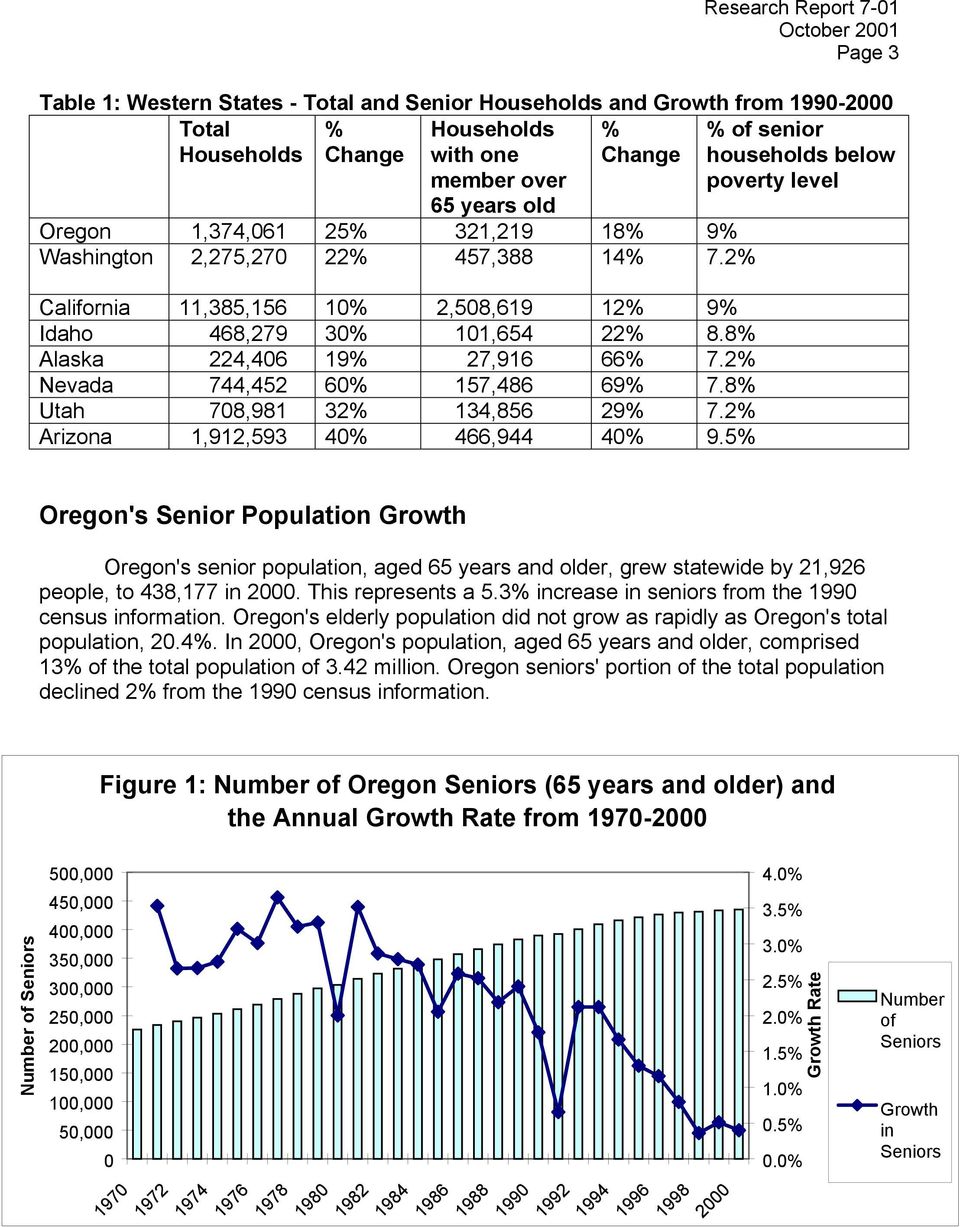
6 Page 4 Figure 1 reveals the number of Oregon seniors (65 years and older) and the growth rate of seniors for the past 30 years from In 2000 the U.S. census estimate of seniors in Oregon is 438,177. Even though the number of Oregon seniors has been growing annually over the past 30 years, the annual growth rate of seniors has been declining steadily since There were only 3 years, 1986, 1989 and 1992, which had an increase in the annual growth rate in the senior population over the prior year. Over the past 30 years, the annual growth rate has significantly declined from a high annual rate of 3.5% in 1982 to.5% in The annual growth rate of.5% is the lowest percentage in thirty years and the growth rate has remained at approximately.5% since Figure 2 breaks the senior population into five age categories: 65-69, 70-74, 75-79, and 85+. This graph illustrates the trends in the age groups over the last ten years as well as the Oregon Department of Administrative Services -Office of Economic Analysis September 2001 forecast of Oregon's population out to year In 2000, 26% of all Oregon seniors were between the ages of 65 and 69. This age category had the largest number of seniors but over the past ten years ( ), this category of seniors has declined 8%, from 122,529 in 1990 to 112,307 in Between , the fastest growing group of seniors is the oldest seniors, aged 85 years and older, with a ten-year growth rate of 51%. Combining the two oldest groups of seniors, those over 80 years old, reveals a growth rate of 40% from for those seniors. The overall growth in seniors of 5.3% is spurred by the rapid rise in the most elderly population in Figure 2: Trends in Oregon's Senior Population By Age Groups , , , , , , , , , ,
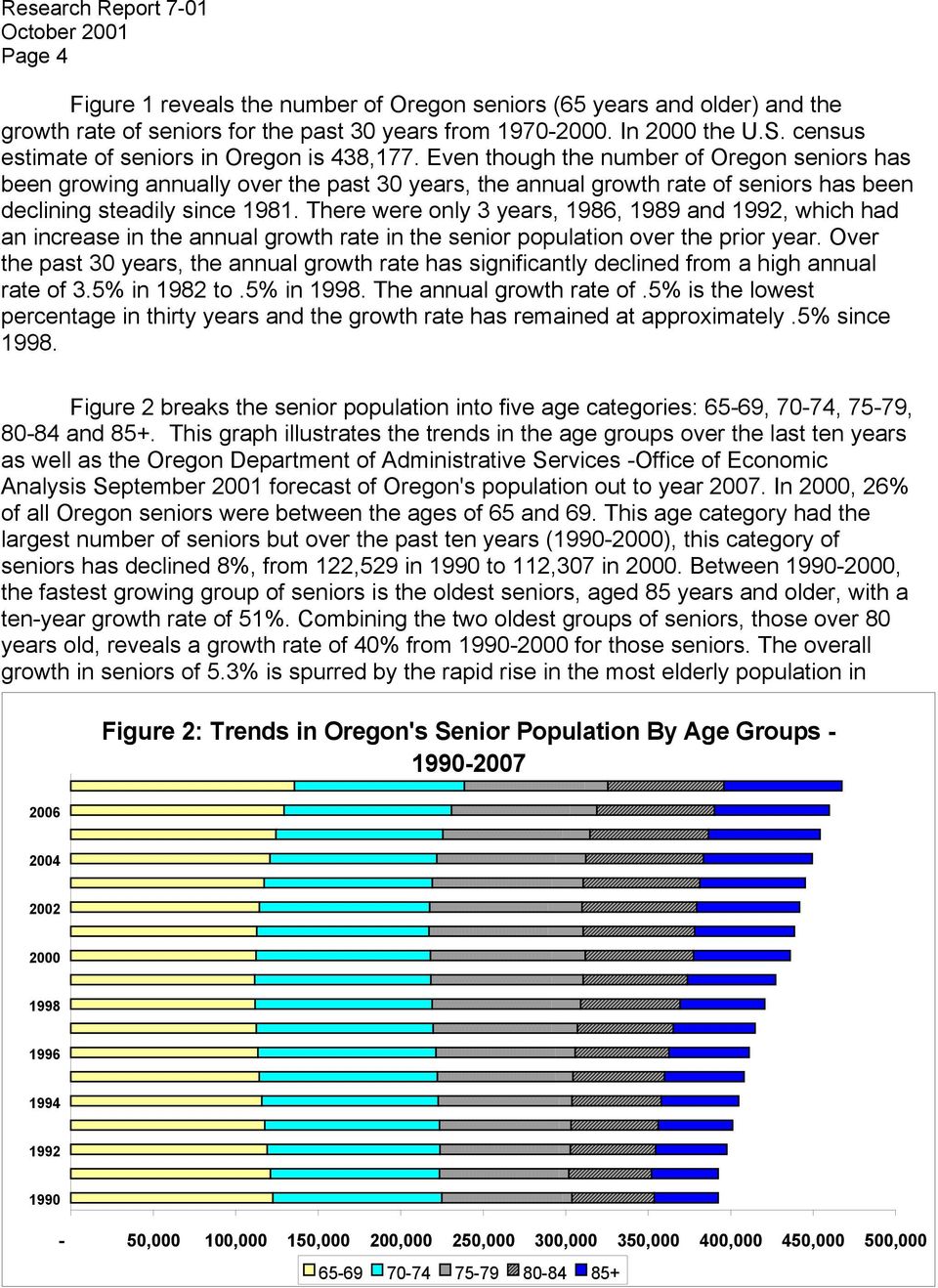
7 Page 5 Oregon. The projections for the next seven years until 2007 reveal that the younger seniors aged will be increasing in the near future. Geographical Population Differences The growth in the senior population in Oregon was fairly consistent throughout the state compared to the growth in total population from Over the ten-year period, between , the total senior population in Oregon grew by 21,926 individuals. The increase in seniors comprised only 4% of the 579,078 additional people that reside in Oregon in 2000 versus ten years ago. In Figure 3, Oregon is divided into 8 regions: Central, Metro, Mid-Columbia, Willamette Valley, North Coast, Northeast, Southeast and Southern. This graph illustrates the average growth rate of the entire population as well as seniors, aged 65 and older, for the eight regions. The average growth rate ranged from 5.8% in the Metro region to 41.2% in the Central region. This range of average growth rates for seniors is similar to the average growth rate range of the total population from The total population growth was between 8.7% in the Southeast and as high as 49.5% in the Central region. For both total and senior populations, the Central region had the highest percentage increases of more than 40%.

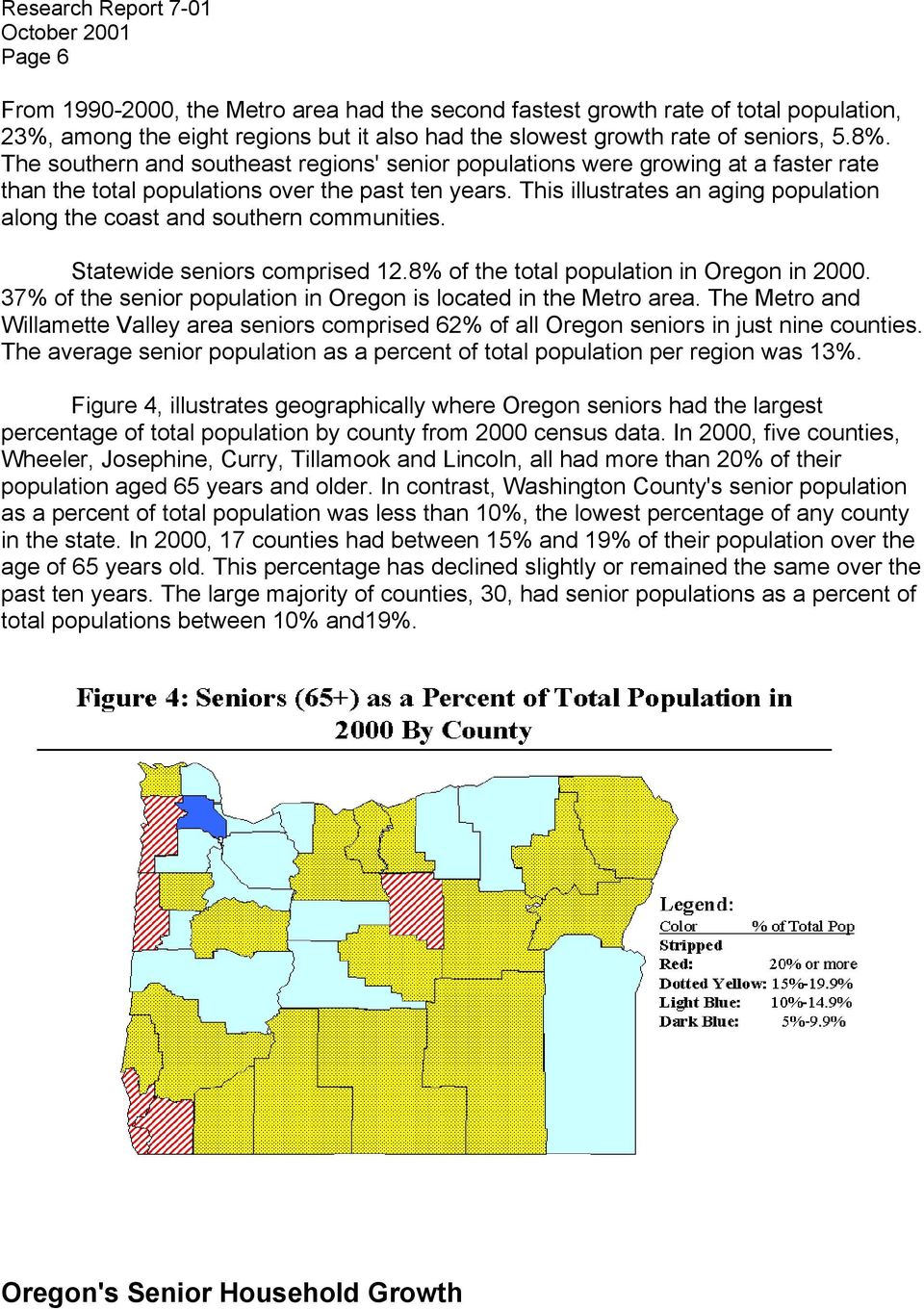
8 Page 6 From , the Metro area had the second fastest growth rate of total population, 23%, among the eight regions but it also had the slowest growth rate of seniors, 5.8%. The southern and southeast regions' senior populations were growing at a faster rate than the total populations over the past ten years. This illustrates an aging population along the coast and southern communities. Statewide seniors comprised 12.8% of the total population in Oregon in % of the senior population in Oregon is located in the Metro area. The Metro and Willamette Valley area seniors comprised 62% of all Oregon seniors in just nine counties. The average senior population as a percent of total population per region was 13%. Figure 4, illustrates geographically where Oregon seniors had the largest percentage of total population by county from 2000 census data. In 2000, five counties, Wheeler, Josephine, Curry, Tillamook and Lincoln, all had more than 20% of their population aged 65 years and older. In contrast, Washington County's senior population as a percent of total population was less than 10%, the lowest percentage of any county in the state. In 2000, 17 counties had between 15% and 19% of their population over the age of 65 years old. This percentage has declined slightly or remained the same over the past ten years. The large majority of counties, 30, had senior populations as a percent of total populations between 10% and19%. Oregon's Senior Household Growth
9 Page 7 In addition to population data, the census survey provides a new estimate, every ten years, of the number of housing units or households in Oregon. Household information is very useful in analyzing tax policies pertaining to different age and income groups. In particular, the census data on households is divided into occupied housing units according to housing tenure, owners versus renters. This is particularly helpful in addressing tax policies specifically targeted at homeowners or renters. In 2000, Oregon's senior population totaled 438,177. The number of households, with at least one member over the age of 65 years old, was 321,219. A small portion of these households, with senior members, is headed by individuals under the age of 65. According to the 2000 census data, there were 278,295 households headed by seniors, who either owned a home, 218,183 (78%), or paid rent for housing, 60,112 (22%). Figure 5 illustrates the number of senior households separated into homeowners and renters by regions. Most Oregon seniors, aged 65 years and older, are homeowners rather than renters. The percent of seniors, who are homeowners, ranged from 75-85% of total senior population, depending on the region of the state. Both senior renters and homeowners grew at similar rates between 1990 and Statewide, senior renters

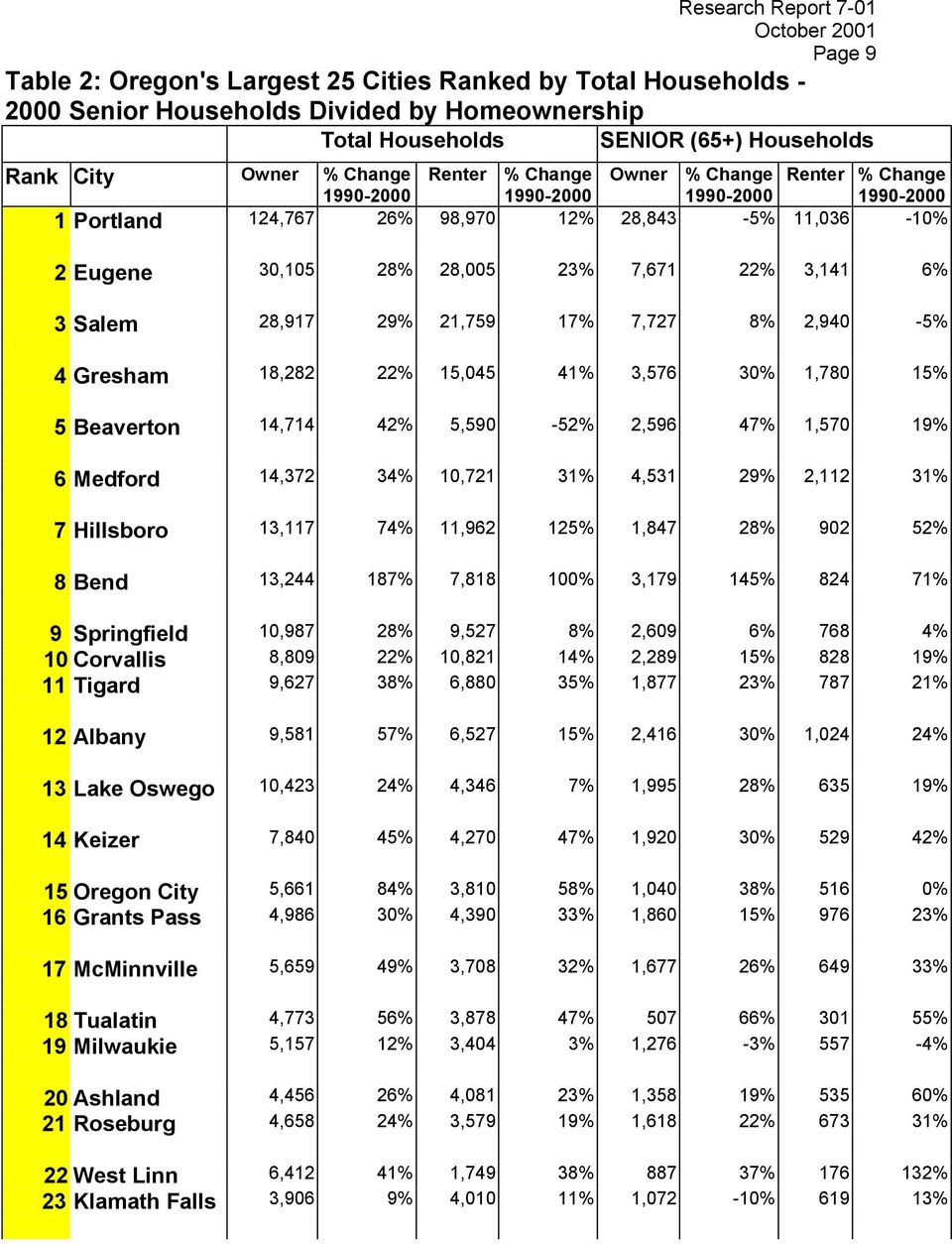
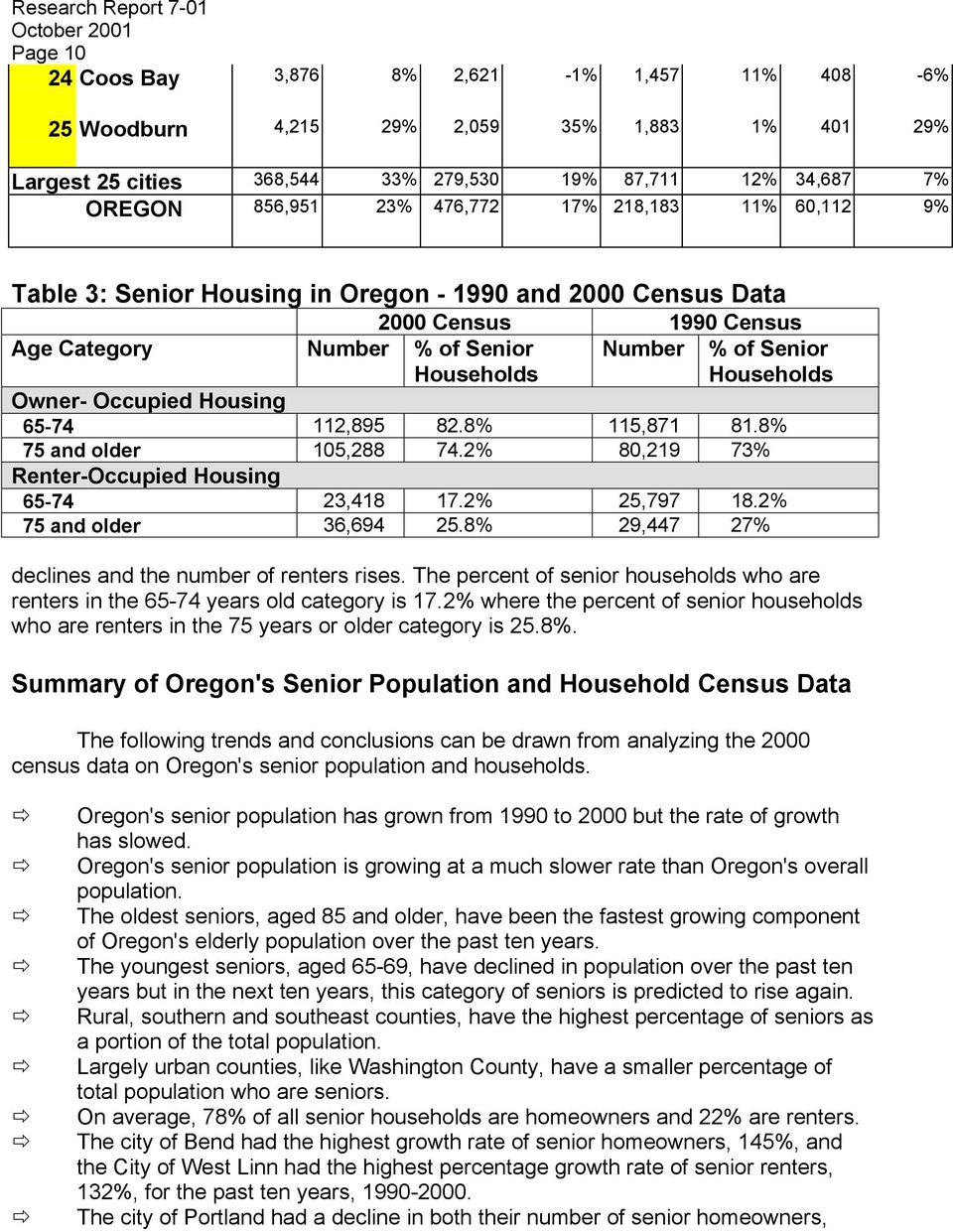
10 Page 8 increased by 9% and senior homeowners by 11%. Senior homeowners comprised 24% of all homeowners and 12% of all renters in Table 2 highlights the number of senior households for the largest 25 cities in Oregon ranked by the number of total households in The 25 largest cities in Oregon comprised 40% of the 218,183 senior homeowners and 58% of the 60,112 rental housing occupied by Oregon seniors in On average, 71% of the seniors, in the 25 largest cities, are homeowners versus 29% who are renters. This is similar to all Oregon senior households where homeowners make up 78% of the households and 22% are renters. Seniors have a higher homeownership rate than other age group in the state. On average in 2000, only 64% of Oregon households were homeowners versus 36% who were renters. Between 1990 and 2000, urban households in Oregon's 25 largest cities grew by 37%. This was faster than Oregon's total household growth of 26%. In 2000, Portland had 28,843 senior homeowners, a decline of 5% over the past 10 years. Portland also had a decline in senior renters of -10%. Besides Portland, Milwaukee was the only other Oregon city, with both a decline in senior renters and homeowners, while the number of all household owners and renters grew over the past ten years. Klamath Falls was the only other city with a decline in senior homeowners of -10%. Two other Oregon cities, Salem and Coos Bay, each had a fall in the number of senior renters from Bend had the largest percentage increase in senior homeowners, 145%, of any Oregon city. The city of Bend also had more than a 100% increase in both its total homeowners and renters. West Linn had the highest percentage growth in senior renters (132%). Eugene had the largest overall increase in seniors, 1,688 people over the past ten years. Medford had the largest increase in the number of senior renters, 655. Three cities, Beaverton, Lake Oswego and Tualatin, each had higher growth rates of senior renters and homeowners than the growth rate for all aged households over the past ten years. Coos Bay also has an aging homeowner population as the growth rate for senior homeowners was higher than the growth rate for all homeowners. Furthermore, cities like Albany, McMinnville, Ashland, Roseburg, West Linn, and Klamath Falls each had aging renter populations over the past ten years because the growth rate of senior renters is higher than the growth rate of all renters in the city. All other cities had a growth rate in the senior owners and renters, which was less than the growth rate of the total population. Table 3 illustrates the number of senior households in Oregon aged years old and those households with seniors aged 75 years or older for both the 1990 and 2000 census. The percent of senior households who are homeowners in the years old category are 82.8% in 2000 and 81.8% in The percent of senior households who are homeowners in the 75 years or older category are 74.2% in 2000 and 73% in There has been very little change in the percent of elderly households over the last ten years. The census data reveals that as seniors get older, the number of homeowners

11 Page 9 Table 2: Oregon's Largest 25 Cities Ranked by Total Households Senior Households Divided by Homeownership Total Households SENIOR (65+) Households Rank City Owner % Change Renter % Change Owner % Change Renter % Change Portland 124,767 26% 98,970 12% 28,843-5% 11,036-10% 2 Eugene 30,105 28% 28,005 23% 7,671 22% 3,141 6% 3 Salem 28,917 29% 21,759 17% 7,727 8% 2,940-5% 4 Gresham 18,282 22% 15,045 41% 3,576 30% 1,780 15% 5 Beaverton 14,714 42% 5,590-52% 2,596 47% 1,570 19% 6 Medford 14,372 34% 10,721 31% 4,531 29% 2,112 31% 7 Hillsboro 13,117 74% 11, % 1,847 28% % 8 Bend 13, % 7, % 3, % % 9 Springfield 10,987 28% 9,527 8% 2,609 6% 768 4% 10 Corvallis 8,809 22% 10,821 14% 2,289 15% % 11 Tigard 9,627 38% 6,880 35% 1,877 23% % 12 Albany 9,581 57% 6,527 15% 2,416 30% 1,024 24% 13 Lake Oswego 10,423 24% 4,346 7% 1,995 28% % 14 Keizer 7,840 45% 4,270 47% 1,920 30% % 15 Oregon City 5,661 84% 3,810 58% 1,040 38% 516 0% 16 Grants Pass 4,986 30% 4,390 33% 1,860 15% % 17 McMinnville 5,659 49% 3,708 32% 1,677 26% % 18 Tualatin 4,773 56% 3,878 47% % % 19 Milwaukie 5,157 12% 3,404 3% 1,276-3% 557-4% 20 Ashland 4,456 26% 4,081 23% 1,358 19% % 21 Roseburg 4,658 24% 3,579 19% 1,618 22% % 22 West Linn 6,412 41% 1,749 38% % % 23 Klamath Falls 3,906 9% 4,010 11% 1,072-10% %
12 Page Coos Bay 3,876 8% 2,621-1% 1,457 11% 408-6% 25 Woodburn 4,215 29% 2,059 35% 1,883 1% % Largest 25 cities 368,544 33% 279,530 19% 87,711 12% 34,687 7% OREGON 856,951 23% 476,772 17% 218,183 11% 60,112 9% Table 3: Senior Housing in Oregon and 2000 Census Data 2000 Census 1990 Census Age Category Number % of Senior Households Number % of Senior Households Owner- Occupied Housing , % 115, % 75 and older 105, % 80,219 73% Renter-Occupied Housing , % 25, % 75 and older 36, % 29,447 27% declines and the number of renters rises. The percent of senior households who are renters in the years old category is 17.2% where the percent of senior households who are renters in the 75 years or older category is 25.8%. Summary of Oregon's Senior Population and Household Census Data The following trends and conclusions can be drawn from analyzing the 2000 census data on Oregon's senior population and households. Oregon's senior population has grown from 1990 to 2000 but the rate of growth has slowed. Oregon's senior population is growing at a much slower rate than Oregon's overall population. The oldest seniors, aged 85 and older, have been the fastest growing component of Oregon's elderly population over the past ten years. The youngest seniors, aged 65-69, have declined in population over the past ten years but in the next ten years, this category of seniors is predicted to rise again. Rural, southern and southeast counties, have the highest percentage of seniors as a portion of the total population. Largely urban counties, like Washington County, have a smaller percentage of total population who are seniors. On average, 78% of all senior households are homeowners and 22% are renters. The city of Bend had the highest growth rate of senior homeowners, 145%, and the City of West Linn had the highest percentage growth rate of senior renters, 132%, for the past ten years, The city of Portland had a decline in both their number of senior homeowners,
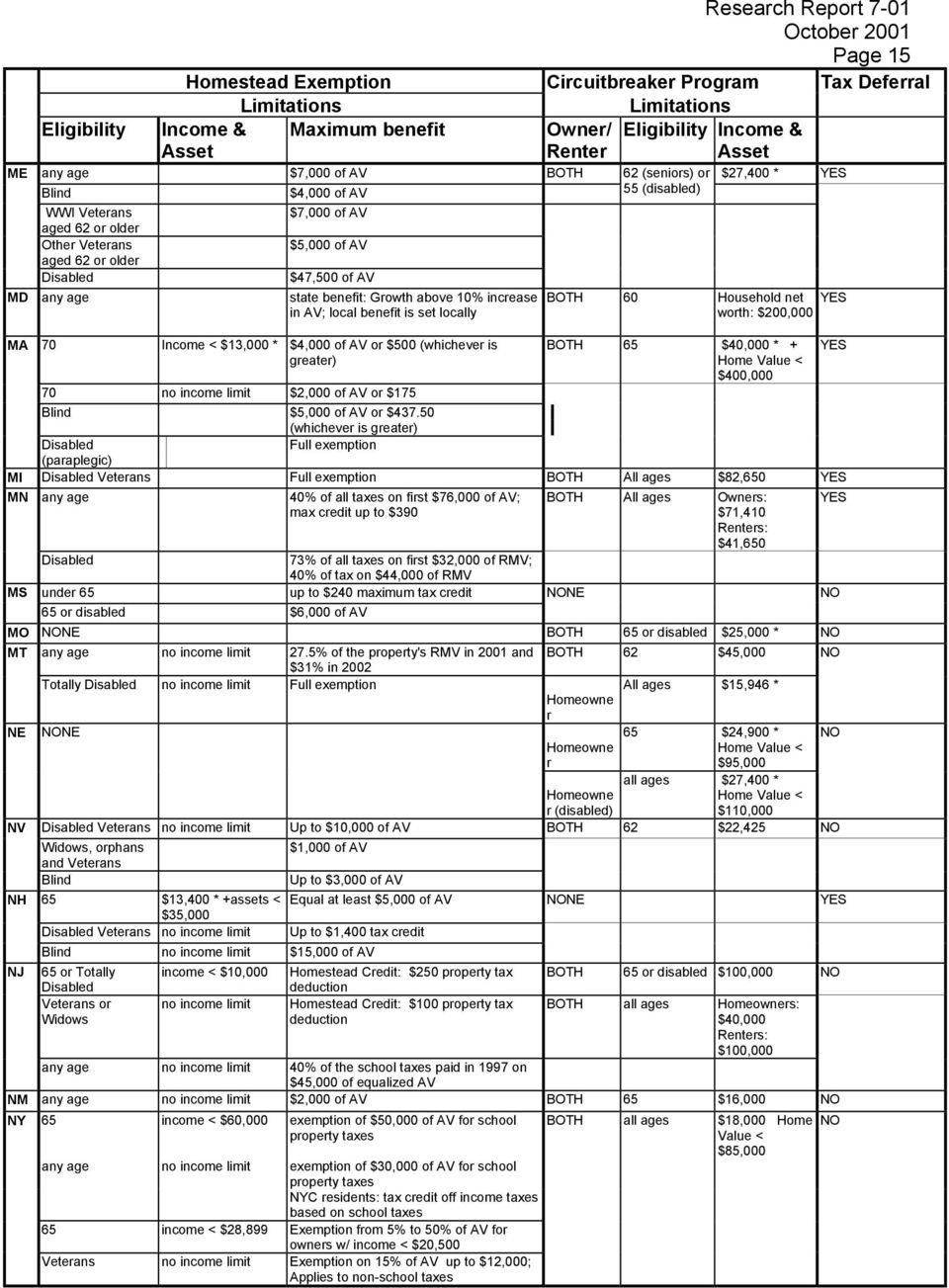
13 Research Report 7-01 Page 11-5%, and renters, -10%, over the past ten years. As seniors grow older, a larger portion of them sell their homes and become renters. Elderly Property Tax Relief Programs As senior households grow, the demand for property tax relief for seniors increases as well. U.S. states have used a variety of methods to assist seniors with property tax relief. Property tax relief policies can be placed into three categories: homestead exemption or reduction in local property taxes paid, state financed tax credits or deductions for property taxes paid on a home and property tax deferral programs. U.S. States' Senior Property Tax Relief Programs The information for U.S. states' property tax relief programs is from the 2000 AARP publication titled, "The State Economic, Demographic & Fiscal Handbook 2000." The author conducted a survey of 51 states to collect information on property tax relief programs. There are three categories of programs: homestead programs, circuitbreaker and tax deferral programs. Homestead property tax relief programs are reductions in the amount of assessed value subject to taxation. They also take the form of homestead credits, which are tax credits for the property taxes owed. Homestead programs do not benefit renters. In contrast, circuitbreaker programs are state financed tax credits that can assist either renters or homeowners or both. Often, the programs benefits depend on a participant s household income. In most cases, the circuitbreaker programs are targeted at the low- and moderate-income homeowners and/or renters. Typically, there will be an income threshold that program participants must meet to qualify for a partial or complete property tax rebate. Property tax deferral programs allow elderly and disabled homeowners the opportunity to defer tax payments on all or part of their property taxes until the sale of the property or death. Homestead Programs In 2000, 45 states (88.2% of surveyed states) had some type of homestead property tax exemption. This is the most common form of property tax relief for homeowners among U.S. states. 11 states had a limited homestead exemption program due to the fact that the program was targeted at specific groups of residents like war veterans or the disabled population. Oregon is one of those states with a limited homestead exemption program, which provides partial property tax relief to disabled war veterans and surviving spouses of war veterans. Oregon s limited homestead partial tax exemption is state mandated but not funded by the state. The loss in property tax revenue is not backfilled by state funds.

14 Page 12 Typically a state, with a homestead program, establishes a maximum program benefit. In many states the maximum benefit is a percent of the assessed value of the home that is exempt. 18 states also had an income or asset limitation, which restricted the homestead program. Generally, the maximum benefit is higher for low-income participants. Other states' homestead exempt value benefit increases for seniors, veterans and disabled homeowners. Hawaii has a higher homestead exempt amount of the assessed value as seniors grow older. Other states like, Kansas, Delaware and Arizona, exempt the school property taxes only. The six states, which do not have a homestead exemption, are the following: Arkansas, Colorado, Missouri, Nebraska, North Dakota and Washington. Each of these states have a state financed circuitbreaker program. A few states have both a circuitbreaker and deferral program. Of all states, which had a homestead tax relief program, 31 states also had a circuitbreaker program in Circuitbreaker Programs In 2000, 36 states, (71%) had a circuitbreaker program. The state funded tax credit or refund payment is available to homeowners and renters in 27 states. 8 states provided a tax credit for homeowners only. Oregon is the only state to provide tax refund payments for senior renters only. All other states, with circuitbreaker programs, designed the policies to provide some property tax relief to homeowners. All states have established a maximum income or asset threshold that individuals qualifying for the tax relief program must meet. In combination with the income requirement, 6 states also imposed a home value, asset or household net worth test for eligibility in the tax credit program. States traditionally establish a maximum benefit for a tax credit program. Oregon's circuitbreaker type program is the Elderly Rental Assistance Program. This program has a maximum household income limit of $10,000 per year that senior renters must meet in order to qualify. Out of the 37 states with circuitbreaker programs, only 3 states, Arizona, South Dakota and West Virginia, have a maximum household income limit below $10,000 in The remaining states, with circuitbreaker programs, have the same or higher household income limits than Oregon's Elderly Rental Assistance Program. Tax Deferral Programs In 2000, a property tax deferral program existed in 24 states, (47% of surveyed states). Most tax deferral programs are restricted to seniors and disabled individuals. Only two states, Florida and Pennsylvania, as well as Washington DC have deferral programs for all state homeowners who meet the other program requirements. All but six states with tax deferral programs have a household income limit or a restriction on the amount of property tax as a percent of income to qualify for the program. Some states

15 Page 13 restrict the total amount of tax a program participant can defer each year. Florida allows seniors to defer property taxes in excess of 3% of household income. In all 24 states with a tax deferral program, each state also had either a circuitbreaker or homestead program or both. 18 states, 75% of the 24 states with deferral programs, also had both circuitbreaker and homestead programs. 3 states had a homestead exemption and tax deferral program and 3 states had a circuitbreaker and tax deferral program. In summary, Oregon has a limited homestead program, targeted at disabled war veterans and surviving spouses of war veterans, a circuitbreaker program for renters only and a property tax deferral program for seniors. Most all other U.S. states, besides

16 Page 14 Table 4: U.S. States Property Tax Relief Programs in 2000 Eligibility Homestead Exemption or Credit Circuitbreaker Program Tax Deferral Limitations Limitations Income & Maximum benefit Owner/ Eligibility Income Asset Renter & Asset AL 65 state AGI < $12,000 $5,000 AV on local taxes + all state taxes NONE NO any age federal AGI < $7,500 Full exemption on local + state taxes AK any age local option exemption up to $10,000 of AV NONE NO 65 or disabled $150,000 of AV veteran + spouse AZ any age 35% of school taxes for operating costs up to $500 BOTH 65 $3,750 * YES AR NONE Homeowner 62 $30,000 NO CA any age $7,000 of AV BOTH 62 $33,993 YES Disabled Veteran no income limit $40,000 of AV Renter $26,573 * Disabled Veteran Income < $24,000 $60,000 of AV Totally Disabled $100,000 of AV Veterans Totally Disabled Income < $24,000 $150,000 of AV Veterans CO NONE BOTH 58 $11,000 * YES CT 65 or totally disabled local option property tax relief BOTH 65 $23,900 * NO DE 65 Up to 50% tax credit or $500 for school taxes NONE NO DC 65 Income < $100,000 $30,000 of AV + 50% reduction of taxes BOTH All ages $20,000 YES FL any age $25,000 of AV NONE YES Disabled $25,500 of AV Totally Disabled Income < $17,334 Full exemption Totally Disabled no income limit Full exemption Veterans GA any age $2,000 AV + tax credit for property taxes on $4,000 of NONE YES AV 65 Income < $10,000 $4,000 of AV 62 Income < $10,000 $10,000 of AV 62 $43,000 of AV HI under 55 $40,000 of AV Homeowner 55 $20,000 NO $60,000 of AV $80,000 of AV $100,000 of AV 70+ $120,000 of AV Disabled $25,000 of AV to full exemption Disabled Veterans Full exemption ID any age $50,000 of AV or 50% of AV for improvements (lesser) Homeowner 65 $19,570 NO IL any age Up to $45,000 of cash value for improvements for 4 BOTH 65 $21,218 * YES years; Up to $4,500 equalized AV based on increases since Additional $2,000 or $2,500 equalized AV Disabled Veterans Up to $58,000 of AV on homes purchased w/ federal funds IN any age 10% of tax + deduction of $2,000 of AV or 50% of total NONE NO AV (lesser) 65 Income < $25,000 + $2,000 of AV or 50% of AV Assets < $23,000 Disabled or Blind Income < $17,000 $2,000 of AV or 50% of AV IA any age $4,850 of AV BOTH 65 $16,665 NO Disabled Veterans Income < $25,000 Full exemption KS any age $20,000 of AV for school property taxes only BOTH 55 $25,000 NO KT 65 $25,400 of AV NONE NO LA any age $7,500 of AV NONE NO

17 Eligibility Research Report 7-01 Page 15 Homestead Exemption Circuitbreaker Program Tax Deferral Limitations Limitations Income & Maximum benefit Owner/ Eligibility Income & Asset Renter Asset ME any age $7,000 of AV BOTH 62 (seniors) or $27,400 * YES Blind $4,000 of AV 55 (disabled) WWI Veterans $7,000 of AV aged 62 or older Other Veterans $5,000 of AV aged 62 or older Disabled $47,500 of AV MD any age state benefit: Growth above 10% increase in AV; local benefit is set locally MA 70 Income < $13,000 * $4,000 of AV or $500 (whichever is greater) BOTH 60 Household net YES worth: $200,000 BOTH 65 $40,000 * + Home Value < $400, no income limit $2,000 of AV or $175 Blind $5,000 of AV or $ (whichever is greater) Disabled Full exemption (paraplegic) MI Disabled Veterans Full exemption BOTH All ages $82,650 YES MN any age 40% of all taxes on first $76,000 of AV; BOTH All ages Owners: YES max credit up to $390 $71,410 Renters: $41,650 Disabled 73% of all taxes on first $32,000 of RMV; 40% of tax on $44,000 of RMV MS under 65 up to $240 maximum tax credit NONE NO 65 or disabled $6,000 of AV MO NONE BOTH 65 or disabled $25,000 * NO MT any age no income limit 27.5% of the property's RMV in 2001 and $31% in 2002 BOTH 62 $45,000 NO NE Totally Disabled no income limit Full exemption NONE Homeowne r Homeowne r All ages $15,946 * 65 $24,900 * Home Value < $95,000 all ages $27,400 * Home Value < $110,000 Homeowne r (disabled) NV Disabled Veterans no income limit Up to $10,000 of AV BOTH 62 $22,425 NO Widows, orphans $1,000 of AV and Veterans Blind Up to $3,000 of AV NH 65 $13,400 * +assets < Equal at least $5,000 of AV NONE YES $35,000 Disabled Veterans no income limit Up to $1,400 tax credit Blind no income limit $15,000 of AV NJ 65 or Totally income < $10,000 Homestead Credit: $250 property tax BOTH 65 or disabled $100,000 NO Disabled deduction Veterans or no income limit Homestead Credit: $100 property tax Widows deduction BOTH all ages Homeowners: $40,000 Renters: $100,000 any age no income limit 40% of the school taxes paid in 1997 on $45,000 of equalized AV NM any age no income limit $2,000 of AV BOTH 65 $16,000 NO NY 65 income < $60,000 exemption of $50,000 of AV for school property taxes any age no income limit exemption of $30,000 of AV for school property taxes NYC residents: tax credit off income taxes based on school taxes 65 income < $28,899 Exemption from 5% to 50% of AV for owners w/ income < $20,500 Veterans no income limit Exemption on 15% of AV up to $12,000; Applies to non-school taxes BOTH all ages $18,000 Home Value < $85,000 YES NO NO
18 Page 16 Eligibility Homestead Exemption Circuitbreaker Program Tax Deferra l Limitations Income & Maximum benefit Asset Owner/ Renter Limitations Eligibility Income & Asset NC 65 or disabled income < $15,000 Exempt on first $20,000 of AV NONE NO Disabled Veterans Exempt for $38,000 of AV ND NONE BOTH 65 $14,000 + YES Assets < $50,000 OH any age no income limit 12.5% of property taxes Homeowner 65 $23,300 NO OK any age no income limit $1,000 of AV Homeowner 65 $12,000 NO any age income < $20,000 $2,000 of AV OR disabled war veteran $8,778 * $9,013 of AV * Renters 58 $10,000 YES service connected disabled $8,778 * $12,020 of AV * veteran PA any age local option - exempt up to 50% of BOTH 65 or disabled $15,000 YES service connected disabled veteran median AV for school taxes Full exemption or 50 & (surviving spouse) RI Veterans $1,000 of AV BOTH 65 or $30,000 NO Blind $18,000 of AV disabled SC any age no income limit $100,000 RMV for school operating NONE NO taxes only Disabled or Blind $50,000 of RMV Disabled Veterans or Paraplegics no income limit Full exemption + value of one acre of land SD Paraplegics no income limit Full exemption BOTH 65 or disabled $9,500 * YES $12,500 ** Homeowner 65 or disabled $5,758 * TN 65 or disabled income < $11,510 Tax credit: based on the first $18,000 NONE YES of RMV or max AV of $4,500 TX any age no income limit $15,000 of AV for school taxes and NONE YES $3,000 for county taxes 65 or disabled no income limit $25,000 of AV for school taxes and $3,000 for local taxes + option up to 20% of AV UT Disabled Veteran no income limit Up to $82,500 of AV BOTH 65 or $22,422 YES Blind no income limit Up to $11,500 of AV Widowed Indigent hardship income < $22,422 local option: up to 50% of tax, up to $598 VT Disabled Veterans no income limit $10,000 of AV BOTH all ages $47,000 NO Homeowner all ages $88,000 VA 65 or disabled income < $30,000 Full exemption NONE YES and net worth < $100, or disabled income < $52,000 and net worth < Exemption from certain cities and counties' taxes $195,000 WA NONE Homeowner 61 or disabled $30,000 YES WV 65 or disabled no income limit $20,000 of AV BOTH 65 $5,000 NO WI any age no income limit - both homeowners & renters $300 tax credit on income taxes BOTH all ages $24,500 YES WY Veterans no income limit $2,000 of AV Homeowner all ages 180% of federal poverty level Disabled Veterans no income limit $4,000 of AV NOTE: * single ** married Source: "The State Economic, Demographic, & Fiscal Handbook 2000" by David Baer YES

19 Page 17 Oregon, have some type of property tax relief program (homestead exemption or circuitbreaker) for senior homeowners rather than or in addition to a property tax deferral program. In contrast to Oregon, most states have a property tax relief program targeted at senior homeowners. Historical and Recent Trends to Oregon's Tax Relief Programs Between 1973 and 1991, Oregon had a homestead and renters relief program. Currently in Oregon, there are two primary programs targeted at low-income seniors: the property tax deferral program and the Elderly Rental Assistance program. In addition, state and local governments fund property tax exemptions for certain homes and housing complexes, which serve Oregon seniors. This report highlights the state funded property tax exemption for non-profit homes for the elderly. Senior Property Tax Deferral Program Oregon began the first property tax deferral program in the U.S. in 1963 for Oregon's elderly. Homeowners, age 62 or older, can defer payment on their property taxes until the owner dies or sells the property. The state pays the property tax and places a lien on the property for the tax and accrues simple interest at 6% per year. From 1963 until 1983, the property tax deferral program did not have a maximum income limit. Since 1984, the program has targeted low-income seniors. Each senior's household income must be less than an initial household income threshold in the year prior to applying. Then, once the senior qualifies for the tax deferral program, a taxpayer may defer taxes in years when the household's federally adjusted gross income, in the prior year, is less than a maximum income threshold. These income thresholds for the program will both be $32,000 beginning and indexed to annual changes in inflation. Once a senior qualifies for the tax deferral program, the senior chooses annually whether to defer his/her taxes. The property tax deferral program was also expanded to include the disabled population beginning tax year There is not an age requirement for disabled individuals. Oregon's senior property tax deferral program had a rising number of participants in the program each year from until , see Table 5. The number of seniors participating in the tax deferral program is dependent on two major factors the amount of property taxes each senior must pay and the interest rates in the U.S. As interest rates in the U.S. and property taxes in Oregon rose from , so did the number of participants in the tax deferral program. Finally, in , the number of seniors deferring their property taxes hit a high of 13,165 participants and an average property tax deferral amount of $1,513 per senior. At the end of 1990, Oregon voters, to provide statewide property tax relief, approved Measure 5. Every tax year since then, with the exception of tax year , the number of seniors participating in the senior deferral program has declined. For the past ten years between 1990 and 2000, the number of seniors participating in the deferral program has declined by 4,154 seniors,

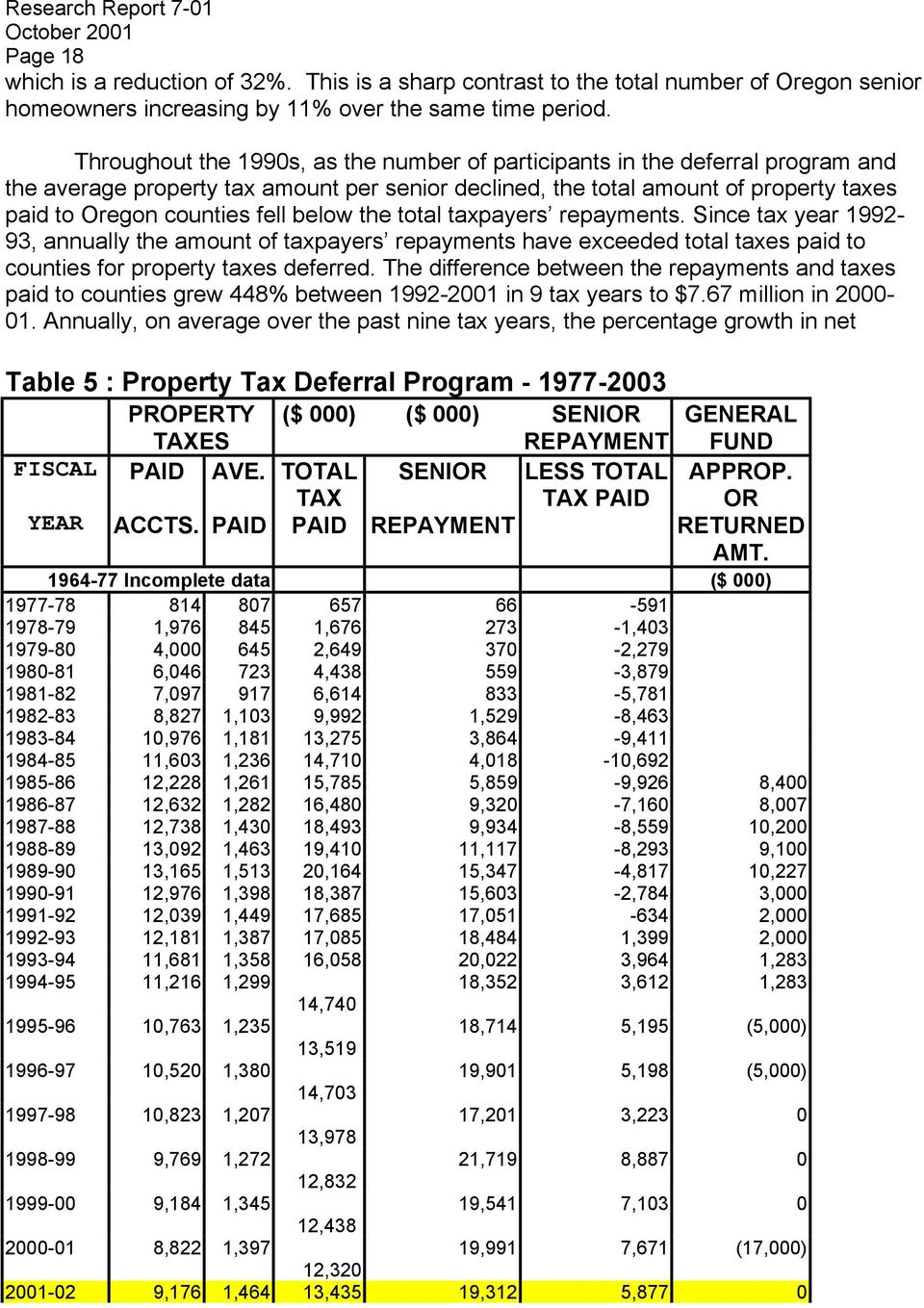
20 Page 18 which is a reduction of 32%. This is a sharp contrast to the total number of Oregon senior homeowners increasing by 11% over the same time period. Throughout the 1990s, as the number of participants in the deferral program and the average property tax amount per senior declined, the total amount of property taxes paid to Oregon counties fell below the total taxpayers repayments. Since tax year , annually the amount of taxpayers repayments have exceeded total taxes paid to counties for property taxes deferred. The difference between the repayments and taxes paid to counties grew 448% between in 9 tax years to $7.67 million in Annually, on average over the past nine tax years, the percentage growth in net Table 5 : Property Tax Deferral Program PROPERTY TAXES ($ 000) ($ 000) SENIOR REPAYMENT GENERAL FUND FISCAL PAID AVE. TOTAL TAX SENIOR LESS TOTAL TAX PAID APPROP. OR YEAR ACCTS. PAID PAID REPAYMENT RETURNED AMT Incomplete data ($ 000) , , , , , , , , , , , , ,827 1,103 9,992 1,529-8, ,976 1,181 13,275 3,864-9, ,603 1,236 14,710 4,018-10, ,228 1,261 15,785 5,859-9,926 8, ,632 1,282 16,480 9,320-7,160 8, ,738 1,430 18,493 9,934-8,559 10, ,092 1,463 19,410 11,117-8,293 9, ,165 1,513 20,164 15,347-4,817 10, ,976 1,398 18,387 15,603-2,784 3, ,039 1,449 17,685 17, , ,181 1,387 17,085 18,484 1,399 2, ,681 1,358 16,058 20,022 3,964 1, ,216 1,299 18,352 3,612 1,283 14, ,763 1,235 18,714 5,195 (5,000) 13, ,520 1,380 19,901 5,198 (5,000) 14, ,823 1,207 17,201 3, , ,769 1,272 21,719 8, , ,184 1,345 19,541 7, , ,822 1,397 19,991 7,671 (17,000) 12, ,176 1,464 13,435 19,312 5,877 0
21 Page ,600 1,535 14,737 19,300 4, ,700 1,597 15,486 19,479 3, ,800 1,660 16,272 19,750 3,478 0 NOTE: Shaded area represents the Department of Revenue forecasts revenue from the tax deferral program has been 56%. The Department of Revenue costs to administer the program are approximately $1.2 million per year. Since , the tax deferral program has not needed a general fund appropriation. In fact in recent years, the Department of Revenue has returned a portion of the tax deferral program's revolving fund to the state general fund. In 2001, the Department of Revenue provided $17 million to the general fund from the property tax deferral program revolving account. As of July 2001, the revolving fund account for the property tax deferral program had $34 million. The Department of Revenue forecasts the difference between total tax repayments and taxes to counties from the deferral program to be $10.4 million in the biennium and $7.4 million in the biennium. Seniors, living in the Portland Metro area, make up a large portion of the senior deferral program participants. Senior deferral program participants in Multnomah County alone represent 26% of all deferral program participants. All Portland Metro area seniors, those in Multnomah, Clackamas and Washington counties, comprise 42% of all deferral program participants in One of the main reasons for this higher participation in the Portland Metro area is because homes have higher assessed values and higher property taxes than other areas of the state. Table 6 illustrates the total number of senior deferral program participants by county compared to the total number of senior homeowners in The number of seniors deferring their property taxes was only 4% of all senior homeowners statewide. The percent of all senior homeowners deferring their property taxes ranged from 1% to 7%. Sherman, Lake and Grant, were the only counties with 1% of their senior homeowners participating in the tax deferral program. Multnomah County had the highest percentage of senior homeowners, 7%, participating in the tax deferral program of any Oregon county. Homeowners and Renters Refund Program (HARRP) Oregon's first property tax reduction program was the Homeowners and Renters Refund Program (HARRP), created in 1973, to provide property tax relief to low- and middle-income Oregonians. It was designed to help all low-income homeowners. The program refunded property taxes paid up to a maximum for each income group. Initially in 1973, HARRP refunds were restricted to Oregon households with an annual household income below $15,000. This limit was raised two times: to $16,000 in 1977 and $17,500 in Between 1980 and 1989, the average total HARRP refunds paid out annually was $67.7 million and the average number of HARRP returns were 327,802 per year. In 1989, an asset test was added to the program for participants under the age of 65 years old. A HARRP participant's household assets could not exceed $25,000 unless the owner was over the age of 65 years old. In 1990, the household income limit on the HARRP program was later decreased to $10,000 and the maximum refund schedule was decreased. The HARRP property tax relief program was eliminated in 1991 due to
22 Page 20 growing concerns about the cost of the program and the need for the assistance program once Measure 5, property tax limitation measure, went into effect beginning
23 Page 21 TABLE 6: Oregon Senior Owners and Renters - Participants in the Tax Deferral and Elderly Rental Assistance Programs In Senior Owners Property Tax Deferral Participants Deferral Participants as % of all Owners 2000 Senior Renters Elderly Rental Assistance ERA as % of all senior Renters Baker 36 2% % 1,684 Benton 116 3% % 4,009 Clackamas 716 4% 5, % 18,616 Clatsop 112 4% % 2,889 Columbia 105 4% % 2,740 Coos 298 5% 1, % 6,325 Crook 84 5% % 1,560 Curry 85 3% % 3,101 Deschutes 306 4% 1, % 7,956 Douglas 275 3% 1, % 9,381 Gilliam 4 2% 32 * N/A 207 Grant 9 1% 105 * N/A 711 Harney 13 2% % 620 Hood River 25 2% % 1,232 Jackson 500 3% 3, % 14,456 Jefferson 1, % % Josephine 185 2% 1, % 8,054 Klamath 192 4% 1, % 5,021 Lake 10 1% % 698 Lane 777 4% 5, % 21,877 Lincoln 210 5% 1, % 4,636 Linn 368 5% 1, % 7,598 Malheur 34 2% N/A 2,105 Marion 17, % 4, %
24 Page 22 Morrow 9 1% 101 * N/A 638 Multnomah 2,305 7% 12,980 2,496 19% 34,464 Polk 163 4% 1, % 4,283 Sherman 3 1% 28 * N/A 222 Tillamook 82 3% % 2,709 Umatilla 109 2% 1, % 4,415 Union 46 3% % 1,832 Wallowa 13 2% % 724 Wasco 68 3% % 1,993 Washington 745 4% 6, % 18,144 Wheeler 6 3% 36 * N/A 194 Yamhill 4, % 1, % Other (*) 34 OREGON 218,183 8,881 4% 60,112 7,062 12% * represents refunds which did not have a county identified or are from outside Oregon
25 Page 23 Elderly Rental Assistance Program In 1975, the Elderly Rental Assistance (ERA) program was created as an alternative to HARRP for low-income senior renters. When the program was first created, initially an individual had to be at least 58 years old, live in a housing complex that is not property tax exempt and meet the household income limit to qualify for the program. The ERA refund payment equals the rent, fuel and utility expenses, up to $2,100, minus a certain percent of the participant's household income. A senior renter in the ERA program can claim up to 3 prior years of refunds, in addition to the current year. Between 1980 and 1989, ERA returns declined from 4,699 to 1,045 returns. This reduction represents a 75% reduction in ERA participants in nine years. In 1989, the same asset test for HARRP participants was also applied to ERA program participants. If an ERA participant is under age 65, the person's household assets can not exceed $25,000. After the HARRP policy changes in 1989 and 1990, the number of ERA participants increased ten fold to 11,372 returns in This increase was due to former HARRP program senior renters switching to the ERA program. In 1991, while the Legislature ended the HARRP program, it expanded the ERA program to provide better benefits for low-income senior renters. The program's household income limit was raised from $5,000 to $10,000 and the percent of household income was reduced from 40% to 20% to allow for larger ERA refunds. Even with the policy changes in 1991, the number of participants in the ERA program declined during the 1990s. The number of ERA returns dropped from its highest number of participants in 1990 of 11,372 to a low of 7,062 in This corresponds to a loss of 38% of the returns in 10 years. Prior to tax year , the number of ERA returns has stabilized at around 7,300 returns, see Figure 6. A primary reason for the decline in the ERA participants during the 1990s, was that the income threshold had not been increased for more than 10 years. The maximum household income threshold to qualify for the program of $10,000 is significantly below the property tax deferral program initial threshold of $32,000 beginning in The ERA household income threshold is also not indexed to changes in inflation. In addition, a large number of senior renters live in housing complexes or homes, which are already property tax exempt, so those seniors do not qualify for receiving ERA refunds. In 2001, the number of the ERA participants increased 12% from the prior year to 7,900 seniors. The primary reason for the rapid increase in ERA payments is due to a large mailing to seniors, in early 2001, which described the upcoming changes to the ERA program. This outreach to seniors was effective in informing additional low-income senior renters about the ERA assistance program. In tight budget years like , if the ERA and non-profit homes for the elderly programs' appropriation is less than the revenue necessary to pay all program claims, then the claims must be pro rated. This reduces each senior's ERA refund amount. Oregon s Elderly Rental Assistance Program provides seniors with a refund payment instead of deferring property taxes like the tax deferral program. Table 6 reveals
26 Page 24 that the ERA program has a higher participation rate among elderly renters than the property tax deferral program does among senior homeowners. In 2000, there were 7,062 seniors, 12%, receiving ERA payments out of 60,112 renters. Crook County had the highest participation rate in the ERA program, 21% of all senior renters in the county received an ERA payment in Multnomah County also had a large portion of their senior renters, 19%, receiving ERA refunds in In addition to Crook and Multnomah counties, there were nine other counties that had 10% or more of their senior renters participating in the ERA program. State Funded Property Tax Exemption for Homes Serving Seniors Non-Profit Homes for the Elderly (State Funded) This program was enacted in 1977 to assist private non-profit corporations to provide permanent housing, recreation, social facilities and care to elderly persons. The elderly homes must be built or acquired after January 1, 1977 by a private non-profit corporation and receive subsidies under certain federal and state housing programs. The corporation, receiving the property tax exemption, must charge rents that reflect the property tax savings. A claim must be filed with the county assessor for the exemption and the state pays the counties for a complete or partial property tax exemption for qualified homes This property tax exemption for non-profit homes for the elderly indirectly provides relief to seniors through lower monthly rents. Table 7: Number of Non-Profit Homes for Seniors Receiving a Property Tax Exemption Fiscal Year Number of Homes % Growth in Number of Homes Total Payments ($) Average Payment per Home ($) ,892 34, % 648,247 25, % 663,558 23, % 759,609 24, % 746,907 23, % 827,729 24, % 901,428 25, % 1,009,436 26, % 1,077,453 27, % 1,178,012 28,732 NOTE: Shaded area represents the Department of Revenue forecasts During the 1990s, the number of homes qualifying for this exemption has steadily increased. In 1993, there were only 18 elderly homes claiming a property tax exemption. By 2001, the number of homes had grown to 39, see Table 7. This is an increase of 117% over eight years. The average refund per home was $26,564 in In 2001,
27 Page 25 there are 39 homes receiving a property tax exemption spread out throughout Oregon in 17 counties. 10 of these homes are in Multnomah County. 9 counties had just one nonprofit home for the elderly per county Legislative Changes to Property Tax Relief Programs and Projected Costs Elderly Rental Assistance and Non-profit Homes for the Elderly The 2001 legislature passed two bills, SB 425A and HB2208B. Each measure had components changing the administration of the Elderly Rental Assistance (ERA) Program and Non-Profit Homes for the Elderly: A specific filing deadline of July 1 was established for all ERA claims The payment date for ERA participants is moved from October to no later than November 15 th Non-profit homes must file an application with the counties by April 1 The appropriation for the biennium will be split up each year - Allows pro ration of program payments in both years of the biennium if necessary Both ERA program payments and county payments for the property tax exemption of non-profit elderly homes will be subject to pro ration if the appropriation and emergency funds are insufficient to pay all program claims One policy issue, which was not directly addressed during the changes from the 2001 legislative session, was the cost responsibility for any shortfall in revenue from pro rating the county payments for the property tax exemption for non-profit homes for the elderly. It was not clear whether the owners of the non-profit homes for the elderly would be subject to a property tax for the difference between the property taxes assessed on the home versus the prorated payment paid to the counties by the Department of Revenue. According to Legislative Counsel, any pro ration in county payments that occurs does not make the owners of the homes subject to any property tax. If pro ration occurs, local governments, in the areas where the homes are located throughout Oregon, would receive less revenue from the Department of Revenue for the tax exemption. Annually, the Department of Revenue receives a combined biennium appropriation for the administration of the elderly rental assistance program and property tax exemption for non-profit homes for the elderly. Due to the legislative changes in 2001, the Department of Revenue must not only forecast the amount of ERA claims as well as county payments for non-profit homes for the elderly property tax exemption but also split up the biennium appropriation between both tax years. Prior to the biennium, the Department of Revenue appropriation had been sufficient to pay the total payments for both programs. In January 2000, the Department of Revenue requested additional funds from the Emergency Board to supplement the biennium appropriation to continue to pay elderly rental assistance program claims. If the Emergency Board had not provided additional funds in 2000, the Department of Revenue would have had to pro rates the ERA payments for The 2001 legislature appropriated $9 million for
28 Page 26 Payments & Appropriation ($000) 7,000 6,000 # of Current Yr. and Total Refunds 5,000 4,000 3,000 2,000 1,000 0 Figure 6: Elderly Non-Profit Rental Homes Asistance for the Elderly Program: (NPH) Number of Refunds in Current and Prior Years Figure 7: Elderly Rental Assistance (ERA) and 10,000 9,000 8,000 7,000 6,000 5,000 4,000 3,000 2,000 1, Program Payments Exceed Appropriation 1,400 1,200 1, Appropriation Total Program Payments ERA Payments NPH Payments # of Prior Yr. Refunds Total Current Yr Prior Yrs biennium for both property tax relief program payments. The appropriation is $2 million less than the appropriation for these property tax relief programs. In early 2001, a large outreach was made to inform seniors of ERA program changes. That outreach increased the number of seniors participating in the assistance program by 838 refunds in The initial forecast of the ERA claims did not anticipate this participation increase. In examining the trends and making predictions of ERA refunds, it is helpful to split the total refunds into current and prior year refunds, see Figure 6. Typically, the majority of the prior year claims are just for 1 prior year. Between , the trends in the current year and prior refunds are not the same. The current year refunds have declined steadily over this time period. In contrast, the prior year ERA refunds have oscillated up and down every few years. Annually, the prior year refunds have made up between 2-5% of the total refunds from In , total refunds increased by 838 refunds of which 61% of those were prior year claims. In , the number of prior year claims increased significantly as a large number of new senior renters entering the ERA program claimed prior year refunds. In addition, the changes during the 2001 legislature established a distinct annual deadline for ERA claims beginning As a result, the Department of Revenue has already received a large number of ERA claims for prior years that will be paid out in In , prior year claims are predicted to grow by 803 refunds or 157% over the number of prior year claims.
29 Page 27 Currently, the Department of Revenue predicts program payments for ERA claims and non-profit homes for the elderly to exceed the biennium appropriation for by $2.57 million. Without additional funding from the Emergency Board in either 2001 or 25,000 20,000 Figure 8: SENIOR DEFERRAL PROGRAM - Taxes Paid and Repayments from TOTAL TAX PAID SENIOR REPAYMENT 15,000 10,000 5, , both and program payments will have to be pro rated. Division of the biennial appropriation between tax years will determine the amount of proration that will occur each year beginning this fall One approach to dividing the appropriation would be to pay all claims in the first year of the biennium in anticipation that in there might be additional funds that could come from the Emergency Board. The drawback to this approach is that if funds were not provided by the Emergency Board in 2002, the pro ration of refunds would be felt heavily all in one year. Another approach would be to evenly separate the appropriation, 50% in each year. The advantage to this approach would be to spread the pro rated payments over two years but the prorated payments in the second year could be higher, provided the initial projections for program claims are accurate. Another approach would be to divide the appropriation up according to the forecasted program payments in and The advantage of this approach would be that both tax years would have similar pro rated payments, provided the forecast was accurate. The disadvantage is that refunds may be pro rated more than needed in the first year if the actual claims in the are below the forecast. If the current appropriation is split up according to the forecasted program payments, in , 48% of $9 million would be spent on program payments and in , 52% of $9 million would be spent, see Figure 7. In , both program
30 Page 28 payments will be reduced by a total of $1.24 million; $988,000 from ERA payments and $240,000 from county payments for elderly non-profit homes' property tax exemption. The pro rated payments correspond to a reduction of approximately $125 per ERA participant and $6,154 per elderly home refund. The $240,000 reduction in county payments in 2001, due to the pro ration of the property tax exemption for non-profit homes, will result in less revenue for local taxing districts levying property taxes on the elderly homes. In 2002, the Department of Revenue predicts a larger shortfall in revenue, $1.33 million for the estimated program payments. ERA payments will need to be reduced by a total of $1.06 million and county payments will be reduced by $266,000. In both tax years in , the ERA and county payments are expected to be reduced by 22% each year. Property Tax Deferral Program In 2001, the legislature passed HB2208A. It raised the initial household income limit to $32,000 to qualify for the property tax deferral program and indexed the initial household income limit to changes in the U.S. CPI beginning With the 2001 changes, the initial household income and the maximum federally adjusted gross income to remain eligible for the program are both set at $32,000 and indexed annually to changes in the U.S. CPI. In addition, the income limits for the special assessment deferral program were set at $32,000. Now both special assessment and property tax deferral programs have consistent income thresholds for seniors qualify for the programs. Currently in , the senior and disabled tax deferral program has 9,176 participants of which 190 people on the tax deferral program are disabled. As of July 2001, there is a surplus of $33 million in the program s revolving fund account. The Department of Revenue forecasts that taxpayers' repayments will exceed the taxes paid to counties by $5.7 million in and $4.15 million in After accounting for administrative costs each biennium, the net revenues of the senior and disabled property tax deferral program is predicted to grow by $8.6 million in biennium and $4.9 million in biennium. The Department of Revenue's forecasts are based on the assumptions that senior tax deferral participants will grow by 4% in and 4.6% in and 1% per year in the biennium. One challenge in predicting the tax deferral participation of seniors and the disabled population in the near future is balancing the large number of potential seniors and disabled population that could participate in the program with the effects of the interest rate on the participation rate in the program. As interest rates fall and remain below the rate charged in the tax deferral program, (6%), there is less of an incentive to participate in the state's property tax deferral program. In the current biennium, there is not likely to be a significant increase in the number of seniors participating in the deferral but in the long-term as interest rates rise again, there will be more of an incentive to defer property taxes at 6% interest.
2016 Individual Exchange Premiums updated November 4, 2015
 2016 Individual Exchange Premiums updated November 4, 2015 Within the document, you'll find insights across 50 states and DC with available findings (i.e., carrier participation, price leadership, gross
LexisNexis Law Firm Billable Hours Survey Top Line Report. June 11, 2012
 LexisNexis Law Firm Billable Hours Survey Top Line Report June 11, 2012 Executive Summary by Law Firm Size According to the survey, we found that attorneys were not billing all the time they worked. There
INTRODUCTION. Figure 1. Contributions by Source and Year: 2012 2014 (Billions of dollars)
 Annual Survey of Public Pensions: State- and Locally- Administered Defined Benefit Data Summary Report: Economy-Wide Statistics Division Briefs: Public Sector By Phillip Vidal Released July 2015 G14-ASPP-SL
VCF Program Statistics (Represents activity through the end of the day on June 30, 2015)
 VCF Program Statistics (Represents activity through the end of the day on June 30, 2015) As of June 30, 2015, the VCF has made 12,712 eligibility decisions, finding 11,770 claimants eligible for compensation.
Hail-related claims under comprehensive coverage
 Bulletin Vol. 29, No. 3 : April 2012 Hail-related claims under comprehensive coverage Claims for hail damage more than doubled in 2011 compared with the previous three years. Hail claims are primarily
ANTHONY P. CARNEVALE NICOLE SMITH JEFF STROHL
 State-Level Analysis HELP WANTED PROJECTIONS of JOBS and EDUCATION REQUIREMENTS Through 2018 JUNE 2010 ANTHONY P. CARNEVALE NICOLE SMITH JEFF STROHL Contents 1 Introduction 3 U.S. Maps: Educational concentrations
STATES VEHICLE ASSET POLICIES IN THE FOOD STAMP PROGRAM
 820 First Street NE, Suite 510 Washington, DC 20002 Tel: 202-408-1080 Fax: 202-408-1056 [email protected] www.cbpp.org Revised July 1, 2008 STATES VEHICLE ASSET POLICIES IN THE FOOD STAMP PROGRAM States
STATE PERSONAL INCOME TAXES ON PENSIONS & RETIREMENT INCOME: TAX YEAR 2010
 STATE PERSONAL INCOME TAXES ON PENSIONS & RETIREMENT INCOME: TAX YEAR 2010 Ronald Snell Denver, Colorado February 2011 Most states that levy a personal income tax allow people who receive retirement income
STATE INCOME TAX WITHHOLDING INFORMATION DOCUMENT
 STATE INCOME TAX WITHHOLDING INFORMATION DOCUMENT Zurich American Life Insurance Company (ZALICO) Administrative Offices: PO BOX 19097 Greenville, SC 29602-9097 800/449-0523 This document is intended to
COADs and EOHS in Oregon Index Updated 2/10/11
 COADs and EOHS in Oregon Index Updated 2/10/11 Community Organizations Active in Disasters 1 - Vernonia's "Unmet Needs Committee" 2 - Clatsop County Long-Term Disaster Recover Committee (CCLTDRC) - contact:
How To Rate Plan On A Credit Card With A Credit Union
 Rate History Contact: 1 (800) 331-1538 Form * ** Date Date Name 1 NH94 I D 9/14/1998 N/A N/A N/A 35.00% 20.00% 1/25/2006 3/27/2006 8/20/2006 2 LTC94P I F 9/14/1998 N/A N/A N/A 35.00% 20.00% 1/25/2006 3/27/2006
Table 1: Advertising, Marketing and Promotional Expense as a Percentage of Net Operating Revenue
 Table 1: Advertising, Marketing and Promotional Expense as a Percentage of Net Operating Revenue NAIC Group % Attorney s Title 3.8% Chicago / Fidelity 0.9% Diversified 0.6% First American 2.7% Investors
United States Bankruptcy Court District of Arizona NOTICE TO: DEBTOR ATTORNEYS, BANKRUPTCY PETITION PREPARERS AND DEBTORS
 United States Bankruptcy Court District of Arizona NOTICE TO: DEBTOR ATTORNEYS, BANKRUPTCY PETITION PREPARERS AND DEBTORS UPDATED REQUIREMENTS FOR FORMAT OF MASTER MAILING LIST The meeting of creditors
STATE SUPPLEMENTAL NUTRITION ASSISTANCE PROGRAM PARTICIPATION RATES IN 2009 FOOD AND NUTRITION SERVICE
 Responsibility and Work Opportunity Reconciliation Act.... STATE SUPPLEMENTAL NUTRITION ASSISTANCE PROGRAM PARTICIPATION RATES IN 2009 FOOD AND NUTRITION SERVICE Recent studies have examined national participation
Health Insurance Coverage of Children Under Age 19: 2008 and 2009
 Health Insurance Coverage of Children Under Age 19: 2008 and 2009 American Community Survey Briefs Issued September 2010 ACSBR/09-11 IntroductIon Health insurance, whether private or public, improves children
Foreign Language Enrollments in K 12 Public Schools: Are Students Prepared for a Global Society?
 Foreign Language s in K 2 Public Schools: Are Students Prepared for a Global Society? Section I: Introduction Since 968, the American Council on the Teaching of Foreign Languages (ACTFL) has conducted
United States Bankruptcy Court District of Arizona
 United States Bankruptcy Court District of Arizona NOTICE TO: DEBTOR ATTORNEYS, BANKRUPTCY PETITION PREPARERS AND DEBTORS UPDATED REQUIREMENTS FOR FORMAT OF MASTER MAILING LIST The meeting of creditors
Health Insurance Price Index Report for Open Enrollment and Q1 2014. May 2014
 Health Insurance Price Index Report for Open Enrollment and May 2014 ehealth 5.2014 Table of Contents Introduction... 3 Executive Summary and Highlights... 4 Nationwide Health Insurance Costs National
U.S. Department of Housing and Urban Development: Weekly Progress Report on Recovery Act Spending
 U.S. Department of Housing and Urban Development: Weekly Progress Report on Recovery Act Spending by State and Program Report as of 3/7/2011 5:40:51 PM HUD's Weekly Recovery Act Progress Report: AK Grants
Regional Electricity Forecasting
 Regional Electricity Forecasting presented to Michigan Forum on Economic Regulatory Policy January 29, 2010 presented by Doug Gotham State Utility Forecasting Group State Utility Forecasting Group Began
Cancellation of Debt (COD) R. Bruce McCommons Harford County, MD TrC 12/4/2013 [email protected]
 Cancellation of Debt (COD) R. Bruce McCommons Harford County, MD TrC 12/4/2013 [email protected] 1 Cancellation of debt (COD)... Generally, if a debt for which the taxpayer was personally responsible
COMMERCIAL FINANCE ASSOCIATION. Annual Asset-Based Lending and Factoring Surveys, 2008
 COMMERCIAL FINANCE ASSOCIATION Annual Asset-Based Lending and Factoring Surveys, 2008 Non-Member Edition May 6, 2009 R.S. Carmichael & Co., Inc. Commercial Finance Association 70 West Red Oak Lane (4 th
AAIS Mobile-Homeowners 2008 Series
 Policy Forms and Endorsements IT IS WOLTERS KLUWER FINANCIAL SERVICES' POLICY TO LIMIT THE SALE OF BUREAU FORMS TO THE MEMBERS AND SUBSCRIBERS OF THOSE RESPECTIVE BUREAUS. PURCHASE AND USE OF BUREAU FORMS
Arizona Form 2014 Credit for Taxes Paid to Another State or Country 309
 Arizona Form 2014 Credit for Taxes Paid to Another State or Country 309 Phone Numbers For information or help, call one of the numbers listed: Phoenix (602) 255-3381 From area codes 520 and 928, toll-free
Health Insurance Exchanges and the Medicaid Expansion After the Supreme Court Decision: State Actions and Key Implementation Issues
 Health Insurance Exchanges and the Medicaid Expansion After the Supreme Court Decision: State Actions and Key Implementation Issues Sara R. Collins, Ph.D. Vice President, Affordable Health Insurance The
Table 12: Availability Of Workers Compensation Insurance Through Homeowner s Insurance By Jurisdiction
 AL No 2 Yes No See footnote 2. AK No Yes No N/A AZ Yes Yes Yes No specific coverage or rate information available. AR No Yes No N/A CA Yes No No Section 11590 of the CA State Insurance Code mandates the
Benefits of Selling WorkLife 65
 PruTerm WorkLife 65 SM LEARN ABOUT THE PRODUCT AND MARKET Benefits of Selling WorkLife 65 Pru s new and innovative term product will resonate with your clients. WorkLife 65 is a new and innovative term
kaiser medicaid and the uninsured commission on The Cost and Coverage Implications of the ACA Medicaid Expansion: National and State-by-State Analysis
 kaiser commission on medicaid and the uninsured The Cost and Coverage Implications of the ACA Medicaid Expansion: National and State-by-State Analysis John Holahan, Matthew Buettgens, Caitlin Carroll,
Notices of Cancellation / Nonrenewal and / or Other Related Forms
 Forms are listed alphabetically by form title. INDEX POLICY CODES 1. Auto 2. Fire and Multiple Peril 3. Liability 4. Property, other than Fire and Multiple Peril (e.g. Crime & Inland Marine) 5. Workers
NHIS State Health insurance data
 State Estimates of Health Insurance Coverage Data from the National Health Interview Survey Eve Powell-Griner SHADAC State Survey Workshop Washington, DC, January 13, 2009 U.S. DEPARTMENT OF HEALTH AND
STATE HOMELESSNESS. The. An examination of homelessness, economic, housing, and demographic trends at the national and state levels.
 The STATE of HOMELESSNESS in America 2014 An examination of homelessness, economic, housing, and demographic trends at the national and state levels. The National Alliance to End Homelessness (Alliance)
Tax Rates and Tax Burdens In The District of Columbia - A Nationwide Comparison
 Government of the District of Columbia Natwar M. Gandhi Chief Financial Officer Tax Rates and Tax Burdens In The District of Columbia - A Nationwide Comparison 2004 Issued August 2005 Tax Rates And Tax
OREGON GAMING & ENTERTAINMENT
 OREGON GAMING & ENTERTAINMENT Statewide Oregon Voter Survey June 2009 www.rileyresearch.com 10200 SW Eastridge St, Suite 120, Portland, OR 97225 phone [503] 222-4179 fax [503] 222-4313 INTRODUCTION & METHODOLOGY
Health Coverage for the Hispanic Population Today and Under the Affordable Care Act
 on on medicaid and and the the uninsured Health Coverage for the Population Today and Under the Affordable Care Act April 2013 Over 50 million s currently live in the United States, comprising 17 percent
Seniors and People with Disabilities (SPD)
 DHS: Seniors and People with Disabilities Seniors and People with Disabilities (SPD) The SPD mission is to make it possible to become independent, healthy and safe. SPD contributes to the DHS mission by
90-400 APPENDIX B. STATE AGENCY ADDRESSES FOR INTERSTATE UIB CLAIMS
 INTERSTATE UIB CLAIMS Alabama Multi- Unit (#01) Industrial Relations Bldg. Montgomery, AL 31604 Alaska Interstate Unit (#02) P.O. Box 3-7000 Juneau, AK 99801 Arizona Interstate Liable Office (#03) Department
Closing the College Attainment Gap between the U.S. and Most Educated Countries, and the Contributions to be made by the States
 National Center for Higher Education Management Systems Closing the College Attainment Gap between the U.S. and Most Educated Countries, and the Contributions to be made by the States Patrick J. Kelly
Guidelines for Nonprofit Organizations and Special Events with Alcohol
 Guidelines for Nonprofit Organizations and Special Events with Alcohol www.oregon.gov/olcc (Rev. 07/2011) Guidelines For Nonprofit Organizations And Special Events with Alcohol This guideline will help
Florida Workers Comp Market
 Florida Workers Comp Market 10/5/10 Lori Lovgren 561-893-3337 [email protected] Florida Workers Compensation Rates 10-1-03 1-1-11 to 1-1-11* Manufacturing + 9.9% 57.8% Contracting + 7.3% 64.4 % Office
Oregon Law Enforcement Staffing Study 2004 2008
 Oregon Law Enforcement Staffing Study 2004 2008 Prepared by the Oregon Criminal Justice Commission Purpose: The purpose of this document is to report law enforcement staffing data for Oregon for the five
Required Minimum Distribution Election Form for IRA s, 403(b)/TSA and other Qualified Plans
 Required Minimum Distribution Election Form for IRA s, 403(b)/TSA and other Qualified Plans For Policyholders who have not annuitized their deferred annuity contracts Zurich American Life Insurance Company
The Case for Change The Case for Whopping Big Change
 TESTIMONY The California Assembly Higher Education Committee October 7, 2013 Presentation by: David Longanecker President, Western Interstate Commission for Higher Education (WICHE) FINANCING CALIFORNIA
Radiologic Sciences Staffing and Workplace Survey 2015
 Radiologic Sciences Staffing and Workplace Survey 2015 Reproduction in any form is forbidden without written permission from publisher. 1 Table of Contents Executive Summary... 3 Staffing Levels... 3 Longitudinal
TAX PREP FEE PHILOSOPHY. Copyright 2013 Drake Software
 TAX PREP FEE PHILOSOPHY Copyright 2013 Drake Software Table of Contents Tax Prep Fee Survey Introduction... 2 Profile of Respondents... 3 Tax Prep Fee Averages - Federal Forms... 4 1040 Prep Fee Averages
How To Regulate Rate Regulation
 Rate Regulation Introduction Concerns over the fairness and equity of insurer rating practices that attempt to charge higher premiums to those with higher actual and expected claims costs have increased
Distribution Request for Payment of Qualified Health and Long-Term Care Insurance Premiums THE CITY OF SEATTLE VOLUNTARY DEFERRED COMPENSATION PLAN
 Instructions Distribution Request for Payment of Qualified Health and Long-Term Care Insurance Premiums THE CITY OF SEATTLE VOLUNTARY DEFERRED COMPENSATION PLAN Retired Public Safety Officers can use this
Alaska (AK) Arizona (AZ) Arkansas (AR) California-RN (CA-RN) Colorado (CO)
 Beth Radtke 50 Included in the report: 7/22/2015 11:15:28 AM Alaska (AK) Arizona (AZ) Arkansas (AR) California-RN (CA-RN) Colorado (CO) Connecticut (CT) Delaware (DE) District Columbia (DC) Florida (FL)
Alabama Commission of Higher Education P. O. Box 302000 Montgomery, AL. Alabama
 Alabama Alaska Arizona Arkansas California Colorado Connecticut Delaware Alabama Commission of Higher Education P. O. Box 302000 Montgomery, AL 36130-2000 (334) 242-1998 Fax: (334) 242-0268 Alaska Commission
Federation of State Boards of Physical Therapy Jurisdiction Licensure Reference Guide Topic: Continuing Competence
 This document reports CEU requirements for renewal. It describes: Number of required for renewal Who approves continuing education Required courses for renewal Which jurisdictions require active practice
Suitability Agent Continuing Education Requirements by State
 Suitability Agent Continuing Education Requirements by State STATE AL AK AZ AR CA CO CT DE DC FL GA HI ID Insurance producers holding a life line of insurance license must complete a one-time 4 hour annuity
New York Public School Spending In Perspec7ve
 New York Public School Spending In Perspec7ve School District Fiscal Stress Conference Nelson A. Rockefeller Ins0tute of Government New York State Associa0on of School Business Officials October 4, 2013
LIMITED PARTNERSHIP FORMATION
 LIMITED PARTNERSHIP FORMATION The following Chart has been designed to allow you in a summary format, determine the minimum requirements to form a limited partnership in all 50 states and the District
ehealth Price Index Trends and Costs in the Short-Term Health Insurance Market, 2013 and 2014
 ehealth Price Index Trends and Costs in the Short-Term Health Insurance Market, 2013 and 2014 June 2015 1 INTRODUCTION In this report, ehealth provides an analysis of consumer shopping trends and premium
50-State Analysis. School Attendance Age Limits. 700 Broadway, Suite 810 Denver, CO 80203-3442 303.299.3600 Fax: 303.296.8332
 0-State Analysis School Attendance Age Limits 700 Broadway, Suite 810 Denver, CO 80203-32 303.299.3600 Fax: 303.296.8332 Introduction School Attendance Age Limits By Marga Mikulecky April 2013 This 0-State
TITLE POLICY ENDORSEMENTS BY STATE
 TITLE POLICY ENDORSEMENTS BY STATE State Endorsement ID Endorsement Description AK ARM ALTA 6 Adjustable (Variable) Rate AK BALLOON FNMA Balloon Endorsement AK CONDO ALTA 4 Condominium AK COPY FEE Copies
Federation of State Boards of Physical Therapy Jurisdiction Licensure Reference Guide Topic: Continuing Competence
 This document reports CEU (continuing education units) and CCU (continuing competence units) requirements for renewal. It describes: Number of CEUs/CCUs required for renewal Who approves continuing education
State Corporate Income Tax-Calculation
 State Corporate Income Tax-Calculation 1 Because it takes all elements (a*b*c) to calculate the personal or corporate income tax, no one element of the corporate income tax can be analyzed separately from
ENS Governmental Format Status (As of 06/16/2008)
 Alaska AK Production (G) Region D Tan - Development Required Alabama AL Production (G) Region C Arkansas AR Production (G) Region C D Yellow - Pended for required Beta Site Green - In Production - Direct
Table 11: Residual Workers Compensation Insurance Market By Jurisdiction
 Table 11: Residual Workers Market By AL Yes/NCCI 3 Two declination AK Yes/NCCI Two declination AZ Yes/NCCI Three declination, including one from the State Fund Agent/ ()/ Access? 4 Recommend NWCRP Recommend
Cancellation/Nonrenewal Surplus Lines Exemptions
 Cancellation/Nonrenewal Surplus Lines Exemptions * Indicates updates in laws or regulations for the state Contact: Tina Crum, [email protected], 847-553-3804 Disclaimer: This document was prepared by
Legislative Summary Sheet: Bills Related to Military Families Recently Introduced into State Legislatures
 Legislative Summary Sheet: Bills Related to Military Families Recently Introduced into State Legislatures This legislative summary sheet was developed to give an overview of the policy and legislation
LexisNexis Law Firm Billable Hours Survey Report
 LexisNexis Law Firm Billable Hours Survey Report Executive Summary Despite the critical impact on a firm s bottom line, it remains challenging for some attorneys and legal staff to efficiently capture
ONLINE SERVICES FOR KEY LOW-INCOME BENEFIT PROGRAMS What States Provide Online with Respect to SNAP, TANF, Child Care Assistance, Medicaid, and CHIP
 820 First Street NE, Suite 510 Washington, DC 20002 Tel: 202-408-1080 Fax: 202-408-1056 [email protected] www.cbpp.org Updated June 8, 2011 ONLINE SERVICES FOR KEY LOW-INCOME BENEFIT PROGRAMS What States
THE FUTURE OF HIGHER EDUCATION IN TEXAS
 THE FUTURE OF HIGHER EDUCATION IN TEXAS WOODY L. HUNT, CHAIRMAN HIGHER EDUCATION STRATEGIC PLANNING COMMITTEE September 17, 2015 1 Let s talk about higher education in Texas and the educational competitiveness
How to Eliminate Your Tax Debt
 How to Eliminate Your Tax Debt Bankruptcy Solutions for Tax-Burdened Individuals A White Paper Presented by MARKOWITZ O DONNELL How To Eliminate Your Tax Debt Bankruptcy Solutions for Tax-Burdened Individuals
Standardized Pharmacy Technician Education and Training
 Standardized Pharmacy Technician Education and Training Kevin N. Nicholson, RPh, JD Vice President, Pharmacy Regulatory Affairs National Association of Chain Drug Stores May 19, 2009 Overview of how technicians
Community College/Technical Institute Mission Convergence Study
 Center for Community College Policy Education Commission of the States Community College/Technical Institute Mission Convergence Study Phase 1: Survey of the States Prepared by Donald E. Puyear, Ph.D.
Rates are valid through March 31, 2014.
 The data in this chart was compiled from the physician fee schedule information posted on the CMS website as of January 2014. CPT codes and descriptions are copyright 2012 American Medical Association.
Breakeven Cost for Residential Photovoltaics in the United States: Key Drivers and Sensitivities (Report Summary)
 Breakeven Cost for Residential Photovoltaics in the United States: Key Drivers and Sensitivities (Report Summary) Paul Denholm Robert M. Margolis Sean Ong Billy Roberts December 2009 NREL/PR-6A2-47248
Annual Survey of Public Employment & Payroll Summary Report: 2013
 Annual Survey of Public Employment & Payroll Summary Report: 2013 Economy-Wide Statistics Briefs: Public Sector by Robert Jesse Willhide Released December 19, 2014 G13-ASPEP INTRODUCTION This report is
Marketplaces (Exchanges): Information for Employers and Individuals Lisa Klinger, J.D. www.leavitt.com/healthcarereform.com
 10-21- 2013 As of January 1, 2014, the Patient Protection and Affordable Care Act (PPACA) requires most U.S. citizens and lawful residents to either have minimum essential coverage or to pay a federal
States Future Economic Standing
 States Future Economic Standing if current education levels remain the same. Presentation by Joe Marks SREB Director of Data Services State Leaders Forum St. Petersburg, Florida November 17, 2004 1 The
OVERPAYMENTS IN GENERAL
 IN GENERAL This chapter deals with state law provisions identifying, establishing, and collecting overpayments. All states have provisions addressing these matters. A state s law generally differs in the
The 80/20 Rule: How Insurers Spend Your Health Insurance Premiums
 SUMMARY The 80/20 Rule: How Insurers Spend Your Health Insurance Premiums The Affordable Care Act holds health insurers accountable to consumers and ensures that American families receive value for their
Department of Banking and Finance
 Criminal History Reference Listings The following contacts may assist in obtaining criminal history checks from various state agencies. While the information is believed to be reliable, the links reflect
AAIS Personal and Premises Liability Program
 Policy Forms and Endorsements IT IS WOLTERS KLUWER FINANCIAL SERVICES' POLICY TO LIMIT THE SALE OF BUREAU FORMS TO THE MEMBERS AND SUBSCRIBERS OF THOSE RESPECTIVE BUREAUS. PURCHASE AND USE OF BUREAU FORMS
Tax Rates and Tax Burdens in the District of Columbia - A Nationwide Comparison. Government of the District of Columbia. Vincent C.
 Government of the District of Columbia Vincent C. Gray Mayor Jeffrey DeWitt Chief Financial Officer Tax Rates and Tax Burdens in the District of Columbia - A Nationwide Comparison 2013 Issued November
Resource Brief: Ombudsman Program Data Management Systems
 Resource Brief: Ombudsman Program Prepared by the National Association of State Units on Aging National Long-Term Care Ombudsman Resource Center National Citizens' Coalition for Nursing Home Reform 1424
Department of Legislative Services
 Department of Legislative Services Maryland General Assembly 2008 Session HB 1169 FISCAL AND POLICY NOTE House Bill 1169 Ways and Means (Delegate Barve) Sales and Use Tax - Computer Services Exemption
Driving under the influence of alcohol or
 National Survey on Drug Use and Health The NSDUH Report December 9, 2010 State Estimates of Drunk and Drugged Driving In Brief Combined 2006 to 2009 data indicate that 13.2 percent of persons aged 16 or
Ending Veteran and Veteran Family Homelessness: The Homeless Veteran Supported Employment Program (HVSEP)
 Ending Veteran and Veteran Family Homelessness: The Homeless Veteran Supported Employment Program (HVSEP) Carma A. Heitzmann, Ph.D. National Program Manager HVSEP VHA Homeless Program Office [email protected]
Stanford Self-Management Program County Contacts updated January 2016
 Baker Community Connection of Northeast Oregon 2810 Cedar Street Baker City, OR 97814 541-523-3186 @ccno.org Benton Clackamas Mitchell Heath Aimee Esquer Jennifer Jungenberg Delfina Hernandez Samaritan
U.S. Department of Education NCES 2011-460 NAEP. Tools on the Web
 U.S. Department of Education NCES 2011-460 NAEP Tools on the Web Whether you re an educator, a member of the media, a parent, a student, a policymaker, or a researcher, there are many resources available
OREGON HOUSING & COMMUNITY SERVICES. Report on. Assisted Living Facilities. Using the. Analysis of Income and Expense System (AIES) For
 OREGON HOUSING & COMMUNITY SERVICES TABLE OF CONTENTS Report on Assisted Living Facilities Using the Analysis of Income and Expense System (AIES) For Fiscal Years Ending in 2009 ACKNOWLEDGEMENTS This report
How To Get A National Rac (And Mac)
 7 th National RAC (and MAC) Summit December 5 6, 2012 Washington, DC Jane Snecinski P.O. Box 12078 Atlanta, GA 30355 www.postacuteadvisors.com National client base (both public and private sector) based
Payroll Tax Chart Results
 Payroll Tax Chart Results Terminated Employee -- Involuntary Terminated Employee -- Vacation Pay Terminated Employee -- Voluntary Taxing Authority Federal Payment Date for Involuntary Termination No provision
The Lincoln National Life Insurance Company Variable Life Portfolio
 The Lincoln National Life Insurance Company Variable Life Portfolio State Availability as of 12/14/2015 PRODUCTS AL AK AZ AR CA CO CT DE DC FL GA GU HI ID IL IN IA KS KY LA ME MP MD MA MI MN MS MO MT NE
OREGON PROPERTY TAX OVERVIEW
 OREGON PROPERTY TAX OVERVIEW Presentation to OCCA November 9, 2012 Carol Samuels Senior Vice President [email protected] Mary Macpherson Vice President [email protected] CAROL SAMUELS, SNW Property
American Equity Investment Life Insurance Company Bonus Gold (Index 1-07) PFG Marketing Group, Inc.
 A Fixed Indexed Annuity with a 16-year surrender period. This product is not available in AK AL CT DE MN NJ NV NY OH OK OR PR TX UT VI WA Ratings A.M. Best : A- Standard & Poor's: BBB+ 1 Year S&P 500 Annual
Vocational Rehabilitation
 Vocational Rehabilitation Senate Education Appropriations Committee October 7, 2015 Emily Sikes, Chief Legislative Analyst, OPPAGA oppaga THE FLORIDA LEGISLATURE S OFFICE OF PROGRAM POLICY ANALYSIS & GOVERNMENT
Mapping State Proficiency Standards Onto the NAEP Scales:
 Mapping State Proficiency Standards Onto the NAEP Scales: Variation and Change in State Standards for Reading and Mathematics, 2005 2009 NCES 2011-458 U.S. DEPARTMENT OF EDUCATION Contents 1 Executive
The Survey of Undergraduate and Graduate Programs in Communication. Sciences and Disorders has been conducted since 1982-83. Surveys were conducted in
 Introduction The Survey of Undergraduate and Graduate Programs in Communication Sciences and Disorders has been conducted since 1982-83. Surveys were conducted in 1982-83, 1983-84, 1984-85, 1985-86, 1986-87,
NEW CARRIER SIGN UP REQUEST FORM
 Instructions: (Please fax or email the completed documents) [email protected] Fax: 1-855-631-4174 o Fill o Copy o Copy o initial o Insurance out Carrier profile of Common Carrier Authority Company
Piloting a searchable database of dropout prevention programs in nine low-income urban school districts in the Northeast and Islands Region
 ISSUES& ANSWERS REL 2008 No. 046 Piloting a searchable database of dropout prevention programs in nine low-income urban school districts in the Northeast and Islands Region U.S. D e p a r t m e n t o f
NCCI Filing Memorandum Item B-1420
 NCCI Filing Memorandum Item B-1420 NATIONAL COUNCIL ON COMPENSATION INSURANCE, INC. (Applies in: AK, AL, AR, AZ, CO, CT, DC, FL, GA, HI, IA, ID, IL, IN, KS, KY, LA, MD, ME, MO, MS, MT, NC, NE, NH, NM,
Motor Vehicle Financial Responsibility Forms
 Alphabetical Index Forms are listed alphabetically by form title. Important Note: The forms shown herein for each state may not be a complete listing of all the financial responsibility forms that are
State Homestead / Circuit Breaker Tax Relief Programs, 2006
 Homestead / Circuit Breaker Programs, 2006 State Age 65 and under; no income limits $4,000 AV (state taxes) $2,000 AV (local taxes) The total exemption applicable to the property cannot exceed $4,000 Alabama