
ANTHONY P. CARNEVALE NICOLE SMITH JEFF STROHL
|
|
|
- Eleanor Sutton
- 9 years ago
- Views:
Transcription
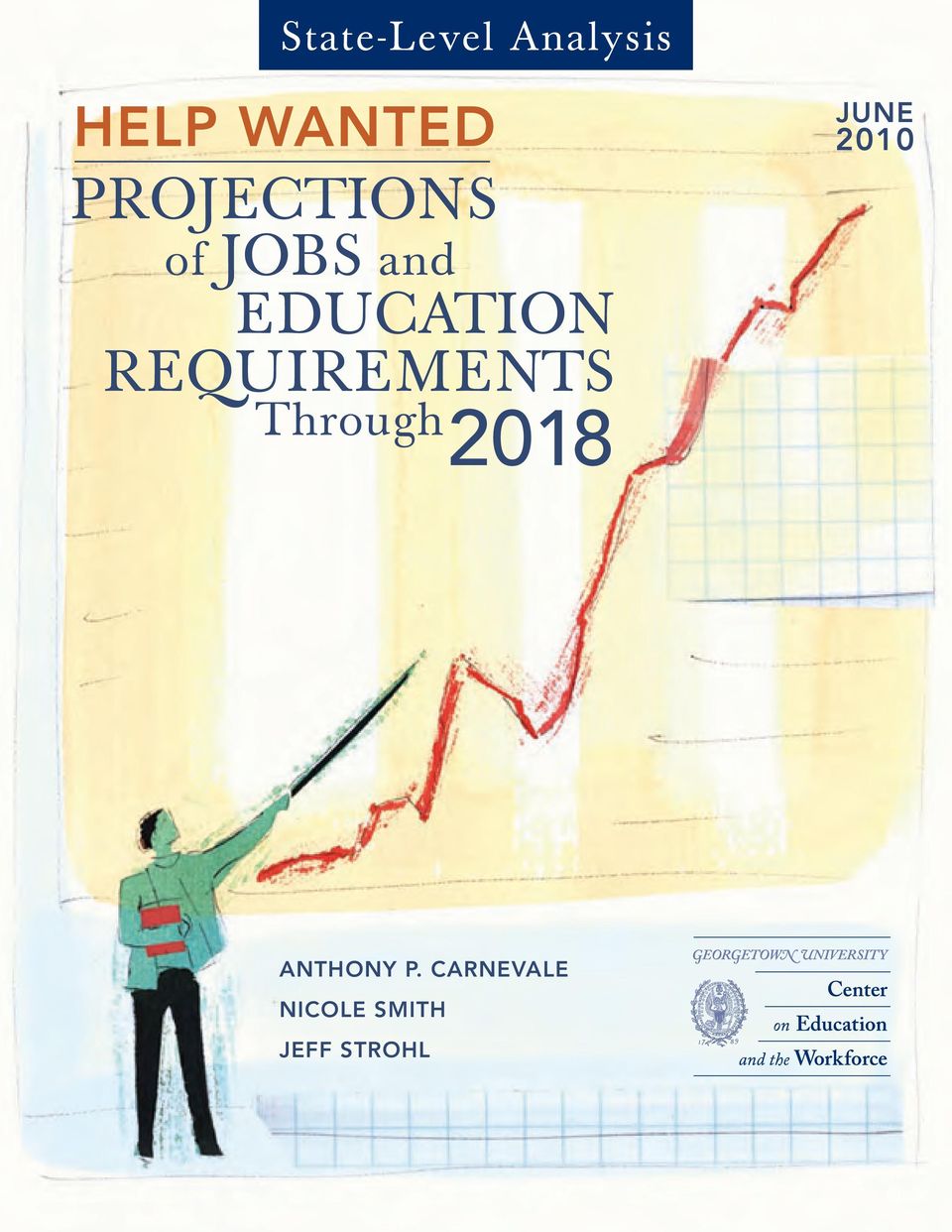
1 State-Level Analysis HELP WANTED PROJECTIONS of JOBS and EDUCATION REQUIREMENTS Through 2018 JUNE 2010 ANTHONY P. CARNEVALE NICOLE SMITH JEFF STROHL
2

3 Contents 1 Introduction 3 U.S. Maps: Educational concentrations of total jobs by state in Alabama 13 Alaska 15 Arizona 17 Arkansas 19 California 21 Colorado 23 Connecticut 25 Delaware 27 The District of Columbia 29 Florida 31 Georgia 33 Hawaii 35 Idaho 37 Illinois 39 Indiana 41 Iowa 43 Kansas 45 Kentucky 47 Louisiana 49 Maine 51 Maryland 53 Massachusetts 55 Michigan 57 Minnesota 59 Mississippi 61 Missouri 63 Montana 65 Nebraska 67 Nevada 69 New Hampshire 71 New Jersey 73 New Mexico 75 New York 77 North Carolina 79 North Dakota 81 Ohio 83 Oklahoma 85 Oregon 87 Pennsylvania 89 Rhode Island 91 South Carolina 93 South Dakota 95 Tennessee 97 Texas 99 Utah 101 Vermont 103 Virginia 105 Washington 107 West Virginia 109 Wisconsin 111 Wyoming 113 Appendix: State-level analysis of total jobs by educational demand in The Georgetown University Center on Education and the Workforce i
4

5 Introduction Help Wanted: Projections of Jobs and Education Requirements Through 2018 This report projects education requirements linked to forecasted job growth by state and the District of Columbia, from 2008 through ,2 It complements a larger national report which projects education demand by occupation and industry for the same time period. 3 The national report shows that by 2018, 63 percent of jobs will require a postsecondary education beyond high school. The state report: Gauges each state s position compared to the national average; Compares the educational composition of jobs in the base year (2008) to the forecast year (2018); and, Shows where the jobs are by state, education level and occupation, for 25 detailed occupational categories in The state report finds that: Only 19 states will be at or above the 63 percent proportion of jobs (nationally) that will require a postsecondary education beyond high school in 2018; Jobs in the District of Columbia will have the highest concentration of postsecondary education in 2018; The highest proportions of Bachelor s jobs and graduate jobs will be concentrated in the northeastern states; Jobs for workers with some college or with Associate s s will be dispersed throughout the country; Jobs for high school graduates or dropouts will be concentrated in the southern states; and, Three states, Arkansas, Louisiana and West Virginia, are more than 10 percentage points below the national average, which means that the educational composition of jobs in these states will be mostly high school education levels or less in Job growth differs significantly by state. These state-level forecasts integrate state disparities by incorporating information on industrial makeup as well as industrial growth and decline. 2 The location of the job determines number of jobs by state, not the state where employees reside. 3 The full report by the Center on Education and the Workforce provides comprehensive industry and occupational forecasts of where jobs will be and what kinds of preparation they will demand of their workers. The report is available online at The Georgetown University Center on Education and the Workforce 1
6

7 U.S. Maps Educational concentrations of total jobs by state in District of columbia, North Dakota, Minnesota, Massachusetts, and colorado will lead the nation in share of total jobs within state requiring postsecondary education in Postsecondary Jobs WA MT ND ME OR ID SD MN WI NY VT NH MA CA NV UT WY CO NE KS IA MO IL IN MI KY OH WV PA MD VA CT NJ DE RI DC AZ NM OK AR TN SC NC TX LA MS AL GA State percentage: TOP 5 AK FL 71% HI 49% The Georgetown University Center on Education and the Workforce 3

8 TExas, California, Nevada, Mississippi, and Arizona will lead the nation in share of total jobs within state requiring less than high school in High School dropout Jobs WA MT ND ME OR ID SD MN WI NY VT NH MA CA NV UT WY CO NE KS IA MO IL IN MI KY OH WV PA MD VA CT NJ DE RI DC AZ NM OK AR TN SC NC TX LA MS AL GA State percentage: TOP 5 AK FL 11% 17% 8% 10% HI Less than 7% 4 Projections of Jobs and Education Requirements Through 2018

9 West virginia, Arkansas, Pennsylvania, Maine, and Louisiana will lead the nation in share of total jobs within state requiring a high school diploma in High School graduate Jobs WA MT ND ME OR ID SD MN WI NY VT NH MA CA NV UT WY CO NE KS IA MO IL IN MI KY OH WV PA MD VA CT NJ DE RI DC AZ NM OK AR TN SC NC TX LA MS AL GA State percentage: TOP 5 AK FL 32% 41% 28% 31% HI 19% 27% The Georgetown University Center on Education and the Workforce 5

10 Alaska, UTah, IDaho, WYoming, and ORegon will lead the nation in share of total jobs within state requiring some college in Some college/postsecondary certificate Jobs WA MT ND ME OR ID SD MN WI NY VT NH MA CA NV UT WY CO NE KS IA MO IL IN MI KY OH WV PA MD VA CT NJ DE RI DC AZ NM OK AR TN SC NC TX LA MS AL GA State percentage: TOP 5 AK FL 23% 28% 21% 22% HI 14% 20% 6 Projections of Jobs and Education Requirements Through 2018

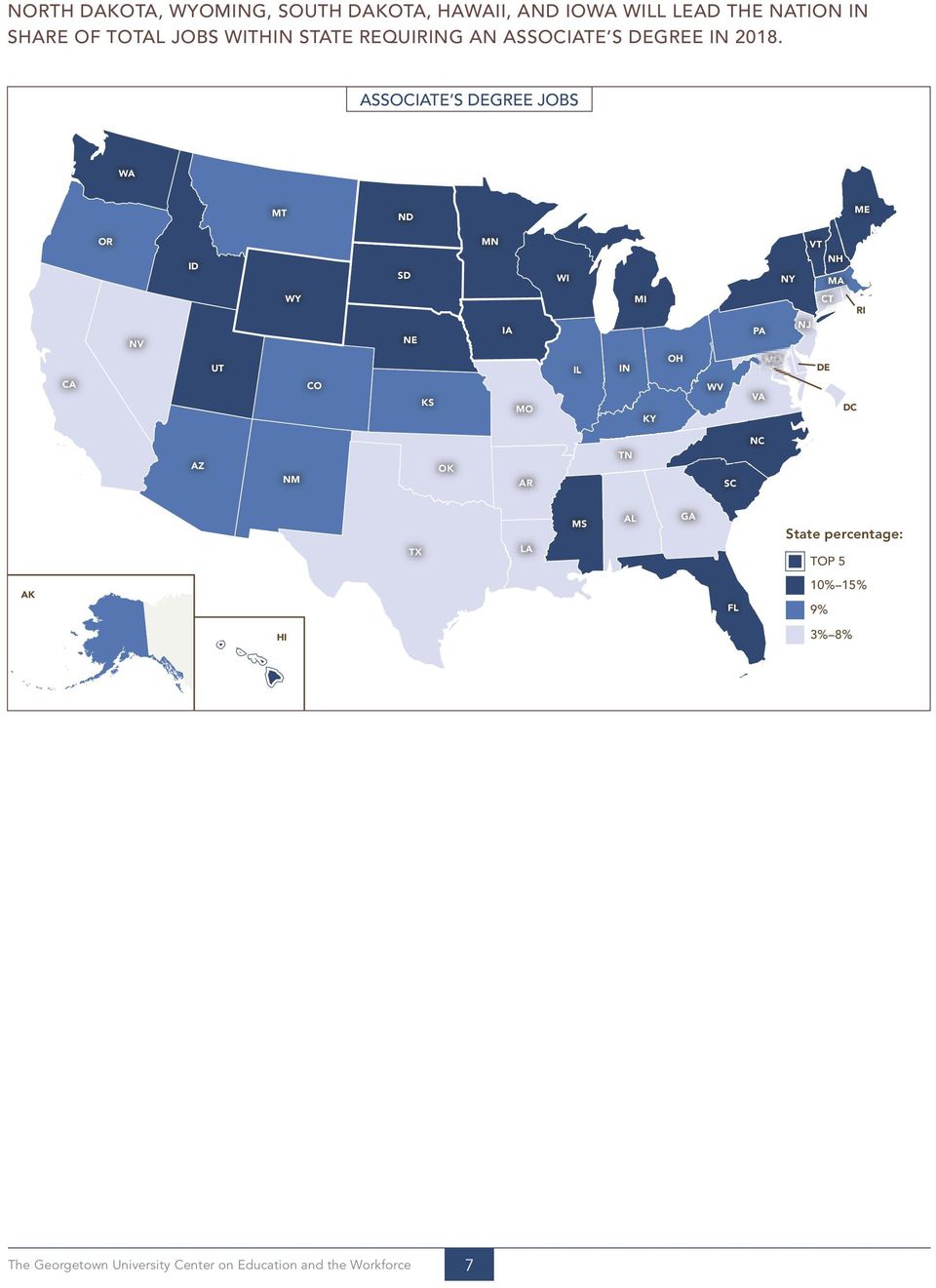
11 North Dakota, WYoming, South dakota, Hawaii, and IowA will lead the nation in share of total jobs within state requiring an Associate s in Associate s jobs WA MT ND ME OR ID SD MN WI NY VT NH MA CA NV UT WY CO NE KS IA MO IL IN MI KY OH WV PA MD VA CT NJ DE RI DC AZ NM OK AR TN SC NC TX LA MS AL GA State percentage: TOP 5 AK FL 10% 15% 9% HI 3% 8% The Georgetown University Center on Education and the Workforce 7
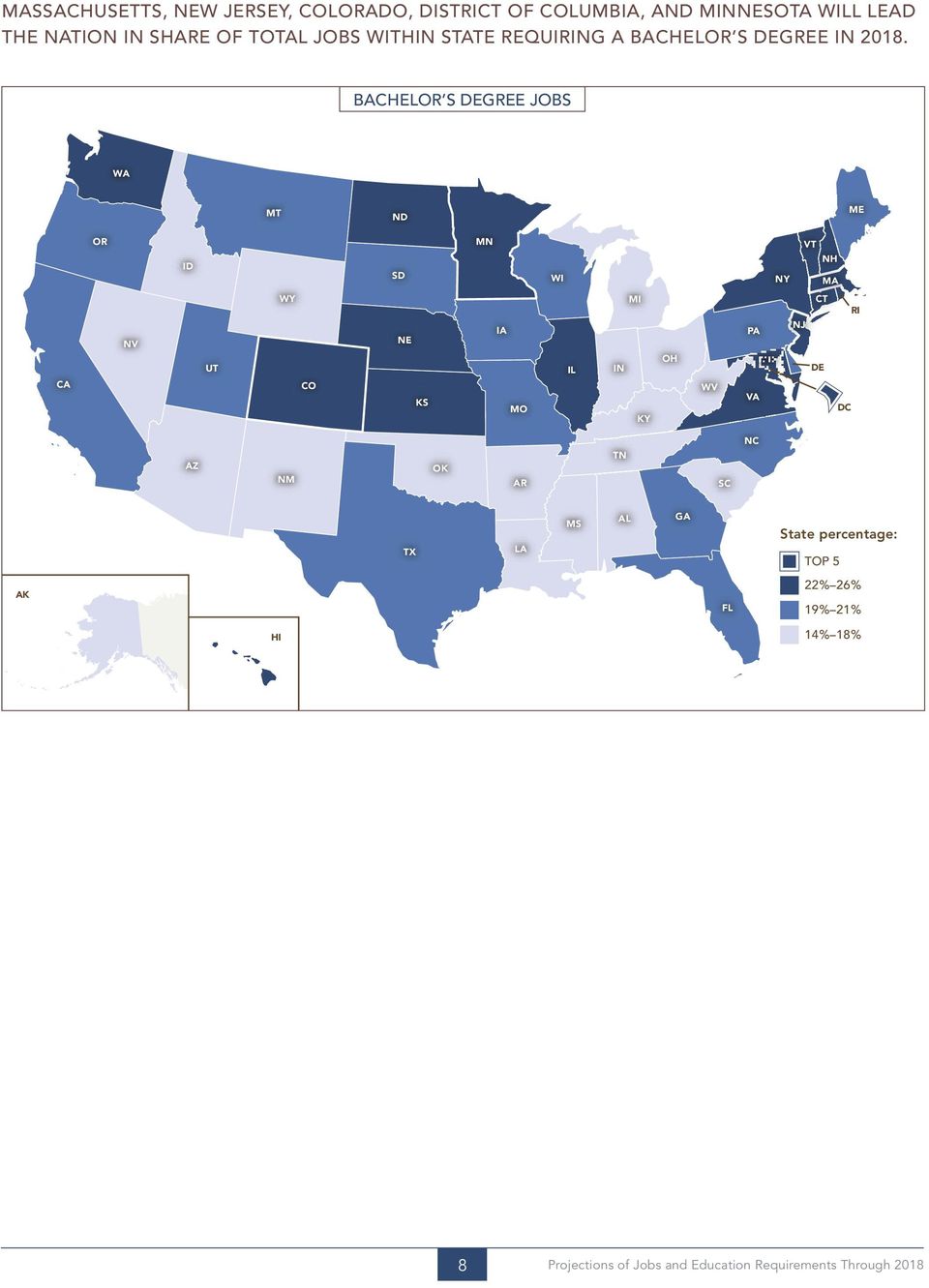
12 MAssachusetts, New Jersey, COlorado, District of columbia, and Minnesota will lead the nation in share of total jobs within state requiring a Bachelor s in Bachelor s jobs WA MT ND ME OR ID SD MN WI NY VT NH MA CA NV UT WY CO NE KS IA MO IL IN MI KY OH WV PA MD VA CT NJ DE RI DC AZ NM OK AR TN SC NC TX LA MS AL GA State percentage: TOP 5 AK FL 22% 26% 19% 21% HI 14% 18% 8 Projections of Jobs and Education Requirements Through 2018
13 District of columbia, Massachusetts, Maryland, Connecticut, and New york will lead the nation in share of total jobs within state requiring a graduate in Graduate jobs WA MT ND ME OR ID SD MN WI NY VT NH MA CA NV UT WY CO NE KS IA MO IL IN MI KY OH WV PA MD VA CT NJ DE RI DC AZ NM OK AR TN SC NC TX LA MS AL GA State percentage: TOP 5 AK FL 11% 28% 9% 11% HI 6% 8% The Georgetown University Center on Education and the Workforce 9

14

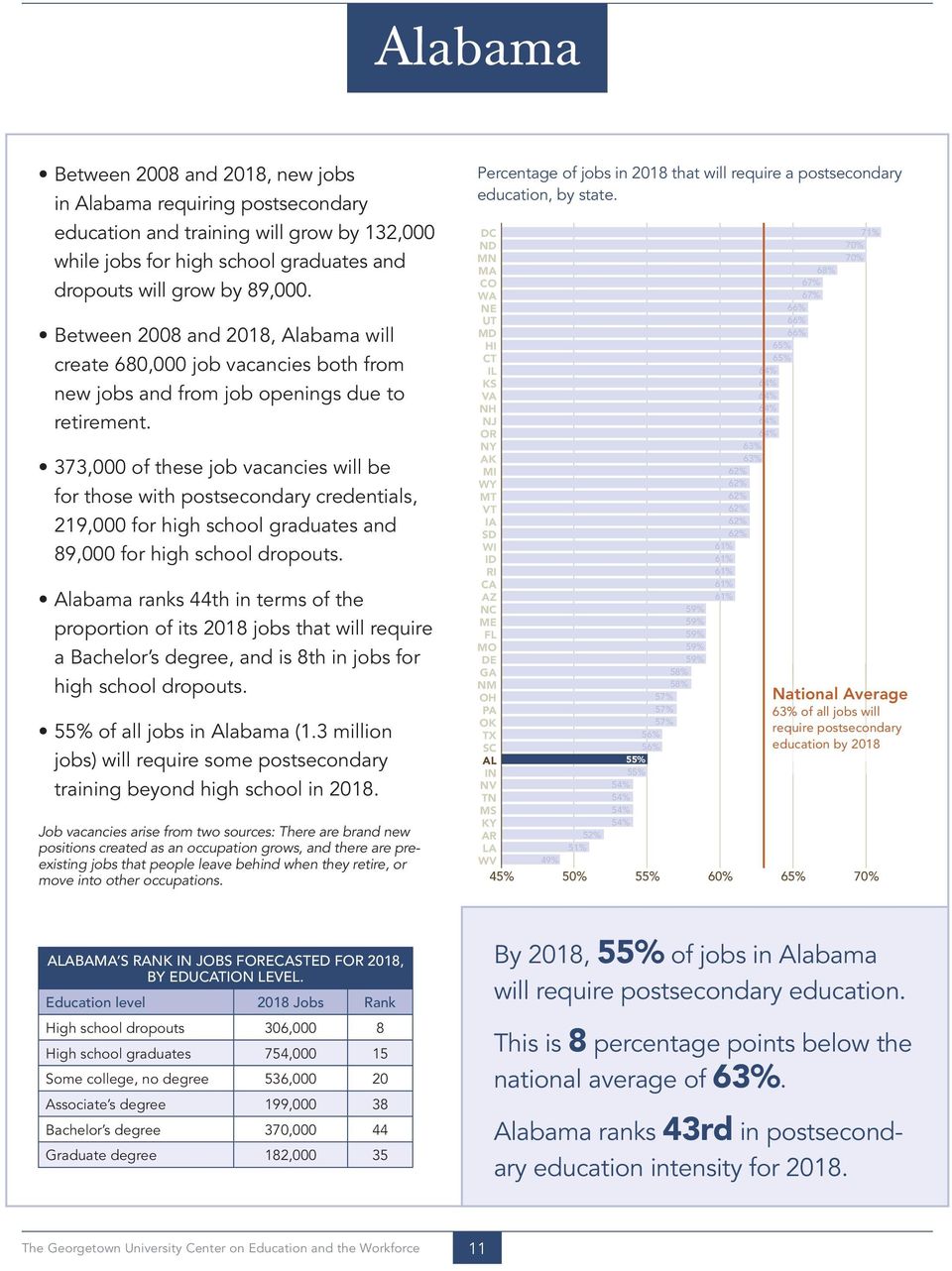
15 Alabama Between 2008 and 2018, new jobs in Alabama requiring postsecondary education and training will grow by 132,000 while jobs for high school graduates and dropouts will grow by 89,000. Between 2008 and 2018, Alabama will create 680,000 job vacancies both from new jobs and from job openings due to retirement. 373,000 of these job vacancies will be for those with postsecondary credentials, 219,000 for high school graduates and 89,000 for high school dropouts. Alabama ranks 44th in terms of the proportion of its 2018 jobs that will require a Bachelor s, and is 8th in jobs for high school dropouts. of all jobs in Alabama (1.3 million jobs) will require some postsecondary training beyond high school in Percentage of jobs in 2018 that will require a postsecondary education, by state. Job vacancies arise from two sources: There are brand new positions created as an occupation grows, and there are preexisting 52% 51% jobs that people leave behind when they retire, or 49% move into other occupations. 45% 60% DC ND MN MA CO WA NE UT MD HI CT IL KS VA NH NJ OR NY AK MI WY MT VT IA SD WI ID RI CA AZ NC ME FL MO DE GA NM OH PA OK TX SC AL IN NV TN MS KY AR LA WV 68% 71% National Average of all jobs will require postsecondary education by % Alabama s rank in jobs forecasted for 2018, by education level. Education level 2018 Jobs Rank dropouts 306,000 8 graduates 754, Some college, no 536, Associate s 199, Bachelor s 370, Graduate 182, By 2018, of jobs in Alabama will require postsecondary education. This is 8 percentage points below the national average of. Alabama ranks 43rd in postsecondary education intensity for The Georgetown University Center on Education and the Workforce 11
16 ALABAMA Change in jobs by education level: 2008 and Education level 2008 Jobs 2018 Jobs Difference dropouts 280, ,000 26,000 1,400,000 1,200,000 1,000,000 1,155,000 1,287,000 graduates 691, ,000 63,000 Postsecondary 1,155,000 1,287, , , , , , ,000 Postsecondary graduates dropouts 200, , , Occupations Managerial and Professional Office STEM Community and Arts Where the jobs will be in 2018, by occupation and education level (in thousands of jobs)* dropouts graduates Some college Associate s Bachelor s *Zero does not necessarily mean no jobs. Since jobs are rounded to the nearest thousand, zero means less than 500 jobs. Graduate Management Business operations specialty Financial specialists Legal Computer and mathematical science Architects and technicians Engineers and technicians Life and physical scientists Social scientists Community and social services Arts, design, entertainment, sports, and media Education Education Healthcare Food and Personal Sales and Office Support Blue Collar Healthcare practitioners Healthcare support Food preparation and serving Building and grounds cleaning and maintenance Personal care Protective services Sales Office and administrative support Farming, fishing and forestry Construction and extraction Installation, maintenance, and equipment repair **Total jobs are a snapshot of the economy that shows where jobs are located by education type. They differ from job vacancies because total jobs are filled by people currently working in these positions who may not be leaving in the short-term to create a job opening. Total Production Transportation and material moving Total** , Projections of Jobs and Education Requirements Through 2018

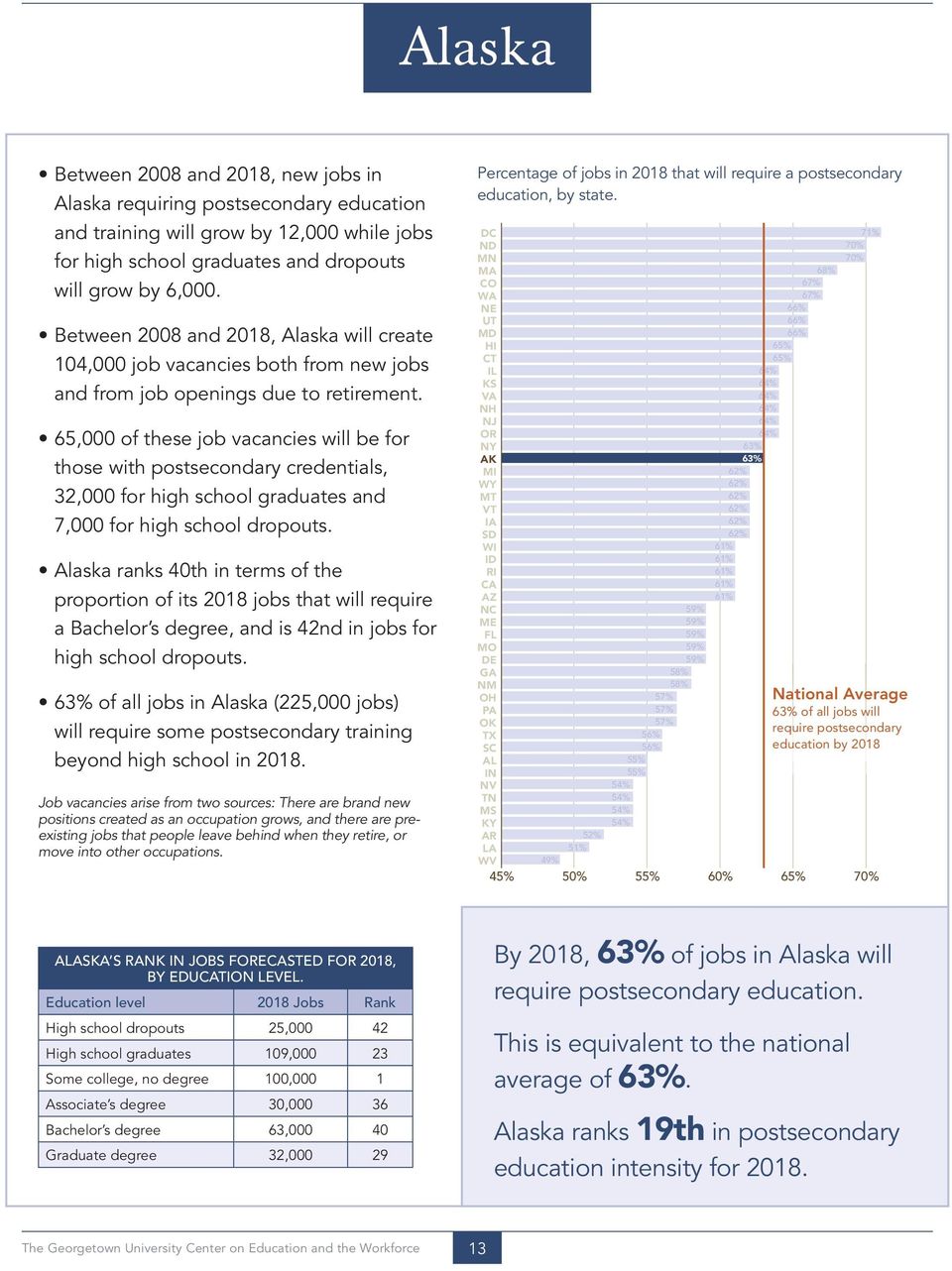
17 Alaska Between 2008 and 2018, new jobs in Alaska requiring postsecondary education and training will grow by 12,000 while jobs for high school graduates and dropouts will grow by 6,000. Between 2008 and 2018, Alaska will create 104,000 job vacancies both from new jobs and from job openings due to retirement. 65,000 of these job vacancies will be for those with postsecondary credentials, 32,000 for high school graduates and 7,000 for high school dropouts. Alaska ranks 40th in terms of the proportion of its 2018 jobs that will require a Bachelor s, and is 42nd in jobs for high school dropouts. of all jobs in Alaska (225,000 jobs) will require some postsecondary training beyond high school in Job vacancies arise from two sources: There are brand new positions created as an occupation grows, and there are preexisting jobs that people leave behind when they retire, or move into other occupations. Percentage of jobs in 2018 that will require a postsecondary education, by state. DC ND MN MA CO WA NE UT MD HI CT IL KS VA NH NJ OR NY AK MI WY MT VT IA SD WI ID RI CA AZ NC ME FL MO DE GA NM OH PA OK TX SC AL IN NV TN MS KY AR LA WV 68% 71% National Average of all jobs will require postsecondary education by % 51% 49% 45% 50% 60% Alaska s rank in jobs forecasted for 2018, by education level. Education level 2018 Jobs Rank dropouts 25, graduates 109, Some college, no 100,000 1 Associate s 30, Bachelor s 63, Graduate 32, By 2018, of jobs in Alaska will require postsecondary education. This is equivalent to the national average of. Alaska ranks 19th in postsecondary education intensity for The Georgetown University Center on Education and the Workforce 13
18 Alaska Change in jobs by education level: 2008 and ,000 Education level 2008 Jobs 2018 Jobs Difference 200, , ,000 dropouts 24,000 25,000 1,000 graduates 104, ,000 5, ,000 Postsecondary 213, ,000 12, , , ,000 Postsecondary graduates dropouts 50, ,000 25, Occupations Managerial and Professional Office STEM Community and Arts Where the jobs will be in 2018, by occupation and education level (in thousands of jobs)* dropouts graduates Some college Associate s Bachelor s Graduate Management Business operations specialty Financial specialists Legal Computer and mathematical science Architects and technicians Engineers and technicians Life and physical scientists Social scientists Community and social services Arts, design, entertainment, sports, and media Education Education Healthcare Food and Personal Sales and Office Support Blue Collar Healthcare practitioners Healthcare support Food preparation and serving Building and grounds cleaning and maintenance Personal care Protective services Sales Office and administrative support Farming, fishing and forestry Construction and extraction Installation, maintenance, and equipment repair Production Transportation and material moving Total** *Zero does not necessarily mean no jobs. Since jobs are rounded to the nearest thousand, zero means less than 500 jobs. **Total jobs are a snapshot of the economy that shows where jobs are located by education type. They differ from job vacancies because total jobs are filled by people currently working in these positions who may not be leaving in the short-term to create a job opening. Total 14 Projections of Jobs and Education Requirements Through 2018

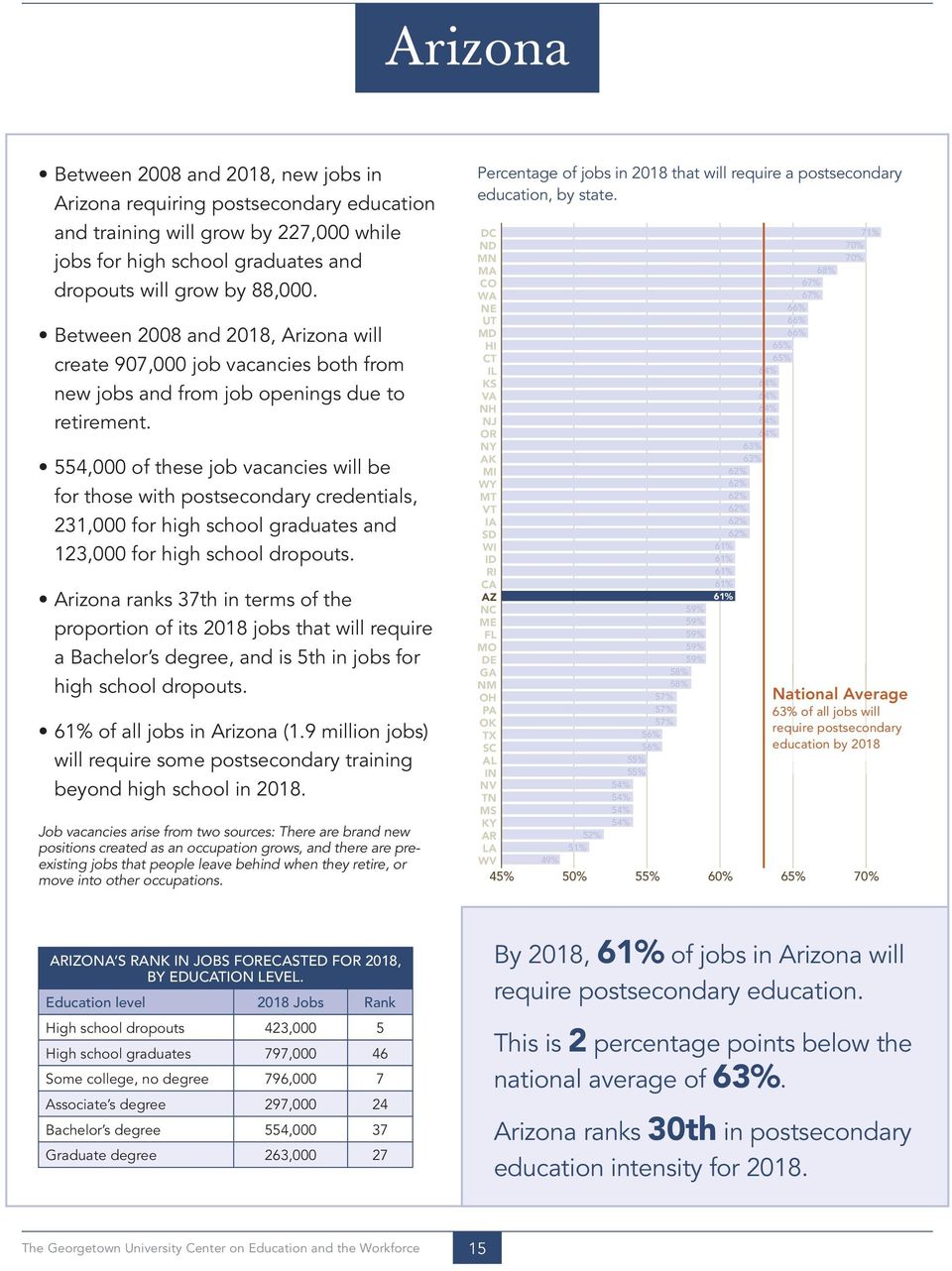
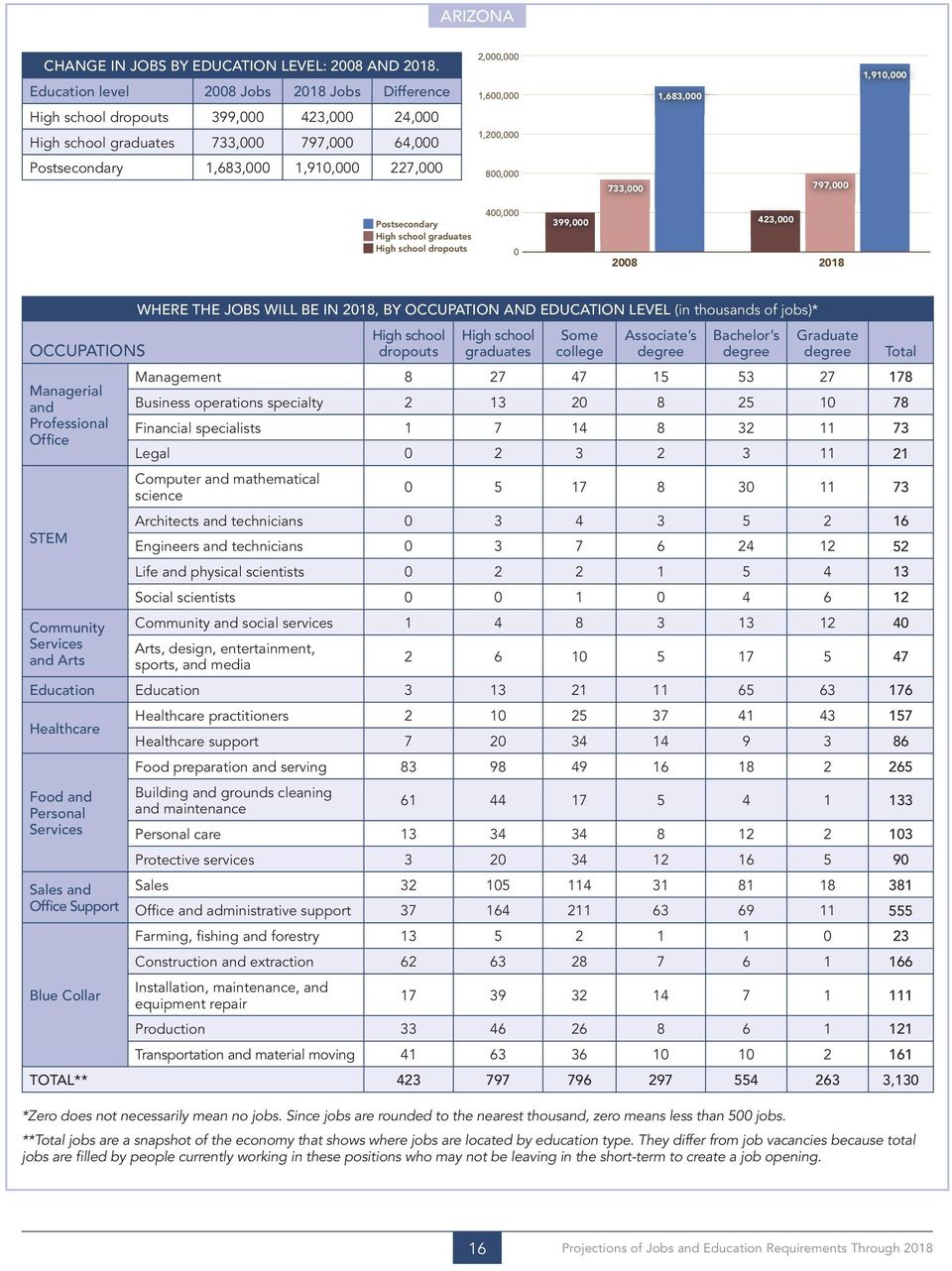
19 Arizona Between 2008 and 2018, new jobs in Arizona requiring postsecondary education and training will grow by 227,000 while jobs for high school graduates and dropouts will grow by 88,000. Between 2008 and 2018, Arizona will create 907,000 job vacancies both from new jobs and from job openings due to retirement. 554,000 of these job vacancies will be for those with postsecondary credentials, 231,000 for high school graduates and 123,000 for high school dropouts. Arizona ranks 37th in terms of the proportion of its 2018 jobs that will require a Bachelor s, and is 5th in jobs for high school dropouts. of all jobs in Arizona (1.9 million jobs) will require some postsecondary training beyond high school in Percentage of jobs in 2018 that will require a postsecondary education, by state. Job vacancies arise from two sources: There are brand new positions created as an occupation grows, and there are preexisting 52% 51% jobs that people leave behind when they retire, or 49% move into other occupations. 45% 60% DC ND MN MA CO WA NE UT MD HI CT IL KS VA NH NJ OR NY AK MI WY MT VT IA SD WI ID RI CA AZ NC ME FL MO DE GA NM OH PA OK TX SC AL IN NV TN MS KY AR LA WV 68% 71% National Average of all jobs will require postsecondary education by % Arizona s rank in jobs forecasted for 2018, by education level. Education level 2018 Jobs Rank dropouts 423,000 5 graduates 797, Some college, no 796,000 7 Associate s 297, Bachelor s 554, Graduate 263, By 2018, of jobs in Arizona will require postsecondary education. This is 2 percentage points below the national average of. Arizona ranks 30th in postsecondary education intensity for The Georgetown University Center on Education and the Workforce 15
20 Arizona Change in jobs by education level: 2008 and Education level 2008 Jobs 2018 Jobs Difference 2,000,000 1,600,000 1,683,000 1,910,000 dropouts 399, ,000 24,000 graduates 733, ,000 64,000 1,200,000 Postsecondary 1,683,000 1,910, , , , ,000 Postsecondary graduates dropouts 400, , , Occupations Managerial and Professional Office STEM Community and Arts Where the jobs will be in 2018, by occupation and education level (in thousands of jobs)* dropouts graduates Some college Associate s Bachelor s Graduate Management Business operations specialty Financial specialists Legal Computer and mathematical science Architects and technicians Engineers and technicians Life and physical scientists Social scientists Community and social services Arts, design, entertainment, sports, and media Education Education Healthcare Food and Personal Sales and Office Support Blue Collar Healthcare practitioners Healthcare support Food preparation and serving Building and grounds cleaning and maintenance Total Personal care Protective services Sales Office and administrative support Farming, fishing and forestry Construction and extraction Installation, maintenance, and equipment repair Production Transportation and material moving Total** ,130 *Zero does not necessarily mean no jobs. Since jobs are rounded to the nearest thousand, zero means less than 500 jobs. **Total jobs are a snapshot of the economy that shows where jobs are located by education type. They differ from job vacancies because total jobs are filled by people currently working in these positions who may not be leaving in the short-term to create a job opening. 16 Projections of Jobs and Education Requirements Through 2018
21 Arkansas Between 2008 and 2018, new jobs in Arkansas requiring postsecondary education and training will grow by 86,000 while jobs for high school graduates and dropouts will grow by 63,000. Between 2008 and 2018, Arkansas will create 419,000 job vacancies both from new jobs and from job openings due to retirement. 217,000 of these job vacancies will be for those with postsecondary credentials, 150,000 for high school graduates and 52,000 for high school dropouts. Arkansas ranks 47th in terms of the proportion of its 2018 jobs that will require a Bachelor s, and is 9th in jobs for high school dropouts. 52% of all jobs in Arkansas (750,000 jobs) will require some postsecondary training beyond high school in Percentage of jobs in 2018 that will require a postsecondary education, by state. Job vacancies arise from two sources: There are brand new positions created as an occupation grows, and there are preexisting 52% 51% jobs that people leave behind when they retire, or 49% move into other occupations. 45% 60% DC ND MN MA CO WA NE UT MD HI CT IL KS VA NH NJ OR NY AK MI WY MT VT IA SD WI ID RI CA AZ NC ME FL MO DE GA NM OH PA OK TX SC AL IN NV TN MS KY AR LA WV 68% 71% National Average of all jobs will require postsecondary education by % Arkansas rank in jobs forecasted for 2018, by education level. Education level 2018 Jobs Rank dropouts 178,000 9 graduates 519,000 2 Some college, no 334, Associate s 108, Bachelor s 217, Graduate 92, By 2018, 52% of jobs in Arkansas will require postsecondary education. This is 11 percentage points below the national average of. Arkansas ranks 49th in postsecondary education intensity for The Georgetown University Center on Education and the Workforce 17
22 Arkansas Change in jobs by education level: 2008 and Education level 2008 Jobs 2018 Jobs Difference dropouts 162, ,000 16,000 graduates 472, ,000 47,000 Postsecondary 663, ,000 86, , , , , , , , ,000 Postsecondary graduates dropouts 0 162, , Occupations Managerial and Professional Office STEM Community and Arts Where the jobs will be in 2018, by occupation and education level (in thousands of jobs)* dropouts graduates Some college Associate s Bachelor s Graduate Management Business operations specialty Financial specialists Legal Computer and mathematical science Architects and technicians Engineers and technicians Life and physical scientists Social scientists Community and social services Arts, design, entertainment, sports, and media Education Education Healthcare Food and Personal Sales and Office Support Blue Collar Healthcare practitioners Healthcare support Food preparation and serving Building and grounds cleaning and maintenance Personal care Protective services Sales Office and administrative support Farming, fishing and forestry Construction and extraction Installation, maintenance, and equipment repair Production Transportation and material moving Total** ,447 *Zero does not necessarily mean no jobs. Since jobs are rounded to the nearest thousand, zero means less than 500 jobs. **Total jobs are a snapshot of the economy that shows where jobs are located by education type. They differ from job vacancies because total jobs are filled by people currently working in these positions who may not be leaving in the short-term to create a job opening. Total 18 Projections of Jobs and Education Requirements Through 2018
23 California Between 2008 and 2018, new jobs in California requiring postsecondary education and training will grow by 1.3 million while jobs for high school graduates and dropouts will grow by 614,000. Between 2008 and 2018, California will create 5.5 million job vacancies both from new jobs and from job openings due to retirement. 3.3 million of these job vacancies will be for those with postsecondary credentials, 1.2 million for high school graduates and 1 million for high school dropouts. California ranks 21st in terms of the proportion of its 2018 jobs that will require a Bachelor s, and is 2nd in jobs for high school dropouts. of all jobs in California (12 million jobs) will require some postsecondary training beyond high school in Percentage of jobs in 2018 that will require a postsecondary education, by state. Job vacancies arise from two sources: There are brand new positions created as an occupation grows, and there are preexisting 52% 51% jobs that people leave behind when they retire, or 49% move into other occupations. 45% 60% DC ND MN MA CO WA NE UT MD HI CT IL KS VA NH NJ OR NY AK MI WY MT VT IA SD WI ID RI CA AZ NC ME FL MO DE GA NM OH PA OK TX SC AL IN NV TN MS KY AR LA WV 68% 71% National Average of all jobs will require postsecondary education by % California s rank in jobs forecasted for 2018, by education level. Education level 2018 Jobs Rank dropouts 3,163,000 2 graduates 4,198, Some college, no 4,042, Associate s 1,582, Bachelor s 3,937, Graduate 1,961, By 2018, of jobs in California will require postsecondary education. This is 2 percentage points below the national average of. California ranks 29th in postsecondary education intensity for The Georgetown University Center on Education and the Workforce 19
24 California Change in jobs by education level: 2008 and Education level 2008 Jobs 2018 Jobs Difference dropouts 2,914,000 3,163, ,000 graduates 3,833,000 4,198, ,000 Postsecondary 10,195,000 11,522,000 1,327,000 Postsecondary graduates dropouts 12,000,000 10,000,000 8,000,000 6,000,000 4,000,000 2,000, ,914,000 3,833,000 10,195,000 3,163,000 4,198, ,522,000 Occupations Managerial and Professional Office STEM Community and Arts Where the jobs will be in 2018, by occupation and education level (in thousands of jobs)* dropouts graduates Some college Associate s Bachelor s Graduate Management ,170 Business operations specialty Financial specialists Legal Computer and mathematical science Total Architects and technicians Engineers and technicians Life and physical scientists Social scientists Community and social services Arts, design, entertainment, sports, and media Education Education ,255 Healthcare Food and Personal Sales and Office Support Blue Collar Healthcare practitioners Healthcare support Food preparation and serving ,503 Building and grounds cleaning and maintenance Personal care Protective services Sales ,116 Office and administrative support , ,970 Farming, fishing and forestry Construction and extraction Installation, maintenance, and equipment repair Production Transportation and material moving ,096 Total** 3,163 4,198 4,042 1,582 3,937 1,961 18,883 *Zero does not necessarily mean no jobs. Since jobs are rounded to the nearest thousand, zero means less than 500 jobs. **Total jobs are a snapshot of the economy that shows where jobs are located by education type. They differ from job vacancies because total jobs are filled by people currently working in these positions who may not be leaving in the short-term to create a job opening. 20 Projections of Jobs and Education Requirements Through 2018
25 Colorado Between 2008 and 2018, new jobs in Colorado requiring postsecondary education and training will grow by 411,000 while jobs for high school graduates and dropouts will grow by 217,000. Between 2008 and 2018, Colorado will create 924,000 job vacancies both from new jobs and from job openings due to retirement. 609,000 of these job vacancies will be for those with postsecondary credentials, 220,000 for high school graduates and 94,000 for high school dropouts. Colorado ranks 3rd in terms of the proportion of its 2018 jobs that will require a Bachelor s, and is 25th in jobs for high school dropouts. of all jobs in Colorado (2.1 million jobs) will require some postsecondary training beyond high school in Percentage of jobs in 2018 that will require a postsecondary education, by state. Job vacancies arise from two sources: There are brand new positions created as an occupation grows, and there are preexisting 52% 51% jobs that people leave behind when they retire, or 49% move into other occupations. 45% 60% DC ND MN MA CO WA NE UT MD HI CT IL KS VA NH NJ OR NY AK MI WY MT VT IA SD WI ID RI CA AZ NC ME FL MO DE GA NM OH PA OK TX SC AL IN NV TN MS KY AR LA WV 68% 71% National Average of all jobs will require postsecondary education by % Colorado s rank in jobs forecasted for 2018, by education level. Education level 2018 Jobs Rank dropouts 324, graduates 761, Some college, no 708, Associate s 281, Bachelor s 768,000 3 Graduate 346, By 2018, of jobs in Colorado will require postsecondary education. This is 4 percentage points above the national average of. Colorado ranks 5th in postsecondary education intensity for The Georgetown University Center on Education and the Workforce 21
26 colorado Change in jobs by education level: 2008 and ,500,000 Education level 2008 Jobs 2018 Jobs Difference 2,000,000 2,104,000 dropouts 257, ,000 68,000 graduates 612, , ,000 1,500,000 1,693,000 Postsecondary 1,693,000 2,104, ,000 1,000,000 Postsecondary graduates dropouts 500, , , , , Occupations Managerial and Professional Office STEM Community and Arts Where the jobs will be in 2018, by occupation and education level (in thousands of jobs)* dropouts graduates Some college Associate s Bachelor s Graduate Management Business operations specialty Financial specialists Legal Computer and mathematical science Total Architects and technicians Engineers and technicians Life and physical scientists Social scientists Community and social services Arts, design, entertainment, sports, and media Education Education Healthcare Food and Personal Sales and Office Support Blue Collar Healthcare practitioners Healthcare support Food preparation and serving Building and grounds cleaning and maintenance Personal care Protective services Sales Office and administrative support Farming, fishing and forestry Construction and extraction Installation, maintenance, and equipment repair Production Transportation and material moving Total** ,189 *Zero does not necessarily mean no jobs. Since jobs are rounded to the nearest thousand, zero means less than 500 jobs. **Total jobs are a snapshot of the economy that shows where jobs are located by education type. They differ from job vacancies because total jobs are filled by people currently working in these positions who may not be leaving in the short-term to create a job opening. 22 Projections of Jobs and Education Requirements Through 2018
27 Connecticut Between 2008 and 2018, new jobs in Connecticut requiring postsecondary education and training will grow by 85,000 while jobs for high school graduates and dropouts will grow by 31,000. Between 2008 and 2018, Connecticut will create 564,000 job vacancies both from new jobs and from job openings due to retirement. 359,000 of these job vacancies will be for those with postsecondary credentials, 163,000 for high school graduates and 42,000 for high school dropouts. Connecticut ranks 8th in terms of the proportion of its 2018 jobs that will require a Bachelor s, and is 38th in jobs for high school dropouts. of all jobs in Connecticut (1.2 million jobs) will require some postsecondary training beyond high school in Percentage of jobs in 2018 that will require a postsecondary education, by state. Job vacancies arise from two sources: There are brand new positions created as an occupation grows, and there are preexisting 52% 51% jobs that people leave behind when they retire, or 49% move into other occupations. 45% 60% DC ND MN MA CO WA NE UT MD HI CT IL KS VA NH NJ OR NY AK MI WY MT VT IA SD WI ID RI CA AZ NC ME FL MO DE GA NM OH PA OK TX SC AL IN NV TN MS KY AR LA WV 68% 71% National Average of all jobs will require postsecondary education by % Connecticut s rank in jobs forecasted for 2018, by education level. Education level 2018 Jobs Rank dropouts 145, graduates 562, Some college, no 364, Associate s 166, Bachelor s 426,000 8 Graduate 282,000 4 By 2018, of jobs in Connecticut will require postsecondary education. This is 2 percentage points above the national average of. Connecticut ranks 11th in postsecondary education intensity for The Georgetown University Center on Education and the Workforce 23
28 Connecticut Change in jobs by education level: 2008 and ,400,000 Education level 2008 Jobs 2018 Jobs Difference dropouts 139, ,000 6,000 1,200,000 1,000,000 1,154,000 1,239,000 graduates 537, ,000 25, ,000 Postsecondary 1,154,000 1,239,000 85, , , , ,000 Postsecondary graduates dropouts 200, , , Occupations Managerial and Professional Office STEM Community and Arts Where the jobs will be in 2018, by occupation and education level (in thousands of jobs)* dropouts graduates Some college Associate s Bachelor s Graduate Management Business operations specialty Financial specialists Legal Computer and mathematical science Architects and technicians Engineers and technicians Life and physical scientists Social scientists Community and social services Arts, design, entertainment, sports, and media Education Education Healthcare Food and Personal Sales and Office Support Blue Collar Healthcare practitioners Healthcare support Food preparation and serving Building and grounds cleaning and maintenance Personal care Protective services Sales Office and administrative support Farming, fishing and forestry Construction and extraction Installation, maintenance, and equipment repair Production Transportation and material moving Total** ,945 *Zero does not necessarily mean no jobs. Since jobs are rounded to the nearest thousand, zero means less than 500 jobs. **Total jobs are a snapshot of the economy that shows where jobs are located by education type. They differ from job vacancies because total jobs are filled by people currently working in these positions who may not be leaving in the short-term to create a job opening. Total 24 Projections of Jobs and Education Requirements Through 2018
29 Delaware Between 2008 and 2018, new jobs in Delaware requiring postsecondary education and training will grow by 26,000 while jobs for high school graduates and dropouts will grow by 14,000. Between 2008 and 2018, Delaware will create 144,000 job vacancies both from new jobs and from job openings due to retirement. 83,000 of these job vacancies will be for those with postsecondary credentials, 46,000 for high school graduates and 14,000 for high school dropouts. Delaware ranks 30th in terms of the proportion of its 2018 jobs that will require a Bachelor s, and is 27th in jobs for high school dropouts. of all jobs in Delaware (300,000 jobs) will require some postsecondary training beyond high school in Percentage of jobs in 2018 that will require a postsecondary education, by state. Job vacancies arise from two sources: There are brand new positions created as an occupation grows, and there are preexisting 52% 51% jobs that people leave behind when they retire, or 49% move into other occupations. 45% 60% DC ND MN MA CO WA NE UT MD HI CT IL KS VA NH NJ OR NY AK MI WY MT VT IA SD WI ID RI CA AZ NC ME FL MO DE GA NM OH PA OK TX SC AL IN NV TN MS KY AR LA WV 68% 71% National Average of all jobs will require postsecondary education by % Delaware s rank in jobs forecasted for 2018, by education level. Education level 2018 Jobs Rank dropouts 49, graduates 160, Some college, no 96, Associate s 43, Bachelor s 95, Graduate 52, By 2018, of jobs in Delaware will require postsecondary education. This is 4 percentage points below the national average of. Delaware ranks 35th in postsecondary education intensity for The Georgetown University Center on Education and the Workforce 25
30 Delaware Change in jobs by education level: 2008 and Education level 2008 Jobs 2018 Jobs Difference 300, , , ,000 dropouts 46,000 49,000 3, ,000 graduates 149, ,000 11,000 Postsecondary 261, ,000 26, , , , ,000 Postsecondary graduates dropouts 50, ,000 49, Occupations Managerial and Professional Office STEM Community and Arts Where the jobs will be in 2018, by occupation and education level (in thousands of jobs)* dropouts graduates Some college Associate s Bachelor s Graduate Management Business operations specialty Financial specialists Legal Computer and mathematical science Architects and technicians Engineers and technicians Life and physical scientists Social scientists Community and social services Arts, design, entertainment, sports, and media Education Education Healthcare Food and Personal Sales and Office Support Blue Collar Healthcare practitioners Healthcare support Food preparation and serving Building and grounds cleaning and maintenance Personal care Protective services Sales Office and administrative support Farming, fishing and forestry Construction and extraction Installation, maintenance, and equipment repair Production Transportation and material moving Total** *Zero does not necessarily mean no jobs. Since jobs are rounded to the nearest thousand, zero means less than 500 jobs. **Total jobs are a snapshot of the economy that shows where jobs are located by education type. They differ from job vacancies because total jobs are filled by people currently working in these positions who may not be leaving in the short-term to create a job opening. Total 26 Projections of Jobs and Education Requirements Through 2018
31 The District of Columbia Between 2008 and 2018, new jobs in the District of Columbia requiring postsecondary education and training will grow by 43,000 while jobs for high school graduates and dropouts will grow by 17,000. Between 2008 and 2018, the District of Columbia will create 225,000 job vacancies both from new jobs and from job openings due to retirement. 157,000 of these job vacancies will be for those with postsecondary credentials, 45,000 for high school graduates and 23,000 for high school dropouts. The District of Columbia ranks 4th in terms of the proportion of its 2018 jobs that will require a Bachelor s, and is 20th in jobs for high school dropouts. 71% of all jobs in the District of Columbia (500,000 jobs) will require some postsecondary training beyond high school in Job vacancies arise from two sources: There are brand new positions created as an occupation grows, and there are preexisting jobs that people leave behind when they retire, or move into other occupations. The District of Columbia s rank in jobs forecasted for 2018, by education level. Education level 2018 Jobs Rank dropouts 78, graduates 155, Some college, no 116, Associate s 28, Bachelor s 188,000 4 Graduate 211,000 1 Percentage of jobs in 2018 that will require a postsecondary education, by state. DC ND MN MA CO WA NE UT MD HI CT IL KS VA NH NJ OR NY AK MI WY MT VT IA SD WI ID RI CA AZ NC ME FL MO DE GA NM OH PA OK TX SC AL IN NV TN MS KY AR LA WV 68% 71% National Average of all jobs will require postsecondary education by % 51% 49% 45% 50% 60% By 2018, 71% of jobs in the District of Columbia will require postsecondary education. This is 8 percentage points above the national average of. The District of Columbia ranks 1st in postsecondary education intensity for The Georgetown University Center on Education and the Workforce 27
32 The District of columbia Change in jobs by education level: 2008 and Education level 2008 Jobs 2018 Jobs Difference dropouts 72,000 78,000 6, , , , , ,000 graduates 144, ,000 11,000 Postsecondary 500, ,000 43, , ,000 Postsecondary graduates dropouts 100, , , ,000 78, Occupations Managerial and Professional Office STEM Community and Arts Where the jobs will be in 2018, by occupation and education level (in thousands of jobs)* dropouts graduates Some college Associate s Bachelor s Graduate Management Business operations specialty Financial specialists Legal Computer and mathematical science Architects and technicians Engineers and technicians Life and physical scientists Social scientists Community and social services Arts, design, entertainment, sports, and media Education Education Healthcare Food and Personal Sales and Office Support Blue Collar Healthcare practitioners Healthcare support Food preparation and serving Building and grounds cleaning and maintenance Personal care Protective services Sales Office and administrative support Farming, fishing and forestry Construction and extraction Installation, maintenance, and equipment repair Production Transportation and material moving Total** *Zero does not necessarily mean no jobs. Since jobs are rounded to the nearest thousand, zero means less than 500 jobs. **Total jobs are a snapshot of the economy that shows where jobs are located by education type. They differ from job vacancies because total jobs are filled by people currently working in these positions who may not be leaving in the short-term to create a job opening. Total 28 Projections of Jobs and Education Requirements Through 2018
33 Florida Between 2008 and 2018, new jobs in Florida requiring postsecondary education and training will grow by 679,000 while jobs for high school graduates and dropouts will grow by 357,000. Between 2008 and 2018, Florida will create 2.8 million job vacancies both from new jobs and from job openings due to retirement. 1.6 million of these job vacancies will be for those with postsecondary credentials, 834,000 for high school graduates and 303,000 for high school dropouts. Florida ranks 32nd in terms of the proportion of its 2018 jobs that will require a Bachelor s, and is 14th in jobs for high school dropouts. of all jobs in Florida (5.6 million jobs) will require some postsecondary training beyond high school in Percentage of jobs in 2018 that will require a postsecondary education, by state. Job vacancies arise from two sources: There are brand new positions created as an occupation grows, and there are preexisting 52% 51% jobs that people leave behind when they retire, or 49% move into other occupations. 45% 60% DC ND MN MA CO WA NE UT MD HI CT IL KS VA NH NJ OR NY AK MI WY MT VT IA SD WI ID RI CA AZ NC ME FL MO DE GA NM OH PA OK TX SC AL IN NV TN MS KY AR LA WV 68% 71% National Average of all jobs will require postsecondary education by % Florida s rank in jobs forecasted for 2018, by education level. Education level 2018 Jobs Rank dropouts 1,047, graduates 2,878, Some college, no 2,014, Associate s 1,049, Bachelor s 1,769, Graduate 771, By 2018, of jobs in Florida will require postsecondary education. This is 4 percentage points below the national average of. Florida ranks 33rd in postsecondary education intensity for The Georgetown University Center on Education and the Workforce 29
34 Florida Change in jobs by education level: 2008 and Education level 2008 Jobs 2018 Jobs Difference dropouts 961,000 1,047,000 86,000 6,000,000 5,000,000 4,000,000 4,923,000 5,603,000 graduates 2,607,000 2,878, ,000 Postsecondary 4,923,000 5,603, ,000 3,000,000 2,000,000 2,607,000 2,878,000 Postsecondary graduates dropouts 1,000, ,000 1,047, Occupations Managerial and Professional Office STEM Community and Arts Where the jobs will be in 2018, by occupation and education level (in thousands of jobs)* dropouts graduates Some college Associate s Bachelor s Graduate Management Business operations specialty Financial specialists Legal Computer and mathematical science Total Architects and technicians Engineers and technicians Life and physical scientists Social scientists Community and social services Arts, design, entertainment, sports, and media Education Education Healthcare Food and Personal Sales and Office Support Blue Collar Healthcare practitioners Healthcare support Food preparation and serving Building and grounds cleaning and maintenance Personal care Protective services Sales ,305 Office and administrative support ,683 Farming, fishing and forestry Construction and extraction Installation, maintenance, and equipment repair Production Transportation and material moving Total** 1,047 2,878 2,014 1,049 1, ,527 *Zero does not necessarily mean no jobs. Since jobs are rounded to the nearest thousand, zero means less than 500 jobs. **Total jobs are a snapshot of the economy that shows where jobs are located by education type. They differ from job vacancies because total jobs are filled by people currently working in these positions who may not be leaving in the short-term to create a job opening. 30 Projections of Jobs and Education Requirements Through 2018
35 Georgia Between 2008 and 2018, new jobs in Georgia requiring postsecondary education and training will grow by 306,000 while jobs for high school graduates and dropouts will grow by 160,000. Between 2008 and 2018, Georgia will create 1.4 million job vacancies both from new jobs and from job openings due to retirement. 820,000 of these job vacancies will be for those with postsecondary credentials, 424,000 for high school graduates and 171,000 for high school dropouts. Georgia ranks 23rd in terms of the proportion of its 2018 jobs that will require a Bachelor s, and is 11th in jobs for high school dropouts. of all jobs in Georgia (2.8 million jobs) will require some postsecondary training beyond high school in Percentage of jobs in 2018 that will require a postsecondary education, by state. Job vacancies arise from two sources: There are brand new positions created as an occupation grows, and there are preexisting 52% 51% jobs that people leave behind when they retire, or 49% move into other occupations. 45% 60% DC ND MN MA CO WA NE UT MD HI CT IL KS VA NH NJ OR NY AK MI WY MT VT IA SD WI ID RI CA AZ NC ME FL MO DE GA NM OH PA OK TX SC AL IN NV TN MS KY AR LA WV 68% 71% National Average of all jobs will require postsecondary education by % Georgia s rank in jobs forecasted for 2018, by education level. Education level 2018 Jobs Rank dropouts 590, graduates 1,463, Some college, no 1,042, Associate s 381, Bachelor s 946, Graduate 460, By 2018, of jobs in Georgia will require postsecondary education. This is 5 percentage points below the national average of. Georgia ranks 36th in postsecondary education intensity for The Georgetown University Center on Education and the Workforce 31
36 Georgia Change in jobs by education level: 2008 and Education level 2008 Jobs 2018 Jobs Difference dropouts 546, ,000 43,000 3,000,000 2,000,000 2,523,000 2,830,000 graduates 1,347,000 1,463, ,000 Postsecondary 2,523,000 2,830, ,000 1,000,000 1,347,000 1,463,000 Postsecondary graduates dropouts 0 546, , Occupations Managerial and Professional Office STEM Community and Arts Where the jobs will be in 2018, by occupation and education level (in thousands of jobs)* dropouts graduates Some college Associate s Bachelor s Graduate Management Business operations specialty Financial specialists Legal Computer and mathematical science Total Architects and technicians Engineers and technicians Life and physical scientists Social scientists Community and social services Arts, design, entertainment, sports, and media Education Education Healthcare Food and Personal Sales and Office Support Blue Collar Healthcare practitioners Healthcare support Food preparation and serving Building and grounds cleaning and maintenance Personal care Protective services Sales Office and administrative support Farming, fishing and forestry Construction and extraction Installation, maintenance, and equipment repair Production Transportation and material moving Total** 590 1,463 1, ,882 *Zero does not necessarily mean no jobs. Since jobs are rounded to the nearest thousand, zero means less than 500 jobs. **Total jobs are a snapshot of the economy that shows where jobs are located by education type. They differ from job vacancies because total jobs are filled by people currently working in these positions who may not be leaving in the short-term to create a job opening. 32 Projections of Jobs and Education Requirements Through 2018
37 Hawaii Between 2008 and 2018, new jobs in Hawaii requiring postsecondary education and training will grow by 21,000 while jobs for high school graduates and dropouts will grow by 9,000. Between 2008 and 2018, Hawaii will create 205,400 job vacancies both from new jobs and from job openings due to retirement. 131,100 of these job vacancies will be for those with postsecondary credentials, 62,000 for high school graduates and 13,000 for high school dropouts. Hawaii ranks 12th in terms of the proportion of its 2018 jobs that will require a Bachelor s, and is 47th in jobs for high school dropouts. of all jobs in Hawaii (451,000 jobs) will require some postsecondary training beyond high school in Job vacancies arise from two sources: There are brand new positions created as an occupation grows, and there are preexisting jobs that people leave behind when they retire, or move into other occupations. Percentage of jobs in 2018 that will require a postsecondary education, by state. DC ND MN MA CO WA NE UT MD HI CT IL KS VA NH NJ OR NY AK MI WY MT VT IA SD WI ID RI CA AZ NC ME FL MO DE GA NM OH PA OK TX SC AL IN NV TN MS KY AR LA WV 68% 71% National Average of all jobs will require postsecondary education by % 51% 49% 45% 50% 60% Hawaii s rank in jobs forecasted for 2018, by education level. Education level 2018 Jobs Rank dropouts 46, graduates 212, Some college, no 155, Associate s 85,000 4 Bachelor s 149, Graduate 62, By 2018, of jobs in Hawaii will require postsecondary education. This is 2 percentage points above the national average of. Hawaii ranks 10th in postsecondary education intensity for The Georgetown University Center on Education and the Workforce 33
38 Hawaii Change in jobs by education level: 2008 and ,000 Education level 2008 Jobs 2018 Jobs Difference 400, , ,000 dropouts 44,000 46,000 2,000 graduates 205, ,000 7, ,000 Postsecondary 429, ,000 21, , , ,000 Postsecondary graduates dropouts 100, ,000 46, Occupations Managerial and Professional Office STEM Community and Arts Where the jobs will be in 2018, by occupation and education level (in thousands of jobs)* dropouts graduates Some college Associate s Bachelor s Graduate Management Business operations specialty Financial specialists Legal Computer and mathematical science Architects and technicians Engineers and technicians Life and physical scientists Social scientists Community and social services Arts, design, entertainment, sports, and media Education Education Healthcare Food and Personal Sales and Office Support Blue Collar Healthcare practitioners Healthcare support Food preparation and serving Building and grounds cleaning and maintenance Personal care Protective services Sales Office and administrative support Farming, fishing and forestry Construction and extraction Installation, maintenance, and equipment repair Production Transportation and material moving Total** *Zero does not necessarily mean no jobs. Since jobs are rounded to the nearest thousand, zero means less than 500 jobs. **Total jobs are a snapshot of the economy that shows where jobs are located by education type. They differ from job vacancies because total jobs are filled by people currently working in these positions who may not be leaving in the short-term to create a job opening. Total 34 Projections of Jobs and Education Requirements Through 2018
39 Idaho Between 2008 and 2018, new jobs in Idaho requiring postsecondary education and training will grow by 65,000 while jobs for high school graduates and dropouts will grow by 33,000. Between 2008 and 2018, Idaho will create 239,000 job vacancies both from new jobs and from job openings due to retirement. 146,000 of these job vacancies will be for those with postsecondary credentials, 68,000 for high school graduates and 24,000 for high school dropouts. Idaho ranks 35th in terms of the proportion of its 2018 jobs that will require a Bachelor s, and is 19th in jobs for high school dropouts. of all jobs in Idaho (503,000 jobs) will require some postsecondary training beyond high school in Job vacancies arise from two sources: There are brand new positions created as an occupation grows, and there are preexisting jobs that people leave behind when they retire, or move into other occupations. Percentage of jobs in 2018 that will require a postsecondary education, by state. DC ND MN MA CO WA NE UT MD HI CT IL KS VA NH NJ OR NY AK MI WY MT VT IA SD WI ID RI CA AZ NC ME FL MO DE GA NM OH PA OK TX SC AL IN NV TN MS KY AR LA WV 68% 71% National Average of all jobs will require postsecondary education by % 51% 49% 45% 50% 60% Idaho s rank in jobs forecasted for 2018, by education level. Education level 2018 Jobs Rank dropouts 84, graduates 235, Some college, no 222,000 3 Associate s 81, Bachelor s 146, Graduate 55, By 2018, of jobs in Idaho will require postsecondary education. This is 2 percentage points below the national average of. Idaho ranks 27th in postsecondary education intensity for The Georgetown University Center on Education and the Workforce 35
40 Idaho Change in jobs by education level: 2008 and ,000 Education level 2008 Jobs 2018 Jobs Difference 500, ,000 dropouts 76,000 84,000 8, , ,000 graduates 211, ,000 25,000 Postsecondary 439, ,000 65, , , , ,000 Postsecondary graduates dropouts 100, ,000 84, Occupations Managerial and Professional Office STEM Community and Arts Where the jobs will be in 2018, by occupation and education level (in thousands of jobs)* dropouts graduates Some college Associate s Bachelor s Graduate Management Business operations specialty Financial specialists Legal Computer and mathematical science Architects and technicians Engineers and technicians Life and physical scientists Social scientists Community and social services Arts, design, entertainment, sports, and media Education Education Healthcare Food and Personal Sales and Office Support Blue Collar Healthcare practitioners Healthcare support Food preparation and serving Building and grounds cleaning and maintenance Personal care Protective services Sales Office and administrative support Farming, fishing and forestry Construction and extraction Installation, maintenance, and equipment repair Production Transportation and material moving Total** *Zero does not necessarily mean no jobs. Since jobs are rounded to the nearest thousand, zero means less than 500 jobs. **Total jobs are a snapshot of the economy that shows where jobs are located by education type. They differ from job vacancies because total jobs are filled by people currently working in these positions who may not be leaving in the short-term to create a job opening. Total 36 Projections of Jobs and Education Requirements Through 2018
41 Illinois Between 2008 and 2018, new jobs in Illinois requiring postsecondary education and training will grow by 418,000 while jobs for high school graduates and dropouts will grow by 148,000. Between 2008 and 2018, Illinois will create 2 million job vacancies both from new jobs and from job openings due to retirement. 1.3 million of these job vacancies will be for those with postsecondary credentials, 530,000 for high school graduates and 203,000 for high school dropouts. Illinois ranks 13th in terms of the proportion of its 2018 jobs that will require a Bachelor s, and is 24th in jobs for high school dropouts. of all jobs in Illinois (4.4 million jobs) will require some postsecondary training beyond high school in Job vacancies arise from two sources: There are brand new positions created as an occupation grows, and there are preexisting jobs that people leave behind when they retire, or move into other occupations. Percentage of jobs in 2018 that will require a postsecondary education, by state. DC ND MN MA CO WA NE UT MD HI CT IL KS VA NH NJ OR NY AK MI WY MT VT IA SD WI ID RI CA AZ NC ME FL MO DE GA NM OH PA OK TX SC AL IN NV TN MS KY AR LA WV 68% 71% National Average of all jobs will require postsecondary education by % 51% 49% 45% 50% 60% Illinois rank in jobs forecasted for 2018, by education level. Education level 2018 Jobs Rank dropouts 699, graduates 1,820, Some college, no 1,510, Associate s 621, Bachelor s 1,468, Graduate 783,000 8 By 2018, of jobs in Illinois will require postsecondary education. This is 1 percentage point above the national average of. Illinois ranks 12th in postsecondary education intensity for The Georgetown University Center on Education and the Workforce 37
42 Illinois Change in jobs by education level: 2008 and ,000,000 Education level 2008 Jobs 2018 Jobs Difference dropouts 661, ,000 38,000 graduates 1,711,000 1,820, ,000 4,000,000 3,000,000 3,964,000 4,382,000 Postsecondary 3,964,000 4,382, ,000 2,000,000 1,711,000 1,820,000 Postsecondary graduates dropouts 1,000, , , Occupations Managerial and Professional Office STEM Community and Arts Where the jobs will be in 2018, by occupation and education level (in thousands of jobs)* dropouts graduates Some college Associate s Bachelor s Graduate Management Business operations specialty Financial specialists Legal Computer and mathematical science Total Architects and technicians Engineers and technicians Life and physical scientists Social scientists Community and social services Arts, design, entertainment, sports, and media Education Education Healthcare Food and Personal Sales and Office Support Blue Collar Healthcare practitioners Healthcare support Food preparation and serving Building and grounds cleaning and maintenance Personal care Protective services Sales Office and administrative support ,078 Farming, fishing and forestry Construction and extraction Installation, maintenance, and equipment repair Production Transportation and material moving Total** 699 1,820 1, , ,901 *Zero does not necessarily mean no jobs. Since jobs are rounded to the nearest thousand, zero means less than 500 jobs. **Total jobs are a snapshot of the economy that shows where jobs are located by education type. They differ from job vacancies because total jobs are filled by people currently working in these positions who may not be leaving in the short-term to create a job opening. 38 Projections of Jobs and Education Requirements Through 2018
43 Indiana Between 2008 and 2018, new jobs in Indiana requiring postsecondary education and training will grow by 79,000 while jobs for high school graduates and dropouts will grow by 16,000. Between 2008 and 2018, Indiana will create 930,000 job vacancies both from new jobs and from job openings due to retirement. 506,000 of these job vacancies will be for those with postsecondary credentials, 328,000 for high school graduates and 96,000 for high school dropouts. Indiana ranks 42nd in terms of the proportion of its 2018 jobs that will require a Bachelor s, and is 22nd in jobs for high school dropouts. of all jobs in Indiana (1.7 million jobs) will require some postsecondary training beyond high school in Percentage of jobs in 2018 that will require a postsecondary education, by state. Job vacancies arise from two sources: There are brand new positions created as an occupation grows, and there are preexisting 52% 51% jobs that people leave behind when they retire, or 49% move into other occupations. 45% 60% DC ND MN MA CO WA NE UT MD HI CT IL KS VA NH NJ OR NY AK MI WY MT VT IA SD WI ID RI CA AZ NC ME FL MO DE GA NM OH PA OK TX SC AL IN NV TN MS KY AR LA WV 68% 71% National Average of all jobs will require postsecondary education by % Indiana s rank in jobs forecasted for 2018, by education level. Education level 2018 Jobs Rank dropouts 330, graduates 1,132,000 7 Some college, no 696, Associate s 291, Bachelor s 527, Graduate 234, By 2018, of jobs in Indiana will require postsecondary education. This is 8 percentage points below the national average of. Indiana ranks 44th in postsecondary education intensity for The Georgetown University Center on Education and the Workforce 39
44 Indiana Change in jobs by education level: 2008 and ,000,000 Education level 2008 Jobs 2018 Jobs Difference dropouts 326, ,000 3,000 1,500,000 1,667,000 1,747,000 graduates 1,119,000 1,132,000 13,000 Postsecondary 1,667,000 1,747,000 79,000 1,000,000 1,119,000 1,132, ,000 Postsecondary graduates dropouts 0 326, , Occupations Managerial and Professional Office STEM Community and Arts Where the jobs will be in 2018, by occupation and education level (in thousands of jobs)* dropouts graduates Some college Associate s Bachelor s Graduate Management Business operations specialty Financial specialists Legal Computer and mathematical science Architects and technicians Engineers and technicians Life and physical scientists Social scientists Community and social services Arts, design, entertainment, sports, and media Education Education Healthcare Food and Personal Sales and Office Support Blue Collar Healthcare practitioners Healthcare support Food preparation and serving Building and grounds cleaning and maintenance Total Personal care Protective services Sales Office and administrative support Farming, fishing and forestry Construction and extraction Installation, maintenance, and equipment repair Production Transportation and material moving Total** 330 1, ,209 *Zero does not necessarily mean no jobs. Since jobs are rounded to the nearest thousand, zero means less than 500 jobs. **Total jobs are a snapshot of the economy that shows where jobs are located by education type. They differ from job vacancies because total jobs are filled by people currently working in these positions who may not be leaving in the short-term to create a job opening. 40 Projections of Jobs and Education Requirements Through 2018
45 Iowa Between 2008 and 2018, new jobs in Iowa requiring postsecondary education and training will grow by 101,000 while jobs for high school graduates and dropouts will grow by 57,000. Between 2008 and 2018, Iowa will create 527,100 job vacancies both from new jobs and from job openings due to retirement. 319,000 of these job vacancies will be for those with postsecondary credentials, 169,000 for high school graduates and 39,000 for high school dropouts. Iowa ranks 22nd in terms of the proportion of its 2018 jobs that will require a Bachelor s, and is 43rd in jobs for high school dropouts. of all jobs in Iowa (1.1 million jobs) will require some postsecondary training beyond high school in Job vacancies arise from two sources: There are brand new positions created as an occupation grows, and there are preexisting jobs that people leave behind when they retire, or move into other occupations. Percentage of jobs in 2018 that will require a postsecondary education, by state. DC ND MN MA CO WA NE UT MD HI CT IL KS VA NH NJ OR NY AK MI WY MT VT IA SD WI ID RI CA AZ NC ME FL MO DE GA NM OH PA OK TX SC AL IN NV TN MS KY AR LA WV 68% 71% National Average of all jobs will require postsecondary education by % 51% 49% 45% 50% 60% Iowa s rank in jobs forecasted for 2018, by education level. Education level 2018 Jobs Rank dropouts 135, graduates 583, Some college, no 414, Associate s 216,000 5 Bachelor s 349, Graduate 122, By 2018, of jobs in Iowa will require postsecondary education. This is 1 percentage point below the national average of. Iowa ranks 24th in postsecondary education intensity for The Georgetown University Center on Education and the Workforce 41
46 Iowa Change in jobs by education level: 2008 and Education level 2008 Jobs 2018 Jobs Difference dropouts 124, ,000 11,000 1,200,000 1,000, , ,000 1,100,000 graduates 538, ,000 46,000 Postsecondary 999,000 1,100, , , , , ,000 Postsecondary graduates dropouts 200, , , Occupations Managerial and Professional Office STEM Community and Arts Where the jobs will be in 2018, by occupation and education level (in thousands of jobs)* dropouts graduates Some college Associate s Bachelor s Graduate Management Business operations specialty Financial specialists Legal Computer and mathematical science Architects and technicians Engineers and technicians Life and physical scientists Social scientists Community and social services Arts, design, entertainment, sports, and media Education Education Healthcare Food and Personal Sales and Office Support Blue Collar Healthcare practitioners Healthcare support Food preparation and serving Building and grounds cleaning and maintenance Personal care Protective services Sales Office and administrative support Farming, fishing and forestry Construction and extraction Installation, maintenance, and equipment repair Production Transportation and material moving Total** ,819 *Zero does not necessarily mean no jobs. Since jobs are rounded to the nearest thousand, zero means less than 500 jobs. **Total jobs are a snapshot of the economy that shows where jobs are located by education type. They differ from job vacancies because total jobs are filled by people currently working in these positions who may not be leaving in the short-term to create a job opening. Total 42 Projections of Jobs and Education Requirements Through 2018
47 Kansas Between 2008 and 2018, new jobs in Kansas requiring postsecondary education and training will grow by 99,000 while jobs for high school graduates and dropouts will grow by 51,000. Between 2008 and 2018, Kansas will create 482,000 job vacancies both from new jobs and from job openings due to retirement. 301,000 of these job vacancies will be for those with postsecondary credentials, 136,000 for high school graduates and 45,000 for high school dropouts. Kansas ranks 15th in terms of the proportion of its 2018 jobs that will require a Bachelor s, and is 32nd in jobs for high school dropouts. of all jobs in Kansas (1 million jobs) will require some postsecondary training beyond high school in Job vacancies arise from two sources: There are brand new positions created as an occupation grows, and there are preexisting jobs that people leave behind when they retire, or move into other occupations. Percentage of jobs in 2018 that will require a postsecondary education, by state. DC ND MN MA CO WA NE UT MD HI CT IL KS VA NH NJ OR NY AK MI WY MT VT IA SD WI ID RI CA AZ NC ME FL MO DE GA NM OH PA OK TX SC AL IN NV TN MS KY AR LA WV 68% 71% National Average of all jobs will require postsecondary education by % 51% 49% 45% 50% 60% Kansas rank in jobs forecasted for 2018, by education level. Education level 2018 Jobs Rank dropouts 155, graduates 470, Some college, no 402, Associate s 145, Bachelor s 345, Graduate 147, By 2018, of jobs in Kansas will require postsecondary education. This is 1 percentage point above the national average of. Kansas ranks 13th in postsecondary education intensity for The Georgetown University Center on Education and the Workforce 43
48 Kansas Change in jobs by education level: 2008 and ,200,000 Education level 2008 Jobs 2018 Jobs Difference dropouts 142, ,000 13,000 1,000, , ,000 1,039,000 graduates 432, ,000 38,000 Postsecondary 940,000 1,039,000 99, , , , ,000 Postsecondary graduates dropouts 200, , , Occupations Managerial and Professional Office STEM Community and Arts Where the jobs will be in 2018, by occupation and education level (in thousands of jobs)* dropouts graduates Some college Associate s Bachelor s Graduate Management Business operations specialty Financial specialists Legal Computer and mathematical science Architects and technicians Engineers and technicians Life and physical scientists Social scientists Community and social services Arts, design, entertainment, sports, and media Education Education Healthcare Food and Personal Sales and Office Support Blue Collar Healthcare practitioners Healthcare support Food preparation and serving Building and grounds cleaning and maintenance Personal care Protective services Sales Office and administrative support Farming, fishing and forestry Construction and extraction Installation, maintenance, and equipment repair Production Transportation and material moving Total** ,664 *Zero does not necessarily mean no jobs. Since jobs are rounded to the nearest thousand, zero means less than 500 jobs. **Total jobs are a snapshot of the economy that shows where jobs are located by education type. They differ from job vacancies because total jobs are filled by people currently working in these positions who may not be leaving in the short-term to create a job opening. Total 44 Projections of Jobs and Education Requirements Through 2018
49 Kentucky Between 2008 and 2018, new jobs in Kentucky requiring postsecondary education and training will grow by 137,000 while jobs for high school graduates and dropouts will grow by 49,000. Between 2008 and 2018, Kentucky will create 617,000 job vacancies both from new jobs and from job openings due to retirement. 330,000 of these job vacancies will be for those with postsecondary credentials, 218,000 for high school graduates and 69,000 for high school dropouts. Kentucky ranks 33rd in terms of the proportion of its 2018 jobs that will require a Bachelor s, and is 16th in jobs for high school dropouts. of all jobs in Kentucky (1.1 million jobs) will require some postsecondary training beyond high school in Percentage of jobs in 2018 that will require a postsecondary education, by state. Job vacancies arise from two sources: There are brand new positions created as an occupation grows, and there are preexisting 52% 51% jobs that people leave behind when they retire, or 49% move into other occupations. 45% 60% DC ND MN MA CO WA NE UT MD HI CT IL KS VA NH NJ OR NY AK MI WY MT VT IA SD WI ID RI CA AZ NC ME FL MO DE GA NM OH PA OK TX SC AL IN NV TN MS KY AR LA WV 68% 71% National Average of all jobs will require postsecondary education by % Kentucky s rank in jobs forecasted for 2018, by education level. Education level 2018 Jobs Rank dropouts 237, graduates 751,000 6 Some college, no 460, Associate s 187, Bachelor s 311, Graduate 180, By 2018, of jobs in Kentucky will require postsecondary education. This is 9 percentage points below the national average of. Kentucky ranks 48th in postsecondary education intensity for The Georgetown University Center on Education and the Workforce 45
50 Kentucky Change in jobs by education level: 2008 and Education level 2008 Jobs 2018 Jobs Difference 1,200,000 1,000,000 1,051,000 1,138,000 dropouts 225, ,000 12, ,000 graduates 714, ,000 37,000 Postsecondary 1,051,000 1,138,000 87, , , , ,000 Postsecondary graduates dropouts 200, , , Occupations Managerial and Professional Office STEM Community and Arts Where the jobs will be in 2018, by occupation and education level (in thousands of jobs)* dropouts graduates Some college Associate s Bachelor s Graduate Management Business operations specialty Financial specialists Legal Computer and mathematical science Architects and technicians Engineers and technicians Life and physical scientists Social scientists Community and social services Arts, design, entertainment, sports, and media Education Education Healthcare Food and Personal Sales and Office Support Blue Collar Healthcare practitioners Healthcare support Food preparation and serving Building and grounds cleaning and maintenance Personal care Protective services Sales Office and administrative support Farming, fishing and forestry Construction and extraction Installation, maintenance, and equipment repair Production Transportation and material moving Total** ,127 *Zero does not necessarily mean no jobs. Since jobs are rounded to the nearest thousand, zero means less than 500 jobs. **Total jobs are a snapshot of the economy that shows where jobs are located by education type. They differ from job vacancies because total jobs are filled by people currently working in these positions who may not be leaving in the short-term to create a job opening. Total 46 Projections of Jobs and Education Requirements Through 2018
51 Louisiana Between 2008 and 2018, new jobs in Louisiana requiring postsecondary education and training will grow by 65,000 while jobs for high school graduates and dropouts will grow by 61,000. Between 2008 and 2018, Louisiana will create 634,000 job vacancies both from new jobs and from job openings due to retirement. 316,000 of these job vacancies will be for those with postsecondary credentials, 229,000 for high school graduates and 89,000 for high school dropouts. Louisiana ranks 45th in terms of the proportion of its 2018 jobs that will require a Bachelor s, and is 6th in jobs for high school dropouts. 51% of all jobs in Louisiana (1.1 million jobs) will require some postsecondary training beyond high school in Percentage of jobs in 2018 that will require a postsecondary education, by state. Job vacancies arise from two sources: There are brand new positions created as an occupation grows, and there are preexisting 52% 51% jobs that people leave behind when they retire, or 49% move into other occupations. 45% 60% DC ND MN MA CO WA NE UT MD HI CT IL KS VA NH NJ OR NY AK MI WY MT VT IA SD WI ID RI CA AZ NC ME FL MO DE GA NM OH PA OK TX SC AL IN NV TN MS KY AR LA WV 68% 71% National Average of all jobs will require postsecondary education by % Louisiana s rank in jobs forecasted for 2018, by education level. Education level 2018 Jobs Rank dropouts 308,000 6 graduates 790,000 5 Some college, no 487, Associate s 128, Bachelor s 336, Graduate 138, By 2018, 51% of jobs in Louisiana will require postsecondary education. This is 12 percentage points below the national average of. Louisiana ranks 50th in postsecondary education intensity for The Georgetown University Center on Education and the Workforce 47
52 Louisiana Change in jobs by education level: 2008 and ,200,000 Education level 2008 Jobs 2018 Jobs Difference 1,000,000 1,024,000 1,089,000 dropouts 289, ,000 19,000 graduates 748, ,000 42,000 Postsecondary 1,024,000 1,089,000 65, , , , , ,000 Postsecondary graduates dropouts 200, , , Occupations Managerial and Professional Office STEM Community and Arts Where the jobs will be in 2018, by occupation and education level (in thousands of jobs)* dropouts graduates Some college Associate s Bachelor s Graduate Management Business operations specialty Financial specialists Legal Computer and mathematical science Architects and technicians Engineers and technicians Life and physical scientists Social scientists Community and social services Arts, design, entertainment, sports, and media Education Education Healthcare Food and Personal Sales and Office Support Blue Collar Healthcare practitioners Healthcare support Food preparation and serving Building and grounds cleaning and maintenance Personal care Protective services Sales Office and administrative support Farming, fishing and forestry Construction and extraction Installation, maintenance, and equipment repair Total Production Transportation and material moving Total** ,187 *Zero does not necessarily mean no jobs. Since jobs are rounded to the nearest thousand, zero means less than 500 jobs. **Total jobs are a snapshot of the economy that shows where jobs are located by education type. They differ from job vacancies because total jobs are filled by people currently working in these positions who may not be leaving in the short-term to create a job opening. 48 Projections of Jobs and Education Requirements Through 2018
53 Maine Between 2008 and 2018, new jobs in Maine requiring postsecondary education and training will grow by 15,000 while jobs for high school graduates and dropouts will grow by 2,200. Between 2008 and 2018, Maine will create 196,000 job vacancies both from new jobs and from job openings due to retirement. 115,000 of these job vacancies will be for those with postsecondary credentials, 70,000 for high school graduates and 11,000 for high school dropouts. Maine ranks 29th in terms of the proportion of its 2018 jobs that will require a Bachelor s, and is 49th in jobs for high school dropouts. of all jobs in Maine (396,000 jobs) will require some postsecondary training beyond high school in Job vacancies arise from two sources: There are brand new positions created as an occupation grows, and there are preexisting jobs that people leave behind when they retire, or move into other occupations. Percentage of jobs in 2018 that will require a postsecondary education, by state. DC ND MN MA CO WA NE UT MD HI CT IL KS VA NH NJ OR NY AK MI WY MT VT IA SD WI ID RI CA AZ NC ME FL MO DE GA NM OH PA OK TX SC AL IN NV TN MS KY AR LA WV 68% 71% National Average of all jobs will require postsecondary education by % 51% 49% 45% 50% 60% Maine s rank in jobs forecasted for 2018, by education level. Education level 2018 Jobs Rank dropouts 37, graduates 242,000 3 Some college, no 136, Associate s 75, Bachelor s 128, Graduate 58, By 2018, of jobs in Maine will require postsecondary education. This is 4 percentage points below the national average of. Maine ranks 32nd in postsecondary education intensity for The Georgetown University Center on Education and the Workforce 49
54 Maine Change in jobs by education level: 2008 and Education level 2008 Jobs 2018 Jobs Difference dropouts 36,800 37, , , , ,000 graduates 240, ,000 2,000 Postsecondary 381, ,000 15, , , , ,000 Postsecondary graduates dropouts 0 36,800 37, Occupations Managerial and Professional Office STEM Community and Arts Where the jobs will be in 2018, by occupation and education level (in thousands of jobs)* dropouts graduates Some college Associate s Bachelor s Graduate Management Business operations specialty Financial specialists Legal Computer and mathematical science Architects and technicians Engineers and technicians Life and physical scientists Social scientists Community and social services Arts, design, entertainment, sports, and media Education Education Healthcare Food and Personal Sales and Office Support Blue Collar Healthcare practitioners Healthcare support Food preparation and serving Building and grounds cleaning and maintenance Personal care Protective services Sales Office and administrative support Farming, fishing and forestry Construction and extraction Installation, maintenance, and equipment repair Production Transportation and material moving Total** *Zero does not necessarily mean no jobs. Since jobs are rounded to the nearest thousand, zero means less than 500 jobs. **Total jobs are a snapshot of the economy that shows where jobs are located by education type. They differ from job vacancies because total jobs are filled by people currently working in these positions who may not be leaving in the short-term to create a job opening. Total 50 Projections of Jobs and Education Requirements Through 2018
55 Maryland Between 2008 and 2018, new jobs in Maryland requiring postsecondary education and training will grow by 213,000 while jobs for high school graduates and dropouts will grow by 107,000. Between 2008 and 2018, Maryland will create 908,000 job vacancies both from new jobs and from job openings due to retirement. 569,000 of these job vacancies will be for those with postsecondary credentials, 250,000 for high school graduates and 88,000 for high school dropouts. Maryland ranks 11th in terms of the proportion of its 2018 jobs that will require a Bachelor s, and is 30th in jobs for high school dropouts. of all jobs in Maryland (2 million jobs) will require some postsecondary training beyond high school in Percentage of jobs in 2018 that will require a postsecondary education, by state. Job vacancies arise from two sources: There are brand new positions created as an occupation grows, and there are preexisting 52% 51% jobs that people leave behind when they retire, or 49% move into other occupations. 45% 60% DC ND MN MA CO WA NE UT MD HI CT IL KS VA NH NJ OR NY AK MI WY MT VT IA SD WI ID RI CA AZ NC ME FL MO DE GA NM OH PA OK TX SC AL IN NV TN MS KY AR LA WV 68% 71% National Average of all jobs will require postsecondary education by % Maryland s rank in jobs forecasted for 2018, by education level. Education level 2018 Jobs Rank dropouts 305, graduates 863, Some college, no 628, Associate s 239, Bachelor s 652, Graduate 446,000 3 By 2018, of jobs in Maryland will require postsecondary education. This is 3 percentage points above the national average of. Maryland ranks 9th in postsecondary education intensity for The Georgetown University Center on Education and the Workforce 51
56 Maryland Change in jobs by education level: 2008 and ,000,000 1,964,000 Education level 2008 Jobs 2018 Jobs Difference dropouts 275, ,000 30,000 1,500,000 1,751,000 graduates 787, ,000 77,000 Postsecondary 1,751,000 1,964, ,000 1,000, , , ,000 Postsecondary graduates dropouts 0 275, , Occupations Managerial and Professional Office STEM Community and Arts Where the jobs will be in 2018, by occupation and education level (in thousands of jobs)* dropouts graduates Some college Associate s Bachelor s Graduate Management Business operations specialty Financial specialists Legal Computer and mathematical science Total Architects and technicians Engineers and technicians Life and physical scientists Social scientists Community and social services Arts, design, entertainment, sports, and media Education Education Healthcare Food and Personal Sales and Office Support Blue Collar Healthcare practitioners Healthcare support Food preparation and serving Building and grounds cleaning and maintenance Personal care Protective services Sales Office and administrative support Farming, fishing and forestry Construction and extraction Installation, maintenance, and equipment repair Production Transportation and material moving Total** ,132 *Zero does not necessarily mean no jobs. Since jobs are rounded to the nearest thousand, zero means less than 500 jobs. **Total jobs are a snapshot of the economy that shows where jobs are located by education type. They differ from job vacancies because total jobs are filled by people currently working in these positions who may not be leaving in the short-term to create a job opening. 52 Projections of Jobs and Education Requirements Through 2018
57 Massachusetts Between 2008 and 2018, new jobs in Massachusetts requiring postsecondary education and training will grow by 148,000 while jobs for high school graduates and dropouts will grow by 25,000. Between 2008 and 2018, Massachusetts will create over 1 million job vacancies both from new jobs and from job openings due to retirement. 707,000 of these job vacancies will be for those with postsecondary credentials, 277,000 for high school graduates and 80,000 for high school dropouts. Massachusetts ranks 1st in terms of the proportion of its 2018 jobs that will require a Bachelor s, and is 39th in jobs for high school dropouts. 68% of all jobs in Massachusetts (2.4 million jobs) will require some postsecondary training beyond high school in Percentage of jobs in 2018 that will require a postsecondary education, by state. Job vacancies arise from two sources: There are brand new positions created as an occupation grows, and there are preexisting 52% 51% jobs that people leave behind when they retire, or 49% move into other occupations. 45% 60% DC ND MN MA CO WA NE UT MD HI CT IL KS VA NH NJ OR NY AK MI WY MT VT IA SD WI ID RI CA AZ NC ME FL MO DE GA NM OH PA OK TX SC AL IN NV TN MS KY AR LA WV 68% 71% National Average of all jobs will require postsecondary education by % Massachusetts rank in jobs forecasted for 2018, by education level. Education level 2018 Jobs Rank dropouts 276, graduates 954, Some college, no 609, Associate s 331, Bachelor s 916,000 1 Graduate 584,000 2 By 2018, 68% of jobs in Massachusetts will require postsecondary education. This is 5 percentage points above the national average of. Massachusetts ranks 4th in postsecondary education intensity for The Georgetown University Center on Education and the Workforce 53
58 Massachusetts Change in jobs by education level: 2008 and Education level 2008 Jobs 2018 Jobs Difference dropouts 271, ,000 5,000 2,500,000 2,000,000 2,290,000 2,438,000 graduates 934, ,000 20,000 1,500,000 Postsecondary 2,290,000 2,438, ,000 1,000, , ,000 Postsecondary graduates dropouts 500, , , Occupations Managerial and Professional Office STEM Community and Arts Where the jobs will be in 2018, by occupation and education level (in thousands of jobs)* dropouts graduates Some college Associate s Bachelor s Graduate Management Business operations specialty Financial specialists Legal Computer and mathematical science Total Architects and technicians Engineers and technicians Life and physical scientists Social scientists Community and social services Arts, design, entertainment, sports, and media Education Education Healthcare Food and Personal Sales and Office Support Blue Collar Healthcare practitioners Healthcare support Food preparation and serving Building and grounds cleaning and maintenance Personal care Protective services Sales Office and administrative support Farming, fishing and forestry Construction and extraction Installation, maintenance, and equipment repair Production Transportation and material moving Total** ,668 *Zero does not necessarily mean no jobs. Since jobs are rounded to the nearest thousand, zero means less than 500 jobs. **Total jobs are a snapshot of the economy that shows where jobs are located by education type. They differ from job vacancies because total jobs are filled by people currently working in these positions who may not be leaving in the short-term to create a job opening. 54 Projections of Jobs and Education Requirements Through 2018
59 Michigan Between 2008 and 2018, new jobs in Michigan requiring postsecondary education and training will grow by 116,000 while jobs for high school graduates and dropouts will grow by 22,000. Between 2008 and 2018, Michigan will create 1.3 million job vacancies both from new jobs and from job openings due to retirement. 836,000 of these job vacancies will be for those with postsecondary credentials, 388,000 for high school graduates and 103,000 for high school dropouts. Michigan ranks 34th in terms of the proportion of its 2018 jobs that will require a Bachelor s, and is 35th in jobs for high school dropouts. of all jobs in Michigan (2.9 million jobs) will require some postsecondary training beyond high school in Percentage of jobs in 2018 that will require a postsecondary education, by state. Job vacancies arise from two sources: There are brand new positions created as an occupation grows, and there are preexisting 52% 51% jobs that people leave behind when they retire, or 49% move into other occupations. 45% 60% DC ND MN MA CO WA NE UT MD HI CT IL KS VA NH NJ OR NY AK MI WY MT VT IA SD WI ID RI CA AZ NC ME FL MO DE GA NM OH PA OK TX SC AL IN NV TN MS KY AR LA WV 68% 71% National Average of all jobs will require postsecondary education by % Michigan s rank in jobs forecasted for 2018, by education level. Education level 2018 Jobs Rank dropouts 354, graduates 1,338, Some college, no 1,129,000 8 Associate s 452, Bachelor s 850, Graduate 452, By 2018, of jobs in Michigan will require postsecondary education. This is 1 percentage point below the national average of. Michigan ranks 20th in postsecondary education intensity for The Georgetown University Center on Education and the Workforce 55
60 michigan Change in jobs by education level: 2008 and Education level 2008 Jobs 2018 Jobs Difference 3,000,000 2,500,000 2,767,000 2,883,000 dropouts 350, ,000 4,000 2,000,000 graduates 1,320,000 1,338,000 18,000 Postsecondary 2,767,000 2,883, ,000 1,500,000 1,000,000 1,320,000 1,338,000 Postsecondary graduates dropouts 500, , , Occupations Managerial and Professional Office STEM Community and Arts Where the jobs will be in 2018, by occupation and education level (in thousands of jobs)* dropouts graduates Some college Associate s Bachelor s Graduate Management Business operations specialty Financial specialists Legal Computer and mathematical science Total Architects and technicians Engineers and technicians Life and physical scientists Social scientists Community and social services Arts, design, entertainment, sports, and media Education Education Healthcare Food and Personal Sales and Office Support Blue Collar Healthcare practitioners Healthcare support Food preparation and serving Building and grounds cleaning and maintenance Personal care Protective services Sales Office and administrative support Farming, fishing and forestry Construction and extraction Installation, maintenance, and equipment repair Production Transportation and material moving Total** 354 1,338 1, ,575 *Zero does not necessarily mean no jobs. Since jobs are rounded to the nearest thousand, zero means less than 500 jobs. **Total jobs are a snapshot of the economy that shows where jobs are located by education type. They differ from job vacancies because total jobs are filled by people currently working in these positions who may not be leaving in the short-term to create a job opening. 56 Projections of Jobs and Education Requirements Through 2018
61 Minnesota Between 2008 and 2018, new jobs in Minnesota requiring postsecondary education and training will grow by 152,000 while jobs for high school graduates and dropouts will grow by 28,000. Between 2008 and 2018, Minnesota will create 902,000 job vacancies both from new jobs and from job openings due to retirement. 620,000 of these job vacancies will be for those with postsecondary credentials, 227,000 for high school graduates and 55,000 for high school dropouts. Minnesota ranks 5th in terms of the proportion of its 2018 jobs that will require a Bachelor s, and is 48th in jobs for high school dropouts. of all jobs in Minnesota (2.1 million jobs) will require some postsecondary training beyond high school in Percentage of jobs in 2018 that will require a postsecondary education, by state. Job vacancies arise from two sources: There are brand new positions created as an occupation grows, and there are preexisting 52% 51% jobs that people leave behind when they retire, or 49% move into other occupations. 45% 60% DC ND MN MA CO WA NE UT MD HI CT IL KS VA NH NJ OR NY AK MI WY MT VT IA SD WI ID RI CA AZ NC ME FL MO DE GA NM OH PA OK TX SC AL IN NV TN MS KY AR LA WV 68% 71% National Average of all jobs will require postsecondary education by % Minnesota s rank in jobs forecasted for 2018, by education level. Education level 2018 Jobs Rank dropouts 189, graduates 782, Some college, no 743, Associate s 374,000 6 Bachelor s 729,000 5 Graduate 293, By 2018, of jobs in Minnesota will require postsecondary education. This is 7 percentage points above the national average of. Minnesota ranks 3rd in postsecondary education intensity for The Georgetown University Center on Education and the Workforce 57
62 Minnesota Change in jobs by education level: 2008 and ,500,000 Education level 2008 Jobs 2018 Jobs Difference dropouts 185, ,000 4,000 graduates 759, ,000 24,000 2,000,000 1,500,000 1,987,000 2,139,000 Postsecondary 1,987,000 2,139, ,000 1,000,000 Postsecondary graduates dropouts 500, , , , , Occupations Managerial and Professional Office STEM Community and Arts Where the jobs will be in 2018, by occupation and education level (in thousands of jobs)* dropouts graduates Some college Associate s Bachelor s Graduate Management Business operations specialty Financial specialists Legal Computer and mathematical science Architects and technicians Engineers and technicians Life and physical scientists Social scientists Community and social services Arts, design, entertainment, sports, and media Education Education Healthcare Food and Personal Sales and Office Support Blue Collar Healthcare practitioners Healthcare support Food preparation and serving Building and grounds cleaning and maintenance Total Personal care Protective services Sales Office and administrative support Farming, fishing and forestry Construction and extraction Installation, maintenance, and equipment repair Production Transportation and material moving Total** ,111 *Zero does not necessarily mean no jobs. Since jobs are rounded to the nearest thousand, zero means less than 500 jobs. **Total jobs are a snapshot of the economy that shows where jobs are located by education type. They differ from job vacancies because total jobs are filled by people currently working in these positions who may not be leaving in the short-term to create a job opening. 58 Projections of Jobs and Education Requirements Through 2018
63 Mississippi Between 2008 and 2018, new jobs in Mississippi requiring postsecondary education and training will grow by 73,000 while jobs for high school graduates and dropouts will grow by 55,000. Between 2008 and 2018, Mississippi will create 398,000 job vacancies both from new jobs and from job openings due to retirement. 214,000 of these job vacancies will be for those with postsecondary credentials, 128,000 for high school graduates and 56,000 for high school dropouts. Mississippi ranks 50th in terms of the proportion of its 2018 jobs that will require a Bachelor s, and is 4th in jobs for high school dropouts. of all jobs in Mississippi (740,000 jobs) will require some postsecondary training beyond high school in Percentage of jobs in 2018 that will require a postsecondary education, by state. Job vacancies arise from two sources: There are brand new positions created as an occupation grows, and there are preexisting 52% 51% jobs that people leave behind when they retire, or 49% move into other occupations. 45% 60% DC ND MN MA CO WA NE UT MD HI CT IL KS VA NH NJ OR NY AK MI WY MT VT IA SD WI ID RI CA AZ NC ME FL MO DE GA NM OH PA OK TX SC AL IN NV TN MS KY AR LA WV 68% 71% National Average of all jobs will require postsecondary education by % Mississippi s rank in jobs forecasted for 2018, by education level. Education level 2018 Jobs Rank dropouts 192,000 4 graduates 442, Some college, no 313, Associate s 135, Bachelor s 202, Graduate 90, By 2018, of jobs in Mississippi will require postsecondary education. This is 9 percentage points below the national average of. Mississippi ranks 47th in postsecondary education intensity for The Georgetown University Center on Education and the Workforce 59
64 mississippi Change in jobs by education level: 2008 and Education level 2008 Jobs 2018 Jobs Difference dropouts 176, ,000 16, , , , ,000 graduates 403, ,000 39,000 Postsecondary 667, ,000 73, , , ,000 Postsecondary graduates dropouts 200, , , Occupations Managerial and Professional Office STEM Community and Arts Where the jobs will be in 2018, by occupation and education level (in thousands of jobs)* dropouts graduates Some college Associate s Bachelor s Graduate Management Business operations specialty Financial specialists Legal Computer and mathematical science Architects and technicians Engineers and technicians Life and physical scientists Social scientists Community and social services Arts, design, entertainment, sports, and media Education Education Healthcare Food and Personal Sales and Office Support Blue Collar Healthcare practitioners Healthcare support Food preparation and serving Building and grounds cleaning and maintenance Personal care Protective services Sales Office and administrative support Farming, fishing and forestry Construction and extraction Installation, maintenance, and equipment repair Production Transportation and material moving Total** ,373 *Zero does not necessarily mean no jobs. Since jobs are rounded to the nearest thousand, zero means less than 500 jobs. **Total jobs are a snapshot of the economy that shows where jobs are located by education type. They differ from job vacancies because total jobs are filled by people currently working in these positions who may not be leaving in the short-term to create a job opening. Total 60 Projections of Jobs and Education Requirements Through 2018
65 Missouri Between 2008 and 2018, new jobs in Missouri requiring postsecondary education and training will grow by 86,000 while jobs for high school graduates and dropouts will grow by 34,000. Between 2008 and 2018, Missouri will create 898,000 job vacancies both from new jobs and from job openings due to retirement. 523,000 of these job vacancies will be for those with postsecondary credentials, 287,000 for high school graduates and 88,000 for high school dropouts. Missouri ranks 33rd in terms of the proportion of its 2018 jobs that will require a Bachelor s, and is 26th in jobs for high school dropouts. of all jobs in Missouri (1.8 million jobs) will require some postsecondary training beyond high school in Percentage of jobs in 2018 that will require a postsecondary education, by state. Job vacancies arise from two sources: There are brand new positions created as an occupation grows, and there are preexisting 52% 51% jobs that people leave behind when they retire, or 49% move into other occupations. 45% 60% DC ND MN MA CO WA NE UT MD HI CT IL KS VA NH NJ OR NY AK MI WY MT VT IA SD WI ID RI CA AZ NC ME FL MO DE GA NM OH PA OK TX SC AL IN NV TN MS KY AR LA WV 68% 71% National Average of all jobs will require postsecondary education by % Missouri s rank in jobs forecasted for 2018, by education level. Education level 2018 Jobs Rank dropouts 305, graduates 991, Some college, no 711, Associate s 243, Bachelor s 568, Graduate 282, By 2018, of jobs in Missouri will require postsecondary education. This is 4 percentage points below the national average of. Missouri ranks 34th in postsecondary education intensity for The Georgetown University Center on Education and the Workforce 61
66 Missouri Change in jobs by education level: 2008 and ,000,000 Education level 2008 Jobs 2018 Jobs Difference 1,600,000 1,718,000 1,803,000 dropouts 297, ,000 8,000 graduates 965, ,000 26,000 1,200,000 Postsecondary 1,718,000 1,803,000 86, , , ,000 Postsecondary graduates dropouts 400, , , Occupations Managerial and Professional Office STEM Community and Arts Where the jobs will be in 2018, by occupation and education level (in thousands of jobs)* dropouts graduates Some college Associate s Bachelor s Graduate Management Business operations specialty Financial specialists Legal Computer and mathematical science Architects and technicians Engineers and technicians Life and physical scientists Social scientists Community and social services Arts, design, entertainment, sports, and media Education Education Healthcare Food and Personal Sales and Office Support Blue Collar Healthcare practitioners Healthcare support Food preparation and serving Building and grounds cleaning and maintenance Total Personal care Protective services Sales Office and administrative support Farming, fishing and forestry Construction and extraction Installation, maintenance, and equipment repair Production Transportation and material moving Total** ,099 *Zero does not necessarily mean no jobs. Since jobs are rounded to the nearest thousand, zero means less than 500 jobs. **Total jobs are a snapshot of the economy that shows where jobs are located by education type. They differ from job vacancies because total jobs are filled by people currently working in these positions who may not be leaving in the short-term to create a job opening. 62 Projections of Jobs and Education Requirements Through 2018
67 Montana Between 2008 and 2018, new jobs in Montana requiring postsecondary education and training will grow by 23,000 while jobs for high school graduates and dropouts will grow by 11,000. Between 2008 and 2018, Montana will create 155,000 job vacancies both from new jobs and from job openings due to retirement. 96,000 of these job vacancies will be for those with postsecondary credentials, 49,000 for high school graduates and 10,000 for high school dropouts. Montana ranks 20th in terms of the proportion of its 2018 jobs that will require a Bachelor s, and is 46th in jobs for high school dropouts. of all jobs in Montana (331,000 jobs) will require some postsecondary training beyond high school in Percentage of jobs in 2018 that will require a postsecondary education, by state. Job vacancies arise from two sources: There are brand new positions created as an occupation grows, and there are preexisting 52% 51% jobs that people leave behind when they retire, or 49% move into other occupations. 45% 60% DC ND MN MA CO WA NE UT MD HI CT IL KS VA NH NJ OR NY AK MI WY MT VT IA SD WI ID RI CA AZ NC ME FL MO DE GA NM OH PA OK TX SC AL IN NV TN MS KY AR LA WV 68% 71% National Average of all jobs will require postsecondary education by % Montana s rank in jobs forecasted for 2018, by education level. Education level 2018 Jobs Rank dropouts 35, graduates 170, Some college, no 131,000 9 Associate s 49, Bachelor s 112, Graduate 40, By 2018, of jobs in Montana will require postsecondary education. This is 1 percentage point below the national average of. Montana ranks 22nd in postsecondary education intensity for The Georgetown University Center on Education and the Workforce 63
68 montana Change in jobs by education level: 2008 and Education level 2008 Jobs 2018 Jobs Difference 350, , , ,000 dropouts 33,000 35,000 2,000 graduates 161, ,000 9, ,000 Postsecondary 308, ,000 23, , , ,000 Postsecondary graduates dropouts 70, ,000 35, Occupations Managerial and Professional Office STEM Community and Arts Where the jobs will be in 2018, by occupation and education level (in thousands of jobs)* dropouts graduates Some college Associate s Bachelor s Graduate Management Business operations specialty Financial specialists Legal Computer and mathematical science Architects and technicians Engineers and technicians Life and physical scientists Social scientists Community and social services Arts, design, entertainment, sports, and media Education Education Healthcare Food and Personal Sales and Office Support Blue Collar Healthcare practitioners Healthcare support Food preparation and serving Building and grounds cleaning and maintenance Personal care Protective services Sales Office and administrative support Farming, fishing and forestry Construction and extraction Installation, maintenance, and equipment repair Production Transportation and material moving Total** *Zero does not necessarily mean no jobs. Since jobs are rounded to the nearest thousand, zero means less than 500 jobs. **Total jobs are a snapshot of the economy that shows where jobs are located by education type. They differ from job vacancies because total jobs are filled by people currently working in these positions who may not be leaving in the short-term to create a job opening. Total 64 Projections of Jobs and Education Requirements Through 2018
69 Nebraska Between 2008 and 2018, new jobs in Nebraska requiring postsecondary education and training will grow by 56,000 while jobs for high school graduates and dropouts will grow by 25,000. Between 2008 and 2018, Nebraska will create 321,000 job vacancies both from new jobs and from job openings due to retirement. 207,000 of these job vacancies will be for those with postsecondary credentials, 89,000 for high school graduates and 25,000 for high school dropouts. Nebraska ranks 17th in terms of the proportion of its 2018 jobs that will require a Bachelor s, and is 36th in jobs for high school dropouts. of all jobs in Nebraska (715,000 jobs) will require some postsecondary training beyond high school in Percentage of jobs in 2018 that will require a postsecondary education, by state. Job vacancies arise from two sources: There are brand new positions created as an occupation grows, and there are preexisting 52% 51% jobs that people leave behind when they retire, or 49% move into other occupations. 45% 60% DC ND MN MA CO WA NE UT MD HI CT IL KS VA NH NJ OR NY AK MI WY MT VT IA SD WI ID RI CA AZ NC ME FL MO DE GA NM OH PA OK TX SC AL IN NV TN MS KY AR LA WV 68% 71% National Average of all jobs will require postsecondary education by % Nebraska s rank in jobs forecasted for 2018, by education level. Education level 2018 Jobs Rank dropouts 87, graduates 307, Some college, no 274, Associate s 127,000 7 Bachelor s 225, Graduate 89, By 2018, of jobs in Nebraska will require postsecondary education. This is 3 percentage points above the national average of. Nebraska ranks 7th in postsecondary education intensity for The Georgetown University Center on Education and the Workforce 65
70 nebraska Change in jobs by education level: 2008 and ,000 Education level 2008 Jobs 2018 Jobs Difference dropouts 81,000 87,000 5, , , ,000 graduates 287, ,000 20,000 Postsecondary 658, ,000 56, , , , ,000 Postsecondary graduates dropouts 0 81,000 87, Occupations Managerial and Professional Office STEM Community and Arts Where the jobs will be in 2018, by occupation and education level (in thousands of jobs)* dropouts graduates Some college Associate s Bachelor s Graduate Management Business operations specialty Financial specialists Legal Computer and mathematical science Architects and technicians Engineers and technicians Life and physical scientists Social scientists Community and social services Arts, design, entertainment, sports, and media Education Education Healthcare Food and Personal Sales and Office Support Blue Collar Healthcare practitioners Healthcare support Food preparation and serving Building and grounds cleaning and maintenance Personal care Protective services Sales Office and administrative support Farming, fishing and forestry Construction and extraction Installation, maintenance, and equipment repair Production Transportation and material moving Total** ,110 *Zero does not necessarily mean no jobs. Since jobs are rounded to the nearest thousand, zero means less than 500 jobs. **Total jobs are a snapshot of the economy that shows where jobs are located by education type. They differ from job vacancies because total jobs are filled by people currently working in these positions who may not be leaving in the short-term to create a job opening. Total 66 Projections of Jobs and Education Requirements Through 2018
71 Nevada Between 2008 and 2018, new jobs in Nevada requiring postsecondary education and training will grow by 218,000 while jobs for high school graduates and dropouts will grow by 183,000. Between 2008 and 2018, Nevada will create 511,000 job vacancies both from new jobs and from job openings due to retirement. 272,000 of these job vacancies will be for those with postsecondary credentials, 161,000 for high school graduates and 78,000 for high school dropouts. Nevada ranks 48th in terms of the proportion of its 2018 jobs that will require a Bachelor s, and is 3rd in jobs for high school dropouts. of all jobs in Nevada (938,000 jobs) will require some postsecondary training beyond high school in Job vacancies arise from two sources: There are brand new positions created as an occupation grows, and there are preexisting jobs that people leave behind when they retire, or move into other occupations. Percentage of jobs in 2018 that will require a postsecondary education, by state. DC ND MN MA CO WA NE UT MD HI CT IL KS VA NH NJ OR NY AK MI WY MT VT IA SD WI ID RI CA AZ NC ME FL MO DE GA NM OH PA OK TX SC AL IN NV TN MS KY AR LA WV 68% 71% National Average of all jobs will require postsecondary education by % 51% 49% 45% 50% 60% Nevada s rank in jobs forecasted for 2018, by education level. Education level 2018 Jobs Rank dropouts 270,000 3 graduates 554, Some college, no 441,000 6 Associate s 133, Bachelor s 255, Graduate 109, By 2018, of jobs in Nevada will require postsecondary education. This is 9 percentage points below the national average of. Nevada ranks 45th in postsecondary education intensity for The Georgetown University Center on Education and the Workforce 67
72 nevada Change in jobs by education level: 2008 and Education level 2008 Jobs 2018 Jobs Difference 1,000, , ,000 dropouts 211, ,000 60,000 graduates 432, , ,000 Postsecondary 719, , , , , , , ,000 Postsecondary graduates dropouts 200, , , Occupations Managerial and Professional Office STEM Community and Arts Where the jobs will be in 2018, by occupation and education level (in thousands of jobs)* dropouts graduates Some college Associate s Bachelor s Graduate Management Business operations specialty Financial specialists Legal Computer and mathematical science Architects and technicians Engineers and technicians Life and physical scientists Social scientists Community and social services Arts, design, entertainment, sports, and media Education Education Healthcare Food and Personal Sales and Office Support Blue Collar Healthcare practitioners Healthcare support Food preparation and serving Building and grounds cleaning and maintenance Total Personal care Protective services Sales Office and administrative support Farming, fishing and forestry Construction and extraction Installation, maintenance, and equipment repair Production Transportation and material moving Total** ,763 *Zero does not necessarily mean no jobs. Since jobs are rounded to the nearest thousand, zero means less than 500 jobs. **Total jobs are a snapshot of the economy that shows where jobs are located by education type. They differ from job vacancies because total jobs are filled by people currently working in these positions who may not be leaving in the short-term to create a job opening. 68 Projections of Jobs and Education Requirements Through 2018
73 New Hampshire Between 2008 and 2018, new jobs in New Hampshire requiring postsecondary education and training will grow by 53,000 while jobs for high school graduates and dropouts will grow by 22,000. Between 2008 and 2018, New Hampshire will create 223,000 job vacancies both from new jobs and from job openings due to retirement. 141,000 of these job vacancies will be for those with postsecondary credentials, 67,000 for high school graduates and 15,000 for high school dropouts. New Hampshire ranks 7th in terms of the proportion of its 2018 jobs that will require a Bachelor s, and is 45th in jobs for high school dropouts. of all jobs in New Hampshire (486,000 jobs) will require some postsecondary training beyond high school in Percentage of jobs in 2018 that will require a postsecondary education, by state. Job vacancies arise from two sources: There are brand new positions created as an occupation grows, and there are preexisting 52% 51% jobs that people leave behind when they retire, or 49% move into other occupations. 45% 60% DC ND MN MA CO WA NE UT MD HI CT IL KS VA NH NJ OR NY AK MI WY MT VT IA SD WI ID RI CA AZ NC ME FL MO DE GA NM OH PA OK TX SC AL IN NV TN MS KY AR LA WV 68% 71% National Average of all jobs will require postsecondary education by % New Hampshire s rank in jobs forecasted for 2018, by education level. Education level 2018 Jobs Rank dropouts 51, graduates 233, Some college, no 151, Associate s 83, Bachelor s 172,000 7 Graduate 80, By 2018, of jobs in New Hampshire will require postsecondary education. This is 1 percentage point above the national average of. New Hampshire ranks 15th in postsecondary education intensity for The Georgetown University Center on Education and the Workforce 69
74 new hampshire Change in jobs by education level: 2008 and , ,000 Education level 2008 Jobs 2018 Jobs Difference 400, ,000 dropouts 47,000 51,000 4,000 graduates 215, ,000 18, ,000 Postsecondary 433, ,000 53, , , ,000 Postsecondary graduates dropouts 100, ,000 51, Occupations Managerial and Professional Office STEM Community and Arts Where the jobs will be in 2018, by occupation and education level (in thousands of jobs)* dropouts graduates Some college Associate s Bachelor s Graduate Management Business operations specialty Financial specialists Legal Computer and mathematical science Architects and technicians Engineers and technicians Life and physical scientists Social scientists Community and social services Arts, design, entertainment, sports, and media Education Education Healthcare Food and Personal Sales and Office Support Blue Collar Healthcare practitioners Healthcare support Food preparation and serving Building and grounds cleaning and maintenance Personal care Protective services Sales Office and administrative support Farming, fishing and forestry Construction and extraction Installation, maintenance, and equipment repair Production Transportation and material moving Total** *Zero does not necessarily mean no jobs. Since jobs are rounded to the nearest thousand, zero means less than 500 jobs. **Total jobs are a snapshot of the economy that shows where jobs are located by education type. They differ from job vacancies because total jobs are filled by people currently working in these positions who may not be leaving in the short-term to create a job opening. Total 70 Projections of Jobs and Education Requirements Through 2018
75 New Jersey Between 2008 and 2018, new jobs in New Jersey requiring postsecondary education and training will grow by 148,000 while jobs for high school graduates and dropouts will grow by 43,000. Between 2008 and 2018, New Jersey will create 1.3 million job vacancies both from new jobs and from job openings due to retirement. 794,000 of these job vacancies will be for those with postsecondary credentials, 376,000 for high school graduates and 118,000 for high school dropouts. New Jersey ranks 2nd in terms of the proportion of its 2018 jobs that will require a Bachelor s, and is 33rd in jobs for high school dropouts. of all jobs in New Jersey (2.7 million jobs) will require some postsecondary training beyond high school in Percentage of jobs in 2018 that will require a postsecondary education, by state. Job vacancies arise from two sources: There are brand new positions created as an occupation grows, and there are preexisting 52% 51% jobs that people leave behind when they retire, or 49% move into other occupations. 45% 60% DC ND MN MA CO WA NE UT MD HI CT IL KS VA NH NJ OR NY AK MI WY MT VT IA SD WI ID RI CA AZ NC ME FL MO DE GA NM OH PA OK TX SC AL IN NV TN MS KY AR LA WV 68% 71% National Average of all jobs will require postsecondary education by % New Jersey s rank in jobs forecasted for 2018, by education level. Education level 2018 Jobs Rank dropouts 408, graduates 1,300, Some college, no 808, Associate s 334, Bachelor s 1,059,000 2 Graduate 538,000 7 By 2018, of jobs in New Jersey will require postsecondary education. This is 1 percentage point above the national average of. New Jersey ranks 16th in postsecondary education intensity for The Georgetown University Center on Education and the Workforce 71
76 new jersey Change in jobs by education level: 2008 and Education level 2008 Jobs 2018 Jobs Difference 3,000,000 2,500,000 2,591,000 2,739,000 dropouts 400, ,000 8,000 2,000,000 graduates 1,263,000 1,300,000 35,000 Postsecondary 2,591,000 2,739, ,000 1,500,000 1,000,000 1,263,000 1,298,000 Postsecondary graduates dropouts 500, , , Occupations Managerial and Professional Office STEM Community and Arts Where the jobs will be in 2018, by occupation and education level (in thousands of jobs)* dropouts graduates Some college Associate s Bachelor s Graduate Management Business operations specialty Financial specialists Legal Computer and mathematical science Total Architects and technicians Engineers and technicians Life and physical scientists Social scientists Community and social services Arts, design, entertainment, sports, and media Education Education Healthcare Food and Personal Sales and Office Support Blue Collar Healthcare practitioners Healthcare support Food preparation and serving Building and grounds cleaning and maintenance Personal care Protective services Sales Office and administrative support Farming, fishing and forestry Construction and extraction Installation, maintenance, and equipment repair Production Transportation and material moving Total** 408 1, , ,444 *Zero does not necessarily mean no jobs. Since jobs are rounded to the nearest thousand, zero means less than 500 jobs. **Total jobs are a snapshot of the economy that shows where jobs are located by education type. They differ from job vacancies because total jobs are filled by people currently working in these positions who may not be leaving in the short-term to create a job opening. 72 Projections of Jobs and Education Requirements Through 2018
77 New Mexico Between 2008 and 2018, new jobs in New Mexico requiring postsecondary education and training will grow by 58,000 while jobs for high school graduates and dropouts will grow by 43,000. Between 2008 and 2018, New Mexico will create 292,000 job vacancies both from new jobs and from job openings due to retirement. 166,000 of these job vacancies will be for those with postsecondary credentials, 86,000 for high school graduates and 39,000 for high school dropouts. New Mexico ranks 46th in terms of the proportion of its 2018 jobs that will require a Bachelor s, and is 7th in jobs for high school dropouts. of all jobs in New Mexico (574,000 jobs) will require some postsecondary training beyond high school in Percentage of jobs in 2018 that will require a postsecondary education, by state. Job vacancies arise from two sources: There are brand new positions created as an occupation grows, and there are preexisting 52% 51% jobs that people leave behind when they retire, or 49% move into other occupations. 45% 60% DC ND MN MA CO WA NE UT MD HI CT IL KS VA NH NJ OR NY AK MI WY MT VT IA SD WI ID RI CA AZ NC ME FL MO DE GA NM OH PA OK TX SC AL IN NV TN MS KY AR LA WV 68% 71% National Average of all jobs will require postsecondary education by % New Mexico s rank in jobs forecasted for 2018, by education level. Education level 2018 Jobs Rank dropouts 135,000 7 graduates 297, Some college, no 241, Associate s 88, Bachelor s 152, Graduate 93, By 2018, of jobs in New Mexico will require postsecondary education. This is 5 percentage points below the national average of. New Mexico ranks 37th in postsecondary education intensity for The Georgetown University Center on Education and the Workforce 73
78 new mexico Change in jobs by education level: 2008 and Education level 2008 Jobs 2018 Jobs Difference 600, , , ,000 dropouts 122, ,000 13, ,000 graduates 268, ,000 30,000 Postsecondary 515, ,000 58, , , , ,000 Postsecondary graduates dropouts 100, , , Occupations Managerial and Professional Office STEM Community and Arts Where the jobs will be in 2018, by occupation and education level (in thousands of jobs)* dropouts graduates Some college Associate s Bachelor s Graduate Management Business operations specialty Financial specialists Legal Computer and mathematical science Architects and technicians Engineers and technicians Life and physical scientists Social scientists Community and social services Arts, design, entertainment, sports, and media Education Education Healthcare Food and Personal Sales and Office Support Blue Collar Healthcare practitioners Healthcare support Food preparation and serving Building and grounds cleaning and maintenance Personal care Protective services Sales Office and administrative support Farming, fishing and forestry Construction and extraction Installation, maintenance, and equipment repair Production Transportation and material moving Total** ,007 *Zero does not necessarily mean no jobs. Since jobs are rounded to the nearest thousand, zero means less than 500 jobs. **Total jobs are a snapshot of the economy that shows where jobs are located by education type. They differ from job vacancies because total jobs are filled by people currently working in these positions who may not be leaving in the short-term to create a job opening. Total 74 Projections of Jobs and Education Requirements Through 2018
79 New York Between 2008 and 2018, new jobs in New York requiring postsecondary education and training will grow by 359,000 while jobs for high school graduates and dropouts will grow by 137,000. Between 2008 and 2018, New York will create 2.8 million job vacancies both from new jobs and from job openings due to retirement. 1.8 million of these job vacancies will be for those with postsecondary credentials, 750,000 for high school graduates and 287,000 for high school dropouts. New York ranks 14th in terms of the proportion of its 2018 jobs that will require a Bachelor s, and is 21st in jobs for high school dropouts. of all jobs in New York (6.1 million jobs) will require some postsecondary training beyond high school in Percentage of jobs in 2018 that will require a postsecondary education, by state. Job vacancies arise from two sources: There are brand new positions created as an occupation grows, and there are preexisting 52% 51% jobs that people leave behind when they retire, or 49% move into other occupations. 45% 60% DC ND MN MA CO WA NE UT MD HI CT IL KS VA NH NJ OR NY AK MI WY MT VT IA SD WI ID RI CA AZ NC ME FL MO DE GA NM OH PA OK TX SC AL IN NV TN MS KY AR LA WV 68% 71% National Average of all jobs will require postsecondary education by % New York s rank in jobs forecasted for 2018, by education level. Education level 2018 Jobs Rank dropouts 989, graduates 2,588, Some college, no 1,619, Associate s 1,003, Bachelor s 2,086, Graduate 1,425,000 5 By 2018, of jobs in New York will require postsecondary education. This is equivalent to the national average of. New York ranks 18th in postsecondary education intensity for The Georgetown University Center on Education and the Workforce 75
80 new york Change in jobs by education level: 2008 and ,000 Education level 2008 Jobs 2018 Jobs Difference dropouts 950, ,000 39, , ,000 5,775,000 6,134,000 graduates 2,490,000 2,588,000 98, ,000 Postsecondary 5,775,000 6,134, , , ,000 2,490,000 2,588,000 Postsecondary graduates dropouts 100, , , Occupations Managerial and Professional Office STEM Community and Arts Where the jobs will be in 2018, by occupation and education level (in thousands of jobs)* dropouts graduates Some college Associate s Bachelor s Graduate Management Business operations specialty Financial specialists Legal Computer and mathematical science Total Architects and technicians Engineers and technicians Life and physical scientists Social scientists Community and social services Arts, design, entertainment, sports, and media Education Education Healthcare Food and Personal Sales and Office Support Blue Collar Healthcare practitioners Healthcare support Food preparation and serving Building and grounds cleaning and maintenance Personal care Protective services Sales ,041 Office and administrative support ,665 Farming, fishing and forestry Construction and extraction Installation, maintenance, and equipment repair Production Transportation and material moving Total** 989 2,588 1,619 1,004 2,086 1,425 9,712 *Zero does not necessarily mean no jobs. Since jobs are rounded to the nearest thousand, zero means less than 500 jobs. **Total jobs are a snapshot of the economy that shows where jobs are located by education type. They differ from job vacancies because total jobs are filled by people currently working in these positions who may not be leaving in the short-term to create a job opening. 76 Projections of Jobs and Education Requirements Through 2018
81 North Carolina Between 2008 and 2018, new jobs in North Carolina requiring postsecondary education and training will grow by 332,000 while jobs for high school graduates and dropouts will grow by 157,000. Between 2008 and 2018, North Carolina will create 1.4 million job vacancies both from new jobs and from job openings due to retirement. 833,000 of these job vacancies will be for those with postsecondary credentials, 413,000 for high school graduates and 172,000 for high school dropouts. North Carolina ranks 27th in terms of the proportion of its 2018 jobs that will require a Bachelor s, and is 10th in jobs for high school dropouts. of all jobs in North Carolina (2.9 million jobs) will require some postsecondary training beyond high school in Percentage of jobs in 2018 that will require a postsecondary education, by state. Job vacancies arise from two sources: There are brand new positions created as an occupation grows, and there are preexisting 52% 51% jobs that people leave behind when they retire, or 49% move into other occupations. 45% 60% DC ND MN MA CO WA NE UT MD HI CT IL KS VA NH NJ OR NY AK MI WY MT VT IA SD WI ID RI CA AZ NC ME FL MO DE GA NM OH PA OK TX SC AL IN NV TN MS KY AR LA WV 68% 71% National Average of all jobs will require postsecondary education by % North Carolina s rank in jobs forecasted for 2018, by education level. Education level 2018 Jobs Rank dropouts 593, graduates 1,425, Some college, no 1,049, Associate s 488, Bachelor s 938, Graduate 399, By 2018, of jobs in North Carolina will require postsecondary education. This is 4 percentage points below the national average of. North Carolina ranks 31st in postsecondary education intensity for The Georgetown University Center on Education and the Workforce 77
82 North carolina Change in jobs by education level: 2008 and Education level 2008 Jobs 2018 Jobs Difference 300,000 2,553,000 2,875,000 dropouts 550, ,000 42, ,000 graduates 1,310,000 1,425, ,000 Postsecondary 2,553,000 2,875, , ,000 1,310,000 1,425,000 Postsecondary graduates dropouts 0 550, , Occupations Managerial and Professional Office STEM Community and Arts Where the jobs will be in 2018, by occupation and education level (in thousands of jobs)* dropouts graduates Some college Associate s Bachelor s Graduate Management Business operations specialty Financial specialists Legal Computer and mathematical science Total Architects and technicians Engineers and technicians Life and physical scientists Social scientists Community and social services Arts, design, entertainment, sports, and media Education Education Healthcare Food and Personal Sales and Office Support Blue Collar Healthcare practitioners Healthcare support Food preparation and serving Building and grounds cleaning and maintenance Personal care Protective services Sales Office and administrative support Farming, fishing and forestry Construction and extraction Installation, maintenance, and equipment repair Production Transportation and material moving Total** 593 1,425 1, ,892 *Zero does not necessarily mean no jobs. Since jobs are rounded to the nearest thousand, zero means less than 500 jobs. **Total jobs are a snapshot of the economy that shows where jobs are located by education type. They differ from job vacancies because total jobs are filled by people currently working in these positions who may not be leaving in the short-term to create a job opening. 78 Projections of Jobs and Education Requirements Through 2018
83 North Dakota Between 2008 and 2018, new jobs in North Dakota requiring postsecondary education and training will grow by 14,000 while jobs for high school graduates and dropouts will grow by 6,000. Between 2008 and 2018, North Dakota will create 120,000 job vacancies both from new jobs and from job openings due to retirement. 80,000 of these job vacancies will be for those with postsecondary credentials, 33,000 for high school graduates and 7,000 for high school dropouts. North Dakota ranks 6th in terms of the proportion of its 2018 jobs that will require a Bachelor s, and is 51st in jobs for high school dropouts. of all jobs in North Dakota (277,000 jobs) will require some postsecondary training beyond high school in Percentage of jobs in 2018 that will require a postsecondary education, by state. Job vacancies arise from two sources: There are brand new positions created as an occupation grows, and there are preexisting 52% 51% jobs that people leave behind when they retire, or 49% move into other occupations. 45% 60% DC ND MN MA CO WA NE UT MD HI CT IL KS VA NH NJ OR NY AK MI WY MT VT IA SD WI ID RI CA AZ NC ME FL MO DE GA NM OH PA OK TX SC AL IN NV TN MS KY AR LA WV 68% 71% National Average of all jobs will require postsecondary education by % North Dakota s rank in jobs forecasted for 2018, by education level. Education level 2018 Jobs Rank dropouts 23, graduates 114, Some college, no 102, Associate s 60,000 1 Bachelor s 89,000 6 Graduate 25, By 2018, of jobs in North Dakota will require postsecondary education. This is 7 percentage points above the national average of. North Dakota ranks 2nd in postsecondary education intensity for The Georgetown University Center on Education and the Workforce 79
84 North dakota Change in jobs by education level: 2008 and Education level 2008 Jobs 2018 Jobs Difference 300, , , ,000 dropouts 21,000 23,000 1, ,000 graduates 108, ,000 5,000 Postsecondary 262, ,000 14, , , , ,000 Postsecondary graduates dropouts 50, ,000 23, Occupations Managerial and Professional Office STEM Community and Arts Where the jobs will be in 2018, by occupation and education level (in thousands of jobs)* dropouts graduates Some college Associate s Bachelor s Graduate Management Business operations specialty Financial specialists Legal Computer and mathematical science Architects and technicians Engineers and technicians Life and physical scientists Social scientists Community and social services Arts, design, entertainment, sports, and media Education Education Healthcare Food and Personal Sales and Office Support Blue Collar Healthcare practitioners Healthcare support Food preparation and serving Building and grounds cleaning and maintenance Personal care Protective services Sales Office and administrative support Farming, fishing and forestry Construction and extraction Installation, maintenance, and equipment repair Production Transportation and material moving Total** *Zero does not necessarily mean no jobs. Since jobs are rounded to the nearest thousand, zero means less than 500 jobs. **Total jobs are a snapshot of the economy that shows where jobs are located by education type. They differ from job vacancies because total jobs are filled by people currently working in these positions who may not be leaving in the short-term to create a job opening. Total 80 Projections of Jobs and Education Requirements Through 2018
85 Ohio Between 2008 and 2018, new jobs in Ohio requiring postsecondary education and training will grow by 153,000 while jobs for high school graduates and dropouts will grow by 29,000. Between 2008 and 2018, Ohio will create 1.7 million job vacancies both from new jobs and from job openings due to retirement. 967,000 of these job vacancies will be for those with postsecondary credentials, 600,000 for high school graduates and 142,000 for high school dropouts. Ohio ranks 36th in terms of the proportion of its 2018 jobs that will require a Bachelor s, and is 34th in jobs for high school dropouts. of all jobs in Ohio (3.3 million jobs) will require some postsecondary training beyond high school in Percentage of jobs in 2018 that will require a postsecondary education, by state. Job vacancies arise from two sources: There are brand new positions created as an occupation grows, and there are preexisting 52% 51% jobs that people leave behind when they retire, or 49% move into other occupations. 45% 60% DC ND MN MA CO WA NE UT MD HI CT IL KS VA NH NJ OR NY AK MI WY MT VT IA SD WI ID RI CA AZ NC ME FL MO DE GA NM OH PA OK TX SC AL IN NV TN MS KY AR LA WV 68% 71% National Average of all jobs will require postsecondary education by % Ohio s rank in jobs forecasted for 2018, by education level. Education level 2018 Jobs Rank dropouts 490, graduates 2,069,000 8 Some college, no 1,264, Associate s 553, Bachelor s 1,012, Graduate 509, By 2018, of jobs in Ohio will require postsecondary education. This is 6 percentage points below the national average of. Ohio ranks 38th in postsecondary education intensity for The Georgetown University Center on Education and the Workforce 81
86 ohio Change in jobs by education level: 2008 and ,000,000 Education level 2008 Jobs 2018 Jobs Difference dropouts 484, ,000 6,000 3,000,000 3,185,000 3,337,000 graduates 2,045,000 2,069,000 23,000 Postsecondary 3,185,000 3,337, ,000 2,000,000 2,045,000 2,069,000 1,000,000 Postsecondary graduates dropouts 0 484, , Occupations Managerial and Professional Office STEM Community and Arts Where the jobs will be in 2018, by occupation and education level (in thousands of jobs)* dropouts graduates Some college Associate s Bachelor s Graduate Management Business operations specialty Financial specialists Legal Computer and mathematical science Total Architects and technicians Engineers and technicians Life and physical scientists Social scientists Community and social services Arts, design, entertainment, sports, and media Education Education Healthcare Food and Personal Sales and Office Support Blue Collar Healthcare practitioners Healthcare support Food preparation and serving Building and grounds cleaning and maintenance Personal care Protective services Sales Office and administrative support Farming, fishing and forestry Construction and extraction Installation, maintenance, and equipment repair Production Transportation and material moving Total** 490 2,069 1, , ,895 *Zero does not necessarily mean no jobs. Since jobs are rounded to the nearest thousand, zero means less than 500 jobs. **Total jobs are a snapshot of the economy that shows where jobs are located by education type. They differ from job vacancies because total jobs are filled by people currently working in these positions who may not be leaving in the short-term to create a job opening. 82 Projections of Jobs and Education Requirements Through 2018
87 Oklahoma Between 2008 and 2018, new jobs in Oklahoma requiring postsecondary education and training will grow by 87,000 while jobs for high school graduates and dropouts will grow by 59,000. Between 2008 and 2018, Oklahoma will create 541,000 job vacancies both from new jobs and from job openings due to retirement. 308,000 of these job vacancies will be for those with postsecondary credentials, 172,000 for high school graduates and 61,000 for high school dropouts. Oklahoma ranks 38th in terms of the proportion of its 2018 jobs that will require a Bachelor s, and is 15th in jobs for high school dropouts. of all jobs in Oklahoma (1 million jobs) will require some postsecondary training beyond high school in Percentage of jobs in 2018 that will require a postsecondary education, by state. Job vacancies arise from two sources: There are brand new positions created as an occupation grows, and there are preexisting 52% 51% jobs that people leave behind when they retire, or 49% move into other occupations. 45% 60% DC ND MN MA CO WA NE UT MD HI CT IL KS VA NH NJ OR NY AK MI WY MT VT IA SD WI ID RI CA AZ NC ME FL MO DE GA NM OH PA OK TX SC AL IN NV TN MS KY AR LA WV 68% 71% National Average of all jobs will require postsecondary education by % Oklahoma s rank in jobs forecasted for 2018, by education level. Education level 2018 Jobs Rank dropouts 211, graduates 592, Some college, no 451, Associate s 151, Bachelor s 332, Graduate 130, By 2018, of jobs in Oklahoma will require postsecondary education. This is 6 percentage points below the national average of. Oklahoma ranks 40th in postsecondary education intensity for The Georgetown University Center on Education and the Workforce 83
88 Oklahoma Change in jobs by education level: 2008 and ,200,000 Education level 2008 Jobs 2018 Jobs Difference dropouts 194, ,000 17,000 1,000, , ,000 1,064,000 graduates 550, ,000 42,000 Postsecondary 978,000 1,064,000 87, , , , ,000 Postsecondary graduates dropouts 200, , , Occupations Managerial and Professional Office STEM Community and Arts Where the jobs will be in 2018, by occupation and education level (in thousands of jobs)* dropouts graduates Some college Associate s Bachelor s Graduate Management Business operations specialty Financial specialists Legal Computer and mathematical science Architects and technicians Engineers and technicians Life and physical scientists Social scientists Community and social services Arts, design, entertainment, sports, and media Education Education Healthcare Food and Personal Sales and Office Support Blue Collar Healthcare practitioners Healthcare support Food preparation and serving Building and grounds cleaning and maintenance Personal care Protective services Sales Office and administrative support Farming, fishing and forestry Construction and extraction Installation, maintenance, and equipment repair Production Transportation and material moving Total** ,867 *Zero does not necessarily mean no jobs. Since jobs are rounded to the nearest thousand, zero means less than 500 jobs. **Total jobs are a snapshot of the economy that shows where jobs are located by education type. They differ from job vacancies because total jobs are filled by people currently working in these positions who may not be leaving in the short-term to create a job opening. Total 84 Projections of Jobs and Education Requirements Through 2018
89 Oregon Between 2008 and 2018, new jobs in Oregon requiring postsecondary education and training will grow by 123,000 while jobs for high school graduates and dropouts will grow by 47,000. Between 2008 and 2018, Oregon will create 591,000 job vacancies both from new jobs and from job openings due to retirement. 377,000 of these job vacancies will be for those with postsecondary credentials, 152,000 for high school graduates and 62,000 for high school dropouts. Oregon ranks 28th in terms of the proportion of its 2018 jobs that will require a Bachelor s, and is 18th in jobs for high school dropouts. of all jobs in Oregon (1.3 million jobs) will require some postsecondary training beyond high school in Job vacancies arise from two sources: There are brand new positions created as an occupation grows, and there are preexisting jobs that people leave behind when they retire, or move into other occupations. Percentage of jobs in 2018 that will require a postsecondary education, by state. DC ND MN MA CO WA NE UT MD HI CT IL KS VA NH NJ OR NY AK MI WY MT VT IA SD WI ID RI CA AZ NC ME FL MO DE GA NM OH PA OK TX SC AL IN NV TN MS KY AR LA WV 68% 71% National Average of all jobs will require postsecondary education by % 51% 49% 45% 50% 60% Oregon s rank in jobs forecasted for 2018, by education level. Education level 2018 Jobs Rank dropouts 214, graduates 525, Some college, no 523,000 5 Associate s 184, Bachelor s 394, Graduate 200, By 2018, of jobs in Oregon will require postsecondary education. This is 1 percentage point above the national average of. Oregon ranks 17th in postsecondary education intensity for The Georgetown University Center on Education and the Workforce 85
90 oregon Change in jobs by education level: 2008 and ,500,000 Education level 2008 Jobs 2018 Jobs Difference dropouts 201, ,000 13,000 1,000,000 1,179,000 1,302,000 graduates 490, ,000 34,000 Postsecondary 1,179,000 1,302, , , , ,000 Postsecondary graduates dropouts 0 201, , Occupations Managerial and Professional Office STEM Community and Arts Where the jobs will be in 2018, by occupation and education level (in thousands of jobs)* dropouts graduates Some college Associate s Bachelor s Graduate Management Business operations specialty Financial specialists Legal Computer and mathematical science Architects and technicians Engineers and technicians Life and physical scientists Social scientists Community and social services Arts, design, entertainment, sports, and media Education Education Healthcare Food and Personal Sales and Office Support Blue Collar Healthcare practitioners Healthcare support Food preparation and serving Building and grounds cleaning and maintenance Personal care Protective services Sales Office and administrative support Farming, fishing and forestry Construction and extraction Installation, maintenance, and equipment repair Production Transportation and material moving Total** ,040 *Zero does not necessarily mean no jobs. Since jobs are rounded to the nearest thousand, zero means less than 500 jobs. **Total jobs are a snapshot of the economy that shows where jobs are located by education type. They differ from job vacancies because total jobs are filled by people currently working in these positions who may not be leaving in the short-term to create a job opening. Total 86 Projections of Jobs and Education Requirements Through 2018
91 Pennsylvania Between 2008 and 2018, new jobs in Pennsylvania requiring postsecondary education and training will grow by 181,000 while jobs for high school graduates and dropouts will grow by 63,000. Between 2008 and 2018, Pennsylvania will create 1.8 million job vacancies both from new jobs and from job openings due to retirement. 1 million of these job vacancies will be for those with postsecondary credentials, 676,000 for high school graduates and 139,000 for high school dropouts. Pennsylvania ranks 25th in terms of the proportion of its 2018 jobs that will require a Bachelor s, and is 37th in jobs for high school dropouts. of all jobs in Pennsylvania (3.5 million jobs) will require some postsecondary training beyond high school in Percentage of jobs in 2018 that will require a postsecondary education, by state. Job vacancies arise from two sources: There are brand new positions created as an occupation grows, and there are preexisting 52% 51% jobs that people leave behind when they retire, or 49% move into other occupations. 45% 60% DC ND MN MA CO WA NE UT MD HI CT IL KS VA NH NJ OR NY AK MI WY MT VT IA SD WI ID RI CA AZ NC ME FL MO DE GA NM OH PA OK TX SC AL IN NV TN MS KY AR LA WV 68% 71% National Average of all jobs will require postsecondary education by % Pennsylvania s rank in jobs forecasted for 2018, by education level. Education level 2018 Jobs Rank dropouts 478, graduates 2,331,000 3 Some college, no 1,098, Associate s 599, Bachelor s 1,213, Graduate 637, By 2018, of jobs in Pennsylvania will require postsecondary education. This is 6 percentage points below the national average of. Pennsylvania ranks 39th in postsecondary education intensity for The Georgetown University Center on Education and the Workforce 87
92 Pennsylvania Change in jobs by education level: 2008 and ,000,000 Education level 2008 Jobs 2018 Jobs Difference dropouts 468, ,000 10,000 3,000,000 3,365,000 3,546,000 graduates 2,277,000 2,331,000 53,000 Postsecondary 3,365,000 3,546, ,000 2,000,000 2,277,000 2,331,000 1,000,000 Postsecondary graduates dropouts 0 468, , Occupations Managerial and Professional Office STEM Community and Arts Where the jobs will be in 2018, by occupation and education level (in thousands of jobs)* dropouts graduates Some college Associate s Bachelor s Graduate Management Business operations specialty Financial specialists Legal Computer and mathematical science Total Architects and technicians Engineers and technicians Life and physical scientists Social scientists Community and social services Arts, design, entertainment, sports, and media Education Education Healthcare Food and Personal Sales and Office Support Blue Collar Healthcare practitioners Healthcare support Food preparation and serving Building and grounds cleaning and maintenance Personal care Protective services Sales Office and administrative support ,025 Farming, fishing and forestry Construction and extraction Installation, maintenance, and equipment repair Production Transportation and material moving Total** 478 2,331 1, , ,355 *Zero does not necessarily mean no jobs. Since jobs are rounded to the nearest thousand, zero means less than 500 jobs. **Total jobs are a snapshot of the economy that shows where jobs are located by education type. They differ from job vacancies because total jobs are filled by people currently working in these positions who may not be leaving in the short-term to create a job opening. 88 Projections of Jobs and Education Requirements Through 2018
93 Rhode Island Between 2008 and 2018, new jobs in Rhode Island requiring postsecondary education and training will grow by 19,000 while jobs for high school graduates and dropouts will grow by 6,000. Between 2008 and 2018, Rhode Island will create 153,000 job vacancies both from new jobs and from job openings due to retirement. 93,000 of these job vacancies will be for those with postsecondary credentials, 43,000 for high school graduates and 17,000 for high school dropouts. Rhode Island ranks 16th in terms of the proportion of its 2018 jobs that will require a Bachelor s, and is 17th in jobs for high school dropouts. of all jobs in Rhode Island (321,000 jobs) will require some postsecondary training beyond high school in Percentage of jobs in 2018 that will require a postsecondary education, by state. Job vacancies arise from two sources: There are brand new positions created as an occupation grows, and there are preexisting 52% 51% jobs that people leave behind when they retire, or 49% move into other occupations. 45% 60% DC ND MN MA CO WA NE UT MD HI CT IL KS VA NH NJ OR NY AK MI WY MT VT IA SD WI ID RI CA AZ NC ME FL MO DE GA NM OH PA OK TX SC AL IN NV TN MS KY AR LA WV 68% 71% National Average of all jobs will require postsecondary education by % Rhode Island s rank in jobs forecasted for 2018, by education level. Education level 2018 Jobs Rank dropouts 58, graduates 150, Some college, no 101, Associate s 51, Bachelor s 110, Graduate 60,000 9 By 2018, of jobs in Rhode Island will require postsecondary education. This is 2 percentage points below the national average of. Rhode Island ranks 28th in postsecondary education intensity for The Georgetown University Center on Education and the Workforce 89
94 Rhode Island Change in jobs by education level: 2008 and ,000 Education level 2008 Jobs 2018 Jobs Difference 300, , ,000 dropouts 57,000 58,000 1, ,000 graduates 144, ,000 5, ,000 Postsecondary 302, ,000 19, , , , ,000 Postsecondary graduates dropouts 50, ,000 58, Occupations Managerial and Professional Office STEM Community and Arts Where the jobs will be in 2018, by occupation and education level (in thousands of jobs)* dropouts graduates Some college Associate s Bachelor s Graduate Management Business operations specialty Financial specialists Legal Computer and mathematical science Architects and technicians Engineers and technicians Life and physical scientists Social scientists Community and social services Arts, design, entertainment, sports, and media Education Education Healthcare Food and Personal Sales and Office Support Blue Collar Healthcare practitioners Healthcare support Food preparation and serving Building and grounds cleaning and maintenance Personal care Protective services Sales Office and administrative support Farming, fishing and forestry Construction and extraction Installation, maintenance, and equipment repair Production Transportation and material moving Total** *Zero does not necessarily mean no jobs. Since jobs are rounded to the nearest thousand, zero means less than 500 jobs. **Total jobs are a snapshot of the economy that shows where jobs are located by education type. They differ from job vacancies because total jobs are filled by people currently working in these positions who may not be leaving in the short-term to create a job opening. Total 90 Projections of Jobs and Education Requirements Through 2018
95 South Carolina Between 2008 and 2018, new jobs in South Carolina requiring postsecondary education and training will grow by 94,000 while jobs for high school graduates and dropouts will grow by 40,000. Between 2008 and 2018, South Carolina will create 630,000 job vacancies both from new jobs and from job openings due to retirement. 349,000 of these job vacancies will be for those with postsecondary credentials, 206,000 for high school graduates and 75,000 for high school dropouts. South Carolina ranks 39th in terms of the proportion of its 2018 jobs that will require a Bachelor s, and is 12th in jobs for high school dropouts. of all jobs in South Carolina (1.2 million jobs) will require some postsecondary training beyond high school in Percentage of jobs in 2018 that will require a postsecondary education, by state. Job vacancies arise from two sources: There are brand new positions created as an occupation grows, and there are preexisting 52% 51% jobs that people leave behind when they retire, or 49% move into other occupations. 45% 60% DC ND MN MA CO WA NE UT MD HI CT IL KS VA NH NJ OR NY AK MI WY MT VT IA SD WI ID RI CA AZ NC ME FL MO DE GA NM OH PA OK TX SC AL IN NV TN MS KY AR LA WV 68% 71% National Average of all jobs will require postsecondary education by % South Carolina s rank in jobs forecasted for 2018, by education level. Education level 2018 Jobs Rank dropouts 258, graduates 710, Some college, no 452, Associate s 215, Bachelor s 369, Graduate 168, By 2018, of jobs in South Carolina will require postsecondary education. This is 7 percentage points below the national average of. South Carolina ranks 42nd in postsecondary education intensity for The Georgetown University Center on Education and the Workforce 91
96 south carolina Change in jobs by education level: 2008 and ,400,000 Education level 2008 Jobs 2018 Jobs Difference dropouts 249, ,000 9,000 1,200,000 1,000,000 1,110,000 1,204,000 graduates 680, ,000 31, ,000 Postsecondary 1,110,000 1,204,000 94, , , , ,000 Postsecondary graduates dropouts 200, , , Occupations Managerial and Professional Office STEM Community and Arts Where the jobs will be in 2018, by occupation and education level (in thousands of jobs)* dropouts graduates Some college Associate s Bachelor s Graduate Management Business operations specialty Financial specialists Legal Computer and mathematical science Architects and technicians Engineers and technicians Life and physical scientists Social scientists Community and social services Arts, design, entertainment, sports, and media Education Education Healthcare Food and Personal Sales and Office Support Blue Collar Healthcare practitioners Healthcare support Food preparation and serving Building and grounds cleaning and maintenance Personal care Protective services Sales Office and administrative support Farming, fishing and forestry Construction and extraction Installation, maintenance, and equipment repair Total Production Transportation and material moving Total** ,172 *Zero does not necessarily mean no jobs. Since jobs are rounded to the nearest thousand, zero means less than 500 jobs. **Total jobs are a snapshot of the economy that shows where jobs are located by education type. They differ from job vacancies because total jobs are filled by people currently working in these positions who may not be leaving in the short-term to create a job opening. 92 Projections of Jobs and Education Requirements Through 2018
97 South Dakota Between 2008 and 2018, new jobs in South Dakota requiring postsecondary education and training will grow by 25,000 while jobs for high school graduates and dropouts will grow by 14,000. Between 2008 and 2018, South Dakota will create 141,000 job vacancies both from new jobs and from job openings due to retirement. 85,000 of these job vacancies will be for those with postsecondary credentials, 45,000 for high school graduates and 11,000 for high school dropouts. South Dakota ranks 19th in terms of the proportion of its 2018 jobs that will require a Bachelor s, and is 41st in jobs for high school dropouts. of all jobs in South Dakota (294,000 jobs) will require some postsecondary training beyond high school in Percentage of jobs in 2018 that will require a postsecondary education, by state. Job vacancies arise from two sources: There are brand new positions created as an occupation grows, and there are preexisting 52% 51% jobs that people leave behind when they retire, or 49% move into other occupations. 45% 60% DC ND MN MA CO WA NE UT MD HI CT IL KS VA NH NJ OR NY AK MI WY MT VT IA SD WI ID RI CA AZ NC ME FL MO DE GA NM OH PA OK TX SC AL IN NV TN MS KY AR LA WV 68% 71% National Average of all jobs will require postsecondary education by % South Dakota s rank in jobs forecasted for 2018, by education level. Education level 2018 Jobs Rank dropouts 37, graduates 156, Some college, no 107, Associate s 59,000 3 Bachelor s 98, Graduate 31, By 2018, of jobs in South Dakota will require postsecondary education. This is 1 percentage point below the national average of. South Dakota ranks 25th in postsecondary education intensity for The Georgetown University Center on Education and the Workforce 93
98 south dakota Change in jobs by education level: 2008 and , ,000 Education level 2008 Jobs 2018 Jobs Difference 250, ,000 dropouts 34,000 37,000 3,000 graduates 145, ,000 11,000 Postsecondary 270, ,000 25, , , , , ,000 Postsecondary graduates dropouts 50, ,000 37, Occupations Managerial and Professional Office STEM Community and Arts Where the jobs will be in 2018, by occupation and education level (in thousands of jobs)* dropouts graduates Some college Associate s Bachelor s Graduate Management Business operations specialty Financial specialists Legal Computer and mathematical science Architects and technicians Engineers and technicians Life and physical scientists Social scientists Community and social services Arts, design, entertainment, sports, and media Education Education Healthcare Food and Personal Sales and Office Support Blue Collar Healthcare practitioners Healthcare support Food preparation and serving Building and grounds cleaning and maintenance Personal care Protective services Sales Office and administrative support Farming, fishing and forestry Construction and extraction Installation, maintenance, and equipment repair Production Transportation and material moving Total** *Zero does not necessarily mean no jobs. Since jobs are rounded to the nearest thousand, zero means less than 500 jobs. **Total jobs are a snapshot of the economy that shows where jobs are located by education type. They differ from job vacancies because total jobs are filled by people currently working in these positions who may not be leaving in the short-term to create a job opening. Total 94 Projections of Jobs and Education Requirements Through 2018
99 Tennessee Between 2008 and 2018, new jobs in Tennessee requiring postsecondary education and training will grow by 194,000 while jobs for high school graduates and dropouts will grow by 145,000. Between 2008 and 2018, Tennessee will create 967,000 job vacancies both from new jobs and from job openings due to retirement. 516,000 of these job vacancies will be for those with postsecondary credentials, 336,000 for high school graduates and 115,000 for high school dropouts. Tennessee ranks 41st in terms of the proportion of its 2018 jobs that will require a Bachelor s, and is 13th in jobs for high school dropouts. of all jobs in Tennessee (1.8 million jobs) will require some postsecondary training beyond high school in Percentage of jobs in 2018 that will require a postsecondary education, by state. Job vacancies arise from two sources: There are brand new positions created as an occupation grows, and there are preexisting 52% 51% jobs that people leave behind when they retire, or 49% move into other occupations. 45% 60% DC ND MN MA CO WA NE UT MD HI CT IL KS VA NH NJ OR NY AK MI WY MT VT IA SD WI ID RI CA AZ NC ME FL MO DE GA NM OH PA OK TX SC AL IN NV TN MS KY AR LA WV 68% 71% National Average of all jobs will require postsecondary education by % Tennessee s rank in jobs forecasted for 2018, by education level. Education level 2018 Jobs Rank dropouts 397, graduates 1,159,000 9 Some college, no 727, Associate s 246, Bachelor s 553, Graduate 255, By 2018, of jobs in Tennessee will require postsecondary education. This is 9 percentage points below the national average of. Tennessee ranks 46th in postsecondary education intensity for The Georgetown University Center on Education and the Workforce 95
100 tennessee Change in jobs by education level: 2008 and ,000,000 Education level 2008 Jobs 2018 Jobs Difference dropouts 358, ,000 39,000 graduates 1,052,000 1,159, ,000 Postsecondary 1,588,000 1,781, ,000 1,600,000 1,200, ,000 1,052,000 1,588,000 1,159,000 1,781,000 Postsecondary graduates dropouts 400, , , Occupations Managerial and Professional Office STEM Community and Arts Where the jobs will be in 2018, by occupation and education level (in thousands of jobs)* dropouts graduates Some college Associate s Bachelor s Graduate Management Business operations specialty Financial specialists Legal Computer and mathematical science Architects and technicians Engineers and technicians Life and physical scientists Social scientists Community and social services Arts, design, entertainment, sports, and media Education Education Healthcare Food and Personal Sales and Office Support Blue Collar Healthcare practitioners Healthcare support Food preparation and serving Building and grounds cleaning and maintenance Total Personal care Protective services Sales Office and administrative support Farming, fishing and forestry Construction and extraction Installation, maintenance, and equipment repair Production Transportation and material moving Total** 397 1, ,336 *Zero does not necessarily mean no jobs. Since jobs are rounded to the nearest thousand, zero means less than 500 jobs. **Total jobs are a snapshot of the economy that shows where jobs are located by education type. They differ from job vacancies because total jobs are filled by people currently working in these positions who may not be leaving in the short-term to create a job opening. 96 Projections of Jobs and Education Requirements Through 2018
101 Texas Between 2008 and 2018, new jobs in Texas requiring postsecondary education and training will grow by 1.3 million while jobs for high school graduates and dropouts will grow by 915,000. Between 2008 and 2018, Texas will create 4 million job vacancies both from new jobs and from job openings due to retirement. 2.2 million of these job vacancies will be for those with postsecondary credentials, 1.1 million for high school graduates and 667,000 for high school dropouts. Texas ranks 31st in terms of the proportion of its 2018 jobs that will require a Bachelor s, and is 1st in jobs for high school dropouts. of all jobs in Texas (7.7 million jobs) will require some postsecondary training beyond high school in Job vacancies arise from two sources: There are brand new positions created as an occupation grows, and there are preexisting jobs that people leave behind when they retire, or move into other occupations. Percentage of jobs in 2018 that will require a postsecondary education, by state. DC ND MN MA CO WA NE UT MD HI CT IL KS VA NH NJ OR NY AK MI WY MT VT IA SD WI ID RI CA AZ NC ME FL MO DE GA NM OH PA OK TX SC AL IN NV TN MS KY AR LA WV 68% 71% National Average of all jobs will require postsecondary education by % 51% 49% 45% 50% 60% Texas rank in jobs forecasted for 2018, by education level. Education level 2018 Jobs Rank dropouts 2,301,000 1 graduates 3,673, Some college, no 3,070, Associate s 1,005, Bachelor s 2,544, Graduate 1,058, By 2018, of jobs in Texas will require postsecondary education. This is 7 percentage points below the national average of. Texas ranks 41st in postsecondary education intensity for The Georgetown University Center on Education and the Workforce 97
102 TExas Change in jobs by education level: 2008 and Education level 2008 Jobs 2018 Jobs Difference dropouts 1,946,000 2,301, ,000 8,000,000 6,000,000 6,391,000 7,677,000 graduates 3,114,000 3,673, ,000 Postsecondary 6,391,000 7,677,000 1,286,000 4,000,000 3,114,000 3,673,000 Postsecondary graduates dropouts 2,000, ,946,000 2,301, Occupations Managerial and Professional Office STEM Community and Arts Where the jobs will be in 2018, by occupation and education level (in thousands of jobs)* dropouts graduates Some college Associate s Bachelor s Graduate Management Business operations specialty Financial specialists Legal Computer and mathematical science Total Architects and technicians Engineers and technicians Life and physical scientists Social scientists Community and social services Arts, design, entertainment, sports, and media Education Education Healthcare Food and Personal Sales and Office Support Blue Collar Healthcare practitioners Healthcare support Food preparation and serving ,164 Building and grounds cleaning and maintenance Personal care Protective services Sales ,509 Office and administrative support ,192 Farming, fishing and forestry Construction and extraction Installation, maintenance, and equipment repair Production Transportation and material moving Total** 2,301 3,673 3,070 1,005 2,544 1,058 13,651 *Zero does not necessarily mean no jobs. Since jobs are rounded to the nearest thousand, zero means less than 500 jobs. **Total jobs are a snapshot of the economy that shows where jobs are located by education type. They differ from job vacancies because total jobs are filled by people currently working in these positions who may not be leaving in the short-term to create a job opening. 98 Projections of Jobs and Education Requirements Through 2018
103 Utah Between 2008 and 2018, new jobs in Utah requiring postsecondary education and training will grow by 202,000 while jobs for high school graduates and dropouts will grow by 97,000. Between 2008 and 2018, Utah will create 477,000 job vacancies both from new jobs and from job openings due to retirement. 308,000 of these job vacancies will be for those with postsecondary credentials, 126,000 for high school graduates and 43,000 for high school dropouts. Utah ranks 24th in terms of the proportion of its 2018 jobs that will require a Bachelor s, and is 31st in jobs for high school dropouts. of all jobs in Utah (1 million jobs) will require some postsecondary training beyond high school in Job vacancies arise from two sources: There are brand new positions created as an occupation grows, and there are preexisting jobs that people leave behind when they retire, or move into other occupations. Percentage of jobs in 2018 that will require a postsecondary education, by state. DC ND MN MA CO WA NE UT MD HI CT IL KS VA NH NJ OR NY AK MI WY MT VT IA SD WI ID RI CA AZ NC ME FL MO DE GA NM OH PA OK TX SC AL IN NV TN MS KY AR LA WV 68% 71% National Average of all jobs will require postsecondary education by % 51% 49% 45% 50% 60% Utah s rank in jobs forecasted for 2018, by education level. Education level 2018 Jobs Rank dropouts 148, graduates 436, Some college, no 440, Associate s 173,000 2 Bachelor s 319, Graduate 131, By 2018, of jobs in Utah will require postsecondary education. This is 3 percentage points above the national average of. Utah ranks 8th in postsecondary education intensity for The Georgetown University Center on Education and the Workforce 99
104 utah Change in jobs by education level: 2008 and ,200,000 Education level 2008 Jobs 2018 Jobs Difference 1,000,000 1,063,000 dropouts 124, ,000 24, , ,000 graduates 363, ,000 73,000 Postsecondary 861,000 1,063, , , , , ,000 Postsecondary graduates dropouts 200, , , Occupations Managerial and Professional Office STEM Community and Arts Where the jobs will be in 2018, by occupation and education level (in thousands of jobs)* dropouts graduates Some college Associate s Bachelor s Graduate Management Business operations specialty Financial specialists Legal Computer and mathematical science Architects and technicians Engineers and technicians Life and physical scientists Social scientists Community and social services Arts, design, entertainment, sports, and media Education Education Healthcare Food and Personal Sales and Office Support Blue Collar Healthcare practitioners Healthcare support Food preparation and serving Building and grounds cleaning and maintenance Personal care Protective services Sales Office and administrative support Farming, fishing and forestry Construction and extraction Installation, maintenance, and equipment repair Production Transportation and material moving Total** ,647 *Zero does not necessarily mean no jobs. Since jobs are rounded to the nearest thousand, zero means less than 500 jobs. **Total jobs are a snapshot of the economy that shows where jobs are located by education type. They differ from job vacancies because total jobs are filled by people currently working in these positions who may not be leaving in the short-term to create a job opening. Total 100 Projections of Jobs and Education Requirements Through 2018
105 Vermont Between 2008 and 2018, new jobs in Vermont requiring postsecondary education and training will grow by 9,000 while jobs for high school graduates and dropouts will grow by 1,000. Between 2008 and 2018, Vermont will create 100,000 job vacancies both from new jobs and from job openings due to retirement. 62,000 of these job vacancies will be for those with postsecondary credentials, 33,000 for high school graduates and 5,000 for high school dropouts. Vermont ranks 9th in terms of the proportion of its 2018 jobs that will require a Bachelor s, and is 50th in jobs for high school dropouts. of all jobs in Vermont (211,000 jobs) will require some postsecondary training beyond high school in Percentage of jobs in 2018 that will require a postsecondary education, by state. Job vacancies arise from two sources: There are brand new positions created as an occupation grows, and there are preexisting 52% 51% jobs that people leave behind when they retire, or 49% move into other occupations. 45% 60% DC ND MN MA CO WA NE UT MD HI CT IL KS VA NH NJ OR NY AK MI WY MT VT IA SD WI ID RI CA AZ NC ME FL MO DE GA NM OH PA OK TX SC AL IN NV TN MS KY AR LA WV 68% 71% National Average of all jobs will require postsecondary education by % Vermont s rank in jobs forecasted for 2018, by education level. Education level 2018 Jobs Rank dropouts 19, graduates 113, Some college, no 61, Associate s 36, Bachelor s 77,000 9 Graduate 38, By 2018, of jobs in Vermont will require postsecondary education. This is 1 percentage point below the national average of. Vermont ranks 23rd in postsecondary education intensity for The Georgetown University Center on Education and the Workforce 101
106 vermont Change in jobs by education level: 2008 and ,000 Education level 2008 Jobs 2018 Jobs Difference dropouts 18,000 19,000 1,000 graduates 113, , , , , ,000 Postsecondary 202, ,000 9, , , ,000 Postsecondary graduates dropouts 50, ,000 19, Occupations Managerial and Professional Office STEM Community and Arts Where the jobs will be in 2018, by occupation and education level (in thousands of jobs)* dropouts graduates Some college Associate s Bachelor s Graduate Management Business operations specialty Financial specialists Legal Computer and mathematical science Architects and technicians Engineers and technicians Life and physical scientists Social scientists Community and social services Arts, design, entertainment, sports, and media Education Education Healthcare Food and Personal Sales and Office Support Blue Collar Healthcare practitioners Healthcare support Food preparation and serving Building and grounds cleaning and maintenance Personal care Protective services Sales Office and administrative support Farming, fishing and forestry Construction and extraction Installation, maintenance, and equipment repair Production Transportation and material moving Total** *Zero does not necessarily mean no jobs. Since jobs are rounded to the nearest thousand, zero means less than 500 jobs. **Total jobs are a snapshot of the economy that shows where jobs are located by education type. They differ from job vacancies because total jobs are filled by people currently working in these positions who may not be leaving in the short-term to create a job opening. Total 102 Projections of Jobs and Education Requirements Through 2018
107 Virginia Between 2008 and 2018, new jobs in Virginia requiring postsecondary education and training will grow by 389,000 while jobs for high school graduates and dropouts will grow by 150,000. Between 2008 and 2018, Virginia will create 1.3 million job vacancies both from new jobs and from job openings due to retirement. 820,000 of these job vacancies will be for those with postsecondary credentials, 363,000 for high school graduates and 131,000 for high school dropouts. Virginia ranks 10th in terms of the proportion of its 2018 jobs that will require a Bachelor s, and is 28th in jobs for high school dropouts. of all jobs in Virginia (2.8 million jobs) will require some postsecondary training beyond high school in Percentage of jobs in 2018 that will require a postsecondary education, by state. Job vacancies arise from two sources: There are brand new positions created as an occupation grows, and there are preexisting 52% 51% jobs that people leave behind when they retire, or 49% move into other occupations. 45% 60% DC ND MN MA CO WA NE UT MD HI CT IL KS VA NH NJ OR NY AK MI WY MT VT IA SD WI ID RI CA AZ NC ME FL MO DE GA NM OH PA OK TX SC AL IN NV TN MS KY AR LA WV 68% 71% National Average of all jobs will require postsecondary education by % Virginia s rank in jobs forecasted for 2018, by education level. Education level 2018 Jobs Rank dropouts 451, graduates 1,253, Some college, no 912, Associate s 356, Bachelor s 993, Graduate 570,000 6 By 2018, of jobs in Virginia will require postsecondary education. This is 1 percentage point above the national average of. Virginia ranks 14th in postsecondary education intensity for The Georgetown University Center on Education and the Workforce 103
108 virginia Change in jobs by education level: 2008 and Education level 2008 Jobs 2018 Jobs Difference dropouts 413, ,000 37,000 3,000,000 2,500,000 2,000,000 2,441,000 2,830,000 graduates 1,140,000 1,253, ,000 Postsecondary 2,441,000 2,830, ,000 1,500,000 1,000,000 1,140,000 1,253,000 Postsecondary graduates dropouts 500, , , Occupations Managerial and Professional Office STEM Community and Arts Where the jobs will be in 2018, by occupation and education level (in thousands of jobs)* dropouts graduates Some college Associate s Bachelor s Graduate Management Business operations specialty Financial specialists Legal Computer and mathematical science Total Architects and technicians Engineers and technicians Life and physical scientists Social scientists Community and social services Arts, design, entertainment, sports, and media Education Education Healthcare Food and Personal Sales and Office Support Blue Collar Healthcare practitioners Healthcare support Food preparation and serving Building and grounds cleaning and maintenance Personal care Protective services Sales Office and administrative support Farming, fishing and forestry Construction and extraction Installation, maintenance, and equipment repair Production Transportation and material moving Total** 451 1, ,534 *Zero does not necessarily mean no jobs. Since jobs are rounded to the nearest thousand, zero means less than 500 jobs. **Total jobs are a snapshot of the economy that shows where jobs are located by education type. They differ from job vacancies because total jobs are filled by people currently working in these positions who may not be leaving in the short-term to create a job opening. 104 Projections of Jobs and Education Requirements Through 2018
109 Washington Between 2008 and 2018, new jobs in Washington requiring postsecondary education and training will grow by 259,000 while jobs for high school graduates and dropouts will grow by 107,000. Between 2008 and 2018, Washington will create over 1 million job vacancies both from new jobs and from job openings due to retirement. 677,000 of these job vacancies will be for those with postsecondary credentials, 257,000 for high school graduates and 94,000 for high school dropouts. Washington ranks 18th in terms of the proportion of its 2018 jobs that will require a Bachelor s, and is 29th in jobs for high school dropouts. of all jobs in Washington (2.3 million jobs) will require some postsecondary training beyond high school in Percentage of jobs in 2018 that will require a postsecondary education, by state. Job vacancies arise from two sources: There are brand new positions created as an occupation grows, and there are preexisting 52% 51% jobs that people leave behind when they retire, or 49% move into other occupations. 45% 60% DC ND MN MA CO WA NE UT MD HI CT IL KS VA NH NJ OR NY AK MI WY MT VT IA SD WI ID RI CA AZ NC ME FL MO DE GA NM OH PA OK TX SC AL IN NV TN MS KY AR LA WV 68% 71% National Average of all jobs will require postsecondary education by % Washington s rank in jobs forecasted for 2018, by education level. Education level 2018 Jobs Rank dropouts 325, graduates 888, Some college, no 853, Associate s 399,000 9 Bachelor s 730, Graduate 353, By 2018, of jobs in Washington will require postsecondary education. This is 4 percentage points above the national average of. Washington ranks 6th in postsecondary education intensity for The Georgetown University Center on Education and the Workforce 105
110 Washington Change in jobs by education level: 2008 and Education level 2008 Jobs 2018 Jobs Difference dropouts 298, ,000 27,000 graduates 808, ,000 80,000 2,500,000 2,000,000 1,500,000 2,075,000 2,334,000 Postsecondary 2,075,000 2,334, ,000 1,000, , ,000 Postsecondary graduates dropouts 500, , , Occupations Managerial and Professional Office STEM Community and Arts Where the jobs will be in 2018, by occupation and education level (in thousands of jobs)* dropouts graduates Some college Associate s Bachelor s Graduate Management Business operations specialty Financial specialists Legal Computer and mathematical science Total Architects and technicians Engineers and technicians Life and physical scientists Social scientists Community and social services Arts, design, entertainment, sports, and media Education Education Healthcare Food and Personal Sales and Office Support Blue Collar Healthcare practitioners Healthcare support Food preparation and serving Building and grounds cleaning and maintenance Personal care Protective services Sales Office and administrative support Farming, fishing and forestry Construction and extraction Installation, maintenance, and equipment repair Production Transportation and material moving Total** ,547 *Zero does not necessarily mean no jobs. Since jobs are rounded to the nearest thousand, zero means less than 500 jobs. **Total jobs are a snapshot of the economy that shows where jobs are located by education type. They differ from job vacancies because total jobs are filled by people currently working in these positions who may not be leaving in the short-term to create a job opening. 106 Projections of Jobs and Education Requirements Through 2018
111 West Virginia Between 2008 and 2018, new jobs in West Virginia requiring postsecondary education and training will grow by 20,000 while jobs for high school graduates and dropouts will grow by 13,000. Between 2008 and 2018, West Virginia will create 234,000 job vacancies both from new jobs and from job openings due to retirement. 115,000 of these job vacancies will be for those with postsecondary credentials, 95,000 for high school graduates and 23,000 for high school dropouts. West Virginia ranks 51st in terms of the proportion of its 2018 jobs that will require a Bachelor s, and is 23rd in jobs for high school dropouts. 49% of all jobs in West Virginia (398,000 jobs) will require some postsecondary training beyond high school in Percentage of jobs in 2018 that will require a postsecondary education, by state. Job vacancies arise from two sources: There are brand new positions created as an occupation grows, and there are preexisting 52% 51% jobs that people leave behind when they retire, or 49% move into other occupations. 45% 60% DC ND MN MA CO WA NE UT MD HI CT IL KS VA NH NJ OR NY AK MI WY MT VT IA SD WI ID RI CA AZ NC ME FL MO DE GA NM OH PA OK TX SC AL IN NV TN MS KY AR LA WV 68% 71% National Average of all jobs will require postsecondary education by % West virginia s rank in jobs forecasted for 2018, by education level. Education level 2018 Jobs Rank dropouts 79, graduates 328,000 1 Some college, no 158, Associate s 72, Bachelor s 109, Graduate 60, By 2018, 49% of jobs in West Virginia will require postsecondary education. This is 14 percentage points below the national average of. West Virginia ranks 51st in postsecondary education intensity for The Georgetown University Center on Education and the Workforce 107
112 west virginia Change in jobs by education level: 2008 and Education level 2008 Jobs 2018 Jobs Difference dropouts 76,000 79,000 3, , , , , , ,000 graduates 317, ,000 10,000 Postsecondary 378, ,000 20, , ,000 Postsecondary graduates dropouts 0 76,000 79, Occupations Managerial and Professional Office STEM Community and Arts Where the jobs will be in 2018, by occupation and education level (in thousands of jobs)* dropouts graduates Some college Associate s Bachelor s Graduate Management Business operations specialty Financial specialists Legal Computer and mathematical science Architects and technicians Engineers and technicians Life and physical scientists Social scientists Community and social services Arts, design, entertainment, sports, and media Education Education Healthcare Food and Personal Sales and Office Support Blue Collar Healthcare practitioners Healthcare support Food preparation and serving Building and grounds cleaning and maintenance Personal care Protective services Sales Office and administrative support Farming, fishing and forestry Construction and extraction Installation, maintenance, and equipment repair Production Transportation and material moving Total** *Zero does not necessarily mean no jobs. Since jobs are rounded to the nearest thousand, zero means less than 500 jobs. **Total jobs are a snapshot of the economy that shows where jobs are located by education type. They differ from job vacancies because total jobs are filled by people currently working in these positions who may not be leaving in the short-term to create a job opening. Total 108 Projections of Jobs and Education Requirements Through 2018
113 Wisconsin Between 2008 and 2018, new jobs in Wisconsin requiring postsecondary education and training will grow by 139,000 while jobs for high school graduates and dropouts will grow by 52,000. Between 2008 and 2018, Wisconsin will create 925,000 job vacancies both from new jobs and from job openings due to retirement. 558,000 of these job vacancies will be for those with postsecondary credentials, 297,000 for high school graduates and 70,000 for high school dropouts. Wisconsin ranks 26th in terms of the proportion of its 2018 jobs that will require a Bachelor s, and is 40th in jobs for high school dropouts. of all jobs in Wisconsin (1.9 million jobs) will require some postsecondary training beyond high school in Percentage of jobs in 2018 that will require a postsecondary education, by state. Job vacancies arise from two sources: There are brand new positions created as an occupation grows, and there are preexisting 52% 51% jobs that people leave behind when they retire, or 49% move into other occupations. 45% 60% DC ND MN MA CO WA NE UT MD HI CT IL KS VA NH NJ OR NY AK MI WY MT VT IA SD WI ID RI CA AZ NC ME FL MO DE GA NM OH PA OK TX SC AL IN NV TN MS KY AR LA WV 68% 71% National Average of all jobs will require postsecondary education by % Wisconsin s rank in jobs forecasted for 2018, by education level. Education level 2018 Jobs Rank dropouts 241, graduates 1,026, Some college, no 704, Associate s 366,000 8 Bachelor s 600, Graduate 255, By 2018, of jobs in Wisconsin will require postsecondary education. This is 2 percentage points below the national average of. Wisconsin ranks 26th in postsecondary education intensity for The Georgetown University Center on Education and the Workforce 109
114 wisconsin Change in jobs by education level: 2008 and Education level 2008 Jobs 2018 Jobs Difference dropouts 231, ,000 10,000 2,000,000 1,500,000 1,787,000 1,925,000 graduates 984,000 1,026,000 42,000 Postsecondary 1,787,000 1,925, ,000 1,000, ,000 1,026, ,000 Postsecondary graduates dropouts 0 231, , Occupations Managerial and Professional Office STEM Community and Arts Where the jobs will be in 2018, by occupation and education level (in thousands of jobs)* dropouts graduates Some college Associate s Bachelor s Graduate Management Business operations specialty Financial specialists Legal Computer and mathematical science Architects and technicians Engineers and technicians Life and physical scientists Social scientists Community and social services Arts, design, entertainment, sports, and media Education Education Healthcare Food and Personal Sales and Office Support Blue Collar Healthcare practitioners Healthcare support Food preparation and serving Building and grounds cleaning and maintenance Total Personal care Protective services Sales Office and administrative support Farming, fishing and forestry Construction and extraction Installation, maintenance, and equipment repair Production Transportation and material moving Total** 241 1, ,193 *Zero does not necessarily mean no jobs. Since jobs are rounded to the nearest thousand, zero means less than 500 jobs. **Total jobs are a snapshot of the economy that shows where jobs are located by education type. They differ from job vacancies because total jobs are filled by people currently working in these positions who may not be leaving in the short-term to create a job opening. 110 Projections of Jobs and Education Requirements Through 2018
115 Wyoming Between 2008 and 2018, new jobs in Wyoming requiring postsecondary education and training will grow by 16,000 while jobs for high school graduates and dropouts will grow by 16,000. Between 2008 and 2018, Wyoming will create 108,000 job vacancies both from new jobs and from job openings due to retirement. 65,000 of these job vacancies will be for those with postsecondary credentials, 34,000 for high school graduates and 8,000 for high school dropouts. Wyoming ranks 43rd in terms of the proportion of its 2018 jobs that will require a Bachelor s, and is 44th in jobs for high school dropouts. of all jobs in Wyoming (278,000 jobs) will require some postsecondary training beyond high school in Percentage of jobs in 2018 that will require a postsecondary education, by state. Job vacancies arise from two sources: There are brand new positions created as an occupation grows, and there are preexisting 52% 51% jobs that people leave behind when they retire, or 49% move into other occupations. 45% 60% DC ND MN MA CO WA NE UT MD HI CT IL KS VA NH NJ OR NY AK MI WY MT VT IA SD WI ID RI CA AZ NC ME FL MO DE GA NM OH PA OK TX SC AL IN NV TN MS KY AR LA WV 68% 71% National Average of all jobs will require postsecondary education by % Wyoming s rank in jobs forecasted for 2018, by education level. Education level 2018 Jobs Rank dropouts 28, graduates 119, Some college, no 98,000 4 Associate s 47,000 2 Bachelor s 58, Graduate 22, By 2018, of jobs in Wyoming will require postsecondary education. This is 1 percentage point below the national average of. Wyoming ranks 21st in postsecondary education intensity for The Georgetown University Center on Education and the Workforce 111
116 wyoming Change in jobs by education level: 2008 and ,000 Education level 2008 Jobs 2018 Jobs Difference dropouts 24,000 28,000 3,000 graduates 102, ,000 13, , , , ,000 Postsecondary 193, ,000 16, , , ,000 Postsecondary graduates dropouts 50, ,000 28, Occupations Managerial and Professional Office STEM Community and Arts Where the jobs will be in 2018, by occupation and education level (in thousands of jobs)* dropouts graduates Some college Associate s Bachelor s Graduate Management Business operations specialty Financial specialists Legal Computer and mathematical science Architects and technicians Engineers and technicians Life and physical scientists Social scientists Community and social services Arts, design, entertainment, sports, and media Education Education Healthcare Food and Personal Sales and Office Support Blue Collar Healthcare practitioners Healthcare support Food preparation and serving Building and grounds cleaning and maintenance Personal care Protective services Sales Office and administrative support Farming, fishing and forestry Construction and extraction Installation, maintenance, and equipment repair Production Transportation and material moving Total** *Zero does not necessarily mean no jobs. Since jobs are rounded to the nearest thousand, zero means less than 500 jobs. **Total jobs are a snapshot of the economy that shows where jobs are located by education type. They differ from job vacancies because total jobs are filled by people currently working in these positions who may not be leaving in the short-term to create a job opening. Total 112 Projections of Jobs and Education Requirements Through 2018
117 Appendix State-level analysis of total jobs by educational demand in Ranking of states by educational requirements in 2018 Source: Center on Education and the Workforce forecast of educational demand through 2018 State High school dropouts High school graduates Some college, no Associate s Bachelor s Graduate s Total postsecondary education AL AK AZ AR CA CO CT DE DC FL GA HI ID IL IN IA KS KY LA ME MD MA MI MN MS MO MT NE NV NH NJ NM NY means that this state has the highest concentration in the nation of jobs that require the selected eduation level The Georgetown University Center on Education and the Workforce 113
118 Ranking of states by educational requirements in 2018, continued State High school dropouts High school graduates Some college, no Associate s Bachelor s Graduate s Total postsecondary education NC ND OH OK OR PA RI SC SD TN TX UT VT VA WA WV WI WY means that this state has the highest concentration in the nation of jobs that require the selected eduation level Percentage of jobs by educational requirements in 2018 Source: Center on Education and the Workforce forecast of educational demand through 2018 State High school dropouts High school graduates Some college, no Associate s Bachelor s Graduate s Total postsecondary education AL 13% 32% 22% 8% 16% 6% AK 7% 30% 28% 9% 17% 6% AZ 14% 25% 25% 9% 18% 6% AR 12% 36% 23% 7% 15% 4% 52% CA 17% 22% 21% 8% 21% 7% CO 10% 23% 22% 9% 25% 9% CT 7% 28% 18% 8% 23% 11% DE 9% 32% 19% 9% 20% 8% DC 10% 19% 14% 3% 25% 17% 71% FL 11% 30% 20% 11% 19% 6% GA 12% 29% 21% 8% 20% 7% HI 6% 29% 22% 12% 22% 6% ID 10% 28% 26% 10% 18% 5% IL 10% 26% 22% 9% 22% 9% IN 10% 35% 21% 9% 17% 5% IA 7% 31% 22% 12% 20% 5% KS 9% 27% 24% 9% 22% 7% KY 11% 35% 21% 9% 15% 6% LA 14% 35% 22% 6% 16% 4% 51% ME 5% 36% 20% 11% 20% 6% 114 Projections of Jobs and Education Requirements Through 2018
119 Percentage of jobs by educational requirements in 2018, continued State High school dropouts High school graduates Some college, no Associate s Bachelor s Graduate s Total postsecondary education MD 9% 26% 20% 8% 22% 11% MA 7% 25% 16% 9% 26% 12% 68% MI 8% 30% 25% 10% 18% 7% MN 6% 25% 23% 12% 24% 7% MS 14% 32% 22% 10% 15% 5% MO 10% 32% 23% 8% 19% 7% MT 6% 31% 24% 9% 21% 5% NE 7% 27% 24% 12% 22% 6% NV 15% 31% 25% 8% 15% 4% NH 6% 30% 19% 10% 23% 8% NJ 9% 28% 18% 7% 25% 10% NM 13% 29% 24% 9% 16% 7% NY 10% 27% 16% 10% 22% 11% NC 12% 29% 21% 10% 20% 6% ND 5% 26% 23% 15% 24% 5% OH 8% 35% 21% 9% 18% 7% OK 11% 32% 24% 8% 18% 5% OR 11% 26% 25% 9% 20% 7% PA 7% 36% 17% 9% 20% 7% RI 11% 28% 18% 9% 22% 9% SC 12% 32% 20% 10% 18% 6% SD 7% 31% 21% 12% 21% 5% TN 12% 35% 21% 7% 17% 6% TX 17% 26% 22% 7% 19% 6% UT 9% 26% 26% 10% 20% 6% VT 5% 33% 17% 11% 23% 8% VA 9% 27% 20% 8% 23% 10% WA 9% 24% 24% 11% 22% 8% WV 10% 41% 19% 9% 14% 5% 49% WI 7% 32% 21% 11% 20% 6% WY 7% 31% 26% 13% 17% 5% The Georgetown University Center on Education and the Workforce 115
120
121
122 Help Wanted: Projections of Jobs and Education Requirements Through 2018 is comprised of an executive summary, a national report and a state-level analysis. It provides comprehensive industrial and occupational forecasts of where jobs will be and what kinds of preparation they will demand of their workers. The report is available online at or hard copies can be obtained by contacting the Center at [email protected] Whitehaven Street, NW, Suite 5000 Washington, DC Mail: Campus Box , Washington, DC cew.georgetown.edu UNION BUG
recovery: Projections of Jobs and Education Requirements Through 2020 June 2013
 recovery: Projections of Jobs and Requirements Through June 2013 Projections of Jobs and Requirements Through This report projects education requirements linked to forecasted job growth by state and the
STATE INCOME TAX WITHHOLDING INFORMATION DOCUMENT
 STATE INCOME TAX WITHHOLDING INFORMATION DOCUMENT Zurich American Life Insurance Company (ZALICO) Administrative Offices: PO BOX 19097 Greenville, SC 29602-9097 800/449-0523 This document is intended to
2016 Individual Exchange Premiums updated November 4, 2015
 2016 Individual Exchange Premiums updated November 4, 2015 Within the document, you'll find insights across 50 states and DC with available findings (i.e., carrier participation, price leadership, gross
LexisNexis Law Firm Billable Hours Survey Top Line Report. June 11, 2012
 LexisNexis Law Firm Billable Hours Survey Top Line Report June 11, 2012 Executive Summary by Law Firm Size According to the survey, we found that attorneys were not billing all the time they worked. There
VCF Program Statistics (Represents activity through the end of the day on June 30, 2015)
 VCF Program Statistics (Represents activity through the end of the day on June 30, 2015) As of June 30, 2015, the VCF has made 12,712 eligibility decisions, finding 11,770 claimants eligible for compensation.
INTRODUCTION. Figure 1. Contributions by Source and Year: 2012 2014 (Billions of dollars)
 Annual Survey of Public Pensions: State- and Locally- Administered Defined Benefit Data Summary Report: Economy-Wide Statistics Division Briefs: Public Sector By Phillip Vidal Released July 2015 G14-ASPP-SL
Notices of Cancellation / Nonrenewal and / or Other Related Forms
 Forms are listed alphabetically by form title. INDEX POLICY CODES 1. Auto 2. Fire and Multiple Peril 3. Liability 4. Property, other than Fire and Multiple Peril (e.g. Crime & Inland Marine) 5. Workers
Hail-related claims under comprehensive coverage
 Bulletin Vol. 29, No. 3 : April 2012 Hail-related claims under comprehensive coverage Claims for hail damage more than doubled in 2011 compared with the previous three years. Hail claims are primarily
ENS Governmental Format Status (As of 06/16/2008)
 Alaska AK Production (G) Region D Tan - Development Required Alabama AL Production (G) Region C Arkansas AR Production (G) Region C D Yellow - Pended for required Beta Site Green - In Production - Direct
Foreign Language Enrollments in K 12 Public Schools: Are Students Prepared for a Global Society?
 Foreign Language s in K 2 Public Schools: Are Students Prepared for a Global Society? Section I: Introduction Since 968, the American Council on the Teaching of Foreign Languages (ACTFL) has conducted
50-State Analysis. School Attendance Age Limits. 700 Broadway, Suite 810 Denver, CO 80203-3442 303.299.3600 Fax: 303.296.8332
 0-State Analysis School Attendance Age Limits 700 Broadway, Suite 810 Denver, CO 80203-32 303.299.3600 Fax: 303.296.8332 Introduction School Attendance Age Limits By Marga Mikulecky April 2013 This 0-State
Alaska (AK) Arizona (AZ) Arkansas (AR) California-RN (CA-RN) Colorado (CO)
 Beth Radtke 50 Included in the report: 7/22/2015 11:15:28 AM Alaska (AK) Arizona (AZ) Arkansas (AR) California-RN (CA-RN) Colorado (CO) Connecticut (CT) Delaware (DE) District Columbia (DC) Florida (FL)
United States Bankruptcy Court District of Arizona NOTICE TO: DEBTOR ATTORNEYS, BANKRUPTCY PETITION PREPARERS AND DEBTORS
 United States Bankruptcy Court District of Arizona NOTICE TO: DEBTOR ATTORNEYS, BANKRUPTCY PETITION PREPARERS AND DEBTORS UPDATED REQUIREMENTS FOR FORMAT OF MASTER MAILING LIST The meeting of creditors
United States Bankruptcy Court District of Arizona
 United States Bankruptcy Court District of Arizona NOTICE TO: DEBTOR ATTORNEYS, BANKRUPTCY PETITION PREPARERS AND DEBTORS UPDATED REQUIREMENTS FOR FORMAT OF MASTER MAILING LIST The meeting of creditors
Health Insurance Exchanges and the Medicaid Expansion After the Supreme Court Decision: State Actions and Key Implementation Issues
 Health Insurance Exchanges and the Medicaid Expansion After the Supreme Court Decision: State Actions and Key Implementation Issues Sara R. Collins, Ph.D. Vice President, Affordable Health Insurance The
Table 1: Advertising, Marketing and Promotional Expense as a Percentage of Net Operating Revenue
 Table 1: Advertising, Marketing and Promotional Expense as a Percentage of Net Operating Revenue NAIC Group % Attorney s Title 3.8% Chicago / Fidelity 0.9% Diversified 0.6% First American 2.7% Investors
Rates are valid through March 31, 2014.
 The data in this chart was compiled from the physician fee schedule information posted on the CMS website as of January 2014. CPT codes and descriptions are copyright 2012 American Medical Association.
AAIS Mobile-Homeowners 2008 Series
 Policy Forms and Endorsements IT IS WOLTERS KLUWER FINANCIAL SERVICES' POLICY TO LIMIT THE SALE OF BUREAU FORMS TO THE MEMBERS AND SUBSCRIBERS OF THOSE RESPECTIVE BUREAUS. PURCHASE AND USE OF BUREAU FORMS
COMMERCIAL FINANCE ASSOCIATION. Annual Asset-Based Lending and Factoring Surveys, 2008
 COMMERCIAL FINANCE ASSOCIATION Annual Asset-Based Lending and Factoring Surveys, 2008 Non-Member Edition May 6, 2009 R.S. Carmichael & Co., Inc. Commercial Finance Association 70 West Red Oak Lane (4 th
Community College/Technical Institute Mission Convergence Study
 Center for Community College Policy Education Commission of the States Community College/Technical Institute Mission Convergence Study Phase 1: Survey of the States Prepared by Donald E. Puyear, Ph.D.
Health Insurance Price Index Report for Open Enrollment and Q1 2014. May 2014
 Health Insurance Price Index Report for Open Enrollment and May 2014 ehealth 5.2014 Table of Contents Introduction... 3 Executive Summary and Highlights... 4 Nationwide Health Insurance Costs National
Cancellation of Debt (COD) R. Bruce McCommons Harford County, MD TrC 12/4/2013 [email protected]
 Cancellation of Debt (COD) R. Bruce McCommons Harford County, MD TrC 12/4/2013 [email protected] 1 Cancellation of debt (COD)... Generally, if a debt for which the taxpayer was personally responsible
Closing the College Attainment Gap between the U.S. and Most Educated Countries, and the Contributions to be made by the States
 National Center for Higher Education Management Systems Closing the College Attainment Gap between the U.S. and Most Educated Countries, and the Contributions to be made by the States Patrick J. Kelly
THE FUTURE OF HIGHER EDUCATION IN TEXAS
 THE FUTURE OF HIGHER EDUCATION IN TEXAS WOODY L. HUNT, CHAIRMAN HIGHER EDUCATION STRATEGIC PLANNING COMMITTEE September 17, 2015 1 Let s talk about higher education in Texas and the educational competitiveness
Alaska (AK) Arizona (AZ) Arkansas (AR) California-RN (CA-RN) Colorado (CO)
 Beth Radtke 49 Included in the report: 7/22/2015 11:24:12 AM Alaska (AK) Arizona (AZ) Arkansas (AR) California-RN (CA-RN) Colorado (CO) Connecticut (CT) Delaware (DE) District Columbia (DC) Florida (FL)
Health Insurance Coverage of Children Under Age 19: 2008 and 2009
 Health Insurance Coverage of Children Under Age 19: 2008 and 2009 American Community Survey Briefs Issued September 2010 ACSBR/09-11 IntroductIon Health insurance, whether private or public, improves children
How To Regulate Rate Regulation
 Rate Regulation Introduction Concerns over the fairness and equity of insurer rating practices that attempt to charge higher premiums to those with higher actual and expected claims costs have increased
Cancellation/Nonrenewal Surplus Lines Exemptions
 Cancellation/Nonrenewal Surplus Lines Exemptions * Indicates updates in laws or regulations for the state Contact: Tina Crum, [email protected], 847-553-3804 Disclaimer: This document was prepared by
How To Get A National Rac (And Mac)
 7 th National RAC (and MAC) Summit December 5 6, 2012 Washington, DC Jane Snecinski P.O. Box 12078 Atlanta, GA 30355 www.postacuteadvisors.com National client base (both public and private sector) based
TABLE 1. Didactic/Clinical/Lab SEMESTER TWO (Apply for admission to Nursing Program during Semester Two)
 ITEM 127-105-R0505 TABLE 1 CURRICULUM FOR 72 CREDIT ASN WITH OPTIONAL PN EXIT AFTER 48(+) CREDITS ( STAND-ALONE LPN PROGRAMS WILL OFFER FIRST FOUR SEMESTERS) Course Credits Didactic/Clinical/Lab Course
STATE SUPPLEMENTAL NUTRITION ASSISTANCE PROGRAM PARTICIPATION RATES IN 2009 FOOD AND NUTRITION SERVICE
 Responsibility and Work Opportunity Reconciliation Act.... STATE SUPPLEMENTAL NUTRITION ASSISTANCE PROGRAM PARTICIPATION RATES IN 2009 FOOD AND NUTRITION SERVICE Recent studies have examined national participation
The Case for Change The Case for Whopping Big Change
 TESTIMONY The California Assembly Higher Education Committee October 7, 2013 Presentation by: David Longanecker President, Western Interstate Commission for Higher Education (WICHE) FINANCING CALIFORNIA
Motor Vehicle Financial Responsibility Forms
 Alphabetical Index Forms are listed alphabetically by form title. Important Note: The forms shown herein for each state may not be a complete listing of all the financial responsibility forms that are
Alabama Commission of Higher Education P. O. Box 302000 Montgomery, AL. Alabama
 Alabama Alaska Arizona Arkansas California Colorado Connecticut Delaware Alabama Commission of Higher Education P. O. Box 302000 Montgomery, AL 36130-2000 (334) 242-1998 Fax: (334) 242-0268 Alaska Commission
Required Minimum Distribution Election Form for IRA s, 403(b)/TSA and other Qualified Plans
 Required Minimum Distribution Election Form for IRA s, 403(b)/TSA and other Qualified Plans For Policyholders who have not annuitized their deferred annuity contracts Zurich American Life Insurance Company
Benefits of Selling WorkLife 65
 PruTerm WorkLife 65 SM LEARN ABOUT THE PRODUCT AND MARKET Benefits of Selling WorkLife 65 Pru s new and innovative term product will resonate with your clients. WorkLife 65 is a new and innovative term
NEW CARRIER SIGN UP REQUEST FORM
 Instructions: (Please fax or email the completed documents) [email protected] Fax: 1-855-631-4174 o Fill o Copy o Copy o initial o Insurance out Carrier profile of Common Carrier Authority Company
Motor Vehicle Financial Responsibility Forms
 Alphabetical Index Forms are listed alphabetically by form title. Important Note: The forms shown herein for each state may not be a complete listing of all the financial responsibility forms that are
Radiologic Sciences Staffing and Workplace Survey 2015
 Radiologic Sciences Staffing and Workplace Survey 2015 Reproduction in any form is forbidden without written permission from publisher. 1 Table of Contents Executive Summary... 3 Staffing Levels... 3 Longitudinal
kaiser medicaid and the uninsured commission on The Cost and Coverage Implications of the ACA Medicaid Expansion: National and State-by-State Analysis
 kaiser commission on medicaid and the uninsured The Cost and Coverage Implications of the ACA Medicaid Expansion: National and State-by-State Analysis John Holahan, Matthew Buettgens, Caitlin Carroll,
Annual Survey of Public Employment & Payroll Summary Report: 2013
 Annual Survey of Public Employment & Payroll Summary Report: 2013 Economy-Wide Statistics Briefs: Public Sector by Robert Jesse Willhide Released December 19, 2014 G13-ASPEP INTRODUCTION This report is
90-400 APPENDIX B. STATE AGENCY ADDRESSES FOR INTERSTATE UIB CLAIMS
 INTERSTATE UIB CLAIMS Alabama Multi- Unit (#01) Industrial Relations Bldg. Montgomery, AL 31604 Alaska Interstate Unit (#02) P.O. Box 3-7000 Juneau, AK 99801 Arizona Interstate Liable Office (#03) Department
Resource Brief: Ombudsman Program Data Management Systems
 Resource Brief: Ombudsman Program Prepared by the National Association of State Units on Aging National Long-Term Care Ombudsman Resource Center National Citizens' Coalition for Nursing Home Reform 1424
Health Coverage for the Hispanic Population Today and Under the Affordable Care Act
 on on medicaid and and the the uninsured Health Coverage for the Population Today and Under the Affordable Care Act April 2013 Over 50 million s currently live in the United States, comprising 17 percent
AAIS Personal and Premises Liability Program
 Policy Forms and Endorsements IT IS WOLTERS KLUWER FINANCIAL SERVICES' POLICY TO LIMIT THE SALE OF BUREAU FORMS TO THE MEMBERS AND SUBSCRIBERS OF THOSE RESPECTIVE BUREAUS. PURCHASE AND USE OF BUREAU FORMS
Three-Year Moving Averages by States % Home Internet Access
 Three-Year Moving Averages by States % Home Internet Access Alabama Alaska Arizona Arkansas California Colorado Connecticut Delaware Florida Georgia Hawaii Idaho Illinois Indiana Iowa Kansas Kentucky Louisiana
ONLINE SERVICES FOR KEY LOW-INCOME BENEFIT PROGRAMS What States Provide Online with Respect to SNAP, TANF, Child Care Assistance, Medicaid, and CHIP
 820 First Street NE, Suite 510 Washington, DC 20002 Tel: 202-408-1080 Fax: 202-408-1056 [email protected] www.cbpp.org Updated June 8, 2011 ONLINE SERVICES FOR KEY LOW-INCOME BENEFIT PROGRAMS What States
TAX PREP FEE PHILOSOPHY. Copyright 2013 Drake Software
 TAX PREP FEE PHILOSOPHY Copyright 2013 Drake Software Table of Contents Tax Prep Fee Survey Introduction... 2 Profile of Respondents... 3 Tax Prep Fee Averages - Federal Forms... 4 1040 Prep Fee Averages
NCCI Filing Memorandum Item B-1420
 NCCI Filing Memorandum Item B-1420 NATIONAL COUNCIL ON COMPENSATION INSURANCE, INC. (Applies in: AK, AL, AR, AZ, CO, CT, DC, FL, GA, HI, IA, ID, IL, IN, KS, KY, LA, MD, ME, MO, MS, MT, NC, NE, NH, NM,
Arizona Form 2014 Credit for Taxes Paid to Another State or Country 309
 Arizona Form 2014 Credit for Taxes Paid to Another State or Country 309 Phone Numbers For information or help, call one of the numbers listed: Phoenix (602) 255-3381 From area codes 520 and 928, toll-free
ASNT Conference Edition - Fall 2013. Salary Survey 2013. Your Path to the Perfect Job Starts Here.
 ASNT Conference Edition - Fall 2013 Salary Survey 2013 ABOUT PQNDT ABOUT PQNDT PQNDT (Personnel for Quality and Nondestructive Testing) is the premier personnel recruitment and placement agency for the
LIMITED PARTNERSHIP FORMATION
 LIMITED PARTNERSHIP FORMATION The following Chart has been designed to allow you in a summary format, determine the minimum requirements to form a limited partnership in all 50 states and the District
8. Network Usage and Growth
 8. Network Usage and Growth To monitor use of the public switched telephone network, the National Exchange Carrier Association (NECA) provides quarterly reports to the Commission on the volume of interstate
*Time is listed as approximate as an offender may be charged with other crimes which may add on to the sentence.
 Victims of drunk driving crashes are given a life sentence. In instances of vehicular homicide caused by drunk drivers, these offenders rarely receive a life sentence in prison. Laws vary greatly on the
NYCOM 2009 Entering Class - Matriculant Comparison Data
 NYCOM 2009 Entering Class - Matriculant Comparison Data Enclosed are summary tables of the 2009 matriculants and parallel data for matriculants to your college. Matriculant data were matched to the applicant
STATE PERSONAL INCOME TAXES ON PENSIONS & RETIREMENT INCOME: TAX YEAR 2010
 STATE PERSONAL INCOME TAXES ON PENSIONS & RETIREMENT INCOME: TAX YEAR 2010 Ronald Snell Denver, Colorado February 2011 Most states that levy a personal income tax allow people who receive retirement income
FR Y-14Q: Retail US Auto Loan Schedule Instructions
 FR Y-14Q: Retail US Auto Loan Schedule Instructions This document provides general guidance and data definitions for the US Auto Loan Schedule. For the International Auto Loan Schedule, see the separate
Audio Monitoring And The Law: How to Use Audio Legally in Security Systems. Today s Learning Objectives
 Audio Monitoring And The Law: How to Use Audio Legally in Security Systems Presented to ISC West / SIA Education April 11, 2013 Donald J Schiffer Attorney at Law General Counsel Louroe Electronics Today
Pro Hac Vice Admission Rules
 AMERICAN BAR ASSOCIATION CENTER FOR PROFESSIONAL RESPONSIBILITY CPR POLICY IMPLEMENTATION COMMITTEE Pro Hac Vice Admission Rules Recommendation: The American Bar Association adopts a Model Rule on Pro
Public School Teacher Experience Distribution. Public School Teacher Experience Distribution
 Public School Teacher Experience Distribution Lower Quartile Median Upper Quartile Mode Alabama Percent of Teachers FY Public School Teacher Experience Distribution Lower Quartile Median Upper Quartile
Use and Characteristics of Electronic Health Record Systems Among Office-based Physician Practices: United States, 2001 2012
 Use and Characteristics of Electronic Health Record Systems Among Office-based Physician Practices: United States, 2001 2012 Chun-Ju Hsiao, Ph.D., and Esther Hing, M.P.H. Key findings In 2012, 72% of office-based
Building Codes in Effect by State
 s in Effect by Mandated or Electrical Mechanical Plumbing Fuel Gas Efficiency Accessibility Life Safety Fire Alabama (AL) The only state mandatory code is Life Safety. Only state buildings, schools, hotels,
Marketplaces (Exchanges): Information for Employers and Individuals Lisa Klinger, J.D. www.leavitt.com/healthcarereform.com
 10-21- 2013 As of January 1, 2014, the Patient Protection and Affordable Care Act (PPACA) requires most U.S. citizens and lawful residents to either have minimum essential coverage or to pay a federal
The Vermont Legislative Research Shop
 The Vermont Legislative Research Shop State Responses to Terrorism Every state has responded in some way to the events of September 11 th. Most states have named a Director of Homeland or a liaison to
State Insurance Information
 State Insurance Information Alabama 201 Monroe St. Suite 1700 Montgomery, AL 36104 334-269-3550 fax:334-241-4192 http://www.aldoi.org/ Alaska Dept. of Commerce, Division of Insurance. P.O. Box 110805 Juneau,
Impact of Undocumented Populations on 2010 Congressional Reapportionment
 Impact of Undocumented Populations on 2010 Congressional Reapportionment September 19, 2007 Orlando J. Rodriguez, M.A. Manager/Connecticut State Data Center College of Liberal Arts and Sciences University
Approved Mortgage Insurance Forms
 Approved Mortgage Insurance Forms Document Name Form/Version No. Arch Mortgage Insurance Company First Lien Master Policy ARCH 1800.00 (07/14) Texas Declarations Page ARCH 1800.00 TXDEC (07/14) Commitment
Driving under the influence of alcohol or
 National Survey on Drug Use and Health The NSDUH Report December 9, 2010 State Estimates of Drunk and Drugged Driving In Brief Combined 2006 to 2009 data indicate that 13.2 percent of persons aged 16 or
CPT Codes For Spirometry
 Micro Direct, Inc. 803 Webster Street Lewiston, ME 04240 (800) 588-3381 (207) 786-7280 FAX www.mdspiro.com CPT Codes For Spirometry The current Procedural Teminology (CPT) codes defined below are the most
Cost and Benefits of Individual and Family Health Insurance. December 2013
 Cost and Benefits of Individual and Family Health Insurance December 2013 ehealth 12.2013 Table of Contents Introduction and Background... 3 Methodology Summary... 3 Report Highlights - Policies active
Department of Banking and Finance
 Criminal History Reference Listings The following contacts may assist in obtaining criminal history checks from various state agencies. While the information is believed to be reliable, the links reflect
Recent Trends in Medicaid and CHIP Enrollment: Analysis of CMS Performance Measure Data through August 2014
 Recent Trends in and CHIP Enrollment: Analysis of CMS Performance Measure Data through August Samantha Artiga, Robin Rudowitz, Jessica Stephens and Laura Snyder Starting in December 2013, the Centers for
State Vocational Rehabilitation (VR) Agencies
 State Vocational Rehabilitation (VR) Agencies State Vocational Rehabilitation (VR) agencies furnish a wide variety of services to help people with disabilities return to work. These services are designed
Health Reform. Health Insurance Market Reforms: Pre-Existing Condition Exclusions
 Health Insurance Market Reforms: Pre-Existing Cditi Exclusis SEPTEMBER 2012 Overview What is a pre-existing cditi? Pre-existing cditis are medical cditis or other health problems that existed before the
Workers Compensation State Guidelines & Availability
 ALABAMA Alabama State Specific Release Form Control\Release Forms_pdf\Alabama 1-2 Weeks ALASKA ARIZONA Arizona State Specific Release Form Control\Release Forms_pdf\Arizona 7-8 Weeks by mail By Mail ARKANSAS
Summary of State Educational Requirements for International Dentists
 Summary of State Educational Requirements for International Dentists This information is subject to change the reader must contact the state dental board directly to verify the current licensure requirements
INSTRUCTIONS FOR.TXT FIXED FILE SSA UPLOAD QUARTERLY WAGE & TAX REPORTING
 INSTRUCTIONS FOR.TXT FIXED FILE SSA UPLOAD QUARTERLY WAGE & TAX REPORTING LWC_Instructions_Rev:06/2/5 TABLE OF CONTENTS I. Instruction for Quarterly wage reporting..3 II. General Information. 4 A. What
The Economic Benefit of Postsecondary Degrees
 The Economic Benefit of Postsecondary A State and National Level Analysis December 2012 Katie Zaback Andy Carlson State Higher Education Executive Officers Matt Crellin National Center for Higher Education
NON-RESIDENT INDEPENDENT, PUBLIC, AND COMPANY ADJUSTER LICENSING CHECKLIST
 NON-RESIDENT INDEPENDENT, PUBLIC, AND COMPANY ADJUSTER LICENSING CHECKLIST ** Utilize this list to determine whether or not a non-resident applicant may waive the Oklahoma examination or become licensed
U.S. Department of Housing and Urban Development: Weekly Progress Report on Recovery Act Spending
 U.S. Department of Housing and Urban Development: Weekly Progress Report on Recovery Act Spending by State and Program Report as of 3/7/2011 5:40:51 PM HUD's Weekly Recovery Act Progress Report: AK Grants
How To Rate Plan On A Credit Card With A Credit Union
 Rate History Contact: 1 (800) 331-1538 Form * ** Date Date Name 1 NH94 I D 9/14/1998 N/A N/A N/A 35.00% 20.00% 1/25/2006 3/27/2006 8/20/2006 2 LTC94P I F 9/14/1998 N/A N/A N/A 35.00% 20.00% 1/25/2006 3/27/2006
Healthcare. State Report. Anthony P. Carnevale Nicole Smith Artem Gulish Bennett H. Beach. June 2012
 Healthcare State Report June 2012 Anthony P. Carnevale Nicole Smith Artem Gulish Bennett H. Beach B Table of Contents Healthcare: State Level Analysis... 3 Alabama... 12 Alaska... 14 Arizona... 16 Arkansas...
Impacts of Sequestration on the States
 Impacts of Sequestration on the States Alabama Alabama will lose about $230,000 in Justice Assistance Grants that support law STOP Violence Against Women Program: Alabama could lose up to $102,000 in funds
Chex Systems, Inc. does not currently charge a fee to place, lift or remove a freeze; however, we reserve the right to apply the following fees:
 Chex Systems, Inc. does not currently charge a fee to place, lift or remove a freeze; however, we reserve the right to apply the following fees: Security Freeze Table AA, AP and AE Military addresses*
FAMILY LAW DIVORCE AND DISSOLUTION ALIMONY, MAINTENANCE, AND OTHER SPOUSAL SUPPORT (STATUTES) Thomson Reuters/West August 2010
 FAMILY LAW DIVORCE AND DISSOLUTION ALIMONY, MAINTENANCE, AND OTHER SPOUSAL SUPPORT (STATUTES) Thomson Reuters/West August 2010 All states and jurisdictions have enacted statutes regarding the provision
How To Get An R22 In Massachusetts
 MAIA Bulletin #2004-26 December 2004 (updated 6/6/05) SR-22 Project One of the most common complaints we receive is that consumers in Massachusetts are unable to secure SR-22 (financial responsibility)
High Risk Health Pools and Plans by State
 High Risk Health Pools and Plans by State State Program Contact Alabama Alabama Health 1-866-833-3375 Insurance Plan 1-334-263-8311 http://www.alseib.org/healthinsurance/ahip/ Alaska Alaska Comprehensive
Regional Electricity Forecasting
 Regional Electricity Forecasting presented to Michigan Forum on Economic Regulatory Policy January 29, 2010 presented by Doug Gotham State Utility Forecasting Group State Utility Forecasting Group Began
Issuers Owing Refunds for 2013
 Issuers Owing Refunds for 2013 Based on MLR reports filed through June 30, 2014 State AK Premera Blue Cross $2,626,786 $0 $0 The MEGA Life and Health Insurance Company $39,115 $0 $0 Time Insurance Company
AAIS Commercial Umbrella Liability Program
 Policy Forms and Endorsements THIS REFERENCE GUIDE FEATURES FORMS CONTAINED IN THE COMMERCIAL UMBRELLA LIABITY PROGRAM 1.0 AND COMMERCIAL UMBRELLA LIABITY PROGRAM 09 10. IT IS WOLTERS KLUWER FINANCIAL
Data show key role for community colleges in 4-year
 Page 1 of 7 (https://www.insidehighered.com) Data show key role for community colleges in 4-year degree production Submitted by Doug Lederman on September 10, 2012-3:00am The notion that community colleges
Masters of Science in Finance Online Degree Program Updated February 5, 2014.
 Masters of Science in Finance Online Degree Program Updated February 5, 2014. This document contains the following information related to Georgetown University s Master of Science in Finance Online Program:
BUSINESS DEVELOPMENT OUTCOMES
 BUSINESS DEVELOPMENT OUTCOMES Small Business Ownership Description Total number of employer firms and self-employment in the state per 100 people in the labor force, 2003. Explanation Business ownership
State-by-State Listing of Departments of Insurance Updated August 2005
 BUREAUS State-by-State Listing of Departments of Insurance Updated August 2005 Alabama Dept. of Insurance P.O. Box 303351 201 Monroe St. #1700 Montgomery AL 36104 (334) 269-3550 http://www.aldoi.org E-mail:
Quality & Nondestructive Testing Industry. Salary Survey 2012. Your Path to the Perfect Job Starts Here.
 Quality & Nondestructive Testing Industry Salary Survey 2012 Your Path to the Perfect Job Starts Here. ABOUT PQNDT PQNDT (Personnel for Quality and Nondestructive Testing) is the leading personnel recruitment