
Chapter 2 The Economic Structure of the NFL
|
|
|
- Conrad Wilson
- 10 years ago
- Views:
Transcription
1 Chapter 2 The Economic Structure of the NFL John Vrooman We are a bunch of fat cat Republicans who vote socialist on football. Art Modell, former owner of the Cleveland Browns/ Baltimore Ravens Asserting that a single team could produce a game is like a Zen riddle: Who wins when a football team plays itself? American Needle, Inc. v. NFL, et al. 538 F.3d 736 (7th Cir.2009). 2.1 Introduction Sports leagues are unique in that individual clubs are mutually interdependent in their cooperative production of competitive games. As joint members of natural cartels each sports team is only as strong as its weakest opponent. Over the last halfcentury the National Football League (NFL) has become the most economically powerful sports league in the world largely because it has also been the most egalitarian. In 2010 NFL clubs pooled and shared two-thirds of over $8 billion in revenues among 32 franchises. The underlying source of NFL economic strength has been a survivalist league-think mentality that developed from the outset of the NFL-AFL war Evenly shared national media money has grown at a compound rate of 12% from $47 million annually at the time of the actual NFL merger in 1970 to $4 billion under TV contract extensions. J. Vrooman (*) Vanderbilt University, Nashville, TN, USA [email protected] K.G. Quinn (ed.), The Economics of the National Football League: The State of the Art, Sports Economics, Management and Policy 3, DOI / _2, Springer Science+Business Media, LLC

2 8 J. Vrooman Over the last 2 decades, however, a major threat to league-thinking solidarity has emerged from an individualist counterrevolution in unshared venue revenue. During the luxury-seat stadium building frenzy that followed the watershed 1993 Collective Bargaining Agreement (CBA), the proportion of team-specific venue revenue has doubled from 10 to 20% of total revenue. This once-tight syndicate now finds itself split into those teams with new venues and those without. Sports unions are also divisive in that the internal politics of current players are often incongruent with interests of unrepresented future and former players. Professional sports labor markets are horizontally segmented along seniority lines and distinctions between veterans and rookies have become hard and fast seniority requirements for free-agent eligibility. It is common for veteran players to coalesce with management to bargain away the rights of future generations of disenfranchised rookies and forgotten former players. This creates a twisted bilateral monopoly where veteran players are often overpaid because of upper-tier monopoly power, while rookies are exploited because of owners lower-tier monopsony power. The solidarity of the NFL Players Association (NFLPA) is especially fragmented because of the relatively short careers of NFL players. The unrestricted NFL free-agent eligibility requirement of 4 years exceeds the average NFL experience of 3.8 years. NFL players are now split into a dual labor market where horizontal bargaining coalitions cut across vertical labor-management lines. As a result, CBA outcomes usually reflect the coalition of upper-tier owners and veteran players. In spite of ongoing tension among owner and player segments during the media and venue revenue revolutions in the NFL since the early 1990s, the 1993 CBA was renewed 3 times in 1998, 2002, and 2006 without major confrontation. The 2006 extension was set to expire after 2011 with both sides having options to end the agreement 1 or 2 years early. In 2008 the NFL Management Council (NFLMC) exercised its option by claiming that rising player costs were squeezing profits for small-revenue owners trapped in older stadiums and large-revenue owners who were paying for their new venues. Initially NFL owners had three proposals. The first was to reduce the players salary cap revenue base by allowing an 18% increase in new stadium cost credits. This base reduction would cut the players share of total revenue (57.5% in 2009) by about 10%. The second proposal was largely a divide-and-conquer tactic. The NFLMC sought to strengthen an existing entering NFL rookie draft pool (also a product of the 1993 CBA) by imposing a rookie cap similar to the NBA rookie wage scale. Third, as a hint that media rights fees were beginning to weaken, the owners also wanted to increase the regular season from 16 to 18 games by reducing the preseason from 4 to 2 games. 1 The NFLPA preferred to play under the status quo of the 2006 CBA and questioned whether owners were under financial distress. 1 This tactic was obviously designed to enhance TV rights package because NFL season-ticket prices already included two preseason games and the marginal cost of annual player contracts is zero. Players countered that they should be paid proportionally more.

3 2 The Economic Structure of the NFL 9 The NFLMC threatened a player lockout for 2011, and the fractured League played the 2010 season without a salary cap. 2 This chapter argues that while the owners threat of a 2011 lockout was credible, their claims of rising player costs are false and derivative proposals are not justified based on available evidence. The underlying cause of the profit squeeze of NFL owners is the polarizing dynamic of unshared venue revenue available to owners in new venues. Since the 1993 CBA, NFL has leveraged its legalized monopoly power to extort public stadium subsidies, cartelize media rights and gouge gate, venue and media revenue through quasi-perfect price discrimination and vertical integration. 3 The NFL s current economic problem is not between owners and players or even between veterans and disenfranchised rookies. The imbalance diametrically opposes owners of teams playing in new lucrative profit-max venues built since the 1993 CBA and those owners playing in older welfare-max cookie-cutter stadiums of the 1970s. The solution is not for the new CBA to allow greater player exploitation, public venue extortion, and media siphoning. The remedy lies at the source of the cost squeeze: NFL owners should simply share more venue revenue. 2.2 The Media Revolution The league-think solidarity of the NFL was forged in the heat of the rival league war with the American Football League (AFL) After the NFL-AFL merger was approved by Congress in 1966, the new super-league soon regained its 2 Three preset safeguards prevented payroll explosion during the uncapped 2010 season. First, freeagent eligibility was increased from 4 to 6 years. This adversely affected 293 players or 21.6% of NFL players with 4 5 years experience in Second, according to a Final Eight Plan, the eight divisional playoffs clubs in the previous season were limited in the unrestricted free-agents they could sign. The four clubs playing in league championship games could only sign UFAs unless to replace those lost. The four clubs that lost in the divisional Playoffs could only sign one additional UFA after replacing UFAs lost. The first year salary of UFAs signed could not exceed the first year salary of the player lost. Third, the uncapped 2010 season would also be played without a team payroll minimum. 3 A schizophrenic history of antitrust law has protected the NFL as a natural cartel in the negotiation of TV rights in the Sports Broadcasting Act of 1961 and as a nonprofit trade association in the Internal Revenue Code 501(c)(6). US Courts have consistently treated the League as several and separate firms. In American Needle, Inc. v. NFL, et al., 560_U.S. (2010)(08 661) the Supreme Court reversed the 7th Circuit s ruling 538 F.3d 736 (7th Cir. 2009) that the NFL was a single entity. The 7th Circuit was the first US Court of Appeals to consider a professional sports league as a single entity. 4 League-think was the business model of former Commissioner Pete Rozelle, Revenue sharing is the single most effective means of balanced competition in a sports league The AFL sued the NFL for Sherman Act Section 2 antitrust violation. In American Football League v. National Football League, 323 f. 2d 124 (4th Cir. 1963) the Court found that the fact that the American League was successfully launched, could stage a full schedule of games in 1960, has competed very successfully for outstanding players, and has obtained advantageous contracts for national television coverage strongly supports the District courts finding that the National did not have the power to prevent or impede the formation of the new league Vrooman ( 1997 ).

4 10 J. Vrooman lost monopoly and monopsony power. 5 Empowered with an antitrust exemption allowing the collective negotiation of TV rights in the Sports Broadcasting Act of 1961, the NFL has become the most economically powerful sports league in the world. Total NFL revenues topped $8 billion in The average NFL club in 2010 was valued by Forbes at $1 billion at a multiple of 4 times revenues of $250 million. 6 The combination of league-wide sharing of negatively correlated win loss gate revenues, contractually obligated luxury-seat money, long-term media rights fees, and cost certainty from a hard salary cap has made the NFL the perfect portfolio diversified through time and across regions. NFL national television rights have exploded 80-fold since 1970 and the League will take in $4 billion annually in TV rights through These collectively negotiated fees are about 50% of total revenue and are shared equally among NFL clubs. Gate revenue is 21.6% of NFL total revenue and it is shared 66/34 (60/40 after standard 15% deduction for game expenses) in a straight-pool home/visitor formula (equal visiting team shares after 2002 expansion/realignment). League accounting rules distinguish between local and national revenues (same for each club). National revenue has dropped from 75% at the time of the 1993 CBA to 63% in The emerging importance of unshared venue revenue from luxury seats has become a chink in NFL solidarity armor. Club seats and luxury suites have driven the venue revolution over the last 2 decades, and unshared venue revenue has more than doubled from 10 to 22.6% of total revenue. After decertification and legal victory in McNeil 1992, the NFLPA recertified and bargained successfully for free agency in In exchange for free agency the owners imposed a league-wide hard cap on player costs at 64% of defined gross revenues (DGR). The league-wide hard payroll cap imposed on NFL player salaries since 1994 creates cost certainty for the owners. 9 The 1993 CBA was extended in 1998 and 2002, but unshared luxury-seat money from the ongoing venue revolution 5 The AFL-NFL Merger Act was an amendment to the Sports Broadcasting Act of 1961, which previously exempted all four major sports leagues from antitrust liability under Sherman Act, Section 1 with respect to the collective negotiation of TV rights. In Congressional merger hearings then NFL Commissioner Pete Rozelle testified, Professional football operations will be preserved in the 23 cities and 25 stadiums where such operations are presently being conducted, Following the actual 26 team merger 1970 (16 NFL clubs and 10 AFL clubs) the NFL added 2 clubs in 1976, 2 more in 1995 and 1 team each in 1999 and Compare other 2009 revenues: MLB $5.9 billion; NBA $3.8 billion; NHL $2.9 billion; and EPL $2.75 billion. 7 National Revenues include common revenues from National TV and radio, International TV, NFL properties, enterprises and films, and the 34% Visiting Team Share (VTS) of ticket revenues. 8 NFL s Plan B free agency system where a team could protect 37 of 47 roster players was rendered illegal in McNeil, et al. v NFL, 790 F. Supp. 871(8th Cir. 1992). After McNeil NFLMC and NFLPA reached an accord in 1993 CBA that granted unrestricted free agency after 4 years and restricted free agency after 3 years. 9 The hard NFL cap can be temporarily avoided by paying players signing bonuses which are prorated over the length of the contract for cap purposes. The prorated bonus carries forward and creates an equivalent amount of dead cap space which limits future payroll.

5 2 The Economic Structure of the NFL 11 created two revenue asymmetry problems in the 2006 CBA. The NFLPA had a problem with hidden luxury seat money being excluded from the DGR salary cap base, and teams playing in older venues complained about the growing disparity of unshared luxury-seat revenues. As a compromise the 2006 CBA expanded revenue-sharing base beyond DGR and the salary cap percentage was reduced to 57% of total football revenue (TR). 10 Under the new formula the players received a smaller slice of a larger more inclusive total revenue pie for (DGR was about 87.5% of TR). The payroll cap was set at $102 million in 2006 (compared to $94.5 million under DGR formula), $109 million in 2007, and $116 million in The CBA also had a minimum payroll that progressed in 1.2% increments annually from 84 to 90% of the salary cap over the course of the CBA. Given cost certainty the payroll cap, the NFL became a fully diversified money machine. Unfortunately much of NFL value is extracted by monopoly power over an exclusive fan base and venue extortion power over the general tax-paying public. All four major leagues were granted antitrust exemption from the sale of pooled national sponsored telecast rights in the Sports Broadcasting Act of 1961 SBA. 11 Collective negotiation of pooled rights fees was justified by Congress because of the natural interdependence of clubs in sports leagues and social welfare from competitive balance. TV rights fees shown in Table 2.1 reveal the long history of the best case for the NFL and worst case for the networks. 12 At the time of the AFL-NFL merger 10 The cap in 2006 CBA was set at $102 million (2006), $109 million (2007), 57.5% of total revenues in , and 58% The fail-safe trigger adjustment rate is set at 2 percentage points higher: 59% ( ), 59.5% ( ), and 60% ( ). Minimum payroll ratio increases by 1.2% points each year from 84% of the cap in 2006 to 90% of the cap in 2011 The top 15 revenue clubs agreed to share $430 million with clubs in older venues whose payroll exceeds 65% their revenue and their gate revenue is at least 90% of the league average. 11 Eleven teams had contracts with CBS, two with NBC and the Cleveland Browns had its own network. After pooled national TV contract between AFL and ABC in 1960 the court ruled against pooled rights selling by the NFL in United States v. National Football League, 196 F. Supp.445, 446 (E.D. Penn.1961). The Sports Broadcasting Act reversed the decision to remedy an apparent inequity between NFL and AFL. The first provision of the SBA enacted in 1961 exempts agreement among professional football, baseball, basketball, and hockey teams to pool their sponsored television rights for sale as a package. A second provision of the SBA was passed in1966 to allow the NFL and AFL to merge without antitrust challenge. The antitrust exemption applies to agreements by member clubs of two or more professional leagues to combine their operations in an expanded single league if such an agreement increases rather than decreases the number of professional football clubs. The same 1966 act also amended the tax laws so that professional football leagues are exempt from federal income tax if they are not organized for profit and no part of the earnings inures to the benefit of any individual. In Shaw v. Dallas Cowboys Football Club, 171 F.3rd 299 (3rd Cir. 1999) the Court held that the exemption applies only to broadcasts provided free to air and not to satellite broadcasts. The second merger provision of the SBA applies only to professional football leagues. 12 National rights fees for the NFL since the AFL-NFL merger dwarf MLB and NBA revenues four-to-one. Comparison annual TV rights fees: MLB, $803 million; NBA, $930 million; NASCAR, $560 million; NCAA Basketball Tournament, $565 million; and NHL, $148 million.

6 12 J. Vrooman Table 2.1 NFL TV right fees Term Years Clubs Total rights Annual rights Broadcast Cable Satellite ABC CBS NBC FOX ESPN TBS DirecTV American Football League National Football League , , , ,388 1, ,600 2, ,410 3, , ,130 4, ,100 1,000 TV rights in other leagues: MLB $803 million annually (7 years ); NBA $930 million annually (8 years ); NASCAR $560 million annually (8 years ). Total TV revenues in Big 5 European Leagues $4.45 billion *CBS, NBC, FOX 2 year extensions ; DirecTV Sunday Ticket extended at $4 billion 4 years: ABC was relegated to a prime-time Monday Night Football (MNF) experiment and partnerships established between CBS-NFL and NBC-AFL during the war were continued for the NFC and AFC after the merger in NFL network affiliations were stable until the emergence of a fourth network FOX as sports rights bidder for NFL TV rights in The AFL originally signed a 5-year pooled agreement with ABC for $2.125 million per season. Immediately following the specific SBA exemption in 1961 the NFL struck an annual deals with CBS for $4.65 million ( ) followed by $14.1 million ( ). In 1964 ABC had bid $13 million and NBC $10 million per year. After losing the 1964 NFL bid, NBC solidified the AFL with a 5-year deal for $36 million plus $6.7 million for postseason. The NBC- AFL deal for $8.54 million per season ( ) was tripled a year later by the NFL-CBS deal for $25 million per season ( ). ABC then found a broadcasting relationship with NCAA college football before acquiring the MNF rights in By their own admission NBC and CBS overbid contracts, when annual fees doubled from to $420 million and lost over $300 million on contracts which doubled fees again to $900 million.

7 2 The Economic Structure of the NFL 13 FOX Network crashed the 1993 NFL TV rights auction by offering $395 million for prized NFC rights, compared to a second-best offer from CBS for $290 million for The after-shock was delayed until rights auction where CBS regained AFC rights for a hefty $500 million and FOX retained NFC rights for $550 million. The second time around NBC was the odd network out of the NFL monopoly auction. ABC and cable affiliate ESPN paid $1.15 billion for Sunday and Monday nights. 16 FOX affiliate DirecTV paid $400 million per year for exclusive rights to out-of-market games shown by pay-per-view on NFL Sunday Ticket and the NFL Network (launched in 2003) to be delivered via satellite platform. After FOX blew apart traditional network partnerships, annual NFL rights fees more than doubled from $1 billion in to $2.6 billion This explosion in rights fees forced incumbents ABC, CBS, and NBC to allow expensive NFL rights to migrate to ABC cable affiliate ESPN and FOX satellite affiliate DirecTV. In 2006 rights again increased by 40% and NFL TV siphoning continued. ABC abdicated NFL rights by allowing MNF to migrate to cable affiliate ESPN for $1.1 billion. DirecTV paid $700 million annually for PPV Sunday Ticket and NFL Network, which produced its own exclusive eight-game package late in After siphoning off its TV inventory to cable and satellite platforms, all NFL games were still available for a price, but access was becoming more exclusive through price discrimination and vertical integration. 2.3 The Venue Revolution If the media revolution over the last half-century has built NFL solidarity, the venue revolution over the last quarter century has served to tear it down. Since the 1995 NFL expansion into Carolina and Jacksonville new or renovated stadiums have been approved for 27 of the 32 NFL clubs. 17 The origins of this venue revolution can be traced to two maverick owners: Joe Robbie of the Miami Dolphins and Jerry 15 The FOX strategy was to run financial losses and use sports broadcasting to gain legitimacy as a fourth major network rising from its 1986 start-up with a handful of UHF stations. In its first year, FOX outbid ABC for the MNF package in the 1987 rights auction price of $125 million. The NFL chose the incumbent ABC and offered FOX eight Sunday night games that ultimately landed with ESPN for the NFL s first cable contract ABC acquired ESPN in 1984 and Disney acquired ABC/ESPN in FOX Network launched in 1986 and is owned by Rupert Murdoch s News Corporation, which gained control of satellite platform DirecTV in San Francisco 49ers $937 million stadium was approved by Santa Clara voters in Five clubs playing older venues: Miami Dolphins Sun Life Stadium 1987; Minnesota Vikings Hubert H. Humphrey Metrodome 1982; New Orleans Saints Louisiana Superdome 1975; Buffalo Bills Ralph Wilson Stadium 1973; and Atlanta Falcons Georgia Dome Two clubs paying in older partially renovated Stadiums: Oakland Raiders Oakland Alameda County Coliseum 1995R and San Diego Chargers Qualcomm Stadium 1997R.

8 14 J. Vrooman Jones of the Dallas Cowboys. After butting heads with the City of Miami and Dade County over renovation of the Orange Bowl, Robbie decided in 1984 to build his own private stadium backed by luxury-seat revenues. The stadium design combined mezzanine club seats of Kansas City Chiefs football-only Arrowhead with twin tiers of luxury suites in the Dallas Cowboys football-only Texas Stadium. Joe Robbie Stadium opened in 1987 just outside Dade County at a cost of $115 million, including $13 million from the State of Florida. The prototypical inside-out design was a revolutionary form of spatial price discrimination where lower bowl and upper-deck seating were attached to a luxury-seat motel in the middle, rather than the other way around. The revolutionary financial design involved up front 10 year leasing of 216 luxury suites at $29,000 $65,000 per season, and 10,214 club seats at $600 $1400 per season. Dolphins stadium debt was retired in 10 years from annual payments of $16 million derived from luxury-seat revenue alone. The second split with the cooperative past occurred after wildcat oilman Jerry Jones paid a NFL record $150 million for the Dallas Cowboys and Texas Stadium lease in During the successful years of the Cowboys in the mid 1990s, Jones set up a series of ambush licensing deals for the Cowboys Texas Stadium that competed directly with the league-wide sponsorship agreements negotiated by NFL Properties (NFLP). NFLP had been created in 1963 as the merchandising element of the Commissioner Rozelle s league-think model. The conflicting sponsorships resulted in mutual law suits that successfully challenged NFL collectivism and increased local venue money. 19 The twin suits were resolved with a legal distinction separating NFLP and the Cowboys brand from Jones and Texas Stadium. This subtle separation attached revenue to the stadium and increased unshared cash flow for the individual club that controlled its own venue. The private funding of Joe Robbie Stadium created a revenue-sharing problem for the rest of the League that was solved when the other owners agreed to waive the visiting team share (VTS) of luxury seats if the fees were used in the construction of the stadium (the premium seat waiver). 20 The VTS waiver was later extended to 18 Purchase price included $65 million for 56% of the NFL Club, $75 million for all of Texas Stadium and $20 million for Valley Ranch and deferred salaries. After going 1 15 in 1989, the Cowboys became the NFL s most successful team in the 1990s. Dallas qualified for the playoffs eight times, won six division titles, and won three Super Bowls in 1993, 1994 and Jones entered into licensing agreements with direct competitors of NFLP: Nike v. Reebok, Pepsi v. Coke, and American Express v. MasterCard. The NFLP argued misappropriation of NFL property (Cowboy brand) in NFL Properties v. Dallas Cowboys, Texas Stadium, and Jerry Jones, S.D.N.Y., 1995, 95 Civ In Dallas Cowboys Football Club, Ltd. v. NFL Trust, No. 95-civ (S.D.N.Y. Oct. 18, 1996) the Dallas Cowboys challenged the teams agreement allowing NFLP control over their marks. The Cowboys alleged that [t]he marks of the member clubs are not of equal, or even comparable, value, At the time the Cowboys accounted for one-third of NFL merchandise and twice as much as the second highest team. Jones argued that NFLP exclusive licensing constituted collusion in violation of Sherman Section Club-seat money is split into club fees and reserve-seat tickets. The ticket portion of the club seat is shared with the league (66/34) as gate revenue while the club fee premium is treated as unshared venue revenue.

9 2 The Economic Structure of the NFL 15 personal seat licenses (PSLs) used for venue construction after the Carolina Panthers sold $122 million in PSLs for a 76.3% private funding of Bank of America (Ericsson) Stadium in Perhaps the most important factor in the second half of the venue revolution was the League s extension of the premium waiver into the creation of a full blown credit facility for venue finance. After the New England Patriots aborted relocation to Hartford in 1999, the NFL began a G-3 loan program ( NFL Constitution and Bylaws, 1999 Resolution G-3) where stadium loans were to be repaid from 34% VTS of club seat premiums. The League loaned up to 50% of private costs (maximum $150 million) for teams in six largest TV markets, and up to 34% (maximum $100 million) for clubs in smaller markets. In Table 2.2 the 25 stadiums built since the 1995 expansion are split into venues built during the relocation/extortion period after1995 and the G-3 loan period after The G-3 loan program was clearly designed to discourage teams in large TV markets from relocating to smaller markets. Consider the Chicago Bears who contributed less than one-third of the $632 million cost for the New Soldier Field that opened in Of the $200 million private share, $100 million came from a G-3 loan and $70 million from PSL sales. The Bears actual cash outlay was only $30 million. The G-3 program involves a transparent wealth transfer from the VTS of smaller teams to large market teams playing in new venues. Premium seat waivers and G-3 loans are also excludable from the salary cap base. This is the large market owners attempt to protect TV rights and shift venue cost to the players, and ironically to the smaller revenue clubs. Since the NFL s $10.8 billion venue revolution began public coffers have been hit for about one-half the cost. The 12 stadiums built under the $1.1 billion G-3 program averaged 59% private share and one-fourth of the private share was from G-3 loans. The 13 stadiums built in relocation/extortion period before G-3 averaged only 26.6% private funding and 60% of the private share came from PSLs. The good news is that the G-3 program was shifting the financing burden to the NFL teams rather than the general tax-paying public, but the bad news was that the internal private burden was being shifted to smaller markets through the premium waiver and to players through stadium cost exemptions from the salary cap revenue base. In venue deals negotiated during the relocation/extortion derby expansion, the public share of venue cost varies inversely with market size. 22 To see how the NFL 21 A PSL is the present value of a season-ticket discount over the life of the season-ticket option. For example, if the true value of the season ticket is $1000 per season ($100 per game), a $5000 PSL would be paid up front for the season ticket priced at $500. PSLs usually work for a relocation or expansion teams and first time season-ticket holders. PSLs do not work if there is no discount or there is a limit to the life of the PSL option. The Oakland Raiders bungled PSL offering in 1995 relocation violated both of these basic principles. 22 This is because the top half of the League occupies the 16 largest TV markets (1.5 million and higher), while the bottom half is auctioned to the highest public funding bid by the 30 or so midmarkets eager to land a club.

10 16 J. Vrooman Table 2.2 NFL stadiums since 1995 expansion/relocation ($Millions) NFL franchise NFL stadium Year Open Total Seats Luxury Suites Expansion-relocation Jacksonville Jaguarsb Municipal stadiumc St. Louis Rams d Edward Jones Dome Oakland Raidersd McAfee Coliseumc Carolina Panthersb Bank America stadium San Diego Chargers Qualcomm stadium c Washington Redskins FedEx stadium Baltimore Ravensd M&T Bank stadium Tampa Bay Bucs Raymond James stadium Tennessee Titansd LP fi eld Cleveland Brownsb Browns stadium Cincinnati Bengals Paul Brown stadium Pittsburgh Steelers Heinz field b Houston Texans Reliant stadium Extortion totals 13 venues , G-3 loan program a Denver Broncos Invesco at mile high New England Patriots Gillette stadium Detroit Lions Ford field Seattle Seahawks Qwest field Club Seats PSL Seats Total Cost$ Private Cost$ G-3a Loan$ PSL Fees$ Private Share

11 2 The Economic Structure of the NFL 17 Philadelphia Eagles Lincoln financial field Chicago Bears New soldier field Green Bay Packers Lambeau field c Arizona Cardinals University of Phoenix Indianapolis Colts Lucas oil stadium Dallas Cowboys Cowboys stadium , , Kansas City Chiefs Arrowhead stadium c New York Giants/Jets New meadowlands ,600 1, G-3 totals 12 venues ,493 4,423 1,084 1, a After aborted move of New England Patriots to Hartford Connecticut in 1999, the League established the G-3 loan program for venue construction (Amendment 1999 G-3 NFL Bylaws). Using a debt facility backed by TV revenues, the NFL loaned up to 50% of private stadium contribution for top six TV markets ($150 million maximum) and up to 34% of the private share for smaller markets ($100 million maximum). G-3 loans are repaid from visiting team share of club-seat premiums b Expansion teams: Carolina played 1995 in Clemson stadium cstadium renovations d Relocation teams: ravens played in Baltimore Memorial Stadium. Titans played 1997 in Liberty Bowl and 1998 in Vanderbilt Stadium. The decision whether Cleveland would get an expansion or relocation team was delayed until after stadium elections in Tampa and Cincinnati

12 18 J. Vrooman venue extortion game worked, consider the relocation circus surrounding the 1995 expansion. The six finalists in the auction were Oakland, Baltimore, St. Louis, Memphis, Charlotte, and Jacksonville. The first three had lost teams to previous NFL relocation-extortions, but the surprise expansion choices were Charlotte and Jacksonville. Carolina was selected because of the economics of its stadium design (158 suites and 11,300 club seats) and $158 million in PSL money. 23 Jacksonville was granted a franchise based on advanced sale of 10,000 club seats for $75 million. Each of the four other finalists (with venue subsidies still in hand) became immediate relocation targets for existing NFL clubs seeking easy public money for new venues. In 1995 the LA Raiders moved back to Oakland for 100% public renovation of Oakland Alameda County Coliseum (143 luxury suites and 6,300 club seats) and the LA Rams relocated to St. Louis for 100% public funding of the Edward Jones Dome (142 suites and 6,200 club seats). The Cleveland Browns became the Baltimore Ravens in 1996 for 87% public funding of the M&T Bank Stadium (open 1998 with 108 suites and 7,900 club seats) and the Houston Oilers moved to Nashville for 76% public funding of LP Field (open 1999 with 143 suites and 9,600 club seats). All four relocation schemes used PSL fees, but not for stadium construction. Each city paid direct PSL subsidies to the relocating teams and $29 million relocation fees to the NFL. 24 The NFL then retro-expanded into Cleveland in 1999 for 75% public funding of the new Browns Stadium with 147 suites and 8,800 club seats. 25 After several delays between competing LA investment groups, the NFL retro-filled the Houston market instead for 71% public funding of Reliant Stadium (191suites and 8,300 club seats) in The new Cleveland Browns paid an expansion fee of $476 million and Houston Texans paid a premium fee of $700 million to outbid LA 26 This left the second largest US TV market LA without a NFL team. This was not a major problem for two reasons. First, LA teams rarely sold out games especially in the cavernous 23 Because the $158 million PSLs were sold by the Carolina Panthers about $60 million was paid in Federal income taxes. Later $80 million in PSLs were sold by the St. Louis Convention & Visitors Commission (CVC) for the Rams. The Rams PSL funds were not taxable, because the CVC is a public authority. All subsequent PSL financing schemes shielded PSL revenue from Federal income tax liability by using the public authority loophole. So about one-third of PSL subsidies were shifted to general taxpayers. 24 St. Louis sold $80 million PSLs: $20 million for $29 million Rams relocation fee, $17 million for PSL sharing with League, $28 million for Rams lease in Anaheim, and $15 million for practice facility. Oakland sold $68 million in PSLs: $53.9 million for Raiders non recourse loan, plus $10 million practice facility. Raiders forewent $46.3 million in court 1987 settlement and paid no relocation fee. Maryland Stadium Authority sold $67 million PSLs: $22 million for Ravens lease in Cleveland, $16 million lost Browns expansion fee, and $29 million relocation fee. Nashville sold $71 million PSLs, for $29 million relocation fee and stadium costs. 25 Cleveland received a replacement franchise as settlement of a law suit against the NFL over the relocation of the Browns to Baltimore in The League delayed the decision on whether the Cleveland franchise would be an expansion or relocation club until after 90% public funding was approved in both Tampa and Cincinnati. 26 Al Lerner paid $530 million for the Browns but $54 million was used to repay the League for stadium loan.

13 2 The Economic Structure of the NFL 19 LA Coliseum, and the black-out rule makes LA s TV market (5.65 million TV households) irrelevant. Second, the NFL prefers to keep at least one major market open for the venue extortion triangles of other clubs. LA relocation has been used in subsequent threats by the New Orleans Saints, Arizona Cardinals, Indianapolis Colts, and San Diego Chargers. 27 Several problems emerged during the venue revolution. The first and most obvious was the general shift toward increased reliance on unshared venue revenue. Second, the venue privatization potential discovered by Joe Robbie went into the owners pockets because of the heavy public subsidies that were leveraged through relocation/extortion threats after the 1995 expansion. Third, most of the private team shares of venue costs were financed by exclusionary schemes of personal seat licenses (PSLs) and luxury-seat packages. Take-it-or-leave-it perfect price discrimination has exhausted the consumer-surplus of the marginal fan. Fan-exclusion tactics have become virtually the same in both media and venue revolutions. The NFL league-cartel and its local monopoly teams have charged fewer and fewer fans more and more money for the same all-or nothing season-ticket package. Over a very short period the venue structure of an entire League will have been transformed from multipurpose public stadiums designed for maximum fan welfare to publically subsidized exclusive football-only venues designed for maximum profit. 2.4 Owners Divided In the wake of the venue revolution NFL Clubs can be divided into distinct revenue quartiles as shown in Table 2.3. Unfortunately for the old-school league-think business model these tiers reflect the polarity TV market size and unshared venue revenue. The ordering is based on revenues and franchise values, but the actual quartile segments more closely reflect Value/Revenue multiples (V/R) used in appraising those franchise values. V/R multiples reflect the underlying risk inherent in expected positive and negative cash flows for the 32 clubs. The top eight clubs in League 1 enjoy advantages of greater cash flow from new venues, and they also benefit from its contractually obligated certainty. During the venue revolution it was common practice for NFL owners to trade more risky (high variance) gate revenue for more certain (low variance) venue revenue. 28 The opposite is true of the lower 27 In lieu of a stadium the Saints get $186.5 million subsidy Cardinals took a two-thirds public subsidy for new stadium in Colts received $575 million subsidy for $675 million Lucas Oil Stadium in One of the most valuable aspects of NFL venue revenue over gate revenue is its contractually obligated certainty. V/R multiples also reflect league-specific risk on revenue and player costs. Compare the NFL league multiple of 4.0 to MLB 2.5, NBA 2.91, and NHL 2.34 ( Forbes ). NFL ticket demand is relatively price and win inelastic compared to the other leagues because of its 16-game regular season compared to 162 games in MLB; and 82 games in NBA and NHL. NFL demand could become more elastic with a proposed 18-game season.

14 20 J. Vrooman Table 2.3 NFL ownership quartiles in 2009 Team TVHH Value Rev V/R Debt D/V Pay P/R Gate League 1 Dallas Cowboys , Washington Redskins , New England Patriots , New York Giants , Houston Texans , New York Jets , Philadelphia Eagles , Chicago Bears , League 2 Baltimore Ravens , Denver Broncos , Indianapolis Colts , Carolina Panthers , Tampa Bay Buccaneers , Green Bay Packers , Cleveland Browns , Miami Dolphins , League 3 Pittsburgh Steelers Tennessee Titans Seattle Seahawks Kansas City Chiefs San Francisco 49ers New Orleans Saints Arizona Cardinals San Diego Chargers League 4 Cincinnati Bengals Detroit Lions Atlanta Falcons Buffalo Bills St Louis Rams Minnesota Vikings Oakland Raiders Jacksonville Jaguars NFL averages , Source: Forbes and Nielsen Media; TVHH is Nielsen TV households in millions; dual markets SFO and NY spilt TVHH/2 Rev is revenue in $1000; debt includes stadium debt; V/R is value/revenue multiple, D/V is debt/ value leverage ratio; pay is player cost including benefits; P/R is player costs as percent of/revenues; and Gate is team gate ratio to league average gate revenue In 2009, National revenue was $157.8 million per club; salary cap $128.5 million; minimum payroll $107.8 million; and player benefits were about $23 million. Payrolls can exceed cap because bonus money accrues in year paid and is prorated for the cap

15 2 The Economic Structure of the NFL 21 and more volatile team-specific revenues of clubs relegated to Leagues 3 and 4. Collective bargaining coalitions between club owners usually sets top-tier League 1 against bottom-tier League 4 with swing coalitions from Leagues 2 and 3. Without direct access to NFL financial records, these data are the best available way (even for the NFLPA) to analyze the NFLMC claims of financial distress. Exogenous profit pressure could possibly result from the negative cash flow of debt service on a team s private share of venue costs or for the going $1billion franchise price. The NFL owners goal was to reduce an internally set debt limit from $150 million per club in 2008 to $120 million by The current level of debt in the NFL is $6.5 billion or $200 million per club (including stadium debt). Leverage ratios and the players share of revenue are shown in Table 2.3. There are only eight clubs with leverage ratios above the league average of 20% debt/value (D/V) in Three of those clubs: NY Giants 55%, NY Jets 65% and Detroit Lions 43% used debt to finance their private share of their venues. 29 The other five clubs are still paying down recent acquisition costs for their respective franchises: Baltimore Ravens, 25%; Miami Dolphins, 40%; Pittsburgh Steelers, 25%; Atlanta Falcons, 33%; and Minnesota Vikings, 36%. Based on this evidence NFL clubs do not appear to be overburdened from the outside weight of club acquisition or private venue construction costs. The 2006 CBA extension established a supplemental revenue-sharing (SRS) pool to redistribute $430 million from the top 15 revenue clubs to the bottom 8 12 revenue clubs through SRS was a modest compromise designed to relieve player cost pressure if the club had a player cost/revenue ratio (P/R) over 65% and receive a full share if its gate revenue was above 90% of the league average (Gate). 30 Based on the NFL benchmark of 65% players share, there is evidence of an exogenous player cost squeeze for only a handful of teams. NY Jets and NY Giants player costs exceed two-thirds of revenues for their last season played in old Meadowlands. Revenues in the New Meadowlands Stadium (2010) should increase by 20% which will return these ratios to below 60%. One-half of the teams in the League are experiencing player costs above 60% of revenues. Player costs are cyclical in the middle two quartiles, but the squeeze appears to be a burden for clubs in 29 The NY Jets and NY Giants each borrowed $650 million in addition to G-3 loans of $150 million each to finance the $1.6 billion New Meadowlands Stadium that opened in The Detroit Lions privately financed 75% (including $100 million G-3 loan) of $500 million Ford Field in Steve Bisciotti paid $275 in 1999 for 49% and $325 million in 2004 for the remaining 51% of the Ravens, Stephen Ross paid $1.1 billion for the Dolphins in ; Arthur Blank paid $545 million for the Falcons in 2002; Zygi Wylf paid $600 million for the Vikings in 2005; Dan and Art Rooney II borrowed $250 million to buyout other Rooney brothers in According to the plan $100 million to be distributed for 2006; $110 million to be distributed each year SRS replaced a pool that previously distributed about $30 $40 million annually. SRS was funded by the league s top 15 revenue teams. SRS was discontinued in the 2010 uncapped season when the owners opted out of the final year of the CBA. Owners in new stadiums were not eligible for 5 years and new owners during term of the 2006 CBA were not eligible. Player costs include benefits of about $23 million per club in 2009.

16 22 J. Vrooman League 4 and those at the bottom of League 3. A similar pattern with the Gate ratio confirms that player cost pressure in the NFL is due to unequal revenue distribution rather than the player s overall share of the league revenue Owners and Players Divided Since the AFL-NFL merger in 1970 NFL owners have held the greatest monopsony power of the four major North American leagues. NFL players gained unrestricted free agency in the 1993 CBA, but only after the NFLPA had decertified as a union in 1989, sued the NFL in McNeil in 1992 and agreed to a hard salary cap. 31 The only threat to the NFL s monopsony power occurred during the rival league war with the USFL Given the symbiotic relationship between TV and the NFL, new rights contracts are tied to player salary increases. For example, the doubling of salaries during the USFL war was fueled by a 160% increase in TV rights fees More recently the doubling of TV rights in worked together with NFL free agency to create a 38% increase in players salaries in The jump of the players share of total revenue from 57.2% in 1990 to 68.5% in 1993 triggered the NFL salary cap for the 1994 season. 33 As shown in Table 2.4, since the salary cap began player salaries have risen in sync with each new TV deal, and then remained stable until the next rights auction. This happens because the salary cap and payroll minimum were tied to the contracted TV portion of defined gross revenues (DGR) from 1994 to In a similar manner, each of the 4 year CBA renewals since 1993 was strategically synchronized with new TV contracts in 1994, 1998, and 2006 (8 year TV deal in 1998 spanned the 2002 CBA). 31 After 1987 bargaining impasse over unrestricted free agency, the NFLPA decertified in 1989 to remove the NFL owners labor-law antitrust exemption. NFL s Plan B restricted free agency system where a team could protect 37 of 47 roster players was rendered illegal in McNeil, et al. v. NFL. 790 F.Supp.871 (8th Cir. 1992). 3 2 NFL average player salary doubled during USFL competition from $120,000 in 1982 to $245,000 in In United States Football league v. National Football League, 644 F. Supp (S.D.N.Y., 1986) a jury found that the NFL had violated Section 2 of the Sherman Act, but that the USFL had damaged itself and was entitled to damages of only $1. The NFL successfully argued that the strategy of the USFL was to force an NFL merger. The NFL-USFL war ended with the financial collapse of the USFL, followed by two seasons of frozen salaries for NFL players, a failed NFLPA strike in 1987 and a 5-year collective bargaining impasse through The 1993 season was uncapped but the salary cap and payroll minimum would become effective if player costs exceeded 67% of defined gross revenues (DGR). Guaranteed league-wide salary was set at 58% of DGR and the 1994 cap was set at 64% of DGR less league-wide benefits. The cap was set at 63% in ; 62% in 1997; 63% in , and 63.5% of DGR in The minimum team payroll was set at 54% of DGR.

17 2 The Economic Structure of the NFL 23 Table 2.4 NFL revenues and player costs Total National National Player Player Payroll Cap Mean Percent Year Revenue Revenue Percent Costs Percent Cap Percent Salary Change a 1, , ,471 1, b 1,745 1, , a 1,819 1, , ,142 1, , , ,235 1, , , ,382 1, , , c 3,138 2, , , ,423 2, , , , ,938 2, , , , ,284 2, , , , a 4,944 2, , , , ,330 3, , , , ,029 3, , , , ,160 3, , , , c 6,539 3, , , , ,090 4, , , , ,575 4, , , , ,016 5, , , , Sources : NFL, NFLPA and Forbes Player costs include player salaries and benefits. Benefits increase from 10% of player costs in 1993 to 15% in the uncapped season 2009 ($736 million). National Revenues include common revenues from National TV and radio, International TV, NFL properties, enterprises and films, and the Visiting Team Share (VTS) of ticket revenues. Revenues do not include fees from Houston Texans (2002 expansion fee $700 million) for $150 million in and $100 million in 2003; Cleveland Browns (1999 expansion fee $530 million less $43 million stadium loan) for $487 million in 1998; Carolina Panthers and Jacksonville Jaguars (1995 expansion fees $140 million each) for $84 million in 1993, $56 million in 1994 and $35 million a TV contracts b CBA and uncapped 1993 season c CBA extension with TV contracts Much of the current tension among owners was already apparent in the 2006 CBA extension, in which the players received a smaller salary cap slice of a larger total revenue (TR) pie. The payroll cap base was increased from DGR to TR while the payroll cap share was reduced from 64.5% of DGR to 57.0% of TR. This actually resulted in a higher salary cap for 2006 under the new TR formula ($102 million per club) than under the DGR formula that it replaced ($94.5 million). During the current CBA negotiations there has been major confusion about three different definitions of NFL revenue. DGR was essentially the NFL s revenue-sharing base used among its teams. This included all (home and VTS) gate receipts (net of admission taxes and surcharges deductable for purposes of revenue sharing) including ticket

18 24 J. Vrooman Table 2.5 NFL total revenue lexicon Year PAY/TR* PAY/TR TR/TR* PAY/DGR DGR/TR DGR/TR* DGR% TR% Source : NFLPA. The payroll cap ratio was scheduled to be 58.0% in Pay is total player cost including benefits (15% of total costs in 2009); TR* is all NFL revenue; TR is TR* after stadium cost credits; DGR includes gate and media revenue and excludes venue revenue: DGR% cap share for DGR; TR% cap share for TR revenue from luxury suites and club seats subject to gate sharing among NFL teams, and radio and TV broadcast revenue. Venue revenue was therefore excluded from DGR, but is partially included in Total Revenue TR, which includes concessions, parking, sponsorships, club fees, and luxury-box income (PSL revenues were included in DGR and TR unless they were used in venue construction). So in effect the players after 2006 were given a share of local revenues not available to other teams in the League. The current CBA problem concerns stadium credits that are still allowed as deductions from local revenue to the extent that such revenues are used to pay for or pay financing costs for the construction of a new stadium that increases TR. 34 The NFLMC prefers to discuss the players cost share in terms of its percentage of TR (including deduction for stadium costs), whereas the NFLPA frames the players share as a portion of all revenue before credits and deductions (TR*). As shown in Table 2.5, DGR was stable at 88% of TR and 80% of TR*from 2000 to 2006, but TR has declined from 93% of TR* in 2005 to 88.6% in The players share of revenue by all definitions fell by at least 5% between 2000 and 2002, and then recovered slightly after a brief bump from the 2006 TR formula. After 2006 the players share stayed the same relative to TR and declined compared to TR* (TR* increased relative to TR). The NFLPA argues that their current share of TR is 57% of $8.016 billion after cost deductions, but that the players get only one-half of all revenue TR* equal to $9.047 billion before cost deductions. The NFLMC has proposed an additional 18% in stadium cost credits, while the 34 Accounting rules for DGR before 2006 and TR thereafter allow expense deductions for cost of goods sold, luxury-box and club-seat depreciation, and reasonable advertising expenses for internet and satellite TV.

19 2 The Economic Structure of the NFL 25 80% 75% 70% 65% National Revenue 60% 55% 50% Players' Share 45% 40% Fig. 2.1 NFL national revenue and players percent of total revenue NFLPA counters that the owners already have taken over $1 billion in expense allowances. The owners proposal would reduce player costs by 18% and cut the players share of TR by 10% to less than 50%. 35 Perhaps the most important non event found in Tables 2.4 and 2.5 and shown in Fig. 2.1 is that the players share has been consistently below 60% of TR since 2000 when the G-3 loan program began. 36 The most telling collateral discovery is the clear downward trend in NFL national revenue from 75% of TR in 1993 to 63% in This is strong evidence that the profit squeeze for teams in the lower quartiles the NFL is a direct result of the increase in unshared venue revenue for the upper tiers of League owners, rather than rising pressure from overall player costs. 35 The cost-credit proposal is similar to that of the 2005 NHL CBA where all existing player contracts were rolled back by 24% to lower the player share from 75% before the lockout to 57% of Hockey Related Revenues (HRR) by 2005.The 6-year NHL deal that runs through 2011 specified a hard salary cap that limits the players share to 57% of HRR. The difference is that NFL player costs are already at 57% of TR not 75%. 36 Player cost shares of revenues are similar in all four major sports leagues. Vrooman ( 2009 ) argues that, As the result of internal competition among sportsman owners, monopsonistic exploitation has virtually vanished over the last decade in all leagues. All leagues have similar carrying capacities for player costs at two-thirds of revenues and current payroll cap percentages are almost identical at about 60%. Zimbalist ( 2010, 25) concludes, The tensions experienced in the NFL since the 2006 move to using TR as the cap base suggest a possible disadvantage to the cap system, namely unequal club revenues. If all teams are compelled to have payrolls with a certain narrow range, and such range is determined based on league-wide revenues, then markedly unequal rates of profit across clubs may be the result.

20 26 J. Vrooman 2.5 Players Divided Since the landmark 1993 CBA the owners have publically negotiated in the media for a rookie cap within the cap that pits veterans and retired players against unproven rookies in a divisive zero-sum game for what has become a relatively insignificant sum: One of management s biggest concerns is the exorbitant and inefficient spending on rookies. Our current system of paying rookies doesn t make sense. In 2009, 256 drafted rookies signed contracts calling for $1.2 billion in compensation with $585 million guaranteed. This year (2010) the numbers increased to $1.27 billion, including $660 million guaranteed for 255 draft choices. Our management negotiating team has proposed a common sense wage scale similar to the entry level scale for players in the NBA and NHL. We estimate that a rookie wage scale would free up more than a billion dollars during a 5 year agreement. That money would be redistributed to veterans and retired players. 37 The NFLPA response has consistently opposed player salary controls at any level. 38 In the current negotiations the Players proposed modifying the existing Performance-Based Pool system that was negotiated in the 2002 CBA extension (Article XXXVIII-B). 39 In the NFLPA proposal rookie contracts would be cut to a maximum of 3 years. This would reduce the risk that clubs face of overpaying high draft choices, and it would let underpaid players negotiate market-level deals sooner. The NFLPA estimated this would save $200 million. $150 million would go to a Proven Performance Fund that rewards rookies and veterans who had previously signed contracts below their market value, and $50 million (matched by $50 million from owners) for $100 million per year that would go to retired players. NFL owners were unwilling to guarantee that rookie savings would go to veterans, and they rejected the NFLPA proposal. 37 Under our (NFLMC) proposal mandatory contract lengths would be 5 years for first round players (6 years for quarterbacks), 4 years for 2nd 7th round picks and 3 years for undrafted rookies. First round contracts could be renegotiated after 3 years and after year two for all other rookies. Under the proposal the first pick would sign a 5-year contract for $5.34 million bonus and $1.5 million salary his rookie year. In years 2 and 3 his salary would be $1.7 million and $1.9 million. His fourth and fifth year would rise to $2.3 million and $2.9 million for a package of $15.6 million. If he was quarterback he would be paid $4.3 million in year six. Mark Murphy ( 2010 ), president of the Green Bay Packers and member of the NFL owners bargaining committee. 38 Former NFLPA executive director Gene Upshaw argued that any salaries gained by the rookies ultimately trickle up to the veterans who renegotiated their contracts, and that nonmarket controls on rookie salaries would allow the League to keep four or five rookies because it s cheaper than keeping one or two veterans. 39 In the last uncapped season 2009, the performance-based pool made up $109.5 million of about $736 million in total player benefits. The fund began at just over $15 million in 2002 and was reset at $96 million ($3 million per club) in 2006, when the fund s growth was also capped at 5%. A player s PBP Index is the ratio of his playing time percentage to his PBP compensation (his salary plus prorated bonuses). Each player would receive an allocation determined by dividing his PBP Index by the sum of his team s PBP Indexes and multiplying that by his clubs total PBP allocation. The top 25 payouts in 2009 ranged from $250,000 to $400,000.

21 2 The Economic Structure of the NFL 27 Currently the overall salaries of drafted rookies for each NFL team have been constrained since the 1993 CBA by an Entering Player Pool (Article XVII). 40 In 1993 the rookie pool was originally set at $56 million or $2 million per club and was increased to 3.5% of DGR for the first capped year After 1994 the pool was initially allowed to grow at the same annual rate as DGR until the 1998 CBA, when pool growth was limited to 10%. Beginning with the 2002 CBA the entry pool was frozen for and held to 5% growth thereafter. As a result the rookies share of the salary cap was cut from 6.5% in 1997 to 3.7% by In 2009 rookies made up 16.4% of NFL rosters but the rookie share was limited to just 2% of total revenue, leaving 55% for veteran players. 41 Compared to the exaggerated League figures cited above the entire rookie pool was only $ million in 2009 compared to a $4 billion salary cap, and it was increased to $ million for the uncapped 2010 season. Most of the anti-rookie rhetoric concerns the going market rates for first round picks, especially quarterbacks. But given the zero-sum nature of the already shrinking rookie pool, gains for first rounders come at the expense of players drafted in later rounds rather than from veteran players. In 2009 one-half of the rookie draft pool was spent on first and second round picks. 42 After the first round, players drafted in rounds 2 7 usually sign 3- or 4 year minimum salary contracts ($310,000 in 2009) that are augmented with market signing bonuses. 43 Unfortunately because of the smoke-and-mirror misdirection tactics used in public negotiations there is major confusion (public and private) in the discussion of NFL player salaries. Unlike NBA and MLB contracts, NFL player contracts are not automatically guaranteed, and when guarantees are specified, even the best rookies and veteran players are not always protected from being cut for skill, injury, or salary cap reasons. Consider for example, the contract of University of Georgia quarterback Matthew Stafford, the first overall pick of the Detroit Lions in Stafford s contract was reported in the media to be for $72 million over 6 years with $41.7 million guaranteed Entry pool allocations are different for each team based on number and position of draft picks. 41 Experience distribution in 2009: 0 years 16.4%; 1 year 14.6%; 2 years 12.8%; 3 years 12%; 0 3 years 55.8%. 42 In 2009 first round players received 36.2% and second round picks took 14.5%. In 2009 the Detroit Lions paid cap salaries for 3 of the first 33 draft picks (1, 20, and 33) equal to 65.6% of their $8.074 million rookie pool allocation, including 38% on first overall pick Matthew Stafford. 43 Under the most recent 2006 CBA a rookie s first contract could not exceed 4 years unless he was drafted in the first round. The first 16 picks were limited to 6 years and picks were had a max of 5 years. First year salaries (calculated like Article XXIV salary cap using base salary and prorated signing bonus) for all players must fit within a team s rookie pool allocation. The maximum raise for any season is 25% of the first year s salary and rookie contracts cannot be renegotiated until after the second season. 44 The first pick in the 2008 draft quarterback Matt Ryan signed a 6-year contract with the Atlanta Falcons for $72 million, $34.75 million guaranteed, and the first pick in the 2010 draft, quarterback Sam Bradford signed a 6-year deal with the St. Louis Rams for $76 million with $50 million guaranteed.
22 28 J. Vrooman $8,000 NFL/NBA Average Guaranteed Contract ($K) $7,000 $6,000 $5,000 $4,000 $3,000 $2,000 $1,000 ROOKIE CAP APY = 4 APY*/PICK.5 ROOKIE APY NFL APY* = $1, % NBA SCALE $ Fig. 2.2 NFL/NBA first round pick comparison 2009 The apparent equity problem was that without playing a down in the NFL, Stafford would be paid more than League-MVP quarterback Tom Brady who was in the fifth year of a 6 year ( ) contract with the New England Patriots for $60 million ($26.5 million guaranteed). In reality Stafford s only full guarantee was his base salary of $ million for an average base per year (APY) of $ million. 45 Stafford s 2009 salary cap number was $3.1 million for the Lions compared to Brady s $ million cap hit for the Patriots. More importantly at the start of the 2010 season, Brady used the leverage record of first round rookie quarterback deals to negotiate a 4 year extension worth $72 million ($18 million APY), of which $48.5 million was guaranteed. 46 As the result of the relatively high salaries for rookies selected in the top half of the first round the NFLMC has proposed a rookie slotting scale similar to the NBA. To see if additional NFL salary controls are needed, NFL rookie APY s (circles) and salary cap numbers (squares) for 2009 first round picks are compared in Fig. 2.2 to the NBA rookie 120% scale for (dashed line) as specified in the 45 Stafford s minimum salary cap numbers equal his expected base salary plus prorated option bonus of $3.48 million Minimum cap hits 2009 $3.1 million, 2010 $3.875 million, 2011 $4.65 million, 2012 $5.425 million, 2013 $6.2 million, and 2014 $6.975 million; total $ million. 46 Brady had $6.5 million left on previous contract for 2010 which brought 5-year total to $78.5 million. Only $28.3 million is fully guaranteed against being cut for skill, injury, and salary cap reasons.
23 2 The Economic Structure of the NFL 29 NBA CBA. 47 It is clear that only those players in the top half of round one received APY contracts above the NFL average salary (APY*) in 2009 and only the top 10 picks had first year cap numbers above APY* of $1.858 million. Also shown in Fig. 2.2 is a hypothetical power rule (solid line) that reflects the reward structure inherent in the relative value of first round talent. 48 The inverse power rule specifies that talent naturally varies inversely with the square root of the pick: APY = 4(APY*)/PICK 1/2, where APY* is the average NFL salary and APY of the first pick is 4(APY*) (this sets the 16th pick is equal to APY*). It is not surprising that first round NFL rookie APY s and cap numbers both behave in accordance with the inverse power rule, but it is remarkable that same is true for the NBA rookie scale. 49 This evidence leads to two simple conclusions concerning the proposed rookie cap. First, the NFL entry pool has already been squeezed to less than 2% of total revenue and now it serves as an effective control over the balance between rookie and veteran salaries. There is also evidence that negotiating market rate rookie salaries positively influences the renegotiation of veteran contracts. Second, the distribution of individual contract prices within the rookie pool efficiently reflects the underlying distribution of talent. Additional salary controls in the NFL rookie draft would only magnify the inefficiency inherent in NFL owners considerable monopsony power NBA rookie contracts are usually signed for the maximum 120% of the scale that is specified in the CBA since Each NBA rookie scale contract for a first round pick covers two seasons with a club option for the third and fourth seasons. A team may sign a player between 80 and 120% of the scale salary figure. Teams can provide this amount using the Rookie exception, even if they are over the salary cap. Annual raises are limited to 8%, and can t exceed 120% of the scale amount for that season. The percentage increase for the third and fourth option years varies by the player s draft position. Teams have until the player s second season to use their option for the third season and until the third season to use their option for the fourth season. If the team uses both options and keeps the player for four seasons, then the player is a restricted free-agent after his fourth season. If the team declines either option, then the player is an unrestricted free-agent. 48 The Dallas Cowboys draft-day trade value chart first used in the 1990s follows a similar power rule. 49 In results not shown here the inverse power rule also holds for the NHL s entry level system after performance bonuses are paid. In the NHL Entry Level System: All group 1 players (rookies) face the same maximum annual compensation depending on year drafted ($925,000 in 2011). Players years old are covered by the Entry Level rules for 3 years, players are covered for 2 years, players 24 are covered for one and players who are 25 years and older are not subject to limits. A signing bonus cannot exceed 10% of annual compensation. Players can receive Individual A performance bonus up to a maximum of $212,500 each $850,000 total; Individual B Leaguewide performance bonuses payable by the League and/or club up to a max of $2 million per season. As the first overall pick for the season Sidney Crosby earned a $765,00 salary and $85,000 bonus (10%) for the maximum compensation of $850,000 stated in the 2005 CBA plus: the maximum $850,000 in Individual A bonuses, the maximum of $2 million in Individual B bonuses from the Pittsburgh Penguins and $400,000 bonuses from the League for total compensation of $4.1 million in his first season. After three seasons in the entry level system, Crosby received $9 million in If NFL owners are concerned about efficiency then it makes more sense to reduce max contract lengths from 6 years for the top of round one (picks 1 16), 5 years for the bottom of round one (picks 7 32) and 4 years for players taken after round one (rounds 2 7) to 5, 4, and 3 years, respectively. In the NBA rookie scale system all 1st round contracts are for 2 years with team options for the third and fourth years. It is questionable whether NFL teams are entitled to recover player development expenses that have been shifted to the NCAA.
24 30 J. Vrooman 2.6 Rule of Reason Unfortunately the most recent rounds of collective bargaining between the NFLMC and NFLPA have been reduced to public posturing in the media, lobbying in Congress and legal maneuvering in the courts. 51 In the most important legal decision since McNeil (1992) the US Supreme Court recently recognized the basic duality of NFL competition and cooperation in the American Needle case. 52 American Needle, Inc. successfully argued that an exclusive 10 year agreement between NFL Properties (NFLP) and Reebok in 2000 violated Sherman Act Section 1 (conspiracy). The decision was a victory for the NFLPA because the players wanted to retain the tactical threat of decertifying and suing the League as a cartel in violation of Section 1 (successful tactic in McNeil ). American Needle was a loss for NFL owners (as well as owners in other sports leagues) because they were seeking a blanket exemption from antitrust law. The NFL argued that it should be considered a single entity, and therefore it could not conspire under Section 1. The Supreme Court found otherwise: The fact that NFL teams share an interest in making the entire league successful and profitable, and that they must cooperate to produce games, provides a perfectly sensible justification for making a host of collective decisions. Because some of these restraints on competition are necessary to produce the NFL s product, the Rule of Reason should apply and teams cooperation is likely to be permissible. But the activity at issue in this case is still concerted activity covered for Section 1. The Rule of Reason simply means that the legality of League activity must be judged based on the balance of its anti- and pro-competitive effects. An agreement is unlawful if the anticompetitive damage outweighs the pro-competitive benefits. In a similar way the NFLMC and NFLPA should strike a reasonable bargain that finds the lance between the competitive and cooperative nature of the NFL. Anticompetitive siphoning of NFL games allowed by the SBA s exemption of collective negotiation of media rights must be weighed against the pro-competitive distribution effects of the equal sharing of media revenue. Anticompetitive price discrimination and exclusion of the NFL fan base through luxury seat and PSL pricing schemes, should be weighed against the welfare efficiency gains of private stadium construction over public venue extortion. 51 Former player Gene Upshaw was the executive director of the NFLPA for 25 years until his death in Upshaw was succeeded by outsider and Washington lawyer and lobbyist Demaurice Smith in In American Needle, Inc. v. NFL, et al., 560_U.S. (2010)(08 661) the Supreme Court reversed a lower court finding that the NFL was a single entity: 538 F.3d 736 (7th Cir. 2009). The 7th Circuit was the only US Court of Appeals to consider a professional sports league as a single entity. The case concerned the exclusive contract in 2000 between Reebok and NFL Properties. NFLP was created in 1963 as the marketing arm of the NFL. Between 1963 and 2000 NFLP granted nonexclusive licenses to vendors, including American Needle, Inc.
25 2 The Economic Structure of the NFL 31 It is also reasonable for NFL teams to cooperate financially with revenue sharing while they aggressively compete in the market for football talent. Player cost pressure in the NFL is the direct result of competition among owners, and almost all NFLMC proposals are intended to protect owners against internal competition among themselves. On the demand/revenue side the NFL is economically the most powerful sports league in the world, and on the supply side it is protected by cost certainty of the salary cap. The erosion of monopsony power by competition among sportsman owners is an efficient positive-sum move. Over the last 20 years the player share of revenues has approached 60% or higher in all of the major sports leagues (Vrooman 2009 ). The major problem that now faces the League is the equitable redistribution of those costs among its owners. The players received a favorable and fair CBA deal in 2006 almost by accident. Now they are understandably satisfied with the status quo, while the owners want to take it back. Before 2006 the players received 64% of DGR which is essentially gate and media revenue, while the League owners shared all of media revenue and 34% of the gate. So the revenue-sharing bases were roughly the same for owners and players. After 2006 the players agreed to a smaller share of a larger pie when they received 57% of TR (DGR plus venue revenue minus stadium cost credits). Meanwhile the League revenue-sharing formula remained the same: equally split media and 34% of gate revenue. So when venue revenue asymmetrically exploded during the venue revolution, player costs increased more slowly than the revenues of the upper-tier Leagues 1 and 2 clubs and more rapidly than revenues of teams in lower-tier Leagues 3 and 4. The obvious solution is to match the revenue-sharing bases of the players salary cap and the League s national revenue by including more venue revenue in the League s revenue-sharing formula. Zen koan: Who wins when a football team plays itself? Answer: No one. References Murphy M (2010) To avoid an NFL lockout, lets stop breaking the bank with rookies. Washington Post, December 17, 2010 Vrooman J (1997) Franchise free agency in professional sports leagues. Southern Econ J 64(1): Vrooman J (2009) Theory of the perfect game: competitive balance in monopoly sports leagues. Rev Ind Organ 34(1):5 44 Zimbalist A (2010) Reflections on salary shares and salary caps. J Sports Econ 11(1):17 28
26
2011 AMERICAN CONFERENCE. East Division W L T Pct. Pts. OP New England# 13 3 0.813 513 342. Washington 5 11 0.313 288 367 North Division
 2011 New England# 13 3 0.813 513 342 New York Giants 9 7 0.563 394 400 New York Jets 8 8 0.500 377 363 Philadelphia 8 8 0.500 396 328 Miami 6 10 0.375 329 313 Dallas 8 8 0.500 369 347 Buffalo 6 10 0.375
NFL Stadium Funding Information. Stadiums Opened Since 1997
 NFL Stadium Funding Information Stadiums Opened Since 1997 Total Private Funding Public Funding Year Project Total % of Total % of Stadium/Team Team Opened Cost Private Total Public Total San Francisco
2015 NFL Annual Selection Meeting R P O CLUB PLAYER POS COLLEGE ROUND 2
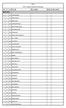 ROUND 2 2 1 33 TENNESSEE 2 2 34 TAMPA BAY 2 3 35 OAKLAND 2 4 36 JACKSONVILLE 2 5 37 NEW YORK JETS 2 6 38 WASHINGTON 2 7 39 CHICAGO 2 8 40 NEW YORK GIANTS 2 9 41 ST. LOUIS 2 10 42 ATLANTA 2 11 43 CLEVELAND
Financial Issues in Sport Chapter 1
 C H A P T E R 1 Financial Issues in Sport Chapter 1 Chapter Objectives Understand how important managing money is for anyone in the sport industry. Understand how math, strategy, and managerial skills
2014 Super Bowl betting odds have Broncos tied with Patriots
 2014 Super Bowl betting odds have Broncos tied with Patriots By Mike Klis The Denver Post February 17, 2014 Understandably, the Broncos have lost some shine, at least in Las Vegas. A Super Bowl favorite
 Additional information >>> HERE
 Accounting for Sports Franchises
 Accounting for Sports Franchises UNVERSITY OF FLORIDA ACCOUNTING CONFERENCE November 4, 2011 Justin Webster, Vice President of Finance DENVER BRONCOS FOOTBALL CLUB Agenda 1. Introduction 2. League/Team
North American Sports Leagues Home TV-Market Rankings 2007-08
 North American Sports Leagues Home TV-Market Rankings 2007-08 Rank Designated Market Area (DMA) TV HHLDS NFL MLB NBA NHL 1 New York 7.392 2 2 2 3 2 Los Angeles 5.647 0 2 2 2 3 Chicago 3.469 1 2 1 1 4 Philadelphia
Case 1:15-cv-08188 Document 1 Filed 10/16/15 Page 1 of 40 IN THE UNITED STATES DISTRICT COURT SOUTHERN DISTRICT OF NEW YORK
 Case 1:15-cv-08188 Document 1 Filed 10/16/15 Page 1 of 40 IN THE UNITED STATES DISTRICT COURT SOUTHERN DISTRICT OF NEW YORK ------------------------------------------- X Trilogy Holding, LLC d/b/a Bounce
Arizona Cardinals Yellow
 Arizona Cardinals Cardinal Red,, Blue 1996 through 2001 / 2000 Season 194 C Arizona Cardinals Red "Cardinal Red" Secondary Colors: 280 C Additional Colors: Black 6 C 116 C Additional Colors 2: 201 C 159
SACKS-CHAMPIONSHIPS-GAMES WON ALL-TIME RECORDS TEAM RECORDS
 SACKS-CHAMPIONSHIPS-GAMES WON TEAM RECORDS CHAMPIONSHIPS Most Seasons League Champion 13 Green Bay, 1929-1931, 1936, 1939, 1944, 1961-62, 1965-67, 1996, 2010 9 Chi. Bears, 1921, 1932-33, 1940-41, 1943,
NATIONAL FOOTBALL LEAGUE
 CONSTITUTION AND BYLAWS OF THE NATIONAL FOOTBALL LEAGUE Effective February 1, 1970 (2006 Rev.) *Provisions of the Constitution relating to players (in particular, Articles XII, XIV, XV, XVI, XVII, and
Organizing Topic: Data Analysis
 Organizing Topic: Data Analysis Mathematical Goals: Students will analyze and interpret univariate data using measures of central tendency and dispersion. Students will calculate the z-scores for data.
Sam Schaefer April 2011
 Football Betting Trends Sam Schaefer April 2011 2 Acknowledgements I would like to take this time to thank all of those who have contributed to my learning the past four years. This includes my parents,
In the event of a tie, the score on the last ten questions will be used as a tie-breaker.
 NEW YORK STATE ASSOCIATION FUTURE BUSIINESS LEADERS OF AMERICA SPRING DISTRICT MEETING SPORTS MANAGEMENT 2010 TEST DIRECTIONS 1. Complete the information requested on the answer sheet. PRINT your name
Buffalo Bills Ticket Office One Bills Drive Orchard Park, NY 14127
 Buffalo Bills Ticket Office One Bills Drive Orchard Park, NY 14127 Phone: 1-877-BB-TICKS (1-877-228-4257) Fax: 1-716-312-8900 Email: [email protected] HOURS Off Season: Monday through Friday: 9am -
CBA 101. Prepared by the NBA (September 2014)
 CBA 101 Highlights of the 2011 Collective Bargaining Agreement Between the National Basketball Association (NBA) and the National Basketball Players Association (NBPA) TM Prepared by the NBA (September
Sales Fulfillment Invoicing Broadcast Traffic Management & League Reporting Contract & Proposal Generation
 Sponsorship Inventory Management and Business Intelligence Software for Professional Sports Teams Sales Fulfillment Invoicing Broadcast Traffic Management & League Reporting Contract & Proposal Generation
Loss Aversion, Team Relocations, and Major League Expansion
 Loss Aversion, Team Relocations, and Major League Expansion Brad R. Humphreys West Virginia University Li Zhou University of Alberta Abstract Professional sports teams receive large public subsidies for
Social Media and Professional Sports: An analysis of the National Basketball Association and National Football League teams strategies
 Southern Illinois University Carbondale OpenSIUC Research Papers Graduate School 2015 Social Media and Professional Sports: An analysis of the National Basketball Association and National Football League
Testimony of. Mr. Daniel Fawcett. Executive Vice President DIRECTV November 14, 2006
 Testimony of Mr. Daniel Fawcett Executive Vice President DIRECTV November 14, 2006 Written Testimony Daniel M. Fawcett Executive Vice President, Business and Legal Affairs and Programming Acquisition DIRECTV,
Going Vertical: The Hospital-Health Insurer Merger. By Christi J. Braun 1 Farrah Short
 Going Vertical: The Hospital-Health Insurer Merger By Christi J. Braun 1 Farrah Short In today s health care reform environment, efficient health care delivery, stemming soaring health care costs, and
KANTAR MEDIA RELEASES MARCH MADNESS ADVERTISING TRENDS REPORT
 For interview requests and queries: Bill Daddi Daddi Brand Communications 646-370-1341 917-620-3717 [email protected] KANTAR MEDIA RELEASES MARCH MADNESS ADVERTISING TRENDS REPORT Historical Advertising
Data Management Summative MDM 4U1 Alex Bouma June 14, 2007. Sporting Cities Major League Locations
 Data Management Summative MDM 4U1 Alex Bouma June 14, 2007 Sporting Cities Major League Locations Table of Contents Title Page 1 Table of Contents...2 Introduction.3 Background.3 Results 5-11 Future Work...11
Understanding the Ratings Game. Connie Ledoux Book, Ph.D. [email protected] Presentation to NATOA Annual Conference New Orleans, 2009
 Understanding the Ratings Game Connie Ledoux Book, Ph.D. [email protected] Presentation to NATOA Annual Conference New Orleans, 2009 Pop Quiz Can you trust your gut instinct when it comes to television and
Retransmission Consent
 Retransmission Consent In a world of uncertainty, it seems as if annual cable rate increases have become as certain as taxes. Have you ever wondered why these rates continue to increase? Well just imagine
UP TO 40 % TEAMS AND PRODUCTS ALL PRODUCTS OFFICIALLY LICENSED
 UP TO 40 % PROFIT TEAMS AND PRODUCTS ALL PRODUCTS OFFICIALLY LICENSED SK BF V-07/15 NHL and the NHL Shield are registered trademarks of the National Hockey League. All NHL logos and marks and NHL team
Economics 340 > Economics of Sports > Syllabus
 Course: Economics 40 > Economics of Sports > Syllabus Fall 0 Dr. Delemeester Marietta College The Economics of Sports (www.marietta.edu/~delemeeg/econ40) Texts: The Economics of Sports by Leeds and von
Social Casino Postmortems. Derrick Morton CEO, FlowPlay
 Social Casino Postmortems Derrick Morton CEO, FlowPlay Background FlowPlay is the creator of Vegas World Social Casino MMO Launched November 2012 65 Floor Hotel, Night Club, Pool, Lounge, Chapel 50 Slots,
Additional details >>> HERE <<<
 Additional details >>> HERE http://dbvir.com/winningtip/pdx/nasl3500/
State Tax Return. Go Crazy, Folks... But Not Too Crazy: 1 California Court Ponders Remedy For Macy's Victory Over San Francisco
 November 2006 Volume 13 Number 11 State Tax Return Go Crazy, Folks... But Not Too Crazy: 1 California Court Ponders Remedy For Macy's Victory Over San Francisco Rachel Wilson Dallas (214) 969-5050 A taxpayer
MAJOR LEAGUE BASEBALL 2011 ATTENDANCE ANALYSIS. Compiled and Written by David P. Kronheim. [email protected]
 MAJOR LEAGUE BASEBALL 2011 ATTENDANCE ANALYSIS Compiled and Written by David P. Kronheim [email protected] 2012 MAJOR LEAGUE BASEBALL 2011 ATTENDANCE ANALYSIS TABLE OF CONTENTS PAGES Attendance Reporting
Information About Filing a Case in the United States Tax Court. Attached are the forms to use in filing your case in the United States Tax Court.
 Information About Filing a Case in the United States Tax Court Attached are the forms to use in filing your case in the United States Tax Court. It is very important that you take time to carefully read
ESOP Summary Plan Description
 BUSINESS IN THE RIGHT DIRECTION. GO WEST. ESOP Summary Plan Description for participants in the Employee Stock Ownership Plan This Summary Plan Description (SPD) corresponds with the plan document dated
B U S I N E S S C O S T S
 Introduction A company s success in today s highly competitive global economy is determined by its ability to produce the highest quality products and services at the lowest costs. This competitive imperative
Tax Reform in Texas: Was it the Perfect Storm? Karey Barton Principal
 Tax Reform in Texas: Was it the Perfect Storm? Karey Barton Principal December 15, 2008 Agenda The background: What was the emphasis driving tax reform? How did the process work? The basics: Who is subject
Rate Increase FAQs. Q. I refuse to pay more money for lousy service. If you are experiencing trouble with your service please call us.
 Rate Increase FAQs Q. Why are rates going up? TV networks continue to demand major increases in the costs we pay them to carry their networks. We negotiate to keep costs as low as possible and will continue
THE WALT DISNEY COMPANY REPORTS RECORD QUARTERLY EARNINGS FOR THE FIRST QUARTER OF FISCAL 2016
 FOR IMMEDIATE RELEASE February 9, THE WALT DISNEY COMPANY REPORTS RECORD QUARTERLY EARNINGS FOR THE FIRST QUARTER OF FISCAL Global success of Star Wars: The Force Awakens drove record quarterly operating
Columbus, OH is the Number One Sports Town in the U.S. Boston, Buffalo and Pittsburgh Also Leading Sports Cities
 FOR IMMEDIATE RELEASE Columbus, OH is the Number One Sports Town in the U.S. Boston, Buffalo and Pittsburgh Also Leading Sports Cities NEW YORK (October 1, 2008) Columbus, OH is the number one sports town
Connecticut State Employee Collective Bargaining and Retirement Benefits
 Background Connecticut State Employee Collective Bargaining and Retirement Benefits State employees through their bargaining units have had the authority under state law to collectively bargain on wages,
NIELSEN SPORTS INSIGHTS
 May 2012 NIELSEN SPORTS INSIGHTS The first quarter of 2012 continued to demonstrate the phenomenal drawing power of sports content. The NY Giants' Super Bowl win set yet another TV viewership record with
Industries. Industry Standards
 Industries Industry Standards Review: Top Domestic Grossing Films of All Time: Gone With the Wind (1939) Star Wars: Episode IV A New Hope (1977) The Sound of Music (1965) E.T. (1982) Titanic (1997) The
How To Calculate The Benefits From Hosting A Major League Team
 What Are the Benefits of Hosting a Major League Sports Franchise? By Jordan Rappaport and Chad Wilkerson Over the last few decades the number of U.S. metropolitan areas large enough to host a franchise
RULES AND REGULATIONS OF FIXED ODDS BETTING GAMES
 RULES AND REGULATIONS OF FIXED ODDS BETTING GAMES Project: Royalhighgate Public Company Ltd. 04.04.2014 Table of contents SECTION I: GENERAL RULES... 6 ARTICLE 1 GENERAL REGULATIONS...6 ARTICLE 2 THE HOLDING
THE 2013 ENTERTAINMENT, MEDIA & ADVERTISING MARKET RESEARCH HANDBOOK
 THE 2013 ENTERTAINMENT, MEDIA & ADVERTISING MARKET RESEARCH HANDBOOK th 13 Edition December 2012 362 pages ISBN# 1-57783-185-3 PART I: MARKET SUMMARY CONTENTS 1 MARKET ASSESSMENT: ADVERTISING 1.1 Advertising
inaugural opening 2007 3,270,210 2008 3,456,641 2009 3,609,048 2010 4,002,000 2011 5,468,951 2012 (projected) 6,000,000+
 The World s game in the USA The U.S. soccer community is currently at 65 million participants, including youth and adult players, fans, and volunteers. 14 million children between the ages of 6-17 play
THE WALT DISNEY COMPANY REPORTS THIRD QUARTER AND NINE MONTHS EARNINGS FOR FISCAL 2015
 FOR IMMEDIATE RELEASE August 4, THE WALT DISNEY COMPANY REPORTS THIRD QUARTER AND NINE MONTHS EARNINGS FOR FISCAL BURBANK, Calif. The Walt Disney Company today reported record quarterly earnings of $2.5
NFL Player Supplemental Disability Plan 200 St. Paul Place, Suite 2420 Baltimore, MD 21202-2040 (800) 638-3186. May 2005.
 NFL Player Supplemental Disability Plan 200 St. Paul Place, Suite 2420 Baltimore, MD 21202-2040 (800) 638-3186 May 2005 Dear NFL Player: This booklet summarizes the NFL Player Supplemental Disability Plan
THE STOCK MARKET GAME GLOSSARY
 THE STOCK MARKET GAME GLOSSARY Accounting: A method of recording a company s financial activity and arranging the information in reports that make the information understandable. Accounts payable: The
Venture Capital Tax Credits By State
 Venture Capital Tax Credits By State Alabama States Credit Amount Eligibility Notes Alaska Arizona Angel Investment Bill (Direct Tax Credit available for investments made after June 30, 2006, for tax years
A baseball stadium is unlikely to spur economic development in the area around it. Publicly financed stadiums do not pay for themselves.
 820 First Street, NE, Suite 610, Washington, DC 20002 Tel: 202-408-1080 Fax: 202-408-8173 http://www.dcfpi.org June 9, 2003 WOULD A PUBLICLY FINANCED BASEBALL STADIUM PAY OFF FOR DC? Economic Research
2 0 1 5-1 6 P l at i n u m
 N o. 1 R A T E D B E T T N F L & I N G C o l l e g e F o o t b a l l Every Week: s t a t f o x. c o m b e s t B e t s t o p w e e k l y p i c k s e x c l u s i v e p o w e r r a t i n g s H a n d i c a
Employee Benefits Alert
 Employee Benefits Alert June 2006 Issue No. 69 Square Pegs: Applying COBRA to Health Reimbursement Arrangements Executive Summary Almost all health reimbursement arrangements (HRAs) must offer COBRA coverage
There are two things used to calculate these benefits: Credited Seasons and Benefit Credits.
 BENEFITS RESOURCES Thanks to decades of diligence, the NFLPA has hammered out the very best benefits package in professional sports for our member players. This section serves as a general guide to NFL
Appraisal Economics Inc. Joseph Kettell, ASA [email protected] (201)265-3333 www.appraisaleconomics.com
 Appraisal Economics Inc. Joseph Kettell, ASA [email protected] (201)265-3333 www.appraisaleconomics.com Identified Asset Fair Market Value Player Contracts $60,000,000 National Broadcast Rights 110,000,000
An Assessment of UEFA s Financial Fairplay Rules. Stefan Szymanski
 An Assessment of UEFA s Financial Fairplay Rules Stefan Szymanski 1. Background 2. FFP rules 3. Assessment of objectives 4. Assessment of methods 5. Impact on Premier League 6. Conclusions Financial Stability
How the Seattle Sonics Became the Oklahoma City Thunder and the Economic Implications
 How the Seattle Sonics Became the Oklahoma City Thunder and the Economic Implications One of the most popular sports in the United States today is basketball and a large part of that popularity is facilitated
THE MASSACHUSETTS HEALTH CARE REFORM ACT: WHAT MUST EMPLOYERS DO?
 JULY 11, 2007 VOLUME 3, NUMBER 5 Employers nationwide need to understand what is happening in Massachusetts. THE MASSACHUSETTS HEALTH CARE REFORM ACT: WHAT MUST EMPLOYERS DO? by Katherine J. Utz* [email protected]
Detroit is proposing to be able to challenge all fouls, from offensive holding, any foul that takes place, they re proposing should be reviewable.
 Competition Committee Conference Call with NFL Executive Vice President of Football Operations Troy Vincent, Atlanta Falcons President & CEO and Competition Committee Chairman Rich McKay and St. Louis
SportsBusiness Journal Sports Business Resources your sports business news and information source.
 SportsBusiness Journal Sports Business Resources your sports business news and information source. Finance Financial Game Plan Advisers try to get athletes focused on reaching long-term goals By LIZ MULLEN
A STADIUM FOR ALL AGES
 A STADIUM FOR ALL AGES For decades, the Mercedes-Benz Superdome has defined the New Orleans skyline. With its iconic design, the venue has become one of the most recognizable landmarks in America. The
The Welfare Effects of Vertical Integration in Multichannel Television Markets
 The Welfare Effects of Vertical Integration in Multichannel Television Markets Greg Crawford (Zurich), Robin Lee (Harvard), Michael Whinston (MIT), and Ali Yurukoglu (Stanford GSB) FTC Microeconomics Conference,
U.S. Bank 401(k) Savings Plan Summary Plan Description
 U.S. Bank 401(k) Savings Plan Summary Plan Description January 2012 This document constitutes part of a prospectus covering securities that have been registered under the Securities Act of 1933. HR1201W
America s Most Legendary Coaches, Live on Gameday
 America s Most Legendary Coaches, Live on Gameday Founded by former University of Oklahoma and Dallas Cowboys head football coach Barry Switzer, Coaches Cabana is the first of its kind to offer college
The Income Taxation of Employment Split Dollar Loan Arrangements Split Dollar Loan Arrangements
 The Income Taxation of Employment Split Dollar Loan Arrangements Split Dollar Loan Arrangements These materials are not intended to be used to avoid tax penalties and were prepared to support the promotion
The Sports Sales Combine Phoenix, AZ November 6-8, 2014
 Sports Business Solutions & The Phoenix Suns Present: The Sports Sales Combine Phoenix, AZ November 6-8, 2014 Participating Coaches: Matt Clark Manager, Membership Development San Diego Padres Matt currently
ISyE 2028 Basic Statistical Methods - Fall 2015 Analysis of NFL Team Performance Against the Spread Betting Line
 ISyE 2028 Basic Statistical Methods - Fall 2015 Analysis of NFL Team Performance Against the Spread Betting Line Introduction Author: Jonathan Pang Sports betting, although controversial, is an extremely
a. Five-year contract b. December 1, 2016 termination date
 SUMMARY OF MAJOR LEAGUE BASEBALL PLAYERS ASSOCIATION- MAJOR LEAGUE BASEBALL LABOR AGREEMENT I. TERM a. Five-year contract b. December 1, 2016 termination date II. SCHEDULING, REALIGNMENT, AND POSTSEASON
Oklahoma Ad Valorem. 1 of 14. Central Valuation by Oklahoma Tax Commission: All Public Service Corporations (multiple county impact)
 Oklahoma Ad Valorem - Founded Before Statehood And Codified in the 1907 Populist Constitution And Current Laws - Township Assessors in 1894 - County Assessor System Set Up in 1911 - Tax Commission Oversight
BY REQUEST OF THE REVENUE AND TRANSPORTATION INTERIM COMMITTEE A BILL FOR AN ACT ENTITLED: "AN ACT REVISING CERTAIN PROVISIONS RELATED TO THE
 SB00.0 SENATE BILL NO. INTRODUCED BY F. THOMAS BY REQUEST OF THE REVENUE AND TRANSPORTATION INTERIM COMMITTEE A BILL FOR AN ACT ENTITLED: "AN ACT REVISING CERTAIN PROVISIONS RELATED TO THE ADMINISTRATION
CHAPTER 5 INTRODUCTION TO VALUATION: THE TIME VALUE OF MONEY
 CHAPTER 5 INTRODUCTION TO VALUATION: THE TIME VALUE OF MONEY Answers to Concepts Review and Critical Thinking Questions 1. The four parts are the present value (PV), the future value (FV), the discount
CANADA UNITED STATES MONTREAL TORONTO BOSTON NEW YORK CITY PHILADELPHIA WASHINGTON, D.C. CHICAGO SALT LAKE CITY DENVER COLUMBUS SAN JOSE KANSAS CITY
 VANCOUVER SEATTLE CANADA PORTLAND MONTREAL TORONTO BOSTON SAN JOSE SALT LAKE CITY DENVER KANSAS CITY CHICAGO COLUMBUS NEW YORK CITY PHILADELPHIA WASHINGTON, D.C. LOS ANGELES ATLANTA DALLAS UNITED STATES
GW Law Alumni Elective Courses Survey
 GW Law Alumni Elective Courses Survey About You 1. Year of graduation (if you hold multiple degrees from GW Law, please select your most recent graduation year) [drop-down list included 1925-2010] 2. Practice
Statement of Edward M. Gramlich Acting Director Congressional Budget Office. before the Committee on Veterans' Affairs United States Senate
 Statement of Edward M. Gramlich Acting Director Congressional Budget Office before the Committee on Veterans' Affairs United States Senate June 17,1987 NOTICE This statement is not available for public
Salary Caps in Professional Team Sports - Balancing Competition or Balancing Costs in the National Hockey League?
 Powered by TCPDF (www.tcpdf.org) Salary Caps in Professional Team Sports - Balancing Competition or Balancing Costs in the National Hockey League? Economics Master's thesis Antti Lipasti 2015 Department
BROADCAST EXCLUSIVITY RULES
 United States Government Accountability Office Report to Congressional Requesters April 2015 BROADCAST EXCLUSIVITY RULES Effects of Elimination Would Depend on Other Federal Actions and Industry Response
Public Financial Disclosure A Guide to Reporting Selected Financial Instruments
 Public Financial Disclosure A Guide to Reporting Selected Financial Instruments TABLE OF CONTENTS AMERICAN DEPOSITARY RECEIPT 1 CASH BALANCE PENSION PLAN 2 COMMON TRUST FUND OF A BANK 4 EMPLOYEE STOCK
THE COFFIN CORNER: Vol. 26, No. 3 (2004) A CHRONOLOGY OF PRO FOOTBALL ON TELEVISION: Part 1
 A CHRONOLOGY OF PRO FOOTBALL ON TELEVISION: Part 1 by Tim Brulia 1939- first telecast of a pro football game. Brooklyn Dodgers hosting Philadelphia Eagles on experimental station W2XBS (NBC). 1948- first
The Performance of Betting Lines for Predicting the Outcome of NFL Games
 The Performance of Betting Lines for Predicting the Outcome of NFL Games Greg Szalkowski and Michael L. Nelson Old Dominion University, Department of Computer Science Norfolk, VA 23529 arxiv:1211.4000v1
EARNINGS RELEASE FOR THE QUARTER ENDED SEPTEMBER 30, 2015
 21ST CENTURY FOX REPORTS FIRST QUARTER INCOME FROM CONTINUING OPERATIONS PER SHARE OF $0.34 AND FIRST QUARTER TOTAL SEGMENT OPERATING INCOME BEFORE DEPRECIATION AND AMORTIZATION OF $1.54 BILLION ON TOTAL
The Business of Sports: Where s the Money?
 The Business of Sports: Where s the Money? Dr Justin Wolfers Assistant Professor of Economics www.stanford.edu/people/jwolfers [email protected] 1 Why the Business of Sports? For all his brilliance,
2011 Public Act 152: Publicly Funded Health Insurance Contribution Act (MCL 15.561 15.569), as amended by 2013 Public Acts numbered 269 through 273
 2011 Public Act 152: Publicly Funded Health Insurance Contribution Act (MCL 15.561 15.569), as amended by 2013 Public Acts numbered 269 through 273 Frequently Asked Questions Table of Contents 1. General...
Master Builder. Plus: + Paramount Metal Systems Thermal Retrofit + Metal-clad Football Stadiums + Project Management. October 2010
 October 2010 Master Builder Design-build partnership between Ayars & Ayars Inc. and Architecture Etcetera LLC combines efforts on an office building boasting Butler Manufacturing s metal panels Plus: +