
Science Driving the Future of Resuscitation: ACLS
|
|
|
- Meryl Jennings
- 10 years ago
- Views:
Transcription
1 Paris Hotel and Casino Las Vegas, Nevada Science Driving the Future of Resuscitation: ACLS Joseph P. Ornato, MD, FACP, FACC, FACEP Professor & Chairman, Dept. of Emergency Medicine Professor, Internal Medicine (Cardiology) Virginia Commonwealth University Health System Operational Medical Director Richmond Ambulance Authority Richmond Fire & EMS Henrico County Division of Fire Richmond, VA

2 Disclosure Information Joseph P. Ornato, MD, FACP, FACC, FACEP Science Driving the Future of Resuscitation: ACLS FINANCIAL DISCLOSURE: Cardiac Co-Chair & Consultant: NIH Resuscitation Outcomes Consortium (ROC) American Editor, Resuscitation Advisory Board, Key Technologies, Inc. (Transnasal Cooling Device) UNLABELED/UNAPPROVED USES DISCLOSURE: Transnasal cooling devices

3 Intra-arrest hot topics Airway management Role of ACLS drugs Extracorporeal Membrane Oxygenation CPR (ecpr) Intra-arrest therapeutic hypothermia

4 AHA Guidelines Grading

5 Airway Management During CPR performed by providers trained in its use, the supraglottic airway is a reasonable alternative to bag-mask ventilation (Class IIa, LOE B) and endotracheal intubation (Class IIa, LOE A). For healthcare professionals trained in its use, the esophagealtracheal tube is an acceptable alternative to both bag-mask ventilation (Class IIa, LOE C) or endotracheal intubation (Class IIa, LOE A) for airway management in cardiac arrest. For healthcare professionals trained in its use, the laryngeal tube may be considered as an alternative to bag-mask ventilation (Class IIb, LOE C) or endotracheal intubation for airway management in cardiac arrest (Class IIb, LOE C). For healthcare professionals trained in its use, the laryngeal mask airway is an acceptable alternative to bagmask ventilation (Class IIa, LOE B) or endotracheal intubation (Class IIa, LOE C) for airway management in cardiac arrest.

6 Prehospital airway management in cardiac arrest - CARES McMullan J et al. Resuscitation 2014; 85: ,691 out-of-hospital cardiac arrests in the CARES registry Frequency of use ET= 5,591 (52%) SGA= 3,110 (30%) BVM= 1,929 (18%) Survival to DC intact ET= 5.4% SGA= 6.7% BVM= 18.6% BVM pts more likely to be: VF or VT initially EMS witnessed Bystander AED Propensity matched, adjusted for confounders Survival to discharge intact Survival by Airway Management Strategy Survival to discharge Survival to admission Sustained ROSC Favors SGA or ET Favors BVM Odds Ratio [95% CI]

7 Prehospital airway management in cardiac arrest - CARES McMullan J et al. Resuscitation 2014; 85: Survival by Advanced Airway Type 10,691 out-of-hospital cardiac arrests in the Survival to discharge 1.66 CARES registry neurologically intact Frequency of use 1.72 ET= 5,591 (52%) Survival to discharge SGA= 3,110 (30%) 1.43 BVM= 1,929 (18%) Survival to admission Survival to DC intact ET= 5.4% 1.38 SGA= 6.7% Sustained ROSC Propensity matched, adjusted for confounders Favors SGA Odds Ratio [95% CI] Favors ET

8 ET intubation vs. supraglottic airway in cardiac arrest - ROC Wang HE et al. Resuscitation 2012; 83: Survival by Advanced Airway Type 10,455 adult out-ofhospital 0.84 cardiac arrest in Resuscitation Airway or respiratory complications Outcomes Consortium 1.78 (ROC) registry ROSC Not a randomized trial 1.74 Frequency of use Survival to 24 hrs ET= 8,487 (81%) SGA= 1,968 (19%) 1.40 Survival to DC Survival to DC intact neurologically intact ET= 4.7% SGA= 3.9% Favors SGA Odds Ratio [95% CI] Favors ET

9 ACLS Drugs It is reasonable to consider administering a 1 mg dose of IV/IO epinephrine every 3 to 5 minutes during adult cardiac arrest (Class IIb, LOE A). Amiodarone may be considered for VF or pulseless VT unresponsive to CPR, defibrillation, and a vasopressor therapy (Class IIb, LOE B). Lidocaine may be considered if amiodarone is not available (Class IIb, LOE B).

10 Benefit of each link in the chain of survival Stiell I et al. N Engl J Med 2004;351: ,638 OOH-CA patients 17 cities in Ontario, CA Sequential addition of each link in the chain of survival Outcome= survival to hospital discharge Variable Age <75 yr Early Access Adjusted Odds Ratio [95% CI] Adjusted Odds Ratio [95% CI] 1.6 [1.2, 2.3] 4.4 [3.1, 6.4] Early CPR 3.7 [2.5, 5.4] Early DF 3.4 [1.4, 8.4] Early ACLS 1.1 [0.8, 1.5] ccv Survival worse Survival better ccv
![chain of survival Outcome= survival to hospital discharge Variable Age <75 yr Early Access Adjusted Odds Ratio [95% CI]](/docs-images/45/2813972/images/page_10.jpg "Adjusted Odds Ratio [95% CI] 1.6 [1.2, 2.3] 4.4 [3.1, 6.4] Early CPR 3.7 [2.5, 5.4] Early DF 3.4 [1.4, 8.4] Early ACLS 1.")
11 ACLS meds vs. no ACLS drugs in Oslo Olasveengen TM et al. JAMA 2009; 301: No drugs 851 OOH-CA cases Randomized to ACLS with vs. without drugs EMS response time interval= 10 min Initial VF= 33% Byst witn= 65% Byst CPR= 63% MD on unit= 37% 50% 40% 30% 20% 10% 0% 40% 25% ROSC 32% 21% Admitted to hospital Drugs p>.001 p>.001 p>.002 p>.61 p>.53 30% 20% Admitted to ICU 11% 9% Discharged 10% 8% Alive at 1 year

12 Prehospital randomized trial of no epinephrine vs. epinephrine Jacobs I et al. Resuscitation 2011;82(9): out-of-hospital cardiac arrest patients Randomized to receive no epinephrine vs. epinephrine during resuscitation Perth, Australia 30% 25% 20% 15% 10% 5% 0% p < % No epinephrine 24% p < % Epinephrine 25% p =.15 2% 4% ROSC Admitted Discharged

13 Prehospital epinephrine use & survival in Japan Hagihara A et al. JAMA 2012; 307: ,188 OOH-CA cases EMS skills: CPR AED IV Give epi 1 mg q4min x 3 Epinephrine vs. no epinephrine by EMS 3.7% of patients received epinephrine Model ROSC Unadjusted Adjusted for propensity Adjusted for propensity and selected variables Adjusted for all covariates 1 month survival Unadjusted Adjusted for propensity Adjusted for propensity and selected variables Adjusted for all covariates CPC 1 or 2 Unadjusted Adjusted for propensity Adjusted for propensity and selected variables Adjusted for all covariates OPC 1 or 2 Unadjusted Adjusted for propensity Adjusted for propensity and selected variables Adjusted for all covariates Favors No No Prehospital Epinephrine Favors Prehospital Epinephrine Odds Ratio [95% CI]

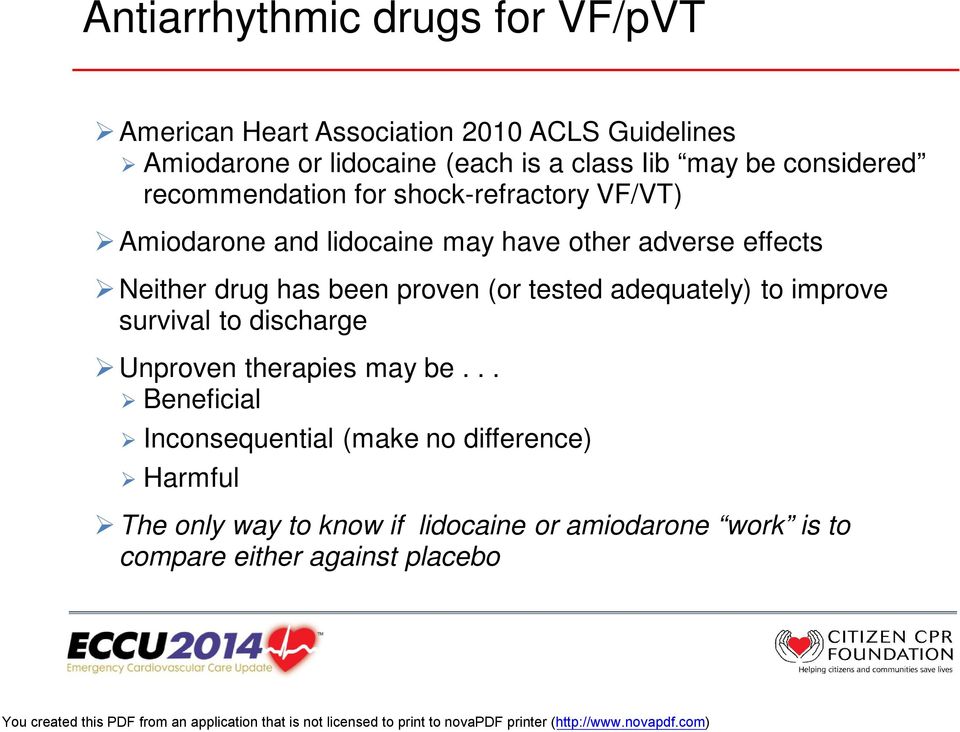
14 Antiarrhythmic drugs for VF/pVT American Heart Association 2010 ACLS Guidelines Amiodarone or lidocaine (each is a class Iib may be considered recommendation for shock-refractory VF/VT) Amiodarone and lidocaine may have other adverse effects Neither drug has been proven (or tested adequately) to improve survival to discharge Unproven therapies may be... Beneficial Inconsequential (make no difference) Harmful The only way to know if lidocaine or amiodarone work is to compare either against placebo
15 Amiodarone vs. lidocaine OOH-CA ARREST Trial ALIVE Trial Persistent or recurrent VF/VT Continue CPR Intubate at once Obtain IV access Epi 1 mg IV q 3-5 min DF 360 J sec after med dose Pattern drug-shock, drug-shock Amio 300 mg DF 360 J within sec Placebo IIb medications Lidocaine Bretylium Mg sulfate Procainamide (Na bicarb) N= 348 Amio vs. Lido Toronto EMS st DF = 12±7 min 911-drug = 25±8 min Survival to Admission 70% 60% 50% 40% 30% 20% 10% N= % 34% Amiodarone 300 mg 49% 39% 17% 12% Placebo 64% 41% 38% 33% Admission 25% 20% 15% 10% 5% 0% 23% Amio p< % Lido 0% All patients VF Asys or PEA ROSC No ROSC Kudenchuk P et al. N Engl J Med 1999; 341:871-8 Dorian P et al. N Engl J Med Mar 21;346(12):884-90

16 NIH Resuscitation Outcomes Consortium (ROC) Amiodarone vs. Lidocaine vs. Placebo Study (ALPS) N= SYRINGE # AMIODARONE KIT LIDOCAINE KIT PLACEBO KIT 1 Amiodarone 150 mg (3 cc) Lidocaine 60 mg (3 cc) Placebo (3 cc) 2 Amiodarone 150 mg (3 cc) Lidocaine 60 mg (3 cc) Placebo (3 cc) 3 Amiodarone 150 mg (3 cc) Lidocaine 60 mg (3 cc) Placebo (3 cc)

17 Extra Corporeal Membrane Oxygenation (ECMO) CPR (ecpr) In settings where ecpr is readily available, it may be considered when the time without blood flow is brief and the condition leading to the cardiac arrest is reversible (e.g., accidental hypothermia drug intoxication) or amenable to heart transplantation (eg, myocarditis) or revascularization (e.g., acute myocardial infarction) (Class IIb, LOE C).

18 Extra Corporeal Membrane Oxygenation (ECMO) CPR (ecpr) Lack of randomized trials Available data is from small case series and observational reports Most are retrospective Age (median= 56) years Duration of CPR minutes Initial rhythm Typical exclusion criteria IHCA vs. OHCA Survival 20-33%

19 ECPR associated with hypothermia and normoxia in refractory cardiac arrest Fagnoul D et al. Resuscitation 2013;84: Collapse to ECPR 58 min [45-70] Survivors 41 min [39-58] Non-survivors 60 min [55-77] p=0.059 ALL had mechanical chest compression ALL had intra arrest hypothermia Tight P a O 2 & P a CO 2 management PCI on ECMO for suspected ischemia
![[39-58] Non-survivors 60 min [55-77] p=0.](/docs-images/45/2813972/images/page_19.jpg "059 ALL had mechanical chest compression ALL had intra arrest hypothermia Tight P a O 2")
20 ecpr for patients with OHCA of cardiac origin: A propensity matched study Maekawa K et al. Crit Care Med 2013;41: Sopporo, Japan Witnessed OHCA of cardiac origin Failed CPR >20 min Primary Endpoint: Neuro Intact Survival 3-months post-arrest Log-rank p= ecpr (n= 48, PCI 40%) Manual CPR (n= 48, PCI 5%) Hazard Ratio [95% CI] Adjusted Hazard Ratio [95% CI] p Pre-existing arrhythmia 0.33 [ ] 0.59 [ ] 0.42 Atropine administration (+1 mg) 1.55 [ ] 1.28 [ ] 0.14 Duration of CPR (+10 min) 1.18 [ ] 1.08 [ ] 0.52 Pupil diameter on hospital arrival (+1 mm) 1.56 [ ] 1.39 [ ] Breathing spontaneously on hospital arrival 0.28 [ ] 0.42 [ ] 0.13 Shockable rhythm on hospital arrival 0.39 [ ] 0.84 [ ] 0.69 Initial lactate level (+1 mmol/l) 1.05 [ ] 1.03 [ ] 0.40
![018 ecpr (n= 48, PCI 40%) Manual CPR (n= 48, PCI 5%) Hazard Ratio [95% CI] Adjusted Hazard Ratio [95% CI] p Pre-existing arrhythmia 0.33 [0.10-1.06] 0.59 [0.15-2.13] 0.](/docs-images/45/2813972/images/page_20.jpg "42 Atropine administration (+1 mg) 1.55 [1.16-2.07] 1.28 [0.92-1.77] 0.14 Duration of CPR (+10 min) 1.18 [0.98-1.42] 1.08 [0.85-1.34] 0.52 Pupil diameter on hospital arrival (+1 mm) 1.56 [1.26-1.")
21 Two year survival and neurological outcome of IHCA patients rescued by ecpr Shin TG, et al. International Journal Cardiol 2013;168: ecpr ecpr increased 2-year survival 2.4 fold compared to CCPR NNT: 7 patients over 2 years Best candidates: < 65 years CPR duration < 35 min Potentially reversible causes
22 Intra-Arrest Hypothermia In summary, we recommend that comatose (ie, lack of meaningful response to verbal commands) adult patients with ROSC after out-of-hospital VF cardiac arrest should be cooled to 32 C to 34 C (89.6 F to 93.2 F) for 12 to 24 hours (Class I, LOE B). Induced hypothermia also may be considered for comatose adult patients with ROSC after in-hospital cardiac arrest of any initial rhythm or after out-of-hospital cardiac arrest with an initial rhythm of pulseless electric activity or asystole (Class IIb, LOE B).
23 Randomized Trial of Prehospital Induction of Hypothermia in OOH-CA with Rapid Infusion of 4ºC Saline Kim et. al. JAMA 2014; 311: % 70% 60% Cooled p=.69 62% 64% Not Cooled N= 1,359 Median times from 911 call to ROSC = min Survival to Discharge 50% 40% 30% 20% 18% p=.30 16% 10% 0% VF Not VF 50% 40% Cooled Not Cooled 41% p=.0001 Mean temp change NS vs control VF= -1.1 ºC Non-VF= -1.2 ºC Survival to Discharge 30% 20% 10% 26% p= % 30% 0% Rearrest Pulm Edema on CXR
24 Intra-arrest hypothermia Nozari et al. Circulation, 2006; 113: dogs VF cardiac arrest No flow 3 min, 7 min BLS before ALS Randomized to early vs. delayed intra-arrest hypothermia to 34 ºC 10 min 20 min
25 Intra-arrest hypothermia Nozari et al. Circulation, 2006; 113: dogs VF cardiac arrest No flow 3 min, 7 min BLS before ALS Randomized to early vs. delayed intra-arrest hypothermia to 34 ºC Early Hypothermia Delayed Hypothermia OPC-1 (normal) OOOO O OPC-2 (mildly impaired) OPC-3 (moderately impaired OPC-4 (severely impaired) O O O OPC-5 (death) O OOOOOOOO
26 Design of the Rapid Infusion of cold Normal SalinE by paramedics during CPR (RINSE trial) Deasy C et al. BMC Emergency Medicine. 2011;11:17 Australian pre-hospital randomized clinical trial During CPR, infuse up to 2L of 4 C saline rapidly IV Primary outcome: survival to d/c Secondary outcomes: ROSC, survival to admission, temp on ED arrival, 12 month quality of life in survivors
27 External Head/Neck Cooling Callaway C et al. Resuscitation 2002;52: OOH-CA pts randomized to usual care vs. ice bags on head & neck during resuscitation Monitored nasopharyngeal & esophageal temp
28 Comparison between transnasal head cooling begun during CPR and surface cooling after resuscitation in a pig model of cardiac arrest Guan J, Barbut D, Wang H, et al. Critical Care Medicine.2008:36(11) Suppl:S428-S433
29 Selective Brain Cooling ( Rhinochill ) Non-invasive Intranasal PFC spray delivered through nasal prongs Can be initiated early Ambulance or ED Very rapid cooling Upper airways designed for heat exchange Preferential brain cooling Brain-core gradient
30 Intra-arrest transnasal cooling Castren et al. Circulation 2010;122(7): out-of-hospital cardiac arrest patients 15 sites, 5 European countries Pts randomized to prehospital nasal cooling or no prehospital nasal cooling Standard therapeutic hypothermia used after hospital arrival
31 Transnasal cooling with dehumidified high flow air Harikrishna Tandri H, Zviman M, Srinivas MR, et al. Circulation 2012; 126:A1 18 adult pigs Intubated, mechanically ventilated Core body temp in R atrium Brain temp of frontal, parietal, occipital lobes using thermocouples Rate of temp cooling measured at 80L/min transnasal dehumidified air flow MR thermography showed uniform global brain cooling
32 Intra-arrest hot topics summary Airway management Role of ACLS drugs Extracorporeal Membrane Oxygenation CPR (ecpr) Intra-arrest therapeutic hypothermia
Adding IV Amiodarone to the EMS Algorithm for Cardiac Arrest Due to VF/Pulseless VT
 Adding IV Amiodarone to the EMS Algorithm for Cardiac Arrest Due to VF/Pulseless VT Introduction Before the year 2000, the traditional antiarrhythmic agents (lidocaine, bretylium, magnesium sulfate, procainamide,
2015 Interim Resources for HeartCode ACLS
 2015 Interim Resources for HeartCode ACLS Original Release: November 25, 2015 Starting in 2016, new versions of American Heart Association online courses will be released to reflect the changes published
The 5 Most Important EMS Articles EAGLES 2014
 The 5 Most Important EMS Articles EAGLES 2014 Corey M. Slovis, M.D. Vanderbilt University Medical Center Metro Nashville Fire Department Nashville International Airport Nashville, TN VanderbiltEM.com
Epinephrine in CPR. The 5 Most Important EMS Articles EAGLES 2014. Epi vs No-Epi Take Homes 2/28/2014. VF/VT (1990 Pairs) Epi vs No-Epi
 The 5 Most Important EMS Articles EAGLES 214 Corey M. Slovis, M.D. Vanderbilt University Medical Center Metro Nashville Fire Department Nashville International Airport Nashville, TN nephrine in CPR VF/VT
Patient Schematic. Perkins GD et al The Lancet, 385, 2015, 947-955
 Lancet March 2015 Patient Schematic Perkins GD et al The Lancet, 385, 2015, 947-955 Background Adequate CPR is critical for survival for CA patients Maintenance of high-quality compressions during OHCA
ACLS PRE-TEST ANNOTATED ANSWER KEY
 ACLS PRE-TEST ANNOTATED ANSWER KEY June, 2011 Question 1: Question 2: There is no pulse with this rhythm. Question 3: Question 4: Question 5: Question 6: Question 7: Question 8: Question 9: Question 10:
2015 AHA Guidelines for CPR and ECC: Time for a Change Michael Sayre, MD University of Washington Emergency Medicine. Disclosures
 2015 AHA Guidelines for CPR and ECC: Time for a Change Michael Sayre, MD University of Washington Emergency Medicine Disclosures Medtronic Foundation: Research Grant Physio Control: EMS Fellowship Program
ROC CONTINUOUS CHEST COMPRESSIONS STUDY (CCC): MEDICAL CARDIAC ARREST MEDICAL DIRECTIVE
 ROC CONTINUOUS CHEST COMPRESSIONS STUDY (CCC): MEDICAL CARDIAC ARREST MEDICAL DIRECTIVE An Advanced Care Paramedic will provide the treatment based on the randomization scheme and as prescribed in this
What is the Future of Epinephrine in Cardiac Arrest? Pros and Cons
 What is the Future of Epinephrine in Cardiac Arrest? Pros and Cons Melissa L. Thompson Bastin, PharmD., BCPS Komal A. Pandya, PharmD., BCPS 0 Presenter Disclosure Information Melissa L. Thompson Bastin,
Cardiac Arrest Pediatric Ventricular Fibrillation / Pulseless Ventricular Tachycardia Protocol revised October 2008
 Cardiac Arrest Pediatric Ventricular Fibrillation / Pulseless Ventricular Tachycardia Protocol revised October 2008 Preamble In contrast to cardiac arrest in adults, cardiopulmonary arrest in pediatric
If you do not wish to print the entire pre-test you may print Page 2 only to write your answers, score your test, and turn in to your instructor.
 This is a SAMPLE of the pretest you can access with your AHA PALS Course Manual at Heart.org/Eccstudent using your personal code that comes with your PALS Course Manual The American Heart Association strongly
EMBARGOED FOR RELEASE
 Systems of Care and Continuous Quality Improvement Universal elements of a system of care have been identified to provide stakeholders with a common framework with which to assemble an integrated resuscitation
Cardiac Arrest VF/Pulseless VT Learning Station Checklist
 Cardiac Arrest VF/Pulseless VT Learning Station Checklist VF/VT 00 American Heart Association Adult Cardiac Arrest Shout for Help/Activate Emergency Response Epinephrine every - min Amiodarone Start CPR
ACLS Provider Manual Comparison Sheet Based on 2010 AHA Guidelines for CPR and ECC. BLS Changes
 ACLS Provider Manual Comparison Sheet Based on 2010 AHA Guidelines for CPR and ECC CPR Chest compressions, Airway, Breathing (C-A-B) BLS Changes New Old Rationale New science indicates the following order:
AMERICAN HEART ASSOCIATION 2010 ACLS GUIDELINES: WHAT EVERY CLINICIAN NEEDS TO KNOW
 AMERICAN HEART ASSOCIATION 2010 ACLS GUIDELINES: WHAT EVERY CLINICIAN NEEDS TO KNOW Joseph Heidenreich, MD Texas A&M Health Science Center Scott & White Memorial Hospital Scott & White Memorial Hospital
Cardiac Arrest - Ventricular Fibrillation / Pulseless Ventricular Tachycardia Protocol revised October 2008
 Cardiac Arrest - Ventricular Fibrillation / Pulseless Ventricular Tachycardia Protocol revised October 2008 Preamble Survival from cardiorespiratory arrest for patients who present with ventricular fibrillation
Objectives. Cardiac Arrest by the Numbers. Where would you want to collapse in V-FIB? 7/31/14
 Objectives David Glendenning Education Coordinator New Hanover Regional Medical Center EMS Review CPR technique and sequence Review recent evidence & current studies in the use of ACLS medications Review
Resuscitation 83 (2012) 327 332. Contents lists available at SciVerse ScienceDirect. Resuscitation
 Resuscitation 83 (2012) 327 332 Contents lists available at SciVerse ScienceDirect Resuscitation jo u rn al hom epage : www.elsevier.com/locate/resuscitation Clinical Paper Outcome when adrenaline (epinephrine)
Journal reading. Method. Introduction. Measurement. Supervisor: F1 徐 英 洲 Presentor:R1 劉 邦 民 103.04.14
 Journal reading Supervisor: F1 徐 英 洲 Presentor:R1 劉 邦 民 103.04.14 Introduction Epinephrine usage in CPR Pro: Ability to augment BP and increased coronary perfusion through systemic vasoconstriction Cons:
New Approaches for Prehospital Cardiac Arrest Management 2010 NCEMSF Conference
 New Approaches for Prehospital Cardiac Arrest Management 2010 NCEMSF Conference Mark E. Pinchalk, MS, EMT-P Paramedic Crew Chief City of Pittsburgh EMS Out of Hospital Cardiac Arrest Poor outcomes: Arizona
American Heart Association ACLS Pre-Course Self Assessment Dec., 2006. ECG Analysis. Name the following rhythms from the list below:
 American Heart Association ACLS Pre-Course Self Assessment Dec., 2006 ECG Analysis This pre-test is exactly the same as the pretest on the ACLS Provider manual CD. This paper version can be completed in
Sudden Cardiac Arrest- Focusing on the Unsolved Problems
 Sudden Cardiac Arrest- Focusing on the Unsolved Problems Wen-Jone Chen MD, PhD, FESC Professor of Medicine, Department of Emergency Medicine, National Taiwan University, Taipei, Taiwan Superintendent,
Official Online ACLS Exam
 \ Official Online ACLS Exam Please fill out this form before you take the exam. Name : Email : Phone : 1. Hypovolemia initially produces which arrhythmia? A. PEA B. Sinus tachycardia C. Symptomatic bradyarrhythmia
available at www.sciencedirect.com journal homepage: www.elsevier.com/locate/resuscitation
 Resuscitation (2008) 79, 424 431 available at www.sciencedirect.com journal homepage: www.elsevier.com/locate/resuscitation CLINICAL PAPER Defibrillation or cardiopulmonary resuscitation first for patients
Resuscitation Could this new model of CPR hold promise for better rates of neurologically intact survival?
 Cover report by Gordon A. Ewy, MD, Michael J. Kellum, MD, & Bentley J. Bobrow, MD CARDIOCEREBRAL Resuscitation Could this new model of CPR hold promise for better rates of neurologically intact survival?
ACLS Study Guide BLS Overview CAB
 ACLS Study Guide The ACLS Provider exam is 50-mutiple choice questions. Passing score is 84%. Student may miss 8 questions. For students taking ACLS for the first time or renewing students with a current
Update on Small Animal Cardiopulmonary Resuscitation (CPR)- is anything new?
 Update on Small Animal Cardiopulmonary Resuscitation (CPR)- is anything new? DVM, DACVA Objective: Update on the new Small animal guidelines for CPR and a discussion of the 2012 Reassessment Campaign on
Target groups: Paramedics, nurses, respiratory therapists, physicians, and others who manage respiratory emergencies.
 Overview Estimated scenario time: 10 15 minutes Estimated debriefing time: 10 minutes Target groups: Paramedics, nurses, respiratory therapists, physicians, and others who manage respiratory emergencies.
ACLS Cardiac Arrest Algorithm Neumar, R. W. et al. Circulation 2010;122:S729-S767
 ACLS Cardiac Arrest Algorithm Neumar, R. W. et al. Circulation 2010;122:S729-S767 Copyright 2010 American Heart Association ACLS Cardiac Arrest Circular Algorithm Neumar, R. W. et al. Circulation 2010;122:S729-S767
2015 Interim Resources for BLS
 2015 Interim Resources for BLS Original Release: November 25, 2015 Starting in 2016, new versions of American Heart Association online courses will be released to reflect the changes published in the 2015
Question-and-Answer Document 2010 AHA Guidelines for CPR & ECC As of October 18, 2010
 Question-and-Answer Document 2010 AHA Guidelines for CPR & ECC As of October 18, 2010 Q: What are the most significant changes in the 2010 AHA Guidelines for CPR & ECC? A: Major changes for all rescuers,
Management of Adult Cardiac Arrest
 73991_CH27_page68-73.qxd 6/6/11 3:54 PM Page 68 27.68 Section 5 Medical Guidelines for Performing a 12-Lead ECG The only way to learn how to obtain a 12-lead ECG is to practice with the equipment itself.
Resuscitation in cardiac arrest the role of the HEMS physician
 Resuscitation in cardiac arrest the role of the HEMS physician Dr Anne Weaver Consultant in Emergency Medicine & Pre-hospital Care AIRMED World Congress Rome 2014 Aims Describe standard care for cardiac
Resuscitation in congenital heart disease. Peter C. Laussen MBBS FCICM Department Critical Care Medicine Hospital for Sick Children Toronto
 Resuscitation in congenital heart disease Peter C. Laussen MBBS FCICM Department Critical Care Medicine Hospital for Sick Children Toronto Evolution of Congenital Heart Disease Extraordinary success: Overall
Pediatric Airway Management
 Pediatric Airway Management Dec 2003 Dr. Shapiro I., PICU Adult Chain of Survival EMS CPR ALS Early Defibrillation Pediatric Chain of Survival Prevention CPR EMS ALS Out-of-Hospital Cardiac Arrest SIDS
E C C. American Heart Association. Advanced Cardiovascular Life Support. Written Exams. May 2011
 E C C American Heart Association Advanced Cardiovascular Life Support Written Exams Contents: Exam Memo Student Answer Sheet Version A Exam Version A Answer Key Version A Reference Sheet Version B Exam
2010 American Heart Association Guidelines for Cardiopulmonary Resuscitation and Emergency Cardiovascular Care
 2010 American Heart Association Guidelines for Cardiopulmonary Resuscitation and Emergency Cardiovascular Care Presenter Name Disclosures
Helicopter emergency medical services (HEMS) response to out-of-hospital cardiac arrest
 Lyon and Nelson Scandinavian Journal of Trauma, Resuscitation and Emergency Medicine 2013, 21:1 ORIGINAL RESEARCH Open Access Helicopter emergency medical services (HEMS) response to out-of-hospital cardiac
E C C. American Heart Association. Advanced Cardiovascular Life Support. Written Precourse Self-Assessment. May 2011. 2011 American Heart Association
 E C C American Heart Association Advanced Cardiovascular Life Support Written Precourse Self-Assessment May 2011 2011 American Heart Association 2011 ACLS Written Precourse Self-Assessment 1. Ten minutes
ACLS PHARMACOLOGY 2011 Guidelines
 ACLS PHARMACOLOGY 2011 Guidelines ADENOSINE Narrow complex tachycardias or wide complex tachycardias that may be supraventricular in nature. It is effective in treating 90% of the reentry arrhythmias.
THERAPEUTIC INDUCED HYPOTHERMIA GUIDELINES
 THERAPEUTIC INDUCED HYPOTHERMIA GUIDELINES Guidelines for Inclusion: (check all that apply) Cardiac arrest patients with any of the following: Ventricular fibrillation Pulseless Ventricular tachycardia
Michigan Adult Cardiac Protocols CARDIAC ARREST GENERAL. Date: May 31, 2012 Page 1 of 5
 Date: May 31, 2012 Page 1 of 5 Cardiac Arrest General This protocol should be followed for all adult cardiac arrests. Medical cardiac arrest patients undergoing attempted resuscitation should not be transported
Team Leader. Ensures high-quality CPR at all times Assigns team member roles Ensures that team members perform well. Bradycardia Management
 ACLS Megacode Case 1: Sinus Bradycardia (Bradycardia VF/Pulseless VT Asystole Out-of-Hospital Scenario You are a paramedic and arrive on the scene to find a 57-year-old woman complaining of indigestion.
It is recommended that the reader review each medical directive presented in this presentation along with the actual PCP Core medical directive.
 It is recommended that the reader review each medical directive presented in this presentation along with the actual PCP Core medical directive. This presentation will highlight the changes and any new
Crash Cart Drugs Drugs used in CPR. Dr. Layla Borham Professor of Clinical Pharmacology Umm Al Qura University
 Crash Cart Drugs Drugs used in CPR Dr. Layla Borham Professor of Clinical Pharmacology Umm Al Qura University Introduction A list of the drugs kept in the crash carts. This list has been approved by the
Use of the A-B-C basic life support sequence.
 Basic Life Support A change in the basic life support (BLS) sequence of steps for trained rescuers from A-B-C (Airway, Breathing, Chest compressions) to C-A-B (Chest compressions, Airway, Breathing) for
DEBRIEFING GUIDE. The key components of an optimal code response: 1. Early recognition that the patient is deteriorating or has become unresponsive.
 DEBRIEFING GUIDE I N T R O D U C T I O N Debriefing has been shown to improve clinical behavior during cardiac resuscitation and, as such, has become a recommended procedure in the 2010 American Heart
Resuscitation Patient Management Tool May 2015 CPA Event
 OPTIONAL: Local Event ID: Did pt. receive chest compressions and/or defibrillation during this event? criteria) (does NOT meet inclusion Date/Time the need for chest compressions ( or defibrillation when
Purpose To guide registered nurses who may manage clients experiencing sudden or unexpected life-threatening cardiac emergencies.
 Emergency Cardiac Care: Decision Support Tool #1 RN-Initiated Emergency Cardiac Care Without Cardiac Monitoring/Manual Defibrillator or Emergency Cardiac Drugs Decision support tools are evidence-based
Present : PGY 王 淳 峻 Supervisor: F1 王 德 皓 991109
 Present : PGY 王 淳 峻 Supervisor: F1 王 德 皓 991109 Interventions to prevent cardiac arrest + Airway management + Ventilation support + Treatment of bradyarrhythmias & Tachyarrhythmias Treat cardiac arrest
IU Health ACLS Study Guide
 IU Health ACLS Study Guide Preparing for your upcoming ACLS Class REVISED SEPTEMBER 2011 ON APRIL 1, 2011 WE BEGAN TEACHING THE 2010 AHA GUIDELINES. WE HIGHLY RECOMMEND REVIEWING THE NEW ALGORYHMS FOUND
Practical ACLS Megacode Testing and Training Scenario Set for SimPad. Consolidated Instructor Manual. Frances Wickham Lee, DBA
 Practical ACLS Megacode Testing and Training Scenario Set for SimPad Consolidated Instructor Manual Frances Wickham Lee, DBA Scenario Authors: Frances Wickham Lee, DBA John Walker, BHS John Schaefer, MD
Development of a National Out-of-Hospital Cardiac Arrest Surveillance Registry. ICEM Singapore 2010
 Development of a National Out-of-Hospital Cardiac Arrest Surveillance Registry ICEM Singapore 2010 Bryan McNally, MD, MPH Assistant Professor of Emergency Medicine Emory University School of Medicine Atlanta,
Impact of Manual CPR on Increasing Coronary Perfusion Pressure
 Impact of Manual CPR on Increasing Coronary Perfusion Pressure In sudden cardiac arrest cases, the ability to adequately perfuse the brain and heart during resuscitation is of critical importance. The
Aktuelle Literatur aus der Notfallmedizin
 05.02.2014 Aktuelle Literatur aus der Notfallmedizin prä- und innerklinisch Aktuelle Publikationen aus 2012 / 2013 PubMed hits zu emergency medicine 12,599 Abstract OBJECTIVES: Current American Heart
Paediatric Advanced Life Support
 Paediatric Advanced Life Support Introduction There is concern that resuscitation from cardiac arrest is not performed as well as it might because the variations in guidelines for different age groups
Utilizing the Cath Lab for Cardiac Arrest
 Utilizing the Cath Lab for Cardiac Arrest Khaled M. Ziada, MD Director, Cardiovascular Catheterization Laboratories Gill Heart Institute, University of Kentucky UK/AHA Strive to Revive Symposium May 2013
How you can help save lives
 How you can help save lives Through Life Support Training Courses with THE INTERNATIONAL LIFE SUPPORT TRAINING CENTER (ILSTC) TABLE OF CONTENTS Introduction Page 3 Basic Life Support for Healthcare Provider
Advanced Cardiac Life Support
 Advanced Cardiac Life Support Dr Teo Wee Siong NATIONAL RESUSCITATION COUNCIL Singapore Guidelines 2006 Prof Anantharaman A/Prof Lim Swee Han Dr Chee Tek Siong A/Prof Peter Manning A/Prof Eillyne Seow
Brain Cooling in Traumatic Brain Injury and Stroke
 Brain Cooling in Traumatic Brain Injury and Stroke Bridget Harris, PhD, RGN Clinical Research Specialist, NHS Lothian Research Fellow, University of Edinburgh Content Therapeutic temperature reduction
HIGHLIGHTS. of the 2015 American Heart Association. Guidelines Update for CPR and ECC
 HIGHLIGHTS of the 2015 American Heart Association Guidelines Update for CPR and ECC Contents Introduction..............................................1 Ethical Issues............................................3
Community Ambulance Service of Minot ALS Standing Orders Legend
 Legend Indicates General Information and Guidelines Indicates Procedures Indicates Medication Administration Indicates Referral to Other Protocol Indicates Referral to Online Medical Direction Pediatric
Cardiac arrest management Connie J. Mattera, NWC EMSS
 Stayin alive Contemporary Cardiac Arrest Management Connie J. Mattera, M.S., R.N., EMT-P [email protected] www.nwcemss.org Upon completion the participant will identify priorities of care for pts in cardiac
The American Heart Association released new resuscitation science and treatment guidelines on October 19, 2010.
 ACLS Study Guide The American Heart Association released new resuscitation science and treatment guidelines on October 19, 2010. Please read the below information carefully This letter is to confirm your
High dose versus standard dose epinephrine in cardiac arrest a meta-analysis
 Resuscitation 45 (2000) 161 166 www.elsevier.com/locate/resuscitation High dose versus standard dose epinephrine in cardiac arrest a meta-analysis C. Vandycke *, P. Martens Department of Emergency Medicine,
If you do not wish to print the entire pre-test you may print Page 2 only to write your answers, score your test, and turn in to your instructor.
 This is a SAMPLE of the pretest you can access with your AHA PALS Course Manual at Heart.org/Eccstudent using your personal code that comes with your PALS Course Manual The American Heart Association strongly
BLS: basic cardiac life support. ACLS: advanced cardiac life support. PALS: paediatric advanced life support. VF: ventricular fibrillation
 RN-Initiated Emergency Cardiac Care: Decision Support Tool #2 Emergency Cardiac Care in Areas Using Cardiac Monitoring, Defibrillation and Emergency Cardiac Drugs Decision support tools are evidenced-based
Cardiac Arrest: General Considerations
 Andrea Gabrielli, MD, FCCM Cardiac Arrest: General Considerations Cardiopulmonary resuscitation (CPR) is described as a series of assessments and interventions performed during a variety of acute medical
This article appeared in a journal published by Elsevier. The attached copy is furnished to the author for internal non-commercial research and
 This article appeared in a journal published by Elsevier. The attached copy is furnished to the author for internal non-commercial research and education use, including for instruction at the authors institution
All Intraosseous Sites Are Not Equal
 All Intraosseous Sites Are Not Equal Clinical Data Suggests the Sternal IO Route Improves Patient Outcomes Current Guidelines, (such as AHA) indicate that Intraosseous Infusion (IO) is a rapid, safe and
Success Manual and Cheat Sheet Notes to Pass Your Basic Life Support (BLS) Course
 Success Manual and Cheat Sheet Notes to Pass Your Basic Life Support (BLS) Course Written by: Jay Snaric, MS And Kimberly Hickman, RN CPR St. Louis 44 Meramec Valley Plaza St. Louis MO 63088 www.stlcpr.com
AHA Instructor Renewal
 AHA Instructor Renewal Thank you for your continuing on as American Heart Association AHA Instructor! In this packet you will we have provided information on: A detailed outline of the process to renew
LIFE SUPPORT TRAINING CENTER
 LIFE SUPPORT TRAINING CENTER (LSTC) Contents Preface Page 1 Basic Life Support Page 3 Advanced Cardiovascular Life Support Page 5 Pediatric Advanced Life Support Page 7 Neonatal Resuscitation Program
2011 Advanced Cardiovascular Life Support (ACLS) Classroom Course & Materials Frequently Asked Questions (FAQs) As of July 21, 2011
 2011 Advanced Cardiovascular Life Support (ACLS) Classroom Course & Materials Frequently Asked Questions (FAQs) As of July 21, 2011 Course Information Q: What is the Advanced Cardiovascular Life Support
ST. ROSE HOSPITAL EMERGENCY SERVICES THERAPEUTIC HYPOTHERMIA AFTER CARDIAC ARREST PROTOCOL PURPOSE
 PURPOSE To outline the management of therapeutic hypothermia for the patient following cardiac arrest. LEVEL SUPPORTIVE DATA EFFECTS OF THERAPEUTIC HYPOTHERMIA Interdependent. Requires MD order. Cardiac
Advanced Cardiovascular Life Support Case Scenarios
 Advanced Cardiovascular Life Support Case Scenarios ACLS Respiratory Arrest Case Out-of-Hospital Scenario You are a paramedic and respond to the scene of a possible cardiac arrest. A young man lies motionless
American Heart Association. Pediatric Advanced Life Support. Written Precourse Self-Assessment. Questions and Answer Key for Students.
 E C C American Heart Association Pediatric Advanced Life Support Written Precourse Self-Assessment Questions and Answer Key for Students January 2012 PALS Written 2011 Precourse Self-Assessment ECG Rhythm
Outcomes of Rapid Defibrillation by Security Officers after Cardiac Arrest in Casinos
 Outcomes of Rapid Defibrillation by Security Officers after Cardiac Arrest in Casinos Terence D. Valenzuela, M.D., M.P.H., Denise J. Roe, Dr.P.H., Graham Nichol, M.D., M.P.H., Lani L. Clark, B.S., Daniel
The American Heart Association Guidelines Including Pediatric Resuscitation
 Lesson 3 The American Heart Association Guidelines Including Pediatric Resuscitation Sharon E. Mace, MD, FACEP, FAAP Objectives On completion of this lesson, you should be able to: 1. List the correct
GUIDELINE 11.5 MEDICATIONS IN ADULT CARDIAC ARREST
 AUSTRALIAN RESUSCITATION COUNCIL GUIDELINE 11.5 MEDICATIONS IN ADULT CARDIAC ARREST While the listed drugs have theoretical benefits in selected situations, no medication has been shown to improve long-term
Guidelines for CPR and ECC
 H i g h l i g h t s o f t h e 2010 American Heart Association Guidelines for CPR and ECC Contents Major Issues Affecting All Rescuers 1 Lay Rescuer Adult CPR 3 Healthcare Provider BLS 5 Electrical Therapies
STATE OF CONNECTICUT
 STATE OF CONNECTICUT DEPARTMENT OF PUBLIC HEALTH June 7, 2010 The Following Will Be Policy For Emergency Medical Service Care Providers: GUIDELINES FOR EMR, EMT, AEMT, and Paramedic DETERMINATION OF DEATH/DISCONTINUATION
In-hospital resuscitation. Superseded by
 6 In-hospital resuscitation Introduction These guidelines are aimed primarily at healthcare professionals who are first to respond to an in-hospital cardiac arrest and may also be applicable to healthcare
Northwestern Health Sciences University. Basic Life Support for Healthcare Providers
 Northwestern Health Sciences University Basic Life Support for Healthcare Providers Pretest May 2005 This examination to be used only as a PRECOURSE TEST for BLS for Healthcare Providers Courses Based
www.cprtrainingfast.com
 ADVANCED CARDIAC LIFE SUPPORT (ACLS) RECERTIFICATION EXAMINATION 1. Ten minutes after an 85 year old woman collapses, paramedics arrive and start CPR for the first time. The monitor shows fine (low amplitude)
10. An infant with a history of vomiting and diarrhea arrives by ambulance. During your primary assessment the infant responds only to painful stimula
 1. You are called to help resuscitate an infant with severe symptomatic bradycardia associated with respiratory distress. The bradycardia persists despite establishment of an effective airway, oxygenation,