
CALVERT SAGE FUND Calvert Large Cap Value Fund Calvert Equity Income Fund STATEMENT OF ADDITIONAL INFORMATION. April 30, 2015
|
|
|
- Hortense Lang
- 10 years ago
- Views:
Transcription
1 Calvert SAGE Strategies Calvert Investments CALVERT SAGE FUND Calvert Large Cap Value Fund Calvert Equity Income Fund 4550 Montgomery Avenue, Bethesda, Maryland STATEMENT OF ADDITIONAL INFORMATION April 30, 2015 Class (Ticker) Calvert Large Cap Value Fund A (CLVAX) C (CLVCX) Y (CLVYX) Calvert Equity Income Fund A (CEIAX) C (CEICX) Y (CEIYX) New Account Information: Broker Services: Client Services: (800) TDD for the Hearing-Impaired: (800) This Statement of Additional Information ( SAI ) is not a prospectus. Investors should read the SAI in conjunction with the applicable Fund s (collectively referred to as the Funds ) Prospectus dated April 30, Each Fund s audited financial statements included in its most recent Annual Report to Shareholders are expressly incorporated by reference and made a part of this SAI. Each Fund s Prospectus and most recent shareholder report may be obtained free of charge by writing the respective Fund at the above address, calling the Fund at , or visiting our website at

2

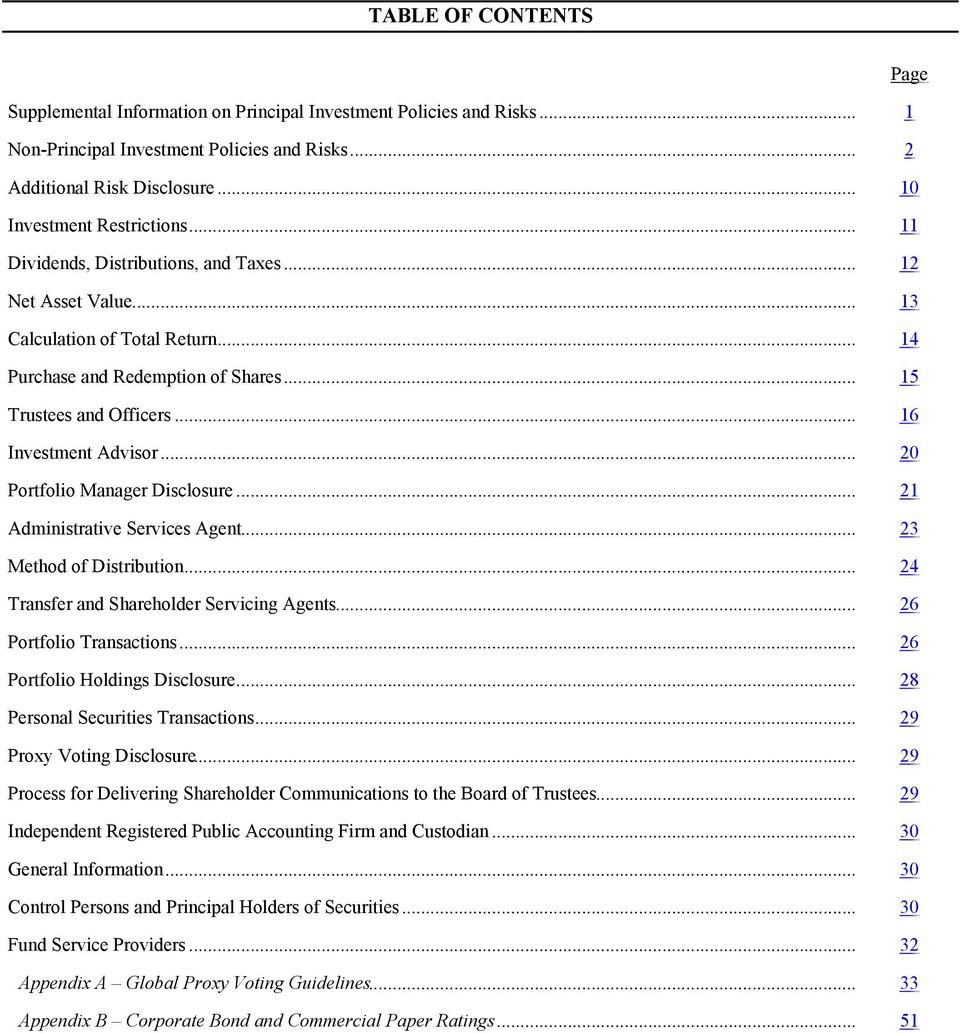
3 TABLE OF CONTENTS Page Supplemental Information on Principal Investment Policies and Risks... Non-Principal Investment Policies and Risks... Additional Risk Disclosure... Investment Restrictions... Dividends, Distributions, and Taxes... Net Asset Value... Calculation of Total Return... Purchase and Redemption of Shares... Trustees and Officers... Investment Advisor... Portfolio Manager Disclosure... Administrative Services Agent... Method of Distribution... Transfer and Shareholder Servicing Agents... Portfolio Transactions... Portfolio Holdings Disclosure... Personal Securities Transactions... Proxy Voting Disclosure... Process for Delivering Shareholder Communications to the Board of Trustees... Independent Registered Public Accounting Firm and Custodian... General Information... Control Persons and Principal Holders of Securities... Fund Service Providers... Appendix A Global Proxy Voting Guidelines... Appendix B Corporate Bond and Commercial Paper Ratings
4 SUPPLEMENTAL INFORMATION ON PRINCIPAL INVESTMENT POLICIES AND RISKS Large-Cap Issuers Investing in large-cap issuers generally involves the risk that these companies may grow more slowly than the economy as a whole or not at all. Compared to small and mid-cap companies, large cap companies are more widely followed in the market, which can make it more difficult to find attractive stocks that are not overpriced. Large-cap stocks also may be less responsive to competitive opportunities and challenges, such as changes in technology, and may offer less potential for long-term capital appreciation. Convertible Securities (Applies to Calvert Equity Income) A convertible security is a bond, debenture, note, preferred stock or other security that may be converted into or exchanged for a prescribed amount of common stock of the same or a different issuer within a particular time period at a specified price or formula. A convertible security entitles the holder to receive the interest paid or accrued on debt or the dividend paid on preferred stock until the convertible security matures or is redeemed, converted or exchanged. Before conversion or exchange, such securities ordinarily provide a stream of income with generally higher yields than common stocks of the same or similar issuers, but lower than the yield on non-convertible debt. Of course, there can be no assurance of current income because issuers of convertible securities may default on their obligations. In addition, there can be no assurance of capital appreciation because the value of the underlying common stock will fluctuate. Because of the conversion feature, the Advisor considers some convertible securities to be equity equivalents. The price of a convertible security will normally fluctuate in some proportion to changes in the price of the underlying asset. A convertible security is subject to risks relating to the activities of the issuer and/or general market and economic conditions. The stream of income typically paid on a convertible security may tend to cushion the security against declines in the price of the underlying asset. However, the stream of income causes fluctuations based upon changes in interest rates and the credit quality of the issuer. In general, the value of a convertible security is a function of (1) its yield in comparison with yields of other securities of comparable maturity and quality that do not have a conversion privilege and (2) its worth, at market value, if converted or exchanged into the underlying common stock. The price of a convertible security often reflects such variations in the price of the underlying common stock in a way that a non-convertible security does not. At any given time, investment value generally depends upon such factors as the general level of interest rates, the yield of similar nonconvertible securities, the financial strength of the issuer and the seniority of the security in the issuer s capital structure. A convertible security may be subject to redemption at the option of the issuer at a predetermined price. If a convertible security held by the Fund is called for redemption, the Fund would be required to permit the issuer to redeem the security and convert it to underlying common stock or to cash, or would sell the convertible security to a third party, which may have an adverse effect on the Fund. A convertible security may feature a put option that permits the holder of the convertible security to sell that security back to the issuer at a predetermined price. Trust Preferred Securities (Applies to Calvert Equity Income) The Fund may purchase trust preferred securities, which are preferred stocks issued by a special purpose trust subsidiary backed by subordinated debt of the corporate parent. These securities typically bear a market rate coupon comparable to interest rates available on debt of a similarly rated company. The securities are generally senior in claim to standard preferred stock but junior to other bondholders. Holders of the trust preferred securities have limited voting rights to control the activities of the trust and no voting rights with respect to the parent company. Trust preferred securities may have varying maturity dates, at times in excess of 30 years, or may have no specified maturity date. Dividend payments of the trust preferred securities generally coincide with interest payments on the underlying subordinated debt. Trust preferred securities generally have a yield advantage over traditional preferred stocks, but unlike traditional preferred stocks, distributions are treated as interest rather than dividends for federal income tax purposes. Trust preferred securities are subject to unique risks, which include the fact that dividend payments will only be paid if interest payments on the underlying obligations are made, which interest payments are dependent on the financial condition of the parent corporation and may be deferred for up to 20 consecutive quarters. There is also the risk that the underlying obligations, and thus the trust preferred securities, may be prepaid after a stated call date or as a result of certain tax or regulatory events, resulting in a lower yield to maturity. Trust preferred securities prices fluctuate for several reasons including changes in investors perception of the financial condition of an issuer or the general condition of the market for trust preferred securities, or when political or economic events affecting the issuers occur. Trust preferred securities are also (a) sensitive to interest rate fluctuations, as the cost of capital rises and borrowing costs increase in a rising interest rate environment, and (b) subject to the risk that they may be called for redemption in a falling interest rate environment. 1
5 Foreign Securities Investments in foreign securities may present risks not typically involved in domestic investments. The Funds may purchase foreign securities directly on foreign markets. These securities are subject to the risk of currency fluctuation relative to the U.S. dollar. Foreign securities may also involve different accounting, auditing, and financial reporting standards and various administrative difficulties such as delays in clearing and settling portfolio trades or in receiving payment of dividends or other distributions. In addition, a foreign issuer may become subject to sanctions imposed by the United States or another country, which could result in the immediate freeze of the foreign issuer s assets or securities. The imposition of such sanctions could impair the market value of the securities of the foreign issuer and limit a Fund s ability to buy, sell, receive or deliver the securities.the Funds may also invest in American Depositary Receipts ( ADRs ) and other receipts evidencing ownership of foreign securities, such as Global Depositary Receipts ( GDRs ). ADRs are United States ( U.S. ) dollar-denominated and traded in the United States on exchanges or over the counter, and can be either sponsored or unsponsored. The company sponsoring the ADR is subject to U.S. reporting requirements and will pay the costs of distributing dividends and shareholder materials. With an unsponsored ADR, the U.S. bank will recover costs from the movement of share prices and the payment of dividends. Less information is normally available on unsponsored ADRs. By investing in ADRs rather than directly in foreign issuers stock, the Funds may possibly avoid some currency and some liquidity risks. However, the value of the foreign securities underlying the ADR may still be impacted by currency fluctuations. The information available for ADRs is subject to the more uniform and more exacting accounting, auditing and financial reporting standards of the domestic market or exchange on which they are traded. GDRs can involve currency risk since they may not be U.S. dollar-denominated. Additional costs may be incurred in connection with international investment since foreign brokerage commissions and the custodial costs associated with maintaining foreign portfolio securities are generally higher than in the United States. Fee expense may also be incurred on currency exchanges when the Funds change investments from one country to another or convert foreign securities holdings into U.S. dollars. U. S. Government policies have at times, in the past, through imposition of currency controls, changes in tax policy and other restrictions, discouraged certain investments abroad by U.S. investors. In addition, foreign countries may impose withholding and taxes on dividends and interest. Below-Investment Grade, High-Yield Debt Securities (Applies to Calvert Equity Income) Below investment-grade, high-yield debt securities are lower-quality debt securities (generally those rated BB+ or lower by Standard & Poor s Ratings Services ( S&P ) or Ba1 or lower by Moody s Investors Service ( Moody s ), known as junk bonds ). These securities have moderate to poor protection of principal and interest payments and have speculative characteristics. (See Appendix B for a description of the ratings.) The Fund considers a security to be investment grade if it has received an investment grade rating from at least one nationally recognized statistical rating organization ( NRSRO ), or is an unrated security of comparable quality as determined by the Advisor. Below-investment-grade, high-yield debt securities involve greater risk of default or price declines due to changes in the issuer s creditworthiness than investment-grade debt securities. Because the market for lower-rated securities may be thinner and less active than for higher-rated securities, there may be market price volatility for these securities and limited liquidity in the resale market. Market prices for these securities may decline significantly in periods of general economic difficulty or rising interest rates. Unrated debt securities may fall into the lower quality category. Unrated securities usually are not attractive to as many buyers as rated securities are, which may make them less marketable. Small-Cap Issuers NON-PRINCIPAL INVESTMENT POLICIES AND RISKS The securities of small-cap issuers may be less actively traded than the securities of larger-cap issuers, may trade in a more limited volume, and may change in value more abruptly than securities of larger companies. Information concerning these securities may not be readily available, so the securities issuers be less actively followed by stock analysts. Small-cap issuers do not usually participate in market rallies to the same extent as more widely known securities, and they tend to have a relatively higher percentage of insider ownership. Investing in smaller, new issuers generally involves greater risk than investing in larger, established issuers. Small-cap issuers may have limited product lines, markets, or financial resources and may lack management depth. The securities in such companies may also have limited marketability and may be subject to more abrupt or erratic market movements than securities of larger, more established companies or the market averages in general. The small-cap issuers in which the Funds invest may include some micro-cap securities. The prices of micro-cap securities are generally even more volatile and their markets are even less liquid relative to small-cap, mid-cap and large-cap securities. Microcap companies are more likely to have more limited product lines, fewer capital resources and less depth of management than 2

6 larger companies. Therefore, the Fund may involve considerably more risk of loss and their returns may differ significantly from funds that do not invest in micro-cap securities. Mid-Cap Issuers The securities of mid-cap issuers often have greater price volatility, lower trading volume, and less liquidity than the securities of larger, more established companies. Investing in mid-cap issuers generally involves greater risk than investing in larger, established issuers. These companies tend to have smaller revenues, narrower product lines, less management depth and experience, smaller shares of their product or service markets, fewer financial resources and less competitive strength than larger companies. Emerging Market Securities Investing in emerging market countries involves certain risks not typically associated with investing in the United States, and it imposes risks greater than, or in addition to, risks of investing in more developed foreign countries. These risks include, but are not limited to, the following: greater risks of nationalization or expropriation of assets or confiscatory taxation; currency devaluations and other currency exchange rate fluctuations; greater social, economic, and political uncertainty and instability (including amplified risk of war and terrorism); more substantial government involvement in the economy; less government supervision and regulation of the securities markets and participants in those markets, and possible arbitrary and unpredictable enforcement of securities regulations; controls on foreign investment and limitations on repatriation of invested capital and on a Fund s ability to exchange local currencies for U.S. dollars; unavailability of currency-hedging techniques in certain emerging market countries; the fact that companies in emerging market countries may be smaller, less seasoned, or newly organized; the difference in, or lack of, auditing and financial reporting standards, which may result in unavailability of material information about issuers; the risk that it may be more difficult to obtain and/or enforce a judgment in a court outside the United States; and greater price volatility, substantially less liquidity, and significantly smaller market capitalization of securities markets. Also, any change in the leadership or politics of emerging market countries, or the countries that exercise a significant influence over those countries, may halt the expansion of, or reverse the liberalization of, foreign investment policies now occurring and adversely affect existing investment opportunities. Furthermore, high rates of inflation and rapid fluctuations in inflation rates have had, and may continue to have, negative effects on the economies and securities markets of certain emerging market countries. Custodial services and other investment-related costs are often more expensive in emerging market countries, which can reduce a Fund s income from investments in securities or debt instruments of emerging market country issuers. Lastly, the economies of individual emerging market countries may differ favorably or unfavorably from the U.S. economy in such respects as the rate of growth in gross domestic product, the rate of inflation, capital reinvestment, resource self-sufficiency and balance of payments position. Forward Foreign Currency Contracts Since investments in securities of issuers domiciled in foreign countries usually involve currencies of the foreign countries, and since the Funds may temporarily hold funds in foreign currencies during the completion of investment programs, the value of the assets of the Funds as measured in U.S. dollars may be affected favorably or unfavorably by changes in foreign currency exchange rates and exchange control regulations. For example, if the value of the foreign currency in which a security is denominated increases or decreases in relation to the value of the U.S. dollar, the value of the security in U.S. dollars will increase or decrease correspondingly. The Funds will conduct their foreign currency exchange transactions either on a spot (i.e., cash) basis at the current rate prevailing in the foreign exchange market, or by entering into forward contracts to purchase or sell foreign currencies. A forward foreign currency contract involves an obligation to purchase or sell a specific currency at a future date which may be any fixed number of days from the date of the contract agreed upon by the parties, at a price set at the time of the contract. These contracts are traded both in the interbank market conducted directly between currency traders (usually large commercial banks) and between the currency traders and their customers. A forward foreign currency contract generally has no deposit requirement, and no commissions are charged at any stage for trades. The Funds may enter into forward foreign currency contracts for two reasons. First, a Fund may desire to preserve the U.S. dollar price of a security when it enters into a contract for the purchase or sale of a security denominated in a foreign currency. The Fund may be able to protect itself against possible losses resulting from changes in the relationship between the U.S. dollar and foreign currencies during the period between the date the security is purchased or sold and the date on which payment is made or received by entering into a forward contract for the purchase or sale, for a fixed amount of dollars, of the amount of the foreign currency involved in the underlying security transactions. Second, a Fund may have exposure to a particular foreign currency from the Fund s portfolio securities and the Advisor may anticipate a substantial decline in the value of that currency against the U.S. dollar. The precise matching of the forward foreign currency contract amounts and the value of the portfolio s securities involved will not generally be possible since the future 3

7 value of the securities will change as a consequence of market movements between the date the forward contract is entered into and the date it matures. The projection of currency market movements is difficult, and the successful execution of this hedging strategy is uncertain. Although forward foreign currency contracts tend to limit the risk of loss due to a decline in the value of the hedged currency, at the same time they tend to limit any potential gain which might result should the value of such currency increase. The Funds do not intend to enter into such forward contracts under this circumstance on a regular or continuous basis. Short-Term Instruments The Funds may invest in short-term instruments, including money market instruments, on an ongoing basis to provide liquidity or for other reasons. Money market instruments are generally short-term investments that may include but are not limited to: (i) short-term obligations issued or guaranteed by the U.S. government, its agencies or instrumentalities (including governmentsponsored enterprises); (ii) negotiable certificates of deposit, bankers acceptances, fixed time deposits and other obligations of U.S. and foreign banks (including foreign branches) and similar instruments; (iii) commercial paper; (iv) repurchase agreements; (v) short-term U.S. dollar-denominated obligations of foreign banks (including U.S. branches) that, in the opinion of the Advisor, are of comparable quality to obligations of U.S. banks that may be purchased by the Funds; and (vi) money market funds. Time deposits are non-negotiable deposits maintained in banking institutions for specified periods of time at stated interest rates. Bankers acceptances are time drafts drawn on commercial banks by borrowers, usually in connection with international transactions. Temporary Defensive Positions For temporary defensive purposes which may include a lack of adequate purchase candidates or an unfavorable market environment - the Funds may invest in cash or cash equivalents. Cash equivalents include instruments such as, but not limited to, U.S. government and agency obligations, certificates of deposit, banker s acceptances, time deposits, commercial paper, short-term corporate debt securities, and repurchase agreements. The Funds investments in temporary defensive positions are generally not insured by the Federal Deposit Insurance Corporation, even though a bank may be the issuer. The Funds may invest in money market instruments of banks, whether foreign or domestic, including obligations of U.S. branches of foreign banks ( Yankee instruments) and obligations of foreign branches of U.S. banks ( Eurodollar instruments). All such instruments must be high-quality, U.S. dollar-denominated obligations. Although not subject to foreign currency risk since they are U.S. dollar-denominated, investments in foreign money market instruments may involve risks that are different than investments in securities of U.S. issuers. See Foreign Securities in Supplemental Information on Principal Investment Policies and Risks above. Repurchase Agreements Each Fund may invest up to 10% of its net assets in repurchase agreements, except that investments in repurchase agreements may exceed this limit for temporary defensive purposes. Repurchase agreements are arrangements under which a Fund buys a security, and the seller simultaneously agrees to repurchase the security at a mutually agreed-upon time and price reflecting a market rate of interest. Repurchase agreements are short-term money market investments, designed to generate current income. A Fund engages in repurchase agreements in order to earn a higher rate of return than it could earn simply by investing in the obligation which is the subject of the repurchase agreement. Repurchase agreements are not, however, without risk. In the event of the bankruptcy of a seller during the term of a repurchase agreement, a legal question exists as to whether the Fund would be deemed the owner of the underlying security or would be deemed only to have a security interest in and lien upon such security. The Funds will only engage in repurchase agreements with recognized securities dealers and banks determined to present minimal credit risk by the Advisor under the direction and supervision of the Fund s Board of Trustees. In addition, the Funds will only engage in repurchase agreements reasonably designed to secure fully during the term of the agreement the seller s obligation to repurchase the underlying security and will monitor the market value of the underlying security during the term of the agreement. If the value of the underlying security declines and is not at least equal to the repurchase price due the Fund pursuant to the agreement, the Fund will require the seller to pledge additional securities or cash to secure the seller s obligations pursuant to the agreement. If the seller defaults on its obligation to repurchase and the value of the underlying security declines, the Fund may incur a loss and may incur expenses in selling the underlying security. While an underlying security may mature after one year, repurchase agreements are generally for periods of less than one year. Repurchase agreements not terminable within seven days are considered illiquid. 4
8 Reverse Repurchase Agreements The Funds may invest up to 10% of their respective net assets in reverse repurchase agreements. Under a reverse repurchase agreement, a Fund sells portfolio securities to a bank or securities dealer and agrees to repurchase those securities from such party at an agreed upon date and price reflecting a market rate of interest. A Fund invests the proceeds from each reverse repurchase agreement in obligations in which it is authorized to invest. Each Fund intends to enter into a reverse repurchase agreement only when the interest income expected to be earned on the obligation in which the Fund plans to invest the proceeds exceeds the amount the Fund will pay in interest to the other party to the agreement plus all costs associated with the transaction. The Funds do not intend to borrow for leverage purposes. The Funds will only be permitted to pledge assets to the extent necessary to secure borrowings and reverse repurchase agreements. During the time a reverse repurchase agreement is outstanding, the Fund will maintain, in a segregated custodial account, an amount of cash, U.S. government securities, or other liquid, high-quality debt securities at least equal in value to the repurchase price. The Fund will mark to market the value of assets held in the segregated account and will place additional assets in the account whenever the total value of the account falls below the amount required under applicable regulations. A Fund s use of reverse repurchase agreements involves the risk that the other party to the agreements could become subject to bankruptcy or liquidation proceedings during the period the agreements are outstanding. In such event, the Fund may not be able to repurchase the securities it has sold to that other party. Under those circumstances, if at the expiration of the agreement such securities are of greater value than the proceeds obtained by the Fund under the agreement, the Fund may have been better off had it not entered into the agreement. However, the Funds will enter into reverse repurchase agreements only with banks and dealers which the Advisor believes present minimal credit risks under guidelines adopted by the Funds Board of Trustees. High Social Impact Investments The High Social Impact Investments program targets a percentage of a Fund s assets to directly support the growth of communitybased organizations for the purposes of promoting business creation, housing development and economic and social development of urban and rural communities. These investments may be either debt or equity investments and are illiquid. High Social Impact debt investments are unrated and are deemed by the Advisor to be the equivalent of below-investment grade, high-yield debt securities - that is, lower quality debt securities (generally those rated BB+ or lower by S&P or Ba1 or lower by Moody s, known as junk bonds ). These securities have moderate to poor protection of principal and interest payments and have speculative characteristics. (See Appendix B for a description of the ratings.) Rather than earning a higher rate, as would be expected to compensate for the higher risk (i.e., lower credit quality), they earn a rate of return that is lower than the then-prevailing market rate. There is no secondary market for these securities. The Funds may make their High Social Impact Investments through direct investments, or through intermediaries, such as through the purchase of notes issued by the Calvert Social Investment Foundation, a non-profit organization, legally distinct from the Funds and Calvert Investments, Inc., organized as a charitable and educational foundation for the purpose of increasing public awareness and knowledge of the concept of socially responsible investing. The Foundation prepares its own careful credit analysis to attempt to identify those community development issuers whose financial condition is adequate to meet future obligations or is expected to be adequate in the future. Through portfolio diversification and credit analysis, investment risk can be reduced, although there can be no assurance that losses will not occur. Neither Fund has begun investing in this program. The Funds may make direct High Social Impact Investments through the Special Equities program described below in this Non- Principal Investment Policies and Risks section (neither Fund has commenced investing in that program); such investments are referred to as Social Enterprise investments. Special Equities Investments The Special Equities program allows a Fund to promote sustainable and responsible investment goals through privately placed investments. As stated in the Prospectus, the Board of Trustees identifies, evaluates and selects Special Equities investments. The Special Equities program, while generally comprising a small percentage of any participating Fund s assets, invests in many investments that involve relatively high risks. These include foreign securities, below-investment grade, high-yield debt securities, emerging market securities, real estate investment trusts, small-cap issuers, limited partnerships, and securities with equity and debt characteristics, among others. See Foreign Securities and Below-Investment Grade, High-Yield Debt Securities in Supplemental Information on Principal Investment Policies and Risks above, and Emerging Market Securities, Small-Cap Issuers, and Illiquid Securities in this section on Non-Principal Investment Policies and Risks. Funds participating in the Special Equities program may also invest in unsecured debt, which does not have the benefits of a secured creditor in the event of bankruptcy. A Special Equities investment may lose its entire value if the business enterprise does not succeed. Because of their illiquid nature and contractual transfer restrictions, Special Equities investments may not be easily sold or transferred. 5

9 Each Fund has retained independent consultants to provide investment research and other research-related services with respect to the Special Equities program. The Funds have not yet commenced investing in this program. Warrants The Funds may invest in warrants. Warrants are options to purchase common stock at a specific price (usually at a premium above the market value of the optioned common stock at issuance) valid for a specific period of time. Warrants may have a life ranging from less than one year to perpetual. However, most warrants have expiration dates after which they are worthless. Warrants have no voting rights, pay no dividends and have no rights with respect to the assets of the corporation issuing them. The percentage increase or decrease in the market price of the warrant may tend to be greater than the percentage increase or decrease in the market price of the optioned common stock. Exchange-Traded Funds ( ETFS ) ETFs are shares of other investment companies that can be traded in the secondary market (e.g., on an exchange) and whose underlying assets are generally stocks selected to track a particular index. Therefore, an ETF can track the performance of an index in much the same way as a traditional indexed mutual fund. But unlike many traditional investment companies, which are only bought and sold at closing net asset values, ETFs are tradable in the secondary market on an intra-day basis, and are redeemed principally in-kind at each day s next calculated net asset value. Although there can be no guarantee that an ETF s intra-day price changes will accurately track the price changes of the related index, ETFs benefit from an in-kind redemption mechanism that is designed to protect ongoing shareholders from adverse effects on the ETFs that could arise from frequent cash creation and redemption transactions. Moreover, in contrast to conventional indexed mutual funds where redemptions can have an adverse tax impact on shareholders because of the need to sell portfolio securities (which sales may generate taxable gains), the in-kind redemption mechanism of the ETFs generally will not lead to a taxable event for the ETF or its ongoing shareholders. A Fund may purchase shares of ETFs for the limited purpose of managing the Fund s cash position consistent with the Fund s benchmark. For example, an ETF may be purchased if a Fund has excess cash and it may be held until the Advisor decides to make other permissible investments. Similarly, if the Fund should receive a large redemption request, the Fund could sell some or all of an ETF position to raise cash. The threshold responsibility standards of the Fund will not apply to an investment in an ETF or to any of the individual underlying securities held by the ETF. Accordingly, the Fund could have indirect exposure to a company that does not meet the Fund s threshold responsibility standards and that could therefore not be purchased directly by the Fund. ETF investments, however, (i) will not constitute a direct ownership interest in any security that does not meet applicable threshold responsibility standards, (ii) will be limited to the amount of net cash available, which, in general, is not expected to be a material portion of the Fund and (iii) will be used principally to help reduce deviations from the Fund s benchmark. Some of the risks of investing in ETFs are similar to those of investing in an indexed mutual fund, including (i) market risk (the risk of fluctuating stock prices in general), (ii) asset class risk (the risk of fluctuating prices of the stocks represented in the ETF s index), (iii) tracking error risk (the risk of errors in matching the ETF s underlying assets to the index), (iv) industry concentration risk (the risk of the stocks in a particular index being concentrated in an industry performing poorly relative to other stocks) and (v) the risk that since an ETF is not actively managed it cannot sell poorly performing stocks as long as they are represented in the index. In addition, ETFs may trade at a discount from their net asset value, and because ETFs operate as open-end investment companies or unit investment trusts, they incur fees that are separate from the fees incurred directly by the Fund. Therefore, the Fund s purchase of an ETF results in the layering of expenses, such that Fund shareholders indirectly bear a proportionate share of any operating expenses of the ETF. Illiquid Securities No Fund may purchase illiquid securities if more than 15% of the value of its net assets would be invested in such securities. The Advisor will monitor the amount of illiquid securities in the Fund, under the supervision of the Board, to ensure compliance with the Fund s investment restrictions. Historically, illiquid securities have included securities subject to contractual or legal restrictions on resale because they have not been registered under the Securities Act of 1933, as amended (the Securities Act ), securities that are otherwise not readily marketable, and repurchase agreements having a maturity of longer than seven days. Securities that have not been registered under the Securities Act are referred to as private placement or restricted securities and are purchased directly from the issuer or in the secondary market. Mutual funds do not typically hold a significant amount of these restricted or other illiquid securities because of the potential for delays on resale and uncertainty in valuation. Limitations on resale may have an adverse effect on the marketability of the securities, and the Fund might be unable to sell restricted or other illiquid securities promptly or at reasonable prices. 6

10 Notwithstanding the above, a Fund may purchase securities which, while privately placed, are eligible for purchase and sale under Rule 144A under the Securities Act. This rule permits certain qualified institutional buyers, such as the Funds, to trade in privately placed securities even though such securities are not registered under the Securities Act. If the Board determines, based upon a continuing review of Rule 144A securities, that such securities are liquid, they will not be subject to the 15% limit on illiquid investments. The Board has adopted guidelines as part of the Valuation Procedures and delegated to the Advisor the daily function of determining the liquidity of restricted securities. The Board retains sufficient oversight and is ultimately responsible for the determinations. Restricted securities will be priced at fair value as determined in accordance with procedures prescribed by the Fund s Board. Derivatives A Fund may use various techniques to increase or decrease its exposure to changing security prices, interest rates, or other factors that affect security values. These techniques may involve derivative transactions such as buying and selling options and futures contracts and leveraged notes, entering into swap agreements, and purchasing indexed securities for the purpose of adjusting the risk and return characteristics of the Fund. A Fund can use these practices either as a substitute for alternative permissible investments or as protection against a move that has an adverse effect on the Fund s portfolio securities. If the Advisor judges market conditions incorrectly or employs a strategy that does not correlate well with the Fund s investments, or if the counterparty to the transaction does not perform as promised, these techniques could result in a loss. These techniques may increase the volatility of the Fund and may involve a small investment of cash relative to the magnitude of the risk assumed. Derivatives are often illiquid, which can make it difficult to value them. Option and Futures Contracts Each Fund may purchase put and call options and write covered call options and secured put options on securities which meet the Fund s threshold responsibility standards, and may employ a variety of option combination strategies. Each Fund may also engage in the purchase and sale of futures contracts, including foreign currency futures contracts and interest rate futures contracts. In addition, each Fund may write covered call options and secured put options on such futures contracts. Each Fund s use of options and futures is described more fully below. The Funds may engage in such transactions only for hedging purposes, including hedging of the Fund s cash position. It may not engage in such transactions for the purposes of speculation or leverage. Such investment policies and techniques may involve a greater degree of risk than those inherent in more conservative investment approaches. Options are typically classified as either American-style or European-style, based on the dates on which the option may be exercised. American-style options may be exercised at any time prior to the expiration date and European-style options may only be exercised on the expiration date. Option contracts traded on futures exchanges are mainly American-style, and options traded over-the-counter are mainly European-style. The value of an option will fluctuate based primarily on the time remaining until expiration of the option, known as the option s time value, and the difference between the then-prevailing price of the underlying security and the option s exercise price. This difference, known as the option s intrinsic value, determines whether an option is in-the-money (meaning the option exercise price is less than the current market value of the security underlying the option), at-the-money (meaning the option exercise price is equal to the current market value of the security underlying the option), or out-of-the-money (meaning the option exercise price is greater than the current market value of the security underlying the option), at any point in time. If there is an existing secondary market for an option, it can be closed out at any time by the Fund for a gain or a loss. Alternatively, the holder of an in-the-money American-style option may exercise the option at any time prior to the expiration date, while the holder of an in-the-money European-style option must wait until the expiration date to exercise the option. Options that expire out-of-the-money are worthless resulting in a loss of the entire premium paid. Other principal factors that affect the market value of an option include supply and demand, interest rates, and the current market price and price volatility of the underlying security. Purchasing Options. A Fund will pay a premium (plus any commission) to purchase an option. The premium reflects the total of the option s time value and intrinsic value. The purchaser of an option has a right to buy (in the case of a call option) or sell (in the case of a put option) the underlying security at the exercise price and has no obligation after the premium has been paid. Call Options. The purchase of a call option on a security is similar to taking a long position because the value of the option generally increases as the price of the underlying security increases. However, in the event that the underlying security declines in value, losses on options are limited to the premium paid to purchase the option. Although a call option has the potential to increase in value from higher prices for the underlying security, because the option will expire on its expiration date, any such gains may be more than offset by reductions in the option s time value or other valuation factors. A Fund may only buy call options to hedge its available cash balance, to limit the risk of a substantial increase in the market price of a security which the Fund intends to purchase, or to close an outstanding position that resulted from writing a corresponding call option. Any profit 7

11 or loss from such a closing transaction will depend on whether the amount received is more or less than the premium paid for the call option plus the related transaction costs. A Fund may purchase securities by exercising a call option solely on the basis of considerations consistent with the investment objectives and policies of the Fund. Put Options. The purchase of a put option on a security is similar to taking a short position (selling a security that you do not own) in that security because the value of the option generally increases as the value of the underlying security decreases. However, in the event that the underlying security increases in value, losses on the option are limited to the premium paid to purchase the option. Although a put option has the potential to increase in value from lower prices for the underlying security, because the option will expire on its expiration date, any such gains may be more than offset by reductions in the option s time value or other valuation factors. A Fund may purchase put options to protect its portfolio securities against the risk of declining prices or to close an outstanding position that resulted from writing a corresponding put option. Any profit or loss from such a closing transaction will depend on whether the amount received is more or less than the premium paid for the put option plus the related transaction costs. Writing Options. Each Fund may write certain types of options. Writing options means that the Fund is selling an investor the right, but not the obligation, to purchase (in the case of a call option) or to sell (in the case of a put option) a security or index at the exercise price in exchange for the option premium. The writer of an option has the obligation to sell (in the case of a call option) or buy (in the case of a put option) the underlying security and has no rights other than to receive the premium. Writing options involves more risk than purchasing options because a writer of an option has the potential to realize a gain that is limited to the value of the premium (less any commission) and takes on potentially unlimited risk from increases in the price of the underlying security, in the case of a call option, and the risk that the underlying security may decline to zero, in the case of a put option (which would require the writer of the put option to pay the exercise price for a security that is worthless). Accordingly, the Funds may only write covered call options and secured put options, which mitigate these substantial risks. A call option is deemed covered if the Fund owns the security. A put option is deemed secured if the Fund has segregated cash or securities having an aggregate value equal to the total purchase price the Fund will have to pay if the put option is exercised. Call Options. A Fund that writes a call option on a security will receive the option premium (less any commission), which helps to mitigate the effect of any depreciation in the market value of that security. However, because the Fund is obligated to sell that security at the exercise price, this strategy also limits the Fund s ability to benefit from an increase in the price of the security above the exercise price. Each Fund may write covered call options on securities. This means that so long as the Fund is obligated as the writer of a call option, the Fund will own the underlying security. The Funds may write such options in order to receive the premiums from options that expire and to seek net gains from closing purchase transactions with respect to such options. Writing covered call options can increase the income of the Fund and thus reduce declines in the net asset value per share of the Fund if securities covered by such options decline in value. Exercise of a call option by the purchaser, however, will cause the Fund to forego future appreciation of the securities covered by the option. A Fund s turnover may increase through the exercise of a call option that it has written; this may occur if the market value of the underlying security increases and the Fund has not entered into a closing purchase transaction. When a Fund writes a covered call option, it will realize a profit in the amount of the premium, less a commission, so long as the price of the underlying security remains below the exercise price. Put Options. A Fund that writes a put option on a security will receive the option premium (less any commission), which effectively reduces the Fund s acquisition cost for that security. If it is contemplating an investment in a security but is uncertain about its near-term price trajectory, a Fund could write a put option on a security; the premium will provide the Fund with a partial buffer against a price increase, while providing the Fund with an opportunity to acquire the security at the lower exercise price. However, the Fund remains obligated to purchase the underlying security from the buyer of the put option (usually in the event the price of the security falls below the exercise price). Accordingly, this strategy may result in unexpected losses if the option is exercised against the Fund at a time when the price of the security has declined below the exercise price by more than the amount of the premium received. A Fund may only write secured put options, which requires the Fund to segregate cash or securities, through its custodian, having a value at least equal to the exercise price of the put option. If the value of the segregated securities declines below the exercise price of the put option, the Fund will have to segregate additional assets. When a Fund writes a secured put option, it will realize a profit in the amount of the premium, less a commission, so long as the price of the underlying security remains above the exercise price. Exchange-Traded Options. A Fund may purchase and write put and call options in standard contracts traded on national securities exchanges on securities of issuers which meet the Fund s threshold responsibility standards and on foreign currencies. Options exchanges may provide liquidity in the secondary market. Although the Funds intend to acquire and write only such exchange-traded options for which an active secondary market appears to exist, there can be no assurance that such a market will exist for any particular option contract at any particular time. The absence of a liquid market might prevent the Fund from closing an options position, which could impair the Funds ability to hedge effectively. The inability to close out a written option 8

12 position may have an adverse effect on the Fund s liquidity because it may be required to hold the securities covering or securing the option until the option expires or is exercised. The information provided above under Purchasing Options and Writing Options is applicable to exchange-traded options. Futures Transactions. The Funds may purchase and sell futures contracts, but only when, in the judgment of the Advisor, such a position acts as a hedge. The Funds may not enter into futures contracts for the purpose of speculation or leverage. These futures contracts may include, but are not limited to, market index futures contracts and futures contracts based on U.S. government obligations. Futures contracts are designed by boards of trade which are designated contracts markets by the Community Futures Trading Commission ( CFTC ). Futures contracts trade on contracts markets in a manner that is similar to the way a stock trades on a stock exchange and the boards of trade, through their clearing corporations, guarantee performance of the contracts. A futures contract is an agreement between two parties to buy and sell a security on a future date which has the effect of establishing the current price for the security. Many futures contracts by their terms require actual delivery and acceptance of securities, but some allow for cash settlement of the difference between the futures price and the market value of the underlying security or index at time of delivery. In most cases the contracts are closed out before the settlement date without making or taking delivery of securities. Upon buying or selling a futures contract, the Fund deposits initial margin with its custodian, and thereafter daily payments of maintenance margin are made to and from the executing broker. Payments of maintenance margin reflect changes in the value of the futures contract, with the Fund being obligated to make such payments if the futures position becomes less valuable and entitled to receive such payments if the futures position becomes more valuable. The Funds can use these practices only for hedging purposes and not for speculation or leverage. If the Advisor judges market conditions incorrectly or employs a strategy that does not correlate well with the Funds investments, these techniques could result in a loss. These techniques may increase the volatility of a Fund and may involve a small investment of cash relative to the magnitude of the risk assumed. Options on Futures Contracts. Each Fund may purchase put or call options, write secured put options or write covered call options on futures contracts that the Fund could otherwise invest in and that are traded on a U.S. exchange or a board of trade. Each Fund may also enter into closing transactions with respect to such options to terminate an existing position. Each Fund may only invest in options on futures contracts to hedge its portfolio securities or its available cash balance and not for speculation or leverage purposes. The information provided above under Purchasing Options and Writing Options is applicable to options on futures contracts, except that references therein to securities should instead refer to futures contracts. Regulatory Limitations. The Advisor to the Funds has claimed an exclusion from the CFTC s definition of commodity pool operator. Under the relevant CFTC rule, the Advisor can claim an exclusion with respect to a Fund if the Fund, among other things, limits its use of certain derivatives, such as futures, certain options, and swaps. Under the rule, if a fund uses commodity interests (such as futures contracts, options on futures contracts and swaps) other than for bona fide hedging purposes (as defined by the CFTC), the aggregate initial margin and premiums required to establish these positions (after taking into account unrealized profits and unrealized losses on any such positions and excluding the amount by which options are in-the-money at the time of purchase) may not exceed 5% of a fund s NAV, or alternatively, the aggregate net notional value of those positions, as determined at the time the most recent position was established, may not exceed 100% of the fund s NAV (after taking into account unrealized profits and unrealized losses on any such positions). If a Fund s use of futures contracts does not comply with these limits, then the Advisor and/or the Subadvisor would be subject to registration (if not already registered) and regulation in its capacity as the Fund s commodity pool operator or commodity trading adviser, respectively, and the Fund would be subject to regulation under the Commodity Exchange Act. A Fund may incur additional expense as a result of the CFTC s registration and regulation obligations, and its use of certain derivatives and other instruments may be limited or restricted. The Funds generally intend to engage in transactions in futures contracts and options thereon only for hedging, risk management, and other permissible purposes in accordance with the rules and regulations of the CFTC or other regulatory authorities. In instances involving the purchase of futures contracts or call options thereon or the writing of put options thereon by a Fund, an amount of cash, U.S. government securities or other liquid securities, equal to the notional value of the futures contracts and options thereon (less any related margin deposits), will be segregated by the Funds custodian to cover the position, or alternative cover will be employed, thereby ensuring that the use of such futures contracts and options is unleveraged. Additional Risks of Options and Futures Contracts. If a Fund has sold futures or takes options positions to hedge against a decline in the market and the market later advances, the Fund may suffer a loss on the futures contracts or options which it would not have experienced if it had not hedged. Correlation is also imperfect between movements in the prices of futures contracts and movements in prices of the securities which are the subject of the hedge. Thus the price of the futures contract or option 9
13 may move more than or less than the price of the securities being hedged. Where a Fund has sold futures or taken options positions to hedge against a decline in the market, the price of the futures contract may advance and the value of the portfolio securities in the Fund may decline. If this were to occur, the Fund might lose money on the futures contracts or options and also experience a decline in the value of its portfolio securities. The Funds can close out futures positions and options on futures in the secondary market only on an exchange or board of trade. Although the Funds intend to purchase or sell only such futures, and purchase or write such options, for which an active secondary market appears to exist, there can be no assurance that such a market will exist for any particular futures contract or option at any particular time. This might prevent the Funds from closing a futures position or an option on a futures contract, which could require a Fund to make daily margin payments in the event of adverse price movements. If a Fund cannot close out an option position, it may be required to exercise the option to realize any profit or the option may expire worthless. Although some of the securities underlying an index future contract, an option on an index future contract or an option on an index may not necessarily meet the Fund s threshold responsibility standards, any such hedge position taken by the Fund will not constitute a direct ownership interest in the underlying securities. Charitable Contributions On occasion, a Fund may make de minimis charitable contributions to groups intended to further the Fund s sustainable and socially responsible investment purpose, including but not limited to educating investors about sustainable and responsible investing. Financial Market Risk ADDITIONAL RISK DISCLOSURE Over the past several years, the U.S. and other countries have experienced significant disruptions to their financial markets impacting the liquidity and volatility of securities generally, including securities in which the Funds may invest. While certain recent economic indicators have shown modest improvements in the capital markets, these indicators could worsen. During periods of extreme market volatility, prices of securities held by the Funds may be negatively impacted due to imbalances between market participants seeking to sell the same or similar securities and market participants willing or able to buy such securities. As a result, the market prices of securities held by the Funds could go down, at times without regard to the financial condition of or specific events impacting the issuer of the security. Reduced liquidity in credit and fixed-income markets may continue to negatively impact issuers worldwide. Illiquidity in these markets may reduce the amount of credit available to purchasers of raw materials, goods, and services, which may, in turn, place downward pressure on the prices of economic staples. It may also result in issuers facing increased difficulty obtaining financing and, ultimately, a decline in their stock prices. These events and the potential for continuing market turbulence may have an adverse effect on the Funds. The Advisor and each Subadvisor generally will take these and other economic conditions into consideration when making investment decisions for a Fund and will seek to manage the Fund in a manner consistent with achieving that Fund s investment objective, but there can be no assurance that the Advisor or Subadvisor will be successful in doing so. The total public debt of the U.S. as a percentage of gross domestic product has grown rapidly since the beginning of the 2008 financial downturn. Government agencies project that the U.S. will continue to maintain high debt levels for the foreseeable future. Although high debt levels are not necessarily indicators or causes of economic problems, they may create certain systemic risks if sound debt management practices are not implemented. In August 2011, S&P lowered its long-term sovereign credit rating on the U.S. Among other reasons for the downgrade, S&P cited controversy over raising the statutory debt ceiling and growth in public spending. The ultimate impact of the downgrade is uncertain, but it may lead to increased interest rates and volatility. The downgrade may also adversely affect the market prices and yields of securities backed by the U.S. In light of these and other conditions in the U.S. and global financial markets and the U.S. and global economy, legislators, the presidential administration, and regulators have increased their focus on the regulation of the financial services industry. Federal, state, and other governments, their regulatory agencies or self-regulatory organizations may take actions that affect the regulation of the instruments in which the Funds invest, or the issuers of such instruments, in ways that are unforeseeable. Legislation or regulation may also change the way in which the Funds are regulated. Such legislation or regulation could limit or preclude a Fund s ability to achieve its investment objective. Fixed-income markets have recently experienced a period of relatively high volatility. If the U.S. Federal Reserve chooses to resume its quantitative easing stimulus program or increases interest rates, fixed-income markets could continue to experience high volatility, which could negatively impact a Fund s performance. 10

14 Cybersecurity Risk The Funds and their service providers may be prone to operational and information security risks resulting from cyber attacks. Cyber attacks include, among other behaviors, stealing or corrupting data maintained online or digitally, denial of service attacks on websites, the unauthorized release of confidential information or various other forms of cybersecurity breaches. Cyber attacks affecting the Funds or their investment advisor, custodian, transfer agent, intermediaries and other third-party service providers may adversely impact the Funds. For instance, cyber attacks may interfere with the processing of shareholder transactions, impact the Funds ability to calculate their NAVs, cause the release of private shareholder information or confidential business information, impede trading, subject the Funds to regulatory fines or financial losses and/or cause reputational damage. The Funds may also incur additional costs for cybersecurity risk management purposes. Similar types of cybersecurity risks are also present for issues or securities in which the Funds may invest, which could result in material adverse consequences for such issuers and may cause the Funds investment in such companies to lose value. Fundamental Investment Restrictions INVESTMENT RESTRICTIONS Each Fund, except as otherwise indicated below, has adopted the following fundamental investment restrictions. These restrictions may not be changed without the approval of the holders of a majority of the outstanding shares of the Fund as defined under the Investment Company Act of 1940, as amended (the 1940 Act ). 1. No Fund may make any investment inconsistent with its classification as a diversified investment company under the 1940 Act. 2. No Fund may concentrate its investments in the securities of issuers primarily engaged in any particular industry or group of industries (other than securities issued or guaranteed by the U.S. government or its agencies or instrumentalities and repurchase agreements secured thereby). 3. No Fund may issue senior securities or borrow money, except from banks and through reverse repurchase agreements in an amount up to 33 1/3% of the value of the Fund s total assets (including the amount borrowed). 4. No Fund may underwrite the securities of other issuers, except to the extent that, in connection with the disposition of portfolio securities, the Fund may be deemed to be an underwriter. 5. No Fund may invest directly in commodities or real estate, although the Fund may invest in financial futures, and the Fund may invest in securities which are secured by real estate or real estate mortgages and securities of issuers which invest or deal in commodities, commodity futures, real estate or real estate mortgages. 6. No Fund may lend any security or make any loan, including engaging in repurchase agreements, if, as a result, more than 33 1/3% of the Fund s total assets would be loaned to other parties, except through the purchase of debt securities or other debt instruments. Under current law, a diversified investment company, with respect to 75% of its total assets, can invest no more than 5% of its total assets in the securities of any one issuer and may not acquire more than 10% of the voting securities of any issuer. Under the interpretation of the Securities and Exchange Commission ( SEC ) staff, concentrate means to invest 25% or more of total assets in the securities of issuers primarily engaged in any one industry or group of industries. Each Fund may invest up to 10% of its net assets in reverse repurchase agreements. Under current law, a Fund may underwrite securities only in compliance with the conditions of Sections 10(f) and 12(c) of the 1940 Act and the rules thereunder wherein the Fund may underwrite securities to the extent that the Fund may be considered an underwriter within the meaning of the Securities Act in selling a portfolio security. Nonfundamental Investment Restrictions The Board of Trustees has adopted the following nonfundamental investment restrictions for each Fund. A nonfundamental investment restriction can be changed by the Board at any time without a shareholder vote. 1. Under normal circumstances, the Fund will invest at least 80% of its net assets in large-cap companies. (Calvert Large Cap Value only) 2. Under normal circumstances, the Fund will invest at least 80% of its net assets in equity securities. (Calvert Equity Income only) 3. The Fund may not purchase securities on margin, except such short-term credits as may be necessary for the clearance of transactions. 11

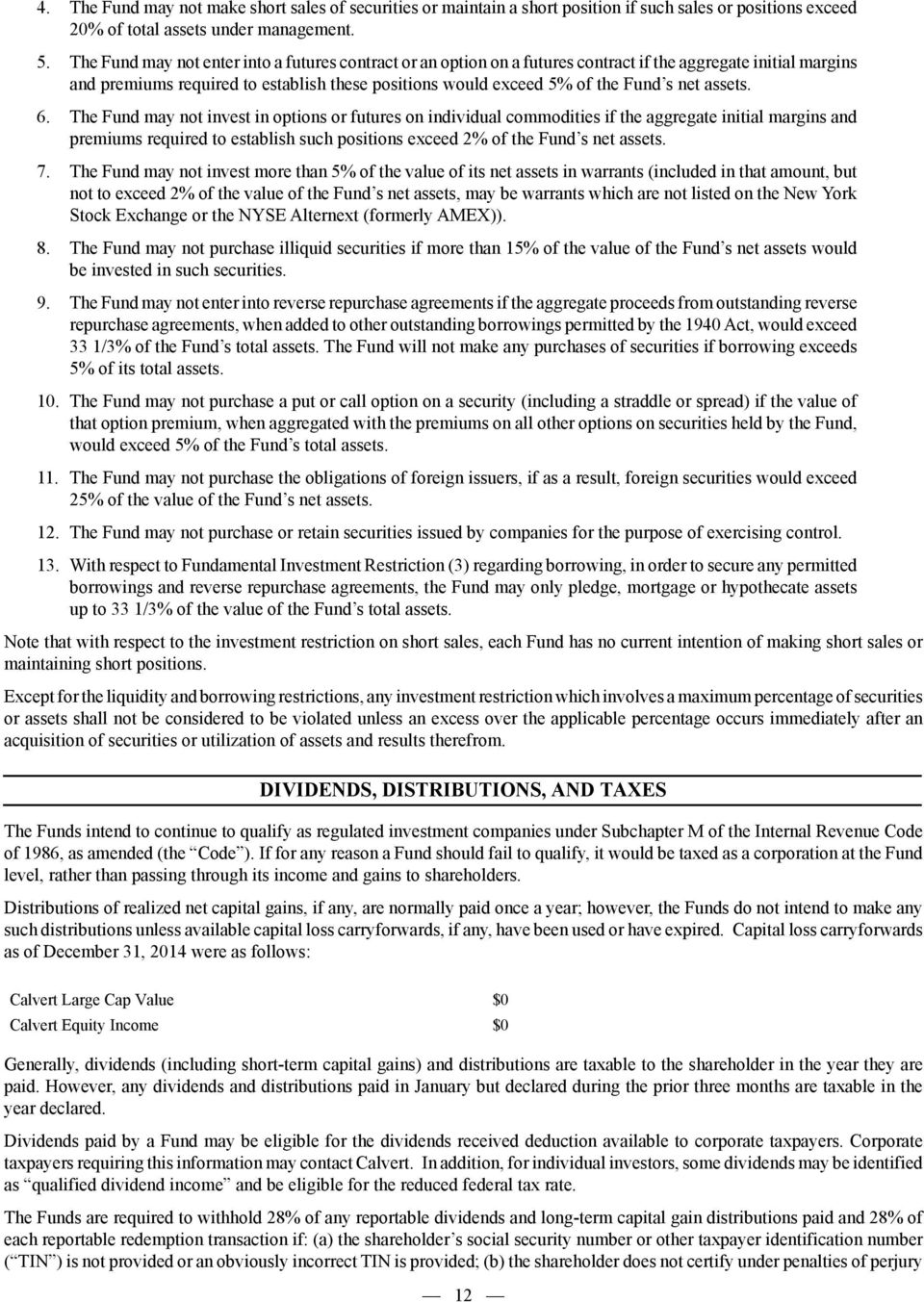
15 4. The Fund may not make short sales of securities or maintain a short position if such sales or positions exceed 20% of total assets under management. 5. The Fund may not enter into a futures contract or an option on a futures contract if the aggregate initial margins and premiums required to establish these positions would exceed 5% of the Fund s net assets. 6. The Fund may not invest in options or futures on individual commodities if the aggregate initial margins and premiums required to establish such positions exceed 2% of the Fund s net assets. 7. The Fund may not invest more than 5% of the value of its net assets in warrants (included in that amount, but not to exceed 2% of the value of the Fund s net assets, may be warrants which are not listed on the New York Stock Exchange or the NYSE Alternext (formerly AMEX)). 8. The Fund may not purchase illiquid securities if more than 15% of the value of the Fund s net assets would be invested in such securities. 9. The Fund may not enter into reverse repurchase agreements if the aggregate proceeds from outstanding reverse repurchase agreements, when added to other outstanding borrowings permitted by the 1940 Act, would exceed 33 1/3% of the Fund s total assets. The Fund will not make any purchases of securities if borrowing exceeds 5% of its total assets. 10. The Fund may not purchase a put or call option on a security (including a straddle or spread) if the value of that option premium, when aggregated with the premiums on all other options on securities held by the Fund, would exceed 5% of the Fund s total assets. 11. The Fund may not purchase the obligations of foreign issuers, if as a result, foreign securities would exceed 25% of the value of the Fund s net assets. 12. The Fund may not purchase or retain securities issued by companies for the purpose of exercising control. 13. With respect to Fundamental Investment Restriction (3) regarding borrowing, in order to secure any permitted borrowings and reverse repurchase agreements, the Fund may only pledge, mortgage or hypothecate assets up to 33 1/3% of the value of the Fund s total assets. Note that with respect to the investment restriction on short sales, each Fund has no current intention of making short sales or maintaining short positions. Except for the liquidity and borrowing restrictions, any investment restriction which involves a maximum percentage of securities or assets shall not be considered to be violated unless an excess over the applicable percentage occurs immediately after an acquisition of securities or utilization of assets and results therefrom. DIVIDENDS, DISTRIBUTIONS, AND TAXES The Funds intend to continue to qualify as regulated investment companies under Subchapter M of the Internal Revenue Code of 1986, as amended (the Code ). If for any reason a Fund should fail to qualify, it would be taxed as a corporation at the Fund level, rather than passing through its income and gains to shareholders. Distributions of realized net capital gains, if any, are normally paid once a year; however, the Funds do not intend to make any such distributions unless available capital loss carryforwards, if any, have been used or have expired. Capital loss carryforwards as of December 31, 2014 were as follows: Calvert Large Cap Value $0 Calvert Equity Income $0 Generally, dividends (including short-term capital gains) and distributions are taxable to the shareholder in the year they are paid. However, any dividends and distributions paid in January but declared during the prior three months are taxable in the year declared. Dividends paid by a Fund may be eligible for the dividends received deduction available to corporate taxpayers. Corporate taxpayers requiring this information may contact Calvert. In addition, for individual investors, some dividends may be identified as qualified dividend income and be eligible for the reduced federal tax rate. The Funds are required to withhold 28% of any reportable dividends and long-term capital gain distributions paid and 28% of each reportable redemption transaction if: (a) the shareholder s social security number or other taxpayer identification number ( TIN ) is not provided or an obviously incorrect TIN is provided; (b) the shareholder does not certify under penalties of perjury 12
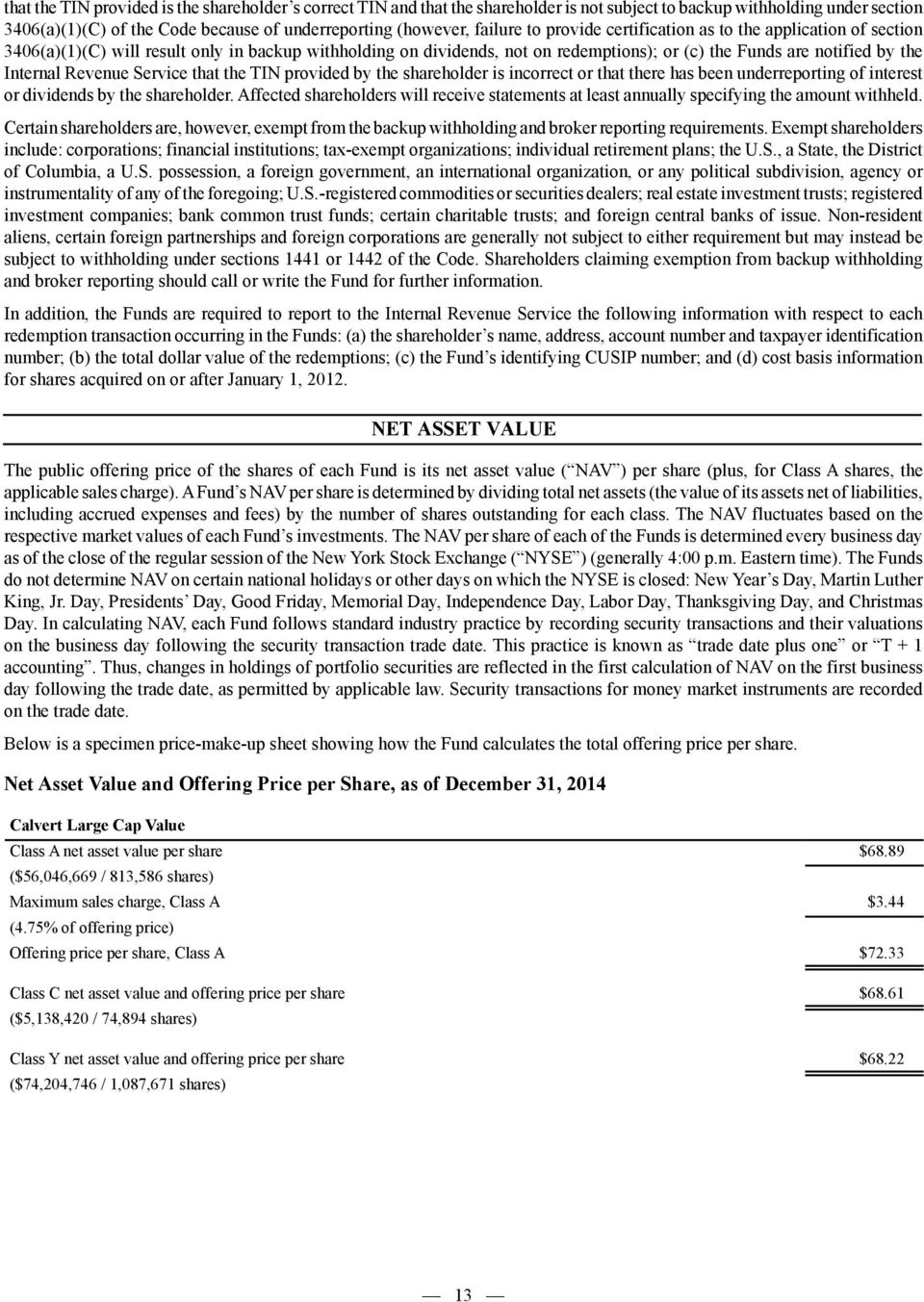
16 that the TIN provided is the shareholder s correct TIN and that the shareholder is not subject to backup withholding under section 3406(a)(1)(C) of the Code because of underreporting (however, failure to provide certification as to the application of section 3406(a)(1)(C) will result only in backup withholding on dividends, not on redemptions); or (c) the Funds are notified by the Internal Revenue Service that the TIN provided by the shareholder is incorrect or that there has been underreporting of interest or dividends by the shareholder. Affected shareholders will receive statements at least annually specifying the amount withheld. Certain shareholders are, however, exempt from the backup withholding and broker reporting requirements. Exempt shareholders include: corporations; financial institutions; tax-exempt organizations; individual retirement plans; the U.S., a State, the District of Columbia, a U.S. possession, a foreign government, an international organization, or any political subdivision, agency or instrumentality of any of the foregoing; U.S.-registered commodities or securities dealers; real estate investment trusts; registered investment companies; bank common trust funds; certain charitable trusts; and foreign central banks of issue. Non-resident aliens, certain foreign partnerships and foreign corporations are generally not subject to either requirement but may instead be subject to withholding under sections 1441 or 1442 of the Code. Shareholders claiming exemption from backup withholding and broker reporting should call or write the Fund for further information. In addition, the Funds are required to report to the Internal Revenue Service the following information with respect to each redemption transaction occurring in the Funds: (a) the shareholder s name, address, account number and taxpayer identification number; (b) the total dollar value of the redemptions; (c) the Fund s identifying CUSIP number; and (d) cost basis information for shares acquired on or after January 1, NET ASSET VALUE The public offering price of the shares of each Fund is its net asset value ( NAV ) per share (plus, for Class A shares, the applicable sales charge). A Fund s NAV per share is determined by dividing total net assets (the value of its assets net of liabilities, including accrued expenses and fees) by the number of shares outstanding for each class. The NAV fluctuates based on the respective market values of each Fund s investments. The NAV per share of each of the Funds is determined every business day as of the close of the regular session of the New York Stock Exchange ( NYSE ) (generally 4:00 p.m. Eastern time). The Funds do not determine NAV on certain national holidays or other days on which the NYSE is closed: New Year s Day, Martin Luther King, Jr. Day, Presidents Day, Good Friday, Memorial Day, Independence Day, Labor Day, Thanksgiving Day, and Christmas Day. In calculating NAV, each Fund follows standard industry practice by recording security transactions and their valuations on the business day following the security transaction trade date. This practice is known as trade date plus one or T + 1 accounting. Thus, changes in holdings of portfolio securities are reflected in the first calculation of NAV on the first business day following the trade date, as permitted by applicable law. Security transactions for money market instruments are recorded on the trade date. Below is a specimen price-make-up sheet showing how the Fund calculates the total offering price per share. Net Asset Value and Offering Price per Share, as of December 31, 2014 Calvert Large Cap Value Class A net asset value per share $68.89 ($56,046,669 / 813,586 shares) Maximum sales charge, Class A $3.44 (4.75% of offering price) Offering price per share, Class A $72.33 Class C net asset value and offering price per share $68.61 ($5,138,420 / 74,894 shares) Class Y net asset value and offering price per share $68.22 ($74,204,746 / 1,087,671 shares) 13
17 Calvert Equity Income Class A net asset value per share $20.41 ($25,839,184 / 1,265,954 shares) Maximum sales charge, Class A $1.02 (4.75% of offering price) Offering price per share, Class A $21.43 Class C net asset value and offering price per share $20.41 ($4,263,040 / 208,855 shares) Class Y net asset value and offering price per share $20.60 ($2,811,560 / 136,498 shares) CALCULATION OF YIELD AND TOTAL RETURN Each Fund may advertise total return. Total return is calculated separately for each class. Total return differs from yield in that yield figures measure only the income component of the Fund s investments, while total return includes not only the effect of income dividends but also any change in NAV, or principal amount, during the stated period. Total return is computed by taking the total number of shares purchased by a hypothetical $1,000 investment after deducting any applicable sales charge, adding all additional shares purchased within the period with reinvested dividends and distributions, calculating the value of those shares at the end of the period, and dividing the result by the initial $1,000 investment. Note: Total Return as quoted in the Financial Highlights section of the Fund s Prospectus and Annual Report to Shareholders, however, per SEC instructions, does not reflect deduction of the sales charge, and corresponds to return without maximum load (or w/o max load or at NAV ) as referred to herein. For periods of more than one year, the cumulative total return is then adjusted for the number of years, taking compounding into account, to calculate average annual total return during that period. Total return before taxes is computed according to the following formula: P(1 + T) n = ERV where P = a hypothetical initial payment of $1,000; T = total return; n = number of years; and ERV = the ending redeemable value of a hypothetical $1,000 payment made at the beginning of the period. Total return after taxes on distributions is computed according to the following formula: P(1 +T) n = ATV D where P = a hypothetical initial payment of $1,000; T = average annual total return (after taxes on distributions); n = number of years and ATV D = the ending value of a hypothetical $1,000 payment made at the beginning of the 1, 5, or 10 year periods at the end of such periods (or portions thereof if applicable) after taxes on fund distributions but not after taxes on redemption. Total return after taxes on distributions and sale of fund shares is computed according to the following formula: P(1 +T) n = ATV DR where P = a hypothetical initial payment of $1,000; T = average annual total return (after taxes on distributions and redemption); n = number of years and ATV DR = the ending value of a hypothetical $1,000 payment made at the beginning of the 1, 5, or 10 year periods at the end of such periods (or portions thereof if applicable), after taxes on fund distributions and redemption. Total return is historical in nature and is not intended to indicate future performance. All total return quotations, including returns after taxes, reflect the deduction of the Fund s maximum sales charge ( return with maximum load ), except quotations of return without maximum load (or without CDSC or at NAV ) which do not deduct a sales charge. Return without maximum load, which will be higher than total return, should be considered only by investors, such as participants in certain pension plans, to whom the sales charge does not apply, or for purposes of comparison only with comparable figures which also do not reflect sales charges, such as Lipper averages. Thus, in the formula above, for return without maximum load, P = the entire $1,000 hypothetical initial investment and does not reflect the deduction of any sales charge; for return with maximum load, P = a hypothetical initial investment of $1,000 less any sales charge actually imposed at the beginning of the period for which the performance is being calculated. Pursuant to an Agreement and Plan of Reorganization, Class A shares and Class I shares of the Everest Fund of Summit Mutual Funds, Inc. (the Predecessor Fund ) were reorganized into the Class A shares and Class Y shares, respectively, of Calvert Large Cap Value Fund, which commenced operations on December 12, The standardized total return for Class A and Class C 14

18 shares of Calvert Large Cap Value Fund is linked to the total return of Class A shares of the Predecessor Fund, and the standardized total return for Class Y shares of Calvert Large Cap Value Fund is "linked" to the total return of the Class I shares of the Predecessor Fund. Class A and Class C investment performance results for Calvert Large Cap Value Fund for the period prior to December 12, 2008 are for Class A of the Predecessor Fund at NAV (i.e., they do not reflect a deduction for the frontend sales charge applied by the Predecessor Fund). Actual Class A and Class C investment performance would have been lower than Class A share performance of the Predecessor Fund because Class A and Class C of the Calvert Large Cap Value Fund have higher class-specific expenses than Class A of the Predecessor Fund. Class Y investment performance results for Calvert Large Cap Value Fund for the period prior to December 12, 2008 are for Class I of the Predecessor Fund. Actual Class Y investment performance would have been lower than Class I share performance of the Predecessor Fund because Class Y of the Calvert Large Cap Value Fund has higher class-specific expenses than Class I of the Predecessor Fund. See the Prospectus for each Fund s standardized (with maximum load) performance results for the periods ended December 31, Average annual total returns without maximum load for Class A and Class C shares for the periods ended December 31, 2014, are as follows: CALVERT LARGE CAP VALUE FUND Before Taxes Periods Ended December 31, 2014 Class A Total Return Without Maximum Load Class C Total Return Without CDSC One Year 8.38% 7.19% Five Years 12.48% 11.25% Ten Years 5.98% 5.39% CALVERT EQUITY INCOME FUND Before Taxes Periods Ended December 31, 2014 Class A Total Return Without Maximum Load Class C Total Return Without CDSC One Year 9.38% 8.15% Five Years N/A N/A Ten Years N/A N/A From Inception * 16.16% 14.91% *Class A October 31, 2011 Class C October 31, 2011 Total return, like NAV per share, fluctuates in response to changes in market conditions. Total return for any particular time period should not be considered an indication of future return. PURCHASE AND REDEMPTION OF SHARES Each Fund has authorized one or more broker/dealers to receive on its behalf purchase and redemption orders. Such broker/ dealers are authorized to designate other intermediaries to receive purchase and redemption orders on the Fund s behalf. The Fund will be deemed to have received a purchase or redemption order when an authorized broker/dealer, or if applicable, a broker/dealer s authorized designee, receives the order in good order. The customer orders will be priced at the Fund s NAV next computed after they are received by an authorized broker/dealer or the broker/dealer s authorized designee. Neither Fund has an arrangement with any person to permit frequent purchases and redemptions of Fund shares. The Funds do not issue share certificates. Shares are electronically recorded. If you are redeeming or exchanging shares represented by certificates previously issued by a Fund, you must return the certificates to the Fund s transfer agent with your written redemption or exchange request. If the certificates have been lost, the shareholder will have to pay to post an indemnity bond in case the original certificates are later presented by another person. Each Fund has filed a notice of election with the SEC pursuant to Rule 18f-1 under the 1940 Act. The notice states that the Fund may honor redemptions that, during any 90-day period, exceed $250,000 or 1% of the net asset value of the Fund, whichever 15

19 is less, by redemptions-in-kind (distributions of a pro rata share of the portfolio securities, rather than cash). The notice of election is irrevocable while Rule 18f-1 is in effect unless the SEC permits the withdrawal of such notice. See the applicable Fund s Prospectus for additional details on purchases and redemptions. TRUSTEES AND OFFICERS The Board of Trustees supervises each Fund s activities and reviews its contracts with companies that provide it with services. Business information about the Trustees and Officers as well as information regarding the experience, qualifications, attributes and skills of the Trustees is provided below. Independent Trustees refers to Trustees who are not interested persons as that term is defined in the 1940 Act and the rules thereunder. Name & Age Position with Fund INDEPENDENT TRUSTEES CARI DOMINGUEZ AGE: 66 ALICE GRESHAM BULLOCK AGE: 64 M. CHARITO KRUVANT AGE: 69 CYNTHIA MILLIGAN AGE: 69 ANTHONY A. WILLIAMS AGE: 63 INTERESTED TRUSTEES JOHN H. STREUR* AGE: 55 Position Start Date Principal Occupation During Last 5 Years Trustee 2008 Former Chair of the U.S. Equal Employment Opportunity Commission. Trustee 2008 Professor at Howard University School of Law. She is former Dean of Howard University School of Law and Deputy Director of the Association of American Law Schools. Trustee 2008 President and CEO of Creative Associates International, Inc., a firm that specializes in human resources development, information management, public affairs and private enterprise development. Trustee 2008 Dean Emeritus, College of Business Administration, University of Nebraska, Lincoln. She is the former President and Chief Executive Officer for CMA, a consulting firm for financial institutions. Trustee 2010 CEO and Executive Director of the Federal City Council (7/12 to present); Senior Adviser and Independent Consultant for McKenna Long & Aldridge LLP (9/11 to present); Executive Director of Global Government Practice at the Corporate Executive Board (1/10 to 1/12); William H. Bloomberg Lecturer in Public Management at the Harvard Kennedy School (2009 to 2012); Director of State and Municipal Practice at Arent Fox LLP (6/09 to 1/10). Trustee, President & Chair 2015 President and Chief Executive Officer of Calvert Investments, Inc. (since January 2015); President and Director, Portfolio 21 Investments, Inc. (through October 2014); President, Chief Executive Officer and Director, Managers Investment Group LLC (through January 2012); President and Director, The Managers Funds and Managers AMG Funds (through January 2012). # of Calvert Portfolios Overseen Other Directorships During the Past Five Years 2 Manpower, Inc. Triple S Management Corporation 15 None 23 Acacia Federal Savings Bank (through 2013) Summit Foundation WETA Public Broadcasting 15 Wells Fargo Company- NYSE Gallup, Inc. W.K. Kellogg Foundation Raven Industries - NASDAQ Colonial Williamsburg Foundation Kellogg Company -NYSE 10 Freddie Mac Meruelo Maddux Properties, Inc. Weston Solutions, Inc. Bipartisan Debt Reduction Task Force Chesapeake Bay Foundation Catholic University of America Urban Institute 37 Portfolio 21 Investments, Inc. (through October 2014) Managers Investment Group LLC (through January 2012) The Managers Funds (through January 2012) Managers AMG Funds (through January 2012) Calvert Social Investment Foundation *Mr. Streur is an interested person of the Funds since he is an Officer and Director of the Funds Advisor and certain affiliates. 16
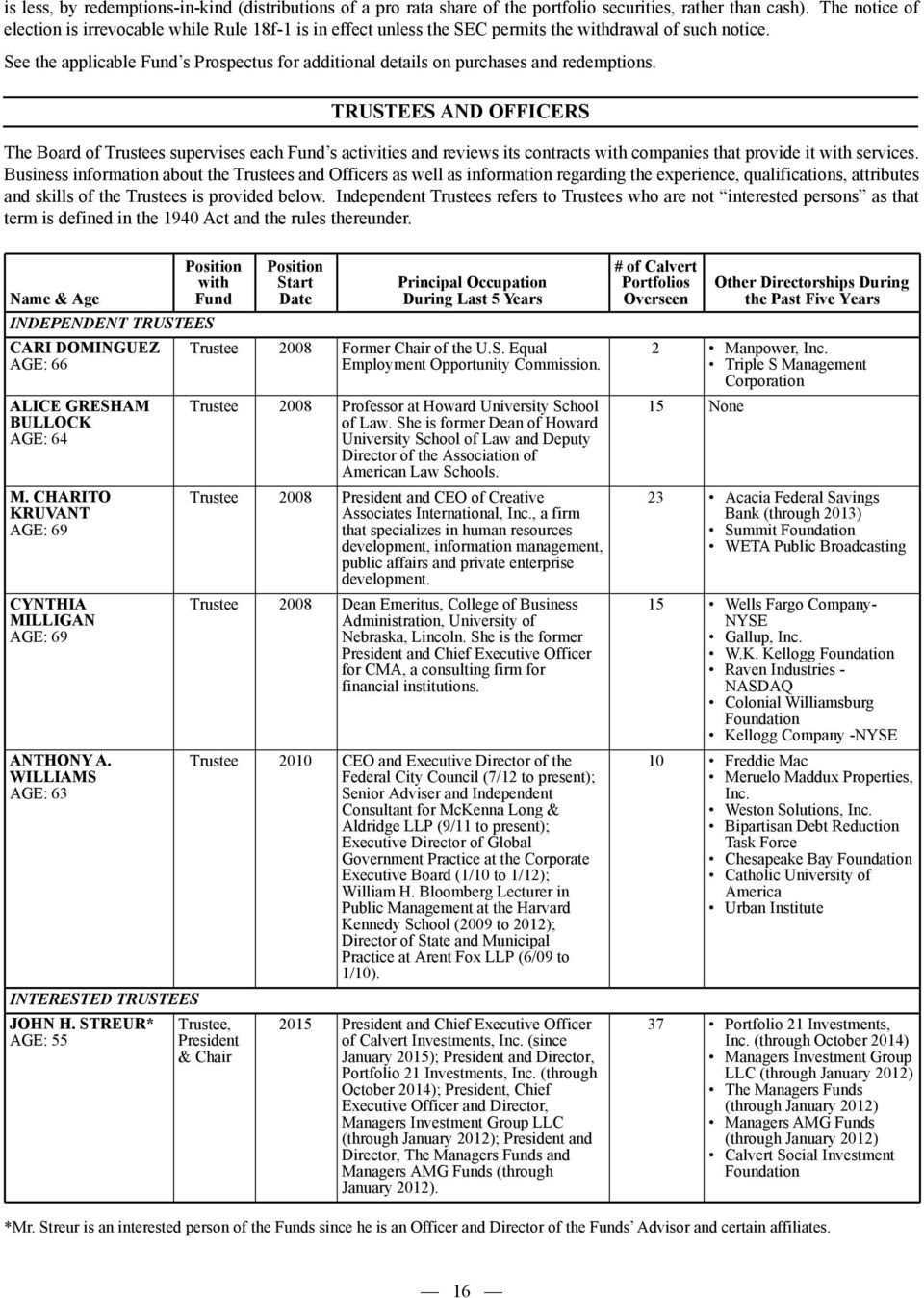
20 Name & Age OFFICERS SUSAN WALKER BENDER, Esq. AGE: 56 VICKI L. BENJAMIN AGE: 53 ROBERT D. BENSON, Esq. AGE: 36 HOPE BROWN AGE: 41 THOMAS DAILEY AGE: 50 MATTHEW DUCH AGE: 39 IVY WAFFORD DUKE, Esq. AGE: 46 ROBERT J. ENDERSON, CFA AGE: 56 PATRICK FAUL AGE: 50 TRACI L. GOLDT AGE: 41 HUI PING HO, CPA AGE: 50 VISHAL KHANDUJA, CFA AGE: 37 LANCELOT A. KING, Esq. AGE: 44 AUGUSTO DIVO MACEDO, Esq. AGE: 52 ANDREW K. NIEBLER, Esq. AGE: 47 CATHERINE P. ROY AGE: 59 NATALIE A. TRUNOW AGE: 47 MICHAEL V. YUHAS JR., CPA AGE: 53 Position with Fund Assistant Vice President & Assistant Secretary Position Start Date Principal Occupation During Last 5 Years 2008 Assistant Vice President, Assistant Secretary and Associate General Counsel of Calvert Investments, Inc. Treasurer 2015 Senior Vice President and Chief Financial Officer of Calvert Investments, Inc. since March Prior to Calvert, Ms. Benjamin was a Senior Partner at KPMG. Assistant Vice President & Assistant Secretary Chief Compliance Officer 2014 Assistant General Counsel (since 2014) and Staff Attorney (prior to 2014), Calvert Investments, Inc Chief Compliance Officer for the Calvert Funds (since 2014). Vice President and Chief Compliance Officer, Wilmington Funds ( ). Vice President and Senior Compliance Officer, Wilmington Trust Investment Advisors, Inc. ( ). Assistant Vice President, Lead Manager, Risk Management and Divisional Compliance, T. Rowe Price Associates, Inc. ( ). Vice President 2010 Vice President of the Advisor and lead portfolio manager for Calvert s taxable and tax-exempt money market funds and municipal funds. Vice President 2011 Vice President of the Advisor (since 2011) and portfolio manager for Calvert s taxable fixed-income funds. Assistant Vice President & Assistant Secretary Assistant Treasurer 2008 Assistant Vice President, Assistant Secretary and Acting General Counsel (Deputy General Counsel prior to 2015) of Calvert Investments, Inc., and Chief Compliance Officer for the Advisor and Calvert Investment Distributors, Inc Vice President, Corporate Finance, of Calvert Investments, Inc. Vice President 2010 Vice President and Head of Credit Research for the Advisor. Assistant Secretary Assistant Treasurer 2008 Electronic Filing and Administrative Operations Manager (since 2011) and Executive Assistant to General Counsel (prior to 2011), Calvert Investments, Inc Assistant Treasurer and Tax Compliance Manager of Calvert Investments, Inc. Vice President 2014 Vice President of Calvert Investment Management, Inc. (since 2014) and portfolio manager for Calvert s taxable fixed-income funds since Previously worked at Columbia Management as Portfolio Manager - Global Rates and Currency Team ( ). Assistant Vice President & Assistant Secretary Assistant Vice President & Assistant Secretary Assistant Vice President & Assistant Secretary 2008 Assistant Vice President, Assistant Secretary and Associate General Counsel of Calvert Investments, Inc Assistant Vice President, Assistant Secretary and Assistant General Counsel Compliance of Calvert Investments, Inc Assistant Vice President, Assistant Secretary and Associate General Counsel of Calvert Investments, Inc. Vice President 2008 Senior Vice President of the Advisor and Chief Investment Officer Fixed Income. Vice President 2008 Senior Vice President of the Advisor, and Chief Investment Officer Equities. Fund Controller 2008 Vice President of Fund Administration of Calvert Investment Administrative Services, Inc. The address of the Trustees and Officers is 4550 Montgomery Avenue, Suite 1000N, Bethesda, MD As of December 31, 2014, the Trustees and Officers as a group owned less than 1% of each Fund s outstanding shares. 17
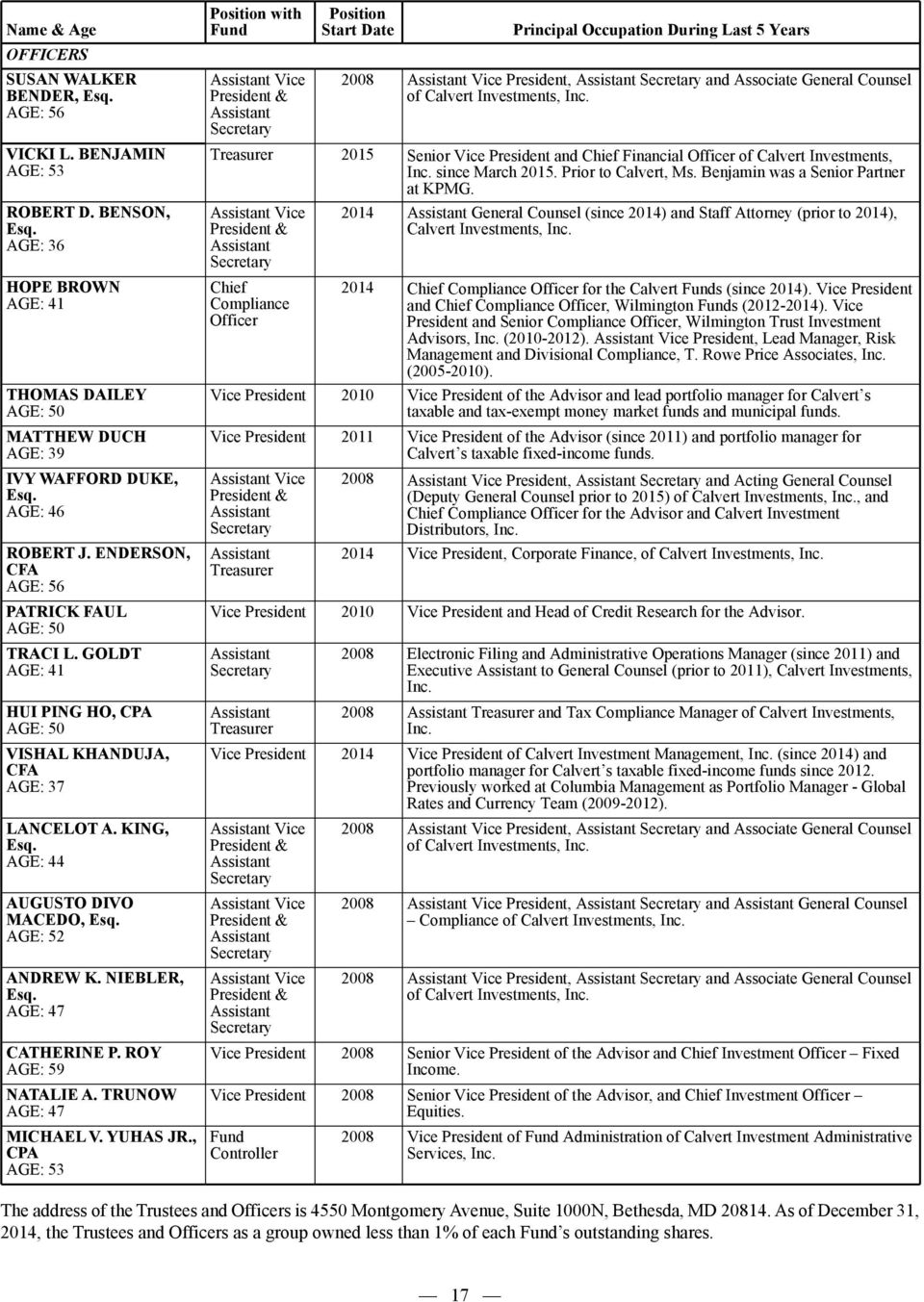
21 Additional Information about the Trustees The Board of Trustees believes that each Trustee s experience, qualifications, attributes or skills on an individual basis and in combination with those of the other Trustees lead to the conclusion that the Trustees possess the requisite experience, qualifications, attributes and skills to serve on the Board. The Board of Trustees believes that the Trustees ability to review critically, evaluate, question and discuss information provided to them; to interact effectively with the Advisor, other service providers, legal counsel and independent public accountants; and to exercise effective business judgment in the performance of their duties as Trustees, support this conclusion. The Board of Trustees has also considered the contributions that each Trustee can make to the Board and the Funds. In addition, the following specific experience, qualifications, attributes and/or skills apply as to each Trustee: Ms. Dominguez, experience as the head of a federal agency and experience as a board member of a public company; Ms. Gresham Bullock, academic leadership experience, legal experience and experience as a board member of various organizations; Ms. Kruvant, experience as a chief executive officer of a private company and experience as a board member of various organizations; Ms. Milligan, academic leadership experience, experience as a chief executive officer of a private company, and experience as a board member of various organizations; Mr. Williams, experience as the mayor of the District of Columbia and as a board member of various organizations; and Mr. Streur, leadership roles within the Advisor and certain of its affiliates, and experience building and managing investment management firms. References to the experience, qualifications, attributes and/or skills of the Trustees are pursuant to requirements of the SEC, do not constitute holding out of the Board or any Trustee as having special expertise or experience, and shall not impose any greater responsibility or liability on any such Trustee or on the Board by reason thereof. Board Structure The Board of Trustees is responsible for overseeing the management and operations of the Funds. The Board consists of five Independent Trustees and one Trustee who is an interested person of the Funds. Mr. Streur, who is an interested person of the Funds, serves as Chairperson of the Board. The Board of Trustees has two standing Committees: the Governance Committee and the Audit Committee. Each of the Governance and Audit Committees is chaired by an Independent Trustee and composed of all of the Independent Trustees. Although the Board has not designated a lead independent trustee, the Chair of the Governance Committee acts as a liaison between Fund management and the Independent Trustees. In addition, the Chairs of the Governance Committee and Audit Committee work with Fund management in formulating agendas for Board and Committee meetings. Through the Governance and Audit Committees, the Independent Trustees consider and address important matters involving the Funds, including those presenting conflicts or potential conflicts of interest for Fund management. The Independent Trustees also regularly meet outside the presence of Fund management and are advised by independent legal counsel. The Board of Trustees has determined that its committees help ensure that the Funds have effective and independent governance and oversight. The Board of Trustees has also determined that its leadership structure is appropriate and benefits shareholders because an interested Chair has a personal and professional stake in the quality and continuity of services provided to the Funds, has strong day-to-day leadership over the Advisor s operations, and has a senior leadership role within the Advisor. The Board of Trustees also believes that its leadership structure facilitates the orderly and efficient flow of information to the Independent Trustees from Fund management. The Governance Committee addresses matters of fund governance, including policies on Trustee compensation and on Board and Committee structure and responsibilities. The functions of the Governance Committee also include those of a Nominating Committee, e.g., the initiation and consideration of nominations for the appointment or election of independent Trustees of the Board. These matters were addressed in meetings held four times in the past fiscal year. The current members of this Committee are Mses. Dominguez, Gresham Bullock, Kruvant and Milligan, each an Independent Trustee. The Audit Committee approves and recommends to the Board independent public accountants to conduct the annual audit of the Funds financial statements; reviews with the independent public accountants the outline, scope, and results of the annual audit; and reviews the performance and fees charged by the independent public accountants for professional services. In addition, the Audit Committee meets with the Funds independent public accountants and representatives of Fund management to review accounting activities and areas of financial reporting and control. This Committee met five times in the past fiscal year. The current members of this Committee are Mses. Dominguez, Gresham Bullock, Kruvant and Milligan, each an Independent Trustee. The Board of Trustees has retained Lipper Analytical Services, Inc. to provide the Board with an independent analysis of investment performance and expenses for the Funds, in connection with the Board s annual consideration of the renewal of the Funds investment advisory and underwriting agreements, as required by section 15(c) of the 1940 Act. Board Oversight of Risk An integral part of the Board s overall responsibility for overseeing the management and operations of the Funds is the Board s oversight of the risk management of each Fund s investment program and business affairs. The Funds are subject to a number 18
22 of risks, such as investment risk, credit and counterparty risk, valuation risk, risk of operational failure or lack of business continuity, and legal, compliance and regulatory risk. The Funds, the Advisor, and other service providers to the Funds have implemented various processes, procedures and controls to identify and address risks to the Funds. Different processes, procedures and controls are employed with respect to different types of risks. The Board of Trustees exercises oversight of the risk management process primarily through the Audit Committee, and through oversight by the Board itself. In addition to adopting, and periodically reviewing, policies and procedures designed to address risks to the Funds, the Board of Trustees requires management of the Advisor and the Funds, including the Funds Chief Compliance Officer ( CCO ), to report to the Board and the Committees of the Board on a variety of matters, including matters relating to risk management, at regular and special meetings. The Board and the Audit Committee receive regular reports from the Funds independent public accountants on internal control and financial reporting matters. On at least a quarterly basis, the Independent Trustees meet with the Funds CCO, including outside the presence of management, to discuss issues related to compliance. Furthermore, the Board receives a quarterly report from the Funds CCO regarding the operation of the compliance policies and procedures of the Funds and its primary service providers. The Board also receives regular reports from the Advisor on the investments and securities trading of the Funds, including its investment performance and asset weightings compared to appropriate benchmarks, as well as reports regarding the valuation of the Funds securities. The Board also receives reports from the Funds primary service providers regarding their operations as they relate to the Funds. Trustees Ownership of Fund Shares The Trustees owned shares in the Funds and in all other Calvert Funds for which they serve on the applicable Board of Trustees, in the following amounts as of December 31, 2014: Calvert Large Cap Value Name of Trustee Independent Trustees Dollar Range of Equity Securities In the Fund 19 Aggregate Dollar Range of Equity Securities in all Registered Investment Companies Overseen By Trustee in Calvert Family of Funds Cari M. Dominguez None $10,001-$50,000 Alice Gresham Bullock None None M. Charito Kruvant None $50,001-$100,000 Cynthia Milligan None None Anthony A. Williams None None Interested Trustee Barbara J. Krumsiek* None >$100,000 John H. Streur** None None Calvert Equity Income Name of Trustee Independent Trustees Dollar Range of Equity Securities In the Fund Aggregate Dollar Range of Equity Securities in all Registered Investment Companies Overseen By Trustee in Calvert Family of Funds Cari M. Dominguez None $10,001-$50,000 Alice Gresham Bullock None None M. Charito Kruvant None $50,001-$100,000 Cynthia Milligan None None Anthony A. Williams None None Interested Trustee Barbara J. Krumsiek* $50,001-$100,000 >$100,000 John H. Streur** None None *Ms. Krumsiek resigned as a Trustee of the Fund, effective December 31, **Mr. Streur became a Trustee of the Fund, effective January 1, Trustees not employed by the Advisor or its affiliates may elect to defer receipt of all or a percentage of their fees and deem such deferred amounts to be invested in any Calvert Fund through the Trustees Deferred Compensation Plan. Management believes this will have a negligible effect on the Fund s assets, liabilities, net assets, and net income per share.
23 Trustees Compensation Trustee Compensation Table Calvert SAGE Fund The following table (unaudited numbers) sets forth information describing the compensation of each Trustee for his/her services to the Funds for the Funds most recent fiscal year ended December 31, 2014* and to all of the portfolios in the Fund Complex. Each Fund within Calvert SAGE Fund is responsible for a proportionate share of these payments. Name of Person, Position Aggregate Compensation From Fund (Includes Pension or Retirement Benefits) Pension or Retirement Benefits Accrued As Part of Fund s Expenses Total Compensation From Fund and Fund Complex Paid to Trustee**** Cari M. Dominguez (Trustee) $35,000 $0 $35,000 Alice Gresham Bullock (Trustee) $36,000 $0 $100,500 M. Charito Kruvant *** (Trustee) $37,500 $0 $175,500 Cynthia Milligan *** (Trustee) $35,000 $0 $96,000 Anthony A. Williams (Trustee) $30,500 $0 $96,500 Barbara J. Krumsiek** (Trustee, Chair & President) John H. Streur** (Trustee, Chair & President) $0 $0 $0 $0 $0 $0 *Each Fund changed its fiscal year-end from September 30 to December 31, effective on December 31, Fund data as of the most recently completed fiscal year is as of September 30, **Ms. Krumsiek was an interested person of the Funds since she was an Officer and Director of the Advisor and certain affiliates. Ms. Krumsiek resigned as a Trustee of the Funds, effective December 31, Mr. Streur became a Trustee and President of the Funds, effective January 1, 2015, and is an interested person of the Funds since he is an Officer and Director of the Advisor and certain affiliates. ***Mses. Kruvant and Milligan have chosen to defer a portion of their compensation. As of December 31, 2014, total deferred compensation for service on all applicable Calvert Fund Boards, including dividends and capital appreciation, was $725,234 and $443,778 for each of them, respectively. ****As of December 31, 2014, the Fund Complex consisted of thirty-nine (39) Funds. INVESTMENT ADVISOR The Funds Investment Advisor is Calvert Investment Management, Inc. ( Calvert or the Advisor ), a subsidiary of Calvert Investments, Inc., which is a subsidiary of Ameritas Mutual Holding Company. Under the Investment Advisory Agreement with respect to the Funds, the Advisor provides investment advice to the Funds and oversees the day-to-day operations, subject to the supervision and direction of the Board of Trustees. The Advisor provides the Funds with investment supervision and management, and office space; furnishes executive and other personnel to the Funds; and pays the salaries and fees of all Trustees who are employees of the Advisor or its affiliates. The Funds pay all their other respective administrative and operating expenses, including: custodial, registrar, dividend disbursing and transfer agency fees; administrative service fees; fund accounting fees; federal and state securities registration fees; salaries, fees and expenses of executive officers and employees of the Funds, who are not employees of the Advisor or of its affiliates; insurance premiums; trade association dues; legal and audit fees; interest, taxes and other business fees; expenses of printing and mailing reports, notices, prospectuses, and proxy material to shareholders; shareholder meeting expenses; and brokerage commissions and other costs associated with the purchase and sale of portfolio securities Under the Investment Advisory Agreement, for its services, the Advisor receives an annual fee, payable monthly, of 0.65% of Calvert Large Cap Value s average daily net assets and 0.50% of Calvert Equity Income s average daily net assets. This investment advisory fee includes the cost of evaluating sustainable and responsible investments according to the Funds threshold responsibility standards and enhanced engagement initiatives. The Advisor reserves the right to (i) waive all or a part of its fee; (ii) reimburse the Funds for expenses; and (iii) pay broker/ dealers in consideration of their promotional or administrative services. The Advisor may, but is not required to, waive current payment of its fees or reimburse expenses of the Funds, except as noted in the Funds Prospectus. Advisory fees are allocated among classes as a Fund-level expense based on net assets. 20
24 The following chart shows the investment advisory fees paid to the Advisor by the Funds for the past four fiscal periods: Fiscal Year Ended 9/30/12 Fiscal Year Ended 9/30/13 Fiscal Year Ended 9/30/14 Fiscal Period Ended 12/31/14* Calvert Large Cap Value $544,279 $576,121 $767,640 $215,258 Calvert Equity Income $23,671 $73,560 $136,602 $41,533 *Each Fund changed its fiscal year-end from September 30 to December 31, effective on December 31, Data provided is for fiscal period October 1, 2014 through December 31, PORTFOLIO MANAGER DISCLOSURE Additional information about each Fund s Portfolio Managers, identified in the Prospectus of the Fund, is provided below. A. Other Accounts Managed by Fund Portfolio Managers The following Portfolio Managers of the Funds are also primarily responsible for day-to-day management of the portfolios of the other accounts indicated below. This information includes accounts managed by any group which includes the identified Portfolio Manager. The Other Accounts category includes accounts managed in the Portfolio Manager s personal as well as professional capacities. Calvert Large Cap Value Calvert: Rachel Volynsky, CFA Accounts Managed (not including Calvert Large Cap Value) as of December 31, 2014 Registered Investment Companies Other Pooled Investment Vehicles Other Accounts Number of Other Accounts Managed Total Assets in Other Accounts Managed $181,984,833 $0 $123,978,759 Number of Other Accounts in which Advisory Fee is Based on Account s Performance Total Assets in Other Accounts in which Advisory Fee is Based on Account s Performance Calvert: Natalie A. Trunow Accounts Managed (not including Calvert Large Cap Value) as of December 31, $0 $0 $0 Registered Investment Companies Other Pooled Investment Vehicles Other Accounts Number of Other Accounts Managed Total Assets in Other Accounts Managed $2,800,385,140 $211,745,334 $43,441,397 Number of Other Accounts in which Advisory Fee is Based on Account s Performance Total Assets in Other Accounts in which Advisory Fee is Based on Account s Performance Calvert: Yvonne M. Bishop Accounts Managed (not including Calvert Large Cap Value) as of December 31, $0 $0 $0 Registered Investment Companies Other Pooled Investment Vehicles Other Accounts Number of Other Accounts Managed Total Assets in Other Accounts Managed $181,984,833 $0 $123,978,579 Number of Other Accounts in which Advisory Fee is Based on Account s Performance Total Assets in Other Accounts in which Advisory Fee is Based on Account s Performance $0 $0 $0 21
25 Calvert Equity Income Calvert: Yvonne M. Bishop Accounts Managed (not including Calvert Equity Income) as of December 31, 2014 Registered Investment Companies 22 Other Pooled Investment Vehicles Other Accounts Number of Other Accounts Manage Total Assets in Other Accounts Managed $284,066,218 $0 $123,978,759 Number of Other Accounts in which Advisory Fee is Based on Account s Performance Total Assets in Other Accounts in which Advisory Fee is Based on Account s Performance Calvert: Rachel Volynsky, CFA Accounts Managed (not including Calvert Equity Income) as of December 31, $0 $0 $0 Registered Investment Companies Other Pooled Investment Vehicles Other Accounts Number of Other Accounts Managed Total Assets in Other Accounts Managed $284,066,218 $0 $123,978,759 Number of Other Accounts in which Advisory Fee is Based on Account s Performance Total Assets in Other Accounts in which Advisory Fee is Based on Account s Performance Calvert: Natalie A. Trunow Accounts Managed (not including Calvert Equity Income) as of December 31, $0 $0 $0 Registered Investment Companies Other Pooled Investment Vehicles Other Accounts Number of Other Accounts Managed Total Assets in Other Accounts Managed $2,902,466,525 $211,745,334 $43,441,397 Number of Other Accounts in which Advisory Fee is Based on Account s Performance Total Assets in Other Accounts in which Advisory Fee is Based on Account s Performance B. Potential Conflicts of Interest in Managing the Funds and Other Accounts $0 $0 $0 The following describes material conflicts of interest, which may potentially arise in connection with the management of the Funds investments by a Portfolio Manager and that individual s simultaneous management of the investments of any other accounts listed in this SAI. See Other Accounts Managed by Fund Portfolio Managers above. Calvert: Rachel Volynsky, CFA, Yvonne M. Bishop and Natalie A. Trunow Because the Portfolio Managers have responsibility for managing more than one account, potential conflicts of interest may arise. Those potential conflicts could include preferential treatment of one account over others in terms of allocation of resources or of investment opportunities. The Portfolio Managers for the Funds are aware of and abide by the Advisor s trade allocation procedures, which seek to ensure fair allocation of investment opportunities among all accounts. The Funds rely on a pro rata allocation methodology that considers such factors as account size, investment objective, holdings, suitability and availability of cash for investment. In addition, performance dispersion among accounts employing similar investment strategies but with different fee structures is periodically examined by the Advisor to ensure that any material divergence in expected performance is adequately explained by differences in the investment guidelines and timing of cash flows. C. Compensation of Fund Portfolio Managers Set forth below are the structure of and method used to determine (1) the cash and non-cash compensation received by each Portfolio Manager from a Fund, the Advisor of the Funds, or any other sources with respect to management of the Funds, and (2) the cash and non-cash compensation received by the Portfolio Manager from any other accounts listed in this SAI. See Other Accounts Managed by Fund Portfolio Managers above.
26 Calvert: Rachel Volynsky, CFA, Yvonne M. Bishop and Natalie A. Trunow Type of Compensation Received Salary (cash) Bonus (cash) Compensation with Respect to Management of Calvert Large Cap Value, Calvert Equity Income and Other Accounts as of December 31, 2014 Source of Compensation Calvert Calvert Deferred Compensation None N/A Other Compensation or Benefits Not Generally Available to All Salaried Employees None Criteria on which Compensation is Based Fixed annually. Based on experience and responsibilities. Competitive with industry peers / standards. Paid annually. Based on quantitative formula linked to long- and short-term corporate financial performance (i.e., net earnings) of Calvert Investments, Inc., parent of the Advisor, long- and short-term performance of Funds overseen, relative to Fund benchmarks, and growth in Fund assets. Also based on qualitative factors, such as the ability to work well with other members of the investment team. N/A D. Securities Ownership of Portfolio Managers of the Funds With respect to each Portfolio Manager identified in the Prospectus, the following information sets forth the Portfolio Manager s beneficial ownership of securities as of December 31, 2014 in the Funds managed by that individual. The securities were valued as of December 31, (Specified ranges: None; $1 to $10,000; $10,001 to $50,000; $50,001 to $100,000; $100,001 to $500,000; $500,001 to $1,000,000; or over $1,000,000.) Large Cap Value Equity Income Fund Firm Name of Portfolio Manager Fund Ownership Rachel Volynsky, CFA $10,001 to $50,000 Calvert Natalie A. Trunow None Yvonne M. Bishop $50,001 to $100,000 Yvonne M. Bishop $10,001 to $50,000 Calvert Rachel Volynsky, CFA None Natalie A. Trunow None ADMINISTRATIVE SERVICES AGENT Calvert Investment Administrative Services, Inc. ( CIAS ), an affiliate of the Advisor, has been retained by each Fund to provide certain administrative services necessary to the conduct of its affairs, including the preparation of regulatory filings and shareholder reports. For providing such services, CIAS receives an annual administrative fee payable monthly of 0.20% of each Fund s average daily net assets. The following chart shows the administrative fees paid to CIAS by the Funds for the past four fiscal periods: Fiscal Year Ended 9/30/12 Fiscal Year Ended 9/30/13 Fiscal Year Ended 9/30/14 Fiscal Period Ended 12/31/14* Calvert Large Cap Value $167,470 $177,268 $236,197 $66,233 Calvert Equity Income $7,283 $22,634 $51,534 $16,613 *Each Fund changed its fiscal year-end from September 30 to December 31, effective on December 31, Data provided is for fiscal period October 1, 2014 through December 31,
27 METHOD OF DISTRIBUTION Calvert Investment Distributors, Inc. ( CID ) is the principal underwriter and distributor for the Funds. CID is an affiliate of each Fund s Advisor. Under the terms of its underwriting agreement with the Funds, CID markets and distributes the Funds shares and is responsible for preparing advertising and sales literature, and printing and mailing prospectuses to prospective investors. Pursuant to Rule 12b-1 under the 1940 Act, the Funds have adopted Distribution Plans (the Plans ), which permit the Funds to pay certain expenses associated with the distribution and servicing of shares. Such expenses for Class A shares may not exceed, on an annual basis, 0.50% of each of the Funds respective Class A average daily net assets. However, the Board has determined that, until further action by the Board, neither Fund shall pay Class A distribution expenses in excess of 0.25% of Class A shares average daily net assets. Expenses under the Funds Class C Plan may not exceed, on an annual basis, 1.00% of the Funds Class C average daily net assets. Class Y has no Plan. The Class A and C Plans compensate CID at a set rate regardless of CID s expenses. Plan expenses may be spent for advertising, printing and mailing of prospectuses to persons who are not already Fund shareholders, compensation to broker/dealers, underwriters, and salespersons. The Funds Plans were approved by the Board of Trustees, including the Trustees who are not interested persons of the Funds (as that term is defined in the 1940 Act) and who have no direct or indirect financial interest in the operation of the Plans or in any agreements related to the Plans. The selection and nomination of the Trustees who are not interested persons of the Funds are committed to the discretion of the Independent Trustees. In establishing the Plans, the Trustees considered various factors including the amount of the distribution expenses. The Trustees determined that there is a reasonable likelihood that the Plans will benefit each Fund and its shareholders, including through economies of scale at higher asset levels, better investment opportunities and more flexibility in managing a growing portfolio. The Plans may be terminated by vote of a majority of the Independent Trustees who have no direct or indirect financial interest in the Plans, or by vote of a majority of the outstanding shares of the affected class of each Fund. Any change in the Plans that would materially increase the distribution cost to a Fund requires approval of the shareholders of the affected class; otherwise, the Plans may be amended by the Trustees, including a majority of the Independent Trustees, as described above. The Plans will continue in effect for successive one-year terms provided that such continuance is specifically approved by: (i) the vote of a majority of the Trustees who are not parties to the Plans or interested persons of any such party and who have no direct or indirect financial interest in the Plans, and (ii) the vote of a majority of the entire Board of Trustees. As noted above, distribution and shareholder servicing expenses are paid to broker/dealers through sales charges (paid by the investor) and 12b-1 Plan expenses (paid by the Funds as part of the annual operating expenses). In addition to these payments, the Advisor, CID and/or their affiliates, at their own expense, may incur costs and pay expenses associated with the distribution of shares of the Funds. The Advisor, CID and/or their affiliates have agreed to pay certain firms compensation based on sales of Fund shares or on assets held in those firms accounts for their marketing, distribution, and shareholder servicing of Fund shares, above the usual sales charges, distribution and service fees. In other instances, one of these entities may make annual payments to a broker/dealer in order to be included in a wrap or preferred provider program. This list may be changed from time to time. As of March 31, 2015, the Advisor, CID and/or their affiliates had special arrangements regarding one or more Calvert Funds with the following firms: Ameriprise Financial Services, Ameritas Life Insurance Corp., Charles Schwab & Co., Inc., CUSO, First Ameritas Life Insurance Corp., LPL Financial Services, Merrill Lynch, Morgan Stanley, Pershing, Raymond James, Thrivent Financial for Lutherans, UBS Financial Services and Wells Fargo Advisors. Where payments are being made to a broker/dealer to encourage sales of Fund shares, the broker/dealer has an incentive to recommend Fund shares to its customers. The Advisor does not use Fund brokerage to compensate broker/dealers for the sale of Fund shares. The Funds have entered into an agreement with CID as principal underwriter. CID makes a continuous offering of the Funds securities on a best efforts basis. Under the terms of the agreement, CID is entitled to receive a distribution fee and a service fee from each Fund based on the average daily net assets of the Fund s respective classes. These fees are paid pursuant to the Fund s Plan. Total Plan Expenses paid to CID by the Fund for the past two fiscal periods were as follows: Fiscal Year Ended 9/30/14 Fiscal Period Ended 12/31/14* Class A Class C Class A Class C Calvert Large Cap Value $111,215 $40,190 $33,325 $12,472 Calvert Equity Income $52,023 $30,797 $16,650 $9,797 24
28 *Each Fund changed its fiscal year-end from September 30 to December 31, effective on December 31, Data provided is for fiscal period October 1, 2014 through December 31, For the past two fiscal periods, the Funds Plan expenses for Classes A and C were spent for the following purposes: Fiscal Year Ended 9/30/14 Fiscal Period Ended 12/31/14* Calvert Large Cap Value Class A Class C Class A Class C Compensation to broker/dealers $111,215 $29,165 $33,325 $9,071 Compensation to sales personnel $0 $0 $0 $0 Advertising $0 $0 $0 $0 Printing and mailing of prospectuses to other than current shareholders $0 $0 $0 $0 Compensation to underwriters $0 $11,025 $0 $3,401 Interest, financing charges $0 $0 $0 $0 Other: sales & marketing expenses including salaries, conference, trade show & seminar expenses, market research & other marketing support expenses $0 $0 $0 $0 Fiscal Year Ended 9/30/14 Fiscal Period Ended 12/31/14* Calvert Equity Income Class A Class C Class A Class C Compensation to broker/dealers $44,992 $17,287 $15,008 $6,684 Compensation to sales personnel $0 $0 $0 $0 Advertising $2,954 $0 $1,642 $0 Printing and mailing of prospectuses to other than current shareholders $187 $0 $0 $0 Compensation to underwriters $ $13,510 $0 $3,113 Interest, financing charges $ $0 $0 $0 Other $3,890 $0 $0 $0 Class A shares of the Funds are offered at net asset value plus a front-end sales charge as follows: Amount of Investment As a % of Offering Price As a % of net Amount Invested Allowed to Brokers as a % of Offering Price Less than $50, % 4.99% 4.00% $50,000 but less than $100, % 3.90% 3.00% $100,000 but less than $250, % 2.83% 2.25% $250,000 but less than $500, % 1.78% 1.25% $500,000 but less than $1,000, % 1.01% 0.80% $1,000,000 and over 0.00% 0.00% 0.00% CID receives any front-end sales charge or CDSC paid. A portion of the front-end sales charge may be reallowed to dealers. The aggregate amount of sales charges (gross underwriting commissions) and, for Class A only, the net amount retained by CID (i.e., not reallowed to dealers) for the past four fiscal periods were: Fiscal Year Fiscal Year Ended 9/30/12 Fiscal Year Ended 9/30/13 Fiscal Year Ended 9/30/14 Fiscal Period Ended 12/31/14* Class A Gross Net Gross Net Gross Net Gross Net Calvert Large Cap Value $33,866 $24,022 $49,871 $32,156 $41,850 $29,716 $10,804 $2,698 Calvert Equity Income $18,622 $13,656 $39,440 $28,594 $60,355 $39,338 $13,866 $4,359 *Each Fund changed its fiscal year-end from September 30 to December 31, effective on December 31, Data provided is for fiscal period October 1, 2014 through December 31,
29 Class C Fiscal Year Ended 9/30/12 Fiscal Year Ended 9/30/13 Fiscal Year Ended 9/30/14 Fiscal Period Ended 12/31/14* Calvert Large Cap Value $129 $279 $283 $135 Calvert Equity Income $38 $256 $156 $407 *Each Fund changed its fiscal year-end from September 30 to December 31, effective on December 31, Data provided is for fiscal period October 1, 2014 through December 31, The Trustees and certain other affiliated persons of the Funds are exempt from the sales charge since the distribution costs are minimal to persons already familiar with the Funds. Other groups (e.g., group retirement plans) are exempt due to economies of scale in distribution. See the Prospectus for additional share purchase information. TRANSFER AND SHAREHOLDER SERVICING AGENTS Boston Financial Data Services, Inc. ( BFDS ), a subsidiary of State Street Bank & Trust Company, N. A., has been retained by the Funds to act as transfer agent and dividend disbursing agent. These responsibilities include: responding to certain shareholder inquiries and instructions, crediting and debiting shareholder accounts for purchases and redemptions of Fund shares and confirming such transactions, and daily updating of shareholder accounts to reflect declaration and payment of dividends. Calvert Investment Services, Inc. ( CIS ), a subsidiary of Calvert Investments, Inc., has been retained by the Funds to act as shareholder servicing agent. Shareholder servicing responsibilities include responding to shareholder inquiries and instructions concerning their accounts, entering any telephoned purchases or redemptions into the BFDS system, maintenance of broker/ dealer data, and preparing and distributing statements to shareholders regarding their accounts. For these services, BFDS receives a fee based on the number of shareholder accounts and transactions, while CIS receives a fee based on the asset class (fixed income and equities) and the resources necessary to support the various services each asset class requires. CIS may contract with subagents, at the Funds expense, to provide recordkeeping and sub-accounting services to the Funds. The following chart shows the shareholder servicing fees paid to CIS by the Funds for the past four fiscal periods: Fiscal Year Ended 9/30/12 Fiscal Year Ended 9/30/13 Fiscal Year Ended 9/30/14 Fiscal Period Ended 12/31/14* Calvert Large Cap Value $12,297 $12,376 $13,448 $3,901 Calvert Equity Income $1,113 $4,006 $7,096 $2,488 *Each Fund changed its fiscal year-end from September 30 to December 31, effective on December 31, Data provided is for fiscal period October 1, 2014 through December 31, PORTFOLIO TRANSACTIONS The Funds Advisor places orders with broker-dealers for the Funds portfolio transactions. Purchases and sales of equity securities on a securities exchange or an over-the-counter market are effected through broker-dealers who receive commissions for their services. Generally, commissions relating to securities traded on foreign exchanges will be higher than commissions relating to securities traded on U.S. exchanges and may not be subject to negotiation. Equity securities may also be purchased from underwriters at prices that include underwriting fees. Fixed income securities are generally traded at a net price with dealers acting as principal for their own accounts without a stated commission. The price of the security usually includes profit to the dealers. In underwritten offerings, securities are purchased at a fixed price, which includes an amount of compensation to the underwriter, generally referred to as the underwriter s concession or discount. Prices for fixed-income securities in secondary trades usually include undisclosed compensation to the market-maker reflecting the spread between the bid and ask prices for the securities. Portfolio transactions are undertaken on the basis of their desirability from an investment standpoint. The Funds Advisor makes investment decisions and select brokers and dealers under the direction and supervision of the Funds Board of Trustees. Broker/dealers who execute portfolio transactions on behalf of the Funds are selected on the basis of their execution capability and trading expertise considering, among other factors, the overall reasonableness of the brokerage commissions, current market conditions, size and timing of the order, difficulty of execution, per share price, market familiarity, reliability, integrity, and financial condition, subject to the Advisor s obligation to seek best execution. The Funds have adopted a policy that prohibits the Advisor from using Fund brokerage to compensate broker/dealers for promotion or sale of Fund shares. 26
30 For the last four fiscal periods, total brokerage commissions paid were as follows: Fiscal Year Ended 9/30/12 Fiscal Year Ended 9/30/13 Fiscal Year Ended 9/30/14 Fiscal Period Ended 12/31/14* Calvert Large Cap Value $77,248 $76,937 $121,239 $27,262 Calvert Equity Income $4,207 $9,131 $8,055 $2,322 *Each Fund changed its fiscal year-end from September 30 to December 31, effective on December 31, Data provided is for fiscal period October 1, 2014 through December 31, Calvert Large Cap Value s increase in brokerage commissions in 2014 was due to increased trading activity related to expanded trading opportunities. The Funds did not pay brokerage commissions to any affiliated persons for the last four fiscal periods. The Funds Advisor selects brokers on the basis of best execution. In some cases it selects brokers that provide research and research-related services to it. These research services include advice, either directly or through publications or writings, as to the value of securities, the advisability of investing in, purchasing or selling securities, and the availability of securities or purchasers or sellers of securities; furnishing of analyses and reports concerning issuers, securities or industries; providing information on economic factors and trends; assisting in determining portfolio strategy; providing computer software used in security analyses; providing portfolio performance evaluation and technical market analyses; and providing other services relevant to the investment decision making process. If, in the judgment of the Advisor, the Funds or other accounts managed by it will be benefited by supplemental research services, it is authorized to pay brokerage commissions to a broker furnishing such services which are in excess of commissions which another broker may have charged for effecting the same transaction. It is the policy of the Advisor that such research services will be used for the benefit of the Funds as well as other Calvert funds and managed accounts. For the past two fiscal periods, the Advisor and/or Subadvisors allocated brokerage commissions for soft dollar research services in the following amounts: Fiscal Year Ended 9/30/14 Fiscal Period Ended 12/31/14* Amount of Transactions Related Commissions Amount of Transactions Related Commissions Calvert Large Cap Value $26,613,178 $8,477 $44,402,895 $13,124 Calvert Equity Income $37,714,086 $7,319 $9,706,247 $2,322 *Each Fund changed its fiscal year-end from September 30 to December 31, effective on December 31, Data provided is for fiscal period October 1, 2014 through December 31, For the same period the Advisor received no soft dollar credits in connection with fixed-price offerings. As of December 31, 2014, the Funds held securities of its regular broker-dealers (as defined in the 1940 Act) or of the parents of those broker-dealers as indicated in the amounts shown below: Fund Broker/Dealer Type of Security D = debt E = equity Amount Calvert Large Cap Value JP Morgan Chase Manhattan E $5,409,102 Morgan Stanley Smith Barney LLC E $4,112,955 State Street Bank and Trust Company D $4,717,352 Calvert Equity Income State Street Bank and Trust Company D $1,918,475 The portfolio turnover rates for the Funds for the last three fiscal periods were as follows: 27 Fiscal Year Ended 9/30/13 Fiscal Year Ended 9/30/14 Fiscal Period Ended 12/31/14* Calvert Large Cap Value 48% 64% 35% Calvert Equity Income 60% 57% 14% *Each Fund changed its fiscal year-end from September 30 to December 31, effective on December 31, Data provided is for fiscal period October 1, 2014 through December 31, 2014.
31 PORTFOLIO HOLDINGS DISCLOSURE The Funds have adopted a Portfolio Holdings Disclosure Policy ( Disclosure Policy ) that is designed to prevent the inappropriate disclosure of or the misuse of non-public information regarding a Fund s portfolio holdings. Publicly Available Portfolio Holdings Information regarding a Fund s portfolio holdings is publicly available: (1) at the time such information is filed with the Commission in a publicly available filing; or (2) the day next following the day when such information is posted on the website. This information may be a Funds complete portfolio holdings, such as those disclosed in its Semi- Annual or Annual Reports and filed with the Commission on Form N-CSR or in its quarterly holdings reports filed with the Commission on Form N-Q after the Funds first and third quarters. A Fund s portfolio holdings are available on the website: for equity funds, 15 calendar days after each month-end; for fixed-income funds, 15 calendar days after each quarter-end. From time to time, a Fund may disclose on whether it holds a particular security, in response to media inquiries. A Fund s publicly available portfolio holdings may be provided to third parties without prior approval under the Disclosure Policy. Non-Public Portfolio Holdings The Funds Disclosure Policy, as described generally below, allows the disclosure of a Funds non-public portfolio holdings for the Fund s legitimate business purposes, subject to certain conditions, to: (1) rating and ranking organizations; (2) certain service providers; and (3) certain other recipients. Non-public portfolio holdings may not be disclosed to members of the media under any circumstance. Subject to approval from the Legal Department of Calvert Investments, Inc., a representative from the Administrator may provide a Funds non-public portfolio holdings to a recognized rating and ranking organization, without limitation on the condition that the non-public portfolio holdings will be used solely for the purposes of developing a rating and subject to a written agreement requiring confidentiality and prohibiting the use of the information for trading. A service provider or other third party that receives information about a Fund s non-public portfolio holdings where necessary to enable the provider to perform its contractual services for the Fund (e.g., a person that performs account maintenance and record keeping services) may receive non-public portfolio holdings without limitation on the condition that the non-public portfolio holdings will be used solely for the purpose of servicing the Fund and subject to a written agreement requiring confidentiality and prohibiting the use of the information for trading. A Fund s partial or complete portfolio holdings may be disclosed to certain other recipients, current and prospective shareholders of the Funds and current and prospective clients of the Advisor, provided that: (1) the recipient makes a specific request to the General Counsel of Calvert Investments, Inc. (or his designee) ( Authorized Individual ); (2) the Authorized Individual determines that the Fund has a legitimate business purpose for disclosing non-public portfolio holdings information to the recipient; (3) the Authorized Individual (if other than the General Counsel) obtains prior approval from the Legal Department; and (4) the recipient signs a confidentiality agreement that provides that the non-public portfolio holdings will be kept confidential, may not be used to trade, and may not be disseminated or used for any purpose other than the purpose approved by the Authorized Individual. The Disclosure Policy further provides that, in approving a request, the Authorized Individual considers the recipient s need for the relevant holdings information, whether the disclosure will benefit the Fund, or, at a minimum, not harm the Fund, and what conflicts may result from such disclosures. Under the Disclosure Policy, neither the Funds, the Advisor, nor any other party is permitted to receive compensation or other consideration from or on behalf of the recipient in connection with disclosure to the recipient of the Fund s non-public portfolio holdings. The Disclosure Policy is subject to annual review by the Funds Board of Trustees. The Funds Board of Trustees shall also receive annual reports from Fund Management on those entities to whom such disclosure has been made. Ongoing Arrangements The following is a list of those entities to whom information about the Funds non-public portfolio securities is made available and the frequency (following a 15 day lag), including the identity of the persons who receive information pursuant to such arrangements. In all such cases, disclosure is made subject to a written confidentiality agreement, which may include provisions preventing use of the information to trade. Name of Entity Information Provided Frequency Provided Barclays Capital Portfolio Holdings Daily Barra Portfolio Holdings Daily Bloomberg Portfolio Holdings Daily 28
32 Name of Entity Information Provided Frequency Provided Charles River Systems Portfolio Holdings Daily FactSet Portfolio Holdings Daily HC Asset Management Portfolio Holdings Quarterly Institutional Shareholder Services Portfolio Holdings Quarterly KPMG Portfolio Holdings Annually Morningstar Portfolio Holdings Monthly State Street Bank and Trust Portfolio Holdings Daily Thomson Reuters/Lipper Portfolio Holdings Monthly PERSONAL SECURITIES TRANSACTIONS The Funds, their Advisor and principal underwriter have adopted a Code of Ethics pursuant to Rule 17j-1 of the 1940 Act. The Code of Ethics is designed to protect the public from abusive trading practices and to maintain ethical standards for access persons as defined in the rule when dealing with the public. The Code of Ethics permits the investment personnel of the Advisor to invest in securities that may be purchased or held by a Fund. The Code of Ethics contains certain conditions such as preclearance of personal securities transactions and restrictions on use of material nonpublic information. PROXY VOTING DISCLOSURE Please refer to Appendix A of this SAI for the Global Proxy Voting Guidelines of the Calvert Funds. The Guidelines include the policies and procedures that the Funds use in determining how to vote proxies relating to portfolio securities, as well as when a vote presents a possible conflict of interest between the interests of Fund shareholders, and those of a Fund s Advisor, principal underwriter, or an affiliated person of the Fund, its Advisor, or principal underwriter. PROCESS FOR DELIVERING SHAREHOLDER COMMUNICATIONS TO THE BOARD OF TRUSTEES Any shareholder who wishes to send a communication to the Board of Trustees should send the communication to the attention of the Fund s Secretary at the following address: Calvert Funds Attn: [Name of Fund] Secretary 4550 Montgomery Avenue Bethesda, Maryland All communications should state the specific Calvert Fund to which the communication relates. After reviewing the communication, the Fund s Secretary will forward the communication to the Board of Trustees. In its function as a nominating committee, the Governance Committee of the Board of Trustees will consider any candidates for vacancies on the Board from any shareholder of a Fund who has held his or her shares for at least five years. Shareholders of a Fund who wish to nominate a candidate to the Board must submit the recommendation in writing to the attention of the Fund s Secretary at 4550 Montgomery Avenue, Bethesda, MD The recommendation must include biographical information, including business experience for the past ten years and a description of the qualifications of the proposed nominee, along with a statement from the proposed nominee that he or she is willing to serve and meets the requirements to be an independent Trustee. A shareholder wishing to recommend to the Governance Committee a candidate for election as a Trustee may request the Funds Policy for the Consideration of Trustee Nominees by contacting the Fund s Secretary at the address above. If a shareholder wishes to send a communication directly to an individual Trustee or to a Committee of the Fund s Board of Trustees, the communication should be specifically addressed to such individual Trustee or Committee and sent in care of the Fund s Secretary at the address above. Communications to individual Trustees or to a Committee sent in care of the Fund s Secretary will be forwarded to the individual Trustee or to the Committee, as applicable. 29
33 INDEPENDENT REGISTERED PUBLIC ACCOUNTING FIRM AND CUSTODIAN KPMG LLP serves as the independent registered public accounting firm for the Funds. State Street Bank & Trust Company, N.A., serves as custodian of the Funds investments. The custodian has no part in deciding the Funds investment policies or the choice of securities that are to be purchased or sold for the Funds. GENERAL INFORMATION Each Fund is a series of Calvert SAGE Fund, an open-end management investment company organized as a Maryland business trust on June 9, Each Fund is diversified. Each share of each Fund represents an equal proportionate interest in that series with each other share and is entitled to such dividends and distributions out of the income belonging to such series as declared by the Board. Each Fund offers three separate classes of shares: Class A, Class C and Class Y. Each class represents interests in the same portfolio of investments but, as further described in the Prospectus, each class is subject to differing sales charges and expenses, resulting in differing NAVs and distributions. Upon liquidation of a Fund, shareholders of each class are entitled to share pro rata in the net assets belonging to that series available for distribution. The Funds are not required to hold annual shareholder meetings, but special meetings may be called for certain purposes such as electing Trustees, changing fundamental policies, or approving a management contract. As a shareholder, you receive one vote for each share you own, except that matters affecting classes differently, such as Distribution Plans, will be voted on separately by the affected class(es). CONTROL PERSONS AND PRINCIPAL HOLDERS OF SECURITIES As of April 1, 2015, to the Funds knowledge, the following shareholders owned of record or beneficially 5% or more of the outstanding voting securities of the class of the Funds as shown: Fund Name Name and Address % of Ownership Calvert Large Cap Value TIAA-CREF Trust Co. TTEE/CUST FBO The Retirement Plans for Which TIAA-CREF acts as Record Keeper Saint Louis, MO American Enterprise Investment Serv. Minneapolis, MN Pershing, LLC Jersey City, NJ MLPF&S For the Sole Benefit of Its Customers Jacksonville, FL Pershing, LLC Jersey City, NJ Charles Schwab & Co., Inc. Special Custody Acct. FBO Customers San Francisco, CA LPL Financial San Diego, CA 16.04% of Class A 9.15% of Class A 6.81% of Class A 14.79% of Class C 11.17% of Class C 8.64% of Class C 7.37% of Class C 30
34 Ameritas Life Insurance Corp. Separate Account D Lincoln, NE Ameritas Life Insurance Corp. Separate Account G-2 Lincoln, NE Ameritas Life Insurance Corp. Separate Account G Lincoln, NE Charles Schwab & Co., Inc. Reinvest. Account. San Francisco, CA 35.63% of Class Y 30.69% of Class Y 9.92% of Class Y 5.78% of Class Y Calvert Equity Income American Enterprise Investment Serv. Minneapolis, MN Pershing, LLC Jersey City, NJ Pershing, LLC Jersey City, NJ Raymond James Omnibus for Mutual Funds St. Petersburg, FL American Enterprise Investment Serv. Minneapolis, MN LPL Financial San Diego, CA Raymond James Omnibus For Mutual Funds St. Petersburg, FL National Financial Services Corp. For the Exclusive Benefit of our Customers New York, NY Pershing, LLC Jersey City, NJ LPL Financial San Diego, CA 9.83% of Class A 6.83% of Class A 21.13% of Class C 11.43% of Class C 11.23% of Class C 10.68% of Class C 42.33% of Class Y 23.92% of Class Y 18.27% of Class Y 6.93% of Class Y 31
35 FUND SERVICE PROVIDERS INVESTMENT ADVISOR Calvert Investment Management, Inc Montgomery Avenue Suite 1000N Bethesda, Maryland SHAREHOLDER SERVICING AGENT Calvert Investment Services, Inc Montgomery Avenue Suite 1000N Bethesda, Maryland PRINCIPAL UNDERWRITER Calvert Investment Distributors, Inc Montgomery Avenue Suite 1000N Bethesda, Maryland ADMINISTRATIVE SERVICES AGENT Calvert Investment Administrative Services, Inc Montgomery Avenue Suite 1000N Bethesda, Maryland TRANSFER AGENT Boston Financial Data Services, Inc. 330 West 9 th Street Kansas City, Missouri INDEPENDENT REGISTERED PUBLIC ACCOUNTING FIRM KPMG LLP 1601 Market Street Philadelphia, Pennsylvania CUSTODIAN State Street Bank & Trust Company, N.A. 225 Franklin Street Boston, Massachusetts
36 I. INTRODUCTION APPENDIX A GLOBAL PROXY VOTING GUIDELINES FOR CALVERT FAMILY OF FUNDS Calvert believes that sound corporate governance and overall corporate sustainability and social responsibility characterize healthy corporations. A well-governed, sustainable and socially responsible company meets high standards of corporate ethics and operates in the best interests of other stakeholders (employees, customers, communities and the environment). In our view, companies that combine good governance and corporate sustainability and social responsibility are better positioned for longterm success. Long-Term Value. Responsible, healthy companies focus on long-term value creation that align the interests of management with those of shareowners and other stakeholders. Good governance is likely to be compromised when a company becomes myopic, focusing on current earnings expectations and other short-term goals rather than the fundamental soundness of the enterprise over the longer term. A focus on long-term value creation also increases the relevance of companies environmental management, treatment of workers and communities, and other sustainability and social responsibility factors. Just as a short-term focus on earnings performance can compromise long-term shareowner interests, so can poor treatment of workers, communities, the environment or other stakeholders create short-term gain while increasing risks and compromising performance over the longer term. Calvert s proxy voting guidelines support governance structures and policies that keep the focus of company management on long-term corporate health and sustainable financial, social and environmental performance. Accountability. Management of a company must be accountable to the board of directors; the board must be accountable to the company s shareowners; and the board and management together must be accountable to the stakeholders. Some governance structures by their very nature weaken accountability, including corporations that are too insulated from possible takeovers. Certain other governance structures are well suited to manage this accountability: independent boards that represent a wide variety of interests and perspectives; full disclosure of company performance on financial, environmental, and social metrics; charters, bylaws, and procedures that allow shareholders to express their wishes and concerns; and compensation structures that work to align the interests and time-frames of management and owners. Calvert s proxy voting guidelines support structures that create and reinforce accountability, and oppose those that do not. Sustainability. Well-governed companies are those whose operations are financially, socially and environmentally sustainable. Sustainability requires fair treatment of shareholders and other stakeholders in order to position the company for continued viability and growth over time. Effective corporate governance, like national governance, cannot indefinitely ignore or exploit certain groups or interests to the benefit of others without incurring mounting risks for the corporation. For example, companies that provide excessive compensation to executives at the expense of other employees and shareowners are creating risks that may be expressed in rising employee turnover or activist campaigns targeting corporate practices. Companies that fail to account for potential liabilities associated with climate change may be creating risks that will be expressed in costly government regulation or uninsured catastrophic losses. Calvert s proxy voting guidelines aim to support sustainable governance that attends fairly to the interests of shareowners, workers, communities and the environment. As a long-term equity investor, Calvert strives to encourage corporate responsibility, which includes respectful treatment of workers, suppliers, customers and communities, environmental stewardship, product integrity and high standards of corporate ethics as well as more traditional measures of sound corporate governance. Companies that combine good governance and social responsibility strive to avoid unnecessary financial risk while serving the interests of both shareowners and stakeholders. In our view, Good Governance + Sustainability and Social Responsibility = Corporate Responsibility. On behalf of our shareholders, Calvert Funds generally vote our proxies in accordance with the positions set forth in these Proxy Voting Guidelines ( the Guidelines ). The Guidelines are not meant to be exhaustive, nor can they anticipate every potential voting issue on which the Funds may be asked to cast their proxies. There also may be instances when the Advisor votes the Funds shares in a manner that does not strictly adhere to or is inconsistent with these Guidelines if doing so is in the best interests of the Funds shareholders. Also, to the extent that the Guidelines do not address potential voting issues, the Funds delegate to the appropriate advisor the authority to act on its behalf to promote the applicable Funds investment objectives and social goals. To the extent the Funds vote proxies in a manner not strictly in accordance with these Guidelines, and such votes present a potential conflict of interest, the Funds will proceed in accordance with Section IV below. 33
37 When support for or opposition to a proxy proposal as described below is qualified with the term, ordinarily, this means that the Fund advisor generally foresees voting all shares as described except in special circumstances where the advisor determines that a contrary vote may be in the best interests of Fund shareholders. When support for or opposition to a proxy proposal is qualified by the expression, on a case by case basis, this means that the Fund advisor cannot determine in advance whether such proposals are generally in the best interests of Fund shareholders and will reserve judgment until such time as the specific proposal is reviewed and evaluated. When we use the term, shareholder, we are referring to Calvert s mutual fund shareholders whose proxy votes we cast in accordance with these Guidelines. When we use the term, shareowner, we are referring to the equity owners of stock in publicly traded corporations. Calvert appreciates that issues brought to shareholders may change over time, as both investors concerns and rules governing inclusion of specific items in corporate proxies change. Corporate governance laws and best practices codes are continuously evolving, worldwide. We have constructed these Guidelines to be both general enough and sufficiently flexible to adapt to such changes. Internationally, corporate governance codes have more in common with each other than do the laws and cultures of the countries in which the companies are domiciled. In light of these different regulatory contexts the Fund advisor will assess both best practices in the country in question and consistency with the Fund s Guidelines prior to voting proxies. To that end, we have not attempted to address every specific issue that may arise on a proxy ballot. Calvert s proxy voting record is available on the Funds web site, and on the Securities and Exchange Commission s website at II. CORPORATE GOVERNANCE A. Board and Governance Issues The board of directors ( the board ) is responsible for the overall governance of the corporation, including representing the interests of shareowners and overseeing the company s relationships with other stakeholders. While company boards in most countries do not have a statutory responsibility to protect stakeholders, the duties of care and loyalty encompass the brand, financial, and reputational risks that can result from inadequate attention to stakeholder interests. Thus, in our view, a board s fiduciary duties encompass stakeholder relations as well as protecting shareowner interests. One of the most fundamental sources of good governance is independence. Directors who have financial or other affiliations with companies on whose boards they serve may face conflicts of interest between their own interests and those of the corporation s shareowners and other stakeholders. In our view, the board should be composed of a majority of independent directors and key committees, including the audit, compensation, and nominating and/or governance committees, should be composed exclusively of independent directors. Independent directors are those who do not have a material financial or personal relationship with the company or any of its managers that could compromise the director s objectivity and fiduciary responsibility to shareowners. In general, this means that an independent director should have no affiliation with the company other than a seat on the board and (in some cases) ownership of sufficient company stock to give the director a stake in the company s financial performance, but not so great as to constitute a controlling or significant interest. Because the board s ability to represent shareowners independently of management can be compromised when the Chair is also a member of management, it is beneficial for the Chair of the board to be an independent director. Another critical component of good governance is diversity. Well-governed companies benefit from a wide diversity of perspective and background on their boards. To bring such diversity to the board, directors should be chosen to reflect diversity of experience, perspective, expertise, gender, race, culture, age and geography. Calvert believes that in an increasingly complex global marketplace, the ability to draw on a wide range of viewpoints, backgrounds, skills, and experience is critical to a company s success. Corporate diversity helps companies increase the likelihood of making the right strategic and operational decisions, contributes to a more positive public image and reputation, and catalyzes efforts to recruit, retain, and promote the best people, including women and minorities. Private companies may take some time to achieve an adequate balance of diversity and independence on their boards. Therefore, for private companies, the fund advisor will vote on a case-by-case basis on board independence and board diversity matters. Each director should also be willing and able to devote sufficient time and effort to the duties of a director. Directors who routinely fail to attend board meetings, regardless of the number of boards on which they serve, are not devoting sufficient attention to good corporate governance. The board should periodically evaluate its performance, the performance of its various committees, and the performance of individual board members in governing the corporation. 34
38 Board Independence The Fund advisor will oppose slates of directors without at least a majority of independent directors. The Fund advisor will support proposals requesting that the majority of directors be independent and that the board audit, compensation and/or nominating committees be composed exclusively of independent directors. The Fund advisor will oppose non-independent directors candidates nominated to the audit, compensation and/or nominating committees. The Fund advisor will support proposals seeking to separate the positions of Chair of the board and Chief Executive Officer as well as resolutions asking for the Chair to be an independent director. Board Diversity The Fund advisor will oppose slates of directors that result in a board that does not include gender, racial and diversity of perspective. The Fund advisor may oppose individual director candidates or slates of directors if the board fails to include the necessary breadth and depth of relevant skills, experience and background to ensure adequate oversight of company management. The Fund advisor will support proposals requesting that companies adopt policies or nominating committee charters to assure that diversity is a key attribute of every director search. Board Accountability The Fund advisor will oppose slates of directors in situations where the company failed to take action on shareowner proposals that were approved by the majority of votes cast in the prior year. The Fund advisor will oppose directors if at the previous board election, any director received more than 50 percent opposition (based on shares cast) and the company failed to address the underlying issues that caused the high opposition. The Fund advisor will oppose directors if the board implements an advisory vote on executive compensation on a less frequent basis than the frequency approved by shareholders. The Fund advisor will oppose directors when the company s poison pill has a dead-hand or modified dead-hand feature. The Fund advisor will oppose directors if the board adopts a poorly structured poison pill without shareholder approval. The Fund advisor will oppose directors if the board makes a material adverse change to an existing poison pill without shareholder approval. The Fund advisor will evaluate on a case-by-case basis and potentially oppose director nominees for Environment, Social, and Governance (ESG) failures. The Fund advisor will ordinarily oppose director candidates who have not attended a sufficient number of meetings of the board or key committees on which they served to effectively discharge their duties as directors. The Fund advisor will oppose directors who sit on more than four public company boards and oppose directors who serve as CEO and sit on more than two additional boards. Board Committee on Sustainability/Corporate Social Responsibility Issues Shareholders have filed binding resolutions seeking the creation of a board committee dedicated to long term strategic thinking and risk management of sustainability issues including environment, human rights, diversity and others. While we believe all directors should be informed and active on sustainability issues, we do see the value of a focused sustainability committee. The Fund advisor will ordinarily support the creation of a board level committee on sustainability/corporate social responsibility issues. Limitations, Director Liability and Indemnification Because of increased litigation brought against directors of corporations and the increased costs of director s liability insurance, many states have passed laws limiting director liability for actions taken in good faith. It is argued that such indemnification is necessary for companies to be able to attract the most qualified individuals to their boards. The Fund advisor will ordinarily support proposals seeking to indemnify directors and limit director liability for acts excluding fraud or other wanton or willful misconduct or illegal acts, but will oppose proposals seeking to indemnify directors for all acts. 35
39 Limit Directors Tenure Corporate directors generally may stand for re-election indefinitely. Opponents of this practice suggest that limited tenure would inject new perspectives into the boardroom as well as possibly creating room for directors from diverse backgrounds. However, continuity is also important and there are other mechanisms such as voting against or withholding votes during the election of directors, which shareholders can use to voice their opposition to certain candidates. It may be in the best interests of the shareowners for long-serving directors to remain on the board, providing they maintain their independence as well as the independent perspective they bring to the board. The Fund advisor will examine and vote on a case-by-case basis proposals to limit director tenure. The Fund advisor will oppose incumbent nominating committee board members where average board tenure is 12 years or greater and the company exhibits a record of poor performance. Director Stock Ownership Advocates of requirements that directors own shares of company stock argue that stock ownership helps to align the interests of directors with the interests of shareowners. Yet there are ways that such requirements may also undermine good governance. For example, limiting board service only to those who can afford to purchase shares or encouraging companies to use stock awards as part or all of director compensation. In the latter case, unless there are mandatory holding requirements or other stipulations that help to assure that director and shareowner incentives are indeed aligned, awards of stock as compensation can create conflicts of interest where board members may make decisions for personal gain rather than for the benefit of shareowners. Thus, in some circumstances director stock ownership requirements may be beneficial and in others detrimental to the creation of long-term shareowner value. The Fund advisor will examine and vote on a case-by-case basis proposals requiring that corporate directors own shares in the company. The Fund advisor will oppose excessive awards of stock or stock options to directors. Director Elections Contested Election of Directors Contested elections of directors frequently occur when a board or shareholder nominated candidate or slate runs for the purpose of seeking a significant change or improvement in corporate policy, control, or structure. Competing slates will be evaluated based upon the personal qualifications of the candidates, the economic impact of the policies that they advance, and their expressed and demonstrated commitment to the interests of all shareholders. The Fund advisor will evaluate director nominees on case-by-case basis in contested election of directors. Classified or Staggered Boards On a classified (or staggered) board, directors are divided into separate classes with directors in each class elected to overlapping three-year terms. Companies argue that such boards offer continuity in strategic direction, which promotes long-term planning. However, in some instances these structures may deter legitimate efforts to elect new directors or takeover attempts that may benefit shareowners. The Fund advisor will ordinarily support proposals to elect all board members annually and to remove classified boards. Majority Vote Standard A majority voting standard allows shareholders with a majority of votes in favor or against determine the election of board nominees. Currently, most board elections are uncontested and allow directors to be elected with a plurality of votes. Calvert believes majority voting increases director accountability to shareholders, as directors recognize shareholders have a voice in the election process. The Fund advisor will generally support both precatory and binding resolutions seeking to establish a majority vote standard. Cumulative Voting Cumulative voting allows shareowners to stack their votes behind one or a few directors running for the board, thereby helping a minority of shareowners to win board representation. Cumulative voting gives minority shareowners a voice in corporate affairs proportionate to their actual strength in voting shares. However, like many tools, cumulative voting can be misused. In general, where shareowner rights and voice are well protected by a strong, diverse, and independent board and key committees, 36
40 where shareowners may call special meetings or act by written consent, and in the absence of strong anti-takeover provisions, cumulative voting is usually unnecessary. The Fund advisor will examine and vote on a case-by-case basis proposals calling for cumulative voting in the election of directors. Shareholder Rights Supermajority Vote Requirements Supermajority vote requirements in a company s charter or bylaws require a level of voting approval in excess of a simple majority. Generally, supermajority provisions require at least 2/3 affirmative votes for passage of issues. The Fund advisor will ordinarily oppose supermajority vote requirements. Shareowner Access to Proxy Equal access proposals ask companies to give shareowners access to proxy materials to state their views on contested issues, including director nominations. In some cases, such proposals allow shareowners holding a certain percentage of shares to nominate directors. There is no reason why management should be allowed to nominate directors while shareowners - whom directors are supposed to represent - are deprived of the same right. We support the view that shareowners should be granted access to the proxy ballot in the nomination of directors. The Fund advisor will ordinarily support proposals for shareowner access to the proxy ballot. Restrictions on Shareowners Acting by Written Consent Written consent allows shareowners to initiate and carry out a shareowner action without waiting until the annual meeting, or by calling a special meeting. It permits action to be taken by the written consent of the same percentage of outstanding shares that would be required to effect the proposed action at a shareowner meeting. The Fund advisor will ordinarily oppose proposals to restrict, limit or eliminate the right of shareowners to act by written consent. The Fund advisor will ordinarily support proposals to allow or facilitate shareowner action by written consent. Restrictions on Shareowners Calling Meetings It is common for company management to retain the right to call special meetings of shareowners at any time, but shareowners often do not have similar rights. In general, we support the right of shareowners to call special meetings, even in extraordinary circumstances, such as consideration of a takeover bid. Restrictions on the right of shareowners to call a meeting can also restrict the ability of shareowners to force company management to consider shareowner proposals or director candidates. The Fund advisor will ordinarily oppose restrictions on the right of shareowners to call special meetings; as such, restrictions limit the right of shareowners to participate in governance. Dual or Multiple Classes of Stock In order to maintain corporate control in the hands of a certain group of shareowners, companies may seek to create multiple classes of stock with differing rights pertaining to voting and dividends. Creation of multiple classes of stock limits the right of some shareowners - often a majority of shareowners - to exercise influence over the governance of the corporation. This approach in turn diffuses directors incentives to exercise appropriate oversight and control over management. The Fund advisor will ordinarily oppose proposals to create dual classes of stock. However, the advisor will examine and vote on a case-by-case basis proposals to create classes of stock offering different dividend rights (such as one class that pays cash dividends and a second that pays stock dividends), and may support such proposals if they do not limit shareowner rights. The Fund advisor will ordinarily support proposals to recapitalize stock such that each share is equal to one vote. Ratification of Auditor and Audit Committee The annual shareholder ratification of the outside auditors is standard practice. While it is recognized that the company is in the best position to evaluate the competence of the outside auditors, we believe that outside auditors must ultimately be accountable to shareowners. Further, Calvert recognizes the critical responsibilities of the audit committee and its members including the oversight of financial statements and internal reporting controls. 37
41 The Fund advisor will ordinarily oppose proposals seeking ratification of the auditor when fees for non-audit consulting services exceed 25 % of all fees or in any other case where the advisor determines that the independence of the auditor may be compromised. The Fund advisor will ordinarily support proposals to adopt a policy to ensure that the auditor will only provide audit services to the company and not provide other services. The Fund advisor will ordinarily support proposals that set a reasonable mandatory rotation of the auditor (at least every five years). The Fund advisor will ordinarily support proposals that call for more stringent measures to ensure auditor independence. In a number of countries companies routinely appoint internal statutory auditors. The Fund advisor will ordinarily support the appointment or reelection of internal statutory auditors unless there are concerns about audit methods used or the audit reports produced, or if there are questions regarding the auditors being voted on. In some countries, shareholder election of auditors is not common practice. The Fund advisor will ordinarily support proposals that call for the annual election of auditors by shareholders. Audit Committee The Fund advisor will ordinarily oppose members of the audit committee where the audit committee has approved an audit contract where non-audit fees exceed audit fees or in any other case where the advisor determines that the independence of the auditor may be compromised. The Fund advisor will ordinarily oppose members of the audit committee at companies with ineffective internal controls, considering whether the company has a history of accounting issues, or significant recent problems, and the board s response to them Transparency and Disclosure International corporate governance is constantly changing and there have been waves of development of governance codes around the world. The common thread throughout all of these codes is that shareowners want their companies to be transparent. The Fund advisor will ordinarily support proposals that call for full disclosure of company financial performance. The Fund advisor will ordinarily support proposals that call for an annual financial audit by external and independent auditors. The Fund advisor will ordinarily support proposals that call for disclosure of ownership, structure, and objectives of companies, including the rights of minority shareholders vis-à-vis the rights of major shareholders. The Fund advisor will ordinarily support proposals that call for disclosure of corporate governance codes and structures, including efforts to mitigate risk and promote a compliance-oriented corporate culture. The Fund advisor will ordinarily support proposals that call for disclosure of related party transactions. The Fund advisor will ordinarily support proposals that call for disclosure of the board nominating process. B. Executive and Employee Compensation Executive risks and rewards need to be better aligned with those of employees, shareowners and the long-term performance of the corporation. Prosperity should be shared broadly within a company, as should the downside risk of share ownership. Executive compensation packages should also be transparent and shareowners should have the right and responsibility to vote on compensation plans and strategy. There are many companies whose executive compensation seems disconnected from the actual performance of the corporation and creation of shareowner value. The structure of these compensation plans often determines the level of alignment between management and shareowner interests. Calvert stresses the importance of pay-for-performance, where executive compensation is linked to clearly defined and rigorous criteria. These executives should not only enjoy the benefits when the company performs well, but boards should ensure executives are accordingly penalized when they are unable to meet established performance criteria. Stock option plans transfer significant amounts of wealth from shareowners to highly paid executives and directors. Reasonable limits must be set on dilution caused by such plans, which should be designed to provide incentives as opposed to risk-free rewards. 38
42 Disclosure of CEO, Executive, Board and Employee Compensation The Fund advisor will ordinarily support proposals requesting companies disclose compensation practices and policies including salaries, option awards, bonuses, and restricted stock grants of top management, Board of Directors, and employees. The Fund advisor will ordinarily support proposals requesting that companies disclose links between firm financial performance and annual compensation packages of top management, Board of Directors, and employees. CEO and Executive Compensation The Fund advisor will oppose executive compensation proposals if we determine that the compensation does not reflect the financial, economic and social circumstances of the company (i.e., during times of financial strains or underperformance). The Fund advisor will support proposals seeking to establish an annual shareholder advisory vote on compensation. The Fund advisor will ordinarily oppose proposals seeking shareholder ratification of the company s executive officers compensation (also known as an Advisory Vote on Compensation) if executive risks and rewards are not aligned with the interests of shareowners and the long-term performance of the corporation. The Fund advisor will ordinarily oppose compensation proposals if the plan lacks a sufficient connection to performance, or lacks adequate disclosure, or contains features that are considered to be problematic or clearly deviate from best market practice without adequate justification. Compensation Committee The Fund advisor may oppose members of the compensation committee and potentially the full board when it is determined they have approved compensation plans that are deemed excessive or have not amended their policies in response to shareholder concern. Executive & Employee Stock Option Plans The Fund advisor will ordinarily oppose proposals to approve stock option plans in which the dilutive effect exceeds 10 percent of share value. The Fund advisor will ordinarily oppose proposals to approve stock option plans that do not contain provisions prohibiting automatic re-pricing, unless such plans are indexed to a peer group or other measurement so long as the performance benchmark is predetermined prior to the grant date and not subject to change retroactively. The Fund advisor will examine and ordinarily oppose proposals for re-pricing of underwater options. The Fund advisor will ordinarily oppose proposals to approve stock option plans that have option exercise prices below the market price on the day of the grant. The Fund advisor will ordinarily support proposals requiring that all option plans and option re-pricing be submitted for shareholder approval. The Fund advisor will ordinarily oppose proposals to approve stock option plans with evergreen features, reserving a specified percentage of stock for award each year with no termination date. The Fund advisor will ordinarily support proposals to approve stock option plans for outside directors subject to the same constraints previously described. The Fund advisor will support proposals to approve Employee Stock Ownership Plans (ESOPs) created to promote active employee ownership (e.g., those that pass through voting rights on all matters to a trustee or fiduciary who is independent from company management). The Fund advisor will oppose any ESOP whose primary purpose is to prevent a corporate takeover. Expensing of Stock Options Calvert s view is that the expensing of stock options gives shareholders valuable additional information about companies financial performance, and should therefore be encouraged. The Fund advisor will ordinarily support proposals requesting that companies expense stock options. Pay Equity The Fund advisor will support proposals requesting that management provide a pay equity report. 39
43 Ratio between CEO and Worker Pay The Fund advisor will support proposals requesting that management report on the ratio between CEO and employee compensation. The Fund advisor will examine and vote on a case-by-case basis proposals requesting management to set a maximum limit on executive compensation. Executive Compensation Tie to Non-Financial Performance The Fund advisor will support proposals asking companies to review their executive compensation as it links to nonfinancial performance such as diversity, labor and human rights, environment, community relations, and other sustainability and/or corporate social responsibility-related issues. Severance Agreements Severance payments are compensation agreements that provide for top executives who are terminated or demoted pursuant to a takeover or other change in control. Companies argue that such provisions are necessary to keep executives from jumping ship during potential takeover attempts. Calvert believes boards should allow shareholders the ability to ratify such severance or change in control agreements to determine if such awards are excessive and unnecessary. The Fund advisor will support proposals providing shareowners the right to ratify adoption of severance or change in control agreements. The Fund advisor will examine and vote on a case-by-case basis severance or change in control agreements, based upon an evaluation of the particular agreement itself and taking into consideration total management compensation, the employees covered by the plan, quality of management, size of the payout and any leveraged buyout or takeover restrictions. The Fund advisor will oppose the election of compensation committee members who approve severance agreements that are not ratified by shareowners. C. Mergers, Acquisitions, Spin-offs, and Other Corporate Restructuring Mergers and acquisitions frequently raise significant issues of corporate strategy, and as such should be considered very carefully by shareowners. Mergers, in particular, may have the effect of profoundly changing corporate governance, for better or worse, as two corporations with different cultures, traditions, and strategies become one. Considering the Non-Financial Effects of a Merger Proposal Such proposals allow or require the board to consider the impact of merger decisions on various stakeholders, including employees, communities of place or interest, customers, and business partners, and give the board the right to reject a tender offer on the grounds that it would adversely affect the company s stakeholders. The Fund advisor will support proposals that consider non-financial impacts of mergers. The Fund advisor will examine and vote on a case-by-case basis all merger and acquisition proposals, and will support those that offer value to shareowners while protecting or improving the company s social, environmental, and governance performance. The Fund advisor will ordinarily oppose proposals for corporate acquisition, takeover, restructuring plans that include significant new takeover defenses or that pose other potential financial, social, or environmental risks or liabilities. Opt-Out of State Anti-takeover Law Several states have enacted anti-takeover statutes to protect companies against hostile takeovers. In some, directors or shareowners are required to opt in for such provisions to be operational; in others, directors or shareowners may opt out. Hostile takeovers come in many forms. Some offer advantages to shareowners by replacing current management with more effective management. Others do not. Shareowners of both the acquirer and the target firms stand to lose or gain significantly, depending on the terms of the takeover, the strategic attributes of the takeover, and the price and method of acquisition. In general, shareowners should have the right to consider all potential takeovers, hostile or not, and vote their shares based on their assessment of the particular offer. The Fund advisor will ordinarily support proposals for bylaw changes allowing a company to opt out of state antitakeover laws and will oppose proposals requiring companies to opt into state anti-takeover statutes. 40
44 Charter and By-Laws There may be proposals involving changes to corporate charters or by-laws that are not otherwise addressed in or anticipated by these Guidelines. The Fund advisor will examine and vote on a case-by-case basis proposals to amend or change corporate charter or bylaws, and may support such proposals if they are deemed consistent with shareholders best interests and the principles of sound governance and overall corporate social responsibility/sustainability underlying these Guidelines. Reincorporation Corporations are bound by the laws of the states in which they are incorporated. Companies reincorporate for a variety of reasons, including shifting incorporation to a state where the company has its most active operations or corporate headquarters. In other cases, reincorporation is done to take advantage of stronger state corporate takeover laws, or to reduce tax or regulatory burdens. In these instances, reincorporation may result in greater costs to stakeholders, or in loss of valuable shareowner rights. Finally, changes in state law have made reincorporating in certain locations more or less favorable to governance issues such as shareholder rights. The Fund advisor will ordinarily support proposals to reincorporate for valid business reasons (such as reincorporating in the same state as the corporate headquarters). The Fund advisor will review on a case-by-case basis proposals to reincorporate for improvements in governance structure and policies (such as reincorporating in states like North Dakota, with shareholder friendly provisions). The Fund advisor will ordinarily oppose proposals to reincorporate outside the United States if the advisor determines that such reincorporation is no more than the establishment of a skeleton offshore headquarters or mailing address for purposes of tax avoidance, and the company does not have substantial business activities in the country in which it proposes to reincorporate. Common Stock Authorization Companies may choose to increase their authorization of common stock for a variety of reasons. In some instances, the intended purpose of the increased authorization may clearly benefit shareowners; in others, the benefits to shareowners are less clear. Given that increased authorization of common stock is dilutive, except where the authorization is being used to facilitate a stock split or stock dividend, proposed increases in authorized common stock must be examined carefully to determine whether the benefits of issuing additional stock outweigh the potential dilution. The Fund advisor will ordinarily support proposals authorizing the issuance of additional common stock necessary to facilitate a stock split. The Fund advisor will examine and vote on a case-by case basis proposals authorizing the issuance of additional common stock. If the company already has a large amount of stock authorized but not issued, or reserved for its stock option plans, or where the request is to increase shares by more than 100 percent of the current authorization, the Fund advisor will ordinarily oppose the proposals (unless there is a convincing business plan for use of additional authorized common stock) due to concerns that the authorized but unissued shares will be used as a poison pill or other takeover defense. Blank Check Preferred Stock Blank check preferred stock is stock with a fixed dividend and a preferential claim on company assets relative to common shares. The terms of the stock (voting, dividend, and conversion rights) are set by the board at a future date without further shareowner action. While such an issue can in theory have legitimate corporate purposes, most often it has been used as an anti-takeover device. The Fund advisor will ordinarily oppose the creation of blank check preferred stock. In addition, the Fund advisor will ordinarily oppose increases in authorization of preferred stock with unspecified terms and conditions of use that may be determined by the board at a future date, without approval of shareholders. Poison Pills Poison pills (or shareowner rights plans) are triggered by an unwanted takeover attempt and cause a variety of events to occur which may make the company financially less attractive to the suitor. Typically, directors have enacted these plans without shareowner approval. Most poison pill resolutions deal with shareowner ratification of poison pills or repealing them altogether. The Fund advisor will support proposals calling for shareowner approval of poison pills or shareholder rights plans. The Fund advisor will ordinarily oppose poison pills or shareowner rights plans. 41
45 Greenmail Greenmail is the premium a takeover target firm offers to a corporate raider in exchange for the raider s shares. This usually means that the bidder s shares are purchased at a price higher than market price, discriminating against other shareowners. The Fund advisor will ordinarily support anti-greenmail provisions and oppose the payment of greenmail. III. CORPORATE SUSTAINABILITY AND SOCIAL RESPONSIBILITY A. Sustainability Reporting The global economy of the 21 st century must find ways to encourage new approaches to wealth creation that raises living standards (particularly in the developing world) while preserving and protecting fragile ecosystems and vital resources that did not factor into previous economic models. In response to this new imperative, the notion of sustainability (or sustainable development) has emerged as a core theme of public policy and corporate responsibility. Investors increasingly see financial materiality in corporate management of environmental, social and governance issues. Producing and disclosing a sustainability report demonstrates that a company is broadly aware of business risks and opportunities and has established programs to manage its exposure. As companies strive to translate the concept of sustainability into practice and measure their performance, this has created a growing demand for broadly accepted sustainability performance indicators and reporting guidelines. There are many forms of sustainability reporting, with one of the most comprehensive systems being the Global Reporting Initiative (GRI) reporting guidelines. The Fund advisor will ordinarily support proposals asking companies to prepare sustainability reports, including publishing annual reports in accordance with the Global Reporting Initiative (GRI) or other reasonable international codes of conduct or reporting models. The Fund advisor will ordinarily support proposals requesting that companies conduct social and/or environmental audits of their performance. B. Environment All corporations have an impact on the environment. A company s environmental policies and performance can have a substantial effect on the firm s financial performance. We expect management to take all reasonable steps to reduce negative environmental impacts and a company s overall environmental footprint. The Fund advisor will ordinarily support proposals to reduce negative environmental impacts and a company s overall environmental footprint, including any threats to biodiversity in ecologically sensitive areas. The Fund advisor will ordinarily support proposals asking companies to report on their environmental practices, policies and impacts, including environmental damage and health risks resulting from operations, and the impact of environmental liabilities on shareowner value. The Fund advisor will ordinarily support proposals asking companies to prepare a comprehensive report on recycling or waste management efforts, to increase recycling efforts, or to adopt a formal recycling policy. Ceres Principles The Coalition for Environmentally Responsible Economies (Ceres), a coalition comprised of social investors and environmental organizations, has developed an environmental corporate code of conduct. The Ceres Principles ask corporations to conduct environmental audits of their operations, establish environmental management practices, assume responsibility for damage they cause to the environment and take other leadership initiatives on the environment. Shareholder resolutions are frequently introduced asking companies to: 1) become signatories of the Ceres Principles; or 2) produce a report addressing management s response to each of the points raised in the Ceres Principles. The Fund advisor will support proposals requesting that a company become a signatory to the Ceres Principles. Climate Change Mitigation Shareholder initiatives on climate change have focused on companies that contribute materially to climate change. Increasingly, corporations in a wide variety of industries are facing shareowner proposals on climate change as shareowners recognize that companies can take cost-effective and often cost-saving steps to reduce energy use that contribute to climate change. Initiatives have included proposals requesting companies to disclose information, using various guidelines. This includes information about the company s impact on climate change, policies and targets for reducing greenhouse gas emissions, increasing energy efficiency, and substituting renewable energy resources for fossil fuels. 42
46 The Fund advisor will support proposals requesting that companies disclose information on greenhouse gas emissions or take specific actions, at reasonable cost, to mitigate climate change, including reducing greenhouse gas emissions and developing and using renewable or other less-polluting energy sources. The Fund advisor will support proposals seeking the preparation of a report on a company s activities related to the development of renewable energy sources. The Fund advisor will support proposals seeking increased investment in renewable energy sources unless the terms of the resolution are overly restrictive. The Fund advisor will support proposals seeking an assessment of a company s impact on financed emissions through their operations, lending, and borrowing activities. Climate Change Adaptation Shareholder initiatives on climate change may also focus on companies that are particularly at risk from disruptions due to climate change. Companies may face physical risk in operations or in the supply chain, or price shocks or disruptions of key raw materials, or other impacts. Initiatives have included proposals that request companies to disclose these potential risks and detail measures taken to understand and mitigate risks. The Fund advisor will support proposals seeking the preparation of a report on the company s risks due to climate change. The Fund advisor will support proposals seeking disclosure of the company s plans to adapt to climate change. Chemical and Other Global Sustainability Concerns In the absence of truly effective regulation, it is largely up to companies to manage (and disclose information concerning) the use of harmful chemicals in the products we encounter every day. Shareholder initiatives with companies may focus on other planetary boundaries and global sustainability concerns and risks (not mentioned elsewhere in this section) as defined by the Stockholm Resilience Center. Such initiatives may include information about the company s impact on atmospheric aerosol loading, ozone depletion, and other impacts on our Earth s atmosphere; nitrogen and phosphorus use; and chemical pollution and dispersion globally. The Fund advisor will support proposals seeking the preparation of a report on a company s risks linked to atmospheric aerosol loading, ozone depletion, and other impacts on our Earth s atmosphere. The Fund advisor will support proposals seeking the preparation of a report on a company s risks linked to nitrogen and phosphorus use. The Fund advisor will support proposals seeking the preparation of a report on a company s operations and products impacts on chemical pollution and dispersion globally, including dispersion of chemicals and plastics globally throughout global ecosystems, and other associated risks. Water Proposals may be filed that ask a company to prepare a report evaluating the business risks linked to water use and impacts on the company s supply chain and the company s operations, including subsidiaries and water user partners. Such proposals may also ask companies to disclose current policies and procedures for mitigating the impact of operations on local communities or ecosystems globally, including open ocean, near-shore ocean, coastal, freshwater, and aquifer impacts, including any broad hydrological system impacts. The Fund advisor will support proposals seeking the preparation of a report on a company s risks linked to water use or impacts to water, including but not limited to water quality and ocean acidification. The Fund advisor will support proposals seeking the adoption of programs and policies that enhance access and affordability to safe drinking water and sanitation. Environmental Justice Quite often, corporate activities that damage the environment have a disproportional impact on poor people, people of color, Indigenous Peoples and other marginalized groups. For example, companies will sometimes locate environmentally damaging operations in poor communities or in developing countries where poor or Indigenous Peoples have little or no voice in political and economic affairs. The Fund advisor will ordinarily support proposals asking companies to report on whether environmental and health risks posed by their activities fall disproportionately on any one group or groups, and to take action to reduce those risks at reasonable cost to the company. 43
47 The Fund advisor will ordinarily support proposals asking companies to respect the rights of local and indigenous communities to participate in decisions affecting their local environment. Land-Use Change / Biodiversity Conservation/GMOs Companies should disclose information regarding company policies, programs and performance indicators related to land-use change such as deforestation and degradation, agriculture, and biodiversity conservation. The Fund advisor will support proposals requesting greater transparency on companies biodiversity impacts of supply chain, energy usage, waste stream, products usage, products end of life, and associated risks. The Fund advisor will support proposals requesting greater transparency on companies land-use changes, including deforestation and degradation and agriculture impacts from their supply chain, energy usage, waste stream, products usage, products end of life, and associated risks. The Fund advisor will support proposals requesting greater transparency on companies GMOs impacts from their supply chain, energy usage, waste stream, products usage, products end of life, and associated risks. Hydraulic Fracturing Companies should disclose information regarding company policies, programs and performance indicators related to oil and natural gas development employing well stimulation that utilizes hydraulic fracturing. Moreover, the Shale Gas Production Subcommittee commissioned by U.S. Secretary of Energy supports greater disclosure. The Subcommittee s November 11, 2011, final report regarding its analysis of the measures that can be taken to reduce the environmental impact and improve the safety of shale gas production included the recommendation to improve public information about shale gas operations 1. As the Subcommittee s report indicates, much of the conflict that has been associated with shale oil and gas development in the United States can be attributed to a lack of communication and transparency. Therefore, it would be a great disservice to stakeholders that benefit from responsible development of natural gas employing hydraulic fracturing if the progress of that development was impeded by insufficient disclosure of the policies, programs and performance metrics that govern and indicate the responsible management of oil and natural gas. The Fund advisor will support proposals requesting greater transparency on the practice of hydraulic fracturing and associated risks. C. Workplace Issues Labor Relations Companies treatment of their workers can have a pervasive effect on the performance of the enterprise, as well as on the communities and societies where such companies operate. Calvert believes that well-governed, responsible corporations treat workers fairly in all locations, and avoid exploitation of poor or marginalized people. Shareowner resolutions are sometimes filed asking companies to develop codes of conduct that address labor relations issues, including use of child labor, forced labor, safe working conditions, fair wages and the right to freedom of association and collective bargaining. The Fund advisor will ordinarily support proposals requesting companies to adopt, report on, and agree to independent monitoring of codes of conduct addressing global labor and human rights practices. The Fund advisor will ordinarily support proposals requesting that companies avoid exploitative labor practices, including child labor and forced labor. The Fund advisor will ordinarily support proposals requesting that companies commit to providing safe workplaces. 1 U.S. Department of Energy. Shale Gas Production Subcommittee Second 90-Day report. November 11,
48 Vendor/Supplier Standards Special attention has been focused on companies that use offshore vendors to manufacture or supply products for resale in the United States. While many offshore vendors have satisfactory workplace practices, there have also been many instances of abuse, including forced labor, child labor, discrimination, intimidation and harassment of workers seeking to associate, organize or bargain collectively, unsafe working conditions, and other very poor working conditions. Shareowner resolutions are sometimes filed asking companies to adopt codes of conduct regarding vendor/supplier labor practices, to report on compliance with such codes, and to support independent third party monitoring of compliance. At the heart of these proposals is the belief that corporations that operate globally have both the power and the responsibility to curtail abusive labor practices on the part of their suppliers and vendors. The Fund advisor will ordinarily support proposals requesting that companies adopt codes of conduct and other vendor/ supplier standards requiring that foreign suppliers and licensees comply with all applicable laws and/or international standards (such as the International Labor Organization s core labor standards) regarding wages, benefits, working conditions, including laws and standards regarding discrimination, child labor and forced labor, worker health and safety, freedom of association and other rights. This support includes proposals requesting compliance with vendor codes of conduct, compliance reporting, and third party monitoring or verification. Diversity and Equal Employment Opportunity (EEO) Women and minorities are still significantly underrepresented in the ranks of senior corporate management and other highincome positions, and overrepresented in the more poorly paid categories, including office and clerical workers and service workers. This lack of diversity at all levels of the corporate enterprise can stifle the free expression of diverse perspectives and insights, reducing the level dynamism, adaptability to change, and ultimately competitive advantage. Furthermore, women and people of color have long been subject to discrimination in the workplace, thus depriving the company of the full benefit of their potential contributions. Shareowner resolutions are sometimes filed asking companies to report on their efforts to meet or exceed federal EEO mandates. Typically, such reporting involves little additional cost to the corporation since most, if not all, of the data is already gathered to meet government-reporting requirements (all firms with more than 100 employees, or federal contractors with more than 50 employees, must file EEO-1 reports with the Equal Employment Opportunity Commission). Shareowner resolutions have also been filed asking companies to extend non-discrimination policies to gay, lesbian, bisexual and transgender employees. The Fund advisor will ordinarily support proposals asking companies to report on efforts to comply with federal EEO mandates. The Fund advisor will support proposals asking companies to report on their progress in meeting the recommendations of the Glass Ceiling Commission and to eliminate all vestiges of glass ceilings for women and minority employees. The Fund advisor will ordinarily support proposals asking companies to include language in EEO statements specifically barring discrimination based on sexual orientation, and gender identity and/or expression, and to report on company initiatives to create a workplace free of discrimination based on sexual orientation and gender identity and/or expression. The Fund advisor will ordinarily support proposals seeking reports on a company s initiatives to create a workplace free of discrimination based on sexual orientation and gender identity and/or expression. The Fund advisor will oppose proposals that seek to eliminate protection already afforded to gay, lesbian, bisexual and transgender employees. The Fund advisor will support proposals seeking more careful consideration of the use of racial, gender, or other stereotypes in advertising campaigns, including preparation of a report at reasonable cost to the company. Plant Closings Federal law requires 60 days advance notice of major plant closings or layoffs. Beyond such notice, however, many corporations provide very little in the way of support for workers losing jobs through layoffs or downsizing. The way a company treats employees that are laid off often has a substantial impact on the morale and productivity of those that remain employed. Programs aimed at assisting displaced workers are helpful both to those displaced and to the company s ability to recover from market downturns or other setbacks resulting in layoffs or plant closings. The Fund advisor will ordinarily support resolutions asking companies to create or expand upon relocation programs for displaced workers. 45
49 D. International Operations and Human Rights Business Activities and Investments Global corporations often do business in countries lacking adequate legal or regulatory structures protecting workers, consumers, communities and the environment, or where lax enforcement renders existing laws ineffective. Many companies have sought to lower costs by transferring operations to less regulated areas, or to low-wage areas. Such activity is not always exploitative, but it can be. In the past, transgressions of human rights in offshore operations were not well known or reported, but increasingly, company operations in countries with substandard labor or human rights records have come under much greater scrutiny. The adverse publicity associated with allegations of sweatshop practices or other human rights abuses can also pose substantial brand or reputational risks for companies. Many of the shareowner resolutions filed on international operations and human rights focus on specific countries or specific issues within these countries. For example, shareowners have asked internet and communication technology companies to report on steps being taken to seek solutions regarding free expression and privacy challenges faced by companies doing business internationally; or to report on or comply with international standards aimed at protecting human rights on a global, sectoral or country basis such as the UN Global Compact, the UN Voluntary Principles on Human Rights and Security, UN Guiding Principles on Business and Human Rights and the International Labor Organization s core labor standards. In some cases, resolutions have requested that companies report on operations and investments, or cease operations, in particular nations with repressive regimes or a history of human rights, labor abuses and/or genocide, such as Sudan or Burma. In other cases, resolutions may oppose all company operations in a particular country; in others, the resolutions seek to limit particular industries or practices that are particularly egregious. The Fund advisor will ordinarily support proposals requesting that companies develop human rights policies and periodic reporting on operations and investments in countries with repressive regimes and/or conflict zones. The Fund advisor will ordinarily support proposals requesting that a company undertake due diligence appropriate to their industry and issues specific to their human rights risks. The Fund advisor will ordinarily support proposals requesting a report discussing how investment policies address or could address human rights issues. The Fund advisor will ordinarily support proposals requesting that companies adopt or support reasonable third-party codes of conduct or principles addressing human rights and discrimination. The Fund advisor will ordinarily support proposals requesting that companies develop policies and protocols to eliminate bribery and corruption. The Fund advisor will ordinarily support proposals requesting a report discussing how business practices and/or products limit or could limit freedom of expression or privacy. The Fund advisor will ordinarily support proposals requesting a report discussing the company s efforts to eliminate conflict minerals from supply chains. Internet Surveillance/Censorship and Data Security Information technology sector companies often do business in countries with potentially repressive regimes, raising concerns that companies may be abetting repression and censorship of the Internet. For instance, governments may use an information, communications and technology (ICT) company s technologies to track, monitor, identify, and suppress political dissent. Thus, companies interactions with governments could violate the Global Network Initiative s Principles on Freedom of Expression and Privacy, the ICT sector s predominating standards for protecting consumers rights in these areas. The Fund advisor will support proposals asking companies to adopt and/or disclose Internet privacy and censorship policies and procedures relating to privacy, freedom of speech, Internet censorship, government monitoring of the Internet, and government requests for customer data. Unauthorized Images Some corporations use images in their advertising or brands that are offensive to certain cultures, or that may perpetuate racism and bigotry. For instance, some companies use American Indian symbols and imagery to advertise and market commercial products, including sports franchises. Others have used images or caricatures of African Americans, Jews, Latinos, or other minority or indigenous groups in ways that are objectionable to members of such groups. The Fund advisor will support proposals asking companies to avoid the unauthorized or improper use of images of racial, ethnic, or indigenous groups in the promotion of their products. 46
50 International Outsourcing Operations Shareholder resolutions are sometimes filed calling on companies to report on their operating practices in international factories and plants located in production zones characterized by low taxation, low wages, and inadequate regulation. Companies often operate in these regions under U.S. government-sponsored programs to promote international trade and economic development. In addition, companies often aim to take advantage of limited regulatory frameworks that result in lower labor costs and fewer environmental and other regulations. These types of operations have caused harmful social and environmental impacts, including severe violation of labor standards and outsized carbon emissions. Calvert encourages companies to disclose supplier location information, including, at a minimum, country-level operations and, optimally, suppliers specific identities and locations. The Fund advisor will ordinarily support proposals calling for reports on treatment of workers and protection of human rights in international operations in locations characterized by low taxation, low labor costs, and inadequate regulation. The Fund advisor will ordinarily support proposals calling for greater pay equity and fair treatment of workers, improved environmental practices, and stronger community support in offshore operations. Access to Pharmaceuticals The cost of medicine is a serious issue throughout the world. In the United States, many citizens lack health insurance and many more lack a prescription drug benefit under Medicare or private insurance programs. In Africa and in many other parts of the developing world, millions of people have already died from the AIDS virus and tens of millions more are infected. Medications to treat AIDS, malaria, tuberculosis and other diseases are often so costly as to be out of reach of most of those affected. Shareowner resolutions are sometimes filed asking pharmaceutical companies to take steps to make drugs more accessible and affordable to victims of pandemic or epidemic disease. The Fund advisor will ordinarily support proposals asking pharmaceutical companies to take steps to make drugs more affordable and accessible for the treatment of HIV AIDS, malaria, tuberculosis and other serious diseases affecting poor countries or populations. The Fund advisor will ordinarily support proposals asking companies with operations in heavily infected areas such as Africa to ensure that their workforces receive appropriate access to counseling or healthcare advice, health care coverage, or access to treatment. E. Indigenous Peoples Rights Cultural Rights of Indigenous Peoples The survival, security and human rights of millions of Indigenous Peoples around the world are increasingly threatened. Efforts to extract or develop natural resources in areas populated by Indigenous Peoples often threaten their lives and cultures, as well as their natural environments. Indigenous communities are demonstrating a new assertiveness when it comes to rejecting resource extraction projects. Calvert believes that to secure project access and ensure that invested assets eventually realize a return; leading companies must recognize the need to secure the free, prior and informed consent/consultation of affected indigenous communities and deliver tangible benefits to them. Such companies also need to follow the UN Declaration on the Rights of Indigenous Peoples, which sets out the individual and collective rights of Indigenous Peoples, as well as their rights to culture, identity, language, employment, health, education and other issues The Fund advisor will ordinarily support proposals requesting that companies respect the rights of and negotiate fairly with indigenous peoples, develop codes of conduct dealing with treatment of indigenous peoples, and avoid exploitation and destruction of their natural resources and ecology. The Fund advisor will ordinarily support proposals requesting companies to develop, strengthen or implement a policy or guideline designed to address free, prior and informed consent/consultation from indigenous peoples or other communities. The Fund advisor will ordinarily support proposals requesting that companies support and follow the UN Declaration on the Rights of Indigenous Peoples and/or create a policy or program to do so. F. Product Safety and Impact Many companies products have significant impacts on consumers, communities and society at large, and these impacts may expose companies to reputational or brand risks. Responsible, well-governed companies should be aware of these potential risks and take proactive steps to manage them. Shareowner proposals that ask companies to evaluate certain impacts of their products, or to provide full disclosure of the nature of those products, can be harbingers of potential risks that companies may face if they fail to act. For example, several shareowner proposals have been filed requesting that food and beverage manufacturers 47
51 label all foods containing genetically modified organisms (GMOs); other proposals have requested that companies report on the health or psychological impacts of their products. The Fund advisor will review on case-by-case basis proposals requesting that companies report on the impacts of their products on consumers and communities and will ordinarily support such proposals when the requests can be fulfilled at reasonable cost to the company, or when potential reputational or brand risks are substantial. The Fund advisor will ordinarily support proposals requesting that companies disclose the contents or attributes of their products to potential consumers. Toxic Chemicals Shareowner resolutions are sometimes filed with cosmetics, household products, and retail companies asking them to report on the use of toxic chemicals in consumer products, and to provide policies regarding toxic chemicals. Recent resolutions have focused on parabens, PVC, bromated flame retardants (BFRs), nanomaterials, and other chemicals. In addition, some resolutions ask the company to adopt a general policy with regard to toxics in products. These shareholder resolutions arise out of concern that many toxic chemicals may be legal to include in product formulations in the US, but not in other countries (such as the European Union) posing liability risk to the company. In addition, independent scientists have raised serious health and safety concerns about the use of some of these chemicals. Companies may face risk from harm to the consumer or affected communities, particularly as some of these chemicals persist in the environment. The Fund advisor will ordinarily support resolutions asking companies to disclose product ingredients. The Fund advisor will ordinarily support resolutions asking companies to disclose policies related to toxic chemicals. The Fund advisor will examine and vote on a case-by-case basis asking companies to reformulate a product by a given date, unless this reformulation is required by law in selected markets. Animal Welfare Shareowners and animal rights groups sometimes file resolutions with companies that engage in animal testing for the purposes of determining product efficacy or assuring consumer product safety. The Fund advisor will ordinarily support proposals seeking information on a company s animal testing practices, or requesting that management develop cost-effective alternatives to animal testing. The Fund advisor will ordinarily support proposals calling for consumer product companies to reduce or eliminate animal testing or the suffering of animal test subjects. The Fund advisor will examine and vote on a case-by-case basis proposals calling for pharmaceutical or medical products firms to reduce animal testing or the suffering of animal test subjects. The Fund advisor will ordinarily support proposals requesting that companies report to shareholders on the risks and liabilities associated with concentrated animal feeding operations unless the company has publicly disclosed guidelines for its corporate and contract farming operations, including compliance monitoring; or the company does not directly source from confined animal feeding operations. Tobacco Shareowner resolutions are sometimes filed with insurance and health care companies asking them to report on the appropriateness of investments in the tobacco industry, and on the impact of smoking on benefit payments for death, disease and property loss. The Fund advisor will ordinarily support resolutions asking companies not to invest in the stocks of tobacco companies. The Fund advisor will ordinarily support resolutions asking companies to research the impact of ceasing business transactions with the tobacco industry. G. Weapons Contracting Weapons/Military Products Shareowner resolutions may be filed with companies with significant defense contracts, asking them to report on the nature of the contracts, particularly the goods and services to be provided. The Fund advisor will ordinarily support proposals calling for reports on the type and volume of defense contracts. 48
52 H. Community Equal Credit Opportunity Access to capital is essential to full participation and opportunity in our society. The Equal Credit Opportunity Act (ECOA) prohibits lenders from discriminating with regard to race, religion, national origin, sex, age, etc. Shareowner resolutions are sometimes filed requesting: (1) reports on lending practices in low/moderate income or minority areas and on steps to remedy mortgage lending discrimination; (2) the development of fair lending policies that would assure access to credit for major disadvantaged groups and require reports to shareowners on the implementation of such policies; and (3) the application of ECOA standards by non-financial corporations to their financial subsidiaries. The Fund advisor will ordinarily support proposals requesting increased disclosure on ECOA and stronger policies and programs regarding compliance with ECOA. Redlining Redlining is the systematic denial of services to people within a geographic area based on their economic or racial/ethnic profile. The term originated in banking, but the same practice can occur in many businesses, including insurance and supermarkets. Shareowner resolutions are sometimes filed asking companies to assess their lending practices or other business operations with respect to serving communities of color or the poor, and develop policies to avoid redlining. The Fund advisor will support proposals to develop and implement policies dealing with fair lending and housing, or other nondiscriminatory business practices. Predatory Lending Predatory lending involves charging excessive fees to subprime borrowers without providing adequate disclosure. Predatory lenders can engage in abusive business practices that take advantage of the elderly or the economically disadvantaged. This includes charging excessive fees, making loans to those unable to make interest payments and steering customers selectively to products with higher than prevailing interest rates. Shareowner resolutions are sometimes filed asking for the development of policies to prevent predatory lending practices. The Fund advisor will support proposals calling on companies to address and eliminate predatory lending practices. The Fund advisor will support proposals seeking the development of a policy or preparation of a report to guard against predatory lending practices. Insurance Companies and Economically Targeted Investments Economically targeted investments (ETIs) are loans made to low-to-moderate income communities or individuals to foster and promote, among other things, small businesses and farms, affordable housing and community development banks and credit unions. At present, insurance companies put less than one-tenth of one percent of their more than $1.9 trillion in assets into ETIs. Shareowner resolutions are sometimes filed asking for reports outlining how insurers could implement an ETI program. The Fund advisor will support proposals encouraging adoption of or participation in economically targeted investment programs that can be implemented at reasonable cost. Healthcare Many communities are increasingly concerned about the ability of for-profit health care institutions to provide quality health care. Shareholders have asked corporations operating hospitals for reports on the quality of their patient care. The Fund advisor will ordinarily support resolutions that call on hospitals to submit reports on patient healthcare and details of health care practices. I. Political Action Committees and Political Partisanship Shareholders have a right to know how corporate assets are being spent in furtherance of political campaigns, social causes or government lobbying activities. Although companies are already required to make such disclosures pursuant to federal and state law, such information is often not readily available to investors and shareowners. Moreover, corporate lobbying activities and political spending may at times be inconsistent with or actually undermine shareholder and stakeholder interests that companies are otherwise responsible to protect. The Fund advisor will ordinarily support resolutions asking companies to disclose political spending made either directly or through political action committees, trade associations and/or other advocacy associations. The Fund advisor will ordinarily support resolutions asking companies to disclose the budgets dedicated to public policy lobbying activities. 49
53 The Fund advisor will ordinarily support resolutions requesting a report discussing the alignment between a company s political contributions and its sustainability commitments and public policy positions. The Fund advisor will ordinarily support resolutions requesting that companies support public policy activities, including lobbying or political spending that are consistent with shareholder or other stakeholder efforts to strengthen policies that protect workers, communities, the environment, public safety, or any of the other principles embodied in these Guidelines. J. Other Issues All social issues that are not covered in these Guidelines are delegated to the Fund s advisor to vote in accordance with the Fund s specific sustainable and socially responsible criteria. In addition to actions taken pursuant to the Fund s Conflict of Interest Policy, Calvert Sustainability Research Department ( CSRD ) will report to the Boards on issues not covered by these Guidelines as they arise. IV. CONFLICT OF INTEREST POLICY All Calvert Funds strictly adhere to the Guidelines detailed in Sections II and III, above. Thus, generally, adherence to the Global Proxy Voting Guidelines will leave little opportunity for a material conflict of interest to emerge between any of the Funds, on the one hand, and the Fund s investment advisor, sub-advisor, principal underwriter, or an affiliated person of the Fund, on the other hand. Nonetheless, upon the occurrence of the exercise of voting discretion where there is a variance in the vote from the Global Proxy Voting Guidelines, which could lend itself to a potential conflict between these interests, a meeting of the Audit Committee of the Fund that holds that security will be immediately convened to determine how the proxy should be voted. Adopted September Last Revised September
54 APPENDIX B CORPORATE BOND AND COMMERCIAL PAPER RATINGS (source: Standard & Poor s Ratings Services) Bonds AAA: AA: An obligation rated AAA has the highest rating assigned by Standard & Poor s. The obligor s capacity to meet its financial commitment on the obligation is extremely strong. An obligation rated AA differs from the highest-rated obligations only in a small degree. The obligor s capacity to meet its financial commitment on the obligation is very strong. A: An obligation rated A carries elements which may cause the obligation to be more susceptible to the adverse effects of changes in circumstances and economic conditions. BBB: An obligation rated BBB exhibits adequate protection parameters but may be susceptible to adverse changes in economic conditions or changing circumstances which are likely to lead to a weakened capacity for the obligor to meet its financial commitment on the obligation. BB, B, CCC, CC and C: These obligations are regarded as having significant speculative characteristics. BB indicates the lowest degree of speculation and C the highest. While such obligations will likely have some quality and protective characteristics, these factors are outweighed by large uncertainties and/or major exposures to adverse conditions. BB: An obligation rated BB is less vulnerable to nonpayment than other speculative issues, however this type of obligation is subject to major ongoing uncertainties and/or exposure to adverse business, financial, or economic conditions which could result in the obligor s inability to meet its financial commitment on the obligation. B: An obligation rated B is more vulnerable to nonpayment than obligations rated BB, but the obligor currently has the capacity meet its financial commitment on the obligations. Adverse business, financial, and/or economic conditions may impair the obligor s capacity or willingness to meet its financial commitment on the obligation. CCC: CC: An obligation rated CCC is currently vulnerable to nonpayment and is dependent upon favorable business, financial and economic conditions in order to sustain its ability to meet its financial commitment on the obligation. Should adverse business, financial and/or economic conditions occur, the obligor is not likely to have the capacity to meet its financial commitment on the obligation. An obligation rated CC is currently highly vulnerable to nonpayment. C: An obligation rated C is often associated with situations in which a bankruptcy petition has been filed or where similar action has been taken but payment on the obligation is being continued. D: An obligation rated D is in payment default. The D rating is used when interest payments or principal payments are not made on the date due even if the applicable grace period has not expired, unless Standard & Poor s believes that such payments will be made during such grace period. The D rating also will be used when a bankruptcy petition has been filed or other similar action when payments on the obligation are deemed to be jeopardized. Note: Ratings from AA to CCC may be modified by the addition of a plus (+) or minus (-) sign to show relative standing within the major rating categories. Notes SP-1: These issues are considered as having a strong capacity to pay principal and interest. Those issues determined to possess overwhelming safety characteristics are denoted with a plus sign (+) designation. SP-2: SP-3: These issues are considered as having a satisfactory capacity to pay principal and interest. These issues are considered as having a speculative capacity to pay principal and interest. Commercial Paper A-1: This rating indicates a strong degree of safety regarding timely payment. Those issues determined to possess extremely strong safety characteristics are denoted with a plus sign (+) designation. A-2: This rating indicates a satisfactory degree of safety regarding timely payment. A-3: This rating indicates that the issue carries an adequate capacity for timely payment, however it is more vulnerable to the adverse effects of changes in circumstances than those obligations with higher ratings. 51
55 LONG-TERM OBLIGATION RATINGS (source: Moody s Investors Service) Moody s long-term obligation ratings are opinions of the relative credit risk of fixed-income obligations with an original maturity of one year or more. They address the possibility that a financial obligation will not be honored as promised. Such ratings reflect both the likelihood of default and any financial loss suffered in the event of default. Aaa: Obligations rated Aaa are judged to be of the highest quality, with minimal credit risk. Aa: Obligations rated Aa are judged to be of high quality and are subject to very low credit risk. A: Obligations rated A are considered upper-medium grade and are subject to low credit risk. Baa: Obligations rated Baa are subject to moderate credit risk. They are considered medium-grade and may possess certain speculative characteristics. Ba: Obligations rated Ba are judged to have speculative elements and are subject to substantial credit risk. B: Obligations rated B are considered speculative and are subject to high credit risk. Caa: Obligations rated Caa are judged to be of poor standing and are subject to very high credit risk. Ca: Obligations rated Ca are highly speculative and are likely in, or very near, default, with some prospect of recovery of principal and interest. C: Obligations rated C are the lowest rated class of bonds and are typically in default, with little prospect for recovery of principal or interest. Note: Moody s appends numerical modifiers 1, 2, and 3 to each generic rating classification from Aa through Caa. The modifier 1 indicates that the obligation ranks in the higher end of its generic rating category; the modifier 2 indicates a mid-range ranking; and the modifier 3 indicates a ranking in the lower end of that generic rating category. SHORT-TERM RATINGS (source: Moody s Investors Service) Moody s short-term ratings are opinions of the ability of issuers to honor short-term financial obligations. Ratings may be assigned to issuers, short-term programs or to individual short-term debt instruments. Such obligations generally have an original maturity not exceeding thirteen months, unless explicitly noted. Moody s employs the following designations to indicate the relative repayment ability of rated issuers: P-1: P-2: P-3: NP: Issuers (or supporting institutions) rated Prime-1 have a superior ability to repay short-term debt obligations. Issuers (or supporting institutions) rated Prime-2 have a strong ability to repay short-term debt obligations. Issuers (or supporting institutions) rated Prime-3 have an acceptable ability to repay short-term obligations. Issuers (or supporting institutions) rated Not Prime do not fall within any of the Prime rating categories. Note: Canadian issuers rated P-1 or P-2 have their short-term ratings enhanced by the senior-most long-term rating of the issuer, its guarantor or support-provider. 52
How To Invest In American Funds Insurance Series Portfolio Series
 American Funds Insurance Series Portfolio Series Prospectus May 1, 2015 Class 4 shares American Funds Global Growth Portfolio American Funds Growth and Income Portfolio Class P2 shares American Funds Managed
ALLOCATION STRATEGIES A, C, & I SHARES PROSPECTUS August 1, 2015
 ALLOCATION STRATEGIES A, C, & I SHARES PROSPECTUS August 1, 2015 Investment Adviser: RidgeWorth Investments A Shares C Shares I Shares Aggressive Growth Allocation Strategy SLAAX CLVLX CVMGX Conservative
City National Rochdale High Yield Bond Fund a series of City National Rochdale Funds
 City National Rochdale High Yield Bond Fund a series of City National Rochdale Funds SUMMARY PROSPECTUS DATED JANUARY 31, 2015, AS SUPPLEMENTED MAY 1, 2015 Class: Institutional Class Servicing Class Class
SPDR SSGA Income Allocation ETF
 SPDR SSGA Income Allocation ETF Summary Prospectus-October 31, 2015 INKM (NYSE Ticker) Before you invest in the SPDR SSGA Income Allocation ETF (the Fund ), you may want to review the Fund's prospectus
Daily Income Fund Retail Class Shares ( Retail Shares )
 Daily Income Fund Retail Class Shares ( Retail Shares ) Money Market Portfolio Ticker Symbol: DRTXX U.S. Treasury Portfolio No Ticker Symbol U.S. Government Portfolio Ticker Symbol: DREXX Municipal Portfolio
OAKTREE HIGH YIELD BOND FUND
 OAKTREE HIGH YIELD BOND FUND Institutional Class OHYIX Advisor Class OHYDX Before you invest, you may want to review the Fund s prospectus, which contains more information about the Fund and its risks.
Seix Total Return Bond Fund
 Summary Prospectus Seix Total Return Bond Fund AUGUST 1, 2015 (AS REVISED FEBRUARY 1, 2016) Class / Ticker Symbol A / CBPSX R / SCBLX I / SAMFX IS / SAMZX Before you invest, you may want to review the
FREE MARKET U.S. EQUITY FUND FREE MARKET INTERNATIONAL EQUITY FUND FREE MARKET FIXED INCOME FUND of THE RBB FUND, INC. PROSPECTUS.
 FREE MARKET U.S. EQUITY FUND FREE MARKET INTERNATIONAL EQUITY FUND FREE MARKET FIXED INCOME FUND of THE RBB FUND, INC. PROSPECTUS December 31, 2014 Investment Adviser: MATSON MONEY, INC. 5955 Deerfield
Daily Income Fund Retail Class Shares ( Retail Shares )
 Daily Income Fund Retail Class Shares ( Retail Shares ) Money Market Portfolio Ticker Symbol: DRTXX U.S. Treasury Portfolio No Ticker Symbol U.S. Government Portfolio Ticker Symbol: DREXX Municipal Portfolio
Brown Advisory Strategic Bond Fund Class/Ticker: Institutional Shares / (Not Available for Sale)
 Summary Prospectus October 30, 2015 Brown Advisory Strategic Bond Fund Class/Ticker: Institutional Shares / (Not Available for Sale) Before you invest, you may want to review the Fund s Prospectus, which
Important Information about Closed-End Funds and Unit Investment Trusts
 Robert W. Baird & Co. Incorporated Important Information about Closed-End Funds and Unit Investment Trusts Baird has prepared this document to help you understand the characteristics and risks associated
DFA INVESTMENT DIMENSIONS GROUP INC.
 PROSPECTUS February 28, 2015 Please carefully read the important information it contains before investing. DFA INVESTMENT DIMENSIONS GROUP INC. DFA ONE-YEAR FIXED INCOME PORTFOLIO Ticker: DFIHX DFA TWO-YEAR
SUMMARY PROSPECTUS CALVERT GLOBAL ENERGY SOLUTIONS FUND INVESTMENT OBJECTIVE FEES AND EXPENSES OF THE FUND. Example. Portfolio Turnover
 SUMMARY PROSPECTUS February 1, 2016 CALVERT GLOBAL ENERGY SOLUTIONS FUND Class (Ticker): A (CGAEX) C (CGACX) Link to Prospectus (Table of Contents) Y (CGAYX) Link to Statement of Additional Information
Pioneer Funds. Supplement to the Summary Prospectuses, as in effect and as may be amended from time to time, for: May 1, 2015
 Pioneer Funds May 1, 2015 Supplement to the Summary Prospectuses, as in effect and as may be amended from time to time, for: Fund Pioneer Absolute Return Bond Fund Pioneer AMT-Free Municipal Fund Pioneer
SPDR Wells Fargo Preferred Stock ETF
 SPDR Wells Fargo Preferred Stock ETF Summary Prospectus-October 31, 2015 PSK (NYSE Ticker) Before you invest in the SPDR Wells Fargo Preferred Stock ETF (the Fund ), you may want to review the Fund's prospectus
Catalyst/Princeton Floating Rate Income Fund Class A: CFRAX Class C: CFRCX Class I: CFRIX SUMMARY PROSPECTUS NOVEMBER 1, 2015
 Catalyst/Princeton Floating Rate Income Fund Class A: CFRAX Class C: CFRCX Class I: CFRIX SUMMARY PROSPECTUS NOVEMBER 1, 2015 Before you invest, you may want to review the Fund s complete prospectus, which
TORTOISE NORTH AMERICAN PIPELINE FUND TICKER SYMBOL: TPYP
 STATEMENT OF ADDITIONAL INFORMATION TORTOISE NORTH AMERICAN PIPELINE FUND TICKER SYMBOL: TPYP (the Fund ) a series of MONTAGE MANAGERS TRUST (the Trust ) June 19, 2015, as supplemented June 24, 2015 Principal
Nuveen Intelligent Risk Conservative Allocation Fund will be liquidated after the close of business on June 24, 2016.
 NUVEEN INTELLIGENT RISK CONSERVATIVE ALLOCATION FUND SUPPLEMENT DATED APRIL 18, 2016 TO THE SUMMARY PROSPECTUS DATED DECEMBER 31, 2015 Nuveen Intelligent Risk Conservative Allocation Fund will be liquidated
THE BERWYN FUNDS. Shareholder Services Ultimus Fund Solutions, LLC P.O. Box 46707 Cincinnati, Ohio 45246-0707 800-992-6757
 THE BERWYN FUNDS Shareholder Services Ultimus Fund Solutions, LLC P.O. Box 46707 Cincinnati, Ohio 45246-0707 800-992-6757 Berwyn Fund (BERWX) Berwyn Income Fund (BERIX) Berwyn Cornerstone Fund (BERCX)
EP Asia Small Companies Fund EP Latin America Fund EP China Fund Each a series of Investment Managers Series Trust
 EP Asia Small Companies Fund EP Latin America Fund EP China Fund Each a series of Investment Managers Series Trust Supplement dated June 30, 2015, to the Summary Prospectus dated March 5, 2015, and the
Understanding mutual fund share classes, fees and certain risk considerations
 Disclosure Understanding mutual fund share classes, fees and certain risk considerations Highlights Mutual funds may offer different share classes most commonly in retail brokerage accounts, Class A, B
Series of Shares B, B-6, E, F, F-6, O B, E, F, O O A, B
 No securities regulatory authority has expressed an opinion about these securities and it is an offence to claim otherwise. The Funds and their securities offered under this Annual Information Form are
OPPENHEIMER Capital Appreciation Fund/VA
 OPPENHEIMER Capital Appreciation Fund/VA A series of Oppenheimer Variable Account Funds Prospectus dated April 30, 2015* Share Classes: Non-Service Shares Service Shares Oppenheimer Capital Appreciation
TRANSAMERICA SERIES TRUST Transamerica Vanguard ETF Portfolio Conservative VP. Supplement to the Currently Effective Prospectus and Summary Prospectus
 TRANSAMERICA SERIES TRUST Transamerica Vanguard ETF Portfolio Conservative VP Supplement to the Currently Effective Prospectus and Summary Prospectus * * * The following replaces in their entirety the
ADVISORSHARES TRUST. AdvisorShares Pacific Asset Enhanced Floating Rate ETF NYSE Arca Ticker: FLRT
 ADVISORSHARES TRUST AdvisorShares Pacific Asset Enhanced Floating Rate ETF NYSE Arca Ticker: FLRT Supplement dated February 26, 2016 to the Summary Prospectus, Prospectus, and Statement of Additional Information
MERCER FUNDS MERCER OPPORTUNISTIC FIXED INCOME FUND SUPPLEMENT TO THE STATEMENT OF ADDITIONAL INFORMATION DATED AUGUST 14, 2013
 MERCER FUNDS MERCER OPPORTUNISTIC FIXED INCOME FUND SUPPLEMENT TO THE STATEMENT OF ADDITIONAL INFORMATION DATED AUGUST 14, 2013 The date of this Supplement is November 14, 2013. The following changes have
Brown Advisory WMC Strategic European Equity Fund Class/Ticker: Institutional Shares / BAFHX Investor Shares / BIAHX Advisor Shares / BAHAX
 Summary Prospectus October 30, 2015 Brown Advisory WMC Strategic European Equity Fund Class/Ticker: Institutional Shares / BAFHX Investor Shares / BIAHX Advisor Shares / BAHAX Before you invest, you may
The Options Clearing Corporation
 PROSPECTUS M The Options Clearing Corporation PUT AND CALL OPTIONS This prospectus pertains to put and call security options ( Options ) issued by The Options Clearing Corporation ( OCC ). Certain types
Redemption of Shares Class A Sales Charge Waivers beginning on page 37 of the Fund s Statement of Additional Information.
 USA Mutuals Takeover Targets Fund Trading Symbols: Institutional Class Shares (TOTIX) Investor Class Shares (TOTNX) Class A Shares (TOTAX) Class C Shares (TOTCX) Summary Prospectus July 29, 2015 Before
The Fund s investment objective is to seek to provide a level of current income consistent with limited price volatility.
 SUMMARY PROSPECTUS June 30, 2016 DoubleLine Ultra Short Bond Fund DoubleLine F U N D S Share Class (Ticker): Class I (DBULX) Class N (DLUSX) Before you invest, you may wish to review the Fund s Prospectus,
EATON VANCE HEXAVEST GLOBAL EQUITY FUND Supplement to Summary Prospectus dated December 1, 2015
 EATON VANCE HEXAVEST GLOBAL EQUITY FUND Supplement to Summary Prospectus dated December 1, 2015 1. The following replaces Fees and Expenses of the Fund : Fees and Expenses of the Fund This table describes
Market Linked Certificates of Deposit
 Market Linked Certificates of Deposit This material was prepared by Wells Fargo Securities, LLC, a registered brokerdealer and separate non-bank affiliate of Wells Fargo & Company. This material is not
RISK DISCLOSURE STATEMENT
 RISK DISCLOSURE STATEMENT You should note that there are significant risks inherent in investing in certain financial instruments and in certain markets. Investment in derivatives, futures, options and
Risk Explanation for Exchange-Traded Derivatives
 Risk Explanation for Exchange-Traded Derivatives The below risk explanation is provided pursuant to Hong Kong regulatory requirements relating to trading in exchange-traded derivatives by those of our
ADVISORSHARES YIELDPRO ETF (NASDAQ Ticker: YPRO) SUMMARY PROSPECTUS November 1, 2015
 ADVISORSHARES YIELDPRO ETF (NASDAQ Ticker: YPRO) SUMMARY PROSPECTUS November 1, 2015 Before you invest in the AdvisorShares Fund, you may want to review the Fund s prospectus and statement of additional
Nuveen Tactical Market Opportunities Fund
 Nuveen Tactical Market Opportunities Fund Summary Prospectus January 29, 2016 Ticker: Class A NTMAX, Class C NTMCX, Class I FGTYX This summary prospectus is designed to provide investors with key Fund
Prospectus Socially Responsible Funds
 Prospectus Socially Responsible Funds Calvert Social Investment Fund (CSIF) Balanced Portfolio Equity Portfolio Enhanced Equity Portfolio Bond Portfolio Money Market Portfolio Calvert Social Index Fund
Bond Fund of the TIAA-CREF Life Funds
 Summary Prospectus MAY 1, 2015 Bond Fund of the TIAA-CREF Life Funds Ticker: TLBDX Before you invest, you may want to review the Fund s prospectus, which contains more information about the Fund and its
BMO Mutual Funds 2015
 BMO Mutual Funds 2015 SEMI-ANNUAL FINANCIAL STATEMENTS BMO Select Trust Conservative Portfolio NOTICE OF NO AUDITOR REVIEW OF THE SEMI-ANNUAL FINANCIAL STATEMENTS BMO Investments Inc., the Manager of the
The Bond Fund of America
 The Bond Fund of America Summary prospectus March 1, 2015 Class A B C F-1 F-2 529-A 529-B 529-C 529-E ABNDX BFABX BFACX BFAFX ABNFX CFAAX CFABX CFACX CFAEX 529-F-1 R-1 R-2 R-2E R-3 R-4 R-5 R-6 CFAFX RBFAX
Nuveen NWQ Global Equity Income Fund
 Nuveen NWQ Global Equity Income Fund Summary Prospectus October 30, 2015, as supplemented June 1, 2016 Ticker: Class A NQGAX, Class C NQGCX, Class I NQGIX This summary prospectus is designed to provide
Deutsche Strategic Equity Long/Short Fund
 Summary Prospectus December 1, 2015 Deutsche Strategic Equity Long/Short Fund Class/Ticker A DSLAX C DSLCX INST DSLIX S DSLSX Before you invest, you may want to review the fund s prospectus, which contains
Evergreen INSTITUTIONAL MONEY MARKET FUNDS. Prospectus July 1, 2009
 Evergreen INSTITUTIONAL MONEY MARKET FUNDS Prospectus July 1, 2009 Evergreen Institutional 100% Treasury Money Market Fund Evergreen Institutional Money Market Fund Evergreen Institutional Municipal Money
GUIDE TO INVESTING IN MARKET LINKED CERTIFICATES OF DEPOSIT
 GUIDE TO INVESTING IN MARKET LINKED CERTIFICATES OF DEPOSIT What you should know before you buy What are Market Linked CDs? are a particular type of structured investment issued by third-party banks. A
2016 Summary Prospectus
 March 1, 2016 Global X Permanent ETF NYSE Arca, Inc: PERM 2016 Summary Prospectus Before you invest, you may want to review the Fund's prospectus, which contains more information about the Fund and its
PROSPECTUS. Van Eck VIP Trust Van Eck VIP Global Bond Fund (Initial Class Shares) MAY 1, 2011
 PROSPECTUS MAY 1, 2011 Van Eck VIP Trust Van Eck VIP Global Bond Fund (Initial Class Shares) These securities have not been approved or disapproved either by the Securities and Exchange Commission (SEC)
PureFunds ISE Cyber Security ETF (the Fund ) June 18, 2015. Supplement to the Summary Prospectus dated November 7, 2014
 PureFunds ISE Cyber Security ETF (the Fund ) June 18, 2015 Supplement to the Summary Prospectus dated November 7, 2014 Effective immediately, Ernesto Tong, CFA, Managing Director of Penserra Capital Management,
SUMMARY PROSPECTUS. TCW High Yield Bond Fund FEBRUARY 29 I SHARE: TGHYX N SHARE: TGHNX
 TCW High Yield Bond Fund I SHARE: TGHYX N SHARE: TGHNX 20 6 FEBRUARY 29 SUMMARY PROSPECTUS Before you invest, you may want to review the Fund s Prospectus which contain more information about the Fund
RBC Money Market Funds Prospectus
 RBC Money Market Funds Prospectus November 25, 2015 Prime Money Market Fund RBC Institutional Class 1: RBC Institutional Class 2: RBC Select Class: RBC Reserve Class: RBC Investor Class: TPNXX TKIXX TKSXX
Wells Fargo Advantage Funds
 Statement of Additional Information November 1, 2015 Wells Fargo Advantage Funds MUNICIPAL INCOME FUNDS California Limited-Term Tax-Free Fund Class A - SFCIX; Class C - SFCCX; Administrator Class - SCTIX;
TD ASSET MANAGEMENT USA FUNDS INC. TDAM U.S. Equity Shareholder Yield Fund. TDAM U.S. Large Cap Core Equity Fund
 TD ASSET MANAGEMENT USA FUNDS INC. TDAM U.S. Equity Shareholder Yield Fund TDAM U.S. Large Cap Core Equity Fund TDAM Global Equity Shareholder Yield Fund TDAM Global All Cap Fund TDAM U.S. Small-Mid Cap
PIMCO Foreign Bond Fund (U.S. Dollar- Hedged)
 Your Global Investment Authority PIMCO Foreign Bond Fund (U.S. Dollar- Hedged) SUMMARY PROSPECTUS July 31, 2015 (as supplemented December 1, 2015) Share Class: Inst P Admin D A C R Ticker: PFORX PFBPX
DREYFUS VARIABLE INVESTMENT FUND - APPRECIATION PORTFOLIO Supplement dated July 20, 2011 to Prospectus dated May 1, 2011
 DREYFUS VARIABLE INVESTMENT FUND - APPRECIATION PORTFOLIO Supplement dated July 20, 2011 to Prospectus dated May 1, 2011 The following information supplements the information contained in the section of
Lord Abbett High Yield Fund
 SUMMARY PROSPECTUS Lord Abbett High Yield Fund APRIL 1, 2015 CLASS/TICKER CLASS A... LHYAX CLASS I... LAHYX CLASS R4... TBD CLASS B... LHYBX CLASS P... LHYPX CLASS R5... TBD CLASS C... LHYCX CLASS R2...
SPDR MSCI South Korea Quality Mix ETF
 SPDR MSCI South Korea Quality Mix ETF Summary Prospectus-January 31, 2016 QKOR (NYSE Ticker) Before you invest in the SPDR MSCI South Korea Quality Mix ETF (the Fund ), you may want to review the Fund's
Closed-End Funds. A closed-end fund is a type of investment company. whose shares are listed on a stock exchange
 a guide to Closed-End Funds A closed-end fund is a type of investment company whose shares are listed on a stock exchange or are traded in the over-the-counter market. Contents What Is a Closed-End Fund?...2
PureFunds TM ISE Big Data ETF Trading Symbol: BDAT Listed on NYSE Arca. Summary Prospectus January 31, 2016. www.pureetfs.com
 PureFunds TM ISE Big Data ETF Trading Symbol: BDAT Listed on NYSE Arca Summary Prospectus January 31, 2016 www.pureetfs.com Before you invest, you may want to review the PureFunds TM ISE Big Data ETF s
Summary Prospectus Supplement dated January 12, 2016. Invesco Equity and Income Fund
 VK-EQI SUM SUP-1 011216 Summary Prospectus Supplement dated January 12, 2016 The purpose of this mailing is to provide you with changes to the current Summary Prospectuses for A, B, C, R, Y, R5 and R6
Janus Investment Fund
 January 28, 2013 Class A Shares Ticker Class C Shares Ticker Class S Shares Ticker Class I Shares Ticker Class N Shares Ticker Class R Shares Ticker Class T Shares Ticker Global & International Janus Asia
Summary Prospectus October 28, 2014
 OPPENHEIMER Gold & Special Minerals Fund NYSE Ticker Symbols Class A OPGSX Class B OGMBX Class C OGMCX Class R OGMNX Class Y OGMYX Class I OGMIX Summary Prospectus October 28, 2014 Before you invest, you
(expenses that you pay each year as a percentage of the value of your investment)
 July 31, 2015 SUMMARY PROSPECTUS SAAT Core Market Strategy Allocation Fund (SKTAX) Class A Before you invest, you may want to review the Fund s prospectus, which contains information about the Fund and
Simplified Prospectus
 Simplified Prospectus for the following SEI FUNDS Canadian Equity Funds Canadian Equity Fund 1,3,5,7,9,11,13,16 Canadian Small Company Equity Fund 1,3,5,7,9,11,13 U.S. Equity Funds U.S. Large Cap Index
National Bank Mutual Funds
 National Bank Mutual Funds Offering securities of the Investor Series, unless otherwise indicated (and securities of the Advisor, F, Institutional, M, O, R, F5, T5, T, E, FT, N and NR Series where indicated).
DFA INVESTMENT DIMENSIONS GROUP INC. DIMENSIONAL INVESTMENT GROUP INC. SUPPLEMENT TO THE STATEMENTS OF ADDITIONAL INFORMATION DATED FEBRUARY 28, 2015
 DFA INVESTMENT DIMENSIONS GROUP INC. DIMENSIONAL INVESTMENT GROUP INC. SUPPLEMENT TO THE STATEMENTS OF ADDITIONAL INFORMATION DATED FEBRUARY 28, 2015 The purpose of this Supplement to the Statement of
T. Rowe Price Target Retirement 2030 Fund Advisor Class
 T. Rowe Price Target Retirement 2030 Fund Advisor Class Supplement to Summary Prospectus Dated October 1, 2015 Effective February 1, 2016, the T. Rowe Price Mid-Cap Index Fund and the T. Rowe Price Small-Cap
BLACKROCK FUNDS SM BlackRock Emerging Markets Long/Short Equity Fund (the Fund )
 BLACKROCK FUNDS SM BlackRock Emerging Markets Long/Short Equity Fund (the Fund ) Supplement dated May 6, 2016 to the Fund s Summary Prospectus and Prospectus, each dated November 27, 2015 Effective immediately,
SUMMARY PROSPECTUS SIPT VP Conservative Strategy Fund (SVPTX) Class II
 April 30, 2016 SUMMARY PROSPECTUS SIPT VP Conservative Strategy Fund (SVPTX) Class II Before you invest, you may want to review the Fund s Prospectus, which contains information about the Fund and its
J.P. MORGAN SPECIALTY FUNDS. JPMorgan U.S. Real Estate Fund (All Share Classes) (a series of JPMorgan Trust II)
 J.P. MORGAN SPECIALTY FUNDS JPMorgan U.S. Real Estate Fund (All Share Classes) (a series of JPMorgan Trust II) Supplement dated November 12, 2013 to the Prospectus and Summary Prospectus dated May 1, 2013,
City National Rochdale Intermediate Fixed Income Fund a series of City National Rochdale Funds
 City National Rochdale Intermediate Fixed Income Fund a series of City National Rochdale Funds SUMMARY PROSPECTUS DATED JANUARY 31, 2015, AS SUPPLEMENTED MAY 1, 2015 Class: Class N Institutional Class
Advantus Short Duration Bond Fund. Advantus Strategic Dividend Income Fund. Advantus Dynamic Managed Volatility Fund
 Advantus Short Duration Bond Fund Investor Class Shares ABSNX Institutional Class Shares VBSIX Advantus Strategic Dividend Income Fund Class A Shares ASDNX Institutional Class Shares VSDIX Advantus Dynamic
SUMMARY PROSPECTUS. TCW Emerging Markets Multi-Asset Opportunities Fund FEBRUARY 29 I SHARE: TGMAX N SHARE: TGMEX
 TCW Emerging Markets Multi-Asset Opportunities Fund I SHARE: TGMAX N SHARE: TGMEX 20 6 FEBRUARY 29 SUMMARY PROSPECTUS Before you invest, you may want to review the Fund s Prospectus which contain more
Deutsche Emerging Markets Frontier Fund
 Summary Prospectus December 1, 2015 Deutsche Emerging Markets Frontier Fund Class/Ticker A DEFAX C DEFCX INST DEFWX S DEFSX Before you invest, you may want to review the fund s prospectus, which contains
Effective on or about March 1, 2016, Mary Jayne Maly will no longer serve as Portfolio Manager to the Fund.
 I-VIMGV STAT SUP-1 011216 Statutory Prospectus Supplement dated January 12, 2016 The purpose of this mailing is to provide you with changes to the current Statutory Prospectuses for Series I and Series
STEWARD FUNDS MANAGING WEALTH, PROTECTING VALUES SOCIALLY RESPONSIBLE SCREENED FUNDS. PROSPECTUS August 28, 2015
 STEWARD FUNDS MANAGING WEALTH, PROTECTING VALUES SOCIALLY RESPONSIBLE SCREENED FUNDS Steward Large Cap Enhanced Index Fund Individual Class SEEKX Institutional Class SEECX Steward Small-Mid Cap Enhanced
Leader Short-Term Bond Fund. Leader Total Return Fund
 Leader Short-Term Bond Fund Institutional Shares: Investor Shares: Class A Shares: Class C Shares: LCCIX LCCMX LCAMX LCMCX Leader Total Return Fund Institutional Shares: Investor Shares: Class A Shares:
The Bright Start College Savings Program Direct-Sold Plan. Supplement dated January 30, 2015 to Program Disclosure Statement dated November 12, 2012
 The Bright Start College Savings Program Direct-Sold Plan Supplement dated January 30, 2015 to Program Disclosure Statement dated November 12, 2012 This supplement amends the Program Disclosure Statement
With interest rates at historically low levels, and the U.S. economy showing continued strength,
 Managing Interest Rate Risk in Your Bond Holdings THE RIGHT STRATEGY MAY HELP FIXED INCOME PORTFOLIOS DURING PERIODS OF RISING INTEREST RATES. With interest rates at historically low levels, and the U.S.
Franklin Templeton Variable Insurance Products Trust
 Statement of Additional Information May 1, 2016 Franklin Templeton Variable Insurance Products Trust Franklin Flex Cap Growth VIP Fund Franklin Founding Funds Allocation VIP Fund Franklin Global Real Estate
John Hancock Bond Trust. John Hancock Focused High Yield Fund (the fund )
 John Hancock Bond Trust John Hancock Focused High Yield Fund (the fund ) Supplement dated June 24, 2016 to the current Summary Prospectus, as may be supplemented The following information supplements and
May 1, 2015. Legg Mason Partners Variable Equity Trust. ClearBridge Variable Aggressive Growth Portfolio
 May 1, 2015 Legg Mason Partners Variable Equity Trust ClearBridge Variable Aggressive Growth Portfolio Class I (QLMGOX) and Class II (QLMGTX) Shares 620 Eighth Avenue New York, New York 10018 1-877-721-1926