
SAGE Systems. Secure Browser Installation Manual. Interim. For Technology Coordinators Updated October 15, 2014
|
|
|
- Iris Robinson
- 10 years ago
- Views:
Transcription
1 SAGE Systems Interim Secure Browser Installation Manual For Technology Coordinators Updated October 15, 2014 Prepared by the American Institutes for Research
2 Table of Contents Introduction to the Secure Browser Manual... 4 Manual Content... 4 Other Resources... 5 Section I. Supported Operating Systems... 6 Section II. Overview of Secure Browsers... 7 About the Secure Browser... 7 Close External User Applications... 7 No Testing on Computers with Dual Monitors... 7 Forbidden Application Detection... 8 Secure Browser Error Messages... 8 Section III. Desktop Secure Browser Installation... 9 Installation Options One-by-One (Manual) Installation Network Installation (Network Administrators) Installation without Administrator Rights (Windows) Windows Secure Browser Windows Secure Browser: Individual Installation Installing the.msi Package via the User Interface Installing the.msi Package via a Script Windows Secure Browser: Network Installation Installing the Secure Browser to a Shared Drive Pushing the Secure Browser Installation Directory from the Network to Client Computers Windows Secure Browser: Thin Client Installation NComputing Virtual Desktop Installation Terminal Server Installation Windows Secure Browser: Installation Without Administrator Rights Windows Secure Browser: Uninstallation Mac OS X Secure Browsers Mac Secure Browser 6.5: Individual Installation Mac Secure Browser 7.0: Individual Installation Mac OS X Secure Browser: Network Installation Installing the Mac OS X Secure Browser Using Apple Remote Desktop Mac OS X Secure Browser: Uninstallation Linux Secure Browser Linux Secure Browser: Standard (32-Bit) Installation Linux Secure Browser: 64-Bit Installation Linux Secure Browser: Uninstallation SBIM-2
3 Section IV. Proxy Settings for Desktop Secure Browsers Specifying a Proxy Server to Use with the Secure Browser Create a Corresponding Desktop Shortcut to Run the Browser Using Additional Parameters Microsoft Windows Mac OS X Linux Section V. Mobile Secure Browser Installation Introduction to Testing on Tablets and Chromebooks ios AIRSecureTest Mobile Secure Browser Downloading and Installing the ios AIRSecureTest Mobile Secure Browser Opening the AIRSecureTest Browser and Selecting the Assessment Program Activating Guided Access Before a Test Session Begins Deactivating Guided Access After a Test Session Ends Closing the AIRSecureTest Mobile Secure Browser ios ios Android AIRSecureTest Mobile Secure Browser Downloading and Installing the Android AIRSecureTest Mobile Secure Browser Opening the AIRSecureTest Browser and Selecting the Assessment Program Closing the AIRSecureTest Mobile Secure Browser Chrome OS AIRSecureTest Kiosk App Adding the AIRSecureTest Kiosk App to Managed Chromebooks Adding the AIRSecureTest Kiosk App to Non-Managed Chromebooks Opening the AIRSecureTest Kiosk App and Selecting the Assessment Program Technical Support SBIM-3

4 Introduction to the Secure Browser Manual This manual provides instructions for installing secure browsers on computers and devices running a supported operating system. Manual Content Below is a brief description of each section in this manual, as well as a table of common symbols and elements used throughout the document. Section I, Supported Operating Systems, provides information about which operating systems are supported. Section II, Overview of Secure Browsers, provides information about the secure browsers that are used for online testing. Section III, Desktop Secure Browser Installation, includes instructions for installing the secure browser onto supported Windows, Mac, and Linux platforms. Section IV, Proxy Settings for Desktop Secure Browsers, provides commands for each web proxy server type. Section V, Mobile Secure Browser Installation, includes instructions for installing the mobile secure browser onto supported ios, Android, and Chrome OS platforms. Table 1. Key Symbols and Elements Element Description Alert: This symbol accompanies important information regarding a task that may cause minor errors. Note: This symbol accompanies additional information that may be of interest. [text] Bold text in brackets is used to indicate a link or button that is clickable. Warning: This symbol accompanies important information regarding actions that may cause fatal errors. SBIM-4
5 Other Resources This manual does not contain information about technical specifications or Braille requirements. For information about technical specifications and related requirements, including hardware, software, and text-to-speech, refer to the Technical Specifications Manual for Online Testing. For information about Braille hardware and software requirements, as well as basic test administration processes, refer to the Braille Requirements and Testing Manual. The above resources as well as test administration manuals and user guides for other systems are available on the SAGE Portal ( SBIM-5

6 Section I. Supported Operating Systems This section contains basic information regarding supported operating systems. For detailed information, refer to the Technical Specifications Manual for Online Testing. Table 2. Supported Operating Systems for Supported Operating Systems Supported Devices Supported Secure Browser Related Requirements Windows XP (Service Pack 3), Vista, 7, 8.0, 8.1 Server 2003, 2008 Mac OS X 10.5 (Intel) Mac OS X 10.6, 10.7, 10.8, 10.9 Linux Fedora opensuse 13.1 Red Hat Enterprise 6.5 Ubuntu (LTS) 10.04, 12.04, Desktops/Laptops/Netbooks 7.0* Fast User Switching must be disabled. Windows Servers are supported when using a thin client. Desktops/Laptops/Netbooks 6.5 N/A Desktops/Laptops/Netbooks 7.0 Mission Control/Spaces must be disabled ( ) Desktops/Laptops/Netbooks 6.5 Required libraries must be installed. Festival and SoX software must be installed. Verdana TrueType font must be installed. ios (ipads) 6.0, , 7.1 ipad 2 ipad 3 4 th Generation (Retina Display) ipad Air AIRSecureTest Mobile Secure Browser Guided Access must be enabled. Note: Guided Access is not the same as Single App Mode. Android Google Nexus 10 Motorola Xoom Samsung Galaxy Note (10.1) Samsung Galaxy Tab 2 (10.1) AIRSecureTest Mobile Secure Browser The secure browser keyboard must be enabled after installing the mobile secure browser. Chrome OS Chromebooks AIRSecureTest kiosk application Chromebooks must be in kiosk mode. Windows Tablets 8.0, 8.1 Microsoft Surface Asus Transformer AIRSecureTest kiosk application * Note: Tablets running Windows 7, 8.0, and 8.1 are not supported. AIR is working on solutions so that the Windows Secure Browser 7 can be utilized on Windows 8.1 Pro touch screen devices. SBIM-6

7 Section II. Overview of Secure Browsers The information in this section provides an overview of secure browsers and their use with online assessments. This section includes the following topics: About the Secure Browser Forbidden Application Detection Secure Browser Error Messages About the Secure Browser All students must use a secure browser to access operational assessments. The secure browser prevents students from accessing other computer or Internet applications or copying test information. All computers that will be used for testing must have the correct secure browser installed. This manual contains instructions for downloading and installing the secure browsers. Your LEA or school IT staff should ensure that the secure browser has been installed correctly on all computers and devices that will be used for student testing. While the secure browser is an integral component of test security, Test Administrators (TAs) perform an equally important role in preserving test integrity. TAs should be aware of the following and employ the necessary precautions while administering online assessments: Close External User Applications Prior to administering the online assessments, all non-required applications on computers and devices should be closed. After closing these applications, the secure browser can be launched. The secure browser will not work if the computer detects that a forbidden application is running. For more information, see the Forbidden Application Detection section. No Testing on Computers with Dual Monitors Students should not take online assessments on computers that are connected to more than one monitor. Systems that use a dual monitor setup typically display an application on one monitor screen while another application is accessible on the other screen. SBIM-7

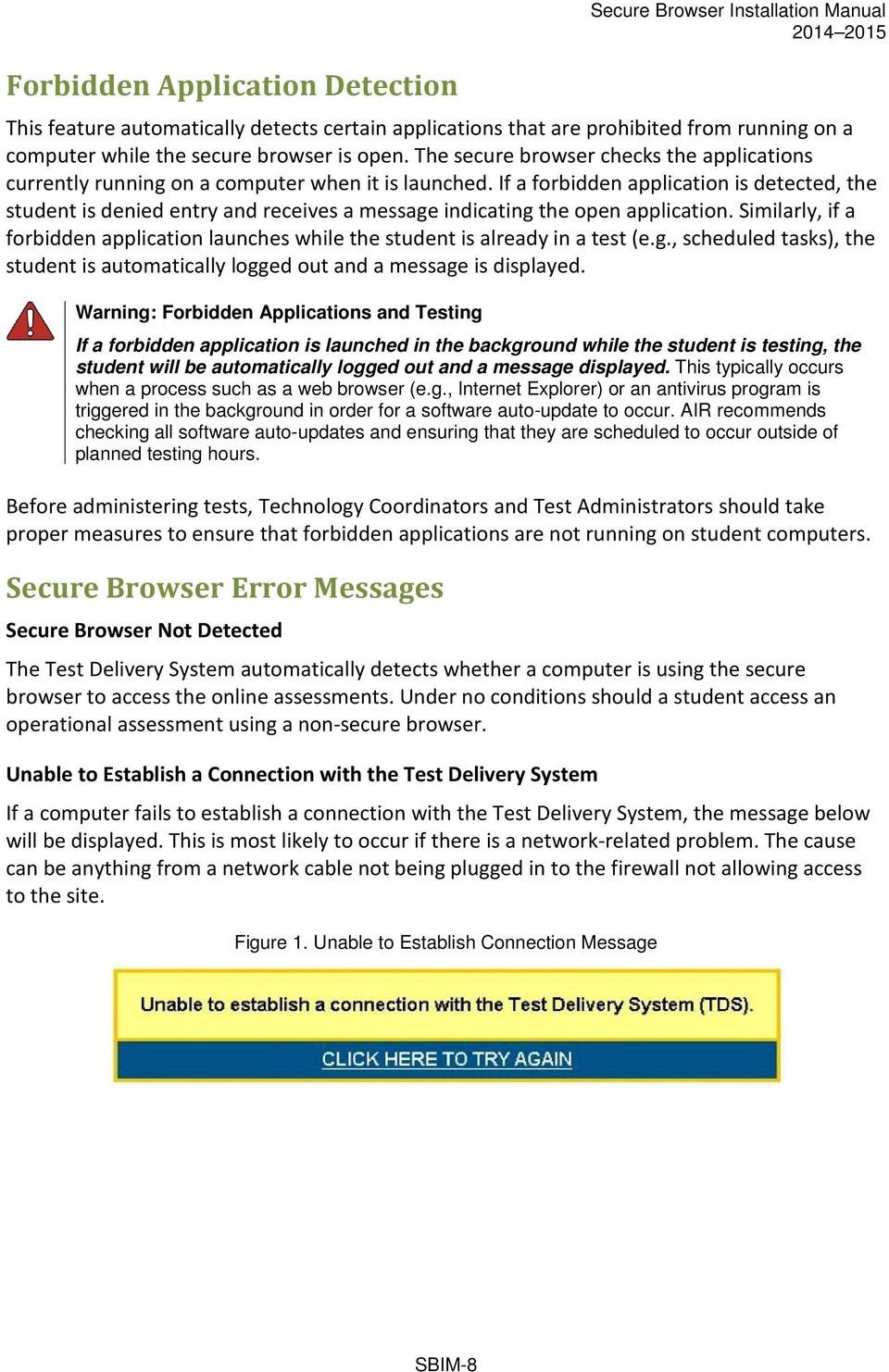
8 Forbidden Application Detection This feature automatically detects certain applications that are prohibited from running on a computer while the secure browser is open. The secure browser checks the applications currently running on a computer when it is launched. If a forbidden application is detected, the student is denied entry and receives a message indicating the open application. Similarly, if a forbidden application launches while the student is already in a test (e.g., scheduled tasks), the student is automatically logged out and a message is displayed. Warning: Forbidden Applications and Testing If a forbidden application is launched in the background while the student is testing, the student will be automatically logged out and a message displayed. This typically occurs when a process such as a web browser (e.g., Internet Explorer) or an antivirus program is triggered in the background in order for a software auto-update to occur. AIR recommends checking all software auto-updates and ensuring that they are scheduled to occur outside of planned testing hours. Before administering tests, Technology Coordinators and Test Administrators should take proper measures to ensure that forbidden applications are not running on student computers. Secure Browser Error Messages Secure Browser Not Detected The Test Delivery System automatically detects whether a computer is using the secure browser to access the online assessments. Under no conditions should a student access an operational assessment using a non-secure browser. Unable to Establish a Connection with the Test Delivery System If a computer fails to establish a connection with the Test Delivery System, the message below will be displayed. This is most likely to occur if there is a network-related problem. The cause can be anything from a network cable not being plugged in to the firewall not allowing access to the site. Figure 1. Unable to Establish Connection Message SBIM-8
9 Section III. Desktop Secure Browser Installation The appropriate secure browser must be installed on each computer that will be used for student testing. All secure browsers can be downloaded from the SAGE Portal ( Note: If your school s computers still have a secure browser from a previous test administration, it should be uninstalled. AIR strongly recommends that the secure browser be installed on each individual computer that will be used for student testing. This section contains secure browser installation instructions for each supported desktop operating system platform. Installation Options Windows Secure Browser 7.0 Mac OS X Secure Browsers o Mac Secure Browser 6.5 o Mac Secure Browser 7.0 Linux Secure Browser 6.5 SBIM-9

10 Installation Options AIR recommends installing the secure browser individually on each computer that will be used for student testing. The secure browser can also be pushed out or installed onto a network; however, the installation instructions provided in this manual may not apply to your network configuration. One-by-One (Manual) Installation From each computer to be used for testing, access the Internet and download and install the browser; OR Download and save the browser onto a media device (such as a flash drive) and then copy and install the files onto each computer; OR Download and save the browser to a network folder and then copy it onto each computer. For any of these options, go to the secure browsers page and download and install the browser to your desired location (an individual computer, a media device, or a network folder). Network Installation (Network Administrators) You can push the browser out to all computers through a network by copying browser files from the network to individual computers or through third-party programs to run the installers, such as Apple Remote Desktop. Installation without Administrator Rights (Windows) If you must install the secure browser on computers to which you do not have administrator or installation rights, read the Windows Secure Browser: Installation Without Administrator Rights section in this document. SBIM-10

11 Windows Secure Browser 7.0 This section provides instructions for installing the Windows secure browser on desktop computers running a supported Windows operating system. The Windows secure browser will not run on non-supported Windows platforms. You must install Windows Secure Browser 7.0 on each computer that will be used for student testing. About the Instructions in this Section The instructions in this section assume machines are running a 64-bit version of Windows and that the secure browser will be installed to the default C:\Program Files (x86)\ location. If you are running a 32-bit version of Windows, then adjust the instructions accordingly to the C:\Program Files\ path. Notes: Installing Windows secure browser 7.0 will uninstall the previous version automatically, if the new secure browser is installed to the same location as the previous secure browser. Secure Browser 7.0 will launch the uninstaller process and remove the previous version s files. If the previous secure browser files were copied to other locations, they will have to be manually uninstalled from those locations. The installation file for Windows computers is an.msi file, which requires administration rights. For instructions on installing the secure browser without administrator rights, refer to the Windows Secure Browser: Installation Without Administrator Rights section. The following instructions are included in this section: Windows Secure Browser: Individual Installation Windows Secure Browser: Network Installation Windows Secure Browser: Thin Client Installation Windows Secure Browser: Installation Without Administrator Rights Windows Secure Browser: Uninstallation SBIM-11

12 Windows Secure Browser: Individual Installation This section contains instructions for installing the secure browser to individual machines. Two sets of instructions are included in this section: Installing the.msi Package via the User Interface Installing the.msi Package via a Script Installing the.msi Package via the User Interface 1. Navigate to the Secure Browser page of the SAGE Portal. Select the [Windows] tab, then click the [Download Browser] link. A dialog window will open. Note: This step may vary slightly depending on the browser you are currently using. o If presented with a choice to either Run or Save the file, select Run. This will open the Secure Browser Setup Wizard. o If presented only with the option to [Save], save the file to a convenient location. After saving the file, double-click the installation file (UTSecureBrowser7.0-Win.msi) to open the Secure Browser Setup Wizard. 2. Follow the instructions in the Secure Browser Setup Wizard to proceed with the installation. When prompted, select the Standard installation option. This will install the browser to its default location: C:\Program Files (x86)\utsecurebrowser A shortcut icon will also be installed to the desktop. The shortcut icon should say UT Secure Browser Click [Finish]. This will launch the secure browser directly from the Setup Wizard. 5. Upon launching the secure browser, you will see the student login screen. Note: The browser will fill the entire screen and hide the task bar. 6. To exit the browser, click the [Close Secure Browser] button in the upper right corner of the screen. SBIM-12
![Navigate to the Secure Browser page of the SAGE Portal. Select the [Windows] tab, then click the [Download Browser] link. A dialog window will open.](/docs-images/40/2767333/images/page_12.jpg "Note: This step may vary slightly depending on the browser you are currently using. o If presented with a choice to either Run or Save the file, select Run.")
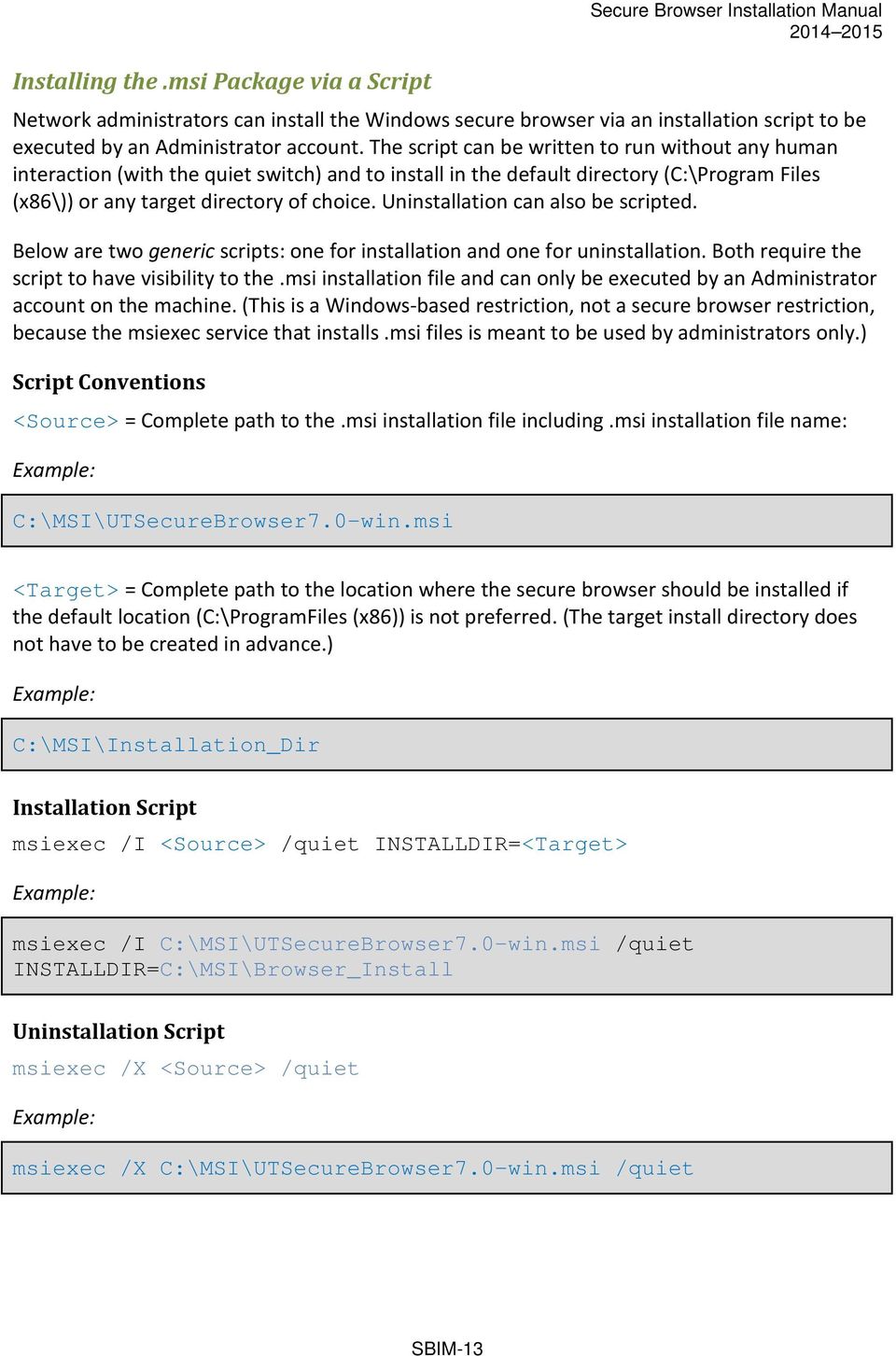
13 Installing the.msi Package via a Script Network administrators can install the Windows secure browser via an installation script to be executed by an Administrator account. The script can be written to run without any human interaction (with the quiet switch) and to install in the default directory (C:\Program Files (x86\)) or any target directory of choice. Uninstallation can also be scripted. Below are two generic scripts: one for installation and one for uninstallation. Both require the script to have visibility to the.msi installation file and can only be executed by an Administrator account on the machine. (This is a Windows-based restriction, not a secure browser restriction, because the msiexec service that installs.msi files is meant to be used by administrators only.) Script Conventions <Source> = Complete path to the.msi installation file including.msi installation file name: Example: C:\MSI\UTSecureBrowser7.0-win.msi <Target> = Complete path to the location where the secure browser should be installed if the default location (C:\ProgramFiles (x86)) is not preferred. (The target install directory does not have to be created in advance.) Example: C:\MSI\Installation_Dir Installation Script msiexec /I <Source> /quiet INSTALLDIR=<Target> Example: msiexec /I C:\MSI\UTSecureBrowser7.0-win.msi /quiet INSTALLDIR=C:\MSI\Browser_Install Uninstallation Script msiexec /X <Source> /quiet Example: msiexec /X C:\MSI\UTSecureBrowser7.0-win.msi /quiet SBIM-13
14 Windows Secure Browser: Network Installation You can install the secure browser to all computers on a network by copying browser files from the network to individual computers or through third-party programs to run the installers. This section contains instructions for the following: Installing the Secure Browser to a Shared Drive Pushing the Secure Browser Installation Directory from the Network to Client Computers Installing the Secure Browser to a Shared Drive 1. Install the secure browser following the standard directions in the Windows Secure Browser: Individual Installation section. 2. On each client machine, map the network directory to the location where you installed the secure browser. a. In the network location where you installed the secure browser, create a shortcut by right-clicking the UTSecureBrowser7.0.exe icon and selecting Create Shortcut. Optional: You may want to rename the new shortcut to UTSecureBrowser7.0. (This becomes the shortcut link name that you will use in step 3 below.) b. In the shortcut properties section, change the path to UTSecureBrowser7.0.exe to use the mapped path. 3. To each user (computer) profile, add the following command, which will execute upon login through the user group login script: COPY <X> \UTSecureBrowser7.0.lnk %USERPROFILE%\Desktop Note: <X> refers to the shared directory from which the browser will be run. The script will need to reference the correct directory. SBIM-14

15 Pushing the Secure Browser Installation Directory from the Network to Client Computers 1. Install the browser onto your server following the standard directions available in this document. 2. Identify the source network directory location where you saved the browser file. These instructions refer to that network directory location as <X>. 3. Identify the target network directory on the local user computers to which you will copy the browser file. These instructions refer to that directory as <Y>. Make sure that you have write access to <Y> on the local computers. Note: Restricted users will have access only to certain folders on the local computers. 4. Create a shortcut in the network directory by right-clicking the UTSecureBrowser7.0.exe icon and selecting Create Shortcut. Rename the new shortcut, e.g., UTSecureBrowser7.0. Note: In the shortcut properties section, the Target and Start In attributes will show the <X> network installation directory. 5. Change the shortcut properties ( Target and Start In attributes) to the local computers <Y> directory instead of the default <X> network directory. That way the secure browser shortcut will point to the designated installation directory. 6. Add the following lines to the login script for each user, replacing your actual local and source network directories for <X> and <Y>: IF EXIST <Y> GOTO DONE XCOPY <X> <Y> /E /I COPY <Y>\UTSecureBrowser7.0.lnk %USERPROFILE%\Desktop :DONE EXIT SBIM-15

16 Windows Secure Browser: Thin Client Installation You can install the secure browser to an NComputing virtual desktop or to a terminal server: NComputing Virtual Desktop Installation Terminal Server Installation About NComputing AIR conducts quality testing with L230 and L300 terminals using Windows 7 and vspace Server Other terminals should work provided the server host is a supported client Windows operating system. For more information, refer to the Technical Specifications Manual for Online Testing. About Terminal Servers Terminal servers used with a thin client can be used for online testing. AIR conducts quality testing with Windows Server 2003 and For more information, refer to the Technical Specifications Manual for Online Testing. Security Issues With Terminal Services or Remote Desktop Connections to Servers Using a terminal services or remote desktop connection to access a Windows Server or workstation that has the secure browser installed is typically not a secure test environment. Therefore, AIR does not support terminal services or remote desktop connections to access a Windows Server for secure online testing. SBIM-16

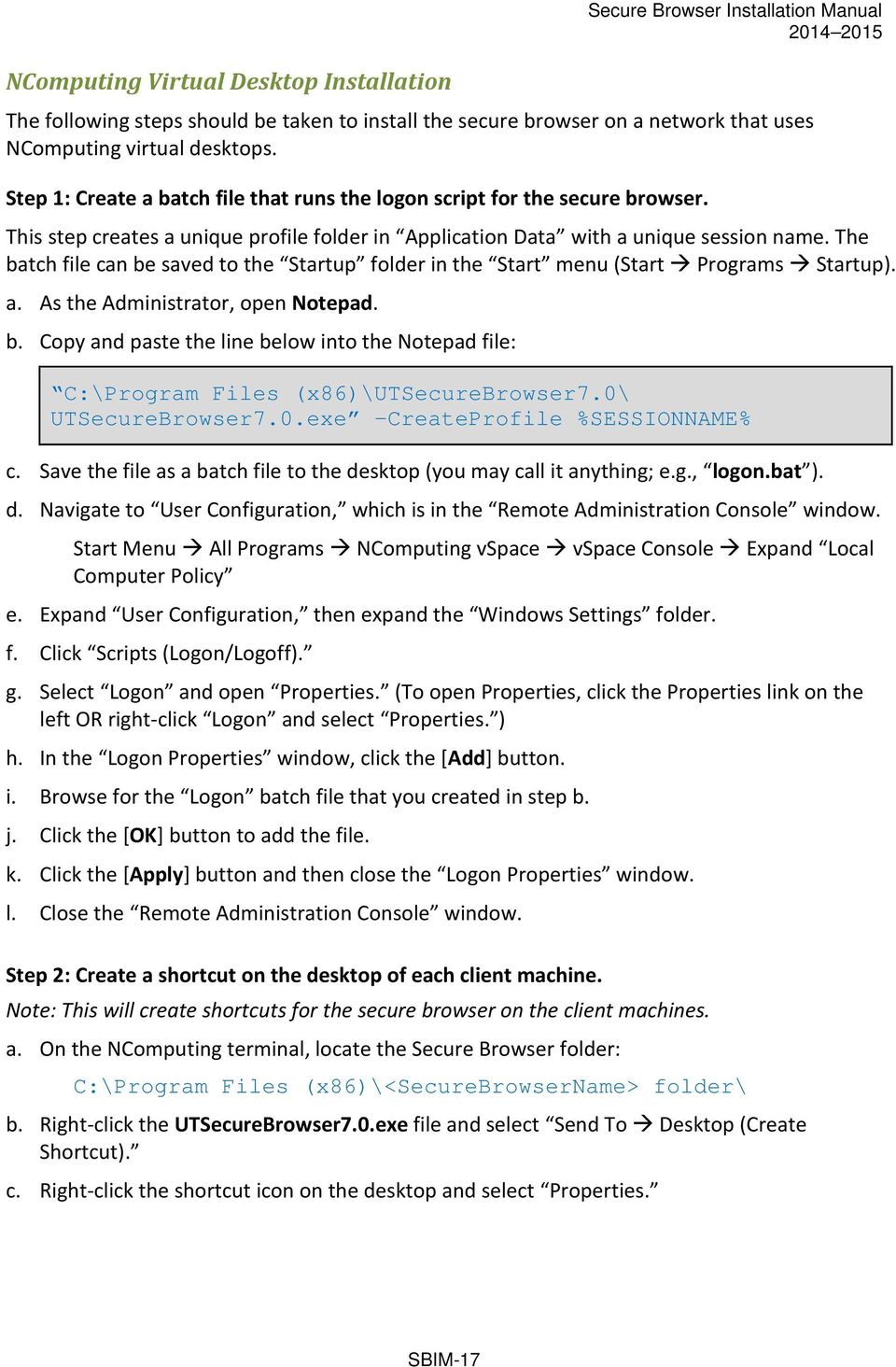
17 NComputing Virtual Desktop Installation The following steps should be taken to install the secure browser on a network that uses NComputing virtual desktops. Step 1: Create a batch file that runs the logon script for the secure browser. This step creates a unique profile folder in Application Data with a unique session name. The batch file can be saved to the Startup folder in the Start menu (Start Programs Startup). a. As the Administrator, open Notepad. b. Copy and paste the line below into the Notepad file: C:\Program Files (x86)\utsecurebrowser7.0\ UTSecureBrowser7.0.exe CreateProfile %SESSIONNAME% c. Save the file as a batch file to the desktop (you may call it anything; e.g., logon.bat ). d. Navigate to User Configuration, which is in the Remote Administration Console window. Start Menu All Programs NComputing vspace vspace Console Expand Local Computer Policy e. Expand User Configuration, then expand the Windows Settings folder. f. Click Scripts (Logon/Logoff). g. Select Logon and open Properties. (To open Properties, click the Properties link on the left OR right-click Logon and select Properties. ) h. In the Logon Properties window, click the [Add] button. i. Browse for the Logon batch file that you created in step b. j. Click the [OK] button to add the file. k. Click the [Apply] button and then close the Logon Properties window. l. Close the Remote Administration Console window. Step 2: Create a shortcut on the desktop of each client machine. Note: This will create shortcuts for the secure browser on the client machines. a. On the NComputing terminal, locate the Secure Browser folder: C:\Program Files (x86)\<securebrowsername> folder\ b. Right-click the UTSecureBrowser7.0.exe file and select Send To Desktop (Create Shortcut). c. Right-click the shortcut icon on the desktop and select Properties. SBIM-17
18 d. In the Target text box, type or copy/paste the correct command below as shown: C:\Program Files(X86)\UTSecureBrowser7.0\ UTSecureBrowser7.0.exe P %SESSIONNAME% e. Click [OK] to close the Properties window. f. Optional: Rename the desktop shortcut to UTSecureBrowser7.0. Step 3: Log in as an Administrator and run the application once. Simply launching the secure browser and going to the diagnostics page is sufficient (you do not need to start a test). Note: In order to launch the secure browser on the client machines, users will need to doubleclick the shortcut created on the desktop. SBIM-18

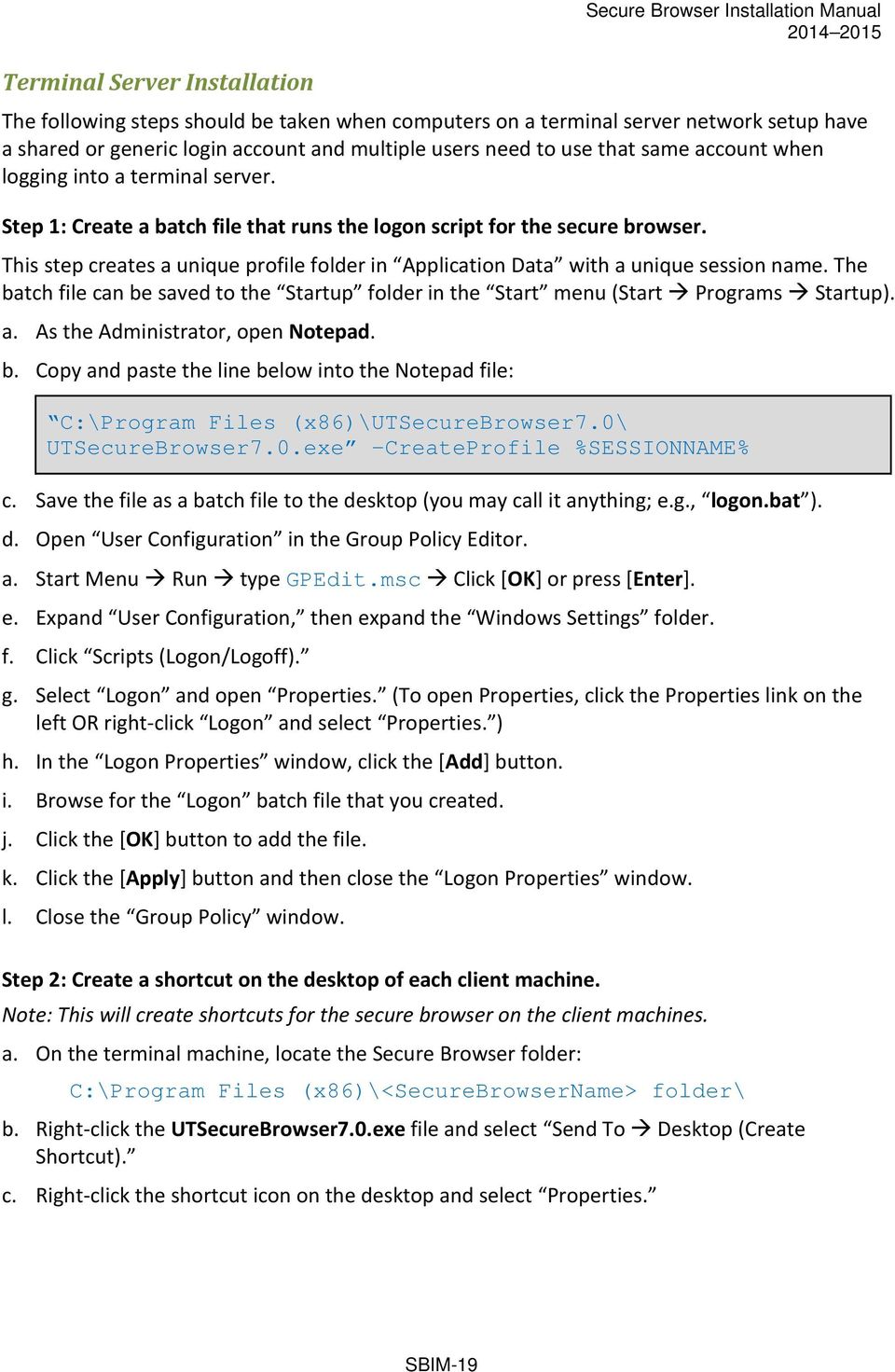
19 Terminal Server Installation The following steps should be taken when computers on a terminal server network setup have a shared or generic login account and multiple users need to use that same account when logging into a terminal server. Step 1: Create a batch file that runs the logon script for the secure browser. This step creates a unique profile folder in Application Data with a unique session name. The batch file can be saved to the Startup folder in the Start menu (Start Programs Startup). a. As the Administrator, open Notepad. b. Copy and paste the line below into the Notepad file: C:\Program Files (x86)\utsecurebrowser7.0\ UTSecureBrowser7.0.exe CreateProfile %SESSIONNAME% c. Save the file as a batch file to the desktop (you may call it anything; e.g., logon.bat ). d. Open User Configuration in the Group Policy Editor. a. Start Menu Run type GPEdit.msc Click [OK] or press [Enter]. e. Expand User Configuration, then expand the Windows Settings folder. f. Click Scripts (Logon/Logoff). g. Select Logon and open Properties. (To open Properties, click the Properties link on the left OR right-click Logon and select Properties. ) h. In the Logon Properties window, click the [Add] button. i. Browse for the Logon batch file that you created. j. Click the [OK] button to add the file. k. Click the [Apply] button and then close the Logon Properties window. l. Close the Group Policy window. Step 2: Create a shortcut on the desktop of each client machine. Note: This will create shortcuts for the secure browser on the client machines. a. On the terminal machine, locate the Secure Browser folder: C:\Program Files (x86)\<securebrowsername> folder\ b. Right-click the UTSecureBrowser7.0.exe file and select Send To Desktop (Create Shortcut). c. Right-click the shortcut icon on the desktop and select Properties. SBIM-19
20 d. In the Target text box, type or copy/paste the correct path below as shown: C:\Program Files(X86)\UTSecureBrowser7.0\ UTSecureBrowser7.0.exe P %SESSIONNAME% e. Click [OK] to close the Properties window. f. Optional: Rename the desktop shortcut to UTSecureBrowser7.0. SBIM-20
![0.exe P %SESSIONNAME% e. Click [OK] to close the Properties window. f.](/docs-images/40/2767333/images/page_20.jpg "Optional: Rename the desktop shortcut to UTSecureBrowser7.0. SBIM-20")
21 Windows Secure Browser: Installation Without Administrator Rights We strongly recommend that you install the secure browser on each individual computer. However, if you do not have administrator rights, follow the instructions below to use either a shared network location or a removable drive to copy the secure browser program to the computer. Once you have installed the browser on one machine, you can copy it to restricted accounts on other machines. 1. On a computer on which you have installation rights, download and install the browser, following the standard directions available in the Windows Secure Browser 7.0 section. 2. Copy the entire folder where the browser was installed (usually, C:\Program Files (x86)\utsecurebrowser7.0 ) to a removable drive or shared network location. 3. Copy the entire directory from the shared location or removable drive to any directory on the target computer. 4. Drag the UTSecureBrowser7.0.exe icon to the desktop to create a convenient shortcut. SBIM-21
22 Windows Secure Browser: Uninstallation If you need to manually uninstall a Windows secure browser, follow the steps below. 1. Open the Control Panel (from your taskbar, select Start > Settings > Control Panel). 2. Select Add or Remove Programs. 3. Select the Secure Browser program (e.g., UTSecureBrowser7.0) and click [Remove] to open the Uninstall Wizard. 4. Click [Next]. 5. Click [Uninstall]. This will remove the secure browser. 6. Click [Finish] to complete the uninstall process. Note: Installing the new Windows secure browser will uninstall previous versions automatically in most cases. If you did not use the installer program to install the secure browser onto a network, or you installed the new secure browser to a different location than the previous secure browser, you will need to manually remove the earlier version first. SBIM-22
23 Mac OS X Secure Browsers This section provides instructions for installing the Mac secure browsers on desktop computers. Two secure browsers are available; one for computers running Mac OS 10.5 (Intel) and one for computers running Mac OS 10.6, 10.7, 10.8, and The correct secure browser must be installed on Mac computers used for student testing. The following instructions are included in this section: Mac Secure Browser 6.5: Individual Installation Note: This secure browser must be installed on computers running Mac OS 10.5 (Leopard) with an Intel processor. Computers running Mac OS 10.5 with a PowerPC processor are not supported. Mac Secure Browser 7.0: Individual Installation Note: This secure browser must be installed on computers running Mac OS 10.6, 10.7, 10.8, and Mac OS X Secure Browser: Network Installation Mac OS X Secure Browser: Uninstallation SBIM-23
24 Mac Secure Browser 6.5: Individual Installation This section provides instructions for installing the Mac secure browser on desktop computers running Mac OS 10.5 with an Intel processor. 1. Navigate to the Secure Browser page of the SAGE Portal. Select the [Mac OS X 10.5] tab, then click the [Download Browser] link. A dialog window will open. If prompted for a download location, select the desktop. Note: This step may slightly vary depending on the browser you are currently using. o If your browser automatically expands the Zip file, proceed to step 3. o If your computer opens the Software License Agreement page, proceed to step 4. o If you receive a warning message that the file contains an application, click [Continue] and proceed to step Open the file (UTSecureBrowser6.5-OSX.dmg) to expand its contents. Double-click the UTSecureBrowser6.5-OSX.dmg file to mount the UTSecureBrowser6.5 folder on the desktop. Note: Your computer may automatically expand the file upon download. 3. Double-click the mounted folder (UTSecureBrowser6.5). The Software License Agreement window will open. 4. Click [Accept]. 5. Drag the UT Secure Browser 6.5 icon to your Applications folder. Important: The secure browser must be launched to successfully complete the installation. The secure browser will disable Exposé (hot corner) settings if they are set and they will remain disabled after the browser is closed. 6. Open the Applications folder and double-click the UTSecureBrowser6.5 icon to launch the secure browser. Upon launching the secure browser, you will see the student login screen. Note: The browser will fill the entire screen and hide the dock. 7. To exit the browser, click the [Close Secure Browser] button in the upper right corner of the screen. SBIM-24
25 Mac Secure Browser 7.0: Individual Installation This section provides instructions for installing the Mac secure browser on desktop computers running Mac OS 10.6, 10.7, 10.8, and Navigate to the Secure Browser page of the SAGE Portal. Select the [Mac OS X ] tab, then click the [Download Browser] link. A dialog window will open. If prompted for a download location, select the desktop. Note: This step may slightly vary depending on the browser you are currently using. o If your browser automatically expands the Zip file, proceed to step 3. o If your computer opens the Software License Agreement page, proceed to step 4. o If you receive a warning message that the file contains an application, click [Continue] and proceed to step Open the file (UTSecureBrowser7.0-OSX.dmg) to expand its contents. Double-click the UTSecureBrowser7.0-OSX.dmg file to mount the UTSecureBrowser7.0 folder on the desktop. Note: Your computer may automatically expand the file upon download. 3. Double-click the mounted folder (UTSecureBrowser7.0). The Software License Agreement window will open. 4. Click [Accept]. 5. Drag the UT Secure Browser 7.0 icon to your Applications folder. Important: The secure browser must be launched to successfully complete the installation. For Mac OS 10.6, Exposé settings will be disabled only when the secure browser is launched. The dock will appear the first time the Exposé settings are disabled upon browser launch. System security is not affected because applications opened from the dock open in the background and cannot be accessed. For Mac OS 10.7, 10.8, and 10.9, Mission Control/Spaces must be manually disabled before students can use the secure browser. Instructions for disabling Spaces are in the Technical Specifications Manual for Online Testing. 6. Open the Applications folder and double-click the UTSecureBrowser7.0 icon to launch the secure browser. Upon launching the secure browser, you will see the student login screen. Note: The browser will fill the entire screen and hide the dock. 7. To exit the browser, click the [Close Secure Browser] button in the upper right corner of the screen. SBIM-25
26 Mac OS X Secure Browser: Network Installation This section provides network installation instructions for Mac OS X computers and the Apple Remote Desktop application. Installing the Mac OS X Secure Browser Using Apple Remote Desktop 1. Log into an administrator computer on your network. This computer should have Apple Remote Desktop installed and running. 2. Download the correct Mac OS X browser from the SAGE Portal. o For Mac OS 10.5 (Intel), download Mac Secure Browser 6.5. o For Mac OS , download Mac Secure Browser Click the downloaded icon to unzip and save the.dmg file onto your administrator computer. 4. Open the.dmg file and select the.app file. 5. Open Apple Remote Desktop. 6. In the Apple Remote Desktop window, select a computer list. 7. Select one or more computers from the computer list onto which you would like to install the secure browser. 8. Select Manage > Copy Items. 9. Select the browser.app file (from step 4). 10. Select copy options, including your preferred destination on the target machine. 11. Click [Copy]. SBIM-26
27 Mac OS X Secure Browser: Uninstallation Before installing a new Mac secure browser, you will need to uninstall the previous version, if you have one. There may be a secure browser folder on the desktop. (The secure browser version number will vary depending on your operating system version.) Drag the folder and related files to the Trash. If the browser was installed to a different location, remove it accordingly. SBIM-27
28 Linux Secure Browser 6.5 This section provides instructions for installing the Linux secure browser on desktop computers running a supported Linux distribution. While the Linux secure browser can be installed on other Linux distributions, AIR cannot guarantee those distributions will support the secure browser. Notes: In addition to installing the Linux secure browser, required and recommended libraries should be installed. Festival and SoX software must be installed. Verdana TrueType font must be installed. For more information about the above Linux requirements, refer to the Technical Specifications Manual for Online Testing. The following instructions are included in this section: Linux Secure Browser: Standard (32-Bit) Installation Linux Secure Browser: 64-Bit Installation Linux Secure Browser: Uninstallation SBIM-28
29 Linux Secure Browser: Standard (32-Bit) Installation The instructions in this section are for installing the Linux secure browser onto 32-bit versions of Linux systems. 1. Navigate to the Secure Browser page of the SAGE Portal. Select the [Linux] tab, then click the [Download Browser] link. Save the file to the desktop. 2. Right-click the downloaded file (UTSecureBrowser6.5-Linux.tar.bz2), and select Extract Here to expand the file. This creates the UTSecureBrowser6.5 folder on the desktop. Note: To expand the compressed image using command line, use the following command: tar -jxvf UTSecureBrowser6.5-Linux.tar.bz2 3. Open the UTSecureBrowser6.5 folder. 4. Double-click the file install-icon.sh and select Run from the prompt. Note: This will create the UTSecureBrowser6.5 icon on the desktop.* 5. From the desktop, double-click the UTSecureBrowser6.5 icon to launch the browser. 6. Upon launching the secure browser, you will see the student login screen. Note: The browser will fill the entire screen and hide the task bar. 7. To exit the browser, click [Close Secure Browser] in the upper right corner of the screen. * If you do not want to run the installer, you can extract the files by opening the UTSecureBrowser6.5 file and selecting Run from the options in the message dialog box. SBIM-29
30 Linux Secure Browser: 64-Bit Installation The secure browser is a 32-bit browser. If you have machines running a 64-bit Linux distribution, the secure browser will not launch properly. The reason is that 64-bit distributions typically do not have 32-bit compatibility libraries installed. In order for the secure browser to run, the 32-bit compatibility libraries for your Linux distribution must be installed. As the commands for doing so vary between Linux distributions, we encourage you to check the documentation for your specific Linux distribution or configuration. The following command prompts should work for supported Linux distributions. Fedora Note: You must run the following command as the root user. yum install glibc.i686 opensuse 13.1 zypper install glibc-32bit Red Hat Enterprise Linux 6.5 yum install glibc.i686 Ubuntu (LTS) 10.04, sudo apt-get install ia32-libs Ubuntu (LTS) (coming soon) SBIM-30
31 Linux Secure Browser: Uninstallation Before installing a new Linux secure browser, you will need to uninstall the previous version, if you have one. There may be a secure browser folder on the desktop. (The secure browser version number will vary depending on your operating system version.) Drag the folder and related files to the Trash. If the browser was installed to a different location, remove it accordingly. SBIM-31
32 Section IV. Proxy Settings for Desktop Secure Browsers By default, the secure browsers for Windows, Mac, and Linux are packaged with the proxy setting set to auto-detect. This setting can be overridden using the command line or by creating a shortcut. Specifying a Proxy Server to Use with the Secure Browser These secure browsers attempt to auto-detect the settings for your network s web proxy server. As an option you can change the settings to use by passing parameters to the proxy executable. The following proxy values are supported: 0 Direct connection, no proxy 1 Manual proxy configuration 2 Proxy auto-configuration (PAC) 4 Auto-detect proxy settings 5 System proxy settings (this is the default) Description System Command Run the browser without any proxy Set the proxy for HTTP requests only Set the proxy for all protocols to mimic the Use this proxy server for all protocols of Firefox Specify the URL of the PAC file Windows UTSecureBrowser7.0.exe -proxy 0 Mac 10.5 (Intel) arch -i386./utsecurebrowser6.5 -proxy 0 Mac /UTSecureBrowser7.0 -proxy 0 Linux./UTSecureBrowser6.5 -proxy 0 Windows UTSecureBrowser7.0.exe -proxy 1: Mac 10.5 (Intel) arch -i386./utsecurebrowser6.5 -proxy 1: Mac /UTSecureBrowser7.0 -proxy 1: Linux./UTSecureBrowser6.5 -proxy 1: Windows UTSecureBrowser7.0.exe -proxy 1:*:foo.com:80 Mac 10.5 (Intel) arch i386./utsecurebrowser6.5 -proxy 1:*:foo.com:80 Mac /UTSecureBrowser7.0 -proxy 1:*:foo.com:80 Linux./UTSecureBrowser6.5 -proxy 1:*:foo.com:80 Windows UTSecureBrowser7.0.exe -proxy 2:proxy.com Mac 10.5 (Intel) arch -i386./utsecurebrowser6.5 -proxy 2:proxy.com Mac /UTSecureBrowser7.0 -proxy 2:proxy.com Linux./UTSecureBrowser6.5 -proxy 2:proxy.com SBIM-32
33 Description System Command Auto-detect proxy settings Use the system proxy setting (default) Windows UTSecureBrowser7.0.exe -proxy 4 Mac 10.5 (Intel) arch -i386./utsecurebrowser6.5 -proxy 4 Mac /UTSecureBrowser7.0 -proxy 4 Linux./UTSecureBrowser6.5 -proxy 4 Windows UTSecureBrowser7.0.exe -proxy 5 Mac 10.5 (Intel) arch -i386./utsecurebrowser6.5 -proxy 5 Mac /UTSecureBrowser7.0 -proxy 5 Linux./UTSecureBrowser6.5 -proxy 5 Create a Corresponding Desktop Shortcut to Run the Browser Using Additional Parameters This section provides guidelines for adding a non-default proxy setting to the secure browser so that it will launch as desired. All commands in this section are examples only. Microsoft Windows 1. Navigate to the location of the Secure Browser program folder. 2. Create a shortcut by right-clicking the UTSecureBrowser7.0.exe executable file. 3. Move the shortcut to a desired location, such as the desktop. 4. Right-click the shortcut icon to edit its properties. 5. In the Target: input field, append the additional options after the command. For example: C:\Program Files (x86)\utsecurebrowser7.0\utsecurebrowser7.0.exe proxy 1: 6. Click [OK]. SBIM-33
34 Mac OS X The steps in this section require you to use Terminal. Note: The screenshots in this section were taken with a computer running Mac From the Terminal application, change to the desktop directory. (Go to Applications > Utilities > Terminal. In Terminal, type the command below and press [Enter].) cd Desktop 2. Create a.command file using an editor such as pico. To do so, type the command below and press [Enter]. This creates the securebrowser.command file on the desktop. pico securebrowser.command After you create the securebrowser.command file, Terminal may look like this: 3. Edit the file as necessary. You need to specify the actual directory path to the secure browser and the desired proxy option. Ensure the second command ends with an ampersand (&). Mac 10.5 (Intel) #!/bin/sh (press [Enter]) arch -i386 /Applications/UTSecureBrowser7.0.app/Contents/ MacOS/UTSecureBrowser7.0 proxy 1: & Mac #!/bin/sh (press [Enter]) /Applications/UTSecureBrowser7.0.app/Contents/MacOS/./ UTSecureBrowser7.0 proxy 1: & SBIM-34
35 Sample Mac Command 4. Save the file and exit the editor by pressing [Ctrl-O], [Enter] and [Ctrl-X]. After you are done, Terminal may look like this: 5. Execute permission to the shell script file. (In Terminal, type in the command line below and press [Enter].) chmod a+x securebrowser.command 6. Close Terminal. 7. Click the [securebrowser.command] icon on the desktop. This will open the secure browser with the proxy setting that you configured. SBIM-35
36 Linux Information about creating a corresponding desktop shortcut for supported Linux distributions will be available soon. SBIM-36
37 Section V. Mobile Secure Browser Installation The appropriate AIRSecureTest mobile secure browser application must be installed on each supported device that will be used for student testing. All mobile secure browsers can be accessed from the SAGE Portal ( This section contains information about the installation of the AIRSecureTest app for ios, Android, and Chrome OS. For information about configuring supported tablets and Chromebooks to work with the secure browser, refer to the Technical Specifications Manual for Online Testing. This section includes the following: Introduction to Testing on Tablets and Chromebooks ios AIRSecureTest Mobile Secure Browser Android AIRSecureTest Mobile Secure Browser Chrome OS AIRSecureTest Kiosk App Introduction to Testing on Tablets and Chromebooks The AIRSecureTest mobile secure browser application is designed to support a secure testing environment. This application may require changes to default device settings. Student testing on ipads requires Guided Access to be enabled. Student testing on Android tablets requires the secure browser keyboard to be enabled. Student testing on Chromebooks requires the device to be in kiosk mode. The first time a mobile secure browser is opened successfully, a Launchpad page will appear. This page will prompt you to select your state (Utah) and the program (Student Assessment of Growth and Excellence). Once this step is completed, the student login page will load. SBIM-37
38 ios AIRSecureTest Mobile Secure Browser The AIRSecureTest secure browser can be downloaded from the App store. The process for installing the secure browser is the same as for any other ios application. This section contains instructions for downloading and installing the AIRSecureTest browser, selecting your state and assessment program, and activating Guided Access. Downloading and Installing the ios AIRSecureTest Mobile Secure Browser Opening the AIRSecureTest Browser and Selecting the Assessment Program Activating Guided Access Before a Test Session Begins Deactivating Guided Access After a Test Session Ends Closing the AIRSecureTest Mobile Secure Browser Downloading and Installing the ios AIRSecureTest Mobile Secure Browser 1. On your ipad, navigate to the Secure Browser page of the SAGE Portal and select the ios tab. Click the [Download] button. Note: You may also search for AIRSecureTest in the App store to find the secure browser app. The AIRSecureTest application download page will open. 2. Tap or select the [Free] button. The button will change to [Install App]. 3. Tap or select [Install App]. 4. Enter your Apple ID password. 5. The AIRSecureTest mobile secure browser will download and install onto your ipad. Look for the AIRSecureTest icon. SBIM-38
39 Opening the AIRSecureTest Browser and Selecting the Assessment Program The first time you open the AIRSecureTest mobile secure browser, you will see a Launchpad screen. This Launchpad establishes the test administration your students will log into. 1. Under Please Select Your State, select Utah from the drop-down list. 2. Under Choose Your Assessment Program, Student Assessment of Growth and Excellence should already be selected. 3. Tap or select [OK]. The student login page will load. The secure browser is now ready for students to use. The Launchpad screen is designed to display only one time. The student login page will display automatically the next time the secure browser is launched. SBIM-39
40 Activating Guided Access Before a Test Session Begins Guided Access must already be enabled via ios Settings prior to completing these steps. More information about Guided Access and how to enable it is located in the Technical Specifications Manual for Online Testing. If students are using ipads with ios 7, the volume buttons can be enabled prior to starting Guided Access. 1. Open the AIRSecureTest secure browser app. The student login page should display. 2. Triple-click (press) the Home button on the ipad. 3. The Guided Access options will appear in a border around the secure browser app. a. Tap the [Options] button under Hardware Buttons. A pop-up menu will appear with options. b. Tap the toggle for Volume Buttons so that it is enabled. (This will allow students to adjust volume during the test.) c. Tap the [Start] button in the upper right corner. A pop-up message will appear saying, Guided Access has started. Notes: Guided Access is not the same as Single App Mode. It cannot be enabled or activated via a Mobile Device Management program. When Guided Access is activated, students cannot switch to other applications or take screenshots. If you are using ios 6, the Hardware Buttons are completely disabled and cannot be enabled. SBIM-40
41 Deactivating Guided Access After a Test Session Ends 1. Triple-click (press) the Home button on the ipad. 2. Enter the Guided Access passcode. This must be the same passcode used when Guided Access was enabled. 3. Tap the [End] button in the upper left corner. A pop-up message will appear saying Guided Access ended. Closing the AIRSecureTest Mobile Secure Browser Closing the AIRSecureTest browser is the same as closing any other ios application. ios Double-click (press) the Home button. This will open the multitasking bar. 2. Press the [AIRSecureTest] icon until it wiggles and the red minus sign appears. 3. Tap the red minus sign and then press the Home button. ios Double-click (press) the Home button. This will open the multitasking screen. 2. Locate the [AIRSecureTest] app preview and slide it upwards. SBIM-41
42 Android AIRSecureTest Mobile Secure Browser The AIRSecureTest secure browser can be downloaded from the Google Play store. The process for installing the secure browser is the same as for any other Android application. This section contains instructions for downloading and installing the AIRSecureTest browser and selecting your state and assessment program. Downloading and Installing the Android AIRSecureTest Mobile Secure Browser Opening the AIRSecureTest Browser and Selecting the Assessment Program Closing the AIRSecureTest Mobile Secure Browser Downloading and Installing the Android AIRSecureTest Mobile Secure Browser 1. On your Android tablet, navigate to the Secure Browser page of the SAGE Portal and select the Android tab. Click [Download Browser]. Note: You may also search for AIRSecureTest in the Google Play store to find the secure browser app. The AIRSecureTest application download page will open. 2. Tap or select the [Install] button. 3. The AIRSecureTest mobile secure browser will download and install onto your tablet. Look for the AIRSecureTest icon. (The name may be truncated.) Android Secure Browser Keyboard If the secure browser keyboard has not been selected via device settings on Android tablets, it will need to be selected upon opening the AIRSecureTest app. For more information about the Android secure browser keyboard, including instructions for enabling it, refer to the Technical Specifications Manual for Online Testing. SBIM-42
43 Opening the AIRSecureTest Browser and Selecting the Assessment Program The first time you open the AIRSecureTest mobile secure browser, you will see a Launchpad screen. This Launchpad establishes the test administration your students will log into. 1. Under Please Select Your State, select Utah from the drop-down list. 2. Under Choose Your Assessment Program, Student Assessment of Growth and Excellence should already be selected. 3. Tap or select [OK]. The student login page will load. The secure browser is now ready for students to use. The Launchpad screen is designed to display only one time. The student login page will display automatically the next time the secure browser is launched. Closing the AIRSecureTest Mobile Secure Browser Closing the AIRSecureTest browser is the same as closing any other Android application. 1. Tap the Menu icon [ ] in the upper right corner. 2. Tap [Exit]. A pop-up message will appear asking you to verify that you want to exit the secure browser. 3. Tap [Exit]. SBIM-43
44 Chrome OS AIRSecureTest Kiosk App AIR has worked with Google to develop a secure kiosk application for use with Chromebooks. The AIRSecureTest kiosk application can be installed onto managed Chromebooks via the Google Admin Console. It can also be downloaded and installed on non-managed Chromebooks from the Chrome Web store. About the AIRSecureTest Kiosk App The AIRSecureTest browser is not a hosted app. In order to support all test features, AIR developed a packaged kiosk application. As a result, this app must be deployed onto managed Chromebooks via the Chrome Management Console as a kiosk application rather than via a public session. (You may still use public sessions for other applications.) Chromebooks and Kiosk Mode Using the AIRSecureTest kiosk application requires Chromebooks to run in kiosk mode. For more information about Chromebooks and enabling kiosk mode, refer to the Technical Specifications Manual for Online Testing. Google has also provided their own documentation and supports Chromebook users. This section contains instructions for installing the AIRSecureTest kiosk application and selecting your state and assessment program. Adding the AIRSecureTest Kiosk App to Managed Chromebooks Adding the AIRSecureTest Kiosk App to Non-Managed Chromebooks Opening the AIRSecureTest Kiosk App and Selecting the Assessment Program SBIM-44
45 Adding the AIRSecureTest Kiosk App to Managed Chromebooks These instructions are for Chrome Device Managers who will add the secure browser to their domain-managed Chromebook devices. Note: The instructions that follow are based on the current Device Management Console interface. If Google makes changes to their Console interface, apply the following instructions in accordance with UI changes. 1. As the Chromebook administrator, log into your Chrome OS management console ( 2. Navigate to Device management > Chrome management > Device settings 3. On the Device settings page, scroll down to the Kiosk Settings section. o Ensure that Single App Kiosk is set to Allow Single App Kiosk. Note: The AIRSecureTest app is not compatible with public sessions. However, you may still use public sessions as necessary for other Chromebook uses (e.g., classroom instruction or other test administrations). 4. Click the [Manage Kiosk Applications] link. The Kiosk Apps window will appear. You will need to add the AIRSecureTest app. a. Click [Chrome Web Store]. b. In the search box, type AIRSecureTest (without quotes) and press [Enter]. c. The AIRSecureTest app will appear. Click the [Add] link. The app will appear in the Total to install section. d. Click [Save]. Once these steps are complete, the AIRSecureTest application will appear on all managed Chromebook devices. Note: Students do NOT need to log into Chromebooks to take the test. When Chromebooks are powered up, simply click the [Apps] link in the bottom row and select the [AIRSecureTest] app. The secure browser will open in full-screen mode. Important: If you launch the AIRSecureTest app and receive the following error message, then the secure browser is installed properly but not configured to run in kiosk mode. The AIRSecureTest application requires kiosk mode to be enabled. Ensure that the above steps are completed. The AIRSecureTest app must appear in the Manage Kiosk applications window in Step 4. SBIM-45
46 Adding the AIRSecureTest Kiosk App to Non-Managed Chromebooks These instructions are for downloading the secure browser onto individual, non-managed Chromebook devices. Non-Managed Chromebooks and Kiosk Mode Non-managed Chromebook devices must not already be configured with user accounts before you enable kiosk mode. If you have already added Google user accounts to a Chromebook, you will need to wipe the device. Google has provided instructions for wiping Chromebook devices: After you wipe the device, follow the instructions below to enable kiosk mode and install the AIRSecureTest app. 1. Power on your Chromebook device. a. Follow the steps to advance to the login screen. b. When the login screen appears, press the following key combination: [Ctrl] + [Alt] + [K]. This will open the Enable Kiosk Mode screen. Note: If the Enable Kiosk Mode screen does not appear, wait 5 10 minutes and then press [Ctrl] + [Alt] + [K] again. 2. Follow the on-screen instructions to enable kiosk mode. (Click [Enable], then click [OK]. 3. Log in with your Google user account. 4. Add the mobile secure browser to the Chromebook startup screen: a. Open Chrome and enter the following path in the URL bar: chrome://extensions. b. Click the check box for Developer Mode. c. Click the [Add kiosk application ] button, which is located at the top of the screen. d. Enter the following AIRSecureTest ID into the Add kiosk application text field: ondcgjblmdblfnmdeoeebaemlckomedj Note: You can copy the ID if you open the Chrome Web Store and search for the AIRSecureTest app. It appears in the URL. e. Click [Add]. The AIRSecureTest application should now appear in the Manage Kiosk Applications list. f. Check Permanently keep this device in kiosk mode. g. Click [Done]. 5. Log out of your account (click the icon in the lower right corner and select [Sign Out]. 6. In the Chromebook menu row (at the bottom of the screen), you should see an [Apps] link. If you click on it, the AIRSecureTest app should be available. Click the app to launch the browser. SBIM-46
47 Opening the AIRSecureTest Kiosk App and Selecting the Assessment Program The first time you open the AIRSecureTest kiosk app, you will see a Launchpad screen. This Launchpad establishes the test administration your students will log into. 1. Under Please Select Your State, select Utah from the drop-down list. 2. Under Choose Your Assessment Program, Student Assessment of Growth and Excellence should already be selected. 3. Tap or select [OK]. The student login page will load. The secure browser is now ready for students to use. The Launchpad screen is designed to display only one time. The student login page will display automatically the next time the secure browser is launched. SBIM-47
48 Technical Support If this document does not answer your questions, contact your Technology Coordinator or systems administrator prior to contacting the SAGE Help Desk. If you must contact the Help Desk, you will be asked to provide as much detail as possible about the issue(s) you encountered. Hours of Operation: Regular Hours: Monday Friday, 8:00 a.m. to 5:00 p.m. Mountain Time (except holidays) Summative Testing Window Hours: Monday Friday, 7:00 a.m. to 7:00 p.m. Mountain Time (except holidays) SAGE Help Desk Toll-Free Phone Support: Support: Always include the following information: Test Administrator name and IT/network contact person and contact information SSID(s) of affected student(s) o Do NOT provide any other student information, as doing so may violate FERPA policies. Results ID for the affected student test(s) Operating system and browser version information Any error messages and codes that appeared, if applicable Information about your network configuration: o Secure browser installation (to individual machines or network) o Wired or wireless Internet network setup Supported Operating Systems As a reminder, AIR provides official technical support only for the systems that are used for student testing and related applications. Refer to Section I. Supported Operating Systems. SBIM-48
Assessment of Student Performance and Progress. Secure Browser Installation Manual
 CALIFORNIA Assessment of Student Performance and Progress Secure Browser Installation Manual Winter/Spring 2015 Smarter Balanced Summative Assessments Smarter Balanced Interim Assessments Updated May 1,
AzMERIT Secure Browser Installation Manual For Technology Coordinators
 AzMERIT Secure Browser Installation Manual For Technology Coordinators 2014-2015 Revised January 5, 2015 Prepared by the American Institutes for Research Descriptions of the operation of the Test Information
Secure Browser Installation Manual
 Secure Browser Installation Manual 2015 2016 Published August 17, 2015 Prepared by the American Institutes for Research Table of Contents Section I. Introduction to the Secure Browser Manual... 1 Scope...
Smarter Balanced Assessment Consortium:
 Smarter Balanced Assessment Consortium: For the Spring 2014 Field Test Administration Updated March 26, 2014 Prepared by the American Institutes for Research Smarter Balanced Assessment Consortium, 2014
System Requirements for Computer-Based Testing AzMERIT
 System Requirements for Computer-Based ing AzMERIT This document contains basic technology requirements for online testing using American Institutes for Research s (AIR) systems for the 2015 2016 test
System Requirements for Online Testing
 System Requirements for Online Testing Updated 7/8/2014 Overview This document was developed by the American Institutes for Research (AIR) and the Florida Department of Education and contains technology
SAGE Summative Technical Specifications for LEA IT Directors 2013 2014
 SAGE Summative Technical Specifications for LEA IT Directors 2013 2014 Updated February 11, 2014 Prepared by the American Institutes for Research (AIR) Table of Contents Introduction to this Manual...6
How To Use Senior Systems Cloud Services
 Senior Systems Cloud Services In this guide... Senior Systems Cloud Services 1 Cloud Services User Guide 2 Working In Your Cloud Environment 3 Cloud Profile Management Tool 6 How To Save Files 8 How To
ELPA21 Field Test Setup and Installation Guide December 2014
 ELPA21 Field Test Setup and Installation Guide December 2014 Disclaimer: The contents of this document were developed under a grant from the U.S. Department of Education. However, those contents do not
Technology Services Group Procedures. IH Anywhere guide. 0 P a g e
 VDI Pilot Technology Services Group Procedures IH Anywhere guide 0 P a g e Installation Disable Apple Security Table of Contents IH Anywhere for Apple OSX (MAC)... 2 1. Installation... 2 Disable Apple
Overview. Supported Operating Systems and Devices
 System Requirements for Online Testing 2016 2017 Overview This document was developed by the American Institutes for Research (AIR) and the Florida Department of Education (FDOE) and contains technology
Kaspersky Security Center Web-Console
 Kaspersky Security Center Web-Console User Guide CONTENTS ABOUT THIS GUIDE... 5 In this document... 5 Document conventions... 7 KASPERSKY SECURITY CENTER WEB-CONSOLE... 8 SOFTWARE REQUIREMENTS... 10 APPLICATION
4cast Client Specification and Installation
 4cast Client Specification and Installation Version 2015.00 10 November 2014 Innovative Solutions for Education Management www.drakelane.co.uk System requirements The client requires Administrative rights
Contents. Hardware Configuration... 27 Uninstalling Shortcuts Black...29
 Contents Getting Started...1 Check your Computer meets the Minimum Requirements... 1 Ensure your Computer is Running in Normal Sized Fonts... 7 Ensure your Regional Settings are Correct... 9 Reboot your
CONNECT-TO-CHOP USER GUIDE
 CONNECT-TO-CHOP USER GUIDE VERSION V8 Table of Contents 1 Overview... 3 2 Requirements... 3 2.1 Security... 3 2.2 Computer... 3 2.3 Application... 3 2.3.1 Web Browser... 3 2.3.2 Prerequisites... 3 3 Logon...
Virtual Workplace Personal Device Client Installation Instructions
 Virtual Workplace Personal Device Client Installation Instructions 1 Table of Contents About this Installation Guide... 2 Client Overview... 2 VMware Horizon View Clients... 2 UniPrint Clients... 3 Client
ATTENTION: End users should take note that Main Line Health has not verified within a Citrix
 Subject: Citrix Remote Access using PhoneFactor Authentication ATTENTION: End users should take note that Main Line Health has not verified within a Citrix environment the image quality of clinical cal
Net 2. NetApp Electronic Library. User Guide for Net 2 Client Version 6.0a
 Net 2 NetApp Electronic Library User Guide for Net 2 Client Version 6.0a Table of Contents 1 INTRODUCTION AND KEY FEATURES... 3 SOME OF THE KEY FEATURES INCLUDE:... 3 INSTALLATION PREREQUISITES:... 3 2
UP L18 Enhanced MDM and Updated Email Protection Hands-On Lab
 UP L18 Enhanced MDM and Updated Email Protection Hands-On Lab Description The Symantec App Center platform continues to expand it s offering with new enhanced support for native agent based device management
Parallels Panel. Parallels Small Business Panel 10.2: User's Guide. Revision 1.0
 Parallels Panel Parallels Small Business Panel 10.2: User's Guide Revision 1.0 Copyright Notice ISBN: N/A Parallels 660 SW 39 th Street Suite 205 Renton, Washington 98057 USA Phone: +1 (425) 282 6400 Fax:
Personal Call Manager User Guide. BCM Business Communications Manager
 Personal Call Manager User Guide BCM Business Communications Manager Document Status: Standard Document Version: 04.01 Document Number: NN40010-104 Date: August 2008 Copyright Nortel Networks 2005 2008
Getting Started with Vision 6
 Getting Started with Vision 6 Version 6.9 Notice Copyright 1981-2009 Netop Business Solutions A/S. All Rights Reserved. Portions used under license from third parties. Please send any comments to: Netop
Office of Information Technology Connecting to Microsoft Exchange User Guide
 OVERVIEW The Office of Information Technology is migrating its messaging infrastructure from Microsoft Exchange 2003 to Microsoft Exchange 2010. Moving to the latest technology will provide many enhancements
SAGE Secure Browser Frequently Asked Questions
 SAGE Secure Browser Frequently Asked Questions How often will there be auto-updates to the secure browser? Our goal is that the secure browser will continue to be updated once a year. However, updates
Live Maps. for System Center Operations Manager 2007 R2 v6.2.1. Installation Guide
 Live Maps for System Center Operations Manager 2007 R2 v6.2.1 Installation Guide CONTENTS Contents... 2 Introduction... 4 About This Guide... 4 Supported Products... 4 Understanding Live Maps... 4 Live
How to use the VMware Workstation / Player to create an ISaGRAF (Ver. 3.55) development environment?
 Author Janice Hong Version 1.0.0 Date Mar. 2014 Page 1/56 How to use the VMware Workstation / Player to create an ISaGRAF (Ver. 3.55) development environment? Application Note The 32-bit operating system
Akin Gump Strauss Hauer & Feld LLP Remote Access Resources (DUO)
 Akin Gump Strauss Hauer & Feld LLP Remote Access Resources (DUO) Firm Laptop Windows Home PC Mac Computer Apple ipad Android Devices Exit akingump.com 2015 Akin Gump Strauss Hauer & Feld LLP Check Point
Installation Instructions
 Avira Secure Backup Installation Instructions Trademarks and Copyright Trademarks Windows is a registered trademark of the Microsoft Corporation in the United States and other countries. All other brand
http://docs.trendmicro.com
 Trend Micro Incorporated reserves the right to make changes to this document and to the products described herein without notice. Before installing and using the product, please review the readme files,
Mercy s Remote Access Instructions
 Mercy s Remote Access Instructions ~~~~~~~~~~~~~~ Section A Windows 2000 / XP ~~~~~~~~~~~~~~ I. Install Meditech............................... A1 II. Install VPN Client............................. A3
User guide. Business Email
 User guide Business Email June 2013 Contents Introduction 3 Logging on to the UC Management Centre User Interface 3 Exchange User Summary 4 Downloading Outlook 5 Outlook Configuration 6 Configuring Outlook
Akin Gump Strauss Hauer & Feld LLP Remote Access Resources
 Akin Gump Strauss Hauer & Feld LLP Remote Access Resources Firm Laptop Windows Home PC Mac Computer Apple ipad Android Devices Exit akingump.com 2013 Akin Gump Strauss Hauer & Feld LLP Checkpoint VPN (Firm
Velocity Web Services Client 1.0 Installation Guide and Release Notes
 Velocity Web Services Client 1.0 Installation Guide and Release Notes Copyright 2014-2015, Identiv. Last updated June 24, 2015. Overview This document provides the only information about version 1.0 of
VPN: Virtual Private Network Setup Instructions
 VPN: Virtual Private Network Setup Instructions Virtual Private Network (VPN): For e-journals and web-based databases, plus applications like EndNote's Online Search (formerly "Connect") and business systems.
Pearl Echo Installation Checklist
 Pearl Echo Installation Checklist Use this checklist to enter critical installation and setup information that will be required to install Pearl Echo in your network. For detailed deployment instructions
WA2262 Applied Data Science and Big Data Analytics Boot Camp for Business Analysts. Classroom Setup Guide. Web Age Solutions Inc.
 WA2262 Applied Data Science and Big Data Analytics Boot Camp for Business Analysts Classroom Setup Guide Web Age Solutions Inc. Copyright Web Age Solutions Inc. 1 Table of Contents Part 1 - Minimum Software
Universal Management Service 2015
 Universal Management Service 2015 UMS 2015 Help All rights reserved. No parts of this work may be reproduced in any form or by any means - graphic, electronic, or mechanical, including photocopying, recording,
Adobe Connect Support Guidelines
 THINK TANK Online Services Adobe Connect Support Guidelines Page 1 Contents Introduction... 4 What is Adobe Connect?... 4 Adobe Connect Usage Quick Guide... 4 Items Required for Accessing Think Tank Online
Remote Desktop Solution, (RDS), replacing CITRIX Home Access
 Remote Desktop Solution, (RDS), replacing CITRIX Home Access RDS Applications on a Computer Overview RDS has replaced citrix for remote access at home for College staff and pupils. This does not replace
DAY OF TESTING GUIDE. Contact Information. Websites. Please do not bookmark the Proctor Interface or the Student Interface.
 DAY OF TESTING GUIDE Contact Information General Contact [email protected] (212) 217-0700 ITS Technical Support Monday-Friday, 8AM-8PM ET (800) 514-8494 Outside of business and weekends, press 1 to be taken
SHC Client Remote Access User Guide for Citrix & F5 VPN Edge Client
 SHC Client Remote Access User Guide for Citrix & F5 VPN Edge Client Version 1.1 1/15/2013 This remote access end user reference guide provides an overview of how to install Citrix receiver (a required
Remote Desktop Services User's Guide
 Contents Remote Desktop Services Document Revision Control Revision Description Author DATE 1.0 Initial Release Karen M. Hess 3/24/2015 1.1 Added section for viewing mapped drives Karen M. Hess 4/15/2015
Remote Application Server Version 14. Last updated: 25-02-15
 Remote Application Server Version 14 Last updated: 25-02-15 Information in this document is subject to change without notice. Companies, names, and data used in examples herein are fictitious unless otherwise
ONLINE ACCOUNTABILITY FOR EVERY DEVICE. Quick Reference Guide V1.0
 ONLINE ACCOUNTABILITY FOR EVERY DEVICE Quick Reference Guide V1.0 TABLE OF CONTENTS ACCOUNT SET UP Creating an X3watch account DOWNLOADING AND INSTALLING X3WATCH System Requirements How to install on a
Allworx OfficeSafe Operations Guide Release 6.0
 Allworx OfficeSafe Operations Guide Release 6.0 No part of this publication may be reproduced, stored in a retrieval system, or transmitted, in any form or by any means, electronic, mechanical, photocopy,
Introduction to MS WINDOWS XP
 Introduction to MS WINDOWS XP Mouse Desktop Windows Applications File handling Introduction to MS Windows XP 2 Table of Contents What is Windows XP?... 3 Windows within Windows... 3 The Desktop... 3 The
Avira Secure Backup INSTALLATION GUIDE. HowTo
 Avira Secure Backup INSTALLATION GUIDE HowTo Table of contents 1. Introduction... 3 2. System Requirements... 3 2.1 Windows...3 2.2 Mac...4 2.3 ios (iphone, ipad and ipod touch)...4 3. Avira Secure Backup
Sharp Remote Device Manager (SRDM) Server Software Setup Guide
 Sharp Remote Device Manager (SRDM) Server Software Setup Guide This Guide explains how to install the software which is required in order to use Sharp Remote Device Manager (SRDM). SRDM is a web-based
AVG Business SSO Partner Getting Started Guide
 AVG Business SSO Partner Getting Started Guide Table of Contents Overview... 2 Getting Started... 3 Web and OS requirements... 3 Supported web and device browsers... 3 Initial Login... 4 Navigation in
Senior Systems Cloud Services
 Senior Systems Cloud Services In this guide... Senior Systems Cloud Services 1 Cloud Services User Guide 2 Working In Your Cloud Environment 3 Cloud Profile Management Tool 6 How To Save Files 8 How To
Remote Application Server Version 14. Last updated: 06-02-15
 Remote Application Server Version 14 Last updated: 06-02-15 Information in this document is subject to change without notice. Companies, names, and data used in examples herein are fictitious unless otherwise
Server & Workstation Installation of Client Profiles for Windows
 C ase Manag e m e n t by C l i e n t P rofiles Server & Workstation Installation of Client Profiles for Windows T E C H N O L O G Y F O R T H E B U S I N E S S O F L A W General Notes to Prepare for Installing
Local Caching Servers (LCS): User Manual
 Local Caching Servers (LCS): User Manual Table of Contents Local Caching Servers... 1 Supported Browsers... 1 Getting Help... 1 System Requirements... 2 Macintosh... 2 Windows... 2 Linux... 2 Downloading
Technical Specifications Manual for Online Testing
 Technical Specifications Manual for Online Testing For Technology Coordinators Published December 4, 2014 Prepared by the American Institutes for Research 1 Table of Contents Introduction to the Technical
Web-Access Security Solution
 WavecrestCyBlock Client Version 2.1.13 Web-Access Security Solution UserGuide www.wavecrest.net Copyright Copyright 1996-2014, Wavecrest Computing, Inc. All rights reserved. Use of this product and this
Kaspersky Security Center Web-Console
 Kaspersky Security Center Web-Console User Guide CONTENTS ABOUT THIS GUIDE... 5 In this document... 5 Document conventions... 7 KASPERSKY SECURITY CENTER WEB-CONSOLE... 8 SOFTWARE REQUIREMENTS... 10 APPLICATION
Kaspersky Password Manager
 Kaspersky Password Manager User Guide Dear User, Thank you for choosing our product. We hope that you will find this documentation useful and that it will provide answers to most questions that may arise.
ThinPoint Quick Start Guide
 ThinPoint Quick Start Guide 2 ThinPoint Quick Start Guide Table of Contents Part 1 Introduction 3 Part 2 ThinPoint Windows Host Installation 3 1 Compatibility... list 3 2 Pre-requisites... 3 3 Installation...
TOSHIBA GA-1310. Printing from Windows
 TOSHIBA GA-1310 Printing from Windows 2009 Electronics for Imaging, Inc. The information in this publication is covered under Legal Notices for this product. 45081979 04 February 2009 CONTENTS 3 CONTENTS
Getting Started with WebEx Access Anywhere
 Getting Started with WebEx Access Anywhere This guide provides basic instructions to help you start using WebEx Access Anywhere quickly. This guide assumes that you have a user account on your meeting
Flexible Identity Federation
 Flexible Identity Federation User guide version 1.0.1 Publication History Date Description Revision 2015.09.25 initial release 1.0.0 2015.12.10 minor corrections 1.0.1 Copyright Orange Business Services
Configuring Devices for Use with Cisco Configuration Professional (CCP) 2.5
 Configuring Devices for Use with Cisco Configuration Professional (CCP) 2.5 Objectives Part 1: Configure CCP Access for Routers Enable HTTP/HTTPS server. Create a user account with privilege level 15.
Installation Guide for Pulse on Windows Server 2012
 MadCap Software Installation Guide for Pulse on Windows Server 2012 Pulse Copyright 2014 MadCap Software. All rights reserved. Information in this document is subject to change without notice. The software
http://docs.trendmicro.com
 Trend Micro Incorporated reserves the right to make changes to this document and to the products described herein without notice. Before installing and using the product, please review the readme files,
Backup & Disaster Recovery Appliance User Guide
 Built on the Intel Hybrid Cloud Platform Backup & Disaster Recovery Appliance User Guide Order Number: G68664-001 Rev 1.0 June 22, 2012 Contents Registering the BDR Appliance... 4 Step 1: Register the
Novell Filr. Mobile Client
 Novell Filr Mobile Client 0 Table of Contents Quick Start 3 Supported Mobile Devices 3 Supported Languages 4 File Viewing Support 4 FILES THAT CANNOT BE VIEWED IN THE FILR APP 4 FILES THAT GIVE A WARNING
Intel Unite Solution. Standalone User Guide
 Intel Unite Solution Standalone User Guide Legal Disclaimers & Copyrights All information provided here is subject to change without notice. Contact your Intel representative to obtain the latest Intel
Desktop Surveillance Help
 Desktop Surveillance Help Table of Contents About... 9 What s New... 10 System Requirements... 11 Updating from Desktop Surveillance 2.6 to Desktop Surveillance 3.2... 13 Program Structure... 14 Getting
Upgrading to Document Manager 2.7
 Upgrading to Document Manager 2.7 22 July 2013 Trademarks Document Manager and Document Manager Administration are trademarks of Document Logistix Ltd. TokOpen, TokAdmin, TokImport and TokExRef are registered
Table of Contents. CHAPTER 1 About This Guide... 9. CHAPTER 2 Introduction... 11. CHAPTER 3 Database Backup and Restoration... 15
 Table of Contents CHAPTER 1 About This Guide......................... 9 The Installation Guides....................................... 10 CHAPTER 2 Introduction............................ 11 Required
8x8 Click2Pop User Guide
 USER GUIDE 8x8 User Guide Getting Started with April 2014 Contents Introduction... 3 What s new.... 3 8x8.... 3 Here is how works...4 8x8 Click2Connect.... 4 Requirements.... 4 Installation on Microsoft
Remote Access Services Microsoft Windows - Installation Guide
 Remote Access Services Microsoft Windows - Installation Guide Version 3.1 February 23, 2015 1 P age Contents GETTING STARTED... 3 JAVA VERIFICATION, INSTALLATION, AND CONFIGURATION... 3 Windows XP... 3
Abila Nonprofit Online. Connection Guide
 Abila Nonprofit Online This is a publication of Abila, Inc. 2014 Abila, Inc. and its affiliated entities. All rights reserved. Abila, the Abila logos, and the Abila product and service names mentioned
Windows and MAC User Handbook Remote and Secure Connection Version 1.01 09/19/2013. User Handbook
 Windows and MAC User Handbook How to Connect Your PC or MAC Remotely and Securely to Your U.S. Department of Commerce Account Developed for You by the Office of IT Services (OITS)/IT Service Desk *** For
Kaspersky Lab Mobile Device Management Deployment Guide
 Kaspersky Lab Mobile Device Management Deployment Guide Introduction With the release of Kaspersky Security Center 10.0 a new functionality has been implemented which allows centralized management of mobile
Installation Guide for Pulse on Windows Server 2008R2
 MadCap Software Installation Guide for Pulse on Windows Server 2008R2 Pulse Copyright 2014 MadCap Software. All rights reserved. Information in this document is subject to change without notice. The software
Hosting Users Guide 2011
 Hosting Users Guide 2011 eofficemgr technology support for small business Celebrating a decade of providing innovative cloud computing services to small business. Table of Contents Overview... 3 Configure
Novell Filr 1.0.x Mobile App Quick Start
 Novell Filr 1.0.x Mobile App Quick Start February 2014 Novell Quick Start Novell Filr allows you to easily access all your files and folders from your desktop, browser, or a mobile device. In addition,
Online Backup Client User Manual
 Online Backup Client User Manual Software version 3.21 For Linux distributions January 2011 Version 2.0 Disclaimer This document is compiled with the greatest possible care. However, errors might have
Installing and Configuring WhatsUp Gold
 Installing and Configuring WhatsUp Gold This guide provides information about installing and configuring WhatsUp Gold v14.2, including instructions on how to run the WhatsUp web interface through an Internet
Installation Instruction STATISTICA Enterprise Server
 Installation Instruction STATISTICA Enterprise Server Notes: ❶ The installation of STATISTICA Enterprise Server entails two parts: a) a server installation, and b) workstation installations on each of
STATISTICA VERSION 9 STATISTICA ENTERPRISE INSTALLATION INSTRUCTIONS FOR USE WITH TERMINAL SERVER
 Notes: STATISTICA VERSION 9 STATISTICA ENTERPRISE INSTALLATION INSTRUCTIONS FOR USE WITH TERMINAL SERVER 1. These instructions focus on installation on Windows Terminal Server (WTS), but are applicable
TIPS FOR USING OS X 10.8 MOUNTAIN LION
 Mac OS X Tutorial 10.8 Mountain Lion 1 TIPS FOR USING OS X 10.8 MOUNTAIN LION LAUNCHPAD Launchpad is an application launcher first introduced in OS X 10.7 Lion and improved upon in Mountain Lion. Launchpad
Autograph 3.3 Network Installation
 Eastmond Publishing Ltd (Autograph) PO Box 46, Oundle, Peterborough, PE8 4JX, UK Tel: +44 (0)1832 273444 Fax: +44 (0)1832 273529 Email: [email protected] Web: www.autograph-maths.com Technical
Virtual Office Remote Installation Guide
 Virtual Office Remote Installation Guide Table of Contents VIRTUAL OFFICE REMOTE INSTALLATION GUIDE... 3 UNIVERSAL PRINTER CONFIGURATION INSTRUCTIONS... 12 CHANGING DEFAULT PRINTERS ON LOCAL SYSTEM...
System Administration Training Guide. S100 Installation and Site Management
 System Administration Training Guide S100 Installation and Site Management Table of contents System Requirements for Acumatica ERP 4.2... 5 Learning Objects:... 5 Web Browser... 5 Server Software... 5
Getting Started. Version 3.1 Last updated 2014/3/10. Orbweb ME: Getting Started
 Information in this document is subject to change without notice. Companies, names, and data used in examples herein are fictitious unless otherwise noted. No part of this document may be reproduced or
Using Access.Centegra.Com (Physician Access) Secure Remote Access from the Internet
 System Requirements These are the minimum requirements necessary to ensure the proper operation of Centegra Health System s Access.Centegra.Com. Administrative level access to the PC or other device used
Centralized Mac Home Directories On Windows Servers: Using Windows To Serve The Mac
 Making it easy to deploy, integrate and manage Macs, iphones and ipads in a Windows environment. Centralized Mac Home Directories On Windows Servers: Using Windows To Serve The Mac 2011 ENTERPRISE DEVICE
SMART Sync 2011. Windows operating systems. System administrator s guide
 SMART Sync 2011 Windows operating systems System administrator s guide Trademark notice SMART Sync, smarttech and the SMART logo are trademarks or registered trademarks of SMART Technologies ULC in the
Core Protection for Virtual Machines 1
 Core Protection for Virtual Machines 1 Comprehensive Threat Protection for Virtual Environments. Installation Guide e Endpoint Security Trend Micro Incorporated reserves the right to make changes to this
Centran Version 4 Getting Started Guide KABA MAS. Table Of Contents
 Page 1 Centran Version 4 Getting Started Guide KABA MAS Kaba Mas Welcome Kaba Mas, part of the world-wide Kaba group, is the world's leading manufacturer and supplier of high security, electronic safe
webkpi SaaS ETL Connector Installation & Configuration Guide
 webkpi SaaS ETL Connector Installation & Configuration Guide SaaS ETL Version 2.5.0.12 Version 1.6 September 2013 webkpi SaaS ETL Connector Version 2.5.0.12 V 1.6 Page 1 Table of Contents Table of Contents
How to use Mints@Home
 How to use Mints@Home Citrix Remote Access gives Mints users the ability to access University Of Cambridge and MINTS resources from any computer, anywhere in the world,. The service requires a high-speed