
David C. Maynard, MA, LPCC, NCC Emergency and Trauma Services Chandler Medical Center
|
|
|
- Deborah Carpenter
- 10 years ago
- Views:
Transcription
1 ALCOHOL AND DRUG USE: Addressing a Prolific Problem in Healthcare David C. Maynard, MA, LPCC, NCC Emergency and Trauma Services Chandler Medical Center
2 American College of Surgeons Committee On Trauma (ACS) Mandate effective in 2006 Level Two Trauma Centers: Screen for alcohol Level One Trauma Centers (LOTC): Screen and provide brief interventions for alcohol 3

3 American College of Surgeons Education for prevention assume motivation High-risk individuals are often resistant Trauma centers can use the teachable moment Result: effective injury prevention strategy Example: alcohol counseling for problem drinkers 4

4 American College of Surgeons Alcohol is a significant factor in injury Must identify problem drinkers LOTC must provide intervention Reduced trauma recidivism by 50% 5 American College of Surgeons (ACS) Committee on Trauma. Resources for optimal care of the injured patient ACS: Chicago (2006).

5 Alcohol and Trauma Up to 69% meet diagnostic criteria for alcohol abuse or dependence. 46% of patients admitted with a blood alcohol level (BAL) of zero also meet aforementioned criteria. 6 Jurkovich GJ, Rivara FP, Gurney JG, Seguin D, Fligner CL, Copass M. Effects of alcohol intoxication on the initial assessment of trauma patients. Ann Emerg Med. 1992; 21:

6 Alcohol and Trauma 40-50% of patients admitted to a LOTC have positive BAL on admission Mean BAL = 187 mg/dl Most prevalent chronic illness in trauma patients. 7 Rivara FP, Jurkovich GJ, Gurney JG, et al. The magnitude of acute and chronic alcohol abuse in trauma patients. Arch Surg. 1993; 128:

7 Brief Intervention Efficacy Long established history Chick, J.; Lloyd, G.; and Crombie, E. Counseling problem drinkers in medical wards: A controlled study. British Medical Journal 290: , Kristenson, H.; Ohlin, H.; Hulten-Nosslin, B.; Trell, E.; and Hood, B. Identification and intervention of heavy drinking in middle-aged men: Results and follow-up of months of long-term study with randomized controls. Alcoholism: Clinical and Experimental Research 7(2): , Persson, J., and Magnusson, P.H. Early intervention in patients with excessive consumption of alcohol: A controlled study. Alcohol 6(5): , Efficacy Bien, T.H.; Miller, W.R.; and Tonigan, J.S. Brief interventions for alcohol problems: A review. Addiction 88: , Kahn, M.; Wilson, L.; and Becker, L. Effectiveness of physician-based interventions with problem drinkers: A review. Canadian Medical Association Journal 152(6): , Wilk, A.I.; Jensen, N.M.; and Havighurst, T.C. Meta-analysis of randomized control trials addressing brief interventions in heavy alcohol drinkers. Journal of General Internal Medicine 12(5): ,

8 Alcohol Intervention Most patients are ready to change use. 86% report at least one binge-drinking episode in the past month. Mean of 3.4 days of binge-drinking/month. 84% consider changing their drinking. 9 Apodaca, TR and Schermer, CR. Readiness to Change Alcohol Use after Trauma. Journal of Trauma. 2003; 54(5), May 2003,
9 Alcohol Intervention 94% of patients believes someone from the trauma team should address their alcohol use. Barriers exist to the incorporation of routine alcohol screening and intervention in trauma centers. Treatment may need to be culturally adapted. 10 Schermer, CR; Bloomfield, LA; Lu, SW; Demarest, GB. Trauma Patient Willingness to Participate in Alcohol Screening and Intervention. Journal of Trauma. 2003; 54(4), April 2003,

10 Alcohol Intervention 2524 patients were screened 1153 screened positive (46%) 366 randomized to intervention group (IG) 396 to control group (CG) 11

11 Alcohol Intervention At 12 months: IG decrease alcohol use by 21.8 ± 3.7 drinks/wk; CG decrease was 6.7 ± 5.8 (p< 0.03) 12

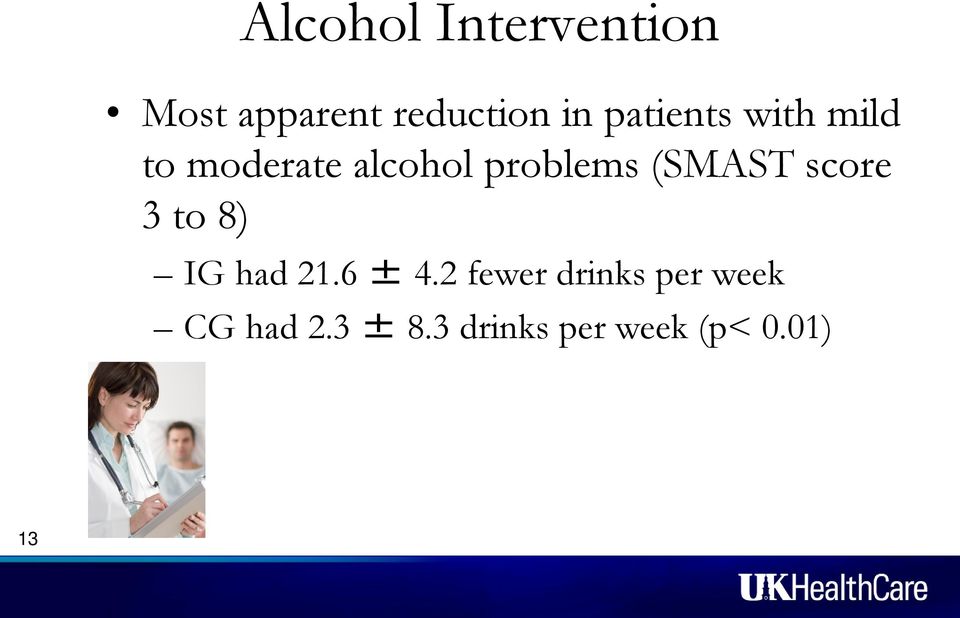
12 Alcohol Intervention Most apparent reduction in patients with mild to moderate alcohol problems (SMAST score 3 to 8) IG had 21.6 ± 4.2 fewer drinks per week CG had 2.3 ± 8.3 drinks per week (p< 0.01) 13
13 Alcohol Intervention IG had 47% reduction in injuries requiring either emergency department or trauma center admission. (hazard ratio 0.53, 95% confidence interval 0.26 to 1.07, p<0.07) IG had 48% reduction in injuries requiring hospital admission (3 years follow-up). 14 Gentilello, LM; Rivara, FP, Donovan, DM; Jurkovich, JG; et al. Alcohol Interventions in a Trauma Center as a Means of Reducing the Risk of Injury Recurrence. Annals of Surgery (4),
14 Protocol for Patient Identification Collection of biological screens Glasgow Comma Score <15 Nursing Admission Assessment Clinical Suspicion Chemical Dependency consult 15

15 Elements of a Brief Intervention 16 Never confront Establish rapport Communicate risk Identify pt goals Provide information Resolve ambivalence Develop discrepancy Use Open-ended questions Build motivation for change Elicit commitment to change Reflective listening statements Demonstrate respect and empathy Use I statements Choose strategies based on client readiness Initiate thinking about change in problem behavior

16 FRAMES Feedback is given about personal risk Responsibility to change is on the patient Advice to change Menu of options Empathic style is used Self-efficacy or optimistic empowerment is engendered in the patient 17

17 Reading the Report 18 Stages of Change Pre-Contemplation Not considering change Aware of a few negative consequences Unlikely to take action soon Contemplation Aware of pros/cons of use Ambivalent about change Not decided to commit to change

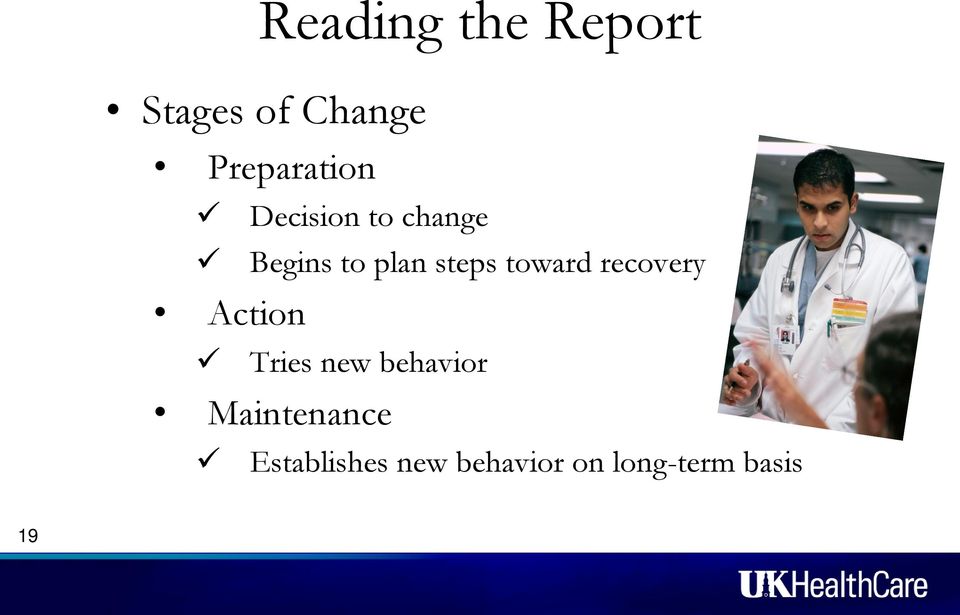
18 Reading the Report Stages of Change Preparation Decision to change Begins to plan steps toward recovery Action Tries new behavior Maintenance Establishes new behavior on long-term basis 19
19 Conclusion These data reinforce the need for: a fully integrated BI program in trauma centers; greater scrutiny of substance using trauma patients; study to remove bias; and, protocol to more effectively address substance use. 20

20 21 Questions and Answers

21 Contact Information David C. Maynard, MA, LPCC, NCC Emergency and Trauma Services University of Kentucky Chandler Medical Center 800 Rose Street, H213 Lexington, KY
Screening, Brief Intervention, and Referral for Treatment: Evidence for Use in Clinical Settings: Reference List
 Screening, Brief Intervention, and Referral for Treatment: Evidence for Use in Clinical Settings: Reference List Elinore F. McCance Katz, MD, PhD Professor of Psychiatry University of California San Francisco
The SAOR Model for Screening and Initial Assessment
 The SAOR Model for Screening and Initial Assessment The key components of the SAOR model are outlined below: Support Ask & Assess Offer Assistance Refer The support aspect of the intervention is guided
OVERVIEW OF BRIEF INTERVENTION FOR RISKY SUBSTANCE USE IN PRIMARY CARE. Prepared by CASAColumbia
 OVERVIEW OF BRIEF INTERVENTION FOR RISKY SUBSTANCE USE IN PRIMARY CARE Prepared by CASAColumbia February 2014 Outline Introduction Three Key Steps Engage Motivate Plan Sample Videos 2 INTRODUCTION 3 Addiction
Pragmatic Evidence Based Review Substance Abuse in moderate to severe TBI
 Pragmatic Evidence Based Review Substance Abuse in moderate to severe TBI Reviewer Emma Scheib Date Report Completed November 2011 Important Note: This report is not intended to replace clinical judgement,
Substance Use Education for Nurses Screening, Brief Intervention and Referral to Treatment (SBIRT) SBIRT: An Effective Approach
 Substance Use Education for Nurses Screening, Brief Intervention and Referral to Treatment (SBIRT) University of Pittsburgh The ATN-SBIRT Program is a partnership with the University of Pittsburgh and
AMERICAN COLLEGE OF SURGEONS Committee on Trauma. Alcohol and Injury. Presented by the Subcommittee on Injury Prevention and Control
 AMERICAN COLLEGE OF SURGEONS Committee on Trauma Alcohol and Injury Presented by the Subcommittee on Injury Prevention and Control AMERICAN COLLEGE OF SURGEONS Committee on Trauma Alcohol and Injury Presented
Brief interventions for heavy alcohol users admitted to general hospital wards (Review)
 Brief interventions for heavy alcohol users admitted to general hospital wards (Review) McQueen J, Howe TE, Allan L, Mains D This is a reprint of a Cochrane review, prepared and maintained by The Cochrane
Traumatic Brain Injury for VR Counselors Margaret A. Struchen, Ph.D. and Laura M. Ritter, Ph.D., M.P.H.
 Training Session 1c: Understanding Recovery Courses and Outcomes after TBI What is the typical recovery course after a mild or moderate/severe TBI? What are the effects of personal and environmental factors,
Predictive capacity of the AUDIT questionnaire for alcohol-related harm
 Addiction (1995) 90, 1479-1485 RESEARCH REPORT Predictive capacity of the AUDIT questionnaire for alcohol-related harm KATHERINE M. CONIGRAVE,' JOHN B. SAUNDERS' & ROBERT B. REZNIK^ ^Centre for Drug and
Brief Intervention Stages of Change and Motivational Interviewing
 Brief Intervention Stages of Change and Motivational Interviewing James Bray, PhD Alicia Kowalchuk, DO Vicki Waters MS, PA-C InSight SBIRT Residency Training Program This project is funded by Substance
Tom Freese, PhD Sherry Larkins, PhD Clayton Chau, MD (Planner) - Medical Director Behavioral Services; L.A. Care Health Plan
 Tom Freese, PhD Sherry Larkins, PhD Clayton Chau, MD (Planner) - Medical Director Behavioral Services; L.A. Care Health Plan UCLA Integrated Substance Abuse Programs UCLA David Geffen School of Medicine,
SBIRT Success: Clinical and patient success coexist. Joseph A Hurley MediCenter Executive Director President of Primary Care National
 SBIRT Success: Clinical and patient success coexist Joseph A Hurley MediCenter Executive Director President of Primary Care National WARNING Medical billing and/or clinical acronyms might be used during
Screening, Brief Intervention, Referral, and Treatment (SBIRT) in Psychiatry
 Screening, Brief Intervention, Referral, and Treatment (SBIRT) in Psychiatry Steve Martino, Ph.D. The SBIRT Training in Yale Residency Programs (SAMHSA 1U79Ti020253-01; PI: Gail D Onofrio, M.D.) At Issue
USING MOTIVATIONAL INTERVIEWING IN SUBSTANCE ABUSE TREATMENT
 USING MOTIVATIONAL INTERVIEWING IN SUBSTANCE ABUSE TREATMENT Allegheny HealthChoices, Inc. Spring 2008 This report is the second in a series on substance abuse treatment for the Allegheny County behavioral
CAGE. AUDIT-C and the Full AUDIT
 CAGE In the past have you ever: C tried to Cut down or Change your pattern of drinking or drug use? A been Annoyed or Angry because of others concern about your drinking or drug use? G felt Guilty about
How To Screen For Alcohol Dependence
 Commonwealth of Massachusetts Board of Registration in Medicine Quality and Patient Safety Division Advisory Alcohol Screening and Management Protocols July 2013 Background The Quality and Patient Safety
mental health-substance use
 mental health-substance use recognition and effective responses from General Practice Gary Croton Eastern Hume Dual Diagnosis Service www.dualdiagnosis.org.au This talk: 25 minutes The territory 5 minutes
Alcohol Screening and Brief Interventions of Women
 Alcohol Screening and Brief Interventions of Women Competency #2 Midwest Regional Fetal Alcohol Syndrome Training Center Competency 2: Screening and Brief Interventions This competency addresses preventing
------------------------------------------------------------------------------------------------------------
 The Journal of Family Practice (C) 1999 by Appleton & Lange. All rights reserved. Volume 48(5) May 1999 pp 378-384 Brief Physician Advice for Alcohol Problems in Older Adults: A Randomized Community-Based
Treating Co-Occurring Disorders. Stevie Hansen, B.A., LCDC, NCACI Chief, Addiction Services
 Treating Co-Occurring Disorders Stevie Hansen, B.A., LCDC, NCACI Chief, Addiction Services Implementing SAMHSA Evidence-Based Practice Toolkits Integrated Dual Diagnosis Treatment (IDDT) Target group:
These core elements are included in three increasingly detailed levels of definition:
 A Definition of Motivational Interviewing The definition of Motivational Interviewing (MI) has evolved and been refined since the original publications on its utility as an approach to behavior change.
Suggested APA style reference:
 Suggested APA style reference: Parks, G. A., & Woodford, M. S. (2005). CHOICES about alcohol: A brief alcohol abuse prevention and harm reduction program for college students. In G. R. Walz & R. K. Yep
CURRICULUM VITAE Kathryn Lenore Garcia Lenberg, M.P.H., Ph.D.
 Contact Information Business: 9426 Indian School Rd. NE Ste. 1 Albuquerque, NM 87112 Office Phone: (505) 345-6100 ext. 11 Email: [email protected] CURRICULUM VITAE Kathryn Lenore Garcia
Comprehensive Addiction Treatment
 Comprehensive Addiction Treatment A cognitive-behavioral approach to treating substance use disorders Brief Treatment Eric G. Devine Deborah J. Brief George E. Horton Joseph S. LoCastro Comprehensive Addiction
Overview of Colorado SBIRT
 Integrating Mental Health and Substance Use Services with HIV/AIDS Prevention Overview of Colorado SBIRT U.S. Conference on AIDS Orlando, Florida September 13, 2010 Presenter: Leigh Fischer, Program Manager
Co-Occurring Substance Use and Mental Health Disorders. Joy Chudzynski, PsyD UCLA Integrated Substance Abuse Programs
 Co-Occurring Substance Use and Mental Health Disorders Joy Chudzynski, PsyD UCLA Integrated Substance Abuse Programs Introduction Overview of the evolving field of Co-Occurring Disorders Addiction and
Michael Fleming, M.D., M.P.H., and Linda Baier Manwell
 Brief Intervention in Primary Care Settings A Primary Treatment Method for At-Risk, Problem, and Dependent Drinkers Michael Fleming, M.D., M.P.H., and Linda Baier Manwell Primary health care providers
Alcohol Screening and Brief Intervention (SBI) for Trauma Patients
 Alcohol Screening and Brief Intervention (SBI) for Trauma Patients AMERICAN COLLEGE OF SURGEONS Committee on Trauma U.S. DEPARTMENT OF HEALTH AND HUMAN SERVICES Centers for Disease Control and Prevention,
Treatment of Alcoholism
 Treatment of Alcoholism Why is it important Prevents further to body by getting people off alcohol. Can prevent death. Helps keep health insurance down. Provides assistance so alcoholics don t t have to
MASSACHUSETTS TOBACCO TREATMENT SPECIALIST TRAINING
 University of Massachusetts Medical School MASSACHUSETTS TOBACCO TREATMENT SPECIALIST TRAINING Course Description Goals and Learning Objectives 1 2012 55 Lake Avenue North, Worcester, MA 01655 www.umassmed.edu/tobacco
Session 3. Intervening with Alcohol Problems in Emergency Settings
 Session 3. Intervening with Alcohol Problems in Emergency Settings Carlo C. DiClemente, PhD* Carl Soderstrom, MD Excessive alcohol consumption plays an important role in many of the medical conditions,
DISTANCE EDUCATION IN THE FACILITATION OF AN ADDICTION INTERVENTION PROGRAM. Dr. Leann Kaiser, PhD and Susan Templeton
 DISTANCE EDUCATION IN THE FACILITATION OF AN ADDICTION INTERVENTION PROGRAM Dr. Leann Kaiser, PhD and Susan Templeton THE POPULATION The Wind River Indian Reservation (over 2 million acres) in Fremont
Alcohol screening and brief intervention in primary care: no evidence of efficacy for dependence
 Systematic review: Alcohol screening and brief intervention in primary care: no evidence of efficacy for dependence Richard Saitz MD, MPH, FACP, FASAM Professor of Medicine & Epidemiology Boston University
Matching Stages of Change and Treatment to Treatment Goal, Intervention and Technique 1/04 1
 Matching Stages of Change and Treatment to Treatment Goal, Intervention and Technique STAGE OF CHANGE/ Pre-contemplation Pre-engagement /engagement I don t see how my substance use warrants concern. Establish
BRIEF INTERVENTIONS (BIs) performed in primary
 GUTH ET AL. 243 Brief Intervention in Alcohol-Dependent Versus Nondependent Individuals* SARAH GUTH, B.A., SARAH A. LINDBERG, B.A., GARY J. BADGER, M.S., COLLEEN S. THOMAS, M.S., GAIL L. ROSE, PH.D., AND
Trauma Victims and Blood Alcohol Testing:
 Page 1 of 6 Trauma Victims and Blood Alcohol Testing: Attitudes and Practices of IHS Physicians Matthew J. Powers, MSEH, MS, RS, Staff Sanitarian, and Richard J. Smith, III, MS, RS, IHS Injury Prevention
Methamphetamine Behavioral Treatments
 California Addiction Training and Education Series Jeanne L. Obert, MFT, MSM Executive Director, Matrix Institute on Addictions Methamphetamine Behavioral Treatments Behavioral Treatment: Contingency Management
Facilitating Behavior Change
 Facilitating Behavior Change This section contains the following subjects: Readiness to Change Motivational Interviewing 57 ASSESSING AND INCREASING MOTIVATION Adherence and nonadherence are behaviors,
Leader s s Guide. Motivating Clients for Treatment and Addressing Resistance
 Leader s s Guide Motivating Clients for Treatment and Addressing Resistance Treatnet Training Volume B, Module 2: Updated 15 February 2008 Module 2 training goals: 1. Increase knowledge of motivational
http://nurse practitioners and physician assistants.advanceweb.com/features/articles/alcohol Abuse.aspx
 http://nurse practitioners and physician assistants.advanceweb.com/features/articles/alcohol Abuse.aspx Alcohol Abuse By Neva K.Gulsby, PA-C, and Bonnie A. Dadig, EdD, PA-C Posted on: April 18, 2013 Excessive
Implementation of SBIRT onto Electronic Health Records: From Documentation to Data
 Implementation of SBIRT onto Electronic Health Records: From Documentation to Data John R. McAteer, LCSW-R New York City Department of Health and Mental Hygiene Bureau of Alcohol and Drug Use Prevention,
Special Populations in Alcoholics Anonymous. J. Scott Tonigan, Ph.D., Gerard J. Connors, Ph.D., and William R. Miller, Ph.D.
 Special Populations in Alcoholics Anonymous J. Scott Tonigan, Ph.D., Gerard J. Connors, Ph.D., and William R. Miller, Ph.D. The vast majority of Alcoholics Anonymous (AA) members in the United States are
How To Know What Happens When You Drink
 Moderate Drinking, Harm Reduction, and Abstinence Outcomes BACKGROUND Kenneth Anderson - HAMS Harm Reduction Starting in the 1970s and leading up to the present day, William Miller and his colleagues have
Minnesota Co-occurring Mental Health & Substance Disorders Competencies:
 Minnesota Co-occurring Mental Health & Substance Disorders Competencies: This document was developed by the Minnesota Department of Human Services over the course of a series of public input meetings held
SBIRT: Behavioral Health Screenings & Patient- Centered Care. Presented By: Zoe O Neill July 24, 2013
 SBIRT: Behavioral Health Screenings & Patient- Centered Care Presented By: Zoe O Neill July 24, 2013 Welcome! Type questions into the Questions Pane Patient-Centered Primary Care Institute History and
 DEPARTMENT OF COUNSELING AND EDUCATIONAL PSYCHOLOGY COLLEGE OF EDUCATION 6300 Ocean drive, Unit 5834 Corpus Christi, Texas- 78412-5834 Facilitating Change: Combining Motivational Interviewing and Dialectical
Supporting families affected by drug and alcohol use: Adfam evidence pack
 Supporting families affected by drug and alcohol use: Adfam evidence pack For many years, support for the families of substance users has operated on an often unstructured basis and has not tended to put
Cystic fibrosis: an example of research and practice
 Cystic fibrosis: an example of research and practice Dr Gary Latchford 2015 Plan Questions from earlier presentation Cystic Fibrosis Our work in CF: Clinical practice, research, and a focus on adherence
Reference document. Alcohol addiction
 Reference document Alcohol addiction Table of content Introduction 2 Definition 2 Signs and symptoms 3 Intervening with an employee 4 Available treatments and resources 5 Conclusion 5 Reference document
Ninon Yale Clinical Nurse Specialist Trauma Program McGill University Health Centre Sept. 27, 2012
 Ninon Yale Clinical Nurse Specialist Trauma Program McGill University Health Centre Sept. 27, 2012 Suicide in Québec Québec is the Canadian province with the highest suicide rate Affects all age groups
Summary of Goals & Objectives for the Maine Differential Substance Abuse Treatment (DSAT) Community Program for Women
 Summary of Goals & Objectives for the Maine Differential Substance Abuse Treatment (DSAT) Community Program for Women Women s Community DSAT Pre-Treatment Orientation Sessions Intended Audience Women who
Karla Ramirez, LCSW Director, Outpatient Services Laurel Ridge Treatment Center
 Karla Ramirez, LCSW Director, Outpatient Services Laurel Ridge Treatment Center 1 in 4 Americans will have an alcohol or drug problems at some point in their lives. The number of alcohol abusers and addicts
9/25/2015. Parallels between Treatment Models 2. Parallels between Treatment Models. Integrated Dual Disorder Treatment and Co-occurring Disorders
 Integrated Dual Disorder Treatment and Co-occurring Disorders RANDI TOLLIVER, PHD HEARTLAND HEALTH OUTREACH, INC. ILLINOIS ASSOCIATION OF PROBLEM-SOLVING COURTS OCTOBER 8, 2015 SPRINGFIELD, IL Parallels
FOCUS ON INTEGRATED TREATMENT COURSE OBJECTIVES
 FOCUS ON INTEGRATED TREATMENT COURSE OBJECTIVES INDEX FIT The Complete Program Pages 2-6 FIT Complete Clinician Collection Pages 7-11 FIT Screening & Assessment Page 12 FIT Motivational Interviewing Page
SPECIFICATION FOR THE LOCAL COMMISSIONED SERVICE FOR THE MANAGEMENT ALCOHOL MISUSE
 SPECIFICATION FOR THE LOCAL COMMISSIONED SERVICE FOR THE MANAGEMENT OF ALCOHOL MISUSE Date: March 2015 1 1. Introduction Alcohol misuse is a major public health problem in Camden with high rates of hospital
NICE Pathways bring together all NICE guidance, quality standards and other NICE information on a specific topic.
 bring together all NICE guidance, quality standards and other NICE information on a specific topic. are interactive and designed to be used online. They are updated regularly as new NICE guidance is published.
Dual diagnosis: working together
 Dual diagnosis: working together Tom Carnwath RCGP conference Birmingham 2007 DSM-IV & cocaine Cocaine intoxication Cocaine withdrawal Cocaine-induced sleep disorder Cocaine-induced sexual dysfunction
Alcohol and Opiates Disorders
 BRIEF SCREENING, INTERVENTION, AND REFERRAL The Problem According to the National Institute on Alcohol Abuse and Alcoholism 3 in 10 adults drink at levels that elevate their risk of physical, mental health,
Department of Social and Health Services Division of Alcohol and Substance Abuse. WAC 388-805 Revision Recommendations Patient Placement Criteria
 Department of Social and Health Services Division of Alcohol and Substance Abuse WAC 388-805 Revision Recommendations Patient Placement Criteria April 2003 WAC 388-805 WAC 388-805-005 What definitions
Screening, Brief Intervention and Referral to Treatment (SBIRT) for Substance Use: A Public Health Approach. Joan Dilonardo, Ph.D., R.
 Screening, Brief Intervention and Referral to Treatment (SBIRT) for Substance Use: A Public Health Approach Joan Dilonardo, Ph.D., R.N What is SBIRT? Some definitions Screening: a preliminary systematic
Brief Interventions for other drugs? Luke Mitcheson, Clinical Psychologist,
 Brief Interventions for other drugs? Luke Mitcheson, Clinical Psychologist, Ideas in development For who? Delivered by? What? When? How to disseminate outside of specialist commissioned services? Implementation
ALCOHOL SCREENING and BRIEF INTERVENTION (ASBI) PROGRAM IMPLEMENTATION and OPERATIONS MANUAL
 ALCOHOL SCREENING and BRIEF INTERVENTION (ASBI) PROGRAM IMPLEMENTATION and OPERATIONS MANUAL David R. Boyd, MDCM, FACS Karen Milman, MD, MPH Peter Stuart, MD Anthony Dekker, DO Jim Flaherty, MD, FAAP Emergency
Executive Summary and Recommendations
 1 of 11 9/15/2011 2:13 PM NCBI Bookshelf. A service of the National Library of Medicine, National Institutes of Health. Center for Substance Abuse Treatment. SAMHSA/CSAT Treatment Improvement Protocols.
Patients are still addicted Buprenorphine is simply a substitute for heroin or
 BUPRENORPHINE TREATMENT: A Training For Multidisciplinary Addiction Professionals Module VI: Myths About the Use of Medication in Recovery Patients are still addicted Buprenorphine is simply a substitute
Designing Clinical Addiction Research
 Designing Clinical Addiction Research Richard Saitz MD, MPH, FACP, FASAM Professor of Medicine & Epidemiology Boston University Schools of Medicine & Public Health Director, Clinical Addiction, Research
Recovery and Dual Diagnosis
 Recovery and Dual Diagnosis Martha Levey, Ed.D. Affiliated Service Providers of Indiana, Inc. The mission of ASPIN is to provide innovative educational programs, resource management, program development,
Bristol Wet Clinic: An alternative approach to alcohol addiction. Dr Emma Mastrocola
 Bristol Wet Clinic: An alternative approach to alcohol addiction Dr Emma Mastrocola What is addiction really? It is a sign, a signal, a symptom of distress. It is a language that tells us about a plight
Behavioral Health Services for Adults Program Capacity Eligibility Description of Services Funding Dosage Phase I 33 hours
 Outpatient Substance Abuse Recovery (OSARP) Dual Diagnosis Behavioral Health Services for Adults Capacity Eligibility Description of Services Funding Dosage 35 at any Adults with Phase I 33 hours point
LEVEL II.1 SA: INTENSIVE OUTPATIENT - Adult
 LEVEL II.1 SA: INTENSIVE OUTPATIENT - Adult Definition The following is based on the Adult Criteria of the Patient Placement Criteria for the Treatment of Substance- Related Disorders of the American Society
Motivational Interviewing: Quick and Effective Tools for Clinicians
 Motivational Interviewing: Quick and Effective Tools for Clinicians November 6-7, 2012 Seattle, WA Co-provided by: Training Xchange University of Washington Center for Commercialization Department of Psychiatry
TEACHING THE FOUR PROCESSES
 TEACHING THE FOUR PROCESSES MINT Pre-Forum Workshop Bill Miller & Terri Moyers Fort Wayne September 2012 Planning Engaging Focusing Evoking Relational Foundation Motivational Interviewing 1. Engaging 2.