
Facilitating Behavior Change
|
|
|
- Heather Wright
- 9 years ago
- Views:
Transcription
1 Facilitating Behavior Change This section contains the following subjects: Readiness to Change Motivational Interviewing 57

2 ASSESSING AND INCREASING MOTIVATION Adherence and nonadherence are behaviors, and adherence to medication regimens requires behavior change. Motivation is a key factor in successful behavior change and has been shown to promote adherence to chronic therapies (World Health Organization, 2003). This appendix presents techniques that will be useful in assessing motivation and helping older adults increase their intrinsic motivation to adhere to medication regimens and other chronic therapies. Two models are introduced: Readiness to Change and Motivational Interviewing. These techniques and the concepts behind them are discussed primarily in the context of medication adherence, but they can also be applied to such lifestyle modifications as diet and exercise. READINESS TO CHANGE Behavior change is rarely a discrete, single event. During the past decade, behavior change has come to be understood as a process of identifiable stages through which people pass (Zimmerman et al., 2000). The Stages of Change model describes five stages of readiness (Figure 5) precontemplation, contemplation, preparation, action, and maintenance and provides a framework for understanding behavior change (DiClemente and Prochaska, 1998). FIGURE 5. THE STAGES OF CHANGE CONTINUUM Source: Adapted from DiClemente and Prochaska,

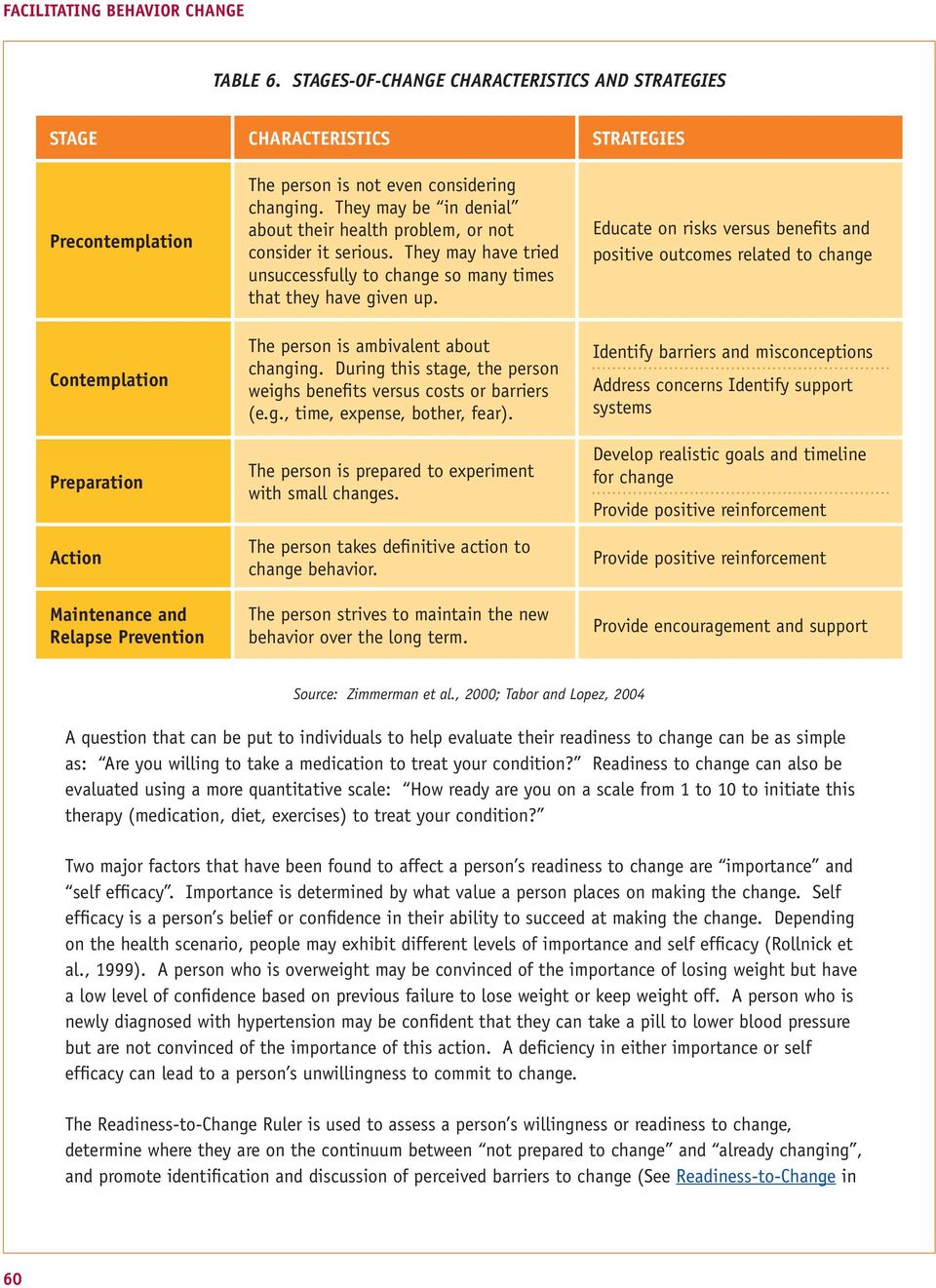
3 For most people behavior change occurs gradually over time, with the person progressing from being uninterested, unaware, or unwilling to make a change (precontemplation), to considering a change (contemplation), to deciding and preparing to make a change (preparation). This is followed by definitive action, and attempts to maintain the new behavior over time (maintenance). People can progress in both directions in the stages of change. Most people will recycle through the stages of change several times before the change becomes fully established (Zimmerman et al., 2000). The Stages of Change model is useful for identifying appropriate interventions to foster positive behavior change (Table 6); by identifying where a person is in the change process, interventions can be tailored to the person s readiness to change (Zimmerman et al., 2000). Anything that moves a person along the continuum towards making a positive change should be viewed as a success. Once the person reaches the contemplation stage, additional strategies can be employed to help the person move along the stages of change. It is important to evaluate a person s readiness to change for any proposed intervention (Zimmerman et al., 2000). Interventions that are not staged to the readiness of the individual will be less likely to succeed. Also, interventions that try to move a person too quickly through the stages of change are more likely to create resistance that will impede behavior change. For example, if trying to get a person to quit smoking, it is essential to know where the person is in his or her readiness to stop. A person who is not even thinking about quitting smoking (precontemplation) is generally not ready to receive information about specific smoking cessation aids. In this case, focusing the intervention on smoking cessation aids sends the message that the health care provider is not really listening. This may not only damage rapport but can also make the person even more resistant to quitting smoking. A more stage-specific intervention with this person would be to try to get the person to think about quitting (contemplation). Once the person reaches the contemplation stages, additional strategies can be employed to continue to move the person through the stages of behavioral change. Anything that moves a person along the continuum toward making a positive change should be viewed as a success. Employing stage-specific interventions will decrease provider frustration by lessening the unrealistic expectation that change will occur with a single intervention. 59

4 TABLE 6. STAGES-OF-CHANGE CHARACTERISTICS AND STRATEGIES STAGE CHARACTERISTICS STRATEGIES Precontemplation Contemplation Preparation Action Maintenance and Relapse Prevention The person is not even considering changing. They may be in denial about their health problem, or not consider it serious. They may have tried unsuccessfully to change so many times that they have given up. The person is ambivalent about changing. During this stage, the person weighs benefits versus costs or barriers (e.g., time, expense, bother, fear). The person is prepared to experiment with small changes. The person takes definitive action to change behavior. The person strives to maintain the new behavior over the long term. Educate on risks versus benefits and positive outcomes related to change Identify barriers and misconceptions Address concerns Identify support systems Develop realistic goals and timeline for change Provide positive reinforcement Provide positive reinforcement Provide encouragement and support Source: Zimmerman et al., 2000; Tabor and Lopez, 2004 A question that can be put to individuals to help evaluate their readiness to change can be as simple as: Are you willing to take a medication to treat your condition? Readiness to change can also be evaluated using a more quantitative scale: How ready are you on a scale from 1 to 10 to initiate this therapy (medication, diet, exercises) to treat your condition? Two major factors that have been found to affect a person s readiness to change are importance and self efficacy. Importance is determined by what value a person places on making the change. Self efficacy is a person s belief or confidence in their ability to succeed at making the change. Depending on the health scenario, people may exhibit different levels of importance and self efficacy (Rollnick et al., 1999). A person who is overweight may be convinced of the importance of losing weight but have a low level of confidence based on previous failure to lose weight or keep weight off. A person who is newly diagnosed with hypertension may be confident that they can take a pill to lower blood pressure but are not convinced of the importance of this action. A deficiency in either importance or self efficacy can lead to a person s unwillingness to commit to change. The Readiness-to-Change Ruler is used to assess a person s willingness or readiness to change, determine where they are on the continuum between not prepared to change and already changing, and promote identification and discussion of perceived barriers to change (See Readiness-to-Change in 60
5 the Assessment Tools section). The Readiness-to-Change Ruler can be used as a quick assessment of a person s present motivational state relative to changing a specific behavior, and can serve as the basis for motivation-based interventions to elicit behavior change, such as motivational interviewing. MOTIVATIONAL INTERVIEWING MOTIVATIONAL INTERVIEWING Motivational interviewing is an approach, first reported in the addiction literature, to improve adherence (Miller & Rollnick, 2002); it is both an assessment strategy and an intervention. Motivational interviewing is used to determine a person s readiness to engage in a target behavior such as taking a medication as prescribed and then applying specific skills and strategies based on the person s level of readiness to create a favorable climate for change. Motivational interviewing is a person-centered, directive method of communicating with the goal of enhancing a person s intrinsic motivation to change by exploring and resolving ambivalence and resistance (Miller & Rollnick, 2002). Motivational interviewing techniques try to avoid simply telling a person what they need to do. People can easily dismiss such suggestions or come up with a number of reasons why the suggested change is not possible. The essence of motivational interviewing is in its collaborative nature, communicating in a partner-like relationship, where the interviewer seeks to create a positive interpersonal atmosphere. In motivational interviewing, responsibility for change is left to the person; the overall goal is to increase the person s intrinsic motivation, so that change arises from within rather than being imposed. It must be recognized that it is the person, not the health care provider, who will ultimately need to make changes that will affect their health. Thus, change must be negotiated, not dictated. Consistent with the collaborative model, the health care provider functions not to motivate the person, but to draw out intrinsic motivation based on the person s own personal goals and values. MOTIVATIONAL INTERVIEWING PRINCIPLES Motivational interviewing uses a number of person-centered techniques to create a favorable climate for change. There are five general principles that underlie motivational interviewing (Miller & Rollnick, 2002). The key principles are arranged to form the acronym READS, to help providers remember these key concepts (Table 7). These principles are not necessarily applied in this particular order, and all of these techniques should be used throughout the interaction. 61
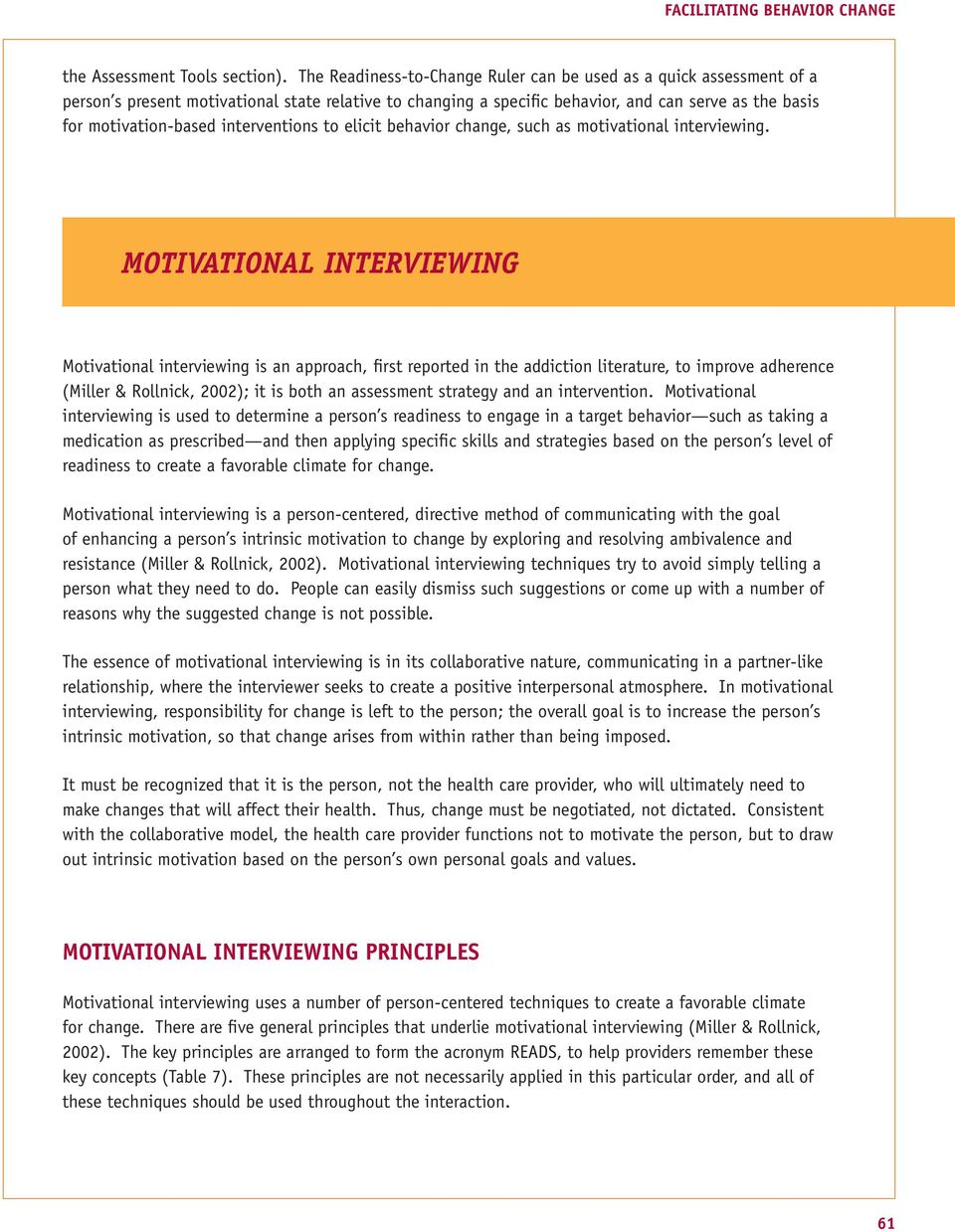
6 TABLE 7. READS Principles of Motivational Interviewing 1. Roll with resistance 2. Express empathy 3. Avoid argumentation 4. Develop discrepancy 5. Support self-efficacy Source: Miller & Rollnick, 2002 Roll with Resistance Resistance can take several forms, such negating, blaming, excusing, minimizing, arguing, challenging, interrupting, and ignoring. In motivational interviewing one does not directly oppose resistance but, rather, rolls or flows with it. Direct confrontation will create additional barriers that will make change more difficult. A person s resistance during motivational interviewing is expected and should not be viewed as a negative outcome. In fact, a person who resists is providing information about factors that foster or reduce motivation to adhere to behavioral change. Rolling with resistance, then, includes involving the person actively in the process of problem solving. Resistant behavior may be a signal that the person does not believe or accept information that has been presented. The health care provider should provide information and alternatives, and explore possible solutions. Exploring the reasons behind the resistant behavior can lead the person to seriously consider possibilities for change. Express Empathy Because motivational interviewing relies to a great extent on establishing and maintaining rapport with the person, the ability to express empathy is critical to this process. This requires skillful, reflective listening to understand a person s feelings and perspectives without judging, criticizing, or blaming. An attitude of acceptance and respect contributes to the development of an effective, helping relationship and enhances the person s self-esteem. Empathic responses demonstrate that the health care provider understands the person s point of view and provides an important basis for engaging the person in a process of change. Avoid Argumentation Resistance to change is strongly affected by the health care provider s response; therefore, arguments should be avoided. Direct confrontations usually result in defensive reactions and increased resistance to change. Resistance is an indication that the health care provider should change strategies rather than argue. The emphasis should focus on helping the person with self-recognition of problem areas rather than coerced admission. 62

7 Develop Discrepancy The principle of developing discrepancy is based on the understanding that motivation for change is created when the person perceives a discrepancy between their present behavior and important personal goals (Miller & Rollnick, 2002). This often involves identifying and clarifying the person s own goals. The goals need to be those of the person and not those of the health care provider, otherwise the person will feel as though they are being coerced and may become more resistant to change. An important objective of motivational interviewing is to help a person recognize or amplify the discrepancy between their behavior and their personal goals. There are a number of techniques that can be used to help develop discrepancy. One technique is to ask the person what is good or positive about a particular behavior and what is bad or not so good about that same behavior. Reflecting back and examining the positive and negative will help discrepancy emerge. When skillfully done, motivational interviewing changes the person s perceptions of discrepancy without creating a sense of being pressured of coerced. Support Self-Efficacy Self-efficacy is a person s belief or confidence in their ability to carry out a target behavior successfully. A general goal of motivational interviewing is to enhance the person s confidence in their ability to overcome barriers and succeed in change. Health care providers can support self-efficacy by recognizing small positive steps that the person is taking to change their behavior. Even when the person is simply contemplating a change, there is an opportunity to provide recognition and support. Supportive statements can be as simple as It s great to hear that you are interested in getting more information about your diabetes. Setting reasonable and reachable goals that the person can actually accomplish will also help build confidence. It is important that the person be involved in setting the goal. For an overweight person that is physically inactive, even getting them to exercise five to 10 minutes twice a week is a move in the right direction. Seeing that they can accomplish this will give them additional motivation to continue to exercise. Lastly, it is important that the health care provider believes that the person can achieve the goal. This belief in the person can have a powerful positive effect on the outcome. Elicit, Provide, Elicit The person, not the health care provider, is the primary source of solutions for dealing with their medical problems. In order for the person to take responsibility for their own health, they need to become an active participant in sessions with their health care providers. Motivational interviewing uses the general concept of elicit, provide, elicit, which is a continuous process Information is elicited from the person so the health care provider can better understand 63

8 their attitudes, beliefs, values, and readiness to change. The health care provider can check for understanding of what the person is saying by using reflective listening skills and asking for additional clarification when required; this will help establish a collaborative relationship and build empathy. Information elicited can also be used to help develop discrepancy. After eliciting information, the health care provider can then provide information to address any knowledge gaps identified. It may be appropriate at times to ask permission from the person to provide them with additional information. This may increase acceptance of the information, as the person will not feel that information is simply being imposed on them. Lastly, whenever the person is presented with new information, the health care provider should elicit information on the person s understanding of the new information and their feelings about it. This can identify concerns or questions that the person may have regarding the information presented. FOR MORE INFORMATION Training is required to develop the skills for successful motivational interviewing. The reader is referred to the following sources for additional information. Miller RH, Rollnick S. Motivational interviewing: preparing people for change, 2nd ed. New York, NY: Guilford Press, This is the classic text that reviews the background and theory of motivational interviewing. Rollnick S, Mason P, Butler C. Health behavior change: a guide for practitioners. Edinburgh, Scotland: Churchill Livingstone, This practical text is aimed at helping health care professionals assess readiness to change, provides suggestions for incorporating motivational interviewing in clinical practice, and presents examples for handling challenging situations that are likely to confront health care providers. Bodenheimer T, MacGregor K, Sharifi C. Helping patients manage their chronic conditions. California Healthcare Foundation. June Available at cfm?itemid= Accessed 4/25/06. This publication provides a good introduction to health behavior change techniques. The California Healthcare Foundation developed a brochure, Helping Patients Manage Chronic Conditions, which can be download from its web site ( free of charge. The following two articles discuss the application of motivational interviewing and health behavior change to medication management: Possidente CJ, Bucci KK, McClain WJ. Motivational interviewing: a tool to improve medication adherence. Am J Health-Syst Pharm 2005;62: Scales R, Miller J, Burden R. Why wrestle when you can dance? Optimizing outcomes with motivational interviewing. J Am Pharm Assoc 2003;43(Supp 1):S46-S47. 64

Overcoming Resistance to Stopping Tobacco Use: A Motivational Approach
 Overcoming Resistance to Stopping Tobacco Use: A Motivational Approach Lowell C. Dale, MD Associate Professor of Medicine Mayo Clinic Nicotine Dependence Center & Division of Primary Care Internal Medicine
Brief Intervention Stages of Change and Motivational Interviewing
 Brief Intervention Stages of Change and Motivational Interviewing James Bray, PhD Alicia Kowalchuk, DO Vicki Waters MS, PA-C InSight SBIRT Residency Training Program This project is funded by Substance
Accelerated Students (2D) in Psychiatric Clinical Setting
 Accelerated Students (2D) in Psychiatric Clinical Setting Strengthening the self efficacy through the use of Motivational Interviewing Andrea Katz, RN, MSN, PMHCNS, BC Deborah Schiavone, RN, PhD, PMHCNS,
MOTIVATIONAL INTERVIEWING. SOW 6425 Professor Nan Van Den Bergh
 MOTIVATIONAL INTERVIEWING SOW 6425 Professor Nan Van Den Bergh MOTIVATIONAL INTERVIEWING A client-centered, directive method for enhancing motivation to change by exploring and resolving a client s ambivalence
Health Coaching: A New and Exciting Technique to Enhance Patient Self-Management and Improve Outcomes
 Health Coaching: A New and Exciting Technique to Enhance Patient Self-Management and Improve Outcomes MELINDA HUFFMAN RN, BSN, MSN, CCNS Home Healthcare Nurse April 2007 Volume 25 Number 4 Pages 271-274
Leader s s Guide. Motivating Clients for Treatment and Addressing Resistance
 Leader s s Guide Motivating Clients for Treatment and Addressing Resistance Treatnet Training Volume B, Module 2: Updated 15 February 2008 Module 2 training goals: 1. Increase knowledge of motivational
Matching Stages of Change and Treatment to Treatment Goal, Intervention and Technique 1/04 1
 Matching Stages of Change and Treatment to Treatment Goal, Intervention and Technique STAGE OF CHANGE/ Pre-contemplation Pre-engagement /engagement I don t see how my substance use warrants concern. Establish
These core elements are included in three increasingly detailed levels of definition:
 A Definition of Motivational Interviewing The definition of Motivational Interviewing (MI) has evolved and been refined since the original publications on its utility as an approach to behavior change.
Application of Motivational Interviewing to College & Career Decision Making
 Application of Motivational Interviewing to College & Career Decision Making Originally developed by William R. Miller in 1983 as a useful set of techniques to use in the treatment of problem drinkers,
Using Motivational Interviewing Techniques in SMART Recovery. Roadblocks to Listening
 Using Motivational Interviewing Techniques in SMART Recovery By Jim (GJBXVI) Braastad According to research dating back to the 1960 s, people tend to believe what they hear themselves say. However, in
The only way to keep your health is to eat what you don t want, drink what you don t like, and do what you d rather not
 Motivational Interviewing B. Nierenberg, Phd, ABPP University of Miami Miller School of Medicine M. Jensen, PhD U of Washington School of Medicine Motivation Interviewing: Rationale How well people manage
Alison Bell [email protected] Medicine in Addictions Conference
 Alison Bell [email protected] Medicine in Addictions Conference 2013 Motivational Interviewing Are we Dancing or Wrestling? Definition of Motivational Interviewing Motivational interviewing is a
MOTIVATIONAL INTERVIEWING: AN INTRODUCTION
 Accreditation The content of this Telehealth presentation, in its enduring state, will expire on 01/15/2017 from this date on CNE s can no longer be awarded. Measures have been taken, by the Utah Department
Self-Management Support/Education...1. Table 1: Comparison of Traditional Education & Self-Management Education...3
 Patient Self-Management A Discussion Paper December 2007 TABLE OF CONTENTS Self-Management Support/Education...1 Table 1: Comparison of Traditional Education & Self-Management Education...3 Empowerment-Based
Motivational Interviewing: Steps to Success! Create effective dialogue with your client
 Motivational Interviewing: Steps to Success! Step 1: Establish Rapport Step 2: Assess Readiness Step 3: Assess Motivation and Confidence Step 4: Patient Identifies Problems and Solutions Step 5: Identify
Coaching and Feedback
 Coaching and Feedback Follow the Guidelines for Effective Interpersonal Communication There are fundamental strategies that should always be part of interpersonal communication in the work place. Don t
USING MOTIVATIONAL INTERVIEWING IN SUBSTANCE ABUSE TREATMENT
 USING MOTIVATIONAL INTERVIEWING IN SUBSTANCE ABUSE TREATMENT Allegheny HealthChoices, Inc. Spring 2008 This report is the second in a series on substance abuse treatment for the Allegheny County behavioral
SI Coordinator Handbook. Information, Resources and Forms
 SI Coordinator Handbook Information, Resources and Forms Updated November 2010 1 2 Table of Contents SI Coordinator Job Description... 5 Observations and Evaluations... 9 Initial Contacts... 10 Informal
 DEPARTMENT OF COUNSELING AND EDUCATIONAL PSYCHOLOGY COLLEGE OF EDUCATION 6300 Ocean drive, Unit 5834 Corpus Christi, Texas- 78412-5834 Facilitating Change: Combining Motivational Interviewing and Dialectical
Motivational Interviewing in a Chemical Dependency Treatment Setting. A CASAC Continuing Education Workbook
 Motivational Interviewing in a Chemical Dependency Treatment Setting A CASAC Continuing Education Workbook Office of the Medical Director & the Bureau of Treatment Steven Kipnis, MD, FACP, FASAM Patricia
MOTIVATIONAL INTERVIEWING MI, GLOSSARY & FACT SHEET
 MOTIVATIONAL INTERVIEWING MI, GLOSSARY & FACT SHEET What is Motivational Interviewing - MI? The founders of motivational interviewing are Dr s. William R. Miller & Stephen Rollnick,1991. We have sought
Counsel Subordinates TSG 158-100-1260
 Counsel Subordinates TSG 158-100-1260 4 August 2003 Task(s) TASK NUMBER TASK TITLE Taught or 158-100-1180 Develop Subordinate Leaders in a Squad Supported 158-100-1271 Develop Subordinate Leaders in a
Difficult Tutoring Situations
 Difficult Tutoring Situations At some time or other, all tutors will find themselves faced with difficult situations in a tutoring session. The following information will provide you with some common categories
OVERVIEW OF BRIEF INTERVENTION FOR RISKY SUBSTANCE USE IN PRIMARY CARE. Prepared by CASAColumbia
 OVERVIEW OF BRIEF INTERVENTION FOR RISKY SUBSTANCE USE IN PRIMARY CARE Prepared by CASAColumbia February 2014 Outline Introduction Three Key Steps Engage Motivate Plan Sample Videos 2 INTRODUCTION 3 Addiction
Chapter 5 NUTRITION EDUCATION AND COUNSELING. Jamie Stang and Mary Story
 Chapter 5 NUTRITION EDUCATION AND COUNSELING Jamie Stang and Mary Story One of the keys to effective nutrition education and counseling of teenagers is a good understanding of normal adolescent psychosocial
Three Theories of Individual Behavioral Decision-Making
 Three Theories of Individual Decision-Making Be precise and explicit about what you want to understand. It is critical to successful research that you are very explicit and precise about the general class
Section 11. Giving and Receiving Feedback
 Section 11 Giving and Receiving Feedback Introduction This section is about describing what is meant by feedback and will focus on situations where you will be given, and where you will give, feedback.
Motivational Interviewing Building Rapport With Clients to Encourage Desirable Behavioral and Lifestyle Changes
 CE Professional Case Management Vol. 17, No. 4, 164-172 Copyright 2012 Wolters Kluwer Health Lippincott Williams & Wilkins Motivational Interviewing Building Rapport With Clients to Encourage Desirable
Health Promotion: Models of Health Promotion
 : Models of Tannahill Beattie Tones French Stages of change model Health belief model Health action model Socio cognitive theory Theory of reasoned action 1. Tannahill 1985 process of enhancing health
Coaching for Improved Work Performance. How to get better results from your employees.
 Coaching for Improved Work Performance How to get better results from your employees. Believing the Right Things Purpose: learn how to be more successful as manager of people Specifically: to learn how
Chapter 2 Essential Skills for Case Managers
 Chapter 2 Essential Skills for Case Managers 2.1 Essential Skill Overview If you ask ten people what case management means to them, you will most likely get ten different answers. Though case management
APPLICATIONS GUIDE. TRACOM Sneak Peek. Excerpts from. Improving Personal Effectiveness With Versatility
 APPLICATIONS GUIDE TRACOM Sneak Peek Excerpts from Improving Personal Effectiveness With Versatility TABLE OF CONTENTS PAGE Introduction...1 Prerequisites...1 A Guide for You...1 Why Learn to Become Highly
Prescription for Success: Community HealthCorps Member Training. Prescription 7: Health Education. HealthCorps Reader
 HealthCorps Reader Part One: Overview No knowledge is more crucial than knowledge about health. Without it, no other life goal can be successfully achieved. -- The Carnegie Foundation Health education
Mediation Skills in Conflict Resolution
 Mediation Skills in Conflict Resolution Presented by the Federal Mediation and Conciliation Service Considerations of Mediator Training Much is common sense Learn skills and approaches No prescribed or
Planning Advances Based on a Prospect s State of Readiness
 Stages of Change in Senior Housing Sales Planning Advances Based on a Prospect s State of Readiness N early every new inquiry about senior housing relates to an older adult that is struggling with serious
Conflict... An Opportunity for Development
 Conflict... An Opportunity for Development ~ Agenda ~ Introductions and Workshop Objectives Understanding Conflict: What is Conflict? The Conflict Cycle Resolving Conflict: Using I Messages College Conflict
Motivational Interviewing Strategies and Techniques: Rationales and Examples
 Motivational Interviewing Strategies and Techniques: Rationales and Examples ASKING PERMISSION Rationale: Communicates respect for clients. Also, clients are more likely to discuss changing when asked,
Brief Intervention and Motivational Interviewing Tool
 Brief Intervention and Motivational Interviewing Tool This resource was developed by Bronwyn Hagger & Doreen Entwistle, AODP through consultation with Sharon Maroney, Binjari Clinic, Edna Iles & Sheila
It s not Like Selling Pots and Pans or is it? A new way of Selling Project Management to Senior Management
 It s not Like Selling Pots and Pans or is it? A new way of Selling Project Management to Senior Management Elizabeth Larson, PMP, CBAP and Richard Larson, PMP, CBAP Principals, Watermark Learning, Inc.
How To Treat An Addiction With Cognitive Behavioral Therapy
 Cognitive Behavioral Therapy Part 1 An Overview Cognitive Behavioral Therapy (CBT) is a general classification of psycho therapy, based on social learning theory, which emphasizes how our thinking interacts
Coaching the team at Work
 Coaching the team at Work Introduction While a great deal has been written about coaching individuals, there has been relatively little investigation of coaching teams at work. Yet in discussions with
GUIDE TO PATIENT COUNSELLING
 Guide To Patient Counselling page - 1 - GUIDE TO PATIENT COUNSELLING Communication is the transfer of information meaningful to those involved. It is the process in which messages are generated and sent
Shared Solutions: An Overview Special Education Policy and Programs Branch Ministry of Education
 Shared Solutions: An Overview Special Education Policy and Programs Branch Ministry of Education Table of Contents 1. Shared Solutions: Overview 2. Understanding Conflict 3. Preventing Conflicts 4. Video:
Using Motivational Interviewing to Improve Clinical Outcomes
 Using Motivational Interviewing to Improve Clinical Outcomes BARBARA B. WALKER, PH. D. NATIONAL JEWISH HEALTH DENVER, COLORADO [email protected] Overview Why MI? What exactly is MI? Spirit Principles
SITUATIONAL LEADERSHIP AND EXECUTIVE COACHING
 977632 ch03.2 6/1/05 10:59 PM Page 26 Y CHAPTER THREE SITUATIONAL LEADERSHIP AND EXECUTIVE COACHING Paul Hersey and Roger Chevalier Executive coaching requires exceptional leadership and questioning skills
CMAG - 1 CASE MANAGEMENT ADHERENCE GUIDELINES VERSION 1.0
 CMAG - 1 CASE MANAGEMENT ADHERENCE GUIDELINES VERSION 1.0 Guidelines from the Case Management Society of America for improving patient adherence to medication therapies June 1, 2004 2004 Case Management
SPIN Selling SITUATION PROBLEM IMPLICATION NEED-PAYOFF By Neil Rackham
 SITUATION PROBLEM IMPLICATION NEED-PAYOFF By Neil Rackham 1. Sales Behavior and Sales Success Small Sales Selling Techniques The traditional selling techniques that most of us have been trained to use
MASSACHUSETTS TOBACCO TREATMENT SPECIALIST TRAINING
 University of Massachusetts Medical School MASSACHUSETTS TOBACCO TREATMENT SPECIALIST TRAINING Course Description Goals and Learning Objectives 1 2012 55 Lake Avenue North, Worcester, MA 01655 www.umassmed.edu/tobacco
Being Accountable in Work and Life
 Being Accountable in Work and Life Workshop Objectives > Define accountability > Become aware of your own level of accountability > Understand the importance of accountability and how it relates to work
Patients are still addicted Buprenorphine is simply a substitute for heroin or
 BUPRENORPHINE TREATMENT: A Training For Multidisciplinary Addiction Professionals Module VI: Myths About the Use of Medication in Recovery Patients are still addicted Buprenorphine is simply a substitute
Overview Medication Adherence Where Are We Today?
 Overview Medication Adherence Where Are We Today? This section covers the following topics: Adherence concepts and terminology Statistics related to adherence Consequences of medication nonadherence Factors
The Stages of Change Stage One: Precontemplation Stage Two: Contemplation
 The Stages of Change The stages of change are: Precontemplation (Not yet acknowledging that there is a problem behavior that needs to be changed) Contemplation (Acknowledging that there is a problem but
Methamphetamine Behavioral Treatments
 California Addiction Training and Education Series Jeanne L. Obert, MFT, MSM Executive Director, Matrix Institute on Addictions Methamphetamine Behavioral Treatments Behavioral Treatment: Contingency Management
Change Leadership: A Boot Camp to Drive Organizational Change
 Change Leadership: A Boot Camp to Drive Organizational Change Presented by: Rachel Schaming Radiology Ltd. Tucson, AZ 520.705.2889 Email: [email protected] Your Perceptions of Change What are
Restorative Parenting: A Group Facilitation Curriculum Activities Dave Mathews, Psy.D., LICSW
 Restorative Parenting: A Group Facilitation Curriculum Activities Dave Mathews, Psy.D., LICSW RP Activities 1. Framework of Resourcefulness 2. Identifying the Broken Contract Articles 3. The Process of
WHO GLOBAL COMPETENCY MODEL
 1. Core Competencies WHO GLOBAL COMPETENCY MODEL 1) COMMUNICATING IN A CREDIBLE AND EFFECTIVE WAY Definition: Expresses oneself clearly in conversations and interactions with others; listens actively.
Introduction to Interactive Journaling Facilitation Notes
 Introduction to Interactive Journaling Facilitation Notes SESSION ONE Learning Objectives - Address common questions about the design and application of Interactive Journals - Review some of the evidence-based
100 Ways To Improve Your Sales Success. Some Great Tips To Boost Your Sales
 100 Ways To Improve Your Sales Success Some Great Tips To Boost Your Sales 100 Ways To Improve Your Sales Success By Sean Mcpheat, Managing Director Of The Sales Training Consultancy What makes a successful
Improving Safety Communication Skills: Becoming an Empathic Communicator
 Session 716 Improving Safety Communication Skills: Becoming an Empathic Communicator Joshua H. Williams, Ph.D. Senior Project Manager Safety Performance Solutions Blacksburg, VA Introduction Effective
WHY THEORY MATTERS FOR EFFECTIVE HEALTH PROMOTION:
 WHY THEORY MATTERS FOR EFFECTIVE HEALTH PROMOTION: A BRIEFING I could not do my job without talking about theory. (Health promotion practitioner) There is nothing so practical as a good theory (Kurt Lewin).
MOTIVATIONAL INTERVIEWING QUESTIONNAIRE
 MOTIVATIONAL INTERVIEWING QUESTIONNAIRE 1. The following are other words that describe the concept of Confrontation Fight Battle Struggle Conflict Opposition 2. Motivational Interviewing is a directive,
Training professionals in motivational interviewing
 Evidence scan: Training professionals in motivational interviewing November 2011 Identify Innovate Demonstrate Encourage Contents Key messages 3 1. Scope 4 2 Characteristics of training 9 3. Characteristics
Chapter 3: Managing Conflict with Your Boss
 Chapter 3: Managing Conflict with Your Boss Overview The special case of conflict between a direct report and a boss presents unique challenges. As a manager with responsibilities up and down the organizational
Motivational Interviewing for Better Health Outcomes February 22, 2011
 Motivational Interviewing for Better Health Outcomes February 22, 2011 Ana Moseley, LISW, ACSW, Clinical Director Tom Peterson, Ph.D., Associate Clinical Director Arturo Gonzales, MA, Ph.D., Executive
"Removing Barriers: Dual Diagnosis Treatment and Motivational Interviewing"
 Sciacca, K. 1997. Removing barriers: dual diagnosis and motivational interviewing. Professional Counselor 12(1): 41-6. Reprinted with permission from Health Communications, publisher of Counselor (formerly
Foundation Skills for Substance Abuse Counseling. Geoff Wilson, LCSW, CADC The Ridge Behavioral Health System
 Foundation Skills for Substance Abuse Counseling Geoff Wilson, LCSW, CADC The Ridge Behavioral Health System The Take Home!! What do you want to leave with today? Agenda TAP 21: Addiction Counseling Competencies:
CALIFORNIA ACADEMIC DECATHLON
 A Contest of Academic Strength Providing academic competition to encourage, acknowledge and reward academic excellence through teamwork among decathletes of all achievement levels. CALIFORNIA ACADEMIC
Module 0. Facilitating Adult Learning. (September 2004)
 Module 0 Facilitating Adult Learning (September 2004) Table of Contents a. Preparing to conduct a training... 1 b. Developing training objectives... 1 c. Designing training content... 1 d. Using principles
Coaching. Outcomes: Participants gain an understanding and self-confidence in the basics of coaching and motivating others to perform their best;
 Coaching Summary: Participants in this session will learn when to coach and have an opportunity to practice specific coaching skills. During the practice session, participants will identify strengths and
Quality Meets the CEO
 Quality Meets the CEO Jeffery E. Payne [email protected] Reliable Software Technologies Corporate management does not care about quality. This is the cold, hard reality of the software world. Management
Leadership and Management Competencies
 Leadership and Management Competencies 0 The Saskatchewan Public Service Vision: The Best Public Service in Canada Our Commitment to Excellence Dedicated to service excellence, we demonstrate innovation,
Table of Contents Page Introduction... 3 Key Feedback Principles... 4 Types of Feedback... 5
 P r o v i d i n g q u a l i t y f e e d b a c k a g o o d p r a c t i c e g u i d e Table of Contents Page Introduction... 3 Key Feedback Principles... 4 Types of Feedback... 5 Positive Feedback... 5 Developmental
PART III COUNSELING ON TB
 PART III COUNSELING ON TB Objectives: By the end of Part III of the training, the participants will: Understand the Cough-to-Cure Pathway and be able to successfully apply the three phases of counseling
STEP 5: Giving Feedback
 STEP 5: Giving Feedback Introduction You are now aware of the responsibilities of workplace mentoring, the six step approach to teaching skills, the importance of identifying the point of the lesson, and
Is a monetary incentive a feasible solution to some of the UK s most pressing health concerns?
 Norwich Economics Papers June 2010 Is a monetary incentive a feasible solution to some of the UK s most pressing health concerns? ALEX HAINES A monetary incentive is not always the key to all of life's
CLASSIFIED EMPLOYEE PERFORMANCE EVALUATION PROCESS
 SHASTA COUNTY OFFICE OF EDUCATION CLASSIFIED EMPLOYEE PERFORMANCE EVALUATION PROCESS Implemented: 2003/04 School Year SHASTA COUNTY OFFICE OF EDUCATION CLASSIFIED EMPLOYEE PERFORMANCE EVALUATION PROCESS
TIPS FOR SUPERVISORS
 TIPS FOR SUPERVISORS IDENTIFYING AND ASSISTING TROUBLED EMPLOYEES The HRS WorkLife Programs, Employee Assistance Program (EAP) is designed to aid staff members in seeking professional assistance to resolve
1. Current situation Describe the problem or opportunity (the need for your proposal).
 Generic Grant Outline Always check with the sponsor for specific proposal guidelines (and follow them closely), but also become familiar with the generic proposal structure to better understand what information
Respect Handout. You receive respect when you show others respect regardless of how they treat you.
 RESPECT -- THE WILL TO UNDERSTAND Part Two Heading in Decent People, Decent Company: How to Lead with Character at Work and in Life by Robert Turknett and Carolyn Turknett, 2005 Respect Handout Respect
After the Reduction in Force: How to Re-Energize Your Team
 Overview This offering will take managers through a five-step process, providing detailed worksheets/activities for each step. The five steps that managers will be guided through are: 1. Personally prepare
Health Promotion Theories and Models for Program Planning and Implementation
 Health Promotion Theories and Models for Program Planning and Implementation Rowan Frost, CHES, MPH Mel & Enid Zuckerman College of Public Health University of Arizona January 2008 Behavior change theories
Accountability for Others being responsible for the consequences of the actions of those whom you manage.
 List of Soft Skill Competencies with Descriptions Each title is available as a separate training and development module and is based on the competencies measured by the TriMetrix Job and Personal Talent
Social Cognitive (Learning) Theory Strategies Theory of Reasoned Action and Theory of Planned Behaviour
 Theories and Intervention Approaches to Health-Behaviour Change John P. Elder, PhD, MPH, Guadalupe X. Ayala, MA, Stewart Harris, MD, MPH Graduate School of Public Health, San Diego State University, San
Satir Transformational Systemic Therapy (in Brief)
 Satir Transformational Systemic Therapy (in Brief) What happens when a human being appears on the professional radar and, without directly challenging the prevailing system, provides new possibilities
Theories of Behavior Change
 Theories of Behavior Change Defining Theories of Behavior Change Behavior change is often a goal for staff working directly with constituents, organizations, governments, or communities. Individuals charged
Team Building. HR can provide you with support for building effective team work.
 Team Building HR can provide you with support for building effective team work. Developing Effective Teams Model Typically we work with the leader or a smaller working group to determine what they would
Theories and Principles of Interpersonal Communication. Stephanie Kellogg
 Interpersonal Communication 1 Theories and Principles of Interpersonal Communication Stephanie Kellogg Teaching Module COM 5600 Dr. Chad Edwards February 19, 2007 Interpersonal Communication 2 Theories
What was the impact for you? For the patient? How did it turn out? How has this helped you in your job? What was the result?
 EXAMPLE VALUE BASED INTERVIEW QUESTIONS VALUE LEADING QUESTION FOLLOW UP QUESTIONS KEY CRITERIA Compassion Give me an example of a time when you were particularly perceptive regarding a Describe what you
Module Five Critical Thinking
 Module Five Critical Thinking Introduction Critical thinking is often perceived as a difficult skill separate from the thinking process as a whole. In fact, it is the essence of thinking. It is not enough
ICF CORE COMPETENCIES RATING LEVELS
 coachfederation.org ICF CORE COMPETENCIES RATING LEVELS Adapted from the Minimum Skills Requirements documents for each credential level Includes will-not-receive-passing-score criteria. COMPETENCY 1.
Section 2 - Key Account Management - Core Skills - Critical Success Factors in the Transition to KAM
 Section 2 - Key Account Management - Core Skills - Critical Success Factors in the Transition to KAM 1. This presentation looks at the Core skills required in Key Account Management and the Critical Success
STUDENTS PERSPECTIVES / ADDRESSING UNDERLYING MOTIVATION
 STUDENTS PERSPECTIVES / ADDRESSING UNDERLYING MOTIVATION This Quick Training Aid was excerpted from a Guidebook entitled: What Schools Can Do to Welcome and Meet the Needs of All Students, Unit VI, pp
Completing the competency based application form
 Completing the competency based application form For the HEO/SEO cohort, you will be required to provide evidence of how you meet the following competencies: This involves completing and submitting a competency
COMPETENCY ACC LEVEL PCC LEVEL MCC LEVEL 1. Ethics and Standards
 ICF CORE COMPETENCIES RATING LEVELS Adapted from the Minimum Skills Requirements documents for each credential level (Includes will-not-receive-passing-score criteria- gray background) COMPETENCY ACC LEVEL
UNDERSTANDING MINDFULNESS-BASED SOBRIETY. Presented by: Dr. Phil Welches and Nick Turner
 UNDERSTANDING MINDFULNESS-BASED SOBRIETY Presented by: Dr. Phil Welches and Nick Turner Mindfulness-Based Sobriety Turner, N., Welches, P., & Conti, S. (2014). Mindfulness-based sobriety. Oakland, CA:
Models of Health Promotion and Illness Prevention
 Models of Health Promotion and Illness Prevention Dr. Ali D. Abbas/ Instructor, Fundamentals of Nursing Department, College of Nursing, University of Baghdad, [email protected] LEARNING OBJECTIVES After