
Food and Agricultural Import Regulations and Standards - Narrative
|
|
|
- Ursula Harvey
- 10 years ago
- Views:
Transcription
1 THIS REPORT CONTAINS ASSESSMENTS OF COMMODITY AND TRADE ISSUES MADE BY USDA STAFF AND NOT NECESSARILY STATEMENTS OF OFFICIAL U.S. GOVERNMENT POLICY Required Report - public distribution Date: GAIN Report Number: Philippines Food and Agricultural Import Regulations and Standards - Narrative FAIRS Country Report Approved By: Emiko Purdy Prepared By: Pia A. Ang Report Highlights: This report outlines Philippine government requirements for the importation of food and agricultural products. This report aims to assist U.S. exporters by providing information on labeling, packaging, permitted ingredients and other information. It also provides points of contact for key Philippine government authorities, U.S. government and trade associations. Sections I on Food Laws; IV on Other Regulations and VII on Animal Feed Ingredients have been updated.

2 Section I. Food Laws: Food and Drug Administration: On August 18, 2009, President Arroyo signed a new law strengthening the regulatory capacity of the Bureau of Food and Drugs (BFAD) to ensure the safety, quality, and efficacy of medicines and other health products in the country. Republic Act No otherwise known as the Food and Drug Administration Act of 2009, also renames BFAD as the Food and Drug Administration (FDA) with improved administrative and technical capacity in the regulation of food, drugs, cosmetic, and device establishments and products. The new law also provides for the establishment of adequate testing laboratories, upgrading the agency s equipment, augmentation of its human resources complement, and gives it authority to retain its income for its operations. The FDA will also have four new centers on the regulation and research of drugs, food, cosmetics and devices to ensure their safety, efficacy, and quality. These products will be regulated by the FDA in terms of importation, export, manufacturing, distribution, advertising, and marketing. FDA, an agency under the Department of Health, will have expanded powers, including the ability to ban, recall, and withdraw any health product that have caused death, serious illness or injury to a consumer. The agency will also have the authority to conduct spot checks on establishments for compliance and issue cease-and-desist orders of products that fail safety standards. The agency will continue to assume the primary jurisdiction in the collection and inspection of samples of health products prior to the issuance of appropriate certificates. The law also allowed the FDA to establish a Regulatory Enforcement Unit to serve executive rulings of the FDA as well as executive and serve search warrants and arrests. The law enforcement unit will run for a period of not exceeding five years upon the implementation of RA Another salient feature of RA 9711 is allowing the FDA to keep its income from testing of products to upgrade their laboratories and other equipment. The law takes effect 15 days after its publication in the Office Gazette or in two national newspapers. To date, RA 9711 has not yet been published. Health and Agriculture: The two main agencies tasked with developing and enforcing food safety standards in the Philippines are the Bureau of Food and Drugs (BFAD) under the Department of Health (DOH), and the Bureau of Agriculture and Fisheries Product Standards (BAFPS) of the Department of Agriculture (DA). Under the Food, Drug and Cosmetics Act, BFAD was made responsible for the safety of processed food products while the Agriculture and Fisheries Modernization Act (AFMA) made BAFPS accountable for fresh and primary agricultural and fisheries products. Food, Drug and Cosmetics Act: In 1963, Republic Act No (RA 3720) or the "Food, Drug and Cosmetics Act" was enacted to ensure the safety and purity of foods, drugs and cosmetics made available to the public. Under the Food Act, the Food and Drugs Administration (FDA) was created under the DOH. Executive Order No. 175 (EO 175) later renamed the FDA as the Bureau of Food and Drug. BFAD s primary function is to ensure the safety, proper handling, efficacy, purity and quality of processed foods, drugs, diagnostic reagents, medical devices, cosmetics and hazardous household substances. The Bureau of Food and Drugs oversees the control of the manufacture and sale of processed foods, where the major concerns are adulteration and mislabeling of food products. It is responsible for the surveillance of imported food products at legal ports of entry. Agriculture and Fisheries Modernization Act: The Bureau of Agriculture and Fisheries Standards (BAFPS) under the Department of Agriculture was established in 1997 as provided for by Republic Act No or the Agriculture Fisheries and Modernization Act. Its major duties include formulating and enforcing standards of quality in the processing, preservation, packaging, labeling, importation, exportation, distribution and advertising of fresh and primary agricultural and fisheries products. BAFPS also provides assistance in establishing the scientific basis for food safety, trade standards and codes of practice and harmonizes them with internationally accepted standards and practices. BAFPS serves as the National Enquiry Point for Codex Alimentarius and other food safety and standards regulatory bodies. It is in charge of monitoring and disseminating information on international developments in food safety. Regulatory Agencies: A number of different regulatory bodies exist in the Philippines and these are often supported by specialist commissions which focus on specific technical matters such as meat inspection, biosafety, etc. The main regulatory bodies monitoring the safety aspects of imported agriculture and food products are the Bureau of Animal Industry (BAI), Bureau of Fisheries & Aquatic Resources (BFAR) and the Bureau of Plant Industry (BPI). All these bureaus are under the jurisdiction of DA.

3 Republic Act No (RA 3639) established the BAI and empowered it to prescribe standards for quality in the manufacture, importation, labeling, advertising, distribution and sale of livestock, poultry, meat products, dairy products and animal feeds and veterinary supplies in the country. The BAI is also charged with preventing, controlling, containing and eradicating communicable animal disease by regulating the flow of animals and animal products in the country. Presidential Decree No. 7 (PD 7) authorizes the National Meat Inspection Commission (NMIC) to implement policies and procedures governing post production flow of livestock, meat and meat products both locally produced and imported through the various stages of marketing. The NMIC supervises the operations of abattoirs and meat establishments and conducts ante- and post-mortem inspections of meat. The Meat Import/Export Services of the NMIC ensures that imported or exportable meat and meat products are produced under acceptable conditions and systems. In June 2004, Republic Act 9296 (RA 9296) otherwise known as the National Meat Inspection Code was signed into law and its Implementing Rules and Regulations (IRR) were issued in October The law, which transfers certain NMIC functions to the Local Government Units, was crafted to harmonize Philippine meat inspection laws with international standards to enable the domestic meat processing industry to participate in global trade. Moreover, the NMIC was officially renamed the National Meat Inspection Service (NMIS). While the BAI has jurisdiction over the import of both live animals and meat, the NMIS plays a key role in the enforcement of the regulations over fresh, chilled and frozen meat and poultry imports into the Philippines. The Bureau of Plant Industry (BPI), created through series of laws - Republic Acts, Presidential Decrees, Executive and Administrative Orders, has the primary task of promoting the development of plant industries through research and development, crop production and protection and effective technology promotion and transfer. Presidential Decree No (PD 1433), the Plant Quarantine Law authorizes the DA through the BPI to exercise inspection and certification and/or treatment activities on imported and exportable plant products such as fruits and vegetables. PD 1433 also mandates the BPI to prevent the introduction of exotic pests into the country, to prevent further spread of existing plant pests and to enforce phytosanitary measures for the export of plants, plant products and regulated articles. Presidential Decree No. 704 (PD 704) gives the Bureau of Fisheries and Aquatic Resources the administrative responsibility to control fish and other marine products. The Fisheries Post-Harvest Technology Division (FPHTD) of BFAR issues commodity clearances (i.e., import permits) and other requirements for the import of fish and fishery products. Import Regulations: All imported food and agricultural products are required to comply with the Philippines food health and phytosanitary laws. In general, none of these products is allowed to enter the Philippines if it is deemed to pose a danger to human life or well-being, either directly or indirectly. All food and agricultural products, including plant products that enter the Philippines, are required to pass through procedures designed to check that they are not contaminated with any pest and that they are fit for their intended use. At present, national microbiological standards for food have not yet been established. Philippine food regulations are thus generally patterned after CODEX Alimentarius Commission guidelines as well as regulations established by the FDA of the United States and similar regulatory bodies in other countries. The health and phytosanitary regulations and procedures applied on imported agriculture and food products are broadly similar for all types of products. Under Philippine import laws, it is the responsibility of the importer to ensure that any product entering the country s customs territory is in full compliance with Philippine health and phytosanitary regulations. The enforcing authorities will check for compliance by inspecting the goods and relevant import/export documentation and decide on whether the goods may enter the Philippines. In cases of non-compliance, the goods may be required to be treated before being released or they may be rejected and ordered destroyed or disposed of outside the Philippines. It is therefore very important that importers and exporters ensure that compliance is achieved before the goods are shipped to the Philippines.

4 Section II. Labeling Requirements: Labeling standards that are used in the United States are generally acceptable, and are widely used by Philippine food manufacturers involved in supplying both the local and export markets. Local regulations do, in some cases, require different labeling content for a small number of products. These include bottled water and prepackaged processed meats, which are covered by specific labeling regulations that have been developed by BFAD. The following information is required to be on the labels of imported food products: Name of the food; List of ingredients used in the product (in decreasing order of proportion), including additives, flavorings and preservatives used; Net contents and drained weight; Name and address of manufacturer/packer or distributor, including country of origin for imported products and name and the address of Philippine importer/distributor; Lot identification. Additional information on food labeling contained in BFAD AO No. 88-B (1994) may be obtained from Nutritional and Health Claims and Advertising: The label of food that is marketed for special dietary uses, e.g., diabetic foods, must include information concerning its vitamin, mineral and other dietary properties as required by the BFAD, and in a manner that fully informs purchasers of the product's intrinsic value in terms of its special use. BFAD has the authority to prescribe general standards and guidelines for food advertisements. It is also responsible for monitoring and ascertaining the veracity of nutritional and medicinal claims in food advertisements in the various media. BFAD may call upon any manufacturer, distributor, or advertiser to desist from inaccurate or misleading nutritional or medicinal claims in their advertisement. Should any food manufacturer, distributor or advertiser refuse or fail to obey the BFAD order to desist from using false claims, it can be assessed penalties under the law and regulations. Imported Food Products: The BFAD requires that importers provide advance copies of the labels of the products they intend to import. This information is required for the registration of imported food and drink products. The content of such labels is scrutinized to establish whether it is acceptable under CODEX and BFAD requirements. Nutritional and medical claims made on such labels are one of the factors considered by BFAD when evaluating applications to register foreign products for import into the Philippines, especially Category II products such as food supplements, infant foods and special dietary foods. Products that have labels, which make claims that cannot be easily substantiated, can be banned from entry into the country. No labeling for biotechnology or organic products is currently required by the Philippine government Section III. Packaging and Container Regulations: Codex Alimentarius and USFDA regulations serve as the Philippine BFAD s main reference guidelines for policy pertaining to good manufacturing practices and suitability of packaging materials for food use. Hence, compliance with Codex and/or U.S. regulations for packaged foods will almost always assure compliance with Philippine regulations. Importers need, however, to register packaged products with BFAD before they are sold at retail outlets (see Section VI). Section IV. Food Additives Regulations: Food additives must comply with the Philippine Food Act and the regulations that have been established by the BFAD for such products. Food additives are broadly defined by BFAD as "any substance that becomes a component part of a processed food product or otherwise affects the characteristics of the food product." As such, they include any substance which has a direct or indirect impact on the food as a result of its use in producing, manufacturing, processing and preparing the food product, and

5 in packing, treating, packaging, transporting, and/or holding the food product. Please see Appendix I for the list of acceptable food additives by BFAD. Section V. Pesticides and Other Contaminants: The Fertilizer and Pesticide Authority (FPA) was created in 1977 by Presidential Decree No.1144 (PD 1144). The FPA is the designated national authority for registration matters. FPA licenses pesticide distributors and dealers and issues import certificates. Registration may be suspended or cancelled when there is imminent danger of misuse of the products or violations of regulations by handlers. Education, training and certification of pesticide handlers and agro-medical officers are also significant activities of the FPA. Registration of new and toxic pesticides requires evaluation by the FPA for risk and benefits. While the FPA is the designated regulatory agency for registration matters, the Bureau of Plant Industry (BPI) is the agency mandated to monitor the levels of pesticide residue in crops to protect both local and international consumers. It also monitors the level of chemical residues on agricultural crops and by-products and recommends policies for the safety of consumers. Moreover, BPI determines and evaluates practices on the use of pesticides for possible modification. Section VI. Other Regulations and Requirements: Registration of Processed Food Products: All processed food products offered for retail sale in the Philippines must be registered with BFAD. Registration of imported products may only be undertaken by a Philippine entity, although some documentation and, for certain types of products, samples need to be provided by the exporter. Products have been divided into two categories with distinct sets of registration requirements and procedures. Category I includes: bakery & bakery related products; non-alcoholic beverages & beverage mixes; candies & confectionery products; cocoa & cocoa related products; coffee, tea & non-dairy creamer; condiments, sauces & seasonings; culinary products; gelatin, dessert preparation & mixes; dairy products; dressings & spreads; flour/flour mixes & starch; fish & other marine products; fruits, vegetable & edible fungi (prepared); meat and poultry products (prepared); noodles, pastas & pastry wrapper; nut & nut products; native delicacies; oils, fats & shortening; snack foods & breakfast cereals and; sugar & other related products. Category II includes: alcoholic beverages; food supplements; tea (herbal); bottled drinking water; food for infants and children; foods for special dietary use; transgenic food products (use of genetic engineering/biotechnology) and; ethnic food products with indigenous ingredient(s) not common in the Philippines. An application for registration should be filed by the Philippine importer for the importation and distribution/offer for sale of each class per brand of product. Only products with a valid Certificate of Product Registration from BFAD will be allowed for retail sale in the Philippines. Following are the list of requirements for the registration of food products: Category I Letter of application for registration from importer/distributor; Accomplished Affidavit of Undertaking, typewritten and notarized; Accomplished product list by product classification, three (3) copies; Valid License to Operate (from BFAD) with name of supplier/source(s) of imported food product; Copy of sales invoice; One sample of each product in commercial presentation and a copy of the label that is in conformance with Codex Labeling Regulations and BFAD requirements. In lieu of product sample, a colored picture of each product may be

6 Category II submitted. A sticker indicating the name and address of the importer must be attached if such information is not printed on the label; Registration fee of Pesos 200 per product. Letter of application for registration from importer/distributor; Valid License to Operate (LTO) as an importer/distributor (issued by BFAD); Product Information List of ingredients in decreasing order of proportion. For additives with prescribed limit, the amount added must be indicated; Finished product specification (physico-chemical and microbiological); Samples of the product in its commercial presentation for laboratory analysis; Loose label and labeling materials to be used for the products; Estimated shelf-life, parameters used and methods for determining shelf-life; Brief description/flow diagram of the method of manufacture; Certificate of analysis. Include analytical methods used. Additional requirements for food supplements may apply as necessary; Registration fee of Pesos 250 to 1,000 per product plus cost of laboratory analysis. Laboratory testing by BFAD for products under Category II is mandatory to determine the safety of the product and to assure that there will be no misbranding or adulteration. Products under Category I may be subject to random examination at any time while in the country and the cost of laboratory analysis shall be charged to the importer. A Certificate of Product Registration (CPR) shall be issued by BFAD and shall be valid for one (1) year. Subsequent renewal of a CPR shall be valid for a period of five (5) years. Cost of renewal ranges from Pesos 1,000 for Category I products to Pesos 5,000 for Category II products and Pesos 5,000 for food supplements and bottled water. Exporters should also note that a Philippine importer needs to secure a License to Operate (LTO) from BFAD, which is actually a prerequisite for the registration of any food product. The License lists names of foreign suppliers or sources of the products being registered. Thus, the importer is required to obtain from the exporter and submit to BFAD the following: (1) a copy of the Foreign Agency Agreement duly authenticated by the Philippine Consulate in the country of origin and; (2) a Certificate of Status of Manufacture by the exporter issued by the Government Health Agency of the country where the product is manufactured; this should also be authenticated by the Philippine Consulate. In March 2007, BFAD issued Bureau Circular No. 6-A (2007) imposing additional requirements for imported products to be sold in the Philippines. BFAD requires all importers to obtain a Certificate of Free Sale for the said product from the regulatory agency of the exporting country. The cost of initial one-year licensing fee is Pesos 4,000. Renewal of License to Operate, valid for two (2) years, is Pesos 8,000. Additional information may be obtained from the BFAD website:

7 Section VII. Other Specific Standards: Import Regulations for Food Products: The Philippines is a signatory to the World Trade Organization and has lifted quantitative restrictions (QRs) on imports of food products except for rice. Tariff-Rate Quotas (TRQs) still remain on a number of sensitive products such as corn, poultry meat, pork, sugar and coffee. Minimum Access Volumes (MAV) has been established for these commodities. The GRP opened its rice market in 2002 when it allowed the private sector, mainly traders, to import rice. Prior to this, the National Food Authority (NFA) was the sole importer of rice. The NFA expanded rice importation to include farmer groups although this sector was inexperienced in rice importation, and therefore, was unable to fill the allocation it was given. Private sector rice imports are assessed a 50-percent tariff rate and import licenses are regulated by the NFA. Imports by the NFA, on the other hand, usually for buffer stock purposes, are imported duty-free. In 2005, the GRP completed negotiations with other WTO members for the extension of its quantitative restrictions on rice. Quarantine clearances that serve as import licenses are required prior to the importation of fresh fruits and vegetables as well as meat and meat products. All other food product imports do not have licensing requirements except for commodities entering duty-free or subject to an in-quota tariff such as frozen pork, frozen poultry, fresh/chilled potatoes, coffee beans, corn and coffee extract. In all cases, imported meat, fish or produce requires that a registered importer be the receiver of the shipment. Consequently, the importer would have to be knowledgeable about the regulations associated with the particular commodity being imported. Import Regulations for Meat and Meat Products: In September 2005, the DA issued Administrative Order No. 26 (AO 26), which updated its Administrative Order No. 39 (2000) or the Revised Rules, Regulations and Standards Governing the Importation of Meat and Meat Products into the Philippines. AO 26 reiterates the need for a DA-accredited importer to obtain a Veterinary Quarantine Clearance (VQC) certificate prior to the importation of meat and meat products. A VQC will now be valid for 60 days from the date of issuance, within which the meat or meat products are to be shipped from the country of origin, and may no longer be extended beyond that. A VQC is non-transferable and can only be used by the

8 consignee to whom it was issued. A one shipment/bill-of-laiding per VQC issued policy will be strictly adhered to. The complete text of Administrative Order No. 26 may be obtained from: At present, all U.S. meat establishments that are regulated and inspected by the USDA Food Safety and Inspection Service (FSIS) are eligible to export meat and poultry to the Philippines. There is a great deal of sensitivity in the Philippines about U.S. food products that are packed in cartons with labels indicating shipment to another country. It is recommended that such markings be covered or removed since the Philippines does not require the cartons to be marked for export to the Philippines. Import Regulations for Live Animals: On December 22, 2005, the Philippine DA formally agreed to allow U.S. live breeder cattle imports into the country subject to the terms and conditions specified in the Philippine Import Health Protocol for Live Cattle from the United States, negotiated by the APHIS and the Bureau of Animal Industry. As with meat and meat products, importers are required to obtain a Veterinary Quarantine Clearance (VQC) Certificate from BAI prior to the shipment of animals. Specific import terms and conditions contained in the protocol can be obtained from APHIS Veterinary Services. The Philippines likewise allows imports of live poultry, swine and their products provided that they are accompanied by a USDA health certificate. Specific Philippine import requirements for live animals and animal products may be obtained from: All live animals from the United States must be accompanied by an APHIS Certificate of Inspection of Export Animals (VS Form 17-37) and a U.S. origin Health Certificate. The DA also allows the importation of protein-free tallow with insoluble impurities below 0.15% in weight. Moreover, beef products derived from beef from Australia or New Zealand, must be certified as having been legally imported from said countries. For collagen casings of bovine origin, the BAI requires additional FSIS certification that the product was prepared from hides and skins other than that coming from the head. A summary of Philippine export requirements for meat and poultry products from the United States may be obtained from Import Regulations For Fish and Seafood: In 1999, the Department of Agriculture completed implementing rules and regulations for Republic Act 8550 (RA 8550) of 1998 known as the Fisheries Code. The regulations are embodied in Fisheries Administrative Order 195. The new order clarified the need for importers to obtain quarantine permits. The importation of fresh/chilled/frozen fish and fishery/aquatic products is allowed only when certified as necessary by the Secretary of Agriculture in order to achieve food security taking into consideration public welfare and safety. Only the importation of fresh/chilled/frozen fish and fishery/aquatic products for canning and processing purposes and those undertaken by institutional buyers is exempt from such certification. Further, all importation must satisfy the Hazard Analysis and Critical Control Point (HACCP) standards as provided under Section 67 of RA All fish and fishery/aquatic products imported into the Philippines intended for distribution and further processing must be accompanied by an International Health Certificate issued by the authorized or competent regulatory agency from the country of origin and must be presented as part of the documentation requirements upon arrival. The International Health certificate shall be issued on the basis that the following requirements have been met: Fish and fishery/aquatic products meet the quality of fresh fish prior to freezing shall be graded accordingly to size. The fishery products must be handled and processed hygienically in processing plants and/or freezer vessels. Frozen fishery products must be kept and maintained at -18 C or lower during transport. Fish and fishery/aquatic products must be subject to visual inspection for parasite check. Fish infested with parasites, must be removed from the batch. Moreover, the International Health Certificate shall be supported with the following laboratory test results, which shall not

9 exceed for the indicator organisms, such as: Total viable count 10/gram E. coli 10 to 100/gram Salmonella absent in 25 gram sample Shigella absent Vibrio cholerae absent Fishery/aquatic products must be packed under hygienic condition to prevent contamination from lubricants, oils, fuels or any hazardous substances. The following information should appear on the packaging and on the accompanying documents: the country of origin written out in full; species of fish/fishery products weight and content; address of supplier; and BFAR Inspection stamp mark. Frozen fishery/aquatic products imported in bulk intended for further processing are not covered by this requirement. Additional information may be downloaded on fish and fish product importation from On January 8, 2007, the Philippine Department of Agriculture (DA) issued Fisheries Administrative Order No. 225 lifting the six-year ban on the importation of live Pacific white shrimps, known scientifically as Penaeus vannamei. The DA projects that the lifting of the ban would result in the doubling of domestic shrimp production within the next two years. The vannamei stock is believed to grow faster that the local black tiger prawn and requires less expensive low-protein feed. This follows a two-year intensive study and testing period by the Bureau of Fisheries and Aquatic Resources (BFAR) on imported Pacific white shrimp stocks. Fisheries Administrative Order No. 207, issued by the DA in 2001, banned the importation and culture of live shrimp and prawns in the country to protect the local shrimp industry from contamination by the Taura virus that had nearly wiped out shrimp farms in various parts of Asia. Under the new directive, grow-out farmers must have a permit to import brood stock from BFAR, which will be issued on the basis of inspection of hatchery facilities. Such inspection and accreditation will be undertaken by the National Fishery Research and Development Institute and the concerned BFAR Regional Office. The administrative order likewise states that the brood stock must come only from the eight brood stock facilities in the United States that are known to have the capacity to produce brood stock that are specific pathogen-free or specific pathogen-resistant. The eight brood stock facilities are High Health Aquaculture, Inc. (Hawaii), Kona Bay Marine Resources (Hawaii), Molokai Sea Farms International (Hawaii), Rainbow Hawaii Farms (Hawaii), Shrimp Production Hawaii, Inc. (Hawaii), Shrimp Improvement Systems, Inc. (Florida), Harlingen Shrimp Farms, Ltd. (Texas) and SyAqua USA (Kentucky). Also under the guidelines of the directive, a brood stock facility must have a minimum of two years disease-free status, as certified by a competent authority from the country of origin, and must submit a disease history for the period covering its commercial establishment to the present Import Regulations for Fresh Produce: In response to pressure from domestic vegetable producers to limit imports as well as to crack down on illegal importation of fruits and vegetables into the Philippines, the DA has further tightened its import permit application procedures. In March 2003 through Memorandum No. 18 (MO 18), the Bureau of Plant and Industry imposed additional requirements for all imported fresh fruits and vegetables. The implementation of these additional checks and authentication processes, often times result in delays of imports of the affected products. BPI regulates imports of fresh fruits and vegetables. All imports of fresh produce require phytosanitary clearances from BPI, which also serve as import licenses. These permits are applied for by the Philippine importer for each shipment. Shipments of fresh fruits and vegetables must be accompanied by a USDA Phytosanitary Certificate (PC) issued at the port of origin.

10 Like meat and meat product, import permits for fruits and vegetables need to be secured prior to exportation from the United States. The date of shipment should not be earlier than the import permit. In January 2006, the APHIS Regional Office in Manila submitted the pest list for the following U.S. vegetables: broccoli, cauliflower, lettuce, carrots, cabbage and celery to BPI as requested, in order for it to conduct a pest risk analysis. BPI and APHIS are currently in the process of negotiating the import protocols for the concerned vegetables. In the interim, BPI has expressed willingness to allow these products entry into the country provided that they are intended for the high-end market (i.e., hotels, restaurants and supermarkets). However, while BPI insists that it continues to process and issue import permits, Philippine importers have reported some delays in obtaining the permits. In 1995, BPI established plant health regulations, which allow the import of U.S. apples, grapes, oranges, potatoes, onions, and garlic from the United States, provided these products when necessary, undergo a specified cold treatment to control targeted pests. Importation of Florida grapefruit, oranges, and tangerines into the Philippines is permitted under a March 2000 protocol between the Philippines and the United States. In 2004, BPI formally allowed the entry of U.S. fresh cherries into the country. More information on import requirements for fresh fruits and vegetables may be downloaded from Import Regulations for Animal Feed Ingredients and Pet Food: Requirements for pet food are similar to import procedures for meat and meat products. BAI requires Philippine of animal feeds and pet food to be registered with BAI prior to importation. All animal feeds, animal feed ingredients and pet food products entering the Philippines need to be accompanied by a sanitary certificate issued by the relevant U.S. regulatory body. Like meat products, an Import Permit needs to be secured from Animal Feeds Division of the BAI before the goods are shipped out of the United States. At present, all ruminant meat and bone meal (MBM) from the United States is still banned for export to the Philippines. In 2001, Memorandum Order No. 6 was issued restricting imports of all mammalian MBM into the Philippines. Since then, the Philippines has gradually relaxed the ban, by allowing porcine and poultry MBM. The policy on U.S. ruminant MBM is currently under review. Genetically Engineered Foods: The Rules and Regulations for the Importation and Release into the Environment of Plants and Plant Products Derived from the Use of Modern Biotechnology (AO8) was signed into law in 2003 and became effective on July 1, Under AO8, all GE plant varieties ( regulated article ) must be evaluated by a third party panel of Philippine scientists for food, feed and environmental safety prior to entering the Philippines. Any commodity or food containing an unapproved variety regardless of country of origin will be prohibited from entering the Philippines. Food Fortification Law: The Philippine Food Fortification Law of 2000 or RA 8976 became effective on November 7, All staple foods - rice, sugar, flour, salt and cooking oil -- will require fortification by law. The Philippine government has identified Vitamin A, iron, and iodine as the three most needed micronutrients in the country. Food and agriculture companies would now be required to fortify their products as mandated by RA The law aims to provide 50 percent or more of the recommended daily allowance (RDA) of Vitamin A and iron among at-risk groups, particularly children below 6 years old and women of reproductive age. This law applies to all manufacturers or producers, importers, traders, tollees, retailers repackers of staple foods as well as restaurants and food service establishments. The Department of Health through BFAD and the National Nutrition Council are responsible for implementing and monitoring the program. BFAD is mandated to regularly monitor food fortification levels and shall see to it that the fortification process complies with DOH standards. Sanctions for non-compliance include fines of not more than P1 million and revocation of permits and licenses depending on the gravity of the offense. Section VIII. Copyright and/or Trademark Laws: All copyright and trademark regulations are contained in the Intellectual Property Code of the Philippines (Republic Act No. 8293). The Philippine Intellectual Property Office under the Department of Trade and Industry is in charge of enforcing these regulations and ensuring that intellectual property rights are enforced.

11 Trademark: A trademark may not be registered if it is immoral, deceptive or of a scandalous matter; if it is the flag, coat of arm or insignia of the Philippines or any of its political symbols; a name, portrait or signature identifying a particular living individual without that person s written consent; identical with a registered mark whether or not registered in the Philippines but well known internationally; if it misleads the public; signs that are generic for the goods or services; shapes that may be necessitated by technical factors; color alone, unless defined by a given form and/or anything contrary to public order or morality. An applicant for a trademark may be a natural person, or juridical person and all applications should be in the name of the applicant, who may sign the application. If there is more than one applicant, all should be named as applicants but any individual applicant may sign the application for and on behalf of all applicants. A certificate of registration shall remain in force for ten (10) years; provided that, without need of any notice from the Bureau of Trademarks, the applicant shall file a declaration of actual use and evidence to that effect within one year from the fifth (5 th ) anniversary of the date of registration of the mark. If the owner failed to use the mark, he/she should also file an affidavit of Non-Use with the Bureau of Trademarks showing that non-use of the same is due to causes beyond his/her control. The registration may also be renewed for a period of ten (10) years after its expiration, and there is no limit as to the number of times the registrant may request a renewal of registration provided the prescribed fees are paid. The application for registration of the mark shall be in Filipino or in English and shall contain a request for registration; name and address of applicant; state of which the applicant is a national or where domiciled; the law under which it is organized when the applicant is a juridical entity; appointment of an agent or representative or an indication of claims on priority of an earlier application (if applicable). A reproduction of the mark in the prescribed format must also be submitted along with the list of goods and services for which the registration is sought. Copyright: Copyright registration is available for books, poetry, plays, short stories, newspapers and newspaper articles, magazines and magazine articles, comic books, musical compositions (words and/or music), recordings, choreographic works, pantomimes, motion pictures, filmstrips, television programs, photographs, paintings, drawings, prints, maps, architectural plans, scale models, sculptural works, craft works, jewelry designs, fabric designs, computer programs, and databases. In general, a copyright lasts for the life of the author, plus 50 years. The term is different for commissioned works and works where a corporation is the author. Section IX. Import Procedures: The basic procedures which apply to the import of food and agricultural products are as follows:

12 STEP 1 Only accredited and/or registered individuals or businesses may import food products into the Philippines. Importers must obtain accreditation from relevant Philippine regulatory bodies (i.e., License to Operate (LTO) from BFAD for processed foods, Certificate of Accreditation from BAI for meat and meat products and BPI for fresh fruits & vegetables). STEP 2 Determine whether food or agriculture products can enter the Philippines. Only acceptable countries as determined by the relevant regulatory body may export food and agriculture products to the Philippines. STEP 3 In the case of meat and poultry, imports can only be made from foreign meat establishments (i.e. abattoirs/slaughterhouses), which are accredited by the Department of Agriculture. All U.S. federally inspected and approved meat establishments located in the United States are eligible to export to the Philippines. STEP 4 Import licenses/permits must be obtained from the relevant regulatory body for the goods to be imported to the Philippines before the products are shipped from the exporting countries. Veterinary Quarantine Certificates (VQC) must be obtained from BAI and Import Permits (IP) from BPI prior to importation. A Certificate of Product Registration (CPR), renewable annually, must be secured from BFAD prior to initial importation. STEP 5 APPENDIX I All agricultural and food products entering the Philippines must be accompanied by a phytosanitary or health certificate issued by the regulatory body in the exporting country. This is required to be submitted for inspection along with the import permit to facilitate physical inspection of the goods and customs clearance at the port of entry. LIST OF PERMISSIBLE FOOD ADDITIVES The substances listed hereto are those that have been approved for use in foodstuffs. These food additives are divided into three major groups: Group 1. Substances that are directly added to food and classified into the following functional categories:

13 Anticaking Agents Antimicrobial agents Antioxidants Antioxidant Synergists Emulsifiers Firming Agents Flavor Enhancers Flour Treatment Agents Dough Conditioners Food Acidulant Food Colors Humectants Leavening Agents Nutrient Spplements Ph - Control Agents Sequestrants Stabilizers and Thickeners Surface- Finishing Agents Surface - Finishing Agents Sweeteners: Non-Nutritive Sweeteners Nutritive Sweeteners Miscellaneous Group II Substances that are considered as Processing Aids and classified into: Antifoaming Agents Clarifying Agents Catalyst Contact Freezing Agents Extraction/Carrier Solvents Fat Crystal Modifier Filtration Aids Flocculating Agents Lubricants, Anti Stick Agents and Molding Aids Propellant and Packaging Cases Enzyme Preparations GROUP III Flavoring Substances (* to be elaborated) ANTI-CAKING AGENTS Substances added to finely powdered or crystalline food products to prevent caking, lumping or agglomentation. Restriction/Maximum Level of Use Aluminum Calcium Silicate 2 % in salt; (calcium aluminum silicate) Calcium phosphate, tribasic 2% in salt; Calcium Silicate 2% in salt; 5% in baking powder Iron ammonium citrate 25 % ppm in salt Magnesium carbonate 2 % in salt; Magnesium silicate 2 % in salt; Myristates, pamitates, stearates of aluminum, calcium, magnesium potassium and sodium Silicon dioxide 2 % Sodium aluminum silicate (sodium silica aluminate) 2 % Sodium calcium alumeno silicate 2 % Sodium ferrocyanide ( Yellow of Soda) 33 ppm in salt (calculated as anhydrous soduim ferrocyanide) Tricalcium silicate 2 % in salt ANTIOXIDANTS Substances used to preserve food by retarding deterioration, rancidity or discoloration due to oxidation. Restriction/Maximum Level of Use Ascorbic Acid Ascorbyl palmitate Butylated hydroxyanisole 0.02 %* Butylated hydroxyanisole 0.02 %* Calcium ascorbate Dilauryl thiodipropropionate 0.02 %* Erythorbic acid Ethoxynquin 100 ppm for color preservation of chili powder and paprika

14 Lecithin Propylgallate 0.02 %* Sodium Ascorbate Sodium erythorbate Stannous chloride ppm calculated as tin* Thidipropionic acid 0.02 %* Tertiary butyl hydroquinone (TBHQ) 0.02%* Alpha-tocopherol Tocopherol (mixed concentrate) ANTIMICROBAL AGENTS Substances used to preserve food by preventing growth of microorganism and subsequent spoilage. Restrictions/Maximum level of use Benzoic acid and its potassium and sodium salts 0.1% Dehydroacetic acid and its sodium salt 65 ppm in cu/peeled squash Erythorbic acid Metabisulfites of potassium and sodium Not in meat or food recognized as source of Vit. B ( thiamine)* Methyl paraben 0.1% Nisin 100 ppm in processed cheese; subject to specific regulatory guidelines Nitrate of potassium and sodium 500 ppm Nitrate of sodium 200 ppm Prophyl paraben 0.1 % Propionic acid and its calcium and sodium salt 0.2 % Ascorbic acid and its potassium, calcium and sodium salts 0.3 % Sodium or potassium sulfate not in source of Vitamin B1* Sulfur dioxide not in sources of Vitamin B1* ANTIOXIDANT SYNERGIST Substance used to interact with antioxidants to produce a total greater than the sum of effects produced by the synergist and the antioxidant individually. Restrictions/Medium Level of Use Calcium disodium EDTA ppm* Citric acid Disodium EDTA PPM* Gum guaic (guaiac resin) Isopropyl citrate 0.02 % Monoglyceride Citrate 200 PPM Phosphoric acid Potassium citrate Sodium citrate EMULSIFIERS Substances which modify surface tension in the component phase of an emulsion to establish a uniform dispersion or emulsion. Restrictions/Medium Level of Use Accetic acid ester of mono and diglycerides Ammonium salt of phosphatidic acid 50 ppm in cocoa powder and cocoa sugar mixtures Brominated vegetable oil 15 ppm in beverages Cholic/Desoxycholic acid 0.1 % in dried egg white Diacetyl-tartaric acid ester of mono and di-glycerides Diatyl sodium sulfosticcinate ppm Ethoxylated mono and diglycerides (Polyglycerate 60) % Glycerol ester of wood resin 110 ppm in beverages Glyceryl lactoesters of fauy acids (Lactic acid esters of mono and diglycerides) Glyceryl (glycol) monostearate 2 % in macaroni products; Hydroxylated lecithin Lactylic esters of fany acids Lactylated fatty acids esters of glycerol and propylene glycol Lecithin Mono-and-di-glycerides * OX bile extract (Purified oxgall or sodium choleate) 0.1 in dried egg white

15 0.002 % in cheese; Polyglycerol esters of fatty acids Polyoxyethylene (8) stearate 0.5% in bakery products Polyoxyethylene (20) sorbitan mono-stearte (Polysorbate 60) %* Polyoxyethylene (20) sorbitan tristearate (Polysorbate 65) %* Polyoxyethylene (20) sorbitan monnoleate (Poysorbate 80) % Propylene glycol alginate Proplene glycol esters of fatty acids Sodium phosphate Sodium stearoyl-2-lactylate % Sorbitan monostearate 1.0% in margarine Sorbitan tristearate 3.0% in liquid and plastic shortening Succistearin (stearoyl propylene glycol hydrogen succinate) Sucgrolycerides %* Sucrose esters of fatty acids 1.0- Tartaric acid esters of mono and di-glycerides FIRMING AGENTS Substances added to precipitate residual pectin, thus strengthening the supporting tissue and preventing its collapse during processing. Restrictions Maximum Level of Use Aluminum Sulfate Calcium carbonate Calcium Chloride Calcium lactobionate Calcium phosphate, monobasic Calcium sulfate Magnesium chloride FLAVOR ENHANCERS Substances added to supplement, enhance, or modify the original taste and/or aroma of a food without imparting a characteristics taste or aroma. Restriction Maximum Level of Use Disodium guanylate Disodium inosinate Glutamic acid Monoammonium glutamate Mopotassium glutamate Monosodium glutamate FLOUR TREATMENT AGENTS/DOUGH CONDITIONER Substances added to milled flour, at the mill, to improve its color and baking qualities, including bleaching and maturing agents. Dough conditioners modify starch adn gluten, thereby producing a more stable dough. Restriction Maximum Level of Use Acetone peroxide Ammonium chloride Ammonium persulphate 250 ppm of flour Ammonium phosphate, monobasic Ammonium phosphate, dibasic Ammonium sulfate Ascorbic acid 200 ppm of flour Azodicalbonamide 45 ppm of flour Benzoyl peroxide 150 ppm of flour Calcium Bromate 75 ppm of flour Calcium carbonate Calcium iodate 45 ppm of flour Calcium lactate Calcium peroxide 100 ppm of flour Calcium phophate, monobasic Calcium phosphate, dibasic Calcium stearoyl-2-lactylate 5000 ppm of flour Calcium Sulfate Chlorine/chlorine dioxide L-Xysteine (hydrochloride) Ethoxylated mono- and di-glycerides 5000 ppm of flour Lactylic stearate 5000 ppm of flour Potassium bromate (banned 1994) 100 ppm of flour

16 Potassium iodate Potassium persulphate Sodium stearoyl-2-lactylate Sodium stearyl fumarate Succinylated monoglycerides 75 ppm of flour 100 ppm of flour 5000 ppm of flour 5000 ppm of flour 5000 ppm of flour FOOD ACIDULANTS Acids normally presently in food which, when added to food, produces an agreeable sharp or tart taste in the product. Restriction Maximum Level of Use Acetic Acid * Citric Acid Fumaric Acid Lactic Acid Malic Acid Phosphoric Acid Tartaric Acid and their calcium, potassium and sodium salts. *not in vinegar or in food products where is claimed that vinegar is the acidulant added HUMECTANTS Substances incorporated in food to promote retention of moisture, including anti-dusting agents. Restrictions/Maximum Level of Use Glycerol (Glycerine) Propylene Glycol Sorbitol Triacen (Glycerol triacetate) *The label of food whose reasonably forsceable consumption may result in a daily ingestion of 50 grams of sorbitol shall bear the statement " Excess consumption may have a laxative effect" FOOD COLORS Substances used to impart color or shade to a food Code No. Restrictions/Maximum Level of Use Class 1 Annatto extract C / C1 Natural Orange + ELEC No. E160b Beet powder (dehydrated beets) Beta-carotene ELEC No.E160a Beta-apo-8' carotenal ELEC No.E160c Canthaxanthin ELEC No.E161g Carrot oil - Caramel - Carmine/Cochineal extract C C1 Natural Red + Curcumin C ELEC No. E10 Fruit Juice/Vegetable Juice
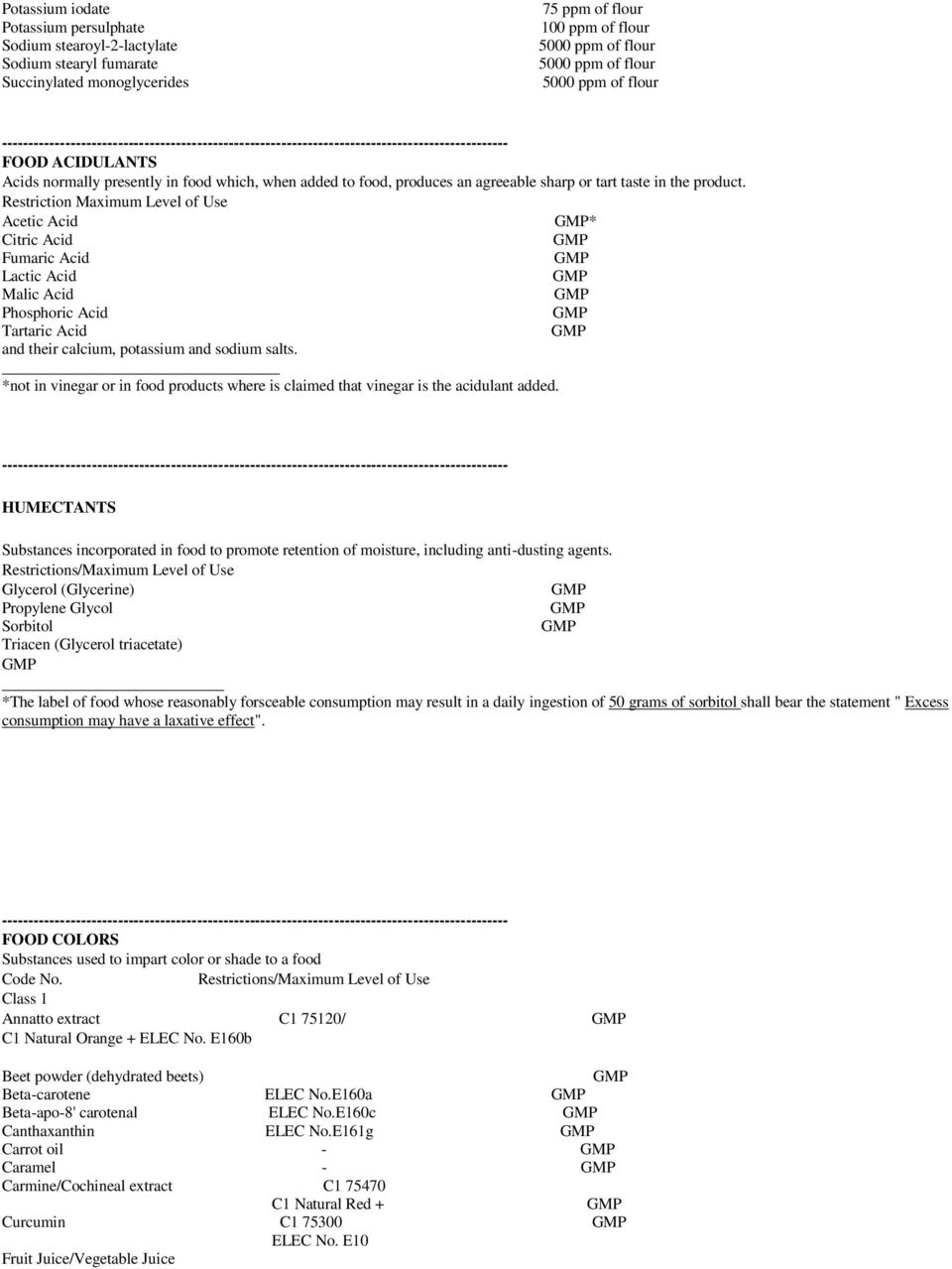
17 Grape skin extract (enocianine) grape color extract Ironoxides a. Yellow (hydrated ferrie oxide) C ) b. Red (anhydrous ferrie oxide) C177491) Paprika/Paprika oleoresin - Riboflavin (Lactoflavin/Riboflavin 5' Phosphate-sodium - Safron - Titanium dioxide (pigment white 6) C % (Powdered turmeric, indian saffron) - Class 11 Allura Red ( FD & C Red # 40) C * C1Food Red 27 Amaranth (FD & C Red # 2) C * ELEC No. E123 Brilliant Black PN C ( Black PN, Brilliant Black PN) C1 Food Black 1 Chocolate Brown HT ELEC. No E151 Brown HT, Brown HS) C1 Food Brown 3 Brilliant Blue FCF C * (FD & C Blue # 1) C1 Food Bl Citrus Red 2 only for peel of ranges, 2 ppm Fast Green FCF C ( FD & C Green # 3) C1 Food Green Indigotine (FD & C Blue # 2) C ( Indigo Carmine ) C1 Food Blue 2 Orange B only for surfate of sausage casing; 150 ppm Sunset Yellow (FD & C Yellow #6) C C1 Food Yellow 3 * EEC #E110 Tartrazine (FD & C Yellow #5) C C1 Food Yellow 4 * EEC # E102 Erythrosine (FD & C Red #3) C * C1 Food Red 14 EEC No. E127 * singly or in combination should not exceed 300 ppm LEAVENING AGENTS Substances used to produce or stimulate production of carbon dioxide in baked goods to impart a light texture. Restrictions/Maximum Level of Use Ammonium bicarbonate Ammonium phosphate, mono- and di-basic Calcium phosphate, mono-basic Dried yeast Glucono-delta lactone Sodium acid pyrophosphate Sodium aluminum phosphate Sodium bicarbonate SURFACE-FINISHING AGENTS Substances used to enhance palatability, preserve gloss or inhibits discoloration of foods, including glazes, polishes, waxes and protective covering. Restrictions/Maximum Level of Use Beeswax 0.4% in confectionary; Cadelila Wax 0.4 % in confectionery; Carnauba Wax 0.4 % in confectionery; Castor Oil 500 ppm in hard candy; Mineral Oil Petrolatum Polyethylene glycol Rice bran Wax 0.2 % in confectionery; 0.2 % in confectionery 0.15 % in bakery products 0.02 % in dried fruits & vegetables on fresh fruits; 50 ppm in candy; fresh fruits & veg.

18 2.5 % in chewing gum NUTRIENT SUPPLEMENTS Substances that are necessary for human body's nutritional and metabolic process. Restrictions/Maximum Level of Use Amino acids in the free hydrated or anhydrous form or as the hydrochloride, sodium or potassium salts. L-Alanine L-Alginine L-Asparagine L-Aspartic acid L-Cystine L-Cysteine L-Glutamic acid Glycine ( Aminoacetic acid ) L-Histidine L-Isoleucine L-Leucine L-Lysine DL-Methionine L-Methionine L-Phenylalanine L-Proline L-Serine L-Theonine L-Tryptophan L-Tyrosine L-Valine Aluminum nicotinate N-Acetyl-L-Methionine Ascorbic acid Bakers Yeast Protein ( Saccharomyces cerevisiae) Biotin Calcium citrate Calcium carbonate Calcium glycerophosphate Calcium oxide Calcium Pantothenate ( Calcium chloride Double Salt of) Calcium Phosphate Calcium pyrophosphate Caroteten Choline Bitartrate Choline Chloride Copper Gluconate % Copper ( Cuprous) Iodide 0.01 % in table salt Ferric Phosphate Ferric Pyrophosphate Ferric Sodium Pyrophosphate Ferrous Fumarate Ferrous Gluconate Ferrous Lactate Ferrous Sulfate Fish Protein Concentrate Folic Acid ( Folacin) 0.1 mg per for infants- below 0.3 mg per day for children (4 years) old Glutamic acid ( or hydrochloride) Inositol Iron, reduced Iron-Choline Citrate Complex Kelp (not for infant foods) ( except in infant foods and Foods containing, nitrities & nitrates) 0.4 mg per day for adults and children above 4 years old 0.8 mg per day for pregnant or lactating women As source of Iodine dietary foods

19 4 years old 0.25 mg I / day for adults and lactating women Niacin Nacinamide Niacinamide ascorbate Nicotinamide -ascorbic acid complex D-Pantothenamide D-Pantothenyl alcohol Potassium chloride Potassium iodide mg I / day for infants mg I / day for children below children above years old 0.03 mg I / day for pregnant or 0.01 mg in salt mg I / day for infants mg I / day for children below 4 years old mg I / day for adults and children above 4 years old 0.30 mg I / day for pregnant or lactating women Pyridoxine hydrochloride Riboflavin Riboflavin-5-phosphate Sodium pantothenate Sodium phosphate Thiamine Hydrochloride Thiamine mononitrate Tocopherols L-Tocopheryl acetate Vitamin A Vitamin A acetate Vitamin A palmitate Vitamin B6 Vitamin B12 Vitamin D2 Vitamin D3 Vitamin K Zinc chloride Zinc gluconate Zinc methionine sulfate Zinc oxide Zinc stearate Zinc sulfate Linoleic acid Magnesium oxide prepared from edible fats & oils Magnesium phosphate ( di, & Tri basic) Magnesium Sulfate Manganese - Chloride ( Citrate, gluconate, gly cero phosphate, orthphosphate, oxide, sulfate) Manganous oxide ph-control AGENTS Substances added to change or maintain active or basicity, including buffers, acids and alkalies. Restrictions/Maximum Levels of Use Acids Acetic acid Adipic acid Citric acid Gluconic acid Hydrochloride acid Lactic acid Malic acid Phosphoric acid Succinic acid Sulfuric acid Tartaric acid Alkalies Ammonium bicarbonate Ammonium carbonate * *

20 Ammonium hydroxide Calcium carbonate Calcium hydroxide Calcium oxide Magnesium carbonate Magnesium hydroxide Magnesium oxide Potassium bicarbonate Potassium carbonate Potassium hydroxide Magnesium carbonate Magnesium hydroxide Magnesium oxide Potassium hydroxide Sodium Bicarbonate Sodium carbonate Sodium hydroxide Buffers Aluminum ammonium sulfate Aluminum potassium sulfate Aluminum sodium sulfate Ammonium phosphatemmono-and-di-basic Ammonium sulfate Calcium citrate Calcium gluconate Calcium lactate Calcium phosphate, mono-and-di-basic Calcium pyrophosphate Potassium citrate Potassium phosphate, mono-and-di-basic Sodium acetate Sodium citrate Sodium Phosphate,mono-and-di-basic Sodium pyrophosphate Refers to annex 1 for Recommended Levels in certain food products SEQUESTRANTS Substances which combine with polyvalent metal ions to form a soluble metal complex to improve the quality and stability of products. Restrictions/Maximum Levels of Use Calcium acetate Calcium chloride Calcium citrate Calcium diacetate Calcium disodium EDTA Calcium gluconate Calcium hexa metaphosphate Calcium phosphate,monbasic Calcium phytate Calcium sulfate Citric acid Dipotassium phosphate Disodium EDTA Disodium phosphate Isopropyl citrate Appendix I. Government Regulatory Agency Contacts: AGRICULTURAL AFFAIRS OFFICE (AAO)/USDA U.S. EMBASSY MANILA 25/F Ayala Life-FGU Bldg Ayala Avenue, Makati City Tel: (+632) /53

21 Fax: (+632) [email protected] ANIMAL AND PLANT HEALTH INSPECTION SERVICE (APHIS) U.S. EMBASSY MANILA 25/F Ayala Life-FGU Bldg Ayala Avenue, Makati City Tel: (+632) Fax: (+632) [email protected] AGRICULTURAL TRADE OFFICE (ATO)/USDA U.S. EMBASSY MANILA 25/F Ayala Life-FGU Bldg Ayala Avenue, Makati City Tel: (+632) Fax: (+632) [email protected] BUREAU OF ANIMAL INDUSTRY DEPARTMENT OF AGRICULTURE BAI Compound, Visayas Avenue Diliman, Quezon City Philippines 1104 Tel : (+632) / Fax : (+632) Website : BUREAU OF PLANT INDUSTRY DEPARTMENT OF AGRICULTURE 692 San Andres Street Malate, Manila Philippines 1004 Tel : (+632) Fax : (+632) Website : BUREAU OF CUSTOMS VALUATION & CLASSIFICATION DEPARTMENT DEPARTMENT OF FINANCE New Customs Building Port Area, Manila Philippines 1018 Tel : (+632) Fax : (+632) Website : BUREAU OF FISHERIES & AQUATIC RESOURCES Department of Agriculture 4/F, Arcadia Building 860 Quezon Avenue Quezon City Philippines 1103 Tel : (+632) / Fax : (+632)
22 Website : BUREAU OF FOOD AND DRUGS DEPARTMENT OF HEALTH Civic Drive Filinvest Corporate City Alabang, Muntinlupa City Philippines 1770 Tel : (+632) / Fax : (+632) Website : NATIONAL MEAT INSPECTION SERVICE DEPARTMENT OF AGRICULTURE Tel : (+632) Fax : (+632) Website : BUREAU OF AGRICULTURE & FISHERIES PRODUCT STANDARDS DEPARTMENT OF AGRICULTURE Tel : (+632) Fax : (+632) Website : BUREAU OF IMPORT SERVICES DEPARTMENT OF TRADE & INDUSTRY 3/F Oppen Building 349 Sen. Gil Puyat Avenue Makati City, Philippines Tel : (+632) Fax : (+632) Website : BUREAU OF INTERNAL REVENUE DEPARTMENT OF FINANCE National Internal Revenue Building, Diliman, Quezon City, M.M. Philippines Tel : (+632) / Fax : (+632) Website : BUREAU OF INTERNATIONAL TRADE RELATIONS DEPARTMENT OF TRADE & INDUSTRY 5/F, New Solid Building 357 Sen. Gil Puyat Avenue Makati City, Metro Manila, Philippines 1200 Tel : (+632) / Fax : (+632) Website : BUREAU OF TRADE REGULATION & CONSUMER PROTECTION DEPARTMENT OF TRADE & INDUSTRY 2/F, Trade & Industry Building 361 Sen. Gil Puyat Avenue Makati City, Metro Manila Philippines 1200 Tel : (+632)
23 Fax : (+632) Website : NATIONAL FOOD AUTHORITY 101 E. Rodriguez Sr. Ave. Quezon City Philippines 1102 Tel : (+632) / Fax : (+632) Website : Appendix II. Other Import Specialist Contacts: APPENDIX III SYNERGY ASIA MARKETING SERVICES, INC. (Philippine representative of Washington Apple Commission and the California Table Grape Commission) Unit 602-C, Summit Office Tower 530 Shaw Boulevard Mandaluyong City 1501 Metro Manila Tel: (632) ; ; Fax: (632) Contact: Ms. Evelyn Mercurio, Managing Director [email protected] LIEU MARKETING ASSOCIATES PTE LTD (ASEAN Representative of California Pistachio Commission, California Tree Fruit Agreement, Florida Department of Citrus, Pear Bureau Northwest, Raisin Administrative Committee, United States Potato Board, Wine Institute of California, Western United States Agricultural Trade Association, Mid- America International Agri-Trade Council, Food Export USA-Northeast and the Southern United States Trade Association) Block 3 Alexandra Distripark Unit 08-22, Pasir Panjang Road Singapore Tel: (65) Fax: (65) Contact: Richard Lieu [email protected] PACRIM ASSOCIATES LTD. (ASEAN Representative for US Dairy Export Council) The Regent Hotel 155 Rajadamri Road Bangkok 10330, Thailand Tel: (662) Fax: (662) Contact: Mr. Dan Fitzgerald, ASEAN Representative USA POULTRY AND EGG EXPORT COUNCIL #15-04 Liat Towers, 541 Orchard Road Singapore Tel: (65) Fax: (65) Contact: Ms. Margaret Say, ASEAN Representative [email protected]
24 US MEAT EXPORT FEDERATION #15-03 Liat Towers, 541 Orchard Road Singapore Tel: (65) Fax: (65) Contact: Ms. Sabrina Yin, ASEAN Representative PHILIPPINE ASSOCIATION OF SUPERMARKETS, INC. Rm 311, Mariwasa Building Aurora Boulevard, Cubao Quezon City, Philippines Tel: (632) Fax: (632) Contact: Mr. Jose Albert, President MEAT IMPORTERS AND TRADERS ASSOCIATION Panay Ave. Quezon City, Philippines Tel: (632) to 48 Fax: (632) Contact: Mr. Jess Cham, President HOTEL AND RESTAURANT ASSOCIATION OF THE PHILIPPINES 4/F Golden Rock Building 168 Salcedo St., Legaspi Village Makati City, Philippines Tel: (632) Fax: (632) Contact: Mr. Humphrey O' Leary, President PHILIPPINE FOOD PROCESSORS AND EXPORTERS ORGANIZATION 1205 Jollibee Plaza, Emerald Avenue, Ortigas Center Pasig City, Philipines Tel: (632) / Fax: (632) Contact: Mr. Jesus T. Tanchangco, Sr., President PHILIPPINE ASSOCIATION OF MEAT PROCESSORS, INC. Suite 204, Sunrise Condominium Ortigas Avenue, Greenhills San Juan, Metro Manila Philippines Tel: (632) Fax: (632) Contact: Mr. Felix O. Tiukinhoy, President PHILIPPINE PET FOOD IMPORTERS ASSOCIATION 1313 M. Adriatico St., Ermita, Manila
25 Tel: (632) Fax: (632) Contact: Mr. Eduardo L. Legarda
CODEX STAN 256 2007 Page 1 of 5 STANDARD FOR FAT SPREADS AND BLENDED SPREADS CODEX STAN 256-2007
 CODEX STAN 256 2007 Page 1 of 5 1. SCOPE STANDARD FOR FAT SPREADS AND BLENDED SPREADS CODEX STAN 256-2007 This Standard applies to fat products, containing not less than 10% and not more than 90% fat,
DRAFT. Made under the Food Standards Australia New Zealand Act 1991. CONSULTATION DRAFT 7 July 2014
 DRAFT Food Standards Code Schedule 17 Made under the Food Standards Australia New Zealand Act 1991 Schedule 17 Vitamins and minerals Note 1 This instrument is a standard under the Food Standards Australia
CODEX STAN 168 Page 1 of 6 INTRODUCTION
 CODEX STAN 168 Page 1 of 6 INTRODUCTION The Regional European Standard for Mayonnaise was elaborated by the Codex Coordinating Committee for Europe and adopted by the Codex Alimentarius Commission at its
CODEX STANDARD FOR FOLLOW-UP FORMULA CODEX STAN 156-1987. This standard applies to the composition and labelling of follow-up formula.
 CODEX STAN 156-1987 Page 1 of 9 CODEX STANDARD FOR FOLLOW-UP FORMULA CODEX STAN 156-1987 1. SCOPE This standard applies to the composition and labelling of follow-up formula. It does not apply to foods
4 servings - Bring 8 cups of water to boil. Slowly whisk in entire package of soup mix. Lower heat simmer 10-15 minutes, stirring occasionally.
 Cheddar Broccoli INGREDIENTS: Non-dairy Creamer (Maltodextrin, Palm Oil, Sodium Caseinate, Di-potassium Phosphate, Mono and Diglycerides, Natural Flavor, Annatto Color), Food Starch-Modified, Sweet Whey,
Nutritional and Calorie Guide Bakery and Coffee Items
 Nutritional and Calorie Guide Bakery and Coffee Items Page Intentionally Left Blank Page 2 3/4/2014 Table of Contents Coffee Products Iced Coffee and Iced Lattes 4 Iced Lattes and Cappuccinos 5 Hot Chocolate
NUTRITION FACTS AND INGREDIENTS ZV0 - ZV10
 ZV0 ADVANCED ELECTROLYTE DRINK WATERMELON PER 100g PER SERVING 4.5g TABLET ENERGY 269.1kJ 1152.0kcal 12.1kJ 51.8kcal PROTEIN 35.6g 1.6g CARBOHYDRATES 6.3g 0.28g SUGARS
Syllabus M.Tech. Food Technology DSC- FT- 1 A: FUNDAMENTALS OF FOOD SCIENCE AND TECHNOLOGY PART I
 Syllabus M.Tech. Food Technology DSC- FT- 1 A: FUNDAMENTALS OF FOOD SCIENCE AND TECHNOLOGY PART I Unit 1 Introduction to Food Science and Technology Definition, scope and current trends in food science
USE BLUE OR BLACK INK ONLY. 1c. ARE YOU THE NEW OWNER OF A PREVIOUSLY REGISTERED FACILITY? Yes O No O
 FDA USE ONLY USE BLUE OR BLACK INK ONLY Date: (MM/DD/YYYY) Section 1 - TYPE OF REGISTRATION 1a. O DOMESTIC REGISTRATION O FOREIGN REGISTRATION 1b. O INITIAL REGISTRATION O UPDATE OF REGISTRATION INFORMATION
FOOD ADDITIVES: WHAT THEY DO 1998 by David A. Katz. All rights reserved.
 FOOD ADDITIVES: WHAT THEY DO 1998 by David A. Katz. All rights reserved. The following table is a list of common food additives and the reason they are added to our food. Additive Acacia (gum Arabic) Acetic
⓲ FOOD DETECTIVES. THE WHOLE STORY
 ⓲ FOOD DETECTIVES. THE WHOLE STORY HANDOUT 2 Instructions: Let s compare a snack product s packaging to its nutrition information. Circle the buzzwords product marketers have used to convince shoppers
CODEX STANDARD FOR MOZZARELLA
 CODEX STANDARD FOR MOZZARELLA CODEX STAN 262-2006 1. SCOPE This Standard applies to Mozzarella intended for direct consumption or for further processing, in conformity with the description in Section 2
Systems Based Vulnerability & Risk Assessment
 Systems Based Vulnerability & Risk Assessment Shaun Kennedy Deputy Director John Hoffman Senior Research Fellow DHS University Network Summit on Research and Education 16 March - 2007 Risk Assessment An
ALLERGEN STATEMENT: FOR KERNELS CANADIAN RETAIL STORES (EXCLUDING KERNELS STORES LOCATED INSIDE A BASKIN ROBBINS STORE LOCATION
 March 2015 Allergen Statement with regards to Peanuts and Tree Nuts and Wheat glutens in Kernels CANADIAN RETAIL STORES (Excluding Kernels stores located inside a Baskin Robbins store location.) "With
Hill s Evidence-Based Clinical Nutrition for Dermatology Specialists
 Hill s Evidence-Based Clinical Nutrition for Dermatology Specialists Discover the most complete and clinically proven line of dermatologic nutrition from Hill s Hill s Prescription Diet d/d Formulated
User Guide. Standard 1.2.4 Labelling of Ingredients. December 2013. Ingredient Labelling of Foods
 Ingredient Labelling of Foods User Guide to Standard 1.2.4 Labelling of Ingredients December 2013 Ingredient Labelling of Foods Contents Background... 2 Food Standards in Australia and New Zealand... 2
NEW SNACK PRODUCTS RELEASED FROM APRIL - JULY 2003 CONTAINING MALIC ACID.
 A Taste for Today and Tomorrow 421 Seaman St., Stoney Creek, ON L8E 3J4 (905) 662-1127 NEW SNACK PRODUCTS RELEASED FROM APRIL - JULY 2003 CONTAINING MALIC ACID. Product NSpired Natural Foods Skinny Yellow
PIZZA HUT INGREDIENT STATEMENTS
 Pizza Ingredients Thin N Crispy Dough XL Full House Dough Bigfoot Dough Blend Italian Bistro, Soft & Sweet Dough Pan Dough Hand-Tossed Style Dough & Stuffed Crust Dough Personal Pan Pizza Dough 4ForAll
Ουσίες που προσδίδουν χρώμα E100 Curcumin E101 (i) Riboflavin E101 (ii)riboflavin-5'-phosphate E102 Tartrazine E104 Quinoline yellow E110 Sunset
 Ουσίες που προσδίδουν χρώμα E100 Curcumin E101 (i) Riboflavin E101 (ii)riboflavin-5'-phosphate E102 Tartrazine E104 Quinoline yellow E110 Sunset Yellow FCF; Orange Yellow S E120 Cochineal; Carminic acid;
STANDARD FOR EDIBLE CASEIN PRODUCTS CODEX STAN 290-1995. Formerly CODEX STAN A-18-1995. Adopted in 1995. Revision 2001. Amendments 2010, 2013, 2014.
 STANDARD FOR EDIBLE CASEIN PRODUCTS CODEX STAN 290-1995 Formerly CODEX STAN A-18-1995. Adopted in 1995. Revision 2001. Amendments 2010, 2013, 2014. CODEX STAN 290-1995 2 1. SCOPE This Standard applies
SOLID FATS AND ADDED SUGARS (SoFAS) Know the Limits
 COOPERATIVE EXTENSION SERVICE UNIVERSITY OF KENTUCKY COLLEGE OF AGRICULTURE, LEXINGTON, KY, 40546 NEP-207B SOLID FATS AND ADDED SUGARS (SoFAS) Know the Limits The U.S. Department of Agriculture s Dietary
AMINO BALANCE PRODUCTS L-ARGININE PRODUCTS
 ANABOL NATURALS SUPPLEMENT FACTS AMINO BALANCE PRODUCTS Serving Size 1/4 Level Teaspoon Servings Per Container 80 Serving Size 3 Capsules Servings Per Container 40 Calories Vitamin B-6 (as pyridoxine HCl)
This Regulation shall be binding in its entirety and directly applicable in all Member States.
 L 314/36 Official Journal of the European Union 1.12.2009 COMMISSION REGULATION (EC) No 1170/2009 of 30 November 2009 amending Directive 2002/46/EC of the European Parliament and of Council and Regulation
GENERAL STANDARD FOR THE LABELLING OF PREPACKAGED FOODS
 1 Labelling of Prepackaged Foods (CODEX STAN 1-1985) GENERAL STANDARD FOR THE LABELLING OF PREPACKAGED FOODS CODEX STAN 1-1985 1. SCOPE This standard applies to the labelling of all prepackaged foods to
How To Make A Homemade Cheese Pie
 ARBY S ROAST BEEF SANDWICHES Regular Beef n Cheddar Contains: Milk, Wheat, Mustard 195 440 21 6 1 60 1270 40 1 9 22 2 2 6 30 Medium Beef n Cheddar Contains: Milk, Wheat, Mustard 251 540 27 9 1.5 100 1710
PATIENT INFORMATION LEAFLET: CENTRUM. Read the contents of this leaflet carefully before you start using CENTRUM, because it
 PATIENT INFORMATION LEAFLET: CENTRUM Page 1 of 7 This leaflet tells you about CENTRUM tablets. Read the contents of this leaflet carefully before you start using CENTRUM, because it contains important
Moo. Mustard Natural: distilled vinegar, water, mustard seed, salt, turmeric, paprika, spice extractive. 2 Assemble the burger
 THE SCIENCE F HAMBURGER MEAT Regular Bun (top) Natural: enriched flour, water, yeast, soybean or canola oil, salt, wheat gluten Artificial: high fructose corn syrup, calcium sulfate, calcium carbonate,
Both drink mixes contain similar basic ingredients, as listed in Table 1. Ascorbic acid (vitamin C) Ascorbic acid (vitamin C)
 MAKE YOUR OWN ORANGE DRINK AN EXPERIMENT IN DETERMINING HOW ADDITIVES AFFECT OUR FOOD 2000, 1999, 1996 by David A. Katz. All rights reserved. Reproduction permitted for education use provided original
Committee on Medical Aspects of Food and Nutrition Policy
 Nutrient Intakes Last updated: December 2014 This paper describes how nutrient intakes are calculated from food purchases and how they are compared to nutrient recommendations and other dietary guidelines.
Young s Homemade Ice Cream 2013 Ingredient List American Celebration. Banana. Banana Cookie Crunch. Black Raspberry. Black Walnut.
 Young s Homemade Ice Cream 2013 Ingredient List American Celebration Banana Banana Cookie Crunch Black Raspberry Black Walnut Bubble Gum Butter Pecan Cake Batter Caramel Chocolate Toffee Caramel Cookie
National Food Safety Standard Standard for nutrition labelling of prepackaged foods
 National Standards of People s Republic of China GB 28050 2011 National Food Safety Standard Standard for nutrition labelling of prepackaged foods (Nota: traducción no oficial) Issued on: 2011-10-12 Implemented
SCHEDULE A PRODUCT INFORMATION
 SCHEDULE A PRODUCT INFORMATION SOUP 1) CAMPBELL'S CONDENSED SOUP- CHICKEN & STARS (1541_11) INGREDIENTS: CHICKEN STOCK, ENRICHED PASTA (WHEAT FLOUR, EGG WHITES, NIACIN, FERROUS SULFATE, THIAMINE MONONITRATE,
Identifying. Food Additives
 Identifying Food Additives Identifying Food Additives Food Additives Additives are used to improve food. They can: improve the keeping quality of a food by making it last longer on the shelf or in the
Phase Out Artificial Trans Fat In King County Food Service Establishments
 The Regulation to Phase Out Artificial Trans Fat In King County Food Service Establishments (Chapter 5.10 of the Code of the King County Board of Health) How to Comply: What Restaurants, Delis, Bakeries,
2015 Kennywood Ingredient Book. Snack-A-Saurus
 2015 Kennywood Ingredient Book Snack-A-Saurus Due to the volume of products used, we cannot ensure all of the labels provided on this page are accurate. Products may be substituted at any time from our
It's in the details. JOST MINERAL GUIDE
 It's in the details. JOST MINERAL GUIDE Reference Guide to Jost Mineral Compounds Jost Chemical Co. manufactures a line of mineral compounds that are used in the nutritional supplement, clinical nutrition,
Baked Goods Apple Muffins Ingredients: Sugar, flour, apples, eggs, canola oil, palm and palm kernel oil, soybean oil, water, cinnamon, molasses, whole
 Beverages Cappuccino/Latte Ingredients: espresso, milk, vitamin A palmitate, vitamin D3. May contain wheat, soy, milk, Cappuccino/Latte with Soy Milk Ingredients: espresse, Soymilk (filtered water, whole
Speedway LLC Nutritionals Lunch Menu
 Speedway LLC Nutritionals Lunch Menu Serving Size (g) Calories Calories from Fat (g) Total Fat (g) Saturated Fat (g) Trans Fat (g) Cholesterol (mg) Sodium (mg) Total Carbs (g) Dietary Fiber (g) Sugars
Nutrition Facts/Allergen Information
 Nutrition Facts/Allergen Information Here at CilantroMex, our goal is to provide our customers with the freshest, most delicious, and most nutritious foods. We use the freshest meats and produce when preparing
LIFE STAGES. DOG and CAT FOODS. Give your pet the natural, wholesome nutrition needed for all-day activity and a lifetime of fitness and health
 assurance of quality LIFE STAGES DOG and CAT FOODS Give your pet the natural, wholesome nutrition needed for all-day activity and a lifetime of fitness and health LIFE STAGES DOG and CAT FOODS Blue Seal
STANDARD FOR CHOCOLATE AND CHOCOLATE PRODUCTS (CODEX STAN 87-1981, Rev. 1-2003)
 CODEX STAN 87 Page 1 de 11 1 SCOPE STANDARD FOR CHOCOLATE AND CHOCOLATE PRODUCTS (CODEX STAN 87-1981, Rev. 1-2003) The standard applies to chocolate and chocolate products intended for human consumption
Decree N 152 (24 January 2013) Administrative Measure on Inspection, Quarantine and Supervision of Imports and Exports of Dairy products
 Decree N 152 (24 January 2013) Administrative Measure on Inspection, Quarantine and Supervision of Imports and Exports of Dairy products Chapter 1 General Principle Article 1 In order to enhance inspection,
GAIN Report Global Agriculture Information Network
 Foreign Agricultural Service GAIN Report Global Agriculture Information Network Voluntary Report - public distribution Date: 4/7/2000 Japan GAIN Report #JA0037 Organic Products Japan Agricultural For Organic
Save Time and Money at the Grocery Store
 Save Time and Money at the Grocery Store Plan a Grocery List Making a list helps you recall items you need and also saves you time. Organize your list according to the layout of the grocery store. For
INGREDIENT INFORMATION
 INGREDIENT INFMATION This information is accurate to the best of our knowledge and is based on standard product recipes and current information provided by our food suppliers. Please note the date of the
AIJN Guideline for Vegetable Juices and Nectars
 AIJN Guideline for Vegetable Juices and Nectars 1. INTRODUCTION This guideline is applicable without prejudice to the national legislation of each Member State and/or Code of Practice and cannot be used
ALLERGEN INFORMATION (US)
 Apple Sauce, Natural Bacon Jalapeño Queso Beef, Seasoned Ground Beef, Seasoned Shredded Black Bean Corn Salsa Black Beans Brown Rice Wheat Soy Milk Egg Tree Nuts Peanuts Fish Crustacean /Shellfish Brownies
Overview and Application of Food Labelling and Information Requirements
 Overview and Application of Food Labelling and Information Requirements User Guide To Standard 1.2.1 Labelling and Other Information Requirements November 2011 1 Background Food Standards in Australia
Guidance for Industry What You Need To Know About Registration of Food Facilities Small Entity Compliance Guide
 Guidance for Industry What You Need To Know About Registration of Food Facilities Small Entity Compliance Guide Additional copies are available from: Office of Compliance, HFS-607 Center for Food Safety
Acid, Acidified and Low-acid Foods
 EC 705 April 2000 Acid, Acidified and Low-acid Foods Canning Guidelines for Food Processors Department of Food Science and Human Nutrition College of Agriculture, Forestry & Life Sciences Clemson University
Food additives - alphabetical list
 Food additives - alphabetical list Symbols used in this list A or α = alpha; β = beta; δ = delta; γ = gamma. Acacia or gum Arabic 414 Acesulphame potassium 950 Acetic acid, glacial 260 Acetic and fatty
Product Category: Similac
 Similac Product Category: Similac Go & Grow by Similac Toddler Drink Updated 5/5/2016 Product Information: Go & Grow by Similac Toddler Drink 1 of 4 A milk-based drink for toddlers 12-24 months old. Designed
Quality Ingredient Information
 This guide is designed to help you make informed choices when you eat at Culver's. If you have any questions or concerns about food allergies or sensitivities, we recommend that you contact your medical
Making Healthy Food Choices. Section 2: Module 5
 Making Healthy Food Choices Section 2: Module 5 1 Nutrition For Health What is healthy Tips on planning meals Making a shopping list/ Bulk orders Using WIC foods Cook and freeze What foods to choose How
Certified Paleo. 1. Certified Paleo. 1.1 Applicability. 1.2 Guidelines. Program Standards and Specifications
 Certified Paleo Program Standards and Specifications 1. Certified Paleo The Certified Paleo Requirements for Grain-Free, Legume-Free, Dairy-Free, Artificial Coloring, Artificial Preservatives, Artificial
Nutrition Requirements for Foods and Beverages Sold During the Regular School Day throughout the School Campus
 Nutrition s for Foods and Beverages Sold During the Regular School Day throughout the School Campus THIS RULE PERTAINS TO ALL SCHOOLS THAT PARTICIPATE IN THE NATIONAL SCHOOL LUNCH PROGRAM (NSLP) In June
Healthy Eating During Pregnancy
 Healthy Eating During Pregnancy Pregnancy is a time of great change. Your body is changing to allow your baby to grow and develop. Good nutrition will help you meet the extra demands of pregnancy while
ST 2004-01 Food Definition, Issued May, 2004; Revised June, 2007 and May, 2015
 Business Tax Division Sales & Use Tax P.O. Box 530 Columbus; Ohio 43216-0530 www.tax.ohio.gov ST 2004-01 Food Definition, Issued May, 2004; Revised June, 2007 and May, 2015 The purpose of this information
Sweets nutritional information
 Sweets nutritional information Brownies INGREDIENTS: Chocolate Chips (sugar, chocolate liquor, cocoa butter and soy lecithin), Butter (cream and butter), Brown Sugar, Enriched Unbleached White Flour (Wheat
New Zealand Product Ingredients (Revised January 2015) BREADS MEAT, POULTRY, & SEAFOOD. Page 1
 New Zealand Product Ingredients (Revised January 2015) This list is compiled based on product information provided by Subway approved food manufacturers. Every effort is made to keep this information current
Phosphates on. www.prayon.com
 Phosphates on THE TABLE www.prayon.com www.prayon.com Phosphates ON THE table Prayon* is currently one of the leading producers and sellers of purified phosphoric acids as well as technical and food phosphates.
COOKIES BARS CUPCAKES
 COOKIES Chocolate Chip: DIV Flour Blend (white, brown & sweet rice flours, tapioca flour, cornstarch, potato starch, xanthan gum), brown sugar, vegan margarine [soybean, palm fruit, canola & olive oils,
Food Additives approved by the EU (E-Number list by category)
 Colours E 100 Curcumin E 101 Riboflavins (i) Riboflavin (ii) Riboflavin-5'-phosphate E 102 Tartrazine E 104 Quinoline Yellow E 110 Sunset Yellow FCF, Orange Yellow S E 120 Cochineal, Carminic acid, Carmines
FOOD FACILITIES REGISTRATION OF. Protecting the U.S. Food Supply. What You Need to Know About
 U.S. Food and Drug Administration Protecting the U.S. Food Supply U.S. Department of Health and Human Services What You Need to Know About REGISTRATION OF FOOD FACILITIES FDA Food Security Information
Product Information: PediaSure
 Product Information: PediaSure 1 of 5 PEDIASURE is a source of Complete, Balanced Nutrition especially designed for the oral feeding of children 2 to 13 years of age. May be used as the sole source of
Canada s Food Guide Jeopardy
 Canada s Food Guide Jeopardy Drafted: July 2008 Revised: December 2012 Eating Well with Canada s Food Guide Veg & Fruit Grain Products Milk & Alternatives Meat & Alternatives Physical Activity Miscellaneous
Nutritional Glossary. Index of Contents
 Nutritional Glossary This glossary provides nutrition information about the nutrients commonly found in fruits, vegetables, and other plant foods Each glossary definition has a long and a short version.
CODEX STANDARD FOR FERMENTED MILKS CODEX STAN 243-2003
 CODEX STAN 243-2003 Page 1 of 5 1. SCOPE CODEX STANDARD FOR FERMENTED MILKS CODEX STAN 243-2003 This standard applies to fermented milks, that is Fermented Milk including, Heat Treated Fermented Milks,
RUTF product specifications
 MSF International Office UNICEF SD, RUTF pre-bid conference, August 15, 2012 RUTF product specifications Odile Caron Coordinator for food quality assurance Scope Item description Finished product specifications:
Preferred Meal Systems, Inc. 083948 As Served 6.25 (oz) 177.19 (g) 1 6.25 (oz) 177.19 (g) 1 Serving Consists of one 6.25 oz serving of sloppy joe.
 Preferred Meal Systems, Inc. Product Specification Sheet Item N175 NUTRIENT INFORMATION PER SERVING Item Name Brand: Number: Basis for Data Submitted: Package Size: Servings Per Package: Weight Per Serving:
CHILD CARE DIPLOMA. Course Sample
 CHILD CARE DIPLOMA Course Sample Unit CHP2 Providing for children s physical needs inclusive of health and safety The Statutory framework for the EYFS is a requirement for all registered early years providers.
February 2006. 23 Best Foods for Athletes
 23 Best Foods for Athletes February 2006 1. Beans Legumes a. Excellent source of fiber (important for keeping blood sugar and cholesterol levels under control). b. High in protein and a good source of
Nutritional Information: Cookies
 al Information: Cookies Classic Chocolate Chip Total Fat 17g Sat. Fat 8.5g 26% 43% Total Carb. 39g 13% Dietary fiber 1.2g 5% Sugars 28g Cholest. 35mg 12% Protein 3g 7% Calories 283 Fat Calories 127 Sodium
INGREDIENT INFORMATION
 INGREDIENT INFMATION This information is accurate to the best of our knowledge and is based on standard product recipes and current information provided by our food suppliers. Please note the date of the
Selection and Preparation of Foods Management of the Food Budget*
 Selection and Preparation of Foods Management of the Food Budget* Healthy meals on a limited budget! How can you serve healthy meals on a limited budget? It takes some time and planning, but you and your
BUREAU OF INDIAN STANDARDS MANAK BHAVAN, 9 BAHADUR SHAH ZAFAR MARG; NEW DELHI 110002
 11536:2006 Doc FAD 16 (1761)F Indian Standard PROCESSED-CEREAL BASED COMPLEMENTARY FOODS SPECIFICATION (Second Revision) ICS 67.060 BIS 2006 BUREAU OF INDIAN STANDARDS MANAK BHAVAN, 9 BAHADUR SHAH ZAFAR
FOOD INGREDIENT NUMBERS:
 FOOD INGREDIENT NUMBERS: (E-numbers) E-Numbers represent specific food additives, used by the food industry in the manufacture of various food products. These E-Numbers have been formulated by the European
PRIOR NOTICE OF IMPORTED FOOD SHIPMENTS A
 U.S. Food and Drug Administration Protecting the U.S. Food Supply U.S. Department of Health and Human Services What You Need to Know About PRIOR NOTICE OF IMPORTED FOOD SHIPMENTS A Small Entity Compliance
Food Category system (1) Food Category Name (2) Recommended Maximum level (5) INS No. (4) Food Additive (3) Note (6) 14.2.3 Grape wine Malic Acid DL-
 Notice Calling for suggestions, views, comments etc from WTO- SPS Committee members within a period of 60 days on the draft notification related to additional additives/enzymes/processing aids for use
Quality Ingredient Information
 This guide is designed to help you make informed choices when you eat at Culver's. If you have any questions or concerns about food allergies or sensitivities, we recommend that you contact your medical
After all, our children deserve the very best!
 From the day our children are born, their health is our first priority. That s why we developed our Carlson for Kids product lines, to ensure that they receive the very best nutritional supplements. Only
Reading Food Labels. Nutritional values The ingredients of the item The percentage of the Recommended Daily Intake (RDI) of particular nutrients
 Eating well involves choosing a variety of foods that are low in saturated and trans fats, low in salt and high in dietary fibre. Food labels carry useful information to help you make choices about the
INGREDIENT INFORMATION
 INGREDIENT INFMATION This information is accurate to the best of our knowledge and is based on standard product recipes and current information provided by our food suppliers. Please note the date of the
 California School Nutrition Association June 2006 Summary of Requirements for Foods & Beverages Sold in California Schools The following is a summary of requirements for food sales in California schools.
Standard 3.1.1. Interpretation and Application
 Standard 3.1.1 Interpretation and Application AUSTRALIA NEW ZEALAND FOOD STANDARDS CODE CHAPTER 3 (AUSTRALIA ONLY) A GUIDE TO THE FOOD SAFETY STANDARDS SECOND EDITION, JANUARY 2001 AUSTRALIA NEW ZEALAND
McDonald's USA Ingredients Listing for Popular Menu Items
 McDonald's USA Ingredients Listing for Popular Menu Items Provided below is a listing of components in our popular menu items by category, followed by the ingredient statements for those components. Allergens
UTI CAT FOOD COMPARISON CHART
 UTI CAT FOOD COMPARISON CHART believes that urinary tract infections, crystals and kidney problems in today s cat are due mainly to excessive minerals consumed by our cats as they age. Once you cat reaches
CENTRAL LABORATORY. Frontline Service : Conduct of Routine Laboratory Analysis. Customer : Government Agencies, FDA Inspectors, Other Stake Holders
 CENTRAL LABORATORY Frontline Service : Conduct of Routine Analysis Customer : Government Agencies, FDA Inspectors, Other Stake Holders Requirements : Duly Accomplished Request for Analysis FDA Circular
GUIDELINES FOR FOOD IMPORT CONTROL SYSTEMS
 GUIDELINES FOR FOOD IMPORT CONTROL SYSTEMS SECTION 1 SCOPE CAC/GL 47-2003 1. This document provides a framework for the development and operation of an import control system to protect consumers and facilitate
phasing out ARTIFICIAL TRANS FAT How to Comply: What Restaurants, Caterers, Mobile Food Vendors, and Others Need to Know
 phasing out ARTIFICIAL TRANS FAT in Cambridge Food Service Establishments How to Comply: What Restaurants, Caterers, Mobile Food Vendors, and Others Need to Know SUMMARY OF REGULATION In 2009, the City
Guidance for Industry
 Guidance for Industry Questions and Answers Regarding Registration of Food Facilities (Edition 2) Final Guidance Comments and suggestions regarding this document may be submitted at any time. Submit comments
Product list Magnesium, Calcium and further mineral compounds
 Product list Magnesium, Calcium and further mineral compounds Product list Magnesium, Calcium and further mineral compounds A Aluminium stearate Aluminium sulphate C Calcium acetate Calcium ascorbate L-Calcium
Snack Foods and Beverages In Utah Schools A comparison of state policy with USDA s nutrition standards
 A data table from The Pew Charitable Trusts and the Robert Wood Johnson Foundation Jan 2015 Snack Foods and Beverages In Utah Schools A comparison of state policy with USDA s nutrition standards In 2008,
Food Groups To Encourage. chapter OVERVIEW
 23 chapter 5 Food Groups To Encourage OVERVIEW Increased intakes of fruits, vegetables, whole grains, and fat free or low fat milk and milk products are likely to have important health benefits for most
Welcome! We give you vegetarian frankfurter sausages, sliced, tofu and fried products.
 Welcome! We give you vegetarian frankfurter sausages, sliced, tofu and fried products. All our products are vegan and have always been known for their reliable quality and exceptional taste. All Polsoja
11 III. Create additional market opportunities for New Hampshire producers who are not
 Rep. Moynihan, Coos 2 October, 13 13-23h 08/ Amendment to HB 660-FN 1 Amend the bill by replacing all after the enacting clause with the following: 3 1 New Subdivision; Genetically Engineered. Foods. Amend.
CAT FOOD PREMIUM PREVENTION BY NUTRITION. krmivo-brit.cz
 PREMIUM CAT FOOD PREVENTION BY NUTRITION VAFO PRAHA s.r.o. Chrášťany 9, Rudná u Prahy Tel.: +0 57 95 11 Fax: +0 57 95 11 [email protected] krmivo-brit.cz PREMIUM QUALITY CAT FOOD PREMIUM QUALITY C