
Dr. Astrid Kopp-Duller (1985)
|
|
|
- Meryl Wilcox
- 10 years ago
- Views:
Transcription
1 A dyslexic person, of good or average intelligence, perceives his environment in a different way, his attention diminishes when confronted with symbols such as letters and numbers. Due to a deficiency of his partial performances, his perception of these symbols is different to the perception of non-dyslexic people. This results in difficulties when learning to read and write and do arithmetic. Dr. Astrid Kopp-Duller (1985) Text: Sissi Nuhl Everyone who can call a dyslexic person his friend, is a very lucky person. Dyslexic people are very creative, technologically gifted my computer was properly adjusted by dyslexic children and they also showed great patience when explaining it all to me. Every dyslexic person has a well developed sense of justice. This I find most important in times like this. I am very pleased that we have people like that. A dyslexic person is a loyal friend for life. Often dyslexia is mistakenly seen as a general reading and writing weakness. The fact is that there is a difference mainly in the study support. Let us try to work out the differences. The cause for an acquired reading and spelling weakness can be psychological, physiological, family problems, teaching methods, learning deficiency and general poor performance. In contrast, dyslexia is genetic meaning that the tendency to being dyslexic was already present at birth. How this tendency will express itself in each individual will depend on his environment. If a dyslexic person finds conditions that do justice to his needs, then there will never be grave problems at school. Early recognition of dyslexia is very important. Many signs are already recognisable at the pre-school stage. The crawling phase is very important for the development of the coordination necessary for the reading and writing. It has been observed that this phase has never taken place, or taken place in a very diminished form, for many dyslexics. They are often the socalled ground shufflers, more often than not they crawl backwards or sideways. At this stage it is of utmost importance to closely observe these children for other symptoms indicating a possible dyslexia. And, because
2 dyslexia is of genetic origin, observation is recommended when dyslexia is found in one parent and perhaps in a few relatives. At the first signs of problems in acquiring reading, writing and arithmetic skills, tests should be done without desay to ensure a minimum waste of time. In general intensive practising does not show much improvement but a lot of frustration for the child and the whole family unit. It is not necessary and must not be. We know that dyslexia is not an illness or a handicap, nor are these children lazy or stupid. I am a dyslexia trainer and many mothers and children seek my help. With a computer test or other means, with games especially with younger children who are still unable to deal with a computer, it can be determined in a short period of time,which perceptions are affected and need to be trained. The first part of the test is dedicated to the attention apability. The second part of the test is dedicated to the sensory perceptions needed to read, write and do arithmetic. And they are: Visual differentiation is the capacity to recognize sameness and differences and keep them apart. Visual memory is the capacity to remember what has been seen, to store and retrieve it when necessary. Visual continuity is the capacity to line up visual impressions as they take place. Auditory differentiation is the capacity to hear particular words and differentiate similar sounding words. Auditory memory to retain what has been heard to store and retrieve it when necessary. Auditory continuity to discern which word has been spoken first in a sentence.
3 Room orientation sense of space and time and the capacity to judge size and items. Body pattern to judge own body (to differentiate left and right ). After analysing the test results it is determined which perceptions need to be taken care of. Here we deal with a primary dyslexia. Once the children s boundaries are broken, through constant demands and lack of understanding, they acquire behavioural problems, then it becomes a secondary dyslexia. And this is much more difficult to remedy than the primary dyslexia. This is why it is so important to help these children in a quick and targeted manner. The children need success experiences. We do not want sick and desperate children who do not believe in themselves anymore. The combined efforts of parents, teachers and dyslexia trainers is especially important. The teacher must not be made the sole responsible for the progress of the dyslexic children. Once this circle closes and the child notices that it is not alone with this problem, behavioural problems will not happen. Comments such as more practice or it is going to work out well are out of place. At this point I would like to point out that there are very dedicated teachers, nut if a teacher tells me that I have the wrong profession because there is no such thing like dyslexia, I would have to ask this teacher to reconsider his career as a teacher. It is also important to clarify what is a spelling error and what is a perception error? In general dyslexic children make perception errors. Meaning that, due to their perception disorder they are not aware of any errors made during the process of reading or writing. These perception errors mainly happen with frequently used words. There are several perception errors:
4 Sequencing of letters omission (several), addition (severale) and sequencing (serevale). To confuse letters such as b and d. To confuse similar sounds such as k and g or t and d. Stretching of sounds and accentuated sounds. Memorising and storage of errors (sight words are misspelled, the same words in a text are spelled differently. A combination of all the above. The basic problem of dyslexic children is their inability to control their thoughts during the process of reading, writing and doing arithmetic. The solution is to increase their concentration span and improve their perceptions by targeted training, as well as individual training of the errors when reading, writing and doing arithmetic. Here we have the pictorial understanding and the manipulation of letters and numbers. What a dyslexic person can touch or see in three dimensions, he will remember. It is also very useful to deal with whole word families at once. If we take the word drive (driver, drive), then we can deal with several words at the same time. Dyslexic children enjoy working with plasticine, shaving foam etc. To work on the computer is also very important. Dyslexic children access the computer very easily. The training programme needs to be tailored for each child. This is why a one on one training is important. Dyslexic children need lots of time and understanding, then they will acquire the skills of reading, writing and arithmetic just like any other child. These children are out of place in a school for the disadvantaged!!
5 Constant control and observation is important. Lets try to create a world where dyslexic people have a place in our society without prejudicing. Lets listen to dyslexic people wit attention they have a lot to tell us,- and we all can learn a lot from them.
Practice Test for Special Education EC-12
 Practice Test for Special Education EC-12 1. The Individualized Educational Program (IEP) includes: A. Written evaluation B. Assessment tests C. Interviews 2. Learning disabilities include: A. Cerebral
Learning Disabilities. Strategies for the classroom
 Learning Disabilities Strategies for the classroom A learning disability is a neurological condition that interferes with a person s ability to store, process or produce information. Common Disabilities
STAFF DEVELOPMENT in SPECIAL EDUCATION
 STAFF DEVELOPMENT in SPECIAL EDUCATION Learning Disabilities AASEP s Staff Development Course LEARNING DISABILITIES Copyright AASEP (2006) 1 of 7 Objectives To understand what is a learning disability
Categories of Exceptionality and Definitions
 7. CATEGORIES and DEFINITIONS of EXCEPTIONALITIES Purpose of the standard To provide the ministry with details of the categories and definitions of exceptionalities available to the public, including parents
Identifying dyslexia and other learning problems using LASS
 Identifying dyslexia and other learning problems using LASS 1 Outline of presentation What is LASS? What is dyslexia? Indicators of dyslexia Components and features of LASS Uses of LASS for screening and
SPECIFIC LEARNING DISABILITIES (SLD)
 Together, We Can Make A Difference Office 770-577-7771 Toll Free1-800-322-7065 www.peppinc.org SPECIFIC LEARNING DISABILITIES (SLD) Definition (1) Specific learning disability is defined as a disorder
SPECIFIC LEARNING DISABILITY
 I. DEFINITION "Specific learning disability" means a disorder in one or more of the basic psychological processes involved in understanding or in using language, spoken or written, that may manifest itself
Unit 3. Effective Communication in Health and Social Care. Learning aims
 Unit 3 Effective Communication in Health and Social Care Learning aims In this unit you will: investigate different forms of communication. investigate barriers to communication in health and social care.
Chapter 4: Eligibility Categories
 23 Chapter 4: Eligibility Categories In this chapter you will: learn the different special education categories 24 IDEA lists different disability categories under which children may be eligible for services.
7. HOW TO TEACH A DYSLEXIC PUPIL TO READ
 7. HOW TO TEACH A DYSLEXIC PUPIL TO READ OVERVIEW Extract In this module, we will cover the following topics: Introduction Reading ages How to choose appropriate reading materials Teaching a dyslexic child
Jack s Dyslexia Index indicates he has dyslexic difficulties that are mild in extent.
 Dyslexia Portfolio Report for Jack Jones Assessed by Sue Thompson on 05/08/2009 Report for parents When a child is identified as dyslexic, additional support will be needed from both school and home to
EARLY INTERVENTION: COMMUNICATION AND LANGUAGE SERVICES FOR FAMILIES OF DEAF AND HARD-OF-HEARING CHILDREN
 EARLY INTERVENTION: COMMUNICATION AND LANGUAGE SERVICES FOR FAMILIES OF DEAF AND HARD-OF-HEARING CHILDREN Our child has a hearing loss. What happens next? What is early intervention? What can we do to
LEARNING DISABILITIES
 LEARNING DISABILITIES True or False?? Learning disabilities are considered invisible disabilities? More girls are diagnosed with LD than boys Ritalin, a common treatment, is a stimulant, it is a cure.
Comprehensive Special Education Plan. Programs and Services for Students with Disabilities
 Comprehensive Special Education Plan Programs and Services for Students with Disabilities The Pupil Personnel Services of the Corning-Painted Post Area School District is dedicated to work collaboratively
DISCONNECTED KIDS BY DR. ROBERT MELILLO THE GROUNDBREAKING BRAIN BALANCE PROGRAM
 DISCONNECTED KIDS THE GROUNDBREAKING BRAIN BALANCE PROGRAM FOR CHILDREN WITH AUTISM, ADHD, DYSLEXIA, AND OTHER NEUROLOGICAL DISORDERS BY DR. ROBERT MELILLO Table 1: Normal Vital Signs Table 2: Curl-Ups
3030. Eligibility Criteria.
 3030. Eligibility Criteria. 5 CA ADC 3030BARCLAYS OFFICIAL CALIFORNIA CODE OF REGULATIONS Barclays Official California Code of Regulations Currentness Title 5. Education Division 1. California Department
This has been adapted from 'Bilingual pupils and special educational needs: A teacher's guide to appropriate support and referral', by Susan Shaw.
 SEN or EAL? Filter questions This has been adapted from 'Bilingual pupils and special educational needs: A teacher's guide to appropriate support and referral', by Susan Shaw. Use these questions to decide
Why do some people have dyslexia? Evidence suggests that dyslexia results from differences in how the brain processes written and/or verbal language.
 Dyslexia What is dyslexia? Dyslexia is a learning disability that manifests primarily as a difficulty with written language, particularly with reading and spelling. It has many underlying causes that are
HOLY TRINITY PEWLEY DOWN SCHOOL, GUILDFORD SEN POLICY
 Opening Statement HOLY TRINITY PEWLEY DOWN SCHOOL, GUILDFORD SEN POLICY At Holy Trinity Pewley Down School the provision for children with SEN is an integral part of our school ethos. It is based on a
ATLANTA SPEECH SCHOOL 3160 NORTHSIDE PARKWAY, NW ATLANTA, GA 30327 404-233-5332 APPLICATION AND CASE HISTORY QUESTIONNAIRE SUMMER PROGRAMS
 ATLANTA SPEECH SCHOOL 3160 RTHSIDE PARKWAY, NW ATLANTA, GA 30327 404-233-5332 APPLICATION AND CASE HISTORY QUESTIONNAIRE SUMMER PROGRAMS DATE: CHILD S NAME: BIRTH DATE: S. S. # PARENTS: ADDRESS: TELEPHONE:
Dyslexia/Reading Disorder
 Dyslexia/Reading Disorder What is a reading disorder? - A reading disorder is when one has difficultly in reading or understanding material within a reading. - Most people with reading disorders have problems
Learning Disabilities in Prison
 Learning Disabilities in Prison Heather Fels MS4, MPH The University of California San Francisco School of Medicine Outline Definition Socioeconomics and Learning Disabilities Crime and Prison Population
Growing Up With Epilepsy
 Teaching Students with Epilepsy: Children with epilepsy often experience learning issues as a result of their seizures. These may include ongoing problems with motor skills or cognitive functions, as well
Helping your child with Non-verbal Learning Disability
 Helping your child with Non-verbal Learning Disability What is non-verbal learning disability? Non-verbal learning disability (NVLD) is a term used to describe a pattern of strengths and weaknesses in
There are basically three options available for overcoming barriers to learning:
 COGNITIVE SKILLS DEVELOPMENT Teacher Introduction Determining Your Students Weaknesses (Excerpts from article by Dr. Ken Gibson, Founder and CEO of LearningRx) Do you have students who struggle to understand
Learning Disabilities: 101
 Learning Disabilities: 101 Website: www.ldayr.org E-mail: [email protected] 905-844-7933 x 23 By: Kelli Cote, Principal, Parent, LDAYR Director Shelley Henderson, Parent and LDAYR Director April 9, 2014 Learning
VAK Learning Styles. Whether you realise it or not, we all have preferences for how we absorb information, analyse it and make decisions:
 What is Your Learning Preference? VAK Learning Styles Whether you realise it or not, we all have preferences for how we absorb information, analyse it and make decisions: Some people like to see what you
Dyspraxia Foundation USA
 Dyspraxia Foundation USA Presentation to The US Department of Education September 19, 2014 I. Introduction Agenda Dyspraxia USA II. III. IV. What is Developmental Coordination Disorder (DCD)/Dyspraxia
Study Plan in Psychology Education
 Study Plan in Psychology Education CONTENTS 1) Presentation 5) Mandatory Subjects 2) Requirements 6) Objectives 3) Study Plan / Duration 7) Suggested Courses 4) Academics Credit Table 1) Presentation offers
QUEEN S COLLEGE, LONDON. Special Educational Needs (SEN) and Learning Difficulties and Disabilities (LDD) POLICY DOCUMENT
 QUEEN S COLLEGE, LONDON Special Educational Needs (SEN) and Learning Difficulties and Disabilities (LDD) POLICY DOCUMENT Policy for Special Educational Needs (SEN) and Learning Difficulties and Disabilities
Adopted by the Board of Directors: November 12, 2002
 Dyslexia is a specific learning disability that is neurological in origin. It is characterized by difficulties with accurate and/or fluent word recognition and by poor spelling and decoding abilities.
DUBAI COLLEGE. A tradition of quality in education. Special Education Needs & Disability (SEND) Policy. Statement of Intent.
 DUBAI COLLEGE A tradition of quality in education Special Education Needs & Disability (SEND) Policy Statement of Intent Dubai College is strongly committed to inclusive education across all year groups;
Moderate learning difficulties
 Handout 1 Moderate learning difficulties The area of cognition and learning includes moderate learning difficulties (MLD), severe learning difficulties (SLD), profound and multiple learning difficulties
Modern foreign languages
 Modern foreign languages Programme of study for key stage 3 and attainment targets (This is an extract from The National Curriculum 2007) Crown copyright 2007 Qualifications and Curriculum Authority 2007
Appendix A: The Visual-Spatial Learner in School
 Appendix A: The Visual-Spatial Learner in School Betty Maxwell There are two main ways of organizing the world. These are spatial (using space) and sequential (using time). Spatial people tend to use space
Developmental Verbal Dyspraxia Nuffield Approach
 Developmental Verbal Dyspraxia Nuffield Approach Pam Williams, Consultant Speech & Language Therapist Nuffield Hearing & Speech Centre RNTNE Hospital, London, Uk Outline of session Speech & language difficulties
Foundations of the Montessori Method (3 credits)
 MO 634 Foundations of the Montessori Method This course offers an overview of human development through adulthood, with an in-depth focus on childhood development from birth to age six. Specific topics
Modifying Curriculum and Instruction
 Modifying Curriculum and Instruction Purpose of Modification: The purpose of modification is to enable an individual to compensate for intellectual, behavioral, or physical disabi1ities. Modifications
Pre-Course Information
 SPELD NZ Theory Certificate Course in Specific Learning Disabilities Online & Block 2016 Pre-Course Information Disclaimer The information contained in this handbook replaces all information contained
Co-dependency. Fact Sheet on co-dependency from Mental Health America:
 Co-dependency Fact Sheet on co-dependency from Mental Health America: Co-dependency is a learned behavior that can be passed down from one generation to another. It is an emotional and behavioral condition
Models for an Adapted and for a Modified Program
 Models for an Adapted and for a Modified Program Students are assessed to the prescribed learning outcomes Students receive letter grades Adapted Program Instructional practices: Options for: Giving instructions
C.I.T.E. LEARNING STYLES INSTRUMENT
 C.I.T.E. LEARNING STYLES INSTRUMENT The C.I.T.E. Instrument (Babich, Burdine, Albright, and Randol, 1976) was formulated at the Murdoch Teachers Center in Wichita, Kansas to help teachers determine the
Department of Education Learners first, connected and inspired
 Department of Education Learners first, connected and inspired Frequently Asked Questions about Early Entry to Kindergarten (Cross Sectoral Information for Parents) Frequently Asked Questions about Early
Al Ahliyya Amman University Faculty of Arts Department of Psychology Course Description Special Education
 Al Ahliyya Amman University Faculty of Arts Department of Psychology Course Description Special Education 0731111 Psychology and life {3} [3-3] Defining humans behavior; Essential life skills: problem
Questionnaire for parents
 6 Questionnaire for parents Child s name: Completed by: Date: 1. How would you assess your child s development? Is there anything in particular that you have noticed, for example their development compared
Hungarian teachers perceptions of dyslexic language learners
 Hungarian teachers perceptions of dyslexic language learners Judit Kormos and Edit Hegybíró Kontra Eötvös Loránd University Budapest Department of English Applied Linguistics Presented at the 31st International
Office of Disability Support Service 0106 Shoemaker 301.314.7682 Fax: 301.405.0813 www.counseling.umd.edu/dss. A Guide to Services for Students with a
 Office of Disability Support Service 0106 Shoemaker 301.314.7682 Fax: 301.405.0813 www.counseling.umd.edu/dss A Guide to Services for Students with a Learning Disability (Revised 4.28.14) Do I Have A Learning
Interpretive Report of WISC-IV and WIAT-II Testing - (United Kingdom)
 EXAMINEE: Abigail Sample REPORT DATE: 17/11/2005 AGE: 8 years 4 months DATE OF BIRTH: 27/06/1997 ETHNICITY: EXAMINEE ID: 1353 EXAMINER: Ann Other GENDER: Female Tests Administered: WISC-IV
Student Centred Appraisal of Need
 Student Centred Appraisal of Need Booklet for parents, carers and staff January 2010 INTRODUCTION The Student Centred Appraisal of Need provides a consistent approach in determining educational needs of
BILET 2. AŞAMA ÖRNEK SINAV READING SECTION. Siblings Relationships: A Brief Analysis
 READING SECTION Siblings Relationships: A Brief Analysis 1 During childhood, sisters and brothers are a major part of each other s lives for better or for worse. As adults they may drift apart as they
Listen, Protect, and Connect
 Page 1 Listen, Protect, and Connect PSYCHOLOGICAL FIRST AID FOR CHILDREN, PARENTS, AND OTHER CAREGIVERS AFTER NATURAL DISASTERS Helping you and your child in times of disaster. Page 2 As a parent or adult
DRAFT TJ PROGRAM OF STUDIES: AP PSYCHOLOGY
 DRAFT TJ PROGRAM OF STUDIES: AP PSYCHOLOGY COURSE DESCRIPTION AP Psychology engages students in a rigorous appraisal of many facets of our current understanding of psychology. The course is based on the
Interpretive Report of WMS IV Testing
 Interpretive Report of WMS IV Testing Examinee and Testing Information Examinee Name Date of Report 7/1/2009 Examinee ID 12345 Years of Education 11 Date of Birth 3/24/1988 Home Language English Gender
Dyslexia Advice to Employers
 Dyslexia Advice to Employers Dyslexia is a complex condition that in actual fact covers a spectrum from mild to severe. Dyslexia is often accompanied by other learning difficulties, conditions such as
Bachelor of Arts in Early Childhood Degree Offerings through the 2010-2012 Catalog*
 Bachelor of Arts in Early Childhood Degree Offerings through the 2010- Catalog* Catalog Number Class Name Course Description Semester Credits Prerequisites Semesters Offered Mode of Delivery EC 210 INTRODUCTION
Advising mothers on management of diarrhoea in the home
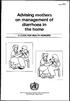 CDD193.1 ORIGINAL ENGUSH 1 Advising mothers on management of diarrhoea in the home A GUIDE FOR HEALTH WORKERS Diarrh~eal Disease Control (CDD) Programme World Health Organization CONTENTS PAGE Introduction
Frequency, definition Modifiability, existence of multiple operations & strategies
 Human Computer Interaction Intro HCI 1 HCI's Goal Users Improve Productivity computer users Tasks software engineers Users System Cognitive models of people as information processing systems Knowledge
Unplanned Pregnancy: Why People Choose Each of the Options
 Unplanned Pregnancy: Why People Choose Each of the Options Discussing pregnancy options in the classroom can elicit a range of student responses, such as confusion, anger, fear, etc. This appendix is designed
Dyslexia and Co-occurring Specific Learning Difficulties Pamela Deponio, University of Edinburgh
 Dyslexia and Co-occurring Specific Learning Difficulties Pamela Deponio, University of Edinburgh Let s Read! Reading and Print Disabilities in Young People Tallinn, Estonia. August 7 9, 2012 Key message
It s All in the Brain!
 It s All in the Brain! Presented by: Mari Hubig, M.Ed. 0-3 Outreach Coordinator Educational Resource Center on Deafness What is the Brain? The brain is a muscle In order to grow and flourish, the brain
Case Study: Jane Dhillon. 2. Why do I think Jane has a non-verbal learning disability?
 Case Study: Jane Dhillon 1. Background information on Jane Dhillon 2. Why do I think Jane has a non-verbal learning disability? Three issues in this course that relate to Jane: 3. Memory 4. Peer relationships
Asset 1.6 What are speech, language and communication needs?
 1 of 5 The National Strategies Asset 1.6 What are speech, language and needs? a) Summary of key points Taken from the Primary and Secondary Inclusion Development Programme (IDP): Dyslexia and speech, language
Grade 12 Psychology (40S) Outcomes Unedited Draft 1
 Grade 12 Psychology (40S) Outcomes Unedited Draft 1 Theme 1: Introduction and Research Methods Topic 1: Introduction 1.1.1 Define psychology, and list and explain its goals. 1.1.2 Describe and compare
Assessment, Recording and Reporting Policy. Introduction
 Assessment, Recording and Reporting Policy Introduction Assessment is essential for the promotion of effective learning and teaching. It enables the teacher to deliver an appropriate curriculum and provides
Reading and writing processes in a neurolinguistic perspective
 Reading and writing processes in a neurolinguistic perspective Contents The relation speech writing Reading and writing processes models Acquired disturbances of reading and writing Developmental disorders
Areas of Processing Deficit and Their Link to Areas of Academic Achievement
 Areas of Processing Deficit and Their Link to Areas of Academic Achievement Phonological Processing Model Wagner, R.K., Torgesen, J.K., & Rashotte, C.A. (1999). Comprehensive Test of Phonological Processing.
Brain Function, Spell Reading, and Sweep-Sweep-Spell by Abigail Marshall, March 2005
 Brain Function, Spell Reading, and Sweep-Sweep-Spell by Abigail Marshall, March 2005 This is not phonics or a phonetic process; it is simply letter and word recognition. Ronald D. Davis T wo of the most
Common Educational Tests used for Assessments for Special Education
 Cognition/Intelligence Ability to reason, to think abstractly, and to solve problems. Wechsler tests: WISC-III, WAIS-R, WPPSI-R Stanford-Binet: Fourth Edition Differential Ability Scales (DAS) Verbal Intelligence
Accommodating Students with LDs in Postsecondary Studies
 Accommodating Students with LDs in Postsecondary Studies June 2012 Students with learning disabilities (LDs) form the majority of students seeking services from offices for students with disabilities at
AppliTrack: Tips for Successful Essays. Spring 2013
 AppliTrack: Tips for Successful Essays Spring 2013 2 ONLINE APPLICATIONS: KEYS TO SUCCESS Note: School districts and ROE consortia are now requiring essay questions as a part of the online application
Comprehensive Reading Assessment Grades K-1
 Comprehensive Reading Assessment Grades K-1 User Information Name: Doe, John Date of Birth: Jan 01, 1995 Current Grade in School: 3rd Grade in School at Evaluation: 1st Evaluation Date: May 17, 2006 Background
Concept for the children s day-care facility Cologne Bumblebees e.v. International Bilingual Kindergarden
 Concept for the children s day-care facility Cologne Bumblebees e.v. International Bilingual Kindergarden 1. An English/German children s day-care facility for Cologne Against the background of an increasing
DR. PAT MOSSMAN Tutoring
 DR. PAT MOSSMAN Tutoring INDIVIDUAL INSTRuction Reading Writing Math Language Development Tsawwassen and ladner pat.moss10.com - 236.993.5943 [email protected] Testing in each academic subject is
Al Ahliyya Amman University Faculty of Arts Department of Psychology Course Description Psychology
 Al Ahliyya Amman University Faculty of Arts Department of Psychology Course Description Psychology 0731111 Psychology And Life {3}[3-3] Defining humans behavior; Essential life skills: problem solving,
What is Adult Developmental Co-ordination Disorder (DCD)?
 Assessment Service What is Adult Developmental Co-ordination Disorder (DCD)? What is Developmental Co-ordination Disorder (DCD) in adults? DCD is a label that is often used as an umbrella term for children
D: Communication and Interpersonal Skills
 D: Communication and Interpersonal Skills Alberta Licensed Practical Nurses Competency Profile 39 Priority: One Competency: D-1 Effective Communication D-1-1 D-1-2 D-1-3 D-1-4 D-1-5 Demonstrate ability
The purpose of this presentation is: To define deafblindness and discuss the impact of combined vision and hearing loss on learning, communication,
 The purpose of this presentation is: To define deafblindness and discuss the impact of combined vision and hearing loss on learning, communication, and overall development To describe the role of interveners
ADHD and Math Disabilities: Cognitive Similarities and Instructional Interventions
 ADHD and Math Disabilities: Cognitive Similarities and Instructional Interventions By Amy Platt ABSTRACT: Studies indicate that between 4-7% of the school age population experiences some form of math difficulty
KS3 Computing Group 1 Programme of Study 2015 2016 2 hours per week
 1 07/09/15 2 14/09/15 3 21/09/15 4 28/09/15 Communication and Networks esafety Obtains content from the World Wide Web using a web browser. Understands the importance of communicating safely and respectfully
COMPUTER SUPPORT STAFF TIPS FOR DISABILITY ETIQUETTE
 COMPUTER SUPPORT STAFF TIPS FOR DISABILITY ETIQUETTE COMPUTER SUPPORT STAFF TIPS FOR DISABILITY ETIQUETTE Norman Coombs, CEO EASI EASI: Equal Access to Software and Information 2011 (this document may
What are psychometric tests?
 508 U2 AOS2: Intelligence and personality Figure 18.1 A school psychologist gives a student a Wechsler Intelligence Scale test. This tests cognitive abilities in children and adults. What are psychometric
Interpretive Report of WAIS IV Testing. Test Administered WAIS-IV (9/1/2008) Age at Testing 40 years 8 months Retest? No
 Interpretive Report of WAIS IV Testing Examinee and Testing Information Examinee Name Date of Report 9/4/2011 Examinee ID Years of Education 18 Date of Birth 12/7/1967 Home Language English Gender Female
Social Service Agencies. Programs for Schools & Music Therapy. Outreach
 Music Therapy Outreach Programs for Schools & Social Service Agencies Innovative and creative programs addressing the therapeutic needs of children, adolescents, and adults. Brooklyn-Queens Conservatory
St George Catholic College. SEN Information Report 2015-2016
 St George Catholic College SEN Information Report 2015-2016 The SEN Information Report complies with section 69(2) of the Children and Family Act 2014, regulations 51 and schedule 1 of the Special Needs
Special Educational Needs Policy
 Hayle Community School Special Educational Needs Policy Ref: SEND Code of Practice 0-25 years Contents: Page 1. Aims and Objectives 1 2. Definition of Special Educational Need 2 3. Responsible Persons
PARENT EDUCATION AND EARLY CHILDHOOD PROGRAMMES
 The Consultative Group on Early Childhood Care and Development PARENT EDUCATION AND EARLY CHILDHOOD PROGRAMMES Coordinators' Notebook No. 12, December 1992 by Cassie Landers Consultative Group for Early
Integrated Skills in English (ISE) Guide for Students ISE Foundation (A2) Reading & Writing Speaking & Listening
 Integrated Skills in English (ISE) Guide for Students ISE Foundation (A2) Reading & Writing Speaking & Listening Trinity College London www.trinitycollege.com Charity number 1014792 Patron HRH The Duke
Art Therapy. Understanding. as one of the various creative therapeutic approaches that can be used to provide emotional support to children
 Understanding Art Therapy as one of the various creative therapeutic approaches that can be used to provide emotional support to children Some other creative therapeutic approaches: Art Therapy, Play Therapy
APPENDIX A GLOSSARY OF TERMS AND ABBREVIATIONS
 APPENDIX A GLOSSARY OF TERMS AND ABBREVIATIONS GLOSSARY OF TERMS AND ABBREVIATIONS Special Education Terms/Legal Terms Annual Goals Educational performance to be achieved by a student within one year.
MICHIGAN TEST FOR TEACHER CERTIFICATION (MTTC) TEST OBJECTIVES FIELD 062: HEARING IMPAIRED
 MICHIGAN TEST FOR TEACHER CERTIFICATION (MTTC) TEST OBJECTIVES Subarea Human Development and Students with Special Educational Needs Hearing Impairments Assessment Program Development and Intervention
Myths and Facts About People with Disabilities
 Myths and Facts About People with Disabilities Myths are roadblocks that interfere with the ability of persons with disabilities to have equality in employment. These roadblocks usually result from a lack
Parents recording social workers - A guidance note for parents and professionals
 Parents recording social workers - A guidance note for parents and professionals The Transparency Project December 2015 www.transparencyproject.org.uk [email protected] (Charity Registration
AMI MONTESSORI DIPLOMA ELEMENTARY 6-12
 AMI MONTESSORI DIPLOMA ELEMENTARY 6-12 Course Brochure AMI LEGACY CAPACITY OUTREACH Course Description: Delivery: Prerequisites: The study of Montessori pedagogy and child development as well as an interdisciplinary
Schools must maintain up-to-date information on any student who has a medical condition that may require emergency care at school.
 POLICY NO. 5140 MEDICAL ALERT AND ADMINISTERING MEDICATION TO STUDENTS POLICY Schools must maintain up-to-date information on any student who has a medical condition that may require emergency care at
Health Care Practitioners and The Education (Additional Support for Learning) (Scotland) Act 2004
 Enquire THE SCOTTISH ADVICE SERVICE FOR ADDITIONAL SUPPORT FOR LEARNING What s my role? Health Care Practitioners and The Education (Additional Support for Learning) (Scotland) Act 2004 The following information