
Unit 3. Effective Communication in Health and Social Care. Learning aims
|
|
|
- Curtis Wood
- 9 years ago
- Views:
Transcription
1 Unit 3 Effective Communication in Health and Social Care Learning aims In this unit you will: investigate different forms of communication. investigate barriers to communication in health and social care. communicate effectively in health and social care _BTEC_HS_L2_Unit-3_56-77.indd 56
2 Assessment criteria P1 P2 Level 2 Pass Level 2 Merit Level 2 Distinction 2A.P1 Describe different forms of verbal and non-verbal communication. 2A.P2 Describe different forms of alternative communication for different needs, using examples from health and social care. 2B.P3 Describe the barriers to communication in health and social care and their effects on service users. Learning aim A: Investigate different forms of communication 2A.M1 Explain the advantages and disadvantages of different forms of communication used, with reference to a one-to-one and a group interaction. 2A.D1 Assess the effectiveness of different forms of communication for service users with different needs. Learning aim B: Investigate barriers to communication in health and social care 2B.P4 Using examples, explain ways in which barriers to communication may be overcome and the benefits to service users of overcoming these barriers. 2B.M2 Explain how measures have been implemented to overcome barriers to communication, with reference to a selected case. Learning aim C: Communicate effectively in health and social care 2B.D2 Evaluate the effectiveness of measures taken to remove barriers to communication, with reference to a selected case. P3 P4 P5 M1 2C.P5 Demonstrate communication skills through interactions in health and social care, describing their effects. 2C.M3 Select and demonstrate communication skills through interactions in health and social care, explaining their effectiveness. 2C.D3 Select and demonstrate communication skills through oneto-one and group interactions in health and social care, evaluating their effectiveness and making recommendations for improvement. M2 M3 D1 D2 D _BTEC_HS_L2_Unit-3_56-77.indd 57

3 Learning Aim A A.1 Effective communication UNIT 3 Effective Communication in Health and Social Care Communication is a two-way process, and the key elements needed are as follows: sender the person starting the communication message what the sender wishes to communicate medium the method of communication: verbal, written, signed, electronic, telephone, etc. receiver the person who receives the message and interprets it understanding the message has to be correctly interpreted by the receiver feedback the receiver needs to show the sender that he or she has received and understood the message. We sometimes describe the steps that need to be taken for communication to be effective as the communication cycle. Verbal communication This is the main form of communication between people; it uses the spoken word. Clear speech Speaking clearly is essential, particularly when working with service users who may have difficulties when receiving or giving messages. Speaking clearly allows instructions to be absorbed and understood and if hearing or learning difficulties are involved then some service users can lip-read or use body language to gain further understanding. Selection of appropriate language Communication needed Feedback given Message prepared Language can be classed as formal and informal and is used in various ways with different people. For example, making a complaint, having an interview or speaking to a teacher would require formal language, which contains the correct terminology. You may speak to someone by calling them Mr or Mrs. On the other hand, when arranging a night out with friends or chatting with your immediate family you may use shortened words, slang and relaxed terminology; for example, what you up to love? Message sent Message understood Figure 3.01 The communication cycle Message received Message interpreted _BTEC_HS_L2_Unit-3_56-77.indd 58

4 Age-appropriate language This means using language that can be understood by the person you are communicating with. Talking to a group of reception children about how and why they should clean their teeth would not be valuable if medical terminology and long sentences were used; they would understand the concept better if shorter words and pictures were used. P1 Non-discriminatory use of language Conversation topics such as jokes can be a source of misunderstanding and tension. Humour differs between people and between cultures, and what might be funny to one person might not necessarily be funny to someone else. Jokes about religion, for example, might not be unusual but can be offensive to a person with strong religious beliefs. Pace, tone and pitch To communicate effectively, you also need to pay careful attention to the way you speak. Tone of voice can convey different feelings. It is possible to say the same words in a different tone or pitch of voice, perhaps with a slight emphasis on some words rather than others, and yet convey a different meaning. Also don t rush, as information can be lost if you speak too quickly, especially if the person is hard of hearing, or has a language other than English as a first language, or if you are speaking to a child. In most cases, you will speak more slowly to ensure these people can understand you they all have different barriers to communication. Active listening skills Active listening is about being involved, really listening and asking questions. If someone is leaning away from the other person, gazing around or looking bored, he or she is not listening. Active listeners check out what they have heard. They may ask a question to clarify a point or may nod to give encouragement to the speaker. Key terms Active listening skills: Showing that you are listening and using words to encourage the conversation. M1 D _BTEC_HS_L2_Unit-3_56-77.indd 59

5 Non-verbal communication Posture Posture is a part of body language and gives an indication of whether the person with you is interested, ill or cannot hear you. Individuals who are in a slouched position with their head in their hands can give us many signals as to their feelings. Facial expressions Facial expressions tell us what people are thinking even when they do not realise it. Sometimes what we say is contradicted by what our body language is saying; body language does not lie and gives a true reflection of what we are thinking and many people feel this instinctively. UNIT 3 Effective Communication in Health and Social Care Eye contact Eye contact is essential when communicating as it lets the receiver know you are listening, showing an interest and understanding messages. Lack of eye contact could mean the receiver is not hearing you, so you may need to consider technologies to help with this. Appropriate use of touch and personal space Touch or contact can be very comforting, but you must be careful to use touch respectfully and appropriately. For example, a person may be clearly upset and you might feel like giving the individual a comforting hug as you would with a friend or relation. However, you may not know this person well and you may be breaching personal boundaries if you were to do this in which case, the individual would be embarrassed and possibly offended. Sometimes touch can be misunderstood, especially if someone is from a different culture. In some cultures, men and women do not touch, even to shake hands. Always ask first what service users would like you to do and tell them how you will need to touch them before you do so. Gestures Gestures are signals used with our body to convey messages. Gestures can be seen a lot when heated discussions are taking place and the message is important. Some gestures such as hand signals are universally recognised, for example okay (when the finger and thumb form a circle). Different gestures can be offensive from culture to culture and not all gestures are universally recognised. Key terms Gestures: These can include movement of the hands, face and body and can convey feelings of approval, hostility and dejection _BTEC_HS_L2_Unit-3_56-77.indd 60

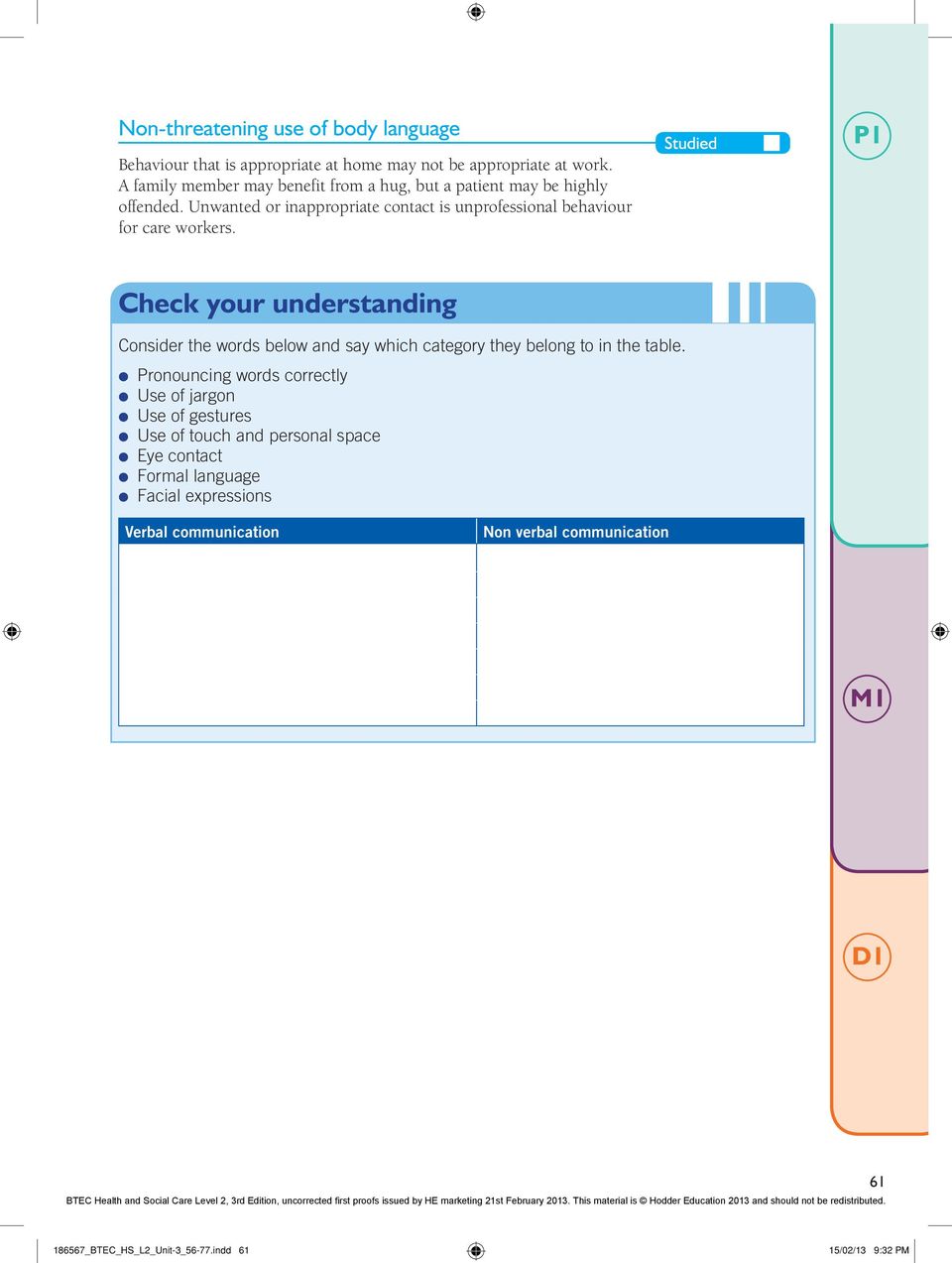
6 Non-threatening use of body language Behaviour that is appropriate at home may not be appropriate at work. A family member may benefit from a hug, but a patient may be highly offended. Unwanted or inappropriate contact is unprofessional behaviour for care workers. P1 Check your understanding Consider the words below and say which category they belong to in the table. Pronouncing words correctly Use of jargon Use of gestures Use of touch and personal space Eye contact Formal language Facial expressions Verbal communication Non verbal communication M1 D _BTEC_HS_L2_Unit-3_56-77.indd 61
7 A.2 Alternative forms of communication Various forms of alternative communication are used for people with differing needs; for example: the visually impaired the hearing impaired people with learning disabilities. UNIT 3 Effective Communication in Health and Social Care Table 3.01 Alternative forms of communication Alternative form of communication Braille and Braille software British Sign Language Fingerspelling Text messaging Interpreter Translation Objects of reference Explanation of uses Braille is a writing system which enables blind and partially sighted people to read and write through touch. It was invented by Louis Braille ( ), who was blind and became a teacher of the blind. It consists of patterns of raised dots arranged in cells of up to six dots in a 3 x 2 configuration. Each cell represents a letter, numeral or punctuation mark. Some frequently used words and letter combinations also have their own single cell patterns. British Sign Language is a method of non-verbal communication that uses movements of the hands, body, face and head, which make up a complete language system. It is the preferred first language of many deaf people and is used by hearing people to communicate with those who are deaf. Other deaf people rely on lip-reading to understand what is being said to them. People who use British Sign Language use fingerspelling. Signers spell out the word with their fingers for words that do not have a sign, for example names and places. Text messaging is the exchange of short written messages between mobile phones or other devices that may be fixed or portable. SMS means short message service. Some messages now can include pictures and photographs. Text messages can be used to interact with automated systems, for example when ordering products and services from mobile phones or participating in contests. This is a person who changes the verbal messages into either sign language or another language so that messages can be understood. This is changing written messages into a form that can be understood by those with sensory impairments or who use different languages, including Braille. Objects of reference are any objects that represent other things. Children may have a teddy bear or comfort blanket that represents home and safety. They will feel more secure if they have their blanket or favourite toy, especially if they are in a strange place, such as hospital. For a child, the smell of these familiar objects is associated with Mum and home _BTEC_HS_L2_Unit-3_56-77.indd 62

8 Communication passport Bliss symbols Makaton Technological aids Pictures Advocate Communication passports are a way of recording the important things about a child or adult, in a person-centered way, and of supporting an individual's transitions between services. A passport gives a clear focus for ongoing home/school liaison and partnership when working with families. Bliss symbols are a system of meaning-based symbols, which can be used by people with severe difficulties in speaking to communicate without speech. It is useful for people with cerebral palsy and other physical disabilities who may find reading and spelling difficult but who may still require a system of communication. Makaton is a language programme that uses signs and symbols and pictures to help people to communicate. It is designed to support spoken language and the signs and symbols are used with speech, in spoken word order. There are many aids that can be used to support individuals who have sensory impairments. For example, the Minicom which can be used for individuals who have a hearing disability, or voice typing for those who have a sight problem. Pictures can be used to represent messages. A system called Picture Exchange Communication System (PECS) is an alternative form of communication. It is used as an aid in communication for children with autism and other special needs. The system has been used with a variety of ages including pre-school children, adolescents and adults who have a wide array of communication problems. This is a nominated person who will act or speak on behalf of other individuals who may not be able to put forward their opinions. This individual may speak on behalf of someone who has a learning difficulty, sensory difficulty or who may not speak the required language. P _BTEC_HS_L2_Unit-3_56-77.indd 63

9 Check your understanding Alternative forms of communication Use the words in the list below to complete the sentences. Minicom Braille children settle vulnerable symbols advocate spoken touch translator Makaton UNIT 3 Effective Communication in Health and Social Care 1. is a writing system which enables blind and partially sighted people to read and write through. 2. An interpreter is someone who converts language into signs. 3. may have an object of reference like a toy to help them into nursery. 4. Bliss are a system of meaning-based symbols which can be used by people with severe difficulties in speaking. 5. is a language programme using signs and symbols to help people to communicate. 6. A changes the written word into other forms. 7. is a device used for those who have a hearing problem. 8. An is a person who will speak or act on behalf on a person. Key learning points Verbal communication This is sending messages to others using the spoken word; it can take place face to face or through the telephone or internet. Non-verbal communication This is sending messages to others without speaking, using body language and gestures. It can be used with service users who have sensory or learning difficulties. Braille An alternative form of communication used with individuals who have sight difficulties. It is an arrangement of raised dots on a page, which indicate letters, words and numbers _BTEC_HS_L2_Unit-3_56-77.indd 64

10 British Sign Language A nationally recognised set of signs used to communicate with individuals who have learning and hearing difficulties. Hand signals represent words and phrases to convey messages. P1 P2 Makaton An alternative form of communication used mainly with individuals who have learning difficulties; it is a set of signs and symbols to support speech. Assessment activity Posters Pass In small groups you are going to formulate three descriptive posters for your classroom. Each poster should include pictures, examples and descriptions relating to communication in healthcare settings. Poster 1 non-verbal communication Poster 2 verbal communication Poster 3 alternative forms of communication M1 D _BTEC_HS_L2_Unit-3_56-77.indd 65

11 Model assignment This assignment will assess the following learning aims:: A investigate different forms of communication B investigate barriers to communication in health and social care C communicate effectively in health and social care Scenario As a student in a residential care home you have been asked to produce an information booklet for new members of staff about Effective Communication. Section 1 UNIT 3 Effective Communication in Health and Social Care A description of different forms of verbal, non-verbal and alternative forms of communication which are used in your care setting. An explanation of the advantages and disadvantages of different forms of communication that are used, for example one-to-one and group interactions. An assessment of how useful different forms of communication are to the service users in the home, for example those with sight and hearing problems. Section 2 In the care home some barriers exist at present that are stopping effective communication; for example, for service users whose first language is not English and service users who have dementia. A description of the barriers which stop communication and their effects on the service users within the care home. Explain how these barriers can be overcome within the care home. Include examples of these barriers. An evaluation of how the removal of these barriers may benefit the service users at the care home _BTEC_HS_L2_Unit-3_56-77.indd 76

12 Practical demonstrations To further inform new members of staff about effective communication, you have been asked to set up a role play situation where the new members of staff will observe and comment on your communication skills. Role play 1 An elderly lady in your care setting who has hearing difficulties is looking forward to seeing her daughter on Sunday. Unfortunately, you take a telephone call from the daughter who says that she is unable to visit as her car has broken down. You have to role play the telephone conversation with the resident s daughter and delivery of the message to the elderly lady. This is sensitive information and both people are obviously upset. P1 P2 P3 P4 P5 Role play 2 Once you have delivered this information you need to continue the role play situation where you tell the rest of the staff about the incident in handover. Demonstrate how you feel you could have handled the situation better, or improved the way you interacted with each person. M1 M2 M3 D1 D2 D _BTEC_HS_L2_Unit-3_56-77.indd 77

MEDICAL ASSISTANT : COMMUNICATION WITH PATIENTS.
 MEDICAL ASSISTANT : COMMUNICATION WITH PATIENTS. The most important abilities of a CMA are: the ability to Communicate effectively, with professionalism and diplomacy to all types of patients. Recognize
Communication in health and social care
 1 Communication in health and social care Unit outline Care workers require effective communication skills in order to work with the diverse range of people they meet in health and social care settings.
Your guide to. Communicating with people with a learning disability
 Your guide to Communicating with people with a learning disability About this guide This guide is designed to provide a brief introduction to communication, and the problems faced by someone with a learning
CDDH FACT SHEET. Working with people with intellectual disabilities in healthcare settings
 CDDH FACT SHEET Working with people with intellectual disabilities in healthcare settings People with intellectual disabilities have the same right as other community members to access community based
Tip Cards. Language and communication support. People with a learning disability. People with a sensory impairment. Guiding people and assistance dogs
 Tip Cards Dundee Equality and Diversity Partnership Language and communication support People from minority ethnic communities People with a learning disability People with a sensory impairment Guiding
Interpreting and Translating
 This document is uncontrolled once printed. Please refer to the Trusts Intranet site for the most up to date version Interpreting and Translating NGH-GU-290 Ratified By: Procedural Document Group Date
Communication Skills. Breege Smithers Practice Educator
 Communication Skills Breege Smithers Practice Educator Aim of Session To develop an understanding of the processes and skills that are involved in effective communication with patients and clients. Objectives
Communication in health and social care
 Credit value: 5 1 Communication in health and social care Health and social care professionals need good communication skills to develop positive relationships and share information with people using services.
Helping your child with Non-verbal Learning Disability
 Helping your child with Non-verbal Learning Disability What is non-verbal learning disability? Non-verbal learning disability (NVLD) is a term used to describe a pattern of strengths and weaknesses in
Language Development and Deaf Children
 Language Development and Deaf Children What is the difference between speech and language? Language is the words, structures, thoughts and concepts we have in our minds. Speech is one way in which we communicate
EARLY INTERVENTION: COMMUNICATION AND LANGUAGE SERVICES FOR FAMILIES OF DEAF AND HARD-OF-HEARING CHILDREN
 EARLY INTERVENTION: COMMUNICATION AND LANGUAGE SERVICES FOR FAMILIES OF DEAF AND HARD-OF-HEARING CHILDREN Our child has a hearing loss. What happens next? What is early intervention? What can we do to
OUR PLACE SCHOOLS The Orchard, Bransford, Worcester, WR6 5JE Tel: 01886 833378 Email. [email protected]
 OUR PLACE SCHOOLS The Orchard, Bransford, Worcester, WR6 5JE Tel: 01886 833378 Email. [email protected] www.ourplaceschools.com Total Communications Policy Total Communications Policy A Total Communication
How To Communicate Effectively
 A WorkLife4You Guide Communication Skills for Healthy Relationships Communication is vital in creating and maintaining a relationship, whether it be an intimate relationship such as with a partner, child,
BUSINESS COMMUNICATIONS Curriculum Content Frameworks
 BUSINESS COMMUNICATIONS Curriculum Content Frameworks Please note: All assessment questions will be taken from the knowledge portion of these frameworks. Prepared by Pattie Lovins, Rivercrest High School
Chapter 4 COMMUNICATION SKILLS. The difference between verbal and nonverbal communication. The difference between hearing and listening
 Chapter 4 COMMUNICATION SKILLS What You Will Learn The difference between verbal and nonverbal communication The difference between hearing and listening Factors that promote effective communication Barriers
Talking Disability. It s important to look past the disability and treat me as a real person. Communicating with people with a disability
 It s important to look past the disability and treat me as a real person. Communicating with people with a disability This communication booklet has been developed in recognition of the fact that how we
Tip cards. Language and communication support. People with a learning disability. People with a sensory impairment. Guiding people and assistance dogs
 Tip cards Language and communication support People with a learning disability People with a sensory impairment Guiding people and assistance dogs People with a mental health problem Asking service users
Interpreting and Translation Policy
 Interpreting and Translation Policy Exec Director lead Author/ lead Feedback on implementation to Karen Tomlinson Liz Johnson Tina Ball Date of draft February 2009 Consultation period February April 2009
Quick guide to autism
 Quick guide to autism What it looks like and how you can help What is autism spectrum disorder (ASD)? ASD is a lifelong neurodevelopmental disorder We don t know what causes ASD but we do know genetics
Verbal Communication II
 Verbal Communication II Course Health Science Unit II Communication Essential Question How does the communication process affect health care delivery? TEKS 130.204 (c) 2A, 2B, 3B, 3C Prior Student Learning
HEALTH AND SOCIAL CARE
 Cambridge TECHNICALS OCR LEVEL 3 CAMBRIDGE TECHNICAL CERTIFICATE/DIPLOMA IN HEALTH AND SOCIAL CARE DEVELOPING EFFECTIVE COMMUNICATION IN HEALTH AND SOCIAL CARE R/600/8939 LEVEL 3 UNIT 1 GUIDED LEARNING
Baby Signing. Babies are born with an inherent body language that is common to all cultures.
 Baby Signing Babies are born with an inherent body language that is common to all cultures. Long before the emergence of speech, babies spontaneously communicate with their parents using gestures and sounds
About POhWER NHS Complaints Advocacy. This guide will tell you what to expect if you decide to work with POhWER to make a complaint about the NHS
 About POhWER NHS Complaints Advocacy This guide will tell you what to expect if you decide to work with POhWER to make a complaint about the NHS About POhWER NHS Complaints Advocacy Your Right to Complaints
Disability Etiquette
 Disability Etiquette Fear of the unknown and lack of knowledge about how to act can lead to uneasiness when meeting a person who has a disability. Remember: a person with a disability is a person with
EFFECTIVE COMMUNICATION 7-1 EFFECTIVE COMMUNICATION
 EFFECTIVE COMMUNICATION 7-1 EFFECTIVE COMMUNICATION OBJECTIVES To successfully complete this assignment, you must study the text and master the following objectives: Identify the parts of Shannon s communications
Types of communication
 Types of communication Intra-personal Communication Intra-personal Communication is the kind of communication that occurs within us. It involves thoughts, feelings, and the way we look at ourselves. Because
Working with an Interpreter Online Education. Children s Hospital of Wisconsin
 Working with an Interpreter Online Education Children s Hospital of Wisconsin This presentation will help you Understand the role of an interpreter Work effectively with an interpreter Access interpreter
Communicating with People with Disabilities
 Communicating with People with Disabilities 2005 Acknowledgments This publication is based on a booklet developed as part of the RuralAccess 2000. Contributors Special Thanks goes to the following individuals
How To Teach A Counselor To Be A Successful Counselor
 Counseling Microskills Microskills are the basic foundational skills involved in effective helping relationships. They are the foundational tools on which the success of interventions with clients may
Information Sheet 1 Autism and Asperger Syndrome
 Information Sheet 1 Autism and Asperger Syndrome In producing this information we recognise that there are a number of terms that different individuals and groups prefer to use, including autism spectrum
Disability Information Cards
 Disability Information Cards Information cards providing brief descriptions of a number of common disabilities, the implications of those disabilities, inclusion tips and direction to websites providing
Barriers to Communication
 Barriers to Communication There are many potential barriers to communication that must be recognized by those involved especially those in supervisory positions. Possible Barriers: 1. Symbols or words
Customer Service Training
 W A S H I N G T O N S T A T E D E P A R T M E N T O F H E A L T H W I C P R O G R A M Customer Service Training - 1 - This institution is an equal opportunity provider. Washington WIC Nutrition Program
HLTEN502B Apply effective communication skills in nursing practice
 HLTEN502B Apply effective communication skills in nursing practice Release: 1 HLTEN502B Apply effective communication skills in nursing practice Modification History Not Applicable Unit Descriptor Descriptor
GUIDE TO PATIENT COUNSELLING
 Guide To Patient Counselling page - 1 - GUIDE TO PATIENT COUNSELLING Communication is the transfer of information meaningful to those involved. It is the process in which messages are generated and sent
Principles of Inclusive Communication. An information and self-assessment tool for public authorities
 Principles of Inclusive Communication An information and self-assessment tool for public authorities Principles of Inclusive Communication An information and self-assessment tool for public authorities
!"#$%&##'()$*"&))& ''''+!,'-%)&./&0$1)&'+21.0
 INTERNATIONAL BUSINESS SKILLS COURSEWARE '!"#$%&##'()$*"&))& ''''+!,'-%)&./&0$1)&'+21.0!""#$%&'$%()*!++,"&-'&,.(,/(01+&.$++( 2#-"'&'&,.$#+ I hear and I Forget I see and I Remember I do and I Understand
COMMUNICATION ACCESS for people who have communication disabilities
 COMMUNICATION ACCESS for people who have communication disabilities Guidelines and Resources on Communicating with People who have Communication Disabilities Table of Contents The Right to Communicate...1
Developing Communication Skills in Learning for Life and Work
 Key Stage 3 Developing Communication Skills in Learning for Life and Work 1 Communication is central to the whole curriculum. Children should be able to communicate in order to express themselves socially,
Chapter 1 Communicating in Your Life
 Name: Class: Date: Chapter 1 Communicating in Your Life True/False Indicate whether the sentence or statement is true or false. 1. The communication process has five components: the sender, the message,
Chapter 4: Eligibility Categories
 23 Chapter 4: Eligibility Categories In this chapter you will: learn the different special education categories 24 IDEA lists different disability categories under which children may be eligible for services.
Technology in Music Therapy and Special Education. What is Special Education?
 Technology in Music Therapy and Special Education What is Special Education? Disabilities are categorized into the following areas: o Autism, visual impairment, hearing impairment, deaf- blindness, multiple
Dr. Astrid Kopp-Duller (1985)
 A dyslexic person, of good or average intelligence, perceives his environment in a different way, his attention diminishes when confronted with symbols such as letters and numbers. Due to a deficiency
VAK Learning Styles Self-Assessment Questionnaire
 Student Services Study Skills Student Development and Counselling VAK Learning Styles Self-Assessment Questionnaire Circle or tick the answer that most represents how you generally behave. (It s best to
For parents and carers of children with autism
 For parents and carers of children with autism The NSPCC helps parents and carers talk to their children about staying safe. It s part of our work to prevent abuse from happening to any child. And it
Please note this bulletin replaces Equality Bulletin 34.
 Equality Unit Equality bulletin number 40 Updated Guidelines for Using Interpretation & Translation Services for People Needing Language Support and Alternative Formats for People with Disabilities Introduction
Communicating Effectively with Aboriginal and Torres Strait Islander people
 Communicating Effectively with Aboriginal and Torres Strait Islander people The information provided below is a guide to understanding and applying appropriate communication techniques when working with
ITEC Level 3. Unit 821 - Client Care and Communication in Beauty Related Industries. Recommended minimum guided learning hours 28
 ITEC Level 3 Unit 821 - Client Care and Communication in Beauty Related Industries Recommended minimum guided learning hours 28 QCA Qualification Accreditation Number: T/601/4457 Learning outcome Learners
Information about speech, language and communication needs
 Information about speech, language and communication needs About this resource This information resource tells you all about speech, language and communication needs (SLCN). It has lots of information
Lipreading. Writing. 1 Gallaudet University http://careercenter.gallaudet.edu/index.asp?id=4664
 Workshop Handout Communication Modes Every deaf person is different and will possess different skills and limitations in communicating with hearing people. Deaf people will usually either speak and lipread,
Developing Effective Communication in Health and Social Care
 Unit 1: Developing Effective Communication in Health and Social Care Unit code: QCF Level 3: Credit value: 10 Guided learning hours: 60 Aim and purpose R/600/8939 BTEC Nationals This unit aims to enable
MODULE 1: Introduction
 MODULE 1: Introduction Materials Flipchart, display material, pens Icebreaker Welcome everyone to the first session. Explain how long the training programme will run and how long each session will run
INSPIRING POSSIBILITIES
 INSPIRING POSSIBILITIES Skills for Independent Living: Parents Help Build Social Skills Many youth with disabilities have difficulty understanding social situations or navigating interpersonal events such
HOW CAN I IMPROVE MY PUBLIC SPEAKING SKILLS? (To be used in conjunction with the assessment developed for Standard 4B.J and 5C.J)
 (To be used in conjunction with the assessment developed for Standard 4B.J and 5C.J) Performance Standard 4A.J Each student will listen to a three to five minute speech given by another student and will
The USPI Physician and Care Provider s Guide to Effective Communication
 The USPI Physician and Care Provider s Guide to Effective Communication KNOW HOW PATIENTS WILL EVALUATE PROVIDER SKILLS The Clinician and Group CAHPS - Consumer Assessment of Healthcare Providers and Systems
BUSINESS OCR LEVEL 2 CAMBRIDGE TECHNICAL. Cambridge TECHNICALS VERBAL AND NON-VERBAL COMMUNICATION IN BUSINESS CONTEXTS CERTIFICATE/DIPLOMA IN
 Cambridge TECHNICALS OCR LEVEL 2 CAMBRIDGE TECHNICAL CERTIFICATE/DIPLOMA IN BUSINESS VERBAL AND NON-VERBAL COMMUNICATION IN BUSINESS CONTEXTS M/502/5303 LEVEL 2 UNIT 6 GUIDED LEARNING HOURS: 30 UNIT CREDIT
THERAPEUTIC COMMUNICATION & PATIENT TEACHING. The medical office... The Medical Assistant s role...
 THERAPEUTIC COMMUNICATION & PATIENT TEACHING The medical office... is a strange environment may cause hesitancy & fearfulness: new procedures medical jargon may be overwhelming may create guarded behaviors:
Student Centred Appraisal of Need
 Student Centred Appraisal of Need Booklet for parents, carers and staff January 2010 INTRODUCTION The Student Centred Appraisal of Need provides a consistent approach in determining educational needs of
Cerebral Palsy and Visual Impairment
 CP Factsheet Cerebral Palsy and Visual Impairment Although cerebral palsy mainly causes difficulty with movement, other conditions may also occur. This is because other parts of the brain may also be affected
Growing Up With Epilepsy
 Teaching Students with Epilepsy: Children with epilepsy often experience learning issues as a result of their seizures. These may include ongoing problems with motor skills or cognitive functions, as well
1.02 Understand effective communication
 1.02 Understand effective communication Journal Prompt #1 How do you communicate? Do you like to talk? Are you a good listener? What makes you a good listener? Why do healthcare professionals have to have
OHIO EXPOSITIONS COMMISSION CUSTOMER SERVICE GUIDELINES
 OHIO EXPOSITIONS COMMISSION CUSTOMER SERVICE GUIDELINES The Ohio Expositions Commission (OEC) is committed to providing the best possible service to customers both internal and external. In support of
A college degree is not a sign that one is a finished product but an indication a person is prepared for life.
 NACADA presents Significant Conversations: The Art and Science of Communication in Transformational Advising November 6, 2008 José F. Rodríguez Florida International University [email protected] A college
OCR Levels 2 and 3 in Supporting Teaching and Learning in Schools. Unit 39 Support pupils with communication and interaction needs
 OCR Levels 2 and 3 in Supporting Teaching and Learning in Schools Unit 39 Support pupils with communication and interaction needs UNIT SUMMARY Who is this unit for? This unit is for those who provide support
Accessible Customer Service. Guide. Providing Services to People with Disabilities
 Accessible Customer Service Guide Providing Services to People with Disabilities January 1, 2012 As required by law under Section 6 of the Accessibility for Ontarians with Disabilities Act, Accessible
Why Listening Is So Important
 Why Listening Is So Important There is a saying about listening that eloquently summarizes the nature of the process. The source of the words is unknown, but the message is universal God gave us two ears,
Understanding late stage dementia Understanding dementia
 Understanding late stage dementia About this factsheet This factsheet is for relatives of people diagnosed with dementia. It provides information about what to expect as dementia progresses to late stage.
To persons completing this application:
 To persons completing this application: Thank you for your interest in the Toronto Rehabilitation Institute s Augmentative and Alternative Communication (AAC) Clinic. Who we see: Our mandate is to help
Strategies for Inclusion of Children with Multiple Disabilities, including Deaf-Blindness. Barbara Purvis
 TECHNICAL ASSISTANCE C INFORMATION PERSONNEL TRAINING National Consortium on Deaf-Blindness [email protected] Strategies for Inclusion of Children with Multiple Disabilities, including Deaf-Blindness
Interpreting and translation services
 Interpreting and translation services Guidelines (2015) Promoting effective communication between schools, parents and communities NSW DEPARTMENT OF EDUCATION WWW.SCHOOLS.NSW.EDU.AU Contents Interpreting
3030. Eligibility Criteria.
 3030. Eligibility Criteria. 5 CA ADC 3030BARCLAYS OFFICIAL CALIFORNIA CODE OF REGULATIONS Barclays Official California Code of Regulations Currentness Title 5. Education Division 1. California Department
This unit is aimed at those who are interested in, or new to, working in social care settings with adults.
 Unit Title: Principles of communication in adult social care settings Unit sector reference: PWCS 31 Level: 3 Credit value: 2 Guided learning hours: 17 Unit expiry date: 31/07/2015 Unit accreditation number:
Soft Skills Module 5. Effective Communication: Listening, Speaking, Writing, Interpreting
 Soft Skills Module 5 Effective Communication: Listening, Speaking, Writing, Interpreting Soft Skills Module 5 Effective Communication: Listening, Speaking, Writing, Interpreting Summary Goal: Equip students
3. A variety of materials are available so that children of all skill levels have something to play with.
 The Incredible Years BEST PRACTICES INVENTORY-R* DATE / / CLASSROOM ARRANGEMENT 1. The classroom has clearly defined and well-equipped learning centers. The number of children allowed in a center is limited
March 10, 2015 CONFERENCE CALL DOCUMENTATION FOR C.N.A.s Presented by Dwana Jackson, CNA, AIPP Quality Specialist
 March 10, 2015 CONFERENCE CALL DOCUMENTATION FOR C.N.A.s Presented by Dwana Jackson, CNA, AIPP Quality Specialist Good morning everyone and welcome to today s conference call, our topic today is documentation
My Child Has Selective Mutism, What Do I Do Now?
 My Child Has Selective Mutism, What Do I Do Now? Written by Christine Stanley and Teresa Cardulla Evaluate your child. Once you suspect selective mutism (SM), you should confirm that diagnosis. In doing
DEAFNESS AND HARD OF HEARING
 DEAFNESS AND HARD OF HEARING Rarely is a person completely deaf, and a hearing loss could fall anywhere along the continuum from totally deaf to partial hearing. The amount of usable (or residual) hearing
The Context of Special Needs in Ireland
 chapter one The Context of Special Needs in Ireland chapter outline Definitions of special need Models of disability History of special needs service provision in Ireland This book is aimed primarily at
Industry Guidelines on Captioning Television Programs 1 Introduction
 Industry Guidelines on Captioning Television Programs 1 Introduction These guidelines address the quality of closed captions on television programs by setting a benchmark for best practice. The guideline
Advice for Class Teachers. Moderating pupils reading at P 4 NC Level 1
 Advice for Class Teachers Moderating pupils reading at P 4 NC Level 1 Exemplars of writing at P Scales and into National Curriculum levels. The purpose of this document is to provide guidance for class
The purpose of this presentation is: To define deafblindness and discuss the impact of combined vision and hearing loss on learning, communication,
 The purpose of this presentation is: To define deafblindness and discuss the impact of combined vision and hearing loss on learning, communication, and overall development To describe the role of interveners
Link: University of Canberra http://www.canberra.edu.au/studyskills/learning/oralpres.html#preparing
 6. Voice, speech and body language: The way you speak, the way you act and the way you move around can be very important to succeed in your presentation. Here you will find some useful advices and links
COMMUNICATION IN PALLIATIVE
 COMMUNICATION IN PALLIATIVE CARE Objectives Describe the concepts and components of communication in palliative care Describe the types of communication Describe the barriers to communication Discuss the
TOOLS for DEVELOPING Communication PLANS
 TOOLS for DEVELOPING Communication PLANS Students with disabilities, like all students, must have the opportunity to fully participate in all aspects of their education. Being able to effectively communicate
communication Tips for successful communication at all stages of Alzheimer's disease
 communication Tips for successful communication at all stages of Alzheimer's disease Communication and dementia As the disease progresses, the communication skills of a person with Alzheimer's disease
Guidance on assessing the attainment of young children with Special Educational Needs in the Early Years Foundation Stage (EYFS).
 Guidance on assessing the attainment of young children with Special Educational Needs in the Early Years Foundation Stage (EYFS). Meeting the individual needs of all children lies at the heart of the EYFS
Maryland 4-H Public Speaking Guide
 Maryland 4-H Public Speaking Guide Do you have questions? Contact Tom Hutson, 4-H Educator University of Maryland Extension Talbot County (410) 822-1244 or [email protected] Equal access/opportunity programs
Strengthening Integrated Education Programs for Blind and Visually Impaired Children in Bangladesh
 WA 092 Strengthening Integrated Education Programs for Blind and Visually Impaired Children in Bangladesh Manju Samaddar Principal Baptist Sangha School for Blind Girls 77, Senpara Parbata, Mirpur 10 Dhaka
Practice Test for Special Education EC-12
 Practice Test for Special Education EC-12 1. The Individualized Educational Program (IEP) includes: A. Written evaluation B. Assessment tests C. Interviews 2. Learning disabilities include: A. Cerebral
When students do not meet your behavioral expectations but are not exactly breaking the rules and may not deserve an official consequence.
 E-4 Diversify responses to various degrees of misbehavior When you re in the middle of instruction, you may encounter an assortment of misbehavior that varies in degrees of severity and warrants different