
IAEA Safety Standards. Safety Assessment for Facilities and Activities
|
|
|
- Samson Barnett
- 10 years ago
- Views:
Transcription
1 IAEA Safety Standards for protecting people and the environment Safety Assessment for Facilities and Activities General Safety Requirements Part 4 No. GSR Part 4

2 SAFETY ASSESSMENT FOR FACILITIES AND ACTIVITIES Safety standards survey The IAEA welcomes your response. Please see:

3 The following States are Members of the International Atomic Energy Agency: AFGHANISTAN ALBANIA ALGERIA ANGOLA ARGENTINA ARMENIA AUSTRALIA AUSTRIA AZERBAIJAN BANGLADESH BELARUS BELGIUM BELIZE BENIN BOLIVIA BOSNIA AND HERZEGOVINA BOTSWANA BRAZIL BULGARIA BURKINA FASO CAMEROON CANADA CENTRAL AFRICAN REPUBLIC CHAD CHILE CHINA COLOMBIA COSTA RICA CÔTE D IVOIRE CROATIA CUBA CYPRUS CZECH REPUBLIC DEMOCRATIC REPUBLIC OF THE CONGO DENMARK DOMINICAN REPUBLIC ECUADOR EGYPT EL SALVADOR ERITREA ESTONIA ETHIOPIA FINLAND FRANCE GABON GEORGIA GERMANY GHANA GREECE GUATEMALA HAITI HOLY SEE HONDURAS HUNGARY ICELAND INDIA INDONESIA IRAN, ISLAMIC REPUBLIC OF IRAQ IRELAND ISRAEL ITALY JAMAICA JAPAN JORDAN KAZAKHSTAN KENYA KOREA, REPUBLIC OF KUWAIT KYRGYZSTAN LATVIA LEBANON LIBERIA LIBYAN ARAB JAMAHIRIYA LIECHTENSTEIN LITHUANIA LUXEMBOURG MADAGASCAR MALAWI MALAYSIA MALI MALTA MARSHALL ISLANDS MAURITANIA MAURITIUS MEXICO MONACO MONGOLIA MONTENEGRO MOROCCO MOZAMBIQUE MYANMAR NAMIBIA NEPAL NETHERLANDS NEW ZEALAND NICARAGUA NIGER NIGERIA NORWAY OMAN PAKISTAN PALAU PANAMA PARAGUAY PERU PHILIPPINES POLAND PORTUGAL QATAR REPUBLIC OF MOLDOVA ROMANIA RUSSIAN FEDERATION SAUDI ARABIA SENEGAL SERBIA SEYCHELLES SIERRA LEONE SINGAPORE SLOVAKIA SLOVENIA SOUTH AFRICA SPAIN SRI LANKA SUDAN SWEDEN SWITZERLAND SYRIAN ARAB REPUBLIC TAJIKISTAN THAILAND THE FORMER YUGOSLAV REPUBLIC OF MACEDONIA TUNISIA TURKEY UGANDA UKRAINE UNITED ARAB EMIRATES UNITED KINGDOM OF GREAT BRITAIN AND NORTHERN IRELAND UNITED REPUBLIC OF TANZANIA UNITED STATES OF AMERICA URUGUAY UZBEKISTAN VENEZUELA VIETNAM YEMEN ZAMBIA ZIMBABWE The Agency s Statute was approved on 23 October 1956 by the Conference on the Statute of the IAEA held at United Nations Headquarters, New York; it entered into force on 29 July The Headquarters of the Agency are situated in Vienna. Its principal objective is to accelerate and enlarge the contribution of atomic energy to peace, health and prosperity throughout the world.

4 IAEA SAFETY STANDARDS SERIES No. GSR Part 4 SAFETY ASSESSMENT FOR FACILITIES AND ACTIVITIES GENERAL SAFETY REQUIREMENTS This publication includes a CD-ROM containing the IAEA Safety Glossary: 2007 Edition (2007) and the Fundamental Safety Principles (2006), each in Arabic, Chinese, English, French, Russian and Spanish versions. The CD-ROM is also available for purchase separately. See: INTERNATIONAL ATOMIC ENERGY AGENCY VIENNA, 2009

5 COPYRIGHT NOTICE All IAEA scientific and technical publications are protected by the terms of the Universal Copyright Convention as adopted in 1952 (Berne) and as revised in 1972 (Paris). The copyright has since been extended by the World Intellectual Property Organization (Geneva) to include electronic and virtual intellectual property. Permission to use whole or parts of texts contained in IAEA publications in printed or electronic form must be obtained and is usually subject to royalty agreements. Proposals for non-commercial reproductions and translations are welcomed and considered on a case-by-case basis. Enquiries should be addressed to the IAEA Publishing Section at: Sales and Promotion, Publishing Section International Atomic Energy Agency Wagramer Strasse 5 P.O. Box Vienna, Austria fax: tel.: [email protected] IAEA, 2009 Printed by the IAEA in Austria May 2009 STI/PUB/1375 IAEA Library Cataloguing in Publication Data Safety assessment for facilities and activities : general safety requirements. Vienna : International Atomic Energy Agency, p. ; 24 cm. (IAEA safety standards series, ISSN X ; no. GSR part 4) STI/PUB/1375 ISBN Includes bibliographical references. 1. Nuclear power plants Safety measures. 2. Nuclear power plants Risk assessment. 3. Industrial safety. I. International Atomic Energy Agency. II. Series. IAEAL
6 FOREWORD by Mohamed ElBaradei Director General The IAEA s Statute authorizes the Agency to establish safety standards to protect health and minimize danger to life and property standards which the IAEA must use in its own operations, and which a State can apply by means of its regulatory provisions for nuclear and radiation safety. A comprehensive body of safety standards under regular review, together with the IAEA s assistance in their application, has become a key element in a global safety regime. In the mid-1990s, a major overhaul of the IAEA s safety standards programme was initiated, with a revised oversight committee structure and a systematic approach to updating the entire corpus of standards. The new standards that have resulted are of a high calibre and reflect best practices in Member States. With the assistance of the Commission on Safety Standards, the IAEA is working to promote the global acceptance and use of its safety standards. Safety standards are only effective, however, if they are properly applied in practice. The IAEA s safety services which range in scope from engineering safety, operational safety, and radiation, transport and waste safety to regulatory matters and safety culture in organizations assist Member States in applying the standards and appraise their effectiveness. These safety services enable valuable insights to be shared and I continue to urge all Member States to make use of them. Regulating nuclear and radiation safety is a national responsibility, and many Member States have decided to adopt the IAEA s safety standards for use in their national regulations. For the Contracting Parties to the various international safety conventions, IAEA standards provide a consistent, reliable means of ensuring the effective fulfilment of obligations under the conventions. The standards are also applied by designers, manufacturers and operators around the world to enhance nuclear and radiation safety in power generation, medicine, industry, agriculture, research and education. The IAEA takes seriously the enduring challenge for users and regulators everywhere: that of ensuring a high level of safety in the use of nuclear materials and radiation sources around the world. Their continuing utilization for the benefit of humankind must be managed in a safe manner, and the IAEA safety standards are designed to facilitate the achievement of that goal.

7 .

8 THE IAEA SAFETY STANDARDS BACKGROUND Radioactivity is a natural phenomenon and natural sources of radiation are features of the environment. Radiation and radioactive substances have many beneficial applications, ranging from power generation to uses in medicine, industry and agriculture. The radiation risks to workers and the public and to the environment that may arise from these applications have to be assessed and, if necessary, controlled. Activities such as the medical uses of radiation, the operation of nuclear installations, the production, transport and use of radioactive material, and the management of radioactive waste must therefore be subject to standards of safety. Regulating safety is a national responsibility. However, radiation risks may transcend national borders, and international cooperation serves to promote and enhance safety globally by exchanging experience and by improving capabilities to control hazards, to prevent accidents, to respond to emergencies and to mitigate any harmful consequences. States have an obligation of diligence and duty of care, and are expected to fulfil their national and international undertakings and obligations. International safety standards provide support for States in meeting their obligations under general principles of international law, such as those relating to environmental protection. International safety standards also promote and assure confidence in safety and facilitate international commerce and trade. A global nuclear safety regime is in place and is being continuously improved. IAEA safety standards, which support the implementation of binding international instruments and national safety infrastructures, are a cornerstone of this global regime. The IAEA safety standards constitute a useful tool for contracting parties to assess their performance under these international conventions. THE IAEA SAFETY STANDARDS The status of the IAEA safety standards derives from the IAEA s Statute, which authorizes the IAEA to establish or adopt, in consultation and, where appropriate, in collaboration with the competent organs of the United Nations and with the specialized agencies concerned, standards of safety for protection

9 of health and minimization of danger to life and property, and to provide for their application. With a view to ensuring the protection of people and the environment from harmful effects of ionizing radiation, the IAEA safety standards establish fundamental safety principles, requirements and measures to control the radiation exposure of people and the release of radioactive material to the environment, to restrict the likelihood of events that might lead to a loss of control over a nuclear reactor core, nuclear chain reaction, radioactive source or any other source of radiation, and to mitigate the consequences of such events if they were to occur. The standards apply to facilities and activities that give rise to radiation risks, including nuclear installations, the use of radiation and radioactive sources, the transport of radioactive material and the management of radioactive waste. Safety measures and security measures 1 have in common the aim of protecting human life and health and the environment. Safety measures and security measures must be designed and implemented in an integrated manner so that security measures do not compromise safety and safety measures do not compromise security. The IAEA safety standards reflect an international consensus on what constitutes a high level of safety for protecting people and the environment from harmful effects of ionizing radiation. They are issued in the IAEA Safety Standards Series, which has three categories (see Fig. 1). Safety Fundamentals Safety Fundamentals present the fundamental safety objective and principles of protection and safety, and provide the basis for the safety requirements. Safety Requirements An integrated and consistent set of Safety Requirements establishes the requirements that must be met to ensure the protection of people and the environment, both now and in the future. The requirements are governed by the objective and principles of the Safety Fundamentals. If the requirements are not met, measures must be taken to reach or restore the required level of safety. The format and style of the requirements facilitate their use for the establishment, in a harmonized manner, of a national regulatory framework. The safety requirements use shall statements together with statements of 1 See also publications issued in the IAEA Nuclear Security Series.
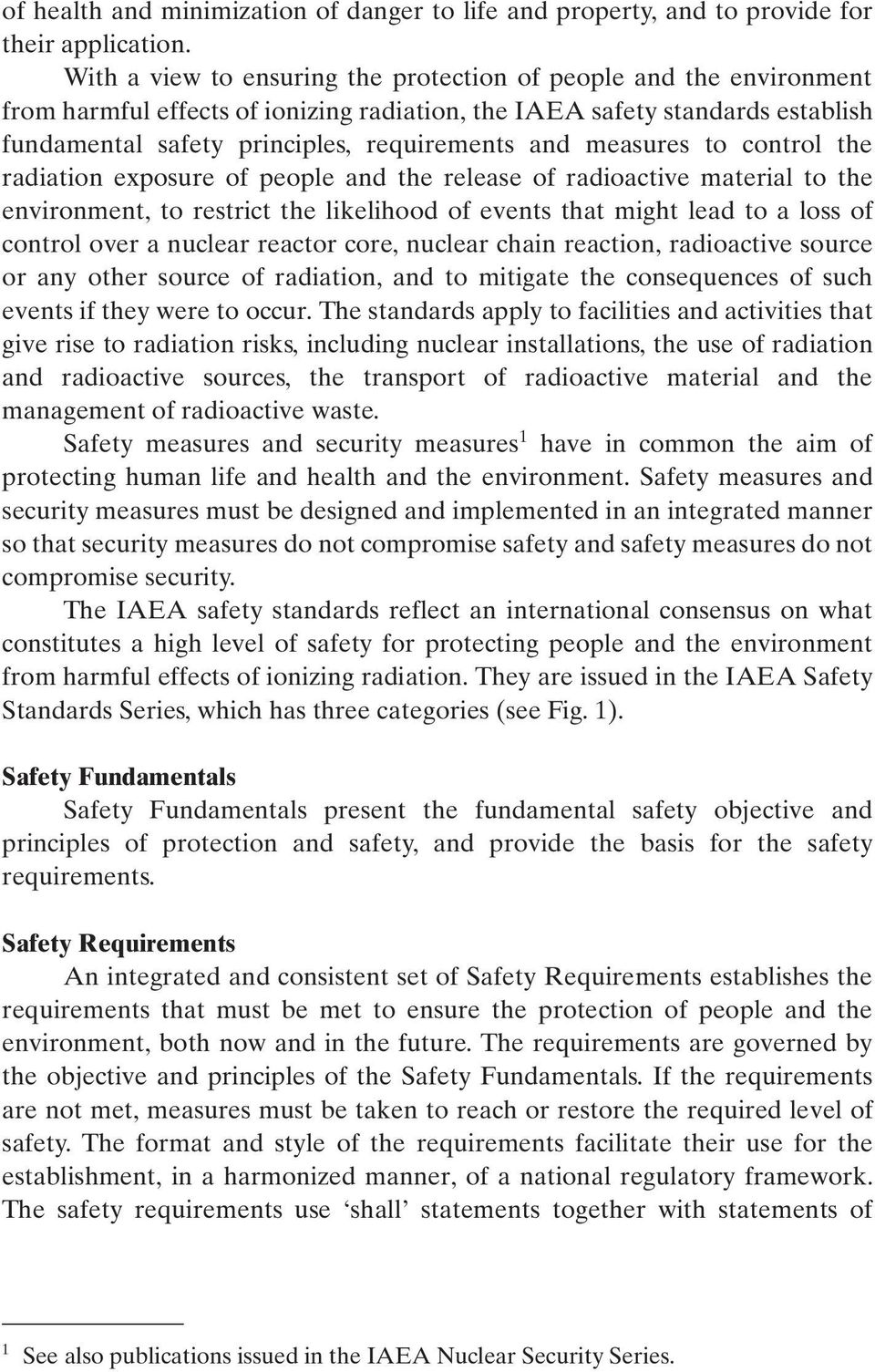
10 Safety Fundamentals Fundamental Safety Principles General Safety Requirements Part 1. Governmental, Legal and Regulatory Framework for Safety Part 2. Leadership and Management for Safety Part 3. Radiation Protection and the Safety of Radiation Sources Part 4. Safety Assessment for Facilities and Activities Part 5. Predisposal Management of Radioactive Waste Part 6. Decommissioning and Termination of Activities Part 7. Emergency Preparedness and Response Specific Safety Requirements 1. Site Evaluation for Nuclear Installations 2. Safety of Nuclear Power Plants 2.1. Design and Construction 2.2. Commissioning and Operation 3. Safety of Research Reactors 4. Safety of Nuclear Fuel Cycle Facilities 5. Safety of Radioactive Waste Disposal Facilities 6. Safe Transport of Radioactive Material Collection of Safety Guides FIG. 1. The long term structure of the IAEA Safety Standards Series. associated conditions to be met. Many requirements are not addressed to a specific party, the implication being that the appropriate parties are responsible for fulfilling them. Safety Guides Safety Guides provide recommendations and guidance on how to comply with the safety requirements, indicating an international consensus that it is necessary to take the measures recommended (or equivalent alternative measures). The Safety Guides present international good practices, and increasingly they reflect best practices, to help users striving to achieve high levels of safety. The recommendations provided in Safety Guides are expressed as should statements. APPLICATION OF THE IAEA SAFETY STANDARDS The principal users of safety standards in IAEA Member States are regulatory bodies and other relevant national authorities. The IAEA safety
11 standards are also used by co-sponsoring organizations and by many organizations that design, construct and operate nuclear facilities, as well as organizations involved in the use of radiation and radioactive sources. The IAEA safety standards are applicable, as relevant, throughout the entire lifetime of all facilities and activities existing and new utilized for peaceful purposes and to protective actions to reduce existing radiation risks. They can be used by States as a reference for their national regulations in respect of facilities and activities. The IAEA s Statute makes the safety standards binding on the IAEA in relation to its own operations and also on States in relation to IAEA assisted operations. The IAEA safety standards also form the basis for the IAEA s safety review services, and they are used by the IAEA in support of competence building, including the development of educational curricula and training courses. International conventions contain requirements similar to those in the IAEA safety standards and make them binding on contracting parties. The IAEA safety standards, supplemented by international conventions, industry standards and detailed national requirements, establish a consistent basis for protecting people and the environment. There will also be some special aspects of safety that need to be assessed at the national level. For example, many of the IAEA safety standards, in particular those addressing aspects of safety in planning or design, are intended to apply primarily to new facilities and activities. The requirements established in the IAEA safety standards might not be fully met at some existing facilities that were built to earlier standards. The way in which IAEA safety standards are to be applied to such facilities is a decision for individual States. The scientific considerations underlying the IAEA safety standards provide an objective basis for decisions concerning safety; however, decision makers must also make informed judgements and must determine how best to balance the benefits of an action or an activity against the associated radiation risks and any other detrimental impacts to which it gives rise. DEVELOPMENT PROCESS FOR THE IAEA SAFETY STANDARDS The preparation and review of the safety standards involves the IAEA Secretariat and four safety standards committees, for nuclear safety (NUSSC), radiation safety (RASSC), the safety of radioactive waste (WASSC) and the safe transport of radioactive material (TRANSSC), and a Commission on

12 Outline and work plan prepared by the Secretariat; review by the safety standards committees and the CSS Secretariat and consultants: drafting of new or revision of existing safety standard Draft Review by safety standards committee(s) Final draft Draft Comments Member States Endorsement by the CSS FIG. 2. The process for developing a new safety standard or revising an existing standard. Safety Standards (CSS) which oversees the IAEA safety standards programme (see Fig. 2). All IAEA Member States may nominate experts for the safety standards committees and may provide comments on draft standards. The membership of the Commission on Safety Standards is appointed by the Director General and includes senior governmental officials having responsibility for establishing national standards. A management system has been established for the processes of planning, developing, reviewing, revising and establishing the IAEA safety standards. It articulates the mandate of the IAEA, the vision for the future application of the safety standards, policies and strategies, and corresponding functions and responsibilities.

13 INTERACTION WITH OTHER INTERNATIONAL ORGANIZATIONS The findings of the United Nations Scientific Committee on the Effects of Atomic Radiation (UNSCEAR) and the recommendations of international expert bodies, notably the International Commission on Radiological Protection (ICRP), are taken into account in developing the IAEA safety standards. Some safety standards are developed in cooperation with other bodies in the United Nations system or other specialized agencies, including the Food and Agriculture Organization of the United Nations, the United Nations Environment Programme, the International Labour Organization, the OECD Nuclear Energy Agency, the Pan American Health Organization and the World Health Organization. INTERPRETATION OF THE TEXT Safety related terms are to be understood as defined in the IAEA Safety Glossary (see Otherwise, words are used with the spellings and meanings assigned to them in the latest edition of The Concise Oxford Dictionary. For Safety Guides, the English version of the text is the authoritative version. The background and context of each standard in the IAEA Safety Standards Series and its objective, scope and structure are explained in Section 1, Introduction, of each publication. Material for which there is no appropriate place in the body text (e.g. material that is subsidiary to or separate from the body text, is included in support of statements in the body text, or describes methods of calculation, procedures or limits and conditions) may be presented in appendices or annexes. An appendix, if included, is considered to form an integral part of the safety standard. Material in an appendix has the same status as the body text, and the IAEA assumes authorship of it. Annexes and footnotes to the main text, if included, are used to provide practical examples or additional information or explanation. Annexes and footnotes are not integral parts of the main text. Annex material published by the IAEA is not necessarily issued under its authorship; material under other authorship may be presented in annexes to the safety standards. Extraneous material presented in annexes is excerpted and adapted as necessary to be generally useful.

14 CONTENTS 1. INTRODUCTION Background ( ) Objective ( ) Scope ( ) Structure (1.10) BASIS FOR REQUIRING A SAFETY ASSESSMENT ( ) GRADED APPROACH TO SAFETY ASSESSMENT Requirement 1: Graded approach ( ) SAFETY ASSESSMENT Overall requirements ( ) Requirement 2: Scope of the safety assessment (4) Requirement 3: Responsibility for the safety assessment ( ) Requirement 4: Purpose of the safety assessment ( ) Specific requirements ( ) Requirement 5: Preparation for the safety assessment (4.18) Requirement 6: Assessment of the possible radiation risks (4.19) Requirement 7: Assessment of safety functions ( ) Requirement 8: Assessment of site characteristics ( ) Requirement 9: Assessment of the provisions for radiation protection ( ) Requirement 10: Assessment of engineering aspects ( ) Requirement 11: Assessment of human factors ( ) Requirement 12: Assessment of safety over the lifetime of a facility or activity ( ) Defence in depth and safety margins ( ) Requirement 13: Assessment of defence in depth ( ) Safety analysis ( ) Requirement 14: Scope of the safety analysis ( )

15 Requirement 15: Deterministic and probabilistic approaches ( ) Requirement 16: Criteria for judging safety (4.57) Requirement 17: Uncertainty and sensitivity analysis ( ) Requirement 18: Use of computer codes (4.60) Requirement 19: Use of operating experience data (4.61) Documentation ( ) Requirement 20: Documentation of the safety assessment ( ) Independent verification ( ) Requirement 21: Independent verification ( ) MANAGEMENT, USE AND MAINTENANCE OF THE SAFETY ASSESSMENT Requirement 22: Management of the safety assessment (5) Requirement 23: Use of the safety assessment (5) Requirement 24: Maintenance of the safety assessment ( ) REFERENCES CONTRIBUTORS TO DRAFTING AND REVIEW BODIES FOR THE ENDORSEMENT OF IAEA SAFETY STANDARDS

16 1. INTRODUCTION BACKGROUND 1.1. The Safety Fundamentals publication, Fundamental Safety Principles [1], establishes principles for ensuring the protection of workers, the public and the environment, now and in the future, from harmful effects of ionizing radiation. These principles apply to all situations involving exposure to, or the potential for exposure to, ionizing radiation (hereafter simply termed radiation ) Safety assessments 1 are to be undertaken as a means of evaluating compliance with safety requirements (and thereby the application of the fundamental safety principles) for all facilities and activities and to determine the measures that need to be taken to ensure safety. The safety assessments are to be carried out and documented by the organization responsible for operating the facility or conducting the activity, are to be independently verified and are to be submitted to the regulatory body as part of the licensing or authorization process. OBJECTIVE 1.3. The objective of this Safety Requirements publication is to establish the generally applicable requirements to be fulfilled in safety assessment for facilities and activities, with special attention paid to defence in depth, quantitative analyses and the application of a graded approach to the ranges of facilities and of activities that are addressed. The publication also addresses the independent verification of the safety assessment that needs to be carried out by the originators and users of the safety assessment. This publication is intended to provide a consistent and coherent basis for safety assessment across all facilities and activities, which will facilitate the transfer of good practices between organizations conducting safety assessments and will assist in 1 In general, safety assessment is the assessment of all aspects of a practice that are relevant to protection and safety. For an authorized facility, this includes siting, design and operation of the facility. Safety assessment is the systematic process that is carried out throughout the lifetime of the facility or activity to ensure that all the relevant safety requirements are met by the proposed (or actual) design. Safety assessment includes, but is not limited to, the formal safety analysis. 1
17 enhancing the confidence of all interested parties that an adequate level of safety has been achieved for facilities and activities The set of requirements established in this publication (both as numbered shall statements in bold type and as concomitant statements of associated conditions that are required to be met) will be supported by more detailed guidance on particular aspects of the safety assessment and safety analysis for specific types of facilities and activities. This publication is aimed at achieving a consistent terminology and identifying differences between the requirements for different types of facilities and activities Implementation of the comprehensive set of requirements established in this Safety Requirements publication will ensure that all the safety relevant issues are considered. However, a graded approach must be taken to implementation of the requirements, to provide flexibility. Hence, although it is anticipated that all the safety requirements established here are to be complied with, it is recognized that the level of effort to be applied in carrying out the necessary safety assessment needs to be commensurate with the possible radiation risks, and their uncertainties, associated with the facility or activity. SCOPE 1.6. The requirements, which are derived from the Fundamental Safety Principles [1], relate to any human activity that may cause people to be exposed to radiation risks 2 arising from facilities and activities 3, as follows: 2 The term radiation risks refers to: Detrimental health effects of exposure to radiation (including the likelihood of such effects occurring); Any other safety related risks (including those to ecosystems in the environment) that might arise as a direct consequence of: Exposure to radiation; The presence of radioactive material (including radioactive waste) or its release to the environment; A loss of control over a nuclear reactor core, nuclear chain reaction, radioactive source or any other source of radiation. 3 The list of facilities and activities given here has been compiled from the lists provided in the Fundamental Safety Principles [1] and the Safety Requirements publication on Legal and Governmental Infrastructure for Nuclear, Radiation, Radioactive Waste and Transport Safety [2]. 2
18 Facilities includes: (a) Nuclear power plants; (b) Other reactors (such as research reactors and critical assemblies); (c) Enrichment facilities and fuel fabrication facilities; (d) Conversion facilities used to generate UF 6 ; (e) Storage and reprocessing plants for irradiated fuel; (f) Facilities for radioactive waste management where radioactive waste is treated, conditioned, stored or disposed of; (g) Any other places where radioactive materials are produced, processed, used, handled or stored; (h) Irradiation facilities for medical, industrial, research and other purposes, and any places where radiation generators are installed; (i) Facilities where the mining and processing of radioactive ores (such as ores of uranium and thorium) are carried out. Activities includes: (a) (b) (c) (d) (e) (f) The production, use, import and export of radiation sources for industrial, research, medical and other purposes; The transport of radioactive material; The decommissioning and dismantling of facilities and the closure of repositories for radioactive waste; The close-out of facilities where the mining and processing of radioactive ore was carried out; Activities for radioactive waste management such as the discharge of effluents; The remediation of sites affected by residues from past activities Safety assessment plays an important role throughout the lifetime of the facility or activity whenever decisions on safety issues are made by the designers, the constructors, the manufacturers, the operating organization or the regulatory body. The initial development and use of the safety assessment provides the framework for the acquisition of the necessary information to demonstrate compliance with the relevant safety requirements, and for the development and maintenance of the safety assessment over the lifetime of the facility or activity Stages in the lifetime of a facility or activity where a safety assessment is carried out, updated and used by the designers, the operating organization and the regulatory body include: 3

19 (a) Site evaluation for the facility or activity 4 ; (b) Development of the design; (c) Construction of the facility or implementation of the activity; (d) Commissioning of the facility or activity; (e) Commencement of operation of the facility or conduct of the activity; (f) Normal operation of the facility or normal conduct of the activity; (g) Modification of the design or operation; (h) Periodic safety reviews; (i) Life extension of the facility beyond its original design life; (j) Changes in ownership or management of the facility; (k) Decommissioning and dismantling of a facility; (l) Closure of a repository for the disposal of radioactive waste and the postclosure phase; (m) Remediation of a site and release from regulatory control For many facilities and activities, environmental impact assessments and non-radiological risk assessments will be required before construction or implementation can commence. The assessment of these aspects will, in general, have many commonalities with the safety assessment that is carried out to address associated radiation risks. These different assessments may be combined to save resources and to increase the credibility and acceptability of their results. However, this Safety Requirements publication does not establish requirements for such a combined assessment or make recommendations on how to assess non-radiological hazards. STRUCTURE Section 2 provides the basis for requiring a safety assessment to be carried out, derived from the Fundamental Safety Principles [1]. Section 3 describes the graded approach to implementation of the requirements for safety assessment for different facilities and activities. Section 4 establishes the overall requirements for a safety assessment and specific requirements that relate to the assessment of features relevant to safety. Section 4 also establishes the requirements to address defence in depth and safety margins, to perform safety analysis, to document the safety assessment and to carry out an independent verification. Section 5 establishes the requirements for the management, use and maintenance of the safety assessment. 4 The requirements for transport related activities are established in Ref. [3]. 4

20 2. BASIS FOR REQUIRING A SAFETY ASSESSMENT 2.1. Fundamental Safety Principles [1] states that the fundamental safety objective is to protect people and the environment from harmful effects of ionizing radiation. This objective applies to all facilities and activities as described in Section 1, and has to be achieved for all stages in their lifetime without unduly limiting the application of technology Fundamental Safety Principles [1] establishes ten principles that apply in achieving this fundamental safety objective. This leads, inter alia, to the requirement for a safety assessment to be carried out The text accompanying Principle 3 on leadership and management for safety states that: Safety has to be assessed for all facilities and activities, consistent with a graded approach. Safety assessment involves the systematic analysis of normal operation and its effects, of the ways in which failures might occur and of the consequences of such failures. Safety assessments cover the safety measures necessary to control the hazard, and the design and engineered safety features are assessed to demonstrate that they fulfil the safety functions required of them. Where control measures or operator actions are called on to maintain safety, an initial safety assessment has to be carried out to demonstrate that the arrangements made are robust and that they can be relied on. A facility may only be constructed and commissioned or an activity may only be commenced once it has been demonstrated to the satisfaction of the regulatory body that the proposed safety measures are adequate. (Ref. [1].) 2.4. Principle 3 further states that: The process of safety assessment for facilities and activities is repeated in whole or in part as necessary later in the conduct of operations in order to take into account changed circumstances (such as the application of new standards or scientific and technological developments), the feedback of operating experience, modifications and the effects of ageing. For operations that continue over long periods of time, assessments are reviewed and repeated as necessary. Continuation of such operations is subject to these reassessments demonstrating to the 5

21 satisfaction of the regulatory body that the safety measures remain adequate. (Ref. [1].) 2.5. Principle 5 on the optimization of protection recognizes the need for a graded approach so that: The resources devoted to safety by the licensee, and the scope and stringency of regulations and their application, have to be commensurate with the magnitude of the radiation risks and their amenability to control. Regulatory control may not be needed where this is not warranted by the magnitude of the radiation risks. (Ref. [1].) The concept of the graded approach applies to all aspects of safety assessment, including the scope and the level of detail of the safety assessment required. This is addressed in Section The safety assessment also provides input into the application of other fundamental principles, as follows: (a) (b) (c) (d) (e) (f) Principle 4 on the justification of facilities and activities: to identify the radiation risks that must be compensated for by the benefits yielded by the facility or activity. Principle 5 on the optimization of protection: to determine whether the radiation risks that arise from the facility or activity have been reduced to a level that is as low as reasonably achievable when economic and social factors have been taken into account. Principle 6 on the limitation of risks to individuals: to determine whether the applicable dose limits and risk limits have been met. Principle 7 on the protection of present and future generations: to determine whether adequate protection is provided not only for local populations but also for populations remote from facilities and activities, and for the environment, now and in the future. A safety assessment will provide input into any necessary environmental impact assessment. Principle 8 on accident prevention: to determine whether all practicable efforts have been made to prevent a loss of control over a nuclear reactor core, nuclear chain reaction, radioactive source or other source of radiation that could give rise to radiation risks. Principle 9 on emergency preparedness and response: to identify the full range of foreseeable events for which arrangements for emergency preparedness and response need to be considered. 6
22 (g) Principle 10 on the reduction of existing or unregulated radiation risks: to determine the magnitude of existing or unregulated radiation risks and to provide an input into the determination of whether proposed protective actions are justified Principle 8 on prevention of accidents also states that the primary means of ensuring high levels of safety is to apply defence in depth. In this approach, a number of consecutive and independent levels of protection or physical barriers are provided such that, if one level of protection or barrier were to fail, the subsequent level or barrier would be available. Requirements on the safety assessment of defence in depth are established in paras of this publication. 3. GRADED APPROACH TO SAFETY ASSESSMENT Requirement 1: Graded approach A graded approach shall be used in determining the scope and level of detail of the safety assessment carried out in a particular State for any particular facility or activity, consistent with the magnitude of the possible radiation risks arising from the facility or activity Under Principle 5 of the Fundamental Safety Principles [1], it is also stated that the resources devoted to safety by the licensee, and the scope and stringency of regulations and their application, have to be commensurate with the magnitude of the possible radiation risks and their amenability to control. To apply this principle, a graded approach needs to be taken in carrying out the safety assessments for the wide range of facilities and activities described in Section 1, owing to the very different levels of possible radiation risks associated with them. This allows flexibility in the way that the radiation risks are assessed and controlled without unduly limiting the operation of facilities or the conduct of activities A graded approach is to be used in determining the scope and level of detail of the safety assessment carried out in a particular State for any particular facility or activity, and the resources that need to be directed to it. 7
23 3.3. The main factor to be taken into consideration in the application of a graded approach is that the safety assessment has to be consistent with the magnitude of the possible radiation risks arising from the facility or activity. The approach also takes into account any releases of radioactive material in normal operation, the potential consequences of anticipated operational occurrences and possible accidents, and the possibility of the occurrence of very low probability events with potentially high consequences Other relevant factors, such as the maturity or complexity of the facility or activity, are also to be taken into account in a graded approach to safety assessment. The consideration of maturity relates to the use of proven practices and procedures, proven designs, data on operational performance of similar facilities or activities, uncertainties in the performance of the facility or activity, and the continuing and future availability of experienced manufacturers and constructors. Complexity relates to the extent and difficulty of the effort required to construct a facility or to implement an activity, the number of related processes for which control is necessary, the extent to which radioactive material has to be handled, the longevity of the radioactive material, and the reliability and complexity of systems and components, and their accessibility for maintenance, inspection, testing and repair Before starting the safety assessment, a judgement has to be made as to the scope and level of detail of the safety assessment for the facility or activity, and the resources that need to be directed to it, and this has to be agreed with the regulatory body The application of the graded approach needs to be reassessed as the safety assessment progresses and a better understanding is obtained of the radiation risks arising from the facility or activity. The scope and level of detail of the safety assessment are then modified as necessary and the level of resources to be applied is adjusted accordingly A graded approach is also to be taken in applying the requirements for updating the safety assessment (see para. 5.10). 8
24 4. SAFETY ASSESSMENT OVERALL REQUIREMENTS Requirement 2: Scope of the safety assessment A safety assessment shall be carried out for all applications of technology that give rise to radiation risks; that is, for all types of facilities and activities. Requirement 3: Responsibility for the safety assessment The responsibility for carrying out the safety assessment shall rest with the responsible legal person; that is, the person or organization responsible for the facility or activity In application of the principles established in the Fundamental Safety Principles (Ref. [1], paras 3.15, 3.16), a safety assessment is to be carried out for all applications of technology that give rise to radiation risks; that is, for all types of facilities and activities as described in Section The responsibility for carrying out the safety assessment rests with the responsible legal person; that is, the person or organization responsible for the facility or activity generally, the person or organization authorized (licensed or registered) to operate the facility or to conduct the activity. The operating organization is responsible for the way in which the safety assessment is carried out and for the quality of the results. If the operating organization changes, the responsibility for the safety assessment has to be transferred to the new operating organization. The safety assessment has to be carried out by a team of suitably qualified and experienced people who are knowledgeable about all aspects of safety assessment and analysis that are applicable to the particular facility or activity concerned. Requirement 4: Purpose of the safety assessment The primary purposes of the safety assessment shall be to determine whether an adequate level of safety has been achieved for a facility or activity and whether the basic safety objectives and safety criteria established by the designer, the operating organization and the regulatory body, in compliance with the requirements for protection and safety as established in the International Basic Safety Standards for Protection against Ionizing Radiation and for the Safety of Radiation Sources [4], have been fulfilled. 9
25 4.3. The requirements include requirements for the protection of workers and the public against radiation exposure, and any other requirements for ensuring the safety of the facility or activity The safety assessment has to include an assessment of the provisions in place for radiation protection, to determine whether radiation risks are being controlled within specified limits and constraints, and whether they have been reduced to a level that is as low as reasonably achievable. This will also provide an input into the application of the other fundamental safety principles, as indicated in Section The safety assessment has to address all radiation risks that arise from normal operation (that is, when the facility is operating normally or the activity is being carried out normally) and from anticipated operational occurrences and accident conditions (in which failures or internal or external events have occurred that challenge the safety of the facility or activity). The safety assessment for anticipated operational occurrences and accident conditions also has to address failures that might occur and the consequences of any failures A safety assessment has to be carried out at the design stage for a new facility or activity, or as early as possible in the lifetime of an existing facility or activity. For facilities and activities that continue over long periods of time, the safety assessment needs to be updated as necessary through the stages of the lifetime of the facility or activity, so as to take into account possible changes in circumstances (such as the application of new standards or new scientific and technological developments), changes in site characteristics, and modifications to the design or operation, and also the effects of ageing In the updating of the safety assessment, account also has to be taken of operating experience, including data on anticipated operational occurrences and accident conditions and accident precursors, both for the facility or the activity itself and for similar facilities or activities The frequency at which the safety assessment is to be updated is related to the radiation risks associated with the facility or activity, and the extent to which changes are made to the facility or activity. As a minimum, the safety assessment is to be updated in the periodic safety review carried out at predefined intervals in accordance with regulatory requirements. Continuation of operation of such facilities or conduct of such activities is subject to being 10
26 able to demonstrate in the reassessment, to the satisfaction of the operating organization and the regulatory body, that the safety measures in place remain adequate It is determined in the safety assessment whether adequate measures have been taken to control radiation risks to an acceptable level. It is determined whether the structures, systems, components and barriers incorporated into the design fulfil the safety functions required of them. It is also determined whether adequate measures have been taken to prevent anticipated operational occurrences and accident conditions, and whether any radiological consequence can be mitigated if accidents do occur The safety assessment has to address all the radiation risks to individuals and population groups that arise from operation of the facility or conduct of the activity. This includes the local population and also population groups that are geographically remote from the facility or activity giving rise to the radiation risks, including population groups in other States, as appropriate The safety assessment has to address radiation risks in the present and in the long term. This is particularly important for activities such as the management of radioactive waste, the effects of which could span many generations It has to be determined in the safety assessment whether adequate defence in depth has been provided, as appropriate, through a combination of several layers of protection (i.e. physical barriers, systems to protect the barriers, and administrative procedures) that would have to fail or to be bypassed before there could be any consequences for people or the environment The safety assessment has to include a safety analysis, which consists of a set of different quantitative analyses for evaluating and assessing challenges to safety in various operational states, anticipated operational occurrences and accident conditions, by means of deterministic and also probabilistic methods. The scope and level of detail of the safety analysis are determined by use of a graded approach, as described in Section 3. Determination of the scope and level of detail of the safety analysis is an integral part of the safety assessment. 11
27 4.14. The calculational methods and computer codes that are used to carry out the safety analysis have to be verified, tested and benchmarked as appropriate to build confidence in their use and their suitability for the intended application. This will form part of the supporting evidence presented in the documentation. As part of the management system, the operating organization and the regulatory body have to seek improvements to the tools and data that are used The results of the safety assessment are used to determine appropriate safety related improvements to the design and operation of the facility or the conduct of the activity. The results will allow assessment of the safety significance of unremedied shortcomings or of planned modifications and may be used to determine priorities for modifications. They may also be used to provide the basis for permitting the continued operation of the facility or conduct of the activity. SPECIFIC REQUIREMENTS Figure 1 shows the main elements of the process for safety assessment and verification. This requires that a systematic evaluation of all features of the facility or activity relevant to safety be carried out, and includes: (a) (b) (c) (d) (e) (f) (g) (h) Preparation for the safety assessment, in terms of assembling the expertise, tools and information required to carry out the work; Identification of the possible radiation risks resulting from normal operation, anticipated operational occurrences or accident conditions; Identification and assessment of a comprehensive set of safety functions; Assessment of the site characteristics that relate to the possible radiation risks; Assessment of the provisions for radiological protection; Assessment of engineering aspects to determine whether the safety requirements for design relevant to the facility or activity have been met; Assessment of human factor related aspects of the design and operation of the facility or the planning and conduct of the activity; Assessment of safety in the longer term, which is of particular concern when ageing effects might develop and might affect safety margins, decommissioning and dismantling of facilities, and closure of repositories for radioactive waste. 12
28 Preparation for the safety assessment SAFETY ASSESSMENT Features to be assessed Safety approach Defence in depth Possible radiation risks Safety margins Safety functions Multiple barriers Site characteristics Radiation protection Engineering aspects Human factors Long term safety Safety analysis Deterministic/probabilistic analysis Scope/approach Safety criteria Uncertainty/sensitivity Computer codes Operating experience Uses of safety assessment Limits, conditions, etc. Maintenance, inspection Management system Documentation (Safety Report) Independent verification ITERATIVE PROCESS Emergency preparedness Submission to regulatory body Regulatory review FIG. 1. Overview of the safety assessment process. 13
29 The requirements associated with the main elements of safety assessment and verification are established in this section (paras ) All the requirements established in this section are applicable in the context of the complexity of, and the radiation risks associated with, the facility or activity. The safety assessment incorporates a graded approach reflecting these considerations, as indicated in para. 1.5 and described in Section 3. Requirement 5: Preparation for the safety assessment The first stage of carrying out the safety assessment shall be to ensure that the necessary resources, information, data, analytical tools as well as safety criteria are identified and are available The necessary preparations have to be made to ensure that: (a) (b) (c) (d) There are a sufficient number of people with the necessary skills and expertise available to carry out the work, and adequate funding is available; Background information relating to the location, design, construction, commissioning, operation, decommissioning and dismantling of the facility or activity, as relevant, is available, together with any other evidence that is required to support the safety assessment; The necessary tools for carrying out the safety assessment are available, including the necessary computer codes for carrying out the safety analysis; The safety criteria defined in national regulations or approved by the regulatory body to be used for judging whether the safety of the facility or activity is adequate have been identified. This could include applicable industrial safety standards and associated criteria. 5 Requirement 6: Assessment of the possible radiation risks The possible radiation risks associated with the facility or activity shall be identified and assessed. 5 Examples are the standards of the American Society of Mechanical Engineers. 14
30 4.19. The possible radiation risks 6 associated with the facility or activity include the level and likelihood of radiation exposure of workers and the public, and of the possible release of radioactive material to the environment, that are associated with anticipated operational occurrences or with accidents that lead to a loss of control over a nuclear reactor core, nuclear chain reaction, radioactive source or any other source of radiation. Requirement 7: Assessment of safety functions All safety functions associated with a facility or activity shall be specified and assessed All safety functions 7 associated with a facility or activity are to be specified and assessed. This includes the safety functions associated with the engineered structures, systems and components, any physical or natural barriers and inherent safety features as applicable, and any human actions necessary to ensure the safety of the facility or activity. This is a key aspect of assessment, and is vital to the assessment of the application of defence in depth (see paras ). An assessment is undertaken to determine whether the safety functions can be fulfilled for all normal operational modes (including startup and shutdown where appropriate), all anticipated operational occurrences and the accident conditions to be taken into account; these include design basis accidents and beyond design basis accidents (including severe accidents) In the assessment of the safety functions, it has to be determined whether they will be performed with an adequate level of reliability, consistent with the graded approach (see Section 3). It has to be determined in the assessment whether the structures, systems, components and barriers that are provided to perform the safety functions have an adequate level of reliability, redundancy, diversity, separation, segregation, independence and equipment qualification, 6 The term possible radiation risks relates to the maximum possible radiological consequences that could occur when radioactive material is released from the facility or in the activity, with no credit being taken for the safety systems or protective measures in place to prevent this. 7 Safety functions are functions that are necessary to be performed for the facility or activity to prevent or mitigate radiological consequences of normal operation, anticipated operational occurrences and accident conditions. These functions can include control of reactivity, removal of heat from radioactive material, confinement of radioactive material and shielding, depending on the nature of the facility or activity. 15
31 as appropriate, and whether potential vulnerabilities have been identified and eliminated. Requirement 8: Assessment of site characteristics An assessment of the site characteristics relating to the safety of the facility or activity shall be carried out An assessment of the site characteristics 8 relating to the safety of the facility or activity has to cover: (a) (b) (c) The physical, chemical and radiological characteristics that will affect the dispersion or migration of radioactive material released in normal operation or as a result of anticipated operational occurrences or accident conditions; Identification of natural and human induced external events in the region that have the potential to affect the safety of facilities and activities. This could include natural external events (such as extreme weather conditions, earthquakes and external flooding) and human induced events (such as aircraft crashes and hazards arising from transport and industrial activities), depending on the possible radiation risks associated with the facilities and activities; The distribution of the population around the site and its characteristics with regard to any siting policy of the State, the potential for neighbouring States to be affected and the requirement to develop an emergency plan The scope and level of detail of the site assessment have to be consistent with the possible radiation risks associated with the facility or activity, the type of facility to be operated or activity to be conducted, and the purpose of the assessment (e.g. to determine whether a new site is suitable for a facility or activity, to evaluate the safety of an existing site or to assess the long term suitability of a site for waste disposal). The site assessment is to be reviewed periodically over the lifetime of the facility or activity (see para. 5.10). 8 The site is taken to mean the location of the facility or the location where an activity is conducted. 16
32 Requirement 9: Assessment of the provisions for radiation protection It shall be determined in the safety assessment for a facility or activity whether adequate measures are in place to protect people and the environment from harmful effects of ionizing radiation It has to be determined in the safety assessment for a facility or activity whether adequate measures are in place to protect people and the environment from harmful effects of ionizing radiation, as required by the fundamental safety objective [1] It has to be determined in the safety assessment whether adequate measures are in place to control the radiation exposure of workers and members of the public within relevant dose limits (as required by Principle 6 [1]), and whether protection is optimized so that the magnitude of individual doses, the number of people exposed and the likelihood of exposures being incurred have all been kept as low as reasonably achievable, economic and social factors having been taken into account (see Principle 5 [1]) In the safety assessment of the provisions for radiation protection, normal operation of the facility or activity, anticipated operational occurrences and accident conditions have to be addressed. Requirement 10: Assessment of engineering aspects It shall be determined in the safety assessment whether a facility or activity uses, to the extent practicable, structures, systems and components of robust and proven design Relevant operating experience, including results of root cause analysis of operational occurrences, accidents and accident precursors where appropriate, have to be taken into account The design principles that have been applied for the facility are identified in the safety assessment, and it has to be determined whether these principles have been met. The design principles applied will depend on the type of facility but could give rise to requirements to incorporate defence in depth, multiple barriers to the release of radioactive material, and safety margins, and to provide redundancy, diversity and equipment qualification in the design of safety systems. 17
33 4.29. Where innovative improvements beyond current practices have been incorporated into the design, it has to be determined in the safety assessment whether compliance with the safety requirements has been demonstrated by an appropriate programme of research, analysis and testing complemented by a subsequent programme of monitoring during operation It has to be determined in the safety assessment whether a suitable safety classification scheme has been formulated and applied to structures, systems and components. It has to be determined whether the safety classification scheme adequately reflects the importance to safety of structures, systems and components, the severity of the consequences of their failure, the requirement for them to be available in anticipated operational occurrences and accident conditions, and the need for them to be adequately qualified. It also has to be determined in the safety assessment whether the scheme identifies the appropriate industry codes and standards and the regulatory requirements that need to be applied in the design, manufacturing, construction and inspection of engineered features, in the development of procedures and in the management system for the facility or activity The external events that could arise for a facility or activity have to be addressed in the safety assessment, and it has to be determined whether an adequate level of protection against their consequences is provided. This could include natural external events, such as extreme weather conditions, and human induced events, such as aircraft crashes, depending on the possible radiation risks associated with the facility or activity. Where applicable, the magnitude of the external events that the facility is required to be able to withstand (sometimes referred to as design basis external events) has to be established for each type of external event on the basis of historical data for the site for natural external events and a survey of the site and the surrounding area for human induced events. Where there is more than one facility or activity at the same location, account has to be taken in the safety assessment of the effect of a single external event, such as an earthquake or a flood, on all of the facilities and activities, and of the potential hazards presented by each facility or activity to the others The internal events that could arise for a facility have to be addressed in the safety assessment, and it has to be demonstrated whether the structures, systems and components are able to perform their safety functions under the loads induced by normal operation and the anticipated operational occurrences and accident conditions that were taken into account explicitly in the design of the facility. Depending on the radiation risks associated with the facility or 18
34 activity, this could include consideration of specific loads and load combinations, and environmental conditions (e.g. temperature, pressure, humidity and radiation levels) imposed on structures and components as a result of internal events, such as pipe breaks, impingement forces, internal flooding and spraying, internal missiles, load drop, internal explosions and fire It has to be determined in the safety assessment whether the materials used are suitable for their purpose with regard to the standards specified in the design, and for the operational conditions that arise during normal operation and following anticipated operational occurrences or accidents that were taken into account explicitly in the design of the facility or activity It has to be addressed in the safety assessment whether preference has been given to a fail-safe design or, if this is not practicable, whether an effective means of detecting failures that occur has been incorporated wherever appropriate It has to be determined in the safety assessment whether any time related aspects, such as ageing and wear, or life limiting factors, such as cumulative fatigue, embrittlement, corrosion, chemical decomposition and radiation induced damage, have been adequately addressed. This includes the assessment of ageing management programmes for nuclear facilities It has to be determined in the safety assessment whether equipment essential to safety has been qualified to a sufficiently high level that it will be able to perform its safety function in the conditions that would be encountered in normal operation, and following anticipated operational occurrences and accidents that were taken into account in the design, and in conditions that may arise as a result of external events that were taken into account in the design The provisions made for the decommissioning and dismantling of the facility or for the closure of a repository for the disposal of radioactive waste have to be specified, and it has to be determined in the safety assessment whether they are adequate. Requirement 11: Assessment of human factors Human interactions with the facility or activity shall be addressed in the safety assessment, and it shall be determined whether the procedures and safety measures that are provided for all normal operational activities, in particular those that are necessary for implementation of the operational limits and conditions, and those that are required in response to anticipated operational occurrences and accidents, ensure an adequate level of safety. 19
35 4.38. The safety of facilities and activities will depend on actions carried out by the operating personnel, and all such human interactions with the facility or activity are to be assessed It has to be evaluated in the safety assessment whether personnel competences, the associated training programmes and the specified minimum staffing levels for maintaining safety are adequate It has to be determined in the safety assessment whether requirements relating to human factors were addressed in the design and operation of a facility or in the way in which an activity is conducted. This includes those human factors relating to ergonomic design in all areas and to human machine interfaces where activities are carried out For existing facilities and activities, aspects of safety culture are to be included in the safety assessment as appropriate. Requirement 12: Assessment of safety over the lifetime of a facility or activity The safety assessment shall cover all the stages in the lifetime of a facility or activity in which there are possible radiation risks A safety assessment is carried out at the design stage for a new facility or activity. The safety assessment has to cover all the stages in the lifetime of a facility or activity in which there are possible radiation risks (see para. 1.8). The assessment includes activities that are carried out over a long period of time, such as the decommissioning and dismantling of a facility, the long term storage of radioactive waste, and activities in the post-closure phase of a repository for radioactive waste in significant quantities, and the time at which such activities are conducted (that is, whether they are conducted early or deferred to a later time when radiation levels are lower) In the case of a repository for radioactive waste in significant quantities, radiation risks have to be considered for the post-closure phase. Radiation risks following closure of the repository may arise from gradual processes, such as the degradation of barriers, and from discrete events that could affect isolation of the waste, such as inadvertent human intrusion or abrupt changes in geological conditions. 20
36 4.44. The Safety Requirements publication on Geological Disposal of Radioactive Waste [5] requires that, in view of the uncertainties inherent in predicting events, reasonable assurance of compliance with the safety requirements relating to long term hazards be obtained by the use of multiple lines of reasoning. Reasonable assurance of compliance is obtained by supplementing the quantitative estimates of repository performance with qualitative evidence that the repository as designed will provide isolation of the waste. DEFENCE IN DEPTH AND SAFETY MARGINS Requirement 13: Assessment of defence in depth It shall be determined in the assessment of defence in depth whether adequate provisions have been made at each of the levels of defence in depth It has to be determined in the assessment of defence in depth whether adequate provisions have been made at each of the levels of defence in depth to ensure that the legal person responsible for the facility can: (a) (b) (c) (d) (e) Address deviations from normal operation or, in the case of a repository, from its expected evolution in the long term; Detect and terminate safety related deviations from normal operation or from its expected evolution in the long term, should deviations occur; Control accidents within the limits established for the design; Specify measures to mitigate the consequences of accidents that exceed design limits; Mitigate radiation risks associated with possible releases of radioactive material The necessary layers of protection, including physical barriers to confine radioactive material at specific locations, and the necessary supporting administrative controls for achieving defence in depth have to be identified in the safety assessment. This includes identification of: (a) (b) (c) (d) Safety functions that must be fulfilled; Potential challenges to these safety functions; Mechanisms that give rise to these challenges, and the necessary responses to them; Provisions made to prevent these mechanisms from occurring; 21
37 (e) (f) Provisions made to identify or monitor deterioration caused by these mechanisms, if practicable; Provisions for mitigating the consequences if the safety functions fail To determine whether defence in depth has been adequately implemented, it has to be determined in the safety assessment whether: (a) (b) (c) (d) Priority has been given to: reducing the number of challenges to the integrity of layers of protection and physical barriers; preventing the failure or bypass of a barrier when challenged; preventing the failure of one barrier leading to the failure of another barrier; and preventing significant releases of radioactive material if failure of a barrier does occur; The layers of protection and physical barriers are independent of each other as far as practicable; Special attention has been paid to internal and external events that have the potential to adversely affect more than one barrier at once or to cause simultaneous failures of safety systems; Specific measures have been implemented to ensure reliability and effectiveness of the required levels of defence It has to be determined in the safety assessment whether there are adequate safety margins in the design and operation of the facility, or in the conduct of the activity in normal operation and in anticipated operational occurrences or accident conditions, such that there is a wide margin to failure of any structures, systems and components for any of the anticipated operational occurrences or any possible accident conditions. Safety margins are typically specified in codes and standards as well as by the regulatory body. It has to be determined in the safety assessment whether acceptance criteria for each aspect of the safety analysis are such that an adequate safety margin is ensured. SAFETY ANALYSIS Requirement 14: Scope of the safety analysis The performance of a facility or activity in all operational states and, as necessary, in the post-operational phase shall be assessed in the safety analysis. 22
38 4.49. It has to be determined in the safety analysis 9 whether the facility or activity is in compliance with the relevant safety requirements and regulatory requirements The consequences arising from all normal operational conditions (including startup and shutdown, where appropriate) and the frequencies and consequences associated with all anticipated operational occurrences and accident conditions have to be addressed in the safety analysis. This includes accidents that have been taken into account in the design (referred to as design basis accidents) as well as beyond design basis accidents (including severe accidents) for facilities and activities where the radiation risks are high. The analysis has to be performed to a scope and level of detail that correspond to the magnitude of the radiation risk associated with the facility or activity, the frequency of the events included in the analysis, the complexity of the facility or activity, and the uncertainties inherent in the processes that are included in the analysis Anticipated operational occurrences and accident conditions that challenge safety are to be identified in the safety analysis. This includes all internal and external events and processes that may have consequences for physical barriers for confining the radioactive material or that otherwise give rise to radiation risks. 10 The features, events and processes to be considered in the safety analysis are to be selected on the basis of a systematic, logical and structured approach, and justification has to be provided that the identification of all scenarios relevant for safety is sufficiently comprehensive. 11 The analysis has to be based on an appropriate grouping and bounding of the events and processes, and partial failures of components or barriers as well as complete failures have to be considered. 9 Safety analysis is the evaluation of the potential hazards associated with a facility or an activity. This is a systematic process that is carried out throughout the design process to ensure that all the relevant safety requirements are met by the proposed (or actual) design. The safety analysis is part of the overall safety assessment. 10 It should be noted that different terms are used for internal and external events and processes for different types of facilities and activities. For example, for nuclear reactors, the term postulated initiating events is used, whereas for the safety of radioactive waste, the term usually used is features, events and processes. 11 The term scenario means a postulated or assumed set of conditions and/or events. 23
39 4.52. Relevant operating experience has to be taken into account in the safety analysis. This includes operating experience from the actual facility or activity, where available, and operating experience from similar facilities and activities. It includes consideration of the anticipated operational occurrences and accident conditions that have arisen during operation of the facility or conduct of the activity. The aim of this will be to determine the cause of the anticipated operational occurrences or accident conditions, their possible effects, their significance and the effectiveness of the proposed corrective actions. Requirement 15: Deterministic and probabilistic approaches Both deterministic and probabilistic approaches shall be included in the safety analysis Deterministic and probabilistic approaches have been shown to complement one another and can be used together to provide input into an integrated decision making process. The extent of the deterministic and probabilistic analyses carried out for a facility or activity has to be consistent with the graded approach The aim of the deterministic approach is to specify and apply a set of conservative deterministic rules and requirements for the design and operation of facilities or for the planning and conduct of activities. When these rules and requirements are met, they are expected to provide a high degree of confidence that the level of radiation risks to workers and members of the public arising from the facility or activity will be acceptably low. This conservative approach provides a way of compensating for uncertainties in the performance of equipment and the performance of personnel, by providing a large safety margin The objectives of a probabilistic safety analysis are to determine all significant contributing factors to the radiation risks arising from a facility or activity, and to evaluate the extent to which the overall design is well balanced and meets probabilistic safety criteria where these have been defined. In the area of reactor safety, probabilistic safety analysis uses a comprehensive, structured approach to identify failure scenarios. It constitutes a conceptual and mathematical tool for deriving numerical estimates of risk. The probabilistic approach uses realistic assumptions whenever possible and provides a framework for addressing many of the uncertainties explicitly. Probabilistic approaches may provide insights into system performance, 24
40 reliability, interactions and weaknesses in the design, the application of defence in depth, and risks, that it may not be possible to derive from a deterministic analysis Improvements in the overall approach to safety analysis have permitted a better integration of deterministic and probabilistic approaches. With increasing quality of models and data, it is possible to develop more realistic deterministic analysis and to make use of probabilistic information in selecting accident scenarios. Increasing emphasis is being placed on specifying probabilistically how compliance with the deterministic safety criteria is to be demonstrated, for example, by specifying confidence intervals and how safety margins are specified. Requirement 16: Criteria for judging safety Criteria for judging safety shall be defined for the safety analysis Criteria for judging safety, sufficient to meet the fundamental safety objective and to apply the fundamental safety principles established in Ref. [1] as well as to meet the requirements of the designer, the operating organization and the regulatory body, have to be defined for the safety analysis. In addition, detailed criteria may be developed to assist in assessing compliance with these higher level objectives, principles and requirements, including risk criteria that relate to the likelihood of anticipated operational occurrences or the likelihood of accidents occurring that give rise to significant radiation risks. Requirement 17: Uncertainty and sensitivity analysis Uncertainty and sensitivity analysis shall be performed and taken into account in the results of the safety analysis and the conclusions drawn from it The safety analysis incorporates, to varying degrees, predictions of the circumstances that will prevail in the operational or post-operational stages of 25
41 a facility or activity. There will always be uncertainties 12 associated with such predictions that will depend on the nature of the facility or activity and the complexity of the safety analysis. These uncertainties have to be taken into account in the results of the safety analysis and the conclusions drawn from it Uncertainties in the safety analysis have to be characterized with respect to their source, nature and degree, using quantitative methods, professional judgement or both. Uncertainties that may have implications for the outcome of the safety analysis and for decisions made on that basis are to be addressed in uncertainty and sensitivity analyses. Uncertainty analysis refers mainly to the statistical combination and propagation of uncertainties in data, whereas sensitivity analysis refers to the sensitivity of results to major assumptions about parameters, scenarios or modelling. Requirement 18: Use of computer codes Any calculational methods and computer codes used in the safety analysis shall undergo verification and validation Any calculational methods and computer codes used in the safety analysis have to undergo verification and validation to a sufficient degree. Model verification is the process of determining that a computational model correctly implements the intended conceptual model or mathematical model; that is, whether the controlling physical equations and data have been correctly translated into the computer code. System code verification is the review of source coding in relation to its description in the system code documentation. Model validation is the process of determining whether a mathematical model is an adequate representation of the real system being modelled, by comparing the predictions of the model with observations of the real system or with 12 There are two facets to uncertainty: aleatory (or stochastic) uncertainty and epistemic uncertainty. Aleatory uncertainty has to do with events or phenomena that occur in a random manner, such as random failures of equipment. These aspects of uncertainty are inherent in the logical structure of the probabilistic model. Epistemic uncertainty is associated with the state of knowledge relating to a given problem under consideration. In any analysis or analytical model of a physical phenomenon, simplifications and assumptions are made. Even for relatively simple problems, a model may omit some aspects that are deemed unimportant to the solution. Additionally, the state of knowledge within the relevant scientific and engineering disciplines may be incomplete. Simplifications and incompleteness of knowledge give rise to uncertainties in the prediction of outcomes for a specified problem. 26
42 experimental data. System code validation is the assessment of the accuracy of values predicted by the system code against relevant experimental data for the important phenomena expected to occur. The uncertainties, approximations made in the models, and shortcomings in the models and the underlying basis of data, and how these are to be taken into account in the safety analysis, all have to be identified and specified in the validation process. In addition, it has to be ensured that users of the code have sufficient experience in the application of the code to the type of facility or activity to be analysed. Requirement 19: Use of operating experience data Data on operational safety performance shall be collected and assessed If warranted by the possible radiation risks associated with a facility or activity, data on operational safety performance have to be collected and assessed, including records of incidents such as human errors, the performance of safety systems, radiation doses, and the generation of radioactive waste and effluents. The scope of the data to be collected for facilities and activities has to be in accordance with the graded approach. For complex facilities, data are to be collected on the basis of a set of safety performance indicators that have been established for the facility. Data on operating experience are to be used, as appropriate, to update the safety assessment and to review the management systems; this is described further in Section 5. DOCUMENTATION Requirement 20: Documentation of the safety assessment The results and findings of the safety assessment shall be documented The results and findings of the safety assessment are to be documented, as appropriate, in the form of a safety report that reflects the complexity of the facility or activity and the radiation risks associated with it. The safety report presents the assessments and the analyses that have been carried out for the purpose of demonstrating that the facility or activity is in compliance with the fundamental safety principles and the requirements established in this Safety Requirements publication, and any other safety requirements as established in national laws and regulations. 27
43 4.63. The quantitative and qualitative outcomes of the safety assessment form the basis for the safety report. The outcomes of the safety assessment are supplemented by supporting evidence for and reasoning about the robustness and reliability of the safety assessment and its assumptions, including information on the performance of individual components of systems as appropriate The safety report has to document the safety assessment in sufficient scope and detail to support the conclusions reached and to provide an adequate input into independent verification and regulatory review. The safety report includes: (a) (b) (c) (d) (e) A justification for the selection of the anticipated operational occurrences and accidents considered in the analysis; An overview and necessary details of the collection of data, the modelling, the computer codes and the assumptions made; Criteria used for the evaluation of the modelling results; Results of the analysis covering the performance of the facility or activity, the radiation risks incurred and a discussion of the underlying uncertainties; Conclusions on the acceptability of the level of safety achieved and the identification of necessary improvements and additional measures The safety report is to be updated as necessary. The safety report has to be retained until the facility has been fully decommissioned and dismantled or the activity has been terminated and released from regulatory control. For a repository for radioactive waste, the safety report has to be retained for an extended period of time after closure of the repository. INDEPENDENT VERIFICATION Requirement 21: Independent verification The operating organization shall carry out an independent verification of the safety assessment before it is used by the operating organization or submitted to the regulatory body The operating organization is to carry out an independent verification to increase the level of confidence in the safety assessment before it is used by the operating organization or submitted to the regulatory body. 28
44 4.67. The independent verification is performed by suitably qualified and experienced individuals or a group different from those who carried out the safety assessment. The aim of independent verification is to determine whether the safety assessment has been carried out in an acceptable way The decisions made on the scope and level of detail of the independent verification have to be reviewed in the independent verification itself, to ensure that they are consistent with the graded approach and reflect the possible radiation risks associated with the facility or activity, and its maturity and complexity (see para. 3.4) The independent verification has to combine an overall review, to determine whether the safety assessment carried out is comprehensive, with spot checks in which a much more detailed review is carried out that focuses on those aspects of the safety assessment that have the highest impact on the radiation risks arising from the facility or activity. It also has to be considered in the independent verification whether there are any contributions to the radiation risks that have not been taken into account It has to be determined in the independent verification whether the models and data used are accurate representations of the design and operation of the facility or the planning and conduct of the activity In addition, the regulatory body has to carry out a separate independent verification to satisfy itself that the safety assessment is acceptable and to determine whether it provides an adequate demonstration of whether the legal and regulatory requirements are met. 13 The verification by the regulatory body is not part of the operating organization s process and is not to be used or claimed by the operating organization as part of its independent verification. 13 It is accepted that the scope and extent of the independent verification carried out by the regulatory body is at the discretion of the State. 29
45 5. MANAGEMENT, USE AND MAINTENANCE OF THE SAFETY ASSESSMENT Requirement 22: Management of the safety assessment The processes by which the safety assessment is produced shall be planned, organized, applied, audited and reviewed. Requirement 23: Use of the safety assessment The results of the safety assessment shall be used to specify the programme for maintenance, surveillance and inspection; to specify the procedures to be put in place for all operational activities significant to safety and for responding to anticipated operational occurrences and accidents; to specify the necessary competences for the staff involved in the facility or activity and to make decisions in an integrated, risk informed approach. Requirement 24: Maintenance of the safety assessment The safety assessment shall be periodically reviewed and updated The safety assessment is key to enabling the operating organization to manage facilities and activities safely. It is also a vital input to the safety report required to demonstrate compliance with regulatory requirements The safety assessment in itself cannot achieve safety. Safety can only be achieved if the input assumptions are valid, the derived limits and conditions are implemented and maintained, and the assessment reflects the facility or activity as it actually is at any point in time. Facilities and activities change and evolve over their lifetimes (e.g. through construction, commissioning, operation, and decommissioning and dismantling or closure) and with modifications, improvements and effects of ageing. Knowledge and understanding also advance with time and experience. The safety assessment has to be updated to reflect such changes and to remain valid. Updating of the safety assessment is also important in order to provide a baseline for the future evaluation of monitoring data and performance indicators and, for facilities for the storage and disposal of radioactive waste, to provide an appropriate record for reference with regard to future use of the site. 30
46 5.3. The safety assessment has to be reviewed to identify the input assumptions for which compliance is to be ensured by means of appropriate controls for safety management The safety assessment provides one of the inputs into defining the limits and conditions that are to be implemented by means of suitable procedures and controls. These procedures and controls have to include a means for monitoring to ensure that the limits and conditions are complied with at all times The results of the safety assessment have to be used to specify the programme for maintenance, surveillance and inspection to be established, which will use procedures and controls that are auditable to ensure that: (a) (b) All necessary conditions are maintained; All structures, systems and components maintain their integrity and functional capability over their required lifetime The results of the safety assessment have to be used to specify the procedures to be put in place for all operational activities significant to safety and for responding to anticipated operational occurrences and to accidents. The safety assessment is also to be used as an input into planning for on-site and off-site emergency response and accident management The results of the safety assessment are to be used to specify the necessary competences for the staff involved in the facility or activity, which are used to inform their training, control and supervision The results of the safety assessment have to be used to make decisions in an integrated, risk informed approach, by means of which the results and insights from the deterministic and probabilistic assessments and any other requirements are combined in making decisions on safety matters in relation to the facility or activity Since the safety assessment provides such an important input into the management system for facilities and activities, the processes by which it is produced have to be planned, organized, applied, audited and reviewed in a way that is in accordance with the graded approach. Consideration is also to be given to ways in which results and insights from the safety assessment may best be communicated to a wide range of interested parties, including the designers, the operating organization, the regulatory body and other professionals. Communication of the results from the safety assessment to interested parties 31
47 has to be commensurate with the possible radiation risks arising from the facility or activity and the complexity of the models and tools used The safety assessment has to be periodically reviewed and updated at predefined intervals in accordance with regulatory requirements. Periodic review may need to be carried out more frequently to take into account: (a) (b) (c) (d) Any changes that may significantly affect the safety of the facility or activity; Significant developments in knowledge and understanding (such as developments arising from research or operating experience); Emerging safety issues due to a regulatory concern or a significant incident; Safety significant modifications to the computer codes, or changes in the input data used in the safety analysis. 32
48 REFERENCES [1] EUROPEAN ATOMIC ENERGY COMMUNITY, FOOD AND AGRICULTURE ORGANIZATION OF THE UNITED NATIONS, INTERNATIONAL ATOMIC ENERGY AGENCY, INTERNATIONAL LABOUR ORGANIZATION, INTERNATIONAL MARITIME ORGANIZATION, OECD NUCLEAR ENERGY AGENCY, PAN AMERICAN HEALTH ORGANIZATION, UNITED NATIONS ENVIRONMENT PROGRAMME, WORLD HEALTH ORGANIZATION, Fundamental Safety Principles, IAEA Safety Standards Series No. SF-1, IAEA, Vienna (2006). [2] INTERNATIONAL ATOMIC ENERGY AGENCY, Legal and Governmental Infrastructure for Nuclear, Radiation, Radioactive Waste and Transport Safety, IAEA Safety Standards Series No. GS-R-1, IAEA, Vienna (2000). [3] INTERNATIONAL ATOMIC ENERGY AGENCY, Regulations for the Safe Transport of Radioactive Material, 2005 Edition, IAEA Safety Standards Series No. TS-R-1, IAEA, Vienna (2005). [4] FOOD AND AGRICULTURE ORGANIZATION OF THE UNITED NATIONS, INTERNATIONAL ATOMIC ENERGY AGENCY, INTERNATIONAL LABOUR ORGANISATION, OECD NUCLEAR ENERGY AGENCY, PAN AMERICAN HEALTH ORGANIZATION, WORLD HEALTH ORGANIZATION, International Basic Safety Standards for Protection against Ionizing Radiation and for the Safety of Radiation Sources, IAEA Safety Series No. 115, IAEA, Vienna (1996). [5] INTERNATIONAL ATOMIC ENERGY AGENCY, OECD NUCLEAR ENERGY AGENCY, Geological Disposal of Radioactive Waste, IAEA Safety Standards Series No. WS-R-4, IAEA, Vienna (2006). [6] INTERNATIONAL ATOMIC ENERGY AGENCY, IAEA Safety Glossary: Terminology Used in Nuclear Safety and Radiation Protection, 2007 Edition, IAEA, Vienna (2007). 33
49 .
50 CONTRIBUTORS TO DRAFTING AND REVIEW Aeberli, W. Bester, P.J. De Monk, P.J. El-Shanawany, M. Goldammer, W. Kanwar, R. Kondo, S. Mayfield, M. Niehaus, F. Ogiso, Z. Prasad, S.S. Raze-ur-Rehman, X. Saint Raymond, P. Sajaroff, P.M. Sallit, G. Sharma, D.N. Shepherd, C.H. Vaughan, G.J. Waker, C.H. Swiss Nuclear Safety Inspectorate (HSK), Switzerland National Nuclear Regulatory Body, South Africa Ministry of Housing, Spatial Planning and the Environment, Netherlands International Atomic Energy Agency Consultant, Germany Bhabha Atomic Research Centre, India Japan Nuclear Energy Safety Organization, Japan Nuclear Regulatory Commission, United States of America Consultant, Germany Japan Nuclear Energy Safety Organization, Japan Bhabha Atomic Research Centre, India Pakistan Atomic Energy Commission, Pakistan Nuclear Installations Safety Directorate (DSIN), France Nuclear Regulatory Authority, Argentina Department for Transport, United Kingdom Bhabha Atomic Research Centre, India Corporate Risk Associates, United Kingdom Nuclear Installations Inspectorate, United Kingdom Nuclear Installations Inspectorate, United Kingdom 35
51 .
52 BODIES FOR THE ENDORSEMENT OF IAEA SAFETY STANDARDS An asterisk denotes a corresponding member. Corresponding members receive drafts for comment and other documentation but they do not generally participate in meetings. Two asterisks denote an alternate. Commission on Safety Standards Argentina: González, A.J.; Australia: Loy, J.; Belgium: Samain, J.-P.; Brazil: Vinhas, L.A.; Canada: Jammal, R.; China: Liu Hua; Egypt: Barakat, M.; Finland: Laaksonen, J.; France: Lacoste, A.-C. (Chairperson); Germany: Majer, D.; India: Sharma, S.K.; Israel: Levanon, I.; Japan: Fukushima, A.; Korea, Republic of: Choul-Ho Yun; Lithuania: Maksimovas, G.; Pakistan: Rahman, M.S.; Russian Federation: Adamchik, S.; South Africa: Magugumela, M.T.; Spain: Barceló Vernet, J., Sweden: Larsson, C.M.; Ukraine: Mykolaichuk, O.; United Kingdom: Weightman, M.; United States of America: Virgilio, M.; Vietnam: Le-chi Dung; IAEA: Delattre, D. (Coordinator); Advisory Group on Nuclear Security: Hashmi, J.A.; European Commission: Faross, P.; International Nuclear Safety Group: Meserve, R.; International Commission on Radiological Protection: Holm, L.-E.; OECD Nuclear Energy Agency: Yoshimura, U.; Safety Standards Committee Chairpersons: Brach, E.W. (TRANSSC); Magnusson, S. (RASSC); Pather, T. (WASSC); Vaughan, G.J. (NUSSC). Nuclear Safety Standards Committee Algeria: Merrouche, D.; Argentina: Waldman, R.; Australia: Le Cann, G.; Austria: Sholly, S.; Belgium: De Boeck, B.; Brazil: Gromann, A.; *Bulgaria: Gledachev, Y.; Canada: Rzentkowski, G.; China: Jingxi Li; Croatia: Valčić, I.; *Cyprus: Demetriades, P.; Czech Republic: Šváb, M.; Egypt: Ibrahim, M.; Finland: Järvinen, M.-L.; France: Feron, F.; Germany: Wassilew, C.; Ghana: Emi-Reynolds, G., *Greece: Camarinopoulos, L.; Hungary: Adorján, F.; India: Vaze, K.; Indonesia: Antariksawan, A.; Iran, Islamic Republic of: Asgharizadeh, F.; Israel: Hirshfeld, H.; Italy: Bava, G.; Japan: Kanda, T.; Korea, Republic of: Hyun-Koon Kim; Libyan Arab Jamahiriya: Abuzid, O.; Lithuania: Demčenko, M.; Malaysia: Azlina Mohammed Jais; Mexico: Carrera, A.; Morocco: Soufi, I.; Netherlands: van der Wiel, L.; Pakistan: Habib, M.A.; Poland: Jurkowski, M.; Romania: Biro, L.; Russian Federation: Baranaev, Y.; Slovakia: Uhrik, P.; Slovenia: Vojnovič, D.; South Africa: Leotwane, W.; Spain: Zarzuela, J.; Sweden: Hallman, A.; Switzerland: Flury, P.; Tunisia: Baccouche, S.; 37
53 Turkey: Bezdegumeli, U.; Ukraine: Shumkova, N.; United Kingdom: Vaughan, G.J. (Chairperson); United States of America: Mayfield, M.; Uruguay: Nader, A.; European Commission: Vigne, S.; FORATOM: Fourest, B.; IAEA: Feige, G. (Coordinator); International Electrotechnical Commission: Bouard, J.-P.; International Organization for Standardization: Sevestre, B.; OECD Nuclear Energy Agency: Reig, J.; *World Nuclear Association: Borysova, I. Radiation Safety Standards Committee *Algeria: Chelbani, S.; Argentina: Massera, G.; Australia: Melbourne, A.; *Austria: Karg, V.; Belgium: van Bladel, L.; Brazil: Rodriguez Rochedo, E.R.; *Bulgaria: Katzarska, L.; Canada: Clement, C.; China: Huating Yang; Croatia: Kralik, I.; *Cuba: Betancourt Hernandez, L.; *Cyprus: Demetriades, P.; Czech Republic: Petrova, K.; Denmark: Øhlenschlæger, M.; Egypt: Hassib, G.M.; Estonia: Lust, M.; Finland: Markkanen, M.; France: Godet, J.-L.; Germany: Helming, M.; Ghana: Amoako, J.; *Greece: Kamenopoulou, V.; Hungary: Koblinger, L.; Iceland: Magnusson, S. (Chairperson); India: Sharma, D.N.; Indonesia: Widodo, S.; Iran, Islamic Republic of: Kardan, M.R.; Ireland: Colgan, T.; Israel: Koch, J.; Italy: Bologna, L.; Japan: Kiryu, Y.; Korea, Republic of: Byung-Soo Lee; *Latvia: Salmins, A.; Libyan Arab Jamahiriya: Busitta, M.; Lithuania: Mastauskas, A.; Malaysia: Hamrah, M.A.; Mexico: Delgado Guardado, J.; Morocco: Tazi, S.; Netherlands: Zuur, C.; Norway: Saxebol, G.; Pakistan: Ali, M.; Paraguay: Romero de Gonzalez, V.; Philippines: Valdezco, E.; Poland: Merta, A.; Portugal: Dias de Oliveira, A.M.; Romania: Rodna, A.; Russian Federation: Savkin, M.; Slovakia: Jurina, V.; Slovenia: Sutej, T.; South Africa: Olivier, J.H.I.; Spain: Amor Calvo, I.; Sweden: Almen, A.; Switzerland: Piller, G.; *Thailand: Suntarapai, P.; Tunisia: Chékir, Z.; Turkey: Okyar, H.B.; Ukraine: Pavlenko, T.; United Kingdom: Robinson, I.; United States of America: Lewis, R.; *Uruguay: Nader, A.; European Commission: Janssens, A.; Food and Agriculture Organization of the United Nations: Byron, D.; IAEA: Boal, T. (Coordinator); International Commission on Radiological Protection: Valentin, J.; International Electrotechnical Commission: Thompson, I.; International Labour Office: Niu, S.; International Organization for Standardization: Rannou, A.; International Source Suppliers and Producers Association: Fasten, W.; OECD Nuclear Energy Agency: Lazo, T.E.; Pan American Health Organization: Jiménez, P.; United Nations Scientific Committee on the Effects of Atomic Radiation: Crick, M.; World Health Organization: Carr, Z.; World Nuclear Association: Saint-Pierre, S. 38
54 Transport Safety Standards Committee Argentina: López Vietri, J.; **Capadona, N.M.; Australia: Sarkar, S.; Austria: Kirchnawy, F.; Belgium: Cottens, E.; Brazil: Xavier, A.M.; Bulgaria: Bakalova, A.; Canada: Régimbald, A.; China: Xiaoqing Li; Croatia: Belamarić, N.; *Cuba: Quevedo Garcia, J.R.; *Cyprus: Demetriades, P.; Czech Republic: Ducháček, V.; Denmark: Breddam, K.; Egypt: El-Shinawy, R.M.K.; Finland: Lahkola, A.; France: Landier, D.; Germany: Rein, H.; *Nitsche, F.; **Alter, U.; Ghana: Emi-Reynolds, G.; *Greece: Vogiatzi, S.; Hungary: Sáfár, J.; India: Agarwal, S.P.; Indonesia: Wisnubroto, D.; Iran, Islamic Republic of: Eshraghi, A.; *Emamjomeh, A.; Ireland: Duffy, J.; Israel: Koch, J.; Italy: Trivelloni, S.; **Orsini, A.; Japan: Hanaki, I.; Korea, Republic of: Dae-Hyung Cho; Libyan Arab Jamahiriya: Kekli, A.T.; Lithuania: Statkus, V.; Malaysia: Sobari, M.P.M.; **Husain, Z.A.; Mexico: Bautista Arteaga, D.M.; **Delgado Guardado, J.L.; *Morocco: Allach, A.; Netherlands: Ter Morshuizen, M.; *New Zealand: Ardouin, C.; Norway: Hornkjøl, S.; Pakistan: Rashid, M.; *Paraguay: More Torres, L.E.; Poland: Dziubiak, T.; Portugal: Buxo da Trindade, R.; Russian Federation: Buchelnikov, A.E.; South Africa: Hinrichsen, P.; Spain: Zamora Martin, F.; Sweden: Häggblom, E.; **Svahn, B.; Switzerland: Krietsch, T.; Thailand: Jerachanchai, S.; Turkey: Ertürk, K.; Ukraine: Lopatin, S.; United Kingdom: Sallit, G.; United States of America: Boyle, R.W.; Brach, E.W. (Chairperson); Uruguay: Nader, A.; *Cabral, W.; European Commission: Binet, J.; IAEA: Stewart, J.T. (Coordinator); International Air Transport Association: Brennan, D.; International Civil Aviation Organization: Rooney, K.; International Federation of Air Line Pilots Associations: Tisdall, A.; **Gessl, M.; International Maritime Organization: Rahim, I.; International Organization for Standardization: Malesys, P.; International Source Supplies and Producers Association: Miller, J.J.; **Roughan, K.; United Nations Economic Commission for Europe: Kervella, O.; Universal Postal Union: Bowers, D.G.; World Nuclear Association: Gorlin, S.; World Nuclear Transport Institute: Green, L. Waste Safety Standards Committee Algeria: Abdenacer, G.; Argentina: Biaggio, A.; Australia: Williams, G.; *Austria: Fischer, H.; Belgium: Blommaert, W.; Brazil: Tostes, M.; *Bulgaria: Simeonov, G.; Canada: Howard, D.; China: Zhimin Qu; Croatia: Trifunovic, D.; Cuba: Fernandez, A.; Cyprus: Demetriades, P.; Czech Republic: Lietava, P.; Denmark: Nielsen, C.; Egypt: Mohamed, Y.; Estonia: Lust, M.; Finland: Hutri, K.; France: Rieu, J.; Germany: Götz, C.; Ghana: Faanu, A.; Greece: Tzika, F.; Hungary: Czoch, I.; India: Rana, D.; Indonesia: Wisnubroto, D.; Iran, Islamic 39
55 Republic of: Assadi, M.; *Zarghami, R.; Iraq: Abbas, H.; Israel: Dody, A.; Italy: Dionisi, M.; Japan: Matsuo, H.; Korea, Republic of: Won-Jae Park; *Latvia: Salmins, A.; Libyan Arab Jamahiriya: Elfawares, A.; Lithuania: Paulikas, V.; Malaysia: Sudin, M.; Mexico: Aguirre Gómez, J.; *Morocco: Barkouch, R.; Netherlands: van der Shaaf, M.; Pakistan: Mannan, A.; *Paraguay: Idoyaga Navarro, M.; Poland: Wlodarski, J.; Portugal: Flausino de Paiva, M.; Slovakia: Homola, J.; Slovenia: Mele, I.; South Africa: Pather, T. (Chairperson); Spain: Sanz Aludan, M.; Sweden: Frise, L.; Switzerland: Wanner, H.; *Thailand: Supaokit, P.; Tunisia: Bousselmi, M.; Turkey: Özdemir, T.; Ukraine: Makarovska, O.; United Kingdom: Chandler, S.; United States of America: Camper, L.; *Uruguay: Nader, A.; European Commission: Necheva, C.; European Nuclear Installations Safety Standards: Lorenz, B.; *European Nuclear Installations Safety Standards: Zaiss, W.; IAEA: Siraky, G. (Coordinator); International Organization for Standardization: Hutson, G.; International Source Suppliers and Producers Association: Fasten, W.; OECD Nuclear Energy Agency: Riotte, H.; World Nuclear Association: Saint-Pierre, S. 40
56 Safety through international standards The IAEA s standards have become a key element of the global safety regime for the beneficial uses of nuclear and radiation related technologies. IAEA safety standards are being applied in nuclear power generation as well as in medicine, industry, agriculture, research and education to ensure the proper protection of people and the environment. Mohamed ElBaradei IAEA Director General INTERNATIONAL ATOMIC ENERGY AGENCY VIENNA ISBN ISSN X
FDI performance and potential rankings. Astrit Sulstarova Division on Investment and Enterprise UNCTAD
 FDI performance and potential rankings Astrit Sulstarova Division on Investment and Enterprise UNCTAD FDI perfomance index The Inward FDI Performance Index ranks countries by the FDI they receive relative
Proforma Cost for international UN Volunteers for UN Partner Agencies for 2016. International UN Volunteers (12 months)
 Proforma Cost for international UN Volunteers for UN Partner Agencies for 2016 Country Of Assignment International UN Volunteers (12 months) International UN Youth Volunteers (12 months) University Volunteers
Cisco Global Cloud Index Supplement: Cloud Readiness Regional Details
 White Paper Cisco Global Cloud Index Supplement: Cloud Readiness Regional Details What You Will Learn The Cisco Global Cloud Index is an ongoing effort to forecast the growth of global data center and
GLOBAL. 2014 Country Well-Being Rankings. D Social (% thriving) E Financial (% thriving) F Community (% thriving) G Physical (% thriving)
 0 0 GLOBAL 0 Country Rankings 0 0 0 0 0 0 0 0 0 0 0 0 0 0 0 0 0 : >0.0% 0.% 0.0% 0.% 0.0% 0.% 0.0% 0.0% A Country s global rank B in three or more elements of well-being C (% thriving) D (% thriving) E
Bangladesh Visa fees for foreign nationals
 Bangladesh Visa fees for foreign nationals No. All fees in US $ 1. Afghanistan 5.00 5.00 10.00 2. Albania 2.00 2.00 3.00 3. Algeria 1.00 1.00 2.00 4. Angola 11.00 11.00 22.00 5. Argentina 21.00 21.00 42.00
Consolidated International Banking Statistics in Japan
 Total (Transfer Consolidated cross-border claims in all currencies and local claims in non-local currencies Up to and including one year Maturities Over one year up to two years Over two years Public Sector
IAEA Safety Standards. Licensing Process for Nuclear Installations
 IAEA Safety Standards for protecting people and the environment Licensing Process for Nuclear Installations Specific Safety Guide No. SSG-12 IAEA SAFETY RELATED PUBLICATIONS IAEA SAFETY STANDARDS Under
UNHCR, United Nations High Commissioner for Refugees
 Belgium 22 Jul 1953 r 08 Apr 1969 a Belize 27 Jun 1990 a 27 Jun 1990 a Benin 04 Apr 1962 s 06 Jul 1970 a Bolivia 09 Feb 1982 a 09 Feb 1982 a Bosnia and Herzegovina 01 Sep 1993 s 01 Sep 1993 s Botswana
States Parties to the 1951 Convention relating to the Status of Refugees and the 1967 Protocol
 States Parties to the 1951 Convention relating to the Status of Refugees and the 1967 Protocol Date of entry into force: 22 April 1954 (Convention) 4 October 1967 (Protocol) As of 1 October 2008 Total
ISO is the world s largest developer of voluntary international
 The ISO Survey 2005 ISO and The ISO Survey ISO is the world s largest developer of voluntary international standards for business, government and society. Its portfolio at the beginning of June 2006 comprised
IAEA Safety Standards. Safety of Nuclear Power Plants: Design
 IAEA Safety Standards for protecting people and the environment Safety of Nuclear Power Plants: Design Specific Safety Requirements No. SSR-2/1 IAEA SAFETY STANDARDS AND RELATED PUBLICATIONS IAEA SAFETY
Mineral Industry Surveys
 4 Mineral Industry Surveys For information contact: Robert L. Virta, Asbestos Commodity Specialist U.S. Geological Survey 989 National Center Reston, VA 20192 Telephone: 703-648-7726, Fax: (703) 648-7757
Action required The Committee is requested to take note of the position of 2010 11 income and expenditure as of 30 September 2010.
 INTERNATIONAL LABOUR OFFICE Governing Body 309th Session, Geneva, November 2010 Programme, Financial and Administrative Committee GB.309/PFA/1 PFA FOR INFORMATION FIRST ITEM ON THE AGENDA Programme and
INTERNATIONAL AIR SERVICES TRANSIT AGREEMENT SIGNED AT CHICAGO ON 7 DECEMBER 1944
 State INTERNATIONAL AIR SERVICES TRANSIT AGREEMENT SIGNED AT CHICAGO ON 7 DECEMBER 1944 Entry into force: The Agreement entered into force on 30 January 1945. Status: 130 Parties. This list is based on
IAEA Safety Standards. Operational Limits and Conditions and Operating Procedures for Research Reactors
 IAEA Safety Standards for protecting people and the environment Operational Limits and Conditions and Operating Procedures for Research Reactors Safety Guide No. NS-G-4.4 OPERATIONAL LIMITS AND CONDITIONS
Appendix 1: Full Country Rankings
 Appendix 1: Full Country Rankings Below please find the complete rankings of all 75 markets considered in the analysis. Rankings are broken into overall rankings and subsector rankings. Overall Renewable
Considerations to Launch a Nuclear Power Programme
 Considerations to Launch a Nuclear Power Programme CONSIDERATIONS TO LAUNCH A NUCLEAR POWER PROGRAMME The following States are Members of the International Atomic Energy Agency: AFGHANISTAN ALBANIA ALGERIA
LIST OF RESOLUTIONS ADOPTED BY THE GENERAL ASSEMBLY AT ITS SIXTY-EIGHTH SESSION ON THE RECOMMENDATION OF THE THIRD COMMITTEE
 LIST OF AT THE LEVEL OF THE THIRD COMMITTEE ITEM 27: SOCIAL DEVELOPMENT ITEM 27 (a) Implementation of the outcome of the World Summit for Social Development and of the twenty-fourth special session of
IAEA Safety Standards. Development and Application of Level 1 Probabilistic Safety Assessment for Nuclear Power Plants
 IAEA Safety Standards for protecting people and the environment Development and Application of Level 1 Probabilistic Safety Assessment for Nuclear Power Plants Specific Safety Guide No. SSG-3 IAEA SAFETY
The World Market for Medical, Surgical, or Laboratory Sterilizers: A 2013 Global Trade Perspective
 Brochure More information from http://www.researchandmarkets.com/reports/2389480/ The World Market for Medical, Surgical, or Laboratory Sterilizers: A 2013 Global Trade Perspective Description: This report
OFFICIAL NAMES OF THE UNITED NATIONS MEMBERSHIP
 OFFICIAL NAMES OF THE UNITED NATIONS MEMBERSHIP Islamic Republic of Afghanistan Republic of Albania People s Democratic Republic of Algeria Principality of Andorra Republic of Angola Antigua and Barbuda
IAEA Safety Standards. The Management System for Nuclear Installations
 IAEA Safety Standards for protecting people and the environment The Management System for Nuclear Installations Safety Guide No. GS-G-3.5 IAEA SAFETY RELATED PUBLICATIONS IAEA SAFETY STANDARDS Under the
Guidelines for DBA Coverage for Direct and Host Country Contracts
 Guidelines for DBA Coverage for Direct and Host Country Contracts An Additional Help document for ADS Chapter 302 New Reference: 06/14/2007 Responsible Office: OAA/P File Name: 302sap_061407_cd48 BACKGROUND:
Contact Centers Worldwide
 A Contact Centers Worldwide Country Tel.no. Supported lang. Contact Center Albania Algeria 852 665 00 +46 10 71 66160 Angola 89900 +34 91 339 2121 (Port) and Portuguese +34 913394044 +34 913394023 (Por)
IAEA Safety Standards
 IAEA Safety Standards for protecting people and the environment The Management System for Technical Services in Radiation Safety Safety Guide No. GS-G-3.2 THE MANAGEMENT SYSTEM FOR TECHNICAL SERVICES IN
How To Calculate The Lorenz Curve
 FACT SHEET 1. Overview 1.1 Developed by an Italian statistician Corrado in the 1910s, is commonly used to indicate income inequality in a society. is a number which has a value between zero and one. As
APPLICATION OF THE MANAGEMENT SYSTEM FOR FACILITIES AND ACTIVITIES
 APPLICATION OF THE MANAGEMENT SYSTEM FOR FACILITIES AND ACTIVITIES Safety standards survey The IAEA welcomes your response. Please see: http://www-ns.iaea.org/standards/feedback.htm The following States
HEALTHIEST COUNTRIES 1 to 40
 BLOOMBERG RANKINGS THE WORLD'S HEALTHIEST COUNTRIES HEALTHIEST COUNTRIES 1 to 40 1 Singapore 89.45% 92.52% 3.07% 2 Italy 89.07 94.61 5.54 3 Australia 88.33 93.19 4.86 4 Switzerland 88.29 93.47 5.17 5 Japan
Nuclear Security Recommendations on Radioactive Material and Associated Facilities
 IAEA Nuclear Security Series No. 14 Recommendations Nuclear Security Recommendations on Radioactive Material and Associated Facilities THE IAEA NUCLEAR SECURITY SERIES Nuclear security issues relating
IAEA Safety Standards. Radiation Protection and Safety of Radiation Sources: International Basic Safety Standards
 This publication has been superseded by GSR Part 3 IAEA Safety Standards for protecting people and the environment Radiation Protection and Safety of Radiation Sources: International Basic Safety Standards
Policies and Strategies for Radioactive Waste Management
 IAEA Nuclear Energy Series No. NW-G-1.1 Basic Principles Objectives Policies and Strategies for Radioactive Waste Management Guides Technical Reports POLICIES AND STRATEGIES FOR RADIOACTIVE WASTE MANAGEMENT
IAEA Safety Standards. Safety Classification of Structures, Systems and Components in Nuclear Power Plants
 IAEA Safety Standards for protecting people and the environment Safety Classification of Structures, Systems and Components in Nuclear Power Plants Specific Safety Guide No. SSG-30 IAEA SAFETY STANDARDS
EMEA BENEFITS BENCHMARKING OFFERING
 EMEA BENEFITS BENCHMARKING OFFERING COVERED COUNTRIES SWEDEN FINLAND NORWAY ESTONIA R U S S I A DENMARK LITHUANIA LATVIA IRELAND PORTUGAL U. K. NETHERLANDS POLAND BELARUS GERMANY BELGIUM CZECH REP. UKRAINE
Countries Ranked by Per Capita Income A. IBRD Only 1 Category iv (over $7,185)
 Page 1 of 5 Note: This OP 3.10, Annex C replaces the version dated September 2013. The revised terms are effective for all loans that are approved on or after July 1, 2014. Countries Ranked by Per Capita
Senate Committee: Education and Employment. QUESTION ON NOTICE Budget Estimates 2015-2016
 Senate Committee: Education and Employment QUESTION ON NOTICE Budget Estimates 2015-2016 Outcome: Higher Education Research and International Department of Education and Training Question No. SQ15-000549
Dial 00-800-0010, when prompted to enter calling number, enter 800-544-6666 American Samoa 1-800-544-6666 Number can be dialed directly Angola 0199
 National Financial Services International Calling Instructions Albania 00-800-0010 Dial 00-800-0010, when prompted to enter American Samoa 1-800-544-6666 Number can be dialed directly Angola 0199 Dial
Outsource International Ltd
 Providing global technology solutions for: Carriers Systems Integrators Resellers Outsource Manufacturers International Ltd Government agencies Financial sector Global Technology Solutions Providing global
INTERNATIONAL ATOMIC ENERGY AGENCY VIENNA ISBN 978 92 0 109808 5 ISSN
 IAEA Nuclear Energy Series No. NG-T-3.2 Basic Principles Objectives Guides Evaluation of the Status of National Nuclear Infrastructure Development Technical Reports EVALUATION OF THE STATUS OF NATIONAL
מדינת ישראל. Tourist Visa Table
 Updated 22/06/2016 מדינת ישראל Tourist Visa Table Tourist visa exemption is applied to national and official passports only, and not to other travel documents. Exe = exempted Req = required Press the first
IAEA Safety Standards. Radiation Safety in Industrial Radiography
 IAEA Safety Standards for protecting people and the environment Radiation Safety in Industrial Radiography Specific Safety Guide No. SSG-11 IAEA SAFETY RELATED PUBLICATIONS IAEA SAFETY STANDARDS Under
Expression of Interest in Research Grant Applications
 INTERNATIONAL CENTRE FOR GENETIC ENGINEERING AND BIOTECHNOLOGY THE ACADEMY OF SCIENCES FOR THE DEVELOPING WORLD UNITED NATIONS EDUCATIONAL, SCIENTIFIC AND CULTURAL ORGANIZATION ICGEB-TWAS-UNESCO/IBSP Joint
Migration and Remittances: Top Countries
 Migration and Remittances: Top Countries Top Immigration Countries a, 010 number of immigrants, millions United States b Russian Federation b Germany b Saudi Arabia b Canada b United Kingdom b Spain b
Technical & Trade School Lines World Report
 Brochure More information from http://www.researchandmarkets.com/reports/1836899/ Technical & Trade School Lines World Report Description: TECHNICAL & TRADE SCHOOL LINES WORLD REPORT The Technical & Trade
Population below the poverty line Rural % Population below $1 a day % Urban % Urban % Survey year. National %
 2.7 International the the Afghanistan.................... Albania 2002 29.6 19.8 25.4...... 2002 a
Faster voice/data integration for global mergers and acquisitions
 Global agility in technology solutions. sm Faster voice/data integration for global mergers and acquisitions >The InTech Group, Inc. Worldwide in-country technical resources for newly merged companies
Fall 2015 International Student Enrollment
 Fall 2015 International Student Enrollment Prepared by The Office of International Affairs Nova Southeastern University Nova Southeastern University International Student Statistics Fall 2015 International
IRU SURWHFWLQJ SHRSOH DQG WKH HQYLURQPHQW
 REMEDIATION PROCESS FOR AREAS AFFECTED BY PAST ACTIVITIES AND ACCIDENTS Safety standards survey The IAEA welcomes your response. Please see: http://www-ns.iaea.org/standards/feedback.htm The following
Fiscal Rules and Fiscal Responsibility Frameworks for Growth in Emerging and Low-Income Countries
 Fiscal Affairs Department Effects of Good Government, by Ambrogio Lorenzetti, Siena, Italy, 1338-39 Fiscal Rules and Fiscal Responsibility Frameworks for Growth in Emerging and Low-Income Countries Martine
Raveh Ravid & Co. CPA. November 2015
 Raveh Ravid & Co. CPA November 2015 About Us Established in 1986 by Abir Raveh, CPA & Itzhak Ravid, CPA 6 Partners, 80 employees Located in Tel Aviv, Israel wide range of professional services highly experienced
Eligibility List 2015
 The Global Fund adopted an allocation-based approach for funding programs against HIV/AIDS, TB and malaria in 2013. The Global Fund policy states that countries can receive allocation only if their components
AFR EUR MENA NAC SACA SEA WP
 250000 200000 Millions (USD) 150000 100000 50000 0 AFR EUR MENA NAC SACA SEA WP India China USA Russian Federation Brazil Germany Pakistan Japan Indonesia Mexico Bangladesh Egypt France Italy Turkey Thailand
Brandeis University. International Student & Scholar Statistics
 1 Brandeis University International Student & Scholar Statistics 2014 2 TABLE OF CONTENTS OVERVIEW OF INTERNATIONAL STUDENT & SCHOLAR POPULATION 3 DETAILED INFORMATION ON INTERNATIONAL STUDENT POPULATION
Directory & Mailing List Publisher Lines World Report
 Brochure More information from http://www.researchandmarkets.com/reports/1836438/ Directory & Mailing List Publisher Lines World Report Description: DIRECTORY & MAILING LIST PUBLISHER LINES WORLD REPORT
INDEX FOR RISK MANAGEMENT RESULTS 2015
 INDEX FOR RISK MANAGEMENT RESULTS 2015 INFORM 2015 INFORM MEASURES THE RISK OF HUMANITARIAN CRISES AND DISASTERS IN 191 COUNTRIES COUNTRY RISK 3 YR TREND Afghanistan 7.88 æ Albania 2.61 à Algeria 4.64
IAEA Safety Standards. Use of a Graded Approach in the Application of the Safety Requirements for Research Reactors
 IAEA Safety Standards for protecting people and the environment Use of a Graded Approach in the Application of the Safety Requirements for Research Reactors Specific Safety Guide No. SSG-22 IAEA SAFETY
INSTRUCTIONS FOR COMPLETING THE USAID/TDA DEFENSE BASE ACT (DBA) APPLICATION
 INSTRUCTIONS FOR COMPLETING THE USAID/TDA DEFENSE BASE ACT (DBA) APPLICATION Full Name of Insured or Company and Complete Mailing Address: This is whoever has the contract with USAID. Generally, it is
Global Dialing Comment. Telephone Type. AT&T Direct Number. Access Type. Dial-In Number. Country. Albania Toll-Free 00-800-0010 888-426-6840
 Below is a list of Global Access Numbers, in order by country. If a Country has an AT&T Direct Number, the audio conference requires two-stage dialing. First, dial the AT&T Direct Number. Second, dial
How To Protect Nuclear Material
 IAEA Nuclear Security Series No. 13 Recommendations Nuclear Security Recommendations on Physical Protection of Nuclear Material and Nuclear Facilities (INFCIRC/225/Revision 5) THE IAEA NUCLEAR SECURITY
CONVENTION FOR THE UNIFICATION OF CERTAIN RULES FOR INTERNATIONAL CARRIAGE BY AIR DONE AT MONTREAL ON 28 MAY 1999
 State CONVENTION FOR THE UNIFICATION OF CERTAIN RULES FOR INTERNATIONAL CARRIAGE BY AIR DONE AT MONTREAL ON 28 MAY 1999 Entry into force: The Convention entered into force on 4 November 2003*. Status:
Entrance Visas in Brazil (Updated on July 08, 2014)
 Ministry of External Relations Immigration Division Padip Holders of diplomatic passports Pasof Holders of official or service passports Entrance Visas in Brazil (Updated on July 08, 2014) Caption Vitem
ADVOC. the international network of independent law firms
 ADVOC the international network of independent law firms About ADVOC ADVOC is an international network of independent law firms, sharing international expertise in jurisdictions across the globe Our member
Development, Use and Maintenance of the Design Basis Threat
 IAEA Nuclear Security Series No. 10 Implementing Guide Development, Use and Maintenance of the Design Basis Threat DEVELOPMENT, USE AND MAINTENANCE OF THE DESIGN BASIS THREAT The following States are Members
Digital TV Research. http://www.marketresearch.com/digital-tv- Research-v3873/ Publisher Sample
 Digital TV Research http://www.marketresearch.com/digital-tv- Research-v3873/ Publisher Sample Phone: 800.298.5699 (US) or +1.240.747.3093 or +1.240.747.3093 (Int'l) Hours: Monday - Thursday: 5:30am -
Editorial for Summer Edition
 Editorial for Summer Edition of the SOCIETAS ET IURISPRUDENTIA 2015 Dear readers and friends, let me introduce the second issue of the third volume of SOCIETAS ET IURISPRUDENTIA, an international scientific
Monthly Report on Asylum Applications in The Netherlands and Europe
 Asylum Trends Monthly Report on Asylum Applications in The Netherlands and Europe November 2013 2014 November 2014 Colophon Title Subtitle Author Asylum Trends Monthly Report on Asylum Applications in
KYOTO PROTOCOL STATUS OF RATIFICATION
 KYOTO PROTOCOL STATUS OF RATIFICATION Notes: R = Ratification At = Acceptance Ap = Approval Ac = Accession 1. ALBANIA ----- 01/04/05 (Ac) 30/06/05 2. ALGERIA ---- 16/02/05 (Ac) 17/05/05 3. ANTIGUA AND
Safety Reports Series No.70. Management System Standards: Comparison between IAEA GS-R-3 and ASME NQA-1-2008 and NQA-1a-2009 Addenda
 Safety Reports Series No.70 Management System Standards: Comparison between IAEA GS-R-3 and ASME NQA-1-2008 and NQA-1a-2009 Addenda IAEA SAFETY STANDARDS AND RELATED PUBLICATIONS IAEA SAFETY STANDARDS
NINETY-EIGHTH SESSION
 Original: English 15 October 2009 NINETY-EIGHTH SESSION REPORT ON HUMAN RESOURCES MANAGEMENT Page i CONTENTS Page I. INTRODUCTION..... 1 II. IOM STAFF.... 1 New Director of HRM. 1 Vacancies and placements...
Praise for Directory of Global Professional Accounting and Business Certifications
 Brochure More information from http://www.researchandmarkets.com/reports/2214904/ Directory of Global Professional Accounting and Business Certifications Description: Praise for Directory of Global Professional
How To Decommission A Nuclear Plant
 IAEA Nuclear Energy Series No. NW-G-2.1 This publication provides guidance on the development of policy and strategies for the decommissioning of nuclear facilities. It is intended as an aid, resource
CONTENTS THE UNITED NATIONS' HIGH COMMISSIONER FOR REFUGEES (UNHCR)
 CONTENTS HIGH COMMISSIONER FOR REFUGEES (UNHCR) 1. INTRODUCTION...2 2. UNHCR HANDBOOK...2 3. CONTACT WITH UNHCR...2 4. UNHCR DATABASE...3 5. UNHCR HEADQUARTERS...3 ANNEX A. LIST OF STATES PARTY TO THE
World Consumer Income and Expenditure Patterns
 World Consumer Income and Expenditure Patterns 2014 14th edi tion Euromonitor International Ltd. 60-61 Britton Street, EC1M 5UX TableTypeID: 30010; ITtableID: 22914 Income Algeria Income Algeria Income
Global Education Office University of New Mexico MSC06 3850, Mesa Vista Hall, Rm. 2120 Tel. 505 277 4032, Fax 505 277 1867, geo@unm.
 Global Education Office University of New Mexico MSC06 3850, Mesa Vista Hall, Rm. 220 Tel. 505 277 4032, Fax 505 277 867, [email protected] Report on International Students, Scholars and Study Abroad Programs
PAY MONTHLY ADDITIONAL SERVICES TERMS AND CONDITIONS
 4GEE PHONE PLANS ADDITIONAL SERVICES (ALL STANDARD 12 & 24 MONTH PLANS INCLUDING SIM ONLY PLANS) The following add-ons are available on your plan. We reserve the right to change the add-ons available to
Introducing Clinical Trials Insurance Services Ltd
 Introducing Clinical Trials Insurance Services Ltd Important Staff Richard Kelly Managing Director Richard joined CTIS in 2006 having previously managed the Pharmaceutical wholesale division at Heath Lambert
Cities THE GLOBAL CREATIVITY INDEX 2015
 Cities THE GLOBAL CREATIVITY INDEX 2015 The Cities Project at the Martin Prosperity Institute focuses on the role of cities as the key economic and social organizing unit of global capitalism. It explores
Company Overview. Global Recovery Alliance AG specializes in international credit management & medical debt collection.
 Company Overview Global Recovery Alliance AG specializes in international credit management & medical debt collection. Global Recovery Alliance provides a single point of contact for American, Canadian
Region Country AT&T Direct Access Code(s) HelpLine Number. Telstra: 1 800 881 011 Optus: 1 800 551 155
 Mondelēz International HelpLine Numbers March 22, 2013 There are many ways to report a concern or suspected misconduct, including discussing it with your supervisor, your supervisor s supervisor, another
89% 96% 94% 100% 54% Williams 93% financial aid at Williams. completion statistics $44,753 76% class of 2013 average four-year debt: $12,749
 financial aid at Average - $, financial aid is comprehensive, covering books, health insurance, study abroad costs, travel, and personal expenses % % % % cost met by average % of with demonstrated need
How To Get A Passport From A Country You'Ve Never Been To
 The ISO Survey of Certifications ISO and international standardization ISO is the International Organization for Standardization. It has a membership of 162* national standards bodies from countries large
THE ADVANTAGES OF A UK INTERNATIONAL HOLDING COMPANY
 THE ADVANTAGES OF A UK INTERNATIONAL HOLDING COMPANY Ideal Characteristics for the Location of an International Holding Company Laurence Binge +44 (0)1372 471117 [email protected] www.woolford.co.uk
World directory of medical schools
 World directory of medical schools Important note The World Health Organization has no authority to grant any form of recognition or accreditation to schools for the training of health personnel. Such
Per Minute Rate Unlimited North America
 AT&T U-verse Calling Calling Rates Rates do not include taxes, fees, surcharges. Call destinations and rates are subject to change. An additional per minute rate for international calls terminating on
Postal rates. As of January 2015
 Postal rates As of January 2015 Sending mail within the Netherlands or to another country? Whatever it is you wish to send, you can count on our services. This leaflet will provide you with the postal
List of Agreements on Mutual Visa Exemption. Between the People s Republic of China and Foreign Countries
 List of Agreements on Mutual Visa Exemption Between the People s Republic of China and Foreign Countries (In alphabetical order of foreign countries) Last Update: May 9, 2015 No. Foreign Country Passport
Standard Virgin Mobile Rates
 Standard Virgin Mobile National Out of Bundle * National Landlines National Mobiles National Texts Data per MB Calls to UPC Customer Care (1908) Voicemail 10c per text 1c per MB International ** UK Landlines
International Fuel Prices 2012/2013
 International Fuel Prices 212/213 8 th Edition Published by International Fuel Prices 212/213 8 th Edition Disclaimer Findings, interpretation and conclusions expressed in this document are based on the
Taxation Determination
 Page status: legally binding Page 1 of 8 Taxation Determination Fringe benefits tax: reasonable amounts under section 31G of the Fringe Benefits Tax Assessment Act 1986 for food and drink expenses incurred
Citizens of the following nationalities are exempted from holding a visa when crossing the external borders of the SCHENGEN area:
 WEB SUMMIT BULLETIN VISA The VISA requirement to cross the external borders of the SCHENGEN area it is one of the most important procedural steps for all those participants in the next Web Summit that
What Can I Do With the Data?
 Profile of GMAT Testing: Report Five-Year Summary, TY2011 TY2015 November 2015 Globally, nearly 1.3 million Graduate Management Admission Test (GMAT ) exams have been taken over the past five years by
Know the Facts. Aon Hewitt Country Profiles can help: Support a decision to establish or not establish operations in a specific country.
 Aon Hewitt Country Profiles Your eguide to employment requirements and practices Profiles for nearly 90 countries worldwide Risk. Reinsurance. Human Resources. Know the Facts Whether you are a newcomer
INDEX FOR RISK MANAGEMENT
 INDEX FOR RISK MANAGEMENT RESULTS 2016 WELCOME Welcome to the INFORM (Index for Risk Management) 2016 global results report. INFORM is a way to understand and measure the risk of humanitarian crises and
Global Online Business Intelligence Masterfile
 Size of Universe Cost Source Min Order Quantity 5,000 Update Frequency 6,074,363 Names USD 150.00 /M Addresses (Business Addresses Only) USD 175.00 /M Addresses (Named Executives) USD 150.00 /M Addresses
EMERGENCIES 911 ABROAD
 EMERGENCIES 911 ABROAD If you re in an emergency situation abroad, you ll need to know how to contact the police, an ambulance, or even the fire department. Not every county uses 911 as its emergency contact
List of tables. I. World Trade Developments
 List of tables I. World Trade Developments 1. Overview Table I.1 Growth in the volume of world merchandise exports and production, 2010-2014 39 Table I.2 Growth in the volume of world merchandise trade
TRANSFERS FROM AN OVERSEAS PENSION SCHEME
 PENSIONS PROFILE DECEMBER 2011 TRANSFERS FROM AN OVERSEAS PENSION SCHEME = Summary A simplified guide to the process: 1. Individual requests transfer from their overseas pension scheme to their UK registered
Global AML Resource Map Over 2000 AML professionals
 www.pwc.co.uk Global AML Resource Map Over 2000 AML professionals January 2016 Global AML Resources: Europe France Italy Jersey / Guernsey 8 Ireland 1 Portugal 7 Luxembourg 5 United Kingdom 1 50 11 Spain