
Isle of Man Gambling Prevalence Survey 2012
|
|
|
- Blaze Stevenson
- 10 years ago
- Views:
Transcription

1 Isle of Man Gambling Prevalence Survey 2012 Author: Melody Askari Prepared for: The Alcohol Advisory Service, in association with IOM Department of Health, Mental Health Services and the IOM Gambling Supervision Commission In conjunction with: The National Centre for Social Research

2 Isle of Man Gambling Prevalence Survey 2012 Author: Melody Askari Any queries regarding this publication should be sent to Prepared for: The Alcohol Advisory Service, in association with IOM Department of Health, Mental Health Services and the IOM Gambling Supervision Commission In conjunction with: The National Centre for Social Research Submitted 1 st October
3 Acknowledgements These are the findings from the first ever population study into gambling behaviours on the Isle of Man. Thanks to a great deal of knowledgeable input this study has provided baseline information about the nature and prevalence of gambling behaviours on the Island. It will serve as a foundation for further research in to gambling on the Island, and will also provide guidance to ensure more tailored service provision for problem gamblers on the Isle of Man. I would like to thank the respondents who took time to complete and return the survey that formed the foundation for this research. Without them there simply would be no study. Likewise I would like to extend my thanks to the ethics committee on the Isle of Man who agreed that this study could go ahead with little correction to methodology. A great deal of gratitude goes to the National Centre for Social Research for preparing sending and inputting the data retrieved from the returned questionnaires. As well as providing the data collection service, Heather Wardle and Rosie Sutton from NatCen who have previously worked on the British Gambling Prevalence Survey have ensured that at every stage of the research process we have stayed on track. Heather has overseen the project from its inception, and has no doubt guided the project to this successful conclusion, her advice has been invaluable. Many thanks. Finally I would like to very much thank the Alcohol Advisory service for suggesting and pursuing this research, for taking the time to discuss and finalise the research aims and objectives and for providing advice and guidance on the many stages of the research and data collection journey. I hope that this will be the first of many longitudinal studies in to gambling behaviour on the Isle of Man. 3

4 Further Acknowledgements This is the first time that the Isle of Man has conducted an in-depth population study into our nations gambling habits and the results prove for interesting reading. It would appear from the research that majority of us like an occasional flutter and we do this in a sensible and controlled manner. However, for a minority this pastime can become addictive and compulsive. We are hopeful that the results will not only give us an understanding of our populations gambling activity but will inform us as to extent and prevalence of gambling problems and how that may impact on individuals, families and the community. Ultimately we are hopeful that it will steer the direction of travel for our fledgling Gambling Support Service GamCare Isle of Man. This study would not have been possible without the guidance of Peter Cartmel from the Partnerships and Contracts Office within the Department of Social Care. Thanks are also extended to our Commissioners & colleagues from the Mental Health Service, notably Assistant Director Steve Chell and Consultant Clinical Psychologist of the Islands Psychological Therapies Service, Michael Pope. The Research was made possible by a grant from the Gambling Supervision Commission through fees levied on licence holders within the Islands Gambling Industry. Lastly, I would like to thank the National Centre for Social Research in particular Heather Wardle and Rosie Sutton for the expertise they brought to the field work & data collection stage of the project and ultimately Melody Askari the Principal Researcher and project director who has been a joy to work alongside. Thea Ozenturk (AAS Director) 4

5 Executive Summary This report presents the findings from the first Isle of Man Gambling Prevalence Survey Overall 1942 people took part in this study and results were weighted to provide information on the general population as well as the respondents. Participation in gambling activities (Chapter 2 and 3) Overall, 78% of the population had participated in an activity in the previous 12 months (compared to 73% for the British Gambling Prevalence survey 2010). The most popular gambling activity was the National Lottery Draw and on the Isle of Man in % of respondents had bought a National Lottery Draw ticket in the previous 12 months. This was 10% more than the same observed behaviour in the British Gambling Prevalence Survey Apart from the National Lottery Draw the next most popular gambling activities on the Isle of Man were scratchcards, (32%), other lotteries (19%) and horse racing (15%). Apart from the top four activities, the gambling activity men most participated in was private betting (16%) Apart from the top four activities, the gambling activity women participated in was bingo (12%). Men over the age of 16 on the Isle of Man have participated in an average of 2.1 activities in the past 12 months. Women over the age of 16 on the Isle of Man participated in an average of 1.8 activities in the past 12 months. Men and women between the ages of were most likely to participate in a gambling activity in the previous 12 months with an average participation rate of 3.3 activities. Problem Gambling (Chapter 4) 3.9% of men and 1.9% of women over the age of 16 on the Isle of Man were in the at risk category for problem gambling (that is, scoring either 1 or 2 on the DSM-IV scale). These percentages have been weighted and are representative of the population (taking into account error margins). 0.2% of men and 0.1% of women presented a score of above 5 which puts them in the pathological gambler category. Overall, those who lived in a household as a couple were more likely to score on the DSM-IV scale (3.2%). Those who were unemployed and unable to work due to long term disability were the most likely to score on the DSM-IV scale with 7.8% scoring 1 and 2.5% scoring 2, putting them in the at risk category. 5
6 The most commonly cited DSM-IV category was a preoccupation with gambling. Attitudes to Gambling (Chapter 5) Attitudes towards gambling were generally negative with respondents averaging a score of 23 (neutral = 24, negative = less than 24 and positive = more than 24). Women were slightly more negative than men (22.7 for women against 23.7 for men). Age and living arrangements were not significant when looking at attitudes to gambling. Widows presented the most negative attitude by marital status towards gambling with a score of Individuals waiting to take up paid employment presented the most negative attitude towards gambling by economic status (21.21). Those who were already in paid employment were the most positive although still leaning to the negative side of the neutral 24. Significant Others (Chapter 6) 8% of individuals stated that they had, at some point in the previous 12 months advised a family member, friend or acquaintance to gamble less. Women were more likely to do this (9.2% compared to 6.9% of men). Women were most likely to advise a close family member whilst men were most likely to advise a close friend. Overall advice was most often given to close friends (56.8%). 7.5% of individuals stated that a spouse or partner, parent, child or close relative had a gambling problem in the past year olds were most likely to have advised someone to gamble less in the previous 12 months. Those ages 75+ were least likely year olds were most likely to identify problem gambling in a significant other. 28% of separated individuals had advised someone to gamble less in the previous 12 months in comparison to 5.4% of married couples. Individuals who did not live as a couple were most likely to advise a close friend. Individuals who did live as a couple were most likely to advise a close family member. Individuals who were unemployed and on long term disability were most likely to identify problem gambling in a significant other. 6
7 Table of Contents Acknowledgements... 3 Further Acknowledgements... 4 Executive Summary... 5 Tables and Figures Introduction Background: Aims: Sample and response: Reporting Conventions: Weighting Conventions: Isle of Man Census information Gambling Participation in the past 12 months Introduction Reporting conventions, gambling participation Overall gambling participation Number of gambling activities in the previous 12 months Comparisons with the BGPS Gambling participation by demographics Introduction Gambling participation by age Gambling participation by age comparison with the BGPS Gambling participation by marital status Gambling participation by marital status comparison with the BGPS Gambling Participation by living arrangement Gambling participation by economic activity Problem Gambling Introduction: DSM-IV characteristics and caveats DSM-IV characteristics DSM-IV caveats The prevalence of problem gambling in

8 8 4.6 The prevalence of problem gambling in 2012 comparison with the BGPS DSM-IV score by age Problem gambling prevalence by marital status Problem gambling prevalence by living arrangements Problem gambling prevalence by economic activity Individual DSM-IV questions by sex Individual DSM-IV questions by sex. Comparison with the BGPS Attitudes to Gambling Introduction Attitudes towards gambling by sex Attitudes towards gambling by sex comparison with the BGPS Attitudes towards gambling by ten year age groups Attitudes towards gambling by Marital Status Attitudes towards gambling by living arrangements Attitudes towards gambling by economic activity Significant others Introduction Advice given to a family member, friend or acquaintance in the previous 12 months Identifying problem gambling in significant others Advice given to a family member, friend or acquaintance in the previous 12 months by age group Identifying problem gambling in significant others by age group Advice given to a family member, friend or acquaintance in the previous 12 months by marital status Identifying problem gambling in significant others by marital status Advice given to a family member, friend or acquaintance in the previous 12 months by living arrangements Identifying problem gambling in significant others by living arrangements Advice given to a family member, friend or acquaintance in the previous 12 months by economic status Identifying problem gambling in significant others by economic status GamCare Isle of Man - Comments and Next Steps to Service Development Appendix 1: Questionnaire documentation... 50

9 Appendix 2: Coding notes Tables and Figures Table 1: Gambling participation in the previous 12 months by sex Table 2: Mean number of gambling activities by sex Table 3: Comparison of gambling participation BGPS 2010 and IOM Table 4: Gambling participation by age Table 5: gambling participation by marital status Table 6: Gambling participation by economic status (%) Table 7: DSM-IV Keycode Table 8: DSM-IV score by sex. Comparison with the BGPS Table 9: DSM-IV score by age Table 10: DSM-IV score by marital status Table 11: DSM-IV score by economic status Table 12: Individual DSM-IV items by sex Table 13: Individual DSM-IV questions. Comparison with the BGPS Table 14: Attitudes towards gambling by sex Table 15: Attitudes towards gambling by sex comparison with the BGPS Table 16: Attitude towards gambling by living arrangements Table 17: Attitudes towards gambling by economic activity Table 18: Advice given to a family member, friend or acquaintance in the previous 12 months Table 19: Advice given to a family member, friend or acquaintance in the previous 12 months by age group Table 20: Advice given to a family member, friend or acquaintance in the previous 12 months by marital status Table 21: Advice given to a family member, friend or acquaintance in the previous 12 months by living arrangements Table 22: Identifying problem gambling in significant others by living arrangements Table 23: Advice given to a family member, friend or acquaintance in the previous 12 months by economic status

10 Figure 1: Number of gambling activities in past year by sex Figure 2: Gambling participation by living arrangement Figure 3: DSM-IV scores by sex Figure 4: DSM-IV by living arrangements Figure 5: Attitude to gambling by age group Figure 6: Attitude to gambling by marital status Figure 7: Identifying problem gambling in significant others Figure 8: Identifying problem gambling in significant others by age group Figure 9: Identifying problem gambling in significant others by marital status Figure 10: Identifying problem gambling in significant others by economic status
11 1 Introduction 1.1 Background: The Isle of Man has a variety of in situ gambling environments which allowed inhabitants on the Island to participate in a variety of gambling activities. These on island facilities include various betting shops and bookmakers and a large casino. As well as attending gambling establishments individuals are able purchase tickets for the National Lottery Draw and the Irish Lottery Draw and are also able to access peripheral gambling activities such as slot machines. The development of easily accessible online gambling websites has also provided further opportunities for individuals to participate in gambling activities. The Isle of Man Gambling Supervision Commission also provides licenses to over forty online gambling organisations and hosts a variety of other gambling related businesses each of which bring considerable industry to the Island. a As a result of the increased number of gambling related businesses based on the Island the gambling landscape has changed and evolved over the last five years saw the introduction of the Gambling Supervision Act which encompassed several regulation changes and previous Acts. This new Act was designed to effectively manage the large and growing variety of gambling activity on the Island. b The 2010 Gambling Supervision Act by the Isle of Man government states that their regulatory objectives are: 5. (b) protecting children and other vulnerable persons from being harmed or exploited by gambling: and 5. (c) preventing gambling from being I. A source of crime or disorder, II. Associated with crime or disorder, or III. Used to support crime a b Other acts include the Gambling (Amendment) Act 1984, the Casino Act 1986, the Gaming, Betting and Lotteries Act 1988, the Online Gambling Regulation Act 2001, the Gambling (Amendment) Act
12 As part of the implementation of this Act and in order to address the area of social responsibility and gambling on the Island the Isle of Man Gambling Supervision Commission commissioned an exploratory pilot study to begin to understand gambling behaviour on the Island. Exploring the Prevalence of Problem Gambling on the Isle of Man c explored the level of service provision, i.e. help for problem gamblers and their significant others on the Isle of Man by interviewing relevant and potential service providers based on the Island. As part of the pilot a series of recommendations were given, including consideration of a population study to further explore gambling behaviours. The Isle of Man Gambling Prevalence Survey 2012 was commissioned by the Alcohol Advisory Service as a result of this pilot. The study would be the first of its kind developed explicitly to explore, document and further understand the gambling landscape on the Isle of Man. 1.2 Aims: The main objective of the study was to examine gambling behaviour among Isle of Man residents in order to be able to; Conduct a baseline study to gather information about gambling participation and behaviours on the Isle of Man identify the rate and prevalence of Problem Gambling on the Isle of Man identify, using a standard screening instrument based on the American Psychiatric Association Diagnostic and Statistics Manual IV (DSM-IV), the severity of problems experienced by individuals, including those at-risk of experiencing gambling-related harm to guide the level and type of service provision given by the Alcohol Advisory Service identify the effect of gambling on family members conduct a baseline study which will allow subsequent (longitudinal) data to be collected at agreed intervals in order to assess any changes in the rate and prevalence of Problem Gambling. Future studies may also encompass a section which evaluates service provision. (advertising, ease of access, barriers to accessing services etc) As this was the first survey of its kind to be undertaken on the Isle of Man care was taken to ensure that the questionnaire design was compatible with a larger gambling prevalence survey, the 2010 British Gambling Prevalence Survey (BGPS 2010). This was not only to ensure that questionnaire design remained reliable, objective, and measurable, but also to enable some comparisons to be made. The National Centre for Social Research (NatCen) c Exploring the prevalence of Problem Gambling on the Isle of Man, A scoping Study (Askari 2009) 12
13 who developed and conduct the BGPS series were consulted during the development of the questionnaire and were also contracted to distribute questionnaires on the Island and provide the final data for analysis. 1.3 Sample and response: Data was collected via a postal questionnaire which was sent to 4000 randomly selected addresses chosen from the Small Users Postcode Address File. The Small Users Postcode Address File is a listing of all addresses which receive less than 50 items of mail per day, which typically indicates that they are residential properties. It is frequently used as a sample frame for most national surveys in Great Britain and Northern Ireland therefore seemed a suitable sample technique for the Isle of Man. Of the 4000 questionnaires sent out, 1942 were included in the final analysis. After omitting addresses of ineligible households (i.e. business and unoccupied premises) the final percentage of returns represents an overall response rate of 51%. This is substantially higher than the response rate for the British Gambling Prevalence Survey which gave a conservative estimate of 47%. d 1.4 Reporting Conventions: There are some caveats and conventions that need to be taken in to consideration when looking at the analysis The tables are based on valid responses, that is, non-responses are excluded. As a result weighted and un-weighted bases (present at the bottom of each table) may vary. Please see section 1.5 for information on the weighting variable The data used in the report are weighted. The figures shown reflect the relative size of each group of the population. This may differ from the number of questionnaires returned. Rows may not add up to 100% due to rounding up, or down, or multiple choice question responses Figures have been rounded to the nearest whole The sample was of private households in the Isle of Man; This means that those residing in institutions, such as care homes, prisons or hospitals were excluded from the study This report outlines the main findings from the Isle of Man Gambling Prevalence Survey 2012 (IOM 2012). Chapter 2 and 3 explores the results from the first set of questions regarding participation in gambling activity. Chapter 4 and 5 describes the outcome of the DSM-IV problem gambling screen. Chapter 6 explores attitudes to gambling on the d British Gambling Prevalence Survey 2010, NatCen 13

14 Isle of Man and chapter 7 looks at the role of significant others in assessing the prevalence of problem gambling on the Island. 1.5 Weighting Conventions: The profile of respondents were a near perfect match to the census data by sex, but there were slightly fewer responses from younger people and slightly more older people. To account for this NatCen provided a weighting variable for non-response. Where possible both the weighted and un-weighted base figures have been given for reference. Where the weighted and un-weighted bases are not present for reference the figures given have been calculated with the weighted variable. All figures given are a representation of the population of the Isle of Man. 1.6 Isle of Man Census information 2011 The IOM 2012 non-response weights were based on results from the Isle of Man census Primary useful demographic information from this Census is listed below. e Resident population: 84,497 Number of residents over the age of 15: 70,459 (the IOM 2012 age criteria is 16. This has been taken in to account when developing non-response weights) Male population: 41,971 Female population: 42,526 There is no census information about living arrangements or marital status. e Isle of Man Census 2011 Summary Results. Economic Affairs Division, Isle of Man Government Treasury March

15 2 Gambling Participation in the past 12 months 2.1 Introduction One of the main aims of the 2012 Isle of Man Gambling Prevalence Survey 2012 (IOM 2012) was to get some baseline information about gambling participation and behaviour by residents on the Island. In order to gain this information the survey included a list of gambling activities. Respondents were asked to confirm whether they had participated in each (or any) of the activities within the previous 12 months. The gambling activities listed were taken from the ones listed in the BGPS 2010 and covered traditional forms of gambling such as the National Lottery, scratchcards, bingo halls, slot machines and betting at a bookmakers as well as less traditional formats including virtual gaming, online betting exchanges and spread betting. In order to ensure that all types of gambling behaviour were captured a further other form of gambling option was also included. This chapter explores the data from the results of the survey which focused on gambling participation in the previous 12 months. Section 2.2 provides a brief overview of participation in each activity whilst section 2.3 and looks at participation by sex. Section 2.4 looks at numbers of participation in different activities in the previous 12 months. 2.2 Reporting conventions, gambling participation Note that the following gambling activities have been shortened but include: Gambling activity The National Lottery Draw Bingo Virtual gaming machines Horse races Dog races Sports betting Non-sports betting Full description Including Thunderball, Euromillions and online Cards or tickets, and bingo halls (not online) In a bookmakers to bet on virtual roulette, keno, bingo In a bookmakers, by phone or on the track In a bookmakers, by phone or on the track In a bookmakers, by phone or on the track In a bookmakers, by phone or on the track 15

16 2.3 Overall gambling participation Table 1: Gambling participation in the previous 12 months by sex Sex Type of gambling activity Men (%) Women (%) Total (%) The National Lottery Draw Scratchcards Another lottery Football pools Bingo Fruit or slot machines Virtual gaming machines Table games (roulette, cards or dice) in a casino Playing poker in a pub tournament/league or at a club Online gambling Online betting with a bookmaker on any event or sport Betting exchange Horse races Dog races Sports betting Betting on non-sports events Spread betting Private betting Another form of gambling in the last 12 months Any gambling activity Bases (weighted) Bases (un-weighted) Table 1: Gambling participation in the previous 12 months by sex shows gambling participation in the previous 12 months for 16 varieties of gambling by sex. Overall, 78% of the respondents had participated in one gambling activity or more within the last 12 months. Of those 69% had participated in the National Lottery Draw. The next most popular activities were Scratchcards (32%), other lotteries (19%) and Horse race betting (15%). Slot machines and table games elicited a similar overall response rate (12% and 11% respectively) whilst at the other end of the spectrum spread betting (1%), dog races (1%) and betting exchanges (2%) gave the lowest response rates. More men than women had participated in a gambling activity in the previous 12 months (79% and 78% respectively). The most popular activity for men were the national lottery (71%), scratchcards (28%), other forms of lottery (20%), horse betting (15%), fruit and slot machines (12%), table games (11%), private betting (10%) and online betting (8%). The least popular activities for men were betting exchanges (2%), dog races (1%) and spread betting (1%). 16
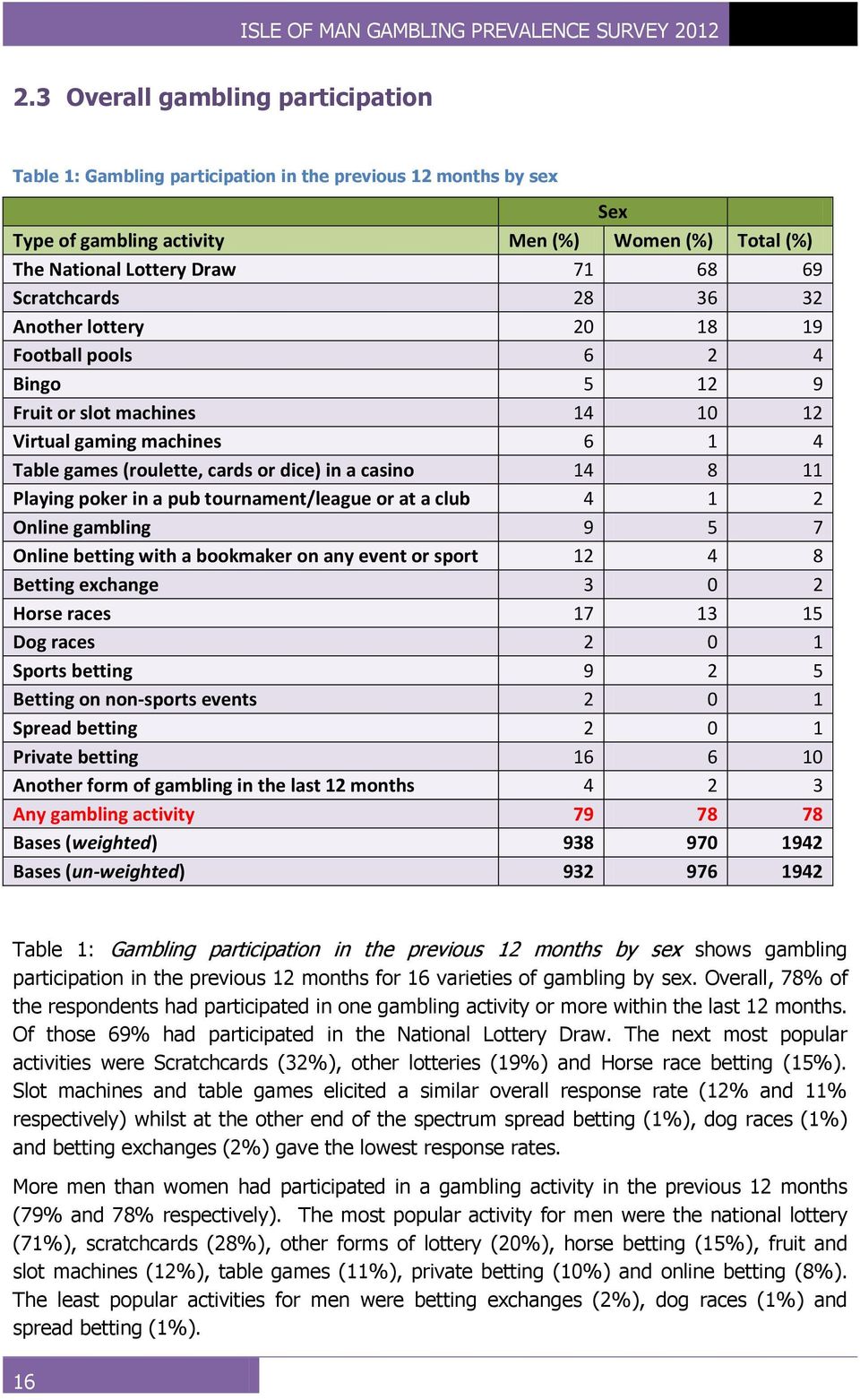
17 No of gambling activities (%) ISLE OF MAN GAMBLING PREVALENCE SURVEY 2012 The most popular gambling activity for women was the national lottery (68%), scratchcards (36%), and other forms of lottery (18%). The next most popular activities were horse betting (13%), bingo (12%) and fruit or slot machines (10%). Similar to men, the least popular activities for women were betting exchanges, dog races and spread betting (0% for each). Scratchcards and bingo were the only 2 activities where the percentage of women outweighed the men (36% vs. 28% for scratchcards and 12% vs. 5% for bingo). 2.4 Number of gambling activities in the previous 12 months Table 2: Mean number of gambling activities by sex Sex Men Women Total Mean number of Gambling Activities Standard error of the mean Bases (weighted) Bases (un-weighted) Table 2: Mean number of gambling activities by sex shows the number of gambling activities undertaken in the last 12 months by sex. On average, Men in the population participated in 2.1 activities in the past 12 months whilst women in the general population participated in 1.8 activities. Overall the mean number of gambling activity per individual in the previous 12 months in the general population is just under 2 (1.9). Figure 1: Number of gambling activities in past year by sex Number of gambling activities in previous 12 months by sex male female total Figure 1: Number of gambling activities in past year by sex shows the mean number of activities by sex. Just under a quarter of adults had not gambled in the previous 12 months 17

18 (22%) whilst just over a quarter had participated in 1 gambling activity (26%). 21% confirmed they had gambled on 2 gambling activities whilst 12% stated they had gambled in 3 activities. A further 18% stated that they had participation in 4 or more activities. Women were slightly less likely to have gambled at all in the previous 12 months (22% vs. 20%) however they were slightly more likely to have participated in 1 or 2 gambling activities (27% vs. 26% and 23% vs. 18% respectively). No women had participated in 8 or more gambling activities in the past year. Men were more likely than women to have participated in 3 or more gambling activities in the past year. 2.5 Comparisons with the BGPS 2010 In order to provide clear comparisons the gambling activities identified in Table 3: Comparison of gambling participation BGPS 2010 and IOM 2012 have been re-categorised to be compatible with definitions used both in the BGPS 2010 and in the IOM Table 3: Comparison of gambling participation BGPS 2010 and IOM 2012 Type of gambling activity IOM 2012 (%) BGPS 2010 (%) Men Women Total Men Women Total The National Lottery Draw Scratchcards Another lottery Football pools Bingo Fruit or slot machines Virtual gaming machines Table games (roulette, cards or dice) in a casino Playing poker in a pub tournament/league or at a club Online gambling Online betting with a bookmaker on any event or sport Betting exchange Horse races Dog races Sports betting Betting on non-sports events Spread betting Private betting Another form of gambling in the last 12 months Any gambling activity Bases (weighted) Bases (un-weighted)

19 Whilst these figures should be compared with some care due to the minor differences in definitions it is clear that overall figures for gambling participation rates in the general population on the Isle of Man were higher than the corresponding figures given for the BGPS In the BGPS % of the population had participated in a gambling activity in the previous 12 months, a slightly lower figure than the IOM 2012 outcome of 78%. Both the BGPS 2010 and the IOM 2012 found that the National Lottery Draw was the most popular form of gambling activity. The BGPS 2010 reported an overall participation rate of 59% which was 10% less than the same participation figures for the Isle of Man (69%). The BGPS 2010 showed a higher rate of participation for the next most popular gambling activity, other lotteries, 25%, in comparison to 19% for the general population of the Isle of Man. Population participation in the next two activities, the football pools and bingo elicited the same responses for both the BGPS 2010 and the IOM 2012 (4% and 9% respectively) whilst the level of participation for slot machines showed a difference of only 1%. Other similarities in response were playing poker in a pub/club (2%), spread betting (1%) and horse races (1% difference). Men on the Isle of Man were 10% more likely to participate in the National Lottery Draw whilst women on the Isle of Man were 12% more like to participate. Similarly 28% of men and 36% of women were more likely to buy a scratchcard in comparison to the BGPS 2010 figures of 23% and 25% respectively. 19

20 3 Gambling participation by demographics 3.1 Introduction The number of demographic questions asked in the questionnaire was relatively minimal therefore analysis of gambling activity by demographic data is limited. However some population analysis can be made. Section 3.2 explores gambling participation in the previous 12 months by age. Section 3.4 looks at gambling by marital status and section 3.7 explores gambling by economic activity. 3.2 Gambling participation by age Table 4: Gambling participation by age Age group Type of gambling activity (%) Total The National Lottery Draw Scratchcards Another lottery Football pools Bingo Fruit or slot machines Virtual gaming machines Table games in a casino Playing poker in a pub/club Online gambling Online betting Betting exchange Horse races Dog races Sports betting Betting on non-sports events Spread betting Private betting Another form of gambling Mean number of Gambling Activities Standard error of the mean Bases (weighted) Bases (un-weighted)

21 Table 4: Gambling participation by age shows gambling participation in the previous 12 months by age. Ages have been grouped in to 10 year bands for ease of analysis. The majority of individuals who participated in the National Lottery Draw in the previous 12 months were within the year age bands and 60% of those who purchased scratchcards were in the age band. Apart from the National Lottery Draw and Scratchcards the most popular gambling activities for year olds were the table games in a casino (22%) and fruit or slot machines (19%). For year olds horse races and table games in a casino (23%) followed by other lotteries and online betting (19%). With the exception of the National Lottery Draw, scratchcards and other lotteries the majority of gambling activities declined in popularity as age groups increased (for example fruit or slot machines). The lowest participation groups were the and the 74+ age groups and the most frequent age groups were the age groups. 3.3 Gambling participation by age comparison with the BGPS 2010 The results for gambling participation by age were similar between the BGPS 2010 and the IOM The BGPS 2010 found that the highest mean, that is the group most likely to participate in a higher number of gambling activities in a 12 month period than any other age group was the age group. A similar result was found in the IOM 2012 study. The BGPS 2010 also found a decrease in individual activities as the age groups increased, another trend seen in the IOM 2012 data. 3.4 Gambling participation by marital status Table 5: gambling participation by marital status shows the level of gambling participation by marital status. The mean number of gambling activities per marital status was fairly evenly spread with single, married and separated respondents participating in 1.9 gambling activities in the previous 12 months. Those who were either in a civil partnership, or widowed participated in slightly less at 1.8 whilst divorced respondents participated in an average of 1.7 activities. The most popular activity for all marital statuses was the national lottery draw. Those in civil partnerships participated in the highest number of gambling activities in comparison to all other marital statuses. Those in civil partnerships were also most likely to participate in online gambling, online betting, horse racing, dog races, sports and non-sports betting, private and other forms of betting in comparison to other marital status groups. Single individuals were least likely to participate in other lotteries but were the only other group apart from the married cohort to have participated in every single activity. Apart from the national lottery draw and scratchcards divorced and widowed individuals were generally less likely to participate in any gambling activity. 21
22 Table 5: gambling participation by marital status Marital Status Type of Gambling activity Single Married Civil Partner Separated Divorced Widowed Total The National Lottery Draw Scratchcards Another lottery Football pools Bingo Fruit or slot machines Virtual gaming machines Table games in a casino Playing poker in a pub/club Online gambling Online betting Betting exchange Horse races Dog races Sports betting Betting on non-sports events Spread betting Private betting Another form of gambling Mean no. of Gambling Acts St. error of the mean Bases (weighted) Bases (un-weighted) Gambling participation by marital status comparison with the BGPS 2010 The IOM 2012 cohort showed similar patterns to the BGPS 2010 with married and separated or divorced individuals more likely to participate in a gambling activity than their single counterparts. Similarly the BGPS 2010 found that single people were more likely to take part in a greater number of gambling activities and were less like to take part in the national lottery than their married counterparts. 3.6 Gambling Participation by living arrangement Figure 2: Gambling participation by living arrangement shows gambling participation in the previous 12 months by living arrangements. The most popular gambling activity for those 22
23 who were living in a household as a couple was the national lottery draw (76%). The least popular gambling activity for those living in a household as a couple was spreadbetting although this is reflective of the participation rates in general. The most popular gambling activity apart from the national lottery draw for those who did not live in a household as a couple was scratchcards with spreadbetting again the least popular. Figure 2: Gambling participation by living arrangement Gambling participation by living arrangement Yes I am living in this household as a couple (%) No I'm not living in this household as a couple (%) Total (%) Yes % No % Total Bases (weighted) Bases (un-weighted) Those who confirmed they did not live in a household as a couple were more likely to participate in the football pools, bingo, fruit or slot machines, table games in a casino, playing poker in a club and private betting. Those who did live in a household as a couple were more likely to have participated in the national lottery draw, scratchcards, other lottery draws, online gambling, online betting, betting exchange, horse races and dog races. There was even participation across the household category for virtual gaming machines, betting on sports events, betting on other events, spread betting and other forms of gambling. The 23
24 Type of Gambling activity Full time education Employed Unpaid work Waiting to take up paid work Unemployed Unemployed and unable to work due to Temporary sickness Unemployed due to long term disability Retired Looking after the home or family Other Total ISLE OF MAN GAMBLING PREVALENCE SURVEY 2012 BGPS 2010 did not specifically discuss this demographic therefore a direct comparison is not possible. 3.7 Gambling participation by economic activity Table 6: Gambling participation by economic status (%) Economic Status National Lottery Draw Scratchcards Another lottery The football pools Bingo Fruit or slot machines Virtual gaming machines Table games in a casino Playing poker in a pub/club Online gambling Online betting Betting exchange Horse races Dog races Betting on sports events Betting on other events Spread-betting 2 1 Private betting Another form of gambling Mean number of Gambling Activities Standard error of the mean Bases (weighted) Bases (un-weighted)
25 Table 6: Gambling participation by economic status shows gambling participation in the previous 12 months by economic status. As expected the most popular gambling activity was the National Lottery Draw which was played by every single economic group. 100% of those who were intending on looking for work, but were hampered by temporary illness had participated in the national lottery draw in the previous 12 months. For those in school or college the national lottery draw (41%), scratchcards (33%), the football pools and table games in a casino (13%), betting exchanges (7%) and other lotteries (1%) were the only gambling activities participated in the previous 12 months. Those in paid employment participated in all gambling activities across the range with the national lottery draw (79%) scratchcards (39%) and Horse races (19%) the most popular. For those individuals who were unemployed and seeking work there was participation in the national lottery draw (45%) scratchcards (18%) horse races (14%) other lotteries and table games in a casino (combined 10%). Those who were unable to work due to long term sickness were in the mid-range for participation in the national lottery draw (60%). There was no significant participation in playing poker in a pub/club, betting exchanges or spread betting but there was some participation all other activities. Those who were retired participated in every gambling activity except for spreadbetting. The most popular activities aside from the national lottery draw and scratchcards were other lotteries (20%) and horse races (12%). Apart from those in paid employment individuals who were looking after the family or home were most likely to play bingo (11% and 9% respectively) and were least likely to participate in betting exchanges, betting on other events and spreadbetting. 25
26 4 Problem Gambling 4.1 Introduction: One of the main objectives of the Isle of Man 2012 Lottery and Gambling study was to explore the prevalence of problem gambling on the Island not only to identify the prevalence of problem gambling but also to identify the prevalence of at risk individuals. In order to explore these issues two sets of questions were used in the survey. One set of questions concentrated on self-reporting of problem gambling traits and the other group focused on significant others. This chapter concentrates on the self-reporting of problem gambling whilst chapter 7 explores significant others. Problem gambling, for the purposes of this study, is defined as gambling to a degree that compromises, disrupts or damaged family, personal or recreational pursuits (Rosenthal 1992). The questions used to explore the individual prevalence of problem gambling on the Isle of Man were taken from the BGPS 2010 who first developed the series in The questions were designed to capture the prevalence of problem gambling in a sample population and were adapted for the BGPS from the diagnostic questions designed to identify pathological gambling in the Diagnostic and Statistical Manual of the American Psychiatric Association (DSM-IV). The DSM-IV screen has been used by the BGPS in 1999, 2007 and Using the DSM-IV screen, rather than another for the IOM 2012 study had two main advantages; firstly as a generally (although not globally) accepted measure for measuring rates of problem gambling in individuals it allowed an objective exploration of the rates of problem gambling on the Island. Secondly, as it was used for the BGPS in 2010 it has allowed some comparisons to be made between the two studies. Section 5.2 and 5.3 discuss caveats and characteristics of the DSM-IV. Section 5.5 explores the prevalence of problem gambling on the Isle of Man. Section 5.7 looks at DSM-IV scores by age and sex. Sections 5.8 to 5.12 look at problem gambling by demographic. 4.2 DSM-IV characteristics and caveats The following breakdown of the DSM-IV screen and the caveats that should be taken in to account has been adapted from the BGPS 2010 report. This is to ensure that the analysis is read in the same way. 26
27 4.3 DSM-IV characteristics Each DSM-IV item is assessed on a four point scale ranging from never to very often. These have been re-coded for analysis Recoded scores on the DSM-IV scale are from zero to ten. Those who score a zero are non-problematic gamblers Both the IOM 2012 results and the BGPS 2010 results are based on this recoded score pattern A diagnosis of pathological gambling is made when a person meets 5 out of the 10 criteria however this has not been included in the IOM 2012 nor the BGPS series. This is to ensure clarity and simplicity for the reader but has also been omitted because the study is not concerned with identifying pathological gamblers (who would be statistically insignificant therefore difficult to analyse). The diagnosis of problem gambler has been included in the DMS-IV screen. A person meets the problem gambler criteria if they have met 3 out of the 10 criteria. This threshold has been the same for the 1999, 2007 and 2010 BGPS series and has been adopted for the 2012 IOM study At risk respondents, i.e. those who meet 1 or 2 criteria are also included. NOTE this is not a DSM-IV diagnostic but useful for the purposes of the IOM 2012 study Confidence levels have been set at 95% 4.4 DSM-IV caveats This survey cannot say anything about the direction of causality The sample design is of a number of private households. This means that a number of sub-groups that may be more likely to be problem gamblers have not been captured e.g. the homeless, or prisons. As such the problem gambling prevalence rates in this report may underestimate the prevalence of problem gambling Some people may be motivated to give socially desirable (and potentially dishonest) answers to a questionnaire and may underestimate the extent of their gambling behaviour No screen for problem gambling is perfect although the DSM-IV screen has been developed to minimise false positives and false negatives. False positives is where someone without a gambling problem is classified as a problem gambler, and a False negative is when some with a gambling problem is classified as someone without a gambling problem Those who did not participate in gambling activity in the previous 12 months have been re-coded to zero and are included in the analysis as a score of 0 in order to inform accurate population rates 27
28 Bearing in mind the above caveats and due to the sample design, and taking in to account sampling error as well as the survey design and size, the results discussed present a best estimate of current problem gambling in the general population on the Isle of Man. 4.5 The prevalence of problem gambling in 2012 Figure 3: DSM-IV scores by sex shows valid DSM-IV scores for both men and women and figures are demonstrative of the general population. Non-problematic gamblers make up the vast majority of the general population (95.9% of men and 98% of women, a total of 97%). 3.9% of men and 1.9% of women presented a DSM-IV score of either 1 or 2. This is below the DSM-IV criteria for problem gambling but falls within the at risk category. If this is related to the 2011 IOM Census this equates to approximately 1637 men and 807 women. 0.2% of men and 0.1% of women presented a DSM-IV score of 6, falling within the pathological gambling threshold. There were no other scores present in this screen. A realistic estimate of the rate and prevalence of problem gambling on the Isle of Man is around 0.2% of the male population and 0.1% of the female population. If this is related to the 2011 IOM Census this equates to approximately 84 men and 43 women. Table 7: DSM-IV Keycode DSM-IV Score Description 0 Non-problematic gambler 1 At risk of problem gambling 2 At risk of problem gambling 3 Problem gambler 4 Problem gambler 5 Pathological gambler 6 Pathological gambler 7+ Pathological gambler Figure 3: DSM-IV scores by sex DSM-IV Score by Sex Score 1 Score 2 Score 6 Men % Women % Total % Bases (weighted) Bases (un-weighted) % % % Male Female Total 28
29 4.6 The prevalence of problem gambling in 2012 comparison with the BGPS 2010 Table 8: DSM-IV score by sex. Comparison with the BGPS shows a comparison between the IOM 2012 and the BGPS The BGPS 2010 data scored across the spectrum however this is not shown on the comparative table as only relevant scores are shown. Whilst the BGPS sample population was far greater than the IOM 2012 study, some comparisons can be made. Table 8: DSM-IV score by sex. Comparison with the BGPS 2010 DSM-IV score by sex IOM 2012 BGPS 2010 (EXTRACT) Men Women Total Men Women Total Bases (weighted) Bases (un-weighted) Overall the total percentage of non-problematic gamblers on the Isle of Man was 2% higher than the BGPS sample equivalent (97% non-problematic gamblers in the IOM 2012 compared to 95%). The BGPS 2010 data showed a higher overall total score of 1 in comparison to the IOM 2012 (3.3% against 2.4%). The IOM 2012 produced far less variation in scores, (0, 1, 2 or 6) whilst the BGPS 2010, probably due to the large sample produced scores across the spectrum. Scores were generally lower for the IOM 2012 than the BGPS 2010 equivalent with 3% of men scoring 1 against 4.1% of men in the BGPS Similarly 1.8% of women scored 1 on the IOM 2012 study in comparison to 2.5% of women in the BGPS DSM-IV score by age Table 9: DSM-IV score by shows valid DSM-IV scores by age. Of the valid responses those in the and the age groups were most likely to score 1 on the DSM-IV spectrum (3.5% and 3.2% respectively) year olds were also most likely to score 2 on the DSM- IV scale. Those who were deemed at risk crossed the age spectrum. Those that scored 6 and are considered problem gamblers were in the 45-54, and 75+ age groups (a cumulative total of 1.1% and an overall total of 0.2%). These percentages provide a best estimate for prevalence of at risk gamblers in the general population by age. 29
30 Table 9: DSM-IV score by age Age Group DSM-IV score Total Bases (weighted) Bases (un-weighted) Problem gambling prevalence by marital status Table 10: DSM-IV score by marital status shows DSM-IV scores by marital status. Interestingly those in civil partnerships are statistically most likely to positively respond to a DSM-IV question with an overall response rate of 9.2% putting them at the at risk category. The term Civil Partnership in the questionnaire was clarified as follows: A civil partner in a legally-recognised Civil Partnership. This is a particularly high statistic given that Civil Partnerships were only legalised in March It may well be the case that respondents ticked the civil partnership box due to a lack of suitable alternatives i.e. common law and cohabiting options. Those who were single or divorced were similarly likely to respond to a DSM-IV question (3.6% and 3.4% respectively). Table 10: DSM-IV score by marital status Marital Status DSM-IV score Single Married Civil partner Separated Divorced Widowed Total Problem gambler (3+) Bases (weighted) Bases (un-weighted) Problem gambling prevalence by living arrangements Figure 4: DSM-IV by living arrangements shows problem gambling prevalence by living arrangements. Overall those who live in a household as a couple are more likely to score on 30
31 the DSM-IV scale although this was not the case for individuals who had responded to two DSM-IV questions. There is no difference between living arrangements for individuals who are problem gamblers (0.2% if living alone and 0.2% if living in a household as a couple). Figure 4: DSM-IV by living arrangements DSM-IV by living arrangements Score 1 Score 2 Score Yes % No % Total % Are you living with anyone in this household as a couple? Yes No Total Bases (weighted) Bases (un-weighted) Problem gambling prevalence by economic activity Table 11: DSM-IV score by economic status shows Problem gambling prevalence by economic activity. Those in full time education, unpaid work, those who were waiting to take up paid work, those who were unemployed and those who were unemployed and temporarily unable to look for work due to short sickness did not respond to any of the DSM-IV questions. Individuals in the general population most likely to score one and/or two are those who were unable to work due to long term disability (7.8% and 2.5% respectively). Those in paid work score next highest with 2.6% scoring one,.4% scoring two and.2% scoring six. Those who are retired are the only other employment group who score across the spectrum with 1.8% scoring one,.7% scoring two and.2% scoring six. 31
32 Type of Gambling activity Full time education Employed Unpaid work Waiting to take up paid work Unemployed Unemployed and unable to work due to Temporary sickness Unemployed due to long term disability Retired Looking after the home or family Other Total ISLE OF MAN GAMBLING PREVALENCE SURVEY 2012 Table 11: DSM-IV score by economic status Economic Status Problem Gambler (3+) Bases (weighted) Bases (un-weighted) Individual DSM-IV questions by sex Table 12: Individual DSM-IV items by sex shows responses to DSM-IV questions by sex. Over all those who are chasing losses score the highest with an average total of 2.1%. The next most common positive response to a DSM-IV question is a preoccupation with gambling with an average of 1%. Women are most like to cite chasing losses as a concern (1.8%). Table 12: Individual DSM-IV items by sex Individual response to DSM-IV items by Sex Men Women Total Chasing losses A preoccupation with gambling A need to gamble with increasingly amounts of money Being restless or irritable when trying to stop gambling Gambling as escapism Lying to people to conceal extent of gambling Having tried but failed to cut back on gambling Having committed a crime in order to finance gambling Having risked or lost a relationship/job/educational/work opportunity because of gambling Reliance on others to help with a financial crisis caused by gambling Bases (weighted)
33 Bases (un-weighted) Individual DSM-IV questions by sex. Comparison with the BGPS 2010 Again the BGPS 2010 results were slightly higher than the IOM 2012 outcomes but this may be due to the larger population sample. There were some similarities which are shown in Table 13: Individual DSM-IV questions. Comparison with the BGPS For example, 2.4% of men on the Isle of Man and 2.7% of men in the UK cited chasing loses as a gambling factor. 1.8% of women on the Isle of Man and 1.6% of women in the UK positively responded to the same question. Interestingly the overall average total in the population for chasing loses was the same (2.1%). Table 13: Individual DSM-IV questions. Comparison with the BGPS 2010 IOM 2012 (%) BGPS 2010 (%) Individual response to DSM-IV items by Sex Men Women Total Men Women Total Chasing losses A preoccupation with gambling A need to gamble with increasingly amounts of money Being restless or irritable when trying to stop gambling Gambling as escapism Lying to people to conceal extent of gambling Having tried but failed to cut back on gambling Having committed a crime in order to finance gambling Having risked or lost a relationship/job/educational/work opportunity because of gambling Reliance on others to help with a financial crisis caused by gambling Bases (weighted) Bases (un-weighted)
34 5 Attitudes to Gambling 5.1 Introduction As well as exploring gambling participation and the prevalence of problem gambling the IOM 2012 survey also focused on attitudes to gambling. The questions used to explore these attitudes were again taken from the BGPS This has allowed some comparisons to be made. The attitudes to gambling section of the survey was delivered via eight questions, each with a score between one and five (1 being strongly disagree and 5 being strongly agree). The scores from each of the questions were summed up giving a total of between 8 and 40. Some of the questions needed to be re-coded in order for this to happen, and this has been noted in the coding and syntax instructions in the appendix. A score of 24 represents a midpoint, or overall neutral attitude towards gambling. Scores above 24 represent a positive attitude towards gambling and conversely scores below 24 represent a negative attitude towards gambling. Section 5.2 explores attitudes to gambling by sex. Section 5.4 looks at attitudes to gambling by age. Section 5.5 explores attitudes to gambling by marital status and section 5.7 looks at attitudes to gambling by economic status. 5.2 Attitudes towards gambling by sex Table 14: Attitudes towards gambling by sex shows attitudes towards gambling by sex shows the separate scores for each item (between 1-5) and the total score. Taking into account a standard deviation of 3.16% and with a neutral score of 3, the average score for 5 of the items lay to the negative (less than 3) and three of the items were on the positive side (too many opportunities to gamble, sensible gambling, banning gambling). The overall mean for men was 23.7 and for women 22.7 with an average of 23. Bearing in mind a neutral view point of 24 this indicates that attitudes towards gambling lean slightly towards the negative. Women are slightly more negative than men over all (a score of for women Vs for men). 34
35 Table 14: Attitudes towards gambling by sex Men Women Total Mean Stan. Dev. Mean Stan. Dev. Mean Stan. Dev. There are too many opportunities for gambling nowadays People should have the right to gamble whenever they want Gambling should be discouraged Most people who gamble do so sensibly Gambling is dangerous for family life On balance gambling is good for society Gambling livens up life It would be better if gambling was banned altogether (D) Attitude score Attitudes towards gambling by sex comparison with the BGPS 2010 Table 15: Attitudes towards gambling by sex comparison with the BGPS 2010 Men Women Total Mean SD Mean SD Mean SD IOM 2012: There are too many opportunities for gambling nowadays BGPS 2010: There are too many opportunities for gambling nowadays IOM 2012: People should have the right to gamble whenever they want BGPS 2010: People should have the right to gamble whenever they want IOM 2012: Gambling should be discouraged BGPS 2010: Gambling should be discouraged IOM 2012: Most people who gamble do so sensibly BGPS 2010: Most people who gamble do so sensibly IOM 2012: Gambling is dangerous for family life BGPS 2010: Gambling is dangerous for family life IOM 2012: On balance gambling is good for society BGPS 2010: On balance gambling is good for society IOM 2012: Gambling livens up life
36 BGPS 2010: Gambling livens up life IOM 2012: It would be better if gambling was banned altogether BGPS 2010: It would be better if gambling was banned altogether IOM 2012: Attitude score BGPS 2010: Attitude score Table 15: Attitudes towards gambling by sex comparison with the BGPS 2010 shows the IOM data against the BGPS 2010 survey. Scores from the IOM 2012 were slightly different to those found in the BGPS 2010 study although over all attitude scores were relatively similar (23.7 for the IOM 2012 study in comparison to 23.2 for the BGPS 2010 survey) tending towards the negative. 5.4 Attitudes towards gambling by ten year age groups Using 24 as a neutral response to gambling, above 24 as a positive attitude towards gambling and below 24 as a negative attitude towards gambling it is clear that age does not have a particular effect on attitudes to gambling with each age group presenting a slightly negative attitude over all. The scores from the IOM 2012 are consistent with the scores from the BGPS 2010 attitude questions. The BGPS 2010 also did not find any particular variance of attitude according to age. Figure 5: Attitude to gambling by age group Attitude to gambling by age group Total Mean Bases (weighted) 1886 Bases (un-weighted)
37 5.5 Attitudes towards gambling by Marital Status Those who were single, married or in a civil partnership present scores closest to the neutral 24, although remaining marginally negative. Those who are widowed score the most negative attitude towards gambling with (compared to a score of for widows in the BGPS 2010). The greatest difference between the BGPS 2010 and the IOM 2012 score by marital status is for those who are separated or divorced. The IOM average mean for these groups (22.9) is higher than the average score presented by the BGPS 2010 (21.98) although both scores remain on the negative side of the neutral viewpoint. Figure 6: Attitude to gambling by marital status Attitude to Gambling by marital status Mean Single Married Civil Partnership Separated Divorced Widowed Total Bases (weighted) 1886 Bases (un-weighted) Attitudes towards gambling by living arrangements Again there were no particular differences in attitude dependant on whether the respondent was living in a household as a couple or not although attitudes leaned slightly towards the negative. This information was not discussed in the BGPS 2010 so no comparison can be made. Table 16: Attitude towards gambling by living arrangements Are you living with anyone in this household as a couple? Mean Std. Deviation Yes No Total
38 5.7 Attitudes towards gambling by economic activity Individuals who are waiting to take up paid work already present the most negative score out of the economic activity demographic (a mean of 21.21). Individuals who are in paid employment are the most positive although they still learn towards the negative (23.67). This information was not discussed in the BGPS 2010 so no comparison can be made. Table 17: Attitudes towards gambling by economic activity Which of these descriptions applies to what you were doing last Std. Mean week? Deviation Going to school or college full-time (including on vacation) In paid employment or self-employment (or away temporarily) Doing unpaid work Waiting to take up paid work already obtained Looking for paid work or a Government training scheme Intending to look for work but prevented by temporary sickness Permanently unable to work because of long-term sickness or disability Retired from paid work Looking after the home or family Doing something else Total Bases (weighted) 1838 Bases (un-weighted)
39 6 Significant others 6.1 Introduction Part of the remit for the IOM 2012 was to explore the role of significant others in identifying and dealing with problem gambling behaviour. In order to explore this several questions were designed to extract information from respondents about their own experiences in dealing with and approaching individuals they believe have exhibited problem gambling behaviour. Respondents were first asked whether they had, at any point in the previous 12 months advised an individual to gamble less. If the response was positive they were directed on to a further three questions which explored the relationship between themselves and the person they advised. Those who gave a negative response were directed to miss the breakdown question and move to a question designed to explore the identification of problem gambling in family members. The responses have been weighted to ensure they are representative of the population and percentages used provide a best estimate for the general population. The below analysis discusses this final section of the survey. 6.2 Advice given to a family member, friend or acquaintance in the previous 12 months Table 18: Advice given to a family member, friend or acquaintance in the previous 12 months shows the number of individuals who positively responded to the question In the last 12 months have you advised any family member s friends or acquaintances to gamble less? 6.9% of men and 9.2% of women; an overall average of 8%. Women are more likely to advise someone to gamble less. Of the 8% who stated that they had at some point in the previous 12 months advised someone to stop gambling 48% stated that it was a close family member, 26.8% stated another family member and 56.8% stated that it was a close friend. Note that respondents were able to tick more than one category; this means that the percentage groups may not add up to 100%. There is a significant difference between men and women with women most likely to advise a close family member to gamble less (55.6%) and men most likely to advise a close friend (72.6%). On average the most common advice group is the close friend category (56.8%). 39
40 Table 18: Advice given to a family member, friend or acquaintance in the previous 12 months Men Women Total In the last 12 months have you advised any family members, friends or acquaintances to gamble less? A close family member Another family member A close friend Bases (weighted) Bases (un-weighted) Identifying problem gambling in significant others When asked Do you feel that your spouse/partner, parent or child have ever had a gambling problem more women than men stated yes (5% for women compared to 2.6% for men). When asked Do you feel that a close relative has ever had a gambling problem more women than men stated yes (7.8% for women compared to 7.1% for men) Figure 7: Identifying problem gambling in significant others Identifying problem gambling in significant others by sex Do you feel that your spouse/partner, parent or child have ever had a gambling problem? Do you feel that a close relative has ever had a gambling problem? % % % Men Women Total Men % Women % Total % Bases (weighted) Bases (un-weighted)
41 6.4 Advice given to a family member, friend or acquaintance in the previous 12 months by age group Interestingly the number of positive responses to the question In the last 12 months have you advised any family member s friends or acquaintances to gamble less decreased as the age group increased year olds are over twice as likely to have advised someone to gamble less in the previous 12 months than both the age group and the 75+ age group 10.7% compared to 4.1% and 3.8%). There is a noticeable percentage drop between the age groups and the age group (a drop of 3.9% from 8% to 4.1%). There are some differences in the types of people who were advised according to age group. Individuals between the age of 35 and 74 are most likely to advise a close family member whilst interestingly the two age groups at each end of the spectrum and 75+ are most likely to advise a close friend. Table 19: Advice given to a family member, friend or acquaintance in the previous 12 months by age group In the last 12 months have you advised any family members, friends or acquaintances to gamble less? Total A close family member Another family member A close friend Bases (weighted) Bases (un-weighted) Identifying problem gambling in significant others by age group When asked the questions regarding the identification of problem gambling in significant others there were noticeable differences in response to these questions depending on age group years olds gave the highest positive responses to both questions, followed by the age groups. Only 1.3% of year olds stated that they believed a spouse/partner, parent or child ever had a gambling problem. This may, in part be due to the fact that marriages and children may be in their infancy during this age period and dependency and contact with parents may be less frequent than younger and older age groups. Figure 8: Identifying problem gambling in significant others by age group shows this information in chart format. 41
42 Figure 8: Identifying problem gambling in significant others by age group Identifying problem gambling in significant others by age group Do you feel that your spouse/partner, parent or child have ever had a gambling problem? (%) Do you feel that a close relative has ever had a gambling problem? (%) Total Age Group Single Married Civil Partnership Separated Divorced Widowed Total Bases (weighted) Bases (un-weighted) Advice given to a family member, friend or acquaintance in the previous 12 months by marital status Again there were significant differences in advice given by marital status. 28% of separated individuals had given advice to someone they knew in the previous 12 months compared to 5.4% of married or widowed respondents. Of the separated respondents most gave advice to a close family member followed by a close friend. Individuals who are married are least likely to give advice to another family member but are most likely to give advice to a close family member. Conversely those that are single are least like to give advice to a close family member but most like to advise a close friend. 42
43 Table 20: Advice given to a family member, friend or acquaintance in the previous 12 months by marital status In the last 12 months have you advised any family members, friends or acquaintances to gamble less? Single Married Civil Partner Separated Divorced Widowed Total A close family member Another family member A close friend Bases (weighted) Bases (un-weighted) Identifying problem gambling in significant others by marital status Figure 9: Identifying problem gambling in significant others by marital status 25.0% 20.0% 19.1% 16.0% 15.0% 10.0% 5.0% 4.5% 3.0% 3.0% 8.4% 3.7% 13.1% 8.2% 10.8% 2.6% 5.6% 3.9% 7.5% 0.0% Single Married Civil Partner Separated Divorced Widowed total Do you feel that your spouse/partner, parent or child have ever had a gambling problem? Do you feel that a close relative has ever had a gambling problem? Single Married CP Separated Divorced Widowed Total Bases (weighted) Bases (un-weighted) Separated individuals are most likely to believe that a spouse/partner, parent or child has previously had a gambling problem (19.1%). Widowed individuals are least likely to believe this to be the case (2.6%). Separated individuals are also most likely believe that a close 43
44 relative has had a gambling problem (16%) whilst those who were single are least likely to believe this to be the case. 6.8 Advice given to a family member, friend or acquaintance in the previous 12 months by living arrangements There were differences in response to the question in the last 12 months have you advised any family member s friends or acquaintances to gamble less depending on whether the respondent lives in a household as a couple or not. Those who do not living as a couple are far more likely to advise any family member or acquaintance to gamble less (10.2% compared to 6% for those who live as a couple). Those who do not live as a couple are most likely to advise a close friend whilst those who live as a couple are most likely to advise a close family member. The scores for a close family member are comparable. Table 21: Advice given to a family member, friend or acquaintance in the previous 12 months by living arrangements Yes No Total In the last 12 months have you advised any family members, friends or acquaintances to gamble less? A close family member Another family member A close friend Bases (weighted) Bases (un-weighted) Identifying problem gambling in significant others by living arrangements Table 22: Identifying problem gambling in significant others by living arrangements Do you live in a household as a couple? Yes No Total Do you feel that your spouse/partner, parent or child have ever had a gambling problem? Do you feel that a close relative has ever had a gambling problem? Bases (weighted) Bases (un-weighted) When asked Do you feel that your spouse/partner, parent or child have ever had a gambling problem more individuals who did not live in a household as a couple responded positively than those that did (4.9% compared to 3.1%). The tables were turned for the 44
45 Full time education Paid work Unpaid work Waiting to take up paid work Unemployed Unemployed and unable to work due to Temporary sickness Unemployed due to long term disability Retired Looking after the home or family Other Total ISLE OF MAN GAMBLING PREVALENCE SURVEY 2012 question Do you feel that a close relative has ever had a gambling problem, with 8.8% of individuals who were living in a household as a couple responding positively in comparison to 6.6% of those who were not Advice given to a family member, friend or acquaintance in the previous 12 months by economic status Table 23: Advice given to a family member, friend or acquaintance in the previous 12 months by economic status Which of these descriptions applies to what you were doing last week? In the last 12 months have you advised any family member s friends or acquaintances to gamble less? A close family member Another family member A close friend Bases (weighted) Bases (unweighted) Those that were either in full time education or unemployed due to long term disability are most likely to have advised a family member, friend or acquaintance to stop gambling in the previous 12 months (15% and 13.6% respectively). Retired individuals are least likely to offer advice under the same terms (3.8%). Interestingly no unemployed or temporarily unemployed individuals positively responded to this question. Of those who positively responded to the follow up questions 100% of those in full time education either advised a family member or a close friend and 100% of those in unpaid work advised a close friend. 45
46 6.11 Identifying problem gambling in significant others by economic status Groups that did not respond to these questions have been omitted from Figure 10: Identifying problem gambling in significant others by economic status (waiting to take up paid work and unemployed and temporarily unable to look for work). Individuals who are unemployed due to long term disability are most likely to feel that a spouse/partner, parent of child has had a gambling problem at some point (15.9%). Those that are unemployed due to long term disability are also most likely to believe that a close relative has, at some point had a gambling problem (15%). Those who looked after the home or family also presented a high positive response rate to the close relative question with 12.3% believing that a close relative has, at some point, had a gambling problem. Figure 10: Identifying problem gambling in significant others by economic status Identifying problem gambling in significant others by economic status Do you feel that a close relative has ever had a gambling problem? (%) Do you feel that your spouse/partner, parent or child have ever had a gambling problem? (%) Total Other Looking after the home or family Retired Unemployed due to long term disability Unemployed Unpaid work Paid work Full time education
47 7 GamCare Isle of Man - Comments and Next Steps to Service Development The gambling landscape has altered dramatically with globalisation and the internet. We can now gamble remotely in a world-wide interactive market which is vast and varied. This baseline study has provided us with a state of the nation report for 2012 and what is clear is that gambling activity is changing and widening through the use of technology in the modern world and many previous assumptions we may have held about gambling have been swept away on this wave of advancement. While there is universal support from Regulators and the Industry for measures to protect the young and the vulnerable, it is clear that services aimed at education and prevention need to keep pace with the continuous development of the gambling industry to both raise awareness of those deemed at risk and to provide advice and support to those gamblers whose harmless flutter turns into something more serious and problematic. On to the survey and whilst we can t make any statements on trends as it is the first survey of its kind, it has been useful to make comparisons with our nearest jurisdiction, the UK, using the British Gambling Prevalence Survey (BGPS) This has demonstrated that there are fewer pathological gamblers at 0.2%. Demographically, using the 2011 census, this equates to 127 individuals in comparison to 0.9% in the equivalent UK study. By contrast, GamCare Isle of Man in its first year of operation has had 44 referrals for problem gamblers and offered 568 appointments with a 78% attendance rate. Furthermore, of those gamblers who were scored, 86% rated as pathological gamblers. Given the survey results it would be surprising if in this short time more than a third of those affected had presented for support. GamCare UK have advised us that services generally see an increase in referrals and a peak around years 2 to 3! The area of significant others affected by someone else s gambling appears to be at odds with reports of pathological and problem gambling with much greater numbers admitting to being affected by someone else s gambling. This is a new area of research not included in the BGPS and seems to highlight possible under-reporting by problem gamblers themselves & the hidden harm beneath the surface. Whilst other addictions such as substance misuse manifest sooner and are harder to disguise, gambling problems can be concealed until financial or familial breakdown surface. In GamCare Isle of Man we are seeing individuals presenting at the crises stage with large debts and financial losses being at the source of a referral. Significant Others referrals though are lower than expected given the research with 22 referrals. Evidently more awareness raising to those affected and a message that help is available to those affected in their own right and not as an adjunct to the treatment of the problem gambler is needed. Also interesting is the at risk category with 3.9% of men and 1.9% of women equating to 2444 in the population. This service has almost exclusively dealt with the pathological gamblers with only 1 presenting in the at risk stage. An area of practice to develop is more 47
48 preventative programmes targeting the at risk with programmes that increase awareness of the early indicators of a problem developing. Gambling activity per population as presented in this study and listed by those presenting to GamCare IOM are also useful to compare. It would appear that without the National Lottery and its Scratchcards and other lotteries, such as the Irish Lottery, gambling would almost certainly border on minority behaviour. By contrast, FOBT s or Fixed Odds Betting Machines seem to be the most commonly reported primary problem gambling activity at our fledgling service. In conclusion, it is clear that whilst there are some similarities between our study and the BGPS, we can also see some differences, particularly in those presenting to our service at this time. This could be something that changes as the service grows and we look forward to continuing to develop this new initiative for the Isle of Man. GamCare Isle of Man, September
49 Blank page 49
50 Appendix 1: Questionnaire documentation 50
51 ISLE OF MAN GAMBLING PREVALENCE SURVEY 2012 CONFIDENTIAL SN: Isle of Man Lottery & Gambling study Booklet for Adults aged 16+ How to complete the questionnaire: This questionnaire should be completed by the person who has the next birthday and is aged 16 and over. Most of the questions on the following pages can be answered by putting a tick in the box next to or below the answer that applies to you. You are sometimes told to skip over some questions in this survey. When this happens, you will see an arrow ( ) with a note that tells you what question to answer next. EXAMPLE QUESTION (please do not fill in) E1 Are you? Female 51 Tick ONE box Male Go to E2
52 Go to E3 Don t worry if you make a mistake: simply cross out the mistake and tick the correct box. When you have completed it, please return the questionnaire in the pre-paid envelope provided as soon as possible by 31 st January No stamp is required. SN: CKL: 006 Mailing No.: Card (1): 009 Batch No.: Spare Columns
53 SECTION A - Everyone please answer Q1 Have you spent any money on any of the following activities in the last 12 months? Please tick ONE box for each activity. Tick ONE box per activity Yes No Tickets for the National Lottery Draw, including Thunderball and Euromillions and online Scratchcards (but not online or newspaper or magazine scratchcards) Tickets for any other lottery, including charity lotteries The football pools Bingo cards or tickets, including playing at a bingo hall (not online) Fruit or slot machines
54 Virtual gaming machines in a bookmakers to bet on virtual roulette, keno, bingo etc Table games (roulette, cards or dice) in a casino Playing poker in a pub tournament/ league or at a club Online gambling like playing poker, bingo, scratchcards, slot machine style games or casino games for money Online betting with a bookmaker on any event or sport Betting exchange This is where you lay or back bets against other people using a betting exchange. There is no bookmaker to determine the odds. This is sometimes called peer to peer betting Betting on horse races in a bookmaker s, by phone or at the track Betting on dog races in a bookmaker s, by phone or at the track
55 Betting on sports events in a bookmaker s, by phone or at the venue Betting on other events in a bookmaker s, by phone or at the venue Spread-betting In spread-betting you bet that the outcome of an event will be higher or lower than the bookmaker s prediction. The amount you win or lose depends on how right or wrong you are Private betting, playing cards or games for money with friends, family or colleagues Another form of gambling in the last 12 months Spare Columns If you ticked YES for any activities please continue to Section B, otherwise please go to Section C (page 5) SECTION B For the next set of questions about gambling, please indicate the extent to which each one has applied to you in the last 12 months. Please tick ONE box for each question. Tick ONE box 55
56 Every time I lost Most of the time Some of the time (less than half the time I lost) Never When you gamble, how often do you go back another Q day to win back money you lost? Tick ONE box for each question 050 Very often Fairly often Occasionally Never How often have you found yourself thinking about Q gambling (that is reliving past gambling 3 experiences, planning the next time you will play, or thinking of ways to get money to gamble)? Have you needed to gamble with more and more money Q to get the excitement you are looking for? Have you felt restless or irritable when trying to cut Q down gambling? Have you gambled to escape from problems Qor when you are feeling depressed, 6 anxious or bad about yourself? Have you lied to family, or others, to hide the extent Qof your gambling? Have you made unsuccessful attempts to control, cut Q back or stop gambling? Have you Qcommitted a crime in order to finance 9 gambling or to pay gambling debts? Have you risked or lost an important relationship, Q job, educational or work opportunity 1 because of gambling? Have you asked others to provide money to help with Q a financial crisis caused by gambling? Spare Columns
57 SECTION C - Everyone please answer Below is a list of things people have said about gambling. Please tick ONE box for each statement to show how much you agree or disagree. Q12 Please tick ONE box for EACH statement. Strongly agree Agree Neither agree or disagre e Disagre e Strongl y disagre e There are too many opportunities for gambling nowadays 070 Q13 People should have the right to gamble whenever they want Q14 Gambling should be discouraged Q15 Most people who gamble do so sensibly Q16 Gambling is dangerous for family life Q17 On balance gambling is good for society Q18 Gambling livens up life Q19 It would be better if gambling was banned altogether SECTION D - Everyone please answer Spare Columns Q20 In the last 12 months have you advised any family members, friends or acquaintances to gamble less? 57 Tick ONE box Yes 080
58 1 Go to Q21 (page 6) No 2 Go to Q22 (page 6) Q21 Was the person/persons you advised to gamble less one of the following.? Please tick ONE box for each Yes No A close family member. For example a spouse, parent, partner or child Another family member. For example aunt, uncle, grandparent, cousin A close friend A work colleague or other acquaintance Q22 Do you feel that your spouse/partner, parent or child has ever had a gambling problem? Tick ONE box 085 Yes No 1 2 Q23 Do you feel that a close relative has ever had a gambling problem? (Aunt, Uncle, Nieces, Nephews) Yes No Tick ONE box Q24 Are you? Male Tick ONE box
59 Female 2 Q25 How old were you on your last birthday? years Q26 Are you? Please write in old Tick ONE box 090 Single, that is, never married Married and living with husband/wife..a civil partner in a legally-recognised Civil Partnership Married and separated from husband/wife Divorced Widowed Q27 Are you living with anyone in this household as a couple? Tick ONE box 091 Yes No 1 2 Q28 Which of these descriptions applies to what you were doing last week? Going to school or college full-time (including on vacation) Tick ONE box In paid employment or self-employment (or away temporarily) 02 On a Government scheme for employment training Doing unpaid work for a business that you own, or that a relative owns 04 Waiting to take up paid work already obtained
60 Looking for paid work or a Government training scheme Intending to look for work but prevented by temporary sickness or injury (sick or injured for 28 days or less) 07 Permanently unable to work because of long-term sickness or disability Retired from paid work Looking after the home or family Doing something else THANK YOU FOR COMPLETING THIS QUESTIONNAIRE Please return this questionnaire to NatCen in the pre-paid envelope provided. No stamp is required We really appreciate you taking time to take part in this study. All your answers will be treated in strict confidence. If you would like to speak to someone in confidence about your own or someone else s gambling, below are some telephone numbers and websites that might be useful. GamCare, provides counselling, advice and practical help in addressing the social impact of gambling in the UK, can be visited at: Its confidential helpline is: Non-UK residents can contact GamCare for details of International support organisations. Gamblers Anonymous is a fellowship of men and women who have joined together to do something about their own gambling problem and help others. There are regional fellowships around the world. The Gamblers Anonymous international service site is at: 60
61 Appendix 2: Coding notes Q1a - Q1s Gambling activity in the last 12 months If an individual has responded to 1 or more questions, all 'not applicable' responses [-1'] have been re coded to 'No' [2] If an individual has not responded to any questions, all 'not applicable' responses [-1'] have been re coded to 'Not answered' [-9] Q2-Q11 The DSM-IV Problem Gambling Screen If an individual has not responded to a question, it has been re coded to 'Not answered' [- 9] Q12-Q19 Attitudes to Gambling If an individual has responded to 1 or more questions, all 'not applicable' responses [-1'] have been re coded to 'Partial Response' [0] If an individual has not responded to any questions, all 'not applicable' responses [-1'] have been re coded to 'Not answered' [-9] Q20-Q23 Problem Gambling in family members If an individual has not responded to Q20 nor any of Q21a-Q21d the missing responses have been re coded to 'Not answered' [-9] If an individual has responded 'Yes' to Q20 but has only answered 1 or 2 of the Q21a-Q21d questions the missing responses have been re coded to [-9] If an individual has not responded to Q22 or Q23 question it has been re coded to 'Not answered' [-9] 61
62 If an Individual has not responded to Q20 but has subsequently answered one or more of Q21a-Q21d as yes Q20 has been re coded to Yes. If an Individual has not responded to Q20 but has subsequently answered all of Q21a-Q21d as No Q20 has been re coded to No and Q21a-21d has been re coded to Not applicable. If an individual has responded 'No' to Q20 but has responded 'Yes' to one or more of Q21a- Q21d Q20 has been re coded to Yes. Q24-Q28 Demographics If an individual has not responded to a question it has been re coded to 'Not answered' [-9] General If an individual has declined to answer any of the questions they have been deleted from the dataset. 62
63 Blank page 63
Executive summary. Participation in gambling activities (Chapter 2)
 Executive summary This report presents results from the British Gambling Prevalence Survey (BGPS) 2010. This is the third nationally representative survey of its kind; previous studies were conducted in
Gambling participation: activities and mode of access
 Gambling participation: activities and mode of access January 2014 1 Key findings 1.1 The following findings are based on a set of questions commissioned by the Gambling Commission in omnibus surveys conducted
Gambling participation: activities and mode of access
 Gambling participation: activities and mode of access July 2013 1 Key findings 1.1 The following findings are based on a set of questions commissioned by the Gambling Commission in omnibus surveys conducted
GAMBLING BEHAVIOUR IN BRITAIN: Results from the British Gambling Prevalence Survey. Kerry Sproston, Bob Erens, Jim Orford
 GAMBLING BEHAVIOUR IN BRITAIN: Results from the British Gambling Prevalence Survey Kerry Sproston, Bob Erens, Jim Orford GAMBLING BEHAVIOUR IN BRITAIN: Results from the British Gambling Prevalence Survey
Gambling participation: activities and mode of access
 Gambling participation: activities and mode of access January 2015 1 Key findings 1.1 The following findings are based on a set of questions commissioned by the Gambling Commission in omnibus surveys conducted
Examining machine gambling in the British Gambling Prevalence Survey
 Examining machine gambling in the British Gambling Prevalence Survey Authors : Heather Wardle, Rosie Sutton, Dan Philo, David Hussey and Laura Nass Date : 26/03/2013 Prepared for: The Gambling Commission
Changes in machine gambling behaviour
 Changes in machine gambling behaviour Headline findings from a follow-up study of participants to the Health Survey for England 2012, Scottish Health Survey 2012 and the British Gambling Prevalence Survey
British Gambling Prevalence Survey 2010
 British Gambling Prevalence Survey 2010 Authors: Heather Wardle, Alison Moody, Suzanne Spence, Jim Orford, Rachel Volberg, Dhriti Jotangia, Mark Griffiths, David Hussey and Fiona Dobbie. Prepared for:
Gambling behaviour. Summary
 Gambling behaviour 7 Heather Wardle, Carla Seabury Summary In 2012, for the first time, questions on gambling activity were included in the Health Survey for England. This chapter presents estimates of
Understanding gamblingrelated
 Understanding gamblingrelated harm and debt Information paper July 2015 Introduction Gambling is a safe and enjoyable experience for most people who gamble, but a small proportion experience harm. One
British Gambling Prevalence Survey 2010
 UK Data Archive Study Number 6843 - British Gambling Prevalence Survey, 2010 British Gambling Prevalence Survey 2010 Authors: Heather Wardle, Alison Moody, Suzanne Spence, Jim Orford, Rachel Volberg, Dhriti
Gambling Commission. Trends in Gambling Behaviour 2008-2014
 Gambling Commission Trends in Gambling Behaviour 2008-2014 Report Name Prepared for Authors Project team Trends in Gambling Behaviour 2008-2014 Gambling Commission Doros Georgiou Karl King Adrian Talbot
Gambling among sports people. Heather Wardle & Andrew Gibbons
 Gambling among sports people Heather Wardle & Andrew Gibbons Contents Gambling in Britain Study overview Gambling among sports people What does it mean? 1 Gambling in Britain 1. Breadth and depth of opportunity
Fixed Odds Betting Terminals and the Code of Practice. A report for the Association of British Bookmakers Limited SUMMARY ONLY
 Fixed Odds Betting Terminals and the Code of Practice A report for the Association of British Bookmakers Limited SUMMARY ONLY Europe Economics Chancery House 53-64 Chancery Lane London WC2A 1QU Tel: (+44)
Problem Gambling in New Zealand. Preliminary findings from the New Zealand Health Survey (July 2011 to March 2012)
 Problem Gambling in New Zealand Preliminary findings from the New Zealand Health Survey (July 2011 to March 2012) August 2012 Table of contents Summary of key findings... 1 Introduction... 1 Gambling in
A Survey of Gambling in Delaware. Walter Mateja, Robert Wilson, and Betty Ableman
 A Survey of Gambling in Delaware by Walter Mateja, Robert Wilson, and Betty Ableman PREFACE ************************************************************************ In April 1997, Delaware Health and Social
Briefing for the Presentation to the DSD Committee, 19 January 2012. Represented by:
 Briefing for the Presentation to the DSD Committee, 19 January 2012 Represented by: Glen McCabe, Managing Director of Merlok Systems Paul Feldstein, Literary Agent & Publishing Consultant, Alan Gilmore,
GAMBLING ADDICTIONS ON THE INTERNET
 GAMBLING ADDICTIONS ON THE INTERNET Dr Mark Griffiths Professor of Gambling Studies International Gaming Research Unit Psychology Division, Nottingham Trent University United Kingdom [email protected]
REPORT OF SURVEY ON PARTICIPATION IN GAMBLING ACTIVITIES AMONG SINGAPORE RESIDENTS, 2014
 REPORT OF SURVEY ON PARTICIPATION IN GAMBLING ACTIVITIES AMONG SINGAPORE RESIDENTS, 2014 NATIONAL COUNCIL ON PROBLEM GAMBLING [5 February 2015] Page 1 of 18 REPORT OF SURVEY ON PARTICIPATION IN GAMBLING
Gambling in Tower Hamlets- 2016
 in Tower Hamlets- 2016 is a legal activity which may become problematic and be harmful to Tower Hamlets. What are the issues with gambling? Section 9(1) of the Act 2005 defines general betting as the making
Gambling participation: activities and mode of access
 Gamling participation: activities and mode of access April 2013 1 Key findings 1.1 The following findings are ased on a set of questions commissioned y the Gamling Commission in omnius surveys conducted
REPORT OF SURVEY ON PARTICIPATION IN GAMBLING ACTIVITIES AMONG SINGAPORE RESIDENTS, 2011
 REPORT OF SURVEY ON PARTICIPATION IN GAMBLING ACTIVITIES AMONG SINGAPORE RESIDENTS, 2011 NATIONAL COUNCIL ON PROBLEM GAMBLING 23 FEBRUARY 2012 REPORT OF SURVEY ON PARTICIPATION IN GAMBLING ACTIVITIES AMONG
Heather Wardle a e, Alison Moody a, Mark Griffiths b, Jim Orford c & Rachel Volberg d a National Centre for Social Research, London, UK
 This article was downloaded by: [Mark Griffiths] On: 21 November 2011, At: 07:39 Publisher: Routledge Informa Ltd Registered in England and Wales Registered Number: 1072954 Registered office: Mortimer
Gambling Attitudes and Behaviors: A 2011 Survey of Adult Iowans
 Gambling Attitudes and Behaviors: A 2011 Survey of Adult Iowans Prepared for Iowa Department of Public Health Office of Problem Gambling Treatment and Prevention Prepared by Melvin E. Gonnerman, Jr. &
Appendix 1. Local Area Profile. Gambling Premises: Hotspots of Recorded Crime, Vulnerable People and Vulnerable Places
 Appendix 1 Local Area Profile Gambling Premises: Hotspots of Recorded Crime, Vulnerable People and Vulnerable Places In the London Borough of Ealing there are currently 82 betting shops, 6 Adult Gaming
Internet gambling : An online empirical study among student gamblers. Professor Mark Griffiths Andrew Barnes
 Internet gambling : An online empirical study among student gamblers Professor Mark Griffiths Andrew Barnes International Gaming Research Unit Nottingham Trent University E-mail : mark.griffiths [email protected]
The Prevalence of Underage Gambling
 Job number ; Title of document : Draft status 1 December 2014 The Prevalence of Underage Gambling A research study among 11 to16 year-olds on behalf of the Gambling Commission Young People Omnibus 2014
Sports Betting in the United Kingdom
 Sports Betting in the United Kingdom Symposium Glücksspiel 2010 Forschungsstelle Glücksspiel, Universität Hohenheim, Stuttgart 11 und 12 März 2010 Alan Littler [email protected] Tilburg Law and Economics
Fixed Odds Betting Terminals, the Code of Practice, and problem gambling. A second report for the Association of British Bookmakers Limited
 Fixed Odds Betting Terminals, the Code of Practice, and problem gambling A second report for the Association of British Bookmakers Limited Europe Economics Chancery House 53-64 Chancery Lane London WC2A
Norway: The slot machine and problem gambling
 Norway: The slot machine and problem gambling A study commissioned by the Norwegian Gaming and Foundation Authority IJ Bakken 1, A Øren 1, KG Götestam 2 1 SINTEF 2 Norwegian University of Science and Technology
New Zealanders Participation in Gambling
 New Zealanders Participation in Gambling Results from the 2010 Health and Lifestyles Survey Author: Rebecca Gray, Research and Evaluation Unit, Health Sponsorship Council. Citation: Gray, R 2011. New Zealanders
Appendix 3: Brief Biography of the Report Author
 Appendix 3: Brief Biography of the Report Author Professor Mark Griffiths, BSc, PhD, CPsychol, PGDipHE, FBPsS, FRSA Dr. Mark Griffiths is a Chartered Psychologist and Professor of Gambling Studies at the
Internet Gambling in Canada: Prevalence, Patterns and Land-Based Comparisons
 Internet Gambling in Canada: Prevalence, Patterns and Land-Based Comparisons Dr. Robert Wood & Dr. Robert Williams University of Lethbridge Current Study Funded by a Level IV grant from the Ontario Problem
Advice on non-commercial and private gaming and betting
 Advice on non-commercial and private gaming and betting November 2012 Contents 1 Introduction 3 2 Defining non-commercial and private gaming and betting 3 3 Non-commercial prize gaming 4 4 Non-commercial
Gambling and Problem Gambling Prevalence Among College Students in Florida July 2008
 Gambling and Problem Gambling Prevalence Among College Students in Florida July 2008 A report to the Florida Council on Compulsive Gambling, Inc. International Center for Youth Gambling Problems and High-Risk
Betting shops: Gambling impacts and Local Authority responses
 Betting shops: Gambling impacts and Local Authority responses Scottish Government Ministerial Summit Trades Hall, Glasgow 23 April 2014 Shannon Hanrahan Independent Public Health Advocate Overview Gambling
From slot machines to gaming terminals experiences with regulatory changes in Norway Vienna September 2010
 From slot machines to gaming terminals experiences with regulatory changes in Norway Vienna September 2010 Senior adviser Jonny Engebø The Norwegian Gaming Authority Presentation Background and decisions
Report 1. Identifying harm? Potential markers of harm from industry data
 Report 1. Identifying harm? Potential markers of harm from industry data Authors: Heather Wardle, Jonathan Parke and Dave Excell This report is part of the Responsible Gambling Trust s Machines Research
GAMBLING AND PROBLEM GAMBLING AMONG ADOLESCENTS IN BRITAIN
 GAMBLING AND PROBLEM GAMBLING AMONG ADOLESCENTS IN BRITAIN David Forrest Discovery, 2012, Toronto Report today on results from large-scale youth gambling prevalence surveys in Britain, one of few jurisdictions
Executive Summary. 1. What is the temporal relationship between problem gambling and other co-occurring disorders?
 Executive Summary The issue of ascertaining the temporal relationship between problem gambling and cooccurring disorders is an important one. By understanding the connection between problem gambling and
TABLE OF CONTENTS. 1. Lottery and Gambling Industry Overview. 1.1. International Gambling. 1.2. Global Betting, Gambling and Gaming Industry
 1 TABLE OF CONTENTS 1. Lottery and Gambling Industry Overview 1.1. International Gambling 1.2. Global Betting, Gambling and Gaming Industry 1.3. Global Online Gaming Market 1.4. Types of Gamblers 2. Europe
Finnish survey: Attitudes on gambling 1994-2012
 Finnish survey: Attitudes on gambling 1994-2012 9th European Conference on Gambling Studies and Policy Issues 2012 Club Hotel Casino Loutraki, Loutraki, Greece Parallel Session 3 Research September 21,
Problem Gambling in Germany Evidence and Preventive Measures
 Parallel Session 4 / 03.07.2008 Focus on Europe / Middle Central and a bit from the North Problem Gambling in Germany Evidence and Preventive Measures Paper presented at the 7 th European Conference on
Gambling Tax Reform 2014
 Gambling Tax Reform 2014 Information Note December 2013 1. Contents Page Foreword 3 Section 1 Introduction 4 Section 2 Liability for the Duties 6 Section 3 Regulatory Matters 9 Section 4 Definition of
Gambling Behavior among High School Students in the State of Connecticut
 Gambling Behavior among High School Students in the State of Connecticut A Report Delivered to CT Department of Mental Health and Addiction Services and CT Department of Education May 15, 2007 Team Members
Newfoundland and Labrador Gambling Prevalence Study. June 2009
 Newfoundland and Labrador Gambling Prevalence Study June Newfoundland and Labrador Gambling Prevalence Study Prepared for: 1 st Floor West Block Confederation Building P.O. Box 8700 St John s, NL A1B 4J6
New Gambling Act Explained Councillors
 New Gambling Act Explained Councillors KEEPING GAMBLING CRIME FREE, FAIR AND OPEN, PROTECTING CHILDREN AND VULNERABLE ADULTS improving the quality of life for all This leaflet has been prepared by the
Online Gambling. The main forms of online gambling are online wagering and online gaming.
 Online Gambling The main forms of online gambling are online wagering and online gaming. Online wagering is comprised of betting on racing (thoroughbred, harness and dog), sports betting (such as the outcome
Underage gambling in England and Wales
 Final report Underage gambling in England and Wales Research conducted by Ipsos MORI on behalf of the National Lottery Commission July 2012 Legal notice 2012 Ipsos MORI all rights reserved. The contents
[email protected] Tel: 01706 927074 Monitoring Officer: Yes Section 151 Officer: Yes
 Subject: Fixed Odds Betting Terminals / request to support the introduction of a maximum stake Report to: Planning and Licensing Committee Status: For Publication Date: Monday, 21 September 2015 Cabinet
Social Impact of Gambling. Andy Todd Counselling Manager RCA Trust Paisley
 Social Impact of Gambling Andy Todd Counselling Manager RCA Trust Paisley The RCA Trust Our service was established in 1978 as an independent voluntary service We aim to limit the damaging affects of problem
Code of Practice. September 2012 Version 4. Queensland Responsible Gambling. Office of Liquor and Gaming Regulation www.olgr.qld.gov.
 Queensland Responsible Gambling Introduction... 2 Rationale...2 What is responsible gambling?...2 What is problem gambling?...2 Guiding principle...2 Outcomes...2 Accountability and review...3 Cultural
General Certificate of Education Advanced Subsidiary Examination June 2015
 General Certificate of Education Advanced Subsidiary Examination June 2015 Critical Thinking CRIT2 Unit 2 Information, Inference and Explanation Insert Source Material This Source Material is to be read
Gambling and Problem Gambling in Mississippi
 Social Research Report Series 97-1 Gambling and Problem Gambling in Mississippi A Report to the Mississippi Council on Compulsive Gambling Rachel A. Volberg Gemini Research Social Science Research Center
Study into the Sales of Add-on General Insurance Products
 Study into the Sales of Add-on General Insurance Quantitative Consumer Research Report Prepared For: Financial Conduct Authority (FCA) March, 2014 Authorised Contact Persons Frances Green Research Director
Review of remote casino, betting and bingo regulatory return and gambling software regulatory return. Consultation document
 Review of remote casino, betting and bingo regulatory return and gambling software regulatory return Consultation document October 2013 Contents 1 Introduction 3 2 Background and context 5 3 Reasons for
Quitline Tax Increase. Survey NEW ZEALAND POLICE CITIZENS SATISFACTION RESEARCH (TN/10/19) Six Month Follow Up. Contents
 Market Research Proposal Proposal Prepared For New Zealand Police Quitline Tax Increase Research Report Prepared for The Quit Group January 2011 Survey Six Month Follow Up NEW ZEALAND POLICE CITIZENS SATISFACTION
TABLE OF CONTENTS. 1. Lottery and Gambling Industry Overview. 1.1. International Gambling. 1.2. Global Betting, Gambling and Gaming Industry
 1 TABLE OF CONTENTS 1. Lottery and Gambling Industry Overview 1.1. International Gambling 1.2. Global Betting, Gambling and Gaming Industry 1.3. Global Online Gaming Market 1.4. Types of Gamblers 2. Europe
Code of Practice. Queensland responsible gambling Code of Practice. Section I V4.1 2015
 Department of Justice and Attorney-General Queensland responsible gambling Code of Practice Section I V4.1 2015 Code of Practice Produced by the Department of Justice and Attorney-General www.business.qld.gov.au/liquor-gaming
Gambling Insights & Trends
 Gambling Insights & Trends April 2011 Adam Goodman Vertical Insight Manager Contents Market Environment Gambling Market Environment Problem gambling among young people, particularly online, is emerging
ARGYLL AND BUTE COUNCIL Planning, Protective Services and Licensing Committee. Gambling Policy Fixed Odds Betting Terminals
 ARGYLL AND BUTE COUNCIL Planning, Protective Services and Licensing Committee Customer Services 17 th December 2014 Gambling Policy Fixed Odds Betting Terminals 1. EXECUTIVE SUMMARY 1.1 Concerns have been
Betting: advice for remote, non-remote and betting intermediaries Advice note
 Betting: advice for remote, non-remote and betting intermediaries Advice note October 2013 (updated October 2014) 1 Summary 1.1 This advice note explains the approach adopted by the Gambling Commission
An examination of participation in online gambling activities and the relationship with problem gambling
 An examination of participation in online gambling activities and the relationship with problem gambling ABBY MCCORMACK 1,2,3 *, GILLIAN W. SHORTER 4,5 and MARK D. GRIFFITHS 1 Journal of Behavioral Addictions
The relationship between mental wellbeing and financial management among older people
 The relationship between mental wellbeing and financial management among older people An analysis using the third wave of Understanding Society January 2014 www.pfrc.bris.ac.uk www.ilcuk.org.uk A working
NCAA Student-Athlete Gambling Behaviors and Attitudes: 2004-2012. Supplementary Tables May 2013
 NCAA Student-Athlete Gambling Behaviors and Attitudes: 2004-2012 Supplementary Tables May 2013 Investigators Dr. Thomas Paskus, NCAA Principal Research Scientist Dr. Jeffrey Derevensky, Director International
Gambling Awareness and Problem Gambling Interventions in UK Prisons
 Gambling Awareness and Problem Gambling Interventions in UK Prisons Corinne May-Chahal Gerda Reith Allie Wilson Kirsteen Paton Lancaster & Glasgow Universities [email protected] Foundations
Gambling revenue. 10.1 Gambling revenue and taxation
 Gambling revenue TECHNICAL PAPER 1 The gambling industry is subject to the Australian Government s GST, as well as a wide range of State taxes, license fees and levies. This paper focuses on State Government
If You Think Investing is Gambling, You re Doing it Wrong!
 If You Think Investing is Gambling, You re Doing it Wrong! Warren Buffet Jennifer Arthur, M.Sc. PhD Candidate, University of Adelaide Supervisor: Dr. Paul Delfabbro 10th European Conference on Gambling
Report To: Policy & Resources Committee Date: 2 February 2016. Contact Officer: Gerard Malone Contact No: 01475 712710
 AGENDA ITEM NO: 20 Report To: Policy & Resources Committee Date: 2 February 2016 Report By: Head of Legal & Property Services Report No: GM/LP/009/16 Contact Officer: Gerard Malone Contact No: 01475 712710
Study on Hong Kong People s Participation in Gambling Activities (2005) Key Statistics
 Study on Hong Kong People s Participation in Gambling Activities (2005) Key Statistics Contents 1. The Survey... 3 a)telephone Survey... 3 b)youth Survey... 3 2.Findings of Telephone Survey... 4 2.1 Participation
INTERNET GAMING MRS. AMINA MAKNOON DIRECTOR OF LEGAL SERVICES BETTING GAMING AND LOTTERIES COMMISSION
 INTERNET GAMING MRS. AMINA MAKNOON DIRECTOR OF LEGAL SERVICES BETTING GAMING AND LOTTERIES COMMISSION What is Internet Gaming? The term internet gaming is often used interchangeably with internet or online
Can I hold a race night, casino night or poker night? Click here for printer-friendly version
 Can I hold a race night, casino night or poker night? Click here for printer-friendly version Can I hold a race night or casino night to raise funds for charity? You should read all of the information
Gambling Commission - Industry statistics 2009-2012 09/10/11/12. Industry statistics. April 2009 to March 2012
 1 09/10/11/12 Industry statistics April 2009 to March 2012 2 Contents Section 1: Gambling industry data 4 Section 2: Betting 11 Section 3: Bingo 23 Section 4: Casinos 30 Section 5: Gaming machines, including
Gambling Commission - Industry statistics 2009-2012 09/10/11/12. Industry statistics. April 2009 to September 2012
 1 09/10/11/12 Industry statistics April 2009 to September 2012 2 Contents Gambling industry data 4 Betting 11 Bingo 23 Casinos 30 Gaming machines, including arcades 39 Lotteries 45 Remote betting, bingo
Standard 12: The student will explain and evaluate the financial impact and consequences of gambling.
 STUDENT MODULE 12.1 GAMBLING PAGE 1 Standard 12: The student will explain and evaluate the financial impact and consequences of gambling. Risky Business Simone, Paula, and Randy meet in the library every
How to Develop a Sporting Habit for Life
 How to Develop a Sporting Habit for Life Final report December 2012 Context Sport England s 2012-17 strategy aims to help people and communities across the country transform our sporting culture, so that
UK - legal overview by John Hagan and Melanie Ellis
 The Gambling Act 2005 ( the 2005 Act ), which came into force on 1 September 2007, regulates all forms of gambling in the UK with the exception of the National Lottery and spread betting. This legislation
low levels of compliance with the regulations and POCA by negligent HVD operators are enabling criminals to launder the proceeds of crime
 6.185 Under the regulations HMRC must maintain a registry of HVDs. However the regulations do not enable HMRC to conduct a fit and proper person test on those who seek to register as an HVD. From 2004
SUPPLEMENT No. 2 TO THE SOVEREIGN BASE AREAS GAZETTE No. 1681 of 25th February 2013 LEGISLATION
 SUPPLEMENT No. 2 TO THE SOVEREIGN BASE AREAS GAZETTE No. 1681 of 25th February 2013 LEGISLATION CONTENTS: The following LEGISLATION is published in this Supplement which forms part of this Gazette : Ordinance
Gambling patterns of South Australians and associated health indicators
 Gambling patterns of South Australians and associated health indicators MAY 2001 Prepared for Strategic Planning and Policy Division Department of Human Services ~ South Australia Anne Taylor Eleonora
Toronto Resident Casino Survey Prepared for The City of Toronto
 Toronto Resident Casino Survey Prepared for The Summary Summary Nearly all Torontonians are aware that a casino is being considered for their city. Residents are slightly more likely to oppose than support
BINGO anwer bookletapl13 4/13/05 11:27 AM Page 1 BINGO. Game Answers
 anwer bookletapl13 4/13/05 11:27 AM Page 1 Game Answers anwer bookletapl13 4/13/05 11:27 AM Page 2 anwer bookletapl13 4/13/05 11:27 AM Page 3 B 4 B 55 B 20 B 47 B 34 Older adults who develop problems with
4. Work and retirement
 4. Work and retirement James Banks Institute for Fiscal Studies and University College London María Casanova Institute for Fiscal Studies and University College London Amongst other things, the analysis
Comparing purchase patterns in online and offline gambling Chris Hand, Kingston University.
 Comparing purchase patterns in online and offline gambling Chris Hand, Kingston University. One oft-cited advantage of online shopping is convenience, especially in the grocery market which has been the
Awareness of New Jersey s Family Leave Insurance Program Is Low, Even As Public Support Remains High and Need Persists
 NEW JERSEY S FAMILY LEAVE INSURANCE PROGRAM A CENTER FOR WOMEN AND WORK ISSUE BRIEF OCTOBER 2012 Awareness of New Jersey s Family Leave Insurance Program Is Low, Even As Public Support Remains High and
This briefing is divided into themes, where possible 2001 data is provided for comparison.
 Information Action 2011 Census Second Release December 2012 Consultation The Office for National Statistics (ONS) has now begun the Second Release of outputs from the 2011 Census at local authority level.
REPORT. A Study of Hong Kong People s Participation in Gambling Activities. Social Sciences Research Centre The University of Hong Kong
 REPORT on A Study of Hong Kong People s Participation in Gambling Activities Social Sciences Research Centre The University of Hong Kong Commissioned by Home Affairs Bureau, Government of the Hong Kong
Are lottery scratchcards a "hard" form of gambling?
 Also in this section: Lotteries and the Problem Gambling Community: Myths and Countermyths By Don Feeney [This article prints out to about ten pages.] The Opinion section has many purposes including being
Indicators of betting as primary gambling activity
 Indicators of betting as primary gambling activity Advice note, October 2013 1. Introduction 1.1 The Gambling Commission s (the Commission) interpretation of the framework of the Gambling Act 2005 (the