
West Virginia Oral Health Plan
|
|
|
- Denis Walker
- 10 years ago
- Views:
Transcription
1 West Virginia Oral Health Plan March 2010 Bureau for Public Health 350 Capitol Street, Room 427 Charleston, West Virginia Joe Manchin III, Governor Patsy A. Hardy, Cabinet Secretary
2 WEST VIRGINIA ORAL HEALTH PLAN Joe Manchin, III Governor Patsy A. Hardy, FACHE, MSN, MBA Cabinet Secretary, Department of Health and Human Resources Chris Curtis, M.P.H. Acting Commissioner, Bureau for Public Health Pat Moss Director, Office of Maternal, Child and Family Health March 2010
3 Christina Mullins, Director Infant, Child and Adolescent Health David Walker, D.D.S., Dental Director Oral Health Program Donnie Haynes, Coordinator Oral Health Program Kathy Cummons, Director Research, Evaluation and Planning Melissa Baker, Epidemiologist Research, Evaluation and Planning
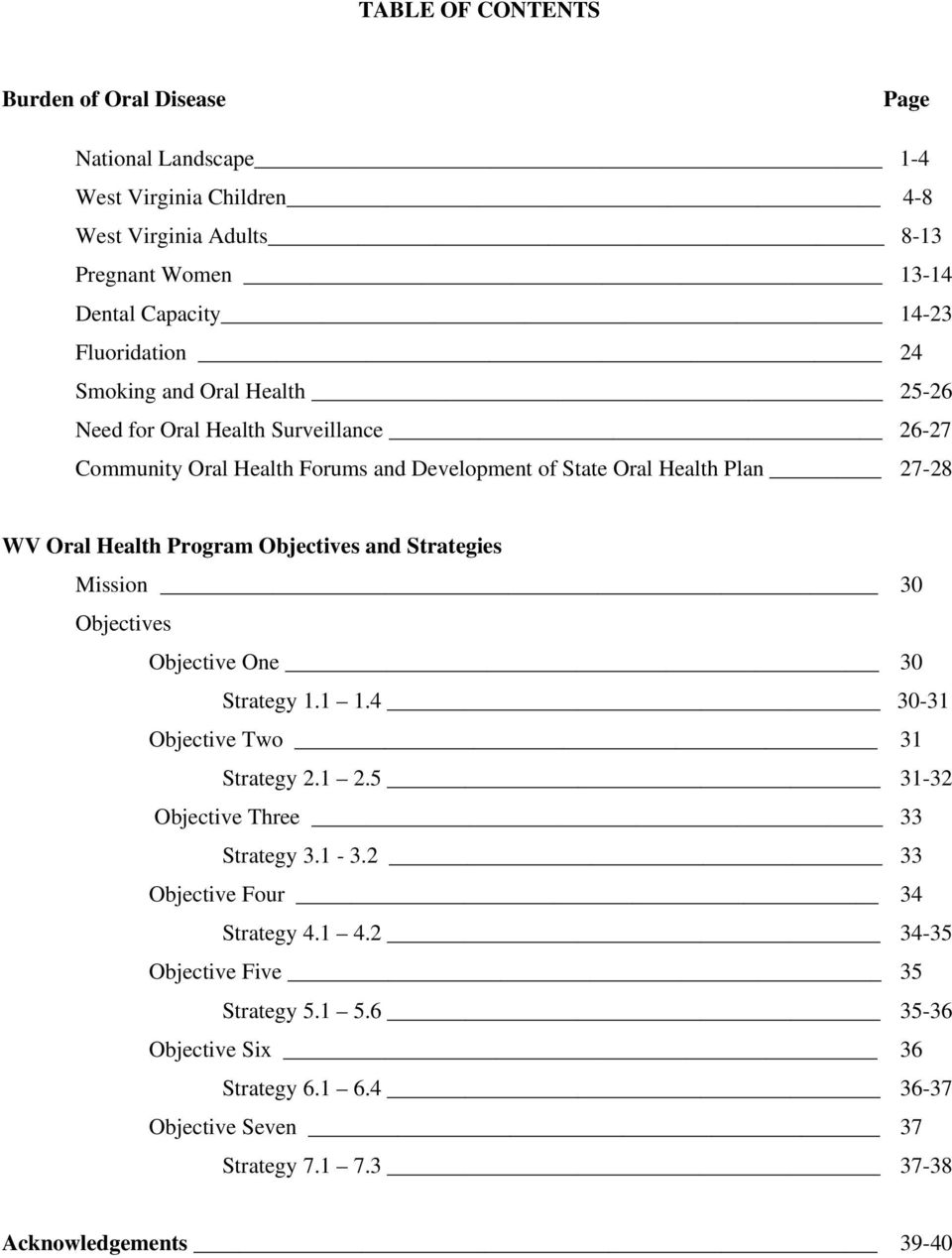
4 TABLE OF CONTENTS Burden of Oral Disease Page National Landscape 1-4 West Virginia Children 4-8 West Virginia Adults 8-13 Pregnant Women Dental Capacity Fluoridation 24 Smoking and Oral Health Need for Oral Health Surveillance Community Oral Health Forums and Development of State Oral Health Plan WV Oral Health Program Objectives and Strategies Mission 30 Objectives Objective One 30 Strategy Objective Two 31 Strategy Objective Three 33 Strategy Objective Four 34 Strategy Objective Five 35 Strategy Objective Six 36 Strategy Objective Seven 37 Strategy Acknowledgements 39-40
5 Burden of Oral Disease National Landscape Oral diseases are progressive and cumulative and become more complex over time affecting our ability to eat foods we choose, how we look, and the way we communicate. These diseases can affect economic productivity and compromise our ability to work at home, at school, or on the job. Many children and adults lack dental insurance and financial resources limiting the ability to seek regular dental services. Parental awareness, public and private dental coverage, and availability of dental providers, especially for children receiving Medicaid, are critical factors in children obtaining needed dental care. Even though children enrolled in Medicaid are individually entitled under the law to comprehensive preventive and restorative dental services, dental care utilization for this population is low. The reasons for low utilization are many, but a lack of dental providers who participate in Medicaid is a key factor. Few dentists participate in Medicaid less than half of all active private dentists in some areas. Low reimbursement rates, patient no-shows for appointments, complex forms and burdensome administrative requirements are commonly cited by dentists as reasons for not participating in Medicaid. State policymakers are increasingly focused on children s oral health as a major policy issue, spurred in part by the 2000 U.S. Surgeon General s Report on Oral Health, the high profile death of a child from consequences of a preventable dental infection, and expanded dental provisions in the reauthorization of the Children s Health Insurance Program (CHIP). This heightened focus on children s oral health is reflected in new legislation, press coverage, and efforts by state and local oral health coalitions to advance improvements in children s oral health policies and programs. Policy activity has resulted in both successes and frustrations as oral health competes for scarce resources and the costs of both appropriate and inappropriate dental care continue to escalate. Efforts to reform health care present a significant opportunity to address the resurgence of childhood tooth decay among key populations of children. Children s oral health is essential to child development and optimal overall health and wellbeing a critical part of achieving key developmental milestones and functions including eating, speaking, and attaining normal social and emotional development. Tooth decay, despite being preventable, remains the single most common chronic disease of U.S. children, affecting 26% of preschoolers, 44% of kindergarteners, and half of all teens. Low-income and minority children are particularly affected as they experience the highest rates of this disease yet have the lowest rates of dental care. Poor oral health can have significant effects on overall health, particularly in adulthood, and has been associated with heart and lung diseases, stroke, and low weight births. In fact, the legacy of poor oral health in childhood is reflected in the health of young people entering the military. The Department of Defense reports that 42% of new army recruits could not be deployed until their dental problems were addressed. 1 P age

6 Dental caries the disease process that causes cavities is largely preventable, highly manageable, and chronic. It is a complex disease process involving the interplay of diet, fluoride, and genetics that results in individual levels of risk for cavities. A family history of dental caries, lack of appropriate fluoride exposure, and frequent sugar intake are among the key risk factors for tooth decay. According to the National Oral Health Policy Center, Trendnotes, October 2009, the decline in dental caries among children has mainly been due to successful, well-established public health strategies that include community water fluoridation, dental sealant programs, and public education and awareness campaigns. Long-standing, community-based public health strategies also have been successful in providing a return on public investment for those who are at the greatest risk. Cost savings include the following: Dental costs for children enrolled in Medicaid for five continuous years who have their first preventive dental visit by age one are nearly 40% less ($263 compared to $447) than for children who receive their first dental visit after age one. For every one dollar invested in community water fluoridation, $38 in dental treatment costs are saved. School based dental sealant programs save costs when they are delivered to children at high-risk for tooth decay. When children lack dental coverage and access to regular check-ups, dental care frequently waits until symptoms such as a toothache are severe and facial abscesses occur. In these cases, care is often sought in an emergency department where it is costly and likely to be limited to treating the immediate symptoms but not the underlying problem. Dental sealants - plastic coatings applied to the chewing surfaces of the back teeth where most decay occurs - are a safe, effective way to prevent cavities. Yet, only about one-third of children ages six to nineteen years have sealants. Although children from lower income families are almost twice as likely to have decay as those from higher income families, they are only half as likely to have sealants. The following are highlights of oral health data for children as reported from the 2003 U.S. Department of Health and Human Services, National Call to Action to Promote Oral Health and the 2009 National Center for Chronic Disease Prevention and Health Promotion. Dental caries (tooth decay) is the single most common chronic childhood disease five times more common than asthma and seven times more common than hay fever. 2 P age
7 Tooth decay affects more than one-fourth of U.S. children age two to five and half of those ages twelve to fifteen. About half of all children and two-thirds of children age twelve to nineteen from low income families have had decay. Tobacco-related oral lesions are prevalent in adolescents who use smokeless (spit) tobacco. Unintentional injuries, many of which include head, mouth, and neck injuries, are common in children. Intentional injuries commonly affect the craniofacial tissues. Professional care is necessary for maintaining oral health, yet twenty-five percent of poor children have not seen a dentist before entering kindergarten. Medical insurance is a strong predictor of access to dental care. Uninsured children are two and one half times less likely than insured children to receive dental care. Children from families without dental insurance are three times more likely to have dental needs than children with either public or private insurance. For each child without medical insurance, there are at least two and six tenths children without dental insurance. Children and adolescents of some racial and ethnic groups and those of lower income experience more untreated decay. For example, 40% of Mexican-American children age six to eight have untreated decay, compared with 25% of non-hispanic whites. Twenty percent of all adolescents twelve to nineteen years currently have untreated tooth decay. (In West Virginia, approximately 41% of children receiving Medicaid receive at least one dental service). Older Americans make up a growing percentage of the population. As we continue to live longer, the need for proper oral care is vital to maintain natural teeth and enhance the quality of life. Currently, over 60 percent of the U.S. population over the age of 65 have some or all of their natural teeth. Many people think that conditions such as toothaches, tooth loss and dry mouth happen naturally as you grow old. The truth is, most of these conditions result from diseases of the teeth such as periodontal disease and dental caries or side effects of medications. The following are highlights of oral health data for adults and older adults, as reported by the 2003 U.S. Department of Health and Human Services, National Call to Action to Promote Oral Health and the 2009 National Center for Chronic Disease Prevention and Health Promotion: Most adults show signs of periodontal or gingival diseases. Severe periodontal disease (measured as six millimeters of periodontal attachment loss) affects about four percent to twelve percent of adults. Half of the cases of severe gum disease in the U.S. are the result of cigarette smoking. Three times as many smokers as people who have never smoked have gum disease. Employed adults lose more than 164 million hours of work each year due to dental disease or dental visits. 3 P age

8 For every adult nineteen years or older with medical insurance, there are three without dental insurance. A little less than two thirds of adults report having visited a dentist in the past twelve months. Those with income at or above the poverty level are twice as likely to report a dental visit in the past twelve months as those who are below the poverty line. Older Adults Twenty-three percent of 65 to 74 year olds have severe periodontal disease (measured as six millimeters of periodontal attachment loss). (Also, at all ages, men are more likely than women to have more severe diseases, and at all ages people at the lowest socioeconomic levels have more severe periodontal disease.) One-fourth of adults age 65 years and older are edentulous, compared to 46 percent twenty years ago. These figures are higher for those living in poverty. Oral and pharyngeal cancers are diagnosed in about 30,000 Americans annually; 7,000 die from these diseases each year. These cancers are primarily diagnosed in the elderly with a prognosis of poor for survival. The five-year survival rate for white patients is 56%, for blacks, it is only 34%. Older Americans take both prescription and over-the-counter drugs. In all probability, at least one of the medications used will have an oral side effect usually dry mouth. The inhibition of salivary flow increases the risk for oral disease because saliva contains antimicrobial components as well as minerals that can help rebuild tooth enamel after attack by acid-producing, decay-causing bacteria. Individuals in long-term care facilities are prescribed an average of eight drugs. At any given time, five percent of Americans age 65 and older (currently some 1.65 million people) are living in a long-term care facility where dental care is problematic. Many elderly individuals lose their dental insurance when they retire. The situation may be worse for older women, who generally have lower incomes and may never have had dental insurance. Medicaid funds dental care for the low-income and disabled elderly in some states, but reimbursements are low. Medicare is not designed to reimburse for routine dental care (West Virginia Medicaid does not provide for routine dental care for adults). West Virginia Children West Virginia recognizes the need to improve oral health for its residents, and long-term improvements will begin with the State s children. At this time, there is limited information about sealants and/or caries for children living in West Virginia. However, this document will explore the issues of dental coverage and access of services for children with West Virginia Medicaid and the West Virginia Children s Health Insurance Program. 4 P age
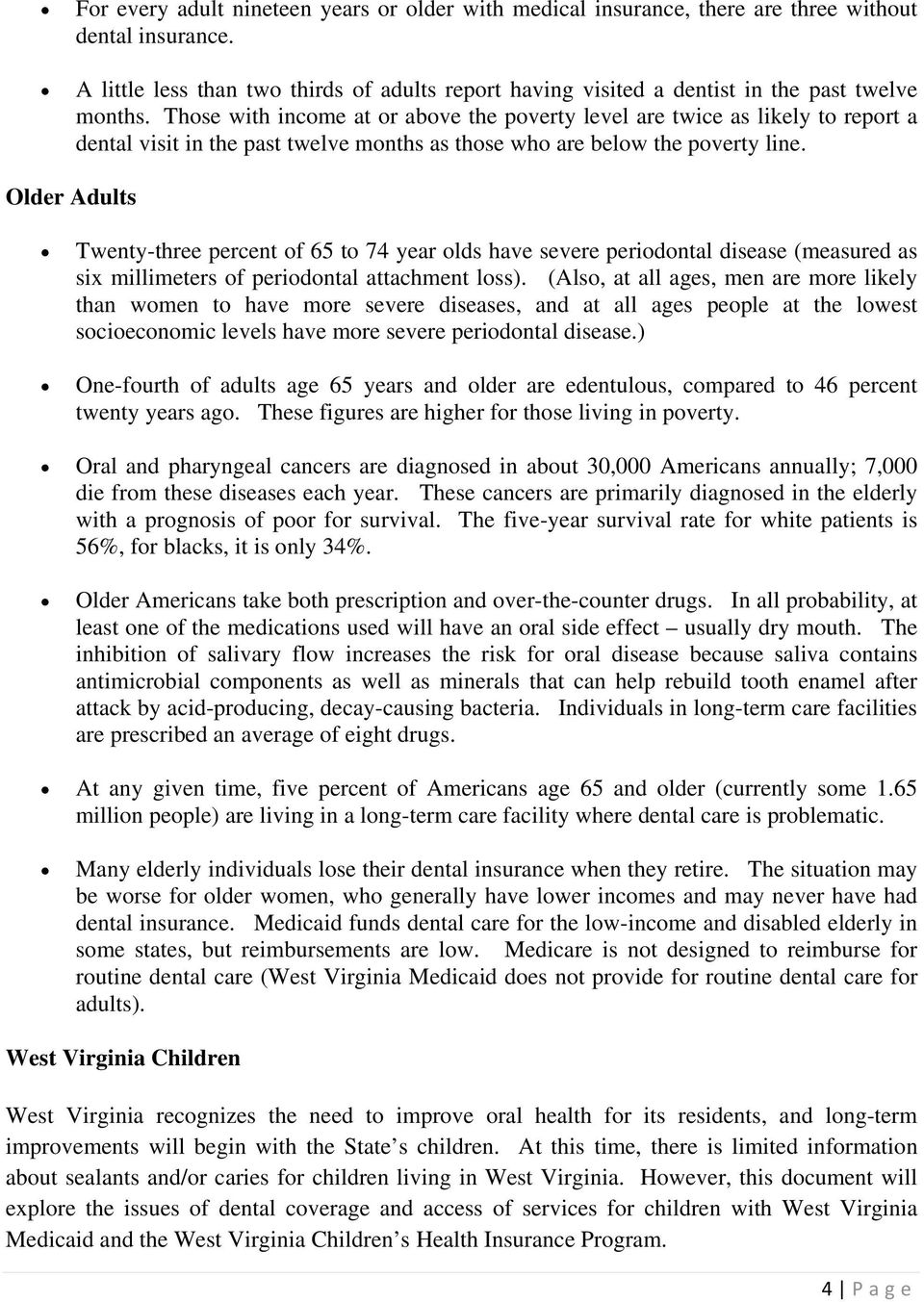
9 According to the 2008 West Virginia CMS 416 (EPSDT Participation Report), there were 206,729 Medicaid eligible persons between the ages of zero to twenty. From , about 41% of this population received dental services during a one year period. There was some fluctuation in 2006 when dental services spiked to 55.69%. For this same time period and age group, only 35% received any preventive dental service within each year. The following table provides specific information. Table 1 West Virginia CMS-416 Dental EPSDT Participation Report Year Information Total Eligible (Ages 0-20) 210, , , ,729 Total Eligible Receiving Dental Services 86, ,070 85,108 86,250 Percentage Eligible Receiving Dental Services 40.87% 55.69% 40.99% 41.72% Total Eligible Receiving Preventive Services 72,973 73,893 73,012 74,326 Percentage Eligible Receiving Preventive Services 34.58% 35.15% 35.16% 35.95% Total Eligible Receiving Dental Treatment Services 82,201 85,676 84,711 85,866 Percentage Eligible Receiving Dental Treatment Services 40.38% 40.76% 40.80% 41.53% CMS-416 Dental Participation P age
10 Opportunities to Address Dental Caries under CHIP Reauthorization Act (CHIPRA) On February 4, 2009, President Obama signed into law the reauthorization of the Children s Health Insurance Program (CHIP). Included in the bill are eight major dental provisions that range from mandating dental coverage to encouraging primary preventive care. The new Children s Health Insurance Program provisions include the following: Requires that states provide dental coverage for Children s Health Insurance Program beneficiaries. Allows states to provide dental coverage that wraps around commercial medical coverage for children who are otherwise eligible for Children s Health Insurance Program. They may have private medical, but no dental insurance. However, children covered by the Public Employees Insurance Agency would not be eligible for this benefit. Requires that states report on Children s Health Insurance Program dental program performance. Establishes a requirement that parents of newborns be informed of risks for early childhood caries and its prevention. According to the West Virginia Children s Health Insurance Program Annual Report 2009, there are several significant changes in the new law that are designed to improve the health care that children receive in the Children s Health Insurance Program and impact the current benefit structure for West Virginia Children s Health Insurance Program. In compliance with West Virginia Children s Health Insurance Program Reauthorization Act s requirements, the current dental benefit for enrolled beneficiaries with income that exceeds 200% FPL needs to be changed. Currently, dental services for this group are limited to preventive services and subject to a maximum of $150 per year. The new dental benefit will include both preventive and restoration services. Restoration services will include a co-payment of $25 per service. Between January 1, 2008, and December 31, 2008, West Virginia Children s Health Insurance Program, using HEDIS-Type Data, estimated that of the 8,675 children age two to eighteen years, who were continuously enrolled for the whole year, 8,380 or 96.60% had at least one dental visit during the year. Previous percentages were 96.06% for 2007 and 95.84% for P age

11 Table 2 West Virginia CHIP Enrollment Data Age Group in Years Information Totals Number of Continuously Enrolled Children ,448 2,917 2,422 8,675 Number Having Dental Check up Visit ,377 2,826 2,308 8,380 % Year % 97.86% 97.10% 96.88% 95.29% 96.60% % Year % 97.58% 97.24% 96.23% 94.17% 96.06% % Year % 97.51% 96.70% 95.52% 94.72% 95.84% WV CHIP Data The following table shows the 1998 prevalence of tooth decay and sealants in West Virginia children. West Virginia hopes to update this data in Table Prevalence of Dental Caries and Dental Sealants in West Virginia Dental Caries (Tooth Decay) Experience Percentages Children, age eight years 65.6% Adolescents, age 15 years 66.0% Untreated Caries (Tooth Decay) Children, age eight years 35.5% Adolescents, age 15 years 32.9% Dental Sealants Children age eight years (1 st Molars) 36.7% Adolescents (1 st and 2 nd molars) age % 1998 Baseline data taken from WV Healthy People P age

12 According to the above data, 65.6% of West Virginia children age eight have experienced tooth decay as well as 66% of adolescents age fifteen. Thirty-five and a half percent of children ages six to eight years have untreated caries, along with 32.9% of adolescents age fifteen. Only 36.7% of children age eight and 34.6% of adolescents age fourteen have dental sealants. Data for children s dental care is not current and difficult to find for West Virginia children. West Virginia Adults According to Centers for Disease and Control Prevention (CDC), West Virginia has the highest rate of tooth loss of adults age 65 and older in the nation. With a State that ranks almost last in median income and a high rate of poverty, residents do not rate seeing a dentist as a priority. Government health care plans and private employers often do not offer adequate dental insurance coverage. Medicaid fully covers children up to age twenty-one, but only covers extractions to alleviate pain and suffering for those adults covered under Medicaid. Medicare for the elderly offers no coverage and many times private insurance is offered as a separate policy by companies and employees opt not to pay for it. Unfortunately, some people elect not to continue with regular dental treatment if they have lost their dental insurance or elect not to seek regular dental care if they do not have insurance. According to the West Virginia Dental Association, transportation is often an issue if a dentist is not located nearby, but a bigger problem is the fact that many West Virginia dentists limit or will not treat Medicaid patients because Medicaid often reimburses less than a procedure costs. Using data from BRFSS, the following tables look at data over several years in three categories. This gives us an idea of whether improvements have been made across time. Adults that have had permanent teeth extracted decreases with higher education and income levels. The older a person is, the more likely he/she is to have had permanent teeth extracted. 8 P age

13 Table 4 West Virginia Adults That Have Had Any Permanent Teeth Extracted Percentages by Year Information Percent of ALL adults 61.1% 60.1% 60.3% RACE GENDER *Black N/A N/A N/A White 60.7% 60.2% 60.4% *Other N/A N/A N/A Female 62.7% 60.9% 62.0% Male 59.3% 59.3% 58.4% AGE in years Years 18.6% 18.2% 15.6% Years 34.9% 36.2% 39.4% Years 52.9% 52.8% 48.6% Years 70.8% 65.5% 66.5% Years 83.5% 78.5% 80.2% 65 + Years 89.8% 90.1% 90.2% EDUCATION LEVEL Less than high school 83.5% 84.0% 81.4% High school graduate 66.7% 67.6% 68.3% At least some college 49.2% 53.1% 53.6% College graduate 42.3% 36.8% 38.4% INCOME RANGE Less than $15, % 82.5% 82.3% $15,000 24, % 75.4% 73.4% $25,000 34, % 67.4% 69.7% $35,000 49, % 54.2% 61.9% $50, % 40.2% 42.2% Data Source: Behavior Risk Factor Surveillance System (BRFSS) *Sample size too small to calculate accurately. 9 P age

14 Over the past five years, adults age 65 and older have decreased the percentages that have had all of their natural teeth extracted from 44.3% to 37.8%. The percentage is still well above the national average of 18.5%. Table 5 West Virginia Adults Age 65+ That Have All Their Natural Teeth Extracted Percentages by Year Information Percent of ALL Adults 44.3% 41.3% 42.9% 40.5% 37.8% RACE *Black N/A N/A N/A N/A N/A White 44.6% 41.3% 42.6% 40.0% 37.6% *Other N/A N/A N/A N/A N/A GENDER Female 46.2% 43.4% 44.1% 41.7% 38.3% Male 41.4% 38.2% 41.1% 38.9% 37.3% EDUCATION LEVEL Less than high school 64.3% 60.0% 67.9% 57.3% 59.4% High school graduate 38.2% 37.0% 39.3% 39.3% 37.8% At least some college N/A 32.0% 28.9% 33.5% 30.0% College graduate 12.9% 16.9% 12.1% 12.4% 12.8% INCOME RANGE Less than $15, % 55.8% 63.0% 62.4% 61.8% $15,000 24, % 43.1% 46.7% 49.6% 43.1% $25,000 34,999 N/A N/A N/A 39.2% 32.7% $35,000 49,999 N/A N/A N/A 15.9% 23.6% $50,000 + N/A 12.6% 11.5% 18.1% 7.7% Data Source: Behavior Risk Factor Surveillance System (BRFSS) *Sample size too small to calculate. 10 P age

15 The following table looks at the percentage of West Virginians who have visited a dentist or dental clinic within the past year for any reason. Those with higher education and income levels are more likely to visit the dentist with minor variations with age. Females are more likely to visit the dentist than males. Since 2002, there has been very little change in the percentage of adults visiting the dentist or dental clinic. Table 6 WV Adults who Visited Dentist or Dental Clinic within the Past Year for Any Reason Percentages by Year Information Percent of All Adults 57.8% 61.2% 62.5% 61.4% 60.7% RACE *Black N/A N/A N/A N/A N/A White 57.9% 61.1% 62.6% 61.0% 60.6% *Other N/A N/A N/A N/A N/A GENDER Female 58.4% 62.9% 63.9% 63.6% 63.9% Male 57.2% 59.3% 61.0% 59.0% 57.3% AGE in years Years 72.2 % 75.1% 71.9% 72.7% 65.1% Years 60.4% 64.6% 67.5% 63.7% 61.8% Years 66.5% 65.8% 61.7% 64.2% 65.6% Years 61.6% 62.9% 70.7% 64.5% 62.5% Years 46.1% 57.8% 59.5% 59.8% 58.9% 65 + Years 43.3% 45.7% 47.2% 48.3% 52.8% EDUCATION LEVEL Less than high school 31.3% 35.8% 34.3% 32.6% 37.5% High school graduate 56.1% 59.1% 58.6% 57.8% 55.4% At least some college 68.8% 68.7% 73.9% 68.8% 66.0% College graduate 80.0% 79.4% 81.3% 80.2% 80.3% INCOME RANGE Less than $15, % 35.8% 45.1% 32.9% 33.5% $15,000 24, % 50.8% 48.5% 46.7% 47.2% $25,000 34, % 53.9% 62.1% 55.0% 51.7% $35,000 49, % 72.2% 67.5% 66.1% 64.5% $50, % 81.7% 82.5% 81.5% 80.2% Data Source: Behavior Risk Factor Surveillance System (BRFSS). *Sample size too small to calculate. 11 P age

16 The following bar graphs compare the West Virginia data with national data. West Virginia has a significantly higher percentage of adults that have had any permanent teeth extracted, adults age 65+ who have had all of their natural teeth extracted and a lower percentage who visited the dentist or dental clinic within the past year for any reason. 80 Figure 1. Adults that have had any permanent teeth extracted* Percent Nationwide WV Year Data Source: Behavior Risk Factor Surveillance System (BRFSS) *2002 data not available. Value may be inaccurate. Figure 2. Adults age 65+ with all natural teeth extracted Percent Nationwide WV Year Data Source: Behavior Risk Factor Surveillance System (BRFSS) 12 P age

17 Figure 3. Visited the dentist or dental clinic within the past year for any reason Percent Nationwide WV Year Data Source: Behavior Risk Factor Surveillance System (BRFSS) According to the above data, West Virginia lags significantly behind the Nation. The only significant change since 1999 was the percentage of persons age 65+ with all natural teeth extracted. Both the Nation and West Virginia saw a decrease, however, the gap between West Virginia and the Nation remains significant. Pregnant Women PRAMS (Pregnancy Risk Assessment Monitoring System) asked women whether they had their teeth cleaned before, during or after pregnancy. The respondent was to answer yes or no to each time period. Below is the yes response rate to each of those time periods. WVPRAMS Survey Question 83 (Phase V): When did you have your teeth cleaned by a dentist or dental hygienist? (For each of the three time periods, indicate Yes or No) a. Before my most recent pregnancy.. Y N b. During my most recent pregnancy.. Y N c. After my most recent pregnancy. Y N 13 P age

18 Table 7 PRAMS: WV Mothers that Reported Having Teeth Cleaned* Percentages by Year Information Before Pregnancy 62.6% 63.2% 62.1% 64.0% During Pregnancy 25.6% 26.4% 27.2% 25.6% After Pregnancy 23.8% 22.7% 24.1% 21.7% *Each respondent indicated yes or no for each of the three time periods. WV PRAMS Dental Capacity The Office of Maternal, Child and Family Health administers the Bureau for Children and Families Pre-Employment Services Dental/Vision Project that supports these services for persons transitioning from welfare to work. For Pre-Employment Services, the local Department of Health and Human Resources Family Support Specialist will assess if a client may need dental ($2,500 lifetime benefit limit) and/or vision care. If the client is eligible, a referral will be issued effective for one year. The client receives a list of providers in his or her area that participate in the Program and it is up to them to take advantage of the services. From data in the fiscal system, for the 2009 fiscal year (07/01/08 06/30/09), $1,305,961 was spent serving 1,926 persons for dental benefits and $218,785 was expended for vision services for 1,319 persons. Financing for the Program is sound but recruitment of new dental providers and provider shortage in some areas of the state is challenging. The locations of low dental provider participation include: Parkersburg, Lewisburg, Braxton County, and Eastern Panhandle areas and a general lack of participating oral surgeons everywhere. Recruitment has been heavy in all of these areas for several years, but despite not having a lack of dentists in these areas participation is low. For example, Parkersburg has at least 19 dentists within a five mile radius and only one agreed to participate in the Pre-Employment Program. Most dentists who do not agree to participate cite low payments on the fee schedule, especially for oral surgery services, and some mention not wanting to participate in a State program because they have had bad experiences with Medicaid payments and clients. A fee increase for Medicaid dental services (and Pre-Employment would follow) has been proposed for several months. The Office of Maternal, Child and Family Health also administers a small program called the Donated Dental Project in which the dentist donates his time to fit a patient for dentures and is reimbursed for a lab bill up to $500. Eligibility criteria for patients is if under the age of 65, must be a Supplemental Security Income (SSI) recipient and 65 years or older, income must be at or below 133% of the Federal Poverty Level (FPL). 14 P age

19 As most dentists are charging $1,000 to $3,000 for a set of dentures, the program currently has only 65 dentists throughout 34 counties participating and recruitment is difficult. Participating dentists are only required to provide services to one client per year, but some providers like Affordable Dentures in Barboursville and the West Virginia University School of Dentistry provides services to many annually. Funding is limited to $40,000 a year and can usually provide services to 100 clients per year or $400 per person. As of January 2010, 245 persons are on the waiting list with funding for the 2010 fiscal year already allocated, essentially halting any new placements until the new fiscal year starts July 1, According to the West Virginia Board of Dental Examiners, as of January 2010, there are 854 practicing dentists serving the 1.8 million residents of West Virginia. The West Virginia University School of Dentistry reports that in 2009, 44 students graduated and of those, 33 are currently practicing in West Virginia (75%). The graph below shows an increase in dental student retention of West Virginia University graduates from 50% in 2005 to 75% in Figure 4 West Virginia University Dental Student Retention WVU Dental Student Retention Percent practicing in WV after graduation West Virginia University School of Dentistry The map on the next page shows where dentists are located and a table follows showing the actual number of dentists per county. This information was obtained from the West Virginia Dental Association. The list includes dentists that specialize in orthodontics, periodontal disease, dentures, etc. It is estimated that 50 of the 854 practicing dentists are specialists. 15 P age
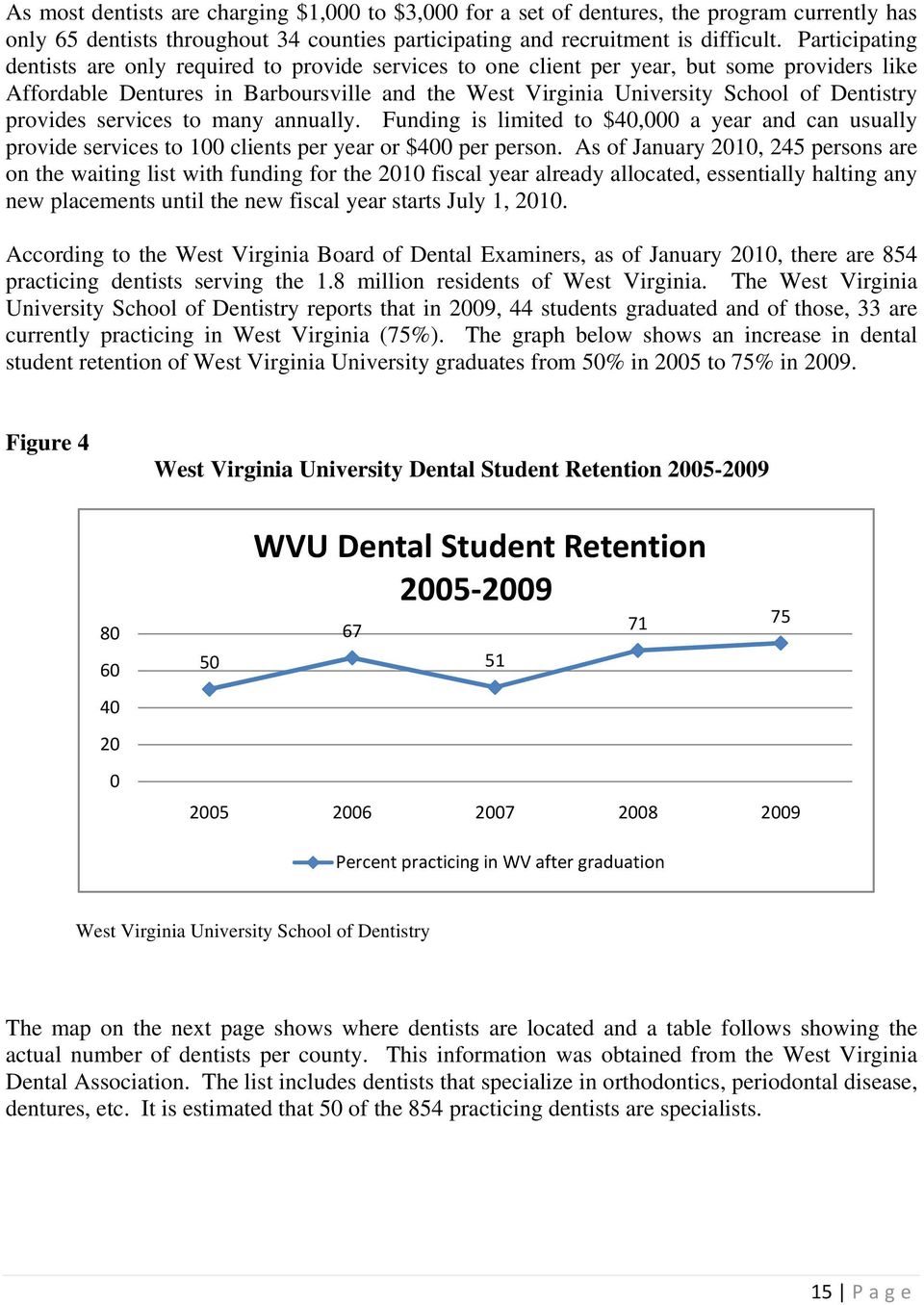
20 Figure 5 HANCOCK WV Dentists per County BROOKE OHIO MARSHALL MASON JACKSON WOOD WIRT ROANE PLEAS ANTS RITCHIE CAL HOUN TYLER GILMER WETZEL DODD RIDGE BRAXTON HARRISON LEWIS MONONGALIA MARION UPSHUR TAYLOR BARBOUR RANDOLPH PRESTON TUCKER PENDLETON GRANT MINERAL HARDY HAMPSHIRE MORGAN BERKELEY JEFF ERSON CABELL PUTNAM CLAY WEBSTER KANAWHA NICHOLAS POCAHONTAS LINCOLN WAYNE BOONE FAYETTE GREENBRIER MINGO LOGAN RALEIGH WYOMING SUMMERS MONROE MCDOWELL MERCER WV Dental Association Dentists per county: 5 or less or more P age
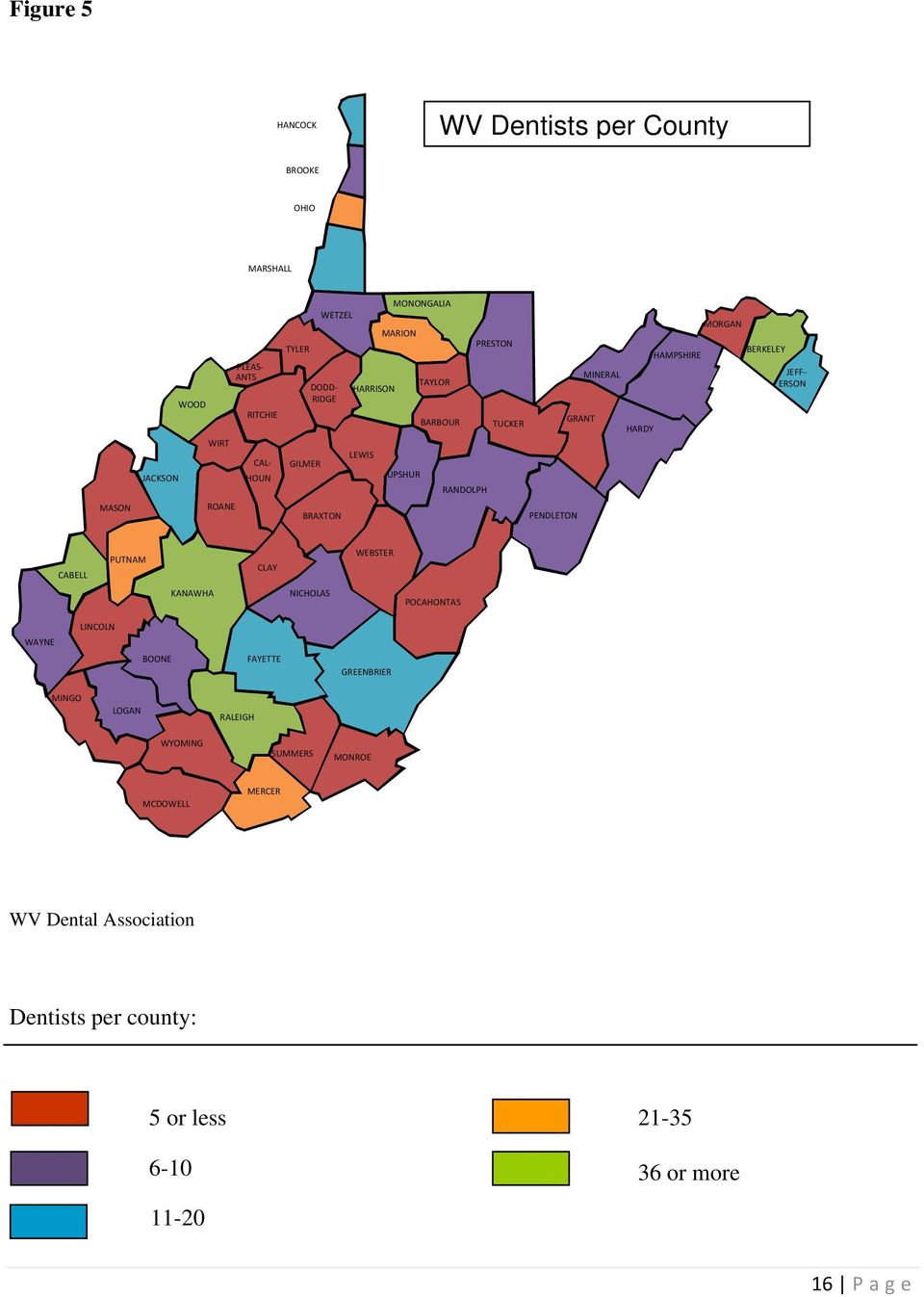
21 Table 8 Number of Dentists in West Virginia by County County Number Dentists County Number Dentists Barbour 4 Monongalia 104 Berkley 47 Monroe 1 Boone 6 Morgan 3 Braxton 5 McDowell 2 Brooke 7 Nicholas 8 Cabell 53 Ohio 35 Calhoun 1 Pendleton 7 Clay 3 Pleasants 3 Doddridge 1 Pocahontas 2 Fayette 19 Preston 8 Gilmer 1 Putnam 21 Grant 4 Raleigh 42 Greenbrier 20 Randolph 9 Hampshire 8 Ritchie 1 Hancock 17 Roane 3 Hardy 7 Summers 2 Harrison 45 Taylor 5 Jackson 11 Tucker 3 Jefferson 12 Tyler 2 Kanawha 147 Upshur 8 Lewis 4 Wayne 10 Lincoln 5 Webster 2 Logan 6 Wetzel 6 Marion 27 Wirt 1 Marshall 13 Wood 41 Mason 5 Wyoming 5 Mercer 30 Mineral 8 Mingo 4 Total Dentists Board of Dental Examiners 17 P age
22 Some of the 854 practicing dentists in West Virginia provide services through local health departments, free clinics and primary care centers to provide oral health services across the State. The following information describes the locations: Table 9 County/Local Health Departments Offering Oral Health Services County Preventive Services Educational Services Medicaid Billing Grant NA Yes NA Marshall Hosts dental clinics in schools Provides oral health educational materials to school children in Marshall County yes Monongalia A full-time dental clinic is run daily. Provides oral health education using a grant from the Department of Education. Distributes toothbrushes and paste to students. yes Pocahontas NA Provides oral health education to Health Department clients NA Mid-Ohio Valley Did a Mission of Mercy dental clinic last summer but cannot afford to do yearly. Studying other alternatives to provide services. 18 dentists participated in Mission of Mercy effort. Provides assessments and makes referrals through the school system to local dentists. yes FY 2010 Annual Health Department Program Plan Free clinics offering oral health services: Three Free Clinics provide direct dental services o Ebenezer Medical Outreach, Cabell County o Susan Dew Hoff Memorial Clinic, Harrison County o West Virginia Health Right, Kanawha County 18 P age
23 Primary care centers offering oral health services: Ten Primary Care Centers have dental services on site o Clay-Battelle Health Association, Monongalia County o E. A. Hawse Health Center, Inc., Hardy County o Monongahela Valley Association of Health Centers, Inc., Marion County o New River Health Association, Inc., Fayette County o Preston-Taylor Community Health Centers, Inc., Taylor County o Ritchie County Primary Care Association, Ritchie, Pleasants, Wood, and Doddridge Counties o Tug River Health Association, Inc., McDowell County o Valley Health Systems, Inc., Cabell, Lincoln, Kanawha, Putnam and Wayne Counties o WomenCare Inc., Kanawha County o Minnie Hamilton Health Care Center, Calhoun and Gilmer Counties 19 P age
24 Forty-nine School Based Health Centers serving 61 schools in 24 counties are shown in the following map. (The map was prepared with data provided by the West Virginia School Health Technical Assistance and Evaluation Center, Marshall University, September 2009). Figure 6 On November 20, 2008, West Virginia Governor Joe Manchin III and the Appalachian Regional Commission (ARC) Federal Co-Chair, Anne B. Pope, announced a major initiative on schoolcommunity partnerships to promote children s oral health in West Virginia. Appalachian Regional Commission and the Claude Worthington Benedum Foundation have collaborated to fund a $500,000 grant for the program, which will help establish school based dental clinics and will be managed by the Robert C. Byrd Center for Rural Health at Marshall University. The clinics target school-age youth without access to dental care in the economically distressed, at-risk, and transitional counties of West Virginia. One of the clinics responsibilities is to provide sealants to prevent cavities. 20 P age
25 Appalachian Regional Commission funds are used to fund dental equipment requests, and Benedum Foundation funds are used for planning and technical assistance. Schools, health departments, and rural health centers can submit proposals defining their plan and the funding needed to implement a program to expand youth access to oral health care. Approximately 7,500 students will be provided with sealants, exams, and/or restorative care each year as a result of the program. The Appalachian Regional Commission has given out grants of up to $25,000 to seventeen communities to examine children s teeth, administer fluoride treatment and apply sealants. Students at Tuscarora Elementary School in Martinsburg come into the nurse s office three at a time. For some of these children this was their first visit to the dentist. Dr. Lisa Dunn is conducting the exams and plans to examine children on free and reduced lunch at every school in Berkeley County whose parents give permission. Dunn refers those who need more care to the new Healthy Smiles Clinic, a sliding scale dental practice that opened in Martinsburg. Dunn says she sees a lot of children who have one or two cavities and others with more serious problems. I saw a young man the other day, I m going to guess he was 10 or 11 because it was an intermediate school and every primary or baby tooth that he had left in his mouth but one needed to be extracted, Dunn said. So it was very serious. 21 P age
26 The following map displays the counties in which the Appalachian Regional Commission/ Benedum grantees are located. Figure 7 22 P age
27 Based on recent data the following map depicts the WV Health Professional Shortage Areas for Dental Care, January Figure 8 23 P age
28 Fluoridation Sixty-five years ago, on January 25, 1945, the city of Grand Rapids, Michigan, added fluoride to its municipal water system and community water fluoridation began. Since that day, this simple, safe, and inexpensive public health intervention has contributed to a remarkable decline in tooth decay in the United States, with each generation enjoying better oral health than the previous generation. Currently, 69.8% of the water serving households in West Virginia is fluoridated. See the following map from the 2006 National Fluoridation Report: Figure 9 24 P age
29 Smoking and oral health Besides the link between tobacco and heart disease, stroke, emphysema, and cancer (especially lung and throat cancers), smoking leads to the following oral health consequences: Bad breath. Tooth discoloration. Inflammation of the salivary gland openings on the roof of the mouth. Increased build up of plaque and tartar on the teeth. Increased loss of bone within the jaw. Increased risk of leukoplakia, white patches inside the mouth. Increased risk of developing gum disease, a leading cause of tooth loss. Delayed healing process following tooth extraction, periodontal treatment, or oral surgery. Lower success rate of dental implant procedures. Increased risk of developing oral cancer. Table 10 Percentage Cigarette Smoking Among Adults Age 18 Years and Older Information Percentages TOTAL Percent of Adults 26.5% RACE Black 37.2% White 26.1% Other 35.9% GENDER Female 27.0% Male 26.0% 2008 WV BRFSS 25 P age
30 Table 11 Percentage of Students in High School (9 th 12 th grade) Who Smoked Cigarettes or Who Used Chewing Tobacco or Snuff on One or More Occasions Over the Past 30 Days Percentages Information Cigarettes Chews TOTAL Percent of HS Students 27.6% 14.8% RACE White 27.7% 15.2% Black * * Other * * GENDER Female 28.0% 2.2% Male 27.4% 27.0% 2007 WV YRB *less than 100 students in this subgroup West Virginia ranks first in the nation for smoking, health outcomes in a number of areas, show this as a major problem. Despite attempts to educate residents and encourage quitting, the rate has fluctuated very little in the last several years. Need for oral health surveillance Monitoring the status of oral disease in the State s population is essential for setting achievable goals and objectives as well as for planning, implementing, and evaluating public health programs. Currently, West Virginia does not have a surveillance system in place. Using the definition of surveillance in public health (the ongoing and systematic collection, analysis, dissemination, and interpretation of outcome-specific data), the data shows there is an impending need to develop new techniques to build up surveillance systems for oral diseases. Surveillance is the process which provides data, and puts the information into action. The data disseminated by a public health surveillance system can be used for immediate public health action, program planning and evaluation, and formulating research hypotheses. It can also be a valuable tool with identifying resources. 26 P age
31 Surveillance systems would provide information necessary for public health decision-making. A comprehensive public health surveillance system would routinely collect data on health outcomes, risk factors and intervention strategies for the whole population or representative samples of the population. Having a surveillance system in place would help identify key oral health indicators that could assist the oral health program in finding usable, creditable data. At the state and local level, an integrated system of data collection would be an evolving process as new techniques would be developed in response to new demands. It also is important for illustrating the burden of oral disease and for gaining support and funding for the state oral health program. To develop a state oral health surveillance system, oral health programs must assess the currently available assets, such as data sources that already include an oral health component, other state resources and capacity that can be used to augment those of the oral health program. Under the leadership of the Association of State and Territorial Dental Directors (ASTDD), and in collaboration with the Centers for Disease and Control Prevention (CDC), the National Oral Health Surveillance System (NOHSS) was developed to help public health programs monitor the burden of oral disease, use of the oral health care delivery system, and monitor the status of community water fluoridation on both state and national levels. The National Oral Health Surveillance System is a web-based query system ( which is available to the public and includes indicators for oral health, information on state dental programs, and links to important oral health information. Below are some examples and benefits of a surveillance system: A plan for collecting, analyzing, and disseminating data. Surveillance of oral diseases using key oral health indicators (e.g., state fluoridation status, caries experience, or decayed, missing, and filled teeth) are standard approaches for comparability across states. Monitor water fluoridation data monthly using a system such as the Association of State and Territorial Dental Directors/Centers for Disease and Control Prevention Water Fluoridation Reporting System. Update data at periodic, specific intervals. Current data and indicators consistent with other reporting systems; e.g., the National Oral Health Surveillance and Water Fluoridation Reporting System (WFRS). Summary of Community Oral Health Forums and Development of State Oral Health Plan The Office of Maternal, Child, and Family Health partnered with Marshall University and other key stakeholders in oral health to develop a statewide comprehensive oral health plan in accordance with CDC recommendations. Marshall University applied for and received a grant from the Claude Worthington Benedum Foundation in the amount of $45,000 to provide logistical support and technical assistance to the Office of Maternal, Child and Family Health in the planning process. The West Virginia Department of Health and Human Resources, Oral 27 P age
32 Health Advisory Board took the lead in this effort and met every other month to discuss progress and working in assigned work groups provided updates from the regional forums. Key components in the development of the state oral health plan will be the input and involvement received from all key stakeholders, as well as data collected from regional community town hall meetings. The community meetings were held in nine different locations in the State with over 285 participants in attendance. The regional meetings were held on the dates and locations listed below: 1. July 17 th, at the Greenbrier, White Sulphur Springs, West Virginia (in conjunction with the West Virginia Dental Association) 2. August 6 th, at Oglebay Resort and Conference Center State Park, Wheeling, West Virginia (in conjunction with the WVPCA) 3. September 11 th, at the Blennerhassett Historic Hotel, Parkersburg, West Virginia (in conjunction with the Mid-Ohio Valley Oral Health Task Force) 4. September 24 th, at Stonewall Resort and Conference Center, Roanoke, West Virginia (in conjunction with the West Virginia Public Health Dental Section) 5. September 28 th, at Boone County Armory, Madison, West Virginia (in conjunction with REV Up Madison, All About Health, The Wellness Council of West Virginia & The Robert Wood Johnson Foundation) 6. October 22 nd, at West Virginia University Health Sciences Center, Morgantown, West Virginia (in conjunction with the West Virginia University School of Dentistry) 7. October 22 nd, Glade Springs Resort (in conjunction with WVPCA) 8. November 13 th, Charleston, West Virginia, Charleston Area Medical Center (in conjunction with Growing Healthy Children Conference) 9. November 20 th, at Martinsburg, West Virginia (in conjunction with the WV Healthy Smiles Partnership of the Eastern Panhandle) Following a presentation on the need for a current oral health plan by representatives from the West Virginia Department of Health and Human Resources, Oral Health Advisory Board, the audience was given opportunity to provide input and feedback from their respected regions. At the conclusion of the meeting, a West Virginia State Oral Health Plan Survey was provided to collect information and identify key priorities that need to be addressed to improve the status of oral health in West Virginia. Participants were asked to rank (1-9) various issues with the most important barriers ranked first. 28 P age
33 The following table is a summary of the information collected from the regional community meeting participants: Table 12. Ranking of Priorities Survey Results from Regional Community Meeting Participants. Priorities at a glance 1 Disease Treatment and Prevention Direct services, prevention vs. restorative, cost and, by whom, etc. 2 Public Education and Outreach Social marketing of the importance of good oral health. 3 Funding/Reimbursement Insurance coverage, Medicaid, PEIA as well as federal funding opportunities. 4 School Based Education and Service Delivery Services provided at a school or school related site. 5 Oral Health Promotion across the lifespan Looking at oral health from perinatal, children and adults through seniors. 6 Workforce Scope of practice, shortage of dental providers, recruitment and retention. 7 Water Fluoridation and Fluoride Programs Water treatment plants, fluoride rinse programs, etc. 8 Data Collection and Surveillance On going monitoring of the status of oral health in West Virginia. 9 Burden of Disease and Documentation An encompassing report on the current status of oral health in West Virginia. WV School Health TA & Evaluation, Marshall University Final approval of the State Oral Health Plan will be given by the West Virginia Department of Health and Human Resources Oral Health Advisory Board. Delivery of the plan will be provided during the 2010/2011 Legislative Session and will allow West Virginia to seek additional federal funding and support for the Oral Health Program. 29 P age
34 Objectives and Strategies Mission: The mission of the West Virginia Oral Health Program is to improve the oral health status of West Virginia by providing a structured approach to meeting the oral health needs of everyone in the state. Objective One: The West Virginia Oral Health Program will strengthen West Virginia s state-level infrastructure and capacity to improve the oral health of its citizens. Strategy 1:1 The West Virginia Oral Health Program will secure adequate funding to support staff expansion of oral health efforts and implementation of the oral health plan, including at a minimum: A full-time oral health director to administer and supervise all dental health programs within the West Virginia Bureau for Public Health. Recommend assessing the feasibility of hiring a full-time dentist with a public health degree and or experience as the oral health director, in accordance with West Virginia State Personnel Policies ( A part time epidemiologist to develop, implement and monitor an oral health surveillance system Adequate staff to support and ensure implementation of the state plan, such as a fluoridation specialist and epidemiologist. Stakeholders: West Virginia Bureau for Public Health, West Virginia Department of Health and Human Resources Oral Health Advisory Board Timeline: Years One-Two Strategy 1:2 The West Virginia Oral Health Program will establish and maintain a state-based oral health surveillance system to assess needs and monitor progress in improving oral health systems in accordance with Centers for Disease Control and Prevention recommendations. Stakeholders: West Virginia Bureau for Public Health, West Virginia Department of Health and Human Resources Oral Health Advisory Board Timeline: Years One-Two Strategy 1:3 The West Virginia Oral Health Program will complete a burden of disease report on oral health disease in West Virginia, which includes a study of all payers regarding the 30 P age
35 current costs of emergency room visits incurred for dental problems to determine if expenses can be reduced through more appropriate utilization of expanded coverage, and preventive programs. Stakeholders: West Virginia Bureau for Public Health, Payers, West Virginia Children s Health Insurance Program, West Virginia Bureau for Medical Services, West Virginia Public Employees Insurance Agency, West Virginia Insurance Commission Timeline: Year One Strategy 1:4 - The West Virginia Oral Health Program will develop and sustain a statewide coalition of stakeholders in both public and private sectors invested in reducing oral health disease. The oral health coalition will: Advocate and support program and policy improvements. Encourage coordination and communication among stakeholders. Increase public awareness and understanding of the importance of oral health. Stakeholders: West Virginia Department of Health and Human Resources Oral Health Advisory Board, West Virginia Bureau for Public Health, West Virginia Healthy Kids and Families Coalition, West Virginia School Based Health Assembly; state associations; all with an interest Timeline: Years One-Three Objective Two: The West Virginia Oral Health Program will develop a financing strategy for oral health services and implementation of the state plan recommendations. Strategy 2:1 - The West Virginia Oral Health Program will develop a budget and assess costs and revenues needed to support expansion of the West Virginia Bureau for Public Health Oral Health Program and fund expansion of oral health services. Stakeholders: West Virginia Bureau for Public Health, West Virginia Department of Health and Human Resources Oral Health Advisory Board Timeline: Years One-Two Strategy 2:2 - The West Virginia Oral Health Program will analyze feasibility and develop a strategy for approval of a one cent increase in the tax on soft drinks. Such a tax would also encourage West Virginians to make healthier drink choices. 31 P age
36 Stakeholders: West Virginia Dental Association, West Virginia Dental Hygiene Association, West Virginia Council of Churches, West Virginia Growing Healthy Children, West Virginia Oral Health Coalition once established, Other Public Interest Groups Timeline: Years One-Five Strategy 2:3 - The West Virginia Oral Health Program will establish recommendations for systematic and ongoing monitoring/evaluation of reimbursement, and incremental/phasing in of increases in West Virginia Medicaid and West Virginia Children s Health Insurance Program reimbursement for dental services to 25% of the American Dental Association Mid Atlantic scale; giving priority to increased reimbursement for oral health surgery (i.e., shift away from emergency) and other services critical to increasing access. Stakeholders: West Virginia Department of Health and Human Resources Oral Health Advisory Board, West Virginia Dental Association, West Virginia Dental Hygiene Association, West Virginia Bureau for Medical Services, West Virginia Dental Assistants, West Virginia Children s Health Insurance Program Timeline: Years One-Five Strategy 2:4 - The West Virginia Oral Health Program will develop a plan to phase in expansion of coverage for preventative and basic restorative services for children, adults, and pregnant women under the West Virginia Children s Health Insurance Program, West Virginia Public Employees Insurance Agency, and West Virginia Medicaid. Stakeholders: West Virginia Children s Health Insurance Program, West Virginia Public Employees Insurance Agency, West Virginia Bureau for Medical Services, West Virginia Department of Health and Human Resources Oral Health Advisory Board, West Virginia Dental Association, West Virginia Dental Hygiene Association; West Virginia Dental Assistants Timeline: Years One-Five Strategy 2:5 - The West Virginia Oral Health Program will explore feasibility of a public/private partnership for development of an affordable, basic dental plan for adults that includes features such as an employer-based pool that is supplemented by state funds and includes individual contributions. Stakeholders: West Virginia Department of Health and Human Resources, West Virginia Bureau for Medical Services, West Virginia Oral Health Coalition once established, West Virginia Dental Hygiene Association Timeline: Years One-Five 32 P age
37 Objective Three: The West Virginia Oral Health Program will promote oral health across the lifespan. Strategy 3:1 - The West Virginia Oral Health Program will identify funding to implement a statewide oral health public awareness campaign with consistent messages targeted to specific high risk groups including pregnant women, minorities, parents of young children, nursing home staff, and health professionals Stakeholders: West Virginia Department of Health and Human Resources Oral Health Advisory Board, West Virginia Perinatal Partnership, West Virginia Right from the Start, West Virginia Head Start, West Virginia Women, Infants and Children, West Virginia Higher Education Policy Commission Timeline: Years One-Two Strategy 3:2 - The West Virginia Oral Health Program will collaborate with all health professionals to increase oral health awareness across the lifespan, to incorporate lifelong dental care into current medical protocols, and to promote dental care as part of an integral part of a medical home Stakeholders: West Virginia Department of Health and Human Resources Oral Health Advisory Board, West Virginia Oral Health Coalition once established, West Virginia Higher Education Policy Commission, West Virginia University School of Dentistry Timeline: Years One-Two Objective Four: The West Virginia Oral Health Program will strengthen and improve the dental health workforce. Strategy 4:1 - The West Virginia Oral Health Program will form a task force to study the following: The existing capacity and distribution of the oral health workforce to ensure oral health needs are met. How to extend or expand workforce capacity and productivity to address oral health in health care shortage areas. Ensure a sufficient workforce pool to meet oral health care needs. Stakeholders: West Virginia Department of Health and Human Resources Oral Health Advisory Board, West Virginia Higher Education Policy Commission, West Virginia University School of Dentistry, West Virginia Dental Association, West Virginia Dental 33 P age
38 Hygiene Association, West Virginia Dental Assistants, West Virginia Primary Care Association, Division of Primary Care, Division of Recruitment and Retention Timeline: Years One-Two Strategy 4: 2 - The West Virginia Oral Health Program will develop a plan to address unequal distribution and shortage of dentists in rural areas including the following: Establish a uniform system for assessing oral health workforce capacity as one component of the oral health surveillance system. Assure capacity for schools of dentistry and dental hygiene to recruit and retain faculty to provide state of the art teaching and research opportunities. Recruitment and retention of dentists and dental hygienists: o A West Virginia loan repayment program and a tax credit for service program for dentists and dental hygienists who agree to practice in underserved areas. Providers would agree to see West Virginia Medicaid and West Virginia Children s Health Insurance Program patients at a specified minimal level (e.g. 50%) or regardless of the ability to pay, which includes Temporary Assistance for Needy Families and preemployment programs. o Maximize loan repayment options as they relate to the National Health Service Corps and the Recruitment Retention Community Project. Need for continuing health education training programs for health care providers, school educators, and extension specialists Stakeholders: West Virginia Department of Health and Human Resources Oral Health Advisory Board, West Virginia University School of Dentistry, West Virginia Higher Education Policy Commission, West Virginia Schools of Dental Hygiene, West Virginia Dental Assistants, West Virginia Dental Association, West Virginia Primary Care Association, Division of Recruitment and Retention Timeline: Years One-Two Objective Five: The West Virginia Oral Health Program will invest in community prevention. Strategy 5:1 - The West Virginia Oral Health Program will develop and implement a statewide plan for increasing the number of public water systems with fluoridated water 34 P age
39 Stakeholders: West Virginia Department of Health and Human Resources Oral Health Advisory Board, West Virginia Bureau for Public Health, West Virginia Water Quality Division, West Virginia County Health Departments Timeline: Years One-Five Strategy 5:2 - The West Virginia Oral Health Program will develop a preventative oral health program for all West Virginians that involve a broad spectrum of health care professionals. Stakeholders: West Virginia Dental Association, West Virginia Dental Hygiene Association, West Virginia Dental Assistants, West Virginia Bureau for Public Health, West Virginia Chapter of American Academy of Pediatrics Timeline: Years One-Five Strategy 5:3 - The West Virginia Oral Health Program will define protocol and develop educational components and training opportunities for pediatricians and family practitioners to replicate successful and proven preventive oral health programs such as fluoride varnish, promoting good oral health activities and linkage to dental homes. Stakeholders: West Virginia Dental Association, West Virginia Chapter of American Academy of Pediatrics, West Virginia Chapter of Academy of Family Physicians Timeline: Years One-Five Strategy 5:4 - The West Virginia Oral Health Program will work with the West Virginia Department of Education to analyze, evaluate and redefine the role of the state s Oral Health Educators to maximize their effectiveness as community oral health prevention specialists. Stakeholders: West Virginia Bureau for Public Health, West Virginia Department of Education, West Virginia Department of Health and Human Resources Oral Health Advisory Board Timeline: Years One-Two Strategy 5:5 - The West Virginia Oral Health Program will encourage local boards of health to implement a dental health component in their program plans and provide outreach activities to inform the public of the type and availability of oral health services Stakeholders: West Virginia Bureau for Public Health, West Virginia Department of Health and Human Resources Oral Health Advisory Board Timeline: Years One-Two 35 P age
40 Strategy 5:6 - The West Virginia Oral Health Program will support and collaborate with oral cancer educational programs in the state to: Study risk factors that lead to oral cancer. Improve accessibility of screening to detect oral cancer. Stress high risk behaviors, signs, and symptoms of oral cancer in oral health education presentations. Stakeholders: West Virginia Division of Tobacco Prevention, West Virginia Bureau for Public Health Timeline: Years One-Three Objective Six: The West Virginia Oral Health Program will strengthen the role of West Virginia s schools in promoting the oral health of students. Strategy 6:1 - The West Virginia Oral Health Program will improve oral health knowledge among students through teacher trainings about oral health as an integral part of overall health by: Teacher trainings about oral health as a key component of overall health. Assessment and monitoring of learning outcomes regarding oral health. Stakeholders: West Virginia Department of Education, West Virginia Bureau for Public Health, West Virginia Oral Health Educators, West Virginia Department of Health and Human Resources Oral Health Advisory Board Timeline: Years One-Five Strategy 6:2 - The West Virginia Oral Health Program will incorporate strategies to increase parent instruction and involvement in oral health education. Stakeholders: West Virginia Department of Education, West Virginia Department of Health and Human Resources Oral Health Advisory Board, West Virginia Dental Association, West Virginia Dental Hygiene Association, West Virginia Bureau for Public Health Timeline: Years One-Five 36 P age
41 Strategy 6:3 - The West Virginia Oral Health Program will promote and support expansion and improvement in school-based oral health programs including the following: Fluoride rinse programs. Sealant programs. Protective mouthguard requirement for all West Virginia Secondary Schools Activity Commission sports. Stakeholders: West Virginia Department of Education, West Department of Health and Human Resources Oral Health Advisory Board, West Virginia Dental Association, West Virginia Dental Hygiene Association, West Virginia Bureau for Public Health Timeline: Years One-Five Strategy 6:4 - The West Virginia Oral Health Program will evaluate and make recommendations for policies requiring dental examinations prior to school entry collaborating with the Governor s Kids First initiative to ensure a dental component. Stakeholders: West Virginia Department of Education, West Virginia Dental Association, West Virginia Dental Hygiene Association, West Virginia Oral Health Committee once established, West Virginia Bureau for Public Health Timeline: Years One-Five Objective Seven: The West Virginia Oral Health Program will maintain, evaluate, and monitor state plan implementation. Strategy 7:1 - The West Virginia Oral Health Program will establish a process to implement the state plan, including defining roles and responsibilities and local agencies for planning and evaluation, coordination and accountability. Stakeholders: West Virginia Department of Health and Human Resources Oral Health Advisory Board Timeframe: Years One-Five Strategy 7:2 - The West Virginia Oral Health Program will report progress on a regular basis to Select Committee D on Oral Health. Stakeholders: West Virginia Bureau for Public Health Timeline: Years One-Five 37 P age
42 Strategy 7:3 - The West Virginia Oral Health Program will establish a broad based coalition focused on oral health improvement for all West Virginian s across the lifespan. Stakeholders: West Virginia Bureau for Public Health, West Virginia Department of Health and Human Resources Oral Health Advisory Board Timeframe: Years One-Five 38 P age
43 ACKNOWLEDGEMENTS This document was a collaborative effort by many individuals and organizations. The West Virginia Oral Health Advisory Committee acknowledges the following for their time and energy in preparing this document. The West Virginia Oral Health Advisory Board Members Laura Aliff, RDH Sharon L. Carte Sister Mary Rebecca Fidler, PhD, RSM Sister M. Jane Harrington, CSJ Donnie Haynes, BS Dr. Fernando Indacochea Felice Joseph Nancy Malecek Vacant Christina Mullins Bobbi Jo Muto, RDH, BS Melanie B. Purkey Beverly Robinson (retired) Gina Sharps, RDH, BS Charles L. Smith, DDS Richard Stevens Candace A. Vance, RN Louise T. Veselicky Kimberly Vickers, CDA WV Health Right Director, WV CHIP Susan Dew Hoff Memorial Clinic Sisters of St. Joseph Charitable Fund, Inc. Children s Dentistry Project West Virginia Chapter American Academy of Pediatrics WV PEIA Insurance Market Analyst, WV Insurance Commission Bureau for Medical Services Infant, Child, and Adolescent Health CHC and School Based Oral Health WVDE Office of Healthy Schools Claude Worthington Benedum Foundation WV Dental Hygiene Association WV Private Dental Practitioner Executive Director, WV Dental Association WV CHIP Acting Dean, WVU School of Dentistry WV Dental Assistants Association Chairman: David H. Walker, DDS, Dental Director Oral Health Program 350 Capitol Street, Room 427 Charleston, WV Phone: [email protected] The West Virginia Oral Health Advisory Workgroup Linda Anderson, Marshall University Paula Fields, Marshall University Beth Hubbard, RDH, Office of Healthy Schools Paula Legge, Oral Health Program Phil Martino, Environmental Health Services Stephanie Montgomery, Marshall University Vacant, Bureau for Medical Services Melissa Baker, Office of Maternal, Child, and Family Health, Research Dr. Richard Crespo, Marshall University Tisha Reed, Pre-Employment Project, Oral Health Program Betty Tyler, Early Childhood Health Nell Phillips, Community Health Systems Karen Pauley, Division of Rural Health and Recruitment 39 P age
44 Other Partners Funder: Claude Worthington Benedum Foundation Facilitators and Staff: Robert C. Byrd Center for Rural Health, Marshall University Richard Crespo Bobbi Jo Muto Linda Anderson West Virginia DHHR -Office of Maternal, Child and Family Health David Walker, DDS, Dental Director Donnie Haynes Christina Mullins Melissa Baker LeAnn Bonnet 40 P age
DIVISION OF REHABILITATION SERVICES SSI Contact List
 DIVISION OF REHABILITATION SERVICES SSI Contact List Barbour 722 W. Pike Street Berkeley Boone Judy Reed District 1 Manager Charleston District Office P.O. Box 547 City, State, Zip: Institute, WV 25112
Strengthening and Enhancing West Virginia s Medicaid Program:
 Strengthening and Enhancing West Virginia s Medicaid Program: Overview of the Managed Care Organization (MCO) Program Benefit Expansion August 2013 Prepared for: BMS Provider Training Workshops Presentation
Wyoming 3600 -Elementary Education
 TABLE D6: FIRST CLASS PERMITS FOR FULL-TIME EMPLOYEES BY COUNTY First Class Permits Specializations (81) Issued by County School Year Expiring 14 County Endorsement Code Endorsement Count Applicant 4115
State of Mississippi. Oral Health Plan
 State of Mississippi Oral Health Plan 2006 2010 Vision Statement: We envision a Mississippi where every child enjoys optimal oral health; where prevention and health education are emphasized and treatment
Oral Health Program. Strategic Plan. U.S. Department of Health and Human Services Centers for Disease Control and Prevention
 Oral Health Program Strategic Plan 2011 2014 U.S. Department of Health and Human Services Centers for Disease Control and Prevention Centers for Disease Control and Prevention National Center for Chronic
Building School - Community Partnerships for Children s Oral Health in West Virginia 12/1/2008
 Building School - Community Partnerships for Children s Oral Health in West Virginia 12/1/2008 Prepared by the School Health Technical Assistance and Evaluation Center, Robert C Byrd Center for Rural Health,
Health Priority: Access to Primary and Preventive Health Services Objective 4: Access to Oral Health Services
 Health Priority: Access to Primary and Preventive Health Services Objective 4: Access to Oral Health Services Long Term (2010) Subcommittee Outcome Objective: By 2010, increase by 10 percentage points
WEST VIRGINIA THE MOUNTAIN STATE. Building Partnerships in WV Personnel Preparation Program Partnerships
 WEST VIRGINIA THE MOUNTAIN STATE Building Partnerships in WV Personnel Preparation Program Partnerships Kathy Hudnall [email protected] Kathy Knighton [email protected] West Virginia Department
CMS oral Health Initiative an opportunity for Dental Hygienists April 23 rd 2015 Nancy Gurzick, RDH, BSDH, MA
 CMS oral Health Initiative an opportunity for Dental Hygienists April 23 rd 2015 Nancy Gurzick, RDH, BSDH, MA Course objectives Part I Federal and State Oral Health Programs Understanding Medicaid/Federal
Innovative State Practices for Improving The Provision of Medicaid Dental Services:
 Innovative State Practices for Improving The Provision of Medicaid Dental Services: SUMMARY OF EIGHT STATE REPORTS: (Alabama, Arizona, Maryland, Nebraska, North Carolina, Rhode Island, Texas and Virginia)
WV County GIS Tax Mapping Programs (January 2012)
 WV County GIS Tax Mapping Programs (January 2012) Populous Counties Utilize GIS A survey that compares 2010 Census population data to county assessors mapping programs reveals that most assessors who reside
Issue Brief: Expanding Access to Oral Health Care in Idaho
 Issue Brief: Expanding Access to Oral Health Care in Idaho Oral diseases can be attributed to bacterial infections that, if left untreated, can affect other systems of the body. A growing number of studies
State of North Carolina. Medicaid Dental Review
 State of North Carolina Medicaid Dental Review October 2010 EXECUTIVE SUMMARY The Centers for Medicare & Medicaid Services (CMS) is committed to improving pediatric dental care in the Medicaid program
Dental Therapists in New Zealand: What the Evidence Shows
 Issue Brief PROJECT Children s NAME Dental Campaign Dental Therapists in New Zealand: What the Evidence Shows Dental decay remains the most common chronic childhood disease in the United States. 1 More
School Dental Exam Requirement Tool Kit
 School Dental Exam Requirement Tool Kit West Virginia Board of Education 2014-2015 Gayle C. Manchin, President Michael I. Green, Vice President Tina H. Combs, Secretary Thomas W. Campbell, Member Lloyd
Ohio Public Health Association
 Ohio Public Health Association Dental Care Access: A Public Health Issue April 17 th, 2014 Presented by: Audia Ellis, MSN, RN, FNP BC [email protected] Objectives Evaluate the current state of dental
Vermont Oral Health Plan 2014
 Vermont Oral Health Plan 2014 Table of Contents INTRODUCTION TO VERMONT ORAL HEALTH PLAN 2013... 3 THE BURDEN OF ORAL DISEASE IN VERMONT... 6 Children... 6 Adults... 8 Older Adults... 10 Disparities...
America s Oral Health
 a me r i c a s Most Trusted D e n t a l l P a n America s Oral Health The Role of Dental Benefits Compiled and published by Delta Dental Plans Association, this report cites data from a number of industry
Challenges and Solutions Recruiting and Retaining Speech Language Pathologists (SLPs) in West Virginia. The WV PIC RECRUITMENT/RETENTION PROJECT
 Challenges and Solutions Recruiting and Retaining Speech Language Pathologists (SLPs) in West Virginia The WV PIC RECRUITMENT/RETENTION PROJECT SLP SHORTAGE IN WEST VIRGINIA PLEA- SANTS BOONE BRAXTON BROOKE
Preventing Type 2 Diabetes in West Virginia: Sustaining and Scaling the National Diabetes Prevention Program
 Preventing Type 2 Diabetes in West Virginia: Sustaining and Scaling the National Diabetes Prevention Program Gina Wood, MPH, RD, LD West Virginia Public Health Symposium November 21, 2013 Program Objectives
SOCIAL SECURITY ADMINISTRATION - FIELD OFFICE LIAISONS SSI Contact List
 SOCIAL SECURITY ADMINISTRATION - FIELD OFFICE LIAISONS SSI Contact List Barbour Toni Alfera 320 W Pike Street, Suite 100 City, State, Zip: Clarksburg, WV 26301 Phone: 304-623-5641 TTY: Fax: 304-622-3234
How to FindVeterans and Troubled People in Your State
 Y ou ve heard about our computer centers around the state that offer free Internet access and computer instruction, but did you know that our mentors are also trained to help Veterans find resources and
OAK HILL, WEST VIRGINIA
 AVAILABLE SPACE 298 INDUSTRIAL DRIVE BUILDING OAK HILL, WEST VIRGINIA LOCATION Building Address - 298 Industrial Drive Oak Hill, WV 25901 Located in City Limits - No Zoning - Industrial County - Fayette
Oral health care is vital for seniors
 Oral health care is vital for seniors (NC) Statistics Canada estimates seniors represent the fastest growing segment of the Canadian population, a segment expected to reach 9.2 million by 2041. As more
School-Based Oral Health Care. A Choice for Michigan Children.indd 1
 School-Based Oral Health Care A Choice for Michigan Children School Based Oral Health Care: A Choice for Michigan Children is part of an information set meant to serve as a guideline for school personnel
A Message. Dear Colleague:
 A Message Dear Colleague: I am pleased to present the New York State Oral Health Plan. This plan addresses the burden of oral disease in New York State and was developed by the New York State Department
AVAILABLE SPACE COLLIERS STEEL BUILDING
 AVAILABLE SPACE COLLIERS STEEL BUILDING LOCATION Building Address - RR 2 Box 450 Located in City Limits - Yes County - Brooke Located in Business/Industrial Park - No Can the Building be Multi-Tenant -
An Overview of Children s Health Issues in Michigan
 An Overview of Children s Health Issues in Michigan Sponsors Michigan Chapter American Academy of Pediatrics Michigan Council for Maternal and Child Health School - Community Health Alliance of Michigan
California s State Oral Health Infrastructure: Opportunities for Improvement and Funding
 California s State Oral Health Infrastructure: Opportunities for Improvement and Funding joel diringer, jd, mph, and kathy r. phipps, drph, rdh abstract California has virtually no statewide dental public
Employment Services Bureau of Employment Programs (BEP) 558-2630 www.wvbep.org, www.wvwic.org 1-800-FREE411 (directory assistance)
 Employment Services Bureau of Employment Programs (BEP) 558-2630 www.wvbep.org, www.wvwic.org 1-800-FREE411 (directory assistance) Region 1 Fayette County Workforce WV Satellite Office 211 North Court
DAVISVILLE, WEST VIRGINIA
 AVAILABLE SPACE POLYMER TECHNOLOGY PARK SPEC BUILDING LOCATION Building Address - 245 Polymer Way Davisville, WV 26142 Located in City Limits - No Zoning - None County - Wood Located in Business/Industrial
RESA Special Education Directors & Head Start Organizational & Contact Chart
 RESA Special Education Directors & Head Start Organizational & Contact Chart Ohio Tyler Wetzel Marion Monongalia Preston Mason Wood Wirt Jackson Roane Harrison Harrison Taylor 20 Ritchie Barbour Tucker
Report of Results and Analysis of Parent Survey Data Collected in Southern West Virginia
 Partners in Community Outreach Education Begins at Home Partners in Community Outreach In-Home Family Education Programs Report of Results and Analysis of Parent Survey Data Collected in Southern West
Blood Lead Level Screening Plan West Virginia Childhood Lead Poisoning Prevention Program
 Blood Lead Level Screening Plan West Virginia Childhood Lead Poisoning Prevention Program Introduction: The West Virginia Childhood Lead Poisoning Prevention Program (CLPPP) developed the lead screening
LESAGE, WEST VIRGINIA
 AVAILABLE SPACE HADCO BUSINESS PARK BUILDING V LOCATION Building Address - HADCO Business Park 8201 Frazier s Lane (Rte. 2) Lesage, WV 25537 Located in City Limits - No County - Cabell Located in Business/Industrial
Public School Transportation National and Regional Perspectives: An Update
 Public School Transportation National and Regional Perspectives: An Update Presented to Education Subcommittee C Public School Finance January 2009 Amy Higginbotham Jared Pincin Dr. Tami Gurley-Calvez
Colorado Medical Assistance Program
 Colorado Medical Assistance Program Colorado Department of Health Care Policy & Financing Using General Fund Dollars to Expand Medicaid Access Amy Scangarella Children s s Policy Specialist Using General
State of Alabama. Medicaid Dental Review
 State of Alabama Medicaid Dental Review October 2010 Executive Summary The Centers for Medicare & Medicaid Services (CMS) is committed to improving pediatric dental care in the Medicaid program reflecting
Dental Health Services in Canada
 Dental Health Services in Canada Facts and Figures 2010 Canadian Dental Association Number of Dentists In January 2010, there were 19,563 licensed dentists in Canada. Approximately 89% were in general
Needs Assessment. Adult Basic Education (ABE) in West Virginia has been on the forefront of many
 Needs Assessment 2.1 Individuals Most in Need Adult Basic Education (ABE) in West Virginia has been on the forefront of many initiatives throughout the country and continues to serve a leadership role
VARNISH! MICHIGAN BABIES TOO!
 VARNISH! MICHIGAN BABIES TOO! 2012-2013 Annual Report The Varnish! Michigan Babies Too! Program was developed as an incentive for medical providers to have oral health training and begin an oral health
2012 West Virginia State Health Profile. Shaping safe and healthy communities
 2012 West Virginia State Health Profile Shaping safe and healthy communities Healthy People Healthy Communities West Virginia State Health Profile West Virginia Department of Health and Human Resources
Iowa s Maternal Health, Child Health and Family Planning Business Plan
 Iowa s Maternal Health, Child Health and Family Planning Business Plan CHILD HEALTH Who we are... A public-private partnership that... Promotes access to regular preventive health care services for children
BLUEFIELD, WEST VIRGINIA
 AVAILABLE SPACE FRYE ROOFING INC BUILDING LOCATION Building Address - 2000 Princeton Avenue Bluefield, WV 24701 Located in City Limits - Yes Zoning - County - Mercer Located in Business/Industrial Park
How To Conduct A Dental Public Health Activity
 Dental Public Health Activities & Practices Practice Number: 49003 Submitted By: Methodist Healthcare Ministries Submission Date: September 2009 Last Updated: September 2009 SECTION I: PRACTICE OVERVIEW
The West Virginia DA List
 Amy Mann Summers County 120 Ballengee Street Hinton, WV 25951 Phone (304) 466-7110 Fax (304) 466-7145 Brian Abraham Logan County 420 Main Street, Suite 300 Logan, WV 25601 Phone (304) 792-8670 Fax (304)
Choptank Community Health System School Based Dental Program Healthy Children Are Better Learners DENTAL
 School Based Dental Program Healthy Children Are Better Learners DENTAL Dear Parent/Guardian: As a student in the Caroline, Dorchester and Talbot County Public School system, your child has access to the
Kansas Dental Project Joint Venture
 Kansas Dental Project Joint Venture Purpose In 2009, the W.K. Kellogg Foundation launched a national initiative to expand access to oral health care through innovative and community-driven solutions to
A Model Framework For Community Oral Health. Programs. Based Upon The Ten Essential Public Health Services. Prepared by
 A Model Framework For Community Oral Health Programs Based Upon The Ten Essential Public Health Services Prepared by American Association for Community Dental Programs With support from Association of
Impact and Opportunities for Integrated Medical and Dental Care Management under the Affordable Care Act
 Impact and Opportunities for Integrated Medical and Dental Care Management under the Affordable Care Act A Federal Perspective David Williams, Ph.D. Objective of this presentation: To share the Federal
CRIME VICTIM SERVICE PROVIDER DIRECTORY 2014 STATE OF WEST VIRGINIA
 CRIME VICTIM SERVICE PROVIDER DIRECTORY 2014 STATE OF WEST VIRGINIA 2 ACKOWLEDGEMENTS State of West Virginia Earl Ray Tomblin, Governor Department of Military Affairs and Public Safety Joseph Thornton,
Early Childhood Indicators Report
 2015 Early Childhood Indicators Report Carol Prentice, Prentice Consulting, 2012 Updated by Alaska Department of Health & Social Services, September 2013 Updated by Prentice Consulting, July 2015 Early
Promoting and Enhancing the Oral Health of the Public HHS ORAL HEALTH INITIATIVE 2010
 Promoting and Enhancing the Oral Health of the Public HHS ORAL HEALTH INITIATIVE 2010 Table of Contents ADMINISTRATION FOR CHILDREN AND FAMILIES... 4 Head Start Dental Home Initiative... 4 CENTERS FOR
kaiser medicaid and the uninsured Oral Health and Low-Income Nonelderly Adults: A Review of Coverage and Access commission on June 2012
 P O L I C Y B R I E F kaiser commission on medicaid and the uninsured Oral Health and Low-Income Nonelderly Adults: A Review of Coverage and Access 1330 G S T R E E T NW, W A S H I N G T O N, DC 20005
Healthy People 2020: Who s Leading the Leading Health Indicators?
 Healthy People 2020: Who s Leading the Leading Health Indicators? Don Wright, M.D., M.P.H. Deputy Assistant Secretary for Health Promotion and Disease Prevention Who s Leading the Leading Health Indicators?
Dental care and treatment for patients with head and neck cancer. Department of Restorative Dentistry Information for patients
 Dental care and treatment for patients with head and neck cancer Department of Restorative Dentistry Information for patients i Why have I been referred to the Restorative Dentistry Team? Treatment of
2011 2012 Consumer Guide
 2011 2012 Consumer Guide Helping Families Make Informed Choices About Care West Virginia Bureau of Senior Services West Virginia Health Care Association (WVHCA) is the trade association representing nursing
An Introduction to State Public Health for Tribal Leaders
 The governmental public health system in the United States is comprised of federal agencies, state health agencies, tribal and territorial health departments, and more than 2,500 local health departments.
THE PUBLIC HEALTH DENTAL HYGIENE PRACTITIONER ROLE IN MANAGED CARE ORGANIZATIONS. A Fact Sheet Prepared by the PA Dental Hygienists Association
 THE PUBLIC HEALTH DENTAL HYGIENE PRACTITIONER ROLE IN MANAGED CARE ORGANIZATIONS A Fact Sheet Prepared by the PA Dental Hygienists Association Background Bill establishing PHDHPs passed and signed into