
PROPOSED CHART OF ACCOUNTS FOR BROKER DEALER
|
|
|
- Gary Johns
- 10 years ago
- Views:
Transcription
1 As of PROPOSED CHART OF ACCOUNTS FOR BROKER DEALER IN SECURITIES 1

2 The Chart of Accounts is aimed at organizing bookkeeping procedures, informing the public about any economic and administrative information needed, as well as elaborating financial statements and other established reports. The Chart of Accounts is based on generally accepted accounting principles in the Philippines with reference to Philippine Financial Reporting Standards. The Chart of Accounts has the following structure: 1. Accounts are grouped in classes: a) Class 1 Assets b) Class 2 Liabilities c) Class 3 Equity d) Class 4 Revenues e) Class 5 Cost of Services f) Class 6 Expenses 2. Each class is divided into groups, which in turn is divided into subgroups. 3. Numbers are used to designate each account. 4. Seven-digit numbers are used to designate the accounts. a) The first digit of the account number reflects the class of the account, specifying whether it is part of Assets, Liabilities, Equity, Revenues, Cost of Service, and Expenses. b) The second and third digits reflect the group and subgroup of accounts. The last four digits reflect the concrete object of bookkeeping. 5. The balances on accounts within "Assets", "Liabilities", "Equity" are used to draw up the Balance Sheet; balances on accounts within classes "Revenues", Cost of Service and "Expenses " are used to draw up the Statement of Income. 6. The Chart of Accounts specifies the account number and name. The description, application, and reflection on accounts (to debit and to credit) are also provided. Acronyms As used in this document, unless the context indicates otherwise: 1. TP- Trading Participant/s; used interchangeably with broker, broker dealer or dealer 2. SEC refers to the Securities and Exchange Commission 3. PSE - refers to the Philippine Stock Exchange 4. CTGF refers to the Clearing Trade Guaranty Fund 5. HDMF refers to the Home Development Mutual Fund; also known as Pag-ibig 6. Central Depository may refer to the Philippine Central Depository or any other firm offering depository services 7. BIR refers to the Bureau of Internal Revenue 8. PhilHealth the National Health Insurance Program which is administered by the Philippine Health Insurance Corporation 9. AFS Available-for-Sale 10. VAT Value Added Tax 11. ECC Employee Compensation Contribution 12. PAS Philippine Accounting Standards 13. PFRS Philippine Financial Reporting Standards 2

3 Assets A resource that the TP owns or controls, has economic value, is expected to provide future benefit, and can be measured reliably Current Assets These accounts are used to record assets that are reasonably expected to be realized in cash, or is intended for sale or consumption in the entity's normal operating cycle; it is held primarily for the purpose of being traded and expected to be realized within twelve months after the balance sheet date; or it is cash or a cash equivalent unless it is restricted from being exchanged or used to settle a liability for at least twelve months after the balance sheet date Cash and Cash Equivalents These include cash on hand and peso or foreign currency deposits in banks which are unrestricted and immediately available for use in current operations. These are also highly liquid investments that are readily convertible to known amount of cash with original maturities of three months or less from dates of placements and that are subject to an insignificant risk of changes in value Cash on Hand This account is used to record cash in the form of notes and coins under the custody of the cash custodian. All cash receipts not yet deposited to a bank All cash disbursements, cash deposits and other cash investments Petty Cash Fund This account is used to record funds to defray minimal cash disbursements. All petty cash payments shall be evidenced or supported by duly accomplished and approved petty cash vouchers. Set up and replenishment of petty cash fund and increase in petty cash fund Cash disbursements from the petty cash fund Cash in Bank Local Currency This account is used for all peso-denominated bank accounts. All cash and check deposits, interest received (net of withholding tax), and bank credit advices or memos 3

4 All bank withdrawals, check payments, and bank debit advices or memos Cash in Bank - Foreign Currency This account is used for all foreign currency- denominated bank accounts. All cash and check deposits denominated in currencies other than the Philippine currency, interest received (net of withholding tax), and bank credit advices or memos All bank withdrawals, check payments, conversion of such accounts to Philippine peso, and debit advices or memos Cash in Bank- Reserve Bank Account This account is used for bank deposits for the exclusive benefit of customers as required by the SRC Rule Special Reserve Bank Account for the Exclusive Benefit of Customer (referred by the SRC as the Reserve Bank Account ). All customer funds should be deposited under this account. All cash and check deposits pursuant to SRC Rule Special Reserve Bank Account for the Exclusive Benefit of Customer, interest received (net of withholding tax), and bank credit advices or memos All bank withdrawals, check payments, and bank debit advices or memos Cash Clearing House This account is used for bank deposits pertaining to transactions entered into between the broker and the clearing house. All cash and check deposits All payments and withdrawals made Cash Equivalents This account is used for highly liquid investments that are readily convertible to known amounts of cash and which are subject to insignificant risk of changes in value, the maturity of which, is normally 90 days or less from date of acquisition. All investments with maturity of less than 90 days Maturity or termination of investments 4

5 Trade Receivables These include amounts due from customers resulting from brokerage services rendered and other activities arising from the core business operations and expected to be collected in the regular course of business Receivable from Customers Cash Accounts This account is used to record the amount due from customers resulting from brokerage services rendered, including value of securities bought in behalf of clustomers, commission, and other charges on cash accounts. Amount due from customers for brokerage services rendered Collections on the amounts due from customers for brokerage services rendered and authorized write-offs of the accounts after determining that the receivable is no longer collectible Allowance for Credit Losses Receivable from Customers Cash Accounts This account is used to record valuation reserves for non-collectibility of receivables from customer-cash accounts, which is estimated based on regulatory requirements, industry or TP standards. Accounts of customers, which have been determined to be uncollectible for which authority to write-off has been granted Estimated amount of credit losses Receivable from Customers Margin Accounts This account is used to record the amount due from customers arising from margin transactions. Amount due from customers for brokerage services rendered for margin accounts Collections on the amounts due from customers for brokerage services rendered and authorized write-offs of the accounts after determining that the receivable is no longer collectible Allowance for Credit Losses Receivable from Customers Margin Accounts This account is used to record valuation reserves for non-collectibility of receivables from customers-margin accounts, which is estimated based on regulatory requirements, industry or TP standards. 5

6 Accounts of margin customers, which have been determined to be uncollectible for which authority to write-off has been granted Estimated amount of credit losses Receivable from Other Brokers This account is used to record claims due from other brokers for the purchase of securities and other trade-related transactions. All claims from other brokers arising from the purchase of securities and other traderelated transactions Collections of amounts due from other brokers, authorized write-offs, and reclassifications from other accounts Receivable from Clearing House This account is used to record the cash settlement entitlement of TPs to be received from the clearing house during or after the settlement of their clearing house-eligible trades. These receivables arise from selling transactions for the account of customers and TP s own account on settlement date. Net receivable from clearing house for proceeds from selling transactions Collections of amounts due to TP Receivable from Securities Failed to Deliver This account is used to record the amount of receivable from buying brokers or dealers covering the purchase price of securities sold but not yet delivered. The related long value represents the market value of securities, which the brokerage concern is obliged to deliver. Market value of securities failed to deliver Delivery of securities, collections of amounts due, and authorized write-offs after determining that the receivable is no longer collectible 6

7 Receivable from Securities Borrowed This account is used to record the amount advanced to lending brokers or dealers as collateral for the borrowed securities (market value of security at the time of transaction plus or minus subsequent mark-to-market) and thus the amount to be received when the borrowed security is returned. The related long value represents the current market value of the securities borrowed. Market value of securities borrowed Delivery of securities, collections of amounts due, and authorized write-offs after determining that the receivable is no longer collectible Dividends Receivable This account is used to record cash and property dividends earned but not yet received on shares of stocks owned by the TP. Cash and property dividends declared but not yet received Receipt of cash and property dividends Allowance for Credit Losses Other Trade Receivables This account is used to record valuation reserves for non-collectibility of trade receivable other than receivable from customers, which is estimated based on regulatory requirements, industry or TP standards. Accounts due from other parties arising from other trade-related activities which have been determined to be uncollectible for which authority to write-off has been granted Estimated amount of credit losses Other Receivables These accounts are used to record Notes Receivable, Interest Receivable, Secured Demand Notes, and other receivables Notes Receivable This account is used to record receivable due to the TP, in the form of a promissory note, arising from a loan extended by the TP. 7

8 Notes receivable at outstanding balance Collection of notes receivable Interest Receivable This account is used to record interest income already earned but not yet collected or received on investments in government securities and on loans considered under existing rules and regulations. Interest earned for the period Collection of interest receivable Secured Demand Notes This account is used to record notes receivable from a lender whose claim is subordinated to the claims of creditors pursuant to a satisfactory subordination agreement in conformity with SRC Rule 29.1 (G). The outstanding balance of secured demand note Payment of subordinated liability to lender Advances to Officers and Employees This account is used to record the amounts due from officers and employees of the TP. All cash advances subject to liquidation and other receivables from officers and employees Liquidation of cash advances, collection of receivables from officers and employees, and authorized write-off of accounts Due from Related Parties This account is used to record all receivables arising from transactions with stockholders and related parties other than TP officers or employees. Advances to and other transfers of assets to related parties Collection of receivables from related parties, credit memos,and authorized write-off 8

9 Others - Receivables This account is used to record receivables from other sources which cannot be classified under the specific receivable accounts. Outstanding balance of other receivables Collections Accounts which have been determined to be uncollectible for which authority to write-off has been granted and reclassifications to other accounts Allowance for Credit Losses Other Receivables This account is used to record valuation reserves for non-collectibility of other receivables which is estimated based on regulatory requirements, industry or TP standards. Accounts due from other parties arising from non-trade-related activities which have been determined to be uncollectible for which authority to write-off has been granted Estimated amount of credit losses Financial Assets at Fair Value through Profit or Loss These are financial assets which are either classified as held for trading or upon recognition it is designated at fair value through profit and loss which shall be accounted for in accordance with PAS Held for Trading Securities This account is used for equity securities that are acquired principally for the purpose of selling or repurchasing them in the near term; or part of a portfolio of identified securities that are managed together and for which there is evidenced of a recent actual pattern of short-term profit-taking. Cost (fair value of consideration given plus transaction costs) of financial asset acquired and reclassification from other financial assets Fair value changes Sale or disposal of financial asset Fair value changes Financial Assets Designated at Fair Value This account is used for financial assets that are designated on initial recognition as one to be measured at fair value with fair value changes in profit or loss. 9

10 Cost (fair value of consideration given plus transaction costs) of financial asset acquired and reclassification from other financial assets Fair value changes Sale or disposal of financial asset Fair value changes Investments in Securities with No Ready Market This account is used to record investment in securities, which have no ready market, including delisted or suspended issues. Investments made and reclassifications from other accounts Investments sold, reclassified to other accounts, or written-off Prepayments Prepaid Rent This account is used to record the advance payment and deposit for lease or rental of buildings, land, equipment, office space, vehicles, and other property, plant, and equipment for use in operations. Advance payment and deposit for lease or rental of property, plant, and equipment for use in operations Expired or expensed portion at the end of the accounting period Prepaid Insurance This account is used to record the advance payment for surety bond premiums and insurance premiums of TP properties, etc. Advance payment for surety bond premiums and insurance premiums of TP properties Expired or expensed portion at the end of the accounting period Prepaid Taxes and Licenses This account is used to record the advance payments for taxes and licenses including business permits, real property taxes, etc. 10
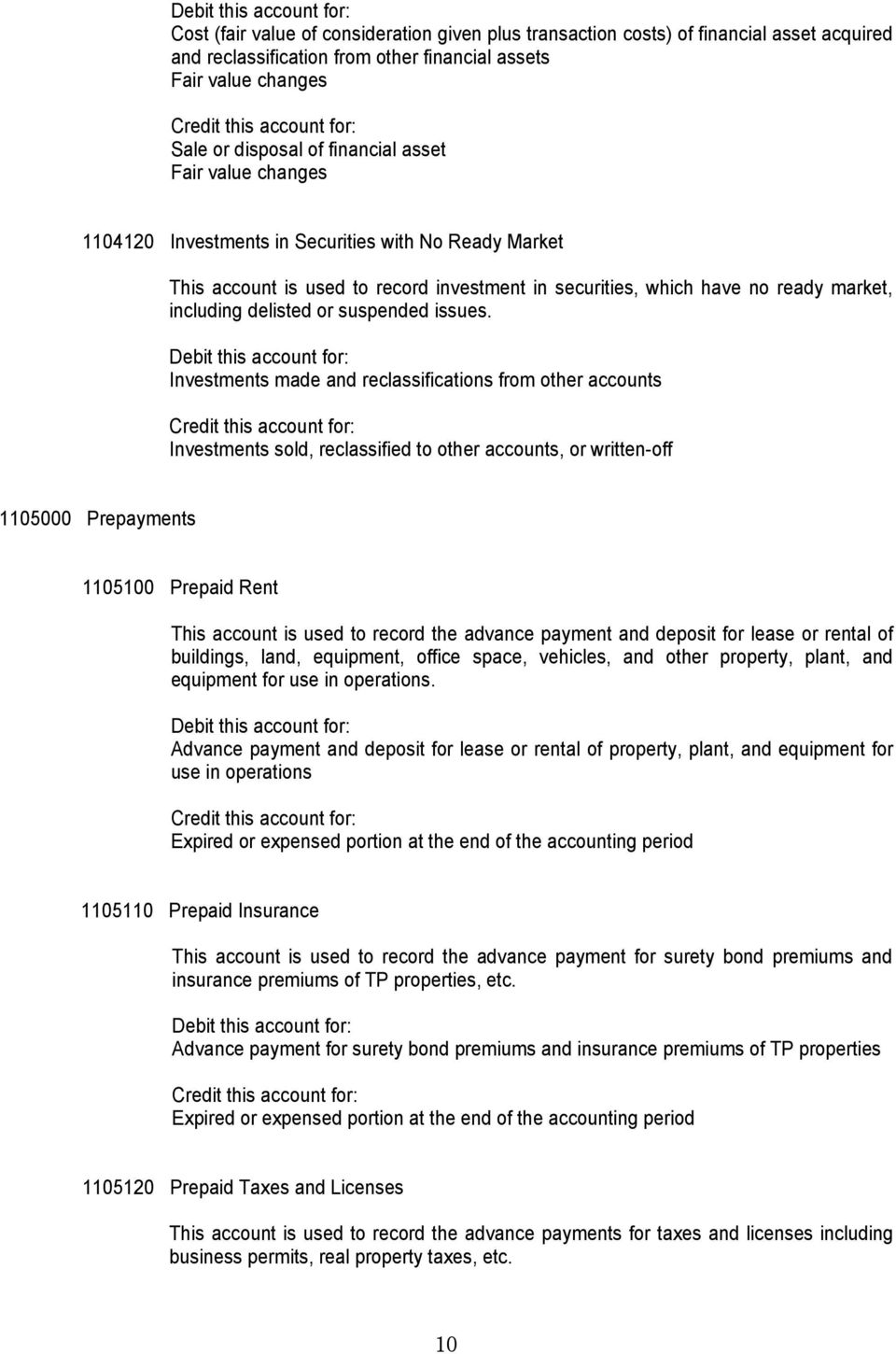
11 Advance payment for taxes and licenses Expired or expensed portion at the end of the accounting period Other Prepayments This account is used to record other prepaid expenses not included in any specific prepaid expense accounts. Other prepaid expenses The expired or expensed portion of other prepaid expenses at the end of the accounting period Available-for-Sale Investments Current Portion This account is used to account for the current portion of any non-derivative financial assets designated on initial recognition as Available-for-Sale. AFS assets are measured at fair value in the balance sheet. Fair value changes on AFS assets are recognised directly in equity, through the statement of changes in equity, except for interest on AFS assets (which is recognised in income on an effective yield basis), impairment losses, and (for interest-bearing AFS debt instruments) foreign exchange gains or losses. This must be accounted for under PAS Available-for-Sale Investments Current Portion with Ready Market This account is used to account for the current portion of any non-derivative financial assets designated on initial recognition as Available-for-Sale with ready market. Cost (fair value of consideration given plus transaction costs) of Available-for-Sale investments Discount accretion as it is subsequently measured at amortized cost using the effective interest method in cases when the acquisition cost is less than the par value of the instrument Gains arising from the change in the fair value of securities Sale or divestment of Available-for-Sale investments Premium amortization as it is subsequently measured at amortized cost using the effective interest method in cases when the acquisition cost is greater than the par value of the instrument Losses arising from the change in the fair value of securities Available-for-Sale Investments Current Portion with No Ready Market This account is used to account for the current portion of any non-derivative financial assets designated on initial recognition as Available-for-Sale with no ready market. 11
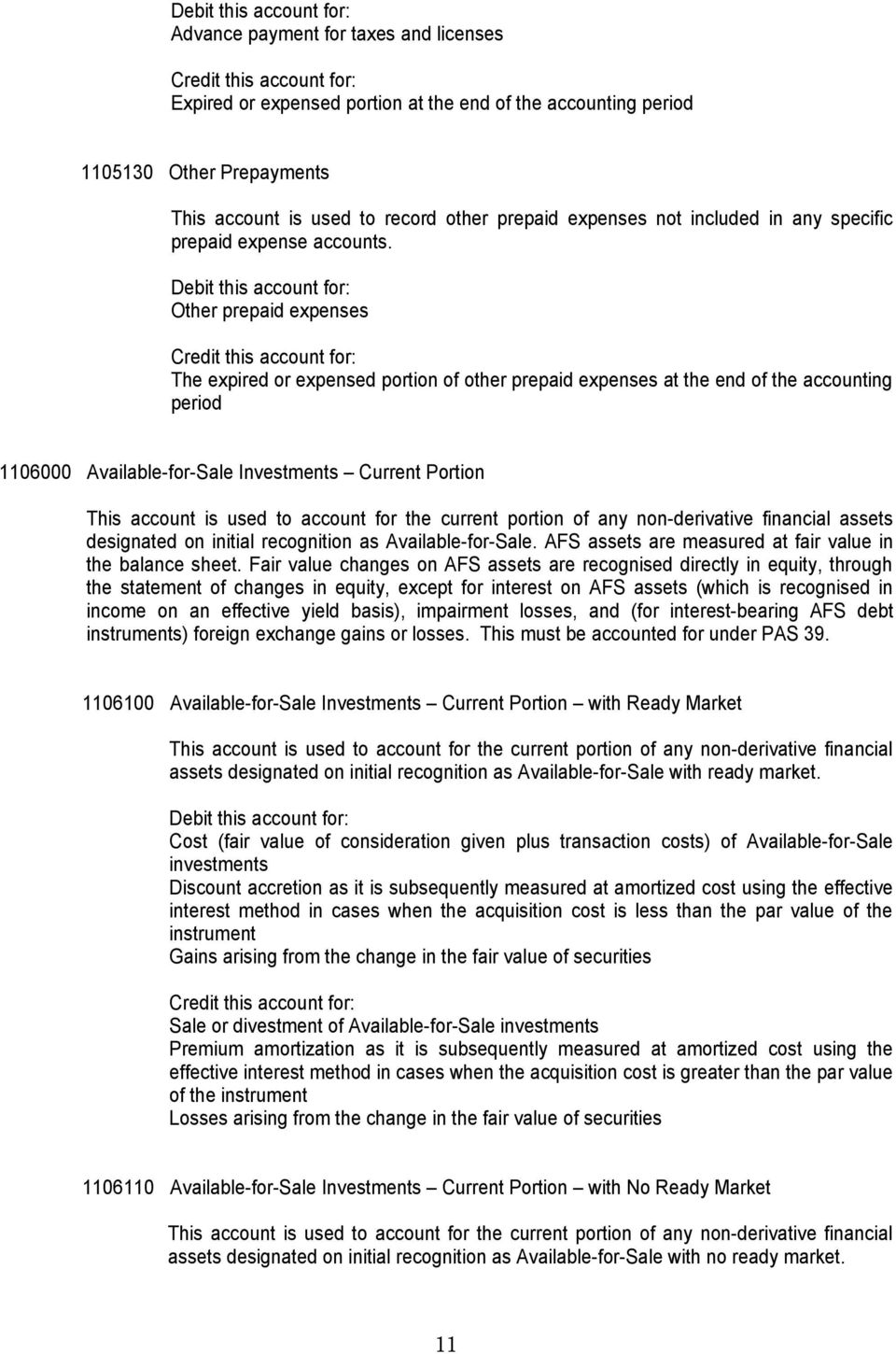
12 Cost (fair value of consideration given plus transaction costs) of Available-for-Sale investments Discount accretion as it is subsequently measured at amortized cost using the effective interest method in cases when the acquisition cost is less than the par value of the instrument Gains arising from the change in the fair value of securities Sale or divestment of Available-for-Sale investments Premium amortization as it is subsequently measured at amortized cost using the effective interest method in cases when the acquisition cost is greater than the par value of the instrument Losses arising from the change in the fair value of securities Held-to-Maturity Investments -Current Portion This account is for the current portion of Held-to-Maturity investments in debt securities. Held-to- Maturity investments are non-derivative financial assets with fixed or determinable payments and fixed maturity that an entity has the positive intention and ability to hold to maturity. This must be accounted for under PAS 39. Current portion of Held-to-Maturity investments Discount accretion as it is subsequently measured at amortized cost using the effective interest method in cases when the acquisition cost does not equal to the par value of the instrument Maturity or termination of investment or reclassification to other accounts Premium amortization Other Current Assets This account is used to record all other current assets which cannot be properly classified in specific current asset accounts. Other current assets not accounted specifically in preceding accounts Authorized write-offs and reclassification to other accounts Non-Current Assets These accounts are used to record assets that are not reasonably expected to be realized in cash or sold or consumed within one year, and which cannot be properly classified in specific noncurrent asset accounts Available-For-Sale Investments - Non-Current Portion This account is used to account for the long-term portion of securities that are designated as Available-for-Sale. 12

13 Available-For-Sale Investments Non-Current Portion - with Ready Market This account is used to account for the long-term portion of securities that are designated as Available-for-Sale with ready market. Cost (fair value of consideration given plus transaction costs) of Available-for-Sale investments Discount accretion as it is subsequently measured at amortized cost using the effective interest method in cases when the acquisition cost is less than the par value of the instrument Gains arising from the change in the fair value of securities Sale or divestment of Available-for-Sale investments Premium amortization as it is subsequently measured at amortized cost using the effective interest method in cases when the acquisition cost is greater than the par value of the instrument Losses arising from the change in the fair value of securities Available-For-Sale Investments Non-Current Portion without Ready Market This account is used to account for the long-term portion of securities that are designated as Available-for-Sale without ready market. Cost (fair value of consideration given plus transaction costs) of Available-for-Sale investments Discount accretion as it is subsequently measured at amortized cost using the effective interest method in cases when the acquisition cost is less than the par value of the instrument Gains arising from the change in the fair value of securities Sale or divestment of Available-for-Sale investments Premium amortization as it is subsequently measured at amortized cost using the effective interest method in cases when the acquisition cost is greater than the par value of the instrument Losses arising from the change in the fair value of securities Held-to-Maturity Investments Non-Current Portion This account is used to account for the long-term portion of Held-to-Maturity investments in debt securities. Long-term portion of Held-to-Maturity investments Discount accretion as it is subsequently measured at amortized cost using the effective interest method in cases when the acquisition cost does not equal to the par value of the instrument Premium amortization Termination of investments or reclassification to other accounts 13
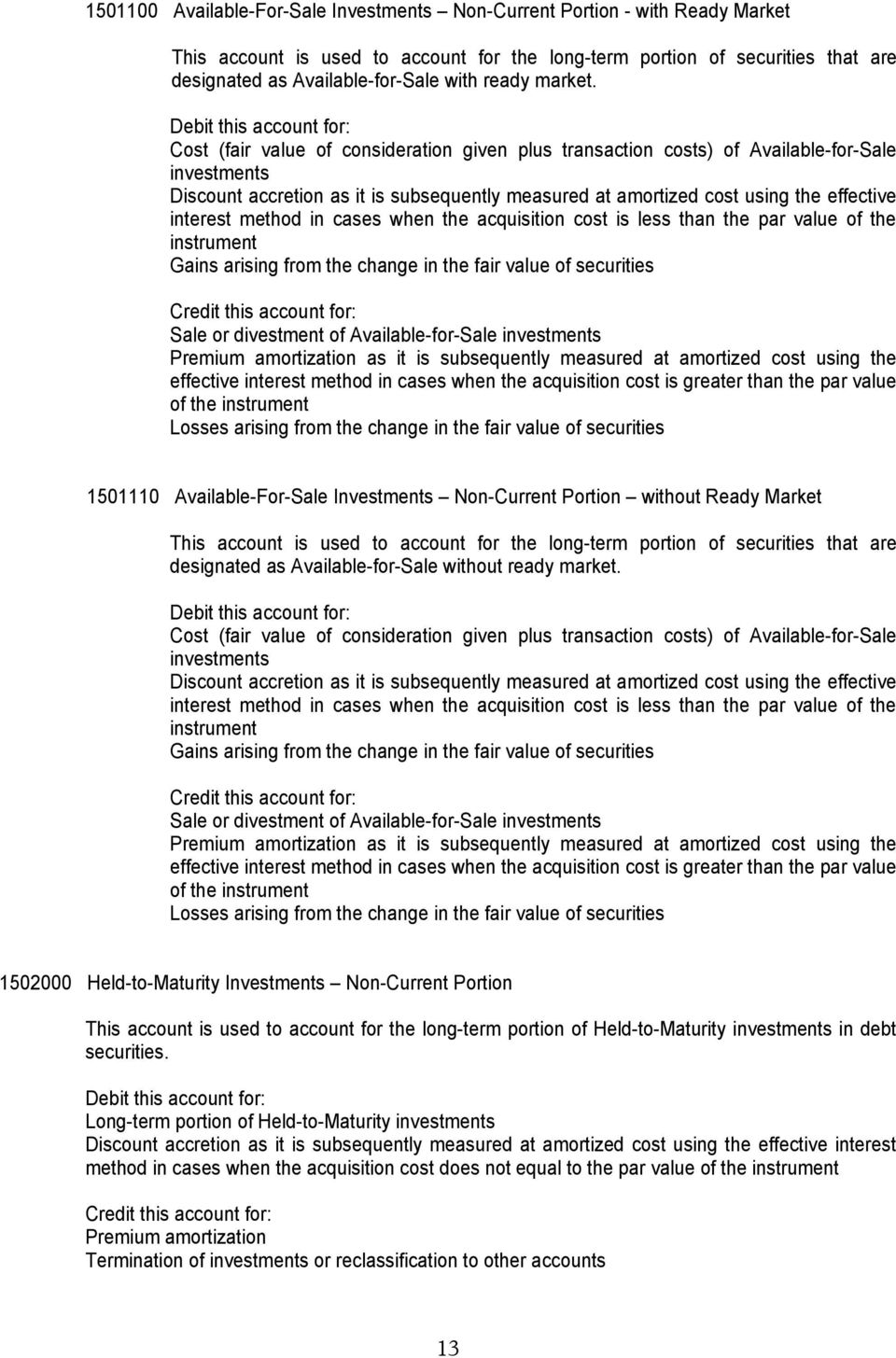
14 Investments in Subsidiaries This account is used to account for investments in the equity instruments of unconsolidated subsidiaries, which shall be accounted for in accordance with PAS 27. As provided under PAS 27, a subsidiary is an entity that is controlled by another entity (known as the parent). Control is presumed to exist when the parent owns, directly or indirectly through subsidiaries, more than half of the voting power of an entity, unless in exceptional circumstances, it can be directly demonstrated that such ownership does not constitute control. Cost of investment in subsidiaries Reversal of impairment loss Sale or divestment of investment in subsidiaries Impairment loss, if any Investment in Associates This account is used to account for the equity instruments of associates, which shall be accounted for under PAS 28. An associate is an entity over which the investor has significant influence and that is neither a subsidiary nor an interest in a joint venture. Significant influence is presumed to exist if an investor holds, directly or indirectly through subsidiaries, 20 percent or more of the voting power of the investee, unless it can be clearly demonstrated that that is not the case. Conversely, if the investor holds, directly or indirectly through subsidiaries, less than 20 percent of the voting power of the investee, it is presumed that the investor does not have significant influence, unless such influence can be clearly demonstrated. Cost of investment in associate Reversal of impairment loss Sale or divestment of investment in associate Impairment loss, if any Investment in Joint Venture This account is used for investments in a contractual arrangement subject to joint control. This can be treated as follows: (a) jointly controlled ventures recognized by the venture by including the assets and liabilities, expenses and income in the venture; (b) jointly controlled assets recognized on a proportional basis; or (c) jointly controlled entities recognized in consolidated statements. Cost of investment in joint ventures Reversal of impairment loss Sale or divestment of investment in joint ventures Impairment loss, if any 14
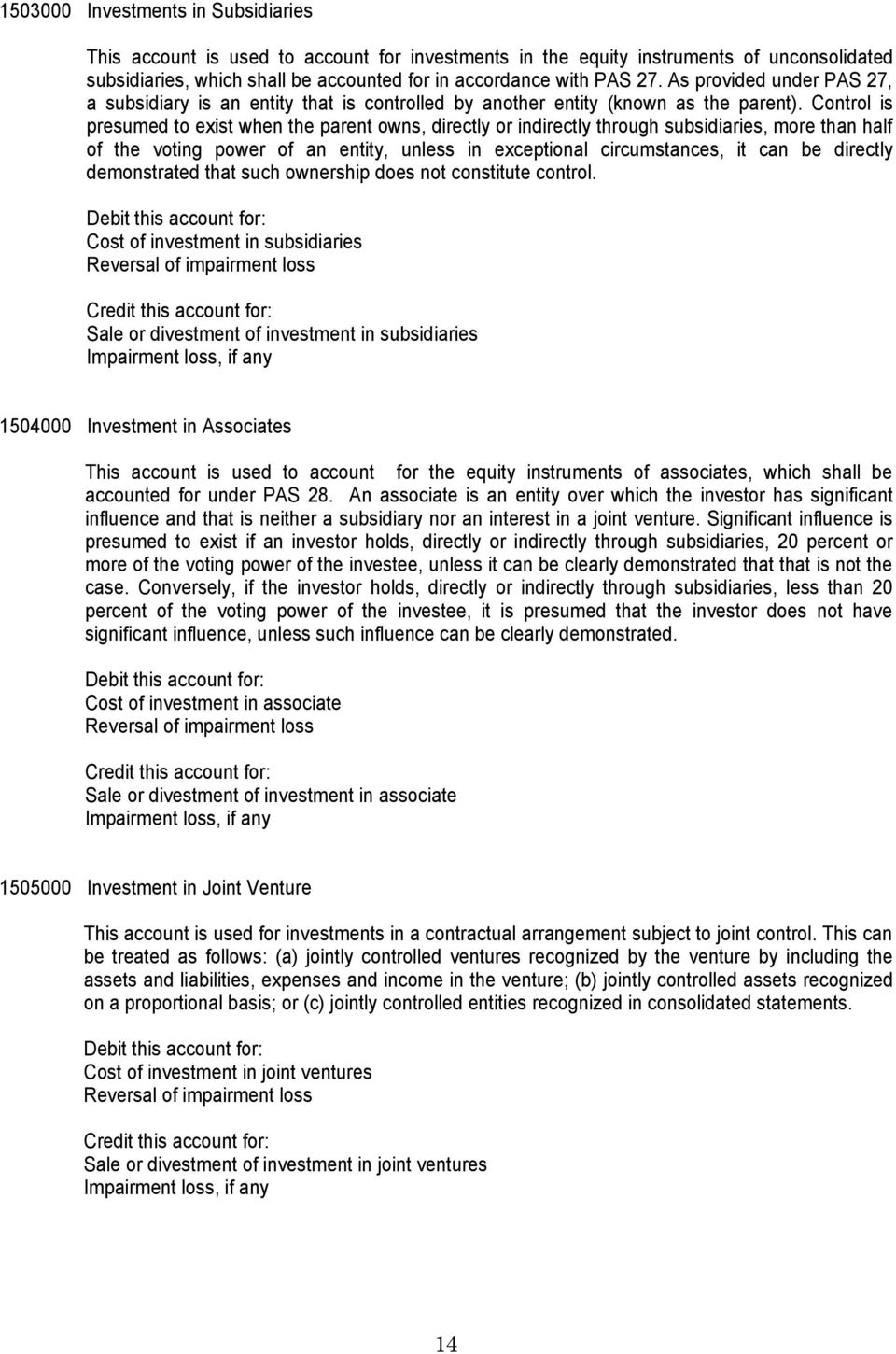
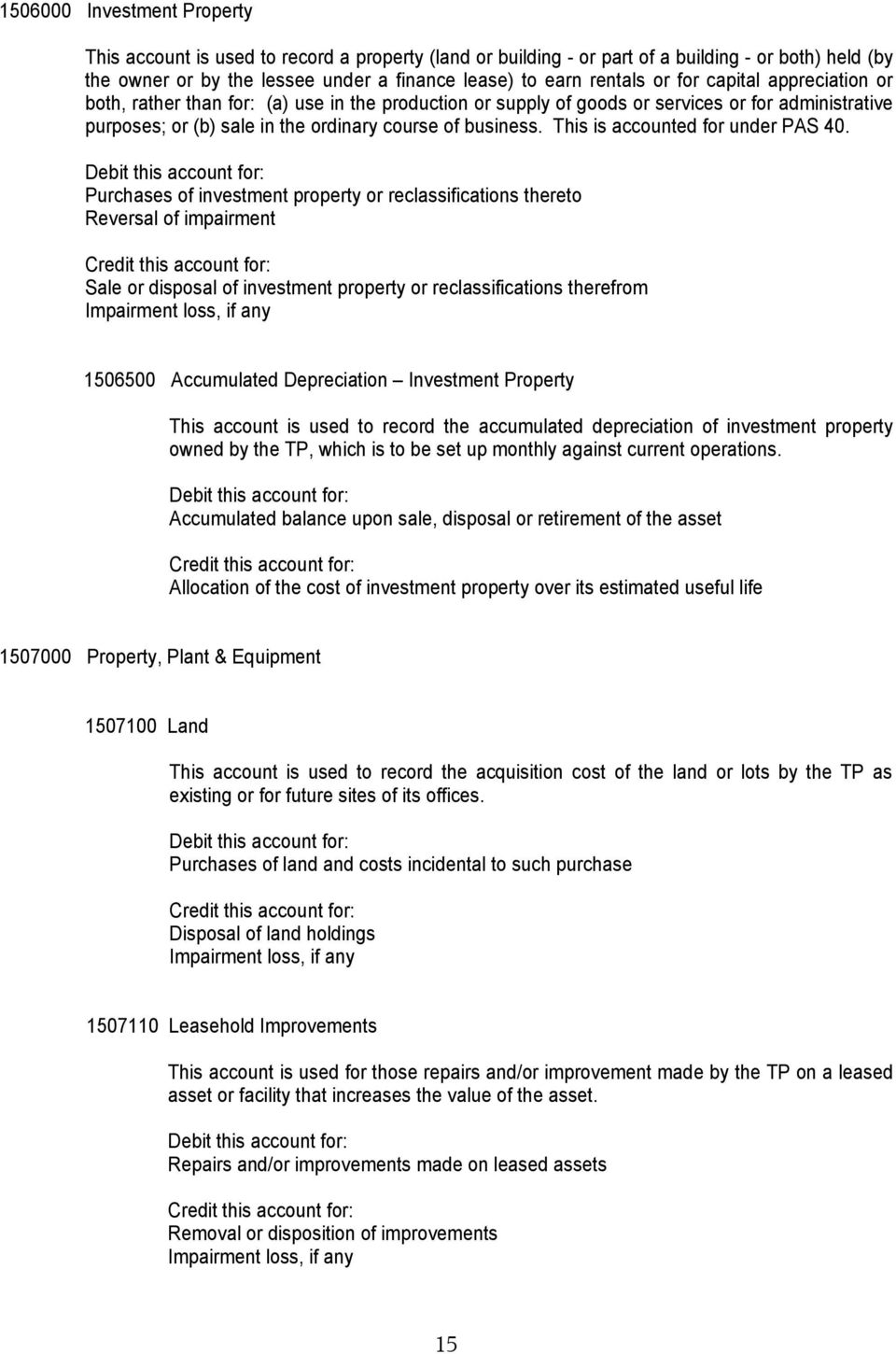
15 Investment Property This account is used to record a property (land or building - or part of a building - or both) held (by the owner or by the lessee under a finance lease) to earn rentals or for capital appreciation or both, rather than for: (a) use in the production or supply of goods or services or for administrative purposes; or (b) sale in the ordinary course of business. This is accounted for under PAS 40. Purchases of investment property or reclassifications thereto Reversal of impairment Sale or disposal of investment property or reclassifications therefrom Impairment loss, if any Accumulated Depreciation Investment Property This account is used to record the accumulated depreciation of investment property owned by the TP, which is to be set up monthly against current operations. Accumulated balance upon sale, disposal or retirement of the asset Allocation of the cost of investment property over its estimated useful life Property, Plant & Equipment Land This account is used to record the acquisition cost of the land or lots by the TP as existing or for future sites of its offices. Purchases of land and costs incidental to such purchase Disposal of land holdings Impairment loss, if any Leasehold Improvements This account is used for those repairs and/or improvement made by the TP on a leased asset or facility that increases the value of the asset. Repairs and/or improvements made on leased assets Removal or disposition of improvements Impairment loss, if any 15
16 Accumulated Amortization Leasehold Improvements This account is used to record the accumulated amortization of leasehold improvements made by the TP on its leased asset, which is to be set up monthly against current operations. Accumulated balance upon sale, disposal or retirement of the asset Allocation of the cost of leasehold improvement over its estimated useful life or term of lease, whichever is shorter Building This account is used to record the cost of buildings owned or controlled and used or to be used by the TP for its businesses. This excludes property investments. Acquisition cost of building owned or controlled Sale, disposal or retirement of the asset Impairment loss, if any Accumulated Depreciation - Building This account is used to record the accumulated depreciation of building owned by the TP, which is to be set up monthly against current operations. Accumulated balance upon sale, disposal or retirement of the asset Allocation of the cost of building over its estimated useful life Condominium This account is used to record the cost of condominium owned or controlled and used or to be used by the TP for its businesses. This excludes property investments. Acquisition cost of condominium owned or controlled Sale, disposal or retirement of the asset Impairment loss, if any 16

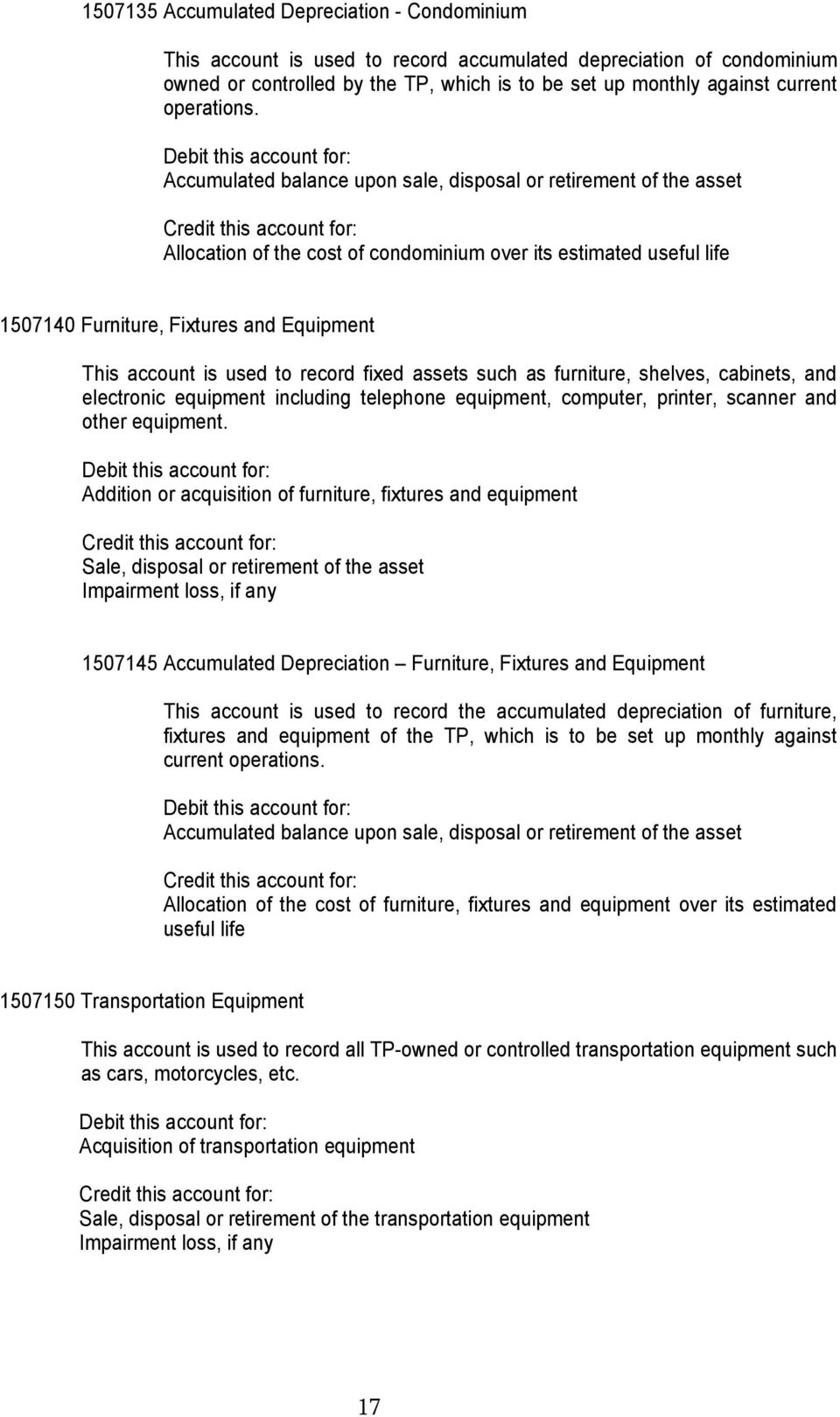
17 Accumulated Depreciation - Condominium This account is used to record accumulated depreciation of condominium owned or controlled by the TP, which is to be set up monthly against current operations. Accumulated balance upon sale, disposal or retirement of the asset Allocation of the cost of condominium over its estimated useful life Furniture, Fixtures and Equipment This account is used to record fixed assets such as furniture, shelves, cabinets, and electronic equipment including telephone equipment, computer, printer, scanner and other equipment. Addition or acquisition of furniture, fixtures and equipment Sale, disposal or retirement of the asset Impairment loss, if any Accumulated Depreciation Furniture, Fixtures and Equipment This account is used to record the accumulated depreciation of furniture, fixtures and equipment of the TP, which is to be set up monthly against current operations. Accumulated balance upon sale, disposal or retirement of the asset Allocation of the cost of furniture, fixtures and equipment over its estimated useful life Transportation Equipment This account is used to record all TP-owned or controlled transportation equipment such as cars, motorcycles, etc. Acquisition of transportation equipment Sale, disposal or retirement of the transportation equipment Impairment loss, if any 17
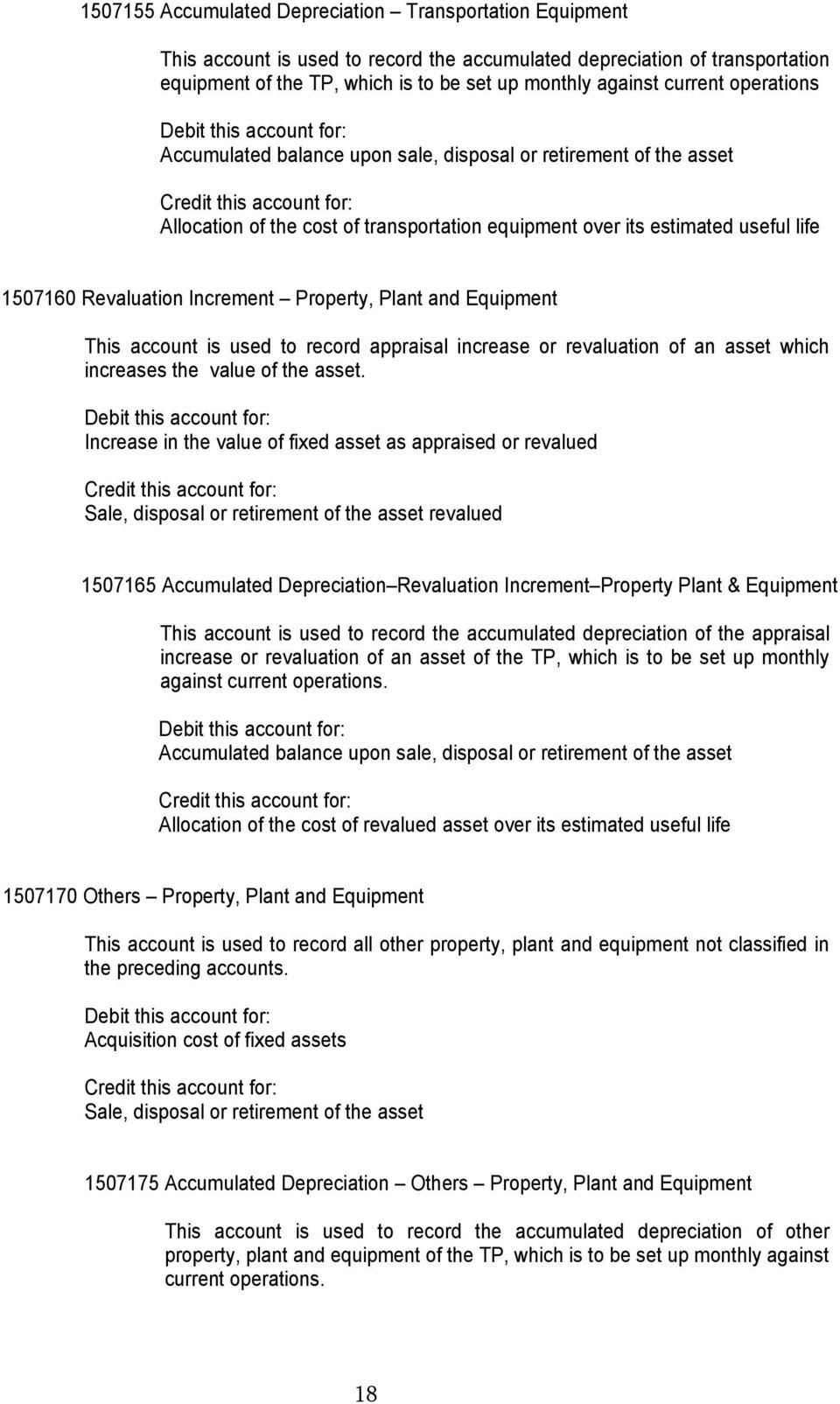
18 Accumulated Depreciation Transportation Equipment This account is used to record the accumulated depreciation of transportation equipment of the TP, which is to be set up monthly against current operations Accumulated balance upon sale, disposal or retirement of the asset Allocation of the cost of transportation equipment over its estimated useful life Revaluation Increment Property, Plant and Equipment This account is used to record appraisal increase or revaluation of an asset which increases the value of the asset. Increase in the value of fixed asset as appraised or revalued Sale, disposal or retirement of the asset revalued Accumulated Depreciation Revaluation Increment Property Plant & Equipment This account is used to record the accumulated depreciation of the appraisal increase or revaluation of an asset of the TP, which is to be set up monthly against current operations. Accumulated balance upon sale, disposal or retirement of the asset Allocation of the cost of revalued asset over its estimated useful life Others Property, Plant and Equipment This account is used to record all other property, plant and equipment not classified in the preceding accounts. Acquisition cost of fixed assets Sale, disposal or retirement of the asset Accumulated Depreciation Others Property, Plant and Equipment This account is used to record the accumulated depreciation of other property, plant and equipment of the TP, which is to be set up monthly against current operations. 18
19 Accumulated balance upon sale, disposal or retirement of the asset Allocation of costs of other fixed assets over their estimated useful life Intangible Assets This account is used to record identifiable nonmonetary assets without physical substance Computer Software (Net of Amortization) This account is used to record acquisition of operating system for computer hardware. Acquisition of computer software Amortization of software cost over its useful life Impairment, if any Goodwill This account is used to record goodwill arising on business combination, which represents the excess of the cost of acquisition over the TP's interest in the fair value of the identifiable assets and liabilities of a subsidiary, associate or jointly controlled entity at the date of acquisition. Set-up of goodwill Impairment, if any Trading Rights This account is used to record the cost of the seat in the Philippine Stock Exchange which carries right to trade in the exchange. Acquisition of trading right Reversal of impairment loss Impairment, if any Other Intangible Assets (Net of Amortization) This account is used to record all other intangible assets not specifically identified in the accounts above, and which are allowed to be recognized as intangibles in accordance with PAS

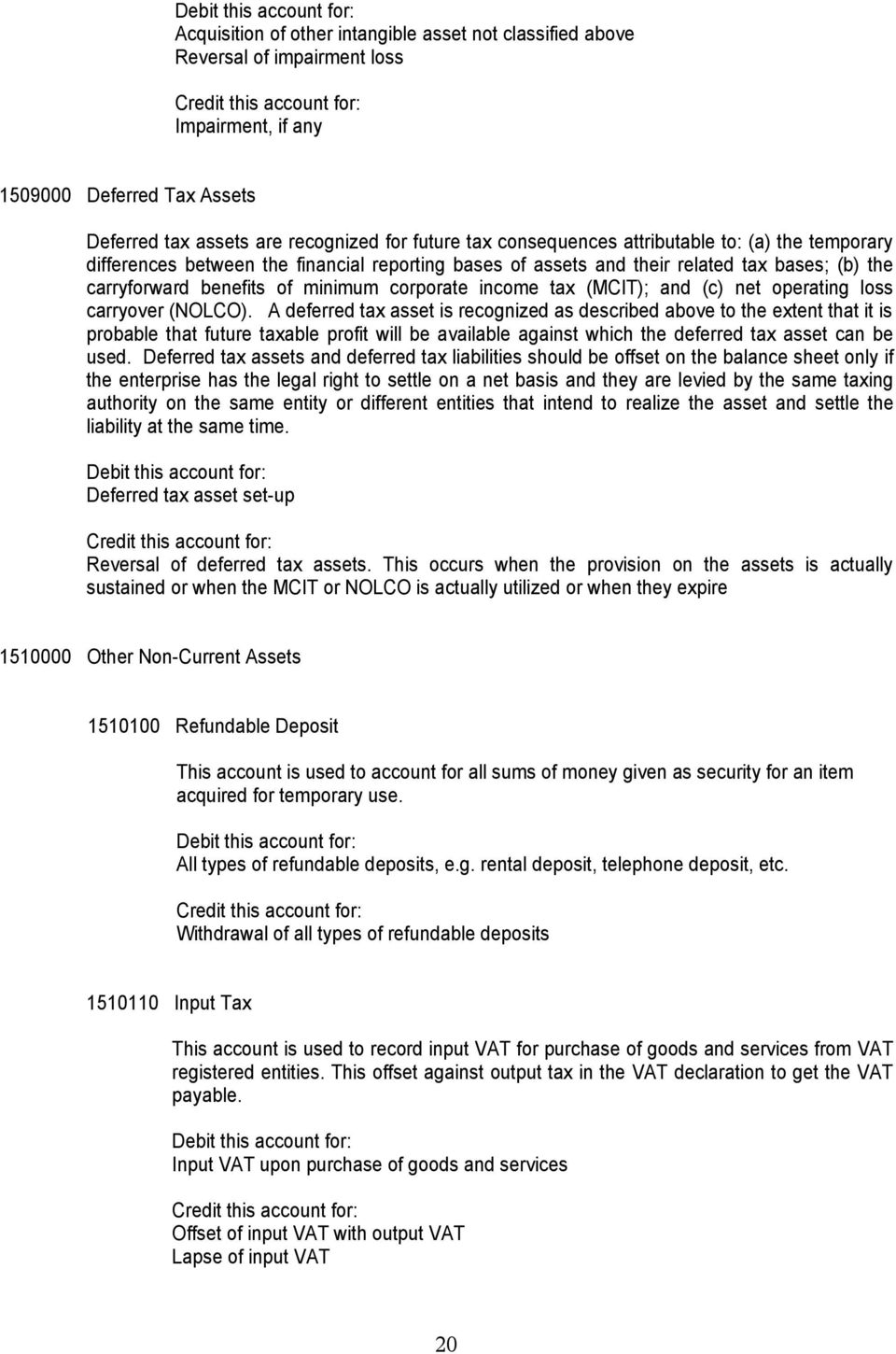
20 Acquisition of other intangible asset not classified above Reversal of impairment loss Impairment, if any Deferred Tax Assets Deferred tax assets are recognized for future tax consequences attributable to: (a) the temporary differences between the financial reporting bases of assets and their related tax bases; (b) the carryforward benefits of minimum corporate income tax (MCIT); and (c) net operating loss carryover (NOLCO). A deferred tax asset is recognized as described above to the extent that it is probable that future taxable profit will be available against which the deferred tax asset can be used. Deferred tax assets and deferred tax liabilities should be offset on the balance sheet only if the enterprise has the legal right to settle on a net basis and they are levied by the same taxing authority on the same entity or different entities that intend to realize the asset and settle the liability at the same time. Deferred tax asset set-up Reversal of deferred tax assets. This occurs when the provision on the assets is actually sustained or when the MCIT or NOLCO is actually utilized or when they expire Other Non-Current Assets Refundable Deposit This account is used to account for all sums of money given as security for an item acquired for temporary use. All types of refundable deposits, e.g. rental deposit, telephone deposit, etc. Withdrawal of all types of refundable deposits Input Tax This account is used to record input VAT for purchase of goods and services from VAT registered entities. This offset against output tax in the VAT declaration to get the VAT payable. Input VAT upon purchase of goods and services Offset of input VAT with output VAT Lapse of input VAT 20
21 Creditable Withholding Tax This account is used to record the creditable withholding tax, which is an amount withheld from income payments. Withheld amount of revenues Settlement of income tax obligation Retirement Pension Asset This account is used to record the prepaid amount of retirement benefit of employees which shall be accounted for in accordance with PAS 19 and PAS 39. Contribution to the plan Recognized service cost and expected liability Miscellaneous Assets This account is used to record all other types of non-current assets, which cannot be classified under any specific non-current asset accounts. All other types of non-current assets Sale or disposition of other types of assets and reclassification of other asset accounts Liabilities This includes obligation of TP that is recognized when it is probable that an outflow of resources embodying economic benefits will result from the settlement of a present obligation and the amount at which the settlement will take place can be measured reliably Current Liabilities Trade Payables Payable to Customers This account is used to record the amount due to customers arising from brokerage services rendered, including value of securities sold in behalf of customers, commission, and other charges. 21
22 Payments of amounts due to customers Amount due to customers Payable to Clearing House This account is used to record cash settlement obligations of TPs' for payment to clearing house to facilitate the settlement of their Clearing House-Eligible Trades. Payment of matured dues to clearing house Contract values of the securities bought on behalf of the customers or for its own account Payable to Brokers This account is used to record claims due to other brokers for the sale of securities and other trade-related transactions. Payments of amounts due to other brokers All claims from other brokers arising from the sale of securities, etc Payable for Securities Failed to Receive This account is used to record the amount payable to selling brokers or dealers for securities purchased by the brokerage concern but which have not been received. The related short value represents the current market value of the securities which the selling broker or dealer is obliged to deliver. Market value of the securities at the contract date upon receipt of the securities Amount payable to selling brokers or dealers for securities purchased by the brokerage concern but not yet received Payable for Securities Loans This account is used to record the cash collateral advanced by the borrowing brokers or dealers (market value of securities at time of transaction plus or minus subsequent mark-to-market) and thus the amount to be repaid upon return of securities loaned. The related short value represents the current market value of the securities loaned to the borrowing broker. 22
23 Payments or return of loaned securities to other brokers or customers Market value of the loaned securities from other brokers or customers Dividends Payable - Customers This account is used to record dividends received in behalf of beneficial owners of securities held in the name of the broker-dealers. Distributions of dividends to eligible beneficial owners Cash or property dividends received in behalf of beneficial owners of securities held in the name of the broker-dealers Payable to Non-Customers This account is used to record claims due to other parties which are non trade-related. Payments of non trade-related payables to non-customers Claims payable to non-customers Interest accruals Short-Term Borrowings This account is used to record borrowings which are maturing within the next balance sheet date. Payments of matured short-term borrowings Amount of borrowings which are maturing within the next balance sheet date Current Portion of Long-Term Borrowings Subordinated Liability Current Portion This account is used to record current portion of indebtedness subordinated to the claims of creditors pursuant to a satisfactory subordination agreement in conformity with SRC Rule 29.1 (G). This is accounted for in accordance with PAS
24 Payments made to lenders, conversion of subordinated liability to equity, or reclassification to other accounts Approved subordinated loan Loans Payable - Current Portion This account is used to record portion of loans maturing within one year after the balance sheet date. This is accounted for in accordance with PAS 39. Payments or settlement of loans The current portion of loans payable after one year Notes Payable - Current Portion This account is used to record portion of promissory notes maturing within one year after the balance sheet date. This is accounted for in accordance with PAS 39. Payments or settlement of promissory notes Portion of the promissory notes payable within one year Bonds Payable- Current Portion This account is used to record portion of bonds payable maturing within one year after the balance sheet date. Payments or settlement of bonds Portion of bonds payable within one year Income Tax Payable This account is used to record income tax payable due within one year after the balance sheet date. Payments or settlement of income tax payable Recognition of income tax payable 24
25 Provisions - Short-Term This account is used to record for the current portion of a present obligation (legal or constructive), where as a result of a past event, it is probable that an outflow of resources embodying economic benefits will be required to settle the obligation and a reliable estimate can be made on the amount of the obligation. This is accounted for in accordance with PAS 37. Payment or settlement of obligation Current portion of the provision (legal or constructive) Other Current Liabilities Due to Related Parties This account is used to record all receivables arising from transactions with stockholders and related parties other than TP officers or employees. Payment of due to related parties, debit memos, and liability condoned Payables, advances from, and transfers of assets Due to BIR This represents the tax deducted or withheld by the TP, as withholding agent and taxes owed by the TP for remittance or payment to the BIR, in accordance with existing rules and regulations Due to BIR - VAT Payable This account is used to record tax dues for the VAT, which is levied on the performance of services, i.e., dealings in securities. Payment of monthly VAT dues to BIR The amount of VAT dues for the service performed in dealings in securities Due to BIR - Withholding Tax Compensation This account is used to record taxes withheld from income payments to individuals receiving purely compensation income arising from an employeremployee relationship. 25
26 Remittances of withheld tax on compensation to the BIR Amount of tax withheld on the employee s salaries and other compensation Due to BIR - Withholding Tax - Expanded This account is used to record taxes withheld as required by law for professional fees, rentals of real and personal properties in excess of P10,000 annually, payment to certain contractors, and others as required by applicable provisions of the tax law. Remittances of withheld taxes to the BIR Amount withheld out of payments for professional fees, rentals of real and personal property, payments for contractors and others as required by applicable provisions of the tax law Due to BIR - Withholding Tax Final This account is used to record taxes withheld as required by law for cash and/or property dividends distributed, capital gains presumed to have been realized from the sale, exchange or other disposition of real property, fringe benefit granted to the employees except rank and file employees, and others as required by applicable provisions of the tax law. Remittances to the BIR of withheld taxes on transactions subject to Final Tax Taxes withheld for cash and/or property dividends distributed, capital gains from sale, exchange or other disposition of real property, fringe benefits and others as required by applicable provisions of the tax law Due to BIR - Withholding Tax Others This account is used to record other taxes which cannot be properly classified in the preceding withholding tax accounts. Remittances of taxes withheld to BIR Amount of taxes withheld for other transactions subject to withholding tax not covered on the preceding accounts 26
27 Due to BIR - Documentary Stamp Tax Payable This account is used to record the tax on documents, instruments, loan agreements and papers evidencing the acceptance, assignment, sale or transfer of an obligation, right or property incident thereto. Payments to BIR for the documentary stamp tax liability Documentary stamp tax due Due to BIR - Stock Transaction Tax Payable This account is used to record tax dues for stock transactions which is computed at 1/2 of 1% of gross selling price imposed on the sale, barter, exchange or other disposition of shares through the facilities of stock exchange. Payment of stock transaction tax due to BIR Stock transaction tax due Due to BIR - Other Taxes Payable This account is used to record other taxes due which cannot be properly classified in the preceding tax accounts. Payments of other taxes Amount of taxes due other than those included in the preceding accounts SSS Loan Payable This account is used to record the amount withheld from employees salary for payment of their loan with SSS for remittance to the latter. Remittance of amounts withheld from employees for payment of their loans Amount withheld from employees salary for their payment on their SSS Loan SSS Premium Payable This account is used to record the monthly SSS contributions by the TP employees by way of salary deductions for remittance with the SSS. 27
28 Remittances of withheld premium contributions to SSS SSS Premium contributions by the TP employees HDMF Loan Payable This account is used to record the amount withheld from employees salaries for payment of their loan with Pag-ibig Fund for remittance to the latter. Remittance of amounts withheld from employees for payment of their loans Amount withheld from employees salaries for their payment on their Pag-ibig Fund Loan PhilHealth Premium Payable This account is used to record the monthly PhilHealth contributions withheld from TP employees by way of salary deductions for remittance to PhilHealth. Remittances of withheld premium contributions to PhilHealth Premium contributions by the TP employees ECC Payable This account is used to record employer EC contributions to SSS. Payment of ECC due to SSS Amount of employer s contribution to SSS HDMF Fund Payable This account is used to record the amount due to HDMF for employees contributions. Remittances to HDMF of the contributions Amount due to HDMF for employees contributions 28
29 Transfer Fee Payable This account is used to record fees to the transfer office for issuance of certificates of stocks. Payment for the request issuance of certificates to the transfer office Amount payable to the transfer office for the issuance of certificates Central Depository Fees Payable This account is used to record the fees incurred at Central Depository for lodgment and upliftment requests, and terminal fees for the access of the Central Depository System. Payment of dues to the Central Depository Fees payable to the Central Depository Clearing House Fee Payable This account is used to record charges by clearing house which is normally based on volume. Payment of due to clearing house Amount due to clearing house Transaction Fee Payable This account is used to record the monthly dues to the Exchange. Payment made to the Exchange for the transaction fees Amount due to the Exchange Interest Payable This account is used to record unpaid interests on borrowings such as on loans on banks and other financial institutions, notes payables, and other borrowings to other entities with interest clauses. 29
30 Payment of the interest Interest incurred and due on borrowings such as on loans on banks and other financial institutions, notes payables, and other borrowings to other entities with interest clauses Securities Differences This account is used to record unresolved short security differences in the monthly securities counts, which were not resolved within seven (7) days after discovery. This is recorded for RBCA purposes only and NOT for general ledger. Market values of the securities bought back as replacement of unresolved securities differences at the time of discovery Market values of short securities differences at the time of discovery Securities Sold not yet Repurchased This account is used to record securities sold which are not carried long and not yet repurchased on the day after the settlement period. The contract value of repurchased securities The contract value of the securities to be repurchased Dividends Payable - Stockholders This account is used to record the unpaid cash or property dividends declared by the TP Board of Directors to stockholders on record. Payment of cash or property dividends to stockholders Amount of cash or property dividends to be distributed Mortgage Payable The amount of mortgage, which is a debt instrument by which the borrower (mortgagor) gives the lender (mortgagee) a lien on property as security for the repayment of a loan that remains to be paid. 30
31 Payment of mortgage due Amount of mortgage availed Deposits Due This account is used to record deposits received for considerations other than those emanating from the leasing of TP properties. Refund of deposits Deposit received for considerations other than rentals of properties Rental Deposit Payable This account is used to record deposits received from other party for rentals of buildings, equipment and other properties that is refundable at a specified date. Cash refund to lessee Receipt of deposit from lessee for rentals of buildings, equipment and other properties Advances for Future Services This account is used to record collected revenues that are not recognized as income pending completion of the earning process. If related to an asset account, this account should be presented net of related asset account. Earned portion of the fees received in advance Consideration received in advance Accrued Management Bonus This account is used to record accrual of bonuses to officers. Payment of bonuses to officers Reversal of accruals at the beginning of the accounting period Accrual of approved bonuses to officers 31
32 Accrued Expenses This account is used to record accrual of expenses such as utilities, salaries, and other regularly accrued expenses. Payment of accrued expenses Reversal of accruals at the beginning of the accounting period Accrual of expenses Miscellaneous Payable This account is used to record other current liabilities which cannot be properly classified in the preceding accounts. Payment of miscellaneous liabilities Amount of liability incurred Non-Current Liabilities These accounts are used generally to record liabilities payable more than one year after the balance sheet date Non-Current Portion of Long-term Borrowings Subordinated Liability Non-Current Portion This account is used to record indebtedness subordinated to the claims of creditors pursuant to a satisfactory subordination agreement in conformity with SRC Rule 29.1 (G). This is accounted for in accordance with PAS 39. Payments made to lenders, Conversion of subordinated liability to equity Reclassification to other accounts Approved subordinated loan Loans Payable Non-Current Portion This account is used to record loans extended to the TP by banks and other lending institutions not maturing within one year from the balance sheet date. This is accounted for in accordance with PAS
33 Reclassifications to current portion Settlement of the loan Non-current portion for loans payable not maturing within one year from the balance sheet date Notes Payable Non-Current Portion This account is used to record payable due from the TP, in the form of promissory note, arising from loan extended to TP, not payable within one year from the balance sheet date. This is accounted for in accordance with PAS 39. Reclassifications to current portion Settlement of loans Portion of promissory notes payable after one year Bonds Payable- Non-Current Portion This account is used to record indebtedness due from the TP arising from issuance of bond certificate not payable within one year from the balance sheet date. Reclassifications to current portion Settlement of loans Portion of bonds payable after one year Deferred Tax Liability This account is used to record tax liability recognized for temporary differences that will result in net taxable amounts in future years. Reduction to the extent that those deductible amounts offset taxable amounts from other temporary differences in future years Recognition of deferred tax liability Retirement Liability This account is used to record retirement benefit of employees which shall be accounted for in accordance with PAS 19 and PAS
34 Recognition of retirement expense paid to employees Accrual of retirement cost Obligation under Finance Lease This account is used to record the future lease payments payable under finance lease that shall be accounted for in accordance with PAS 17. Payment of lease obligation Cost of the leased asset Redeemable Preferred Shares This is used to record preferred shares issued which provides for redemption on a specific date at the option of the holder and with guaranteed dividends. This shall be measured at amortized cost using effective interest method. Redemption of preferred shares issued Cost of preferred shares issued Provisions Long-term This account is used to record for the non-current portion of a present obligation (legal or constructive), where as a result of a past event, it is probable that an outflow of resources embodying economic benefits will be required to settle the obligation and a reliable estimate can be made on the amount of the obligation. This is accounted for in accordance with PAS 37. Payment or settlement of obligation Non-current portion of the provision (legal or constructive) Other Non-Current Liabilities This account is used to record all other non-current liabilities which cannot be properly classified in other accounts. Payments of liability or reclassification to other accounts Non-current liability incurred 34
35 Equity Equity Attributable to Shareholders of the Parent Share Capital This account is used to record the issuance of shares of the TP as authorized by its Articles of Incorporation. This is accounted for in accordance with PFRS Common Share Capital This account is used to record shares having no preferences generally in terms of dividends, voting rights or distributions. Transfer of common shares from capital account to treasury shares, preference shares, or share premium (during quasi-reorganization) Issuance of shares for an amount equal to par value times the number of shares issued, when subscription for common shares sold have been fully paid Subscribed Common Shares Capital This account is used to record shares sold on a subscription basis, the full price of the stock is not received initially and not until the full subscription price is received will the shares be issued to the buyer. Issuance of common shares once the shares have been fully paid for Subscription of common shares Subscription Receivable - Common Shares This account is used to record the outstanding portion of subscribed common shares. This is reported as a deduction from equity. The unpaid balance of the full subscription price of the common shares bought by the investor The payment of the remaining balance of the subscription 35
36 Preference Share Capital - Non-Cumulative This account is used to record shares that carry certain preferences over common share such as dividends and a claim on TP s assets upon liquidation. Non-cumulative preference shares, however, does not present a steady claim on dividends in the event of dividend suspension and may not be paid any missed dividends once payment for the accumulated unpaid dividends has resumed. Transfer of preference shares non-cumulative from capital account to treasury shares Issuance of shares for an amount equal to par value times the number of shares issued, when subscription for preference shares (non-cumulative) sold has been fully paid Subscribed Preference Shares - Non-Cumulative This account is used to record all subscriptions of the TP s non-cumulative preference shares. Issuance of preference shares (non-cumulative) once the shares have been fully paid for Subscription of preference shares (non-cumulative) Subscription Receivable - Preference Shares - Non-Cumulative This account is used to record the outstanding portion of the subscribed noncumulative preference shares. This is reported as a deduction from equity. The unpaid balance of the full subscription price of the non-cumulative preference shares bought by the investor The payment of the remaining balance of the subscription Preference Share Capital Cumulative This account is used to record shares that carry certain preferences over common shares and shall be entitled to all past and present dividends once payment for any unpaid dividends has resumed but not redeemable at the option of the holder. 36
37 Transfer of preference shares - cumulative from capital account to treasury shares Issuance of shares for an amount equal to par value times the number of shares issued and when subscription for preference shares (cumulative) sold has been fully paid Subscribed Preference Shares - Cumulative This account is used to record all subscriptions of the TP s cumulative preference shares. Issuance of preference shares (cumulative) once the shares have been fully paid for Subscription of preference shares (cumulative) Subscription Receivable - Preference Shares Cumulative This account is used to record the outstanding portion of the subscribed cumulative preference shares. This is reported as a deduction from equity. The unpaid balance of the full subscription price of the cumulative preference shares bought by the investor The payment of the remaining balance of the subscription Stock Dividend Distributable This account is used to record distributions of the earnings of the TP in the form of its own shares of stock. The amount capitalized is equal to the par value of the stock. Issuance of stock dividends Declaration of stock dividend Reserves Share Premium This account is used to record any amount received in excess of the par value of the stocks issued. 37
38 Sale of treasury stock below cost, absorption of a deficit in a recapitalization (quasi reorganization), and declaration of a small (ordinary) stock dividend Excess of par value of stocks issued Sale of treasury stock above cost Additional capital arising from the recapitalization or revisions in the capital structure (quasi reorganization) Additional assessments on stockholders Conversion of convertible bonds or preference stock Declaration of a small (ordinary) stock dividend Donated Capital This account is used to record voluntary contributions of resources to the TP. Retirement or sale of the asset donated Initial recognition of the asset donated to the TP Deposit for Future Subscription This account is used to record all payments received for subscription from all the authorized stocks issued to stockholders with pending application to SEC for increase of capital shares. In the absence of said application, payment should be classified as liability. The transfer of deposit to share of capital account when approval from SEC for increase in capital shares is received All payments received for subscriptions pending approval from SEC Revaluation Reserves This account is used to record the increase in the carrying amount of the assets as a result of revaluation. Subsequent revaluation decrease Retirement or disposal of the revalued asset Recognition of the deferred tax liability on the appraisal increase Recognition of the increase in the asset s carrying amount 38
39 Option Premium on Convertible Bonds This account is used to record the equity component of convertible debt instruments and compound instruments. Examples include a convertible bond with the holder s option to convert into common shares and debt issued with detachable share purchase warrants. When the initial carrying amount of a compound financial instrument is required to be allocated to its equity and liability components, the equity component is assigned the residual amount after deducting from the fair value of the instrument as a whole the amount separately determined for the liability component. Payment of convertible debt instrument or reclassification to other accounts Equity component of convertible debt instruments and compound instruments Net Unrealized Gains/(Losses) on AFS Investments This account is used to record increase or decrease in fair value of AFS investments in accordance with PAS 39. This should be net of deferred tax liability. Decline in value of AFS investments Any reversal or adjustment made in the same year the decline was recognized to take into account appreciation of market values of non-current investments Cumulative Translation Adjustment This account is used to record imbalances resulting from different exchange rates used to remeasure different line items in the balance sheet and income statement when financial statements of foreign affiliates stated in foreign currency are restated in the parent TP s reporting currency for the consolidation. Losses caused by translation adjustments Gains caused by translation adjustments Treasury Shares (TS) This account is used to record shares that have been reacquired and are available for retirement or resale; it cannot vote and pays no dividends. This is shown in the balance sheet as a deduction from the total of all owners equity accounts Common shares (TS) This account is used to record common shares treasury stock. 39
40 The reacquisition of common share capital The reissuance of treasury shares Preference shares Cumulative (TS) This account is used to record preference shares cumulative treasury stock. The reacquisition of preference - cumulative shares The reissuance of treasury shares Preference shares - Non-Cumulative (TS) This account is used to record preference shares - non-cumulative treasury stock. The reacquisition of preference - non-cumulative shares The reissuance of treasury shares Retained Earnings These accounts are used to record the undistributed earnings of the TP Retained Earnings - Appropriated-Reserve Fund This account is used to record undistributed earnings reserved for capital build up pursuant to SEC Memorandum Circular 16 series of 2004, otherwise known as the RBCA rules. Declaration of stock dividends The segregation of the appropriated reserve fund from the unrestricted retained earnings Retained Earnings - Appropriated-Others This account is used to record undistributed earnings reserved for future projects of the TP and is restricted for dividend declaration. 40
41 The transfer of the appropriated earnings to unrestricted retained earnings after completion of the projects The segregation of the appropriated retained earnings from the unappropriated retained earnings Retained Earnings/(Deficit) - Unappropriated This account is used to record accumulated earnings after appropriation to or transfer from reserves and distribution of dividends. The transfer of the unrestricted retained earnings to appropriated retained earnings Declaration of dividends Net income for the current period Prior Period Adjustments This account is used to record prior period adjustments. Reductions in retained earnings Additions to retained earnings Minority Interest This account is used to record the portion of the profit or loss and net assets of a subsidiary attributable to equity interests that are not owned, directly or indirectly through subsidiaries, by the TP. PAS 27 requires the presentation of minority interest within equity in the consolidated balance sheet. The recognition of the portion of equity in TP's subsidiary not directly or indirectly owned by the TP during consolidation. Revenues Commission Revenue This account is used to record commissions earned from stock brokerage services rendered to customers. 41
42 Closing of revenue at the end of financial year to retained earnings/(deficit) Commissions earned during the period Other Revenues These accounts are used to record revenues other than the commission revenue Rental Revenue This account is used to record income earned from rental of buildings, land, equipment, office space, vehicles, and other property, plant, and equipment. Closing of rental revenue at the end of financial year to retained earnings/(deficit) Rent earned during the period Dividend Revenue This account is used to record dividends earned from securities owned by TP as principal. Closing of dividend revenue at the end of financial year to retained earnings/(deficit) Dividend earned during the period Interest Revenue This account is used to record interests earned from deposit in banks, investments in government securities and on loans considered under existing rules and regulations. Interest earned during the year Closing of interest revenue at the end of financial year to retained earnings/(deficit) 42
43 Gain/(Loss) on Sale of Financial Assets at Fair Value through Profit or Loss This account is used to record gains and losses on sale of financial assets that were acquired or incurred principally for the purpose of generating profit from short-term fluctuations in price or dealer s margin. This is the difference between the carrying amount of the financial asset held for trading versus its selling price. Loss on sale of financial assets held for trading Closing of net realized gain at the end of financial year to retained earnings/(deficit) Gain on sale of financial assets held for trading Closing of net realized loss at the end of financial year to retained earnings/(deficit) Unrealized Market Gain/(Loss) on Financial Assets at Fair Value through Profit or Loss This account is used to record gains and losses from the change in the fair value of financial assets held for trading. Mark to market loss on financial assets held for trading Closing of net unrealized gain at the end of financial year to retained earnings/(deficit) Mark to market gain on financial assets held for trading Closing of net unrealized loss at the end of financial year to retained earnings/(deficit) Foreign Exchange Gain/(Loss) This account is used when there is/are: Exchange differences arising on settlement of monetary items or on translating monetary items A change on the exchange rate between the transaction date and settlement date, and the transaction is settled within the same accounting period. When a gain or loss on a non-monetary item is recognized in profit and loss. Exchange differences arising on monetary item that form part of a reporting entity s net investment in foreign operation Exchange differences arising from translation of a foreign operation previously classified in equity which are not recognized in profit and loss until the disposal of the operation. 43
44 Exchange loss on settlement and translation of unsettled monetary items resulting to loss Closing of net foreign exchange gain at the end of financial year to retained earnings/(deficit) Exchange gain on settlement and translation of unsettled monetary items resulting to gain Closing of net foreign exchange loss at the end of financial year to retained earnings/(deficit) Unrealized Foreign Exchange Gain/(Loss) This account is used to record unrealized gains/losses arising from revaluation of foreign currency denominated accounts. This shall be accounted for in accordance with PAS 21. Exchange loss on revaluation of foreign currency denominated account Closing of net unrealized foreign exchange gain at the end of financial year to retained earnings/(deficit) Exchange gain on revaluation of foreign currency denominated account Closing of net unrealized foreign exchange loss at the end of financial year to retained earnings/(deficit) Gain/(Loss) on Sale of Other Assets This account is used to record gains and losses incurred in the disposition of other assets, which is the difference between the carrying amount and its selling price. Loss on sale of other assets Closing of net gain on sale of other assets at the end of financial year to retained earnings/(deficit) Gain on sale of other assets Closing of net loss on sale of other assets at the end of financial year to retained earnings/(deficit) Miscellaneous Revenues This account is used to record other gains or revenues, which cannot be properly classified in preceding accounts. 44
45 Closing of revenue at end of financial year to retained earnings/(deficit) Other gains or revenues Share of Profit/(Loss) of Associates This account is used to record share of TP in profit or loss of associates in accordance with PAS 28. Share in losses of associates Share in profit of associates Share of Profit/(Loss) of Joint Ventures This account is used to record share of TP in profit or loss of joint ventures in accordance with PAS 28. Share in losses of joint ventures Share in profit of joint ventures Cost of Service Commissions Expenses This account represents commissions paid to licensed salesmen, either employees or authorized agents. Commissions paid or accrued for a period Salaries and Benefits - Operations These accounts are used to record salaries and other benefits of employees directly engaged in effecting transactions in securities. 45
46 Salaries and Wages - Operations This account is used to record salaries and benefits of employees directly involved in the operations. Salaries and benefits paid or accrued to employees directly involved in operations Any reversal or adjustment made in the same year the expense was recognized th Month & Compensation-Related Benefits - Operations This account is used to record 13 th month benefits & other employee benefits of employees directly involved in the operations. 13 th month and other employee benefits accrued or paid to employees directly involved in operations Any reversal or adjustment made in the same year the expense was recognized Employees' Welfare - Operations This account is used to record any aid in the form of money or necessities to promote the well being of TP employees directly involved in the operations. Cost of employee welfare benefits Any reversal or adjustment made in the same year the expense was recognized SSS Contributions - Operations This account is used to record the employer s share of the premium contributions to SSS for employees directly involved in the operations. Premium contributions accrued or paid to SSS for employees directly involved in operations Any reversal/adjustment made in the same year the expense was recognized 46
47 PhilHealth Contributions - Operations This account is used to record PhilHealth contributions of employers for employees directly involved in operations. PhilHealth contributions accrued or paid for employees directly involved in operations Any reversal or adjustment made in the same year the expense was recognized EC Contributions - Operations This account is used to record the employer EC contributions to SSS for employees directly involved in operations. Employer contributions accrued or paid for employees directly involved in operations Any reversal or adjustment made in the same year the expense was recognized HDMF Fund Contributions - Operations This account is used to record employer's share to HDMF for employees directly involved in the operations. Contributions accrued or paid to HDMF for employees directly involved in the operations Any reversal or adjustment made in the same year the expense was recognized Employee Retirement Cost Operations This account is used to record employer s contributions for the postemployment benefits of its employees. Payment or accrual of contributions payable to a contribution plan Any reversal/adjustment made in the same year the expense was recognize 47
48 Stock Exchange Dues and Fees This account is used to record dues to the Exchange for transaction fees and other fees incidental to its membership with the exchange such as but not limited to terminal fees, use of Exchange facilities, etc. Dues accrued or paid to the Exchange Central Depository Fees This account is used to record charges by the Central Depository for lodgment and upliftment requests, and terminal fees for the access of the Central Depository system. Lodgment and upliftment requests, and terminal fees Research Fees This account is used to record charges for access to Bloomberg, Reuters, and other similar data providers. Access or subscription fees for data use Operating Expenses Administrative Expenses Compensation and Benefits - Admin Salaries and Wages - Admin This account is used to record salaries and wages of employees other than those involved in operations. 48
49 Payment or accrual of salaries and wages of employees other than those involved in operations Any reversal or adjustment made in the same year the expense was recognized th Month & Other Compensation-Related Benefits - Admin This account is used to record 13 th month & other benefits of employees other than those directly involved in operations. Payment or accrual of 13 th month & other benefits of employees other than those directly involved in operations Any reversal or adjustment made in the same year the expense was recognized Employees' Welfare - Admin This account is used to record any aid in the form of money or necessities (such as medical care, housing, car plan, uniforms, etc.) to promote the wellbeing of TP employees other than those directly involved in operations. Cost of employee welfare benefits other than those directly involved in operations Any reversal or adjustment made in the same year the expense was recognized SSS Contributions - Admin This account is used to record employers premium contributions for employees other than those directly involved in operations to SSS. Payment or accrual of SSS premium contributions of employees other than those involved in operations Any reversal or adjustment made in the same year the expense was recognized 49
50 PhilHealth Contributions - Admin This account is used to record PhilHealth contributions of employees other than those directly involved in operations. Payment or accrual of PhilHealth contributions of employees other than those involved in operations Any reversal or adjustment made in the same year the expense was recognized EC Contributions - Admin This account is used to record employer EC contributions to SSS for employees other than those directly involved in operations. Employer contributions accrued or paid for employees other than those directly involved in operations Any reversal or adjustment made in the same year the expense was recognized HDMF Fund Contributions - Admin This account is used to record premium contributions by employees to HDMF. Premium contributions by employees to HDMF Closing of expense at the end of financial year to retained earnings/deficit) Any reversal or adjustment made in the same year the expense was recognized Employee Retirement Cost - Admin This account is used to record employer s contributions for the postemployment benefits of its employees. Payment or accrual of contributions payable to a contribution plan Any reversal or adjustment made in the same year the expense was recognized 50
51 Trainings and Seminars This account is used to record training and seminar costs of employees. Training and seminar costs of employees Management Bonus This account is used to record management bonus given to officers excluding 13 th month pay and statutory bonuses Management bonus given to officers Transportation and Travel This account is used to record expenses for the official travel of directors, officers and employees such as fares, hotel bills, subsistence, porterage and tips. This account also includes expenses of directors, officers and employees incurred for fuel and minor repairs in using personally owned vehicles for official travel. Transportation and travel costs Meetings and Conferences This account is used to record costs of business meetings and conferences. Business meetings and conferences costs Entertainment, Amusement and Recreation This account is used to record fixed allowances and/or actual expenses for client solicitations, public relations activities, and business development activities. 51
52 Representation and entertainment costs Management Fees This account is used to record management fees incurred and subject to a management fee agreement. Management fees Professional Fees This account is used to record expenses for services rendered by individuals or firms on a retainer or contractual basis such as the legal counsel, external auditors and consultants. Billed or accrued expenses for services of legal counsel, external auditors and consultants Directors Fees This account is used to record per diems and fees granted to directors in accordance with management policy. Per diems and other fees granted to directors Rent This account is used to record costs incurred or accrued from rental of buildings, land, equipment, office space, vehicles, and other property, plant, and equipment. 52
53 Rental dues Utilities This account is used to record cost of power, light, and water consumption. Cost of power, light, and water consumption Insurance This account is used to record insurance costs including among others, insurance for fire, burglary. Insurance costs including among others, insurance for fire, burglary Office Supplies This account is used to record costs of office supplies used. Costs of office supplies used Postage, Telephone & Communication This account is used to record costs for mailing, telephone, facsimile, telegram and other form of communications used in the business operations. 53
54 Costs of postage, telephone, and other form of communications used in the business operations Security, Messengerial and Janitorial This account is used to record costs for security, messengerial, and janitorial services provided by other entities it has service agreements with. Costs of security, messengerial, and janitorial services Gas & Oil This account is used to record costs for gas & oil of TP-owned vehicles. Gas & oil costs Repairs & Maintenance This account is used to record repairs & maintenance of property, plant and equipment. Cost of repairs and maintenance Advertising & Promotions This account is used to record cost of handbills, pamphlets, billboards, brochures and give-aways, print advertisements, and other promotional materials or activities. 54
55 Cost of advertisements and promotions Bank Charges This account is used to record all bank charges other than interest. Bank charges Photocopies This account is used to record costs for photocopying or reproduction of documents. Photocopying costs Subscription and Periodicals This account is used to record cost incurred for subscriptions of periodicals, newspapers, magazines and newsletters. Costs incurred for the purchase or subscription of periodicals Condominium Dues and Fees This account is used to record all condominium dues and other related fees incurred. Debit this account for Condominium dues and other fees related thereto 55
56 Taxes & Licenses This account is used to record all taxes & licenses such as real property taxes, business permits, motor vehicles registration fees, privilege tax, firearms tax, gross receipts tax and other taxes excluding income taxes and VAT payables. Taxes & licenses Other Operating Expenses This account is used to record other operating expenses which cannot be properly classified in the preceding expense accounts. Cost of other operating expenses Depreciation and Amortization These accounts are used to record the periodic write-off of capital assets over the asset s useful life Depreciation Leasehold Improvements This account is used to record periodic allocations of costs of leasehold improvements with finite useful life. Amortization expense for the period Depreciation - Building This account is used to record the periodic allocation of the cost of building over its useful life. Periodic depreciation of building 56
57 Depreciation - Condominium This account is used to record the periodic allocation of the cost of condominiums over its useful life. Periodic depreciation of condominium Depreciation Furniture, Fixtures and Equipment This account is used to record the periodic allocation of the costs of furniture, fixtures and equipment over its useful life. Periodic depreciation of furniture, fixtures and equipment Depreciation - Transportation Equipment This account is used to record the periodic allocation of the costs of transportation equipment over its useful life. Periodic depreciation of transportation and automotive equipment Depreciation Revaluation This account is used to record periodic allocation of appraisal increase on fixed assets over its useful life. Periodic depreciation of appraisal increase of fixed assets Depreciation - Others-Property, Plant and Equipment This account is used to record the periodic allocation of the costs of other fixed assets not included on the preceding accounts over its useful life. 57
58 Periodic depreciation of other fixed assets Amortization Intangible Assets This account is used to record periodic allocation of intangible assets over its finite useful life. Periodic amortization of intangible assets Provision for Credit Losses Provision for Credit Losses Receivables from Customers Cash Accounts This account is used to record bad and doubtful accounts of customers maintaining cash accounts estimated in accordance with SEC Circular, industry or PFRS. Recognition of credit losses Provision for Credit Losses Receivables from Customers Margin Accounts This account is used to record bad and doubtful accounts of customers maintaining margin accounts estimated in accordance with SEC Circular, industry or PFRS. Recognition of credit losses Provision for Credit Losses Other Trade Receivables This account is used to record bad and doubtful accounts of the parties in a traderelated activity estimated in accordance with SEC Circular, industry or PFRS. 58
59 Recognition of credit losses Impairment Losses Impairment Losses Investments This account is used to record the amount by which the carrying amount of an investment exceeds its estimated recoverable amount. The recoverable amount must be estimated if there is evidence that suggests an asset is impaired. Recognition of impairment losses Impairment Losses Investment Property This account is used to record the amount by which the carrying amount of an investment property exceeds its estimated recoverable amount. The recoverable amount must be estimated if there is evidence that suggests an asset is impaired. Recognition of impairment losses Impairment Losses Property, Plant and Equipment This account is used to record the amount by which the carrying amount of a property, plant and equipment exceeds its estimated recoverable amount. The recoverable amount must be estimated if there is evidence that suggests an asset is impaired. Recognition of impairment losses 59
60 Impairment Losses Intangible Assets This account is used to record the amount by which the carrying amount of an intangible asset exceeds its estimated recoverable amount. The recoverable amount must be estimated if there is evidence that suggests an asset is impaired. Recognition of impairment losses Impairment Losses Other Non-Current Asset This account is used to record the amount by which the carrying amount of other noncurrent asset exceeds its estimated recoverable amount. The recoverable amount must be estimated if there is evidence that suggests an asset is impaired. Recognition of impairment losses Interest expense This account is used to record the amount of interest incurred on loans and other borrowings. Interest incurred for the period including accruals Miscellaneous Expense This account is used to record all other expenses not accounted for in other accounts. Expenses incurred 60
61 Provision for Income Tax Provision for Income Tax Regular Corporate Income Tax (RCIT) This account is used to record tax payable for the fiscal/calendar year, except to the extent that the tax arises from a transaction or event which is recognized in the same or different period directly in equity and in a business combination, if that is an acquisition. Recognition of current income tax for the taxable period, except to the extent that the tax arises from a transaction or event which is recognized in the same or different period directly in equity and in a business combination, if that is an acquisition Provision for Income Tax - Deferred This account is used to record the provision for income tax deferred in respect of taxable temporary differences, except to the extent that the tax arises from a transaction or event which is recognized in the same or different period directly in equity and in a business combination, if that is an acquisition. Deferred portion of the income tax expense in respect of taxable temporary differences, except to the extent that the tax arises from a transaction or event which is recognized in the same or different period directly in equity and in a business combination, if that is an acquisition Provision for Income Tax Minimum Corporate Income Tax (MCIT) This account is used to record tax applied whenever the corporation has zero or negative taxable income or when the amount of the MCIT is greater than the normal income tax due. This shall be accounted for in accordance with Revenue Regulation Record applicable MCIT for the year 61
62 Provision for Income Tax Final This account is used to record final corporate tax applied to the corporation s income subject to final tax. Record applicable corporate final tax for the year 62
BALANCE SHEET CHART OF ACCOUNTS FOR TRADING PARTICIPANTS
 CHART OF ACCOUNTS FOR TRADING PARTICIPANTS ASSETS 1000000-1999999 1 1 0 0 0 0 0 Current Assets 1 1 0 1 0 0 0 Cash and Cash Equivalents 1 1 0 1 1 0 0 Cash on Hand 1 1 0 1 1 1 0 Petty Cash Fund 1 1 0 1 1
CHART OF ACCOUNTS for GENERAL INSURANCE COMPANIES ASSETS
 CHART OF ACCOUNTS for GENERAL INSURANCE COMPANIES ASSETS 1. CASH ON HAND This represents the total amount of undeposited collections and the different types of working funds in the custody of the cashier
G8 Education Limited ABN: 95 123 828 553. Accounting Policies
 G8 Education Limited ABN: 95 123 828 553 Accounting Policies Table of Contents Note 1: Summary of significant accounting policies... 3 (a) Basis of preparation... 3 (b) Principles of consolidation... 3
PRINCIPLES FOR PRODUCING AND SUBMITTING REPORTS
 December 2014 PRINCIPLES FOR PRODUCING AND SUBMITTING REPORTS (1) The balance sheet and income statement are in euros, rounded up to integers. Amounts recorded in foreign currencies must be converted into
SSAP 24 STATEMENT OF STANDARD ACCOUNTING PRACTICE 24 ACCOUNTING FOR INVESTMENTS IN SECURITIES
 SSAP 24 STATEMENT OF STANDARD ACCOUNTING PRACTICE 24 ACCOUNTING FOR INVESTMENTS IN SECURITIES (Issued April 1999) The standards, which have been set in bold italic type, should be read in the context of
POLICY MANUAL. Financial Management Significant Accounting Policies (July 2015)
 POLICY 1. Objective To adopt Full Accrual Accounting and all other applicable Accounting Standards. 2. Local Government Reference Local Government Act 1995 Local Government (Financial Management) Regulations
HARMONIC DRIVE SYSTEMS INC. AND CONSOLIDATED SUBSIDIARIES CONSOLIDATED FINANCIAL STATEMENTS MARCH 31, 2013
 HARMONIC DRIVE SYSTEMS INC. AND CONSOLIDATED SUBSIDIARIES CONSOLIDATED FINANCIAL STATEMENTS MARCH 31, 2013 HARMONIC DRIVE SYSTEMS INC. AND CONSOLIDATED SUBSIDIARIES CONSOLIDATED BALANCE SHEETS ASSETS
FORM G-405, PART IIA REPORT ON FINANCES AND OPERATIONS OF GOVERNMENT SECURITIES BROKERS AND DEALERS
 FORM G-405, PART IIA REPORT ON FINANCES AND OPERATIONS OF GOVERNMENT SECURITIES BROKERS AND DEALERS GENERAL INSTRUCTIONS This report on the finances and operations of government securities brokers and
MATRIX IT LTD. AND ITS SUBSIDIARIES CONSOLIDATED FINANCIAL STATEMENTS
 CONSOLIDATED FINANCIAL STATEMENTS AS OF DECEMBER 31, 2013 CONSOLIDATED FINANCIAL STATEMENTS AS OF DECEMBER 31, 2013 NIS IN THOUSANDS INDEX Page Auditors' Reports 2-4 Consolidated Statements of Financial
Transition to International Financial Reporting Standards
 Transition to International Financial Reporting Standards Topps Tiles Plc In accordance with IFRS 1, First-time adoption of International Financial Reporting Standards ( IFRS ), Topps Tiles Plc, ( Topps
Residual carrying amounts and expected useful lives are reviewed at each reporting date and adjusted if necessary.
 87 Accounting Policies Intangible assets a) Goodwill Goodwill represents the excess of the cost of an acquisition over the fair value of identifiable net assets and liabilities of the acquired company
International Accounting Standard 39 Financial Instruments: Recognition and Measurement
 EC staff consolidated version as of 18 February 2011 FOR INFORMATION PURPOSES ONLY International Accounting Standard 39 Financial Instruments: Recognition and Measurement Objective 1 The objective of this
Summary of Significant Accounting Policies FOR THE FINANCIAL YEAR ENDED 31 MARCH 2014
 46 Unless otherwise stated, the following accounting policies have been applied consistently in dealing with items which are considered material in relation to the financial statements. The Company and
Note 2 SIGNIFICANT ACCOUNTING
 Note 2 SIGNIFICANT ACCOUNTING POLICIES BASIS FOR THE PREPARATION OF THE FINANCIAL STATEMENTS The consolidated financial statements have been prepared in accordance with International Financial Reporting
1 CONSOLIDATED FINANCIAL STATEMENTS (1) Consolidated Balance Sheets
 1 CONSOLIDATED FINANCIAL STATEMENTS (1) Consolidated Balance Sheets As of March 31,2014 As of March 31,2015 Assets Cash and due from banks 478,425 339,266 Call loans and bills bought 23,088 58,740 Monetary
Indian Accounting Standard (Ind AS) 7 Statement of Cash Flows
 Contents Indian Accounting Standard (Ind AS) 7 Statement of Cash Flows Paragraphs OBJECTIVE SCOPE 1 3 BENEFITS OF CASH FLOW INFORMATION 4 5 DEFINITIONS 6 9 Cash and cash equivalents 7 9 PRESENTATION OF
RULES ON THE CHART OF ACCOUNTS AND THE CONTENTS OF ACCOUNTS IN THE CHART OF ACCOUNTS FOR BANKS
 Outsourced translation Official Gazette of RS, Nos 98/2007, 57/2008 and 3/2009 Pursuant to Article 15, paragraph 2, item 2 of the Accounting and Auditing Law (Official Gazette of RS, No. 46/2006), the
PART III. Consolidated Financial Statements of Hitachi, Ltd. and Subsidiaries: Independent Auditors Report 47
 PART III Item 17. Financial Statements Consolidated Financial Statements of Hitachi, Ltd. and Subsidiaries: Schedule: Page Number Independent Auditors Report 47 Consolidated Balance Sheets as of March
NOTES TO THE FINANCIAL STATEMENTS
 NOTES TO THE FINANCIAL STATEMENTS 1 SIGNIFICANT ACCOUNTING POLICIES (a) Statement of compliance These financial statements have been prepared in accordance with all applicable Hong Kong Financial Reporting
Cathay Life Insurance Co., Ltd. Financial Statements As of December 31, 2006 and 2007 With Independent Auditors Report
 Financial Statements With Independent Auditors Report The reader is advised that these financial statements have been prepared originally in Chinese. These financial statements do not include additional
EXPLANATORY NOTES. 1. Summary of accounting policies
 1. Summary of accounting policies Reporting Entity Taranaki Regional Council is a regional local authority governed by the Local Government Act 2002. The Taranaki Regional Council group (TRC) consists
How To Account In Indian Accounting Standards
 Indian Accounting Standard (Ind AS) 39 Financial Instruments: Recognition and Measurement Contents Paragraphs Objective 1 Scope 2 7 Definitions 8 9 Embedded derivatives 10 13 Recognition and derecognition
Financial Instruments: Recognition and Measurement
 STATUTORY BOARD FINANCIAL REPORTING STANDARD SB-FRS 39 Financial Instruments: Recognition and Measurement This version of the Statutory Board Financial Reporting Standard does not include amendments that
Cathay Life Insurance Co., Ltd. Financial Statements For The Three Months Ended March 31, 2012 and 2011 With Independent Auditors Review Report
 Financial Statements For The Three Months Ended March 31, 2012 and 2011 With Independent Auditors Review Report The reader is advised that these financial statements have been prepared originally in Chinese.
Management s Responsibility for the Financial Statements
 SGV & CO SyCip Gorres Velayo & Co. 6760 Ayala Avenue 1226 Makati City Philippines Phone: (632) 891-0307 Fax: (632) 819-0872 www.sgv.com.ph BOA/PRC Reg. No. 0001 SEC Accreditation No. 0012-FR-1 INDEPENDENT
INDUSTRIAL-ALLIANCE LIFE INSURANCE COMPANY. FIRST QUARTER 2000 Consolidated Financial Statements (Non audited)
 INDUSTRIAL-ALLIANCE LIFE INSURANCE COMPANY FIRST QUARTER 2000 Consolidated Financial Statements (Non audited) March 31,2000 TABLE OF CONTENTS CONSOLIDATED INCOME 2 CONSOLIDATED CONTINUITY OF EQUITY 3 CONSOLIDATED
Consolidated Balance Sheets March 31, 2001 and 2000
 Financial Statements SEIKAGAKU CORPORATION AND CONSOLIDATED SUBSIDIARIES Consolidated Balance Sheets March 31, 2001 and 2000 Assets Current assets: Cash and cash equivalents... Short-term investments (Note
Appendix 16: Chart of Accounts for Small Business Investment Companies
 Appendix 16: Chart of Accounts for Small Business Investment Companies 10 06 A A. Account Numbering System. This system provides for two-digit number designations for major categories under which accounts
Sri Lanka Accounting Standard-LKAS 7. Statement of Cash Flows
 Sri Lanka Accounting Standard-LKAS 7 Statement of Cash Flows CONTENTS SRI LANKA ACCOUNTING STANDARD-LKAS 7 STATEMENT OF CASH FLOWS paragraphs OBJECTIVE SCOPE 1 3 BENEFITS OF CASH FLOW INFORMATION 4 5 DEFINITIONS
Report of Independent Auditors and Consolidated Statements of Financial Condition for. Davidson Companies and Subsidiaries
 Report of Independent Auditors and Consolidated Statements of Financial Condition for Davidson Companies and Subsidiaries REPORT OF INDEPENDENT AUDITORS To the Board of Directors Davidson Companies We
INSTRUCTIONS FOR COMPLETING INSURANCE COMPANY FINANCIAL STATEMENTS
 INSTRUCTIONS FOR COMPLETING INSURANCE COMPANY "DRAFT VERSION FOR FIRST REVIEW ONLY" Submitted to: Minstry of Finance and Economy Head of Insurance Department Republic of Armenia Submitted by: BearingPoint
NEPAL ACCOUNTING STANDARDS ON CASH FLOW STATEMENTS
 NAS 03 NEPAL ACCOUNTING STANDARDS ON CASH FLOW STATEMENTS CONTENTS Paragraphs OBJECTIVE SCOPE 1-3 BENEFITS OF CASH FLOWS INFORMATION 4-5 DEFINITIONS 6-9 Cash and cash equivalents 7-9 PRESENTATION OF A
ASSETS. Are cash and other Assets expected to be converted into cash, either in One Year or in the operating cycle, which ever is longer.
 ASSETS Current Assets: Are cash and other Assets expected to be converted into cash, either in One Year or in the operating cycle, which ever is longer. sold, or consumed funds. : It is the money on deposit
Statement of Cash Flows: Reporting and Analysis
 Statement of Cash Flows: Reporting and Analysis Statement of Cash Flows: Reporting and Analysis Copyright 2014 by DELTACPE LLC All rights reserved. No part of this course may be reproduced in any form
VII. Consolidated financial statements Credit Suisse (Bank) 281 Report of the Group Auditors. 283 Consolidated statements of income
 VII Consolidated financial statements Credit Suisse (Bank) 281 Report of the Group Auditors 283 Consolidated statements of income 284 Consolidated balance sheets 286 Statements of changes in shareholder
How To Balance Sheet
 Page 1 of 6 Balance Sheet Accounts The Chart of Accounts is normally arranged or grouped by the Major Types of Accounts. The Balance Sheet Accounts (Assets, Liabilities, & Equity) are presented first,
KOREAN AIR LINES CO., LTD. AND SUBSIDIARIES. Consolidated Financial Statements
 Consolidated Financial Statements December 31, 2015 (With Independent Auditors Report Thereon) Contents Page Independent Auditors Report 1 Consolidated Statements of Financial Position 3 Consolidated Statements
TABLE OF CONTENTS CHAPTER 9
 TABLE OF CONTENTS CHAPTER 9 Purpose...1 Balance Sheet Accounts...1 Assets...1 Cash...1 Accounts Receivable...2 Accounts Receivable Allowances...4 Loans and Notes Receivable...4 Loans and Notes Allowances...5
Arkansas Development Finance Authority, a Component Unit of the State of Arkansas
 Arkansas Development Finance Authority, a Component Unit of the State of Arkansas Combined Financial Statements and Additional Information for the Year Ended June 30, 2000, and Independent Auditors Report
Consolidated Financial Statements
 Consolidated Financial Statements For the year ended February 20, 2016 Nitori Holdings Co., Ltd. Consolidated Balance Sheet Nitori Holdings Co., Ltd. and consolidated subsidiaries As at February 20, 2016
SIGNIFICANT GROUP ACCOUNTING POLICIES
 SIGNIFICANT GROUP ACCOUNTING POLICIES Basis of consolidation Subsidiaries Subsidiaries are all entities over which the Group has the sole right to exercise control over the operations and govern the financial
Principal Accounting Policies
 1. Basis of Preparation The accounts have been prepared in accordance with Hong Kong Financial Reporting Standards ( HKFRS ). The accounts have been prepared under the historical cost convention as modified
UNIONS TOPICAL INDEX ACCOUNTING MANUAL FOR FEDERAL CREDIT 100-1
 ACCOUNTING MANUAL FOR FEDERAL CREDIT UNIONS TOPICAL INDEX ACCURATE AND CURRENT RECORDS ESSENTIAL 200-3 BASIC ACCOUNTING RECORDS 200-3 Double-Entry System 200-3 Types Of Accounts 200-4 PURPOSE OF RECORDS
STATEMENT OF CASH FLOWS AND WORKING CAPITAL ANALYSIS
 C H A P T E R 1 0 STATEMENT OF CASH FLOWS AND WORKING CAPITAL ANALYSIS I N T R O D U C T I O N Historically, profit-oriented businesses have used the accrual basis of accounting in which the income statement,
SHIRE OF CARNARVON POLICY
 SHIRE OF CARNARVON POLICY POLICY NO C010 POLICY SIGNIFICANT ACCOUNTING POLICIES RESPONSIBLE DIRECTORATE CORPORATE COUNCIL ADOPTION Date: 27.5.14 Resolution No. FC 5/5/14 REVIEWED/MODIFIED Date: Resolution
Report of Independent Auditor To the Shareholders of Capital Nomura Securities Public Company Limited
 Capital Nomura Securities Public Company Limited Report and financial statements 31 August 2011 and 2010 Report of Independent Auditor To the Shareholders of Capital Nomura Securities Public Company Limited
Anadolu Hayat Emeklilik Anonim Şirketi Consolidated Balance Sheet As At 31 December 2015 (Currency: Turkish Lira (TRY))
 Consolidated Balance Sheet As At ASSETS I- Current Assets A- Cash and Cash Equivalents 14 302,999,458 216,428,429 1- Cash 14 3,385 27,952 2- Cheques Received 3- Banks 14 145,598,543 87,301,020 4- Cheques
Statement of Cash Flows
 STATUTORY BOARD FINANCIAL REPORTING STANDARD SB-FRS 7 Statement of Cash Flows This version of SB-FRS 7 does not include amendments that are effective for annual periods beginning after 1 January 2014.
Statement of Financial Condition unaudited
 Statement of Financial Condition unaudited June 30, 2015 Vanguard Marketing Corporation (a wholly owned subsidiary of The Vanguard Group, Inc.) Vanguard Marketing Corporation (a wholly owned subsidiary
18 BUSINESS ACCOUNTING STANDARD FINANCIAL ASSETS AND FINANCIAL LIABILITIES I. GENERAL PROVISIONS
 APPROVED by Resolution No. 11 of 27 October 2004 of the Standards Board of the Public Establishment the Institute of Accounting of the Republic of Lithuania 18 BUSINESS ACCOUNTING STANDARD FINANCIAL ASSETS
ANADOLU ANONİM TÜRK SİGORTA ŞİRKETİ DETAILED BALANCE SHEET
 ASSETS I- Current Assets Audited Current Period Audited Previous Period A- Cash and Cash Equivalents 14 1.606.048.714 1.153.712.216 1- Cash 14 37.347 49.256 2- Cheques Received 3- Banks 14 1.356.733.446
3. CONSOLIDATED QUARTERLY FINANCIAL STATEMENTS
 3. CONSOLIDATED QUARTERLY FINANCIAL STATEMENTS (1) Consolidated Quarterly Balance Sheets September 30, 2014 and March 31, 2014 Supplementary Information 2Q FY March 2015 March 31, 2014 September 30, 2014
The consolidated financial statements of
 Our 2014 financial statements The consolidated financial statements of plc and its subsidiaries (the Group) for the year ended 31 December 2014 have been prepared in accordance with International Financial
Consolidated Balance Sheet
 Consolidated Balance Sheet (As of March 31, 2010) Item Amount Item Amount [Assets] million yen [Liabilities] million yen Current assets 12,277Current liabilities 7,388 Notes payable and accounts 2,449
SinoPac Financial Holdings Company Limited and Subsidiaries
 SinoPac Financial Holdings Company Limited and Subsidiaries Consolidated Financial Statements for the Years Ended December 31, 2010 and 2009 and Independent Auditors Report INDEPENDENT AUDITORS REPORT
Financial Statements
 ATB INSURANCE ADVISORS INC. Financial Statements Year Ended March 31, 2015 Independent Auditor s Report.... 442 Statement of Financial Position..................... 443 Statement of Changes in Equity....
INSTRUCTIONS QUARTERLY REPORTING (C.B. 40/1 TO 40/4)
 INSTRUCTIONS QUARTERLY REPORTING (C.B. 40/1 TO 40/4) The Quarterly Reports are to be completed by all financial Institutions for the periods January March, April-June, July September and October December
International Accounting Standard 7 Statement of cash flows *
 International Accounting Standard 7 Statement of cash flows * Objective Information about the cash flows of an entity is useful in providing users of financial statements with a basis to assess the ability
Consolidated financial statements
 Summary of significant accounting policies Basis of preparation DSM s consolidated financial statements have been prepared in accordance with International Financial Reporting Standards (IFRS) as adopted
Samsung Electro-Mechanics Co., Ltd. Consolidated financial statements Years ended December 31, 2009 and 2008 with independent auditors report
 Consolidated financial statements Years ended with independent auditors report Consolidated financial statements Years ended with independent auditors report Contents Page Independent auditors report 1-2
Türkiye İş Bankası A.Ş. Separate Financial Statements As at and for the Year Ended 31 December 2015
 Türkiye İş Bankası A.Ş. Separate Financial Statements As at and for the Year Ended 2015 29 April 2016 This report includes 93 pages of separate financial statements together with their explanatory notes.
Notes to Consolidated Balance Sheet
 Notes to Consolidated Balance Sheet 1. Amounts less than one million yen have been omitted. 2. Standards for recognition and measurement of trading assets and liabilities are as follows: Recognition: Trading
Microfinance Organization Credo LLC Financial statements
 LLC Financial statements Year ended 31 December 2015, together with independent auditor s report Financial statements Contents Independent auditors report Financial statements Statement of financial position...
How To Write A Budget For The Council
 FP5 SIGNIFICANT ACCOUNTING POLICIES - BUDGET Adopted: Audit Committee 20 June 2013 Committee Decision No. 10 Audit Committee Minutes endorsed by Council OMC 18 July 2013 Council Decision No. 2753 AASB
International Accounting Standard 12 Income Taxes
 EC staff consolidated version as of 21 June 2012, EN IAS 12 FOR INFORMATION PURPOSES ONLY International Accounting Standard 12 Income Taxes Objective The objective of this Standard is to prescribe the
VASSETI (UK) PLC CONSOLIDATED FINANCIAL STATEMENTS FOR THE SIX MONTHS ENDED 30 JUNE 2013
 CONSOLIDATED FINANCIAL STATEMENTS FOR THE SIX MONTHS ENDED 30 JUNE 2013 INTERIM MANAGEMENT REPORT (UNAUDITED) FOR THE 6 MONTHS ENDED 30 JUNE 2013 1. Key Risks and uncertainties Risks and uncertainties
Summary of Certain Differences between SFRS and US GAAP
 Summary of Certain Differences between and SUMMARY OF CERTAIN DIFFERENCES BETWEEN AND The combined financial statements and the pro forma consolidated financial information of our Group included in this
AUTOMOBILE ACCIDENT COMPENSATION ADMINISTRATION. Financial Statements and Independent Auditors Report. June 30, 2001 and 2000
 AUTOMOBILE ACCIDENT COMPENSATION ADMINISTRATION Financial Statements and Independent Auditors Report Balance Sheets Assets 2001 2000 Cash and cash equivalents $ 5,175,507 $ 5,012,402 Collateral received
Shin Kong Investment Trust Co., Ltd. Financial Statements for the Years Ended December 31, 2014 and 2013 and Independent Auditors Report
 Shin Kong Investment Trust Co., Ltd. Financial Statements for the Years Ended, 2014 and 2013 and Independent Auditors Report INDEPENDENT AUDITORS REPORT The Board of Directors and stockholder Shin Kong
FINANCE POLICY POLICY NO F.6 SIGNIFICANT ACCOUNTING POLICIES. FILE NUMBER FIN 2 ADOPTION DATE 13 June 2002
 POLICY NO F.6 POLICY SUBJECT FILE NUMBER FIN 2 ADOPTION DATE 13 June 2002 Shire of Toodyay Policy Manual FINANCE POLICY SIGNIFICANT ACCOUNTING POLICIES LAST REVIEW 22 July 2014 (Council Resolution No 201/07/14)
85.52 Investments. 85.52.10 July 1, 2003. About investments. Short-term investments. 85.52.20 June 1, 2003 85.52.10
 85.52.10 85.52 Investments 85.52.10 July 1, 2003 About investments Investments are made as authorized by law and/or contractual agreement. Investment purchase and sale transactions are to be reported for
Consolidated Statement of Financial Position
 18 Consolidated Statement of Financial Position As at December 31, 2010 and 2009 Notes SAR 000 SAR 000 Assets Cash and balances with SAMA 4 11,997,395 10,457,455 Due from banks and other financial institutions
ACCOUNTING POLICIES. for the year ended 30 June 2014
 ACCOUNTING POLICIES REPORTING ENTITIES City Lodge Hotels Limited (the company) is a company domiciled in South Africa. The group financial statements of the company as at and comprise the company and its
Indian Accounting Standard (Ind AS) 12. Income Taxes
 Indian Accounting Standard (Ind AS) 12 Contents Income Taxes Paragraphs Objective Scope 1 4 Definitions 5 11 Tax base 7 11 Recognition of current tax liabilities and current tax assets 12 14 Recognition
The Awa Bank, Ltd. Consolidated Financial Statements. The Awa Bank, Ltd. and its Consolidated Subsidiaries. Years ended March 31, 2011 and 2012
 The Awa Bank, Ltd. Consolidated Financial Statements Years ended March 31, 2011 and 2012 Consolidated Balance Sheets (Note 1) 2011 2012 2012 Assets Cash and due from banks (Notes 3 and 4) \ 230,831 \
ASPE AT A GLANCE Section 3856 Financial Instruments
 ASPE AT A GLANCE Section 3856 Financial Instruments December 2014 Section 3856 Financial Instruments Effective Date Fiscal years beginning on or after January 1, 2011 1 SCOPE Applies to all financial instruments
EVERGREEN MARINE CORPORATION FINANCIAL STATEMENTS WITH REPORT OF INDEPENDENT AUDITORS FOR THE YEARS ENDED DECEMBER 31, 2006 AND 2005
 EVERGREEN MARINE CORPORATION FINANCIAL STATEMENTS WITH REPORT OF INDEPENDENT AUDITORS FOR THE YEARS ENDED DECEMBER 31, 2006 AND 2005 The reader is advised that the accompanying financial statements have
Sri Lanka Accounting Standard LKAS 12. Income Taxes
 Sri Lanka Accounting Standard LKAS 12 Income Taxes CONTENTS paragraphs SRI LANKA ACCOUNTING STANDARD-LKAS 12 INCOME TAXES OBJECTIVE SCOPE 1 4 DEFINITIONS 5 11 Tax base 7 11 RECOGNITION OF CURRENT TAX LIABILITIES
Apex Clearing Corporation
 Statement of Financial Condition (Unaudited) Apex Clearing Corporation is a member of FINRA, Securities Investor Protection Corporation (SIPC), NYSE MKT LLC, NYSE Arca, Inc., BATS Y Exchange, Inc., BATS
DRAFT. Quarterly Savings and Loan Holding Company Report FR 2320. General Instructions Who Must Report. When to Submit the Report
 JOBNAME: No Job Name PAGE: 1 SESS: 378 OUTPUT: Mon Nov 21 10:08:25 2011 /frb/bsr/instructs/fr2320/4_dec11_2320-gen_v3 INSTRUCTIONS FOR PREPARATION OF Quarterly Savings and Loan Holding Company Report General
IV. ACCOUNTING SYSTEMS AND PROCEDURES A. CHART OF ACCOUNTS
 1. Account Coding Scheme IV. ACCOUNTING SYSTEMS AND PROCEDURES A. CHART OF ACCOUNTS The chart of accounts establishes the general ledger and subsidiary ledger accounts to be used by Rural Electric Cooperatives.
The Kansai Electric Power Company, Incorporated and Subsidiaries
 The Kansai Electric Power Company, Incorporated and Subsidiaries Consolidated Financial Statements for the Years Ended March 31, 2003 and 2002 and for the Six Months Ended September 30, 2003 and 2002 The
Consolidated financial statements 2014. Zurich Insurance Group Annual Report 2014
 Consolidated financial statements 2014 Annual Report 2014 2 Annual results 2014 Consolidated financial statements Contents Consolidated income statements 3 Consolidated statements of comprehensive income
International Accounting Standard 12 Income Taxes. Objective. Scope. Definitions IAS 12
 International Accounting Standard 12 Income Taxes Objective The objective of this Standard is to prescribe the accounting treatment for income taxes. The principal issue in accounting for income taxes
Summary of Significant Differences between Japanese GAAP and U.S. GAAP
 Summary of Significant Differences between Japanese GAAP and U.S. GAAP The consolidated financial statements of SMFG and its subsidiaries presented in this annual report conform with generally accepted
JANNEY MONTGOMERY SCOTT LLC Statement of Financial Condition Year ended June 30, 2013 (Unaudited)
 JANNEY MONTGOMERY SCOTT LLC Statement of Financial Condition Year ended June 30, 2013 (Unaudited) Janney Montgomery Scott LLC Financial Statements and Supplemental Information For the year ended June 30,
INDEX TO FINANCIAL STATEMENTS. Balance Sheets as of June 30, 2015 and December 31, 2014 (Unaudited) F-2
 INDEX TO FINANCIAL STATEMENTS Page Financial Statements Balance Sheets as of and December 31, 2014 (Unaudited) F-2 Statements of Operations for the three months ended and 2014 (Unaudited) F-3 Statements
The statements are presented in pounds sterling and have been prepared under IFRS using the historical cost convention.
 Note 1 to the financial information Basis of accounting ITE Group Plc is a UK listed company and together with its subsidiary operations is hereafter referred to as the Company. The Company is required
Consolidated Financial Statements (For the fiscal year ended March 31, 2013)
 Consolidated Financial Statements (For the fiscal year ended ) Consolidated Balance Sheets Current assets: Cash and deposits Other Assets Notes receivable, accounts receivable from completed construction
2 This Standard shall be applied by all entities that are investors with joint control of, or significant influence over, an investee.
 International Accounting Standard 28 Investments in Associates and Joint Ventures Objective 1 The objective of this Standard is to prescribe the accounting for investments in associates and to set out
Consolidated Financial Statements Notes to the Consolidated Financial Statements for Fiscal Year 2014
 171 The most important exchange rates applied in the consolidated financial statements developed as follows in relation to the euro: Currency Average rate Closing rate Country 1 EUR = 2014 2013 2014 2013
GOLDMAN SACHS EXECUTION & CLEARING, L.P. and SUBSIDIARIES
 CONSOLIDATED STATEMENT of FINANCIAL CONDITION PURSUANT to RULE 17a-5 of the SECURITIES and EXCHANGE COMMISSION As of June 30, 2010 30 HUDSON STREET JERSEY CITY, NJ 07302 CONSOLIDATED STATEMENT OF FINANCIAL
Financial Statements
 Financial Statements Years ended March 31,2002 and 2003 Contents Consolidated Financial Statements...1 Report of Independent Auditors on Consolidated Financial Statements...2 Consolidated Balance Sheets...3
Consolidated Financial Statements
 Consolidated Financial Statements Reports 111 Management s responsibility for financial reporting 111 Report of Independent Registered Chartered Accountants 112 Management s report on internal control
Arab National Bank Saudi Joint Stock Company
 CONSOLIDATED STATEMENT OF FINANCIAL POSITION As at December 31, 2013 and 2012 ASSETS Note 2013 SAR 000 2012 SAR 000 Cash and balances with SAMA 4 14,971,749 20,334,429 Due from banks and other financial
FINANCIAL STATEMENT 2010
 FINANCIAL STATEMENT 2010 CONTENTS Independent Auditors Report------------------------------ 2 Consolidated Balance Sheets ------------------------------ 3 Consolidated Statements of Operations ----------------