
Gerência de Redes Distribuída e Confiável Baseada em Grupos de Agentes
|
|
|
- Aubrey Patterson
- 10 years ago
- Views:
Transcription
1 Universidade Federal de Minas Gerais Instituto de Ciências Exatas Departamento de Ciência da Computação Gerência de Redes Distribuída e Confiável Baseada em Grupos de Agentes Aldri Luiz dos Santos Belo Horizonte 18 de Junho de 2004

2 ALDRI LUIZ DOS SANTOS Gerência de Redes Distribuída e Confiável Baseada em Grupos de Agentes Tese Apresentada ao Curso de Pós-Graduação em Ciência da Computação da Universidade Federal de Minas Gerais, Como Requisito Parcial para A Obtenção do Grau de Doutor em Ciência da Computação. Belo Horizonte Junho de 2004

3 ALDRI LUIZ DOS SANTOS Reliable Distributed Network Management Based on Agent Clusters Thesis Presented to the Graduate Course in Computer Science of the Federal University of Minas Gerais, as Partial Requirement to Obtain the Degree of Doctor in Computer Science. Belo Horizonte June, 2004
4 Acknowledgements First of all, I d like to thank to my advisor, Prof. Elias P. Duarte Jr. I thank his for the discussions, criticism, and for teaching me the universe of network managements and distributed systems. I also thank his for the discussions on how to write a paper. I very grateful for believe in my potential and for his patience with me. I am also testimony of his efforts to create conditions to my participation in conferences. Moreover, without his support, I would never get to go to Japan. I would like to thank to my co-advisor, Prof. José M. S. Nogueira. I thank his efforts to accept me as graduate student. His knowledge in network management is immense. I very grateful for his suggests and comments in my research and for his comments in my write style. I hope improving over time. I would like to thank to the DCC at UFMG to participate of this great department, I could learn and watch the way of carry out research of many professors during my course. I would like to express my gratitude to all people of Dept. of Informatics of Federal University of Paraná. During all my PhD Course I had the support of them. In special, I would like to acknowledge the following person: Prof. Roberto Hexsel, my Master advice, Prof. Alexandre Direne, Prof. Olga Belon, During the summer of 2001 I had the pleasure to meet and work with Prof. Glenn Mansfield. I want to work with you and return to Japan many times. During my period in Sendai was wonderful and I had the opportunity to meet extraordinary friends. Clecio Lima, Solange Sakuma, Angela Negreiro, and Lilian Tsuruta. Their support was fundamental to become my season in Japan so special. i

5 To my friend Luis Bona, thanks for your support all time. And also to all people from Manaus. In special to Fabíola Nakamura, Eduardo Nakamura, and José P. Q. Neto. Believe, I ll never forget the classification exam. To people from ATM laboratory: Isabela, Lula, Daniel, Emanoel, Márcio CM, Loius, and others, thanks so much. A special thanks to Michele Nogueira Lima, I do not have words to say how much you are special for me. I love you. ii

6 Resumo Estendido O documento desta tese foi originalmente redigido em inglês. Para estar em conformidade com as normas da Universidade Federal de Minas Gerais, este resumo em português faz uma exposição abreviada de cada um dos capítulos que compõe esta tese. Capítulo 1 Introdução Gerência de falhas é uma das funções chaves dos sistemas de gerência de redes integradas. A finalidade da gerência de falhas é localizar, determinar as causas e, se possível, corrigir falhas na rede. Particularmente, sistemas de gerência de falhas devem ser capazes de funcionar corretamente na presença de falhas na rede. Esta tese apresenta a especificação de uma arquitetura de agrupamento de agentes para o Simple Network Management Protocol (SNMP) que suporta replicação dos objetos de gerência. Esta arquitetura pode ser aplicada a qualquer framework de gerência distribuída. A maioria dos sistemas de monitoração somente permite examinar os objetos de gerência de agentes livres de falhas. Os objetos de gerência refletem o estado das entidades gerenciadas. Assim, a leitura da MIB (Management Information Base) de um agente falho muitas vezes é útil para se determinar a razão porque um determinado elemento da rede está falho ou inacessível. Neste trabalho descrevemos uma arquitetura para agrupamento de agentes em clusters. Um cluster de agentes proporciona que objetos de gerência sejam tolerantes a falhas. Objetos replicados de um agente falho, que pertence a um cluster, podem ser iii

7 acessados através de um chamado cluster par. A arquitetura especificada é estruturada em três camadas. A camada inferior corresponde aos objetos de gerência nos elementos da rede chamados Agente. A camada intermediária contém as entidades de gerência chamadas gerente de cluster que executam a tarefa de monitorar um conjunto de objetos de gerência a fim de mantê-los replicados e consistentes em outros clusters. Na camada superior são definidos todos os clusters de gerência assim como o relacionamento entre esses clusters. Esta arquitetura permite que diferentes mecanismos de comunicação sejam utilizados para enviar instâncias dos objetos replicados entre os clusters. Nesta tese, propomos o uso de protocolos para comunicação de grupos, devido às suas propriedades e serviços como multicast confiável e gerência de grupos, entre outros. Como contribuições, esta tese apresenta: A definição de uma arquitetura para gerência de falhas de redes confiável baseada na replicação dos dados de gerência dos elementos de uma rede. A definição de um framework SNMP de agrupamento de agentes para replicação dos dados de gerência em grupos de agentes SNMP. A implementação de uma ferramenta de gerência de falhas de redes baseada no framework SNMP de agrupamento de agentes. A publicação de um Internet-Draft chamado A Clustering Architecture for Replicating Managed Objects. Este Draft descreve os componentes da arquitetura de agrupamentos de agentes SNMP. Capítulo 2 - Gerência de Redes & O Framework SNMP Gerência de Rede é necessário para controlar e monitorar as operações da rede de acordo com os requisitos dos usuários. A Gerência inclui a inicialização, monitoração e modificações tanto nos elementos de hardware quanto de software. iv
8 A ISO (International Organization for Standardization) propôs uma classificação das funcionalidades do gerenciamento de redes em cinco áreas: falhas, desempenho, configuração, segurança, e contabilização. Tais funcionalidades foram propostas como parte da especificação do gerenciamento de sistemas OSI (Open Systems Interconnection). O SNMP (Simple Network Management Protocol) é o padrão de fato utilizado atualmente no gerenciamento das redes. SNMP é um framework aberto desenvolvido pela comunidade TCP/IP que permite o gerenciamento integrado de redes altamente heterogêneas. A arquitetura SNMP é originalmente baseada no paradigma gerente-agente, na qual a rede é monitorada e controlada através de aplicações de gerenciamento chamadas gerentes executando numa Estação de Gerência de Rede (Network Management Station), e agentes executando no nós e dispositivos da rede. Cada agente executando numa rede mantém informações de gerência armazenadas numa base de informações de gerência local - MIB (Management Information Base). A Estação de Gerência da Rede executa uma coleção de aplicações de gerência que permite o gerenciamento de falhas, desempenho, configuração, segurança, contabilização, entre outras funcionalidades. Informações de gerência é um componente chave de qualquer sistema de gerência de rede. No framework SNMP, as informações são estruturadas como uma coleção de objetos de gerência (managed objects) armazenada numa MIB. A SMI (Structure of Management Information) defines as regras para descrever as informações de gerência. A SMI define os tipos de dados que podem ser usados numa MIB, e como tais informações são representadas e identificadas dentro da MIB. O protocol SNMP é empregado pelas aplicações gerentes e agentes para comunicar informações gerência. Ele é usado pelos gerentes para consultar e controlar os agentes, e pelos agentes para disparar traps e respostas as consultas executadas pelos gerentes. O protocolo SNMP oferece uma coleção de operações a fim de comunicar as informações de gerência: Get, GetNext, Bulk, Set, Response, Trap. Durante os anos 90, a IETF (Internet Engineering Task Force) definiu três arquiteturas de gerenciamento para a Internet, conhecidas como SNMPv1, SNMPv2, e SNMPv3. A v

9 arquitetura SNMPv3, atualmente em uso, atende as necessidades de segurança e escalabilidade exigidas pela comunidade Internet ao longo desses anos. Capítulo 3 - Replicação & Comunicação de Grupo Um problema inerente aos sistemas distribuídos é a potencial vulnerabilidade a falhas. Contudo, em sistemas distribuídos, é possível introduzir redundância, e assim, tornar um sistema como um todo mais confiável do que as suas partes. Num sistema de computação distribuída é impossível tolerar todos os tipos de falhas. Assim, o objetivo da tolerância a falhas é melhorar a confiabilidade e disponibilidade de um sistema ao tolerar um número específico de tipos de falhas. Modelos de falha têm sido desenvolvidos para descrever de maneira abstrata os efeitos dos tipos de falhas. Uma hierarquia dos modelos de falha foi desenvolvida para uso em diversas áreas de aplicação e inclui os seguintes modelos: Bizantino, Bizantino com autenticação, desempenho, omissão, crash, e fail-stop. O modelo de falha mais amplo nesta hierarquia é o modelo de falha Bizantino (Byzantine or Arbitrary). Neste modelo, os componentes falham de maneira arbitrária. Este modelo acomoda todas as possíveis causas de falhas, incluindo falhas maliciosas. O modelo de falha fail-stop inclui ao modelo de falha crash a suposição que um componente falho é detectado pelos outros componentes. Além disso, um componente do sistema funciona corretamente ou não funciona. Redundância é normalmente introduzida pela replicação dos componentes ou serviços. Embora replicação seja um conceito intuitivo, sua implementação em sistemas distribuídos requer técnicas sofisticadas. Replicação ativa e passiva são as duas principais classes de técnicas de replicação para assegurar consistência entre as réplicas. Técnicas de replicação tais como coordinator-cohort, semi-passiva, e semi-ativa são variantes das duas principais classes. A técnica de replicação passiva é também conhecida como a abordagem primary-backup. Esta técnica seleciona uma réplica servidora para atuar como réplica primária, e as outras réplicas atuam como backup. Desta forma, a comunicação entre uma aplicação cliente e vi

10 as réplicas servidoras ocorre somente através da réplica primária. Aplicações distribuídas confiáveis devem assegurar que os serviços sejam oferecidos mesmo em presença de falhas. A abstração de grupos de processos é uma possível abordagem para construir sistemas confiáveis. Esta abordagem consiste de estruturar uma aplicação em grupos cooperantes de processos que se comunicam usando um serviço multicast confiável. Sistemas de comunicação de grupo proporcionam a abstração de grupos de processos, sendo poderosas ferramentas para a construção de aplicações distribuídas tolerantes a falhas. Diversos sistemas de comunicação de grupos têm sido implementados e estão disponíveis, tais como Transis, Horus, e Ensemble. Nós consideramos que devido a natureza distribuída dos atuais sistemas de gerência de redes e a abstração de grupos cooperantes de processos é possível aplicar uma variação da técnica de replicação passiva para construir sistemas de gerência de redes tolerantes a falhas. Em particular, um grupo de agentes poderia ser estendido para enviar suas informações, isto é, seus objetos de gerências para outros agentes de forma a replicar suas informações e tais agentes atuarem como réplicas backups dos seus objetos de gerência. Nós definimos esta extensão da replicação passiva para replicar objetos de gerência como replicação passiva com permissão de operação de leitura nas réplicas backup. Capítulo 4 - Gerência por Replicação: Especificação Existem inúmeras possibilidades de implementar redundância em sistemas distribuídos com o objetivo de obter confiabilidade. Os recursos de comunicação e processamento disponíveis numa rede são requisitos que devem ser considerados na definição da estratégia de redundância a ser utilizada. A disponibilidade de tais recursos torna-se mais importante em situações de falhas, onde normalmente o comportamento da rede é afetado e a quantidade de recursos de comunicação e processamento é reduzida. A abstração lógica de cluster para a arquitetura de agrupamentos de agentes leva em consideração a questão da escalabilidade e dos recursos necessários para suportar a vii

11 replicação de objetos de gerência e, assim, permitir a construção de sistemas de monitoração confiáveis. Os seguintes requisitos operacionais são identificados na arquitetura para replicação de objetos de gerência a fim de alocar o mínimo de recursos da rede e, ao mesmo tempo, garantir a distribuição dos objetos replicados em lugares específicos da rede. Flexibilidade: a arquitetura permite a definição dos objetos de gerência replicados por um cluster; quais agentes são seus agentes membros a serem monitorados, e os lugares onde os objetos são replicados. Disponibilidade: cópias dos objetos de gerência replicados são mantidas em lugares específicos. Desta forma, enquanto houver uma cópia dos objetos de gerência que seja accessível, ou seja, sem falhas, o acesso às informações desses objetos é garantido. Consistência: os valores dos objetos de gerência replicados em diferentes lugares da rede devem estar consistentes com a cópia original. Escalabilidade: o aumento do número de objetos replicados ou dos agentes monitorados requer a utilização de mais recursos da rede na replicação dos objetos de gerência. Para diminuir os recursos utilizados e garantir a replicação dos objetos, a arquitetura permite a redefinição ou a criação de novos agrupamentos de agentes, assegurando a escalabilidade da operação de replicação de objetos de gerência. O modelo da arquitetura de agrupamento de agentes para replicação de objetos de gerência consiste de elementos de redes chamados nós, conectados numa rede. Nos nós da rede ocorrem somente falhas do tipo fail-stop, isto é, um nó só funciona quando não há falhas. Também, assumimos que não ocorre qualquer particionamento na rede, e que o sistema é síncrono. O modelo não considera falhas nos links de comunicação porque tais falhas podem implicar que nós operacionais sejam considerados falhos e, assim, as informações replicadas desses nós poderiam não refletir a realidade. No modelo, um certo nó contém uma aplicação gerente, e os demais nós contêm uma aplicação agente. Também assumimos que o gerente é similar a qualquer gerente baseado viii

12 no paradigma gerente-agente. O nó gerente nunca falha e tem a capacidade de alguma forma de detectar um nó falho. O modelo também assume que certos nós com capacidade de processamento e espaço de memória podem ser expandidos para atuarem como gerente de cluster. Um gerente de cluster é um agente com capacidade de monitoração e coleta de objetos de um grupo de agentes a fim de propagá-los para outros agentes, gerente de cluster, com o objetivo de replicá-los. As informações de gerência são mantidas em variáveis chamadas objetos. Em particular, os agentes somente mantêm informações locais sobre os nós onde estão hospedados, enquanto os gerentes dos clusters mantêm informações locais e informações replicadas de outros agentes. No modelo, clusters são abstrações lógicas que o gerente define com o objetivo de replicar as informações mantidas por um grupo de agentes. Cada cluster possui um gerente de cluster. Como mencionado anteriormente, assumimos o modelo de falhas fail-stop e também a existência de um subsistema de comunicação conectando os gerentes dos clusters que proporciona a difusão das mensagens. A comunicação entre os gerentes de cluster requer serviços de grupo, tais como multicast confiável e gerência de grupos (membership), para suportar a consistência das informações replicadas. Uma possível solução para obter esses serviços, além de implementá-los no sistema, é o uso de protocolos de comunicação de grupo. Três operações de comunicação são definidas de forma que o gerente de cluster de um cluster possa desempenhar a tarefa de replicação dos objetos do cluster e também receber os objetos replicados de outros clusters: query, replicate, e receive. Em resumo, um gerente de cluster possui dois tipos de comunicação: a comunicação gerente de cluster-agente e a comunicação gerente do cluster-gerente de cluster. A primeira é usada para monitorar os agentes membros de um cluster, e a última é usada para replicar os objetos nos gerentes dos clusters pares. As informações replicadas no sistema de gerência podem ser agrupadas em réplicas, visão de réplicas, e instâncias de réplicas. Uma réplica representa uma cópia dos objetos de um grupo de agentes monitorados por um gerente de cluster. Uma visão de réplica representa todas as cópias do conjunto réplica de um cluster espalhadas no sistema. Uma ix

13 instância de réplicas representa o conjunto das réplicas armazenadas em um cluster. Além da sua réplica, um cluster pode manter copias das réplicas de outros clusters. Desta forma, o conjunto de todas as informações replicadas em um sistema de gerência usando a arquitetura de replicação pode ser denotada através do conjunto de todas as visões de réplicas ou através do conjunto de todas as instâncias de réplicas. Capítulo 5 - Um Framework SNMP para Replicação de Objetos em Grupos de Agentes Este capítulo apresenta um framework SNMP para agrupamentos de agentes para replicação de objetos de gerência. O framework é definido como uma MIB (Management Information Base) chamada Replic-MIB. Esta MIB permite a definição e uso dos clusters de gerência assim como ocorre a replicação dos objetos de gerência entre os clusters. A MIB é dividida em dois grupos: clusterdefinition e clusterreplica. O grupo clusterdefinition consiste de quatro tabelas: clustertable, membertable, repobjecttable, e peertable. Essas tabelas são empregadas na aplicação de gerência e nos agentes a fim de definir e construir clusters de agentes. A tabela clustertable contém a definição completa de todos os clusters, sendo mantida somente no gerente. As tabelas membertable, repobjecttable, e peertable são construídas pelo gerente nos agentes definidos como gerentes de cluster. A tabela membertable contém informações que especificam cada membro no cluster. A tabela repobjecttable contém a definição dos objetos de gerência que serão replicados. A tabela peertable define os gerentes de cluster que atuam como clusters pares (peer clusters) mantendo cópias dos objetos de gerência replicados. O grupo clusterreplication consiste de uma única tabela chamada replicatable. Esta tabela é automaticamente construída nos gerentes de cluster, e mantém os objetos de gerência replicados de cada agente membro de um dado cluster assim como de outros clusters definidos como clusters pares. x
14 Capítulo 6 - Uma Ferramenta SNMP Baseada em Agrupamento de Agentes Este capítulo apresenta uma ferramenta de gerência de falhas construida baseada no framework SNMP da arquitetura de agrupamento de agentes. A ferramenta permite acesso aos objetos replicados de agentes falhos numa rede. A ferramenta foi implementada usando o pacote NET-SNMP e o sistema de comunicação de grupo chamado Ensemble, ambos de domínio público. A ferramenta adiciona dois novos componentes ao sistema de gerência baseado em SNMP: gerente de cluster e a aplicação de grupo mcluster. Um cluster monitora um conjunto de objetos de um grupo de agentes através do seu gerente de cluster. Uma aplicação de grupo chamada mcluster suporta a capacidade de comunicação confiável entre os gerentes de cluster a fim de garantir a replicação dos dados. A avaliação da ferramenta foi realizada numa rede local e consistiu de um estudo do consumo de recursos da rede, uma análise de desempenho, e uma breve análise da disponibilidade da ferramenta. O estudo do consumo de recursos da rede apresenta uma estimativa do espaço de memória para armazenar os objetos replicados e uma estimativa da largura de banda necessária para monitorar e replicar os objetos entre os clusters considerando diferentes freqüências de monitoração. A estimativa de espaço de memória leva em conta a quantidade bytes necessárias para guardar as informações de um objeto replicado. A análise de desempenho da ferramenta examina a freqüência de atualização de alguns objetos de gerência normalmente encontrados nos sistemas de gerência de redes, tais como os objetos de gerência dos grupos IP, TCP e UDP. Essa análise tem com objetivo determinar qual intervalo tais objetos devem ser monitorados e replicados numa rede local. Além disso, a análise de desempenho também examina o impacto da replicação dos objetos entre os gerentes de cluster, mostrando o desempenho da aplicação de grupo mcluster. A análise de disponibilidade mostra o comportamento da aplicação de grupo cluster na xi

15 presença de gerentes de cluster falhos. Em particular, o estudo verifica a latência requerida para propagar mensagens com objetos replicados para gerentes de cluster sujeito a falhas. Capítulo 7 - Conclusão A pesquisa desta tese levou a diversas contribuições tais como o desenvolvimento de um mecanismo para construir sistemas de gerência de redes tolerantes a falhas, a especificação de um framework SNMP, e a implementação e avaliação de um protótipo. Na tese, especificamos uma arquitetura para agrupamentos de agentes para replicação de objetos de gerência. A arquitetura é estruturada em três camadas. A arquitetura em três camadas proporciona escalabilidade e flexibilidade para replicar diferentes conjuntos de objetos de gerência. Esses fatores são fundamentais para desenvolver um sistema tolerante a falhas. Um grupo de agentes prover funcionalidades de objetos tolerantes a falhas ao replicar os objetos para outros grupos de agentes. O framework SNMP para a arquitetura de agrupamento de agentes especifica os objetos de gerência SNMP usados para construir grupos de agentes, monitorar subconjuntos de objetos de gerência SNMP, o armazenamento de tais objetos replicados e a replicação desses objetos em agentes SNMP denominados de gerentes de cluster. Uma MIB (Management Information Base) chamada Replic-MIB descreve o uso de grupos de agentes e os objetos de gerência a ser implementado em cada entidade de gerenciamento de um sistema de gerência SNMP. A ferramenta de gerência de falhas SNMP construída expande as funcionalidades dos agentes SNMP para atuarem como gerentes de clusters. Uma infraestrutura de comunicação de grupo sob o nível de gerentes de cluster assegura a consistência entre as cópias dos valores dos objetos de gerência mantidos pelos gerentes de cluster. A ferramenta foi avaliada numa rede local. A avaliação mostrou o impacto da configuração de clusters sobre o consumo de recursos da rede e o desempenho da ferramenta. Como exemplo prático de uso, a ferramenta pode ser usada para determinar a ocorrência de ataques de negação de serviços tais como ataques TCP SYN-Flooding. xii
16 Além das contribuições apresentadas acima, esta pesquisa tem levantado interessantes questões a serem estudadas, tais como implementar uma infraestrutura de comunicação de grupo usando o SNMP, implementar agregação sobre os objetos replicados a fim de reduzir o número de consultas de monitoramento e conseqüentemente o consumo de largura de banda, considerar outros tipos de falhas como as falhas de canais de dados não consideradas na arquitetura, entre outras questões. xiii

17 Abstract Network management systems are essential when parts of the network are non-operational. Particularly, fault management applications must be able to work correctly in the presence of network faults. Access to the management data of a crashed or unreachable network element may help to determine why it is faulty. However, most network monitoring systems only allow the examination of managed objects of fault-free agents. This work presents a strategy for the construction of highly available network management systems. The strategy employs data replication, a distributed and hierarchical organizational model, and the clustering approach, which allows a logical division of networks, in order to reduce the overhead of messages exchanged among network elements. The first contribution of this thesis is the definition of an agent clustering architecture for object replication. The architecture is structured in three layers. The lower layer corresponds to typical agents at the network elements, which keep management objects at their local MIB s (Management Information Base). The middle layer corresponds to management entities called cluster managers that have the task of monitoring agent s managed objects and replicating them in other clusters. The upper layer corresponds to the manager entity that defines each cluster of agents as well as the relationship among clusters. A cluster of agents provides fault-tolerant object functionality. In this way, replicated managed objects of a crashed or unreachable agent that belongs to a given cluster may be accessed through its cluster manager or one of its peer cluster managers. The second contribution of this thesis is an SNMP agent clustering framework for the Internet community. This SNMP framework describes a set of management objects xiv

18 that supports the replication of managed objects. The MIB called ReplicMiB specifies how to define cluster members, replicated objects, and peer clusters of a given cluster. Furthermore, it introduces the compliance statements for the SNMP manager and cluster manager entities, i.e. which management objects need to be implemented in these SNMP entities. An example of the framework usage is introduced along with the description of the MIB objects. The third contribution of this thesis is a fault management tool based on the SNMP agent clustering framework. The tool extends the functionalities of SNMP agents to object replication and enables the access to management data replicated in the fault-free SNMP agents. The tool was built using the NET-SNMP package and the Ensemble group communication toolkit. Changes in the internal structure allow the SNMP agents to play the role of cluster managers. A group application called mcluster provides the insfrastructure for reliable communication among cluster managers and ensures the consistency of replicated managed objects. An extensive evaluation of the tool deployed at a local area network was carried out. The evaluation consisted of a resource consumption analysis, a performance analysis, and a brief study of the availability of managed objects in failure situations. xv
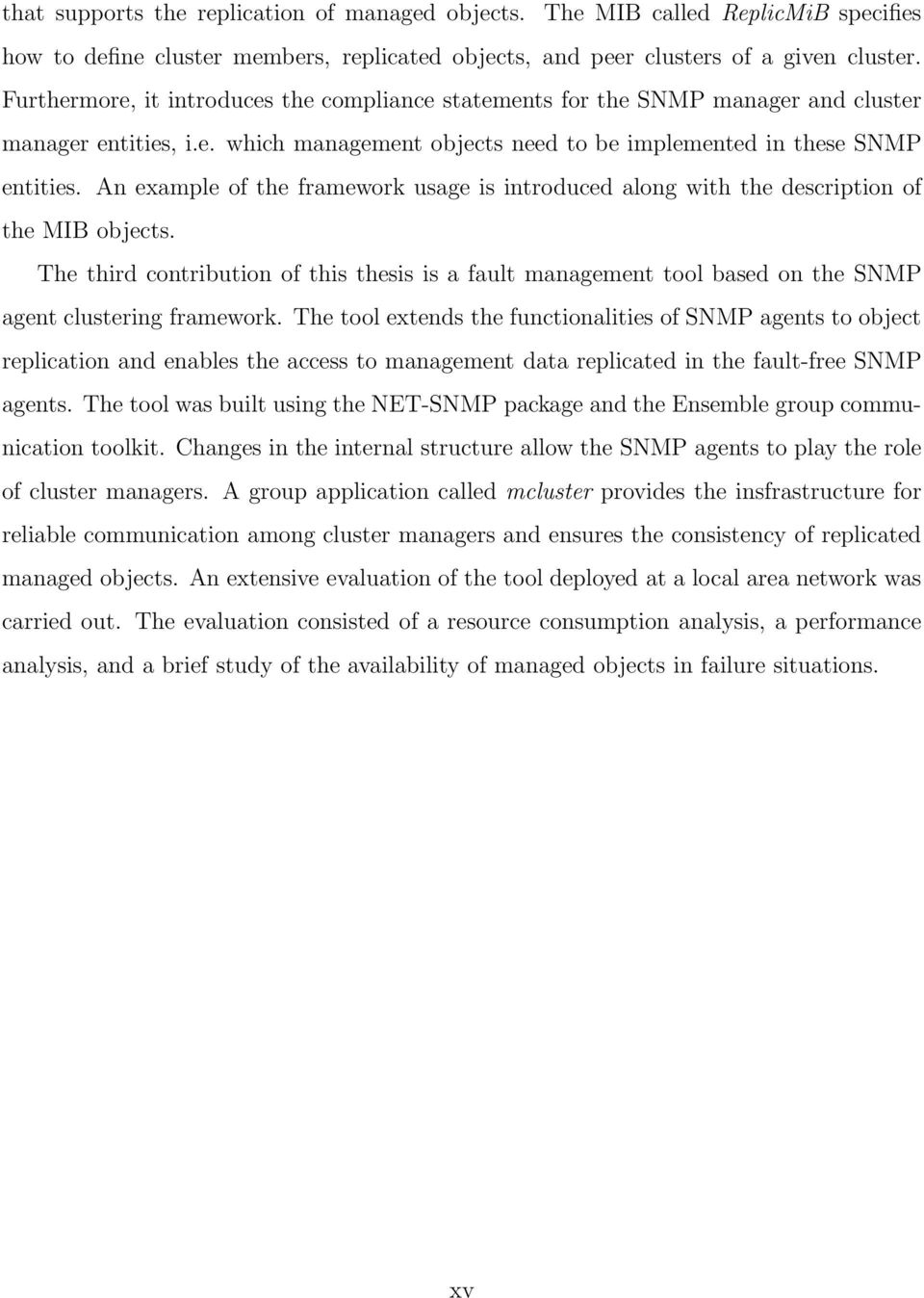
19 Contents List of Abbreviations List of Figures List of Tables xix xx xxii 1 Introduction Problem Description Solution Highlights and Contributions Related Work Thesis Organization Network Management & The SNMP Framework Network Management SNMP Framework SNMP Architecture Structure of Management Information The SNMP Protocol Evolution of the SNMP Conclusion Replication & Group Communication Failure Models Replication Techniques Passive Replication Coordinator-Cohort Active Replication xvi

20 3.2.4 Semi-Passive Replication Semi-Active Replication Group Communication Passive Replication Applied to Managed Objects Conclusion Management by Replication: Specification Requirements of the System Specification Cluster Cluster Manager Operation Replicated Information Managed Objects Replication An Agent Clustering Architecture Using SNMP Conclusion An SNMP Framework for Object Replication in Agent Clusters The MIB for Replicating MO s Management Clusters Cluster Members Replicated Objects Peer Clusters Keeping and Accessing Replicated Objects Conclusion An SNMP Tool Based on Agent Clustering System Model Cluster Manager Structure mcluster Structure Running the Tool Evaluation of the Tool Impact on Network Resources Performance Analysis Availability Analysis Detection of TCP SYN-Flooding Attacks xvii
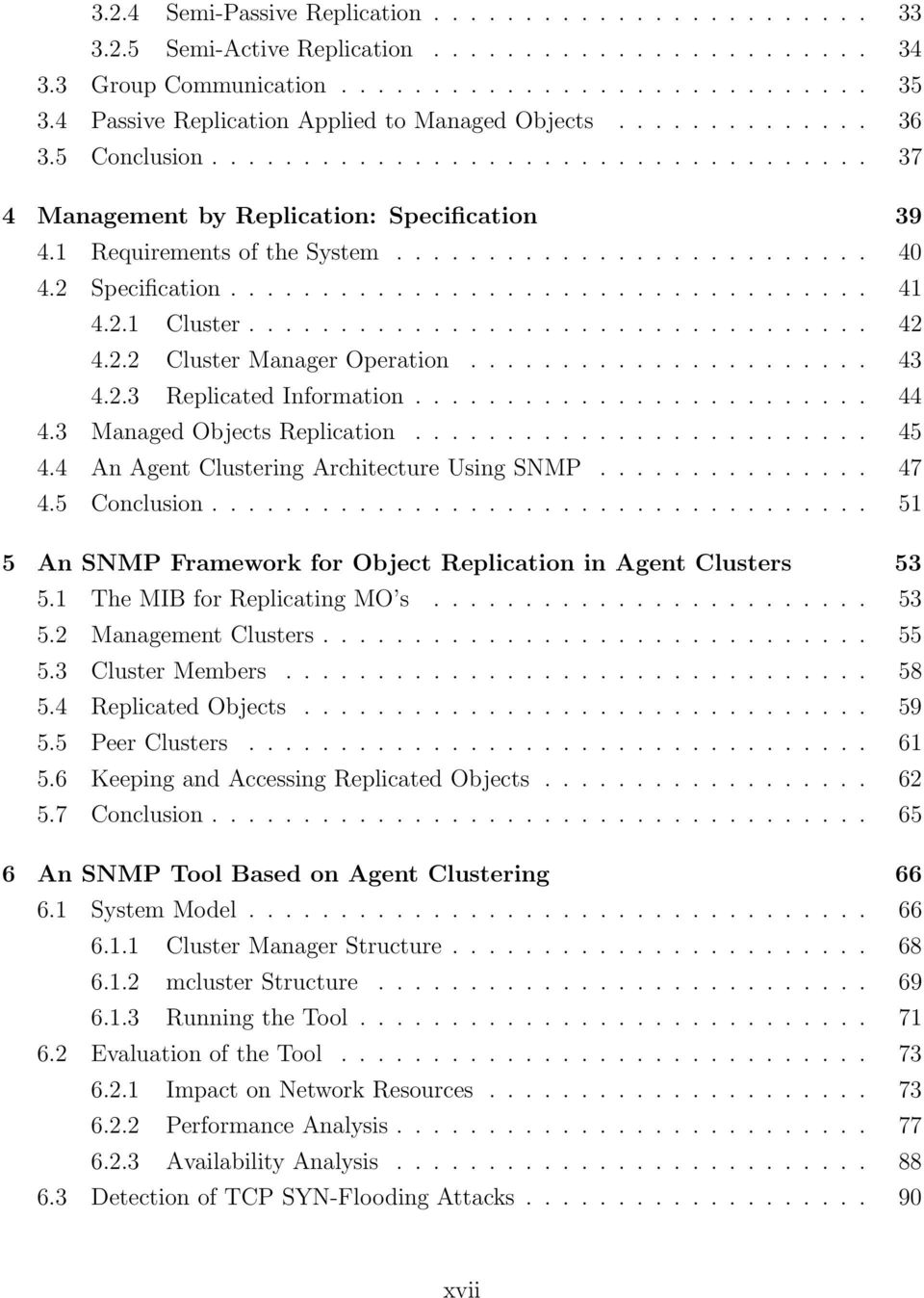
21 6.4 Conclusion Conclusions Goals and Results Main Contributions Future Work and Applications A Replication MIB 112 B Usage of the SNMP Tool 133 C SNMP Objects Used in Performance Analysis 145 D Description of A TCP SYN-Flooding Attack 149 xviii
22 List of Abbreviations Ag Agent/Agent Member ACK Acknowledge ASN.1 Abstract Syntax Notation Language One BER Basic Encoding Rules CM Cluster Manager DisMan Distributed Management Working Group IETF Internet Engineering Task Force IP Internet Protocol IPv4 Internet Protocol version 4 IPv6 Internet Protocol version 6 ISO International Organization for Standardization MIB Management Information Base MO Management Object/Managed Object NMS Network Management Station OID Object Identifier OSI Open Systems Interconnection PDU Protocol Data Unit RFC Request for Comments SMI Structure of Management Information SNMP Simple Network Management Protocol SNMPv3 Simple Network Management Protocol version 3 SYN Synchronize SYN ACK Synchronize Acknowledge TCP Transmission Control Protocol UDP User Datagram Protocol xix
23 List of Figures 1.1 The proposed three-tier agent clustering architecture The global architecture of group communication [23] Two level peer model [24] Group-based architecture for replicating managed objects ANMP s hierarchical architecture [28] The Manager/Agent paradigm Hierarchical organization of MIB objects Operations between management entities Passive replication: processing of a request Coordinator-cohort: processing of a request Active replication: processing of a request Semi-passive replication: processing of a request with crash at the primary Semi-active replication: processing of a request Passive replication: agents playing as primary and backup The replication architecture The operation of the clustering architecture Querying replicas by the general manager Replic-MIB: basic structure The cluster definition table The cluster member table The replicated object table The peer cluster table The cluster replica table SNMP agents interact with a group communication tool xx
24 6.2 Cluster manager architecture mcluster architecture A ReplicaTable row Set of IP objects: update frequency for 3 seconds of monitoring time Set of TCP objects: update frequency for 3 seconds of monitoring time Set of UDP objects: update frequency for 3 seconds of monitoring time Latency of the ping-pong test Latency required to the exchange of messages with 1 and 2 peer clusters Latency required to the exchange of messages with 3 and 4 peer clusters Latency required to the exchange of messages with 5 and 6 peer clusters Average latency versus number of peer clusters Exchange of messages among cluster managers with failure conditions Three-way handshake xxi
25 List of Tables 5.1 An example cluster table as defined at the manager application level An example member table in cluster C i An example replicated object table in cluster C i An example peer table in cluster C i An example replica table in cluster Ci Properties supported by Ensemble Configuration files used for defining a cluster Space allocated by one cluster to keep replicated objects Calculation of estimated bandwidth for a cluster Set of IP evaluated objects Set of TCP evaluated objects Set of UDP evaluated objects TCP object values in a TCP SYN-Flooding attack xxii
26 Chapter 1 Introduction Computer networks have become essential for enterprises and people. An adequate performance of networks is often a pre-condition for the appropriate performance of the enterprises themselves. At the same time, networks are complex, being composed by both hardware and software elements, and heterogeneous protocols produced by different organizations and vendors. Integrated network management systems include tools for network monitoring and control of hardware, software elements, and heterogeneous protocols [1]. An efficient network management system must guarantee access to reliable information to the managed components. The only way to maintain such information at the manager application is the continuous monitoring of the system parameters that affect management decisions [2]. The increasing complexity of managed network components and services provided by such components may require monitoring more and more parameters. A distributed three-layer architecture for distributed applications offers numerous advantages such as better scalability and availability. Using such kind of architecture, the overall availability of a management system can be increased since different components of the system may be executed at different locations. Besides, a failure of one of the components would not imply the immediate unavailability of the whole service [3]. However, since the dependencies among various components usually exist, even a single failure of a crucial component may bring part of a management system to a halt or render it inaccurate. 1
27 2 The Simple Network Management Protocol (SNMP) is the management framework standardized by the Internet Engineering Task Force (IETF) for IP networks [4, 5]. SNMP is currently the de facto standard for network management and has been adopted by a large number of organizations. Some of the issues that affect the scalability of monitoring systems, such as the distance between the management station and the network elements, have been addressed in the SNMP framework through the adoption of the three-tier architecture in the SNMP framework [6]. In a three-layer architecture, components in the middle layer can extend their functionalities to perform activities previously executed only by the manager application. As management activities are closer to the network elements, the traffic overhead on network reduces, the control loops shortens, and new management activities can be included as the replication of management data. Besides, middle-layer components of a management system can operate in an autonomous manner. Thus, in case of given parts of a monitored network becoming unavailable for some reason, operational management middle-layer components can go on to monitor their partitions. Replication is a natural manner to deal with failures. Many software replication techniques have been proposed in order to provide the redundancy of both services and data for distributed systems [7, 8, 9, 10]. Such techniques allow the operation of distributed systems even in presence of failures. While replication is a natural solution for fault-tolerance, the implementation of a consistent replicated system is not so easy and requires certain properties such as agreement and ordering [11]. Group communication is a communication infrastructure that offers high-level primitives and has properties that allow the construction of fault-tolerant distributed systems based on groups of cooperating processes [11, 12]. Group communication mechanisms typically ensure agreement and ordering properties, among others. Agreement properties ensure that all members agree on the delivery of some message, or on some value. Ordering properties ensure that messages are delivered to all members in a certain order. Hence, group communication can help in the design and implementation of distributed systems that hold data, such as a network management system, for example.
28 1.1. Problem Description 3 As the functionality of network management systems includes fault and performance management, among others, it is fundamental that these systems work correctly during the occurrence of network faults even when some management components are faulty. Thus, fault tolerance techniques have been applied in order to build reliable distributed network management systems [13]. Fault management is one of the key functions of integrated network management systems. The purpose of fault management is to locate, determine the causes and, if possible, correct network faults [1]. Different approaches have been proposed to accomplish this task, including the application of system-level diagnosis for fault-tolerant network monitoring [13, 14, 15], alarm correlation [16], and proactive fault detection [17], among others. This work presents an agent clustering architecture that supports passive replication [9] of managed objects. The architecture is introduced taking into consideration the widely used SNMPv3 framework [4, 18]. However, the architecture is generic and can be applied to any distributed management framework. Moreover, this work presents an SNMP framework of the agent clustering architecture and a fault-tolerant fault management tool based on this framework. This chapter is organized as follows. First, we describe the problem addressed in our work. Next, we introduce the proposed solution for the problem and the contributions of this work. After, we present the related work. Finally, the organization of the remaining chapters is presented. 1.1 Problem Description The problem tackled in this work is to provide a reliable fault management mechanism which allows a human manager to collect network information from a given network element or set of network elements even if they have crashed or are unreachable. Although there is a number of network monitoring systems, they usually only allow the examination of managed objects of fault-free agents. However, as management objects reflect the state of managed entities, it is often useful to examine the information at the
29 1.2. Solution Highlights and Contributions 4 MIB (Management Information Base) of a crashed agent with the purpose of determining the reason why a given network element has crashed or is unreachable. Thus, the state of the MIB s objects may help the diagnosis process. Furthermore, there is currently no standard way to examine MIB objects of faulty agents using SNMP, for instance. 1.2 Solution Highlights and Contributions We present a new fault management architecture for the Internet standard Simple Network Management Protocol (SNMP) based on agent clustering that supports passive replication of managed objects. Specifically, this work has the purpose of defining a generic replication architecture that can be applied to any distributed management framework. The proposed architecture is structured in three layers, as shown in Figure 1.1. The lower layer corresponds to the typical management entities in the network elements that keep managed objects. The middle layer corresponds to the management entities defined as cluster managers by a management application. These entities have the task of monitoring managed objects of management entities in the lower layer and replicating their values in other cluster managers. The upper layer corresponds to a management application that defines management clusters as well as the relationship among clusters. Manager CM CM CM Ag Ag Ag Ag Ag Cluster 1 Ag Ag Ag Ag Ag Cluster 2 Ag Ag Cluster N Figure 1.1: The proposed three-tier agent clustering architecture. In its operation, each cluster manager (CM) periodically queries, at a given time interval, each agent member (Ag) that belongs to its cluster in order to monitor previously
30 1.2. Solution Highlights and Contributions 5 defined managed objects. A CM keeps at the local MIB instances of monitored objects values and next replicates those values in other cluster managers which act as its peer clusters. The three-layer architecture allows the manager to query directly an specific agent in order to obtain values of its objects or a given cluster manager and its peer clusters in order to obtain values of replicated objects. The clustering approach allows a specific cluster manager to keep replicated objects from a number of other cluster managers, even if the set of replicated objects from each one is different. Typically, a set of cluster managers replicate the same set of managed objects but it is possible to define different sets of managed objects for each cluster manager. Thus, a cluster manager might be at the same time peer of a given cluster manager which replicates only TCP (Transmission Control Protocol) objects, for example, and peer of another cluster manager which replicates, for example, only UDP (User Datagram Protocol) objects. We propose the use of a group communication protocol [12, 20, 21] to guarantee the consistency among replicated objects in peer clusters. Group communication protocols offer properties and services, such as reliable multicast and group membership, among others, that ensure the consistency of replicated data. However, the architecture allows the use of different mechanisms to support the transmission of instances of replicated objects to the peer cluster managers. In summary, a cluster of agents provides fault-tolerant object functionality by replicating managed objects of a given collection of agents in agents that play the role of cluster managers. In this way, the human manager or the manager application could access replicated managed objects of a crashed agent of a given cluster through a peer cluster manager. Furthermore, a cluster manager behaves as a cache of managed objects that may reduce the impact of monitoring on network performance.
31 1.2. Solution Highlights and Contributions 6 The key contributions of this research are: 1. Definition of an architecture for reliable network fault management based on replication that allows the access to variables, i.e. replicated objects, of crashed or unreachable management entities. The architecture presents concepts of clustering and peers, among others, in order to guarantee requirements such as scalability and consistency of replicated data of network management systems. 2. Definition of an SNMP framework for replication of managed objects in SNMP agent clusters. The framework specifies management objects that support the creation and operation of agent groups, as well as the replication of managed objects in different management entities. The MIB called Replic-MIB defines compliance modules for both the SNMP manager and the cluster manager entities in a network management system. Such modules define a collection of management objects for those SNMP entities. 3. Implementation of a network fault management tool based on the agent clustering framework. The tool was built using the public-domain NET-SNMP package [22] and a group communication toolkit called Ensemble [21]. The tool extends new functionalities to SNMP agents that allow the creation of SNMP agent clusters for managed object replication. A group application called mcluster, which was built using Ensemble, ensures a reliable communication facility among clusters. 4. Publication of an Internet-Draft named A Clustering Architecture for Replicating Managed Objects as a Draft of the Distributed Management (DisMan) working group [6] of the Internet Engineering Task Force (IETF). Particularly, the Draft describes the components of the architecture, provides example of cluster configuration, and the constraints and advices to the development of the architecture. An Internet- Draft is the first step to propose an IETF standard to be published as an Request for Comments (RFC) document. RFC documents are commonly adopted as standard by Internet community.
32 1.3. Related Work Related Work A number of solutions have been proposed in the literature for the development of network management systems. In this section, we present related work that has been shown to be effective for building reliable distributed systems. Issues such as organizational models, group communication facilities, and data replication, among others, are considered. We describe the strategies of each related work and discuss how such approaches relate to the present work A Group Communication Protocol for Distributed Network Management Systems Lee [23] introduces an efficient group communication protocol that provides ordered delivery of messages and supports overlapped grouping facility in a distributed network management system based on the hierarchical domain approach. Guaranteeing reliable communication among the members of a group is one of the problems that must be handled in designing fault tolerant distributed systems. Group communication protocols provide a means for developing a reliable system without having to build a number of underlying services such as multicast and membership. A reliable group communication protocol typically guarantees the ordered delivery of messages among the members of a group, but it also introduces protocol overhead in a system. Lee has designed a distributed and hierarchical group communication protocol in which the group communication function is split into three hierarchical entities called global group manager (GGM), group communication daemon (GCD) and local group manager (LGM), as shown in Figure 1.2. Such hierarchy helps to reduce the protocol overhead in supporting an atomic and reliable group communication, even with the introduction of the overlapped grouping concept, i.e. a given process may belong to two or more groups at the same time. The GGM controls and manages all members of all groups through GCD or LGM entities. A GCD resides in each host providing a group communication. It is responsible
33 1.3. Related Work 8 for creating and removing LGMs, and it also supports overlapped group management functionality, i.e. the ability to control groups that contain members in common. An LGM has the task of managing one or more process members of a specific group within a host. As a group can be distributed over one or more hosts, in a single host there can be various LGMs, each one supporting a different group. LGM GCD LGM LGM GCD GGM Communication Network GCD LGM LGM LGM GCD LGM GCD LGM GGM Global Group Manager LGM Local Group Manager GCD Global Communication Daemon Figure 1.2: The global architecture of group communication [23]. The group communication is performed in three steps: the first step occurs between process members and a LGM, the second between LGMs and a GCD and the last between GCDs and the GGM. Therefore, an LGM controls process members which reside on a local host, a GCD provides the overlapped group management function and the GGM manages all LGMs in a network. The architecture proposed in this thesis employs distributed and hierarchical approaches similar to the ones described by Lee in order to reduce the communication overhead in monitoring and replicating managed objects. Particularly the structure of the architecture is split in three layers called the manager layer, the cluster layer, and the cluster member layer. This structure provides simplicity and efficiency in replicating managed objects. Furthermore, it allows groups to overlap, thus a process member can cooperate with various groups that replicate different sets of managed objects.
34 1.3. Related Work Multicast-SNMP to Coordinate Distributed Management Agents Schönwälder [24] introduces an approach for defining SNMP agent groups that implement membership facilities on top of SNMP in order to build distributed management systems based on cooperating management agents. His work describes how group membership information and a master election algorithm can be built by using SNMP trap messages encapsulated in UDP/IP 1 multicasts. Group communication primitives allow the construction of fully distributed management applications executed by autonomous cooperating agents. Schönwälder argues that distributing management tasks to a number of cooperating agents provides some benefits like the ability to implement load-balancing algorithms and the ability to replicate functions in order to increase the fault tolerance of the management system itself. In his approach, a delegation mechanism adds mobility to the management threads that has the purpose of balancing the management load over a set of agents. Peer-Agent Peer-Agent Peer-Agent Agent Agent Agent Agent Agent Agent Agent MIB MIB MIB MIB MIB MIB MIB Figure 1.3: Two level peer model [24]. Schönwälder has implemented network management applications using the approach of cooperating management agents structured on a peer-based model, as shown in Figure 1.3. Schönwälder mentions that it is possible to combine a hierarchical model with a peer model by implementing the nodes of a hierarchical structure using a set of cooperating peers, and 1 UDP/IP - User Datagram Protocol/Internet Protocol
35 1.3. Related Work 10 thus achieving the advantages of both approaches. Schönwälder also mentions that more study is needed to understand which properties of group communication protocols are actually needed by management applications and how the protocols behave in situations where the network is unstable. As one of the main purposes of a network management system is to help in situations where the network does not operate as designed, it might therefore be useful to lower the consistency requirements usually found in distributed systems. The architecture proposed in this work also combines the advantages of a peer model along with a distributed and hierarchical model. Thus, our architecture allows the definition of a set of cooperating peer agents in an intermediate hierarchical structure. This middle layer provides the ability to replicate managed objects. However, in contrast to Schönwälder s proposal, our architecture does not implement group communication primitives needed to coordinate distributed management agents. It assumes an underlying reliable communication mechanism, such as group membership, to accomplish this task Group Communication as an Infrastructure for Distributed Systems Management Breitgand et al. [25] propose the use of group communication for facilitating development of fault-tolerant, efficient and scalable distributed management solutions. They present a generic management architecture in two layers. The architecture exploits a group communication service in order to minimize the communication costs and thus, it helps to preserve complete and consistent operation despite of potential network partitions and site crashes. The proposed management platform includes four reliable services that are the building blocks for implementing distributed system management applications. Those services support common management tasks as distributed configuration management, software distribution, remote execution of the management actions, and efficient grouping of targets with the same management requirements. A prototype of the platform was partially implemented on which were addressed common management tasks such as simultaneous executions of the same operation in a group of
36 1.3. Related Work 11 workstations; software installation in multiple workstations; and consistent network table management in order to improve the consistency of Network Information Service (NIS). Breitgand et al. mention that the proposed platform could be extended to become general enough to be applied to the problems of both distributed systems and network management. One of the problems to solve is the scalability issue, since the architecture in two layers based on the client-server paradigm may not provide the appropriate scalability. In order to solve scalability problems, they have suggested extending the platform to include a reliable mid-level manager service that facilitates a development of reliable hierarchical management applications. This mid-level manager could be used for efficient aggregation of low-level management data to higher-level data that would be presented to a higher-level management application. Our replication architecture includes a mid-level manager similar to the one suggested by Breitgand et al. Our purpose is to provide an efficient aggregation mechanism for management objects monitored at a lower level that are replicated at other middle level managers. Our architecture provides scalability and flexibility in order to replicate different sets of managed objects. Besides, keeping a collection of important managed objects closer to the management application allows the reduction of the traffic overheard and improves the response time in querying those managed objects Replication of SNMP Objects in Agent Groups In [26, 27], Santos and Duarte have introduced a framework for replicating SNMP management objects in local area networks. This framework presents a two-tier architecture in which replicated objects are kept among the network elements themselves, as shown in Figure 1.4. The defined framework is based on groups of agents communicating with each other using reliable multicast. A group of agents provides fault-tolerant object functionality. The framework allows the dynamic definition of each agent group as well as management objects to be replicated in each one. In contrast to Schönwälder s proposal [24], the framework
37 1.3. Related Work 12 considers that a membership service under SNMP guarantees reliable communication. Manager Request Request Group Agent Agent Agent Update Agent Figure 1.4: Group-based architecture for replicating managed objects. The introduced SNMP service allows replicated MIB objects of crashed agents to be accessed through working agents. The service is based on cooperating groups of SNMP agents defined over a group communication tool. The main part of the MIB describing the framework consists of three dynamic tables. The first table contains the definition of multiple agent groups; the second table contains the specification of objects that are replicated in each group, and the last table keeps the replicated objects in all members of all groups. When the system is initialized, the replicated object table is automatically built from the other two tables and replicated throughout the group. In this way, the replicated object table enables a manager to access replicated objects through any agent of a given group. However, several new framework requirements were identified to extend this service to large networks. Issues like network elements with different processing capacity and required bandwidth might often interfere on network data consistency, consequently affecting the reliability and scalability of a network monitoring system. In the two-tier architecture for cooperating groups of SNMP agents, all members of a group need to replicate objects at each time interval as well as to keep replicated objects from other agents. To accomplish this task, each agent needs to have enough processing capacity. Furthermore, network resources are also required to transmit replication messages. The issues mentioned above can restrict the number of agents at a given group or even the number of agent groups. Hence, in order to solve those issues, other approaches presented at literature, such as the clustering approach, have been included in that framework. They
38 1.3. Related Work 13 have contributed for defining the replication architecture proposed in this work as well as a new framework ANMP: Ad Hoc Network Management Protocol Chen et al. [28] present a protocol for managing mobile wireless ad hoc networks called Ad hoc Network Management Protocol (ANMP). The protocol uses hierarchical clustering of network elements in order to reduce the number of messages exchanged between the manager and the mobile agents. The clustering approach enables the network manager to keep track of mobile elements as they gad around. Moreover, ANMP is fully compatible with Simple Network Management Protocol, being an extension of the Simple Network Management Protocol version 3 (SNMPv3). Chen et al. argue that using a hierarchical model for data collection is a good approach in order to build a protocol that provides message efficiency, since intermediate levels of the hierarchy can collect data, often producing a digest, before forwarding it to upper layers of hierarchy. However, employing that approach in ad hoc networks introduces a disadvantage which is the cost of maintaining a hierarchy in face of node mobility. The topology of an ad hoc network may be quite dynamic; thus, it is necessary to support automated reconfiguration. In order to solve this problem, among others, they have proposed a threelevel hierarchical architecture based on clustering for ANMP, as shown in Figure 1.5. They argue that forming clusters is the most logical way of dividing an ad hoc network to simplify the task of management. Such a division facilitates decentralized network management that thus becomes more fault tolerant and message efficient. The lowest level of the ANMP architecture consists of individual nodes called agents. Several agents, which are close to one another, are grouped in clusters and managed by a cluster head. The middle level consists of cluster heads. At the upper level, a network manager manages all cluster heads. The structure of the clusters is dynamic. Thus, as nodes move around, the number and composition of the clusters change. In the same way, the nodes acting as cluster heads also change over time.
39 1.3. Related Work 14 Manager Cluster head Cluster Agents Figure 1.5: ANMP s hierarchical architecture [28]. In order to support clustering in ad hoc networks, Chen et al. developed two clustering approaches: graph-based clustering and geographical-based clustering. The first approach models the network as a graph and forms clusters based on the graph topology. The second approach uses a global positioning system (GPS) information to divide the network into clusters. ANMP extends the MIB s used in SNMP to include ad hoc network specific information. Chen et al. added a new MIB group called anmpmib to the MIB-2 of SNMP for supporting ad hoc network management functions. Thus, every node in the network locally runs an ANMP entity. This new MIB contains, among its subgroups, a group that defines objects related to the topology information of the ad hoc network, allowing each node to keep a list of all neighbors as well as clustering protocols which may be used for topology maintenance. The architecture of management elements clustering for the management of data replication proposed in this work applies some of the approaches described by Chen et al. Those approaches focus on solving the requirements of scalability, consistency, and processing capacity among the network elements in order to extend the object replication service to large networks. We have used a clustering approach in our work to reduce the number of messages exchanged among the network elements and thus to decrease the impact of replication on network performance. Like in ANMP, we define an intermediate level of management.
40 1.3. Related Work 15 This middle level consists of network elements called cluster managers that are capable of monitoring and replicating objects among them. Furthermore, the architecture splitted into three levels provides the scalability needed for clustering network elements with either homogeneous or heterogeneous characteristics. Hence, a manager application can define different sets of clusters in which each cluster represents a set of network elements and management objects to be replicated. We also introduce a new MIB group called Replic- MIB for supporting managed object replication in agent cluster. The specification of the Replic-MIB takes into account the SNMP framework Network Control and Management of a Reconfigurable WDM Network Wei et al. [29] describe a management system based on CORBA and the group communication tool Isis [12], deployed on a set of two management stations (NMS s) and five managed network elements, on top of a WDM (Wavelength Division Multiplexing) network. Robustness of the management functionality is provided through the object group mechanism which actively replicates management software objects across the two management stations. Thus, in case of one management station crashes, the other station takes over seamlessly. Except for the administrator front-end graphical interface, all other management objects, i.e. connection, fault and configuration objects, are replicated and span across both management stations. In this way, crashing of a management process on one management station can be tolerated, without affecting the continuous operation of the management system. In our architecture, we allow the replication of management objects not management functions. We introduce the passive replication technique which better supports the usage of object groups like views over the whole management objects [12]. The passive replication tecnique selects one replica in order to play as primary replicas, and the other replicas play as backups. Thus, each agent group can replicate a specific collection of objects according to its goal. Hence, not all management objects are replicated. This replication strategy allows
41 1.4. Thesis Organization 16 copies of objects replicated from each agent group to be deployed to different management entities in the system. 1.4 Thesis Organization The rest of the thesis is organized as follows. Chapter 2 introduces the network management paradigm based on SNMP. Chapter 3 presents an overview of failure models, replication techniques and group membership that are commonly used for the development of reliable distributed applications. Chapter 4 defines requirements of the proposed model and describes the agent clustering architecture for replicating management objects. Chapter 5 describes an SNMP framework for replication of managed objects in agent clusters. In chapter 6, we present a practical fault network management tool based on the SNMP agent clustering framework. Furthermore, we introduce an evaluation of the tool which includes a study of the resource consumption, a performance analysis, and a brief study of the availability of the tool. An application example shows how the tool can help to determine the occurrence of TCP SYN-Flooding attacks. Chapter 7 concludes the thesis and presents directions for future work.
42 Chapter 2 Network Management & The SNMP Framework Computer networks are increasingly more complex and larger. These networks are typically composed of hardware, software, and heterogeneous protocols produced by different organizations and vendors. Network Management systems are used to control and monitor network elements and the system as a whole [1]. SNMP (Simple Network Management Protocol) is the de facto standard for network management nowadays, and a large number of organizations have adopted it. Thus, using the SNMP Framework as reference, we will propose an agent clustering architecture for building reliable network management systems. This chapter defines the goals of network management systems and presents the classification of network management functionality proposed by ISO (International Organization for Standardization). Such classification still remains current, although other functionalities have been included over time. Section 2.2 presents an overview of the Internetstandard Management Framework, widely known as the SNMP Framework, that describes the SNMP management architecture, the Structure of Management Information (SMI), the Internet Management Information Base (MIB), and the SNMP protocol used by managers and agents to communicate. In addition, this section presents a brief discussion about the framework s evolution trends, including the SNMPv3. 17
43 2.1. Network Management Network Management Network Management is needed to control and monitor the operation of the network according to changing user requirements. Management includes the initialization, monitoring and modification of both hardware and software elements in the network [30]. Such elements can be computers, routers, bridges, hubs, modem, consoles, and printers, among others. ISO (International Organization for Standardization) has proposed a classification of network management functionalities into five areas: fault, performance, configuration, security, and accounting management. These functionalities were proposed as part of the OSI (Open Systems Interconnection) systems management specification, but they have been widely accepted to describe the requirements for any network management system [31]. The function of each area is described below: Fault management: allows the detection, isolation, and correction, if possible, of abnormal operations of the network (network elements and services). Performance management: allows performance monitoring and evaluation of the network. Configuration management: allows the human manager to reconfigure the network from a manager station in order to guarantee continuous operation and quality of service. Security management: includes procedures to protect the system from unauthorized access. Accounting management: enables charges and costs to be assigned for network usage. In the next section, we present an overview of the Internet Standard Network Management Framework, also known as the SNMP (Simple Network Management Protocol) Framework.
44 2.2. SNMP Framework SNMP Framework SNMP (Simple Network Management Protocol) [4, 32, 33, 34] is the de facto standard for network management nowadays. A large number of organizations have adopted SNMP in order to manage their networks. A vast number of network devices such as routers, bridges, hubs, and operating systems from different vendors offer support for SNMP. As networks expand and become mission critical, the need for an integrated system to allow network monitoring and control becomes critical [35]. Networks are made up of heterogeneous elements, being based on computer and communication technologies produced by different organizations and vendors. Thus, it is important that network management systems be based on international open standards, shared by all technologies. SNMP is an open framework developed by the TCP/IP community to allow the integrated management of highly heterogeneous internets. Although SNMP is a simple protocol, its huge success is not due to a lack of more complex alternatives. SNMP s simplicity, is, to the opposite, one of the reasons why the protocol has been so widely deployed. As the impact of adding network management to managed nodes must be minimal, avoiding complicated approaches is a basic requirement of any network management model. The simplicity of SNMP has guaranteed its efficiency and scalability. Although there is a number of areas in which SNMP has shown deficiencies, the set of standards has been evolving: new versions and new solutions are being developed continuously. In this section, we provide an overview of the SNMP management architecture, including the data definition language called Structure of Management Information (SMI), the Management Information Base (MIB), the management protocol, and conclude examining the framework s evolution trends SNMP Architecture SNMP is originally based on the manager-agent paradigm, in which the network is monitored and controlled through management applications called managers running in a Net-
45 2.2. SNMP Framework 20 work Management Station (NMS), and agents running in nodes and network devices, also known as managed devices. In order to simplify our understanding, throughout this section, We call agents all nodes and network devices that contain an agent. As shown in Figure 2.1, each agent keeps management information stored in a local Management Information Base (MIB). The NMS also keeps a MIB. A MIB may include a large amount of management information such as the number of packets received by an agent and the status of its interfaces. The NMS and the agents communicate using a network management protocol. MIB NMS SNMP Client MANAGEMENT APPLICATIONS SNMP Trap SNMP Trap SNMP Trap SNMP query SNMP query SNMP query Agent Agent Agent MIB SNMP Server MIB SNMP Server MIB SNMP Server Figure 2.1: The Manager/Agent paradigm. The NMS runs a collection of management applications, which provides fault, performance, configuration, security, and accounting management [36]. Agents run on computers and network devices such as routers, bridges, hubs, that are equipped with SNMP so that they can be managed by the NMS. Each agent replies to SNMP queries, and may issue asynchronous alarms, called traps, to the NMS reporting exceptions, for example, when management objects indicate that an error has occurred. Agents run an SNMP server, and the NMS runs SNMP client applications. An SNMP MIB is a set of management objects (MO s). Each object is a data variable
46 2.2. SNMP Framework 21 that represents one characteristic of the managed element. The MIB s are standard, and different types of agents have MIB s containing different objects. The NMS can cause an action to take place at an agent or can change and agent s configuration by modifying the value of specific variables. The NMS and the agents communicate using a network management protocol called SNMP. SNMP contains three general types of operations: get, with which the NMS queries an agent for the value of a given management object; set, with which the NMS writes the value of a given management object on a given agent; and trap, with which an agent notifies the NMS about a significant event. SNMP is an application layer protocol of the TCP/IP protocol suite. It runs on top of UDP (User Datagram Protocol), a connectionless transport protocol, which runs on top of IP (Internet Protocol). The reason for which a connectionless protocol was chosen is that network management must be very resilient to faults over the network. A connection may have problems to be established if there is a fault. Furthermore, a connection-oriented approach masks a number of network problems for the application, because it does retransmission and flow control automatically. Network management cannot have these problems hidden from it. There are two strategies usually employed by the NMS to monitor the network: polling and alarm management. The NMS polls agents regularly at specific time intervals querying for management objects. The interval may vary depending on the object or the network state. On the other hand, alarm management is based on traps sent by agents to the NMS when threshold conditions are reached. In general, network management systems employ a combination of polling and alarm management [37]. If the NMS monitors a large number of agents and each agent maintains a large number of objects, then it may become impractical to regularly poll all agents for all of their data [18]. However, trap processing also has problems of its own. As agents must generate events when thresholds are achieved, they must continuously monitor the value of the management objects. This process may have a bad impact on the performance of the agent. Furthermore, when there is a fault in the network, the NMS is usually flooded with
47 2.2. SNMP Framework 22 alarms sent from agents that have different perspectives of the problem, and diagnosis can be difficult in those circumstances. If the network problem is congestion, traps will make it even worse. The SNMP community favors pollings over traps [38] Structure of Management Information Management information is a key component of any network management system. In the SNMP framework, information is structured as a collection of management objects (MO s) stored at the MIB. Each MO refers to a MIB variable. Each device in the network keeps a MIB that has information about the managed resources of that device. The NMS monitors a resource by reading its corresponding MO s current value, and controls the resource by writing a new value to the MO. In SNMP, the only data types supported are simple scalars and data arrays. The Structure of Management Information (SMI) [39] defines the rules for describing management information. The SMI defines the data types that can be used in the MIB, and how resources within the MIB are represented and identified. It was built to emphasize simplicity and extensibility. The SMI allows the description of management information independently of implementation details. The SMI is defined using a restricted subset of ASN.1 (Abstract Syntax Notation Language One). ASN.1 is an ISO formal language that defines the abstract syntax of application data. Abstract syntax refers to the generic structure of data, as seen by an application, independent of any encoding techniques used by lower level protocols. An abstract syntax allows data types to be defined and values of those types to be specified independently of any specific representation of the data. ASN.1 is employed to define not only the management objects, but also the Protocol Data Units (PDU s) exchanged by the management protocol. There must be a mapping between the abstract syntax and an encoding, which is used to store or transfer the object. The encoding rules used by SNMP are called BER (Basic Encoding Rules), which, like ASN.1, is also an ISO standard. BER describes a method for
48 2.2. SNMP Framework 23 encoding values of each ASN.1 type as an octet string. The encoding is based on the use of a type-length-value structure to encode any ASN.1 definition. The type includes the ASN.1 type plus its class, the length indicates the length of the actual value representation, and the value is a string of octet. The structure is recursive, so that complex types are also represented using this basic rule. Object Identifiers The SMI has, among others, the task of defining unique identifiers for management objects. Thus, there must be a consensus throughout systems about what each object is used to represent, and how objects are accessed. ccitt (0) iso (1) iso-ccitt (2) standard (0) authority (1) member (2) org (3) dod (6) internet (1) directory (1) mgmt (2) experimental (3) private (4) security (5) snmpv2 (6) mib-2 (1) system (1) interface (2)... sample (11) Figure 2.2: Hierarchical organization of MIB objects. Each object identifier is a sequence of labels, which translates to a sequence of integers. Each object is organized in a tree, such that the integer sequence corresponds to the path from the root of the tree up to the point where the object is defined. It is important to remember that these objects and their identifiers are standard, defined by the authority who is responsible for the management framework.
49 2.2. SNMP Framework 24 The virtual root of the tree of objects is assigned to the ASN.1 standard, as shown in Figure 2.2. In the first level, there are three possible subtrees: ccitt, iso and joint-iso-ccitt. Each SNMP MIB is defined under the internet subtree, which is under the iso subtree, being referred as iso.org.dod.internet and translated as The SMI defines under the internet subtree the following subtree among others: mgmt: employed for standard Internet management objects. The mgmt subtree contains the standard MIB, under the subtree mib-2. experimental: employed to identify experimental objects. private: employed by vendors and organizations to attend private needs. This subtree contains a subtree called enterprises under which a subtree is allocated to each organization that registers for an enterprise object identifier. MIB-2 MIB-2, defined in Request for Comments (RFCs) 2011, 2012, and 2013 [34, 40, 41], is the current standard TCP/IP protocol s MIB. The mib-2 subtree is under the mgmt subtree, being referred as iso.org.dod.internet.mgmt.mib-2 or Within the MIB, objects are usually defined in groups on which each group has a specific purpose. system: overall information about the managed device itself; for example, the variable sysuptime shows how long ago the device was last re-initialized. interfaces: information about each of the interfaces from the agent to the network and its traffic; for example, the variable ifnumber gives the number of interfaces of the agent to the network. at (address translation): contains address resolution information, used for mapping IP address into media-specific address. For example, the variable atphysaddress gives the media address for a given interface, and the variable atnetaddress gives the IP address.
50 2.2. SNMP Framework 25 ip, icmp, tcp, udp, egp, and snmp: every group has information about that protocol s implementation and behavior on the system. For example, the variable ipindelivers gives the total number of input datagrams successfully delivered to IP user-protocols. transmission: gives information concerning the transmission schemes and access protocols at each system interface, used for media-specific MIBS, as for X.25, Token Ring, FDDI, among others The SNMP Protocol The SNMP protocol is employed by managers and agents to communicate management information. It is used by managers to query and control agents, and by agents to issue traps and reply to queries. Version 2 of SNMP also allows managers to communicate among themselves. SNMP became a full Internet standard in 1990 [33]. The protocol has since evolved, but basic SNMP is in widespread use, having been adopted by dozens of organizations worldwide. For the implementations described in chapter 6, SNMPv3 was used. SNMP provides a collection of operations performed between management entities, as described below and shown in Figure 2.3, in order to communicate management information. Get: requests the value of a given management object; GetNext: requests the value of next management object; Bulk: requests a set of management objects at the same time; Set: stores a new value for a given management object; Response: responses operations described before; Trap: an agent sends the value of a given management object to a manager when exceptional events have occurred;
51 2.2. SNMP Framework 26 Report: internal notification in the entity; manager side agent side manager side agent side get, getnext, bulk, set trap response Figure 2.3: Operations between management entities. A full description of some aspects not detailed in this chapter but which are SNMP standard may be found in [18, 31, 38]. These aspects include, for example, how to define a MIB, i.e. objects, data types, and how to address object instantiations, among others Evolution of the SNMP Throughout the 1990s, the Internet Engineering Task Force (IETF) defined three management architectures for the Internet, known as SNMPv1, SNMPv2, and SNMPv3 [42, 43]. In the early 1990s, the IETF concluded the first version of SNMP called SNMPv1, and the first version of the data definition language called SMIv1. Both SMIv1 and SNMPv1 were adopted by the manufactures of networking devices and vendors of management software. Due to several deficiencies as the lack of effective security mechanisms presented by SNMPv1, the IETF soon started efforts to introduce SNMP version 2 together with a second version of tha data definition language (SMI). However, this process presented several difficulties and its result was the SNMP version 2 known as SNMPv2c. SNMPv2c is not a complete IETF standard as it lacks strong security. The second version of the SMI, called SMIv2, was more successful and has been published as an Internet Standard in 1999 [39, 44]. As SNMPv2c did not achieve its goals, in 1997, an attempt was started to define SNMP version 3 called SNMPv3 that provides effective security mechanisms and remote
52 2.3. Conclusion 27 administration capabilities [4]. Most current SNMP-based systems are built with this third version of the framework. 2.3 Conclusion In this chapter, we introduced the purpose of network management systems and presented the traditional classification of network management functionality proposed by ISO (International Organization for Standardization). Next, we presented the SNMP Framework. SNMP has been widely adopted by different organizations at the management of their networks, being a de facto standard. We presented an overview of the SNMP Framework focusing on the main components: the SNMP architecture, the SMI, and the SNMP protocol. The SNMP architecture is originally based on the manager-agent paradigm. In this architecture, managers, which run in a Network Management Station, and agents, which run in managed devices, accomplish the network management. The SMI is a data definition language that defines the rules for describing management information, allowing the description of management information independently of implementation details. The SNMP protocol provides the communication between managers and agents. Further, it allows managers to query and control agents, and agents to issue trap messages and reply to queries. We also presented a brief discuss over the framework s evolution trends that include SNMPv3. Throughout the thesis, we utilize the SNMP framework to describe an architecture of management entities clustering for replication of managed objects.
53 Chapter 3 Replication & Group Communication A major problem inherent to distributed systems is their potential vulnerability to failures. Indeed, whenever a single element fails, the availability of the whole system may be damaged. On the other hand, the distributed nature of systems provides the means to increase they dependability, which means that reliance can justifiably be placed on the service their deliver [45]. In distributed systems, it is possible to introduce redundancy and, thus, make the overall system more reliable than its individual parts [46]. Redundancy is usually introduced by replication of components or services. Although replication is an intuitive and readily understood concept, its implementation in a distributed system requires sophisticated techniques [8]. Active and passive replication are two major classes of replication techniques to ensure consistency between replicas. Both techniques are useful since they have complementary qualities, and many other replication techniques extend such qualities. This chapter presents an overview of some replication techniques showing their differences, similarities, and sometimes their applications in distributed systems. Many of those techniques have been described by Défago [46]. Section 3.1 describes the existing failure models. Section 3.2 presents replication techniques and their usage in a client-server model. Section 3.3 describes the group abstraction and the role of the group membership service for building reliable distributed applications. Moreover, group communication systems, such 28
54 3.1. Failure Models 29 as the Ensemble system, are mentioned. Section 3.4 proposes the use of passive replication and group abstraction for building reliable network management systems. 3.1 Failure Models The reliability of a component or system is its ability to function correctly over specified period of time. The availability of a system is defined to be the probability that system is working at given time, regardless of the number of times it may have failed and been repaired [19]. In a distributed computing system, it is impossible to tolerate all failures since there is always a nonzero probability that all will fail, either independently or due to a common cause. Therefore, the goal of fault tolerance is to improve the reliability and availability of a system to a specified level by tolerating a specified number of selected types of failures. Failure models have been developed to describe abstractly the effects of failures. The use of such a model simplifies the programmer s task by allowing the program to be designed to cope with this abstract model rather than trying to cope with the different individual causes of failures. A hierarchy of failure models has been developed for use in different application areas [47]. The broadest failure model is the Byzantine or arbitrary failure model where components fail in an arbitrary way [48]. This model accommodates all possible causes of failures, including malicious failures where a machine actively tries to interfere with the progress of a computation. Naturally, the systems based on this failure model are complicated and expensive to execute. The Byzantine with authentication failure model allows the same type of failure, but with the added assumption that a method is available to identify reliably the sender of a message. This assumption substantially simplifies the problem. The timing or performance failure model assumes a component will respond with the correct value, but not necessarily within a given time specification [49]. The omission failure model assumes a component may never respond to an input [49]. The crash or fail-silent failure model assumes that the only way a component can fail is by ceasing to operate without making any incorrect state transitions [50]. Finally, the fail-stop failure
55 3.2. Replication Techniques 30 model adds to the crash model the assumption that the component fails in a way that is detectable by other components [51]. A more complete classification of failure models and their relations can be found in [52]; numerous other classifications based on factors such as duration and cause have also been proposed [45]. In general, more inclusive is the failure model, higher is the probability that it covers all failures that are encountered, but at a cost of increased processing time and communication. 3.2 Replication Techniques Replication techniques applied to critical components of systems are an approach to introduce redundancy. Replication is actually the only mechanism for fault tolerance that simultaneously increases the reliability and the availability of a system [7]. Replication is the process of making a copy (replica) of resources, processes or data. In particular, the kind of replica considered in this thesis is management data, specifically, management objects. There are two basic techniques for replication: active and passive replication. Both techniques are useful since they have complementary qualities. Replication techniques such as coordinator-cohort, semi-passive, and semi-active are variants of those techniques. In this section, we discuss the differences and similarities of those replication techniques. The application model taken into account in all replication techniques is the client-server model. Furthermore, the server is composed of three replica entities named P1, P2, and P3. It is also assumed that only the client makes requests to the server, and a request is a processing required at the server that may or not involve state changes among the replicas Passive Replication The passive replication technique is also known as the primary-backup approach [53]. This technique selects one replica in order to play as primary, and the other replicas play as backups. As Figure 3.1 shows, the client only interacts with the primary (P1), i.e. it sends its request to the primary. The primary then processes the request, and next sends update
56 3.2. Replication Techniques 31 messages to the backups (P2 and P3) in order to keep a consistent state among replicas. Once the backups have been updated, the primary then sends the response to the client. As all backups interact directly only with the primary, every time that the primary fails, the backups must detect the failure and run an election algorithm, such as a leader election algorithm, in order to determine which one will become the new primary. Thus, this replication technique has two drawbacks: (1) the reconfiguration procedure in order to elect a new primary is typically costly, and (2) in case of the primary fails, the client needs to be informed about the new primary in order to resend its request. Client P1 Primary Request Response P2 Backup Update P3 Backup Processing State update Figure 3.1: Passive replication: processing of a request Coordinator-Cohort Coordinator-cohort [54] is a variant of passive replication designed in the context of the Isis group communication system [55]. As passive replication, it is based on the principle that only one of the replicas should process the requests. Thus, at this strategy, one of the replicas is designed as the coordinator (primary) and the others are the cohorts (backups). Unlike a passive replication, a client sends its request to the whole group of replicas: P1, P2, and P3, as shown in Figure 3.2. The coordinator (P1) then handles the request and next sends update messages to the cohorts (P2 and P3) in order to make them updated. If the coordinator fails, the other group members elect a new coordinator, and it takes over the processing of the request.
57 3.2. Replication Techniques 32 Client P1 P2 Coordinator Cohort Request Update Response P3 Cohort Processing State update Figure 3.2: Coordinator-cohort: processing of a request Active Replication In the active replication, also called the state-machine approach [56], the replicas behave independently. As shown in Figure 3.3, the client always sends its request to all replicas: P1, P2, and P3. Every replica then handles the request received, and sends its response. To keep the replicas identical, active replication also must ensure that all replicas receive the requests in the same order. Client P1 Request Response P2 P3 Processing Figure 3.3: Active replication: processing of a request. The main advantage of active replication is its failure transparency; no matter how many replicas are faulty or fault-free, the replicated data is accessed in the same way. Thus, a low response time is achieved even in case of failures. However, this technique has two important drawbacks: (1) the redundancy of processing implies a high resource usage,
58 3.2. Replication Techniques 33 and (2) the handling of a request must be performed in a deterministic manner, i.e. the request result must only depend on the current state of the replica and the sequence of actions that are executed [46, 57] Semi-Passive Replication Semi-passive replication presents similarities with both passive replication and coordinatorcohort. Typically, this technique can be seen as a variant of passive replication, as it retains most of its major characteristics. However, the selection of a primary in semipassive replication is based on consensus [58], and not in a group membership service as it is usually done in passive replication and coordinator-cohort [46, 59]. Client P1 Primary Request Crash Response P2 P3 Backup Backup Update Crashed Processing State update Figure 3.4: Semi-passive replication: processing of a request with crash at the primary. In contrast to passive replication, in this technique the client process always sends its request to all replicas: P1, P2, and P3. Typically, the replica playing as primary (P1) handles the request, and next sends update messages to other replicas. However, when a failure occurs at the primary (P1), another replica is selected as primary (P2), as shown in Figure 3.4. The new primary takes over the processing of the request and updates the remaining replicas. As all replicas receive the request, the client does not resend its request in the case of occurring a failure at the primary. A full description of semi-passive replication is presented by Défago [46].
59 3.2. Replication Techniques Semi-Active Replication The semi-active replication was developed to solve the problem of non-determinism with active replication in the context of time-critical applications. It is an approach that involves characteristics of both active and passive replication [56, 60]. This technique is based on active replication and extended with the notion of a leader (primary) and followers (backups) deployed in passive replication. The client sends its request to all replicas: P1, P2, and P3. Although all replicas perform the handling of a request, only the leader (P1) is responsible to perform the nondeterministic parts of the request processing, and then inform the followers (P2 and P3) through update messages, as shown in Figure 3.5. It is considered non-determinism when there is no way to guarantee that the processing performed by all replicas will achieve the same result, i.e. the result may depend on local values whose instances can be different. For instance, multi-threading typically introduces non-determinism. A definition of determinism is found in Section Client P1 Leader Request Response P2 Follower Update P3 Follower Det. processing Non-det processing State update Figure 3.5: Semi-active replication: processing of a request. An important aspect about semi-active replication and semi-passive replication is their behavior in the ideal scenarios. Semi-active replication, in the absence of non-deterministic processing, is essentially an active replication scheme in which all replicas handle the requests, whereas semi-passive replication, in the absence of fails, ensures that requests are only processed by a single process [46, 59].
60 3.3. Group Communication Group Communication Developing distributed applications is a difficult task, because of the complexity of the applications themselves and of the distributed settings prone to failure in which such applications are often performed. Reliable distributed applications must ensure that its services are provided even when failures occur. The process group abstraction is a possible approach for constructing reliable applications [61]. This approach consists of structuring the application into cooperating groups of processes that communicate using a reliable multicast service. Reliable multicast services ensure that all messages sent to the group are delivered to each group member that is not faulty. Group membership is a service responsible for managing groups of processes, i.e. it maintains consistent information about which members are functioning and which have failed at any moment. In order to do this, a membership service reports failures, recoveries or joining members, indicating changes into the membership [62, 63]. A group communication system typically provides reliable group multicast and membership service. Group communication systems introduce the process group abstraction. They are powerful tools for the development of fault-tolerant distributed applications. In fact, a group communication system encapsulates certain solutions to fundamental problems that arise in the development of reliable systems, providing programmers with a simple distributed programming abstraction. Several group communication systems have been implemented and are available, such as Transis [64], Horus [20] and Ensemble [21]. Ensemble is a group communication toolkit that allows the development of fault-tolerant complex distributed applications. It provides a library of protocols which handles issues such as re-liably sending and receiving messages, transferring process states, implementing security, detecting failures and managing system reconfiguration. The group abstraction is an adequate framework for providing reliable multicast primitives required to implement replication in distributed systems. The following section describes the use of the group abstraction as an alternative for building dependable network management systems.
61 3.4. Passive Replication Applied to Managed Objects Passive Replication Applied to Managed Objects Replication techniques such as active replication have already been previously applied to network management systems in order to increase their dependability [29]. However, considering the distributed nature of current network management systems and requirements such as non-deterministic processing of the requests and low response time, we argue that a variation of passive replication is the most adequate technique to perform the task of replicating managed objects [11]. Passive replication can be extended in order to be applied to a management system. Consider a simple management system composed of a collection of agents where each agent typically keeps information about a particular managed device at its MIB (Management Information Base). These agents could be extended to send their information to other agents and in addition to keep information coming from other agents in the system. In this way, a set of agents could be seen as agent group that supports a replication service of management information. (A) query query manager (B) query query manager Group agent 3 query client Group agent 3 query client query backup agent 1 Update primary Update backup query query agent 1 backup Update backup backup query client Update agent 4 backup client Update primary Update agent 4 manager agent 2 manager agent 2 query query Figure 3.6: Passive replication: agents playing as primary and backup. In order to achieve passive replication functionality in a group of agents, each agent must play as primary and backup at the same time. The primary role enables an agent to multicast its objects to other agents, whereas the backup role enables an agent to keep objects sent by other agents [10]. Thus, as Figure 3.6 shows, an agent is a primary for its own managed objects and replicates them in other group members (A); at the same time,
62 3.5. Conclusion 37 it can also be a backup of other agents, i.e. keeping local replicas of managed objects of other group members (B). A client can query any group agent through a query request for accessing as local objects the replicated objects, as shown in Figure 3.6. However, only the source agent of a MIB can send update requests to other agents for replicating and updating its managed objects. Systems which implement passive replication typically only allow access to the primary copy. However, in network management systems, management entities that keep managed objects can frequently be accessed by manager applications. Hence, such systems can also allow queries to any network entity that keeps copies of replicated information. We define this extension of the passive replication for replicating managed objects in which queries can be done to any member of an agent group as passive replication with read operations on backup agents. 3.5 Conclusion In this chapter, we presented concepts on failure models, replication techniques, and group abstraction which allow the construction of reliable distributed systems. The description of main failure models found in distributed computing systems was presented. Replication techniques allow the development of reliable systems through the redundancy of theirs components. We presented an overview of the replication techniques passive, coordinator-cohort, active, semi-passive, and semi-active that can be used to replicate a service in distributed systems. The study discussed the differences and similarities of replication techniques taking into account a client-server model. The process group abstraction is an approach that have been used to building reliable applications in settings prone to failure. Typically, this approach structures a distributed application in cooperating groups of processes that communicate using a reliable multicast service. Thus, if a process fails, other processes can execute its task, for example. In general, such approach enables that a distributed application can tolerante several kinds of failures.
63 3.5. Conclusion 38 The complexity and the distributed nature of current network management systems introduce ideal characteristics to apply both the group abstraction and the passive replication technique for supporting the construction of group-based reliable network management systems. Thus, management information replicated among the network management entities could still be accessed even if certain network entities are faulty.
64 Chapter 4 Management by Replication: Specification It is essential that a network management system works correctly during occurrences of network faults. Data replication is an attractive mechanism for building fault-tolerant systems since it simultaneously increases the availability of a system. Hence, the use of data replication in a distributed network management system provides the means for getting management data from a faulty network element. This chapter presents the requirements and the specification of an agent clustering architecture for building fault-tolerant network management systems. Section 4.1 describes the requirements of the agent clustering architecture for supporting the replication of managed objects. Section 4.2 presents the model of the agent clustering architecture as well as assumptions about the failure model. Section 4.3 presents the issues and properties of the architecture in order to keep the consistency of the replicated objects even in failure situations. Section 4.4 introduces the agent clustering architecture structured in three layers based on the SNMP framework. Furthermore, we present an example of usage of the architecture. 39
65 4.1. Requirements of the System Requirements of the System There is a number of possibilities to implement redundancy in a distributed system. In particular, the available resources of communication and processing in a network environment are factors that must be taken into account at the moment of defining the redundancy strategy to be applied. Moreover, those resources are essential in failure situations, in which the network operation is affected and such resources are reduced. The cluster abstraction employed in the agent clustering architecture takes into account the issue of resource consumption needed for supporting managed objects replication and hence allowing the building of practical network monitoring systems. The following functional requirements are identified for the MO s replication system in order to allocate the minimal amount of network resources as well as to guarantee the distribution of replicated objects in various places on the network. Flexibility: configuration of several collections of managed objects from clusters of network elements to be replicated; which network elements are members of a cluster; and in which network elements those managed objects must be replicated. Availability: copies of values of managed objects may be kept in specific network elements in the system. Thus, while there is at least an accessible copy of managed objects, i.e. a fault-free network element, the access to values of such objects is guaranteed. Consistency: values of managed objects, which are replicated among various network management entities, must be consistent with the original values. Scalability: the increase in the number of agents or managed objects to be replicated in the system requires the allocation of more network resources. In order to enable the operation of replication and reduce the network resource consumption, the clustering architecture allows both the creation and redefinition of new agents clusters.
66 4.2. Specification 41 In the following, we describe the architecture of agent clustering for managed objects replication. 4.2 Specification In this section we present the specification of the agent clustering architecture for replicating managed objects as well as assumptions about the failure model and the communication model. The system model consists of multiple network elements, called nodes, connected by a network. The nodes only experience the fail-stop failure model, i.e. a node either operates correctly or not at all [51]. We assume that no network partitions occur and that the system is synchronous, hence it is possible to estimate the time required for both message transmission and processing. Although the considered failure model as well as the kind of network partition are not well adequate to all kinds of networks, we are considering those assumptions in our model since they are adequate to local area networks. Such assumptions will be studied in other kinds of network such as WAN (Wide Area Network) and MAN (Metropolitan Area Network) later in order to check if they attend to the requirements of the system. The fail-stop failure model, according to the kind of network, can affect requirements such as the scalability of the system model. In the system model, a given node contains the manager application and each one of the other nodes contains an agent application. We consider that the manager application is similar to any manager based on the manager-agent paradigm, and furthermore it never fails and has the ability to detect a faulty node. In addition, we consider that certain agents can be extended to play the cluster manager role. A cluster manager is an agent which can collect and replicate information to other cluster managers. Typically, management information is kept in variables termed objects. In particular, ordinary agents only keep local information about nodes where they are hosted, whereas a cluster manager can keep replicated information from other agent applications. The following nomenclature is used throughout this section and next section to iden-
67 4.2. Specification 42 tify the system entities. Entities can introduce one or two subscripts. Entities with one subscript are used to indicate an element in a set. Let i be an entity. The subscript i refers to the i-th element of. For example, value q i. Entities with two subscripts are used to indicate an element whose value is a copy of another element value. Let i,j be an entity. The subscript i refers to the i-the element of and the subscript j refers to a copy of element i kept in element i,j. For example, in notation q i,j, the value of element q i is copied in element q i,j, in this case q i and q i,j are sets. Let A = {a 1, a 2, a 3,..., a n } be the set of all agents in the system model. Let O = {o 1, o 2, o 3,..., o m } be the set of all objects at the agents. Let L = {l 1, l 2, l 3,..., l k } be the set of all cluster managers, where L A. A cluster manager is an agent defined by the manager in order to carry out the task of monitoring and replicating managed objects Cluster Clusters are logical abstractions in the system that the manager defines with the purpose of replicating information kept by a group of agents. Let C = {c 1, c 2,..., c k } denote the set of all possible clusters defined by the manager. A cluster c i is a four-tuple (l i, G i, R i, P i ), where l i is an agent that denotes the manager role, which monitors and replicates managed objects, l i L. Furthermore, the relation among L and C is symmetric; G i is a set of agents monitored by the cluster manager l i, where G i A; R i is a set of managed objects to be monitored by the cluster manager l i, where R i 2 O ; P i is a set of the peer clusters, where P i C. Peer clusters are named other clusters that receive and keep replicated information sent by a given cluster. The communication among clusters for replicating information occurs through their cluster managers.
68 4.2. Specification Cluster Manager Operation As mentioned earlier, we assume the fail-stop model and consider the existence of a communication subsystem connecting cluster managers in order to provide primitives to broadcast messages. In addition, we consider that the communication among cluster managers requires group services, such as membership and reliable multicast, for supporting consistency of replicated information. One possible solution for the achievement of those kinds of services, besides implementing them into the system, is the usage of group communication protocols [20, 21, 64]. In order to execute the monitoring and replication task of a cluster, and also receive data replicated from the other clusters, the following three communication operations below are defined for the cluster manager of cluster c i : query(a,o): is the operation periodically issued by cluster manager l i in order to query a managed object <o> of an agent <a>; replicate(m): is the operation periodically issued by cluster manager l i in order to send a message to their peer cluster managers. A message <m> contains the value of a replicated object; receive(m): is the operation periodically issued by cluster manager l i when receiving a message sent by other cluster manager. A message <m> contains the value of a replicated object. The first operation corresponds to a communication primitive normally issued by the manager for querying ordinary agents in a network management system based on the manager-agent paradigm. Let Q i = {q 1, q 2, q 3,..., q n } denote the set of queries that a cluster manager l i should periodically issue to an agent a G i. q i : A O O : (a, o) q i (a, o) = : if a has failed if a is fault-free Thus, a query q i corresponds to a communication operation denoted by query(a,o) in order to collect information of a monitored object. The query result will always be
69 4.2. Specification 44 successful and return a value when agent a is fault-free. On the other hand, if the agent has failed, the query result will not return any value. The second and third operations correspond to group communication primitives deployed by cluster managers in order to communicate with their peer clusters. Note that cluster managers only communicate with fault-free peer clusters. Thus, it is required a failure detection mechanism. Let F thus denote an underlying failure detection function used by cluster managers as a service of group control. This function is defined as follows: Thus, F : L {0, 1} 0 : if c i has failed c i 1 : if c i is fault-free { c i, c j C c j P i, F (c j ) = 1} = P 1 and P 2 where P 1 means that cluster c j receives any message sent by cluster c i ; P 2 means that cluster c j receives messages in the same order sent by cluster c i. In summary, a cluster manager introduces two types of communication to carry out the object replication: the cluster manager - agent communication and the cluster manager - cluster manager communication. The former enables a cluster manager to monitor the agent members, and the latter enables a cluster manager to replicate their objects at the peer clusters Replicated Information A replica represents the copy of values of a set of objects of a group of agents monitored by a cluster manager. Let c i = (l i, G i, R i, P i ) be a cluster and let r i,j = {(o, a) o R i and a G i } denote a replica kept by the cluster manager of cluster c j. Hence, a pair (o, a)
70 4.3. Managed Objects Replication 45 in a replica indicates that object <o> from agent <a> from cluster c i is replicated in the cluster c j. A replica view represents all copies of the replica from a cluster spread in other cluster managers. Recall that a cluster manager, besides keeping a replica of its monitored objects, has to send copies of these objects to all its peer clusters. Thus, v i = {r i,j j (P i {i})} denotes the set of replicas of cluster c i. A replica instance represents the set of replicas stored in a cluster. A cluster can keep its original replica and copy replicas from other clusters. Thus, s i = {r j,i i (P j {i})} denotes the set of replicas which are kept in cluster c i. The set of all information replicated in a management system can be denoted through the set of all replica views expressed as v i or the set of all replica instances expressed as i s i. i 4.3 Managed Objects Replication The managed object replication system based on agent clustering consists of replicating the values of a set of objects of a group of operational agents. The set of objects replicated of each cluster, which is called replica, is kept by the cluster manager and also copied in its peer clusters. As the objects of the agent members of a cluster can have its values changed over time, a replica only have its values updated when the cluster manager queries one of these objects and detects a new value. Thus, the replication system introduces two main requirements. The first one is to ensure that the object values of a replica, i.e. the values copied to a cluster manager, are consistent with the current values of these objects in the agent members of a cluster. The second requirement is to ensure that all replica views in the system at a given time are identical. The first requirement depends on the frequency with which the values of the replicated objects are changed in the agent members. However, it can be configured, since the monitoring time interval can be set up by the administrator for a cluster to query the replicated
71 4.3. Managed Objects Replication 46 objects. Since the main goal of the replication system is to ensure access to the last information of network elements, the system must include mechanisms to guarantee that the replica views are consistent. Group services employed to among cluster managers can guarantee the second requirement. Thus, when the agent members or the cluster managers are faulty, their data is still available elsewhere. MO s Replication Properties The object replication system must obey several properties in order to keep its data consistent. Particularly, the safety and liveness properties are important because they guarantee the correct operation of the replication system. In the following, we define those properties in term of clusters and replicas. We consider that when a group of clusters is created, every cluster c i makes in its cluster manager a replica r i = {(o 1, a 1, ), (o 2, a 1 ), (o 1, a 2 ), (o 2, a 2 ),..., (o m, a n )}. For each pair (o j, a k ) r i, o j denotes the value of an object from agent a k which is both monitored and replicated in cluster c i. Furthermore, the cluster manager of cluster c i distributes copies of replica r i to the peer clusters of cluster c i. Once replica r i is stored at the cluster manager of cluster c i, any change in the values of the objects detected by the cluster manager will result in an update of the replica r i. Hence, the cluster manager of cluster c i must also multicast such values changes to its peer clusters in order to guarantee that all copies of replica r i are updated, and thus replica view v i is always kept consistent. Let C = {c 1, c 2, c 3,..., c n } be a set of clusters. The replicas kept at the cluster managers must adhere to the properties below: Safety Properties Validity 01: if cluster c j c j P i. C keeps a copy of replica r i, i.e. c j contains r i,j, then Validity 02: if cluster c j P i and it does not receive updates on its copy of replica r i, then c j is faulty.
72 4.4. An Agent Clustering Architecture Using SNMP 47 Agreement: if cluster c j P i receives an update value on replica r i,j and cluster c k P i also receives an update value on replica r i,k, then r i,j = r i,k. Validity 01 property states that only the peer clusters of a cluster keep a copy of its replica. Validity 02 property states that changes on the local replica of a cluster will be multicast for all peer clusters since they are not faulty. The Agreement property states that any update modifying a replica copy delivered to a peer cluster will eventually be delivered to all peer clusters. Liveness Property Termination: if the cluster manager of cluster c i does not fail, then the objects of its agent members will continue to be replicated, as well as copies of the replicas from other clusters will be kept by the cluster manager of c i. In order to ensure safety and liveness properties to the MO s replication system, even in failure situations of cluster managers, group services, such as reliable multicast and group membership, must be supported by the system [65, 66, 67]. In this section we have identified and described the properties of the agent clustering architecture for replicating managed objects. Next, we present the architecture of agent clustering based on the SNMP framework. 4.4 An Agent Clustering Architecture Using SNMP The Simple Network Management Protocol version 3 (SNMPv3) is the Internet standard management architecture [4], as seen in Chapter 2. Thus, given its popularity worldwide, we have deployed the SNMPv3 framework in order to define the agent clustering architecture for replicating managed objects. An SNMPv3 system is composed of management entities that communicate using the management protocol. The SNMP architecture defines a Management Information Base (MIB) as a collection of related management objects that are kept at the agents in order to allow management applications to monitor and control the managed elements. SNMP
73 4.4. An Agent Clustering Architecture Using SNMP 48 entities have traditionally been called managers and agents. A managed network element contains an agent, which is a management entity that has access to management instrumentation. Managers are collections of user-level applications, which provide services such as performance evaluation, fault diagnosis, and accounting, among others. Each management system has at least one Network Management Station (NMS), which runs at least one manager entity [18]. Distributed network management is widely recognized as a requirement for dealing with large, complex, and dynamic networks [6, 43]. The distributed management entities assume roles like executing scripts [68], monitoring events [69], scheduling actions [70] or reporting alarms [71], among others. Thus, three-tier architectures have become popular for distributed management, in which mid-level distributed management entities are included between agents in the bottom level and managers in the top level. Considering both the SNMP architecture and the distributed network management paradigm mentioned above, the proposed agent clustering architecture expands SNMP architecture by adding modules that provide functionality for fault tolerance through a logical way of dividing the network elements in clusters and replicating managed objects. The SNMP agent clustering architecture for replicating managed objects is structured in three layers, as shown in Figure 4.1. The three layers are called the manager layer, the cluster layer, and the cluster member layer, respectively, and are described below. The manager layer is composed by managers, i.e. management applications, which define clusters as well as the relationship among cluster managers. The cluster layer is composed by the management entities playing as cluster managers. Each cluster manager is an ordinary agent that has the task of periodically monitoring a subset of managed objects of its cluster members and replicating those objects in other cluster managers. The cluster member layer is composed by all cluster members, i.e. network management entities which have their managed objects monitored and replicated by a cluster manager.
74 4.4. An Agent Clustering Architecture Using SNMP 49 Manager Manager Layer Cluster Manager Replication Cluster Layer Agent Cluster Member Layer Cluster Members Cluster Members Figure 4.1: The replication architecture. The architecture allows the usage of different communication mechanisms to replicate managed objects among cluster managers. Furthermore, the architecture does not put any restriction on how the agent groups are formed, the criteria for grouping a set of agents into a cluster depends on the set of monitored objects and the specific network s monitoring policy[72, 73]. Next, we present how is the operation among the entities of the architecture. Using the Clustering Architecture Figure 4.2 shows an example of the operation of the clustering architecture. In this example, three agent clusters raising a set of 12 agents are monitored by cluster managers CM1, CM2, and CM3. The first cluster manager (CM1) monitors objects of the agents Ag 1, Ag 2, Ag 3 and Ag 4. The second cluster manager (CM2) monitors objects of the agents Ag 5, Ag 6, and Ag 7 ; and the last cluster manager (CM3) monitors objects of the agents Ag 8, Ag 9, Ag 10, Ag 11, and Ag 12.
75 4.4. An Agent Clustering Architecture Using SNMP 50 CM1 CM2 CM3 Ag1 Ag2 Ag9 Ag11 Ag3 Ag4 Ag8 Ag10 Ag12 Cluster 1 Ag5 Ag7 Ag6 Cluster 3 Cluster 2 Ag Agent Member CM Cluster Manager Managed Objects Figure 4.2: The operation of the clustering architecture. Figure 4.2 focuses particularly on the operation of the CM1, and its operation with other two cluster managers. Thus, CM1 periodically monitors the objects of its agents, keeps one copy of those objects, and next replicates them at its two peer cluster managers (CM2 and CM3), as shown by the solid and dotted lines respectively in the figure. At the same time, CM1 will also receive replicated objects from CM2 and CM3 in which it has been defined as peer cluster. Considering the passive replication approach employed, CM1 is the leader for all replicated objects of its agent cluster; the same functioning occurs in CM2 and CM3. (1) Manager (3) (4) CM1 (2) CM2 CM3 Ag1 Ag3 Ag2 Ag4 Cluster 1 Figure 4.3: Querying replicas by the general manager
76 4.5. Conclusion 51 The architecture allows the manager to have many options to query values of management objects from a given agent. Taking into account the example architecture defined above, Figure 4.3 illustrates the alternatives that the manager can execute in order to query object values monitored by the cluster manager CM1. In the example, it is assumed that all cluster managers contain replicas of the objects monitored by all clusters. First, the manager can make a query to CM1, (1) in the figure. If the query is not successful, i.e. no reply arrives (2), the manager still has the option to obtain that information through the peer clusters. The manager then can make a query to CM2 and obtain the replicated objects from CM1 (3 and 4). We have described, through of this scenery example, the operation of the architecture and have shown its capacity to deal with faulty network elements. 4.5 Conclusion In this chapter, we introduced an architecture based on agent clustering for supporting the replication of managed objects. The architecture took into account fundamental characteristics for current distributed systems such as the flexibility and scalability requirements. The architecture describes the structure of the construction of logical clusters, the communication primitives, which allows the cluster operation, and how the relationship among clusters occurs. Furthermore, the several collections of data replicated by management entities were specified. Particularly, we defined as replica the collection of objects both monitored and replicated by a cluster manager. Copies of a replica spread in other clusters of a management system are defined as replica view, and copies of replicas kept in a cluster are defined as replica instance. Group services must guarantee the consistency among the copies of a replica. Hence, we introduced the safety and liveness properties that ensure the correct operation of the replication system. Finally, we described a three-layer agent cluster architecture taking into account the SNMP framework, where the upper layer corresponds to the manager application that defines management clusters and their relationships, and the middle layer corresponds to
77 4.5. Conclusion 52 management entities called cluster managers, which monitor a given set of agents.
78 Chapter 5 An SNMP Framework for Object Replication in Agent Clusters In this chapter, we describe the SNMP agent clustering framework specified as a MIB. This framework introduces the management objects defined for supporting managed object replication based on the clustering architecture. Section 5.1 presents the MIB that defines the framework. Section 5.2 describes how to define SNMP management clusters and their relationships. Section 5.3 presents the values required to make traditional SNMP agents in cluster managers. Section 5.4 describes the parameters that define a subset of replicated objects in a given cluster. Section 5.5 describes the parameters required to define the peer clusters of a given cluster. Section 5.6 describes how values of the replicated objects are kept. 5.1 The MIB for Replicating MO s In this section, we present an SNMP agent clustering framework that supports passive replication of management objects. The framework is defined as a MIB called Replic-MIB which allows the definition and usage of management clusters, as well as the replication operation among clusters. The MIB is divided in two groups: clusterdefinition and 53
79 5.1. The MIB for Replicating MO s 54 clusterreplica, as shown in Figure 5.1 and described in the following. Throughout this chapter, we will often refer to a manager application only as manager, and a cluster of agents only as cluster. Furthermore, it is important to keep in mind that a cluster manager is an agent which plays a manager role from a cluster of agents in order to replicate managed objects. replicobjects clusterdefinition clustertable membertable repobjecttable peertable clusterreplication replicatable Figure 5.1: Replic-MIB: basic structure. The clusterdefinition group consists of four tables: clustertable, membertable, repobjecttable, and peertable. Those tables are deployed at management application and agents in order to define and build agent clusters (clusters). Table clustertable contains the whole definition of all clusters, and it is kept only at the manager. Entries of table clustertable defining a cluster include the definition of its cluster members (agents to be monitored), the specification of managed objects to be replicated, and the definition of peer clusters. In this way, the administrator can automatically to build an given cluster from a manager. Tables membertable, repobjecttable, and peertable are built by the manager into the agents defined as cluster managers. Table membertable contains information that specifies each member in the cluster. Table repobjecttable contains the definition of each management object to be replicated. Table peertable defines the cluster managers that play as peer clusters keeping copies of the replicated management objects. The clusterreplication group consists of a single core table called replicatable. This table is automatically built into the cluster managers, and keeps replicated managed
80 5.2. Management Clusters 55 objects from each agent member of a given cluster as well as from other clusters defined as its peer clusters. The description of the main portions of the MIB framework is given next. An example of the framework usage is given together with the description of components. The complete MIB design is given in Appendix A. 5.2 Management Clusters An SNMP manager application allows the definition of all agent clusters, their members, and the managed objects to be replicated. The Figure 5.2 shows the fields of table clustertable used for defining and keeping all information required to create each agent cluster. clustertable clusterentry clusterindex clusterid clusteraddresstype clusteraddress clustermembertype clustermember clusteroid clusterinstanceindex clusterrepclusterid clustername clusterdescr clusterstatus Figure 5.2: The cluster definition table. Each entry of table clustertable defines the following management objects: clusterindex: identifies an entry of table clustertable. clusterid: identifies a cluster.
81 5.2. Management Clusters 56 clusteraddresstype: describes the type of address in clusteraddress. IPv4 or IPv6. For example, clusteraddress: identifies the cluster manager, i.e. the SNMP entity that monitors a set of agents. clustermembertype: defines the type of address of each member of a given cluster (clustermember). For example, IPv4 or IPv6. clustermember: defines the address of each member of a given cluster. clusteroid: defines the instance OID (the ASN.1 object identifier) of a managed object which is replicated. clusterinstanceindex: defines the instance index of a managed object which is replicated. clusterrepclusterid: (RepCID) keeps the identifier of the peer clusters. clustername: keeps information about the administrator responsible for the cluster. clusterdescr: describes the purpose of the cluster. clusterstatus: indicates the status of the cluster. Next, an example of table clustertable is given together with its description. The Framework Usage: A clustertable Example Table 5.1 illustrates the complete clustertable example of an SNMP management system that defines two clusters whose cluster managers are identified as C i and C j. The type of address in each cluster manager is ipv4(1), and their IP addresses are and , respectively.
82 5.2. Management Clusters 57 Index ID Address Address Member Mem- OID Instance Rep Name Descr Status Type Type ber Index CID 1 Ci ipv4(1) ipv4(1) Mb1 ifinoctets 1 Cj John example active(1) 2 Ci ipv4(1) ipv4(1) Mb1 ifinoctets 2 Cj John example active(1) 3 Ci ipv4(1) ipv4(1) Mb2 ifinoctets 1 Cj John example active(1) 4 Ci ipv4(1) ipv4(1) Mb2 ifinoctets 2 Cj John example active(1) 5 Cj ipv4(1) ipv4(1) Mb3 ifinoctets 1 Ci John example active(1) 6 Cj ipv4(1) ipv4(1) Mb4 ifinoctets 1 Ci John example active(1) Table 5.1: An example cluster table as defined at the manager application level. The cluster monitored by cluster manager C i contains two agent members identified (labelled) as M b1 and M b2 in the table in place of their IP addresses, and , respectively. The type of address in Mb1 and Mb2 is ipv4(1). C i monitors the instance indexes 1 and 2 of the ifinoctets OID from all members of its cluster (Mb1 and Mb2). Those managed objects are kept replicated in C i and in C j, which is defined as its peer cluster. The cluster monitored by cluster manager C j contains two agent members identified (labelled) as M b3 and M b4 in the table in place of their IP addresses, and , respectively. The type of address in Mb3 and Mb4 is ipv4(1). C j monitors instance index 1 of the ifinoctets OID from all members of its cluster (Mb3 and Mb4). This managed object is kept replicated in C j and in C i, which is defined as its peer cluster. The administrator responsible for defining each agent cluster is known as John. The purpose in defining two clusters is to describe a cluster table example. The status of each table entry is active(1), i.e. all information is complete. The management object example defined to be replicated, ifinoctet, keeps the number of octets that has arrived through a given network interface [18]. It is defined in MIB-2 (see Chapter 2). In fact, C i as well as C j could be monitoring different managed object.
83 5.3. Cluster Members Cluster Members A cluster manager is an agent that has the task of monitoring a subset of managed objects of a collection of agents, and replicating this selected objects in peer clusters. Each agent monitored by a given cluster manager is considered as a cluster member. A table called membertable is used to define and keep cluster member information. This table is illustrated in Figure 5.3. membertable memberentry cmindex cmaddresstype cmaddress cmsecurity cmstatus Figure 5.3: The cluster member table. Each entry of table membertable defines the following management objects: cmindex: identifies an entry of table membertable. cmaddresstype: defines the type of the address of each agent member of the cluster (cmaddress). cmaddress: defines the cluster member address. cmsecurity: defines the security mechanism used for accessing an agent member. cmstatus: defines the status of an agent member. Next, an example of table membertable is given together with its description. The Framework Usage: A membertable Example
84 5.4. Replicated Objects 59 Table 5.2 illustrates the complete membertable example kept in the cluster manager C i. This cluster manager defines two agent members (Mb1 and Mb2), which have IP addresses and , respectively. The type of address in Mb1 and Mb2 is ipv4(1). Furthermore, each agent member employs community as the security mechanism. The status of each agent member in the cluster is active(1), i.e. currently they are monitored by C i. Index Address Type Address Security Status 1 ipv4(1) (Mb1) community active(1) 2 ipv4(1) (Mb2) community active(1) Table 5.2: An example member table in cluster C i. The cluster manager C j also keeps a table membertable defining its cluster members. 5.4 Replicated Objects Besides specifying the members of a cluster, it is also necessary to define which objects are replicated in the cluster manager. Table repobjecttable, illustrated in Figure 5.4, is used to determine which objects are replicated in a given cluster. repobjecttable repobjectentry roindex rooid roinstanceindex rointerval rostate rostatus Figure 5.4: The replicated object table. Each entry of table repobjecttable defines the following management objects: roindex: identifies an entry of table repobjecttable.
85 5.4. Replicated Objects 60 rooid: contains an instance OID of a managed object. roinstanceindex: contains an instance index of a managed object. rointerval: defines the time frequency on which the managed object is monitored and replicated. rostate: determines whether the managed object is replicated in the cluster. rostatus: indicates whether the entry information is complete. Next, an example of table repobjecttable is given together with its description. The Framework Usage: A repobjecttable Example Table 5.3 illustrates the complete repobjecttable example kept in the cluster manager C i. This cluster manager specifies two managed objects: ifinoctets.1 and ifinoctets.2. Those managed objects must be monitored and next replicated at a time interval of 2 seconds. The state of each managed object is active(1), i.e. the C i is monitoring and keeping replicas of each managed object. The status in each entry of table is active(1), i.e. all information is complete. Index OID InstanceIndex Interval State Status 1 ifinoctets 1 2 seconds active(1) active(1) 2 ifinoctets 2 2 seconds active(1) active(1) Table 5.3: An example replicated object table in cluster C i. The cluster manager C j also keeps a table repobjecttable specifying managed objects to be replicated.
86 5.5. Peer Clusters Peer Clusters Besides monitoring managed objects of cluster members, each cluster manager has the task of replicating these objects in other cluster managers defined as its peer clusters. Table peertable, illustrated in Figure 5.5, is used to define peer clusters that maintain replicas of the managed objects monitored by a given cluster. An important characteristic of a cluster manager is its ability of keeping replicas of managed objects replicated by other cluster managers. peertable peerentry pcindex pcaddresstype pcaddress pcrotindex pcstatus Figure 5.5: The peer cluster table. Each entry of table peertable defines the following management objects: pcindex: identifies an entry of table peertable. pcaddresstype: describes the type of address in pcaddress. pcaddress: identifies the cluster manager address in order to play a peer cluster. pcrotindex: indicates the index of an object at the replicated object table. This object is replicated in the peer cluster. pcstatus: indicates whether the peer cluster entry is complete. Next, an example of table peertable is given together with its description. The Framework Usage: A peertable Example
87 5.6. Keeping and Accessing Replicated Objects 62 Table 5.4 illustrates the complete peertable example kept in the cluster manager C i. This cluster manager defines C j as its peer cluster. The address type of C j is ipv4(1). The index of the managed objects defined in repobjecttable and replicated in C j are 1 and 2, respectively. The status in each entry of table is active(1), i.e. all information is complete. Index Address Type Address ROTIndex Status 1 ipv4(1) (Cj) 1 active(1) 2 ipv4(1) (Cj) 2 active(1) Table 5.4: An example peer table in cluster C i. The cluster manager C j also keeps a table peertable defining its peer clusters. 5.6 Keeping and Accessing Replicated Objects In order to allow SNMP clusters to keep replicated objects so that the SNMP managers can access through any peer cluster, table replicatable is defined, as shown in Figure 5.6. This table keeps the values of the replicated objects of all cluster members from a local cluster as well as from the peer clusters. replicatable replicaentry repindex reppeertype reppeer repmembertype repmember repoid repinstanceindex repvalue repvaluetype reptimestamp repstatus Figure 5.6: The cluster replica table.
88 5.6. Keeping and Accessing Replicated Objects 63 Each entry of table replicatable defines the following management objects: repindex: identifies an entry of table relicatable. reppeertype: keeps the type of address in reppeer. reppeer: keeps the address of the local cluster manager or the peer cluster from which replicas are obtained. repmembertype: keeps the type of address of a given cluster member. repmember: keeps the address of an agent member, i.e. cluster member, from which replicas are obtained. repoid: defines an instance OID of a replicated managed object. repinstanceindex: defines an instance index of a replicated managed object. repvalue: defines the value of an instance of a replicated object. repvaluetype: defines the data type of an instance of a replicated object. reptimestamp: contains the time elapsed since a value of an instance of a replicated object was last updated. repstatus: indicates whether the replica entry is complete. Next, an example of table replicattable is given together with its description. The Framework Usage: A replicatable Example After the administrator activates the clusters, each cluster manager starts to monitor the specified managed objects of all cluster members. For each managed object, a time interval is specified in order to determine the frequency in which the cluster manager monitors the object. At each time interval of an object, the cluster manager polls all cluster members and checks whether the object values have been updated since the previous interval. The new
89 5.6. Keeping and Accessing Replicated Objects 64 values are then updated in table replicatable. Next, those object values are replicated at all clusters defined as peer clusters that will keep the replicated object values in their table replicatable. Thus, each replicatable maintains a replica of the objects monitored by the local cluster and keeps replicas of the peer clusters. It is important to mention that the time interval must be carefully chosen to allow objects at the clusters and peers to be consistent, and avoid a high impact on network performance. Continuing the example of the framework usage, Table 5.5 illustrates the complete replicatable example kept at the cluster manager C i. In the same way, the cluster manager C j also keeps a table replicatable. Table replicatable is indexed by the tuple (repindex,reppeer,repmember), and is under subtree clusterreplication, as shown in Figure 5.1. Index Peer Peer Member Mem- OID Inst. Value Value TimeStamp Status Type Type ber Index Type 1 ipv4(1) Ci ipv4(1) Mb1 ifinoctets counter32(4) 0:00:35.24 active(1) 2 ipv4(1) Ci ipv4(1) Mb1 ifinoctets counter32(4) 0:00:36.83 active(1) 3 ipv4(1) Ci ipv4(1) Mb2 ifinoctets counter32(4) 0:00:37.89 active(1) 4 ipv4(1) Ci ipv4(1) Mb2 ifinoctets counter32(4) 0:00:38.89 active(1) 5 ipv4(1) Cj ipv4(1) Mb3 ifinoctets counter32(4) 0:00:32.17 active(1) 6 ipv4(1) Cj ipv4(1) Mb4 ifinoctets counter32(4) 0:00:33.77 active(1) Table 5.5: An example replica table in cluster Ci. Continuing the example above, now consider that agent M b1 has crashed. The manager then can query a cluster manager (CM) in order to obtain the crashed agent s objects. Thus, snmpget commands may be employed to access instances of objects ifinoctets of member Mb1 of cluster Ci s from any peer cluster CM. snmpget agent=<cm> object=<clusterreplication>.<ci>.<mb1>.<ifinoctets>.<1> snmpget agent=<cm> object=<clusterreplication>.<ci>.<mb1>.<ifinoctets>.<2>
90 5.7. Conclusion 65 These commands are received by cluster manager CM, which can be either Ci or Cj, because objects are replicated in both clusters. No matter which cluster is the cluster manager (CM), the response received is as shown below. response: object=clusterreplication.ci.mb1.ifinoctets.1 = 124 response: object=clusterreplication.ci.mb1.ifinoctets.2 = 145 This version of the SNMP agent clustering framework was documented into an Internet- Draft, and published as a Draft document of the Distributed Management (DisMan) working group of the Internet Engineering Task Force (IETF). We present an overview of the steps required to publish an RFC document at the IETF in Appendix A. 5.7 Conclusion In this chapter, we presented the SNMP framework for object replication based on agent clusters. The Replic-MIB allows the definition and usage of clusters, as well as the replication operation among clusters. The MIB is divided in two groups. The clusterdefinition group consists of tables where are configured agents members, set of replicated objects, and the peer clusters of the clusters. The clusterreplica group consists of one table that keeps replicated objects of the clusters and from their peer clusters. Along with the description of management clusters and cluster members, replicated objects and peer clusters, an example of the framework usage was detailed. In additon, we detailed which information about replicated objects is kept in the clusters, and how it can be accessed in order to determine the source of replicated objects. Although the SNMP agent clustering framework is complete, other managed objects must be included over time since the members of the DisMan working group as well as other IETF working groups must submit new suggestions and comments to the framework. Some suggestions submitted in the IETF meetings are mentioned in Section 7.3 where we discuss future work. In the next chapter, we present a fault network management tool built based on the proposed SNMP framework
91 Chapter 6 An SNMP Tool Based on Agent Clustering This chapter describes a fault management tool built based on the SNMP agent clustering framework. The tool allows the access to replicated objects of crashed or unreachable agents on a network. Section 6.1 introduces the tool model that was implemented, and describes the internal structure of the cluster manager and mcluster components. The cluster manager component is an SNMP agent expanded for supporting the cluster and replication service. The mcluster component is an Ensemble application that provides a reliable communication service among cluster managers. Furthermore, this section describes the procedures for running the tool and its assumptions. Section 6.2 presents an evaluation of the tool that consists of a study of resource consumption, a performance analysis, and a brief study of the availability of the tool. In Section 6.3, an application example shows how the tool can help to determine the occurrence of TCP SYN-Flooding attacks. 6.1 System Model A fault management tool based on the SNMP agent clustering framework was built using the public-domain NET-SNMP package [22] and the Ensemble group communication 66
92 6.1. System Model 67 toolkit [21]. The tool allows the creation of SNMP agent clusters that support the replication of selected objects. A cluster monitors a set of objects of a group of agents through its cluster manager. Moreover, the tool enables the creation and the destruction of clusters at any time. The system is based on cooperating groups of SNMP agents defined over a group communication tool. Each group is a collection of SNMP agents acting as cluster managers that communicate using a reliable multicast service. The group communication tool is located between the SNMP entity and the UDP protocol, as depicted in Figure 6.1. SNMP GROUP TOOL UDP NETWORK UDP GROUP TOOL SNMP UDP GROUP TOOL SNMP UDP GROUP TOOL SNMP Figure 6.1: SNMP agents interact with a group communication tool. In the literature, there is a number of group communication systems, and we have used the Ensemble group communication for many reasons. Ensemble is a public-domain package and has been employed for building different dependable systems [74, 75]. Ensemble supports a fail-stop, synchronous model. Furthermore, it provides a high level of flexibility through the dynamic composition of the protocol layers for building applications, and provides high performance due to low communication latency [21]. Moreover, according to Ken Birman, Ensemble Project Director, Ensemble allows the addition of other kinds of failure detectors and may be used to implement Byzantine Agreement Protocols. An Ensemble application called mcluster was built for supporting the reliable multicast capability to SNMP agent clusters. The mcluster application provides ordered channels among all peer clusters, and also implements a group membership service that allows all clusters to detect failures in their peer cluster managers. Particularly, Ensemble provides
93 6.1. System Model 68 an application called gossip which simulates low-bandwidth broadcast for systems that do not have IP multicast, but it also enables the development of systems based on IP multicast. Taking into account the SNMP framework seen in Chapter 5, a cluster manager must include tables membertable, repobjecttable, peertable, and replicatable. Thus, when a cluster is activated, it automatically monitors the selected objects and replicates them throughout the peer clusters. The technique of passive replication is employed among cluster managers, hence each cluster manager is the leader for the replicated objects of its agent members. A cluster manager, besides monitoring the collection of objects of a group of agents, receives and handles messages with replicated objects that arrive from other cluster managers. For that, modules were added in order to parse each message and update the replicated objects, as described in the next section. Moreover, a cluster manager can be accessed using SNMP operations like any typical SNMP agent. Hence, the tool enables any peer clusters to be queried in order to obtain the replicated objects of an agent that belongs to a given cluster. Next, we describe the internal structure of a cluster manager, and the mcluster group application Cluster Manager Structure The structure of the SNMP agent was expanded with the inclusion of new modules that provide the cluster and replication services. Hence, this agent can play the role of cluster manager. The internal structure of a cluster manager is divided in four modules: agent, thread scheduler, monitoring threads, and replica manager, as shown in Figure 6.2. A cluster manager plays a dual role, being both a typical SNMP agent and an entity that manages object replication. The agent module performs the same operation of a common agent, keeping management information stored at a local Management Information Base (MIB). The thread scheduler module controls the time period in which monitoring and repli-
94 6.1. System Model 69 cation occurs. Indeed, at each second, it examines which objects must be monitored and triggers monitoring threads to execute the task. Threads Scheduler Monitoring Threads (1) Management Protocol (3) Out Going Multicast Protocol Agent Members M C (2) L U MIB S T E Manager Management Protocol Agent Replica Manager (4) In Going Multicast Protocol R Figure 6.2: Cluster manager architecture. The monitoring threads module can be seen as instances of query, storage and replication procedures since each monitoring thread polls a given replicated object in the agent members when actived by the scheduler module, (1) in the figure. Next, the value of the object is stored at the local MIB (2), and one copy is delivered to the mcluster in order to be replicated in the peer clusters (3). A monitoring thread repeats these steps for each agent member. An snmpget operation executed by the cluster manager enables the monitoring threads to poll the specified objects. The replica manager module receives and checks the values of the replicated objects that arrive from other cluster managers through the mcluster group application (4). These values are replicated at the local MIB mcluster Structure The mcluster application supports the communication among cluster managers, ensuring an ordered and reliable communication. The mcluster structure is composed by some de-
95 6.1. System Model 70 fault Ensemble properties [21, 76], such as membership (Gmp), group view synchronization (Sync), protocol switching (Switch), fragmentation-reassembly (Frag), failure detection (Suspect), and flow control (Flow), as shown in Figure 6.3. In fact, Ensemble translates those properties in a protocol stack during the compilation of the mcluster application. SNMP Cluster Manager (1) Gmp Sync Switch Frag Suspect Flow (4) Mcluster (2) (3) Group Communication Figure 6.3: mcluster architecture. As figure 6.3 shows, the SNMP cluster manager delivers to the mcluster application messages with objects to be replicated (1). The mcluster then multicasts these messages to other SNMP cluster managers by Ensemble (2). At the same time, the mcluster can also receive messages sent by other mclusters (3). Messages that arrive are examined and next delivered to the SNMP cluster manager (4). The Ensemble properties specified in the mcluster application ensure that the replicated objects are sent to fault-free cluster managers. Particularly, the membership property (Gmp) enables the mcluster to know which peer clusters are operational. The Ensemble package currently provides about 50 properties also called as protocol layers [21, 77]. Some of them are listed in Table 6.1. A full description of the Ensemble properties is found in [21].
96 6.1. System Model 71 P roperty Agree Auth Causal Cltsvr Debug Evs Flow Frag Gmp Heal Migrate Privacy Rekey Scale Suspect Switch Sync Total Xfer Description agreed (safe) delivery authentication causally ordered broadcast client-server management adds debugging layers extended virtual synchrony flow control fragmentation-reassembly Group membership properties partition healing process migration encryption of application data support for rekeying the group scalability failure detection protocol switching group view synchronization totally ordered broadcast state transfer Table 6.1: Properties supported by Ensemble Running the Tool The SNMP fault management tool built based on the agent clustering architecture runs on Unix environment. The replication MIB, Replic-MIB, is implemented under the enterprises subtree, which is under the internet subtree, being referred as iso.org.dod.internet. private.enterprises.replicmib and translated as Although Replic-MIB defines two compliance modules for designing replication systems, as shown in Appendix A, the tool only implements the simple module, which requires the minimal set of objects and does not demand objects in the manager level. Hence, the cluster definition is neither dynamically nor automatically provided by the manager application.
97 6.1. System Model 72 In fact, the cluster configuration, i.e. definition of agent members, replicated objects, and peer clusters, is made manually through configuration files added to a cluster manager. Conf iguration F iles <device name>.clustermembers.conf <device name>.replicatedobjects.conf <device name>.peercluster.conf F ields Index, Ip Address, Port, Security, Status Index, Oid, Oid Index, Interval, State, Status Index, Ip Address, RotIndex, Status Table 6.2: Configuration files used for defining a cluster. The names of the configuration files of a cluster take into account the name of the network element that will be a cluster manager, being named as <device name>.clustermembers.conf, <device name>.replicatedobjects.conf, and <device name>.peercluster.conf. The <device name>.clustermembers.conf file defines the agent members, the <device name>.replicatedobjects.conf file defines the objects to be replicated, and the <device name>.peer- Cluster.conf file defines the peer clusters where the managed objects are replicated. Table 6.2 shows the parameters to be configured at each file. Thus, when a cluster manager is started, it reads these files and builds the membertable, repobjecttable, and peertable tables, respectively. The following procedures are needed for running the fault management tool. First, the mcluster application must be started in all network elements where SNMP agents will be cluster managers. The mcluster applications will support the communication among the cluster managers. % mcluster & Second, each SNMP agent that will act as cluster manager must be started like an ordinary SNMP agent, as shown below. Such agents must have implemented the Replic-MIB in order to be activated as cluster managers.
98 6.2. Evaluation of the Tool 73 % snmpd -p <port> Once SNMP agents are running as cluster managers, it is possible to issue a query to them using SNMP operations like snmpget or snmpwalk. Parameters to execute these operations are shown below. % snmpget or snmpwalk -p <port> <destination host> <security> <oid> A full example of the operation of the fault management tool is given in Appendix B. The example presents procedures and parameters needed to configure clusters and to access the replicated objects. Next, we describe an extensive evaluation of the tool carried out at a local area network. 6.2 Evaluation of the Tool This section presents an evaluation of the SNMP monitoring tool running on a local area network. The evaluation includes a study of resource consumption, a performance analysis, and an availability analysis [78, 79, 80, 81]. The study of resource consumption estimates the network resources needed to guarantee that the monitoring tool can provide replication of managed objects [82]. The performance analysis presents the operation of a cluster manager by monitoring given sets of objects, the performance of the mcluster application by exchanging messages among cluster managers, and the impact of the number of peer clusters of a cluster [83]. The availability analysis shows the operation of cluster managers when peer clusters fail. In particular, this last analysis considers only the behavior of the mcluster application Impact on Network Resources This subsection presents the evaluation of both space and communication costs imposed by the SNMP monitoring tool based on the agent clustering architecture.
99 6.2. Evaluation of the Tool Space Cost The amount of memory required to keep objects replicated must be taken into account in the moment of setting up replication clusters. Depending on the kind of network [84], such as wireless sensor networks, memory space is still a scarce resource [85] and the use of data replication may be not simple or adequate. The monitoring tool enables cluster managers to keep a table with replicated objects. In fact, each row of this table keeps data about a given replicated object as well as other information such as its source and the cluster manager that sent the replicated data. In this sense, a row contains numerous fields and requires the allocation of a fixed amount of memory, as illustrated in Figure 6.4. Bytes Count Index PeerType Peer MemberType Member OID Instance Value ValueType TimeStamp Status Figure 6.4: A ReplicaTable row. The figure shows that the OID (Object Identifier) field, which keeps the identifier of an object, is responsible for the largest part of the memory allocated for a row. An SNMP OID contain up to 128 labels, and each label occupies 4 bytes in the tool, then the OID field may occupy 576 bytes in the worst case. In particular, the format and the amount of bytes required to store the OID of an object have concerned the Internet community, and several studies have been done [86, 87]. The Peer and Member fields, which keep the addresses of a cluster and of a cluster member, occupy 20 bytes since the use of IPv6 addresses is also considered. The description of other fields is given in the previous chapter. The amount of memory required by an agent in order to be cluster manager or peer cluster can be estimated by taking into account the space allocated to a row, i.e. 907 bytes or Kbytes of RAM memory. Table 6.3 shows the space that a cluster manager may occupy by keeping replicated objects. The estimated number of objects monitored by an agent varies from 1 to 100 objects. The estimated number of monitored agents is 1, 2, 4, 8, and 16 agents. Other numbers of monitored objects and agents can easily be deduced
100 6.2. Evaluation of the Tool 75 using this table. No. of Memory Quantity (Kbytes) X No. of Agents Objects 1 Ag 2 Ags 4 Ags 8 Ags 16 Ags , Table 6.3: Space allocated by one cluster to keep replicated objects. Thus, for example, a replication service of managed objects that creates two clusters to monitor 15 objects of 8 agents and replicate each other will require Kbytes in each cluster manager. Each cluster manager will require Kbytes to keep their replicated objects and more Kbytes to keep the objects sent by the other cluster manager. Hence, using the memory space cost of a row, we can determine the space required for different cluster configurations in order to run a replication service Communication Cost The communication cost to keep the object replication service comprises of two parts. The first part comes from periodic queries to the objects of the agent members of a cluster. The second part comes from the replication of those objects in the peer clusters. In this sense, the computation of the bandwidth required for a cluster can be based on defining the monitoring cost and replication cost. In the following, we present the time intervals applied to define those metrics. monitoring interval: the time interval in which a cluster manager periodically polls all its agent members to update its replica. This interval is denoted as m. The NET- SNMP package particularly establishes that the timeout to receive the response of
101 6.2. Evaluation of the Tool 76 a query try is one second and that up to five retries can be done to each SNMP query. Hence, a manager application actually assumes that an SNMP query was not successful only after the first query try and all query retries have been carried out, which can take together up to seven seconds. Thus, in order to avoid that two or more SNMP queries to an object happen at same time, we advise a monitoring interval of at least 10 seconds. query time: the time actually spent to monitor all objects inside a monitoring time. This time is denoted as q, being q m. replication time: the time spent to multicast the replicated objects of a cluster to its peer clusters. This time is denoted as r. Once we defined the monitoring time and the replication time, we can define the monitoring cost and the replication cost. For simplicity, we consider that as q as r are equal to the time interval of a query successful on the first try, i.e. a query only spends one second. Furthermore, we assume that in case of a query failure, a new retry implies in extra monitoring cost. We can thus state the monitoring cost and replication cost as follows: Let M i denote the bandwidth required by cluster manager of cluster c i to monitor all its replicated objects. Hence, the monitoring cost of cluster c i is expressed as: ( ) No. of queries message size of a query operation M i = No. of agents (6.1) query time ( qi ) The message size of a query operation ( 1500 bytes) is the default size of an SNMP message[39], the number of queries is the amount of monitored objects, and the query time is the time required to monitor all objects. Let R i denote the required bandwidth to multicast the objects replicated of cluster c i in the peer clusters. Hence, the replication cost of cluster c i is expressed as: R i = No. of multicast messages multicast message size replication time ( ri ) (6.2)
102 6.2. Evaluation of the Tool 77 The size of a multicast message in the monitoring tool is 1600 bytes, the number of multicast messages depends on the frequency in which objects are periodically monitored and how many objects were in fact updated, and the replication time is the time spent to multicast updated objects to peer cluster managers. In this way, the bandwidth required to keep and also replicate the monitored objects of a cluster c i can be expressed as B i = M i + R i. Hence, the computation of the extra minimum bandwidth required by the monitoring tool to support the object replication service can be expressed as: n B i, where n = number of clusters. i=1 Considering the configuration of the replication service previously described, two clusters that monitor 15 objects of 8 agents, and assuming that as q as r spend one second, the estimate of the monitoring cost is 180 Kbytes per second, and the replication cost, assuming that all object are updated, is 192 Kbytes per second. Hence, the estimated bandwidth for each cluster is 372 Kbytes per second. Such value is in practice lower because not all objects are updated at each query period. Table 6.4 shows how the values were calculated. Cost of a Cluster Bandwidth M i 15 x 1500 x KBps R i (15 x 8) x KBps Table 6.4: Calculation of estimated bandwidth for a cluster Performance Analysis This section presents a performance analysis of the monitoring tool. First, we define some sets of replicated objects composed by managed objects found in many network management systems. Next, we examine the update frequency of such objects in order to determine which time interval is adequate to monitor and replicate those objects. Last, the impact of the replication of objects among cluster managers is shown by analyzing the performance of the mcluster application.
103 6.2. Evaluation of the Tool Sets of Objects Evaluated The definition of a meaningful collection of objects that can be found in any sort of network is a task very hard. In the same way, it is a challenge for a network administrator to predict which information of a network element should be preserved in case this element becomes faulty. We choose three groups of objects from the MIB-2, which is the standard TCP/IP protocol s MIB, in order to exemplify the behavior of managed objects in a network. IP, TCP and UDP groups, seen in Section 2.2.2, define managed objects that hold information about the operational state of the corresponding protocols running in a network element and are fundamental to monitor the network behavior. In the following, we show the sets of selected objects of each group. The first set comprises 14 IP objects specified in Table 6.5. The second set comprises 9 TCP objects specified in Table 6.6. The last set comprises 4 UDP objects specified in Table 6.7. Note that we include an Index field in all three tables. This field is used to identify each object in Section The complete description of the objects is given in Appendix C. Index IP Object Name Identifier 1 ipinreceives ipinhdrerrors ipinaddrerrors ipindiscards ipindelivers ipoutrequests ipoutdiscards ipreasmtimeout ipreasmreqds ipreasmoks ipreasmfails ipfrafoks ipfragfails ipfragcreates Table 6.5: Set of IP evaluated objects.
104 6.2. Evaluation of the Tool 79 Index TCP Object Name Identifier 1 tcpmaxconn tcpactiveopens tcppassiveopens tcpattemptfails tcpestabresets tcpcurrestab tcpinsegs tcpoutsegs tcpretranssegs Table 6.6: Set of TCP evaluated objects. Index UDP Object Name Identifier 1 udpindatagrams udpnoports udpinerrors udpoutdatagrams Table 6.7: Set of UDP evaluated objects. In the next section, we evaluate the behavior of each subset of objects by monitoring and computing their update frequency The Behavior of the Three Sets of Objects The bandwidth cost demanded by the replication service of the monitoring tool depends on the frequency with which the replicated objects are updated in the agents. Objects frequently updated lead to higher communication costs than those seldom modified. In this sense, we monitor the three sets of objects applied on the experiments in order to verify their update frequency, as well as keeping their statistical information. A new object called clusterstats was added in the monitoring tool in order to keep statistical information about the replicated objects. This object counts the number of queries and updates performed by a cluster manager towards all its replicated objects. Another object called clusteronoffswitch was added in the tool to control the operation
105 6.2. Evaluation of the Tool 80 time of a cluster. These two objects together provide facilities for monitoring the update frequency of the replicated object sets considering a given selected time period. The cluster manager monitored during 30 minutes each one of the three subsets of IP, TCP and UDP objects of an agent member of the cluster. There was only one agent member in each cluster. The monitoring interval configured for each query was 3 seconds. We choose such monitoring interval and time period for monitoring the objects because it allows us to check some hundreds of queries issued to each object. Hence, we considered the number of queries a relevant sample. Furthermore, both the cluster manager and the agent member were hosted in machines under conditions of normal workload, i.e. they were not dedicated exclusively to the experiment. We present the behavior of the sets of objects in the following. For simplicity of graphs, we have included the indexes that identify the objects in Tables 6.5, 6.6 and 6.7 instead of their numbers or names. The graph in Figure 6.5 shows the number of queries and the number of updates on the set of IP objects. During 30 minutes, almost 600 queries were issued for all objects. The indexes 1, 5, 6, and 14, respectively, ipinreceives, ipindelivers, ipoutrequests, and ipfragcreates objects, were updated by around 350 queries, whereas the other objects did not suffer any update in the period. Number of Queries Set of IP Objects Monitored During 30 minutes Index of the IP Objects Number of queries Number of updates Figure 6.5: Set of IP objects: update frequency for 3 seconds of monitoring time.
106 6.2. Evaluation of the Tool 81 If we take into account that four objects suffered nearly 350 updates, i.e. nearly half of all their queries led to updates, and also consider a uniform distribution in the update of all objects, we can suppose a monitoring time of 6 seconds, which is twice the configured monitoring time, to be enough to collect information about the four objects. The other objects, as they did not suffer changes in this period, could be monitored in larger monitoring intervals. Number of Queries Set of TCP Objects Monitored During 30 minutes Index of the TCP Objects Number of queries Number of updates Figure 6.6: Set of TCP objects: update frequency for 3 seconds of monitoring time. The graph in Figure 6.6 shows the number of queries and the number of updates considering the set of TCP objects. Almost 600 queries were executed for all objects. Notice that only three objects, 2, 7, and 8, respectively, tcpactiveopens, tcpinsegs, and tcpoutsegs, were updated by around 7 updates each one. Object number 6, tcpcurrestab, was updated by only 2 queries. If we consider the number of updates of the tcpactiveopens and tcpcurrestab objects, which keep information about the number of established TCP connections, and the number of updates verified in the other two objects, which keep information about the traffic on the established TCP connections, we can suppose that few TCP connections were established at the selected time period and such connections implied in a low traffic on network.
107 6.2. Evaluation of the Tool 82 Number of Queries Set of UDP Objects Monitored During 30 minutes Index of the UDP Objects Number of queries Number of updates Figure 6.7: Set of UDP objects: update frequency for 3 seconds of monitoring time. The graph in Figure 6.7 shows the number of queries and the number of updates executed on the set of UDP objects. Almost 600 queries were executed for all objects. The indexes 1 and 4, respectively, udpindatagrams and udpoutdatagrams objects, were updated around 300 times during the experiment. These objects keep information about the datagram traffic on the network element. Taking into account the number of updates detected to these two objects, we can conclude the machine that hosted the agent member presented a low UDP traffic during the experiment The mcluster Application Performance This section shows the performance evaluation of the mcluster application that supports the communication among cluster managers. First, we examine the behavior of the mcluster application, which provides the exchange of messages between two cluster managers. Next, we consider the impact of the number of peer clusters over the consistency of the copies of the replicated objects. Exchange of Messages Between Cluster Managers The Ensemble team has carried out an extensive performance evaluation of the Ensemble system in 2000 [88]. The analysis below takes into account a small part of that study and
108 6.2. Evaluation of the Tool 83 is based on advices of the Ensemble maintenance group [88]. The analysis introduces a performance comparison among the communication provided by mcluster application and the communication only supported by Ensemble system or UDP. The analysis considers the latency required to the exchange of messages between cluster managers. Latency measures followed the measurement standard for point-to-point communication called ping-pong. The measurement included two machines and verified the elapsed time between the sending of a message to the target machine and its immediate response back to the source machine. The measurements were taken at a 100 Mbps Ethernet local area network composed by 20 machines with RAM memory from 64 MB to 512 MB. The machines run the Linux/Debian operating system and are connected to a 3Com switch (3C17300 SuperStack). All experiments occurred in a pair of machines with Pentium III, 800Mhz, 196 MB memory, and Linux/Debian operating system. Users executed applications such as browsers and text editors during the experiments. In the following, we described the other two communication levels examined: Ensemble system and UDP socket. The Ensemble package includes some programs such as the perf application [76]. This application carries out performance tests on the Ensemble system, such as latency measure and evaluates the Ensemble protocols stacks. Such protocol stacks provide the group properties used to build an Ensemble application. FIFO stack (standard), authenticated stack (AUTH), and totally ordered protocol stack (ORDER) are some of these protocol stacks [88]. In the experiment, the perf program measured the latency of the ORDER protocol stack of the Ensemble system running in the network. As the UDP protocol is the main communication infrastructure of the Ensemble system, we measured the latency of a simple communication via UDP using a client socket program and a server socket program built in C language [89].
109 6.2. Evaluation of the Tool Mcluster Ensemble Stack UDP Protocol Request/Response Latency Required Time (milliseconds) Length of Message (bytes) Figure 6.8: Latency of the ping-pong test. The measurements of three communication levels were done considering message sizes from 100 bytes to 1600 bytes. This size range was chosen for two reasons: first, because the size of an SNMP PDU (Protocol Data Unit) packet is fixed in 1500 bytes, and second, because the size of replication messages, which are exchanged through the mcluster application, is 1600 bytes. The latency was measured using the gettimeofday function of the C language. On each communication level, 300 measurements were taken for all message sizes, and we calculated the average latency for each size. The number of 300 measurement rounds was chosen because the perf program considers this value as default value for the number of rounds argument. The graph in Figure 6.8 shows the latency measured for the request/response communication with the mcluster application, the Ensemble system, and the UDP protocol. The latency measured for sending and receiving messages without data using the UDP protocol is 0.1 milliseconds, whereas the latency for the same size of message sent by Ensemble and mcluster is 0.33 and 0.41 milliseconds, respectively. Such values show the processing cost
110 6.2. Evaluation of the Tool 85 of the protocol stacks regardless of the data message size. Note that the latencies of the communication using Ensemble and UDP become near to each other when the message size increases. Such behavior occurs because UDP is the default data transport protocol of the Ensemble system, as mentioned earlier. Moreover, Ensemble contains the Frag property, which fragments and reassembles messages, to control the size of messages, see Table 6.1. When comparing only latencies achieved using Ensemble and mcluster, we note the latencies using mcluster are higher mainly to messages from 900 up to 1600 bytes. The internal operation of the protocol stack,.i.e. group properties configured in the mcluster application must be the reason for such values. In particular, our main goal was to measure the latency of the messages of 1600 bytes, which is the size of a replication message sent by the mcluster application. In this sense, the latency to send and receive a replication message is around 1.1 milliseconds using the mcluster application, 0.77 milliseconds using the Ensemble system, and 0.65 milliseconds using the UDP protocol. If we consider that the mcluster application includes the group properties mentioned in Section 6.1.2, and that such properties require additional processing, then the mcluster application s latency, which corresponds to an increase of 40% on the latency measured using the Ensemble system, is not high. Different Sizes of the Peer Clusters Group This evaluation presents the behavior of the latencies required to different group sizes of cluster managers. In this sense, the effective communication among cluster managers is important in order to guarantee the consistency of replicated objects. The experiments thus analyze the scalability constraints of the mcluster application, which is fundamental to guarantee the exchange of messages among cluster managers. In each test, a cluster manager, through its mcluster application, sends a multicast message to all peer clusters and next receives a unicast message from all peer clusters. Furthermore, all multicast and unicast messages contain a replication message with infor-
111 6.2. Evaluation of the Tool 86 mation equivalent to messages with one replicated object. The size of a replication message is 1600 bytes, whereas the size of a mcluster message, i.e. multicast or unicast message, is 4096 bytes, which is the default size established by Ensemble. The number of cluster managers selected as peer clusters for a cluster manager varies from 1 to 6. All experiments took into account the execution in sequence of 300 test rounds to each peer cluster group and were repeated 12 times in order to confirm the results. However, the graphs show only one of the results measured for each experiment. The experiments were run in the same environment described previously in this section. Cluster managers were hosted in seven machines, and a given cluster manager was responsible for sending each multicast message. Hence, it controlled the start of each test round. The workload on all machines and the traffic on the network were normal and presented the same characteristics described previously. In the following, we show the graphs with the latency measured in the communication between a cluster manager and its peer clusters. Required Time (milliseconds) Request/Response Latency for A Replication Message Latency 1 peer cluster Number of Rounds Required Time (milliseconds) Request/Response Latency for A Replication Message Latency 2 peer clusters Number of Rounds Figure 6.9: Latency required to the exchange of messages with 1 and 2 peer clusters. The graphs in Figure 6.9 show the latency measured for 1 and 2 peer clusters. Although the graphs show several values going up to 5 milliseconds, the values are in general around 2 milliseconds. Hence, we can conclude that the communication among these numbers of peer clusters at a local area network is highly stable.
112 6.2. Evaluation of the Tool 87 Required Time (milliseconds) Request/Response Latency for A Replication Message Latency 3 peer clusters Number of Rounds Required Time (milliseconds) Request/Response Latency for A Replication Message Latency 4 peer clusters Number of Rounds Figure 6.10: Latency required to the exchange of messages with 3 and 4 peer clusters. The graphs in Figure 6.10 show the latency measured with 3 and 4 peer clusters. Although the graphs also depict a stable behavior, the latency values are not so constant as in the previous graphs. A latency peak of 5.0 milliseconds was detected to 3 peer clusters and a latency peak of 6.5 milliseconds was detected to 4 peer clusters. Required Time (milliseconds) Request/Response Latency for A Replication Message Latency 5 peer clusters Number of Rounds Required Time (milliseconds) Request/Response Latency for A Replication Message Latency 6 peer clusters Number of Rounds Figure 6.11: Latency required to the exchange of messages with 5 and 6 peer clusters. The graphs in Figure 6.11 show the latency measured with 5 and 6 peer clusters. When compared with the previous graphs, which show latency values around 2.0 milliseconds, those latency values are higher, around 2.5 milliseconds, and are a little less stable. The
113 6.2. Evaluation of the Tool 88 experiments detected latency peaks of 7.5 and 9.5 milliseconds but such values were not so frequent. Required Time (milliseconds) Average Latency of 300 Rounds by Test 1 PC 2 PCs 3 PCs 4 PCs 5 PCs 6 PCs Number of The Experiment Figure 6.12: Average latency versus number of peer clusters. The graph in Figure 6.12 shows a summary with the average latency of each one of 12 experiments carried out for each size of peer cluster group (PCs). Recall that each experiment took into account the execution of 300 test rounds. Note that in general the difference among the average latency measured with 1 PC and 6 PCs is small, around 0.8 milliseconds. Hence, we conclude that, although some high peaks of latency have been showed on the graphs, the communication among a cluster manager and up to 6 peer clusters is able to guarantee consistency among copies of a replica Availability Analysis This section shows the behavior of the mcluster application in the presence of faulty cluster managers. The analysis verifies the latency required to multicast messages for peer cluster managers subject to faults. The experiment involved seven cluster managers hosted in different machines and was carried out at the same local area network described in the previous section. A given
114 6.2. Evaluation of the Tool 89 cluster was responsible for sending replication messages to the other cluster managers, which acted as peer clusters. The latency measurement taken also follows the method applied previously, i.e. a cluster manager sends a multicast message to its peer clusters and waits for unicast messages in response. The peer clusters were configured to fail after receiving a given number of messages sent by the sender s cluster manager. Thus, it was established that the chosen cluster manager would send 300 messages to the peer clusters, and that for each 50 messages received by the peer clusters, one of them should fail. Moreover, once a peer cluster has failed, it should keep failed. The graph in Figure 6.13 shows the latency required in each round. Note that when a peer cluster fails, the operational clusters detect the failure. As a result, the group membership establishes a new view of the group members. 1e+07 Request/Response Latency for A Replication Message with Crashed Clusters Latency: 6 peer clusters with crash to each 50 messages Required Time (microseconds) 1e Number of Rounds Figure 6.13: Exchange of messages among cluster managers with failure conditions.
115 6.3. Detection of TCP SYN-Flooding Attacks 90 The graph shows that the latency measured is typically low, around 2 to 3 milliseconds. However, the latency of rounds that happen during the creation of a new view of the group is high, around 1 second. Because of the measurement method applied, the latency of each round decreases when the number of failed peer cluster increases, but such reduction is small. Thus, the latency of a round measured considering six fault-free peer clusters is around 2.5 milliseconds, whereas the latency of a round with only one fault-free peer cluster is around 1.7 milliseconds. These values depict the behavior of the multicast service in the presence of faulty clusters, as well as its relation with the group membership service. This section presented the effectiveness of the group membership and multicast services of the mcluster application under crash conditions of the cluster managers. We consider that the mcluster application allows the monitoring tool to keep an object replication service at a local area network even if several clusters have failed. Thus, it is possible to access the managed objects of a crashed SNMP agent while the cluster manager or at least a peer cluster is operational. In the following we present an example of practical usage of the tool in which it has been used for detecting occurrences of TCP SYN-Flooding Attacks. 6.3 Detection of TCP SYN-Flooding Attacks A TCP SYN-Flooding attack is one of attacks based on denial of service [90]. This kind of attack consists in provoking a fault in the mechanism that establishes TCP connection, and it is characterized in flooding one server with SYN packets from random source IP addresses. A TCP connection is established through a process called three-way handshake, as shown in Figure Thus, in order to establish a TCP connection, a source host sends a SYN (synchronize/start) packet to a destination host that must next send back a SYN ACK (synchronize acknowledge) packet to the source host. After sending a SYN ACK packet, the destination host waits an ACK (acknowledge) before the connection is established. While it keeps waiting for the ACK to the SYN ACK, a connection queue of finite size on the destination host keeps track of connections
116 6.3. Detection of TCP SYN-Flooding Attacks 91 waiting to be completed. Typically, the connection queue empties quickly since an ACK is expected to arrive a few milliseconds after a SYN ACK. SOURCE DESTINATION SYN, SEQ = X LISTEN SYN, SEQ = Y, ACK = X+1 SYN_RECVD ACK = Y+1 CONNECTED Figure 6.14: Three-way handshake. A TCP SYN-Flooding attack exploits the three-way mechanism in the following way. An attacking source host sends to a target host (destination) TCP SYN packets with random source address. The target host then sends a SYN ACK back to the random source address and adds an entry to the connection queue. Since the SYN ACK is sent to an incorrect or non-existent host, the final part of the process is never completed and the entry remains in the connection queue until the timer expires, typically for about one minute. Hence, it is possible to fill up the connection queue and become unavailable TCP services by generating TCP SYN packets from random IP addresses at a rapid rate [91]. In this way, there is no easy to trace the originator of the attack because the IP address of the source is forged. The MIB-2 [40] has the TCP group that keeps information about the TCP protocol and its behavior on the system. Some of TCP objects and their definitions are described below. Through those TCP objects is possible to verify the TCP protocol behavior and thus to determine the occurrence of TCP SYN-Flooding attacks. tcpmaxconn: the limit on the total number of TCP connections the entity can support.
117 6.3. Detection of TCP SYN-Flooding Attacks 92 tcpactiveopens: the number of times TCP connections have made a direct transition to the SYN-SENT state from the CLOSED state. tcppassiveopens: the number of times TCP connections have made a direct transition to the SYN-RCVD state from the LISTEN state. tcpattempfails: the number of times TCP connections have made a direct transition to the CLOSED state from either the SYN-SENT state or the SYN-RCVD state, plus the number of times TCP connections have made a direct transition to the LISTEN state from the SYN-RCVD state. tcpestabresets: the number of times TCP connections have made a direct transition to the CLOSED state from either the ESTABLISHED state or the CLOSE-WAIT state. tcpcurrestab: the number of TCP connections for which the current state is either ESTABLISHED or CLOSE-WAIT. It is possible to get in [92] a description of the TCP finite state machine, which specifies how a TCP protocol on one machine interacts with other TCP protocol. Scenarios Description An experiment was carried out at a local area network composed by machines based on different Intel Pentium and AMD K6 processors, running Linux and connected through a 100Mbps Ethernet LAN. The SNMP cluster managers were hosted in two machines called genio and ork in order to monitor a subset of TCP managed objects. Each cluster manager monitored a set of 12 machines and replicated TCP MIB objects to the other cluster manager. A machine monitored by cluster genio was subjected to a TCP SYN- Flooding attack [93], and after a few seconds, nearly 20 seconds, under the attack, it crashed. The attack program used in our experiments was the Syn Flooder implemented by Zakath [94].
118 6.3. Detection of TCP SYN-Flooding Attacks 93 In order to examine the TCP MIB objects of the crashed agent, the cluster manager genio was invoked. Replicated objects included tcppassiveopens, which gives the number of times TCP connections have made a direct transition to the SYN-RCVD state from the LISTEN state [40]. Another replicated object was tcpcurrestab, which gives the number of TCP connections for which the current state is either ESTABLISHED or CLOSE-WAIT. The value of the MIB objects left no doubt as the reason why the machine was unreachable. Previous logs showed that usually tcppassiveopens was equal to zero, while after the failure it was equal to 85; object tcpcurrestab remained at the usual value, near to 12. The same values obtained from cluster manager genio were obtained through the replica in cluster manager ork. If the tool based on replicated objects were not available, it would have been impossible to examine the MIB of this machine after it crashed. T CP Attack T ime Objects 10sec 20sec 30sec 40sec 50sec 60sec 80sec 100sec tcpactiveopens tcppassiveopens tcpattemptfails tcpestabresets tcpcurrestab Table 6.8: TCP object values in a TCP SYN-Flooding attack. In addition, in order to validate replicated object values, TCP objects were also monitored at local machine and stored in file during the TCP SYN-Flooding attack. Those values are shown in Table 6.8. The establishment of connections was not possible during the attack because there were not available resources. In this way, the value of TcpActiveOpens object did not suffer many modifications. TcpAttempFails value increased during the attack because the SYN-RCVD state was reseted to the LISTEN state after a timeout event. Appendix D describes the procedures used to perform and monitor the TCP SYN- Flooding attacks.
119 6.4. Conclusion Conclusion In this chapter, we presented a fault management tool based on the SNMP agent clustering framework. The tool allows the construction of agent clusters for object replication. The implementation of new functionalities within an SNMP agent allows ordinary SNMP agents to play the role of cluster managers. A group communication infrastructure ensures reliable communication among cluster managers. Thus, the replicated objects remain consistent even in the presence of faults. We also described the procedure used to configure SNMP agents as cluster managers. We introduced an extensive evaluation of the tool carried out at a local area network. A study of the network cost considered the space and bandwidth required to operate a cluster. A performance analysis depicted the behavior of a cluster manager when monitoring several subsets of objects. Further, the ability of mcluster application to multicast messages for different sizes of peer clusters group was evaluated. Finally, an availability analysis depicted the behavior of the communication between a cluster manager and its peer cluster managers. As a practical application of the tool, we presented how the tool can help to detect why a given agent has crashed. An agent was subjected to TCP SYN-Flooding attack and next values of its TCP objects were accessed in a cluster manager agent.
120 Chapter 7 Conclusions This chapter presents the conclusions of the thesis. Section 7.1 describes the purpose and expected results of this work. Section 7.2 describes the main contributions, and Section 7.3 presents possible applications and directions for future work. 7.1 Goals and Results Network management systems include tools that enable monitoring and control of networks composed by hardware, software, and heterogeneous protocols. In particular, network management systems become essential during anomalous situations, when the network is partly non-operational. Thus, fault management applications must be able to work correctly even in the presence of network faults. Hence, it is important that network management systems have a mechanism that allows the access to their management information in numerous crash situations. There is a vast literature on the construction of reliable distributed systems, and over time the mechanisms to build reliable systems have improved and have been adapted to new applications and environments. In Chapter 1, we presented some work related to the development of reliable network and system management, presenting several approaches and concepts to deal with the challenge of building fault-tolerant management systems. 95
121 7.2. Main Contributions 96 This thesis aggregated and adapted many of those solutions in order to develop a flexible architecture based on agent clustering for replicating network management information, and thus to provide the access to given management information of faulty management entities. The architecture makes it possible to construct reliable network management systems that are customized to the restrictions and the specific needs of a network. Particularly, this characteristic makes this work attractive since the approach may be used in different kinds of networks. Moreover, this work considers issues such as the processing capacity of management entities and the scalability of the system. 7.2 Main Contributions The research of this thesis led to several research contributions such as the development of a mechanism to build fault-tolerant network management systems, the specification of an SNMP framework, the implementation and evaluation of a prototype, among others. Those contributions are described below. In the research, we have specified an architecture for agent clustering for managed object replication. The architecture is structured in three layers called the cluster member layer, the cluster layer, and the manager layer. The distributed three-tier architecture provides scalability and flexibility for replicating different set of managed objects. Such factors are fundamental for developing a fault-tolerant system. A cluster of agents provides fault-tolerant object functionality by replicating managed objects among agent clusters. Thus, it is possible to access managed objects of a crashed agent through peer clusters. Furthermore, we have defined an SNMP framework for the agent clustering architecture. The framework specifies SNMP management objects used for building SNMP agent clusters, monitoring subsets of SNMP managed objects, and the storage and replication of those objects values in SNMP agents called cluster managers. The MIB called Replic-MIB introduces the usage of clusters and management objects to be implemented in each SNMP entity of a network management system. An SNMP fault management tool was built using public-domain software [22, 21]. The
122 7.3. Future Work and Applications 97 tool expands the functionalities of SNMP agents to play as cluster managers. A group communication infrastructure under the cluster managers level ensures the consistency among copies of managed objects values kept by cluster managers. An experimental evaluation of the tool was carried out at a local area network. The evaluation showed the impact of the configuration of clusters on network resource consumption and the tool performance. An application example showed that the tool may be used to determine the occurrence of DoS (Denial of Service) attacks. An Internet-Draft in the Distributed Management (DisMan) Working Group of the IETF describing the agent clustering architecture was published. The community has discussed the proposed architecture as well as its application. Comments and suggestions done during the IETF meetings have lead to new questions to be studied, for example, the usage of a communication infrastructure using only SNMP operations. The discussion of an Internet-Draft is a long process where the proposed work is commonly subjected to many changes in its structure until the work can be published as a Request for Comments (RFC) document, and thus to be adopted like a standard by the Internet community. 7.3 Future Work and Applications Besides the contributions presented in the previous section, this research has raised many interesting questions and issues that deserve further research. We give in the following a series of suggestions and issues in order to improve the agent clustering architecture and the usage of the SNMP fault monitoring tool. The Monitoring tool in Three Layers Our current SNMP monitoring tool only implements the simple compliance module described in the SNMP agent clustering framework. This compliance module requires a minimal set of management objects and does not take into account the management objects needed in the manager level. The next step is the development of the full framework
123 7.3. Future Work and Applications 98 that includes such management objects at the manager level. In this way, all cluster configurations will be automatic and dynamic, and avoid the manual addition of configuration files in the SNMP agents. IETF Internet Standard A number of challenges still exist to turn the Internet-Draft of the agent clustering architecture in an Internet standard. Most of these challenges surround the issue of replica consistency, and the factors that influence it. Important factors, such as reliable multicast and group membership, currently provided by communication mechanisms like the Ensemble system need to be handled under the point of view of the IETF standard. In the IETF, working groups, such as Multicast & Anycast Group Membership (magma) [96], Reliable Multicast Transport (rmt) [97], and Multicast Security (msec) [98], specify such group services. Thus, it is necessary to check the applicability of those services to guarantee the consistency of the MO s replication provided by the agent clustering architecture. The target is to develop a version of the architecture totally in accordance with the other services already specified by IETF so that it can be implemented by the Internet community. Infrastructure Without Group Communication Toolkits Many multicast and group membership protocols have been proposed in the literature for different environments and targets [67, 64, 20, 21, 63, 99]. A simple multicast protocol and a light weight group membership could be implemented in the SNMP agents to support the communication among cluster managers. Hence, the fault monitoring tool would employ no group communication toolkit. This would allow the development of a more flexible tool. Aggregation of SNMP Managed Objects The reduction of monitoring costs in the network management systems is an issue widely discussed by the Internet community. In our agent clustering architecture, a cluster manager must continuously monitor its agent members sending thus a number of queries. Those
124 7.3. Future Work and Applications 99 queries introduce bandwidth and processing overhead that contribute to constrain the number of MO s that can be monitored. Mansfied-Keeni [87, 100] has proposed a strategy to aggregate managed objects, and thus to reduce the number of queries sent to an SNMP agent. The implementation of this strategy along with the agent clustering architecture would enable the aggregation of objects monitored by a cluster manager in a few objects, and would reduce the number of queries to agent members. Reliable Detection of DDoS Attacks A methodology for proactive detection of distributed denial of service (DDoS) attacks using network management systems has been proposed by Cabrera et al. [101]. The goal of the methodology is to determine which MIB variables better characterize the occurrence of an attack in a given target machine, and so monitor such variables in order to suppose anomalous behavior. The usage of the agent clustering architecture can enhance this methodology, by enabling the development of reliable systems for detection of DDoS attacks. In this way, DDoS attacks could be detected even if network elements suffering the attack have failed. Monitoring Communication Cost The agent clustering architecture includes two functionalities to agents that play as cluster manager: the abilities of monitoring and replicating managed objects. Particularly, the monitoring ability is based on polling of agent members. This strategy introduces traffic overhead and many times is not the better alternative to minimize the monitoring cost depending on the characterization of the monitored data [2]. A possible solution to minimize the monitoring communication cost is to combine polling with local event driven reporting. Event reporting is a process where a local event in a network element triggers a report, which is sent by that element to the manager. Thus, for example, agent members of a cluster could report to the cluster manager when the values of certain objects would suffer any update or reach a given value.
125 7.3. Future Work and Applications 100 Failure of Communication Links The agent clustering architecture has taken into account the fail-stop model, which is the simplest failure model. This failure model assumes reliable communication links and that network components only fail by halting. However, such failure model may not be realistic for different sorts of network as MANs and WANs, which are more prone to link failures. For these kinds of networks, the omission model seems to be more adequate since it considers the case of partitions and recovery of a network. Furthermore, such model considers that components may fail during the execution of a given task, such as the message transmission for all members of a group. Considering communication link failures, it is important to determine which replication technique and communication mechanism must be applied when implementing the agent clustering architecture in network management systems. In WANs, for example, the probability of the occurrence of a large message delay is high. On the other hand, group communication systems typically include membership protocols that assume that a given component is faulty when a message delay happens. In general, such strategy can take to mistakes and have a high processing cost. As a result of these suspects, a group membership protocol would frequently create a new group view to exclude the component suspected as faulty, and next it would create another group view to include this component again [46].
126 Bibliography [1] A. Leinwand and K. F. Conroy, Network Management: A Practical Perspective, Addison-Wesley, [2] M. Dilman and D. Raz, Efficient Reactive Monitoring, Proceedings of the IEEE INFOCOM, Anchorage, AK, April [3] D. Breitgand, G. Shaviner, and D. Dolev, Towards Highly Available Three-Tier Monitoring Applications, Proceeding of the 11th IFIP/IEEE Workshop on Distributed Systems: Operations & Management (DSOM 00) - Extended Abstract, Austin, Texas, December [4] D. Harrington, R. Presuhn, and B. Wijnen, An Architecture for Describing SNMP Management Frameworks, RFC 3411, December [5] J. Schönwälder, A. Pras, and J. P. Martin-Flatin, On The Future of Internet Management Technologies, IEEE Communications Magazines, Vol. 41, No. 10, pp , October [6] Distributed Management (DisMan) Charter. Available at: charters/disman-charter.html. Accessed October, [7] R. Guerraoui and A. Schiper, Fault-Tolerance by Replication in Distributed Systems, International Conference on Reliable Software Technologies, Springer Verlag (LNCS), [8] R. Guerraoui and A. Schiper, Software-based Replication for Fault Tolerance, IEEE Computer, Vol. 30, No. 4, pp , April
127 Bibliography 102 [9] M. Wiesmann, F. Pedone, A. Schiper, B. Kemme, and G. Alonso, Understanding Replication in Databases and Distributed Systems, Technical Report SSC/1999/035, École Polytechnique Fédérale de Lausanne, Switzerland, September [10] M. Wiesmann, F. Pedone, A. Schiper, B. Kemme, and G. Alonso, Database Replication Techniques: a Three Parameter Classification, Proceedings of 19th IEEE Symposium on Reliable Distributed Systems (SRDS2000), pp , Nürnberg, Germany, October [11] M. Wiesmann, Group Communications and Database Replication: Techniques, Issues and Performance, Ph.D. Thesis, École Polytechinque Fédérale de Lausanne, Lausanne, [12] K. Birman, Building Reliable and Secure Network Applications, Prentice-Hall, [13] E. P. Duarte Jr., G. Mansfield, T. Nanya, and S. Noguchi, Non-Broadcast Network Fault-Monitoring Based on System-Level Diagnosis, Proceedings of the 5th IEEE/IFIP International Symposium on Integrated Network Management (IM 97), San Diego CA, [14] M. Bearden and R. Bianchini Jr., Efficient and Fault-Tolerant Distributed Host Monitoring Using System-Level Diagnosis, Proceedings of the IFIP/IEEE International Conference on Distributed Platforms, Dresden, Germany, pp , February [15] E. P. Duarte Jr., and T. Nanya, A Hierarchical Adaptive Distributed System-Level Diagnosis Algorithm, IEEE Transactions on Computers, Vol. 47, No.1, pp , Jan [16] S. Kätker and M. Paterok, Fault Isolation and Event Correlation for Integrated Network Management, Proceedings of the 5th IEEE/IFIP International Symposium on Integrated Network Management (IM 97), San Diego CA, [17] C. S. Hood, and C. Ji, Proactive Network Fault Detection, Proc. INFOCOM 97, 1997.
128 Bibliography 103 [18] W. Stallings, Snmp, Snmpv2, Snmpv3 and Rmon 1 and 2, Addison-Wesley, Reading, MA, [19] R. Sahner, K. S. Trivedi, and A. Puliafito, Performance and Reliability Analysis of Computer Systems: An Example-Based ApproachUsing The SHARPE Software Package, Kluwer Academic Publishers, [20] R. V. Renesse, K. P. Birman and S. Maffeis, Horus: A Flexible Group Communication System, Communications of the ACM, Vol. 39, No. 4, pp , April [21] M. G. Hayden, The Ensemble System, Ph.D. Thesis, Cornell University, Ithaca, Jan [22] The NET-SNMP Home Page, Available at: Accessed October, [23] K.-H. Lee, A Group Communication Protocol for Distributed Network Management Systems, In Proc. ICCC 95, pp , [24] J. Schönwälder, Using Multicast-SNMP to Coordinate Distributed Management Agents, IEEE Workshop on Systems Management, June [25] D. Breitgand, Group Communication as an Infrastructure for Distributed Systems Management, Master Dissertation, Hebrew University of Jerusalem, June [26] E. P. Duarte Jr. and A. L. dos Santos, Semi-Active Replication of SNMP Objects in Agent Groups Applied for Fault Management, Proceedings of the 7th IFIP/IEEE International Symposium on Integrated Network Management (IM 01), Seattle, May [27] E. P. Duarte Jr. and A. L. dos Santos, Network Fault Management Based on SNMP Agent Groups, Proceedings of the IEEE 21st International Conference on Distributed Comput ing Systems Workshops (ICDCS 2001), Workshop on Applied Reliable Group Communications, pp , Mesa, Arizona, April 2001.
129 Bibliography 104 [28] W. Chen, N. Jain, and S. Singh, ANMP: Ad Hoc Network Management Protocol, IEEE Journal on Selected Areas in Communications, Vol. 17, No. 8, August [29] J. Wei, C. Shen, B. J. Wilson, and M. J. Post, Network Control and Management of a Reconfigurable WDM Network, Proceedings of the Military Communications Conference (MILCOM 96), Mclean, Virginia, October [30] A. Pras, Network Management Architectures, Ph.D. Thesis, University of Twente, Netherlands, [31] W. Stallings, SNMP, SNMPv2, and CMIP. The Practical Guide to Network Management Standards, Addison-Wesley, Reading, MA, [32] M. T. Rose and K. McCloghrie, Structure and Identification of Management Information for TCP/IP-based Internets, RFC 1155, Hughes LAN Systems, May [33] J. D. Case, M.S. Fedor, M.L. ASchoffstall, and J.R. Davin, A simple network management protocol, RFC 1157, SNMP Research Inc., May [34] K. McCloghrie, SNMPv2 Management Information Base for the Internet Protocol using SMIv2, RFC 2011, Cisco Systems, November [35] E. P. Duarte Jr., Fault-Tolerant Network Monitoring, Ph.D. Thesis, Tokyo Institute of Technology, Tokyo, [36] W. Stallings, Network Management, IEEE Computer Society Press, Los Alamitos, CA, [37] L. Steinberg, Techniques for Managing Asynchronously Generated Alerts, RFC 1224, IBM Corporation, May [38] M. T. Rose, The Simple Book - An Introduction to Internet Management, 2nd ed., Prentice-Hall, Englewood Cliffs, NJ, [39] McCloghrie, K., Perkins, D., Schoenwaelder, J., Case, J., Rose, M., and S. Waldbusser, Structure of Management Information Version 2 (SMIv2), RFC 2578, April 1999.
130 Bibliography 105 [40] K. McCloghrie, SNMPv2 Management Information Base for the Transmission Control Protocol using SMIv2, RFC 2012, Cisco Systems, November [41] K. McCloghrie, SNMPv2 Management Information Base for the User Datagram Protocol using SMIv2, RFC 2013, Cisco Systems, November [42] J. P. Martin-Flatin, S. Znaty, and J. P. Hubaux, A Survey of Distributed Enterprise Network and Systems Management Paradigms, Journal of Network and Systems Management, 7(1), pp. 9-26, March [43] J. P. Martin-Flatin, Chapter 3: Two Taxonomies of Distributed Network and Systems Management Paradigms, Emerging Trends and Challenges in Network Management, Plenum, March [44] J. Schönwälder, Evolution of Open Source SNMP Tools, in Proc. SANE 2002 Conference, May [45] J. C. Laprie, Dependability: Basic Concepts and Terminology, Springer-Verlag, Vienna, [46] X. Défago, Agreement-Related Problems: from Semi-Passive Replication to Totally Ordered Broadcast, Ph.D. Thesis, École Polytechinque Fédérale de Lausanne, Lausanne, [47] V. Hadzilacos and S. Toueg, Fault-Tolerant Broadcast and Related Problems, In S. Mullender, editor, Distributed Systems, ACM Press Books, Chapter 5, pp , Addison-Wesley, second edition, [48] L. Lamport, R. Shostak, and M. Pease, The Byzantine Generals Problem, ACM TOPLAS, Vol. 4, No. 3, pp , July [49] F. Cristian, H. Aghili, R. Strong, and D. Dolev, Atomic Broadcast: From Simple Message Diffusion to Byzantine Aggreement, Proceedings of the 15th Symposium on Fault-Tolerant Computing, pp , June 1985.
131 Bibliography 106 [50] D. Powell, D. Seaton, G. Bonn, P. Verissimo, and F. Waeselynk, The Delta-4 Approach to Dependability in Open Distributed Systems, Proceedings of the IEEE 18th International symposium on Fault-Tolerant Computing, Tokyo, June [51] R. D. Schlichting and F. B. Schneider, Fail-Stop Processor: An Approach to Designing Fault Tolerant Computing Systems, ACM Transactions on Computer Systems, Vol. 3, No. 1, pp , Aug [52] D. Powell, Failure Mode Assumptions and Assumptions Coverage, Proceedings of the 22th IEEE Symposium on Fault-Tolerant Computing, pp , [53] N. Budhiraja, K. Marzullo, F. B. Schneider, and S. Toueg, The Primary-Backup Approach, In S. Mullender, editor, Distributed Systems, ACM Press Books, Chapter 8, pp , Addison-Wesley, second edition, [54] K. P. Birman, T. Joseph, T. Raeuchle, and A. El Abbadi, Implementing Fault- Tolerant Distributed Objects, IEEE Transactions on software Engineering, 11(6), pp , June [55] K. Birman and R. van Renesse, Reliable Distributed Computing with the Isis Toolkit, IEEE Computer Society Press, [56] F. B. Schneider, Implementing Fault-Tolerant Services Using The State Machine Approach: A Tutorial, ACM Computing Surveys, Vol. 22, No. 4, pp , Dec [57] S. Poledna, Replica Determinism in Distributed Real-Time Systems: A Brief Survey, Real-Times Sytems, 6(3), pp , May [58] T. D. Chandra and S. Toueg, Unreliable Failure Detectors for Reliable Distributed Systems, Journal of the ACM, 43(2), pp , [59] X. Défago and A. Schiper, Specification of Replication Techniques, Semi-Passive Replication, and Lazy consensus, Technical Report IC/2002/007, École Polytechnique Fédérale de Lausanne, Switzerland, February 2002.
132 Bibliography 107 [60] D. Powell, Delta-4: A Generic Architecture for Dependable Distributed Computing, ESPRIT Research Reports, Springer-Verlag, volume 1, [61] K. Birman, The Process Group Approach to Reliable Distributed Computing, Communications of the ACM, vol. 36, No. 12, pp , December [62] M. A. Hiltunem and R. D. Schlichting, A Configurable Membership Service, IEEE Transactions on Computers, Vol. 47, No. 5, May [63] S. Mishra, C. Fetzer and F. Cristian, The Timewheel Group Membership Protocol, Proceedings of the 3rd IEEE Workshop on Fault-Tolerant Parallel and Distributed Systems, Orlando, FL, April [64] D. Dolev and D. Malki, The Transis Approach to High Availability Cluster Communication, Communications of the ACM, vol. 39, No. 4, pp , December [65] P. Felber, The CORBA Group Service: A Service Approach to Object Groups in CORBA, Ph.D. Thesis, École Polytechnique Fédérale de Lausanne, Switzerland, [66] G. V. Chockler, I, Keidar, and R. Vitenberg, Group Communication Specifications: A Comprehensive Study, ACM Computer Surveys, 33(4):143, December [67] X. Défago, A. Schiper, and P. Urbán, Totally Ordered Broadcast and Multicast Algorithms: A Comprehensive Survey, Technical Report DSC/2000/036, École Polytechnique Fédérale de Lausanne, Switzerland, September [68] D. Levi and J. Schönwälder, Definitions of Managed Objects for the Delegation of Management Scripts, RFC 3165, August [69] R. Kavasseri and B. Stewart, Event MIB, RFC 2981, October [70] D. Levi and J. Schönwälder, Definitions of Managed Objects for Scheduling Management Operations, RFC 3231, January [71] S. Chisholm and D. Romascanu, Alarm MIB, Internet Draft, IETF, December 2001.
133 Bibliography 108 [72] A. L. dos Santos, E. P. Duarte Jr., and G. Mansfield, Gerência de Falhas Distribuída e Confiável Baseada em Clusters de Agentes, Proceedings of the XX Simpósio Brasileiro de Redes de Computadores (SBRC2002), Búzios, Rio de Janeiro, Maio [73] A. L. dos Santos, E. P. Duarte Jr., and G. M. Keeni, Reliable Distributed Network Management by Replication, Journal of Network and Systems Management, Vol. 12, No. 2, June [74] R. van Renesse, K, Birman, M. Hayden, A. Vaysburd, and D. Karr, Building Adaptive Systems Using Ensemble, Software-Practice and Experience, Vol. 28, No. 9, pp , July [75] M. Cukier, J. Ren, P. Rubel, D. E. Bakken, and D. A. Karr, Building Dependable Distributed Objects with the AQuA Architecture, 29th Annual International Symposium on Fault-Tolerant Computing (FTCS-29), Madison, Wiscosin, June [76] M. Hayden and O. Rodeh, Ensemble Tutorial, The Ensemble Home Page, Available at: Accessed November, [77] J. Hickey, N. Lynch, and R. van Renesse, Specifications and Proofs for Ensemble Layers, 5th International Conference on Tools and Algorithms for the Construction and Analysis of Systems (TACAS), LNCS, Springer-Verlag, March [78] Raj Jain, The Art of Computer System Performance Analysis, John Wiley & Sons, [79] H. V. Ramasamy, P. Pandey, J. Lyons, M. Cukier, and W. H. Sanders, Quantifying the Cost of Providing Intrusion Tolerance in Group Communication Systems, Procedings of the 2002 International Conference on Dependable Systems and Networks, pp , Washington, DC, June [80] M. G. Merideth and P. Narasimhan, Metrics for The Evaluation of Proactive and Reactive Survivability, Procedings of the 2003 International Conference on Dependable Systems and Networks, San Francisco, CA, June 2003.
134 Bibliography 109 [81] C. Pattinson, A Study of The Behaviour of The Simple Network Management Protocol, Procedings of 12th International Workshop on Distributed Systems: Operations & Management (DSOM 01), pp , Nancy, France, October [82] Y. Zhu, T. Chen S. Liu, Models and Analysis of Trade-offs in Distributed Network Management Approaches, Proceedings of the 7th IFIP/IEEE International Symposium on Integrated Network Management (IM 01), pp , Seattle, May [83] J. Holliday, D. Agrawal, and E. Abbadi, The Performance of Database Replication with Group Multicast, In Proc. FTCS 99, [84] C. Basile, M. Killijian, and D. Powell, A Survey of Dependability Issues in Mobile Wireless Networks, Technical Report, LAAS CNRS Toulouse, France, [85] I. F. Akyildiz, W. Su, Y. Sankarasubramaniam, and E. Cayirci, A Survey on Sensor Networks, IEEE Communications, Vol. 40, No. 8, pp , [86] J. Schönwälder, SNMP Payload Compression, Work In Progress, April Available at: pression-01.txt [87] G. M. Keeni, The Managed Object Aggregation MIB, Internet Draft, IETF, September Available at: [88] Ensemble Home Page, Available at: Accessed November, [89] A. L. dos Santos, Avaliação de Desempenho da Comunicação com PVM em Ambiente Linux, M.Sc. Dissertation, Federal University of Paraná, May, [90] C. L. Schuba, I. V. Krusul, M. G. Kuhn, E. H. Spafford, A. Sundaram, and D. Zamboni, Analysis of a Denial of Service Attack on TCP, IEEE Symposium on Security and Privacy, 1997.
135 Bibliography 110 [91] Cisco, Defining Strategies to Protect TCP SYN Denial of Service Attacks. Available at: Accessed June, [92] D. E. Comer, D. L. Stevens, Internetworking with TCP/IP Volume II: Design, Implementation, and Internals, Prentice-Hall, 3rd edition, [93] R. Farrow, TCP SYN Flooding Attacks and Remedies, Network Computing Unix World. Available at: security/004/0 04.txt.html. Accessed June, [94] Operation: Security, Tools : Denial of Services - Syn Flooder by Zakath. Available at: db.php?viewcat=11. Accessed June, [95] A. L. dos Santos, E. P. Duarte Jr., and G. Mansfield, A Clustering Architecture for Replicating Managed Objects, Internet Draft, IETF, November Available at: aldri/draft/replicationmib/index.html [96] Multicast & Anycast Group Membership (magma) Charter, Available at: ietf.org/html.charters/magma-charter.html, Accessed October, [97] Reliable Multicast Transport (rmt) Charter, Available at: charters/rmt-charter.html, Accessed October, [98] Multicast Security (msec) Charter, Available at: msec-charter.html, Accessed October, [99] M. Raynal and F. Tronel, Group Membership Failure Detection: A Simple Protocol and Its Probability Analysis, Distributed Systems Engineering Journal, 6(3), pp , [100] G. M. Keeni, The Aggregation MIB for Time Based Samples of A Managed Object, Internet Draft, IETF, September Available at: /materials/draft-glenn-mo-taggr-mib-00.txt
136 Bibliography 111 [101] J. B. Cabrera, L. Lewis, X. Qin, W. Lee, R. Prasanth, B. Ravichandran, and Raman Mehra, Proactive Detection of Distributed Denial of Service Attacks Using MIB Variables - A Feasibility Study, Proceedings of the 7th IFIP/IEEE International Symposium on Integrated Network Management (IM 01), Seattle, May [102] The Internet Engineering Task Force (IETF), The Tao of IETF: A Novice s Guide to the Internet Engineering Task Force. Available at: #6.3. Acessed March, [103] J. Postel and J. Reynolds, Intructions to RFC Authors, RFC 2223, ISI, October [104] S. Bradner, The Internet Standards Process Revision 3, RFC 2026, Harvard University, October [105] C. Huitema, J. Postel, and S. Crocker, Not All RFCs are Standards,, RFC 1796, April 1995.
137 Appendix A Replication MIB This appendix presents the complete design of the Replication MIB. Next, we present an overview of the steps required to publish an RFC document at the Internet Engineering Task Force (IETF). 1. REPLIC-MIB REPLIC-MIB DEFINITIONS ::= BEGIN IMPORTS MODULE-IDENTITY, OBJECT-TYPE, Unsigned32, enterprises FROM SNMPv2-SMI RowStatus, TimeStamp FROM SNMPv2-TC MODULE-COMPLIANCE, OBJECT-GROUP FROM SNMPv2-CONF InetAddressType, InetAddress FROM INET-ADDRESS-MIB SnmpAdminString FROM SNMP-FRAMEWORK-MIB; 112
138 113 replicmib MODULE-IDENTITY LAST-UPDATED " Z" ORGANIZATION "Federal University of Parana - Dept. Informatics" CONTACT-INFO "Aldri L. Santos Elias P. Duarte Jr. Federal University of Parana Dept. Informatics P.O. Box Curitiba, PR Brazil Phone: {aldri, elias}@inf.ufpr.br Glenn Mansfield Cyber Solutions Inc. ICR Bldg. 3F Minami Yoshinari Aoba-ku Sendai-shi Miyagi Japan Phone: [email protected]" DESCRIPTION " This MIB module defines a set of objects that supports object replication in a three-layer clustering architecture." ::= { enterprises 2026 } -- to be assigned by IANA The groups defined within this MIB definition: -- replicobjects OBJECT IDENTIFIER ::= { replicmib 1 } replicconformance OBJECT IDENTIFIER ::= { replicmib 2 } clusterdefinition OBJECT IDENTIFIER ::= { replicobjects 1 } clusterreplication OBJECT IDENTIFIER ::= { replicobjects 2 }
139 114 clustertable OBJECT-TYPE SYNTAX SEQUENCE OF ClusterEntry MAX-ACCESS not-accessible STATUS current DESCRIPTION " This table allows the definition of agent clusters, which are used to monitor and replicate objects from other agents, providing alternative means of accessing information from those agents when they are unreachable." ::= { clusterdefinition 1 } clusterentry OBJECT-TYPE SYNTAX ClusterEntry MAX-ACCESS not-accessible STATUS current DESCRIPTION " Each entry contains the definition of an agent cluster, its members and replicated objects." INDEX { clusterid, clusterindex } ::= { clustertable 1 } ClusterEntry ::= SEQUENCE { clusterindex Unsigned32, clusterid Unsigned32, clusteraddresstype InetAddressType, clusteraddress InetAddress, clustermembertype InetAddressType, clustermember InetAddress, clusteroid OBJECT IDENTIFIER, clusterinstanceindex OBJECT IDENTIFIER, clusterrepclusterid Unsigned32, clustername SnmpAdminString, clusterdescr SnmpAdminString, clusterstatus RowStatus }
140 115 clusterindex OBJECT-TYPE SYNTAX Unsigned32 MAX-ACCESS read-only STATUS current DESCRIPTION " Unique value which identifies a cluster table entry." ::= { clusterentry 1 } clusterid OBJECT-TYPE SYNTAX Unsigned32 MAX-ACCESS read-only STATUS current DESCRIPTION " The unique identifier of a cluster that is defined for monitoring a subset of agents and replicating some of their objects." ::= { clusterentry 2 } clusteraddresstype OBJECT-TYPE SYNTAX InetAddressType MAX-ACCESS read-only STATUS current DESCRIPTION " The type of address in clusteraddress." ::= { clusterentry 3 } clusteraddress OBJECT-TYPE SYNTAX InetAddress MAX-ACCESS read-only STATUS current DESCRIPTION " The IP address of a agent that monitors a set of agents and replicates their objects on its peer clusters." ::= { clusterentry 4 } clustermembertype OBJECT-TYPE SYNTAX InetAddressType MAX-ACCESS read-only
141 116 STATUS current DESCRIPTION " The type of address in clustermember." ::= { clusterentry 5 } clustermember OBJECT-TYPE SYNTAX InetAddress MAX-ACCESS read-only STATUS current DESCRIPTION " The IP address of an agent which has its objects monitored and replicated by the cluster." ::= { clusterentry 6 } clusteroid OBJECT-TYPE SYNTAX OBJECT IDENTIFIER MAX-ACCESS read-only STATUS current DESCRIPTION " The instance identifier of a replicated managed object. For example: ifinoctets " ::= { clusterentry 7 } clusterinstanceindex OBJECT-TYPE SYNTAX OBJECT IDENTIFIER MAX-ACCESS read-only STATUS current DESCRIPTION " Unique identifier of an instance index of a replicated managed object." ::= { clusterentry 8 } clusterrepclusterid OBJECT-TYPE SYNTAX Unsigned32 MAX-ACCESS read-only STATUS current DESCRIPTION " Identifier of a peer cluster which keeps replica of managed
142 117 objects kept by the current cluster." ::= { clusterentry 9 } clustername OBJECT-TYPE SYNTAX SnmpAdminString MAX-ACCESS read-only STATUS current DESCRIPTION " The human manager responsible for the cluster." ::= { clusterentry 10 } clusterdescr OBJECT-TYPE SYNTAX SnmpAdminString MAX-ACCESS read-only STATUS current DESCRIPTION " Description of the purpose of the cluster." ::= { clusterentry 11 } clusterstatus OBJECT-TYPE SYNTAX RowStatus MAX-ACCESS read-create STATUS current DESCRIPTION " The status of this cluster entry. To create a row in this table, a manager must set this object to either createandgo(4) or createandwait(5). This object may not be active(1) until instances of all other objects are appropriately configured. Its value, meanwhile, is notready(2)." ::= { clusterentry 12 } membertable OBJECT-TYPE SYNTAX SEQUENCE OF MemberEntry MAX-ACCESS not-accessible STATUS current
143 118 DESCRIPTION " This table contains information that defines the set of agents monitored by the cluster." ::={ clusterdefinition 2 } memberentry OBJECT-TYPE SYNTAX MemberEntry MAX-ACCESS not-accessible STATUS current DESCRIPTION " Each entry contains the definition of a cluster member." INDEX { cmindex } ::= { membertable 1 } MemberEntry ::= SEQUENCE { cmindex Unsigned32, cmaddresstype InetAddressType, cmaddress InetAddress, cmsecurity SnmpAdminString, cmstatus RowStatus } cmindex OBJECT-TYPE SYNTAX Unsigned32 MAX-ACCESS read-only STATUS current DESCRIPTION " Unique identifier of a cluster member table entry." ::= { memberentry 1 } cmaddresstype OBJECT-TYPE SYNTAX InetAddressType MAX-ACCESS read-only STATUS current DESCRIPTION " The type of address in cmaddress." ::= { memberentry 2 }
144 119 cmaddress OBJECT-TYPE SYNTAX InetAddress MAX-ACCESS read-only STATUS current DESCRIPTION " The IP address of a cluster member whose objects are monitored and replicated by the cluster." ::= { memberentry 3 } cmsecurity OBJECT-TYPE SYNTAX SnmpAdminString MAX-ACCESS read-only STATUS current DESCRIPTION " The security required to access cluster member objects." ::= { memberentry 4 } cmstatus OBJECT-TYPE SYNTAX RowStatus MAX-ACCESS read-create STATUS current DESCRIPTION " The status of this cluster member entry. To create a row in this table, a manager must set this object to either createandgo(4) or createandwait(5). This object may not be active(1) until instances of all other objects are appropriately configured. Its value, meanwhile, is notready(2)." ::= { memberentry 5 } repobjecttable OBJECT-TYPE SYNTAX SEQUENCE OF RepObjectEntry MAX-ACCESS not-accessible STATUS current DESCRIPTION " This table allows the definition of a set of managed objects
145 120 which are monitored and replicated by the cluster." ::={ clusterdefinition 3 } repobjectentry OBJECT-TYPE SYNTAX RepObjectEntry MAX-ACCESS not-accessible STATUS current DESCRIPTION " An entry keeping information about an object that is replicated." INDEX { roindex } ::= { repobjecttable 1 } RepObjectEntry ::= SEQUENCE { roindex Unsigned32, rooid OBJECT IDENTIFIER, roinstanceindex OBJECT IDENTIFIER, rointerval Unsigned32, rostate Unsigned32, rostatus RowStatus } roindex OBJECT-TYPE SYNTAX Unsigned32 MAX-ACCESS read-only STATUS current DESCRIPTION " Unique identifier of a replicated object table entry." ::= { repobjectentry 1 } rooid OBJECT-TYPE SYNTAX OBJECT IDENTIFIER MAX-ACCESS read-only STATUS current DESCRIPTION " The instance identifier of an object which is replicated by the cluster." ::= { repobjectentry 2 }
146 121 roinstanceindex OBJECT-TYPE SYNTAX OBJECT IDENTIFIER MAX-ACCESS read-only STATUS current DESCRIPTION " Unique identifier of an instance index of an object which is replicated by the cluster." ::= { repobjectentry 3 } rointerval OBJECT-TYPE SYNTAX Unsigned32 MAX-ACCESS read-only STATUS current DESCRIPTION " The time interval in which a cluster polls replicated objects in cluster members." ::= { repobjectentry 4 } rostate OBJECT-TYPE SYNTAX Unsigned32(0 1) -- { non-active(0), active(1)} MAX-ACCESS read-only STATUS current DESCRIPTION " The State object determines whether an object is replicated in a given cluster. Setting this value to non-active(0) requests that an object should not be replicated. Setting this value to active(1) requests that an object should be replicated." ::= { repobjectentry 5 } rostatus OBJECT-TYPE SYNTAX RowStatus MAX-ACCESS read-create STATUS current DESCRIPTION " The status of this replicated object entry.
147 122 To create a row in this table, a manager must set this object to either createandgo(4) or createandwait(5). This object may not be active(1) until instances of all other objects are appropriately configured. Its value, meanwhile, is notready(2)." ::= { repobjectentry 6 } peertable OBJECT-TYPE SYNTAX SEQUENCE OF PeerEntry MAX-ACCESS not-accessible STATUS current DESCRIPTION " This table allows the definition of peer clusters of agent clusters which are used to maintain replicated objects." ::={ clusterdefinition 4 } peerentry OBJECT-TYPE SYNTAX PeerEntry MAX-ACCESS not-accessible STATUS current DESCRIPTION " Each entry contains information of a cluster that maintains replicated objects." INDEX { pcindex } ::= { peertable 1 } PeerEntry ::= SEQUENCE { pcindex Unsigned32, pcaddresstype InetAddressType, pcaddress InetAddress, pcrotindex Unsigned32, pcstatus RowStatus } pcindex OBJECT-TYPE SYNTAX Unsigned32
148 123 MAX-ACCESS read-only STATUS current DESCRIPTION " Unique value which identifies a peer cluster table entry." ::= { peerentry 1 } pcaddresstype OBJECT-TYPE SYNTAX InetAddressType MAX-ACCESS read-only STATUS current DESCRIPTION " The type of address in pcaddress." ::= { peerentry 2 } pcaddress OBJECT-TYPE SYNTAX InetAddress MAX-ACCESS read-only STATUS current DESCRIPTION " The IP address of a peer cluster which receives and keeps replicated objects by the cluster." ::= { peerentry 3 } pcrotindex OBJECT-TYPE SYNTAX Unsigned32 MAX-ACCESS read-only STATUS current DESCRIPTION " Index of a object in the replicated object table which is replicated in a given peer cluster." ::= { peerentry 4 } pcstatus OBJECT-TYPE SYNTAX RowStatus MAX-ACCESS read-create STATUS current DESCRIPTION " The status of this peer cluster entry.
149 124 To create a row in this table, a manager must set this object to either createandgo(4) or createandwait(5). This object may not be active(1) until instances of all other objects are appropriately configured. Its value, meanwhile, is notready(2)." ::= { peerentry 5 } replicatable OBJECT-TYPE SYNTAX SEQUENCE OF ReplicaEntry MAX-ACCESS not-accessible STATUS current DESCRIPTION " This table keeps the replicated instances of managed objects." ::={ clusterreplication 1 } replicaentry OBJECT-TYPE SYNTAX ReplicaEntry MAX-ACCESS not-accessible STATUS current DESCRIPTION " Each entry keeps an instance of a given object of a given agent." INDEX { repindex } ::= { replicatable 1 } ReplicaEntry ::= SEQUENCE { repindex Unsigned32, reppeertype InetAddressType, reppeer InetAddress, repmembertype InetAddressType, repmember InetAddress, repoid OBJECT IDENTIFIER, repinstanceindex OBJECT IDENTIFIER, repvalue OCTET STRING, repvaluetype INTEGER, reptimestamp TimeStamp, repstatus RowStatus
150 125 } repindex OBJECT-TYPE SYNTAX Unsigned32 MAX-ACCESS read-only STATUS current DESCRIPTION " Unique value which identifies a replica table entry." ::= { replicaentry 1 } reppeertype OBJECT-TYPE SYNTAX InetAddressType MAX-ACCESS read-only STATUS current DESCRIPTION " The type of address in reppeer." ::= { replicaentry 2 } reppeer OBJECT-TYPE SYNTAX InetAddress MAX-ACCESS read-only STATUS current DESCRIPTION " The IP address of a peer cluster that monitors a set of agents and replicates their objects in the cluster." ::= { replicaentry 3 } repmembertype OBJECT-TYPE SYNTAX InetAddressType MAX-ACCESS read-only STATUS current DESCRIPTION " The type of address in repmember." ::= { replicaentry 4 } repmember OBJECT-TYPE SYNTAX IpAddress MAX-ACCESS read-only
151 126 STATUS current DESCRIPTION " The IP address of an agent whose objects are replicated in the cluster." ::= { replicaentry 5 } repoid OBJECT-TYPE SYNTAX OBJECT IDENTIFIER MAX-ACCESS read-only STATUS current DESCRIPTION " The instance identifier of a replicated object maintained in the cluster." ::= { replicaentry 6 } repinstanceindex OBJECT-TYPE SYNTAX OBJECT IDENTIFIER MAX-ACCESS read-only STATUS current DESCRIPTION " Unique identifier of an instance index of a replicated object maintained in the cluster." ::= { replicaentry 7 } repvalue OBJECT-TYPE SYNTAX OCTET STRING MAX-ACCESS read-only STATUS current DESCRIPTION " Value of an instance of a replicated object. The data type of the instance is specified in the next managed object." ::= { replicaentry 8 } repvaluetype OBJECT-TYPE SYNTAX INTEGER { integer(0), integer32(1),
152 127 } unsigned32(2), gauge32(3), counter32(4), counter64(5), timeticks(6), octectstring(7), objectidentifier(8), ipaddress(9), opaque(10), bits(11) MAX-ACCESS read-only STATUS current DESCRIPTION " The data type of an instance of a replicated object kept in the previous managed object." ::= { replicaentry 9 } reptimestamp OBJECT-TYPE SYNTAX TimeStamp MAX-ACCESS read-only STATUS current DESCRIPTION " The value of sysuptime at the time of the last update of a value of an instance of a replicated object." ::= { replicaentry 10 } repstatus OBJECT-TYPE SYNTAX RowStatus MAX-ACCESS read-create STATUS current DESCRIPTION " The status of this replica entry. This object may not be active(1) until instances of all other objects are appropriately configured. Its value, meanwhile, is notready(2)." ::= { replicaentry 11 }
153 Conformance information replicgroups OBJECT IDENTIFIER ::= { replicconformance 1 } repliccompliances OBJECT IDENTIFIER ::= { replicconformance 2 } -- Compliance statements replicmanagercompliance MODULE-COMPLIANCE STATUS current DESCRIPTION " The compliance statement for SNMP entities which implement the replication MIB in the manager level." MODULE MANDATORY-GROUPS { replicmanagergroup } ::= { repliccompliances 1 } replicclustercompliance MODULE-COMPLIANCE STATUS current DESCRIPTION " The compliance statement for SNMP entities which implement the replication MIB in the cluster level." MODULE MANDATORY-GROUPS { replicclustergroup } ::= { repliccompliances 2 } replicfullcompliance MODULE-COMPLIANCE STATUS current DESCRIPTION " The compliance statement for SNMP entities which implement the replication MIB in three layers." MODULE MANDATORY-GROUPS { replicmanagergroup, replicclustergroup } ::= { repliccompliances 3 } -- Units of conformance replicmanagergroup OBJECT-GROUP
154 129 OBJECTS{ clusterindex, clusterid, clusteraddresstype, clusteraddress, clustermembertype, clustermember, clusteroid, clusterinstanceindex, clusterrepclusterid, clustername, clusterdescr, clusterstatus } STATUS current DESCRIPTION " The collection of objects for the definition of agents clusters, which are used to replicate objects." ::= { replicgroups 1 } replicclustergroup OBJECT-GROUP OBJECTS{ cmindex, cmaddresstype, cmaddress, cmsecurity, cmstatus, roindex, rooid, roinstanceindex, rointerval, rostate, rostatus, pcindex, pcaddresstype, pcaddress, pcrotindex, pcstatus,
155 130 repindex, reppeertype, reppeer, repmembertype, repmember, repoid, repinstanceindex, repvalue, repvaluetype, reptimestamp, repstatus } STATUS current DESCRIPTION " The collection of objects used to monitor and keep the replicated objects." ::= { replicgroups 2 } END 2. Getting a Standard Published Every IETF standard is published as an RFC (Request for Comments), but are usually called RFCs. Every RFC starts out as an Internet Draft, often called an I-D [103]. The basic steps for getting something published as an IETF standard are: 1. Publish the document as an Internet Draft. 2. Receive comments on the draft. 3. Edit your draft based on the comments. 4. Repeat steps 1 through 3 a few times. 5. Ask an Area Director (AD) to take the draft to the IESG - in case of an individual submission. The ADs are members of the Internet Engineering Steering Group
156 131 (IESG). When the draft is an official working group (WG) product, the WG chair asks the AD to take it to the IESG. To understand the IETF hierarchy, see [102]. 6. Make any changes deemed necessary by the IESG, and this might include giving up on becoming a standard. 7. Wait for the document to be published by the RFC Editor. A complete explanation of these steps is contained in The Internet Standards Process, RFC 2026 [104]. This RFC goes into great detail on a topic that is very often misunderstood, even by seasoned IETF participants: different types of RFCs go through different processes and have different rankings. There are six kinds of RFCs: Proposed standards Draft standards Internet standards, sometimes called full standards Experimental protocols Informational documents Historic standards Only the first three (proposed, draft, and full) are standards within the IETF. A summary of the RFCs classification can be found in Not All RFCs are Standards, RFC 1796 [105]. There are also three sub-series of RFCs, known as FYIs, BCPs, and STDs. The For Your Information (FYI) RFC sub-series was created to document overviews and topics which are introductory or appeal to a broad audience. Frequently, FYIs are created by groups within the IETF User Services Area. Best Current Practice (BCP) documents describe the application of various technologies in the Internet. The STD RFC sub-series was created to identify RFCs that do in fact specify Internet standards. Some STDs are
157 132 actually sets of more than one RFC, and the standard designation applies to the whole set of documents. The main reason some people do not want their documents put on the IETF standards track is that they must give up change control on their work. That is, as soon as people propose that their work become an IETF standard, they must fully relinquish control on it. If there is general agreement, parts of the document can be completely changed, whole sections can be ripped out, new ideas can be added, and the name can be changed. On the other hand, if the goal is the best standard possible with the widest implementation, then the IETF process looks like to be an adequate place. Incidentally, the change control on Internet standards does not end when the work is put on the standards track. The document itself can be changed later for a number of reasons, the most common of which is that developers discover a problem as they implement the standard. These later changes are also under the control of the IETF, not the editors of the standards document.
158 Appendix B Usage of the SNMP Tool This appendix presents the usage of the SNMP fault management tool based on the SNMP agent clustering framework. The manual below shows how to specify the agent members, the replicated objects, and the peer clusters of a cluster. Particularly, it describes a full example of clusters configuration and exhibits the management information displayed by the tool. The host names and IP addresses mentioned over the text belong to laboratories of Department of Informatics of UFPR. 1. Defining Clusters This example configuration defines two clusters identified by the dupont and tournesol cluster managers. The IP addresses of the network elements that host the dupont and tournesol clusters are and , respectively. The dupont cluster has two agent members called chef and cartman. Those agents are hosted in the machines whose IP addresses are and , respectively. The dupont cluster will monitor a set of seven objects of the ICMP group. These objects will be replicated at the dupont local MIB and in the tournesol cluster, which is its peer cluster. The configuration files that define the dupont cluster are shown below, and the tournesol cluster is described in sequence. 133
159 134 Arguments of the dupont.clustermembers.conf file: #INDEX IP ADDRESS PORT SECURITY STATUS 10 chef 5000 public 1 20 cartman 5000 public 1 Arguments of the dupont.replicatedobjects.conf file: #INDEX OID OID INDEX INTERVAL STATE STATUS Arguments dupont.peercluster.conf file: #INDEX IP ADDRESS ROTINDEX STATUS 1 tournesol tournesol tournesol tournesol tournesol tournesol tournesol 7 1 The tournesol cluster has two agent members called shelley and wendy, and whose IP addresses are and , respectively. The tournesol cluster will monitor three objects of the ICMP group. Those objects will be replicated in the tournesol local MIB, and in the dupont cluster, which is the peer cluster. The configuration files that define the tournesol cluster are shown below. Arguments of the tournesol.clustermembers.conf file: #INDEX IP ADDRESS PORT SECURITY STATUS 10 shelley 5000 public 1 20 wendy 5000 public 1
160 135 Arguments of the tournesol.replicatedobjects.conf file: #INDEX OID OID INDEX INTERVAL STATE STATUS Arguments of the tournesol.peercluster.conf file: #INDEX IP ADDRESS ROTINDEX STATUS 1 dupont dupont dupont 3 1 Once the configuration files contain information to create the two clusters, the next stage is to initialize them. 2. Initializing and Querying Clusters After creating the configuration files that define the dupont and tournesol clusters, such clusters can be initialized in the network elements that hosted the cluster managers. If the SNMP agents are not running, they can be started by the command shown below. Of course, the mcluster application must be started in the same machines that performance the dupont and tournesol cluster managers. % snmpd -p 5000 In fact, the dupond and tournesol agents become cluster managers only when the clusteronoffswitch object is set 1 (active cluster) as shown below. A cluster manager then starts to monitor and to replicate managed objects. % snmpset -p 5000 dupont public i 1
161 136 An SNMP agent can stop being a cluster manager in any time. For that, the clusteronoffswitch object must be set 6 (destroy cluster) as shown below. When the object is set as destroy, such SNMP agent will not act as a cluster manager, but will keep running as an ordinary SNMP agent. % snmpset -p 5000 dupont public i 6 The tool translates the iso.org.dod.internet.private.enterprises.replicmib OID as The subtree replicobjects is under the Replic-MIB module, and is translated as.1. The subtree replicobjects includes two subtrees called clusterdefinition and clusterreplication. We will use the value as part of the definition of a replication OID in next commands. Continuing the configuration of clusters above, we describe how to obtain information over dupont and tournesol clusters. SNMP query commands like snmpwalk enable the access to information of a given cluster. The command below obtains information of the agent members of the dupont cluster. % snmpwalk -p 5000 dupont public clusterdefinition.membertable membertable.memberentry.cmindex.10 = Gauge32: 10 membertable.memberentry.cmindex.20 = Gauge32: 20 membertable.memberentry.cmaddresstype.10 = unknown(0) membertable.memberentry.cmaddresstype.20 = unknown(0) membertable.memberentry.cmaddress.10 = IpAddress: membertable.memberentry.cmaddress.20 = IpAddress: membertable.memberentry.cmsecurity.10 = public membertable.memberentry.cmsecurity.20 = public membertable.memberentry.cmstatus.10 = active(1) membertable.memberentry.cmstatus.20 = active(1) The following command obtains information of the ICMP objects monitored by the dupont cluster. % snmpwalk -p 5000 dupont public clusterdefinition.repobjecttable repobjecttable.repobjectentry.roindex.1 = Gauge32: 1 repobjecttable.repobjectentry.roindex.2 = Gauge32: 2
162 137 repobjecttable.repobjectentry.roindex.3 = Gauge32: 3 repobjecttable.repobjectentry.roindex.4 = Gauge32: 4 repobjecttable.repobjectentry.roindex.5 = Gauge32: 5 repobjecttable.repobjectentry.roindex.6 = Gauge32: 6 repobjecttable.repobjectentry.roindex.7 = Gauge32: 7 repobjecttable.repobjectentry.rooid.1 = OID: icmp.icmpinmsgs repobjecttable.repobjectentry.rooid.2 = OID: icmp.icmpinerrors repobjecttable.repobjectentry.rooid.3 = OID: icmp.icmpintimeexcds repobjecttable.repobjectentry.rooid.4 = OID: icmp.icmpinechos repobjecttable.repobjectentry.rooid.5 = OID: icmp.icmpoutmsgs repobjecttable.repobjectentry.rooid.6 = OID: icmp.icmpoutdestunreachs repobjecttable.repobjectentry.rooid.7 = OID: icmp.icmpoutechoreps repobjecttable.repobjectentry.roinstanceindex.1 = OID:.ccitt.zeroDotZero repobjecttable.repobjectentry.roinstanceindex.2 = OID:.ccitt.zeroDotZero repobjecttable.repobjectentry.roinstanceindex.3 = OID:.ccitt.zeroDotZero repobjecttable.repobjectentry.roinstanceindex.4 = OID:.ccitt.zeroDotZero repobjecttable.repobjectentry.roinstanceindex.5 = OID:.ccitt.zeroDotZero repobjecttable.repobjectentry.roinstanceindex.6 = OID:.ccitt.zeroDotZero repobjecttable.repobjectentry.roinstanceindex.7 = OID:.ccitt.zeroDotZero repobjecttable.repobjectentry.rointerval.1 = Gauge32: 10 repobjecttable.repobjectentry.rointerval.2 = Gauge32: 10 repobjecttable.repobjectentry.rointerval.3 = Gauge32: 10 repobjecttable.repobjectentry.rointerval.4 = Gauge32: 10 repobjecttable.repobjectentry.rointerval.5 = Gauge32: 10 repobjecttable.repobjectentry.rointerval.6 = Gauge32: 10 repobjecttable.repobjectentry.rointerval.7 = Gauge32: 10 repobjecttable.repobjectentry.rostate.1 = Gauge32: 1 repobjecttable.repobjectentry.rostate.2 = Gauge32: 1 repobjecttable.repobjectentry.rostate.3 = Gauge32: 1 repobjecttable.repobjectentry.rostate.4 = Gauge32: 1 repobjecttable.repobjectentry.rostate.5 = Gauge32: 1 repobjecttable.repobjectentry.rostate.6 = Gauge32: 1 repobjecttable.repobjectentry.rostate.7 = Gauge32: 1 repobjecttable.repobjectentry.rostatus.1 = active(1) repobjecttable.repobjectentry.rostatus.2 = active(1) repobjecttable.repobjectentry.rostatus.3 = active(1) repobjecttable.repobjectentry.rostatus.4 = active(1) repobjecttable.repobjectentry.rostatus.5 = active(1) repobjecttable.repobjectentry.rostatus.6 = active(1) repobjecttable.repobjectentry.rostatus.7 = active(1) The following command obtains information of the peer clusters that maintain copies of the ICMP objects monitored by the dupont cluster. % snmpwalk -p 5000 dupont public clusterdefinition.peertable peertable.peerentry.pcindex.1 = Gauge32: 1 peertable.peerentry.pcindex.2 = Gauge32: 2 peertable.peerentry.pcindex.3 = Gauge32: 3 peertable.peerentry.pcindex.4 = Gauge32: 4 peertable.peerentry.pcindex.5 = Gauge32: 5 peertable.peerentry.pcindex.6 = Gauge32: 6 peertable.peerentry.pcindex.7 = Gauge32: 7 peertable.peerentry.pcaddresstype.1 = unknown(0) peertable.peerentry.pcaddresstype.2 = unknown(0)
163 138 peertable.peerentry.pcaddresstype.3 = unknown(0) peertable.peerentry.pcaddresstype.4 = unknown(0) peertable.peerentry.pcaddresstype.5 = unknown(0) peertable.peerentry.pcaddresstype.6 = unknown(0) peertable.peerentry.pcaddresstype.7 = unknown(0) peertable.peerentry.pcaddress.1 = IpAddress: peertable.peerentry.pcaddress.2 = IpAddress: peertable.peerentry.pcaddress.3 = IpAddress: peertable.peerentry.pcaddress.4 = IpAddress: peertable.peerentry.pcaddress.5 = IpAddress: peertable.peerentry.pcaddress.6 = IpAddress: peertable.peerentry.pcaddress.7 = IpAddress: peertable.peerentry.pcrotindex.1 = Gauge32: 1 peertable.peerentry.pcrotindex.2 = Gauge32: 2 peertable.peerentry.pcrotindex.3 = Gauge32: 3 peertable.peerentry.pcrotindex.4 = Gauge32: 4 peertable.peerentry.pcrotindex.5 = Gauge32: 5 peertable.peerentry.pcrotindex.6 = Gauge32: 6 peertable.peerentry.pcrotindex.7 = Gauge32: 7 peertable.peerentry.pcstatus.1 = active(1) peertable.peerentry.pcstatus.2 = active(1) peertable.peerentry.pcstatus.3 = active(1) peertable.peerentry.pcstatus.4 = active(1) peertable.peerentry.pcstatus.5 = active(1) peertable.peerentry.pcstatus.6 = active(1) peertable.peerentry.pcstatus.7 = active(1) The following command obtains information of all ICMP objects replicated and kept in the dupont cluster, including ICMP objects of the tournesol cluster. % snmpwalk -p 5000 dupont public clusterreplication.replicatable replicatable.replicaentry.repmember = IpAddress: replicatable.replicaentry.repmember = IpAddress: replicatable.replicaentry.repmember = IpAddress: replicatable.replicaentry.repmember = IpAddress: replicatable.replicaentry.repmember = IpAddress: replicatable.replicaentry.repmember = IpAddress: replicatable.replicaentry.repmember = IpAddress: replicatable.replicaentry.repmember = IpAddress: replicatable.replicaentry.repmember = IpAddress: replicatable.replicaentry.repmember = IpAddress: replicatable.replicaentry.repmember = IpAddress: replicatable.replicaentry.repmember = IpAddress: replicatable.replicaentry.repmember = IpAddress: replicatable.replicaentry.repmember = IpAddress: replicatable.replicaentry.repmember = IpAddress: replicatable.replicaentry.repmember = IpAddress: replicatable.replicaentry.repmember = IpAddress: replicatable.replicaentry.repmember = IpAddress: replicatable.replicaentry.repmember = IpAddress: replicatable.replicaentry.repmember = IpAddress: replicatable.replicaentry.repoid = OID: icmp.icmpintimeexcds replicatable.replicaentry.repoid = OID: icmp.icmpinerrors replicatable.replicaentry.repoid = OID: icmp.icmpinmsgs
164 replicatable.replicaentry.repoid = OID: icmp.icmpoutechoreps replicatable.replicaentry.repoid = OID: icmp.icmpoutdestunreachs replicatable.replicaentry.repoid = OID: icmp.icmpoutmsgs replicatable.replicaentry.repoid = OID: icmp.icmpinechos replicatable.replicaentry.repoid = OID: icmp.icmpintimeexcds replicatable.replicaentry.repoid = OID: icmp.icmpinerrors replicatable.replicaentry.repoid = OID: icmp.icmpinmsgs replicatable.replicaentry.repoid = OID: icmp.icmpoutechoreps replicatable.replicaentry.repoid = OID: icmp.icmpoutdestunreachs replicatable.replicaentry.repoid = OID: icmp.icmpoutmsgs replicatable.replicaentry.repoid = OID: icmp.icmpinechos replicatable.replicaentry.repoid = OID: icmp.icmpintimeexcds replicatable.replicaentry.repoid = OID: icmp.icmpinerrors replicatable.replicaentry.repoid = OID: icmp.icmpinmsgs replicatable.replicaentry.repoid = OID: icmp.icmpintimeexcds replicatable.replicaentry.repoid = OID: icmp.icmpinerrors replicatable.replicaentry.repoid = OID: icmp.icmpinmsgs replicatable.replicaentry.repinstanceindex = OID:.ccitt.zeroDotZero replicatable.replicaentry.repinstanceindex = OID:.ccitt.zeroDotZero replicatable.replicaentry.repinstanceindex = OID:.ccitt.zeroDotZero replicatable.replicaentry.repinstanceindex = OID:.ccitt.zeroDotZero replicatable.replicaentry.repinstanceindex = OID:.ccitt.zeroDotZero replicatable.replicaentry.repinstanceindex = OID:.ccitt.zeroDotZero replicatable.replicaentry.repinstanceindex = OID:.ccitt.zeroDotZero replicatable.replicaentry.repinstanceindex = OID:.ccitt.zeroDotZero replicatable.replicaentry.repinstanceindex = OID:.ccitt.zeroDotZero replicatable.replicaentry.repinstanceindex = OID:.ccitt.zeroDotZero replicatable.replicaentry.repinstanceindex = OID:.ccitt.zeroDotZero replicatable.replicaentry.repinstanceindex = OID:.ccitt.zeroDotZero replicatable.replicaentry.repinstanceindex = OID:.ccitt.zeroDotZero replicatable.replicaentry.repinstanceindex = OID:.ccitt.zeroDotZero replicatable.replicaentry.repinstanceindex = OID:.ccitt.zeroDotZero replicatable.replicaentry.repinstanceindex = OID:.ccitt.zeroDotZero replicatable.replicaentry.repinstanceindex = OID:.ccitt.zeroDotZero replicatable.replicaentry.repinstanceindex = OID:.ccitt.zeroDotZero replicatable.replicaentry.repinstanceindex = OID:.ccitt.zeroDotZero replicatable.replicaentry.repinstanceindex = OID:.ccitt.zeroDotZero replicatable.replicaentry.repvalue = "Counter32: 47" replicatable.replicaentry.repvalue = "Counter32: 25" replicatable.replicaentry.repvalue = "Counter32: 1744" replicatable.replicaentry.repvalue = "Counter32: 352" replicatable.replicaentry.repvalue = "Counter32: 6" replicatable.replicaentry.repvalue = "Counter32: 359" replicatable.replicaentry.repvalue = "Counter32: 352" replicatable.replicaentry.repvalue = "Counter32: 61" replicatable.replicaentry.repvalue = "Counter32: 78" replicatable.replicaentry.repvalue = "Counter32: 448" replicatable.replicaentry.repvalue = "Counter32: 411" replicatable.replicaentry.repvalue = "Counter32: 1709" replicatable.replicaentry.repvalue = "Counter32: 2139" replicatable.replicaentry.repvalue = "Counter32: 411" replicatable.replicaentry.repvalue = "Counter32: 211" replicatable.replicaentry.repvalue = "Counter32: 328" replicatable.replicaentry.repvalue = "Counter32: 74160" replicatable.replicaentry.repvalue = "Counter32: 112" replicatable.replicaentry.repvalue = "Counter32: 155" replicatable.replicaentry.repvalue = "Counter32: 1243" replicatable.replicaentry.repvaluetype = counter32(4) replicatable.replicaentry.repvaluetype = counter32(4) 139
165 replicatable.replicaentry.repvaluetype = counter32(4) replicatable.replicaentry.repvaluetype = counter32(4) replicatable.replicaentry.repvaluetype = counter32(4) replicatable.replicaentry.repvaluetype = counter32(4) replicatable.replicaentry.repvaluetype = counter32(4) replicatable.replicaentry.repvaluetype = counter32(4) replicatable.replicaentry.repvaluetype = counter32(4) replicatable.replicaentry.repvaluetype = counter32(4) replicatable.replicaentry.repvaluetype = counter32(4) replicatable.replicaentry.repvaluetype = counter32(4) replicatable.replicaentry.repvaluetype = counter32(4) replicatable.replicaentry.repvaluetype = counter32(4) replicatable.replicaentry.repvaluetype = counter32(4) replicatable.replicaentry.repvaluetype = counter32(4) replicatable.replicaentry.repvaluetype = counter32(4) replicatable.replicaentry.repvaluetype = counter32(4) replicatable.replicaentry.repvaluetype = counter32(4) replicatable.replicaentry.repvaluetype = counter32(4) replicatable.replicaentry.reptimestamp = Timeticks: (290) 0:00:02.90 replicatable.replicaentry.reptimestamp = Timeticks: (291) 0:00:02.91 replicatable.replicaentry.reptimestamp = Timeticks: (301) 0:00:03.01 replicatable.replicaentry.reptimestamp = Timeticks: (19472) 0:03:14.72 replicatable.replicaentry.reptimestamp = Timeticks: (19472) 0:03:14.72 replicatable.replicaentry.reptimestamp = Timeticks: (19472) 0:03:14.72 replicatable.replicaentry.reptimestamp = Timeticks: (19472) 0:03:14.72 replicatable.replicaentry.reptimestamp = Timeticks: (19472) 0:03:14.72 replicatable.replicaentry.reptimestamp = Timeticks: (19472) 0:03:14.72 replicatable.replicaentry.reptimestamp = Timeticks: (19472) 0:03:14.72 replicatable.replicaentry.reptimestamp = Timeticks: (19472) 0:03:14.72 replicatable.replicaentry.reptimestamp = Timeticks: (19472) 0:03:14.72 replicatable.replicaentry.reptimestamp = Timeticks: (19472) 0:03:14.72 replicatable.replicaentry.reptimestamp = Timeticks: (19472) 0:03:14.72 replicatable.replicaentry.reptimestamp = Timeticks: (19473) 0:03:14.73 replicatable.replicaentry.reptimestamp = Timeticks: (19473) 0:03:14.73 replicatable.replicaentry.reptimestamp = Timeticks: (19474) 0:03:14.74 replicatable.replicaentry.reptimestamp = Timeticks: (290) 0:00:02.90 replicatable.replicaentry.reptimestamp = Timeticks: (291) 0:00:02.91 replicatable.replicaentry.reptimestamp = Timeticks: (292) 0:00:02.92 replicatable.replicaentry.repstatus = active(1) replicatable.replicaentry.repstatus = active(1) replicatable.replicaentry.repstatus = active(1) replicatable.replicaentry.repstatus = active(1) replicatable.replicaentry.repstatus = active(1) replicatable.replicaentry.repstatus = active(1) replicatable.replicaentry.repstatus = active(1) replicatable.replicaentry.repstatus = active(1) replicatable.replicaentry.repstatus = active(1) replicatable.replicaentry.repstatus = active(1) replicatable.replicaentry.repstatus = active(1) replicatable.replicaentry.repstatus = active(1) replicatable.replicaentry.repstatus = active(1) replicatable.replicaentry.repstatus = active(1) replicatable.replicaentry.repstatus = active(1) replicatable.replicaentry.repstatus = active(1) replicatable.replicaentry.repstatus = active(1) replicatable.replicaentry.repstatus = active(1) replicatable.replicaentry.repstatus = active(1) replicatable.replicaentry.repstatus = active(1) 140
166 141 The same sequence of SNMP commands can be applied to the tournesol cluster, being needed only to exchange the <destination host> parameter. The next command achieves information of the agent members of the tournesol cluster. % snmpwalk -p 5000 tournesol public clusterdefinition.membertable membertable.memberentry.cmindex.10 = Gauge32: 10 membertable.memberentry.cmindex.20 = Gauge32: 20 membertable.memberentry.cmaddresstype.10 = unknown(0) membertable.memberentry.cmaddresstype.20 = unknown(0) membertable.memberentry.cmaddress.10 = IpAddress: membertable.memberentry.cmaddress.20 = IpAddress: membertable.memberentry.cmsecurity.10 = public membertable.memberentry.cmsecurity.20 = public membertable.memberentry.cmstatus.10 = active(1) membertable.memberentry.cmstatus.20 = active(1) The next command obtains information of the ICMP objects monitored by the tournesol cluster. % snmpwalk -p 5000 tournesol public clusterdefinition.repobjecttable repobjecttable.repobjectentry.roindex.1 = Gauge32: 1 repobjecttable.repobjectentry.roindex.2 = Gauge32: 2 repobjecttable.repobjectentry.roindex.3 = Gauge32: 3 repobjecttable.repobjectentry.rooid.1 = OID: icmp.icmpinmsgs repobjecttable.repobjectentry.rooid.2 = OID: icmp.icmpinerrors repobjecttable.repobjectentry.rooid.3 = OID: icmp.icmpintimeexcds repobjecttable.repobjectentry.roinstanceindex.1 = OID:.ccitt.zeroDotZero repobjecttable.repobjectentry.roinstanceindex.2 = OID:.ccitt.zeroDotZero repobjecttable.repobjectentry.roinstanceindex.3 = OID:.ccitt.zeroDotZero repobjecttable.repobjectentry.rointerval.1 = Gauge32: 10 repobjecttable.repobjectentry.rointerval.2 = Gauge32: 10 repobjecttable.repobjectentry.rointerval.3 = Gauge32: 10 repobjecttable.repobjectentry.rostate.1 = Gauge32: 1 repobjecttable.repobjectentry.rostate.2 = Gauge32: 1 repobjecttable.repobjectentry.rostate.3 = Gauge32: 1 repobjecttable.repobjectentry.rostatus.1 = active(1) repobjecttable.repobjectentry.rostatus.2 = active(1) repobjecttable.repobjectentry.rostatus.3 = active(1) The next command obtains information of the peer clusters that maintain copies of the ICMP objects monitored by the tournesol cluster. % snmpwalk -p 5000 tournesol public clusterdefinition.peertable
167 142 peertable.peerentry.pcindex.1 = Gauge32: 1 peertable.peerentry.pcindex.2 = Gauge32: 2 peertable.peerentry.pcindex.3 = Gauge32: 3 peertable.peerentry.pcaddresstype.1 = unknown(0) peertable.peerentry.pcaddresstype.2 = unknown(0) peertable.peerentry.pcaddresstype.3 = unknown(0) peertable.peerentry.pcaddress.1 = IpAddress: peertable.peerentry.pcaddress.2 = IpAddress: peertable.peerentry.pcaddress.3 = IpAddress: peertable.peerentry.pcrotindex.1 = Gauge32: 1 peertable.peerentry.pcrotindex.2 = Gauge32: 2 peertable.peerentry.pcrotindex.3 = Gauge32: 3 peertable.peerentry.pcstatus.1 = active(1) peertable.peerentry.pcstatus.2 = active(1) peertable.peerentry.pcstatus.3 = active(1) The next command obtains information of the ICMP objects replicated and kept in the tournesol cluster, including ICMP objects of the dupont cluster. % snmpwalk -p 5000 tournesol public clusterreplication.replicatable replicatable.replicaentry.repmember = IpAddress: replicatable.replicaentry.repmember = IpAddress: replicatable.replicaentry.repmember = IpAddress: replicatable.replicaentry.repmember = IpAddress: replicatable.replicaentry.repmember = IpAddress: replicatable.replicaentry.repmember = IpAddress: replicatable.replicaentry.repmember = IpAddress: replicatable.replicaentry.repmember = IpAddress: replicatable.replicaentry.repmember = IpAddress: replicatable.replicaentry.repmember = IpAddress: replicatable.replicaentry.repmember = IpAddress: replicatable.replicaentry.repmember = IpAddress: replicatable.replicaentry.repmember = IpAddress: replicatable.replicaentry.repmember = IpAddress: replicatable.replicaentry.repmember = IpAddress: replicatable.replicaentry.repmember = IpAddress: replicatable.replicaentry.repmember = IpAddress: replicatable.replicaentry.repmember = IpAddress: replicatable.replicaentry.repmember = IpAddress: replicatable.replicaentry.repmember = IpAddress: replicatable.replicaentry.repoid = OID: icmp.icmpintimeexcds replicatable.replicaentry.repoid = OID: icmp.icmpinerrors replicatable.replicaentry.repoid = OID: icmp.icmpinmsgs replicatable.replicaentry.repoid = OID: icmp.icmpoutechoreps replicatable.replicaentry.repoid = OID: icmp.icmpoutdestunreachs replicatable.replicaentry.repoid = OID: icmp.icmpoutmsgs replicatable.replicaentry.repoid = OID: icmp.icmpinechos replicatable.replicaentry.repoid = OID: icmp.icmpintimeexcds replicatable.replicaentry.repoid = OID: icmp.icmpinerrors replicatable.replicaentry.repoid = OID: icmp.icmpinmsgs replicatable.replicaentry.repoid = OID: icmp.icmpoutechoreps replicatable.replicaentry.repoid = OID: icmp.icmpoutdestunreachs replicatable.replicaentry.repoid = OID: icmp.icmpoutmsgs replicatable.replicaentry.repoid = OID: icmp.icmpinechos
168 replicatable.replicaentry.repoid = OID: icmp.icmpintimeexcds replicatable.replicaentry.repoid = OID: icmp.icmpinerrors replicatable.replicaentry.repoid = OID: icmp.icmpinmsgs replicatable.replicaentry.repoid = OID: icmp.icmpintimeexcds replicatable.replicaentry.repoid = OID: icmp.icmpinerrors replicatable.replicaentry.repoid = OID: icmp.icmpinmsgs replicatable.replicaentry.repinstanceindex = OID:.ccitt.zeroDotZero replicatable.replicaentry.repinstanceindex = OID:.ccitt.zeroDotZero replicatable.replicaentry.repinstanceindex = OID:.ccitt.zeroDotZero replicatable.replicaentry.repinstanceindex = OID:.ccitt.zeroDotZero replicatable.replicaentry.repinstanceindex = OID:.ccitt.zeroDotZero replicatable.replicaentry.repinstanceindex = OID:.ccitt.zeroDotZero replicatable.replicaentry.repinstanceindex = OID:.ccitt.zeroDotZero replicatable.replicaentry.repinstanceindex = OID:.ccitt.zeroDotZero replicatable.replicaentry.repinstanceindex = OID:.ccitt.zeroDotZero replicatable.replicaentry.repinstanceindex = OID:.ccitt.zeroDotZero replicatable.replicaentry.repinstanceindex = OID:.ccitt.zeroDotZero replicatable.replicaentry.repinstanceindex = OID:.ccitt.zeroDotZero replicatable.replicaentry.repinstanceindex = OID:.ccitt.zeroDotZero replicatable.replicaentry.repinstanceindex = OID:.ccitt.zeroDotZero replicatable.replicaentry.repinstanceindex = OID:.ccitt.zeroDotZero replicatable.replicaentry.repinstanceindex = OID:.ccitt.zeroDotZero replicatable.replicaentry.repinstanceindex = OID:.ccitt.zeroDotZero replicatable.replicaentry.repinstanceindex = OID:.ccitt.zeroDotZero replicatable.replicaentry.repinstanceindex = OID:.ccitt.zeroDotZero replicatable.replicaentry.repinstanceindex = OID:.ccitt.zeroDotZero replicatable.replicaentry.repvalue = "Counter32: 47" replicatable.replicaentry.repvalue = "Counter32: 25" replicatable.replicaentry.repvalue = "Counter32: 1744" replicatable.replicaentry.repvalue = "Counter32: 352" replicatable.replicaentry.repvalue = "Counter32: 6" replicatable.replicaentry.repvalue = "Counter32: 359" replicatable.replicaentry.repvalue = "Counter32: 352" replicatable.replicaentry.repvalue = "Counter32: 61" replicatable.replicaentry.repvalue = "Counter32: 78" replicatable.replicaentry.repvalue = "Counter32: 448" replicatable.replicaentry.repvalue = "Counter32: 411" replicatable.replicaentry.repvalue = "Counter32: 1709" replicatable.replicaentry.repvalue = "Counter32: 2139" replicatable.replicaentry.repvalue = "Counter32: 411" replicatable.replicaentry.repvalue = "Counter32: 211" replicatable.replicaentry.repvalue = "Counter32: 328" replicatable.replicaentry.repvalue = "Counter32: 74160" replicatable.replicaentry.repvalue = "Counter32: 112" replicatable.replicaentry.repvalue = "Counter32: 155" replicatable.replicaentry.repvalue = "Counter32: 1243" replicatable.replicaentry.repvaluetype = counter32(4) replicatable.replicaentry.repvaluetype = counter32(4) replicatable.replicaentry.repvaluetype = counter32(4) replicatable.replicaentry.repvaluetype = counter32(4) replicatable.replicaentry.repvaluetype = counter32(4) replicatable.replicaentry.repvaluetype = counter32(4) replicatable.replicaentry.repvaluetype = counter32(4) replicatable.replicaentry.repvaluetype = counter32(4) replicatable.replicaentry.repvaluetype = counter32(4) replicatable.replicaentry.repvaluetype = counter32(4) replicatable.replicaentry.repvaluetype = counter32(4) replicatable.replicaentry.repvaluetype = counter32(4) replicatable.replicaentry.repvaluetype = counter32(4) 143
169 144 replicatable.replicaentry.repvaluetype = counter32(4) replicatable.replicaentry.repvaluetype = counter32(4) replicatable.replicaentry.repvaluetype = counter32(4) replicatable.replicaentry.repvaluetype = counter32(4) replicatable.replicaentry.repvaluetype = counter32(4) replicatable.replicaentry.repvaluetype = counter32(4) replicatable.replicaentry.repvaluetype = counter32(4) replicatable.replicaentry.reptimestamp = Timeticks: (23) 0:00:00.23 replicatable.replicaentry.reptimestamp = Timeticks: (24) 0:00:00.24 replicatable.replicaentry.reptimestamp = Timeticks: (35) 0:00:00.35 replicatable.replicaentry.reptimestamp = Timeticks: (22239) 0:03:42.39 replicatable.replicaentry.reptimestamp = Timeticks: (22239) 0:03:42.39 replicatable.replicaentry.reptimestamp = Timeticks: (22239) 0:03:42.39 replicatable.replicaentry.reptimestamp = Timeticks: (22239) 0:03:42.39 replicatable.replicaentry.reptimestamp = Timeticks: (22239) 0:03:42.39 replicatable.replicaentry.reptimestamp = Timeticks: (22239) 0:03:42.39 replicatable.replicaentry.reptimestamp = Timeticks: (22239) 0:03:42.39 replicatable.replicaentry.reptimestamp = Timeticks: (22239) 0:03:42.39 replicatable.replicaentry.reptimestamp = Timeticks: (22239) 0:03:42.39 replicatable.replicaentry.reptimestamp = Timeticks: (22239) 0:03:42.39 replicatable.replicaentry.reptimestamp = Timeticks: (22239) 0:03:42.39 replicatable.replicaentry.reptimestamp = Timeticks: (22239) 0:03:42.39 replicatable.replicaentry.reptimestamp = Timeticks: (22239) 0:03:42.39 replicatable.replicaentry.reptimestamp = Timeticks: (22240) 0:03:42.40 replicatable.replicaentry.reptimestamp = Timeticks: (22) 0:00:00.22 replicatable.replicaentry.reptimestamp = Timeticks: (23) 0:00:00.23 replicatable.replicaentry.reptimestamp = Timeticks: (24) 0:00:00.24 replicatable.replicaentry.repstatus = active(1) replicatable.replicaentry.repstatus = active(1) replicatable.replicaentry.repstatus = active(1) replicatable.replicaentry.repstatus = active(1) replicatable.replicaentry.repstatus = active(1) replicatable.replicaentry.repstatus = active(1) replicatable.replicaentry.repstatus = active(1) replicatable.replicaentry.repstatus = active(1) replicatable.replicaentry.repstatus = active(1) replicatable.replicaentry.repstatus = active(1) replicatable.replicaentry.repstatus = active(1) replicatable.replicaentry.repstatus = active(1) replicatable.replicaentry.repstatus = active(1) replicatable.replicaentry.repstatus = active(1) replicatable.replicaentry.repstatus = active(1) replicatable.replicaentry.repstatus = active(1) replicatable.replicaentry.repstatus = active(1) replicatable.replicaentry.repstatus = active(1) replicatable.replicaentry.repstatus = active(1) replicatable.replicaentry.repstatus = active(1) This appendix described an example on how to configure clusters of agents using the SNMP fault management tool. In general, the appendix presented the stages of definition, initialization, and query to the clusters.
170 Appendix C SNMP Objects Used in Performance Analysis IP - Internet Protocol ipinreceives: The total number of input datagrams received from interfaces, including those received in error. ipinhdrerrors: The number of input datagrams discarded due to errors in their IP headers, including bad checksums, version number mismatch, other format errors, time-to-live exceeded, errors discovered in processing their IP options, etc. ipinaddrerrors: The number of input datagrams discarded because the IP address in their IP header s destination field was not a valid address to be received at this entity. This count includes invalid addresses (e.g., ) and addresses of unsupported Classes (e.g., Class E). For entities which are not IP routers and therefore do not forward datagrams, this counter includes datagrams discarded because the destination address was not a local address. ipindiscards: The number of input IP datagrams for which no problems were encountered to prevent their continued processing, but which were discarded (e.g., for lack 145
171 146 of buffer space). Note that this counter does not include any datagrams discarded while awaiting re-assembly. ipindelivers: The total number of input datagrams successfully delivered to IP userprotocols (including ICMP). ipoutrequests: The total number of IP datagrams which local IP user- protocols (including ICMP) supplied to IP in requests for transmission. Note that this counter does not include any datagrams counted in ipforwdatagrams. ipoutdiscards: The number of output IP datagrams for which no problem was encountered to prevent their transmission to their destination, but which were discarded (e.g., for lack of buffer space). Note that this counter would include datagrams counted in ipforwdatagrams if any such packets met this (discretionary) discard criterion. ipreasmtimeout: The maximum number of seconds which received fragments are held while they are awaiting reassembly at this entity. ipreasmreqds: The number of IP fragments received which needed to be reassembled at this entity. ipreasmoks: The number of IP datagrams successfully re-assembled. ipreasmfails: The number of failures detected by the IP re-assembly algorithm (for whatever reason: timed out, errors, etc). Note that this is not necessarily a count of discarded IP fragments since some algorithms (notably the algorithm in RFC 815) can lose track of the number of fragments by combining them as they are received. ipfrafoks: The number of IP datagrams that have been successfully fragmented at this entity.
172 147 ipfragfails: The number of IP datagrams that have been discarded because they needed to be fragmented at this entity but could not be, e.g., because their don t fragment flag was set. ipfragcreates: The number of IP datagram fragments that have been generated as a result of fragmentation at this entity. TCP - Trasmission Control Protocol tcpmaxconn: The limit on the total number of TCP connections the entity can support. In entities where the maximum number of connections is dynamic, this object should contain the value -1. tcpactiveopens: The number of times TCP connections have made a direct transition to the SYN-SENT state from the CLOSED state. tcppassiveopens: The number of times TCP connections have made a direct transition to the SYN-RCVD state from the LISTEN state. tcpattemptfails: The number of times TCP connections have made a direct transition to the CLOSED state from either the SYN-SENT state or the SYN-RCVD state, plus the number of times TCP connections have made a direct transition to the LISTEN state from the SYN-RCVD state. tcpestabresets: The number of times TCP connections have made a direct transition to the CLOSED state from either the ESTABLISHED state or the CLOSE-WAIT state. tcpcurrestab: The number of TCP connections for which the current state is either ESTABLISHED or CLOSE- WAIT. tcpinsegs: The total number of segments received, including those received in error. This count includes segments received on currently established connections.
173 148 tcpoutsegs: The total number of segments sent, including those on current connections but excluding those containing only retransmitted octets. tcpretranssegs: The total number of segments retransmitted - that is, the number of TCP segments transmitted containing one or more previously transmitted octets. tcpinerrs: The total number of segments received in error (e.g., bad TCP checksums). tcpoutrsts: The number of TCP segments sent containing the RST flag. UDP - User Datragram Protocol udpindatagrams: The total number of UDP datagrams delivered to UDP users. udpnoports: The total number of received UDP datagrams for which there was no application at the destination port. udpinerrors: The number of received UDP datagrams that could not be delivered for reasons other than the lack of an application at the destination port. udpoutdatagrams: The total number of UDP datagrams sent from this entity.
174 Appendix D Description of A TCP SYN-Flooding Attack This appendix describes in detail how the TCP SYN-Flooding attacks were performed and monitored. We describe how a machine called cartman monitored by cluster genio was submitted to a TCP SYN-Flooding attack. The information shown here was monitored using the Netstat tool, which displays statistics information about TCP/UDP on local machine among others. Before starting the attack, cartman s TCP connections were as follows. Active Internet connections (w/o servers) Proto Recv-Q Send-Q Local Address Foreign Address State tcp 0 0 cartman.inf.ufpr.b:3612 stan.inf.ufpr.br:6000 ESTABLISHED tcp 0 0 cartman.inf.ufpr.br:ssh stan.inf.ufpr.br:1022 ESTABLISHED tcp 0 0 cartman.inf.ufpr.b:3001 cartman.inf.ufpr.b:3641 ESTABLISHED tcp 0 0 cartman.inf.ufpr.b:3836 imagens.cade.com.br:www ESTABLISHED tcp 1 1 cartman.inf.ufpr.b: :3128 CLOSING tcp 0 1 cartman.inf.ufpr.b: :3128 LAST_ACK tcp 1 1 cartman.inf.ufpr.b: :3128 CLOSING tcp 1 1 cartman.inf.ufpr.b: :3128 CLOSING tcp 1 1 cartman.inf.ufpr.b: :3128 CLOSING tcp 1 1 cartman.inf.ufpr.b: :3128 CLOSING tcp 1 0 cartman.inf.ufpr.b: :3128 CLOSE_WAIT tcp 0 0 cartman.inf.ufpr.b: :3128 TIME_WAIT tcp 1 0 cartman.inf.ufpr.b: :3128 CLOSE_WAIT 149
175 150 tcp 0 0 cartman.inf.ufpr.b: ESTABLISHED tcp 0 0 cartman.inf.ufpr.b:3676 kenny.inf.ufpr.br:6000 ESTABLISHED tcp 0 0 cartman.inf.ufpr.b:3834 dns2.cade.com.br:www ESTABLISHED tcp 0 0 cartman.inf.ufpr.br:ssh kenny.inf.ufpr.br:1022 ESTABLISHED tcp 0 0 cartman.inf.ufpr.b: :pop3 TIME_WAIT tcp 0 0 cartman.inf.ufpr.b:3641 cartman.inf.ufpr.b:3001 ESTABLISHED During the attack, as shown below, all cartman s TCP connections were in SYN RECV state, i.e. waiting an ACK (acknowledgement) in order to complete the establishment of a connection. Active Internet connections (w/o servers) Proto Recv-Q Send-Q Local Address Foreign Address State tcp 0 0 cartman.inf.ufpr.br:ssh :2048 SYN_RECV tcp 0 0 cartman.inf.ufpr.br:ssh :1505 SYN_RECV tcp 0 0 cartman.inf.ufpr.br:ssh :1011 SYN_RECV tcp 0 0 cartman.inf.ufpr.br:ssh :2225 SYN_RECV tcp 0 0 cartman.inf.ufpr.br:ssh :1925 SYN_RECV tcp 0 0 cartman.inf.ufpr.br:ssh :1986 SYN_RECV tcp 0 0 cartman.inf.ufpr.br:ssh :1271 SYN_RECV tcp 0 0 cartman.inf.ufpr.br:ssh A KNWK.spl:1792 SYN_RECV tcp 0 0 cartman.inf.ufpr.br:ssh :1805 SYN_RECV tcp 0 0 cartman.inf.ufpr.br:ssh :1230 SYN_RECV tcp 0 0 cartman.inf.ufpr.br:ssh :1879 SYN_RECV tcp 0 0 cartman.inf.ufpr.br:ssh :1502 SYN_RECV tcp 0 0 cartman.inf.ufpr.br:ssh :1350 SYN_RECV tcp 0 0 cartman.inf.ufpr.br:ssh :2482 SYN_RECV tcp 0 0 cartman.inf.ufpr.br:ssh :1380 SYN_RECV tcp 0 0 cartman.inf.ufpr.br:ssh :1107 SYN_RECV tcp 0 0 cartman.inf.ufpr.br:ssh :1443 SYN_RECV tcp 0 0 cartman.inf.ufpr.br:ssh :1611 SYN_RECV tcp 0 0 cartman.inf.ufpr.br:ssh :2066 SYN_RECV tcp 0 0 cartman.inf.ufpr.br:ssh :1289 SYN_RECV tcp 0 0 cartman.inf.ufpr.br:ssh :1400 SYN_RECV tcp 0 0 cartman.inf.ufpr.br:ssh :1499 SYN_RECV tcp 0 0 cartman.inf.ufpr.br:ssh :2076 SYN_RECV tcp 0 0 cartman.inf.ufpr.br:ssh :1731 SYN_RECV tcp 0 0 cartman.inf.ufpr.br:ssh :1020 SYN_RECV tcp 0 0 cartman.inf.ufpr.br:ssh :2041 SYN_RECV tcp 0 0 cartman.inf.ufpr.br:ssh :1827 SYN_RECV tcp 0 0 cartman.inf.ufpr.br:ssh :1537 SYN_RECV tcp 0 0 cartman.inf.ufpr.br:ssh :1956 SYN_RECV
176 151 tcp 0 0 cartman.inf.ufpr.br:ssh :1949 SYN_RECV tcp 0 0 cartman.inf.ufpr.br:ssh :1641 SYN_RECV tcp 0 0 cartman.inf.ufpr.br:ssh :1385 SYN_RECV tcp 0 0 cartman.inf.ufpr.br:ssh :2370 SYN_RECV tcp 0 0 cartman.inf.ufpr.br:ssh :1606 SYN_RECV tcp 0 0 cartman.inf.ufpr.br:ssh :1972 SYN_RECV tcp 0 0 cartman.inf.ufpr.br:ssh :1642 SYN_RECV tcp 0 0 cartman.inf.ufpr.br:ssh :1382 SYN_RECV tcp 0 0 cartman.inf.ufpr.br:ssh :1551 SYN_RECV tcp 0 0 cartman.inf.ufpr.br:ssh :2298 SYN_RECV tcp 0 0 cartman.inf.ufpr.br:ssh :2350 SYN_RECV After stopping the attack, each TCP connection with SYN RECV remained in the connection queue until a timer expired, typically for about one minute. Next, as shown below, the connection queue decreased and TCP services were available again. Active Internet connections (w/o servers) Proto Recv-Q Send-Q Local Address Foreign Address State tcp 0 0 cartman.inf.ufpr.b:3612 stan.inf.ufpr.br:6000 ESTABLISHED tcp 0 0 cartman.inf.ufpr.br:ssh stan.inf.ufpr.br:1022 ESTABLISHED tcp 1 0 cartman.inf.ufpr.b: :3128 CLOSE_WAIT tcp 0 0 cartman.inf.ufpr.b:3001 cartman.inf.ufpr.b:3641 ESTABLISHED tcp 0 1 cartman.inf.ufpr.b:3889 k4.linksynergy.com:www SYN_SENT tcp 0 0 cartman.inf.ufpr.b:3676 kenny.inf.ufpr.br:6000 ESTABLISHED tcp 0 0 cartman.inf.ufpr.br:ssh kenny.inf.ufpr.br:1022 ESTABLISHED tcp 0 0 cartman.inf.ufpr.b:3884 merlin.eb.com:www TIME_WAIT tcp 0 0 cartman.inf.ufpr.b:3881 merlin.eb.com:www TIME_WAIT tcp 0 0 cartman.inf.ufpr.b:3882 merlin.eb.com:www ESTABLISHED tcp 0 0 cartman.inf.ufpr.b: :pop3 TIME_WAIT tcp 0 0 cartman.inf.ufpr.b: :pop3 FIN_WAIT2 tcp 0 0 cartman.inf.ufpr.b:3641 cartman.inf.ufpr.b:3001 ESTABLISHED
Inovando sistemas com arquiteturas elásticas
 Inovando sistemas com arquiteturas elásticas Renato Bognar Principal System Engineer 1 Agenda Quais são os desafios de construir ua aplicação? Quais os pontos de atenção? Vai construir Apps móveis? Desfazendo
REDES DE ARMAZENAMENTO E ALTA DISPONIBILIDADE
 REDES DE ARMAZENAMENTO E ALTA DISPONIBILIDADE O que é SAN? SAN Storage Área Network Rede de armazenamento. É uma rede de alta velocidade dedicada que possui servidores e recursos compartilhados de STORAGE
Introdução aos Sistemas Distribuídos
 O que é um Sistema Distribuído? Introdução aos Sistemas Distribuídos Um sistema distribuído consiste num conjunto de máquinas que trabalham de forma coordenada e conjunta para resolver um determinado problema.
Managing the Evolution of XML-based Mediation Queries
 Universidade Federal de Pernambuco Centro de Informática Pós-Graduação em Ciências da Computação Managing the Evolution of XML-based Mediation Queries by Bernadette Farias Lóscio Tese de Doutorado Recife,
Slides for Chapter 10: Peer-to-Peer Systems
 Slides for Chapter 10: Peer-to-Peer Systems From Coulouris, Dollimore and Kindberg Distributed Systems: Concepts and Design Edition 4, Addison-Wesley 2005 Figure 10.1: Distinctions between IP and overlay
CRM: customer relationship management: o revolucionário marketing de relacionamento com o cliente P
 CRM: customer relationship management: o revolucionário marketing de relacionamento com o cliente Download: CRM: customer relationship management: o revolucionário marketing de relacionamento com o cliente
 O que é WinRDBI O WinRDBI (Windows Relational DataBase Interpreter) é uma ferramenta educacional utilizada pela Universidade do Estado do Arizona, e que fornece uma abordagem ativa para entender as capacidades
THINK SUCCESS MAKE IT HAPPEN ANNA NOT MISSING HER ENGLISH CLASS. myclass AN ENGLISH COURSE THAT FITS YOUR LIFE
 THINK SUCCESS MAKE IT HAPPEN ANNA NOT MISSING HER ENGLISH CLASS myclass AN ENGLISH COURSE THAT FITS YOUR LIFE Porquê myclass Why myclass? A importância do Inglês é fundamental tanto na construção da sua
Seu servidor deverá estar com a versão 3.24 ou superior do Mikrotik RouterOS e no mínimo 4 (quatro) placas de rede.
 Provedor de Internet e Serviços - (41) 3673-5879 Balance PCC para 3 links adsl com modem em bridge (2 links de 8mb, 1 link de 2mb). Seu servidor deverá estar com a versão 3.24 ou superior do Mikrotik RouterOS
Boletim Técnico. Esta implementação consiste em atender a legislação do intercâmbio eletrônico na versão 4.0 adotado pela Unimed do Brasil.
 Produto : Totvs + Foundation Saúde + 11.5.3 Chamado : TFOQEI Data da criação : 27/08/12 Data da revisão : 10/09/12 País(es) : Brasil Banco(s) de Dados : Esta implementação consiste em atender a legislação
03 infra TI RAID. MTBF; RAID Protection; Mirroring and Parity; RAID levels; write penalty
 03 infra TI RAID MTBF; RAID Protection; Mirroring and Parity; RAID levels; write penalty Por que RAID? Redundant Array Inexpensive Disks x Redudant Array Independent Disks Performance limitation of disk
Ambiente de Armazenamento
 03 infra TI Ambiente de Armazenamento Principais componentes de Hosts e Armazenamento; Tipos de conectividade PCI, IDE/ATA, SCSI etc.; Componentes de um drive de disco; Desempenho de drives de disco; Sistemas
Bioinformática BLAST. Blast information guide. Buscas de sequências semelhantes. Search for Homologies BLAST
 BLAST Bioinformática Search for Homologies BLAST BLAST - Basic Local Alignment Search Tool http://blastncbinlmnihgov/blastcgi 1 2 Blast information guide Buscas de sequências semelhantes http://blastncbinlmnihgov/blastcgi?cmd=web&page_type=blastdocs
PROMETHEUS: OPERATIONAL OPTIMIZATION OF FIREWALLS IN LARGE CORPORATE NETWORKS
 UNIVERSIDADE DE LISBOA FACULDADE DE CIÊNCIAS DEPARTAMENTO DE INFORMÁTICA PROMETHEUS: OPERATIONAL OPTIMIZATION OF FIREWALLS IN LARGE CORPORATE NETWORKS Ricardo Manuel dos Santos Neves Oliveira MESTRADO
QUESTIONÁRIOS DE AVALIAÇÃO: QUE INFORMAÇÕES ELES REALMENTE NOS FORNECEM?
 QUESTIONÁRIOS DE AVALIAÇÃO: QUE INFORMAÇÕES ELES REALMENTE NOS FORNECEM? Grizendi, J. C. M [email protected] Universidade Estácio de Sá Av. Presidente João Goulart, 600 - Cruzeiro do Sul Juiz de Fora
INGLÊS. Aula 13 DIRECT AND INDIRECT SPEECH
 INGLÊS Aula 13 DIRECT AND INDIRECT SPEECH Direct(Quoted) And Indirect(Reported) Speech Você pode responder esta pergunta: "What did he/she say?" de duas maneiras: - Repetindo as palavras ditas (direct
ArcHC_3D research case studies (FCT:PTDC/AUR/66476/2006) Casos de estudo do projecto ArcHC_3D (FCT:PTDC/AUR/66476/2006)
 ArcHC_3D research case studies (FCT:PTDC/AUR/66476/2006) Casos de estudo do projecto ArcHC_3D (FCT:PTDC/AUR/66476/2006) 1 Casa de Valflores - Loures 2 3 4 5 6 7 8 9 10 11 12 13 14 15 Capela de S. Frutuoso
Certification Protocol For Certifica Minas Café - UTZ Certified
 Certification Protocol For Certifica Minas Café - UTZ Certified Certification Protocol Version 1.1, February 2014 www.utzcertified.org Copies of this document are available for free in electronic format
Marcelo L. Braunstein Business Development Manager IBM Latin America [email protected]
 Marcelo L. Braunstein Business Development Manager IBM Latin America [email protected] Education Research LA Grid Collaboration Talent Development 1 Education Research Collaboration Talent Development
SUITABILITY OF RELATIVE HUMIDITY AS AN ESTIMATOR OF LEAF WETNESS DURATION
 SUITABILITY OF RELATIVE HUMIDITY AS AN ESTIMATOR OF LEAF WETNESS DURATION PAULO C. SENTELHAS 1, ANNA DALLA MARTA 2, SIMONE ORLANDINI 2, EDUARDO A. SANTOS 3, TERRY J. GILLESPIE 3, MARK L. GLEASON 4 1 Departamento
ANALYSIS OF THE CPDLC REAL TIME CHARACTERISTICS AND THE MODE S DATA LINK CAPACITY
 ANALYSIS OF THE CPDLC REAL TIME CHARACTERISTICS AND THE MODE S DATA LINK CAPACITY Fernando de Oliveira Gil Lúcio Flávio Vismari João Batista Camargo Júnior Universidade de São Paulo Escola Politécnica
Universidade de Lisboa
 Universidade de Lisboa Faculdade de Ciências Departamento de Biologia Animal MULTISOURCE EPIDEMIC DATA COLLECTOR João Miguel Quintino de Morais Zamite Mestrado em Bioinformática e Biologia Computacional
TABLE OF CONTENTS WHAT TYPE OF SITES CAN OR CANNOT BE CERTIFIED?
 TABLE OF CONTENTS 1 2 3 4 5 6 7 8 9 INTRODUCTION WHAT TYPE OF SITES CAN OR CANNOT BE CERTIFIED? WHAT PARTS OF THE PLANT CAN BE EXCLUDED AND WHAT IS THE IMPACT ON THE AUDIT DURATION? THE AUDIT PREPARATION
TEXTO PARA DISCUSSÃO N 265 ECONOMIC GROWTH, CONVERGENCE AND QUALITY OF HUMAN CAPITAL FORMATION SYSTEM. Luciano Nakabashi Lízia de Figueiredo
 TEXTO PARA DISCUSSÃO N 265 ECONOMIC GROWTH, CONVERGENCE AND QUALITY OF HUMAN CAPITAL FORMATION SYSTEM Luciano Nakabashi Lízia de Figueiredo Junho de 2005 Ficha catalográfica 330.34 N63e 2005 Nakabashi,
Network Management: Theory and Practice
 Network Management: Theory and Practice Fátima de Lima Procópio Duarte E-mail: [email protected] Enterprise: Prodabel Phone:00-55-31-277-8356 Address:Av.Carlos Luz, 1275 Caiçara B.H. M.G. CEP 31230-000
EuroRec Repository. Translation Manual. January 2012
 EuroRec Repository Translation Manual January 2012 Added to Deliverable D6.3 for the EHR-Q TN project EuroRec Repository Translations Manual January 2012 1/21 Table of Content 1 Property of the document...
Simple Network Management Protocol
 A Seminar Report on Simple Network Management Protocol Submitted in partial fulfillment of the requirement for the award of degree Of Computer Science SUBMITTED TO: SUBMITTED BY: www.studymafia.org www.studymafia.org
MANÁ: Uma Arquitetura para Gerenciamento de Redes de Sensores Sem Fio
 Linnyer Beatrys Ruiz MANÁ: Uma Arquitetura para Gerenciamento de Redes de Sensores Sem Fio Tese apresentada ao Curso de Pós-graduação em Ciência da Computação da Universidade Federal de Minas Gerais, como
Representação de Caracteres
 Representação de Caracteres IFBA Instituto Federal de Educ. Ciencia e Tec Bahia Curso de Analise e Desenvolvimento de Sistemas Introdução à Ciência da Computação Prof. Msc. Antonio Carlos Souza Coletânea
UNIVERSIDADE DE LISBOA Faculdade de Ciências Departamento de Informática
 UNIVERSIDADE DE LISBOA Faculdade de Ciências Departamento de Informática DIVERSITY IN AUTOMATIC CLOUD COMPUTING RESOURCE SELECTION Vinicius Vielmo Cogo MESTRADO EM INFORMÁTICA 2011 UNIVERSIDADE DE LISBOA
NADABAS. Report from a short term mission to the National Statistical Institute of Mozambique, Maputo Mozambique. 16-27 April 2012
 MZ:2012:04r NADABAS Report from a short term mission to the National Statistical Institute of Mozambique, Maputo Mozambique 16-27 April 2012 within the frame work of the AGREEMENT ON CONSULTING ON INSTITUTIONAL
Armazenamento Inteligente
 03 infra TI Armazenamento Inteligente Components of intelligent storage system; List benefits of intelligent storage system; I/O Optimization; FrontEnd; Back-End; Explain intelligent cache algorithms and
Cloud computing and its transforming power
 Susana Sargento Instituto das Telecomunicações, Universidade de Aveiro. Cloud computing and its transforming power 153 The article describes the vision of cloud computing along with the stakeholders position
StreamServe Project Guide and Framework Versão 1.4 / Maio-2013
 StreamServe Project Guide and Framework Versão 1.4 / Maio-2013 PAF011 Version control V 1.1 Revisão do documento 09-04-2012 Rui Miguel (DSI/DIS) V 1.2 Alteração da forma de obtenção do PIARQT012 29-08-2012
Simple Network Management Protocol
 56 CHAPTER Chapter Goals Discuss the SNMP Management Information Base. Describe SNMP version 1. Describe SNMP version 2. Background The (SNMP) is an application layer protocol that facilitates the exchange
How To Write A Web Based Program For A Large Data Analysis
 A Abordagem POESIA para a Integração de Dados e Serviços na Web Semântica Renato Fileto Tese de Doutorado Instituto de Computação Universidade Estadual de Campinas A Abordagem POESIA para a Integração
Brasuíno BS1 - Manual do Usuário
 05 de Janeiro de 2012 Parabéns! Você tem em mãos um produto com alta qualidade e tecnologia, que respeita a liberdade do usuário: você pode estudá-lo, alterá-lo e redistribuí-lo como quiser. Ele é um hardware
Geographically Aware Web Text Mining
 UNIVERSIDADE DE LISBOA FACULDADE DE CIÊNCIAS DEPARTAMENTO DE INFORMÁTICA Geographically Aware Web Text Mining Bruno Emanuel da Graça Martins DOUTORAMENTO EM INFORMÁTICA ESPECIALIDADE ENGENHARIA INFORMÁTICA
César Augusto Lins de Oliveira
 Pós-Graduação em Ciência da Computação STRATEGY-AWARE BUSINESS PROCESS MANAGEMENT Por César Augusto Lins de Oliveira Tese de Doutorado Universidade Federal de Pernambuco [email protected] www.cin.ufpe.br/~posgraduacao
Prova escrita de conhecimentos específicos de Inglês
 Provas Especialmente Adequadas Destinadas a Avaliar a Capacidade para a Frequência dos Cursos Superiores do Instituto Politécnico de Leiria dos Maiores de 23 Anos - 2012 Instruções gerais Prova escrita
VESTIBULAR 2013 1ª Fase INGLÊS. Instruções Gerais: Instruções para a prova de Inglês:
 Instruções Gerais: VESTIBULAR 2013 1ª Fase INGLÊS Hoje você deverá elaborar uma Redação e responder às questões de Língua Portuguesa e de Inglês. Você terá 4 horas para realizar as três provas. O verso
Performance Assessment of Real-Time Data Management on Wireless Sensor Networks
 UNIVERSIDADE DA BEIRA INTERIOR Faculdade de Engenharia Departamento de Informática Performance Assessment of Real-Time Data Management on Wireless Sensor Networks Ousmane Diallo Thesis for obtaining the
M2273-Updating Your Database Administration Skills to Microsoft SQL Server 2005
 M2273-Updating Your Database Administration Skills to Microsoft SQL Server 2005 Este é um curso de 35 horas queirá dotar os participantes com know-how necessário para efectuar um upgrade de conhecimentos
EXAME DE PROFICIÊNCIA EM INGLÊS PARA PROCESSOS SELETIVOS DE PROGRAMAS DE PÓS-GRADUAÇÃO DA UFMG
 IDIOMA ÁREA Centro de Extensão da Faculdade de Letras da Universidade Federal de Minas Gerais CENEX-FALE/UFMG Av. Antonio Carlos, 6627 Faculdade de Letras Sala 1000-A Belo Horizonte - MG - CEP: 31270-901
SNMP Basics BUPT/QMUL 2015-05-12
 SNMP Basics BUPT/QMUL 2015-05-12 Agenda Brief introduction to Network Management Brief introduction to SNMP SNMP Network Management Framework RMON New trends of network management Summary 2 Brief Introduction
Prova Escrita de Inglês
 EXAME FINAL NACIONAL DO ENSINO SECUNDÁRIO Prova Escrita de Inglês 11.º Ano de Escolaridade Continuação bienal Decreto-Lei n.º 139/2012, de 5 de julho Prova 550/1.ª Fase 8 Páginas Duração da Prova: 120
Nursing in Portugal. Introduction. National Nurse Career Structure. Registration Title Field of Activity. Education
 Nursing in Portugal Introduction National Nurse Career Structure Types of nurse in Portugal Regulation Registration Title Field of Activity Entry to Nurse Education Education Type of Specialist nurse (specialised
Inovação no Roteamento Inter-Domínio com Redes Definidas por Software
 Universidade Federal do Amazonas Instituto de Computação Programa de Pós-graduação em Informática Ricardo Bennesby da Silva Inovação no Roteamento Inter-Domínio com Redes Definidas por Software Manaus-AM
R07. IV B.Tech. II Semester Regular Examinations, April, 2011. NETWORK MANAGEMENT SYSTEMS (Information Technology)
 Set No. 1 1. a) Discus about network management goals and functions in detail. b) Explain in detail about current status and future of network management. 2. a) Explain the SNMP network management architecture.
Presented by Aurang Zeb 14CS-03. Network Management System
 Presented by Aurang Zeb 14CS-03 Network Management System INTRODUCTION o We can define network management as monitoring, testing, configuring, and troubleshooting network components to meet a set of requirements.
ROOT CAUSE ANALYSIS IN LARGE AND COMPLEX NETWORKS
 UNIVERSIDADE DE LISBOA FACULDADE DE CIÊNCIAS DEPARTAMENTO DE INFORMÁTICA ROOT CAUSE ANALYSIS IN LARGE AND COMPLEX NETWORKS Tiago Filipe Rodrigues de Carvalho MESTRADO EM SEGURANÇA INFORMÁTICA Dezembro
Prova Escrita de Inglês
 EXAME NACIONAL DO ENSINO SECUNDÁRIO Decreto-Lei n.º 74/2004, de 26 de março Prova Escrita de Inglês 10.º e 11.º Anos de Escolaridade Continuação bienal Prova 550/2.ª Fase 8 Páginas Duração da Prova: 120
How To Get A Phd In Computer Science
 Grupo de Pesquisa em Redes de Computadores DCC/UFMG José Marcos Silva Nogueira Workshop de Telecom Unicamp, Campinas, 2015 Universidade Federal de Minas Gerais - UFMG Universidade Federal de Minas Founded
METHODOLOGY FOR BUILDING AND MAINTAINING ENTERPRISE ARCHITECTURES
 UNIVERSITY OF THE ALGARVE FACULTY OF SCIENCE AND TECHNOLOGY METHODOLOGY FOR BUILDING AND MAINTAINING ENTERPRISE ARCHITECTURES IN SMALL AND MEDIUM ENTERPRISES Ruben David de Sousa Gomes (Licenciado Student
Nuno Ribas. Country Manager - Alcatel-Lucent Enterprise June 2015
 Nuno Ribas Country Manager - Alcatel-Lucent Enterprise June 2015 1 OUR COMPANY 1. At-a-glance 830,000+ customers 2900+ resellers 2700+ employees HQ Company HQ in Colombes (near Paris), France North America
Classification of Peer-to-Peer Traffic by Exploring the Heterogeneity of Traffic Features Through Entropy
 UNIVERSITY OF BEIRA INTERIOR Engineering Classification of Peer-to-Peer Traffic by Exploring the Heterogeneity of Traffic Features Through Entropy João Vasco Paulo Gomes Thesis for obtaining the degree
EXAME DE PROFICIÊNCIA EM IDIOMA INGLÊS PARA PROCESSOS SELETIVOS DE PROGRAMAS DE PÓS-GRADUAÇÃO DA UFMG
 IDIOMA ÁREA DE PESQUISA Centro de Extensão da Faculdade de Letras da UFMG Av. Antonio Carlos, 6627 Faculdade de Letras Sala 1000-A Belo Horizonte - MG - CEP: 31270-901 ING 2 EXAME DE PROFICIÊNCIA EM IDIOMA
Lecture 5: Foundation of Network Management
 Lecture 5: Foundation of Network Management Prof. Shervin Shirmohammadi SITE, University of Ottawa Prof. Shervin Shirmohammadi CEG 4395 5-1 Network Management Standards OSI: Common Management Information
Distributed Systems LEEC (2005/06 2º Sem.)
 Distributed Systems LEEC (2005/06 2º Sem.) Introduction João Paulo Carvalho Universidade Técnica de Lisboa / Instituto Superior Técnico Outline Definition of a Distributed System Goals Connecting Users
Principles and characteristics of distributed systems and environments
 Principles and characteristics of distributed systems and environments Definition of a distributed system Distributed system is a collection of independent computers that appears to its users as a single
Endnote Web tutorial for BJCVS/RBCCV
 Oliveira MAB, SPECIAL et al. - Endnote ARTICLE Web tutorial for BJCVS/RBCCV Endnote Web tutorial for BJCVS/RBCCV Tutorial do Endnote Web para o BJCVS/RBCCV Marcos Aurélio Barboza de Oliveira 1, MD, PhD;
An Architecture to Resilient and Highly Available Identity Providers Based on OpenID Standard
 Federal University of Amazonas Computing Institute Informatic Post-Graduation Program An Architecture to Resilient and Highly Available Identity Providers Based on OpenID Standard Hugo Assis Cunha Manaus
SIMPLE NETWORK MANAGEMENT PROTOCOL (SNMP)
 1 SIMPLE NETWORK MANAGEMENT PROTOCOL (SNMP) Mohammad S. Hasan Agenda 2 Looking at Today What is a management protocol and why is it needed Addressing a variable within SNMP Differing versions Ad-hoc Network
QUALITY KNOWLEDGE INTEGRATION: A BRAZILIAN COMPARISON ANALYSIS
 QUALITY KNOWLEDGE INTEGRATION: A BRAZILIAN COMPARISON ANALYSIS Úrsula Maruyama [email protected] CEFET/RJ, Departamento de Ensino e Administração (DEPEA) Av. Maracanã 229, Maracanã CEP 20.271-110
SAGE Sistema Aberto de Gerenciamento de Energia. Documento de Interoperabilidade do Protocolo IEC/60870-5-101 no SAGE
 Documento de Interoperabilidade do Protocolo IEC/60870-5-101 no SAGE MAIO 2003 Documento de Interoperabilidade A comunicação do SAGE sob o protocolo IEC/60870-5-101 pode ser estabelecida em canais de comunicação
Social-Networking@Edge
 Social-Networking@Edge Miguel Guerreiro Anão Borges Thesis to obtain the Master of Science Degree in Information Systems and Computer Engineering Examination Committee Chairperson: Prof Dr. Alberto Manuel
SWSA ((SECURING WEB WITH CISCO WEB SECURITY APPLIANCE)) 2.1
 SWSA ((SECURING WEB WITH CISCO WEB SECURITY APPLIANCE)) 2.1 Objetivo Securing Web with Cisco Web Security Appliance (SWSA) é um curso com carga horário de dois dias, que proporciona aos alunos os conhecimentos
An evaluation of the Brazilian business incubators innovation
 An evaluation of the Brazilian business incubators innovation UMA MENSURAÇÃO DA INOVAÇÃO NAS INCUBADORAS DE EMPRESAS BRASILEIRAS Jefferson de Souza Pinto Diego de Carvalho Moretti Rosley Anholon Faculdades
Identifique a oração que está no Simple Future Tense :
 SIMPLE PAST REGULAR AND IRREGULAR VERBS AFIRMATIVE NEGATIVE AND INTERROGATIVE FORMS Questão (1) - Peter wins the game and begins to cry. A forma CORRETA no passado dos verbos sublinhados é: a) won - began
A COMPARISON BETWEEN KOREA AND TURKEY
 AF_01_Project_2012_ISG 12/03/30 11:50 Page 94 HOW EASY IS MAKING TRADE ACROSS BORDERS? A COMPARISON BETWEEN KOREA AND TURKEY SERÁ FÁCIL FAZER COMÉRCIO ATRAVÉS DAS FRONTEIRAS? UMA COMPARAÇÃO ENTRE A CORÉIA
Comparison of SNMP. Versions 1, 2 and 3
 Comparison of SNMP 1 Comparison of SNMP Versions 1, 2 and 3 Eddie Bibbs Brandon Matt ICTN 4600-001 Xin Tang April 17, 2006 Comparison of SNMP 2 During its development history, the communities of researchers,
Developing Process Mining Tools
 Developing Process Mining Tools An Implementation of Sequence Clustering for ProM Gabriel Martins Veiga Dissertation for the degree of Master of Science in Information Systems and Computer Engineering
Uma Ferramenta Essencial! Prof. Fred Sauer, D.Sc. [email protected]
 Uma Ferramenta Essencial! Prof. Fred Sauer, D.Sc. [email protected] Quem é WireShark? Packet sniffer/protocol analyzer Ferramenta de Rede de código aberto Evolução do Ethereal Instalação Instalação no
System and Network Management
 - System and Network Management Network Management : ability to monitor, control and plan the resources and components of computer system and networks network management is a problem created by computer!
MURIQUI (Brachyteles arachnoides) Population and Habitat Viability Assessment Belo Horizonte, Brazil 23-26 May 1998
 MURIQUI (Brachyteles arachnoides) Population and Habitat Viability Assessment Belo Horizonte, Brazil 23-26 May 1998 Executive Summary and Recommendations The muriqui is one of the world s greatest country-specific
Pattern Mining A Key To Improve Network Usage Understanding
 Pattern Mining A Key To Improve Network Usage Understanding Nuno Miguel Vaz Afonso Dissertação para a Obtenção do Grau de Mestre em Engenharia Informática e Computadores Presidente: Orientador: Co-Orientador:
HARVESTING AND WOOD TRANSPORT PLANNING WITH SNAP III PROGRAM (Scheduling and Network Analysis Program) IN A PINE PLANTATION IN SOUTHEAST BRAZIL 1
 Harvesting and Wood Transport Planning with SNAP III... 831 HARVESTING AND WOOD TRANSPORT PLANNING WITH SNAP III PROGRAM (Scheduling and Network Analysis Program) IN A PINE PLANTATION IN SOUTHEAST BRAZIL