
Performance Management System. For FSA, RMA, and FAS Offices (Except Foreign Service) SHORT REFERENCE. 5-PM (Revision 10)
|
|
|
- Erin Hill
- 10 years ago
- Views:
Transcription
1 FFAS HANDBOOK Performance Management System For FSA, RMA, and FAS Offices (Except Foreign Service) SHORT REFERENE 5-PM (Revision 10) UNITED STATES DEPARTMENT OF AGRIULTURE Farm Service Agency Washington, D 20250

2 .

3 UNITED STATES DEPARTMENT OF AGRIULTURE Farm Service Agency Washington, D Performance Management System 5-PM (Revision 10) Amendment 2 Approved by: Deputy Administrator, Management Amendment Transmittal A Reason for Amendment Paragraph 3 has been amended to identify supervisor and reviewing official for ED s. Page ontrol hart T Text Exhibit , pages 1, Page 1

4 .

5 Table of ontents Page No. Part 1 Basic Provisions 1 Overview Authority, overage, and Related References Responsibilities and Redelegations of Authority (Reserved) Part 2 Performance Management omponents 20 Overview Establishing Performance Elements Establishing Performance Standards (Reserved) Part 3 Measuring Performance Section 1 Progress Reviews 44 Reviewing Employee Progress Documenting Progress Reviews (Reserved) Section 2 Performance Evaluation 61 Overview Performance Appraisal Period Performance Appraisals (Reserved) Part 4 Administrative Procedures 88 Grievance Procedures Performance Plan and Appraisal Files Training and Evaluation PM (Rev. 10) Amend. 1 T Page 1
6 Table of ontents (ontinued) Exhibits 1 Reports, Forms, Abbreviations, and Redelegations of Authority 2 Definitions of Terms Used in This Handbook 3 (Reserved) 4 2-Tier (Pass/Fail) Performance Management Procedures for FSA National Office and RMA, Except K 5 (Reserved) 6 2-Tier (Pass/Fail) Performance Management ommon Policies for FSA State and ounty Offices 7 (Reserved) 8 4-Tier Performance Management Procedures for FAS; 5-Tier Performance Management Procedures for FSA State Offices When Required by ollective Bargaining Agreements, and RMA K Offices PM (Rev. 10) Amend. 1 Page 2
7 Part 1 Basic Provisions Par. 1 1 Overview A Handbook Purpose This handbook: applies to all FAS, FSA, and RMA employees Exceptions: See exceptions in subparagraph 2 B. prescribes policies, principles, and procedures for FFAS employees under the pass/fail and 4- and 5-tier performance management systems. B Objective FFAS s objective is to ensure that the Performance Management Systems are used as a tool for executing basic management and supervisory responsibilities by: communicating and clarifying goals and objectives identifying individual accountability to accomplish organizational goals and objectives evaluating and improving individual and organizational performance using performance ratings as a basis for: adjusting basic pay awards training promoting reassigning demoting retaining reduction in force removals based on unsatisfactory performance PM (Rev. 10) Amend. 1 Page 1-1 (and 1-2)
8 .

9 2 Authority, overage, and Related References Par. 2 A Sources of Authority The following contain the regulatory basis for administering the FFAS Performance Management Systems: 5 U.S FR Part 430 Pub. L other provisions of law and executive orders. B FFAS Performance Management Systems All employees in General Manager, General Schedule, and Wage Grade for ounty Office positions are covered under the following FFAS Performance Management Systems: 2-tier, pass/fail FSA National Office and RMA, except K (Exhibit 4) FSA State and ounty Offices (Exhibit 6) 4-tier (FAS) and 5-tier FSA State Offices, when required by collective bargaining agreements, and RMA K Offices (Exhibit 8) PM (Rev. 10) Amend. 1 Page 1-3
10 2 Authority, overage, and Related References (ontinued) Par. 2 B FFAS Performance Management Systems (ontinued) Exceptions: The following employees are not covered by the FFAS Performance Management Systems in this handbook: persons employed without compensation persons employed on a fee or contract basis employees outside the continental limits of the U.S. who are paid according to local native prevailing wage rates for the area in which employed ST members temporary employees with appointments of 120 calendar days or less Foreign Service employees members of the Senior Executive Service PM (Rev. 10) Amend. 1 Page 1-4
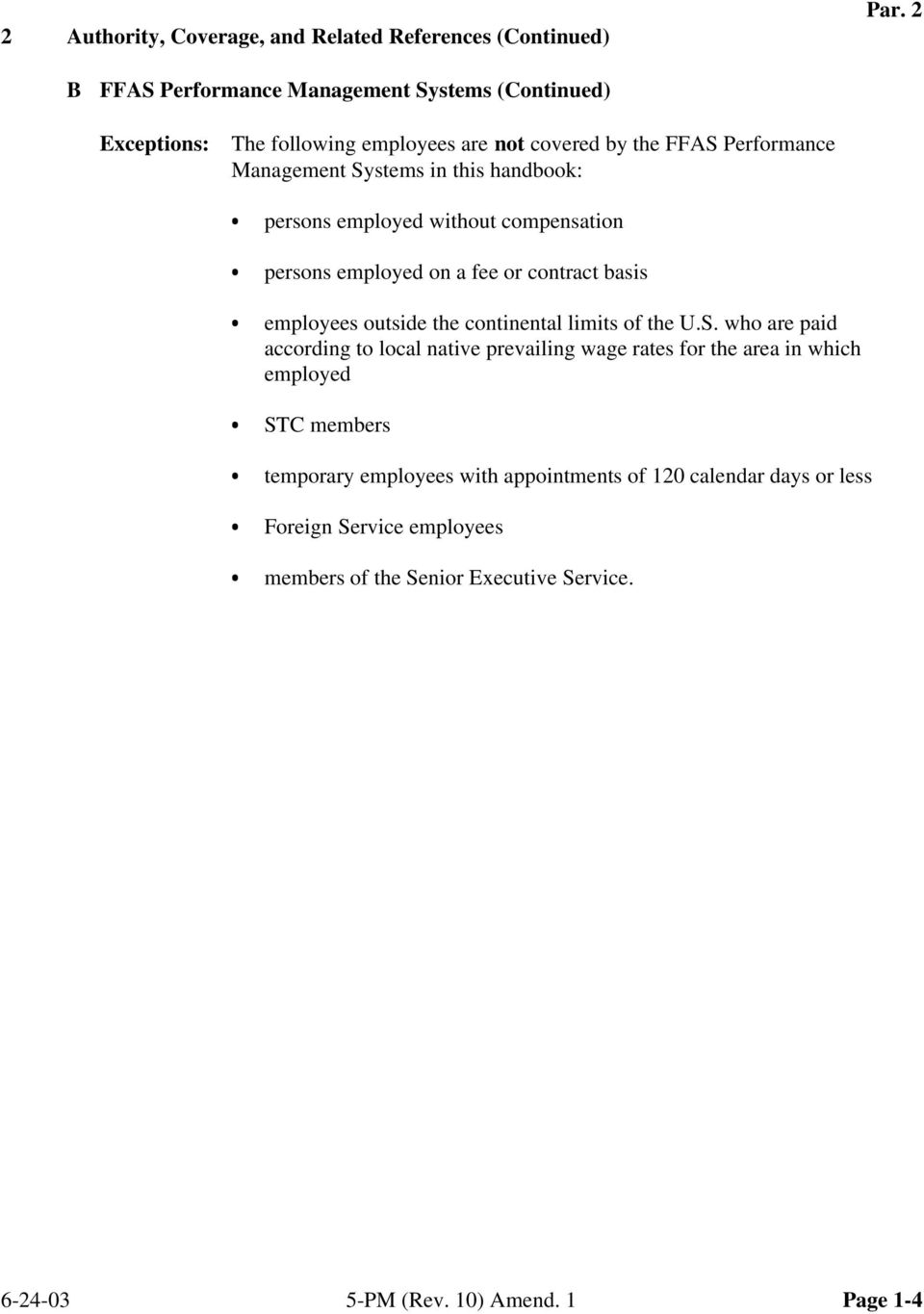
11 2 Authority, overage, and Related References (ontinued) Par. 2 Related Handbooks The following handbooks concern the FFAS Performance Management Systems. IF the material concerns... appraisal grievances THEN see... any of the following: 15-PM for FSA employees, except O ounty Office employees 22-PM, Part 10.5 for O ounty Office employees approved abbreviations incentive awards 1-M. local bargaining unit agreements for negotiated grievance procedures for bargaining unit employees. either of the following: 7-PM local bargaining unit agreements. ontact your union representative or HRD PM (Rev. 10) Amend. 1 Page 1-5 (and 1-6)

12 .

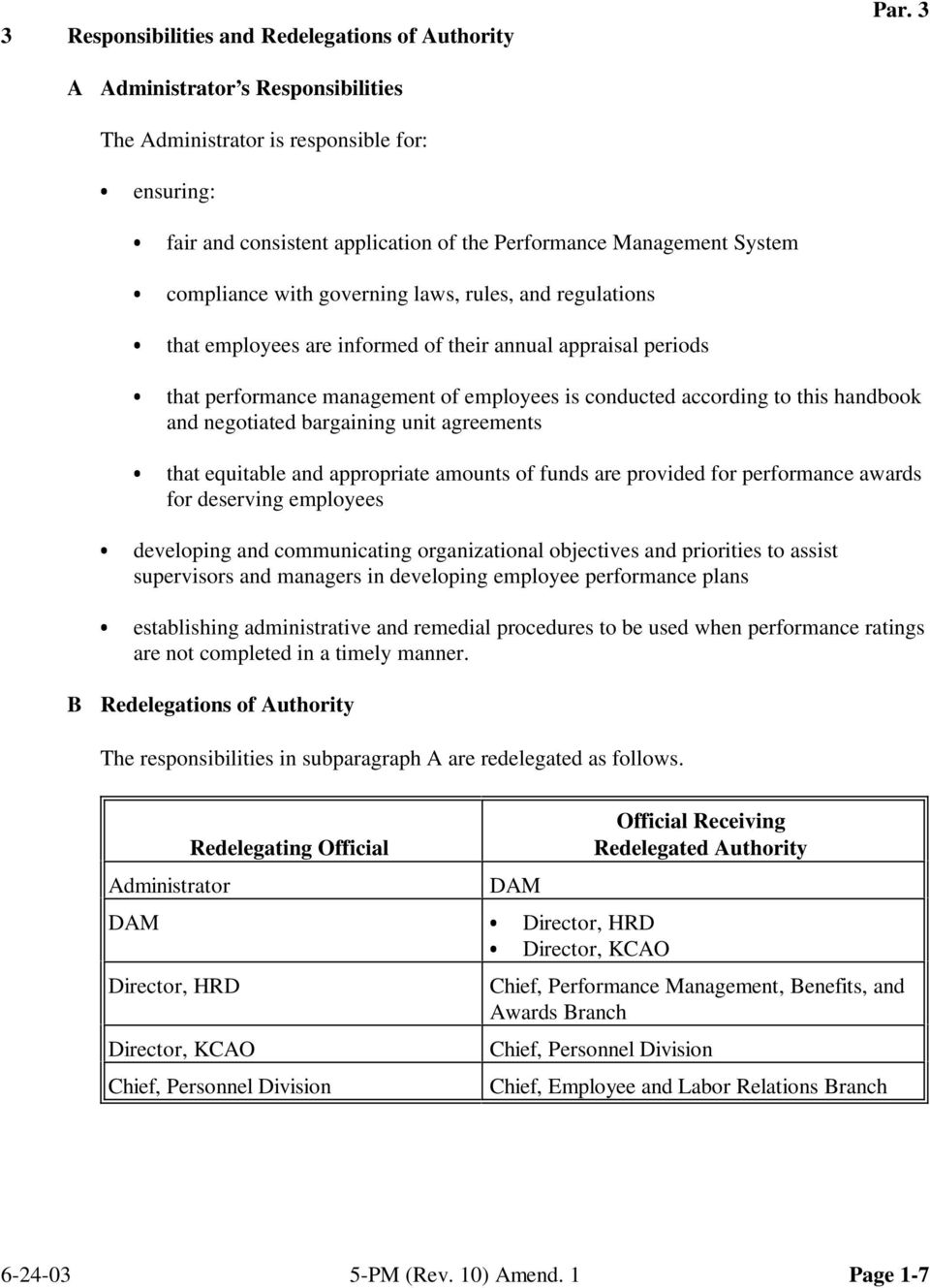
13 3 Responsibilities and Redelegations of Authority Par. 3 A Administrator s Responsibilities The Administrator is responsible for: ensuring: fair and consistent application of the Performance Management System compliance with governing laws, rules, and regulations that employees are informed of their annual appraisal periods that performance management of employees is conducted according to this handbook and negotiated bargaining unit agreements that equitable and appropriate amounts of funds are provided for performance awards for deserving employees developing and communicating organizational objectives and priorities to assist supervisors and managers in developing employee performance plans establishing administrative and remedial procedures to be used when performance ratings are not completed in a timely manner. B Redelegations of Authority The responsibilities in subparagraph A are redelegated as follows. Official Receiving Redelegating Official Redelegated Authority Administrator DAM DAM Director, HRD Director, KAO Director, HRD hief, Performance Management, Benefits, and Awards Branch Director, KAO hief, Personnel Division hief, Personnel Division hief, Employee and Labor Relations Branch PM (Rev. 10) Amend. 1 Page 1-7
14 3 Responsibilities and Redelegations of Authority (ontinued) Par. 3 Servicing Personnel Office s and State Office s Responsibilities Following are responsibilities of the servicing personnel office and the State Office. IF office is... servicing personnel office State Office THEN the office shall... provide: advice and assistance to supervisors and managers in carrying out their performance management responsibilities supervisors and managers with adequate performance appraisal training opportunities and technical advice about performance appraisal policies and procedures notification of annual performance appraisal periods and due dates necessary assistance to follow up on nonreceipt of overdue performance ratings assist supervisors and managers in resolving differences that may arise in carrying out the Performance Management System. servicing personnel office maintain official copies of performance appraisal documents; that is, AD-435 s, AD-435A s, and AD-435B s. Note: Hard copies are not required when using automated system. State Office maintain official copies of ED s AD-435 s, AD-435A s, and AD-435B s in EPF. Note: Official copies of performance appraisal documents for other O ounty Office employees are maintained in the ounty Office PM (Rev. 10) Amend. 1 Page 1-8

15 3 Responsibilities and Redelegations of Authority (ontinued) Par. 3 D ounty Office s Responsibilities Following are ounty Office responsibilities for O ounty Office employees. Step Action 1 reate EPF for each O ounty Office employee. 2 Maintain official copies of AD-435 s, AD-435A s, and AD-435B s. Note: Hard copies are not required when using automated system. 3 Follow up on nonreceipt of overdue performance ratings. E Reviewing Official s Responsibilities The reviewing official shall: when required, review and approve performance plans and performance appraisals that are prepared by subordinate supervisors to ensure consistency and equity throughout the organizations when required, review and approve performance appraisals in a timely manner, ensuring accuracy and conformance with this handbook ensure that performance appraisals are considered in personnel management decisions and related actions resolve disagreements between the supervisor and employee PM (Rev. 10) Amend. 1 Page 1-9

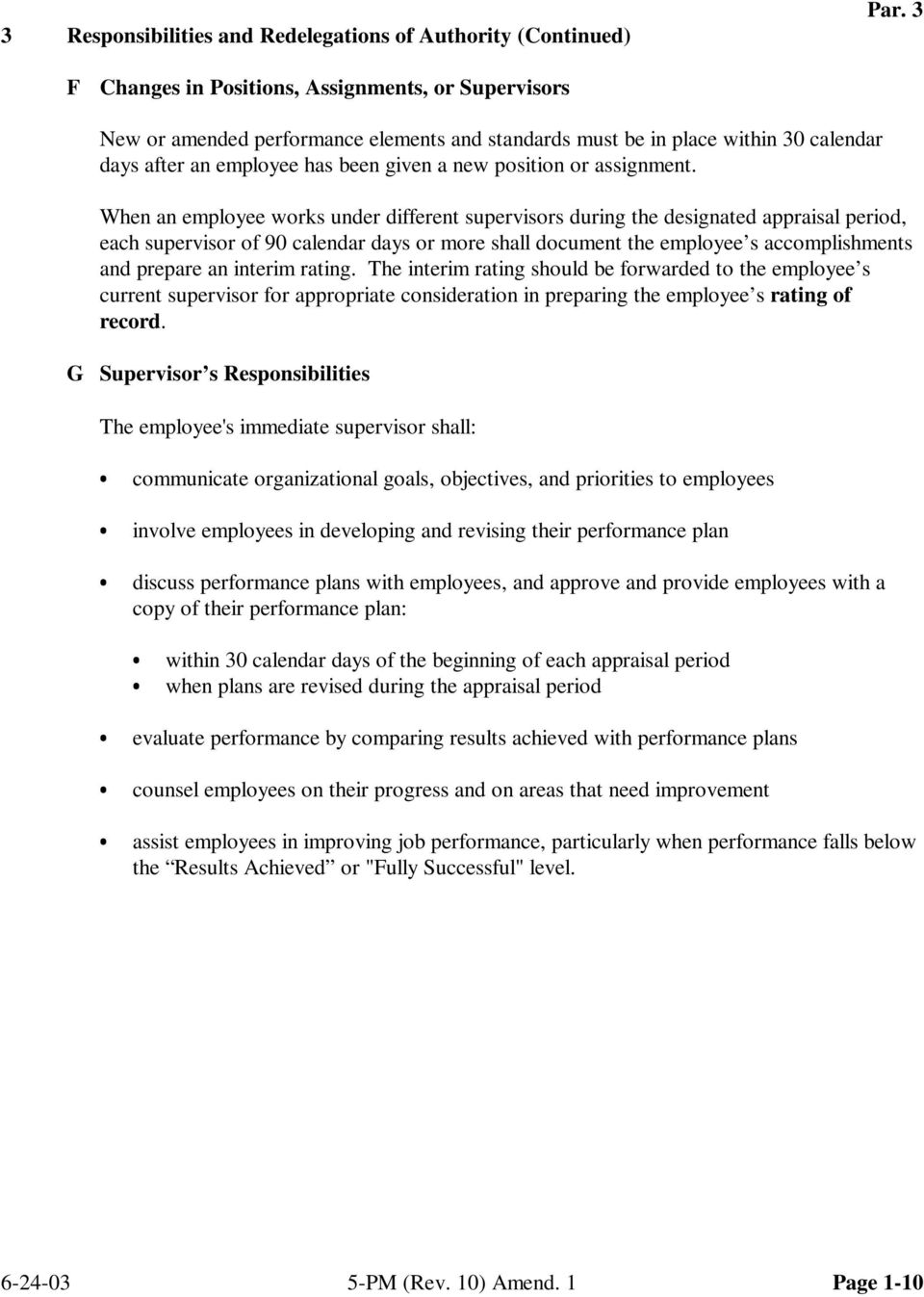
16 3 Responsibilities and Redelegations of Authority (ontinued) Par. 3 F hanges in Positions, Assignments, or Supervisors New or amended performance elements and standards must be in place within 30 calendar days after an employee has been given a new position or assignment. When an employee works under different supervisors during the designated appraisal period, each supervisor of 90 calendar days or more shall document the employee s accomplishments and prepare an interim rating. The interim rating should be forwarded to the employee s current supervisor for appropriate consideration in preparing the employee s rating of record. G Supervisor s Responsibilities The employee's immediate supervisor shall: communicate organizational goals, objectives, and priorities to employees involve employees in developing and revising their performance plan discuss performance plans with employees, and approve and provide employees with a copy of their performance plan: within 30 calendar days of the beginning of each appraisal period when plans are revised during the appraisal period evaluate performance by comparing results achieved with performance plans counsel employees on their progress and on areas that need improvement assist employees in improving job performance, particularly when performance falls below the Results Achieved or "Fully Successful" level PM (Rev. 10) Amend. 1 Page 1-10
17 3 Responsibilities and Redelegations of Authority (ontinued) Par. 3 H Employee s Responsibilities The employee shall: take part in the development of the employee s performance plan plan and perform duties to the best of the employee s ability so that the performance plan will be met or exceeded recommend to the supervisor needed changes in the performance plan during the appraisal period *--identify work problems, and cooperate with the supervisor and reviewer to resolve the --* problems and set objectives to improve work performance complete assigned training to meet current and future job performance needs. I Determining O ounty Office Employee s Supervisor and Reviewer Use the following table as a guide to determine the O ounty Office employee s supervisor and reviewer for performance appraisal purposes. ounty Office Position Supervisor Reviewer ED O DD--* *--Note: O may elect to confer with DD before issuing rating. All subordinate positions except PT s with primary responsibility for FLP PT s with primary responsibility for FLP ED FLM DD DD *--Note: ED and FLM may confer on the rating when PT performs both Farm Programs and farm loan duties.--* 4-19 (Reserved) PM (Rev. 10) Amend. 2 Page 1-11

18 .

19 .

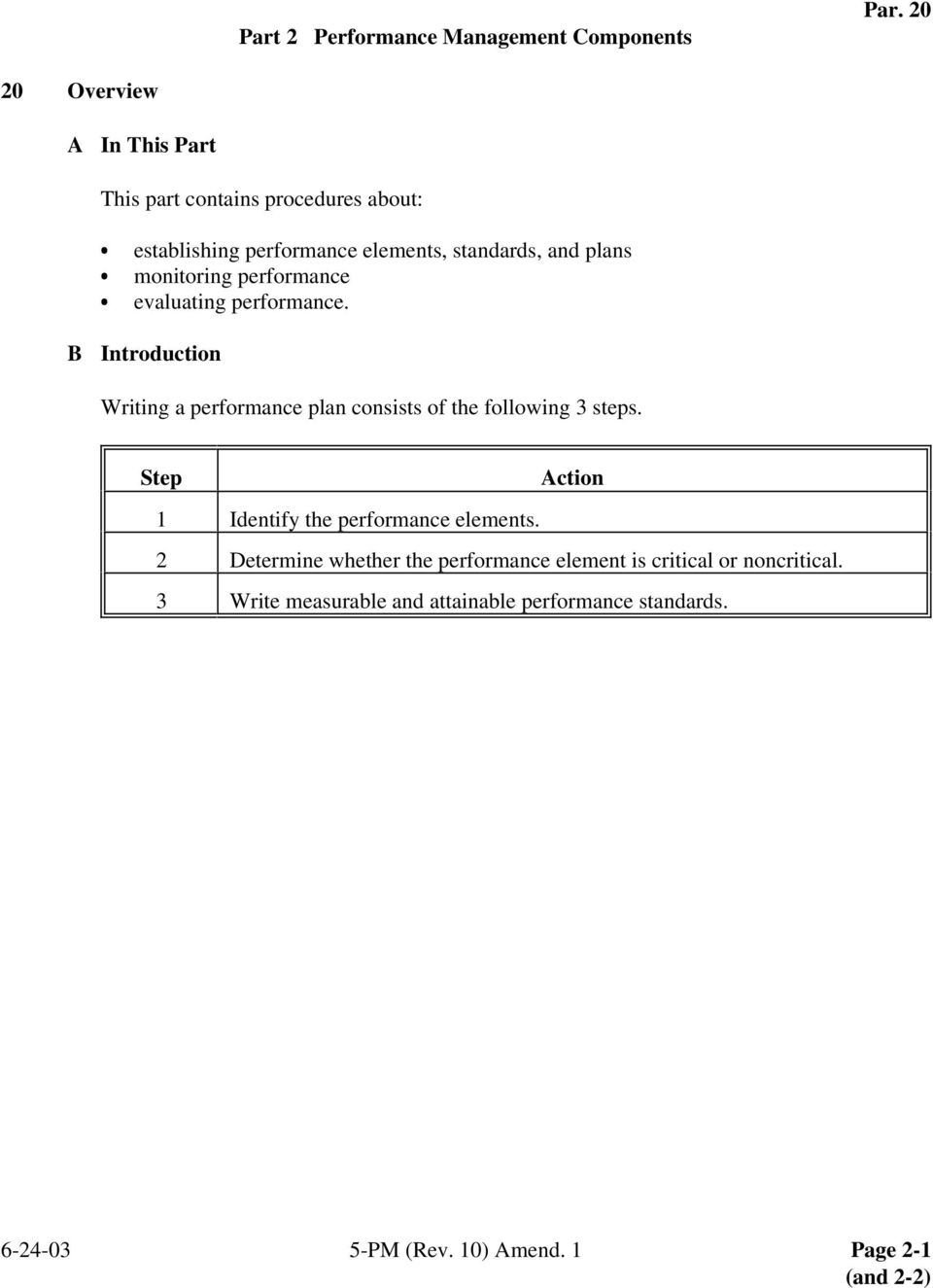
20 Part 2 Performance Management omponents Par Overview A In This Part This part contains procedures about: establishing performance elements, standards, and plans monitoring performance evaluating performance. B Introduction Writing a performance plan consists of the following 3 steps. Step Action 1 Identify the performance elements. 2 Determine whether the performance element is critical or noncritical. 3 Write measurable and attainable performance standards PM (Rev. 10) Amend. 1 Page 2-1 (and 2-2)
21 .
22 21 Establishing Performance Elements Par. 21 A Definition of Performance Elements Performance elements are duties and responsibilities for which an employee is accountable and responsible. B When to Establish or Revise Performance Elements Establish or revise performance elements: within 30 calendar days of an employee s assignment to a position because of 1 of the following: appointment promotion temporary promotion or detail for 120 calendar days or more reassignment change to lower grade each time a work assignment changes significantly, whether or not a personnel action is effected. Identifying Performance Elements When identifying performance elements, the elements: shall be: observable measurable attainable by the employee compatible with results expected of other employees in the unit or in the same position should be reflected in the employee s official position description and encompass the position s major duties and responsibilities PM (Rev. 10) Amend. 1 Page 2-3
23 21 Establishing Performance Elements (ontinued) Par. 21 D Available Sources to Develop Elements Use the following applicable sources to develop performance elements: position descriptions work plans instructions project proposals organizational goals and objectives job analysis Affirmative Employment Plan ivil Rights Implementation Plan Federal Equal Opportunity Recruitment Plan Disabled Veterans Affirmative Employment Plan Disability Employment Plan individual development plans any other source that assigns or fixes responsibility for accomplishment. E Number of Elements Under pass/fail, establish a minimum of 2 performance elements, but no more than 5 elements. Under either the 4- or 5-tier systems, establish at least 3 performance elements, but no more than 10 elements PM (Rev. 10) Amend. 1 Page 2-4
24 21 Establishing Performance Elements (ontinued) Par. 21 F Identifying ritical and Noncritical Elements Identify critical and noncritical elements through an analysis of duties and responsibilities and the element s linkage to the mission, functions, goals, and objectives of the organization. Under pass/fail, all performance elements are critical. Under the 4- and 5-tier system, identify each element as critical or noncritical. Every plan must have at least 1 critical element. onsider the following questions in determining whether an element should be designated critical or noncritical. Is the assigned duty so important that, if an employee fails to perform any 1 of the duties in an acceptable manner, the employee could not be retained in the position? What amount of time does the employee spend on the assigned duty? What impact does the assigned duty have on the organization? PM (Rev. 10) Amend. 1 Page 2-5
25 21 Establishing Performance Elements (ontinued) Par. 21 G Improper Elements Do not include the following in performance elements: conduct or behavior issues Examples: Examples of these issues include: absence tardiness insubordination. personal traits, unless the traits are clearly job-related and capable of being documented and measured Examples: Examples of traits not to include are: interpersonal relationships resourcefulness dependability. work assignments that are not expected to be performed during the appraisal period "other duties as assigned" other activities that are not a major or integral part of the position. H Generic Elements Supervisors may develop generic performance elements to cover similar jobs or occupations. These elements must be clearly differentiated from other elements on the same performance plan PM (Rev. 10) Amend. 1 Page 2-6 (through 2-10)
26 22 Establishing Performance Standards Par. 22 A Definition of Performance Standard A performance standard is a statement of expectations or requirements that management expects to be achieved for each performance element. B When to Establish or Revise Performance Standards Establish or revise performance standards: within 30 calendar days of an employee s assignment to a position because of 1 of the following: appointment promotion temporary promotion or detail for 120 calendar days or more reassignment change to lower grade each time a work assignment changes significantly, whether or not a personnel action is effected PM (Rev. 10) Amend. 1 Page 2-11
27 22 Establishing Performance Standards (ontinued) Par. 22 Identifying Performance Standards When identifying performance standards, the standard must be: realistic achievable; that is, be based on factors that the employee has authority to control at the level of performance expected for the grade held by the employee statements of the conditions that will exist when a performance element is accomplished defined in terms that measure: quality quantity timeliness economy results effectiveness. D Level of Performance and Standards Performance standards need only be established at the "Results Achieved" (pass/fail only) and "Fully Successful" level. "Results Achieved" and "Fully Successful" indicate that the work performance is of good quality, with the employee: producing the expected quantity of work meeting deadlines or schedules for completing the expected quantity of work. E Generic Standards (Reserved) Supervisors may develop generic performance standards to cover similar jobs or occupations. These standards must be clearly differentiated from other standards on the same performance plan PM (Rev. 10) Amend. 1 Page 2-12
28 Part 3 Measuring Performance Par Reviewing Employee Progress Section 1 Progress Reviews A Definition of Progress Review A progress review is a review by the supervisor of the employee s progress toward achieving the performance standards and is not in itself a rating. B Mandatory Progress Reviews The supervisor shall: during the regular 12-month appraisal period, conduct at least 1 progress review, which is usually between the sixth and ninth months at a minimum, inform the employee of the employee s level of performance compared with the performance elements and standards of the employee s established position. Periodic Optional Progress Reviews Even though only a midyear progress review is required, it is in the best interest of the supervisor and employee that periodic progress review discussions be held. An employee may request a meeting for this review. Periodic counseling sessions with the employee will: provide regular feedback keep the channels of communication open assist in identifying strengths and weaknesses help avoid giving the employee an unexpected performance rating at the end of the appraisal period PM (Rev. 10) Amend. 1 Page 3-1
29 45 Documenting Progress Reviews Par. 45 A Optional Documentation There is no required format on how to document progress reviews. It is recommended that points of discussion and any strengths or weaknesses be in writing with a copy to the employee. B Mandatory Documentation (Reserved) The supervisor and employee shall document when the midyear progress review has been completed PM (Rev. 10) Amend. 1 Page 3-2 (through 3-40)
30 Section 2 Performance Evaluation Par Overview A Introduction This section contains procedures about: the mandatory performance appraisal period conditions that need to be met when appraising an employee documentation required inability to rate PM (Rev. 10) Amend. 1 Page 3-41
31 62 Performance Appraisal Period Par. 62 A Appraisal Period The appraisal period for all covered employees is from October 1 of each year to September 30 of the following year. heck normally with your local human resource office for different cycles. 63 Performance Appraisals A Policy Employees are entitled to the rating that most accurately describes their performance when compared to the performance standard for each performance element. An employee s performance appraisal consists of: element ratings summary rating. B Evaluation onditions Supervisors must be aware of the following before completing the employee s performance appraisal. Do not complete unless: elements and standards were established at the "Results Achieved" or"meets Fully Successful" level and communicated to the employee the employee has served under those elements and standards in the current position for 90 calendar days or more. Base ratings on actual employee accomplishments PM (Rev. 10) Amend. 1 Page 3-42
32 63 Performance Appraisals (ontinued) Par. 63 Inability to Rate When a performance appraisal rating of record cannot be prepared at the end of the designated appraisal period, the appraisal period shall be extended to the amount necessary to meet the minimum appraisal period; that is, at least 90 calendar days. D Documenting Performance Appraisal (Reserved) Where applicable, supervisors shall use either automated systems or AD-435 s to document the supervisor s appraisal of the employee. Access the FFAS intranet for guidance on the FFAS performance policy. The website is If using i*ams to document performance, supervisors must use their i*ams logon ID and password. The i*ams website is If an i*ams logon ID and password are needed, consult the Human Resources staff. On the same i*ams website, click on the link for the i*ams self service manual to view the i*ams web application procedure on how to document the performance appraisal using i*ams PM (Rev. 10) Amend. 1 Page 3-43
33 .
34 Part 4 Administrative Procedures Par Grievance Procedures A Administrative and Negotiated Grievance Procedures Grievance procedures regarding performance appraisals are covered as follows: administrative grievance procedures: 15-PM, Exhibit 4, for FFAS Federal employees 22-PM, Part 10.5, for O ounty Office employees negotiated grievance procedures for FAS, FSA, and RMA bargaining unit employees may be found in their respective bargaining unit agreement PM (Rev. 10) Amend. 1 Page 4-1
35 89 Performance Plan and Appraisal Files Par. 89 A Filing Documents When applicable, the servicing personnel office and State and ounty Offices shall: file performance work plans and performance appraisals in a separate folder labeled the Employee Performance Folder keep performance work plans and performance appraisals for 5 years for SES employees and 4 years for non-ses employees. B Purging EPF s Offices filing performance appraisal documents shall purge AD-435 s, AD-435A s, and AD-435B s that are more than 5 years old from EPF s. Transferring EPF s EPF s shall accompany the official personnel folders when these folders are transferred to any of the following locations: another FSA servicing personnel office another agency another department PM (Rev. 10) Amend. 1 Page 4-2
36 90 Training and Evaluation Par. 90 A Performance Appraisal Training Servicing personnel offices and State Offices shall inform covered employees of the essential provisions in this handbook using any of the following: training informal discussions between supervisors and employees coverage of performance appraisal requirements in: USDA Employee Handbook employee orientation material electronic mail other appropriate sources. B Appraisal System Evaluation Servicing personnel offices and State Offices shall: make periodic evaluations of the Performance Management System: through the regularly scheduled personnel management evaluation process when directed by the Office of Human Resources Management to ensure that: requirements of the law are being effectively implemented improvements are made as needed send a copy of the periodic evaluation to the Director, HRD. Note: The KAO servicing personnel office shall send the evaluation to the Director, HRD, through the hief, Personnel Division, KAO PM (Rev. 10) Amend. 1 Page 4-3
37 .
38 Reports, Forms, Abbreviations, and Redelegations of Authority Exhibit 1 Reports None. Forms This table lists the forms referenced in this handbook. Number Title 4140 Performance Work Plan Ex A Opportunity to Improve Ex. 6 Display Reference Reference AD-435 Performance Appraisal Ex. 8 3, 63, 89, Ex. 2 AD-435A AD-435B Performance Plan, Progress Review and Appraisal Worksheet Performance Plan, Progress Review and Appraisal Worksheet (ontinuation) Ex. 8 3, 89 Ex. 8 3, 89 AD-2000 Performance Plan Agreement and Appraisal Ex. 4 Ex. 2 AD-2000-A Opportunity to Improve Ex PM (Rev. 10) Amend. 1 Page 1
39 Reports, Forms, Abbreviations, and Redelegations of Authority (ontinued) Exhibit 1 Abbreviations Not Listed in 1-M This table lists all abbreviations not listed in 1-M. Approved Abbreviation Term Reference O non-federal ounty Office employees Text EO/R Equal Opportunity/ivil Rights 4, 6, 8 EPF employee performance folder 3, 89 Ex. 4, 6, 8 FLM Farm Loan Manager 3 i*ams Internet * ombined Administrative Management System 63, Ex. 6 OTI Opportunity to Improve Ex. 4, 6 PT program technician 3 RIF Reduction-in-Force Ex. 4, 6, 8 WGI within-grade increase Ex. 4, 6, PM (Rev. 10) Amend. 2 Page 1
40 Reports, Forms, Abbreviations, and Redelegations of Authority (ontinued) Exhibit 1 Redelegations of Authority The Administrator is responsible for establishing and directing the FFAS Performance Management System. This responsibility is redelegated as follows. Redelegating Official Official Receiving Redelegated Authority Reference Administrator DAM 3 DAM Director, HRD Director, KAO Director, HRD Director, KAO hief, Personnel Division hief, Performance Management, Benefits, and Awards Branch hief, Personnel Division hief, Employee and Labor Relations Branch PM (Rev. 10) Amend. 1 Page 3
41 .
42 Definitions of Terms Used in This Handbook Exhibit 2 Additional Performance Element An additional performance element is a dimension or aspect of individual, team, or organizational performance that is not a critical or noncritical element. Such elements are not used in assigning a summary level. Appraisal An appraisal is the act or process of reviewing and evaluating the performance of an employee against the described performance work plan, including oral and/or written progress reviews. Appraisal Period An appraisal period is the period of time during which an employee s performance will be reviewed and a rating of record will be prepared. The appraisal period generally begins on October 1 of each year and ends on September 30 of the following year. Appraisal Unit An appraisal unit is a numerical weight given the element rating. Appraisal units are used as the basis for converting the element rating to a narrative summary rating using either of the following: the Decision Table on AD-435, for FSA and RMA employees the Decision Table in Exhibit 8, for FAS employees. ritical Element A critical element is: a component of a position consisting of 1 or more duties and responsibilities on which the employee is rated and which contributes toward accomplishing the goals and objectives of the organization so important that unacceptable performance in the element would result in unacceptable performance in the position. Performance work plans under the 2-level (pass/fail) program only contain critical elements. This work assignment or responsibility is of such importance that unacceptable performance on the element would result in a determination that the employee s overall performance is at the Results Not Achieved level PM (Rev. 10) Amend. 1 Page 1
43 Definitions of Terms Used in This Handbook (ontinued) Exhibit 2 ustomers ustomers are internal coworkers and/or external members of the public who receive various services and/or products from Agency employees. Decision Table Detail A Decision Table is used in converting the appraisal units for individual elements into a summary rating on AD-435. Detail is the temporary assignment of an employee for either of the following purposes: perform services outside the scope of the specific position to which the employee is formally appointed perform services for, and under the direction of, an organizational unit that is not the unit in which the employee holds the appointment. Departure (or Interim) Rating A departure (or interim) rating is an appraisal given to employees who have served on a performance plan for at least 90 calendar days and the employee/supervisor relationship changes. The interim rating is not a formal rating of record and is only to be considered when determining the annual rating of record. Element Rating An element rating is the level of performance on an element that is determined by comparing accomplishments to the performance standard. Element rating levels for 4- and 5-tier systems are: Exceeds Fully Successful Meets Fully Successful Does Not Meet Fully Successful. Element rating levels for pass/fail are: Results Achieved Results Not Achieved PM (Rev. 10) Amend. 1 Page 2
44 Definitions of Terms Used in This Handbook (ontinued) Exhibit 2 Fully Successful Rating Fully Successful is a rating for performance that is of good quality. Employee produces the expected quantity and quality of work and meets deadlines for completing the work. Interim (or Departure) Rating An interim (or departure) rating is an appraisal given to employees who have served on a performance plan for at least 90 calendar days and the employee/supervisor relationship changes. The interim rating is not a formal rating of record and is only to be considered when determining the annual rating of record. Marginal Rating Marginal is a rating for performance that needs improvement to achieve the Fully Successful level. Minimum Appraisal Period A minimum appraisal period is the 90-calendar-day period of time, or such other period of time as established in local negotiated labor-management agreements, during which an employee must have operated under a performance work plan and for which the employee may receive a performance rating. Noncritical Element A noncritical element is a component of an employee s position that does not meet the definition of a critical element, but is of sufficient importance to warrant written appraisal. Opportunity to Improve An opportunity to improve is a written plan established at any time during the appraisal period when it is determined by the Rating Official that an employee is performing at the Results Not Achieved level in any element(s). It outlines the steps the employee should take to improve performance to an acceptable level and the length of time for which it is in effect PM (Rev. 10) Amend. 1 Page 3
45 Definitions of Terms Used in This Handbook (ontinued) Exhibit 2 Outstanding Rating Outstanding is a rating for performance of rare, very high quality. Employee produces an exceptional quantity of work significantly ahead of established schedules and with very little supervision. Performance for each element consistently exceeds the Fully Successful standard. Note: An Outstanding rating requires narrative documentation and other evidence. Performance Performance is an employee s accomplishment of assigned work as specified in the critical and noncritical elements of the employee s position. Performance Appraisal A performance appraisal lists the performance elements, element ratings, and summary ratings that are used to record the employee s rating of record. Performance Elements Performance elements are duties and responsibilities for which an employee is accountable and responsible. Performance Standard A performance standard: is a statement of expectations or requirements that management expects to be achieved for each performance element may include, but is not limited to, factors such as quality, quantity, timeliness, and manner of performance. Performance Work Plan A performance work plan is the written document that identifies the employee s critical elements and performance standards by which he or she will be rated. It is recorded on AD PM (Rev. 10) Amend. 1 Page 4
46 Definitions of Terms Used in This Handbook (ontinued) Exhibit 2 Progress Review A progress review is a joint discussion between the Rating Official and the employee regarding the employee s progress toward achieving performance standards. It does not involve the issuance of a rating of record. Rating Official A rating official is an employee s first line supervisor or other person designated with responsibility for establishing performance work plans, conducting progress reviews, and issuing final ratings of record. Rating of Record A rating of record is the final summary rating normally issued at the end of the appraisal period which becomes a part of the employee s performance file (EPF) maintained in the servicing personnel office. Results Achieved Results Achieved is an element rating which means performance meets expectations. Also, the overall summary rating which equates to the Level 3, Fully Successful, as specified in 5 FR (d)(2)(iii). Results Not Achieved Results Not Achieved is a element rating indicating performance is unacceptable, e.g. does not meet expectations. It is also a summary level which equates to the Level 1, Unacceptable, as specified in 5 FR (d)(2)(i). Reviewing Official The reviewing official is an individual at a higher level in the organization than that of the rating official and is responsible for reviewing and concurring in a Results Not Achieved rating and resolving differences of opinion between rating officials and employees PM (Rev. 10) Amend. 1 Page 5
47 Definitions of Terms Used in This Handbook (ontinued) Exhibit 2 Service enter Agencies Service enter agencies are the mission areas of the Farm Service Agency, Natural Resources onservation Service, and Rural Development. Summary Rating The summary rating is a written record of the appraisal of each critical and noncritical element and the assignment of a summary rating level. Superior Rating Team Superior is a rating for performance of unusually good or excellent quality. Employee produces a very high quantity of work ahead of established schedules and with less than normal supervision. A team is a cooperative unit designed to accomplish a specified mission, such as those typically found in local offices, within organizational structures, assigned to specific tasks or projects, etc. Team membership is not necessarily limited to a specific agency or functional unit. Unacceptable Rating Unacceptable is a rating for performance that does not meet established Fully Successful standards in 1 or more critical elements PM (Rev. 10) Amend. 1 Page 6
48 Exhibit 4 (Par. 2) 2-Tier (Pass/Fail) Performance Management Procedures for FSA National Office and RMA, Except K Farm Service Agency/Risk Management Agency PERFORMANE MANAGEMENT POLIY MANUAL October 1, 2000 Results Achieved/Results Not Achieved Distribution: September 3, 2002 FSA, HRD, Performance Management, Benefits and Awards Branch PM (Rev. 10) Amend. 1 Page 1
49 Exhibit 4 (Par. 2) 2-Tier (Pass/Fail) Performance Management Procedures for FSA National Office and RMA, Except K (ontinued) Table of ontents Page No. Purpose and Background... 3 Legal Authorities and Effective Date... 4 Definitions Acronyms, Forms and Records... 7 Responsibilities overage Policy Planning Performance Monitoring and Appraising Performance Progress Reviews Ratings of Record Details and Temporary Promotions Supervisory hange Position and Supervisory hange Position hange Without a Supervisory hange Results Not Achieved Performance Linkage of Ratings of Record to Other Personnel Actions Within-Grade Increases (WGI) Promotions Training and Development Reduction-In-Force (RIF) Retention Standing Ratings within the same Pattern Quality Step Increases (QSI s) Other Employee Recognition Program Evaluation PM (Rev. 10) Amend. 1 Page 2
50 Exhibit 4 (Par. 2) 2-Tier (Pass/Fail) Performance Management Procedures for FSA National Office and RMA, Except K (ontinued) 1. Purpose Performance Management Policy The purpose of performance management is to improve individual and organizational performance, program effectiveness, and accountability by focusing on results, service quality, and customer satisfaction, and by aligning standards and elements with organizational goals and strategic plans.. 2. Background In September 1995, the Office of Personnel Management deregulated performance management, giving agencies the flexibility to redesign their current programs using summary rating patterns from two to five levels. In order to research, evaluate, and recommend program changes based on the new flexibilities, a project team of employees from all Service enter Agencies, including union representation, was formed in July The development team concluded from its research that the two-level summary rating pattern, with the flexibility to add nonrated team performance components as developmental tools, would meet most of the needs for the Service enter Agencies. According to OPM, agencies using the two level pattern report that it decreases favoritism, increases equity and consistency in ratings, eliminates rating inflation, reduces employee complaints and grievances, improves credibility, eliminates automatic connection between ratings and awards, reduces paperwork, and focuses on actual performance and performance improvement. The March 2000 collective bargaining agreement between FSA/RMA and AFSME Local 3925 specifically allows for a two-tier rating pattern, and in Y 2000 both FSA and RMA elected to implement the Two-Level Performance Appraisal System for Washington, D.. headquarters employees PM (Rev. 10) Amend. 1 Page 3
51 Exhibit 4 (Par. 2) 2-Tier (Pass/Fail) Performance Management Procedures for FSA National Office and RMA, Except K (ontinued) 3. Legal Authorities That Govern Performance Management USDA Performance Management System established on June 12, 1996 hapter 43 of Title 5 of the U. S. ode Title 5, ode of Federal Regulations, Part 430 Title 5, ode of Federal Regulations, Part 432 AFSME Local 3925 ontract, Article Effective Date The effective date for this policy is October 1, 2000, for Washington, D.. headquarters employees; however, implementation began January 1, 1999, in nonunionized field locations. 5. Definitions a. Additional Performance Element. A dimension or aspect of individual, team, or organizational performance that is not a critical or noncritical element. Such elements are not used in assigning a summary level. b. Appraisal. The act or process of reviewing and evaluating the performance of an employee against the described performance work plan, including oral and/or written progress reviews. c. Appraisal Period. The period of time during which an employee s performance will be reviewed and a rating of record will be prepared. The appraisal period generally begins on October 1 of each year and ends on September 30 of the following year. d. ritical Element. A component of a position consisting of one or more duties and responsibilities on which the employee is rated and which contributes toward accomplishing the goals and objectives of the organization. This work assignment or responsibility is of such importance that unacceptable performance on the element would result in a determination that the employee s overall performance is at the Results Not Achieved level. Performance work plans under this two-level program only contain critical elements PM (Rev. 10) Amend. 1 Page 4
52 Exhibit 4 (Par. 2) 2-Tier (Pass/Fail) Performance Management Procedures for FSA National Office and RMA, Except K (ontinued) 5. Definitions (ontinued) e. ustomers. Internal coworkers and/or external members of the public who receive various services and/or products from Service enter Agency employees. f. Element Rating. The level of performance on a critical element which is determined by comparing accomplishments to the performance standard. Element rating levels are: Results Achieved and Results Not Achieved. g. Minimum Appraisal Period. The 90-calendar-day period of time, or such other period of time as established in local negotiated labor-management agreements, during which an employee must have operated under a performance work plan and for which the employee may receive a performance rating. h. Opportunity to Improve. A written plan established at any time during the appraisal period when it is determined by the Rating Official that an employee is performing at the Results Not Achieved level in any element(s). It outlines the steps the employee should take to improve performance to an acceptable level and the length of time for which it is in effect. i. Performance Standard. The management-approved expression of the performance, threshold(s), requirement(s), or expectation(s) that must be met to be appraised at a particular level of performance. A performance standard may include, but is not limited to, quality, quantity, cost-efficiency, timeliness, and manner of performance. j. Performance Work Plan. The written document that identifies the employee s critical elements and performance standards by which he or she will be rated. It is contained on AD-2000, Performance Plan Agreement and Appraisal. See paragraph 11 of this exhibit for an example of AD PM (Rev. 10) Amend. 1 Page 5
53 Exhibit 4 (Par. 2) 2-Tier (Pass/Fail) Performance Management Procedures for FSA National Office and RMA, Except K (ontinued) 5. Definitions (ontinued) k. Progress Review. A joint discussion between the Rating Official and the employee regarding the employee s progress toward achieving performance standards. It does not involve the issuance of a rating of record. l. Rating of Record. The final summary rating normally issued at the end of the appraisal period which becomes a part of the employee s performance file (EPF) maintained in the Servicing Human Resources Office. m. Rating Official. An employee s first line supervisor or other person designated with responsibility for establishing performance work plans, conducting progress reviews, and issuing final ratings of record. Typically, the Rating Official resides in the same agency as the employee being rated. n. Results Achieved. Element rating which means performance meets expectations. Also, the overall summary rating which equates to the Level 3, Fully Successful, as specified in 5 FR (d)(2)(iii). o. Results Not Achieved. Element rating indicating performance is unacceptable, e.g., does not meet expectations. It is also a summary level which equates to the Level 1, Unacceptable, as specified in 5 FR (d)(2)(i). p. Reviewing Official. The individual responsible for reviewing and concurring in a Results Not Achieved rating and resolving differences of opinion between rating officials and employees. q. Service enter Agencies. The mission areas of the Farm Service Agency, Natural Resources onservation Service, and Rural Development. r. Team. A cooperative unit designed to accomplish a specified mission, such as those typically found in local offices, within organizational structures, assigned to specific tasks or projects, etc. Team membership is not necessarily limited to a specific agency or functional unit PM (Rev. 10) Amend. 1 Page 6
54 Exhibit 4 (Par. 2) 2-Tier (Pass/Fail) Performance Management Procedures for FSA National Office and RMA, Except K (ontinued) 6. Acronyms EO/R - Equal Opportunity/ivil Rights EPF - Employee Performance Folder OTI - Opportunity to Improve RIF - Reduction-in-Force 7. Forms and Records a. Appraisal Forms. Performance work plans containing progress reviews and performance ratings conducted under this program must be recorded on AD-2000, Performance Plan Agreement and Appraisal. b. Opportunity to Improve (OTI). An OTI is developed and documented on AD-2000-A, Opportunity to Improve. See paragraph 10 b (3) of this exhibit for discussion of performance at the Results Not Achieved level and also for the form. c. Records. In addition to the procedures set forth in 5 FR Part 293, the following procedures govern the establishment and maintenance of performance records. (1) All records must meet the requirements of 5 FR Part 297 as well as any Departmental provisions of the Privacy and Freedom of Information Acts. (2) Additional performance elements that are developed between a supervisor and employee and are not considered part of the rating are not to be submitted to the Human Resources Office, but are to be maintained by the supervisor and employee. (3) Ratings of record and the performance work plans on which the ratings are based must be filed in the Employee Performance Folder (EPF) for the most recent 4 years. Ratings older than 4 years are not retained in the EPF PM (Rev. 10) Amend. 1 Page 7
55 Exhibit 4 (Par. 2) 2-Tier (Pass/Fail) Performance Management Procedures for FSA National Office and RMA, Except K (ontinued) 7. Forms and Records (ontinued) (4) When the EPF of an employee is sent to another Servicing Human Resources Office in the employing agency, to another agency or department, or to the National Personnel Records enter (NPR), the losing Servicing Human Resources Office shall include in the EPF the three most recent ratings of record received during the preceding 4-year period. Also, the losing office will purge from the EPF all ratings of record and work plans that are more than 4 years old. 8. Responsibilities a. Agency Heads are responsible for: (1) Tailoring Departmental policy to meet the individual needs of the Agency. (2) Assisting in resolving concerns at the lowest possible level. b. The Servicing Human Resources Office is responsible for: (1) Providing technical and operational support and advice to the rating officials to help them administer the performance management program in a manner consistent with applicable laws, rules, and regulations. (2) Ensuring that performance work plans and ratings of record are maintained in the Servicing Human Resources Office in accordance with the requirements in 5 FR Parts 293 and 297. (3) Providing training on the performance management program and their responsibilities. (4) Assisting in resolving concerns at the lowest possible level PM (Rev. 10) Amend. 1 Page 8
56 Exhibit 4 (Par. 2) 2-Tier (Pass/Fail) Performance Management Procedures for FSA National Office and RMA, Except K (ontinued) 8. Responsibilities (ontinued) c. Reviewing Officials are responsible for: (1) Reviewing and concurring in a results not achieved rating. (2) Resolving differences between employees and rating officials concerning ratings and adjusting ratings when necessary. (3) Assisting in resolving concerns at the lowest possible level. d. Rating Officials are responsible for: (1) Timely informing employees of the overall mission, objectives, goals, plans, and activities of the Agency and work unit and the employee s related duties and responsibilities. (2) Providing feedback to the employee through ongoing communication and actively listening and considering feedback from the employee and customers. (3) Providing the employee the opportunity to participate in the development of performance work plans. (4) Providing employees with written performance work plans which identify the critical elements related to their specific duties, responsibilities, and expected levels of performance. (5) onducting and documenting quarterly but no less than semi-annual reviews. (6) ompleting performance ratings which include evaluating and documenting employees actual accomplishments and determining summary levels. (7) Recommending personnel actions and/or training, as necessary, based on the employee s level of performance in relation to the performance standards and elements. (8) Addressing concerns at the lowest possible level PM (Rev. 10) Amend. 1 Page 9
57 Exhibit 4 (Par. 2) 2-Tier (Pass/Fail) Performance Management Procedures for FSA National Office and RMA, Except K (ontinued) 8. Responsibilities (ontinued) e. Employees are responsible for: (1) ommunicating with the supervisor throughout the appraisal period. (2) Participating in the development of performance work plans and measurable performance standards. (3) Assuring that they have a clear understanding of their rating official s expectations and requesting clarification when necessary. (4) Assisting in identifying training needs to enhance performance. (5) Managing performance to achieve expectations and bringing to the rating official s attention circumstances that may affect achievement of standards. (6) Participating in discussions of individual performance. (7) Actively listening and considering feedback with an open mind. (8) Providing input on accomplishments. (9) Improving those aspects of performance identified as needing improvement. f. The roles of Union Officials are: (1) Assisting management and employees to ensure that the program is administered consistent with negotiated labor-management agreements. (2) Assisting in resolving concerns at the lowest possible level PM (Rev. 10) Amend. 1 Page 10
58 Exhibit 4 (Par. 2) 2-Tier (Pass/Fail) Performance Management Procedures for FSA National Office and RMA, Except K (ontinued) 9. overage This program covers all headquarters bargaining unit employees of the Farm Service Agency (FSA) and Risk Management Agency (RMA). {FSA management has extended this policy to all nonbargaining unit employees in headquarters and RMA management has extended this policy to all nonbargaining unit employees in Washington and at all ompliance and regional offices, except Kansas ity. Schedule employees are covered by this program but are not afforded any rights as established by 5 US 4303.} Excluded from coverage are those employees expected to be employed for less than 90 days; non-federal employees, and those persons employed in the Senior Executive Service. 10. Policy It is the policy of the FSA and RMA that, within the framework provided by this program, individual and organizational goals will be communicated to employees, individual responsibility for accomplishing team and organizational goals will be identified, employees will be provided feedback regarding performance, performance will be evaluated and improved, and performance results will be used as a basis for appropriate personnel actions. All participants in this process should expect to be held accountable for accomplishment of their performance management responsibilities as identified in this directive. ommunication between the rating official and the employee is essential throughout this process. Rating officials and employees should work together to jointly clarify how competencies apply within the work environment so that there is a common understanding about the expectations for performance. In addition, there should be a discussion of the goals of the individual work unit and the employee s involvement/contribution to unit goals for the upcoming year. In developing performance plans, rating officials must seek the input of employees before the plans are implemented. Employees shall be provided a minimum of 5 workdays to submit their comments and recommendations to their supervisors. The Rating Official is ultimately responsible for setting performance elements and standards PM (Rev. 10) Amend. 1 Page 11
59 Exhibit 4 (Par. 2) 2-Tier (Pass/Fail) Performance Management Procedures for FSA National Office and RMA, Except K (ontinued) 10. Policy a. Planning Performance Planning performance is the process of developing performance work plans that align individual performance with organizational goals. Focus must be placed on accomplishments (i.e., end results) rather than on activities. The Office of Personnel Management developed an eight-step method to assist organizations in developing performance plans with this emphasis. See the Quick Reference for Developing Employee Performance Plans that Link to Organizational Goals, at that outlines this process. This reference may be consulted when developing performance work plans. (1) Performance work plans are developed on AD-2000, Performance Plan Agreement and Appraisal. Work plans document progress reviews and specify the elements and the standards on which the employee will be rated. (2) Performance work plans under this two-level program only contain critical elements as required by the Office of Personnel Management. A performance work plan must contain at least two but no more than a total of five critical elements. Elements must be rated within the context of an employee s position and grade level. (a) ritical elements are work assignments or responsibilities of such importance that unacceptable performance in the element would result in a determination that the employee s overall performance is unacceptable. (b) The elements should be based on organizational goals, strategic plans, position descriptions, and internal and external customer needs. Whenever possible, similar positions should have like standards. (c) Sources of feedback on employee performance related to a critical element must be substantiated and documented. If such feedback is used in the rating of record, employees shall have an opportunity to review the documentation and comment on all outside feedback provided to the supervisor prior to the rating of record. (d) ritical elements must be based solely on the individual performance of the employee PM (Rev. 10) Amend. 1 Page 12
60 Exhibit 4 (Par. 2) 2-Tier (Pass/Fail) Performance Management Procedures for FSA National Office and RMA, Except K (ontinued) 10. Policy (ontinued) (e) Standardized (generic) performance elements have been established and are available for use in developing performance work plans. The standard elements may be used as is, or with clarification, or up to 3 new elements may be developed, as appropriate. i ii Timeframes and appropriate procedures, when referenced in elements, are derived directly from applicable regulatory guidelines, procedural guides, and/or agency program instructions, etc. This is so that the standard does not become too cumbersome and lengthy as was the case with past performance management programs. When timeframes, quantity, quality, or cost-effectiveness need to be more specific or expanded from the standards provided, this may be (a) documented on an additional sheet and attached to the performance plan; (b) referenced to one of the blank numbered blocks located after the standardized elements; or, if possible, (c) placed directly in the block with the element. Any elements needing additional clarification will be further defined in writing by the rating official in one of the manners described in the previous paragraph. A copy must be given to the employee at the beginning of the appraisal period along with a copy of his or her performance work plan. iii Employees and rating officials may choose applicable elements by placing a checkmark in the appropriate block. iv v Rating officials may also write specific performance elements in the blank spaces provided at the end of the standardized elements. All employees must have at least one job-specific performance element which may include supervisory responsibilities, the individual s contributions to team accomplishments, execution of duties, etc., or an element may be specifically written for this purpose in the blank numbered blocks provided at the end of the standardized elements PM (Rev. 10) Amend. 1 Page 13
61 Exhibit 4 (Par. 2) 2-Tier (Pass/Fail) Performance Management Procedures for FSA National Office and RMA, Except K (ontinued) 10. Policy (ontinued). vi A mandatory EO/R element, Element 9, is required as a stand-alone element for all rating officials. vii Employees who are not rating officials must also have a stand-alone EO/R element - Element 10. (3) Additional performance elements provide another tool for communicating performance expectations important to the organization. However, they are not appropriate for inclusion in the performance work plan as critical elements and will not be used in assigning a summary level. They allow employee performance plans to communicate a fuller picture of the performance that is expected. Additional elements are to be provided separately in a format best suited for the element. Team performance objectives where overall team accomplishments are being monitored and evaluated is one example. (Remember, only the individual contributions to the team, Element 12, can be evaluated under the performance work plan.) (4) Standards should focus on accomplishments -- results, service quality, teamwork, and customer service. Standards should be established: (a) within 30 days of the beginning of an appraisal period; or (b) within 30 days of appointment, reassignment, promotion, detail for more than the minimum appraisal period, or when the duties of the position are substantially changed during the established appraisal period. (5) The employee and rating official sign and date the performance work plan indicating that it has been discussed and the employee has had the opportunity to obtain a clear understanding of expectations. The employee is provided a copy of AD-2000 and any additional clarifying information. Where there is disagreement as to the content of performance elements and standards, the rating official s decision prevails. If the employee refuses to sign the performance work plan at the beginning of the appraisal period, the supervisor should note this in the employee s signature block. The date the plan was discussed with the employee and implemented should also be noted accordingly. Lack of the employee s signature and date on the performance work plan does not negate implementation of the plan PM (Rev. 10) Amend. 1 Page 14
62 Exhibit 4 (Par. 2) 2-Tier (Pass/Fail) Performance Management Procedures for FSA National Office and RMA, Except K (ontinued) 10. Policy (ontinued) (6) At the time the performance plan is developed, the employee also indicates knowledge and understanding of the standards of conduct (ethics regulations) and acknowledges that questions have been answered to their satisfaction by initialing the appropriate block. (7) The substance of elements and performance standards cannot be grieved. b. Monitoring and Appraising Performance The employee and rating official will meet periodically throughout the appraisal period to provide feedback relating to performance. This will be accomplished through progress reviews and performance ratings. (1) Progress Reviews (a) Regular and open communication between supervisors and employees is vitally important in any performance management system, and particularly in a two-tier performance appraisal system where all elements rated are critical elements. (b) Rating officials are responsible for initiating communication with the employee about actual performance and ensuring progress reviews are held. Open dialog between the employee and the rating official is crucial during these discussions. (c) Progress reviews should be held quarterly, but no less than semi-annually, and such reviews will be documented in writing. (d) The rating official is encouraged to make written comments concerning the employee s performance on AD-2000 at the time of the progress review. The purpose of the written comments is to provide for a more formal identification of the employee s performance in relation to the performance work plan. Employees are encouraged to provide written comments on the form at this time, also. The employee and the rating official initial and date the appropriate blocks to indicate the discussions were held PM (Rev. 10) Amend. 1 Page 15
63 Exhibit 4 (Par. 2) 2-Tier (Pass/Fail) Performance Management Procedures for FSA National Office and RMA, Except K (ontinued) 10. Policy (ontinued) (e) If a progress review is not conducted, the employee has the option of contacting the rating official to inquire of the status. If the progress review is still not held, the employee may seek assistance from the second level supervisor (usually the reviewing official). Bargaining unit employees may also seek assistance from their exclusive representative. The purpose of this is to encourage resolution at the lowest possible level, make employees more responsible in their own performance, and to encourage employee involvement and participation. (f) Failure to conduct a progress review may be grieved; however, the outcome of a progress review may not be grieved as no official rating is given. (2) Ratings of Record (a) A rating of record is the final rating issued at the end of the appraisal period and it becomes a part of the employee s performance file (EPF) maintained in the Servicing Human Resources Office. A rating of Results Achieved or Results Not Achieved is assigned to each element at this time, as well as the overall summary rating. (b) A performance work plan must be in place for the minimum appraisal period (a minimum of 90 calendar days) and normally no longer than 15 months for a rating of record to be conducted. (c) Normally, the rating of record is issued for the appraisal period ending September 30. i Performance discussions and ratings will occur at the time of each position and/or supervisory change provided the employee has served under standards for the minimum appraisal period. This rating must be provided to the gaining supervisor to be considered at the time the rating of record is issued PM (Rev. 10) Amend. 1 Page 16
64 Exhibit 4 (Par. 2) 2-Tier (Pass/Fail) Performance Management Procedures for FSA National Office and RMA, Except K (ontinued) 10. Policy (ontinued) Details and Temporary Promotions. At the conclusion of a detail or temporary promotion, the rating official to whom the employee was detailed will document the employee s accomplishments and forward the information to the employee s permanent supervisor. This guidance applies to any employee detailed within USDA. When an employee is detailed outside the Department, the permanent supervisor should make a concerted effort to obtain information regarding the employee s performance prior to completing the annual performance rating of record. Supervisory hange. Each individual who supervised the employee for 90 days or more during the appraisal period should discuss the performance with the employee, prepare feedback comments, and forward them to the current rating official. Position and Supervisory hange. When an employee who has occupied a position for at least 90 days leaves that position, the supervisor or rating official should prepare feedback comments on the employee s performance and forward them to the new supervisor/rating official. Position hange Without a Supervisory hange. When an employee changes position, but retains the same supervisor (e.g., the employee was promoted or reassigned within the same organization), the supervisor should prepare written documentation of the employee s performance. This information must be considered in the employee s rating of record. ii All employees must be issued a rating of record annually. Employees who have not served under established standards for the minimum appraisal period must have the timeframe extended to meet this requirement. Once the minimum appraisal period has been completed, a rating of record must be issued PM (Rev. 10) Amend. 1 Page 17
65 Exhibit 4 (Par. 2) 2-Tier (Pass/Fail) Performance Management Procedures for FSA National Office and RMA, Except K (ontinued) 10. Policy (ontinued) (d) An overall summary rating of Results Achieved indicates that the employee has met the performance expectations for each element. Results Achieved performance equates to the Level 3, Fully Successful, as specified in statute. An overall summary rating of Results Not Achieved means that the employee has not met performance expectations for one or more element(s) and constitutes unacceptable performance. Results Not Achieved performance has the same meaning and effect as Unacceptable, Level 1, as used in law and regulation. i ii Results Achieved performance requires no written comments by the rating official. It requires signature by only the rating official and the employee; there is no need for the signature of the reviewing official or anyone above the level of the rating official. Results Not Achieved performance requires mandatory written comments to be attached to the performance work plan and must be signed by the rating official and the reviewing official prior to presenting to the employee for signature. See paragraph 10 b (3) of this exhibit for further guidance on this level of performance. The employee s signature indicates receipt of the rating; it does not represent agreement with the rating. If the employee refuses to sign the rating of record, the rating official should note this in the appropriate block and indicate the date the rating was issued. (e) Ratings of record may be grieved and shall be handled under the administrative grievance procedure or applicable negotiated grievance procedure. (3) Results Not Achieved Performance (a) Rating officials shall discuss and consider reasonable means by which to assist employees in improving performance. Such assistance may include training, closer supervision, revision of assignments, coaching, etc PM (Rev. 10) Amend. 1 Page 18
66 Exhibit 4 (Par. 2) 2-Tier (Pass/Fail) Performance Management Procedures for FSA National Office and RMA, Except K (ontinued) 10. Policy (ontinued) (b) If, however, at anytime during the appraisal period one or more element(s) is found to be at the Results Not Achieved level, the employee should be placed under an official opportunity to improve (OTI). The purpose of an OTI is to provide the employee a reasonable opportunity to improve performance to the acceptable Results Achieved level before the employee receives an official rating of record. Employees must be given an OTI, and must fail that OTI, before they can receive an official rating of record of Results Not Achieved. (c) AD-2000-A, Opportunity to Improve, will be completed jointly by the rating official and employee with the technical assistance of the Servicing Human Resources Office. It will be signed by the rating official and the employee indicating receipt and implementation of the plan. The employee s signature is not required, however, to implement the plan. See paragraph 12 of this exhibit for an example of AD-2000-A. omponents of the plan consist of: i The length of time for which it is to be in effect. The duration will be determined by considering: the type of position for which the OTI is being prepared, the types of improvement needed, the amount of reasonable time necessary to demonstrate the acceptable performance (but no less than 60 days), and applicable negotiated labor-management agreements. ii The element(s) in which performance is unacceptable, specific deficiencies, and required improvement to raise performance to the Results Achieved level. iii The support/assistance to be provided to the employee PM (Rev. 10) Amend. 1 Page 19
67 Exhibit 4 (Par. 2) 2-Tier (Pass/Fail) Performance Management Procedures for FSA National Office and RMA, Except K (ontinued) 10. Policy (ontinued) iv v The frequency of follow-up reviews. In determining the frequency of reviews, consideration should be given to the length of the OTI. Upon completion of each follow-up review, the rating official and employee will initial and date in the appropriate block of AD-2000-A. The final review will state whether performance meets or does not meet expectations. If it does not meet expectations, then the rating official must provide written comments supporting this determination. The rating official will contact the Servicing Human Resources Office to determine further action necessary, i.e., reassignment, demotion, or removal. (d) Employees who improve their performance to the acceptable level during the improvement period must sustain acceptable performance. i ii Should the employee s performance return to the unacceptable level in the same element(s) within 12 months from the commencement date of the improvement period, a performance-based adverse action (i.e., demotion or removal) or other alternative action (i.e., reassignment) may be proposed without the benefit of an additional improvement period. Should performance fall to the unacceptable level in a different element(s) during this 12-month period, the employee must be given another improvement period for this element(s). (e) Prior to the implementation of this policy (October 1, 2000, for FSA (headquarters) and RMA employees), administrative actions initiated against employees whose performance has been determined to be unacceptable as defined under 5 US 4303 shall continue to be processed under applicable procedures PM (Rev. 10) Amend. 1 Page 20
68 Exhibit 4 (Par. 2) 2-Tier (Pass/Fail) Performance Management Procedures for FSA National Office and RMA, Except K (ontinued) 10. Policy (ontinued) c. Linkage of Ratings of Record to Other Personnel Actions Personnel decisions are made on the basis of merit with appropriate consideration of employee performance. All judgments about performance must be fair and equitable and may not be based upon nonmerit factors such as sex, race, color, national origin, religion, personal favoritism, age, marital status, political affiliation, sexual orientation, mental or physical disability, or other nonmerit reasons. (1) Within-Grade Increases (WGI). Employees may be granted WGI s when the current level of performance and most recent rating of record are Results Achieved. When a WGI decision is not consistent with the employee s most recent rating of record, the rating official should contact the Servicing Human Resources Office to determine what further action is necessary. (2) Promotions. No employee shall receive a promotion unless the most current rating of record is Results Achieved. Rating officials and employees should be aware, however, that a Results Achieved rating is not the only criteria for promotion. (3) Training and Development. The performance appraisal process may be used as a basis for identifying the training needs of employees. Additional performance elements are particularly useful for this purpose. (4) Reduction-in-Force (RIF). Annual ratings of record are used to establish service credit and retention standing for RIF purposes. An employee will not be assigned a new rating of record for the sole purpose of affecting retention standing. To provide adequate time to properly determine an employee s retention standing prior to a RIF, a general or specific RIF notice will specify the date after which no new rating of record will be given that could be used to determine retention standing PM (Rev. 10) Amend. 1 Page 21
69 Exhibit 4 (Par. 2) 2-Tier (Pass/Fail) Performance Management Procedures for FSA National Office and RMA, Except K (ontinued) 10. Policy (ontinued) (5) Retention Standing. According to Departmental policy (as contained in Personnel Bulletin No , Reduction in Force) the crediting of performance ratings issued on or after October 1, 1997, is subject to Office of Personnel Management (OPM) regulations on whether all the ratings within the competitive area were issued under a single rating pattern. (a) Ratings issued under multiple (or different) rating patterns. Where these ratings do not conform to a single rating pattern, the following crediting plan will be used to determine the years to be credited. The following table uses the years to be credited for RIF purposes, unless otherwise negotiated by a union. Rating Pattern No. of Summary Rating Levels Level 1 (Unacceptabl e or equiv.) Level 2 (Marginal or equiv.) Level 3 (Fully Successful or equiv. Level 4 (Superior or equiv.) Level 5 (Outstanding or equiv.) A 2 levels 0 N/A 16 N/A N/A B 3 levels 0 N/A 13 N/A 17 3 levels 0 N/A N/A D 3 levels N/A N/A E 4 levels 0 N/A F 4 levels N/A 18 G 4 levels N/A H 5 levels Note: N/A means not applicable to this rating pattern, i.e., this level is not used in this pattern. The numbers represent the number of years to be credited for a rating at that level and under that pattern PM (Rev. 10) Amend. 1 Page 22
70 Exhibit 4 (Par. 2) 2-Tier (Pass/Fail) Performance Management Procedures for FSA National Office and RMA, Except K (ontinued) 10. Policy (ontinued) (b) Ratings within the same pattern. Where all ratings within the specified 4-year period and competitive area are in the same rating pattern, the OPM provision for using the pattern of crediting 20 years of service for a level 5 rating (Outstanding), 16 years service credit for a level 4 rating (Superior), and 12 years for a level 3 rating (Fully Successful) will be used. This provision is also used for all ratings issued before October 1, 1997, regardless of the rating pattern used. For complete guidance on RIF procedures, contact HRD or KAO, PD. (6) Quality Step Increases (QSI s). QSI s may be granted to employees who demonstrate sustained performance of high quality significantly above that expected at the Results Achieved level. Procedures and criteria for nominating and approving QSI s are covered in the Employee Recognition Policy website (7) Other Employee Recognition. Work accomplishments may be recognized under the Employee Recognition Policy and in Article 26: Employee Recognition and Awards in the March 8, 2000, union contract.) d. Program Evaluation Ongoing evaluation of the performance management program will be conducted by FSA and RMA in order to identify continuous improvement opportunities and to make adjustments in overall policy. Evaluation of overall organizational results, employee satisfaction, and consistency with mission objectives will promote the continued enhancement of a performance management program supportive of critical organizational results. The two-level summary rating system will be reviewed annually by a written survey (to include web-based means) of all FSA/RMA headquarters personnel during its first two years of operation. Survey questions will be developed jointly by a labor/management committee, and will give employees the opportunity to comment on the two-tier appraisal system and recommend improvements. A comprehensive evaluation of the two-level program, including focus groups as well as a written survey (to include web-based means), will be made by the end of its third year of operation PM (Rev. 10) Amend. 1 Page 23
71 Exhibit 4 (Par. 2) 2-Tier (Pass/Fail) Performance Management Procedures for FSA National Office and RMA, Except K (ontinued) 11. AD-2000, Performance Plan Agreement and Appraisal The following is an example of AD PM (Rev. 10) Amend. 1 Page 24
72 Exhibit 4 (Par. 2) 2-Tier (Pass/Fail) Performance Management Procedures for FSA National Office and RMA, Except K (ontinued) 11. AD-2000, Performance Plan Agreement and Appraisal (ontinued) PM (Rev. 10) Amend. 1 Page 25
73 Exhibit 4 (Par. 2) 2-Tier (Pass/Fail) Performance Management Procedures for FSA National Office and RMA, Except K (ontinued) 11. AD-2000, Performance Plan Agreement and Appraisal (ontinued) PM (Rev. 10) Amend. 1 Page 26
74 Exhibit 4 (Par. 2) 2-Tier (Pass/Fail) Performance Management Procedures for FSA National Office and RMA, Except K (ontinued) 11. AD-2000, Performance Plan Agreement and Appraisal (ontinued) PM (Rev. 10) Amend. 1 Page 27
75 Exhibit 4 (Par. 2) 2-Tier (Pass/Fail) Performance Management Procedures for FSA National Office and RMA, Except K (ontinued) 12. AD-2000-A, Opportunity to Improve The following is an example of AD-2000-A PM (Rev. 10) Amend. 1 Page 28
76 Exhibit 4 (Par. 2) 2-Tier (Pass/Fail) Performance Management Procedures for FSA National Office and RMA, Except K (ontinued) 12. AD-2000-A, Opportunity to Improve (ontinued) PM (Rev. 10) Amend. 1 Page 29
77 Exhibit 4 (Par. 2) 2-Tier (Pass/Fail) Performance Management Procedures for FSA National Office and RMA, Except K (ontinued) 12. AD-2000-A, Opportunity to Improve (ontinued) PM (Rev. 10) Amend. 1 Page 30
78 Exhibit 4 (Par. 2) 2-Tier (Pass/Fail) Performance Management Procedures for FSA National Office and RMA, Except K (ontinued) 12. AD-2000-A, Opportunity to Improve (ontinued) PM (Rev. 10) Amend. 1 Page 31
79 .
80 Exhibit 6 (Par. 2) 2-Tier (Pass/Fail) Performance Management ommon Policies for FSA State and ounty Offices 1. Purpose Performance Management The purpose of performance management is to improve individual and organizational performance, program effectiveness, and accountability by focusing on results, service quality, and customer satisfaction, and by aligning standards and elements with organizational goals and strategic plans. 2. Background In September 1995, the Office of Personnel Management deregulated performance management, giving agencies the flexibility to redesign their current programs using summary rating patterns from two to five levels. In order to research, evaluate, and recommend program changes based on the new flexibilities, a project team of employees from all Service enter Agencies, including union representation, was formed in July The development team concluded from its research that the two-level summary rating pattern, with the flexibility to add nonrated team performance components as developmental tools, would meet most of the needs for the Service enter Agencies. The two-level pattern decreases favoritism, increases equity and consistency in ratings, eliminates rating inflation, reduces employee complaints and grievances, improves credibility, eliminates automatic connection between ratings and awards, reduces paperwork, and focuses on actual performance and performance improvement. 3. Legal Authorities That Govern Performance Management USDA Performance Management System established on June 12, 1996 hapter 43 of Title 5 of the U. S. ode Title 5, ode of Federal Regulations, Part 430 Title 5, ode of Federal Regulations, Part 432 Distribution: March 30, PM (Rev. 10) Amend. 1 Page 1
81 Exhibit 6 (Par. 2) 2-Tier (Pass/Fail) Performance Management ommon Policies for FSA State and ounty Offices (ontinued) 4. Effective Date The effective date for this policy is October 1, 1998; however, implementation began January 1, Definitions a. Additional Performance Element. A dimension or aspect of individual, team, or organizational performance that is not a critical or noncritical element. Such elements are not used in assigning a summary level. b. Appraisal. The act or process of reviewing and evaluating the performance of an employee against the described performance work plan, including oral and/or written progress reviews. c. Appraisal Period. The period of time during which an employee s performance will be reviewed and a rating of record will be prepared. The appraisal period generally begins on October 1 of each year and ends on September 30 of the following year. d. ritical Element. A component of a position consisting of one or more duties and responsibilities on which the employee is rated and which contributes toward accomplishing the goals and objectives of the organization. This work assignment or responsibility is of such importance that unacceptable performance on the element would result in a determination that the employee s overall performance is at the "Results Not Achieved" level. Performance work plans under this two-level program only contain critical elements. e. ustomers. Internal coworkers and/or external members of the public who receive various services and/or products from Service enter Agency employees. f. Element Rating. The level of performance on a critical element which is determined by comparing accomplishments to the performance standard. Element rating levels are: "Results Achieved" and "Results Not Achieved". g. Minimum Appraisal Period. The 90-calendar-day period of time, or such other period of time as established in local negotiated labor-management agreements, during which an employee must have operated under a performance work plan and for which the employee may receive a performance rating PM (Rev. 10) Amend. 1 Page 2
82 Exhibit 6 (Par. 2) 2-Tier (Pass/Fail) Performance Management ommon Policies for FSA State and ounty Offices (ontinued) 5. Definitions (ontinued) h. Opportunity to Improve. A written plan established at any time during the appraisal period when it is determined by the Rating Official that an employee is performing at the "Results Not Achieved" level in any element(s). It outlines the steps the employee should take to improve performance to an acceptable level and the length of time for which it is in effect. See paragraph 11 of this exhibit for an example of Form 4140-A. i. Performance Standard. The management-approved expression of the performance threshold(s), requirement(s), or expectation(s) that must be met to be appraised at a particular level of performance. A performance standard may include, but is not limited to, quality, quantity, cost-efficiency, timeliness, and manner of performance. j. Performance Work Plan. The written document that identifies the employee s critical elements and performance standards by which he or she will be rated. It is contained on Form 4140, Performance Work Plan. See paragraph 12 of this exhibit. k. Progress Review. A joint discussion between the Rating Official and the employee regarding the employee s progress toward achieving performance standards. It does not involve the issuance of a rating of record. l. Rating of Record. The final summary rating normally issued at the end of the appraisal period which becomes a part of the employee s performance file (EPF) maintained in the Servicing Human Resources Office. m. Rating Official. An employee s first line supervisor or other person designated with responsibility for establishing performance work plans, conducting progress reviews, and issuing final ratings of record. Typically, the Rating Official resides in the same agency as the employee being rated. n. Results Achieved. Element rating which means performance meets expectations. Also, the overall summary rating which equates to the Level 3, "Fully Successful," as specified in 5 FR (d)(2)(iii) PM (Rev. 10) Amend. 1 Page 3
83 Exhibit 6 (Par. 2) 2-Tier (Pass/Fail) Performance Management ommon Policies for FSA State and ounty Offices (ontinued) 5. Definitions (ontinued) o. Results Not Achieved. Element rating indicating performance is unacceptable, e.g., does not meet expectations. It is also a summary level which equates to the Level 1, "Unacceptable," as specified in 5 FR (d)(2)(i). p. Reviewing Official. The individual responsible for reviewing and concurring in a "Results Not Achieved" rating and resolving differences of opinion between rating officials and employees. q. Service enter Agencies. The mission areas of the Farm Service Agency, Natural Resources onservation Service, and Rural Development. r. Team. A cooperative unit designed to accomplish a specified mission, such as those typically found in local offices, within organizational structures, assigned to specific tasks or projects, etc. Team membership is not necessarily limited to a specific agency or functional unit. 6. Acronyms EO/R - Equal Opportunity/ivil Rights EPF - Employee Performance Folder OTI - Opportunity to Improve RIF - Reduction-in-Force 7. Forms and Records a. Appraisal Forms. Performance work plans containing progress reviews and performance ratings conducted under this program must be recorded on Form 4140, Performance Work Plan. b. Opportunity to Improve (OTI). An OTI is developed and documented on Form 4140-A, Opportunity to Improve. See section 10B(3) of this exhibit for discussion of performance at the "Results Not Achieved" level PM (Rev. 10) Amend. 1 Page 4
84 Exhibit 6 (Par. 2) 2-Tier (Pass/Fail) Performance Management ommon Policies for FSA State and ounty Offices (ontinued) 7. Forms and Records (ontinued) c. Records. In addition to the procedures set forth in 5 FR Part 293, the following procedures govern the establishment and maintenance of performance records. (1) All records maintained must meet the requirements of 5 FR Part 297 as well as any Departmental provisions of the Privacy and Freedom of Information Acts. (2) Additional performance elements that are developed between a supervisor and employee and are not considered part of the rating are not to be submitted to the Human Resource Office, but are to be maintained by the supervisor and employee. (3) Ratings of record and the performance work plans on which the ratings are based must be filed in the Employee Performance Folder (EPF) for the most recent 4 years. Ratings older than 4 years are not retained in the EPF. (4) When the EPF of an employee is sent to another Servicing Human Resources Office in the employing agency, to another agency or department, or to the National Personnel Records enter (NPR), the "losing" Servicing Human Resources Office shall include in the EPF the three most recent ratings of record received during the preceding 4-year period. Also, the "losing" office will purge from the EPF all ratings of record and work plans that are more than 4 years old. 8. Responsibilities a. Agency Heads are responsible for: (1) Tailoring Departmental policy to meet the individual needs of the Agency. (2) Assisting in resolving concerns at the lowest possible level PM (Rev. 10) Amend. 1 Page 5
85 Exhibit 6 (Par. 2) 2-Tier (Pass/Fail) Performance Management ommon Policies for FSA State and ounty Offices (ontinued) 8. Responsibilities (ontinued) b. The Servicing Human Resources Office is responsible for: (1) Providing technical and operational support and advice to the rating officials to help them administer the performance management program in a manner consistent with applicable laws, rules, and regulations. (2) Ensuring that performance work plans and ratings of record are maintained in the Servicing Human Resources Office in accordance with the requirements in 5 FR Parts 293 and 297. (3) Providing training on the performance management program and their responsibilities. (4) Assisting in resolving concerns at the lowest possible level. c. Reviewing Officials are responsible for: (1) Reviewing and concurring in a "Results Not Achieved" rating. (2) Resolving differences between employees and rating officials concerning ratings and adjusting ratings when necessary. (3) Assisting in resolving concerns at the lowest possible level. d. Rating Officials are responsible for: (1) Informing employees of the overall mission, objectives, goals, plans, and activities of the Agency and work unit and the employee s related duties and responsibilities. (2) Providing feedback to the employee through ongoing communication and actively listening and considering feedback from the employee and customers. (3) Providing the employee the opportunity to participate in the development of performance work plans PM (Rev. 10) Amend. 1 Page 6
86 Exhibit 6 (Par. 2) 2-Tier (Pass/Fail) Performance Management ommon Policies for FSA State and ounty Offices (ontinued) 8. Responsibilities (ontinued) (4) Providing employees with written performance work plans which identify the critical elements related to their specific duties, responsibilities, and expected levels of performance. (5) onducting and documenting at least one formal progress review around the midpoint of the appraisal period and additional reviews as necessary. (6) ompleting performance ratings which include evaluating and documenting employees actual accomplishments and determining summary levels. (7) Recommending personnel actions and/or training, as necessary, based on the employee s level of performance in relation to the performance standards and elements. (8) Addressing concerns at the lowest possible level. e. Employees are responsible for: (1) ommunicating with the supervisor throughout the appraisal period. (2) Participating in the development of performance work plans and measurable performance standards. (3) Assuring that they have a clear understanding of their rating official s expectations and requesting clarification when necessary. (4) Assisting in identifying training needs to enhance performance. (5) Managing performance to achieve expectations and bringing to the rating official s attention circumstances that may affect achievement of standards. (6) Participating in discussions of individual performance. (7) Actively listening and considering feedback with an open mind. (8) Providing input on accomplishments. (9) Improving those aspects of performance identified as needing improvement PM (Rev. 10) Amend. 1 Page 7
87 Exhibit 6 (Par. 2) 2-Tier (Pass/Fail) Performance Management ommon Policies for FSA State and ounty Offices (ontinued) 8. Responsibilities (ontinued) f. The roles of Union Officials are: 9. overage (1) Assisting management and employees to ensure that the program is administered consistent with negotiated labor-management agreements. (2) Assisting in resolving concerns at the lowest possible level. This program covers all Federal USDA employees of the Farm Service Agency (FSA), Natural Resource onservation Service (NRS), and Rural Development (RD) mission areas, and FSA O employees, who are reasonably expected to be employed for more than 90 days. Schedule employees are covered by this program but are not afforded any rights as established by 5 US Excluded from coverage are those employees expected to be employed for less than 90 days; O employees, such as onservation District employees; and those persons employed in the Senior Executive Service. 10. Policy It is the policy of the Service enter Agencies that, within the framework provided by this program, individual and organizational goals will be communicated to employees, individual responsibility for accomplishing team and organizational goals will be identified, employees will be provided feedback regarding performance, performance will be evaluated and improved, and performance results will be used as a basis for appropriate personnel actions. All participants in this process should expect to be held accountable for accomplishment of their performance management responsibilities as identified in this directive. ommunication between the rating official and the employee is essential throughout this process. Rating officials and employees should work together to jointly clarify how competencies apply within the work environment so that there is a common understanding about the expectations for performance. In addition, there should be a discussion of the goals of the individual work unit and the employee s involvement/contribution to unit goals for the upcoming year. The Rating Official is ultimately responsible for setting performance elements and standards PM (Rev. 10) Amend. 1 Page 8
88 Exhibit 6 (Par. 2) 2-Tier (Pass/Fail) Performance Management ommon Policies for FSA State and ounty Offices (ontinued) 10. Policy (ontinued) a. Planning Performance Planning performance is the process of developing performance work plans that align individual performance with organizational goals. Focus must be placed on accomplishments (i.e., end results) rather than on activities. (1) Performance work plans are developed on Form 4140, Performance Work Plan, or through i*ams. Work plans document progress reviews and specify the elements and the standards on which the employee will be rated. (2) Performance work plans under this two-level program only contain critical elements as required by the Office of Personnel Management. A performance work plan must contain at least two but no more than a total of five critical elements. (a) ritical elements are work assignments or responsibilities of such importance that unacceptable performance in the element would result in a determination that the employee s overall performance is unacceptable. (b) The elements should be based on organizational goals, strategic plans, position descriptions, and internal and external customer needs. Whenever possible, similar positions should have like standards. (c) Sources of feedback on employee performance related to a critical element must be substantiated and documented. (d) ritical elements must be based solely on the individual performance of the employee. (e) Standardized (generic) performance elements have been established and are available for use in developing performance work plans PM (Rev. 10) Amend. 1 Page 9
89 Exhibit 6 (Par. 2) 2-Tier (Pass/Fail) Performance Management ommon Policies for FSA State and ounty Offices (ontinued) 10. Policy (ontinued) i ii Timeframes and appropriate procedures, when referenced in elements, are derived directly from applicable regulatory guidelines, procedural guides, and/or agency program instructions, etc. This is so that the standard does not become too cumbersome and lengthy as was the case with past performance management programs. When timeframes, quantity, quality, or cost-effectiveness need to be more specific or expanded from the standards provided, this may be (a) documented on an additional sheet and attached to the performance plan; (b) referenced to one of the blank numbered blocks located after the standardized elements; or, if possible, (c) placed directly in the block with the element. Any elements needing additional clarification will be further defined in writing by the rating official in one of the manners described in the previous paragraph. A copy must be given to the employee at the beginning of the appraisal period along with a copy of his or her performance work plan. iii Employees and rating officials may choose applicable elements by placing a checkmark in the appropriate block. iv v Rating officials may also write specific performance elements in the blank spaces provided at the end of the standardized elements. All employees must have at least one job-specific performance element which may include supervisory responsibilities, the individual s contributions to team accomplishments, execution of duties, etc., or an element may be specifically written for this purpose in the blank numbered blocks provided at the end of the standardized elements. vi A mandatory EO/R element, Element 9, is required as a stand-alone element for all rating officials. vii Employees who are not rating officials must also have an EO/R standard and this has been included with Element PM (Rev. 10) Amend. 1 Page 10
90 Exhibit 6 (Par. 2) 2-Tier (Pass/Fail) Performance Management ommon Policies for FSA State and ounty Offices (ontinued) 10. Policy (ontinued) (3) Additional performance elements provide another tool for communicating performance expectations important to the organization. However, they are not appropriate for inclusion in the performance work plan as critical elements and will not be used in assigning a summary level. They allow employee performance plans to communicate a fuller picture of the performance that is expected. Additional elements are to be provided separately in a format best suited for the element. Team performance objectives where overall team accomplishments are being monitored and evaluated is one example. (Remember, only the individual contributions to the team, Element 12, can be evaluated under the performance work plan.) (4) Standards should focus on accomplishments -- results, service quality, teamwork, and customer service. Standards should be established: (a) within 30 days of the beginning of an appraisal cycle; or (b) within 30 days of appointment, reassignment, promotion, detail for more than the minimum appraisal period, or when the duties of the position are substantially changed during the established appraisal period. (5) The employee and rating official sign and date the performance work plan indicating that it has been discussed and the employee has had the opportunity to obtain a clear understanding of expectations. The employee is provided a copy of Form 4140, or through i*ams, and any additional clarifying information. Where there is disagreement as to the content of performance elements and standards, the rating official s decision prevails. If the employee refuses to sign the performance work plan at the beginning of the appraisal cycle, the supervisor should note this in the employee s signature block. The date the plan was discussed with the employee and implemented should also be noted accordingly. Lack of the employee s signature and date on the performance work plan does not negate implementation of the plan. (6) At the time the performance plan is developed, the employee also indicates knowledge and understanding of the standards of conduct (ethics regulations) and acknowledges that questions have been answered to their satisfaction by initialing the appropriate block. (7) The contents of performance work plans cannot be grieved PM (Rev. 10) Amend. 1 Page 11
91 Exhibit 6 (Par. 2) 2-Tier (Pass/Fail) Performance Management ommon Policies for FSA State and ounty Offices (ontinued) 10. Policy (ontinued) b. Monitoring and Appraising Performance. The employee and rating official will meet periodically throughout the appraisal period to provide feedback relating to performance. This will be accomplished through progress reviews and performance ratings. (1) Progress Reviews (a) A progress review is a joint discussion between the rating official and the employee regarding specific strengths and weaknesses in relation to the employee s performance work plan, as well as any areas of performance which are central to the employee s position. It does not involve the issuance of a rating of record. (b) Rating officials are responsible for initiating communication with the employee about actual performance and ensuring progress reviews are held. Open dialog between the employee and the rating official is crucial during these discussions. (c) Progress reviews are conducted one or more times during a full appraisal period. Normally, these required reviews will be accomplished during the midpoint of the appraisal cycle. (d) The rating official is encouraged to make written comments concerning the employee s performance on Form 4140 at the time of the progress review. The purpose of the written comments is to provide for a more formal identification of the employee s performance in relation to the performance work plan. Employees are encouraged to provide written comments on the form at this time also. The employee and the rating official initial and date the appropriate blocks to indicate the discussions were held. (e) If a progress review is not conducted, the employee has the option of contacting the rating official to inquire of the status. If the progress review is still not held, the employee may seek assistance from the second level supervisor (usually the reviewing official). Bargaining unit employees may also seek assistance from their exclusive representative. The purpose of this is to encourage resolution at the lowest possible level, make employees more responsible in their own performance, and to encourage employee involvement and participation PM (Rev. 10) Amend. 1 Page 12
92 Exhibit 6 (Par. 2) 2-Tier (Pass/Fail) Performance Management ommon Policies for FSA State and ounty Offices (ontinued) 10. Policy (ontinued) (f) Failure to conduct a progress review may be grieved; however, the outcome of a progress review may not be grieved as no official rating has been given. (2) Ratings of Record (a) A rating of record is the final rating issued at the end of the appraisal period and it becomes a part of the employee s performance file (EPF) maintained in the Servicing Human Resources Office. A rating of "Results Achieved" or "Results Not Achieved" is assigned to each element at this time, as well as the overall summary rating. (b) A performance work plan must be in place for the minimum appraisal period (minimum 90 calendar days) and normally no longer than 15 months for a rating of record to be conducted. (c) Normally, the rating of record is issued for the appraisal cycle ending September 30. i Performance discussions and ratings will occur at the time of each position and/or supervisory change provided the employee has served under standards for the minimum appraisal period. This rating must be provided to the gaining supervisor to be considered at the time the rating of record is issued. Details and Temporary Promotions. At the conclusion of a detail or temporary promotion, the rating official to whom the employee was detailed will document the employee s accomplishments and forward the information to the employee s permanent supervisor. This guidance applies to any employee detailed within USDA. When an employee is detailed outside the Department, the permanent supervisor should make a concerted effort to obtain information regarding the employee s performance prior to completing the annual performance rating of record PM (Rev. 10) Amend. 1 Page 13
93 Exhibit 6 (Par. 2) 2-Tier (Pass/Fail) Performance Management ommon Policies for FSA State and ounty Offices (ontinued) 10. Policy (ontinued) Supervisory hange. Each individual who supervised the employee for 90 days or more during the appraisal period should discuss the performance with the employee, prepare feedback comments, and forward them to the current rating official. Position and Supervisory hange. When an employee who has occupied a position for at least 90 days leaves that position, the supervisor or rating official should prepare feedback comments on the employee s performance and forward them to the new supervisor/rating official. Position hange Without a Supervisory hange. When an employee changes position, but retains the same supervisor (e.g., the employee was promoted or reassigned within the same organization), the supervisor should prepare written documentation of the employee's performance. This information must be considered in the employee's rating of record. ii All employees must be issued a rating of record annually. Employees who have not served under established standards for the minimum appraisal period must have the timeframe extended to meet this requirement. Once the minimum appraisal period has been completed, a rating of record must be issued. (d) An overall summary rating of "Results Achieved" indicates that the employee has met the performance expectations for each element. "Results Achieved" performance equates to the Level 3, "Fully Successful," as specified in statute. An overall summary rating of "Results Not Achieved" means that the employee has not met performance expectations for one or more element(s) and constitutes unacceptable performance. "Results Not Achieved" performance has the same meaning and effect as "Unacceptable," Level 1, as used in law and regulation. i "Results Achieved" performance requires no written comments by the rating official. It requires signature by only the rating official and the employee; there is no need for the signature of the reviewing official or anyone above the level of the rating official PM (Rev. 10) Amend. 1 Page 14
94 Exhibit 6 (Par. 2) 2-Tier (Pass/Fail) Performance Management ommon Policies for FSA State and ounty Offices (ontinued) 10. Policy (ontinued) ii "Results Not Achieved" performance requires mandatory written comments to be attached to the performance work plan and must be signed by the rating official and the reviewing official prior to presenting to the employee for signature. See section 10B(3) for further guidance on this level of performance. The employee s signature indicates receipt of the rating; it does not represent agreement with the rating. If the employee refuses to sign the rating of record, the rating official should note this in the appropriate block and indicate the date the rating was issued. (e) Ratings of record may be grieved and shall be handled using the administrative grievance procedure or applicable negotiated grievance procedure. (3) "Results Not Achieved" performance (a) Rating officials shall discuss and consider reasonable means by which to assist employees in improving performance. Such assistance may include training, closer supervision, revision of assignments, coaching, etc. (b) If, however, at anytime during the appraisal cycle one or more element(s) is found to be at the "Results Not Achieved" level, the employee should be placed under an official opportunity to improve (OTI). The purpose of an OTI is to provide the employee a reasonable opportunity to improve performance to the acceptable "Results Achieved" level. (c) Form 4140-A, Opportunity to Improve, will be completed jointly by the rating official and employee with technical assistance of the servicing human resources office. It will be signed by the rating official and the employee indicating receipt and implementation of the plan. The employee s signature is not required, however, to implement the plan PM (Rev. 10) Amend. 1 Page 15
95 Exhibit 6 (Par. 2) 2-Tier (Pass/Fail) Performance Management ommon Policies for FSA State and ounty Offices (ontinued) 10. Policy (ontinued) omponents of the plan consist of the following: i Length of time for which it is to be in effect. The duration will be determined by considering: the type of position for which the OTI is being prepared, the types of improvement needed, the amount of reasonable time necessary to demonstrate the acceptable performance (but no less than 60 days), and applicable negotiated labor-management agreements. ii The element(s) in which performance is unacceptable, specific deficiencies, and required improvement to raise performance to the "Results Achieved" level. iii The support/assistance to be provided to the employee. iv v The frequency of follow-up reviews. In determining the frequency of reviews, consideration should be given to the length of the OTI. Upon completion of each follow-up review, the rating official and employee will initial and date in the appropriate block of Form 4140-A. The final review will state whether performance meets or does not meet expectations. If it does not meet expectations, then the rating official must provide written comments supporting this determination. The rating official will contact the Servicing Human Resources Office to determine further action necessary, i.e., reassignment, demotion, or removal PM (Rev. 10) Amend. 1 Page 16
96 Exhibit 6 (Par. 2) 2-Tier (Pass/Fail) Performance Management ommon Policies for FSA State and ounty Offices (ontinued) 10. Policy (ontinued) (d) Employees who improve their performance to the acceptable level during the improvement period must sustain acceptable performance. i ii Should the employee s performance return to the unacceptable level in the same element(s) within 12 months from the commencement date of the improvement period, a performance-based adverse action (i.e., demotion or removal) or other alternative action (i.e., reassignment) may be proposed without the benefit of an additional improvement period. Should performance fall to the unacceptable level in a different element(s) during this 12-month period, the employee must be given another improvement period for this element(s). (e) Prior to the implementation date of this policy (January 1, 1999), administrative actions initiated against employees whose performance has been determined to be Unacceptable as defined under 5 US 4303, shall continue to be processed under applicable procedures. c. Linkage of Ratings of Record to Other Personnel Actions Personnel decisions are made on the basis of merit with appropriate consideration of employee performance. All judgments about performance must be fair and equitable and may not be based upon nonmerit factors such as sex, race, color, national origin, religion, personal favoritism, age, marital status, political affiliation, sexual orientation, mental or physical disability, or other nonmerit reasons. (1) Within-Grade Increases (WGI). Employees may be granted WGI s when the employee s current level of performance and most recent rating of record is "Results Achieved". When a WGI decision is not consistent with the employee s most recent rating of record, the rating official should contact the Servicing Human Resources Office to determine what further action is necessary PM (Rev. 10) Amend. 1 Page 17
97 Exhibit 6 (Par. 2) 2-Tier (Pass/Fail) Performance Management ommon Policies for FSA State and ounty Offices (ontinued) 10. Policy (ontinued) (2) Promotions. No employee shall receive a promotion unless the current rating of record is "Results Achieved". Rating officials and employees should be aware, however, that a "Results Achieved" rating is not the only criteria for promotion. (3) Training and development. The performance appraisal process may be used as a basis for identifying the training needs of employees. Additional performance elements are particularly useful for this purpose. (4) Reduction-in-force (RIF). Annual ratings of record are used to establish service credit and retention standing for RIF purposes, except for O employees. An employee will not be assigned a new rating of record for the sole purpose of affecting retention standing. To provide adequate time to properly determine an employee s retention standing prior to a RIF, a general or specific RIF notice will specify the date after which no new rating of record will be given that could be used to determine retention standing. Retention Standing. According to Departmental policy (as contained in Personnel Bulletin No , Reduction in Force), the crediting of performance ratings issued on or after October 1, 1997, is subject to Office of Personnel Management (OPM) regulations on whether all the ratings within the competitive area were issued under a single rating pattern PM (Rev. 10) Amend. 1 Page 18
98 Exhibit 6 (Par. 2) 2-Tier (Pass/Fail) Performance Management ommon Policies for FSA State and ounty Offices (ontinued) 10. Policy (ontinued) (a) Ratings issued under multiple (or different) rating patterns. Where these ratings do not conform to a single rating pattern, the following crediting plan will be used to determine the years to be credited. Rating Pattern Number of Summary Rating Levels Level 1 (Unacceptable or equivalent) Level 2 (Marginal or equiv.) Level 3 (Fully Successful or equiv.) Level 4 (Superior or equiv.) Level 5 (Outstanding or equiv.) A 2 levels 0 N/A 16 N/A N/A B 3 levels 0 N/A 13 N/A 17 3 levels 0 N/A N/A D 3 levels N/A N/A E 4 levels 0 N/A F 4 levels N/A 18 G 4 levels N/A H 5 levels Note: N/A means "not applicable" to this rating pattern, i.e., this level is not used in this pattern. The numbers represent the number of years to be credited for a rating at that level and under that pattern. (b) Ratings within the same pattern. Where all ratings within the specified period and competitive area are in the same pattern, the OPM provision for using the pattern of crediting 20 years of service for a level 5 rating, 16 years service credit for a level 4 rating, and 12 years for a level 3 rating will be used. This provision is also used for all ratings issued before October 1, In addition, this regulation for crediting service applies to all ratings issued before October 1, 1997, regardless of the rating pattern being used. For complete guidance on RIF procedures, see 29-PM which discusses this topic PM (Rev. 10) Amend. 1 Page 19
99 Exhibit 6 (Par. 2) 2-Tier (Pass/Fail) Performance Management ommon Policies for FSA State and ounty Offices (ontinued) 10. Policy (ontinued) (5) Quality Step Increases (QSI s). QSI s may be granted to employees who demonstrate sustained performance of high quality significantly above that expected at the "Results Achieved" level. Procedures for nominating and approving QSI s are covered in the Employee Recognition Policy. (6) Other Employee Recognition. Work accomplishments may be recognized under the Employee Recognition Policy. d. Program Evaluation Ongoing evaluation of the performance management program will be conducted by the Performance Management, Benefits, and Awards Branch, HRD in order to identify continuous improvement opportunities and to make adjustments to the overall policy. Evaluation of overall organizational results, employee satisfaction, and consistency with mission objectives will promote the continued enhancement of a performance management program supportive of critical organizational results PM (Rev. 10) Amend. 1 Page 20
100 Exhibit 6 (Par. 2) 2-Tier (Pass/Fail) Performance Management ommon Policies for FSA State and ounty Offices (ontinued) 11. Form 4140-A, Opportunity to Improve The following is an example of Form 4140-A PM (Rev. 10) Amend. 1 Page 21
101 Exhibit 6 (Par. 2) 2-Tier (Pass/Fail) Performance Management ommon Policies for FSA State and ounty Offices (ontinued) 11. Form 4140-A, Opportunity to Improve (ontinued) PM (Rev. 10) Amend. 1 Page 22
102 Exhibit 6 (Par. 2) 2-Tier (Pass/Fail) Performance Management ommon Policies for FSA State and ounty Offices (ontinued) 11. Form 4140-A, Opportunity to Improve (ontinued) PM (Rev. 10) Amend. 1 Page 23
103 Exhibit 6 (Par. 2) 2-Tier (Pass/Fail) Performance Management ommon Policies for FSA State and ounty Offices (ontinued) 12. Form 4140, Performance Work Plan The following is an example of Form PM (Rev. 10) Amend. 1 Page 24
104 Exhibit 6 (Par. 2) 2-Tier (Pass/Fail) Performance Management ommon Policies for FSA State and ounty Offices (ontinued) 12. Form 4140, Performance Work Plan (ontinued) PM (Rev. 10) Amend. 1 Page 25
105 Exhibit 6 (Par. 2) 2-Tier (Pass/Fail) Performance Management ommon Policies for FSA State and ounty Offices (ontinued) 12. Form 4140, Performance Work Plan (ontinued) PM (Rev. 10) Amend. 1 Page 26
106 Exhibit 6 (Par. 2) 2-Tier (Pass/Fail) Performance Management ommon Policies for FSA State and ounty Offices (ontinued) 12. Form 4140, Performance Work Plan (ontinued) PM (Rev. 10) Amend. 1 Page 27
107 .
108 Exhibit 8 (Par. 2, Ex. 2) 4-Tier Performance Management Procedures for FAS; 5-Tier Performance Management Procedures for FSA State Offices When Required by ollective Bargaining Agreements, and RMA K Offices 1 Mandatory Performance Elements and Standards A Equal Opportunity and ivil Rights (EO and R) Statements Furthering EO and R are important FFAS goals. Include EO and R statements as follows. IF the employee is... nonsupervisory THEN include... EO and R statements into an existing critical or newly established critical performance element or elements. Existing elements considered as inclusive of EO and R requirements should address issues, such as: customer service effectiveness of program delivery employee relationships other interpersonal relationships. A new critical element to address these same issues may be established. When the determination is made that the EO and R principles are reflected in more than 1 element, at least 1 of the elements must be critical. Note: EO and R principles reflect the effectiveness of "how" services and program delivery are provided PM (Rev. 10) Amend. 1 Page 1
109 Exhibit 8 (Par. 2, Ex. 2) 4-Tier Performance Management Procedures for FAS; 5-Tier Performance Management Procedures for FSA State Offices When Required by ollective Bargaining Agreements, and RMA K Offices (ontinued) 1 Mandatory Performance Elements and Standards (ontinued) B Equal Opportunity and ivil Rights (EO and R) Statements (ontinued) IF the employee is... THEN include... supervisory the critical element, "Practices and Implements Equal Opportunity and ivil Rights Principles in All Aspects of Employment Activities and Program Delivery" as appropriate, any of the following within the EO and R element for the "Fully Successful" level. Assures that all employees are informed of USDA and FFAS policies on the prevention of sexual harassment, affirmative employment, and the discrimination complaint processes and program delivery. Maintains an open channel of communication with employees and discusses EO and R issues at supervisory and employee meetings. Supports, participates, attends, and encourages employees to participate in special emphasis program activities or training to increase cultural awareness and valuing of differences. Maintains contacts with organizations and media that represent women and minorities to inform them of FFAS programs and employment opportunities. Makes reasonable accommodation in programs, facilities, and employment activities for individuals with disabilities. Takes corrective action at the informal level to resolve internal EO and R problems, grievances, complaints of sexual harassment, or other discriminatory treatment PM (Rev. 10) Amend. 1 Page 2
110 Exhibit 8 (Par. 2, Ex. 2) 4-Tier Performance Management Procedures for FAS; 5-Tier Performance Management Procedures for FSA State Offices When Required by ollective Bargaining Agreements, and RMA K Offices (ontinued) 2 Writing Performance Plans A Definition of Performance Plan A performance plan is the written record of the employee s performance elements and standards. B ommunication and Participation Employee participation is recommended in establishing or revising performance plans. The final decision, however, shall be made by the employee s supervisor. Employee participation may include any of the following: employee and supervisor discuss and jointly develop performance plan employee provides a draft plan to supervisor employee comments on draft performance plan prepared by supervisor a group of employees occupying similar positions prepare a proposed plan for the supervisor s approval. The supervisor should consider the employee s comments to ensure: consistency objectivity equity. Forms for Documenting Performance Plan Prepare the performance plan by documenting the employee s performance elements and standards on AD-435A and AD-435B. Examples: See paragraph 3 of this exhibit for examples of AD-435A and AD-435B PM (Rev. 10) Amend. 1 Page 3
111 Exhibit 8 (Par. 2, Ex. 2) 4-Tier Performance Management Procedures for FAS; 5-Tier Performance Management Procedures for FSA State Offices When Required by ollective Bargaining Agreements, and RMA K Offices (ontinued) 3 Examples of AD-435A and AD-435B A Example of AD-435A Following is a completed example of AD-435A PM (Rev. 10) Amend. 1 Page 4
112 Exhibit 8 (Par. 2, Ex. 2) 4-Tier Performance Management Procedures for FAS; 5-Tier Performance Management Procedures for FSA State Offices When Required by ollective Bargaining Agreements, and RMA K Offices (ontinued) 3 Examples of AD-435A and AD-435B (ontinued) B Example of AD-435B Following is a completed example of AD-435B PM (Rev. 10) Amend. 1 Page 5
113 Exhibit 8 (Par. 2, Ex. 2) 4-Tier Performance Management Procedures for FAS; 5-Tier Performance Management Procedures for FSA State Offices When Required by ollective Bargaining Agreements, and RMA K Offices (ontinued) 4 Processing Performance Plans A Supervisor s Action The supervisor shall take the following actions to process a performance plan. Step 1 Review performance plan for accuracy. Action 2 Give performance plan to reviewing official for signature. 3 Present performance plan to employee. After discussing each element and standard, request that the employee sign and date AD-435A, item 11. Notes: Supervisors should attempt to resolve any differences. If the employee refuses to sign the performance plan, the employee will still be held accountable for the elements and standards as presented. Annotate the performance plan, as follows: the performance plan was presented to, and discussed with, the employee the employee refused to sign the date the plan was presented to the employee. Advise the employee of available options or avenues of redress. 4 Give a copy of the signed performance plan to the employee. 5 Keep the original (EPF) and supervisor copies of AD-435A and AD-435B PM (Rev. 10) Amend. 1 Page 6
114 Exhibit 8 (Par. 2, Ex. 2) 4-Tier Performance Management Procedures for FAS; 5-Tier Performance Management Procedures for FSA State Offices When Required by ollective Bargaining Agreements, and RMA K Offices (ontinued) 4 Processing Performance Plans (ontinued) B Reviewing Official s Action The reviewing official shall take the following actions to process a performance plan. Step Action 1 Review employee s elements and standards, as submitted by the supervisor, to ensure that the performance plan is: in conformance with FFAS policy and guidelines consistent with other performance plans in the work unit. 2 Sign and date on AD-435A, item 11. Employee s Action The employee shall take the following action to process a performance plan. Step Action 1 Review presented performance plan with supervisor. 2 Discuss elements and standards needing clarification. 3 Sign and date AD-435A, item 11. The employee s signature certifies that: a discussion took place with the supervisor regarding the performance plan the employee received a copy of the performance plan, which reflects the current position description. Note: Failure to sign a performance plan does not invalidate the plan. The employee shall be held accountable for performing duties at the "Fully Successful" level as listed in the performance plan PM (Rev. 10) Amend. 1 Page 7
115 Exhibit 8 (Par. 2, Ex. 2) 4-Tier Performance Management Procedures for FAS; 5-Tier Performance Management Procedures for FSA State Offices When Required by ollective Bargaining Agreements, and RMA K Offices (ontinued) 5 Using AD-435, Performance Appraisal A Servicing Personnel Office s and State Office s Responsibility At the end of the appraisal period, the servicing personnel office and the State Office shall send instructions for completing AD-435 to supervisors. B Supervisor s Responsibility The supervisor shall: compare the employee s work performance with performance elements and standards that were established according to Part 2 Note: The supervisor may request the employee to submit a list of accomplishments. document the appraisal on AD PM (Rev. 10) Amend. 1 Page 8
116 Exhibit 8 (Par. 2, Ex. 2) 4-Tier Performance Management Procedures for FAS; 5-Tier Performance Management Procedures for FSA State Offices When Required by ollective Bargaining Agreements, and RMA K Offices (ontinued) 5 Using AD-435, Performance Appraisal (ontinued) Example of AD-435 Following is an example of AD PM (Rev. 10) Amend. 1 Page 9
117 Exhibit 8 (Par. 2, Ex. 2) 4-Tier Performance Management Procedures for FAS; 5-Tier Performance Management Procedures for FSA State Offices When Required by ollective Bargaining Agreements, and RMA K Offices (ontinued) 6 Processing Performance Appraisals A Supervisor Action The supervisor shall take the following action to process a performance appraisal. Step Action 1 Review instructions provided by the servicing personnel office or State Office. 2 omplete AD-435 according to the instructions on AD Discuss AD-435 s with the reviewing official. Obtain reviewer s signature and date on AD-435, item Present and discuss AD-435 with the employee. Employee shall check the appropriate box in item 17. Obtain employee s signature, and date discussion took place, in item 18. Notes: If employee refuses to sign, annotate reason and date in item 18. It is recommended that next year s performance plan be reviewed, discussed, and signatures obtained. 5 Provide the employee with a signed copy of AD-435. Keep the supervisor s copy of AD Send the following employee appraisal documents to the appropriate office for filing within 30 calendar days after the end of the rating period: copy 1 of AD-435 originals of AD-435A and AD-435B. Reminder: See subparagraphs 3 and 3 D for the appropriate filing office, which is 1 of the following: servicing personnel office State Office ounty Office PM (Rev. 10) Amend. 1 Page 10
118 Exhibit 8 (Par. 2, Ex. 2) 4-Tier Performance Management Procedures for FAS; 5-Tier Performance Management Procedures for FSA State Offices When Required by ollective Bargaining Agreements, and RMA K Offices (ontinued) 6 Processing Performance Appraisals (ontinued) B Reviewing Official Action The reviewing official shall take the following action to process a performance appraisal. Step Action 1 Review employee s performance plan and appraisal to ensure that it is: in conformance with FFAS policy and guidelines consistent throughout the organization. 2 As reviewing official of the employee s performance appraisal, sign and date AD- 435, item 20. Note: The reviewing official has the authority to change element and summary ratings. This should be done in consultation with the first level supervisor. Employee Action The employee shall take the following action to process the employee s performance appraisal. Step Action 1 Review and discuss the performance appraisal. 2 heck the appropriate box on AD-435, item 17, concerning employee responsibilities and conduct. 3 Sign and date AD-435, item 18. Notes: If the employee does not sign, state the reason. Refusal to sign the performance appraisal does not invalidate the element and summary ratings given. An employee may contact an employee relations specialist for guidance PM (Rev. 10) Amend. 1 Page 11
119 Exhibit 8 (Par. 2, Ex. 2) 4-Tier Performance Management Procedures for FAS; 5-Tier Performance Management Procedures for FSA State Offices When Required by ollective Bargaining Agreements, and RMA K Offices (ontinued) 6 Processing Performance Appraisals (ontinued) D Servicing Personnel Office and State Office Action The servicing personnel office and State Office shall take the following action. Step Action 1 Send reminder and instructions for completing AD-435 to supervisors. 2 When received, record AD-435 s, AD-435A s, and AD-435B s. 3 Review each form to ensure that all items were completed. 4 Enter ratings into NF data base. Exception: This step is not for State Offices. 5 File forms in the employee s EPF. E ounty Office Action The ounty Office shall take the following action for processing performance appraisals for all O ounty Office employees, except ED. Step Action 1 When received, record AD-435 s, AD-435A s, and AD-435B s. 2 Review each form to ensure that all items were completed. 3 File forms in the employee s EPF PM (Rev. 10) Amend. 1 Page 12
120 Exhibit 8 (Par. 2, Ex. 2) 4-Tier Performance Management Procedures for FAS; 5-Tier Performance Management Procedures for FSA State Offices When Required by ollective Bargaining Agreements, and RMA K Offices (ontinued) 7 ompleting Performance Appraisals A Element Ratings Following are the 3 element rating levels: "Exceeds Fully Successful" "Meets Fully Successful" "Does Not Meet Fully Successful." An explanation of the "Exceeds Fully Successful" and "Meets Fully Successful" level ratings are optional when the summary rating is "Superior" or "Fully Successful" on AD-435. On AD-435A and AD-435B, complete item 10, Accomplishments, for each element when the summary rating is "Outstanding". Elements rated "Does Not Meet Fully Successful" must be supported with narrative documentation and other evidence. See subparagraph 10 D of this exhibit PM (Rev. 10) Amend. 1 Page 13
121 Exhibit 8 (Par. 2, Ex. 2) 4-Tier Performance Management Procedures for FAS; 5-Tier Performance Management Procedures for FSA State Offices When Required by ollective Bargaining Agreements, and RMA K Offices (ontinued) 7 ompleting Performance Appraisals (ontinued) B Summary Ratings Summary ratings shall be: calculated by using the information in subparagraph D and the Decision Table on AD-435 consistent with the following definitions. Summary Rating Unacceptable Marginal Fully Successful Superior Outstanding Definition Performance that does not meet established "Fully Successful" standards in 1 or more critical elements. Performance that needs improvement to achieve the "Fully Successful" level. Performance that is of good quality. Employee produces the expected quantity of work and meets deadlines for completing the work. Performance of unusually good or excellent quality. Employee produces a very high quantity of work ahead of established schedules and with less than normal supervision. Performance of rare, very high quality. Employee produces an exceptional quantity of work significantly ahead of established schedules and with very little supervision. Performance for each element consistently exceeds the "Fully Successful" standard. Note: Support an "Outstanding" rating with narrative documentation and other evidence PM (Rev. 10) Amend. 1 Page 14
122 Exhibit 8 (Par. 2, Ex. 2) 4-Tier Performance Management Procedures for FAS; 5-Tier Performance Management Procedures for FSA State Offices When Required by ollective Bargaining Agreements, and RMA K Offices (ontinued) 7 ompleting Performance Appraisals (ontinued) FAS Summary Ratings Summary ratings for FAS employees shall be: based on the following Decision Table, instead of the Decision Table on AD-435, item 16B: rating of "Outstanding" if item 15E equals item 15H rating of "Superior" if no element is rated in item 15D, item 15E is more than item 15F, and item 15F is more than zero rating of "Unacceptable" if any critical element is rated in item 15D rating of "Fully Successful" if an "Outstanding", "Superior", or "Unacceptable" rating does not apply calculated by using the information in subparagraph D and the Decision Table in this subparagraph consistent with the following definitions. Summary Rating Unacceptable Fully Successful Superior Outstanding Definition Performance that does not meet established "Fully Successful" standards in 1 or more critical elements. Performance that is of good quality. Employee produces the expected quantity of work and meets deadlines for completing the work. Performance of unusually good or excellent quality. Employee produces a very high quantity of work ahead of established schedules and with less than normal supervision. Performance of rare, very high quality. Employee produces an exceptional quantity of work significantly ahead of established schedules and with very little supervision. Performance for each element consistently exceeds the "Fully Successful" standard. Note: Support an "Outstanding" rating with narrative documentation and other evidence PM (Rev. 10) Amend. 1 Page 15
123 Exhibit 8 (Par. 2, Ex. 2) 4-Tier Performance Management Procedures for FAS; 5-Tier Performance Management Procedures for FSA State Offices When Required by ollective Bargaining Agreements, and RMA K Offices (ontinued) 7 ompleting Performance Appraisals (ontinued) D Weight of Element Units Each critical and noncritical element is assigned a specific number of appraisal units, as follows: critical elements are assigned 2 appraisal units noncritical elements are assigned 1 appraisal unit. The weighing of each element automatically occurs when the element ratings are converted to the summary rating. E Multiple Appraisals ombine or consider multiple appraisals in deriving the employee s next rating. Prepare AD-435 to document the employee s accomplishments and summary rating if: the employee is on detail for 120 calendar days or more a change in supervisors occurs and the employee works under a new supervisor for 90 calendar days or more the employee changes positions and serves in the new position for 90 calendar days or more the employee transfers outside of his or her Agency Note: The former supervisor should provide a copy of this AD-435 to the employee s new supervisor. the employee performs collateral duties. The rating shall reflect both of the following: primary duties of the position primary collateral duty PM (Rev. 10) Amend. 1 Page 16
124 Exhibit 8 (Par. 2, Ex. 2) 4-Tier Performance Management Procedures for FAS; 5-Tier Performance Management Procedures for FSA State Offices When Required by ollective Bargaining Agreements, and RMA K Offices (ontinued) 7 ompleting Performance Appraisals (ontinued) F ommunicating Rating A performance appraisal rating of record shall not be communicated to the employee before the reviewing official s approval. This does not preclude discussing performance accomplishments between supervisor and employee before the final determination of the rating of record. G Minimum Appraisal Period The minimum appraisal period that an employee is to be rated by using an approved performance plan is 90 calendar days. H Forced Distribution A prescribed distribution of levels of ratings for employees, that is, forced distribution of rating levels, is not permitted. I Inability to Rate When a performance appraisal rating of record cannot be prepared at the end of the designated appraisal period, the appraisal period shall be extended to the amount necessary to meet the minimum appraisal period; that is, at least 90 calendar days. Note: If an employee is to be nominated for a performance award or quality step increase, the appraisal period must end before the end of the awards nomination period to be considered for an award nomination based on performance PM (Rev. 10) Amend. 1 Page 17
125 Exhibit 8 (Par. 2, Ex. 2) 4-Tier Performance Management Procedures for FAS; 5-Tier Performance Management Procedures for FSA State Offices When Required by ollective Bargaining Agreements, and RMA K Offices (ontinued) 8 Linkage to Personnel Actions A Impact of Performance Appraisals Performance appraisal ratings are used as a basis for: adjusting basic pay determining awards training promoting reassigning demoting retaining reduction in force removal. B Examples of Importance of Performance Appraisals Following are examples that illustrate the importance of performance appraisals: an employee must receive at least a "Fully Successful" summary rating to be given WGI in reduction in force, additional service credit is given for a "Fully Successful" or higher summary rating for the last 3 ratings of record an employee receiving a "Fully Successful" or higher summary rating may be eligible for a performance-based award, such as a lump-sum monetary award PM (Rev. 10) Amend. 1 Page 18
126 Exhibit 8 (Par. 2, Ex. 2) 4-Tier Performance Management Procedures for FAS; 5-Tier Performance Management Procedures for FSA State Offices When Required by ollective Bargaining Agreements, and RMA K Offices (ontinued) 9 Impact of Acceptable Performance Appraisals A Within-Grade Increases An employee will receive a WGI, when the: employee s current performance rating of record is "Fully Successful" or higher employee completes the required waiting period for advancement to the next higher step of the grade of his or her position employee has not received an equivalent increase during the waiting period. B Performance-Based Awards An employee s rating of record may be used to grant monetary performance awards and quality step increases. Promotions and Reassignments onsider performance ratings to evaluate employees for promotion and reassignments to positions with greater promotion potential. No employee shall receive a career promotion, unless the current rating of record is "Fully Successful" or higher PM (Rev. 10) Amend. 1 Page 19
127 Exhibit 8 (Par. 2, Ex. 2) 4-Tier Performance Management Procedures for FAS; 5-Tier Performance Management Procedures for FSA State Offices When Required by ollective Bargaining Agreements, and RMA K Offices (ontinued) 9 Impact of Acceptable Performance Appraisals (ontinued) D Training Supervisors shall use the performance appraisal process to determine an employee s training needs. E Reduction in Force (RIF) Performance ratings of record are used to establish service credit for RIF purposes. For RIF purposes, a rating of record means an annual summary rating according to the time period in subparagraph 62 A. To determine additional service credit, use performance ratings that are: completed before the date of the specific notice officially approved a matter of official record. Note: An employee must not be assigned a new rating of record only to affect retention standing. Exclusion: This subparagraph does not apply to O ounty Office employees PM (Rev. 10) Amend. 1 Page 20
128 Exhibit 8 (Par. 2, Ex. 2) 4-Tier Performance Management Procedures for FAS; 5-Tier Performance Management Procedures for FSA State Offices When Required by ollective Bargaining Agreements, and RMA K Offices (ontinued) 10 Impact of Unacceptable Performance Appraisals A Denying WGI If an employee is not performing at an acceptable level of competence, that is, a summary rating of "Fully Successful," the supervisor may withhold the employee s WGI. Before the WGI due date, the servicing personnel office shall forward the notification of WGI to the supervisor for a decision to approve or disapprove. The supervisor may obtain guidance on appropriate procedures to be followed by contacting the appropriate office as follows: ounty Office supervisors shall contact the State Office all other supervisors shall contact his or her servicing personnel office, as follows: Employee and Labor Relations Branch, HRD Employee and Labor Relations Branch, Personnel Division, KAO. Note: If WGI decision is not consistent with the employee s most recent performance appraisal rating, prepare a new AD-435. B Training The performance appraisal process is used to determine an employee s training needs. Supervisors shall assist employees in improving performance if an element is rated at the "Does Not Meet Fully Successful" level. This assistance may include, but is not limited to, the following: formal training on-the-job training counseling closer supervision PM (Rev. 10) Amend. 1 Page 21
129 Exhibit 8 (Par. 2, Ex. 2) 4-Tier Performance Management Procedures for FAS; 5-Tier Performance Management Procedures for FSA State Offices When Required by ollective Bargaining Agreements, and RMA K Offices (ontinued) 10 Impact of Unacceptable Performance Appraisals (ontinued) Reassignments Management may reassign an employee with an "Unacceptable" performance appraisal to a position where the employee can perform at an acceptable level. D Unacceptable Performance If the employee performs at the "Does Not Meet Fully Successful" level in 1 or more critical elements, the supervisor may take the following actions at any time without waiting for the end of the rating period: provide the employee with an opportunity to improve Note: This shall be done in conjunction with an employee relations specialist. except for Schedule employees, management may do 1 of the following for employees whose performance continues to be "Unacceptable" after the opportunity to improve has ended: reassign the employee to a position that the employee can perform reduce the grade of the employee to a level that the employee can perform remove the employee from Federal service PM (Rev. 10) Amend. 1 Page 22
FFAS. Human Resources Management Evaluation Program HANDBOOK. For All FAS, FSA, and RMA Offices. 13-PM (Revision 6) SHORT REFERENCE
 FFAS HANDBOOK Human Resources Management Evaluation Program For All FAS, FSA, and RMA Offices SHORT REFERENE 13-PM (Revision 6) UNITED STATES DEPARTMENT OF AGRIULTURE Farm Service Agency Washington, D
Department of Homeland Security Management Directives System MD Number: 3181 Issue Date: 3/23/2006 PERFORMANCE MANAGEMENT
 Department of Homeland Security Management Directives System MD Number: 3181 Issue Date: 3/23/2006 PERFORMANCE MANAGEMENT I. Purpose This Management Directive (MD) is an implementing directive as defined
NOAA PERFORMANCE MANAGEMENT PROGRAM
 NAO 202-430 NOAA PERFORMANCE MANAGEMENT PROGRAM Issued 2/13/98; Effective 2/6/98 (as amended: AM #1-9/25/98; AM #2-6/26/03 (also, certain pages were amended 6/10/98 - in truth, only a reissue in order
DEPARTMENTAL REGULATION
 U.S. Department of Agriculture Washington, D.C. 20250 DEPARTMENTAL REGULATION SUBJECT: Performance Management NUMBER: 4040-430 DATE: September 30, 2013 OPI: Office of Human Resources Management Section
5 CFR Ch. I (1 1 01 Edition) SOURCE: 60 FR 43943, Aug. 23, 1995, unless otherwise noted. otherwise noted.
 Pt. 430 appointment may not be used to fill an agency s regular positions on a continuing basis. (3) Schedule B appointments must be made in the same manner as merit staffing requirements prescribed for
Director of Administration and Management ADMINISTRATIVE INSTRUCTION
 Director of Administration and Management ADMINISTRATIVE INSTRUCTION NUMBER 63 November 9, 2012 Change 1, Effective September 22, 2015 HRD, WHS SUBJECT: Performance Appraisal System for General Schedule,
NRCS PERFORMANCE MANAGEMENT IMPLEMENTATION GUIDANCE FOR NEW 5 LEVEL PERFORMANCE MANAGEMENT SYSTEM
 NRCS PERFORMANCE MANAGEMENT IMPLEMENTATION GUIDANCE FOR NEW 5 LEVEL PERFORMANCE MANAGEMENT SYSTEM INTRODUCTION This is an at-a-glance tool for establishing hardcopy performance plans, conducting midyear
ARTICLE 26 - PERFORMANCE APPRAISAL
 ARTICLE 26 - PERFORMANCE APPRAISAL Page 1 The performance appraisal of employees in the AFGE bargaining unit shall he in accordance with this Article and VA Directive 5013 and VA handbook 5013. In the
CHAPTER 9 TECHNICIAN PERFORMANCE APPRAISAL SYSTEM. Section I General. 1-2. Basic Requirements. This chapter requires that Performance Plans:
 CHAPTER 9 TECHNICIAN PERFORMANCE APPRAISAL SYSTEM Section I General 1-1. Purpose. This chapter establishes the Performance Appraisal Program for National Guard Technicians and is consistent with Title
DEPARTMENT OF DEFENSE OFFICE OF DEPENDENTS SCHOOLS 2461 EISENHOWER AVENUE ALEXANDRIA, VIRGINIA 22331-1100
 SUBJECT: DEPARTMENT OF DEFENSE OFFICE OF DEPENDENTS SCHOOLS 2461 EISENHOWER AVENUE ALEXANDRIA, VIRGINIA 22331-1100 DEPARTMENT OF DEFENSE Dependents SCHOOLS REGULATION SYSTEM TRANSMITTAL DS Regulation 5430.9
PERFORMANCE MANAGEMENT PROGRAM
 Court Services and Offender Supervision Agency for the District of Columbia POLICY STATEMENT PERFORMANCE MANAGEMENT PROGRAM I. COVERAGE This Policy Statement covers all Court Services and Offender Supervision
Subpart D Executive Development
 Office of Personnel Management 430.102 Subpart D Executive Development 412.401 Continuing executive development. (a) Each agency must establish a program or programs for the continuing development of its
SUBCHAPTER 430 PERFORMANCE MANAGEMENT TABLE OF CONTENTS. A. Purpose 430-1. B. Policy 430-1. C. Performance Appraisal 430-2. D.
 SUBCHAPTER 430 PERFORMANCE MANAGEMENT TABLE OF CONTENTS SECTIONS PAGE A. Purpose 430-1 B. Policy 430-1 C. Performance Appraisal 430-2 D. Awards 430-2 E. Responsibilities 430-2 APPENDIX A, DOD Performance
Interim Performance Management System for Positions Transitioning to the GS from NSPS. Department of the Navy Handbook. Version 2.
 Interim Performance Management System for Positions Transitioning to the GS from NSPS Department of the Navy Handbook Version 2.0 September 2010 Table of Contents INTRODUCTION 3 BACKGROUND 3 WHO IS COVERED?
DEPARTMENT OF THE NAVY HEADQUARTERS UNITED STATES MARINE CORPS 3280 RUSSELL ROAD QUANTICO, VIRGINIA 22134-5103 MCO 12430.2 MPO-30 29 DEC 1998
 DEPARTMENT OF THE NAVY HEADQUARTERS UNITED STATES MARINE CORPS 3280 RUSSELL ROAD QUANTICO, VIRGINIA 22134-5103 MCO 12430.2 MPO-30 MARINE CORPS ORDER 12430.2 From: Commandant of the Marine Corps To: Distribution
Department of Defense INSTRUCTION
 Department of Defense INSTRUCTION NUMBER 1400.25, Volume 430 August 5, 2014 USD(P&R) SUBJECT: DoD Civilian Personnel Management System: Performance Management References: See Enclosure 1 1. PURPOSE a.
SMITHSONIAN DIRECTIVE 212, Federal Personnel Handbook, Chapter 430 NON-SENIOR-LEVEL PERFORMANCE APPRAISAL PROGRAM
 SMITHSONIAN DIRECTIVE 212, Federal Personnel Handbook, Chapter 430 September 30, 2010 NON-SENIOR-LEVEL PERFORMANCE APPRAISAL PROGRAM Purpose 1 Policy 1 Coverage 2 Exclusions 2 Definitions 3 Responsibilities
3 FAM 2820 PERFORMANCE APPRAISAL SYSTEM FOR GENERAL SCHEDULE AND PREVAILING RATE EMPLOYEES
 3 FAM 2820 PERFORMANCE APPRAISAL SYSTEM FOR GENERAL SCHEDULE AND PREVAILING RATE EMPLOYEES 3 FAM 2821 GENERAL 3 FAM 2821.1 Authorities (Office of Origin: HR/CSHRM) The authorities cited for this subchapter
Duty Station: Appraisal Period: From: To: Employee: Rating Official: Reviewing Official (if applicable*): Employee: Date: Rating Official: Date:
 U.S. DEPARTMENT OF THE INTERIOR Employee Performance Appraisal Plan Employee Name and Social Security Number: Title/Series/Grade: Duty Station: Appraisal Period: From: To: Part A-1: Notification of Standards:
How To Write An Appraisal Program
 Table of Contents Introduction 2 Instructions 3 Glossary 4 Program Information 5 1. Coverage 5 2. Appraisal Period 6 3. Minimum Appraisal Period 6 4. Summary Levels 7 5. Element Appraisal (Expectations)
Performance Appraisal Handbook
 Working Smarter for America The Department of the Interior s Performance Appraisal Handbook A Guide for Managers/Supervisors and Employees Office of the Secretary Office of Human Resources 10/4/04 #370DM430HB-1
PERFORMANCE ASSESSMENT AND COMMUNICATION SYSTEM (PACS)
 PERFORMANCE ASSESSMENT AND COMMUNICATION SYSTEM (PACS) 1. DATE ISSUED CHAPTER S430_1 2. EMPLOYEES COVERED 3. LAW AND REGULATION 4. SSA DELEGATIONS OF AUTHORITY 5. SSA POLICY 5.1. Introduction 5.2. Overview
U.S. NUCLEAR REGULATORY COMMISSION MANAGEMENT DIRECTIVE (MD) Personnel Management Performance Appraisals, Awards and Training
 U.S. NUCLEAR REGULATORY COMMISSION MANAGEMENT DIRECTIVE (MD) MD 10.67 Volume 10, Part 3: Approved By: GENERAL GRADE PERFORMANCE Personnel Management Performance Appraisals, Awards and Training Miriam Cohen
Senior Executive And Organizational Performance Management System
 U.S. DEPARTMENT OF HEALTH AND HUMAN SERVICES Senior Executive And Organizational Performance Management System July 2008 Revised 11/13/07 page 0 HHS Senior Executive and Organizational Performance Management
Department of Veterans Affairs VA HANDBOOK 5013/1. November 18, 2003 PERFORMANCE MANAGEMENT SYSTEMS
 Department of Veterans Affairs VA HANDBOOK 5013/1 Washington, DC 20420 Transmittal Sheet November 18, 2003 PERFORMANCE MANAGEMENT SYSTEMS 1. REASON FOR ISSUE: To revise Department of Veterans Affairs (VA)
Guidance for Completing the Supervisory Employee Performance Appraisal Plan
 Guidance for Completing the Supervisory Employee Performance Appraisal Plan Establishing Critical Elements and Performance Standards Critical elements (at least one, but not more than five) must be established
SUBCHAPTER 920 EXECUTIVE AND SENIOR PROFESSIONAL PAY AND PERFORMANCE SYSTEM TABLE OF CONTENTS
 SUBCHAPTER 920 EXECUTIVE AND SENIOR PROFESSIONAL PAY AND PERFORMANCE SYSTEM 1 SUBCHAPTER 920 TABLE OF CONTENTS SECTION TITLE PAGE 1 PURPOSE 4 2 APPLICABILITY 4 3 DEFINITIONS 5 4 POLICY 10 5 RESPONSIBILITIES
Executive Performance Management System
 33 U.S. DEPARTMENT OF HEALTH AND HUMAN SERVICES Executive Performance Management System December 2010 Table of Contents 1.0 INTRODUCTION 1 1.1 Purpose... 1 1.2 Policy..2 1.3 Authority 2 1.4 References..
MEMORANDUM OF AGREEMENT Performance Management and Appraisal Program (PMAP)
 MEMORANDUM OF AGREEMENT Performance Management and Appraisal Program (PMAP) Section 1.0 The Agency retains the right to determine how much of its budget will be allocated for performance awards. Should
Chapter 6. Performance Management Program
 Chapter 6 Performance Management Program This publication supersedes MSNG-HRR, Chapter 6, dated 1 October 2011. Table of Contents Section 1 Introduction 6-1. Purpose 6-2. Explanation of Terms 6-3. Responsibilities
MILLSAPS COLLEGE ANNUAL EMPLOYEE PERFORMANCE EVALUATION For Exempt and Nonexempt Staff
 MILLSAPS COLLEGE ANNUAL EMPLOYEE PERFORMANCE EVALUATION For Exempt and Nonexempt Staff EMPLOYEE NAME: JOB TITLE: DEPARTMENT: PERIOD OF EVALUATION: FROM: TO: TIME IN CURRENT POSITION: TIME WITH THE COLLEGE:
PERFORMANCE APPRAISAL
 Aligns employee performance plans with organizational goals Focuses employees on achieving results Requires employee performance plans to include clear performance elements (expectations) with measurable
DIRECTIVE TRANSMITTAL
 U.S. NUCLEAR REGULATORY COMMISSION DIRECTIVE TRANSMITTAL TN: DT-04-10 To: Subject: NRC Management Directives Custodians Transmittal of Management Directive 9.25, Organization and Functions, Purpose: Directive
UNITED STATES DEPARTMENT OF AGRICULTURE Farm Service Agency Washington, DC 20250. Notice PM-2912
 UNITED STATES DEPARTMENT OF AGRICULTURE Farm Service Agency Washington, DC 20250 Notice PM-2912 For: FFAS Managers and Supervisors, except FSA County Offices Adding the New Employee Engagement Standard
DMA POLICY: 3-05-01-2013 NAME: PAY PLAN POLICY
 DMA POLICY: 3-05-01-2013 NAME: PAY PLAN POLICY EFFECTIVE DATE: September 1.2013 I. PURPOSE The purpose of this document is to summarize the Department program for implementing compensation under the broadband
General Schedule Leader Grade Evaluation Guide
 General Schedule Leader Grade Evaluation Guide TABLE OF CONTENTS PART I - GENERAL SCHEDULE WORK LEADER POSITIONS... 2 COVERAGE OF PART I...2 EXCLUSIONS... 3 NOTE TO USERS... 4 GRADE LEVEL DETERMINATION...
STATE BOARD FOR TECHNICAL AND COMPREHENSIVE EDUCATION PROCEDURE
 PAGE: 1 of 17 TITLE: EMPLOYEE PERFORMANCE MANAGEMENT SYSTEM (EPMS) (REVIEW DATE OPTION) POLICY REFERENCE NUMBER: 8-4-100 DIVISION OF RESPONSIBILITY: Human Resource Services DATE OF LAST REVISION: May 13,
Performance Appraisal Handbook (370 DM 430)
 U.S. Department of the Interior Performance Appraisal Handbook (370 DM 430) A Guide for Managers/Supervisors and Employees Performance Appraisal Handbook Table of Contents Timeline for the Performance
Performance Appraisal System
 SUPERVISORY MANUAL Performance Appraisal System For a New Century State Workforce State of Hawaii Department of Human Resources Development July 1, 2001 PERFORMANCE APPRAISAL SYSTEM POLICY STATEMENT Public
CHAPTER 43 - PERFORMANCE APPRAISAL
 CHAPTER 43 - PERFORMANCE APPRAISAL SUBCHAPTER I - GENERAL PROVISIONS 4301. Definitions. 4302. Establishment of performance appraisal systems. (4302a. Repealed.) 4303. Actions based on unacceptable performance.
WRITING PERFORMANCE ELEMENTS AND STANDARDS THAT ARE ALIGNED WITH ORGANIZATIONAL GOALS, FOCUS ON RESULTS, AND HAVE REAL MEASURES
 WRITING PERFORMANCE ELEMENTS AND STANDARDS THAT ARE ALIGNED WITH ORGANIZATIONAL GOALS, FOCUS ON RESULTS, AND HAVE REAL MEASURES from the Office of Personnel Management s September 2001 publication, A HANDBOOK
National Guard Technician Performance Appraisal Program
 Technician Personnel Regulation 430 Performance Management National Guard Technician Performance Appraisal Program Departments of the Army and the Air Force National Guard Bureau Arlington, VA 22202-3231
EMPLOYEE PERFORMANCE APPRAISAL FORM
 EMPLOYEE PERFORMANCE APPRAISAL FORM Name: Job Title: Date: Department: Type of Appraisal: Annual Probationary Self Evaluation Appraisal Period: From: To: Instructions: Please carefully review the employee
COMPLIANCE WITH THIS PUBLICATION IS MANDATORY
 BY ORDER OF THE SECRETARY OF THE AIR FORCE AIR FORCE INSTRUCTION 36-1001 1 JULY 1999 Personnel MANAGING THE CIVILIAN PERFORMANCE PROGRAM COMPLIANCE WITH THIS PUBLICATION IS MANDATORY ACCESSIBILITY: Publications
HUMAN RESOURCES. Revised: 04/30/03 Reviewed and Updated 11/11/10. To ensure a means by which employees and their supervisors can:
 HUMAN RESOURCES Revised: 04/30/03 Reviewed and Updated 11/11/10 Policy Statement 3: Performance Management Performance Management Program 1. Purpose To establish a Policy for implementing and managing
COLORADO DEPARTMENT PERFORMANCE MANAGEMENT PROGRAM IMPLEMENTATION PLAN STATE OF COLORADO PERFORMANCE MANAGEMENT SYSTEM OF TRANSPORTATION JANUARY 2016
 STATE OF COLORADO PERFORMANCE MANAGEMENT SYSTEM COLORADO DEPARTMENT OF TRANSPORTATION PERFORMANCE MANAGEMENT PROGRAM IMPLEMENTATION PLAN JANUARY 2016 Approved by Department of Personnel and Administration
F. PERFORMANCE APPRAISAL AND DEVELOPMENT SYSTEM
 F. PERFORMANCE APPRAISAL AND DEVELOPMENT SYSTEM GENERAL POLICY It is the policy of Scott County to regularly evaluate the work performance of its employees and provide them with relevant feedback to enable
Bonneville Power Administration Performance Management Program Policy
 Bonneville Power Administration Performance Management Program Policy This document contains DOE Order 331.1C, Employee Performance Management and Recognition Program and Bonneville Power Administration
Performance Management
 Performance Management PURPOSE... 1 POLICY STATEMENT... 2 WHO SHOULD KNOW THIS POLICY... 2 DEFINITIONS... 2 REGULATIONS... 3 1.0 TIMING AND FREQUENCY OF APPRAISALS... 3 2.0 PERFORMANCE PLANNING... 3 2.1
US Geological Survey. Office of Human Resources Customer Service Plan
 US Geological Survey Office of Human Resources Customer Service Plan Table of Contents Human Resources Customer Service Plan... 3 Introduction - Vision and Mission Statements... 3 Codes of Conduct... 3
U.S. DEPARTMENT OF THE INTERIOR SENIOR LEVEL AND SCIENTIFIC AND PROFESSIONAL PERFORMANCE AGREEMENT AND APPRAISAL SYSTEM.
 ` U.S. DEPARTMENT OF THE INTERIOR SENIOR LEVEL AND SCIENTIFIC AND PROFESSIONAL PERFORMANCE AGREEMENT AND APPRAISAL SYSTEM Table of Contents Page Section I. Authority and Purpose 1 Section II. Coverage
Performance Management Toolkit. Pennsylvania Department of Public Welfare. Office of Children, Youth and Families
 Performance Management Toolkit Pennsylvania Department of Public Welfare Office of Children, Youth and Families June 2012 PERFORMANCE STANDARDS TOOLKIT The toolkit includes the following resources: Management
Department of Management Services Division of Human Resource Management PROGRAM GUIDELINES
 Department of Management Services Division of Human Resource Management PROGRAM GUIDELINES SUBJECT: Administration of the Performance Management Process STATUTORY/RULE REFERENCE: EFFECTIVE DATE: Section
JOB DESCRIPTION HUMAN RESOURCES GENERALIST
 JOB DESCRIPTION HUMAN RESOURCES GENERALIST 1 Human Resources Generalist I. POSITION DESCRIPTION: The Human Resources Generalist manages the day-to-day operations of the Human Resource Department. The HR
PERFORMANCE MANAGEMENT PROGRAM (PMP)
 PERFORMANCE MANAGEMENT PROGRAM (PMP) Revised April 2015 1 Introduction Performance management is an ongoing process of communication between a supervisor and an employee that occurs throughout the year,
MS 601 Administration of the Peace Corps Direct Hire Personnel System
 MS 601 Administration of the Peace Corps Direct Hire Personnel System Effective Date: January 7, 2013 Responsible Office: Human Resource Management (M/HRM) Supersedes: 5/25/12; 2/2/11; 7/27/10; 07/15/98;
ADMINISTRATIVE INSTRUCTION
 Director of Administration and Management ADMINISTRATIVE INSTRUCTION SUBJECT: Equal Employment Opportunity (EEO) and Diversity Programs References: See Enclosure 1 NUMBER 31 August 19, 2013 EEOD, WHS 1.
Professional & Scientific Performance Appraisal
 Professional & Scientific Performance Appraisal Employee s Name: Employee s University ID #: Employee s Title: Department: Date Employee Began Current Position: Review Period: From: To: Supervisor s Name:
Code of Conduct, Statement of Corporate Purpose, Managing Unsatisfactory Performance, SES Performance Management
 Policy Name: Status: Staff Performance Management Policy and Framework Current Policy Number: 4 Version Number: 3 File reference: Compliance Level: Applies to: Category: Summary Related Policies: ADM/3132P02
UNITED STATES DEPARTMENT OF AGRICULTURE AGRICULTURAL MARKETING SERVICE DIRECTIVE 4300.5 4/6/04 EQUAL EMPLOYMENT OPPORTUNITY PROGRAM
 UNITED STATES DEPARTMENT OF AGRICULTURE AGRICULTURAL MARKETING SERVICE DIRECTIVE 4300.5 EQUAL EMPLOYMENT OPPORTUNITY PROGRAM I. PURPOSE This Directive establishes policy, procedures and responsibilities
How To Manage Performance
 Department of Defense INSTRUCTION NUMBER 1400.25-V2011 August 14, 2009 Incorporating Change 1, January 15, 2010 USD(P&R) SUBJECT: DoD Civilian Personnel Management System: Defense Civilian Intelligence
Colorado Department of Human Services Performance Management Program Implementation Plan
 Colorado Department of Human Services Performance Management Program Implementation Plan Approved by Department of Personnel and Administration on October 2014 I. INTRODUCTION COLORADO DEPARTMENT OF HUMAN
ADAMS STATE UNIVERSITY Performance Evaluation Process Performance Evaluation
 ADAMS STATE UNIVERSITY Performance Evaluation Process Performance Evaluation (For performance planning, performance progress reviews and final performance evaluations) I. Identification Section: Employee
The Department of Interior Five Level Performance Management System. Participant Guide
 The Department of Interior Five Level Performance Management System Participant Guide Welcome Welcome to this TEL (Technology Enhanced Learning) training event. We are excited that you will be joining
5 CFR Ch. LXXXVI (1 1 14 Edition)
 9601.103 (2) Credit union service organization as defined in 741.222(a) of the NCUA Regulations, 12 CFR 741.222(a). (3) Credit union trade groups include credit union trade organizations whose membership
This policy provides establishes procedures for evaluating employees performance and communicating performance expectations.
 Revision Date: First Version Page: 1 of 10 I. SCOPE This policy applies to all salaried operational employees of the College of William and Mary, including the Virginia Institute of Marine Science (hereafter
Alexander County Performance Evaluation Policy
 Alexander County Performance Evaluation Policy Adopted: April 2, 2002 Revised August 4, 2003 I. INTRODUCTION The County of Alexander has recognized the relationship of position classification, job performance,
DEPARTMENT OF JUVENILE JUSTICE PERFORMANCE MANAGEMENT SUPERVISOR OR RATER S GUIDE
 DEPARTMENT OF JUVENILE JUSTICE PERFORMANCE MANAGEMENT SUPERVISOR OR RATER S GUIDE DECEMBER 2013 TABLE OF CONTENTS Topic Page Number Supervisor or Rater s Guide (Scope & Purpose)... 4 Definitions... 4 Statutory/Rule
Performance Appraisal
 Performance Appraisal Articles 9, 10, 16, 23, 27 and 40 Agenda Objectives Discussion Topics Article 9, Classification Article 10, Competence Article 16, Employee Awards and Recognition Article 23,
DoDEA Personnel Center HR Competency Definitions
 DoDEA Personnel Center HR Competency Definitions ATTACHMENT 10 Business Management Competencies Business Process Reengineering Applies business process reengineering principles and techniques to reengineer
Delaware County Human Resources Department Performance Review System Supervisor Guide
 Supervisors, Managers and Directors, Thank you for reviewing the. This guide is an important source of information regarding the administration of the Performance Review System. The proper application
Policies and Procedures Manual
 University of Cincinnati Division of Administration and Finance Policies and Procedures Manual Broadband Program For Project Management Architects Planners Engineers Project Managers Directors Contents
TOWN OF NEEDHAM PUBLIC WORKS PERFORMANCE EVALUATION POLICY #419
 TOWN OF NEEDHAM PUBLIC WORKS PERFORMANCE EVALUATION POLICY #419 I. PURPOSE AND SCOPE The Purpose of this policy is to outline the Town's Public Works performance evaluation program, including the use of
FY 2015 Senior Professional (SP) Performance Appraisal System Opening Guidance
 Office of Executive Resources Office of the Chief Human Capital Officer U.S. Department of Energy FY 2015 Senior Professional (SP) Performance Appraisal System Opening Guidance Table of Contents Contents
~~4 <l,.p. Human Resources Director
 Approved: City of Riverside, California Human Resources Policy and Procedure Manual ~~4
Performance Management Handbook. City of American Canyon
 Performance Management Handbook City of American Canyon 1 TABLE OF CONTENTS Introduction 1 Background on performance management City Core competencies Performance management model Development of the Core
Employee Performance Review. Reference Guide
 Employee Performance Review Reference Guide Oklahoma Baptist University Office of Human Resources March 2005 TABLE OF CONTENTS Why Review?... 1 The Ratings... 1 Managerial Elements... 1 Leadership...
POLYTECHNIC UNIVERSITY OF THE PHILIPPINES Human Resource Management Division PERFORMANCE EVALUATION SYSTEM
 POLYTECHNIC UNIVERSITY OF THE PHILIPPINES Human Resource Management Division PERFORMANCE EVALUATION SYSTEM Pursuant to the provisions of Rule IX of the Omnibus Rules Implementing Book V of Executive Order
CHAPTER 3. FILLING A POSITION THROUGH MERIT STAFFING PROCEDURES
 Merit Staffing Policy 335.1 CHAPTER 3. FILLING A POSITION THROUGH MERIT STAFFING PROCEDURES 3-1 Position Management and Classification Considerations When a position is to be vacated, managers have the
EMPLOYEE PERFORMANCE MANAGEMENT SYSTEM MODEL POLICY (Revised and Effective 11/1/09) MANDATORY BASELINE EPMS SYSTEM
 EMPLOYEE PERFORMANCE MANAGEMENT SYSTEM MODEL POLICY (Revised and Effective 11/1/09) THE LANGUAGE USED IN THIS DOCUMENT DOES NOT CREATE AN EMPLOYMENT CONTRACT BETWEEN THE EMPLOYEE AND THE AGENCY. THIS DOCUMENT
The Colorado Department of Regulatory Agencies (DORA) Performance Management Program Updated - April, 2009
 The Colorado Department of Regulatory Agencies (DORA) Performance Management Program Updated - April, 2009 Background This document provides details of the Department of Regulatory Agencies Performance
Classification Appeal Decision Under section 5112 of title 5, United States Code
 Classification Appeal Decision Under section 5112 of title 5, United States Code Appellant: Agency classification: Organization: OPM decision: OPM decision number: [appellants names] Medical Administrative
Guide for Writing USDA Performance Plans. Performance Elements and Measureable Standards
 Guide for Writing USDA Performance Plans Performance Elements and Measureable Standards Note: The following elements and standards exemplify the performance elements used in various USDA agencies. Please
PART I D.C. PERSONNEL REGULATIONS CHAPTER 14 PERFORMANCE MANAGEMENT CONTENTS
 CHAPTER 14 PERFORMANCE MANAGEMENT 14-I-i Section PART I D.C. PERSONNEL REGULATIONS CHAPTER 14 PERFORMANCE MANAGEMENT CONTENTS Page 1400 APPLICABILITY...... 1 1401 EXCLUSIONS... 1 1402 PURPOSE... 2 1403
PART 537 REPAYMENT OF STUDENT LOANS
 Office of Personnel Management 537.101 536.304 Issuance of employee letters. When an employee is entitled to grade and/or pay retention, the employing agency shall give to the employee, with a copy of
FFAS. Worklife Programs HANDBOOK. For All FSA, RMA, and FAS Offices Except Overseas 34-PM SHORT REFERENCE
 FFAS HANDBOOK Worklife Programs For All FSA, RMA, and FAS Offices Except Overseas SHORT REFERENCE 34-PM UNITED STATES DEPARTMENT OF AGRICULTURE Farm Service Agency Washington, DC 20250 . UNITED STATES
Performance Appraisal Handbook For Supervisors. For the evaluation of Non-Instructional Academic Staff (NIAS) and University Staff
 Performance Appraisal Handbook For Supervisors For the evaluation of Non-Instructional Academic Staff (NIAS) and University Staff Department of Human Resources May 2013 Introduction Performance management
Introduction to the Position Classification Standards
 Introduction to the Position Classification Standards (Also See The Classifier s Handbook) TABLE OF CONTENTS SECTION I. BACKGROUND... 2 A. Statutory Basis...2 B. Classification Standards Issuances... 2
Checklist for Meeting Regulatory Requirements: Performance Appraisal Systems
 Performance Appraisal Systems INTRODUCTION There are a number of regulatory provisions that guide the design and development of performance appraisal systems. These provisions are presented on the following
COLORADO STATE UNIVERSITY - PUEBLO PERFORMANCE MANAGEMENT PROGRAM
 COLORADO STATE UNIVERSITY - PUEBLO PERFORMANCE MANAGEMENT PROGRAM Mission Statement: There is hereby established a University at Pueblo, to be known as Colorado State University Pueblo, which shall be
Performance Factors and Campuswide Standards Guidelines. With Behavioral Indicators
 Performance Factors and Campuswide Standards Guidelines With Behavioral Indicators Rev. 05/06/2014 Contents PERFORMANCE FACTOR GUIDELINES... 1 Position Expertise... 1 Approach to Work... 2 Quality of Work...
Senior Executive Service Performance Management System. [Agency Name]
![Senior Executive Service Performance Management System. [Agency Name]](/thumbs/25/5686485.jpg "Senior Executive Service Performance Management System. [Agency Name]") 1. System Coverage Senior Executive Service Performance Management System [Agency Name] The [Agency Name] (hereafter referred to as the agency) Senior Executive Service (SES) performance management system
1. System Coverage Senior Executive Service Performance Management System [Agency Name] The [Agency Name] (hereafter referred to as the agency) Senior Executive Service (SES) performance management system
INTERIM EMPLOYEE DEVELOPMENT AND TRAINING POLICY
 INTERIM EMPLOYEE DEVELOPMENT AND TRAINING POLICY Corporate and Strategic Human Capital Initiatives NOAA - Workforce Management Office Issued June 2006 Revised March 2007 1 INTERIM EMPLOYEE DEVELOPMENT
TITLE: Employee Performance Evaluations
 Courage Responsibility Ethics Dedication - CREDibly serving the public safety of New Mexico ISSUE DATE: 11/08/85 REVIEW/REVISED: 02/23/15 EFFECTIVE DATE: 11/22/85 CD-032100 TITLE: Employee Performance
CITY OF GUNNISON EMPLOYEE PERFORMANCE APPRAISAL FORM 2013
 CITY OF GUNNISON EMPLOYEE PERFORMANCE APPRAISAL FORM 2013 Name: Position: Anniversary Date in Position: Department: Supervisor: Appraisal Period: from to PURPOSE Communication about performance between
PRESENTATION ON PERFORMANCE APPRAISAL BY: LOUISE AGYEMAN-BARNING
 PRESENTATION ON PERFORMANCE APPRAISAL BY: LOUISE AGYEMAN-BARNING OUTLINE Definition of Performance Appraisal Why Performance Appraisal (Objectives) Benefits Types of Performance Appraisal Appraisal System