
SUBCHAPTER 920 EXECUTIVE AND SENIOR PROFESSIONAL PAY AND PERFORMANCE SYSTEM TABLE OF CONTENTS
|
|
|
- Godwin Horton
- 10 years ago
- Views:
Transcription
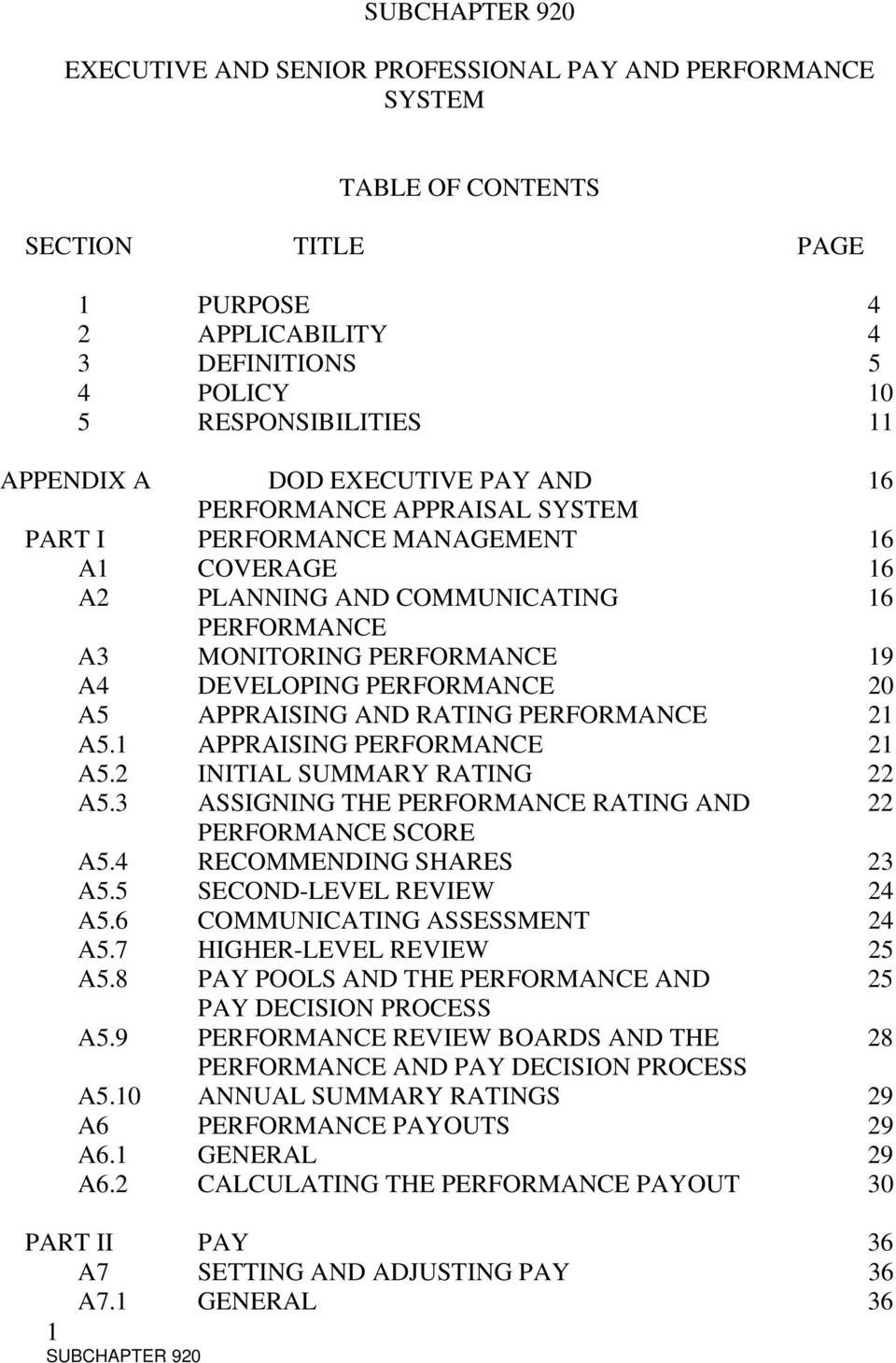
1 SUBCHAPTER 920 EXECUTIVE AND SENIOR PROFESSIONAL PAY AND PERFORMANCE SYSTEM 1 SUBCHAPTER 920 TABLE OF CONTENTS SECTION TITLE PAGE 1 PURPOSE 4 2 APPLICABILITY 4 3 DEFINITIONS 5 4 POLICY 10 5 RESPONSIBILITIES 11 APPENDIX A DOD EXECUTIVE PAY AND 16 PERFORMANCE APPRAISAL SYSTEM PART I PERFORMANCE MANAGEMENT 16 A1 COVERAGE 16 A2 PLANNING AND COMMUNICATING 16 PERFORMANCE A3 MONITORING PERFORMANCE 19 A4 DEVELOPING PERFORMANCE 20 A5 APPRAISING AND RATING PERFORMANCE 21 A5.1 APPRAISING PERFORMANCE 21 A5.2 INITIAL SUMMARY RATING 22 A5.3 ASSIGNING THE PERFORMANCE RATING AND 22 PERFORMANCE SCORE A5.4 RECOMMENDING SHARES 23 A5.5 SECOND-LEVEL REVIEW 24 A5.6 COMMUNICATING ASSESSMENT 24 A5.7 HIGHER-LEVEL REVIEW 25 A5.8 PAY POOLS AND THE PERFORMANCE AND 25 PAY DECISION PROCESS A5.9 PERFORMANCE REVIEW BOARDS AND THE 28 PERFORMANCE AND PAY DECISION PROCESS A5.10 ANNUAL SUMMARY RATINGS 29 A6 PERFORMANCE PAYOUTS 29 A6.1 GENERAL 29 A6.2 CALCULATING THE PERFORMANCE PAYOUT 30 PART II PAY 36 A7 SETTING AND ADJUSTING PAY 36 A7.1 GENERAL 36
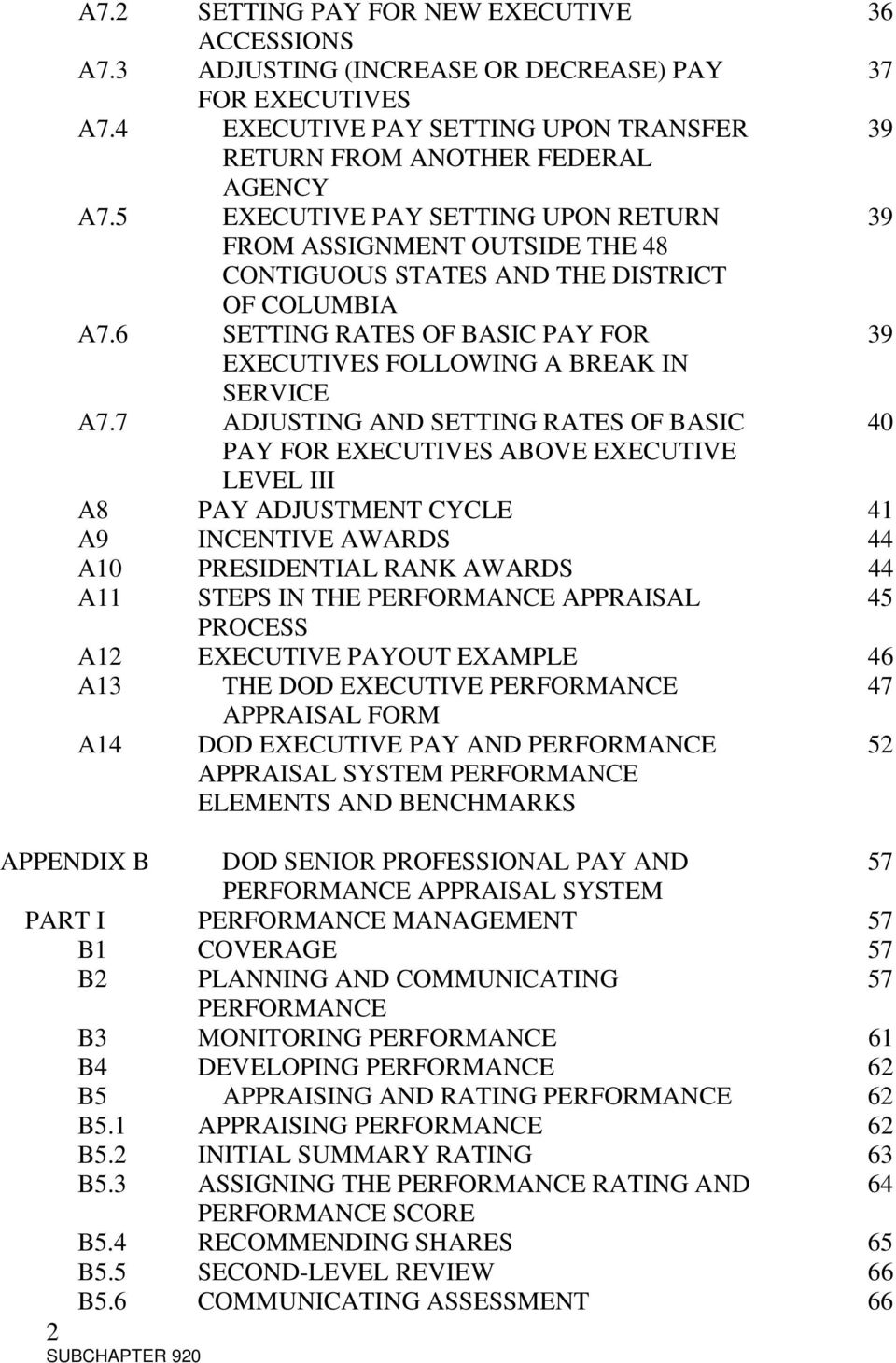
2 A7.2 SETTING PAY FOR NEW EXECUTIVE 36 ACCESSIONS A7.3 ADJUSTING (INCREASE OR DECREASE) PAY 37 FOR EXECUTIVES A7.4 EXECUTIVE PAY SETTING UPON TRANSFER 39 RETURN FROM ANOTHER FEDERAL AGENCY A7.5 EXECUTIVE PAY SETTING UPON RETURN 39 FROM ASSIGNMENT OUTSIDE THE 48 CONTIGUOUS STATES AND THE DISTRICT OF COLUMBIA A7.6 SETTING RATES OF BASIC PAY FOR 39 EXECUTIVES FOLLOWING A BREAK IN SERVICE A7.7 ADJUSTING AND SETTING RATES OF BASIC 40 PAY FOR EXECUTIVES ABOVE EXECUTIVE LEVEL III A8 PAY ADJUSTMENT CYCLE 41 A9 INCENTIVE AWARDS 44 A10 PRESIDENTIAL RANK AWARDS 44 A11 STEPS IN THE PERFORMANCE APPRAISAL 45 PROCESS A12 EXECUTIVE PAYOUT EXAMPLE 46 A13 THE DOD EXECUTIVE PERFORMANCE 47 APPRAISAL FORM A14 DOD EXECUTIVE PAY AND PERFORMANCE APPRAISAL SYSTEM PERFORMANCE ELEMENTS AND BENCHMARKS 52 APPENDIX B DOD SENIOR PROFESSIONAL PAY AND 57 PERFORMANCE APPRAISAL SYSTEM PART I PERFORMANCE MANAGEMENT 57 B1 COVERAGE 57 B2 PLANNING AND COMMUNICATING 57 PERFORMANCE B3 MONITORING PERFORMANCE 61 B4 DEVELOPING PERFORMANCE 62 B5 APPRAISING AND RATING PERFORMANCE 62 B5.1 APPRAISING PERFORMANCE 62 B5.2 INITIAL SUMMARY RATING 63 B5.3 ASSIGNING THE PERFORMANCE RATING AND 64 PERFORMANCE SCORE B5.4 RECOMMENDING SHARES 65 B5.5 SECOND-LEVEL REVIEW 66 B5.6 COMMUNICATING ASSESSMENT 66 2 SUBCHAPTER 920
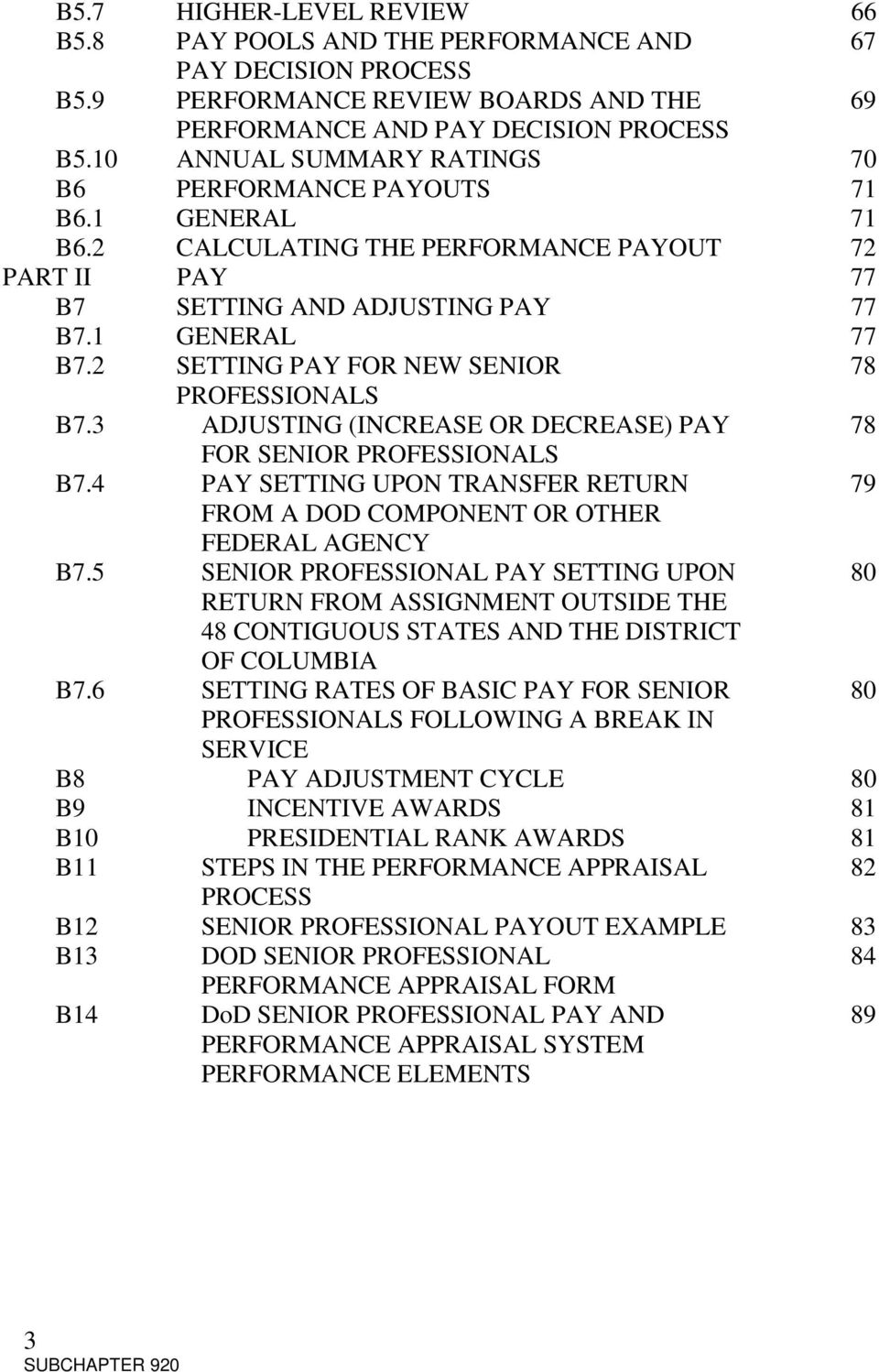
3 B5.7 HIGHER-LEVEL REVIEW 66 B5.8 PAY POOLS AND THE PERFORMANCE AND 67 PAY DECISION PROCESS B5.9 PERFORMANCE REVIEW BOARDS AND THE 69 PERFORMANCE AND PAY DECISION PROCESS B5.10 ANNUAL SUMMARY RATINGS 70 B6 PERFORMANCE PAYOUTS 71 B6.1 GENERAL 71 B6.2 CALCULATING THE PERFORMANCE PAYOUT 72 PART II PAY 77 B7 SETTING AND ADJUSTING PAY 77 B7.1 GENERAL 77 B7.2 SETTING PAY FOR NEW SENIOR 78 PROFESSIONALS B7.3 ADJUSTING (INCREASE OR DECREASE) PAY 78 FOR SENIOR PROFESSIONALS B7.4 PAY SETTING UPON TRANSFER RETURN 79 FROM A DOD COMPONENT OR OTHER FEDERAL AGENCY B7.5 SENIOR PROFESSIONAL PAY SETTING UPON 80 RETURN FROM ASSIGNMENT OUTSIDE THE 48 CONTIGUOUS STATES AND THE DISTRICT OF COLUMBIA B7.6 SETTING RATES OF BASIC PAY FOR SENIOR 80 PROFESSIONALS FOLLOWING A BREAK IN SERVICE B8 PAY ADJUSTMENT CYCLE 80 B9 INCENTIVE AWARDS 81 B10 PRESIDENTIAL RANK AWARDS 81 B11 STEPS IN THE PERFORMANCE APPRAISAL 82 PROCESS B12 SENIOR PROFESSIONAL PAYOUT EXAMPLE 83 B13 DOD SENIOR PROFESSIONAL 84 PERFORMANCE APPRAISAL FORM B14 DoD SENIOR PROFESSIONAL PAY AND PERFORMANCE APPRAISAL SYSTEM PERFORMANCE ELEMENTS 89 3 SUBCHAPTER 920
4 SUBCHAPTER 920 SUBJECT: Executive and Senior Professional Pay and Performance References: (a) DOD Directive , DOD Civilian Personnel Management System, November 25, 1996 (b) Title 5, United States Code (c) Title 5, Code of Federal Regulations (d) Title 10, United States Code (e) DoD Directive , "The Career Lifecycle Management of the Senior Executive Service Leaders Within the Department of Defense,. October25, PURPOSE 1.1. This Subchapter implements the Executive and Senior Professional pay and performance management policies under references (a) through (e); prescribes procedures, delegates authority, and assigns responsibility for executive and senior professional performance management within the Department of Defense (DoD); and establishes the DoD Executive (Senior Executive Service (SES)) and Senior Professional Pay and Performance Systems in accordance with SC920 APPENDIX A. "DoD Executive Pay and Performance Appraisal System;" and Senior Levels (SLs) and Scientific and Professionals (STs) in accordance with SC920 APPENDIX B. "DoD Senior Professional Pay and Performance Appraisal System." 1.2. The purpose of the Executive and Senior Professional Pay and Performance Appraisal System, herein referred to as the "System," is to provide an equitable method for appraising and compensating covered executives and senior professionals. The System is an essential tool for the development of a highly productive workforce. It also provides management, at the lowest practical level, the authority, control, and flexibility needed to accomplish the organization's mission and strategic goals. The System allows for executive and senior professional involvement in the performance evaluation process; communication between Rating Officials and executives and senior professionals; clear accountability for results; identification of developmental needs; integrity and transparency in its application; and an understandable rationale for pay progression based on performance and mission accomplishment. 2. APPLICABILITY 2.1. This Subchapter applies to DoD SES and SLs, STs (and equivalents). It may be administratively extended to the Defense Intelligence Senior Executive Service (DISES) and Defense Intelligence Senior Levels (DISLs). The Under Secretary of Defense for Intelligence (USD(I)) performs the functions of the Authorizing Official with 4

5 respect to DISES and DISL positions; including positions in the Defense Civilian Intelligence Personnel System This policy does not apply to expert and consultant appointments (5 U.S.C. 3109) and highly qualified experts (5 U.S.C. 9903). 3. DEFINITIONS 3.1. Annual Summary Rating. The final rating approved by the Authorizing Official at the end of the performance appraisal period. This includes the summary performance rating, total performance score, and approved number of shares. This is also the rating of record, the official rating or the Final Summary Rating, as required in reference (c) Appraisal. The annual process under which results-driven Performance Requirements are established, reviewed, evaluated, assigned a summary rating, and documented in writing. The results of performance appraisals and ratings are used as a basis to adjust pay, grant bonuses, and make other personnel decisions Authorizing Official. The head of a DoD Component or an official who is delegated authority in writing to act for the head of the DoD Component is defined as an Authorizing Official for the purpose of this policy. Authorizing Officials include the Deputy Secretary of Defense for the Office of the Secretary of Defense, Office of the Chairman of the Joint Chiefs of Staff and the Joint Staff, Defense Agencies, DoD Field Activities and other organizational entities of the Department; the Secretaries of the Military Departments for their respective Military Departments; the DoD Office of Inspector General; and the heads of other DoD Agencies and Field Activities with independent appointing authority for themselves and their serviced activities; and their designees Balanced measures. Balanced measures mean an approach to performance measurement that balances organizational results with the perspectives of distinct groups, including employees and customers Basic pay. The annual rate of compensation exclusive of awards, bonuses and differentials as indicated in reference (c). The rate of basic pay may not exceed the applicable maximum rates under law and regulation, including 5 U.S.C (reference d) Career Senior Executives. SES appointments with competitive selection requirements and no time limits. 5
6 3.7. DoD Component. The Office of the Secretary of Defense, the Military Departments, the Chairman of the Joint Chiefs of Staff, including the Joint Staff, the Combatant Commands, the Office of the Inspector General of the Department of Defense, the Defense Agencies, the DoD Field Activities, and all other organizational entities in the Department of Defense (hereafter referred to collectively as the DoD Components ) Executive. The term executive includes U.S. citizen appropriated fund employees assigned to positions in the Senior Executive Service (SES) under 5 U.S.C Executive and Senior Professional Pay and Performance System. The DoD-wide policies, requirements, and parameters governing the performance of executives and senior professionals, which includes the appraisal programs under references (b) and (c). This includes policies, practices, and procedures for planning, monitoring, developing, evaluating, and rewarding performance General Pay Increase (GPI). An adjustment to the minimum rate of the pay range for STs and SLs. It is determined annually by Executive Order and published by Office of Personnel Management (OPM), generally in January of each year. The GPI is one of three variables in the equation that determines the Pay Pool Funding Factor Incentive Award. Recognition or incentive granted for a suggestion, invention, superior accomplishment or other meritorious effort under the authority of Chapter 45 of reference (c) Initial Summary Rating. The summary Performance Rating, associated score between 0 and 100 assigned/proposed by the Rating Official, the recommended number of Shares, and documentation of accomplishments after evaluating the employee s performance against the established Performance Elements and Performance Requirements. This is a proposed rating of record for SES and SL/ST employees Interim Rating. A written assessment when either the executive, senior professional or Rating Official leaves their position before the end of the performance appraisal period after the executive or senior professional has been under performance standards for a minimum of 90 days. Raters will provide comments regarding the executive and senior professional s performance to the individual who succeeds them as the Rating Official for their consideration when completing the Initial Summary Rating. 6

7 3.14. Minimum performance appraisal period. The minimum period (90 days) that an executive or senior professional must serve under a Performance Plan to be rated Pay Pool. A combination of organizational elements, (e.g., divisions, branches, functional communities, etc.) and/or tier structures, that is defined for purposes of determining Performance Payouts under the Executive and Senior Professional Pay and Performance Appraisal System Pay Pool Funding Factor. The sum of three variables (GPI for Senior Professionals or President's Adjustment to Executive Pay (PAEP) for Senior Executives; Pay Progression Budget; and Performance Bonus Budget), which becomes part of the overall formula to calculate a Performance Payout Pay Pool Manager. The individual charged with the overall responsibility for the effective operation of the Pay Pool and for the distribution of funds in a manner consistent with DoD, Component, and organizational policies Pay Pool Value. The amount of money available for Performance Payouts in a Pay Pool. It is calculated by multiplying the Pay Pool Funding Factor by the total salaries of all covered executives or senior professionals in the Pay Pool Pay Progression Budget. One of three variables in the equation that determines the Pay Pool Funding Factor. It is a percentage of the payroll budget set aside for performance-based pay increases, and is determined and published annually by the Head of the Component Performance appraisal period (Performance Rating Cycle). The established period of time for which an executive and senior professional's performance will be appraised and rated. There is a standard performance appraisal period in DoD. The performance appraisal period begins 1 October of each year and ends on September 30 of each year. The performance appraisal period is also called the performance rating cycle Performance Award (Bonus). A one-time, lump sum payment paid to career executives and senior professionals in recognition of performance during the performance appraisal period. A Performance Bonus is not part of basic pay Performance Bonus Budget. One of three variables in the equation that determines the Pay Pool Funding Factor. It is a percentage of the payroll budget set aside for performance awards and is determined and published annually by the Head of the Component. 7
8 3.23. Performance Elements. The critical components of an executive s or senior professional's work that contribute to organizational goals and results, and are so important that unsatisfactory performance of any one of the Performance Elements would make the executive s overall job performance unsatisfactory. There are seven standard Performance Elements: Leadership/Supervision, Contribution to Mission Accomplishment, Resource Management, Communication, Cooperation/Teamwork, Customer Care, and Technical Competence/Problem Solving. For executives, there are three mandatory Performance Elements (Leadership/Supervision, Contribution to Mission Accomplishment, and Customer Care). For senior professionals, there are three mandatory Performance Elements (Contribution to Mission Accomplishment, Technical Competence/Problem Solving, and Customer Care) Performance Payout. The total monetary value of a basic pay increase and Performance Bonus Performance Payout Formula. The formula that calculates a Performance Payout. It consists of the following variables: salary, number of Shares, and Share Value Performance Plan. The document that describes the individual and organizational expectations for the performance appraisal period and establishes the elements and Performance Requirements against which performance will be evaluated Performance Rating. The written assessment of performance compared to the Performance Elements and the Performance Requirements for the position. There are five rating levels: Exceptional Results, Exceeds Expected Results, Achieved Expectations, Minimally Satisfactory and Unsatisfactory Performance Requirements. Written statements of measurable results expected to be achieved during the performance appraisal period. Typically, there are between one and four SMART-Q (see below) written Performance Requirements for each Performance Element. They describe both the "what is expected" and the "how it is to be accomplished" usually for the Achieved Expectations performance rating level. These are the performance standards required by reference (c) against which performance will be evaluated Performance Review Board (PRB). A panel of individuals established to provide oversight to ensure balance, equity and fairness in the evaluation and scoring process under the performance appraisal system and to ensure there are meaningful distinctions in relative performance reflected in the Performance Requirements. PRB s will be used for both SES and SL/ST review processes. Membership of the PRB must have three or more members who are appointed by the Authorizing Official, or designee acting on behalf of the Authorizing Official for this 8
9 purpose. When appraising a career appointee's performance more than one-half of the PRB must be SES career appointees. Membership must be consistent with 5 CFR and should include women, minorities and people with disabilities; all who are appointed in a manner that assures consistency, stability and objectivity Performance Score. The numeric value between 0 and 100 associated with a Performance Rating. The Performance Rating, Performance Score and Shares comprise the Initial Summary Rating and, once approved by the Authorizing Official, the Annual Summary Rating Presidential Adjustment of Executives Pay (PAEP). When appropriate, one of three variables in the equation that determines the Pay Pool Funding Factor. The PAEP is an annually determined adjustment to the rate of the pay scales for Executives and Senior Professionals, determined by Executive Order and published by OPM, (generally in January of each year). The PAEP is not guaranteed and not granted automatically across the board Rating Official. The supervisor who is responsible for assessing an executive or senior professional's performance as part of the annual performance appraisal process and develops the Initial Summary Rating for a senior executive or senior professional s performance appraisal Rigorous Appraisal of Subordinates. The supervisors deliberate engagement in the full spectrum of performance management (planning, monitoring, rating, and rewarding) of subordinate employees Senior Professional. Those employees in appropriated fund positions classified as Senior Level (SL), and Scientific and Professional (ST) under 5 U.S.C or equivalent Share. A notional representation of a portion of the Pay Pool Fund, which allows mathematical computation of individual Performance Payouts. Shares are assigned as a result of the senior executive or senior professional's final Performance Score and are the basis on which individuals earn an increase to basic pay or a Performance Bonus, or both Share Value. The Share Value represents a fixed percentage used to calculate the Performance Payout (to include basic pay increase, bonus or both) for each executive or senior professional. It is a variable of the Performance Payout Formula. It is calculated by dividing the Pay Pool Value by the sum of each executive s salary multiplied by each executive s number of shares for all covered executives or senior professionals in the Pay Pool. 9

10 3.36. SMART-Q. A framework used for developing measurable resultsdriven Performance Requirements. The acronym stands for: Specific (define results to be accomplished within the scope of the job), Measurable (define quality, quantity and/or effectiveness), Aligned (support specific strategic goals), Realistic/Relevant (requirements are achievable yet challenging), Timely (define a deadline/timeframe for achieving the requirements), and Quality (identify the degree of excellence expected) Total Performance Payout Adjustment. An increase or decrease to the proposed basic pay increase and/or Performance Bonus as calculated by the Performance Payout Formula determined by the Authorizing Official. 4. POLICY 4.1. It is the policy of the Department that the DoD Executive and Senior Professional Pay and Performance System shall: Promote a performance culture in which the performance and contributions of executives and senior professionals are accurately and fully recognized and rewarded Be transparent, trusted, credible, and applied in a consistent, equal, nondiscriminatory and non political manner Link and assess individual performance excellence with the results oriented goals of the DoD or Component strategic plans, the Government Performance and Results Act, The President s Management Agenda, or other strategic initiatives Hold executives and senior professionals (as applicable) accountable for rigorous performance management of their subordinate employees and for aligning their subordinate employees' Performance Plans to organizational goals Use performance results as a basis for making proper and meaningful distinctions in performance; and as a basis for determining pay, awards, development, retention, removal, and other personnel decisions for executives and senior professionals Ensure that executives or senior professionals who demonstrate the highest level of performance, make the greatest contributions to DoDwide or organizational performance, or who exemplify superior leadership and results generally receive the highest rates of basic pay or pay adjustments. 10

11 Appraise performance of executives and senior professionals using measures that balance organizational results with customer, employee, and other perspectives It is the policy of the Department that the DoD Executive and Senior Professional Performance System shall be maintained, implemented, and applied in a manner that maintains Certification by the Office of Personnel Management and the Office of Management Budget as required by 5 U.S.C (reference (b)) and 5 C.F.R. 430, Subpart D (reference (c)). 5. RESPONSIBILITIES 5.1. Performance management is a priority for supervisors, executives and senior professionals throughout the Department of Defense. The success of executives and senior professionals must be linked to the performance of subordinate supervisors and employees to the full execution of performance management and pay-forperformance responsibilities and practices at all levels of the organization. All parties to the executive and senior level performance management process need to invest adequate time and effort throughout the rating cycle for training on and administration of performance management Pursuant to reference (c) Part 430, Subparts C and D, the Secretary of Defense, as the head of the Department of Defense, exercises overall responsibility for: Establishing policy for DoD Executive and Senior Professional Pay and Performance Systems; Rigorously overseeing and annually assessing System implementation and ongoing application; Ensuring that executives and senior professionals are held accountable for rigorous performance management of subordinate employees and for aligning their subordinate employees' Performance Plans to organizational goals Ensuring assessment is linked to the performance expectations and evaluations; Providing performance appraisal guidelines based on an assessment of the Department mission accomplishments and external standards such as the Government Performance Review Act and President s Management Agenda to Authorizing Officials, Rating Officials, Pay Pools and Performance Review Boards (as appropriate); and 11

12 Establishing DoD mission performance review mechanisms that can be used to assist in the evaluation of accomplishments The Under Secretary of Defense (Personnel and Readiness) (USD (P&R)) shall: Develop DoD Executive and Senior Professional Pay and Performance System policy that is consistent with references (a) through (c), above; transparent, trusted, and creditable; and applied in an equitable, nondiscriminatory, and non political manner, for Secretary of Defense approval; Issue guidelines for System implementation, ensure that the appraisal system makes meaningful distinctions based on relative performance, and that executives and senior professionals are held accountable for rigorous performance management of subordinate employees and for aligning their subordinate employees' Performance Plans to organizational goals; Ensure that DoD and/or organizational performance (as appropriate) is assessed annually against organizational strategic goals and performance measures and that these results are reflected in executive and senior level performance appraisals and performance pay decisions; Ensure that Components provide appropriate training to supervisors, executives and senior professionals on this System, and on performance management, in general, including planning and appraising performance Validate Component certifications provided under paragraph before annual Performance Bonuses and performance pay increases are made effective Ensure that the Executive and Senior Professional Pay and Performance annual performance appraisal results is communicated in the aggregate to Executives and Senior Professionals while maintaining individual confidentiality to the extent possible to help ensure understanding of the basis for Annual Summary Ratings and accompanying Performance Payouts Authorizing Officials shall: Ensure that the requirements of DoD Executive and Senior Professional Pay and Performance System are implemented and applied in a consistent, transparent, trusted, creditable, equitable, nondiscriminatory, and non political manner; 12

13 Hold executives, and senior professionals as appropriate, accountable for rigorous performance management, including making meaningful distinctions in employee performance; Establish the composition of the Performance Review Board and select a chairperson consistent with Chapter 43 of reference (b) and Part 430, Subpart C of reference (c), Reference (e), and DoD component-specific Performance Review Board procedures Annually, assess organizational performance against strategic goals and performance measures and communicate these results to executives, senior professionals, Rating Officials and Performance Review Board members. These results must be reflected in executive and senior level performance appraisals Ensure that basic pay, pay adjustments, Performance Bonuses, and other awards based on the results of the appraisal process accurately reflect and recognize individual performance and/or contribution to agency or organization performance; Ensure that the results of the Executive and Senior Professional Pay and Performance System are communicated in the aggregate to Executives and Senior Professionals while maintaining individual confidentiality to the extent possible to help ensure understanding of the basis for Annual Summary Ratings and accompanying Performance Payouts Establish guidance for scoring and weighting Performance Requirements and Performance Elements; and, Conduct the processes in A11. and B The DoD Component Heads shall: Implement the established Executive and Senior Professional Pay and Performance System consistent with DoD policy and guidance; Ensure pay adjustments are based on performance and reflect Component and organizational performance; Ensure that executives and senior professionals are held accountable for rigorous performance management of subordinate and for aligning their subordinate employees' Performance Plans to organizational goals; 13
14 Budget to support executive and senior professional pay adjustments and Performance Bonuses; Set pay for accessions, adjust pay for reassignments and transfers, and adjust pay based on performance and other criteria outlined in this Subchapter; Provide training to Rating Officials, executives and senior professionals, Pay Pool Managers, Performance Review Boards and other officials in the performance management process to ensure effective implementation of the Department's performance management policy; Ensure that organizational performance is assessed annually against organizational strategic goals and performance measures and that these results are reflected in executive and senior level performance appraisals and performance pay decisions; Establish Component performance review mechanisms that can be used to assist in the evaluation of organizational and executive and senior professional accomplishments; and Certify annually that: The appraisal system makes meaningful distinctions based on relative performance, holds executives accountable for organizational performance and rigorous performance management of subordinate employees, and that pay adjustments, Performance Bonuses and Annual Summary Ratings reflect and recognize individual performance and contribution to the Component and Department s mission; and Annual summary ratings, pay adjustments, and bonuses accurately reflect subordinate employee s performance, which includes business results, employee and customer perspectives, and when applicable, accountability for the rigorous performance management of subordinates Rating Officials shall, at a minimum: Ensure that their executives or senior professionals are held accountable for rigorous performance management of their subordinates; Be skilled in and diligently apply rigorous performance management principles and practices, including planning, assessing and communicating performance to carry out the full range of performance management responsibilities; 14

15 Write and document results-driven Performance Requirements that are linked to the organization's strategic plan, mission and goals and that can support making meaningful distinctions in performance levels; Conduct meaningful progress reviews at least once during the performance appraisal period where performance progress and developmental opportunities are discussed, in order to promote, sustain, and improve performance; Appraise the executives or senior professionals realistically and fairly, using the results of organizational performance assessments as a factor in determining the appropriate performance rating; Communicate the Initial Summary Rating and the Annual Summary Rating when approved by the Authorizing Official; Recommend a Total Performance Payout Adjustment consistent with policy outlined in A Be prepared to discuss their executive's or senior professional's individual performance and contribution to the mission, as well as ratings, at Pay Pool and/or Performance Review Board meetings, as may be necessary; Adequately deal with executive or senior professional performance deficiencies in a timely and constructive manner; and Carry out all the responsibilities enumerated at A11.and B11. 15

16 SC920 APPENDIX A DoD Executive Pay and Performance Appraisal System for Senior Executive Service Members PART I. PERFORMANCE MANAGEMENT A1. COVERAGE A1.1. DoD Component Coverage. The DoD Executive and Senior Professional Pay and Performance System applies to all DoD appropriated fund Components. A1.2. Employee Coverage. This subchapter and Appendix cover executives assigned to positions in the SES defined under 5 U.S.C A2. PLANNING AND COMMUNICATING PERFORMANCE A2.1. The Rating Official plans and develops the Performance Plan including Performance Elements and Performance Requirements in consultation with the Executive, and communicates the Performance Plan for the Performance Appraisal Period to the Executive. A2.2. Performance appraisal period. A Duration of the performance appraisal period. The duration of the performance appraisal period normally will be 12 months, except when an executive fails to achieve expectations, when a new executive (through appointment, reinstatement, reassignment, transfer) is assigned to a position after the beginning of the performance appraisal period, or when other situations occur that may warrant a performance appraisal period of less or more than 12 months (e.g., departure of the Rating Official before the end of the performance appraisal period). A The performance appraisal period shall be October 1 through September 30 each year. A Minimum performance appraisal period. In order to provide for meaningful evaluation of an executive's performance, the minimum performance appraisal period will be 90 days. A Extended performance appraisal period. If an Annual Summary Rating cannot be prepared at the end of the performance appraisal period because the executive has not completed the minimum performance appraisal period or for other reasons, the executive's performance appraisal period must be 16
17 extended, but not for a period longer than 15 months. The Rating Official determines how long the performance appraisal period will be extended to ensure that the executive is provided ample opportunity to achieve the performance elements and requirements, but not more than 15 months. At the end of the extended performance appraisal period, and after scores, ratings and Shares have been assigned, an Authorizing Official may use a portion of the applicable Pay Pool funds for the executive's Performance Payout. A2.3. Development of Performance Plans. A Each executive must have a Performance Plan that describes the executive's performance elements and requirements aligned with organizational goals and objectives for the performance appraisal period, and sets the results-driven Performance Requirements against which performance will be evaluated. A Rating Officials must develop Performance Plans in consultation with the executive and communicate the required Performance Elements and Performance Requirements. The development of the Performance Plans and the communication about the requirements must occur: appraisal period or A On or before the beginning of the performance A Within 30 days of appointment for executives assigned after the beginning of the performance appraisal period; and workload changes. A Whenever there is a modification for mission or A Performance Plans must include: A Performance Elements as described in , and A Performance Requirements as described in A The executives acknowledgment of receipt of the Performance Plan as evidenced by a signature on the DoD Executive Performance Appraisal Form. A Performance Elements. A There are seven standard Performance Elements that may be used to evaluate an executive. They are: (1) Leadership/Supervision; (2) Contribution to Mission Accomplishment; (3) Resource Management; (4) 17
18 Communication; (5) Operation/Teamwork; (6) Customer Care; and (7) Technical Competence/Problem Solving. A full description of these Performance Elements is provided at A14. A There are three mandatory Performance Elements. They are: Contribution to Mission Accomplishment, Leadership/Supervision, and Customer Care. A The remaining four standard Performance Elements may be used as stand alone Performance Elements or may be embedded into one or all of the three mandatory Performance Elements. All Performance Elements included in the Performance Plan are considered to be critical. A The Performance Elements must be weighted. Authorizing Officials shall establish guidance for weighting Performance Elements. Contribution to Mission Accomplishment must be weighted at least 60 percent among all Performance Elements selected. The sum of the weights for all Performance Elements used will be 100 percent. A Performance Requirements. A The Rating Official must work with the executive to develop Performance Requirements for each Performance Element that reflect the duties, responsibilities and expected outcomes. A All Performance Requirements shall be resultsdriven, written in the SMART-Q framework, and specify measurable results and outcomes of a particular Performance Element. Performance Requirements must describe the level of performance required to be rated achieved expectations. These are the performance standards against which the executive s performance will be appraised. Performance Requirements must meet the mandatory criteria described below: executives shall: responsibility; A SMART-Q Performance Requirements for A Apply to their respective areas of A Be linked with strategic plans and initiatives of the Component or Department; reflect expected agency or organizational performance; 18

19 A Clearly describe performance that is measurable, verifiable, or apparent and focus on tangible outputs, outcomes, milestones or other deliverables; and A Include balanced measures reflecting the perspectives of distinct groups including customers and employees. A There should be at least one and typically no more than four SMART-Q written Performance Requirements for each Performance Element that is used to evaluate an executive s performance. All Performance Requirements will be mission focused and results oriented. A On occasion, some Performance Requirements require a competency-based outcome rather than a results-oriented outcome. However, in this case, at least 60 percent of the executives Performance Requirements must be results oriented and describe performance that meet the requirements described at A However, the Mission Accomplishment Performance Element must contain only measurable results-oriented Performance Requirements. A Performance Requirements must be written in a manner that allows the Rating Official to make meaningful distinctions in performance. Each requirement should demonstrate the complexity and scope of the work and be attainable. A For supervisory positions, there are two mandatory Performance Requirements as part of the Leadership/Supervision Element. There must be a requirement that: (1) subordinate employee Performance Plans are aligned with organizational goals; appraised rigorously (realistically) against clear, measurable standards of performance; and employee and customer views are considered in achieving organizational results, and (2) executive achieves results in promoting equal employment opportunity, affirmative action, and diversity in the performance of responsibilities. A3. MONITORING PERFORMANCE A 3.1. Supervisors must monitor each executive's performance during the performance appraisal period and communicate feedback to the executive on progress in accomplishing the Performance Elements and Performance Requirements described in the Performance Plan as follows: A On-Going Performance Feedback. Relative to the Performance Plan, the Rating Official shall provide ongoing feedback as necessary. Feedback aims to reinforce, acknowledge, anticipate, and remedy executive performance. 19
20 Feedback can be provided at any time during the performance appraisal period. Executives may request periodic feedback on performance. A At least one progress review must be held between the Rating Official and executive during the performance appraisal period. Rating Officials must provide advice and assistance to executives on how to develop and improve their performance. The Rating Official will document the feedback using the appropriate section of the Performance Appraisal Form. A Any time an executive is failing to meet performance requirements, steps must be taken to promptly address the executive's unacceptable performance. A When addressing unacceptable performance, Rating Officials shall identify and communicate to the executive the specific performance deficiency that requires improvement and identify necessary evidence that demonstrates improvement. A Interim Rating. A written assessment of an executive's performance should be completed when either the executive or Rating Official leaves their position before the end of the performance appraisal period after the executive has been under a performance plan for a minimum of 90 days. Raters with over 90 days of supervision will provide comments regarding the executive s performance to the individual who succeeds them as the Rating Official for their consideration when completing the Initial Summary Rating. A4. DEVELOPING PERFORMANCE A4.1. Developing performance is integrated with the performance management process. Along with meaningful performance-related discussions that assist the executive in reinforcing strengths and correcting weaknesses, employee development opportunities should be discussed. A4.2. Performance Elements and Performance Requirements may serve as the basis for assessing, and providing the framework for discussing, executive developmental needs. A4.3. Rating Officials should discuss and encourage executives to seek executive and leadership professional development opportunities that promote achievement of the strategic initiatives of the Component and or Department of Defense. These may include: 20
21 missions and goals; A Enhancing their contribution to DoD and organizational A Enhancing their understanding of the DoD operational environment, e.g., comfortable working in remote regions of the world, dealing with local communities, adapting to foreign languages and cultures, working with networks, operating alongside or within the United Nations organizations, and working alongside non-governmental organizations to further U.S. and partner interests, and A Developing cultural awareness and foreign language proficiency as may be needed by the Department. A4.4. Rating Officials should discuss and encourage executives to develop a portfolio of diverse experiences to broaden perspectives and view responsibilities in the context of the larger DoD enterprise, the national security mission, and public policy interests of the Department. A5. APPRAISING AND RATING PERFORMANCE A5.1. Appraising Performance. Supervisors must appraise each executive's performance in writing and assign an Initial Summary Rating and discuss the results of the Annual Summary Rating at the end of the Performance Appraisal Period with the executive, as follows: A Appraisals will be based upon an assessment of individual and organizational performance considering such factors as: results achieved consistent with DoD goals; customers satisfaction, and employee perspectives; the effectiveness, productivity, rigorous performance of the executives and employees for whom the executive is responsible; activities that demonstrate achieving diversity, equal employment opportunity, and affirmative action results in leadership and performance management responsibilities; adherence to requirements regarding merit system principles and prohibited personnel practices set forth in 5 U.S.C. 2301; contribution to mission accomplishment; resource management; problem solving and technical competence; cooperation and teamwork; communication and customer care. Distribution of performance ratings and scores will not be forced or artificially constrained by a Rating Official, Pay Pool, Performance Review Board or Authorizing Official. A Each Rating Official will determine the degree and level to which the executive has accomplished the Performance Requirements for his/her position and assign a score for each Performance Requirement and Performance Element included in the Performance Plan. 21
22 A Rating Officials may request that the executive provide written input describing accomplishments throughout the performance appraisal period to assist the Rating Official in evaluating the executive s performance. A The Rating Official considers the executive s input describing accomplishments towards Performance Elements and Performance Requirements, as well as input from individuals in the executive s rating chain, subordinates and customers; if received. A If the executive was supervised by more than one Rating Official during the performance appraisal period, the rater of record must consider Interim Rating inputs provided by previous raters when preparing the appraisal. Each Performance Element will be evaluated and rated separately; this becomes the Initial Summary Rating. A5.2. Initial Summary Rating. Rating Officials must conduct an end of the performance appraisal period performance review with each of their executives and complete the Initial Summary Rating. The Initial Summary Rating provides the executive a preliminary performance assessment pending final review and approval by the Authorizing Official. It includes a discussion about the executive's overall performance, the tentative Performance Rating, Performance Score, and recommended number of Shares. It does not include a discussion about the Performance Share Value or Performance Payout information. The Authorizing Official is the only individual who determines the final Annual Summary Rating, Performance Score and number of Shares after consideration of Performance Review Board recommendations. A The Rating Official will score each Performance requirement and Performance Element individually and multiply the point score of each Performance Element by the element s percentage weight and sum the results to arrive at the Performance Score. The maximum Performance Score is 100 points. The Performance Score determines the Performance Rating. A An executive whose performance is unsatisfactory for any Performance Element (i.e., receives fewer than 51 points) will receive an Annual Summary Rating of Unsatisfactory. A Components may use an alternative scoring strategy to achieve the adjectival Performance Rating, with USD (P&R) approval. A5.3. Assigning the Performance Rating and Performance Score. A Performance Ratings are: 22
23 A Exceptional Results is performance that far exceeds what is expected in the attainment of the Performance Requirement, as evidenced by exceptional accomplishments or contributions to the mission. A Exceeds Expected Results is performance that surpasses what is expected in the attainment of the Performance Requirements and/or results in the achievement of unexpected outcomes that contribute to the mission. A Achieved Expectations is performance that fully meets the attainment of the Performance Requirements as defined by the Performance Plan. A Minimally Satisfactory is performance that partially meets or demonstrates some progress toward the attainment of the Performance Requirements described in the Performance Plan. A Unsatisfactory is performance that fails to meet the Performance Requirements for any element in the Performance Plan. A Performance Scores for each Performance Element are assigned after the Rating Official determines the Performance Rating. A The Rating Official must assign a Performance Rating and Performance Score based upon an assessment of the executive's performance results. Rating levels and Performance Scores are assigned consistent with Figure below. To help determine the appropriate Performance Rating, there are benchmark descriptions. The Rating Official should assign the highest Performance Rating and Performance Score to executives who demonstrate the highest level of performance and make the greatest contributions to the DoD s performance and mission. A5.4. Recommending Shares. A At this point in the process, the Rating Official will recommend a number of Shares for an executive based on his/her Performance Score. Shares are a notional representation of a portion of the Pay Pool, which allows mathematical computation of individual Performance Payouts and are used during the pay decision process. Shares are assigned as a result of the executive's final Performance Score and are the basis on which individuals earn an increase to basic pay or a Performance Bonus, or both. A Recommending Shares is the first step in linking performance to payout. The Initial Summary Rating (Performance Rating, Performance Score, and recommended number of Shares) will be used to determine recommended 23
24 Share allocations that will drive the recommended basic pay increase and/or Performance Bonus. Using the Share Conversion Chart found in Figure , the Rating Official selects the recommended number of Shares from the Performance Payout Shares column that corresponds to the executive s Performance Rating and Performance Score. Figure Performance Rating Level, Score Ranges and Shares for Payout Share Conversion Chart Performance Rating Level Score Performance Payout Shares Exceptional Results , 12 13, 14, 15, or 16 Shares Exceeds Expected Results , 8, 9 or 10 Shares Achieved Expectations , 2, 3, 4, 5 or 6 Shares Minimally Satisfactory Shares Unsatisfactory Shares A When an executive receives a Performance Payout, it will be a percentage of current basic pay. This percentage is based on the number of Shares granted based on the executive's Performance Rating and Performance Score. After a Performance Score is assigned, the Rating Official will recommend the number of Shares that may be granted. The Rating Official will determine the recommended number of Shares using the framework above. The Shares earned by an executive will be used to calculate the Performance Payout as outlined in the Performance Payout (A6.2.7.). A In determining the number of Shares, Rating Officials should consider the executive s scope, level of responsibility, complexity of assignments, and mission impact. They should also take into consideration the Initial Summary Rating, the executive s current basic pay, overall funding availability, and performance of the executive against the relative performance of other executives (if applicable). A5.5. Second-Level Review. Components may require a review of the Rating Official s recommendations by the next level supervisor. This second-level reviewer must document the review by signing the DoD Executive Performance Appraisal Form in the area indicated for Second-Level Reviewer. A5.6. Communicating Assessment. The Rating Official must communicate to the executive the Initial Summary Rating, the Annual Summary Rating, and the organization's aggregate performance appraisal results. 24
25 A The Rating Official will document results on the appropriate section of the DoD Executive Performance Appraisal Form. Components may add Component-specific instructions for completing the form. A Signatures are required from the Rating Official and the executive in the appropriate section of the DoD Executive Performance Appraisal Form. A5.7. Higher-Level Review. A Executives may respond in writing after receipt of the Initial Summary Rating and/or request a review by an official at a higher level within the organization (if there is one) prior to review by the Performance Review Board. The executive must request such review within 7 work days of receiving the Initial Summary Rating. A A reviewing official at a higher level in the Component, either an executive or an active General/Flag Officer, must be appointed to consider the executive's response. Components may appoint someone outside the Component to perform the review when the Authorizing Official is also the Rating Official or the review is more appropriately conducted by an external executive or General/Flag Officer. When a General/Flag Officer is involved in the review, the executive must agree to the military member s involvement. A The higher-level reviewing official must respond within 7 work days of receiving the request for higher-level review, unless there are extenuating circumstances. However, it is important, that to the extent possible, the Initial Summary Rating be presented timely to the Pay Pool and Performance Review Board. The higher-level reviewing official may not change the Rating Official s Initial Summary Rating, but may recommend a different Initial Summary Rating to the Pay Pool, the Performance Review Board and the Authorizing Official. A Copies of the higher level reviewer s findings and recommendations must be given to the executive, the Rating Official, the Second-Level Reviewer (as appropriate), the Pay Pool, the Performance Review Board and the Authorizing Official. A The higher-level review is the final process by which an executive may request review of the assigned Initial Summary Rating. An executive may not grieve any Performance Plan, Appraisal, Performance Rating, Performance Score, Shares allocation, adjustment in basic pay, the non-receipt of a Performance Bonus, or the amount of a Performance Bonus. A5.8. Pay Pools and the Performance and Pay Decision Process. 25
26 A The DoD Executive and Senior Professional Pay and Performance System uses a pay pool concept (1) in the performance appraisal review process to ensure performance standards are applied consistently across the organization, and (2) in the performance pay decision process to manage, control, and distribute performance-based pay increases and Performance Bonuses. A Generally, Pay Pools may be combinations of organizational elements (e.g., divisions, branches, and functional communities) that are defined for purposes of determining Performance Payouts under The Executive and Senior Professional Pay and Performance System. A Pay Pools must be established in a manner that precludes conflicts of interest. time. A Each executive is assigned to only one Pay Pool at a A The Authorizing Official shall determine the executive Pay Pool structure and identify a Pay Pool Manager to organize and lead each Pay Pool. A The Pay Pool Manager reports to the Performance Review Board. However, the Authorizing Official may elect to combine the functions of the Pay Pool Manager with those of the Performance Review Board, such as when the number of executives warrants only one Pay Pool. When Pay Pool Manager and Performance Review Board functions are combined, the Performance Review Board Chair assumes the responsibilities of the Pay Pool Manager and reports directly to the Authorizing Official. A Pay Pool funding and the functions of the Pay Pool Manager are the performance pay decision process are described in "Part II. Pay," below. A Pay Pool Manager. The Pay Pool Manager is responsible for ensuring that (1) the performance appraisal review process undertaken by the Pay Pool Panel results in individual Initial Performance Ratings that are consistent with the standards set in this instruction, (2) the recommended distribution of performance pay funds is based upon executive performance, contributions and organizational success, and (3) Pay Pool Panel decision processes in this instruction are executed fairly, consistently across the Pay Pool. A The Pay Pool Manager ensures review of Rating Official recommendations and reports the recommendations derived from the Pay Pool 26
27 Panel performance review and performance pay decision process to the Performance Review Board. If the Pay Pool and Performance Review Board functions have been combined, the Performance Review Board Chair will report to the Authorizing Official. A The Pay Pool Manager reports proposed changes to the Executive s Performance Rating, Recommended Shares, and Performance Score with the Rating Official prior to finalizing Pay Pool deliberations. A The Rating Official will immediately provide documented feedback that may include additional evidence to substantiate the Executive s performance rating (if applicable). A If a dispute between the rating official and the Pay Pool Manager still exists, the Performance Review Board will make a final determination based upon the Pay Pool Managers Performance Payout recommended results. A If the functions of the Pay Pool Manager and Performance Review Board are combined as set forth in A5.9.2., disputes regarding the Executive s Performance Rating, Recommended Shares, and Performance Score between the Rating Official and the Performance Review Board Chair will be forwarded to the Authorizing Official for a final decision. A If a dispute between the rating official and the Performance Review Board still exists, the Authorizing Official will make a final determination based upon the Performance Review Board s Performance Payout recommended results. A Based on Pay Pool Panel deliberations, the Pay Pool Manager may recommend a Total Performance Payout Adjustment consistent with policy outlined in A A The Pay Pool Manager may not participate in payout deliberations or decisions regarding his/her own performance assessment or pay. A Performance Payouts will be calculated and administered so that a Pay Pool Manager does not exceed the resources that are available in the Pay Pool. A If executive payouts exceed the amount designated for the Pay Pool, the Pay Pool Manager must adjust the payout amounts accordingly. 27
28 A Decisions regarding the amount of the Performance Payout are based on the established Performance Payout Formula calculations described in A6.2. Process. A5.9. Performance Review Boards and the Performance and Pay Decision A A Performance Review Board, or Boards, will be established by the Authorizing Official to review the recommendations of the Pay Pool Manager(s) to ensure Performance Requirements are applied, performance pay adjustments are distributed, and organizational performance and pay decision processes are executed consistently, fairly and in accordance with this instruction across the organization. A Authorizing Officials shall establish the composition of the Performance Review Board and select a chairperson consistent with Chapter 43 of reference (b) and Part 430, Subpart C of reference (c) and Component-specific Performance Review Board procedures. The Authorizing Official may elect to combine the functions of the Pay Pool Manager with those of the Performance Review Board, such as when the number of executives warrants only one Pay Pool. When Pay Pool and Performance Review Board functions are combined, the Performance Review Board Chair assumes the responsibilities of the Pay Pool Manager and reports directly to the Authorizing Official. A The Performance Review Board will review and evaluate Pay Pool Manager recommendations as they relate to mission accomplishments and performance, the written review by the higher-level reviewing official, as required, the executive's written response (if any), and conduct any further review needed, to make written recommendations concerning: Authorizing Official; and as specified in A A All executives Initial Summary Ratings to the A Performance Bonuses and increases to basic pay; A Total Performance Pay Adjustments, if applicable, A Performance Review Board members may not take part in any deliberations involving their own appraisals or those in their supervisory chain. A Performance Review Board Chairperson. 28
29 A The Performance Review Board Chairperson is responsible for ensuring that Performance Requirements are applied, recommended performance pay adjustments are distributed, and organizational performance and pay decision processes are executed consistently, fairly and in accordance with this instruction across the organization. The Performance Review Board Chairperson will also ensure that the Performance Review Board processes are executed consistently, fairly and in accordance with this instruction. A The Performance Review Board Chairperson reports recommendations resulting from Performance Review Board deliberations to the Authorizing Official. A The Performance Review Board Chairperson may not participate in payout deliberations or decisions regarding his/her own performance assessment or pay. A5.10. Annual Summary Ratings. The Authorizing Official: A Determines the Annual Summary Rating, Performance Score and Performance Payout Shares after consideration of Performance Review Board recommendations. Determinations must be made in writing. A Certifies that the results of the performance appraisal process make meaningful distinctions based on relative performance and are consistent with the guidelines established in this policy; and A Assures that basic pay increases and Performance Bonuses accurately reflect and recognize individual performance and contributions to the Component s mission performance. A6. PERFORMANCE PAYOUTS A6.1. General. A A Performance Payout recognizes an executive's accomplishments during the Performance Appraisal Period, is based on Shares earned through performance, and is calculated using the Performance Payout Formula. Performance Payouts occur annually, normally in January. The amount of money available for Performance Payouts is divided into two elements, basic pay increases and Performance Bonuses. The amount of the payouts made to an individual executive is subject to the amounts available for payouts in the executives' Pay Pool, based on the Pay Pool Funding Factor. 29
30 A Executives must have an Annual Performance Rating of Achieved Expectations (based on an overall Performance Score of at least 70, or the equivalent) to be considered for a Performance Bonus. In addition, executives must achieve expectations for all Performance Elements to be eligible for a Performance Payout. A Decisions regarding the amount of the Performance Payout are based on the established Performance Payout calculations described in this policy. A Annually, the Deputy Secretary of Defense will determine the maximum Pay Pool Factor to be used in calculating the pay pool value and the recommended basic pay increase payout values. A A Pay Pool Factor will be determined for each tier to recognize the level of difficulty, complexity and scope of impact of results. The lowest pay pool value typically would be at Tier 1 and the highest pay pool value at Tier 3. A Each Pay Pool will be distinguished by SES occupying positions in the same tier group. A Performance Payouts are determined by the Authorizing Official based on the Performance Payout Formula and recommendations derived from the performance review process. Recommendations for payout may initiate with Rating Officials, Reviewers (if any), the Pay Pool Process or the Performance Review Board Process. A6.2. Calculating the Performance Payout. A The DoD Executive and Senior Professional Pay and Performance System calculates executive payouts using a formula construct. The Performance Payout Formula is used to arrive at a recommended Performance Payout the total monetary value of a basic pay increase and Performance Bonus. Performance Payouts will be calculated and administered so that a Pay Pool Manager does not exceed the resources that are available in the Pay Pool. A The Performance Payout Formula combines funds allocated for basic increases and Performance Bonuses into one Pay Pool. In making Performance Payouts, the amount of that year s Pay Pool and Share value must be determined. The process involves calculating the: (1) value of the Pay Pool, (2) value per Share, and (3) total payout. This process is outlined in the steps below: 30
31 A Determining Pay Pool Funding Factor. The first step is determining the Pay Pool Funding Factor. This is the amount budgeted for basic pay increases and Performance Bonuses, expressed as a percentage of total basic pay of all executives in the Pay Pool. The Pay Pool Funding Factor is the sum of three variables: the President's Adjustment to Executive Pay (PAEP), the organization's Pay Progression Budget a percentage of the payroll budget set aside for performance-based pay increases and the organization's Performance Bonus Budget a percentage of the payroll budget set aside for performance-based incentives. A The amount of money available for basic pay increases is the total of the Presidential Adjustment of Executive's Pay (PAEP) plus an organization's Pay Progression Budget. All basic pay increases are determined using this pay for performance formula. (Basic Pay increases are not guaranteed. They are based upon performance and determined through the DoD Senior Executive and Senior Professional Performance Appraisal System). A Bonus is the amount of money available for bonus payments, based upon an organization's review of its past funding and current budget requirements and priorities. The Bonus pool may not exceed 10 percent of total aggregate basic pay of the career executives in the Pay Pool as of the end of the fiscal year prior to the fiscal year in which the award payments are made. A The sum of these factors is the Pay Pool Funding Factor (for example: 2 percent from the PAEP, 1 percent from the Pay Progression Budget, and 7 percent for Performance Bonuses = 10 percent). A The Authorizing Official may set aside some of the Pay Pool Funding Factor or use other funding sources, referred to as a Reserve, for payouts such as those described in A or for those made outside of the normal performance pay adjustment cycle as described in A8. A Determining the Pay Pool Value. The next step is determining the value of the pay pool. The Pay Pool Value is the amount of money available for Performance Payouts to executives in a Pay Pool. It is calculated by multiplying the Pay Pool Funding Factor by the total basic pay of all covered executives in the Pay Pool, as follows: Pay Pool Value = Pay Pool Funding Factor X Total salaries of all covered executives. A The amount budgeted for bonuses many not exceed the statutory cap in accordance with A Funds from the Basic Pay Increase budget may be used to pay bonuses. However, none of the amount budgeted for bonuses may be 31
32 used for Basic Pay Increases. Rating Officials, Performance Review Boards, and Pay Pool Managers otherwise may use discretion in determining the proportion of an executive s total Performance Payout that is paid as a basic pay increase and/or bonus, consistent with this policy. A Assigning Shares. The Initial Summary Rating (Performance Rating, Performance Score, and recommended number of Shares) will be used to determine recommended Share allocations that will drive the recommended basic pay increase and/or Performance Bonus. The Rating Official selects the recommended number of Shares (A5.4.). The Share recommendation is reviewed during the Pay Pool and Performance Review Board process. The Authorizing Official considers the recommendations and assigns the final number of Shares. A Determining the Share Value. Next, each individual executive's basic pay is multiplied by the number of Shares awarded to that executive (Salary X Shares). The sum total of (Salary x Shares) for all executives in the Pay Pool is used to calculate the Share Value. The Share Value is an estimate until pay decisions are finalized by the Authorizing Official. A The sum total of (Salary x Share) value for all executives in the Pay Pool is divided into the pool value to arrive at the Share value as follows: Share Value = Pool Value / sum total of (Salary x Share) A The Share Value represents a fixed percentage used to calculate the Performance Payout (to include basic pay increase, bonus, or both) for each executive. The value of a Share cannot be exactly determined until the rating and Performance Review Board processes are complete and the Authorizing Official has made payout decisions. A Performance Payout. An executive's total Performance Payout is the executive's basic pay at the end of the performance appraisal period multiplied by the number of Shares earned multiplied by the Share Value. Performance Payout = Salary X Shares X Share Value A The total Performance Payout is checked against the limits specified in reference (c). A Once total Performance Payout is checked against applicable limits, the Authorizing Official determines how funds awarded will be split between basic pay increase and Performance Bonus. The Authorizing Official decides 32
33 that either the result of the Performance Payout Formula and the recommendation of the performance review process is appropriate for the executive, or that a Total Performance Payout Adjustment is warranted, in accordance with A A Basic Pay Increases. A Basic pay increases that would result in an executive s salary exceeding the applicable pay cap will not be granted. However, an executive may earn a bonus that does not exceed the aggregate limit. A An Authorizing Official, based on a recommendation of the Pay Pool Manager, may reallocate to executives, not at the top of their pay range, some or all of any unexpended basic pay funds. This reallocation is placed back into the Pay Pool and distributed to uncapped executives as determined by the Performance Review Board or Authorizing Official. Any increase in an uncapped executives basic pay as a result of this reallocation will be offset by an equivalent reduction in the executive s bonus payment. Thus, the uncapped executive s total Performance Payout is unchanged. A Performance Bonus. A Performance Bonuses are tools to recognize, motivate and reward significant individual achievements or contributions and shall be an integral part of career executive pay and performance management. Noncareer and Limited Term executives are not eligible for bonuses. A Bonuses for career executives must be between 5 and 20 percent of basic pay. A If bonus payout exceeds the statutory pay caps, the Pay Pool Manager may do any one of the following to bring the amount in line with the statutory caps: A Check the Bonus Pool Value to determine whether, overall, the budget estimate is too high resulting in calculations beyond the statutory caps. If so, the Bonus Budget must be reduced. A Adjust the executive's overall performance score and number of shares, as appropriate, within the range for the Performance Rating assigned. accordance with A below. A Adjust the executive's payout in 33
34 A After confirmation that caps are not exceeded, obtain appropriate approvals and distribute Performance Payout accordingly. A Total Performance Payout Adjustment. A A Total Performance Payout Adjustment is an increase or decrease to an executive's total Performance Payout. The adjustment may be made to the executive's basic pay increase and/or Performance Bonus. A An adjustment in the Performance Payout is made for the circumstances described in A A The decision to make an adjustment to an executive's total payout must be made in a judicious and prudent manner and may not be used to avoid applying the necessary rigor for assigning an executive's Performance Score and number of Shares earned during a performance appraisal period. A The Authorizing Official is the only authority who can grant a Total Performance Payout Adjustment, which might be recommended by the Rating Official, Pay Pool Manager, and/or Performance Review Board. The decision to grant such an adjustment must be documented in writing. A Adjustments in total Performance Payout for executives cannot result in exceeding the aggregate pay limit. When an adjustment is made to an executive's Performance Bonus, the combined total the original bonus amount plus the adjusted amount cannot exceed 20% of the executive's salary. A If a Total Performance Payout Adjustment decreases the amount of the Performance Bonus, the resulting bonus cannot be less than 5% of the executive s salary. A A Total Performance Payout Adjustment increase may be made for reasons such as the following: A Recognize rare and unusual circumstances in which an executive achieves extraordinary results over and above that which the Performance Payout Formula provides; and/or A Recognize a significant team accomplishment or achievement in meeting an organization's strategic goals. 34
35 A A Total Performance Payout Adjustment decrease may be made for reasons such as the following: A For less than a full year of service during the performance appraisal period (Prorating); and/or A Recent hiring action (e.g., within the last year) in which a significant pay increase was granted upon appointment, reassignment or transfer. imposed by statute or regulation. A To comply with maximum limits A The Performance Payout and Job Change. A Executives who change jobs to a position in the same or different DoD Component with a different Pay Pool after the last day of the performance appraisal period, but before the effective date of the Performance Payout, shall be evaluated and assigned an Annual Summary Rating by the Authorizing Official of record on the last day of the performance appraisal period. The executive's payout shall be calculated and paid based on the Pay Pool Funding Factor and Share Value of the gaining Pay Pool. A Executives who change jobs to a position in the same or different DoD Component with a different Pay Pool and who served all but the last 90 days of the performance appraisal period, may be evaluated and assigned an Annual Summary Rating by the Rating and Authorizing Officials of record for the period of performance provided that there is an adequate basis on which to appraise and rate the executive's performance. The executive shall receive a recommended Performance Rating, Performance Score, and number of Shares. The executive shall be included in the gaining DoD Component Pay Pool at the end of regular performance cycle. The executive's payout also may be prorated in accordance with A , and the basic pay increase adjusted in accordance with A A Performance Payouts for executives no longer covered by this instruction. Executives who received an Annual Summary Rating under this instruction and are no longer covered by this instruction at the time of payout are not entitled to a Basic Pay Increase Performance Payout. However, such executives may be considered for a Performance Bonus if performance during the applicable period merits recognition. 35
36 A It would not be appropriate to deny a bonus payout solely on the basis that the executive left the organization after the end of the performance period. PART II. PAY A7. SETTING AND ADJUSTING PAY A7.1. General. A7.1. Executive pay is set based upon a number of factors including individual and organizational performance results, the complexity and scope of work, the breadth of responsibility, the employee s experience, pay history and qualifications. Executive pay adjustments must be linked to performance. A7.2. Executive basic pay is exclusive of bonuses, differentials, and allowances as outlined in reference (c). A7.3. Aggregate Limitation on Pay. Aggregate limitation on pay cannot exceed limits established in 5 U.S.C for executives paid under 5 U.S.C Total compensation paid to an executive during a calendar year may not exceed level I of the Executive Schedule (EX-I), or the Vice President s salary with a certified executive performance system. A7.2. Setting Pay for New Executive Accessions. A Upon accession, an executive s pay will normally be set at any rate within the range not to exceed level III of the Executive Schedule (EX-III). In setting a new executive s rate of basic pay, the Component must consider the nature and quality of the executive s experience, pay history, qualifications, job responsibilities and Performance Requirements. A7.2.2 Rates of basic pay above the rate for level EX-III but less than or equal to the rate for level II of the Executive Schedule (EX-II) under a certified performance appraisal system generally are reserved for those newly appointed senior executives who possess superior leadership or other essential competences, as determined by the Authorizing Official or designee. In addition, they will be serving in positions with the broadest scope of authority, highest levels of responsibility, and significant personal accountability for the success or failure of the DoD Component's programs. A In setting a new executive's rate of basic pay, a DoD Component must consider the nature and quality of the executive's experience, 36
37 qualifications, and accomplishments as they relate to the requirements of the SES position, as well as the executive's new job responsibilities. A In setting a new executive's rate of basic pay, a DoD Component must consider the executive's broad scope of authority, and level of responsibility and his or her personal accountability for the success or failure of programs. A The approving official for setting pay for new accessions is the Head of the Component or designee. A7.3. Adjusting (increase or decrease) Pay for Executives. A Annual Performance Appraisal Process. An executive may be considered for an increase in pay as part of the annual performance appraisal process, considering an executive's overall performance, significance of results achieved against the Performance Requirements, broad scope of authority and level of responsibility, and the executive's personal accountability for the success or failure of an organization's programs. Basic pay shall be adjusted so as to reflect meaningful distinctions among executives based on individual performance and or contribution to the organization's mission in alignment with strategic planning initiatives. The criteria for performance evaluation and adjustments in basic pay must reflect meaningful distinctions within a single Performance Rating (e.g., the higher the executive's performance within a rating level, generally the higher the pay adjustment) and or between Performance Ratings, (e.g. the higher the rating level, generally, the higher the basic pay adjustment). A pay adjustment made under this section must be approved by the Authorizing Official. A An executive who receives an annual summary rating of Exceptional Results, Exceeds Expected Results, or Achieved Results shall be considered for an annual pay increase, subject to the limitation on the maximum rate of basic pay in 5 CFR (a), and the provisions of A7.7. of this Subchapter. A An executive who receives an annual summary rating of Minimally Satisfactory or Unsatisfactory shall not receive an increase in basic pay for the current performance appraisal period. A Performance-based Rate Adjustment. An executive may qualify for a performance-based rate adjustment that advances the relative position in the pay range in accordance with 5 CFR (b)(3). Such an adjustment is reserved for those senior executives who demonstrate the highest levels of individual performance and or make the greatest contribution to the DoD Component's performance as determined through the annual performance appraisal process. However, generally, such adjustments are made during the annual performance appraisal process as supervisors consider both 37
38 the performance of an executive and the broad scope of authority and level of responsibility of an executive in determining an appropriate increase to basic pay. Pay Adjustments made under this section must be approved by the Authorizing Official. A Change in Rate Range. An executive may qualify for a basic pay adjustment up to an amount that would maintain relative position in the range because the minimum and/or maximum rate of basic pay of the SES rate range under 5 CFR (a)(1) or (2) changed, in accordance with 5 CFR (b)(4). In such instance, the performance of the executive must have been rated at any one of the following performance levels: Achieved Expectations, Exceeds Expected Results or Exceptional Results. Pay may be adjusted only by an amount that does not exceed the amount necessary to maintain the executive's relative position in the SES rate range. A pay adjustment made under this section must be approved by the Authorizing Official. A Reassignment. A pay increase may be appropriate upon reassigning an executive to a position with substantially greater scope and responsibility. There must be a clear articulation of the difference in position scope and responsibility, generally evidenced by the formal reassignment of the executive to a new position description. A pay adjustment made under this section must be approved by the Authorizing Official. A Retention. A pay increase provided when the Executive is critical to the mission of the Component and the executive would be likely to leave the Department of Defense in the absence of the pay increase. Although an offer of other employment is not required, there must be other evidence that suggests that the executive would likely leave the Department of Defense. A pay adjustment made under this section must be approved by Authorizing Official. A Exceptionally Meritorious Accomplishment. A pay increase made outside the annual performance appraisal process for exceptionally meritorious accomplishment. A pay adjustment for this purpose is rare and unusual. It recognizes circumstances where an accomplishment is so significant to the Component's mission that it warrants a basic pay increase that is timed to the significant accomplishment itself rather than to the annual performance appraisal process. A pay adjustment made under this section must be approved by the Authorizing Official. A After OPM Certification of the DoD Executive and Senior Professional Pay and Performance System. If an executive entered on duty prior to the certification of DoD's Executive and Senior Professional Pay and Performance System, a basic pay adjustment may be made to increase that executive s rate of basic pay up to the appropriate rate but not to exceed EX-II after certification of the system. The determination to provide an additional pay increase may not be made effective before the date the DoD System is certified, or after December 31st of the calendar year for which 38
39 the agency's system is certified. A pay adjustment made under this section must be approved by the Authorizing Official. A Decrease Basic Pay. A decrease in basic pay shall be considered for receiving a Minimally Successful or Unsatisfactory Annual Summary Rating or otherwise failing to meet a critical performance requirement, and or disciplinary related circumstance that warrants a reduction in basic pay consistent with paragraph (j) of the 5 CFR and (b). A pay adjustment made under this section must be approved by the Authorizing Official. Agency. A7.4. Executive Pay Setting Upon Transfer/Return from Another Federal A When an executive transfers to the Department of Defense from another Federal Agency, basic pay may be set at any rate within the SES rate range that will provide no reduction in basic pay, subject to the limitation on the maximum rate of basic pay in 5 CFR (a). Pay set under this section must be approved by the Head of the Component or designee. A Pay may be set lower than that held in the non-dod Federal Agency voluntarily and with the approval of the executive. A7.5. Executive Pay Setting Upon Return from Assignment Outside the 48 Contiguous States and The District of Columbia. A There will be an adjustment to the pay of executives who were in positions located outside the 48 contiguous States or the District of Columbia as of the first pay period beginning on or after January 1, 2004, upon their return to the Continental United States. The adjustment will be equal to the amount of locality rate authorized for the applicable locality area upon reassignment. The adjustment will not be considered a pay adjustment for the purpose of applying the provisions of Parts 430 and 534, reference (c). Pay set under this section must be approved by the Head of the Component or designee. Service. A7.6. Setting Rates of Basic Pay for Executives Following a Break in A When a former executive is reappointed to an executive position after a break in service of more than 30 days, the Component may set the rate of basic pay of a former executive at any rate corresponding to the executive s new position, responsibilities and requirements, consistent with this policy. 39
40 A If there has been a break in executive service of 30 days or less, the executive s rate of basic pay must be set at a rate within the SES rate range, but not higher than the executive s former SES rate of basic pay. A Pay set under this section must be approved by the Head of the Component or designee. A7.7. Adjusting and Setting Rates of Basic Pay for Executives Above Executive Level III. A Increases in rate of basic pay above EX-III are generally reserved for those executives who have demonstrated the highest levels of individual performance and/or made the greatest contributions to the agency s performance. Executives generally serve in positions with the broadest scope and responsibilities, highest levels of authority, and have significant personal accountability for the success or failure of programs. Authorizing Officials shall approve basic pay increases of an executive above the rate of level III of the Executive Schedule. This authority may not be delegated further as required by 5 CFR (g) (3). Pay above level III of the Executive Schedule shall be set as follows: A Under a certified performance system in accordance with 5 CFR Part 430, Subpart D. A Under the DoD Executive and Senior Professional Pay and Performance System with an Annual Summary Rating of Exceptional Results, Exceeds Expected Results, or Achieved Expectations, and in consideration of an executive's broad scope of authority and level of responsibility, and an executive's personal accountability for the success or failure of an organization's programs. A Under 7.2. "Setting Pay for New Executive Accessions," 7.4. "Executive Pay Setting Upon Transfer/Return from Another Federal Agency," A7.5. "Executive Pay Setting Upon Return from Assignment Outside the 48 Contiguous States and The District of Columbia," and A7.6. "Setting Rates of Basic Pay for Executives Following a Break in Service," when the executive possesses a superior level of leadership and other critical competencies consistent with the DoD Component s human capital strategic plan; is appointed to a position with broad scope of authority and significant level of responsibility; and the executive will have significant personal accountability for the success or failure of an organization's programs. Other relevant factors, including pay history, qualifications, and accomplishments as they relate to the position may also be considered. A Under 7.3. Adjusting (increase or decrease) Pay for Senior Executives, when the executive possesses a superior level of leadership and 40
41 other critical competencies consistent with the DoD Component s human capital strategic plan; is in or reassigned to a position with broad scope of authority and significant level of responsibility; and the executive will have significant personal accountability for the success or failure of an organization's programs. Other relevant factors may be considered including unique and in-demand qualifications and accomplishments as they relate to the position and the basis for action, e.g. retention of the executive. A8. PAY ADJUSTMENT CYCLE A8.1. The basic pay of an executive may be adjusted (increase or decrease) not more than once during any 12-month period. Certain pay actions do not start a new 12-month waiting period while others do. A8.2. The following actions are not considered pay adjustments for purposes of the 12-month rule and do not begin a new 12-month period: A Conversion of Executives to the New SES Pay System. This is the conversion of an executive to the new SES pay system under 56 CFR , and the conversion of other employees to equivalent senior executive positions. A Zero Adjustment. A A determination made to grant a zero adjustment in pay after reviewing a senior executive's Annual Summary Rating, provided the Executive s rate of basic pay does not fall below the minimum of the rate range (5 CFR (c)(3)(ii)). A A zero adjustment made during the 12-month period preceding the first day of the first applicable pay period beginning on or after January 1, 2004, caused by the former limitation on basic pay plus locality-based comparability payments under 5 U.S.C. 5304(g)(2) for an executive who was granted an increase in his or her rate of basic pay that did not result in a actual increase in pay ((5 CFR (c)(3)(iii)). A Additional Increase in Executive Schedule Rates of Pay. A determination made to provide an additional pay increase under 5 CFR (f) when there is an increase in Executive Schedule rates of pay. A Change in SES Rate Range. A A pay adjustment made to maintain an executive's relative position in the SES rate range under 5 CFR (b)(4). 41
42 A A pay adjustment made to ensure that a SES rate of basic pay does not fall below the minimum rate of the SES rate range in accordance with 5 CFR.404(c)(vi). A After reinstatement of OPM Certification of the DoD Executive and Senior Professional Pay and Performance System ("Certification Gap."). In this situation, DoD was prevented from establishing or adjusting a rate of basic pay above the rate of level III of the Executive Schedule because DoD had not yet obtained continued certification of its performance appraisal system for in the current calendar year (i.e., DoD has a gap in certification). The determination to provide an additional pay increase may not be made effective before the date the DoD System is certified, or after December 31st of the calendar year for which the system is certified. A pay adjustment may be granted once DoD's System is certified by OPM in any one of the following circumstances: A Upon initial appointment of an individual to the Senior Executive Service under 5 CFR (a) when the conditions of paragraph A7.2.2 above are met. A For a current SES member using one of the following exceptions to the 12-month rule as described in 5 CFR (c)(4)(i)(ii) or (iii): accomplishment, A Exceptionally meritorious A Reassignment to a position with substantially greater scope and responsibility A Recruit a senior executive with superior leadership and competencies from a position in another Federal agency, A Retention of the executive is so critical to the DoD Component's mission and the executive would likely leave the Department of Defense in the absence of a pay increase. A8.3. The following actions are considered pay adjustments for the purposes of applying the 12-month rule and begin a new 12-month period: A Under certain circumstances, Authorizing Officials may make a determination to provide an additional pay increase without regard to whether the executive has received a pay adjustment during the previous 12-month period. An Authorizing Official must approve and document the reasons for an additional basic pay 42
43 increase during a 12-month period (an exception to the 12-month rule) and may grant one for the reasons stated below. A Exceptional Meritorious Accomplishment. The senior executive's exceptional meritorious accomplishment significantly contributes to the Component's performance. This pay increase is made outside the annual performance appraisal process, and is therefore, made under rare and unusual circumstances. This out of cycle pay increase recognizes that the significant accomplishment warrants a basic pay increase timed to the significant accomplishment itself rather than to the annual performance appraisal process cycle. A Reassignment. The senior executive is reassigned to a position with substantially broader scope of authority and level of responsibility. There must be a clear articulation of the difference in position scope and responsibility, generally evidenced by the formal reassignment of the executive to a new position description. A Retention. A pay increase provided when the executive is critical to the mission of the Component and the executive would be likely to leave the Department of Defense in the absence of the pay increase. Although an offer of other employment is not required, there must be other evidence that suggests that the executive would likely leave the Department of Defense. A Adjustments in pay after OPM Certification of the DoD Executive and Senior Professional Pay and Performance System. A pay adjustment may be made under this section to increase in a newly hired or appointed executive s rate of basic pay up to EX-II after certification of the DoD Executive and Senior Professional Pay and Performance System consistent with the limitations in 5 CFR (a)(33). In such an instance, pay above level III of the Executive Schedule but less than or equal to the rate for level II of the Executive Schedule generally is reserved for those executives who have demonstrated the highest levels of individual performance and or made the greatest contributions to the DoD Component's performance as determined through the annual performance appraisal process, and whose positions have been determined to have the broadest scope of authority and level of responsibility. In the case of newly appointed executives, they must possess superior leadership or other competences, consistent with the DoD Component' strategic goals and objectives, and their positions have been determined to have the broadest scope of authority and level of responsibility. A Different Performance Appraisal Cycle. The action conforms to an otherwise applicable executive appraisal and pay adjustment cycle (e.g., in the case of a senior executive who was appointed to an SES position within the past 12 months or a senior executive who was transferred to an SES position from an agency 43
44 with a different senior executive appraisal and pay adjustment cycle within the past 12 months). A9. INCENTIVE AWARDS A9.1. Receiving a Performance Bonus does not preclude an executive from receiving other awards, provided that the employee is not monetarily rewarded twice for the same accomplishment. A9.2. Consistent with DoD Component/activity awards authorities and delegations, awards may be granted to executives, either as individuals or as members of a team. The granting of such awards shall be based on a suggestion, invention, superior accomplishment, productivity gain, or other personal effort that contributes to the efficiency, economy, or other improvement to Government operations or achieves a significant reduction in paperwork. The award itself may be monetary, non-monetary, informal recognition, honorary, or a combination thereof. A10. PRESIDENTIAL RANK AWARDS A10.1. Under title 5, U.S.C. 4507, Executives may be recognized for exceptional performance over an extended period of time. There are two categories of awards: Distinguished Executives are recognized for sustained extraordinary accomplishment and Meritorious Executives are recognized for sustained accomplishment. Both of these awards are monetary awards. A10.2. Executives are eligible to receive a Presidential Rank Award and a Performance Bonus in the same calendar year. A It is inappropriate to deny or reduce a performance payout to PRA winners solely on the basis of receiving one of these awards. The decision to grant a performance payout must be based upon accomplishments during the applicable performance period. 44
45 A11. STEPS IN THE PERFORMANCE APPRAISAL PROCESS RATING OFFICIAL Step Action 1 Develop Performance Plan 2 Determine whether to require more than the 3 Mandatory Performance Elements 3 Weight the Performance Elements. Mission Accomplishment must be weighted at least 60%. 4 Develop, with the executive, a narrative description of the Performance Requirements for each Element 5 Discuss Performance Elements and Requirements with executive 6 Document Performance Elements and Requirements on the DoD Executive Pay and Performance Appraisal Form 7 Provide on-going feedback during the performance appraisal period 8 Hold at least one progress review during the performance appraisal period and document it a. Conduct Interim Rating, if required 9 Ask executive for narrative input to end-of-year annual performance appraisal, if desired 10 Appraise executive's performance at the end of the performance appraisal period 11 Assess executive accomplishments against Performance Elements and Requirements 12 Assign numeric score to Performance Elements as part of Initial Performance Rating 13 Use Share Conversion Chart, recommend preliminary Performance Payout Shares 14 Determine recommended split between increase to basic pay and Performance Bonus 15 Recommend Total Performance Payout Adjustment, in writing, to Performance Review Board (if warranted) 16 Discuss Initial Summary Rating with executive Includes only tentative Performance Rating, Performance Score, and recommended number of Shares. 17 Provide the Pay Pool Manager or Performance Review Board feedback to their recommended changes to the Performance Rating, Performance Score, and recommended number of Shares (if warranted). PAY POOL/PERFORMANCE REVIEW BOARD Step Action 1 Review executive Performance Ratings, Initial Summary Ratings and Performance Payout Shares 2 Review the senior executive s response to the Initial Summary Rating (if any) and the higher level official s comments. 3 Recommend adjustment in total payout, in writing, to basic pay and Performance Bonuses to the Authorizing Official 4 Discuss recommended changes to the Performance Rating, Performance Score, and recommended number of Shares with the Rating Official and consider feedback. 5 Recommend adjustment in total payout, in writing, to Authorizing Official (if warranted) AUTHORIZING OFFICIAL Step Action 1 Determine Annual Summary Ratings, Performance Scores and Performance Payout Shares (including split between Bonus and increase to basic pay) 2 Determine Total Performance Payout Adjustment, in writing (if warranted) 45
46 A12. EXECUTIVE PAYOUT EXAMPLE Assumptions 40 executives in the Pay Pool. The executive in question makes $140,000 per year and received 12 Performance Shares. The other 39 executives make $140,000 each and receive 12 Performance Shares each. This example is a simple illustration of the mathematical calculation; it does not illustrate the required differentiation between performance levels or the values of the Pool Funding Factor. 1. Authorizing Official Determines Pay Pool Funding Factor 1.7% (Pay Progression Budget; budgeted for pay increases) + 1.3% (PAEP increase) + 7% (Performance Bonus Budget; potential Performance Bonuses) = 10% 2. Determine Pay Pool Value Pay Pool Funding Factor x Total salaries of all covered executives = Pay Pool Value -- 10% x $5,600,000 = $560, Determine Basic Pay Increase Cap* (Pay Progression Budget + PAEP) x Total Salaries (1.7% + 1.3%) x $5,600,000 = $168, Determine Sum of (Salary x Shares) for all Executives Executive salary x Shares assigned for each Executive $140,000 x 12 = 1,680,000 Sum the (salary x shares) for all Executives 1,680, ,680,000 +1,680,000 + (40 total) = 67,200, Determine Share Value Pay Pool Value / Sum of (salary x shares) = Share Value $560,000/67,200,000 = Determine the Executive s Total Performance Payout Salary x Shares x Value per Share = Performance Payout $140,000 x 12 x = $14, Determine Split between Pay Increase and Performance Bonus (Performance Review Board recommendation) $4,200 Pay Increase and $9,800 Performance Bonus 8. Check that Performance Bonus is Between 5% and 20% of executive s annual salary $7,000 and $28,000 in this example 9. Check that Total Pay Increases are at or under the Basic Pay Increases Cap* ($280,000 in this Example) Total Pay Increase = Pay Increase + Pay Increase (40 times in this Example) $4,200 x 40 = 168, Based on these Calculations, the Executive in the Example Receives $144,200 in Salary and a $9,800 Performance Bonus *Step checks Pay Pool Funding Factor; is not directly part of the individual payout calculation. 46
47 A13. THE DoD EXECUTIVE PERFORMANCE APPRAISAL FORM Department of Defense Executive Performance Appraisal Form Part A Performance Plan 1. Name of Executive (Last, First, MI) 2. Position Title 3. Organization 4. Pay Pool Manager 5. Rating Period Dates: Beginning/Ending (yyyymmdd)/(yyyymmdd) 6. Performance Type Annual Interim 7. Appointment Type: SES: Career, Noncareer, LTD Term, LTD Emergency Part B I Performance Elements and Requirements (See Page 2, Part B, Section I.) The signatures below acknowledge joint development and understanding of the Performance Elements and Performance Requirements. 8.a. Signature of Executive 8.b. Typed Name of Executive (Last, First, MI) 8.c. Date 9.a. Signature of Rating Official 9.b. Typed Name of Rating Official (Last, First, MI) 9.c. Date Part B II - On-Going Feedback 10. Record of performance feedback within the rating period: Date (yyyymmdd) Executive: Rating Official Date (yyyymmdd) Executive: Rating Official Part C Initial Summary Rating Document the Rating Officials' Determination of the Initial Summary Rating (Block 11a) and 11 (b) based on the accomplishments on page a. Initial Summary Rating: 11.b. Recommended Performance Score: 11.c. Recommended Number of Shares 11.d. Signature, Rating Official Date (yyyymmdd) 11.e. Signature, Second-Level Reviewer (if required) Date (yyyymmdd) Part D - Executive Acknowledgement of Appraisal Signature acknowledges that the executive is aware of and was provided a copy of this evaluation. It does not constitute agreement or disagreement with the evaluation. 12.a. Signature of Executive 12.b. Date (yyyymmdd) 12.c. Higher-level review Executive 's Initials Date Request Submitted (Check indicates the executive's request for a higher-level review within 7 workdays after receipt of the Initial Summary Rating.) Part E - Performance Review Board Recommendations 13.a. Performance Rating 13.b. Performance Score 13.c. Performance Shares Part F - Authorizing Official Performance Score, Pay Increases and Performance Bonus 14.a. Performance Score Shares 14.c. Performance 14.b. Basic Pay Increase: 14.e. Signature of Authorizing Official $ Bonus: $ 14.d. Adjustment in Total Payout: Basic Pay Increase: $ Performance Bonus: $ 14.f. Date (yyyymmdd) Page 1 47
48 Department of Defense Executive Performance Appraisal Part B Section I Performance Elements, Performance Requirements and Preliminary Score Limited to One Page (You may use and attach a blank sheet of paper to this form if you cannot fit the Performance Elements and Requirements on this page. If you choose to use a blank sheet of paper, please enter, "See Attached" at the top of this form. To the maximum extent possible, you are to use one page to write Performance Elements and Requirements.) Performance Elements and Requirements 1. Leadership/Supervision Weight 2. Contribution to Mission Accomplishment At least 60% Weight 3. Customer Care Weight Page 2 Preliminary Performance Score 48
49 Department of Defense Executive Performance Appraisal Part C Accomplishments (Components may add Component-specific instructions or requirements) Page 3 49
50 Department of Defense Executive Performance Appraisal Part C Accomplishments (Components may add Component-specific instructions or requirements) Page 4 50
51 Department of Defense Executive Performance Appraisal Form Administrative Instructions Part A Performance Plan (Page 1, Blocks 1 7 (Page 1) Identify pertinent information about the executive being rated. Section 6. Annual Rating: Completed after the end of the appraisal period. Interim Rating: Appraisal of executive performance, other than the annual rating, completed during the rating period due to a reassignment or on the departure of a supervisor. Part B I - Performance Elements, Performance Requirements and Preliminary Score (Page 2) Identify the standard Performance Elements for each executive, which include major areas of responsibilities. Each Performance Element must be supported by one or more Performance Requirements, which state what is expected at the achieved expectations performance level. Performance Requirements must be specific so that expectations are clear, i.e., level of quality, time frame, etc. Documents the Rating Official s Initial Summary Rating based on the executive s accomplishments towards meeting the Performance Requirements of each Performance Element. Each Performance Element must be weighted. Contribution to Mission must be weighted at least 60%. I - Performance Elements and Performance Requirements (Page 1, blocks 8 and 9) The signatures of the executive and Rating Official are required in this Part to acknowledge joint development and understanding of the Performance Elements and Requirements. II - On-Going Feedback (Page 1, block 10) Document performance feedback sessions between the executive and the Rating Official. At least one entry is required during the rating period. Part C Initial Summary Rating (Pages 3 and 4 or no more than two pages on plain bond paper) Document the executive s accomplishments on each Performance Requirement. The Rating Official renders a preliminary rating as the Pay Pool, Performance Review Board, and Authorizing Official consider accomplishments to determine the final rating. Document the Rating Official s determination of the Initial Summary Rating (11.a.), preliminary Performance Score (11.b.), and the recommended number of Shares (11.c.). Share Conversion Chart Performance Rating Score Range Performance Payout Shares Exceptional Results , 12 13, 14, 15, or 16 Shares Exceeds Expected , 8, 9 or 10 Shares Results Achieved Expectations , 2, 3, 4, 5 or 6 Shares Minimally Shares Satisfactory Unsatisfactory Shares Part D Executive Acknowledgement of Appraisal (Block 12.a.) The signature of the executive acknowledges that the executive is aware of and has been provided a copy of this evaluation. Signature does not constitute agreement or disagreement with the appraisal. If the executive desires to provide a written response to the Initial Performance Rating, and desires a higher-level review, the executive places a check in block 12.c. and initials and dates the form. Part E - Performance Review Board (PRB) Recommendations (Blocks 13. a. through 13.c.) Document PRB recommendations to the Authorizing Official: the Performance Rating (block 13.a.); the Performance Score (block 13.b.); and the performance Shares (block 13.c.). Part F - Authorizing Official Performance Score, Pay Increases and Performance Bonuses (Blocks 14 a. through 14.f.) Document the Authorizing Officials decisions on: the Performance Score and Performance Shares (block 14.a.); the dollar amount of the increase in basic pay (block 14.b.); the dollar amount of the Performance Bonus (block 14.c.); the adjustment in total payout (block 14.d.); the signature of the Authorizing Official (block 14.e); and the date of the Authorizing Official s decisions (block 14.f.). 51
52 A14. DoD EXECUTIVE PAY AND PERFORMANCE APPRAISAL PERFORMANCE ELEMENTS AND BENCHMARKS Below is a general description of each of the seven Performance Elements. The basis for determining the rating level of each Performance Element will be the relationship of an executive's accomplishments to the Performance Requirements. The Table, "Performance Benchmarks," which follows the general descriptions of each of the Performance Elements, provides indications of performance at level 3, "Achieves Results." These performance indicators can be used to measure, evaluate, and score achievement of the Performance Requirements. 1. Leadership/Supervision (Mandatory): Demonstrates effective and ethical individual and organization leadership to assess situations realistically; identifies and recommends or implements needed changes. Creates and communicates a vision for work, translating broad organizational goals into objectives, plans and priorities; drives results and creates high performing organizations. Actively furthers the mission of the organization and assures that organizational performance is aligned to the strategic plan. Works to improve the diversity of the organization, ensures that all employee rights are respected and takes responsibility for the effective management of employee performance. Builds leaders for the future through active engagement in and support for developmental programs, and develops them through motivation, mentoring, and coaching. Balances individual and organizational results with the perspectives of distinct groups, including customers and employees. Ensures that subordinate employees know and understand the organizational strategic goals and how their positions contribute to meeting organizational goals. Ensures that Performance Requirements or Performance Objectives of subordinate employees are aligned with organizational goals and employees are held accountable for results. Provides timely and constructive performance feedback. Ensures a safe work environment. 2. Contribution to Mission Accomplishment (Mandatory): Executes the position s assigned duties in a manner that contributes to the successful outcome of strategic goals and objectives. Ensures that the accomplishments of the organization or program managed can be directly tied to mission need. Specifies the results or commitments to be achieved during the rating period. 3. Resource Management: Demonstrates effective use/management of personal and organizational resources such as time, personnel, equipment and/or funds. Meets schedules and deadlines, and accomplishes work in order of priority; generates and accepts new ideas and methods for increasing work efficiency; effectively utilizes and properly controls available resources; supports organization s resource development and conservation goals. Manages organization or program within the parameters established for the Department s Internal Control Program. 52
53 4. Communication: Demonstrates effective listening, writing, and oral communication skills. Provides or exchanges oral/written ideas and information that are timely, accurate, and easily understood. Represents the organization in a manner appropriate for the level of communication. Understands and operates under the communication release requirements of the organization. 5. Cooperation/Teamwork: Demonstrates traits of flexibility, adaptability and decisiveness and the ability to exhibit and foster cooperation in team efforts and organizational settings. Uses the appropriate cooperation and teamwork skills for the situation. 6. Customer Care (Mandatory): Demonstrates effective interactions with internal and external customers. Demonstrates care for customers through respectful, courteous, reliable and conscientious actions. Seeks out, develops, and/or maintains solid working relationship with customers to identify their needs, quantifies those needs, and develops practical solutions. Keeps customer informed. Within the scope of job responsibility, seeks out and develops new programs and/or reimbursable customer work. 7. Technical Competence/Problem Solving: Demonstrates the knowledge and skills required to execute the position s assigned duties and responsibilities. Ensures the technical accuracy of the work produced or provided by organization managed. Independently identifies issues and recognizes all sides in the resolution process. 53
54 DoD EXECUTIVE PAY AND PERFORMANCE SYSTEM PERFORMANCE ELEMENT BENCHMARKS EXECUTIVES AND SENIOR PROFESSIONALS The basis for determining the rating level of each Performance Element will be the relationship of an executive or senior professional s accomplishments to the Performance Requirements. The table below identifies each of the seven benchmark Performance Elements: Leadership/Supervision; Contribution to Mission Accomplishment; Resource Management; Communication; Cooperation/Teamwork; Customer Care; and Technical Competence/Problem Solving and illustrates accomplishments and contributions that may be considered in reviewing the executive s accomplishments. Performance Element Leadership/ Supervision (mandatory element) Competencies/Performance Accomplishment: Vision - Takes a long-term view and acts as a catalyst for organizational change; builds a shared vision with others. Influences others to translate vision into action. Engages in succession planning. Drives results and creates high performing organizations and safe work environments. Service Motivation - Creates and sustains an organizational culture which encourages others to provide the quality of service essential to high performance. Enables others to acquire the tools and support they need to perform well. Shows a commitment to public service. Influences others toward a spirit of service and meaningful contributions to mission accomplishment. Integrity/Honesty - Instills mutual trust and confidence; creates a culture that fosters high standards of ethics; behaves in a fair and ethical manner toward others, and demonstrates a sense of corporate responsibility and commitment to public service. Leveraging Human Capital - Recruits, develops, and retains a diverse high quality workforce in an equitable manner consistent with applicable law and merit systems principles. Leads and manages an inclusive workplace that maximizes the talents of each person to achieve sound business results. Respects, understands, values and seeks out individual differences to achieve the vision and mission of the organization. Develops and uses measures and rewards to hold self and others, including subordinate managers and supervisors, accountable for achieving results that embody the principles of diversity and achieve organizational results. Decisiveness - Exercises good judgment by making sound and well-informed decisions; perceives the impact and implications of decisions; makes effective and timely decisions, even when data is limited or solutions produce unpleasant consequences; is proactive and achievement oriented. Balancing Perspectives Approaches responsibilities that balance organizational results with the perspectives of distinct groups, including customers and employees. 54
55 Contribution to Mission Accomplishment (mandatory element) Strategic Alignment - Achieves results that support and contribute to the accomplishment of the strategic goals of the organization, Component and the Department. Strategic Thinking - Formulates effective strategies consistent with the business and competitive strategy of the Department and Component in a global economy. Examines policy issues and strategic planning with a long-term perspective. Determines objectives and sets priorities; anticipates potential threats or opportunities. Entrepreneurship - Identifies opportunities to develop and market new products and/or services within or outside of the organization. Is willing to take risks; initiates actions that involve a deliberate risk to achieve a recognized benefit or advantage. External Awareness - Identifies and keeps up to date on key national and international policies and economic, political, and social trends that affect the organization. Understands near-term and long-range plans and determines how best to be positioned to achieve a competitive business advantage in a global economy or to best achieve the goals of the Department and Component. Performance Element Resource Management Communication Competencies/Performance Accomplishment: Financial Management - Demonstrates broad understanding of principles of financial management and marketing expertise necessary to ensure appropriate funding levels. Prepares, justifies, and/or administers the budget for the program area; uses cost-benefit thinking to set priorities; monitors expenditures in support of programs and policies. Identifies cost-effective approaches. Manages procurement and contracting. Human Resources Management - Assesses current and future staffing needs based on organizational goals and budget realities. Using merit principles, ensures staff is appropriately selected, developed, utilized, appraised, and rewarded; takes corrective action, as appropriate. Technology Management - Uses efficient and cost-effective approaches to integrate technology into the workplace and improve program effectiveness. Develops strategies using new technology to enhance decision-making. Understands the impact of technological changes on the organization. Accountability - Assures that effective controls are developed and maintained to ensure the integrity of the organization. Holds self and others accountable for rules and responsibilities. Can be relied upon to ensure that projects within areas of specific responsibility are completed in a timely manner and within budget. Monitors and evaluates plans; focuses on results and measuring attainment of outcomes. Complies with all accountability systems requirements, and documents actions taken. Influencing/Negotiating Consistent with Department and Component policies, persuades others; builds consensus through give and take; gains cooperation from others to obtain information and accomplish goals; facilitates "win-win" situations. Interpersonal Skills - Considers and responds appropriately to the needs, feelings, and capabilities of different people in different situations; is tactful, compassionate and sensitive, and treats others with respect. Oral Communication - Makes clear and convincing oral presentations to individuals or groups; listens effectively and clarifies information as needed; facilitates an open exchange of ideas and fosters an atmosphere of open communication. Political Savvy - Identifies the internal and external politics that impact the work of the organization. Approaches each problem situation with a clear perception of organizational and political reality; recognizes the impact of alternative courses of action. Written Communication - Expresses facts and ideas in writing in a clear, convincing and organized manner. 55
56 Cooperation/ Teamwork: Customer Care (mandatory element) Problem Solving/ Technical Competence Flexibility - Is open to change and new information; adapts behavior and work methods in response to new information, changing conditions, or unexpected obstacles. Adjusts rapidly to new situations warranting attention and resolution. Resilience - Deals effectively with pressure; maintains focus and intensity and remains optimistic and persistent, even under adversity. Recovers quickly from setbacks. Effectively balances personal life and work. Conflict Management - Identifies and takes steps to prevent potential situations that could result in unpleasant confrontations. Manages and resolves conflicts and disagreements in a positive and constructive manner to minimize negative impact. Team Building - Inspires, motivates, and guides others toward goal accomplishment. Consistently develops and sustains cooperative working relationships. Encourages and facilitates cooperation within the organization and with customer groups; fosters commitment, team spirit, pride, and trust. Develops leadership in others through coaching, mentoring, rewarding, and guiding employees. Customer Service - Balancing interests of a variety of clients, readily readjusts priorities to respond to pressing and changing client demands. Anticipates and meets the need of clients; achieves quality end products; is committed to continuous improvement of services. Partnering - Develops networks and builds alliances, engages in cross-functional activities; collaborates across boundaries, and finds common ground with a widening range of stakeholders. Utilizes contacts to build and strengthen internal support bases. Problem Solving - Identifies and analyzes problems; distinguishes between relevant and irrelevant information to make logical decisions; provides solutions to individual and organizational problems. Technical Credibility - Understands and appropriately applies procedures, requirements, regulations, and policies related to specialized expertise. Is able to make sound hiring and capital resource decisions and to address training and development needs. Understands linkages between administrative competencies and mission needs. Continual Learning - Grasps the essence of new information; masters new technical and business knowledge; recognizes own strengths and weaknesses; pursues self-development; seeks feedback from others and opportunities to master new knowledge. Creativity and Innovation - Develops new insights into situations and applies innovative solutions to make organizational improvements; creates a work environment that encourages creative thinking and innovation; designs and implements new or cutting-edge programs. 56
57 SC920 APPENDIX B DoD Senior Professional Pay and Performance Appraisal System PART I. PERFORMANCE MANAGEMENT B1. COVERAGE B1. DoD Component Coverage. The DoD Executive and Senior Professional Pay and Performance System applies to all DoD appropriated fund Components. B2. Employee Coverage. This subchapter and Appendix cover senior professionals assigned to Scientific and Senior Level professional positions under 5 U.S.C B2. PLANNING AND COMMUNICATING PERFORMANCE B2.1. The Rating Official plans and develops the Performance Plan (Performance Elements and Performance Requirements) in consultation with the senior professional, and communicates the Performance Plan for the Performance Appraisal Period to the senior professional. B2.2. Performance Appraisal Period. B Duration of the performance appraisal period. The duration of the performance appraisal period normally will be 12 months, except when a senior professional fails to achieve expectations, when a new senior professional (through appointment, reinstatement, reassignment, transfer) is assigned to a position after the beginning of the performance appraisal period, or when other situations occur that may warrant a performance appraisal period of less or more than 12 months (e.g., departure of the Rating Official before the end of the appraisal period). B The performance appraisal period shall be October 1 through September 30 each year. B Minimum appraisal period. In order to provide for meaningful evaluation of a senior professional's performance, the minimum performance appraisal period will be 90 days. B Extended appraisal period. If an Annual Summary Rating cannot be prepared at the end of the performance appraisal period because the senior professional has not completed the minimum performance appraisal period or for 57
58 other reasons, the senior professional's performance appraisal period must be extended, but not for a period longer than 15 months. The Rating Official determines for how long the performance appraisal period will be extended to ensure that the senior professional is provided ample opportunity to achieve the Performance Elements and Requirements, but not more than 15 months. At the end of the extended performance appraisal period, and after scores, ratings, and Shares have been assigned, an Authorizing Official may use a portion of the applicable Pay Pool funds for the senior professional's Performance Payout. B2.3. Development of Performance Plans. B Each senior professional must have a Performance Plan that describes the senior professional's Performance Elements and Requirements aligned with organizational goals and objectives for the performance appraisal period, and sets the results-driven Performance Requirements against which performance will be evaluated. B Rating Officials must develop Performance Plans in consultation with the senior professional and communicate the required Performance Elements and Performance Requirements. The development of the Performance Plans and the communication about the requirements must occur: appraisal period or B On or before the beginning of the performance B Within 30 days of appointment for senior professional s assigned after the beginning of the performance appraisal period; and workload changes. B Whenever there is a modification for mission or B Performance Plans must include: below; below; B Performance Elements as described in B B Performance Requirements as described in B B The senior professionals acknowledgement of receipt of the Performance Plan as evidenced by a signature on the DoD Senior Professional s Performance Appraisal Form. 58
59 B Performance Elements. B There are seven standard Performance Elements that may be used to evaluate a senior professional. They are: (1) Leadership/Supervision; (2) Contribution to Mission Accomplishment; (3) Resource Management; (4) Communication; (5) Operation/Teamwork; (6) Customer Care; and (7) Technical Competence/Problem Solving. A full description of these Performance Elements is provided at B14. B There are three mandatory Performance Elements. They are: Contribution to Mission Accomplishment, Technical Competence/Problem Solving, and Customer Care. Leadership/Supervision is also mandatory for senior professionals with supervisory responsibilities and the applicable Performance Requirements in B below. B The remaining four standard Performance Elements may be used as stand alone Performance Elements or may be embedded into one or all of the three mandatory Performance Elements. All Performance Elements included in the Performance Plan are considered to be critical. B The Performance Elements must be weighted. Authorizing Officials shall establish guidance for weighting Performance Elements. Contribution to Mission Accomplishment must be weighted at least 60 percent among all Performance Elements selected. The sum of the weights for all Performance Elements used will be 100 percent. B Performance Requirements. B The Rating Official must work with the senior professional to develop Performance Requirements for each Performance Element that reflect the duties, responsibilities and expected outcomes. B All Performance Requirements shall be resultsdriven, written in the SMART-Q framework, and specify measurable results and outcomes of a particular Performance Element. Performance Requirements must describe the level of performance expected to be rated achieved expectations. These are the performance standards against which the senior professional s performance will be appraised. Performance Requirements must meet the mandatory criteria described below: 59
60 professionals shall: responsibility; B SMART-Q Performance Requirements for senior B Apply to their respective areas of B Be linked with strategic plans and initiatives of the Component or Department as well as other applicable guidance (e.g. President's Management Agenda); reflect expected agency or organizational performance; B Clearly describe performance that is measurable, verifiable, or apparent; and focus on tangible outputs, outcomes, milestones or other deliverables; and B Reflect the perspectives of distinct groups including customers and employees. B There should be at least one and typically no more than four SMART-Q written Performance Requirements for each Performance Element that is used to evaluate a senior professional s performance. All Performance Requirements will be mission focused and results oriented. B On occasion, some Performance Requirements require a competency-based outcome rather than a results-oriented outcome. However, in this case, at least 60 percent of the executives Performance Requirements must be results oriented and describe performance that meet the requirements described at B However, the Mission Accomplishment Performance Element must contain only measurable results-oriented Performance Requirements. B Performance Requirements must be written in a manner that allows the Rating Official to make meaningful distinctions in performance. Each requirement should demonstrate the complexity and scope of the work and be attainable. B For senior professionals with supervisory positions, there are two mandatory Performance Requirements as part of the Leadership/Supervision Element. There must be a requirement that: (1) subordinate employee Performance Plans are aligned with organizational goals; appraised rigorously (realistically) against clear, measurable standards of performance; and employee and customer views are considered in achieving organizational results, and (2) senior 60
61 professional achieves results in promoting equal employment opportunity, affirmative action, and diversity in the performance of responsibilities. B3. MONITORING PERFORMANCE B3.1. Supervisors must monitor each senior professional's performance during the appraisal period and communicate feedback to the senior professional on progress in accomplishing the Performance Elements and Performance Requirements described in the Performance Plan as follows: B On-Going Performance Feedback. Relative to the Performance Plan, the Rating Official shall provide ongoing feedback as necessary. Feedback aims to reinforce, acknowledge, anticipate, and to remedy senior professional performance. Feedback can be provided at any time during the appraisal period. Senior Professionals may request periodic feedback on performance. B At least one progress review must be held between the Rating Official and senior professional during the appraisal period. Rating Officials must provide advice and assistance to senior professionals on how to develop and or improve their performance. The Rating Official will document the feedback using the appropriate section of the Performance Appraisal Form. B Any time a senior professional is failing to meet Performance Requirements, steps must be taken to promptly address the senior professional's unacceptable performance. B When addressing unacceptable performance, Rating Officials shall identify and communicate to the senior professional the specific performance deficiency that requires improvement and identify necessary evidence that demonstrates improvements. B Interim Rating. A written assessment of a senior professional's performance should be completed when either the senior professional or Rating Official leaves their position before the end of the appraisal period after the senior professional has been under a Performance Plan for a minimum of 90 days. Raters with over 90 days of supervision will provide comments regarding the senior professional s performance to the individual who succeeds them as the Rating Official for their consideration when completing the Initial Summary Rating. 61
62 B4. DEVELOPING PERFORMANCE B4.1. Developing performance is integrated with the performance management process. Along with meaningful performance-related discussions that assist the senior professional in reinforcing strengths and correcting weaknesses, employee development opportunities should be discussed. B4.2. Performance Elements and Performance Requirements may serve as the basis for assessing, and providing the framework for discussing, senior professional developmental needs. B4.3. Rating Officials should discuss and encourage senior professionals to seek professional and leadership development opportunities that promote achievement of the strategic initiatives of the Component and or Department of Defense. These may include: missions and goals; B Enhancing their contribution to DoD and organizational B Enhancing their understanding of the DoD operational environment, e.g., comfortable working in remote regions of the world, dealing with local communities, adapting to foreign languages and cultures, working with networks, operating alongside or within the United Nations organizations, and working alongside non-governmental organizations to further U.S. and partner interests, and B Developing cultural awareness and foreign language proficiency as may be needed by the Department. B4.4. Rating Officials should discuss and encourage senior professionals to develop a portfolio of diverse experiences to broaden perspectives and view responsibilities in the context of the larger DoD enterprise, the national security mission, and public policy interests of the Department. B5. APPRAISING AND RATING PERFORMANCE B5.1. Appraising Performance. Supervisors must appraise each senior professional's performance in writing and assign an Initial Summary Rating and discuss the Annual Summary Rating at the end of the Performance Appraisal Period with the senior professional, as follows: B Appraisals will be based upon an assessment of individual and organizational performance considering such factors as: results achieved consistent 62
63 with DoD goals; customers satisfaction, and employee perspectives; the effectiveness, productivity, rigorous performance of the senior professional and employees for whom the senior professional is responsible; activities that demonstrate achieving diversity, equal employment opportunity, and affirmative action results in leadership and performance management responsibilities; adherence to requirements regarding merit system principles and prohibited personnel practices set forth in 5 U.S.C. 2301; contribution to mission accomplishment; resource management; problem solving and technical competence; cooperation and teamwork; communication and customer care. Distribution of performance ratings and scores will not be forced or artificially constrained by a Rating Official, Performance Review Board or Authorizing Official. B Each Rating Official will determine the degree and level to which the senior professional has accomplished the Performance Requirements for his/her position and assign a score for each Performance Requirement and Performance Element included in the Performance Plan. B Rating Officials may request that the senior professional provide written input describing accomplishments throughout the appraisal period to assist the Rating Official in evaluating the senior professional s performance. B The Rating Official considers the senior professional s input describing accomplishments towards Performance Elements and Performance Requirements, and input from individuals in the senior professional s rating chain, peers, subordinates and customers, if received. B If the senior professional was supervised by more than one Rating Official during the appraisal period, the rater of record must consider Interim Rating inputs provided by previous raters when preparing the appraisal. Each Performance Element will be evaluated and rated separately; this becomes the Initial Summary Rating. B5.2. Initial Summary Rating. Rating Officials must conduct an end of the appraisal period performance review with each of their senior professionals and complete the Initial Summary Rating. The Initial Summary Rating provides the senior professional a preliminary performance assessment pending final review and approval by the Authorizing Official. It includes a discussion about the senior professional's overall performance, the tentative Performance Rating and Performance Score, and recommended number of Shares. It does not include a discussion about the value of the Shares or Performance Payout information. The Authorizing Official is the only individual who determines the final Annual Summary Rating, Performance Score and number of Shares after consideration of Performance Review Board recommendations. 63
64 B The Rating Official will score each Performance Requirment and Performance Element individually and multiply the point score of each Performance Element by the element s percentage weight and sum the results to arrive at the Performance Score. The maximum Performance Score is 100 points. The Performance Score determines the Performance Rating. B A senior professional whose performance is unsatisfactory for any Performance Element (i.e., receives fewer than 51 points) will receive an Annual Summary Rating of Unsatisfactory. B Components may use an alternative scoring strategy to achieve the adjectival Performance Rating, with USD (P&R) approval. B5.3. Assigning the Performance Rating and Performance Score. B Performance Ratings are: B Exceptional Results is performance that far exceeds what is expected in the attainment of the Performance Requirement, as evidenced by exceptional accomplishments or contributions to the mission. B Exceeds Expected Results is performance that surpasses what is expected in the attainment of the Performance Requirements and/or results in the achievement of unexpected outcomes that contribute to the mission. B Achieved Expectations is performance that fully meets the attainment of the Performance Requirements as defined by the Performance Plan. B Minimally Satisfactory is performance that partially meets or demonstrates some progress toward the attainment of the Performance Requirements described in the Performance Plan. B Unacceptable is performance that fails to meet one or more of the Performance Requirements in the Performance Plan. B Performance Scores for each Performance Element are assigned after the Rating Official determines the Performance Rating. B The Rating Official must assign a Performance Rating and Performance Score based upon an assessment of the senior professional's performance results. Rating levels and Performance Scores are assigned consistent with Figure 64
65 below. To help determine the appropriate Performance Rating, there are benchmark descriptions. The Rating Official should assign the highest Performance Rating and Performance Score to senior professionals who demonstrate the highest level of performance and make the greatest contributions to the DoD s performance and mission. B5.4. Recommending Shares. B At this point in the process, the Rating Official will recommend a number of Shares for a senior professional based on his/her Performance Score. Shares are a notional representation of a portion of the Pay Pool, which allows mathematical computation of individual Performance Payouts and are used during the pay decision process. Shares are assigned as a result of the senior professional's final Performance Score and are the basis on which individuals earn an increase to basic pay or a Performance Bonus, or both. B Recommending Shares is the first step in linking performance to payout. The Initial Summary Rating (Performance Rating, Performance Score, and recommended number of Shares) will be used to determine recommended Share allocations that will drive the recommended basic pay increase and/or Performance Bonus. Using the Share Conversion Chart found in Figure , the Rating Official selects the recommended number of Shares from the Performance Payout Shares column that corresponds to the senior professional s Performance Rating and Performance Score. Figure Performance Rating Level, Score Ranges and Shares for Payout Share Conversion Chart Performance Rating Level Score Performance Payout Shares Exceptional Results , 12 13, 14, 15, or 16 Shares Exceeds Expected Results , 8, 9 or 10 Shares Achieved Expectations , 2, 3, 4, 5 or 6 Shares Minimally Satisfactory Shares Unsatisfactory Shares B When a senior professional receives a Performance Payout, the Performance Payout will be a percentage of current basic pay. This percentage is based on the number of Shares granted based on the senior professional's Performance Rating and Performance Score. After a Performance Score is assigned, the Rating Official will recommend the number of Shares that may be granted. The Rating Official will determine the recommended number of Shares using the framework above. The 65
66 Shares earned by a senior professional will be used to calculate the Performance Payout as outlined in Calculating the Performance Payout (B6.2.). B In determining the number of Shares, Rating Officials should consider the senior professional s scope, level of responsibility, complexity of assignments, and mission impact. They should also take into consideration the Initial Summary Rating, the senior professional s current basic pay, overall funding availability, and performance of the executive against the relative performance of other senior professionals (if applicable). B5.5. Second-Level Review. Components may require a review of the Rating Official s recommendations by the next level supervisor. This second-level reviewer must document the review by signing the DoD Senior Professional Performance Appraisal Form in the area indicated for Second-Level Reviewer. B5.6. Communicating Assessment. The Rating Official must communicate to the senior professional the Initial Summary Rating and the Annual Summary Rating. B The Rating Official will document results on the appropriate section of the DoD Senior Professional Performance Appraisal Form. Components may add Component-specific instructions for completing the form. B Signatures are required from the Rating Official and the senior professional in the appropriate section of the DoD Senior Professional Performance Appraisal Form. B5.7. Higher-Level Review. B A senior professional has the opportunity to respond in writing after receipt of the Initial Summary Rating, and to request review by an official at a higher organizational level (if there is one) prior to review by the Performance Review Board. The senior professional must request such review within 7 calendar days of receiving the Initial Summary Rating. B The senior professional may comment in writing regarding his/her preliminary performance score and/or appraisal. B A higher-level reviewing official, either another executive or active duty General/Flag Officer, at a higher level in the Component, must be appointed to consider the senior professional's response. Components may appoint someone outside of the Component to perform the review when the Authorizing Official is also the Rating Official or the review is more appropriately conducted by an external 66
67 executive or General/Flag Officer. When a General/Flag Officer is involved in the review, the senior professional must agree to the military member's involvement. B The higher-level reviewing official must respond within 7 work days of receiving the request for higher-level review, unless there are extenuating circumstances. However, it is important, that to the extent possible, the Initial Summary Rating be presented timely to the Pay Pool and Performance Review Board. The higherlevel reviewing official may not change the Rating Official's preliminary performance score, but may recommend a different preliminary performance score to the Pay Pool, Performance Review Board and the Authorizing Official. B Copies of the higher level reviewer's findings and recommendations must be given to the senior professional, the Rating Official, the Second-Level Reviewer (as appropriate), the Pay Pool, the Performance Review Board, and the Authorizing Official. B5.8. Pay Pools and the Performance and Pay Decision Process. B The DoD Executive and Senior Professional Pay and Performance System uses a pay pool concept (1) in the performance appraisal review process to ensure performance standards are applied consistently across the organization, and (2) in the performance pay decision process to manage, control, and distribute performance-based pay increases and Performance Bonuses. B Generally, pay pools may be combinations of organizational elements, (e.g., divisions, branches, and functional communities) that are defined for purposes of determining Performance Payouts under the Executive and Senior Professional Pay and Performance System. B Pay Pools must be established in a manner that precludes conflicts of interest. Pool at a time. B Each senior professional is assigned to only one Pay B The Authorizing Official shall determine the senior professional Pay Pool structure and identify a Pay Pool Manager to organize and lead each Pay Pool. B The Pay Pool Manager reports to the Performance Review Board. However, the Authorizing Official may elect to combine the functions of the Pay Pool Manager with those of the Performance Review Board, such as when the 67
68 number of senior professionals warrants only one Pay Pool. When Pay Pool Manager and Performance Review Board functions are combined, the Performance Review Board Chair assumes the responsibilities of the Pay Pool Manager and reports directly to the Authorizing Official. B Pay Pool funding and the functions of the Pay Pool Manager are the performance pay decision process are described in "Part II. Setting and Adjusting Pay," below. B Pay Pool Manager. The Pay Pool Manager is responsible for ensuring that (1) the performance appraisal review process undertaken by the Pay Pool Panel results in individual Initial Performance Ratings that are consistent with the standards set in this instruction, (2) the recommended distribution of performance pay funds is based upon senior professional performance, contributions and organizational success, and (3) Pay Pool decision processes in this instruction are executed fairly, consistently across the Pay Pool. B The Pay Pool Manager ensures review of Rating Official recommendations and reports the recommendations derived from the Pay Pool Panel performance review and performance pay decision process to the Performance Review Board. If the Pay Pool and Performance Review Board functions have been combined, the Pay Pool Manager (i.e., the Performance Review Board Chair) will report to the Authorizing Official. B The Pay Pool Manager reports proposed changes to the Executive s Performance Rating, Recommended Shares, and Performance Score with the Rating Official prior to finalizing Pay Pool deliberations. B The Rating Official will immediately provide documented feedback that may include additional evidence to substantiate the Executive s performance rating (if applicable). B If a dispute between the rating official and the Pay Pool Manager still exists, the Performance Review Board will make a final determination based upon the Pay Pool Managers Performance Payout recommended results. B If the functions of the Pay Pool Manager and Performance Review Board are combined as set forth in A5.9.2., disputes regarding the Executive s Performance Rating, Recommended Shares, and Performance Score between the Rating Official and the Performance Review Board Chair will be forwarded to the Authorizing Official for a final decision. 68
69 B If a dispute between the rating official and the Performance Review Board still exists, the Authorizing Official will make a final determination based upon the Performance Review Board s Performance Payout recommended results. B Based on Pay Pool Panel deliberations, the Pay Pool Manager may recommend a Total Performance Payout Adjustment consistent with policy outlined in B B The Pay Pool Manager may not participate in payout deliberations or decisions regarding his/her own performance assessment or pay. B Performance Payouts will be calculated and administered so that a Pay Pool Manager does not exceed the resources that are available in the Pay Pool. B If senior professional payouts exceed the amount designated for the Pay Pool, the Pay Pool Manager must adjust the payout amounts accordingly. B Decisions regarding the amount of the Performance Payout are based on the established Performance Payout calculations described in B6.2. Process. B5.9. Performance Review Boards and the Performance and Pay Decision B A Performance Review Board, or Boards, will be established by the Authorizing Official to review the recommendations of the Pay Pool Manager(s) to ensure Performance Requirements are applied, performance pay adjustments are distributed, and organizational performance and pay decision processes are executed consistently, fairly and in accordance with this instruction across the organization. B Authorizing Officials shall establish the composition of the Performance Review Board and select a chairperson consistent with Chapter 43 of reference (b), Part 430 of Subpart (c) and Component-specific Performance Review Board procedures. The Authorizing Official may elect to combine the functions of the Pay Pool Manager with those of the Performance Review Board, such as when the number of senior professionals warrants only one Pay Pool. When Pay Pool and Performance Review Board functions are combined, the Performance Review Board Chair assumes the responsibilities of the Pay Pool Manager and reports directly to the Authorizing Official. 69
70 B The Performance Review Board will review and evaluate Pay Pool Manager recommendations as they relate to mission accomplishments and performance, the written review by the higher-level reviewing official, as required, the senior professional's written response (if any), and conduct any further review needed, to make written recommendations concerning: the Authorizing Official; and as specified in B B All senior professionals Initial Summary Ratings to B Performance Bonuses and increases to basic pay; B Total Performance Pay Adjustments, if applicable, B Performance Review Board members may not take part in any deliberations involving their own appraisals or those in their supervisory chain. B Performance Review Board Chairperson. B The Performance Review Board Chairperson is responsible for ensuring that Performance Requirements are applied, recommended performance pay adjustments are distributed, and organizational performance and pay decision processes are executed consistently, fairly and in accordance with this instruction across the organization. The Performance Review Board Chairperson will also ensure that the Performance Review Board processes are executed consistently, fairly and in accordance with this instruction. B The Performance Review Board Chairperson reports recommendations resulting from Performance Review Board deliberations to the Authorizing Official. B The Performance Review Board Chairperson may not participate in payout deliberations or decisions regarding his/her own performance assessment or pay. B5.10. Annual Summary Ratings. The Authorizing Official: B Determines the Annual Summary Rating, Performance Score and Performance Payout Shares after consideration of Performance Review Board recommendations. Determinations must be made in writing. 70
71 B Certifies that the results of the performance appraisal process make meaningful distinctions based on relative performance and are consistent with the guidelines established in this policy; and B Assures that basic pay increases and Performance Bonuses accurately reflect and recognize individual performance and contributions to the Component s mission performance. B6. PERFORMANCE PAYOUTS B6.1. General. B A Performance Payout recognizes a senior professional's accomplishments during the Performance Appraisal Period, is based on Shares earned through performance, and is calculated using the Performance Payout Formula. Performance Payouts occur annually, normally in January. The amount of money available for Performance Payouts is divided into two elements, basic pay increases and Performance Bonuses. The amount of the payouts made to an individual senior professional is subject to the amounts available for payouts in the senior professionals' Pay Pool, based on the Pay Pool Funding Factor. B Senior Professionals must have an Annual Performance Rating of Achieved Expectations (based on an overall Performance Score of at least 70, or the equivalent) to be considered for a Performance Bonus. In addition, senior professionals must achieve expectations for all Performance Elements to be eligible for a Performance Payout. B Decisions regarding the amount of the Performance Payout are based on the established Performance Payout calculations described in this policy. B Annually, the Deputy Secretary of Defense will determine the maximum Pay Pool Factor to be used in calculating the pay pool value and the recommended basic pay increase payout values. B Performance Payouts are determined by the Authorizing Official based on the Performance Payout Formula and recommendations derived from the performance review process. Recommendations for payout may initiate with Rating Officials, Reviewers (if any), the Pay Pool Process or the Performance Review Board Process. 71
72 B6.2. Calculating the Performance Payout. B The DoD Executive and Senior Professional Pay and Performance System calculates senior professional payouts using a formula construct. The Performance Payout Formula is used to arrive at a recommended Performance Payout the total monetary value of a basic pay increase and Performance Bonus. Performance Payouts will be calculated and administered so that a Pay Pool Manager does not exceed the resources that are available in the Pay Pool. B The Performance Payout Formula combines funds allocated for basic increases and Performance Bonuses into one Pay Pool. In making Performance Payouts, the amount of that year s Pay Pool and Share value must be determined. The process involves calculating the: (1) value of the Pay Pool, (2) value per Share, and (3) total payout. This process is outlined in the steps below: B Determining Pay Pool Funding Factor. The first step is determining the Pay Pool Funding Factor. This is the amount budgeted for basic pay increases and Performance Bonuses, expressed as a percentage of total basic pay of all senior professionals in the Pay Pool. The Pay Pool Funding Factor is the sum of three variables: the General Pay Increase (GPI), the organization's Pay Progression Budget a percentage of the payroll budget set aside for performance-based pay increases and the organization's Performance Bonus Budget a percentage of the payroll budget set aside for performance-based incentives. B The amount of money available for basic pay increases is the total of the GPI plus an organization's Pay Progression Budget. All basic pay increases are determined using this pay for performance formula. Basic Pay increases are based upon performance and determined through the DoD Senior Executive and Senior Professional Performance Appraisal System. B Bonus is the amount of money available for bonus payments, based upon an organization's review of its past funding and current budget requirements and priorities. The Bonus Pay Pool may not exceed 10 percent of the total aggregate of all senior professional salaries in the pay pool as of the end of the fiscal year in which bonus payments are made. B The sum of these factors is the Pay Pool Funding Factor (For example: 2 percent from the GPI, 1 percent from the Pay Progression Budget, and 7 percent for Performance Bonuses = 10 percent). 72
73 B The Authorizing Official may set aside some of the Pay Pool Funding Factor or use other funding sources, referred to as a Reserve, for payouts such as those described in B below. B Determining the Pay Pool Value. The next step is determining the value of the pay pool. The Pay Pool Value is the amount of money available for Performance Payouts to senior professionals in a Pay Pool. It is calculated by multiplying the Pay Pool Funding Factor by the total basic pay of all covered senior professionals in the Pay Pool, as follows: Pay Pool Value = Pay Pool Funding Factor X Total salaries of all covered senior professionals B The amount budgeted for bonuses many not exceed the maximum cap in accordance with B , above. Funds from the Basic Pay Increase budget may be used to pay bonuses. However, none of than the amount budgeted for bonuses may be used for Basic Pay Increases. Rating Officials, Performance Review Board, and Pay Pool Managers otherwise may use discretion in determining the proportion of a senior professional s total Performance Payout that is paid as a basic pay increase and/or bonus, consistent with this policy. B Assigning Shares. The Initial Summary Rating (Performance Rating level, Performance Score, and recommended number of Shares) will be used to determine recommended Share allocations that will drive the recommended basic pay increase and/or Performance Bonus. The Rating Official selects the recommended number of Shares (B5.4). The Share recommendation is reviewed during the Pay Pool and Performance Review Board process. The Authorizing Official considers the recommendations and assigns the final number of Shares. B Determining the Share Value. Next, each individual senior professional's basic pay is multiplied by the number of Shares awarded to that senior professional (Salary X Shares). The sum of (Salary x Shares) for all senior professional's in the Pay Pool is used to calculate the Share Value. The Share Value is an estimate until pay decisions are finalized by the Authorizing Official. B The sum total of (Salary x Share) value for all senior professionals in the Pay Pool is divided into the pool value to arrive at the Share value as follows: Share Value = Pool Value / Sum total of (Salary x Share) 73
74 B The Share Value represents a fixed percentage used to calculate the Performance Payout (to include basic pay increase, bonus, or both) for each senior professional. The value of a Share cannot be exactly determined until the rating and Performance Review Board processes are complete and the Authorizing Official has made payout decisions. B Performance Payout. A senior professional's total Performance Payout is the senior professional's basic pay at the end of the appraisal period multiplied by the number of Shares earned multiplied by the Share Value. Performance Payout = Salary X Shares X Share Value B The total Performance Payout is checked against the applicable limits specified in reference (c). B Once total Performance Payout is checked against applicable limits, the Authorizing Official determines how funds awarded will be split between basic pay increase and Performance Bonus. The Authorizing Official decides that either the result of the Performance Payout Formula and the recommendation of the performance review process are appropriate for the senior professional, or that a Total Performance Payout Adjustment is warranted, in accordance with B B Basic Pay Increases. B Basic pay increases that would result in a senior professional s salary exceeding the applicable pay cap will not be granted. However, a senior professional may earn a bonus that does not exceed the applicable aggregate limit. B An Authorizing Official, based on a recommendation of the Pay Pool Manager, may reallocate to senior professionals, not at the top of their pay range, some or all of any unexpended basic pay funds. This reallocation is placed back into the Pay Pool and distributed to uncapped senior professionals as determined by the Performance Review Board or Authorizing Official. Any increase in an uncapped senior professional's basic pay as a result of this reallocation will be offset by an equivalent reduction in the senior professional s bonus payment. Thus, the uncapped senior professional s total Performance Payout is unchanged. B Performance Bonus. 74
75 B Performance Bonuses are tools to recognize, motivate and reward significant individual achievements or contributions and shall be an integral part of senior professional pay and performance management. B Bonuses for senior professionals normally will not exceed 10 percent of the senior professional's annual rate of basic pay. Exceptional performance by the senior professional may justify up to 20 percent. B If an individual bonus payout exceeds the established limits in B , the Pay Pool Manager may do any one of the following to bring the amount in line with the caps: B Check the Bonus Pool Value to determine whether, overall, the budget estimate is too high resulting in calculations beyond the cap (see B , above). If so, the Bonus Budget must be reduced. B Adjust the senior professional's overall performance score and number of shares, as appropriate, within the range for the Performance Rating assigned. B Adjust the senior professional's payout in accordance with B below. B After confirmation that caps are not exceeded, obtain appropriate approvals and distribute Performance Payout accordingly. B Total Performance Payout Adjustment. B A Total Performance Payout Adjustment is an increase or decrease to a senior professional's total Performance Payout. The adjustment may be made to the senior professional's basic pay increase and/or Performance Bonus. B An adjustment in the Performance Payout is made for the circumstances described in B B The decision to make an adjustment to a senior professional's total payout must be made in a judicious and prudent manner and may not be used to avoid applying the necessary rigor for assigning a senior professional's Performance Score and number of Shares earned during a performance appraisal period. 75
76 B The Authorizing Official is the only authority who can grant a Total Performance Payout Adjustment, which might be recommended by the Rating Official, Pay Pool Manager, and/or Performance Review Board. The decision to grant such an adjustment must be documented, in writing. B Adjustments in total Performance Payout for senior professionals cannot result in exceeding the aggregate pay limit. When an adjustment is made to a senior professional's Performance Bonus the combined total-the original bonus amount plus the adjusted amount-cannot exceed 20% of a senior professional's salary. B A Total Performance Payout Adjustment increase may be made for reasons such as the following: B Recognize rare and unusual circumstances in which a senior professional achieves extraordinary results over and above that which the Performance Payout Formula provides; and/or B Recognize a significant team accomplishment or achievement in meeting an organization's strategic goals. B A Total Performance Payout Adjustment decrease may be made for reasons such as the following: B For less than a full year of service during the performance appraisal period (Prorating); and/or B Recent hiring action (e.g., within the last year) in which a significant pay increase was granted upon appointment, reassignment or transfer. imposed by statute or regulation. B To comply with maximum limits B Locality Increases. After the Authorizing Official has approved the senior professional s Performance Payout, the basic pay adjustment portion shall be adjusted by the amount of that year s applicable locality pay adjustment if extended to SL/ST s by the President, subject to any limits contained in law or regulation. B The Performance Payout and Job Change. 76
77 B Senior professionals who change jobs to a position in the same or different DoD Component with a different Pay Pool after the last day of the performance appraisal period, but before the effective date of the Performance Payout, shall be evaluated and assigned an Annual Summary Rating by the Authorizing Official of record on the last day of the performance appraisal period. Senior professional's payout shall be calculated and paid based on the Pay Pool Funding Factor and Share Value of the gaining Pay Pool. B Senior Professionals who change jobs to a position in the same or different DoD Component with a different Pay Pool and who served all but the last 90 days of the performance appraisal period, may be evaluated and assigned an Annual Summary Rating by the Rating and Authorizing Officials of record for the period of performance provided that there is an adequate basis on which to appraise and rate the senior professional's performance. The senior professional shall receive a recommended Performance Rating, Performance Score, and number of Shares. The Senior Professional shall be included in the gaining DoD Component Pay Pool at the end of regular performance cycle. The executive's payout also may be prorated in accordance with B , and the basic pay increase adjusted in accordance with B B Performance Payouts for senior professionals no longer covered by this instruction. Senior Professionals who received an Annual Summary Rating under this instruction and are no longer covered by this instruction at the time of payout are not entitled to a Basic Pay Increase Performance Payout. However, such senior professionals may be considered for a Performance Bonuses if performance during the applicable period merits recognition. B It would not be appropriate to deny a bonus payout solely on the basis that the executive left the organization after the end of the performance period. PART II. PAY B7. SETTING AND ADJUSTING PAY B7.1. General. B Senior Professional pay is set based upon a number of factors including individual and organizational performance results, the complexity and scope of work, the breadth of responsibility, the employee s experience, pay history and qualifications. Senior Professional pay adjustments must be linked to performance. 77
78 B Senior Professional basic pay is exclusive of bonuses, differentials, and allowances as outlined in reference (c). B Aggregate Limitation on Pay. Aggregate limitation on pay cannot exceed limits established in 5 U.S.C for senior professionals paid under 5 U.S.C Total compensation paid to a senior professional during a calendar year may not exceed level I of the Executive Schedule (EX-I), or the Vice President s salary with a certified senior professional performance appraisal system. B7.2. Setting Pay for New Senior Professionals. B Upon accession, a senior professional s pay shall normally be set at any rate within the pay range not less than 120 percent of the minimum rate of basic pay payable for GS-15 of the General Schedule and not greater than the rate of basic pay payable for level IV of the Executive Schedule. In setting a new senior professional s rate of basic pay, the Component must consider the nature and quality of the senior professional s experience, pay history, qualifications, job responsibilities and Performance Requirements. B Higher rates of basic pay within the authorized pay range for senior professionals will be paid to those senior professionals who possess superior functional/technical competence and/or other critical competencies, as determined by the Head of the Component or designee as part of the organization's strategic human capital plan as well as the technical and other related responsibilities of the position. B7.2.3 In setting a new senior professional s rate of basic pay, the Head of the Component or designee must consider the nature and quality of the senior professional's experience, qualifications, and accomplishments related to the requirements of the position, as well as the senior professional's new job responsibilities. B After setting the senior professional s rate of basic pay, it will be adjusted by any applicable adjustment for locality pay as authorized by the President for that year. B7.3. Adjusting (increase or decrease) Pay for Senior Professionals. Senior Professionals who demonstrate the highest level of performance and/or make the greatest contributions to the DoD s performance, typically must receive the highest rates of basic pay or annual adjustments in pay. The Authorizing Official or designee (as noted in each section below) may increase or decrease, as appropriate, basic pay of a senior professional as follows: 78
79 B Annual Performance Appraisal Process. A senior professional may be considered for an increase in pay as part of the annual performance appraisal process, considering a senior professional's technical competence, scope of authority and level of responsibility; and the senior professional's personal accountability for the success or failure of an organization's programs. Basic pay shall be adjusted so as to reflect meaningful distinctions among senior professionals based on individual performance and or contribution to the organization's mission in alignment with the strategic planning initiatives. The criteria for performance evaluation and adjustments in basic pay must reflect meaningful distinctions within a single Performance Rating (e.g., the higher the senior professional s performance within a rating level, generally the higher the pay adjustment) and or between Performance Ratings, (e.g. the higher the rating level, generally, the higher the basic pay adjustment). A basic pay adjustment cannot result in the rate of pay of a senior professional exceeding level IV of the Executive Schedule, or level III of the Executive Schedule including locality pay. A pay adjustment made under this section must be approved by the Authorizing Official. B A senior professional who receives an annual summary rating of Exceptional Results, Exceeds Expected Results, or Achieved Results shall be considered for an annual pay increase, subject to the limitation on the maximum rate of basic pay 5 CFR , (level IV of the Executive Schedule) and under a certified performance management system, a higher aggregate limitation up to the Vice President's salary. B A senior professional who receives an annual summary rating of Minimally Satisfactory or Unsatisfactory shall not receive an increase in basic pay for the current appraisal period as long as they stay within the rate range. B Decrease Basic Pay. Any reduction in the basic pay of a senior professional is subject to the provisions of subparts C and D of part 752 of 5 CFR. A pay adjustment made under this section must be approved by the Authorizing Official. B7.4. Pay Setting Upon Transfer/Return From a DoD Component or Other Federal Agency. B When a senior professional transfers from another DoD Component or Federal Agency, pay may be set at any rate within the rate range, subject to the maximum of level IV of the Executive Schedule (or level III with locality pay). If the new rate of basic pay does not exceed the senior professional's former rate of pay, the pay action does not start a new 12-monht period. Pay set under this section must be approved by the Head of the Component or designee. 79
80 B Pay may be set lower than that held in the non-dod Federal Agency voluntarily and with the approval of the senior professional. B7.5. Senior Professional Pay Setting Upon Return from Assignment Outside the 48 Contiguous States and The District of Columbia. B There will be an adjustment to the pay of senior professionals who were in positions located outside the 48 contiguous States or the District of Columbia as of the first pay period beginning on or after January 1, 2004, upon their return to the Continental United States. The adjustment will be equal to the amount of locality rate authorized for the applicable locality area upon reassignment. The adjustment will not be considered a pay adjustment for the purpose of applying the provisions of parts 430 and 534, reference (c). Pay set under this section must be approved by the Head of the Component or designee. B7.6. Setting Rates of Basic Pay for Senior Professionals Following a Break in Service. B When a former senior professional is reappointed to a senior professional position after a break in service of more than 30 days, the Head of the Component or designee may set the rate of basic pay of a former senior professional at any rate corresponding to the senior professional s new position, responsibilities and requirements, consistent with this policy. B If there has been a break in senior professional service of 30 days or less, the senior professional s rate of basic pay must be set at a rate consistent with the provisions of B7.2.,above. B Pay set under this section must be approved by the Head of the Component or designee. B8. PAY ADJUSTMENT CYCLE B8.1. Basic Pay may not be adjusted (increase or decrease) more than once during any 12-month period. initial appointment. B A pay adjustment includes the assignment of a pay rate upon B An annual adjustment in pay under 5 CFR shall not be considered a pay adjustment if it does not exceed the greater of the annual General 80
81 Schedule adjustment under 5 U.S.C or the Executive Schedule adjustment under 5 U.S.C effective the same day. B If, upon transfer from another DoD Component or Federal Agency, the rate of basic pay does not exceed the senior professional's former rate, the pay action does not start a new 12-month period. B9. INCENTIVE AWARDS B9.1. Receiving a Performance Bonus does not preclude a senior professional from receiving other awards, provided that the employee is not monetarily rewarded twice for the same accomplishment. B9.2. Consistent with DoD Component/activity awards authorities and delegations, awards may be granted to senior professionals, either as individuals or as members of a team. The granting of such awards shall be based on a suggestion, invention, superior accomplishment, productivity gain, or other personal effort that contributes to the efficiency, economy, or other improvement to Government operations or achieves a significant reduction in paperwork. The award itself may be monetary, non-monetary, informal recognition, honorary, or a combination thereof. B10. PRESIDENTIAL RANK AWARDS B10.1. Under title 5, U.S.C. 4507(a), senior professionals may be recognized for exceptional performance over an extended period of time. There are two categories of awards: Distinguished Professionals are recognized for sustained extraordinary accomplishment and Meritorious Professionals are recognized for sustained accomplishment. Both of these awards are monetary awards. B10.2. Senior Professionals are eligible to receive a Presidential Rank Award and a Performance Bonus in the same calendar year. B It is inappropriate to deny or reduce a performance payout to PRA winners solely on the basis of receiving one of these awards. The decision to grant a performance payout must be based upon accomplishments during the applicable performance period. 81
82 B11. STEPS IN THE PERFORMANCE APPRAISAL PROCESS RATING OFFICIAL Step Action 1 Develop Performance Plan 2 Determine whether to require more than the 3 Mandatory Performance Elements 3 Weight the Performance Elements Mission Accomplishment must be weighted at least 60% 4 Develop, with the senior professional, a narrative description of the Performance Requirements for each Element 5 Discuss Performance Elements and Requirements with the senior professional 6 Document Performance Elements and Requirements on the DoD Senior Professional Pay and Performance Appraisal Form 7 Provide on-going feedback during the performance appraisal period 8 Hold at least one progress review during the performance appraisal period and document it a. Conduct Interim Rating, if required 9 Ask senior professional for narrative input to end-of-year annual performance appraisal, if desired 10 Appraise senior professional's performance at the end of the performance appraisal period 11 Assess senior professional accomplishments against Performance Elements and Requirements 12 Assign numeric score to Performance Elements as part of Initial Performance Rating 13 Use Share Conversion Chart, recommend preliminary Performance Payout Shares 14 Determine recommended split between increase to basic pay and Performance Bonus 15 Recommend Total Performance Payout Adjustment, in writing, to Performance Review Board (if warranted) 16 Discuss Initial Summary Rating with senior professional Includes only tentative Performance Rating and Performance Score, and recommended number of Shares 17 Provide the Pay Pool Manager or Performance Review Board feedback to their recommended changes to the Performance Rating, Performance Score, and recommended number of Shares (if warranted). PAY POOL/PERFORMANCE REVIEW BOARD Step Action 1 Review senior professional Performance Ratings, Initial Summary Ratings and Performance Payout Shares 2 Review the senior executive s response to the Initial Summary Rating (if any) and the higher level official s comments. 3 Recommend adjustment in total payout, in writing, to Authorizing Official (if warranted) 4 Discuss recommended changes to the Performance Rating, Performance Score, and recommended number of Shares with the Rating Official and consider feedback. 5 Recommend adjustment in total payout, in writing, to Authorizing Official (if warranted) AUTHORIZING OFFICIAL Step Action 1 Determine Final Performance Annual Summary Ratings, Performance Scores and Performance Payout Shares (including split between Bonus and increase to basic pay) 2 Determine Total Performance Payout Adjustment, in writing (if warranted) 82
83 B12. SENIOR PROFESSIONAL PAYOUT EXAMPLE Assumptions 40 senior professionals in the Pay Pool. The senior professional in question makes $135,000 per year and received 12 performance Shares. The other 39 senior professionals make $135,000 each and receive 12 performance Shares each. This example is a simple illustration of the mathematical calculation; it does not illustrate the required differentiation between performance levels or the values of the Pool Funding Factor. 1. Authorizing Official Determines Pay Pool Funding Factor 1.7% (Pay Progression Budget; budgeted for pay increases) + 1.3% (GPI increase) + 7% (Performance Bonus Budget; potential Performance Bonuses) = 10% 2. Determine Pay Pool Value Pay Pool Funding Factor x Total salaries of all covered senior professionals = Pay Pool Value -- 10% x $5,400,000 = $540, Determine Basic Pay Increase Cap* (Pay Progression Budget + GPI) x Total Salaries (1.7% + 1.3%) x $5,400,000 = $162, Determine Sum of (Salary x Shares) for all Executives Senior Professional salary x Shares assigned to each Senior Professional $135,000 x 12 = 1,620,000 Sum the (salary x shares) for all Senior Professionals $1,620, ,620, ,620,000 (40 total) = 64,800, Determine Share Value Pay Pool Value / Sum of (salary x shares = Share Value $540,000/64,800,000 = Determine the Senior Professional s Total Performance Payout Salary x Shares x Value per Share = Performance Payout $135,000 x 12 x = $13, Determine Split between Pay Increase and Performance Bonus (Performance Review Board recommendation) $4,050 Pay Increase and $9,450 Performance Bonus 8. Check that Performance Bonus is < 20% of annual salary for senior professionals < $27,000 in this example 9. Check that Total Pay Increases are at or under the Basic Pay Increases Cap* ($270,000 in this Example) Total Pay Increase = Pay Increase + Pay Increase (40 times in this Example) $4,050 x 40 = 162, Based on these Calculations, the Senior Professional in the Example Receives $139,050 in Salary and a $9,450 Performance Bonus, plus locality pay. *Step checks Pay Pool Funding Factor; is not directly part of the individual payout calculation. 83
84 B13. THE DoD SENIOR PROFESSIONAL PERFORMANCE APPRAISAL FORM Department of Defense Senior Professional Performance Appraisal Form Part A Performance Plan 1.Name of Senior Professional (Last, First, MI) 2. Position Title 3. Organization 4. Pay Pool Manager 5. Rating Period Dates: Beginning/Ending (yyyymmdd)/(yyyymmdd) 6. Performance Type Annual Interim 7. Appointment Type: SL ST Part B I Performance Elements and Requirements (See Page 2, Part B, Section I.) The signatures below acknowledge joint development and understanding of the Performance Elements and Performance Requirements. 8. a. Signature of Senior Professional 8. b. Typed Name of Senior Professional (Last, First, MI) 8. c. Date 9.a. Signature of Rating Official 9. b. Typed Name of Rating Official (Last, First, MI) 9. c. Date Part B II - On-Going Feedback 10. Record of performance feedback within the rating period: Date (yyyymmdd) Senior Professional: Rating Official Date (yyyymmdd) Senior Professional: Rating Official Part C Initial Summary Rating Document the Rating Officials' Determination of the Initial Summary Rating (Block 11a) and 11 (b) based on the accomplishments on page a. Initial Summary Rating: 11.b. Recommended Performance Score: 11.c. Recommended Number of Shares 11.d Signature, Rating Official Date (yyyymmdd) 11.e. Signature, Second-Level Reviewer (if required) Date (yyyymmdd) Part D - Senior Professional Acknowledgement of Appraisal Signature acknowledges that the senior professional is aware of and was provided a copy of this evaluation. It does not constitute agreement or disagreement with the evaluation. 12.a. Signature of Senior Professional 12. b. Date (yyyymmdd) 12.c. Higher-level review Senior Professional 's Initials Date Request Submitted (Check indicates the senior professional's request for a higher-level review within 7 workdays after receipt of the Initial Summary Rating.) Part E - Performance Review Board Recommendations 13. a. Performance Rating 13.b. Performance Score 13.c. Performance Shares 14.a. Performance Score Part F - Authorizing Official Performance Score, Pay Increases and Performance Bonus 14.b. Basic Pay 14.c. Performance Shares Increase: Bonus: $ $ 14.d. Adjustment in Total Payout: Basic Pay Increase: $ Performance Bonus: $ 14. e. Signature of Authorizing Official 14.f. Date (yyyymmdd) Page 1 84
85 Department of Defense Senior Professional Performance Appraisal Part B Section I Performance Elements, Performance Requirements and Preliminary Score Limited to One Page (You may use and attach a blank sheet of paper to this form if you cannot fit the Performance Elements and Requirements on this page. If you choose to use a blank sheet of paper, please enter, "See Attached" at the top of this form. To the maximum extent possible, you are to use one page to write Performance Elements and Requirements) Performance Elements and Requirements 1. Contribution to Mission Accomplishment 60%_Weight 2. Technical Competence-Problem Solving Weight 3. Customer Care Weight Preliminary Performance Score Page 2 85
86 Department of Defense Senior Professional Performance Appraisal Part C Accomplishments (Components may add Component-specific instructions or requirements) Page 3 86
87 Department of Defense Senior Professional Performance Appraisal Part C Accomplishments (Components may add Component-specific instructions or requirements) Page 4 87
88 Department of Defense Senior Professional Performance Appraisal Form Administrative Instructions Part A Performance Plan (Page 1, Blocks 1 7 (Page 1) Identify pertinent information about the senior professional being rated. Section 6. Annual Rating: Completed after the end of the appraisal period. Interim Rating: Appraisal of senior professional performance, other than the annual rating, completed during the rating period due to a reassignment or on the departure of a supervisor. Part B I - Performance Elements, Performance Requirements and Preliminary Score (Page 2) Identify the standard Performance Elements for each senior professional, which include major areas of responsibilities. Each Performance Element must be supported by one or more Performance Requirements, which state "what" is expected at the achieved expectations performance level. Performance Requirements must be specific so that expectations are clear, i.e., level of quality, time frame, etc. Documents the Rating Official s Initial Summary Rating based on the senior professional s accomplishments towards meeting the Performance Requirements of each Performance Element. Each Performance Element must be weighted. Contribution to Mission must be weighted at least 60%. I - Performance Elements and Performance Requirements (Page 1, blocks 8 and 9) The signatures of the senior professional and Rating Official are required in this Part to acknowledge joint development and understanding of the Performance Elements and Requirements. II - On-Going Feedback (Page 1, block 10) Document performance feedback sessions between the senior professional and the Rating Official. At least one entry is required during the rating period. Part C Initial Summary Rating (Pages 3 and 4 or no more than two pages on plain bond paper) Document the senior professional s accomplishments on each Performance Requirement. The Rating Official renders a preliminary rating as the Pay Pool, Performance Review Board, and Authorizing Official consider accomplishments to determine the final rating. Part C Initial Summary Rating. Document the Rating Official s determination of the Initial Summary Rating, which includes the preliminary Performance Rating (block 11.a.), the recommend Performance Score (11.b.), and the recommended number of Shares (11.c.). Share Conversion Chart Performance Rating Score Range Performance Payout Shares Exceptional Results , 12 13, 14, 15, or 16 Shares Exceeds Expected , 8, 9 or 10 Shares Results Achieved Expectations , 2, 3, 4, 5 or 6 Shares Minimally Shares Satisfactory Unsatisfactory Shares Part D Senior Professional Acknowledgement of Appraisal (Block 12.a.) The signature of the senior professional acknowledges that the senior professional is aware of and has been provided a copy of this evaluation. Signature does not constitute agreement or disagreement with the appraisal. If the senior professional desires to provide a written response to the Initial Performance Rating, and desires a higher-level review, the senior professional places a check in block 12.c. and initials and dates the form. Part E - Performance Review Board (PRB) Recommendations (Blocks 13. a. through 13.c.) Document PRB recommendations to the Authorizing Official: the Performance Rating (block 13.a.); the Performance Score (block 13.b.); and the performance Shares (block 13.c.). Part F - Authorizing Official Performance Score, Pay Increases and Performance Bonuses (Blocks 14 a. through 14.f.) Document the Authorizing Officials decisions on: the Performance Score and Performance Shares (block 14.a.); the dollar amount of the increase in basic pay (block 14.b.); the dollar amount of the Performance Bonus (block 14.c.); the adjustment in total payout (block 14.d.); the signature of the Authorizing Official (block 14.e); and the date of the Authorizing Official s decisions (block 14.f.). 88
89 B14. DoD SENIOR PROFESSIONAL PAY AND PERFORMANCE APPRAISAL SYSTEM PERFORMANCE ELEMENTS Below is a general description of each of the seven Performance Elements. The basis for determining the rating level of each Performance Element will be the relationship of an executive's accomplishments to the Performance Requirements. The Table, "Performance Benchmarks," at Appendix A14 provides indications of performance at level 3, "Achieves Results." These performance indicators can be used to measure, evaluate, and score achievement of the Performance Requirements. 1. Leadership/Supervision: Demonstrates effective and ethical individual and organization leadership to assess situations realistically; identifies and recommends or implements needed changes. Creates and communicates a vision for work, translating broad organizational goals into objectives, plans and priorities; drives results and creates high performing organizations. Actively furthers the mission of the organization and assures that organizational performance is aligned to the strategic plan. Works to improve the diversity of the organization, ensures that all employee rights are respected and takes responsibility for the effective management of employee performance. Builds leaders for the future through active engagement in and support for developmental programs, and develops them through motivation, mentoring, and coaching. Balances individual and organizational results with the perspectives of distinct groups, including customers and employees. Ensures that subordinate employees know and understand the organizational strategic goals and how their positions contribute to meeting organizational goals. Ensures that Performance Requirements or Performance Objectives of subordinate employees are aligned with organizational goals and employees are held accountable for results. Provides timely and constructive performance feedback. Ensures a safe work environment. 2. Contribution to Mission Accomplishment (Mandatory): Executes the position s assigned duties in a manner that contributes to the successful outcome of strategic goals and objectives. Ensures that the accomplishments of the organization or program managed can be directly tied to mission need. Specifies the results or commitments to be achieved during the rating period. 3. Resource Management: Demonstrates effective use/management of personal and organizational resources such as time, personnel, equipment and/or funds. Meets schedules and deadlines, and accomplishes work in order of priority; generates and accepts new ideas and methods for increasing work efficiency; effectively utilizes and properly controls available resources; supports organization s resource development and conservation goals. Manages organization or program within the parameters established for the Department s Internal Control Program. 89
90 4. Communication: Demonstrates effective listening, writing, and oral communication skills. Provides or exchanges oral/written ideas and information that are timely, accurate, and easily understood. Represents the organization in a manner appropriate for the level of communication. Understands and operates under the communication release requirements of the organization. 5. Cooperation/Teamwork: Demonstrates traits of flexibility, adaptability and decisiveness and the ability to exhibit and foster cooperation in team efforts and organizational settings. Uses the appropriate cooperation and teamwork skills for the situation. 6. Customer Care (Mandatory): Demonstrates effective interactions with internal and external customers. Demonstrates care for customers through respectful, courteous, reliable and conscientious actions. Seeks out, develops, and/or maintains solid working relationship with customers to identify their needs, quantifies those needs, and develops practical solutions. Keeps customer informed. Within the scope of job responsibility, seeks out and develops new programs and/or reimbursable customer work. 7. Technical Competence/Problem Solving (Mandatory): Demonstrates the knowledge and skills required to execute the position s assigned duties and responsibilities. Ensures the technical accuracy of the work produced or provided by organization managed. Independently identifies issues and recognizes all sides in the resolution process. 90
Executive Performance Management System
 33 U.S. DEPARTMENT OF HEALTH AND HUMAN SERVICES Executive Performance Management System December 2010 Table of Contents 1.0 INTRODUCTION 1 1.1 Purpose... 1 1.2 Policy..2 1.3 Authority 2 1.4 References..
Subpart D Executive Development
 Office of Personnel Management 430.102 Subpart D Executive Development 412.401 Continuing executive development. (a) Each agency must establish a program or programs for the continuing development of its
Senior Executive Service Performance Management System Department of the Interior
 Senior Executive Service Performance Management System Department of the Interior 1. System Coverage The Department of the Interior (hereafter referred to as the agency) Senior Executive Service (SES)
U.S. DEPARTMENT OF THE INTERIOR SENIOR LEVEL AND SCIENTIFIC AND PROFESSIONAL PERFORMANCE AGREEMENT AND APPRAISAL SYSTEM.
 ` U.S. DEPARTMENT OF THE INTERIOR SENIOR LEVEL AND SCIENTIFIC AND PROFESSIONAL PERFORMANCE AGREEMENT AND APPRAISAL SYSTEM Table of Contents Page Section I. Authority and Purpose 1 Section II. Coverage
Senior Executive And Organizational Performance Management System
 U.S. DEPARTMENT OF HEALTH AND HUMAN SERVICES Senior Executive And Organizational Performance Management System July 2008 Revised 11/13/07 page 0 HHS Senior Executive and Organizational Performance Management
Senior Executive Service Performance Management System. U.S. Nuclear Regulatory Commission
 Senior Executive Service Performance Management System U.S. Nuclear Regulatory Commission 1. System Coverage The Nuclear Regulatory Commission (hereafter referred to as the agency) Senior Executive Service
Senior Executive Service Performance Management System. [Agency Name]
![Senior Executive Service Performance Management System. [Agency Name]](/thumbs/25/5686485.jpg "Senior Executive Service Performance Management System. [Agency Name]") 1. System Coverage Senior Executive Service Performance Management System [Agency Name] The [Agency Name] (hereafter referred to as the agency) Senior Executive Service (SES) performance management system
1. System Coverage Senior Executive Service Performance Management System [Agency Name] The [Agency Name] (hereafter referred to as the agency) Senior Executive Service (SES) performance management system
Department of Defense INSTRUCTION
 Department of Defense INSTRUCTION NUMBER 1400.25, Volume 2012 April 28, 2012 USD(P&R) SUBJECT: DoD Civilian Personnel Management System: Defense Civilian Intelligence Personnel System (DCIPS) Performance-Based
How To Manage Performance
 Department of Defense INSTRUCTION NUMBER 1400.25-V2011 August 14, 2009 Incorporating Change 1, January 15, 2010 USD(P&R) SUBJECT: DoD Civilian Personnel Management System: Defense Civilian Intelligence
Department of Homeland Security Management Directives System MD Number: 3181 Issue Date: 3/23/2006 PERFORMANCE MANAGEMENT
 Department of Homeland Security Management Directives System MD Number: 3181 Issue Date: 3/23/2006 PERFORMANCE MANAGEMENT I. Purpose This Management Directive (MD) is an implementing directive as defined
Department of Homeland Security Management Directive System MD Number: 3180 SENIOR EXECUTIVE SERVICE PERFORMANCE MANAGEMENT
 Department of Homeland Security Management Directive System MD Number: 3180 SENIOR EXECUTIVE SERVICE PERFORMANCE MANAGEMENT 1. Purpose This directive establishes Department of Homeland Security (DHS) policy
Rules and Regulations
 Rules and Regulations Federal Register Vol. 80, No. 186 Friday, September 25, 2015 57693 This section of the FEDERAL REGISTER contains regulatory documents having general applicability and legal effect,
5 CFR Ch. I (1 1 01 Edition) SOURCE: 60 FR 43943, Aug. 23, 1995, unless otherwise noted. otherwise noted.
 Pt. 430 appointment may not be used to fill an agency s regular positions on a continuing basis. (3) Schedule B appointments must be made in the same manner as merit staffing requirements prescribed for
PERFORMANCE APPRAISAL
 Aligns employee performance plans with organizational goals Focuses employees on achieving results Requires employee performance plans to include clear performance elements (expectations) with measurable
Subj: MANAGEMENT OF SENIOR EXECUTIVE SERVICE (SES) AND OTHER SENIOR EXECUTIVE POSITIONS IN THE MARINE CORPS
 MPC-10 MARINE CORPS ORDER 12920.1B From: Commandant of the Marine Corps To: Distribution List Subj: MANAGEMENT OF SENIOR EXECUTIVE SERVICE (SES) AND OTHER SENIOR EXECUTIVE POSITIONS IN THE MARINE CORPS
Senior Executive Service (SES) Question Answer OPM URL 1 What is the basis for the Senior Executive Service?
 Senior Executive Service (SES) Question Answer OPM URL 1 What is the basis for the Senior Executive Service? 2 What are the different types of SES positions? 3 What are the different types of SES appointments?
Department of Defense INSTRUCTION
 Department of Defense INSTRUCTION NUMBER 1400.25-V2014 March 20, 2012 USD(P&R) SUBJECT: DoD Civilian Personnel Management System: Defense Civilian Intelligence Personnel System (DCIPS) Employee Grievance
SUBCHAPTER 430 PERFORMANCE MANAGEMENT TABLE OF CONTENTS. A. Purpose 430-1. B. Policy 430-1. C. Performance Appraisal 430-2. D.
 SUBCHAPTER 430 PERFORMANCE MANAGEMENT TABLE OF CONTENTS SECTIONS PAGE A. Purpose 430-1 B. Policy 430-1 C. Performance Appraisal 430-2 D. Awards 430-2 E. Responsibilities 430-2 APPENDIX A, DOD Performance
3 FAM 2820 PERFORMANCE APPRAISAL SYSTEM FOR GENERAL SCHEDULE AND PREVAILING RATE EMPLOYEES
 3 FAM 2820 PERFORMANCE APPRAISAL SYSTEM FOR GENERAL SCHEDULE AND PREVAILING RATE EMPLOYEES 3 FAM 2821 GENERAL 3 FAM 2821.1 Authorities (Office of Origin: HR/CSHRM) The authorities cited for this subchapter
SMITHSONIAN DIRECTIVE 212, Federal Personnel Handbook, Chapter 430 NON-SENIOR-LEVEL PERFORMANCE APPRAISAL PROGRAM
 SMITHSONIAN DIRECTIVE 212, Federal Personnel Handbook, Chapter 430 September 30, 2010 NON-SENIOR-LEVEL PERFORMANCE APPRAISAL PROGRAM Purpose 1 Policy 1 Coverage 2 Exclusions 2 Definitions 3 Responsibilities
Department of Defense INSTRUCTION
 Department of Defense INSTRUCTION NUMBER 1400.25, Volume 430 August 5, 2014 USD(P&R) SUBJECT: DoD Civilian Personnel Management System: Performance Management References: See Enclosure 1 1. PURPOSE a.
FY 2014 Senior Executive Service (SES) Performance Management Training
 FY 2014 Senior Executive Service (SES) Management Training HC-40 February 2014 OFFICE OF THE CHIEF HUMAN CAPITAL OFFICER Table of Contents Overview Planning Monitoring and Developing Rating Rewarding Executive
DEPARTMENTAL REGULATION
 U.S. Department of Agriculture Washington, D.C. 20250 DEPARTMENTAL REGULATION SUBJECT: Performance Management NUMBER: 4040-430 DATE: September 30, 2013 OPI: Office of Human Resources Management Section
CHAPTER 9 TECHNICIAN PERFORMANCE APPRAISAL SYSTEM. Section I General. 1-2. Basic Requirements. This chapter requires that Performance Plans:
 CHAPTER 9 TECHNICIAN PERFORMANCE APPRAISAL SYSTEM Section I General 1-1. Purpose. This chapter establishes the Performance Appraisal Program for National Guard Technicians and is consistent with Title
PERFORMANCE MANAGEMENT PROGRAM
 Court Services and Offender Supervision Agency for the District of Columbia POLICY STATEMENT PERFORMANCE MANAGEMENT PROGRAM I. COVERAGE This Policy Statement covers all Court Services and Offender Supervision
How To Write An Appraisal Program
 Table of Contents Introduction 2 Instructions 3 Glossary 4 Program Information 5 1. Coverage 5 2. Appraisal Period 6 3. Minimum Appraisal Period 6 4. Summary Levels 7 5. Element Appraisal (Expectations)
Interim Performance Management System for Positions Transitioning to the GS from NSPS. Department of the Navy Handbook. Version 2.
 Interim Performance Management System for Positions Transitioning to the GS from NSPS Department of the Navy Handbook Version 2.0 September 2010 Table of Contents INTRODUCTION 3 BACKGROUND 3 WHO IS COVERED?
THE HUMAN CAPITAL ASSESSMENT AND ACCOUNTABILITY FRAMEWORK (HCAAF) SYSTEMS, STANDARDS AND METRICS
 THE HUMAN CAPITAL ASSESSMENT AND ACCOUNTABILITY FRAMEWORK (HCAAF) SYSTEMS, STANDARDS AND METRICS Table of Contents Introduction... 1 Metrics... 4 The Strategic Alignment System... 5 The Leadership and
U.S. Chemical Safety and Hazard Investigation Board
 CSB ORDER 031 U.S. Chemical Safety and Hazard Investigation Board SUBJECT: Student Loan Repayment Program CONTENTS 1. Purpose...2 2. Effective Date...2 3. Scope...2 4. References...2 5. Policy...2 6. Definitions...2
F. PERFORMANCE APPRAISAL AND DEVELOPMENT SYSTEM
 F. PERFORMANCE APPRAISAL AND DEVELOPMENT SYSTEM GENERAL POLICY It is the policy of Scott County to regularly evaluate the work performance of its employees and provide them with relevant feedback to enable
Department of Defense INSTRUCTION. DoD Civilian Personnel Management System: Volume 250, Civilian Strategic Human Capital Planning (SHCP)
 Department of Defense INSTRUCTION NUMBER 1400.25, Volume 250 November 18, 2008 USD(P&R) SUBJECT: DoD Civilian Personnel Management System: Volume 250, Civilian Strategic Human Capital Planning (SHCP) References:
COLORADO DEPARTMENT PERFORMANCE MANAGEMENT PROGRAM IMPLEMENTATION PLAN STATE OF COLORADO PERFORMANCE MANAGEMENT SYSTEM OF TRANSPORTATION JANUARY 2016
 STATE OF COLORADO PERFORMANCE MANAGEMENT SYSTEM COLORADO DEPARTMENT OF TRANSPORTATION PERFORMANCE MANAGEMENT PROGRAM IMPLEMENTATION PLAN JANUARY 2016 Approved by Department of Personnel and Administration
MEMORANDUM OF AGREEMENT Performance Management and Appraisal Program (PMAP)
 MEMORANDUM OF AGREEMENT Performance Management and Appraisal Program (PMAP) Section 1.0 The Agency retains the right to determine how much of its budget will be allocated for performance awards. Should
Department of Defense DIRECTIVE
 Department of Defense DIRECTIVE NUMBER 5105.36 February 28, 2002 Certified Current as of November 21, 2003 SUBJECT: Defense Contract Audit Agency (DCAA) DA&M References: (a) Title 10, United States Code
Bonneville Power Administration Performance Management Program Policy
 Bonneville Power Administration Performance Management Program Policy This document contains DOE Order 331.1C, Employee Performance Management and Recognition Program and Bonneville Power Administration
Chapter 6. Performance Management Program
 Chapter 6 Performance Management Program This publication supersedes MSNG-HRR, Chapter 6, dated 1 October 2011. Table of Contents Section 1 Introduction 6-1. Purpose 6-2. Explanation of Terms 6-3. Responsibilities
Director of Administration and Management ADMINISTRATIVE INSTRUCTION
 Director of Administration and Management ADMINISTRATIVE INSTRUCTION NUMBER 63 November 9, 2012 Change 1, Effective September 22, 2015 HRD, WHS SUBJECT: Performance Appraisal System for General Schedule,
NOAA PERFORMANCE MANAGEMENT PROGRAM
 NAO 202-430 NOAA PERFORMANCE MANAGEMENT PROGRAM Issued 2/13/98; Effective 2/6/98 (as amended: AM #1-9/25/98; AM #2-6/26/03 (also, certain pages were amended 6/10/98 - in truth, only a reissue in order
Subj: CIVILIAN HUMAN RESOURCES MANAGEMENT IN THE DEPARTMENT OF THE NAVY
 SECNAV INSTRUCTION 12250.6A From: Secretary of the Navy SECNAVINST 12250.6A ASN(M&RA)/OCHR 015 Subj: CIVILIAN HUMAN RESOURCES MANAGEMENT IN THE DEPARTMENT OF THE NAVY Ref: See enclosure (1) Encl: (1) References
Performance Management
 Performance Management PURPOSE... 1 POLICY STATEMENT... 2 WHO SHOULD KNOW THIS POLICY... 2 DEFINITIONS... 2 REGULATIONS... 3 1.0 TIMING AND FREQUENCY OF APPRAISALS... 3 2.0 PERFORMANCE PLANNING... 3 2.1
Department of Defense INSTRUCTION
 Department of Defense INSTRUCTION NUMBER 1442.02 September 30, 2010 GC, DoD SUBJECT: Personnel Actions Involving Civilian Attorneys References: See Enclosure 1 1. PURPOSE. This Instruction: a. Reissues
Colorado Department of Human Services Performance Management Program Implementation Plan
 Colorado Department of Human Services Performance Management Program Implementation Plan Approved by Department of Personnel and Administration on October 2014 I. INTRODUCTION COLORADO DEPARTMENT OF HUMAN
DMA POLICY: 3-05-01-2013 NAME: PAY PLAN POLICY
 DMA POLICY: 3-05-01-2013 NAME: PAY PLAN POLICY EFFECTIVE DATE: September 1.2013 I. PURPOSE The purpose of this document is to summarize the Department program for implementing compensation under the broadband
U.S. NUCLEAR REGULATORY COMMISSION MANAGEMENT DIRECTIVE (MD) Personnel Management Performance Appraisals, Awards and Training
 U.S. NUCLEAR REGULATORY COMMISSION MANAGEMENT DIRECTIVE (MD) MD 10.67 Volume 10, Part 3: Approved By: GENERAL GRADE PERFORMANCE Personnel Management Performance Appraisals, Awards and Training Miriam Cohen
The Colorado Department of Regulatory Agencies (DORA) Performance Management Program Updated - April, 2009
 The Colorado Department of Regulatory Agencies (DORA) Performance Management Program Updated - April, 2009 Background This document provides details of the Department of Regulatory Agencies Performance
ARTICLE 26 - PERFORMANCE APPRAISAL
 ARTICLE 26 - PERFORMANCE APPRAISAL Page 1 The performance appraisal of employees in the AFGE bargaining unit shall he in accordance with this Article and VA Directive 5013 and VA handbook 5013. In the
Department of Defense INSTRUCTION
 Department of Defense INSTRUCTION NUMBER 1400.25, Volume 2005 March 3, 2012 USD(P&R) SUBJECT: DoD Civilian Personnel Management System: Defense Civilian Intelligence Personnel System (DCIPS) Employment
COLORADO STATE UNIVERSITY - PUEBLO PERFORMANCE MANAGEMENT PROGRAM
 COLORADO STATE UNIVERSITY - PUEBLO PERFORMANCE MANAGEMENT PROGRAM Mission Statement: There is hereby established a University at Pueblo, to be known as Colorado State University Pueblo, which shall be
Guidance for Completing the Supervisory Employee Performance Appraisal Plan
 Guidance for Completing the Supervisory Employee Performance Appraisal Plan Establishing Critical Elements and Performance Standards Critical elements (at least one, but not more than five) must be established
INDIAN AFFAIRS MANUAL Human Capital Management Chapter 451 Awards and Recognition Page 1
 Chapter 451 Awards and Recognition Page 1 1.1 Purpose. This policy defines the options and requirements for recognizing individual and group achievement and acknowledging contributions that lead to achievement
ADS Chapter 461 Employee Evaluation Program, Foreign Service and Senior Foreign Service
 Employee Evaluation Program, Foreign Service and Senior Foreign Service Document Quality Check Date: 11/09/2012 Partial Revision Date: 09/16/2011 Responsible Office: OHR/ELR File Name: 461_110912 Functional
CHAPTER 43 - PERFORMANCE APPRAISAL
 CHAPTER 43 - PERFORMANCE APPRAISAL SUBCHAPTER I - GENERAL PROVISIONS 4301. Definitions. 4302. Establishment of performance appraisal systems. (4302a. Repealed.) 4303. Actions based on unacceptable performance.
DEPARTMENT OF THE NAVY HEADQUARTERS UNITED STATES MARINE CORPS 3280 RUSSELL ROAD QUANTICO, VIRGINIA 22134-5103 MCO 12430.2 MPO-30 29 DEC 1998
 DEPARTMENT OF THE NAVY HEADQUARTERS UNITED STATES MARINE CORPS 3280 RUSSELL ROAD QUANTICO, VIRGINIA 22134-5103 MCO 12430.2 MPO-30 MARINE CORPS ORDER 12430.2 From: Commandant of the Marine Corps To: Distribution
Department of Defense INSTRUCTION
 Department of Defense INSTRUCTION NUMBER 1400.25, Volume 451 November 4, 2013 USD(P&R) SUBJECT: DoD Civilian Personnel Management System: Awards References: See Enclosure 1 1. PURPOSE a. Instruction. This
Department of Veterans Affairs VA HANDBOOK 5013/1. November 18, 2003 PERFORMANCE MANAGEMENT SYSTEMS
 Department of Veterans Affairs VA HANDBOOK 5013/1 Washington, DC 20420 Transmittal Sheet November 18, 2003 PERFORMANCE MANAGEMENT SYSTEMS 1. REASON FOR ISSUE: To revise Department of Veterans Affairs (VA)
Department of Defense INSTRUCTION
 Department of Defense INSTRUCTION NUMBER 1400.25, Volume 315 March 19, 2012 USD(P&R) SUBJECT: DoD Civilian Personnel Management System: Employment of Spouses of Active Duty Military References: See Enclosure
Department of Defense INSTRUCTION
 Department of Defense INSTRUCTION NUMBER 1400.25, Volume 336 January 22, 2015 USD(P&R) SUBJECT: DoD Civilian Personnel Management System: Civilian Firefighters and Law Enforcement Officers References:
Guidance Note: Corporate Governance - Board of Directors. March 2015. Ce document est aussi disponible en français.
 Guidance Note: Corporate Governance - Board of Directors March 2015 Ce document est aussi disponible en français. Applicability The Guidance Note: Corporate Governance - Board of Directors (the Guidance
Duty Station: Appraisal Period: From: To: Employee: Rating Official: Reviewing Official (if applicable*): Employee: Date: Rating Official: Date:
 U.S. DEPARTMENT OF THE INTERIOR Employee Performance Appraisal Plan Employee Name and Social Security Number: Title/Series/Grade: Duty Station: Appraisal Period: From: To: Part A-1: Notification of Standards:
Checklist for Meeting Regulatory Requirements: Performance Appraisal Systems
 Performance Appraisal Systems INTRODUCTION There are a number of regulatory provisions that guide the design and development of performance appraisal systems. These provisions are presented on the following
DEPARTMENT OF DEFENSE OFFICE OF DEPENDENTS SCHOOLS 2461 EISENHOWER AVENUE ALEXANDRIA, VIRGINIA 22331-1100
 SUBJECT: DEPARTMENT OF DEFENSE OFFICE OF DEPENDENTS SCHOOLS 2461 EISENHOWER AVENUE ALEXANDRIA, VIRGINIA 22331-1100 DEPARTMENT OF DEFENSE Dependents SCHOOLS REGULATION SYSTEM TRANSMITTAL DS Regulation 5430.9
ADMINISTRATIVE INSTRUCTION
 Director of Administration and Management ADMINISTRATIVE INSTRUCTION SUBJECT: Equal Employment Opportunity (EEO) and Diversity Programs References: See Enclosure 1 NUMBER 31 August 19, 2013 EEOD, WHS 1.
USDA Senior Level/Scientific or Professional (SL/ST) Performance Appraisal System
 USDA Senior Level/Scientific or Professional (SL/ST) Performance Appraisal System Windwalker Corporation/CI International June 2010 1 Objectives Enhance the understanding of pay-forperformance systems
Corporate Governance Regulations
 Corporate Governance Regulations Contents Part 1: Preliminary Provisions Article 1: Preamble... Article 2: Definitions... Part 2: Rights of Shareholders and the General Assembly Article 3: General Rights
Evaluating Performance. A Guide to Non-Instructional Academic Staff, Limited, and Exempt Classified Employee Evaluation
 Evaluating Performance A Guide to Non-Instructional Academic Staff, Limited, and Exempt Classified Employee Evaluation Training Agenda Why do Performance Evaluations? Employee and Supervisor Roles in Performance
USDA Senior Executive Performance Appraisal System
 USDA Senior Executive Performance Appraisal System Windwalker Corporation/CI International 1 Points of Contact If you need a workbook or have questions about the new SES performance appraisal systems,
PERFORMANCE MANAGEMENT PROGRAM (PMP)
 PERFORMANCE MANAGEMENT PROGRAM (PMP) Revised April 2015 1 Introduction Performance management is an ongoing process of communication between a supervisor and an employee that occurs throughout the year,
HYATT HOTELS CORPORATION CORPORATE GOVERNANCE GUIDELINES
 HYATT HOTELS CORPORATION CORPORATE GOVERNANCE GUIDELINES The following Corporate Governance Guidelines (the Guidelines ) have been adopted by the Board of Directors (the Board ) of Hyatt Hotels Corporation
INTERIM EMPLOYEE DEVELOPMENT AND TRAINING POLICY
 INTERIM EMPLOYEE DEVELOPMENT AND TRAINING POLICY Corporate and Strategic Human Capital Initiatives NOAA - Workforce Management Office Issued June 2006 Revised March 2007 1 INTERIM EMPLOYEE DEVELOPMENT
Performance Appraisal Handbook
 Working Smarter for America The Department of the Interior s Performance Appraisal Handbook A Guide for Managers/Supervisors and Employees Office of the Secretary Office of Human Resources 10/4/04 #370DM430HB-1
Performance Appraisal System
 SUPERVISORY MANUAL Performance Appraisal System For a New Century State Workforce State of Hawaii Department of Human Resources Development July 1, 2001 PERFORMANCE APPRAISAL SYSTEM POLICY STATEMENT Public
RULES OF THE DEPARTMENT OF MANAGEMENT SERVICES PERSONNEL MANAGEMENT SYSTEM CHAPTER 60L-35 PERFORMANCE EVALUATION SYSTEM
 60L-35.001 Scope and Purpose 60L-35.002 Definitions 60L-35.003 Minimum Requirements 60L-35.004 Career Service 60L-35.005 Selected Exempt Service 60L-35.006 Transitional Provision (Repealed) 60L-35.001
Department of Defense DIRECTIVE. SUBJECT: Department of Defense Presidential Support Program
 Department of Defense DIRECTIVE NUMBER 5210.55 December 15, 1998 (ES, OSD) SUBJECT: Department of Defense Presidential Support Program References: (a) DoD Directive 5210.55, "Selection of DoD Military
Pueblo Community College Performance Management Program for Classified Employees Revised 7-22-15. I. Introduction
 Pueblo Community College Performance Management Program for Classified Employees Revised 7-22-15 I. Introduction The purpose of the Pueblo Community College Performance Management Program for classified
UNDER SECRETARY OF DEFENSE 5000 DEFENSE PENTAGON WASHINGTON, DC 20301-5000
 UNDER SECRETARY OF DEFENSE 5000 DEFENSE PENTAGON WASHINGTON, DC 20301-5000 INTELLIGENCE July 8, 2013 MEMORANDUM FOR SECRETARIES OF THE MILITARY DEPARTMENTS CHAIRMAN OF THE JOINT CHIEFS OF STAFF UNDER SECRETARIES
Alexander County Performance Evaluation Policy
 Alexander County Performance Evaluation Policy Adopted: April 2, 2002 Revised August 4, 2003 I. INTRODUCTION The County of Alexander has recognized the relationship of position classification, job performance,
2012 Army DCIPS Performance-Based Bonus and Awards Guidance
 2012 Army DCIPS Performance-Based Bonus and Awards Guidance Purpose: To provide interim administrative guidance for the conduct of the FY2012 Performance-Based Bonus Program and FY2013 Awards and Recognition
Subj: CIVILIAN EMPLOYEE TRAINING AND CAREER DEVELOPMENT
 SECNAV INSTRUCTION 12410.25 From: Secretary of the Navy DEPARTMENT OF THE NAVY OFFICE OF THE SECRETARY 1000 NAVY PENTAGON WASHINGTON DC 20350-1000 SECNAVINST 12410.25 ASN(M&RA) Subj: CIVILIAN EMPLOYEE
MS 601 Administration of the Peace Corps Direct Hire Personnel System
 MS 601 Administration of the Peace Corps Direct Hire Personnel System Effective Date: January 7, 2013 Responsible Office: Human Resource Management (M/HRM) Supersedes: 5/25/12; 2/2/11; 7/27/10; 07/15/98;
Department of Defense INSTRUCTION. Policy on Graduate Education for Military Officers
 Department of Defense INSTRUCTION NUMBER 1322.10 April 29, 2008 USD(P&R) SUBJECT: Policy on Graduate Education for Military Officers References: (a) DoD Directive 1322.10, Policy on Graduate Education
Attachment 1: DOE Phased Retirement Implementation Plan
 Attachment 1: DOE Phased Retirement Implementation Plan Purpose: Phased retirement is designed to assist agencies with knowledge management and continuity of operations in the short term. Although the
STATE BOARD FOR TECHNICAL AND COMPREHENSIVE EDUCATION PROCEDURE
 PAGE: 1 of 17 TITLE: EMPLOYEE PERFORMANCE MANAGEMENT SYSTEM (EPMS) (REVIEW DATE OPTION) POLICY REFERENCE NUMBER: 8-4-100 DIVISION OF RESPONSIBILITY: Human Resource Services DATE OF LAST REVISION: May 13,
Faculty Rank and Tenure Plan
 Faculty Rank and Tenure Plan 1. Purpose 2. Policy General Procedures 3. Definition of Terms 4. Administration Procedures for Rank 5. Minimum Rank Requirements (including Ranking Table) 6. Assignment of
PERFORMANCE APPRAISAL
 Blinn College is the premier two-year college in Texas for those seeking educational excellence in academic programs, technical education, and workforce development. We expect excellence and we encourage
C. NPPD Management Directive 064-01.. Training and Learning Board.''
 Department of Homeland Security National Protection and Program Directorate Directive Number: NPPD 064-02 Revision Number: 00 Issue Date: 05/04/11 Advanced External Training Opportunities I. Purpose This
Oregon University System
 Oregon University System COMPLETING A PERFORMANCE APPRAISAL For Employees in Classified Information Technology Positions Represented by the Oregon Public Employees Union Instructions for Supervisors INTRODUCTION
PART I D.C. PERSONNEL REGULATIONS CHAPTER 14 PERFORMANCE MANAGEMENT CONTENTS
 CHAPTER 14 PERFORMANCE MANAGEMENT 14-I-i Section PART I D.C. PERSONNEL REGULATIONS CHAPTER 14 PERFORMANCE MANAGEMENT CONTENTS Page 1400 APPLICABILITY...... 1 1401 EXCLUSIONS... 1 1402 PURPOSE... 2 1403
GAO PERFORMANCE MANAGEMENT SYSTEMS. IRS s Systems for Frontline Employees and Managers Align with Strategic Goals but Improvements Can Be Made
 GAO United States General Accounting Office Report to Congressional Requesters July 2002 PERFORMANCE MANAGEMENT SYSTEMS IRS s Systems for Frontline Employees and Managers Align with Strategic Goals but
DoD Financial Management Regulation Volume 8, Chapter 2 March 2006 SUMMARY OF MAJOR CHANGES TO DOD 7000.14-R, VOLUME 8, CHAPTER 2 TIME AND ATTENDANCE
 SUMMARY OF MAJOR CHANGES TO DOD 7000.14-R, VOLUME 8, CHAPTER 2 TIME AND ATTENDANCE Substantive revisions are denoted by a preceding the section, paragraph, table or figure that includes the revision. PARAGRAPH
Department of Defense INSTRUCTION
 Department of Defense INSTRUCTION NUMBER 3115.12 August 24, 2010 USD(I) SUBJECT: Open Source Intelligence (OSINT) References: See Enclosure 1 1. PURPOSE. This Instruction: a. Establishes policy, assigns
National Commission for Academic Accreditation & Assessment. Standards for Quality Assurance and Accreditation of Higher Education Institutions
 National Commission for Academic Accreditation & Assessment Standards for Quality Assurance and Accreditation of Higher Education Institutions November 2009 Standards for Institutional Accreditation in
Department of Defense DIRECTIVE
 Department of Defense DIRECTIVE NUMBER 5105.77 October 30, 2015 DCMO SUBJECT: National Guard Bureau (NGB) References: See Enclosure 1 1. PURPOSE. Pursuant to the authority vested in the Secretary of Defense
HUMAN RESOURCES. Revised: 04/30/03 Reviewed and Updated 11/11/10. To ensure a means by which employees and their supervisors can:
 HUMAN RESOURCES Revised: 04/30/03 Reviewed and Updated 11/11/10 Policy Statement 3: Performance Management Performance Management Program 1. Purpose To establish a Policy for implementing and managing
ADMINISTRATIVE MEMORANDUM No. 92 Rev. 1. SUBJECT: Guidelines for the Performance Evaluation System
 ADMINISTRATIVE MEMORANDUM No. 92 Rev. 1 SUBJECT: Guidelines for the Performance Evaluation System I. BACKGROUND Article 39 of the General Standards, entitled "Work Performance Evaluation," states: Staff
Policies and Procedures Manual
 University of Cincinnati Division of Administration and Finance Policies and Procedures Manual Broadband Program For Project Management Architects Planners Engineers Project Managers Directors Contents
2. SCOPE: This directive applies to employment of civilian annuitants who would be subject to salary offset under 5 U.S.C. 8344 or 5 U.S.C. 8468.
 OFFICE OF HUMAN CAPITAL TSA MANAGEMENT DIRECTIVE No. 1100.55-6 To enhance mission performance, TSA is committed to promoting a culture founded on its values of Integrity, Innovation and Team Spirit. Note:
National Guard Technician Performance Appraisal Program
 Technician Personnel Regulation 430 Performance Management National Guard Technician Performance Appraisal Program Departments of the Army and the Air Force National Guard Bureau Arlington, VA 22202-3231
Performance Management for DOI General Workforce. Nancy Miller Chief of Labor and Employee Relations Department of the Interior
 Performance Management for DOI General Workforce Nancy Miller Chief of Labor and Employee Relations Department of the Interior 202-208 208-6754 Background FY07 Marks the third year under DOI s five-level