
DEPARTMENT OF JUVENILE JUSTICE PERFORMANCE MANAGEMENT SUPERVISOR OR RATER S GUIDE
|
|
|
- Elmer Webb
- 10 years ago
- Views:
Transcription
1 DEPARTMENT OF JUVENILE JUSTICE PERFORMANCE MANAGEMENT SUPERVISOR OR RATER S GUIDE DECEMBER 2013

2 TABLE OF CONTENTS Topic Page Number Supervisor or Rater s Guide (Scope & Purpose)... 4 Definitions... 4 Statutory/Rule Provisions Policy PROCEDURES... 7 Transition to One Standard Evaluation Period... 7 Agency-wide SMART Cascaded Performance Expectations... 7 Job Specific SMART Performance Expectations..7-9 The Performance Evaluation Process Second-Level Review.14 Close-out Evaluations.14 Corrective Action Plans (Performance Improvement Plans) Hard Copy vs. Electronic Copy.15 Invalid Evaluations..15 Manager s Notepad.15 Employee Quarterly Performance Reviews Calculation of Rating...16 Performance Management Reports REFERENCE AND AIDS Employee Quarterly Performance Review Form Performance Planning & Evaluation Form Components of a Good Performance Evaluation Review Session Managing Unsatisfactory Performance Tips for Providing Counseling to Improve Performance Sample Corrective Action Plan (Performance Improvement Plan) 29 Bureau of Personnel Page 2 December 2013

3 Frequently Asked Questions (FAQs) Rule 60L-35, F.A.C. (Performance Evaluation System) Glossary of Terms SMART Expectation Worksheet Point Rating Rubric Worksheet...51 Bureau of Personnel Page 3 December 2013

4 Performance Management Supervisor or Rater s Guide I. SCOPE AND PURPOSE Effective July 1, 2013, a performance evaluation module was implemented in the People First human resource information system. Effective July 1, 2014, the annual performance evaluation period for all agencies using the new module will be aligned. This guideline clarifies and documents how DJJ will approach performance management under the new performance evaluation module (July 1, 2013) and throughout the transitional period that precedes the alignment of all agency evaluation periods (July 1, 2014). II. DEFINITIONS For the purposes of this document, the definitions applicable to all terms and acronyms are those found in Rule 60L-35, F.A.C., and the attached glossary. A. Statutory Provisions Career Service Section , F.S.: Public employee performance evaluation system. A public employee performance evaluation system shall be established as a basis for evaluating and improving the performance of the state s workforce to inform employees of strong and weak points in the employee s performance, to identify training needs, and to award lump-sum bonuses in accordance with section (2), Florida Statutes. (1) Upon original appointment, promotion, demotion or reassignment, a job description of the position assigned must be made available to the career service employee. The job description may be made available in an electronic format. (2) Each employee must have a performance evaluation at least annually and the employee must receive an oral and written assessment of his or her performance evaluation. The performance evaluation may include a plan of action for improvement of the employee s performance based on the work expectations or performance standards applicable to the position as determined by the agency head. (3) The department may adopt rules to administer the public employee performance evaluation system, which establish procedures for performance evaluation, review periods and forms. Senior Management Service Section (1)(b), F.S.: (1) In order to implement the purposes of this part, the Department of Management Services, after approval by the Administration Commission, shall adopt and amend rules providing for: (b) A performance appraisal system that shall take into consideration individual and organizational efficiency, productivity and effectiveness. Bureau of Personnel Page 4 December 2013

5 Selected Exempt Service Section (1)(b), F.S.: (1) The department shall adopt and administer uniform personnel rules, records and reports relating to employees and positions in the Selected Exempt Service, as well as any other rules and procedures relating to personnel administration that are necessary to carry out the purposes of this part. (b) The department shall develop a uniform performance appraisal system for employees and positions in the Selected Exempt Service covered by a collective bargaining agreement. Each employing agency shall develop a performance appraisal system for all other employees and positions in the Selected Exempt System. The agency system shall take into consideration individual and organizational efficiency, productivity and effectiveness. B. Rule Provisions Rule 60L-35, F.A.C., Performance Evaluation System: The provisions of this rule shall be applied to this guideline. III. POLICY A. One Standard Evaluation Period of July 1 June 30 In order to consistently and effectively assess employee performance and collect performance data, as well as maximize efficiencies through the People First automated tool, the State Personnel System has adopted a statewide designated evaluation date of June 30. Consequently, the evaluation period covered by each annual performance plan is July 1 through June 30. B. Performance Expectations Agency cascaded performance expectations and job-specific performance expectations should describe the minimum necessary to achieve satisfactory performance of an essential duty or responsibility or satisfactory demonstration of an attribute or value deemed necessary for the accomplishment of an agency mission. C. Probationary Evaluations Career Service employees who are appointed with probationary status and are required to serve at least a one-year (but no more than 18-month) probationary period shall be placed in the probationary performance plan that begins on the first day of the calendar month in which they are placed in probationary status. Prior to the end of the probationary period, the rater shall complete an evaluation on these employees. NOTE: There is no mechanism to notify supervisors through of the probationary evaluation due date. The Bureau of Personnel will provide a probationary evaluation report to all managers and supervisors for proper verification regarding due dates of probationary evaluations to ensure probationary evaluations are completed on or before the end of the probationary period.) Bureau of Personnel Page 5 December 2013

6 D. Close-out Evaluations Close-out evaluations shall be conducted upon an employee receiving a promotion, demotion, reassignment, original appointment, or significantly different duties and responsibilities. Close-out evaluations shall also be conducted when an employee leaves DJJ. Close-out evaluations are required when an employee is leaving due to separation, change in supervisor, facility or program area. E. Invalid Evaluations There may be times, in instances of a grievance, agency policy decision, or other action when a determination is made, that a completed evaluation and rating are not valid. When evaluations are considered to be invalid, another evaluation shall be completed. F. Second-Level Review The second-level review is conducted by the rater s supervisor (i.e., second-level manager). In accordance with the rule, this reviewer does not have the ability to change the rating. Instead, it is the second-level manager s responsibility to ensure that evaluations are consistently conducted in accordance with agency policy and state rules and guidelines. G. Corrective Action Plans (Off-line only) Any time an employee is not meeting performance expectations during the evaluation period or when it is necessary to give an employee one or more final individual ratings below Meets Expectation, the employee may be placed on a corrective action plan, formerly known as a performance improvement plan (PIP). If this occurs, please notify the Bureau of Personnel and ensure a copy of the Corrective Action Plan is placed in the employee s official personnel file. H. Hard Copy vs. Electronic Copy The official record shall be considered to be the completed evaluation housed in the People First system. Employees, HR staff and managers will have the ability to print a copy of expectations and evaluations at any time. I. Manager s Notepad This feature in People First may be used by raters to keep track of an employee s progress throughout the evaluation period and may be used to record employee performance and any coaching or counseling activities. Raters may refer to information in the Manager s Notepad at the end of the rating period when determining the appropriate rating for employee performance. This field is not required and will not be included on the employee s final evaluation form. Comments saved to this field are subject to public records requests. J. Employee Quarterly Performance Review Form Optional The Employee Quarterly Performance Reviews are still optional in conducting performance reviews for employees on at least a quarterly basis. These forms must be provided to the Bureau of Personnel at the end of each performance evaluation period. Bureau of Personnel Page 6 December 2013
7 K. Overall Rating The average of each individual expectation rating that shall be carried out no more than two decimal places, with no rounding. The People First system will automatically perform the mathematical calculation based on scores entered for individual expectations ratings. Ratings of N None given will not be calculated in the overall rating. L. Agency Heads Agency heads who do not report to anyone or to anyone other than the Governor, Cabinet or other type of board or committee shall not be required to have a performance plan or evaluation completed. However, these employees shall be recognized in the People First system as raters or reviewers and shall be required to perform such duties, as required by the rule. IV. PROCEDURE A. Transition to One Standard Evaluation Period 1. All agencies went live in the system on July 1, 2013, and will close out with a rating on December 31, All agencies will implement SMART (Specific, Measurable, Achievable, Relevant, Timebound) expectations on January 1, 2014, with an ending evaluation date of June 30, a) The rater will enter job-specific SMART expectations into the People First system for each employee. All agency-wide cascaded SMART expectations will be prepopulated in the system. b) It is required that all employees have SMART expectations effective January 1, 2014, including those employees in probationary status. Therefore, if the expectations change, it shall be necessary for the rater to rate the probationary employee on December 31, This rating will not remove the employee from probationary status. If sufficient time has not passed to assess performance, a rating of N None given may be given. 3. All agencies will open a new evaluation period July 1, 2014, with an ending date of June 30, 2015, and expectations will be based on the SMART methodology. B. Agency-wide SMART Cascaded Performance Expectations The Department has two (2) agency-wide SMART cascaded performance expectations for the evaluation period January 1, 2014 to June 30, These expectations will be pre-populated in the People First system. C. Job Specific SMART Performance Expectations Supervisors should establish job specific SMART performance expectations at the beginning of the evaluation period. Expectations must be created using the SMART methodology to increase the likelihood that the expectation is clear, measurable and can be accomplished. Some program areas may elect to have statewide job specific expectations for certain positions. The following chart reflects additional information regarding SMART expectations. Bureau of Personnel Page 7 December 2013
8 S Specific The outcomes to be delivered are clearly defined. M Measurable The outcomes can be objectively measured and assessed. A Achievable The employee has the time and resources to accomplish the expectation. R Relevant The work and results clearly align with the goal of the team, the department or division, and the agency as a whole. T Time-bound A delivery date or schedule is clearly specified. A performance expectation shall be written to indicate the acceptable level of performance that would constitute a meets expectation rating. A 5-point rating rubric is used to identify the level and explanation of performance. The performance expectations/rating rubric must be entered into the People First system (Performance & Talent Management module). A 5-point rating rubric must: Allow a degree of flexibility to ensure that defined expectations are reasonable and leave room for mitigating circumstances. Define specifically the outcome expected (created in partnership between supervisor and employee) the final product desired for each SMART expectation. Always are defined at Level 3 the success level first! Require that the action verb used be written in the past tense because you re agreeing on what has to be successfully accomplished by the end of the rating cycle. Make the evaluation process more objective and less subjective. Note: If a supervisory position is vacant or the incumbent is out on extended leave, the next level up (in most cases the reviewer) must set expectations/rating rubric for employees reporting to that position. To ensure that performance expectations are developed properly and that they help determine whether or not an essential duty or responsibility has been satisfactorily performed or an attribute has been satisfactorily demonstrated, the following points should be kept in mind: An expectation should be stated specifically. The statement should enable the employee to know what they have to do to meet it and should enable the supervisor or rater to measure it against the employee's actual performance. The expectation should clearly state what is being measured, when it will be measured and how it will be measured. The actual performance should be something that can be observed. An expectation should be practical to measure. The most commonly used measures of performance are quality, quantity, timeliness, and cost-effectiveness. The statement should identify tasks that can be assessed and that can distinguish different levels of performance. o Quality describes how well or how thoroughly the work is performed; refers to accuracy, appearance, usefulness or effectiveness. It may be expressed in terms of an error rate, such as a number or percentage of errors allowable per unit, or as general results to be achieved if numerical rates are not feasible. Bureau of Personnel Page 8 December 2013

9 For measurements involving quality, consider usefulness, responsiveness, error rate, and feedback from users or customers. o Quantity specifies how much work must be completed within a specific period of time. For measurements involving quantity, use numbers or percentages only if tracking systems are used. o Timeliness specifies how quickly work must be produced; answers questions such as when, how soon, or within what period. In instances where definite quantity standards cannot be set, it may be possible to set time limits. Also, when work tends to fluctuate or there are seasonal trends in workload, a time per unit requirement may be a more practical means of measurement. For measurements involving timeliness, consider the best performance indicator and what is easiest to track. o Cost-effectiveness is used when performance can be assessed in terms of the amount of money saved, earned, collected or expended in the accomplishment of the work being performed. An expectation should be meaningful. It should assess how well essential duties and responsibilities are being performed or whether attributes valued by the agency are being demonstrated. The expectation should not be based on an individual s traits or person-to-person comparisons. Quantitative criteria should only be used if relevant to the job. In other words, do not measure numbers just for numbers sake. An expectation should be realistic. There should be a reasonable probability that any qualified and competent employee can meet the expectation, based on historical precedents or logical sources for comparison. It should be possible to accomplish while still presenting a reasonable challenge to the employee. An expectation should be similar for employees who are performing similar jobs. Although differences in work requirements may result in some variations, particular care should be taken to ensure that employees who are performing identical jobs are treated uniformly and that differences in expectations reflect real differences in jobs. Note: Additional information (Developing Performance Expectations Job Aid, sample performance expectations ), may be accessed as follows: Developing Performance Expectations Job Aid -+Developing+Expectations+final.pdf Sample Performance Expectations Expectation+Samples.pdf Bureau of Personnel Page 9 December 2013

10 D. The Performance Evaluation Process 1. Performance Planning Period When an employee is appointed into a new job (not later than 30 calendar days after appointment), or when they are beginning a new review period, the supervisor or rater will receive a People First generated alert to set performance expectations (SMART) for the employee. The employee s performance expectations must be based on their position description and discussed with the employee prior to the employee acknowledging receipt of the expectations through the People First system. 2. Performance Evaluation Periods Probationary Period Only those employees hired into a probationary period after July 1, 2013, will be completed in the People First system. All other probationary evaluations shall be completed off-line (on paper). On January 1, 2014, all employees are required to have SMART expectations. Therefore, all employees, including probationary employees, shall receive a closeout evaluation for their expectations received prior to the transition to SMART expectations for their performance from April 1, 2013 December 31, If the period of time is not sufficient to assess performance, a rating of N None given may be assigned. A new performance plan with SMART expectations shall be established for the rating period of January 1 June 30, As stated above, if the probationary employee was hired prior to July 1, 2013, this performance plan will not be completed in the People First system. If a probationary employee completes his or her probationary period prior to June 30, 2014, a probationary evaluation shall be completed offline and the employee will be systematically placed into the current evaluation period (January 1 June 30, 2014) for the remainder of the period. All employees, including probationary employees, shall receive a rating for the January 1 June 30, 2014 evaluation period. Those employees with more than 61 days remaining in their probationary period will be systematically placed in a special July 1 December 31, 2014 evaluation period, created only for probationary employees, until they meet the end of their probationary period. At this time, a probationary evaluation shall be completed and the employee will be systematically placed in the current evaluation period, July 1, 2014 June 30, Note: If a probationary period ends within 60 calendar days of an evaluation period, the overall ratings for the probationary evaluation shall become the employee s overall rating for the evaluation period. The supervisor should enter verbiage in the comments section for each expectation as follows, In accordance with Rule 60L (4), F.A.C., the rating for this expectation is carrying forward for this evaluation period. Bureau of Personnel Page 10 December 2013

11 Extending the Probationary Period (Off-line only) If the supervisor or rater is unable to assess a probationary employee s performance at the end of the probationary period, the probationary period may be extended in 60-day increments. At minimum, supervisors must check with the second-level supervisor prior to extending an employee s probationary period. Some program areas may require approval at a higher level than the second-level supervisor, please contact administration in your program area. The topic portion of the Performance Planning and Evaluation Form shall be completed, and mark the box which reflects Extension of Probationary Period and indicate the Extended Evaluation Period in the designated section on the form. The individual s expectations on the Performance Planning and Evaluation form shall be completed with a rating of N unable to determine. The Overall Performance Rating shall be captured as N unable to determine and the supervisor or rater shall use the comment field in this section to indicate the probationary period is being extended; why the probationary period is being extended and the dates of the extension. If the supervisor or rater is able to rate the employee with a less than satisfactory (below 3.00) rating, the employee s probationary period may be extended to provide the employee additional time to improve performance. The Overall Performance Rating will be captured as (i.e., 2.89) and the supervisor or rater shall use the comment field in this section to indicate the probationary period is being extended; why the probationary period is being extended and the dates of the extension. In these instances, the employee shall be placed on a Corrective Action Plan (Performance Improvement Plan). Please refer to pages for additional information regarding CAPs. At the end of the extended probationary period, if the supervisor or rater can assess the performance of the employee, a Probationary to Permanent evaluation shall be completed. If the employee receives an overall rating of Satisfactory or above, the employee will attain permanent status. If the employee receives an overall rating below Satisfactory, disciplinary action shall be taken in accordance with the Department s procedures. Probationary period extensions may be granted for reasons such as: Additional time to allow an employee the opportunity to achieve satisfactory performance. Additional time to allow a supervisor or rater to observe the performance of an employee who has been away from the workplace on an extended approved leave of absence. Probationary periods shall not be extended for: Absences attributed to military leave or the federal Family Medical Leave Act (FMLA). These absences shall count toward completion of the required period; or, Training or other activities that was not required or available prior to the beginning of the probationary period. Bureau of Personnel Page 11 December 2013

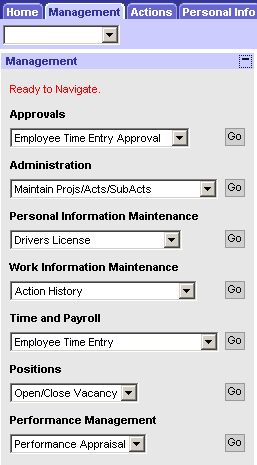
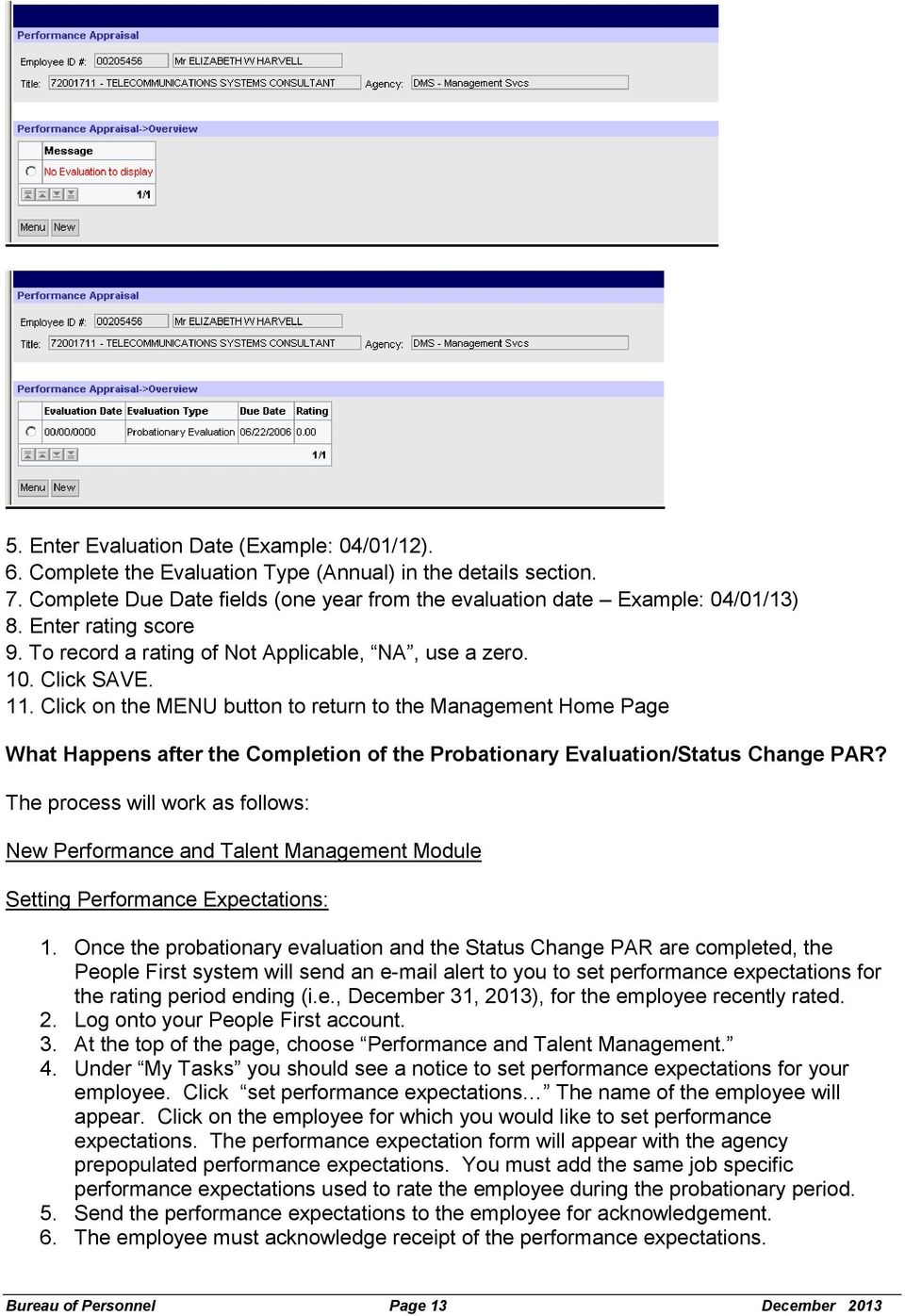
12 It should be noted; however, that if the probationary period is extended, it must be indicated on the Performance Planning and Evaluation Form, which must be completed on or before the end of the original probationary period. The supervisor or rater would assign a rating of N unable to determine to each performance expectation and document that the leave of absence was the reason. Failure to evaluate a probationary employee on or before the end of the probationary period or documented extension will result in the employee successfully completing the probationary period, with an overall Satisfactory rating. Probationary Evaluations Tracking Mechanism The Bureau of Personnel will track probationary evaluations on a monthly basis. The tracking method use will be: Impromptu Reports Current Month Probationary Expiration The report will be sent to all managers and supervisors for proper verification regarding due dates of probationary evaluations. Probationary Performance Evaluations/People First Managers should enter probationary performance evaluation information into the People First system. What Do I need to Do? What steps do I follow to enter evaluation data for an employee? 1. Click on My Direct Reports under the Management Tab. 2. Select an employee for whom you wish to enter data. 3. Click GO next to the Performance Appraisal option. 4. Click on the NEW button in the overview section. Bureau of Personnel Page 12 December 2013

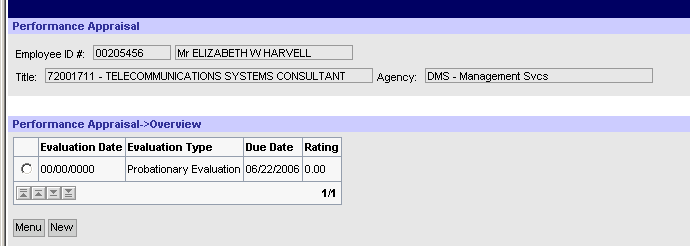
13 5. Enter Evaluation Date (Example: 04/01/12). 6. Complete the Evaluation Type (Annual) in the details section. 7. Complete Due Date fields (one year from the evaluation date Example: 04/01/13) 8. Enter rating score 9. To record a rating of Not Applicable, NA, use a zero. 10. Click SAVE. 11. Click on the MENU button to return to the Management Home Page What Happens after the Completion of the Probationary Evaluation/Status Change PAR? The process will work as follows: New Performance and Talent Management Module Setting Performance Expectations: 1. Once the probationary evaluation and the Status Change PAR are completed, the People First system will send an alert to you to set performance expectations for the rating period ending (i.e., December 31, 2013), for the employee recently rated. 2. Log onto your People First account. 3. At the top of the page, choose Performance and Talent Management. 4. Under My Tasks you should see a notice to set performance expectations for your employee. Click set performance expectations The name of the employee will appear. Click on the employee for which you would like to set performance expectations. The performance expectation form will appear with the agency prepopulated performance expectations. You must add the same job specific performance expectations used to rate the employee during the probationary period. 5. Send the performance expectations to the employee for acknowledgement. 6. The employee must acknowledge receipt of the performance expectations. Bureau of Personnel Page 13 December 2013
14 Note: For additional information (Performance Evaluation Training Videos and User Guides) regarding the People First Performance & Talent Management module, please access at: E. Second-Level Review The second-level review is conducted by the rater s supervisor after the rater has assessed employee performance. In accordance with the rule, the second-level reviewer cannot change the rating. This review is done to ensure the rater is complying with the requirements of the rule and agency policy. The review is conducted prior to the employee receiving the evaluation and the second-level reviewer may make comments on the employee s overall rating and performance. If the rater or second-level reviewer position becomes vacant, or either is on extended leave, the next level manger will be assigned as the rater. (For additional information, please refer to pages 35-26, questions #37-#39). F. Close-out Evaluations 1. Promotion, Demotion, Reassignment or Original Appointment A close-out evaluation shall be conducted in these instances. The rater shall assess employee performance and give a rating for each individual expectation. Once the evaluation is completed, the employee shall receive new expectations and be placed in the current evaluation period for the remainder of the period. If at any time a rater feels there has not been enough time to assess employee performance, a rating of an N None given may be given 2. Lateral Lateral action appointments entail moving to positions with duties and responsibilities that are substantially the same. A close-out evaluation shall be completed for lateral appointments. 3. Significant Change in Duties Any time there are significant changes to the duties and responsibilities of a position that require new expectations to be established, the rater shall close out the current employee evaluation, giving each expectation a rating, and then create new expectations and communicate such expectations to the employee. 4. Change in Agency Any time an employee leaves DJJ and goes to another agency, the rater shall assess performance and complete an evaluation on the departing employee prior to completing the PAR (separating the employee) and prior to the last day worked. The employee will systematically be placed in the current evaluation plan at the new agency and the new rater shall create new expectations for the remainder of the evaluation period. 5. Administrative Close-out When the rater misses the 60-day deadline to complete the evaluation process, the People First system will automatically close out the evaluation in accordance with the rule. 6. Change in Supervisor A close-out evaluation shall be completed when there is a change in supervisor. G. Corrective Action Plans/Performance Improvement Plans (Off-line only) 1. At any time an employee is not performing in accordance with his or her performance expectations, an employee may be placed on a Corrective Action Plan in 60 day Bureau of Personnel Page 14 December 2013
15 increments to improve performance. These plans shall be completed outside of the People First system. a) Corrective Action Plans shall identify the areas in which the employee is not performing and the necessary actions to be taken to improve performance. b) Corrective Action Plans shall be for a specific duration, to be established in 60 day increments to improve to satisfactory performance. b) All Corrective Action Plans must be submitted to the BOP. 2. Once the employee has completed the time period established by the Corrective Action Plan and is successfully performing, the employee will continue on in the evaluation year until the end of the established evaluation period. a) If the employee s performance does not improve by the end of the Corrective Action Plan, the employee may continue the Corrective Action Plan for an additional days or be removed from the position. If the employee fails to satisfactorily complete the Corrective Action Plan, the supervisor should request disciplinary action in accordance with DJJ policy. Note: A sample Corrective Action or Performance Improvement Plan is located on Page 29. H. Hard Copy vs. Electronic Copy The official record shall be considered to be the completed evaluation housed in the People First system. Employees, HR staff and managers will have the ability to print a copy of expectations and evaluations at any time. I. Invalid Evaluations If it is found that an evaluation rating was not done in accordance with the rule and/or agency policy (e.g., the employee never got written notice he was performing poorly; the rater did not follow the procedures, etc.) and a determination is made that a completed evaluation should be marked invalid, a copy of the evaluation shall be printed, sealed in an envelope, marked invalid and placed in the hard copy in the official personnel file. Then a designated member from the BOP shall call the People First Service Center and the employee will be put back into the evaluation phase. At this time, the rater will then be required to re-evaluate the employee correctly and the corrected evaluation will become the most current, official evaluation on record. The electronic audit log will capture the activity in the People First system so the history will be reflected in the electronic record. J. Manager s Notepad This feature is intended to be a tool that raters may use to keep track of employee performance throughout the rating period. It can serve as a place to document employee performance so that the rater may use the information when preparing the final evaluation. This feature is only visible to the rater and when the evaluation becomes final the notes are not shared with the employee. Any notes captured throughout the evaluation period are subject to a public records request and may be obtained by viewing the audit log. Therefore, this feature should only be used to capture activities as they directly relate to assessing performance. Bureau of Personnel Page 15 December 2013
16 K. Employee Quarterly Performance Reviews Optional The Employee Quarterly Performance Review Form (refer to pages 19-19) is still optional in conducting performance reviews for employees performance on at least a quarterly basis. Raters or supervisors may use this form to address performance expectations and objectives and to provide feedback (i.e., comments, guidance and direction) to employees in meeting the performance expectations. L. Calculation of Rating Ratings of a 5 through 1 or N shall be given for individual performance expectations in accordance with Rule 60L-35, F.A.C. The average of each scored expectation will be automatically calculated by the People First system and will be carried out to the second decimal place. M. Performance Management Reports Performance management reports may be generated with the Performance & Talent Management module within People First. For instructions regarding processing performance management reports, may be accessed at: nagement+reports+instructional+guide.pdf Bureau of Personnel Page 16 December 2013

17 References and Aids DJJ Employee Quarterly Performance Review Form Optional Performance Planning & Evaluation Form Components of a Good Performance Evaluation Review Session Managing Unsatisfactory Performance Tips for Providing Counseling to Improve Performance Sample Corrective Action Plan (Performance Improvement Plan) Frequently Asked Questions (FAQs) Rule 60L-35, F.A.C. Glossary of Terms SMART Expectation Worksheet 5-Point Rating Rubric Worksheet For additional information contact: Department of Juvenile Justice Bureau of Personnel 2737 Centerview Drive Tallahassee, Florida Sylvia Baker at (850) Bureau of Personnel Page 17 December 2013

18 FLORIDA DEPARTMENT OF JUVENILE JUSTICE Rick Scott, Governor Wansley Walters, Secretary EMPLOYEE QUARTERLY PERFORMANCE REVIEW Employee Name: PF ID: Program Area: Job Title: Position #: Date of Review: Performance Review Period From: to This Performance Review form is intended as a tool for supervisor or rater to address employee performance expectations and objectives and to provide comment, guidance and direction to employees in meeting those expectations. Supervisors or raters should conduct performance reviews with each employee at least quarterly. This form is not intended as, and does not take the place of, the yearly performance evaluation required by state statute, administrative rule and agency policy. Key Performance Expectations: Performance Achievements: Areas Targeted for Improvement: Supervisor or Rater s Directions to Employee: Bureau of Personnel Page 18 December 2013
19 Employee Response: Please sign below and provide a copy to the employee. Return the original copy to the Bureau of Personnel with the employee s annual performance evaluation. Employee Signature (does not necessarily signify agreement) Supervisor or Rater s Signature Date Date Date of Next Performance Review: Bureau of Personnel Page 19 December 2013
20 Employee Name: DEPARTMENT OF JUVENILE JUSTICE PERFORMANCE EVALUATION SYSTEM PERFORMANCE PLANNING & EVALUATION FORM People First ID Number: Division: Bureau: Section: Class Title: Position Number: Location: Performance Evaluation Period Covered From: To: Evaluation type (check one) Extension of Probationary Period Probationary to Permanent Interim Annual Special Extended Evaluation From: To: Period: PERFORMANCE PLANNING The planning portion of this form is intended to be used by the supervisor or rater to identify, review, and discuss specific performance expectations on which the employee shall be evaluated and for which the employee is responsible for achieving during the evaluation period. The supervisor or rater shall also review the overall and individual rating scales with the employee during the performance planning session. The expectations developed during performance planning are not intended to account for all assignments and work expectations, only those identified as critical or a higher priority. Performance Expectations Performance Expectations are statements that describe satisfactory performance of essential duties or responsibilities listed in the position description or satisfactory demonstration of attributes or values that the agency deems necessary for the accomplishment of its core missions. The following scale shall be used to rate each individual performance expectation. INDIVIDUAL PERFORMANCE EXPECTATIONS RATING SCALE 5 EXCEPTIONAL: Employee consistently exceeds the performance expectation of the position. Examples include, but are not limited to: The employee requires little or no supervision from management in accomplishing his/her tasks and seeks opportunities to enhance the organization. The employee possesses highly advanced job knowledge. The employee is relied upon to solve complex problems and applies creativity and innovative approaches in formulating solutions. 4 ABOVE EXPECTATION: Employee consistently meets and often exceeds the performance expectation of the position. Examples include, but are not limited to: The employee requires minimal supervision from management in accomplishing his/her tasks. The employee possesses a thorough knowledge of the job, and often solves or assists in solving complex problems. 3 MEETS EXPECTATION: Employee consistently meets and may occasionally exceed the performance expectation of the position. Examples include, but are not limited to: The employee requires moderate supervision from management in accomplishing his/her tasks. The employee possesses sufficient knowledge and/or initiative to execute his/her duties and responsibilities. 2 BELOW EXPECTATION: Employee exhibits inconsistent job performance, but has the capacity to improve to meet the performance expectation of the position. Examples include, but are not limited to: At times the employee requires close supervision where he/she should be operating on his/her own. The employee sometimes lacks the initiative, and/or job knowledge to execute his/her duties and responsibilities. 1 UNACCEPTABLE: Employee consistently fails to meet the designated performance expectation. Examples include, but are not limited to: The employee requires close supervision and his/her work requires continual correction. The employee s job knowledge is insufficient to meet daily requirements. N NONE GIVEN: No longer applicable or unable to determine. PERFORMANCE EXPECTATIONS/EVALUATION EXPECTATIONS/5-POINT RATING RUBRIC Customer Service EVALUATION RATING COMMENTS REQUIRED FOR RATINGS 5, 4, 2 or 1 In Interactions with all customers, including youth, parents, stakeholders, co-workers, and/or members of the public, employee responds to information requests or issues in a timely, courteous, honest, professional, and respectful manner and demonstrates a willingness to assist others N Bureau of Personnel Page 20 December 2013

21 . 5 Responded (timely more than 95% of time) with 0 complaints. 4 Responded (timely 90-95% of time) with 0 complaints. 3 Responded (timely 80-89% of time) with 0 complaints. 2 - Responded (timely 70-79% of time) or has 1 customer complaint. 1 Responded (timely less than 70% of time) or 2 or more customer complaints. Dependability N Completes assignments in a thorough, accurate, and timely manner. Adapts well to changes in work environment, work schedules, and work content and load. 5 The employee had no incidents or complaints during the rating period. 4 The employee had 1-2 incidents or complaints during the rating period. 3 The employee had 3-4 incidents or complaints during the rating period. 2 The employee had 5-6 incidents or complaints during the rating period. 1 The employee had 7 or more incidents or complaints during the rating period N N N N N N N Bureau of Personnel Page 21 December 2013
22 N N OVERALL RATING SCALE NUMERIC RANGE OVERALL RATING Outstanding Commendable Satisfactory Needs Improvement 2.49 and below Unsatisfactory OVERALL RATING Adding the score from each performance expectation and dividing the sum by the number of expectations assessed will provide the employee s annual performance rating. Note: Expectations assessed as N should not be calculated as an expectation scored. Calculate as follows: Total of all scores divided by number of expectations scored = (Employee Performance Rating By The Supervisor or rater) OVERALL RATING: Bureau of Personnel Page 22 December 2013
23 PERFORMANCE EVALUATION FORM PERFORMANCE EVALUATION PERIOD COVERED: From To EMPLOYEE S PERFORMANCE RATING BY THE SUPERVISOR OR RATER This is to acknowledge that my supervisor or rater and I have reviewed and discussed the evaluation and rating for the evaluation period covered by this form. Employee s Signature: Date: Employee s Comments (optional) Supervisor or rater s Name (Print) Supervisor or rater s Signature: Date: Supervisor or rater's Comments (optional): Reviewer s Name (Print) Reviewer s Signature: Date: Reviewer s Comments (optional): Bureau of Personnel Page 23 December 2013
24 PERFORMANCE PLANNING FORM Note to Supervisor or rater: Use this form at the beginning of the review period to discuss the performance expectations with the employee for this position. Please provide the employee with a copy of the performance expectations, which are listed in the Performance Planning & Evaluation Form. The employee will be rated on these expectations during the next evaluation period. Ensure the completion of the Performance Planning Form and provide a copy to the employee. Retain the original Performance Planning Form and attach it to the Performance Evaluation Form at the end of the evaluation period. PERFORMANCE PLANNING PERIOD COVERED: From To This is to acknowledge that my supervisor or rater and I have reviewed and discussed: The individual performance expectations by which I shall be evaluated during the evaluation period identified above. The rating scale to be used to rate each individual performance expectation during the evaluations period identified above. The Overall Rating scale, the average of each individually rated performance expectation that shall determine the final overall performance rating. Employee s Name (Print) Employee s Signature: Date: Supervisor or rater s Name (Print) Supervisor or rater s Signature: Date: Bureau of Personnel Page 24 December 2013
25 COMPONENTS OF A GOOD PERFORMANCE EVALUATION REVIEW SESSION How well a supervisor or rater is able to plan for and review the performance of the people who report to him or her will have an important and direct effect on how well employees perform their jobs and how satisfied they are working for the supervisor or rater, and the organization. The review session itself can be the single most significant part of the evaluation process. There are three reasons why the review session is so important. First, the employee will remember the session and what was said because it is a prime indicator of the supervisor or rater s attitude, perceptions and assumptions about the employee. The employee s reaction to the information shared by the supervisor or rater will leave a lasting impression as to how the supervisor or rater will view the employee in the future. Second, the employee will use the information from the review session to make assumptions as to how the supervisor or rater values or devalues work. If little positive feedback is given, the employee may presume that quality work is not valued. If poor work is overlooked, the employee likewise may presume quality work is not valued. If, on the other hand, there is little or no feedback, the employee is left wondering as to whether their work was good, bad, valued or not valued, necessary or may assume their work is acceptable when it is not. Third, because the supervisor or rater represents the entire organization to the employee, employees often presume that the supervisor or rater s attitude and behavior is representative of all managers. Supervisors or raters must be able to communicate effectively if the system is to work. Employees too, must communicate. Active listening, coupled with a positive attitude will go a long way in making the performance evaluation review session a success. RESPONSIBILITIES OF THE SUPERVISOR OR RATER It is the supervisor or rater s responsibility to make sure that all of the employees who report to him or her know exactly what is expected of them, the basis on which their job performance will be reviewed and that they will receive regular and constructive feedback and coaching from the supervisor or rater as necessary throughout the review period. It is also the supervisor or rater s responsibility to prepare a formal, written performance evaluation of each employee s performance at least annually and to meet with each employee in order to discuss the performance evaluation with them. If this evaluation is completed correctly, the contents discussed in the evaluation review session should consist largely of information previously discussed with the employee. There should be few, if any, surprises for the employee when the annual review session is conducted. Bureau of Personnel Page 25 December 2013
26 MANAGING UNSATISFCTORY PERFORMANCE The Performance Evaluation System is a method for reviewing, planning and evaluating employee job expectations and performance. The system enables employees to receive feedback concerning performance of assigned duties and responsibilities. It informs them of their strengths and areas of needed improvement in job performance, helps to identify current and future training needs, and provides documentation for awarding discretionary merit increases, and lump sum bonuses in accordance with Section (2), Florida Statutes. At any time, if an employee is not meeting expectations, the supervisor or rater shall inform the employee in writing of deficiencies and identify corrective action to be taken, prior to the end of the evaluation period, in order to facilitate the employee s progress toward meeting performance expectations. This document was created to assist supervisors or raters in addressing problem performance. Define the Problem What specifically is the employee doing wrong? Do: Have first-hand knowledge Observe performance for yourself Know the specific areas of weakness Know how extensive the problem is Remain calm Don t: Talk in generalities Pick isolated incidents Rely on hearsay Allow yourself to become emotional. Determine the Cause Once you have defined the problem, ask yourself the following questions: 1. Does the employee know performance is unsatisfactory? 2. Does the employee know what is supposed to be done and when? 3. Are there obstacles preventing the employee from performing? 4. Does the employee know how to do the task? 5. Could the employee perform the task if he or she wanted to? If the answer is Yes to each question, then the supervisor or rater is responsible for redirecting the employee s behavior through coaching and taking appropriate action if the behavior does not improve. If the answer is No to any of the questions, then the supervisor or rater should provide the employee with feedback to identify the problems; develop a written work plan to identify what needs to change; remove any obstacles preventing the employee from performing; and provide any necessary training. Once this has taken place, the supervisor or rater should see improvement in performance. If no improvement occurs, then the supervisor or rater should take appropriate action. There is not a requirement to place an employee on a work plan prior to taking disciplinary action. Bureau of Personnel Page 26 December 2013
27 TIPS FOR PROVIDING COUNSELING TO IMPROVE PERFORMANCE Once a performance problem has been identified and the cause as been determined, it then becomes time to develop an effective performance plan to bring the employee s performance back into productivity. The following are tips to assist supervisors or raters in this process: Ideas for keeping performance evaluations up to date and free from legal challenges. 1. Make sure the deficiencies actually exist and they are not perceived deficiencies. 2. Be on the lookout for performance standards that are unclear, subjective, or not communicated to everyone. Ensure standards can be observed and that there are job-related measurements and not assessed on personal traits or individual feelings. 3. Avoid misunderstandings over what must occur. Does Below Expectation or Needs Improvement automatically lead to termination? Does it place time limits for needed improvements? Solidify the guidance to improve performance by providing a step-by-step approach for necessary improvements. Timing is important evaluations that refer to Outstanding work performance or documentation that recognizes the Exceptional or Commendable performance followed closely by a severe drop in performance should be checked immediately. Some supervisors or raters tend to use evaluations as a management tool, and not as a source of information to assist employees. Supervisors or raters tend to bring their own values to the process. Here are some of the reasons (not necessarily valid ones) that supervisors or raters may have for inflating the evaluation: 1. To boost the spirits of an employee who has been distracted by a personal problem 2. To avoid confrontations with difficult employees 3. To get difficult employees promoted out of the section 4. To hide personnel problems from higher level managers 5. To ensure that all employees remain eligible to receive legislative pay adjustments It is important that employees understand that a value of 3 means the employee is consistently meeting (and sometimes exceeding) the expectation in question. Additionally, an overall rating in the Satisfactory range is the norm and does not equate to being just a C rather than a B or A student. Here are some of the reasons (once again not necessarily valid ones) supervisors or raters may have for reducing the evaluation: 1. To subdue a troublesome employee 2. To induce fear as a motivation to improve performance Bureau of Personnel Page 27 December 2013
28 3. To encourage a problem employee to resign 4. To create a record to justify an impending discharge Beware of poor communication. An evaluation must be built around clear objectives. The employee must understand the process, the frequency of the evaluation, and the method used to measure performance. The supervisor or rater must have a clear idea of what the organization considers acceptable and unacceptable performance, what should be considered a measure, and how to measure performance and set goals for improvement. Ask the employee to help pinpoint what tasks are important to the job. When the employee takes an active role, the supervisor or rater is less likely to be accused of being subjective or biased. Separate job performance from employee personality. Evaluate only on the job work. Be honest. If the supervisor or rater attempts to sugarcoat an evaluation of employee performance when it really is unacceptable and then attempts to take action to remove the employee from the position a few months later for poor performance, the previous evaluation cannot provide documentation to uphold poor performance. Keep all paperwork in order. Look upon record keeping as part of a supervisor or rater s job. If the agency is ever challenged, they will have to produce solid and accurate records to defend its position. This means keeping documentation on all staff members, not just singling out certain employees. Use it as a work status or activity report. This means taking accurate accounts of job performance on assignments given. If counseling sessions or status meetings are conducted with an employee, it is advisable to summarize the session in a memo for and provide the employee with a copy. Bureau of Personnel Page 28 December 2013
29 Sample Corrective Action Plan (Performance Improvement Plan) Performance Expectation Deficient Areas/Causes Solution Progress Will provide correct responses to customer requests within two days. Providing incorrect information. Cause: Insufficient knowledge. Not responding to s within the expected time frame. Cause: Disorganization s are lost in in-box. Complete training with subject matter experts within 60 days. Complete Outlook training for managing s within 30 days. 9/1/14: Training complete. Copy me on all responses for the next 5 days. 9/1/14: Training complete, but improvement is still needed. Suggest using task list. Reassess in 2 weeks. Bureau of Personnel Page 29 December 2013
30 Frequently Asked Questions (FAQs) Performance Evaluation Process 1. Is the performance evaluation system a part of People First? Yes. Managers and employees will log into the People First system as they currently do. Once in the system, participants will access the performance evaluation process by selecting the Performance and Talent Management tab in People First. 2. Are agencies expected to use the performance evaluation process within People First? Yes. All state personnel system agencies will be expected to use the People First system to conduct performance evaluations, which will support enterprise wide consistency and continuity in performance management practices. 3. Does work information (e.g., work address, reporting relationships, etc.) contained in the People First system impact the performance evaluation process? Yes. The work information contained in People First is used to drive key activities. For example, the participant s work address is used to send automatic s when the participant needs to complete a performance evaluation activity. The data must be accurate in People First for the employee and manager to effectively complete the performance evaluation process. 4. What performance evaluations are processed in People First? Annual and probationary performance evaluations are processed using People First. Other agency-specific performance evaluations are not included. For example, interim, trainee and special recognition evaluations will be handled outside of People First. 5. Is there a formal process for midpoint performance evaluations in People First? No. Since the purpose of a midpoint performance evaluation is to promote ongoing communication between managers and employees, the system will permit (and managers are encouraged to make) relevant notes throughout the performance evaluation period on how the employee is performing with respect to each performance expectation. Additionally, automated s are sent to managers on a quarterly basis reminding them to provide feedback to their employees throughout the performance evaluation period; (managers should provide constant feedback and not wait for reminders). For this reason, the standard performance evaluation period as captured in the system will not include a formal midpoint performance evaluation process. However, managers are expected to assess and meet with employees on a more frequent basis than annually. 6. Does the performance evaluation system include Selected Exempt Service (SES) and Senior Management Service (SMS) employees? Yes. In addition to Career Service (CS) employees, all SES and SMS employees (excluding agency heads) are included in the standard performance evaluation process. There will not be a separate performance evaluation process or evaluation form for SES or SMS employees. 7. Does the performance evaluation system include OPS employees? No. At this time OPS employees are not included. 8. Are overlapped employees and employees sharing a position (multiple employees in one position) able to use the performance evaluation system? Yes. Multiple employees that are overlapped in one position and employees sharing a position are able to use the performance evaluation system in the same manner as all other employees. Bureau of Personnel Page 30 December 2013
31 9. Are overlapped managers and managers sharing a position (multiple managers or second-level managers in one position) able to use the performance evaluation system? Yes. When a manager or second-level manager position is overlapped, the manager s evaluation activities (tasks) will be assigned alphabetically by the manager s first name (ONLY assigned to one manager). If the other manager is responsible for completing the evaluation activities, each process (set performance expectations and performance evaluation) must be delegated to the other manager. 10. Is there a standard annual performance evaluation period? Yes. Effective July 1, 2013, the standard statewide performance evaluation period is July 1 June Is there standard performance evaluation periods for probationary employees? Yes. While the probationary period will not change (the status expiration date of probationary employees will still be driven by their respective appointment date), employees are placed into a probationary plan based on the calendar month they start their probationary status. For example, an employee with an original appointment date of Aug. 11, 2014, who is required to serve a one-year probationary period will have a (probationary) status expiration date of Aug. 10, 2015, but the employee will be placed in a probationary performance evaluation period of Aug. 1, 2014, to July 31, Prior to the status expiration date of Aug. 10, 2015, the manager will receive automated notices from the system to complete the probationary performance evaluation. NOTE: The status expiration date will be pulled from the Appointment Status screen in People First. This date must be accurate in the People First system in order for the employee to be placed in the correct probationary performance evaluation period. 12. Are employees with a probationary period beginning prior to July 1 use the Performance Evaluation system in People First? No. All employees in a probationary status prior to July 1, 2013, will be handled outside of People First until the Personnel Action Request (PAR) is completed to move the employee to permanent status or the employee is appointed to a new probationary period. For example, an employee with an original appointment date of Feb. 11, 2013, and a Feb. 10, 2014, expiration date will have their probationary evaluation conducted outside of People First using the agency s current process. Once the PAR is completed to move the employee to permanent status (on or after July 1, 2013), the employee will be moved into the agency s standard plan within People First. o Using the same example above, if the employee is appointed to a new probationary status on or after July 1, 2013, the employee will be moved into the appropriate probationary plan within People First. 13. What tracking mechanism should be used to track due dates of probationary evaluations? The Bureau of Personnel will track probationary evaluations on a monthly basis. The tracking method use will be: Impromptu Reports Current Month Probationary Expiration 14. If the probationary period is extended, what type of evaluation should be completed to note the extension of the probationary period? If the supervisor or rater is unable to assess a probationary employee s performance at the end of the probationary period, the probationary period may be extended in accordance with agency Bureau of Personnel Page 31 December 2013
32 policy. The supervisor or rater must fill out the employee information portion of the Performance Planning and Evaluation Form. They may use the Interim or Special evaluation type. Note: The extended evaluation is completed off-line (paper). 15. How should performance evaluations be administered when an employee takes an extended leave of absence? Normally, a supervisor or rater expects to observe the employee s performance over the course of the twelve months in the evaluation period. However, an extended leave of absence during any point in an evaluation period could impact the supervisor or rater s ability to assess performance. Consequently, supervisors or raters need to consider the type of leave taken, how long the employee was absent during the rating period, and when (during or after the evaluation period) did the employee return. If the supervisor or rater is comfortable that these factors did not impact the ability to assess employee performance, then the performance evaluation should be administered the same as usual. In no case shall leave protected by state or federal law (USERRA, FMLA, etc.) be used as a negative factor in assessing performance. When supervisor or raters are aware that an employee will be taking extended leave, an Interim (off-line) evaluation should be conducted to close out the evaluation period or, in the case of a probationary employee, assess performance up to the time the employee goes on extended leave. This is critical as it may have an impact on future employment actions including legislatively mandated pay increases and layoffs. As with all evaluations, any and all performance deficiencies or causes for special recognition that the supervisor or rater has been documenting should be noted on this evaluation. If an Interim evaluation is not conducted prior to the employee s extended leave of absence, the supervisor or rater should assign a rating of N None Given to each performance expectation at the time of the agency designated evaluation date. It should be documented that the N None Given rating is due to the supervisor or rater s inability to assess performance because of the employee s leave of absence. Assigning an N None Given documents that the statutory requirement for annual performance evaluations is being met but does falsely rate an employee s performance. 16. May an employee with probationary status have the probationary period extended for a sufficient period of time to assess performance when a leave of absence impacts the ability of a supervisor or rater to assess performance? Yes, except as noted below. An employee with probationary status may have the probationary period extended for a sufficient period of time to assess performance, in accordance with State Personnel System program guidelines (Extension of Probationary Period for Career Service Employees, effective April 17, 2007). However, court interpretations of federal provisions prohibit employers from extending probationary periods for employees due to the use of FMLA or military leave, because such extensions interfere with employees FMLA and military leave rights by discouraging their use. (Schmauch v. Honda of America Manufacturing, Inc., 295F. Supp.2d 823[S.D. Ohio 2003]) Therefore, the supervisor or rater should assign a rating of N None Given to each performance expectation (and document that the leave of absence was the reason). Because section (1), F.S. requires employees to complete at least a 1-year probationary period before attaining permanent status, and Rule 60L (3), F.A.C., provides that failure to evaluate a probationary employee on or before the end of the probationary period will result in the employee successfully completing the probationary period, employees on federally protected forms of leave will consequently attain permanent status simply because of the passage of time that takes them to the end of the 1-year probationary period. In these cases, there is no correlation to satisfactory performance, since the assigned Bureau of Personnel Page 32 December 2013
33 rating should be an N-None Given. 17. At the end of the extension, what type of evaluation should be completed? At the end of the extended probationary period, provided the supervisor or rater can assess the performance of the employee, a Probationary to Permanent evaluation shall be completed. The supervisor or rater shall assess the employee s performance in accordance with the rating scale provided in the rule. If the employee receives an overall rating of Satisfactory or above, the employee will attain permanent status. 18. Are all steps within the performance evaluation process completed in People First? No. While both the performance expectations setting and performance evaluation processes will be completed in People First, managers will continue to discuss with the employee the employee s performance expectations, job performance throughout the year and performance evaluation. The use of an electronic system does not remove a manager s responsibility to conduct all performance activities. 19. Are position descriptions captured in the Performance and Talent Management system? No. While position descriptions should always be reviewed and updated, if necessary, as part of the performance evaluation process, at this time they will not be stored or maintained in the Performance and Talent Management system. 20. Do participants receive an electronic notification when an action is required during the annual and probationary performance evaluation processes? Yes. System generated s are sent to the manager, second-level manager and employee when action is required. The work address in People First is used for all notifications related to the performance expectations setting and performance evaluation processes. Additionally, a task due will appear in the My Tasks section of the Performance and Talent Management tab in People First. Consequently, it s critical that work addresses are accurately and timely maintained in People First to ensure participants are notified when action is needed. NOTE: Notifications will only be sent to the manager, reviewer and/or employee when the work address is maintained in People First. 21. What steps are included in the performance expectations setting process? Step 1: Manager creates the employee s performance expectations. Step 2: Manager discusses the performance expectations with the employee. Step 3: Manager sends the performance expectations to the employee. Step 4: Employee acknowledges receipt. 22. Do agencies have the ability to assign common performance expectations to all employees in the agency? Yes. Prior to the performance evaluation period beginning, performance expectations can be assigned to all employees. These types of performance expectations are referred to as agency performance expectations. 23. Can performance expectations be assigned to specific employee groups other than all employees in the agency, such as by the broadband code, sworn indicator, supervisor indicator, etc.? No. Agency performance expectations can only be assigned to all employees in the agency. Bureau of Personnel Page 33 December 2013
34 24. Can changes be made to agency performance expectations during the performance evaluation plan year? No. Agency performance expectations must be determined prior to moving employees into the performance evaluation plan. Once the performance evaluation period has started, updates to the agency performance expectations will require the agency to conduct a close-out evaluation on all employees. At that point, the agency s managers would establish the new performance expectations with the employee. However, prior to the start of each annual performance evaluation period, agencies will have the opportunity to provide new or revised agency performance expectations. The human resource staff will be responsible for reviewing agency performance expectations and for providing updates to People First prior to the new performance evaluation plan beginning. Prior to the initial implementation, agencies were asked to designate two human resource staff members that will be authorized to provide updates for agency performance expectations. 25. Can job specific performance expectations be added to the employee s individual performance evaluation? Yes. During the performance expectations setting process, job specific performance expectations can be added by the employee s manager. 26. Does the second-level manager have the ability to update or add performance expectations to an employee s performance evaluation? Yes. Second-level managers have access to update or add performance expectations in the event that the manager is unable to complete this step. 27. Can performance expectations be changed after the employee has acknowledged receipt? No. Once the expectations are acknowledged by the employee, the manager can no longer make updates. If a situation occurs that requires individual performance expectations to change during the evaluation period, the manager is required to close out the evaluation and set new expectations. 28. Does human resource staff have the ability to update or add performance expectations to an employee s performance evaluation? No. Human resource staff will have statewide View Only access and will not be able to update performance expectations. 29. Are there a required number of performance expectations for each performance evaluation? No. There is no system requirement for a specific number of performance expectations. 30. Can the agency limit the number of performance expectations a manager can create? No. There is no system requirement for a specific number of performance expectations. 31. Will performance expectations set by the manager require approval prior to sending to the employee for acknowledgment? No. There is no approval process for the second-level manager when setting performance expectations. 32. Can job-specific performance expectations be copied from one performance evaluation period to the next performance evaluation period? Yes. During the performance expectations setting phase, managers have the ability to copy job specific performance expectations from the previous year s performance evaluation to the new Bureau of Personnel Page 34 December 2013
35 performance evaluation. Agency performance expectations are systematically populated at the beginning of each plan year and cannot be copied by the manager from plan year to plan year. 33. Are job-specific performance expectations displayed in a particular order? Yes. Performance expectations are displayed alphabetically by expectation title. If a different order is needed, managers should include numbers (e.g., 01, 02, 03 ) as the first characters in the expectation title. 34. Are performance expectations visible as additional job specific expectations are added? Yes. Each time the manager selects Add Performance Expectation, all current performance expectations displayed will remain but are presented in a collapsed format. To make the performance expectations visible, the manager should select Expand All Expectations link. 35. What steps are included in the performance evaluation process in People First? Step 1: Manager documents the employee s job performance throughout the performance evaluation period; (use of the system for this step is optional). Step 2: Manager completes the employee s performance evaluation. Step 3: Second-level manager completes the review of the employee s performance evaluation. Step 4: Manager sends the performance evaluation to the employee to acknowledge receipt. Step 5: Employee acknowledges receipt of the performance evaluation, completing the performance evaluation process. 36. Are the manager and second-level manager systematically assigned in the performance evaluation process? Yes. Both the manager and second-level manager are assigned based on the reporting relationships in People First. The manager (rater) is the supervisor of the employee and the second-level manager (reviewer) is the supervisor of the rater, based on the reporting relationships in People First. 37. Are the manager and second-level manager systematically assigned if one of the positions is vacated? Yes. If either the manager (rater) or second-level manager (reviewer) (or both) positions become vacant, the next level manager will be assigned as the rater. For example, if the manager s position is vacant, the second-level manager will become the rater and the third-level manager will become the reviewer. If the vacancy occurs during the evaluation period, any information previously entered on the evaluation will be available to the new manager. 38. Can the manager or second-level manager be delegated to a different employee? Yes. When a manager or second-level manager task is due for a specific employee, it can be delegated to another employee. Once the task is delegated to another employee, the task will appear for the employee to complete. 39. Is it appropriate for a manager or second-level manager to delegate a task (to set performance expectations or to complete an evaluation) because they do not want to complete the task? No. Each manager must use professional judgment when deciding to delegate a task to another employee. Generally, the employee s current manager should complete the evaluation and not delegate the responsibility. In certain situations, delegation may be appropriate. For example, Bureau of Personnel Page 35 December 2013
36 when the manager is on extended leave or the employee worked on a special project under a different manager. 40. Does a task remain available to the employee for the entire evaluation period once it has been delegated? Yes. When delegating a task, the manager has the option to set a time limit. If no time limit is set, the delegation will remain active until the task has been completed. 41. Once the manager delegates a task, will the manager continue to have access to complete the task? Yes. Both the manager and the employee who has been delegated the task will have access to complete the task. 42. Can the manager make notes on the employee s job performance throughout the performance evaluation period? Yes. To support ongoing assessment of performance, the manager has the option to add notes for each performance expectation during the performance evaluation period. Only the manager can see the notes, and the notes will not be included on the final performance evaluation that is sent to the second-level manager and employee. Using the notes feature can also facilitate the manager s ability to track areas of concern to which the employee may need timely notification to correct, pursuant to Rule 60L (d), F.A.C. 43. Will the standard 5-point rating scale continue used with the performance evaluation process within People First? Yes. The same rating scale, as provided in Rule 60L-35, F.A.C., is used. 44. Are comments required for all performance expectation ratings? No. In accordance with Rule 60L , F.A.C., comments are not required for ratings of 3. However, any score other than a 3 will comments, including ratings of N (None Given). 45. Are ratings of N None Given included in the average for the Overall Rating of an employee? No. Only the numerical ratings of 1 through 5 are included in the Overall Rating score for the employee. 46. Does a rating of N None Given have a numerical equivalent for purposes of legislatively mandated pay increases? A number is never reflected on the actual performance evaluation. It does not count for the overall rating. Federal provisions, specifically those in USERRA and FMLA, require that employees be held harmless for using federally protected leave and that the employee shall receive any pay increases, differentials, step increases, merit increases, or periodic increases that the employee would have attained with reasonable certainty had he or she remained continuously employed during the period of service. Therefore, when an employee is on extended leave and receives a rating of N None Given, the employer must look to the most recent performance evaluation for which the employee received a rating. Although rated an N due to their extended leave of absence, employees who received a rating of 3, 4 or 5 should be considered to have satisfactory performance for purposes of legislatively mandated pay increases because there is nothing to suggest the employee would have performed below satisfactory nor is there a certainty that they would have performed above that level. Bureau of Personnel Page 36 December 2013
37 However, if an employee s most recent numerical evaluation was less than satisfactory (a 1 or 2), there is no reasonable certainty that performance would improve to a satisfactory level. Therefore, these employees should not be considered for any employment action that requires satisfactory performance until such time as they return to work and are subsequently evaluated and rated at a 3 Satisfactory or above. Employees who receive an N None Given rating and have no prior numerical rating, (e.g., the probationary employee that attains permanent status while out on military leave) will be presumed to have successfully performed their established job duties, even though they do not have an overall numerical rating. Therefore, these employees should be considered eligible for any legislatively mandated pay increase tied to successful performance of job duties. This is in accordance with Rule 60L (3), F.A.C., that requires employees to be notified of performance deficiencies that could result in a Below Expectation or Unacceptable rating prior to the end of the evaluation period. Absent anything in writing indicating the employee was performing below a satisfactory level, it can be presumed the employee was performing at least at a satisfactory level prior to the extended leave of absence. 47. Do managers have the ability to complete annual performance evaluations once the standard performance evaluation period has ended? Yes. In accordance with the Rule 60L (2)(b), F.A.C., managers have 60 days from the end of the annual performance evaluation period to complete performance evaluations. 48. Do managers have the ability to update an evaluation after the 60 day period from the end of the standard performance evaluation period? No. Following the 60 day period, the performance evaluation will be administratively closed and the manager will no longer have access to update the performance evaluation. 49. Does the second-level manager have access to change the manager s evaluation of the employee during the review stage? No. During the review stage, the second-level manager can view the performance evaluation and provide overall comments on the employee s performance, but will not be able to change the manager s scores or comments, pursuant to Rule 60L (e), F.A.C. 50. Is the manager able to complete the performance evaluation process if the employee is unable to or refuses to acknowledge receipt of either the performance expectations or performance evaluation? Yes. If the employee is unable to acknowledge receipt or refuses to acknowledge receipt, the manager has the ability to complete the performance evaluation, in accordance with Rules 60L (7) and (8), F.A.C. However, the manager is required to add comments explaining why they are completing the process for the employee. This should only take place when the employee is unable or refuses to acknowledge receipt. 51. Can the employee add comments to the performance evaluation? Yes. Once the performance evaluation is sent to the employee for acknowledgement, the employee has the opportunity to include comments prior to acknowledging receipt of the completed performance evaluation, pursuant to Rule 60L (7), F.A.C Is the manager notified when the employee acknowledges receipt of the performance expectations and evaluation? Yes, once the employee acknowledges the performance expectations and has been placed into the evaluation process, the manager will receive an notification to begin monitoring and evaluating the employee. Once the employee has acknowledged receipt of the completed evaluation, the manager will receive an notification. Bureau of Personnel Page 37 December 2013
38 53. Does the system have the ability to include additional attachments such as Word documents or other documents? No. Attachments cannot be added to the performance evaluation in People First. However, the system does have copy and paste features when adding notes and comments. 54. Can a close-out performance evaluation be completed when an employee changes positions in the same agency during the performance evaluation period? Yes. If a close-out evaluation is conducted, it must be completed prior to the employee s last day in the position. When appointment actions of original, promotion, demotion and reassignment are completed, new performance expectations will need to be created for the employee. 55. Can a close-out performance evaluation be completed when an employee changes agencies during the performance evaluation period? Yes. When a close-out evaluation is conducted, it must be completed prior to the employee s last day at the exiting agency. Once the appointment PAR is completed, the employee will be placed in the appropriate performance evaluation plan at the new agency. 56. Is a close-out performance evaluation required when an employee s supervisor changes during the performance evaluation period? Yes. DJJ requires a close-out performance evaluation when an employee s supervisor changes during the evaluation period. 57. Are agencies required to print and keep a hard copy of the performance evaluation in the employee s personnel file? No. Many paper transactional documents that agencies historically maintained in a traditional personnel file for pay, appointment, status, and other employee actions (e.g., performance evaluations) are being rendered obsolete by the automation of numerous human resource processes in the People First system. Consequently, the electronic version of the performance evaluation that will reside in People First is the official (master) record of completed performance evaluations for all Career Service, Selected Exempt Service, and Senior Management Service employees. However, the system will allow a hard copy of the completed performance evaluation form to be printed so that the manager can discuss it with employees who do not have computer access. This function also allows all employees to print and retain an administratively convenient copy, if desired. In addition, the ability to print a hard copy allows agencies to respond to public record inquiries where the employee s completed performance evaluation(s) have been specifically requested. Please note that managers still complete the performance evaluation process using the system, even if the employee does not have access to a computer. In cases where an employee cannot electronically acknowledge receipt of the completed performance evaluation, the manager will be responsible (and accountable) for notating in the system that the completed performance evaluation was discussed with the employee. 58. Do employees have access to view previous performance evaluations completed in People First? Yes. Active employees have access to all performance evaluations completed in People First on or after July 1, To access, employees can select the Performance Evaluation icon in the About Me Section in Performance & Talent Management. Bureau of Personnel Page 38 December 2013
39 59. Are plans of action for performance improvement included in the performance evaluation system? No. Corrective Action Plans (CAPs) are included in the performance evaluation process in the People First system as part of the initial implementation. 60. What role will the human resource staff have in the performance evaluation process? Human resource staff (A, H, U, X and Y security role codes) have statewide View Only access and are responsible for providing policy guidance to agency employees and for ensuring that all work units within the agency are timely completing performance processes (oversight). They will only be able to update performance evaluations for their direct reports structure (manager/second-level manager). Technical assistance questions should be directed to the People First Service Center. 61. Do OPS employees and contractors have access to the performance evaluation system? No. OPS employees and contractors do not have access to the performance evaluation system; however, these employees will have access as a manager and/or reviewer. 62. Are reports available in the People First system for the performance evaluation process? Yes. Reports are available for managers, upper-level managers (e.g., agency heads, directors) and human resource staff to monitor the performance process. 63. Is there an appeal process for performance evaluations? Employees may decide to file an agency grievance under the Career Service grievance procedure. Employees with union rights may have the option of filing a grievance under the applicable collective bargaining agreement. If an employee files a grievance concerning their performance evaluation, the BOP may be contacted for assistance. Bureau of Personnel Page 39 December 2013
40 RULES OF THE DEPARTMENT OF MANAGEMENT SERVICES PERSONNEL MANAGEMENT SYSTEM CHAPTER 60L-35 PERFORMANCE EVALUATION SYSTEM 60L Scope and Purpose 60L Definitions. 60L Minimum Requirements. 60L Career Service. 60L Selected Exempt Service. 60L Transitional Provision 60L Scope and Purpose. This chapter sets forth the rules governing a uniform Performance Evaluation System, for reviewing and evaluating the job performance of employees in the state s Career Service and employees in the Selected Exempt Service covered by collective bargaining agreements. The Performance Evaluation System enables employees to receive feedback concerning performance of assigned duties and responsibilities. It informs them of their strengths and areas of needed improvement in job performance, identifies current and future training needs, and provides documentation for awarding discretionary merit increases, and lump sum bonuses in accordance with Section (2), Florida Statutes. Nothing in this rule shall limit the ability of an agency to take disciplinary action in accordance with Chapter 60L-36, Florida Administrative Code. Specific Authority , (3), FS. Law Implemented (2)(b)5., , (1)(b) FS. History New L Definitions. For the purpose of administering this chapter, the following definitions shall apply: (1) Agency Designated Evaluation Date The date selected by an agency which begins the 60-day period within which annual evaluations shall be completed. An agency may select up to four (4) designated evaluation dates per calendar year in order to accommodate operational needs. plan. (2) Evaluation Period The annual period of time covered by the performance (3) Overall Rating The employee s level of performance for the evaluation period, which is derived as follows: (a) Calculate the average of all of the individually-rated performance expectations. In calculating this average, all digits three or more places to the right of the decimal shall be dropped. No rounding shall be used in this calculation. (b) Locate the numeric range in which the calculated average falls on the below chart and assign the corresponding overall rating. Bureau of Personnel Page 40 December 2013
41 OVERALL RATING SCALE NUMERIC RANGE OVERALL RATING Outstanding Commendable Satisfactory Needs Improvement 2.49 and below Unsatisfactory (4) Performance Evaluation A written assessment of an employee s performance of assigned duties and responsibilities as reflected in the employee s performance expectations and documented on a performance evaluation form. (5) Performance Expectation A statement that describes satisfactory performance of an essential duty or responsibility as listed in the position description or satisfactory demonstration of an attribute or value that the agency deems necessary for the accomplishment of its core missions. For purposes of this rule, a duty or responsibility is essential if it must be successfully performed in order to fulfill the requirements of the position. (6) Performance Plan A written notification prepared by the rater that identifies the performance expectations by which the employee will be evaluated during the evaluation period. (7) Rater The employee s current immediate supervisor or a designated managerial employee who has knowledge of the employee s duties, responsibilities and job performance. Specific Authority , (3), FS. Law Implemented (2)(b)5, , (1)(b) FS. History New L Minimum Requirements. (1) The rater shall conduct a performance planning session with the employee to identify the performance expectations by which an employee shall be evaluated and to review the performance expectations and rating scale. The rater shall also provide an opportunity for employee feedback regarding what is expected of the employee in the position. A performance plan shall be signed by the rater and the employee, indicating that the performance expectations have been discussed. A copy of the signed performance plan shall be made available to the employee. In the event an employee refuses to sign the performance plan, the rater shall make a signed and dated notation on the plan that the employee refused to sign. (2) The rater shall manage performance by: (a) Conducting an oral performance planning session with each employee at the beginning of every evaluation period and providing to the employee a copy of the corresponding performance plan. (b) Conducting written and oral performance evaluations of his/her employees at least annually. Such evaluations must be completed within sixty (60) calendar days following the agency designated evaluation date. (c) Providing employees with coaching and meaningful feedback regarding job performance throughout the evaluation period. Bureau of Personnel Page 41 December 2013
42 (d) Timely informing the employee in writing of performance expectation deficiencies that could result in a Below Expectation or Unacceptable rating and the necessary corrective action to be taken prior to the end of the evaluation period. (e) Meeting in person with the employee, when practicable, for performance planning and performance evaluation. (3) At a minimum, a written performance evaluation shall include: (a) A rating of the employee s job performance during the evaluation period for each performance expectation identified in the performance plan. Each performance expectation shall be measured using the following scale. RATING NUMERIC SCALE INDIVIDUAL PERFORMANCE EXPECTATIONS RATING SCALE DEFINITION AND EXAMPLES Exceptional 5 Employee consistently exceeds the performance expectation of the position. Examples include, but are not limited to: The employee requires little or no supervision from management in accomplishing his/her tasks and seeks opportunities to enhance the organization. The employee possesses highly advanced job knowledge. The employee is relied upon to solve complex problems and applies creativity and innovative approaches in formulating solutions. Above Expectation 4 Employee consistently meets and often exceeds the performance expectation of the position. Examples include, but are not limited to: The employee requires minimal supervision from management in accomplishing his/her tasks. The employee possesses a thorough knowledge of the job, and often solves or assists in solving complex problems. Meets Expectation 3 Employee consistently meets and may occasionally exceed the performance expectation of the position. Examples include, but are not limited to: The employee requires moderate supervision from management in accomplishing his/her tasks. The employee possesses sufficient knowledge and/or initiative to execute his/her duties and responsibilities. Below Expectation 2 Employee exhibits inconsistent job performance, but has the capacity to improve to meet the performance expectation of the position. Examples include, but are not limited to: At times the employee requires close supervision where he/she should be operating on his/her own. The employee sometimes lacks the initiative, and/or job knowledge to execute his/her duties and responsibilities. Unacceptable 1 Employee consistently fails to meet the designated performance expectation. Examples include, but are not limited to: The employee requires close supervision and his/her work requires continual correction. The employee s job knowledge is insufficient to meet daily requirements. N None given No longer applicable or unable to determine. (b) Comments relating to the employee s job performance for each performance expectation rating of Exceptional and Above Expectation. (c) Comments relating to the employee s job performance for each performance expectation rating of Below Expectation and Unacceptable, as well as prescribed developmental activities and corrective action(s) for areas where improvement is required. Bureau of Personnel Page 42 December 2013
43 (d) The overall rating of the employee s job performance during the evaluation period, which shall not be adjusted or affected by the ratings of any other employees being rated. (e) At the agency s discretion, performance plans and evaluations may be reviewed by a higher-level authority and comments may be provided. However, completed performance plans and evaluations shall not be changed by a higher-level authority. (4) Employees with an overall rating of either Needs Improvement or Unsatisfactory shall be considered to have not met their performance expectations for the position during that evaluation period. (5) Other than probationary employees addressed in paragraph 60L (3), F.A.C., employees who do not receive a performance evaluation within sixty (60) calendar days following the agency designated evaluation date shall be considered to have met their performance expectations as documented on their performance plan, and will receive a rating of Meets Expectation for each performance expectation and an overall rating of Satisfactory. (6) A description of training and educational opportunities for the employee may be included as part of the performance planning/evaluation process. Training opportunities may include those available under Sections and , FS. (7) The performance evaluation shall be signed by the rater and the employee. The signature of the employee shall indicate only that the employee s job performance has been discussed with the employee and does not imply that the employee agrees or disagrees with the rater s assessment of his/her performance. The employee may attach written comments to the performance evaluation form in response to the evaluation. In the event an employee refuses to sign the performance evaluation, the rater shall make a signed and dated notation on the evaluation that the employee refused to sign. (8) A performance evaluation is considered to be complete when it has been discussed with the employee and the employee has signed or refused to sign the evaluation. The evaluation shall then be included in the employee s personnel file, and a copy shall be made available to the employee. (9) Agencies may develop additional internal performance evaluation policies and procedures that comply with this performance evaluation rule. (10) An agency may use forms developed by the Department of Management Services or forms developed by their agency to evaluate and document their employees performance. Specific Authority , (3), FS. Law Implemented (2)(b), , (1)(b) FS. History New L Career Service. (1) Agencies shall comply with this performance evaluation rule when reviewing and evaluating the performance of Career Service employees. (2) Upon original appointment, promotion, demotion, or reassignment to a position with significantly different job duties or responsibilities, the rater shall timely conduct a performance planning session with the employee. Bureau of Personnel Page 43 December 2013
44 (3) Career Service employees in probationary status shall have a performance evaluation completed on or before the end of the probationary period provided that, if the probationary period is extended pursuant to agency policy, the extension shall be noted on the evaluation form and the employee shall have another performance evaluation completed on or before the end of the extended probationary period. Failure to evaluate the probationary employee on or before the end of the probationary period will result in the employee successfully completing the probationary period. (4) If an employee successfully completes the probationary period within 60 calendar days of the agency designated evaluation date, the probationary period overall rating shall become the employee s overall rating for the annual evaluation period that corresponds with that agency designated evaluation date. Specific Authority , (3) FS. Law Implemented (2)(b), FS. History New L Selected Exempt Service. (1) Agencies shall comply with this performance evaluation rule when reviewing and evaluating the performance of Selected Exempt Service employees covered by collective bargaining agreements. (a) Upon original appointment to a position with significantly different job duties or responsibilities, the rater shall timely conduct a performance planning session with the employee. (b) Agencies may also incorporate any elements that the agency head deems appropriate for evaluating performance in relationship to the requirements of the position filled by the employee, so long as such elements do not conflict with this rule. (2) In accordance with Section (1)(b), Florida Statutes, agencies shall develop their own respective performance evaluation system for reviewing and evaluating the performance of all other Selected Exempt Service employees. Specific Authority , (1) FS. Law Implemented (2)(b), (1)(b) FS. History New L Transitional Provision. To allow adequate time for agencies to adapt their operational procedures for carrying out the provisions of this rule chapter, agencies have until December 31, 2008 to implement this rule. Specific Authority , , (3), FS. Law Implemented (2)(b)5., , , (1)(b) FS. History New Bureau of Personnel Page 44 December 2013
45 GLOSSARY OF TERMS TERM Achievable Agency Wide Expectation Completed Performance Evaluation Corrective Action Plan Expectation Rating Evaluation Period Measurable Overall Rating DEFINITION Refers to a performance expectation for which the employee has the resources, time, and access to people, data, etc., to allow him or her to carry out the goal successfully. A performance expectation that is common to all employees of a particular agency and that the agency provides to the People First system prior to the start of an evaluation period so that it can be systematically assigned to all employees during that evaluation period. A performance evaluation that has met all the requirements of Rule 60L , F.A.C. and has undergone all the procedural steps in the People First performance evaluation system including (1) having been discussed with the employee (in person, whenever reasonable) and (2) having been acknowledged by the employee (via signature or online) or by the rater on behalf of the employee (in which case the rater has notated the reason the employee did not personally acknowledge receipt). Documented steps to improve performance that the rater outlines for an employee. Such plan documents the specific steps that the employee must take prior to the end of the evaluation period or probationary evaluation period in order to correct performance deficiencies that could result in an expectation rating of Below or Unacceptable, pursuant to Rule 60L (2)(d), F.A.C.; A numerical score ranging from 1 to 5 that is the measure of the level of performance that the employee achieved in each performance expectation during a particular evaluation period or, when justified, an indicator of N -- None Given that the employee receives if a particular performance expectation is not rated; in accordance with Rule 60L (3)(a), F.A.C. The standard period of time covered by the performance plan. Compare Probationary Evaluation Period. Refers to a performance expectation that can be objectively assessed according to a pre-determined and applicable measurement. The employee s averaged level of performance for a specific evaluation period, that is derived only from the employee s numerical scores for each Bureau of Personnel Page 45 December 2013
46 People First Performance Management System Performance Evaluation Performance Expectation Performance Plan Probationary Evaluation Period performance expectation that was rated, in accordance with Rule 60L (3)(a) and (3) (b), F.A.C. All expectation ratings of N None Given are not factored into the overall rating. An automated tool connected to the state s human resource information system (People First) that documents performance expectations, expectation ratings, overall ratings, and other relevant information concerning the employee s performance for the evaluation period; supports tracking of employee progress and timely completion of performance plans and performance evaluations; and serves as the system of record for completed performance evaluations. A written assessment of the employee s performance that is prepared by the rater pursuant to Rule 60L (4), F.A.C. This assessment (whether documented on a paper form or an automated tool) contains individual expectation ratings for each performance expectation assigned to an employee, an overall rating, corresponding comments and, if applicable, a corresponding corrective action plan. An individual goal that is strategically linked to the agency s defined goals and is set using the SMART methodology. These individual goals are expressed as statements that, in accordance with Rule 60L (5), F.A.C., describes (1) the satisfactory completion of a duty or responsibility that is listed in the position description and deemed essential by the agency for successfully fulfilling a position requirement or (2) the satisfactory demonstration of an attribute or value that is deemed necessary by the agency for successfully accomplishing a core mission. Such statements may be particular to a position or expressed as an agency wide expectation that applies to all employees of that agency. A written notification (whether documented on a paper form or an automated tool )that identifies the performance expectations by which an employee will be evaluated during an evaluation period, pursuant to Rule 60L (6), F.A.C. A 12-month period of time covered by a performance plan that is specific to a Career Service employee serving a probationary period. There are 12 established probationary evaluation periods and, when applicable, Career Service employees are assigned the period that begins on the first of the calendar month in which the Career Service employee was appointed with probationary status. Bureau of Personnel Page 46 December 2013
47 Probationary Period Rater Relevant Reviewer Second Level Manager SMART Methodology Specific A period of time of at least one year, that a Career Service employee must successfully complete in order to attain permanent status in their current position, in accordance with section (2), Florida Statute). The employee s immediate supervisor who is normally responsible for setting performance expectations and evaluating performance, or a manager ( designated managerial employee ) who has the necessary knowledge of the employee s job duties and responsibilities to set performance expectations and/or assess performance if the immediate supervisor is not available, pursuant to Rule 60L (7), F.A.C. Refers to a performance expectation that addresses work and results that are clearly aligned with the goals of the team, the department or division, and the organization as a whole and that are directly related to the duties and responsibilities of the position. The second level manager (or other designate manager) who is responsible for reviewing performance evaluations to ensure the validity of the performance management process. A higher level authority who is normally the rater s immediate supervisor or, if not available, the next level manager up, who is responsible for supporting the validity of the performance management process by reviewing performance evaluations before they are completed to ensure that expectations relate to the agency mission and goals and that performance is being measured pursuant to all pertinent laws, rules, and State Personnel System policies, and in accordance with Rule 60L (3)(e), F.A.C. A method for creating performance expectations which focuses on setting standards that are specific, measurable, achievable, relevant, and time-bound (SMART). Performance Expectations based on the SMART methodology allow raters to accurately assess the level of performance the employee has achieved for each individual goal and facilitate the ability of second level managers to support consistency in rating practices within the agency as well as throughout all agencies using the State of Florida performance management process. Refers to a performance expectation that clearly defines the outcomes to be delivered, with any necessary interpretation agreed upon by the employee and manager in advance. Bureau of Personnel Page 47 December 2013
48 Time-Bound Variable Compensation Refers to a performance expectation that clearly specifies a delivery date, schedule or deadline. A discretionary payment to reward achievement of high levels of performance measured against predetermined criteria; the amount of which will vary each evaluation period and does not become a permanent part of base pay. Bureau of Personnel Page 48 December 2013
49 DEPARTMENT OF JUVENILE JUSTICE SMART Expectation Worksheet REMINDER: The concept of writing SMART goals and expectations is very important for accomplishing individual goals and expectations, which in turn are linked to an agency s or department s formally ratified goals. It is also critical for ensuring good continual communication between employees and supervisors so there are no surprises during the annual performance evaluation session. SMART goals and expectations are to be written as clearly and concisely as possible, ensuring that all related questions to each SMART component are thoroughly answered. Current/Non-SMART Expectation: SMART Conversion Process: What is to be done? Specific Why is it to be done? How is it to be done? What is to be measured? How is it to be measured? Measurable Is it possible to achieve the goal? Have others achieved the goal successfully? What are the challenges? What knowledge is needed? Achievable Bureau of Personnel Page 49 December 2013
50 What skills are needed? Achievable What abilities (behaviors?) are needed? What resources are needed? Will meeting the goal be challenging but not defeating? What is the reason/purpose/benefit of accomplishing the goal? What is the result of the goal? (Not the activities leading up to the result.) What is the established completion date? Relevant (Results-Focused) Time-Bound Does the completion date create a practical sense of urgency? The New SMART Version of the Expectation: Bureau of Personnel Page 50 December 2013
51 SMART Expectation: DEPARTMENT OF JUVENILE JUSTICE The 5-Point Rating Rubric Worksheet The 5-Point Rating Rubric Scoring Level 3 Standard for Success Scoring Level 5 Standards for 1, 2, 4, & CAUTION 1 Bureau of Personnel Page 51 December 2013
Department of Management Services Division of Human Resource Management PROGRAM GUIDELINES
 Department of Management Services Division of Human Resource Management PROGRAM GUIDELINES SUBJECT: Administration of the Performance Management Process STATUTORY/RULE REFERENCE: EFFECTIVE DATE: Section
RULES OF THE DEPARTMENT OF MANAGEMENT SERVICES PERSONNEL MANAGEMENT SYSTEM CHAPTER 60L-35 PERFORMANCE EVALUATION SYSTEM
 60L-35.001 Scope and Purpose 60L-35.002 Definitions 60L-35.003 Minimum Requirements 60L-35.004 Career Service 60L-35.005 Selected Exempt Service 60L-35.006 Transitional Provision (Repealed) 60L-35.001
Performance Appraisal System
 SUPERVISORY MANUAL Performance Appraisal System For a New Century State Workforce State of Hawaii Department of Human Resources Development July 1, 2001 PERFORMANCE APPRAISAL SYSTEM POLICY STATEMENT Public
Oregon University System
 Oregon University System COMPLETING A PERFORMANCE APPRAISAL For Employees in Classified Information Technology Positions Represented by the Oregon Public Employees Union Instructions for Supervisors INTRODUCTION
Performance Management Process Overview Elements of the Performance Management Process
 PERFORMANCE MANAGEMENT CREATING SMART GOALS: In People Admin, the University will be asking managers and supervisors to focus their Performance Management outcomes by basing employee work plans on SMART
Division of Human Resources Staff Performance Management Procedure
 Performance standards and expectations, based on an up-to-date position description, should be clearly communicated to employees at the time of appointment to their position and as they change thereafter.
PERFORMANCE EVALUATIONS
 PERFORMANCE EVALUATIONS SOURCE: AGENCY ADMINISTRATION; OHIO REVISED CODE 124.34; OHIO ADMINSTRATIVE CODE 123:1-29; 123:3-1-01: OCSEA Contract, Article 22 CONTACT: OFFICE OF EMPLOYEE SERVICES Performance
Chapter 110, Florida Statutes; Chapter 60L-35, Florida Administrative Code; Executive Director
 SECTION: 6.4 SUBJECT: AUTHORITY: Performance Evaluation System Chapter 110, Florida Statutes; Chapter 60L-35, Florida Administrative Code; Executive Director Policy: Evaluations will be used by supervisors
Performance Management Handbook. City of American Canyon
 Performance Management Handbook City of American Canyon 1 TABLE OF CONTENTS Introduction 1 Background on performance management City Core competencies Performance management model Development of the Core
Colorado Department of Human Services Performance Management Program Implementation Plan
 Colorado Department of Human Services Performance Management Program Implementation Plan Approved by Department of Personnel and Administration on October 2014 I. INTRODUCTION COLORADO DEPARTMENT OF HUMAN
Performance Management Manual AUBMC
 Manual 6. Reward Performance 1. Mutually develop performance plan 5. Communicate the evaluation AUBMC 2. Monitor and document performance 4. Evaluate Performance 3. Provide Coaching and Development 1 SECTION
Employee Performance Review. Reference Guide
 Employee Performance Review Reference Guide Oklahoma Baptist University Office of Human Resources March 2005 TABLE OF CONTENTS Why Review?... 1 The Ratings... 1 Managerial Elements... 1 Leadership...
ARTICLE 26 - PERFORMANCE APPRAISAL
 ARTICLE 26 - PERFORMANCE APPRAISAL Page 1 The performance appraisal of employees in the AFGE bargaining unit shall he in accordance with this Article and VA Directive 5013 and VA handbook 5013. In the
EFFECTIVE DATE: October 1, 2010 Page 1 of 12
 1093.0 PERFORMANCE EVALUATION 1093.0.1 Authorization: Act 688 of 2009 amends Arkansas Code Annotated 21-5-1101 to provide a performance-based merit increase pay system based on employee performance evaluation.
Guide to Effective Staff Performance Evaluations
 Guide to Effective Staff Performance Evaluations Compiled by Human Resources Siemens Hall, Room 211 The research is clear. The outcome is consistent. We know with certainty that the most powerful leadership
PERFORMANCE MANAGEMENT PROGRAM (PMP)
 PERFORMANCE MANAGEMENT PROGRAM (PMP) Revised April 2015 1 Introduction Performance management is an ongoing process of communication between a supervisor and an employee that occurs throughout the year,
HUMAN RESOURCES. Revised: 04/30/03 Reviewed and Updated 11/11/10. To ensure a means by which employees and their supervisors can:
 HUMAN RESOURCES Revised: 04/30/03 Reviewed and Updated 11/11/10 Policy Statement 3: Performance Management Performance Management Program 1. Purpose To establish a Policy for implementing and managing
Alexander County Performance Evaluation Policy
 Alexander County Performance Evaluation Policy Adopted: April 2, 2002 Revised August 4, 2003 I. INTRODUCTION The County of Alexander has recognized the relationship of position classification, job performance,
Guide to Effective Staff Performance Evaluations
 Guide to Effective Staff Performance Evaluations HRS Human Resource Services-Operations The research is clear. The outcome is consistent. We know with certainty that the most powerful leadership tool for
Employee Development Plan
 Form A Employee Development Plan Fiscal Year: EMPLOYEE NAME: TIME IN CURRENT POSITION: DEPARTMENT: This section should be completed by the supervisor and employee as part of the final performance evaluation
The information contained in this guideline is the processes typically recommended by Human Resource Services (HRS).
 The information contained in this guideline is the processes typically recommended by Human Resource Services (HRS). Neither these guidelines nor any University policies, procedures, or practices shall
Preparing for the Performance Review Process
 Preparing for the Performance Review Process 1 HOW AM I DOING? 3 A. WHY CONDUCT PERFORMANCE REVIEWS? 3 A.1 BENEFITS FOR UNIVERSITY 3 A.2 BENEFITS FOR SUPERVISOR/UNIT HEAD 3 A.3 BENEFITS FOR EMPLOYEE 4
Delaware County Human Resources Department Performance Review System Supervisor Guide
 Supervisors, Managers and Directors, Thank you for reviewing the. This guide is an important source of information regarding the administration of the Performance Review System. The proper application
3 FAM 2820 PERFORMANCE APPRAISAL SYSTEM FOR GENERAL SCHEDULE AND PREVAILING RATE EMPLOYEES
 3 FAM 2820 PERFORMANCE APPRAISAL SYSTEM FOR GENERAL SCHEDULE AND PREVAILING RATE EMPLOYEES 3 FAM 2821 GENERAL 3 FAM 2821.1 Authorities (Office of Origin: HR/CSHRM) The authorities cited for this subchapter
Dubai Municipality/Human Resources Department
 1 1. 2. 3. 4. 5. 6. 7. 8. 9. 10. Table of Contents Introduction... Policy Description... 2.1 General.. 2.2 Purpose... 2.3 Scope... 2.3 Definitions... Employee Performance Management Cycle... 3.1 Performance
Staff Performance Evaluation Training. Office of Human Resources October 2014
 Staff Performance Evaluation Training Office of Human Resources October 2014 Documents Suggestion: Have copies of the following documents available during this presentation Core Competencies Staff Self-Evaluation
Performance Management S TA F F D E V E L O P M E N T & T R A I N I N G
 Performance Management S TA F F D E V E L O P M E N T & T R A I N I N G Performance Objectives Identify the definition of Performance Management. Identify the Performance Management process. Identify the
COLORADO STATE UNIVERSITY - PUEBLO PERFORMANCE MANAGEMENT PROGRAM
 COLORADO STATE UNIVERSITY - PUEBLO PERFORMANCE MANAGEMENT PROGRAM Mission Statement: There is hereby established a University at Pueblo, to be known as Colorado State University Pueblo, which shall be
PERFORMANCE ASSESSMENT AND COMMUNICATION SYSTEM (PACS)
 PERFORMANCE ASSESSMENT AND COMMUNICATION SYSTEM (PACS) 1. DATE ISSUED CHAPTER S430_1 2. EMPLOYEES COVERED 3. LAW AND REGULATION 4. SSA DELEGATIONS OF AUTHORITY 5. SSA POLICY 5.1. Introduction 5.2. Overview
F. PERFORMANCE APPRAISAL AND DEVELOPMENT SYSTEM
 F. PERFORMANCE APPRAISAL AND DEVELOPMENT SYSTEM GENERAL POLICY It is the policy of Scott County to regularly evaluate the work performance of its employees and provide them with relevant feedback to enable
Welcome to Part 1 of Performance Appraisal Training. This training is being provided by Human Resource Services.
 Presentation: Performance Appraisal Training Late Updated: 3/27/2012 Slide 1: Welcome to Part 1 of Performance Appraisal Training. This training is being provided by Human Resource Services. Slide 2: Learning
Sample Performance Appraisal
 Sample Performance Appraisal Employee Name: Employee Job Title: Review Period Start: Review Period End: Hire Date: Location: Supervisor: Appraisal Date: General Information The purpose of the review is
PERforM The State of Missouri s Online Employee Performance and Appraisal System
 Employee Performance Planning and Appraisal in Missouri State Government 1 A Guide to the PERforM Process Developed by State of Missouri Office of Administration Division of Personnel Center for Management
PERFORMANCE MANAGEMENT PROCESS
 PERFORMANCE MANAGEMENT PROCESS It is not merely evaluation. STATE OF OKLAHOMA TRAINING AND DEVELOPMENT OFFICE OF MANAGEMENT AND ENTERPRISE SERVICES HUMAN CAPITAL MANAGEMENT About HCM Training and Development
Performance Management. Writing Performance Assessments and Goals 2014
 Performance Management Writing Performance Assessments and Goals 2014 Performance Management Writing Performance Assessments and Goals Agenda 1. Performance Management - general 2. UF Assessment Tool Job
GUIDE TO EFFECTIVE STAFF PERFORMANCE EVALUATIONS
 GUIDE TO EFFECTIVE STAFF PERFORMANCE EVALUATIONS The research is clear. The outcome is consistent. We know with certainty that the most powerful leadership tool for improving productivity and increasing
EMPLOYEE PERFORMANCE APPRAISAL FORM
 EMPLOYEE PERFORMANCE APPRAISAL FORM Name: Job Title: Date: Department: Type of Appraisal: Annual Probationary Self Evaluation Appraisal Period: From: To: Instructions: Please carefully review the employee
Performance Management. Office of Human Resources
 Performance Management Office of Human Resources Jean Prather, PHR DEVELOPING EMPLOYEES The conventional definition of management is getting work done through h people, but real management is developing
DFA MERIT PAY SYSTEM GUIDE
 DFA MERIT PAY SYSTEM GUIDE ACT 289 of 2007 and ACT 688 of 2009 and ACT 1017 of 2011 Revised April 13, 2011 1 Department of Finance Guide Table of Contents Table of Contents INTRODUCTION TO THE DFA MERIT
Setting the Expectation for Success: Performance Management & Appraisal System
 HILLSBOROUGH COUNTY CIVIL SERVICE BOARD OFFICE Setting the Expectation for Success: Performance Management & Appraisal System Supervisor s Guide PROCESS OVERVIEW Setting the Expectation for Success: Performance
The Performance & Learning Plan and Year End Performance Evaluation Process Overview: Employee Guide
 The Performance & Learning Plan and Year End Performance Evaluation Process Overview: Employee Guide The Performance & Learning Plan (PLP) and Year End Performance Evaluation (YEP) Processes together form
CHAPTER 9 TECHNICIAN PERFORMANCE APPRAISAL SYSTEM. Section I General. 1-2. Basic Requirements. This chapter requires that Performance Plans:
 CHAPTER 9 TECHNICIAN PERFORMANCE APPRAISAL SYSTEM Section I General 1-1. Purpose. This chapter establishes the Performance Appraisal Program for National Guard Technicians and is consistent with Title
POLICE OFFICER (EMPLOYEE) EVALUATION
 CHESWOLD POLICE Department of Public Safety POLICE OFFICER (EMPLOYEE) EVALUATION Effective Date: Directive Number: April 15, 2013 10-1-7 Special Instructions: NONE Distribution: All Sworn & Last Re-Evaluation
CITY OF GUNNISON EMPLOYEE PERFORMANCE APPRAISAL FORM 2013
 CITY OF GUNNISON EMPLOYEE PERFORMANCE APPRAISAL FORM 2013 Name: Position: Anniversary Date in Position: Department: Supervisor: Appraisal Period: from to PURPOSE Communication about performance between
Never confuse effort for results. If you're measuring effort as progress, you're not measuring the right thing
 Module VI: Establishing Goals & Managing Employee Performance INTRODUCTION Never confuse effort for results. If you're measuring effort as progress, you're not measuring the right thing Anonymous What
ADS Chapter 461 Employee Evaluation Program, Foreign Service and Senior Foreign Service
 Employee Evaluation Program, Foreign Service and Senior Foreign Service Document Quality Check Date: 11/09/2012 Partial Revision Date: 09/16/2011 Responsible Office: OHR/ELR File Name: 461_110912 Functional
Federal Authority for Government Human Resources
 Federal Authority for Government Human Resources Table of Content Introduction 3 I- General Framework 1- Principles 2- Scope 3- Objectives 4- EPMS Foundation 5- Definitions II- Key roles and responsibilities
Performance Appraisal Handbook
 Working Smarter for America The Department of the Interior s Performance Appraisal Handbook A Guide for Managers/Supervisors and Employees Office of the Secretary Office of Human Resources 10/4/04 #370DM430HB-1
DEFINITIONS. Annual Appraisal the performance evaluation conducted once a year that goes in an employee s permanent record.
 DEFINITIONS Annual Appraisal the performance evaluation conducted once a year that goes in an employee s permanent record. Appointing Authority Agency head or designee who is responsible for final review
STATE BOARD FOR TECHNICAL AND COMPREHENSIVE EDUCATION PROCEDURE
 PAGE: 1 of 17 TITLE: EMPLOYEE PERFORMANCE MANAGEMENT SYSTEM (EPMS) (REVIEW DATE OPTION) POLICY REFERENCE NUMBER: 8-4-100 DIVISION OF RESPONSIBILITY: Human Resource Services DATE OF LAST REVISION: May 13,
Writing Performance Objectives for Job Components: A Brief Tutorial
 Writing Performance Objectives for Job Components: A Brief Tutorial Under the State of Missouri s PERforM employee appraisal system, each employee must have at least one (1) performance objective for each
How To Manage Performance
 Department of Defense INSTRUCTION NUMBER 1400.25-V2011 August 14, 2009 Incorporating Change 1, January 15, 2010 USD(P&R) SUBJECT: DoD Civilian Personnel Management System: Defense Civilian Intelligence
2015 Performance Appraisal Template Samples
 2015 Performance Appraisal Template Samples Human Resources Peer Networking Benchmarks 13 Examples of Performance Appraisals submitted by MAPP members Including Core Competencies and Helpful Phrases 2015
5.2 Performance Management Policy
 Policy Statement The is committed to supporting the growth and development of employees through effective performance management. A key element of performance management is the translation of government
Pueblo Community College Performance Management Program for Classified Employees Revised 7-22-15. I. Introduction
 Pueblo Community College Performance Management Program for Classified Employees Revised 7-22-15 I. Introduction The purpose of the Pueblo Community College Performance Management Program for classified
SWU 2010. Performance Evaluation Training
 2010 Performance Evaluation Training Objectives Why is Performance Management so critical? Benefits Common Errors H-M-L Conversations Evaluation Techniques Goal Setting New Online Evaluation Tools The
Performance Appraisal Handbook For Supervisors. For the evaluation of Non-Instructional Academic Staff (NIAS) and University Staff
 Performance Appraisal Handbook For Supervisors For the evaluation of Non-Instructional Academic Staff (NIAS) and University Staff Department of Human Resources May 2013 Introduction Performance management
APPENDIX TOWN OF MONTAGUE PERFORMANCE APPRAISAL SYSTEM GUIDELINES
 Performance Appraisal Review APPENDIX TOWN OF MONTAGUE PERFORMANCE APPRAISAL SYSTEM GUIDELINES I. INTRODUCTION A. WHAT IS PERFORMANCE APPRAISAL? Performance appraisal is a process of assessing a person
HUMAN RESOURCES DEPARTMENT. Guide to Evaluating Classified Employees
 HUMAN RESOURCES DEPARTMENT Guide to Evaluating Classified Employees HUMAN RESOURCES DEPARTMENT Guide to Evaluating Classified Employees San Juan Unified School District 3738 Walnut Ave. Carmichael, CA
PERFORMANCE APPRAISAL
 PERFORMANCE APPRAISAL WHAT IS A PERFORMANCE APPRAISAL? The Appraisal Process PHASE 1 Identification and Observation of Behaviour PHASE 2 Measurement of Performance PHASE 3 Development of future Performance
POLICY STATEMENT AND REGULATIONS
 POLICY STATEMENT AND REGULATIONS Number 100.16 EXEMPT STAFF PERFORMANCE APPRAISAL POLICY POLICY: All exempt District staff shall have their performance reviewed 1) twice during any probationary period
Chapter 6. Performance Management Program
 Chapter 6 Performance Management Program This publication supersedes MSNG-HRR, Chapter 6, dated 1 October 2011. Table of Contents Section 1 Introduction 6-1. Purpose 6-2. Explanation of Terms 6-3. Responsibilities
TECHNICAL GUIDANCE PERFORMANCE MANAGEMENT
 TECHNICAL GUIDANCE PERFORMANCE MANAGEMENT Prepared by the Division of Human Resources in the Department of Personnel & Administration. Issued March 17, 2014. GENERAL This document is for use by human resources
Performance Management and Evaluation for Administrators and Technical Professionals
 Performance Management and Evaluation for Administrators and Technical Professionals Employee Name Department Banner S#: Employee Job Title Evaluation Period From: To: Supervisor Name/S# Reason for Evaluation
~~4 <l,.p. Human Resources Director
 Approved: City of Riverside, California Human Resources Policy and Procedure Manual ~~4
GOAL SETTING and PERFORMANCE REVIEW Form
 GOAL SETTING and PERFORMANCE REVIEW Form (For RANK and FILE) (Rating Period) (Name) (Position) PART 1 QUANTITATIVE GOALS (60%) INSTRUCTIONS This part is for setting and evaluating the performance of your
MANAGING & EVALUATING EMPLOYEE PERFORMANCE. A Guide to Classified Employee Performance Management & Evaluation
 MANAGING & EVALUATING EMPLOYEE PERFORMANCE A Guide to Classified Employee Performance Management & Evaluation OUTLINE Why do performance evaluations? Supervisor s role in performance management Employee
Writing and Conducting Successful Performance Appraisals. Guidelines for Managers and Supervisors
 Writing and Conducting Successful Performance Appraisals Guidelines for Managers and Supervisors Performance reviews are like compasses They give your exact position and provide direction Office of Human
Employee Performance Evaluation System
 Employee Performance Evaluation System Evaluator Handbook (June 2015) Personnel Cabinet Department of Human Resources Administration Performance Management Program State Office Building 501 High Street
TITLE: Employee Performance Evaluations
 Courage Responsibility Ethics Dedication - CREDibly serving the public safety of New Mexico ISSUE DATE: 11/08/85 REVIEW/REVISED: 02/23/15 EFFECTIVE DATE: 11/22/85 CD-032100 TITLE: Employee Performance
Nomination for NASPE Eugene H. Rooney Jr. Award Innovative State Human Resource Management Program
 Nomination for NASPE Eugene H. Rooney Jr. Award Innovative State Human Resource Management Program Program Title Performance and Talent Management Initiative (Performance Matters Initiative) State Florida
James Madison University Salary Administration Plan
 James Madison University Salary Administration Plan Date of Current Revision: September 2014 Click the link below to be taken to a specific section. Overview Pay Practices Pay Practice Chart Reassignment
TOWN OF NEEDHAM PUBLIC WORKS PERFORMANCE EVALUATION POLICY #419
 TOWN OF NEEDHAM PUBLIC WORKS PERFORMANCE EVALUATION POLICY #419 I. PURPOSE AND SCOPE The Purpose of this policy is to outline the Town's Public Works performance evaluation program, including the use of
Administrative Instruction
 Administrative Instruction Date: To: From: 26 July 2011 All UNOPS Personnel Pierre Moreau-Peron, Director, HRPG J 1-r AI Reference: Subject: AUHRPG/2011/04 Performance Management and Appraisal for staff
Utica College Performance Review Form
 Utica College Performance Review Form EMPLOYEE NAME: DEPARTMENT: HIRE DATE: / / SUPERVISOR*: JOB TITLE: REVIEW PERIOD: From To *Supervisor is the person delivering the review INSTRUCTIONS FOR COMPLETING
WINTHROP UNIVERSITY EMPLOYEE PERFORMANCE MANAGEMENT SYSTEM POLICY AND PROCEDURE
 WINTHROP UNIVERSITY EMPLOYEE PERFORMANCE MANAGEMENT SYSTEM POLICY AND PROCEDURE THIS DOCUMENT IS NOT A CONTRACT BETWEEN EMPLOYEES AND WINTHROP UNIVERSITY, EITHER EXPRESSED OR IMPLIED. THIS DOCUMENT DOES
DOUGLAS COUNTY CIVIL SERVICE COMMISSION HUMAN RESOURCES DEPARTMENT. PERFORMANCE APPRAISAL MANUAL (Non-Supervisory Employees) TABLE OF CONTENTS
 DOUGLAS COUNTY CIVIL SERVICE COMMISSION HUMAN RESOURCES DEPARTMENT PERFORMANCE APPRAISAL MANUAL (Non-Supervisory Employees) TABLE OF CONTENTS ITEM DESCRIPTION PAGE(S) Section I Introduction 1-2 Section
PERFORMANCE EVALUATIONS:
 : More Important than Ever in 2011 According to the Equal Employment Opportunity Commission ( EEOC ), the Commission received over 7% more employment discrimination and unlawful harassment charges in 2010
Performance Management Guide For Managers
 Performance Management Guide For Managers This guide applies to employees who are not covered by a collective bargaining agreement or for whom the agreement contains no provision regarding this subject.
EFFECTIVE PERFORMANCE APPRAISALS
 EFFECTIVE PERFORMANCE APPRAISALS When used correctly, the performance appraisal process is a useful technique to hold employees accountable for desired results, and aligning them with business strategy.
CONDUCTING EMPLOYEE PERFORMANCE ASSESSMENTS
 CONDUCTING EMPLOYEE PERFORMANCE ASSESSMENTS I. Overview II. III. IV. Why Assess Performance? When to Conduct a Written Performance Assessment Conducting the Performance Assessment Meeting V. Setting SMART
Interim Performance Management System for Positions Transitioning to the GS from NSPS. Department of the Navy Handbook. Version 2.
 Interim Performance Management System for Positions Transitioning to the GS from NSPS Department of the Navy Handbook Version 2.0 September 2010 Table of Contents INTRODUCTION 3 BACKGROUND 3 WHO IS COVERED?
U.S. Department of Energy
 U.S. Department of Energy Supervisory/Non-supervisory Employee Performance Management and Recognition Program Desk Reference U.S. Department of Energy Office of the Chief Human Capital Officer October
Performance Appraisal System to Improve Construction Productivity paper submitted to International Journal of Scientific and Research Publications
 International Journal of Scientific and Research Publications, Volume 3, Issue 11, November 2013 1 Performance Appraisal System to Improve Construction Productivity paper submitted to International Journal
This policy provides establishes procedures for evaluating employees performance and communicating performance expectations.
 Revision Date: First Version Page: 1 of 10 I. SCOPE This policy applies to all salaried operational employees of the College of William and Mary, including the Virginia Institute of Marine Science (hereafter
Performance Appraisal Handbook
 Performance Appraisal Handbook For Civil Service Employees Human Resources Performance Appraisal Definition - 3 Uses - 3 Performance Standards - 4 Rating Definitions - 5 Performance Goals - 5 Rating Errors
Performance Management Toolkit. Pennsylvania Department of Public Welfare. Office of Children, Youth and Families
 Performance Management Toolkit Pennsylvania Department of Public Welfare Office of Children, Youth and Families June 2012 PERFORMANCE STANDARDS TOOLKIT The toolkit includes the following resources: Management
Performance Evaluation. August 20, 2013
 Performance Evaluation Discussion Points for University Support Staff August 20, 2013 Performance Evaluations method to assess job performance. A PSU system would include the following: 1. University Support
BCGEU Support Staff. Performance Appraisal Program. - Resource Manual -
 BCGEU Support Staff Performance Appraisal Program - Resource Manual - Prepared by Human Resources April 2008 PURPOSE OF THE PROGRAM The Performance Appraisal Program has been designed to benefit BCGEU
ST. THOMAS UNIVERSITY PERFORMANCE ASSESSMENT FORM WITH SUPERVISORY DUTIES
 ST. THOMAS UNIVERSITY PERFORMANCE ASSESSMENT FORM WITH SUPERVISORY DUTIES DATE: Name: Position: Department: Annual Performance Review COPY MUST BE RETURNED TO HR FOR FILE Part 1: of General Performance
Performance Evaluation System Protocol. Licensed Executive Professionals
 Colorado Springs School District 11 Dr. Nicholas Gledich, Superintendent Performance Evaluation System Protocol Licensed Executive Professionals Revised March 2014 235169.6 Department of Human Resources
Supervisor s Performance Management Guide
 Supervisor s Performance Management Guide 1. Introduction... 2 2. Duties and Job Descriptions... 2 3. Supervisor s Role... 2 4. Goals & Employee Development... 3 5. Annual Performance Evaluation Process...