
Colabor Group Inc. Consolidated Financial Statements. December 26, 2015 and December 27, 2014
|
|
|
- Edmund Waters
- 9 years ago
- Views:
Transcription

1 Colabor Group Inc. Consolidated Financial Statements December 26, 2015 and December 27, 2014 Independent Auditor's Report 2-3 Consolidated Financial Statements Consolidated Statements of Earnings 4 Consolidated Statements of Comprehensive Income 5 Consolidated Statements of Changes in Equity 6 Consolidated Statements of Cash Flows 7 Consolidated Statements of Financial Position

2 Independent Auditor's Report Raymond Chabot Grant Thornton LLP Suite 2000 National Bank Tower 600 De La Gauchetière Street West Montréal, Quebec H3B 4L8 To the Shareholders of Groupe Colabor Inc. Telephone: Fax: We have audited the accompanying consolidated financial statements of Colabor Group Inc., which comprise the consolidated statements of financial position as at and the consolidated statements of earnings, comprehensive income, changes in equity and cash flows for the years then ended, and a summary of significant accounting policies and other explanatory information. Management s responsibility for the consolidated financial statements Management is responsible for the preparation and fair presentation of these consolidated financial statements in accordance with International Financial Reporting Standards (IFRS) and for such internal control as management determines is necessary to enable the preparation of consolidated financial statements that are free from material misstatement, whether due to fraud or error. Auditor s responsibility Our responsibility is to express an opinion on these consolidated financial statements based on our audits. We conducted our audits in accordance with Canadian generally accepted auditing standards. Those standards require that we comply with ethical requirements and plan and perform the audit to obtain reasonable assurance about whether the consolidated financial statements are free from material misstatement. An audit involves performing procedures to obtain audit evidence about the amounts and disclosures in the consolidated financial statements. The procedures selected depend on the auditor s judgment, including the assessment of the risks of material misstatement of the consolidated financial statements, whether due to fraud or error. In making those risk assessments, the auditor considers internal control relevant to the entity s preparation and fair presentation of the consolidated financial statements in order to design audit procedures that are appropriate in the circumstances, but not for the purpose of expressing an opinion on the effectiveness of the entity s internal control. An audit also includes evaluating the appropriateness of accounting policies used and the reasonableness of accounting Member of Grant Thornton International Ltd 2

3 estimates made by management, as well as evaluating the overall presentation of the consolidated financial statements. We believe that the audit evidence we have obtained in our audits is sufficient and appropriate to provide a basis for our audit opinion. Opinion In our opinion, the consolidated financial statements present fairly, in all material respects, the financial position of Colabor Group Inc. as at December 26, 2015 and December 27, 2014 and its financial performance and its cash flows for the years then ended in accordance with International Financial Reporting Standards (IFRS). 1 Montréal March 16, CPA auditor, CA public accountancy permit no. A

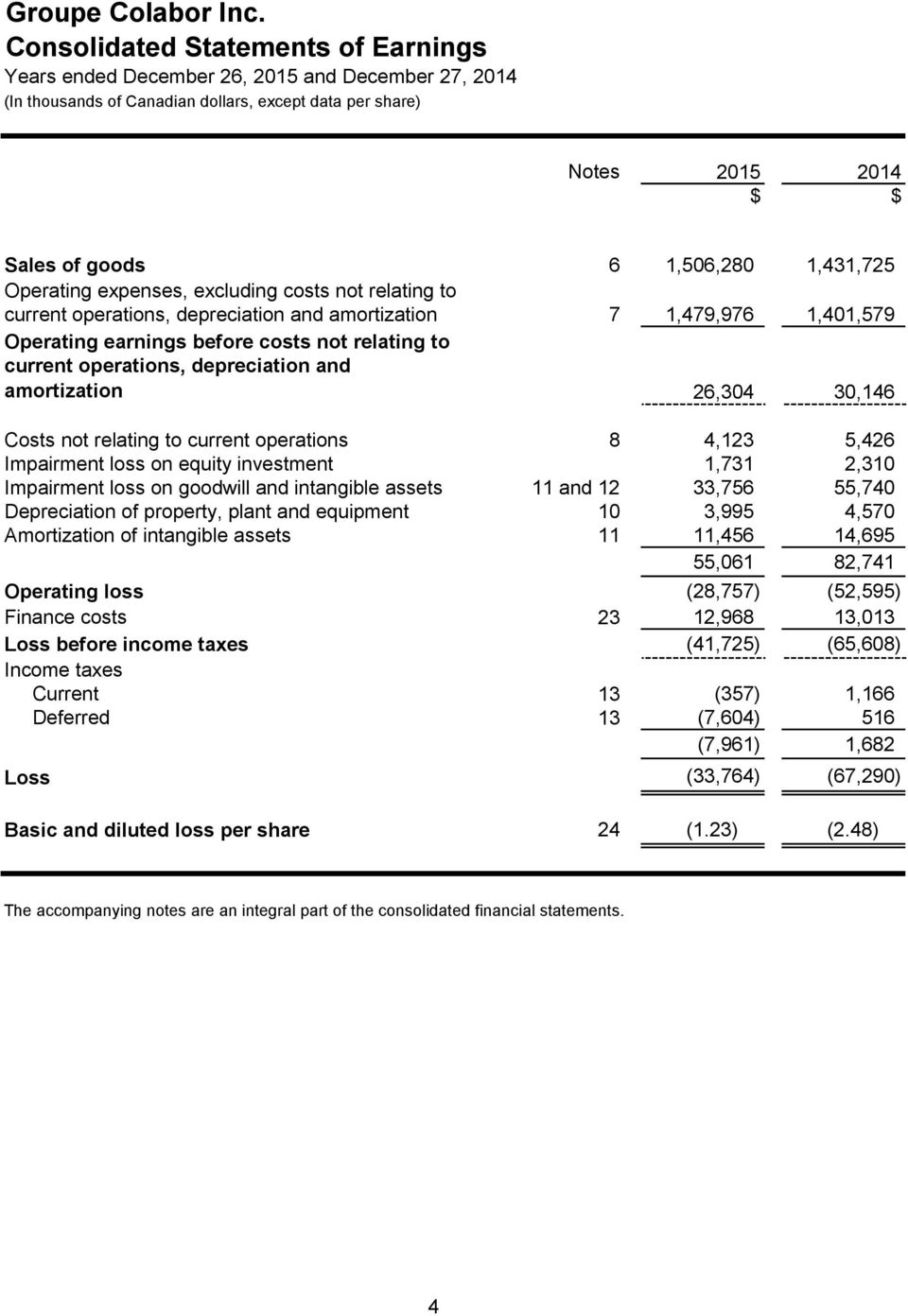
4 Consolidated Statements of Earnings Years ended (In thousands of Canadian dollars, except data per share) Notes Sales of goods 6 1,506,280 1,431,725 Operating expenses, excluding costs not relating to current operations, depreciation and amortization 7 1,479,976 1,401,579 Operating earnings before costs not relating to current operations, depreciation and amortization 26,304 30,146 Costs not relating to current operations 8 4,123 5,426 Impairment loss on equity investment 1,731 2,310 Impairment loss on goodwill and intangible assets 11 and 12 33,756 55,740 Depreciation of property, plant and equipment 10 3,995 4,570 Amortization of intangible assets 11 11,456 14,695 55,061 82,741 Operating loss (28,757) (52,595) Finance costs 23 12,968 13,013 Loss before income taxes (41,725) (65,608) Income taxes Current 13 (357) 1,166 Deferred 13 (7,604) 516 (7,961) 1,682 Loss (33,764) (67,290) Basic and diluted loss per share 24 (1.23) (2.48) The accompanying notes are an integral part of the consolidated financial statements. 4
5 Consolidated Statements of Comprehensive Income Years ended (In thousands of Canadian dollars) Loss (33,764) (67,290) Other comprehensive income that will be subsequently reclassified to earnings Available-for-sale financial asset Loss for the year (1,877) (2,310) Reclassification to earnings of cumulative loss 1,731 2,310 Cash flow hedges Loss for the year (190) Reclassification to earnings 268 Taxes on other comprehensive income that will be subsequently reclassified to earnings 20 (21) (126) 57 Other comprehensive income that will not be reclassified to earnings Remeasurement of pension obligation 93 (1,108) Taxes on other comprehensive income that will not be reclassified to earnings (25) (820) Total other comprehensive income (58) (763) Total comprehensive income (33,822) (68,053) The accompanying notes are an integral part of the consolidated financial statements. 5

6 Consolidated Statements of Changes in Equity Years ended (In thousands of Canadian dollars) Shares held Convertible under debenture stock-based Available-forconversion Contributed compensation sale financial Cash flow Share capital options surplus plans asset hedges Deficit Total equity Balance as at December 28, ,972 1,742 1,563 (381) (112,074) 100,822 Loss for the year (33,764) (33,764) Other comprehensive income Loss on available-for-sale financial asset (1,877) (1,877) Reclassification to earnings 1,731 1,731 Remeasurement of pension obligation Taxes on other comprehensive income 20 (25) (5) Total comprehensive income (126) (33,696) (33,822) Stock-based compensation plan expenses Transactions with owners Balance as at December 26, ,972 1,742 1,880 (381) (126) (145,770) 67,317 Shares held Convertible under debenture stock-based Available-forconversion Contributed compensation sale financial Cash flow Share capital options surplus plans asset hedges Deficit Total equity Balance as at January 1, ,622 1,742 1,326 (381) (57) (37,439) 173,813 Loss for the year (67,290) (67,290) Other comprehensive income Loss on available-for-sale financial asset 2,310 2,310 Reclassification to earnings of the (2,310) 268 (2,042) cumulative loss on available-for-sale financial asset Loss on cash flow hedges (190) (190) Remeasurement of pension (1,108) (1,108) obligation Taxes on other comprehensive income (21) Total comprehensive income 57 (68,110) (68,053) Dividends declared (6,525) (6,525) Shares issued (Note 5) 1,350 1,350 Stock-based compensation plan expenses Transactions with owners 1, (6,525) (4,938) Balance as at December 27, ,972 1,742 1,563 (381) (112,074) 100,822 The accompanying notes are an integral part of the consolidated financial statements. 6

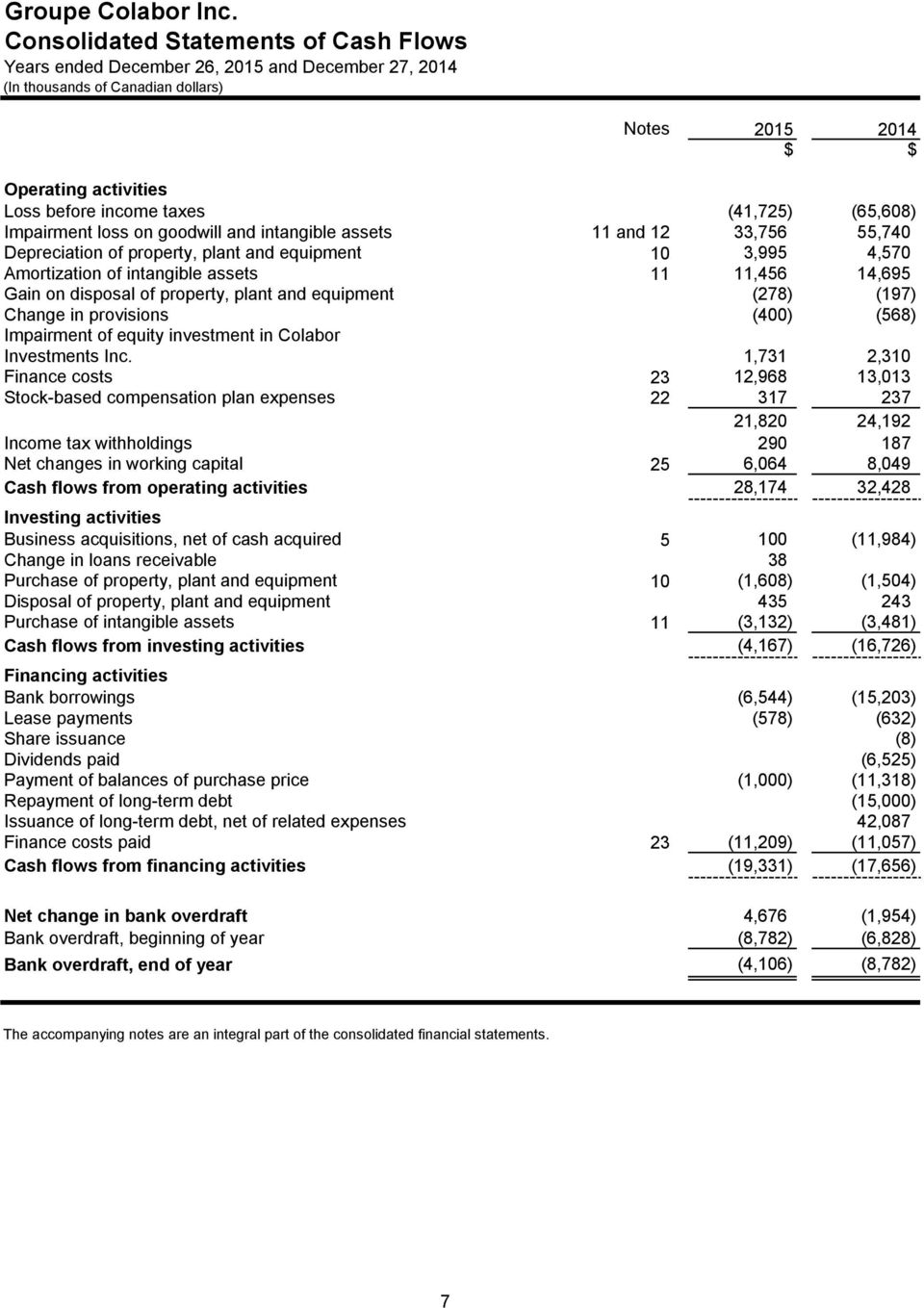
7 Consolidated Statements of Cash Flows Years ended (In thousands of Canadian dollars) Notes Operating activities Loss before income taxes (41,725) (65,608) Impairment loss on goodwill and intangible assets 11 and 12 33,756 55,740 Depreciation of property, plant and equipment 10 3,995 4,570 Amortization of intangible assets 11 11,456 14,695 Gain on disposal of property, plant and equipment (278) (197) Change in provisions (400) (568) Impairment of equity investment in Colabor Investments Inc. 1,731 2,310 Finance costs 23 12,968 13,013 Stock-based compensation plan expenses ,820 24,192 Income tax withholdings Net changes in working capital 25 6,064 8,049 Cash flows from operating activities 28,174 32,428 Investing activities Business acquisitions, net of cash acquired (11,984) Change in loans receivable 38 Purchase of property, plant and equipment 10 (1,608) (1,504) Disposal of property, plant and equipment Purchase of intangible assets 11 (3,132) (3,481) Cash flows from investing activities (4,167) (16,726) Financing activities Bank borrowings (6,544) (15,203) Lease payments (578) (632) Share issuance (8) Dividends paid (6,525) Payment of balances of purchase price (1,000) (11,318) Repayment of long-term debt (15,000) Issuance of long-term debt, net of related expenses 42,087 Finance costs paid 23 (11,209) (11,057) Cash flows from financing activities (19,331) (17,656) Net change in bank overdraft 4,676 (1,954) Bank overdraft, beginning of year (8,782) (6,828) Bank overdraft, end of year (4,106) (8,782) The accompanying notes are an integral part of the consolidated financial statements. 7
8 Consolidated Statements of Financial Position (In thousands of Canadian dollars) Notes ASSETS Current Trade and other receivables 9 104, ,729 Recoverable tax assets 1,568 1,500 Inventory 87,282 92,693 Prepaid expenses 2,936 3,069 Loans receivable 131 Current assets 196, ,991 Non-current Equity investment in Colabor Investments Inc ,803 Loans receivable 576 Property, plant and equipment 10 15,835 16,419 Intangible assets 11 62,844 93,675 Goodwill 12 84,130 94,569 Deferred income tax asset 13 2,089 Non-current assets 166, ,466 Total assets 362, ,457 LIABILITIES AND EQUITY LIABILITIES Current Bank overdraft 4,106 8,782 Trade and other payables 93, ,193 Rebates payable 8,301 10,481 Balances of purchase price payable Bank borrowings 18 1,000 6,000 Obligations under finance leases Deferred revenue Provisions 17 1,174 1,655 Current liabilities 109, ,439 Non-current Bank borrowings 18 87,038 88,076 Long-term debt 19 42,295 42,181 Convertible debentures 20 48,859 48,086 Obligations under leases 16 2, Pension obligation ,271 1,406 Provisions 17 3,816 3,500 Deferred income tax liabilities ,083 Non-current liabilities 186, ,196 Total liabilities 295, ,635 EQUITY Share capital , ,972 Deficit (145,770) (112,074) Other components of equity 3,115 2,924 Total equity 67, ,822 Total liabilities and equity 362, ,457 The accompanying notes are an integral part of the consolidated financial statements. The Board of Directors approved and authorized the publication of the consolidated financial statements on March 16, 2016 On behalf of the Board, /s/ Richard Lord Director /s/ Robert Panet-Raymond Director 8

9 1. NATURE OF OPERATIONS Colabor Group Inc. (hereafter the "Group") and its wholly-owned subsidiaries (hereafter, collectively the "Company") distribute and market food and food-related products in Canada. The Company's year-end is the last Saturday of December. The years ended December 26, 2015 and December 27, 2014 comprised 52 weeks. 2. GENERAL INFORMATION AND STATEMENT OF COMPLIANCE WITH IFRS These consolidated financial statements of the Company are prepared in accordance with International Financial Reporting Standards (IFRS). Colabor Group Inc., the group s ultimate parent company, is incorporated under the Canada Business Corporations Act. It is a Canadian company headquartered at 1620 De Montarville Boulevard, Boucherville, Quebec, J4B 8P4. The shares of Colabor Group Inc. and convertible debentures are listed on the Toronto Stock Exchange (TSX: GCL and TSX: GCL.DB.A). 3. SIGNIFICANT ACCOUNTING POLICIES 3.1 General information The consolidated financial statements have been prepared in accordance with the significant accounting policies described in this note. These accounting policies have been applied consistently throughout the two years. 3.2 Basis of measurement These consolidated financial statements are presented at historical cost, with the exception of certain financial instruments that are measured at fair value and the pension obligation that is measured at the present value of the pension obligation less the fair value of the plan assets. 3.3 Basis of consolidation The consolidated financial statements include the accounts of the parent company and its subsidiaries. The parent company has control of a subsidiary when it is exposed, or has rights, to variable returns from its involvement with the subsidiary and has the ability to affect those returns through its power over the subsidiary. These entities are consolidated from the date the Company acquires control until the date control ends. The consolidated financial statements include the accounts of the Colabor Group Inc. and its subsidiaries which are all wholly-owned. All transactions and balances between the Group's companies are eliminated on consolidation, including unrealized gains and losses on transactions between the Group's companies. 9

10 3. SIGNIFICANT ACCOUNTING POLICIES (Continued) 3.4 Business combinations Business combinations are accounted for using the acquisition method. The consideration transferred by the Company to obtain control of an entity is calculated as the sum of the acquisition-date fair values of assets transferred, liabilities incurred and the equity interests issued by the Company, which includes the fair value of any asset or liability arising from a contingent consideration arrangement. Acquisition costs are expensed as incurred. The Company recognizes identifiable assets acquired and liabilities assumed, including contingent liabilities, in a business combination regardless of whether they have been previously recognized in the acquiree's financial statements prior to the acquisition. Assets acquired and liabilities assumed are generally measured at the acquisition-date fair values. Goodwill is stated after separate recognition of identifiable intangible assets. It is calculated as the excess of the sum of (a) fair value of consideration transferred, (b) the recognized amount of any non-controlling interest in the acquiree and (c) acquisition-date fair value of any existing equity interest that the Company has in the acquiree, over the acquisition-date fair values of identifiable net assets. If the fair values of identifiable net assets exceed the sum calculated above, the excess amount (i.e. gain on a bargain purchase) is recognized in profit or loss immediately. 3.5 Revenue recognition Sales of goods are the only significant source of revenue. Sales of goods in the consolidated statements of earnings represent the fair value of the consideration received or receivable from third parties on the sales of goods to customers, net of commodity taxes, returns, rebates and discounts. The Company recognizes revenue when all of the following conditions are satisfied: (a) The Company has transferred to the buyer the significant risks and rewards of ownership of the goods, that is on delivery of the goods; (b) The Company retains neither continuing managerial involvement to the degree usually associated with ownership nor effective control over the goods sold; (c) The amount of the sales of goods can be measured reliably; (d) It is probable that the economic benefits associated with the transaction will flow to the Company; (e) Transaction costs incurred or to be incurred can be measured reliably. 10

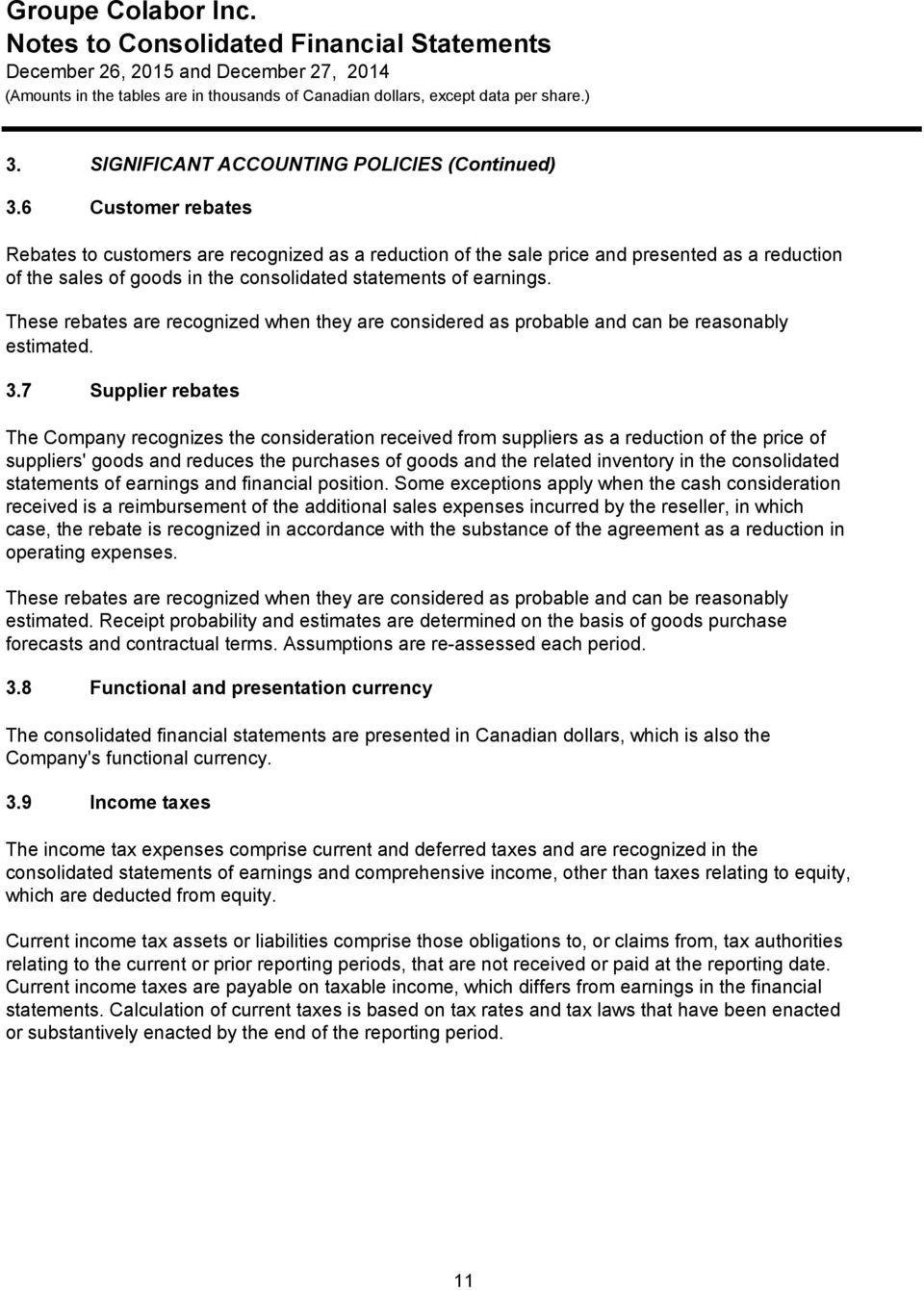
11 3. SIGNIFICANT ACCOUNTING POLICIES (Continued) 3.6 Customer rebates Rebates to customers are recognized as a reduction of the sale price and presented as a reduction of the sales of goods in the consolidated statements of earnings. These rebates are recognized when they are considered as probable and can be reasonably estimated. 3.7 Supplier rebates The Company recognizes the consideration received from suppliers as a reduction of the price of suppliers' goods and reduces the purchases of goods and the related inventory in the consolidated statements of earnings and financial position. Some exceptions apply when the cash consideration received is a reimbursement of the additional sales expenses incurred by the reseller, in which case, the rebate is recognized in accordance with the substance of the agreement as a reduction in operating expenses. These rebates are recognized when they are considered as probable and can be reasonably estimated. Receipt probability and estimates are determined on the basis of goods purchase forecasts and contractual terms. Assumptions are re-assessed each period. 3.8 Functional and presentation currency The consolidated financial statements are presented in Canadian dollars, which is also the Company's functional currency. 3.9 Income taxes The income tax expenses comprise current and deferred taxes and are recognized in the consolidated statements of earnings and comprehensive income, other than taxes relating to equity, which are deducted from equity. Current income tax assets or liabilities comprise those obligations to, or claims from, tax authorities relating to the current or prior reporting periods, that are not received or paid at the reporting date. Current income taxes are payable on taxable income, which differs from earnings in the financial statements. Calculation of current taxes is based on tax rates and tax laws that have been enacted or substantively enacted by the end of the reporting period. 11
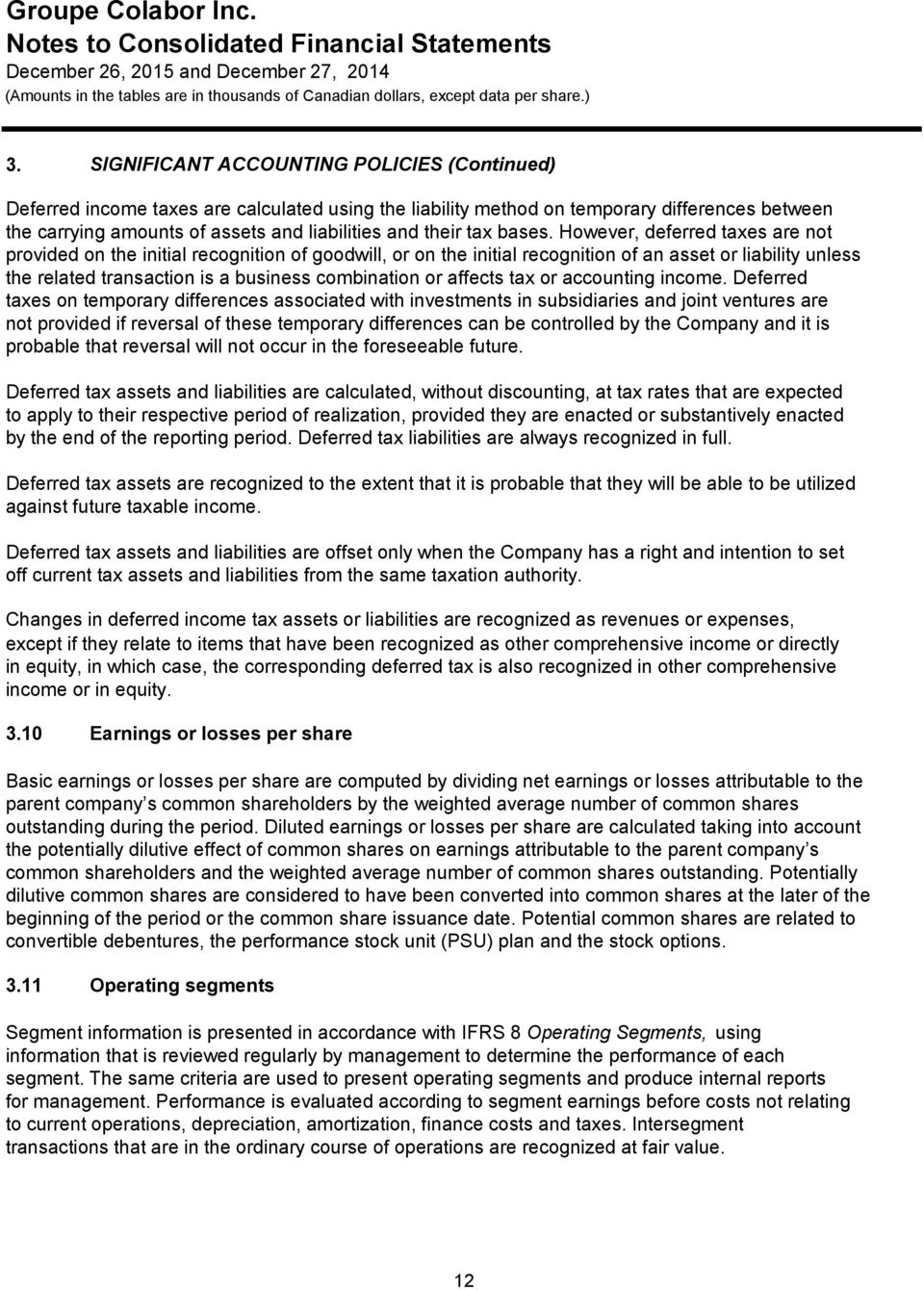
12 3. SIGNIFICANT ACCOUNTING POLICIES (Continued) Deferred income taxes are calculated using the liability method on temporary differences between the carrying amounts of assets and liabilities and their tax bases. However, deferred taxes are not provided on the initial recognition of goodwill, or on the initial recognition of an asset or liability unless the related transaction is a business combination or affects tax or accounting income. Deferred taxes on temporary differences associated with investments in subsidiaries and joint ventures are not provided if reversal of these temporary differences can be controlled by the Company and it is probable that reversal will not occur in the foreseeable future. Deferred tax assets and liabilities are calculated, without discounting, at tax rates that are expected to apply to their respective period of realization, provided they are enacted or substantively enacted by the end of the reporting period. Deferred tax liabilities are always recognized in full. Deferred tax assets are recognized to the extent that it is probable that they will be able to be utilized against future taxable income. Deferred tax assets and liabilities are offset only when the Company has a right and intention to set off current tax assets and liabilities from the same taxation authority. Changes in deferred income tax assets or liabilities are recognized as revenues or expenses, except if they relate to items that have been recognized as other comprehensive income or directly in equity, in which case, the corresponding deferred tax is also recognized in other comprehensive income or in equity Earnings or losses per share Basic earnings or losses per share are computed by dividing net earnings or losses attributable to the parent company s common shareholders by the weighted average number of common shares outstanding during the period. Diluted earnings or losses per share are calculated taking into account the potentially dilutive effect of common shares on earnings attributable to the parent company s common shareholders and the weighted average number of common shares outstanding. Potentially dilutive common shares are considered to have been converted into common shares at the later of the beginning of the period or the common share issuance date. Potential common shares are related to convertible debentures, the performance stock unit (PSU) plan and the stock options Operating segments Segment information is presented in accordance with IFRS 8 Operating Segments, using information that is reviewed regularly by management to determine the performance of each segment. The same criteria are used to present operating segments and produce internal reports for management. Performance is evaluated according to segment earnings before costs not relating to current operations, depreciation, amortization, finance costs and taxes. Intersegment transactions that are in the ordinary course of operations are recognized at fair value. 12
13 3. SIGNIFICANT ACCOUNTING POLICIES (Continued) The Company has two operating segments: distribution to food service enterprises (Distribution Segment) and sale to food distributors (Wholesale Segment). The accounting policies the Company uses for segments are the same as those used in its consolidated financial statements, except that the following are not allocated to segments earnings: Corporate expenses (employee compensation and other unallocated amounts); Finance costs; Depreciation of property, plant and equipment and amortization of intangible assets; Costs not relating to current operations; Impairment loss on equity investments, goodwill and intangible assets; Tax expenses Inventory Inventory is valued at the lower of cost and net realizable value. Cost is determined by the first in, first out method. The cost of inventories comprises costs of purchases and other costs incurred in bringing the inventory to its present location and condition, net of suppliers' rebates. Net realizable value is the estimated selling price in the ordinary course of business less any applicable estimated selling expenses Property, plant and equipment Property, plant and equipment are recognized at the acquisition cost less accumulated depreciation and amortization and accumulated impairment losses. Acquisition cost includes costs incurred to acquire and install the related assets. Land is not depreciated. Other property, plant and equipment are depreciated on a straight-line basis on components with homogeneous useful lives to depreciate the initial cost over their estimated useful lives, taking residual values into account. The useful lives are as follows: Furniture, warehouse equipment and vehicles Road vehicles and road vehicles under finance leases Computer equipment Leasehold improvements 5 to 15 years 7 to 10 years 4 years Lease term, 10 to 20 years The useful lives, depreciation method and residual values are reviewed each year, taking the nature of the asset, its expected use and technological developments into account. Assets are depreciated once they are available for use. 13

14 3. SIGNIFICANT ACCOUNTING POLICIES (Continued) Depreciation is recognized in consolidated statements of earnings within "Depreciation of property, plant and equipment". The profit or loss on the disposal of an item of property, plant and equipment is the difference in the proceeds versus the carrying amount of the asset and is recognized in results in operating expenses Intangible assets Distribution software, customer relationships and signing bonuses These intangible assets are recognized at acquisition cost less accumulated amortization and accumulated impairment losses. The acquisition cost of distribution software includes costs incurred to acquire and install the related software. All customer relationships are attributable to business combinations and satisfy the accounting criteria of intangible assets. The signing bonuses are incurred in connection with the renewal of distribution agreements and are amortized from the date the agreement comes into effect. These intangible assets are amortized on a straight-line basis to amortize the initial cost over their estimated useful lives, taking residual values into account. The useful lives are as follows: Distribution software Customer relationships Signing bonuses 4 and 7 years 2 to 20 years 5 and 7 years The useful lives, amortization method and residual values are reviewed each year, taking the nature of the asset, its expected use and technological developments into account. Assets are amortized once they are available for use. Amortization is recognized in the consolidated statements of earnings within "Amortization of intangible assets". Any impairment is recognized in the consolidated statements of earnings within "Impairment of goodwill and intangible assets". 14

15 3. SIGNIFICANT ACCOUNTING POLICIES (Continued) Trademarks Trademarks have indefinite useful lives considering that management does not intend to dispose of them. They are recognized using the cost model and are not amortized. They are tested for impairment annually, or more frequently if events or changes in circumstances indicate that they are impaired. Any impairment is recognized in the consolidated statements of earnings within "Impairment of goodwill and intangible assets" Goodwill Goodwill represents the future economic benefits arising from a business combination that are not individually identified and separately recognized. Goodwill is carried at cost less accumulated impairment losses Impairment testing of goodwill, property, plant and equipment and intangible assets For the purposes of assessing impairment, assets are grouped at the lowest levels for which there are largely independent cash inflows (cash-generating units). As a result, some assets are tested individually for impairment and some are tested at cash-generating unit level. Goodwill is allocated to those cash-generating units that are expected to benefit from synergies of the related business combination and represent the lowest level for the Company at which management monitors goodwill. Cash-generating units to which goodwill has been allocated and trademarks with an indefinite useful life are tested for impairment when an adverse event occurs and at least annually. All other individual assets or cash-generating units are tested for impairment whenever events or changes in circumstances indicate that the carrying amount may not be recoverable. An impairment loss is recognized in the consolidated statements of earnings within "impairment of goodwill and intangible assets" for the amount by which the asset's or cash-generating unit's carrying amount exceeds its recoverable amount, which is the higher of fair value less costs to sell and value-in-use. To determine the value-in-use, management estimates expected future cash flows from each asset or cash-generating unit and determines a suitable interest rate in order to calculate the present value of those cash flows. The data used for impairment testing procedures are directly linked to the Company's latest approved budget. Discount factors are determined individually for each asset or cash-generating unit and reflect their respective risk profiles as assessed by management. 15
16 3. SIGNIFICANT ACCOUNTING POLICIES (Continued) Impairment losses for cash-generating units reduce first the carrying amount of any goodwill allocated to that cash-generating unit. Any remaining impairment loss is charged pro rata to the other assets in the cash-generating unit. With the exception of goodwill, all assets are subsequently reassessed for indications that an impairment loss previously recognized may no longer exist. On assets other than goodwill, an impairment charge is reversed if the asset's or cash-generating unit s recoverable amount exceeds its carrying amount. The increased carrying amount of an asset attributable to a reversal of an impairment loss cannot exceed the carrying amount that would have been determined, net of amortization or depreciation, had no impairment loss been recognized Leased assets Leases where the Company assumes substantially all the risks and rewards incidental to ownership are classified as finance leases. On initial recognition, the assets held under finance leases are recognized under property, plant and equipment at the lower of fair value or the present value of minimum lease payments. A corresponding liability is recognized as an obligation under finance leases. In subsequent periods, interest relating to the obligation is recognized under finance costs on the consolidated statements of earnings. Other leases are operating leases and the leased assets are not recognized on the Company's consolidated statement of financial position. Payments under operating leases are recognized in earnings on a straight-line basis over the lease term. Related expenses, such as maintenance and insurance, are recognized as an expense as they are incurred Financial instruments Financial assets and financial liabilities are recognized when the Company becomes a party to the contractual provisions of the financial instrument. Financial assets are derecognized when the contractual rights to the cash flows from the financial asset expire, or when the financial asset and all substantial risks and rewards are transferred. A financial liability is derecognized when it is extinguished, discharged, cancelled or expires. Financial assets a) Loans and receivables Loans and receivables are non-derivative financial assets with fixed or determinable payments that are not quoted in an active market. Loans and receivables are initially recognized at fair value plus transaction costs. After initial recognition these are measured at amortized cost using the effective interest rate method, less a provision for impairment. Discounting is omitted where the effect of discounting is immaterial. The Company includes in this category trade and other receivables and loans receivable. 16
17 3. SIGNIFICANT ACCOUNTING POLICIES (Continued) b) Available-for-sale financial assets Available-for-sale financial assets are non-derivative financial assets that are either designated to this category or do not qualify for inclusion in any of the other categories of financial assets. Available-for-sale financial assets include the equity investment in Colabor Investments Inc. Financial instruments in this class are measured initially at fair value plus transaction costs. Available-for-sale assets are then measured at fair value. Gains and losses are recognized in other comprehensive income and are included in the available-for-sale financial asset category in consolidated statements of changes in equity. When the asset is disposed or is impaired, the cumulative gain or loss recognized in other comprehensive income is reclassified to earnings and the reclassification presented within "Impairment loss on equity investment" in the consolidated statements of earnings. c) Impairment of financial assets All financial assets are subject to review for impairment at least at each reporting date. Financial assets are impaired when there is any objective evidence that a financial asset or a group of financial assets is impaired. Objective evidence that a financial asset is impaired could include: significant financial difficulty of the issuer or obligor; a breach of contract, such as a default or delinquency in interest or principal payments; it becoming probable that the borrower will enter bankruptcy or other financial reorganization. Individually significant receivables are considered for impairment when they are past due or when other objective evidence is received that a specific counterparty will default. Receivables that are not considered to be individually impaired are reviewed for impairment in groups, which are determined by reference to the industry sector. Objective evidence that a financial asset is impaired could include the Company's historical collection experience, an increase in the portfolio recovery period and any domestic or local change in economic conditions in correlation with debtors' failure to pay. Financial liabilities The Company's financial liabilities include the bank overdraft, trade and other payables excluding sales taxes to remit and compensation payable, rebates payable, balances of purchase price payable, bank borrowings, convertible debentures and long-term debt. Financial liabilities in this class are measured initially at fair value less transaction costs. After initial recognition they are measured at amortized cost using the effective interest rate method. They are presented in current liabilities when payable within 12 months of the closing date, otherwise, they are presented as non-current. Interest expense is included in "Finance costs" in the consolidated statements of earnings. 17
18 3. SIGNIFICANT ACCOUNTING POLICIES (Continued) Convertible debentures The convertible debentures are separated into their debt and equity components. The value of the debt component of the debentures is determined, at the time of issuance, by discounting the future interest obligations and the principal payment due at maturity, using a discount rate which represents the estimated borrowing rate available to the Company for similar debentures having no conversion rights. The remaining portion of the gross proceeds of the debentures issued is presented as an option to convert debentures in equity net of the tax implications, and the attributed amount is not subsequently reviewed. The attributed amount remains over the term of the related convertible debentures. Convertible debentures issue costs are applied against the two components on a pro rata basis of the allocated proceeds of issue. The debt component presented in the consolidated statements of financial position increases over the term of the debenture to the full face value of the outstanding debentures at maturity. The difference, that is, the accretion on convertible debentures, is presented as implicit interest expense with the result that adjusted interest expense reflects the effective yield of the debt component of the debentures. Upon conversion of the debentures into common shares by the holders, both of the above-mentioned components are transferred to share capital. If a conversion option is not exercised at the expiry of the convertible debentures, the equity component of the convertible debentures is transferred to contributed surplus. Derivative financial instruments, including hedge accounting The embedded derivatives are separated from the host contract and recognized separately if the economic characteristics, host contract risks and embedded derivative are not closely related. The derivative financial instruments used for hedge accounting are initially recognized at fair value and are subsequently measured at fair value as well in the consolidated statements of financial position. If a hedge is effective, the changes in fair value of the derivatives designated as hedges in a cash flow hedging relationship are recognized in other comprehensive income and are included in the "Cash flow hedges" reserve under equity. Any ineffective portion of the hedge is immediately recognized in earnings. Any profit recognized in other comprehensive income is removed from equity and reclassified in earnings if the hedged item affects earnings and is presented as a reclassification in other comprehensive income. However, if a non-financial asset or liability is recognized as a result of a hedging transaction, profit or loss previously recognized in other comprehensive income is included in the initial measurement of the hedged item. If it is no longer expected that a transaction will take place or if the hedging instrument becomes ineffective, the related profit or loss recognized with other comprehensive income is immediately reclassified in earnings. 18

19 3. SIGNIFICANT ACCOUNTING POLICIES (Continued) 3.19 Provisions, contingent liabilities and contingent assets Provisions represent liabilities to the Company for which the amount or timing is uncertain. Provisions are recognized when the Company has a present legal or constructive obligation as a result of past events, it is probable that an outflow of resources will be required to settle the obligation, and the amounts can be reliably estimated. A present obligation arises from the presence of a legal or constructive commitment that has resulted from past events, for example, product warranties granted, legal disputes or onerous contracts. Provisions are measured at the estimated expenditure required to settle the present obligation, based on the most reliable evidence available at the reporting date, including the risks and uncertainties associated with the present obligation. Provisions are measured at the present value of the expected expenditures to settle the obligation using a discount rate that reflects current market assessments of the time value of money and the risks specific to the obligation. The increase in the provision due to passage of time is recognized in earnings as a finance cost. Any reimbursement that the Company can be virtually certain to collect from a third party with respect to the obligation is recognized as a separate asset. However, this asset may not exceed the amount of the related provision. All provisions are reviewed at each reporting date and adjusted to reflect the current best estimate. In those cases where the possible outflow of economic resources as a result of present obligations is considered improbable or remote, no liability is recognized, unless it was assumed in the course of a business combination. In 2013, the Company recognized provisions for onerous contracts (see Note 17) Pension obligation and other employee benefits The Company provides post-employment benefits through defined contribution plans and a defined benefit plan. Contributions to the defined contribution plans are recognized as an expense in the period that relevant employee services are received. The liability recognized in the consolidated statements of financial position for the defined benefit plan is the present value of the defined benefit obligation at the closing date less the fair value of plan assets. The remeasurement of the pension obligation, which includes actuarial variances relating to the obligations and the return on plan assets in excess of interest income, is recognized in consolidated other comprehensive income and immediately in the deficit without subsequent reclassification to earnings. 19

20 3. SIGNIFICANT ACCOUNTING POLICIES (Continued) 3.21 Equity Share capital represents the amount received on issued shares, or as partial payment of acquisitions, less issue costs, net of any underlying income tax benefit of these issue costs. Debenture conversion options represent the equity component of convertible debentures. Contributed surplus includes compensation cost for the Company's stock-based compensation plans and the convertible debenture conversion option that expires without being converted. Shares held under the stock-based compensation plans are shares held for the Company's various stock-based compensation plans. The available-for-sale financial asset is the cumulative net change in the unrealized fair value of the equity investment in Colabor Investments Inc. The cash flow hedges are the cumulative net change in the effective portion of the unrealized fair value of a cash flow hedge relating to hedging transactions. The deficit includes retained earnings for the current and past years. Unpaid dividends are included in liabilities in the period the payment is approved by the Board of Directors. All transactions with owners of the parent company are recorded separately within equity Stock-based compensation Stock option plan The Company has an equity-settled stock option plan for certain of its officers and employees. This plan does not feature any options for a cash settlement. All goods and services received in exchange for the grant of stock options are measured at their fair values unless they cannot be reasonably determined. If the Company is not able to reliably estimate the fair values of goods or services received, the values are determined indirectly by reference to the fair value of the equity instruments granted. This fair value is measured at the grant date. Stock-based compensation is ultimately recognized as an expense in the consolidated statements of earnings with a corresponding credit to contributed surplus. 20
21 3. SIGNIFICANT ACCOUNTING POLICIES (Continued) If vesting periods or other vesting conditions apply, the expense is allocated over the vesting period, based on the best available estimate of the number of share options expected to vest. Non-market vesting conditions are included in assumptions about the number of options that are expected to become exercisable. Estimates are subsequently revised if there is any indication that the number of share options expected to vest differs from previous estimates. Any cumulative adjustment prior to vesting is recognized in the current period. No adjustment is made to any expense recognized in prior periods if share options that ultimately vest are different from that estimated on vesting. Upon exercise of share options, the proceeds received net of any directly attributable transaction costs are credited to share capital and the corresponding stock-based compensation that was previously included in contributed surplus. Performance stock unit plan The Company has a performance stock unit (PSU) plan for certain officers and employees. The PSUs vest after a maximum three-year period, on the basis of performance targets. The compensation cost is measured on the award date at the fair value of the shares and recognized over the related service period with a corresponding increase in contributed surplus. The Company recognizes the plan expense based on the expected attainment of performance targets. The impact of any change in the number of PSUs to be acquired is recognized in the period the estimate is revised. Under the PSU plan, shares purchased on the open market on behalf of plan members are recognized at cost as a reduction of equity. If the fair market value of the shares on the award date is greater than the acquisition price paid by the Company, the difference is recognized as contributed surplus. If the fair market value of the shares on the award date is less than the acquisition price paid by the Company, the difference is applied against retained earnings. Directors' share unit plan Members of the Company's Board of Directors may elect to receive some or all of their annual fees in the form of Directors' share units (DSUs). The accrued DSU compensation liability is measured at each closing date on the basis of the number of outstanding share units and the market price of the Company's common shares. Changes in the liability are recognized as a compensation expense and the liability is included in trade and other payables. Employee stock ownership plan The Company has an employee stock ownership plan. Under the terms of this plan, the Company pays contributions calculated on the basis of percentages provided in the plan, in consideration of employee contributions. These contributions are recognized when employees agree to pay their share. 21
22 3. SIGNIFICANT ACCOUNTING POLICIES (Continued) 3.23 Standards, amendments and current interpretations that are not yet effective At the date of authorization of these consolidated financial statements, certain new standards, amendments and interpretations to existing standards have been published by the IASB but are not yet effective, and have not been adopted early by the Company. Management anticipates that the relevant pronouncements will be adopted in the Company s accounting policies for the first period beginning after the effective date of the pronouncement. Information on new standards, amendments and interpretations that are expected to be relevant to the Company s consolidated financial statements is provided below. Certain other new standards and interpretations have been issued but are not expected to have a material impact on the Company s consolidated financial statements. IFRS 9 Financial Instruments In July 2014, the IASB published IFRS 9 which replaces IAS 39 Financial Instruments: Recognition and Measurement (IAS 39). IFRS 9 introduces improvements which include a logical model for classification and measurement of financial assets, a single, forward-looking "expected loss" impairment model and substantially reformed approach to hedge accounting. IFRS 9 is effective for annual reporting periods beginning on or after January 1, Earlier application is permitted. The Company has yet to assess the impact of this new standard on its consolidated financial statements. IFRS 15 Revenues from Contracts with Customers In May 2014, the IASB published IFRS 15 which replaces IAS 18 Revenue, IAS 11 Construction Contracts and some revenue-related interpretations. IFRS 15 establishes a new control-based revenue recognition model, changes the basis for deciding when revenue is recognized at a point in time or over time, provides new and more detailed guidance on specific topics and expands and improves disclosures about revenue. IFRS 15 is effective for annual reporting periods beginning on or after January 1, Earlier application is permitted. The Company has yet to assess the impact of this new standard on its consolidated financial statements. IFRS 16 Leases In January 2016, the IASB published IFRS 16 which will replace IAS 17 Leases. IFRS 16 eliminates the classification as an operating lease and requires lessees to recognize a right-of-use asset and a lease liability in the statement of financial position. An exemption is permitted for short-term leases and for leases of low-value assets. Additionally, IFRS 16 changes the definition of a lease, sets requirements on how to account for the asset and liability, including complexities such as non-lease elements, variable lease payments and option periods changes the accounting for sale and leaseback arrangements largely retains IAS 17 s approach to lessor accounting and introduces new disclosure requirements IFRS 16 is effective for annual periods beginning on or after January 1, 2019, with early application permitted in certain circumstances. The Company has yet to assess the impact of this new standard on its consolidated financial statements. 22
23 4. SIGNIFICANT ESTIMATES AND JUDGEMENTS When preparing the consolidated financial statements management undertakes a number of judgements, estimates and assumptions about recognition and measurement of assets, liabilities, income and expenses. The actual results are likely to differ from the judgements, estimates and assumptions made by management, and will seldom equal the estimated results. Information about the significant judgements, estimates and assumptions that have the most significant effect on the recognition and measurement of assets, liabilities, income and expenses is provided below. Impairment of trade and other receivables The amount recognized as impairment of trade and other receivables is based on management s assessment of the risks associated with each trade and other receivable with reference to losses incurred in prior periods, collection experience and the impact of the current and expected economic conditions. Supplier rebates Supplier rebates recognized are estimated on the basis that the necessary conditions for obtaining the rebates are satisfied. Impairment of available-for-sale financial asset Management assesses whether there are any indications of impairment of the available-for-sale financial asset at each reporting date. When management determines that the asset is impaired, the cumulative loss recognized in other comprehensive income is reclassified to earnings. Inventory valuation Inventory is measured at the lower of cost and net realizable value. In estimating net realizable value, management takes into account the most reliable evidence available at the time the estimates are made. The quantity, age and condition of inventory are measured and evaluated regularly during the year. Useful lives of depreciable assets Management reviews the useful lives of depreciable assets at each reporting date based on the expected utility of the assets to the Company. Actual results, however, may vary due to technical obsolescence, particularly for distribution software and computer hardware. 23
24 4. SIGNIFICANT ESTIMATES AND JUDGEMENTS (Continued) Impairment of trademarks and goodwill An impairment loss is recognized for the amount by which an asset's or cash-generating unit's carrying amount exceeds its recoverable amount. To determine the recoverable amount, management estimates expected future cash flows from each asset or cash-generating unit and determines a suitable interest rate in order to calculate the present value of those cash flows. In the process of measuring expected future cash flows, management makes assumptions about future operating results. These assumptions relate to future events and circumstances. The actual results may vary, and may cause significant adjustments to the Company's assets within the next financial years. In most cases, determining the applicable discount rate involves estimating the appropriate adjustment to market risk and the appropriate adjustment to asset-specific risk factors. Deferred tax assets The assessment of the probability of future taxable income in which deferred tax assets can be utilized is based on the Company's latest approved budget forecast, which is adjusted for significant non-taxable income and expenses and specific limits to the use of any unused tax loss. If a positive forecast of taxable income indicates the probable use of deferred tax assets, especially when it can be utilized without a time limit, those deferred tax assets are usually recognized in full. The recognition of deferred tax assets that are subject to certain legal or economic limits or uncertainties is assessed individually by management based on the specific facts and circumstances. Business combinations On initial recognition, the assets and liabilities of the acquired business and the consideration paid for them are included in the consolidated statements of financial position at their fair values. In measuring fair value, management uses estimates of future cash flows and discount rates. Any subsequent change in these estimates would affect the amount of goodwill if the change qualifies as an adjustment in the measurement period. Any other change would be recognized in the consolidated statement of earnings in the subsequent period. Pension obligation Management estimates the pension obligation annually with the assistance of independent actuaries; however, the actual outcome may vary due to estimation uncertainties. The estimate of its pension obligation is based on rates of inflation and mortality that management considers to be reasonable. It also takes into account the Company's specific anticipation of future salary increases, retirement ages of employees and other actuarial factors. Discount factors are determined close to each year-end by reference to high quality corporate bonds that are denominated in the currency in which the benefits will be paid and that have terms to maturity approximating to the terms of the related pension liability. Estimation uncertainties exist, which may vary significantly in future appraisals of the Company's defined benefit obligations. 24
25 5. BUSINESS COMBINATIONS 5.1 Remeasurement of acquisition in 2014 Acquisition of La Poissonnerie Marcotte (1980) Inc. assets During the first quarter of 2015, the Company remeasured and finalized the allocation of the purchase price of La Poissonnerie Marcotte (1980) Inc. (hereafter ("Marcotte"), acquired on September 10, The preliminary allocation of the purchase price as at December 27, 2014 was changed as follows: Change in balances $ Working capital (226) Property, plant and equipment (250) Goodwill 376 Change in acquisition cost and fair value of the consideration received (100) Net cash flows on acquisition and fair value of portion received in cash (100) 5.2 Acquisition in 2014 Acquisition of La Poissonnerie Marcotte (1980) Inc. assets On September 10, 2014, the Company acquired a majority of the assets of La Poissonnerie Marcotte (1980) Inc. ( Marcotte ), a leading distributor of food and non-food products based in Trois-Rivières, Quebec. The results of operations are included in the consolidated statement of earnings since the acquisition date. The acquisition of Marcotte reflects one of the Company's objectives to increase its distribution clientele and create synergies. The preliminary purchase price allocation is determined as follows: Value recognized on the acquisition date $ Trade and other receivables 4,647 Inventory 3,392 Prepaid expenses 133 Property, plant and equipment 1,024 Intangible assets 6,390 Goodwill 2,520 Trade and other payables (3,517) Deferred tax liabilities (427) Acquisition cost and fair value of cash consideration transferred 14,162 Portion paid through a share issue (1,358) Portion paid in balances of purchase price (820) Net cash flows on acquisition and fair value of portion transferred to cash 11,984 25
26 5. BUSINESS COMBINATIONS (Continued) Business acquisition-related costs amounting to $387,000 are not included as part of acquisition cost and have been recognized as costs not relating to current operations in the consolidated statements of earnings. Marcotte has contributed a total of $6,151,000 to the Company's sale of goods. The operating loss before depreciation and amortization for the period between the acquisition date and the end of the year was not disclosed due to the management system transition. Management estimates that, if the acquisition had occurred on January 1, 2014, additional sales of goods would have been $25,000,000 but cannot estimate the additional operating earnings because of the lack of detail in the management systems in place at the time of acquisition. Trade and other receivables The contractual amount of trade and other receivables amounted to $4,647,000 at the acquisition date. Based on the best estimate of contractual cash flows, all amounts are expected to be recovered. Goodwill Goodwill primarily relates to forecasted growth, future profitability, expertise and significant employee competencies as well as expected cost synergies. Goodwill from this business combination is expected to be deductible for tax purposes. Issuance of shares To finance the acquisition of Marcotte, the Company issued 391,645 common shares for an evaluated total of $1,358,000. The $8,000 in share issue costs was recognized as a decrease in the shares issued. 6. SEGMENT REPORTING The Company has two reportable segments: distribution to food service enterprises (Distribution Segment) and distribution to food distributors (Wholesale Segment). These operating segments are monitored and strategic decisions are made on the basis of segment operating results. Management does not take assets and liabilities into account in the analysis of the various segments. 26
27 6. SEGMENT REPORTING (Continued) Segment information can be analyzed as follows: Distribution Wholesale Segment Segment Total Segment sales of goods 1,038, ,772 1,745,540 Segment operating expenses Cost of goods sold 903, ,926 1,574,124 Employee remuneration 77,924 10,502 88,426 Other expenses 45,723 5,589 51,312 1,026, ,017 1,713,862 Segment earnings 11,923 19,755 31, Distribution Wholesale Segment Segment Total $ Segment sales of goods 964, ,286 1,641,429 Segment operating expenses Cost of goods sold 835, ,915 1,475,021 Employee remuneration 73,470 10,363 83,833 Other expenses 40,293 5,662 45, , ,940 1,604,809 Segment earnings 15,274 21,346 36,620 The totals presented for the Company's operating segments reconcile to key financial figures as presented in its consolidated financial statements as follows: Sales of goods Total segment earnings 1,745,540 1,641,429 Elimination of intersegment earnings (239,260) (209,704) Company sales of goods 1,506,280 1,431,
28 6. SEGMENT REPORTING (Continued) Earnings Total segment earnings 31,678 36,620 Employee remuneration not allocated (5,636) (5,138) Other expenses not allocated 262 (1,336) Costs not relating to current operations (4,123) (5,426) Impairment loss on equity investment (1,731) (2,310) Impairment loss on goodwill and intangible assets (33,756) (55,740) Depreciation of property, plant and equipment (3,995) (4,570) Amortization of intangible assets (11,456) (14,695) Company operating earnings (28,757) (52,595) Finance costs (12,968) (13,013) Company loss before taxes (41,725) (65,608) 7. OPERATING EXPENSES, EXCLUDING COSTS NOT RELATING TO CURRENT OPERATIONS, DEPRECIATION AND AMORTIZATION Purchases of goods 1,329,489 1,274,375 Changes in inventory 5,375 (9,058) Employee benefits expense (Note 22.1) 94,062 88,971 Other expenses 51,050 47,291 1,479,976 1,401,579 28
29 8. COSTS NOT RELATING TO CURRENT OPERATIONS Costs of internal restructuring of operations Disbursed costs 2,174 2,089 Provisions for onerous contracts (Note 17) 1, Direct costs relating to realized, unrealized and potential business acquisitions Litigation settlement (a) 1,648 Other ,123 5,426 (a) On July 3, 2014, the Company finalized an agreement to settle litigation under which it was the subject of a motion for partial cancellation of an arbitration award in June 2009 and an appeal of a 2013 Superior court ruling. The Company has reached agreement with the counterparty to definitively conclude all outstanding cases. Under this settlement, the Company recognized a $1,175,000 charge to earnings in the third quarter. Additionally, the Company reached an agreement with the Canada Revenue Agency ("CRA") relating to the CRA's objection to the tax consequences of the conversion of its income trust structure into a business corporation in August Legal fees were incurred in this respect. 9. TRADE AND OTHER RECEIVABLES Trade accounts 85, ,399 Supplier rebates receivable 15,971 17,682 Other 3,082 3, , ,729 29
30 10. PROPERTY, PLANT AND EQUIPMENT Furniture, warehouse Road vehicles equipment Road Computer Leasehold under capital Land and vehicles vehicles equipment improvements leases Total $ Gross carrying amount Balance as at December 28, ,361 3,433 5,129 10,687 1,800 36,473 Acquisitions ,142 3,786 Business combinations (Note 5) (250) (250) Transfers (566) 161 Disposals (174) (412) (586) Balance as at December 26, ,002 3,356 5,432 11,355 3,376 39,584 Depreciation Balance as at December 28, ,570 1,089 3,972 5, ,054 Depreciation 1, , ,995 Transfers (87) 129 Disposals (174) (255) (429) Balance as at December 26, ,955 1,479 4,459 6, ,749 Net carrying amount as at December 26, ,047 1, ,895 2,980 15,835 Furniture, warehouse vehicles equipment Road Computer Leasehold under capital Land and vehicles vehicles equipment improvements leases Total $ Gross carrying amount Balance as at January 1, ,738 5,979 4,695 10,270 35,745 Acquisitions ,800 3,423 Business combinations ,024 Transfers (55) (55) Disposals (265) (3,399) (3,664) Balance as at December 27, ,361 3,433 5,129 10,687 1,800 36,473 Depreciation Balance as at January 1, ,222 3,585 3,285 4,038 19,130 Depreciation 1, , ,570 Transfers (28) (28) Disposals (245) (3,373) (3,618) Balance as at December 27, ,570 1,089 3,972 5, ,054 Net carrying amount as at December 27, ,791 2,344 1,157 5,473 1,591 16,419 Road 30
31 11. INTANGIBLE ASSETS Distribution Signing Customer software bonuses Trademarks relations Total $ Gross carrying amount Balance as at December 28, ,414 2,108 20, , ,439 Acquisitions 916 2,682 3,598 Transfers (32) (32) Impairment loss (Note 12) (11,768) (32,519) (44,287) Balance as at December 26, ,298 4,790 8,542 95, ,718 Amortization Balance as at December 28, ,393 59,371 64,764 Amortization 1, ,681 11,456 Impairment loss (21,346) (21,346) Balance as at December 26, , ,706 54,874 Net carrying amount as at December 26, ,650 4,270 8,542 47,382 62,844 Gross carrying amount Balance as at January 1, ,909 29, , ,720 Acquisitions 1,457 2,108 3,565 Business combinations (Note 5) 6,390 6,390 Transfers Impairment loss (Note 12) (9,387) (54,897) (64,284) Disposals (7) (7) Balance as at December 27, ,414 2,108 20, , ,439 Amortization Balance as at January 1, ,350 77,258 81,608 Amortization 1,022 13,673 14,695 Transfers Impairment loss (31,560) (31,560) Disposals (7) (7) Balance as at December 27, ,393 59,371 64,764 Net carrying amount as at December 27, ,021 2,108 20,310 68,236 93,675 31
32 12. GOODWILL Goodwill Balance, beginning of year 94, ,065 Business combinations (Note 5) 376 2,520 Impairment loss (10,815) (23,016) Balance, end of year 84,130 94,569 Impairment testing of goodwill and trademarks For the purpose of annual impairment testing, goodwill and the trademarks have been attached to the following cash-generating units (CGU), that is the units that are expected to benefit from the synergies of the business combinations. Goodwill Trademarks Goodwill Trademarks Boucherville Division 63,676 6,700 63,676 7,200 CFD Division 10,149 11,268 Norref Division 20,454 1,842 20,454 1,842 Décarie Division ,130 8,542 94,569 20,310 Goodwill and the trademarks are tested for impairment at each year-end. The recoverable amount of the CGUs is determined using their value-in-use. To measure value in use, the Company established cash flow projections for the first five years on the basis of budgets and the strategic plan approved by the Board of Directors. Cash flow projections beyond the period covered by the budgets and the strategic plan were determined using a steady growth rate for subsequent years; this growth rate does not exceed the long-term average growth rate for the Company's segments. These projections have been prepared using both historical data and future trends which the Company expects. Management's retained assumptions in performing the impairment tests were based on the growth rates in the sales of the various divisions, as shown below: Average for Following Average for Following first 5 years years first 5 years years Growth rate Boucherville Division (0.2 %) 0.7 % 0.3 % 0,0 % Summit Division 4.7 % 2.0 % CFD Division 1.5 % 2.0 % 5.1 % 2.0 % Norref Division 4.3 % 2.0 % 6.9 % 2.0 % Décarie Division (1.8 %) 2.0 % 3.3 % 2.0 % 32
33 12. GOODWILL (Continued) The Company's valuation model also takes into account of changes in working capital and the necessary investments in property, plant and equipment to maintain the assets in each of the CGU groups. Pre-tax rates of 13.3% to 15.0% (13.3% to 15.2% as at December 27, 2014) were used to discount expected cash flows. These rates reflect the current market assessment of the time value of money and the risks specific to the asset. The Company regularly reviews the allocation of net assets and corporate assets between CGUs based on changes in its strategic plan. Based on this review, the net assets of the Marcotte Division were added to the net assets of the CFD Division in light of the transfer of the Trois-Rivières activities to Quebec City during the year. The Company has concluded that the recoverable amount, based on value-in-use, of certain CGUs was less than the carrying amount. Accordingly, it recognized an impairment loss during 2015 and 2014, detailed as follows Impairment loss on goodwill, trademark and customer relations of $10,525,000, $11,268,000 and $11,173,000 respectively for the CFD Division; The trademark behind the notority of the brand "Bertrand" in the Quebec region is no longer used. The Division is now operating under the name "Colabor Food Distributor". In light of declining sales in the restaurant sector realized in Quebec in 2015, the competition, the appearance of customer groups and the high turnover of key employees resulted in an impairment loss on goodwill and customer relations. Impairment loss on a trademark that is hardly ever used of $500,000 for the Boucherville Division. Impairment loss on goodwill of $290,000 for the Décarie Division from the anticipated declining sales due to inflation in the price of meat Impairment loss on goodwill, trademark and customer relations of $14,771,000, $9,387,000 and $23,337,000 respectively for the Summit Division; Impairment loss on goodwill of $8,245,000 for the Boucherville Division. The recoverable value of he impaired CGUs is detailed as follows: CFD 30,418 Boucherville 112, ,999 Summit 39,356 Décarie 18,908 33
34 12. GOODWILL (Continued) Based on a sensitivity analysis, no reasonably possible change in the assumptions would have caused a CGU's carrying amount to exceed its recoverable amount. 13. DEFERRED INCOME TAX ASSETS AND LIABILITIES Deferred income tax assets and liabilities relating to the deductible and taxable temporary differences and the unused tax losses have been recognized in the consolidated statements of financial position. The changes in deferred income tax assets and liabilities, without giving effect to offsetting balances for the same taxing authorities, are as follows: 2015 Business Balance, combinations Other beginning and share comprehensive Balance, of year issue Earnings income end of year $ Deferred non-capital losses 2, ,085 Property, plant and equipment (598) (674) (1,272) Intangible assets (9,059) 7,399 (1,660) Equity investment in Colabor Investments Inc Goodwill (1,899) 421 (1,478) Share and debenture issue expenses Provisions 1,378 (44) 1,334 Other 1,186 (306) (5) 875 Deferred income tax assets (liabilities) (6,083) 7,604 (5) 1,516 34
35 13. DEFERRED INCOME TAX ASSETS AND LIABILITIES (Continued) 2014 Business Balance, combinations Other beginning and share comprehensive Balance, of year issue Earnings income end of year $ Deferred non-capital losses 17,213 (14,646) 2,567 Property, plant and equipment 134 (732) (598) Intangible assets (20,213) 11,154 (9,059) Equity investment in Colabor Investments Inc. (95) Goodwill (3,322) (427) 1,850 (1,899) Share and debenture issue expenses (277) Provisions 1,461 (83) 1,378 Other (308) 1, ,186 Deferred income tax assets (liabilities) (5,407) (427) (516) 267 (6,083) The difference between the effective income tax rate and the combined federal and provincial income tax rate in Canada is attributable to the following: Loss before income taxes (41,725) (65,608) Combined federal and provincial income tax rate % % Expected tax expense (11,157) (17,544) Income tax rate adjustment (31) Non-taxable items (59) (77) Non-tax deductible items 3,284 3,755 Adjustment of tax attributes (217) 70 Loss of tax attributes 15,149 Non-deductible portion of the loss on investment Other (43) 52 Tax expenses (7,961) 1,682 As at December 26, 2015, the Company has capital losses amounting to $2,375,000 for which no deferred tax asset has been recognized. In 2013, the Company received a draft notice of reassessment from the Canada Revenue Agency (CRA) contesting the tax consequences of its conversion from an income trust structure to a corporation in August 2009 (hereafter the "Conversion"). 35
36 13. DEFERRED INCOME TAX ASSETS AND LIABILITIES (Continued) On October 2, 2014, the Company reached an agreement with the CRA relating to the CRA's objection to the tax consequences of the conversion of Colabor's income trust structure into a business corporation in August The agreement will not give rise to any cash outlay by the Company for taxation years 2009 to However, a $15,149,000 non-cash expense related to the write-off of certain of the Company's deferred tax assets was recognized in the consolidated statement of earnings for the year ended December 27, This expense takes account of a similar agreement to be reached with Revenu Québec. On July 22, 2015, the Company concluded a similar agreement with the Agence du revenu du Québec. 14. OPERATING LEASES AND COMMITMENTS The Company has entered into various leases expiring through to December 2025, which call for minimum lease payments of $73,404,000. The Company's obligation under one of these leases is secured by a $1,014,000 letter of guarantee. Minimum lease payments under the Company's operating leases are as follows: Less than 1 year 14,986 15,657 1 to 5 years 42,750 46,656 Over 5 years 15,668 9,938 73,404 72,251 Operating lease payments recognized in expenses during the year total $16,453,000 ($16,132,000 in 2014). These are the minimum lease payments. No sub-leasing or conditional lease payments have been made or received. No sub-leasing income is expected since all of the assets under lease are for the Company's exclusive use. The Company's operating leases do not include any contingent rent clauses, nor are there any purchase options, escalation clauses or restrictions, such as those concerning dividends, additional debt and further leasing. 15. BALANCES OF PURCHASE PRICE PAYABLE Balances of purchase price relating to business acquisitions are detailed as follows: Non-interest bearing Instalments due within one year 869 Instalments due in more than one year 36
37 16. OBLIGATIONS UNDER LEASES Obligations under finance leases for road vehicles, 1.7% to 6.9% expiring between 2015 and ,873 1,309 2,873 1,309 Instalments due within one year Instalments due in more than one year 2, Minimum lease payments over the coming years under the finance leases and the balance of the obligations are as follows: Years ending December 31, December 30, December 29, December 28, December 26, Subsequent years 611 Total minimum lease payments under finance leases 3,249 Interest expense included in minimum payments (376) Balance of obligations 2, PROVISIONS Balance, beginning of year 5,155 5,476 Revision of assumptions 1, Accretion expense Provisions used during the year (1,538) (1,426) Balance, end of year 4,990 5,155 Current 1,174 1,655 Non-current 3,816 3,500 Following an internal restructuring of operations in 2013, the Company recognized provisions for onerous contracts using average weighted discounting rates of 2.23 % and 3.28 % in respect of non-cancellable operating leases for the distribution centres whose operations were discontinued. The provisions were estimated on the basis of contractual obligations at the time they were taken and sub-leasing income assumptions using market data. The remaining term of the leases in question ranges from 6 to 8 years. 37
38 18. BANK BORROWINGS 18.1 Credit facility On January 31, 2014, the Company finalized two agreements to refinance its credit facilities and long-term debt. First, a banking syndicate granted to the Company a maximum credit facility of $140,000,000 for a three-year term. By mutual agreement, the credit facility may be increased by an additional $30,000,000. It matures in January 2017 and is secured by a first-ranking hypothec on the Company's present and future assets. Amounts borrowed from the credit facility come in various forms and the interest rate varies based on the type of loan. As at December 26, 2015, the facility is composed of a loan and banker's acceptances bearing interest at rates varying between 3.00% and 3.70% (December 27, 2014: 3.30% and 3.75%). The Company was also granted term credit facilities of a total amount of $18,000,000 to be used for specific purposes and repayable over 24 months starting on the date they are used, as applicable. The Company used $12,000,000 of this credit facility. During the year, $6,000,000 was repaid ($5,000,000 in 2014). It is secured by a first-ranking hypothec on the amount of the Company's present and future assets and is payable in monthly capital instalments of $500,000. As at December 26, 2015, the facility is composed of a loan and banker's acceptances bearing interest at rates varying between (4.0% and 4.70% (December 27, 2014: 4.30% and 4.75%). The credit facilities' interest rates are determined according to a calculation table that takes into account their usage. Under certain circumstances, the Company is required to respect a ratio. As at December 26, 2015, this ratio has been respected. As at, letters of guarantee amounting to $1,014,000 were used for a commitment Average bank loan Based on the nature of its commercial agreements, the Company is subject to significant fluctuations in its daily bank loan. The average daily bank loan was a measure used in the past to comply with certain ratios and covenants. For the years ended the average bank loan was $99,556,000 and $93,039,000 respectively. 19. LONG-TERM DEBT In connection with its bank refinancing in 2014, the Company entered into a loan agreement for a total capital amount of $42,500,000. The loan agreement was signed with the banking syndicate made up of several creditors. A $12,500,000 portion is secured by a second-ranking hypothec on the Company's present and future assets. One of the lenders has an option to become a secured creditor at any time upon written notice. Under the terms of the agreement, the average rate of the long-term debt was increased from 9.1% to 9.8% in January 2015 for the remaining term of the agreement. 38
39 19. LONG-TERM DEBT (Continued) 2015 Par Carrying value amount Debt, 9.8%, maturing on February 1, 2018, issued on January 31, 2014 Balance, beginning of year 42,500 42,181 Non-cash portion of effective interest on long-term debt 114 Balance, end of year 42,500 42, Par Carrying value amount Debt, 9.1%, maturing on February 1, 2018, issued on January 31, 2014 Initial disbursement on January 31, 2014 (net of transaction costs) 42,500 42,087 Non-cash portion of effective interest on long-term debt 94 Balance, end of year 42,500 42, Par Carrying value amount Unsecured debt, 6.5%, maturing on December 28, 2011 Balance, beginning of year 15,000 14,737 Non-cash portion of effective interest on long-term debt 5 Write-off of deferred transaction costs following debt repayment 258 Balance repaid (15,000) (15,000) Balance, end of year The effective rate of the long-term debt is 7.13%. This debt was repaid in full during the year ended December 27, DEBENTURES 5.7% convertible debentures, maturing on April 30, 2017, issued on April 27, 2010 The debentures maturing on April 30, 2017 bear interest at the rate of 5.7% and are payable semi-annually. The effective interest rate is 7.54%. The debentures are convertible at the holder's option into shares at a conversion rate of shares per $1,000 of debenture capital, that is a conversion price of $16.85 per share. Under certain circumstances, the Company could have redeemed some or all of the debentures in advance after April 30, There were no advance redemptions during the year ended December 26,
40 20. DEBENTURES (Continued) 2015 Carrying amount Par Conversion value Debentures option $ 5.7% convertible debentures, maturing on April 30, 2017, issued on April 27, 2010 Balance, beginning of year 50,000 48,086 1,742 Non-cash portion of effective interest on debentures 773 Balance, end of year 50,000 48,859 1, Carrying amount Par Conversion value Debentures option $ 5.7% convertible debentures, maturing on April 30, 2017, issued on April 27, 2010 Balance, beginning of year 50,000 47,373 1,742 Non-cash portion of effective interest on debentures 713 Balance, end of year 50,000 48,086 1, SHARE CAPITAL Authorized Unlimited number of participating, voting common shares without par value. Unlimited number of preferred shares issuable in series, whose designation, rights, restrictions and conditions related to each series shall be established at issue time. Issued and fully paid common shares Number $ Number $ Outstanding, beginning of year 27,480, ,972 27,089, ,622 Issued in connection with an acquisition (see Note 5) 391,645 1,350 Outstanding, end of year 27,480, ,972 27,480, ,972 There were no outstanding preferred shares during the periods covered. 40
41 22. EMPLOYEE REMUNERATION Employee benefits expense Salaries 73,248 69,261 Fringe benefits costs 15,680 14,944 Expenses for stock-based compensation plans Pensions defined benefit plans Pensions defined contribution plans 1,245 1,164 Pensions government defined contribution plans 3,259 3, Stock-based compensation Stock option plan 94,062 88,971 The Company adopted a stock option plan (hereafter the "Option Plan") authorizing its Board of Directors to issue stock options entitling its directors, officers and employees to acquire common shares of the Group (hereafter the "Shares"). The Company's Board of Directors implemented this plan in The maximum number of Shares of the Company that can be issued pursuant to options awarded under the Option Plan is equivalent to 10% of the number of the Company's outstanding Shares at the time of the award, and the total number of Shares of the Company reserved to award options to a single person cannot be greater than 5% of the Shares of the Company. Since the Option Plan does not provide for a set maximum number of Shares of the Company that can be issued thereunder, it will have to be re-approved by the shareholders of the Group every three years from the date of the Annual Meeting of the Group. The price for which the Shares of the Company may be subscribed pursuant to any option granted under the Option Plan of the Company is the market price. For the purposes of the Option Plan, "market price" means the volume weighted average trading price for the Shares of the Company during five trading days on the TSX prior to the applicable date of grant. Unless the Board of Directors of the Company determines otherwise on the date of grant, any option granted will be vested and become exercisable by the eligible participant who has been granted an option (hereafter an "Optionee") in four equal tranches on the first, second, third and fourth anniversary of date of grant. The Optionee may then exercise any vested option at any time no later than the tenth anniversary of the date of grant or such earlier date fixed by the Board of Directors (hereafter the "Expiry Date") and all unexercised options shall expire and terminate and be of no further force or effect whatsoever following such Expiry Date. If approved by the Board of Directors of the Company, in lieu of paying the applicable exercise price, an Optionee may elect to acquire the number of Shares of the Company determined by subtracting the applicable exercise price from the market price of the Shares of the Company on the date of exercise, multiplying the difference by the number of Shares of the Company in respect of which the option was otherwise being exercised and then dividing that product by such market price. 41
42 22. EMPLOYEE REMUNERATION (Continued) The weighted average fair value of the options granted in 2015 of $0.40 per option has been estimated at the award date using a binomial option pricing model using the following weighted average assumptions for options granted during the period: Risk-free interest rate 0.92% Expected volatility of shares 50% Expected annual dividend $0,00 Expected term 5.5 years Share price at date of grant $1.06 Exercise price at date of grant $1.04 The underlying expected volatility was determined by reference to historical data of the Shares over a period of time since The weighted average fair value of the options granted in 2014 of $0.78 per option has been estimated at the award date using a binomial option pricing model using the following weighted average assumptions for options granted during the period: Risk-free interest rate 1.61 % Expected volatility of shares 33% Expected annual dividend $0.24 Expected term 5.5 years Share price at date of grant $4.12 Exercise price at date of grant $3.70 The underlying expected volatility was determined by reference to historical data of the Shares over a period of time since A summary of the Company's stock option plan and the changes occurred during the years is presented in the following table: Weighted Weighted average average Options exercise price Options exercise price Number Number Outstanding at the beginning 939, $ 584, $ Awarded 955, $ 500, $ Expired (50,000) 3.70 $ (144,600) $ Outstanding at the end 1,844, $ 939, $ Exercisable options 398, $ 188, $ 42
43 22. EMPLOYEE REMUNERATION (Continued) The following table presents the information related to the outstanding stock options as at December 26, 2015: Number of Number of Exercise Maturing outstanding exercisable price date options options Performance stock unit plan $12.10 April 30, ,500 61,500 $7.59 May 2, ,100 98,325 $7.75 March 23, , ,400 $4.43 July 29, ,000 20,000 $3.70 May 8, , ,000 $1.04 June 2, ,000 1,844, ,225 Under the terms of the Company s performance stock unit (PSU) plan, introduced on April 28, 2010, common shares may be granted to certain employees of the Company. A trustee appointed to administer the PSU plan purchases common shares on the market as necessary and holds them until such time as ownership is vested to each participant. The common shares vest after a maximum three-year period, on the basis of incentive targets. On the vesting date, PSU plan participants will receive dividends on all common shares held on their account between the grant date and the applicable vesting date. Unvested common shares will be forfeited if the participant resigns for a reason other than his retirement or is terminated for just cause prior to the applicable vesting date. In such an event, these common shares will be sold and the proceeds returned to the Company. Dividends on these common shares will also be remitted to the Company. On March 23, 2013 and May 1, 2014, the Company granted 77,800 and 73,200 common shares respectively under the terms of the PSU plan. The PSUs vest after a maximum three-year period, on the basis of target increases in pre-tax earnings per common share. The number of PSUs acquired by participants is determined by multiplying the number of PSUs granted by a maximum factor of 1.5. As at December 26, 2015, 119,600 common shares may be acquired by plan participants at the share bid price. Directors' share unit plan Since April 28, 2010, the Company has a directors share unit (DSU) plan for its external directors. Under the terms of this plan, the directors may elect to receive 50%, 75% or 100% of their fees receivable as directors in the form of DSUs. When a director opts for this plan, the Company credits to the director's account the number of units corresponding to the deferred compensation, divided by the average closing market price of the common shares during the five days immediately preceding the last day of each of the Company's quarters. DSUs granted under the DSU plan are redeemable and their value is payable only when the DSU holder has ceased to be a director of the Company. 43
44 22. EMPLOYEE REMUNERATION (Continued) No DSUs have been granted under this plan. The compensation cost expensed pursuant to these plans is detailed as follows: Expenses stock option plan Pension obligation and employee future benefits As at December 26, 2015, the Company has a defined benefit pension plan and contributes to group defined contribution plans. The defined benefit pension plan is offered to 80 employees only and not available to new employees. Under the terms of this plan, a certain percentage of salary is converted into pension components each year. Pension benefits under this plan are paid when the beneficiary reaches retirement age. Information about the defined benefit pension plan is as follows: Accrued benefit obligation Balance, beginning of year 8,671 6,826 Current service costs Finance costs Employee contributions Benefits paid (123) (143) Actuarial gains or losses Change in financial assumptions (74) 1,341 Balance, end of year 9,156 8,671 Plan assets Fair value, beginning of year 7,265 6,306 Interest income Actual return in excess of interest income Employer contributions Employee contributions Administrative expenses (1) (1) Benefits paid (123) (143) Fair value, end of year 7,885 7,265 Funded status Deficit and pension obligation (1,271) (1,406) 44
45 22. EMPLOYEE REMUNERATION (Continued) The plan assets are composed of the following for each of the 2015 and 2014 years: 2015 Listed Unlisted Total % Cash and cash equivalents Corporate 7 7 Cash resources % Equity instruments Financial 1,139 1,139 Discretionary consumer Industrial Energy Information technology Health care Consumer goods Telecommunications Equipment Public utilities Other ,470 4,470 57% Debt instruments Government 1,335 1,335 Corporate bonds 1,106 1,106 2,441 2,441 31% Real estate Office Retail sales Multiple-unit industrial rental building Single tenant industrial rental building Other (13) (13) % Total assets 7, , % 45
46 22. EMPLOYEE REMUNERATION (Continued) 2014 Listed Unlisted Total % Cash and cash equivalents Corporate Cash resources % Equity instruments Financial 1,150 1,150 Discretionary consumer Industrial Energy Information technology Health care Consumer goods Telecommunications Equipment Public utilities Other ,285 4,285 59% Debt instruments Government 1,249 1,249 Corporate bonds ,199 2,199 30% Real estate Office Retail sales Multiple-unit industrial rental building Single tenant industrial rental building Other (18) (18) % Total assets 6, , % The net pension expense of the defined benefit pension plan is as follows: Current service costs Net interest Administrative expenses 1 1 Amount recognized in earnings
47 22. EMPLOYEE REMUNERATION (Continued) The remeasurement of the pension obligation is as follows: Actuarial variance Change in financial assumptions 74 (1,341) Actual return in excess of interest income Amount recognized in other comprehensive income 93 (1,108) The significant actuarial assumptions used by the Company are as follows: % % Accrued benefit obligation Discount rate Rate of compensation increase The mortality rate assumption is based on mortality tables published in Canada, that is the CPM2014 mortality table for the private sector. Based on historical data, the Company expects contributions in the range of $360,000 to be paid for year FINANCE COSTS AND FINANCE COSTS PAID Interest on bank borrowings 4,154 4,865 Interest on long-term debt 4,271 3,979 Effective interest on debentures 3,615 3,531 Accretion expense on onerous contracts provision Accretion expense on balance of purchase price Other Finance charges 12,968 13,013 Non-cash portion of effective interest on long-term debt and debentures included in finance costs and write-off of deferred transaction costs on long-term debt (887) (1,070) Credit facility renewal costs or change in credit facilities 35 Amortization of prepaid finance costs included in finance costs (506) (625) Accretion expense on onerous contracts provision (235) (247) Accretion expense on balance of purchase price (131) (49) Finance costs paid 11,209 11,057 47
48 24. DATA PER SHARE Loss per share The following table presents the basic and diluted loss per share: Loss (33,764) (67,290) Weighted average number of outstanding shares used to calculate basic and diluted earnings per share 27,453,960 27,183,564 Basic and diluted loss per share (1.23 $) (2.48 $) Shares that were hypothetically issued after the conversion of convertible debentures, the exercise of stock options and the release of the shares regarding the PSU plans were not included in the calculation of diluted net loss per share because they had an antidilutive effect. Dividends During the 2014 year, the Company declared dividends of $0.06 per share on March 13, 2014, May 1, 2014, July 17, 2014 and October 21, 2014, for a total amount of $6,525,000 in No dividends were declared for the 2015 year. 25. NET CHANGE IN WORKING CAPITAL Net change in working capital between the two year-ends taking into account the working capital assumed on the business combinations and disposal of a wholly-owned subsidiary: Trade and other receivables 19,289 (4,880) Inventory 5,375 (9,058) Prepaid expenses 110 (474) Trade and other payables (16,989) 20,970 Rebates payable (2,180) 1,818 Deferred revenue 501 (105) Pension obligation (42) (222) 26. ECONOMIC DEPENDENCE 6,064 8,049 One customer in the Distribution Segment accounts for 16% of the Company's sales in 2015 (15% in 2014). 48
49 27. RELATED PARTY TRANSACTIONS The Company's related party transactions include transactions with Colabor Investments Inc. and with the Company's key management and directors. Unless otherwise indicated, none of the transactions comprise special characteristics or terms and conditions and no guarantee has been provided or received. The balances are generally paid in cash Transactions with Colabor Investments Inc., an entity with significant influence over the Company (a) Consolidated statements of earnings Rebates (b) 3,295 13,157 Consolidated statements of financial position Equity investment in Colabor Investments Inc ,803 Rebates payable 3,544 10,159 (a) Colabor Investments Inc. holds 5,087,439 common shares of the Group. (b) Rebates equal 3% of sales to preferred customers and shareholders of Colabor Investments Inc., in accordance with various contracts governing the relationships between the Company and Colabor Investments Inc. since the Company's initial public offering in 2005, and are deducted from the cost of goods sold. The agreements with Colabor Investments Inc. ended on April 15, Transactions with key management personnel Key management personnel of the Company are members of the Board of Directors and the Executive Committee. Key management personnel remuneration includes the following expenses: Short-term employee benefits Salaries, including bonuses and special allocations 2,162 3,038 Directors' fees Fringe benefit costs Total short-term employee benefits 2,737 3,576 Defined contribution pension plans Share-based payments Total remuneration 3,055 3,925 49
50 28. FAIR VALUE OF FINANCIAL INSTRUMENTS 28.1 Classes of financial assets and liabilities The carrying amount and fair value of the financial instruments in the consolidated statements of financial position relate to the following classes of assets and liabilities: Carrying Carrying amount Fair value amount Fair value Financial assets Loans and receivables Current Trade and other receivables 104, , , ,729 Loans receivable Non-current Loans receivable , , , ,729 Available-for-sale financial asset Non-current Equity investment in Colabor Investments Inc ,803 2,803 Carrying Carrying amount Fair value amount Fair value Financial liabilities Financial liabilities at amortized cost Current Bank overdraft 4,106 4,106 8,782 8,782 Trade and other payables 85,549 85, , ,832 Rebates payable 8,301 8,301 10,481 10,481 Bank borrowings 1,000 1,000 6,000 6,000 Balances of purchase price payable Obligations under leases ,453 99, , ,409 Non-current Bank borrowings 87,038 87,038 88,076 88,076 Obligations under leases 2,376 2, Long-term debt 42,295 41,912 42,181 41,482 Convertible debentures 48,859 47,230 48,086 45, , , , ,256 50
51 28. FAIR VALUE OF FINANCIAL INSTRUMENTS (Continued) The fair value of trade and other receivables, the current portion of loans receivable, the bank overdraft, trade and other payables (excluding sales taxes to remit and compensation payable), rebates payable and the current portion of bank borrowings and balances of purchase price payable is comparable to the carrying amount given the short period to maturity, i.e. the time value of money is not significant. The fair value of the equity investment in Colabor Investments Inc. was primarily determined using the bid price on the closing date for the underlying asset. The fair value of the non-current portion of loans receivable is equivalent to the carrying amount since these are primarily loans that were granted during the year. The fair value of the non-current portion of bank borrowings is equivalent to the carrying amount. The fair value was established by discounting the future cash flows using rates that the Company could currently obtain for financial liabilities with similar terms and conditions and maturities (classified in level 2 of the fair value hierarchy). The fair value of the current and non-current portion of obligations under finance leases is comparable to the carrying amount since they were entered into in 2015 and The fair value of long-term debt and the liability component of the convertible debentures was determined by discounting future cash flows at 10.5% (10.0% as at December 27, 2014), the rate which the Company could currently obtain for non-convertible debentures with similar terms and conditions and maturities (classified in level 2 of the fair value hierarchy) Financial instruments measured at fair value Financial assets and liabilities measured at fair value are presented using a three-level fair value hierarchy that reflects the significance of the inputs used in making the fair value measurements of these items. The three fair value hierarchy levels are as follows: Level 1: quoted prices (unadjusted) in active markets for identical assets or liabilities; Level 2: inputs other than quoted prices included within Level 1 that are observable for the asset or liability, either directly or indirectly; Level 3: inputs for the asset or liability that are not based on observable market data. The Company's financial instruments measured at fair value consist of the equity investment in Colabor Investments Inc. (Level 2). There were no transfers between Level 1 and Level 2 during the years. 51
52 29. CAPITAL MANAGEMENT The Company's objective when managing its capital is to safeguard its assets and its ability to continue as a going concern, while maximizing its growth and providing a return to shareholders. As was the case in 2014, the Company's capital is composed of the bank overdraft, bank borrowings, the long-term debt, debentures and shareholders' equity. In addition to its conservative approach to safeguarding the balance sheet, the Company achieves this objective through the prudent management of internally-generated capital, by optimizing the use of capital at a lower cost and using capital to finance growth initiatives. The Company intends to maintain a flexible capital structure that is consistent with the above objectives and in order to make adjustments to it in light of changes in economic conditions. In order to maintain or adjust the capital structure, the Company may acquire shares for cancellation in connection with a normal course issuer bid, issue new shares, raise capital through debt instruments (secured, unsecured, convertible or other) or refinance current debt through various instruments with different characteristics. 30. FINANCIAL RISK MANAGEMENT OBJECTIVES AND POLICIES, AND FINANCIAL RISKS Financial risk management objectives and policies The Company is exposed to various financial risks resulting from its operating, investing and financing activities. The Company's management manages financial risks. The Company does not enter into financial instrument agreements including derivative financial instruments for speculative purposes. Financial risks The Company's main financial risk exposure and its financial risk management policies are detailed as follows: Interest rate risk The bank borrowings bear interest at variable rates and the Company is, therefore, exposed to the cash flow risks resulting from interest rate fluctuations. The Company's other financial assets and liabilities do not comprise any interest rate risk since they do not bear interest at variable rates. The Company manages its interest rate risk exposure through an appropriate mix of fixed-rate and variable-rate financial liabilities. The sensitivity analysis includes items bearing interest at variable rates and indicates that a reasonably possible 1% fluctuation in the bank prime rate based on current market conditions would have a $987,000 impact on earnings and equity in 2015 ($826,000 in 2014). Credit risk The carrying amount on the consolidated statements of financial position of trade and other accounts receivable and loans receivable represents the maximum amount exposed to credit risk. 52
53 30. FINANCIAL RISK MANAGEMENT OBJECTIVES AND POLICIES, AND FINANCIAL RISKS (Continued) The Company's credit risk is primarily attributable to its trade accounts receivable and loans receivable. The credit risk related to trade accounts receivable is generally diversified. The Company requires a guarantee and letter of credit from some of its customers. Additionally, certain more risky customers are insured. As at December 26, 2015, the Company has guarantees for 7% of its trade accounts receivable (18% as at December 27, 2014). The Company's policy is to have each customer undergo a credit check. The credit risk related to loans receivable is not diversified. The Company has a movable hypothec on the assets held by the borrower for some of its loans. The Company examined its trade accounts receivable to detect any indications of impairment. It was determined that some trade accounts receivable were impaired and, accordingly, an allowance was recognized. Customers whose accounts are impaired are experiencing financial difficulties. The aging of trade accounts receivable was as follows: Current 83,145 97,567 Overdue from 1 to 60 days 2,153 5,420 Overdue more than 60 days , ,399 The changes in the allowance for doubtful accounts recorded for trade accounts receivable are as follows: Balance, beginning of year 2,246 1,652 Change attributable to business acquisitions ,283 1,745 Expenses for the year 1,904 1,343 Write-off of receivables (2,213) (842) Balance, end of year 1,974 2,246 The Company's management considers that the credit quality of all financial assets described above that are not impaired or overdue is good. Liquidity risk Liquidity risk management serves to maintain a sufficient amount of cash and sources of financing in the form of authorized bank loans. The Company establishes budget and cash estimates to ensure it has the necessary funds to fulfil its obligations. In light of the cash sources available to the Company, management believes that the liquidity risk is low. 53
54 30. FINANCIAL RISK MANAGEMENT OBJECTIVES AND POLICIES, AND FINANCIAL RISKS (Continued) Undiscounted cash flows (including capital and interest) related to the Company's liabilities expire as follows: 2015 Maturing in Maturing in less Maturing in more than than 12 months 1 to 5 years 5 years $ Bank overdraft 4,106 Trade and other payables 85,549 Rebates payable 8,301 Bank borrowings 3,617 89,650 Obligations under leases 603 2,646 Long-term debt 4,180 44,938 Convertible debentures 2,858 50, , , Maturing in Maturing in less Maturing in more than than 12 months 1 to 5 years 5 years $ Bank overdraft 8,782 Trade and other payables 101,832 Rebates payable 10,481 Balances of purchase price payable 1,000 Bank borrowings 8,831 87,460 Obligations under leases Long-term debt 3,863 48,632 Convertible debentures 2,850 53, , , SUBSEQUENT EVENTS Rationalization plan On January 26, 2016, the Company announced a plan to rationalize and optimize its operations. The plan, approved by the Board of Directors, is intended to further improve Colabor s operating efficiency and profitability despite difficult business conditions in the foodservice distribution industry, and to complete the integration of its acquisitions of recent years. This plan follows up the Board of Director s decision, announced on March 12, 2015, to suspend the declaration of a dividend in order to deploy more financial resources to its operations, while applying excess funds to debt repayment. 54
55 31. SUBSEQUENT EVENTS (Continued) The plan encompasses most of Colabor s divisions and consists mainly of centralizing and consolidating certain operations at the head office of the Company or of its divisions. It will entail the elimination of approximately 120 jobs, or 8% of the Company s headcount. In addition to a reduction of current personnel, some vacant positions will be eliminated. Essentially reflecting these layoffs, Colabor will record a charge not related to current operations of approximately $3.0 million, before taxes, in its results for the first quarter of fiscal Long-term debt On March 16, 2016, a lender exercised its option to become a secured creditor by a second ranking hypothec on the Company's present and future assets. The long-term debt is now fully guaranteed. No other terms were amended. 55
ATS AUTOMATION TOOLING SYSTEMS INC. Annual Audited Consolidated Financial Statements
 Annual Audited Consolidated Financial Statements For the year ended March 31, 2014 MANAGEMENT S RESPONSIBILITY FOR FINANCIAL REPORTING The preparation and presentation of the Company s consolidated financial
KOREAN AIR LINES CO., LTD. AND SUBSIDIARIES. Consolidated Financial Statements
 Consolidated Financial Statements December 31, 2015 (With Independent Auditors Report Thereon) Contents Page Independent Auditors Report 1 Consolidated Statements of Financial Position 3 Consolidated Statements
THERMAL ENERGY INTERNATIONAL INC. Unaudited Condensed Consolidated Interim Statements of Financial Position
 Unaudited Condensed Consolidated Interim Statements of Financial Position November 30, 2015 May 31, 2015 $ $ Assets Current assets: Cash and cash equivalents (note 5) 1,239,677 715,343 Trade and other
G8 Education Limited ABN: 95 123 828 553. Accounting Policies
 G8 Education Limited ABN: 95 123 828 553 Accounting Policies Table of Contents Note 1: Summary of significant accounting policies... 3 (a) Basis of preparation... 3 (b) Principles of consolidation... 3
Acal plc. Accounting policies March 2006
 Acal plc Accounting policies March 2006 Basis of preparation The consolidated financial statements of Acal plc and all its subsidiaries have been prepared in accordance with International Financial Reporting
Empire Company Limited Consolidated Financial Statements May 7, 2016
 Consolidated Financial Statements CONTENTS Independent Auditor s Report... 1-2 Consolidated Balance Sheets... 3 Consolidated Statements of (Loss) Earnings... 4 Consolidated Statements of Comprehensive
Consolidated financial statements of MTY Food Group Inc. November 30, 2015 and 2014
 Consolidated financial statements of MTY Food Group Inc. Independent auditor s report...1 2 Consolidated statements of income... 3 Consolidated statements of comprehensive income... 4 Consolidated statements
Note 2 SIGNIFICANT ACCOUNTING
 Note 2 SIGNIFICANT ACCOUNTING POLICIES BASIS FOR THE PREPARATION OF THE FINANCIAL STATEMENTS The consolidated financial statements have been prepared in accordance with International Financial Reporting
SAMPLE MANUFACTURING COMPANY LIMITED CONSOLIDATED FINANCIAL STATEMENTS. Year ended December 31, 2012
 SAMPLE MANUFACTURING COMPANY LIMITED CONSOLIDATED FINANCIAL STATEMENTS Year ended SAMPLE MANUFACTURING COMPANY LIMITED CONSOLIDATED FINANCIAL STATEMENTS For the year ended The information contained in
SAMPLE MANUFACTURING COMPANY LIMITED CONSOLIDATED FINANCIAL STATEMENTS. Year ended December 31, 2011
 SAMPLE MANUFACTURING COMPANY LIMITED CONSOLIDATED FINANCIAL STATEMENTS Year ended SAMPLE MANUFACTURING COMPANY LIMITED CONSOLIDATED FINANCIAL STATEMENTS For the year ended The information contained in
ANNUAL FINANCIAL RESULTS
 ANNUAL FINANCIAL RESULTS For the year ended 31 July 2013 ANNUAL FINANCIAL RESULTS 2013 FONTERRA CO-OPERATIVE GROUP LIMITED Contents: DIRECTORS STATEMENT... 1 INCOME STATEMENT... 2 STATEMENT OF COMPREHENSIVE
Residual carrying amounts and expected useful lives are reviewed at each reporting date and adjusted if necessary.
 87 Accounting Policies Intangible assets a) Goodwill Goodwill represents the excess of the cost of an acquisition over the fair value of identifiable net assets and liabilities of the acquired company
MATRIX IT LTD. AND ITS SUBSIDIARIES CONSOLIDATED FINANCIAL STATEMENTS
 CONSOLIDATED FINANCIAL STATEMENTS AS OF DECEMBER 31, 2013 CONSOLIDATED FINANCIAL STATEMENTS AS OF DECEMBER 31, 2013 NIS IN THOUSANDS INDEX Page Auditors' Reports 2-4 Consolidated Statements of Financial
ANNUAL FINANCIAL RESULTS FOR THE YEAR ENDED 31 JULY 2014 FONTERRA ANNUAL FINANCIAL RESULTS 2014 A
 ANNUAL FINANCIAL RESULTS FOR THE YEAR ENDED 31 JULY 2014 FONTERRA ANNUAL FINANCIAL RESULTS 2014 A CONTENTS DIRECTORS STATEMENT 1 INCOME STATEMENT 2 STATEMENT OF COMPREHENSIVE INCOME 3 STATEMENT OF FINANCIAL
Preliminary Final report
 Appendix 4E Rule 4.3A Preliminary Final report AMCOR LIMITED ABN 62 000 017 372 1. Details of the reporting period and the previous corresponding period Reporting Period: Year Ended Previous Corresponding
Grenville Strategic Royalty Corp (formally Troon Ventures Ltd.) Consolidated Financial Statements For the Year Ended December 31, 2014
 Grenville Strategic Royalty Corp (formally Troon Ventures Ltd.) Consolidated Financial Statements For the Year Ended Contents Independent Auditors Report... 2 Consolidated Statements of Financial Position...
Condensed Consolidated Statement of Operations and Comprehensive Income (Loss) 3. Condensed Consolidated Balance Sheet 4
 CONSOLIDATED FINANCIAL STATEMENTS For the fiscal year ended March 31, 2014 INDEX Page Condensed Consolidated Statement of Operations and Comprehensive Income (Loss) 3 Condensed Consolidated Balance Sheet
INGENICO GROUP Consolidated Financial Statements
 INGENICO GROUP Consolidated Financial Statements December 31, 2014 Ingenico Consolidated Financial Statements December 31, 2014 I. CONSOLIDATED INCOME STATEMENTS For the years ended December 31, 2014 and
CONSOLIDATED FINANCIAL STATEMENTS
 CONSOLIDATED FINANCIAL STATEMENTS TABLE OF CONTENTS MANAGEMENT S STATEMENT OF RESPONSIBILITY FOR FINANCIAL REPORTING 65 INDEPENDENT AUDITOR S REPORT 66 CONSOLIDATED FINANCIAL STATEMENTS 67 Consolidated
(Amounts in millions of Canadian dollars except for per share amounts and where otherwise stated. All amounts stated in US dollars are in millions.
 Notes to the Consolidated Financial Statements (Amounts in millions of Canadian dollars except for per share amounts and where otherwise stated. All amounts stated in US dollars are in millions.) 1. Significant
Mood Media Corporation
 Consolidated Financial Statements Mood Media Corporation For the year ended 1 INDEPENDENT AUDITORS REPORT To the Shareholders of Mood Media Corporation We have audited the accompanying consolidated financial
Financials. Ahold Annual Report 2014 63. Financials
 at a glance Financials Annual Report 2014 63 Financials Financial statements 64 Consolidated income statement 65 Consolidated statement of comprehensive income 66 Consolidated balance sheet 67 Consolidated
Shin Kong Investment Trust Co., Ltd. Financial Statements for the Years Ended December 31, 2014 and 2013 and Independent Auditors Report
 Shin Kong Investment Trust Co., Ltd. Financial Statements for the Years Ended, 2014 and 2013 and Independent Auditors Report INDEPENDENT AUDITORS REPORT The Board of Directors and stockholder Shin Kong
Principal Accounting Policies
 1. Basis of Preparation The accounts have been prepared in accordance with Hong Kong Financial Reporting Standards ( HKFRS ). The accounts have been prepared under the historical cost convention as modified
ACCOUNTING POLICIES. for the year ended 30 June 2014
 ACCOUNTING POLICIES REPORTING ENTITIES City Lodge Hotels Limited (the company) is a company domiciled in South Africa. The group financial statements of the company as at and comprise the company and its
Consolidated Financial Statements Notes to the Consolidated Financial Statements for Fiscal Year 2014
 171 The most important exchange rates applied in the consolidated financial statements developed as follows in relation to the euro: Currency Average rate Closing rate Country 1 EUR = 2014 2013 2014 2013
Summary of Significant Accounting Policies FOR THE FINANCIAL YEAR ENDED 31 MARCH 2014
 46 Unless otherwise stated, the following accounting policies have been applied consistently in dealing with items which are considered material in relation to the financial statements. The Company and
Brussels, March 2014 Summary of significant accounting policies
 Brussels, March 2014 Summary of significant accounting policies Tessenderlo Chemie NV (hereafter referred to as the "company"), the parent company, is domiciled in Belgium. The consolidated financial statements
Consolidated Financial Statements (In Canadian dollars) ACUITYADS INC. Years ended December 31, 2013, 2012 and 2011
 Consolidated Financial Statements ACUITYADS INC. KPMG LLP Telephone (416) 228-7000 Yonge Corporate Centre Fax (416) 228-7123 4100 Yonge Street Suite 200 Internet www.kpmg.ca Toronto ON M2P 2H3 Canada To
THE YARMOUTH MUTUAL FIRE INSURANCE COMPANY Financial Statements For the year ended December 31, 2014
 Financial Statements For the year ended Financial Statements For the year ended Table of Contents Page Independent Auditor's Report 2 Statement of Financial Position 3 Statement of Comprehensive Income
Ahold Annual Report 2012 73 Ahold at a glance Our strategy Our performance Governance Financials Investors
 Ahold Annual Report 73 Ahold at a glance Our strategy Our performance Governance Financials Investors Consolidated income statement Consolidated statement of comprehensive income Consolidated balance sheet
NOTES TO THE FINANCIAL STATEMENTS For the financial year ended 31 March 2012
 For the financial year ended 31 March These notes form an integral part of and should be read in conjunction with the accompanying financial statements. 1. GENERAL The Company, Singapore Telecommunications
Notes to the Consolidated Financial Statements
 1. General The Company is a public limited company incorporated in Hong Kong and its shares are listed on The Stock Exchange of Hong Kong Limited (the Stock Exchange ). The address of the registered office
Samsung Life Insurance Co., Ltd. Separate Financial Statements March 31, 2013 and 2012
 Separate Financial Statements Index Page(s) Report of Independent Auditors 1-2 Separate Financial Statements Statements of Financial Position 3 Statements of Comprehensive Income 4 5 Statements of Changes
The consolidated financial statements of
 Our 2014 financial statements The consolidated financial statements of plc and its subsidiaries (the Group) for the year ended 31 December 2014 have been prepared in accordance with International Financial
The statements are presented in pounds sterling and have been prepared under IFRS using the historical cost convention.
 Note 1 to the financial information Basis of accounting ITE Group Plc is a UK listed company and together with its subsidiary operations is hereafter referred to as the Company. The Company is required
Summary of significant accounting policies
 1 (14) Summary of significant accounting policies The principal accounting policies applied in the preparation of Neste's consolidated financial statements are set out below. These policies have been consistently
Brewers Retail Inc. Financial Statements December 31, 2015 (in thousands of Canadian dollars)
 Financial Statements March 10, 2016 Independent Auditor s Report To the Shareholders of Brewers Retail Inc. We have audited the accompanying financial statements of Brewers Retail Inc., which comprise
QUINSAM CAPITAL CORPORATION INTERIM FINANCIAL STATEMENTS FOR THE THIRD QUARTER ENDED SEPTEMBER 30, 2015 (UNAUDITED AND EXPRESSED IN CANADIAN DOLLARS)
 INTERIM FINANCIAL STATEMENTS FOR THE THIRD QUARTER ENDED SEPTEMBER 30, (UNAUDITED AND EXPRESSED IN CANADIAN DOLLARS) NOTICE TO READER Under National Instrument 51-102, Part 4, subsection 4.3(3) (a), if
Consolidated Statement of Financial Position Sumitomo Corporation and Subsidiaries As of March 31, 2016 and 2015. Millions of U.S.
 Consolidated Statement of Financial Position Sumitomo Corporation and Subsidiaries As of March 31, 2016 and 2015 ASSETS Current assets: Cash and cash equivalents 868,755 895,875 $ 7,757 Time deposits 11,930
Significant Accounting Policies
 Apart from the accounting policies presented within the corresponding notes to the financial statements, other significant accounting policies are set out below. These policies have been consistently applied
Consolidated Financial Statements December 31, 2014 and 2013. (Stated in Canadian Dollars)
 Consolidated Financial Statements December 31, 2014 and 2013 CONSOLIDATED STATEMENTS OF FINANCIAL POSITION As at December 31, 2014 2013 Note $ $ ASSETS Current assets Cash and cash equivalents 4 32,141,013
Consolidated Financial Statements of. Years ended September 30, 2015 and 2014
 Consolidated Financial Statements of Years ended September 30, 2015 and 2014 1 KPMG LLP Telephone 519-747-8800 115 King Street South, 2 nd Floor Fax 519-747-8830 Waterloo ON N2J 5A3 Internet www.kpmg.ca
A&W Food Services of Canada Inc. Consolidated Financial Statements December 30, 2012 and January 1, 2012 (in thousands of dollars)
 A&W Food Services of Canada Inc. Consolidated Financial Statements December 30, and January 1, (in thousands of dollars) February 12, 2013 Independent Auditor s Report To the Shareholders of A&W Food Services
Historical cost is generally based on the fair value of the consideration given in exchange for goods and services.
 Overview business review sustainability and governance performance financials additional information 123 ANNUAL REPORT For the financial year ended 31 March These notes form an integral part of and should
5N PLUS INC. Condensed Interim Consolidated Financial Statements (Unaudited) For the three month periods ended March 31, 2016 and 2015 (in thousands
 Condensed Interim Consolidated Financial Statements (Unaudited) (in thousands of United States dollars) Condensed Interim Consolidated Statements of Financial Position (in thousands of United States dollars)
SIGNIFICANT GROUP ACCOUNTING POLICIES
 SIGNIFICANT GROUP ACCOUNTING POLICIES Basis of consolidation Subsidiaries Subsidiaries are all entities over which the Group has the sole right to exercise control over the operations and govern the financial
eqube Gaming Limited Consolidated Financial Statements For the Years Ended February 29, 2016 and February 28, 2015
 Consolidated Financial Statements For the Years Ended February 29, 2016 and February 28, 2015 Table of Contents Independent Auditor s Report 3-4 Consolidated Statements of Financial Position 5 Consolidated
Consolidated financial statements
 Summary of significant accounting policies Basis of preparation DSM s consolidated financial statements have been prepared in accordance with International Financial Reporting Standards (IFRS) as adopted
Starrex International Ltd.
 Consolidated Financial Statements Table of Contents Independent Auditor s Report 1 Consolidated Financial Statements Consolidated Statements of Financial Position 2 Consolidated Statements of Comprehensive
Notes to the financial statements Year ended 31 December 2011
 These notes form an integral part of the financial statements. The financial statements were authorised for issue by the Board of Directors on 12 March 2012. 1 Domicile and activities City Developments
Condensed Consolidated Interim Financial Statements
 Condensed Consolidated Interim Financial Statements As at December 31, 2011 and for the three months ended December 31, 2011 and 2010 NOTICE OF NO AUDITOR REVIEW OF INTERIM FINANCIAL STATEMENTS Under National
Bluedrop Performance Learning Inc. (formerly Serebra Learning Corporation)
 (formerly Serebra Learning Corporation) Financial Statements Year ended Contents Independent Auditors' Report 1 Statements of Financial Position 3 Statements of Comprehensive Income (Loss) 4 Statements
Financial Results. 46 2013 Annual Report - Financial Review
 Financial Results Managements Statement of Responsibility for Financial Reporting Independent Auditors Report Consolidated Financial Statements Consolidated Statements of Earnings Consolidated Statements
RELIANCE INDUSTRIES (MIDDLE EAST) DMCC 1. Reliance Industries (Middle East) DMCC Reports and Financial Statements for the year ended 31 December 2014
 RELIANCE INDUSTRIES (MIDDLE EAST) DMCC 1 Reliance Industries (Middle East) DMCC Reports and Financial Statements for the year ended 31 December 2014 2 RELIANCE INDUSTRIES (MIDDLE EAST) DMCC Independent
Fonds - A Guide to Independent Valuation
 FINANCIAL STATEMENTS AS AT MAY 31, 2015 INDEPENDENT AUDITORS REPORT To the Shareholders of the Fonds de solidarité des travailleurs du Québec (F.T.Q.) We have audited the accompanying financial statements
Germania Mutual Insurance Company Financial Statements For the year ended December 31, 2014
 Germania Mutual Insurance Company Financial Statements For the year ended Financial Statements For the year ended Table of Contents Page Independent Auditor's Report 2 Statement of Financial Position 3
NOTES TO THE ANNUAL FINANCIAL STATEMENTSNOTE
 NOTES TO THE ANNUAL FINANCIAL STATEMENTSNOTE Notes to the ANNUAL FINANCIAL STATEMENTS 19 1. SUMMARY OF SIGNIFICANT ACCOUNTING POLICIES The principal accounting policies adopted in the preparation of these
Microfinance Organization Credo LLC Financial statements
 LLC Financial statements Year ended 31 December 2015, together with independent auditor s report Financial statements Contents Independent auditors report Financial statements Statement of financial position...
EXPLANATORY NOTES. 1. Summary of accounting policies
 1. Summary of accounting policies Reporting Entity Taranaki Regional Council is a regional local authority governed by the Local Government Act 2002. The Taranaki Regional Council group (TRC) consists
Management s Statement of Responsibility for Financial Reporting 41. Independent Auditors Report 42
 Financial Results Management s Statement of Responsibility for Financial Reporting 41 Independent Auditors Report 42 Consolidated Financial Statements Consolidated Statements of Earnings 43 Consolidated
Interim report to the shareholders for the six months ended March 31, 2012
 Interim report to the shareholders for the six months ended March 31, 2012 CASTING AND EXTRUSION AUTOMOTIVE SOLUTIONS NOTICE TO READER The attached consolidated financial statements have been prepared
Summary of Certain Differences between SFRS and US GAAP
 Summary of Certain Differences between and SUMMARY OF CERTAIN DIFFERENCES BETWEEN AND The combined financial statements and the pro forma consolidated financial information of our Group included in this
Antigonish Farmers Mutual Insurance Company. Consolidated financial statements. December 31, 2014
 Consolidated financial statements Contents Page Management s statement of responsibility for financial reporting 1 Independent auditor s report 2 Consolidated statement of financial position 3 Consolidated
FINANCIAL STATEMENTS AS AT NOVEMBER 30, 2014
 FINANCIAL STATEMENTS AS AT NOVEMBER 30, 2014 INDEPENDENT AUDITORS REPORT To the Shareholders of the Fonds de solidarité des travailleurs du Québec (F.T.Q.) We have audited the accompanying financial statements
Notes to the Financial Statements
 Notes to the Financial Statements 1. General Information The principal activity of Delhaize Group (also referred to, with its consolidated and associated companies, except where the context otherwise requires,
NOTES TO THE FINANCIAL STATEMENTS
 NOTES TO THE FINANCIAL STATEMENTS 1 SIGNIFICANT ACCOUNTING POLICIES (a) Statement of compliance These financial statements have been prepared in accordance with all applicable Hong Kong Financial Reporting
HONEY BUN (1982) LIMITED Financial Statements 30 September 2015
 HONEY BUN (1982) LIMITED Financial Statements. HONEY BUN (1982) LIMITED Index Page Independent Auditors' Report to the Members Financial Statements Statement of profit and loss and other comprehensive
Non-Banking Credit Organization Closed Joint-Stock Company National Settlement Depository
 Non-Banking Credit Organization Closed Joint-Stock Company National Settlement Depository Financial Statements for the year ended 31 December 2011 NON-BANKING CREDIT ORGANIZATION CLOSED JOINT-STOCK COMPANY
Erie Mutual Fire Insurance Company Consolidated Financial Statements For the year ended December 31, 2015
 Consolidated Financial Statements For the year ended, 2015 Consolidated Financial Statements For the year ended, 2015 Table of Contents Page Independent Auditor's Report 2 Consolidated Statement of Financial
Consolidated Financial Statements. FUJIFILM Holdings Corporation and Subsidiaries. March 31, 2015 with Report of Independent Auditors
 Consolidated Financial Statements FUJIFILM Holdings Corporation and Subsidiaries March 31, 2015 with Report of Independent Auditors Consolidated Financial Statements March 31, 2015 Contents Report of Independent
FEDERATED CO-OPERATIVES LIMITED CONSOLIDATED STATEMENT OF COMPREHENSIVE INCOME year ended October 31, 2012
 CONSOLIDATED Financial Statements Federated Co-operatives Limited / OCTOBER 31, 2012 In Millions of CAD $ FEDERATED CO-OPERATIVES LIMITED CONSOLIDATED STATEMENT OF COMPREHENSIVE INCOME year ended October
NOTICE OF NO AUDITOR REVIEW OF INTERIM FINANCIAL STATEMENTS
 Condensed Interim Consolidated Financial Statements of THE BRICK LTD. For the three months ended March 31, 2013 NOTICE OF NO AUDITOR REVIEW OF INTERIM FINANCIAL STATEMENTS Under National Instrument 51-102,
financial group inc. SECOND QUARTER REPORT for period ended june 30 2011
 financial group inc. SECOND QUARTER REPORT for period ended june 30 financial group inc. financial highlights Earnings before income tax decreased 4% to $4.38 million for the six months ending from $4.58
PART III. Consolidated Financial Statements of Hitachi, Ltd. and Subsidiaries: Independent Auditors Report 47
 PART III Item 17. Financial Statements Consolidated Financial Statements of Hitachi, Ltd. and Subsidiaries: Schedule: Page Number Independent Auditors Report 47 Consolidated Balance Sheets as of March
International Accounting Standard 12 Income Taxes. Objective. Scope. Definitions IAS 12
 International Accounting Standard 12 Income Taxes Objective The objective of this Standard is to prescribe the accounting treatment for income taxes. The principal issue in accounting for income taxes
Clarien Bank Limited. Consolidated Financial Statements (With Independent Auditors Report Thereon)
 Clarien Bank Limited Consolidated Financial Statements (With Independent Auditors Report Thereon) Year Ended Table of Contents Independent Auditors Report to the Shareholder 3 Consolidated Statement of
Condensed Interim Consolidated Financial Statements Three months ended July 31, 2012 (Unaudited)
 Condensed Interim Consolidated Financial Statements Three months ended July 31, 2012 (Unaudited) 500 435-4 th Avenue S.W. Calgary, AB T2P 3A8 Tel: 403-984-9798 NOTICE TO READER These condensed interim
Halwell Mutual Insurance Company Financial Statements For the year ended December 31, 2014
 Financial Statements For the year ended Contents Independent Auditor's Report 2 Financial Statements Statement of Financial Position 3 Statement of Comprehensive Income 4 Statement of Members Surplus 5
Expressed in Canadian Dollars - Unaudited
 Hatch Interactive Technologies Corp. (Formerly Tosca Resources Corp.) Consolidated Interim Financial Report For the three and nine month periods ended August 31, 2015 Expressed in Canadian Dollars - Unaudited
Holloway Lodging Corporation. Interim Consolidated Condensed Financial Statements (Unaudited) June 30, 2015 (in thousands of Canadian dollars)
 Interim Consolidated Condensed Financial Statements August 12, Management s Report The accompanying unaudited interim consolidated condensed financial statements of Holloway Lodging Corporation (the Company
International Accounting Standard 12 Income Taxes
 EC staff consolidated version as of 21 June 2012, EN IAS 12 FOR INFORMATION PURPOSES ONLY International Accounting Standard 12 Income Taxes Objective The objective of this Standard is to prescribe the
D. Consolidated Financial Statements
 Consolidated 254 D.1 Consolidated Statements of Income 255 D.2 Consolidated Statements of Comprehensive Income 256 D.3 Consolidated Statements of Financial Position 257 D.4 Consolidated Statements of Cash
CONSOLIDATED FINANCIAL STATEMENTS 31 DECEMBER 2015 CI FINANCIAL CORP.
 CONSOLIDATED FINANCIAL STATEMENTS 31 DECEMBER 2015 CI FINANCIAL CORP. INDEPENDENT AUDITORS REPORT TO THE SHAREHOLDERS OF CI FINANCIAL CORP. We have audited the accompanying consolidated financial statements
Notes to Consolidated Financial Statements Note 1: Basis of Presentation
 NOTES TO CONSOLIDATED FINANCIAL STATEMENTS to Consolidated Financial Statements Note 1: Basis of Presentation Bank of Montreal ( the bank ) is a public company incorporated in Canada having its registered