
Optimizing Load Balance Using Parallel Migratable Objects
|
|
|
- Tamsyn Beasley
- 10 years ago
- Views:
Transcription
1 Optimizing Load Balance Using Parallel Migratable Objects Laxmikant V. Kalé, Eric Bohm Parallel Programming Laboratory University of Illinois Urbana-Champaign 2012/9/25 Laxmikant V. Kalé, Eric Bohm (UIUC) Load Balancing 2012/9/25 1 / 1
2 Optimization Do s and Don ts Correcting load imbalance is an optimization Like all optimizations, it is a cure to a performance ailment Diagnose the ailment before applying treatment Use performance analysis tools to understand performance Ironically, we cover that material later... But your process should be to use them early A sampling of tools of interest: Compiler reports for inlining, instruction level parallelism, etc Profiling tools (gprof, xprof, manual timing) Hardware counters (PAPI, PCL, etc) Valgrind memory tool suite Parallel analysis tools: Projections, HPCToolkit, TAU, JumpShot, etc. Laxmikant V. Kalé, Eric Bohm (UIUC) Load Balancing 2012/9/25 2 / 1

3 How to Diagnose Load Imbalance Often hidden in statements such as: Very high synchronization overhead Most processors are waiting at a reduction Count total amount of computation (ops/flops) per processor In each phase! Because the balance may change from phase to phase Laxmikant V. Kalé, Eric Bohm (UIUC) Load Balancing 2012/9/25 3 / 1

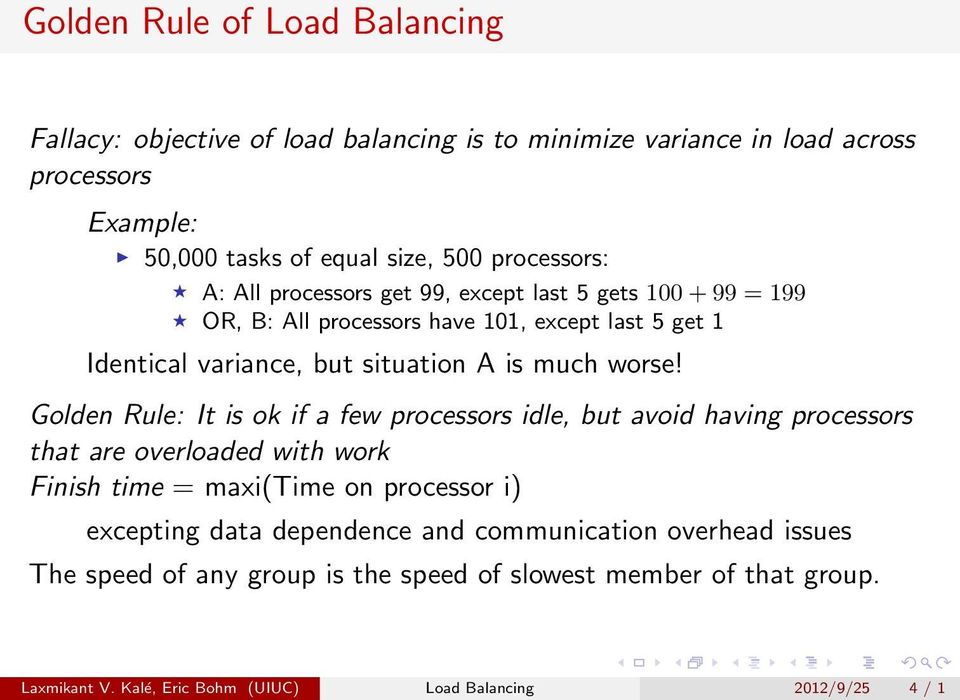
4 Golden Rule of Load Balancing Fallacy: objective of load balancing is to minimize variance in load across processors Example: 50,000 tasks of equal size, 500 processors: A: All processors get 99, except last 5 gets = 199 OR, B: All processors have 101, except last 5 get 1 Identical variance, but situation A is much worse! Golden Rule: It is ok if a few processors idle, but avoid having processors that are overloaded with work Finish time = maxi(time on processor i) excepting data dependence and communication overhead issues The speed of any group is the speed of slowest member of that group. Laxmikant V. Kalé, Eric Bohm (UIUC) Load Balancing 2012/9/25 4 / 1
5 Automatic Dynamic Load Balancing Measurement based load balancers Principle of persistence: In many CSE applications, computational loads and communication patterns tend to persist, even in dynamic computations Therefore, recent past is a good predictor of near future Charm++ provides a suite of load-balancers Periodic measurement and migration of objects Seed balancers (for task-parallelism) Useful for divide-and-conquer and state-space-search applications Seeds for charm++ objects moved around until they take root Laxmikant V. Kalé, Eric Bohm (UIUC) Load Balancing 2012/9/25 5 / 1

6 Using the Load Balancer link a LB module -module <strategy> RefineLB, NeighborLB, GreedyCommLB, others EveryLB will include all load balancing strategies compile time option (specify default balancer) -balancer RefineLB runtime option +balancer RefineLB Laxmikant V. Kalé, Eric Bohm (UIUC) Load Balancing 2012/9/25 6 / 1
7 Code to Use Load Balancing Insert if (mylbstep) AtSync() else ResumeFromSync(); call at natural barrier Implement ResumeFromSync() to resume execution Typical ResumeFromSync contribute to a reduction Laxmikant V. Kalé, Eric Bohm (UIUC) Load Balancing 2012/9/25 7 / 1

8 Example: Stencil while (!converged) { atomic { int x = thisindex.x, y = thisindex.y, z = thisindex.z; copytoboundaries(); thisproxy(wrapx(x 1),y,z).updateGhosts(i, RIGHT, dimy, dimz, right); /...similar calls to send the 6 boundaries... / thisproxy(x,y,wrapz(z+1)).updateghosts(i, FRONT, dimx, dimy, front); } for (remotecount = 0; remotecount < 6; remotecount++) { when updateghosts[i](int i, int d, int w, int h, double b[w h]) atomic { updateboundary(d, w, h, b); } } atomic { int c = computekernel() < DELTA; CkCallback cb(ckreductiontarget(jacobi, checkconverged), thisproxy); if (i%5 == 1) contribute(sizeof(int), \&c, CkReduction::logical and, cb); } if (i % lbperiod == 0) { atomic { AtSync(); } when ResumeFromSync() {} } if (++i % 5 == 0) { when checkconverged(bool result) atomic { if (result) { mainproxy.done(); converged = true; } } } } Laxmikant V. Kalé, Eric Bohm (UIUC) Load Balancing 2012/9/25 8 / 1
 atomic { updateboundary(d, w, h,](/docs-images/44/2348985/images/page_8.jpg "b); } } atomic { int c = computekernel() < DELTA; CkCallback cb(ckreductiontarget(jacobi, checkconverged), thisproxy); if (i%5 == 1) contribute(sizeof(int), \&c, CkReduction::logical and, cb); } if")
9 Chare Migration: motivations Chares are initially placed according to a placement map The user can specify this map While running, some processors might be overloaded Need to rebalance the load Automatic checkpoint Migration to disk Chares are made serializable for transport using the Pack UnPack (PUP) framework Laxmikant V. Kalé, Eric Bohm (UIUC) Load Balancing 2012/9/25 9 / 1

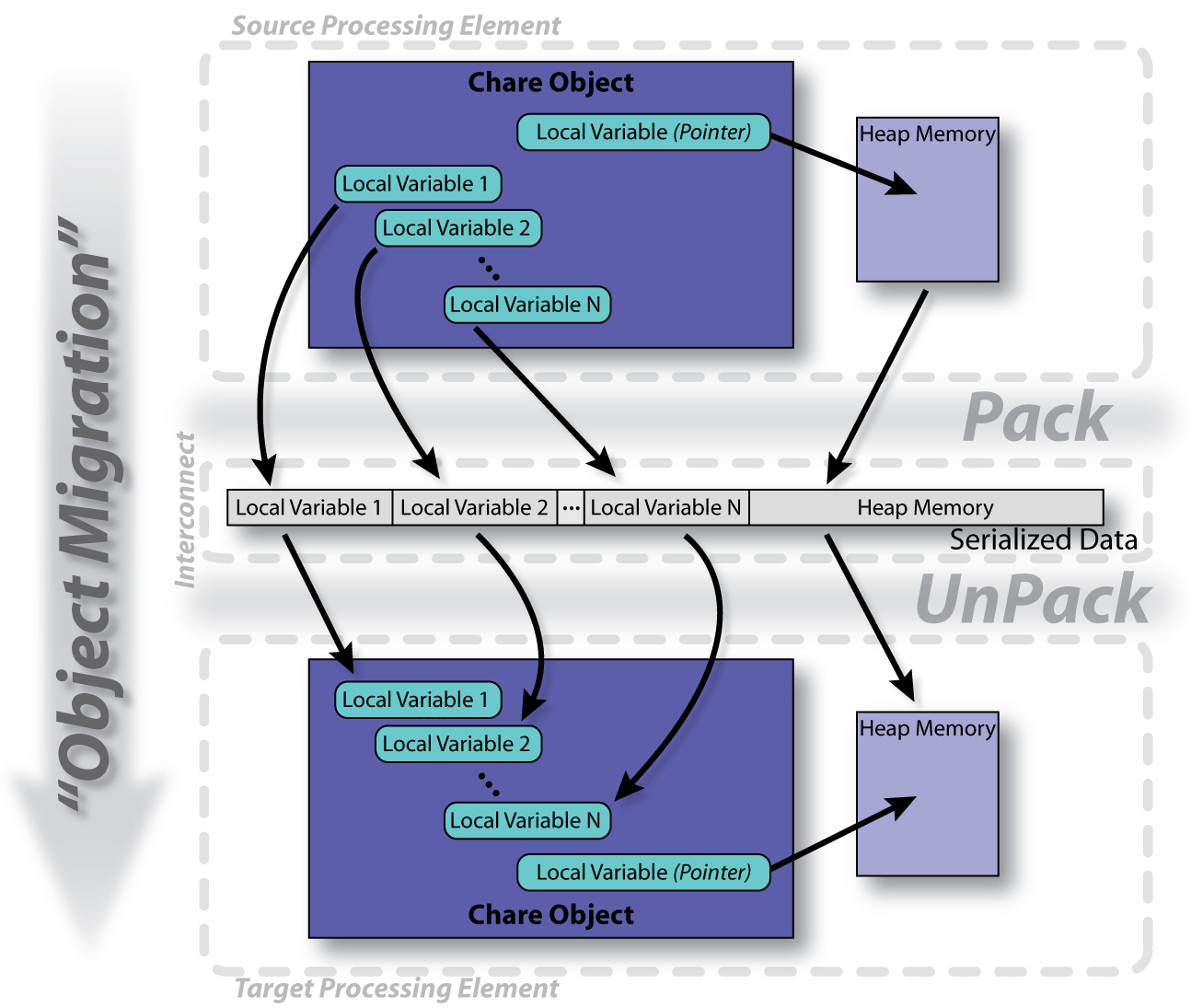
10 The PUP Process Laxmikant V. Kalé, Eric Bohm (UIUC) Load Balancing 2012/9/25 10 / 1
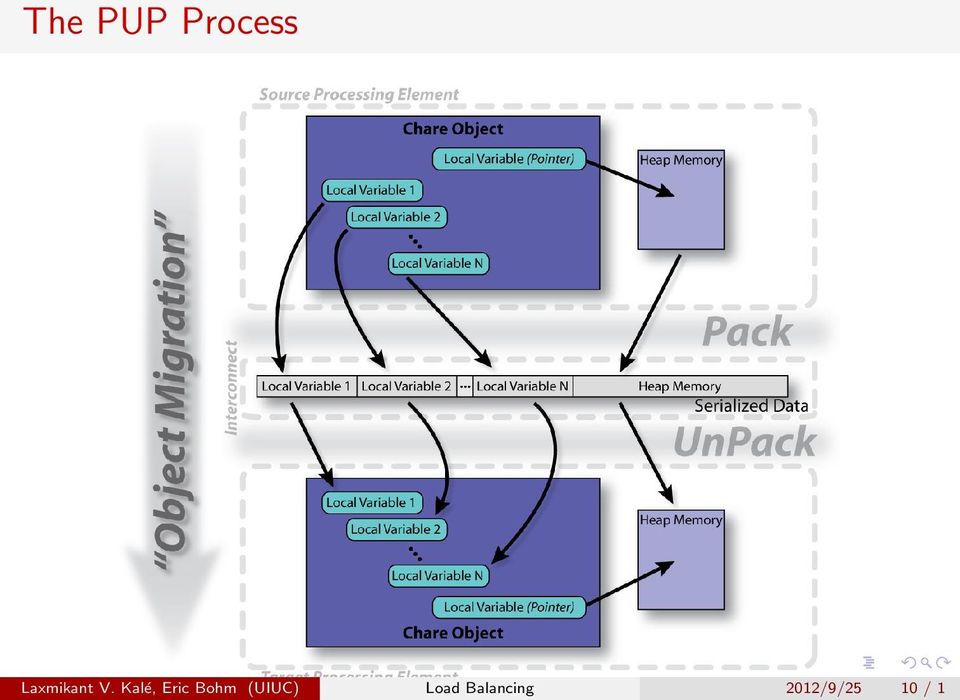
11 PUP Usage Sequence Migration out: ckabouttomigrate Sizing Packing Destructor Migration in: Migration constructor UnPacking ckjustmigrated Laxmikant V. Kalé, Eric Bohm (UIUC) Load Balancing 2012/9/25 11 / 1

12 Writing a PUP routine class MyChare : public CBase MyChare { int a; float b; char c; float localarray[local SIZE]; int heaparraysize; float heaparray; MyClass pointer; }; public: MyChare(); MyChare(CkMigrateMessage msg) {}; MyChare() { if (heaparray!= NULL) { delete [] heaparray; heaparray = NULL; } void pup(pup::er &p) { CBase MyChare::pup(p); p a; p b; p c; p(localarray, LOCAL SIZE); p heaparraysize; if (p.isunpacking()) { heaparray = new float[ heaparraysize]; } p(heaparray, heaparraysize); int isnull = (pointer==null)? 1 : 0; p isnull; if (!isnull) { if (p.isunpacking()) pointer = new MyClass(); p pointer; } } Laxmikant V. Kalé, Eric Bohm (UIUC) Load Balancing 2012/9/25 12 / 1
![= NULL) { delete [] heaparray; heaparray = NULL; } void pup(pup::er &p) { CBase MyChare::pup(p); p a; p b; p c; p(localarray, LOCAL SIZE); p heaparraysize; if (p.](/docs-images/44/2348985/images/page_12.jpg "isunpacking()) { heaparray = new float[ heaparraysize]; } p(heaparray, heaparraysize); int isnull = (pointer==null)? 1 : 0; p isnull; if (!isnull) { if (p.")
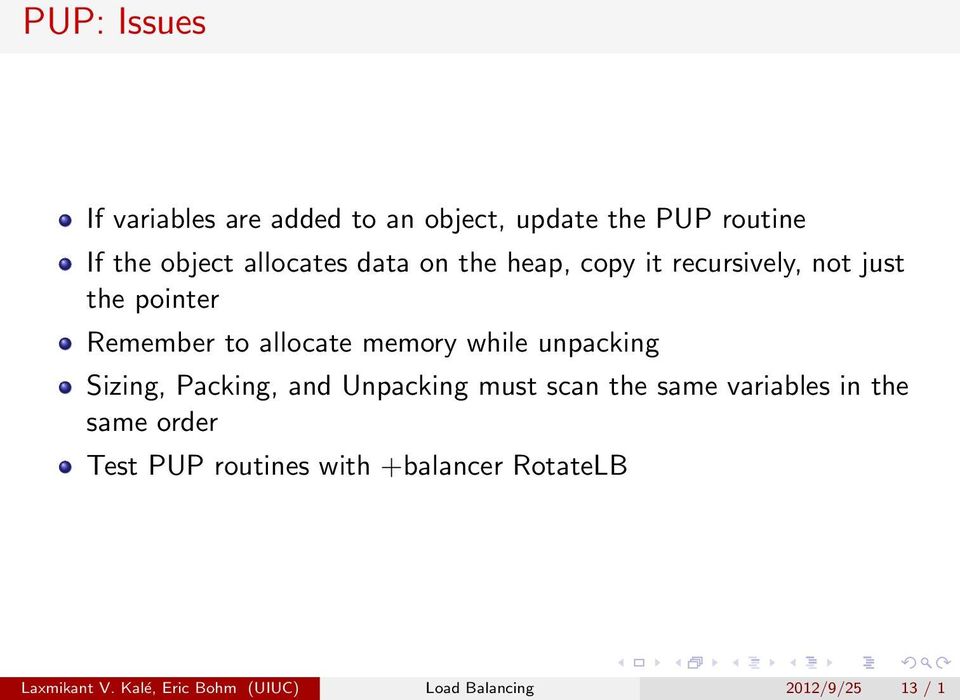
13 PUP: Issues If variables are added to an object, update the PUP routine If the object allocates data on the heap, copy it recursively, not just the pointer Remember to allocate memory while unpacking Sizing, Packing, and Unpacking must scan the same variables in the same order Test PUP routines with +balancer RotateLB Laxmikant V. Kalé, Eric Bohm (UIUC) Load Balancing 2012/9/25 13 / 1

14 Performance Laxmikant V. Kalé, Eric Bohm (UIUC) Load Balancing 2012/9/25 14 / 1


15 Grainsize and Load Balancing How Much Balance Is Possible? Laxmikant V. Kalé, Eric Bohm (UIUC) Load Balancing 2012/9/25 15 / 1


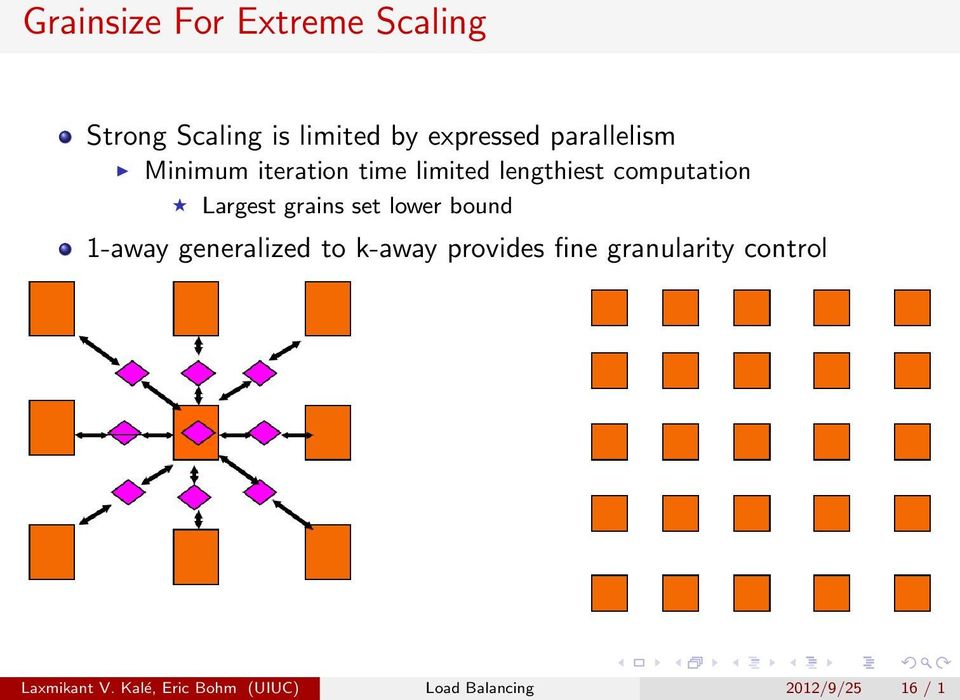
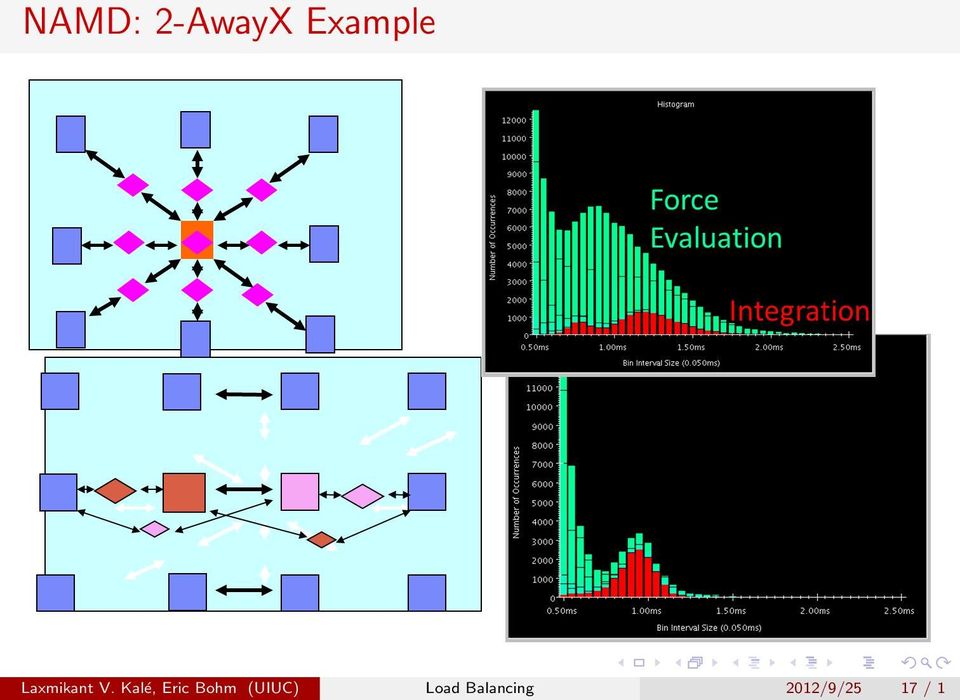
16 Grainsize For Extreme Scaling Strong Scaling is limited by expressed parallelism Minimum iteration time limited lengthiest computation Largest grains set lower bound 1-away generalized to k-away provides fine granularity control Laxmikant V. Kalé, Eric Bohm (UIUC) Load Balancing 2012/9/25 16 / 1
17 NAMD: 2-AwayX Example Laxmikant V. Kalé, Eric Bohm (UIUC) Load Balancing 2012/9/25 17 / 1
18 Load Balancing Strategies Classified by when it is done: Initially Dynamic: Periodically Dynamic: Continuously Classified by whether decisions are taken with global information Fully centralized Quite good a choice when load balancing period is high Fully distributed Each processor knows only about a constant number of neighbors Extreme case: totally local decision (send work to a random destination processor, with some probability). Use aggregated global information, and detailed neighborhood info. Laxmikant V. Kalé, Eric Bohm (UIUC) Load Balancing 2012/9/25 18 / 1
19 Dynamic Load Balancing Scenarios Examples representing typical classes of situations Particles distributed over simulation space Dynamic: because Particles move. Highly non-uniform distribution (cosmology) Relatively Uniform distribution Structured grids, with dynamic refinements/coarsening Unstructured grids with dynamic refinements/coarsening Laxmikant V. Kalé, Eric Bohm (UIUC) Load Balancing 2012/9/25 19 / 1
20 Example Case: Particles Orthogonal Recursive Bisection (ORB) At each stage: divide Particles equally Processor dont need to be a power of 2: Divide in proportion 2:3 with 5 processors How to choose the dimension along which to cut? Choose the longest one How to draw the line? All data on one processor? Sort along each dimension Otherwise: run a distributed histogramming algorithm to find the line, recursively Find the entire tree, and then do all data movement at once Or do it in two-three steps. But no reason to redistribute particles after drawing each line. Laxmikant V. Kalé, Eric Bohm (UIUC) Load Balancing 2012/9/25 20 / 1

21 Dynamic Load Balancing using Objects Object based decomposition (I.e. virtualized decomposition) helps Allows RTS to remap them to balance load But how does the RTS decide where to map objects? Just move objects away from overloaded processors to underloaded processors How is load determined? Laxmikant V. Kalé, Eric Bohm (UIUC) Load Balancing 2012/9/25 21 / 1
22 Measurement Based Load Balancing Principle of Persistence Object communication patterns and computational loads tend to persist over time In spite of dynamic behavior Abrupt but infrequent changes Slow and small changes Runtime instrumentation Measures communication volume and computation time Measurement based load balancers Use the instrumented data-base periodically to make new decisions Many alternative strategies can use the database Laxmikant V. Kalé, Eric Bohm (UIUC) Load Balancing 2012/9/25 22 / 1
23 Periodic Load Balancing Stop the computation? Centralized strategies: Charm RTS collects data (on one processor) about: Computational Load and Communication for each pair If you are not using AMPI/Charm, you can do the same instrumentation and data collection Partition the graph of objects across processors Take communication into account Pt-to-pt, as well as multicast over a subset As you map an object, add to the load on both sending and receiving processor Multicasts to multiple co-located objects are effectively the cost of a single send Laxmikant V. Kalé, Eric Bohm (UIUC) Load Balancing 2012/9/25 23 / 1

24 Typical Load Balancing Steps Laxmikant V. Kalé, Eric Bohm (UIUC) Load Balancing 2012/9/25 24 / 1
25 Object Partitioning Strategies You can use graph partitioners like METIS, K-R BUT: graphs are smaller, and optimization criteria are different Greedy strategies: If communication costs are low: use a simple greedy strategy Sort objects by decreasing load Maintain processors in a heap (by assigned load) In each step: assign the heaviest remaining object to the least loaded processor With small-to-moderate communication cost: Same strategy, but add communication costs as you add an object to a processor Always add a refinement step at the end: Swap work from heaviest loaded processor to some other processor Repeat a few times or until no improvement Laxmikant V. Kalé, Eric Bohm (UIUC) Load Balancing 2012/9/25 25 / 1
26 Object Partitioning Strategies 2 When communication cost is significant: Still use greedy strategy, but: At each assignment step, choose between assigning O to least loaded processor and the processor that already has objects that communicate most with O. Based on the degree of difference in the two metrics Two-stage assignments: In early stages, consider communication costs as long as the processors are in the same (broad) load class, In later stages, decide based on load Branch-and-bound Searches for optimal, but can be stopped after a fixed time Laxmikant V. Kalé, Eric Bohm (UIUC) Load Balancing 2012/9/25 26 / 1
27 Crack Propagation Decomposition into 16 chunks (left) and 128 chunks, 8 for each PE (right). The middle area contains cohesive elements. Both decompositions obtained using Metis. Pictures: S. Breitenfeld, and P. Geubelle As computation progresses, crack propagates, and new elements are added, leading to more complex computations in some chunks Laxmikant V. Kalé, Eric Bohm (UIUC) Load Balancing 2012/9/25 27 / 1
28 Load Balancing Crack Propagation Laxmikant V. Kalé, Eric Bohm (UIUC) Load Balancing 2012/9/25 28 / 1
29 Distributed Load balancing Centralized strategies Still ok for 3000 processors for NAMD Distributed balancing is needed when: Number of processors is large and/or load variation is rapid Large machines: Need to handle locality of communication Topology sensitive placement Need to work with scant global information Approximate or aggregated global information (average/max load) Incomplete global info (only neighborhood) Work diffusion strategies (1980s work by Kale and others!) Achieving global effects by local action Laxmikant V. Kalé, Eric Bohm (UIUC) Load Balancing 2012/9/25 29 / 1
30 Load Balancing on Large Machines Existing load balancing strategies dont scale on extremely large machines Limitations of centralized strategies: Central node: memory/communication bottleneck Decision-making algorithms tend to be very slow Limitations of distributed strategies: Difficult to achieve well-informed load balancing decisions Laxmikant V. Kalé, Eric Bohm (UIUC) Load Balancing 2012/9/25 30 / 1

31 lb test benchmark is a parameterized program that creates a specified Laxmikant V. Kalé, Eric Bohm (UIUC) Load Balancing 2012/9/25 31 / 1 Simulation Study - Memory Overhead lb test experiments performed with the performance simulator BigSim
32 Hierarchical Load Balancers Partition processor allocation into processor groups Apply different strategies at each level Scalable to a large number of processors Laxmikant V. Kalé, Eric Bohm (UIUC) Load Balancing 2012/9/25 32 / 1
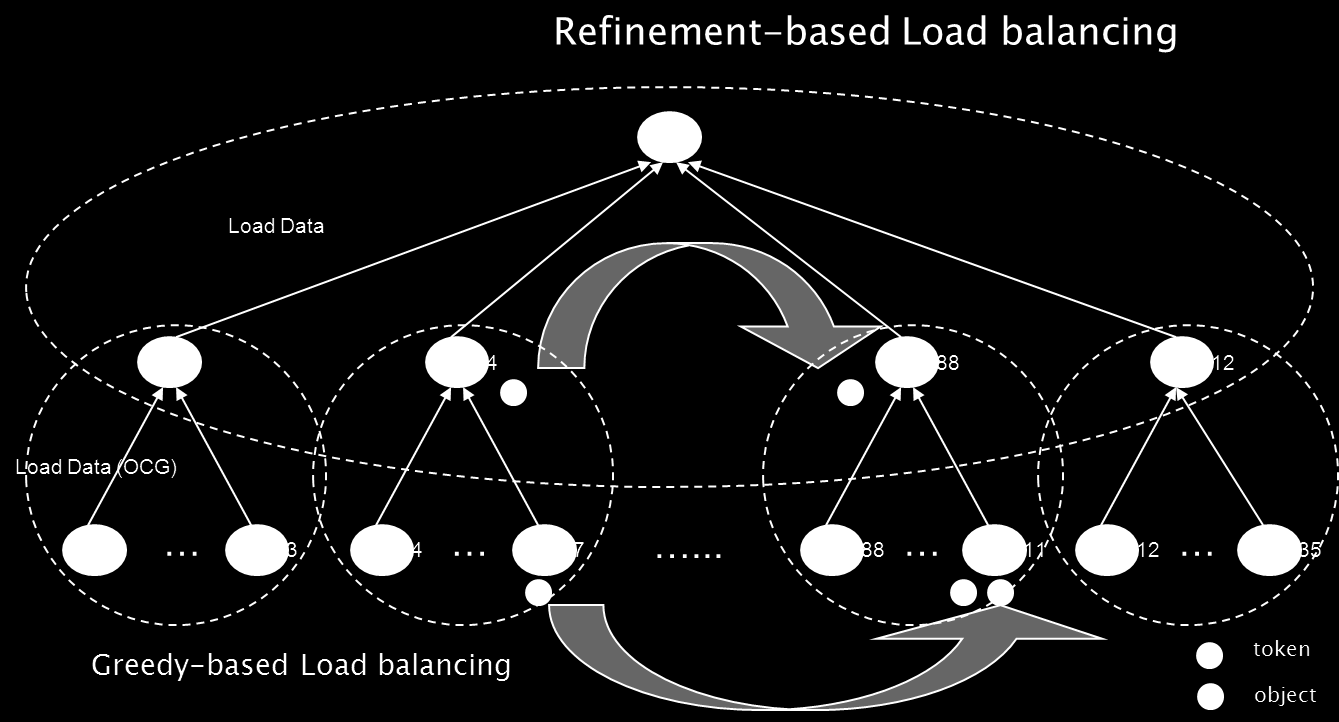
33 Our Hybrid Scheme Laxmikant V. Kalé, Eric Bohm (UIUC) Load Balancing 2012/9/25 33 / 1

34 Hybrid Load Balancing Performance Laxmikant V. Kalé, Eric Bohm (UIUC) Load Balancing 2012/9/25 34 / 1
35 Summary Use Profiling and Performance Analysis Tools Early Measure twice, cut once! Look for overloaded processors, not underloaded processors Use PUP for object serialization Enables Migration for Load Balancing or Fault Tolerance Don t forget to consider granularity Laxmikant V. Kalé, Eric Bohm (UIUC) Load Balancing 2012/9/25 35 / 1
Dynamic Load Balancing in Charm++ Abhinav S Bhatele Parallel Programming Lab, UIUC
 Dynamic Load Balancing in Charm++ Abhinav S Bhatele Parallel Programming Lab, UIUC Outline Dynamic Load Balancing framework in Charm++ Measurement Based Load Balancing Examples: Hybrid Load Balancers Topology-aware
Charm++, what s that?!
 Charm++, what s that?! Les Mardis du dev François Tessier - Runtime team October 15, 2013 François Tessier Charm++ 1 / 25 Outline 1 Introduction 2 Charm++ 3 Basic examples 4 Load Balancing 5 Conclusion
Distributed Dynamic Load Balancing for Iterative-Stencil Applications
 Distributed Dynamic Load Balancing for Iterative-Stencil Applications G. Dethier 1, P. Marchot 2 and P.A. de Marneffe 1 1 EECS Department, University of Liege, Belgium 2 Chemical Engineering Department,
Feedback guided load balancing in a distributed memory environment
 Feedback guided load balancing in a distributed memory environment Constantinos Christofi August 18, 2011 MSc in High Performance Computing The University of Edinburgh Year of Presentation: 2011 Abstract
ParFUM: A Parallel Framework for Unstructured Meshes. Aaron Becker, Isaac Dooley, Terry Wilmarth, Sayantan Chakravorty Charm++ Workshop 2008
 ParFUM: A Parallel Framework for Unstructured Meshes Aaron Becker, Isaac Dooley, Terry Wilmarth, Sayantan Chakravorty Charm++ Workshop 2008 What is ParFUM? A framework for writing parallel finite element
A Review of Customized Dynamic Load Balancing for a Network of Workstations
 A Review of Customized Dynamic Load Balancing for a Network of Workstations Taken from work done by: Mohammed Javeed Zaki, Wei Li, Srinivasan Parthasarathy Computer Science Department, University of Rochester
Cloud Friendly Load Balancing for HPC Applications: Preliminary Work
 Cloud Friendly Load Balancing for HPC Applications: Preliminary Work Osman Sarood, Abhishek Gupta and Laxmikant V. Kalé Department of Computer Science University of Illinois at Urbana-Champaign Urbana,
Scientific Computing Programming with Parallel Objects
 Scientific Computing Programming with Parallel Objects Esteban Meneses, PhD School of Computing, Costa Rica Institute of Technology Parallel Architectures Galore Personal Computing Embedded Computing Moore
Partitioning and Divide and Conquer Strategies
 and Divide and Conquer Strategies Lecture 4 and Strategies Strategies Data partitioning aka domain decomposition Functional decomposition Lecture 4 and Strategies Quiz 4.1 For nuclear reactor simulation,
CSE 4351/5351 Notes 7: Task Scheduling & Load Balancing
 CSE / Notes : Task Scheduling & Load Balancing Task Scheduling A task is a (sequential) activity that uses a set of inputs to produce a set of outputs. A task (precedence) graph is an acyclic, directed
Load Imbalance Analysis
 With CrayPat Load Imbalance Analysis Imbalance time is a metric based on execution time and is dependent on the type of activity: User functions Imbalance time = Maximum time Average time Synchronization
Characterizing the Performance of Dynamic Distribution and Load-Balancing Techniques for Adaptive Grid Hierarchies
 Proceedings of the IASTED International Conference Parallel and Distributed Computing and Systems November 3-6, 1999 in Cambridge Massachusetts, USA Characterizing the Performance of Dynamic Distribution
Mesh Partitioning and Load Balancing
 and Load Balancing Contents: Introduction / Motivation Goals of Load Balancing Structures Tools Slide Flow Chart of a Parallel (Dynamic) Application Partitioning of the initial mesh Computation Iteration
NAMD2- Greater Scalability for Parallel Molecular Dynamics. Presented by Abel Licon
 NAMD2- Greater Scalability for Parallel Molecular Dynamics Laxmikant Kale, Robert Steel, Milind Bhandarkar,, Robert Bunner, Attila Gursoy,, Neal Krawetz,, James Phillips, Aritomo Shinozaki, Krishnan Varadarajan,,
A Comparison Of Shared Memory Parallel Programming Models. Jace A Mogill David Haglin
 A Comparison Of Shared Memory Parallel Programming Models Jace A Mogill David Haglin 1 Parallel Programming Gap Not many innovations... Memory semantics unchanged for over 50 years 2010 Multi-Core x86
Mesh Generation and Load Balancing
 Mesh Generation and Load Balancing Stan Tomov Innovative Computing Laboratory Computer Science Department The University of Tennessee April 04, 2012 CS 594 04/04/2012 Slide 1 / 19 Outline Motivation Reliable
Parallel Programming at the Exascale Era: A Case Study on Parallelizing Matrix Assembly For Unstructured Meshes
 Parallel Programming at the Exascale Era: A Case Study on Parallelizing Matrix Assembly For Unstructured Meshes Eric Petit, Loïc Thebault, Quang V. Dinh May 2014 EXA2CT Consortium 2 WPs Organization Proto-Applications
Mizan: A System for Dynamic Load Balancing in Large-scale Graph Processing
 /35 Mizan: A System for Dynamic Load Balancing in Large-scale Graph Processing Zuhair Khayyat 1 Karim Awara 1 Amani Alonazi 1 Hani Jamjoom 2 Dan Williams 2 Panos Kalnis 1 1 King Abdullah University of
Energy Efficient MapReduce
 Energy Efficient MapReduce Motivation: Energy consumption is an important aspect of datacenters efficiency, the total power consumption in the united states has doubled from 2000 to 2005, representing
Load Balancing Techniques
 Load Balancing Techniques 1 Lecture Outline Following Topics will be discussed Static Load Balancing Dynamic Load Balancing Mapping for load balancing Minimizing Interaction 2 1 Load Balancing Techniques
Distributed communication-aware load balancing with TreeMatch in Charm++
 Distributed communication-aware load balancing with TreeMatch in Charm++ The 9th Scheduling for Large Scale Systems Workshop, Lyon, France Emmanuel Jeannot Guillaume Mercier Francois Tessier In collaboration
Performance of Dynamic Load Balancing Algorithms for Unstructured Mesh Calculations
 Performance of Dynamic Load Balancing Algorithms for Unstructured Mesh Calculations Roy D. Williams, 1990 Presented by Chris Eldred Outline Summary Finite Element Solver Load Balancing Results Types Conclusions
Windows Server Performance Monitoring
 Spot server problems before they are noticed The system s really slow today! How often have you heard that? Finding the solution isn t so easy. The obvious questions to ask are why is it running slowly
Load Balancing. Load Balancing 1 / 24
 Load Balancing Backtracking, branch & bound and alpha-beta pruning: how to assign work to idle processes without much communication? Additionally for alpha-beta pruning: implementing the young-brothers-wait
Load Balancing in Structured Peer to Peer Systems
 Load Balancing in Structured Peer to Peer Systems DR.K.P.KALIYAMURTHIE 1, D.PARAMESWARI 2 Professor and Head, Dept. of IT, Bharath University, Chennai-600 073 1 Asst. Prof. (SG), Dept. of Computer Applications,
Load Balancing in Structured Peer to Peer Systems
 Load Balancing in Structured Peer to Peer Systems Dr.K.P.Kaliyamurthie 1, D.Parameswari 2 1.Professor and Head, Dept. of IT, Bharath University, Chennai-600 073. 2.Asst. Prof.(SG), Dept. of Computer Applications,
A Comparative Performance Analysis of Load Balancing Algorithms in Distributed System using Qualitative Parameters
 A Comparative Performance Analysis of Load Balancing Algorithms in Distributed System using Qualitative Parameters Abhijit A. Rajguru, S.S. Apte Abstract - A distributed system can be viewed as a collection
Parallel Scalable Algorithms- Performance Parameters
 www.bsc.es Parallel Scalable Algorithms- Performance Parameters Vassil Alexandrov, ICREA - Barcelona Supercomputing Center, Spain Overview Sources of Overhead in Parallel Programs Performance Metrics for
Dynamic Load Balancing in a Network of Workstations
 Dynamic Load Balancing in a Network of Workstations 95.515F Research Report By: Shahzad Malik (219762) November 29, 2000 Table of Contents 1 Introduction 3 2 Load Balancing 4 2.1 Static Load Balancing
Performance Monitoring of Parallel Scientific Applications
 Performance Monitoring of Parallel Scientific Applications Abstract. David Skinner National Energy Research Scientific Computing Center Lawrence Berkeley National Laboratory This paper introduces an infrastructure
Locality-Preserving Dynamic Load Balancing for Data-Parallel Applications on Distributed-Memory Multiprocessors
 JOURNAL OF INFORMATION SCIENCE AND ENGINEERING 18, 1037-1048 (2002) Short Paper Locality-Preserving Dynamic Load Balancing for Data-Parallel Applications on Distributed-Memory Multiprocessors PANGFENG
Parallel & Distributed Optimization. Based on Mark Schmidt s slides
 Parallel & Distributed Optimization Based on Mark Schmidt s slides Motivation behind using parallel & Distributed optimization Performance Computational throughput have increased exponentially in linear
Various Schemes of Load Balancing in Distributed Systems- A Review
 741 Various Schemes of Load Balancing in Distributed Systems- A Review Monika Kushwaha Pranveer Singh Institute of Technology Kanpur, U.P. (208020) U.P.T.U., Lucknow Saurabh Gupta Pranveer Singh Institute
Raima Database Manager Version 14.0 In-memory Database Engine
 + Raima Database Manager Version 14.0 In-memory Database Engine By Jeffrey R. Parsons, Senior Engineer January 2016 Abstract Raima Database Manager (RDM) v14.0 contains an all new data storage engine optimized
Load balancing in SOAJA (Service Oriented Java Adaptive Applications)
 Load balancing in SOAJA (Service Oriented Java Adaptive Applications) Richard Olejnik Université des Sciences et Technologies de Lille Laboratoire d Informatique Fondamentale de Lille (LIFL UMR CNRS 8022)
1. The memory address of the first element of an array is called A. floor address B. foundation addressc. first address D.
 1. The memory address of the first element of an array is called A. floor address B. foundation addressc. first address D. base address 2. The memory address of fifth element of an array can be calculated
1. Comments on reviews a. Need to avoid just summarizing web page asks you for:
 1. Comments on reviews a. Need to avoid just summarizing web page asks you for: i. A one or two sentence summary of the paper ii. A description of the problem they were trying to solve iii. A summary of
Quiz 4 Solutions EECS 211: FUNDAMENTALS OF COMPUTER PROGRAMMING II. 1 Q u i z 4 S o l u t i o n s
 Quiz 4 Solutions Q1: What value does function mystery return when called with a value of 4? int mystery ( int number ) { if ( number
Guideline for stresstest Page 1 of 6. Stress test
 Guideline for stresstest Page 1 of 6 Stress test Objective: Show unacceptable problems with high parallel load. Crash, wrong processing, slow processing. Test Procedure: Run test cases with maximum number
Proactive, Resource-Aware, Tunable Real-time Fault-tolerant Middleware
 Proactive, Resource-Aware, Tunable Real-time Fault-tolerant Middleware Priya Narasimhan T. Dumitraş, A. Paulos, S. Pertet, C. Reverte, J. Slember, D. Srivastava Carnegie Mellon University Problem Description
APPENDIX 1 USER LEVEL IMPLEMENTATION OF PPATPAN IN LINUX SYSTEM
 152 APPENDIX 1 USER LEVEL IMPLEMENTATION OF PPATPAN IN LINUX SYSTEM A1.1 INTRODUCTION PPATPAN is implemented in a test bed with five Linux system arranged in a multihop topology. The system is implemented
1) The postfix expression for the infix expression A+B*(C+D)/F+D*E is ABCD+*F/DE*++
 Answer the following 1) The postfix expression for the infix expression A+B*(C+D)/F+D*E is ABCD+*F/DE*++ 2) Which data structure is needed to convert infix notations to postfix notations? Stack 3) The
IMPROVED PROXIMITY AWARE LOAD BALANCING FOR HETEROGENEOUS NODES
 www.ijecs.in International Journal Of Engineering And Computer Science ISSN:2319-7242 Volume 2 Issue 6 June, 2013 Page No. 1914-1919 IMPROVED PROXIMITY AWARE LOAD BALANCING FOR HETEROGENEOUS NODES Ms.
GEDAE TM - A Graphical Programming and Autocode Generation Tool for Signal Processor Applications
 GEDAE TM - A Graphical Programming and Autocode Generation Tool for Signal Processor Applications Harris Z. Zebrowitz Lockheed Martin Advanced Technology Laboratories 1 Federal Street Camden, NJ 08102
Load Balancing on a Grid Using Data Characteristics
 Load Balancing on a Grid Using Data Characteristics Jonathan White and Dale R. Thompson Computer Science and Computer Engineering Department University of Arkansas Fayetteville, AR 72701, USA {jlw09, drt}@uark.edu
SIMULATION OF LOAD BALANCING ALGORITHMS: A Comparative Study
 SIMULATION OF LOAD BALANCING ALGORITHMS: A Comparative Study Milan E. Soklic Abstract This article introduces a new load balancing algorithm, called diffusive load balancing, and compares its performance
KITES TECHNOLOGY COURSE MODULE (C, C++, DS)
 KITES TECHNOLOGY 360 Degree Solution www.kitestechnology.com/academy.php [email protected] [email protected] Contact: - 8961334776 9433759247 9830639522.NET JAVA WEB DESIGN PHP SQL, PL/SQL
How To Balance In Cloud Computing
 A Review on Load Balancing Algorithms in Cloud Hareesh M J Dept. of CSE, RSET, Kochi hareeshmjoseph@ gmail.com John P Martin Dept. of CSE, RSET, Kochi [email protected] Yedhu Sastri Dept. of IT, RSET,
Cloud Computing at Google. Architecture
 Cloud Computing at Google Google File System Web Systems and Algorithms Google Chris Brooks Department of Computer Science University of San Francisco Google has developed a layered system to handle webscale
Write Barrier Removal by Static Analysis
 Write Barrier Removal by Static Analysis Karen Zee and Martin Rinard Laboratory for Computer Science Massachusetts Institute of Technology Cambridge, MA 02139 {kkz, [email protected] ABSTRACT We present
Survey on Load Rebalancing for Distributed File System in Cloud
 Survey on Load Rebalancing for Distributed File System in Cloud Prof. Pranalini S. Ketkar Ankita Bhimrao Patkure IT Department, DCOER, PG Scholar, Computer Department DCOER, Pune University Pune university
LOAD BALANCING DISTRIBUTED OPERATING SYSTEMS, SCALABILITY, SS 2015. Hermann Härtig
 LOAD BALANCING DISTRIBUTED OPERATING SYSTEMS, SCALABILITY, SS 2015 Hermann Härtig ISSUES starting points independent Unix processes and block synchronous execution who does it load migration mechanism
An Implementation Of Multiprocessor Linux
 An Implementation Of Multiprocessor Linux This document describes the implementation of a simple SMP Linux kernel extension and how to use this to develop SMP Linux kernels for architectures other than
Converting a Number from Decimal to Binary
 Converting a Number from Decimal to Binary Convert nonnegative integer in decimal format (base 10) into equivalent binary number (base 2) Rightmost bit of x Remainder of x after division by two Recursive
walberla: Towards an Adaptive, Dynamically Load-Balanced, Massively Parallel Lattice Boltzmann Fluid Simulation
 walberla: Towards an Adaptive, Dynamically Load-Balanced, Massively Parallel Lattice Boltzmann Fluid Simulation SIAM Parallel Processing for Scientific Computing 2012 February 16, 2012 Florian Schornbaum,
Parallelization: Binary Tree Traversal
 By Aaron Weeden and Patrick Royal Shodor Education Foundation, Inc. August 2012 Introduction: According to Moore s law, the number of transistors on a computer chip doubles roughly every two years. First
Concurrency control. Concurrency problems. Database Management System
 Concurrency control Transactions per second (tps) is the measure of the workload of a operational DBMS; if two transactions access concurrently to the same data there is a problem: the module who resolve
Local Area Networks transmission system private speedy and secure kilometres shared transmission medium hardware & software
 Local Area What s a LAN? A transmission system, usually private owned, very speedy and secure, covering a geographical area in the range of kilometres, comprising a shared transmission medium and a set
DECENTRALIZED LOAD BALANCING IN HETEROGENEOUS SYSTEMS USING DIFFUSION APPROACH
 DECENTRALIZED LOAD BALANCING IN HETEROGENEOUS SYSTEMS USING DIFFUSION APPROACH P.Neelakantan Department of Computer Science & Engineering, SVCET, Chittoor [email protected] ABSTRACT The grid
Storage Systems Autumn 2009. Chapter 6: Distributed Hash Tables and their Applications André Brinkmann
 Storage Systems Autumn 2009 Chapter 6: Distributed Hash Tables and their Applications André Brinkmann Scaling RAID architectures Using traditional RAID architecture does not scale Adding news disk implies
Praktikum Wissenschaftliches Rechnen (Performance-optimized optimized Programming)
 Praktikum Wissenschaftliches Rechnen (Performance-optimized optimized Programming) Dynamic Load Balancing Dr. Ralf-Peter Mundani Center for Simulation Technology in Engineering Technische Universität München
GraySort on Apache Spark by Databricks
 GraySort on Apache Spark by Databricks Reynold Xin, Parviz Deyhim, Ali Ghodsi, Xiangrui Meng, Matei Zaharia Databricks Inc. Apache Spark Sorting in Spark Overview Sorting Within a Partition Range Partitioner
Real Time Network Server Monitoring using Smartphone with Dynamic Load Balancing
 www.ijcsi.org 227 Real Time Network Server Monitoring using Smartphone with Dynamic Load Balancing Dhuha Basheer Abdullah 1, Zeena Abdulgafar Thanoon 2, 1 Computer Science Department, Mosul University,
An Empirical Study and Analysis of the Dynamic Load Balancing Techniques Used in Parallel Computing Systems
 An Empirical Study and Analysis of the Dynamic Load Balancing Techniques Used in Parallel Computing Systems Ardhendu Mandal and Subhas Chandra Pal Department of Computer Science and Application, University
Multi-GPU Load Balancing for Simulation and Rendering
 Multi- Load Balancing for Simulation and Rendering Yong Cao Computer Science Department, Virginia Tech, USA In-situ ualization and ual Analytics Instant visualization and interaction of computing tasks
Keywords: Dynamic Load Balancing, Process Migration, Load Indices, Threshold Level, Response Time, Process Age.
 Volume 3, Issue 10, October 2013 ISSN: 2277 128X International Journal of Advanced Research in Computer Science and Software Engineering Research Paper Available online at: www.ijarcsse.com Load Measurement
A Comparison of General Approaches to Multiprocessor Scheduling
 A Comparison of General Approaches to Multiprocessor Scheduling Jing-Chiou Liou AT&T Laboratories Middletown, NJ 0778, USA [email protected] Michael A. Palis Department of Computer Science Rutgers University
Decentralized Dynamic Load Balancing: The Particles Approach
 appered in: Information Sciences, Vol 84, Issue 1-2 (May 1995) S 115-128 Decentralized Dynamic Load Balancing: The Particles Approach Hans-Ulrich Heiss Department of Informatics and Automation Technical
BigData. An Overview of Several Approaches. David Mera 16/12/2013. Masaryk University Brno, Czech Republic
 BigData An Overview of Several Approaches David Mera Masaryk University Brno, Czech Republic 16/12/2013 Table of Contents 1 Introduction 2 Terminology 3 Approaches focused on batch data processing MapReduce-Hadoop
PEER-TO-PEER (P2P) systems have emerged as an appealing
 IEEE TRANSACTIONS ON KNOWLEDGE AND DATA ENGINEERING, VOL. 21, NO. 4, APRIL 2009 595 Histogram-Based Global Load Balancing in Structured Peer-to-Peer Systems Quang Hieu Vu, Member, IEEE, Beng Chin Ooi,
Lecture 3: Scaling by Load Balancing 1. Comments on reviews i. 2. Topic 1: Scalability a. QUESTION: What are problems? i. These papers look at
 Lecture 3: Scaling by Load Balancing 1. Comments on reviews i. 2. Topic 1: Scalability a. QUESTION: What are problems? i. These papers look at distributing load b. QUESTION: What is the context? i. How
Multiprocessor Scheduling and Scheduling in Linux Kernel 2.6
 Multiprocessor Scheduling and Scheduling in Linux Kernel 2.6 Winter Term 2008 / 2009 Jun.-Prof. Dr. André Brinkmann [email protected] Universität Paderborn PC² Agenda Multiprocessor and
MOSIX: High performance Linux farm
 MOSIX: High performance Linux farm Paolo Mastroserio [[email protected]] Francesco Maria Taurino [[email protected]] Gennaro Tortone [[email protected]] Napoli Index overview on Linux farm farm
Linux Driver Devices. Why, When, Which, How?
 Bertrand Mermet Sylvain Ract Linux Driver Devices. Why, When, Which, How? Since its creation in the early 1990 s Linux has been installed on millions of computers or embedded systems. These systems may
Optimizing Distributed Application Performance Using Dynamic Grid Topology-Aware Load Balancing
 Optimizing Distributed Application Performance Using Dynamic Grid Topology-Aware Load Balancing Gregory A. Koenig and Laxmikant V. Kalé Department of Computer Science University of Illinois at Urbana-Champaign
Uintah Framework. Justin Luitjens, Qingyu Meng, John Schmidt, Martin Berzins, Todd Harman, Chuch Wight, Steven Parker, et al
 Uintah Framework Justin Luitjens, Qingyu Meng, John Schmidt, Martin Berzins, Todd Harman, Chuch Wight, Steven Parker, et al Uintah Parallel Computing Framework Uintah - far-sighted design by Steve Parker
Unsupervised Data Mining (Clustering)
 Unsupervised Data Mining (Clustering) Javier Béjar KEMLG December 01 Javier Béjar (KEMLG) Unsupervised Data Mining (Clustering) December 01 1 / 51 Introduction Clustering in KDD One of the main tasks in
Fair Scheduling Algorithm with Dynamic Load Balancing Using In Grid Computing
 Research Inventy: International Journal Of Engineering And Science Vol.2, Issue 10 (April 2013), Pp 53-57 Issn(e): 2278-4721, Issn(p):2319-6483, Www.Researchinventy.Com Fair Scheduling Algorithm with Dynamic
End-user Tools for Application Performance Analysis Using Hardware Counters
 1 End-user Tools for Application Performance Analysis Using Hardware Counters K. London, J. Dongarra, S. Moore, P. Mucci, K. Seymour, T. Spencer Abstract One purpose of the end-user tools described in
Using Peer to Peer Dynamic Querying in Grid Information Services
 Using Peer to Peer Dynamic Querying in Grid Information Services Domenico Talia and Paolo Trunfio DEIS University of Calabria HPC 2008 July 2, 2008 Cetraro, Italy Using P2P for Large scale Grid Information