
Flexible Premium Deferred Variable Annuity. Go paperless. Prospectuses April 30, 2016 Thrivent Variable Annuity Account A Thrivent Series Fund, Inc.
|
|
|
- Anthony Lyons
- 9 years ago
- Views:
Transcription
1 Flexible Premium Deferred Variable Annuity Issued by Aid Association for Lutherans between 6/15/1995 and 4/30/2003. Prospectuses April 30, 2016 Thrivent Variable Annuity Account A Thrivent Series Fund, Inc. Go paperless Free yourself and your kitchen table. Receive notifications when reports and other documents are available online. Get started at Thrivent.com/gopaperless.
2

3 Thrivent Series Fund, Inc. Supplement to the Prospectus dated April 30, 2016 with respect to Thrivent Partner Worldwide Allocation Portfolio Dennis Suvorov is no longer a portfolio manager for Thrivent Partner Worldwide Allocation Portfolio. As a result, all references to Mr. Suvorov are hereby removed from the prospectus of the Thrivent Series Fund, Inc The date of this Supplement is June 28, Please include this Supplement with your Prospectus.

4 THRIVENT VARIABLE ANNUITY ACCOUNT A PROSPECTUS FOR INDIVIDUAL FLEXIBLE PREMIUM DEFERRED VARIABLE ANNUITY CONTRACT ISSUED BY THRIVENT FINANCIAL FOR LUTHERANS Service Center: 4321 North Ballard Road Appleton, WI Telephone: (800) [email protected] Corporate Office: 625 Fourth Avenue South Minneapolis, MN Telephone: (800) [email protected] This Prospectus describes the individual flexible premium deferred variable annuity Contract (the Contract ) which was issued by Thrivent Financial for Lutherans ( Thrivent Financial, we, us or our ), a fraternal benefit society organized under Wisconsin law. Even though we no longer issue new Contracts, you may continue to allocate net premiums among investment alternatives with different investment objectives. We allocate net premiums based on your designation to one or more Subaccounts of Thrivent Variable Annuity Account A (the Variable Account ), and/or to the Fixed Account (which is the general account of ours, and which pays interest in an amount that is at least as great as the guaranteed fixed rate). The assets of each Subaccount will be invested solely in a corresponding Portfolio of Thrivent Series Fund, Inc. (the Fund ), which is an open-end management investment company (commonly known as a mutual fund ). We provide the overall investment management for each of the Portfolios, although some of the Portfolios are managed by an investment subadviser. The accompanying Prospectus for the Fund describes the investment objectives and attendant risks of the following Portfolios: Thrivent Aggressive Allocation Portfolio Thrivent Moderately Aggressive Allocation Portfolio Thrivent Moderate Allocation Portfolio Thrivent Moderately Conservative Allocation Portfolio Thrivent Growth and Income Plus Portfolio Thrivent Balanced Income Plus Portfolio Thrivent Diversified Income Plus Portfolio Thrivent Opportunity Income Plus Portfolio Thrivent Partner Healthcare Portfolio (subadvised by Sectoral Asset Management Inc.) Thrivent Partner Emerging Markets Equity Portfolio (subadvised by Aberdeen Asset Managers Limited) Thrivent Real Estate Securities Portfolio Thrivent Small Cap Stock Portfolio Thrivent Small Cap Index Portfolio Thrivent Mid Cap Stock Portfolio Thrivent Mid Cap Index Portfolio Thrivent Partner Worldwide Allocation Portfolio (subadvised by Aberdeen Asset Managers Limited, Goldman Sachs Asset Management, L.P. and Principal Global Investors, LLC) Thrivent Partner All Cap Portfolio (subadvised by FIAM LLC) Thrivent Large Cap Growth Portfolio Thrivent Partner Growth Stock Portfolio (subadvised by T. Rowe Price Associates, Inc.) Thrivent Large Cap Value Portfolio Thrivent Large Cap Stock Portfolio Thrivent Large Cap Index Portfolio Thrivent High Yield Portfolio Thrivent Income Portfolio Thrivent Bond Index Portfolio Thrivent Limited Maturity Bond Portfolio Thrivent Money Market Portfolio Additional information about us, the Contract and the Variable Account is contained in a Statement of Additional Information ( SAI ) dated April 30, That SAI was filed with the Securities and Exchange Commission and is incorporated by reference in this Prospectus. You may obtain a copy of the SAI and all other documents required to be filed with the SEC without charge by calling us at THRIVENT ( ), going online at thrivent.com, or by writing us at Thrivent Financial for Lutherans, 4321 North Ballard Road, Appleton, Wisconsin, In addition, the Securities and Exchange Commission maintains a website ( that contains the SAI and all other documents required to be filed with the SEC. The Table of Contents for the SAI may be found on Page 40 of this Prospectus. An investment in the Contract is not a deposit of a bank or financial institution and is not insured or guaranteed by the Federal Deposit Insurance Corporation or any other government agency. An investment in the Contract involves investment risk including the possible loss of principal. The Securities and Exchange Commission has not approved or disapproved these securities or determined if this Prospectus is truthful or complete. Any representation to the contrary is a criminal offense. This Prospectus sets forth concisely the information about the Contract that a prospective investor ought to know before investing, and should be read and kept for future reference. We have not authorized anyone to provide you with information that is different. The date of this Prospectus is April 30, 2016.

5 TABLE OF CONTENTS Definitions Fee and Expense Tables Summary The Contract Annuity Payments Exchange Program Federal Tax Status Condensed Financial Information Thrivent Financial and the Variable Account The Variable Account Investment Options Variable Investment Options and the Subaccounts Investment Management Addition, Deletion, Combination, or Substitution of Investments Voting Privileges Fixed Account Risks The Contract Crediting and Allocating Your Premium Payments Owners, Payees and Annuitants Adult and Juvenile Contracts Beneficiaries Assignments of Ownership Successor Owners Contracts Issued in Connection with Qualified Plans Accumulation Phase Contract Valuation Fixed Account Valuation Variable Account Valuation Net Investment Factor Dollar Cost Averaging Transfers among Subaccounts and/or the Fixed Account Frequent Trading Policies Asset Rebalancing Telephone and Online Transactions Timely Processing Surrenders and Withdrawals Before the Annuity Commencement Date Automatic Payout Option Death of an Owner and/or Annuitant Before the Annuity Commencement Date Annuity Phase Annuity Commencement Date Annuity Payments Partial Annuitization Withdrawals and Surrenders during the Annuity Phase Death of Owner/Payee after the Annuity Commencement Date Charges and Deductions Surrender Charge (Contingent Deferred Sales Charge) Transfer Charge % Free Withdrawal

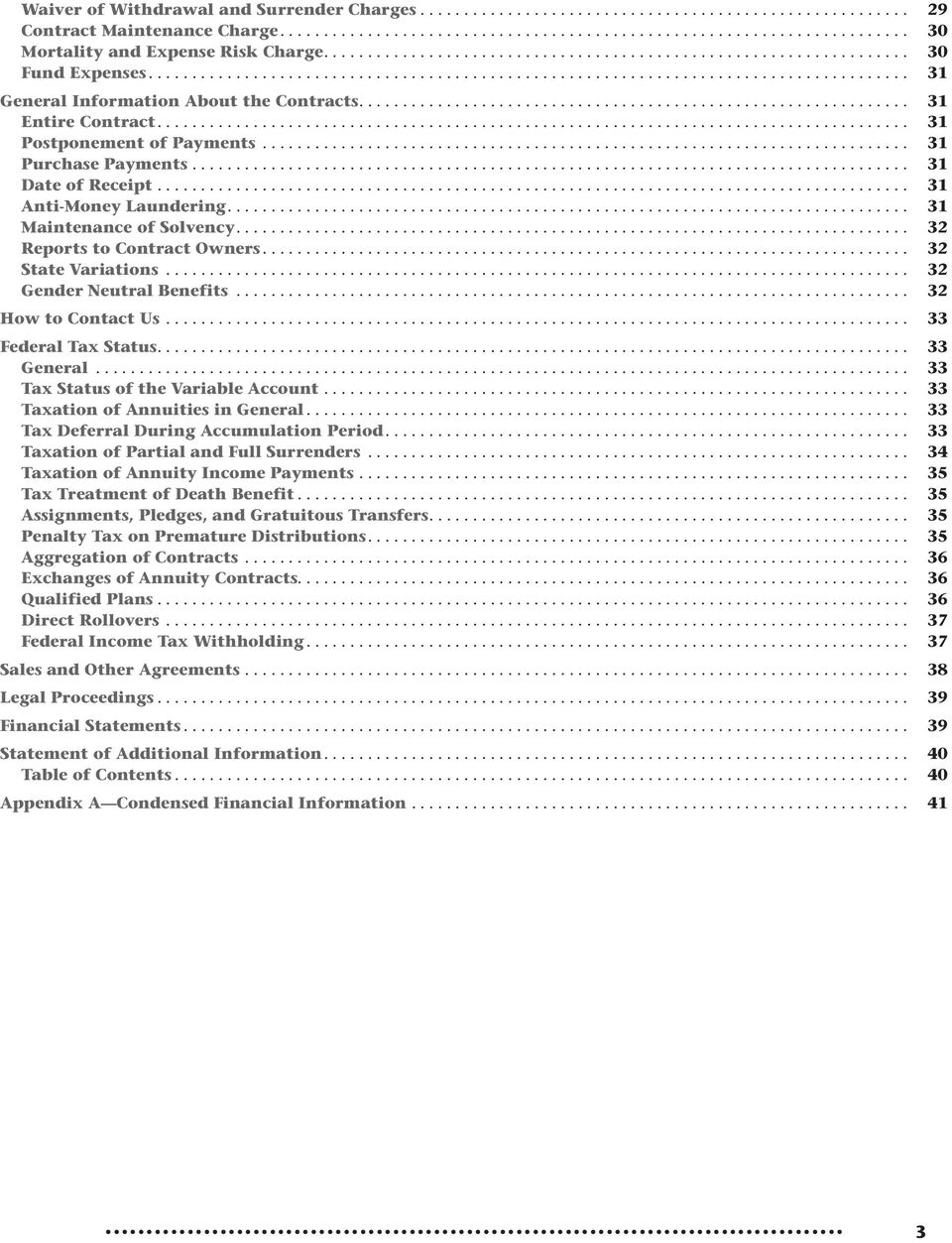
6 Waiver of Withdrawal and Surrender Charges Contract Maintenance Charge Mortality and Expense Risk Charge Fund Expenses General Information About the Contracts Entire Contract Postponement of Payments Purchase Payments Date of Receipt Anti-Money Laundering Maintenance of Solvency Reports to Contract Owners State Variations Gender Neutral Benefits How to Contact Us Federal Tax Status General Tax Status of the Variable Account Taxation of Annuities in General Tax Deferral During Accumulation Period Taxation of Partial and Full Surrenders Taxation of Annuity Income Payments Tax Treatment of Death Benefit Assignments, Pledges, and Gratuitous Transfers Penalty Tax on Premature Distributions Aggregation of Contracts Exchanges of Annuity Contracts Qualified Plans Direct Rollovers Federal Income Tax Withholding Sales and Other Agreements Legal Proceedings Financial Statements Statement of Additional Information Table of Contents Appendix A Condensed Financial Information
7 DEFINITIONS Accumulated Value. The sum of the accumulated values for your Contract in Subaccounts and the Fixed Account at any time prior to the Annuity Commencement Date. Annuitant. The person on whose life or life expectancy the Contract is based. We cannot change the Annuitant except in instances as described in Death of an Owner/Payee after the Annuity Commencement Date. Annuity Commencement Date. The date on which the Annuity Proceeds are applied to an annuity payment option for the benefit of the payee. This is also known as the maturity date. Annuity Proceeds. The Cash Surrender Value on the Annuity Commencement Date. Cash Surrender Value. Accumulated Value less any applicable charges or deductions. Commuted Value. The amount expressed as a lump sum payment which represents the present value of the future payments for the remaining guaranteed period. Contract. The Contract between you and us providing the individual flexible premium deferred variable annuity. Contract Anniversary. The same date in each year as the Issue Date. Code. The Internal Revenue Code of 1986, as amended. Fixed Account. Part of our general account, which includes all of our assets other than those in any separate account of ours. Fund. Thrivent Series Fund, Inc., which is described in the accompanying Prospectus. Issue Date. The effective date of the Contract, generally the date on which you sign the application. brokerage firm, commercial bank, trust company, credit union, or savings association participating in the Medallion Signature Guarantee Program provides that service. Minimum Death Proceeds Value. The highest Accumulated Value of the Contract at issue or on any Contract anniversary date, plus the sum of all premiums paid, less the sum of any withdrawal since that date. Qualified Plan. A retirement plan that receives favorable tax treatment under Section 401, 403, 408, 408A, or similar provisions of the Internal Revenue Code. Service Center. Thrivent Financial for Lutherans, 4321 North Ballard Road, Appleton, Wisconsin, , telephone, THRIVENT ( ), or such other office as we may specify in a notice to the Contract Owner. Subaccount. A subdivision of the Variable Account that invests exclusively in shares of a single portfolio of the Fund. Valuation Date. Any date we are open for business and the New York Stock Exchange is open for regular trading. The Valuation Date ends at the close of regular trading on the New York Stock Exchange, usually 4:00 p.m. Eastern Time. Valuation Period. The period of time from the end of one Valuation Date to the end of the next Valuation Date. Variable Account. Thrivent Variable Annuity Account A, which is a separate account of ours. The Subaccounts are subdivisions of the Variable Account. Written Notice. A written request or notice provided by the Contract Owner and received in good order at our Service Center and satisfactory in form and content to Thrivent Financial. Medallion Signature Guarantee. A stamp provided by a financial institution that verifies your signature. An eligible guarantor institution, such as a national bank, 4

8 FEE AND EXPENSE TABLES The following tables describe the fees and expenses that you will pay when buying, owning, and surrendering the Contract. For a complete discussion of Contract fees and expenses, see Charges and Deductions. The first table describes the fees and expenses that you will pay at the time that you buy the Contract, surrender the Contract, or transfer cash value between investment options. You pay no sales charge when you make additional investments in the Contract. No state premium taxes are deducted. Contract Owner Transaction Expenses Sales Load Imposed on Purchase (as a percentage of purchase payments) 0% Maximum Deferred Sales Load (as a percentage of excess amount surrendered) 7.00% 1 Transfer Charge (after 12 free transfers per Contract Year) $ The next table describes the fees and expenses that you will pay periodically during the time that you own the Contract, not including Fund fees and expenses. Annual Contract Fee $ Annual Subaccount Expenses 4 (as a percentage of average daily Accumulated Value or Annuity Unit Value) Mortality and Expense Risk Charge 1.25% Total Subaccount Annual Expenses 1.25% The next table shows the minimum and maximum Total Annual Portfolio Operating Expenses charged by the Portfolios that you pay indirectly during the time you own the Contract. This table shows the range (minimum and maximum) of fees and expenses (including management fees and other expenses) charged by any of the Portfolios, expressed as an annual percentage of average daily net assets. The amounts are based on the arithmetic average of expenses paid in the year ended December 31, 2015, for all of the available Portfolios, adjusted to reflect anticipated changes in fees and expenses. With respect to new Portfolios, amounts are based on estimates for the current fiscal year. The amounts shown reflect expenses before any applicable expense reimbursement or fee waiver. Total Annual Portfolio Operating Expenses 5 (expenses that are deducted from the Portfolio assets, including management fees and other expenses) Maximum Minimum 1.70% 0.26% Each Subaccount of the Variable Account purchases shares of the corresponding Fund Portfolio at net asset value. The net asset value reflects the investment advisory fees and other expenses that are deducted from the assets of the Portfolio. The advisory fees and other expenses are not fixed or specified under the terms of the Contract, and they may vary from year to year. More detail concerning the fees and expenses of the Portfolios is contained in the prospectus for the Fund. If a Portfolio is structured as a fund of funds, the Portfolio will indirectly bear its proportionate share of any fees and expenses (like investment advisory fees and operating expenses) of the investment companies in which it invests. However, Thrivent Financial has contractually agreed, for as long as the current fee structure is in place, to waive an amount equal to any investment advisory fees indirectly incurred by an Asset Allocation Portfolio as a 5

9 result of its investment in any other mutual fund for which the Adviser or an affiliate serves as investment adviser, other than Thrivent Cash Management Trust. For a list of the fund of funds portfolios available through the Contract, see the chart of portfolios available in the prospectus for the Fund. See Charges and Deductions in this prospectus for a discussion of these other charges. Example The following example is intended to help you compare the cost of investing in the Contract with the cost of investing in other variable annuity contracts. These costs include Contract Owner transaction expenses, Contract fees, separate account annual expenses, and Portfolio fees and expenses. The following example assumes that you invest $10,000 in the Contract for the time periods indicated and that your investment has a 5% return each year and assumes both the minimum and the maximum fees and expenses of the Portfolios. Although your actual costs may be higher or lower, based on these assumptions, your costs would be: Years If you surrender your Contract at the end of the applicable time period with Minimum Portfolio Expenses: $806 $ 976 $1,144 $1,802 Maximum Portfolio Expenses: $941 $1,391 $1,851 $3,271 If you annuitize your Contract at the end of the applicable time period with Minimum Portfolio Expenses: $806 $ 976 $1,144 $1,802 Maximum Portfolio Expenses: $941 $1,391 $1,851 $3,271 If you do not surrender your Contract at end of the applicable time period with Minimum Portfolio Expenses: $154 $ 477 $ 824 $1,802 Maximum Portfolio Expenses: $298 $ 913 $1,552 $3,271 Notes to Fee and Expense Tables: 1 In each Contract Year, you may surrender without a surrender charge up to 10% of the Accumulated Value existing at the time the first surrender is made in a Contract Year; only the amount in excess of that amount (the Excess Amount ) will be subject to a surrender charge. A surrender charge is deducted if a full or partial surrender occurs during the first seven Contract Years. The surrender charge is 7% during the first Contract Year and decreases by 1% each subsequent Contract Year. No surrender charge is deducted for surrenders occurring in Contract Years eight and later. The surrender charge also will be deducted if the annuity payments begin during the first six Contract Years, except under certain circumstances as described in Waiver of Withdrawal and Surrender Charges. 2 You are allowed 12 free transfers per Contract Year. Subsequent transfers (other than the Dollar Cost Averaging and Asset Rebalancing Programs) will incur a $10 transfer charge. 3 If your net premiums in the Contract exceed $1,500, we will waive the Contract maintenance charge. Net premiums are the sum of all premiums less withdrawals. 4 A contract pending payout due to a death claim is charged based on the average daily net assets of the Variable Account and is equal to annual rate of 0.95%. 5 Thrivent Financial has agreed to reimburse certain expenses other than the advisory fees for certain Portfolios. After taking these contractual and voluntary arrangements into account, the range (minimum and maximum) of total operating expenses charged by the Portfolios would have been 0.22% to 1.30%. The reimbursements may be discontinued at any time. 6

10 SUMMARY Please see Definitions at the beginning of this Prospectus for definitions of several technical terms, which can help you understand details about your Contract. The Summary is an introduction to various topics related to the Contract. For more detailed information on each subject, refer to the appropriate section of this Prospectus. The Contract Allocation of Premiums. You may allocate premiums under the Contract to one or more of the Subaccounts of the Variable Account and the Fixed Account. Some of the Subaccounts may be unavailable in some states. The Accumulated Value of the Contract in the Subaccounts and the amount of variable annuity payments will vary, primarily based on the investment experience of the Portfolios whose shares are held in the Subaccounts designated. Premium allocations to the Fixed Account will accumulate at an effective annual interest rate of at least 3.5%. Optional Investment Programs. We offer optional Dollar Cost Averaging and Asset Rebalancing Programs. See The Accumulation Phase Dollar Cost Averaging and The Accumulation Phase Asset Rebalancing. Surrenders. If you request a surrender on or before the Annuity Commencement Date, we will pay to you all or part of the Accumulated Value of a Contract after deducting any applicable surrender charge or maintenance charge. Transfers. You may request the transfer of all or a part of your Contract s Accumulated Value to other Subaccounts or to the Fixed Account. You may request 12 free transfers per Contract Year. Subsequent transfers (other than the Dollar Cost Averaging and Asset Rebalancing Programs) will incur a $10 transfer charge. We will not transfer any amount less than $50 into any single Subaccount. Death Benefits. The Contract offers a Death Benefit if the Annuitant dies before the Annuity Date. Annuity Payments We determine the Annuity Commencement Date based on the Annuitant s age at the time we issue the Contract. You may elect to change this date subject to state restrictions. At the time of your Annuity Commencement Date, you must begin receiving annuity payments if the distributions are from a Qualified Plan. We offer five different annuity payment options, four of which provide annuity payments on a fixed basis. Exchange Program From time to time, we may offer programs for certain variable annuities issued by Thrivent Financial or our affiliates, to be exchanged for the contract described in this prospectus. Such exchange offers will be made available only for contracts that have not yet started making annuity payments. Any new contract resulting from such exchange will have the same Issue Date as the Contract being exchanged only for purposes of calculating surrender charges, if applicable. You should carefully consider whether an exchange is appropriate for you by comparing the death benefits, living benefits and other guarantees that are provided by the contract you currently own to the benefits and guarantees provided by the new contract being offered. You should also compare the fees and charges of your current contract to the new contract being offered as they may be higher than your current contract. The programs we offer will be made available on terms and conditions determined by us and any such programs will comply with applicable law. We believe the exchanges should be tax free for federal income tax purposes; however, you should consult your tax advisor before making any such exchange. Federal Tax Status For a description of the Federal income tax status of annuities, see Federal Tax Status. Generally, a distribution from a Contract before the taxpayer attains age will result in a penalty tax of 10% of the amount of the distribution which is included in gross income. Death proceeds paid to beneficiaries are also subject to income tax. 7

11 SUMMARY Condensed Financial Information Condensed financial information containing the accumulated unit value history appears at the end of this Prospectus in Appendix A. 8

12 THRIVENT FINANCIAL AND THE VARIABLE ACCOUNT Thrivent Financial Thrivent Financial is a not-for-profit financial services membership organization of Christians helping our members achieve financial security and give back to their communities. We were organized in 1902 as a fraternal benefit society under Wisconsin law, and comply with Internal Revenue Code Section 501(c)(8). We are licensed to sell insurance in all states and the District of Columbia. For more information, visit Thrivent.com. The Variable Account The Variable Account is a separate account of ours, which was established in The Variable Account meets the definition of a separate account under the federal securities laws. We have caused the Variable Account to be registered with the Securities and Exchange Commission (the SEC ) as a unit investment trust under the Investment Company Act of 1940 (the 1940 Act ). This registration does not involve supervision by the SEC of the management or investment policies or practices of the Variable Account. We own the assets of the Variable Account, and we are not a trustee with respect to such assets. However, the Wisconsin laws under which the Variable Account is operated provide that the Variable Account shall not be chargeable with liabilities arising out of any other business we may conduct. The Variable Account will be fully funded at all times for the purposes of federal securities laws. We may transfer to our general account assets of the Variable Account which exceed the reserves and other liabilities of the Variable Account. Income and realized and unrealized gains and losses from each Subaccount of the Variable Account are credited to or charged against that Subaccount without regard to any of our other income, gains or losses. We may accumulate in the Variable Account the charge for expense and mortality risk, mortality gains and losses and investment results applicable to those assets that are in excess of net assets supporting the Contracts. 9

13 INVESTMENT OPTIONS Variable Investment Options and the Subaccounts You may allocate the premiums paid under the Contract and transfer from the Contract s Accumulated Value to the Subaccounts of the Variable Account. We invest the assets of each Subaccount in a corresponding Portfolio of the Fund. Note that the italicized Portfolios below are fund of funds which are comprised of investments in other Portfolios within the Fund. The Subaccounts and the corresponding Portfolios are listed below. Subaccount Thrivent Aggressive Allocation Subaccount... Thrivent Moderately Aggressive Allocation Subaccount.. Thrivent Moderate Allocation Subaccount... Thrivent Moderately Conservative Allocation Subaccount... Thrivent Growth and Income Plus Subaccount... Thrivent Balanced Income Plus Subaccount... Thrivent Diversified Income Plus Subaccount... Thrivent Opportunity Income Plus Subaccount... Thrivent Partner Healthcare Subaccount... Thrivent Partner Emerging Markets Equity Subaccount... Thrivent Real Estate Securities Subaccount... Thrivent Small Cap Stock Subaccount... Thrivent Small Cap Index Subaccount... Thrivent Mid Cap Stock Subaccount... Thrivent Mid Cap Index Subaccount... Thrivent Partner Worldwide Allocation Subaccount... Thrivent Partner All Cap Subaccount... Thrivent Large Cap Growth Subaccount... Thrivent Partner Growth Stock Subaccount... Thrivent Large Cap Value Subaccount... Thrivent Large Cap Stock Subaccount... Thrivent Large Cap Index Subaccount Thrivent High Yield Subaccount... Thrivent Income Subaccount... Thrivent Bond Index Subaccount... Thrivent Limited Maturity Bond Subaccount... Thrivent Money Market Subaccount... Corresponding Portfolio Thrivent Aggressive Allocation Portfolio Thrivent Moderately Aggressive Allocation Portfolio Thrivent Moderate Allocation Portfolio Thrivent Moderately Conservative Allocation Portfolio Thrivent Growth and Income Plus Portfolio Thrivent Balanced Income Plus Portfolio Thrivent Diversified Income Plus Portfolio Thrivent Opportunity Income Plus Portfolio Thrivent Partner Healthcare Portfolio Thrivent Partner Emerging Markets Equity Portfolio Thrivent Real Estate Securities Portfolio Thrivent Small Cap Stock Portfolio Thrivent Small Cap Index Portfolio Thrivent Mid Cap Stock Portfolio Thrivent Mid Cap Index Portfolio Thrivent Partner Worldwide Allocation Portfolio Thrivent Partner All Cap Portfolio Thrivent Large Cap Growth Portfolio Thrivent Partner Growth Stock Portfolio Thrivent Large Cap Value Portfolio Thrivent Large Cap Stock Portfolio Thrivent Large Cap Index Portfolio Thrivent High Yield Portfolio Thrivent Income Portfolio Thrivent Bond Index Portfolio Thrivent Limited Maturity Bond Portfolio Thrivent Money Market Portfolio The following table summarizes each Portfolio s investment objective: Portfolio Thrivent Aggressive Allocation Portfolio... Thrivent Moderately Aggressive Allocation Portfolio... Investment Objective To seek long-term capital growth. To seek long-term capital growth. 10

14 INVESTMENT OPTIONS Portfolio Thrivent Moderate Allocation Portfolio... Thrivent Moderately Conservative Allocation Portfolio... Thrivent Growth and Income Plus Portfolio... Thrivent Balanced Income Plus Portfolio... Thrivent Diversified Income Plus Portfolio... Thrivent Opportunity Income Plus Portfolio... Thrivent Partner Healthcare Portfolio... Thrivent Partner Emerging Markets Equity Portfolio... Thrivent Real Estate Securities Portfolio... Thrivent Small Cap Stock Portfolio... Thrivent Small Cap Index Portfolio... Thrivent Mid Cap Stock Portfolio... Thrivent Mid Cap Index Portfolio... Thrivent Partner Worldwide Allocation Portfolio... Thrivent Partner All Cap Portfolio... Thrivent Large Cap Growth Portfolio... Thrivent Partner Growth Stock Portfolio... Thrivent Large Cap Value Portfolio... Thrivent Large Cap Stock Portfolio... Thrivent Large Cap Index Portfolio... Thrivent High Yield Portfolio... Thrivent Income Portfolio... Thrivent Bond Index Portfolio... Thrivent Limited Maturity Bond Portfolio... Thrivent Money Market Portfolio... Investment Objective To seek long-term capital growth while providing reasonable stability of principal. To seek long-term capital growth while providing reasonable stability of principal. To seek long-term capital growth and income. To seek long-term total return through a balance between income and the potential for long-term capital growth. To seek to maximize income while maintaining prospects for capital appreciation. To seek a combination of current income and long-term capital appreciation. To seek long-term capital growth. To seek long-term capital growth. To seek to provide long-term capital appreciation and high current income. To seek long-term capital growth. To seek capital growth that tracks the performance of the S&P SmallCap 600 Index*. To seek long-term capital growth. To seek total returns that track the performance of the S&P MidCap 400 Index*. To seek long-term capital growth. To seek long-term growth of capital. To achieve long-term growth of capital. To achieve long-term growth of capital and, secondarily, increase dividend income. To achieve long-term growth of capital. To seek long-term capital growth. To seek total returns that track the performance of the S&P 500 Index*. To achieve a higher level of income, while also considering growth of capital as a secondary objective. To achieve a high level of income over the longer term while providing reasonable safety of capital. To strive for investment results similar to the total return of the Barclays U.S. Aggregate Bond Index. To seek a high level of current income consistent with stability of principal. To achieve the maximum current income that is consistent with stability of capital and maintenance of liquidity. 11

15 INVESTMENT OPTIONS * The S&P 500, S&P MidCap 400, and S&P SmallCap 600 Indexes are products of S&P Dow Jones Indices LLC or its affiliates ( SPDJI ), and has been licensed for use by Thrivent Financial for Lutherans ( Thrivent Financial ). Standard & Poor s and S&P are registered trademarks of Standard & Poor s Financial Services LLC ( S&P ) and Dow Jones is a registered trademark of Dow Jones Trademark Holdings LLC ( Dow Jones ). The trademarks have been licensed to SPDJI and have been sublicensed for use for certain purposes by Thrivent Financial. Thrivent Financial variable insurance products are not sponsored, endorsed, sold or promoted by SPDJI, Dow Jones, S&P, and of their respective affiliates (collectively, S&P Dow Jones Indices ). S&P Dow Jones Indices does not make any representation or warranty, express or implied, to the owners of the Thrivent Financial variable insurance products or any member of the public regarding the advisability of purchasing variable insurance contracts generally or in the Thrivent Financial variable insurance contracts particularly or the ability of the S&P 500, S&P MidCap 400, and S&P SmallCap 600 Indexes to track general market performance. S&P Dow Jones Indices only relationship to Thrivent Financial with respect to the S&P 500, S&P MidCap 400, and S&P SmallCap 600 Indexes is the licensing of the Indexes and certain trademarks, service marks and/or trade names of S&P Dow Jones Indices and/or its licensors. The S&P 500, S&P MidCap 400, and S&P SmallCap 600 Indexes are determined, composed and calculated by S&P Dow Jones Indices without regard to Thrivent Financial or the Thrivent Financial variable insurance products. S&P Dow Jones Indices have no obligation to take the needs of Thrivent Financial or the owners of the Thrivent Financial variable insurance products into consideration in determining, composing or calculating the S&P 500, S&P MidCap 400, and S&P SmallCap 600 Indexes. S&P Dow Jones Indices is not responsible for and has not participated in the determination of the prices, and amount of the Thrivent Financial variable insurance products or the timing of the issuance or sale of the Thrivent Financial variable insurance contract or in the determination or calculation of the equation by which a Thrivent Financial variable insurance product is to be converted into cash, surrendered or redeemed, as the case may be. S&P Dow Jones Indices has no obligation or liability in connection with the administration, marketing or trading of the Thrivent Financial variable insurance product. There is no assurance that investment products based on the S&P 500, S&P MidCap 400, and S&P SmallCap 600 Indexes will accurately track index performance or provide positive investment returns. S&P Dow Jones Indices LLC is not an investment advisor. Inclusion of a security within an index is not a recommendation by S&P Dow Jones Indices to buy, sell, or hold such security, nor is it considered to be investment advice. S&P DOW JONES INDICES DOES NOT GUARANTEE THE ADEQUACY, ACCURACY, TIMELINESS AND/OR THE COMPLETENESS OF THE S&P 500, S&P MIDCAP 400, AND S&P SMALLCAP 600 INDEXES OR ANY DATA RELATED THERETO OR ANY COMMUNICATION, INCLUDING BUT NOT LIMITED TO, ORAL OR WRITTEN COMMUNICATION (INCLUDING ELECTRONIC COMMUNICATIONS) WITH RESPECT THERETO. S&P DOW JONES INDICES SHALL NOT BE SUBJECT TO ANY DAMAGES OR LIABILITY FOR ANY ERRORS, OMISSIONS, OR DELAYS THEREIN. S&P DOW JONES INDICES MAKES NO EXPRESS OR IMPLIED WARRANTIES, AND EXPRESSLY DISCLAIMS ALL WARRANTIES, OF MERCHANTABILITY OR FITNESS FOR A PARTICULAR PURPOSE OR USE OR AS TO RESULTS TO BE OBTAINED BY THRIVENT FINANCIAL, OWNERS OF THE THRIVENT FINANCIAL VARIABLE INSURANCE PRODUCTS, OR ANY OTHER PERSON OR ENTITY FROM THE USE OF THE S&P 500, S&P MIDCAP 400, AND S&P SMALLCAP 600 INDEXES OR WITH RESPECT TO ANY DATA RELATED THERETO. WITHOUT LIMITING ANY OF THE FOREGOING, IN NO EVENT WHATSOEVER SHALL S&P DOW JONES INDICES BE LIABLE FOR ANY INDIRECT, SPECIAL, INCIDENTAL, PUNITIVE, OR CONSEQUENTIAL DAMAGES INCLUDING BUT NOT LIMITED TO, LOSS OF PROFITS, TRADING LOSSES, LOST TIME OR GOODWILL, EVEN IF THEY HAVE BEEN ADVISED OF THE POSSIBILITY OF SUCH DAMAGES, WHETHER IN CONTRACT, TORT, STRICT LIABILITY, OR OTHERWISE. THERE ARE NO THIRD PARTY BENEFICIARIES OF ANY AGREEMENTS OR ARRANGEMENTS BETWEEN S&P DOW JONES INDICES AND THRIVENT FINANCIAL, OTHER THAN THE LICENSORS OR S&P DOW JONES INDICES. Each Portfolio has its own investment objective, investment program, policies and restrictions. Although the investment objectives and policies of certain Portfolios may be similar to the investment objectives and policies of other Portfolios that we manage or sponsor or that an affiliate of ours may manage or sponsor, we do not represent or assure you that the investment results will be comparable to any other Portfolio, even where the investment adviser or manager is the same. Differences in portfolio size, actual investments held, fund expenses, and other factors all contribute to differences in Portfolio performance. For all of these reasons, you should expect investment results to differ. In particular, certain Portfolios available only through the Contract may have names similar to portfolios not available through the Contract. The performance of a Portfolio not available through the Contract does not indicate performance of the similarly named Portfolio available through the Contract. Before selecting any Subaccount, you should carefully read the accompanying prospectus for the Fund attached to this prospectus and found in the back of this book. You should periodically consider your allocation among Subaccounts in light of current market conditions and your investment goals, risk tolerance and financial circumstances. The Fund prospectus provides more complete information about the Portfolios of the Fund in which the Subaccounts invest, including investment objectives and policies, risks, charges, and expenses. Shares of the Fund are sold to other Portfolios of the Fund, to other insurance company separate accounts of ours and of our wholly owned subsidiary, Thrivent Life Insurance Company ( Thrivent Life ), and to retirement plans that we sponsor. The Fund may, in the future, create new Portfolios. It is conceivable that in the future it may be disadvantageous for both variable annuity 12

16 INVESTMENT OPTIONS separate accounts and variable life insurance separate accounts and for Thrivent Life and us to invest simultaneously in the Fund, although we do not foresee any such disadvantages to either variable annuity or variable life insurance contract owners. The Fund s management intends to monitor events in order to identify any material conflicts between such Contract Owners and to determine what action, if any, should be taken in response. Material conflicts could result from, for example: Changes in state insurance laws; Changes in Federal income tax law; Changes in the investment management of the Fund; or Differences in voting instructions between those given by the Contract Owners from the different separate accounts. If we believe the responses of the Fund to any of those events or conflicts insufficiently protects Contract Owners, we may take appropriate action on our own. Such action could include the sale of Fund shares by one or more of the separate accounts, which could have adverse consequences. The Fund is a Minnesota corporation registered with the SEC under the 1940 Act as an open-end management investment company (commonly called a mutual fund ). That registration does not involve supervision by the SEC of the management or investment practices or policies of the Fund. The Variable Account will purchase and redeem shares from the Fund at net asset value. Shares will be redeemed to the extent necessary for us to collect charges under the Contracts, to make payments upon surrenders, to provide benefits under the Contracts, or to transfer assets from one Subaccount to another as requested by Contract Owners. Any dividend or capital gain distribution received from a Portfolio of the Funds will be reinvested immediately at net asset value in shares of that Portfolio and retained as assets of the corresponding Subaccount. Investment Management Thrivent Financial is investment adviser to the Fund. Thrivent Financial is registered as an investment adviser under the Investment Advisers Act of Pursuant to the investment advisory agreement, Thrivent Financial is responsible for determining which securities to purchase and sell, arranges the purchases and sales and helps formulate the investment program for the Portfolios. Thrivent Financial implements the investment program for the Portfolios consistent with each Portfolio s investment objectives, policies and restrictions. Thrivent Financial and the Fund have engaged the following investment subadvisers: Subadviser Portfolio Name Sectoral Asset Management Inc... Thrivent Partner Healthcare Portfolio Aberdeen Asset Managers Limited... Thrivent Partner Emerging Markets Equity Portfolio Aberdeen Asset Managers Limited, Goldman Sachs Asset Management, L.P. and Principal Global Investors, LLC.... Thrivent Partner Worldwide Allocation Portfolio FIAM LLC... Thrivent Partner All Cap Portfolio T. Rowe Price Associates, Inc.... Thrivent Partner Growth Stock Portfolio We, as investment adviser, pay each of the above subadvisers an annual fee for subadvisory services. Subadvisory fees are described fully in the Statement of Additional Information for the Fund. 13

17 INVESTMENT OPTIONS Addition, Deletion, Combination, or Substitution of Investments Where permitted by applicable law and business need, we reserve the right to make certain changes to the structure and operation of the Variable Account, including, among others, the right to: Remove, combine, or add Subaccounts and make the new Subaccounts available to you at our discretion; Substitute shares of another Portfolio, which may have differences such as (among other things) different fees and expenses, objectives, and risks, for shares of an existing Portfolio in which your Subaccount invests at our discretion; Substitute or close Subaccounts to allocations of premiums or Accumulated Value, or both, and to existing investments or the investment of future premiums, or both, at any time in our discretion; Transfer assets supporting the Contract from one Subaccount to another or from the Variable Account to another Variable Account; Combine the Variable Account with other variable accounts, and/or create new variable accounts; Deregister the Variable Account under the 1940 Act, or operate the Variable Account as a management investment company under the 1940 Act, or as any other form permitted by law; and Modify the provisions of the Contract to reflect changes to the Subaccounts and the Variable Account and to comply with applicable law. The Portfolios, which sell their shares to the Subaccounts, also may terminate these arrangements and discontinue offering their shares to the Subaccounts. We will not make any changes without receiving any necessary approval of the SEC and applicable state insurance departments. We will notify you of any changes. Income, gains and losses, whether or not realized, from the assets in each Subaccount are credited to or charged against that Subaccount without regard to any of our other income, gains or losses. The value of the assets in the Variable Account is determined at the end of each Valuation Date. If investment in the Fund or in any particular Portfolio is no longer possible, in our judgment becomes inappropriate for the purposes of the Contract, or for any other reason in our sole discretion, we may substitute a different investment option for any of the current Portfolios. The substituted investment option may have different fees and expenses. We will not make any substitutions without receiving any necessary approval of the SEC and state insurance departments, if applicable. You will be notified of any substitutions. Subaccounts may be opened, closed or substituted with regard to any of the following as of any specified date: 1) existing Accumulated Value; 2) future payments; and 3) existing and/or future Owners. The Fund sells its shares to the Subaccounts pursuant to a participation agreement and may terminate the agreement and discontinue offering its shares to the Subaccounts. In addition, we reserve the right to make other structural and operational changes affecting the Variable Account. We do not guarantee any money you place in the Subaccounts. The value of each Subaccount will increase or decrease, depending on the investment performance of the corresponding Portfolio and fees and charges under the Contract. You could lose some or all of your money. Voting Privileges To the extent required by law, we will vote the Fund s shares held in the Variable Account at regular and special shareholder meetings of the Fund in accordance with instructions received from persons having voting interests in the corresponding Subaccounts of the Variable Account. If, however, the 1940 Act or any regulation thereunder should be amended or if the present interpretation thereof should change, and as a result we determine that we are permitted to vote the Fund s shares in our own right, we may elect to do so. Before the Maturity Date, the Contract Owner shall have the voting interest with respect to shares of the Fund attributable to the Contract. On and after the Maturity Date, the person entitled to receive annuity 14

18 INVESTMENT OPTIONS payments shall have the voting interest with respect to such shares, which voting interest will generally decrease during the annuity period. The number of votes which a Contract Owner or person entitled to receive annuity payments has the right to instruct will be calculated separately for each Subaccount. The number of votes which each Contract Owner has the right to instruct will be determined by dividing a Contract s Accumulated Value in a Subaccount by the net asset value per share of the corresponding Portfolio in which the Subaccount invests. The number of votes which each person entitled to receive annuity payments has the right to instruct will be determined by dividing the Contract s reserves in a Subaccount by the net asset value per share of the corresponding Portfolio in which the Subaccount invests. Fractional shares will be counted. The number of votes of the Portfolio which the Contract Owner or person entitled to receive annuity payments has the right to instruct will be determined as of the date coincident with the date established by the Portfolio for determining shareholders eligible to vote at the meeting of the Fund. Voting instructions will be solicited by written communications prior to such meeting in accordance with procedures established by the Fund. Any Portfolio shares held in the Variable Account for which we do not receive timely voting instructions, or which are not attributable to Contract Owners, will be voted by us in proportion to the instructions received from all Contract Owners. Any Portfolio shares held by us or our affiliates in General Accounts will, for voting purposes, be allocated to all separate accounts of ours and our affiliates having a voting interest in that Portfolio in proportion to each such separate account s votes. Voting instructions to abstain on any item to be voted upon will be applied on a pro rata basis to reduce the votes eligible to be cast. Fixed Account Prior to the Annuity Commencement Date, you may allocate the premiums paid under the Contract and transfers from the Subaccounts to the Fixed Account. After the Annuity Commencement Date, you may no longer transfer out of the Fixed Account. Any amounts allocated to the Fixed Account are invested with our general account assets. Interest will be credited on premiums allocated to the Fixed Account and on amounts transferred to the Fixed Account from the date of allocation or transfer. The initial interest rate for each such allocation or transfer is guaranteed for 12 months, and subsequent interest rates will not change more frequently than every 12 months. Interest will be compounded daily and will never be less than an effective annual interest rate of 3.5% per year. Because of exemptive and exclusionary provisions, interests in the Fixed Account have not been registered under the Securities Act of 1933 ( 1933 Act ), and the Fixed Account has not been registered as an investment company under the Investment Company Act of 1940 ( 1940 Act ). Accordingly neither the Fixed Account, nor any interests therein are generally subject to the provisions of the 1933 or 1940 Acts. Disclosures regarding the Fixed Account, however, may be subject to certain generally applicable provisions of the federal securities laws relating to the accuracy and completeness of statements in prospectuses. We have been advised that the staff of the Securities and Exchange Commission has not reviewed disclosure relating to the Fixed Account. Contract Owners have no voting rights in the Variable Account with respect to Fixed Account values. Each person having a voting interest in a Subaccount will receive proxy materials, reports and other materials relating to the appropriate Portfolio. 15

19 RISKS This annuity has some risks which may include the following: The investment options you choose may lose value, and the Accumulated Value of your contract can go down; This annuity has liquidity risk because a surrender charge may apply to full or partial surrenders made during the surrender charge period; In addition to taxes on gain, there may be a tax penalty if you withdraw money from the annuity prior to age ; If you elect a Settlement Option, you will only receive periodic annuity payments as frequently as you selected. There is a risk that your annuity payments will not keep pace with your personal expenses. If you choose a life income with no guaranteed period, there is a risk that you will die prematurely and no death proceeds will be paid to your beneficiaries. 16

20 THE CONTRACT Crediting and Allocating Your Premium Payments You may allocate your premiums to any Subaccount of the Variable Account and/or the Fixed Account. Your allocation must be in whole percentages and total 100% of your premiums. We reserve the right to adjust allocation percentages to eliminate fractional percentages. We also reserve the right to limit the number of allocations to subaccounts. You may not allocate less than $50 to either the Subaccount(s) or the Fixed Account. We will allocate your premiums according to the instructions you provided in your application for the Contract or subsequently. You may change your allocation for future premiums at any time by submitting a request to our Service Center. Owners, Payees and Annuitants You, as owner, are typically the recipient of any distributions under the Contract while the Annuitant is alive. The owner of the Contract is usually, but not necessarily, the Annuitant. As owner, you can name beneficiaries, assign the Contract, transfer allocations between Subaccounts and the Fixed Account and designate who receives any annuity payments or distributions under the Contract. You will receive all annuity payments during the Annuitant s lifetime, unless you designate another person or entity as the payee. Keep in mind that if you designate another person or entity as payee, you may still be responsible for any income tax payable on the payments. In the event the Annuitant dies, the death proceeds in the Contract are payable to the named beneficiary. If there is no beneficiary, the death proceeds are payable to you as the owner. We use the Annuitant s life to determine the Annuity Commencement Date of the Contract. In the case of a qualified pension or profit-sharing plan, the Annuitant is the plan participant, and the owner is the retirement plan. Adult and Juvenile Contracts We issue adult Contracts to applicants age 16 or older. We issue juvenile Contracts when the proposed Annuitant was younger than age 16 but otherwise eligible for benefit membership. In the case of the adult Contract, the Annuitant must be 16 years of age or older. While the Annuitant is alive and before the Annuity Commencement Date, the owner of the Contract may exercise every right and enjoy every benefit provided in the Contract. For the juvenile Contract, a juvenile is named as the Annuitant and owner of the Contract. However, because of age, the juvenile cannot exercise the rights of ownership. The adult controller exercises certain rights of ownership on behalf of the juvenile Annuitant. These rights are described in the Contract. The adult controller may transfer control to another eligible person, but cannot transfer ownership of the Contract. Transfer of control to the juvenile Annuitant will take place at the first Contract Anniversary following the earlier of: the Annuitant s 21st birthday; or the Annuitant s 16th birthday after the adult controller transfers control to the Annuitant in writing (or automatically at age 16 in New York), or the death of the adult controller after the Annuitant s 16th birthday. If the person who has control of the Contract dies before the Annuitant gains control, control will be vested in an eligible person according to our Bylaws. If we determine that it is best for the Annuitant, we may transfer control of the Contract to some other eligible person according to our Bylaws. The juvenile Annuitant will become a benefit member on the first Contract Anniversary on or following the juvenile s 16th birthday. Beneficiaries You may name one or more beneficiaries to receive the death proceeds payable under the Contract. If no beneficiary has been named or the beneficiary does not survive the Annuitant, the death proceeds will be paid to you, if living, otherwise to your estate. Thrivent Bylaws list persons eligible to be beneficiaries. You may designate beneficiaries as either first, second or third class. Unless otherwise specified, we will distribute death proceeds in the following order to beneficiaries: equally to the beneficiaries in the first class. If none are living, then; equally to the beneficiaries in the second class. If none are living, then; 17

21 THE CONTRACT equally to the beneficiaries in the third class. If a beneficiary dies within 15 days after the death of the Annuitant, we will consider the beneficiary to have died before the Annuitant for purposes of paying the death proceeds. The interest of any beneficiary will be subject to any collateral assignment. Any indebtedness and interest charged against your Contract or any agreement for a reduction in benefits shall have priority over the interest of any owner, beneficiary or collateral assignee under the Contract. No Beneficiary change shall take effect unless received by the Society at its principal office or corporate headquarters. When it is received, any change shall take effect as of the date the request for beneficiary change was signed, as long as the request for change was mailed or actually delivered to the Society while the insured was alive. Such beneficiary change shall be null and void where the Society has made a good faith payment of the proceeds or has taken other action before receiving the change. Assignments of Ownership You may absolutely assign your Contract by sending a written request, in good order, to our Service Center before the Annuity Commencement Date. You may not absolutely assign a juvenile Contract or a Contract issued in connection with Qualified Plans. You may assign your Contract as collateral for a loan by sending a written request to our Service Center. You may not assign a Contract issued in connection with a Qualified Plan as collateral. You may not assign a Contract after the Annuity Commencement Date. We will give you a special form to make these requests. We must receive and approve any assignment request before it is effective. Once we approve it, the assignment is effective on the date you designated on your written request, in good order, or the date we receive it at our Service Center if no date appears on the request. We are not liable for any payment we make or action we take before we receive and approve an assignment. We are not responsible for the validity or tax consequences of any transfer of ownership. Before you consider assigning, selling, pledging or transferring your Contract, you should consider the tax implications. Generally speaking, assignments are taxable as a complete distribution (surrender) from a deferred annuity contract. See Federal Tax Matters for more information. Successor Owners If you are not the Annuitant, you may designate a successor owner to receive the Contract in the event of your death. If you do not designate a successor owner, your estate will become the new owner upon your death. You may designate or change a successor owner by submitting a written request to our Service Center. We will give you a special form on which to make this request. We must receive and approve any successor owner request before it is effective. Once we approve it, the successor owner designation is effective on the date you designated on your written request or the date we receive it, in good order, at our Service Center if no date appears on the request. We are not liable for any payment we make or action we take before we receive and approve the designation. We are not responsible for the validity of any designation or change of a successor owner. Upon any owner s death before the Annuity Commencement Date, we are required to distribute the Cash Surrender Value within five years. However, if the successor owner is a natural person (as opposed to an entity), the successor owner may elect to receive the Cash Surrender Value in periodic payments over the successor owner s life (or over a period not exceeding the successor owner s life expectancy) as long as the payments begin within one year of your death. If your spouse is the successor owner, your spouse will automatically become the owner of the Contract and will not be required to take these distributions. Contracts Issued in Connection with Qualified Plans If the Contract was used in a Qualified Plan and the owner is the plan administrator, the plan administrator may transfer ownership to the Annuitant if the Qualified Plan permits. Otherwise, a Contract used in a Qualified Plan may not be sold, assigned, discounted or 18
22 THE CONTRACT pledged as collateral for a loan or as surety for performance of an obligation or for any other purpose, to any person other than Thrivent Financial. ACCUMULATION PHASE There are two phases in the Contract: the accumulation and annuity phases. The accumulation phase is the period prior to the Annuity Commencement Date when you invest premiums in the separate and/or Fixed Account under the Contract. Premiums increase the Accumulated Value. In addition, the performance of the Subaccounts underlying the Variable Account and/or the Fixed Account will affect the Accumulated Value as well. The Contract may increase or decrease in value depending on the performance of the Variable Account. Generally, any increase in the Contract s value grows tax-deferred until you request a distribution. Any distributions you take from the Contract during the accumulation phase are taxable to the extent there is gain in the Contract. Accumulation phase distributions are taxed differently than annuity payments. For annuity payments (periodic payments from an annuity payment option during the annuity phase), any cost basis in the Contract is prorated over the length of the annuity payment option. Therefore, each annuity payment will consist partially of cost basis (if there is any) and partially of taxable gain. Contract Valuation During the accumulation phase, we refer to your Contract s value as the Accumulated Value. The Accumulated Value is the total of: the Fixed Account value; and the Variable Account value (the total of all your subaccounts). The Accumulated Value of your Contract is determined on each Valuation Date. Fixed Account Valuation You may choose to deposit some or none of your money in the Fixed Account portion of the Contract. We will credit interest on the Accumulated Values within the Fixed Account at a declared rate of interest for 12 months from the time of deposit. Interest is compounded daily at an effective annual guaranteed minimum interest rate of 3.5%. We may declare higher interest rates at our discretion. You bear the risk that interest credited on the Accumulated Value within the Fixed Account may not exceed 3.5% for any 12-month period. Each month we declare the effective annual interest rate that applies to the Fixed Account. This new rate applies to new premiums or amounts newly transferred from a Subaccount (new money) for the 12-month period beginning at the time of your deposit to the Fixed Account. After that period expires, a new rate will be declared for that deposit and will be effective for another 12 months. This process continues for each block of existing deposits at the end of each 12-month period. The rate of interest in effect at any time for new money may differ from the rate or rates in effect for any blocks of existing money in the Fixed Account. Interest on existing money may vary depending on when the new money was first deposited in the Fixed Account. For purposes of crediting future interest, we will take any withdrawals or transfers from the oldest deposits and accumulated interest in the Fixed Account. Variable Account Valuation We calculate the value of each Subaccount by multiplying the number of accumulation units attributable to that Subaccount by the Accumulation Unit Value for the Subaccount. Any amounts allocated to a Subaccount will be converted into accumulation units of the Subaccount. We credit accumulation units to your Subaccount when you allocate premiums or transfer amounts to that particular Subaccount. The number of accumulation 19
23 ACCUMULATION PHASE units we credit is determined by dividing the premium or other amount credited to the Subaccount by the accumulation unit value for that Valuation Date. Conversely, we reduce your accumulation units in a Subaccount when you withdraw or transfer from that Subaccount and by the Contract maintenance charge allocable to your Contract. The investment experience of the portfolio underlying each Subaccount will cause the accumulation unit value to increase or decrease. In addition, we assess a mortality and expense risk charge, which effectively reduces the value of the Subaccount. We make no guarantee as to the value in any Subaccount. You bear all the investment risk on the performance of the portfolios underlying the corresponding Subaccounts you choose. Because of all of the variables effecting a Subaccount s performance, the Subaccount s value cannot be predetermined. (b) (c) (ii) (iii) The per share amount of any dividend or capital gain distribution made by the Portfolio if the ex-dividend date occurs during the Valuation Period; plus or minus. A per share charge or credit for any taxes reserved for that we determine to be a result of the investment operation of the Portfolio. Is the net asset value per share of the corresponding Portfolio of the Subaccount at the end of the prior Valuation Period. Is the mortality and expense risk charge we deduct for each day in the Valuation Period and is based upon the total Accumulated Value in the Subaccount. The mortality and expense risk charge is 1.25%. In addition to your investment experience, any premiums you make or any surplus refund we credit will positively affect your Accumulated Value. If you make any withdrawals, your Accumulated Value will decrease by the amount of the withdrawals and any associated withdrawal charges. At the end of each Valuation Period, the Accumulation Unit Value for a Subaccount is equal to (1) multiplied by (2) where: (1) Is the Accumulation Unit Value for that Subaccount at the end of the prior Valuation Period. (2) Is the Net Investment Factor for that Subaccount for that period. Net Investment Factor The Net Investment Factor for a Subaccount measures investment performance of that Subaccount. The Net Investment Factor for a Subaccount for a Valuation Period is determined by dividing (a) by (b) and then subtracting (c) where: (a) Is the sum of: (i) The net asset value per share of the corresponding Portfolio of the Subaccount at the end of the Valuation Period; plus Dollar Cost Averaging You may establish a dollar cost averaging program to make periodic transfers of at least the minimum amount required from the Thrivent Money Market Subaccount to the other Subaccounts except the Fixed Account. Transfers will be made automatically on the date you choose (except the 29th, 30th or 31st of a month). You may use dollar cost averaging until the amount in the Thrivent Money Market Subaccount is completely transferred, at which time this DCA plan shall terminate. You may terminate the plan at any time by request. Dollar cost averaging may be suitable for you if you wish to make a substantial deposit in your Contract. This approach allows you to spread investments over time to reduce the risk of investing at the top of the market cycle. You may establish a dollar cost averaging plan by obtaining an application and full information concerning the plan and its restrictions, from our Service Center. Transfers under dollar cost averaging are not subject to the charges applicable to transfers, described below. Dollar cost averaging does not ensure a profit or protect against a loss during declining markets. Because such a program involves continuous investment regardless of changing share prices, you should consider your ability to continue the program through times when the share prices are high. 20
24 ACCUMULATION PHASE Transfers among Subaccounts and/or the Fixed Account Except for certain restrictions mentioned below, you may transfer your Accumulated Value among the Subaccounts and the Fixed Account. Such transfers must take place during the accumulation phase. We will process requests for transfers that we receive at our Service Center, in good order, before 4:00 p.m. Eastern Time or as of the close of business on that Valuation Date. We will process requests we receive after that time as of the close of business on the following Valuation Date. To accomplish a transfer from a Subaccount, we will redeem the accumulation units in that Subaccount and reinvest that value in accumulation units of the other Subaccounts and/or the Fixed Account as you specify. We will impose the following restrictions on transfers: You must transfer out at least $500 or, if less, the total value of the Subaccount or Fixed Account from which you are making the transfer. You must transfer in a minimum amount of $50 to any Subaccount or to the Fixed Account. You may make twelve free transfers from one or more Subaccounts in each Contract year. After that, we will charge you $10 for each subsequent transfer. We consider all amounts transferred in the same Valuation Period to be one transfer. It is not dependent upon the number of originating or destination Subaccounts. We deduct the transfer charge from the total value of the Subaccount from which the transfer was made. When you transfer from two or more Subaccounts, we apply the $10 transfer charge among those Subaccounts in proportion to the amounts you transfer. You may make only one transfer from the Fixed Account in each Contract year. The transfer may not exceed the greater of $500 or 25% of the total value of the Fixed Account at the time of transfer. Transfers from the Fixed Account are not subject to a transfer charge and do not count toward your twelve free transfers. If you want to transfer from the Fixed Account, we redeem the value you wish to transfer from the Fixed Account and reinvest that value in accumulation units of the Subaccount or Subaccounts you have selected. Frequent Trading Policies Because short-term or frequent transfers, purchases and redemptions of Contract value among Subaccounts pose risks to Contract Owners, we place limits on frequent trading practices. Such risks include potentially impaired investment performance due to disruption of portfolio management strategies, increased transactions costs, and dilution of fund shares (and therefore unit values) thereby negatively impacting the performance of the corresponding Subaccount. We have policies and procedures to discourage frequent transfers of value among Subaccounts. We use reasonable efforts to apply the policies and procedures uniformly. Several different tactics are used to detect and prevent excessive trading within the Subaccounts. As described in this section, we impose a fee if the transfers made within a given time period exceed a maximum contractual number. We also use a combination of monitoring Contract Owner activity and further restricting certain Contract Owner transfers based on a history of frequent transfers among subaccounts. When monitoring Contract Owner activity, we may consider several factors to evaluate transfer activity including, but not limited to, the amount and frequency of transfers, the amount of time between transfers and trading patterns. In making this evaluation, we may consider trading in multiple contracts under common ownership or control. Exceptions may apply to Dollar Cost Averaging, automatic investment plans, systematic withdrawal plans or non-abusive re-balancing. We reserve the right, in our sole discretion, to identify other trading practices as abusive. If we determine that you are engaging in excessive trading activity, we will request that you cease such activity immediately. If we determine that you are continuing to engage in excessive trading, we will restrict your Contract so that you can make transfers on only one business day each calendar month and any such transfers must be separated by at least 20 calendar days. We reserve the right to reject or restrict any transfer request, without notice for any reason. 21
25 ACCUMULATION PHASE In addition, the underlying funds may have adopted restrictions designed to discourage frequent trading practices, and we reserve the right to enforce these policies and procedures. Although we seek to deter and prevent frequent trading practices, there are no guarantees that all activity can be detected or prevented. Contract Owners engaging in such trading practices use an evolving variety of strategies to avoid detection and it may not be possible for operational and technological systems to reasonably identify all frequent trading activity. Contract Owners still may be subject to their harmful effects if Thrivent Financial is unable to detect and deter abusive trading practices. Asset Rebalancing You may choose to automatically rebalance your Contract value periodically under the asset rebalancing program. Automatic asset rebalancing may be set up annually or semi-annually to begin on the date you select (except the 29th, 30th, or 31st of a month). Before you begin the program, you should determine your investment goals and risk tolerance. After you determine the appropriate allocations and percentages, we will begin allocating your premiums immediately and rebalance on the date you select. To elect to participate in the program, we must receive a written request at our Service Center from you. This request will override any previous allocations you may have chosen. Rebalancing continues until you stop or change it. The program will not terminate automatically by transferring your allocations to another subaccount. You can change your allocations at any time by telephone request (if we receive proper authorization from you) or by written request. You can also stop or suspend the program by providing a written request to our Service Center. Periodic rebalancing takes into account increases and decreases in Contract values in each Subaccount due to performance, withdrawals, transfers and premiums. Automatic asset rebalancing does not count toward the number of free transfers described previously. The Fixed Account is excluded from this program. We reserve the right to change this program at any time. Telephone and Online Transactions You may perform certain transactions online or over the telephone if we receive proper authorization from you. We have adopted reasonable security procedures to ensure the authenticity of instructions, including requiring identifying information, recording telephone conversations and providing written confirmations of transactions. Nevertheless, we honor telephone instructions from any person who provides the correct identifying information. Be aware that there is a risk of possible loss to the Owner if an unauthorized person uses this service in the Owner s name. Thrivent Financial disclaims any liability for losses resulting from such transactions by not having been properly authorized. However, if Thrivent Financial does not take reasonable steps to help ensure that such authorizations are valid, Thrivent Financial may be liable for such losses. Certain circumstances may prevent you from conducting transactions including but not limited to the event of a disaster, equipment malfunction, or overload of telephone system circuits. Should circumstances prevent you from conducting a telephone or online transaction, we recommend you provide us with a written request. If due to malfunction or other circumstances, the recording of the Contract Owner s telephone request is incomplete or not fully comprehensible, we will not process the transaction. We reserve the right to suspend or limit telephone transactions. Owners can go online at to conduct online transactions or call the Service Center at (800) for telephone transactions. Timely Processing We will process all requests in a timely fashion. Requests received in good order prior to 4:00 p.m. Eastern Time (or sooner if the NYSE closes prior to 4:00 p.m. Eastern Time) on a Valuation Date will use the Accumulation Unit Value as of the close of regular trading on the NYSE on that Valuation Date. We will process requests received after that time using the Accumulation Unit Value as of the close of regular trading on the NYSE of 22
26 ACCUMULATION PHASE the following Valuation Date. An online transaction payment will be applied on the effective date you select. This date can be the same day you perform the transaction as long as the request is received prior to 4:00 p.m. Eastern Time. The effective date cannot be a date prior to the date of the online transaction. Once we issue your Contract, we will process payment of any amount due from any Subaccount within seven calendar days after we receive Notice. Payment may be postponed if the NYSE is closed. Postponement may also result for such other periods as the SEC may permit. Payment from the Fixed Accounts may be deferred up to six months. Surrenders and Withdrawals Before the Annuity Commencement Date You may surrender or withdraw from your Accumulated Value during the accumulation phase if the Annuitant is alive. You may request a surrender or withdrawal by completing an approved surrender form. The surrender or withdrawal will not be processed until we receive your surrender request at our Service Center, in good order. You may obtain a form by contacting your Thrivent Financial representative or calling our Service Center at (800) We do not accept telephone requests for full surrenders. You may make partial surrenders by telephone, if we receive proper authorization from you. (Contracts used in a tax-sheltered annuity under Section 403(b) of the Internal Revenue Code will be subject to certain restrictions regarding surrenders and may require an employer signature. See Federal Tax Status Qualified Plans.) Any surrender which you request will be made at the end of the Valuation Period during which the requirements for surrender are completed. We will pay you the proceeds from a surrender within seven days after the surrender is made. We must receive a withdrawal or surrender request by 4:00 p.m. Eastern Time, on a Valuation Date, in order to process it on the same day. We will generally pay you the requested withdrawal or surrender amount within seven days of our receipt of your request. You will receive the Accumulated Value less any applicable withdrawal or surrender charge or any applicable Contract maintenance charge. Please see Charges and Deductions for more information. In certain cases we may postpone payment of your withdrawal or surrender beyond the seven days. Please see Postponement of Payments for more information. If the amount you request as a partial surrender would reduce the remaining Accumulated Value to less than $600, we may contact you to determine whether you would like a partial surrender of an amount that would result in remaining Accumulated Value of at least $600 or whether instead you would like to make a full surrender of your Contract. If we are unable to contact you within seven days, we reserve the right to treat your request as a request for a full surrender. A surrender reduces your Accumulated Value by the amount surrendered. For amounts surrendered from a Subaccount, this is done by selling Accumulation Units of the Subaccount. For partial surrenders, we allocate the surrender among the Subaccounts and the Fixed Account so that all accounts are reduced in value by the same percentage. With our approval, you may specify a different allocation for a partial surrender. If you have requested that a systematic partial surrender should be allocated to a specific Subaccount and the value in that Subaccount is less than the amount of the allocation, we will allocate the partial surrender among the Subaccounts and the Fixed Account so that all accounts are reduced in value by the same percentage. You may not withdraw less than $25 at one time. You must have a Medallion Signature Guarantee if you want to surrender or withdraw a value of $500,000 or more. Certain surrender requests of less than $500,000 require either a Medallion Signature Guarantee, a notarized signature, or an attestation of your signature by a Thrivent registered representative. These authentication procedures are designed to protect against fraud. Such an authentication procedure may be required for: Surrender of a value of $100,000 or more; Request to send redemption proceeds to an address other than the one listed on the account; Request to wire funds or directly deposit funds to a bank account with a bank name registration different than the bank name of the account; Request to make redemption proceeds payable to someone other than the current owner; 23
27 ACCUMULATION PHASE Request to withdraw or surrender if there has been a change of address on the account within the preceding 15 days; and Certain other transactions as determined by us. A Medallion Signature Guarantee is a stamp provided by a financial institution that guarantees your signature. You sign the Thrivent Financial approved form and have the signature(s) guaranteed by an eligible guarantor institution such as a commercial bank, trust company, brokerage firm, credit union, or a savings bank participating in the Medallion Signature Guarantee Program. We may waive the Medallion Signature Guarantee in limited circumstances. A Notary Public is an individual who is authorized to authenticate signatures and can be found in law firms or many of the same places that an individual who provides Medallion Signature Guarantees can be found. Attestation by a financial representative requires the verification and witness of your signature by a Thrivent Financial representative. A withdrawal or surrender may result in adverse tax consequences, including the imposition of a 10% federal premature distribution penalty. For all surrenders, you should consider the tax implications of a surrender before you make a surrender request. See Federal Tax Status. For more complete instructions pertaining to your individual circumstances, please contact our Service Center at (800) If on your Contract Anniversary, the Accumulated Value of your Contract is below $600 and you have paid no premium for the past 36 consecutive months, we will terminate your Contract and pay you the Accumulated Value of the Contract less any applicable withdrawal charges. You should consult your tax adviser regarding the tax consequences of any withdrawal or surrender. A withdrawal or surrender may result in adverse tax consequences, including the imposition of a 10% federal income tax penalty if made before you attain age See Federal Tax Matters for more details. Automatic Payout Option The automatic payout option is a series of partial withdrawals from your Contract based on the payment method you select. You are taxed on each distribution to the extent there is taxable gain in the Contract. This distribution plan is not considered annuitization nor are the payments considered annuity payments. You may only establish the automatic payout option during the accumulation phase. Distributions made as automatic payments under this option will be subject to withdrawal charges. See Charges and Deductions. You can set up this distribution plan by contacting your representative. You should consult a tax adviser about the tax consequences of receiving automatic payouts. Death of an Owner and/or Annuitant Before the Annuity Commencement Date If the Annuitant dies before the Annuity Commencement Date, the beneficiary will be entitled to receive the Contract s death benefit. We calculate the death benefit at the end of the Valuation Period during which we receive at our Service Center satisfactory proof of the death of an Annuitant. Any amount of the death benefit in excess of the Accumulated Value will be allocated to the Subaccounts and the Fixed Account according to the ratio of the accumulated value in each to the Accumulated Value in the Contract. Once calculated, death proceeds may continue to be subject to the investment experience of the Variable Account. When based on the investment experience of the Variable Account, death proceeds may increase or decrease daily and are not guaranteed for a minimum dollar amount. Surrender charges do not apply to death proceeds. If you are an owner, but not the Annuitant, upon your death we will pay the Cash Surrender Value (not the death proceeds) of the Contract to your successor owner. (However, for Contracts delivered in New York, we will pay the Accumulated Value.) Upon the death of the first owner to die, we are required to distribute the death proceeds (or Cash Surrender Value) to either your beneficiary or successor owner (as stated above): within five years of your death; or 24
28 ACCUMULATION PHASE if your beneficiary or successor owner is a natural person (as opposed to an entity), he or she may select an annuity payment option. Payments must begin within one year of your death. The annuity payments in the selected annuity payment option must be made over a period that does not extend beyond the life or life expectancy of the beneficiary or successor owner, as applicable. Your beneficiary s choices of payment options may be limited if you designate a mandatory form of distribution which does not allow your beneficiary to change it. Any proceeds not subsequently withdrawn will be paid in a lump sum on the date five years after the date of death. Before we can process any death proceeds, we must receive at our Service Center: proof that the Annuitant or owner died before the Annuity Commencement Date; a completed claim form; and any other information that we reasonably require to process the claim. If the Annuitant dies before age 80, the amount of the death benefit is the greater of: the Accumulated Value of the Contract; the sum of all premiums paid less the sum of any withdrawals; or the highest Accumulated Value of the Contract on any minimum death proceeds valuation date preceding the death proceeds calculation date, plus the sum of all premiums paid since the minimum death proceeds valuation date, less the sum of any withdrawals since that date. The first minimum death proceeds valuation is: (a) (b) The Contract issue date if that date is on or after March 1st, 2001; otherwise The first Contract Anniversary date on or after March 1st, In the year the Annuitant reaches age 79, the Minimum Death Benefit Value is set for the last time on the Contract Anniversary date. From that point forward, death proceeds will be the last established minimum death proceeds amount, plus premiums, less withdrawals since that time, or the Accumulated Value of the Contract as of the good order date, whichever is greater. If an Annuitant dies before annuity payments begin and that Annuitant s spouse is the sole primary beneficiary, he or she may, to the extent permitted by law and the Contract, elect to continue the Contract in force, in which case the surviving spouse will become and be treated as the Annuitant and owner effective on the date that the death proceeds are calculated ( Exchange Date ). Any amount of death proceeds in excess of the Accumulated Value of the Contract will be allocated to the Subaccounts and the Fixed Account according to the ratio of the accumulated value in each to the Accumulated Value of the Contract. Where allowed by the Contract, the spouse will have 60 days from the date we receive proof of your death in which to elect to receive proceeds or to continue the Contract. If an election to receive death proceeds or to continue the Contract is not made within 60 days, the surviving spouse will be deemed to have elected to continue the Contract effective on the Exchange Date. If the surviving spouse elects to continue the Contract, the death benefit will be determined according to your Contract based on the Accumulated Value on the Exchange Date. 25
29 ANNUITY PHASE If your Contract was issued in connection with a Qualified Plan, additional restrictions on the manner of payment of the death benefit may apply. Any such restrictions will be stated in the Contract or the plan documents. Purchasers acquiring Contracts pursuant to Qualified Plans should consult qualified pension or tax advisers. The next phase after the accumulation phase of the Contract is the annuity phase. The annuity phase is the period when you begin receiving annuity payments (periodic payments), based on the amounts you accumulated under your Contract. This phase begins on the Annuity Commencement Date. Currently, we offer annuity payment options only on a fixed basis, however, we may choose to make other annuity payment options available in the future. Like the accumulation phase, any amounts remaining in your Contract during the annuity phase are tax-deferred until the payment is received. Annuity Commencement Date The Annuity Commencement Date is the date we apply the Cash Surrender Value to an annuity payment option for the benefit of a payee. The Annuity Commencement Date is sometimes referred to as a maturity date or annuity date. We determine the Annuity Commencement Date at the time we issue your Contract. If the Contract is nonqualified, Annuitant s age 80 is the earliest maturity age we assign at issue. If the Contract is a qualified Contract, Annuitant s age 70 is the earliest maturity age we assign at issue. In certain circumstances you can change your Annuity Commencement Date to a date sooner or later than the assigned date in order to begin or defer receiving annuity payments. Some states may have certain restrictions as to the assignment of a maturity age. For either qualified or nonqualified Contracts, if the Annuitant s age is greater than the earliest maturity age we use, the maturity age and Annuity Commencement Date will be dependent upon the Annuitant s age at the time we issue the Contract. You may change your Annuity Commencement Date by giving us notice in writing or by telephone before both the Annuity Commencement Date currently in effect and the new Annuity Commencement Date. The Annuity Commencement Date is subject to our approval. If we issue your Contract in connection with a Qualified Plan, your plan document, or Contract endorsement may restrict your choice of an Annuity Commencement Date or the annuity payment option available. Your Contract provides for a death benefit if the Annuitant dies before the Annuity Commencement Date. After the Annuity Commencement Date, amounts payable, if any, depend upon the terms of the payment option. However, we cannot make any annuity payments under an annuity payment option if you previously surrendered your Contract or if we have paid out all of the death proceeds to your beneficiary. At the Annuity Commencement Date stated in your Contract, we may, at our discretion, allow you to extend the Annuity Commencement Date. Annuity Payments If you select an annuity payment option, we will transfer your Cash Surrender Value on your Annuity Commencement Date to our Fixed Account, which supports our insurance and annuity obligations. We call the resulting value your Annuity Proceeds. Your Annuity Proceeds will not vary with the performance of the Variable Account. We will pay the Annuity Proceeds to the payee that you designated on your Contract. You may not change to a different annuity payment option once your initial selection has been established. Generally, you or your beneficiary will be the payee. We will not assess a surrender charge at the time of annuitization if annuity payments begin more than three years after your Issue Date and you choose an annuity payment option that provides a life income with a guaranteed payment period (such as Option 4 or Option 5 below). Otherwise, we will apply a surrender charge. In such cases we will take into account the 10% free withdrawal provision and the maximum 7 1 2% limitation described under Withdrawal or Surrender Charges. The following annuity payment options are generally available under the Contract: Option 1 Interest. You leave the Annuity Proceeds with us to earn interest. You may elect to receive the interest that you earn at regular 26
30 ANNUITY PHASE intervals or you may leave the interest to accumulate. You may withdraw all or part of the Annuity Proceeds and the interest earned by submitting a request to our Service Center. Funds held in this option are not tax-deferred. You will be taxed on any taxable gains that accumulated and any earnings attributable to your Accumulated Value in the year in which this option is effected. Interest payments will be currently taxed in the year in which we credit them. This option may not be available in your state. Option 2 Specified Amount Income. We make annuity payments at regular intervals of the amount you selected until the entire Annuity Proceeds plus the interest earned have been paid. The payment period may not be less than 13 months or exceed 30 years. Longer payment periods are permitted in certain circumstances. The payee may withdraw the commuted value of any remaining payments by submitting a request to our Service Center. Annuity payments paid under this option are guaranteed as to a minimum dollar amount. Option 3 Fixed Period Income. We make annuity payments at regular intervals for a fixed number of payments, not to exceed 30 years. We call this payment period the Guaranteed Payment Period. At the end of the guaranteed payment period, all of the annuity payments will be paid, and the Contract will terminate. Longer payment periods are permitted in certain circumstances. The payee may withdraw the commuted value of any remaining payments by submitting a request to our Service Center. Annuity payments paid under this option are guaranteed as to a minimum dollar amount. Option 4 Life Income with Guaranteed Payment Period. We make annuity payments at regular intervals for the lifetime of the payee. If the payee dies during the guaranteed payment period, we will continue payments to the payee s named beneficiary to the end of the guaranteed payment period. The payee may choose a guaranteed payment period of 0 to 30 years at the time this option is selected. The amount of the annuity payments depends upon the age and, where permitted, sex of the payee at the time we issue the annuity payment option. Annuity payments paid under this option are guaranteed as to minimum dollar amount during the guaranteed payment period. Option 5 Joint and Survivor Life Income with Guaranteed Payment Period. We make annuity payments at regular intervals for the lifetime of both payees. Upon the death of one of the payees, we will continue payments for the lifetime of the surviving payee. If both payees die during the guaranteed payment period, we will continue payments to the payees beneficiary to the end of that period. The payees may choose a guaranteed payment period of 0 to 30 years at the time this option is selected. The payees may also choose to have the annuity payments reduce upon the death of the first payee. The annuity payments may be reduced by a factor of 1 2, 1 3 or 1 4. A higher reduction amount will result in a higher payment while both payees are alive. The amount of the payments depends upon the age and, where permitted, sex of the payees at the time we issue the annuity payment option. Annuity payments paid under this option are guaranteed as to minimum dollar amount during the guaranteed payment period. We also have other annuity payment options that may be chosen. Information about these options may be obtained from your representative or our Service Center. If you do not select an annuity payment option before your Annuity Commencement Date, we will select Option 4, the life income with guaranteed payment period, for you. Before your Annuity Commencement Date, you may elect to receive a single sum rather than payments under the annuity payment option by surrendering the Contract. We will deduct a surrender charge from the Accumulated Value of your Contract, if applicable. Under the annuity payment options, the payee may select payments on a monthly, quarterly, semiannual or annual basis, provided each payment is at least $25 ($20 for residents of New York.). We will make the first payment under the annuity payment option on the first business day following the end of the payment interval 27
31 ANNUITY PHASE you choose. If the Annuity Proceeds at the Annuity Commencement Date are less than $1,000 or would not result in a payment of at least $25, we may pay the Annuity Proceeds in a single sum and we will cancel your annuity payment option. We determine the amount of your annuity payments by applying the Annuity Proceeds less any fees or charges due, to the annuity table in the Contract for the annuity payment option selected. We show the amount of the minimum annuity payments guaranteed by us for each $1,000 in an annuity payment option in the table in your Contract. The values of the annuity payment options are based on the payee s age and sex on the Annuity Commencement Date. If there is an error as to the date of birth or sex of the payee, we will adjust any amount payable to conform to the correct date of birth or sex. With respect to each annuity payment under an annuity payment option, we may pay more than the amount of the guaranteed payment. However, we also reserve the right to reduce the amount of any current payment that is higher than the guaranteed amount, to an amount not less than the guaranteed amount. We will also deduct any applicable Contract maintenance charge at the Annuity Commencement Date upon commencement of an annuity payment option or receipt of a lump sum. We declare interest rates applicable to annuity payment options at least annually. Interest is compounded daily at an effective annual guaranteed minimum interest rate of 3.0% or 3.5% based on the option elected. We may declare higher interest rates at our discretion. We consider numerous factors, including the earnings of the general or special accounts, expenses and mortality charges and experience. Partial Annuitization Federal tax law permits taxpayers to annuitize a portion of their annuity while leaving the remaining balance tax deferred. You may elect to have a portion of your proceeds ($2,000 or more) paid to you under an annuity settlement option or a combination of options. The settlement option(s) must be for a fixed amount or fixed period payable for at least ten years, or a single or joint life income with or without a guaranteed period, or any other option agreeable to us. If this requirement is met, the settlement option and the tax-deferred balance will generally be treated as two separate contracts for income tax purposes only. Your after-tax premiums in your contract will be allocated pro-rata between the settlement option and the portion that remains deferred. Withdrawals and Surrenders during the Annuity Phase Upon the Annuity Commencement Date and if the payee chooses a life income payment option, the payee must also elect to characterize the annuity payments as revocable or irrevocable. (However, some states do not allow the characterizations of a Contract as revocable.) For all other payment options, your Contract will be revocable. If your Contract is revocable and you have chosen a life income payment option, you can later characterize your Contract as irrevocable. However, once you characterize your payments as irrevocable, you cannot later change it to a revocable Contract once we begin making the payments. In the event you surrender or take a withdrawal, in such cases, the amount you may withdraw or surrender is the commuted value of any unpaid annuity payments remaining in the guaranteed payout period. The commuted value is the current payments discounted at a rate you establish at the time you select your annuity payment option. Death of Owner/Payee after the Annuity Commencement Date If an owner/payee dies on or after the Annuity Commencement Date and before all of the Annuity Proceeds have been paid, we must pay any remaining Annuity Proceeds under the annuity payment option at least as rapidly as payments were being paid under that annuity payment option on the date of death. If your Contract was issued in connection with a Qualified Plan, additional restrictions on the manner of payment may apply. 28
32 CHARGES AND DEDUCTIONS Surrender Charge (Contingent Deferred Sales Charge) We do not deduct a charge for sales expenses from premiums at the time premiums are paid. Instead, we deduct a charge at the time you surrender all or part of your Contract. If you make a withdrawal from or surrender the Contract before the Contract has been in force for seven full Contract years, the charges in the table shown below will apply. If you select an annuity payment option before the end of the 7th Contract year, we will assess the applicable surrender charge (unless we waive it as described below). Charge as Percentage of Excess Amount Withdrawn or Contract Year Surrendered 1 1 7% 2 6% 3 5% 4 4% 5 3% 6 2% 7 1% 8+ 0% 1 The withdrawal or surrender charge is a percentage of the excess amount. We define the excess amount as the total amount of the withdrawal or surrender less the amount of the 10% free withdrawal, described below. The total amount of withdrawal and surrender charges may not exceed 7 1 2% of total gross premiums you pay under the Contract. If withdrawal or surrender charges are not sufficient to cover sales expenses, we will bear the loss. But, if the amount of such charges is more than sufficient, we will retain the excess. We do not believe that the withdrawal and surrender charges imposed will cover the expected sales expenses for the Contracts. Certain withdrawals and surrenders are subject to a 10% federal tax penalty on the amount of taxable income withdrawn, in addition to ordinary income tax on any such taxable income. See Federal Tax Matters for more information. Transfer Charge You may make twelve free transfers in each Contract Year. We will charge you $10 for each subsequent transfer. 10% Free Withdrawal In each Contract year, you may make free withdrawals of up to 10% of the Accumulated Value existing at the time you made the first withdrawal in that Contract year. A free withdrawal is a withdrawal without a withdrawal charge. To determine the free withdrawal amount, we take 10% of the Accumulated Value of the Contract at the time you made the first withdrawal in that Contract year. Any subsequent free withdrawals are subtracted from this amount. This right is not cumulative from Contract year to Contract year, so each Contract year you are only allowed to take a total of up to 10% from your Accumulated Value without incurring a withdrawal charge. Waiver of Withdrawal and Surrender Charges We will waive the withdrawal or surrender charge under the following circumstances: If you or your spouse is confined to a nursing home, a licensed hospital or a hospice for at least 30 consecutive days and your withdrawal or surrender occurred during your confinement or within 90 days of your confinement. We must receive satisfactory written proof at our Service Center. This is only allowed under certain state s laws. This waiver is not available for Contracts delivered in New York. If you begin annuity payments more than three years after the Issue Date and you choose (1) a fixed period or specified amount where the accumulation phase and the payment period equals or exceeds the Surrender Charge period, or (2) a life income with a guaranteed period (such as Option 4 or 5 of the annuity payment options). Upon the death of the Annuitant (or owner for Contracts delivered in New York). 29
33 CHARGES AND DEDUCTIONS If you receive payments made as one of a series of substantially equal periodic payments for your life or your life expectancy or the joint life expectancies of you and your beneficiary made not less frequently than annually. Withdrawal charges will also be waived for Contracts delivered in New York if Option 2 or 3 is chosen (if the duration of payments lasts for at least five years). We may vary the charges and other terms of the Contracts if special circumstances result in reduced sales expenses, administrative expenses, or various risks. Variations may occur in Contracts sold to members of a class of associated individuals, an employer or other entities representing an associated class. These variations in charges will not be unfairly discriminatory to the interests of other Contract owners. Contract Maintenance Charge During the accumulation phase, we annually deduct a $25 Contract maintenance charge. The charge is deducted on the last day of each Contract year or upon surrender of the Contract if that is earlier. We deduct the charge from your Accumulated Value in proportion to the amounts in your Subaccounts and the Fixed Account (except if you live in South Carolina). The purpose of this charge is to reimburse us for administrative expenses relating to the Contract. We do not deduct this charge if your total net premiums are $1,500 or more at the end of your Contract year or at surrender. Net premiums are your premiums less any withdrawals and any associated withdrawal charges. We do not expect to profit from this charge. We will not increase the charge for administrative expenses regardless of actual expenses. We reserve the right to waive this charge. Mortality and Expense Risk Charge We assume several mortality risks under the Contracts. First, we assume a mortality risk by our contractual obligation to pay death proceeds to the beneficiary if the Annuitant under a Contract dies during the accumulation phase. We assume the risk that the Annuitant may die prior to the Annuity Commencement Date at a time when the death proceeds guaranteed by the Contract may be higher than the Accumulated Value of the Contract. Second, we assume a mortality risk arising from the fact that the Contracts do not impose any surrender charge on the death proceeds. The Cash Surrender Value is lower for Contracts under which a withdrawal or surrender charge remains in effect, while the amount of the death proceeds under such Contracts is unaffected by the withdrawal or surrender charge. Accordingly, our mortality risk is higher under such Contracts than it would be under otherwise comparable Contracts that impose the surrender charge upon payment of death proceeds. Third, we assume a mortality risk by our contractual obligation to continue to make annuity payments for the entire life of the payee(s) under annuity payment options involving life contingencies. This assures each payee that neither the payee s own longevity nor an improvement in life expectancy generally will have an adverse affect on the annuity payments received under a Contract. This relieves the payee from the risk of outliving the amounts accumulated for retirement. Fourth, we assume a mortality risk under our annuity purchase rate tables which are guaranteed for the life of a Contract. Options 1, 2 and 3 are based on a guaranteed effective annual interest rate of 3%. Options 4 and 5 are based on a guaranteed effective annual interest rate of 3.5% using the Commissioner s 1983 Table A Annuitant Mortality Table. In addition to the above mentioned mortality risks, we assume an expense risk under the Contracts. This is because the Contract maintenance charge deducted from the Contracts to cover administrative expenses may not be sufficient to cover the expenses actually incurred. Administrative expenses include such costs as processing premiums, annuity payments, withdrawals, surrenders and transfers; furnishing confirmation notices and periodic reports; calculating the mortality and expense risk charge; preparing voting materials and tax reports; updating the registration statement for the Contracts; and actuarial and other expenses. 30
34 CHARGES AND DEDUCTIONS To compensate us for assuming these mortality and expense risks, we deduct a daily mortality and expense risk charge from the net assets of each Subaccount in the Variable Account. We impose a mortality and expense risk charge at an annual rate of 1.25% of the average daily net assets of such Subaccount in the Variable Account for the mortality and expense risks assumed under the Contracts during the accumulation period. Contracts pending payout due to a death claim are charged at an annual rate of 0.95%. If the mortality and expense risk charge and other charges under a Contract are insufficient to cover the actual mortality costs and administrative expenses incurred by us, we will bear the loss. Conversely, if the mortality and expense risk charge proves more than sufficient, we will keep the excess for any proper corporate purpose including, among other things, payment of sales expenses. We expect to make a profit from this charge. Fund Expenses Because the Variable Account purchases shares of the Fund, the net assets of the Variable Account will reflect the investment advisory fees or other expenses incurred by the Fund. See Fee and Expense Tables and the accompanying current prospectus of the Fund. GENERAL INFORMATION ABOUT THE CONTRACTS Entire Contract The entire contract between you and us consists of: the Contract including any attached riders, endorsements or amendments; the application attached to the Contract; and the Thrivent Financial Articles of Incorporation and Bylaws which are in effect on the Issue Date of the Contract. Postponement of Payments We may defer payment of any surrender, death benefit or annuity payment amounts that are in the Variable Account if: (1) The New York Stock Exchange is closed other than customary weekend and holiday closings, or trading on the New York Stock Exchange is restricted as determined by the SEC, or (2) An emergency exists, as determined by the SEC, as a result of which disposal of securities is not reasonably practicable or it is not reasonably practicable to determine the value of the Variable Account s net assets. Transfers and allocations of Accumulated Value to and from the Subaccounts of the Variable Account may also be postponed under these circumstances. Purchase Payments Your payment must be in U.S. dollars drawn on a U.S. Bank. Thrivent does not accept cash, starter checks (checks without pre-printed registration), traveler s checks, credit card, courtesy checks or most third-party checks. If you pay a premium by check, we require a reasonable time for that check to clear your bank before such funds would be available to you. This period of time will not exceed 15 days. Date of Receipt Except as otherwise stated herein, the date of our receipt of any Written Notice, premium payment, telephonic instructions or other communication is the actual date it is received at our Service Center in proper form unless received (1) after the close of the New York Stock Exchange (generally 4:00 p.m. Eastern Time), or (2) on a date which is not a Valuation Date. In either of these two cases, the date of receipt will be deemed to be the next Valuation Date. Anti-Money Laundering In order to protect against the possible misuse of our products in money laundering or terrorist financing, we have adopted an anti-money laundering program satisfying the requirements of federal law. Among other things, this program requires us, our financial representatives and customers to comply with certain 31
35 GENERAL INFORMATION ABOUT THE CONTRACTS procedures and standards that serve to ensure that our customers identities are properly verified and that premiums are not derived from improper sources. We reserve the right to verify any information received by accessing information maintained in databases internally or externally. Applicable laws designed to prevent terrorist financing and money laundering might in certain circumstances, require us to block certain transactions until we receive authorization from the appropriate regulator. Our anti-money laundering program is subject to change without notice to account for changes in applicable laws or regulations. We may also make changes as a result of our ongoing assessment of exposure to illegal activity. Maintenance of Solvency This provision applies only to values in the Fixed Account. If our reserves for any class of Contract become impaired, you may be required to make an extra payment. Our Board of Directors will determine the amount of any extra payment based on each member s fair share of the deficiency. If the payment is not made, it will be charged as a loan against the Contract with an interest rate of 5% per year. You may choose an equivalent reduction in benefits instead of or in combination with the loan. Any indebtedness and interest charged against the Contract, or any agreement for a reduction in benefits, shall have priority over the interest of any owner, beneficiary, or collateral assignee under the Contract. Reports to Contract Owners At least once each year we will send you a report showing the value of your Contract. The report will include the Accumulated Value and any additional information required by law. Values shown will be for a date no more than two months prior to the date we mail the report. We will mail your report to your last known address unless prior mailings have been returned undeliverable to us. We will make a reasonable effort in these situations to locate you in order to continue mailing your report and other related documents. Please notify the Service Center if your address has changed. State Variations Any state variations in the Contracts are covered in a special policy form for use in that state. This Prospectus provides a general description of the Contracts. Your actual Contract (including the application) and any endorsements, along with our Bylaws, are the controlling documents. Gender Neutral Benefits In 1983, the U.S. Supreme Court held in Arizona Governing Committee v. Norris that the application of sex-distinct actuarial tables to employees based upon their gender in calculating the amount of retirement benefits violates Title VII of the Civil Rights Act of Because of this decision, employer-sponsored retirement plans may not use sex-distinct actuarial annuity rates in determining benefits. Generally, annuity payments described in this Prospectus are determined using sex-distinct actuarial tables based on the Annuitant s gender. However, annuity payments will be based on a gender neutral basis for the following: Contracts used in an employer sponsored retirement plan; Contracts issued in Massachusetts (beginning January 1, 2009); and Contracts issued in Montana (beginning October 1, 1985). 32
36 HOW TO CONTACT US Telephone: Internet: Thrivent.com New Applications: Thrivent Financial P.O. Box 8075 Appleton, WI Additional Premiums (variable products): Thrivent Financial P.O. Box 8061 Appleton, WI Transfers, Surrenders, or Withdrawals: Thrivent Financial P.O. Box 8075 Appleton, WI Express Mail: Thrivent Financial 4321 N. Ballard Road Appleton, WI For Wire Transfer Instructions, Please contact FEDERAL TAX STATUS General The following discussion of the federal income tax treatment of the Contract is not exhaustive, does not purport to cover all situations, and is not intended as tax advice. The federal income tax treatment of the Contract is unclear in certain circumstances, and a qualified tax advisor should always be consulted with regard to the application of law to individual circumstances. This discussion is based on the Internal Revenue Code of 1986, as amended (the Code ), Treasury Department regulations, and interpretations existing on the date of this Prospectus. These authorities, however, are subject to change by Congress, the Treasury Department, and judicial decisions. This discussion does not address any federal estate or gift tax consequences, or any state or local tax consequences, associated with the Contract. In addition, we make no guarantee regarding any tax treatment federal, state, or local of any Contract or any transaction involving a Contract. Tax Status of the Variable Account The Variable Account is not separately taxed as a regulated investment company under the Code, but rather is treated as our separate account. Under current law, both the investment income and realized capital gains of the Variable Account (i.e., the income and capital gains distributed to the Variable Account by the Fund) are reinvested without taxation to us. However, we reserve the right in the future to make a charge against the Variable Account or the Accumulated Value of a Contract for any federal, state, or local income taxes that we incur and determine to be attributable to the Variable Account or the Contract. Taxation of Annuities in General The following discussion assumes that the Contract is not used in connection with a Qualified Plan. Tax Deferral During Accumulation Period In general, under current law, an increase in a Contract s Accumulated Value is not taxable to the Contract Owner until received, either in the form of annuity income payments as contemplated by the Contract or in some other form of distribution. However, this rule 33
37 FEDERAL TAX STATUS applies only if: (1) the investments of the Variable Account are adequately diversified in accordance with Treasury Department regulations; (2) the Company, rather than the Contract Owner, is considered the owner of the assets of the Variable Account for federal income tax purposes; (3) the Contract Owner is an individual (or an individual is treated as the Contract Owner for tax purposes); and (4) the Contract s Annuity Date is not unduly delayed. Diversification Requirements. The Code and Treasury Department regulations prescribe the manner in which the investments of a segregated asset account, such as the Variable Account, are to be adequately diversified. If the Variable Account fails to comply with these rules, the Contract will not be treated as an annuity Contract for federal income tax purposes, and so the interest or earnings credited to the Contract s Accumulated Value in any year will be includible in the contract owner s income that year for federal tax purposes. We expect that the Variable Account, through the Fund, will comply with these rules. Ownership Treatment. In certain circumstances, variable annuity contract owners may be considered the owners, for federal income tax purposes, of the assets of a segregated asset account used to support their Contracts. In those circumstances, the account s income and gains would be currently includible in the contract owners gross income. The Internal Revenue Service (the IRS ) has stated in published rulings that a variable contract owner will be considered the owner of the assets of a segregated asset account if the owner possesses incidents of ownership in those assets, such as the ability to exercise investment control over the assets. The ownership rights under the Contract are similar to, but different in certain respects from, the ownership rights described in IRS rulings in which the contract owners were determined not to be the owners of the assets of a segregated asset account. For example, the contract owner has the choice of more investment options to which to allocate premium payments and the Accumulated Value than were addressed in those rulings. These differences could result in the contract owner being treated as the owner of all or a portion of the assets of the Variable Account and thus subject to current taxation on the income and gains from those assets. In addition, we do not know what standards will be set forth in any further regulations or rulings which the Treasury Department or the IRS may issue. We therefore reserve the right to modify the Contract as necessary to attempt to prevent contract owners from being considered the owners of the assets of the Variable Account. However, there is no assurance that such efforts would be successful. Contracts Not Owned by Individuals. As a general rule, Contracts held by nonnatural persons such as a corporation, trust, or other similar entity are not treated as annuity Contracts for federal tax purposes. The income on such Contracts (as defined in the tax law) is taxed as ordinary income that is received or accrued by the Contract Owner during the taxable year. However, this rule generally will not apply to a Contract held by a trust or other entity which holds the Contract as an agent for a natural person. In addition, this rule will not apply to: (1) a Contract acquired by the estate of a decedent by reason of the death of the decedent; (2) Contracts used in connection with certain Qualified Plans; (3) Contracts purchased by employers upon the termination of certain Qualified Plans; (4) certain Contracts used in connection with structured settlement agreements; and (5) a Contract purchased with a single premium payment when the annuity starting date is no later than one year from the purchase of the Contract and substantially equal periodic payments are made, not less frequently than annually, during the annuity income period. The remainder of this discussion assumes that the Contract will be treated as an annuity Contract for federal income tax purposes. Taxation of Partial and Full Surrenders In the case of a partial surrender, the amount received is generally includible in income for federal tax purposes to the extent that the Accumulated Value of the Contract, before the partial surrender, exceeds the investment in the Contract. In the case of a full surrender, the amount received is includible in income to the extent that it exceeds the investment in the Contract. For these purposes, the investment in the Contract at any time equals the total of the premium payments made under the Contract up to that time less 34
38 FEDERAL TAX STATUS any amounts previously received from the Contract which were excludable from income. All amounts includible in income with respect to the Contract are taxed as ordinary income; no amounts are taxed at the lower rates currently applicable to long-term capital gains and corporate dividends. Taxation of Annuity Income Payments Normally, the portion of each annuity income payment includible in income for federal tax purposes is the excess of the payment over an exclusion amount. In the case of fixed income payments, the exclusion amount is determined by multiplying (1) the payment, by (2) the ratio of the investment in the Contract allocated to our Fixed Account, adjusted for any period certain or refund feature, to the total expected amount of annuity income payments. For this purpose, the expected number or amount of annuity income payments is determined by Treasury Department regulations which take into account the Annuitant s life expectancy and the form of annuity benefit selected. Once the total amount of the investment in the Contract is excluded using the above formulas, annuity income payments will be fully taxable. If annuity income payments cease because of the death of the Annuitant and before the total amount of the investment in the Contract is recovered, the unrecovered amount generally will be allowed as a deduction. Income from annuities will be subject to the Medicare Tax on Investment Income. This tax will be imposed on individuals with a modified adjusted gross income (MAGI) of more than $200,000 and joint filers with an MAGI of more than $250,000. Generally, the tax rate will be 3.8% of the lesser of the net investment income or the amount the MAGI exceeds the threshold amount. There may be special income tax issues present in situations where the Contract Owner and the Annuitant are not the same person and are not married to one another. In such situations a tax advisor should be consulted. Tax Treatment of Death Benefit Prior to the Annuity Date, we may distribute amounts from a Contract because of the death of a Contract Owner or, in certain circumstances, the death of the Annuitant. If distributed in a lump sum, such death benefit proceeds are includible in income in the same manner as a full surrender, or if distributed under an annuity income option, such proceeds are includible in the same manner as annuity income payments. After the Annuity Date, where a guaranteed period exists under a life income option and the Annuitant dies before the end of that period, payments made to the beneficiary for the remainder of that period are includible in income as follows: (1) if received in a lump sum, the payment is includible to the extent that it exceeds the unrecovered investment in the Contract; or (2) if distributed in accordance with the existing annuity income option, they are fully excluded from income until the remaining investment in the Contract is deemed to be recovered, and all payments thereafter are fully includible in income. Assignments, Pledges, and Gratuitous Transfers Any assignment or pledge of (or agreement to assign or pledge) any portion of the Accumulated Value of the Contract is treated for federal income tax purposes as a surrender of such amount or portion. The investment in the Contract is increased by the amount includible in income with respect to such an assignment or pledge. If a Contract Owner transfers a Contract without adequate consideration to a person other than the Owner s spouse (or a former spouse incident to divorce), the Owner must include in income the difference between the Contract s Accumulated Value and the investment in the Contract at the time of the transfer. In such a case, the transferee s investment in the Contract is increased to reflect the amount includible in the transferor s income. Penalty Tax on Premature Distributions Technically, the amount of any payment from the Contract that is includible in income is subject to a 10% penalty tax. However, this penalty tax does not apply to any payment: (1) received on or after the Contract Owner attains age ; (2) attributable to the Contract Owner s becoming disabled (as defined in the tax law); 35
39 FEDERAL TAX STATUS (3) made on or after the death of the Contract Owner or, if the Contract Owner is not an individual, on or after the death of the primary annuitant (as defined in the tax law); (4) that is part of a series of substantially equal periodic payments, not less frequently than annually, for the life or life expectancy of the Contract Owner or the joint lives or joint life expectancies of the Contract Owner and a designated beneficiary (as defined in the tax law). For the purposes of substantially equal periodic payments, if there is a significant modification of the payment schedule before the later of the taxpayer reaching age or the expiration of five years from the time the payment starts, the taxpayer s income shall be increased by the amount of tax and deferred interest that otherwise would have been incurred. Aggregation of Contracts In certain circumstances, the IRS may determine the amount of any distribution from the Contract that is includible in income by combining some or all of the annuity contracts a person owns. For example, if a person purchases a contract and also purchases at approximately the same time another deferred annuity issued by us, the IRS may treat the two contracts as one contract. Similarly, if a person transfers part of his or her interest in one annuity contract to purchase another annuity contract, the IRS might treat the two contracts as one contract. In addition, if a person purchases two or more contracts from us (or an affiliate) during any calendar year, all such contracts will be treated as one contract for purposes of determining the amount of any full or partial surrender that is includible in income. The effects of such aggregation are not always clear; however, such aggregation could affect the amount of a surrender or an annuity payment that is taxable and the amount which might be subject to the 10% penalty tax described above. Exchanges of Annuity Contracts We may issue the Contract in exchange for all or part of another annuity contract. Such an exchange will be income tax free if certain requirements are satisfied (a 1035 Exchange). If the exchange is tax free, the investment in the Contract immediately after the exchange will generally be the same as that of the annuity contract exchanged, increased by any additional premium payment made as part of the exchange. If part of an existing contract is exchanged for the Contract, the IRS might treat the two contracts as one annuity contract in certain circumstances. (See Aggregation of Contracts. ) You should consult your tax advisor in connection with an exchange of all or part of an annuity contract for the Contract. Qualified Plans The Contracts also are designed for use with several types of Qualified Plans. When used in Qualified Plans, deferred annuities like the Contracts do not offer additional tax-deferral benefits, but annuities offer other product benefits to investors in Qualified Plans. Participants under such Qualified Plans as well as Contract Owners, Annuitants, and beneficiaries are cautioned that the rights of any person to any benefits under such Qualified Plans may be subject to the terms and conditions of the plans themselves regardless of the terms and conditions of the Contracts issued in connection with them. Those who intend to use the Contract in connection with Qualified Plans should seek competent advice. The tax rules applicable to Qualified Plans, and to a Contract when used in connection with a Qualified Plan, vary according to the type of plan and the terms and conditions of the plan itself, and they take precedence over the general annuity tax rules described above. For example, for full surrenders, partial surrenders, and annuity income payments under Contracts used in Qualified Plans, there may be no investment in the contract, with the result that the total amount received may be includible in income. The includible amount is taxed at ordinary income tax rates, and a 10% penalty tax also may apply. Exceptions to this penalty tax vary depending on the type of Qualified Plan involved; in the case of an Individual Retirement Annuity (discussed below), exceptions comparable to those described above are available. The following briefly describes certain types of Qualified Plans in connection with which we may issue a Contract. Individual Retirement Accounts and Annuities. Section 408 of the Code permits eligible individuals to contribute to an Individual Retirement Account or an 36
40 FEDERAL TAX STATUS Individual Retirement Annuity (collectively known as an IRA ). IRAs are subject to limits on the amounts that may be contributed and deducted, on the persons who may be eligible to do so, and on the time when distributions may commence. Also, subject to certain requirements discussed below, you may roll over distributions from certain Qualified Plans on a tax-deferred basis into an IRA. Roth IRAs. Section 408A of the Code permits eligible individuals to contribute to a type of IRA known as a Roth IRA. Roth IRAs are generally subject to the same rules as non-roth IRAs, but differ in several respects. Among the differences is that, although contributions to a Roth IRA are not deductible, qualified distributions (those that satisfy certain waiting and use requirements) from a Roth IRA will be excludable from income. Subject to certain restrictions, a distribution from an eligible employer-sponsored qualified plan may be directly moved to a Roth IRA. This movement is called a qualified rollover contribution. Section 403(b) Plans. Section 403(b) of the Code permits public school employees and employees of certain types of charitable, educational, and scientific organizations to have their employers purchase annuity Contracts for them and, subject to certain limitations, to exclude the amount of premium payments from income for federal tax purposes. Subject to plan provisions, distributions from a Contract purchased under section 403(b) may be paid only when the employee reaches age , separates from service, dies, or becomes disabled, the 403(b) plan terminates, or in the case of financial hardship. As a result, the Contract Owner will not be entitled to exercise the surrender rights described under the heading The Contracts Surrender (Redemption) unless one of the above conditions is satisfied. For contracts maintained pursuant to an employer sponsored 403(b) plan, we may require the employer s signature to process any requests for withdrawal, surrender, rollover or transfers to another contract. Direct Rollovers If your Contract is purchased under section 403(b) of the Code or is used in connection with certain other Qualified Plans, any eligible rollover distribution from the Contract will be subject to direct rollover and mandatory withholding requirements. An eligible rollover distribution generally is any taxable distribution from certain Qualified Plans (including from a Contract purchased under section 403(b)) excluding amounts such as minimum distributions required under the Code. Under these requirements, federal income tax equal to 20% of the eligible rollover distribution will be withheld from the amount of the distribution. Unlike withholding on certain other amounts distributed from the Contract, discussed below, the Owner cannot elect out of withholding with respect to an eligible rollover distribution. However, this 20% withholding will not apply if the distribution is directly rolled over to an IRA or to another eligible retirement plan. Federal Income Tax Withholding We will withhold and remit to the federal government a part of the taxable portion of each distribution made under a Contract unless the payee notifies us at or before the time of the distribution that he or she elects not to have any amounts withheld. In certain circumstances, we may be required to withhold tax. The withholding rates applicable to the taxable portion of annuity income payments (other than eligible rollover distributions made in connection with Qualified Plans) are the same as the withholding rates generally applicable to payments of wages. Further, a 10% withholding rate applies to the taxable portion of non-periodic payments (including partial and full surrenders), and as discussed above, the withholding rate applicable to eligible rollover distributions is 20%. Whether or not federal income tax is withheld, the Contract Owner (or other applicable taxpayer) remains liable for payment of federal income tax on Contract distributions. 37
41 SALES AND OTHER AGREEMENTS Thrivent Investment Management Inc., 625 Fourth Avenue South, Minneapolis, Minnesota 55415, an indirect subsidiary of Thrivent Financial, is a registered broker-dealer and acts as principal underwriter and distributor of the Contracts pursuant to a distribution agreement with us. Thrivent Investment Management Inc. also acts as the distributor of a number of other variable annuity and variable life insurance contracts we offer. The financial representative in this transaction is a duly licensed registered representative of Thrivent Investment Management Inc. and is also an appointed insurance producer of Thrivent Financial. The financial representative receives commissions and other incentives, which may be substantial, from Thrivent Financial in return for serving as its insurance producer for the sale of the. This compensation is separate from, and in addition to, any fee you may be paying for investment advisory services, including financial planning services, and may vary depending on the size of the Contract purchased, the total number of insurance contracts or annuity contracts sold by the financial representative, and other factors including whether you currently own a product sold by Thrivent Financial or our affiliates. The commissions that the financial representative receives typically will increase as the size of the Contract increases, but will not result in any charge to you in addition to the charges already described in this prospectus (commissions and other incentives are described below). As a result, the financial representative may have a conflict of interest if he or she is acting as your representative for investment advisory services and acting as an insurance producer of ours for purposes of the sale of the Contract. Our financial representatives sell almost exclusively insurance and annuity products of ours. It is more profitable for us and our affiliates if you purchase products issued by us instead of those issued by other insurance companies. As a result, we have a financial interest in the sale of the Contract, and an incentive to recommend that you purchase a contract issued by Thrivent Financial instead of a contract issued by another company. Sales of Thrivent Financial insurance products, which include variable annuity and variable life insurance contracts, help support our mission of service to congregations and communities. This gives both the organization and our members an opportunity to promote volunteerism, aid those in need, strengthen non-profit organizations and address critical community needs. In addition, compensation varies by product type. As a result, your financial representative in this transaction may have a financial incentive to recommend that you purchase one product instead of another. From time to time and in accordance with applicable laws and regulations, financial representatives are eligible for various incentives. These include cash incentives such as bonuses and sales incentives, and non-cash incentives such as conferences, seminars and trips. Sales of Contracts may help the financial representative in this transaction and/or his or her supervisors qualify for such incentives. Compensation consists of commissions, bonuses and promotional incentives. Commissions range from 0.25% to 3.50% of premiums paid into the Contract. Commission rates are based upon the source of funds used to pay the premium and the age of the annuitant, the source of funds used to pay the premium and the type of contract at the time the premium is paid. Your financial representative may receive cash bonuses ranging from 0% to 50% of base commissions, if eligible. Your financial representative also may receive asset-based compensation ranging from 0% to 0.30% of the account value, if eligible. If you elect a settlement option, we pay commissions to the financial representative ranging from 0% to 0.25% of the premium applied to the settlement option, if eligible. Your financial representative may receive asset based compensation of 0% to 0.30% of the cash value annually, for the life of the settlement option, if eligible. In addition to commissions, we may pay or provide other promotional incentives. Financial representatives may be eligible for promotional incentives depending on the level of their sales of these contracts as well as the other products we offer. These promotional incentives may include, but are not limited to: sponsorship of marketing, educational, compliance meetings and conferences, including subsidy of travel, meal, lodging, entertainment and other expenses related to these meetings; 38
42 SALES AND OTHER AGREEMENTS marketing support related to sales of the Contract including for example, the creation of marketing materials and advertising; and providing services to contract owners. These promotional incentives or reimbursements may be calculated as a percentage of the financial representative s total assets attributable to sales of the Contract or may be a fixed dollar amount. This additional compensation may provide an incentive for the financial representative to favor the Contracts over other products. In addition, our home office employees, as well as our field management personnel who manage our financial representatives, are eligible to receive incentive compensation, based on the amount of sales by the financial representatives of ours and others insurance and annuity products. LEGAL PROCEEDINGS There are no legal proceedings to which the Variable Account is a party or to which the assets of the Variable Account are subject. Neither Thrivent Financial nor Thrivent Investment Management Inc. is involved in any litigation that is of material importance in relation to their financial condition or that relates to the Variable Account. FINANCIAL STATEMENTS The financial statements of Thrivent Financial and the Variable Account are contained in the Statement of Additional Information. 39
43 STATEMENT OF ADDITIONAL INFORMATION TABLE OF CONTENTS Introduction Principal Underwriter Standard and Poor s Disclaimer Independent Registered Public Accounting Firm and Financial Statements You may obtain a copy of the SAI and all other documents required to be filed with the SEC without charge by calling us at THRIVENT ( ), going online at thrivent.com, or by writing us at Thrivent Financial for Lutherans, 4321 North Ballard Road, Appleton, Wisconsin, You may obtain copies of the prospectus, SAI, annual report and all other documents required to be filed with the Securities and Exchange Commission at the Commission s Public Reference Room in Washington, DC. Information on the operation of the public reference room may be obtained by calling (202) Reports and other information about Thrivent Variable Annuity Account A are available on the Commission s website at Copies of this information may be obtained, upon payment of a duplicating fee, by writing to the Public Reference Section of the Commission, U.S. Securities & Exchange Commission, 100 F Street, N.E., Washington, DC THRIVENT VARIABLE ANNUITY ACCOUNT A 1933 Act Registration No Act Registration No Please send me the Statement of Additional Information (SAI) for the: Individual Flexible Premium Deferred Variable Annuity Contract Thrivent Variable Annuity Account A (Name) (Date) (Street Address) (City) (State) (Zip Code) 40
44 APPENDIX A CONDENSED FINANCIAL INFORMATION The following tables show the historical performance of Accumulation Unit Values for each of the previous years ending December 31, for which the relevant Subaccount has been in existence. The date on which operations commenced in each price level is noted in parentheses. This information is derived from the financial statements of the Variable Account and should be read in conjunction with the financial statements, related notes and other financial information of the Variable Account included in the Statement of Additional Information (SAI). You may obtain a copy of the SAI without charge by contacting us at THRIVENT ( ) or visiting our website at Year ended Dec. 31, Thrivent Aggressive Allocation Subaccount (April 29, 2005) Accumulation unit: valueatbeginningofperiod... $17.65 $16.86 $13.44 $12.12 $12.78 $11.01 $8.53 $13.77 $12.75 $11.35 value at end of period... $17.36 $17.65 $16.86 $13.44 $12.12 $12.78 $11.01 $8.53 $13.77 $12.75 number outstanding at end of period (000 omitted)... 2,684 2,807 2,965 3,185 3,587 3,886 4,174 4,110 3,921 3,336 Thrivent Moderately Aggressive Allocation Subaccount (April 29, 2005) Accumulation unit: valueatbeginningofperiod... $17.04 $16.27 $13.58 $12.19 $12.70 $11.14 $8.69 $13.22 $12.42 $11.12 value at end of period... $16.71 $17.04 $16.27 $13.58 $12.19 $12.70 $11.14 $8.69 $13.22 $12.42 number outstanding at end of period (000 omitted)... 10,394 10,750 10,972 11,493 12,527 13,047 13,844 13,943 13,608 9,514 Thrivent Moderate Allocation Subaccount (April 29, 2005) Accumulation unit: valueatbeginningofperiod... $16.30 $15.59 $13.71 $12.43 $12.71 $11.32 $9.04 $12.66 $12.01 $10.91 value at end of period... $16.01 $16.30 $15.59 $13.71 $12.43 $12.71 $11.32 $9.04 $12.66 $12.01 number outstanding at end of period (000 omitted)... 18,101 19,122 19,690 20,238 21,316 22,174 22,493 22,666 22,060 15,122 Thrivent Moderately Conservative Allocation Subaccount (April 29, 2005) Accumulation unit: valueatbeginningofperiod... $15.04 $14.46 $13.43 $12.41 $12.54 $11.40 $9.42 $12.01 $11.52 $10.65 value at end of period... $14.78 $15.04 $14.46 $13.43 $12.41 $12.54 $11.40 $9.42 $12.01 $11.52 number outstanding at end of period (000 omitted)... 6,936 7,532 8,022 8,649 8,906 8,765 8,426 8,031 7,575 4,951 Thrivent Growth and Income Plus Subaccount (April 30, 2008) 1 Accumulation unit: valueatbeginningofperiod... $12.02 $11.90 $9.94 $8.90 $9.24 $8.05 $6.98 $10.00 $ $ value at end of period... $11.77 $12.02 $11.90 $9.94 $8.90 $9.24 $8.05 $6.98 $ $ number outstanding at end of period (000 omitted) Thrivent Balanced Income Plus Subaccount (June 15, 1995) 2 Accumulation unit: valueatbeginningofperiod... $32.10 $30.65 $26.31 $23.70 $23.03 $20.59 $17.12 $23.45 $22.51 $20.46 value at end of period... $31.66 $32.10 $30.65 $26.31 $23.70 $23.03 $20.59 $17.12 $23.45 $22.51 number outstanding at end of period (000 omitted)... 4,341 4,751 5,133 5,634 6,458 7,654 9,058 10,873 14,000 17,359 Thrivent Diversified Income Plus Subaccount (March 2, 1998) 3 Accumulation unit: valueatbeginningofperiod... $19.16 $18.61 $16.95 $14.99 $14.83 $12.97 $9.87 $13.02 $13.31 $11.80 value at end of period... $18.94 $19.16 $18.61 $16.95 $14.99 $14.83 $12.97 $9.87 $13.02 $13.31 number outstanding at end of period (000 omitted)... 1,392 1,427 1,396 1, ,010 1,220 1,767 1,821 Thrivent Opportunity Income Plus Subaccount (April 30, 2003) 4 Accumulation unit: valueatbeginningofperiod... $13.99 $13.69 $14.05 $13.43 $13.01 $11.75 $10.53 $11.22 $10.80 $10.45 value at end of period... $13.81 $13.99 $13.69 $14.05 $13.43 $13.01 $11.75 $10.53 $11.22 $10.80 number outstanding at end of period (000 omitted) Formerly known as Thrivent Equity Income Plus Subaccount. 2 Formerly known as Thrivent Balanced Subaccount. 3 Formerly known as Thrivent High Yield Subaccount II. 4 Formerly known as Thrivent Mortgage Securities Subaccount. 41
45 APPENDIX A CONDENSED FINANCIAL INFORMATION Year ended Dec. 31, Thrivent Partner Healthcare Subaccount (April 30, 2008) Accumulation unit: valueatbeginningofperiod... $21.43 $17.47 $13.49 $11.32 $11.91 $10.86 $8.88 $10.00 $ $ value at end of period... $22.14 $21.43 $17.47 $13.49 $11.32 $11.91 $10.86 $8.88 $ $ number outstanding at end of period (000 omitted) Thrivent Partner Emerging Markets Equity Subaccount (April 30, 2008) 1 Accumulation unit: valueatbeginningofperiod... $11.74 $12.17 $13.30 $10.69 $12.14 $9.65 $5.59 $10.00 $ $ value at end of period... $10.02 $11.74 $12.17 $13.30 $10.69 $12.14 $9.65 $5.59 $ $ number outstanding at end of period (000 omitted) Thrivent Real Estate Securities Subaccount (April 30, 2003) Accumulation unit: valueatbeginningofperiod... $33.94 $26.27 $26.03 $22.43 $20.86 $16.56 $12.99 $20.96 $25.52 $19.25 value at end of period... $34.44 $33.94 $26.27 $26.03 $22.43 $20.86 $16.56 $12.99 $20.96 $25.52 number outstanding at end of period (000 omitted) ,347 Thrivent Small Cap Stock Subaccount (March 2, 2001) Accumulation unit: valueatbeginningofperiod... $22.44 $21.69 $16.16 $14.96 $15.99 $12.95 $10.89 $17.65 $16.84 $15.11 value at end of period... $21.46 $22.44 $21.69 $16.16 $14.96 $15.99 $12.95 $10.89 $17.65 $16.84 number outstanding at end of period (000 omitted) ,121 1,349 1,563 1,980 2,461 Thrivent Small Cap Index Subaccount (June 15, 1995) Accumulation unit: valueatbeginningofperiod... $56.26 $54.07 $38.87 $33.95 $34.19 $27.51 $22.23 $32.66 $33.24 $29.34 value at end of period... $54.35 $56.26 $54.07 $38.87 $33.95 $34.19 $27.51 $22.23 $32.66 $33.24 number outstanding at end of period (000 omitted)... 2,272 2,445 2,683 2,934 3,387 3,961 4,613 5,414 6,719 8,403 Thrivent Mid Cap Stock Subaccount (March 2, 2001) Accumulation unit: valueatbeginningofperiod... $23.33 $21.11 $15.77 $13.98 $15.10 $12.17 $8.86 $15.15 $14.51 $12.96 value at end of period... $23.06 $23.33 $21.11 $15.77 $13.98 $15.10 $12.17 $8.86 $15.15 $14.51 number outstanding at end of period (000 omitted)... 1, ,072 1,333 1,605 1,902 2,430 3,011 Thrivent Mid Cap Index Subaccount (March 2, 2001) Accumulation unit: valueatbeginningofperiod... $27.78 $25.74 $19.61 $16.92 $17.52 $14.09 $10.44 $16.59 $15.61 $14.39 value at end of period... $26.74 $27.78 $25.74 $19.61 $16.92 $17.52 $14.09 $10.44 $16.59 $15.61 number outstanding at end of period (000 omitted) ,077 1,268 1,598 1,932 Thrivent Partner Worldwide Allocation Subaccount (April 30, 2008) Accumulation unit: valueatbeginningofperiod... $9.61 $10.28 $8.95 $7.64 $8.80 $7.85 $6.04 $10.00 $ $ value at end of period... $9.41 $9.61 $10.28 $8.95 $7.64 $8.80 $7.85 $6.04 $ $ number outstanding at end of period (000 omitted)... 2,457 2,570 2,695 2, Thrivent Partner All Cap Subaccount (April 30, 2002) Accumulation unit: valueatbeginningofperiod... $18.05 $16.28 $12.41 $10.95 $11.65 $10.14 $7.99 $14.17 $11.92 $10.46 value at end of period... $18.22 $18.05 $16.28 $12.41 $10.95 $11.65 $10.14 $7.99 $14.17 $11.92 number outstanding at end of period (000 omitted) Thrivent Large Cap Growth Subaccount (April 30, 2002) Accumulation unit: valueatbeginningofperiod... $19.64 $17.92 $13.33 $11.32 $12.10 $11.07 $7.93 $13.84 $12.00 $11.39 value at end of period... $21.43 $19.64 $17.92 $13.33 $11.32 $12.10 $11.07 $7.93 $13.84 $12.00 number outstanding at end of period (000 omitted) ,010 1,309 1,554 1,842 2,249 2,636 1 Formerly known as Thrivent Partner Emerging Markets Subaccount. 42
46 APPENDIX A CONDENSED FINANCIAL INFORMATION Year ended Dec. 31, Thrivent Partner Growth Stock Subaccount (April 30, 2002) Accumulation unit: valueatbeginningofperiod... $22.80 $21.28 $15.52 $13.24 $13.61 $11.82 $8.36 $14.62 $13.55 $12.13 value at end of period... $24.92 $22.80 $21.28 $15.52 $13.24 $13.61 $11.82 $8.36 $14.62 $13.55 number outstanding at end of period (000 omitted) Thrivent Large Cap Value Subaccount (April 25, 2003) Accumulation unit: valueatbeginningofperiod... $24.25 $22.53 $17.30 $14.90 $15.57 $14.00 $11.71 $18.05 $17.46 $14.89 value at end of period... $23.11 $24.25 $22.53 $17.30 $14.90 $15.57 $14.00 $11.71 $18.05 $17.46 number outstanding at end of period (000 omitted) ,004 1,204 1,414 1,626 2,023 2,438 Thrivent Large Cap Stock Subaccount (March 2, 2001) Accumulation unit: valueatbeginningofperiod... $13.12 $12.61 $9.85 $8.69 $9.22 $8.42 $6.68 $10.86 $10.22 $9.25 value at end of period... $13.36 $13.12 $12.61 $9.85 $8.69 $9.22 $8.42 $6.68 $10.86 $10.22 number outstanding at end of period (000 omitted)... 1,944 1,986 2,139 2,326 2,705 3,215 3,848 4,664 5,974 7,662 Thrivent Large Cap Index Subaccount (June 15, 1995) Accumulation unit: valueatbeginningofperiod... $40.73 $36.41 $27.97 $24.52 $24.41 $21.56 $17.30 $27.86 $26.82 $23.55 value at end of period... $40.67 $40.73 $36.41 $27.97 $24.52 $24.41 $21.56 $17.30 $27.86 $26.82 number outstanding at end of period (000 omitted)... 4,627 4,892 5,238 5,692 6,517 7,555 8,852 10,444 13,075 16,234 Thrivent High Yield Subaccount (April 30, 2002) Accumulation unit: valueatbeginningofperiod... $21.92 $21.77 $20.62 $17.95 $17.36 $15.35 $10.83 $13.89 $13.69 $12.57 value at end of period... $21.07 $21.92 $21.77 $20.62 $17.95 $17.36 $15.35 $10.83 $13.89 $13.69 number outstanding at end of period (000 omitted) Thrivent Income Subaccount (April 30, 2002) Accumulation unit: valueatbeginningofperiod... $17.11 $16.24 $16.45 $15.01 $14.35 $13.02 $10.87 $12.35 $12.05 $11.57 value at end of period... $16.78 $17.11 $16.24 $16.45 $15.01 $14.35 $13.02 $10.87 $12.35 $12.05 number outstanding at end of period (000 omitted) ,130 1,336 1,459 Thrivent Bond Index Subaccount (June 15, 1995) Accumulation unit: valueatbeginningofperiod... $22.29 $21.19 $22.00 $21.23 $19.86 $18.41 $17.19 $17.55 $16.81 $16.37 value at end of period... $22.19 $22.29 $21.19 $22.00 $21.23 $19.86 $18.41 $17.19 $17.55 $16.81 number outstanding at end of period (000 omitted)... 1,201 1,303 1,478 1,705 1,806 2,066 2,300 2,867 3,611 4,671 Thrivent Limited Maturity Bond Subaccount (April 30, 2002) Accumulation unit: valueatbeginningofperiod... $12.67 $12.61 $12.71 $12.34 $12.39 $11.91 $10.58 $11.45 $11.15 $10.80 value at end of period... $12.60 $12.67 $12.61 $12.71 $12.34 $12.39 $11.91 $10.58 $11.45 $11.15 number outstanding at end of period (000 omitted) ,107 1,398 1,528 1,450 1,554 1,544 1,928 2,385 Thrivent Money Market Subaccount (April 25, 2003) Accumulation unit: valueatbeginningofperiod... $1.03 $1.04 $1.05 $1.07 $1.08 $1.09 $1.10 $1.09 $1.05 $1.01 value at end of period... $1.02 $1.03 $1.04 $1.05 $1.07 $1.08 $1.09 $1.10 $1.09 $1.05 number outstanding at end of period (000 omitted)... 7,000 7,810 9,157 9,671 12,746 14,751 23,238 43,110 30,384 26,277 43
47 [THIS PAGE INTENTIONALLY LEFT BLANK]
48 Thrivent Series Fund, Inc. Prospectus April 30, 2016 Thrivent Aggressive Allocation Portfolio Thrivent Moderately Aggressive Allocation Portfolio Thrivent Moderate Allocation Portfolio Thrivent Moderately Conservative Allocation Portfolio Thrivent Growth and Income Plus Portfolio Thrivent Balanced Income Plus Portfolio Thrivent Diversified Income Plus Portfolio Thrivent Opportunity Income Plus Portfolio Thrivent Partner Healthcare Portfolio Thrivent Partner Emerging Markets Equity Portfolio Thrivent Real Estate Securities Portfolio Thrivent Small Cap Stock Portfolio Thrivent Small Cap Index Portfolio Thrivent Mid Cap Stock Portfolio Thrivent Mid Cap Index Portfolio Thrivent Partner Worldwide Allocation Portfolio Thrivent Partner All Cap Portfolio Thrivent Large Cap Growth Portfolio Thrivent Partner Growth Stock Portfolio Thrivent Large Cap Value Portfolio Thrivent Large Cap Stock Portfolio Thrivent Large Cap Index Portfolio Thrivent High Yield Portfolio Thrivent Income Portfolio Thrivent Bond Index Portfolio Thrivent Limited Maturity Bond Portfolio Thrivent Money Market Portfolio The Securities and Exchange Commission has not approved or disapproved these securities or determined if this prospectus is truthful or complete. Any representation to the contrary is a criminal offense.
49 Table of Contents PAGE Summary Section Thrivent Aggressive Allocation Portfolio... 3 Thrivent Moderately Aggressive Allocation Portfolio... 7 Thrivent Moderate Allocation Portfolio Thrivent Moderately Conservative Allocation Portfolio Thrivent Growth and Income Plus Portfolio Thrivent Balanced Income Plus Portfolio Thrivent Diversified Income Plus Portfolio Thrivent Opportunity Income Plus Portfolio Thrivent Partner Healthcare Portfolio Thrivent Partner Emerging Markets Equity Portfolio Thrivent Real Estate Securities Portfolio Thrivent Small Cap Stock Portfolio Thrivent Small Cap Index Portfolio Thrivent Mid Cap Stock Portfolio Thrivent Mid Cap Index Portfolio Thrivent Partner Worldwide Allocation Portfolio Thrivent Partner All Cap Portfolio Thrivent Large Cap Growth Portfolio Thrivent Partner Growth Stock Portfolio Thrivent Large Cap Value Portfolio Thrivent Large Cap Stock Portfolio Thrivent Large Cap Index Portfolio Thrivent High Yield Portfolio Thrivent Income Portfolio Thrivent Bond Index Portfolio Thrivent Limited Maturity Bond Portfolio Thrivent Money Market Portfolio Information Pertaining to all Portfolios More about Investment Strategies and Risks Other Securities and Investment Practices Glossary of Principal Risks Glossary of Investment Terms Management Investment Adviser Advisory Fees Portfolio Management Personal Securities Investments Trademarks The Separate Accounts and the Retirement Plans Pricing of Portfolio Shares Tax Matters Financial Highlights
50 Thrivent Aggressive Allocation Portfolio Investment Objective Thrivent Aggressive Allocation Portfolio seeks long-term capital growth. Fees And Expenses This table describes the fees and expenses that you may pay if you buy and hold shares of the Portfolio. Because the Portfolio invests, in part, in other Thrivent mutual funds (the Underlying Portfolios ), you will bear: (1) the fees and expenses directly incurred by the Portfolio itself, and (2) the expenses associated with the Portfolio s investments in the Underlying Portfolios. If you own a variable annuity contract or variable life insurance contract, you will have additional expenses including mortality and expense risk charges. Please refer to the prospectus for your variable contract for additional information about charges for those contracts. SHAREHOLDER FEES (fees paid directly from your investment) Maximum Sales Charge (Load) Maximum Deferred Sales Charge (Load) ANNUAL FUND OPERATING EXPENSES AS A PERCENTAGE OF AVERAGE NET ASSETS (expenses that you pay each year as a percentage of the value of your investment) N/A N/A Management Fees 0.75% Other Expenses 0.06% Acquired Portfolio (Underlying Portfolio) Fees and Expenses 0.23% Total Annual Portfolio Operating Expenses 1.04% Less Expense Reimbursement % Net Annual Portfolio Operating Expenses 0.83% 1 The Adviser has contractually agreed, for as long as the current fee structure is in place, to waive an amount equal to any investment advisory fees indirectly incurred by the Portfolio as a result of its investment in any other mutual fund for which the Adviser serves as investment adviser, other than Thrivent Cash Management Trust. This contractual provision will be reviewed on an annual basis by the Portfolio s Independent Directors and may be terminated upon the mutual agreement between the Independent Directors of the Portfolio and the Adviser. EXAMPLE This example is intended to help you compare the cost of investing in the Portfolio with the cost of investing in other mutual funds. The Portfolio is an investment option for variable contracts, and the example does not include charges imposed by variable contracts. If variable contract charges were imposed, your expenses would be higher than those shown. The example assumes that you invest $10,000 in the Portfolio for the time periods indicated and then redeem all of your shares at the end of those periods. The example also assumes that your investment has a 5% return each year, and that the Portfolio s operating expenses remain the same. Although your actual cost may be higher or lower, based on the foregoing assumptions, your cost would be: 1 Year 3 Years 5 Years 10 Years Thrivent Aggressive Allocation Portfolio $85 $310 $554 $1,252 Portfolio Turnover The Portfolio pays transaction costs, such as commissions, when it buys and sells securities (or turns over its portfolio), except that it does not pay transaction costs for buying and selling shares of the Underlying Portfolios. A higher portfolio turnover rate may indicate higher transaction costs and may result in higher taxes when Portfolio shares are held in a taxable account. These costs, which are not reflected in annual fund operating expenses or in the example, affect the Portfolio s performance. During the most recent fiscal year, the Portfolio s portfolio turnover rate was 60% of the average value of its portfolio. The Portfolio s portfolio turnover rate does not reflect the portfolio turnover rate of the Underlying Portfolios. While the Portfolio does not pay transaction costs for buying and selling shares of the Underlying Portfolios, the Portfolio will indirectly bear the expenses associated with portfolio turnover of the Underlying Portfolios. Principal Strategies The Portfolio pursues its objective by investing in a combination of Underlying Portfolios and directly held financial instruments. The Portfolio uses a prescribed asset allocation strategy involving a two-step process. The first step is the construction of a model for the allocation of the Portfolio s assets across broad asset categories (namely, equity securities and debt securities). The second step involves the determination of sub-classes within the broad asset categories and target weightings for these sub-classes. Sub-classes may be based on market capitalization, investment style (such as growth or value), or economic sector for equity securities, or maturity, duration, security type or credit rating for debt securities. The use of target weightings for various sub-classes within broad asset categories is intended as a multi-style approach to reduce the risk of investing in securities having 3
51 common characteristics. The Portfolio may buy and sell equity index futures to either hedge its exposure or obtain exposure to the equity investments that comprise a particular stock market index. An equity index future is a cash-settled futures contract on the value of a particular stock market index. The Portfolio may also enter into credit default swap agreements on security indexes. The Portfolio may enter into standardized derivatives contracts traded on domestic or foreign securities exchanges, boards of trade, or similar entities, and nonstandardized derivatives contracts traded in the over-thecounter market. The Portfolio will generally make the following allocations between the broad asset categories listed below. Broad Asset Category Target Allocation Allocation Range Equity Securities... 95% % Debt Securities... 5% 0-25% The Portfolio s actual holdings in each broad asset category may be outside the applicable allocation range from time to time due to differing investment performance among asset categories. Thrivent Financial for Lutherans, the Portfolio s adviser ( Thrivent Financial or the Adviser ), will rebalance the Portfolio at least annually so that its holdings are within the ranges for the broad asset categories. The names of the Underlying Portfolios which are currently available for investment by the Portfolio are also shown in the list below. The list is provided for information purposes only. The Adviser may change the Underlying Portfolios without shareholder approval or advance notice to shareholders. The Portfolio may also invest in mutual funds that are only offered to the Portfolio and its affiliates and that do not charge an investment advisory fee. Equity Securities Small Cap Thrivent Small Cap Stock Portfolio Mid Cap Thrivent Mid Cap Stock Portfolio Large Cap Thrivent Large Cap Growth Portfolio Thrivent Large Cap Value Portfolio Thrivent Large Cap Stock Portfolio International Thrivent Partner Worldwide Allocation Portfolio Thrivent Partner Emerging Markets Equity Portfolio Other Thrivent Growth and Income Plus Portfolio Thrivent Balanced Income Plus Portfolio Thrivent Real Estate Securities Portfolio Debt Securities High Yield Bonds Thrivent High Yield Portfolio Intermediate/Long-Term Bonds Thrivent Income Portfolio Short-Term/Intermediate Bonds Thrivent Government Bond Fund Thrivent Limited Maturity Bond Portfolio Other Thrivent Diversified Income Plus Portfolio Thrivent Opportunity Income Plus Portfolio Short-Term Debt Securities Money Market Thrivent Money Market Portfolio Thrivent Cash Management Trust Principal Risks The Portfolio is subject to the following principal investment risks. Shares of the Portfolio will rise and fall in value and there is a risk that you could lose money by investing in the Portfolio. The Portfolio cannot be certain that it will achieve its investment objective. Allocation Risk. The Portfolio s investment performance depends upon how its assets are allocated across broad asset categories and applicable sub-classes within such categories. Some broad asset categories and sub-classes may perform below expectations or the securities markets generally over short and extended periods. Underperformance in the equity markets would have a material adverse effect on the Portfolio s total return given its significant allocation to equity securities. Therefore, a principal risk of investing in the Portfolio is that the allocation strategies used and the allocation decisions made will not produce the desired results. Underlying Portfolio Risk. The performance of the Portfolio is dependent, in part, upon the performance of the Underlying Portfolios in which the Portfolio invests. As a result, the Portfolio is subject to the same risks as those faced by the Underlying Portfolios. Market Risk. Over time, securities markets generally tend to move in cycles with periods when security prices rise and periods when security prices decline. The value of the Portfolio s investments may move with these cycles and, in some instances, increase or decrease more than the applicable market(s) as measured by the Portfolio s benchmark index(es). The securities markets may also decline because of factors that affect a particular industry. Issuer Risk. Issuer risk is the possibility that factors specific to a company to which the Portfolio is exposed will affect the market prices of the company s securities and therefore the value of the Portfolio. Some factors affecting the performance of a company include demand for the company s products or services, the quality of management of the company and brand recognition and loyalty. Common stock of a company is subordinate to other securities issued by the company. Volatility Risk. Volatility risk is the risk that certain types of securities shift in and out of favor depending on market and economic conditions as well as investor sentiment. From time to time, equity investments may fall out of favor as compared to investments in debt securities, and vice versa. Small, less seasoned companies and medium-size companies often have greater price volatility, lower trading volume, and less liquidity than larger, more-established companies. 4
52 Foreign Securities Risk. Foreign securities are generally more volatile than their domestic counterparts, in part because of higher political and economic risks, lack of reliable information and fluctuations in currency exchange rates. Foreign securities also may be more difficult to resell than comparable U.S. securities because the markets for foreign securities are often less liquid. Even when a foreign security increases in price in its local currency, the appreciation may be diluted by adverse changes in exchange rates when the security s value is converted to U.S. dollars. Foreign withholding taxes also may apply and errors and delays may occur in the settlement process for foreign securities. All of these risks may be heightened for securities of issuers located in, or with significant operations in, emerging market countries. Leveraged Loan Risk. Leveraged loans are subject to the risks typically associated with debt securities. In addition, leveraged loans, which typically hold a senior position in the capital structure of a borrower, are subject to the risk that a court could subordinate such loans to presently existing or future indebtedness or take other action detrimental to the holders of leveraged loans. Leveraged loans are also subject to the risk that the value of the collateral, if any, securing a loan may decline, be insufficient to meet the obligations of the borrower, or be difficult to liquidate. Some leveraged loans are not as easily purchased or sold as publicly-traded securities and others are illiquid, which may make it more difficult for the Portfolio to value them or dispose of them at an acceptable price. Below investment-grade leveraged loans are typically more credit sensitive. In the event of fraud or misrepresentation, the Portfolio may not be protected under federal securities laws with respect to leveraged loans that may not be in the form of securities. Derivatives Risk. The use of derivatives (such as futures and swaps) involves additional risks and transaction costs which could leave the Portfolio in a worse position than if it had not used these instruments. Changes in the value of the derivative may not correlate as intended with the underlying asset, rate or index, and the Portfolio could lose much more than the original amount invested. Derivatives can be highly volatile, illiquid and difficult to value. Derivatives are also subject to the risk that the other party in the transaction will not fulfill its contractual obligations. Real Estate Industry Risk. To the extent the Portfolio allocates assets to companies in the real estate business, the Portfolio is subject to real estate industry risk. Declines in real estate values, changes in interest rates or economic downturns can have a significant negative effect on companies in the real estate industry. Other adverse changes could include, but are not limited to, extended vacancies of properties, increased competition, overbuilding and changes in zoning law and government regulations. Credit Risk. Credit risk is the risk that an issuer of a bond to which the Portfolio is exposed may no longer be able to pay its debt. As a result of such an event, the bond may decline in price and affect the value of the Portfolio. High Yield Risk. High yield securities commonly known as junk bonds to which the Portfolio is exposed are considered predominantly speculative with respect to the issuer s continuing ability to make principal and interest payments. If the issuer of the security is in default with respect to interest or principal payments, the value of the Portfolio may be negatively affected. Interest Rate Risk. Interest rate risk is the risk that bond prices decline in value when interest rates rise for bonds that pay a fixed rate of interest. Bonds with longer durations or maturities tend to be more sensitive to changes in interest rates than bonds with shorter durations or maturities. Changes by the Federal Reserve to monetary policies could affect interest rates and the value of some securities. Liquidity Risk. Liquidity is the ability to sell a security relatively quickly for a price that most closely reflects the actual value of the security. Dealer inventories of bonds are at or near historic lows in relation to market size, which has the potential to decrease liquidity and increase price volatility in the fixed income markets, particularly during periods of economic or market stress. As a result of this decreased liquidity, the Portfolio may have to accept a lower price to sell a security, sell other securities to raise cash, or give up an investment opportunity, any of which could have a negative effect on performance. Investment Adviser Risk. The Portfolio is actively managed and the success of its investment strategy depends significantly on the skills of the adviser(s) in assessing the potential of the investments in which the Portfolio invests. This assessment of investments may prove incorrect, resulting in losses or poor performance, even in rising markets. Volatility And Performance The following bar chart and table provide an indication of the risks of investing in the Portfolio by showing changes in the Portfolio s performance from year to year and by showing how the Portfolio s average annual returns for one-, five- and tenyear periods compared to broad-based securities market indices. These indices are the S&P 500 Index, which measures the performance of 500 widely held, publicly traded stocks, the Barclays U.S. Aggregate Bond Index, which measures the performance of U.S. investment grade bonds, and the MSCI All Country World Index ex-usa USD Net Returns, which measures the performance of stock markets in developed and emerging markets countries throughout the world (excluding the U.S.). Call (800) THRIVENT ( ) or visit Thrivent.com for performance results current to the most recent month-end. The bar chart and table include the effects of Portfolio expenses, but not charges or deductions against your variable contract, and assume that you sold your investment at the end of the period. Because shares of the Portfolio are offered through variable life insurance and variable annuity contracts, you should carefully review the variable contract prospectus for information on applicable charges and expenses. If the 5
53 charges and deductions against your variable contract were included, returns would be lower than those shown. How a Portfolio has performed in the past is not necessarily an indication of how it will perform in the future. Annual Return (%) YEAR-BY-YEAR TOTAL RETURN % 9.33% 30.62% 17.53% 12.25% 27.05% 6.02% % -3.93% -0.45% Best Quarter: Q % Worst Quarter: Q % AVERAGE ANNUAL TOTAL RETURNS (PERIODS ENDING DECEMBER 31, 2015) 1 Year 5 Years 10 Years Thrivent Aggressive Allocation Portfolio -0.45% 7.66% 5.65% S&P 500 Index (reflects no deduction for fees, expense or taxes) 1.38% 12.57% 7.31% Barclays U.S. Aggregate Bond Index (reflects no deduction for fees, expense or taxes) 0.55% 3.25% 4.51% MSCI All Country World Index ex-usa USD Net Returns (reflects no deduction for fees or expenses) -5.66% 1.06% 2.92% 15 Management Investment Adviser(s) The Portfolio is managed by Thrivent Financial. Portfolio Manager(s) Russell W. Swansen, David C. Francis, CFA and Mark L. Simenstad, CFA have served as portfolio managers of the Portfolio since its inception in Darren M. Bagwell, CFA and Stephen D. Lowe, CFA have served as portfolio managers of the portfolios since April of Mr. Swansen joined Thrivent Financial in 2003 and is the Chief Investment Officer of Thrivent Financial and Thrivent Asset Management, LLC and serves as the team leader. Mr. Francis is Vice President of Investment Equities and has been with Thrivent Financial since Mr. Simenstad is Vice President of Fixed Income Mutual Funds and Separate Accounts and has been with Thrivent Financial since Mr. Bagwell has been with Thrivent Financial since 2002 in an investment management capacity and currently is a Senior Equity Portfolio Manager. Mr. Lowe has been with Thrivent Financial since 1997 and has served as a portfolio manager since Other Information For important tax information and information about financial intermediary compensation, please turn to Information Pertaining to all Portfolios on page 84 of this prospectus. 6
54 Thrivent Moderately Aggressive Allocation Portfolio Investment Objective Thrivent Moderately Aggressive Allocation Portfolio seeks long-term capital growth. Fees And Expenses This table describes the fees and expenses that you may pay if you buy and hold shares of the Portfolio. Because the Portfolio invests, in part, in other Thrivent mutual funds (the Underlying Portfolios ), you will bear: (1) the fees and expenses directly incurred by the Portfolio itself, and (2) the expenses associated with the Portfolio s investments in the Underlying Portfolios. If you own a variable annuity contract or variable life insurance contract, you will have additional expenses including mortality and expense risk charges. Please refer to the prospectus for your variable contract for additional information about charges for those contracts. SHAREHOLDER FEES (fees paid directly from your investment) Maximum Sales Charge (Load) Maximum Deferred Sales Charge (Load) ANNUAL FUND OPERATING EXPENSES AS A PERCENTAGE OF AVERAGE NET ASSETS (expenses that you pay each year as a percentage of the value of your investment) N/A N/A Management Fees 0.67% Other Expenses 0.03% Acquired Portfolio (Underlying Portfolio) Fees and Expenses 0.24% Total Annual Portfolio Operating Expenses 0.94% Less Expense Reimbursement % Net Annual Portfolio Operating Expenses 0.72% 1 The Adviser has contractually agreed, for as long as the current fee structure is in place, to waive an amount equal to any investment advisory fees indirectly incurred by the Portfolio as a result of its investment in any other mutual fund for which the Adviser serves as investment adviser, other than Thrivent Cash Management Trust. This contractual provision will be reviewed on an annual basis by the Portfolio s Independent Directors and may be terminated upon the mutual agreement between the Independent Directors of the Portfolio and the Adviser. EXAMPLE This example is intended to help you compare the cost of investing in the Portfolio with the cost of investing in other mutual funds. The Portfolio is an investment option for variable contracts, and the example does not include charges imposed by variable contracts. If variable contract charges were imposed, your expenses would be higher than those shown. The example assumes that you invest $10,000 in the Portfolio for the time periods indicated and then redeem all of your shares at the end of those periods. The example also assumes that your investment has a 5% return each year, and that the Portfolio s operating expenses remain the same. Although your actual cost may be higher or lower, based on the foregoing assumptions, your cost would be: 1 Year 3 Years 5 Years 10 Years Thrivent Moderately Aggressive Allocation Portfolio $74 $278 $499 $1,135 Portfolio Turnover The Portfolio pays transaction costs, such as commissions, when it buys and sells securities (or turns over its portfolio), except that it does not pay transaction costs for buying and selling shares of the Underlying Portfolios. A higher portfolio turnover rate may indicate higher transaction costs and may result in higher taxes when Portfolio shares are held in a taxable account. These costs, which are not reflected in annual fund operating expenses or in the example, affect the Portfolio s performance. During the most recent fiscal year, the Portfolio s portfolio turnover rate was 91% of the average value of its portfolio. The Portfolio s portfolio turnover rate does not reflect the portfolio turnover rate of the Underlying Portfolios. While the Portfolio does not pay transaction costs for buying and selling shares of the Underlying Portfolios, the Portfolio will indirectly bear the expenses associated with portfolio turnover of the Underlying Portfolios. Principal Strategies The Portfolio pursues its objective by investing in a combination of Underlying Portfolios and directly held financial instruments. The Portfolio uses a prescribed asset allocation strategy involving a two-step process. The first step is the construction of a model for the allocation of the Portfolio s assets across broad asset categories (namely, equity securities and debt securities). The second step involves the determination of sub-classes within the broad asset categories and target weightings for these sub-classes. Sub-classes may be based on market capitalization, investment style (such as growth or value), or economic sector for equity securities, or maturity, duration, security type or credit rating for debt securities. The use of target weightings for various sub-classes within broad asset categories is intended as a multi-style 7
55 approach to reduce the risk of investing in securities having common characteristics. The Portfolio may buy and sell equity index futures to either hedge its exposure or obtain exposure to the equity investments that comprise a particular stock market index. An equity index future is a cash-settled futures contract on the value of a particular stock market index. The Portfolio may also enter into credit default swap agreements on security indexes. The Portfolio may enter into standardized derivatives contracts traded on domestic or foreign securities exchanges, boards of trade, or similar entities, and nonstandardized derivatives contracts traded in the over-thecounter market. The Portfolio will generally make the following allocations between the broad asset categories listed below. Broad Asset Category Target Allocation Allocation Range Equity Securities... 77% 55-90% Debt Securities... 23% 10-40% The Portfolio s actual holdings in each broad asset category may be outside the applicable allocation range from time to time due to differing investment performance among asset categories. The Adviser will rebalance the Portfolio at least annually so that its holdings are within the ranges for the broad asset categories. The names of the Underlying Portfolios which are currently available for investment by the Portfolio are also shown in the list below. The list is provided for information purposes only. The Adviser may change the Underlying Portfolios without shareholder approval or advance notice to shareholders. The Portfolio may also invest in mutual funds that are only offered to the Portfolio and its affiliates and that do not charge an investment advisory fee. Equity Securities Small Cap Thrivent Small Cap Stock Portfolio Mid Cap Thrivent Mid Cap Stock Portfolio Large Cap Thrivent Large Cap Growth Portfolio Thrivent Large Cap Value Portfolio Thrivent Large Cap Stock Portfolio International Thrivent Partner Worldwide Allocation Portfolio Thrivent Partner Emerging Markets Equity Portfolio Other Thrivent Growth and Income Plus Portfolio Thrivent Balanced Income Plus Portfolio Thrivent Real Estate Securities Portfolio Debt Securities High Yield Bonds Thrivent High Yield Portfolio Intermediate/Long-Term Bonds Thrivent Income Portfolio Short-Term/Intermediate Bonds Thrivent Government Bond Fund Thrivent Limited Maturity Bond Portfolio Other Thrivent Diversified Income Plus Portfolio Thrivent Opportunity Income Plus Portfolio Short-Term Debt Securities Money Market Thrivent Money Market Portfolio Thrivent Cash Management Trust Principal Risks The Portfolio is subject to the following principal investment risks. Shares of the Portfolio will rise and fall in value and there is a risk that you could lose money by investing in the Portfolio. The Portfolio cannot be certain that it will achieve its investment objective. Allocation Risk. The Portfolio s investment performance depends upon how its assets are allocated across broad asset categories and applicable sub-classes within such categories. Some broad asset categories and sub-classes may perform below expectations or the securities markets generally over short and extended periods. Underperformance in the equity markets would have a material adverse effect on the Portfolio s total return given its significant allocation to equity securities. Therefore, a principal risk of investing in the Portfolio is that the allocation strategies used and the allocation decisions made will not produce the desired results. Underlying Portfolio Risk. The performance of the Portfolio is dependent, in part, upon the performance of the Underlying Portfolios in which the Portfolio invests. As a result, the Portfolio is subject to the same risks as those faced by the Underlying Portfolios. Market Risk. Over time, securities markets generally tend to move in cycles with periods when security prices rise and periods when security prices decline. The value of the Portfolio s investments may move with these cycles and, in some instances, increase or decrease more than the applicable market(s) as measured by the Portfolio s benchmark index(es). The securities markets may also decline because of factors that affect a particular industry. Issuer Risk. Issuer risk is the possibility that factors specific to a company to which the Portfolio is exposed will affect the market prices of the company s securities and therefore the value of the Portfolio. Common stock of a company is subordinate to other securities issued by the company. If a company becomes insolvent, interests of investors owning common stock will be subordinated to the interests of other investors in, and general creditors of, the company. Volatility Risk. Volatility risk is the risk that certain types of securities shift in and out of favor depending on market and economic conditions as well as investor sentiment. From time to time, equity investments may fall out of favor as compared to investments in debt securities, and vice versa. Small, less seasoned companies and medium-size companies often have greater price volatility, lower trading volume, and less liquidity than larger, more-established companies. 8
56 Foreign Securities Risk. Foreign securities are generally more volatile than their domestic counterparts, in part because of higher political and economic risks, lack of reliable information and fluctuations in currency exchange rates. Foreign securities also may be more difficult to resell than comparable U.S. securities because the markets for foreign securities are often less liquid. Even when a foreign security increases in price in its local currency, the appreciation may be diluted by adverse changes in exchange rates when the security s value is converted to U.S. dollars. Foreign withholding taxes also may apply and errors and delays may occur in the settlement process for foreign securities. All of these risks may be heightened for securities of issuers located in, or with significant operations in, emerging market countries. Leveraged Loan Risk. Leveraged loans are subject to the risks typically associated with debt securities. In addition, leveraged loans, which typically hold a senior position in the capital structure of a borrower, are subject to the risk that a court could subordinate such loans to presently existing or future indebtedness or take other action detrimental to the holders of leveraged loans. Leveraged loans are also subject to the risk that the value of the collateral, if any, securing a loan may decline, be insufficient to meet the obligations of the borrower, or be difficult to liquidate. Some leveraged loans are not as easily purchased or sold as publicly-traded securities and others are illiquid, which may make it more difficult for the Portfolio to value them or dispose of them at an acceptable price. Below investment-grade leveraged loans are typically more credit sensitive. In the event of fraud or misrepresentation, the Portfolio may not be protected under federal securities laws with respect to leveraged loans that may not be in the form of securities. Derivatives Risk. The use of derivatives (such as futures and swaps) involves additional risks and transaction costs which could leave the Portfolio in a worse position than if it had not used these instruments. Changes in the value of the derivative may not correlate as intended with the underlying asset, rate or index, and the Portfolio could lose much more than the original amount invested. Derivatives can be highly volatile, illiquid and difficult to value. Derivatives are also subject to the risk that the other party in the transaction will not fulfill its contractual obligations. Credit Risk. Credit risk is the risk that an issuer of a bond to which the Portfolio is exposed may no longer be able to pay its debt. As a result of such an event, the bond may decline in price and affect the value of the Portfolio. High Yield Risk. High yield securities commonly known as junk bonds to which the Portfolio is exposed are considered predominantly speculative with respect to the issuer s continuing ability to make principal and interest payments. If the issuer of the security is in default with respect to interest or principal payments, the value of the Portfolio may be negatively affected. pay a fixed rate of interest. Bonds with longer durations or maturities tend to be more sensitive to changes in interest rates than bonds with shorter durations or maturities. Changes by the Federal Reserve to monetary policies could affect interest rates and the value of some securities. Liquidity Risk. Liquidity is the ability to sell a security relatively quickly for a price that most closely reflects the actual value of the security. Dealer inventories of bonds are at or near historic lows in relation to market size, which has the potential to decrease liquidity and increase price volatility in the fixed income markets, particularly during periods of economic or market stress. As a result of this decreased liquidity, the Portfolio may have to accept a lower price to sell a security, sell other securities to raise cash, or give up an investment opportunity, any of which could have a negative effect on performance. Investment Adviser Risk. The Portfolio is actively managed and the success of its investment strategy depends significantly on the skills of the adviser(s) in assessing the potential of the investments in which the Portfolio invests. This assessment of investments may prove incorrect, resulting in losses or poor performance, even in rising markets. Volatility And Performance The following bar chart and table provide an indication of the risks of investing in the Portfolio by showing changes in the Portfolio s performance from year to year and by showing how the Portfolio s average annual returns for one-, five- and tenyear periods compared to broad-based securities market indices. These indices are the S&P 500 Index, which measures the performance of 500 widely held, publicly traded stocks, the Barclays U.S. Aggregate Bond Index, which measures the performance of U.S. investment grade bonds, and the MSCI All Country World Index ex-usa USD Net Returns, which measures the performance of stock markets in developed and emerging markets countries throughout the world (excluding the U.S.). Call (800) THRIVENT ( ) or visit Thrivent.com for performance results current to the most recent month-end. The bar chart and table include the effects of Portfolio expenses, but not charges or deductions against your variable contract, and assume that you sold your investment at the end of the period. Because shares of the Portfolio are offered through variable life insurance and variable annuity contracts, you should carefully review the variable contract prospectus for information on applicable charges and expenses. If the charges and deductions against your variable contract were included, returns would be lower than those shown. Interest Rate Risk. Interest rate risk is the risk that bond prices decline in value when interest rates rise for bonds that 9
57 How a portfolio has performed in the past is not necessarily an indication of how it will perform in the future. YEAR-BY-YEAR TOTAL RETURN Management Investment Adviser(s) The Portfolio is managed by Thrivent Financial. Annual Return (%) % 7.75% 29.80% 15.43% % -2.86% 12.87% 21.30% 6.05% -0.75% Best Quarter: Q % Worst Quarter: Q % AVERAGE ANNUAL TOTAL RETURNS (PERIODS ENDING DECEMBER 31, 2015) 1 Year 5 Years 10 Years Thrivent Moderately Aggressive Allocation Portfolio -0.75% 6.96% 5.47% S&P 500 Index (reflects no deduction for fees, expense or taxes) 1.38% 12.57% 7.31% Barclays U.S. Aggregate Bond Index (reflects no deduction for fees, expense or taxes) 0.55% 3.25% 4.51% MSCI All Country World Index ex-usa USD Net Returns (reflects no deduction for fees or expenses) -5.66% 1.06% 2.92% Portfolio Manager(s) Russell W. Swansen, David C. Francis, CFA and Mark L. Simenstad, CFA have served as portfolio managers of the Portfolio since its inception in Darren M. Bagwell, CFA and Stephen D. Lowe, CFA have served as portfolio managers of the portfolios since April of Mr. Swansen joined Thrivent Financial in 2003 and is the Chief Investment Officer of Thrivent Financial and Thrivent Asset Management, LLC and serves as the team leader. Mr. Francis is Vice President of Investment Equities and has been with Thrivent Financial since Mr. Simenstad is Vice President of Fixed Income Mutual Funds and Separate Accounts and has been with Thrivent Financial since Mr. Bagwell has been with Thrivent Financial since 2002 in an investment management capacity and currently is a Senior Equity Portfolio Manager. Mr. Lowe has been with Thrivent Financial since 1997 and has served as a portfolio manager since Other Information For important tax information and information about financial intermediary compensation, please turn to Information Pertaining to all Portfolios on page 84 of this prospectus. 10
58 Thrivent Moderate Allocation Portfolio Investment Objective Thrivent Moderate Allocation Portfolio seeks long-term capital growth while providing reasonable stability of principal. Fees And Expenses This table describes the fees and expenses that you may pay if you buy and hold shares of the Portfolio. Because the Portfolio invests, in part, in other Thrivent mutual funds (the Underlying Portfolios ), you will bear: (1) the fees and expenses directly incurred by the Portfolio itself, and (2) the expenses associated with the Portfolio s investments in the Underlying Portfolios. If you own a variable annuity contract or variable life insurance contract, you will have additional expenses including mortality and expense risk charges. Please refer to the prospectus for your variable contract for additional information about charges for those contracts. SHAREHOLDER FEES (fees paid directly from your investment) Maximum Sales Charge (Load) Maximum Deferred Sales Charge (Load) ANNUAL FUND OPERATING EXPENSES AS A PERCENTAGE OF AVERAGE NET ASSETS (expenses that you pay each year as a percentage of the value of your investment) N/A N/A Management Fees 0.60% Other Expenses 0.03% Acquired Portfolio (Underlying Portfolio) Fees and Expenses 0.18% Total Annual Portfolio Operating Expenses 0.81% Less Expense Reimbursement % Net Annual Portfolio Operating Expenses 0.64% 1 The Adviser has contractually agreed, for as long as the current fee structure is in place, to waive an amount equal to any investment advisory fees indirectly incurred by the Portfolio as a result of its investment in any other mutual fund for which the Adviser serves as investment adviser, other than Thrivent Cash Management Trust. This contractual provision will be reviewed on an annual basis by the Portfolio s Independent Directors and may be terminated upon the mutual agreement between the Independent Directors of the Portfolio and the Adviser. EXAMPLE This example is intended to help you compare the cost of investing in the Portfolio with the cost of investing in other mutual funds. The Portfolio is an investment option for variable contracts, and the example does not include charges imposed by variable contracts. If variable contract charges were imposed, your expenses would be higher than those shown. The example assumes that you invest $10,000 in the Portfolio for the time periods indicated and then redeem all of your shares at the end of those periods. The example also assumes that your investment has a 5% return each year, and that the Portfolio s operating expenses remain the same. Although your actual cost may be higher or lower, based on the foregoing assumptions, your cost would be: 1 Year 3 Years 5 Years 10 Years Thrivent Moderate Allocation Portfolio $65 $242 $433 $986 Portfolio Turnover The Portfolio pays transaction costs, such as commissions, when it buys and sells securities (or turns over its portfolio), except that it does not pay transaction costs for buying and selling shares of the Underlying Portfolios. A higher portfolio turnover rate may indicate higher transaction costs and may result in higher taxes when Portfolio shares are held in a taxable account. These costs, which are not reflected in annual fund operating expenses or in the example, affect the Portfolio s performance. During the most recent fiscal year, the Portfolio s portfolio turnover rate was 153% of the average value of its portfolio. The Portfolio s portfolio turnover rate does not reflect the portfolio turnover rate of the Underlying Portfolios. While the Portfolio does not pay transaction costs for buying and selling shares of the Underlying Portfolios, the Portfolio will indirectly bear the expenses associated with portfolio turnover of the Underlying Portfolios. Principal Strategies The Portfolio pursues its objective by investing in a combination of Underlying Portfolios and directly held financial instruments. The Portfolio uses a prescribed asset allocation strategy involving a two-step process. The first step is the construction of a model for the allocation of the Portfolio s assets across broad asset categories (namely, equity securities and debt securities). The second step involves the determination of sub-classes within the broad asset categories and target weightings for these sub-classes. Sub-classes may be based on market capitalization, investment style (such as growth or value), or economic sector for equity securities, or maturity, duration, security type or credit rating for debt securities. The use of target weightings for various sub-classes within broad asset categories is intended as a multi-style approach to reduce the risk of investing in securities having 11
59 common characteristics. The Portfolio may buy and sell equity index futures to either hedge its exposure or obtain exposure to the equity investments that comprise a particular stock market index. An equity index future is a cash-settled futures contract on the value of a particular stock market index. The Portfolio may also enter into credit default swap agreements on security indexes. The Portfolio may enter into standardized derivatives contracts traded on domestic or foreign securities exchanges, boards of trade, or similar entities, and nonstandardized derivatives contracts traded in the over-thecounter market. The Portfolio will generally make the following allocations between the broad asset categories listed below. Broad Asset Category Target Allocation Allocation Range Equity Securities... 57% 35-75% Debt Securities... 43% 25-55% The Portfolio s actual holdings in each broad asset category may be outside the applicable allocation range from time to time due to differing investment performance among asset categories. The Adviser will rebalance the Portfolio at least annually so that its holdings are within the ranges for the broad asset categories. The names of the Underlying Portfolios which are currently available for investment by the Portfolio are also shown in the list below. The list is provided for information purposes only. The Adviser may change the Underlying Portfolios without shareholder approval or advance notice to shareholders. The Portfolio may also invest in mutual funds that are only offered to the Portfolio and its affiliates and that do not charge an investment advisory fee. Equity Securities Small Cap Thrivent Small Cap Stock Portfolio Mid Cap Thrivent Mid Cap Stock Portfolio Large Cap Thrivent Large Cap Growth Portfolio Thrivent Large Cap Value Portfolio Thrivent Large Cap Stock Portfolio International Thrivent Partner Worldwide Allocation Portfolio Thrivent Partner Emerging Markets Equity Portfolio Other Thrivent Growth and Income Plus Portfolio Thrivent Balanced Income Plus Portfolio Thrivent Real Estate Securities Portfolio Debt Securities High Yield Bonds Thrivent High Yield Portfolio Intermediate/Long-Term Bonds Thrivent Income Portfolio Short-Term/Intermediate Bonds Thrivent Government Bond Fund Thrivent Limited Maturity Bond Portfolio Other Thrivent Diversified Income Plus Portfolio Thrivent Opportunity Income Plus Portfolio Short-Term Debt Securities Money Market Thrivent Money Market Portfolio Thrivent Cash Management Trust Principal Risks The Portfolio is subject to the following principal investment risks. Shares of the Portfolio will rise and fall in value and there is a risk that you could lose money by investing in the Portfolio. The Portfolio cannot be certain that it will achieve its investment objective. Allocation Risk. The Portfolio s investment performance depends upon how its assets are allocated across broad asset categories and applicable sub-classes within such categories. Some broad asset categories and sub-classes may perform below expectations or the securities markets generally over short and extended periods. Underperformance in the equity markets or debt markets would have a material adverse effect on the Portfolio s total return given its significant allocation to both equity securities and debt securities. Therefore, a principal risk of investing in the Portfolio is that the allocation strategies used and the allocation decisions made will not produce the desired results. Underlying Portfolio Risk. The performance of the Portfolio is dependent, in part, upon the performance of the Underlying Portfolios in which the Portfolio invests. As a result, the Portfolio is subject to the same risks as those faced by the Underlying Portfolios. Market Risk. Over time, securities markets generally tend to move in cycles with periods when security prices rise and periods when security prices decline. The value of the Portfolio s investments may move with these cycles and, in some instances, increase or decrease more than the applicable market(s) as measured by the Portfolio s benchmark index(es). The securities markets may also decline because of factors that affect a particular industry. Issuer Risk. Issuer risk is the possibility that factors specific to a company to which the Portfolio is exposed will affect the market prices of the company s securities and therefore the value of the Portfolio. Common stock of a company is subordinate to other securities issued by the company. If a company becomes insolvent, interests of investors owning common stock will be subordinated to the interests of other investors in, and general creditors of, the company. Volatility Risk. Volatility risk is the risk that certain types of securities shift in and out of favor depending on market and economic conditions as well as investor sentiment. From time to time equity investments may fall out of favor as compared to investments in debt securities, and vice versa. Small, less seasoned companies and medium-size companies often have greater price volatility, lower trading volume, and less liquidity than larger, more-established companies. Foreign Securities Risk. Foreign securities are generally more volatile than their domestic counterparts, in part because of higher political and economic risks, lack of reliable 12
60 information and fluctuations in currency exchange rates. Foreign securities also may be more difficult to resell than comparable U.S. securities because the markets for foreign securities are often less liquid. Even when a foreign security increases in price in its local currency, the appreciation may be diluted by adverse changes in exchange rates when the security s value is converted to U.S. dollars. Foreign withholding taxes also may apply and errors and delays may occur in the settlement process for foreign securities. All of these risks may be heightened for securities of issuers located in, or with significant operations in, emerging market countries. Leveraged Loan Risk. Leveraged loans are subject to the risks typically associated with debt securities. In addition, leveraged loans, which typically hold a senior position in the capital structure of a borrower, are subject to the risk that a court could subordinate such loans to presently existing or future indebtedness or take other action detrimental to the holders of leveraged loans. Leveraged loans are also subject to the risk that the value of the collateral, if any, securing a loan may decline, be insufficient to meet the obligations of the borrower, or be difficult to liquidate. Some leveraged loans are not as easily purchased or sold as publicly-traded securities and others are illiquid, which may make it more difficult for the Portfolio to value them or dispose of them at an acceptable price. Below investment-grade leveraged loans are typically more credit sensitive. In the event of fraud or misrepresentation, the Portfolio may not be protected under federal securities laws with respect to leveraged loans that may not be in the form of securities. Derivatives Risk. The use of derivatives (such as futures and swaps) involves additional risks and transaction costs which could leave the Portfolio in a worse position than if it had not used these instruments. Changes in the value of the derivative may not correlate as intended with the underlying asset, rate or index, and the Portfolio could lose much more than the original amount invested. Derivatives can be highly volatile, illiquid and difficult to value. Derivatives are also subject to the risk that the other party in the transaction will not fulfill its contractual obligations. Real Estate Industry Risk. To the extent the Portfolio allocates assets to companies in the real estate business, the Portfolio is subject to real estate industry risk. Declines in real estate values, changes in interest rates or economic downturns can have a significant negative effect on companies in the real estate industry. Other adverse changes could include, but are not limited to, extended vacancies of properties, increased competition, overbuilding and changes in zoning law and government regulations. Credit Risk. Credit risk is the risk that an issuer of a bond to which the Portfolio is exposed may no longer be able to pay its debt. As a result of such an event, the bond may decline in price and affect the value of the Portfolio. High Yield Risk. High yield securities commonly known as junk bonds to which the Portfolio is exposed are considered predominantly speculative with respect to the issuer s continuing ability to make principal and interest payments. If the issuer of the security is in default with respect to interest or principal payments, the value of the Portfolio may be negatively affected. Interest Rate Risk. Interest rate risk is the risk that bond prices decline in value when interest rates rise for bonds that pay a fixed rate of interest. Bonds with longer durations or maturities tend to be more sensitive to changes in interest rates than bonds with shorter durations or maturities. Changes by the Federal Reserve to monetary policies could affect interest rates and the value of some securities. Liquidity Risk. Liquidity is the ability to sell a security relatively quickly for a price that most closely reflects the actual value of the security. Dealer inventories of bonds are at or near historic lows in relation to market size, which has the potential to decrease liquidity and increase price volatility in the fixed income markets, particularly during periods of economic or market stress. As a result of this decreased liquidity, the Portfolio may have to accept a lower price to sell a security, sell other securities to raise cash, or give up an investment opportunity, any of which could have a negative effect on performance. Investment Adviser Risk. The Portfolio is actively managed and the success of its investment strategy depends significantly on the skills of the adviser(s) in assessing the potential of the investments in which the Portfolio invests. This assessment of investments may prove incorrect, resulting in losses or poor performance, even in rising markets. Volatility And Performance The following bar chart and table provide an indication of the risks of investing in the Portfolio by showing changes in the Portfolio s performance from year to year and by showing how the Portfolio s average annual returns for one-, five- and tenyear periods compared to broad-based securities market indices. These indices are the S&P 500 Index, which measures the performance of 500 widely held, publicly traded stocks, the Barclays U.S. Aggregate Bond Index, which measures the performance of U.S. investment grade bonds, and the MSCI All Country World Index ex-usa USD Net Returns, which measures the performance of stock markets in developed and emerging markets countries throughout the world (excluding the U.S.). Call (800) THRIVENT ( ) or visit Thrivent.com for performance results current to the most recent month-end. The bar chart and table include the effects of Portfolio expenses, but not charges or deductions against your variable contract, and assume that you sold your investment at the end of the period. Because shares of the Portfolio are offered through variable life insurance and variable annuity contracts, you should carefully review the variable contract prospectus for information on applicable charges and expenses. If the charges and deductions against your variable contract were included, returns would be lower than those shown. 13
61 How a Portfolio has performed in the past is not necessarily an indication of how it will perform in the future. Annual Return (%) YEAR-BY-YEAR TOTAL RETURN % 6.77% % -1.02% % % % 11.72% 5.88% -0.56% Best Quarter: Q % Worst Quarter: Q % AVERAGE ANNUAL TOTAL RETURNS (PERIODS ENDING DECEMBER 31, 2015) 1 Year 5 Years 10 Years Thrivent Moderate Allocation Portfolio -0.56% 6.03% 5.22% S&P 500 Index (reflects no deduction for fees, expense or taxes) 1.38% 12.57% 7.31% Barclays U.S. Aggregate Bond Index (reflects no deduction for fees, expense or taxes) 0.55% 3.25% 4.51% MSCI All Country World Index ex-usa USD Net Returns (reflects no deduction for fees or expenses) -5.66% 1.06% 2.92% Management Investment Adviser(s) The Portfolio is managed by Thrivent Financial. Portfolio Manager(s) Russell W. Swansen, David C. Francis, CFA and Mark L. Simenstad, CFA have served as portfolio managers of the Portfolio since its inception in Darren M. Bagwell, CFA and Stephen D. Lowe, CFA have served as portfolio managers of the portfolios since April of Mr. Swansen joined Thrivent Financial in 2003 and is the Chief Investment Officer of Thrivent Financial and Thrivent Asset Management, LLC and serves as the team leader. Mr. Francis is Vice President of Investment Equities and has been with Thrivent Financial since Mr. Simenstad is Vice President of Fixed Income Mutual Funds and Separate Accounts and has been with Thrivent Financial since Mr. Bagwell has been with Thrivent Financial since 2002 in an investment management capacity and currently is a Senior Equity Portfolio Manager. Mr. Lowe has been with Thrivent Financial since 1997 and has served as a portfolio manager since Other Information For important tax information and information about financial intermediary compensation, please turn to Information Pertaining to all Portfolios on page 84 of this prospectus. 14
62 Thrivent Moderately Conservative Allocation Portfolio Investment Objective Thrivent Moderately Conservative Allocation Portfolio seeks long-term capital growth while providing reasonable stability of principal. Fees And Expenses This table describes the fees and expenses that you may pay if you buy and hold shares of the Portfolio. Because the Portfolio invests, in part, in other Thrivent mutual funds (the Underlying Portfolios ), you will bear: (1) the fees and expenses directly incurred by the Portfolio itself, and (2) the expenses associated with the Portfolio s investments in the Underlying Portfolios. If you own a variable annuity contract or variable life insurance contract, you will have additional expenses including mortality and expense risk charges. Please refer to the prospectus for your variable contract for additional information about charges for those contracts. SHAREHOLDER FEES (fees paid directly from your investment) Maximum Sales Charge (Load) Maximum Deferred Sales Charge (Load) ANNUAL FUND OPERATING EXPENSES AS A PERCENTAGE OF AVERAGE NET ASSETS (expenses that you pay each year as a percentage of the value of your investment) N/A N/A Management Fees 0.57% Other Expenses 0.03% Acquired Portfolio (Underlying Portfolio) Fees and Expenses 0.15% Total Annual Portfolio Operating Expenses 0.75% Less Expense Reimbursement % Net Annual Portfolio Operating Expenses 0.61% 1 The Adviser has contractually agreed, for as long as the current fee structure is in place, to waive an amount equal to any investment advisory fees indirectly incurred by the Portfolio as a result of its investment in any other mutual fund for which the Adviser serves as investment adviser, other than Thrivent Cash Management Trust. This contractual provision will be reviewed on an annual basis by the Portfolio s Independent Directors and may be terminated upon the mutual agreement between the Independent Directors of the Portfolio and the Adviser. EXAMPLE This example is intended to help you compare the cost of investing in the Portfolio with the cost of investing in other mutual funds. The Portfolio is an investment option for variable contracts, and the example does not include charges imposed by variable contracts. If variable contract charges were imposed, your expenses would be higher than those shown. The example assumes that you invest $10,000 in the Portfolio for the time periods indicated and then redeem all of your shares at the end of those periods. The example also assumes that your investment has a 5% return each year, and that the Portfolio s operating expenses remain the same. Although your actual cost may be higher or lower, based on the foregoing assumptions, your cost would be: 1 Year 3 Years 5 Years 10 Years Thrivent Moderately Conservative Allocation Portfolio $62 $226 $403 $917 Portfolio Turnover The Portfolio pays transaction costs, such as commissions, when it buys and sells securities (or turns over its portfolio), except that it does not pay transaction costs for buying and selling shares of the Underlying Portfolios. A higher portfolio turnover rate may indicate higher transaction costs and may result in higher taxes when Portfolio shares are held in a taxable account. These costs, which are not reflected in annual fund operating expenses or in the example, affect the Portfolio s performance. During the most recent fiscal year, the Portfolio s portfolio turnover rate was 198% of the average value of its portfolio. The Portfolio s portfolio turnover rate does not reflect the portfolio turnover rate of the Underlying Portfolios. While the Portfolio does not pay transaction costs for buying and selling shares of the Underlying Portfolios, the Portfolio will indirectly bear the expenses associated with portfolio turnover of the Underlying Portfolios. Principal Strategies The Portfolio pursues its objective by investing in a combination of Underlying Portfolios and directly held financial instruments. The Portfolio uses a prescribed asset allocation strategy involving a two-step process: the first step is the construction of a model for the allocation of the Portfolio s assets across broad asset categories (namely, debt securities and equity securities). The second step involves the determination of sub-classes within the broad asset categories and target weightings for these sub-classes. Sub-classes may be based on maturity, duration, security type or credit rating for debt securities, or market capitalization, investment style (such as growth or value), or economic sector for equity securities. The use of target weightings for various sub-classes within broad asset categories is intended as a multi-style 15
63 approach to reduce the risk of investing in securities having common characteristics. The Portfolio may buy and sell equity index futures to either hedge its exposure or obtain exposure to the equity investments that comprise a particular stock market index. An equity index future is a cash-settled futures contract on the value of a particular stock market index. The Portfolio may also enter into credit default swap agreements on security indexes. The Portfolio may enter into standardized derivatives contracts traded on domestic or foreign securities exchanges, boards of trade, or similar entities, and nonstandardized derivatives contracts traded in the over-thecounter market. The Portfolio will generally make the following allocations between the broad asset categories listed below. Broad Asset Category Target Allocation Allocation Range Debt Securities... 63% 35-75% Equity Securities... 37% 25-65% The Portfolio s actual holdings in each broad asset category may be outside the applicable allocation range from time to time due to differing investment performance among asset categories. The Adviser will rebalance the Portfolio at least annually so that its holdings are within the ranges for the broad asset categories. The names of the Underlying Portfolios which are currently available for investment by the Portfolio are also shown in the list below. The list is provided for information purposes only. The Adviser may change the Underlying Portfolios without shareholder approval or advance notice to shareholders. The Portfolio may also invest in mutual funds that are only offered to the Portfolio and its affiliates and that do not charge an investment advisory fee. Debt Securities High Yield Bonds Thrivent High Yield Portfolio Intermediate/Long-Term Bonds Thrivent Income Portfolio Short-Term/Intermediate Bonds Thrivent Government Bond Fund Thrivent Limited Maturity Bond Portfolio Other Thrivent Diversified Income Plus Portfolio Thrivent Opportunity Income Plus Portfolio Equity Securities Small Cap Thrivent Small Cap Stock Portfolio Mid Cap Thrivent Mid Cap Stock Portfolio Large Cap Thrivent Large Cap Growth Portfolio Thrivent Large Cap Value Portfolio Thrivent Large Cap Stock Portfolio International Thrivent Partner Worldwide Allocation Portfolio Thrivent Partner Emerging Markets Equity Portfolio Other Thrivent Growth and Income Plus Portfolio Thrivent Balanced Income Plus Portfolio Thrivent Real Estate Securities Portfolio Short-Term Debt Securities Money Market Thrivent Money Market Portfolio Thrivent Cash Management Trust Principal Risks The Portfolio is subject to the following principal investment risks. Shares of the Portfolio will rise and fall in value and there is a risk that you could lose money by investing in the Portfolio. The Portfolio cannot be certain that it will achieve its investment objective. Allocation Risk. The Portfolio s investment performance depends upon how its assets are allocated across broad asset categories and applicable sub-classes within such categories. Some broad asset categories and sub-classes may perform below expectations or the securities markets generally over short and extended periods. Underperformance in the equity markets or debt markets would have a material adverse effect on the Portfolio s total returns given its significant allocation to equity securities and debt securities. Therefore, a principal risk of investing in the Portfolio is that the allocation strategies used and the allocation decisions made will not produce the desired results. Underlying Portfolio Risk. The performance of the Portfolio is dependent, in part, upon the performance of the Underlying Portfolios in which the Portfolio invests. As a result, the Portfolio is subject to the same risks as those faced by the Underlying Portfolios. Market Risk. Over time, securities markets generally tend to move in cycles with periods when security prices rise and periods when security prices decline. The value of the Portfolio s investments may move with these cycles and, in some instances, increase or decrease more than the applicable market(s) as measured by the Portfolio s benchmark index(es). The securities markets may also decline because of factors that affect a particular industry. Issuer Risk. Issuer risk is the possibility that factors specific to a company to which the Portfolio is exposed will affect the market prices of the company s securities and therefore the value of the Portfolio. Common stock of a company is subordinate to other securities issued by the company. If a company becomes insolvent, interests of investors owning common stock will be subordinated to the interests of other investors in, and general creditors of, the company. Volatility Risk. Volatility risk is the risk that certain types of securities shift in and out of favor depending on market and economic conditions as well as investor sentiment. From time to time, debt investments may fall out of favor as compared to investments in equity securities, and vice versa. Small, less seasoned companies and medium-size companies often have greater price volatility, lower trading volume, and less liquidity than larger, more-established companies. 16
64 Foreign Securities Risk. Foreign securities are generally more volatile than their domestic counterparts, in part because of higher political and economic risks, lack of reliable information and fluctuations in currency exchange rates. Foreign securities also may be more difficult to resell than comparable U.S. securities because the markets for foreign securities are often less liquid. Even when a foreign security increases in price in its local currency, the appreciation may be diluted by adverse changes in exchange rates when the security s value is converted to U.S. dollars. Foreign withholding taxes also may apply and errors and delays may occur in the settlement process for foreign securities. All of these risks may be heightened for securities of issuers located in, or with significant operations in, emerging market countries. Leveraged Loan Risk. Leveraged loans are subject to the risks typically associated with debt securities. In addition, leveraged loans, which typically hold a senior position in the capital structure of a borrower, are subject to the risk that a court could subordinate such loans to presently existing or future indebtedness or take other action detrimental to the holders of leveraged loans. Leveraged loans are also subject to the risk that the value of the collateral, if any, securing a loan may decline, be insufficient to meet the obligations of the borrower, or be difficult to liquidate. Some leveraged loans are not as easily purchased or sold as publicly-traded securities and others are illiquid, which may make it more difficult for the Portfolio to value them or dispose of them at an acceptable price. Below investment-grade leveraged loans are typically more credit sensitive. In the event of fraud or misrepresentation, the Portfolio may not be protected under federal securities laws with respect to leveraged loans that may not be in the form of securities. Derivatives Risk. The use of derivatives (such as futures and swaps) involves additional risks and transaction costs which could leave the Portfolio in a worse position than if it had not used these instruments. Changes in the value of the derivative may not correlate as intended with the underlying asset, rate or index, and the Portfolio could lose much more than the original amount invested. Derivatives can be highly volatile, illiquid and difficult to value. Derivatives are also subject to the risk that the other party in the transaction will not fulfill its contractual obligations. Credit Risk. Credit risk is the risk that an issuer of a bond to which the Portfolio is exposed may no longer be able to pay its debt. As a result of such an event, the bond may decline in price and affect the value of the Portfolio. High Yield Risk. High yield securities commonly known as junk bonds to which the Portfolio is exposed are considered predominantly speculative with respect to the issuer s continuing ability to make principal and interest payments. If the issuer of the security is in default with respect to interest or principal payments, the value of the Portfolio may be negatively affected. Interest Rate Risk. Interest rate risk is the risk that bond prices decline in value when interest rates rise for bonds that pay a fixed rate of interest. Bonds with longer durations or maturities tend to be more sensitive to changes in interest rates than bonds with shorter durations or maturities. Changes by the Federal Reserve to monetary policies could affect interest rates and the value of some securities. Liquidity Risk. Liquidity is the ability to sell a security relatively quickly for a price that most closely reflects the actual value of the security. Dealer inventories of bonds are at or near historic lows in relation to market size, which has the potential to decrease liquidity and increase price volatility in the fixed income markets, particularly during periods of economic or market stress. As a result of this decreased liquidity, the Portfolio may have to accept a lower price to sell a security, sell other securities to raise cash, or give up an investment opportunity, any of which could have a negative effect on performance. Investment Adviser Risk. The Portfolio is actively managed and the success of its investment strategy depends significantly on the skills of the adviser(s) in assessing the potential of the investments in which the Portfolio invests. This assessment of investments may prove incorrect, resulting in losses or poor performance, even in rising markets. Volatility And Performance The following bar chart and table provide an indication of the risks of investing in the Portfolio by showing changes in the Portfolio s performance from year to year and by showing how the Portfolio s average annual returns for one-, five- and ten-year periods compared to broad-based securities market indices. These indices are the S&P 500 Index, which measures the performance of 500 widely held, publicly traded stocks, the Barclays U.S. Aggregate Bond Index, which measures the performance of U.S. investment grade bonds, and the MSCI All Country World Index ex-usa USD Net Returns, which measures the performance of stock markets in developed and emerging markets countries throughout the world (excluding the U.S.). Call (800) THRIVENT ( ) or visit Thrivent.com for performance results current to the most recent month-end. The bar chart and table include the effects of Portfolio expenses, but not charges or deductions against your variable contract, and assume that you sold your investment at the end of the period. Because shares of the Portfolio are offered through variable life insurance and variable annuity contracts, you should carefully review the variable contract prospectus for information on applicable charges and expenses. If the charges and deductions against your variable contract were included, returns would be lower than those shown. 17
65 How a Portfolio has performed in the past is not necessarily an indication of how it will perform in the future. YEAR-BY-YEAR TOTAL RETURN Management Investment Adviser(s) The Portfolio is managed by Thrivent Financial. Annual Return (%) % 11.41% 9.59% 9.02% 5.62% % 0.20% 5.32% -0.46% % Best Quarter: Q % Worst Quarter: Q % AVERAGE ANNUAL TOTAL RETURNS (PERIODS ENDING DECEMBER 31, 2015) 1 Year 5 Years 10 Years Thrivent Moderately Conservative Allocation Portfolio -0.46% 4.65% 4.64% S&P 500 Index (reflects no deduction for fees, expense or taxes) 1.38% 12.57% 7.31% Barclays U.S. Aggregate Bond Index (reflects no deduction for fees, expense or taxes) 0.55% 3.25% 4.51% MSCI All Country World Index ex-usa USD Net Returns (reflects no deduction for fees or expenses) -5.66% 1.06% 2.92% Portfolio Manager(s) Russell W. Swansen, David C. Francis, CFA and Mark L. Simenstad, CFA have served as portfolio managers of the Portfolio since its inception in Darren M. Bagwell, CFA and Stephen D. Lowe, CFA have served as portfolio managers of the portfolios since April of Mr. Swansen joined Thrivent Financial in 2003 and is the Chief Investment Officer of Thrivent Financial and Thrivent Asset Management, LLC and serves as the team leader. Mr. Francis is Vice President of Investment Equities and has been with Thrivent Financial since Mr. Simenstad is Vice President of Fixed Income Mutual Funds and Separate Accounts and has been with Thrivent Financial since Mr. Bagwell has been with Thrivent Financial since 2002 in an investment management capacity and currently is a Senior Equity Portfolio Manager. Mr. Lowe has been with Thrivent Financial since 1997 and has served as a portfolio manager since Other Information For important tax information and information about financial intermediary compensation, please turn to Information Pertaining to all Portfolios on page 84 of this prospectus. 18
66 Thrivent Growth and Income Plus Portfolio Investment Objective Thrivent Growth and Income Plus Portfolio seeks long-term capital growth and income. Fees And Expenses This table describes the fees and expenses that you may pay if you buy and hold shares of the Portfolio. If you own a variable annuity contract or a variable life insurance contract, you will have additional expenses including mortality and expense risk charges. Please refer to the prospectus for your variable contract for additional information about charges for those contracts. SHAREHOLDER FEES (fees paid directly from your investment) Maximum Sales Charge (Load) Maximum Deferred Sales Charge (Load) ANNUAL FUND OPERATING EXPENSES AS A PERCENTAGE OF AVERAGE NET ASSETS (expenses that you pay each year as a percentage of the value of your investment) N/A N/A Management Fees 0.65% Other Expenses 0.34% Acquired (Underlying) Portfolio Fees and Expenses 0.04% Total Annual Portfolio Operating Expenses 1.03% Less Expense Reimbursement % Net Annual Portfolio Operating Expenses 0.84% 1 The Adviser has contractually agreed, through at least April 30, 2017, to waive certain fees and/or reimburse certain expenses associated with the shares of the Thrivent Growth and Income Plus Portfolio in order to limit the Net Annual Portfolio Operating Expenses (excluding Acquired (Underlying) Portfolio Fees and Expenses, if any) to an annual rate of 0.80% of the average daily net assets of the shares. This contractual provision, however, may be terminated before the indicated termination date upon the mutual agreement between the Independent Directors of the Portfolio and the Adviser. EXAMPLE This example is intended to help you compare the cost of investing in the Portfolio with the cost of investing in other mutual funds. The Portfolio is an investment option for variable contracts, and the example does not include charges imposed by variable contracts. If variable contract charges were imposed, your expenses would be higher than those shown. The example assumes that you invest $10,000 in the Portfolio for the time periods indicated and then redeem all of your shares at the end of those periods. In addition, the example reflects the effect of the contractual waiver for the time period in which it is in effect. The example also assumes that your investment has a 5% return each year, and that the Portfolio s operating expenses remain the same. Although your actual cost may be higher or lower, based on the foregoing assumptions, your cost would be: 1 Year 3 Years 5 Years 10 Years Thrivent Growth and Income Plus Portfolio $86 $309 $550 $1,242 Portfolio Turnover The Portfolio pays transaction costs, such as commissions, when it buys and sells securities (or turns over its portfolio). A higher portfolio turnover rate may indicate higher transaction costs and may result in higher taxes when Portfolio shares are held in a taxable account. These costs, which are not reflected in annual fund operating expenses or in the example, affect the Portfolio s performance. During the most recent fiscal year, the Portfolio s portfolio turnover rate was 191% of the average value of its portfolio. Principal Strategies Under normal circumstances, the Portfolio invests in a combination of equity securities and debt securities within the ranges shown in the following table: Broad Asset Category Target Allocation Allocation Range Equity Securities... 70% 50-90% Debt Securities... 30% 10-50% The equity securities in which the Portfolio invests are primarily income-producing and may include common stock, preferred stock, securities convertible into common stock, or securities or other instruments the price of which is linked to the value of common stock. Under normal circumstances, the Portfolio intends to invest in real estate investment trusts ( REITs ). The debt securities in which the Portfolio invests may be of any maturity or credit quality, including high yield, high risk bonds, notes, debentures and other debt obligations commonly known as junk bonds. At the time of purchase, these high-yield securities are rated within or below the BB major rating category by S&P or the Ba major rating category by Moody s or are unrated but considered to be of comparable quality by the Adviser. The Portfolio may also invest in leveraged loans, which are senior secured loans that are made by banks or other lending institutions to companies that are rated below investment grade. In addition, the Portfolio may invest in investment-grade corporate bonds, asset-backed securities, mortgage-backed securities (including 19
67 commercially backed ones), convertible bonds, and sovereign and emerging market debt (both U.S. dollar and non-u.s. dollar denominated). The Portfolio may utilize derivatives, including credit default swap agreements on security indexes. The Portfolio may enter into standardized derivatives contracts traded on domestic or foreign securities exchanges, boards of trade, or similar entities, and non-standardized derivatives contracts traded in the over-the-counter market. The Portfolio may invest in foreign securities, including those of issuers in emerging markets. The Portfolio may invest in exchange-traded funds ( ETFs ), which are investment companies generally designed to track the performance of a securities or other index, including industry, sector, country and region indexes. The Portfolio may also invest in mutual funds that are only offered to the Portfolio and its affiliates and that do not charge an investment advisory fee. The Adviser uses fundamental, quantitative and technical investment research techniques to determine what to buy and sell. Principal Risks The Portfolio is subject to the following principal investment risks. Shares of the Portfolio will rise and fall in value and there is a risk that you could lose money by investing in the Portfolio. The Portfolio cannot be certain that it will achieve its investment objective. Allocation Risk. The Portfolio s investment performance depends upon how its assets are allocated across broad asset categories and applicable sub-classes within such categories. Some broad asset categories and sub-classes may perform below expectations or the securities markets generally over short and extended periods. In particular, underperformance in the equity markets would have a material adverse effect on the Portfolios total returns given their significant allocation to equity securities. Therefore, a principal risk of investing in the Portfolio is that the allocation strategies used and the allocation decisions made will not produce the desired results. Market Risk. Over time, securities markets generally tend to move in cycles with periods when security prices rise and periods when security prices decline. The value of the Portfolio s investments may move with these cycles and, in some instances, increase or decrease more than the applicable market(s) as measured by the Portfolio s benchmark index(es). The securities markets may also decline because of factors that affect a particular industry. Issuer Risk. Issuer risk is the possibility that factors specific to a company to which the Portfolio is exposed will affect the market prices of the company s securities and therefore the value of the Portfolio. Common stock of a company is subordinate to other securities issued by the company. If a company becomes insolvent, interests of investors owning common stock will be subordinated to the interests of other investors in, and general creditors of, the company. Volatility Risk. Volatility risk is the risk that certain types of securities shift in and out of favor depending on market and economic conditions as well as investor sentiment. The value of the Portfolio s shares may be affected by weak equity markets or changes in interest rate or bond yield levels. As a result, the value of the Portfolio s shares may fluctuate significantly in the short term. Foreign Securities Risk. Foreign securities are generally more volatile than their domestic counterparts, in part because of higher political and economic risks, lack of reliable information and fluctuations in currency exchange rates. Foreign securities also may be more difficult to resell than comparable U.S. securities because the markets for foreign securities are often less liquid. Even when a foreign security increases in price in its local currency, the appreciation may be diluted by adverse changes in exchange rates when the security s value is converted to U.S. dollars. Foreign withholding taxes also may apply and errors and delays may occur in the settlement process for foreign securities. All of these risks may be heightened for securities of issuers located in, or with significant operations in, emerging market countries. Preferred Stock Risk. There are certain additional risks associated with investing in preferred securities, including, but not limited to, preferred securities may include provisions that permit the issuer, at its discretion, to defer or omit distributions for a stated period without any adverse consequences to the issuer; preferred securities are generally subordinated to bonds and other debt instruments in a company s capital structure in terms of having priority to corporate income and liquidation payments, and therefore will be subject to greater credit risk than more senior debt instruments; preferred securities may be substantially less liquid than many other securities, such as common stocks or U.S. Government securities; generally, traditional preferred securities offer no voting rights with respect to the issuing company unless preferred dividends have been in arrears for a specified number of periods, at which time the preferred security holders may elect a number of directors to the issuer s board; and in certain varying circumstances, an issuer of preferred securities may redeem the securities prior to a specified date. Derivatives Risk. The use of derivatives (such as futures and swaps) involves additional risks and transaction costs which could leave the Portfolio in a worse position than if it had not used these instruments. Changes in the value of the derivative may not correlate as intended with the underlying asset, rate or index, and the Portfolio could lose much more than the original amount invested. Derivatives can be highly volatile, illiquid and difficult to value. Derivatives are also subject to the risk that the other party in the transaction will not fulfill its contractual obligations. 20
68 Interest Rate Risk. Interest rate risk is the risk that bond prices decline in value when interest rates rise for bonds that pay a fixed rate of interest. Bonds with longer durations or maturities tend to be more sensitive to changes in interest rates than bonds with shorter durations or maturities. In addition, both mortgage-backed and asset-backed securities are sensitive to changes in the repayment patterns of the underlying security. If the principal payment on the underlying asset is repaid faster or slower than the holder of the asset-backed or mortgage-backed security anticipates, the price of the security may fall, particularly if the holder must reinvest the repaid principal at lower rates or must continue to hold the security when interest rates rise. This effect may cause the value of the Portfolio to decline and reduce the overall return of the Portfolio. Changes by the Federal Reserve to monetary policies could affect interest rates and the value of some securities. Credit Risk. Credit risk is the risk that an issuer of a bond to which the Portfolio is exposed may no longer be able to pay its debt. As a result of such an event, the bond may decline in price and affect the value of the Portfolio. Mortgage-Related and Other Asset-Backed Securities Risk. The value of mortgage-related and asset-backed securities will be influenced by the factors affecting the housing market and the assets underlying such securities. As a result, during periods of declining asset value, difficult or frozen credit markets, swings in interest rates, or deteriorating economic conditions, mortgage-related and asset-backed securities may decline in value, face valuation difficulties, become more volatile and/or become illiquid. High Yield Risk. High yield securities to which the Portfolio is exposed are considered predominantly speculative with respect to the issuer s continuing ability to make principal and interest payments. If the issuer of the security is in default with respect to interest or principal payments, the value of the Portfolio may be negatively affected. Leveraged Loan Risk. Leveraged loans are subject to the risks typically associated with debt securities. In addition, leveraged loans, which typically hold a senior position in the capital structure of a borrower, are subject to the risk that a court could subordinate such loans to presently existing or future indebtedness or take other action detrimental to the holders of leveraged loans. Leveraged loans are also subject to the risk that the value of the collateral, if any, securing a loan may decline, be insufficient to meet the obligations of the borrower, or be difficult to liquidate. Some leveraged loans are not as easily purchased or sold as publicly-traded securities and others are illiquid, which may make it more difficult for the Portfolio to value them or dispose of them at an acceptable price. Below investment-grade leveraged loans are typically more credit sensitive. In the event of fraud or misrepresentation, the Portfolio may not be protected under federal securities laws with respect to leveraged loans that may not be in the form of securities. Liquidity Risk. Liquidity is the ability to sell a security relatively quickly for a price that most closely reflects the actual value of the security. High-yield bonds and leveraged loans have a less liquid resale market. In addition, dealer inventories of bonds are at or near historic lows in relation to market size, which has the potential to decrease liquidity and increase price volatility in the fixed income markets, particularly during periods of economic or market stress. As a result, the Portfolio may have difficulty selling or disposing of securities quickly in certain markets or may only be able to sell the holdings at prices substantially less than what the Portfolio believes they are worth. Sovereign Debt Risk. Sovereign debt securities are issued or guaranteed by foreign governmental entities. These investments are subject to the risk that a governmental entity may delay or refuse to pay interest or repay principal on its sovereign debt, due, for example, to cash flow problems, insufficient foreign currency reserves, political considerations, the relative size of the governmental entity s debt position in relation to the economy or the failure to put in place economic reforms required by the International Monetary Fund or other multilateral agencies. If a governmental entity defaults, it may ask for more time in which to pay or for further loans. There is no legal process for collecting sovereign debts that a government does not pay nor are there bankruptcy proceedings through which all or part of the sovereign debt that a governmental entity has not repaid may be collected. Real Estate Investment Trust ( REIT ) Risk. REITs generally can be divided into three types: equity REITs, mortgage REITs and hybrid REITs (which combine the characteristics of equity REITs and mortgage REITs). Equity REITs will be affected by changes in the values of, and incomes from, the properties they own, while mortgage REITs may be affected by the credit quality of the mortgage loans they hold. All REIT types may be affected by changes in interest rates. REITs are subject to additional risks, including the fact that they are dependent on specialized management skills that may affect the REITs abilities to generate cash flows for operating purposes and for making investor distributions. REITs may have limited diversification and are subject to the risks associated with obtaining financing for real property. As with any investment, there is a risk that REIT securities and other real estate industry investments may be overvalued at the time of purchase. In addition, a REIT can pass its income through to its investors without any tax at the entity level if it complies with various requirements under the Internal Revenue Code. There is the risk, however, that a REIT held by the Portfolio will fail to qualify for this tax-free pass-through treatment of its income. By investing in REITs indirectly through the Portfolio, in addition to bearing a proportionate share of the expenses of the Portfolio, you will also indirectly bear similar expenses of the REITs in which the Portfolio invests. Investment Adviser Risk. The Portfolio is actively managed and the success of the Portfolio s investment strategy depends 21
69 significantly on the skills of the adviser(s) in assessing the potential of the investments in which the Portfolio invests. This assessment of investments held in the Portfolio may prove incorrect, resulting in losses or poor performance, even in rising markets. ETF Risk. An ETF is subject to the risks of the underlying investments that it holds. In addition, for index-based ETFs, the performance of an ETF may diverge from the performance of such index (commonly known as tracking error). ETFs are subject to fees and expenses (like management fees and operating expenses) that do not apply to an index, and the Portfolio will indirectly bear its proportionate share of any such fees and expenses paid by the ETFs in which it invests. Volatility And Performance The following bar chart and table provide an indication of the risks of investing in the Portfolio by showing changes in the Portfolio s performance from year to year and by showing how the Portfolio s average annual returns for one-year and five-year periods and since inception compared to broad-based securities market indices. These indices are the MSCI World Index USD Net Returns, which measures the performance of stock markets in developed countries throughout the world, the Barclays U.S. Mortgage-Backed Securities Index, which covers the mortgage-backed securities component of the Barclays U.S. Aggregate Bond Index, the Barclays U.S. High Yield Loan Index, which measures the performance of U.S.-dollar denominated syndicated term loans, and the Barclays U.S. High Yield Ba/B 2% Issuer Capped Index, which represents the performance of high yield corporate bonds rated Ba or B, with a maximum allocation of 2% to any one issuer. Call (800) THRIVENT ( ) or visit Thrivent.com for performance results current to the most recent month-end. Effective August 16, 2013, based on approval of the Portfolio s Board of Directors, the Portfolio s investment objective and principal strategies were changed, which had the effect of converting the Portfolio from one which invested at least 80% of its assets in income-producing equity securities to one which invests in a combination of equity securities and debt securities. At the same time, the Portfolio s name changed from Thrivent Equity Income Plus Portfolio to Thrivent Growth and Income Plus Portfolio. As a result, performance information presented below with respect to periods prior to August 16, 2013, reflects the performance of an investment portfolio that was materially different from the investment portfolio of Thrivent Growth and Income Plus Portfolio. The bar chart includes the effects of Portfolio expenses, but not charges or deductions against your variable contract, and assumes that you sold your investment at the end of the period. Because shares of the Portfolio are offered through variable life insurance and variable annuity contracts, you should carefully review the variable contract prospectus for information on applicable charges and expenses. If the charges and deductions against your variable contract were included, returns would be lower than those shown. How a portfolio has performed in the past is not necessarily an indication of how it will perform in the future. Annual Return (%) YEAR-BY-YEAR TOTAL RETURN % 16.23% % 13.17% 21.24% 2.21% -0.81% Best Quarter: Q % Worst Quarter: Q % AVERAGE ANNUAL TOTAL RETURNS (PERIODS ENDING DECEMBER 31, 2015) 1 Year 5 Years Since Inception (4/30/08) Thrivent Growth and Income Plus Portfolio -0.81% 6.29% 3.43% MSCI World Index USD Net Returns (reflects no deduction for fees or expenses) -0.87% 7.59% 3.45% Barclays U.S. Mortgage-Backed Securities Index (reflects no deduction for fees, expenses or taxes) 1.51% 2.96% 4.13% Barclays U.S. High Yield Loan Index (reflects no deduction for fees, expenses or taxes) -0.82% 3.41% 4.75% Barclays U.S. High Yield Ba/B 2% Issuer Capped Index (reflects no deduction for fees, expenses or taxes) -2.72% 5.45% 6.79% Management Investment Adviser(s) The Portfolio is managed by Thrivent Financial. Portfolio Manager(s) Stephen D. Lowe, CFA has served as a portfolio manager of the Portfolio since Mark L. Simenstad, CFA, Noah J. Monsen, CFA, and Reginald L. Pfeifer, CFA have served as portfolio managers of the Portfolio since John T. Groton, Jr., CFA has served as a portfolio manager of the Portfolio since Mr. Lowe has been with Thrivent Financial since 1997 and has served as a portfolio manager since Mr. Simenstad is Vice President of Fixed Income Mutual Funds and Separate Accounts and has been with Thrivent Financial since Mr. Groton has been with Thrivent Financial since 2007 in an investment management capacity and currently is the firm s Director of Equity Research. Mr. Monsen has been with Thrivent Financial since 2000 and has served in an investment management capacity 22
70 since Mr. Pfeifer has been with Thrivent Financial since 1990 and has served as an equity portfolio manager since Other Information For important tax information and information about financial intermediary compensation, please turn to Information Pertaining to all Portfolios on page 84 of this prospectus. 23
71 Thrivent Balanced Income Plus Portfolio Investment Objective The Thrivent Balanced Income Plus Portfolio seeks long-term total return through a balance between income and the potential for long-term capital growth. Fees And Expenses This table describes the fees and expenses that you may pay if you buy and hold shares of Thrivent Balanced Income Plus Portfolio. If you own a variable annuity contract or a variable life insurance contract, you will have additional expenses, including mortality and expense risk charges. Please refer to the prospectus for your variable contract for additional information about charges for those contracts. SHAREHOLDER FEES (fees paid directly from your investment) Maximum Sales Charge (Load) Maximum Deferred Sales Charge (Load) ANNUAL FUND OPERATING EXPENSES AS A PERCENTAGE OF AVERAGE NET ASSETS (expenses that you pay each year as a percentage of the value of your investment) N/A N/A Management Fees 0.55% Other Expenses 0.11% Acquired (Underlying) Portfolio Fees and Expenses 0.05% Total Annual Portfolio Operating Expenses 0.71% EXAMPLE This example is intended to help you compare the cost of investing in the Portfolio with the cost of investing in other mutual funds. The Portfolio is an investment option for variable contracts, and the example does not include charges imposed by variable contracts. If variable contract charges were imposed your expenses would be higher than those shown. The example assumes that you invest $10,000 in the Portfolio for the time periods indicated and then redeem all of your shares at the end of those periods. The example also assumes that your investment has a 5% return each year, and that the Portfolio s operating expenses remain the same. Although your actual cost may be higher or lower, based on the foregoing assumptions your cost would be: 1 Year 3 Years 5 Years 10 Years Thrivent Balanced Income Plus Portfolio $73 $227 $395 $883 Portfolio Turnover The Portfolio pays transaction costs, such as commissions, when it buys and sells securities (or turns over its portfolio). A higher portfolio turnover rate may indicate higher transaction costs and may result in higher taxes when Portfolio shares are held in a taxable account. These costs, which are not reflected in annual fund operating expenses or in the example, affect the Portfolio s performance. During the most recent fiscal year, the Portfolio s portfolio turnover rate was 147% of the average value of its portfolio. Principal Strategies Under normal circumstances, the Portfolio invests in a combination of equity securities and debt securities within the ranges shown in the following table: Broad Asset Category Target Allocation Allocation Range Equity Securities... 50% 25-75% Debt Securities... 50% 25-75% The equity securities in which the Portfolio invests are primarily income-producing and may include common stock, preferred stock, securities convertible into common stock, or securities or other instruments the price of which is linked to the value of common stock. Under normal circumstances, the Portfolio intends to invest in real estate investment trusts ( REITs ). The debt securities in which the Portfolio invests may be of any maturity or credit quality, including high yield, high risk bonds, notes, debentures and other debt obligations commonly known as junk bonds. At the time of purchase, these high-yield securities are rated within or below the BB major rating category by S&P or the Ba major rating category by Moody s or are unrated but considered to be of comparable quality by the Adviser. The Portfolio may also invest in leveraged loans, which are senior secured loans that are made by banks or other lending institutions to companies that are rated below investment grade. In addition, the Portfolio may invest in investment-grade corporate bonds, asset-backed securities, mortgage-backed securities (including commercially backed ones), convertible bonds, and sovereign and emerging market debt (both U.S. dollar and non-u.s. dollar denominated). The Portfolio may utilize derivatives, including credit default swap agreements on security indexes. The Portfolio may enter into standardized derivatives contracts traded on domestic or foreign securities exchanges, boards of trade, or similar entities, and non-standardized derivatives contracts traded in the over-the-counter market. The Portfolio may invest in foreign securities, including those of issuers in emerging markets. 24
72 The Portfolio may invest in exchange-traded funds ( ETFs ), which are investment companies generally designed to track the performance of a securities or other index, including industry, sector, country and region indexes. The Portfolio may also invest in mutual funds that are only offered to the Portfolio and its affiliates and that do not charge an investment advisory fee. The Adviser uses fundamental, quantitative and technical investment research techniques to determine what to buy and sell. Principal Risks The Portfolio is subject to the following principal investment risks. Shares of the Portfolio will rise and fall in value and there is a risk that you could lose money by investing in the Portfolio. The Portfolio cannot be certain that it will achieve its investment objective. Allocation Risk. The Portfolio s investment performance depends upon how its assets are allocated across broad asset categories and applicable sub-classes within such categories. Some broad asset categories and sub-classes may perform below expectations or the securities markets generally over short and extended periods. Underperformance in the equity markets or debt markets would have a material adverse effect on the Portfolio s total return given its significant allocation to both equity securities and debt securities. Therefore, a principal risk of investing in the Portfolio is that the allocation strategies used and the allocation decisions made will not produce the desired results. Market Risk. Over time, securities markets generally tend to move in cycles with periods when security prices rise and periods when security prices decline. The value of the Portfolio s investments may move with these cycles and, in some instances, increase or decrease more than the applicable market(s) as measured by the Portfolio s benchmark index(es). The securities markets may also decline because of factors that affect a particular industry. Issuer Risk. Issuer risk is the possibility that factors specific to a company to which the Portfolio is exposed will affect the market prices of the company s securities and therefore the value of the Portfolio. Common stock of a company is subordinate to other securities issued by the company. If a company becomes insolvent, interests of investors owning common stock will be subordinated to the interests of other investors in, and general creditors of, the company. Volatility Risk. Volatility risk is the risk that certain types of securities shift in and out of favor depending on market and economic conditions as well as investor sentiment. The value of the Portfolio s shares may be affected by weak equity markets or changes in interest rate or bond yield levels. As a result, the value of the Portfolio s shares may fluctuate significantly in the short term. Credit Risk. Credit risk is the risk that an issuer of a bond to which the Portfolio is exposed may no longer be able to pay its debt. As a result of such an event, the bond may decline in price and affect the value of the Portfolio. Interest Rate Risk. Interest rate risk is the risk that bond prices decline in value when interest rates rise for bonds that pay a fixed rate of interest. Bonds with longer durations or maturities tend to be more sensitive to changes in interest rates than bonds with shorter durations or maturities. In addition, both mortgage-backed and asset-backed securities are sensitive to changes in the repayment patterns of the underlying security. If the principal payment on the underlying asset is repaid faster or slower than the holder of the asset-backed or mortgage-backed security anticipates, the price of the security may fall, particularly if the holder must reinvest the repaid principal at lower rates or must continue to hold the security when interest rates rise. This effect may cause the value of the Portfolio to decline and reduce the overall return of the Portfolio. Changes by the Federal Reserve to monetary policies could affect interest rates and the value of some securities. Mortgage-Related and Other Asset-Backed Securities Risk. The value of mortgage-related and asset-backed securities will be influenced by the factors affecting the housing market and the assets underlying such securities. As a result, during periods of declining asset value, difficult or frozen credit markets, swings in interest rates, or deteriorating economic conditions, mortgage-related and asset-backed securities may decline in value, face valuation difficulties, become more volatile and/or become illiquid. Foreign Securities Risk. Foreign securities are generally more volatile than their domestic counterparts, in part because of higher political and economic risks, lack of reliable information and fluctuations in currency exchange rates. Foreign securities also may be more difficult to resell than comparable U.S. securities because the markets for foreign securities are often less liquid. Even when a foreign security increases in price in its local currency, the appreciation may be diluted by adverse changes in exchange rates when the security s value is converted to U.S. dollars. Foreign withholding taxes also may apply and errors and delays may occur in the settlement process for foreign securities. All of these risks may be heightened for securities of issuers located in, or with significant operations in, emerging market countries. High Yield Risk. High yield securities to which the Portfolio is exposed are considered predominantly speculative with respect to the issuer s continuing ability to make principal and interest payments. If the issuer of the security is in default with respect to interest or principal payments, the value of the Portfolio may be negatively affected. Leveraged Loan Risk. Leveraged loans are subject to the risks typically associated with debt securities. In addition, leveraged loans, which typically hold a senior position in the capital structure of a borrower, are subject to the risk that a court could subordinate such loans to presently existing or future indebtedness or take other action detrimental to the holders of leveraged loans. Leveraged loans are also subject to the risk that the value of the collateral, if any, securing a loan may decline, be insufficient to meet the obligations of the borrower, or be difficult to liquidate. Some leveraged loans are not as easily purchased or sold as publicly-traded securities 25
73 and others are illiquid, which may make it more difficult for the Portfolio to value them or dispose of them at an acceptable price. Below investment-grade leveraged loans are typically more credit sensitive. In the event of fraud or misrepresentation, the Portfolio may not be protected under federal securities laws with respect to leveraged loans that may not be in the form of securities. Liquidity Risk. Liquidity is the ability to sell a security relatively quickly for a price that most closely reflects the actual value of the security. High-yield bonds and leveraged loans have a less liquid resale market. In addition, dealer inventories of bonds are at or near historic lows in relation to market size, which has the potential to decrease liquidity and increase price volatility in the fixed income markets, particularly during periods of economic or market stress. As a result, the Adviser may have difficulty selling or disposing of securities quickly in certain markets or may only be able to sell the holdings at prices substantially less than what the Portfolio believes they are worth. Preferred Stock Risk. There are certain additional risks associated with investing in preferred securities, including, but not limited to, preferred securities may include provisions that permit the issuer, at its discretion, to defer or omit distributions for a stated period without any adverse consequences to the issuer; preferred securities are generally subordinated to bonds and other debt instruments in a company s capital structure in terms of having priority to corporate income and liquidation payments, and therefore will be subject to greater credit risk than more senior debt instruments; preferred securities may be substantially less liquid than many other securities, such as common stocks or U.S. Government securities; generally, traditional preferred securities offer no voting rights with respect to the issuing company unless preferred dividends have been in arrears for a specified number of periods, at which time the preferred security holders may elect a number of directors to the issuer s board; and in certain varying circumstances, an issuer of preferred securities may redeem the securities prior to a specified date. Derivatives Risk. The use of derivatives (such as futures and swaps) involves additional risks and transaction costs which could leave the Portfolio in a worse position than if it had not used these instruments. Changes in the value of the derivative may not correlate as intended with the underlying asset, rate or index, and the Portfolio could lose much more than the original amount invested. Derivatives can be highly volatile, illiquid and difficult to value. Derivatives are also subject to the risk that the other party in the transaction will not fulfill its contractual obligations. Sovereign Debt Risk. Sovereign debt securities are issued or guaranteed by foreign governmental entities. These investments are subject to the risk that a governmental entity may delay or refuse to pay interest or repay principal on its sovereign debt, due, for example, to cash flow problems, insufficient foreign currency reserves, political considerations, the relative size of the governmental entity s debt position in relation to the economy or the failure to put in place economic reforms required by the International Monetary Fund or other multilateral agencies. If a governmental entity defaults, it may ask for more time in which to pay or for further loans. There is no legal process for collecting sovereign debts that a government does not pay nor are there bankruptcy proceedings through which all or part of the sovereign debt that a governmental entity has not repaid may be collected. Real Estate Investment Trust ( REIT ) Risk. REITs generally can be divided into three types: equity REITs, mortgage REITs and hybrid REITs (which combine the characteristics of equity REITs and mortgage REITs). Equity REITs will be affected by changes in the values of, and incomes from, the properties they own, while mortgage REITs may be affected by the credit quality of the mortgage loans they hold. All REIT types may be affected by changes in interest rates. REITs are subject to additional risks, including the fact that they are dependent on specialized management skills that may affect the REITs abilities to generate cash flows for operating purposes and for making investor distributions. REITs may have limited diversification and are subject to the risks associated with obtaining financing for real property. As with any investment, there is a risk that REIT securities and other real estate industry investments may be overvalued at the time of purchase. In addition, a REIT can pass its income through to its investors without any tax at the entity level if it complies with various requirements under the Internal Revenue Code. There is the risk, however, that a REIT held by the Portfolio will fail to qualify for this tax-free pass-through treatment of its income. By investing in REITs indirectly through the Portfolio, in addition to bearing a proportionate share of the expenses of the Portfolio, you will also indirectly bear similar expenses of the REITs in which the Portfolio invests. Investment Adviser Risk. The Portfolio is actively managed and the success of its investment strategy depends significantly on the skills of the adviser(s) in assessing the potential of the investments in which the Portfolio invests. This assessment of investments may prove incorrect, resulting in losses or poor performance, even in rising markets. ETF Risk. An ETF is subject to the risks of the underlying investments that it holds. In addition, for index-based ETFs, the performance of an ETF may diverge from the performance of such index (commonly known as tracking error). ETFs are subject to fees and expenses (like management fees and operating expenses) that do not apply to an index, and the Portfolio will indirectly bear its proportionate share of any such fees and expenses paid by the ETFs in which it invests. Volatility And Performance The following bar chart and table provide an indication of the risks of investing in the Portfolio by showing changes in the Portfolio s performance from year to year and by showing how the Portfolio s average annual returns for one-, five- and ten-year periods compared to broad-based securities market indices. These indices are the MSCI World Index USD Net Returns, which measures the performance of stock markets in developed countries throughout the world, the Barclays U.S. Mortgage- Backed Securities Index, which covers the mortgage-backed securities component of the Barclays U.S. Aggregate Bond Index, the Barclays U.S. High Yield Loan Index, which measures the 26
74 performance of U.S.-dollar denominated syndicated term loans, and the Barclays U.S. High Yield Ba/B 2% Issuer Capped Index, which represents the performance of high yield corporate bonds rated Ba or B, with a maximum allocation of 2% to any one issuer. Call (800) THRIVENT ( ) or visit Thrivent.com for performance results current to the most recent month-end. The bar chart and table include the effects of Portfolio expenses, but not charges or deductions against your variable contract, and assume that you sold your investment at the end of the period. Because shares of the Portfolio are offered through variable life insurance and variable annuity contracts, you should carefully review the variable contract prospectus for information on applicable charges and expenses. If the charges and deductions against your variable contract were included, returns would be lower than those shown. Effective August 16, 2013, based on approval of the Portfolio s Board of Directors and notice to Portfolio shareholders, the Portfolio s principal strategies were changed, which had the effect of converting the Portfolio from one which incorporated the strategies of the Thrivent Large Cap Index and the Thrivent Bond Index Portfolios to one which invests in a combination equity securities and debt securities. At the same time, the Portfolio s name changed from Thrivent Balanced Portfolio to Thrivent Balanced Income Plus Portfolio. As a result, performance information presented below with respect to periods prior to August 16, 2013, reflects the performance of an investment portfolio that was materially different from the investment portfolio of Thrivent Balanced Income Plus Portfolio. How a Portfolio has performed in the past is not necessarily an indication of how it will perform in the future. Annual Return (%) -10 YEAR-BY-YEAR TOTAL RETURN % 17.95% 11.41% 13.29% 12.42% 5.46% % 4.18% 6.07% -0.14% AVERAGE ANNUAL TOTAL RETURNS (PERIODS ENDING DECEMBER 31, 2015) 1 Year 5 Years 10 Years Thrivent Balanced Income Plus Portfolio -0.14% 7.91% 5.78% MSCI World Index USD Net Returns (reflects no deduction for fees or expenses) -0.87% 7.59% 4.98% Barclays U.S. Mortgage-Backed Securities Index (reflects no deduction for fees, expenses or taxes) 1.51% 2.96% 4.64% Barclays U.S. High Yield Loan Index (reflects no deduction for fees, expenses or taxes) -0.82% 3.41% N/A Barclays U.S. High Yield Ba/B 2% Issuer Capped Index (reflects no deduction for fees, expenses or taxes) -2.72% 5.45% 6.59% Management Investment Adviser(s) The Portfolio is managed by Thrivent Financial. Portfolio Manager(s) Stephen D. Lowe, CFA has served as a portfolio manager of the Portfolio since Mark L. Simenstad, CFA, Noah J. Monsen, CFA, and Reginald L. Pfeifer, CFA have served as portfolio managers of the Portfolio since John T. Groton, Jr., CFA has served as a portfolio manager of the Portfolio since Mr. Groton has been with Thrivent Financial since 2007 in an investment management capacity and currently is the firm s Director of Equity Research. Mr. Lowe has been with Thrivent Financial since 1997 and has served as a portfolio manager since Mr. Simenstad is Vice President of Fixed Income Mutual Funds and Separate Accounts and has been with Thrivent Financial since Mr. Monsen has been with Thrivent Financial since 2000 and has served in an investment management capacity since Mr. Pfeifer has been with Thrivent Financial since 1990 and has served as an equity portfolio manager since Other Information For important tax information and information about financial intermediary compensation, please turn to Information Pertaining to all Portfolios on page 84 of this prospectus Best Quarter: Q % Worst Quarter: Q % 27
75 Thrivent Diversified Income Plus Portfolio Investment Objective Thrivent Diversified Income Plus Portfolio seeks to maximize income while maintaining prospects for capital appreciation. Fees And Expenses This table describes the fees and expenses that you may pay if you buy and hold shares of the Portfolio. If you own a variable annuity contract or a variable life insurance contract, you will have additional expenses, including mortality and expense risk charges. Please refer to the prospectus for your variable contract for additional information about charges for those contracts. SHAREHOLDER FEES (fees paid directly from your investment) Maximum Sales Charge (Load) Maximum Deferred Sales Charge (Load) ANNUAL FUND OPERATING EXPENSES AS A PERCENTAGE OF AVERAGE NET ASSETS (expenses that you pay each year as a percentage of the value of your investment) N/A N/A Management Fees 0.40% Other Expenses 0.09% Acquired (Underlying) Portfolio Fees and Expenses 0.12% Total Annual Portfolio Operating Expenses 0.61% EXAMPLE This example is intended to help you compare the cost of investing in the Portfolio with the cost of investing in other mutual funds. The Portfolio is an investment option for variable contracts, and the example does not include charges imposed by variable contracts. If variable contract charges were imposed your expenses would be higher than those shown. The example assumes that you invest $10,000 in the Portfolio for the time periods indicated and then redeem all of your shares at the end of those periods. The example also assumes that your investment has a 5% return each year, and that the Portfolio s operating expenses remain the same. Although your actual cost may be higher or lower, based on the foregoing assumptions your cost would be: 1 Year 3 Years 5 Years 10 Years Thrivent Diversified Income Plus Portfolio $62 $195 $340 $762 Portfolio Turnover The Portfolio pays transaction costs, such as commissions, when it buys and sells securities (or turns over its portfolio). A higher portfolio turnover rate may indicate higher transaction costs and may result in higher taxes when Portfolio shares are held in a taxable account. These costs, which are not reflected in annual fund operating expenses or in the example, affect the Portfolio s performance. During the most recent fiscal year, the Portfolio s portfolio turnover rate was 113% of the average value of its portfolio. Principal Strategies Under normal circumstances, the Portfolio invests in a combination of equity securities and debt securities within the ranges shown in the following table: Broad Asset Category Target Allocation Allocation Range Debt Securities... 70% 50-90% Equity Securities... 30% 10-50% The equity securities in which the Portfolio invests are primarily income-producing and may include common stock, preferred stock, securities convertible into common stock, or securities or other instruments the price of which is linked to the value of common stock. Under normal circumstances, the Portfolio intends to invest in real estate investment trusts ( REITs ). The debt securities in which the Portfolio invests may be of any maturity or credit quality, including high yield, high risk bonds, notes, debentures and other debt obligations commonly known as junk bonds. At the time of purchase, these high-yield securities are rated within or below the BB major rating category by S&P or the Ba major rating category by Moody s or are unrated but considered to be of comparable quality by the Adviser. The Portfolio may also invest in leveraged loans, which are senior secured loans that are made by banks or other lending institutions to companies that are rated below investment grade. In addition, the Portfolio may invest in investment-grade corporate bonds, asset-backed securities, mortgage-backed securities (including commercially backed ones), convertible bonds, and sovereign and emerging market debt (both U.S. dollar and non-u.s. dollar denominated). The Portfolio may utilize derivatives, including credit default swap agreements on security indexes. The Portfolio may enter into standardized derivatives contracts traded on domestic or foreign securities exchanges, boards of trade, or similar entities, and non-standardized derivatives contracts traded in the over-the-counter market. The Portfolio may invest in foreign securities, including those of issuers in emerging markets. 28
76 The Portfolio may invest in exchange-traded funds ( ETFs ), which are investment companies generally designed to track the performance of a securities or other index, including industry, sector, country and region indexes. The Portfolio may also invest in mutual funds that are only offered to the Portfolio and its affiliates and that do not charge an investment advisory fee. The Adviser uses fundamental, quantitative and technical investment research techniques to determine what to buy and sell. Principal Risks The Portfolio is subject to the following principal investment risks. Shares of the Portfolio will rise and fall in value and there is a risk that you could lose money by investing in the Portfolio. The Portfolio cannot be certain that it will achieve its investment objective. Allocation Risk. The Portfolio s investment performance depends upon how its assets are allocated across broad asset categories and applicable sub-classes within such categories. Some broad asset categories and sub-classes may perform below expectations or the securities markets generally over short and extended periods. In particular, underperformance in the fixed income markets would have a material adverse effect on the Portfolio s total returns given its significant allocation to fixed income securities. Therefore, a principal risk of investing in the Portfolio is that the allocation strategies used and the allocation decisions made will not produce the desired results. Market Risk. Over time, securities markets generally tend to move in cycles with periods when security prices rise and periods when security prices decline. The value of the Portfolio s investments may move with these cycles and, in some instances, increase or decrease more than the applicable market(s) as measured by the Portfolio s benchmark index(es). The securities markets may also decline because of factors that affect a particular industry. Credit Risk. Credit risk is the risk that an issuer of a bond to which the Portfolio is exposed, may no longer be able to pay its debt. As a result of such an event, the bond may decline in price and affect the value of the Portfolio. High Yield Risk. High yield securities to which the Portfolio is exposed are considered predominantly speculative with respect to the issuer s continuing ability to make principal and interest payments. If the issuer of the security is in default with respect to interest or principal payments, the value of the Portfolio may be negatively affected Foreign Securities Risk. Foreign securities are generally more volatile than their domestic counterparts, in part because of higher political and economic risks, lack of reliable information and fluctuations in currency exchange rates. Foreign securities also may be more difficult to resell than comparable U.S. securities because the markets for foreign securities are often less liquid. Even when a foreign security increases in price in its local currency, the appreciation may be diluted by adverse changes in exchange rates when the security s value is converted to U.S. dollars. Foreign withholding taxes also may apply and errors and delays may occur in the settlement process for foreign securities. All of these risks may be heightened for securities of issuers located in, or with significant operations in, emerging market countries. Preferred Stock Risk. There are certain additional risks associated with investing in preferred securities, including, but not limited to, preferred securities may include provisions that permit the issuer, at its discretion, to defer or omit distributions for a stated period without any adverse consequences to the issuer; preferred securities are generally subordinated to bonds and other debt instruments in a company s capital structure in terms of having priority to corporate income and liquidation payments, and therefore will be subject to greater credit risk than more senior debt instruments; preferred securities may be substantially less liquid than many other securities, such as common stocks or U.S. Government securities; generally, traditional preferred securities offer no voting rights with respect to the issuing company unless preferred dividends have been in arrears for a specified number of periods, at which time the preferred security holders may elect a number of directors to the issuer s board; and in certain varying circumstances, an issuer of preferred securities may redeem the securities prior to a specified date. Leveraged Loan Risk. Leveraged loans are subject to the risks typically associated with debt securities. In addition, leveraged loans, which typically hold a senior position in the capital structure of a borrower, are subject to the risk that a court could subordinate such loans to presently existing or future indebtedness or take other action detrimental to the holders of leveraged loans. Leveraged loans are also subject to the risk that the value of the collateral, if any, securing a loan may decline, be insufficient to meet the obligations of the borrower, or be difficult to liquidate. Some leveraged loans are not as easily purchased or sold as publicly-traded securities and others are illiquid, which may make it more difficult for the Portfolio to value them or dispose of them at an acceptable price. Below investment-grade leveraged loans are typically more credit sensitive. In the event of fraud or misrepresentation, the Portfolio may not be protected under federal securities laws with respect to leveraged loans that may not be in the form of securities. Derivatives Risk. The use of derivatives (such as futures and swaps) involves additional risks and transaction costs which could leave the Portfolio in a worse position than if it had not used these instruments. Changes in the value of the derivative may not correlate as intended with the underlying asset, rate or index, and the Portfolio could lose much more than the original amount invested. Derivatives can be highly volatile, illiquid and difficult to value. Derivatives are also subject to the risk that the other party in the transaction will not fulfill its contractual obligations. 29
77 Issuer Risk. Issuer risk is the possibility that factors specific to a company to which the Portfolio is exposed will affect the market prices of the company s securities and therefore the value of the Portfolio. Common stock of a company is subordinate to other securities issued by the company. If a company becomes insolvent, interests of investors owning common stock will be subordinated to the interests of other investors in, and general creditors of, the company. Volatility Risk. Volatility risk is the risk that certain types of securities shift in and out of favor depending on market and economic conditions as well as investor sentiment. The value of the Portfolio s shares may be affected by weak equity markets or changes in interest rate or bond yield levels. As a result, the value of the Portfolio s shares may fluctuate significantly in the short term. Interest Rate Risk. Interest rate risk is the risk that bond prices decline in value when interest rates rise for bonds that pay a fixed rate of interest. Bonds with longer durations and maturities tend to be more sensitive to changes in interest rates than bonds with shorter durations or maturities. In addition, both mortgage-backed and asset-backed securities are sensitive to changes in the repayment patterns of the underlying security. If the principal payment on the underlying asset is repaid faster or slower than the holder of the asset-backed or mortgage-backed security anticipates, the price of the security may fall, particularly if the holder must reinvest the repaid principal at lower rates or must continue to hold the security when interest rates rise. This effect may cause the value of the Portfolio to decline and reduce the overall return of the Portfolio. Changes by the Federal Reserve to monetary policies could affect interest rates and the value of some securities. Liquidity Risk. Liquidity is the ability to sell a security relatively quickly for a price that most closely reflects the actual value of the security. High-yield bonds and leveraged loans have a less liquid resale market. In addition, dealer inventories of bonds are at or near historic lows in relation to market size, which has the potential to decrease liquidity and increase price volatility in the fixed income markets, particularly during periods of economic or market stress. As a result, the Adviser may have difficulty selling or disposing of securities quickly in certain markets or may only be able to sell the holdings at prices substantially less than what the Portfolio believes they are worth. Mortgage-Related and Other Asset-Backed Securities Risk. The value of mortgage-related and asset-backed securities will be influenced by the factors affecting the housing market and the assets underlying such securities. As a result, during periods of declining asset value, difficult or frozen credit markets, swings in interest rates, or deteriorating economic conditions, mortgage-related and asset-backed securities may decline in value, face valuation difficulties, become more volatile and/or become illiquid. Real Estate Investment Trust ( REIT ) Risk. REITs generally can be divided into three types: equity REITs, mortgage REITs and hybrid REITs (which combine the characteristics of equity REITs and mortgage REITs). Equity REITs will be affected by changes in the values of, and incomes from, the properties they own, while mortgage REITs may be affected by the credit quality of the mortgage loans they hold. All REIT types may be affected by changes in interest rates. REITs are subject to additional risks, including the fact that they are dependent on specialized management skills that may affect the REITs abilities to generate cash flows for operating purposes and for making investor distributions. REITs may have limited diversification and are subject to the risks associated with obtaining financing for real property. As with any investment, there is a risk that REIT securities and other real estate industry investments may be overvalued at the time of purchase. In addition, a REIT can pass its income through to its investors without any tax at the entity level if it complies with various requirements under the Internal Revenue Code. There is the risk, however, that a REIT held by the Portfolio will fail to qualify for this tax-free pass-through treatment of its income. By investing in REITs indirectly through the Portfolio, in addition to bearing a proportionate share of the expenses of the Portfolio, you will also indirectly bear similar expenses of the REITs in which the Portfolio invests. Investment Adviser Risk. The Portfolio is actively managed and the success of its investment strategy depends significantly on the skills of the adviser(s) in assessing the potential of the investments in which the Portfolio invests. This assessment of investments may prove incorrect, resulting in losses or poor performance, even in rising markets. ETF Risk. An ETF is subject to the risks of the underlying investments that it holds. In addition, for index-based ETFs, the performance of an ETF may diverge from the performance of such index (commonly known as tracking error). ETFs are subject to fees and expenses (like management fees and operating expenses) that do not apply to an index, and the Portfolio will indirectly bear its proportionate share of any such fees and expenses paid by the ETFs in which it invests. Volatility And Performance The following bar chart and table provide an indication of the risks of investing in the Portfolio by showing changes in the Portfolio s performance from year to year and by showing how the Portfolio s average annual returns for one-, five- and ten-year periods compared to broad-based securities market indices. These indices are the MSCI World Index USD Net Returns, which measures the performance of stock markets in developed countries throughout the world, the Barclays U.S. Mortgage-Backed Securities Index, which covers the mortgage-backed securities component of the Barclays U.S. Aggregate Bond Index, the Barclays U.S. High Yield Loan Index, which measures the performance of U.S.-dollar denominated syndicated term loans, and the Barclays U.S. High Yield Ba/B 2% Issuer Capped Index, which represents the performance of high yield corporate bonds rated Ba or B, with a maximum allocation of 2% to any one issuer. 30
78 Call (800) THRIVENT ( ) or visit Thrivent.com for performance results current to the most recent month-end. Effective June 30, 2006, based on approval of the Portfolio s Board of Directors and notice to Portfolio shareholders, the Portfolio s investment objective and principal strategies were changed, which had the effect of converting the Portfolio from one which invested at least 80% of its assets in high-yield securities to one which invests in a combination of debt securities and equity securities. At the same time, the Portfolio s name changed from Thrivent High Yield Portfolio II to Thrivent Diversified Income Plus Portfolio. As a result, performance information presented below with respect to periods prior to June 30, 2006, reflects the performance of an investment portfolio that was materially different from the investment portfolio of Thrivent Diversified Income Plus Portfolio. The bar chart and table include the effects of Portfolio expenses, but not charges or deductions against your variable contract, and assume that you sold your investment at the end of the period. Because shares of the Portfolio are offered through variable life insurance and variable annuity contracts, you should carefully review the variable contract prospectus for information on applicable charges and expenses. If the charges and deductions against your variable contract were included, returns would be lower than those shown. How a Portfolio has performed in the past is not necessarily an indication of how it will perform in the future. Annual Return (%) YEAR-BY-YEAR TOTAL RETURN % % -0.99% 33.06% 15.85% 2.31% 14.48% 11.17% % 0.08% 15 AVERAGE ANNUAL TOTAL RETURNS (PERIODS ENDING DECEMBER 31, 2015) 1 Year 5 Years 10 Years Thrivent Diversified Income Plus Portfolio 0.08% 6.33% 6.16% MSCI World Index USD Net Returns (reflects no deduction for fees or expenses) -0.87% 7.59% 4.98% Barclays U.S. Mortgage-Backed Securities Index (reflects no deduction for fees, expenses or taxes) 1.51% 2.96% 4.64% Barclays U.S. High Yield Loan Index (reflects no deduction for fees, expenses or taxes) % 3.41% N/A Barclays U.S. High Yield Ba/B 2% Issuer Capped Index (reflects no deduction for fees, expenses or taxes) -2.72% 5.45% 6.59% Management Investment Adviser(s) The Portfolio is managed by Thrivent Financial. Portfolio Manager(s) Mark L. Simenstad, CFA has served as a portfolio manager of the Portfolio since Stephen D. Lowe, CFA, Noah J. Monsen, CFA, and Reginald L. Pfeifer, CFA have served as portfolio managers of the Portfolio since John T. Groton, Jr., CFA has served as a portfolio manager of the Portfolio since Mr. Simenstad is Vice President of Fixed Income Mutual Funds and Separate Accounts and has been with Thrivent Financial since Mr. Lowe has been with Thrivent Financial since 1997 and has served as a portfolio manager since Mr. Groton has been with Thrivent Financial since 2007 in an investment management capacity and currently is the firm s Director of Equity Research. Mr. Monsen has been with Thrivent Financial since 2000 and has served in an investment management capacity since Mr. Pfeifer has been with Thrivent Financial since 1990 and has served as an equity portfolio manager since Other Information For important tax information and information about financial intermediary compensation, please turn to Information Pertaining to all Portfolios on page 84 of this prospectus. Best Quarter: Q % Worst Quarter: Q % 31
79 Thrivent Opportunity Income Plus Portfolio Investment Objective Thrivent Opportunity Income Plus Portfolio seeks a combination of current income and long-term capital appreciation. Fees And Expenses This table describes the fees and expenses that you may pay if you buy and hold shares of the Portfolio. If you own a variable annuity contract or a variable life insurance contract, you will have additional expenses, including mortality and expense risk charges. Please refer to the prospectus for your variable contract for additional information about charges for those contracts. SHAREHOLDER FEES (fees paid directly from your investment) Maximum Sales Charge (Load) Maximum Deferred Sales Charge (Load) ANNUAL FUND OPERATING EXPENSES AS A PERCENTAGE OF AVERAGE NET ASSETS (expenses that you pay each year as a percentage of the value of your investment) N/A N/A Management Fees 0.50% Other Expenses 0.23% Acquired (Underlying) Portfolio Fees and Expenses 0.08% Total Annual Portfolio Operating Expenses 0.81% EXAMPLE This example is intended to help you compare the cost of investing in the Portfolio with the cost of investing in other mutual funds. The Portfolio is an investment option for variable contracts, and the example does not include charges imposed by variable contracts. If variable contract charges were imposed your expenses would be higher than those shown. The example assumes that you invest $10,000 in the Portfolio for the time periods indicated and then redeem all of your shares at the end of those periods. The example also assumes that your investment has a 5% return each year, and that the Portfolio s operating expenses remain the same. Although your actual cost may be higher or lower, based on the foregoing assumptions your cost would be: 1 Year 3 Years 5 Years 10 Years Thrivent Opportunity Income Plus Portfolio $83 $259 $450 $1,002 Portfolio Turnover The Portfolio pays transaction costs, such as commissions, when it buys and sells securities (or turns over its portfolio). A higher portfolio turnover rate may indicate higher transaction costs and may result in higher taxes when Portfolio shares are held in a taxable account. These costs, which are not reflected in annual fund operating expenses or in the example, affect the Portfolio s performance. During the most recent fiscal year, the Portfolio s portfolio turnover rate was 184% of the average value of its portfolio. Principal Strategies Under normal circumstances, the Portfolio invests in a broad range of debt securities and may invest in equity securities to a limited extent, as shown in the following table: Broad Asset Category Target Allocation Allocation Range Debt Securities... 95% % Equity Securities... 5% 0-50% The debt securities in which the Portfolio invests may be of any maturity or credit quality, including high yield, high risk bonds, notes, debentures and other debt obligations commonly known as junk bonds. At the time of purchase, these high-yield securities are rated within or below the BB major rating category by S&P or the Ba major rating category by Moody s or are unrated but considered to be of comparable quality by the Adviser. The Portfolio may also invest in leveraged loans, which are senior secured loans that are made by banks or other lending institutions to companies that are rated below investment grade. In addition, the Portfolio may invest in investment-grade corporate bonds, asset-backed securities, mortgage-backed securities (including commercially backed ones), convertible bonds, and sovereign and emerging market debt (both U.S. dollar and non-u.s. dollar denominated). The Portfolio may utilize derivatives, including credit default swap agreements on security indexes. The Portfolio may enter into standardized derivatives contracts traded on domestic or foreign securities exchanges, boards of trade, or similar entities, and non-standardized derivatives contracts traded in the over-the-counter market. The Portfolio may invest in foreign securities, including those of issuers in emerging markets. The Portfolio may invest in exchange-traded funds ( ETFs ), which are investment companies generally designed to track the performance of a securities or other index, including industry, sector, country and region indexes. The Portfolio may also invest in mutual funds that are only offered to the Portfolio and its affiliates and that do not charge an investment advisory fee. 32
80 The Adviser uses fundamental, quantitative and technical investment research techniques to determine what to buy and sell. Principal Risks The Portfolio is subject to the following principal investment risks. Shares of the Portfolio will rise and fall in value and there is a risk that you could lose money by investing in the Portfolio. The Portfolio cannot be certain that it will achieve its investment objectives. Allocation Risk. The Portfolio s investment performance depends upon how its assets are allocated across broad asset categories and applicable sub-classes within such categories. Some broad asset categories and sub-classes may perform below expectations or the securities markets generally over short and extended periods. In particular, underperformance in the fixed income markets would have a material adverse effect on the Portfolio s total returns given its significant allocation to fixed income securities. Therefore, a principal risk of investing in the Portfolio is that the allocation strategies used and the allocation decisions made will not produce the desired results. Market Risk. Over time, securities markets generally tend to move in cycles with periods when security prices rise and periods when security prices decline. The value of the Portfolio s investments may move with these cycles and, in some instances, increase or decrease more than the applicable market(s) as measured by the Portfolio s benchmark index(es). The securities markets may also decline because of factors that affect a particular industry. Issuer Risk. Issuer risk is the possibility that factors specific to a company to which the Portfolio is exposed will affect the market prices of the company s securities and therefore the value of the Portfolio. Volatility Risk. Volatility risk is the risk that certain types of securities shift in and out of favor depending on market and economic conditions as well as investor sentiment. Bonds may exhibit price fluctuations due to changes in interest rate or bond yield levels. Credit Risk. Credit risk is the risk that an issuer of a bond to which the Portfolio is exposed may no longer be able to pay its debt. As a result of such an event, the bond may decline in price and affect the value of the Portfolio. Interest Rate Risk. Interest rate risk is the risk that bond prices decline in value when interest rates rise for bonds that pay a fixed rate of interest. Bonds with longer durations and maturities tend to be more sensitive to changes in interest rates than bonds with shorter durations or maturities. In addition, both mortgage-backed and asset-backed securities are sensitive to changes in the repayment patterns of the underlying security. If the principal payment on the underlying asset is repaid faster or slower than the holder of the asset-backed or mortgage-backed security anticipates, the price of the security may fall, particularly if the holder must reinvest the repaid principal at lower rates or must continue to hold the security when interest rates rise. This effect may cause the value of the Portfolio to decline and reduce the overall return of the Portfolio. Changes by the Federal Reserve to monetary policies could affect interest rates and the value of some securities. Mortgage-Related and Other Asset-Backed Securities Risk. The value of mortgage-related and asset-backed securities will be influenced by the factors affecting the housing market and the assets underlying such securities. As a result, during periods of declining asset value, difficult or frozen credit markets, swings in interest rates, or deteriorating economic conditions, mortgage-related and asset-backed securities may decline in value, face valuation difficulties, become more volatile and/or become illiquid. Investment Adviser Risk. The Portfolio is actively managed and the success of its investment strategy depends significantly on the skills of the adviser(s) in assessing the potential of the investments in which the Portfolio invests. This assessment of investments may prove incorrect, resulting in losses or poor performance, even in rising markets. High Yield Risk. High yield securities to which the Portfolio is exposed are considered predominantly speculative with respect to the issuer s continuing ability to make principal and interest payments. If the issuer of the security is in default with respect to interest or principal payments, the value of the Portfolio may be negatively affected. Leveraged Loan Risk. Leveraged loans are subject to the risks typically associated with debt securities. In addition, leveraged loans, which typically hold a senior position in the capital structure of a borrower, are subject to the risk that a court could subordinate such loans to presently existing or future indebtedness or take other action detrimental to the holders of leveraged loans. Leveraged loans are also subject to the risk that the value of the collateral, if any, securing a loan may decline, be insufficient to meet the obligations of the borrower, or be difficult to liquidate. Some leveraged loans are not as easily purchased or sold as publicly-traded securities and others are illiquid, which may make it more difficult for the Portfolio to value them or dispose of them at an acceptable price. Below investment-grade leveraged loans are typically more credit sensitive. In the event of fraud or misrepresentation, the Portfolio may not be protected under federal securities laws with respect to leveraged loans that may not be in the form of securities. Liquidity Risk. Liquidity is the ability to sell a security relatively quickly for a price that most closely reflects the actual value of the security. High-yield bonds and leveraged loans have a less liquid resale market. In addition, dealer inventories of bonds are at or near historic lows in relation to market size, which has the potential to decrease liquidity and increase price volatility in the fixed income markets, particularly during periods of economic or market stress. As a result, the Adviser may have difficulty selling or disposing of securities quickly in certain markets or may only be able to sell the holdings at prices substantially less than what the Portfolio believes they are worth. 33
81 Sovereign Debt Risk. Sovereign debt securities are issued or guaranteed by foreign governmental entities. These investments are subject to the risk that a governmental entity may delay or refuse to pay interest or repay principal on its sovereign debt, due, for example, to cash flow problems, insufficient foreign currency reserves, political considerations, the relative size of the governmental entity s debt position in relation to the economy or the failure to put in place economic reforms required by the International Monetary Fund or other multilateral agencies. If a governmental entity defaults, it may ask for more time in which to pay or for further loans. There is no legal process for collecting sovereign debts that a government does not pay nor are there bankruptcy proceedings through which all or part of the sovereign debt that a governmental entity has not repaid may be collected. Foreign Securities Risk. Foreign securities are generally more volatile than their domestic counterparts, in part because of higher political and economic risks, lack of reliable information and fluctuations in currency exchange rates. Foreign securities also may be more difficult to resell than comparable U.S. securities because the markets for foreign securities are often less liquid. Even when a foreign security increases in price in its local currency, the appreciation may be diluted by adverse changes in exchange rates when the security s value is converted to U.S. dollars. Foreign withholding taxes also may apply and errors and delays may occur in the settlement process for foreign securities. All of these risks may be heightened for securities of issuers located in, or with significant operations in, emerging market countries. Derivatives Risk. The use of derivatives (such as futures and swaps) involves additional risks and transaction costs which could leave the Portfolio in a worse position than if it had not used these instruments. Changes in the value of the derivative may not correlate as intended with the underlying asset, rate or index, and the Portfolio could lose much more than the original amount invested. Derivatives can be highly volatile, illiquid and difficult to value. Derivatives are also subject to the risk that the other party in the transaction will not fulfill its contractual obligations. ETF Risk. An ETF is subject to the risks of the underlying investments that it holds. In addition, for index-based ETFs, the performance of an ETF may diverge from the performance of such index (commonly known as tracking error). ETFs are subject to fees and expenses (like management fees and operating expenses) that do not apply to an index, and the Portfolio will indirectly bear its proportionate share of any such fees and expenses paid by the ETFs in which it invests. Volatility And Performance The following bar chart and table provide an indication of the risks of investing in the Portfolio by showing changes in the Portfolio s performance from year to year and by showing how the Portfolio s average annual returns for one-, five- and ten-year periods compared to broad-based securities market indices. These indices are the Barclays U.S. Mortgage-Backed Securities Index, which covers the mortgage-backed securities component of the Barclays U.S. Aggregate Bond Index, the Barclays U.S. High Yield Ba/B 2% Issuer Capped Index, which represents the performance of high yield corporate bonds rated Ba or B, with a maximum allocation of 2% to any one issuer, and the Barclays U.S. High Yield Loan Index, which measures the performance of U.S.-dollar denominated syndicated term loans. Call (800) THRIVENT ( ) or visit Thrivent.com for performance results current to the most recent month-end. The bar chart includes the effects of Portfolio expenses, but not charges or deductions against your variable contract, and assume that you sold your investment at the end of the period. Because shares of the Portfolio are offered through variable life insurance and variable annuity contracts, you should carefully review the variable contract prospectus for information on applicable charges and expenses. If the charges and deductions against your variable contract were included, returns would be lower than those shown. Effective August 16, 2013, based on approval of the Portfolio s Board of Directors, the Portfolio s investment objective and principal strategies were changed, which had the effect of converting the Portfolio from one which invested at least 80% of its assets in mortgage-related securities to one which invests in a broad range of fixed-income securities. At the same time, the Portfolio s name changed from Thrivent Mortgage Securities Portfolio to Thrivent Opportunity Income Plus Portfolio. As a result, performance information presented below with respect to periods prior to August 16, 2013, reflects the performance of an investment portfolio that was materially different from the investment portfolio of Thrivent Opportunity Income Plus Portfolio. How a Portfolio has performed in the past is not necessarily an indication of how it will perform in the future. Annual Return (%) YEAR-BY-YEAR TOTAL RETURN % 5.09% % 12.09% -4.96% -1.39% % 4.52% % -0.03% Best Quarter: Q % Worst Quarter: Q % 34
82 AVERAGE ANNUAL TOTAL RETURNS (PERIODS ENDING DECEMBER 31, 2015) 1 Year 5 Years 10 Years Thrivent Opportunity Income Plus Portfolio -0.03% 2.48% 4.12% Barclays U.S. Mortgage-Backed Securities Index (reflects no deduction for fees, expenses or taxes) 1.51% 2.96% 4.64% Barclays U.S. High Yield Ba/B 2% Issuer Capped Index (reflects no deduction for fees, expenses or taxes) -2.72% 5.45% 6.59% Barclays U.S. High Yield Loan Index (reflects no deduction for fees, expenses or taxes) -0.82% 3.41% N/A Management Investment Adviser(s) The Portfolio is managed by Thrivent Financial. Portfolio Manager(s) Gregory R. Anderson, CFA has served as a portfolio manager of the Portfolio since Michael G. Landreville, CFA, CPA (inactive) and Conrad E. Smith, CFA have served as portfolio managers of the Portfolio since the Paul J. Ocenasek, CFA and Kent L. White, CFA have served as portfolio managers of the Portfolio since Mr. Anderson has been with Thrivent Financial since 1997 and has served as a portfolio manager since Mr. Landreville has been with Thrivent Financial since 1983 and has served as a portfolio manager since Mr. Smith has been with Thrivent Financial since 2004 and also manages the leveraged loan portfolio and the high yield bond portfolio of Thrivent Financial s general account. Mr. Ocenasek has been with Thrivent Financial since 1987 and has served in a portfolio management capacity since Mr. White is the Director of Investment Grade Research at Thrivent Financial and has been with the firm since Other Information For important tax information and information about financial intermediary compensation, please turn to Information Pertaining to all Portfolios on page 84 of this prospectus. 35
83 Thrivent Partner Healthcare Portfolio Investment Objective Thrivent Partner Healthcare Portfolio seeks long-term capital growth. Fees And Expenses This table describes the fees and expenses that you may pay if you buy and hold shares of the Portfolio. If you own a variable annuity contract or a variable life insurance contract, you will have additional expenses including mortality and expense risk charges. Please refer to the prospectus for your variable contract for additional information about charges for those contracts. SHAREHOLDER FEES (fees paid directly from your investment) Maximum Sales Charge (Load) Maximum Deferred Sales Charge (Load) ANNUAL FUND OPERATING EXPENSES AS A PERCENTAGE OF AVERAGE NET ASSETS (expenses that you pay each year as a percentage of the value of your investment) N/A N/A Management Fees 0.92% Other Expenses 0.12% Total Annual Portfolio Operating Expenses 1.04% Less Expense Reimbursement % Net Annual Portfolio Operating Expenses 0.95% 1 The Adviser has contractually agreed, through at least April 30, 2017, to waive certain fees and/or reimburse certain expenses associated with the shares of the Thrivent Partner Healthcare Portfolio in order to limit the Net Annual Portfolio Operating Expenses (excluding Acquired (Underlying) Portfolio Fees and Expenses, if any) to an annual rate of 0.95% of the average daily net assets of the shares. This contractual provision, however, may be terminated before the indicated termination date upon the mutual agreement between the Independent Directors of the Portfolio and the Adviser. EXAMPLE This example is intended to help you compare the cost of investing in the Portfolio with the cost of investing in other mutual funds. The Portfolio is an investment option for variable contracts, and the example does not include charges imposed by variable contracts. If variable contract charges were imposed, your expenses would be higher than those shown. The example assumes that you invest $10,000 in the Portfolio for the time periods indicated and then redeem all of your shares at the end of those periods. In addition, the example reflects the effect of the contractual waiver for the time period in which it is in effect. The example also assumes that your investment has a 5% return each year, and that the Portfolio s operating expenses remain the same. Although your actual cost may be higher or lower, based on the foregoing assumptions, your cost would be: 1 Year 3 Years 5 Years 10 Years Thrivent Partner Healthcare Portfolio $97 $322 $565 $1,263 Portfolio Turnover The Portfolio pays transaction costs, such as commissions, when it buys and sells securities (or turns over its portfolio). A higher portfolio turnover rate may indicate higher transaction costs and may result in higher taxes when Portfolio shares are held in a taxable account. These costs, which are not reflected in annual fund operating expenses or in the example, affect the Portfolio s performance. During the most recent fiscal year, the Portfolio s portfolio turnover rate was 73% of the average value of its portfolio. Principal Strategies Under normal circumstances, the Portfolio will invest at least 80% of its net assets (plus the amount of any borrowing for investment purposes) in the securities of companies that are engaged in the development, production or distribution of pharmaceutical, generic, biotechnology and medical technology products or services ( healthcare companies ). Healthcare companies are those that derive at least 50% of their annual revenues from the production of such products and provision of such services or have at least 50% of their assets in such products or services. The Portfolio invests primarily in equity securities of both U.S. and non-u.s. companies (including American Depositary Receipts and issuers in emerging markets) and, as a non-diversified fund under the Investment Company Act of 1940 (the 1940 Act ), focuses its investments in the securities of a relatively few number of issuers. In addition, the Portfolio concentrates its investments in the securities of companies in the healthcare industry, some of which may be small- and medium-sized companies. Should the Adviser determine that the Portfolio would benefit from reducing the percentage of its assets invested in the securities of healthcare companies from 80% to a lesser amount, it will notify you at least 60 days prior to the change. The Portfolio may also invest in mutual funds that are only offered to the Portfolio and its affiliates and that do not charge an investment advisory fee. Sectoral Asset Management, Inc., the Portfolio s subadviser, employs fundamental security analysis to individual companies that have been identified through a bottom-up approach. In selecting securities for the Portfolio, the subadviser engages in primary research and focuses on the 36
84 company s type of business, the company s pipeline of products and services in development, the financial strength of the company, the company s commitment to research and development, the validity and marketability of the company s products and services, and the company s valuations in the marketplace. Principal Risks The Portfolio is subject to the following principal investment risks. Shares of the Portfolio will rise and fall in value and there is a risk that you could lose money by investing in the Portfolio. The Portfolio cannot be certain that it will achieve its investment objectives. Market Risk. Over time, securities markets generally tend to move in cycles with periods when security prices rise and periods when security prices decline. The value of the Portfolio s investments may move with these cycles and, in some instances, increase or decrease more than the applicable market(s) as measured by the Portfolio s benchmark index(es). The securities markets may also decline because of factors that affect a particular industry. Issuer Risk. Issuer risk is the possibility that factors specific to a company to which the Portfolio is exposed will affect the market prices of the company s securities and therefore the value of the Portfolio. Some factors affecting the performance of a company include demand for the company s products or services, the quality of management of the company and brand recognition and loyalty. Common stock of a company is subordinate to other securities issued by the company. If a company becomes insolvent, interests of investors owning common stock will be subordinated to the interests of other investors in, and general creditors of, the company. Volatility Risk. Volatility risk is the risk that certain types of securities shift in and out of favor depending on market and economic conditions as well as investor sentiment. Stocks of growth companies historically have been more volatile than other securities, especially over the short term. Growth stock prices reflect projections of future earnings or revenues and if a company s earnings or revenues fall short of expectations its stock price may fall dramatically. Healthcare Industry Risk. As a sector fund that invests primarily in the healthcare industry, the Portfolio is subject to the risk that the companies in that industry are likely to react similarly to legislative or regulatory changes, adverse market conditions and/or increased competition affecting their market segment. Due to the rapid pace of technological development, there is the risk that the products and services developed by these companies may become rapidly obsolete or have relatively short product cycles. There is also the risk that the products and services offered by these companies will not meet expectations or even reach the marketplace. Foreign Securities Risk. Foreign securities are generally more volatile than their domestic counterparts, in part because of higher political and economic risks, lack of reliable information and fluctuations in currency exchange rates. Foreign securities also may be more difficult to resell than comparable U.S. securities because the markets for foreign securities are often less liquid. Even when a foreign security increases in price in its local currency, the appreciation may be diluted by adverse changes in exchange rates when the security s value is converted to U.S. dollars. Foreign withholding taxes also may apply and errors and delays may occur in the settlement process for foreign securities. All of these risks may be heightened for securities of issuers located in, or with significant operations in, emerging market countries. Small and Mid Cap Risk. Small- and medium-sized companies often have greater price volatility, lower trading volumes, and less liquidity than larger, more established companies. These companies tend to have smaller revenues, narrower product lines, less management depth and experience, smaller shares of their product or service markets, fewer financial resources, and less competitive strength than larger companies. In addition, small-cap companies seldom pay significant dividends that could cushion returns in a falling market. Non-Diversified Risk. The Portfolio is not diversified within the meaning of the 1940 Act. That means the Portfolio may invest a greater percentage of its assets in the securities of any single issuer compared to other funds. A non-diversified portfolio is generally more susceptible than a diversified portfolio to the risk that events or developments affecting a particular issuer or industry will significantly affect the Portfolio s performance. Investment Adviser Risk. The Portfolio is actively managed and the success of its investment strategy depends significantly on the skills of the adviser(s) in assessing the potential of the investments in which the Portfolio invests. This assessment of investments may prove incorrect, resulting in losses or poor performance, even in rising markets. Volatility And Performance The following bar chart and table provide an indication of the risks of investing in the Portfolio by showing changes in the Portfolio s performance from year to year and by showing how the Portfolio s average annual returns for one- and five-year periods and since inception compared to a broad-based securities market index. The index is the MSCI World Healthcare Index, which is a capitalization-weighted index of selected health care stocks from around the world. Call (800) THRIVENT ( ) or visit Thrivent.com for performance results current to the most recent month-end. The bar chart includes the effects of Portfolio expenses, but not charges or deductions against your variable contract, and assume that you sold your investment at the end of the period. Because shares of the Portfolio are offered through variable life insurance and variable annuity contracts, you should carefully review the variable contract prospectus for information on applicable charges and expenses. If the charges and deductions against your variable contract were included, returns would be lower than those shown. 37
85 How a Portfolio has performed in the past is not necessarily an indication of how it will perform in the future. YEAR-BY-YEAR TOTAL RETURN 40 Management Investment Adviser(s) The Portfolio is managed by Thrivent Financial. Thrivent Financial has engaged Sectoral Asset Management Inc. ( Sectoral ) to subadvise the Portfolio. Annual Return (%) % % % % % % % 15 Best Quarter: Q % Worst Quarter: Q % AVERAGE ANNUAL TOTAL RETURNS (PERIODS ENDING DECEMBER 31, 2015) 1Year 5 Years Since Inception (4/30/08) Thrivent Partner Healthcare Portfolio 4.61% 14.62% 12.31% MSCI World Healthcare Index - USD Net Returns (reflects no deduction for fees or taxes) 6.60% 17.15% 11.88% Portfolio Manager(s) Stephan Patten, CFA has served as the portfolio manager of the Portfolio since He joined Sectoral in 2001 as an Assistant Portfolio Manager and became a Portfolio Manager in In September 2013, Mr. Patten became a Managing Director of Sectoral. Marc-André Marcotte, CFA serves as back-up portfolio manager of the Portfolio. Mr. Marcotte joined Sectoral in He is responsible for overseeing the investment research activities at Sectoral. He is also responsible for the coverage of Medical Technology companies. In September 2013, Mr. Marcotte became a Managing Director of Sectoral Asset Management. Other Information For important tax information and information about financial intermediary compensation, please turn to Information Pertaining to all Portfolios on page 84 of this prospectus. 38
86 Thrivent Partner Emerging Markets Equity Portfolio Investment Objective Thrivent Partner Emerging Markets Equity Portfolio seeks long-term capital growth. Fees And Expenses This table describes the fees and expenses that you may pay if you buy and hold shares of the Portfolio. If you own a variable annuity contract or a variable life insurance contract, you will have additional expenses including mortality and expense risk charges. Please refer to the prospectus for your variable contract for additional information about charges for those contracts. SHAREHOLDER FEES (fees paid directly from your investment) Maximum Sales Charge (Load) Maximum Deferred Sales Charge (Load) ANNUAL FUND OPERATING EXPENSES AS A PERCENTAGE OF AVERAGE NET ASSETS (expenses that you pay each year as a percentage of the value of your investment) N/A N/A Management Fees 1.20% Other Expenses 0.50% Total Annual Portfolio Operating Expenses 1.70% Less Expense Reimbursement % Net Annual Portfolio Operating Expenses 1.30% 1 The Adviser has contractually agreed, through at least April 30, 2017, to waive certain fees and/or reimburse certain expenses associated with the shares of the Thrivent Partner Emerging Markets Equity Portfolio in order to limit the Net Annual Portfolio Operating Expenses (excluding Acquired (Underlying) Portfolio Fees and Expenses, if any) to an annual rate of 1.30% of the average daily net assets of the shares. This contractual provision, however, may be terminated before the indicated termination date upon the mutual agreement between the Independent Directors of the Portfolio and the Adviser. EXAMPLE This example is intended to help you compare the cost of investing in the Portfolio with the cost of investing in other mutual funds. The Portfolio is an investment option for variable contracts, and the example does not include charges imposed by variable contracts. If variable contract charges were imposed, your expenses would be higher than those shown. The example assumes that you invest $10,000 in the Portfolio for the time periods indicated and then redeem all of your shares at the end of those periods. In addition, the example reflects the effect of the contractual waiver for the time period in which it is in effect. The example also assumes that your investment has a 5% return each year, and that the Portfolio s operating expenses remain the same. Although your actual cost may be higher or lower, based on the foregoing assumptions, your cost would be: 1 Year 3 Years 5 Years 10 Years Thrivent Partner Emerging Markets Equity Portfolio $132 $497 $885 $1,975 Portfolio Turnover The Portfolio pays transaction costs, such as commissions, when it buys and sells securities (or turns over its portfolio). A higher portfolio turnover rate may indicate higher transaction costs and may result in higher taxes when Portfolio shares are held in a taxable account. These costs, which are not reflected in annual fund operating expenses or in the example, affect the Portfolio s performance. During the most recent fiscal year, the Portfolio s portfolio turnover rate was 4% of the average value of its portfolio. Principal Strategies Under normal circumstances, the Portfolio invests at least 80% of its net assets (plus the amount of any borrowing for investment purposes), at the time of initial purchase, in emerging market equities, including common stock, preferred stock, convertible securities, depositary receipts and rights and warrants to buy common stocks. A security is considered to be an emerging market security if issued by a company that Portfolio management has determined meets one or more of the following criteria: is organized under the laws of, and has its principal office in, an emerging market country; has its principal securities trading market in an emerging market country; alone or on a consolidated basis derives the highest concentration of its annual revenue or earnings or assets from goods produced, sales made or services performed in an emerging market country; and/or issues securities denominated in the currency of an emerging market country. An emerging market country is any country determined by the Adviser or subadviser to have an emerging market economy, considering factors such as the country s credit rating, its political and economic stability and the development of its financial and capital markets. These emerging market countries generally include every nation in the world except the U.S., Canada, Japan, Australia, New Zealand and most nations located in Western Europe. 39
87 The Portfolio s investments are ordinarily diversified among regions, countries and currencies. The Portfolio may invest in securities denominated in U.S. dollars and currencies of emerging market countries in which it may invest. The Portfolio typically has full currency exposure to those markets in which it invests. The Portfolio may invest in securities of any market capitalization, including small and mid-cap securities. The Portfolio may also invest in mutual funds that are only offered to the Portfolio and its affiliates and that do not charge an investment advisory fee. Aberdeen Asset Managers Limited ( Aberdeen ), the Portfolio s subadviser, uses a disciplined investment process based on its proprietary research to determine security selection. Aberdeen seeks to identify quality companies, based on factors such as strength of management and business, that trade at reasonable valuations, based on factors such as earnings growth and other key financial measurements. Aberdeen makes investments for the long-term, although it may sell a security when it perceives a company s business direction or growth prospects to have changed or the company s valuations are no longer attractive. Should the Adviser determine that the Portfolio would benefit from reducing the percentage of its net assets invested in emerging market equities from 80% to a lesser amount, it will notify you at least 60 days prior to the change. Principal Risks The Portfolio is subject to the following principal investment risks. Shares of the Portfolio will rise and fall in value and there is a risk that you could lose money by investing in the Portfolio. The Portfolio cannot be certain that it will achieve its investment objective. Market Risk. Over time, securities markets generally tend to move in cycles with periods when security prices rise and periods when security prices decline. The value of the Portfolio s investments may move with these cycles and, in some instances, increase or decrease more than the applicable market(s) as measured by the Portfolio s benchmark index(es). The securities markets may also decline because of factors that affect a particular industry. Financial Sector Risk. To the extent that the financials sector continues to represent a significant portion of the Portfolio, the Portfolio will be sensitive to changes in, and its performance may depend to a greater extent on, factors impacting this sector. Performance of companies in the financials sector may be adversely impacted by many factors, including, among others, government regulations, economic conditions, credit rating downgrades, changes in interest rates, and decreased liquidity in credit markets. The impact of more stringent capital requirements, recent or future regulation of any individual financial company or recent or future regulation of the financials sector as a whole cannot be predicted. In recent years, cyber attacks and technology malfunctions and failures have become increasingly frequent in this sector and have caused significant losses. Issuer Risk. Issuer risk is the possibility that factors specific to a company to which the Portfolio is exposed will affect the market prices of the company s securities and therefore the value of the Portfolio. Common stock of a company is subordinate to other securities issued by the company. If a company becomes insolvent, interests of investors owning common stock will be subordinated to the interests of other investors in, and general creditors of, the company. Volatility Risk. Volatility risk is the risk that certain types of securities shift in and out of favor depending on market and economic conditions as well as investor sentiment. Emerging Markets Risk. The economic and political structures of developing nations, in most cases, do not compare favorably with the U.S. or other developed countries in terms of wealth and stability, and their financial markets often lack liquidity. Portfolio performance will likely be negatively affected by portfolio exposure to nations in the midst of, among other things, hyperinflation, currency devaluation, trade disagreements, sudden political upheaval or interventionist government policies. Significant buying or selling actions by a few major investors may also heighten the volatility of emerging markets. These factors make investing in emerging market countries significantly riskier than in other countries and events in any one country could cause the Portfolio s share price to decline. Large Cap Risk. Large cap companies may be unable to respond quickly to new competitive challenges such as changes in technology. They may also not be able to attain the high growth rate of successful smaller companies, especially during extended periods of economic expansion. Mid Cap Risk. Medium-sized companies often have greater price volatility, lower trading volume, and less liquidity than larger, more-established companies. These companies tend to have smaller revenues, narrower product lines, less management depth and experience, smaller shares of their product of service markets, fewer financial resources, and less competitive strength than larger companies. Small Cap Risk. Smaller, less seasoned companies often have greater price volatility, lower trading volume, and less liquidity than larger, more established companies. These companies tend to have small revenues, narrower product lines, less management depth and experience, small shares of their product or service markets, fewer financial resources, and less competitive strength than larger companies. Such companies seldom pay significant dividends that could cushion returns in a falling market. Foreign Securities Risk. Securities of foreign companies in which the Portfolio invests generally carry more risk than securities of U.S. companies. The economies and financial markets of certain regions such as Latin America, Asia, Europe and the Mediterranean region can be highly interdependent and may decline at the same time. Other risks result from the varying stages of economic and political development of foreign 40
88 countries; the differing regulatory environments, trading days, and accounting standards of foreign markets; and higher transaction costs. The Portfolio s investment in any country could be subject to governmental actions such as capital or currency controls, nationalizing a company or industry, expropriating assets, or imposing punitive taxes that would have an adverse effect on security prices and impair the Portfolio s ability to repatriate capital or income. The Portfolio is also subject to the risk that the value of a foreign currency may decline against the U.S. dollar, which would reduce the dollar value of securities denominated in that currency. The overall impact of such a decline of foreign currency can be significant, unpredictable, and long lasting, depending on the currencies represented, how each one appreciates or depreciates in relation to the U.S. dollar, and whether currency positions are hedged. Under normal conditions, the Portfolio does not engage in extensive foreign currency hedging programs. Further, exchange rate movements are volatile, and it is not possible to effectively hedge the currency risks of many developing countries. Liquidity Risk. Liquidity is the ability to sell a security relatively quickly for a price that most closely reflects the actual value of the security. Certain securities (i.e., small-cap stocks and foreign securities) often have a less liquid resale market. As a result, the Portfolio may have difficulty selling or disposing of securities quickly in certain markets or may only be able to sell the holdings at prices substantially less than what the Portfolio believes they are worth. Investment Adviser Risk. The Portfolio is actively managed and the success of its investment strategy depends significantly on the skills of the adviser(s) in assessing the potential of the investments in which the Portfolio invests. This assessment of investments may prove incorrect, resulting in losses or poor performance, even in rising markets. Volatility And Performance The following bar chart and table provide an indication of the risks of investing in the Portfolio by showing changes in the Portfolio s performance from year to year and by showing how the Portfolio s average annual returns for one- and five-year periods and since inception compared to a broad-based securities market index. The index is the MSCI Emerging Markets Index - USD Net Returns, which measures the performance of stock markets in developing countries throughout the world. The Fund now compares its returns to MSCI Emerging Markets Index - USD Net Returns because the Adviser believes it more accurately reflects the returns that an investor in the U.S. is able to obtain. Call (800) THRIVENT ( ) or visit Thrivent.com for performance results current to the most recent month-end. The bar chart includes the effects of Portfolio expenses, but not charges or deductions against your variable contract, and assume that you sold your investment at the end of the period. Because shares of the Portfolio are offered through variable life insurance and variable annuity contracts, you should carefully review the variable contract prospectus for information on applicable charges and expenses. If the charges and deductions against your variable contract were included, returns would be lower than those shown. How a Portfolio has performed in the past is not necessarily an indication of how it will perform in the future. Annual Return (%) YEAR-BY-YEAR TOTAL RETURN % % % % -7.34% -2.29% % Best Quarter: Q % Worst Quarter: Q % AVERAGE ANNUAL TOTAL RETURNS (PERIODS ENDING DECEMBER 31, 2015) 1 Year 5 Years Since Inception (4/30/08) Thrivent Partner Emerging Markets Equity Portfolio % -2.55% 1.28% MSCI Emerging Markets Index - USD Net Returns (reflects no deduction for fees or expenses) % -4.80% -2.80% MSCI Emerging Markets Index - USD Gross Returns (reflects no deduction for fees, expense or taxes) % -4.47% -2.47% Management Investment Adviser(s) The Portfolio is managed by Thrivent Financial. Thrivent Financial has engaged Aberdeen Asset Managers Limited ( Aberdeen ) to subadvise the Portfolio. Portfolio Manager(s) Aberdeen uses a team-based approach, with the following team members being primarily responsible for day-to-day management. Devan Kaloo has been with Aberdeen since He is the Head of Global Emerging Markets/Global Head of Equities; he formerly served as a Senior Investment Manager on Aberdeen s Asian Equity team. Joanne Irvine is the Head of Emerging Markets (ex-asia) and has been with Aberdeen since Hugh Young is Managing Director - Asia and has been with Aberdeen since Mark Gordon- James, CFA, is a Senior Investment Manager and has been with Aberdeen since Fiona Manning, CFA, is a Senior Investment Manager and has been with Aberdeen since Other Information For important tax information and information about financial intermediary compensation, please turn to Information Pertaining to all Portfolios on page 84 of this prospectus. 41
89 Thrivent Real Estate Securities Portfolio Investment Objective The Thrivent Real Estate Securities Portfolio seeks to provide long-term capital appreciation and high current income. Fees And Expenses This table describes the fees and expenses that you may pay if you buy and hold shares of the Portfolio. If you own a variable annuity contract or a variable life insurance contract, you will have additional expenses, including mortality and expense risk charges. Please refer to the prospectus for your variable contract for additional information about charges for those contracts. SHAREHOLDER FEES (fees paid directly from your investment) Maximum Sales Charge (Load) Maximum Deferred Sales Charge (Load) ANNUAL FUND OPERATING EXPENSES AS A PERCENTAGE OF AVERAGE NET ASSETS (expenses that you pay each year as a percentage of the value of your investment) N/A N/A Management Fees 0.80% Other Expenses 0.12% Total Annual Portfolio Operating Expenses 0.92% EXAMPLE This example is intended to help you compare the cost of investing in the Portfolio with the cost of investing in other mutual funds. The Portfolio is an investment option for variable contracts, and the example does not include charges imposed by variable contracts. If variable contract charges were imposed your expenses would be higher than those shown. The example assumes that you invest $10,000 in the Portfolio for the time periods indicated and then redeem all of your shares at the end of those periods. The example also assumes that your investment has a 5% return each year, and that the Portfolio s operating expenses remain the same. Although your actual cost may be higher or lower, based on the foregoing assumptions your cost would be: 1 Year 3 Years 5 Years 10 Years Thrivent Real Estate Securities Portfolio $94 $293 $509 $1,131 Portfolio Turnover The Portfolio pays transaction costs, such as commissions, when it buys and sells securities (or turns over its portfolio). A higher portfolio turnover rate may indicate higher transaction costs and may result in higher taxes when Portfolio shares are held in a taxable account. These costs, which are not reflected in annual fund operating expenses or in the example, affect the Portfolio s performance. During the most recent fiscal year, the Portfolio s portfolio turnover rate was 12% of the average value of its portfolio. Principal Strategies In seeking to achieve its investment objective, the Portfolio focuses on income-producing common stocks and other equity securities of U.S. real estate companies. Under normal circumstances, the Portfolio invests at least 80% of its net assets (plus any borrowings for investment purposes) in companies that are primarily engaged in the real estate industry. This includes companies such as real estate investment trusts (REITs) and other real estate related investments. A real estate company generally derives at least 50% of its revenue from real estate ownership, leasing, management, development, financing or sale of residential, commercial or industrial real estate or has at least 50% of its assets in real estate. Should the Adviser determine that the Portfolio would benefit from reducing the percentage of assets invested in companies that are primarily engaged in the real estate industry from 80% to a lesser amount, it will notify you at least 60 days prior to such a change. This Portfolio may invest up to 20% of its assets in equity and fixed income securities of companies which are not principally engaged in the real estate industry or which are not income producing equity securities of companies principally engaged in the U.S. real estate industry. The Portfolio may also invest in mutual funds that are only offered to the Portfolio and its affiliates and that do not charge an investment advisory fee. Principal Risks The Portfolio is subject to the following principal investment risks. Shares of the Portfolio will rise and fall in value and there is a risk that you could lose money by investing in the Portfolio. The Portfolio cannot be certain that it will achieve its investment objective. Market Risk. Over time, securities markets generally tend to move in cycles with periods when security prices rise and periods when security prices decline. The value of the Portfolio s investments may move with these cycles and, in some instances, increase or decrease more than the applicable market(s) as measured by the Portfolio s benchmark index(es). The securities markets may also decline because of factors that affect a particular industry. 42
90 Real Estate Industry Risk. To the extent the Portfolio allocates assets to companies in the real estate business, the Portfolio is subject to real estate industry risk. Declines in real estate values, changes in interest rates or economic downturns can have a significant negative effect on companies in the real estate industry. Other adverse changes could include, but are not limited to, extended vacancies of properties, increased competition, overbuilding and changes in zoning law and government regulations. Real Estate Investment Trust (REIT) Risk. REITs generally can be divided into three types: equity REITs, mortgage REITs and hybrid REITs (which combine the characteristics of equity REITs and mortgage REITs). Equity REITs will be affected by changes in the values of, and incomes from, the properties they own, while mortgage REITs may be affected by the credit quality of the mortgage loans they hold. All REIT types may be affected by changes in interest rates. REITs are subject to additional risks, including the fact that they are dependent on specialized management skills that may affect the REITs abilities to generate cash flows for operating purposes and for making investor distributions. REITs may have limited diversification and are subject to the risks associated with obtaining financing for real property. As with any investment, there is a risk that REIT securities and other real estate industry investments may be overvalued at the time of purchase. In addition, a REIT can pass its income through to its investors without any tax at the entity level if it complies with various requirements under the Internal Revenue Code. There is the risk, however, that a REIT held by the Portfolio will fail to qualify for this tax-free pass-through treatment of its income. By investing in REITs indirectly through the Portfolio, in addition to bearing a proportionate share of the expenses of the Portfolio, you will also indirectly bear similar expenses of the REITs in which the Portfolio invests. Investment Adviser Risk. The Portfolio is actively managed and the success of its investment strategy depends significantly on the skills of the adviser(s) in assessing the potential of the investments in which the Portfolio invests. This assessment of investments may prove incorrect, resulting in losses or poor performance, even in rising markets. Volatility And Performance The following bar chart and table provide an indication of the risks of investing in the Portfolio by showing changes in the Portfolio s performance from year to year and by showing how the Portfolio s average annual returns for one-, five-, and ten-year periods compared to a broad-based securities market index. The index is the FTSE NAREIT All Equity REITs Index, which is a capitalization-weighted index of all equity real estate investment trusts. Call (800) THRIVENT ( ) or visit Thrivent.com for performance results current to the most recent month-end. The bar chart includes the effects of Portfolio expenses, but not charges or deductions against your variable contract, and assume that you sold your investment at the end of the period. Because shares of the Portfolio are offered through variable life insurance and variable annuity contracts, you should carefully review the variable contract prospectus for information on applicable charges and expenses. If the charges and deductions against your variable contract were included, returns would be lower than those shown. How a Portfolio has performed in the past is not necessarily an indication of how it will perform in the future. YEAR-BY-YEAR TOTAL RETURN % 29.08% 27.56% 30.82% Issuer Risk. Issuer risk is the possibility that factors specific to a company to which the Portfolio is exposed will affect the market prices of the company s securities and the value of the Portfolio. Common stock of a company is subordinate to other securities issued by the company. If a company becomes insolvent, interests of investors owning common stock will be subordinated to the interests of other investors in, and general creditors of, the company. Annual Return (%) % % 8.83% 17.54% 2.18% 2.75% Volatility Risk. Volatility risk is the risk that certain types of securities shift in and out of favor depending on market and economic conditions as well as investor sentiment. Interest Rate Risk. Interest rate risk is the risk that security prices (equity or fixed income) decline in value when interest rates rise. This effect of rising interest rates is generally more pronounced for high dividend paying stock than for stocks that pay little or no dividends. This may cause the value of real estate securities to decline during periods of rising interest rates, which would reduce the overall return of the Portfolio. Changes by the Federal Reserve to monetary policies could affect interest rates and the value of some securities Best Quarter: Q % Worst Quarter: Q % AVERAGE ANNUAL TOTAL RETURNS (PERIODS ENDING DECEMBER 31, 2015) 1 Year 5 Years 10 Years Thrivent Real Estate Securities Portfolio 2.75% 11.93% 7.32% FTSE NAREIT All Equity REITs Index (reflects no deduction for fees, expense or taxes) 2.83% 11.91% 7.38% 43
91 Management Investment Adviser(s) The Portfolio is managed by Thrivent Financial. Portfolio Manager(s) Reginald L. Pfeifer, CFA has served as portfolio manager of the Portfolio since its inception in Mr. Pfeifer has been with Thrivent Financial since 1990 and has served as an equity portfolio manager since Previously, he was the Head of Mortgages and Real Estate from 2002 to 2003 and the Head of Fixed Income from 1998 to Other Information For important tax information and information about financial intermediary compensation, please turn to Information Pertaining to all Portfolios on page 84 of this prospectus. 44
92 Thrivent Small Cap Stock Portfolio Investment Objective The Thrivent Small Cap Stock Portfolio seeks long-term capital growth. Fees And Expenses This table describes the fees and expenses that you may pay if you buy and hold shares of the Portfolio. If you own a variable annuity contract or a variable life insurance contract, you will have additional expenses, including mortality and expense risk charges. Please refer to the prospectus for your variable contract for additional information about charges for those contracts. SHAREHOLDER FEES (fees paid directly from your investment) Maximum Sales Charge (Load) Maximum Deferred Sales Charge (Load) ANNUAL FUND OPERATING EXPENSES AS A PERCENTAGE OF AVERAGE NET ASSETS (expenses that you pay each year as a percentage of the value of your investment) N/A N/A Management Fees 0.68% Other Expenses 0.07% Acquired (Underlying) Portfolio Fees and Expenses 0.01% Total Annual Portfolio Operating Expenses 0.76% EXAMPLE This example is intended to help you compare the cost of investing in the Portfolio with the cost of investing in other mutual funds. The Portfolio is an investment option for variable contracts, and the example does not include charges imposed by variable contracts. If variable contract charges were imposed your expenses would be higher than those shown. The example assumes that you invest $10,000 in the Portfolio for the time periods indicated and then redeem all of your shares at the end of those periods. The example also assumes that your investment has a 5% return each year, and that the Portfolio s operating expenses remain the same. Although your actual cost may be higher or lower, based on the foregoing assumptions your cost would be: 1 Year 3 Years 5 Years 10 Years Thrivent Small Cap Stock Portfolio $78 $243 $422 $942 Portfolio Turnover The Portfolio pays transaction costs, such as commissions, when it buys and sells securities (or turns over its portfolio). A higher portfolio turnover rate may indicate higher transaction costs and may result in higher taxes when Portfolio shares are held in a taxable account. These costs, which are not reflected in annual fund operating expenses or in the example, affect the Portfolio s performance. During the most recent fiscal year, the Portfolio s portfolio turnover rate was 90% of the average value of its portfolio. Principal Strategies Under normal circumstances, the Portfolio invests at least 80% of its net assets (plus the amount of any borrowing for investment purposes) in securities of small companies. The Adviser focuses mainly in the securities of smaller companies which have market capitalizations similar to those companies included in widely known indices such as the S&P SmallCap 600 Index or the Russell 2000 Index. Should the Adviser determine that the Portfolio would benefit from reducing the percentage of its assets invested in securities of small companies from 80% to a lesser amount, you will be notified at least 60 days prior to the change. The Portfolio seeks to achieve its investment objective by investing primarily in common stocks. The Adviser uses fundamental, quantitative, and technical investment research techniques to determine what securities to buy and sell. The Adviser looks for small companies that, in its opinion: have an improving fundamental outlook; have capable management; and are financially sound. The Portfolio may also invest in mutual funds that are only offered to the Portfolio and its affiliates and that do not charge an investment advisory fee. The Adviser may sell securities for a variety of reasons, such as to secure gains, limit losses, or reposition assets to more promising opportunities. Principal Risks The Portfolio is subject to the following principal investment risks. Shares of the Portfolio will rise and fall in value and there is a risk that you could lose money by investing in the Portfolio. The Portfolio cannot be certain that it will achieve its investment objective. Market Risk. Over time, securities markets generally tend to move in cycles with periods when security prices rise and periods when security prices decline. The value of the Portfolio s investments may move with these cycles and, in some instances, increase or decrease more than the applicable 45
93 market(s) as measured by the Portfolio s benchmark index(es). The securities markets may also decline because of factors that affect a particular industry. Issuer Risk. Issuer risk is the possibility that factors specific to a company to which the Portfolio is exposed will affect the market prices of the company s securities and therefore the value of the Portfolio. Common stock of a company is subordinate to other securities issued by the company. If a company becomes insolvent, interests of investors owning common stock will be subordinated to the interests of other investors in, and general creditors of, the company. Small Cap Risk. Smaller, less seasoned companies often have greater price volatility, lower trading volume, and less liquidity than larger, more established companies. These companies tend to have small revenues, narrower product lines, less management depth and experience, small shares of their product or service markets, fewer financial resources, and less competitive strength than larger companies. Such companies seldom pay significant dividends that could cushion returns in a falling market. Volatility Risk. Volatility risk is the risk that certain types of securities shift in and out of favor depending on market and economic conditions as well as investor sentiment. Liquidity Risk. Liquidity is the ability to sell a security relatively quickly for a price that most closely reflects the actual value of the security. Small capitalization stocks often have a less liquid resale market. As a result, the Portfolio may have difficulty selling or disposing of securities quickly in certain markets or may only be able to sell the holdings at prices substantially less than what the Portfolio believes they are worth. Investment Adviser Risk. The Portfolio is actively managed and the success of its investment strategy depends significantly on the skills of the adviser(s) in assessing the potential of the investments in which the Portfolio invests. This assessment of investments may prove incorrect, resulting in losses or poor performance, even in rising markets. Volatility And Performance The following bar chart and table provide an indication of the risks of investing in the Portfolio by showing changes in the Portfolio s performance from year to year and by showing how the Portfolio s average annual returns for one-, five- and ten-year periods compared to a broad-based securities market index. The index is the Russell 2000 Index, which is comprised of 2000 of the smaller companies in the Russell 3000 Index. Call (800) THRIVENT ( ) or visit Thrivent.com for performance results current to the most recent month-end. The bar chart and table include the effects of Portfolio expenses, but not charges or deductions against your variable contract, and assume that you sold your investment at the end of the period. Because shares of the Portfolio are offered through variable life insurance and variable annuity contracts, you should carefully review the variable contract prospectus for information on applicable charges and expenses. If the charges and deductions against your variable contract were included, returns would be lower than those shown. How a Portfolio has performed in the past is not necessarily an indication of how it will perform in the future. Annual Return (%) YEAR-BY-YEAR TOTAL RETURN % % % 12.79% % 9.42% 4.76% % -5.31% -3.13% Best Quarter: Q % Worst Quarter: Q % AVERAGE ANNUAL TOTAL RETURNS (PERIODS ENDING DECEMBER 31, 2015) 1 Year 5 Years 10 Years Thrivent Small Cap Stock Portfolio -3.13% 7.40% 4.87% Russell 2000 Index (reflects no deduction for fees, expense or taxes) -4.41% 9.19% 6.80% Management Investment Adviser(s) The Portfolio is managed by Thrivent Financial. Portfolio Manager(s) Matthew D. Finn, CFA has served as lead portfolio manager for the Thrivent Small Cap Stock Portfolio since James M. Tinucci, CFA has served as the associate portfolio manager of the Portfolio since Mr. Finn has been a portfolio manager at Thrivent Financial since 2004, when he joined Thrivent Financial. Mr. Tinucci has been with Thrivent Financial since 2014, and previously held various positions at Thrivent Financial from 2007 to Prior to rejoining Thrivent Financial, Mr. Tinucci was a manager at Deloitte Consulting. Other Information For important tax information and information about financial intermediary compensation, please turn to Information Pertaining to all Portfolios on page 84 of this prospectus. 46
94 Thrivent Small Cap Index Portfolio Investment Objective Thrivent Small Cap Index Portfolio seeks capital growth that tracks the performance of the S&P SmallCap 600 Index. Fees And Expenses This table describes the fees and expenses that you may pay if you buy and hold shares of the Portfolio. If you own a variable annuity contract or a variable life insurance contract, you will have additional expenses, including mortality and expense risk charges. Please refer to the prospectus for your variable contract for additional information about charges for those contracts. SHAREHOLDER FEES (fees paid directly from your investment) Maximum Sales Charge (Load) Maximum Deferred Sales Charge (Load) ANNUAL FUND OPERATING EXPENSES AS A PERCENTAGE OF AVERAGE NET ASSETS (expenses that you pay each year as a percentage of the value of your investment) N/A N/A Management Fees 0.20% Other Expenses 0.09% Total Annual Portfolio Operating Expenses 0.29% EXAMPLE This example is intended to help you compare the cost of investing in the Portfolio with the cost of investing in other mutual funds. The Portfolio is an investment option for variable contracts, and the example does not include charges imposed by variable contracts. If variable contract charges were imposed your expenses would be higher than those shown. The example assumes that you invest $10,000 in the Portfolio for the time periods indicated and then redeem all of your shares at the end of those periods. The example also assumes that your investment has a 5% return each year, and that the Portfolio s operating expenses remain the same. Although your actual cost may be higher or lower, based on the foregoing assumptions your cost would be: 1 Year 3 Years 5 Years 10 Years Thrivent Small Cap Index Portfolio $30 $93 $163 $368 Portfolio Turnover The Portfolio pays transaction costs, such as commissions, when it buys and sells securities (or turns over its portfolio). A higher portfolio turnover rate may indicate higher transaction costs and may result in higher taxes when Portfolio shares are held in a taxable account. These costs, which are not reflected in annual fund operating expenses or in the example, affect the Portfolio s performance. During the most recent fiscal year, the Portfolio s portfolio turnover rate was 20% of the average value of its portfolio. Principal Strategies Under normal circumstances, the Portfolio invests substantially all of its assets (more than 80%) in small company common stocks included in the S&P SmallCap 600 Index in the proportions in which they are represented in the Index. This is a passively managed Portfolio, which means that the Adviser does not choose the securities that make up the Portfolio. The S&P SmallCap 600 Index is a capitalizationweighted index comprised of 600 domestic small capitalization stocks chosen for market size, liquidity, and industry representation. The S&P SmallCap 600 Index is adjusted quarterly, and when changes to the index occur, the Adviser will attempt to replicate these changes within the Portfolio. However, any such changes may result in slight variations from time to time. For liquidity reasons, the Portfolio may invest to some degree in money market instruments. The Portfolio may also invest in mutual funds that are only offered to the Portfolio and its affiliates and that do not charge an investment advisory fee. Principal Risks The Portfolio is subject to the following principal investment risks. Shares of the Portfolio will rise and fall in value and there is a risk that you could lose money by investing in the Portfolio. The Portfolio cannot be certain that it will achieve its investment objective. Market Risk. Over time, securities markets generally tend to move in cycles with periods when security prices rise and periods when security prices decline. The value of the Portfolio s investments may move with these cycles and, in some instances, increase or decrease more than the applicable market(s) as measured by the Portfolio s benchmark index(es). The securities markets may also decline because of factors that affect a particular industry. Issuer Risk. Issuer risk is the possibility that factors specific to a company to which the Portfolio is exposed will affect the market prices of the company s securities and therefore the value of the Portfolio. Common stock of a company is subordinate to other securities issued by the company. If a company becomes insolvent, interests of investors owning common stock will be subordinated to the interests of other investors in, and general creditors of, the company. 47
95 Small Cap Risk. Smaller, less seasoned companies often have greater price volatility, lower trading volume, and less liquidity than larger, more established companies. These companies tend to have small revenues, narrower product lines, less management depth and experience, small shares of their product or service markets, fewer financial resources, and less competitive strength than larger companies. Such companies seldom pay significant dividends that could cushion returns in a falling market. Volatility Risk. Volatility risk is the risk that certain types of securities shift in and out of favor depending on market and economic conditions as well as investor sentiment. Liquidity Risk. Liquidity is the ability to sell a security relatively quickly for a price that most closely reflects the actual value of the security. Certain securities (i.e., small-cap stocks) often have a less liquid resale market. As a result, the Portfolio may have difficulty selling or disposing of securities quickly in certain markets or may only be able to sell the holdings at prices substantially less than what the Portfolio believes they are worth. Volatility And Performance The following bar chart and table provide an indication of the risks of investing in the Portfolio by showing changes in the Portfolio s performance from year to year and by showing how the Portfolio s average annual returns for one-, five- and ten-year periods compared to a broad-based securities market index. The index is the S&P SmallCap 600 Index, which measures the performance of a group of 600 small-cap stocks. Call (800) THRIVENT ( ) or visit Thrivent.com for performance results current to the most recent month-end. The bar chart and table include the effects of Portfolio expenses, but not charges or deductions against your variable contract, and assume that you sold your investment at the end of the period. Because shares of the Portfolio are offered through variable life insurance and variable annuity contracts, you should carefully review the variable contract prospectus for information on applicable charges and expenses. If the charges and deductions against your variable contract were included, returns would be lower than those shown. How a Portfolio has performed in the past is not necessarily an indication of how it will perform in the future. Annual Return (%) YEAR-BY-YEAR TOTAL RETURN % % % % 25.29% 0.54% 15.95% 40.83% % -2.17% Best Quarter: Q % Worst Quarter: Q % AVERAGE ANNUAL TOTAL RETURNS (PERIODS ENDING DECEMBER 31, 2015) 1 Year 5 Years 10 Years Thrivent Small Cap Index Portfolio -2.17% 11.09% 7.70% S&P SmallCap 600 Index (reflects no deduction for fees, expense or taxes) -1.97% 11.48% 8.01% Management Investment Adviser(s) The Portfolio is managed by Thrivent Financial. Portfolio Manager(s) Kevin R. Brimmer, FSA has served as portfolio manager to the Portfolio since 2002 and has been with Thrivent Financial since Other Information For important tax information and information about financial intermediary compensation, please turn to Information Pertaining to all Portfolios on page 84 of this prospectus
96 Thrivent Mid Cap Stock Portfolio Investment Objective Thrivent Mid Cap Stock Portfolio seeks long-term capital growth. Fees And Expenses This table describes the fees and expenses that you may pay if you buy and hold shares of the Portfolio. If you own a variable annuity contract or a variable life insurance contract, you will have additional expenses, including mortality and expense risk charges. Please refer to the prospectus for your variable contract for additional information about charges for those contracts. SHAREHOLDER FEES (fees paid directly from your investment) Maximum Sales Charge (Load) Maximum Deferred Sales Charge (Load) ANNUAL FUND OPERATING EXPENSES AS A PERCENTAGE OF AVERAGE NET ASSETS (expenses that you pay each year as a percentage of the value of your investment) N/A N/A Management Fees 0.66% Other Expenses 0.04% Total Annual Portfolio Operating Expenses 0.70% EXAMPLE This example is intended to help you compare the cost of investing in the Portfolio with the cost of investing in other mutual funds. The Portfolio is an investment option for variable contracts, and the example does not include charges imposed by variable contracts. If variable contract charges were imposed your expenses would be higher than those shown. The example assumes that you invest $10,000 in the Portfolio for the time periods indicated and then redeem all of your shares at the end of those periods. The example also assumes that your investment has a 5% return each year, and that the Portfolio s operating expenses remain the same. Although your actual cost may be higher or lower, based on the foregoing assumptions your cost would be: 1 Year 3 Years 5 Years 10 Years Thrivent Mid Cap Stock Portfolio $72 $224 $390 $871 Portfolio Turnover The Portfolio pays transaction costs, such as commissions, when it buys and sells securities (or turns over its portfolio). A higher portfolio turnover rate may indicate higher transaction costs and may result in higher taxes when Portfolio shares are held in a taxable account. These costs, which are not reflected in annual fund operating expenses or in the example, affect the Portfolio s performance. During the most recent fiscal year, the Portfolio s portfolio turnover rate was 77% of the average value of its portfolio. Principal Strategies Under normal circumstances, the Portfolio invests at least 80% of its net assets (plus the amount of any borrowing for investment purposes) in securities of mid-sized companies. The Adviser focuses mainly on the securities of mid-sized companies which have market capitalizations similar to those included in widely known indices such as the Russell Midcap Index or the S&P MidCap 400 Index. Should the Adviser determine that the Portfolio would benefit from reducing the percentage of its assets invested in mid cap securities from 80% to a lesser amount, you will be notified at least 60 days prior to such a change. The Portfolio seeks to achieve its investment objective by investing primarily in common stocks. The Adviser uses fundamental, quantitative and technical investment research techniques to determine what securities to buy and sell. The Adviser generally looks for mid-sized companies that, in its opinion: have prospects for growth in their sales and earnings; are in an industry with a good economic outlook; have high-quality management; and/or have a strong financial position. The Portfolio may also invest in mutual funds that are only offered to the Portfolio and its affiliates and that do not charge an investment advisory fee. The Adviser may sell securities for a variety of reasons, such as to secure gains, limit losses, or reposition assets to more promising opportunities. Principal Risks The Portfolio is subject to the following principal investment risks. Shares of the Portfolio will rise and fall in value and there is a risk that you could lose money by investing in the Portfolio. The Portfolio cannot be certain that it will achieve its investment objective. Market Risk. Over time, securities markets generally tend to move in cycles with periods when security prices rise and periods when security prices decline. The value of the Portfolio s investments may move with these cycles and, in some instances, increase or decrease more than the applicable market(s) as measured by the Portfolio s benchmark index(es). The securities markets may also decline because of factors that affect a particular industry. 49
97 Issuer Risk. Issuer risk is the possibility that factors specific to a company to which the Portfolio is exposed will affect the market prices of the company s securities and therefore the value of the Portfolio. Common stock of a company is subordinate to other securities issued by the company. If a company becomes insolvent, interests of investors owning common stock will be subordinated to the interests of other investors in, and general creditors of, the company. Mid Cap Risk. Medium-sized companies often have greater price volatility, lower trading volume, and less liquidity than larger, more-established companies. These companies tend to have small revenues, narrower product lines, less management depth and experience, smaller shares of their product or service markets, fewer financial resources, and less competitive strength than larger companies. Volatility Risk. Volatility risk is the risk that certain types of securities shift in and out of favor depending on market and economic conditions as well as investor sentiment. Investment Adviser Risk. The Portfolio is actively managed and the success of its investment strategy depends significantly on the skills of the adviser(s) in assessing the potential of the investments in which the Portfolio invests. This assessment of investments may prove incorrect, resulting in losses or poor performance, even in rising markets. Volatility And Performance The following bar chart and table provide an indication of the risks of investing in the Portfolio by showing changes in the Portfolio s performance from year to year and by showing how the Portfolio s average annual returns for one-, five-, and ten-year periods compared to a broad-based securities market index. The index is the Russell Midcap Index, which measures the performance of the smallest 800 securities in the Russell 1000 Index, as ranked by total market capitalization. Call (800) THRIVENT ( ) or visit Thrivent.com for performance results current to the most recent month-end. The bar chart and table include the effects of Portfolio expenses, but not charges or deductions against your variable contract, and assume that you sold your investment at the end of the period. Because shares of the Portfolio are offered through variable life insurance and variable annuity contracts, you should carefully review the variable contract prospectus for information on applicable charges and expenses. If the charges and deductions against your variable contract were included, returns would be lower than those shown. How a Portfolio has performed in the past is not necessarily an indication of how it will perform in the future. Annual Return (%) YEAR-BY-YEAR TOTAL RETURN % 35.50% % % 14.29% 11.93% % % -6.28% 0.08% Best Quarter: Q % Worst Quarter: Q % AVERAGE ANNUAL TOTAL RETURNS (PERIODS ENDING DECEMBER 31, 2015) 1 Year 5 Years 10 Years Thrivent Mid Cap Stock Portfolio 0.08% 10.21% 7.27% Russell Midcap Index (reflects no deduction for fees, expense or taxes) -2.44% 11.44% 8.00% Management Investment Adviser(s) The Portfolio is managed by Thrivent Financial. Portfolio Manager(s) Brian J. Flanagan, CFA has been a portfolio manager of the Portfolio since He has been with Thrivent Financial since 1994 and a portfolio manager since Other Information For important tax information and information about financial intermediary compensation, please turn to Information Pertaining to all Portfolios on page 84 of this prospectus. 50
98 Thrivent Mid Cap Index Portfolio Investment Objective The Thrivent Mid Cap Index Portfolio seeks total returns that track the performance of the S&P MidCap 400 Index. Fees And Expenses This table describes the fees and expenses that you may pay if you buy and hold shares of the Portfolio. If you own a variable annuity contract or a variable life insurance contract, you will have additional expenses, including mortality and expense risk charges. Please refer to the prospectus for your variable contract for additional information about charges for those contracts. SHAREHOLDER FEES (fees paid directly from your investment) Maximum Sales Charge (Load) Maximum Deferred Sales Charge (Load) ANNUAL FUND OPERATING EXPENSES AS A PERCENTAGE OF AVERAGE NET ASSETS (expenses that you pay each year as a percentage of the value of your investment) N/A N/A Management Fees 0.20% Other Expenses 0.12% Total Annual Portfolio Operating Expenses 0.32% EXAMPLE This example is intended to help you compare the cost of investing in the Portfolio with the cost of investing in other mutual funds. The Portfolio is an investment option for variable contracts, and the example does not include charges imposed by variable contracts. If variable contract charges were imposed your expenses would be higher than those shown. The example assumes that you invest $10,000 in the Portfolio for the time periods indicated and then redeem all of your shares at the end of those periods. The example also assumes that your investment has a 5% return each year, and that the Portfolio s operating expenses remain the same. Although your actual cost may be higher or lower, based on the foregoing assumptions your cost would be: 1 Year 3 Years 5 Years 10 Years Thrivent Mid Cap Index Portfolio $33 $103 $180 $406 Portfolio Turnover The Portfolio pays transaction costs, such as commissions, when it buys and sells securities (or turns over its portfolio). A higher portfolio turnover rate may indicate higher transaction costs and may result in higher taxes when Portfolio shares are held in a taxable account. These costs, which are not reflected in annual fund operating expenses or in the example, affect the Portfolio s performance. During the most recent fiscal year, the Portfolio s portfolio turnover rate was 19% of the average value of its portfolio. Principal Strategies Under normal circumstances, the Portfolio invests substantially all of its assets (more than 80%) in mid-sized company stocks included in the S&P MidCap 400 Index in the proportions in which they are represented in the Index. This is a passively managed Portfolio, which means that the Adviser does not actively choose the securities that should make up the Portfolio. The S&P MidCap 400 Index is a capitalization weighted index of 400 medium capitalization stocks chosen for market size, liquidity, and industry representation. The S&P MidCap 400 Index is adjusted quarterly and when changes to the index occur, the Adviser will attempt to replicate these changes within the Portfolio. However, any such changes may result in slight variations from the index. For liquidity reasons, the Portfolio may invest, to some degree, in money market instruments. The Portfolio may also invest in mutual funds that are only offered to the Portfolio and its affiliates and that do not charge an investment advisory fee. Principal Risks The Portfolio is subject to the following principal investment risks. Shares of the Portfolio will rise and fall in value and there is a risk that you could lose money by investing in the Portfolio. The Portfolio cannot be certain that it will achieve its investment objective. Market Risk. Over time, securities markets generally tend to move in cycles with periods when security prices rise and periods when security prices decline. The value of the Portfolio s investments may move with these cycles and, in some instances, increase or decrease more than the applicable market(s) as measured by the Portfolio s benchmark index(es). The securities markets may also decline because of factors that affect a particular industry. Issuer Risk. Issuer risk is the possibility that factors specific to a company to which the Portfolio is exposed will affect the market prices of the company s securities and therefore the value of the Portfolio. Common stock of a company is subordinate to other securities issued by the company. If a company becomes insolvent, interests of investors owning common stock will be subordinated to the interests of other investors in, and general creditors of, the company. 51
99 Mid Cap Risk. Medium-sized companies often have greater price volatility, lower trading volume, and less liquidity than larger, more-established companies. These companies tend to have small revenues, narrower product lines, less management depth and experience, smaller shares of their product or service markets, fewer financial resources, and less competitive strength than larger companies. Volatility Risk. Volatility risk is the risk that certain types of securities shift in and out of favor depending on market and economic conditions as well as investor sentiment. Foreign Securities Risk. To the extent the Portfolio s portfolio is exposed to foreign securities, it is subject to various risks associated with such securities. Foreign securities are generally more volatile than their domestic counterparts, in part because of higher political and economic risks, lack of reliable information and fluctuations in currency exchange rates. Foreign securities also may be more difficult to resell than comparable U.S. securities because the markets for foreign securities are often less liquid. Even when a foreign security increases in price in its local currency, the appreciation may be diluted by adverse changes in exchange rates when the security s value is converted to U.S. dollars. Foreign withholding taxes also may apply and errors and delays may occur in the settlement process for foreign securities. Volatility And Performance The following bar chart and table provide an indication of the risks of investing in the Portfolio by showing changes in the Portfolio s performance from year to year and by showing how the Portfolio s average annual returns for one-, five- and ten-year periods compared to a broad-based securities market index. The index is the S&P MidCap 400 Index, which measures the performance of 400 mid-cap stocks. Call (800) THRIVENT ( ) or visit Thrivent.com for performance results current to the most recent month-end. The bar chart and table include the effects of Portfolio expenses, but not charges or deductions against your variable contract, and assume that you sold your investment at the end of the period. Because shares of the Portfolio are offered through variable life insurance and variable annuity contracts, you should carefully review the variable contract prospectus for information on applicable charges and expenses. If the charges and deductions against your variable contract were included, returns would be lower than those shown. How a Portfolio has performed in the past is not necessarily an indication of how it will perform in the future. Annual Return (%) YEAR-BY-YEAR TOTAL RETURN % 7.63% % 36.69% 25.91% 17.38% 32.92% 9.28% -2.23% -2.52% Best Quarter: Q % Worst Quarter: Q % AVERAGE ANNUAL TOTAL RETURNS (PERIODS ENDING DECEMBER 31, 2015) 1 Year 5 Years 10 Years Thrivent Mid Cap Index Portfolio -2.52% 10.20% 7.73% S&P MidCap 400 Index (reflects no deduction for fees, expense or taxes) -2.18% 10.68% 8.18% Management Investment Adviser(s) The Portfolio is managed by Thrivent Financial. Portfolio Manager(s) Kevin R. Brimmer, FSA has served as portfolio manager to the Portfolio since 2002 and has been with Thrivent Financial since Other Information For important tax information and information about financial intermediary compensation, please turn to Information Pertaining to all Portfolios on page 84 of this prospectus. 52
100 Thrivent Partner Worldwide Allocation Portfolio Investment Objective Thrivent Partner Worldwide Allocation Portfolio seeks long-term capital growth. Fees And Expenses This table describes the fees and expenses that you may pay if you buy and hold shares of the Portfolio. If you own a variable annuity contract or a variable life insurance contract, you will have additional expenses including mortality and expense risk charges. Please refer to the prospectus for your variable contract for additional information about charges for those contracts. SHAREHOLDER FEES (fees paid directly from your investment) Maximum Sales Charge (Load) Maximum Deferred Sales Charge (Load) ANNUAL FUND OPERATING EXPENSES AS A PERCENTAGE OF AVERAGE NET ASSETS (expenses that you pay each year as a percentage of the value of your investment) N/A N/A Management Fees 0.83% Other Expenses 0.09% Total Annual Portfolio Operating Expenses 0.92% EXAMPLE This example is intended to help you compare the cost of investing in the Portfolio with the cost of investing in other mutual funds. The Portfolio is an investment option for variable contracts, and the example does not include charges imposed by variable contracts. If variable contract charges were imposed, your expenses would be higher than those shown. The example assumes that you invest $10,000 in the Portfolio for the time periods indicated and then redeem all of your shares at the end of those periods. In addition, the example reflects the effect of the contractual waiver for the time period in which it is in effect. The example also assumes that your investment has a 5% return each year, and that the Portfolio s operating expenses remain the same. Although your actual cost may be higher or lower, based on the foregoing assumptions, your cost would be: 1 Year 3 Years 5 Years 10 Years Thrivent Partner Worldwide Allocation Portfolio $94 $293 $509 $1,131 Portfolio Turnover The Portfolio pays transaction costs, such as commissions, when it buys and sells securities (or turns over its portfolio). A higher portfolio turnover rate may indicate higher transaction costs and may result in higher taxes when Portfolio shares are held in a taxable account. These costs, which are not reflected in annual fund operating expenses or in the example, affect the Portfolio s performance. During the most recent fiscal year, the Portfolio s portfolio turnover rate was 76% of the average value of its portfolio. Principal Strategies The Portfolio seeks to achieve its objective by investing primarily in equity and debt securities of issuers throughout the world. The Portfolio seeks to diversify its portfolio broadly among developed and emerging countries and among multiple asset classes. Under normal market conditions, the Portfolio invests at least 40% of its net assets in foreign assets. If market conditions are not deemed favorable by the Portfolio s investment adviser, the Portfolio could invest a lower percentage but at least 30% of its net assets in foreign assets. A foreign asset could be an investment in an issuer that is organized under the laws of a foreign jurisdiction; that is traded principally in a foreign country; that derives at least 50% of its revenues or profits from goods produced or sold, investments made, or services performed in a foreign country or has at least 50% of its assets in a foreign country; or that otherwise exposes the Portfolio to the economic fortunes and risks of a foreign country. The debt securities in which the Portfolio invests may be of any maturity or credit quality and may include high-yield, high-risk bonds, notes, debentures and other debt obligations commonly known as junk bonds. At the time of purchase, these high-yield, high-risk debt securities are rated within or below the BB major rating category by Standard & Poor s or the Ba major rating category by Moody s or are unrated but considered to be of comparable quality. The interest rates of the Portfolio s debt securities may be fixed, floating or subject to periodic reset provisions. The Adviser will make asset allocation decisions among the various asset classes and has selected multiple subadvisers, although the Adviser will directly manage the Portfolio s assets that are allocated to international large-cap value securities and U.S. securities. The subadvisers invest independently of one another and use their own methodologies for selecting assets. The Portfolio will generally make the following allocations among the broad asset classes listed below: International large-cap growth % International large-cap value % Emerging markets equity % Emerging markets debt % International small- and mid-cap equities % U.S. securities % 53
101 The Portfolio s actual holdings in each broad asset category may be outside the applicable allocation range from time to time due to differing investment performances among asset classes. These allocations may change without shareholder approval or advance notice to shareholders to the extent consistent with applicable law. The Portfolio may also invest in mutual funds that are only offered to the Portfolio and its affiliates and that do not charge an investment advisory fee. Principal Global Investors, LLC manages the international large-cap growth assets. Aberdeen Asset Managers Limited manages the emerging markets equity assets. Goldman Sachs Asset Management, L.P. manages the international small- and mid-cap equities and emerging markets debt assets. The Adviser manages the large-cap value assets and the assets allocated to U.S. securities. Principal Risks The Portfolio is subject to the following principal investment risks. Shares of the Portfolio will rise and fall in value and there is a risk that you could lose money by investing in the Portfolio. The Portfolio cannot be certain that it will achieve its investment objective. Market Risk. Over time, securities markets generally tend to move in cycles with periods when security prices rise and periods when security prices decline. The value of the Portfolio s investments may move with these cycles and, in some instances, increase or decrease more than the applicable market(s) as measured by the Portfolio s benchmark index(es). The securities markets may also decline because of factors that affect a particular industry. Issuer Risk. Issuer risk is the possibility that factors specific to a company to which the Portfolio is exposed will affect the market prices of the company s securities and therefore the value of the Portfolio. Common stock of a company is subordinate to other securities issued by the company. If a company becomes insolvent, interests of investors owning common stock will be subordinated to the interests of other investors in, and general creditors of, the company. Volatility Risk. Volatility risk is the risk that certain types of securities shift in and out of favor depending on market and economic conditions as well as investor sentiment. Growth style investing includes the risk of investing in securities whose prices historically have been more volatile than other securities, especially over the short term. Growth stock prices reflect projection of future earnings or revenues and, if a company s earnings or revenues fall short of expectations, its stock price may fall dramatically. Value style investing includes the risk that stocks of undervalued companies may not rise as quickly as anticipated if the market doesn t recognize their intrinsic value or if value stocks are out of favor. Foreign Securities Risk. Securities of foreign companies in which the Portfolio invests generally carry more risk than securities of U.S. companies. The economies and financial markets of certain regions such as Latin America, Asia, Europe and the Mediterranean region can be highly interdependent and may decline at the same time. Other risks result from the varying stages of economic and political development of foreign countries; the differing regulatory environments, trading days, and accounting standards of foreign markets; and higher transaction costs. The Portfolio s investment in any country could be subject to governmental actions such as capital or currency controls, nationalizing a company or industry, expropriating assets, or imposing punitive taxes that would have an adverse effect on security prices and impair the Portfolio s ability to repatriate capital or income. In addition, the issuer of non-u.s. sovereign debt in which the Portfolio invests or the governmental authorities that control the repayment of such debt may be unable or unwilling, for economic reasons or otherwise, to repay the principal or interest when due. The Portfolio is also subject to the risk that the value of a foreign currency may decline against the U.S. dollar, which would reduce the dollar value of securities denominated in that currency. The overall impact of such a decline of foreign currency can be significant, unpredictable, and long lasting, depending on the currencies represented, how each one appreciates or depreciates in relation to the U.S. dollar, and whether currency positions are hedged. Under normal conditions, the Portfolio does not engage in extensive foreign currency hedging programs. Further, exchange rate movements are volatile, and it is not possible to effectively hedge the currency risks of many developing countries. Emerging Markets Risk. The economic and political structures of developing nations, in most cases, do not compare favorably with the U.S. or other developed countries in terms of wealth and stability, and their financial markets often lack liquidity. Portfolio performance will likely be negatively affected by portfolio exposure to nations in the midst of, among other things, hyperinflation, currency devaluation, trade disagreements, sudden political upheaval or interventionist government policies. Significant buying or selling actions by a few major investors may also heighten the volatility of emerging markets. These factors make investing in emerging market countries significantly riskier than in other countries and events in any one country could cause the Portfolio s share price to decline. Liquidity Risk. Liquidity is the ability to sell a security relatively quickly for a price that most closely reflects the actual value of the security. Certain securities (i.e., small-cap stocks and foreign securities) often have a less liquid resale market. As a result, the Portfolio may have difficulty selling or disposing of securities quickly in certain markets or may only be able to sell the holdings at prices substantially less than what the Portfolio believes they are worth. Large Cap Risk. Large cap companies may be unable to respond quickly to new competitive challenges such as changes in technology. They may also not be able to attain the high growth rate of successful smaller companies, especially during extended periods of economic expansion. 54
102 Small and Mid Cap Risk. Small- and medium-sized companies often have greater price volatility, lower trading volumes, and less liquidity than larger, more established companies. These companies tend to have smaller revenues, narrower product lines, less management depth and experience, smaller shares of their product or service markets, fewer financial resources, and less competitive strength than larger companies. In addition, small cap companies seldom pay significant dividends that could cushion returns in a falling market. Credit Risk. Credit risk is the risk that an issuer of a bond to which the Portfolio is exposed may no longer be able to pay its debt. As a result of such an event, the bond may decline in price and affect the value of the Portfolio. Interest Rate Risk. Interest rate risk is the risk that bond prices decline in value when interest rates rise for bonds that pay a fixed rate of interest. Bonds with longer durations or maturities tend to be more sensitive to changes in interest rates than bonds with shorter durations or maturities. Changes by the Federal Reserve to monetary policies could affect interest rates and the value of some securities. High Yield Risk. High yield securities to which the Portfolio is exposed are considered predominantly speculative with respect to the issuer s continuing ability to make principal and interest payments. If the issuer of the security is in default with respect to interest or principal payments, the value of the Portfolio may be negatively affected. Allocation Risk. The Portfolio s investment performance depends upon how its assets are allocated across broad asset categories and applicable sub-classes within such categories. Some broad asset categories and sub-classes may perform below expectations or the securities markets generally over short and extended periods. Therefore, a principal risk of investing in the Portfolio is that the allocation strategies used and the allocation decisions made will not produce the desired results. Multi-Manager Risk. The investment styles employed by the subadvisers may not be complementary. The interplay of the various strategies employed by the subadvisers may result in the Portfolio indirectly holding positions in certain types of securities, industries or sectors. These positions may be detrimental to a Portfolio s performance depending upon the performance of those securities and the overall economic environment. The multi-manager approach could result in a high level of portfolio turnover, resulting in higher brokerage expenses and increased tax liability from a Portfolio s realization of capital gains. It is also possible that one subadviser could be selling a particular security or security from a certain country while another subadviser could be purchasing the same security or a security from that same country. Investment Adviser Risk. The Portfolio is actively managed and the success of its investment strategy depends significantly on the skills of the adviser(s) in assessing the potential of the investments in which the Portfolio invests. This assessment of investments may prove incorrect, resulting in losses or poor performance, even in rising markets. Volatility And Performance The following bar chart and table provide an indication of the risks of investing in the Portfolio by showing changes in the Portfolio s performance from year to year and by showing how the Portfolio s average annual returns for one- and five-year periods and since inception compared to a broad-based securities market index. The index is the MSCI All Country World Index ex-usa USD Net Returns which measures the performance of developed and emerging stock markets throughout the world (excluding the U.S.). Call (800) THRIVENT ( ) or visit Thrivent.com for performance results current to the most recent month-end. The bar chart includes the effects of Portfolio expenses, but not charges or deductions against your variable contract, and assume that you sold your investment at the end of the period. Because shares of the Portfolio are offered through variable life insurance and variable annuity contracts, you should carefully review the variable contract prospectus for information on applicable charges and expenses. If the charges and deductions against your variable contract were included, returns would be lower than those shown. How a portfolio has performed in the past is not necessarily an indication of how it will perform in the future. Annual Return (%) YEAR-BY-YEAR TOTAL RETURN % % % % 16.31% % -0.78% Best Quarter: Q % Worst Quarter: Q % AVERAGE ANNUAL TOTAL RETURNS (PERIODS ENDING DECEMBER 31, 2015) 1 Year 5 Years Since Inception (4/30/08) Thrivent Partner Worldwide Allocation Portfolio -0.78% 2.64% 0.46% MSCI All Country World Index ex-usa USD Net Returns (reflects no deduction for fees or expenses) -5.66% 1.06% -0.85% 55
103 Management Investment Adviser(s) The Portfolio is managed by Thrivent Financial ( Thrivent Financial ), which has engaged Principal Global Investors, LLC ( Principal ), Aberdeen Asset Managers Limited ( Aberdeen ), and Goldman Sachs Asset Management, L.P. ( GSAM ) to subadvise the Portfolio. Thrivent Financial also manages a portion of the Portfolio. Portfolio Manager(s) Mark R. Nebelung, CFA and John Pihlblad, CFA have served as portfolio co-managers for the Principal portion of the Portfolio since 2010 and 2008, respectively. Paul Blankenhagen, CFA and Juliet Cohn have served as portfolio co-managers for the Principal portion of the Portfolio since Mr. Nebelung has co-portfolio management responsibilities of Principal s international growth and global growth equity strategies and co-manages Principal s Pan Asian strategies. Mr. Nebelung also co-leads the firm s Research and Development team, responsible for analytical and risk management systems. He has been with Principal since Mr. Pihlblad is a senior investment officer at Principal and led the development of Principal s proprietary Global Research Platform. He has been with Principal since Mr. Blankenhagen is a co-portfolio manager for the European Equity, International Core, and International Diversified Equity portfolios at Principal. He joined the firm in 1992, has been a member of the international equity team since 1995, and was named a portfolio manager in Ms. Cohn is responsible for co-managing Principal s European Equity, International Core and International Diversified Equity portfolios. She joined the firm in 2003 as a portfolio manager for European equities, and was named to the latter two strategies in Aberdeen uses a team-based approach, with the following team members being primarily responsible for day-to-day management. Devan Kaloo has been with Aberdeen since He is the Head of Global Emerging Markets/Global Head of Equities; he formerly served as a senior investment manager on Aberdeen s Asian Equity team. Joanne Irvine is the Head of Emerging Markets (ex-asia) and has been with Aberdeen since Hugh Young is Managing Director - Asia and has been with Aberdeen since Mark Gordon-James, CFA, is a Senior Investment Manager and has been with Aberdeen since Fiona Manning, CFA, is a Senior Investment Manager and has been with Aberdeen since GSAM s Quantitative Investment Strategies team (the QIS team ) manages the international small-and mid-cap equities of the Portfolio. Armen Avanessians, Managing Director and CIO of the QIS team, joined Goldman Sachs in 1985 and became a member of the Securities Division Executive Committee in Len Ioffee, Managing Director, joined GSAM as an associate in 1994 and has been a portfolio manager since Osman Ali, Managing Director, joined GSAM in 2003 and has been a member of the research and portfolio management team with the QIS team since Takashi Suwabe is a Managing Director and is co-head of active equity research in the QIS team. Mr. Suwabe joined GSAM in 2004 and has been a member of the QIS team since Previously, Mr. Suwabe worked at Nomura Securities and Nomura Research Institute. Denis Suvorov, Vice President, joined GSAM in 2011 as a portfolio manager. Between 2007 and 2011 he was a portfolio manager at Numeric Investors, LLC. GSAM s Emerging Market Debt and Fundamental Currency Team (the EMD team ) manages the emerging market debt assets of the Portfolio. Samuel Finkelstein is a Managing Director, the Global Head of Macro Strategies and a member of the Fixed Income Strategy Group and Cross-Sector Strategy Team at GSAM. He is also the head of the EMD Team and the lead manager of GSAM s portion of the Portfolio. Prior to joining the EMD Team in 2000, Mr. Finkelstein worked in the fixed-income risk and strategy group where he constructed portfolios and monitored risk exposure. He joined GSAM in Ricardo Penfold, Managing Director, joined GSAM in David C. Francis, CFA, Vice President of Investment Equities of Thrivent Financial, serves as lead portfolio manager for the portion of the Portfolio s assets allocated to U.S. securities. Mr. Francis has been with Thrivent Financial since Noah J. Monsen, CFA and BrianM.Bomgren,CQFserve as portfolio managers for the international large cap value assets. Mr. Monsen has been with Thrivent Financial since 2000 and has served in an investment management capacity since Mr. Bomgren has been with Thrivent Financial since 2006 and is currently a Senior Equity Portfolio Manager. Other Information For important tax information and information about financial intermediary compensation, please turn to Information Pertaining to all Portfolios on page 84 of this prospectus. 56
104 Thrivent Partner All Cap Portfolio Investment Objective The investment objective of Thrivent Partner All Cap Portfolio is to seek long-term growth of capital. Fees And Expenses This table describes the fees and expenses that you may pay if you buy and hold shares of the Portfolio. If you own a variable annuity contract or a variable life insurance contract, you will have additional expenses, including mortality and expense risk charges. Please refer to the prospectus for your variable contract for additional information about charges for those contracts. SHAREHOLDER FEES (fees paid directly from your investment) Maximum Sales Charge (Load) Maximum Deferred Sales Charge (Load) ANNUAL FUND OPERATING EXPENSES AS A PERCENTAGE OF AVERAGE NET ASSETS (expenses that you pay each year as a percentage of the value of your investment) N/A N/A Management Fees 0.95% Other Expenses 0.21% Total Annual Portfolio Operating Expenses 1.16% Less Expense Reimbursement % Net Annual Portfolio Operating Expenses 0.85% 1 The Adviser has contractually agreed, through at least April 30, 2017, to waive certain fees and/or reimburse certain expenses associated with the shares of the Thrivent Partner All Cap Portfolio in order to limit the Net Annual Portfolio Operating Expenses (excluding Acquired (Underlying) Portfolio Fees and Expenses, if any) to an annual rate of 0.85% of the average daily net assets of the shares. This contractual provision, however, may be terminated before the indicated termination date upon the mutual agreement between the Independent Directors of the Portfolio and the Adviser. EXAMPLE This example is intended to help you compare the cost of investing in the Portfolio with the cost of investing in other mutual funds. The Portfolio is an investment option for variable contracts, and the example does not include charges imposed by variable contracts. If variable contract charges were imposed your expenses would be higher than those shown. The example assumes that you invest $10,000 in the Portfolio for the time periods indicated and then redeem all of your shares at the end of those periods. The example also assumes that your investment has a 5% return each year, and that the Portfolio s operating expenses remain the same. Although your actual cost may be higher or lower, based on the foregoing assumptions your cost would be: 1 Year 3 Years 5 Years 10 Years Thrivent Partner All Cap Portfolio $87 $338 $608 $1,381 Portfolio Turnover The Portfolio pays transaction costs, such as commissions, when it buys and sells securities (or turns over its portfolio). A higher portfolio turnover rate may indicate higher transaction costs and may result in higher taxes when Portfolio shares are held in a taxable account. These costs, which are not reflected in annual fund operating expenses or in the example, affect the Portfolio s performance. During the most recent fiscal year, the Portfolio s portfolio turnover rate was 72% of the average value of its portfolio. Principal Strategies The Portfolio s principal strategy for achieving its objective is normally to invest the Portfolio s assets primarily in common stocks. FIAM LLC ( FIAM ), the Portfolio s subadviser, is not constrained by any particular investment style. At any given time, FIAM may tend to buy growth stocks or value stocks, or a combination of both types. In buying and selling securities for the Portfolio, FIAM uses a disciplined approach that involves computer-aided, quantitative analysis supported by fundamental analysis. FIAM s computer model systematically reviews thousands of stocks, using data such as historical earnings, dividend yield, earnings per share, and other quantitative factors. Then, the issuers of potential investments are analyzed further using fundamental factors such as growth potential, earnings estimates, and financial condition. The Portfolio may also invest in mutual funds that are only offered to the Portfolio and its affiliates and that do not charge an investment advisory fee. FIAM may use various techniques, such as buying and selling futures contracts and exchange-traded funds, to increase or decrease the Portfolio s exposure to changing security prices or other factors that affect security values. If FIAM s strategies do not work as intended, the Portfolio may not achieve its objective. Principal Risks The Portfolio is subject to the following principal investment risks. Shares of the Portfolio will rise and fall in value and there is a risk that you could lose money by investing in the Portfolio. The Portfolio cannot be certain that it will achieve its investment objective. 57
105 Market Risk. Over time, securities markets generally tend to move in cycles with periods when security prices rise and periods when security prices decline. The value of the Portfolio s investments may move with these cycles and, in some instances, increase or decrease more than the applicable market(s) as measured by the Portfolio s benchmark index(es). The securities markets may also decline because of factors that affect a particular industry. Issuer Risk. Issuer risk is the possibility that factors specific to a company to which the Portfolio is exposed will affect the market prices of the company s securities and therefore the value of the Portfolio. Common stock of a company is subordinate to other securities issued by the company. If a company becomes insolvent, interests of investors owning common stock will be subordinated to the interests of other investors in, and general creditors of, the company. Volatility Risk. Volatility risk is the risk that certain types of securities shift in and out of favor depending on market and economic conditions as well as investor sentiment. Small and Mid Cap Risk. Smaller, less seasoned companies often have greater price volatility, lower trading volume, and less liquidity than larger, more established companies. These companies tend to have small revenues, narrower product lines, less management depth and experience, small shares of their product or service markets, fewer financial resources, and less competitive strength than larger companies. Such companies seldom pay significant dividends that could cushion returns in a falling market. Large Cap Risk. Large cap companies may be unable to respond quickly to new competitive challenges such as changes in technology. They may also not be able to attain the high growth rate of successful smaller companies, especially during extended periods of economic expansion. Liquidity Risk. Liquidity risk is the ability to sell a security relatively quickly for a price that most closely reflects the actual value of the security. Certain securities (i.e., small-cap stocks) often have a less liquid resale market. As a result, the Portfolio may have difficulty selling or disposing of securities quickly in certain markets or market environments. Investment Adviser Risk. The Portfolio is actively managed and the success of its investment strategy depends significantly on the skills of the adviser(s) in assessing the potential of the investments in which the Portfolio invests. This assessment of investments may prove incorrect, resulting in losses or poor performance even in rising markets. Volatility And Performance The following bar chart and table provide an indication of the risks of investing in the Portfolio by showing changes in the Portfolio s performance from year to year and by showing how the Portfolio s average annual returns for one-, five-, and ten-year periods compared to a broad-based securities market index. The index is the Russell 3000 Index, which is comprised of the 3000 largest U.S. companies based on market capitalization and is designed to represent the performance of about 98% of the U.S. equity markets. Call (800) THRIVENT ( ) or visit Thrivent.com for performance results current to the most recent month-end. The bar chart and table include the effects of Portfolio expenses, but not charges or deductions against your variable contract, and assume that you sold your investment at the end of the period. Because shares of the Portfolio are offered through variable life insurance and variable annuity contracts, you should carefully review the variable contract prospectus for information on applicable charges and expenses. If the charges and deductions against your variable contract were included, returns would be lower than those shown. How a Portfolio has performed in the past is not necessarily an indication of how it will perform in the future. Annual Return (%) YEAR-BY-YEAR TOTAL RETURN % 15.47% % 28.48% 16.34% -4.82% 14.74% 32.85% 12.26% 2.26% Best Quarter: Q % Worst Quarter: Q % AVERAGE ANNUAL TOTAL RETURNS (PERIODS ENDING DECEMBER 31, 2015) 1 Year 5 Years 10 Years Thrivent Partner All Cap Portfolio 2.26% 10.74% 7.05% Russell 3000 Index (reflects no deduction for fees or expenses) 0.48% 12.18% 7.35% 58
106 Management Investment Adviser(s) The Portfolio is managed by Thrivent Financial, which has engaged FIAM LLC ( FIAM ) to subadvise the Portfolio. Portfolio Manager(s) Chander Willett is the Lead Portfolio Manager of this team. He generally oversees the Portfolio s day-to-day investment activities. Chad Colman, Katharine O Donovan, Ed Field, Andrew Swanson, Jody Simes, Chip Perrone, Hamish Clark, and Adam Benjamin are each analysts and Global Sector Team Leaders responsible for stock selection for certain sector(s) within the Portfolio. Mr. Willett has been associated with FIAM since 2006, and has over 18 years of investment industry experience. Prior to joining FIAM, Mr. Willett served as a senior analyst at Highline Capital Management, where he analyzed securities in all sectors of health care in both U.S. and international markets, including pharmaceuticals, medical devices, life sciences, and health care services. Chad Colman is a Global Sector Team Leader covering the Global Industrials Sector. Mr. Colman joined FIAM in 2009 as a research analyst for the Industrials sector. Prior to joining FIAM, Mr. Colman served as a senior analyst at RiverSource Investments (formerly American Express Financial Advisors). Katharine O Donovan is a Global Sector Team Leader covering the Financials sector. Ms. O Donovan joined FIAM in May 2008 as a research analyst for the European bank sector. Prior to joining FIAM, Ms. O Donovan spent 10 years each on the buy side and sell side evaluating at European banks, and subsequently global financials. She was at First State Investments from 2007 through 2008 researching financials on the global team. From 1999 to 2007, she covered European banks including the UK at Credit Suisse Asset Management. From 1989 to 1999, she was a sell side analyst of European banks, at what is now Royal Bank of Scotland and Deutsche Bank. Ed Field is a Global Sector Team Leader covering the Utilities and Telecommunications sectors. Mr. Field joined FIAM in 2008 as a research analyst covering the telecommunications sector. Prior to joining FIAM, Mr. Field was a portfolio manager and a telecommunications analyst at Prudential in the UK for 10 years. Andrew Swanson is a Global Sector Team Leader covering the Healthcare sector. Mr. Swanson joined FIAM in 2008 as a pharmaceutical analyst. Prior to joining FIAM, Mr. Swanson was a specialty pharmaceutical analyst at Citi Investment Research and before that he covered the European pharmaceutical sector at Citigroup in London. Jody Simes is a Global Sector Team Leader and has managed the global materials sector portfolio since 2006 and was named the manager of the global energy sector portfolio in Prior to that, Mr. Simes covered the non-ferrous metals, chemicals, and fertilizer sectors, as well as Canadian telecommunications and software companies as an equity research analyst. He has also served as a technology sector specialist for Fidelity Management and Research Company and a fixed income trader for Fidelity Capital Markets. Chip Perrone is a Global Sector Team Leader covering the Consumer Discretionary sector. In October 2010, Mr. Perrone joined the consumer discretionary team. Before assuming the team lead role, his research focus had been U.S. automotive, gaming and lodging, household durables, cruise companies and Latin American consumer discretionary names. Prior to joining the consumer discretionary team, Chip was a member of the International Value portfolio management team at FIAM. His fundamental research coverage included the consumer discretionary, consumer staples, and health care sectors. Prior to joining FIAM in 2007, Mr. Perrone worked at DuPont Capital Management for 17 years as a senior international equity analyst from Hamish Clark is a Global Sector Team Leader covering the Consumer Staples sector. Mr. Clark joined FIAM in 2008 as a research analyst covering the consumer staples sector. Prior to joining FIAM, Mr. Clark worked as a research analyst covering the European consumer sector at Insight Investment, the asset manager of HBOS Plc in London. Adam Benjamin is a Global Sector Team Leader covering the Technology sector. Prior to assuming his current role in 2014, Mr. Benjamin was a research analyst responsible for coverage of the semiconductor, semiconductor capital equipment, and solar end markets. Prior to joining Fidelity in 2011, Mr. Benjamin was a managing director at Jefferies & Company, Inc. since 2004 as the head of semiconductor equity research. Prior to joining Jefferies, he was a senior research associate at SG Cowen where he focused on the semiconductor space for nearly two years, after serving as a vice president in the technology M&A group at that firm for the preceding three years. Mr. Benjamin was also an associate in the Corporate Law department of Sullivan & Worcester. Other Information For important tax information and information about financial intermediary compensation, please turn to Information Pertaining to all Portfolios on page 84 of this prospectus. 59
107 Thrivent Large Cap Growth Portfolio Investment Objective The investment objective of Thrivent Large Cap Growth Portfolio is to achieve long-term growth of capital. Fees And Expenses This table describes the fees and expenses that you may pay if you buy and hold shares of the Portfolio. If you own a variable annuity contract or a variable life insurance contract, you will have additional expenses, including mortality and expense risk charges. Please refer to the prospectus for your variable contract for additional information about charges for those contracts. SHAREHOLDER FEES (fees paid directly from your investment) Maximum Sales Charge (Load) Maximum Deferred Sales Charge (Load) ANNUAL FUND OPERATING EXPENSES AS A PERCENTAGE OF AVERAGE NET ASSETS (expenses that you pay each year as a percentage of the value of your investment) N/A N/A Management Fees 0.40% Other Expenses 0.04% Total Annual Portfolio Operating Expenses 0.44% EXAMPLE This example is intended to help you compare the cost of investing in the Portfolio with the cost of investing in other mutual funds. The Portfolio is an investment option for variable contracts, and the example does not include charges imposed by variable contracts. If variable contract charges were imposed your expenses would be higher than those shown. The example assumes that you invest $10,000 in the Portfolio for the time periods indicated and then redeem all of your shares at the end of those periods. The example also assumes that your investment has a 5% return each year, and that the Portfolio s operating expenses remain the same. Although your actual cost may be higher or lower, based on the foregoing assumptions your cost would be: 1 Year 3 Years 5 Years 10 Years Thrivent Large Cap Growth Portfolio $45 $141 $246 $555 Portfolio Turnover The Portfolio pays transaction costs, such as commissions, when it buys and sells securities (or turns over its portfolio). A higher portfolio turnover rate may indicate higher transaction costs and may result in higher taxes when Portfolio shares are held in a taxable account. These costs, which are not reflected in annual fund operating expenses or in the example, affect the Portfolio s performance. During the most recent fiscal year, the Portfolio s portfolio turnover rate was 68% of the average value of its portfolio. Principal Strategies Under normal circumstances, the Portfolio invests at least 80% of its net assets (plus the amount of any borrowing for investment purposes) in securities of large companies. The Adviser focuses mainly on the securities of large companies which have market capitalizations similar to those included in widely known indices such as the Russell 1000 Growth Index, S&P 500/Citigroup Growth Index, or large company market capitalization classifications published by Lipper, Inc. Should the Adviser determine that the Portfolio would benefit from reducing the percentage of its assets invested in securities of large cap companies from 80% to a lesser amount, it will notify you at least 60 days prior to the change. The Portfolio seeks to achieve its investment objective by investing in common stocks. The Adviser uses fundamental, quantitative, and technical investment research techniques and focuses on stocks of companies that it believes have demonstrated and will sustain above-average earnings growth over time, or which are expected to develop rapid sales and earnings growth in the future when compared to the economy and stock market as a whole. The Portfolio may also invest in mutual funds that are only offered to the Portfolio and its affiliates and that do not charge an investment advisory fee. The Portfolio may sell securities for a variety of reasons, such as to secure gains, limit losses, or reposition assets into more promising opportunities. Principal Risks The Portfolio is subject to the following principal investment risks. Shares of the Portfolio will rise and fall in value and there is a risk that you could lose money by investing in the Portfolio. The Portfolio cannot be certain that it will achieve its investment objective. Market Risk. Over time, securities markets generally tend to move in cycles with periods when security prices rise and periods when security prices decline. The value of the Portfolio s investments may move with these cycles and, in some instances, increase or decrease more than the applicable market(s) as measured by the Portfolio s benchmark index(es). The securities markets may also decline because of factors that affect a particular industry. 60
108 Issuer Risk. Issuer risk is the possibility that factors specific to a company to which the Portfolio is exposed will affect the market prices of the company s securities and therefore the value of the Portfolio. Some factors affecting the performance of a company include demand for the company s products or services, the quality of management of the company and brand recognition and loyalty. Large Cap Risk. Large cap companies may be unable to respond quickly to new competitive challenges such as changes in technology. They may also not be able to attain the high growth rate of successful smaller companies, especially during extended periods of economic expansion. Foreign Securities Risk. Foreign securities are generally more volatile than their domestic counterparts, in part because of higher political and economic risks, lack of reliable information, and fluctuations in currency exchange rates. Foreign securities also may be more difficult to resell than comparable U.S. securities because the markets for foreign securities are often less liquid. Even when a foreign security increases in price in its local currency, the appreciation may be diluted by adverse changes in exchange rates when the security s value is converted to U.S. dollars. Foreign withholding taxes also may apply, and errors and delays may occur in the settlement process for foreign securities. Volatility Risk. Volatility risk is the risk that certain types of securities shift in and out of favor depending on market and economic conditions as well as investor sentiment. Growth style investing includes the risk of investing in securities whose prices historically have been more volatile than other securities, especially over the short term. Growth stock prices reflect projection of future earnings or revenues and, if a company s earnings or revenues fall short of expectations, its stock price may fall dramatically. Investment Adviser Risk. The Portfolio is actively managed and the success of its investment strategy depends significantly on the skills of the adviser(s) in assessing the potential of the investments in which the Portfolio invests. This assessment of investments may prove incorrect, resulting in losses or poor performance, even in rising markets. Volatility And Performance The following bar chart and table provide an indication of the risks of investing in the Portfolio by showing changes in the Portfolio s performance from year to year and by showing how the Portfolio s average annual returns for one-, five- and ten-year periods compared to a broad-based securities market index. The index is the Russell 1000 Growth Index, which measures the performance of large-cap growth stocks. Call (800) THRIVENT ( ) or visit Thrivent.com for performance results current to the most recent month-end. through variable life insurance and variable annuity contracts, you should carefully review the variable contract prospectus for information on applicable charges and expenses. If the charges and deductions against your variable contract were included, returns would be lower than those shown. How a Portfolio has performed in the past is not necessarily an indication of how it will perform in the future. Annual Return (%) YEAR-BY-YEAR TOTAL RETURN 6.72% 16.75% % 41.40% 10.73% -5.27% 19.18% 36.14% 10.99%10.48% Best Quarter: Q % Worst Quarter: Q % AVERAGE ANNUAL TOTAL RETURNS (PERIODS ENDING DECEMBER 31, 2015) 1 Year 5 Years 10 Years Thrivent Large Cap Growth Portfolio 10.48% 13.51% 7.87% Russell 1000 Growth Index (reflects no deduction for fees, expense, or taxes) 5.67% 13.53% 8.53% Management Investment Adviser(s) The Portfolio is managed by Thrivent Financial. Portfolio Manager(s) Darren M. Bagwell, CFA has served as a portfolio manager of the Portfolio since Mr. Bagwell has been with Thrivent Financial since 2002 in an investment management capacity and currently is a Senior Equity Portfolio Manager. Other Information For important tax information and information about financial intermediary compensation, please turn to Information Pertaining to all Portfolios on page 84 of this prospectus. The bar chart and table include the effects of Portfolio expenses, but not charges or deductions against your variable contract, and assume that you sold your investment at the end of the period. Because shares of the Portfolio are offered 61
109 Thrivent Partner Growth Stock Portfolio Investment Objectives The investment objective of the Thrivent Partner Growth Stock Portfolio is to achieve long-term growth of capital and, secondarily, increase dividend income. Fees And Expenses This table describes the fees and expenses that you may pay if you buy and hold shares of the Portfolio. If you own a variable annuity contract or a variable life insurance contract, you will have additional expenses, including mortality and expense risk charges. Please refer to the prospectus for your variable contract for additional information about charges for those contracts. SHAREHOLDER FEES (fees paid directly from your investment) Maximum Sales Charge (Load) Maximum Deferred Sales Charge (Load) ANNUAL FUND OPERATING EXPENSES AS A PERCENTAGE OF AVERAGE NET ASSETS (expenses that you pay each year as a percentage of the value of your investment) N/A N/A Management Fees 0.80% Other Expenses 0.20% Total Annual Portfolio Operating Expenses 1.00% Less Expense Reimbursement % Net Annual Portfolio Operating Expenses 0.80% 1 The Adviser has contractually agreed, through at least April 30, 2017, to waive certain fees and/or reimburse certain expenses associated with the shares of the Thrivent Partner Growth Stock Portfolio in order to limit the Net Annual Portfolio Operating Expenses (excluding Acquired (Underlying) Portfolio Fees and Expenses, if any) to an annual rate of 0.80% of the average daily net assets of the shares. This contractual provision, however, may be terminated before the indicated termination date upon the mutual agreement between the Independent Directors of the Portfolio and the Adviser. EXAMPLE This example is intended to help you compare the cost of investing in the Portfolio with the cost of investing in other mutual funds. The Portfolio is an investment option for variable contracts, and the example does not include charges imposed by variable contracts. If variable contract charges were imposed your expenses would be higher than those shown. The example assumes that you invest $10,000 in the Portfolio for the time periods indicated and then redeem all of your shares at the end of those periods. The example also assumes that your investment has a 5% return each year, and that the Portfolio s operating expenses remain the same. Although your actual cost may be higher or lower, based on the foregoing assumptions your cost would be: 1 Year 3 Years 5 Years 10 Years Thrivent Partner Growth Stock Portfolio $82 $298 $533 $1,206 Portfolio Turnover The Portfolio pays transaction costs, such as commissions, when it buys and sells securities (or turns over its portfolio). A higher portfolio turnover rate may indicate higher transaction costs and may result in higher taxes when Portfolio shares are held in a taxable account. These costs, which are not reflected in annual fund operating expenses or in the example, affect the Portfolio s performance. During the most recent fiscal year, the Portfolio s portfolio turnover rate was 35% of the average value of its portfolio. Principal Strategies The Portfolio s principal strategy for achieving its investment objectives under normal circumstances is to invest at least 80% of net assets (plus the amount of any borrowing for investment purposes) in common stocks. Should the Adviser determine that the Portfolio would benefit from reducing the percentage of its assets invested in common stocks from 80% to a lesser amount, it will notify you at least 60 days prior to such a change. The Portfolio concentrates its investments in growth companies. The Portfolio s subadviser, T. Rowe Price Associates, Inc. ( T. Rowe Price ), seeks investments in companies that have the ability to pay increasing dividends through strong cash flow. The subadviser generally looks for companies with an above-average rate of earnings growth and a lucrative niche in the economy that gives them the ability to sustain earnings momentum even during times of slow economic growth. T. Rowe Price believes that when a company increases its earnings faster than both inflation and the overall economy, the market will eventually reward it with a higher stock price. The Portfolio may at times invest significantly in technology stocks. In pursuing the Portfolio s investment objectives, T. Rowe Price has the discretion to purchase some securities that do not meet its normal investment criteria, as described above, when it believes such purchase will provide an opportunity for substantial appreciation. These situations might arise when T. Rowe Price believes a security could increase in value for a variety of reasons including a change in management, an 62
110 extraordinary corporate event, a new product introduction or innovation, or a favorable competitive development. While the Portfolio invests primarily (at least 80%) in common stocks, it may also invest in foreign stocks (up to 30% of total assets), futures and options, in keeping with the Portfolio s objectives. The Portfolio may also invest in mutual funds that are only offered to the Portfolio and its affiliates and that do not charge an investment advisory fee. The Portfolio may sell securities for a variety of reasons, such as to secure gains, limit losses, or reposition assets into more promising opportunities. Principal Risks The Portfolio is subject to the following principal investment risks. Shares of the Portfolio will rise and fall in value and there is a risk that you could lose money by investing in the Portfolio. The Portfolio cannot be certain that it will achieve its investment objective. Market Risk. Over time, securities markets generally tend to move in cycles with periods when security prices rise and periods when security prices decline. The value of the Portfolio s investments may move with these cycles and, in some instances, increase or decrease more than the applicable market(s) as measured by the Portfolio s benchmark index(es). The securities markets may also decline because of factors that affect a particular industry. Technology-Oriented Companies Risk. Common stocks of companies that rely extensively on technology, science or communications in their product development or operations may be more volatile than the overall stock market and may or may not move in tandem with the overall stock market. Technology, science and communications are rapidly changing fields, and stocks of these companies, especially of smaller or unseasoned companies, may be subject to more abrupt or erratic market movements than the stock market in general. There are significant competitive pressures among technology-oriented companies and the products or operations of such companies may become obsolete quickly. In addition, these companies may have limited product lines, markets or financial resources and the management of such companies may be more dependent upon one or a few key people. Issuer Risk. Issuer risk is the possibility that factors specific to a company to which the Portfolio is exposed will affect the market prices of the company s securities and therefore the value of the Portfolio. Common stock of a company is subordinate to other securities issued by the company. If a company becomes insolvent, interests of investors owning common stock will be subordinated to the interests of other investors in, and general creditors of, the company. economic conditions as well as investor sentiment. Growth style investing includes the risk of investing in securities whose prices historically have been more volatile than other securities, especially over the short term. Growth stock prices reflect projection of future earnings or revenues and, if a company s earnings or revenues fall short of expectations, its stock prices may fall dramatically. Foreign Securities Risk. To the extent the Portfolio s portfolio is exposed to foreign securities, it is subject to various risks associated with such securities. Foreign securities are generally more volatile than their domestic counterparts, in part because of higher political and economic risks, lack of reliable information and fluctuations in currency exchange rates. Foreign securities also may be more difficult to resell than comparable U.S. securities because the markets for foreign securities are often less liquid. Even when a foreign security increases in price in its local currency, the appreciation may be diluted by adverse changes in exchange rates when the security s value is converted to U.S. dollars. Foreign withholding taxes also may apply and errors and delays may occur in the settlement process for foreign securities. Investment Adviser Risk. The Portfolio is actively managed and the success of the Portfolio s investment strategy depends significantly on the skills of the adviser(s) in assessing the potential of the investments in which the Portfolio invests. This assessment of investments may prove incorrect, resulting in losses or poor performance, even in rising markets. Volatility And Performance The following bar chart and table provide an indication of the risks of investing in the Portfolio by showing changes in the Portfolio s performance from year to year and by showing how the Portfolio s average annual returns for one-, five-, and ten-year periods compared to a broad-based securities market index. The index is the S&P 500/Citigroup Growth Index, which is comprised of those stocks within the S&P 500 Index that exhibit strong growth characteristics. Call (800) THRIVENT ( ) or visit Thrivent.com for performance results current to the most recent month-end. The bar chart and table include the effects of Portfolio expenses, but not charges or deductions against your variable contract, and assume that you sold your investment at the end of the period. Because shares of the Portfolio are offered through variable life insurance and variable annuity contracts, you should carefully review the variable contract prospectus for information on applicable charges and expenses. If the charges and deductions against your variable contract were included, returns would be lower than those shown. How a Portfolio has performed in the past is not necessarily an indication of how it will perform in the future. Volatility Risk. Volatility risk is the risk that certain types of securities shift in and out of favor depending on market and 63
111 Annual Return (%) YEAR-BY-YEAR TOTAL RETURN % 9.28% 43.17% 16.62% % -1.48% 18.66% 38.84% 8.52% 10.65% Best Quarter: Q % Worst Quarter: Q % AVERAGE ANNUAL TOTAL RETURNS (PERIODS ENDING DECEMBER 31, 2015) 1 Year 5 Years 10 Years Thrivent Partner Growth Stock Portfolio 10.65% 14.28% 8.82% S&P 500/Citigroup Growth Index (reflects no deduction for fees, expense or taxes) 5.51% 14.05% 8.70% Management Investment Adviser(s) The Portfolio is managed by Thrivent Financial, which has engaged T. Rowe Price Associates, Inc. ( T. Rowe Price ) to subadvise the Portfolio. Portfolio Manager(s) Joseph B. Fath, CPA is the portfolio manager of the Portfolio. He currently serves as Chairman of the Portfolio s Investment Advisory Committee. Mr. Fath joined T. Rowe Price in He joined as an equity research analyst and, since 2008, has assisted other T. Rowe Price portfolio managers in managing the Firm s U.S. large-cap growth strategies. Other Information For important tax information and information about financial intermediary compensation, please turn to Information Pertaining to all Portfolios on page 84 of this prospectus. 64
112 Thrivent Large Cap Value Portfolio Investment Objective The investment objective of Thrivent Large Cap Value Portfolio is to achieve long-term growth of capital. Fees And Expenses This table describes the fees and expenses that you may pay if you buy and hold shares of the Portfolio. If you own a variable annuity contract or a variable life insurance contract, you will have additional expenses, including mortality and expense risk charges. Please refer to the prospectus for your variable contract for additional information about charges for those contracts. SHAREHOLDER FEES (fees paid directly from your investment) Maximum Sales Charge (Load) Maximum Deferred Sales Charge (Load) ANNUAL FUND OPERATING EXPENSES AS A PERCENTAGE OF AVERAGE NET ASSETS (expenses that you pay each year as a percentage of the value of your investment) N/A N/A Management Fees 0.60% Other Expenses 0.04% Total Annual Portfolio Operating Expenses 0.64% EXAMPLE This example is intended to help you compare the cost of investing in the Portfolio with the cost of investing in other mutual funds. The Portfolio is an investment option for variable contracts, and the example does not include charges imposed by variable contracts. If variable contract charges were imposed your expenses would be higher than those shown. The example assumes that you invest $10,000 in the Portfolio for the time periods indicated and then redeem all of your shares at the end of those periods. The example also assumes that your investment has a 5% return each year, and that the Portfolio s operating expenses remain the same. Although your actual cost may be higher or lower, based on the foregoing assumptions your cost would be: 1 Year 3 Years 5 Years 10 Years Thrivent Large Cap Value Portfolio $65 $205 $357 $798 Portfolio Turnover The Portfolio pays transaction costs, such as commissions, when it buys and sells securities (or turns over its portfolio). A higher portfolio turnover rate may indicate higher transaction costs and may result in higher taxes when Portfolio shares are held in a taxable account. These costs, which are not reflected in annual fund operating expenses or in the example, affect the Portfolio s performance. During the most recent fiscal year, the Portfolio s portfolio turnover rate was 34% of the average value of its portfolio. Principal Strategies Under normal circumstances, the Portfolio invests at least 80% of its net assets (plus the amount of any borrowing for investment purposes) in securities of large companies. The Adviser focuses mainly on the securities of large companies which have market capitalizations similar to those included in widely known indices such as the Russell 1000 Value Index, the S&P 500/Citigroup Value Index, or the large company market capitalization classifications published by Lipper, Inc. The Portfolio may also invest in mutual funds that are only offered to the Portfolio and its affiliates and that do not charge an investment advisory fee. Should the Adviser determine that the Portfolio would benefit from reducing the percentage of its assets invested in securities of large cap companies from 80% to a lesser amount, it will notify you at least 60 days prior to the change. The Adviser uses fundamental, quantitative, and technical investment research techniques to identify stocks of companies that it believes are undervalued in relation to their long-term earnings power or asset value. These stocks typically, but not always, have below average price-to-earnings and price-to-book value ratios. The Portfolio may sell securities for a variety of reasons, such as to secure gains, limit losses, or reposition assets into more promising opportunities. Principal Risks The Portfolio is subject to the following principal investment risks. Shares of the Portfolio will rise and fall in value and there is a risk that you could lose money by investing in the Portfolio. The Portfolio cannot be certain that it will achieve its investment objective. Market Risk. Over time, securities markets generally tend to move in cycles with periods when security prices rise and periods when security prices decline. The value of the Portfolio s investments may move with these cycles and, in some instances, increase or decrease more than the applicable market(s) as measured by the Portfolio s benchmark index(es). The securities markets may also decline because of factors that affect a particular industry. Issuer Risk. Issuer risk is the possibility that factors specific to a company to which the Portfolio is exposed will affect the 65
113 market prices of the company s securities and therefore the value of the Portfolio. Common stock of a company is subordinate to other securities issued by the company. If a company becomes insolvent, interests of investors owning common stock will be subordinated to the interests of other investors in, and general creditors of, the company. Large Cap Risk. Large cap companies may be unable to respond quickly to new competitive challenges such as changes in technology. They may also not be able to attain the high growth rate of successful smaller companies, especially during extended periods of economic expansion. Foreign Securities Risk. To the extent the Portfolio s portfolio is exposed to foreign securities, it is subject to various risks associated with such securities. Foreign securities are generally more volatile than their domestic counterparts, in part because of higher political and economic risks, lack of reliable information, and fluctuations in currency exchange rates. Foreign securities also may be more difficult to resell than comparable U.S. securities because the markets for foreign securities are often less liquid. Even when a foreign security increases in price in its local currency, the appreciation may be diluted by adverse changes in exchange rates when the security s value is converted to U.S. dollars. Foreign withholding taxes also may apply, and errors and delays may occur in the settlement process for foreign securities. Volatility Risk. Volatility risk is the risk that certain types of securities shift in and out of favor depending on market and economic conditions as well as investor sentiment. Value style investing includes the risk that stocks of undervalued companies may not rise as quickly as anticipated if the market doesn t recognize their intrinsic value or if value stocks are out of favor. Investment Adviser Risk. The Portfolio is actively managed and the success of the Portfolio s investment strategy depends significantly on the skills of the adviser(s) in assessing the potential of the investments in which the Portfolio invests. This assessment of investments may prove incorrect, resulting in losses or poor performance, even in rising markets. Volatility And Performance The following bar chart and table provide an indication of the risks of investing in the Portfolio by showing changes in the Portfolio s performance from year to year and by showing how the Portfolio s average annual returns for one-, five-, and ten-year periods compared to a broad-based securities market index. The index is the Russell 1000 Value Index, which measures the performance of large-cap value stocks. Call (800) THRIVENT ( ) or visit Thrivent.com for performance results current to the most recent month-end. The bar chart and table include the effects of Portfolio expenses, but not charges or deductions against your variable contract, and assume that you sold your investment at the end of the period. Because shares of the Portfolio are offered through variable life insurance and variable annuity contracts, you should carefully review the variable contract prospectus for information on applicable charges and expenses. If the charges and deductions against your variable contract were included, returns would be lower than those shown. How a Portfolio has performed in the past is not necessarily an indication of how it will perform in the future. Annual Return (%) YEAR-BY-YEAR TOTAL RETURN % 4.70% % 21.11% 12.61% -3.08% 17.57% 31.82% 9.03% -3.53% Best Quarter: Q % Worst Quarter: Q % AVERAGE ANNUAL TOTAL RETURNS (PERIODS ENDING DECEMBER 31, 2015) 1 Year 5 Years 10 Years Thrivent Large Cap Value Portfolio -3.53% 9.58% 5.81% Russell 1000 Value Index (reflects no deduction for fees, expense or taxes) -3.83% 11.27% 6.16% Management Investment Adviser(s) The Portfolio is managed by Thrivent Financial. Portfolio Manager(s) Kurt J. Lauber, CFA has served as portfolio manager of the Portfolio since He joined Thrivent Financial in 2004 and previously served as an associate portfolio manager. Other Information For important tax information and information about financial intermediary compensation, please turn to Information Pertaining to all Portfolios on page 84 of this prospectus. 66
114 Thrivent Large Cap Stock Portfolio Investment Objective Thrivent Large Cap Stock Portfolio seeks long-term capital growth. Fees And Expenses This table describes the fees and expenses that you may pay if you buy and hold shares of the Portfolio. If you own a variable annuity contract or a variable life insurance contract, you will have additional expenses, including mortality and expense risk charges. Please refer to the prospectus for your variable contract for additional information about charges for those contracts. SHAREHOLDER FEES (fees paid directly from your investment) Maximum Sales Charge (Load) Maximum Deferred Sales Charge (Load) ANNUAL FUND OPERATING EXPENSES AS A PERCENTAGE OF AVERAGE NET ASSETS (expenses that you pay each year as a percentage of the value of your investment) N/A N/A Management Fees 0.61% Other Expenses 0.06% Acquired (Underlying) Portfolio Fees and Expenses 0.01% Total Annual Portfolio Operating Expenses 0.68% EXAMPLE This example is intended to help you compare the cost of investing in the Portfolio with the cost of investing in other mutual funds. The Portfolio is an investment option for variable contracts, and the example does not include charges imposed by variable contracts. If variable contract charges were imposed your expenses would be higher than those shown. The example assumes that you invest $10,000 in the Portfolio for the time periods indicated and then redeem all of your shares at the end of those periods. The example also assumes that your investment has a 5% return each year, and that the Portfolio s operating expenses remain the same. Although your actual cost may be higher or lower, based on the foregoing assumptions your cost would be: 1 Year 3 Years 5 Years 10 Years Thrivent Large Cap Stock Portfolio $69 $218 $379 $847 Portfolio Turnover The Portfolio pays transaction costs, such as commissions, when it buys and sells securities (or turns over its portfolio). A higher portfolio turnover rate may indicate higher transaction costs and may result in higher taxes when Portfolio shares are held in a taxable account. These costs, which are not reflected in annual fund operating expenses or in the example, affect the Portfolio s performance. During the most recent fiscal year, the Portfolio s portfolio turnover rate was 57% of the average value of its portfolio. Principal Strategies Under normal circumstances, the Portfolio invests at least 80% of its net assets (plus the amount of any borrowing for investment purposes) in securities of large companies. The Adviser focuses mainly on the securities of large domestic and international companies which have market capitalizations similar to those in the S&P 500 Index, the Russell 1000 Index, or the large company market capitalizations classifications published by Lipper, Inc. Should the Adviser determine that the Portfolio would benefit from reducing the percentage of its assets invested in securities of large cap companies from 80% to a lesser amount, it will notify you at least 60 days prior to such a change. The Portfolio seeks to achieve its investment objective by investing primarily in domestic and international common stocks. The Portfolio may also invest in mutual funds that are only offered to the Portfolio and its affiliates and that do not charge an investment advisory fee. The Adviser uses fundamental, quantitative and technical investment research techniques to determine what securities to buy and sell. The Portfolio may sell securities for a variety of reasons, such as to secure gains, limit losses, or reposition assets to more promising opportunities. Principal Risks The Portfolio is subject to the following principal investment risks. Shares of the Portfolio will rise and fall in value and there is a risk that you could lose money by investing in the Portfolio. The Portfolio cannot be certain that it will achieve its investment objective. Market Risk. Over time, securities markets generally tend to move in cycles with periods when security prices rise and periods when security prices decline. The value of the Portfolio s investments may move with these cycles and, in some instances, increase or decrease more than the applicable market(s) as measured by the Portfolio s benchmark index(es). The securities markets may also decline because of factors that affect a particular industry. Issuer Risk. Issuer risk is the possibility that factors specific to a company to which the Portfolio is exposed will affect the 67
115 market prices of the company s securities and therefore the value of the Portfolio. Some factors affecting the performance of a company include demand for the company s products or services, the quality of management of the company and brand recognition and loyalty. Common stock of a company is subordinate to other securities issued by the company. If a company becomes insolvent, interests of investors owning common stock will be subordinated to the interests of other investors in, and general creditors of, the company. Large Cap Risk. Large cap companies may be unable to respond quickly to new competitive challenges such as changes in technology. They may also not be able to attain the high growth rate of successful smaller companies, especially during extended periods of economic expansion. Foreign Securities Risk. Foreign securities are generally more volatile than their domestic counterparts, in part because of higher political and economic risks, lack of reliable information, and fluctuations in currency exchange rates. Foreign securities also may be more difficult to resell than comparable U.S. securities because the markets for foreign securities are often less liquid. Even when a foreign security increases in price in its local currency, the appreciation may be diluted by adverse changes in exchange rates when the security s value is converted to U.S. dollars. Foreign withholding taxes also may apply, and errors and delays may occur in the settlement process for foreign securities. Volatility Risk. Volatility risk is the risk that certain types of securities shift in and out of favor depending on market and economic conditions as well as investor sentiment. Investment Adviser Risk. The Portfolio is actively managed and the success of the Portfolio s investment strategy depends significantly on the skills of the adviser(s) in assessing the potential of the investments in which the Portfolio invests. This assessment of investments may prove incorrect, resulting in losses or poor performance, even in rising markets. Volatility And Performance The following bar chart and table provide an indication of the risks of investing in the Portfolio by showing changes in the Portfolio s performance from year to year and by showing how the Portfolio s average annual returns for one-, five-, and ten-year periods compared to a broad-based securities market index. The index is the MSCI World Large Cap Index USD Net Returns, which measures the performance of large cap stocks in developed countries throughout the world. Call (800) THRIVENT ( ) or visit Thrivent.com for performance results current to the most recent month-end. The bar chart and table include the effects of Portfolio expenses, but not charges or deductions against your variable contract, and assume that you sold your investment at the end of the period. Because shares of the Portfolio are offered through variable life insurance and variable annuity contracts, you should carefully review the variable contract prospectus for information on applicable charges and expenses. If the charges and deductions against your variable contract were included, returns would be lower than those shown. How a Portfolio has performed in the past is not necessarily an indication of how it will perform in the future. Annual Return (%) YEAR-BY-YEAR TOTAL RETURN % 7.57% % 27.59% 10.82% -4.57% 14.90% 29.60% 5.29% 3.11% Best Quarter: Q % Worst Quarter: Q % AVERAGE ANNUAL TOTAL RETURNS (PERIODS ENDING DECEMBER 31, 2015) 1 Year 5 Years 10 Years Thrivent Large Cap Stock Portfolio 3.11% 9.06% 5.05% MSCI World Large Cap Index USD Net Returns (reflects no deduction for fees, expenses or taxes) -0.96% 7.60% 4.89% Management Investment Adviser(s) The Portfolio is managed by Thrivent Financial. Portfolio Manager(s) Darren M. Bagwell, CFA and Kurt J. Lauber, CFA have served as portfolio managers of the Portfolio since 2016 and 2013, respectively. Mr. Lauber has been with Thrivent Financial since 2004 and previously served as an associate portfolio manager. Mr. Bagwell has been with Thrivent Financial since 2002 in an investment management capacity and currently is a Senior Equity Portfolio Manager. Other Information For important tax information and information about financial intermediary compensation, please turn to Information Pertaining to all Portfolios on page 84 of this prospectus. 68
116 Thrivent Large Cap Index Portfolio Investment Objective Thrivent Large Cap Index Portfolio seeks total returns that track the performance of the S&P 500 Index. Fees And Expenses This table describes the fees and expenses that you may pay if you buy and hold shares of the Portfolio. If you own a variable annuity contract or a variable life insurance contract, you will have additional expenses, including mortality and expense risk charges. Please refer to the prospectus for your variable contract for additional information about charges for those contracts. SHAREHOLDER FEES (fees paid directly from your investment) Maximum Sales Charge (Load) Maximum Deferred Sales Charge (Load) ANNUAL FUND OPERATING EXPENSES AS A PERCENTAGE OF AVERAGE NET ASSETS (expenses that you pay each year as a percentage of the value of your investment) N/A N/A Management Fees 0.20% Other Expenses 0.06% Total Annual Portfolio Operating Expenses 0.26% EXAMPLE This example is intended to help you compare the cost of investing in the Portfolio with the cost of investing in other mutual funds. The Portfolio is an investment option for variable contracts, and the example does not include charges imposed by variable contracts. If variable contract charges were imposed your expenses would be higher than those shown. The example assumes that you invest $10,000 in the Portfolio for the time periods indicated and then redeem all of your shares at the end of those periods. The example also assumes that your investment has a 5% return each year, and that the Portfolio s operating expenses remain the same. Although your actual cost may be higher or lower, based on the foregoing assumptions your cost would be: 1 Year 3 Years 5 Years 10 Years Thrivent Large Cap Index Portfolio $27 $84 $146 $331 Portfolio Turnover The Portfolio pays transaction costs, such as commissions, when it buys and sells securities (or turns over its portfolio). A higher portfolio turnover rate may indicate higher transaction costs and may result in higher taxes when Portfolio shares are held in a taxable account. These costs, which are not reflected in annual fund operating expenses or in the example, affect the Portfolio s performance. During the most recent fiscal year, the Portfolio s portfolio turnover rate was 3% of the average value of its portfolio. Principal Strategies Under normal circumstances, the Portfolio invests substantially all of its assets (more than 80%) in the large company common stocks included in the S&P 500 Index in the proportions in which they are represented in the index. This is a passively managed Portfolio, which means that the Adviser does not actively choose the securities that should make up the Portfolio. The S&P 500 Index is comprised of 500 domestic large company stocks. The index is adjusted quarterly, and when changes to the Index occur, the Adviser will attempt to replicate these changes within the Portfolio. However, any such changes may result in slight variations from time to time. For liquidity reasons, the Portfolio may invest to some degree in money market instruments. The Portfolio may also invest in mutual funds that are only offered to the Portfolio and its affiliates and that do not charge an investment advisory fee. Principal Risks The Portfolio is subject to the following primary investment risks. Shares of the Portfolio will rise and fall in value and there is a risk that you could lose money by investing in the Portfolio. The Portfolio cannot be certain that it will achieve its investment objective. Market Risk. Over time, securities markets generally tend to move in cycles with periods when security prices rise and periods when security prices decline. The value of the Portfolio s investments may move with these cycles and, in some instances, increase or decrease more than the applicable market(s) as measured by the Portfolio s benchmark index(es). The securities markets may also decline because of factors that affect a particular industry. Issuer Risk. Issuer risk is the possibility that factors specific to a company to which a Portfolio is exposed will affect the market prices of the company s securities and therefore the value of the Portfolio. Common stock of a company is subordinate to other securities issued by the company. If a company becomes insolvent, interests of investors owning common stock will be subordinated to the interests of other investors in, and general creditors of, the company. 69
117 Large Cap Risk. Large cap companies may be unable to respond quickly to new competitive challenges such as changes in technology. They may also not be able to attain the high growth rate of successful smaller companies, especially during extended periods of economic expansion. Volatility Risk. Volatility risk is the risk that certain types of securities shift in and out of favor depending on market and economic conditions as well as investor sentiment. Volatility And Performance The following bar chart and table provide an indication of the risks of investing in the Portfolio by showing changes in the Portfolio s performance from year to year and by showing how the Portfolio s average annual returns for one-, five- and ten-year periods compared to a broad-based securities market index. The index is the S&P 500 Index, which measures the performance of 500 widely held, publicly traded stocks. Call (800) THRIVENT ( ) or visit Thrivent.com for performance results current to the most recent month-end. The bar chart and table include the effects of Portfolio expenses, but not charges or deductions against your variable contract, and assume that you sold your investment at the end of the period. Because shares of the Portfolio are offered through variable life insurance and variable annuity contracts, you should carefully review the variable contract prospectus for information on applicable charges and expenses. If the charges and deductions against your variable contract were included, returns would be lower than those shown. How a Portfolio has performed in the past is not necessarily an indication of how it will perform in the future. Annual Return (%) YEAR-BY-YEAR TOTAL RETURN % % 26.20% 15.36% 14.63% 15.54% 31.81% 13.25% 1.71% 1.12% Best Quarter: Q % Worst Quarter: Q % AVERAGE ANNUAL TOTAL RETURNS (PERIODS ENDING DECEMBER 31, 2015) 1 Year 5 Years 10 Years Thrivent Large Cap Index Portfolio 1.12% 12.14% 6.95% S&P 500 Index (reflects no deduction for fees, expense or taxes) 1.38% 12.57% 7.31% Management Investment Adviser(s) The Portfolio is managed by Thrivent Financial. Portfolio Manager(s) Kevin R. Brimmer, FSA has served as portfolio manager to the Portfolio since 2002 and has been with Thrivent Financial since Other Information For important tax information and information about financial intermediary compensation, please turn to Information Pertaining to all Portfolios on page 84 of this prospectus. 70
118 Thrivent High Yield Portfolio Investment Objectives Thrivent High Yield Portfolio seeks to achieve a higher level of income. The Portfolio will also consider growth of capital as a secondary objective. Fees And Expenses This table describes the fees and expenses that you may pay if you buy and hold shares of the Portfolio. If you own a variable annuity contract or a variable life insurance contract, you will have additional expenses, including mortality and expense risk charges. Please refer to the prospectus for your variable contract for additional information about charges for those contracts. SHAREHOLDER FEES (fees paid directly from your investment) Maximum Sales Charge (Load) Maximum Deferred Sales Charge (Load) ANNUAL FUND OPERATING EXPENSES AS A PERCENTAGE OF AVERAGE NET ASSETS (expenses that you pay each year as a percentage of the value of your investment) N/A N/A Management Fees 0.40% Other Expenses 0.05% Total Annual Portfolio Operating Expenses 0.45% EXAMPLE This example is intended to help you compare the cost of investing in the Portfolio with the cost of investing in other mutual funds. The Portfolio is an investment option for variable contracts, and the example does not include charges imposed by variable contracts. If variable contract charges were imposed your expenses would be higher than those shown. The example assumes that you invest $10,000 in the Portfolio for the time periods indicated and then redeem all of your shares at the end of those periods. The example also assumes that your investment has a 5% return each year, and that the Portfolio s operating expenses remain the same. Although your actual cost may be higher or lower, based on the foregoing assumptions your cost would be: 1 Year 3 Years 5 Years 10 Years Thrivent High Yield Portfolio $46 $144 $252 $567 Portfolio Turnover The Portfolio pays transaction costs, such as commissions, when it buys and sells securities (or turns over its portfolio). A higher portfolio turnover rate may indicate higher transaction costs and may result in higher taxes when Portfolio shares are held in a taxable account. These costs, which are not reflected in annual fund operating expenses or in the example, affect the Portfolio s performance. During the most recent fiscal year, the Portfolio s portfolio turnover rate was 38% of the average value of its portfolio. Principal Strategies Under normal market conditions, the Portfolio invests at least 80% of its net assets (plus the amount of any borrowing for investment purposes) in high-yield, high-risk bonds, notes, debentures and other debt obligations (including, but not limited to, leveraged loans, mortgaged-backed securities, convertible bonds, and convertible stock), or preferred stocks. These securities are commonly known as junk bonds. At the time of purchase, these securities are rated within or below the BB major rating category by Standard & Poor s Corporation or the Ba major rating category by Moody s Investor Services, Inc. or are unrated but considered to be of comparable quality by the Adviser. The Portfolio invests in securities regardless of the securities maturity average and may also invest in foreign securities. The Portfolio may also invest in mutual funds that are only offered to the Portfolio and its affiliates and that do not charge an investment advisory fee. Should the Adviser determine that the Portfolio would benefit from reducing the percentage of its assets invested in junk bonds from 80% to a lesser amount, you will be notified at least 60 days prior to such a change. The Adviser uses fundamental, quantitative, and technical research techniques to determine what securities to buy and sell. The Adviser focuses on companies which it believes have or are expected to achieve adequate cash flows or access to capital markets for the payment of principal and interest obligations. Principal Risks The Portfolio is subject to the following principal investment risks. Shares of the Portfolio will rise and fall in value and there is a risk that you could lose money by investing in the Portfolio. The Portfolio cannot be certain that it will achieve its investment objectives. Market Risk. Over time, securities markets generally tend to move in cycles with periods when security prices rise and periods when security prices decline. The value of the Portfolio s investments may move with these cycles and, in some instances, increase or decrease more than the applicable market(s) as measured by the Portfolio s benchmark index(es). The securities markets may also decline because of factors that affect a particular industry. 71
119 Credit Risk. Credit risk is the risk that an issuer of a bond to which the Portfolio is exposed may no longer be able to pay its debt. As a result of such an event, the bond may decline in price and affect the value of the Portfolio. High Yield Risk. High yield securities to which the Portfolio is exposed are considered predominantly speculative with respect to the issuer s continuing ability to make principal and interest payments. If the issuer of the security is in default with respect to interest or principal payments, the value of the Portfolio may be negatively affected. Leveraged Loan Risk. Leveraged loans are subject to the risks typically associated with debt securities. In addition, leveraged loans, which typically hold a senior position in the capital structure of a borrower, are subject to the risk that a court could subordinate such loans to presently existing or future indebtedness or take other action detrimental to the holders of leveraged loans. Leveraged loans are also subject to the risk that the value of the collateral, if any, securing a loan may decline, be insufficient to meet the obligations of the borrower, or be difficult to liquidate. Some leveraged loans are not as easily purchased or sold as publicly-traded securities and others are illiquid, which may make it more difficult for the Portfolio to value them or dispose of them at an acceptable price. Below investment-grade leveraged loans are typically more credit sensitive. In the event of fraud or misrepresentation, the Portfolio may not be protected under federal securities laws with respect to leveraged loans that may not be in the form of securities. Issuer Risk. Issuer risk is the possibility that factors specific to a company to which the Portfolio is exposed will affect the market prices of the company s securities and therefore the value of the Portfolio. Volatility Risk. Volatility risk is the risk that certain types of securities shift in and out of favor depending on market and economic conditions as well as investor sentiment. The value of the Portfolio s shares may be affected by weak equity markets or by changes in interest rate or bond yield levels. As a result, the value of the Portfolio s shares may fluctuate significantly in the short term. Foreign Securities Risk. Foreign securities are generally more volatile than their domestic counterparts, in part because of higher political and economic risks, lack of reliable information and fluctuations in currency exchange rates. Foreign securities also may be more difficult to resell than comparable U.S. securities because the markets for foreign securities are often less liquid. Even when a foreign security increases in price in its local currency, the appreciation may be diluted by adverse changes in exchange rates when the security s value is converted to U.S. dollars. Foreign withholding taxes also may apply and errors and delays may occur in the settlement process for foreign securities. Interest Rate Risk. Interest rate risk is the risk that bond prices decline in value when interest rates rise for bonds that pay a fixed rate of interest. Bonds with longer durations and maturities tend to be more sensitive to changes in interest rates than bonds with shorter durations or maturities. Changes by the Federal Reserve to monetary policies could affect interest rates and the value of some securities. Liquidity Risk. Liquidity is the ability to sell a security relatively quickly for a price that most closely reflects the actual value of the security. High-yield bonds and leveraged loans have a less liquid resale market. In addition, dealer inventories of bonds are at or near historic lows in relation to market size, which has the potential to decrease liquidity and increase price volatility in the fixed income markets, particularly during periods of economic or market stress. As a result, we may have difficulty selling or disposing of securities quickly in certain markets or market environments or may only be able to sell the holdings at prices substantially less than what the Portfolio believes they are worth. Preferred Stock Risk. There are certain additional risks associated with investing in preferred securities, including, but not limited to, preferred securities may include provisions that permit the issuer, at its discretion, to defer or omit distributions for a stated period without any adverse consequences to the issuer; preferred securities are generally subordinated to bonds and other debt instruments in a company s capital structure in terms of having priority to corporate income and liquidation payments, and therefore will be subject to greater credit risk than more senior debt instruments; preferred securities may be substantially less liquid than many other securities, such as common stocks or U.S. Government securities; generally, traditional preferred securities offer no voting rights with respect to the issuing company unless preferred dividends have been in arrears for a specified number of periods, at which time the preferred security holders may elect a number of directors to the issuer s board; and in certain varying circumstances, an issuer of preferred securities may redeem the securities prior to a specified date. Investment Adviser Risk. The Portfolio is actively managed and the success of its investment strategy depends significantly on the skills of the adviser(s) in assessing the potential of the investments in which the Portfolio invests. This assessment of investments may prove incorrect, resulting in losses or poor performance, even in rising markets. Volatility And Performance The following bar chart and table provide an indication of the risks of investing in the Portfolio by showing changes in the Portfolio s performance from year to year and by showing how the Portfolio s average annual returns for one-, five- and ten-year periods compared to a broad-based securities market index. The index is the Barclays U.S. Corporate High Yield Bond Index, which measures the performance of fixed-rate non-investment grade bonds. Call (800) THRIVENT ( ) or visit Thrivent.com for performance results current to the most recent month-end. 72
120 The bar chart and table include the effects of Portfolio expenses, but not charges or deductions against your variable contract, and assume that you sold your investment at the end of the period. Because shares of the Portfolio are offered through variable life insurance and variable annuity contracts, you should carefully review the variable contract prospectus for information on applicable charges and expenses. If the charges and deductions against your variable contract were included, returns would be lower than those shown. How a Portfolio has performed in the past is not necessarily an indication of how it will perform in the future. Annual Return (%) YEAR-BY-YEAR TOTAL RETURN % 2.71% % 43.49% 14.57% 4.70% 16.28% 6.91% 1.96% -2.69% AVERAGE ANNUAL TOTAL RETURNS (PERIODS ENDING DECEMBER 31, 2015) 1 Year 5 Years 10 Years Thrivent High Yield Portfolio -2.69% 5.25% 6.63% Barclays U.S. Corporate High Yield Bond Index (reflects no deduction for fees, expense or taxes) -4.47% 5.04% 6.96% Management Investment Adviser(s) The Portfolio is managed by Thrivent Financial. Portfolio Manager(s) Paul J. Ocenasek, CFA has served as portfolio manager of the Portfolio since He has been with Thrivent Financial since 1987 and, since 1997, has served as portfolio manager to other Thrivent mutual funds. Other Information For important tax information and information about financial intermediary compensation, please turn to Information Pertaining to all Portfolios on page 84 of this prospectus Best Quarter: Q % Worst Quarter: Q % 73
121 Thrivent Income Portfolio Investment Objective Thrivent Income Portfolio seeks to achieve a high level of income over the longer term while providing reasonable safety of capital. Fees And Expenses This table describes the fees and expenses that you may pay if you buy and hold shares of the Portfolio. If you own a variable annuity contract or a variable life insurance contract, you will have additional expenses, including mortality and expense risk charges. Please refer to the prospectus for your variable contract for additional information about charges for those contracts. SHAREHOLDER FEES (fees paid directly from your investment) Maximum Sales Charge (Load) Maximum Deferred Sales Charge (Load) ANNUAL FUND OPERATING EXPENSES AS A PERCENTAGE OF AVERAGE NET ASSETS (expenses that you pay each year as a percentage of the value of your investment) N/A N/A Management Fees 0.40% Other Expenses 0.04% Total Annual Portfolio Operating Expenses 0.44% EXAMPLE This example is intended to help you compare the cost of investing in the Portfolio with the cost of investing in other mutual funds. The Portfolio is an investment option for variable contracts, and the example does not include charges imposed by variable contracts. If variable contract charges were imposed your expenses would be higher than those shown. The example assumes that you invest $10,000 in the Portfolio for the time periods indicated and then redeem all of your shares at the end of those periods. The example also assumes that your investment has a 5% return each year, and that the Portfolio s operating expenses remain the same. Although your actual cost may be higher or lower, based on the foregoing assumptions your cost would be: 1 Year 3 Years 5 Years 10 Years Thrivent Income Portfolio $45 $141 $246 $555 Portfolio Turnover The Portfolio pays transaction costs, such as commissions, when it buys and sells securities (or turns over its portfolio). A higher portfolio turnover rate may indicate higher transaction costs and may result in higher taxes when Portfolio shares are held in a taxable account. These costs, which are not reflected in annual fund operating expenses or in the example, affect the Portfolio s performance. During the most recent fiscal year, the Portfolio s portfolio turnover rate was 92% of the average value of its portfolio. Principal Strategies The principal strategies of the Portfolio are to invest in investment-grade corporate bonds, government bonds, assetbacked securities and mortgage-backed securities. (Asset-backed securities are securities backed by notes or receivables originated by banks, credit card companies or other providers of credit.) Under normal conditions, at least 65% of the Portfolio s assets will be invested in debt securities or preferred stock at least in the Baa major rating category by Moody s or at least in the BBB major rating category by S&P or unrated securities considered to be of comparable quality by the Adviser. The Portfolio may also invest in high-yield, high-risk bonds, notes, debentures and other debt obligations or preferred stock commonly known as junk bonds. At the time of purchase these securities are rated within or below the BB major rating category by S&P or the Ba major rating category by Moody s or are unrated but considered to be of comparable quality by the Adviser. The Adviser uses fundamental, quantitative and technical research techniques to determine what debt obligations to buy and sell. The Adviser may purchase bonds of any maturity and generally focuses on U.S. companies that it believes are financially sound and have strong cash flow, asset values and interest or dividend earnings. The adviser purchases bonds of foreign issuers as well, however. Additionally, the Portfolio may invest in leveraged loans, which are senior secured loans that are made by banks or other lending institutions to companies that are rated below investment grade. Please note that the Portfolio will likely use an interest rate management technique that includes the purchase and sale of U.S. Treasury securities and related futures contracts for the purpose of managing the duration of the Portfolio. The Portfolio may also invest in mutual funds that are only offered to the Portfolio and its affiliates and that do not charge an investment advisory fee. Principal Risks The Portfolio is subject to the following principal investment risks. Shares of the Portfolio will rise and fall in value and there is a risk that you could lose money by investing in the Portfolio. The Portfolio cannot be certain that it will achieve its investment objectives. Market Risk. Over time, securities markets generally tend to move in cycles with periods when security prices rise and 74
122 periods when security prices decline. The value of the Portfolio s investments may move with these cycles and, in some instances, increase or decrease more than the applicable market(s) as measured by the Portfolio s benchmark index(es). The securities markets may also decline because of factors that affect a particular industry. Issuer Risk. Issuer risk is the possibility that factors specific to a company to which the Portfolio is exposed will affect the market prices of the company s securities and therefore the value of the Portfolio. Volatility Risk. Volatility risk is the risk that certain types of securities shift in and out of favor depending on market and economic conditions as well as investor sentiment. Bonds may exhibit price fluctuations due to changes in interest rate or bond yield levels. Credit Risk. Credit risk is the risk that an issuer of a bond to which the Portfolio is exposed may no longer be able to pay its debt. As a result of such an event, the bond may decline in price and affect the value of the Portfolio. High Yield Risk. High yield securities to which the Portfolio is exposed are considered predominantly speculative with respect to the issuer s continuing ability to make principal and interest payments. If the issuer of the security is in default with respect to interest or principal payments, the value of the Portfolio may be negatively affected. Interest Rate Risk. Interest rate risk is the risk that bond prices decline in value when interest rates rise for bonds that pay a fixed rate of interest. Bonds with longer durations and maturities tend to be more sensitive to changes in interest rates than bonds with shorter durations or maturities. In addition, both mortgage-backed and asset-backed securities are sensitive to changes in the repayment patterns of the underlying security. If the principal payment on the underlying asset is repaid faster or slower than the holder of the asset-backed or mortgage-backed security anticipates, the price of the security may fall, particularly if the holder must reinvest the repaid principal at lower rates or must continue to hold the security when interest rates rise. This effect may cause the value of the Portfolio to decline and reduce the overall return of the Portfolio. Changes by the Federal Reserve to monetary policies could affect interest rates and the value of some securities. Liquidity Risk. Liquidity is the ability to sell a security relatively quickly for a price that most closely reflects the actual value of the security. Inventories of bonds are at or near historic lows in relation to market size, which has the potential to decrease liquidity and increase price volatility in the fixed income markets, particularly during periods of economic or market stress. As a result of this decreased liquidity, the Portfolio may have to accept a lower price to sell a security, sell other securities to raise cash, or give up an investment opportunity, and of which could have a negative effect on performance. Leveraged Loan Risk. Leveraged loans are subject to the risks typically associated with debt securities. In addition, leveraged loans, which typically hold a senior position in the capital structure of a borrower, are subject to the risk that a court could subordinate such loans to presently existing or future indebtedness or take other action detrimental to the holders of leveraged loans. Leveraged loans are also subject to the risk that the value of the collateral, if any, securing a loan may decline, be insufficient to meet the obligations of the borrower, or be difficult to liquidate. Some leveraged loans are not as easily purchased or sold as publicly-traded securities and others are illiquid, which may make it more difficult for the Portfolio to value them or dispose of them at an acceptable price. Below investment-grade leveraged loans are typically more credit sensitive. In the event of fraud or misrepresentation, the Portfolio may not be protected under federal securities laws with respect to leveraged loans that may not be in the form of securities. Mortgage-Related and Other Asset-Backed Securities Risk. The value of mortgage-related and asset-backed securities will be influenced by the factors affecting the housing market and the assets underlying such securities. As a result, during periods of declining asset value, difficult or frozen credit markets, swings in interest rates, or deteriorating economic conditions, mortgage-related and asset-backed securities may decline in value, face valuation difficulties, become more volatile and/or become illiquid. Foreign Securities Risk. To the extent the Portfolio s portfolio is exposed to foreign securities, it is subject to various risks associated with such securities. Foreign securities are generally more volatile than their domestic counterparts, in part because of higher political and economic risks, lack of reliable information and fluctuations in currency exchange rates. Foreign securities also may be more difficult to resell than comparable U.S. securities because the markets for foreign securities are often less liquid. Even when a foreign security increases in price in its local currency, the appreciation may be diluted by adverse changes in exchange rates when the security s value is converted to U.S. dollars. Foreign withholding taxes also may apply and errors and delays may occur in the settlement process for foreign securities. Futures Contract Risk. The value of a futures contract tends to increase and decrease in tandem with the value of the underlying instrument. The price of futures can be highly volatile; using them could lower total return, and the potential loss from futures can exceed the Portfolio s initial investment in such contracts. In addition, the value of the futures contract may not accurately track the value of the underlying instrument. Preferred Stock Risk. There are certain additional risks associated with investing in preferred securities, including, but not limited to, preferred securities may include provisions that permit the issuer, at its discretion, to defer or omit distributions for a stated period without any adverse consequences to the issuer; preferred securities are generally 75
123 subordinated to bonds and other debt instruments in a company s capital structure in terms of having priority to corporate income and liquidation payments, and therefore will be subject to greater credit risk than more senior debt instruments; preferred securities may be substantially less liquid than many other securities, such as common stocks or U.S. Government securities; generally, traditional preferred securities offer no voting rights with respect to the issuing company unless preferred dividends have been in arrears for a specified number of periods, at which time the preferred security holders may elect a number of directors to the issuer s board; and in certain varying circumstances, an issuer of preferred securities may redeem the securities prior to a specified date. Investment Adviser Risk. The Portfolio is actively managed and the success of its investment strategy depends significantly on the skills of the adviser(s) in assessing the potential of the investments in which the Portfolio invests. This assessment of investments may prove incorrect, resulting in losses or poor performance, even in rising markets. Volatility And Performance The following bar chart and table provide an indication of the risks of investing in the Portfolio by showing changes in the Portfolio s performance from year to year and by showing how the Portfolio s average annual returns for one-, five- and ten-year periods compared to a broad-based securities market index. The index is the Barclays U.S. Aggregate Bond Index, which measures the performance of U.S. investment grade bonds. Call (800) THRIVENT ( ) or visit Thrivent.com for performance results current to the most recent month-end. The bar chart and table include the effects of Portfolio expenses, but not charges or deductions against your variable contract, and assume that you sold your investment at the end of the period. Because shares of the Portfolio are offered through variable life insurance and variable annuity contracts, you should carefully review the variable contract prospectus for information on applicable charges and expenses. If the charges and deductions against your variable contract were included, returns would be lower than those shown. How a Portfolio has performed in the past is not necessarily an indication of how it will perform in the future. Annual Return (%) YEAR-BY-YEAR TOTAL RETURN % 3.77% 21.29% 11.55% 5.94% 10.98% 6.68% % -0.07% -0.68% Best Quarter: Q % Worst Quarter: Q % AVERAGE ANNUAL TOTAL RETURNS (PERIODS ENDING DECEMBER 31, 2015) 1 Year 5 Years 10 Years Thrivent Income Portfolio -0.68% 4.48% 5.09% Barclays U.S. Aggregate Bond Index (reflects no deduction for fees, expense or taxes) 0.55% 3.25% 4.51% Management Investment Adviser(s) The Portfolio is managed by Thrivent Financial. Portfolio Manager(s) Stephen D. Lowe, CFA has served as the portfolio manager of the Portfolio since He has also been a senior portfolio manager of the high yield portion of Thrivent Financial s general account since Prior to this position, Mr. Lowe was, since 2004, a high yield research manager and, since 2002, an associate portfolio manager of the high yield portion of the general account. He has been with Thrivent Financial since Other Information For important tax information and information about financial intermediary compensation, please turn to Information Pertaining to all Portfolios on page 84 of this prospectus. 76
124 Thrivent Bond Index Portfolio Investment Objective Thrivent Bond Index Portfolio strives for investment results similar to the total return of the Barclays U.S. Aggregate Bond Index. Fees And Expenses This table describes the fees and expenses that you may pay if you buy and hold shares of the Portfolio. If you own a variable annuity contract or a variable life insurance contract, you will have additional expenses, including mortality and expense risk charges. Please refer to the prospectus for your variable contract for additional information about charges for those contracts. SHAREHOLDER FEES (fees paid directly from your investment) Maximum Sales Charge (Load) Maximum Deferred Sales Charge (Load) ANNUAL FUND OPERATING EXPENSES AS A PERCENTAGE OF AVERAGE NET ASSETS (expenses that you pay each year as a percentage of the value of your investment) N/A N/A Management Fees 0.35% Other Expenses 0.12% Acquired (Underlying) Portfolio Fees and Expenses 0.01% Total Annual Portfolio Operating Expenses 0.48% EXAMPLE This example is intended to help you compare the cost of investing in the Portfolio with the cost of investing in other mutual funds. The Portfolio is an investment option for variable contracts, and the example does not include charges imposed by variable contracts. If variable contract charges were imposed your expenses would be higher than those shown. The example assumes that you invest $10,000 in the Portfolio for the time periods indicated and then redeem all of your shares at the end of those periods. The example also assumes that your investment has a 5% return each year, and that the Portfolio s operating expenses remain the same. Although your actual cost may be higher or lower, based on the foregoing assumptions your cost would be: 1 Year 3 Years 5 Years 10 Years Thrivent Bond Index Portfolio $49 $154 $269 $604 Portfolio Turnover The Portfolio pays transaction costs, such as commissions, when it buys and sells securities (or turns over its portfolio). A higher portfolio turnover rate may indicate higher transaction costs and may result in higher taxes when Portfolio shares are held in a taxable account. These costs, which are not reflected in annual fund operating expenses or in the example, affect the Portfolio s performance. During the most recent fiscal year, the Portfolio s portfolio turnover rate was 372% of the average value of its portfolio. Principal Strategies Under normal circumstances, the Portfolio invests at least 80% of net assets (plus the amount of any borrowing for investment purposes) in a representative sample of investment-grade bonds and other debt securities included in the Barclays U.S. Aggregate Bond Index, which could include asset- or mortgage-backed securities. The Portfolio does not invest in all of the issuers that make up the index but selects from issuers within the Index. Therefore, the Adviser expects the investment performance of the Portfolio to approximate the performance of the index over time. The Portfolio may also invest in mutual funds that are only offered to the Portfolio and its affiliates and that do not charge an investment advisory fee. Principal Risks The Portfolio is subject to the following principal investment risks. Shares of the Portfolio will rise and fall in value and there is a risk that you could lose money by investing in the Portfolio. The Portfolio cannot be certain that it will achieve its investment objective. Market Risk. Over time, securities markets generally tend to move in cycles with periods when security prices rise and periods when security prices decline. The value of the Portfolio s investments may move with these cycles and, in some instances, increase or decrease more than the applicable market(s) as measured by the Portfolio s benchmark index(es). The securities markets may also decline because of factors that affect a particular industry. Issuer Risk. Issuer risk is the possibility that factors specific to a company to which the Portfolio is exposed will affect the market prices of the company s securities and therefore the value of the Portfolio. Some factors affecting the performance of a company include demand for the company s products or services, the quality of management of the company and brand recognition and loyalty. Volatility Risk. Volatility risk is the risk that certain types of securities shift in and out of favor depending on market and economic conditions as well as investor sentiment. Bonds may exhibit price fluctuations due to changes in interest rate or bond yield levels. 77
125 Credit Risk. Credit risk is the risk that an issuer of a bond to which the Portfolio is exposed may no longer be able to pay its debt. As a result of such an event, the bond may decline in price and affect the value of the Portfolio. Interest Rate Risk. Interest rate risk is the risk that bond prices decline in value when interest rates rise for bonds that pay a fixed rate of interest. Bonds with longer durations and maturities tend to be more sensitive to changes in interest rates than bonds with shorter durations or maturities. Some municipal bonds may be repaid prior to maturity if interest rates decrease. Changes by the Federal Reserve to monetary policies could affect interest rates and the value of some securities. contract, and assume that you sold your investment at the end of the period. Because shares of the Portfolio are offered through variable life insurance and variable annuity contracts, you should carefully review the variable contract prospectus for information on applicable charges and expenses. If the charges and deductions against your variable contract were included, returns would be lower than those shown. How a Portfolio has performed in the past is not necessarily an indication of how it will perform in the future. 15 YEAR-BY-YEAR TOTAL RETURN Mortgage-Related and Other Asset-Backed Securities Risk. The value of mortgage-related and asset-backed securities will be influenced by the factors affecting the housing market and the assets underlying such securities. As a result, during periods of declining asset value, difficult or frozen credit markets, swings in interest rates, or deteriorating economic conditions, mortgage-related and asset-backed securities may decline in value, face valuation difficulties, become more volatile and/or become illiquid. Annual Return (%) % 9.24% 8.21% 6.52% 5.66% 4.94% 4.04% 0.80% -0.82% -2.47% Liquidity Risk. Liquidity is the ability to sell a security relatively quickly for a price that most closely reflects the actual value of the security. Inventories of bonds are at or near historic lows in relation to market size, which has the potential to decrease liquidity and increase price volatility in the fixed income markets, particularly during periods of economic or market stress. As a result of this decreased liquidity, the Portfolio may have to accept a lower price to sell a security, sell other securities to raise cash, or give up an investment opportunity, and of which could have a negative effect on performance. Investment Adviser Risk. The Portfolio is actively managed and the success of its investment strategy depends significantly on the skills of the adviser(s) in assessing the potential of the investments in which the Portfolio invests. This assessment of investments may prove incorrect, resulting in losses or poor performance, even in rising markets. Volatility And Performance The following bar chart and table provide an indication of the risks of investing in the Portfolio by showing changes in the Portfolio s performance from year to year and by showing how the Portfolio s average annual returns for one-, five- and tenyear periods compared to a broad-based securities market index. The index is the Barclays U.S. Aggregate Bond Index, which measures the performance of U.S. investment grade bonds. Call (800) THRIVENT ( ) or visit Thrivent.com for performance results current to the most recent month-end. The bar chart and table include the effects of Portfolio expenses, but not charges or deductions against your variable Best Quarter: Q % Worst Quarter: Q % AVERAGE ANNUAL TOTAL RETURNS (PERIODS ENDING DECEMBER 31, 2015) 1 Year 5 Years 10 Years Thrivent Bond Index Portfolio 0.80% 3.53% 4.39% Barclays U.S. Aggregate Bond Index (reflects no deduction for fees, expense or taxes) 0.55% 3.25% 4.51% Management Investment Adviser(s) The Portfolio is managed by Thrivent Financial. Portfolio Manager(s) Michael G. Landreville, CFA, CPA (inactive) has served as portfolio manager of the Portfolio since He has been with Thrivent Financial since 1983 and has served as a portfolio manager since Other Information For important tax information and information about financial intermediary compensation, please turn to Information Pertaining to all Portfolios on page 84 of this prospectus. 78
126 Thrivent Limited Maturity Bond Portfolio Investment Objective Thrivent Limited Maturity Bond Portfolio seeks a high level of current income consistent with stability of principal. Fees And Expenses This table describes the fees and expenses that you may pay if you buy and hold shares of the Portfolio. If you own a variable annuity contract or a variable life insurance contract, you will have additional expenses, including mortality and expense risk charges. Please refer to the prospectus for your variable contract for additional information about charges for those contracts. SHAREHOLDER FEES (fees paid directly from your investment) Maximum Sales Charge (Load) Maximum Deferred Sales Charge (Load) ANNUAL FUND OPERATING EXPENSES AS A PERCENTAGE OF AVERAGE NET ASSETS (expenses that you pay each year as a percentage of the value of your investment) N/A N/A Management Fees 0.40% Other Expenses 0.04% Total Annual Portfolio Operating Expenses 0.44% EXAMPLE This example is intended to help you compare the cost of investing in the Portfolio with the cost of investing in other mutual funds. The Portfolio is an investment option for variable contracts, and the example does not include charges imposed by variable contracts. If variable contract charges were imposed your expenses would be higher than those shown. The example assumes that you invest $10,000 in the Portfolio for the time periods indicated and then redeem all of your shares at the end of those periods. The example also assumes that your investment has a 5% return each year, and that the Portfolio s operating expenses remain the same. Although your actual cost may be higher or lower, based on the foregoing assumptions your cost would be: 1 Year 3 Years 5 Years 10 Years Thrivent Limited Maturity Bond Portfolio $45 $141 $246 $555 Portfolio Turnover The Portfolio pays transaction costs, such as commissions, when it buys and sells securities (or turns over its portfolio). A higher portfolio turnover rate may indicate higher transaction costs and may result in higher taxes when Portfolio shares are held in a taxable account. These costs, which are not reflected in annual fund operating expenses or in the example, affect the Portfolio s performance. During the most recent fiscal year, the Portfolio s portfolio turnover rate was 73% of the average value of its portfolio. Principal Strategies The principal strategies of the Portfolio are to invest in investment-grade corporate bonds, government bonds, municipal bonds, mortgage-backed securities (including commercially backed ones), asset-backed securities, and collateralized debt obligations (including collateralized loan obligations). Asset-backed securities are securities backed by notes or receivables originated by banks, credit card companies, or other providers of credit; collateralized debt obligations are types of asset-backed securities. The dollarweighted average effective maturity for the Portfolio is expected to be between one and five years. Under normal market conditions, the Portfolio invests at least 80% of its net assets (plus the amount of any borrowing for investment purposes) in debt securities or preferred stock in at least the Baa major rating category by Moody s or at least in the BBB major rating category by S&P or unrated securities considered to be of comparable quality by the Adviser. Should the Adviser determine that the Portfolio would benefit from reducing the percentage of its assets invested in such investment grade securities from 80% to a lesser amount, it will notify you at least 60 days prior to the change. The Adviser uses fundamental, quantitative and technical investment analysis techniques to determine what debt obligations to buy and sell. The Adviser focuses on companies that it believes are financially sound and have strong cash flow, asset values and interest or dividend earnings. Some of these companies may be foreign ones. Additionally, the Portfolio may invest in leveraged loans, which are senior secured loans that are made by banks or other lending institutions to companies that are rated below investment grade. Please note that the Portfolio will likely use an interest rate management technique that includes the purchase and sale of U.S. Treasury securities and related futures contracts for the purpose of managing the duration of the Portfolio. The Portfolio may also invest in mutual funds that are only offered to the Portfolio and its affiliates and that do not charge an investment advisory fee. 79
127 Principal Risks The Portfolio is subject to the following principal investment risks. Shares of the Portfolio will rise and fall in value and there is a risk that you could lose money by investing in the Portfolio. The Portfolio cannot be certain that it will achieve its investment objective. Market Risk. Over time, securities markets generally tend to move in cycles with periods when security prices rise and periods when security prices decline. The value of the Portfolio s investments may move with these cycles and, in some instances, increase or decrease more than the applicable market(s) as measured by the Portfolio s benchmark index(es). The securities markets may also decline because of factors that affect a particular industry. Issuer Risk. Issuer risk is the possibility that factors specific to a company to which the Portfolio is exposed will affect the market prices of the company s securities and therefore the value of the Portfolio. Volatility Risk. Volatility risk is the risk that certain types of securities shift in and out of favor depending on market and economic conditions as well as investor sentiment. Bonds may exhibit price fluctuations due to changes in interest rate or bond yield levels. Leveraged Loan Risk. Leveraged loans are subject to the risks typically associated with debt securities. In addition, leveraged loans, which typically hold a senior position in the capital structure of a borrower, are subject to the risk that a court could subordinate such loans to presently existing or future indebtedness or take other action detrimental to the holders of leveraged loans. Leveraged loans are also subject to the risk that the value of the collateral, if any, securing a loan may decline, be insufficient to meet the obligations of the borrower, or be difficult to liquidate. Some leveraged loans are not as easily purchased or sold as publicly-traded securities and others are illiquid, which may make it more difficult for the Portfolio to value them or dispose of them at an acceptable price. Below investment-grade leveraged loans are typically more credit sensitive. In the event of fraud or misrepresentation, the Portfolio may not be protected under federal securities laws with respect to leveraged loans that may not be in the form of securities. High Yield Risk. High yield securities commonly know as junk bonds to which the Portfolio is exposed are considered predominantly speculative with respect to the issuer s continuing ability to make principal and interest payments. If the issuer of the security is in default with respect to interest or principal payments, the value of the Portfolio may be negatively affected. Credit Risk. Credit risk is the risk that an issuer of a bond to which the Portfolio is exposed may no longer be able to pay its debt. As a result of such an event, the bond may decline in price and affect the value of the Portfolio. Interest Rate Risk. Interest rate risk is the risk that bond prices decline in value when interest rates rise for bonds that pay a fixed rate of interest. In addition, both mortgage-backed and asset-backed securities are sensitive to changes in the repayment patterns of the underlying security. If the principal payment on the underlying asset is repaid faster or slower than the holder of the asset-backed or mortgage-backed security anticipates, the price of the security may fall, particularly if the holder must reinvest the repaid principal at lower rates or must continue to hold the security when interest rates rise. This effect may cause the value of the Portfolio to decline and reduce the overall return of the Portfolio. Changes by the Federal Reserve to monetary policies could affect interest rates and the value of some securities. Liquidity Risk. Liquidity is the ability to sell a security relatively quickly for a price that most closely reflects the actual value of the security. Inventories of bonds are at or near historic lows in relation to market size, which has the potential to decrease liquidity and increase price volatility in the fixed income markets, particularly during periods of economic or market stress. As a result of this decreased liquidity, the Portfolio may have to accept a lower price to sell a security, sell other securities to raise cash, or give up an investment opportunity, and of which could have a negative effect on performance. Foreign Securities Risk. Foreign securities are generally more volatile than their domestic counterparts, in part because of higher political and economic risks, lack of reliable information and fluctuations in currency exchange rates. Foreign securities also may be more difficult to resell than comparable U.S. securities because the markets for foreign securities are often less liquid. Even when a foreign security increases in price in its local currency, the appreciation may be diluted by adverse changes in exchange rates when the security s value is converted to U.S. dollars. Foreign withholding taxes also may apply and errors and delays may occur in the settlement process for foreign securities. Mortgage-Related and Other Asset-Backed Securities Risk. The value of mortgage-related and asset-backed securities will be influenced by the factors affecting the housing market and the assets underlying such securities. As a result, during periods of declining asset value, difficult or frozen credit markets, swings in interest rates, or deteriorating economic conditions, mortgage-related and asset-backed securities may decline in value, face valuation difficulties, become more volatile and/or become illiquid. Collateralized Debt Obligations Risk. The risks of an investment in a collateralized debt obligation ( CDO ) depend largely on the quality and type of the collateral and the tranche of the CDO in which the Portfolio invests. In addition to the typical risks associated with fixed income securities and asset-backed securities, CDOs carry additional risks including, but not limited to: (i) the possibility that distributions from collateral securities will not be adequate to make interest or other payment; (ii) the risk that the collateral may default, decline in value, and/or be downgraded; (iii) the Portfolio may invest in tranches of CDOs that are subordinate to other tranches; (iv) the structure and complexity of the transaction 80
128 and the legal documents could lead to disputes among investors regarding the characterization of proceeds; (v) the investment return achieved by the Portfolio could be significantly different than those predicted by financial models; (vi) the lack of a readily available secondary market for CDOs; (vii) risk of forced fire sale liquidation due to technical defaults such as coverage test failures; and (viii) the CDO s manager may perform poorly. Futures Contract Risk. The value of a futures contract tends to increase and decrease in tandem with the value of the underlying instrument. The price of futures can be highly volatile; using them could lower total return, and the potential loss from futures can exceed the Portfolio s initial investment in such contracts. In addition, the value of the futures contract may not accurately track the value of the underlying instrument. Preferred Stock Risk. There are certain additional risks associated with investing in preferred securities, including, but not limited to, preferred securities may include provisions that permit the issuer, at its discretion, to defer or omit distributions for a stated period without any adverse consequences to the issuer; preferred securities are generally subordinated to bonds and other debt instruments in a company s capital structure in terms of having priority to corporate income and liquidation payments, and therefore will be subject to greater credit risk than more senior debt instruments; preferred securities may be substantially less liquid than many other securities, such as common stocks or U.S. Government securities; generally, traditional preferred securities offer no voting rights with respect to the issuing company unless preferred dividends have been in arrears for a specified number of periods, at which time the preferred security holders may elect a number of directors to the issuer s board; and in certain varying circumstances, an issuer of preferred securities may redeem the securities prior to a specified date. Investment Adviser Risk. The Portfolio is actively managed and the success of its investment strategy depends significantly on the skills of the adviser(s) in assessing the potential of the investments in which the Portfolio invests. This assessment of investments may prove incorrect, resulting in losses or poor performance, even in rising markets. Volatility And Performance The following bar chart and table provide an indication of the risks of investing in the Portfolio by showing changes in the Portfolio s performance from year to year and by showing how the Portfolio s average annual returns for one-, five- and tenyear periods compared to a broad-based securities market index. The index is the Barclays Government/Credit 1-3 Year Bond Index, which measures the performance of government and corporate fixed-rate debt securities with maturities of 1-3 years. Call (800) THRIVENT ( ) or visit Thrivent.com for performance results current to the most recent month-end. The bar chart and table include the effects of Portfolio expenses, but not charges or deductions against your variable contract, and assume that you sold your investment at the end of the period. Because shares of the Portfolio are offered through variable life insurance and variable annuity contracts, you should carefully review the variable contract prospectus for information on applicable charges and expenses. If the charges and deductions against your variable contract were included, returns would be lower than those shown. How a Portfolio has performed in the past is not necessarily an indication of how it will perform in the future. Annual Return (%) YEAR-BY-YEAR TOTAL RETURN % 3.98% -6.46% 14.04% 5.25% 0.90% 4.32% 0.45% 1.68% 0.73% Best Quarter: Q % Worst Quarter: Q % AVERAGE ANNUAL TOTAL RETURNS (PERIODS ENDING DECEMBER 31, 2015) 1 Year 5 Years 10 Years Thrivent Limited Maturity Bond Portfolio 0.73% 1.61% 2.83% Barclays Government/Credit 1-3 Year Bond Index (reflects no deduction for fees, expense or taxes) 0.65% 0.98% 2.74% Management Investment Adviser(s) The Portfolio is managed by Thrivent Financial. Portfolio Manager(s) Gregory R. Anderson, CFA and Michael G. Landreville, CFA, CPA (inactive) have served as portfolio managers of the Portfolio since the respective years of 2005 and Mr. Anderson has been with Thrivent Financial since 1997 and has served as a portfolio manager since Mr. Landreville has been with Thrivent Financial since 1983 and has served as a portfolio manager since Other Information For important tax information and information about financial intermediary compensation, please turn to Information Pertaining to all Portfolios on page 84 of this prospectus. 81
129 Thrivent Money Market Portfolio Investment Objective Thrivent Money Market Portfolio seeks to achieve the maximum current income that is consistent with stability of capital and maintenance of liquidity. Fees And Expenses This table describes the fees and expenses that you may pay if you buy and hold shares of the Portfolio. If you own a variable annuity contract or a variable life insurance contract, you will have additional expenses, including mortality and expense risk charges. Please refer to the prospectus for your variable contract for additional information about charges for those contracts. SHAREHOLDER FEES (fees paid directly from your investment) Maximum Sales Charge (Load) Maximum Deferred Sales Charge (Load) ANNUAL FUND OPERATING EXPENSES AS A PERCENTAGE OF AVERAGE NET ASSETS (expenses that you pay each year as a percentage of the value of your investment) N/A N/A Management Fees 0.35% Other Expenses 0.15% Total Annual Portfolio Operating Expenses 0.50% EXAMPLE This example is intended to help you compare the cost of investing in the Portfolio with the cost of investing in other mutual funds. The Portfolio is an investment option for variable contracts, and the example does not include charges imposed by variable contracts. If variable contract charges were imposed your expenses would be higher than those shown. The example assumes that you invest $10,000 in the Portfolio for the time periods indicated and then redeem all of your shares at the end of those periods. The example also assumes that your investment has a 5% return each year, and that the Portfolio s operating expenses remain the same. Although your actual cost may be higher or lower, based on the foregoing assumptions your cost would be: 1 Year 3 Years 5 Years 10 Years Thrivent Money Market Portfolio $51 $160 $280 $628 Principal Strategies The Portfolio tries to produce current income while maintaining liquidity by investing at least 99.5% of its total assets in government securities, cash and repurchase agreements collateralized fully by government securities or cash. Government securities are any securities issued or guaranteed as to principal or interest by the United States, or by a person controlled or supervised by and acting as an instrumentality of the government of the United States pursuant to authority granted by the Congress of the United States; or any certificate of deposit for any of the foregoing. The Adviser manages the Portfolio subject to strict rules established by the Securities and Exchange Commission that are designed so that the Portfolio may maintain a stable $1.00 share price. Those rules generally require the Portfolio, among other things, to invest only in high quality securities that are denominated in U.S. dollars and have short remaining maturities. In addition, the rules require the Portfolio to maintain a dollar-weighted average maturity (WAM) of not more than 60 days and a dollar-weighted average life (WAL) of not more than 120 days. When calculating the WAM, the Portfolio may shorten its maturity by using the interest rate resets of certain adjustable rate securities. Generally the Portfolio may not take into account these resets when calculating its WAL. The Adviser typically uses U.S. Treasury securities, short-term discount notes issued by government-related organizations and government securities payable within seven-days or less to provide liquidity for reasonably foreseeable shareholder redemptions and to comply with regulatory requirements. The Adviser invests in other securities by selecting from the available supply of short-term government securities based on its interest rate outlook and analysis of quantitative and technical factors. Although the Portfolio frequently holds securities until maturity, the Adviser may sell securities to increase liquidity. The Adviser will select securities for such sales based on how close the sale price would be to their amortized costs. Principal Risks You could lose money by investing in the Portfolio. Although the Portfolio seeks to preserve the value of your investment at $1.00 per share, it cannot guarantee it will do so. An investment in the Portfolio is not guaranteed by the Federal Deposit Insurance Corporation or any other government agency. The Portfolio s sponsor has no legal obligation to provide financial support to the Portfolio, and you should not expect that the sponsor will provide financial support to the Portfolio at any time. In addition the Portfolio is subject to the following principal investment risks. Credit Risk. Credit risk is the risk that an issuer of a bond to which the Portfolio is exposed may no longer be able to pay 82
130 its debt. As a result of such an event, the bond may decline in price and affect the value of the Portfolio. Credit risk is expected to be low for the Portfolio because of its investments in government securities. Interest Rate Risk. A weak economy, strong equity markets, or changes by the Federal Reserve in its monetary policies may cause short-term interest rates to increase and affect the Portfolio s ability to maintain a stable share price. Government Securities Risk. The Portfolio invests in securities issued or guaranteed by the U.S. Government or its agencies and instrumentalities (such as Federal Home Loan Bank, Ginnie Mae, Fannie Mae or Freddie Mac securities). Securities issued or guaranteed by Federal Home Loans Banks, Ginnie Mae, Fannie Mae or Freddie Mac are not issued directly by the U.S. government. Ginnie Mae is a wholly owned U.S. corporation that is authorized to guarantee, with the full faith and credit of the U.S. government, the timely payment of principal and interest of its securities. By contrast, securities issued or guaranteed by the U.S. government-related organizations such as Federal Home Loan Banks, Fannie Mae and Freddie Mac are not backed by the full faith and credit of the U.S. government. No assurance can be given that the U.S. government would provide financial support to its agencies and instrumentalities if not required to do so by law. In addition, the value of U.S. Government securities may be affected by changes in the credit rating of the U.S. government. Although the Portfolio does not have the ability to impose liquidity fees or temporarily suspend redemptions, the Portfolio may delay the payment of redemption proceeds or suspend redemptions during its liquidation when permitted by applicable regulations. Redemption Risk. The Portfolio may need to sell portfolio securities to meet redemption requests. The Portfolio could experience a loss when selling portfolio securities to meet redemption requests if there is (i) significant redemption activity by shareholders, including, for example, when a single investor or few large investors make a significant redemption of Portfolio shares, (ii) a disruption in the normal operation of the markets in which the Portfolio buys and sells portfolio securities or (iii) the inability of the Portfolio to sell portfolio securities because such securities are illiquid. In such events, the Portfolio could be forced to sell portfolio securities at unfavorable prices in an effort to generate sufficient cash to pay redeeming shareholders. Although the Portfolio does not have the ability to impose liquidity fees or temporarily suspend redemptions, the Portfolio may deny the payment of redemption proceeds or suspend redemptions during its liquidation when permitted by applicable regulations. Volatility And Performance The following bar chart and table provide an indication of the risks of investing in the Portfolio by showing changes in the Portfolio s performance from year to year and by showing the Portfolio s average annual returns for one-, five- and ten-year periods. Call (800) THRIVENT ( ) or visit Thrivent.com for performance results current to the most recent month-end. The bar chart and table include the effects of Portfolio expenses and assume that you sold your investment at the end of the period. Because shares of the Portfolio are offered through variable life insurance and variable annuity contracts, you should carefully review the variable contract prospectus for information on applicable charges and expenses. If the charges and deductions against your variable contract were included, returns would be lower than those shown. How a Portfolio has performed in the past is not necessarily an indication of how it will perform in the future. Annual Return (%) YEAR-BY-YEAR TOTAL RETURN % 5.14% 2.95% 0.43% 0.00% 0.00% 0.00% 0.00%0.00%0.00% Best Quarter: Q % Worst Quarter: 1 Q % 1 The Portfolio s performance was also 0.00% for Q1 10 through Q3 15. AVERAGE ANNUAL TOTAL RETURNS (PERIODS ENDING DECEMBER 31, 2015) 1Year 5 Years 10 Years Thrivent Money Market Portfolio 0.00% 0.00% 1.32% The seven-day yield for the period ended December 31, 2015 was 0.00%. You may call 800-THRIVENT to obtain the Portfolio s current seven-day yield. Management Investment Adviser(s) The Portfolio is managed by Thrivent Financial. Portfolio Manager(s) William D. Stouten has served as portfolio manager of the Portfolio since Prior to this position, he was a research analyst and trader for the Thrivent money market funds since 2001, when he joined Thrivent Financial. Other Information For important tax information and information about financial intermediary compensation, please turn to Information Pertaining to all Portfolios on page 84 of this prospectus. 83
131 Information Pertaining to all Portfolios Tax Information For information about certain tax-related aspects of investing in a Portfolio through a variable contract, please see the variable product prospectus. Payments to Broker-Dealers and Other Financial Intermediaries If you purchase the Portfolio through a broker-dealer or other financial intermediary, the Portfolio and its related companies may pay the intermediary for the sale of Portfolio shares and related services. These payments may create a conflict of interest by influencing the broker-dealer or other intermediary and your salesperson to recommend the Portfolio over another investment. Ask your salesperson or visit your financial intermediary s website for more information. Purchase and Sale of Shares Shares in Thrivent Series Fund, Inc. (the Fund ) are currently sold, without any minimum initial or subsequent investment requirements, only to: Separate accounts of Thrivent Financial and Thrivent Life Insurance Company; Other Portfolios of the Fund; and Retirement plans sponsored by Thrivent Financial. 84
132 More about Investment Strategies and Risks Each Portfolio s investment objective and principal strategies are described in the Summary Section above. The principal strategies are the strategies that a Portfolio s investment adviser and sub-adviser (if applicable) believe are most likely to be important in trying to achieve the Portfolio s investment objective. Please note that each Portfolio may also use strategies and invest in securities that are not described in this prospectus, but that are described in the statement of additional information. Other Securities and Investment Practices This section provides additional information about some of the securities and other practices in which certain Portfolios engage, along with their associated risks. Repurchase Agreements. Each of the Portfolios may buy securities with the understanding that the seller will buy them back with interest at a later date. If the seller is unable to honor its commitment to repurchase the securities, the Portfolio could lose money. When-Issued Securities. Each Portfolio may invest in securities prior to their date of issue. These securities could fall in value by the time they are actually issued, which may be any time from a few days to over a year. In addition, no income will be earned on these securities until they are actually delivered. Exchange Traded Funds (ETFs). Each of the Portfolios, except Thrivent Money Market Portfolio, may invest in ETFs. An ETF is an investment company that holds a portfolio of investments generally designed to track the performance of an index, including industry, sector, country and region indexes. An ETF trades on a securities exchange. Generally, investments in other investment companies (including ETFs) are subject to statutory limitations prescribed by the Investment Company Act of 1940, as amended. These limitations include a prohibition on a Portfolio acquiring more than 3% of the voting shares of any other investment company, and a prohibition on investing more than 5% of the Portfolio s total assets in the securities of any one investment company or more than 10% of its total assets, in the aggregate, in investment company securities. Many ETFs, however, have obtained exemptive relief from the Securities and Exchange Commission to permit unaffiliated funds to invest in the ETFs shares beyond these statutory limitations, subject to certain conditions and pursuant to a contractual arrangement between the ETFs and the investing Portfolio. The Portfolios may rely on these exemptive orders in order to invest in certain ETFs beyond the foregoing statutory limitations. Real Estate Investment Trusts (REITs). Each of the Portfolios, except the Thrivent Money Market Portfolio, may invest in REITs. REITs generally can be divided into three types: equity REITs, mortgage REITs and hybrid REITs (which combine the characteristics of equity REITs and mortgage REITs). Equity REITs will be affected by changes in the values of and incomes from the properties they own, while mortgage REITs may be affected by the credit quality of the mortgage loans they hold. All types of REITs may be affected by changes in interest rates. REITs are subject to other risks as well, including the fact that REITs are dependent on specialized management skills which may affect their ability to generate cash flow for operating purposes and to make distributions to shareholders or unitholders. REITs may have limited diversification and are subject to the risks associated with obtaining financing for real property. A REIT can pass its income through to shareholders or unitholders without any tax at the entity level if it complies with various requirements under the Internal Revenue Code. There is the risk that a REIT held by a Portfolio will fail to qualify for this tax-free pass-through treatment of its income. By investing in REITs indirectly through a Portfolio, in addition to bearing a proportionate share of the expenses of the Portfolio, you will also indirectly bear similar expenses of the REITs in which the Portfolio invests. Zero Coupons. Each of the Portfolios may invest in zero coupon securities. A zero coupon security is a debt security that is purchased and traded at discount to its face value because it pays no interest for some or all of its life. Interest, however, is reported as income to the Portfolio that has purchased the security and the Portfolio is required to distribute to shareholders an amount equal to the amount reported. Those distributions may require the Portfolio to liquidate securities at a disadvantageous time. Foreign Securities. Each of the Portfolios may invest in foreign securities. Foreign securities are generally more volatile than their domestic counterparts, in part because of higher political and economic risks, lack of reliable information and fluctuations in currency exchange rates. These risks are usually higher in less developed countries. Each of the Portfolios, except Thrivent Money Market Portfolio, may use foreign currencies and related instruments, including foreign currency exchange transactions, to hedge its foreign investments. Foreign securities also may be more difficult to resell than comparable U.S. securities because the markets for foreign securities are less efficient. Even where a foreign security increases in price in its local currency, the appreciation may be diluted by the negative effect of exchange rates when the security s value is converted to U.S. dollars. Foreign withholding taxes also may apply and errors and delays may occur in the settlement process for foreign securities. Emerging Markets Securities. A security is considered to be an emerging market security if issued by a company that 85
133 Fund management has determined meets one or more of the following criteria: is organized under the laws of, and has its principal office in, an emerging market country; has its principal securities trading market in an emerging market country; alone or on a consolidated basis derives the highest concentration of its annual revenue or earnings or assets from goods produced, sales made or services performed in an emerging market country; and/or issues securities denominated in the currency of an emerging market country. An emerging market country is any country determined by Fund management to have an emerging market economy, considering factors such as the country s credit rating, its political and economic stability and the development of its financial and capital markets. These emerging market countries generally include every nation in the world except the U.S., Canada, Japan, Australia, New Zealand and most nations located in Western Europe. International Exposure. Each of the Portfolios may have some international exposure (including emerging markets) in their investments. Many U.S. companies in which the Portfolios may invest generate significant revenues and earnings from abroad. As a result, these companies and the prices of their securities may be affected by weaknesses in global and regional economies and the relative value of foreign currencies to the U.S. dollar. These factors, taken as a whole, could adversely affect the performance of a Portfolio. Foreign Currency Transactions. The Portfolios may conduct foreign currency exchange transactions, normally either on a spot (i.e., cash) basis at the spot rate prevailing in the foreign currency exchange market, or through entering into forward contracts to purchase or sell foreign currencies. The Portfolios will generally not enter into a forward contract with a term greater than one year. Under unusual circumstances, Thrivent Partner Worldwide Allocation Portfolio may commit a substantial portion of its portfolio to the consummation of these contracts. Although forward contracts will be used primarily to protect the Portfolios from adverse currency movements, they also involve the risk that anticipated currency movements will not be accurately predicted, and the Portfolios total returns could be adversely affected as a result. There are some markets where it is not possible to engage in effective foreign currency hedging. This is generally true, for example, for the currencies of various emerging markets where the foreign exchange markets are not sufficiently developed to permit hedging activity to take place. Restricted and Illiquid Securities. Each of the Portfolios may invest to a limited extent in restricted or illiquid securities. Any securities that are thinly traded or whose resale is restricted can be difficult to sell at a desired time and price. Some of these securities are new and complex, and trade only among institutions. The markets for these securities are still developing and may not function as efficiently as established markets. Owning a large percentage of restricted or illiquid securities could hamper a Portfolio s ability to raise cash to meet redemptions. Also, because there may not be an established market price for these securities, the Portfolio may have to estimate their value, which means that their valuation (and, to a much smaller extent, the valuation of the Portfolio) may have a subjective element. Securities Lending. Each of the Portfolios except Thrivent Money Market Portfolio may seek additional income by lending securities to qualified institutions. By reinvesting any cash collateral it receives in these transactions, a Portfolio could realize additional gains or losses. If the borrower fails to return the securities and the invested collateral has declined in value, the Portfolio could lose money. Derivatives. Each of the Portfolios except Thrivent Money Market Portfolio may invest in derivatives. Derivatives, a category that includes options, futures, swaps and hybrid instruments, are financial instruments whose value derives from another security, an index, an interest rate, or a currency. Each Portfolio may use derivatives for hedging (attempting to offset a potential loss in one position by establishing an interest in an opposite position). This includes the use of currency-based derivatives for hedging its positions in foreign securities. Each Portfolio may also use derivatives to obtain investment exposure to a certain asset class or speculation (investing for potential income or capital gain). While hedging can guard against potential risks, using derivatives adds to the Portfolio s expenses and can eliminate some opportunities for gains. There is also a risk that a derivative intended as a hedge may not perform as expected. For example, the price or value of the underlying instrument, asset, index, currency or rate may move in a different direction than expected or such movements may be of a magnitude greater or less than expected. Another risk with derivatives is that some types can amplify a gain or loss, potentially earning or losing substantially more money than the actual cost (if any) incurred when the derivative is entered into by a Portfolio. In addition, a derivative used for hedging or replication may not accurately track the value of the underlying asset, index or rate. With some derivatives, whether used for hedging, replication or speculation, there is also the risk that the counterparty may fail to honor its contract terms, causing a loss for the Portfolio. In addition, suitable derivative investments for hedging, replication or speculative purposes may not be available. Derivatives can be difficult to value and illiquid, which means a Portfolio may not be able to close out a derivatives transaction in a cost-efficient manner. Futures contracts are subject to the risk that an exchange may impose price fluctuation limits, which may make it difficult or impossible for a Portfolio to close out a position when desired. Hybrid instruments (a type of potentially high-risk derivative) can combine the characteristics of securities, futures, and 86
134 options. For example, the principal amount, redemption, or conversion terms of a security could be related to the market price of some commodity, currency, or securities index. Such securities may bear interest or pay dividends at below market or even relatively nominal rates. Under certain conditions, the redemption value of a hybrid could be zero. Mortgage-Backed and Asset-Backed Securities. Each of the Portfolios may invest in mortgage-backed and asset-backed securities. Mortgage-backed securities are securities that are backed by pools of mortgages and which pay income based on the payments of principal and income they receive from the underlying mortgages. Asset-backed securities are similar but are backed by other assets, such as pools of consumer loans. Both are sensitive to interest rate changes as well as to changes in the repayment patterns of the underlying securities. If the principal payment on the underlying asset is repaid faster or slower than the holder of the mortgage-backed or asset-backed security anticipates, the price of the security may fall, especially if the holder must reinvest the repaid principal at lower rates or must continue to hold the securities when interest rates rise. Collateralized Debt Obligations. Thrivent Limited Maturity Bond Portfolio may invest in collateralized debt obligations ( CDOs ) as a principal strategy, the other Portfolios may do so as a non-principal strategy. CDOs are types of asset-backed securities. Collateralized loan obligations ( CLOs ) are ordinarily issued by a trust or other special purpose entity and are typically collateralized by a pool of loans, which may include, among others, domestic and non-u.s. senior secured loans, senior unsecured loans, and subordinate corporate loans, including loans that may be rated below investment grade or equivalent unrated loans, held by such issuer. Normally, collateralized bond obligations ( CBOs ), CLOs and other CDOs are privately offered and sold, and thus are not registered under the securities laws. As a result, investments in CDOs may be characterized by the Portfolio as illiquid securities. High-Yield Bonds. Each of the Portfolios except Thrivent Money Market Portfolio may invest in high-yield bonds, including defaulted high-yield securities. High yield bonds are debt securities rated below BBB by S&P or Baa by Moody s or unrated securities deemed to be of comparable quality by the Adviser. To the extent that a Portfolio invests in high yield bonds, it takes on the following risks: The risk of a bond s issuer defaulting on principal or interest payments is greater than on higher quality bonds. Issuers of high-yield bonds are less secure financially and are more likely to be hurt by interest rate increases and declines in the health of the issuer or the economy. Government Bonds and Municipal Bonds. Each of the Portfolios may invest in government bonds and municipal bonds. As a result, a Portfolio s performance may be affected by political and economic conditions at the state, regional or Federal level. These may include budgetary problems, declines in the tax base and other factors that may cause rating agencies to downgrade the credit ratings on certain issues. Adjustable Rate Securities. Each of the Portfolios may invest in bonds or other debt instruments that pay interest at an adjustable rate. The interest rate may be adjusted daily or at specified intervals (such as monthly, quarterly or annually). Adjustments may be based on a referenced market rate (such as the London Interbank Offer Rate or LIBOR ) for a specified term (such as one, three or twelve months). For some securities, adjustments are made by a third-party or auction process designed to maintain a market value close to the security s face amount. Adjustments may be limited by caps or floors. Some adjustable rate securities are payable upon demand, which should reduce the volatility of their market values. The right to demand payment may be exercisable after a specified notice period (such as seven or thirty days) and only at specified intervals (such as at the end of a calendar month or quarter). The right to demand payment may terminate upon certain events (such as the issuer s insolvency). So long as the Adviser expects an adjustable rate security s market value to approximate its face value after each interest rate adjustment, the Adviser may rely on the interest rate when calculating a Portfolio s dollar-weighted average maturity or duration. The market value of an adjustable rate security may nevertheless decline, due to changes in market conditions or the financial condition of the issuer and the effects of caps or floors on interest rate adjustments. Securities Ratings. When fixed-income securities are rated by one or more independent rating agencies, a Portfolio uses these ratings to determine bond quality. Investment grade bonds are those that are rated within or above the BBB major rating category by S&P or the Baa major rating category by Moody s, or unrated but considered of equivalent quality by the Portfolio s adviser. High-yield bonds are below investment grade bonds in terms of quality. In cases where a bond is rated in conflicting categories by different rating agencies, a Portfolio (other than the Thrivent Money Market Portfolio) may choose to follow the higher rating. If a bond is unrated, the Portfolio may assign it to a given category based on its own credit research. If a rating agency downgrades a security, the Portfolio will determine whether to hold or sell the security, depending on all of the facts and circumstances at that time. Short-Term Trading. The investment strategy for each Portfolio at times may include short-term trading. While a Portfolio ordinarily does not trade securities for short-term profits, it will sell any security at any time it believes best, which may result in short-term trading. Short-term trading can increase a Portfolio s transaction costs. Initial Public Offerings. Each Portfolio may purchase securities in initial public offerings (IPOs) of securities. IPOs issued by unseasoned companies with little or no operating history are risky and their prices are highly volatile, but they can result in very large gains in their initial trading. Thus, when the Portfolio s size is smaller, any gains from IPOs will have an exaggerated impact on the Portfolio s reported 87
135 performance than when the Portfolio is larger. Attractive IPOs are often oversubscribed and may not be available to the Portfolio, or only in very limited quantities. There can be no assurance that a Portfolio will have favorable IPO investment opportunities. Defensive Investing. In response to market, economic, political, or other conditions, each Portfolio (other than the Money Market Portfolio) may invest without limitation in cash, preferred stocks, or investment-grade debt instruments for temporary defensive purposes. If the Portfolio does this, different factors could affect the Portfolio s performance and it may not achieve its investment objective. Unusual Opportunities. Each of the Portfolios may purchase some securities that do not meet its normal investment criteria when the investment adviser or subadviser perceives an unusual opportunity for gain, which could include a variety of factors, including a change in management, an extraordinary corporate event, or a temporary imbalance in the supply of or demand for the securities. If the anticipated gains do not materialize, the Portfolio could lose money from such an investment. Investing-in-Funds Risk. The Thrivent Asset Allocation Portfolios allocate their assets, in part, among certain of the other Portfolios ( Underlying Portfolios ). From time to time, one or more of the Underlying Portfolios may experience relatively large investments or redemptions due to reallocations or rebalancings by the Thrivent Asset Allocation Portfolios or other investors. These transactions may affect the Underlying Portfolios since Underlying Portfolios that experience redemptions as a result of reallocations or rebalancings may have to sell portfolio securities and since Underlying Portfolios that receive additional cash will have to invest such cash. These effects may be particularly important when one or more of the Thrivent Asset Allocation Portfolios owns a substantial portion of any Underlying Portfolio. While it is impossible to predict the overall impact of these transactions over time, the performance of an Underlying Portfolio may be adversely affected if the Underlying Portfolio is required to sell securities or invest cash at inopportune times. These transactions could also increase transaction costs and accelerate the realization of taxable income if sales of securities resulted in gains. Because the Thrivent Asset Allocation Portfolios may own substantial portions of some Underlying Portfolios, a redemption or reallocation by a Thrivent Asset Allocation Portfolio away from an Underlying Portfolio could cause the Underlying Portfolio s expenses to increase. As an investor in an Underlying Portfolio, a Thrivent Asset Allocation Portfolio will bear its ratable share of the Underlying Portfolio s expenses, in addition to the expenses of the Thrivent Asset Allocation Portfolio with respect to the assets so invested. In-Kind Redemptions. A Portfolio may redeem its shares in-kind (i.e., with portfolio securities of the Portfolio), subject to applicable regulatory requirements, to certain shareholders seeking an in-kind redemption. Glossary of Principal Risks The main risks associated with investing in each Portfolio are summarized in Summary Section above. More detailed descriptions of the main risks and additional risks of the Portfolios are described below. Please note that each Portfolio also may use strategies and be subject to risks that are not described in this prospectus, but that are described in the statement of additional information. Allocation Risk. Certain Portfolios investment performance depends upon how its assets are allocated across broad asset categories and applicable sub-classes within such categories. Some broad asset categories and sub-classes may perform below expectations or the securities markets generally over short and extended periods. Therefore, a principal risk of investing in the Portfolio is that the allocation strategies used and the allocation decisions made will not produce the desired results. Collateralized Debt Obligations Risk. The risks of an investment in a collateralized debt obligation ( CDO ) depend largely on the quality and type of the collateral and the tranche of the CDO in which the Portfolio invests. In addition to the typical risks associated with fixed income securities and asset-backed securities, CDOs carry additional risks including, but not limited to: (i) the possibility that distributions from collateral securities will not be adequate to make interest or other payments; (ii) the risk that the collateral may default, decline in value, and/or be downgraded; (iii) the Portfolio may invest in tranches of CDOs that are subordinate to other tranches; (iv) the structure and complexity of the transaction and the legal documents could lead to disputes among investors regarding the characterization of proceeds; (v) the investment return achieved by the Portfolio could be significantly different than those predicted by financial models; (vi) the lack of a readily available secondary market for CDOs; (vii) risk of forced fire sale liquidation due to technical defaults such as coverage test failures; and (viii) the CDO s manager may perform poorly. Credit Risk. Credit risk is the risk that an issuer of a bond to which the Portfolio is exposed may no longer be able to pay its debt. As a result of such an event, the bond may decline in price and affect the value of the Portfolio. Cyber Security Risk. With the increased use of the Internet and other technologies, the Portfolios and their service providers are subject to operational and information security risks resulting from cyber-attacks and/or other technological malfunctions. In general, cyber-attacks are deliberate, but unintentional events may have similar effects. Successful cyber-attacks against, or security breakdowns of, a Portfolio or any affiliated or third-party service provider may adversely affect the Portfolio or its shareholders. While the Portfolios and their service providers have established business continuity plans and systems designed to prevent cyber-attacks, there are inherent limitations in such plans and systems including the possibility that certain risks have not been identified. Similar types of cyber security risks also are 88
136 present for issuers of securities in which the Portfolios invest, which could result in material adverse consequences for such issuers, and may cause a Portfolio s investment in such securities to lose value. Derivatives Risk. The use of derivatives (such as futures and swaps) involves additional risks and transaction costs which could leave the Portfolio in a worse position than if it had not used these instruments. Changes in the value of the derivative may not correlate as intended with the underlying asset, rate or index, and the Portfolio could lose much more than the original amount invested. Derivatives can be highly volatile, illiquid and difficult to value. Derivatives are also subject to the risk that the other party in the transaction will not fulfill its contractual obligations. ETF Risk. An ETF is subject to the risks of the underlying investments that it holds. For index-based ETFs, while such ETFs seek to achieve the same returns as a particular market index, the performance of an ETF may diverge from the performance of such index (commonly known as tracking error). ETFs are subject to fees and expenses (like management fees and operating expenses) and a Portfolio will indirectly bear its proportionate share of any such fees and expenses paid by the ETFs in which it invests. In addition, ETF shares may trade at a premium or discount to their net asset value. As ETFs trade on an exchange, they are subject to the risks of any exchange-traded instrument, including: (i) an active trading market for its shares may not develop or be maintained, (ii) trading of its shares may be halted by the exchange, and (iii) its shares may be delisted from the exchange. Emerging Markets Risk. The economic and political structures of developing nations, in most cases, do not compare favorably with the U.S. or other developed countries in terms of wealth and stability, and their financial markets often lack liquidity. Portfolio performance will likely be negatively affected by portfolio exposure to nations in the midst of, among other things, hyperinflation, currency devaluation, trade disagreements, sudden political upheaval or interventionist government policies. Significant buying or selling actions by a few major investors may also heighten the volatility of emerging markets. These factors make investing in emerging market countries significantly riskier than in other countries and events in any one country could cause the Portfolio s share price to decline. Foreign Securities Risk. Foreign securities are generally more volatile than their domestic counterparts, in part because of higher political and economic risks, lack of reliable information, and fluctuations in currency exchange rates. Foreign securities also may be more difficult to resell than comparable U.S. securities because the markets for foreign securities are often less liquid. Even when a foreign security increases in price in its local currency, the appreciation may be diluted by adverse changes in exchange rates when the security s value is converted to U.S. dollars. Foreign withholding taxes also may apply and errors, and delays may occur in the settlement process for foreign securities. Securities of foreign companies in which the Portfolio invests generally carry more risk than securities of U.S. companies. The economies and financial markets of certain regions such as Latin America, Asia, Europe and the Mediterranean region can be highly interdependent and may decline at the same time. Other risks result from the varying stages of economic and political development of foreign countries; the differing regulatory environments, trading days, and accounting standards of foreign markets; and higher transaction costs. The Portfolio s investment in any country could be subject to governmental actions such as capital or currency controls, nationalizing a company or industry, expropriating assets, or imposing punitive taxes that would have an adverse effect on security prices and impair the Portfolio s ability to repatriate capital or income. The Portfolio is also subject to the risk that the value of a foreign currency may decline against the U.S. dollar, which would reduce the dollar value of securities denominated in that currency. The overall impact of such a decline of foreign currency can be significant, unpredictable, and long lasting, depending on the currencies represented, how each one appreciates or depreciates in relation to the U.S. dollar, and whether currency positions are hedged. Under normal conditions, the Portfolio does not engage in extensive foreign currency hedging programs. Further, exchange rate movements are volatile, and it is not possible to effectively hedge the currency risks of many developing countries. Futures Contract Risk. The value of a futures contract tends to increase and decrease in tandem with the value of the underlying instrument. The price of futures can be highly volatile; using them could lower total return, and the potential loss from futures can exceed the Portfolio s initial investment in such contracts. Healthcare Industry Risk. As a sector fund that invests primarily in the healthcare industry, the Partner Healthcare Portfolio is subject to the risk that the companies in that industry are likely to react similarly to legislative or regulatory changes, adverse market conditions and/or increased competition affecting their market segment. Due to the rapid pace of technological development, there is the risk that the products and services developed by these companies may become rapidly obsolete or have relatively short product cycles. There is also the risk that the products and services offered by these companies will not meet expectations or even reach the marketplace. Government Securities Risk. Certain Portfolios invest in securities issued or guaranteed by the U.S. government or its agencies and instrumentalities (such as Ginnie Mae, Fannie Mae or Freddie Mac securities). Securities issued or guaranteed by Ginnie Mae, Fannie Mae or Freddie Mac are not issued directly by the U.S. government. Ginnie Mae is a wholly owned U.S. corporation that is authorized to guarantee, with the full faith and credit of the U.S. government, the timely payment of principal and interest of its securities. By contrast, securities issued or guaranteed by U.S. government-related organizations such as Fannie Mae and Freddie Mac are not backed by the full faith and credit of the U.S. government. No 89
137 assurance can be given that the U.S. government would provide financial support to its agencies and instrumentalities if not required to do so by law. In addition, the value of U.S. government securities may be affected by changes in the credit rating of the U.S. government. High Yield Risk. High yield securities - commonly known as junk bonds - are considered predominantly speculative with respect to the issuer s continuing ability to make principal and interest payments. If the issuer of the security is in default with respect to interest or principal payments, the value of the Portfolio may be negatively affected. Inflation-Linked Security Risk. Inflation-linked debt securities, such as TIPS, are subject to the effects of changes in market interest rates caused by factors other than inflation (real interest rates). In general, the price of an inflation-linked security tends to decrease when real interest rates increase and can increase when real interest rates decrease. Interest payments on inflation-linked securities are unpredictable and will fluctuate as the principal and interest are adjusted for inflation. Any increase in the principal amount of an inflation-linked debt security will be considered taxable ordinary income, even though a Portfolio will not receive the principal until maturity. There can also be no assurance that the inflation index used will accurately measure the real rate of inflation in the prices of goods and services. A Portfolio s investments in inflationlinked securities may lose value in the event that the actual rate of inflation is different than the rate of the inflation index. In addition, inflation-linked securities are subject to the risk that the Consumer Price Index for All Urban Consumers (CPI-U) or other relevant pricing index may be discontinued, fundamentally altered in a manner materially adverse to the interests of an investor in the securities, altered by legislation or Executive Order in a materially adverse manner to the interests of an investor in the securities or substituted with an alternative index. Interest Rate Risk. Interest rate risk is the risk that bond prices decline in value when interest rates rise for bonds that pay a fixed rate of interest. Bonds with longer durations or maturities tend to be more sensitive to changes in interest rates than bonds with shorter durations or maturities. Changes by the Federal Reserve to monetary policies could affect interest rates and the value of some securities. In addition, both mortgage-backed and asset-backed securities are sensitive to changes in the repayment patterns of the underlying security. If the principal payment on the underlying asset is repaid faster or slower than the holder of the asset-backed or mortgage-backed security anticipates, the price of the security may fall, particularly if the holder must reinvest the repaid principal at lower rates or must continue to hold the security when interest rates rise. This effect may cause the value of these Portfolios to decline and reduce the overall return of the Portfolios. In the case of the Money Market Portfolio a weak economy, strong equity markets, or changes by the Federal Reserve to its monetary policies may cause short-term interest rates to decline and affect the value of the Portfolio. Investment Adviser Risk. The Portfolios (except Small Cap Index Portfolio, Mid Cap Index Portfolio, Large Cap Index Portfolio, and Bond Index Portfolio) are actively managed and the success of its investment strategy depends significantly on the skills of the adviser(s) in assessing the potential of the investments in which the Portfolio invests. This assessment of investments may prove incorrect, resulting in losses or poor performance, even in rising markets. Issuer Risk. Issuer risk is the possibility that factors specific to a company to which a Portfolio is exposed will affect the market prices of the company s securities and therefore the value of the Portfolio. Some factors affecting the performance of a company include demand for the company s products or services, the quality of management of the company and brand recognition and loyalty. To the extent that a Portfolio invests in common stock, common stock of a company is subordinate to other securities issued by the company. If a company becomes insolvent, interests of investors owning common stock will be subordinated to the interests of other investors in and general creditors of, the company. Large Cap Risk. Large cap companies may be unable to respond quickly to new competitive challenges such as changes in technology. They may also not be able to attain the high growth rate of successful smaller companies, especially during extended periods of economic expansion. Leveraged Loan Risk. Leveraged loans are subject to the risks typically associated with debt securities. In addition, leveraged loans, which typically hold a senior position in the capital structure of a borrower, are subject to the risk that a court could subordinate such loans to presently existing or future indebtedness or take other action detrimental to the holders of leveraged loans. Leveraged loans are also subject to the risk that the value of the collateral, if any, securing a loan may decline, be insufficient to meet the obligations of the borrower, or be difficult to liquidate. Some leveraged loans are not as easily purchased or sold as publicly-traded securities and others are illiquid, which may make it more difficult for the Portfolio to value them or dispose of them at an acceptable price. Below investment-grade leveraged loans are typically more credit sensitive. In the event of fraud or misrepresentation, the Portfolio may not be protected under federal securities laws with respect to leveraged loans that may not be in the form of securities. Liquidity Risk. Liquidity is the ability to sell a security relatively quickly for a price that most closely reflects the actual value of the security. Certain securities (i.e., small-cap stocks, foreign securities, and high-yield bonds) often have a less liquid resale market. As a result, the Portfolio may have difficulty selling or disposing of securities quickly in certain markets or may only be able to sell the holdings at prices substantially less than what the Portfolio believes they are worth. Less liquid securities can also become more difficult to value. 90
138 Dealer inventories of bonds are at or near historic lows in relation to market size, which has the potential to decrease liquidity and increase price volatility in the fixed income markets, particularly during periods of economic or market stress. In addition, inventories of municipal bonds held by brokers and dealers have decreased in recent years, lessening their ability to make a market in these securities. As a result of this decreased liquidity, a Portfolio may have to accept a lower price to sell a security, sell other securities to raise cash, or give up an investment opportunity, any of which could have a negative effect on performance. Market Risk. Over time, securities markets generally tend to move in cycles with periods when security prices rise and periods when security prices decline. The value of the Portfolio s investments may move with these cycles and, in some instances, increase or decrease more than the applicable market(s) as measured by the Portfolio s benchmark index(es). The securities markets may also decline because of factors that affect a particular industry. Mid Cap Risk. Medium-sized companies often have greater price volatility, lower trading volume, and less liquidity than larger, more-established companies. These companies tend to have smaller revenues, narrower product lines, less management depth and experience, smaller shares of their product or service markets, fewer financial resources, and less competitive strength than larger companies. Mortgage-Related and Other Asset-Backed Securities Risk. The value of mortgage-related and asset-backed securities will be influenced by the factors affecting the housing market and the assets underlying such securities. As a result, during periods of declining asset value, difficult or frozen credit markets, swings in interest rates, or deteriorating economic conditions, mortgage-related and asset-backed securities may decline in value, face valuation difficulties, become more volatile and/or become illiquid. Multi-Manager Risk. Thrivent Series Fund, Inc. (the Fund ) and Thrivent Financial for Lutherans have received an exemptive order from the SEC (known as a multi-manager order ) that permits them to hire and fire one or more subadvisers for the Portfolios without a contractholder vote, subject to approval by the Fund s Board of Directors and contractholder notice. During the transition of management of Portfolio assets from one subadviser to another, it is possible that the Portfolio will not be fully invested in accordance with the Portfolio s prospectus and, therefore, will not be fully pursuing its investment objective during such transition. In addition, the multi-manager approach could result in a high level of portfolio turnover, resulting in higher brokerage expenses and increased tax liability from a Portfolio s realization of capital gains. These aspects of the risk applies to any Portfolio with one or more subadvisers. For a Portfolio that has multiple subadvisers, the investment styles employed by the subadvisers may not be complementary. The interplay of the various strategies employed by the subadvisers may result in the Portfolio indirectly holding positions in certain types of securities, industries or sectors. These positions may be detrimental to a Portfolio s performance depending upon the performance of those securities and the overall economic environment. It is also possible that one subadviser could be selling a particular security or security from a certain country while another subadviser could be purchasing the same security or a security from that same country. Non-Diversified Risk. A Portfolio that is not diversified within the meaning of the 1940 Act may invest a greater percentage of its assets in the securities of any single issuer compared to other funds. A non-diversified portfolio is generally more susceptible than a diversified portfolio to the risk that events or developments affecting a particular issuer or industry will significantly affect the Portfolio s performance. Preferred Stock Risk. There are certain additional risks associated with investing in preferred securities, including, but not limited to, preferred securities may include provisions that permit the issuer, at its discretion, to defer or omit distributions for a stated period without any adverse consequences to the issuer; preferred securities are generally subordinated to bonds and other debt instruments in a company s capital structure in terms of having priority to corporate income and liquidation payments, and therefore will be subject to greater credit risk than more senior debt instruments; preferred securities may be substantially less liquid than many other securities, such as common stocks or U.S. Government securities; generally, traditional preferred securities offer no voting rights with respect to the issuing company unless preferred dividends have been in arrears for a specified number of periods, at which time the preferred security holders may elect a number of directors to the issuer s board; and in certain varying circumstances, an issuer of preferred securities may redeem the securities prior to a specified date. Real Estate Industry Risk. To the extent a Portfolio allocates assets to companies in the real estate business, the Portfolio is subject to real estate industry risk. Declines in real estate values, changes in interest rates or economic downturns can have a significant negative effect on companies in the real estate industry. Other adverse changes could include, but are not limited to, extended vacancies of properties, increased competition, overbuilding and changes in zoning law and government regulations. Real Estate Investment Trust (REIT) Risk. REITs generally can be divided into three types: equity REITs, mortgage REITs and hybrid REITs (which combine the characteristics of equity REITs and mortgage REITs). Equity REITs will be affected by changes in the values of, and incomes from, the properties they own, while mortgage REITs may be affected by the credit quality of the mortgage loans they hold. All REIT types may be affected by changes in interest rates. REITs are subject to additional risks, including the fact that they are dependent on specialized management skills that may affect the REITs abilities to generate cash flows for operating purposes and for making investor distributions. REITs may have limited diversification and are subject to the risks associated with obtaining financing for real property. As 91
139 with any investment, there is a risk that REIT securities and other real estate industry investments may be overvalued at the time of purchase. In addition, a REIT can pass its income through to its investors without any tax at the entity level if it complies with various requirements under the Internal Revenue Code. There is the risk, however, that a REIT held by the Portfolio will fail to qualify for this tax-free pass-through treatment of its income. By investing in REITs indirectly through the Portfolio, in addition to bearing a proportionate share of the expenses of the Portfolio, you will also indirectly bear similar expenses of the REITs in which the Portfolio invests. Redemption Risk. A Portfolio may need to sell portfolio securities to meet redemption requests. A Portfolio could experience a loss when selling portfolio securities to meet redemption requests if there is (i) significant redemption activity by shareholders, including, for example, when a single investor or few large investors make a significant redemption of Portfolio shares, (ii) a disruption in the normal operation of the markets in which the Portfolio buys and sells portfolio securities or (iii) the inability of the Portfolio to sell portfolio securities because such securities are illiquid. In such events, the Portfolio could be forced to sell portfolio securities at unfavorable prices in an effort to generate sufficient cash to pay redeeming shareholders. A Portfolio may suspend redemptions or the payment of redemption proceeds when permitted by applicable regulations. Sector Risk. To the extent that a Portfolio has a significant portion of its assets invested in securities of companies conducting business in a broadly related group of industries within an economic sector, the Portfolio may be more vulnerable to unfavourable developments in that economic sector than portfolios that invest more broadly. As disclosed under Principal Risks in the Summary section for the applicable Portfolio certain Portfolios have a significant portion of their assets invested in securities in, and are therefore subject to the risks of, the sectors described below. Financials Sector Risk. Companies in the financial sector of an economy are subject to extensive governmental regulation and intervention, which may adversely affect the scope of their activities, the prices they can charge, the amount of capital they must maintain and, potentially, their size. Governmental regulation may change frequently and may have significant adverse consequences for companies in the financials sector, including effects not intended by such regulation. The impact of recent or future regulation in various countries of any individual financial company or of the financials sector as a whole cannot be predicted. Certain risks may impact the value of investments in the financials sector more severely than those of investments outside this sector, including the risks associated with companies that operate with substantial financial leverage. Companies in the financial sector may also be adversely affected by increases in interest rates and loan losses, decreases in the availability of money or asset valuations, credit rating downgrades and adverse conditions in other related markets. Insurance companies, in particular, may be subject to severe price competition and/or rate regulation, which may have an adverse impact on their profitability. During the financial crisis that began in 2007, the deterioration of the credit markets impacted a broad range of mortgage, asset-backed, auction rate, sovereign debt and other markets, including U.S. and non-u.s. credit and interbank money markets, thereby affecting a wide range of financial institutions and markets. During the financial crisis, a number of large financial institutions failed, merged with stronger institutions or had significant government infusions of capital. Instability in the financial markets caused certain financial companies to incur large losses. Some financial companies experienced declines in the valuations of their assets, took actions to raise capital (such as the issuance of debt or equity securities), or even ceased operations. Some financial companies borrowed significant amounts of capital from government sources. Those actions caused the securities of many financial companies to decline in value. The financials sector is particularly sensitive to fluctuations in interest rates. The financials sector is also a target for cyber attacks and may experience technology malfunctions and disruptions. In recent years, cyber attacks and technology failures have become increasingly frequent and have caused significant losses. Small Cap Risk. Smaller, less seasoned companies often have greater price volatility, lower trading volume, and less liquidity than larger, more established companies. These companies tend to have small revenues, narrower product lines, less management depth and experience, small shares of their product or service markets, fewer financial resources, and less competitive strength than larger companies. Such companies seldom pay significant dividends that could cushion returns in a falling market. Sovereign Debt Risk. Sovereign debt securities are issued or guaranteed by foreign governmental entities. These investments are subject to the risk that a governmental entity may delay or refuse to pay interest or repay principal on its sovereign debt, due, for example, to cash flow problems, insufficient foreign currency reserves, political considerations, the relative size of the governmental entity s debt position in relation to the economy or the failure to put in place economic reforms required by the International Monetary Fund or other multilateral agencies. If a governmental entity defaults, it may ask for more time in which to pay or for further loans. There is no legal process for collecting sovereign debts that a government does not pay nor are there bankruptcy proceedings through which all or part of the sovereign debt that a governmental entity has not repaid may be collected. Technology-Oriented Companies Risk. Common stocks of companies that rely extensively on technology, science or communications in their product development or operations may be more volatile than the overall stock market and may or may not move in tandem with the overall stock market. Technology, science and communications are rapidly 92
140 changing fields, and stocks of these companies, especially of smaller and unseasoned companies, may be subject to more abrupt or erratic market movements than the stock market in general. These are significant competitive pressures among technology-oriented companies and the products or operations of such companies may become obsolete quickly. In addition, these companies may have limited product lines, markets or financial resources and the management of such companies may be more dependent upon one or a few key people. Underlying Portfolio Risk. The performance of the Portfolio is dependent, in part, upon the performance of the Underlying Portfolios in which the Portfolio invests. As a result, the Portfolio is subject to the same risks as those faced by the Underlying Portfolios. Those risks may include, among others, market risk, issuer risk, volatility risk, foreign securities risk, real estate industry risk, credit risk, interest rate risk, high yield risk and investment adviser risk. As a shareholder of the Portfolio, you will bear your share of the Portfolio s operating expenses as well as the Portfolio s share of the Underlying Portfolios operating expenses. Consequently, an investment in the Portfolio would result in higher aggregate operating costs than investing directly in the Underlying Portfolios. Volatility Risk. Volatility risk is the risk that certain types of securities shift in and out of favor depending on market and economic conditions as well as investor sentiment. Glossary of Investment Terms Dollar-Weighted Average Effective Maturity. Measure of the Portfolio that is determined by calculating the average maturity of each debt security owned by the Portfolio, weighting each security according to the amount that it represents in the Portfolio. In addition, for asset-backed and mortgage-backed securities, as well as bonds with required prepayments or redemption rights, the calculation considers the expected prepayments of the underlying securities and/or the present value of a mandatory stream of prepayments. Duration. A measure of price sensitivity of a bond or bond fund to changes in interest rates. While duration is similar to maturity in that the result is stated in years, it is a better indicator of price sensitivity than maturity since it takes into account the time value of future cash flows generated over the bond s life. Since duration can be computed for bond funds by using a weighted approach, the approximate effect on a bond fund s price can be estimated by multiplying the fund s duration by an expected change in interest rates. For example, if interest rates were to rise by 1%, the net asset value of a bond fund with an average duration of 5 years would be expected to fall 5%. Fundamental Investment Research Techniques. Research techniques that generally assess a company or security s value based on a broad examination of financial data, quality of management, business concept and competition. Maturity. A bond fund has no real maturity, but it does have a dollar-weighted average effective maturity that represents an average of the effective maturities of the underlying bonds, with each bond s effective maturity weighted by the percent of fund assets it represents. For bonds that are most likely to be called before maturity, the effective maturity of a bond is usually the call date. Quantitative Investment Research Techniques. Research techniques that generally focus on a company s financial statements and assess a company or security s value based on appropriate financial ratios that measure revenue, profitability and financial structure. Technical Investment Research Techniques. Research techniques that generally involve the study of trends and movements in a security s price, trading volume and other market-related factors in an attempt to discern patterns. 93
141 Management Investment Adviser Thrivent Financial, 625 Fourth Avenue South, Minneapolis, Minnesota 55415, serves as investment adviser for each of the Portfolios of Thrivent Series Fund, Inc. (the Fund ). Thrivent Financial and its affiliates have been in the investment advisory business since 1986 and managed approximately $99 billion in assets as of December 31, 2015, including approximately $43 billion in mutual fund assets. Thrivent Financial provides investment research and supervision of the assets for the following Portfolios: Thrivent Aggressive Allocation Portfolio Thrivent Moderately Aggressive Allocation Portfolio Thrivent Moderate Allocation Portfolio Thrivent Moderately Conservative Allocation Portfolio Thrivent Growth and Income Plus Portfolio Thrivent Diversified Income Plus Portfolio Thrivent Balanced Income Plus Portfolio Thrivent Opportunity Income Plus Portfolio Thrivent Real Estate Securities Portfolio Thrivent Small Cap Stock Portfolio Thrivent Small Cap Index Portfolio Thrivent Mid Cap Stock Portfolio Thrivent Mid Cap Index Portfolio Thrivent Large Cap Growth Portfolio Thrivent Large Cap Value Portfolio Thrivent Large Cap Stock Portfolio Thrivent Large Cap Index Portfolio Thrivent High Yield Portfolio Thrivent Income Portfolio Thrivent Bond Index Portfolio Thrivent Limited Maturity Bond Portfolio Thrivent Money Market Portfolio In addition, Thrivent Financial also provides investment research and supervision of a portion of the assets of the Thrivent Partner Worldwide Allocation Portfolio. For each of the other Portfolios listed below (the Subadvised Portfolios ), Thrivent Financial establishes the overall investment strategy and evaluates, selects and recommends, subject to the approval of the Board of Directors of the Portfolio, one or more subadvisers to manage the investments of the Subadvised Portfolios. It also allocates assets to the subadvisers, monitors the performance, security holdings and investment strategies of the subadvisers and, when appropriate, researches any potential new subadviser for the Portfolios. Thrivent Financial has ultimate responsibility to oversee the subadvisers and recommend their hiring, termination and replacement. The Subadvised Portfolios include the following: Thrivent Partner Healthcare Portfolio Thrivent Partner Emerging Markets Equity Portfolio Thrivent Partner Worldwide Allocation Portfolio Thrivent Partner All Cap Portfolio Thrivent Partner Growth Stock Portfolio Thrivent Financial and the Fund have received an exemptive order from the SEC that permits Thrivent Financial and the Portfolios, with the approval of the Fund s Board of Directors, to retain one or more subadvisers for the Portfolios, or subsequently change a subadviser, without submitting the respective investment subadvisory agreements, or material amendments to those agreements, to a vote of the shareholders of the applicable Portfolio. Thrivent Financial will notify variable contract owners in the event of any change in the identity of the subadviser of a Portfolio. Advisory Fees Each Portfolio pays an annual investment advisory fee to the investment adviser. During the year ended December 31, 2015, Thrivent Financial received the following advisory fees, expressed as a percentage of the Portfolio s average daily net assets: 1 PORTFOLIO ADVISORY FEE Thrivent Aggressive Allocation Portfolio % Thrivent Moderately Aggressive Allocation Portfolio % Thrivent Moderate Allocation Portfolio % Thrivent Moderately Conservative Allocation Portfolio % Thrivent Growth and Income Plus Portfolio % Thrivent Balanced Income Plus Portfolio % Thrivent Diversified Income Plus Portfolio % Thrivent Opportunity Income Plus Portfolio % Thrivent Partner Healthcare Portfolio % Thrivent Partner Emerging Markets Equity Portfolio % Thrivent Real Estate Securities Portfolio % Thrivent Small Cap Stock Portfolio % Thrivent Small Cap Index Portfolio % Thrivent Mid Cap Stock Portfolio % Thrivent Mid Cap Index Portfolio % Thrivent Partner Worldwide Allocation Portfolio % Thrivent Partner All Cap Portfolio % Thrivent Large Cap Growth Portfolio % Thrivent Partner Growth Stock Portfolio % Thrivent Large Cap Value Portfolio % Thrivent Large Cap Stock Portfolio % Thrivent Large Cap Index Portfolio % Thrivent High Yield Portfolio % Thrivent Income Portfolio % Thrivent Bond Index Portfolio % Thrivent Limited Maturity Bond Portfolio % Thrivent Money Market Portfolio % 94
142 Certain of the other Portfolios also have breakpoints, which you can learn more about by consulting the Statement of Additional Information. In addition, the Fund s annual report discusses the basis for the Board of Directors approval of the investment adviser agreement between the Fund and Thrivent Financial. Furthermore, as of April 30, 2016, the following voluntary expense reimbursements, as a percentage of net assets, were in effect: Portfolio Percentage Thrivent Money Market Portfolio % As of April 30, 2016, contractual expense reimbursements to limit expenses to the following percentages were in effect: Portfolio Percentage Expiration Date Thrivent Growth and Income Plus Portfolio % 4/30/2016 Thrivent Opportunity Income Plus Portfolio % 4/30/2016 Thrivent Partner Healthcare Portfolio % 4/30/2016 Thrivent Partner Emerging Markets Equity Portfolio % 4/30/2016 Thrivent Partner All Cap Portfolio % 4/30/2016 Thrivent Partner Growth Stock Portfolio % 4/30/2016 These voluntary expense reimbursements, however, may be discontinued at any time. Contractual expense reimbursements are also disclosed in the Fees and Expenses table for the applicable Portfolios. 1 Thrivent Financial reimbursed certain expenses of some of the Portfolios. This table does not reflect the effects of any reimbursements. In addition, with respect to the Subadvised Portfolios, Thrivent Financial pays the applicable subadviser(s) a subadvisory fee from the advisory fee it receives from the Subadvised Portfolio. These subadvisory fees do not constitute an additional fee to you, the investor. To learn more about these subadvisory fees, please consult the Statement of Additional Information. 2 The Adviser has contractually agreed, for as long as the current fee structure is in place, to waive an amount equal to any investment advisory fees indirectly incurred by the Portfolio as a result of its investment in any other mutual fund for which the Adviser or an affiliate serves as investment adviser, other than Thrivent Cash Management Trust. Portfolio Management This section provides information about the portfolio management for each of the Portfolios. The Statement of Additional Information for the Fund provides information about the portfolio managers compensation, other accounts managed by the portfolio managers, and the portfolio managers ownership of shares of the Portfolios. Thrivent Aggressive Allocation Portfolio, Thrivent Moderately Aggressive Allocation Portfolio, Thrivent Moderate Allocation Portfolio and Thrivent Moderately Conservative Allocation Portfolio Russell W. Swansen, David C. Francis, CFA and Mark L. Simenstad, CFA have served as portfolio managers of these Portfolios since their inception in Darren M. Bagwell, CFA and Stephen D. Lowe, CFA have served as portfolio managers of the Portfolios since April of Mr. Swansen joined Thrivent Financial in 2003 and is the Chief Investment Officer of Thrivent Asset Mgt. and Thrivent Financial and serves as the team leader. Mr. Francis is Vice President of Investment Equities and has been with Thrivent Financial since Mr. Simenstad is Vice President of Fixed Income Mutual Funds and Separate Accounts and has been with Thrivent Financial since Mr. Bagwell has been with Thrivent Financial since 2002 in an investment management capacity and currently is a Senior Equity Portfolio Manager. Mr. Lowe has been with Thrivent Financial since 1997 and has served as a portfolio manager since Thrivent Growth and Income Plus Portfolio Stephen D. Lowe, CFA has served as a portfolio manager of the Portfolio since Mark L. Simenstad, CFA, Noah J. Monsen, CFA, and Reginald L. Pfeifer, CFA have served as portfolio managers of the Portfolio since John T. Groton, Jr., CFA, has served as a portfolio manager of the Portfolio since Mr. Lowe has served has been with Thrivent Financial since 1997 and has served as a portfolio manager since Mr. Simenstad is Vice President of Fixed Income Mutual Funds and Separate Accounts and has been with Thrivent Financial since Mr. Groton has been with Thrivent Financial since 2007 in an investment management capacity and currently is the firm s Director of Equity Research. Mr. Monsen has been with Thrivent Financial since 2000 and has served in an investment management capacity since Mr. Pfeifer has been with Thrivent Financial since 1990 and has served as an equity portfolio manager since Thrivent Balanced Income Plus Portfolio Stephen D. Lowe, CFA has served as a portfolio manager of the Portfolio since Mark L. Simenstad, CFA, Noah J. Monsen, CFA, and Reginald L. Pfeifer, CFA have served as portfolio managers of the Portfolio since John T. Groton, Jr., CFA, has served as a portfolio manager of the Portfolio since Mr. Groton has been with Thrivent Financial since 2007 in an investment management capacity and currently is the firm s Director of Equity Research. Mr. Lowe has been with Thrivent Financial since 1997 and has served as a portfolio manager since Mr. Simenstad is Vice President of Fixed Income Mutual Funds and Separate Accounts and has been with Thrivent Financial since Mr. Monsen has been with Thrivent Financial since 2000 and has served in an investment management capacity since
143 Mr. Pfeifer has been with Thrivent Financial since 1990 and has served as an equity portfolio manager since Thrivent Diversified Income Plus Portfolio Mark L. Simenstad, CFA has served as a portfolio manager of the Portfolio since Stephen D. Lowe, CFA, Noah J. Monsen, CFA, and Reginald L. Pfeifer, CFA have served as portfolio managers of the Portfolio since John T. Groton, Jr., CFA, has served as a portfolio manager of the Portfolio since Mr. Simenstad is Vice President of Fixed Income Mutual Funds and Separate Accounts and has been with Thrivent Financial since Mr. Lowe has been with Thrivent Financial since 1997 and has served as a portfolio manager since Mr. Groton has been with Thrivent Financial since 2007 in an investment management capacity and currently is the firm s Director of Equity Research. Mr. Monsen has been with Thrivent Financial since 2000 and has served in an investment management capacity since Mr. Pfeifer has been with Thrivent Financial since 1990 and has served as an equity portfolio manager since Thrivent Opportunity Income Plus Portfolio Gregory R. Anderson, CFA has served as a portfolio manager of the Portfolio since Michael G. Landreville, CFA, CPA (inactive) and Conrad E. Smith, CFA have served as portfolio managers of the Portfolio since the Paul J. Ocenasek, CFA and Kent L. White, CFA have served as portfolio managers of the Portfolio since Mr. Anderson has been with Thrivent Financial since 1997 and has served as a portfolio manager since Mr. Landreville has been with Thrivent Financial since 1983 and has served as a portfolio manager since Mr. Smith has been with Thrivent Financial since 2004 and also manages the leveraged loan portfolio and the high yield bond portfolio of Thrivent Financial s general account. Mr. Ocenasek has been with Thrivent Financial since 1987 and has served in a portfolio management capacity since Mr. White is the Director of Investment Grade Research at Thrivent Financial and has been with the firm since Thrivent Partner Healthcare Portfolio Thrivent Financial has engaged Sectoral Asset Management Inc. ( Sectoral ), 1000 Sherbrooke Street West, Suite 2120, Montreal, Quebec H3A 3G4, Canada, as investment subadviser for Thrivent Partner Healthcare Portfolio. Sectoral, which is 100% employee owned, specializes in managing global healthcare portfolios and has been practicing this specialty since As of December 31, 2015, Sectoral managed approximately $2.9 billion in assets. Stephan Patten, CFA has served as the portfolio manager of the Portfolio since He joined Sectoral in 2001 as an Assistant Portfolio Manager and became a Portfolio Manager in Mr. Patten is the Senior Portfolio Manager for the firm s Healthcare Strategy. He also assumes analytical coverage for several pharmaceutical companies. In 2013, Mr. Patten was nominated a Managing Director of Sectoral Asset Management and participates in the Executive Committee of the firm. Marc-André Marcotte, CFA is also a portfolio manager of the Portfolio. Mr. Marcotte joined Sectoral in He is responsible for overseeing the investment research activities at Sectoral. He is also responsible for the coverage of Medical Technology companies. In September 2013, Mr. Marcotte was nominated a Managing Director of Sectoral Asset Management. Prior to joining Sectoral, he worked at CryoCath Technologies, a company specializing in the development of products to treat cardiovascular diseases, where he was the Director of Quality. Before this, he worked with Arterial Vascular Engineering (now Medtronic) in Vancouver as an engineer on angioplasty catheters and stents. He has over eight years of experience in the development of Medical Devices. Mr. Marcotte graduated from Sherbrooke University in 1997 with a Bachelor of Engineering and completed a Master of Business Administration at HEC Montreal in Thrivent Partner Emerging Markets Equity Portfolio Thrivent Financial has engaged Aberdeen Asset Managers Limited ( Aberdeen ), 10 Queen s Terrace, Aberdeen AB10 1YG, United Kingdom, as subadviser for Thrivent Partner Emerging Markets Equity Portfolio. Aberdeen is a subsidiary of Aberdeen Asset Management PLC ( Aberdeen PLC ), which was organized in Aberdeen PLC is the parent company of an asset management group managing approximately $428.2 billion in assets as of December 31, 2015, for a range of pension funds, financial institutions, investment trusts, unit trusts, offshore funds, charities and private clients. In rendering investment advisory services, Aberdeen may use the resources of investment adviser subsidiaries of Aberdeen PLC. Aberdeen uses a team-based approach, with the following team members being primarily responsible for day-to-day management. Devan Kaloo has been with Aberdeen since He is the Head of Global Emerging Markets/Global Head of Equities; he formerly served as a Senior Investment Manager on Aberdeen s Asian Equity team. Joanne Irvine is the Head of Emerging Markets (ex- Asia) and has been with Aberdeen since Hugh Young is Managing Director Asia Equities and has been with Aberdeen since Mark Gordon-James, CFA, is a Senior Investment Manager and has been with Aberdeen since Fiona Manning, CFA, is a Senior Investment Manager and has been with Aberdeen since Thrivent Real Estate Securities Portfolio Reginald L. Pfeifer, CFA has served as portfolio manager of the Portfolio since its inception in Mr. Pfeifer has been with Thrivent Financial since 1990 and has served as an equity portfolio manager since Previously, he was the Head of Mortgages and Real Estate from 2002 to 2003 and the Head of Fixed Income from 1998 to Thrivent Small Cap Stock Portfolio Matthew D. Finn, CFA has served as lead portfolio manager for the Thrivent Small Cap Stock Portfolio since James M. Tinucci, CFA has served as an associate portfolio 96
144 manager of the Portfolio since Mr. Finn has been a portfolio manager at Thrivent Financial since 2004, when he joined the firm. Mr. Tinucci has been with Thrivent Financial since 2014, and previously held various positions at Thrivent from 2007 to Prior to joining Thrivent Financial Mr. Tinucci was a manager at Deloitte Consulting. Thrivent Small Cap Index Portfolio Kevin R. Brimmer, FSA has served as portfolio manager to the Portfolio since 2002 and has been with Thrivent Financial since Thrivent Mid Cap Stock Portfolio Brian J. Flanagan, CFA has been a portfolio manager of the Portfolio since He has been with Thrivent Financial since 1994 and a portfolio manager since Thrivent Mid Cap Index Portfolio Kevin R. Brimmer, FSA has served as portfolio manager to the Portfolio since 2002 and has been with Thrivent Financial since Thrivent Partner Worldwide Allocation Portfolio Thrivent Financial has engaged Principal Global Investors, LLC ( Principal ), 801 Grand Avenue, Des Moines, Iowa 50392; Aberdeen Asset Managers Limited ( Aberdeen ), 10 Queen s Terrace, Aberdeen, AB10 1YG, United Kingdom; and Goldman Sachs Asset Management, L.P. ( GSAM ), 200 West Street, New York, New York , as investment subadvisers for Thrivent Partner Worldwide Allocation Portfolio. Principal is a direct wholly-owned subsidiary of Principal Life Insurance Company. Principal and its predecessor firms have subadvised mutual fund assets since Principal, together with its affiliated asset management companies, had approximately $379.9 billion in assets under management as of December 31, Principal has an investment management team that has day-to-day responsibility for managing its portion of the Portfolio s assets. Mark R. Nebelung, CFA and John Pihlblad, CFA have served as portfolio co-managers for the Principal portion of the Portfolio since 2010 and 2008, respectively. Paul Blankenhagen, CFA and Juliet Cohn have served as portfolio co-managers for the Principal portion of the Portfolio since Mr. Nebelung has co-portfolio management responsibilities of Principal s international growth and global growth equity strategies. Mr. Nebelung also co-leads the firm s Research and Development team, responsible for analytical and risk management systems. He has been with Principal since Mr. Pihlblad is a senior investment officer at Principal and led the development of Principal s proprietary Global Research Platform. He has been with Principal since Mr. Blankenhagen is a co-portfolio manager for the European Equity, International Core, and International Diversified Equity portfolios at Principal. He joined the firm in 1992, has been a member of the international equity team since 1995, and was named a portfolio manager in Ms. Cohn is responsible for co-managing Principal s European Equity, International Core and International Diversified Equity portfolios. She joined the firm in 2003 as a portfolio manager for European equities, and was named to the latter two strategies in GSAM has been registered as an investment adviser since 1990 and is an affiliate of Goldman, Sachs & Co. As of December 31, 2015, GSAM, including its investment advisory affiliates, had assets under supervision (AUS) of approximately $1,082,665.8 million. AUS includes assets under management and other client assets for which Goldman Sachs does not have full discretion. GSAM s Quantitative Investment Strategies team (the QIS team ) manages the international small-and mid-cap equities of the Portfolio. Armen Avanessians, Managing Director and CIO of the QIS team, joined Goldman Sachs in 1985 and became a member of the Securities Division Executive Committee in Len Ioffee, Managing Director, joined GSAM as an associate in 1994 and has been a portfolio manager since Osman Ali, Managing Director, joined GSAM in 2003 and has been a member of the research and portfolio management team with the QIS team since Takashi Suwabe is a Managing Director and is co-head of active equity research in the QIS team. Mr. Suwabe joined GSAM in 2004 and has been a member of the QIS team since Previously, Mr. Suwabe worked at Nomura Securities and Nomura Research Institute. Denis Suvorov, Vice President, joined GSAM in 2011 as a portfolio manager. Between 2007 and 2011 he was a portfolio manager at Numeric Investors, LLC. GSAM s Emerging Market Debt and Fundamental Currency Team (the EMD team ) manages the emerging market debt assets of the Portfolio. Samuel Finkelstein is a Managing Director, the Global Head of Macro Strategies and a member of the Fixed Income Strategy Group and Cross-Sector Strategy Team at GSAM. He is also the head of the EMD Team and the lead manager of GSAM s portion of the Portfolio. Prior to joining the EMD Team in 2000, Mr. Finkelstein worked in the fixed-income risk and strategy group where he constructed portfolios and monitored risk exposure. He joined GSAM in Ricardo Penfold, Managing Director, joined GSAM in Aberdeen is a subsidiary of Aberdeen Asset Management PLC ( Aberdeen PLC ), which was organized in Aberdeen PLC is the parent company of an asset management group managing approximately $428.2 billion in assets as of December 31, 2015, for a range of pension funds, financial institutions, investment trusts, unit trusts, offshore funds, charities and private clients. In rendering investment advisory services, Aberdeen may use the resources of investment adviser subsidiaries of Aberdeen PLC. Aberdeen uses a team-based approach, with the following team members being primarily responsible for day-to-day management. Devan Kaloo has been with Aberdeen since He is the Head of Global Emerging Markets/Global Head of Equities; he formerly served as a Senior Investment Manager on Aberdeen s Asian Equity team. Joanne Irvine is the Head of Emerging Markets (ex- Asia) and has been with Aberdeen since Hugh Young is Managing Director-Asia and has been with Aberdeen since 97
145 1985. Mark Gordon-James, CFA, is a Senior Investment Manager and has been with Aberdeen since Fiona Manning, CFA, is a Senior Investment Manager and has been with Aberdeen since GSAM has been registered as an investment adviser since 1990 and is an affiliate of Goldman, Sachs & Co. As of December 31, 2015, GSAM, including its investment advisory affiliates, had assets under supervision (AUS) of approximately $1,082,665.8 million. AUS includes assets under management and other client assets for which Goldman Sachs does not have full discretion. GSAM uses its Quantitative Investment Strategies team (the QIS team) to manage the international small-and mid-cap equities of the Portfolio. GSAM uses its Emerging Market Debt and Fundamental Currency Team (the EMD team) to manage the emerging market debt assets of the Portfolio. Len Ioffe, Managing Director, joined GSAM as an associate in 1995 and has been a portfolio manager since Osman Ali, Managing Director, joined GSAM in 2003 and has been a member of the research and portfolio management team within the QIS team since Takashi Suwabe is a Managing Director and is co-head of active equity research in the QIS team. Mr. Suwabe joined GSAM in 2004 and has been a member of the QIS team since Previously, Mr. Suwabe worked at Nomura Securities and Nomura Research Institute. Denis Suvorov, Vice President, joined GSAM in 2011 and has been a portfolio manager since Between 2007 and 2011 he was a portfolio manager at Numeric Investors, LLC. Samuel Finkelstein is a Managing Director, the Global Head of Macro Strategies and a member of the Fixed Income Strategy Group and Cross-Sector Strategy Team at GSAM. He is also the head of the EMD Team and the lead manager of GSAM s portion of the Portfolio. Prior to joining the EMD Team in 2000, Mr. Finkelstein worked in the fixed-income risk and strategy group where he constructed portfolios and monitored risk exposure. He joined GSAM in Ricardo Penfold, Managing Director, joined GSAM in Prior to joining GSAM, he was Head of Research and Economics in Venezuela for Santander Investments and Banco Santander Central Hispano for four years. DavidC.Francis,CFA, Vice President of Investment Equities of Thrivent Financial, serves as lead portfolio manager for the portion of the Portfolio s assets allocated to U.S. securities, Mr. Francis has been with the Adviser since Noah J. Monsen, CFA and BrianM.Bomgren,CFOserve as portfolio managers for the international large-cap value assets. Mr. Monsen has been with Thrivent Financial since 2000 and has served in an investment management capacity since Mr. Bomgren has been with Thrivent Financial since 2006 and is currently a Senior Equity Portfolio Manager. Thrivent Partner All Cap Portfolio Thrivent Financial has engaged FIAM LLC ( FIAM ), 900 Salem Street, Smithfield, RI 02917, as investment subadviser for the Thrivent Partner All Cap Portfolio. FIAM, an indirectly-held wholly-owned subsidiary is primarily responsible for choosing investments for the Portfolio. As of December 31, 2015, FIAM and its FIAM Group affiliates managed approximately $ billion in assets worldwide. Chander Willett is the Lead Portfolio Manager of this team. He generally oversees the Portfolio s day-to-day investment activities. Chad Colman, Katharine O Donovan, Ed Field, Andrew Swanson, Jody Simes, Chip Perrone, Hamish Clark, and Adam Benjamin are each analyst/ Global Sector Team Leaders responsible for stock selection for certain sector(s) within the Portfolio. Mr. Willett has been associated with FIAM since 2006, and has over 18 years of investment industry experience. Prior to joining FIAM, Mr. Willett served as a senior analyst at Highline Capital Management, where he analyzed securities in all sectorsofhealthcareinbothu.s.andinternationalmarkets, including pharmaceuticals, medical devices, life sciences, and health care services. Chad Colman is a Global Sector Team Leader covering the Global Industrials Sector. Mr. Colman joined FIAM in 2009 as a research analyst for the Industrials sector. Prior to joining FIAM, Mr. Colman served as a senior analyst at RiverSource Investments (formerly American Express Financial Advisors). Katharine O Donovan is a Global Sector Team Leader covering the Financials sector. Ms. O Donovan joined FIAM in May 2008 as a research analyst for the European bank sector. Prior to joining FIAM, Ms. O Donovan spent 10 years each on the buy side and sell side evaluating at European banks, and subsequently global financials. She was at First State Investments from 2007 through 2008 researching financials on the global team. From 1999 to 2007, she covered European banks including the UK at Credit Suisse Asset Management. From 1989 to 1999, she was a sell side analyst of European banks, at what is now Royal Bank of Scotland and Deutsche Bank. Ed Field is a Global Sector Team Leader covering the Utilities and Telecommunications sectors. Mr. Field joined FIAM in 2008 as a research analyst covering the telecommunications sector. Prior to joining FIAM, Mr. Field was a portfolio manager and a telecommunications analyst at Prudential in the UK for 10 years. Andrew Swanson is a Global Sector Team Leader covering the Healthcare sector. Mr. Swanson joined FIAM in 2008 as a pharmaceutical analyst. Prior to joining FIAM, Mr. Swanson was a specialty pharmaceutical analyst at Citi Investment Research and before that he covered the European pharmaceutical sector at Citigroup in London. Jody Simes is a Global Sector Team Leader and has managed the global materials sector portfolio since 2006 and was named the manager of the global energy sector portfolio in Prior to that, Mr. Simes covered the non-ferrous metals, chemicals, and fertilizer sectors, as well as Canadian telecommunications and software companies as an equity research analyst. He has also served as a technology sector specialist for Fidelity Management and Research Company and a fixed income trader for Fidelity Capital Markets. 98
146 Chip Perrone is a Global Sector Team Leader covering the Consumer Discretionary sector. In October 2010, Mr. Perrone joined the consumer discretionary team. Before assuming the team lead role, his research focus had been U.S. automotive, gaming and lodging, household durables, cruise companies and Latin American consumer discretionary names. Prior to joining the consumer discretionary team, Chip was a member of the International Value portfolio management team at FIAM. His fundamental research coverage included the consumer discretionary, consumer staples, and health care sectors. Prior to joining FIAM in 2007, Mr. Perrone worked at DuPont Capital Management for 17 years as a senior international equity analyst from Hamish Clark is a Global Sector Team Leader covering the Consumer Staples sector. Mr. Clark joined FIAM in 2008 as a research analyst covering the consumer staples sector. Prior to joining FIAM, Mr. Clark worked as a research analyst covering the European consumer sector at Insight Investment, the asset manager of HBOS Plc in London. Adam Benjamin is a Global Sector Team Leader covering the Technology sector. Prior to assuming his current role in 2014, Mr. Benjamin was a research analyst responsible for coverage of the semiconductor, semiconductor capital equipment, and solar end markets. Prior to joining Fidelity in 2011, Mr. Benjamin was a managing director at Jefferies & Company, Inc. since 2004 as the head of semiconductor equity research. Prior to joining Jefferies, he was a senior research associate at SG Cowen where he focused on the semiconductor space for nearly two years, after serving as a vice president in the technology M&A group at that firm for the preceding three years. Mr. Benjamin was also an associate in the Corporate Law department of Sullivan & Worcester. Thrivent Large Cap Growth Portfolio Darren M. Bagwell, CFA hasservedasaportfoliomanager of the Portfolio since Mr. Bagwell has been with Thrivent Financial since 2002 in an investment management capacity and currently is a Senior Equity Portfolio Manager. Thrivent Partner Growth Stock Portfolio Thrivent Financial has engaged T. Rowe Price Associates Inc. ( T. Rowe Price ), 100 East Pratt Street, Baltimore, Maryland 21202, as investment subadviser for the Thrivent Partner Growth Stock Portfolio. T. Rowe Price and its affiliates had approximately $763.1 billion in total assets under management as of December 31, Joseph B. Fath, CPA is the portfolio manager of the Portfolio. He currently serves as chairman of the Portfolio s Investment Advisory Committee. Mr. Fath joined the Firm in He joined the Firm as an equity research analyst and, since 2008, has assisted other T. Rowe Price portfolio managers in managing the Firm s U.S. large-cap growth strategies. Thrivent Large Cap Value Portfolio Kurt J. Lauber, CFA has served as portfolio manager of the Portfolio since He has been with Thrivent Financial since 2004 and previously served as an associate portfolio manager. Thrivent Large Cap Stock Portfolio Darren M. Bagwell, CFA and Kurt J. Lauber, CFA have served as portfolio managers of the portfolio 2016 and 2013, respectively. Mr. Lauber has been with Thrivent Financial since 2004 and previously served as an associate portfolio manager. Mr. Bagwell has been with Thrivent Financial since 2002 in an investment management capacity and currently is a Senior Equity Portfolio Manager. Thrivent Large Cap Index Portfolio Kevin R. Brimmer, FSA has served as portfolio manager to the Portfolio since 2002 and has been with Thrivent Financial since Thrivent High Yield Portfolio Paul J. Ocenasek, CFA has served as portfolio manager of the Portfolio since He has been with Thrivent Financial since 1987 and, since 1997, has served as portfolio manager to other Thrivent mutual funds. Thrivent Income Portfolio Stephen D. Lowe, CFA has served as the portfolio manager of the Portfolio since He has also been a senior portfolio manager of the high yield portion of Thrivent Financial s general account since He has been with Thrivent Financial since Thrivent Bond Index Portfolio Michael G. Landreville, CFA, CPA (inactive) has served as portfolio manager of the Portfolio since Mr. Landreville has been with Thrivent Financial since 1983 and has served as a portfolio manager since Thrivent Limited Maturity Bond Portfolio Gregory R. Anderson, CFA and Michael G. Landreville, CFA, CPA (inactive) have served as portfolio managers of the Portfolio since the respective years of 2005 and Mr. Anderson has been with Thrivent Financial since 1997 and has served as a portfolio manager since Mr. Landreville has been with Thrivent Financial since 1983 and has served as a portfolio manager since Thrivent Money Market Portfolio William D. Stouten has served as portfolio manager of the Portfolio since Prior to this position, he was a research analyst and trader for the Thrivent money market funds since 2001, when he joined Thrivent Financial. Personal Securities Investments Personnel of Thrivent Financial and the subadvisers may invest in securities for their own account pursuant to codes of ethics that establish procedures for personal investing and restrict certain transactions. Transactions in securities that may be held by the Portfolios are permitted by Thrivent Financial, subject to compliance with applicable provisions under the applicable codes of ethics. 99
147 Trademarks The S&P 500 Index, S&P SmallCap 600 Index, S&P MidCap 400 Index and S&P 500/Citigroup Growth Index, and S&P 500/Citigroup Value Index are products of S&P Dow Jones Indices LLC and/or its affiliates and has been licensed for use by the Funds. Copyright 2016 S&P Dow Jones Indices LLC, a subsidiary of McGraw Hill Financial Inc., and/or its affiliates. All rights reserved. Redistribution, reproduction and/or photocopying in whole or in part are prohibited without written permission of S&P Dow Jones Indices LLC. For more information on any of S&P Dow Jones Indices LLC s indices please visit S&P is a registered trademark of Standard & Poor s Financial Services LLC and Dow Jones is a registered trademark of Dow Jones Trademark Holdings LLC. Neither S&P Dow Jones Indices LLC, Dow Jones Trademark Holdings LLC, their affiliates nor their third party licensors make any representation or warranty, express or implied, as to the ability of any index to accurately represent the asset class or market sector that it purports to represent and neither S&P Dow Jones Indices LLC, Dow Jones Trademark Holdings LLC, their affiliates nor their third party licensors shall have any liability for any errors, omissions, or interruptions of any index or the data included therein. None of the MSCI information contained in this prospectus is intended to constitute investment advice or a recommendation to make (or refrain from making) any kind of investment decision and may not be relied on as such. Historical data should not be taken as an indication or guarantee of any future performance. MSCI, each of its affiliates and each other person involved in or related to compiling, computing or creating any MSCI information (collectively, the MSCI Parties ) expressly disclaims all warranties (including, without limitation, any warranties of originality, accuracy, completeness, timeliness, noninfringement, merchantability and fitness for a particular purpose) with respect to this information. Without limiting any of the foregoing, in no event shall any MSCI Party have any liability for any direct, indirect, special, incidental, punitive, consequential (including, without limitation, lost profits) or any other damages. Russell 1000 Growth Index, Russell 1000 Value Index, Russell 1000 Index, Russell 2000 Index, Russell 3000 Index, Russell Midcap Index, Russell Developed Large Cap Index, and Russell Developed Index are trademarks/service marks of the Frank Russell Company and have been licensed for use by Thrivent. Russell is a trademark of the Frank Russell Company. The Separate Accounts and the Retirement Plans Shares in Thrivent Series Fund, Inc. (the Fund ) are currently sold, without sales charges, only to: Separate accounts of Thrivent Financial and Thrivent Life Insurance Company ( Thrivent Life ), a subsidiary of Thrivent Financial, which are used to fund benefits of variable life insurance and variable annuity contracts (each a variable contract ) issued by Thrivent Financial and Thrivent Life; Other Portfolios of the Fund; and Retirement plans sponsored by Thrivent Financial. A Prospectus for the variable contract describes how the premiums and the assets relating to the variable contract may be allocated among one or more of the subaccounts that correspond to the Portfolios of the Fund. Participants in the retirement plans should consult retirement plan documents for information on how to invest. The Fund serves as the underlying investment vehicle for variable annuity contracts and variable life insurance policies that are funded through separate accounts established by Thrivent Financial. It is possible that in the future, it may not be advantageous for variable life insurance separate accounts and variable annuity separate accounts to invest in the Portfolios at the same time. Although neither Thrivent Financial nor the Fund currently foresees any such disadvantage, the Fund s Board of Directors (the Board ) monitors events in order to identify any material conflicts between such policy owners and contract owners. Material conflict could result from, for example, 1) changes in state insurance laws, 2) changes in federal income tax law, 3) changes in the investment management of a Portfolio, or 4) differences in voting instructions between those given by policy owners and those given by contract owners. Should it be necessary, the Board would determine what action if any, should be taken on response to any such conflicts. As a result of differences in tax treatment and other considerations, a conflict could arise between the interests of the variable life insurance contract owners, variable annuity contract owners, and plan participants with respect to their investments in the Fund. The Fund s Board will monitor events in order to identify the existence of any material irreconcilable conflicts and to determine what action if any, should be taken in response to any such conflicts. 100
148 Pricing of Portfolio Shares The price of a Portfolio s shares is based on the Portfolio s net asset value ( NAV ). Each Portfolio generally determines its NAV once daily at the close of regular trading on the New York Stock Exchange ( NYSE ), which is normally 4:00 p.m. Eastern Time. If the NYSE has an unscheduled early close but certain other markets remain open until their regularly scheduled closing time, the NAV may be determined as of the regularly scheduled closing time of the NYSE. If the NYSE and/ or certain other markets close early due to extraordinary circumstances (e.g., weather, terrorism, etc.), the NAV may be calculated as of the early close of the NYSE and/or other markets. The NAV generally will not be determined on days when, due to extraordinary circumstances, the NYSE and/or certain other markets do not open for trading. The Portfolios do not determine NAV on holidays observed by the NYSE or on any other day when the NYSE is closed. The NYSE is regularly closed on Saturdays and Sundays, New Year s Day, Martin Luther King, Jr. Day, Presidents Day, Good Friday, Memorial Day, Independence Day, Labor Day, Thanksgiving Day and Christmas Day. Thrivent Money Market Portfolio seeks to maintain a stable $1.00 NAV, pursuant to procedures established by the Fund s Board of Directors, and generally utilizes the amortized cost method. Valuing securities held by Thrivent Money Market Portfolio on the basis of amortized cost (which approximates market value) involves a constant amortization of premium or accretion of discount to maturity. This method is explained further in the Statement of Additional Information. The Portfolio will not value a security at amortized cost, but will instead make a fair value determination for such security, if it determines that amortized cost is not approximately the same as the fair value of the security. Each other Portfolio determines its NAV by adding the value of Portfolio assets, subtracting the Portfolio s liabilities, and dividing the result by the number of outstanding shares. To determine the NAV, the other Portfolios generally value their securities at current market value using readily available market quotations. If market prices are not available or if the investment adviser determines that they do not accurately reflect fair value for a security, the Board has authorized the investment adviser to make fair valuation determinations pursuant to policies approved by the Board of Directors. Fair valuation of a particular security is an inherently subjective process, with no single standard to utilize when determining a security s fair value. In each case where a security is fair valued, consideration is given to the facts and circumstances relevant to the particular situation. This consideration includes a review of various factors set forth in the pricing policies adopted by the Board of Directors. Because many foreign markets close before the U.S. markets, significant events may occur between the close of the foreign market and the close of the U.S. markets, when the Portfolio s assets are valued, that could have a material impact on the valuation of foreign securities (i.e., available price quotations for these securities may not necessarily reflect the occurrence of the significant event). The Fund, subject to oversight by the Board of Directors, evaluates the impact of these significant events and adjusts the valuation of foreign securities to reflect the fair value as of the close of the U.S. markets to the extent that the available price quotations do not, in the Adviser s opinion, adequately reflect the occurrence of the significant events. The Fund has authorized Thrivent Financial and one or more other entities to accept orders from participants in the retirement plans. The separate accounts and the retirement plans each place an order to buy or sell shares of a respective Portfolio each business day. The amount of the order is based on the aggregate instructions from owners of the variable annuity contracts or the participants in the retirement plans. Orders placed in good order before the close of the NYSE on a given day by the separate accounts, the retirement plans, or participants in the retirement plans result in share purchases and redemptions at the NAV calculated as of the close of the NYSE that day. Policy Regarding Frequent Purchases and Redemptions The Board has adopted the following policy with respect to frequent purchases and redemptions of shares of the Portfolios. The separate accounts and retirement plans that invest in the Portfolios may make purchases and redemptions in the Portfolios daily. The Portfolios do not restrict this activity. Thrivent Financial and Thrivent Life employ certain monitoring controls that seek to identify and deter market timing and excessive short-term trading with the separate accounts, but the Portfolios cannot provide assurance that this monitoring will be effective. In addition, the terms of the variable contracts may limit the ability of Thrivent Financial and Thrivent Life to deter frequent trading. As a result, the Portfolios can give no assurance that market timing and excessive short-term trading will not occur. Frequent purchases and redemptions of shares of the Portfolios can disrupt portfolio management and increase expenses of the Portfolios, thereby negatively impacting their performance. Disclosure of Portfolio Holdings A description of the Portfolios policies and procedures with respect to the disclosure of their portfolio securities is available in the Statement of Additional Information for the Portfolios and at thrivent.com. 101
149 Standing Allocation Order The Thrivent Asset Allocation Portfolios purchase and redeem shares of the other Portfolios (the Underlying Portfolios ) each business day pursuant to a standing allocation order (the Allocation Order ). The Allocation Order provides daily instructions for how a purchase or redemption order by a Thrivent Asset Allocation Portfolio should be allocated among the Underlying Portfolios. Each day, pursuant to the Allocation Order, a Thrivent Asset Allocation Portfolio will purchase or redeem shares of the relevant Underlying Portfolios at the NAV for the Underlying Portfolio calculated that day. Any modification to the daily instruction provided by the Allocation Order must be made before the close of trading on the NYSE. Tax Matters Because you do not own shares of the Fund directly, any transaction relating to either your variable contract or retirement plan results in tax consequences at that level. Please refer to the tax discussion in the applicable account prospectus or your retirement plan documents for more information. Under existing tax law, dividends or capital gains distributions from a Portfolio are not currently taxable to holders of variable contracts when left to accumulate within a variable contract. Depending on the variable contract, withdrawals from the contract may be subject to ordinary income tax and, in addition, a 10% penalty tax on withdrawals before age 59½. For more information regarding the Fund s general policies on distributions, please consult the Statement of Additional Information. 102
150 Financial Highlights The financial highlights tables for each of the Portfolios are intended to help you understand the Portfolios financial performance for the past five years or, if shorter, the period of the Portfolios operations. Certain information reflects financial results for a single Portfolio share. The total returns in the tables represent the rate that an investor would have earned or lost on an investment in a Portfolio (assuming reinvestment of all dividends and distributions). The returns do not reflect any charges that would normally occur at the separate account level. This information has been audited by PricewaterhouseCoopers LLP, independent registered public accounting firm, whose report, along with the Portfolios financial statements, are included in the Annual Report of the Fund for the fiscal year ended December 31, 2015, which is available upon request. 103
151 Thrivent Series Fund, Inc. Financial Highlights FOR A SHARE OUTSTANDING THROUGHOUT EACH PERIOD* Net Asset Value, Beginning of Period AGGRESSIVE ALLOCATION PORTFOLIO Income from Investment Operations Net Realized and Unrealized Gain/(Loss) on Investments (a) Net Investment Income/(Loss) Total from Investment Operations Less Distributions from Net Net Realized Investment Gain on Income Investments Year Ended 12/31/2015 $15.44 $0.10 $(0.13) $(0.03) $(0.16) $(1.06) Year Ended 12/31/ (0.07) (0.43) Year Ended 12/31/ (0.17) (0.18) Year Ended 12/31/ (0.08) (0.52) Year Ended 12/31/ (0.52) (0.46) (0.16) (0.20) MODERATELY AGGRESSIVE ALLOCATION PORTFOLIO Year Ended 12/31/ (0.26) (0.09) (0.19) (0.67) Year Ended 12/31/ (0.13) (0.39) Year Ended 12/31/ (0.20) (0.30) Year Ended 12/31/ (0.14) (0.16) Year Ended 12/31/ (0.45) (0.33) (0.23) (0.14) MODERATE ALLOCATION PORTFOLIO Year Ended 12/31/ (0.26) (0.05) (0.21) (0.55) Year Ended 12/31/ (0.16) (0.37) Year Ended 12/31/ (0.20) (0.27) Year Ended 12/31/ (0.19) (0.08) Year Ended 12/31/ (0.28) (0.11) (0.26) (0.17) MODERATELY CONSERVATIVE ALLOCATION PORTFOLIO Year Ended 12/31/ (0.24) (0.04) (0.23) (0.35) Year Ended 12/31/ (0.20) (0.28) Year Ended 12/31/ (0.19) (0.24) Year Ended 12/31/ (0.19) (0.09) Year Ended 12/31/ (0.16) 0.02 (0.25) (0.15) GROWTH AND INCOME PLUS PORTFOLIO Year Ended 12/31/ (0.32) (0.08) (0.23) (0.44) Year Ended 12/31/ (0.30) (0.91) Year Ended 12/31/ (0.23) Year Ended 12/31/ (0.14) Year Ended 12/31/ (0.37) (0.22) (0.03) BALANCED INCOME PLUS PORTFOLIO Year Ended 12/31/ (0.38) (0.32) (0.52) Year Ended 12/31/ (0.28) (3.13) Year Ended 12/31/ (0.31) (0.55) Year Ended 12/31/ (0.34) (0.47) Year Ended 12/31/ (0.34) (0.50) (a) The amount shown may not correlate with the change in aggregate gains and losses of portfolio securities due to the timing of sales and redemptions of portfolio shares. * All per share amounts have been rounded to the nearest cent. 104
152 Thrivent Series Fund, Inc. Financial Highlights continued Total Distributions Net Asset Value, End of Period Total Return (b) Net Assets, End of Period (in millions) RATIOS / SUPPLEMENTAL DATA Ratio to Average Net Assets Expenses Net Investment Income/(Loss) Ratios to Average Net Assets Before Expenses Waived, Credited or Paid Indirectly Expenses Net Investment Income/(Loss) Portfolio Turnover Rate $(1.22) $14.19 (0.45)% $ % 0.73% 0.64% 0.65% 60% (0.50) % % 0.70% 0.50% 0.70% 58% (0.35) % % 0.53% 0.47% 0.52% 43% (0.60) % % 1.45% 0.49% 1.45% 69% (0.36) (3.93)% % 0.49% 0.43% 0.47% 74% (0.86) (0.75)% 4, % 1.21% 0.55% 1.14% 91% (0.52) % 4, % 1.15% 0.45% 1.15% 88% (0.50) % 4, % 1.09% 0.40% 1.07% 60% (0.30) % 3, % 1.83% 0.40% 1.83% 93% (0.37) (2.86)% 2, % 1.22% 0.33% 1.22% 64% (0.76) (0.56)% 8, % 1.57% 0.51% 1.51% 153% (0.53) % 8, % 1.50% 0.44% 1.50% 134% (0.47) % 7, % 1.46% 0.38% 1.44% 99% (0.27) % 5, % 1.98% 0.38% 1.98% 121% (0.43) (1.02)% 4, % 1.86% 0.29% 1.86% 53% (0.58) (0.46)% 4, % 1.77% 0.50% 1.73% 198% (0.48) % 3, % 1.91% 0.44% 1.91% 182% (0.43) % 3, % 1.72% 0.40% 1.68% 198% (0.28) % 2, % 1.95% 0.41% 1.95% 190% (0.40) % 2, % 2.14% 0.31% 2.14% 46% (0.67) 9.97 (0.81)% % 2.24% 0.99% 2.06% 191% (1.21) % % 2.30% 0.94% 2.16% 176% (0.23) % % 2.10% 0.85% 2.04% 153% (0.14) % % 2.56% 0.81% 2.56% 160% (0.03) 8.81 (2.46)% % 1.78% 0.83% 1.78% 195% (0.84) (0.14)% % 2.77% 0.66% 2.77% 147% (3.41) % % 2.38% 0.64% 2.38% 111% (0.86) % % 1.81% 0.53% 1.81% 216% (0.81) % % 1.93% 0.45% 1.93% 142% (0.84) % % 2.06% 0.44% 2.06% 143% (b) Total investment return assumes dividend reinvestment and does not reflect any deduction for applicable sales charges. Not annualized for periods less than one year. Total return shown does not reflect charges and expenses imposed on contract holders by the variable accounts. Those charges and expenses reduce the return received by contract holders as compared to the return presented. 105
153 Thrivent Series Fund, Inc. Financial Highlights continued FOR A SHARE OUTSTANDING THROUGHOUT EACH PERIOD* Net Asset Value, Beginning of Period DIVERSIFIED INCOME PLUS PORTFOLIO Income from Investment Operations Net Realized and Unrealized Gain/(Loss) on Investments (a) Net Investment Income/(Loss) Total from Investment Operations Less Distributions from Net Net Realized Investment Gain on Income Investments Year Ended 12/31/2015 $ 7.94 $ 0.25 $(0.24) $ 0.01 $(0.26) $(0.16) Year Ended 12/31/ (0.24) Year Ended 12/31/ (0.19) Year Ended 12/31/ (0.26) Year Ended 12/31/ (0.13) 0.16 (0.35) OPPORTUNITY INCOME PLUS PORTFOLIO Year Ended 12/31/ (0.35) (0.34) Year Ended 12/31/ (0.35) Year Ended 12/31/ (0.40) (0.14) (0.26) (0.09) Year Ended 12/31/ (0.16) (0.25) Year Ended 12/31/ (0.30) (0.04) PARTNER HEALTHCARE PORTFOLIO Year Ended 12/31/ (c) (1.23) Year Ended 12/31/ (1.13) Year Ended 12/31/ (0.02) (0.05) (0.58) Year Ended 12/31/ (0.04) (0.15) Year Ended 12/31/ (0.46) (0.43) (0.39) PARTNER EMERGING MARKETS EQUITY PORTFOLIO Year Ended 12/31/ (1.75) (1.63) (0.14) Year Ended 12/31/ (0.41) (0.27) (0.12) Year Ended 12/31/ (1.13) (1.01) (0.13) Year Ended 12/31/ (0.07) (0.06) Year Ended 12/31/ (1.48) (1.33) (0.13) (a) The amount shown may not correlate with the change in aggregate gains and losses of portfolio securities due to the timing of sales and redemptions of portfolio shares. (c) Net investment income per share reflects special dividends. The effect of these dividends amounted to $0.76 per share. * All per share amounts have been rounded to the nearest cent. 106
154 Thrivent Series Fund, Inc. Financial Highlights continued Total Distributions Net Asset Value, End of Period Total Return (b) Net Assets, End of Period (in millions) RATIOS / SUPPLEMENTAL DATA Ratio to Average Net Assets Expenses Net Investment Income/(Loss) Ratios to Average Net Assets Before Expenses Waived, Credited or Paid Indirectly Expenses Net Investment Income/(Loss) Portfolio Turnover Rate $(0.42) $ % $ % 3.65% 0.49% 3.65% 113% (0.24) % % 3.84% 0.48% 3.84% 136% (0.19) % % 3.88% 0.49% 3.88% 150% (0.26) % % 4.58% 0.52% 4.58% 155% (0.35) % % 4.98% 0.55% 4.98% 127% (0.34) 9.81 (0.03)% % 3.44% 0.73% 3.44% 184% (0.35) % % 3.46% 0.79% 3.42% 140% (0.35) (1.39)% % 2.58% 0.88% 2.49% 755% (0.41) % % 1.54% 0.88% 1.49% 936% (0.34) % % 2.89% 0.90% 2.89% 854% (1.23) % % 4.90% 1.03% 4.83% 73% (1.13) % % 0.03% 1.13% 0.03% 63% (0.63) % % (0.10)% 1.31% (0.16)% 61% (0.19) % % 0.26% 1.54% (0.04)% 40% (0.39) (3.79)% % 0.24% 1.64% (0.11)% 66% (0.14) (13.59)% % 1.09% 1.70% 0.79% 4% (0.12) (2.29)% % 1.07% 1.52% 0.95% 14% (0.13) (7.34)% % 1.07% 1.54% 0.92% 5% (0.13) % % 1.27% 1.62% 1.05% 4% (0.13) (10.83)% % 1.27% 1.66% 1.04% 6% (b) Total investment return assumes dividend reinvestment and does not reflect any deduction for applicable sales charges. Not annualized for periods less than one year. Total return shown does not reflect charges and expenses imposed on contract holders by the variable accounts. Those charges and expenses reduce the return received by contract holders as compared to the return presented. 107
155 Thrivent Series Fund, Inc. Financial Highlights continued FOR A SHARE OUTSTANDING THROUGHOUT EACH PERIOD* Net Asset Value, Beginning of Period REAL ESTATE SECURITIES PORTFOLIO Income from Investment Operations Net Realized and Unrealized Gain/(Loss) on Investments (a) Net Investment Income/(Loss) Total from Investment Operations Less Distributions from Net Net Realized Investment Gain on Income Investments Year Ended 12/31/2015 $22.78 $ 0.35 $ 0.16 $ 0.51 $(0.33) $(0.95) Year Ended 12/31/ (0.30) (0.36) Year Ended 12/31/ (0.27) Year Ended 12/31/ (0.65) Year Ended 12/31/2011 (c) SMALL CAP STOCK PORTFOLIO Year Ended 12/31/ (0.38) (0.34) (0.08) (2.42) Year Ended 12/31/ (0.04) (0.19) Year Ended 12/31/ (0.06) Year Ended 12/31/ Year Ended 12/31/ (0.01) (0.66) (0.67) SMALL CAP INDEX PORTFOLIO Year Ended 12/31/ (0.47) (0.30) (0.14) (1.23) Year Ended 12/31/ (0.13) (1.21) Year Ended 12/31/ (0.20) (0.67) Year Ended 12/31/ (0.09) (1.14) Year Ended 12/31/ (0.02) 0.08 (0.11) (0.39) (a) The amount shown may not correlate with the change in aggregate gains and losses of portfolio securities due to the timing of sales and redemptions of portfolio shares. (c) Per share amounts have been calculated using the average shares outstanding method. * All per share amounts have been rounded to the nearest cent. 108
156 Thrivent Series Fund, Inc. Financial Highlights continued Total Distributions Net Asset Value, End of Period Total Return (b) Net Assets, End of Period (in millions) RATIOS / SUPPLEMENTAL DATA Ratio to Average Net Assets Expenses Net Investment Income/(Loss) Ratios to Average Net Assets Before Expenses Waived, Credited or Paid Indirectly Expenses Net Investment Income/(Loss) Portfolio Turnover Rate $(1.28) $ % $ % 1.77% 0.92% 1.77% 12% (0.66) % % 1.67% 0.92% 1.67% 21% (0.27) % % 1.53% 0.92% 1.53% 22% (0.65) % % 1.62% 0.93% 1.62% 32% % % 1.47% 0.87% 1.47% 16% (2.50) (3.13)% % 0.47% 0.75% 0.47% 90% (0.23) % % 0.42% 0.75% 0.42% 56% (0.06) % % 0.25% 0.75% 0.25% 62% % % 0.49% 0.76% 0.49% 96% (5.31)% % (0.10)% 0.76% (0.10)% 88% (1.37) (2.17)% % 1.13% 0.29% 1.13% 20% (1.34) % % 0.87% 0.43% 0.87% 12% (0.87) % % 0.84% 0.44% 0.84% 12% (1.23) % % 1.44% 0.46% 1.44% 9% (0.50) % % 0.63% 0.45% 0.63% 13% (b) Total investment return assumes dividend reinvestment and does not reflect any deduction for applicable sales charges. Not annualized for periods less than one year. Total return shown does not reflect charges and expenses imposed on contract holders by the variable accounts. Those charges and expenses reduce the return received by contract holders as compared to the return presented. 109
157 Thrivent Series Fund, Inc. Financial Highlights continued FOR A SHARE OUTSTANDING THROUGHOUT EACH PERIOD* Net Asset Value, Beginning of Period Income from Investment Operations Net Realized and Unrealized Gain/(Loss) on Investments (a) Net Investment Income/(Loss) Total from Investment Operations Less Distributions from Net Net Realized Investment Gain on Income Investments MID CAP STOCK PORTFOLIO Year Ended 12/31/2015 $18.86 $0.09 $(0.06) $ 0.03 $(0.11) $(2.05) Year Ended 12/31/ (0.06) (0.83) Year Ended 12/31/ (0.06) Year Ended 12/31/ (0.03) Year Ended 12/31/ (0.79) (0.76) (0.01) MID CAP INDEX PORTFOLIO Year Ended 12/31/ (0.51) (0.36) (0.12) (0.75) Year Ended 12/31/ (0.12) (0.76) Year Ended 12/31/ (0.13) (0.44) Year Ended 12/31/ (0.10) (1.21) Year Ended 12/31/ (0.33) (0.23) (0.11) (0.78) PARTNER WORLDWIDE ALLOCATION PORTFOLIO Year Ended 12/31/ (0.25) (0.06) (0.24) Year Ended 12/31/ (0.74) (0.52) (0.20) Year Ended 12/31/ Year Ended 12/31/ (0.12) (0.03) Year Ended 12/31/ (1.26) (1.07) (0.17) (0.14) PARTNER ALL CAP PORTFOLIO Year Ended 12/31/ (0.05) (1.56) Year Ended 12/31/ (0.08) Year Ended 12/31/ (0.08) Year Ended 12/31/ (0.04) Year Ended 12/31/ (0.49) (0.43) (0.06) LARGE CAP GROWTH PORTFOLIO Year Ended 12/31/ (0.13) Year Ended 12/31/ (0.17) Year Ended 12/31/ (0.14) Year Ended 12/31/ (0.22) Year Ended 12/31/ (1.02) (0.92) (0.10) (a) The amount shown may not correlate with the change in aggregate gains and losses of portfolio securities due to the timing of sales and redemptions of portfolio shares. * All per share amounts have been rounded to the nearest cent. 110
158 Thrivent Series Fund, Inc. Financial Highlights continued Total Distributions Net Asset Value, End of Period Total Return (b) Net Assets, End of Period (in millions) RATIOS / SUPPLEMENTAL DATA Ratio to Average Net Assets Expenses Net Investment Income/(Loss) Ratios to Average Net Assets Before Expenses Waived, Credited or Paid Indirectly Expenses Net Investment Income/(Loss) Portfolio Turnover Rate $(2.16) $ % $1, % 0.53% 0.70% 0.52% 77% (0.89) % % 0.63% 0.71% 0.63% 37% (0.06) % % 0.38% 0.72% 0.38% 39% (0.03) % % 0.51% 0.73% 0.51% 47% (0.01) (6.29)% % 0.24% 0.72% 0.24% 35% (0.87) (2.52)% % 1.15% 0.32% 1.15% 19% (0.88) % % 0.89% 0.47% 0.89% 13% (0.57) % % 0.95% 0.50% 0.95% 12% (1.31) % % 1.11% 0.53% 1.11% 8% (0.89) (2.23)% % 0.72% 0.53% 0.72% 16% (0.24) 9.00 (0.78)% 1, % 2.06% 0.92% 2.06% 76% (0.20) 9.30 (5.35)% 1, % 2.24% 0.91% 2.24% 78% % 1, % 1.97% 0.91% 1.97% 80% (0.15) % 1, % 2.10% 0.95% 2.10% 93% (0.31) 7.39 (12.13)% % 2.25% 0.99% 2.25% 64% (1.61) % % 0.36% 1.16% 0.12% 72% (0.08) % % 0.48% 1.18% 0.25% 105% (0.08) % % 0.69% 1.23% 0.45% 133% (0.04) % % 0.81% 1.24% 0.61% 116% (0.06) 8.44 (4.83)% % 0.56% 1.23% 0.36% 124% (0.13) % 1, % 0.41% 0.44% 0.41% 68% (0.17) % 1, % 0.54% 0.44% 0.54% 43% (0.14) % 1, % 0.66% 0.44% 0.66% 62% (0.22) % % 1.16% 0.45% 1.16% 87% (0.10) (5.42)% % 0.55% 0.44% 0.55% 216% (b) Total investment return assumes dividend reinvestment and does not reflect any deduction for applicable sales charges. Not annualized for periods less than one year. Total return shown does not reflect charges and expenses imposed on contract holders by the variable accounts. Those charges and expenses reduce the return received by contract holders as compared to the return presented. 111
159 Thrivent Series Fund, Inc. Financial Highlights continued FOR A SHARE OUTSTANDING THROUGHOUT EACH PERIOD* Net Asset Value, Beginning of Period PARTNER GROWTH STOCK PORTFOLIO Income from Investment Operations Net Realized and Unrealized Gain/(Loss) on Investments (a) Net Investment Income/(Loss) Total from Investment Operations Less Distributions from Net Net Realized Investment Gain on Income Investments Year Ended 12/31/2015 $18.72 $(0.02) $ 1.93 $ 1.91 $ $(1.96) Year Ended 12/31/ (0.03) (1.57) Year Ended 12/31/ (0.04) Year Ended 12/31/ Year Ended 12/31/ (0.03) (0.14) (0.17) LARGE CAP VALUE PORTFOLIO Year Ended 12/31/ (0.79) (0.56) (0.22) (0.49) Year Ended 12/31/ (0.20) Year Ended 12/31/ (0.21) Year Ended 12/31/ (0.19) Year Ended 12/31/ (0.52) (0.34) LARGE CAP STOCK PORTFOLIO Year Ended 12/31/ (0.15) (0.95) Year Ended 12/31/ (0.11) Year Ended 12/31/ (0.12) Year Ended 12/31/ (0.09) Year Ended 12/31/ (0.48) (0.39) LARGE CAP INDEX PORTFOLIO Year Ended 12/31/ (c) (0.25) 0.32 (0.39) (0.14) Year Ended 12/31/ (0.39) (0.06) Year Ended 12/31/ (0.39) (0.23) Year Ended 12/31/ (0.33) Year Ended 12/31/ (0.04) 0.30 (0.30) HIGH YIELD PORTFOLIO Year Ended 12/31/ (0.39) (0.11) (0.28) Year Ended 12/31/ (0.20) 0.10 (0.30) Year Ended 12/31/ (0.32) Year Ended 12/31/ (0.35) Year Ended 12/31/ (0.15) 0.22 (0.37) INCOME PORTFOLIO Year Ended 12/31/ (0.44) (0.06) (0.38) (0.23) Year Ended 12/31/ (0.40) (0.13) Year Ended 12/31/ (0.41) (0.01) (0.40) (0.02) Year Ended 12/31/ (0.40) Year Ended 12/31/ (0.45) (a) The amount shown may not correlate with the change in aggregate gains and losses of portfolio securities due to the timing of sales and redemptions of portfolio shares. (c) Net investment income per share reflects special dividends. The effect of these dividends amounted to $0.07 per share. * All per share amounts have been rounded to the nearest cent. 112
160 Thrivent Series Fund, Inc. Financial Highlights continued Total Distributions Net Asset Value, End of Period Total Return (b) Net Assets, End of Period (in millions) RATIOS / SUPPLEMENTAL DATA Ratio to Average Net Assets Expenses Net Investment Income/(Loss) Ratios to Average Net Assets Before Expenses Waived, Credited or Paid Indirectly Expenses Net Investment Income/(Loss) Portfolio Turnover Rate $(1.96) $ % $ % (0.14)% 1.00% (0.28)% 35% (1.57) % % (0.18)% 1.01% (0.28)% 38% % % (0.24)% 1.04% (0.34)% 34% % % 0.02% 1.06% (0.08)% 32% (1.49)% % (0.20)% 1.06% (0.30)% 26% (0.71) (3.53)% 1, % 1.44% 0.64% 1.44% 34% (0.20) % 1, % 1.34% 0.64% 1.34% 20% (0.21) % 1, % 1.42% 0.64% 1.42% 32% (0.19) % % 1.84% 0.64% 1.84% 90% (3.08)% % 1.70% 0.64% 1.70% 73% (1.10) % % 1.26% 0.67% 1.26% 57% (0.11) % % 1.21% 0.67% 1.21% 64% (0.12) % % 1.02% 0.67% 1.02% 73% (0.09) % % 1.35% 0.69% 1.35% 121% 8.11 (4.58)% % 1.00% 0.69% 1.00% 139% (0.53) % % 2.26% 0.26% 2.26% 3% (0.45) % % 1.65% 0.39% 1.65% 3% (0.62) % % 1.71% 0.40% 1.71% 4% (0.33) % % 1.89% 0.42% 1.89% 4% (0.30) % % 1.67% 0.42% 1.67% 4% (0.28) 4.48 (2.69)% % 5.73% 0.45% 5.73% 38% (0.30) % % 5.86% 0.44% 5.86% 42% (0.32) % % 6.31% 0.44% 6.31% 53% (0.35) % % 7.11% 0.44% 7.11% 57% (0.37) % % 7.81% 0.45% 7.81% 58% (0.61) 9.83 (0.68)% 1, % 3.69% 0.44% 3.69% 92% (0.53) % 1, % 3.77% 0.44% 3.77% 87% (0.42) (0.07)% 1, % 3.78% 0.44% 3.78% 115% (0.40) % 1, % 3.84% 0.44% 3.84% 132% (0.45) % 1, % 4.53% 0.44% 4.53% 142% (b) Total investment return assumes dividend reinvestment and does not reflect any deduction for applicable sales charges. Not annualized for periods less than one year. Total return shown does not reflect charges and expenses imposed on contract holders by the variable accounts. Those charges and expenses reduce the return received by contract holders as compared to the return presented. 113
161 Thrivent Series Fund, Inc. Financial Highlights continued FOR A SHARE OUTSTANDING THROUGHOUT EACH PERIOD* Net Asset Value, Beginning of Period Income from Investment Operations Net Realized and Unrealized Gain/(Loss) on Investments (a) Net Investment Income/(Loss) Total from Investment Operations Less Distributions from Net Net Realized Investment Gain on Income Investments BOND INDEX PORTFOLIO Year Ended 12/31/2015 $11.00 $0.20 $(0.11) $ 0.09 $(0.20) $ Year Ended 12/31/ (0.24) Year Ended 12/31/ (0.48) (0.27) (0.21) (0.35) Year Ended 12/31/ (0.23) (0.14) Year Ended 12/31/ (0.31) (0.07) LIMITED MATURITY BOND PORTFOLIO Year Ended 12/31/ (0.10) 0.07 (0.16) Year Ended 12/31/ (0.01) 0.16 (0.17) Year Ended 12/31/ (0.10) 0.05 (0.15) Year Ended 12/31/ (0.16) Year Ended 12/31/ (0.14) 0.09 (0.22) MONEY MARKET PORTFOLIO Year Ended 12/31/ Year Ended 12/31/ Year Ended 12/31/ Year Ended 12/31/ Year Ended 12/31/ (a) The amount shown may not correlate with the change in aggregate gains and losses of portfolio securities due to the timing of sales and redemptions of portfolio shares. * All per share amounts have been rounded to the nearest cent. 114
162 Thrivent Series Fund, Inc. Financial Highlights continued Total Distributions Net Asset Value, End of Period Total Return (b) Net Assets, End of Period (in millions) RATIOS / SUPPLEMENTAL DATA Ratio to Average Net Assets Expenses Net Investment Income/(Loss) Ratios to Average Net Assets Before Expenses Waived, Credited or Paid Indirectly Expenses Net Investment Income/(Loss) Portfolio Turnover Rate $(0.20) $ % $ % 1.78% 0.47% 1.78% 372% (0.24) % % 2.22% 0.47% 2.22% 407% (0.56) (2.47)% % 1.94% 0.46% 1.94% 384% (0.37) % % 2.00% 0.46% 2.00% 401% (0.38) % % 2.83% 0.46% 2.83% 415% (0.16) % % 1.67% 0.44% 1.67% 73% (0.17) % 1, % 1.75% 0.44% 1.75% 102% (0.15) % 1, % 1.56% 0.44% 1.56% 114% (0.16) % 1, % 1.72% 0.44% 1.71% 107% (0.22) % 1, % 2.31% 0.44% 2.30% 91% % % 0.00% 0.55% (0.33)% N/A % % 0.00% 0.53% (0.35)% N/A % % 0.00% 0.52% (0.30)% N/A % % 0.00% 0.51% (0.23)% N/A % % 0.00% 0.51% (0.21)% N/A (b) Total investment return assumes dividend reinvestment and does not reflect any deduction for applicable sales charges. Not annualized for periods less than one year. Total return shown does not reflect charges and expenses imposed on contract holders by the variable accounts. Those charges and expenses reduce the return received by contract holders as compared to the return presented. 115
163 The Statement of Additional Information, which is incorporated by reference into this Prospectus, contains additional information about the Fund and its Portfolios. Additional information about the Portfolios investments is available in the annual and semiannual reports of the Fund. In the annual report, you will find a discussion of the market conditions and investment strategies that significantly affected the performance of each of the Portfolios during its last fiscal year. You may request a free copy of the Statement of Additional Information, the annual reports or the semiannual reports, or you may make additional requests or inquiries by calling The Statement of Additional Information, the annual report and the semiannual report are also available, free of charge, at Thrivent.com. You also may review and copy information about the Portfolios (including the Statement of Additional Information) at the Public Reference Room of the SEC in Washington, DC. You may get more information about the Public Reference Room by calling You also may get information about the Portfolios on the EDGAR database at the SEC web site ( and copies of the information may be obtained, upon payment of a duplicating fee, by writing the Public Reference Section of the SEC, 100 F Street, NE, Washington, DC , or by sending an to: [email protected] Act File No
164
165 4321 N. Ballard Road, Appleton, WI Important notice regarding delivery of shareholder documents! In response to concerns regarding multiple mailings, we send one copy of an annual and semiannual report and one copy of a prospectus to each household. This process is known as householding. This consolidation helps reduce printing and postage costs, thereby saving money. If you wish to receive additional copies, call us toll-free at If you wish to revoke householding in the future, you may write to us at 4321 N. Ballard Road, Appleton, WI , or call us at We will begin to mail separate regulatory mailings within 30 days of receiving your request. It s your choice , U.S. mail or some of each? Paperless delivery of documents provides faster access to important information. An is sent to you when new documents are available. Paperless delivery options: Prospectuses, annual and semiannual reports. Most billing and contribution notices. Most contract and account statements. Activity confirmation statements. Annual privacy notice. Thrivent magazine. Go to Thrivent.com/gopaperless to learn more. No person has been given the authority to give any information or to make any representations other than those contained in these prospectuses. If given or made, such information or representations must not be relied upon as having been authorized. These prospectuses do not constitute an offer to any person in a state where it is unlawful to make such an offer. The variable annuity contract described herein was issued by Thrivent Financial, the marketing name for Thrivent Financial for Lutherans, 4321 N. Ballard Road, Appleton, WI 54919, and distributed by Thrivent Investment Management Inc., 625 Fourth Ave. S., Minneapolis, MN 55415, a subsidiary of Thrivent Financial for Lutherans. Contract Form 4460, P R4-16
166 4321 N. Ballard Road, Appleton, WI NONPROFIT ORG. US POSTAGE PAID Thrivent Financial Important notice regarding delivery of shareholder documents! In response to concerns regarding multiple mailings, we send one copy of an annual and semiannual report and one copy of a prospectus to each household. This process is known as householding. This consolidation helps reduce printing and postage costs, thereby saving money. If you wish to receive additional copies, call us toll-free at If you wish to revoke householding in the future, you may write to us at 4321 N. Ballard Road, Appleton, WI , or call us at We will begin to mail separate regulatory mailings within 30 days of receiving your request. It s your choice , U.S. mail or some of each? Paperless delivery of documents provides faster access to important information. An is sent to you when new documents are available. Paperless delivery options: Prospectuses, annual and semiannual reports. Most billing and contribution notices. Most contract and account statements. Activity confirmation statements. Annual privacy notice. Thrivent magazine. Go to Thrivent.com/gopaperless to learn more. No person has been given the authority to give any information or to make any representations other than those contained in these prospectuses. If given or made, such information or representations must not be relied upon as having been authorized. These prospectuses do not constitute an offer to any person in a state where it is unlawful to make such an offer. The variable annuity contract described herein was issued by Thrivent Financial, the marketing name for Thrivent Financial for Lutherans, 4321 N. Ballard Road, Appleton, WI 54919, and distributed by Thrivent Investment Management Inc., 625 Fourth Ave. S., Minneapolis, MN 55415, a subsidiary of Thrivent Financial for Lutherans. Contract Form 4460, P R4-16
Thrivent Financial Variable Universal Life Insurance
 Thrivent Financial Variable Universal Life Insurance Issued by Aid Association for Lutherans between 1998 and 2003 and by Thrivent Financial between 2003 and 2004. Prospectuses April 30, 2016 Thrivent
Single Premium Immediate Variable Annuity. How Do You Want to Hear From Us?
 Single Premium Immediate Variable Annuity Prospectuses April 30, 2015 Thrivent Variable Annuity Account II Thrivent Series Fund, Inc. How Do You Want to Hear From Us? Choose email, U.S. mail or some of
Protective Indexed Annuity. Fixed Indexed Annuity Profile
 Protective Indexed Annuity Fixed Indexed Annuity Profile PAC.4939 PAC.xxxx (12.12) (04.13) Protective Life annuities are designed specifically to help you more effectively prepare for and experience retirement.
Flexible Premium Deferred Variable Annuity. How Do You Want to. Prospectuses
 Flexible Premium Deferred Variable Annuity Prospectuses How Do You Want to April 30, 2015 Thrivent Variable Annuity Account I Hear From Us? Choose email, U.S. mail or some of both. Thrivent Series Fund,
Protective Indexed Annuity II
 Protective Indexed Annuity II Fixed Indexed Annuity Profile PAC.5093 (02.14) Protective Life annuities are designed specifically to help you more effectively prepare for and experience retirement. The
No-Load Variable Annuity
 May 1, 2008 P ROSPECTUS T. ROWE PRICE No-Load Variable Annuity ISSUED BY SECURITY BENEFIT LIFE INSURANCE COMPANY VARIABLE ANNUITY PROSPECTUS T. Rowe Price No-Load Variable Annuity An Individual Flexible
2013 Distribution Summary Investor, Premium & e -Series Breakdown of Cumulative Distributions for the Period January 1, 2013 to December 31, 2013
 2013 Summary Breakdown of Cumulative s for the Period January 1, 2013 to December 31, 2013 TD Comfort Portfolios Investor Series TD Comfort Conservative Portfolio 0.070042 0.024999 0.040647 0.051698 0.187386
Retirement Chapters 10 SM Fixed Index Annuity
 Retirement Chapters 10 SM Fixed Index Annuity Personalized Hypothetical Annuity Illustration Prepared For Im A. Client Prepared On May 1, 2015 Prepared By Im A. Producer Producer Firm 123 Any Street Anyplace,
The rates below apply for applications signed between December 15, 2015 and January 14, 2016. Income Growth Rate: 6.00% Income Percentages
 PRUDENTIAL DEFINED INCOME ( PDI ) VARIABLE ANNUITY PRUCO LIFE INSURANCE COMPANY PRUCO LIFE FLEXIBLE PREMIUM VARIABLE ANNUITY ACCOUNT PRUCO LIFE INSURANCE COMPANY OF NEW JERSEY PRUCO LIFE of NEW JERSEY
Variable Deferred Annuity
 May 1, 2015 State Farm Life Insurance Company P R O S P E C T U S Variable Deferred Annuity profile Profile Dated May 1, 2015 STATE FARM VARIABLE DEFERRED ANNUITY POLICY STATE FARM LIFE INSURANCE COMPANY
Thrivent Financial Variable Universal Life Insurance II
 Thrivent Financial Variable Universal Life Insurance II Prospectuses April 30, 2015 Thrivent Variable Life Account I Thrivent Series Fund, Inc. How Do You Want to Hear From Us? Choose email, U.S. mail
Voya SmartDesign Multi-Rate Index Annuity
 Voya Insurance and Annuity Company Deferred Modified Guaranteed Annuity Prospectus Voya SmartDesign Multi-Rate Index Annuity May 1, 2015 This prospectus describes Voya SmartDesign Multi-Rate Index Annuity,
Ameritas Life Insurance Corp. of New York ("Ameritas Life of NY")
 Ameritas Life Insurance Corp. of New York ("Ameritas Life of NY") Ameritas Life of NY Separate Account VUL Ameritas Life of NY Separate Account VA ("Separate Accounts") Supplement to: Overture Encore!
Understanding Indexed Universal Life Insurance
 Understanding Indexed Universal Life Insurance Consumer Guide Table of Contents Overview [ 2 ] Indexed Universal Life Insurance [ 2 ] What is Indexed Universal Life Insurance? [ 2 ] How North American
AFAdvantage Variable Annuity
 AFAdvantage Variable Annuity from May 1, 2013 AFAdvantage Variable Annuity issued by American Fidelity Separate Account B and American Fidelity Assurance Company PROSPECTUS May 1, 2013 American Fidelity
North American Charter
 North American Charter Fixed Index Annuity Consumer Brochure 19873Z REV 3-15 North American Charter The North American Charter from North American Company for Life and Health Insurance is a flexible premium,
Elite Global Plus II Fixed index interest universal life insurance
 Elite Global Plus II Fixed index interest universal life insurance Product Guide Protection plus growth opportunity with a global index option Policies issued by: American General Life Insurance Company
American Legacy Fusion variable annuity
 American Legacy Fusion variable annuity May 1, 2015 Product Prospectus This document and many others can be read online by signing up for edelivery! Make a positive environmental impact by signing up today!
Ameritas Life Insurance Corp. of New York ("Ameritas Life of NY")
 Ameritas Life Insurance Corp. of New York ("Ameritas Life of NY") Ameritas Life of NY Separate Account VUL Ameritas Life of NY Separate Account VA ("Separate Accounts") Supplement to: Overture Encore!
KANSAS CITY LIFE INSURANCE COMPANY. Kansas City Life Variable Life Separate Account
 KANSAS CITY LIFE INSURANCE COMPANY Kansas City Life Variable Life Separate Account Supplement dated May 1, 2015 to the Prospectus dated May 1, 2015 for the Century II Variable Universal Life Insurance
CENTURY II VARIABLE UNIVERSAL LIFE PROSPECTUS INDIVIDUAL FLEXIBLE PREMIUM VARIABLE LIFE INSURANCE CONTRACT
 CENTURY II VARIABLE UNIVERSAL LIFE PROSPECTUS INDIVIDUAL FLEXIBLE PREMIUM VARIABLE LIFE INSURANCE CONTRACT KANSAS CITY LIFE VARIABLE LIFE SEPARATE ACCOUNT OF KANSAS CITY LIFE INSURANCE COMPANY Street Address:
TABLE OF CONTENTS PAGE GENERAL INFORMATION B-3 CERTAIN FEDERAL INCOME TAX CONSEQUENCES B-3 PUBLISHED RATINGS B-7 ADMINISTRATION B-7
 STATEMENT OF ADDITIONAL INFORMATION INDIVIDUAL VARIABLE ANNUITY ISSUED BY JEFFERSON NATIONAL LIFE INSURANCE COMPANY AND JEFFERSON NATIONAL LIFE ANNUITY ACCOUNT G ADMINISTRATIVE OFFICE: P.O. BOX 36840,
RELIASTAR LIFE INSURANCE COMPANY
 RELIASTAR LIFE INSURANCE COMPANY and its SELECT*LIFE SEPARATE ACCOUNT RELIASTAR SELECT VARIABLE ACCOUNT Supplement Dated June 14, 2010 This supplement updates and amends certain information contained in
Advisor s Edge Variable Annuity Prospectus May 2015
 Advisor s Edge Variable Annuity Prospectus May 2015 Advisor s Edge Variable Annuity Prospectus VAE0515 Annuities issued in all states except New York by Transamerica Premier Life Insurance Company, Cedar
Help protect, grow and diversify your retirement money
 Help protect, grow and diversify your retirement money Symetra Edge Pro Fixed Indexed Annuity Not a bank or credit union deposit or obligation Not insured by any federal government agency Not FDIC or NCUA/NCUSIF
FLEXIBLE PAYMENT VARIABLE ANNUITY
 THE NORTHWESTERN MUTUAL LIFE INSURANCE COMPANY May 1, 2016 GO PAPERLESS! See back cover for details. FLEXIBLE PAYMENT VARIABLE ANNUITY Account B Individual flexible payment variable annuity contracts for:
Voya Insurance and Annuity Company and its Separate Account B. Voya Focus Variable Annuity
 Voya Insurance and Annuity Company and its Separate Account B Voya Focus Variable Annuity Supplement dated June 9, 2015 to the Contract Prospectus and Statement of Additional Information, each dated April
Allianz 222 Annuity. Protection and flexible benefits. Allianz Life Insurance Company of North America CB95352-1
 Allianz Life Insurance Company of North America Allianz 222 Annuity Protection and flexible benefits CB95352-1 Must be used with Allianz 222 Annuity consumer brochure insert (CB95352-B) or appropriate
Variable Universal Life Insurance Policy
 May 1, 2015 State Farm Life Insurance Company P R O S P E C T U S Variable Universal Life Insurance Policy prospectus PROSPECTUS DATED MAY 1, 2015 INDIVIDUAL FLEXIBLE PREMIUM VARIABLE UNIVERSAL LIFE INSURANCE
Guaranteed Income for Life (GIFL) Rollover Variable Annuity IRA
 GIFL_Prospectus Cvr_Prdt 0414:Layout 1 4/29/14 10:36 AM Page 2 Guaranteed Income for Life (GIFL) Rollover Variable Annuity IRA PROSPECTUS Exclusively available for 401(k) plan participants with the John
GROW more assets for retirement with interest crediting strategies that are based in part on the performance of the S&P 500 (excluding dividends).
 SM Power Index Plus Annuity with Lifetime SM Income Plus PRODUCT HIGHLIGHTS Help Clients Secure More Retirement Income For Life To help your clients with their retirement goals, it s important to consider
Hy7hn MONUMENT ADVISOR JEFFERSON NATIONAL LIFE ANNUITY ACCOUNT G. May 1, 2015 PROSPECTUS
 Hy7hn MONUMENT ADVISOR JEFFERSON NATIONAL LIFE ANNUITY ACCOUNT G May 1, 2015 PROSPECTUS Monument Advisor Individual Variable Annuity Issued by: JEFFERSON NATIONAL LIFE ANNUITY ACCOUNT G AND JEFFERSON NATIONAL
Columbia Funds Series Trust Columbia Large Cap Growth Fund II Columbia Large Cap Growth Fund III. Columbia Large Cap Growth Fund
 Columbia Funds Series Trust Columbia Large Cap Growth Fund II Columbia Large Cap Growth Fund III Columbia Large Cap Growth Fund V Columbia International Value Fund Columbia International Opportunities
AIUL2013 (04-15) Understanding. Indexed Universal Life
 AIUL2013 (04-15) Understanding Indexed Universal Life About Accordia Life Accordia Life is an innovative life insurance company, providing customers and agents proven expertise in indexed universal life
SUPPLEMENT TO CALVERT VP NATURAL RESOURCES PORTFOLIO. Calvert Variable Products Portfolios Prospectus (Calvert VP Index Portfolios) dated May 1, 2016
 SUPPLEMENT TO CALVERT VP NATURAL RESOURCES PORTFOLIO Calvert Variable Products Portfolios Prospectus (Calvert VP Index Portfolios) dated May 1, 2016 Calvert VP Natural Resources Portfolio Summary Prospectus
MML Series Investment Fund II MML Blend Fund MML Equity Fund MML Managed Bond Fund MML Money Market Fund
 Massachusetts Mutual Life Insurance Company Massachusetts Mutual Variable Annuity Separate Account 1 (For Tax-Qualified Arrangements) Massachusetts Mutual Variable Annuity Separate Account 2 (For Non-Tax
Allianz Vision SM Prospectus
 Allianz Life Insurance Company of New York www.allianzlife.com/newyork/ Allianz Vision New York Variable Annuity Allianz Vision SM Prospectus New York Variable Annuity Individual flexible-payment deferred
MassMutual Transitions Select SM Variable Annuity
 MassMutual Transitions Select SM Variable Annuity Issued by Massachusetts Mutual Life Insurance Company Massachusetts Mutual Variable Annuity Separate Account 4 This prospectus describes an individual
QoL Index Plus II. Protection + Accumulation + Distinctive Living Benefits
 QoL Index Plus II Protection + Accumulation + Distinctive Living Benefits Introducing a breakthrough approach to financial security. QoL Index Plus II We are reinventing life insurance to respond to the
Equity Opportunity Trust Value Select Ten Series 2008A (A Unit Investment Trust)
 Equity Opportunity Trust Value Select Ten Series 2008A (A Unit Investment Trust) Designed for Total Return From: Current Dividend Income Capital Appreciation Portfolio of 10 Highest Dividend Yielding Dow
The Hartford Saver Solution SM A FIXED INDEX ANNUITY DISCLOSURE STATEMENT
 The Hartford Saver Solution SM A FIXED INDEX ANNUITY DISCLOSURE STATEMENT THE HARTFORD SAVER SOLUTION SM FIXED INDEX ANNUITY DISCLOSURE STATEMENT This Disclosure Statement provides important information
Allianz MasterDex 10 Plus Annuity
 Allianz Life Insurance Company of North America Allianz MasterDex 10 SM Plus Annuity Start building today the life you want tomorrow CB51288-03 Page 1 of 16 Discover the MasterDex 10 Plus SM Annuity from
Variable Annuity. Transamerica Retirement Income Plus SM. Prospectus May 2015
 Transamerica Retirement Income Plus SM Prospectus May 2015 Variable Annuity edelivery from Transamerica Less paper conserves natural resources No waiting for the mail Receive documents electronically Store
T. Rowe Price Target Retirement 2030 Fund Advisor Class
 T. Rowe Price Target Retirement 2030 Fund Advisor Class Supplement to Summary Prospectus Dated October 1, 2015 Effective February 1, 2016, the T. Rowe Price Mid-Cap Index Fund and the T. Rowe Price Small-Cap
Personalized Annuity Hypothetical Illustrations. Allianz MasterDex X Annuity. Prepared For Valued Client. Prepared On January 15, 2015 12:22
 Prepared For d Client Prepared On January 5, 205 2:22 Prepared By Stan The Annuity Man PO Box 2225 Ponte Vedra Beach, Florida, 32004 800-509-6473 Allianz Life Insurance Company of North America Personalized
The Hartford Saver Solution Choice SM A FIXED INDEX ANNUITY DISCLOSURE STATEMENT
 The Hartford Saver Solution Choice SM A FIXED INDEX ANNUITY DISCLOSURE STATEMENT THE HARTFORD SAVER SOLUTION CHOICE SM FIXED INDEX ANNUITY DISCLOSURE STATEMENT This Disclosure Statement provides important
Allianz Endurance Plus Annuity
 Allianz Life Insurance Company of North America Allianz Endurance Plus Annuity A versatile and flexible retirement solution CB59951-03 Page 1 of 16 Discover the Allianz Endurance Plus Annuity. A solid
Variable Annuity Prospectus
 Allianz Index Advantage New York Variable Annuity Allianz Life Insurance Company of New York www.allianzlife.com/newyork/ Allianz Index Advantage New York Variable Annuity Prospectus Individual flexible-payment
Index Universal Life At a Glance
 Index Universal Life At a Glance Policies issued by American General Life and The United States Life Insurance Company in the City of New York (US Life) FOR FINANCIAL PROFESSIONAL USE ONLY - NOT FOR PUBLIC
Choice 6. American Equity. Simple Choices for a Secure Retirement. The one who works for you!
 American Equity Simple Choices for a Secure Retirement The one who works for you! A Good Plan is Always Better Than a Good Guess The security of your future begins today with sound planning and a dependable
Lincoln ChoicePlus SM Design variable annuity
 FOR INCOME Prospectus Lincoln ChoicePlus SM Design variable annuity May 1, 2012 This document and many others can be read online by signing up for edelivery! Make a positive environmental impact by signing
Federated Mid-Cap Index Fund
 Summary Prospectus December 31, 2015 Share Class Institutional Service Ticker FMCRX FMDCX Federated Mid-Cap Index Fund A Portfolio of Federated Index Trust Before you invest, you may want to review the
SECURITIES AND EXCHANGE COMMISSION FORM 485BPOS. Post-effective amendments [Rule 485(b)]
![SECURITIES AND EXCHANGE COMMISSION FORM 485BPOS. Post-effective amendments [Rule 485(b)]](/thumbs/25/5807070.jpg "SECURITIES AND EXCHANGE COMMISSION FORM 485BPOS. Post-effective amendments [Rule 485(b)]") SECURITIES AND EXCHANGE COMMISSION FORM 485BPOS Post-effective amendments [Rule 485(b)] Filing Date: 2000-04-12 SEC Accession No. 0000950123-00-003544 (HTML Version on secdatabase.com) FILER TRAVELERS
SECURITIES AND EXCHANGE COMMISSION FORM 485BPOS Post-effective amendments [Rule 485(b)] Filing Date: 2000-04-12 SEC Accession No. 0000950123-00-003544 (HTML Version on secdatabase.com) FILER TRAVELERS
MEMBERS Variable Annuity Series
 MEMBERS Variable Annuity Series Prospectus May 2015 edelivery from Transamerica Less paper conserves natural resources No waiting for the mail Receive documents electronically Store documents securely
SPDR S&P 500 Low Volatility UCITS ETF
 SSGA SPDR ETFs Europe I Plc 2 November 2015 SPDR S&P 500 Low Volatility UCITS ETF Supplement No. 32 (A sub-fund of SSGA SPDR ETFs Europe I plc (the Company ) an open-ended investment company constituted
Allstate ChoiceRate Annuity
 Allstate ChoiceRate Annuity Allstate Life Insurance Company P.O. Box 80469 Lincoln, NE 68501-0469 Telephone Number: 1-800-203-0068 Fax Number: 1-866-628-1006 Prospectus dated May 1, 2008 Allstate Life
PRODUCTS AND SERVICES
 PRODUCTS AND SERVICES Cost and Guide As a member of Thrivent Financial, we want you to have the information you need about the products and services you re paying for. This guide describes the costs associated
Allianz Life Insurance Company of North America www.allianzlife.com. A flexible-payment deferred variable annuity: Allianz Life Variable Account B
 Allianz Life Insurance Company of North America www.allianzlife.com Allianz Vision Variable Annuity Allianz Vision SM Prospectus Variable Annuity A flexible-payment deferred variable annuity: Allianz Life
Series of Shares B, B-6, E, F, F-6, O B, E, F, O O A, B
 No securities regulatory authority has expressed an opinion about these securities and it is an offence to claim otherwise. The Funds and their securities offered under this Annual Information Form are
Annuities at. MNL IncomeVantage SM Fixed Index Annuity. Annuity. their Best
 Annuity MNL IncomeVantage SM Fixed Index Annuity Annuities at their Best 19735Y PRT 10-14FOR AGENT USE ONLY. NOT TO BE USED FOR CONSUMER SOLICITATION PURPOSES. The Income You Need - The Potential You Want
RS Investment Trust. RS Global Fund
 RS Investment Trust RS Focused Growth Opportunity Fund RS Focused Opportunity Fund RS Growth Fund RS Mid Cap Growth Fund RS Select Growth Fund RS Small Cap Equity Fund RS Small Cap Growth Fund RS Technology
PRODUCT COMPARISON GUIDE
 Index Annuities PRODUCT COMPARISON GUIDE Power 10 SM Protector Power 10 Protector Plus SM Income Issued By American General Life Insurance Company SM Power 10 Protector Description Issue age Premium Premium
Allianz MasterDex 5 Plus Annuity
 Allianz Life Insurance Company of North America Allianz MasterDex 5 SM Plus Annuity Make your plans. Then make them happen. CB51261-3 Page 1 of 16 Discover the MasterDex 5 Plus SM Annuity from Allianz.
A Powerful Combination for Retirement
 Power Select Plus Income Index Annuity A Powerful Combination for Retirement Principal Protection. Growth Potential. Lifetime Income. Plus, the Opportunity to Guarantee Rising Income for Up to 10 Contract
Roll-up Rate: 5% Withdrawal Percentages
 PRUDENTIAL PREMIER RETIREMENT VARIABLE ANNUITIES PRUDENTIAL PREMIER ADVISOR VARIABLE ANNUITIES (Offering Highest Daily Lifetime Income v3.0) PRUCO LIFE INSURANCE COMPANY PRUCO LIFE FLEXIBLE PREMIUM VARIABLE
Voya GoldenSelect Guarantee Annuity
 Voya Insurance and Annuity Company Deferred Modified Guaranteed Annuity Prospectus Voya GoldenSelect Guarantee Annuity May 1, 2015 This prospectus describes Voya GoldenSelect Guarantee Annuity, a group
Diversified Growth SM Variable Universal Life. Protection and accumulation that adjust with your life. A better way of life
 Diversified Growth SM Variable Universal Life Protection and accumulation that adjust with your life A better way of life Add to your peace of mind, while adding to your assets You want and need to protect
INVESTMENT ADVISORY AGREEMENT
 INVESTMENT ADVISORY AGREEMENT THIS INVESTMENT ADVISORY AGREEMENT is made on the Effective Date identified below by and between the investment advisors affiliated with BCG Securities, Inc. ( Advisor ),
How To Choose A Gmwb Rider
 Principal Investment Plus Variable Annuity SM Prospectus Prospectus (FOR APPLICATIONS SIGNED ON OR AFTER AUGUST 1, 2013) May 1, 2013 2012 November August 1, 2, 2013 2015 Sign up for edelivery! principal.com,
PHL Variable Insurance Company PO Box 8027, Boston, MA 02266-8027
 PHL Variable Insurance Company PO Box 8027, Boston, MA 02266-8027 Phoenix Personal Income Annuity and Phoenix Personal Protection Choice Indexed Annuity Disclosure Document A Single Premium Deferred Modified
How To Get A Masterdex X Annuity
 Allianz Life Insurance Company of North America Allianz MasterDex X Annuity Focus on the X factor CB52575-NFA-3 1 of 20 Discover the MasterDex X Annuity A fixed index annuity from Allianz Life Insurance
Bonus Gold. American Equity. Gold Standard for a Secure Retirement. The one who works for you!
 American Equity Gold Standard for a Secure Retirement The one who works for you! A Good Plan is Always Better Than a Good Guess The security of your future begins today with sound planning and building
INVESTMENT ADVISORY AGREEMENT
 INVESTMENT ADVISORY AGREEMENT This Investment Advisory Agreement is entered into by and between CONFLUENCE INVESTMENT MANAGEMENT LLC, a Delaware limited liability company ( Adviser ), and the undersigned
Annuity Policy. issued by Transamerica Life Canada
 issued by Transamerica Life Canada Annuity Policy ANY AMOUNT THAT IS ALLOCATED TO A SEGREGATED FUND IS INVESTED AT THE RISK OF THE OWNER AND MAY INCREASE OR DECREASE IN VALUE. TRANSAMERICA LIFE CANADA
QoL Index Plus II. Protection + Accumulation + Distinctive Living Benefits
 QoL Index Plus II Protection + Accumulation + Distinctive Living Benefits Introducing a breakthrough approach to financial security, QoL Index Plus II. We are reinventing life insurance to respond to the
Roll-up Rate: 5% Withdrawal Percentages
 PRUDENTIAL PREMIER RETIREMENT VARIABLE ANNUITY (Offering Highest Daily Lifetime Income v3.0) PRUCO LIFE INSURANCE COMPANY PRUCO LIFE FLEXIBLE PREMIUM VARIABLE ANNUITY ACCOUNT PRUCO LIFE INSURANCE COMPANY
Federated High Income Bond Fund II
 Summary Prospectus April 30, 2016 Share Class Primary Federated High Income Bond Fund II A Portfolio of Federated Insurance Series Before you invest, you may want to review the Fund s Prospectus, which
Transamerica Secure Retirement Index SM Annuity Statement of Understanding
 Transamerica Secure Retirement Index SM Annuity Statement of Understanding Transamerica Life Insurance Company 4333 Edgewood Road NE Cedar Rapids, IA 52499 www.transamerica.com (800) 553-5957 Thank you
Nationwide Destination SM [B]
![Nationwide Destination SM [B]](/thumbs/40/21733293.jpg "Nationwide Destination SM [B]") Nationwide Destination SM [B] Prospectus dated May 1, 2016 An Individual Flexible Premium Deferred Variable Annuity Contract Issued by Nationwide Life Insurance Company Through its Nationwide Variable
Nationwide Destination SM [B] Prospectus dated May 1, 2016 An Individual Flexible Premium Deferred Variable Annuity Contract Issued by Nationwide Life Insurance Company Through its Nationwide Variable
Synergy Global Advantage Gold. Fixed Indexed Universal Life Insurance Consumer Brochure. Distributed by:
 Synergy Global Advantage Gold Fixed Indexed Universal Life Insurance Consumer Brochure Distributed by: ADV 1188 (12-2011) Fidelity & Guaranty Life Insurance Company Rev. 09-2014 14-680 Synergy Global Advantage
UNITED STATES SECURITIES AND EXCHANGE COMMISSION Washington, D.C. 20549 FORM N-4. and/or. (Check appropriate box or boxes.)
 You may not send a completed printout of this form to the SEC to satisfy a filing obligaton. You can only satisfy an SEC filing obligation by submitting the information required by this form to the SEC
DESCRIPTION OF THE PLAN
 DESCRIPTION OF THE PLAN PURPOSE 1. What is the purpose of the Plan? The purpose of the Plan is to provide eligible record owners of common stock of the Company with a simple and convenient means of investing
Sentinel Advantage Variable Annuity P R O S P E C T U S Dated May 1, 2011
 Sentinel Advantage Variable Annuity P R O S P E C T U S Dated May 1, 2011 National Life Insurance Company Home Office: National Life Drive, Montpelier, Vermont 05604 1-800-732-8939 The Contracts described
Transamerica Variable Annuity Series Prospectus May 2015
 Transamerica Variable Annuity Series Prospectus May 2015 edelivery from Transamerica Less paper conserves natural resources No waiting for the mail Receive documents electronically Store documents securely
How To Get A Free Look At A Contract From A Mutual Fund
 NEA Valuebuilder Select SM Prospectus dated May 1, 2013 A Modified Single Premium Deferred Variable Annuity Contract Issued by Nationwide Life Insurance Company Through its Nationwide Variable Account
Automatic Dividend Reinvestment and Stock Purchase Plan
 Automatic Dividend Reinvestment and Stock Purchase Plan The Automatic Dividend Reinvestment and Stock Purchase Plan ("the Plan") of Media General, Inc. provides all registered holders of its Class A Common