
The Private Cloud Your Controlled Access Infrastructure
|
|
|
- Imogene Underwood
- 10 years ago
- Views:
Transcription
1 White Paper: Private Clouds The ongoing debate on the differences between a Public and Private Cloud are broad and often loud. The bottom line is that it s really about how the resource, or computing power, is allocated and how it is accessed by your user community. Viewed in this way, we see the differences between Public and Private as primarily the infrastructure access requirements. The Private Cloud Your Controlled Access Infrastructure Cloud technology provides the flexibility to implement a highly distributed and flexible infrastructure to meet unique business application needs. With the Internet as the primary pathway, users can connect their systems from all over the world, not really caring where the server is located that is processing their transaction. According to the Gartner Group, the definition of Cloud Computing is: A style of computing where scalable and elastic IT enabled capabilities are delivered as a service to customers using Internet technologies. The advantages of Cloud Computing for many organizations are compelling: flexibility, scalability, cost and agility. In this definition, two of the key words, scalable and elastic, define the purpose and structure of the cloud architecture as deployed in a Public Cloud. The architecture is often tied to another term, utility computing, which models the practices of utilities (think electricity, gas, water, etc.) that apportion serviced based on the need of its customers. In other words, customers are only billed for what they use. Scalable therefore refers to the ability for the infrastructure to scale both larger and smaller in response to need. For example, a seasonal ecommerce enterprise will consider the ability to scale its infrastructure for high and low seasons to be invaluable as a way to control operating expenses. Instead of building and maintaining a robust infrastructure year round, an organization only pays for what it uses. The genesis of Private Clouds began with Internet capable applications. The Internet became the pathway that enabled Private Clouds to be possible. No longer was the physical location of the server critical to user access. A Private Cloud, though, is much more than an Internet capable application. A Private Cloud is a cloud infrastructure that is dedicated to an organization. It combines the infrastructure capabilities of resource pooling, scalability and elasticity whether managed internally or by a third and hosted internally or externally. A Private Cloud has many of the same features as a Public Cloud but supports the unique needs of an individual enterprise. While your company website is probably open to ubiquitous access across the Internet, your Private Cloud is secured for access only by authorized users. Users might include employees, customers, contractors, suppliers, bankers, etc. What s key here is that you control and monitor the access. Your Private Cloud is not meant to be ubiquitous. Public Cloud: a virtual infrastructure providing ubiquitous user access on an elastic infrastructure that allows you to pay as resources are used (utility computing). o Examples: Amazon EC2, Google Compute Engine
2 Private Cloud: cloud technology applied to a single organization, restricted user access, virtualized and dedicated infrastructure, scalable. o Examples: hosted environments, software development environments, centralized business applications such as ERP, SCM, HR, intranets, etc. The table below highlights infrastructure characteristics of a Private Cloud: Private Cloud Characteristics Computing Infrastructure Controlled Access Delivery Platform Scalable Virtualization Self Service Description Infrastructure is dedicated and unique to a single organization. May combine hosted and on premise. Only authorized users can access the Private Cloud. Resource pooling on one of the following delivery platforms should be used: IaaS Infrastructure as a Service; PaaS Platform as a Service; or, SaaS Software as a Service. Who owns the hardware is not critical in a Private Cloud. The infrastructure should be scalable with the ability to expand easily as business grows. The infrastructure should be virtualized with highly automated management for quick deployment of new virtual servers, capacity or performance characteristics. On demand self service allows users to obtain, configure and deploy cloud services. This feature depends on the sophistication of the organization and its users. In the area of self service tools, key enterprise users would be application development staff who are constantly adjusting development environments and spinning up new systems to meet their development needs. While not all of the above characteristics are required to create a Private Cloud, certain attributes are critical: the environment must be unique to the organization, provide secure access to authorized users and deploy resource pooling via virtualization. Private Cloud The Interconnected Enterprise Since Private Clouds are all about secure and encrypted access for approved users, the challenge is being sure users are getting what they need, when they need it no matter the geographic location or access device used. Most enterprises creating Private Clouds are expanding from their core on premise IT infrastructure. In a multi location business, users from across the country or the globe can access the applications they need, when they need it. For example: 2

3 Remote sales people can access their CRM and customer/prospect information files. Purchasing managers can search distributed warehouses across their network to determine availability of raw materials or finished goods. Accounting team members can access central applications for payables/receivables. Executives can use business intelligence applications to study revenue trends through a central data warehouse. The most important technological question for any organization is therefore how a Private Cloud best fits the organization s business application deployment strategy. How, when, where will the user access the mission critical applications? Is network security and user authentication properly configured? The Interconnected Enterprise Main Office/ Data Center Field Office Private Cloud Virtualized International Office Data Replication Bank Suppliers Suppliers Distribution Customers Manufacturing Today s interconnected enterprise has computing power in many locations. The Private Cloud is the integration of these unique user requirements across the business and its partners. Private Clouds rely on the use of virtualization technologies. Virtualization enables the following: Hardware virtualization: sharing physical resources with guest operating systems. Memory virtualization: sharing common memory pages across multiple virtual machines. 3

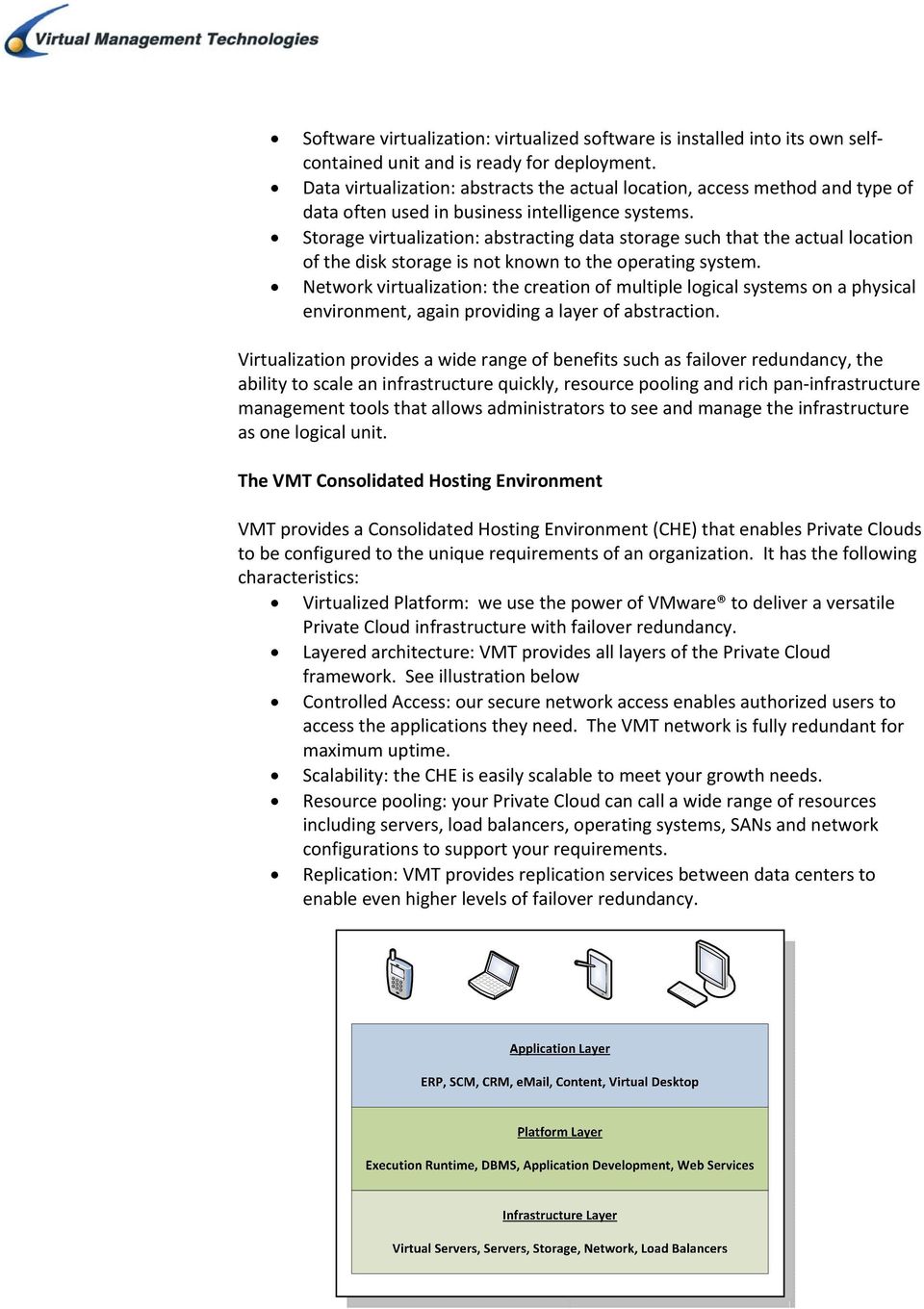
4 Software virtualization: virtualized software is installed into its own selfcontained unit and is ready for deployment. Data virtualization: abstracts the actual location, access method and type of data often used in business intelligence systems. Storage virtualization: abstracting data storage such that the actual location of the disk storage is not known to the operating system. Network virtualization: the creation of multiple logical systems on a physical environment, again providing a layer of abstraction. Virtualization provides a wide range of benefits such as failover redundancy, the ability to scale an infrastructure quickly, resource pooling and rich pan infrastructure management tools that allows administrators to see and manage the infrastructure as one logical unit. The VMT Consolidated Hosting Environment VMT provides a Consolidated Hosting Environment (CHE) that enables Private Clouds to be configured to the unique requirements of an organization. It has the following characteristics: Virtualized Platform: we use the power of VMware to deliver a versatile Private Cloud infrastructure with failover redundancy. Layered architecture: VMT provides all layers of the Private Cloud framework. See illustration below Controlled Access: our secure network access enables authorized users to access the applications they need. The VMT network is fully redundant for maximum uptime. Scalability: the CHE is easily scalable to meet your growth needs. Resource pooling: your Private Cloud can call a wide range of resources including servers, load balancers, operating systems, SANs and network configurations to support your requirements. Replication: VMT provides replication services between data centers to enable even higher levels of failover redundancy. 4
5 Summary For organizations of all sizes a Private Cloud offers significant advantages in building and supporting a business application portfolio. A Private Cloud provides controlled access to a network infrastructure that may be distributed geographically and support users across a wide geographic area with security, privacy and excellent management controls. Remember, a Private Cloud is always unique to the organization. Using a Private Cloud hosted infrastructure enables organizations to extend and expand its computing capabilities. The Private Cloud operates in a secure, redundant environment ensuring that variables such as power, cooling, and device failure are backed up for maximum uptime. For more information on VMT Private Cloud, Hybrid Cloud and Dedicated Infrastructure capabilities, please visit our website at VMT Private Clouds VMT provides a Consolidated Hosting Environment (CHE) that enables Private Clouds to be configured to the unique requirements of an organization. We also provide remote managed services that enable us to monitor and manage multiple infrastructures as one. It has the following characteristics: Virtualized Platform: we use the power of VMware to deliver a versatile Private Cloud infrastructure with failover redundancy. Remote Managed Services: VMT remotely manages IT infrastructures around the globe. Controlled Access: our secure network access enables authorized users to access the applications they need. The VMT network is fully redundant for maximum uptime. Scalability: the CHE is easily scalable to meet your growth needs. Resource pooling: your Private Cloud can call a wide range of resources including servers, load balancers, operating systems, SANs and network configurations to support your requirements. Replication: VMT provides replication services between data centers to enable even higher levels of failover redundancy. For more information on VMT Private Cloud, Hybrid Cloud, Dedicated Infrastructure, and Managed Services, please visit our website at 5

CHAPTER 8 CLOUD COMPUTING
 CHAPTER 8 CLOUD COMPUTING SE 458 SERVICE ORIENTED ARCHITECTURE Assist. Prof. Dr. Volkan TUNALI Faculty of Engineering and Natural Sciences / Maltepe University Topics 2 Cloud Computing Essential Characteristics
Fundamental Concepts and Models
 Chapter 4: Fundamental Concepts and Models Nora Almezeini MIS Department, CBA, KSU From Cloud Computing by Thomas Erl, Zaigham Mahmood, and Ricardo Puttini(ISBN: 0133387526) Copyright 2013 Arcitura Education,
Cloud Computing. Chapter 1 Introducing Cloud Computing
 Cloud Computing Chapter 1 Introducing Cloud Computing Learning Objectives Understand the abstract nature of cloud computing. Describe evolutionary factors of computing that led to the cloud. Describe virtualization
[email protected] [email protected]
 1 The following is merely a collection of notes taken during works, study and just-for-fun activities No copyright infringements intended: all sources are duly listed at the end of the document This work
Where in the Cloud are You? Session 17032 Thursday, March 5, 2015: 1:45 PM-2:45 PM Virginia (Sheraton Seattle)
 Where in the Cloud are You? Session 17032 Thursday, March 5, 2015: 1:45 PM-2:45 PM Virginia (Sheraton Seattle) Abstract The goal of this session is to understanding what is meant when we say Where in the
Realizing the Value Proposition of Cloud Computing
 Realizing the Value Proposition of Cloud Computing CIO s Enterprise IT Strategy for Cloud Jitendra Pal Thethi Abstract Cloud Computing is a model for provisioning and consuming IT capabilities on a need
Fundamental Concepts and Models
 Fundamental Concepts and Models 1 1. Roles and Boundaries Could provider The organization that provides the cloud based IT resources Cloud consumer An organization (or a human) that has a formal contract
Cloud Computing. Key Considerations for Adoption. Abstract. Ramkumar Dargha
 Cloud Computing Key Considerations for Adoption Ramkumar Dargha Abstract Cloud Computing technology and services have been witnessing quite a lot of attention for the past couple of years now. We believe
See Appendix A for the complete definition which includes the five essential characteristics, three service models, and four deployment models.
 Cloud Strategy Information Systems and Technology Bruce Campbell What is the Cloud? From http://csrc.nist.gov/publications/nistpubs/800-145/sp800-145.pdf Cloud computing is a model for enabling ubiquitous,
Demystifying the Cloud Computing 02.22.2012
 Demystifying the Cloud Computing 02.22.2012 Speaker Introduction Victor Lang Enterprise Technology Consulting Services Victor Lang joined Smartbridge in early 2003 as the company s third employee and currently
How To Create A Cloud Based System For Aaas (Networking)
 1 3.1 IaaS Definition IaaS: Infrastructure as a Service Through the internet, provide IT server, storage, computing power and other infrastructure capacity to the end users and the service fee based on
Oracle Applications and Cloud Computing - Future Direction
 Oracle Applications and Cloud Computing - Future Direction February 26, 2010 03:00 PM 03:40 PM Presented By Subash Krishnaswamy [email protected] Vijay Tirumalai [email protected]
Table of Contents. Abstract... Error! Bookmark not defined. Chapter 1... Error! Bookmark not defined. 1. Introduction... Error! Bookmark not defined.
 Table of Contents Abstract... Error! Bookmark not defined. Chapter 1... Error! Bookmark not defined. 1. Introduction... Error! Bookmark not defined. 1.1 Cloud Computing Development... Error! Bookmark not
White Paper on CLOUD COMPUTING
 White Paper on CLOUD COMPUTING INDEX 1. Introduction 2. Features of Cloud Computing 3. Benefits of Cloud computing 4. Service models of Cloud Computing 5. Deployment models of Cloud Computing 6. Examples
Data Centers and Cloud Computing. Data Centers
 Data Centers and Cloud Computing Intro. to Data centers Virtualization Basics Intro. to Cloud Computing 1 Data Centers Large server and storage farms 1000s of servers Many TBs or PBs of data Used by Enterprises
Always On Infrastructure for Software as a Ser vice
 Solution Brief: Always On Infrastructure for Software as a Ser vice WITH EGENERA CLOUD SUITE SOFTWARE Egenera, Inc. 80 Central St. Boxborough, MA 01719 Phone: 978.206.6300 www.egenera.com Introduction
Data Centers and Cloud Computing
 Data Centers and Cloud Computing CS377 Guest Lecture Tian Guo 1 Data Centers and Cloud Computing Intro. to Data centers Virtualization Basics Intro. to Cloud Computing Case Study: Amazon EC2 2 Data Centers
Geoff Raines Cloud Engineer
 Geoff Raines Cloud Engineer Approved for Public Release; Distribution Unlimited. 13-2170 2013 The MITRE Corporation. All rights reserved. Why are P & I important for DoD cloud services? Improves the end-to-end
Cloud Computing Now and the Future Development of the IaaS
 2010 Cloud Computing Now and the Future Development of the IaaS Quanta Computer Division: CCASD Title: Project Manager Name: Chad Lin Agenda: What is Cloud Computing? Public, Private and Hybrid Cloud.
Subash Krishnaswamy Applications Software Technology Corporation
 Oracle Applications and Cloud Computing - Future Direction Subash Krishnaswamy Applications Software Technology Corporation Agenda Introduction ti to CLOUD Oracle Corporation and CLOUD Oracle Applications
Welcome. Panel. Cloud Computing New Challenges in Data Integrity and Security 13 November 2014
 Welcome Cloud Computing New Challenges in Data Integrity and Security 13 November 2014 Panel Tracy Lampula, Associate Director of GIS Compliance, Vertex Pharmaceuticals William Sanborn, Director of Information
SaaS, PaaS & TaaS. By: Raza Usmani
 SaaS, PaaS & TaaS By: Raza Usmani SaaS - Introduction Software as a service (SaaS), sometimes referred to as "on-demand software. software and its associated data are hosted centrally (typically in the
Commercial Software Licensing
 Commercial Software Licensing CHAPTER 12: Prepared by DoD ESI January 2013 Chapter Overview Most software licenses today are either perpetual or subscription. Perpetual licenses involve software possession
Cloud computing and SAP
 Cloud computing and SAP Next Generation SAP Technologies Volume 1 of 2010 Table of contents Document history 1 Overview 2 SAP Landscape challenges 3 Infrastructure as a Service (IaaS) 4 Public, Private,
Cloud Computing. Cloud computing:
 Cloud computing: Cloud Computing A model of data processing in which high scalability IT solutions are delivered to multiple users: as a service, on a mass scale, on the Internet. Network services offering:
Asia/Pacific. Yanna Dharmasthira
 Trends and Directions of SaaSS in Asia/Pacific Yanna Dharmasthira October 2013 Notes accompany this presentation. Please select Notes Page view. These materials can be reproduced only with written approval
Cloud Computing Technology
 Cloud Computing Technology The Architecture Overview Danairat T. Certified Java Programmer, TOGAF Silver [email protected], +66-81-559-1446 1 Agenda What is Cloud Computing? Case Study Service Model Architectures
Data Centers and Cloud Computing. Data Centers. MGHPCC Data Center. Inside a Data Center
 Data Centers and Cloud Computing Intro. to Data centers Virtualization Basics Intro. to Cloud Computing Data Centers Large server and storage farms 1000s of servers Many TBs or PBs of data Used by Enterprises
Cloud Computing. Chapter 1 Introducing Cloud Computing
 Cloud Computing Chapter 1 Introducing Cloud Computing Learning Objectives Understand the abstract nature of cloud computing. Describe evolutionary factors of computing that led to the cloud. Describe virtualization
Virtualization Technologies in SCADA/EMS/DMS/OMS. Vendor perspective Norman Sabelli Ventyx, an ABB company
 1 Virtualization Technologies in SCADA/EMS/DMS/OMS Vendor perspective Norman Sabelli Ventyx, an ABB company 2 Overview Why use Virtualization? Currently used technologies Adoption Considerations Cloud
NATO s Journey to the Cloud Vision and Progress
 NATO s Journey to the Cloud Vision and Progress Dr Peter J. Lenk 2 Definitions of the Cloud A large-scale distributed computing paradigm that is driven by economies of scale, in which a pool of abstracted,
CLOUD COMPUTING. When It's smarter to rent than to buy
 CLOUD COMPUTING When It's smarter to rent than to buy Is it new concept? Nothing new In 1990 s, WWW itself Grid Technologies- Scientific applications Online banking websites More convenience Not to visit
Timo Koskinen, Cloud Computing Leader & Chief Technologist, IBM Finland. 2012 IBM Corporation
 Timo Koskinen, Cloud Computing Leader & Chief Technologist, IBM Finland AGENDA Rethink IT Reinvent Business Cloud Myths 1. Cloud is New Technology 2. If It s Virtualized, It s Cloud 3. SaaS, IaaS - It
Introduction What is the cloud
 Overview/Description: Discussion on the benefits of hosting the campus card system in the cloud. Topic will cover a general overview of what the cloud is; how the cloud hosted solution can benefit the
Outline. What is cloud computing? History Cloud service models Cloud deployment forms Advantages/disadvantages
 Ivan Zapevalov 2 Outline What is cloud computing? History Cloud service models Cloud deployment forms Advantages/disadvantages 3 What is cloud computing? 4 What is cloud computing? Cloud computing is the
Private Cloud Database Consolidation with Exadata. Nitin Vengurlekar Technical Director/Cloud Evangelist
 Private Cloud Database Consolidation with Exadata Nitin Vengurlekar Technical Director/Cloud Evangelist Agenda Private Cloud vs. Public Cloud Business Drivers for Private Cloud Database Architectures for
A Study of Infrastructure Clouds
 A Study of Infrastructure Clouds Pothamsetty Nagaraju 1, K.R.R.M.Rao 2 1 Pursuing M.Tech(CSE), Nalanda Institute of Engineering & Technology,Siddharth Nagar, Sattenapalli, Guntur., Affiliated to JNTUK,
How To Compare Cloud Computing To Cloud Platforms And Cloud Computing
 Volume 3, Issue 11, November 2013 ISSN: 2277 128X International Journal of Advanced Research in Computer Science and Software Engineering Research Paper Available online at: www.ijarcsse.com Cloud Platforms
NCTA Cloud Architecture
 NCTA Cloud Architecture Course Specifications Course Number: 093019 Course Length: 5 days Course Description Target Student: This course is designed for system administrators who wish to plan, design,
VMware vcloud Powered Services
 SOLUTION OVERVIEW VMware vcloud Powered Services VMware-Compatible Clouds for a Broad Array of Business Needs Caught between shrinking resources and growing business needs, organizations are looking to
Tamanna Roy Rayat & Bahra Institute of Engineering & Technology, Punjab, India [email protected]
 IJCSIT, Volume 1, Issue 5 (October, 2014) e-issn: 1694-2329 p-issn: 1694-2345 A STUDY OF CLOUD COMPUTING MODELS AND ITS FUTURE Tamanna Roy Rayat & Bahra Institute of Engineering & Technology, Punjab, India
Why Private Cloud? Nenad BUNCIC VPSI 29-JUNE-2015 EPFL, SI-EXHEB
 Why Private Cloud? O P E R A T I O N S V I E W Nenad BUNCIC EPFL, SI-EXHEB 1 What Exactly Is Cloud? Cloud technology definition, as per National Institute of Standards and Technology (NIST SP 800-145),
Cluster, Grid, Cloud Concepts
 Cluster, Grid, Cloud Concepts Kalaiselvan.K Contents Section 1: Cluster Section 2: Grid Section 3: Cloud Cluster An Overview Need for a Cluster Cluster categorizations A computer cluster is a group of
CLOUD COMPUTING. A Primer
 CLOUD COMPUTING A Primer A Mix of Voices The incredible shrinking CIO CIO Magazine, 2004 IT Doesn t Matter, The cloud will ship service outside the institution and ship power from central IT groups to
VODACOM HANA CLOUD PLATFORM ERMANO QUARTERO HEAD OF PRODUCT VODACOM BUSINESS
 VODACOM HANA CLOUD PLATFORM ERMANO QUARTERO HEAD OF PRODUCT VODACOM BUSINESS WHY CLOUD SOLUTIONS MAKE SENSE? VODACOM S EVOLUTION INTO THE CLOUD 2014 Cloud 2010 2008 Unified communications Value ADSL FTTB
Virtualization and Cloud Computing
 Written by Zakir Hossain, CS Graduate (OSU) CEO, Data Group Fed Certifications: PFA (Programming Foreign Assistance), COR (Contracting Officer), AOR (Assistance Officer) Oracle Certifications: OCP (Oracle
AUTOMATION. Tihomir Hrastovscak HP Software
 HP CLOUD SERVICE AUTOMATION Tihomir Hrastovscak HP Software Presales consultant THE CLOUD ADVANTAGE What the business expects Encourages standard 68.5% systems Pay only for what 77.9% you use Easy/fast
Cloud Courses Description
 Courses Description 101: Fundamental Computing and Architecture Computing Concepts and Models. Data center architecture. Fundamental Architecture. Virtualization Basics. platforms: IaaS, PaaS, SaaS. deployment
Building Blocks of the Private Cloud
 www.cloudtp.com Building Blocks of the Private Cloud Private clouds are exactly what they sound like. Your own instance of SaaS, PaaS, or IaaS that exists in your own data center, all tucked away, protected
Cloud Computing for SCADA
 Cloud Computing for SCADA Moving all or part of SCADA applications to the cloud can cut costs significantly while dramatically increasing reliability and scalability. A White Paper from InduSoft Larry
Zadara Storage Cloud A whitepaper. @ZadaraStorage
 Zadara Storage Cloud A whitepaper @ZadaraStorage Zadara delivers two solutions to its customers: On- premises storage arrays Storage as a service from 31 locations globally (and counting) Some Zadara customers
Architectural Implications of Cloud Computing
 Architectural Implications of Cloud Computing Grace Lewis Research, Technology and Systems Solutions (RTSS) Program Lewis is a senior member of the technical staff at the SEI in the Research, Technology,
C a r l G o e t h a l s T e r r e m a r k E u r o p e. C a r l. g o e t h a l s @ t e r r e m a r k. c o m
 Cloud Computing for Government & Enterprise C a r l G o e t h a l s T e r r e m a r k E u r o p e C a r l. g o e t h a l s @ t e r r e m a r k. c o m Agenda Some history on Terremark State of Cloud Public
Connecting to the Cloud
 Connecting to the Cloud Six Degrees Group www.6dg.co.uk Managed Cloud Hosting Companies all over the world are intrigued by the possibility of cloud services but they have profound concerns about the privacy,
SOA and Cloud in practice - An Example Case Study
 SOA and Cloud in practice - An Example Case Study 2 nd RECOCAPE Event "Emerging Software Technologies: Trends & Challenges Nov. 14 th 2012 ITIDA, Smart Village, Giza, Egypt Agenda What is SOA? What is
Office of the Government Chief Information Officer The Government of the Hong Kong Special Administrative Region
 Office of the Government Chief Information Officer The Government of the Hong Kong Special Administrative Region 1 1) Government Cloud Journey 2) Government Clouds 3) Way Forward 2 1. Government Cloud
Private Cloud 201 How to Build a Private Cloud
 Private Cloud 201 How to Build a Private Cloud Chris E. Avis Sr. IT Pro Evangelist Microsoft Corp. http://chrisavis.com Presented at Seattle Windows Networking User Group January 4, 2012 al 1 The Cloudscape
Cloud Courses Description
 Cloud Courses Description Cloud 101: Fundamental Cloud Computing and Architecture Cloud Computing Concepts and Models. Fundamental Cloud Architecture. Virtualization Basics. Cloud platforms: IaaS, PaaS,
Securing and Auditing Cloud Computing. Jason Alexander Chief Information Security Officer
 Securing and Auditing Cloud Computing Jason Alexander Chief Information Security Officer What is Cloud Computing A model for enabling convenient, on-demand network access to a shared pool of configurable
Enterprise Cloud Solutions
 IT(O) IT Outsourcing Options Enterprise Cloud Solutions CloudAgile Select Partner PDF v2.2 9/11/12 Cloud Computing with Latisys With the Latisys Cloud, your Enterprise can: Achieve unprecedented control,
Building Private & Hybrid Cloud Solutions
 Solution Brief: Building Private & Hybrid Cloud Solutions WITH EGENERA CLOUD SUITE SOFTWARE Egenera, Inc. 80 Central St. Boxborough, MA 01719 Phone: 978.206.6300 www.egenera.com Introduction When most
GETTING THE MOST FROM THE CLOUD. A White Paper presented by
 GETTING THE MOST FROM THE CLOUD A White Paper presented by Why Move to the Cloud? CLOUD COMPUTING the latest evolution of IT services delivery is a scenario under which common business applications are
Topics. Images courtesy of Majd F. Sakr or from Wikipedia unless otherwise noted.
 Cloud Computing Topics 1. What is the Cloud? 2. What is Cloud Computing? 3. Cloud Service Architectures 4. History of Cloud Computing 5. Advantages of Cloud Computing 6. Disadvantages of Cloud Computing
Cloud Computing Paradigm Shift. Jan Šedivý
 Cloud Computing Paradigm Shift Jan Šedivý Business expectations Improving business processes Reducing enterprise costs Increasing the use of information/analytics Improving enterprise workforce effectiveness
Virtualization Impact on Compliance and Audit
 2009 Reflex Systems, LLC Virtualization Impact on Compliance and Audit Michael Wronski, CISSP VP Product Management Reflex Systems Agenda Introduction Virtualization? Cloud? Risks and Challenges? Compliance
ZADARA STORAGE. Managed, hybrid storage EXECUTIVE SUMMARY. Research Brief
 ZADARA STORAGE Managed, hybrid storage Research Brief EXECUTIVE SUMMARY In 2013, Neuralytix first documented Zadara s rise to prominence in the then, fledgling integrated on-premise and in-cloud storage
TECHNOLOGY GUIDE THREE. Emerging Types of Enterprise Computing
 TECHNOLOGY GUIDE THREE Emerging Types of Enterprise Computing TECHNOLOGY GU IDE OUTLINE TG3.1 Introduction TG3.2 Server Farms TG3.3 Virtualization TG3.4 Grid Computing TG3.5 Utility Computing TG3.6 Cloud
Het is een kleine stap naar een hybrid cloud
 Het is een kleine stap naar een hybrid cloud Isabel Moll-Kranenburg Microsoft 14 jaar IT industrie 4 jaar Microsoft Cloud Private Private Cloud Meeting customers where they are The Microsoft Cloud Computing
Cisco Unified Data Center
 Solution Overview Cisco Unified Data Center Simplified, Efficient, and Agile Infrastructure for the Data Center What You Will Learn The data center is critical to the way that IT generates and delivers
Seeing Though the Clouds
 Seeing Though the Clouds A PM Primer on Cloud Computing and Security NIH Project Management Community Meeting Mark L Silverman Are You Smarter Than a 5 Year Old? 1 Cloud First Policy Cloud First When evaluating
Cutting Through the Hype: Straight Talk About the Mainframe and Cloud Computing. Straight talk on cloud computing
 Glenn Anderson, IBM Lab Services and Training Cutting Through the Hype: Straight Talk About the Mainframe and Cloud Computing Summer SHARE August 2014 Session 15593 Straight talk on cloud computing What
Cloud-based Services: To Move or Not To Move. Seminar Internet Economics Cristian Anastasiu & Taya Goubran
 Cloud-based Services: To Move or Not To Move Seminar Internet Economics Cristian Anastasiu & Taya Goubran Agenda Motivation What is Cloud Computing Cloud Service Market Dimensions and Factors of the Cloud
4/28/2014. What's the Scoop on Cloud Computing. Agenda. Why you are here?
 What's the Scoop on Cloud Computing and Virtualization? ation? April 30, 2014 Jason Wampler, Director of IT, Association Forum of Chicagoland Agenda History and Conceptual Overview of Virtualization &
VIRTUAL PRIVATE CLOUD FOR ENTERPRISES
 VIRTUAL PRIVATE CLOUD FOR ENTERPRISES DEFINITION Virtual Private Cloud (VPC) is an on demand configurable pool of shared computing resources allocated within a public cloud environment, providing a certain
Software Systems Architecture in a World of Cloud Computing. Christine Miyachi SDM Entering Class 2000
 Software Systems Architecture in a World of Cloud Computing Christine Miyachi SDM Entering Class 2000 Copyright Christine Miyachi 2013 Outline Overview of cloud computing The business of cloud The process
Quickly Deploy Microsoft Private Cloud and SQL Server 2012 Data Warehouse on Hitachi Converged Solutions. September 25, 2013
 Quickly Deploy Microsoft Private Cloud and SQL Server 2012 Data Warehouse on Hitachi Converged Solutions September 25, 2013 1 WEBTECH EDUCATIONAL SERIES QUICKLY DEPLOY MICROSOFT PRIVATE CLOUD AND SQL SERVER
How To Understand Cloud Computing
 Dr Markus Hagenbuchner [email protected] CSCI319 Introduction to Cloud Computing CSCI319 Chapter 1 Page: 1 of 10 Content and Objectives 1. Introduce to cloud computing 2. Develop and understanding to how
Electronic Records Storage Options and Overview
 Electronic Records Storage Options and Overview www.archives.nysed.gov Objectives Understand the options for electronic records storage, including cloud-based storage Evaluate the options best suited for
Private & Hybrid Cloud: Risk, Security and Audit. Scott Lowry, Hassan Javed VMware, Inc. March 2012
 Private & Hybrid Cloud: Risk, Security and Audit Scott Lowry, Hassan Javed VMware, Inc. March 2012 Private and Hybrid Cloud - Risk, Security and Audit Objectives: Explain the technology and benefits behind
How cloud computing can transform your business landscape
 How cloud computing can transform your business landscape Introduction It seems like everyone is talking about the cloud. Cloud computing and cloud services are the new buzz words for what s really a not
Deploying a Geospatial Cloud
 Deploying a Geospatial Cloud Traditional Public Sector Computing Environment Traditional Computing Infrastructure Silos of dedicated hardware and software Single application per silo Expensive to size
How To Understand Cloud Computing
 A STUDY OF CLOUD COMPUTING: APPLICATIONS AND CHALLENGE 1 DR. NEERAJ BHARGAVA, 2 ANCHAL KUMAWAT, 3 DR. RITU BHARGAVA, 4 SONIYA DAYMA 1 Associate Professor, Dept. of Computer Science, School of Engineering
19.10.11. What Is the Cloud?
 19.10.11 What Is the Cloud? What is Cloud? National Institute for Standards and Technology (NIST) Definition On-demand self-service > Through a portal, no human interaction > Only pay what you need Broad
INCREASING THE CLOUD PERFORMANCE WITH LOCAL AUTHENTICATION
 INTERNATIONAL JOURNAL OF RESEARCH IN COMPUTER APPLICATIONS AND ROBOTICS ISSN 2320-7345 INCREASING THE CLOUD PERFORMANCE WITH LOCAL AUTHENTICATION Sanjay Razdan Department of Computer Science and Eng. Mewar
Cloud Computing. Chapter 1 Introducing Cloud Computing
 Cloud Computing Chapter 1 Introducing Cloud Computing Learning Objectives Understand the abstract nature of cloud computing. Describe evolutionary factors of computing that led to the cloud. Describe virtualization
Introduction to Engineering Using Robotics Experiments Lecture 18 Cloud Computing
 Introduction to Engineering Using Robotics Experiments Lecture 18 Cloud Computing Yinong Chen 2 Big Data Big Data Technologies Cloud Computing Service and Web-Based Computing Applications Industry Control
Cloud Computing Architecture
 Cloud Computing Architecture 1 1. Workload distribution architecture Scale up/down the IT resources Distribute workload among IT resource evenly 2 A variant Cloud service consumer requests are sent to
Who moved my cloud? Part I: Introduction to Private, Public and Hybrid clouds and smooth migration
 Who moved my cloud? Part I: Introduction to Private, Public and Hybrid clouds and smooth migration Part I of an ebook series of cloud infrastructure and platform fundamentals not to be avoided when preparing
Introduction to Cloud : Cloud and Cloud Storage. Lecture 2. Dr. Dalit Naor IBM Haifa Research Storage Systems. Dalit Naor, IBM Haifa Research
 Introduction to Cloud : Cloud and Cloud Storage Lecture 2 Dr. Dalit Naor IBM Haifa Research Storage Systems 1 Advanced Topics in Storage Systems for Big Data - Spring 2014, Tel-Aviv University http://www.eng.tau.ac.il/semcom