
Measuring. Information Society
|
|
|
- Allen Vincent Brooks
- 10 years ago
- Views:
Transcription
1 International Telecommunication Union Measuring the Information Society 2013
2

3 International Telecommunication Union Measuring THE Information Society 2013

4 2013 ITU International Telecommunication Union Place des Nations CH-1211 Geneva Switzerland Original language of publication: English. All rights reserved. No part of this publication may be reproduced, stored in a retrieval system, or transmitted in any form or by any means, electronic, mechanical, photocopying, recording, or otherwise, without the prior permission of the International Telecommunication Union. ISBN ii

5 Foreword I am pleased to present to you the 2013 edition of Measuring the Information Society (MIS). Now in its fifth year, this annual report identifies key ICT developments and tracks the cost and affordability of ICT services, in accordance with internationally agreed methodologies. Its core feature is the ICT Development Index (IDI), which ranks countries performance with regard to ICT infrastructure and uptake. The report aims to provide an objective international performance evaluation based on quantitative indicators and benchmarks, as an essential input to the ICT policy debate in ITU Member States. The 2013 edition also presents the latest results of the ICT Price Basket (IPB), and the first complete price data set for mobile-broadband services; the first-ever model to measure the world s digital native population; and a quantitative assessment of recent digital TV broadcasting trends. Over 250 million people came online over the last year, and almost 40 per cent of the world s population will be using the Internet by end Mobile technology and services continue to be the key driver of the information society, and the number of mobilebroadband subscriptions is close to 2 billion. Mobile-broadband networks are allowing more people to connect to highspeed networks and benefit from a growing number of applications and services. While both fixed- and mobile-broadband speeds continue to increase, the price of services is falling and ICTs are becoming more affordable: in the space of four years, fixed-broadband prices have dropped by an impressive 82 per cent. At the same time, the report also shows that ICT uptake remains limited in many developing countries, and particularly in the world s least connected countries (LCCs) a group of 39 countries (home to 2.4 billion people) with particularly low levels of ICT development. In this group of countries, ICTs can become key enablers for achieving international and national development goals and have the greatest development impact, and more policy attention needs to be directed towards them. Young people all over the world are the most active users of ICTs. For the first time, a model has been developed to estimate the number of digital natives - the young people with solid ICT experience who are drivers of the information society. While 30 per cent of the youth population are digital natives today, the report shows that within the next five years, the digital native population in the developing world is expected to double. The report also sheds new light on the latest digital TV broadcasting trends, another key driving force of the growing information society. The TV industry has undergone an important shift during the past few years and, in 2012, the number of households with digital TV overtook the number of households with analogue TV. This achievement reinforces the dual role of TV broadcasts: fulfilling some of the public services associated with communications and being a major market for private content creators, distributors and networks. I trust that the data and analysis contained in this report will be of great value to the ITU membership, including policymakers, the ICT industry and others working towards building an inclusive global information society. Brahima Sanou Director Telecommunication Development Bureau (BDT) International Telecommunication Union iii

6

7 Acknowledgements The 2013 edition of Measuring the Information Society was prepared by the ICT Data and Statistics Division within the Telecommunication Development Bureau of ITU. The team included Susan Teltscher (Head of Division), Vanessa Gray, Esperanza Magpantay, Doris Olaya and Ivan Vallejo. The following consultants to ITU provided substantive inputs: Lisa Kreuzenbeck, Michael Best (Chapter 4), and Simon Murray (Chapter 5). Fernando Callorda, Diana Korka, Christoph Stork and Shazna Zuhely contributed to the compilation of data sets on prices. Helpful inputs and suggestions were received from the following ITU colleagues: Istvan Bozoski, Pham Hai, Aurora Rubio, Sameer Sharma, Anne Rita Ssemboga and Marcelino Tayob. The work was carried out under the overall direction of Cosmas Zavazava, Chief, Project Support and Knowledge Management Department, Telecommunication Development Bureau. The report includes data from Digital TV Research, Eurostat, OECD, IMF, UNCTAD, the UNESCO Institute for Statistics, the United Nations Population Division and the World Bank, which is greatly acknowledged. ITU also appreciates the cooperation of countries that have provided data included in this report. The report was edited by Anthony Pitt and Bruce Granger, ITU English Translation Section. The desktop publishing was carried out by Nathalie Delmas, and the cover was designed by Céline Désthomas. Administrative support was provided by Herawasih Yasandikusuma. v
8

9 Table of contents Foreword...iii Acknowledgements...v Table of contents... vii Chapter 1. Introduction Recent trends in ICT developments Overview of the report Chapter 2. The ICT Development Index (IDI) Introduction to the IDI Global IDI analysis Monitoring the digital divide: developed, developing and least connected countries IDI sub-indices: access, use and skills Regional IDI analysis Chapter 3. Measuring the cost and affordability of broadband Introduction Fixed-broadband prices Mobile-broadband prices Comparison of mobile-broadband with fixed-broadband and mobile-cellular prices The mobile-broadband sub-basket Chapter 4. Measuring the world s digital natives Introduction Review of the literature Quantifying digital natives Analysis of the results Conclusions vii
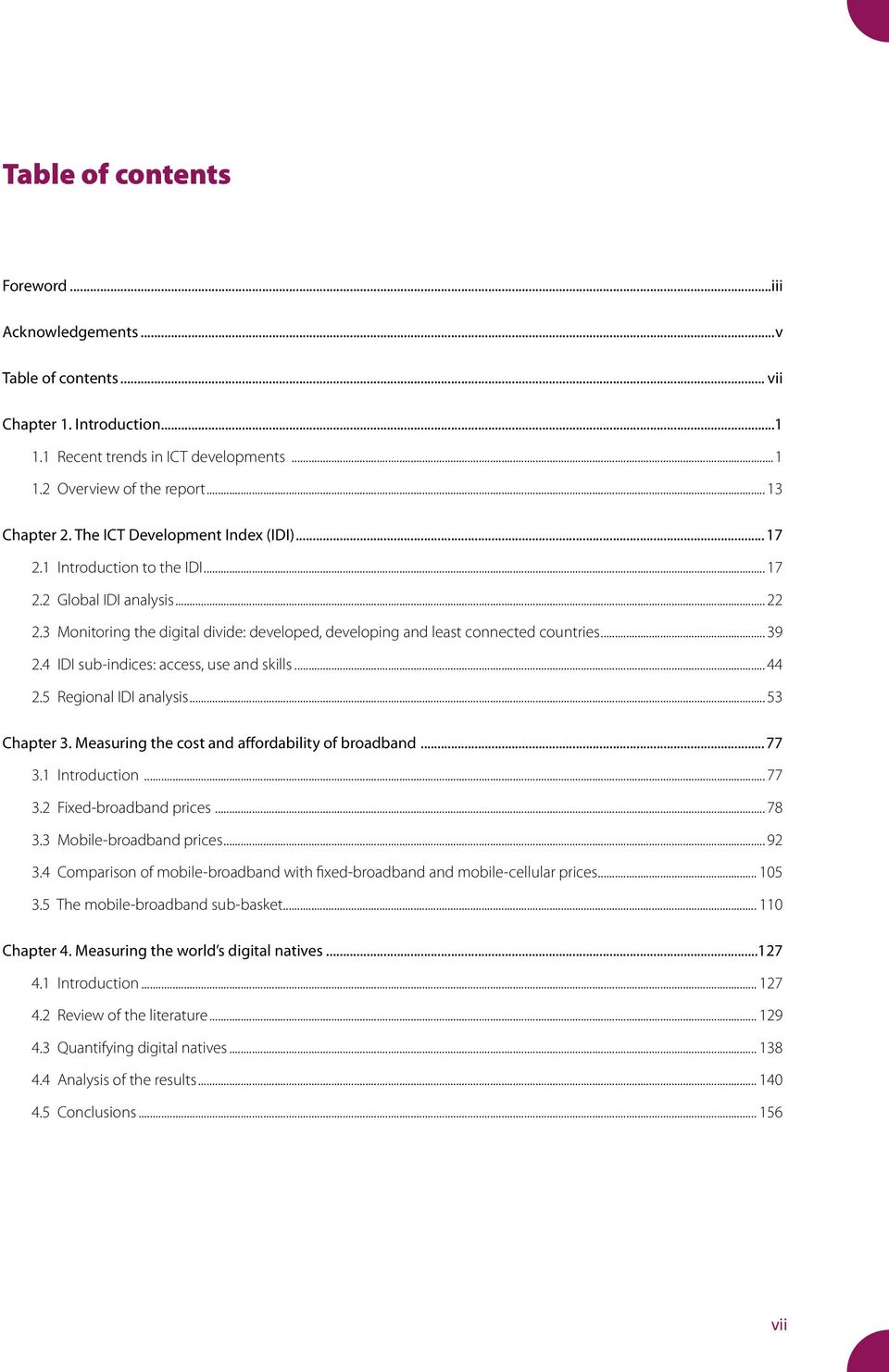
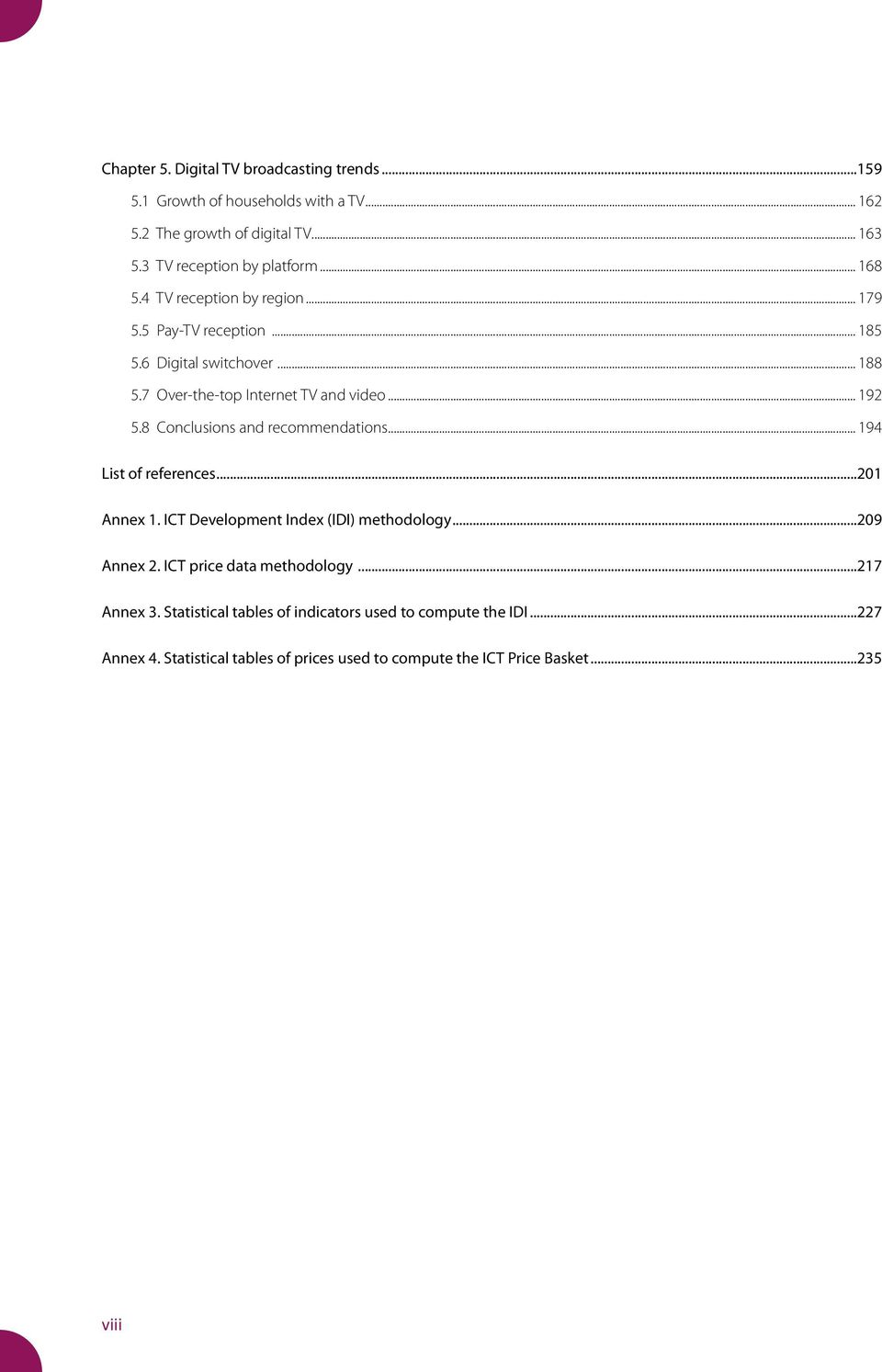
10 Chapter 5. Digital TV broadcasting trends Growth of households with a TV The growth of digital TV TV reception by platform TV reception by region Pay-TV reception Digital switchover Over-the-top Internet TV and video Conclusions and recommendations List of references Annex 1. ICT Development Index (IDI) methodology Annex 2. ICT price data methodology Annex 3. Statistical tables of indicators used to compute the IDI Annex 4. Statistical tables of prices used to compute the ICT Price Basket viii
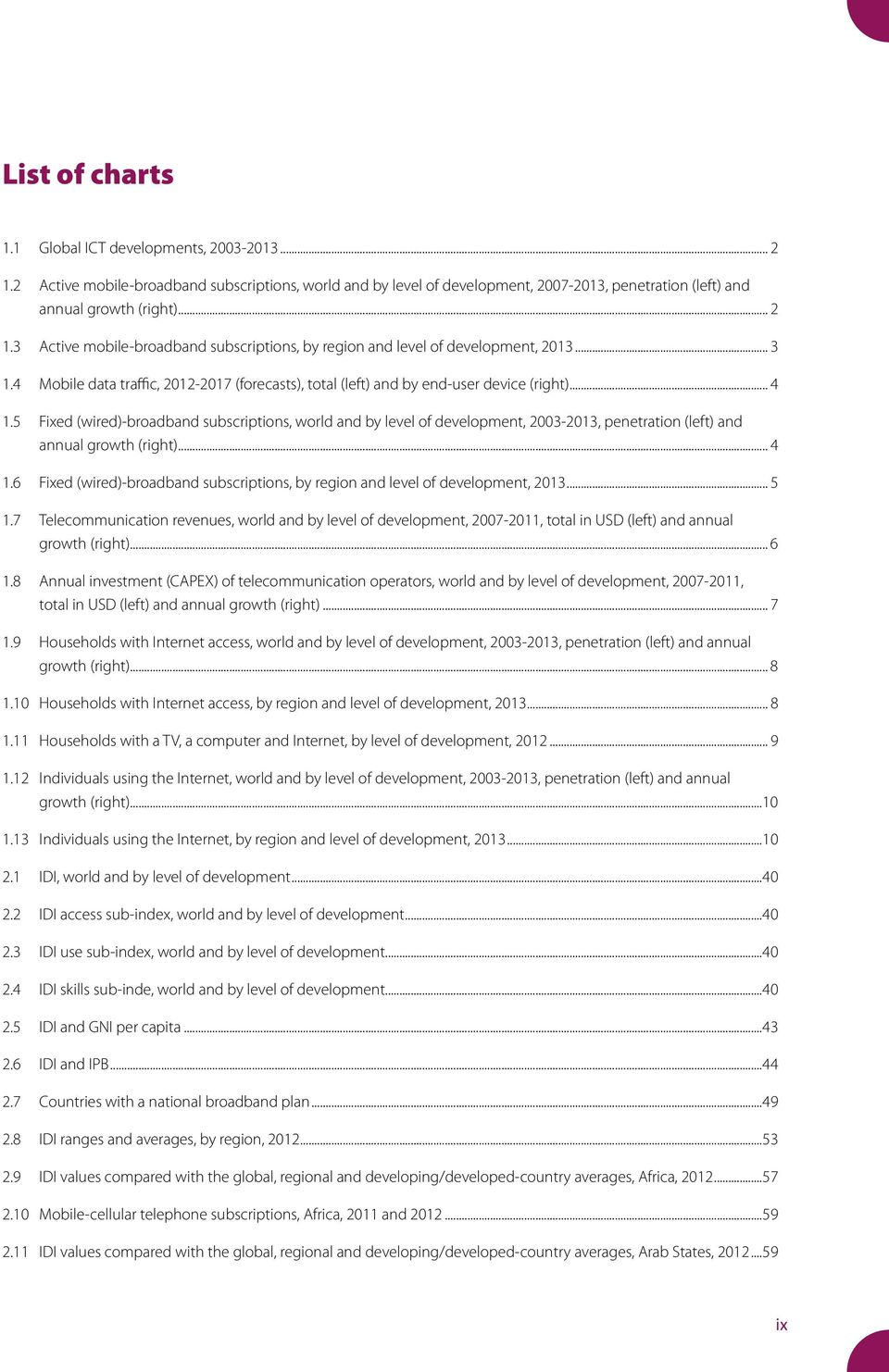
11 List of charts 1.1 Global ICT developments, Active mobile-broadband subscriptions, world and by level of development, , penetration (left) and annual growth (right) Active mobile-broadband subscriptions, by region and level of development, Mobile data traffic, (forecasts), total (left) and by end-user device (right) Fixed (wired)-broadband subscriptions, world and by level of development, , penetration (left) and annual growth (right) Fixed (wired)-broadband subscriptions, by region and level of development, Telecommunication revenues, world and by level of development, , total in USD (left) and annual growth (right) Annual investment (CAPEX) of telecommunication operators, world and by level of development, , total in USD (left) and annual growth (right) Households with Internet access, world and by level of development, , penetration (left) and annual growth (right) Households with Internet access, by region and level of development, Households with a TV, a computer and Internet, by level of development, Individuals using the Internet, world and by level of development, , penetration (left) and annual growth (right) Individuals using the Internet, by region and level of development, IDI, world and by level of development IDI access sub-index, world and by level of development IDI use sub-index, world and by level of development IDI skills sub-inde, world and by level of development IDI and GNI per capita IDI and IPB Countries with a national broadband plan IDI ranges and averages, by region, IDI values compared with the global, regional and developing/developed-country averages, Africa, Mobile-cellular telephone subscriptions, Africa, 2011 and IDI values compared with the global, regional and developing/developed-country averages, Arab States, ix
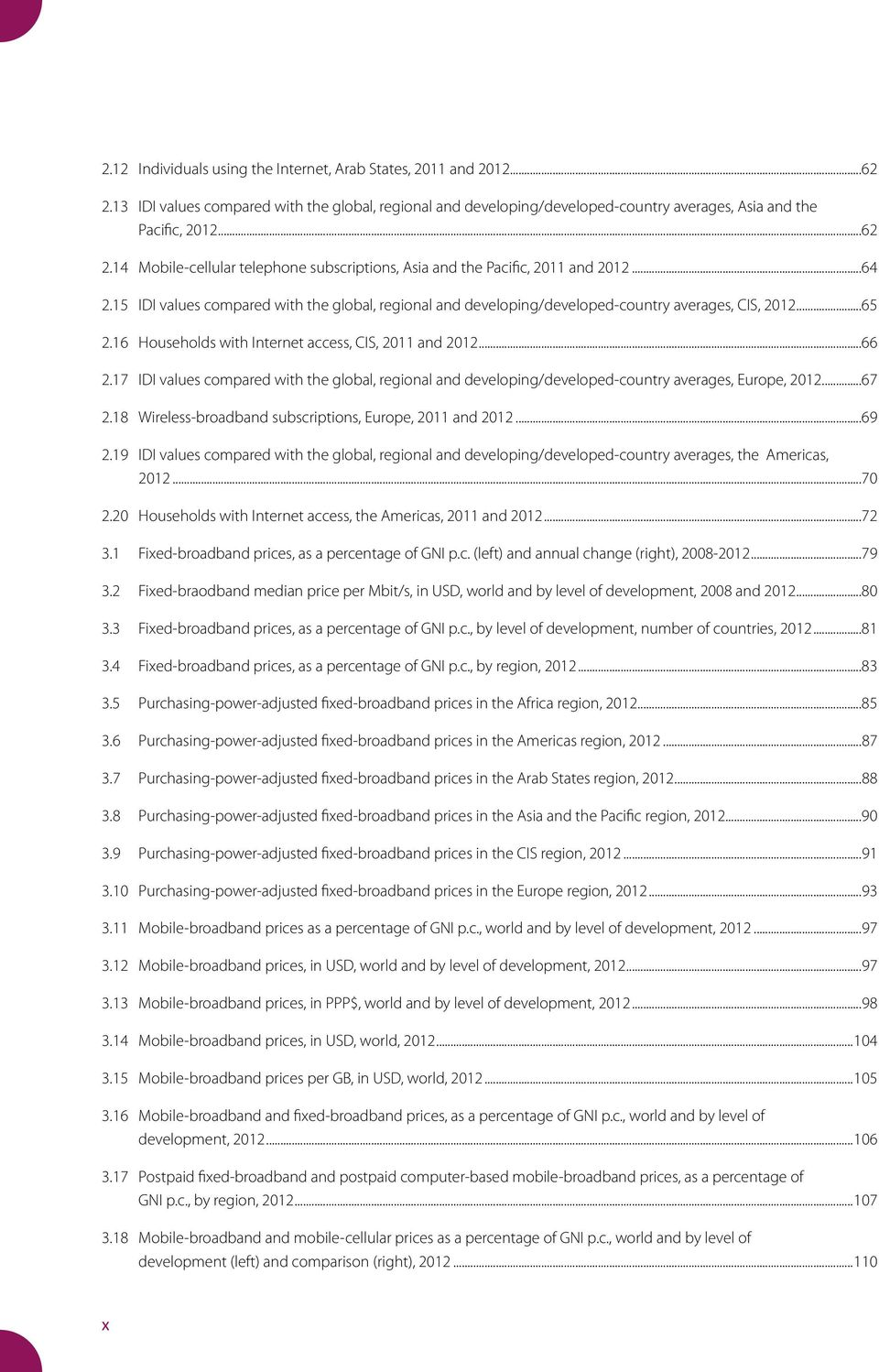
12 2.12 Individuals using the Internet, Arab States, 2011 and IDI values compared with the global, regional and developing/developed-country averages, Asia and the Pacific, Mobile-cellular telephone subscriptions, Asia and the Pacific, 2011 and IDI values compared with the global, regional and developing/developed-country averages, CIS, Households with Internet access, CIS, 2011 and IDI values compared with the global, regional and developing/developed-country averages, Europe, Wireless-broadband subscriptions, Europe, 2011 and IDI values compared with the global, regional and developing/developed-country averages, the Americas, Households with Internet access, the Americas, 2011 and Fixed-broadband prices, as a percentage of GNI p.c. (left) and annual change (right), Fixed-braodband median price per Mbit/s, in USD, world and by level of development, 2008 and Fixed-broadband prices, as a percentage of GNI p.c., by level of development, number of countries, Fixed-broadband prices, as a percentage of GNI p.c., by region, Purchasing-power-adjusted fixed-broadband prices in the Africa region, Purchasing-power-adjusted fixed-broadband prices in the Americas region, Purchasing-power-adjusted fixed-broadband prices in the Arab States region, Purchasing-power-adjusted fixed-broadband prices in the Asia and the Pacific region, Purchasing-power-adjusted fixed-broadband prices in the CIS region, Purchasing-power-adjusted fixed-broadband prices in the Europe region, Mobile-broadband prices as a percentage of GNI p.c., world and by level of development, Mobile-broadband prices, in USD, world and by level of development, Mobile-broadband prices, in PPP$, world and by level of development, Mobile-broadband prices, in USD, world, Mobile-broadband prices per GB, in USD, world, Mobile-broadband and fixed-broadband prices, as a percentage of GNI p.c., world and by level of development, Postpaid fixed-broadband and postpaid computer-based mobile-broadband prices, as a percentage of GNI p.c., by region, Mobile-broadband and mobile-cellular prices as a percentage of GNI p.c., world and by level of development (left) and comparison (right), x
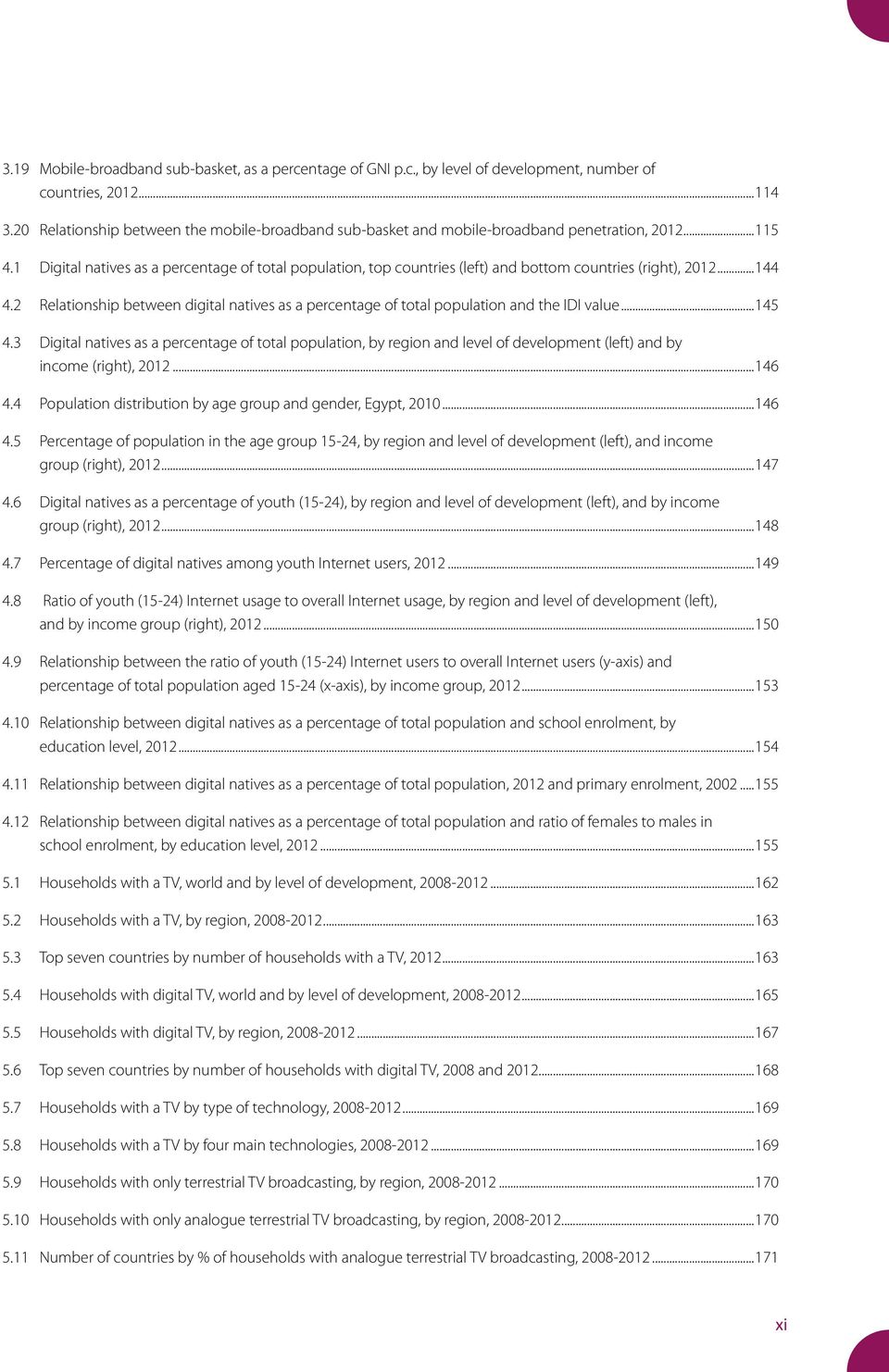
13 3.19 Mobile-broadband sub-basket, as a percentage of GNI p.c., by level of development, number of countries, Relationship between the mobile-broadband sub-basket and mobile-broadband penetration, Digital natives as a percentage of total population, top countries (left) and bottom countries (right), Relationship between digital natives as a percentage of total population and the IDI value Digital natives as a percentage of total population, by region and level of development (left) and by income (right), Population distribution by age group and gender, Egypt, Percentage of population in the age group 15-24, by region and level of development (left), and income group (right), Digital natives as a percentage of youth (15-24), by region and level of development (left), and by income group (right), Percentage of digital natives among youth Internet users, Ratio of youth (15-24) Internet usage to overall Internet usage, by region and level of development (left), and by income group (right), Relationship between the ratio of youth (15-24) Internet users to overall Internet users (y-axis) and percentage of total population aged (x-axis), by income group, Relationship between digital natives as a percentage of total population and school enrolment, by education level, Relationship between digital natives as a percentage of total population, 2012 and primary enrolment, Relationship between digital natives as a percentage of total population and ratio of females to males in school enrolment, by education level, Households with a TV, world and by level of development, Households with a TV, by region, Top seven countries by number of households with a TV, Households with digital TV, world and by level of development, Households with digital TV, by region, Top seven countries by number of households with digital TV, 2008 and Households with a TV by type of technology, Households with a TV by four main technologies, Households with only terrestrial TV broadcasting, by region, Households with only analogue terrestrial TV broadcasting, by region, Number of countries by % of households with analogue terrestrial TV broadcasting, xi
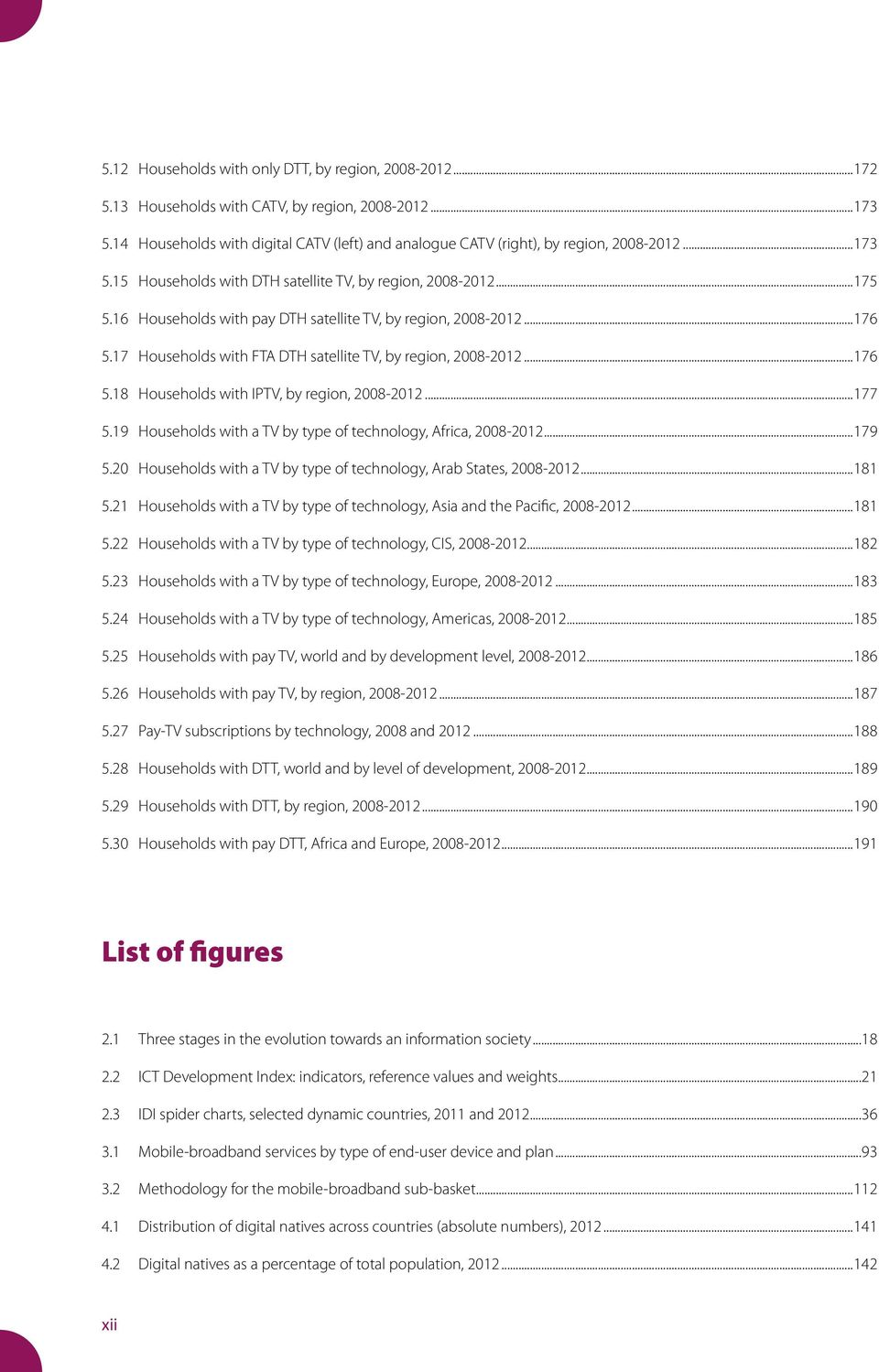
14 5.12 Households with only DTT, by region, Households with CATV, by region, Households with digital CATV (left) and analogue CATV (right), by region, Households with DTH satellite TV, by region, Households with pay DTH satellite TV, by region, Households with FTA DTH satellite TV, by region, Households with IPTV, by region, Households with a TV by type of technology, Africa, Households with a TV by type of technology, Arab States, Households with a TV by type of technology, Asia and the Pacific, Households with a TV by type of technology, CIS, Households with a TV by type of technology, Europe, Households with a TV by type of technology, Americas, Households with pay TV, world and by development level, Households with pay TV, by region, Pay-TV subscriptions by technology, 2008 and Households with DTT, world and by level of development, Households with DTT, by region, Households with pay DTT, Africa and Europe, List of figures 2.1 Three stages in the evolution towards an information society ICT Development Index: indicators, reference values and weights IDI spider charts, selected dynamic countries, 2011 and Mobile-broadband services by type of end-user device and plan Methodology for the mobile-broadband sub-basket Distribution of digital natives across countries (absolute numbers), Digital natives as a percentage of total population, xii
15 4.3 Percentage of population in the age group 15-24, Ratio of youth (15-24) Internet users to overall Internet users, Main TV-distribution technologies DTT standard adoption by country, January List of boxes 1.1 Monitoring the ICT gender gap ITU expert groups From active-mobile broadband to wireless broadband Europe counts on ICTs: The Digital Agenda for Europe Smarter phones and faster networks are driving data usage and revenues in Australia Competition pushes Costa Rica above the regional average Oman boasts second highest wireless-broadband subscriptions penetration in the region An ICT user profile from the United Arab Emirates Rural roll-out in Zambia The least connected countries (LCCs) home to 2.4 billion people are not making enough progress to reduce the digital divide Abundant and secure international Internet bandwidth and fast broadband to protect and run Hong Kong (China) s financial centre Kenya largest amount of international Internet bandwidth per Internet user in Africa Cambodia s heated mobile market Growth in broadband networks brings more Albanians online Data issues: Comparability and transparency Rules applied in collecting mobile-broadband prices Available mobile-broadband plans according to different monthly data allowances To what extent are fixed-broadband and mobile-broadband prices and services comparable? Youth and ICT: the BYN D 2015 Global Youth Summit Survey depicts optimistic millennial generation that believes in the potential of ICTs Digital native model xiii
16 5.1 Historic developments in TV broadcasting North America and Europe Measuring TV uptake The ITU GE06 Agreement The digital TV boom in Brazil List of tables 2.1 IDI values and changes, 2011 and ICT Development Index (IDI), 2011 and Most dynamic countries changes between IDI 2011 and IDI by level of development, 2011 and IDI by groups, 2011 and IDI access sub-index, 2011 and Top ten economies with the greatest change in the IDI access sub-index, by absolute value change (left) and rank change (right) IDI use sub-index, 2011 and Top ten economies with the greatest change in IDI use sub-index, by absolute value change (left) and rank change (right) IDI skills sub-index, 2011 and IDI by region, 2011 and The top five economies in each region and their ranking in the global IDI, IDI Africa IDI Arab States IDI Asia and the Pacific IDI CIS IDI Europe IDI The Americas Minimum advertised fixed-broadband speeds, percentage of countries, 2008 and Fixed-broadband prices, Fixed-broadband prices ranges and averages as a percentage of GNI p.c., by region, xiv

17 3.4 Fixed-broadband prices, Africa, Fixed-broadband prices, the Americas, Fixed-broadband prices, Arab States, Fixed-broadband prices, Asia and the Pacific, Fixed-broadband prices, CIS, Fixed-broadband prices, Europe, Mobile-broadband prices as a percentage of GNI p.c., by region, Mobile-broadband prepaid handset-based prices (500 MB), Mobile-broadband postpaid handset-based prices (500 MB), Mobile-broadband prepaid computer-based prices (1 GB), Mobile-broadband postpaid computer-based prices (1 GB), Comparison of postpaid fixedbroadband and postpaid computer-based mobile-broadband prices, percentage of countries, by region, Comparison of postpaid fixed-broadband and postpaid computer-based mobile-broadband plans in selected countries, Mobile-broadband sub-basket and its components, ICT Price Basket and sub-baskets, 2011 and Fixed-telephone sub-basket, 2011 and Mobile-cellular sub-basket, 2011 and Fixed-broadband sub-basket, 2011 and Digital natives, Internet user penetration, youth and total population, Countries that have assigned part of the digital dividend to mobile-broadband networks Prices of DTT set-top boxes (STB) in selected African countries, July Top 15 countries by percentage of households with pay TV, BBC iplayer requests by device, Q Q4 2012, millions Netflix subscriptions by type of service, Q Q4 2012, millions xv

18

19 Measuring the Information Society 2013 Chapter 1. Introduction 1.1 Recent trends in ICT developments As more and more people join the global information society and high-speed communication networks become an indispensable infrastructure, the tracking and measurement of developments in information and communication technologies (ICTs) remain as relevant as ever. According to ITU estimates, there will be 6.8 billion mobile-cellular subscriptions by the end of 2013 almost as many as there are people on the planet. While the ubiquitous availability of mobile-telephone services is undeniable, with close to 100 per cent of the population covered by a mobile signal, not everyone has a mobile phone. From a measurement point of view, the ongoing challenge thus remains to identify those who are still left without access to ICTs. By end 2013, there will be an estimated 2.7 billion people using the Internet worldwide. In other words, there are still 4.4 billion people who are not yet online. Priority attention needs to be given to the unconnected, and action needs to be taken to improve the accessibility and affordability of broadband Internet services everywhere in order to usher in an inclusive information society. Over the past year, ICT deployment and uptake have continued to grow worldwide (Chart 1.1). While growth in mobile-cellular penetration is flattening, reaching 96 per cent by end 2013, mobile broadband continues to grow strongly, on average by around 40 per cent annually between 2010 and Fixed-broadband uptake, on the other hand, is growing more slowly at around 10 per cent compound annual growth rate (CAGR) albeit steadily, across both developing and developed regions. Reflecting the strong growth in mobile Internet uptake, growth in household access to the Internet has also accelerated over the past three years, mainly in the developing world, and will reach a penetration rate of over 40 per cent globally by end As a comparison, this figure corresponds to about half the proportion of households worldwide that have a TV (almost 80 per cent penetration in 2012: see below and Chapter 5). Infrastructure trends From ubiquitous mobile to ubiquitous broadband? In view of the steep growth of mobile broadband and the widespread deployment of mobile infrastructure, expectations are high that mobile-broadband services will become equally as available as mobile-cellular telephony in the near future. Indeed, Ericsson forecasts that by 2018 there will be 6.5 billion mobile-broadband subscriptions, almost as many as there are mobile-cellular telephone subscriptions in Today, almost all people on Earth live somewhere within reach of a mobile-cellular signal. Not all of those networks, however, have been upgraded to 3G technology, which is necessary to qualify as mobile broadband and provide highspeed access to the Internet. By end 2012, the percentage of the world s population covered by a 3G network was around 50 per cent. In the large majority of countries, 3G services are now commercially available, at least in major urban areas. As networks are being upgraded and services accordingly offered in the market, mobile-broadband subscriptions will continue to grow strongly. ITU estimates that, by end 1
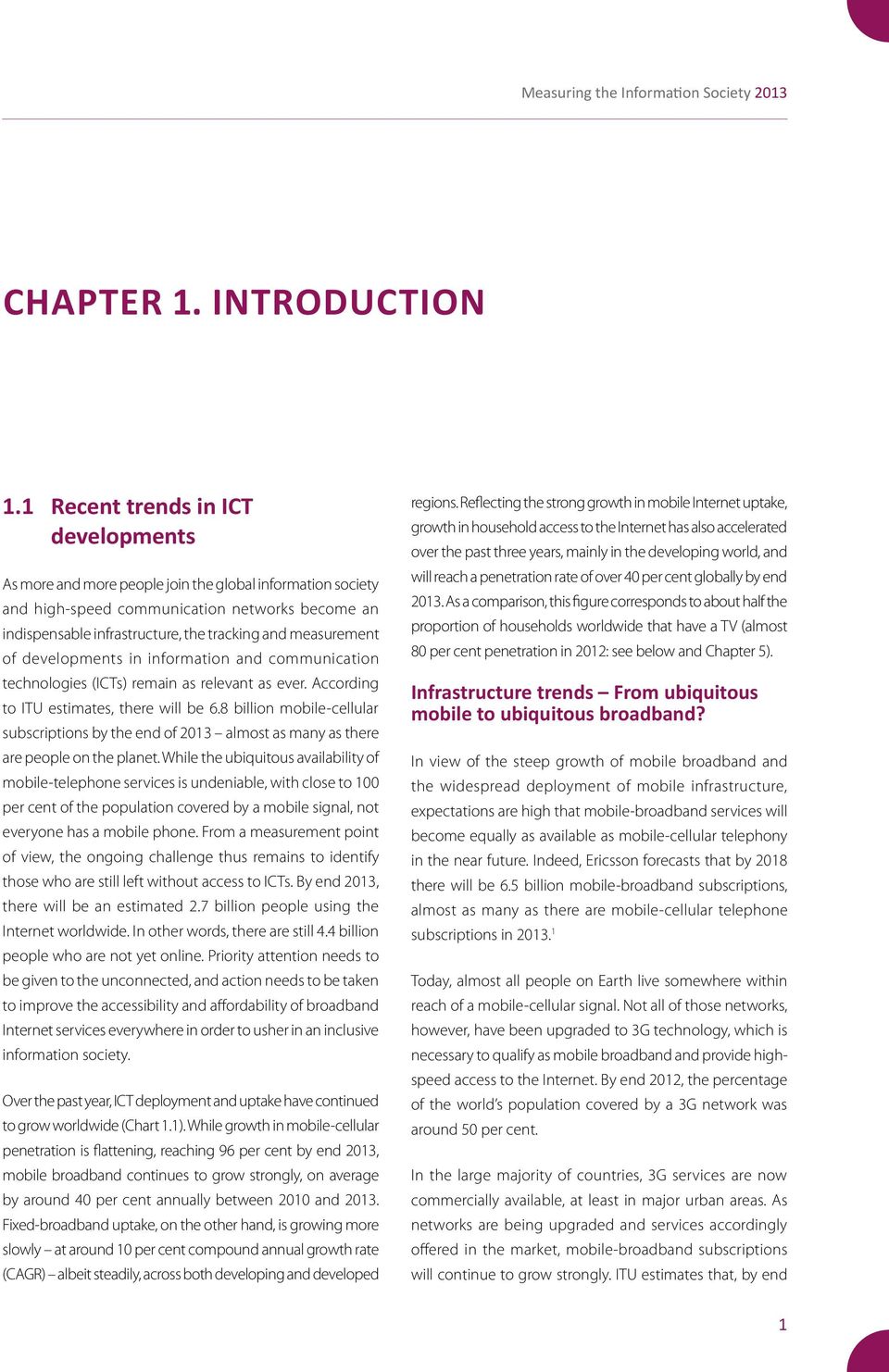
20 Chapter 1. Introduction Chart 1.1: Global ICT developments, * Per 100 inhabitants/households Mobile-cellular telephone subscriptions 96.2 Households with Internet access Individuals using the Internet Active mobile-broadband subscriptions Fixed-telephone subscriptions Fixed (wired) broadband subscriptions * 2013* Note: * Estimate. Source: ITU World Telecommunication/ICT Indicators database. 2013, there will be around 2 billion mobile-broadband subscriptions, corresponding to a global penetration rate of almost 30 per cent (Chart 1.2). Mobile broadband has been the fastest growing market segment over the past few years, with a 40 per cent average annual growth (CAGR) since It is growing rapidly not only in developed but also in developing countries, where subscriptions doubled over the past two years and now outnumber subscriptions in developed countries. Even in Africa, penetration rates will reach almost 11 per cent by end 2013, up from 2 per cent only three years earlier, and will continue to grow strongly (Chart 1.3). Differences between developed and developing countries remain substantial, however, with 75 per cent penetration Chart 1.2: Active mobile-broadband subscriptions, world and by level of development, *, penetration (left) and annual growth (right) Per 100 inhabitants Developed World Developing % Developed World Developing * 2013* * 2012*-13* Note: * Estimate. Source: ITU World Telecommunication/ICT Indicators database. 2
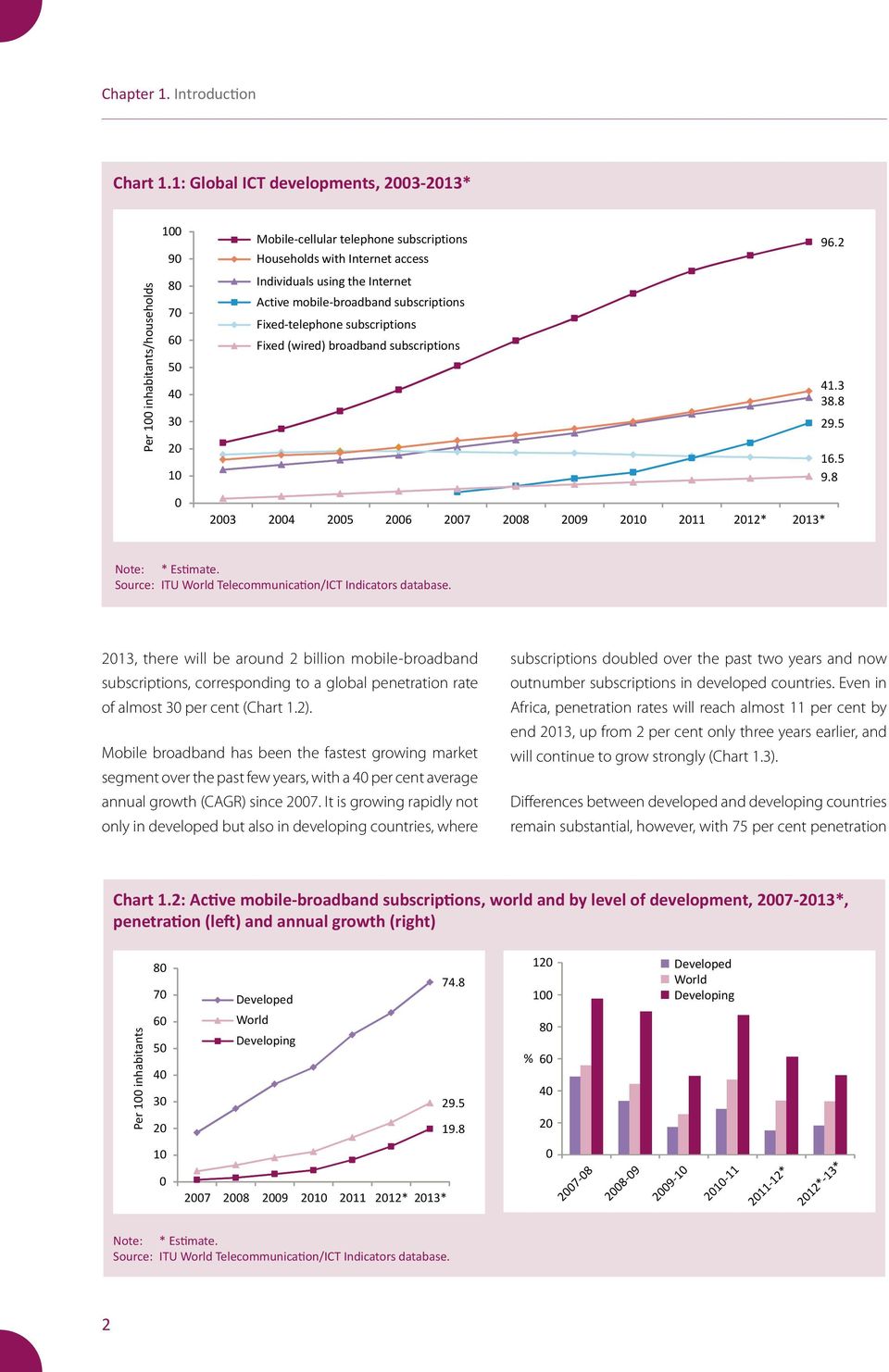
21 Measuring the Information Society 2013 Chart 1.3: Active mobile-broadband subscriptions, by region and level of development, 2013* Per 100 inhabitants Africa Arab States Asia & Pacific CIS The Americas Europe Developing World Developed Note: * Estimate. Source: ITU World Telecommunication/ICT Indicators database. in the former compared with 20 per cent in the latter (Chart 1.3). In developed countries, mobile-broadband uptake continues to grow at double-digit rates and has not yet reached saturation, although a slowdown is to be expected in the near future. A major difference between developed and developing countries is that, in developed countries, mobile broadband is often a complement to rather than a substitute for fixed-broadband access. In developing countries, mobile broadband took off in 2010, and penetration rates will have increased from 4.4 per cent to almost 20 per cent by end In addition to mobile-broadband services, a number of countries and operators, especially from the developing world, where fixed networks are very limited, have chosen to develop other wireless broadband services, in particular WiMAX services, which are now offered in almost 100 countries. In those countries, wireless Internet access either through the mobile-broadband network or via fixed wireless or satellite is often the only alternative to fixed (wired) Internet access. 2 For the time being, the difference between the number of mobile-broadband and wireless-broadband subscriptions is small, globally speaking. This means that the share of WiMAX subscriptions is very small, although it should be borne in mind that countries are just starting to collect the data, and it is to be expected that the share will increase in the future. For some countries, WiMAX is already quite significant, for example Bahrain, Pakistan and Nigeria, where about half the wireless-broadband subscriptions are WiMAX subscriptions. The use of Internet via wireless networks and devices will continue to grow strongly, accompanied and/or driven by an ever-increasing supply of mobile applications and services in the markets. An important trend highlighted in previous reports (ITU, 2012a), and which will continue in the near future, is the shift from voice to data traffic. According to Cisco (2013a), global mobile data traffic grew by 70 per cent in 2012, to a level which corresponds to almost 12 times the entire Internet traffic in Half of the traffic was video traffic. Cisco forecasts that global mobile data traffic will increase 13-fold between 2012 and Mobile data traffic will grow at a CAGR of 66 per cent from 2012 to 2017, reaching 11.2 exabytes per month by 2017 (Cisco, 2013a) (Chart 1.4). The growth in traffic, mostly driven by smartphones, is closely linked to the spread of 4G services. While insignificant today, 3 by G is predicted to account for 10 per cent of mobile connections and 45 per cent of total mobile traffic. 3
22 Chapter 1. Introduction Chart 1.4: Mobile data traffic, (forecasts), total (left) and by end-user device (right) Exabytes per month Exabytes per month Other portable devices (0.2%) Non-smartphones (1.4%) M2M (5.1%) Tablets (11.7%) Laptops (14%) Smartphones (67.5%) Note: Figures in legend (right chart) refer to traffic share in Source: Cisco VNI Mobile Forecast, 2013a. The strong growth in mobile data traffic puts enormous pressure on mobile networks faced with limited spectrum. As the industry is constantly requesting additional spectrum for mobile broadband such as 4G/ LTE, and in order to keep pace with demand, policymakers and regulators should consider adopting regulatory measures to promote flexible and effective frequency-management tools such as spectrum trading and refarming (ITU, 2013b). A large proportion of mobile data traffic will be offloaded on fixed (wired) networks, for example through WiFi connections (33 per cent was offloaded in 2012 according to Cisco, 2013a). Since a lot of data activity takes place in households or other locations where fixed (wired)- broadband and WiFi access is available, and since more and more devices used include WiFi capacity, data offloading will increase as well. This takes some of the pressure off mobile networks, but at the same time requires improved fixed (wired) infrastructure. Chart 1.5: Fixed (wired)-broadband subscriptions, world and by level of development, *, penetration (left) and annual growth (right) Per 100 inhabitants 30 Developed World 25 Developing % Developed World Developing 2012*-13* Note: * Estimate. Source: ITU World Telecommunication/ICT Indicators database. 4
23 Measuring the Information Society 2013 Chart 1.6: Fixed (wired)-broadband subscriptions, by region and level of development, 2013* Per 100 inhabitants Africa Arab States Asia & Pacific CIS The Americas Europe Developing World Developed Note: * Estimate. Source: ITU World Telecommunication/ICT Indicators database. Fixed (wired)-broadband uptake continues to grow albeit more slowly than mobile broadband at around 10 per cent annual average growth between 2010 and Worldwide, growth is slowing owing to slower growth in developed countries over the past three years, whereas growth in developing countries continues at double-digit rates (Chart 1.5). In developing countries, the fixed-network infrastructure is much less widely deployed than in most developed countries. This makes it much more costly to put in place fixed (wired)-broadband infrastructure, there being fewer or no existing networks that could be upgraded with highspeed technologies. Although fixed (wired)-broadband uptake is growing continuously at 13 per cent annual growth over the past three years and reflects the significant investments made in optical-fibre infrastructure in many developing countries, the fixed (wired)-broadband divide between developed and developing regions remains substantial. According to the latest ITU estimates, by end 2013 fixed (wired)-broadband penetration will reach almost 10 per cent globally, 27 per cent in developed countries and around 6 per cent in developing countries. In Africa, fixed (wired)-broadband penetration remains below 1 per cent, compared with 27 per cent in Europe (Chart 1.6). The strong link between broadband uptake and broadband affordability has been demonstrated in previous editions of this report. ITU tracks the price of key ICT services annually, including the price of fixed-broadband services. The results show that the price of fixed-broadband, measured as a percentage of GNI per capita, has fallen by 82 per cent over the past four years. The drop is particularly remarkable in developing countries, partly due to very high initial values. Nonetheless, fixed-broadband services are still unaffordable for most people in developing countries, costing on average 30 per cent of GNI per capita. In 2012, ITU collected data on a number of different mobilebroadband plans and prices, in addition to fixed-broadband prices. A comparison of prices for fixed- and mobile-broadband services shows that, in developing countries, mobile broadband is cheaper than fixed broadband, on average. It is important to keep in mind, however, that many fixed-broadband plans now offer unlimited data volumes, whereas the mobile-broadband plans considered here are capped at 500 MB or 1 GB of data volume. A comparison of four typical mobile-broadband plans for handsets and computers and for prepaid and postpaid plans shows that, in most countries, postpaid handset-based plans are the cheapest and prepaid computer-based plans are the most expensive. In other words, users pay less for a monthly Internet subscription on their smartphone than for a USB prepaid card they can use with their laptops to connect 5
24 Chapter 1. Introduction to the Internet. These and other important findings on the cost and affordability of broadband are presented in Chapter 3 of this report. Revenue and investment trends in the telecommunication sector The size of the telecommunication market is increasing, in line with developments in terms of ICT access and uptake. From 2007 to 2011, total telecommunication revenues grew by 12 per cent, climbing to USD 1.8 trillion, or 2.6 per cent of world GDP. Over the same period, the developing countries share of total telecommunication revenues increased from 26 to 30 per cent, highlighting the growing importance of the telecommunication sector in its own right for the economic growth of the developing world. However, given that the developing economies combined share of global GDP stands at around 35 per cent, there is still room for further telecommunication sector growth in developing countries. Future revenue growth in developing countries could be fuelled by accelerating broadband deployment, thereby reaching more people, and by increasing the intensity of use of telecommunication services, for instance through bundling. Chart 1.7 shows a decline in revenues from 2008 to 2009, coinciding with the global financial crisis. In the case of developing countries, growth immediately recovered in 2010, spiking up to 11 per cent, and was sustained in 2011 with an 8 per cent increase. Developed countries, on the other hand, saw no growth in revenues in 2010, recovering only in 2011 with a 5 per cent increase. These data suggest that the adverse financial situation did indeed have an impact on telecommunication spending, particularly in developed countries, which took until 2011 to return to their 2008 revenue levels, whereas developing countries were less affected by the financial crisis. In both the developed and the developing world, subscriptions continued to grow between 2008 and 2009, thus proving to be resilient to adverse economic conditions, while telecommunication spending (and hence revenues) was more elastic. Chart 1.8 shows the evolution of telecommunication operators capital expenditure (CAPEX), which is fundamental for driving ICT developments. A peak was reached in 2008, with global investment totaling USD 290 billion, but this was followed by two consecutive years of decline. Despite the upturn in 2011, the 2008 investment levels have thus far not been restored. Data on annual CAPEX growth rates show that developed countries experienced the highest contraction between 2008 and 2009 (-16 per cent), but also the strongest recovery Chart 1.7: Telecommunication revenues, world and by level of development, , total in USD (left) and annual growth (right) Billion USD 2'000 1'800 1'600 1'400 1'200 1' '644 1' 224 1'748 1' 288 World Developed Developing 1' ' 739 1' 231 1' 235 1' 837 1' % Developed World Developing Note: World includes 82 countries accounting for 94 per cent of world GDP. Developed includes 33 developed countries accounting for 99 per cent of total GDP in the developed world. Developing includes 49 developing countries accounting for 86 per cent of total GDP in the developing world. Source: ITU World Telecommunication/ICT Indicators database. 6
25 Measuring the Information Society 2013 Chart 1.8: Annual investment (CAPEX) of telecommunication operators, world and by level of development, , total in USD (left) and annual growth (right) Billion USD World Developed Developing % Developed World Developing Note: World includes 67 countries accounting for 87 per cent of world GDP. Developed includes 31 developed countries accounting for 96 per cent of total GDP in the developed world. Developing includes 36 developing countries accounting for 72 per cent of total GDP in the developing world. Source: ITU World Telecommunication/ICT Indicators database. in 2011 (+8 per cent). Investment in developing countries was more stable, with the highest decrease (-6 per cent) occurring between 2008 and 2009, and a mild recovery in 2011 (+2 per cent). This contrasts sharply with the growth rates in telecommunication operators CAPEX recorded prior to the global financial crisis: e.g. an increase of 21 per cent in developing countries and 14 per cent in developed countries between 2007 and Sluggish investment levels after 2008 are consistent with an overall economic environment of restricted access to capital markets, which may limit the capacity of operators to raise funds for new investments. With the expansion of global operators into new markets, many operators are active in both developing and developed countries, and the adverse financial environment in the developed world has thus most probably also impaired investments in the developing world. Insofar as the impact of an investment usually stretches beyond the specific year in which it is allocated, the current relatively lower levels of investment may restrict future ICT developments, such as for instance those needed to improve international connectivity in developing countries or to boost the capacity of mobile-broadband networks in the developed world. This brings into focus the need for increased investment in order to meet the needs of tomorrow s information society and extend ICT services to a larger proportion of the world s population. Consumer uptake trends In parallel with the increase in services and applications offered over the Internet and on mobile devices, an increasing number of people worldwide are using ICTs. Monitoring consumer uptake is important not only for the development of the content industry and Internet-based companies, but also for the development and delivery of online public services, such as e-government, e-education or e-health. The successful implementation of such services depends on having a critical mass of potential consumers online. A key basic indicator to monitor consumer uptake is the number of households with access to the Internet. The number of households with Internet access is increasing in all regions, but large differences persist between developed and developing countries, with penetration rates set to reach almost 80 per cent in the former compared with 28 per cent in the latter, by end 2013 (Chart 1.9). Nevertheless, in developing countries, the proportion of households with Internet access has increased from 12 per cent in 2008 to 28 per cent in 2013, which corresponds 7
26 Chapter 1. Introduction Chart 1.9: Households with Internet access, world and by level of development, *, penetration (left) and annual growth (right) Per 100 households Developed World Developing Developed World 20 Developing 15 % *-13* Note: * Estimate. Source: ITU World Telecommunication/ICT Indicators database. to a remarkable 18 per cent annual average growth rate. A comparison across geographic regions reveals that by far the lowest household Internet penetration is found in Africa. Indeed, the gap between Africa and Asia (the two regions with the lowest household Internet penetrations) is substantial, with a penetration rate of 6.7 per cent in the former compared with 32.7 per cent in the latter (Chart 1.10). At the same time, the numbers also show that there are 1.1 billion households worldwide that are not yet connected to the Internet, and that 90 per cent of these are in the developing world. In order to meet the target set by the Broadband Commission for Digital Development, 4 40 per cent of households in developing countries should have access to the Internet by If growth rates continue at the same rate as during the past Chart 1.10: Households with Internet access, by region and level of development, 2013* Per 100 households Africa Asia & Pacific Arab States CIS The Americas Europe Developing World Developed Note: * Estimate. Source: ITU World Telecommunication/ICT Indicators database. 8
27 Measuring the Information Society 2013 Chart 1.11: Households with a TV, a computer and Internet, by level of development, 2012* % gap TV Computer Internet Per 100 households % gap 67% gap 20 0 Developed World Developing Note: * Estimate. Source: ITU World Telecommunication/ICT Indicators database. couple of years, there is a realistic chance that the target will be achieved. There are many reasons why households in developing countries are not (yet) connected to the Internet, primarily related to the affordability and availability of Internet services. With 53 per cent of the population in developing countries living in rural areas, the infrastructure challenge to connect all of these people to high-speed Internet is enormous. With the continuous increase in wirelessbroadband deployment and services, coupled with falling prices, however, Internet access in households in developing regions is expected to improve over the next few years. A comparison between households with Internet access and households with computers shows that the ratio has been falling steadily and is almost 1:1 in developed countries. In Africa, the ratio is the highest (at 1:1.5), but has fallen sharply since 2005, when it was almost 1:3. This also reflects the shift in the type of Internet access devices used in households, which are no longer limited to computers, 5 but increasingly include other devices, such as smartphones. This raises new questions concerning the differences in ICT usage and impact related to ICT devices and the role of computers in, for example, building ICT skills. An additional interesting comparison is the proportion of households with a computer and Internet access and households with a television (Chart 1.11). Both require access to electricity in order to function properly, and both represent an expense for household budgets for acquiring the equipment/service and/or for the monthly subscription charges. As at end 2012, more than 80 per cent of households globally had a TV, compared with 41 per cent of households with a computer and 37 per cent with Internet access. The gap between households with a TV on the one hand, and households with a computer and Internet, on the other, is much bigger in developing countries than in developed countries. In the former, there are almost three times as many households with a TV than households with a computer or Internet (a gap of 69 percent), while in the latter there are 1.3 times as many (a gap of 25 per cent). While household connections are important for ensuring more inclusive and more frequent Internet access, people can also access the Internet in other locations when household access is not available. This is particularly the case in rural areas of developing countries. Therefore, it is essential to track actual Internet usage (from any location). ITU estimates that, by end 2013, almost 40 per cent of the global population, and 31 per cent of the population in developing countries, will be online (Chart 1.12). Internet user penetration has been growing on 9
28 Chapter 1. Introduction Chart 1.12: Individuals using the Internet, world and by level of development, *, penetration (left) and annual growth (right) Per 100 inhabitants 90 Developed 80 World 70 Developing Developed World 25 Developing 20 % *-13* Note: * Estimate. Source: ITU World Telecommunication/ICT Indicators database. average at double-digit rates over the past ten years, but is slowing in developed countries, where penetration rates will reach almost 77 per cent by end 2013, compared with 31 per cent in developing countries. In Africa, Internet user penetration has doubled over the past four years, and is set to climb to 16 per cent by end 2013 (Chart 1.13). This trend is largely driven by the emergence of mobile-broadband services in many African countries, bringing Internet at lower prices to customers already using handsets. In the world s least developed countries (LDCs), the estimate is for fewer than one in ten people to be using the Internet by end On the basis of the target set by the Broadband Commission for Digital Development, by 2015 at least 60 per cent of Chart 1.13: Individuals using the Internet, by region and level of development, 2013* Per 100 inhabitants Africa Asia & Pacific Arab States CIS The Americas Europe Developing World Developed Note: * Estimate. Source: ITU World Telecommunication/ICT Indicators database. 10
29 Measuring the Information Society 2013 the world population should be online, 50 per cent in developing countries and 15 per cent in LDCs. The target was meant to be ambitious and, indeed, at current growth rates it is unlikely to be achieved. Even the somewhat less ambitious target set by the World Summit on the Information Society (WSIS) in 2003, which calls for half the population to have access to ICTs by 2015, will not be achieved in the case of Internet access at current growth rates. Major efforts will have to be deployed in developing countries to make Internet more accessible and affordable to low-income groups, which account for the large majority of consumers in developing countries. In order to identify digital divides and ensure equal access to ICTs, it is important to track Internet users by different socio-economic variables, for example gender, age, level of education or employment status. While data on these variables are much more limited, in particular in the developing world, ITU estimates show that, for example, the gender gap in Internet usage is still prevalent (see Box 1.1). While the above numbers confirm the overall growth of the information society worldwide, more information is required to assess other aspects, such as the speed and quality of the broadband connections and services. High-end users such as businesses and other organizations require reliable and fast connections without network interruptions. Available data show that there are huge differences among countries in terms of the speeds of connections for fixed broadband: the majority of developed countries subscriptions are at speeds above 2 Mbit/s, while many developing countries are limited to speeds below 2 Mbit/s (ITU, 2013a). Most of the subscriptions at speeds in excess of 10 Mbit/s are found in developed countries. This partly reflects the prevailing retail prices in countries and the limitations of the network infrastructure itself: few fibre-optic cables are deployed outside major urban areas in many developing countries. Other aspects receiving increased attention relate to the differences between the advertised and real speeds of broadband connections. During peak hours, speeds can slow down considerably, which is a major complaint consumers are making to their Internet service providers (ISPs). 6 Speed and quality also differ between mobile and fixed technologies. So far, mobile technologies although improving with the introduction of LTE advanced do not replace fixed technologies for intensive, high-end users. For them, the preferred option will therefore be a high-speed fixed-broadband connection. On the other hand, the mobility requirements of users also vary. A microentrepreneur who is on the move may prefer a mobile connection. In order to address these concerns and respond to consumers demands, operators need to upgrade their networks with technologies that provide higher bandwidth and speed in both wireless and fixed networks. IMT- Advanced/4G technologies, which are currently being developed and tested, promise much higher speeds, equal to those delivered over fixed broadband. Developments in fixed-broadband networks need to focus on extending the fibre network from the core, and bringing it closer or direct to the end user. Upgrading cable networks to DOCSIS 3.0 will support connections at very high speeds, in line with those currently being provided by commercial fibre connections. The role of broadband policies National ICT/broadband policies can stimulate the market, expand services and bring down prices. Governments can therefore play an important role by providing an enabling environment for development of the ICT market and the deployment of broadband infrastructure. Governments should put in place policies to stimulate competition and private investment, in particular in advanced ICT networks, since these are long-term investments that foster economic growth. An increasing number of governments have not only recognized the importance of broadband but also taken active steps to develop a national broadband plan or strategy, or include broadband in their universal access/ service definitions. Today, of the 146 governments that have adopted or are planning to adopt a national policy, strategy or plan to promote broadband, 70 per cent are from developing countries. Furthermore, around 35 per cent of countries have included broadband in their universal access/service definitions and these numbers are expected to increase further. 7 To recall the target set by the Broadband Commission for Digital Development, 11
30 Chapter 1. Introduction Box 1.1: Monitoring the ICT gender gap In view of the multitude of benefits and opportunities ICTs bring, the desire to use computers, mobile phones and the Internet cuts across all sectors of society, and is found in the female and male population alike. But do girls and boys, women and men, have equal access to ICTs? ITU has been tracking indicators that capture the use of ICTs disaggregated by sex since Data show that there is a gender gap in the use of computers, mobile phones and Internet, and that the gap is more prevalent in developing than developed countries. For example, by end 2013, ITU estimates that the gender gap in Internet usage will be 11 per cent globally, 2 per cent in developed countries and 16 per cent in developing countries (Chart Box 1.1). 8 Indeed, there is a close relationship between Internet access differences by gender and other variables, such as level of income and level of education (Dean-Swarray et al, 2013). Gender differences can also be observed when it comes to the location of Internet use, activities carried out over the Internet and frequency of Internet use. For example, available data suggest that women tend to use the Internet more than men for educational activities; that men access the Internet more than women in commercial Internet access facilities (such as cybercafés); and that men tend to be online more frequently than women. Another area where critical gender-relevant information is in high demand is the participation of women in the ICT workforce. There seems to be a striking gap when it comes to gender equality in ICT-related professions and careers, across developed and developing countries (ITU, 2012b). Few comparable data are available to monitor such trends, primarily on account of a lack Chart Box 1.1: Men and women online, 2013* Billions of people 11% % % Women Men Women Men Women Men Developed Developing World Note: * Estimate. Source: ITU World Telecommunication/ICT Indicators database. of internationally comparable statistical standards and definitions related to ICT occupations and employment. While discussions around the gender digital divide and its measurement are not new, recently the topic has received renewed attention in international forums, and there continues to be considerable demand for internationally comparable sexdisaggregated ICT data. The measurement of ICT and gender is critical to understanding developments in the information society and the digital divide, and to informing ICT policy-makers, analysts and other stakeholders addressing issues of gender equality and ICT for development. At the international level, since its launch in 2004, the Partnership on Measuring ICT for Development has been formulating core indicators in the area of infrastructure and access, household ICT access, individual use of ICT, use of ICT in education, ICT use in business, ICT use in government and the ICT sector. While many of these indicators can be broken down by gender, not all of them are collected internationally and/or nationally and, as a result, data availability is patchy at best in particular in developing countries. In addition, certain areas that are not (yet) covered by the Partnership and its members are critical to gender and ICT policy-making, such as ICT careers, ICTrelated employment and ICT skills. In order to prompt people to give greater attention to measuring gender and ICT, the Partnership launched a new Task Group on Gender, co-led by ITU and UNCTAD, in early The objective of the task group is to improve the availability of internationally comparable indicators on gender and ICT, especially in developing countries. Members include representatives of international and regional organizations, NGOs and the private sector. In 2012, the Broadband Commission for Digial Development launched a new Working Group on Gender in order, inter alia, to promote digital inclusion for women and empower women through ICTs. At its first meeting in March 2013, the working group proposed a new target aiming to achieve gender equality in broadband access by 2020, which was endorsed by the Broadband Commission. In recognizing the importance of setting and monitoring international ICT for development goals, the Broadband Commission is making an important contribution to raising awareness, among policy-makers and data producers alike, of the importance of addressing and measuring the gender digital divide. 12
31 Measuring the Information Society 2013 by 2015 all countries should have included broadband in their national ICT policy or plan. Many of these broadband policies and plans focus on building nationwide broadband infrastructure and connecting households, but also on stimulating demand through the adoption of online services and applications such as e-business, e-education, e-health and e-government, and on extending connectivity to provide universal access. Particularly in countries where international connectivity has been limited, another key focus has been on increasing international Internet bandwidth. In its latest Trends in Telecommunication Reform report (ITU, 2013b), ITU highlights various options for policymakers and regulators to create incentives for the private sector to invest in ICTs, such as adopting enabling policies, simplifying licensing regimes, increasing the amount of available spectrum, reducing regulatory obligations and offering tax incentives. In addition, for a thriving broadband environment, regulatory frameworks need to achieve a balance between the promotion of competition in services and in infrastructure in order to address the challenges associated with access to broadband networks and services. The post-2015 debate and ICT measurement At the global level, the ICT-for-development (ICT4D) debate has shifted its focus towards the post-2015 development agenda, which was one of the main topics at the WSIS Forum There is no doubt that ICTs continue to be a key enabler for social and economic development. Access to new technologies is important for ensuring full participation by all in new opportunities related to employment, education, health, governance, peace-building, etc. Nevertheless, outside the ICT4D community, the spread of ICT is often taken for granted and therefore sometimes left out of the core development debate. There is a real danger, however, that while the world is transforming into an information society based on highspeed, always-on connections, there is no equal access to ICTs for all. The main target groups of the MDGs and post-2015 development goals will have to be sought precisely among those 4.4 billion people who are not yet connected to the Internet. People living outside major cities in developing countries are those for whom ICTs can have the greatest development impact. Bringing people online will also give them access to knowledge, education, healthcare and other essential services and business opportunities. Future progress will depend, moreover, on how good the Internet access is and whether it supports running the applications required and desired. It will also be necessary to provide relevant content, and in the languages which those most in need understand. While it is not clear yet how ICTs will be reflected in future international development goals, there is no doubt that they will continue to permeate all sectors of society and the economy and become increasingly indispensable. The divide between those who are part of the global information society and those who are not is liable to deepen, as the latter are left behind and face little progress. Continuous monitoring and measurement of information-society developments will be required in order to identify progress and gaps and to ensure equal access, use and impact of ICTs. It is essential to have the national and international statistical community on board early on in the process of formulating targets and indicators in the field of ICT4D. During the WSIS Forum 2013, participants discussed the process of the post-2015 development agenda and highlighted the need to link the ICT4D measurement debate to the broader development agenda. A session organized by the Partnership on Measuring ICT for Development looked at the lessons learned from measuring international ICT4D goals, specifically those related to the WSIS process, and recommended that the future ICT4D policy debate should take into consideration inputs from the statistical community. 10 ITU, jointly with its partners, is working actively to establish a bridge between these debates and promote an active role for the statistical community in the process of developing future ICT-related development frameworks. 1.2 Overview of the report The main objective of this Measuring the Information Society (MIS) report is to identify recent global and regional trends in ICT deployment and uptake, on the basis of internationally comparable ICT statistics. A key feature of the MIS report series is the presentation of two tools for benchmarking the information society: the ICT Development Index (IDI) 13
32 Chapter 1. Introduction and the ICT Price Basket (IPB). The latest results for these two metrics will help policy-makers monitor trends, identify areas for policy action and compare their ICT developments with those in other markets. In addition, each year the report looks at specific information-society aspects and discusses them on the basis of quantitative analyses. The objective is to provide an unbiased overview of ICT trends for as many countries as possible, especially in the developing world. The data used in the report are primarily statistics collected by ITU, complemented by data received from the United Nations Population Division (population statistics), the UNESCO Institute for Statistics (UIS) (statistics on literacy and school enrolment), the World Bank (data on GNI per capita and PPP dollars) and IMF (data on exchange rates). Chapter 2 will report on the main results of the latest ICT Development Index (IDI), featuring country data for the years 2011 and The chapter begins by presenting a global IDI analysis and highlighting key performers and most dynamic countries, especially from developing regions. It also looks at the relationship between the IDI and GDP per capita, and analyses IDI results by level of development. This is followed by an analysis of the three IDI sub-indices: the access sub-index, the use sub-index and the skills subindex, highlighting key performers. Finally, a regional analysis of the IDI will be presented, discussing the IDI results and main findings separately for each of the six regions defined by the ITU Telecommunication Development Bureau (BDT). Chapter 3 presents the main results of the latest ICT pricedata collection exercise. This year s edition of the report will focus primarily on the consumer price of fixed-broadband and mobile-broadband services. The overall ICT Price Basket (IPB) and its main objective are briefly introduced and presented. This is followed by an analysis of fixedbroadband price data. Price trends over the past five years are discussed, including for different regions and comparing developed and developing countries. Recent market trends in terms of fixed-broadband plans offered in countries are also presented and discussed, such as increases in speed and data allowances. Price data are then presented for mobile-broadband services. Four different types of plan are discussed (prepaid/postpaid handset-based/computerbased plans), and the prices and services analysed and compared. The analysis also looks at differences across regions and between developed and developing countries. The chapter then goes on to compare fixed- and mobilebroadband plans, highlighting differences in terms of prices, data volumes and speed, and pointing to the limitations in terms of comparability. The final section of the chapter proposes a future mobile-broadband sub-basket, combining prices of the different mobile-broadband plans into one single benchmarking value per country, which could be added to the IPB in the future. Without doubt, ICTs where available and affordable play a vital role in the life of young people. The concept of digital natives is broadly used to characterize (young) people born during the digital age and growing up using ICTs. However, no effort has been made so far to quantify the digital natives of today s (and tomorrow s) world, in particular in the developing nations. ITU data, coupled with the UN s demographic statistics, provide a unique source for calculating/estimating the digital native population in all countries. Chapter 4 is about measuring the world s digital native population. After first reviewing the concept of digital natives and defining the methodology used for the calculation, it presents and discusses the main results. Results are shown globally, regionally and at the country level, and are also compared with other relevant variables, for example related to education. The chapter concludes with a number of policy implications resulting from the findings. Chapter 5 takes a closer look at the evolution and current state of play of audiovisual services. It explains how TV broadcasting services have evolved from traditional TV services (linear, free-to-air, analogue TV) to the current diverse audiovisual offer (multichannel, multidevice, linear/nonlinear digital TV and user-generated content), highlighting the effects of convergence in transforming the audiovisual landscape. The Chapter then presents and analyses the data for multichannel TV services, and the growth of digital TV. Data are also broken down by technology (CATV, DTH, satellite, IPTV, DTT, analogue terrestrial broadcasting) and by region, and regional and country differences are examined. The chapter also looks at the digital switchover and analyses data illustrating the increasing role of the Internet in the distribution of audiovisual content (for both IPTV and over-the-top audiovisual services). It concludes with a list of regulatory and policy considerations derived from the analysis presented. 14
33 Measuring the Information Society 2013 Endnotes 1 See 2 In order to take into account the importance of fixed-wireless and satellite Internet access in some countries, and following the recommendations of some Member States, ITU has replaced the indicator mobile-broadband subscriptions with the (broader) indicator wireless-broadband subscriptions in the ICT Development Index (IDI) (see Chapter 2). Apart from mobile-broadband subscriptions, wireless broadband also includes terrestrial fixed-wireless (including WiMAX) and satellite subscriptions. 3 According to Cisco, in 2012, 4G connections represented only 0.9 per cent of mobile connections. 4 In 2011, the Broadband Commission endorsed four targets to be achieved by 2015: (1) making broadband policy universal, (2) making broadband affordable, (3) connecting homes to broadband and (4) getting people online. See 5 A computer refers to a desktop, or a laptop computer, or a tablet or similar handheld computer. It does not include equipment with some embedded computing abilities, such as smart TV sets, and devices with telephony as a main function, such as mobile or smart phones. The definition of computer has been recently updated by the ITU Expert Group on ICT Household Indicators (EGH), as part of the revisions of the core ICT indicators on access to and use of ICT by households and individuals. See 6 See, for example, the joint project by SamKnows and the US Federal Communications Commission (FCC, 2013). 7 ITU World Telecommunication Regulatory Database. 8 This measure presents the difference (in absolute values) between numbers of male and female Internet users relative to male Internet users. Thus, the reference value is the male Internet users group, and the gender gap is expressed comparing females to males. 9 See 10 See 15
34
35 Measuring the Information Society 2013 Chapter 2. The ICT Development Index (IDI) 2.1 Introduction to the IDI 1 Conceptual framework The ICT Development Index (IDI) is a composite index combining 11 indicators into one benchmark measure that serves to monitor and compare developments in information and communication technology (ICT) across countries. The IDI was developed by ITU in 2008 and first presented in the 2009 edition of Measuring the Information Society (ITU, 2009a). It was established in response to ITU Member States request to develop an ICT index and publish it regularly. This section briefly describes the main objectives, conceptual framework and methodology of the IDI. The main objectives of the IDI are to measure: the level and evolution over time of ICT developments in countries and relative to other countries; progress in ICT development in both developed and developing countries: the index should be global and reflect changes taking place in countries at different levels of ICT development; the digital divide, i.e. differences between countries with different levels of ICT development; the development potential of ICTs or the extent to which countries can make use of ICTs to enhance growth and development, based on available capabilities and skills. The recognition that ICTs can be a development enabler, if applied and used appropriately, is critical to countries that are moving towards information or knowledgebased societies, and is central to the IDI s conceptual framework. The ICT development process, and a country s transformation to becoming an information society, can be depicted using the following three-stage model (Figure 2.1): Stage 1: ICT readiness (reflecting the level of networked infrastructure and access to ICTs) Stage 2: ICT intensity (reflecting the level of use of ICTs in the society) Stage 3: ICT impact (reflecting the result/outcome of efficient and effective ICT use). Advancing through these stages depends on a combination of three factors: the availability of ICT infrastructure and access, a high level of ICT usage and the capability to use ICTs effectively. Accordingly, the first two stages listed above correspond to two major components of the IDI: ICT access and ICT use. Reaching the final stage, and maximizing the impact of ICTs, crucially depends on the third component of the IDI: ICT skills. ICT (and other) skills determine the effective use that is made of ICTs, and are critical to leveraging the full potential of ICTs for socio-economic development. Economic growth and development will remain below potential if economies 17
36 Chapter 2. The ICT Development Index (IDI) Figure 2.1: Three stages in the evolution towards an information society ICT Readiness (infrastructure, access) ICT Use (intensity) ICT Impact (outcomes) ICT Development Index ICT Capability (skills) Source: ITU. are not capable of exploiting new technologies and reaping their benefits. Therefore, the IDI includes a measurement of the capability to use ICTs effectively. A single indicator cannot track progress in all three components (access, usage and skills) of the ICT development process, and it is thus necessary to construct a composite index such as the IDI. The IDI aims to capture the evolution of the information society as it goes through its different stages of development, taking into consideration technology convergence and the emergence of new technologies. Based on this conceptual framework, the IDI is divided into the following three sub-indices: Access sub-index: This sub-index captures ICT readiness, and includes five infrastructure and access indicators (fixed-telephone subscriptions, mobilecellular telephone subscriptions, international Internet bandwidth per Internet user, percentage of households with a computer, and percentage of households with Internet access). Use sub-index: This sub-index captures ICT intensity, and includes three ICT intensity and usage indicators (individuals using the Internet, fixed (wired)-broadband subscriptions, and wireless-broadband subscriptions). Skills sub-index: This sub-index captures ICT capability or skills as indispensable input indicators. In the absence of data on ICT skills, it includes three proxy indicators (adult literacy, gross secondary enrolment and gross tertiary enrolment), and is therefore given less weight in the computation of the IDI compared with the other two sub-indices. 2 The choice of indicators included in the sub-indices reflects the corresponding stage of transformation to the information society. Therefore, the indicators in each sub-index may change over time to reflect technological developments related to ICTs, and as more and better data become available. For example, what was considered basic infrastructure in the past such as fixed-telephone lines is fast becoming less relevant in the light of increasing fixed-mobile substitution. Similarly, broadband is currently considered an advanced technology, characterizing intense Internet use, and is therefore included in stage 2 (as an indicator in the use sub-index). However, in the future it may come to be seen as essential and be moved to stage 1 (as an indicator in the access sub-index), while another, new technology may appear in stage 2. Methodology The IDI includes 11 indicators. A detailed definition of each indicator is provided in Annex 1. 18
37 Measuring the Information Society 2013 Box 2.1: ITU expert groups Much of ITU s work in the area of indicator definitions and methodologies is carried out through its two expert groups: the Expert Group on Telecommunication/ICT Indicators (EGTI) and the Expert Group on ICT Household Indicators (EGH). Created in 2009 and 2012, respectively, these two expert groups revise and review ITU s supply-side and demandside statistics, and discuss methodological issues and new indicators. Both groups, which are open to all ITU members and to experts in the field of ICT statistics and data collection, work through online discussion forums and occasional faceto-face meetings. They periodically report back to the World Telecommunication/ICT Indicators Symposium (WTIS), ITU s main forum on ICT statistics. In 2011, EGTI opened a discussion item on the IDI on its online forum, and its experts are encouraged to provide suggestions on how to improve the IDI methodology. 3 EGH includes discussion on the three demand-side indicators included in the IDI (households with a computer, households with Internet access, and individuals using the Internet). Interested experts are invited to join the EGTI 4 and/or the EGH 5 discussion forum to share experiences, contribute to the discussions and participate in the decision-making process. The indicators used to calculate the IDI were selected on the basis of the following criteria: The relevance of a particular indicator for contributing to the main objectives and conceptual framework of the IDI. For example, the selected indicators need to be relevant to both developed and developing countries, and should reflect as much as possible the framework s three components described above. 6 Data availability and quality. Data are required for a large number of countries, as the IDI is a global index. There is relative paucity of ICT-related data, especially at the household level, in the majority of developing countries. In particular, the three indicators included in the skills sub-index should be considered as proxies until data directly relating to ICT skills become available for more countries. The results of various statistical analyses. The statistical associations between various indicators were examined, and principal components analysis (PCA) was used to examine the underlying nature of the data and to explore whether the different dimensions are statistically well-balanced. While the basic methodology has remained the same since the IDI was first published, minor adjustments are being made each year. the IDI and its sub-indices are under regular discussion in ITU, in consultation with experts. Indicator definitions and the IDI methodology are discussed in the ITU Expert Group on Telecommunication/ICT Indicators (EGTI) and the ITU Expert Group on ICT Household Indicators (EGH) (Box 2.1). The indicator that has undergone the greatest change in recent years is the one serving to measure the uptake of wireless broadband. In 2010, ITU revised the definition of mobile-broadband subscriptions so as to reflect more accurately actual data connections to mobile-broadband networks rather than potential connections. In addition, the breakdown of broadband subscriptions was revised and changed from the previous fixed vs mobile to the current wired vs wireless classification. As a result, the new wirelessbroadband indicators include satellite subscriptions, terrestrial fixed (wireless)-broadband subscriptions and active mobile-broadband subscriptions. 7 In the 2011 edition of the IDI, the indicator active mobile-broadband subscriptions replaced the previous indicator mobilecellular subscriptions with access to data communications at broadband speeds, which measured the potential of mobile-cellular subscriptions to access, for example, 3G networks. In this year s IDI, as countries improve their data collection in the area of wireless broadband, all (combined) wireless-broadband technologies are taken into consideration (Box 2.2). Given the dynamic nature of the ICT sector and related data availability, the types of indicators to be included in To improve the IDI, another major consideration for ITU has been to replace some of the subscription-based (supply- 19
38 Chapter 2. The ICT Development Index (IDI) Box 2.2: From active-mobile broadband to wireless broadband By 2013, the large majority of countries had launched 3G high-speed mobile-broadband networks, and more and more countries are starting to test and even commercialize LTEadvanced networks. By 2011, ITU had identified a definition to clearly separate fixed (wired)-broadband subscriptions from wireless-broadband subscriptions and to move from potential subscriptions to active subscriptions. This definition of wireless broadband, in line with that used by OECD, includes satellite subscriptions, terrestrial fixed (wireless)-broadband subscriptions and active mobile-broadband subscriptions. The latter includes both subscriptions that have been used to connect to the Internet using a mobile-cellular telephone and dedicated subscriptions using a USB modem/dongle (Figure Box 2.2). When ITU started collecting data for these indicators in 2010, data reporting was relatively limited. Therefore, the IDI did not at first include satellite broadband, nor terrestrial fixed (wireless)- broadband subscriptions. More recently, though, most countries have aligned their definition and data reporting on the ITU definition and are henceforth providing data broken down by the different wireless-broadband technologies. Consequently, in the 2013 edition of the IDI, the indicator active mobile-broadband subscriptions has been replaced with wireless-broadband subscriptions. While the number of satellite subscriptions is relatively small (or even negligible) in most countries, a number of countries are deploying fixed (wireless)-broadband technologies, such as WiMAX. This is particularly true in some Arab States and some countries in the Americas and Europe. In Bahrain, for example, terrestrial fixed (wireless)-broadband subscriptions in 2011 accounted for close to 50 per cent of all wirelessbroadband subscriptions. Poland and Brazil had well over 1 million fixed-wireless subscriptions in 2012, although the figures were much higher for active mobile-broadband subscriptions. In the Islamic Republic of Iran, where 3G mobile-broadband services were not available in 2012, fixed (wireless)-broadband subscriptions were the only wirelessbroadband technology available to citizens. For most countries, however, especially those that have launched 3G mobile-broadband networks, the inclusion of satellite and terrestrial fixed (wireless)-broadband subscriptions in the IDI will not have a major impact on the data, or on their position in the IDI ranking. Figure Box 2.2: Wireless-broadband subscriptions Active mobile-broadband subscriptions Standard mobilebroadband subscriptions (via a mobilecellular telephone) Dedicated mobilebroadband subscriptions (via USB dongle/modem or as an add-on data package to voice package) Terrestrial fixed (wireless)- broadband subscriptions Satellitebroadband subscriptions Source: ITU (2011b). side) data with more data based on national household surveys (demand-side indicators). This seems particularly important in the area of mobile-cellular services. By end 2013, ITU estimates that the number of mobile-cellular subscriptions will have reached 6.8 billion, close to the figure for the world s population (7 billion). Also, by early 2013, no fewer than 93 economies of the 157 included in the IDI had passed the 100 per cent mobile-cellular penetration mark. The high number of mobile-cellular subscriptions is due mainly to multiple SIM cards that one person may own. The indicator on the number of individuals using a mobile-cellular telephone (which ITU 20
39 Measuring the Information Society 2013 collects through its household survey questionnaire) would therefore provide a more accurate picture of the actual uptake, use and distribution of mobile-cellular services. While the number of countries that collect this information is increasing steadily, only 58 countries reported these data to ITU by end It is therefore too early to substitute the current mobile-cellular subscription data in the IDI with mobile-phone user data. The IDI was computed using the same methodology as in the past, applying the following steps (details are provided in Figure 2.2 and Annex 1): Preparation of the complete data set. This step includes filling in missing values using various statistical techniques. Normalization of data. This is necessary in order to transform the values of the IDI indicators into the same unit of measurement. The chosen normalization method was the distance to a reference measure (or goalpost). The reference values were either 100 or obtained through a statistical procedure. Rescaling of data. The data were rescaled on a scale from 0 to 10 in order to compare the values of the indicators and the sub-indices. Weighting of indicators and sub-indices. The indicator weights were chosen based on the principal components analysis (PCA) results. The access and use sub-indices were given equal weight (40 per cent each). The skills sub-index was given less weight (20 per cent), since it is based on proxy indicators. Figure 2.2: ICT Development Index: indicators, reference values and weights ICT access Reference value (%) 1. Fixed-telephone subscriptions per 100 inhabitants Mobile-cellular telephone subscriptions per 100 inhabitants 3. International Internet bandwidth (bit/s) per Internet user * Percentage of households with a computer Percentage of households with Internet access ICT use 6. Percentage of individuals using the Internet 7. Fixed (wired)-broadband subscriptions per 100 inhab.itants 8. Wireless-broadband subscriptions per 100 inhabitants Reference value (%) ICT Development Index ICT skills Reference value (%) 9. Adult literacy rate 10. Secondary gross enrolment ratio Tertiary gross enrolment ratio Note: * This corresponds to a log value of 5.79, which was used in the normalization step. Source: ITU. 21
40 Chapter 2. The ICT Development Index (IDI) This chapter presents the IDI results for 2012 in comparison with It should be noted that the 2011 IDI values have changed from those published in the previous edition of this report as a result of: Country data revisions. As more accurate data become available, countries provide ITU with revised statistics for previous years, which have been taken into consideration. This also allows ITU to identify inconsistencies and revise previous estimates. Change from active mobile-broadband subscriptions to wireless-broadband subscriptions (see Box 2.2). Differences among countries included in the IDI. The calculation of the IDI ranking depends on the values of the other countries included. In each new edition, some countries are excluded and others added based on data availability. Overall, this version of the IDI includes 157 countries/economies as compared with 155 in last year s edition. The remainder of the chapter is structured as follows. Section 2.2 presents the IDI results at the global level. It highlights some of the top performers, as well as the most dynamic countries as reflected by their changes in IDI value and rank. It also looks at the relationship between a country s IDI score and its income level, presents IDI results by level of development (developed/developing countries) and by groups of countries with different IDI levels. Section 2.3 analyses the three sub-indices (access, use and skills), providing additional insights into areas of high/ low ICT growth, in order to identify areas requiring further attention from policy-makers and private stakeholders. Finally, section 2.4 presents a regional analysis of the IDI. It shows IDI results for six regions (Africa, Americas, Arab States, Asia and the Pacific, Commonwealth of Independent States (CIS) and Europe), as well as a comparative analysis of the six regions. 2.2 Global IDI analysis The results of the 2012 ICT Development Index (IDI) show that there are major differences in ICT levels between countries. In 2012, IDI values ranged from a low of 0.99 (Niger) to a high of 8.57 (Republic of Korea) within the possible (theoretical) range of 0 to 10. At the same time, nearly all countries increased their IDI values between 2011 and 2012, demonstrating that ICT levels continue to mature throughout the world. In 2012, the average IDI value climbed to 4.35, up about 5 per cent from 4.15 in 2011 (Table 2.1). Differences are significant in all three sub-indices of the IDI, but are greatest in the use sub-index, which captures ICT uptake and intensity of usage. Its relatively high coefficient of variation, which measures the variation in countries IDI values, indicates the greatest disparity, higher than in terms of skills and access. This is consistent with the conceptual framework of the IDI, which holds that as countries evolve into information societies (at different speeds), they move from the stage of ICT access to ICT use. While most countries are constantly increasing access to ICTs, a number of countries continue to display very low levels of ICT use. A comparison between 2011 and 2012 shows that, over this time period, both the maximum and minimum IDI values had increased, meaning that ICT levels are maturing not only in countries at the top but also in those at the very bottom. The range between the lowest and the highest IDI values has not changed (7.58 in both 2011 and 2012), suggesting that, overall, the ICT development gap between countries at the very top and at the very bottom has not altered over the year. Changes in the standard deviation (StDev) and the coefficient of variation (CV), which measure the variation or dispersion of all IDI values from the average IDI values, were also relatively minor, suggesting that, overall, countries are moving at similar speeds. A minor decrease in the coefficient of variation between 2011 and 2012 suggests that values are tending to get closer to the average IDI value. Top IDI countries The IDI 2012 includes a total of 157 countries (Table 2.2). The top ten IDI countries are predominantly from Europe and from Asia and the Pacific. While the Republic of Korea, with the highest IDI value of 8.57, continues to lead the world in terms of ICT developments, the Nordic countries Sweden, Iceland, Denmark, Finland and Norway follow closely. The Netherlands, the United Kingdom, Luxembourg and Hong Kong (China) also rank in the top ten. A comparison with the 2011 ranking shows that there is hardly any change in terms of the countries with the highest ICT levels. The United 22
41 Measuring the Information Society 2013 Table 2.1: IDI values and changes, 2011 and 2012 Average value* IDI 2012 IDI 2011 Change in average value Average Min. Max. Range StDev CV Min. Max. Range StDev CV value* IDI Access sub-index Use sub-index Skills sub-index Note: * Simple average. StDev: Standard deviation, CV: Coefficient of variation. Source: ITU. Kingdom joined the top ten group (up from 11th position in 2011), replacing Japan. Almost two-thirds of the top 30 IDI countries are from Europe, where a shared regulatory framework and a clear set of priority areas and goals and targets have helped countries evolve into advanced information economies (Box 2.3). Also among the top 30 are a number of high-income economies from Asia and the Pacific (Australia, Macao (China), Singapore and New Zealand) and the United States, Canada and Barbados from the Americas region. All top ten IDI countries have reached very high levels of ICT access and use, and share a number of characteristics. These include highly competitive ICT markets and ICT services that were privatized and liberalized early on. The top ten economies achieve top scores on all IDI indicators, including in the area of wireless: the number of mobile-cellular subscriptions has surpassed the number of inhabitants in all top ten economies, and mobile-broadband penetration levels are high, and growing steadily. High-speed mobilebroadband networks were launched relatively early on, and by 2012 wireless-broadband penetration stood at over 50 per cent in all top ten economies. The Republic of Korea, together with Finland and Sweden, are leaders in terms of mobile-broadband uptake, and all three have passed the 100 per cent penetration rate for active mobile-broadband subscriptions. 8 At the same time, all top performers benefit from abundant international Internet bandwidth, a highly developed backbone, and solid fixed-broadband infrastructure. Fixedbroadband penetration exceeds 30 per cent in every one of the top ten economies. The very large majority of households in the top ten IDI economies have a computer and Internet access. Another shared characteristic of these economies is their high level of Internet penetration: with the exception of Hong Kong (China), where Internet penetration in 2012 stood at 73 per cent, more than four out of five people in the top ten economies are online. In Iceland, Norway and Sweden, between 94 and 96 per cent of the population are using the Internet. In the Republic of Korea, over 97 per cent of households have access to the Internet, and the figure is over 90 per cent in the Netherlands (94 per cent), Luxembourg and Norway (93 per cent) and Denmark and Sweden (92 per cent). Since countries at the top of the IDI are attaining high levels of ICT access and use, their performance is often measured in terms of objectives that go beyond those measured by the IDI indicators. Indeed, economies with the highest level of ICT use and uptake are increasingly focusing on exploiting the latest technologies, optimizing regulatory frameworks and pushing for increasingly fast and better ICT services. High-speed Internet access at home has become one of the common measures of success. For example, in the Republic of Korea, where ICT continues to be a key priority area, by 2012 nearly all households had high-speed Internet access and the country enjoyed one of the highest average advertised broadband speeds in the world. ICTs have helped the Republic of Korea to 23
42 Chapter 2. The ICT Development Index (IDI) Table 2.2: ICT Development Index (IDI), 2011 and 2012 Economy Rank 2012 IDI 2012 Rank 2011 IDI 2011 Economy Rank 2012 IDI 2012 Rank 2011 IDI 2011 Korea (Rep.) Albania Sweden Ecuador Iceland Fiji Denmark Mexico Finland South Africa Norway Mongolia Netherlands Egypt United Kingdom Suriname Luxembourg Viet Nam Hong Kong, China Morocco Australia Iran (I.R.) Japan Tunisia Switzerland Peru Macao, China Jamaica Singapore Dominican Rep New Zealand Thailand United States Cape Verde France Indonesia Germany Philippines Canada Bolivia Austria El Salvador Estonia Tonga Ireland Syria Malta Paraguay Belgium Uzbekistan Israel Guyana Spain Algeria Slovenia Sri Lanka Barbados Botswana Italy Namibia Qatar Honduras Greece Cuba United Arab Emirates Gabon Czech Republic Ghana Latvia Nicaragua Portugal Zimbabwe Poland Kenya Croatia Swaziland Bahrain Bhutan Russian Federation Sudan Belarus Cambodia Hungary India Slovakia Nigeria Lithuania Lao P.D.R Cyprus Senegal Bulgaria Solomon Islands Uruguay Lesotho Kazakhstan Yemen Antigua & Barbuda Gambia Saudi Arabia Pakistan Chile Uganda Lebanon Djibouti Argentina Zambia Oman Mauritania Romania Myanmar Serbia Bangladesh TFYR Macedonia Cameroon Brunei Darussalam Côte d'ivoire Malaysia Comoros Costa Rica Angola Azerbaijan Congo Brazil Rwanda St. Vincent and the Gr Tanzania Seychelles Benin Moldova Mali Trinidad & Tobago Malawi Bosnia and Herzegovina Liberia Ukraine Congo (Dem. Rep.) Turkey Mozambique Panama Madagascar Georgia Guinea-Bissau Mauritius Ethiopia Maldives Guinea Armenia Eritrea Saint Lucia Burkina Faso Jordan Chad Colombia Central African Rep China Niger Venezuela Note: *The GNI per capita is based on the World Bank s Atlas Method. Source: ITU. ITU. 24
43 Measuring the Information Society 2013 become a robust economy, and overcome the 2008 financial crisis. They have driven growth and innovation, increased transparency and made the country one of the key ICT exporters in the world. 9 By 2012, the large majority of households in Europe s Nordic countries also had high-speed Internet access. Sweden (87 per cent) registered the highest penetration of broadband connections, followed by Denmark and Finland (both 85 per cent). In the Netherlands and the United Kingdom, 83 per cent and 80 per cent, respectively, of all households had a broadband connection to the Internet in Sweden s Broadband Survey, conducted by the Swedish Post and Telecom Authority (PTS), showed that by early 2012 almost half of all households and businesses in Sweden could get broadband with a theoretical rate of at least 100 Mbit/s. Much of the increase was due to fibre being rolled out in the access network. 11 Most of the top performers in the IDI were also early adopters of Long Term Evolution (LTE) wireless technology, and they include the first countries to offer these mobilebroadband services commercially. In Europe, Sweden and Norway were the first countries to offer LTE, as early as end By early 2012, about half of the population of Sweden lived in a place that had coverage by one of the 4G networks. In the Republic of Korea, where LTE services were launched in 2011, nationwide coverage was achieved by April In June 2012, the largest operators in the Republic of Korea and in Hong Kong (China) announced that they were offering users the benefits of the first LTE international roaming agreement. 13 Another feature shared by top performers in the IDI is an independent and active regulatory authority that analyses and supervises the telecommunication markets in order to provide impartial and transparent information, protect consumer interests and guarantee an open and competitive market environment. Only recently, both the Swedish Post and Telecom Authority (PTS) and the Icelandic Post and Telecom Administration (PTA) laid down new rules for dominant operators identified as having significant market power, in order to ensure longterm competition. Recent decisions also referred to as ex ante regulation, as the market is regulated in advance imposed obligations on certain companies to offer wholesale voice and data market services to competitors at fixed (non-discriminatory) prices. 14 Regulators are also increasingly monitoring the speed and quality of fixed- and mobile-broadband subscriptions, and looking into regulatory measures to ensure that their country s backbone infrastructure is able to cope with increasing demand for bandwidth. In the United Kingdom, Ofcom recently published a report to encourage competition in the business connectivity market, and identify how best to sustain critical fibre networks between businesses which also support a growing number of consumer services. 15 In Hong Kong (China), the Office of the Communications Authority offers users an online broadband performance test system to test both actual fixed-broadband and mobile-broadband speeds. 16 Dynamic IDI countries Between 2011 and 2012, there was hardly any change in the top ten IDI economies and only one country the United Kingdom joined the group from its previous 11th position. The group of the top 30 economies saw similarly few changes, suggesting that the countries that have reached high ICT levels usually through a high and long-standing degree of liberalization and privatization and focused ICT policies remain at the top. The ranking further highlights the link between income and education levels and ICT development: all of the top 30 economies in the IDI are high-income economies that share a high level of skills. Although most countries in the ICT Development Index do not see dramatic changes in their IDI value or rank within a year, there are some significant and noteworthy movements. A number of so-called dynamic countries report aboveaverage positive changes in their IDI rank and/or IDI value over the 12-month period. This group of dynamic countries predominantly includes developing countries found in the upper and medium group of the IDI (see section 2.3 and Table 2.5 for a division of countries into groups) (Table 2.3). The most dynamic countries come from all regions, except Europe, where IDI values are generally already very high and growth is more moderate. The reasons underlying the improvement in IDI values and rankings in the most dynamic countries are multiple and varied, but can often be linked to a higher level of competition 25
44 Chapter 2. The ICT Development Index (IDI) Box 2.3: Europe counts on ICTs: The Digital Agenda for Europe The European Union has high hopes for information and communication technologies. Among other things, it is counting on ICTs to fuel competitiveness, drive innovation and create new job opportunities. To fully benefit from its potential, citizens and businesses alike must have access to a flawless, high-speed and universally available network infrastructure. A shared regulatory framework and EU-wide rules created in 2002 and updated in 2009 were put in place to encourage competition, improve functioning of the internal market and guarantee consumer rights. The rules, which apply to fixed and wireless telecommunication markets, the Internet and broadcasting services, were designed to be simple, to foster deregulation and to be technology-neutral and sufficiently flexible to deal with fast-changing market environments. 17 In 2010, the existing regulatory framework was complemented with the Digital Agenda for Europe (DAE), the first of seven flagship initiatives under Europe 2020 the EU s strategy to deliver smart, sustainable and inclusive growth. The DAE, which Figure Box 2.3: The EU s Digital Agenda Scoreboard Note: * R&D: Research and Development. Source: European Commission, Digital Agenda Scoreboard Note: R&D: Research & Development. Source: European Commission, Digital Agenda Scoreboard
45 Measuring the Information Society 2013 Box 2.3: Europe counts on ICTs: The Digital Agenda for Europe (continued) was updated in 2013, includes over 100 actions grouped into seven pillars that include a single digital market, trust and security, and fast and ultra-fast Internet access. It also includes a set of specific targets that should be achieved by 2020 and that are tracked via the EU scoreboard (Figure Box 2.3). 18 Progress on the actions and towards the specific targets is monitored closely and can be viewed by country, or for the EU as a whole. 19 In the last review, major achievements were highlighted including the fact that, by 2013, no fewer than 54 per cent of EU citizens have broadband available at speeds greater than 30 Mbit/s. At the same time, the report also pinpointed shortcomings, including fragmented national markets and the need to move even further and create a Single Telecoms Market to foster growth and further streamline regulation. 20 Although details have not been discussed, a single telecommunication market could, for example, mean the EUwide licensing of certain telecommunication services, facilitate cross-border merger of telecommunication operators, and affect roaming charges. Source: ITU, based on and positive role of the private sector. In a number of cases, government-driven programmes or initiatives have also helped to increase ICT access and use. Finally, strong growth in the number of wireless- and fixed-broadband subscriptions is enabling more and more countries to increase household ICT access and use, and to bring more people online. The following section looks at the most dynamic countries in more detail. Figure 2.3 contains spider charts of the most dynamic countries, which illustrate normalized values and changes between 2011 and 2012, for each one of the 11 indicators included in the IDI. Australia increased its IDI from 7.54 in 2011 to 7.90 in 2012, moving up four places on the IDI in the process, to 11th position. While Australia already boasts a very high level of ICT development, consistent growth rates were recorded on the indicators included in the access sub-index. The highest jump, however, occurred in the use sub-index, with an increase of 0.80 value points (as compared with the global average increase of 0.32) to 7.46 in Australia has seen a significant rise in the number of wireless-broadband subscriptions, and wireless-broadband penetration Table 2.3: Most dynamic countries changes between IDI 2011 and 2012 IDI rank 2012 Change in IDI ranking Country IDI rank change IDI rank 2012 Change in IDI value (absolute) Country IDI value change 33 United Arab Emirates Lebanon Lebanon 9 33 United Arab Emirates Barbados 7 29 Barbados Seychelles 6 54 Oman Belarus 5 60 Costa Rica Costa Rica 5 41 Belarus Mongolia 5 22 Estonia Zambia 5 39 Bahrain /135 Australia/Bangladesh 4* 26 Israel /115 Oman/Zimbabwe 4* 62 Brazil 0.41 Note: * Australia, Bangladesh, Oman and Zimbabwe all went up four places in the IDI rankings between 2011 and Source: ITU. 27
46 Chapter 2. The ICT Development Index (IDI) increased from 81 per cent in 2011 to 103 per cent in 2012, which is among the highest rates in the world. A report by the Australian Communications and Media Authority (ACMA) links the surge in wireless-broadband usage to the increased uptake of smartphones and tablets (Box 2.4). Bahrain entered the top 40 of the IDI 2012, with an IDI value increase of The country improved in both the access and use sub-indices. Within the access sub-index, mobile-cellular telephone penetration climbed from 128 per cent in 2011 to 156 per cent in This comes after mobile number portability (MNP) was introduced in July 2011, accompanied by the public awareness campaign I Love My Number. 21 The introduction of MNP further heightened the competitiveness of the relatively small mobile-cellular market in which three operators compete. Within the IDI use sub-index, both the number of Internet users and the number of wirelessbroadband subscriptions grew significantly. The percentage of individuals using the Internet increased to 88 per cent in 2012, up from 77 per cent the year before. At the same time, broadband has spread successfully around Bahrain and, at 13 per cent, Bahrain s fixed (wired)-broadband penetration is the highest in the Arab States region. Since 2010, all of Box 2.4: Smarter phones and faster networks are driving data usage and revenues in Australia Between 2011 and 2012, Australia s wireless-broadband penetration grew by 27 per cent, from 81 subscriptions per 100 inhabitants in 2011, to 103 in This constitutes not only one of the highest growth rates, but also one of the highest 2012 penetration levels worldwide (see Chart Box 2.4). According to a report by the Australian Communications and Media Authority (ACMA), improvements in mobile-broadband infrastructure as well as the rapid uptake of smartphones and tablets have revived the Australian mobile market, in which mobile-cellular penetration had reached 100 per cent in 2007 and growth was stagnating. The report highlights the importance of the mobile-broadband market as an opportunity for new revenue streams and market Chart Box 2.4: Wireless-broadband subscriptions, top ten economies, 2011 and 2012 Per 100 inhabitants growth. Increasing weight is being given to the smartphone and tablet market, as more and more customers switch from basic and feature phones to smartphones and tablets. ACMA estimates that, in May 2012, 8.67 million Australians were using a smartphone, 4.37 million were using a tablet and 3.65 million customers were using both a mobile phone and a tablet to access the Internet. The rise in smartphone usage is in turn driving data usage, and the report shows that, in comparison with non-smartphone users, smartphone users are: nine times more likely to go online via their handsets; four times more likely to purchase goods online; three times more likely to stream or download audio or video content; three times more likely to pay bills online; twice as likely to access social networking sites. Young people, in particular, were accessing the Internet via their mobile phones: 76 per cent of 18 to 24 year olds and 78 per cent of 25 to 34 year olds, as compared with 51 per cent of the population as a whole. To facilitate Internet access via smartphones or tablets, an estimated 4.5 million Australians downloaded a mobile application during the month of June Operators, on the other hand, are doing their part and are busy upgrading networks, including by supporting the roll-out of 4G. Source: ITU World Telecommunication/ICT Indicators database. Source: ITU, based on ACMA,
47 Measuring the Information Society 2013 the Kingdom s Internet subscriptions are broadband. In 2011, more than half of all broadband subscriptions were to plans with advertised speeds of more than 2 Mbit/s. 22 Wireless-broadband penetration almost doubled, reaching 33.5 per cent in The country also has a nationwide WiMAX network, which the operator Bahrain Zain launched to complement its mobile 3G cellular voice and data network, and upgraded in 2011 in order to provide higher speeds and increase reliability. 23 Bahraini Internet subscribers are thus benefiting from the improved quality and speed offered by broadband connections. Bangladesh climbed four places to 135th in the IDI 2012, with the access sub-index showing the highest increases. In particular, mobile-cellular telephone penetration rose from 56 per cent in 2011 to 64 per cent in Bangladesh has a highly competitive mobile market, with six mobilecellular operators. Fierce competition led to the lowering of mobile-cellular prices and a concomitant rise in subscription numbers. The ICT Price Basket shows that Bangladesh has relatively affordable mobile-cellular prices and that prices have dropped consistently over the past years. In terms of PPP$, the country had one of the least expensive offers in 2012 (see Annex 4). Operators in Bangladesh are competing for a large group of low-income customers and were thus obliged to reduce access costs. This includes the introduction of prepaid offers, per-second billing and the reduction of handset prices (Yusuf et al, 2010). Furthermore, important progress has been made with regard to international Internet bandwidth. In 2012, the Bangladesh Telecommunications Regulatory Commission (BTRC) issued six licenses for the operation of an international terrestrial cable (ITC). 24 Until then, the country s only connection to the world wide web was the SEA-ME-WE4 submarine cable, controlled by the government-owned BTCL. 25 The newly established terrestrial link via India has nearly doubled international Internet bandwidth per Internet user, from Mbit/s to almost Mbit/s by end 2012, as well as enhancing the reliability of Bangladesh s international connectivity. While the advances made in the access subindex are very encouraging, little progress has been made in the use sub-index. Both fixed (wired)-broadband and wireless-broadband penetration remain below 0.5 per cent. The proportion of individuals using the Internet went up by 26 per cent, to 6 per cent in Barbados increased its IDI by 0.65 value points, rising seven places to 29th position in the IDI Most progress has been made in the use sub-index. The country s two mobile operators, Digicel and Lime, launched their mobile-broadband networks in November Mobilebroadband had been long awaited in Barbados, one of the last countries in the Americas region to offer the service. Subsequently, wireless-broadband penetration went up from less than 1 per cent in 2011 to 37 per cent in Lime and Digicel offer a variety of data plans allowing users to choose according to their needs and budget. Customers can choose between prepaid and postpaid offers for both handset- and computer-based usage, as well as different validity periods and data allowances. 27 The IDI access subindex highlights improvements as well. By end 2012, the proportion of households with a computer and with Internet access both increased by around 6 per cent to 69 per cent and 58 per cent, respectively. Furthermore, international Internet bandwidth per Internet user almost doubled, from around bit/s in 2011 to close to bit/s in Belarus is the only country from the CIS region among the most dynamic countries. Between 2011 and 2012, the country climbed five places to 41st position globally. The country has committed to an ambitious State Programme for innovative development of Belarus for in order to improve the quality of ICT services and to modernize and expand telecommunication networks. 28 Improvements in both the access and the use sub-indices indicate a first success of the programme. Household connectivity made significant strides in 2012, the proportion of households with a computer increasing from 46 per cent in 2011 to 52 per cent in 2012 and the proportion of households with Internet access growing from 40 per cent in 2011 to 48 per cent in The indicators applied to measure the use sub-index all showed good progress. Most notably, fixed (wired)-broadband penetration went up from 22 per cent in 2011 to 27 per cent in 2012, which is by far the highest penetration in the CIS region. At the same time, wireless broadband is becoming increasingly important, having reached a penetration rate of 33 per cent by end MTS, the country s largest mobile operator, has achieved 100 per cent 3G mobile-broadband population coverage in the countries cities and regional centres. 29 The proportion of individuals using the Internet is increasing, too, reaching 47 per cent in 2012, up from 40 per cent in
48 Chapter 2. The ICT Development Index (IDI) Brazil is among the most dynamic countries in the IDI 2012, with a value increase of 0.41 as compared with the global average increase of The country ranks 62nd in the IDI Improvements can be seen in both the access and use sub-indices, with the strongest growth in the latter. Brazil stood out in the IDI 2011 for significantly improving household connectivity, and the country continued to make great strides in The proportion of households with a computer increased from 45 per cent in 2011 to 50 per cent by end The proportion of households with Internet access shows an even stronger growth, from 38 per cent in 2011 to 45 per cent in ICT household connectivity is one of the main emphases of Brazil s national broadband plan Programa Nacional de Banda Larga (PNBL). The plan aims to bring fast (at least 1 Mbit/s) and affordable broadband access to 40 million Brazilian households by 2014 (CGPID, 2010). The government has concluded agreements with a number of Brazilian operators to extend broadband access to communities, in particular in rural areas, and to cap monthly subscription prices at USD 30 to 35 for connections offering speeds of 1 Mbit/s. 30 The plan further includes tax cuts for investments in network deployment and upgrades, and the revision of legal frameworks for deploying ICT infrastructure. Mobile broadband is an integral part of the PNBL, and its expansion is promoted in order to increase broadband coverage and Internet usage throughout Brazil. 31 The country s wireless-broadband penetration rose from 22 per cent in 2011 to 37 per cent in Brazilian consulting firm Teleco reports that, by end 2012, 88 per cent of the Brazilian population was covered by a 3G network. Under the 3G licence agreement, operators were required to roll out a 3G network to all cities with a population of more than people by April 2012, a goal that two of the five licensees had achieved by the deadline. 32 Costa Rica improved its IDI by 0.56, almost three times the global average increase. It moved up five places to 60th position, and improved its standing in the Americas region by overtaking Brazil (in 62nd position) in the IDI The monopoly of incumbent ICE was ended in November 2011, when two new mobile operators, Claro (América Móvil) and Movistar (Telefónica), entered the mobile market (Box 2.5). 33 Strong growth in mobile subscriptions has been recorded since then. Mobile-cellular penetration exceeded the number of inhabitants, and stood at 128 per cent by end Wireless-broadband penetration saw an important increase, with all three mobile operators offering postpaid and prepaid 3G plans. Further changes in the mobile sector are to be expected with the anticipated introduction of MNP in The country also stands out for its increase in the number of households with Internet access, penetration climbing from 34 per cent in 2011 to 47 per cent in Estonia improved its IDI by 0.54 value points between 2011 and 2012, and in 2012 ranks 22nd, with an IDI of Impressive progress was made in regard to both the access and use sub-indices, with the greatest improvements in the latter. Mobile-cellular penetration, already at a very high level in 2011, further increased to 155 per cent in The proportion of households with a computer and with Internet access at home grew by around 6 per cent, to 76 per cent and 75 per cent, respectively. Estonia s use sub-index value increased by 1.08 value points, almost three times the average increase. The penetration of Internet users (79 per cent) and fixed (wired)-broadband subscriptions (26 per cent) continue to rise at very high rates. Most impressive are the developments in regard to wireless broadband: penetration went up from 46 per cent in 2011 to 74 per cent in 2012, one of the highest penetration levels worldwide, and Estonians are ardent users of e- and m-services. 35 In 2012, no fewer than 94 per cent of Estonians filed their tax declarations online. E-banking is another very popular online service, with 98 per cent of banking transactions carried out online. Mobile applications are being offered for public services as well, and Estonians can use their mobile phones to pay, for example, for parking (m-parking) or a bus ticket (m-ticket). 36 Estonia has also been singled out for its achievements in terms of making superfast broadband available in homes. According to Point Topic, the country has made great progress in achieving one of the EU s most ambitious targets, namely to make sure that 100 per cent of households can get very high-speed broadband Internet access by A study at end 2012 showed that in Europe the country is one of only two countries, together with Finland, to claim 100 per cent coverage by HSPA, the up-to-date standard for 3G broadband. It also has the third-highest availability of LGE, the 4G mobile standard. 37 Israel s IDI rose by 0.41 value points, which is more than twice the global average increase, to The country ranks in 26th position in the IDI Growth was strongest in the use sub-index, in particular in the number 30
49 Measuring the Information Society 2013 Box 2.5: Competition pushes Costa Rica above the regional average Until 2011, Costa Rica had one of the last remaining state telecommunication-sector monopolies in the world. The Instituto Costarricense de Electricidad (ICE), founded in 1963, had been offering all main telecommunication services in the country, including mobile-cellular services through the brand kölbi. When Costa Rica signed the Dominican Republic-Central America-United States Free Trade Agreement (CAFTA-DR) in 2009, a liberalized telecommunication market was one of the requirements of the agreement. This effectively meant the end of ICE s monopoly, which was enshrined in the 2008 General Telecommunications Law. 38 As the ITU ICT Price Basket shows, ICT services in Costa Rica were relatively affordable even under the monopoly. For instance, in the IPB 2011, Costa Rica had the cheapest mobilecellular basket in terms of PPP$ in the region (ITU, 2012a). However, prior to the liberalization, mobile-cellular penetration levels were below the regional average, at only 65 per cent in 2010 and 92 per cent in 2011 (Chart Box 2.5). Costa Rica was lagging behind other countries in the region in terms of the introduction of new services: ICE s 3G network was launched relatively late in 2009 and Costa Rica was the last country in the world to offer its customers mobilecellular prepaid services, in Furthermore, waiting lists for mobile services were often long, as ICE was running out of mobile connections. 39 While penetration numbers were on the rise before the introduction of competition, they started to increase markedly once competition had been made a legal requirement, and much higher levels were reached after the market entry of the two new mobile operators, Claro (América Móvil) and Movistar (Telefónica) in November By end 2012, mobile-cellular penetration had reached 128 per cent, and exceeded the regional average. 40 Further important developments in the mobile market include the introduction of wireless-broadband services, first offered by the then monopolist ICE in and now available from all Costa Rican mobile operators to both postpaid and prepaid customers. By end 2012, wireless-broadband penetration had reached 28 per cent, up from 10 per cent in In 2011, prior to market liberalization, the country s first MVNOs were launched by ICE to pre-empt any such moves by Claro and Movistar. This was also the first retailer launch of an MVNO in the Latin American region by two Costa Rican electronics and furniture retailers. 42 Further changes are on the horizon for the country s mobile market, with both MNP 43 and LTE to be launched in Chart Box 2.5: Mobile-cellular subscriptions per 100 inhabitants, Costa Rica and the Americas region, Per 100 inhabitants General Telecommunications Law of Costa Rica ends the era of telecommunication monopoly and paves the way for the creation of an independent regulatory authority (Sutel) Costa Rica The Americas 20 November 2011: Claro (América Móvil) and Movistar (Telefónica) enter the Costa Rican mobile-cellular market Source: ITU World Telecommunication/ICT Indicators database. 31
50 Chapter 2. The ICT Development Index (IDI) of Internet users and wireless-broadband subscriptions. Wireless-broadband penetration climbed by more than 61 per cent, from 41 per cent in 2011 to 65 per cent in In June 2012, two mobile operators, Golan Telecom and HOT Mobile, launched 3G services. 44 This brings the total number of mobile operators in the country to five, all of them offering mobile-broadband services. Israel has a competitive Internet market environment, with five main ISPs and 45 smaller licence-holders, and a highlydeveloped infrastructure. Ninety-nine per cent of homes are within reach of a fixed (wired)- broadband connection, and fixed (wired)-broadband penetration had reached 22 per cent by end In 2012, a total of 73 per cent of the Israeli population were using the Internet, up from 69 per cent in Apart from Israel s well-developed broadband infrastructure, the Ministry of Communications attributes the strong growth in the number of Internet users to the vast offer of local content and language websites as well as extensive e-government services. 45 Lebanon has an IDI value of 5.37, and ranks 52nd in the IDI It is the country with the highest increase in IDI value of 0.75 points. In the IDI 2011, the country stood out for increases in the access sub-index (ITU, 2012a). The 2012 data show that while the access sub-index value continues to improve, Lebanon was able to translate progress in ICT access and infrastructure into more intense use of services. The country s broadband market has seen a number of changes between 2011 and 2012, in particular with the introduction of wireless broadband. 3G was commercially launched in November 2011 by Touch and Alfa, Lebanon s two state-owned mobile operators, and wireless-broadband penetration went up from 11 per cent in 2011 to 26 per cent in Fixed (wired)-broadband penetration more than doubled, from 5 per cent in 2011 to 12 per cent in A new entry-level broadband plan was introduced by governmental decree in September 2011, lowering the cost of entry-level broadband by 70 per cent. The price of this new package lies below the Arab States average, according to a study by the Lebanese Telecommunications Regulatory Authority (TRA). 46 The proportion of individuals using the Internet climbed to 61 per cent in 2012, up from 52 per cent in Mongolia moved up five places to 85th in the IDI Both the access and the use sub-index values improved by more than the global average. Great strides were made in terms of ICT household connectivity: the percentage of households with a computer shot up from 24 per cent in 2011 to 30 per cent in 2012, and the proportion of households with Internet access progressed in equal measure, from 9 per cent in 2011 to 14 per cent in The ICT sector has been an important focus of the government s development strategy, and several policy programmes have been put in place to foster ICT development in the country. One of the objectives of the national broadband programme, to be implemented by 2015, is the provision of affordable broadband access. The establishment of services such as e-government, e-learning and e-health have also been identified by the Mongolian Government as crucial development enablers. 47 Wireless broadband is of particular importance for connecting people to the Internet in a country like Mongolia, with its nomadic tradition and being one of the least densely populated countries in the world. 48 Wireless-broadband penetration has increased significantly, from 17 per cent in 2011 to 27 per cent in The percentage of individuals using the Internet has increased, too, with 16 per cent of Mongolians using the Internet in 2012, up from 13 per cent in Oman improved its IDI by 0.56 value places and four ranks, moving up to 54th position in the IDI Progress is visible on both the access and use sub-indices, and can be linked to the country s e-oman digital strategy (Box 2.6). Wirelessbroadband penetration has seen a sizeable increase, from 39 per cent in 2011 to 58 per cent in 2012, and the country s operators are not only expanding the 3G network but also deploying WiMax and LTE. 49 Mobile broadband is relatively affordable in Oman: the 1 GB postpaid computer-based basket remains below 1 per cent of GNI p.c. and is one of the cheapest in the region (see Chapter 3). Internet usage proportion increased between 2011 and 2012, from 48 per cent to 60 per cent. Seychelles improved its ranking by six places, and now stands in 64th position in the IDI All indicators included in the use sub-index showed consistent growth rates from 2011 to The percentage of individuals using the Internet (47 per cent) and the country s fixed (wired)-broadband penetration (12 per cent) are the highest of all countries in the Africa region. Seychelles stands out for gains in the access sub-index. From
51 Measuring the Information Society 2013 Box 2.6: Oman boasts second highest wireless-broadband subscriptions penetration in the region The Omani Government has undertaken several initiatives to foster ICT development and increase rural connectivity in particular. The country s digital strategy e-oman, adopted in 2002 is based on six main pillars that are aimed at turning the country into an information society. They include the development of Oman s human capital, its ICT industry and national content, and the enhancement of ICT infrastructure and e-government services. E-Oman also focuses on infrastructure development, in particular the provision of affordable fixed- and wireless-broadband access. 50 Chart Box 2.6: Wireless-broadband subscriptions, Arab States, 2011 and 2012 Per 100 inhabitants Qatar Oman UAE Saudi Arabia Bahrain Egypt Lebanon Sudan Jordan Morocco Tunisia Mauritania Syria Yemen Comoros Djibouti Source: ITU World Telecommunication/ICT Indicators database. to 2012, it improved its score by 0.62 value points, more than three times the average increase. With the landing of the Seychelles East Africa System (SEAS) fibre-optic cable, available international Internet bandwidth almost tripled in SEAS was implemented under a private-public partnership between Seychelles Government and the archipelago s two main telecommunication operators, Airtel and Cable and Wireless. 55 The United Arab Emirates records the highest increase in rank, shooting up 12 places to 33rd in the IDI Value increases in the access and use sub-indices are both considerably above the global average. All indicators included in the access sub-index showed improvement from 2011 to Mobile-cellular telephone penetration in particular rose by more than 14 per cent, to 170 per cent The Telecommunications Regulatory Authority (TRA) has been working with the mobile operators to extend network coverage, improve rural connectivity and provide faster broadband access through 3G and LTE services. In 2012, important network upgrades were undertaken by the country s two mobile operators. Omantel launched its LTE network in July 2012, 51 and the second mobile operator, Nawras through the Turbocharging Programme has been upgrading its base stations to improve 3G coverage and introduce LTE and WiMAX services. 52 In June 2012, TRA announced a plan to bring basic telecommunication services to 150 villages in remote and rural areas of the Sultanate by the end of Special attention has been given to e-government and wireless services. The e-government portal Omanuna was created to provide government services and information online. Omanuna includes a mobile portal through which a number of services can be accessed via a mobile phone. 54 Wireless-broadband penetration in particular increased substantially, from 39 per cent in 2011 to 58 per cent in Oman now has the second-highest wireless-broadband penetration in the region, topped only by the region s highest-ranked country, Qatar (72 per cent) (see Chart Box 2.6). The country has also made important progress in bringing more people online, and the proportion of individuals using the Internet rose by around 25 per cent, from 48 per cent in 2011 to 60 per cent in in A household survey conducted by the country s Telecommunication Regulatory Authority (TRA, 2012) confirms that virtually all residents use a mobile phone and that 85 per cent of the population use the Internet regularly, and for the most part through a high-speed connection (Box 2.7). In the use sub-index, UAE registered great progress in the number of wireless-broadband subscriptions. By end 2012, penetration had reached 51 per cent, as against 22 per cent the previous year. Furthermore, services are relatively cheap: the UAE ranks among the most affordable countries for prepaid mobile-broadband services, which cost less than 1 per cent of GNI p.c. (see Chapter 3). Zambia, the country with the lowest IDI among the most dynamic countries, managed to improve its ranking by five places to 132nd, with an IDI of While the use sub-index 33
52 Chapter 2. The ICT Development Index (IDI) Box 2.7: An ICT user profile from the United Arab Emirates The United Arab Emirates achieved the highest increase in IDI rank and the second highest increase in IDI value between 2011 and 2012, and now stands in 33rd position in the IDI 2012, with an IDI value of Both its access and use sub-index values increased by many times the global average. A household survey commissioned by the UAE Telecommunication Regulatory Authority (TRA) provides insights into the usage of ICTs in the country (TRA, 2012). With regard to mobile-cellular telephony, the survey, which included individuals between the ages of 15 and 74, 56 found that virtually all the survey participants use a mobile phone. Mobile-cellular penetration stood at 170 per cent by end 2012, and the survey confirms that 32 per cent of customers have more than one SIM card in use on a regular basis (see Chart Box 2.7). The main reasons for owning multiple SIM cards include: to take advantage of different promotions offered by the two operators (60 per cent), to have a separate card for private and business use (59 per cent), and to benefit from better connectivity in different regions of the United Arab Emirates (18 per cent). Prepaid telephony is the preferred choice among customers, with 86 per cent of subscriptions being prepaid. At the same time, 43 per cent of SIM cards have been owned for more than five years. The TRA survey further revealed that an almost equal number of mobile-broadband customers access the Internet via their mobile phones (45 per cent) or their laptops (47 per cent). The proportion of households with Internet access at home has improved significantly over the past year, standing at 72 per cent by end 2012 (see Chart Box 2.7). Almost all home Internet subscriptions are to broadband services (92 per cent are ADSL and 7 per cent are mobile-broadband connections). The percentage of individuals using the Internet is one of the highest in the world at 85 per cent (Chart Box 2.7). Of those, 80 per cent access from home and 56 per cent from work. Most users access the Internet on a very regular basis: 75 per cent of those accessing from home did so at least once a day. Internet users in the UAE spent 58 per cent of their time on English-language websites, while 37 per cent of time spent online is on Arabic websites. The most common activity online is using ing services (88 per cent), followed by social networking (83 per cent) and reading online newspapers or magazines (72 per cent). The survey confirms that social networking sites are very popular among Internet users in the United Arab Emirates, and can be identified as one of the drivers of Internet usage. A total of 69 per cent of users have a profile on a social networking site, of which Facebook is by far the most popular. The majority of users with a profile visit the social networking site every day. Chart Box 2.7: Mobile-cellular subscriptions (left), individuals using the Internet (centre), households with Internet access (right), 2011 and Per 100 inhabitants Per 100 inhabitants Per 100 households United Arab Emirates World 0 United Arab Emirates World 0 United Arab Emirates World Source: ITU World Telecommunication/ICT Indicators database. 34
53 Measuring the Information Society 2013 shows no significant increase, growth in the access subindex is above the global average. This is due to an increase in the country s mobile-cellular penetration, from 61 per cent in 2011 to 76 per cent in Rural connectivity has become an increasingly important issue for policy-makers, who are taking concrete steps to connect remote and rural areas. These include a tax waiver on GSM equipment passed by the Zambian government in 2011, which has allowed mobile operators to extend the country s mobile network. 57 Several network-extension projects have been implemented by the country s mobile operators, and the private sector is trying to extend coverage and services. This also means dealing with grid-power shortages that often afflict rural areas. MTN, for example, has set up solar green sites to connect remote areas that had previously been cut off on account of limited and costly electricity. 58 Other projects are based on public-private partnerships, including Airtel partnering with the Zambian Information Communication and Technology Authority (ZICTA) to expand the mobile network to rural areas. This project, which is financially supported by the government, is part of the Universal Access Network Roll-out project 59 (Box 2.8). Zimbabwe is among the most dynamic countries in the IDI 2012, having moved up four places in the overall IDI ranking, to 115th position. The country made significant progress on both the access and the use sub-indices of the IDI. In both sub-indices, it is the mobile/wireless indicators Box 2.8: Rural roll-out in Zambia Zambia has registered a significant increase in mobile-cellular penetration, from 61 per cent in 2011 to 76 per cent in While this still puts the country behind the average penetration in developing countries (84 per cent), mobile-cellular penetration in Zambia is well above the African regional average of 60 per cent (see Chart Box 2.8). The Zambian Government understands ICTs to be a development enabler, and has committed to making services available to its citizens in rural and remote areas of the country. In 2012, according to the Ministry of Transport, Works, Supply and Communication, a total of mobile-communication Chart Box 2.8: Mobile-cellular subscriptions, 2011 and 2012 Per 100 inhabitants Developing country average Zambia Africa Source: ITU World Telecommunication/ICT Indicators database. towers existed in Zambia, providing network coverage to 78 per cent of the territory. 60 However, mobile-cellular services are concentrated in urban areas, and the Zambian government has initiated a rural roll-out project to cover all of the country s chiefdoms in cooperation with Zambia s three mobile operators and other relevant stakeholders, such as the Electrification Unit, funded through the Universal Access Fund. 61 The project has faced a number of challenges, including lack of access roads, lack of commercial power, vandalism of erected sites ( ), poor demand resulting in poor or no return on investment for operators ( ), which has slowed down the roll-out. 62 The lack of an energy infrastructure in rural Zambia constitutes a major obstacle, and the expansion of the power grid is an expensive undertaking. The Rural Electrification Authority (REA) is implementing its rural electrification programme to provide access to electricity by the year 2030, from which mobile operators can also benefit. 63 Solar energy represents an alternative that has been exploited by the operator MTN, which erected the first solar site in early 2012, with further sites being planned. 64 Zambia s end-2012 mobile-cellular penetration rate confirms the initial success of the roll-out project. Airtel Zambia has indicated that a significant proportion of its new customers are from rural areas. 65 The challenge that lies ahead is to increase broadband penetration and bring an increasing number of Zambians online. By end 2012, the country s wirelessbroadband and fixed (wired)-broadband penetration rates still languished at below 1 per cent, and the proportion of households with Internet access did not exceed 3 per cent. 35
54 Chapter 2. The ICT Development Index (IDI) Figure 2.3: IDI spider charts, selected dynamic countries, 2011 and 2012 Tertiary enrolment Secondary enrolment Literacy Albania Fixed-telephone subscriptions 1.0 Mobile-cellular 0.8 subscriptions International Internet bandwidth per Internet user Households with a computer Tertiary enrolment Secondary enrolment Literacy Australia Fixed-telephone subscriptions 1.0 Mobile-cellular 0.8 subscriptions International Internet bandwidth per Internet user Households with a computer Wirelessbroadband subscriptions Fixed (wired)-broadband subscriptions Internet users Households with Internet Wirelessbroadband subscriptions Fixed (wired)-broadband subscriptions Internet users Households with Internet Tertiary enrolment Secondary enrolment Literacy Bahrain Fixed-telephone subscriptions 1.0 Mobile-cellular 0.8 subscriptions International Internet bandwidth per Internet user Households with a computer Tertiary enrolment Secondary enrolment Literacy Bangladesh Fixed-telephone subscriptions 1.0 Mobile-cellular 0.8 subscriptions International Internet bandwidth per Internet user Households with a computer Wirelessbroadband subscriptions Fixed (wired)-broadband subscriptions Internet users Households with Internet Wirelessbroadband subscriptions Fixed (wired)-broadband subscriptions Internet users Households with Internet Tertiary enrolment Secondary enrolment Literacy Barbados Fixed-telephone subscriptions 1.0 Mobile-cellular 0.8 subscriptions International Internet bandwidth per Internet user Households with a computer Tertiary enrolment Secondary enrolment Literacy Belarus Fixed-telephone subscriptions 1.0 Mobile-cellular 0.8 subscriptions International Internet bandwidth per Internet user Households with a computer Wirelessbroadband subscriptions Fixed (wired)-broadband subscriptions Internet users Households with Internet Wirelessbroadband subscriptions Fixed (wired)-broadband subscriptions Internet users Households with Internet 36
55 Measuring the Information Society 2013 Figure 2.3: IDI spider charts, selected dynamic countries, 2011 and 2012 (continued) Tertiary enrolment Secondary enrolment Literacy Brazil Fixed-telephone subscriptions 1.0 Mobile-cellular 0.8 subscriptions International Internet bandwidth per Internet user Households with a computer Tertiary enrolment Secondary enrolment Literacy Costa Rica Fixed-telephone subscriptions 1.0 Mobile-cellular 0.8 subscriptions International Internet bandwidth per Internet user Households with a computer Wirelessbroadband subscriptions Fixed (wired)-broadband subscriptions Internet users Households with Internet Wirelessbroadband subscriptions Fixed (wired)-broadband subscriptions Internet users Households with Internet Tertiary enrolment Secondary enrolment Literacy Estonia Fixed-telephone subscriptions 1.0 Mobile-cellular 0.8 subscriptions International Internet bandwidth per Internet user Households with a computer Tertiary enrolment Secondary enrolment Literacy Israel Fixed-telephone subscriptions 1.0 Mobile-cellular 0.8 subscriptions International Internet bandwidth per Internet user Households with a computer Wirelessbroadband subscriptions Fixed (wired)-broadband subscriptions Internet users Households with Internet Wirelessbroadband subscriptions Fixed (wired)-broadband subscriptions Internet users Households with Internet Tertiary enrolment Secondary enrolment Literacy Kenya Fixed-telephone subscriptions 1.0 Mobile-cellular 0.8 subscriptions International Internet bandwidth per Internet user Households with a computer Tertiary enrolment Secondary enrolment Literacy Lebanon Fixed-telephone subscriptions 1.0 Mobile-cellular 0.8 subscriptions International Internet bandwidth per Internet user Households with a computer Wirelessbroadband subscriptions Fixed (wired)-broadband subscriptions Internet users Households with Internet Wirelessbroadband subscriptions Fixed (wired)-broadband subscriptions Internet users Households with Internet 37
56 Chapter 2. The ICT Development Index (IDI) Figure 2.3: IDI spider charts, selected dynamic countries, 2011 and 2012 (continued) Tertiary enrolment Secondary enrolment Literacy Mongolia Fixed-telephone subscriptions 1.0 Mobile-cellular 0.8 subscriptions International Internet bandwidth per Internet user Households with a computer Tertiary enrolment Secondary enrolment Literacy Oman Fixed-telephone subscriptions 1.0 Mobile-cellular 0.8 subscriptions International Internet bandwidth per Internet user Households with a computer Wirelessbroadband subscriptions Fixed (wired)-broadband subscriptions Internet users Households with Internet Wirelessbroadband subscriptions Fixed (wired)-broadband subscriptions Internet users Households with Internet Tertiary enrolment Secondary enrolment Literacy Seychelles Fixed-telephone subscriptions 1.0 Mobile-cellular 0.8 subscriptions International Internet bandwidth per Internet user Households with a computer Tertiary enrolment Secondary enrolment Literacy United Arab Emirates Fixed-telephone subscriptions 1.0 Mobile-cellular 0.8 subscriptions International Internet bandwidth per Internet user Households with a computer Wirelessbroadband subscriptions Fixed (wired)-broadband subscriptions Internet users Households with Internet Wirelessbroadband subscriptions Fixed (wired)-broadband subscriptions Internet users Households with Internet Tertiary enrolment Secondary enrolment Literacy Zambia Fixed-telephone subscriptions 1.0 Mobile-cellular 0.8 subscriptions International Internet bandwidth per Internet user Households with a computer Tertiary enrolment Secondary enrolment Literacy Zimbabwe Fixed-telephone subscriptions 1.0 Mobile-cellular 0.8 subscriptions International Internet bandwidth per Internet user Households with a computer Wirelessbroadband subscriptions Fixed (wired)-broadband subscriptions Internet users Households with Internet Wirelessbroadband subscriptions Fixed (wired)-broadband subscriptions Internet users Households with Internet Note: These charts show normalized values of the indicators included in the IDI. Source: ITU. 38
57 Measuring the Information Society 2013 where the most progress was made. Zimbabwe s mobilecellular penetration went up from 72 per cent in 2011 to 97 per cent in In the use sub-index, wireless-broadband penetration doubled from 15 to 30 per cent over the same period. As a result, Zimbabwe has the second-highest penetration rate in Africa, just after Ghana (34 per cent). In 2012, Zimbabwe s three mobile operators undertook roll-out projects and increased coverage, especially in rural areas of the country. 66 At the same time, the country s Postal and Telecommunications Regulatory Authority (POTRAZ) has started to set up base stations in the country s underserved areas, funded through the Universal Services Fund (USF). 67 Apart from infrastructure projects, m-banking is gaining importance in Zimbabwe and increasing the popularity of mobile services. The country s leading operator, Econet Wireless, started a mobile payment service Ecocash in 2011, which attracted 1.7 million customers in its first year and, according to the company, is the region s second most successful service after Kenya s m-pesa. 68 Statistics from POTRAZ further show that the highest share of investments in the telecommunication and postal sector was in data and Internet services (78 per cent of total investments in the second quarter of 2012) Monitoring the digital divide: developed, developing and least connected countries One of the key purposes of measuring ICT developments and for which ITU produces the IDI is to assess and track the global digital divide. The digital divide can be understood as the difference in ICT access and use between countries, between regions, or between other groupings that share common characteristics. At the global level, a common way of identifying differences between countries is to look at national ICT levels in relation to the world average, or to group the world into developed and developing countries and compare their respective performance. The IDI is an especially useful tool for comparing differences in ICT developments since, as a composite index, it consolidates several ICT indicators into one single value. On the basis of the 2012 and 2011 data presented in this chapter, it is possible not only to gauge the magnitude of the current (2012) divide but also to ascertain whether the divide has been increasing or decreasing over the past year. An analysis of the IDI points to a significant divide between the developed and developing world. In 2012, the average developed-country IDI value was exactly twice as high as the developing-country average. At the same time, the developing-country average IDI value is growing faster, at a rate of 5.8 per cent, as against 3.5 per cent for developed countries. While developed countries are starting to reach saturation levels, in particular in terms of mobile-cellular subscriptions and household ICT access, developing countries, where penetration levels remain much lower, continue to have ample potential for growth (Chart 2.1). The difference in the access sub-index (Chart 2.2), which measures ICT infrastructure and readiness, is smaller than the difference in the use sub-index, thus confirming that developing countries have been able to make greater progress in providing basic ICT access. Progress has been achieved particularly through mobile-cellular technology, but also through an increase in household access to ICTs and increased availability of international Internet bandwidth. Between 2011 and 2012, the access sub-index in the developing countries grew three times as fast as in the developed world. The divide, which is measured as the difference in IDI values between groups, is largest in terms of the use sub-index, which measures the uptake and intensity of ICT use. Here, developed countries have reached over three times the average 2012 IDI value of developing countries (Chart 2.3). This gap points to the considerable differences that exist between the developed and developing world in terms of Internet users and fixed (wired)-broadband and wirelessbroadband subscriptions. In many developing countries, broadband access remains very limited, and still today some countries have not yet launched 3G high-speed mobile broadband networks, effectively limiting the potential to bring more people online. At the same time, the use subindex is growing at twice the speed in developing countries. This is a positive development, suggesting that developing countries are catching up. The smallest differences between developed and developing countries and smallest change between 2011 and 2012 are 39
58 Chapter 2. The ICT Development Index (IDI) Chart 2.1: IDI, world and by level of development Chart 2.4: IDI skills sub-inde, world and by level of development IDI Change: +4.8% Change: +3.5% Change: +5.8% World Developed Developing IDI skills sub-index Change: +0.0% Change: +0.0% Change: +0.1% World Developed Developing Chart 2.2: IDI access sub-index, world and by level of development Note: Simple averages. Source: ITU. IDI access sub-index Change: +3.9% Change: +1.9% Change: +5.3% World Developed Developing : found in the skills sub-index (Chart 2.4), where changes take time to come into effect. While developed countries have reached very high levels of literacy and school enrolment, developing countries need to ensure that all citizens are equipped with basic skills to enable them to participate in the information society. This is particularly and increasingly important as infrastructure barriers are being overcome and ICTs are made available to an increasingly large proportion of the world s population. Chart 2.3: IDI use sub-index, world and by level of development IDI use sub-index Change: +12.5% Note: Simple averages. Source: ITU Change: +8.6% Change: +17.3% World Developed Developing Another way of analysing the digital divide is by tracking the IDI range that separates the countries with the highest and the lowest IDI values. This exercise helps to understand how the top performers are evolving compared to those at the bottom. Between 2011 and 2012, the IDI range remained the same globally as well as in developing countries (7.58 for both), suggesting that the countries with the highest and the lowest ICT levels developed at similar speeds. The IDI range in developed countries, on the other hand, decreased from 4.61 to 4.34, indicating that the gap between the top and bottom performers within the developed-country group is closing slightly. Indeed, the maximum and minimum IDI values in the developed countries show that, between 2011 and 2012, the IDI of the top performer increased only slightly (from 8.41 to 8.45), while the IDI of the developed country with the lowest value increased from 3.80 to 4.11 (Table 2.4). 40
59 Measuring the Information Society 2013 Table 2.4: IDI by level of development, 2011 and 2012 Average value* IDI 2012 IDI 2011 Change in average value Min. Max. Range StDev CV Average value* Min. Max. Range StDev CV World Developed Developing Note: * Simple average. StDev: Standard deviation, CV: Coefficient of variation. Source: ITU. For both developed and developing countries, the coefficient of variation (CV), which measures the variation or dispersion of all IDI values from the mean IDI values, decreased slightly between 2011 and 2012, suggesting that both groups became slightly more homogeneous. One shortcoming of grouping countries into only two categories (developed and developing) is that the categories each include countries at very different stages of ICT development. The developing-country group, for instance, which is defined on the basis of the United Nations classification, also includes ICT champions such as the Republic of Korea, Hong Kong (China) and Singapore. Another way of grouping and comparing countries in order to monitor and analyse the digital divide is by creating groups based on countries level of ICT development, i.e. their IDI value. To this end, four groups/quartiles were formed, reflecting four different levels of ICT development: high, upper, medium and low (Table 2.5). Between 2011 and 2012, the IDI range within each group decreased for the high and upper IDI groups, and increased for the medium and low IDI groups. This suggests that while countries with higher IDI levels are moving at similar speeds, the difference in IDI levels of those at the lower end is increasing. The high and upper groups also have smaller coefficients of variation (CV) than the medium and low groups, suggesting that there is more variation in IDI in the groups with lower levels of ICT development. Between 2011 and 2012, the CV decreased slightly for the medium IDI group, but increased for the low IDI group. This highlights Table 2.5: IDI by groups, 2011 and 2012 IDI 2012 IDI 2011 Number Average Average of countries Min. Max. Range StDev CV Min. Max. Range StDev CV value* value* Group High Upper Medium Low Total Note: * Simple average. StDev: Standard deviation, CV: Coefficient of variation. Source: ITU. 41
60 Chapter 2. The ICT Development Index (IDI) Box 2.9: The least connected countries (LCCs) home to 2.4 billion people are not making enough progress to reduce the digital divide The world s least connected countries (LCCs) are the group of relatively late. Some, like Chad, the Central African Republic and 39 countries with low IDI 2012 values, based on a categorization Niger had not launched 3G services by end that divides the 157 countries included in the IDI into four groups (high, upper, medium, and low). In these LCCs, most ICT access and use is limited to basic voice and low-speed data services. While a number of LCCs have reached relatively high levels The LCCs include many of the world s least developed countries (LDCs), and the majority are in Africa. However, they also include a number of highly populated countries that are not LDCs, including India, Nigeria and Pakistan, and they represent a total of mobile-cellular penetration, more advanced ICT services, population of 2.4 billion, which is more than one-third of the including broadband Internet access, remain very limited. world s total (2012) population. In the majority of LCCs, Internet access is limited, hardly ever They are the countries that could potentially derive great benefits high-speed, very expensive, and used by only a small percentage from better access to and use of ICTs, including in areas such as of the population. In Cameroon, Djibouti, Pakistan, Rwanda and health, education and employment. Most of the countries on the Togo, fewer than one in ten people use the Internet. In Papua list of LCCs are also those that are lagging behind with respect to New Guinea, Myanmar, Eritrea and Niger, fewer than 2 per cent the Millennium Development Goals (MDGs). This highlights the of the population is online. The LCCs also tend to have very low need to give special attention to these countries and to adapt fixed- and mobile-broadband penetration levels, and most only national policies so that they can make the most of ICTs in order launched and commercialized 3G mobile-broadband networks to help foster development and achieve the MDGs. Figure Box 2.9: Least connected countries (LCCs), 2012 IDI value: Above 2.33 LCC (2.33 and below) Data not available Source: ITU. that this latter group comprising the lowest quartile of increase in the average IDI value between 2011 and 2012 the 157 countries included in the 2012 IDI is becoming (of only 0.08). Introduced as least connected countries more heterogeneous and that the divide within this group (LCCs) in last year s MIS report (ITU, 2012a), the countries in is widening. Additionally, this group of countries with very this group are not making enough progress to catch up in low levels of ICT uptake and use also recorded the smallest terms of ICT developments (Box 2.9). 42
61 Measuring the Information Society 2013 Chart 2.5: IDI and GNI per capita IDI Korea (Rep.) Estonia United Arab Emirates Moldova Brunei Darussalam Botswana Gabon Angola R² = '000 20'000 30'000 40'000 50'000 60'000 GNI per capita, PPP$, 2011 Source: ITU. There are many reasons why some countries lag behind in terms of ICTs. While governments can foster ICT growth and uptake to a certain extent, including by creating an open regulatory framework and encouraging privatesector investment, there is a strong link between ICT uptake (and other development issues) and income levels. Indeed, a regression analysis of IDI values and GNI per capita shows a high R-squared value (0.88), which confirms the strong relationship that exists between how wealthy countries are and how advanced their information societies are (Chart 2.5). Despite the strong link between income and ICT development variables, some countries are faring comparatively better (or worse) than their income levels would predict. Countries such as the Republic of Korea, Estonia and Moldova, for example, lie well above the regression curve and have relatively high IDI values in relation to their gross national income (GNI) level. The Republic of Korea and Estonia, in particular, have made ICTs a national priority and showcased clear leadership in developing and using ICTs and formulating targeted ICT policies that have driven ICT growth and uptake. Countries with relatively high income levels but comparatively lower IDI values include the United Arab Emirates and Brunei Darussalam, but also Angola, Gabon and Botswana. The comparison suggests that, in these countries, focused policies and government action could quickly lead to higher ICT levels. ITU has repeatedly highlighted the link between the uptake of ICTs and the price of telecommunication services. Unless voice and Internet services are affordable, people will not be able to use and take advantage of them. Prices are increasingly a subject of investigation by regulatory authorities in charge of ensuring fair competition and consumer protection, and the importance of prices and the differences between countries are further elaborated on in Chapter 3 of this report. A comparison of the IDI with the ICT Price Basket (IPB), ITU s unique metric that compares the affordability of ICT services in more than 160 countries worldwide, confirms the link between ICT uptake and affordability (Chart 2.6). A high R-squared value of 0.85 substantiates the claim that relatively high prices tend to hamper the spread of ICTs, while affordable services foster their uptake and use. Countries with very high ICT prices and very low ICT levels, in particular, must address pricing policies in order to allow more people to join the information society. 43
62 Chapter 2. The ICT Development Index (IDI) Chart 2.6: IDI and IPB IDI R² = IPB 2012 Source: ITU. 2.4 IDI sub-indices: access, use and skills On the basis of the underlying conceptual framework, which identifies three stages in the evolution of countries towards becoming information societies, the ICT Development Index (IDI) is divided into the three sub-indices: ICT access, ICT use and ICT skills. Each sub-index is composed of a set of indicators that capture these different stages (see section 2.1). Access sub-index The access sub-index of the IDI measures ICT infrastructure and readiness a basic requirement for using and benefiting from ICTs and is composed of five indicators: fixedtelephone subscriptions per 100 inhabitants, mobile-cellular telephone subscriptions per 100 inhabitants, international Internet bandwidth per Internet user, percentage of households with a computer, and percentage of households with Internet access at home. Globally, mobile-cellular penetration has reached a high of 96 per cent, and a total of 98 economies (out of the 157 included in the IDI) have attained penetration levels above 100 per cent. In 2012, only few economies, such as Cuba, Eritrea, Ethiopia, Mozambique and Niger, recorded mobilecellular penetration rates of around 30 per cent or less. Between 2011 and 2012, mobile-cellular growth rates stood at around 8 per cent in developing countries (as compared with 4 per cent in developed countries), and many developing countries, such as Cambodia, Cameroon, Costa Rica, Rwanda and Zambia, continue to achieve significant increases in the number of mobile-cellular subscriptions. Major advances are also being made in terms of increasing international Internet bandwidth, and a number of new fibre-optic submarine cables are providing countries with more capacity. According to Telegeography, International bandwidth demand growth has been robust on all five of the world s major submarine cable routes, but has been particularly rapid on key routes to emerging markets in Asia, Africa, the Middle East and Latin America. 70 While a number of landlocked developing countries, such as the Central African Republic and Chad, continue to suffer from very low levels of international connectivity, many countries, including Indonesia, Kenya, Lebanon and South Africa, have benefited from new cable deployments, and public-private partnerships to distribute them. The level of household access to ICTs varies greatly among the countries included in the IDI. While in some countries practically all households have a computer and Internet 44
63 Measuring the Information Society 2013 Box 2.10: Abundant and secure international Internet bandwidth and fast broadband to protect and run Hong Kong (China) s financial centre Hong Kong (China) s telecommunication regulator has ensured that, as one of the world s key financial hubs, Hong Kong has an abundant amount of bandwidth. Its international Internet bandwidth per Internet user is the second highest in the world (after Luxembourg). In December 2012, the eighth high-speed undersea cable system, the Asia Submarine-cable Express (ASE), landed in Hong Kong (China), and more cables are planned. ACE offers both unparalleled ultra-low latency performance to the region as well as high resiliency on natural disasters and supports enterprises growth in particular financial institutions for which every millisecond counts in the highly competitive market. 71 According to the Office of the Communications Authority (OFCA), the state-of-the-art telecommunication infrastructure has been an important factor in making Hong Kong (China) one of the world s leading business and financial centres. OFCA s goal is to ensure that consumers get the best services available in terms of capacity, quality and price. By end 2012, Hong Kong (China) had 185 licensed broadband Internet service providers and about 2.27 million registered customers (from a population of just over 7 million) enjoying broadband services with speeds up to Mbit/s. Some 87 per cent of households had fixed broadband at home, and Hong Kong is also one of the world leaders in the deployment of FTTH/B technologies. In addition to a highly competitive 3G market, all five mobile network operators have deployed LTE technology. ITU price data also show that Hong Kong s fixed- and mobilebroadband services are very affordable, in particular when compared internationally (see Chapter 3). Source: ITU, based on access, penetration rates remain very low in many of the low-income economies. In Bangladesh, Burkina Faso, Democratic Republic of the Congo and Liberia, for example, fewer than 5 per cent of households have a computer. In Mali, Myanmar and Rwanda, fewer than 3 per cent of households have Internet access at home. To increase ICT access in homes, services need to be made available and affordable, and an increasing number of countries have instituted specific programmes and set goals for connecting homes. According to the latest report of the Broadband Commission for Digital Development, on broadband plans, 58 per cent of broadband plans in 2013 reference household targets. In total, some 133 countries (around 70 per cent) had a national broadband plan. 72 Most countries in the world are not making any changes in terms of their fixed-telephone penetration, and growth has been negative in developed and developing regions since Exceptions, where an increase in the number of fixed-telephone subscriptions has influenced countries IDI access sub-index value, include Moldova, Seychelles and the United Arab Emirates. Given the importance of basic access as a prerequisite for making use of ICTs, many of the economies that rank at the top of the overall IDI also have a very high access sub-index value. The list is topped by Hong Kong (China), which displays a very high value of 9.18, and also ranked first in last year s access sub-index. An important financial hub, Hong Kong (China) continues to make sure that it has access to abundant international Internet bandwidth and that it benefits from a high degree of competition, the latest broadband technologies and low prices (Box 2.10). The list of the top ten economies on the access sub-index includes a number of other smaller economies (Luxembourg, Iceland, Switzerland, Singapore and Malta), but also countries with large populations (Germany and the United Kingdom) (Table 2.6). The IDI access sub-index highlights very important differences in ICT readiness worldwide. While the top performer is approaching the maximum value of ten, the countries at the bottom (Central African Republic and Eritrea) have access values of just above one. The range that separates the countries at the top from those at the bottom actually increased slightly between 2011 and 2012 (from 8.01 to 8.06), suggesting that the divide in basic access to ICTs is far from being bridged (Table 2.1). 45
64 Chapter 2. The ICT Development Index (IDI) Table 2.6: IDI access sub-index, 2011 and 2012 Rank Access Rank Access Rank Access Rank Access Economy Economy Hong Kong, China China Luxembourg Colombia Iceland Ecuador Switzerland Egypt Germany Syria United Kingdom South Africa Sweden Venezuela Singapore Mexico Netherlands Mongolia Malta Viet Nam Korea (Rep.) Thailand Denmark Tunisia Austria El Salvador France Jamaica Macao, China Fiji Japan Peru Norway Albania New Zealand Gabon Belgium Indonesia Finland Paraguay Canada Algeria Australia Botswana Ireland Cape Verde Israel Philippines United Arab Emirates Sri Lanka Barbados Dominican Rep Estonia Bolivia Bahrain Tonga United States Guyana Slovenia Cambodia Italy Namibia Qatar Honduras Spain Nicaragua Antigua & Barbuda Kenya Portugal Bhutan Saudi Arabia Sudan Russian Federation Senegal Greece Côte d'ivoire Croatia Mauritania Czech Republic Pakistan Kazakhstan Zimbabwe Brunei Darussalam Lao P.D.R Lithuania India Poland Mali Hungary Swaziland Cyprus Gambia Belarus Ghana Uruguay Uzbekistan Bulgaria Benin Slovakia Lesotho Latvia Zambia St. Vincent and the Gr Djibouti Seychelles Yemen Malaysia Bangladesh Lebanon Solomon Islands Argentina Nigeria Serbia Congo Romania Rwanda Moldova Uganda Oman Cameroon Trinidad & Tobago Tanzania Chile Burkina Faso TFYR Macedonia Comoros Maldives Angola Costa Rica Liberia Panama Malawi Brazil Guinea Ukraine Mozambique Saint Lucia Niger Azerbaijan Ethiopia Mauritius Myanmar Turkey Guinea-Bissau Georgia Madagascar Jordan Cuba Suriname Chad Bosnia and Herzegovina Congo (Dem. Rep.) Iran (I.R.) Eritrea Morocco Central African Rep Note: Armenia*The GNI per capita is based 79 on the 4.52World Bank s 79 Atlas 4.23 Method. Source: ITU. 46
65 Measuring the Information Society 2013 Box 2.11: Kenya largest amount of international Internet bandwidth per Internet user in Africa Kenya has made significant advances in its access sub-index, which rose from 2.35 in 2011 to 2.73 in This allowed the country to climb ten places in the access sub-index rankings, although it did not improve in the overall IDI ranking, where it still stands in 116th position in Within the access sub-index, international Internet bandwidth per Internet user increased substantially in 2012, and Kenya has become the country with the largest amount of international Internet bandwidth per Internet user in the Africa region (see Chart Box 2.11). Prior to 2009, Kenya s international Internet connectivity was dependent on satellite links. Understanding the importance of greater Internet capacity, the Kenyan Government has long advocated the landing of submarine cables on its shores. Instead of relying on the private sector, the Kenyan Chart Box 2.11: International Internet bandwidth per Internet user, top five countries, Africa, 2011 and 2012 Bit/s per user 30'000 25'000 20'000 15'000 10'000 5'000 0 Kenya South Africa Côte d'ivoire Seychelles Mauritius Source: ITU World Telecommunication/ICT Indicators database. authorities decided to participate in the construction project for a submarine cable system. The East African Marine System (TEAMS), a public-private partnership (PPP) between the Kenyan Government and Etisalat, the United Arab Emirates incumbent telecommunication operator, went live in October 2009 and links Kenya s coastal town of Mombasa with the United Arab Emirates. 73 However, TEAMS is not Kenya s only source of international Internet bandwidth. Since 2009, SEACOM, the Eastern Africa Submarine Cable System (EASSy) and LION2 have all become operational. While the latter two are run and operated by several international telecommunication companies, SEACOM is owned by private investors. Following the success of TEAMS, another PPP was initiated to expand the country s national backbone network. Kenya s open access National Optical Fibre Backbone Infrastructure (NOFBI) terrestrial network complements the country s cable systems and brings bandwidth to the districts. 74 With the landing of the fourth submarine cable system (LION2) in April 2012, the country was able to increase its capacity significantly. LION2 is an extension of the LION submarine cable system which connects countries bordering the Indian Ocean. 75 Apart from boosting Kenya s international Internet bandwidth capacity, the additional cable will provide redundancy in case of outages and thus guarantee network stability and reliability. LION2 will also allow a greater quantity of international Internet traffic to go through Kenya and strengthen the country s position as a regional communication hub, according to Telekom Kenya, one of the shareholders. 76 Data from the Communications Commission of Kenya (CCK) shows that the total used bandwidth has increased during the course of 2012, 77 driven mostly by the bandwidth capacity of submarine cables (CCK, 2012). The economies that have made the most progress between 2011 and 2012 in terms of ICT access are all from the developing world (Table 2.7). Most of them are ranked in the upper and medium groups on the overall IDI, but the list also includes the high-income economy of the United Arab Emirates. The United Arab Emirates improved its ranking on the access sub-index by ten places by significantly increasing penetration rates for all the indicators making up the access sub-index. Both fixed- and mobile-cellular penetration increased, from 23 to 24 per cent and from 149 to 170 per cent, respectively, in The proportion of households with a computer and with Internet access increased from 77 to 85 per cent and from 67 to 72 per cent, respectively. The country s international Internet bandwidth increased substantially, by almost 70 per cent, to Mbit/s (Box 2.7). Kenya also improved its position by ten places, to 113th on the access sub-index in 2012, thanks primarily to a large 47
66 Chapter 2. The ICT Development Index (IDI) Table 2.7: Top ten economies with the greatest change in the IDI access sub-index, by absolute value change (left) and rank change (right) IDI rank 2012 Source: ITU. Access rank 2012 Country Access value change IDI rank 2012 Access rank 2012 Country Access rank change Lebanon United Arab Emirates Seychelles Kenya United Arab Emirates Lebanon Costa Rica Mongolia Kazakhstan Bahrain Panama Kazakhstan Bahrain Belarus Cambodia Zimbabwe Jordan Gabon Georgia Sudan 5 Box 2.12: Cambodia s heated mobile market Cambodia registered one of the highest increases in the IDI access sub-index between 2011 and 2012, improving its access sub-index value by 0.43 and moving up three places in the subindex rankings. It ranks 120th in the overall IDI in 2012, up one position from the year before. During this time period, mobile-cellular subscriptions went up from 96 to 132 per 100 inhabitants. This represents a 37 per cent growth in mobile-cellular penetration, well above the global and regional average (Chart Box 2.12). Cambodia has a highly competitive and fast-moving mobile market in which eight to ten Chart Box 2.12: Mobile-cellular telephone subscriptions, 2011 and 2012 Per 100 inhabitants Source: ITU World Telecommunication/ICT Indicators database Cambodia World Asia and the Pacific carriers have been operating in recent years. 78 In this competitive environment, price wars have occurred over market shares, with operators trying to lure new customers by offering free SIM cards, high top-up bonuses for SMS, minutes and data, as well as cash prizes. The latest price war erupted in 2012 between the mobile operators Smart and MobiTel. Both were offering very cheap prices and high top-up bonuses for calls, SMS and data. The country s telecommunication regulator ended this latest price war, with reference to the 2009 proclamation, which set a minimum price per minute in order to ensure the sustainable development of the mobile market. 79 Mobile communication has expanded rapidly and plays an important role in this least-developed country, where fixed telecommunication infrastructure is very limited. Fixedtelephone penetration in Cambodia stood at 4 per cent at end 2012, compared to the Asia and the Pacific regional average of 13 per cent and the developing-country average of 11 per cent. Fixed (wired)-broadband penetration remains very low, at 0.20 per cent at end Cambodia also made good progress on the use sub-index, moving up eight places in the rankings. In 2012, the country extended its mobile-broadband network, and increased wirelessbroadband penetration from 2 per cent in 2011 to 7 per cent in In 2013, Cambodia has finalized its National Broadband Policy, which once implemented will help foster broadband development in the country
67 Measuring the Information Society 2013 increase in international Internet bandwidth per Internet user, which jumped from Mbit/s in 2011 to Mbit/s in In terms of international Internet bandwidth per Internet user, this makes Kenya the bandwidth-richest country in Africa (Box 2.11). A very sizeable expansion in international Internet bandwidth also took place in Lebanon, and between 2011 and 2012 Lebanon was the country with the highest value change on the access sub-index. The country, which has been highlighted for its achievements in terms of household access to ICTs, also improved its ranking, from 64th in 2011 to 55th in Cambodia and Sudan are the only countries from the group of LCCs that feature in the top ten economies showing the greatest change in the IDI access sub-index between 2011 and In Cambodia, household access to ICTs remains low, but the number of mobile-cellular subscriptions increased to 132 per 100 inhabitants in 2012, from 96 a year earlier (Box 2.12). In Sudan, the number of households with a computer and with Internet access increased substantially, from 11 to 14 per cent and from 21 to 29 per cent, respectively. Use sub-index The use sub-index of the IDI measures the uptake of ICTs and the intensity of usage indispensable for countries to become information economies and societies. The use sub-index is composed of three indicators: Internet users per 100 inhabitants, fixed (wired)-broadband subscriptions per 100 inhabitants, and wireless-broadband subscriptions per 100 inhabitants. The number of Internet users worldwide is increasing steadily and ITU estimates that, by end 2013, there will be some 2.7 billion Internet users, representing a penetration rate of 40 per cent. Many high-income economies have Internet penetration rates of over 80 per cent and in some of them, including in Iceland, Norway and Denmark, over 90 per cent of people are online. In developing countries, fewer people are able to benefit of the potential of the Internet and in some economies, including Pakistan, Rwanda and Djibouti, fewer than one in ten people are online. In some of the world s LCCs (see Box 2.9), Internet penetration rates remain insignificant. Chart 2.7: Countries with a national broadband plan Number of countries Source: ITU World Telecommunication/ICT Regulatory Database Increasing growth in fixed (wired)-broadband and particularly wireless-broadband penetration rates, however, is enabling many countries in the world to connect previously unconnected areas and bring more people online. Between 2011 and 2012, the total number of mobilebroadband subscriptions grew by 34 per cent globally, and by over 60 per cent in developing countries. A number of countries were able to improve their rankings on the IDI use sub-index significantly by virtue of very strong wirelessbroadband growth rates between 2011 and In some of these countries, such as Albania, Barbados and Lebanon, 3G services were launched relatively recently and so wireless broadband is starting from low levels. In more and more countries, governments are making broadband access to the Internet a policy priority and, according to recent ITU data, in early 2013 over 70 per cent of countries had a national plan, strategy or policy already in place to promote broadband, while another 7 per cent were planning to introduce such measures in the near future (Chart 2.7). The countries found at the top of the IDI use sub-index correspond to a large extent to those ranking high on the overall IDI. Sweden, the Republic of Korea and Iceland come first, second and third, respectively, and the top ten also includes Japan and Australia (Table 2.8). The IDI use sub-index reveals important differences in ICT use and intensity globally. Whereas the countries 49
68 Chapter 2. The ICT Development Index (IDI) Table 2.8: IDI use sub-index, 2011 and 2012 Rank Use Rank Use Rank Use Rank Use Economy Economy Sweden Moldova Korea (Rep.) Colombia Denmark Mexico Norway Viet Nam Finland Ecuador Japan Cape Verde Iceland Venezuela Australia Fiji Netherlands Uzbekistan Luxembourg Jordan Singapore Jamaica United Kingdom Tunisia Macao, China Ukraine United States Nigeria New Zealand Ghana Hong Kong, China Mongolia France Indonesia Switzerland Peru Estonia Zimbabwe Canada Namibia Ireland Suriname Germany Philippines Malta Bolivia Austria Guyana Israel Sudan Qatar El Salvador Belgium Tonga Spain Thailand Latvia Paraguay United Arab Emirates Kenya Czech Republic Iran (I.R.) Barbados Swaziland Croatia Bhutan Slovenia Botswana Italy Syria Poland Sri Lanka Slovakia Cuba Bahrain Honduras Greece Senegal Hungary Uganda Portugal Algeria Russian Federation India Cyprus Angola Bulgaria Yemen Belarus Nicaragua Oman Tanzania Uruguay Lesotho Antigua & Barbuda Zambia Lithuania Solomon Islands Azerbaijan Lao P.D.R Kazakhstan Gambia TFYR Macedonia Cambodia Chile Pakistan Saudi Arabia Rwanda Lebanon Djibouti Serbia Mauritania Brazil Gabon Romania Congo Bosnia and Herzegovina Malawi Argentina Bangladesh Malaysia Mozambique Costa Rica Comoros Trinidad & Tobago Cameroon Georgia Benin Albania Burkina Faso China Liberia Mauritius Central African Rep Turkey Guinea-Bissau Armenia Mali Brunei Darussalam Côte d'ivoire Seychelles Chad Egypt Madagascar Panama Niger Saint Lucia Ethiopia South Africa Congo (Dem. Rep.) Maldives Guinea Morocco Myanmar St. Vincent and the Gr Eritrea Dominican Rep Note: *The GNI per capita is based on the World Bank s Atlas Method. Source: ITU. 50
69 Measuring the Information Society 2013 Table 2.9: Top ten economies with the greatest change in IDI use sub-index, by absolute value change (left) and rank change (right) IDI rank 2012 Source: ITU. Use rank 2012 Country Use value change IDI rank 2012 Use rank 2012 Country Use rank change Ukraine Barbados Iran (I.R.) United Arab Emirates St. Vincent and the Gr Mauritius Brunei Darussalam Albania Moldova Lebanon Mongolia Cambodia Belarus Oman Suriname Cape Verde Argentina Belarus Algeria Swaziland 7 with the highest levels of ICT use have reached IDI values approaching 9 (out of a maximum of 10), the countries with the weakest ICT use levels (Niger and the Central African Republic) have IDI values of only one, or less. In both these countries, broadband Internet access is extremely limited and the number of fixed (wired)-broadband and wireless-broadband subscriptions insignificant. Indeed, in 2012 the Central African Republic reported that fixed (wired)-broadband services had been suspended and that WiMAX was the only operational broadband service in the country, which also suffers from a lack of international Internet bandwidth. 82 All of the countries that have made the most progress between 2011 and 2012 in terms of ICT use are developing countries (Table 2.9), most of them with upper and medium IDI values. Cambodia, which has also made significant progress in terms of ICT access, is the only country with a low IDI value. The country increased its wireless-broadband penetration from 2 per cent in 2011 to 7 per cent in Over the same period, Internet penetration rose from 3 per cent to 5 per cent (see Box 2.12). Barbados and the United Arab Emirates both countries with high IDI values made the greatest progress in terms of their ranking on the IDI use sub-index. Between 2011 and 2012, they moved up 12 and 10 positions in the rankings, respectively. While both countries made only small progress in terms of their fixed (wired)-broadband penetration, both made significant strides in spreading high-speed wireless services. In the UAE, wireless-broadband penetration increased from 22 to 51 per cent within one year (see Box 2.7). Lebanon was singled out in the 2012 MIS report for its strong growth in the IDI access sub-index, but lagged behind in terms of ICT use. Since then, this has changed, and the country has also succeeded in making impressive progress on the use sub-index. The relatively late launch (in October 2011) of 3G mobile-broadband services by the operators MTC Touch and Alfa has quickly driven broadband uptake and Internet user growth. Internet connectivity was also improved through a big increase in the number of fixed-broadband subscriptions, from in 2011 to half a million at end 2012, by which time over 60 per cent of the population were using the Internet (up from 52 per cent in 2011). Both Mauritius and Albania gained nine places in the IDI use sub-index rankings, thanks especially to strong growth in the number of wireless-broadband subscriptions. In Mauritius, wireless broadband penetration grew by 73 per cent, to 22 per 100 inhabitants in In Albania, where a growing number of mobile operators are competing for customers and expanding the 3G network, wirelessbroadband penetration grew by 109 per cent, to 18 per cent in 2012 (Box 2.13). 51
70 Chapter 2. The ICT Development Index (IDI) Box 2.13: Growth in broadband networks brings more Albanians online Albania climbed nine places in the IDI use sub-index rankings, with an increase in its use sub-index value of almost twice the global average (0.32), from 2.15 in 2011 to 2.71 in Growth in the access sub-index was not strong enough to improve the country s overall ranking in the IDI, however, and Albania continues to occupy 80th position globally. Albania s wireless-broadband penetration doubled, from 9 per cent in 2011 to 18 per cent in Mobile broadband was first launched in the country in 2010 by Vodafone Albania. A second licence was issued to the mobile operator AMC in November 2011 (MITIC, 2012). Mobile-broadband network coverage expanded quite rapidly: by April 2012, AMC had already achieved 95 per cent population coverage, while Vodafone s 3G network covered 99 per cent of the country s population. 83 Both operators offer 3G to prepaid and postpaid customers and for use on a computer or handset, and services are relatively affordable (see Chapter 3). Two additional mobile-broadband licences were auctioned off in 2012, and Eagle Mobile is set to launch 3G services in 2013, thus further increasing competition in the market. 84 The expansion of wireless broadband as well as fixed (wired) broadband where the country saw the highest growth rate in Europe has helped to bring Internet access to an increasing number of Albanian households. Between 2011 and 2012, the proportion of households with Internet access is estimated to have increased from 17 per cent to 21 per cent. The number of Albanians using the Internet is on the rise as well. With an increase in the percentage of individuals using the Internet of around 12 per cent from 49 per cent in 2011 to 55 per cent in 2012 Albania has seen one of the highest Internet user growth rates in the Europe region. However, the country remains below the regional European average (71 per cent), and still has one of the lowest Internet user penetration rates in the region after Turkey (45 per cent), Serbia (48 per cent) and Romania (50 per cent) (Chart Box 2.13). A number of policies exist to foster ICT development in the country and further increase Internet user penetration. Albania s broadband strategy 85 aims at improving broadband infrastructure, increasing competition in the sector, lowering prices and improving the quality of services. Furthermore, the Albanian Government aims to increase the number of public services, including e-government, offered online. 86 Chart Box 2.13: Individuals using the Internet, Europe, 2011 and 2012 Per 100 inhabitants Iceland Norway Sweden Denmark Netherlands Luxembourg Finland United Kingdom Switzerland Germany France Belgium Austria Slovakia Estonia Ireland Czech Republic Latvia Israel Hungary Source: ITU World Telecommunication/ICT Indicators database. Spain Malta Slovenia Lithuania Bosnia and Herzegovina Poland Portugal TFYR Macedonia Croatia Cyprus Italy Greece Bulgaria Albania Romania Serbia Turkey Another country that has made good progress on the use sub-index is Oman, which went up eight places, to 46th, in Early launch of 3G mobile-broadband services has driven broadband competition and increased wirelessbroadband penetration from 39 per cent in 2011 to a high of 58 per cent in 2012 (see Box 2.6). 52
71 Measuring the Information Society 2013 Skills sub-index The three indicators included in the skills sub-index of the IDI are: adult literacy rate, gross secondary enrolment ratio, and gross tertiary enrolment ratio. These indicators are used as proxy indicators to help capture each country s level of human capacity and its population s ability to make use of ICTs, in the absence of more targeted indicators such as ICT literacy. Therefore, the skills sub-index is weighted less in the calculation of the IDI and makes up 20 per cent of the overall IDI, as compared with 40 per cent for each of the two other sub-indices. Skills sub-index values change only very gradually, in particular in developed countries where very high levels of literacy and enrolment have already been achieved. Furthermore, data are not always available for the latest year. Thus, 2011 and 2012 sub-index values are identical for most countries (see Table 2.10). Nevertheless, the skills sub-index provides a good indication of the overall level of human capacity in a country. This is important because, in addition to ICT infrastructure, education and skills are necessary for making effective use of ICTs and building a competitive and inclusive information society. 2.5 Regional IDI analysis The regional analysis of the IDI provides insights into differences in ICT development within and between each of the six regions. 87 Countries from the Europe region generally have a high IDI, and the region boasts by far the highest regional average IDI of The CIS region follows, with the second highest regional IDI of 4.95, followed by the Americas (4.45) and Asia and the Pacific (4.37). The Arab States regional IDI, at 3.94, is slightly below the global average of Africa has the lowest regional IDI of 2.0, which is just half that of the Arab States average and less than one-third of the European regional average (see Chart 2.8). An analysis of the IDI range (calculated by subtracting the lowest IDI value in the region from the highest value) and the coefficient of variation 88 (which describes the dispersion of a variable) for each region gauges differences in ICT development within each region (see Table 2.11). Asia and the Pacific displays the largest disparities in ICT development. The region contains both the Republic of Korea, the country with the highest IDI 2012 value, and countries with very low IDI levels, such as Bangladesh and Chart 2.8: IDI ranges and averages, by region, IDI Regional average World average (4.35) Range Europe CIS The Americas Asia & Pacific Arab States Africa Note: Simple averages. Source: ITU. 53
72 Chapter 2. The ICT Development Index (IDI) Table 2.10: IDI skills sub-index, 2011 and 2012 Rank Skills Rank Skills Rank Skills Rank Skills Economy Economy Korea (Rep.) Mexico Finland United Arab Emirates United States Mauritius Greece Bolivia Belarus Saint Lucia Slovenia Tunisia New Zealand Philippines Spain Uzbekistan Australia Qatar Iceland Jamaica Ukraine Sri Lanka Norway Algeria Denmark Malaysia Cuba China Sweden Maldives Belgium South Africa Poland Dominican Rep Lithuania Trinidad & Tobago Austria Indonesia Ireland Paraguay Canada Cape Verde Netherlands Viet Nam Russian Federation Seychelles Estonia Suriname Italy Guyana Argentina Honduras Israel El Salvador Portugal Botswana Barbados Egypt Chile Syria Macao, China Nicaragua Hungary Myanmar United Kingdom Gabon Japan Swaziland Venezuela Morocco France Namibia Czech Republic Solomon Islands Romania India Latvia Ghana Uruguay Bhutan Switzerland Kenya Croatia Lao P.D.R Fiji Cameroon Mongolia Cambodia Germany Comoros Slovakia Zimbabwe Bulgaria Lesotho Kazakhstan Bangladesh Armenia Yemen Serbia Djibouti Hong Kong, China Sudan Costa Rica Congo (Dem. Rep.) Cyprus Congo Colombia Uganda Turkey Zambia Lebanon Gambia Albania Rwanda Saudi Arabia Tanzania Malta Nigeria Moldova Angola Bosnia and Herzegovina Eritrea Bahrain Senegal Peru Madagascar Jordan Pakistan TFYR Macedonia Malawi Iran (I.R.) Côte d'ivoire Ecuador Guinea-Bissau Azerbaijan Liberia Thailand Benin St. Vincent and the Gr Mauritania Luxembourg Ethiopia Brazil Mozambique Georgia Guinea Oman Mali Tonga Central African Rep Brunei Darussalam Chad Singapore Burkina Faso Antigua & Barbuda Niger Note: Panama *The GNI per capita is based 79 on the 7.11 World Bank s 79 Atlas 7.11 Method. Source: ITU. 54
73 Measuring the Information Society 2013 Myanmar. As a result, it has by far the highest range (6.84), but also the highest coefficient of variation (51.83), which underlines that there is an important divide in terms of ICT development between the highest and lowest ranked countries. The stark differences in ICT development reflect the region s diversity in terms of development and income levels. Nevertheless, it is very encouraging that Asia and the Pacific registered the largest decrease in the coefficient of variation (-1.76) from 2011 to 2012, which suggests that the regional digital divide is narrowing. The range also decreased slightly, and both the highest ranked country (Republic of Korea) and lowest ranked country (Bangladesh) in the region progressed. The picture is very different in Africa, the region with the second highest coefficient of variation (46.98). Between 2011 and 2012, Africa was the region where the CV value increased the most, implying a widening of the regional digital divide. The region s top IDI countries (including Seychelles, Mauritius, South Africa and Cape Verde) continue to make good progress in terms of ICT development, while the countries at the bottom (including Central Africa Republic, Burkina Faso, Guinea and Ethiopia) are failing to keep pace both regionally and globally. This is also confirmed by an increase in the regional range. The regional range and the coefficient of variation increased in both the Arab States and CIS regions between 2011 and A number of countries from the Arab States region with relatively high IDI values continue to make great progress in ICT development, and four out of the regional top six Bahrain, Lebanon, Oman and the United Arab Emirates are among the most dynamic countries in the IDI Of the countries that rank further down in regional comparison, Yemen moved up two places in the IDI rankings between 2001 and 2012, to 127th. Syria and Comoros, on the other hand, made little progress and dropped four and three places, respectively. In the CIS region, the coefficient of variation is much lower the second lowest globally after Europe although it increased slightly from 2011 to Yet there is a quite a divide in terms of ICT development between countries such as the Russian Federation, Belarus and Kazakhstan, which feature in the global top 50, and, for example, Uzbekistan, which comes in 104th position in the IDI In the Americas region, the coefficient of variation decreased very slightly. The region is quite diverse and includes, on the one hand, the United States and Canada, which are high-income, developed countries, and, on the other, the developing countries in Latin American and the Caribbean. In the IDI 2012, a number of Latin American and Caribbean countries stand out for having significantly improved their IDI value, including Barbados, Brazil and Costa Rica, which are among the most dynamic countries in the IDI Europe is not only the region with the highest average IDI, at 6.73; it is also the most homogeneous. Furthermore, both the range and coefficient of variation continued to decrease Table 2.11: IDI by region, 2011 and 2012 IDI 2012 IDI 2011 Difference Region Max. Min. Range Average value* StDev CV Max. Min. Range Average value* StDev CV Range Average value* CV Europe CIS The Americas Asia & Pacific Arab States Africa Note: * Simple average. StDev: Standard deviation; CV: Coefficient of variation. Source: ITU. 55
74 Chapter 2. The ICT Development Index (IDI) Table 2.12: The top five economies in each region and their ranking in the global IDI, 2012 Regional IDI rank Source: ITU. Europe Global IDI rank Asia & Pacific Global IDI rank The Americas Global IDI rank Arab States 1 Sweden 2 Korea (Rep.) 1 United States 17 Qatar 31 2 Iceland 3 Hong Kong, China 10 Canada 20 United Arab Emirates Global IDI rank CIS Global IDI rank Africa Global IDI rank Russian Federation 40 Seychelles Belarus 41 Mauritius 72 3 Denmark 4 Australia 11 Barbados 29 Bahrain 39 Kazakhstan 48 South Africa 84 4 Finland 5 Japan 12 Uruguay 47 Saudi Arabia 50 Azerbaijan 61 Cape Verde 96 5 Norway 6 Macao, China 14 Antigua & Barbuda 49 Lebanon 52 Moldova 65 Botswana 108 during the period 2011 to 2012, indicating a narrowing of the regional digital divide. A comparison of the global and regional ranking of the top five countries in each region further highlights global differences in ICT development and regional divides (see Table 2.12). The European top five countries occupy an almost identical global and regional ranking. In the CIS and Arab States regions, the top five countries also rank relatively close together, although their position globally is somewhat lower compared with the European countries. The top five in the Asia and the Pacific region rank closely together globally, with the Republic of Korea standing apart as the global number one. In the Americas region, there is a clear divide between the North American countries (United States and Canada), which rank in the global top 20, and their Caribbean and Latin American neighbours. Africa s regional top five are the most diverse and lowest ranked globally. The Seychelles ranks first in the region and 64th globally. Africa Seychelles and Mauritius are the top ranked countries in the Africa region. They are the only African countries with an IDI above the global average. The African regional IDI of 2.0 is by far the lowest of all regions, and apart from Seychelles and Mauritius only South Africa and Cape Verde have IDI values above the developing-country average. All remaining countries lie below that average and rank very low globally. The bottom nineteen countries in the IDI 2012 are all African countries, with Niger in last position globally with an IDI of 0.99 (Chart 2.9). Between 2011 and 2012, more African countries moved up than moved down the global rankings. Moreover, countries that lost ground in the global IDI fell by no more than two places. However, the biggest gains were made by the region s top ranked countries, and the regional digital divide actually widened between 2011 and The country at the top of the regional rankings Seychelles saw the highest increase in rank, from 70th in 2011 to 64th in 2012, which places the country among the most dynamic in the IDI 2012, together with Zambia and Zimbabwe. All three countries stand out for improvements in the access sub-index. Zambia and Zimbabwe improved in particular their mobile-cellular penetration, while the Seychelles recorded notable increases across all the indicators in the use sub-index. Zimbabwe also registered a high increase in wireless-broadband penetration between 2011 and 2012, and overtook both Kenya and Swaziland in the IDI ranking (see Table 2.13). Mobile-cellular penetration continues to progress throughout the region, with eighteen countries recording double-digit growth rates from 2011 to There is, however, still some room for growth on this indicator, insofar as a mere eight African countries had achieved more than 100 per cent mobile-cellular penetration by end Eritrea has the lowest penetration rate worldwide, at just 5 per cent at end 2012, and showed very little growth from 2011 (see Chart 2.10). The strongest growth in international Internet bandwidth per Internet user was recorded in Kenya, where the figure shot up from just Mbit/s in 2011 to Mbit/s in
75 Measuring the Information Society 2013 Chart 2.9: IDI values compared with the global, regional and developing/developed-country averages, Africa, Developed 6 IDI Seychelles Mauritius Source: ITU. South Africa Cape Verde Botswana Namibia Gabon Ghana Zimbabwe Kenya Swaziland Nigeria Senegal Lesotho Gambia Uganda Zambia Cameroon Côte d Ivoire Angola Congo Rwanda Tanzania Benin Mali Malawi Liberia Congo (Dem. Rep.) Mozambique Madagascar Guinea-Bissau Ethiopia Guinea Eritrea Burkina Faso Chad Central African Rep. Niger World Developing Africa The country connected to the submarine cable system LION2 in April 2012 (see Box 2.11). 89 In the Seychelles, international Internet bandwidth almost tripled with the landing of the Seychelles East Africa System (SEAS) fibre-optic cable. 90 At the same time, in a number of other African countries, including Botswana, Côte d Ivoire and Ethiopia, international Internet bandwidth per Internet user has actually decreased, not because there was a reduction in the international bandwidth, but because the number of Internet users increased faster than the amount of bandwidth. The percentage of households with Internet access is extremely low in Africa, with a regional average of just 5.3 per cent by end 2012, far short of the developingcountry average of 24 per cent. Furthermore, little progress can be seen from 2011 to 2012 in regard to the percentage of households with Internet access in the region. Most improvements took place in Seychelles and Mauritius, countries which already enjoyed a relatively high penetration of households with Internet access, and both reached 42 per cent by end A number of African countries, in particular those at the top of the regional ranking, achieved increases in the use sub-index that exceeded the global average increase (+0.32) from 2011 to Cape Verde s use sub-index value increased most, from 1.39 in 2011 to 2.12 in 2012, which represents one of the highest increases worldwide. The country greatly extended its wireless-broadband penetration, reaching 22.5 per cent by end Progress in wireless broadband was also made in countries such as Ghana, Mauritius, Swaziland and Zimbabwe. At the same time, a large number of African countries were late to launch mobile-broadband networks and have yet to launch 3G high-speed services. Thus, wireless-broadband penetration is marginal in many countries, and more than half of African countries had a penetration of less than 2 per cent by end Fixed telecommunication infrastructure is underdeveloped on the continent and only the Seychelles (12 per cent) and Mauritius (10.5 per cent) have notable fixed (wired)- broadband penetration rates. In the case of Seychelles, the fixed (wired)-broadband penetration is even somewhat higher than the wireless-broadband penetration rate. The two countries also have the highest percentage of individuals using the Internet: 47 per cent in Seychelles and 57
76 Chapter 2. The ICT Development Index (IDI) Table 2.13: IDI Africa Economy Note: *Simple average. Source: ITU. Regional rank 2012 Global rank 2012 IDI 2012 Global rank 2011 IDI 2011 Global rank change Seychelles Mauritius South Africa Cape Verde Botswana Namibia Gabon Ghana Zimbabwe Kenya Swaziland Nigeria Senegal Lesotho Gambia Uganda Zambia Cameroon Côte d'ivoire Angola Congo Rwanda Tanzania Benin Mali Malawi Liberia Congo (Dem. Rep.) Mozambique Madagascar Guinea-Bissau Ethiopia Guinea Eritrea Burkina Faso Chad Central African Rep Niger Average* per cent in Mauritius. Cape Verde (35 per cent), Nigeria (33 per cent), Kenya (32 per cent) and South Africa (41 per cent) also stand out for having a relatively high proportion of individuals using the Internet, well above the developingcountry average (27.5 per cent) at end South Africa has seen the highest increase in the proportion of individuals using the Internet in the region, from 34 per cent in 2011 to 41 per cent in In other African countries, only a very small proportion of the population is online. In Eritrea, Ethiopia, Guinea and Niger, for instance, penetration stood at around 1 per cent by end Arab States The Arab States regional ranking closely reflects income disparities in the region. Qatar tops the regional ranking, with an IDI of 6.54, followed by the United Arab Emirates and Bahrain. Together with Saudi Arabia, Lebanon and Oman, these countries boast a higher IDI than the global average of The countries ranked at the bottom of the 2012 regional IDI, namely Yemen, Djibouti, Mauritania and Comoros, with IDI values of less than two, even lie far below the developing-country average (see Chart 2.11). 58
77 Measuring the Information Society 2013 Chart 2.10: Mobile-cellular telephone subscriptions, Africa, 2011 and Per 100 inhabitants Senegal Gabon Seychelles Botswana South Africa Mauritius Namibia Congo Ghana Zimbabwe Côte d Ivoire Benin Mali Cape Verde Gambia Zambia Kenya Guinea-Bissau Source: ITU World Telecommunication/ICT Indicators database. Nigeria Swaziland Cameroon Lesotho Tanzania Burkina Faso Liberia Rwanda Angola Uganda Guina Madagascar Chad Mozambique Niger Congo (Dem. Rep.) Malawi Ethiopia Central African Rep. Eritrea A number of countries from the Arab States region with relatively high IDI values Bahrain, Lebanon, Oman and the United Arab Emirates are among the most dynamic countries in the IDI 2012 (see section 2.2 and Boxes 2.6 and 2.7). Within the region, the United Arab Emirates, in particular, is making good progress and catching up with Chart 2.11: IDI values compared with the global, regional and developing/developed-country averages, Arab States, Developed 6 IDI World Arab States Developing Qatar UAE Bahrain Saudi Arabia Lebanon Oman Jordan Egypt Morocco Tunisia Syria Algeria Sudan Yemen Djibouti Mauritania Comoros Source: ITU. 59
78 Chapter 2. The ICT Development Index (IDI) Qatar, the region s number one: between 2011 and 2012, the United Arab Emirates was able to reduce the difference in IDI value between itself and Qatar from 0.73 to 0.13, and by 2012 the two Gulf countries rank very close only two places apart in the global IDI. Lebanon also made substantial progress and overtook Oman in the regional and global IDI rankings. Most Arab countries with lower IDI values were unable to improve their IDI value to any significant extent, and are falling behind in international comparison. Comoros IDI barely improved, from 1.68 in 2011 to 1.70 in 2012, with the result that the country lost four places in the global IDI ranking. Djibouti and Mauritania only slightly increased their IDI value, and were thus unable to improve their global IDI ranking, while Algeria, Sudan and Syria fell in the rankings between 2011 and 2012 (see Table 2.14). In the access sub-index, the region records generally high mobile-cellular penetration rates. No fewer than 11 out of 17 Arab States have achieved more than 100 per cent mobile-cellular penetration by end However, while penetration increased significantly in a number of countries that already had very high penetration rates in 2011, including Bahrain, Jordan and the United Arab Emirates, very little progress was made in the countries with the lowest rates. Comoros and Djibouti increased their mobile-cellular penetration rates by a mere 10 per cent each between 2011 and 2012, from 29 per cent to 32 per cent and from 21 per cent to 23 per cent, respectively; and in Syria, penetration even decreased slightly, from 63 per cent in 2011 to 61 per cent in A number of countries from the region achieved sizeable increases in international Internet connectivity. Morocco more than doubled its available bandwidth with the landing of the submarine cable Loukkos. 91 The Gulf Bridge International (GBI) cable system went live in February 2012, adding more international Internet bandwidth in Bahrain, Oman, Qatar, Saudi Arabia and the United Arab Emirates. Bahrain and Qatar attained the highest proportion of households with a computer in the region, at above 90 per cent. Qatar also has the highest percentage of households with Internet access region-wide, at 88 per cent. On the other hand, differences in household connectivity across the region are quite pronounced, and few households are connected to the Internet in Comoros (3 per cent), Mauritania (3 per cent) and Yemen (5 per cent). In these countries, the number of households with a computer is also very low, and little progress has been made from 2011 to At the same time, it is encouraging to see Table 2.14: IDI Arab States Economy Note: *Simple average. Source: ITU. Regional rank 2012 Global rank 2012 IDI 2012 Global rank 2011 IDI 2011 Global rank change Qatar United Arab Emirates Bahrain Saudi Arabia Lebanon Oman Jordan Egypt Morocco Tunisia Syria Algeria Sudan Yemen Djibouti Mauritania Comoros Average*
79 Measuring the Information Society 2013 that Jordan and Morocco, countries with a percentage of households with Internet access around the global average (37.4 per cent), registered considerable increases. Sudan and Tunisia, although still below the global average penetration, managed to increase the proportion of households with Internet access to 29 per cent and 21 per cent, respectively, by end In line with the global trend, wireless broadband is the most dynamic indicator within the use sub-index in the Arab States. While most of the growth in terms of wireless subscriptions stems from active mobile-broadband subscriptions (using the 3G mobile-broadband network), a number of countries in the Arab States region, including Jordan and Bahrain, have extended WiMAX networks to provide additional connectivity. Considerable increases in wireless-broadband penetration were observed in Lebanon and the United Arab Emirates, where the rate more than doubled, to 26 per cent and 51 per cent, respectively. Tunisia and Jordan also doubled their wireless-broadband penetration, although at a much lower level, to achieve 5 per cent and 12 per cent, respectively. Oman stands out in particular: the country further improved its wirelessbroadband penetration from 39 per cent in 2011 to 58 per cent in 2012, a rate comparable to that of many of the IDI top performers. At the same time, no wireless-broadband services exist in three Arab States, namely Algeria, Comoros and Djibouti, and penetration is marginal (below 2 per cent) in Syria and Yemen. Fixed (wired)-broadband penetration is traditionally low in the region, with an average penetration of 2.6 per cent by end 2012, the second lowest regional average just ahead of Africa. With the exception of Lebanon, where fixed (wired)- broadband penetration more than doubled, from 5 per cent in 2011 to 12 per cent in 2012, no important increases in penetration were registered between 2011 and A number of countries, including Bahrain, Jordan, Qatar and Tunisia, even saw their number of subscriptions per 100 inhabitants decrease very slightly. In some cases, for example in Bahrain, an increase in the number of WiMAX subscriptions seems to suggest that terrestrial fixed-wireless broadband is a substitute to fixed (wired)-broadband. Bahrain has the highest fixed-broadband penetration in the region, at 13 per cent, which is only somewhat higher than the global average (9 per cent). The proportion of the population using the Internet varies considerably throughout the Arab States region. With more than 85 per cent of the population using the Internet in Bahrain, Qatar and the United Arab Emirates, these countries are doing well, globally. On the other hand, Internet user penetration in Mauritania and Comoros is around just 5 per cent. Algeria (15 per cent), Djibouti (8 per cent), Sudan (21 per cent), Syria (24 per cent) and Yemen (17 per cent) remain below the global average of 35.7 per cent. The country registering the highest increase in the number of Internet users in the region is Oman, where penetration grew by 25 per cent, from 48 per cent in 2011 to 60 per cent in In Djibouti, Jordan, Lebanon, Mauritania and Yemen, the proportion of individuals using the Internet increased by more than 15 per cent (see Chart 2.12). Asia and the Pacific The regional digital divide is very pronounced in the Asia and the Pacific region. The region is home to some of the IDI s front runners, including the global number one, the Republic of Korea. Other economies with high IDI values, above the global (4.35) and the developed-country (6.78) averages, include Hong Kong (China), Australia, Japan, Macao (China), Singapore and New Zealand. This group of economies clearly stands apart from the rest of the Asia and the Pacific region, and the gap between the regional number seven (New Zealand, with an IDI of 7.64) and number eight (Brunei Darussalam with an IDI of 5.06) is striking. While Brunei Darussalam, Malaysia and the Maldives still have IDI values above the global average, the remaining Asia and the Pacific countries do not. The gap in IDI values becomes even more severe at the bottom of the regional ranking: 12 countries have IDI values below the developing-country average of Solomon Islands, Pakistan, Myanmar and Bangladesh have the lowest IDI values in the region, and rank very low globally (see Chart 2.13). Three countries from the Asia and the Pacific region Australia, Bangladesh and Mongolia are among the most dynamic in the 2012 IDI. Australia s IDI value increased thanks mostly to advances in the use sub-index, in particular in regard to wireless-broadband penetration, and the country was able to overtake Japan in the IDI ranking (see Box 2.4). Bangladesh made most progress in the access sub-index, in particular with regard to mobile-cellular 61
80 Chapter 2. The ICT Development Index (IDI) Chart 2.12: Individuals using the Internet, Arab States, 2011 and Per 100 inhabitants Source: ITU World Telecommunication/ICT Indicators database. Chart 2.13: IDI values compared with the global, regional and developing/developed-country averages, Asia and the Pacific, IDI Source: ITU. Korea (Rep.) Hong Kong, China Australia Japan Macao, China Singapore New Zealand Brunei Darussalam Malaysia Maldives China Fiji Mongolia penetration and international Internet connectivity. Nonetheless, Bangladesh still remains at the bottom of the regional ranking and in 135th position globally. Mongolia, Viet Nam Iran (I.R.) Thailand Indonesia Philippines Tonga Sri Lanka Bhutan Cambodia India Lao P.D.R. Solomon Islands Pakistan Myanmar Bangladesh Developed World Asia & Pacific Developing on the other hand, moved up five places in the global IDI between 2011 and 2012, overtaking both Viet Nam and the Islamic Republic of Iran. 62
81 Measuring the Information Society 2013 A comparison of the global rankings in 2011 and 2012 shows that the majority of Asia and the Pacific countries are falling behind in international comparison (i.e. losing at least one place in comparison with the previous year). Japan, which saw one of the lowest increases in use sub-index value in 2012, lost four places compared to Countries that fell two places in 2012 compared to the previous year include Brunei Darussalam, the Islamic Republic of Iran and Viet Nam (see Table 2.15). While the Asia and the Pacific region s relative performance in relation to other regions has been lower, all countries in the region increased their absolute IDI values between 2011 and The region s developing countries improved mostly in the access sub-index, while the high-income developed countries generally progressed most on the indicators included in the use sub-index. This reflects the three stages of the conceptual framework upon which the IDI has been built. Cambodia is the country registering the highest increase in the access sub-index regionally, and indeed improved well above the global average (0.18). An increase in mobilecellular penetration, the second highest in the region, is mostly responsible for this improvement. Penetration increased by 37 per cent, reaching 132 per cent by end On the other hand, some of the countries with the lowest penetration, most notably India and the Islamic Republic of Iran, added very few new mobile-cellular subscriptions in 2012 (see Chart 2.14). The proportion of households with Internet access is highest globally in the Republic of Korea (97 per cent), followed by New Zealand (87 per cent) and Japan (86 per cent). A number of developing countries saw significant increases in household Internet connectivity, and hence average growth in the access sub-index. The proportion of households with Internet access improved by more than 21 per cent in China. Table 2.15: IDI Asia and the Pacific Economy Note: *Simple average. Source: ITU. Regional rank 2012 Global rank 2012 IDI 2012 Global rank 2011 IDI 2011 Global rank change Korea (Rep.) Hong Kong, China Australia Japan Macao, China Singapore New Zealand Brunei Darussalam Malaysia Maldives China Fiji Mongolia Viet Nam Iran (I.R.) Thailand Indonesia Philippines Tonga Sri Lanka Bhutan Cambodia India Lao P.D.R Solomon Islands Pakistan Myanmar Bangladesh Average*
82 Chapter 2. The ICT Development Index (IDI) Chart 2.14: Mobile-cellular telephone subscriptions, Asia and the Pacific, 2011 and 2012 Per 100 inhabitants > 200% Macao, China Hong Kong, China Source: ITU World Telecommunication/ICT Indicators database. With this increase, China has reached the global average of 37.4 per cent. Wireless broadband is the most dynamic indicator in the use sub-index, but there are large disparities in terms of penetration and growth rates throughout the region. A number of countries from the Asia and the Pacific region still do not have a commercially available 3G network by end 2012, including Bangladesh, Islamic Republic of Iran, Pakistan, Tonga and Thailand. In those countries, satellite broadband and fixed (wireless)-broadband subscriptions, in particular WiMAX, were the main wireless-broadband technologies available. The highest increase took place in countries with a well-developed mobile-broadband market and high penetration rates, such as Macao (China), Australia and Hong Kong (China). Indonesia attained a wireless-broadband penetration of 32 per cent, above the global average of 22 per cent: 3G was launched in Indonesia as early as and services there are among the most affordable in the region (see Chapter 3). Asia and the Pacific countries with a well-developed ICT infrastructure display high levels of fixed (wired)-broadband penetration. These include, for instance, Hong Kong (China) (31.5 per cent), New Zealand (28 per cent), the Republic Maldives Singapore Viet Nam Malaysia Cambodia Thailand Mongolila Indonesia Brunei Darussalam Korea (Rep.) New Zealand Japan Philippines Australia Lao D.P.R. Fiji Sri Lanka China Iran (I.R.) Bhutan India Pakistan Bangladesh Tonga Solomon Islands Myanmar of Korea (38 per cent) and Singapore (26 per cent). Fixed (wired)-broadband penetration is generally low in the region s developing countries. China is an exception, with a fixed (wired)-broadband penetration of 13 per cent. This represents a total of close to 176 million subscriptions at end 2012, over 20 million more than in China also has a large number of fibre connections, and ranks relatively high globally in terms of its fibre-to-the-home/building penetration (close to 5 per cent in mid-2012) 93 Apart from China, only Malaysia (8 per cent), Maldives (5.5 per cent) and Thailand (6 per cent) have a fixed-broadband penetration above the developing-country average of 5 per cent by end Commonwealth of Independent States (CIS) The Commonwealth of Independent States (CIS) regional ranking is headed by the Russian Federation, with an IDI of 6.19, just ahead of Belarus (6.11) and Kazakhstan (5.74). Belarus is among the most dynamic countries of the IDI, and is closing the gap with respect to the Russian Federation. Uzbekistan ranks last with an IDI of 3.12, which is by far the lowest IDI value in the region (Table 2.16). While all CIS countries with the exception of Uzbekistan have an IDI 64
83 Measuring the Information Society 2013 above the world average, all the countries in the region remain below the developed-country average (see Chart 2.15). The CIS region is the region showing the strongest improvement in regional IDI value from 2011 to 2012, with the regional IDI climbing from 4.65 in 2011 to 4.95 in This is the second highest regional IDI after the Europe region (6.73). All CIS countries, with the exception of Uzbekistan, display above-average increases in IDI value. In particular, major improvements can be seen in the access sub-index, with a number of countries, including Belarus, Georgia, Kazakhstan, Moldova and Ukraine, increasing their value by at least twice the global average. By end 2012, mobile-cellular penetration exceeded 100 per cent in all CIS countries except Uzbekistan. The CIS region has by far the highest mobile-cellular penetration (158.9 per cent) of all regions. Such high mobile-cellular penetration is partly explained by the high proportion of prepaid subscriptions Table 2.16: IDI CIS Economy Note: *Simple average. Source: ITU. Regional rank 2012 Global rank 2012 IDI 2012 Global rank 2011 IDI 2011 Global rank change Russian Federation Belarus Kazakhstan Azerbaijan Moldova Ukraine Georgia Armenia Uzbekistan Average* Chart 2.15: IDI values compared with the global, regional and developing/developed-country averages, CIS, Developed 6 IDI CIS World Developing Source: ITU. 65
84 Chapter 2. The ICT Development Index (IDI) Chart 2.16: Households with Internet access, CIS, 2011 and Per 100 households Source: ITU World Telecommunication/ICT Indicators database. in the region, and the use of several SIM cards by single subscribers in order to avoid paying high off-net prices. As noted by the Ukrainian regulator, the number of mobile subscriptions is higher than the population in the country. This situation refers to the fact that one person has several SIM-cards of different operators. However, there are still the residents having no mobile phone in Ukraine, mainly they are children and seniors. One of the main reasons of buying several SIM-cards is the substantial difference between the tariffs for on-net calls and off-net calls. This led to the fact that nearly 94% of mobile outgoing traffic falls on on-net calls (NCCIR, 2013). The usual regulatory remedy applied to prevent high off-net prices becoming a barrier to competition is the regulation of mobile termination rates (MTRs). Lower MTRs help reduce off-net call prices and promote competition in mobile markets, as has been proven in the European Union, where MTRs are clearly regulated in all Member States. 94 The Russian Federation and Kazakhstan have both achieved 50 per cent of households with Internet access by end However, household Internet connectivity varies quite a lot throughout the region. The proportion of households with Internet access is still fairly low in Uzbekistan (10 per cent) and Armenia (25 per cent). A number of CIS countries have seen significant increases on this indicator, in particular Ukraine and Belarus. In Ukraine, the proportion of households with Internet access rose from 29 per cent in 2011 to 37 per cent in 2012; in Belarus, the proportion increased from 40 per cent in 2011 to 48 per cent in 2012 (see Chart 2.16). Significant progress was also registered on the use sub-index between 2011 and 2012, and all CIS countries apart from Uzbekistan and Ukraine saw above-average increases in their use sub-index value. The highest increase occurred in Belarus, which added 0.96 value points to reach a use subindex value of 4.13 in 2012, the second highest in the region after the Russian Federation (4.34). Wireless-broadband penetration is high in a number of CIS countries, including in the Russian Federation (53 per cent) and Kazakhstan (42 per cent). Increases in wireless-broadband penetration were smaller in most CIS countries compared with other regions. Important advances in penetration were made in Belarus, where penetration grew by over 70 per cent and increased from 19 per cent in 2011 to 33 per cent in In Azerbaijan and Moldova, wireless broadband penetration grew by 42 per cent, to 34 per cent and 5 per cent in 2012, respectively. Moldova, together with Ukraine, remains one of the countries with the lowest wireless-broadband penetration in the CIS region. 66
85 Measuring the Information Society 2013 Fixed (wired)-broadband penetration in the CIS is well above the global and developing-country average. Belarus has by far the highest fixed (wired)-broadband penetration in the region. In both Moldova and Ukraine, fixed (wired)- broadband plays an important role, and penetration stands at 12 per cent and 8 per cent, respectively. The situation is very different in Uzbekistan, where fixed (wired)-broadband penetration is less than 1 per cent (although it shows the highest growth rate region-wide, at 36 per cent), while wireless-broadband penetration is relatively high, at 21 per cent at end Europe Europe boasts the highest regional IDI of 6.73, and a generally high level of ICT development. All European countries, with the exception of Albania, have an IDI value above the global average (4.35), and about half have an IDI above the developed-country average (6.78) (see Chart 2.17). Eight European countries rank within the top ten of the IDI The southern and eastern European countries rank lowest. Estonia and Israel improved their IDI values significantly from 2011 to 2012, and in the IDI 2012 Estonia had overtaken Ireland, Malta and Belgium. With most countries in the region already having achieved a very high level of ICT development, there was very little movement in the upper half of the European ranking (see Table 2.17). In the lower half of the European ranking, the majority of the countries lost ground in the global IDI. Poland and Serbia each fell a full five places. Serbia regressed in the global IDI on account of below-average increases in its access sub-index. In these countries, no major improvements were registered on the indicators included in the access sub-index, and fixed-telephone penetration is declining. In Serbia, which lost five places from 2011 to 2012 and is the only country globally whose IDI value has actually dropped, fixed-telephone penetration went down from 37 per cent in 2011 to 30 per cent in 2012, and mobile-cellular penetration decreased from 125 per cent to 93 per cent in the same period. However, it should be noted that there is a break in comparability in the 2011 to 2012 data on mobile-cellular subscriptions for Serbia, since in 2012 the regulator enforced the activity criterion for all prepaid subscriptions. Data from before 2012 effectively included non-active mobile-cellular subscriptions. Chart 2.17: IDI values compared with the global, regional and developing/developed-country averages, Europe, Developed Europe IDI Source: ITU. Sweden Iceland Denmark Finland Norway Netherlands United Kingdom Luxembourg Switzerland France Germany Austria Estonia Ireland Malta Belgium Israel Spain Slovenia Italy Greece Czech Republic Latvia Portugal Poland Croatia Hungary Slovakia Lithuania Cyprus Bulgaria Romania Serbia TFYR Macedonia Bosnia and Herzegovina Turkey Albania World Developing 67
86 Chapter 2. The ICT Development Index (IDI) Table 2.17: IDI Europe Economy Regional rank 2012 Global rank 2012 IDI 2012 Global rank 2011 IDI 2011 Global rank change Sweden Iceland Denmark Finland Norway Netherlands United Kingdom Luxembourg Switzerland France Germany Austria Estonia Ireland Malta Belgium Israel Spain Slovenia Italy Greece Czech Republic Latvia Portugal Poland Croatia Hungary Slovakia Lithuania Cyprus Bulgaria Romania Serbia TFYR Macedonia Bosnia and Herzegovina Turkey Albania Average* Note: *Simple average. Source: ITU. Bosnia and Herzegovina, the Czech Republic and Poland managed only very small (and below-average) increases in their use sub-index, and have thus lost ground in global comparison between 2011 and In all three countries, wireless-broadband penetration the most dynamic indicator globally progressed little. In both the Czech Republic and Poland, wireless-broadband penetration has stood at around 50 per cent since In Bosnia and Herzegovina, wireless-broadband penetration has grown only marginally, from 11 to 12 per cent between 2011 and 2012 (Chart 2.18). Most countries in the region already possess a very welldeveloped ICT infrastructure, and increases in the access sub-index are thus less dynamic. European countries with strong growth in the access sub-index are for the most part those at the bottom of the regional ranking, such as Albania, Bulgaria, Bosnia and Herzegovina, Romania and TFYR Macedonia, all of which made significant progress with regard to ICT household connectivity. Bosnia and Herzegovina logged the highest absolute increase, from 32 per cent of households with Internet access at end 2011 to 40 per cent at end Romania registered a 12 68
87 Measuring the Information Society 2013 Chart 2.18: Wireless-broadband subscriptions, Europe, 2011 and 2012 Per 100 inhabitants Finland Sweden Denmark Norway Estonia Luxembourg United Kingdom Iceland Ireland Israel Netherlands Malta Austria Latvia Source: ITU World Telecommunication/ICT Indicators database. Spain Croatia Poland Czech Republic France Italy Greece Switzerland Bulgaria Germany Serbia Slovakia Slovenia Cyprus Belgium Portugal Hungary Romania TFYR Macedonia Albania Turkey Lithuania Bosnia and Herzegovina per cent increase in the proportion of households with a computer, up from 51 per cent in 2011 to 57 per cent in The top-ranked European countries have a very high proportion of households with a computer and with Internet access. In the Netherlands, virtually all households have a computer (97 per cent) and Iceland has the second highest proportion of households with Internet access globally, at 96 per cent. At the same time, the European Union s Digital Agenda aims at bringing fast broadband (> 30 Mbit/s) to all, and achieving 50 per cent of households with superfast broadband (> 100 Mbit/s) subscriptions by This will be achieved through increased investments in broadband (including EU financing as well as funding from national and private sources), increased competition between broadband providers and regulatory initiatives (see Box 2.3). Wireless broadband is the indicator showing the highest growth rates across the European region. Penetration is highest in Finland (107 per cent) and Sweden (101 per cent), both very mature mobile markets, where wireless broadband was launched early on. Albania (18 per cent), Turkey (16 per cent), Bosnia and Herzegovina (12 per cent) and Lithuania (12 per cent) have the lowest penetration rates in Europe. While penetration in the latter two countries has stagnated since 2011, in Albania 3G was launched only in January and penetration is on the rise. In comparison with other European countries, Turkey was relatively late in launching mobile-broadband services, in mid-2009, 96 and continues to improve its wireless-broadband penetration (see Chart 2.18). Fixed (wired)-broadband penetration is already at a high level the regional average of 25.8 per cent is by far the highest of all regions, with the result that penetration has registered relatively small increases throughout the region, with growth rates below 10 per cent. Albania had the highest annual growth rate of 24 per cent but fixedbroadband penetration remained just below five per cent (see Box 2.13). TFYR Macedonia and Poland where fixed (wired)-broadband penetration reached 15 per cent and 17 per cent, respectively, in 2012 registered double-digit growth rates (of 16 and 13 per cent, respectively) between 2011 and In almost half of the Europe region countries, over 75 per cent of the population was using the Internet by end To have 75 per cent of the population using the Internet regularly is one of the goals of Europe s Digital Agenda to be achieved by 2015 (see Box 2.3). It is a promising trend 69
88 Chapter 2. The ICT Development Index (IDI) that those countries that are still below the target added the highest proportion of Internet users in 2012: penetration increased, for example, by 11 per cent in TFYR Macedonia, from 57 per cent in 2011 to 63 per cent in Other countries displaying strong growth rates above 10 per cent include Portugal (11 per cent), Romania (14 per cent) and Serbia (14 per cent). The Americas The America s regional IDI ranking is headed by the United States (7.53) and Canada (7.38), the only two developed countries in the Americas region. Both have IDI values well above the developed-country average of Just over half of the countries in the region have an IDI value below the global average of Nicaragua ranks last regionally and 114th globally, with an IDI of 2.54 (Chart 2.19). The Americas region is quite dynamic (both upwards and downwards), with almost all countries changing positions in the global rankings between 2011 and Only four countries (Argentina, Brazil, Canada and Jamaica) have the same ranking in the IDI 2012 as in Barbados, Costa Rica and Brazil have significantly increased their IDI values, and the former two also stand out for improvements in their IDI ranking. Of the countries in the Americas region, Antigua and Barbuda saw the highest decrease in global ranking, from 44th in 2011 to 49th in 2012, having achieved only a marginal increase in both the access and the use sub-indices. The country s use sub-index in particular showed very little progress, with an increase in value of just 0.01, one of the lowest worldwide. Trinidad and Tobago lost three places in relation to 2011, also on account of very little growth in the use sub-index. Neither of these two countries are keeping up with the rapid increase in wireless-broadband penetration globally and across the Americas region. This is also the case in Suriname and Paraguay, as well as Saint Vincent and the Grenadines and Saint Lucia. The latter both remained without a mobile-broadband network in 2012, and are thus falling behind in international comparison (see Table 2.18). Colombia, Costa Rica, Paraguay and Venezuela achieved more than 100 per cent mobile-cellular penetration in 2012, bringing the total number of countries with more subscriptions than population in the region to 17. The highest Chart 2.19: IDI values compared with the global, regional and developing/developed-country averages, the Americas, Developed 6 IDI Source: ITU. United States Canada Barbados Uruguay Antigua & Barbuda Chile Argentina Costa Rica Brazil St. Vincent and the G. Trinidad & Tobago Panama St. Lucia Colombia Venezuela Ecuador Mexico Suriname Peru Jamaica Dominican Rep. Bolivia El Salvador Paraguay Guyana Honduras Cuba Nicaragua The Americas World Developing 70
89 Measuring the Information Society 2013 increase occurred in Costa Rica, where penetration went up from 92 per cent in 2011 to 128 per cent by end 2012, after the liberalization of the country s mobile market in With this increase in mobile-cellular penetration and impressive improvements in the proportion of households with Internet access, Costa Rica is among the countries which made most progress in the access sub-index (see Box 2.5). Further countries that secured strong increases in their access sub-index values include Argentina, Brazil, Colombia and Panama, which improved significantly in ICT household connectivity and in particular increased the percentage of households with Internet access (see Chart 2.20). Both Brazil and Colombia have plans in place that aim to bring affordable broadband to more households. The goal of Brazil s Programa Nacional de Banda Larga is to bring broadband access to 40 million of the country s households by 2014, in particular in rural areas, in cooperation with Brazilian operators. 97 Colombia s Vive Digital aims to connect 50 per cent of the country s households to the Internet by One of the key infrastructure projects under this initiative is the establishment of a national fibre-optic network under a public-private partnership. 98 In line with the global trend, it is wireless-broadband penetration that has seen the strongest growth rates in the region. Several countries registered a growth of more than 100 per cent between 2011 and These include Barbados, which launched mobile only in late and achieved a penetration of 37 per cent by end In Bolivia, Ecuador and the Dominican Republic, networks and coverage were further expanded and penetration reached 7 per cent, 23 per cent and 16 per cent, respectively, by end In Costa Rica, competition intensified with the entry of new operators, and wireless-broadband penetration climbed to 28 per cent by end Table 2.18: IDI The Americas Economy Note: *Simple average. Source: ITU. Regional rank 2012 Global rank 2012 IDI 2012 Global rank 2011 IDI 2011 Global rank change United States Canada Barbados Uruguay Antigua & Barbuda Chile Argentina Costa Rica Brazil St. Vincent and the Grenadines Trinidad & Tobago Panama Saint Lucia Colombia Venezuela Ecuador Mexico Suriname Peru Jamaica Dominican Rep Bolivia El Salvador Paraguay Guyana Honduras Cuba Nicaragua Average*
90 Chapter 2. The ICT Development Index (IDI) Chart 2.20: Households with Internet access, the Americas, 2011 and 2012 Per 100 households Saint Vincent and the G Source: ITU World Telecommunication/ICT Indicators database. A number of countries had a higher fixed (wired)- broadband than wireless-broadband penetration, including Colombia, Venezuela and Peru. While Saint Lucia and Saint Vincent and the Grenadines do not (yet) have a 3G network, their fixed (wired)-broadband penetration is relatively high, at 14 per cent and 12 per cent, respectively. By far the highest fixed (wired)-broadband penetration rates are found in the region s developed countries, namely Canada (33 per cent) and the United States (28 per cent). Both countries also have the highest proportion of individuals using the Internet regionally: 87 per cent of Canadians were using the Internet by end 2012, as against 81 per cent of people in the United States. Antigua and Barbuda (84 per cent) and Barbados (73 per cent) likewise had a relatively high proportion of the population using the Internet. El Salvador (26 per cent) and Nicaragua (14 per cent) have seen the highest increases in the number of Internet users, with over 25 per cent growth since
91 Measuring the Information Society 2013 Endnotes 1 This section is based on the 2012 edition of Measuring the Information Society. The presentation of the conceptual framework and methodology of the IDI is maintained in each version of the report, to help the reader. The reader is also advised to consult the 2009 edition of Measuring the Information Society, which provides more information on the development of the IDI concept and methodology. Annex 1 to this report describes the methodology in more detail. 2 Data on the indicators included in the skills sub-index are sourced from the UNESCO Institute for Statistics (UIS). See Annex 1 for more details on the definition of the indicators. 3 For more information on the EGTI online forum see: 4 To join EGTI, visit: 5 To join EGH, visit: 6 In this context, the recommendations made by experts in relation to the development of the single index were taken into consideration. Between 2007 and 2008, ITU maintained an online discussion forum with more than 100 participants on the preparation of the single index. 7 The revision was part of the overall review of ITU s infrastructure indicators, and was carried out through its Expert Group on Telecommunication/ICT Indicators (EGTI). The definition adopted by ITU is in line with the OECD definition of wireless broadband. Active mobile-broadband subscriptions include (a) standard mobile subscriptions with use of data communications at broadband speeds (i.e. mobile-cellular subscriptions with advertised data speeds of 256 kbit/s or greater and which have been used to set up an Internet data connection) and (b) dedicated mobile data subscriptions at broadband speeds (i.e. subscriptions to dedicated data services over a mobile network which are purchased separately from voice services, either as a standalone service e.g. using a data card such as a USB modem/dongle or as an add-on data package to voice services requiring an additional subscription). For more information, see 8 By end 2012, Japan and Singapore also had mobile-broadband penetration rates above 100 per cent. 9 See OECD Broadband portal, at and KISA, See 11 See 12 See 13 See 14 See for Iceland and and term=0_ fe6a1ea for Sweden. 15 See 16 See 17 See 18 See 19 See information by country: 20 See 21 See and 22 See 23 See and 24 See 25 See 26 See and 27 See and 28 See 29 See 30 See 31 See 32 See 73
92 Chapter 2. The ICT Development Index (IDI) 33 See 34 See source=commsupdate&utm_campaign=d99ad5b718-commsupdate+25+january+2013&utm_medium= . 35 See Soiela, See 37 See 38 See 39 See and 40 See 41 See SB8K8xLLM9MSSzPy8xBz9CP0os_gQL0N_D2cLEwN_Vy8XA08zY09TUzNTi1BnI6B8JJK8QYClK1De1dcyyMzVwMDAhBjdBjiAowE- 3SbGaHajyBsEGJuQ5HJM0_Hr9vPIz03VL8gNDQ2NKFcEAKzriVk!/dl3/d3/L2dBISEvZ0FBIS9nQSEh/. 42 See 43 See source=commsupdate&utm_campaign=d99ad5b718-commsupdate+25+january+2013&utm_medium= . 44 See 45 See 46 See TRA, See 48 See 49 See and 50 See 51 See 52 See 53 See and 54 See vef9haypjmdcvsx8zyxcxe6b8pfm8aq7gaebadzjiprz6_tzyc1p1c3ijdhqdfrubgunb1g!!/dl3/d3/l2dbisevz0fbis9nqseh/. 55 See 56 The survey did not include people living in working camps. 57 See 58 See 59 See 60 According to a document published by the Ministry of Transport, Works, Supply and Communication in July See and 62 See 63 See 64 See 65 See 66 See and 67 See 68 See and 74
93 Measuring the Information Society See 70 See 71 See 72 See ITU, Broadband Commission for Digital Development and Cisco, See 74 See and MIC, See 76 See 77 Total used bandwidth increased from Mbit/s in September 2012 to Mbit/s by December See and 79 See and 80 See 81 ITU, 2012a. 82 ITU correspondence with Central African Republic s Agence de régulation des télécommunications. 83 See and 84 See 85 Information based on the draft version of the broadband strategy. 86 ITU and Broadband Commission, The regions in this chapter refer to the ITU/BDT regions, see 88 The coefficient of variation (CV) measures the dispersion of a variable independently of the variable s measurement unit. The higher the CV, the greater the dispersion in the variable. 89 See 90 See 91 See 92 See 93 See 94 For an overview of MTR regulation in the European Union, see the list of countries applying ex-ante regulation to voice call termination on mobile networks (Market 7 under the 2007 EC Recommendation on Relevant Markets), available at For more information on the regulatory accounting principles applied to MTRs in Europe, see the European Commission s Recommendation on the Regulatory Treatment of Fixed and Mobile Termination Rates in the EU, available at: 95 See 96 See 97 See 98 See and 99 See See and See 75
94
95 Measuring the Information Society 2013 Chapter 3. Measuring the cost and affordability of broadband 3.1 Introduction Since the first ICT Price Basket (IPB) was published in 2009 (ITU, 2009a), ITU has been presenting the results of the IPB annually with the objective of measuring the cost and affordability of the key ICT services: fixed telephony, mobile cellular (voice and SMS) and fixed broadband. The IPB has proved to be a useful benchmarking tool for the international comparison of ICT prices covering more than 160 countries. In the broader context of ICT developments, the IPB helps in identifying those cases where prices constitute a barrier to ICT uptake, and points to best practices and bottlenecks that have an impact on the cost of ICT services. In a departure from previous editions of the Measuring the Information Society (MIS) report, this year s analysis of ICT prices does not engage in a comprehensive review of the results of the entire IPB and its sub-baskets, but instead concentrates solely on fixed-broadband and mobilebroadband prices. This responds to the current demand for data and benchmarks to support evidence-based policies and regulatory decisions concerning broadband prices. For instance, in October 2011 the Broadband Commission for Digital Development set four targets for 2015, including a specific one on broadband affordability (Target 2): By 2015, entry-level broadband services should be made affordable in developing countries through adequate regulation and market forces (amounting to less than 5% of average monthly income) (Broadband Commission for Digital Development, 2011). Hence the need for global and harmonized data to measure broadband affordability. The growing importance of measuring broadband affordability is also evident from the changing situation in terms of the uptake of different ICT services and their relevance in delivering access to today s information society. By end 2008 the reference year for the first IPB published there were barely 6 active mobile-broadband subscriptions per 100 inhabitants in the world; now, ITU estimates that by end 2013 that figure will have grown fivefold. The number of fixed (wired)-broadband subscriptions has also grown significantly in this time-frame, albeit at a slower pace (Chapter 1). Conversely, fixed-telephone subscriptions have been declining since Mobile-cellular subscriptions have reached saturation in the majority of countries, and as a result the policy focus is shifting from how many people use a mobile phone to how many people use a mobile phone for accessing the Internet. In response to these dynamic trends, this chapter focuses on an analysis of broadband prices and affordability. It goes beyond the regular review of fixed-broadband prices included in the chapter on IPB in previous MIS reports, and includes a comprehensive analysis of mobile-broadband prices and affordability, based on the extended data collection carried out by ITU in In addition, fixed- and mobile-broadband prices are compared, in order to put into perspective the costs of accessing broadband Internet services. Mobile-broadband prices are also compared with mobile-cellular prices, with a view to assessing whether affordability is a barrier to 77
96 Chapter 3. Measuring the cost and affordability of broadband replicating the mobile miracle (i.e. the mass uptake of regular mobile-cellular services) in the broadband arena. Lastly, this chapter presents and discusses a mobilebroadband sub-basket, which combines the price of two different mobile-broadband plans into a single benchmarking value per country. This follows the conclusions and recommendations of the tenth World Telecommunication/ ICT Indicators Meeting held in September 2012 in Bangkok, Thailand, which highlighted the importance of developing a mobile-broadband price basket. 1 The results of the latest IPB are presented in Tables 3.18 to 3.21 at the end of this chapter. They include end-2012 data for each of the three price sets contained in the IPB (fixedtelephone, mobile-cellular and fixed-broadband services), as well as the general IPB ranking combining the three subbaskets expressed in terms of GNI per capita (GNI p.c.). Prices are expressed as a percentage of GNI p.c. in order to show them in relative terms to the income generated by each country, thus pointing to the affordability of each ICT service. The methodological details of the IPB and the collection of mobile-broadband prices can be found in Annex Fixed-broadband prices Fixed broadband continues to be a critical service for achieving the full benefits of the Internet as a development enabler, because it remains the primary means of accessing highspeed, high-capacity and reliable Internet services (ITU, 2012a). At present, deployments of advanced mobile-broadband technologies, such as LTE-Advanced and WirelessMAN- Advanced, 2 are still limited. Therefore, only a small fraction of total mobile subscriptions correspond to technologies beyond 3G an estimated 0.9 per cent of the world total by end 2012 according to Cisco (2013a); and only a minor share of global IP traffic corresponds to mobile networks 2 per cent of global IP traffic in 2011, as estimated by Cisco (2012). Thus, fixed broadband is still the main option for medium- and high-end users, including businesses and many residential customers. At the same time, fixed broadband continues to be the most expensive service of all those included in the IPB. This highlights the importance of pursuing the international monitoring of fixed-broadband prices in order to support policy and regulatory decisions addressing the issue of affordability of fixed-broadband services. Fixed-broadband prices have been collected by ITU through the annual ICT Price Basket Questionnaire since The fixed-broadband plan chosen represents an entry-level postpaid fixed-broadband plan, with a minimum speed of 256 kbit/s and a monthly usage of (a minimum of ) 1 Gigabyte (GB). For plans that are limited in terms of data allowance (below 1 GB), the cost per additional byte is added to the monthly subscription price up to 1 GB. Prices are presented in USD and PPP$ and also calculated as a percentage of GNI p.c. so as to provide an insight into the affordability of fixed broadband. Countries are ranked according to the price of fixed broadband as a percentage of GNI p.c. The lower the percentage, the lower the relative cost of the service. This section analyses the trends in fixedbroadband prices around the world and by level of development. It also examines the country data for 2012, highlighting those economies that stand out in the overall results of fixed-broadband prices. Lastly, it includes a review of 2012 fixed-broadband prices in each region. Global trends in fixed-broadband prices, A global analysis of fixed-broadband prices from 2008 to 2012, based on the 144 economies for which fixed-broadband data are available for 2008, 2009, 2010, 2011 and 2012, 3 shows that services are becoming more and more affordable. Globally, the fixed-broadband prices dropped from per cent of GNI p.c. in 2008 to 22.1 per cent in The biggest drop occurred in developing countries, where fixed broadband became much more affordable, costing on average 31.0 per cent of GNI p.c. in 2012, down from per cent in The steepest fall was seen between 2008 and 2009, when prices (relative to GNI p.c.) in the developing countries almost halved, before declining at over 30 per cent per year from 2009 to Moreover, fixed broadband continues to become more affordable in the developing world, with a drop of 23.0 per cent from 2011 to 2012 (Chart 3.1). 78
97 Measuring the Information Society 2013 Chart 3.1: Fixed-broadband prices, as a percentage of GNI p.c. (left) and annual change (right), As % of GNI p.c Developing World 85.1 Developed Developed World Developing % change 2011/ / / /2009 Note: Simple averages. Based on 144 economies for which 2008, 2009, 2010, 2011 and 2012 fixed-broadband prices were available. Source: ITU. GNI p.c. is based on World Bank data. In developed countries, where fixed-broadband services were already relatively affordable, prices (relative to GNI p.c.) have fallen at a much more moderate rate (17 to 19 per cent annually from 2008 to 2010). Since 2010, the average cost of fixed-broadband services has stabilized at around 1.7 per cent of GNI p.c. on average, and even increased slightly, by 1.4 and 1.9 per cent in 2011 and 2012, respectively. In most cases, however, an increase in price comes with both a higher data allowance and faster speeds. 4 The price of a fixed-broadband plan is often determined by speed. For example, the US Internet service provider (ISP) Verizon offers its customers a choice between four broadband plans with different advertised speeds, the faster the more expensive. 5 The fixed-broadband price data show that, with fixed broadband becoming more affordable globally, minimum broadband speeds have also gone up (Table 3.1). While in 2008 almost half of the plans included in the data collection had minimum advertised speeds of 256 kbit/s (i.e. the minimum broadband speed), in 2012 about one-fifth of countries offered plans at this speed, and only higher- speed offers were available in the remaining countries. Furthermore, there is a clear trend of moving entry-level plans towards higher speeds. Indeed, more than a quarter of countries offered no fixed-broadband speeds under 2 Mbit/s Table 3.1: Minimum advertised fixed-broadband speeds, percentage of countries, 2008 and 2012 Advertised speed (Mbit/s) > > > > > Speed not specified Note: Based on 144 economies for which 2008, 2009, 2010, 2011 and 2012 fixed-broadband prices were available. Source: ITU. 79
98 Chapter 3. Measuring the cost and affordability of broadband Chart 3.2: Fixed-braodband median price per Mbit/s, in USD, world and by level of development, 2008 and 2012 Developing World Developed USD per Mbit/s Note: Based on 144 economies for which 2008, 2009, 2010, 2011 and 2012 fixed-broadband prices were available. Source: ITU. in 2012, compared with only 9 per cent in Back in 2008, the country in which the entry-level broadband plan had the highest advertised speed was the Czech Republic, at 8.19 Mbit/s. In contrast, in the Republic of Korea and in Romania the lowest speed offered in 2012 was 50 Mbit/s. In both cases, the plans selected correspond to FTTH/B connections, with Box 3.1: Data issues: Comparability and transparency Two major factors affect the comparability of fixed-broadband prices across countries: differences in speed and differences in data allowance. The minimum downstream speed of a broadband connection is defined at 256 kbit/s, and the data collected are for plans based on this minimum speed. Where several offers (with differing speeds) are available, preference is given to the cheapest available connection that offers a speed of at least 256 kbit/s. Data revealed, however, that in the majority of countries no plans at 256 kbit/s are offered and advertised speeds are often much higher. In 2012, plans with an advertised speed of 256 kbit/s were offered in a mere 39 (all of them developing countries) of 169 countries, whereas in 40 countries the recorded plans come with an advertised speed of over 2 Mbit/s. The highest entry-level broadband speeds (for FTTH/B connections) were advertised in the Republic of Korea and Romania, where there were no offers below 50 Mbit/s. 6 This significant difference in speed and hence quality of service and user experience limits the comparability of prices. On the other hand, it has to be remembered that information is based on speeds as advertised by operators, and not actual speeds, which can vary significantly. Some countries require operators to publish information on real speeds achieved, but they remain a minority. Fixed-broadband plans are based on a monthly usage of (a minimum of ) 1 Gigabyte (GB). All 169 countries included in the 2012 fixed-broadband price analysis had offers equal to or above this data cap. However, only 12 countries had offers at exactly 1 GB per month, whereas in the majority of countries (101) unlimited data allowances were offered. In these latter countries, no capped plans for fixed-broadband were available. While plans limited to 1 GB per month are not directly comparable with unlimited offers, the price of these unlimited offers is still very competitive and most of the top-ranking countries have unlimited plans. Further issues concerning the comparability of data were revealed by the data-collection exercise. In some cases, the price for the rental of a fixed-telephone line or other services, such as television, is bundled and cannot be extracted from the monthly charge. Postpaid fixedbroadband subscriptions can vary in terms of commitment periods, with some operators only offering subscriptions for a minimum of 24 months. Furthermore, it is not always clear whether or not taxes are included in the advertised price. 80
99 Measuring the Information Society 2013 optical fibre being the most widely used fixed-broadband access technology in these economies. 7 Chart 3.2 shows that the price per unit of speed (Mbit/s) also decreased significantly between 2008 and Globally, the median price was USD 19.5 per Mbit/s in 2012, almost a quarter of the price in The drop in prices per Mbit/s is visible in both developing and developed countries, where median prices in 2012 stood at USD 38.9 and USD 4.4 per Mbit/s, respectively. These numbers show that people in developing countries pay considerably more per Mbit/s. This is partly explained by the fact that the price of broadband per unit of speed tends to decrease with the total speed contracted, i.e. high-speed broadband subscriptions are cheaper in terms of unit price per Mbit/s than low-speed subscriptions. Since the median speed is ten times higher in developed than in developing countries (5 Mbit/s compared with Mbit/s), prices per Mbit/s are also considerably lower in developed countries. It is to be noted that fixed-broadband prices are based on entry-level plans and includes only one plan per country. 9 Thus, it cannot give a complete picture of average advertised speeds. Furthermore, the data refer to advertised speeds based on operators information, and not actual speeds, which can differ significantly (see Box 3.1). Regional analysis of 2012 fixed-broadband prices The results of the 2012 fixed-broadband price analysis, which includes 169 economies for which 2012 price data were available, show significant differences in the price and affordability of fixed-broadband subscriptions. The cost of an entry-level fixed-broadband subscription ranges from 0.21 per cent of GNI p.c. in Macao (China) to per cent of GNI p.c. in Cuba. In ten countries, for the most part least developed countries (LDCs) from Africa (such as Niger, Madagascar and Malawi) or the Asia-Pacific region (Afghanistan and Solomon Islands), fixed-broadband prices actually exceed the respective countries average monthly GNI p.c. (Table 3.2). However, in the majority of countries, including more than a third of all developing countries with data available for 2012, prices are below 5 per cent of GNI p.c. There are nonetheless a large number of developing countries where fixed-broadband services are largely unaffordable: in 28 per cent of developing countries with data available for 2012, prices are above 20 per cent of GNI p.c. (Chart 3.3). Chart 3.3: Fixed-broadband prices, as a percentage of GNI p.c., by level of development, number of countries, Developed Developing Number of countries >50 Fixed broadband prices, as % of GNI p.c. Source: ITU. 81
100 Chapter 3. Measuring the cost and affordability of broadband Table 3.2: Fixed-broadband prices, 2012 Fixed-broadband prices GNI p.c., USD, 2011 (or latest available) Rank Economy Fixed-broadband prices GNI p.c., USD, 2011 (or latest available) as % of as % of Rank Economy GNI p.c. USD PPP$ GNI p.c. USD PPP$ 1 Macao, China Iran (I.R.) Kuwait Gabon United States South Africa Switzerland Grenada Luxembourg Morocco Andorra N/A Georgia United Kingdom Jordan Japan India Norway Mongolia Hong Kong, China Dominican Rep Qatar Antigua & Barbuda France Dominica Sweden Thailand Singapore China Netherlands Ecuador Cyprus Bhutan Belgium Fiji Denmark Saint Lucia Finland Suriname Italy St. Vincent Trinidad & Tobago El Salvador Austria Jamaica Canada Bangladesh Ireland Moldova Iceland Syria Germany Guatemala Greece Paraguay Lithuania Sudan Russian Federation Indonesia United Arab Emirates Uzbekistan Malta Botswana Spain Guyana Latvia Turkmenistan Turkey Viet Nam Romania Cape Verde Czech Republic Honduras Uruguay Philippines Maldives Micronesia Venezuela Bolivia Korea (Rep.) Marshall Islands N/A Israel Pakistan Australia Angola Oman Samoa Bahamas Belize Croatia Kyrgyzstan Portugal Yemen Seychelles Namibia Estonia Nepal Mauritius Tonga Slovenia Nicaragua Poland Mauritania Kazakhstan Swaziland Bulgaria Djibouti Brunei Darussalam Uganda Brazil Cambodia Bahrain Ghana Slovakia Nigeria Tunisia Tanzania Bosnia and Herzegovina Senegal Sri Lanka Timor-Leste Panama Vanuatu Mexico Kiribati Lebanon Côte d'ivoire New Zealand Kenya Belarus Zimbabwe N/A Costa Rica Cameroon Chile Ethiopia Saudi Arabia Comoros Azerbaijan Benin Ukraine Haiti Hungary Lesotho Malaysia Zambia Montenegro Burkina Faso TFYR Macedonia Mali Egypt Togo St. Kitts and Nevis S. Tomé & Principe Albania Mozambique Colombia Papua New Guinea Algeria Malawi Peru Madagascar Libya Niger Barbados Afghanistan Armenia Solomon Islands Serbia Cuba N/A Argentina Source: ITU. GNI p.c. and PPP$ are based on World Bank data. USD exchange rates are based on IMF data. 82
101 Measuring the Information Society 2013 Chart 3.4: Fixed-broadband prices, as a percentage of GNI p.c., by region, As % of GNI p.c World average (22.1) 10 0 Europe CIS Arab States The Americas Asia & Pacific Africa Note: Simple averages. Source: ITU. A regional analysis of 2012 fixed-broadband prices reveals significant differences in affordability between and within the six regions considered. Prices in Europe are very affordable throughout the region, with a maximum value of 4.5 per cent of GNI p.c. (in Serbia) and an average of just 1.5 per cent of GNI p.c. (Chart 3.4 and Table 3.3). The differences in affordability of fixed-broadband Internet access are also relatively small in the Commonwealth of Independent States (CIS), where prices range from 1.2 per cent of GNI p.c. in the Russian Federation to 16.3 in Kyrgyzstan, with an average regional value of 5.8 per cent of GNI p.c. In the remaining four regions, the differences in affordability are striking. The widest range is found in the Americas region, which contains not only countries with some of the most affordable 2012 fixed-broadband prices, such as the United States, but also the country with the least affordable prices (Cuba). The Asia and the Pacific region shows similar differences, with the region s high-income economies 10 (Hong Kong (China), Macao (China) and Singapore) at the top, and Papua New Guinea, Afghanistan and Solomon Islands with unaffordable fixed-broadband prices of over 100 per cent of GNI p.c. On average, fixed-broadband prices are by far the least affordable in Africa, with an average regional value of 64.3 per cent of GNI p.c. Although the price of fixed-broadband subscriptions is below 5 per cent of GNI p.c. in four Table 3.3: Fixed-broadband prices ranges and averages as a percentage of GNI p.c., by region, 2012 Region Minimum Maximum Range Average value Europe CIS Arab States The Americas Asia & Pacific Africa Source: ITU. 83
102 Chapter 3. Measuring the cost and affordability of broadband countries from the region (Seychelles, Mauritius, Gabon and South Africa), prices correspond to over 40 per cent of GNI p.c. in no fewer than half of the African countries included in the analysis. The following section presents a detailed analysis of fixedbroadband prices within each region. Prices are presented as a percentage of monthly GNI p.c., and in USD and international dollars (PPP$). 11 Prices in PPP$ provide a measure of the cost of the service irrespective of income, but taking into account the purchasing power equivalence between countries. 12 Fixed-broadband prices in Africa Africa has the least affordable fixed-broadband prices in the world, with an average value of 64.3 per cent of GNI p.c. Within the region, prices range from 1.8 per cent of GNI p.c. in Seychelles and Mauritius to per cent of GNI p.c. in Niger. Fixed-broadband services are most affordable in the countries with the highest GNI p.c. levels in the region, while the countries with the least affordable fixed-broadband prices are all LDCs. This underlines the strong link between income/development levels and affordability. On the other hand, two LDCs, Uganda and Tanzania, have lower relative fixed-broadband prices than other countries in the region with higher income levels (see Table 3.4). This is also confirmed when looking at the price of fixed-broadband services in terms of purchasing power parity, which takes into account the national buying power of a local currency (see Chart 3.5). Both Uganda and Tanzania stand out with relatively low PPP$ prices. Further countries with relatively low prices in terms of PPP$ include Mauritius, Cape Verde, Seychelles and South Africa, where prices remain below PPP$ 40. Table 3.4: Fixed-broadband prices, Africa, 2012 Global Regional Fixed-broadband prices GNI p.c., USD, 2011 (or latest rank rank Economy as % of GNI p.c. USD PPP$ available) 47 1 Seychelles Mauritius Gabon South Africa Botswana Cape Verde Angola Namibia Swaziland Uganda Ghana Nigeria Tanzania Senegal Côte d'ivoire Kenya Zimbabwe N/A Cameroon Ethiopia Benin Lesotho Zambia Burkina Faso Mali Togo S. Tomé & Principe Mozambique Malawi Madagascar Niger Note: N/A: Not available. Source: ITU. GNI p.c. and PPP$ values are based on World Bank data. USD exchange rates are based on IMF data. 84
103 Measuring the Information Society 2013 Chart 3.5: Purchasing-power-adjusted fixed-broadband prices in the Africa region, 2012 PPP$ Mauritius Cape Verde Note: PPP$ values are not available for Zimbabwe. Source: ITU. PPP$ values are based on World Bank data. A shortage of international Internet connectivity and a lack of broadband infrastructure are commonplace in the Africa region, and represent major barriers to price decreases. As pointed out in previous editions of this report, an increase in international Internet bandwidth often has a positive effect on prices. An important development in 2012 was the landing of two major cable systems on the African continent: the West Africa Cable System (WACS),which went live in May 2012, and Africa Coast to Europe (ACE), which launched services in a first set of countries in December WACS links South Africa to the United Kingdom with landing points in Namibia, Angola, Democratic Republic of the Congo, Republic of the Congo, Cameroon, Nigeria, Togo, Ghana, Cote d Ivoire and Cape Verde. With the landing of ACE, the Gambia, Guinea, Equatorial Guinea, Liberia, Sao Tomé and Principe and Sierra Leone will for the first time be connected directly to an international submarine cable. 14 Since shortage of international connectivity constitutes a major bottleneck in Africa (see, for instance, Chapter 4 in ITU, 2011a), the direct connection of these countries to international traffic routes could drive fixed-broadband prices down significantly, provided that local ISPs can benefit from competitive prices to connect to the international gateways. Seychelles South Africa Uganda Gabon Ghana Tanzania Angola Côte d Ivoire Senegal Nigeria Kenya Ethiopia Mali Togo Namibia Zambia Botswana Burkina Faso Mozambique Benin Cameroon Malawi Swaziland Lesotho Madagascar S. Tomé & Principe Fixed-broadband prices in the Americas Fixed-broadband prices in the Americas region range from 0.4 per cent of GNI p.c. in the United States to per cent of GNI p.c. in Cuba, which has the least affordable prices globally. In about half of the region s countries, fixed-broadband prices are below 5 per cent of GNI p.c. The high-income countries Trinidad and Tobago, Canada and Bahamas have very affordable fixed-broadband prices at below 2 per cent of GNI p.c., as do Uruguay and Venezuela, where GNI p.c. levels are among the lowest (see Table 3.5). Chart 3.6 shows the price of fixed-broadband services in terms of PPP$, which takes into account the national buying power of a local currency, and confirms the low prices of fixed-broadband services in Uruguay and Venezuela, as well as in Brazil, Costa Rica and Panama, where prices were below PPP$ 25. A number of countries from the Americas region have national broadband strategies that include the promotion of entry-level broadband plans with the objective of bringing down prices and increasing uptake. In Uruguay, for example, the Agenda digital Uruguay sets 15 objectives with regard to ICT development, the first being 85
104 Chapter 3. Measuring the cost and affordability of broadband Table 3.5: Fixed-broadband prices, the Americas, 2012 Global Regional Fixed-broadband prices GNI p.c., USD, 2011 (or latest rank rank Economy as % of GNI p.c. USD PPP$ available) 3 1 United States Trinidad & Tobago Canada Uruguay Venezuela Bahamas Brazil Panama Mexico Costa Rica Chile St. Kitts and Nevis Colombia Peru Barbados Argentina Grenada Dominican Rep Antigua & Barbuda Dominica Ecuador Saint Lucia Suriname St. Vincent and the Grenadines El Salvador Jamaica Guatemala Paraguay Guyana Honduras Bolivia Belize Nicaragua Haiti Cuba N/A Note: N/A: Not available. Source: ITU. GNI p.c. and PPP$ values are based on World Bank data. USD exchange rates are based on IMF data. Internet for all (AGESIC, 2011). This ambitious objective aims to achieve 60 per cent of households connected to a broadband Internet connection by 2012 and 80 per cent by Under the agenda, state-owned telecom operator ANTEL offers a prepaid entry-level fixed-broadband plan with an advertised speed of 512 kbit/s and 1 GB of free data per 30-day period. 15 Customers need to pay for an ANTEL fixed-telephone line to be able to use the service, but there is no additional fee for the Internet subscription. Similar government-led initiatives exist in Costa Rica and Venezuela, whereas in Brazil agreements on affordable fixedbroadband plans have been reached with private operators (ITU, 2012a). Also in the region s developed countries, such as the United States, the national broadband plan Connect America earmarks resources from the Federal Universal Service Fund for meeting the national broadband availability target: Every household and business location in America should have access to affordable broadband service (Federal Communications Commission, 2010). Fixed-broadband prices in the Arab States Kuwait has the most affordable fixed-broadband prices in the region, and the second most affordable prices globally, at 0.4 per cent of GNI p.c., followed by the region s other high-income countries: Qatar, United Arab Emirates, Oman and Bahrain. In all five countries, the price of 1 GB of fixed 86
105 Measuring the Information Society 2013 Chart 3.6: Purchasing-power-adjusted fixed-broadband prices in the Americas region, PPP$ United States Uruguay Brazil Venezuela Trinidad & Tobago Note: PPP$ values are not available for Cuba. Source: ITU. PPP$ values are based on World Bank data. broadband is equal to or below 2 per cent of GNI p.c. On the other hand, prices are much less affordable in the region s least developed countries, with the highest prices recorded in Comoros, at 81.5 per cent of GNI p.c. In more than half of the countries, fixed-broadband prices are below 5 per cent Costa Rica Panama Colombia Mexico Guyana Peru Chile Guatemala Canada Paraguay Honduras Ecuador El Salvador St. Kitts and Nevis Dominican Rep. Jamaica Grenada Bahamas Suriname Saint Lucia Bolivia Nicaragua St. Vincent and the G. Dominica Argentina Barbados Antigua & Barbuda Haiti Belize of GNI p.c., including the lower-middle income countries Egypt and Morocco. Tunisia and Lebanon also have very affordable fixed-broadband prices, at around 2 per cent of GNI p.c., which is comparable to the region s high-income economies (see Table 3.6). Table 3.6: Fixed-broadband prices, Arab States, 2012 Global Regional Fixed-broadband prices GNI p.c., USD, 2011 (or latest rank rank Economy as % of GNI p.c. USD PPP$ available) 2 1 Kuwait Qatar United Arab Emirates Oman Bahrain Tunisia Lebanon Saudi Arabia Egypt Algeria Libya Morocco Jordan Syria Sudan Yemen Mauritania Djibouti Comoros Source: ITU. GNI p.c. and PPP$ values are based on World Bank data. USD exchange rates are based on IMF data. 87
106 Chapter 3. Measuring the cost and affordability of broadband Chart 3.7: Purchasing-power-adjusted fixed-broadband prices in the Arab States region, 2012 PPP$ Kuwait Tunisia Sudan Egypt Morocco Algeria Jordan Yemen Lebanon Oman Bahrain Syria United Arab Emirates Saudi Arabia Mauritania Qatar Djibouti Libya Comoros Source: ITU. PPP$ values are based on World Bank data. Chart 3.7 shows fixed-broadband prices in terms of purchasing power parity, which takes into account the national buying power of a local currency. This comparison confirms that prices are very low in Kuwait, Tunisia, Egypt and Morocco, at below PPP$ 20, but also in the LDC Sudan, where 1 GB of fixed-broadband costs PPP$ Prices in Comoros are again highest when measured in PPP$, at PPP$ Qatar, too, registers very high prices in terms of PPP$ (PPP$ 52.8), but given that it has the highest GNI p.c. levels in the region and one of the highest levels worldwide, fixed broadband nevertheless remains relatively affordable in relation to income. Fixed-broadband prices in Asia and the Pacific The Asia and the Pacific region includes the economy with the most affordable fixed-broadband prices globally, namely Macao (China), at 0.2 per cent of GNI p.c., but also three countries (Papua New Guinea, Afghanistan and Solomon Islands) where prices exceed the monthly GNI p.c. Fixedbroadband prices as a percentage of GNI p.c. are below 5 per cent in around one-third of countries, including such diverse economies in terms of income and development as Australia, Sri Lanka and the Islamic Republic of Iran (see Table 3.7). A comparison of fixed-broadband prices in terms of purchasing power parity, which takes into account the national buying power of a local currency, shows that fixed broadband is quite inexpensive in a number of countries with a relatively low GNI p.c. levels, including Sri Lanka, Bangladesh, India and Nepal (see Chart 3.8). Numerous countries in the region have implemented national broadband strategies in order to increase broadband penetration. An important aspect of these strategies is the promotion of affordable access, which acknowledges that high costs are a major barrier to broadband uptake. In Malaysia, for example, initiatives to reduce broadband access costs are an integral part of the country s National Broadband Initiative, 16 under which, for instance, young people aged 21 to 30 have since January 2013 been able to apply for a MYR 200 (about USD 65) rebate off selected smartphones costing a maximum of MYR 500. This initiative targets young people in the lowerincome bracket and aims to reduce the price barrier for those who do not yet use a smartphone. 17 Another flagship endeavour under the Malaysian National Broadband Initiative is the 1 Million Netbooks programme, under which netbooks are distributed to low-income households so as to enable them to access broadband services
107 Measuring the Information Society 2013 Table 3.7: Fixed-broadband prices, Asia and the Pacific, 2012 Global Regional Fixed-broadband prices GNI p.c., USD, 2011 (or latest rank rank Economy as % of GNI p.c. USD PPP$ available) 1 1 Macao, China Japan Hong Kong, China Singapore Maldives Korea (Rep.) Australia Brunei Darussalam Sri Lanka New Zealand Malaysia Iran (I.R.) India Mongolia Thailand China Bhutan Fiji Bangladesh Indonesia Viet Nam Philippines Micronesia Marshall Islands N/A Pakistan Samoa Nepal Tonga Cambodia Timor-Leste Vanuatu Kiribati Papua New Guinea Afghanistan Solomon Islands Note: N/A: Not available. Source: ITU. GNI p.c. and PPP$ values are based on World Bank data. USD exchange rates are based on IMF data. Although these initiatives do not target the cost of the broadband subscription directly, they help reduce the total cost of ownership of broadband services. A further example is the Intel World Ahead Program, which bundles entry-level PCs and prepaid broadband plans in order to make broadband affordable to lower-income users. This initiative has been launched in partnership with telecommunication operators in several Asian countries, including Viet Nam, India and China. 19 Fixed-broadband services are particularly unaffordable in the small island developing states (SIDS) of Papua New Guinea, Solomon Islands, Kiribati, Vanuatu and Timor- Leste, where prices are above 40 per cent of GNI p.c. Broadband prices in SIDS are often high on account of their geographic isolation, small market size and difficult access to international Internet bandwidth. 89
108 Chapter 3. Measuring the cost and affordability of broadband Chart 3.8: Purchasing-power-adjusted fixed-broadband prices in the Asia and the Pacific region, PPP$ Sri Lanka Macao, China Maldives Bangladesh India Mongolia Nepal Japan Fiji Viet Nam Bhutan Indonesia Hong Kong, China Pakistan Note: PPP$ values are not available for Marshall Islands. Source: ITU. PPP$ values are based on World Bank data. Malaysia China Thailand Korea (Rep.) Singapore Australia Micronesia Philippines Iran (I.R.) New Zealand Samoa Cambodia Tonga Brunei Darussalam Kiribati Afghanistan Vanuatu Timor-Leste Papua New Guinea Solomon Islands Fixed-broadband prices in the Commonwealth of Independent States Fixed-broadband prices are on average quite affordable in the CIS region. Relative prices are lowest in the Russian Federation, at 1.2 per cent of GNI p.c., and are below 5 per cent of GNI p.c. in all countries except Moldova, Uzbekistan, Turkmenistan and Kyrgyzstan, where the service is the least affordable at 16.3 per cent of GNI p.c. (see Table 3.8). A comparison of fixed-broadband prices in terms of PPP$ (see Chart 3.9), which takes into account the national buying power of a local currency, confirms the low relative prices in the region. Prices are below or around PPP$ 30 in all countries except Turkmenistan. Ukraine has the lowest purchasing-power adjusted prices in the region, at PPP$ 15.1, followed by Kazakhstan at PPP$ Table 3.8: Fixed-broadband prices, CIS, 2012 Global rank Regional rank Fixed-broadband prices Economy as % of GNI p.c. USD PPP$ Source: ITU. GNI p.c. and PPP$ values are based on World Bank data. USD exchange rates are based on IMF data. GNI p.c., USD, 2011 (or latest available) 29 1 Russian Federation Kazakhstan Belarus Azerbaijan Ukraine Armenia Georgia Moldova Uzbekistan Turkmenistan Kyrgyzstan
109 Measuring the Information Society 2013 Chart 3.9: Purchasing-power-adjusted fixed-broadband prices in the CIS region, PPP$ Ukraine Kazakhstan Russian Federation Azerbaijan Georgia Uzbekistan Armenia Moldova Kyrgyzstan Belarus Turkmenistan Source: ITU. PPP$ values are based on World Bank data. Fixed-broadband prices in Europe Fixed broadband is affordable throughout Europe. Relative prices range from 0.6 per cent of GNI p.c. in Switzerland, Luxembourg and Andorra to 4.5 per cent of GNI p.c. in Serbia. All 39 countries included in the region have prices below 5 per cent of GNI p.c., with the vast majority below 2 per cent of GNI p.c. The relatively low prices in terms of GNI p.c. across the region reflect its high income (see Table 3.9). A regional comparison in terms of purchasing power parity (see Chart 3.10), which takes into account the national buying power of a local currency, further highlights that this set of countries enjoy very low fixed-broadband prices. In Bosnia and Herzegovina, Romania, Lithuania, Latvia and the United Kingdom, a fixed-broadband subscription costs below PPP$ 20 per month. Prices in terms of PPP$ are highest in Hungary, at PPP$ Hungary ranks low in a regional comparison (35th out of 39 countries), despite its higher GNI p.c. levels as compared with other countries with a similar price measured as a percentage of GNI p.c. A high level of competition in highly developed markets together with ample international Internet bandwidth have brought prices down throughout the European region. With prices being relatively affordable, policy initiatives focus on the quality and speed of fixed-broadband connections. The Digital Agenda for Europe adopted by the European Union (which most countries in the region are either a member of or affiliated with), which aims to reboot Europe s economy and help Europe s citizens and businesses to get the most out of digital technologies, includes a pillar on fast and ultra-fast Internet access (European Commission, 2010). In order to make the most of broadband and be able to use more advanced services (such as high-definition television or videoconferencing), fast Internet connections are essential. Almost 50 per cent of EU households are offered a 30 Mbit/s fixed-broadband subscription (i.e. that speed is available in the household s location), and 8.5 per cent of all fixed-broadband subscriptions in the EU have advertised speeds of 30 Mbit/s and above. 20 This is also reflected in the fixed-broadband price data, with all European countries providing plans with higher advertised speeds than the minimum required 256 kbit/s for an entry-level fixed-broadband plan. In more than half of European countries, advertised speeds for the entry-level fixed-broadband plan were above 5 Mbit/s, including 11 countries with advertised speeds above 10 Mbit/s. Furthermore, data allowances for fixed-broadband 91
110 Chapter 3. Measuring the cost and affordability of broadband Table 3.9: Fixed-broadband prices, Europe, 2012 Global Regional Fixed-broadband prices GNI p.c., USD, 2011 (or latest rank rank Economy as % of GNI p.c. USD PPP$ available) 4 1 Switzerland Luxembourg Andorra N/A United Kingdom Norway France Sweden Netherlands Cyprus Belgium Denmark Finland Italy Austria Ireland Iceland Germany Greece Lithuania Malta Spain Latvia Turkey Romania Czech Republic Israel Croatia Portugal Estonia Slovenia Poland Bulgaria Slovakia Bosnia and Herzegovina Hungary Montenegro TFYR Macedonia Albania Serbia Note: N/A: Not available. Source: ITU. GNI p.c. and PPP$ values are based on World Bank data. USD exchange rates are based on IMF data. plans are very high in the region, with the vast majority of countries offering unlimited plans (see Box 3.1). 3.3 Mobile-broadband prices In 2012, for the first time, ITU collected mobile-broadband prices through its annual ICT Price Basket Questionnaire. 21 The collection of mobile-broadband price data from ITU Member States and the methodology applied was agreed upon by the ITU Expert Group on Telecommunication/ ICT Indicators (EGTI) 22 and endorsed by the tenth World Telecommunication/ICT Indicators Meeting held in September 2012 in Bangkok, Thailand. The methodology reflects the lessons learned from a pilot data-collection exercise presented in the 2012 edition of this report. Mobile-broadband services may be accessed through a computer-based connection, using a USB-modem/dongle to connect to the mobile-broadband network, or through 92
111 Measuring the Information Society 2013 Chart 3.10: Purchasing-power-adjusted fixed-broadband prices in the Europe region, PPP$ Bosnia and Herzegovina Romania Lithuania Latvia United Kingdom Turkey Bulgaria Cyprus Switzerland France Greece Note: PPP$ values are not available for Andorra. Source: ITU. PPP$ values are based on World Bank data. Malta Italy Iceland Croatia Albania Sweden Belgium Finland Czech Republic Estonia Ireland Netherlands Luxembourg Poland Denmark TFYR Macedonia Portugal Spain Norway Israel Austria Montenegro Germany Slovakia Serbia Slovenia Hungary a handset-based connection. 23 Furthermore, mobilebroadband subscriptions can be divided into: (i) prepaid plans, for which customers pay in advance; and (ii) postpaid plans, which are normally billed at the end of each month. As usage, packages and availability differ in each case, prices for all four possible combinations prepaid handsetbased, postpaid handset-based, prepaid computer-based and postpaid computer-based were collected in order to gain a comprehensive overview of the affordability of these different mobile-broadband services (see Figure 3.1). Figure 3.1: Mobile-broadband services by type of end-user device and plan Prepaid Handset-based Postpaid Mobile broadband Prepaid Computer-based Postpaid Source: ITU. 93
112 Chapter 3. Measuring the cost and affordability of broadband It should be noted that there are considerable differences between mobile-broadband pricing structures and those of other ICT services (such as fixed telephony or mobilecellular telephony). Mobile-broadband customers are usually not charged per byte of usage based on what they actually consume/download, but rather pay for a given usage volume (or time). This applies to both prepaid and postpaid customers. An exception to this are pay-as-you-go offers, for which customers, similar to prepaid mobile-cellular offers, pay for the actual amount of bytes downloaded. Pay-as-you-go offers, however, are less common and mostly targeted towards low-volume, occasional usage. The price of a mobile-broadband package is determined by the amount of data included, which is different from fixed-broadband offers, where it is speed more often than data allowances that determines the price of a subscription. The amount of data included in mobile-broadband packages varies considerably between countries and a multitude of plans exist targeting different types of customer. In order to capture mobile-broadband prices for varying types of usage, including lower-usage and higherusage customers, different data thresholds were suggested by EGTI. For handset-based mobile broadband, both 250 MB and 500 MB plans were selected. This reflects the typically lower amount of data included in handset-based offers, and allows a comparison between two different usage patterns. For computer-based mobile-broadband offers, prices for 1 GB of monthly usage were selected, reflecting the typically more extensive use of data services on a laptop or desktop computer. All data were collected based on a minimum validity of the offer of 30 days. For plans that were limited in terms of Box 3.2: Rules applied in collecting mobile-broadband prices Mobile-broadband prices are collected from the operator with the largest market share in the country, measured by the number of mobile-broadband subscriptions. If this information is not available, mobilebroadband prices are collected from the mobile-cellular operator with the largest market share measured by the number of mobile-cellular subscriptions. 2. Prices include taxes. 3. Prices are reported and collected in the national currency and then converted to USD and PPP$. 4. Where operators propose different commitment periods for postpaid mobile-broadband plans, the 12-month plan (or the closest to this commitment period) is selected. 5. Only residential, single-user prices are collected. If prices vary between different regions of the country, the prices applying to the largest city (in terms of population) or to the capital city are used. 6. Prices are collected for one of the following technologies: UMTS, HSDPA+/HSDPA, CDMA2000 and IEEE e. Prices applying to WiFi or hotspots are excluded. 7. Prices are collected for both a) handset-based mobilebroadband subscriptions and b) computer-based mobile-broadband subscriptions. 8. Prices are collected for prepaid and postpaid services, for both handset-based and computer-based plans. 9. Prices are collected for the least expensive plan with a (minimum) data allowance of: i. 1 GB for computer-based subscriptions ii. 250 MB and 500 MB for handset-based subscriptions providing access to the greater Internet 25 over (a minimum of ) 30 days. 10. Data volumes refer to both uploaded and downloaded data. 11. Time-based offers linked to hours of use and not to data volumes are excluded. 12. Preference is given to packages that are not bundled (with voice or other services). If the plan chosen includes other services besides mobile broadband, this is specified in a note. 13. Prices refer to a regular (non-promotional) plan and exclude promotional offers and discounts limited in time or to special user groups (for example, existing clients). Special prices that apply to a certain type of device only (iphone/blackberry, ipad, etc.) are excluded. 94
113 Measuring the Information Society 2013 data allowance (below 250 MB, 500 MB or 1 GB), the price of the additional bytes was added. For plans that were limited in terms of validity (less than 30 days), the price of the additional days was added to the final monthly price. Two possibilities exist, depending on the operator, for extending a plan limited in terms of data allowance (or validity). The customer: (i) continues to use the service and pays an excess usage charge for additional data 26 or (ii) purchases an additional (add-on) package. Thus, for some countries, prices presented in this chapter reflect calculated prices of the base package plus an excess usage charge (e.g. a base package including 400 MB plus the price for 100 MB of excess usage for a monthly usage of 500 MB), or a multiplication of the base package price (e.g. twice the price of a 250 MB plan for a monthly usage of 500 MB). The plans selected represent the least expensive offers including the minimum amount of data for each respective mobile-broadband plan. The guiding idea is to base each plan on what customers would and could purchase given the data allowance and validity of each respective plan. For further details on the agreed rules for mobile-broadband prices see Box 3.2. Prices are presented in USD, in PPP$ and calculated as a percentage of GNI p.c. so as to provide insights into the affordability of mobile broadband. This is in line with the methodology applied for the ICT Price Basket (see Annex 2). Countries are ranked according to the price of mobile broadband as a percentage of GNI p.c. The lower the percentage, the lower the relative cost of the service. Prices are presented and countries are ranked for all four mobile-broadband plans: prepaid handset-based, postpaid handset-based, prepaid computer-based and postpaid computer-based (Table 3.11 to 3.14). Analysis of 2012 mobile-broadband prices Key findings of the 2012 mobile-broadband data analysis, which includes 146 countries, based on the global figures and the averages by level of development: Globally, mobile-broadband prices, like fixedbroadband prices, are on average relatively high, with only the postpaid handset-based plans representing less than 10 per cent of GNI p.c. on average (Chart 3.11). Prices are very affordable in the developed world, while services are much less affordable in the developing world. In developed countries, all four plans (500 MB prepaid and postpaid handset-based and 1 GB prepaid and postpaid computer-based) represent between 1 and 2 per cent of GNI p.c. In developing countries, average prices range from just over 11 per cent of GNI p.c. (for 500 MB postpaid handset-based plans) to almost 25 per cent of GNI p.c. (for 1 GB prepaid computer-based plans). Prepaid computer-based plans are the most expensive compared with all other plans, in both developing and developed countries. Data show that prepaid plans are on average more expensive than postpaid plans for the same usage. Postpaid handset-based plans are most affordable, at around 1 per cent of GNI p.c. in developed countries and around 11 per cent of GNI p.c. in developing countries (Chart 3.11). Computerbased plans are more expensive than handset-based plans in both developing and developed countries, but are also based on a higher amount of data (1 GB instead of 500 MB). Looking at the cost of ICT services in terms of absolute USD values and relative purchasing power parity prices (PPP) adds additional insights to the analysis. PPP-adjusted prices take into account the local buying power of a national currency. This section presents and analyses mobile-broadband prices for 500 MB handset-based plans and 1 GB computer based-plans (both prepaid and postpaid). The 250 MB handset-prices are not discussed insofar as in the majority of countries included in the data collection (from both the developing and the developed world) there were no specific plans for a 250 MB monthly data allowance (Box 3.3). In USD terms, postpaid handset-based mobile-broadband services are slightly more expensive in developed countries than in developing countries. Computer-based offers (both prepaid and postpaid) as well as prepaid handset-based offers are on average a little less expensive in developed countries (Chart 3.12). A comparison of prices in USD, however, does not provide any information about the 95
114 Chapter 3. Measuring the cost and affordability of broadband Box 3.3: Available mobile-broadband plans according to different monthly data allowances In most countries, operators available/advertised offers do not exactly match the thresholds agreed by EGTI (250 MB and 500 MB for handset-based offers and 1 GB for computer-based offers). Considering the global scale of the data collection, it is not possible to define usage patterns that apply across all regions and in both developing and developed countries. Table Box 3.3 indicates the percentage of countries where advertised plans matched, lay below or exceeded the respective data allowances of each mobile-broadband plan. Although in a number of countries packages are offered that include only very low amounts of data, the 250 MB handsetbased package for both prepaid and postpaid handset-based plans is by far the least common match. A mere 15.2 per cent of countries had prepaid handset-based packages and a mere 16.5 per cent had postpaid handset-based packages at exactly 250 MB. In contrast to this, the match was much better for 1 GB computer-based packages, 56.7 per cent of countries having postpaid and 48.4 per cent prepaid offers at 1 GB. In fact, in the majority of countries (64 per cent for prepaid handset-based offers and 75.6 per cent for postpaid handset-based offers), operators do not offer mobile-broadband packages below 500 MB of data or, where they do, a 250 MB package is equally as expensive as or indeed more expensive than a 500 MB package. There is evidence that users average data requirements exceed 250 MB. Cisco, for example, estimates average data traffic for smartphones at 342 MB per month in 2012, with a rapid increase to be expected in the years to come (Cisco, 2013a). While this remains an estimate, and while usage varies considerably between different countries and regions, it underlines that mobile-broadband customers mostly generate and purchase more than 250 MB per month and that this trend is certain to continue as customers use more and more data-heavy applications. 27 The 250 MB handset-based prices are therefore not considered in the analysis of mobile-broadband prices in this chapter; instead, the 500 MB handset-based prices are presented and discussed, together with the 1 GB computer-based prices. Table Box 3.3: Match of mobile-broadband plans and monthly data allowances, percentage of countries, 2012 Mobile-broadband plans Lie below the respective data allowance Advertised mobile-broadband data allowances: Match the respective data allowance Exceed the respective data allowance 250 MB, prepaid handset-based MB, postpaid handset-based MB, prepaid handset-based MB, postpaid handset-based GB, prepaid computer-based GB, postpaid computer-based Note: A total of 146 countries were included in the mobile-broadband data analysis. See Annex Table 2.2 for the number of countries with available data for each of the six mobile-broadband plans. Source: ITU. affordability of services or their relative cost. Average income is many times higher in developed than in developing countries, so customers in developed countries can thus afford ICT services at much higher prices than customers in developing countries. The fact that computer-based offers (both prepaid and postpaid) and prepaid handset-based offers are more expensive in developing than in developed countries in USD points to the very high absolute cost of these services, which few people will be able to afford in developing countries. A comparison of the purchasing-power-adjusted value of mobile-broadband prices between developed and developing countries confirms that services are less expensive in developed countries. The most pronounced differences are between computer-based offers (both prepaid and 96
115 Measuring the Information Society 2013 Chart 3.11: Mobile-broadband prices as a percentage of GNI p.c., world and by level of development, 2012 Postpaid handset-based (500 MB) Prepaid handset-based (500 MB) Postpaid computer-based (1 GB) Developed World Developing Prepaid computer-based (1 GB) As % of GNI per capita Note: Simple averages. The following number of countries are included per plan: prepaid handset-based (500 MB): 126; postpaid handsetbased (500 MB): 124; prepaid computer-based (1 GB): 124; postpaid computer-based (1 GB): 127. Source: ITU. GNI p.c. values are based on World Bank data. Chart 3.12: Mobile-broadband prices, in USD, world and by level of development, 2012 Postpaid handset-based (500 MB) Prepaid handset-based (500 MB) Postpaid computer-based (1 GB) Developed World Developing Prepaid computer-based (1 GB) USD Note: Simple averages. The following number of countries are included per plan: prepaid handset-based (500 MB): 126; postpaid handsetbased (500 MB): 124; prepaid computer-based (1 GB): 124; postpaid computer-based (1 GB): 127. Source: ITU. USD exchange rates are based on IMF data. postpaid). The difference in price in terms of PPP$ between developing and developed countries is smallest for the postpaid handset-based offers at 500 MB. While customers in developed countries pay PPP$ 24.3 on average, customers in developing countries pay only slightly more (PPP$ 28.7). Interestingly, there is very little difference in price between 97
116 Chapter 3. Measuring the cost and affordability of broadband Chart 3.13: Mobile-broadband prices, in PPP$, world and by level of development, 2012 Postpaid handset-based (500 MB) Prepaid handset-based (500 MB) Developed World Developing Postpaid computer-based (1 GB) Prepaid computer-based (1 GB) PPP$ Note: Simple averages. The following number of countries are included per plan: prepaid handset-based (500 MB): 125; postpaid handsetbased (500 MB): 122; prepaid computer-based (1 GB): 123; postpaid computer-based (1 GB): 125. Source: ITU. PPP$ exchange rate based on World Bank. PPP$ exchange rates were not available for Andorra and Zimbabwe. the handset-based offers (postpaid and prepaid), and the postpaid computer-based offers (PPP$ 24.3) in developed countries (Chart 3.13). Only prepaid computer-based plans are substantially higher, and globally the highest. The following sections highlight some key findings and conclusions that can be drawn from the regional and country analysis of all four mobile-broadband plans (prepaid and postpaid handset-based and prepaid and postpaid computer-based) measured in terms of prices per GNI p.c. Regional and country comparison of mobilebroadband prices Key findings of the 2012 mobile-broadband data comparison by region: In all six ITU regions, 500 MB postpaid handsetbased plans are the most affordable, at below 6 per cent of GNI p.c., except for Africa, where the price exceeds 36 per cent of GNI p.c. 1 GB of prepaid computer-based mobilebroadband is the most expensive in all regions, at around 7 per cent of GNI p.c. in the CIS and the Arab States, around 12 per cent in Asia and the Pacific and the Americas, and 58 per cent in Africa. Europe clearly has the most affordable mobilebroadband prices (for all plans), at 2 per cent of GNI p.c. Prices in the Arab States are relatively affordable. In particular, postpaid offers for both handsetbased and computer-based services are very competitive. In the CIS, mobile broadband is equally affordable and the price for 1 GB of computer-based mobile-broadband is only slightly above the price of 500 MB of handset-based mobile broadband (Table 3.10). The differences in price and affordability of mobilebroadband services across countries are considerable. Prices range from around 0.14 per cent of GNI p.c. to more than 100 and even 300 per cent of GNI p.c. (Tables ). Austria displays the most affordable mobile-broadband prices for all four plans, at 0.14 per cent of GNI p.c. The top ten consists mostly of European countries, including many Nordic countries. Very affordable services are also found in 98
117 Measuring the Information Society 2013 Table 3.10: Mobile-broadband prices as a percentage of GNI p.c., by region, 2012 Africa Arab States Asia and the Pacific CIS Europe The Americas Prepaid handset-based (500 MB) Postpaid handset-based (500 MB) Prepaid computer-based (1 GB) Postpaid computer-based (1 GB) Note: Simple averages. Source: ITU. high-income economies such as Australia, Bahrain, Hong Kong (China), Qatar and the United States. In more than half of the countries included, prices remain below 5 per cent of GNI p.c. for all four plans. Postpaid handset-based plans show the highest number of countries below this threshold (about three-quarters of the 124 countries for which data are available). Mobile-broadband prices are least affordable in the African LDCs Democratic Republic of the Congo, Niger, Sierra Leone and Sao Tome and Principe, as well as Zimbabwe. In these countries, the cost of mobile-broadband services exceeds monthly GNI p.c. and mobile broadband is thus not affordable to huge segments of the population. The Democratic Republic of the Congo has the least affordable mobile-broadband prices across all four services, with the exception of 500 MB prepaid handset-based offers, which are even less affordable in Sao Tomé and Principe at per cent of GNI p.c. In between the countries with the most and the least expensive mobile-broadband prices, there are some economies in the middle that stand out as having relatively low prices in relation to their income levels. Handset-based offers at 500 MB (both prepaid and postpaid) cost less than 1.5 per cent of GNI p.c. in upper-middle income developing countries from different regions, such as Kazakhstan, Tunisia, Uruguay, Azerbaijan, Belarus and Venezuela. This means that handset-based mobilebroadband usage is very affordable in these countries and accessible to prepaid customers as well. Likewise, 1 GB of computer-based mobile broadband (for both prepaid and postpaid plans) is very affordable in these countries, at below 2 per cent of GNI p.c. Prepaid and postpaid computer-based mobile-broadband packages are also very affordable in Peru and Mauritius. Tunisia is an exception, with very affordable handset-based prices at around 1 per cent of GNI p.c. and an equally affordable prepaid computer-based offer at 2.1 per cent of GNI p.c., while prepaid computer-based mobilebroadband costs 5.2 per cent of GNI p.c. A number of low and lower-middle income countries stand out for their competitive offers. Mobile-broadband services in Sri Lanka, for all four plans, cost around 1.5 per cent of GNI p.c., which is comparable with many developed countries. Equally, in the African low-income country Kenya mobile-broadband prices, though still high, are relatively affordable in comparison with other countries in the region. Egypt stands out among the Arab States in particular for its affordable prepaid and postpaid computer-based mobilebroadband offers at around 2 per cent of GNI p.c. Comparing prepaid and postpaid mobilebroadband prices Mobile-broadband services have features in common with both mobile-cellular services (mostly prepaid at the global level) and fixed-broadband services (mostly postpaid). The type of subscription has its importance both for operators and for customers. On the one hand, postpaid subscriptions ensure a continuing minimum revenue flow for operators, which may thus be able to offer lower prices per unit of use, but in exchange for a stronger financial commitment from the subscriber. On the other hand, prepaid subscriptions are often the only payment method accessible to low-income, low-user segments who do not qualify for postpaid subscriptions, but the revenue they generate is more uncertain and thus 99
118 Chapter 3. Measuring the cost and affordability of broadband Table 3.11: Mobile-broadband prepaid handset-based prices (500 MB), 2012 Rank Economy Prepaid handset-based prices (500 MB) GNI p.c., USD, 2011 as % of GNI p.c. USD PPP$ (or latest available) Rank Economy Prepaid handset-based prices (500 MB) as % of GNI p.c. USD PPP$ GNI p.c., USD, 2011 (or latest available) 1 Austria Lebanon United Kingdom Antigua & Barbuda Germany Costa Rica Qatar India France Bahamas Italy Pakistan Bahrain Peru Australia El Salvador Estonia China Kuwait South Africa Belgium Egypt United Arab Emirates Brazil Switzerland Libya Croatia Fiji Poland Suriname Slovakia Uzbekistan Portugal Armenia Slovenia Jamaica Hungary Moldova Norway Seychelles New Zealand Mongolia Kazakhstan Colombia Macao, China Philippines Netherlands Ecuador Tunisia Bolivia Uruguay Sudan Belarus Cambodia Azerbaijan Paraguay Saudi Arabia Guatemala Ireland Kenya Canada Namibia Venezuela Iraq Hong Kong, China Ghana Albania Botswana Sri Lanka Tanzania Spain Nigeria Cyprus Congo Trinidad & Tobago Kyrgyzstan TFYR Macedonia Honduras Czech Republic Bangladesh Barbados Haiti Serbia Rwanda Mauritius Samoa Malta Nicaragua Greece Mali Denmark Morocco Russian Federation Tajikistan Turkey Zambia Maldives Uganda Chile Dominican Rep Viet Nam Yemen Brunei Darussalam Angola United States Lesotho Cape Verde Afghanistan Romania Madagascar Panama Senegal Jordan Malawi Indonesia Mozambique Mexico Zimbabwe N/A Georgia Niger Bulgaria Sierra Leone Ukraine Congo (Dem. Rep.) Argentina S. Tomé & Principe Note: N/A: Not available. Source: ITU. GNI p.c. and PPP$ are based on World Bank data. USD exchange rates are based on IMF data. 100
119 Measuring the Information Society 2013 Table 3.12: Mobile-broadband postpaid handset-based prices (500 MB), 2012 Rank Economy Postpaid handset-based prices (500 MB) GNI p.c., USD, 2011 as % of GNI p.c. USD PPP$ (or latest available) Rank Economy Postpaid handset-based prices (500 MB) as % of GNI p.c. USD PPP$ GNI p.c., USD, 2011 (or latest available) 1 Austria Indonesia Finland Peru Luxembourg Andorra N/A Italy Georgia Australia Antigua & Barbuda Lithuania New Zealand Hong Kong, China Bulgaria Iceland Ukraine Qatar Colombia Denmark Argentina Netherlands Lebanon Korea (Rep.) India Macao, China Bahamas Kuwait Moldova Sweden Suriname Estonia Malta Belgium Sudan Slovakia Malaysia Slovenia Costa Rica Sri Lanka El Salvador Portugal South Africa Brunei Darussalam Montenegro Hungary Egypt Norway Syria Latvia Brazil Spain Ecuador France Jamaica Canada Uzbekistan Kazakhstan Morocco Bahrain Lao P.D.R Cyprus Chile Tunisia Armenia Uruguay Paraguay Switzerland China United Kingdom Mongolia Romania Philippines Greece Namibia Belarus Guatemala Azerbaijan Samoa United Arab Emirates Fiji Serbia Honduras Saudi Arabia Kenya Ireland Bolivia Venezuela Nicaragua Japan Ghana Albania Tanzania Panama Bangladesh Poland Nigeria Trinidad & Tobago Kyrgyzstan Germany Haiti TFYR Macedonia Mali Barbados Tajikistan Mauritius Lesotho Turkey Dominican Rep Czech Republic Angola Bhutan Ethiopia Russian Federation Madagascar Maldives Mozambique Mexico S. Tomé & Principe Bosnia and Herzegovina Zimbabwe N/A United States Niger Jordan Congo (Dem. Rep.) Note: N/A: Not available. Source: ITU. GNI p.c. and PPP$ are based on World Bank data. USD exchange rates are based on IMF data. 101
120 Chapter 3. Measuring the cost and affordability of broadband Table 3.13: Mobile-broadband prepaid computer-based prices (1 GB), 2012 Rank Economy Prepaid computer-based prices (1 GB) GNI p.c., USD, 2011 as % of GNI p.c. USD PPP$ (or latest available) Rank Economy Prepaid computer-based prices (1 GB) as % of GNI p.c. USD PPP$ GNI p.c., USD, 2011 (or latest available) 1 Austria Netherlands Finland Bosnia and Herzegovina Ireland Georgia Italy Cape Verde United States Bulgaria Iceland Slovenia Bahrain Brazil Switzerland Ukraine Kuwait India France Lebanon United Arab Emirates Jamaica Oman El Salvador Poland Tunisia Sweden Mongolia Estonia Armenia Kazakhstan Colombia Australia Montenegro Portugal Suriname Croatia Uzbekistan Slovakia Fiji Trinidad & Tobago South Africa Hong Kong, China Romania Germany Paraguay Sri Lanka Guatemala Uruguay Angola Peru Morocco New Zealand Pakistan Albania Ghana Belarus China TFYR Macedonia Sudan Barbados Bolivia Mauritius Moldova Saudi Arabia Botswana Malta Ecuador Belgium Namibia United Kingdom Kenya Qatar Bangladesh Venezuela Nicaragua Hungary Samoa Bahamas Kyrgyzstan Egypt Tajikistan Russian Federation Nigeria Macao, China Congo Spain Zambia Turkey Rwanda Serbia Mali Brunei Darussalam Côte d'ivoire Panama Lesotho Jordan Senegal Maldives Yemen Cyprus Afghanistan Azerbaijan Madagascar Seychelles Mozambique Chile Haiti Canada Togo Greece Cambodia Argentina Dominican Rep Antigua & Barbuda S. Tomé & Principe Costa Rica Niger Indonesia Zimbabwe N/A Mexico Sierra Leone Malaysia Congo (Dem. Rep.) Note: N/A: Not available. Source: ITU. GNI p.c. and PPP$ are based on World Bank data. USD exchange rates are based on IMF data. 102
121 Measuring the Information Society 2013 Table 3.14: Mobile-broadband postpaid computer-based prices (1 GB), 2012 Rank Economy Postpaid computer-based prices (1 GB) GNI p.c., USD, 2011 as % of GNI p.c. USD PPP$ (or latest available) Rank Economy Postpaid computer-based prices (1 GB) as % of GNI p.c. USD PPP$ GNI p.c., USD, 2011 (or latest available) 1 Austria Mexico Iceland Seychelles Finland Chile Sweden Argentina Denmark Indonesia Qatar Antigua & Barbuda Norway Panama United States Costa Rica United Kingdom Poland Kuwait Colombia Estonia Georgia Switzerland Jordan Belgium Bosnia and Herzegovina Romania Jamaica Germany Brazil Slovenia Ukraine Oman India France Lebanon Brunei Darussalam Mongolia Hong Kong, China Morocco Latvia Albania Macao, China Moldova Kazakhstan El Salvador Greece Paraguay Bahrain South Africa Netherlands Suriname Uruguay Ecuador Cyprus Uzbekistan Australia Lao P.D.R Italy Cape Verde United Arab Emirates Fiji Serbia Honduras Portugal Guatemala Libya Syria Trinidad & Tobago Namibia Ireland Bolivia Bulgaria Armenia Spain Ghana Malta Samoa Turkey Nicaragua Korea (Rep.) Philippines Canada Bangladesh Sri Lanka Botswana Andorra N/A Kenya Peru Nigeria New Zealand Kyrgyzstan Japan Tajikistan Belarus Pakistan Slovakia Mali TFYR Macedonia Côte d'ivoire Barbados Lesotho Mauritius Viet Nam Saudi Arabia Timor-Leste Czech Republic China Venezuela Dominican Rep Hungary Ethiopia Bahamas Madagascar Russian Federation Mozambique Maldives Haiti Tunisia Togo Malaysia S. Tomé & Principe Egypt Zimbabwe N/A Lithuania Congo (Dem. Rep.) Azerbaijan ,290 Note: N/A: Not available. Source: ITU. GNI p.c. and PPP$ are based on World Bank data. USD exchange rates are based on IMF data. 103
122 Chapter 3. Measuring the cost and affordability of broadband operators tend to charge higher prices per unit of use. Furthermore, prepaid customers are not tied to a monthly subscription fee over a certain period of time and thus have the mobility to switch operators and the flexibility to adjust their data usage according to their needs and means. Mobile broadband is an emerging market which is developing fast, and price structures are also evolving rapidly. In this context, it is relevant to compare postpaid and prepaid mobile-broadband prices in order to gain an insight into the overall pricing dynamics of these services. As shown in Chart 3.14, prepaid offers are always more expensive on average than the corresponding postpaid offers, irrespective of the end device used. While the difference measured as a percentage of GNI p.c. is rather small in developed countries, the difference in affordability is more significant in developing countries: for computerbased plans, the average price for prepaid offers is 24.7 per cent of GNI p.c. compared to 18.8 per cent of GNI p.c. for postpaid plans. The difference is slightly smaller for handset-based offers: postpaid offers cost an average of 11.3 per cent of GNI p.c. in developing countries, compared with 15.7 per cent of GNI p.c. for prepaid plans. Comparing handset-based and computerbased mobile-broadband prices The two handset-based plans included in this data collection are based on a monthly consumption of 500 MB, whereas computer-based plans provide twice this amount. This choice was made to reflect the typically more extensive use of data services on a laptop or desktop computer. As a result, computer-based plans are necessarily more expensive on average. However, when looking at Chart 3.14, which shows the global average in USD for all four plans, computer-based prices are very competitive considering that they include twice the amount of data. This point is confirmed when comparing the price per GB of volume under each plan (see Chart 3.15): computerbased plans are cheaper on a per GB basis, with postpaid computer-based plans offering the lowest per GB price at 27 USD. This is partly explained by the fact that the price per unit of volume tends to decrease with the total volume contracted, i.e. the price per GB is lower for larger data allowances, the equivalent of a volume discount. This closely resembles the case of fixed broadband, except that Chart 3.14: Mobile-broadband prices, in USD, world, USD Prepaid handsetbased (500 MB) Prepaid computerbased (1 GB) Postpaid handsetbased (500 MB) Postpaid computerbased (1 GB) Note: Simple averages. The following number of countries are included per plan: prepaid handset-based (500 MB): 126; postpaid handsetbased (500 MB): 125; prepaid computer-based (1 GB): 125; postpaid computer-based (1 GB): 127. Source: ITU. USD exchange rates are based on IMF data. 104
123 Measuring the Information Society 2013 Chart 3.15: Mobile-broadband prices per GB, in USD, world, 2012 Postpaid computer-based (1 GB) 27.3 Postpaid handset-based (500 MB) 43.2 Prepaid computer-based (1 GB) 34.9 Prepaid handset-based (500 MB) USD per GB Note: Simple averages. Source: ITU. USD exchange rates are based on IMF data. for fixed broadband it is speed (Mbit/s) rather than data allowance which is the determining factor for prices. 3.4 Comparison of mobile-broadband with fixed-broadband and mobile-cellular prices Comparing mobile-broadband and fixedbroadband prices Globally, it is estimated that there will be three times as many mobile-broadband subscriptions as fixedbroadband subscriptions by end Although the two types of subscription cannot be compared on a like-by-like basis, the high growth of mobile-broadband subscriptions, particularly in developing countries (Chapter 1), testifies to the increasing role that mobile broadband is playing as a pervasive means of accessing the Internet. Mobile broadband frequently serves as a supplement to, rather than substitute for, fixed broadband for customers in developed countries. 28, 29 In developing countries, however, mobile broadband is often the sole Internet access method available, particularly in rural and remote areas. Therefore, it is important to compare the cost and affordability of fixed broadband and mobile broadband, which will have an impact on further service uptake and the spread of Internet access. Chart 3.16 shows average fixed- and mobile-broadband prices as a percentage of GNI p.c. Mobile-broadband prices are presented for prepaid and postpaid handset-based plans, as well as for prepaid and postpaid computerbased plans. The averages are based on 97 countries for which price data on all five plans were available for Fixed broadband is more expensive on average than all four mobile-broadband plans in developing countries. In developed countries, a fixed-broadband subscription is also more expensive than a mobile-broadband subscription, with the exception of prepaid computerbased mobile broadband. Country-level data show that in 53 (out of 65) developing countries fixed broadband is more expensive than each of the four mobile-broadband packages. In developed countries, fixed broadband is more expensive than each of the four mobile-broadband packages in 27 (out of 105
124 Chapter 3. Measuring the cost and affordability of broadband Chart 3.16: Mobile-broadband and fixed-broadband prices, as a percentage of GNI p.c., world and by level of development, 2012 Postpaid handset-based mobile-broadband (500 MB) Prepaid handset-based mobile-broadband (500 MB) Postpaid computer-based mobile-broadband (1 GB) Developed World Developing Prepaid computer-based mobile-broadband (1 GB) Postpaid fixed-broadband (1 GB) As % of GNI p.c. Note: Simple averages. Averages include 97 countries for which prepaid handset-based, postpaid handset-based, prepaid computer-based and postpaid computer-based mobile-broadband as well as postpaid fixed-broadband prices were available. Source: ITU. 32) countries. However, there are qualitative differences between fixed- and mobile-broadband connections (speed, capacity, reliability) which still differentiate the two services (Box 3.4), and make them complementary rather than substitutes in those locations where fixed-broadband services are available and affordable. Box 3.4: To what extent are fixed-broadband and mobile-broadband prices and services comparable? Fixed-broadband and mobile-broadband prices are only comparable to some degree. First of all, data caps differ for the five plans presented in Chart The handset-based mobilebroadband plans included in the data collection are based on 500 MB of data, whereas the computer-based mobile-broadband and the fixed-broadband plans include 1 GB of data. Even when data allowances are the same, as for the computerbased mobile-broadband and the fixed-broadband plans, the actual amount of data included differs. As shown in section 3.2 of this chapter, the majority of fixed-broadband plans are unlimited, whereas computer-based mobile-broadband plans may exceed 1 GB of data allowance but are very rarely unlimited. Furthermore, the subscription type (prepaid and postpaid) varies between the five plans included in the comparison. While data for prepaid and postpaid handset-based and prepaid and postpaid computer-based mobile-broadband plans have been collected, the fixed-broadband plans included are postpaid only. As shown in section 3.3 of this chapter, postpaid offers are on average less expensive than prepaid offers, because operators will usually offer lower prices to customers when they can count on long-term revenue flows. In addition, actual broadband speeds depend on many factors and are difficult to predict, particularly in the case of mobile broadband. Thus, speeds will differ not only between advertised and actual speeds, but also between fixed- and mobile-broadband services. A study by British regulator Ofcom found that mobile-broadband connections on average perform at lower actual speeds than fixed-broadband connections (Ofcom, 2011b). Even in areas with good 3G coverage in the UK, average mobile-broadband speeds were three times lower than average fixed-broadband speeds. Other quality of service parameters, such as average webpage download times, were also significantly better in the case of fixedbroadband connections. These findings confirm that significant differences currently persist in terms of the real performance of fixed broadband and mobile broadband, and this needs to be taken into account when comparing the two types of subscription. 106
125 Measuring the Information Society 2013 In the following section, a comparison of 1 GB postpaid fixed-broadband prices and 1 GB postpaid computer-based mobile-broadband prices will allow for a more insightful analysis of the affordability of fixed- and mobile-broadband services. Both plans are based on the same minimum monthly data consumption (1 GB) and subscription type (postpaid). Furthermore, both plans are used on the same end device: a laptop or desktop computer. However, it must be noted that in practice most fixed-broadband plans offer unlimited data consumption, whereas tiered pricing plans (i.e. with limited data allowances) are the norm in mobilebroadband subscriptions. Comparing postpaid fixed-broadband and postpaid computer-based mobile-broadband prices Globally, postpaid fixed-broadband plans are more expensive than postpaid computer-based mobilebroadband plans. In developing countries, a fixedbroadband subscription costs on average 17.7 per cent of GNI p.c., while a postpaid computer-based mobilebroadband subscription costs 14 per cent of GNI p.c. The difference is smaller in developed countries, where prices are very affordable for both plans, at 1.9 per cent of GNI p.c. for fixed broadband and 1.5 per cent of GNI p.c. for mobile broadband (see Chart 3.16). The picture is more diverse when looking at the regional averages. The difference in affordability between the two plans is largest in Africa: a postpaid computer-based mobile-broadband subscription costs 44.8 per cent of GNI p.c., while a postpaid fixed-broadband subscription is significantly more expensive, at 68.1 per cent of GNI p.c. Both plans are a lot more affordable in Europe and the Arab States, where differences in price between the two plans are also minimal. In the Americas, there is no difference in price in terms of GNI p.c. between fixed broadband and mobile broadband. In the CIS and Asia and the Pacific regions, against the global trend, postpaid computer-based mobile broadband is on average more expensive than postpaid fixed broadband. While the difference is small in the CIS, fixed broadband is somewhat more affordable in Asia and the Pacific, at 4.7 per cent of GNI p.c. compared with 7 per cent of GNI p.c. for mobile broadband (Chart 3.17). Chart 3.17: Postpaid fixed-broadband and postpaid computer-based mobile-broadband prices, as a percentage of GNI p.c., by region, 2012 Europe Arab States CIS Asia & Pacific The Americas Postpaid computer-based mobile-broadband (1 GB) Postpaid fixed-broadband (1 GB) Africa As % of GNI p.c. Note: Simple averages. Averages include 97 countries for which postpaid computer-based mobile-broadband as well as postpaid fixedbroadband prices were available. Source: ITU. 107
126 Chapter 3. Measuring the cost and affordability of broadband When comparing prices at the country level in each of the six regions, postpaid computer-based mobile broadband is less expensive than postpaid fixed broadband in the majority of countries (Table 3.15). Africa is the region that has the biggest proportion of countries where postpaid computerbased mobile-broadband prices are less expensive than fixed-broadband prices. This is in line with the fact that fixed-broadband prices in several African countries are among the world s least affordable (see the results of the 2012 fixed-broadband prices in Table 3.2). Currently, mobile broadband is cheaper than fixed broadband in two-thirds of African countries included in the comparison, and thus constitutes a genuine alternative to fixed broadband in terms of price. In other regions, the number of countries in which postpaid computer-based mobile-broadband prices are cheaper than fixed-broadband prices is more balanced, indicating that fixed-broadband prices are still competitive in several countries. A comparison of postpaid fixed-broadband and postpaid computer-based mobile-broadband plans in a number of selected countries yields further insights into broadband pricing and service affordability. As shown in Table 3.16, most fixed-broadband plans are unlimited in terms of data allowance, whereas computer-based mobilebroadband plans are usually limited to 1 GB or 2 GB of Table 3.15: Comparison of postpaid fixedbroadband and postpaid computer-based mobile-broadband prices, percentage of countries, by region, 2012 Fixed broadband mobile broadband (%) Fixed broadband > mobile broadband (%) Africa Arab States Asia & Pacific CIS Europe Americas Total Note: Includes 97 countries for which postpaid computer-based mobile-broadband as well as postpaid fixed-broadband prices were available. Source: ITU. data. Price data from selected countries suggest that an unlimited data allowance does not necessarily make fixed-broadband plans more expensive than capped mobile-broadband plans. In Brazil and China, for example, the unlimited fixed-broadband plan is cheaper than the 2 GB and 1 GB of computer-based mobile-broadband plans, respectively. The same is true in France and the United States, although the difference in price is much smaller. In the Russian Federation, on the other hand, the unlimited fixed-broadband plan is more expensive than the mobile-broadband plan capped at 4 GB of data. Egypt and India are interesting examples, insofar as fixedbroadband and mobile-broadband plans both include the same amount of data (1GB in Egypt and 2GB in India). In both countries, the mobile-broadband plan is more affordable than the fixed-broadband plan, although the difference in price is relatively small in India. The same is true in Nigeria, although the fixed-broadband plan includes a higher amount of data (6 GB) compared with the 1 GB postpaid computer-based mobile-broadband plan. In contrast to this, in South Africa the 1 GB fixedbroadband plan is more affordable than the 1 GB computer-based mobile-broadband plan. Table 3.16 further shows, for the selected countries, the advertised speeds of fixed- and mobile-broadband connections, which are higher for the latter. However, as noted earlier, these are advertised speeds, and actual fixed-broadband speeds are easier to predict and generally higher than mobile-broadband speeds. 30 Comparing mobile-cellular and mobilebroadband prices Following the mobile miracle and the unprecedented spread of mobile-cellular subscriptions, mobile broadband has been called upon to take the baton in the ICT development race. For instance, the potential of mobile broadband as a development enabler and its role as a catalyst to achieve sustainable development goals is a central theme of the ITU m-powering Development initiative. 31 Key factors that made the mobile miracle possible include the wide coverage of mobile-cellular signals, the affordability of the service and the devices, and the spread of prepaid plans. With 3G coverage increasing in leaps and bounds 32 and broadband-enabled handsets becoming 108
127 Measuring the Information Society 2013 Table 3.16: Comparison of postpaid fixed-broadband and postpaid computer-based mobile-broadband plans in selected countries, 2012 Country Plan Data allowance (GB) Price (PPP$) Brazil China Egypt France India Nigeria Russian Federation South Africa United States Advertised speed (Mbit/s) Mobile Fixed unlimited Mobile n/a Fixed unlimited Mobile Fixed Mobile Fixed unlimited Mobile n/a Fixed Mobile Fixed Mobile Fixed unlimited Mobile n/a Fixed n/a Mobile Fixed unlimited Source: ITU. more widely available, mobile-broadband affordability remains one of the main issues for determining to what extent the mobile miracle can be replicated in mobilebroadband services. 33 This section compares the price of prepaid mobile-cellular services (voice and SMS) with the price of prepaid handsetbased mobile-broadband subscriptions (500 MB of monthly data allowance). The choice of prepaid rather than postpaid plans reflects the fact that most mobile-cellular subscriptions in the world are prepaid. Indeed, prepaid plans have played a crucial role in bringing mobile-cellular services to the previously unconnected in the developing world. Since handset-based mobile-broadband services are usually purchased as an add-on package to mobilecellular subscriptions, it is to be expected that most handset-based mobile-broadband subscriptions will also be prepaid if the same uptake as mobile-cellular services is to be achieved. Globally, the average price of prepaid handset-based mobile broadband is somewhat higher than the average price of prepaid mobile cellular (Chart 3.18). The price difference is particularly marked in developing countries, where prepaid handset-based mobile broadband is 40 per cent more expensive in terms of GNI p.c. than a low-user mobile-cellular monthly offer. In developed countries, on the other hand, prepaid handset-based mobile-broadband prices are even less expensive than low-user mobile-cellular prices. This may be explained by the fact that the ITU mobilecellular sub-basket (low usage, prepaid) does not particularly fit the usage patterns of developed countries, where more intensive use and postpaid contracts are commonplace, and thus the results overestimate the usual cost of mobilecellular services in some developed countries. 34 However, the sum of prepaid mobile-cellular and mobile-broadband prices in developed countries is on average well below the 5 per cent threshold, while in developing countries it surpasses 20 per cent of the monthly GNI p.c. 109
128 Chapter 3. Measuring the cost and affordability of broadband Chart 3.18: Mobile-broadband and mobile-cellular prices as a percentage of GNI p.c., world and by level of development (left) and comparison (right), 2012 As % of GNI p.c Mobilebroadband, prepaid handset-based 500MB Mobile-cellular sub-basket Developed Developing World Number of countries Cheaper Equal to up to 2x as high Developing Developed 2x - 4x as high > 4x as high Prepaid handset-based mobile broadband (500MB) prices relative to mobile-cellular prices Note: Simple averages. Averages include 123 countries for which prepaid handset-based (500 MB) and prepaid mobile-cellular prices were available. Source: ITU. A more detailed analysis of price data by country shows that, in three-quarters of the developed countries included in the data collection, prepaid handset-based mobilebroadband prices are cheaper than mobile-cellular prices. This suggests that cases where mobile-cellular prices are higher than mobile-broadband prices in developed countries occur where the ITU mobile-cellular sub-basket does not effectively match the available mobile-cellular offers in the country. In about a third of the developing countries included in the data collection, prepaid handset-based mobile-broadband prices are cheaper than mobile-cellular prices. In fact, there are only a handful of developing countries where prepaid handset-based mobile-broadband services cost more than twice as much as mobile-cellular services (Chart 3.18). This suggests that in most developing countries prepaid handset-based mobile-broadband prices are aligned with mobile-cellular prices. Nevertheless, one in four developing countries included in the comparison, including economies such as China, Bangladesh, Macao (China) or Libya, have much higher prepaid handset-based mobile-broadband prices than mobile-cellular prices. This highlights the challenge for these economies to translate the level of competition in their mobile-cellular markets to the mobile-broadband arena, in order to promote sustained competition and, as a consequence, lower mobile-broadband prices. 3.5 The mobile-broadband subbasket In view of the growing importance of mobile broadband for accessing the Internet either on the go as a complement to a fixed-broadband connection, or as the only Internet access method available there is a pressing need for a global benchmark for the cost and affordability of mobilebroadband services. This has been reflected in the work of EGTI on this subject since 2011, and further confirmed by the recommendations of the ninth and tenth World Telecommunication/ICT Indicators Meeting to include mobile broadband in the list of services for which ITU monitors and compares prices globally. This section presents a mobile-broadband sub-basket that groups mobile-broadband prices into a single benchmarking value per country, following a harmonized methodology that allows for international comparisons across countries. The proposed sub-basket could in future be incorporated in the IPB, and aims to become a 110
129 Measuring the Information Society 2013 useful policy instrument, facilitating the identification of bottlenecks, shortcomings and best practices related to mobile-broadband affordability. The extensive 2012 ITU data collection of mobile-broadband prices presented in this chapter makes it possible to draw some evidence-based conclusions regarding the most meaningful plans to be considered when constructing a mobile-broadband sub-basket. Among the 146 economies for which data on mobilebroadband prices were available, there were fewer than 70 countries with specific plans available for a 250 MB monthly allowance. For the other 76 countries, data were either not available or the closest plan was the one based on a 500 MB monthly allowance. 35 This means that in more than half of the countries data for a 250 MB monthly allowance were not available, and in most of them it was because the closest plan included at least a 500 MB monthly allowance. Moreover, it is to be expected that monthly data allowances will increase in the future, as networks are upgraded and allow for more capacity. It is thus proposed to discard the plans based on a 250 MB monthly data allowance: they have limited relevance at present and will most probably have even less relevance in the future. This leaves four different plans to be considered for the construction of the mobile-broadband sub-basket: (i) prepaid handset-based, 500 MB; (ii) postpaid handsetbased, 500 MB; (iii) prepaid computer-based, 1 GB; and (iv) postpaid computer-based, 1 GB. Handset-based and computer-based plans correspond to different types of usage: users accessing the Internet through a smartphone tend to consume less data than users connecting their laptop to the Internet through a USB key. This may be either because they mostly use lighter services (e.g. , instant messaging or web browsing) or because they limit the usage of data-hungry services (e.g. video streaming). Cisco (2013a) estimates that a laptop generates seven times as much mobile-data traffic as a smartphone; OECD (2012a) considers that laptopbased mobile broadband consumes five times as much data as handset-based mobile broadband. Evidence thus shows that handset-based and computer-based mobilebroadband plans correspond to different types of usage, and therefore both should be taken into consideration for the construction of the mobile-broadband sub-basket. As explained in section 3.3, handset-based mobilebroadband prices collected by ITU correspond to the price of add-on packages that include a given data allowance. These data packages are added to regular mobile-cellular subscriptions (i.e. added to already contracted voice and SMS services). Since the majority of regular mobile-cellular subscriptions in the world are prepaid, it is to be expected that most of these add-on data packages will also be prepaid. This suggests that the most relevant handset-based prices are those corresponding to prepaid plans. Computer-based mobile broadband, on the other hand, is not linked to regular mobile-cellular subscriptions. In this case, the user acquires a USB modem/dongle, which includes a given data allowance, and plugs it into a computer or laptop. It is therefore a data-only connection more comparable in terms of usage with that of a fixedbroadband subscription. ITU data on fixed-broadband prices correspond to postpaid plans, since they are the most common. Consequently, the most relevant computer-based mobile-broadband prices would be those corresponding to postpaid plans. In conclusion, the mobile-broadband sub-basket could be simplified to two plans: (i) prepaid handset-based, 500 MB; and (ii) postpaid computer-based, 1 GB. This reduces complexity, but still reflects the two main means of mobile-broadband access: computer-based and handset-based. Statistical analysis of the datasets confirms this conclusion: if a country has relatively high/low prices for prepaid handset-based and postpaid computer-based plans, it tends to have relatively high/low prices for postpaid handset-based and prepaid computer-based plans. 36 Moreover, this selection of mobile-broadband plans ensures consistency with the ICT Price Basket framework 37 and facilitates comparison of mobile-broadband prices with those of related ICT services (section 3.4). The proposed mobile-broadband sub-basket is calculated as the sum of the price of the 500 MB prepaid handsetbased plan and the 1GB postpaid computer-based plan as a percentage of a country s monthly GNI p.c. divided by two (Figure 3.2). The cost of each plan as a percentage of the 111
130 Chapter 3. Measuring the cost and affordability of broadband monthly GNI p.c. is limited to a maximum value of 100, so the final mobile-broadband sub-basket value may vary between a theoretical zero (mobile broadband is for free) and 100 (the price of the two mobile-broadband plans is equal to, or exceeds, the monthly GNI p.c.). As in the case of the IPB, the monthly GNI p.c. is used as a proxy for the average national income. Therefore, the sub-basket value points to the relative cost of mobile broadband compared to average income, thus measuring the affordability of the service. Table 3.17 shows the results of the mobile-broadband sub-basket ordered according to affordability of mobilebroadband services. It includes a total of 110 economies for which price data for the two plans included in the sub-basket are available. Values range from a low (i.e. very affordable) 0.1 in Austria, to a maximum of 100 (i.e. the cost of mobile-broadband is equal to or above the average income, and therefore unaffordable to a majority of the population) in Sao Tomé and Principe, Zimbabwe and the Democratic Republic of the Congo. The countries at the top of the mobile-broadband subbasket (i.e. those with most affordable prices) are economies with high GNI p.c. levels from Europe and the Arab States including Qatar, the United Kingdom, Germany, Kuwait and France. However, several countries with lower income levels, such as Estonia, Bahrain 38 or Kazakhstan, also feature in the top 20 of the mobile-broadband sub-basket, with mobilebroadband prices below 1 per cent of monthly GNI p.c. This shows that although income matters (partly owing to the fact that it is inbuilt in the formula of the mobile-broadband subbasket), other factors such as competition and regulation may play a relevant role in making mobile broadband affordable. A total of 49 economies (nearly half of the total in the mobilebroadband sub-basket) have a mobile-broadband subbasket value of 2. The number increases to 75 economies if the threshold of 5 per cent is taken as a reference. Thus, if the affordability target set by the Broadband Commission for Digital Development (entry-level broadband services should, by 2015, be priced at less than 5 per cent of monthly GNI p.c.) were applied to mobile-broadband prices, by end 2012 almost three-quarters of the countries included in the 2012 mobile-broadband sub-basket would already meet this target. This suggests that mobile-broadband is already playing a crucial role in making broadband access affordable. Figure 3.2: Methodology for the mobile-broadband sub-basket Prepaid handset-based 500 MB National average monthly GNI p.c. + Postpaid computer-based 1 GB National average monthly GNI p.c. (Maximum value 100) (Maximum value 100) 2 Mobile = broadband sub-basket Source: ITU. 112
131 Measuring the Information Society 2013 Table 3.17: Mobile-broadband sub-basket and its components, 2012 Economy Mobilebroadband sub-basket Prepaid handsetbased prices (500 MB) as % of GNI p.c. Postpaid computerbased prices (1 GB) as % of GNI p.c. GNI p.c., USD, 2011 (or latest available) Economy Mobilebroadband sub-basket Prepaid handsetbased prices (500 MB) as % of GNI p.c. Postpaid computerbased prices (1 GB) as % of GNI p.c. GNI p.c., USD, 2011 (or latest available) Austria Indonesia Qatar Panama United Kingdom Libya Germany Argentina Kuwait Antigua & Barbuda France Costa Rica Estonia Egypt Norway Jordan Belgium Georgia Switzerland Albania Bahrain Ukraine Italy Lebanon Australia India Slovenia Seychelles United Arab Emirates Brazil Macao, China El Salvador Kazakhstan Cape Verde Netherlands Jamaica Portugal Colombia Uruguay South Africa Denmark Moldova Hong Kong, China Mongolia Slovakia Suriname New Zealand Uzbekistan Ireland Fiji United States Ecuador Canada Paraguay Cyprus Guatemala Belarus Armenia Greece Bolivia Hungary Namibia Spain Philippines Serbia Ghana Trinidad & Tobago Botswana Romania Honduras Brunei Darussalam Kenya Saudi Arabia Morocco Sri Lanka Pakistan Malta Bangladesh Tunisia Samoa Venezuela Nicaragua Turkey Nigeria TFYR Macedonia Kyrgyzstan Barbados Viet Nam Mauritius Tajikistan Czech Republic China Azerbaijan Mali Bulgaria Lesotho Russian Federation Dominican Rep Maldives Haiti Poland Madagascar Chile Mozambique Peru S. Tomé & Principe Bahamas ,970 Zimbabwe Mexico Congo (Dem. Rep.) Source: ITU. 113
132 Chapter 3. Measuring the cost and affordability of broadband The link between development status and affordability of mobile-broadband services is highlighted in Chart Almost all developed countries have a mobile-broadband sub-basket below 5 per cent, which indicates that mobile-broadband services in these countries are affordable. This is also true for about half of developing countries included in the mobilebroadband sub-basket. However, there are still a significant number of developing countries where the price of mobilebroadband services exceeds 5 per cent of the monthly GNI p.c., which suggests that high prices in these countries may be a barrier for mobile-broadband adoption. This is particularly true for LDCs included in the mobile-broadband sub-basket: out of the ten countries with the least affordable prices, seven are LDCs. The LDCs with the most affordable mobile-broadband prices are Bangladesh and Samoa, with a mobile-broadband sub-basket corresponding to 15 per cent of GNI p.c. Non-LDC countries with relatively high mobile-broadband prices include China and the Dominican Republic, despite their rather high income levels compared with countries with similar mobilebroadband sub-basket values. Chart 3.20 shows that the relationship between price and penetration is not as strong for mobile broadband as it is for the other ICT services included in the IPB (see Chart 2.6), particularly in countries with relatively low mobilebroadband penetration (below 40 per cent). This could be explained by the fact that in these countries mobilebroadband is an emerging market, with high subscription growth and rapidly evolving price structures. As a result, 2012 prices will most likely have an impact on future rather than present mobile-broadband uptake. Moreover, the correlation between the mobile-broadband subbasket and income levels (GNI p.c.) is also weak. This suggests that mobile-broadband affordability greatly depends on other variables apart from income, such as for instance regulation and policy initiatives dealing with licensing, spectrum availability and the promotion of competition. However, low mobile-broadband prices are still clearly linked to high mobile-broadband penetration: all economies with a mobile-broadband penetration above 40 per cent have a mobile-broadband sub-basket value of 2 (Chart 3.20). This finding confirms the importance of affordable prices for the further uptake of mobile-broadband services, and hence the need for monitoring tools such as the mobile-broadband subbasket to show where countries stand and support evidencebased policy-making related to mobile-broadband prices. Chart 3.19: Mobile-broadband sub-basket, as a percentage of GNI p.c., by level of development, number of countries, Number of countries Developed 30 Developing >50 Mobile-broadband sub-basket value Source: ITU. 114
133 Measuring the Information Society 2013 Chart 3.20: Relationship between the mobile-broadband sub-basket and mobile-broadband penetration, 2012 Mobile-broadband sub-basket Mobile-broadband sub-basket Active mobile-broadband subscriptions per 100 inhabitants Active mobile-broadband subscriptions per 100 inhabitants Source: ITU. 115
134 Chapter 3. Measuring the cost and affordability of broadband Table 3.18: ICT Price Basket and sub-baskets, 2011 and 2012 Rank Economy IPB Fixed-telephone sub-basket as a % of GNI p.c. Mobile-cellular sub-basket as a % of GNI p.c. Fixed-broadband sub-basket as a % of GNI p.c. GNI p.c., USD, 2011 (or latest available year) Macao, China Qatar Hong Kong, China Singapore Luxembourg Norway United Arab Emirates United States Denmark Sweden Switzerland Finland Austria Cyprus Japan Korea (Rep.) Germany Iceland Netherlands France Belgium Canada Russian Federation Oman Australia Italy Brunei Darussalam Venezuela Maldives United Kingdom Ireland Trinidad & Tobago Bahamas Bahrain Mauritius Lithuania Latvia Costa Rica Israel Malta Kazakhstan Slovenia Spain Sri Lanka Seychelles Greece Belarus Portugal Croatia Saudi Arabia Estonia Slovakia Malaysia Uruguay Poland Czech Republic Panama Azerbaijan Iran (I.R.) 2.0 N/A 0.1 N/A 1.3 N/A 4.7 N/A Lebanon Turkey New Zealand St. Kitts and Nevis Tunisia Ukraine Romania China Hungary Montenegro Egypt Mexico Chile Argentina Georgia Armenia Bosnia and Herzegovina Serbia Barbados Mongolia 2.9 N/A 0.6 N/A 3.0 N/A 5.3 N/A TFYR Macedonia Bhutan
135 Measuring the Information Society 2013 Table 3.18: ICT Price Basket and sub-baskets, 2011 and 2012 (continued) Rank Economy Note: N/A: Not available. Source: ITU. GNI p.c. and PPP$ values are based on World Bank data. IPB Fixed-telephone sub-basket as a % of GNI p.c. Mobile-cellular sub-basket as a % of GNI p.c. Fixed-broadband sub-basket as a % of GNI p.c. GNI p.c., USD, 2011 (or latest available year) Antigua & Barbuda Suriname Algeria Peru Grenada Jordan Dominica Colombia Thailand Bulgaria India Brazil Uzbekistan Dominican Rep Saint Lucia Ecuador Jamaica St. Vincent and the Grenadines Albania Bangladesh Botswana Indonesia El Salvador Guyana Morocco South Africa Fiji Paraguay Moldova Gabon 5.4 N/A 8.0 N/A 3.5 N/A 4.8 N/A Viet Nam Sudan Guatemala Pakistan Namibia Kyrgyzstan Cape Verde Philippines Angola Samoa Yemen Nepal Belize Bolivia Marshall Islands 12.1 N/A 14.0 N/A 6.8 N/A 15.3 N/A Swaziland Ghana Djibouti Cambodia Nicaragua Nigeria Timor-Leste Mauritania Vanuatu Kenya Uganda Senegal Tanzania Micronesia Ethiopia Côte d'ivoire Cuba Zambia Haiti 37.7 N/A 9.5 N/A 21.7 N/A 81.9 N/A Zimbabwe Lesotho 39.0 N/A 13.5 N/A 19.4 N/A 84.0 N/A Kiribati S. Tomé & Principe Benin Solomon Islands 42.3 N/A 11.1 N/A 15.7 N/A N/A Papua New Guinea 44.7 N/A 9.3 N/A 24.7 N/A N/A Eritrea , , Mali Afghanistan 49.4 N/A 8.0 N/A 40.3 N/A N/A Burkina Faso Togo Mozambique Madagascar 57.9 N/A 24.6 N/A 49.3 N/A N/A Congo (Dem. Rep.) 79.3 N/A 62.6 N/A 75.2 N/A 2,527.7 N/A Malawi 83.4 N/A 75.9 N/A 74.2 N/A N/A
136 Chapter 3. Measuring the cost and affordability of broadband Table 3.19: Fixed-telephone sub-basket, 2011 and 2012 Rank Economy Fixed-telephone sub-basket as % of GNI p.c. Value change Relative change (%) Fixedtelephone sub-basket, Fixedtelephone sub-basket, GNI p.c., USD, 2011 (or latest available) USD PPP$ 1 Iran (I.R.) 0.1 N/A N/A N/A Cuba United Arab Emirates Qatar Venezuela Macao, China Singapore Belarus Moldova Korea (Rep.) Bahrain United States Luxembourg Suriname Russian Federation Brunei Darussalam Kazakhstan Hong Kong, China Norway Switzerland Mongolia 0.6 N/A N/A N/A Argentina Azerbaijan Denmark Sweden Maldives Austria Iceland Costa Rica Israel Japan Canada Malaysia Finland Germany Mauritius France Oman Netherlands Australia Ireland Malta Bahamas Saudi Arabia Belgium Morocco Slovenia Seychelles Italy Bhutan Georgia Estonia Cyprus Armenia Yemen Latvia Uzbekistan United Kingdom China St. Kitts and Nevis Uruguay Greece Trinidad & Tobago Antigua & Barbuda Guyana Spain Croatia Lebanon Lithuania Egypt Montenegro Portugal Slovakia Ukraine Panama Serbia Sri Lanka Turkey Thailand Algeria Tunisia
137 Measuring the Information Society 2013 Table 3.19: Fixed-telephone sub-basket, 2011 and 2012 (continued) Rank Economy Fixed-telephone sub-basket as % of GNI p.c. Value change Note: N/A: Not available. Source: ITU. GNI p.c. and PPP$ values are based on World Bank data. Relative change (%) Fixedtelephone sub-basket, Fixedtelephone sub-basket, GNI p.c., USD, 2011 (or latest available) USD PPP$ 82 Kyrgyzstan Dominica Czech Republic Viet Nam Indonesia Colombia Romania Ecuador Poland Barbados St. Vincent and the Grenadines New Zealand Bulgaria Grenada Albania Fiji TFYR Macedonia El Salvador Hungary Guatemala Saint Lucia Swaziland Mexico Jordan Bosnia and Herzegovina Peru India Ethiopia Botswana Namibia Brazil Chile Paraguay Jamaica Cape Verde Pakistan Dominican Rep Nicaragua Bangladesh Ghana Sudan Samoa South Africa Angola Cambodia Nepal Belize Djibouti Kiribati Zambia S. Tomé & Principe Gabon 8.0 N/A N/A N/A Afghanistan 8.0 N/A N/A N/A Philippines Timor-Leste Papua New Guinea 9.3 N/A N/A N/A Nigeria Haiti 9.5 N/A N/A N/A Solomon Islands 11.1 N/A N/A N/A Eritrea Lesotho 13.5 N/A N/A N/A Senegal Marshall Islands 14.0 N/A N/A N/A 45.8 N/A Bolivia Mali Vanuatu Zimbabwe N/A Kenya Tanzania Benin Mauritania Uganda Togo Côte d'ivoire Madagascar 24.6 N/A N/A N/A Burkina Faso Mozambique Micronesia Congo (Dem. Rep.) 62.6 N/A N/A N/A Malawi 75.9 N/A N/A N/A
138 Chapter 3. Measuring the cost and affordability of broadband Table 3.20: Mobile-cellular sub-basket, 2011 and 2012 Rank Economy Mobile-cellular sub-basket as % of GNI p.c. Value change Relative change (%) Mobilecellular sub-basket, Mobilecellular sub-basket, GNI p.c., USD, 2011 (or latest available) USD PPP$ 1 Hong Kong, China Macao, China Denmark Singapore United Arab Emirates Qatar Norway Finland Cyprus Austria Luxembourg Korea (Rep.) Sweden Sri Lanka Germany Australia Oman China Costa Rica Iceland Brunei Darussalam Switzerland Japan United States Mauritius Saudi Arabia Bahamas Belgium Netherlands Malaysia Lithuania Canada Italy Poland Maldives Bahrain France Trinidad & Tobago Slovenia Russian Federation Latvia Slovakia Iran (I.R.) 1.3 N/A N/A N/A Portugal Ireland Israel Venezuela United Kingdom Croatia Spain Seychelles Kazakhstan Belarus Czech Republic Malta Uzbekistan Panama Estonia Bhutan Greece Botswana New Zealand St. Kitts and Nevis Jordan Chile Suriname Uruguay Barbados Azerbaijan Hungary Grenada Antigua & Barbuda Georgia Jamaica Bangladesh Dominica Serbia Lebanon Peru Thailand Egypt
139 Measuring the Information Society 2013 Table 3.20: Mobile-cellular sub-basket, 2011 and 2012 (continued) Rank Economy Mobile-cellular sub-basket as % of GNI p.c. Value change Note: N/A: Not available. Source: ITU. GNI p.c. and PPP$ values are based on World Bank data. Relative change (%) Mobilecellular sub-basket, Mobilecellular sub-basket, GNI p.c., USD, 2011 (or latest available) USD PPP$ 82 India Mongolia 3.0 N/A N/A N/A Montenegro Ukraine Mexico Tunisia Armenia Indonesia TFYR Macedonia Dominican Rep Gabon 3.5 N/A N/A N/A Paraguay Turkey Pakistan Guyana Algeria Viet Nam Bosnia and Herzegovina Saint Lucia Romania Namibia Colombia St. Vincent and the Grenadines Argentina Ecuador El Salvador Sudan Kenya South Africa Micronesia Ghana Philippines Cuba N/A Angola Bulgaria Brazil Marshall Islands 6.8 N/A N/A N/A 22.2 N/A Samoa Fiji Bolivia Timor-Leste Kyrgyzstan Nepal Albania Moldova Swaziland Guatemala Morocco Nigeria Belize Kiribati Vanuatu Cambodia Cape Verde Ethiopia S. Tomé & Principe Djibouti Yemen Solomon Islands 15.7 N/A N/A N/A Zambia Tanzania Mauritania Lesotho 19.4 N/A N/A N/A Uganda Haiti 21.7 N/A N/A N/A Senegal Côte d'ivoire Benin Papua New Guinea 24.7 N/A N/A N/A Burkina Faso Nicaragua Mali Eritrea Mozambique Togo Zimbabwe N/A Afghanistan 40.3 N/A N/A N/A Madagascar 49.3 N/A N/A N/A Malawi 74.2 N/A N/A N/A Congo (Dem. Rep.) 75.2 N/A N/A N/A
140 Chapter 3. Measuring the cost and affordability of broadband Table 3.21: Fixed-broadband sub-basket, 2011 and 2012 Rank Economy Fixed-broadband sub-basket as % of GNI p.c. Value change Relative change (%) Fixedbroadband sub-basket, Fixedbroadband sub-basket, GNI p.c., USD, 2011 (or latest available) USD PPP$ 1 Macao, China United States Switzerland Luxembourg United Kingdom Japan Norway Hong Kong, China Qatar France Sweden Singapore Netherlands Cyprus Belgium Denmark Finland Italy Trinidad & Tobago Austria Canada Ireland Iceland Germany Greece Lithuania Russian Federation United Arab Emirates Malta Spain Latvia Turkey Romania Czech Republic Uruguay Maldives Venezuela Korea (Rep.) Israel Australia Oman Bahamas Croatia Portugal Seychelles Estonia Mauritius Slovenia Poland Kazakhstan Bulgaria Brunei Darussalam Brazil Bahrain Slovakia Tunisia Bosnia and Herzegovina Sri Lanka Panama Mexico Lebanon New Zealand Belarus Costa Rica Chile Saudi Arabia Azerbaijan Ukraine Hungary Argentina Malaysia Montenegro TFYR Macedonia Egypt St. Kitts and Nevis Albania Colombia Algeria Peru Barbados Armenia
141 Measuring the Information Society 2013 Table 3.21: Fixed-broadband sub-basket, 2011 and 2012 (continued) Rank Economy Fixed-broadband sub-basket as % of GNI p.c. Value change Note: N/A: Not available. Source: ITU. GNI p.c. and PPP$ values are based on World Bank data. Relative change (%) Fixedbroadband sub-basket, Fixedbroadband sub-basket, GNI p.c., USD, 2011 (or latest available) USD PPP$ 82 Serbia Iran (I.R.) 4.7 N/A N/A N/A Gabon 4.8 N/A N/A N/A South Africa Grenada Morocco Georgia Jordan India Mongolia 5.3 N/A N/A N/A Dominican Rep Antigua & Barbuda Dominica Thailand China Ecuador Bhutan Fiji Saint Lucia Suriname St. Vincent and the Grenadines El Salvador Jamaica Bangladesh Moldova Guatemala Paraguay Sudan Indonesia Uzbekistan Botswana Guyana Viet Nam Cape Verde Philippines Micronesia Bolivia Marshall Islands 15.3 N/A N/A N/A 50.0 N/A Pakistan Angola Samoa Belize Kyrgyzstan Yemen Namibia Nepal Nicaragua Mauritania Swaziland Djibouti Uganda Cambodia Ghana Nigeria Tanzania Senegal Timor-Leste Vanuatu Côte d'ivoire Kenya Zimbabwe N/A Ethiopia Benin Haiti 81.9 N/A N/A N/A Lesotho 84.0 N/A N/A N/A Zambia Burkina Faso Mali Togo S. Tomé & Principe Mozambique Papua New Guinea N/A N/A N/A Malawi N/A N/A N/A Madagascar N/A N/A N/A Afghanistan N/A N/A N/A Kiribati Solomon Islands N/A N/A N/A Cuba N/A Congo (Dem. Rep.) N/A N/A N/A Eritrea
142 Chapter 3. Measuring the cost and affordability of broadband Endnotes 1 The conclusions and recommendations of the tenth World Telecommunication/ICT Indicators Meeting are available at: 2 For more details on the standards agreed by the ITU Radiocommunication Assembly for next-generation mobile technologies IMT-Advanced see fixed-broadband prices from Lao P.D.R. and Rwanda refer to Countries where an increase in both data allowances and speeds from 2011 to 2012 was reflected in an increase in fixed-broadband prices include Canada, Belgium and Hungary. 5 See 6 In Romania, most fixed (wired)-broadband subscriptions correspond to FTTB/FTTC/FTTN plus coaxial cable to reach the premises. In the Republic of Korea, FTTH is the dominant fixed (wired)-broadband technology. 7 See endnote 6. 8 The median rather than the average is used for benchmarking prices per unit of speed because the median screens outliers, which in this case could greatly alter the results. For instance, if a given country has a very high price per Mbit/s, it will have a significant impact on the result of the average, but it will not directly affect the result of the median. 9 Entry-level fixed-broadband plans are based on a minimum speed of 256 kbit/s, and a minimum monthly data usage of 1 GB. See Annex 2 for more details on the rules applied to the collection of fixed-broadband prices. 10 References to income levels are based on the World Bank classification, see 11 See Annex 2 for more details on the different methods of presenting prices used in this publication. 12 For example, if country A and country B have the same price in USD for any given ICT service, but in country A prices of other products are in general cheaper (in USD), then applying PPP exchange rates to the ICT service price in country A will make this service more expensive. That is because, compared to country B, in country A the same amount of USD (exchanged into national currency at market exchange rates) can buy more products or services. Therefore, the ICT service in country A is more expensive in terms of what could be bought with that amount in each country. The International Comparison Program (ICP) is the major global initiative to produce internationally comparable price levels. It is overseen by a Global Office housed in the World Bank and is implemented through the national statistical offices of more than 110 countries. Together with the OECD/Eurostat PPP data, it provides PPP data for all countries in the ICT Price Basket, except for Cuba and Zimbabwe. For more information on PPP methodology and data, see 13 See and 14 See 15 See 16 See 17 For more information on this initiative, which is coordinated by the Malaysian Communications and Multimedia Commission, see 18 For more information on the Malaysian 1 Million Netbooks initiative, see 19 For more information on the Intel World Ahead Program, see Featured Insight 18 in ITU (2012) and 20 See 21 Data for fixed-telephone, mobile-cellular and fixed-broadband services have been collected since 2008 through the ITU ICT Price Basket Questionnaire, which is sent out annually to all ITU Member States/national statistical contacts. In 2012, the collection of mobile-broadband services was included. 22 The Expert Group on Telecommunication/ICT Indicators (EGTI) was created in May 2009 with the mandate to revise the list of ITU supply-side indicators (i.e. data collected from operators), as well as to discuss outstanding methodological issues and new indicators. EGTI is open to all ITU members and experts in the field of ICT statistics and data collection. It works through an online discussion forum ( ExpertGroup/default.asp) and face-to-face meetings. EGTI reports to the World Telecommunication/ICT Indicators Symposium (WTIS). 23 In addition, in some (mostly developed) countries operators are offering mobile-broadband plans for use on tablet computers. These were not considered in the data collection, given that their availability at the global level is still limited. 24 These rules were presented to the Expert Group on Telecommunication/ICT Indicators (EGTI) in September EGTI agreed that ITU should collect prepaid and postpaid prices, for both handset- and computer based services, with the following volume allowances: 1 GB for computerbased and 250 MB as well as 500 MB for handset based usage. The EGTI proposals to measure mobile-broadband prices were endorsed by the tenth World Telecommunication/ICT Indicators Meeting held in September 2012 in Bangkok, Thailand. 124
143 Measuring the Information Society In line with the ITU definition of active mobile-broadband subscriptions (ITU, 2011b) and the OECD Wireless Broadband Indicator Methodology (OECD, 2010a), only plans that allow access to the greater Internet via HTTP are considered. This excludes plans that provide access only to walled garden services (such as a limited number of websites, content and applications) or only services. It also excludes connections limited to a part of the Internet, such as those limited to the national Internet, or to intranets. 26 Some operators throttle speeds after the data allowance included in the base package has been reached. Customers can then pay an excess usage charge in order to continue to have full-speed connections. In some cases, even throttled speeds are still considered broadband (i.e. equal to, or greater than, 256 kbit/s according to ITU s definition). 27 Cisco (2013a), Cisco Visual Networking Index: Global Mobile Data Traffic Forecast Update, , White Paper, February See for instance Ofcom (2011a), pp , and Horrigan (2013). The only EU country where mobile broadband has been proven to be a substitute, rather than complement, for fixed broadband is Austria (see pp. 5-6 of the European Commission s letter of withdrawal of serious doubts and comments in response to the proposal for wholesale broadband regulation in Austria, Case AT/2009/0970). 29 McDonough, Carol C. (2012), Fixed and mobile broadband: Demand and market structure, 23rd European Regional Conference of the International Telecommunication Society, Vienna, Austria, July Available at 30 Mobile-broadband speeds are not always advertised, since they are often not a determining factor in the mobile-broadband package and its price. Moreover, advertised mobile-broadband speeds offer only an indication of the actual speed, which may change at any moment depending on the location of the subscriber and the number of subscribers in the same area. 31 The m-powering Development initiative was launched in October 2012 at ITU TELECOM World For more information on this ITU initiative, see 32 By end 2012, 3G coverage had already reached around 50 per cent of the population worldwide. 33 Ericsson (2012) estimates that smartphone subscriptions represented a sixth of mobile subscriptions worldwide by the end of 2012, and forecast that they will increase to up to a third of total mobile subscriptions by According to IDC, for the first time ever, in Q more smartphones than feature phones were shipped ( 34 See Box 3.2 in ITU (2011a) for a more detailed discussion on how the methodology of the ITU mobile-cellular sub-basket affects the measurement of mobile-cellular prices in developed countries. 35 Data are not available means that (i) mobile-broadband prices are not advertised on operators websites, and (ii) mobile-broadband prices were not reported by the country administration to ITU through the 2012 ICT Price Basket Questionnaire. 36 The correlation between the results of a mobile-broadband sub-basket using four plans, i.e. (i) prepaid handset-based, 500 MB; (ii) postpaid handsetbased, 500 MB; (iii) prepaid computer-based, 1 GB; and (iv) postpaid computer-based, 1 GB), and a basket using two plans, i.e. (i) and (iv), is very high: (1 being a perfect correlation). This statistical relation is confirmed by a paired sample t-test, which compares the means of the two values (using two plans and four plans) and shows that there is no significant difference. Therefore, the mobile-broadband sub-basket can be constructed on the basis of two plans without losing much information. 37 The IPB includes entry-level plans for several telecommunication services, and aims to measure the affordability of such services. Therefore, rather than a measure of different usages (high-volume, low-volume, prepaid, postpaid), it is a measure of the affordability of entry-level plans for the same usage and type of contract in each service. 38 Bahrain and the United Arab Emirates were the first Arab States to launch commercial 3G services in December Moreover, competition in the mobile-broadband market is high, with three operators offering 3G services (ITU, 2012c). Indeed, the incumbent Batelco competes with two transnational operators: Zain Bahrain and Viva, which is part of the STC group. Competition has been spurred by key regulatory decisions, such as the granting of the third mobile licence in March 2010, and the adoption of light-touch regulation for mobile-broadband prices, which have been freely set by each mobile operator since 2010 (TRA Bahrain, 2013). 125
144
145 Measuring the Information Society 2013 Chapter 4. Measuring the world s digital natives 4.1 Introduction Digital environments have permeated and changed the lives of young people the world over from mobile-phone text messaging to massive multiplayer gaming and online video sharing. For more than two decades, people have discussed and debated the emergence of a distinct and recognizable global population of young people who were born into the digital age and are growing up using information and communication technologies (ICTs) in their daily lives. This population of networked youth is often referred to as digital natives, and has been praised, celebrated, critiqued and worried over. One groundbreaking collection of seminal ethnographic studies, for instance, has outlined how digital media are changing the way young people learn, play, socialize, and participate in civic life. In a summary of their five-year research programme, they argue that: Most youth use online networks to extend the friendships that they navigate. The majority of youth use new media to hang out (Ito et al., 2008). Both national and international policy-makers are also paying increasing attention to digital natives, not only because of the possibilities that ICTs open up for young people all around the world, but also on account of the role that young people play in shaping and driving the information society (Box 4.1). In order to truly understand the impact of digital technologies on young people and ultimately the social, cultural and policy-making implications of this phenomenon it is critical to avoid confining consideration to how digital media are changing young people or what young people are doing with the myriad of technologies in differing contexts; it is at least as important to ask where it holds true that most youth are online. So far, no one has yet quantified digital natives, in particular in the developing world. This has left some key questions unanswered: Just how big is this population of digital natives? How are they distributed geographically and in terms of levels of economic development? What does this tell us about youth, networks, education, policies and other, broader issues? This chapter offers a first attempt to measure the world s digital native population, on the basis of ITU data and United Nations demographic statistics. It presents a model for calculating the number of digital natives in each country. This in turn makes it possible to calculate the size of the digital native population by country, by region and by income level. The chapter also endeavours to relate the presence of digital natives to education and literacy levels, and ultimately to policy-making. According to the model, in 2012 there were around 363 million digital natives out of a world population of around 7 billion or 5.2 per cent. Defining youth as young people aged 15 to 24, this means that 30 per cent of the world s youth have been active online for at least five years. While it follows that fewer than a third of the world s young people today are digital natives, this group nonetheless plays an important role: first, because where the online population is concerned, youth are clearly overrepresented, and second, 127
146 Chapter 4. Measuring the world s digital natives Box 4.1: Youth and ICT: the BYND 2015 Global Youth Summit Young people are increasingly earning recognition from governments and the international community as powerful agents of change whose inclusion in politics is vital to improving democratic processes. Recent social movements like the Arab Spring, Spain s 15-M, Mexico s YoSoy132 movement and student protests in countries around the world from Chile to the United Kingdom reaffirm the need to address this generation s call. 1 Technology and specifically ICT has played a central role in young people s rise to prominence on a global scale. It has helped them to mobilize behind a common cause and to collaborate, and it has given them a voice where before they had none. ICT has brought them together in response to social concerns. It has connected them across huge geopolitical barriers. For young people, access to information means better access to the capital, markets and training they need in order to pursue a career or studies; increased participation in political processes; and recognition of young people as responsible citizens in today s society. Youth entrepreneurship which is facilitated by access to technology, the Internet and information is fast being positioned as a solution for youth employment. Young people are rising to the challenge by pioneering the use of ICT and by driving trends in what is a major and dynamic growth industry. Reasons for their great ability to adapt to and use ICTs include their capacity to learn to use ICTs quickly, their natural enthusiasm for new technology (which offers a wide variety of solutions for playing, communicating and socializing), their generally higher literacy rates and the extra spare time they tend to have compared to older people (ITU, 2008). Recognizing not only the potential impact of ICTs on young people but also the effect that young people have in terms of driving the information society, ITU organized the first global summit on ICTs and youth, from 9 to 11 September 2013, in Costa Rica: BYND 2015 Global Youth Summit. The event brought together young people from all corners of the globe with the aim of highlighting their priorities and capturing their combined voice in crucial national and international policyand decision-making processes. The outcomes of the summit included a crowdsourced, multimedia statement to be presented to Heads of State at the United Nations General Assembly in September For more information, see: because digital natives are key drivers when it comes to ICT uptake, use and impact. In the world as a whole, most young people are not digital natives. The degree to which young people are networked varies considerably across the globe, and digital nativism is not uniform, but differs according to location and circumstances. For instance, the model indicates that throughout Europe no fewer than 79 per cent of youth are digital natives, whereas in Africa the figure drops to 9.2 per cent. Having said that, although in the Africa region only one in ten young people may be digital natives, this chapter also shows that those young people are often their nation s drivers in terms of getting online, thereby trailblazing a new digital future for their country. The chapter begins with a review of the literature around the digital native concept, including an overview of the debate scholars are having on the topic, and the pros and cons. It then offers an operational definition of the digital native, and a computational model based on that definition. The next section applies the model to available data, resulting in a country-by-country estimate of the number of digital natives in These results are then analysed by region, 2 development level and income grouping, 3 and through the lens of educational enrolment levels. The chapter also highlights the need for further research into the way digital natives think, work, communicate and do things, putting more emphasis on research in and about the developing world. It concludes with some final thoughts and recommendations for policy-makers. The literature review below describes different ways of defining the digital native, along with ways in which these networked youth may (or may not) be fundamentally different from their non-networked peers. These debates notwithstanding, what the ethnographic collection cited above (Ito et al., 2008) makes plain is that the young people who are meaningfully connected to digital media do indeed experience new ways to hang out, mess around and geek 128
147 Measuring the Information Society 2013 out ; and, moreover, that these differences can be important, positive and purposeful. However, what this chapter adds to the discussion among other things is that, globally speaking, the digital natives are still the minority albeit an important one of today s youth, but will soon become the majority. For policy-makers, these results lead to several conclusions: Where young people are already mostly online, this reality needs to be taken into account in terms of how we approach their learning, playing and civic engagement. Where young people are only starting to come online, their digital future needs to be planned for. And, in any event, young people are the tip of the digital spear across much of the globe, so we must be ready to listen, learn and grow with them. technologies. Three of the most common terms in use are net generation, digital natives and millennials. When Donald Tapscott (1998) wrote about the concept in the late 1990s, net generation was perhaps the first neologism used to identify young digital users. Strictly confining this population to precise generational dates, net generation includes only those people born between January 1977 and December 1997 (Tapscott, 1998). Coinciding with the digital revolution, the net generation is characterized as being at the heart of the new digital media culture, exceptionally curious, self-reliant, contrarian, smart, focused, able to adapt, high in self-esteem, and has a global orientation (Tapscott, 1998). Oblinger and Oblinger (2005) add that people in the net generation were born around the time the PC was introduced. These authors also posited that the net generation is able to intuitively use a variety of IT devices and navigate the internet, but that their understanding of the technology or source quality may be shallow (Oblinger and Oblinger, 2005: 25). 4.2 Review of the literature The concept of digital native A robust model to quantify digital natives has to be founded upon, and situated within, the existing corpus of literature on the subject. It is therefore important, before defining the model and presenting results, to review the relevant literature. While the literature diverges in many of its viewpoints, it is, regrettably, more homogeneous in its geographic focus. Nearly all of the studies available are specifically from North America, or otherwise more generally from high-income countries. As this chapter will show, the reality of digital nativeness varies considerably between high- and lowincome contexts, and so the tendency for the literature to ignore the developing world means it is systematically blind to a measurably different scenario. It is indeed hoped that the global quantitative model in this chapter may help respond to the literature s narrowness of scope. Digital native, net generation or millennials There are more than a few names in circulation that try to capture the broad concept of youth and digital networking Digital native, the term chosen for this report, is perhaps the most widely used phrase in circulation. Marc Prensky coined digital native in 2001, and later elaborated on the concept in 2009 and elsewhere (Prensky, 2001a, 2001b, 2004, 2009, 2011). Digital natives, according to Prensky, are the generation of young people who are all native speakers of the digital language of computers, video games and the Internet (Prensky, 2001a: 1). In other words, they are the first generation to have grown up with new technology, having lived their entire lives surrounded by and using tools and toys of the digital age. , cellphones and instant messages are not only a part of their lives but are integral parts of their lives (Prensky, 2001a). According to Prensky, who focuses mostly on youth in the United States, unlike older generations young people are now constantly surrounded by and immersed in, and permanently plugged into, portable personal devices such as mobile telephones, MP3 players and handheld games consoles (Prensky, 2001a; see also Selwyn, 2009). Prensky argues that the emergence and rapid dissemination of digital technology to the point where it is essential to a young person s existence signifies a radical break or discontinuity in the last decades of the 20th century, which he calls a singularity (Prensky, 2001a). While suggesting a radical break with previous generations, Prensky did not 129
148 Chapter 4. Measuring the world s digital natives define digital natives in terms of specific dates of birth, as Tapscott did with net generation. Prensky clearly distinguishes his digital native generation from its predecessors by referring to the latter as digital immigrants. Digital immigrants are those who may have acquired some form of digital literacy, (Robinson, 2008: 1) but nonetheless keep their foot in the past (Prensky 2001a: 2). Roughly speaking, according to Prensky, in the case of the United States, all people born before 1980 are digital immigrants. They do not turn to the Internet first for information, prefer to read manuals (rather than assume that a program teaches itself ), print out s and documents ready-for-edit, physically show (rather than ) a link, and even speak in an outdated language (Prensky 2001a: 2). In 2000, Howe and Strauss published Millennials Rising: The Next Great Generation, from which the term millennials took hold. The first cohorts of millennials in the United States graduated from high school in 2000, and Howe and Strauss (2000) describe them as upbeat and engaged youth whom adults hold to high standards. Jones et al. (2010) also characterized millennials as heavy technology users, noting that a 2007 survey of US-based college students born between 1983 and 1992 found that 97 per cent of the students owned a cellphone and 56 per cent owned an MP3 player. A 2013 private-sector survey of over young Internet users showed that these millennials shared a number of common characteristics, in particular the belief that ICTs were important for participating in politics and society (Box 4.2). There are a myriad of other terms associated with digital natives: generation next, Google generation (Helsper and Eynon, 2010: 2), born digital (Palfrey and Gasser, 2008), generation Y (Perillo, 2007), generation C (Duncan-Howell and Lee, 2007), homo-zappiens (Veen and Vrakking, 2006), technological generation (Monereo, 2004) and net savvy youth (Levin and Arafeh, 2002). Others have written about young people who are new millennium learners (Pedró, 2007) and are described as living digital childhoods (Vandewater et al., 2007) within media families (Rideout and Hammel, 2006). Box 4.2: Survey depicts optimistic millennial generation that believes in the potential of ICTs A 2013 online survey by Telefónica and the Financial Times of more than Internet users between the ages of 18 and 30 in 27 countries shows that the large majority of what the survey calls millennials believe that technology has made an important and positive difference in their lives and that it is important for personal success. The Telefónica Global Millennial Survey, which was carried out in 27 countries across six regions, 4 also revealed that the young online generation tends to be optimistic about its future and believes that it can make a difference. Millennials say that technology has helped them participate in the political process, and that they are engaged and concerned about societal issues. According to them, the most important ways to make a difference in the world are by providing more access to education and improving the quality of education (42 per cent), protecting the environment (41 per cent) and eliminating poverty (39 per cent). The majority also believe that climate change is a very pressing issue. The survey revealed a shared belief in the potential of technology, but also highlighted a number of regional differences, as well as a gender gap. While Asian and Latin American millennials were the most optimistic about the economy and their region s future, most Europeans and North Americans were much more pessimistic. A comparison of women s and men s perception of ICT skills and the importance of technology showed that more men than women believed themselves to be on the cutting-edge of technology. Also, fewer women than men believed that technology had influenced their view on life and that technology was the most important area of study. The survey recognizes the need to understand the millennial generation, and Telefónica will be using the results to better understand its young customers concerns and needs, and to identify solutions that make a difference. According to Neelie Kreos, Vice-President of the European Commission: These young men and women are the future. If you want to succeed you need to know what they care about such as reducing the gender gap, improving the quality of education and increasing access to technology and work with them to make concrete positive changes. (Telefónica press release of 4 June 2013)
149 Measuring the Information Society 2013 While Prensky, Tapscott and these many other writers do not often state it explicitly, their concepts emerge from and are premised upon high ICT-uptake contexts, and in particular the high-income communities of the United States. A thorough overview of the literature clearly reveals this leaning towards the United States, Western Europe and other high-income countries, with very little work on this topic examining, or emanating from, the developing world. This chapter will employ the term digital native to describe young technology users. But the question of just what this term encompasses i.e. the precise definition of digital native has many answers in the existing literature. Age range or generation? There has been some debate as to whether digital natives are best characterized in terms of a fixed age range or a generation. Defining digital natives in terms of an age range does not result in a fixed set of individuals, but rather captures a snapshot of people in general at a certain period of their lives. For example, teenager is defined in terms of an age range, and includes everyone from 13 to 19; thus, the composition of the teenager set constantly changes as new members enter when they turn 13 and current members leave when they turn 20. By contrast, a generation refers to a fixed set of people for their entire lifetimes, regardless of what age its members reach. The name of the generation is in reference to the historical context in which the people were born. Edmunds and Turner define a generation as an age cohort that comes to have social significance by virtue of constituting itself as a cultural identity (2002: 7). Pierre Bourdieu (1993) argues that generations are socially and culturally defined and produced, each with its own tastes, orientations, beliefs and dispositions (or habitus ) that emerge as a result of historical and economic circumstances, as well as generational struggles over cultural and economic resources (Buckingham, 2006). Put simply, a generation may be understood as a cohort of people born within a specific time-frame and who may be defined by beliefs or dispositions that are shaped by a historical event or a cultural identity. For example, the baby boomers are the generation of people who were born in the United States soon after World War II. Their baby boomer label has stayed with them through childhood, teenage years and middle-age, and will continue to identify them through old age. In 1993, Mackenzie Wark argued that: Generations are not defined by war or depression any more. They are defined by media culture (Wark, 1993). More than a decade later, David Buckingham (2006) explores the idea that media is a signifier of generational affiliation. After a critical discussion, Buckingham concludes that, in fact, there may be a digital generation of young people who share a cultural identity expressed in their beliefs and dispositions, and in terms of how and for what they use digital technology and media. The debate as to whether the set of digital natives is defined by an age range or a generation extends to specifying exact birth dates for its members. As discussed above, Prensky did not set exact dates to define digital natives. However, other authors have suggested specific birth dates that characterize the generation. Some authors believe digital natives appear after 1980 (Palfrey and Gasser, 2008), while others are more precise, dating millennials as people born in or after 1982 (Oblinger, 2003: 38) and before 1991 (Oblinger and Oblinger, 2005: 2.9). One generation or many? Some writers have taken the generational concept of digital native a step further, defining multiple generations within a typology of digital natives. When the notion was first introduced in the late 1990s and early 2000s, it was conceived as just one generation, namely the young people at that time. As the concept has persisted into the 2010s, it has been suggested that a second generation of digital natives has now emerged. Some argue that, although this second generation shares the digital native characteristics of an upbringing surrounded by and using technology as tools and toys, it also displays new features. Oblinger and Oblinger (2005), for instance, believe that the second generation is characterized by the omnipresence and interactivity of the internet, the availability of a range of portable communications devices, and the virtually immediate speed of communications. Helsper and Eynon (2010) identify the rise of Web 2.0 as marking a shift in digital natives, separating those born after 1990 from the young adults born between 1983 and 1990, and label the former as second-generation digital natives. 131
150 Chapter 4. Measuring the world s digital natives Jones et al. (2010) also define the concept as being much more complex than a single generation. One of their findings, from a study of first-year students who were all born after 1983 but are younger than 25, was that those who used new technology often did so in ways that did not entirely fit the expectations of the net generation or digital native theses. One thing is clear, though: given that the digital age has arrived at different times in different countries, such specific birth dates cannot be applied universally across countries, and are only meaningful in the context of the countries studied by the authors cited above. A population based on access and learning, or breadth and depth of use? An alternative notion is that digital natives are a population defined by their shared accumulation of experience, skills or expertise, rather than a specific age group or generation. A population is a subset of people who share characteristics, such as all people who have access to Internet at home or who are digitally literate (Palfrey and Gasser, 2008: 14). Members of this population can either come from any age range or generation (e.g. any home Internet user), or be further delimited by age range or generation (e.g. home Internet users between the ages of 15 and 24). Helsper and Eynon (2010) express this sentiment, theorizing that a digital native is determined not only by age (or generation), but also by experience and breadth of use. In one of the few cases coming out of Africa, Thinyane, on the basis of a study of first-year university students in South Africa, argues that rather than calling Digital Natives a generation an overstatement, especially in light of the fact that only 1 billion of the 6 billion people in the world even have access to digital technologies we prefer to think of them as a population (Thinyane, 2010: 412). Even Prensky has begun to distance himself from the notion of the digital native as a generation (2009). A study conducted in the United Kingdom found no evidence of the much hyped generational divide needed to define a generational digital native (Jones, 2002: 11). It argues that digital natives are better understood as a diverse group young and old who share technological experience, skills or expertise. Palfrey and Gasser (2008) identify the digital native according to access to technology because access is differentiated between states and regions and between social classes within individual states. For them, access to technology seems to include electricity and broadband, as well as education systems that teach literacy (including digital literacy) and emphasize critical thinking. Subsequently, they clarify that this population is further limited insofar as access to new technology alone is not sufficient: digital natives must have access and have a learned digital literacy (Palfrey and Gasser, 2008). For example, someone with Internet access at home and digital literacy honed through formal or informal learning would be considered a digital native, whereas someone with no access to the Internet, or with access to the Internet but no formal or informal training, would not. Similarly, a 10-year old or a 75-year old who have cultivated considerable, comparable expertise and skills in technologies could both be classified as digital natives, regardless of their generational differences. Thus, according to this understanding of digital native, a subset (but not all members) of the net generation are digital natives; and, conversely, members of other generations (i.e. not youths) can be digital natives. It has also been argued that the defining features of digital natives go beyond age, dates of birth, access or level of expertise, and entail consideration of just what they use the technologies for, and how. Focusing on a number of digital activities that indicate digital nativeness, Helsper and Eynon (2010) find that breadth of use, experience, gender and education are just as important as, or even more important than, age in defining the digital native. They believe that digital nativism is a combination of factors: age (the youngest generation which has grown up with technology), experience (those who have been using or submerged in the Internet the longest) and breadth and depth of use (those for whom the Internet is integrated into daily life) (Helsper and Eynon, 2010: 6). Some scholars argue that digital natives are drawn to the omnipresence and interactivity of the Internet in places like the United States, as well as the availability of a range of portable communication devices, and the virtually immediate speed of communications (Oblinger and Oblinger, 2005; Robinson 2008: 1). In addition, digital natives in developed nations purportedly exercise what Hargittai 132
151 Measuring the Information Society 2013 and Hannant describe as autonomy of use, namely the freedom to use the technology when and where one wants, without constraint from others such as queues of library patrons or employer supervision (Hargittai and Hinnant, 2008: 607). According to these scholars, young people in high-income communities use digital technology and the Internet on their mobile phones, tablets and computers to engage with friends on social media platforms, chat or instant messaging, to download and listen to music, to play games with friends or strangers around the world, to browse websites for fun, and to blog (and micro-blog ). For these authors, the ubiquity of the technologies and the style of work and play that these communities use them to engage in circumscribe part of the definition of the digital native. Some indeed posit that the distinguishing feature of digital natives is the sophisticated way that they absorb the technologies into their daily lives (NetDay, 2004; Robinson, 2008: 68). Although the temptation is to focus on sophistication and ubiquity of use, there is growing evidence that many young people s actual usage of digital technologies remains rather more limited in scope than the digital native rhetoric would suggest (Selwyn, 2009). For example, surveys of adolescents show a predominance of game playing, text messaging and retrieval of online content (Crook and Harrison, 2008; Luckin et al., 2009; Lenhart et al., 2008), whereas younger children s use is more rudimentary, centred on writing, image creation and basic gaming (Selwyn, 2009). Others suggest that young people s Internet use is not as sophisticated as it seems. For instance, Selwyn (2009) believes that the most accurate description of young people s use of the Internet is passive consumption of knowledge rather than active creation of content, or in Crook and Harrison s (2008) words, a low bandwidth exchange of information and knowledge. Although young people might consider themselves more skilled at using the Internet than their parents (Livingstone and Bovill, 2001), a study comparing the information-seeking abilities of teens and adults in the United States and Australia found that teens are likely to have less patience and poorer research skills (Nielsen, 2005). Moreover, it has been argued that children between the ages of nine and nineteen lack skills in evaluating material they find (Hargittai and Hinnant, 2008: 605). Kennedy et al. (2008) also remind us that core technology-based skills do not necessarily translate into sophisticated skills with other technologies or general information literacy. Length of use and submerged exposure Departing from a focus on the type, breadth or sophistication of use, Prensky s seminal article seems to suggest that mere exposure leads to the necessary accumulation of experience, expertise or skills to enter the digital native community. He describes young people in the United States from kindergarten to college as having spent their entire lives surrounded by and using computers, videogames, digital music players, video cams, cell phones, and all other toys and tools of the digital age (Prensky, 2001a). His article seems to imply that young people s being submerged in technology and the Internet translates to some degree of experience or expertise, which calls for new teaching techniques tailored to their evolved way of learning. The notion of being submerged surfaces again in Helsper and Eynon s (2010) definition of digital native as a combination of three factors: age, experience and breadth. Experience, as they define it, includes people who have been on internet the longest, while they might not have grown up with the internet when young, they have been submerged in it for the longest period of time. 6 On the basis of this simple notion of exposure, it has been suggested that the experience required to be a digital native can be measured simply in terms of the number of years a person has been online or the amount of time a person spends online (Hargittai, 2010: 5). For instance, veterans are defined as people who have been online for at least three years, whereas newcomers are those who started using the Internet in the past year (Hargittai and Hinnant, 2008: 609). A more specific type of veteran is the netizen, who, in addition to being online for three years, goes online, from home, every day (Howard et al., 2001). According to this study, netizens, in comparison with less avid users, engage in more capital-enhancing activities online than do utilitarians, experimenters or newcomers (Hargittai and Hinnant, 2008: 609). Some authors have combined the generation or age range with the number of years of exposure in order to define the digital native. Prensky (2001a, 2001b), for instance, specified 133
152 Chapter 4. Measuring the world s digital natives that digital natives were a generation of students who were younger than 22 years old in 2007 (i.e. born after 1985), had more than ten years experience using a computer, indicated they had learned to use a computer by teaching themselves or through family and friends, and reported being able to solve ICT problems by themselves or by drawing on supportive social networks. Brown and Czerniewicz conducted a study based on a definition of those who have grown up digital as people who had used a computer at least since they were 12 years old and had more than ten years experience (2010: 4). Linking their data to Prensky s more stringent criteria, among other findings, they showed that only a small percentage of students not a whole generation actually met the criteria Prensky proposed. Socio-economic, gender and geographic definitions In contrast to a focus on age or depth or length of use as the qualities best defining digital nativeness, some authors argue that other factors, such as socio-economic position, gender, class, language and geography are better defining qualities (Shah and Abraham, 2009). Studies suggest that young people s ability to access digital technologies runs strongly along lines of socioeconomic status and social class, as well as gender, geography and the many other prominent, entrenched social fault lines (Golding, 2000). Some social groups of young people appear to be just as digitally excluded as older generations, although in subtle ways. For instance, studies across Europe and North America show that levels of computer and Internet use are lower among rural youth, female youth and youth from families with low levels of parental education (Vandewater et al., 2007; Selwyn, 2009). Another study shows that girls use the Internet in a greater variety of ways than boys at a younger age (9-15 years), but that boys make broader use of the Internet at an older age (16-19 years) (Livingstone and Helsper, 2007: 13). General academic literature on Internet use echoes these studies, suggesting that even once people cross the initial connectivity divide, numerous differences affect how they incorporate the Internet into their lives, including level of education of the user and the user s parents, gender and ethnicity (Hargittai, 2010). Cognitive and learning differences Another way to approach the digital native concept is through how digital natives think and learn differently from other people. Howe and Strauss (2000) and Prensky (2001a, 2001b) offer complex visions of the digital native as young people (or students) who think and process information in fundamentally different ways from their predecessors. Prensky (2001b) argues for a digital native version of neuroplasticity, the phenomenon whereby stimulation of the brain causes it to change structure and thus affects the way people think. He submits that children raised with a computer think differently because of their hypertext minds. They leap around. It is as though their cognitive structures were parallel, not sequential (Prensky, 2001b: 10). He asserts that today s students think and process information fundamentally differently from their predecessors and that their brains have changed (Prensky, 2001a: 4). According to Prensky, digital natives have been conditioned by their technological environment to expect immediate responses. They prefer random non-linear access to information (i.e. hyperlinks), and have a preference for images over text-based content. Described as multitaskers, they are comfortable being engaged in several tasks simultaneously. They are characterized as being impatient with slower, systematic means of acquiring information and knowledge, and expect instant response and gratification or reward from the technologies they use. Additionally, according to these theories, they are highly adaptive, function best when networked, and use a range of technologies to network with their peers (Prensky, 2001a; Robinson, 2008: 1; Helsper and Eynon, 2010: 2). Citing neurobiology, social psychology and studies done on children using games for learning, Prensky (2001b) also suggests that digital natives learn differently: linear thought processes that dominate educational systems now can actually retard learning for brains developed through game and Web-surfing processes on the computer (Prensky, 2001b: 10). Their approach to learning, he posits, is more collaborative, oriented to problem-solving and task-based (Prensky, 2001a). 134
153 Measuring the Information Society 2013 However, other scholars and research studies disagree with, or are skeptical about, the notion that digital natives process information differently. 7 A study by Margaryan et al. (2011) in Australia did not find evidence to support claims that students patterns of learning and technology use are shifting or that young people adopt radically different learning styles. Rather, they conclude that students seem to conform to traditional pedagogies, albeit with minor uses of digital technology tools for content delivery (Margaryan, Littlejohn and Vojt, 2011). Bullen and Morgan s (2011) study conducted in six different countries at a range of different institutions showed that learners have differing views about the integration of social and academic uses of technology, and are not generally challenging the dominant academic paradigm. They conclude that, to date, there is no convincing evidence to support claims that digital natives learn differently and that the implications for education are far from clear (2011: 60, 62-23). A 2013 study carried out among first-year undergraduate students at the University of Hong Kong (HKU), China, showed that first-year undergraduate students at HKU are indeed digital natives, using a wide range of technologies for personal empowerment and entertainment, but not always digitally literate in using technology to support their learning (Kennedy and Fox, 2013). The study, which aimed at expanding knowledge on digital natives to the Asian learner and their use of technology, also tried to understand the potential impact that digital nativism had on the design of learning environments in higher education. It found that there were new opportunities to create blended learning environments (2013: 76), including opportunities to motivate and assess students that take advantage of different learning technologies, but that face-to-face relationships remained important. Much of the literature emphasizes ways in which technology may be incorporated as an educational tool to enhance digital natives learning, and countless journals, articles and blogs join the conversation about how best to incorporate technology in the classroom. In sum, the debate as to whether digital natives think, learn or work differently and, if so, how, is not yet settled, and more research in this area seems necessary. Nonetheless, it appears clear that many education systems are integrating technology in institutional design and curricula for students at all levels (pre-primary through higher education), with mixed results, both enhancing and hindering students ability to learn. The literature described above demonstrates that there is an array of definitions for the digital native, from a generation, to an age range, to including aspects of expertise, learning, depth or breadth of use, or years of exposure. In addition, some argue that the set of digital natives is defined not just by who they are or what they do, but also by how their brain works and how they learn and think. The following section will show that the literature not only varies on just how to define digital native, but also differs in terms of its enthusiasm for the concept itself. While some writers have argued that digital nativism is the biggest change to hit the world s youth, others suggest it is more of the same and part of an ever-evolving media landscape. Criticisms of the digital native concept As the concept of the digital native has attracted increasing attention within the academic and popular media, a significant body of critical literature has challenged many points. Looking at these critical responses helps to reveal ways in which a quantitative model of the kind presented in this chapter is inherently limited, as well as areas where the work can respond to specific critiques and challenges. Moral panic and historical amnesia One criticism levelled at Prensky s work in particular is that it inspires an academic moral panic, being put forward with tones of euphoria and paranoia (Shah and Abraham, 2009: 12). This school of thought argues that digital native proponents have developed an argument in dramatic language, proclaim a profound change in the world, and pronounce stark generational differences (Bennett et al., 2008; Bennett and Maton, 2010). Critiques quote Prensky s dramatic tone ( really big discontinuity... a singularity an event which changes things so fundamentally that there is absolutely no going back (2001a: 1)) and binary language (new generation vs. all previous; technical natives vs. immigrant accents; learners vs. teachers, etc.). 135
154 Chapter 4. Measuring the world s digital natives Digital nativism also falls prey to something Bennett and Maton (2010) call historical amnesia. Historical amnesia, they say, is when declarations of fundamental change obscure, if not explicitly deny, past precedents for contemporary change (Bennett and Maton, 2010: 16). The digital native, when described as a radical break, lessens the incentives to recognize preceding social or cultural changes. Bennett and Maton also suggest that the digital native theory may mistake new expressions of well-known interests and behaviours for totally new phenomena. Homogeneity in the presence of diversity One of the most prevalent criticisms focuses on the diversity of young users of technology (and those who do not use it at all), and the tendency to conflate digital natives into a homogeneous whole. The critics of treating digital natives as a generation point out that the generation in question is quite diverse in terms of its access to and use of technology. Many authors have argued that there is a digital divide in technology access and use, as evidenced by significant differences in how and why young people use the new technologies and the Internet, as well as how effectively they use them. 8 A number of writers have highlighted the complexity and diversity of the use of new technologies by young people, which tend to be ignored or minimized in arguments that support the digital native concept (Helsper and Eynon, 2010). Studies highlight systematic variation among young adults online behaviour (Hargittai, 2010) and the way in which the digital native theory over-states the rift between generations in terms of their level of immersion in technology (Bayne and Ross, 2007: 1). This is especially the case in developing countries, where the use of, and even basic access to, ICTs is much more limited than in high-income countries. Brown and Czerniewicz (2010) note that in South Africa the term digital native describes only a small and elite group of students. They also identified another group of students who were broadly inexperienced with computer-based technologies; they go on to call this group digital strangers (Brown and Czerniewicz, 2010). Li and Ranieri (2010) surveyed ninthgrade students in China, here too finding a broad range of digital competencies. Similarly, a qualitative study of digital natives in Chile did not find common technical traits or special abilities among students interviewed (Sánchez et al., 2011). Moreover, the issue of ICT disparity between developing and developed countries has been raised numerous times in the literature as a constraint on the global applicability of the existing concepts of digital nativeness (Brown and Czerniewicz, 2010; Palfrey and Gasser, 2008; Palfrey, Gasser, Maclay and Beger, 2011; Smith, 2009; Thinyane, 2010; Tustin et al., 2012; Williams, 2011). Palfrey and Gasser contrast the high levels of broadband access, high rates of literacy, and educational systems that (often) emphasize critical thinking in wealthy countries with the situation in the developing world where technology is less prevalent, electricity often scarce, and literacy rates low, and the number of teachers who know how to instruct kids in the use of technologies in short supply (Palfrey and Gasser, 2008: 14). Furthermore, the growing disparity in technology access and use also exists within rich countries, such as among rural or low-income communities (Palfrey and Gasser, 2008). The Berkman Center for Internet and Society at Harvard University and UNICEF underline this concern by identifying three divides that must be bridged: basic access to technologies and related infrastructure (e.g. electricity); skills to use the technologies; and limited understanding of how young people navigate the online world (Palfrey et al., 2011). According to them, the effects of these divides are felt most acutely in the developing world. Other authors have emphasized the fact that there are significant differences in how and why young people use new technologies, as well as how effectively they use them (e.g. DiMaggio and Hargittai, 2001; Facer and Furlong 2001; Hargittai and Hinnant, 2008; Livingstone and Helsper, 2007). According to Helsper and Eynon (2010), this complexity and diversity of use of new technologies by young people is a topic often ignored or minimized in many arguments in support of the digital native concept. Othering and creating binary opposites A further criticism levelled against digital native is that it is an othering concept. It sets up a binary opposition between those who are natives and those who are not the socalled digital immigrants (Brown and Czerniewicz, 2010). Just as Prensky describes the new generation in contrast 136
155 Measuring the Information Society 2013 to predecessors, the technical natives as opposed to the immigrants with unshakeable accents (2001a), Tapscott s (1998) account also is based on binary oppositions between technologies (the television versus the Internet) and generations (the baby boomers versus the net generation) (Buckingham, 2006). According to these critiques, binary opposites create an other by alienating one of the binary pair (e.g. the noticeable immigrants and the outdated television). Livingstone and Helsper (2007) concluded that a binary divide between haves and have-nots, or users and nonusers, no longer applies to young people. For example, a study of pre-service teachers at the University of British Columbia in Canada found no statistically significant difference in ICT scores between digital natives and digital immigrants; they suggest that the notion of a digital divide is misleading and deceptive, distracting researchers from studying the diversity of ICT users and the nuances of their ICT competencies (Guo, Dobson and Petrina, 2008: 235, 252). A recent study by Romero, et al. (2012) also suggests that a binary divide between generations is a fiction. In their study of one thousand or so online learners from Canadian and European universities, they found that older learners (people born before 1982) felt equally as confident with using ICT as the younger learners (people born between 1982 and 1991) and were able to carry out different activities simultaneously. Western bias An additional significant criticism levelled against the digital native concept is that it is reminiscent of morally questionable chapters in history related to migration, integration, and racial and cultural differences in Western society (Bayne and Ross, 2007). Bayne and Ross (2007) submit that the native evokes a controlling force in the future while the immigrant is portrayed as old and obsolete. This Western bias underlines, for some authors, the highincome country partiality of many digital native proponents. For instance, defining natives and immigrants by generation reflects a privileged position of living in the United States, according to Thomas (2011), who argues that Prensky s description of a digital native describes a generation gap which may have occurred in the United States, but that the same definition applied to other parts of the world would not hold true. Other scholars note the apparent predominance of research from developed countries (Palfrey et al., 2011) and in particular the United States (Thinyane, 2010). Indeed, in one review of the global reach of the term, respondents from Africa, Latin America and Asia routinely expressed unfamiliarity with the digital native concept (Shah and Abraham, 2009). Summary of the literature review The literature discussed above reveals the contours of the digital native academic discourse and the extensive research that has been carried out on the digital native concept, albeit mostly in the United States and Western Europe. First conceived of as a generation corresponding roughly with Generation Y (people born between 1980 and 1995), it has been posited that a second generation was born with the Web 2.0 wave. Other scholars depart from the idea of characterizing digital natives by age range (for example, young people under 25) or generation, arguing instead that other features such as breadth of use, skills, experience or expertise are more pertinent. Proponents of this approach suggest that digital natives can be recognized by their use of technology, whether it is used as a toy for socializing and entertainment or as a tool for information and career advancement. Notably, taking into consideration the use of technology, and in particular skilled or honed expertise, broadens the scope for some authors to include people from older generations who have as much experience with technology as young people born and raised with the technology (if not more). In these cases, digital natives are best considered a population neither a complete generation, nor confined to a particular generation. Another prominent approach to digital natives focuses on how they think, describing them as non-linear, collaborative multitaskers who expect immediate responses, are highly networked, and prefer images and multimedia over text. While some believe that digital natives think fundamentally differently from previous generations, others express doubt that digital natives learn and process information differently. Not surprisingly, the digital native concept has been subject to a range of criticisms. Some claim that much of the literature adopts an alarmist attitude that exaggerates the 137
156 Chapter 4. Measuring the world s digital natives role of technology, overly singing its praises or dwelling on its pitfalls. Another critique focuses on the homogeneous nature of some descriptions of digital nativism, pointing out that not all young people have access to or use technology in the same way, and that those who use technology are not necessarily young or skilled. The literature review clearly demonstrates how little research has been done so far on digital natives and networked youth in the developing countries. While this can be explained by a number of factors, including the fact that the information society, and especially Internet use, has emerged much later in those countries compared with the United States and Western Europe, there is an urgent need for further research on how ICTs are used by, and impact on, young people in the developing world. There is plenty of evidence that points to the eagerness of young people across the world to jump on the information society bandwagon once the technologies become available and affordable. Indeed, ITU statistics show that Internet usage among young people (15-24 years old) is higher than the corresponding figure for the total population, especially in countries with low Internet usage overall. In many developing countries, Internet access at home is limited. Other places, such as schools and Internet cafes, not only become important locations for Internet access but are also more targeted towards, or frequented by, the younger members of the population. Coupled with the relatively higher proportion of youth in the populations of developing countries, an important group of digital natives could emerge in those countries within the next decade. 4.3 Quantifying digital natives While the literature on digital natives is rich and significant, to date there has been no attempt to develop a quantitative model and count the digital native population worldwide. Through the creation of such a model, and the resulting analysis, the concept can be circumscribed and tested for its value and validity. This process will serve both to provide evidence to support (or refute) the value of the concept, and to highlight possible responses and policy issues specific to the digital native community. This chapter thus complements and augments the existing literature by providing a global perspective and offering testable results and measurements. Having said that, quantifying and counting digital natives cannot respond to the full range of criticisms levelled against the concept. For example, the proposed process of counting digital natives does not allow for nuancing, but rather entails a binary decision: either someone is or is not a digital native. Nevertheless, adding a global quantitative model and analysis of the digital native to the available literature should provide greater insights into the practical uses of the concept and in addition provide a testable platform that can further illuminate its strengths and weaknesses. Irrespective of the conceptual debates, the world s population of digitally networked youth is real and, hence, measurable. By creating a globally testable measure of digital nativism, as this report does for the first time, some of the points of debate outlined above can be reasoned through and, perhaps, put aside. The digital native model This section puts forward a definition of the digital native that is operational within the confines of the existing data. It then develops a computational model that maps existing data onto the definition. Put simply, a digital native is defined here as the population of networked youth aged years with five or more years of online experience. The number of digital natives in 2012 is computed country by country using the model, either on the basis of existing country estimates of the number of young people online in 2007 (five years before 2012), or by employing a statistical function to work out an estimate. The resulting estimate, along with overall country population data, creates a worldwide measure of digital natives in The literature review above makes clear that many parameters have been used to define a digital native: age range, date of birth, level of exposure to the Internet and related technologies, depth and range of use of these technologies, and more. Any analytical model will want to include the most salient parameters, but has to balance this against the need for a realistically quantifiable model that relies on available global datasets. With these two requirements in mind, this chapter puts forward the following definition: 138
157 Measuring the Information Society 2013 Definition: A digital native is defined as a youth, aged inclusive, with five years or more experience using the Internet. This definition encompasses the most salient elements often cited in the literature, while excluding those dimensions that are prohibitively hard to operationalize and measure (e.g. depth of use) and/or most controversial (e.g. cognitive differences defining the population). Nor does the definition prescribe what the Internet is used for. Specifics of the model Consider the year According to the definition above, in 2012 a digital native would be someone with five or more years of experience using the Internet who is 15 to 24 years of age. Under this model, a simplifying assumption is made that once someone in their youth starts to use the Internet they continue to use it year after year. For example, if a young person was using the Internet in 2007, the model assumes that they are still using it in Similarly, if they were using the Internet before 2007, they continued to use it in This is called the monotonicity assumption. Monotonicity assumption: Once a young person starts to use the Internet, they continue to use it year after year, presuming no deaths or drop-outs among young Internet users. Given the above definition and assumption, the number of digital natives in a country in 2012 is equal to the number of Internet users aged in the year Such people will have at least five years of Internet experience by Therefore, in order to calculate the total number of digital natives in a country in 2012, it is necessary to take the Internet penetration (users per 100 people) for youth aged in 2007 in that country and multiply it by the total number of youth aged in 2007 in that same country. Box 4.3: Digital native model Digital native penetration (%) in year t = Internet users (%) aged in year t - 5 Digital native absolute numbers in year t = Internet users (%) aged in year t - 5 * population aged in year t - 5 / 100 Youth Internet use functions: Internet users (%) aged = survey data, where available, otherwise: y = x x ; 0 < x 85 (1) y = 100; x > 85 (2) where x is the total Internet user penetration (%) and y is the youth Internet user penetration (%) in a given year. Country example: Costa Rica The youth Internet user penetration was not available for Costa Rica in 2007; therefore, the model has to be applied. Since total Internet user penetration in Costa Rica in 2007 was estimated at 28.4, function (1) is applied: y = * * = This means that the estimated youth Internet user penetration (%) for Costa Rica in 2007 was 56.01, which, according to the digital native model, is equal to the digital native penetration (%) in year Digital native absolute number in year 2012 = Internet users (%) aged in year 2007 * population aged in year 2007 / 100 = * / 100 =
158 Chapter 4. Measuring the world s digital natives In order to determine the percentage of youth who used the Internet in 2007, national household survey data collected by ITU were used, where available, with any missing values being estimated. To estimate the missing values for the proportion of youth Internet users, a function was developed, based on available data from household surveys, which relates the Internet penetration of the overall population (x) to the Internet penetration specific to youth (y) 9 (see Box 4.3). Since more survey data are available for the age group than for the age group 10-19, data for the first age group were used in the function. 10 Hence, for the purpose of this analysis, it is assumed that Internet user penetration for the age group is similar to that for the age group Available data show that in most cases the penetration for the age group is indeed the same or very similar to that for the age group In summary, this Youth Internet Use Function takes the available youthdisaggregated Internet penetration data and estimates youth Internet penetration for all countries where this information is not available from household surveys for a given year, in this case for The model was applied to a total of 180 countries. 12 Box 4.3 presents the model specifics and a country example. Figure 4.1 illustrates the distribution of digital natives by country across the globe, with countries listed in alphabetical order. A bigger box means more digital natives within that country. Not surprisingly, countries with very large populations, such as Brazil, China and India, are prominent in the figure, but highly networked countries with relatively smaller populations, including Canada, the Netherlands and the Republic of Korea, also stand out. When viewed in terms of their absolute numbers, digital natives in the largest countries (e.g. China and India) predominate. However, when they are studied in terms of penetration per 100 people, i.e. as a percentage of the overall population, other patterns are revealed. The estimated proportion of a total population that are digital natives varies between countries, from a low of 0.13 per cent (Timor-Leste) to a high of 14 per cent (Iceland).The countries at the median are Belarus and Syria, with 5.5 and 5.4 per cent digital natives, respectively. Interestingly, China is very close to the median, with digital natives representing 5.6 per cent of its population. These percentages are portrayed on the map in Figure 4.2, where darker shading represents a higher proportion of digital natives. Table 4.1 shows the values for all countries included in the model. 4.4 Analysis of the results The previous section defined the digital native and operationalized the definition with a formal model and existing data from surveys. This section will apply the results for an analysis of digital natives across the world (180 countries). According to the above digital native model, in 2012 there were 363 million digital natives out of a world population of around 7 billion. Thus, across the globe, some 5.2 per cent of the world s total population qualified as digital natives. At the same time, this accounts for 30 per cent of the global youth population aged If all digital natives came together to make up their own country, it would be slightly bigger than the United States, the world s third most populous nation. The sum of all digital natives also represents more than the entire population of Brazil and Mexico combined. Not surprisingly, the results show that high-population countries have high absolute numbers of digital natives, and that high-income countries (which usually display high overall levels of Internet use) tend to have relatively high percentages of their population categorized as digital natives. Iceland, New Zealand, the Republic of Korea and the United States, for example, are all countries with relatively high levels of ICT use that also have a high proportion of digital natives. The countries with the highest proportion of digital natives are all high-income or upper-middle-income countries, and include countries with very high levels of overall Internet penetration, countries at the top of the ICT Development Index (IDI) and countries with relatively larger shares of youth population. Iceland, the country with the highest proportion (14 per cent) of digital natives among its population, boasts the 140
159 Measuring the Information Society 2013 Figure 4.1: Distribution of digital natives across countries (absolute numbers), 2012 Argentina Algeria Canada Germany Indonesia Japan Australia Brazil Iran (I.R.) Moldova Bangladesh Belgium Chile India Italy Korea (Rep. of) Mexico Morocco Nigeria Sudan China Netherlands Pakistan Thailand Turkey United Kingddom Peru Philippines Russian Fed. United States Venezuela Saudi Arabia Viet Nam Colombia Czech Rep. Egypt France Russian Fed. South Africa Spain Note: Absolute number of digital natives in each country (listed alphabetically, top to bottom and left to right) indicated by relative size of box. Source: ITU highest Internet user penetration rates worldwide, at 96 per cent in 2012, and almost all households in the country have Internet at home. Iceland s youth population accounts for more than 14 per cent of the total population of the country one of the highest ratios among the European countries. In 2012, no fewer than 96 per cent of Iceland s young people were digital natives. New Zealand stands out among the high-income countries, in second position with 13.6 per cent of its population qualifying as digital natives. Ranked 16th in the IDI, New Zealand has a household Internet access penetration of 87.4 per cent and an Internet usage penetration of 89.5 per cent. While this is somewhat below other top IDI performers, New Zealand s youth population is proportionately larger than that of other top IDI countries, at 14.3 per cent of the total population. In 2012, almost 95 per cent of the youth population were digital natives. The Republic of Korea lies in third place, 13.5 per cent of its population being digital natives, just below the figure for New Zealand. ICT uptake in the country is exceptionally high, and the Republic of Korea has topped the IDI for the past three years. Although its youth population is also 141
160 Chapter 4. Measuring the world s digital natives Figure 4.2: Digital natives as a percentage of total population, Source: ITU. relatively large, at 13.5 per cent of the total population, the main reason for the Republic of Korea s high position is high Internet usage among young people: by 2012, almost 100 per cent of the country s youth population qualified as digital natives. The government has made extensive efforts to adapt its education system to the needs of digital natives and to take advantage of ICTs to transform the way students learn. Its SMART Education project stands for Self-directed, Motivated, Adaptive, Resource-enriched and Technologyembedded learning. By 2015, all students will be able to access cloud-based educational services via wireless Internet in school, and utilize the learning materials whenever and wherever they want. There will be an unlimited amount of educational material, in all possible formats, including videos and games. The Government of the Republic of Korea also provides opportunities for teachers to further develop their ICT-in-education skills. 13 Malaysia, in particular, stands out as a developing country with one of the highest proportions of digital natives. With 13.4 per cent of digital natives in 2012, the country ranks fourth globally, as compared with its much lower rank (59th) on the IDI. This is a country with a relatively high overall Internet penetration across all age groups in 2012 (66 per cent) that was also fairly high in 2007 (42 per cent). With 18 per cent of the population falling into the youth age range, however, Malaysia does not have a particularly large youth bulge (more will be said about this phenomenon below). Instead, the main explanation for Malaysia s position near the top of the list is the high estimated proportion of young people who have at least five years of experience in using the Internet, at 74.7% in While home Internet access was not particularly high (15 per cent) in 2007, young people may access the Internet in other locations, such as schools. Malaysia has a history of investing not only in education, but also in ICTs in education. A 2002 ITU study on the Internet in Malaysia highlighted the country s advances in bringing schools online, and back in 2000 as many as 31 per cent of primary and 54 per cent of secondary schools already had PC facilities, while 10 per cent of primary and 34 per cent of secondary schools had Internet access (ITU, 2002). Among the Latin American countries, Brazil, Chile, Costa Rica and Uruguay each have 10 per cent or more digital natives, more than in a number of high-income developed countries. In Morocco, Peru and Turkey, some 9 per cent of the population are digital natives, more than in Spain, Greece or Italy. In Italy, in particular, the percentage of digital 142
161 Measuring the Information Society 2013 Table 4.1: Digital natives, 2012 DN as a % of total population DN as a % of total youth* Share of youth population** Rank Economy DN as a % of total population DN as a % of total youth* Share of youth population** Rank Economy DN (total) DN (total) 1 Iceland Syria New Zealand Suriname Korea (Rep.) Belize Malaysia Bolivia Lithuania Qatar United States Honduras Barbados Ecuador Slovakia Cape Verde Latvia Fiji Denmark Oman Norway Iran (I.R.) Singapore Algeria Brunei Darussalam Mongolia Finland Tajikistan Netherlands Sudan Israel Paraguay Canada Uzbekistan Poland Kenya Estonia Senegal Sweden Cuba Hong Kong, China South Africa Australia Haiti Chile Guatemala Switzerland Tonga United Kingdom Pakistan France Tanzania Malta El Salvador Luxembourg Vanuatu Saint Lucia Nigeria Macao, China Georgia Belgium Gambia Austria Gabon Saudi Arabia Bhutan Hungary Philippines Trinidad & Tobago Ukraine Grenada Botswana Brazil Yemen Germany Samoa Uruguay Namibia Costa Rica Swaziland Slovenia Armenia TFYR Macedonia Indonesia Czech Republic Zambia Peru Nicaragua Cyprus Lesotho Ireland Libya Japan Ghana Croatia Uganda Turkey India Bahamas Kazakhstan Portugal Angola Morocco Cameroon Argentina Sri Lanka Jamaica Congo Jordan Togo Viet Nam Comoros Montenegro Guinea-Bissau Serbia Rwanda Spain Afghanistan Colombia Solomon Islands Maldives Lao P.D.R Kuwait Côte d'ivoire Venezuela Bangladesh Panama Benin United Arab Emirates Djibouti Mexico Papua New Guinea Bulgaria Turkmenistan Greece Nepal Moldova Equatorial Guinea Romania Mauritania Bosnia and Herzegovina Somalia Dominican Rep Malawi Lebanon Mozambique Micronesia Iraq Mauritius Chad S. Tomé & Principe Mali St. Vincent and the Gr Guinea Italy Burundi Egypt Burkina Faso Kyrgyzstan Madagascar Tunisia Cambodia Bahrain Liberia Guyana Ethiopia Russian Federation Central African Rep Thailand Eritrea Albania Congo (Dem. Rep.) Zimbabwe Niger Azerbaijan Sierra Leone China Myanmar Belarus Timor-Leste Note: DN: Digital natives. * Refers to population aged 15 to 24. ** Share of youth population (15-24) among the total population. Source: ITU. 143
162 Chapter 4. Measuring the world s digital natives Chart 4.1: Digital natives as a percentage of total population, top countries (left) and bottom countries (right), 2012 As % of total population As % of total population Source: ITU. natives (6.7 per cent) is relatively low, compared with other European countries and developed countries elsewhere. This can be explained by the relatively low youth population ratio in Italy and its lower Internet user penetration relative to other countries from the European Union in In Africa, Mauritius, which ranks first in the regional IDI, also has the highest percentage (7 per cent) of digital natives. Second is Zimbabwe, where 6.1 per cent of the population are digital natives in The country has the world s second highest share of young people aged 15-24, at 24.5 per cent. Chart 4.1 shows the 15 countries with the largest estimated proportion of digital natives among their population, as well as the ten countries with the smallest percentage of digital natives. The ten countries with the lowest proportion of digital natives all well below one in 100 people are mostly nations suffering from conflict, with very low Internet penetration overall and which also feature low on the IDI. Five of them Central African Republic, Democratic Republic of the Congo, Eritrea, Ethiopia and Niger are among the ten countries with the lowest IDI 2012 values, and Liberia ranks 146th out of 157 on the IDI. 14 Cambodia, on the other hand, ranks 120th on the IDI, and has one of the largest shares of young people (aged 15-24) in the world. This suggests that, with the right policies aimed at increasing Internet access outside major urban areas, Cambodia could rapidly increase its number and proportion of digital natives. Important steps are already under way in this regard: in 2013, the country finalized its National Broadband Policy, which aims at expanding broadband Internet access nationwide. 15 Digital natives and the ICT Development Index (IDI) A comparison between countries ICT infrastructure and uptake as measured by the IDI and their proportion of digital natives shows a strong correlation (Chart 4.2). This suggests that enhancing ICT access and use should support a growing level of digital nativism. Nevertheless, the correlation is not as strong as between the IDI and per capita gross national income (GNI p.c.), and the results also reveal somewhat different patterns compared with the IDI results (see Chapter 2). While a number of the top IDI performers (such as the Nordic countries, but also the Republic of Korea and Hong Kong, China) also have high percentages of digital natives, other countries with relatively larger youth populations display higher proportions of digital natives in relation to some top IDI performers. Countries well above the trendline, including Malaysia, Peru and Zimbabwe, have a relatively large number of 144
163 Measuring the Information Society 2013 Chart 4.2: Relationship between digital natives as a percentage of total population and the IDI value 16 Digital natives (%) Zimbabwe Peru Armenia Malaysia Ukraine Kazakhstan R² = IDI value Qatar Source: ITU. digital natives compared to their IDI levels. Countries below the trendline, including Armenia, Kazakhstan and Qatar, have a relatively low number of digital natives compared to their IDI levels. While in the case of Qatar this may be explained by the low proportion of youth in the population (15-24 years olds made up only 12.5 per cent of the total 2012 population), the proportions of youth in Armenia and Kazakhstan are about the same as the world average (around 17 per cent), suggesting that more efforts could be undertaken to connect the younger generation there. Digital natives across income and geographic categories Studying the countries with very high and very low percentages of digital natives among their population reveals some geographic and income patterns. Highincome countries that have high ICT levels (and rank high on the IDI), notably many European countries, seem to have high percentages of digital natives, while lowincome countries, notably African countries, dominate the list with low levels. Indeed, upon closer analysis, the proportion of digital natives in a country varies according to economic level and geographic region. The proportion of digital natives in each region varies from a high 10 per cent in the Americas to 1.9 per cent in Africa. Africa and Asia and the Pacific have relatively low levels of digital natives per capita compared with, for instance, Europe. (Chart 4.3, left). There is, however, significant variation among countries within the regions, in particular within the Asia and Pacific region (where the proportion of digital natives ranges from 0.13 per cent in Timor-Leste to 13.6 per cent in New Zealand). The least variation among countries is found in Europe. A country s population of digital natives also resonates with its level of (economic) development. Some 4.2 per cent of the people residing in developing countries are digital natives, while in the developed countries digital natives account for 10 per cent of the population (Chart 4.3, left). Looking at income groupings, there is a consistent increase in the percentage of digital natives when moving from low- to high-income countries (Chart 4.3, right). The significantly lower proportion of digital natives in lowincome countries than in high-income countries is primarily due to their relatively lower levels of ICT and in particular Internet uptake. 145
164 Chapter 4. Measuring the world s digital natives Chart 4.3: Digital natives as a percentage of total population, by region and level of development (left) and by income (right), 2012 As % of total population As % of total population High-income Upper-middle -income Lower-middle -income Low-income Source: ITU. Youth bulge For the purposes of this chapter, digital natives are defined as youth with at least five years of experience in using the Internet. Therefore, high proportions of digital natives in 2012 for a given country may be attributable to: (i) relatively high number of young people aged in 2007, resulting in a high number of young people aged in 2012, combined with medium or relatively high levels of overall Internet use in 2007; or (ii) high levels of Internet use in 2007, resulting in high levels of five-year youth Internet use in 2012; or (iii) some combination of the two. Many countries are known to have a youth bulge or, in other words, a large proportion of young people relative to their population as a whole. Studies on this phenomenon Chart 4.4: Population distribution by age group and gender, Egypt, 2010 Male Female 0-4 5'000 4' ' 2000 ' 1000 ' ' 2' 000 3' 000 4' 000 5' 000 Population (thousands) Source: United Nations Population Division (UNPD). 146
165 Measuring the Information Society 2013 Chart 4.5: Percentage of population in the age group 15-24, by region and level of development (left), and income group (right), Youth as % of total population Youth as % of total population Low-income Lower-middle Upper-middle High-income -income -income Source: ITU. have focused in particular on the developing world, where a combination of high fertility rates and declining infant mortality has resulted in a large proportion of the population comprising children and young adults. The population pyramid depicted in Chart 4.4 shows a classic youth bulge based on 2010 population data from Egypt. A majority of Egyptians are aged 25 or younger. Indeed, the percentage of a country s population that falls within the digital native age range of in 2012 varies significantly across the world, from a low of 9.7 per cent in Japan to a high (youth bulge) of 24.5 per cent in Swaziland. The global figure is 17 per cent. Differences between the proportions of youth within the age range are significant between developed and developing countries: 12.3 per cent in the former compared with 18.2 per cent in the latter. Regionally, the percentage of the population in the age range varies from 20.1 per cent in Africa to 12.4 per cent in Europe (Chart 4.5, left). In the Europe region, Germany, Greece, Italy, Portugal, Slovenia and Spain have a relatively small proportion of year olds, below 11 per cent. In Cape Verde, Lao PDR, Lesotho, Maldives, Micronesia, Swaziland, Tajikistan and Zimbabwe, the percentage is at least twice as high. Africa, in particular, but also developing countries in Asia and the Pacific, Latin America and the Caribbean, and the Arab States, have more of a youth bulge than Europe, which is not unexpected given that, as mentioned, youth bulges are particularly prevalent in developing nations. The percentage of population in the age range in 2012 is depicted on the map in Figure 4.3. Looking at income categories, it is apparent that the youth bulge is most significant among the low-income and lowermiddle-income countries (Chart 4.5, right). This also explains why some low-income economies, such as Kyrgyzstan and Zimbabwe, where year olds represent 21.5 and 24.4 per cent of the population, respectively, have relatively high percentages of digital natives. Similarly, lower-middleincome economies Morocco, Egypt and Syria have relatively high proportions of digital natives, owing in part to a large young population group. Digital natives compared with overall youth population Another way of looking at digital natives is by analysing their penetration as a percentage of the total youth population in a country. The variation in the proportion of a nation s youth population that are estimated as having been Internet users for five years or more (i.e. are digital natives) in 2012 ranges from a high 99.6 per cent in the Republic of Korea to a low 0.6 per cent in Timor-Leste. In 21 countries (mainly high-income and developed), more than 90 per cent of year olds have 147
166 Chapter 4. Measuring the world s digital natives Figure 4.3: Percentage of population in the age group 15-24, Source: UNPD. Chart 4.6: Digital natives as a percentage of youth (15-24), by region and level of development (left), and by income group (right), 2012 As % of youth population (15-24) As % of youth population (15-24) High-income Upper-middle Lower-middle Low-income -income -income Source: ITU. been online for at least five years. The figure varies significantly according to region and economic level, between 9.2 per cent in the Africa region and 79.1 per cent in Europe (Chart 4.6 left). The percentage of Internet users aged with five or more years of experience ranges from 22.8 per cent in the developing world to 81.9 per cent in the developed world (Chart 4.6, left). Further disaggregation by the four income categories shows a range from 5.7 per cent in low-income countries to 89.6 per cent in high-income countries (Chart 4.6, right). While many low-income countries have a youth bulge, they also have relatively low numbers of young people who have been using the Internet for at least five years compared with 148
167 Measuring the Information Society 2013 Chart 4.7: Percentage of digital natives among youth Internet users, 2012 Youth Internet users Digital natives (five years or more using the Internet) Non digital natives (less than five years using the Internet) 14% 86% 53% 47% 44% 56% Developed (145 million) Developing (503 million) World (648 million) Source: ITU. higher-income countries. In high-income countries, most young people (89.6 per cent) fall into this category (and are thus digital natives); whereas in low-income countries, only about one in 20 young people qualify as digital natives. Similarly, 8 out of 10 young people in Europe have five or more years of experience on the Internet, while only about one in 10 young people in Africa have had similar network experience. Comparing absolute figures for digital natives with the total numbers of youth Internet users in 2012, important differences can be observed across regions. Chart 4.7 presents digital natives as a proportion of total connected youth in 2012, for developed and developing regions, and for the world as a whole. It shows that there are a large number of young people who started using the Internet only more recently (i.e. less than five years ago). Out of a total of 145 million young Internet users in the developed countries, 86.3 per cent are estimated to be digital natives, compared with less than half of the 503 million young Internet users in the developing world. Looking at the world figure, slightly more than half (56 per cent) of young Internet users are considered digital natives. This means that there are around 285 million (44 per cent) of newcomers (young people with less than five years of experience in using the Internet) in the world in Age gaps: Internet use among youth compared with Internet use among the overall population As mentioned before, a country will have a large proportion of digital natives if it has a youth bulge and at least medium levels of Internet user penetration; or if it has high and sustained Internet user penetration within its population as a whole. Nonetheless, there are also significant differences among countries when it comes to the percentage of youth who are Internet users in relation to the percentage of the overall population using the Internet. While some countries have fairly uniform levels of Internet penetration across all age groups, in others, according to available data and estimates, young people are much more networked than the population as a whole. The previous section analysed the percentage of youth with sustained Internet experience, comparing the figures around the globe. More online youth will naturally lead to more digital natives. This section compares the relative intensity of youth Internet use with a country s overall Internet penetration. While the percentage of a country s youth Internet use (for at least five years) is what drives its proportion of digital natives, any difference (or 149
168 Chapter 4. Measuring the world s digital natives gap) between the levels of Internet use among young people, on the one hand, and the overall population, on the other, will help explain to what degree these digital natives are the early adopters, leading the way in a nation s path towards becoming an information society. The extent to which digital natives drive a nation s ICT uptake is important for understanding, learning from and responding to the needs of these network-enabled youth. It is also important since it helps understand the potential that these networked youth represent in terms of driving the information society, stimulating innovation and harnessing the benefits of ICTs. The Internet user age gap can be calculated as the ratio of Internet user penetration in the age range to overall Internet user penetration. For the purpose of this section, 2012 Internet user figures are compared. A ratio of one would mean that Internet penetration among youth is exactly the same as for the population as a whole (no age gap); a ratio of 2 would mean that youth are twice as networked as the overall population; and so forth. Table 4.2 shows Internet user penetration for youth and for the total population, as well as the calculated ratio between these two penetration rates (the age gap), for each country. The ratios range from a high of 2.8 in Eritrea (nearly three times as much Internet use among young people as compared with the population as a whole) to a low of 1.0 in Iceland (where nearly everyone, from all age groups, is an Internet user, with only a tiny increase among young people). The global average is 1.8, demonstrating that, worldwide, youth are, on balance, nearly two times more networked than the global population as a whole. This ratio reveals a significant higher degree of Internet use among young people than in the population as a whole in most countries, but with variations between regions and according to economic level. Looking at the six regions, the ratio ranges from 2.3 in Africa to 1.3 in Europe (Chart 4.8, left). The average ratio for developing countries is 2 (i.e. twice as many young people are online than members of the population as a whole), while the average ratio for developed countries is 1.3. Looking at variations across the four income categories, the ratio decreases significantly as we move from low-income to high-income countries, as depicted in Chart 4.8, right. In every country of the world, the year olds are more likely to be Internet users, suggesting that the young are drivers of the information society. In most of the world s least developed countries, young people are nearly three times more likely than the general population to be using the Internet. This is the case, for example, in Timor-Leste, Myanmar, Burundi, Sierra Leone and Somalia, even if Internet penetration in these countries remains very low. In highly populated countries such as Bangladesh, Pakistan and India, Chart 4.8: Ratio of youth (15-24) Internet usage to overall Internet usage, by region and level of development (left), and by income group (right), 2012 Ratio of youth Internet usage to overall Internet usage Ratio of youth Internet usage to overall Internet usage Low-income Lowermiddleincome Uppermiddleincome High-income Source: ITU. 150
169 Measuring the Information Society 2013 Table 4.2: Internet user penetration, youth and total population, 2012 Economy Youth Internet user penetration* Total Internet user penetration Age gap** Economy Youth Internet user penetration* Note: *The* Refers GNI to per population capita is based aged 15 on to the 24. World ** Ratio Bank s of youth Atlas Method. (15-24) Internet users to overall Internet users. Source: ITU. Total Internet user penetration Korea (Rep.) Uzbekistan Germany Philippines United Arab Emirates Ecuador Switzerland Tonga France Cape Verde Australia Suriname Belgium Guyana Canada Bolivia United Kingdom Fiji United States Ukraine Austria Nigeria Bahrain Kenya Qatar Paraguay Slovakia Thailand Kuwait Iran (I.R.) Japan Micronesia Estonia Cuba Ireland El Salvador New Zealand Bhutan Finland Belize Luxembourg Syria Denmark Kyrgyzstan Netherlands S. Tomé & Principe Czech Republic Sudan Sweden Swaziland Singapore Libya Latvia Senegal Norway Sri Lanka Israel Honduras Barbados Yemen Hong Kong, China Ghana Iceland Zimbabwe Hungary Angola Spain Mongolia Bahamas Guatemala Malta Indonesia Slovenia Algeria Lithuania Uganda Malaysia Tajikistan Bosnia and Herzegovina Equatorial Guinea Poland Nicaragua Macao, China Zambia Portugal Tanzania TFYR Macedonia Namibia Croatia Samoa Chile India Lebanon Gambia Cyprus Botswana Brunei Darussalam Nepal Oman Haiti Trinidad & Tobago Lao P.D.R Italy Vanuatu Montenegro Pakistan Greece Gabon Argentina Djibouti Bulgaria Rwanda Uruguay Turkmenistan Morocco Iraq Albania Solomon Islands Azerbaijan Bangladesh Saudi Arabia Congo Kazakhstan Comoros Russian Federation Cameroon Romania Afghanistan Brazil Mauritania Colombia Cambodia Saint Lucia Mozambique Serbia Lesotho St. Vincent and the Grenadines Malawi Costa Rica Togo Belarus Benin Jamaica Liberia Georgia Burkina Faso Panama Central African Rep Turkey Guinea-Bissau Dominican Rep Côte d'ivoire Egypt Papua New Guinea Venezuela Mali Moldova Chad China Madagascar Grenada Congo (Dem. Rep.) Tunisia Guinea Mauritius Ethiopia Jordan Niger South Africa Somalia Viet Nam Sierra Leone Armenia Burundi Maldives Myanmar Mexico Timor-Leste Peru Eritrea Age gap** 151
170 Chapter 4. Measuring the world s digital natives Figure 4.4: Ratio of youth (15-24) Internet users to overall Internet users, Source: ITU and UNPD. the ratio is also high, between 2.2. and 2.3. The map of the ratio is shown in Figure 4.4 Clearly, youth in low-income and lower-middle-income countries as well as in many African and Southern Asian countries are the relatively most networked they are the early adopters leading their countries in Internet use. This factor, along with the additional youth bulge described above, points to the significance, not just in number, but in importance, of digital natives especially in low-income and lower-middle-income countries and countries of Africa and Southern Asia. If youth are leading digital adoption within a country, then they are likely to: have an online life experience with which the rest of the country s population will not be so familiar; have higher levels of expertise and digital literacy compared with the population as a whole; have potentially adopted a more networked mindset (as described in some of the literature above) than the wider population. Indeed, it is a reasonable conjecture that, as the age gap increases, so too do the most dramatic properties ascribed to digital natives by some proponents namely, that they think differently and are a breed apart. What this finding points to is that it is the countries with the biggest age gaps (which are primarily in the developing world) that are liable to be those most impacted by their digital natives. Paradoxically, while most of the literature on digital natives focuses on high-income countries, the most important location for the application of this concept is likely to be the developing world. These findings also highlight the need for further research to analyse how digital natives think, work and do things differently, and whether this should have an impact on the way digital natives are taught or employed. Age gap and youth bulge Finally, some countries have both a youth bulge and a relatively more networked youth. In fact, a country s youth bulge and the age gap are strongly correlated (the correlation coefficient between the two indicators is 0.78). Relatively small youth bulges and low age gap ratios (meaning that young people 152
171 Measuring the Information Society 2013 Chart 4.9: Relationship between the ratio of youth (15-24) Internet users to overall Internet users (y-axis) and percentage of total population aged (x-axis), by income group, Ratio of youth Internet users to overall Internet users High-income Upper-middle-income Lower-middle-income Low-income % of youth population (15-24) Note: Linear fit. Shaded regions depict 95 per cent confidence levels of fit. Source: ITU and UNPD. are not particularly more networked) occur in high-income countries, while the reverse is true for low-income countries. Chart 4.9 portrays the relationship between a country s youth bulge and the age gap, with countries grouped according to the four income levels. The bottom three lines represent countries in the high-income, upper-middle-income and lower-middle-income groups. What is clear is that, for each of these groups, the lower the income levels the higher the relative degree of Internet use among youth. Furthermore, the greater the youth bulge for these income groups, the more networked the youth are relative to the country as a whole. Finally, the graph shows that the youth in low-income countries (the top line) are indeed the most relatively networked in comparison with the countries in the other income groupings. For these countries, young people truly are driving Internet use. However, and interestingly, as the youth bulge increases in low-income countries, the ratio of youth Internet users to the users in the general population actually declines, in contrast to what occurs in the other three economic groups, which show the opposite trend. This might be the case in low-income countries because the youth bulge in those settings occurs particularly in their most under-resourced (e.g. rural) areas, i.e. in the contexts and communities least able to gain Internet access. If this is true, it implies that those particular settings are characterized at the same time by a higher percentage of youth and a lower level of overall Internet use (including among young people) in comparison with the country s more developed areas. Verifying this hypothesis will require further research, as it carries important policy implications. 153
172 Chapter 4. Measuring the world s digital natives Digital natives and educational factors The above analysis makes clear that the world is filled (unevenly) with digital natives and that in low-income countries in particular young people are the most networked and are driving Internet penetration. Encouraging and nurturing these digital natives is important everywhere, but especially so in the developing world, where they are the early Internet adopters. There are many ways in which a country might nurture and expand its population of digital natives. One perhaps obvious solution is simply to enhance the availability and affordability of Internet access, for instance through ensuring competition and a robust ICT marketplace. Indeed, a nation s proportion of digital natives correlates strongly with all of the major ICT indicators 16 (e.g. mobile-phone subscriptions, Internet usage, household access to a computer and to Internet). As shown above, there is a strong relationship between a nation s ICT infrastructure and uptake (as measured by the IDI) and the percentage of its population that are digital natives. In addition to ICTs, education, which is also taken into account in the IDI calculation (see Chapter 2), is another important correlate to digital nativism. An analysis of the major educational indicators, using the most recent available data, and their relationship to a nation s share of digital natives brings out a number of interesting linkages. Chart 4.10 shows the relationship between school enrolment at the secondary and tertiary levels 17 and a country s proportion of digital natives. 18 The age range for digital natives, namely15-24, places them within these stages of education. What can be seen overall is that, as secondary and tertiary school enrolment levels go up, so too does the percentage of digital natives. This suggests that secondary and tertiary education plays a positive role in enhancing levels of digital nativism, although this may also be the outcome of additional factors. For instance, all of these figures are closely related to a country s level of economic development (a factor at best exogenous to the digital native model). While digital natives age range places them contemporaneously at the secondary or post-secondary education levels, arriving at these stages of schooling would have required them to pass through primary school. And, indeed, the level of primary school enrolment measured in a year in which many of these digital natives would have been of primary school age correlates with levels of digital nativism. Chart 4.11 portrays the relationship between primary school enrolment in 2002 and the percentage of the population categorized as digital natives in While the relationship is significant and positive, 19 it is not at all as strong as the relationship with secondary and tertiary school enrolment (also reflecting Chart 4.10: Relationship between digital natives as a percentage of total population and school enrolment, by education level, 2012 Gross secondary enrolment ratio Digital natives as a % of total population Gross tertiary enrolment ratio Digital natives as a % of total population Note: Linear fit. Shaded regions depict 95 per cent confidence levels of fit. Source: ITU and UNESCO Institute for Statistics (UIS). 154
173 Measuring the Information Society 2013 Chart 4.11: Relationship between digital natives as a percentage of total population, 2012 and primary enrolment, 2002 Gross primary enrolment ratio Digital natives as a % of total population Note: Linear fit. Shaded regions depict 95 per cent confidence levels of fit. Source: ITU and UIS. the fact that overall primary school enrolment rates are much higher and more homogeneous across countries than enrolment rates for higher levels of education). This suggests that, while primary school enrolment is obviously a critical pre-condition for increasing a country s proportion of youth who are digital natives, it is ultimately by enhancing the level of secondary and tertiary school enrolment that the most significant positive impact on the degree of digital nativism is likely to be achieved. Another interesting relationship exists between a country s level of digital nativism and gender balance within school enrolment. Chart 4.12 plots the ratio of female to male enrolment in secondary and tertiary schools against the percentage of digital natives in a country. There is a statistically significant relationship between digital nativism and the ratio of females to males in secondary school and tertiary school. 20 While it is too early to draw firm conclusions from this particular observation, it is possible that girls are more likely to gain access to the Internet from education facilities. This would require equal access to education for both boys and girls. The analysis shows that the higher the enrolment of females in secondary and tertiary schools, the higher a country s share of digital natives. These findings will require additional research. Chart 4.12: Relationship between digital natives as a percentage of total population and ratio of females to males in school enrolment, by education level, Gender parity index for gross secondary enrolment ratio Gender parity index for gross tertiary enrolment ratio Digital natives as a % of total population Digital natives as a % of total population Note: Linear fit. Shaded regions depict 95 per cent confidence levels of fit. Source: ITU and UIS. 155
174 Chapter 4. Measuring the world s digital natives 4.5 Conclusions While the concept of digital native has received considerable attention, been defined in various ways and attracted a certain amount of criticism, it seems very clear that digital media are changing the way young people learn, play, socialize, and participate in civic life (Ito et al., 2008). Although more research is needed in order to understand the impact that digital natives have in driving the information society, and on the way digital natives learn, work and do things, there is general agreement that young people learn and adapt to ICTs quickly. In other words, in their hands and with their minds, ICTs become a particularly powerful tool. This chapter defines a digital native as a networked youth between the age of 15 and 24, with five or more years of experience using the Internet. It then develops a model that operationalizes this definition, and applies the model to datasets in order to quantify the world s digital natives, country by country. The chapter thus offers the first indicator, and the first quantified mapping, of the world s digital natives. According to the model, in 2012 there were around 363 million digital natives out of a world population of nearly 7 billion. This means that 5.2 per cent of the world s population and 30 per cent of year olds engaged in sustained activity online. The digital natives are, globally speaking, a minority of today s youth. This is primarily due to relatively low Internet usage rates in many developing countries with large (youth) populations; but also to the fact that ICTs are a fairly new phenomenon and that, back in 2007, by which time young people had to be online in order to be considered digital natives today (needing at least five years of experience), Internet penetration was relatively low: in 2007, only 21 per cent of the global population was online. Over the past five years, Internet usage has increased significantly in the developing world, from 11.9 percent in 2007 to 30.7 per cent in This report has shown that 53 per cent of today s young Internet users in the developing world do not yet qualify as digital natives. Within the next five years, therefore, the digital native population in the developing countries will more than double, assuming no drop-outs from Internet usage among the youth population. Digital nativism is not homogeneous across the globe, and varies by country, region and level of economic development. Indeed, the estimated proportion of a country s total population that are digital natives varies from a low of 0.13 per cent to a high of 16 per cent, with a global value of 5.2 per cent. Aggregating by region, the share of digital natives varies from a high of 10 per cent in the Americas to 1.9 per cent in Africa. Some 4.2 per cent of people in developing nations are digital natives, as against 10 per cent in the developed countries. A country will have a high percentage of digital natives if it has: relatively high levels of youth and at least medium levels of Internet use; high levels of Internet use; or some combination of the two. Many countries have a large proportion of young people relative to their population as a whole, or, in other words, a youth bulge. Broken down by region, the proportion of the population in the age range varies from 20.1 per cent in Africa to 12.4 per cent in Europe. Variations are also significant across economic groups, with 18.2 per cent of the developing world in this age range as against just 12.3 per cent of the developed world. The youth bulge in Africa and developing economies should be a core driver of the level of digital nativism in those countries. Furthermore, young people are more likely to be online than the general population as a whole. The proportion of the youth population who are young Internet users with five or more years of experience ranges from a high of 99.6 per cent to a low of 0.6 per cent. Aggregation by income categories shows shares ranging from 5.7 per cent in low-income countries to 89.6 per cent in high-income countries. The high degree of sustained youth Internet use drives the level of digital nativism, in particular in Europe, North America and the developed economies in general. The age gap can be calculated as the ratio of a country s Internet user penetration in the age range to its overall Internet user penetration. Values for this ratio range from a high of 2.8 to a low of 1.0, with a global average of 1.8. The average ratio for developing countries is 2 (i.e. twice as many young people are online in comparison with the population as a whole), while the average ratio for developed countries is 1.3. Therefore, the age gap is 156
175 Measuring the Information Society 2013 most salient in the developing world, where digital natives are vigorously leading their nation s use of the Internet. It is reasonable to conclude that, as the age gap increases, so too do the most dramatic properties ascribed to digital natives by some proponents namely that they think differently and are a breed apart. What this finding points to is that the countries with the biggest Internet user age gaps (which are primarily in the developing world) are likely to be those most impacted by their digital natives. Paradoxically, while most of the literature on digital natives focuses on highincome countries, the most important location for the application of this concept is likely to be the developing world. These findings also highlight the need for further research to analyse how digital natives think, work and do things differently, and whether this should have an impact on the way digital natives are taught or employed. In addition, there is a strong correlation between a nation s ICT infrastructure and uptake (as measured, for example, by the IDI results) and the percentage of its population that are digital natives. Enhancing infrastructures and improving the affordability of ICT services should support a growing level of digital nativism. Secondary school and tertiary education enrolments also correlate strongly with the percentage of digital natives within a country. Finally, the results of this analysis yield distinct conclusions in respect of developed and developing nations. In developed economies, the majority of young people are already online, as are most of the population as a whole. As a result, digital nativism may confer less of a driving role or unique position on youth whether in relation to their peers or to the population as a whole. By contrast, for the developing economies, the findings may offer much more food for thought. Digital natives are driving ICT usage in many of the developing nations, insofar as young people are inimitably online relative to the population as a whole. As the early adopters, they are already concentrating skills and experience, and encapsulate many of the most distinct traits of the digital native. Analysis from the model suggests that sustained enhancement of ICT infrastructures, together with an increase in secondary and tertiary school enrolments, especially among females, are ways to boost levels of digital nativism even further. If young people are indeed the tip of the developing world s digital spear, then this is all the more reason to focus on them, learn from them and grow with them. 157
176 Chapter 4. Measuring the world s digital natives Endnotes 1 The 15-M Movement (Movimiento 15-M), which started on 15 May 2011, is part of a series of demonstrations in Spain whose origin can be traced to social networks and civilian digital platforms. The movement demands a radical change in Spanish politics, as protesters do not consider themselves to be represented by any traditional party nor favoured by the measures approved by politicians. Yo Soy 132 is a Mexican protest movement, also closely linked to social networks, centred around the democratization of the country and its media. For more information, see and 2 Region refers to the ITU/BDT regions, see 3 References to income levels are based on the World Bank classification, see 4 Telefónica, in partnership with the Financial Times, commissioned online quantitative interviews among young people aged 18-30, across 27 countries in six regions, including North America, Latin America, Western Europe, Central and Eastern Europe, Asia and the Middle East, and Africa. The survey was carried out between 11 January and 4 February 2013, and included millennials from Argentina, Australia, Brazil, Canada, Chile, China, Colombia, Czech Republic, Egypt, France, Germany, India, Israel, Italy, Japan, Saudi Arabia, Republic of Korea, Mexico, Peru, Poland, Russian Federation, South Africa, Spain, Turkey, United Kingdom, United States and Venezuela. Country sample sizes represented in the global number were weighted by the percentage of the population in each country with access to the Internet. See more at: 5 See 6 However, Livingstone and Helsper s (2007) research suggests that some young people choose not to be submerged, as shown by findings that low and non-users have wholly different priorities and cannot even contemplate how the Internet could become embedded in their daily routines. 7 See, for example: Bekebrede et al. (2011); Bennett, Maton and Kervin (2008); Bullen and Morgan (2011); Guo, Dobson and Petrina (2008); Jones and Cross (2009); Kennedy et al. (2007, 2008, 2009); Pedró (2009); Reeves and Oh (2008); Selwyn (2009); Smith (2009); van den Beemt et al. (2010). 8 See, for example: Brown and Czerniewicz (2010); DiMaggio and Hargittai (2001); Facer and Furlong (2001); Hargittai and Hinnant (2008); Kennedy et al. (2008); Livingstone and Helsper (2007); Oliver and Goerke (2007); Selwyn (2009); and Thinyane (2010). 9 The function is a quadratic function based on Internet user penetration data available for the age group for 70 countries for at least one year during the period 2009 to Internet user data collected from official sources (representative household surveys) are scarce in many developing countries (out of the 70 countries, 28 are developing), as are, a fortiori, data broken down by age. Therefore, data from various years had to be used. When developing the function, patterns were identified according to level of Internet usage in countries but not according to specific years, so various years could be combined. The R-squared of this quadratic function is ITU collects ICT use statistics by age groups using the following breakdowns: <15, 15-24, 25-74, > A selected number of countries collect data for the age group 10-14, and these data confirmed the assumption that Internet user penetration rates for the two age groups (10-14 and 15-24) are similar. For most of these - developed and developing - countries, Internet user penetration in both groups was almost the same (with a ratio of 1:1). However, for some developing countries, Internet user penetration in the age group was slightly higher (with a ratio of 1.2:1). Since the penetration levels in many developing countries were still very low in 2007, the impact on the calculation of the global figures for the number of digital natives should be relatively small, although the country figure could be slightly overestimated. 12 Of the 180 countries included in the analysis, 2007 survey data on youth Internet user penetration was available for 42 countries; the figures for the remaining 138 countries were estimated using the function presented in Box 4.3. Some countries were excluded because there are either no population statistics broken down by age or no overall Internet use figures available. The sum of their population represents less than 1 per cent of the world population. 13 See 14 Neither Sierra Leone nor Timor-Leste are included in the IDI See 16 Correlation coefficients between digital natives as a percentage of the total population in 2012 and the IDI 2012 indicators are as follows: 0.76 with fixed-telephone subscriptions per 100 inhabitants; 0.62 with mobile-cellular subscriptions per 100 inhabitants; 0.87 with percentage of households with a computer; 0.86 with percentage of households with Internet; 0.9 with percentage of individuals using the Internet; 0.8 with fixed (wired)- broadband subscriptions per 100 inhabitants; and 0.58 with wireless-broadband subscriptions per 100 inhabitants. For all indicators, n=154 and p values are below Gross school enrolment is measured as the ratio of the number of pupils or students enrolled in a given level of education, regardless of age, and the official school-age population corresponding to the same level of education. 18 Correlation coefficients between digital natives as a percentage of the total population and gross enrolment ratios are: 0.76 with secondary enrollment, and 0.74 with tertiary enrolment (r(153) =0.76, p<0.0001) and (r(153)=0.74, p< respectively). 19 The correlation coefficient between digital natives as a percentage of the total population and gross primary enrolment ratio is 0.27 (r(139)=0.27, p=0.0009). 20 The correlation coefficients between digital natives as a percentage of the total population and the ratio of females to males in secondary and tertiary school are both significant at 0.40 (r(122)=0.40, p< and r(113)=0.40, p< respectively). 158
177 Measuring the Information Society 2013 Chapter 5. Digital TV broadcasting trends Television transmission has long been a regular electronic communication service, although it has undergone several technological changes throughout its history (Box 5.1). Together with fixed telephony and radio broadcasting, it is among the most enduring ICT services. However, unlike radio and fixed telephony, TV has seen no decline in penetration, and almost 80 per cent of households worldwide had a TV by end This means that TV signals are received by a vast majority of the global population, making them much more pervasive than other ICTs. Moreover, TV has maintained its relevance as a mass communication channel, and continues to be one of the main ways of conveying information to a large audience. 1, 2 The importance of TV access as a development enabler has also been acknowledged in the context of the World Summit on the Information Society (WSIS). Among the ten global targets for the information society identified in the Geneva Plan of Action, Target 8 specifically aims to ensure that all of the world s population have access to television and radio services (ITU, 2005). TV is thus recognized as an important means of providing information to people, expressing national identity, providing a vehicle for domestic content and fulfilling educational purposes (ITU, 2010). The inclusion of TV in international development targets and in national e-strategies has called attention to the issues associated with the measurement of TV uptake and the evolution of the different TV transmission platforms (Box 5.2). Telecommunication networks provide the means of transmitting TV content to viewers, thus linking audiovisual content creators with their public. The three elements (content creators, transmission networks and viewers) have changed considerably since the first broadcasts of TV signals. In the original scheme, TV stations created and packaged the content, which was then broadcast using the analogue terrestrial transmission network. Viewers received the signal through an antenna at their home, and watched TV in their living rooms. Today, the audiovisual landscape is much more diverse: multichannel TV offers 3 are widely available; traditional linear content (i.e. TV channels) coexists with non-linear content, such as catch-up TV and video-on-demand; 4 user-generated content and other non-traditional sources are enriching the audiovisual offer, blurring the boundaries between TV and video and between professional and non-professional content. Viewers do not only consume audiovisual content in their living rooms, but also on the move, using a mobile phone, a tablet or a laptop computer, which are becoming more and more frequent complements to the traditional TV set. 5 The telecommunication networks that distribute TV signals have evolved considerably to meet the demands of content producers and viewers, and have also become more efficient in the use of scarce resources (such as spectrum). Several technologies have been progressively added as alternatives to traditional terrestrial broadcasting networks (Figure 5.1): cable TV (CATV), 6 direct-to-home satellite (DTH), 7 Internet Protocol TV (IPTV), 8 etc. In parallel, there has been a gradual shift towards digital technologies, which is still ongoing with the switchover of terrestrial broadcasting networks to digital technologies. 159
178 Chapter 5. Digital TV broadcasting trends Box 5.1: Historic developments in TV broadcasting North America and Europe The United Kingdom s BBC began the first regular TV-broadcasting transmissions in November Cable networks started to spring up in the United States in 1948, principally to serve households that could not receive over-the-air terrestrial signals. The number of households with a TV set increased as prices fell, networks expanded and more content became available. Cable-TV services requiring a subscription commenced in the US in Subscription TV involves the encryption (scrambling) of a TV signal that is decrypted in the subscriber s home using a set-top box. Cable networks in the US were restricted in terms of the content they could offer, partly owing to their limited network capacity, but also because the channels provided were local. This changed in the late 1970s with the rapid growth of superstations (such as CNN), some of which achieved regional or near-national coverage, being distributed by many cable networks. Cable enjoyed a multichannel TV monopoly in North America until the mid-1970s, when satellite TV (DTH) was introduced. Even then competition was limited, because households receiving satellite TV required a large dish. Most homes receiving satellite TV were in rural areas outside the reach of cable-tv networks. Satellite TV started to offer stiffer competition to cable in the mid-1980s in North America and Europe, with the introduction of both smaller dishes and subscription-based services. These dishes received analogue signals. Satellite-TV operators quickly adopted digital transmission technology in the early 1990s, giving them an advantage over cable operators by virtue of their ability to provide a larger number of channels and use spectrum more efficiently. Satellite- TV operators were able to deploy digital TV rapidly since they were not subject to the same obligation as cable operators (in terms of both cost and time) to build out new infrastructure. The switchover from analogue to digital TV signals is being completed with the upgrade of cable and terrestrial broadcasting networks to digital technology. The process is particularly complex in the case of terrestrial broadcasting networks, because it requires a national strategy to free, reallocate and then reassign the spectrum used for terrestrial TV transmissions. In addition, since in many countries terrestrial broadcasting networks are the most common means of receiving TV signals, awareness-raising campaigns need to be carried out to educate the population on the practicalities of the digital switchover. Despite the technical challenges of the digital switchover, there are many advantages that justify the effort. Digital signals are more robust than analogue ones, thus improving sound and image quality. Moreover, they use spectrum more efficiently than analogue transmissions, thus allowing more TV programmes to be accommodated within the same amount of spectrum thanks to digital video compression. Governments can then decide to allocate the freed spectrum (the digital dividend ) for additional TV channels or for other telecommunication services, such as wireless broadband (Table 5.1). The digital dividend is of exceptional value because it is in the low range of the spectrum, and thus particularly suited to covering large areas. The Internet is also starting to have an impact on the audiovisual sector, particularly through over-the-top (OTT) audiovisual content providers, such as YouTube or Netflix. This adds to IPTV offers, which allow telecommunication operators to include TV services as part of their bundles (fixed telephony, Internet and TV), while ensuring that consumers have a guaranteed quality of service in the TV signal they receive. Conversely, an increasing number of TV sets, set-top boxes, game consoles and DVD players are equipped to be connected to the Internet, and include applications that link consumers to audiovisual content over the Internet (OECD, 2013). 9 This confirms the trend towards the convergence of telecommunications and broadcasting into a multiplatform audiovisual environment (OECD, 2012b; OECD, 2011). The recent changes experienced in the audiovisual sector have also had an effect on revenue streams, which can be classified into three broad categories according to their origin: advertisement revenues, subscription revenues and public funding. The latter may come from a budget allocation or, in some cases, may be levied directly from people receiving the TV signal. 10 Free-to-air (FTA) TV is financed through advertisement and/or public funding, while pay TV depends on subscription revenues, which in some cases are complemented with advertisement revenues. The growing number of players and technological platforms are altering the balance between the different revenue flows in the sector. This chapter takes a closer look at the current state of play and evolution of TV-distribution services, with a focus on 160
179 Measuring the Information Society 2013 Box 5.2: Measuring TV uptake A complete analysis of the uptake of TV services requires data from two distinct sources: surveys on ICT access and use by households, and administrative records from operators. These can be complemented with data from third sources, such as Internet-TV content providers. ITU has been collecting data on TV indicators since the 1960s. The initial indicators Television-equipped households and Number of TV sets have been replaced by newer indicators to reflect the changes in TV services and technologies. The Expert Group on ICT Household Indicators (EGH) and the Expert Group on Telecommunication/ICT Indicators (EGTI) have been reviewing the list of ITU indicators on TV services. 11 Nationally representative household surveys and censuses are the usual vehicles for obtaining reliable data on household access and uptake of TV services, particularly for TV services that do not require a subscription and hence cannot be measured from the supply side. Proportion of households with a TV is the basic indicator for measuring both free and paid TV access. It is included in the Partnership on Measuring ICT for Development s list of Core ICT Indicators (Partnership, 2010), and it is also part of the statistical framework defined to measure the WSIS targets (Partnership, 2011). A complementary indicator also included in the WSIS statistical framework is Proportion of households with multichannel television service, by type of service. The latter was recently discussed and agreed by EGH. 12 Administrative data collected from operators capture only TV services requiring a subscription. Despite this limitation, operators can often provide more accurate data on the TV platform and technology behind each subscription. These details may not be known to subscribers, and are thus more difficult to collect from household surveys. EGTI is reviewing the two administrative indicators currently collected by ITU on TV services: Number of terrestrial multichannel TV subscriptions and Direct-to-home (DTH) satellite antenna subscriptions. 13 The results of the discussion will be presented at the 11th World Telecommunication/ICT Indicators Symposium (WTIS), to be held in Mexico City, Mexico, from 4 to 6 December At the last World Telecommunication/ICT Indicators Meeting (WTIM), 15 which took place in September 2012, in Thailand, a session was devoted to the measurement of digital broadcasting. 16 The discussions at the 10th WTIM and the work of EGH and EGTI on the subject are expected to improve data collection on TV services, and raise awareness of its relevance in measuring and analysing the information society. Figure 5.1: Main TV-distribution technologies Analogue Digital Analogue terrestrial broadcasting Analogue cable TV (CATV) Digital terrestrial TV broadcasting (DTT) Digital cable TV (CATV) Internet Protocol TV (IPTV) Direct-to-home satellite (DTH) wireless wired satellite free to air paid bundled with broadband Source: ITU. 161
180 Chapter 5. Digital TV broadcasting trends digital technologies. First, it presents and analyses data on multichannel TV services, and the growth of digital TV. It then goes on to examine TV services by type of platform, with a view to highlighting the main technological trends. The analysis is supplemented by a presentation of the most salient features of TV reception in each region. The chapter also looks at the current status of the digital switchover, and recent trends in OTT audiovisual distribution. Finally, the analysis is concluded with some regulatory and policy considerations regarding digital broadcasting. 5.1 Growth of households with a TV Television reach is increasing as a greater proportion of homes in developing countries buy TV sets. Rising disposable incomes in the developing world and bigger economies of scale are making sets more affordable. Moreover, television has become more attractive as more channels have been granted licences. 17 It is estimated that there were 1.4 billion households with at least one TV set globally by end 2012, corresponding to 79 per cent of total households. 18 Around 95 million new households with a TV were added between 2008 and 2012, clearly outpacing the growth in the global number Chart 5.1: Households with a TV, world and by level of development, As % of total households Developed World Developing Source: Estimates based on Digital TV Research and ITU data. Data cover 140 countries, accounting for 98 per cent of all households in the world of households during the same period (66 million). This confirms that TV reach is expanding and that more and more households are gaining access to TV services. In the developed world, virtually all households had a TV by 2008, while in developing countries 69 per cent of households had a TV. In the four-year period between 2008 and 2012, most growth took place in the developing world, with the addition of 87 million more households with a TV, thus reaching 72 per cent of households with a TV by In developed countries, where the margin for growth was limited, the percentage of households with a TV was maintained during the four year period (Chart 5.1). This proves that even in developed countries TV services continue to be relevant in today s information society. Developing countries accounted for 66 per cent of total households with a TV by end This is a relatively high proportion compared with the share that households with a computer (50 per cent) or Internet access (47 per cent) in developing countries represented in the world s total. It signifies that TV reaches more people than most other ICT services in the developing world, and thus remains a highly relevant technology for digital inclusion. However, there is room for further growth: around 349 million households in developing countries did not have a TV by end 2012, which means that the total number of people that cannot watch TV at home is still fairly significant in the developing world. This is particularly true in Africa, where fewer than a third of households had a TV by end In contrast, the percentage of households with a TV in all other regions was above 75 per cent (Chart 5.2). The low percentage of households with a TV in the African region can be explained, among other factors, by the limited access to electricity: fewer than 25 per cent of households in Sub-Saharan Africa have access to electricity (AFREA, 2012). However, as regional and national initiatives improve household access to electricity in Africa, 19 household access to TV is expected to grow accordingly in the region. Indeed, Africa experienced the highest growth rate of all regions between 2008 and 2012, with an 18 per cent increase in households with a TV. In absolute terms, the Asia and the Pacific region was home to around half of the world s households with a TV by end 2012, having gained nearly
181 Measuring the Information Society 2013 Chart 5.2: Households with a TV, by region, As % of total households Africa Asia & Pacific Arab States CIS The Americas Europe Source: Estimates based on Digital TV Research and ITU data. Data cover 140 countries, accounting for 98 per cent of all households in the world. million households with a TV since This corresponds to an 11 per cent increase in households with a TV in the four-year period, as against a 4 per cent rise in the total number of households in the region in the same period. The regions with the highest household TV penetration Chart 5.3: Top seven countries by number of households with a TV, 2012 Indonesia 3% Japan 3% Russia 4% Brazil 4% United States 9% Share in global households with a TV India 8% Rest of the world 44% China 25% Source: Estimates based on Digital TV Research and ITU data. Data cover 140 countries, accounting for 98 per cent of all households in the world. were the Americas, the Arab states, CIS and Europe, all of them with more than 90 per cent of households with a TV. The top seven countries accounted for 56 per cent of the world s households with a TV by end 2012 (Chart 5.3). The countries with most households with a TV also are those with the largest numbers of households, which confirms that TV is a widespread technology and hence absolute figures depend primarily on the number of households in the country. 5.2 The growth of digital TV Digital transmission is rapidly replacing analogue as the de facto technology on account of its robustness and efficient use of spectrum, which allow better quality and more channel choice. Several countries have set deadlines for ending analogue terrestrial transmissions. These deadlines have been established on the basis of national digital switchover targets and/or international agreements, such as for instance the EU s Radio Spectrum Policy Programme (European Parliament, Council, 2012). 163
182 Chapter 5. Digital TV broadcasting trends In parallel, operators are deploying digital terrestrial television (DTT) 20 networks to meet the targets set. However, digital TV is not confined to terrestrial broadcasting transmissions, and cable and satellite networks are also being upgraded to digital technology. Several governments have decided not to allocate the entire spectrum formerly used for analogue terrestrial TV broadcasting to digital television. The surplus capacity known as the digital dividend 21 has in several countries been allocated for non-tv purposes, usually wireless broadband. This is the case, for instance, in a number of European countries that have followed the recommendation on the digital dividend contained in the Radio Spectrum Policy Programme (European Parliament, Council, 2012) to use the 800 MHz band i.e. the digital dividend in Europe for high-speed electronic communication services, such as wireless-broadband technologies, in particular to cover sparsely populated areas. A number of countries have already assigned part of the digital dividend to telecommunication operators for the deployment of advanced mobile-broadband networks (Table 5.1), such as LTE. It should be noted that assignment is a preliminary step, and that the effective launch of the services in the assigned bands occurs at a later stage, when the digital switchover is completed and operators have deployed their networks. 24 Telecommunication companies have also realized the benefits of digital TV transmissions, and seen them as an opportunity to enter the pay-tv market. IPTV uses broadband connections to carry TV signals. IPTV is different from over-the-top (OTT) TV and video in that it provides a guaranteed quality of service (QoS), comparable to that of regular TV transmissions, whereas OTT TV is delivered without such QoS assurances. By means of IPTV, telecommunication operators can offer their subscribers bundles of TV, fixed broadband, fixed telephony and, in a growing number of cases, mobile services (voice, data and SMS). Conversely, digital technology also means that cable operators can provide similar bundles. Both cable operators and telecommunication operators are expanding their fibre-optic networks, bringing them closer to the customers premises, and thus greatly enhancing their offers (for instance, by providing a much faster broadband connection). This convergence of networks is one of the main driving forces of competition in current broadcasting markets. Table 5.1: Countries that have assigned part of the digital dividend to mobile-broadband networks Country Date of assignment United States 22 March 2008 Germany May 2010 Sweden March 2011 Spain July 2011 Italy September 2011 France December 2011 Portugal December 2011 Switzerland February 2012 Denmark June 2012 Japan June 2012 Romania September 2012 Croatia October 2012 Ireland December 2012 Source: GSMA 23 and regulators press releases. Mobile TV in most countries is delivered via mobilebroadband connections through IP technology. In addition, several countries have allocated spectrum specifically for mobile TV, which is then delivered through technologies such as DVB-H. 25 The world witnessed a massive shift from analogue to digital TV reception in the four years to end In 2012, a total of 55 per cent of households with a TV received digital TV signals, compared with 30 per cent in 2008 (Chart 5.4). The halfway mark was passed in The digital switchover is also taking place in the developing world, where the number of households receiving digital TV almost tripled from 138 to 380 million in the four-year period. In developed countries, meanwhile, as many as 81 per cent of total households with a TV received the TV signal through digital technologies by end In absolute terms, this means there are 385 million households receiving digital TV in the developed world. This is explained by the fact that the digital switchover was planned (through national 164
183 Measuring the Information Society 2013 Chart 5.4: Households with digital TV, world and by level of development, As % of households with a TV Developed World Developing Source: Estimates based on Digital TV Research and ITU data. Data cover 140 countries, accounting for 98 per cent of all households in the world. laws) and deployed earlier in the developed countries than in the developing countries, which are still in the process of switching over. To some extent, this has benefited the developing world, as equipment prices have fallen since the first countries rolled out their digital networks, thanks to economies of scale. National governments and international initiatives (see Box 5.3) have helped this transition to digital TV reception. Governments have set deadlines for the transition from analogue terrestrial broadcasting to digital terrestrial broadcasting. In larger countries, this often involves switching off the analogue terrestrial signals on a regionby-region basis, which is what has happened in the larger Western European countries as well as in Brazil. 26 Governments have spent considerable sums on educating the public in respect of the forthcoming switchover, including the benefits of digital broadcasting and the practicalities involved. 27 Several governments (including the United States 28 ) have subsidized the cost of a DTT set-top box or even given boxes away free for lower-income homes. Other government initiatives (for example, in Uganda 29 ) have included reducing sales taxes or luxury taxes on set-top boxes. In some countries, national legislation requires product manufacturers to fit all TV sets sold after a given date with a digital TV tuner, so that new consumer equipment was ready for the digital switchover. 30 As regards major international initiatives on the digital switchover, in 2006 governments from 120 countries in Europe, the Middle East and Africa agreed to several measures associated with the introduction of digital broadcasting, including deadlines for the analogue terrestrial television switchover, in the ITU s GE06 Agreement 31 (Box 5.3). However, complete digital transition has been harder to achieve because governments switchover plans do not usually include analogue cable. Cable networks are generally owned by private companies, so governments do not always have the legal basis to enforce switchover plans on them. One exception is Finland, where the deadline for ending digital analogue cable transmissions was set at February 2008, six months after the FTA analogue switch-off (Ministry of Transport and Communications Finland, 2008). Further momentum was provided by many pay-tv operators, which have encouraged their subscribers to convert to their digital offerings not only so that they can increase revenues per subscription but also because they want to retain their subscriptions in the face of additional competition from rival pay-tv operators. Bundling (whereby operators can provide TV and other telecommunication services combined in one subscription with one bill) has also opened up the market, as incumbent telecommunication operators encroach on cable operators traditional turf and vice versa. In countries where local loop unbundling is mandated, alternative operators can also offer bundled services based on the incumbent s network, thus increasing competition. Bundling provides operators with higher overall (blended) average revenue per subscription (ARPU) than standalone TV subscriptions, but lower ARPU for TV services. Additionally, double-play and triple-play subscribers (i.e. those contracting subscriptions to two and three bundled services, respectively) are more loyal than standalone ones, thus reducing churn (disconnections) and the related subscription-retention costs. A regional analysis shows that the proportion of households receiving digital TV signals out of the total households with a TV varies substantially across regions (Chart 5.5). In 165
184 Chapter 5. Digital TV broadcasting trends Box 5.3: The ITU GE06 Agreement In June 2006, at the conclusion of ITU s Regional Radiocommunication Conference (RRC-06) held in Geneva, Switzerland, a total of 107 countries from Europe, Africa, Central Asia and the Middle East as well as the Islamic Republic of Iran adopted the GE06 Agreement with a view to advancing in the development of all-digital terrestrial broadcasting services for radio and television. 32 The GE06 Frequency Plan ensures that as many as digital broadcasting services offered in 120 countries (henceforth referred to as planning area) can operate in a compatible manner. A key factor for the success of the conference was the outstanding cooperation between ITU, the European Broadcasting Union (EBU) and the European Organization for Nuclear Research (CERN), which made its computer grid system available for the time-consuming task of compatibility calculations. 33 ITU Member States in the Americas and the Asia and the Pacific regions were not concerned by the conference, because of the geographical separation from the GE06 countries. 34 There are no major international agreements of this kind on digital radio and television in the Americas and the Asia and the Pacific regions, although some countries have adopted bilateral or multilateral agreements (with a small number of countries) on the subject. The GE06 Agreement sets 2015 as the deadline for completion of the transition period 35 from analogue to digital TV broadcasting, and 2020 in respect of analogue television services in the VHF band ( MHz) for a number of developing countries in the planning area. Radio and television broadcasting in Europe, Central Asia, the Middle East and Africa, like in other regions, is undergoing a substantive transformation with the changeover from analogue to digital. For example, digital technologies allow the transmission of up to 20 television programmes in the same radio-frequency channel, whereas analogue transmissions could only fit in one programme. Moreover, digital broadcasting opens the door to new innovations, such as TV broadcast to mobile devices and handsets (through the DVB-H standard) and high-definition television (HDTV), while providing greater bandwidth for existing mobile, fixed and radionavigation services. The GE06 Agreement was conceived as a regulatory framework that is responsive, flexible and durable in the face of changing technological developments, future demand for spectrum for other uses (e.g. mobile and radionavigation services) and changing communication policies in Member States in the planning area. The precedents for GE06 were the frequency planning frameworks that had been established for analogue television 45 years ago for Europe (Stockholm Frequency Plan, 1961) and 16 years ago for Africa (Geneva Frequency Plan, 1989). These frequency plans were no longer suitable for the digital age, and a new frequency framework was required in order to take full advantage of digital broadcasting. The GE06 Agreement marks the beginning of the end of analogue broadcasting. Figure Box 5.3: GE06 countries Source: ITU. 166
185 Measuring the Information Society 2013 Chart 5.5: Households with digital TV, by region, As % of households with a TV Africa CIS Asia & Pacific The Americas Arab States Europe Source: Estimates based on Digital TV Research and ITU data. Data cover 140 countries, accounting for 98 per cent of all households in the world. the Americas, the Arab States and Europe, more than half the households receiving TV signals did so through digital technologies by end In the Arab States, this is due to the prevalence of satellite technologies (which are digital) 36 as the main means of receiving TV signals. In the Americas, the growth in digital TV penetration is mainly explained by the conversion of CATV networks to digital technologies. Europe has reached first position in terms of percentage of households with a TV that receive the signal through digital technologies on account of the advances made in the DTT switchover (see section 5.3 for more details on the breakdown by platform). On the other hand, Africa, CIS and Asia and the Pacific are still short of the halfway mark in the TV digital switchover process. Nonetheless, all three regions have more than doubled the number of households receiving digital TV between 2008 and In the CIS region, growth is attributable to the conversion of households receiving analogue TV to digital technologies. In Africa, data suggest that many new households with a TV have directly adopted digital technologies. In Asia and the Pacific, it is both conversion to digital TV and new households directly adopting digital technologies that are driving digital TV uptake. Households receiving digital TV as a percentage of total households with a TV reached almost 100 per cent in some countries, such as Estonia, Finland, Italy, Spain and the United Kingdom. In all these countries, the analogue switch-off had already taken place by end 2012 (DigiTAG, 2013). Several other countries are in the process of digital switchover and have already achieved a significant level of digital TV coverage. However, coverage of digital TV signals does not equate to actual uptake, as other barriers to adoption may persist, such as for example the high cost or lack of set-top boxes, limited supply of electricity, lack of relevant content in local languages or high cost of TV sets. In Rwanda, the Ministry of Youth and ICT has launched the Tunga TV programme to reduce price barriers to DTT adoption by making digital TV sets and set-top boxes more affordable. 37 Some developed countries have not achieved full digital conversion owing to the legacy of analogue cable subscriptions. These remaining analogue cable subscribers are reluctant to convert to digital and to pay more for their TV reception, even if they get more channels in exchange. Asia and the Pacific hosts several of the world s most populous countries (with 12 of the region s countries 167
186 Chapter 5. Digital TV broadcasting trends Chart 5.6: Top seven countries by number of households with digital TV, 2008 and 2012 Share in global households with digital TV India 4% Germany 5% United Kingdom 6% Japan 7% Brazil 1% Rest of the world 44% China 11% United States 22% United Kingdom 3% Brazil 4% Germany 4% Japan 5% India 7% Rest of the world 42% United States 15% China 20% Source: Estimates based on Digital TV Research and ITU data. Data cover 140 countries, accounting for 98 per cent of all households in the world. boasting populations in excess of 50 million), so it is not surprising that the number of households receiving digital TV has increased so rapidly there (Chart 5.6). By virtue of the sheer size of the country, the number of households with digital TV in China rocketed between 2008 and 2012, with India also mirroring this growth. However, only 46 per cent of households with a TV in China received digital signals by end 2012, and 44 per cent in India indicating that there is still plenty of room for growth. 5.3 TV reception by platform The massive shift from analogue to digital TV reception in recent years has been achieved through the rapid introduction of new technologies and the subsequent fall in equipment prices as take-up has reached mass-market levels. Satellite TV (DTH) was the initial driver for digital television since it is easier to roll out, securing pan-regional coverage the moment a satellite is deployed. However, a national authorization is required before a satellite-tv platform can officially launch commercial services in each country, which in practice delays the go-live date. Fixed networks (cable and IPTV) took time to catch up owing to the effort needed to build out their infrastructures. Terrestrial TV broadcasting networks require time to enter into operation, on account of both the construction work and the necessary spectrum arrangements involved. Moreover, once terrestrial TV broadcasting, CATV and IPTV networks are completed, they still cannot reach every household, owing to the geographic limitations of terrestrial signals. Hence, they often need to be complemented by satellite networks in order to ensure universal coverage. 38 Cable and telecommunication operators networks nevertheless have a distinct advantage over current satellite networks: once they are deployed, incremental costs per unit of capacity are lower, which is particularly relevant for bandwidth-hungry applications. This allows telecommunication operators to provide TV, broadband and telephony bundles (triple-play) at competitive prices. The United Kingdom and Ireland s BSkyB 39 is one of the few satellite-tv platforms to offer triple-play bundles. Digital TV technologies have been driving the growth in households with a TV between 2008 and 2012 (Chart 5.7). Digital cable subscriptions more than doubled in the four- 168
187 Measuring the Information Society 2013 year period, as did the number of households receiving DTT. The technology recording the highest relative growth was IPTV, with total subscriptions increasing more than fourfold. However, in absolute terms IPTV still represented only a marginal share of total households with a TV. It should be noted that data referring to terrestrial TV broadcasting (both analogue and DTT) presented in this chapter include households with a TV that receive only terrestrial TV broadcasts. If a household subscribes to cable, IPTV or satellite services in addition to receiving terrestrial TV broadcasting, it is counted under cable, IPTV or satellite and not under terrestrial TV broadcasting, thus avoiding double counting.the analysis of the four main TV-distribution technologies (grouped regardless of the analogue/digital differentiation) shows that terrestrial broadcasting remained the most popular TV-distribution platform, although the number of households receiving terrestrial TV broadcasts declined significantly between 2008 and 2012 (Chart 5.8). Cable slightly increased its share in total households with a TV, while DTH satellite subscriptions experienced the highest increase in the four-year period. The following sections present a more detailed analysis of the main TV technology platforms: terrestrial TV Chart 5.7: Households with a TV by type of technology, As % of total households IPTV FTA DTH satellite Pay DTH satellite Analogue cable Digital cable DTT Analogue terrestrial broadcasting Note: Mobile TV is not included owing to lack of data. It would anyhow represent only a marginal share of the total. Source: Estimates based on Digital TV Research and ITU data. Data cover 140 countries, accounting for 98 per cent of all households in the world. Chart 5.8: Households with a TV by four main technologies, As % of households with a TV Note: DTH satellite refers to the sum of FTA and pay DTH satellite; cable includes analogue and digital CATV; terrestrial broadcasting refers to the sum of analogue and digital terrestrial TV broadcasting. Mobile TV is not included owing to lack of data. It would anyhow represent only a marginal share of the total. Source: Estimates based on Digital TV Research and ITU data. Data cover 140 countries, accounting for 98 per cent of all households in the world. broadcasting (analogue and digital), cable TV (analogue and digital), DTH satellite (free and paid), IPTV and mobile TV. For each technology, the key trends in the period are described. Terrestrial TV broadcasting Terrestrial TV broadcasting maintains a significant position in the TV universe. About 546 million households still watched TV only through terrestrial TV broadcasts on their main sets by end 2012, although this figure was down from 657 million at end From the 2012 total, 409 million (75 per cent) were in the developing countries. The figure would be even higher if households watching terrestrial TV broadcasting in addition to subscribing to pay-tv platforms were counted. China (139 million) was the top country measured by households receiving only terrestrial TV broadcasts by end 2012, followed by Brazil (41 million), Indonesia (35 million) and the Russian Federation (24 million). Analogue terrestrial broadcasting has been the de facto TV delivery platform in many countries for many years: a cheap and well-established IPTV DTH satellite Cable Terrestrial broadcasting 169
188 Chapter 5. Digital TV broadcasting trends Chart 5.9: Households with only terrestrial TV broadcasting, by region, As % of households with a TV Africa CIS Asia & Pacific Arab States The Americas Europe Source: Estimates based on Digital TV Research and ITU data. Data cover 140 countries, accounting for 98 per cent of all households in the world. far-reaching and rapid conversion to digital, there were still 404 million households with a TV receiving only analogue terrestrial TV broadcasts by end However, this figure is well down on the 600 million recorded at end The proportion of households with a TV receiving only analogue terrestrial TV broadcasts fell from 36 per cent in 2008 to 23 per cent by end The switchover to DTT or other TV platforms occurred in all regions, but particularly in Europe, where only about 5 per cent of households with a TV watched only analogue TV programmes (Chart 5.10). In Africa, the share of analogue terrestrial broadcasting in total households with a TV was still 65 per cent at end 2012, although this was down from 84 per cent at end The Arab States was the region where households receiving only analogue terrestrial TV broadcasts decreased the least, which is partly explained by the fact that the digital switchover is still in its infancy there. technology that allows upgrading to digital as a progressive and relatively easy process. By end 2012, 74 per cent of households with a TV in Africa received the signal only through terrestrial broadcasting, and over 50 per cent in CIS countries (Chart 5.9). In other regions, between 30 and 40 per cent of households with a TV relied on terrestrial broadcasting. This testifies to the fact that terrestrial broadcasting remains important in all regions. Even in the Arab States, where the percentage of households with a TV watching only terrestrial TV broadcasts was the second lowest, terrestrial broadcasting still accounted for nearly one-third of the total, being the main alternative to satellite TV, which accounted for the rest. Despite the overall high penetration of terrestrial TV broadcasting, it should be noted that it experienced a significant decrease between 2008 and This is mainly due to growing competition from other TV platforms, which has only partially been counterbalanced by the growth in DTT. The following sections present separately the trends in analogue terrestrial broadcasting and DTT in the period Analogue terrestrial TV Analogue terrestrial TV has traditionally been the main means of broadcasting TV signals in most countries. Despite the The list of countries with most households watching only analogue terrestrial broadcasts includes the ones with the largest populations, such as China (125 million by end 2012), Indonesia (35 million), Brazil (28 million) and the Russian Federation (19 million). This highlights the fact that the digital switchover is one of the main ICT challenges that lie ahead in these countries. The only BRIIC country not included in the list is India, where cable remains the main Chart 5.10: Households with only analogue terrestrial TV broadcasting, by region, As % of households with a TV Africa Asia & Pacific Arab States CIS The Americas Europe Source: Estimates based on Digital TV Research and ITU data. Data cover 140 countries, accounting for 98 per cent of all households in the world. 170
189 Measuring the Information Society 2013 Chart 5.11: Number of countries by % of households with analogue terrestrial TV broadcasting, Analogue terrestrial TV broadcasting has little significance* Number of countries Analogue terrestrial TV broadcasting is significant** Analogue terrestrial TV broadcasting dominates*** Note: * Countries where <10% of households with a TV have only analogue terrestrial TV. ** Countries where 11-50% of households with a TV have only analogue terrestrial TV. *** Countries where >50% of households with a TV have only analogue terrestrial TV. Source: Estimates based on Digital TV Research and ITU data. Data cover 140 countries, accounting for 98 per cent of all households in the world. TV platform. Chart 5.11 shows the evolution in the relevance of analogue terrestrial broadcasting by number of countries between 2008 and Digital terrestrial TV Digital terrestrial television (DTT) has experienced substantial growth over the last five years, as governments aim to meet the targets set nationally and internationally for the digital switchover. Digital terrestrial television is usually free-to-air, although some countries (such as Denmark, France, Italy or Spain) also offer pay-dtt packages. In Africa, several countries have introduced pay DTT as a cheaper alternative to satellite TV, and also as a means of overcoming the problem of the limited cable or broadband infrastructure in Africa. Digital switchover is most complex and most expensive in countries where the analogue network is most developed. Therefore, some African countries, for instance, have found digital switchover to be a relatively easy task, since it is a simple matter of replacing a single analogue transmitter with a more powerful and efficient digital one, even though this may also imply that further efforts are necessary to extend terrestrial broadcasting network coverage. For many households, DTT is a low-cost investment, as the boxes are relatively cheap and most of the channels on offer are free-to-air. Depending on the technology involved, most boxes retail at USD 15 to 60. Many governments have subsidized or given away set-top boxes for lower-income homes. In addition, most new sets are built with integrated DTT receivers, and in several developed countries this has become a legal requirement for authorized product manufacturers (DigiTAG, 2013). As a result, digital TV tuners are becoming more commonplace on all TV sets within a household not just the main set. Estimates presented in this section refer to primary DTT (i.e. homes not subscribing to cable, DTH satellite or IPTV, but taking DTT) on the main set, in order to avoid double counting with other TV-delivery platforms. There were 142 million households receiving only DTT on their primary TV set (10 per cent of households with a TV) 171
190 Chapter 5. Digital TV broadcasting trends Chart 5.12: Households with only DTT, by region, As % of households with a TV Europe Africa Asia & Pacific The Americas CIS Arab States Source: Estimates based on Digital TV Research and ITU data. Data cover 140 countries, accounting for 98 per cent of all households in the world. globally by end 2012, up by 24 million from a year earlier and by 86 million from Europe is by far the region where the digital switchover is most advanced, with as many as 12 countries already having switched off analogue terrestrial broadcasting (DigiTAG, 2013). Indeed, the region has long constituted the global DTT stronghold, being home to 42 per cent of global primary DTT households by end The Americas region achieved the first DTT switchover milestone in 2009, with the analogue switch-off in the United States. Other large countries in the region, such as Brazil, are also in the process of gradually switching over. The Africa and CIS regions started to make some progress in the transition to DTT in 2012, while the progress in Asia and the Pacific is ongoing but much slower, because of the sheer size of the region (Chart 5.12). In the Arab States, DTT was only operational in Mauritania, Morocco, Saudi Arabia and Tunisia in 2012 (ITU, 2012c). Italy had 17 million primary DTT households at end 2012, followed by the United States (16 million) and China (14 million). However, the proportion of primary DTT homes to households with a TV was highest in Spain (76 per cent), followed by Italy (73 per cent) and Australia (62 per cent). These are countries where pay-tv services from cable, satellite or IPTV have had less of an impact. Cable TV Cable TV remains strongest in developed countries where it was first included as part of the household rent, such as Belgium and the Netherlands. The low monthly cable bill was often added to the monthly rent by the local council or landlord. Cable TV originally comprised retransmission of public-service broadcasters to avoid signal interference. The situation has often been different in developing countries. In India, local entrepreneurs hooked up their neighbours to rudimentary analogue cable systems. Most of these analogue cable networks started before Indian DTH satellite operations, which offer many more channels. 40 Today, there are a large number of cable operators in India 41 that redistribute popular local content at affordable prices, in some cases complementing subscription revenues with advertising revenues. Most Indian cable subscribers still rely on basic analogue cable networks. With the improvement of cable technologies, CATV networks have been upgraded to deliver broadband Internet and fixed telephony together with TV services, thus entering into direct competition with telecommunication operators. In some countries, such as the United States, cable networks are the main infrastructure-based competition to the telecommunication incumbent. Global cable subscriptions amounted to 467 million (34 per cent of households with a TV) by end 2012, up from 420 million (33 per cent of households with a TV) at end The proportion has fallen in most developed countries owing to additional competition, but it has climbed in the developing nations, such that there is now little difference between the two. In relative terms to total households with a TV, cable penetration is highest in Asia and the Pacific and the Americas, whereas it is negligible in Africa and the Arab States (Chart 5.13). In absolute terms, the Asia and Pacific region is home to most cable-tv subscriptions, China (175 million) and India (62 million) being the countries with most cable subscriptions in In relative terms, 45 per cent of all households received cable TV in China and 27 per cent in India by end Cable-TV penetration was higher in several developed countries, such as Belgium (68 172
191 Measuring the Information Society 2013 Chart 5.13: Households with CATV, by region, As % of households with a TV Asia & Pacific Europe Arab States The Americas CIS Africa Source: Estimates based on Digital TV Research and ITU data. Data cover 140 countries, accounting for 98 per cent of all households in the world. gave their competitors (especially DTH satellite players) firstmover advantage. Nevertheless, most cable networks now offer digital services, although many still provide analogue packages as well. Recording less dramatic growth than IPTV but higher subscription numbers, digital cable reached 251 million subscriptions (18 per cent of households with a TV) by end 2012, up from 114 million in 2008 (9 per cent of households with a TV). The number of subscriptions to digital cable TV in the developing countries overtook the developed countries total in By end 2012, developing countries accounted for 58 per cent of the world total. Countries in the Asia and the Pacific region supplied 57 per cent of global digital cable-tv subscriptions by per cent), Canada (59 per cent), Luxembourg (68 per cent), Netherlands (65 per cent) and Switzerland (65 per cent). Digital cable TV Despite the limited capabilities of analogue networks, cable operators (many of which were owned by public organizations in Europe) were reluctant to make the massive outlay required to upgrade their networks to digital. This The most dynamic regions in terms of digital cable uptake were Asia and the Pacific and Europe, which doubled the percentage of households with a TV subscribing to digital cable between 2008 and 2012 (Chart 5.14). The Americas region also experienced strong growth in households receiving digital cable TV, and retained first position as the region with the highest share of digital cable subscriptions in total households with a TV. The CIS region also saw some growth in the significance of digital cable TV, whereas in Africa and the Arab States digital cable remained negligible. Chart 5.14: Households with digital CATV (left) and analogue CATV (right), by region, As % of households with a TV The Americas Asia & Pacific Europe CIS Arab States Africa As % of households with a TV Asia & Pacific CIS The Americas Europe Arab States Africa Source: Estimates based on Digital TV Research and ITU data. Data cover 140 countries, accounting for 98 per cent of all households in the world. 173
192 Chapter 5. Digital TV broadcasting trends China had an estimated 113 million digital cable-tv subscriptions by end 2012, up by 18 million on the previous year and up by 77 million since China accounted for 45 per cent of the world s digital cable-tv subscriptions by end In relative terms, more than half of households received digital cable TV in Denmark (51 per cent), Finland (54 per cent), Luxembourg (51 per cent) and Malta (53 per cent). These were the leading countries in terms of digital cable-tv penetration in Analogue cable TV Given cable s historic image as a low-cost, no-frills service, cable operators have encountered some reluctance on the part of subscribers to upgrade to digital platforms. To accelerate the digitization process, some governments are forcing cable operators to switch off their analogue networks. China and India 42 are notable examples of this. In China, cable networks are consolidating on a national level: the regulator, the State Administration of Radio, Film and Television (SARFT), is creating the China Radio and TV Network. 43 This network will cover 200 million subscribers and should be operational from November 2013, with full integration envisaged by The cable networks will be upgraded to also offer broadband and telephony, with CNY 4 billion backing from the Ministry of Finance over two years. The cable operators will receive government funding to upgrade their broadband networks. In India, the Ministry of Information and Broadcasting 44 set December 2014 as the national conversion date, following October 2012 for the big four cities (Phase I: The metros ) and March 2013 for the other 38 cities with populations exceeding 1 million (Phase II: 16 million households in total). However, not all analogue cable subscriptions will automatically be converted to digital cable, the six DTH satellite operators claiming that many analogue cable subscriptions have switched to their services. The global number of digital cable subscriptions overtook the analogue cable total in In fact, the number of analogue cable subscriptions fell by 89 million between 2008 and 2012, owing to the conversion of many of these subscriptions to digital CATV. Data suggest that the regions that advanced the most in the conversion from analogue to cable TV were Asia and the Pacific, Europe and the Americas. Indeed, analogue CATV subscriptions decreased in parallel with the increase in digital CATV (Chart 5.14). Nevertheless, there are still more analogue than digital CATV subscriptions in Asia and the Pacific, which highlights the fact that a substantial part of the cable switchover still needs to be carried out. Indeed, almost three-quarters of the remaining analogue cable subscriptions in the world were in the Asia and Pacific region by end Cable switchover continues to be a challenge in China and India, where, despite government rulings to convert cable subscriptions to digital, there were still 61 and 54 million homes receiving analogue cable TV in 2012, respectively. Although the absolute numbers are smaller because of the population size, conversion of analogue to digital cable networks is also a pending issue in the CIS countries. Indeed, most analogue CATV subscriptions have been maintained in the period , and digital CATV is still in its infancy. Satellite TV A major advantage of satellite TV over cable and IPTV is its low initial infrastructure costs relative to the large coverage it achieves as soon as it starts operations. All that DTH satellite subscribers need is a dish and a set-top box with no expensive construction costs. However, unlike many cable operators and telecommunication operators, very few DTH satellite operators offer bundles, because of bandwidth constraints inherent to satellite networks. BSkyB in the United Kingdom and Ireland is a rare exception: the company takes advantage of the local loop unbundling regulation to complement its services offered through satellite infrastructure with on-the-ground infrastructure from the incumbent. This is only possible in a small number of countries, since local loop unbundling is not available in the majority of countries. Most DTH satellite operators focus on supplying value-added TV services, such as high-definition channels or digital video recorders. When satellite-tv platforms were first launched, many observers believed that take-up would be restricted to rural areas outside the footprint of the fixed terrestrial 174
193 Measuring the Information Society 2013 networks. However, by virtue of the fact that it often provides hundreds of channels, satellite TV appealed to city dwellers too, especially because cable networks were slow to convert to digital. Free-to-air satellite television (such as Freesat in the United Kingdom and Tivusat in Italy) has been utilized by several governments to ensure that every home (including those in remote areas not covered by the digital terrestrial TV network) can receive digital television signals. By end 2012, 301 million homes watched TV via a satellite dish, up from 198 million at end The developingcountry total climbed to 164 million by end 2012, 84 million up on the total at end Chart 5.15: Households with DTH satellite TV, by region, As % of households with a TV Arab States Africa CIS Europe The Americas Asia & Pacific The Arab States is by far the region where DTH satellite plays the most important role as a TV-distribution platform (Chart 5.15). This is explained by the relatively low coverage of alternative multichannel platforms (DTT, CATV and IPTV), and the large number of channels offered through free-toair satellite transmissions (ITU, 2012c). As a result, 66 per cent of households with a TV receive it through DTH satellite, compared with 31 per cent in Europe and around 25 per cent in Africa, the Americas and CIS. Asia and the Pacific is the region where DTH satellite TV is least relevant. However, the technology is still important in some countries such as India, the satellite-tv world leader at end 2012 in terms of absolute numbers, with 42 million homes receiving satellite- TV signals (or 36 per cent of all households with a TV). The United States followed with 37 million, corresponding to 30 per cent of all households with a TV. However, penetration was higher in almost all Arab States, where more than 500 free-to-air channels are readily available. 45 For instance, in Algeria, Bahrain, Jordan, Kuwait, Morocco, Saudi Arabia and Tunisia more than 80 per cent of households with TV received DTH satellite TV by end The overall increasing importance of DTH satellite TV is noteworthy: in all regions the share DTH satellite TV represents in total households with a TV grew between 2008 and This was particularly the case in Africa and the CIS region, where DTH satellite subscriptions almost doubled in the four-year period, and the share they represent in total households with a TV rose markedly. This suggests that satellite TV is filling the TV coverage gap in Africa, and taking the place of other TV platforms in the CIS region. Source: Estimates based on Digital TV Research and ITU data. Data cover 140 countries, accounting for 98 per cent of all households in the world. Unlike cable and terrestrial TV broadcasting, DTH satellite is already almost 100 per cent digital. Whereas CATV is a paid service, terrestrial TV broadcasting is mostly free (see section 5.6 for more details on pay DTT). In the case of DTH satellite TV, two modalities coexist: paid channels and FTA channels. Below we take a closer look at the evolution of paid and FTA DTH satellite services. Pay satellite TV Satellite TV has driven pay-tv penetration in many countries, especially those with few digital cable or IPTV networks, or even those where DTT is yet to make much of an impact. By end 2012, 179 million homes (13 per cent of households with a TV) paid to receive satellite-tv signals, up from 164 million a year earlier and 108 million at end The total in the developed countries stood at 92 million (19 per cent of households with a TV) by end 2012, up by 14 million from end The total in the developing countries increased by 56 million over the same period to reach 87 million in 2012 (10 per cent of households with a TV). Although Asia and the Pacific recorded the highest number of pay DTH satellite additions for any region between 2008 and 2012, the Americas region still boasts the highest 175
194 Chapter 5. Digital TV broadcasting trends Chart 5.16: Households with pay DTH satellite TV, by region, have any cable or IPTV platforms, and thus DTH satellite operator MultiChoice enjoys a virtual pay-tv monopoly. Free-to-air satellite TV As % of households with a TV The Americas Africa Europe CIS Asia & Pacific Arab States FTA platforms are used by TV content producers to increase the reach and viewership of their free-to-air channels, and consequently raise advertisement revenues. For instance, the Malaysian pay-tv powerhouse Astro also offers free-to-air DTH satellite through the platform Njoi 46 for those very reasons. Furthermore, some pay-tv operators offer free-to-air DTH satellite platforms to ensure that viewers do not go elsewhere. They also hope that viewers will decide to upgrade to pay services at a later date. Source: Estimates based on Digital TV Research and ITU data. Data cover 140 countries, accounting for 98 per cent of all households in the world. absolute numbers of pay DTH satellite subscriptions (with most of the growth coming from Latin America, building on a substantial base in North America). This is also reflected in the penetration figures, which show that the Americas remains the region where pay DTH satellite represents the largest share in total households with a TV (Chart 5.16). The number of pay DTH satellite subscriptions tripled in the CIS countries between 2008 and 2012, and almost doubled in Africa during the same period. In both these regions, pay DTH satellite is becoming an increasingly important platform for TV reception, which highlights that a relevant number of viewers are willing to pay for TV services in exchange for exclusive content and more channels. In contrast, pay DTH satellite penetration is relatively low in the Arab States, where FTA DTH satellite dominates. As stated in ITU (2012c), end users in the region are, for the most part, not used to paying for content due to the plethora of free broadcasting content, and piracy remains a problem. India (38 million) and the United States (36 million) had the most pay DTH satellite subscriptions by end The thirdand fourth-placed countries, Russian Federation and Brazil, each had about 10 million pay DTH satellite subscriptions by end However, South Africa (54 per cent) had the highest penetration of pay DTH satellite as a proportion of households with a TV at end South Africa does not Some governments use FTA satellite TV to reach households that are outside the terrestrial broadcasting network. This process, known as infilling, is employed for example by Sentech 47 in South Africa. By end 2012, 122 million homes received FTA satellite signals, up from 90 million at end This represented 9 per cent of global households with a TV by end 2012, up from 7 per cent at end The proportion was as high as 63 per cent in the Arab States by end 2012, whereas it was around 10 per cent or lower in all other regions (Chart 5.17). Chart 5.17: Households with FTA DTH satellite TV, by region, As % of households with a TV Arab States CIS Asia & Pacific Europe Africa The Americas Source: Estimates based on Digital TV Research and ITU data. Data cover 140 countries, accounting for 98 per cent of all households in the world. 176
195 Measuring the Information Society 2013 This highlights the importance of FTA satellite channels as a means of information in the Arab States, and their less significant role in other regions. Chart 5.18: Households with IPTV, by region, The share of households with a TV receiving FTA satellite TV was maintained in all regions during the period , proving that the increase in pay DTH satellite penetration came from non-satellite viewers switching to pay DTH satellite or from new households with a TV that opted for pay DTH satellite. IPTV As % of households with a TV Europe The Americas CIS Asia & Pacific Arab States Africa IPTV uses broadband networks to carry TV signals, but maintaining a guaranteed quality of service. This requires reliable and high-capacity broadband connections. IPTV is generally aimed at viewing over a television set, making the quality of experience comparable with that of other TV platforms. Thus, IPTV is considered as a substitute for cable, satellite or terrestrial broadcasting TV. IPTV should not be confused with over-the-top (OTT) or online TV and video, which is delivered via the Internet. Many IPTV services have been launched in recent years, usually bundled with other telecommunication services, such as telephony and Internet access. 48 However, not all countries allow telecommunication operators to enter the TV market through IPTV. This is changing with convergence, as the regulatory trend is to foster cross-competition between TV and telecommunication operators, including the authorization of IPTV services where they are still prohibited. This is the case, for instance, in Mexico, where the Government has recently approved new legislation for reform of the telecommunication sector, including measures to foster competition in pay- TV services, which could lead to a lifting of the ban on telecommunication operators offering TV services. 49 The number of IPTV subscriptions reached 72 million globally by end 2012, up by 17 million from the previous year and more than four times the total recorded in IPTV penetration (as a percentage of total households with a TV) in the developed countries stood at 9 per cent by end 2012, compared with 3 per cent in In developing countries, 3 per cent of households with a TV received IPTV by end 2012, up from less than 0.3 per cent at end One reason why this proportion is so low is the lack of widespread fixedbroadband infrastructure in many developing countries Source: Estimates based on Digital TV Research and ITU data. Data cover 140 countries, accounting for 98 per cent of all households in the world. Furthermore, many operators only provide IPTV services as part of a bundle, which requires a substantial economic commitment on the part of the subscriber and is thus beyond the means of a large proportion of the population in the developing world. The percentage of households with a TV that subscribe to IPTV passed the 10 per cent mark in Europe in 2012, while remaining below 5 per cent in all other regions (Chart 5.18). Despite more than doubling in number in all regions between 2008 and 2012, only in Europe did IPTV subscriptions reach a critical mass. This is consistent with the high fixed-broadband penetration in the region, the wide reach of FTTx and DSL networks, and the popularity of bundled ICT services, 50 all of which are enabling factors for IPTV reception at home. Most IPTV subscriptions were in the European Union (22 million), China (19 million) and the United States (11 million), altogether accounting for almost three-quarters of the world s IPTV subscriptions by end In the European Union, the leading country in terms of IPTV subscriptions is France, with 12 million IPTV subscribers by end The three main fixed operators include more than 150 TV channels in their basic DSL triple-play packages, 51 well beyond the regular DTT offer of 25 TV channels. 177
196 Chapter 5. Digital TV broadcasting trends In relative terms, Hong Kong (China) was the world leader by end 2012 in terms of IPTV subscriptions as a percentage of households with a TV (48 per cent), ahead of France (47 per cent), Singapore (35 per cent), Slovenia (32 per cent) and the United Arab Emirates (30 per cent). The United Arab Emirates is an exception among the Arab States, as most homes in the region receive free-to-air satellite TV signals. Etisalat and Du, the two main telecommunication operators in the country, started offering IPTV services before Moreover, they are rolling out FTTH networks, which will improve bandwidth and hence their capacity to transmit TV channels (ITU, 2012c). IPTV penetration is negligible in Africa owing to low infrastructure build-out and the low number of fixedbroadband subscriptions. The CIS region also displays low penetration at present, but this is set to change soon as many next-generation networks are under construction, especially in the Russian Federation (see section 5.4 for more details on network developments in CIS). Mobile TV There are two main forms of mobile TV: (i) mobile TV broadcast over terrestrial networks or via satellite; (ii) mobile TV transmitted over a 3G/4G mobile-broadband network. The standards for the broadcast side of mobile TV reflect the digital terrestrial standards such as DVB-H (adopted by the European Union), CMMB (China), ISDB (Japan and South America), DMB (Republic of Korea) and ATSC-M/H (North America). Both forms of mobile TV have so far seen limited success. The lack of devices capable of receiving broadcast mobile TV (and the lack of handset subsidies) has stifled its take-up. Mobile consumers have proven reluctant to pay more to receive TV services on their mobile phones. Furthermore, lack of content adapted to the size of mobile screens and to viewing patterns while on the move (shorter viewing periods than regular TV) has also proved to be an issue for further adoption. The screen size may become less of a barrier in the future as tablets and large-size smartphones become more common. In addition to demand-side difficulties, there are technical constraints on the supply side: a shortage of spectrum (or even a lack of allocated spectrum, in the case of broadcast mobile TV) limits available bandwidth for mobile-tv transmissions, which require rather large capacity. Moreover, broadcast mobile TV uses spectrum continuously for broadcasting purposes, independently of the number of mobile-tv viewers. In the current context of scarce spectrum, this is only justified if there is strong demand and a solid business case. However, there have been some notable exceptions and successes with broadcast mobile TV, including in Japan, the Republic of Korea and to a lesser extent Italy. The Republic of Korea started its mobile-tv services in 2002 via CDMA, later upgrading to DMB technologies. NTT DoCoMo launched the first mobile-tv service in Japan in 2005, using the ISDB standards. Italy followed with a DVB-H service from 3 Italia in June Dyle is the primary example of broadcast mobile TV in the United States. It is operated by a joint-venture of 12 major broadcast groups, including Fox and NBC. 52 Dyle began operations via broadcast networks in August It was available in 35 cities by end 2012, offering about five free live standard-definition channels in each city. The company wants to be present in 39 cities by end Apple mobile users access Dyle through an accessory called Elgato. The Samsung Galaxy S Lightray 4G is the only Android phone to run the service at the moment. MultiChoice is pushing broadcast mobile TV in Africa through its DStv Mobile operation. 53 The hybrid DVB-H and 3G service started up in South Africa in December 2010, and has now spread to Ghana, Kenya, Namibia, Nigeria, and Tanzania. Mobile TV transmitted through mobile-broadband networks has registered slightly more success compared with broadcast mobile TV, taking advantage of the roll-out of 3G data networks throughout the world. In this case, TV is streamed to the user s handset in a similar manner as IPTV at home, using the mobile data connection. Examples of mobile TV transmitted using the 3G/4G network include Movistar s Imagenio en el móvil 54 or Etisalat s Mobile TV. 55 This kind of mobile-tv offer may further develop in the future as the deployment of advanced mobile-broadband technologies, such as LTE-Advanced and WirelessMAN- Advanced, increases. 178
197 Measuring the Information Society TV reception by region While each country is different, with unique features when it comes to TV reception, there are some broad regional trends. This is due to both regional technical constraints (e.g. satellite footprints are often regional) and common policy decisions (e.g. the ITU GE06 Agreement sets 2015 as the deadline for the completion of the transition period from analogue to digital TV broadcasting in Africa, CIS and Europe, whereas in other regions no such international agreement exists). The following sections present the most salient trends for each region. Africa The number of households with a TV is growing in many African countries as consumers disposable incomes rise. However, household TV penetration is still low: less than a third of African households had a TV by end Pay satellite TV service providers such as MultiChoice/DStv and CanalSat have been available for many years, but the monthly subscriptions are beyond the pockets of most Africans. Households with a TV that are unable to afford satellite- TV platforms have traditionally relied on analogue terrestrial transmissions, which were often restricted to the Chart 5.19: Households with a TV by type of technology, Africa, As % of total households Other FTA DTH satellite DTT Pay DTH satellite Analogue terrestrial broadcasting Source: Estimates based on Digital TV Research and ITU data. Data cover 34 countries, accounting for 98 per cent of all households in the region. public broadcaster. Cable and broadband networks are underdeveloped in the African region, and thus IPTV and CATV uptake is marginal. Data for the period confirm that analogue terrestrial TV broadcasting is the dominant TV platform (20 per cent household penetration), although DTT has been significant in the region since 2010 and reached 3 per cent household penetration by end FTA satellite complements the free TV offer in the region, providing service to some 2 per cent of households (Chart 5.19). Nearly all pay TV in the region corresponds to pay DTH satellite, with cable TV and IPTV negligible in Africa at present. Almost all of the pay-tv subscribers are signed up to one of the pan-regional pay satellite TV platforms, with MultiChoice/DStv and CanalSat being dominant. Digital terrestrial television (DTT) is beginning to make an impact, with governments issuing licences to domestic commercial players. Many countries are in the process of converting their terrestrial broadcasting networks to digital. In several cases, this process is relatively simple, as the analogue network is rudimentary (often confined to some analogue transmitters in the main cities). Just replacing these transmitters with a more powerful and more efficient digital transmitter instantly increases reach and improves picture and sound quality for many households, although these households still need a digital set-top box. The cost of set-top boxes is beyond the disposable incomes of many homes. In Tanzania, for instance, DTT set-top boxes retail at USD 50 to 100. This is unaffordable for many people, given that gross national income per capita (GNI p.c.) stood at USD 570 in 2012, 56 and hence the price of the set-top box may represent more than 10 per cent of annual GNI p. c. The situation is similar in other African countries, although the range of set-box prices is somewhat narrower (Table 5.2). Nevertheless, the cost of set-top boxes has fallen in recent years. For instance, the retail price of a set-top box halved in Nigeria during In addition to growing competition and bigger economies of scale in the product manufacturer market, tax exemptions have contributed to making set- 179
198 Chapter 5. Digital TV broadcasting trends Table 5.2: Prices of DTT set-top boxes (STB) in selected African countries, July 2013 Kenya Rwanda With transitory tax exemptions* Tanzania Without transitory tax exemptions Price STB USD USD USD USD Price STB as a % of annual GNI p.c. 6% - 9% 5% - 7% 4% - 5% 9% - 18% Note: * StarTimes was granted a transitory 100 per cent tax exemption for terrestrial set-top boxes in Tanzania until Source: Communications Commission of Kenya (CCK), Rwanda Utilities Regulatory Agency (RURA) and Tanzania Communications Regulatory Authority (TCRA). top boxes more affordable. For example, import duties are waived for set-top boxes in Kenya, Rwanda and Tanzania. Moreover, in Tanzania, a 100 per cent tax exemption for DTT set-top boxes was granted to StarTimes until end As a result, retail prices of set-top boxes were relatively affordable in Tanzania until end Pay DTT is also growing fast, as governments award licences. Pay DTT is cheaper than satellite TV, so it appeals to the growing middle class. China-based StarTimes is a pay- TV operator that has invested in the African region and offers pay-tv services combining satellite and terrestrial TV broadcasting. The operator is active in several African countries and reported 2.5 million DTT subscriptions in Africa by June Multichoice s GOtv is a competing pay-dtt operator, which has established DTT operations in partnership with the local government or public broadcaster in several African countries. 59 StarTimes and GOtv operate hybrid free-to-air and pay systems. The FTA side of the operation usually comprises channels from the public broadcaster as well as (often newly-licensed) private local channels. Both companies usually sell their pay-tv services on a prepaid basis via rechargeable smart cards, sometimes accepting mobile payment. Some African pan-national operators have ambitious plans for infrastructure expansion. For example, Kenya s Zuku offers triple-play cable bundles so far only in Nairobi, but plans to expand its cable infrastructure to other major East African cities. The operator also provides a pay DTH satellite platform for the rest of Kenya and nine other East African countries. 60 Arab States More than half of the households in the Arab States receive their TV signals via free-to-air digital satellite (Chart 5.20), as more than 500 channels are available. In fact, many households in the Gulf States own more than one dish, each receiving signals from different satellites. Analogue terrestrial TV broadcasting is the second most popular TV platform in the Arab States, and 28 per cent of households in the region watched only analogue terrestrial broadcasts in Digital terrestrial TV broadcasting is still in its infancy in the region: just four countries had operational digital terrestrial broadcasts in 2012 (ITU, 2012c), and a mere 2 per cent of households in the Arab States had only DTT by end This confirms that the digital switchover process is in an early stage of implementation, and remains a challenge in the region. The abundance of FTA channels and the high level of content piracy in the Arab States have dampened the impact of pay- TV services (ITU, 2012c). Pay DTH satellite operators struggle to convince homes to convert to their packages, their main advantage being exclusive access to premium sports rights. For example, UAE-based OSN controls exclusive rights to golf, rugby and cricket in an attempt to attract the expatriate community. Another example is Al Jazeera Sports, which has about 1 million subscriptions in the Gulf region. The company has grown thanks to its aggressive exclusive acquisition of major rights (such as the European Champions League, various top European domestic leagues and the World Cup). Notwithstanding singular successful business cases, only 3 per cent of households in the region subscribed to pay DTH satellite services. 180
199 Measuring the Information Society 2013 Chart 5.20: Households with a TV by type of technology, Arab States, Chart 5.21: Households with a TV by type of technology, Asia and the Pacific, As % of total households Other DTT Pay DTH satellite Analogue terrestrial broadcasting FTA DTH satellite As % of total households IPTV DTT Pay DTH satellite FTA DTH satellite Digital cable Analog cable Analogue terrestrial broadcasting Source: Estimates based on Digital TV Research and ITU data. Data cover 15 countries, accounting for 80 per cent of all households in the region. Source: Estimates based on Digital TV Research and ITU data. Data cover 23 countries, accounting for 99.8 per cent of all households in the region. Cable and telecommunication operators have heavily promoted the advantages of double-play and triple-play bundles in order to attract new subscriptions in those Arab States where broadband penetration is highest. This is the case, for instance, in the United Arab Emirates, where Etisalat plans to migrate all of its evision TV customers (TV services offered through wired technologies) to its elife IPTV bundles. There were elife double- and triple-play subscribers at end 2012, up from a year earlier. Du s IPTV service competing with Etisalat s offers in the United Arab Emirates had subscriptions at December 2012, up from at end Asia and the Pacific Developments in TV markets in the Asia and the Pacific region have an impact on the global TV sector, because of the sheer size of countries such as Bangladesh, China, India, Indonesia, Japan and Pakistan. Analogue terrestrial broadcasting remains the most popular TV platform in Asia and the Pacific, although it has lost a lot of market share in recent years: households with only analogue terrestrial broadcasting decreased from 37 to 26 per cent between 2008 and 2012 (Chart 5.21). Except in developed countries, such as Australia and Japan, DTT is yet to make much of an impact in the region. Japan ended analogue terrestrial TV broadcasts in 2011, while the analogue switch-off is scheduled to take place in Australia during Analogue terrestrial switch-off has also been finalized in the Republic of Korea (December 2012), but DTT does not have as much importance in the country as many households subscribe to other platforms. In 2012, the number of households receiving CATV (analogue plus digital) overtook those receiving only terrestrial TV broadcasting (analogue plus DTT) in the Asia and the Pacific region. China (175 million) and India (62 million) contributed a vast number of CATV subscriptions, although household CATV penetration was highest in the Republic of Korea (54 per cent of total households had CATV). The massive task of converting homes away from cheap and rudimentary analogue cable networks is under way in the region, with both the Chinese and the Indian governments enshrining this conversion in law. 62 Nevertheless, there were still more analogue cable subscriptions than digital cable subscriptions by end 2012, although this situation is likely to have changed by end In India, rapid conversion to digital cable is in progress, the Ministry of Information and Broadcasting having set December 2014 as the national deadline for migrating analogue cable to digital technologies. In China, cable 181
200 Chapter 5. Digital TV broadcasting trends networks are consolidating on a national level, with full integration expected by Digital cable will not be the only beneficiary of the analogue cable conversion. For instance, DTH satellite operators have successfully attracted analogue cable subscribers to upgrade to their services in countries such as India. IPTV has also attracted customers previously subscribing to analogue cable, particularly in countries with high fixed-broadband penetration, such as the Republic of Korea. Indeed, IPTV is the TV platform that has experienced most growth between 2008 and 2012, increasing total subscriptions in the region more than tenfold to a level almost on a par with the number of DTT households. Both DTT and IPTV are expected to enjoy strong growth in the future, given that their share in total households is still small (less than 5 per cent). Commonwealth of Independent States Chart 5.22: Households with a TV by type of technology, CIS, As % of total households IPTV DTT Pay DTH satellite FTA DTH satellite Digital cable Analogue cable Analogue terrestrial broadcasting Source: Estimates based on Digital TV Research and ITU data. Data cover 10 countries, accounting for 97 per cent of all households in the region. Analogue terrestrial broadcasting remains the most popular TV platform in the CIS region, despite experiencing a decrease in the period , when the proportion of all households with only analogue terrestrial TV broadcasting fell from 63 to 41 per cent (Chart 5.22). Although this downturn has been offset to some extent by the increase in households with only DTT (from less than 1 per cent in 2008 to 8 per cent in 2012), other TV platforms, such as pay DTH satellite and IPTV, have also benefited from the decline in the number of households with only analogue terrestrial broadcasting. Indeed, pay DTH satellite subscriptions tripled in the four-year period, climbing to 12 per cent of households in the region in IPTV grew from virtually zero in 2008 to 4 per cent household penetration in Analogue CATV experienced a slight decrease in the period , which was however more than counterbalanced by the increase in digital CATV. Nonetheless, four out of five households with CATV continued to rely on analogue technology, which highlights that most cable operators in the region still face the challenge of upgrading their networks to digital CATV. The same can be concluded for terrestrial TV broadcasting, with the digital switchover pending for a majority of households in the CIS region. In response to the digital conversion that lies ahead, the Russian Federation is engaged in major construction of digital networks, which will transform the TV sector from basic analogue networks to state-of-the-art networks. Initially concentrated in Moscow and St Petersburg, this construction is being extended to provincial towns and cities. Nearly all of the new network construction in the Russian Federation is led by private companies. Major players include Rostelecom, MTS and ER Telecom. However, these fixed-line operators have to compete against DTH satellite operators, such as Tricolor, 64 which has experienced fast take-up owing to its low-cost packages. In Belarus, the biggest cable TV operators are upgrading their networks to digital technologies: Cosmos TV launched digital operations using the DVB-C standard in 2009, MTIS launched DVB-C in Minsk in 2011, and Garant, which operates in several regions, started DVB-C services in DTT deployment is well advanced in the country, with 96 per cent of the population covered by the DTT signal in June The analogue terrestrial broadcasting switchoff is scheduled to start in some areas in 2013 and extend progressively until completion in Europe The European television landscape is split between the maturing West and the less-developed East. 68 For instance, 182
201 Measuring the Information Society 2013 digital TV penetration stood at 92 per cent in the Western nations at end 2012, compared with 66 per cent in the Eastern countries. Deadlines for analogue terrestrial switchoff were earlier in the West (usually before end 2012) than the East (usually mid 2015). However, the percentage of households with a TV is already very high in both parts of the region (98 per cent). Furthermore, pay-tv penetration is not expected to increase by too much. Most of Western Europe achieved analogue terrestrial switch-off by end This marked a level of maturity for the subregion. The main pay-tv competition in Western Europe will involve attracting the remaining analogue cable subscribers, for instance through price promotions or by offering advanced television services (e.g. HD channels, digital video recorders and video-on-demand libraries). The higher number of DTT channels and their expanding reach is rocking the TV advertising sector (which has also suffered from the economic recession in developed countries). Audience fragmentation means that the traditional channels are losing viewers and therefore cannot necessarily justify high rates for ad spots. This trend is confirmed by the audience share of the five main channels in the largest European markets (France, Germany, Italy, Poland, Spain and the United Kingdom), which declined significantly in the period in all markets except Germany, where high CATV penetration had already brought about a fragmented audience in the 1990s (Lange, 2011). Despite the economic recession, the transition from analogue terrestrial broadcasting to DTT is well advanced in Europe. Only 6 per cent of households in the region relied on analogue terrestrial broadcasting by end 2012, as compared with 25 per cent of households having only DTT by the same year (Chart 5.23). The same transition is taking place with cable, albeit at a slower pace: 9 per cent of households in Europe with analogue CATV in 2012, as against almost 17 per cent with digital CATV. The analogue terrestrial broadcasting switch-off has not only benefited DTT, and as many as 18 million households that in 2008 used analogue or digital terrestrial broadcasting have converted to other TV platforms. CATV has also lost 5 million subscriptions in the transition from analogue to digital technology, which testifies to the strong competition from IPTV and pay DTH satellite operators. Chart 5.23: Households with a TV by type of technology, Europe, As % of total households Source: Estimates based on Digital TV Research and ITU data. Data cover 38 countries, accounting for per cent of all households in the region. DTH satellite subscriptions (both pay and free-to-air) have grown by attracting consumers who previously received analogue TV. However, the most successful technology in attracting households switching to digital TV technologies has been IPTV, which was the fastest growing TV platform in the period This is consistent with the high uptake of broadband services in Europe, the increasing roll-out of FTTH/B networks (which allow for more capacity that can be used to transmit IPTV), 69 and the prevalence of bundling in Europe, 70 all of which are enabling factors for IPTV uptake. The IPTV champion is France, where there were as many as 12 million IPTV subscriptions by end The French TV market was shaken up by Free, 71 which began providing its Freebox an IPTV set-top box free of charge to new subscribers. Today, six telecommunication operators provide IPTV packages, including the three main fixed-broadband operators: France Telecom, SFR and Free. The Americas IPTV Pay DTH satellite FTA DTH satellite Digital cable Analogue cable DTT Analogue terrestrial broadcasting There is a big difference between the TV markets in North America (Canada and the United States) and Latin America. North America is a mature TV market, with a high percentage of households with a TV (99 per cent) and little room for 183
202 Chapter 5. Digital TV broadcasting trends increasing digital TV penetration. Digital TV reached 93 per cent of all households with a TV in North America by end 2012, as compared with 35 per cent in Latin America. Uptake of pay-tv services is also very different between the two subregions: 86 per cent of households with a TV subscribed to a pay-tv service in North America, as against 38 per cent in Latin America. Cable TV is the most popular pay-tv platform in both North America (57 per cent of all pay-tv subscriptions by end 2012) and Latin America (55 per cent of pay-tv subscriptions). There has been a lively debate on cord cutting (see for instance OECD, 2012b and OECD, 2013), whereby pay-tv subscribers forego their subscriptions to rely on TV and video provision via the Internet. Research on the impact of cord cutting has been contradictory. Digital TV Research estimates that CATV subscriptions decreased by 6 million (or almost 10 per cent) between 2008 and 2012 in the United States. However, pay-tv subscriptions increased by more than 4 million in the country, which suggests that rather than cutting the cord, consumers switched to other TV platforms. It should be noted that it is analogue cable subscriptions that are declining; digital cable subscriptions are enjoying strong growth. Latin America paints a different picture, comprising growing TV markets and booming economies. The economic boom and governments encouragement of foreign investment have resulted in substantial upgrades to cable networks, and to investment in fibre and ADSL. This is the case, for instance, in Brazil (Box 5.4). However, much of the market growth has come from the pay satellite TV boom. Three pan-regional players are pushing the market forward. Following the established satellite platform DirecTV/Sky, Claro (owned by América Móvil) and Telefónica have expanded their offer of telecommunication services by introducing lower-priced packages delivered through pay DTH satellite. Box 5.4: The digital TV boom in Brazil The economic boom has driven digital TV forward in Brazil. The sector has been helped by market liberalization. Law /2011 removed entry barriers to foreign investment in the pay-tv market and allowed TV services over any platform (removing previous restrictions on IPTV). 72 Moreover, the creation of the Serviço de Acesso Condicionado (SeAC) reduced the cost of obtaining an authorization to provide pay-tv services, thus creating an enabling environment for the increase in the number of pay-tv service providers, including the participation of small and medium-sized entrepreneurs. 73 Digital TV penetration reached 45 per cent of households by end 2012, up from 34 per cent a year earlier. The Government is gearing up for the 2014 FIFA World Cup and the Rio 2016 summer Olympics, with the TV and communications sectors set to benefit from the extensive network build-out. Pay-TV penetration is relatively low in Brazil, at 28 per cent of households in DTH satellite overtook cable to become the dominant pay-tv platform in There were 9.8 million DTH satellite subscriptions by end 2012 (60 per cent of pay- TV subscriptions), up from 2.1 million at end Most telecommunication operators have launched DTH satellite platforms, and will follow up with IPTV/triple-play packages in the near future. Many international players have operations in Brazil. The market has been boosted by foreign investment from companies such as Vivendi, DirecTV, Portugal Telecom, Telefónica and América Móvil. 74 Brazil is experiencing a surge in triple-play offers, with the three dominant telecommunication groups in the country (Telefónica, América Móvil and Oi) also offering pay TV-services. The most successful in extending its reach to the pay-tv market has been América Móvil: it controls a cable-tv platform (Net) and a pay DTH satellite (Embratel) which together account for more than 50 per cent of the pay-tv market. Telefónica and Oi each represent less than 5 per cent of total pay-tv subscriptions in Brazil. The other big pay-tv player is Sky, a DTH satellite service provider that accounts for 30 per cent of pay-tv subscriptions in the country. However, Sky only offers TV services. 75 Increased competition in the pay-tv market is driving down average revenue per user, especially as operators launch cheaper packages to attract middle-income homes. 76 Brazil chose ISDB-T as the DTT standard. The standard was launched in December 2007, and by May 2012 some 47 per cent of the population were covered by DTT signals. 77 Analogue switch-off is scheduled for June Sao Paulo metropolitan areas are due to switch off by March The Government is considering set-top box subsidies for low-income households. 184
203 Measuring the Information Society 2013 Regional figures show that terrestrial TV broadcasting (analogue plus DTT) has decreased from a 43 per cent household penetration in 2008 to 36 per cent in A more detailed analysis shows that the number of households with only analogue terrestrial TV broadcasting decreased considerably, whereas DTT is growing strongly in the region (Chart 5.24). The United States switched off analogue terrestrial broadcasting in 2009, and other large countries such as Brazil (Box 5.4) and Canada 78 are progressively switching over to DTT. The growth of DTT in the region is expected to continue in the future, insofar as the remaining countries in the region are starting to implement their national strategies for the digital switchover. 79 The Americas is rather unique in terms of DTT technologies, in that three different standards coexist in the region. The Japanese ISDB-T standard has been chosen by most South American countries for their DTT networks. In Ecuador, the Japanese Government will supply set-top boxes to low-income households. However, the US-backed ATSC standard has been adopted in most of Central and North America, including the countries closer geographically to the United States, such as Canada, Dominican Republic, El Salvador, Honduras, Mexico and Puerto Rico. The European DVB-T standard has been adopted by a minority of countries in the Americas region, such as Colombia and Panama. Chart 5.24: Households with a TV by type of technology, Americas, As % of total households IPTV Pay DTH satellite FTA DTH satellite Digital cable Analogue cable DTT Analogue terrestrial broadcasting Source: Estimates based on Digital TV Research and ITU data. Data cover 20 countries, accounting for 97 per cent of all households in the region. CATV (analogue plus digital) penetration decreased only slightly in the period , down to 33 per cent of all households in 2012 (from 35 per cent in 2008), thus nearly mirroring the uptake of terrestrial TV broadcasting. The number of analogue cable subscriptions decreased by some 22 million between 2008 and 2012, whereas digital cable subscriptions almost counterbalanced the decrease, growing by 21 million in the same period. The proportion of households with pay DTH satellite increased from 15 per cent in 2008 to 21 per cent in 2012, and IPTV from 1 to 4 per cent in the four-year period. This suggests that these two platforms were the most successful in attracting the households with a TV that previously had CATV or received only terrestrial TV broadcasting. Free-to-air DTH satellite was of little relevance in the Americas: only 1 per cent of households relied on it to watch TV. 5.5 Pay-TV reception The technological and regional review of TV distribution presented so far has analysed both free-to-air broadcasting and pay-tv services. This section analyses in more detail the pay-tv sector, which includes the following technologies: analogue cable, digital cable, IPTV, pay DTH satellite and pay DTT. Digital TV Research estimates that global pay-tv revenues reached USD 183 billion in 2012, up from USD 145 billion in DTH satellite contributed USD 80 billion to the 2012 total, followed by digital cable (USD 66 billion), analogue cable (USD 22 billion) and IPTV (USD 12 billion), while pay DTT had only a small share in total revenues compared with the other pay-tv platforms. Pay TV has been transformed by the shift to digital. Satellite TV has provided numerous channels without the cost of expensive infrastructure build-outs. Cable operators have responded to this threat by upgrading. The conversion of households to digital TV usually implies higher average revenue per subscription (ARPU) for the service provider, less piracy and greater product choice for the customer. However, digital television can also work 185
204 Chapter 5. Digital TV broadcasting trends against the pay-tv sector. For instance, free-to-air DTT usually provides homes with greater channel choice, which could result in some households cancelling their basic pay- TV subscriptions. However, pay TV retains the advantage of content exclusivity, providing its subscribers with premium sports rights, for example. There are some instances in which regulatory authorities have decided to act in order to avoid exclusivity of certain key content being used to stifle competition. The most notorious example is the FCC s Program access rules in the United States, which required cable operators to grant competing satellite-tv providers access to content they owned. The Program access rules were in force between 1992 and 2012, when they were replaced by an ex-post resolution mechanism for programme access complaints on a case-by-case basis. 80 A more recent example is the intervention of the United Kingdom s regulator (Ofcom) to ensure that the dominant pay-tv operator, Sky, supplies two sports channels to competing DTT and CATV operators at regulated wholesale prices. 81 The number of pay-tv subscriptions worldwide increased by 32 per cent between 2008 and Most growth occurred in developing countries, where the percentage of households with pay TV went up from 24 to 34 per cent in the four-year period (Chart 5.25). This brought the world total Chart 5.25: Households with pay TV, world and by development level, As % of total households Source: Estimates based on Digital TV Research and ITU data. Data cover 140 countries, accounting for 98 per cent of all households in the world Developed World Developing to 42 per cent of households with pay TV by end 2012, which means that 53 per cent of all households with a TV had a pay-tv subscription. Indeed, since end 2010 there have been more households with pay TV globally than households with only free-to-air TV. This is particularly true in developed countries, where more than 60 per cent of households with a TV had a pay-tv subscription by end The Americas was the region displaying the highest pay-tv penetration: almost 60 per cent of households subscribed to pay-tv services by end 2012 (Chart 5.26). This is explained by the high uptake of CATV and pay DTH satellite TV in the region, and the weight of the United States, where 85 per cent of households had pay-tv services (105 million by end 2012). Europe was the other region with more than 50 per cent of households with pay TV. The slightly lower pay-tv penetration compared with the Americas is explained by the development of free-to-air DTT in Europe: 25 per cent of households in Europe received only DTT, compared with only 12 per cent in the Americas. This reflects the more advanced stage of the DTT switchover in Europe, and the fact that most DTT is free. Moreover, this finding suggests that DTT can compete with other multichannel platforms on an equal footing. Household pay-tv penetration increased in Asia and the Pacific from 30 to 41 per cent in the period , with the addition of 115 million new pay-tv subscriptions (65 per cent of new pay-tv subscriptions worldwide in the four-year period). China retained first position as the country with most pay-tv subscriptions (194 million by end 2012), while India (100 million) approached the United States (105 million), taking respectively third and second place in terms of absolute numbers of pay-tv subscriptions. However, pay- TV household penetration was around 50 per cent in China and India, well below the 85 per cent in the United States. The CIS region also experienced a significant increase in pay-tv subscriptions between 2008 and 2012: they grew by more than 50 per cent, reaching 37 per cent household penetration in Africa and the Arab States were by far the regions with the lowest pay-tv penetration. Nevertheless, the number of pay-tv subscriptions doubled in Africa between 2008 and 2012, and 7 per cent of households in the region subscribed 186
205 Measuring the Information Society 2013 Chart 5.26: Households with pay TV, by region, As % of total households Arab States Africa CIS Asia & Pacific Europe The Americas Source: Estimates based on Digital TV Research and ITU data. Data cover 140 countries, accounting for 98 per cent of all households in the world. to pay TV by end This dynamism contrasts with the trend in the Arab States: the region experienced little growth in pay-tv subscriptions during the four-year period, with pay-tv household penetration remaining below 5 per cent in This is in line with the predominance of FTA satellite TV and analogue terrestrial broadcasting in the region (Chart 5.20), both of which are free TV platforms. At the country level, pay-tv penetration was the highest in the Netherlands, Norway, Belgium, Hong Kong (China), Republic of Korea and Denmark, with more than 90 per cent of households in these countries subscribing to pay-tv services (Table 5.3). Chart 5.27 shows the breakdown of pay-tv subscriptions by technology. Analogue CATV subscriptions decreased by 89 million between 2008 and 2012, yet they still represented about a third of global pay-tv subscriptions in The decrease was more than offset by the 136 million digital CATV subscriptions added in the four-year period, propelling digital cable to first position in the ranking of pay-tv subscriptions by technology. Pay DTH satellite subscriptions also increased significantly between 2008 and 2012 (by 71 million), and by end Table 5.3: Top 15 countries by percentage of households with pay TV, 2012 Country % of households with pay TV Netherlands 100 Norway 97 Belgium 94 Hong Kong, China 94 Korea (Rep.) 92 Denmark 92 Malta 86 Sweden 85 United States 85 Canada 84 Latvia 84 Switzerland 84 Luxembourg 83 Romania 82 Singapore 78 Source: Estimates based on Digital TV Research and ITU data they represented about a quarter of global pay-tv subscriptions. The highest relative growth, however, was 187
206 Chapter 5. Digital TV broadcasting trends Chart 5.27: Pay-TV subscriptions by technology, 2008 and 2012 Share in global pay-tv subscriptions 2008 Total: 550 million 2012 Total: 727 million Analogue cable 55% Analogue cable 30% Pay DTT 1% IPTV 3% Pay DTH 20% Digital cable 21% Pay DTT 1% IPTV 10% Pay DTH 25% Digital cable 34% Source: Estimates based on Digital TV Research and ITU data. Data cover 140 countries, accounting for 98 per cent of all households in the world. registered by IPTV subscriptions: they increased fourfold and added 55 million pay-tv subscriptions between 2008 and 2012, which confirms that growth was remarkable in absolute terms, too. On the other hand, pay DTT failed to take off and stagnated at a marginal 1 per cent of total pay-tv subscriptions. This indicates that pay DTT is still an emergent TV platform, and that a solid business model has yet to be established for pay DTT (see section 5.6). 5.6 Digital switchover Many governments have set deadlines for full conversion to digital TV technologies and ceasing the broadcasting of analogue terrestrial signals. Some countries, notably in North America and Europe, had achieved this transition by end 2012, whereas others are yet to start. There are four main DTT standards. The DVB-T standard is most popular in Europe and Africa. The ATSC standard has been adopted in Canada, the United States, the Republic of Korea and some Central American countries. The Japanese ISDB-T standard has been taken up by several Latin American countries, whereas China uses DMB-T. Many of the undecided nations are in the Caribbean or in Asia and the Pacific (Figure 5.2). 83 The national and international targets set for the digital switchover (section 5.2) are driving DTT deployment, and they are also reflected in current uptake. Digital TV Research estimates that almost a third of all households in developed countries had DTT by end 2012, either on its own or in addition to other TV subscriptions (Chart 5.28). In developing countries, there were only 4 per cent of households with DTT. This is explained by the advanced level of digital switchover in developed countries, many of which have already switched off terrestrial analogue signals (DigiTAG, 2013) or are at an advanced stage of the switchover process (e.g. Australia and Canada). Of the almost 210 million households with DTT in 2012, Digital TV Research estimates that around 70 per cent were households watching DTT on the main set and not subscribing to CATV, IPTV or satellite-tv services. Europe has long been at the forefront of DTT uptake. The region surpassed the 40 per cent DTT household penetration mark in 2012 (Chart 5.29). Most of the Western European countries had switched off their analogue 188
207 Measuring the Information Society 2013 Figure 5.2: DTT standard adoption by country, January 2013 DVB-T/DVB-T2 ATSC ISDB-T DMB-T Undecided Source: DiBEG ( DVB Project ( and ITU. Chart 5.28: Households with DTT, world and by level of development, As % of total households Developed World Developing 22 7 Note: Data refer to all households with DTT. These households may also subscribe to cable, satellite or IPTV, but have DTT installed on a secondary TV set. Source: Estimates based on Digital TV Research and ITU data. Data cover 140 countries, accounting for 98 per cent of all households in the world terrestrial signals by end 2012, 84 whereas the deadline for the majority of countries in Eastern Europe is mid-2015 (in compliance with the ITU GE06 Agreement and the 4 European Commission s extended deadline). The 2015 deadline for the completion of the transition period from analogue to digital TV broadcasting set under the GE06 Agreement also applies to African, Arab States and CIS countries. These regions are thus expected to undergo a significant increase in DTT penetration in the next two years. Brazil, Canada and the United States account for more than 90 per cent of households with DTT in the Americas, whereas all other countries in the region are still in the process of defining digital switchover strategies or in the early stages of their implementation. In the Asia and the Pacific region, the number of households with DTT has doubled in the period , but household DTT penetration reached only 5 per cent in Taking into account that there were still 239 million households with only analogue terrestrial TV broadcasting in Asia and the Pacific by end 2012 (representing 59 per cent of global households still relying only on analogue terrestrial broadcasts), the digital switchover challenge remains considerable in the region, and will require much policy and regulatory attention. 189
208 Chapter 5. Digital TV broadcasting trends Chart 5.29: Households with DTT, by region, As % of total households Europe The Americas CIS Asia & Pacific Africa Arab States Note: Data refer to all households with DTT. These households may also subscribe to cable, satellite or IPTV, but have DTT installed on a secondary TV set. Source: Estimates based on Digital TV Research and ITU data. Data cover 140 countries, accounting for 98 per cent of all households in the world. It should be noted that there are other factors apart from coverage that determine DTT uptake. DTT has achieved higher penetration in countries where analogue terrestrial TV broadcasting was a major TV platform before the digital switchover. For instance, the percentage of households with DTT in Germany is low compared to other European countries, because many homes already subscribed to cable or satellite services. On the other hand, DTT has achieved considerable uptake in Italy and Spain, where pay-tv penetration is relatively low and analogue terrestrial broadcasting was the main TV platform prior to the switchover. Moreover, the Italian and Spanish Governments have endeavoured to create vibrant DTT markets by promoting a large and varied choice of DTT content. Indeed, both countries stand out for having a large number of local channels (Lange, 2011) and some successful pay-dtt offers (with larger market shares than the global average of 1 per cent of total pay-tv subscriptions). This suggests that when a significant number of DTT channels are on offer the digital terrestrial platform begins to mirror the basic packages of traditional pay-tv operators. This creates cross-platform competition, which spurs pay-tv operators to lower prices and stress the benefits of their value-added services, such as premium sports rights, Digital Video Recorders (DVRs) and bundles. This testifies to the impact that DTT may have in the TV sector as a whole. Another factor that has a definite impact on DTT uptake is the cost of the reception equipment. The digital switchover requires viewers with old TVs to buy a digital set-top box or directly replace their TV with a new one capable of receiving DTT. In order to prevent the costs involved from becoming a barrier to DTT adoption, many governments have subsidized the cost of the required set-top box for lower-income households and/or the elderly and persons with disabilities or even given the boxes away for free. Such policies have been implemented in several developed countries where the switchover has taken place or is currently under way, some examples being Portugal s Programa de Subsidiação, 85 the United Kingdom s switchover help scheme 86 and Australia s Household Assistance Scheme. 87 In other countries, such as the United States 88 and Italy, 89 subsidies for purchasing DTT set-top boxes have been made available regardless of household income levels. In parallel to government policies to reduce viewers switchover costs, the market prices of set-top boxes have fallen, as manufacturers reach mass-market production levels and competition increases from the supply side. As the digital switchover progresses, the number of freeto-air channels is increasing. Administrations are taking advantage of the spectrum efficiency of digital technologies to award more licences and/or allow existing players more channels. This effect is reinforced by the growing crossplatform competition, which incites other TV platforms, such as satellite-tv and IPTV providers, to increase their offer, too. The growth in the number of available TV channels may have a considerable long-term effect on viewing patterns and lead to audience fragmentation (Lange, 2011; OECD, 2011). On the one hand, as the newer channels increase their audience share, the advertising industry reacts by spreading budgets. On the other hand, many of the new TV licences are granted to the thematic channels from the traditional broadcasting groups. As a result, their flagship channel may lose audience share, but the group portfolio may sustain the overall share, and even be in a position to offer advertisers a more targeted choice. In addition to standard-definition TV channels, some governments have awarded high-definition (HD) DTT 190
209 Measuring the Information Society 2013 licences. For instance, Sweden s Radio and Television Authority (RTVV) authorized seven HD DTT channels in June HD channels are also available in several other EU countries, such as Finland, France, Hungary, Italy, Latvia, Lithuania, Norway, Spain and the United Kingdom. 91 The DVB Project 92 estimates that 24 countries provided highdefinition DTT by January 2013, of which two-thirds were in Europe. HD programmes provide enhanced image quality but require more spectrum, so more standard-definition channels could be broadcast with the same amount of spectrum. Given these constraints, there are limits on the number of HD channels that can be offered. However, many of the new sets on sale are HD compatible and a growing number of households therefore have HD-enabled TVs (ITU, 2013c). This is driving customer demand for HD programmes and making them an attractive prospect for potential DTT customers. Other governments have assigned spectrum to pay-dtt channels (usually alongside free-to-air ones), with mixed results. Pay DTT (usually on a prepaid basis) has proved popular in Italy. Pay-DTT operators in Italy have benefited from the absence of cable-tv networks and the limited impact of IPTV (although DTH satellite from Sky Italia provides strong competition in the pay-tv arena). Mediaset Premium provides 30 linear channels via pay DTT, and one of its main attractions is pay-per-view football from Italy s top two leagues. However, pay DTT has been postponed or cancelled in several countries, such as Cyprus, Ireland and Portugal (Lange, 2011). In France, pay-dtt distributor TV Numeric, which was granted the second national pay-dtt licence in 2011, ceased offering pay-dtt services in December 2012 (CSA, 2013). Global figures confirm that pay DTT has difficulties in taking off: it accounted for only 1 per cent of global pay- TV subscriptions in 2012 (Chart 5.27). However, at regional level, pay DTT accounts for a more significant share in total pay-tv subscriptions in Africa and Europe (Chart 5.30). Pay DTT represents 5 per cent of total pay-tv subscriptions in Europe, but since 2010 pay-dtt subscriptions have been decreasing. This testifies of the difficulties in consolidating the pay-dtt model in the face of fierce competition from other multichannel platforms. Nevertheless, Europe had around 7 million pay-dtt subscriptions by end 2012, and thus accounted for more than 80 per cent of global pay-dtt subscriptions. This is explained by the advanced stage of digital switchover in the region and the wide DTT coverage achieved, so far unmatched in other regions. Pay DTT is extending beyond Europe, and is having a particular impact in Africa. Most African countries do not have well-established fixed (wired) telecommunication networks (i.e. cable, copper or fibre infrastructure), and pay-tv penetration is low, with only 7 per cent of total households subscribing to pay-tv services by end In this context, the number of pay-dtt subscriptions increased from fewer than in 2008 to 1.5 million in Taking into account that there were only 10.7 million households with pay TV in Africa in 2012, pay DTT accounted for 14 per cent of the total in the region. The growth of pay DTT in Africa is explained by the launch of services in Burundi, Central African Republic, Gabon, Ghana, Kenya, Liberia, Malawi, Mozambique, Namibia, Nigeria, Rwanda, Tanzania, Uganda and Zambia. Analogue terrestrial networks in many of these countries are not in good condition, so DTT is regarded as an opportunity to upgrade the outdated terrestrial broadcasting network, Chart 5.30: Households with pay DTT, Africa and Europe, As % of households with pay-tv subscriptions Europe Africa Source: Estimates based on Digital TV Research and ITU data. Data include African and European countries where pay DTT is available. 191
210 Chapter 5. Digital TV broadcasting trends while providing pay TV to a large share of the population that cannot afford the premium-priced satellite-tv packages. Moreover, many of these pay-dtt platforms provide prepaid plans, which helps make them affordable for people who cannot commit to other payment plans. These findings suggest that pay DTT is well positioned to become a very important pay-tv platform in Africa and, together with free DTT, a means of reducing the multichannel TV gap that afflicts Africa in comparison with other regions. 5.7 Over-the-top Internet TV and video Watching TV and video over the Internet is becoming increasingly popular, and its rapid uptake is expected to continue in parallel with the increase in broadband penetration. Over-the-top (OTT) TV relies on broadband Internet connections, and unlike IPTV does not always require an additional subscription for the TV services provided. For instance, YouTube, the Chinese PPLive and many traditional broadcasting stations offer streaming or downloading of TV and video content on the Internet for free. Other OTT TV providers, such as Netflix and Hulu, charge a pay-per-view or subscription fee for accessing their content. Streaming OTT TV and video requires extensive broadband capacity not only on the part of the viewer, who needs to have a high-speed broadband connection, but also on the part of the broadband network operators which provide the end-to-end bandwidth that determines the quality of experience. Unlike in the case of IPTV, where a QoS similar to that of traditional TV is guaranteed, OTT TV and video is delivered on top of the Internet, and thus the QoS depends on the capacity of each end-to-end connection. 93 Digital TV Research estimates that global online TV and video revenues increased from USD 3.79 billion in 2010 to USD billion in By end-2012, 259 million homes in 40 countries watched online television and video, up from 182 million in These figures cover online TV and video developments over fixed broadband in 40 countries. 94 Therefore, they do not include online video consumption over smartphones or tablets. Over-the-top TV and video is becoming a more attractive consumer experience owing to improvements in navigation, recommendation, search, DVR functionality and electronic programme guides. Viewers want a clear and simple experience, not requiring any technical expertise. In addition, picture and sound quality have improved considerably. Furthermore, broadband speeds are increasing as competition forces operators to offer consumers more for similar prices (see Chapter 3). The roll-out of fibre networks (in some cases backed by governments) has added even faster speeds and higher capacity. However, Internet data traffic is increasing exponentially, driven by Internet video and TV, which in 2012 accounted for 57 per cent of consumer Internet traffic (Cisco, 2013b). With the increasing number of interconnected devices (e.g. smartphones, tablets, machine-to-machine data connections), Internet data consumption threatens to outpace network-capacity upgrades. This puts pressure on the supply side, with some broadband operators threatening to increase charges to OTT TV content providers in order to guarantee access. Some middle-ground technical solutions, such as the progress achieved through content delivery networks 95 with the participation of both content providers and network operators, have eased the congestion to some extent. Nevertheless, the topic remains one of the main focuses of regulatory discussion (see, for instance, Chapter 2 in ITU, 2013b). Several governments (such as the Netherlands 96 and Chile 97 while the subject is still being debated in the United States 98 ) have enshrined net neutrality in law, in order to prevent network operators from giving priority to Internet traffic directed to some sites over traffic going to other sites. Some operators have decided to impose data caps on subscriptions in order to limit Internet congestion, particularly in mobile-broadband plans (see Chapter 3). Some ISPs, such as Virgin Media, offer through-the-middle services, which provide dedicated bandwidth to online television and video. Although watching TV and video on a computer is a much better experience than in the past, connected televisions add another dimension to OTT TV and video delivery. Many top-of-the-range sets now on sale have an Internet connection as standard, with applications preloaded. Games consoles have offered Internet connectivity (and 192
211 Measuring the Information Society 2013 therefore OTT access) for some time, and boast a large and growing user base. Blu-ray devices provide a further means of accessing connected TV. Nevertheless, so far online TV cannot fully replicate the pay-tv experience. For example, few online providers can yet match the live sports offers of the traditional pay-tv operators. In addition, the traditional pay-tv operators still have the upper hand as far as EPGs (electronic programme guides where channels are listed in menus by each pay-tv operator) and press recommendation (such as in newspaper sections on TV) are concerned, although this advantage is not likely to last for much longer. Some pay-tv operators have embraced online TV and video, as a means of countering competing OTT players. Sky in the United Kingdom launched Now TV in July Unlike many other OTT platforms provided by traditional pay-tv operators, Now TV is available to all UK broadband subscribers, and not just Sky subscribers. Now TV does not offer as much content as Sky s DTH satellite platform, but makes available a wide choice of pay-per-view movies plus live streaming of sports. This allows Now TV to compete with rival pay TV OTT players, such as Lovefilm and Netflix. Content is likely to remain the key battleground between online TV and video providers and traditional TV platforms. Many people regard online television as a catch-up service for missed shows. The OTT providers have provided little in the way of original professional programming, although this is changing, with some new content being launched directly on the Internet. Nevertheless, there is little OTT live premium content such as sports. Advertising is by far the largest revenue generator in the online TV and video world. Online TV and video advertising is the key driver in the OTT TV sector, generating revenues of USD 6 billion in 2012, up from USD 2.4 billion in Many broadcasters provide online catch-up services, which are usually monetized through advertising. One popular exception is the BBC s iplayer, which is free to UK residents and carries no advertising. In addition to fixed- and mobilebroadband subscribers, iplayer is also distributed by some pay-tv operators, such as for instance Virgin and Sky. The BBC iplayer can be viewed on 600 different devices, and has recently been adapted to ipad and Android smartphones. Multidevice availability has indeed helped foster the strong increase in viewership requests from mobile devices and tablets (Table 5.4). BBC Worldwide launched iplayer abroad as a trial subscription service in mid In spite of the fact that subscription revenues still represent only a small share of total OTT TV revenues, they are a fastgrowing revenue stream. Although the likes of Netflix and Hulu are already reasonably well established as streaming subscription services in North America, international markets have been relatively untouched until now. According to estimates from Digital TV Research, revenues from online TV and video subscriptions climbed from Table 5.4: BBC iplayer requests by device, Q Q4 2012, millions Mobile Tablets Computers Games consoles TV operators Others 4Q Q Q Q Q Q Q Q Q Total Source: BBC. 193
212 Chapter 5. Digital TV broadcasting trends Table 5.5: Netflix subscriptions by type of service, Q Q4 2012, millions 3Q11 4Q11 1Q12 2Q12 3Q12 4Q12 Total streaming subscriptions in the US Paying streaming subscriptions in the US Total streaming subscriptions outside the US Paying streaming subscriptions outside the US Total DVD subscriptions in the US Paying DVD subscriptions in the US Source: Netflix. USD 645 million in 2010 to USD million in For example, Netflix paid streaming subscriptions grew by 41 per cent between Q and Q (Table 5.5). A substantial part of the growth came from international paid streaming subscriptions, following the launch of services in Canada (September 2010), 43 Latin American and Caribbean countries (September 2011), 99 the United Kingdom and Ireland (January 2012), and Denmark, Finland, Norway and Sweden (October 2012). Netflix streaming subscriptions can use more than 800 different devices to receive the service, and the company has agreements with major audiovisual content producers, such as Sony Pictures, Disney, Paramount and Dreamworks. The OTT TV move towards subscription services will stifle the pay-per-view and rental market somewhat, since they supply similar consumer propositions. However, online TV and video rental revenues increased from USD 282 million in 2010 to USD million in 2012, according to Digital TV Research. The fast take-up of subscription services will also adversely affect download-to-own (DTO) buying patterns, albeit less directly than the rental sector. DTO revenues nevertheless jumped from USD 410 million in 2010 to USD million in 2012, according to Digital TV Research. Revenue estimates suggest that online pay-tv platforms are driving growth in the pay-per-view market, and that there is further room for expansion, particularly if OTT TV services are extended to more countries beyond North America and Europe. 5.8 Conclusions and recommendations TV remains important as a source of news and information, as well as a means of expressing national identity and fostering local content. Its vast coverage and high uptake enable TV transmissions to fulfil some of the public services related to communications. At the same time, TV is a major market for private content creators, distributors and networks. These private stakeholders are key to driving TV uptake and underpinning developments in TV networks. The growth of digital TV is changing the sector. For the first time, in 2012 there were more households with digital TV than with analogue TV. The digital switchover brings new challenges and opportunities for both policy-makers and operators. Policy initiative is necessary to manage the changes in the spectrum allocated for terrestrial TV services, guide the analogue terrestrial switch-off, set the rules for the new DTT market and revise those governing other digital TV markets with a view to fostering competition across TV platforms and service providers. Operators (both public and private) face the challenge of upgrading their networks to digital technologies, and expanding their reach to those regions which are not yet covered. In some cases, operators may need the support of governments to meet these challenges, for instance in the form of state aid for the extension of TV coverage to remote areas, or demand-side stimulus to make digital TV sets and set-top boxes affordable for low-income households. Actions of this kind will be particularly 194
213 Measuring the Information Society 2013 relevant in countries with low household TV penetration, such as most African countries and some economies in Asia and the Pacific. Another important trend in TV markets is increasing crossplatform competition. Traditional multichannel TV platforms, such as cable and DTH satellite, face increasing competition from IPTV service providers and even DTT channels. Moreover, TV delivery over the Internet is becoming more and more popular. The convergence of different platforms in the TV market may require a revision of the overall regulation of the sector, but it also constitutes an opportunity to improve consumer choice, make TV services more affordable and extend multichannel TV uptake. Governments can take a number of steps to meet the challenges of the digital TV switchover and ensure that users benefit from better-quality, varied and affordable TV services: The digital switchover requires a set of complex government actions (e.g. laws, technical decrees, spectrum reallocation, new authorizations, crossborder frequency coordination) before operators can effectively embark on the process and households can start adapting to the change. Governments should develop national strategies to coordinate all actions needed for the digital switchover. These strategies should include clear targets and deadlines, and be monitored regularly. The population and all relevant stakeholders (including the private sector) should be informed in a transparent way of the progress achieved. This is particularly valid in developing countries, where the digital switchover is still in its early stages. Digital switchover strategies should include specific actions to ensure a smooth and inclusive transition to digital TV. Initiatives that could be undertaken include subsidies for the acquisition of set-top boxes, tax exemptions for DTT consumer equipment, technical assistance for the installation of new equipment or the adjustment of antennas, information campaigns on the practical steps for households to start receiving the digital signal, etc. Policy-makers should decide on the use of the digital dividend and make it available as soon as possible. This spectrum is particularly valuable, and well-suited for the coverage of large areas through wireless signals. In view of the increasing spectrum needs of wireless-broadband networks, the allocation of part of the digital dividend for advanced wirelessbroadband networks should be considered. Several developed countries have already assigned it for this purpose, and could serve as a reference for lessons learned on the use of the digital dividend. There is no one-size-fits-all approach to the regulation of TV-distribution platforms, since different technologies have different relevance in each country. However, policy-makers should consider reviewing the overall regulation of TV networks in order to foster cross-platform competition and ensure that users benefit from it. Because of the historical developments of TV platforms, several technologies currently competing in the same TV markets may be subject to different regulation. Legacy rules applied to the sector should be reviewed in view of convergence and technology neutrality. Competition and channel diversity should be fostered through, inter alia, transparent and streamlined authorization processes. Countries with low percentages of households with a TV should consider specific initiatives to extend household TV penetration. These initiatives should consider both the demand and supply sides, i.e. actions to increase household access to TV sets and actions to increase the coverage of TV signals. Regarding the latter, the digital switchover is an opportunity to expand the reach of free-to-air multichannel TV, which could be complemented by satellite coverage in remote areas. Availability of relevant content adapted to the local language should be promoted, and could help further boost household TV uptake. 195
214 Chapter 5. Digital TV broadcasting trends Endnotes 1 In a recent survey on Arab media use commissioned by Northwestern University in Qatar, it was found that TV is perceived as the most important source of news and information in most countries included in the study (Qatar, Bahrain, Egypt, Jordan, Saudi Arabia, Lebanon, Tunisia and the United Arab Emirates). Only in Bahrain and Qatar was the Internet considered a more reliable source. This testifies to the importance of TV as a mass communication medium, even in a region where the Arab Spring has highlighted the relevance of other information sources, such as social media. For more details on the study, see 2 TV is by far the most popular medium with Europeans, and the main source of information for political and European matters. TV is the second most trusted medium after radio (European Commission, 2012a). 3 Multichannel TV refers to services that provide additional TV programming beyond free-to-air analogue terrestrial channels. 4 Non-linear TV services are those in which order and time are determined by the viewer, as opposed to linear broadcasting where programmes are transmitted in a time sequence determined by the broadcaster. 5 See, for instance, Dyle (2012) and the January 2013 Business Insider survey, available at 6 Cable television (CATV) service Multichannel programming delivered over a coaxial cable for viewing on television sets (ITU, 2011b). 7 Direct-to-home (DTH) satellite services Received via a satellite dish capable of receiving satellite television broadcasts (ITU, 2011b). 8 Internet Protocol TV (IPTV) Multimedia services such as television/video/audio/text/graphics/data delivered over an IP-based network managed to support the required level of quality of service, quality of experience, security, interactivity and reliability. This does not include video accessed over the public Internet, for example, by streaming. IPTV services are also generally aimed at viewing on a television set rather than a personal computer (ITU, 2011b). 9 For examples of applications that add functionalities to TVs connected to the Internet, see Samsung s website: or Smart TV s website: 10 For example, people using a TV receiver must pay the TV licence fee in the United Kingdom ( Likewise, people that receive radio or television services are required to pay licence fees in Switzerland ( 11 For more information on the ITU expert groups on ICT indicators, see 12 For more details on the ongoing EGH discussions, visit the EGH online forum: 13 For more details on the ongoing EGTI discussions, visit the EGTI online forum: 14 For information on the 11th WTIS, see 15 At the 10th WTIM in Bangkok, it was agreed that the name of the meeting should be changed to World Telecommunication/ICT Indicators Symposium (WTIS), from next year onwards. 16 The presentations made in the 10th WTIM are available at final report can be found at 17 For instance, the number of registered channels in India increased from 524 in 2010 to 831 in 2012 (TRAI, 2012). Another example is the increase in FTA satellite channels in the Arab States, where DTH satellite is the prevalent digital TV technology, see 18 The estimates on households with a TV presented in this chapter cover 140 countries, accounting for 98 per cent of all households in the world. Estimates are based on Digital TV Research and ITU data. 19 For an example of an international initiative to improve electrification in Africa, see the World Bank s Africa electrification Initiative ( For a national example, see the projects undertaken by the Rural Electrification Agency of Senegal ( 20 Digital terrestrial television (DTT) The technological evolution from analogue terrestrial television, providing capability for significantly more channels (ITU, 2011b). There are four main DTT standards: the European DVB, the United States ATSC, the Japanese ISDB and the Chinese DMB. 21 [T]he digital dividend is the amount of spectrum made available by the transition of terrestrial television broadcasting from analogue to digital (ITU, 2012d). 22 For more information on the assignment of the 700 MHz band in the United States, see the FCC s public notice available at 23 See 24 For example, in the United States Verizon and AT&T were the principal winners of the digital dividend spectrum auctioned in March Verizon launched LTE services in December 2010 ( and AT&T started to provide LTE services in several US markets during 2011 ( consumer). 25 For instance, spectrum has been allocated for four national DVB-H networks in Italy. For more information, see pp in AGCOM s 2012 Annual Report, available at For more information on the DVB-H standard, see 196
215 Measuring the Information Society See, for instance, the status of DTT coverage by region in Brazil by May 2012, at: documento.asp?numeropublicacao=276894&assuntopublicacao=emissoras%20em%20opera%e7%e3o&caminhorel=in%edcio-radiodifus%e3o- Apresenta%E7%E3o&filtro=1&documentoPath= pdf. Another example is Spain, where the analogue switch-off was organized progressively in three phases (Red.es, 2010). 27 Examples of education campaigns on the transition to DTT include the FCC s dedicated web portal ( or the Argentine Administration s website to provide information on FTA digital TV ( 28 For more information on the Digital Television Transition in the United States and Public Safety Act of 2005, see 29 For more information on the the Digital Migration Policy for Television Broadcasting in Uganda, see 30 For instance, policies mandating digital tuners in new TV sets were enforced in France, Italy, Spain and the United States in advance of the dates sets for the analogue switch-off (see p. 11 in DigiTAG, 2013). 31 For more information on GE06, see 32 The planning area covers 120 countries; however, 13 countries were not able to attend RRC The compatibility calculations and analysis required a substantial amount of computer capacity and time, in the order of 90 PC-days for each iteration of the Plan. Four iterations were conducted during the conference. Two independent distributed computing systems were implemented to provide additional flexibility and reliability: ITU s distributed computer system, consisting of 100 high-speed (3.6 GHz) hyper-thread PCs, capable of running 200 parallel jobs, and CERN s computer grid structure (small part) using more than 300 PCs located at its member institutions in Germany, Russian Federation, Italy, France and Spain. 34 Prominent landforms such as the Atlantic and Indian oceans and high mountain ridges limit radio-frequency propagation across countries and regions. Conversely, in the absence of geographical barriers, broadcasts go beyond country borders and therefore require cross-border frequency coordination. The ITU Radio Regulations define three regions for the purposes of international frequency planning. The GE06 Agreement covers Region 1 and the Islamic Republic of Iran. For more information on GE06, see 35 The transition period is defined as the period following RRC-06 during which the assignments in the Analogue Plan shall be protected. This means that, after the end of the transition period, analogue broadcasting stations may continue to operate as long as they do not cause unacceptable interference to, and do not claim protection from, the digital assignments in the GE06 Plan. 36 Nearly all TV channels currently being broadcast by satellite are digital. Fewer than 50 analogue channels remain in operation, among the several thousands of digital TV channels broadcast by satellite, see 37 For more information on the Tunga TV programme, see 38 For example, in Spain DTT coverage is complemented by a common satellite platform that integrates all state broadcasters, and provides the circa 1.5 per cent additional population coverage needed to reach universal digital TV service (Red.es, 2010). 39 For more information on BSkyB bundles, see 40 For more information on the first cable TV transmissions in India, see 41 There were around cable TV operators in India in 2012 (TRAI, 2012). 42 For more information on India s legislation on cable networks, see 43 For more information on regulation of CATV operators in China, see Administration Order (No. 67) of the State Administration of Radio Film and Television, available at 44 For more information on the Ministry of Information and Broadcasting s acts and decrees, see: 45 For more information, see the Arab Advisors press release: 46 For more information on Njoi, see 47 For more information on Sentech, see 48 For more information on bundling in Europe, see the EU s E-Communications Household Survey from June 2012: 49 On 10 June 2013, the President of Mexico signed the bill called Reforma Constitucional en Materia de Telecomunicaciones y Competencia Económica, which includes several measures to foster competition in the telecommunication and pay-tv sectors. For more information, see 50 By end 2011, an estimated 43 per cent of homes in the European Union subscribed to a bundle including at least two ICT services, and half of these bundles included television channels (European Commission, 2012b). 51 France Telecom includes 160 channels ( SFR includes 170 ( and Free includes 200 ( 52 For more information on Dyle, see 53 For more details on DStv, see 54 For more information on Movistar s mobile IPTV service, see 197
216 Chapter 5. Digital TV broadcasting trends 55 For more details on Etisalat s Mobile TV, see 56 GNI per capita, Atlas method (current USD). Source: World Bank, 57 For more information on prices of set-top boxes in Nigeria, see 58 StarTimes is engaged in the construction of digital TV transmission platforms in Burundi, Central African Republic, Kenya, Nigeria, Guinea, Rwanda, Tanzania and Uganda. The operator is also trying to extend its business to Benin, Congo (Dem. Rep.), Mozambique and Senegal. Source: 59 GOtv is available in eight countries: Ghana, Kenya, Malawi, Namibia, Nigeria, Uganda, Zambia and Zimbabwe. Source: GOtv is owned by the South African pay-tv operator Multichoice, which offers satellite pay-tv services in several African countries. 60 For more information on Zuku s operations, see 61 Some regions of Australia, such as Adelaide, Perth and surrounding areas have already switched off analogue terrestrial TV broadcasts. Others will follow until end The switch-off plan includes complementary coverage through satellite retransmission of the digital signal in areas out of the coverage of the terrestrial digital broadcasting network. For more information, see 62 See endnotes Ibid. 64 For more information on Tricolor, see: 65 For more information of DVB-C implementation in Belarus, see the websites of Cosmos TV ( MTIS ( and Garant ( For the map of current DTT coverage in Belarus, see 67 The complete schedule for analogue switch-off in Belarus is available at 68 Countries considered as Western Europe are Austria, Belgium, Denmark, Finland, France, Germany, Iceland, Ireland, Italy, Luxembourg, Malta, Netherlands, Norway, Portugal, Spain, Sweden, Switzerland and United Kingdom. Countries included in Eastern Europe are Albania, Bosnia and Herzegovina, Bulgaria, Croatia, Cyprus, Czech Republic, Estonia, Greece, Hungary, Latvia, Lithuania, Montenegro, Poland, Romania, Serbia, Slovakia, Slovenia, TFYR Macedonia and Turkey. 69 For the latest data on FTTH/B penetration in Europe, see the press note from FTTH Council Europe released in February 2013, available at For more details on the impact that fibre technologies may have on TV delivery, see also 70 Bundling has proven very attractive across Europe: around 43 per cent of households in Europe subscribed to a bundle by end The Netherlands, Belgium, France and Slovenia had more than 60 per cent of households subscribing to bundled services, whereas the Czech Republic, Bulgaria and Finland were all below 25 per cent. Half of the homes taking a bundle opted to include TV services as part of their deal (European Commission, 2012b). 71 For more information on the TV services offered by Free, see 72 See Law No of September 2011, available at 73 For more information on SeAC, see p.107 in ANATEL (2013) and =1714&codigoVisao=4&nomeVisao=Cidad%E3o&nomeCanal=TV%20por%20Assinatura&nomeItemCanal=SeAC. 74 For market shares by operator, see ANATEL (2013), p For more information on the pay-tv market in Brazil, see ANATEL (2013), pp , and the overview of telecommunication groups in Brazil provided by the consultancy firm Teleco, available at 76 For a benchmark of average prices for basic pay-tv packages, see 77 By May 2012, 47 per cent of the population and 46 per cent of localities in Brazil were covered by DTT. For the latest official figures on DTT coverage in Brazil, see ANATEL s note available at Dcio-Radiodifus%E3o-Apresenta%E7%E3o. 78 Many Canadian local stations stopped analogue terrestrial broadcasting by end August For more details on Canada s transition to DTT, see 79 For instance, in 2011 Argentina approved the authorization for the operator providing the DTT transmission infrastructure in the country (Decree 835/2011), and DTT is already available in several regions (see In Uruguay, the Ministry of Industry, Energy and Mining approved two laws mandating the cleaning and refarming of the analogue broadcasting spectrum, and setting the deadline for analogue switch-off for some operators (see Decrees 73 and 231 from 2011). 80 For more information on the expiry of the FCC s Program access rules in the United States, see 81 For more information on Ofcom s ruling on Sky exclusive content, see 82 Households with only free-to-air broadcasting in countries where a licence fee is levied from all households with a TV to finance the public broadcasters are not counted as households with pay TV. 198
217 Measuring the Information Society For more details on the technical specifications of the different DTT transmission standards, see Part 4 in ITU (2010). 84 The deadline set in the EU s Radio Spectrum Policy Programme to make available the 800 MHz band for electronic communication services. Specific derogations until end 2015 have been granted to those EU countries with exceptional national or local circumstances or cross-border frequency coordination problems (European Parliament, Council, 2012). 85 For more information on the subsidies granted for the acquisition of set-top boxes in Portugal, see pp of the final report of the Digital Television Migration Monitoring Group, available at 86 For more details on the United Kingdom s switchover help scheme, see 87 For more information on Australia s Household Assistance Scheme, see 88 See endnote The European Commission challenged the aid provided for the purchase of DTT decoders in Italy because it considered it contravened the EU regulation on state aid. For more information, see DigiTAG (2013) and the note of the European Audiovisual Observatory on Italy, available at 90 Source: European Audiovisual Observatory, see 91 Source: European Audiovisual Observatory and Lange (2011). 92 For more information on the DVB Project, see 93 Regular Internet data transmissions are managed on a best effort basis, and therefore no minimum quality of service is guaranteed to the end user by the ISP. 94 Countries covered in these estimates are: Argentina, Australia, Austria, Belgium, Brazil, Canada, China, Czech Republic, Denmark, Finland, France, Germany, Greece, Hong Kong (China), Hungary, India, Indonesia, Ireland, Israel, Italy, Japan, Malaysia, Mexico, Netherlands, New Zealand, Norway, Poland, Portugal, Romania, Russian Federation, Singapore, South Africa, Republic of Korea, Spain, Sweden, Switzerland, Turkey, United Kingdom and the United States. 95 A content delivery network (CDN) is a system of servers in multiple centres that allows easy and rapid access to content by bringing it close to the end-user. CDNs may be directly deployed by large Internet content providers, such as Google, or rolled out by third parties, like Akamai or Level 3, which offer wholesale access to interested online content providers. 96 For more information on the revised Telecommunications Act in the Netherlands, see 97 For more information on the law in Chile, see 98 For more information on the FCC s ruling in the United States, see 99 Netflix is operational in such Latin American countries as Argentina, Bolivia, Brazil, Chile, Colombia, Ecuador, Mexico, Paraguay, Peru and Uruguay. Netflix is available in Spanish, in Portuguese in Brazil, and in English in the Caribbean. Source: 199
218
219 Measuring the Information Society 2013 List of references ACMA (2013), Communications report series, Report 3 Smartphones and tablets, Take-up and use in Australia, Australian Communications and Media Authority, AFREA (2012), Institutional Approaches to Electrification. The Experience of Rural Energy Agencies/ Rural Energy Funds in Sub- Saharan Africa. Africa Renewable Energy Access programme. The World Bank Group. Available at: AGESIC (2011), Agenda Digital Uruguay objetivos para el Available at: ANATEL (2013), Relatório Anual Agência Nacional de Telecomunicações. Available at: tro=1&documentopath= pdf. Bayne, S. and Ross, J. (2007), The digital native and digital immigrant : a dangerous opposition. Annual Conference of the Society for Research into Higher Education, Brighton. Retrieved from: Bekebrede, G., Warmelink, H. J. G. and Mayer, I. S. (2011), Reviewing the need for gaming in education to accommodate the net generation. Computers and Education, 57(2), Bennett, S., Maton, K. and Kervin, L. (2008), The digital natives debate: A critical review of the evidence. British Journal of Educational Technology, 39(5), Bennett, S. and Maton, K. (2010), Beyond the digital natives debate: towards a more nuanced understanding of students technology experiences. Journal of Computer Assisted Learning, 26(5), Broadband Commission for Digital Development (2011), Broadband Targets for Available at: Brown, C. and Czerniewicz, L. (2010), Debunking the digital native : beyond digital apartheid, towards digital democracy. Journal of Computer Assisted Learning, 26(5), Buckingham, D. (2006), Is there a digital generation? Digital generations: Children, young people, and new media, Bullen, M. and Morgan, T. (2011), Digital learners not digital natives. La Cuestión Universitaria, 7, CCK (2012), Communications Commission of Kenya: Annual Report CGPID (2010), Programa nacional de banda larga. Available at: Cisco (2012), Cisco Visual Networking Index: Forecast and Methodology, , White Paper, May Available at: 201
220 List of references Cisco (2013a), Cisco Visual Networking Index: Global Mobile Data Traffic Forecast Update, , White Paper, February Available at: Cisco (2013b), Cisco Visual Networking Index: Forecast and Methodology, , White Paper, May Available at: Crook, C. and Harrison, C. (2008), Web 2.0 technologies for learning at key stages 3 and 4: summary report. Becta. CSA (2013), Rapport annuel 2012, Conseil supérieur de l audiovisuel. Available at: Deen-Swarray, M., Gillwald, A. and Morrell, A. (2013), Lifting the Veil on ICT Gender Indicators, Evidence for ICT Policy Action. Policy Paper No. 13. Available at: DigiTAG (2013), DigiTAG guide to digital switchover, Digital Terrestrial Television Action Group. Available at: Digital Nativism (n.d.). Retrieved 26 March 2013 from: DiMaggio, P. and Hargittai, E. (2001), From the digital divide to digital inequality : Studying internet use as penetration increases. Princeton: Center for Arts and Cultural Policy Studies, Woodrow Wilson School, Princeton University, 4(1), 4-2. Duncan-Howell, J. A. and Lee, K. T. (2007), M-Learning Innovations and Initiatives: Finding a place for mobile technologies within tertiary educational settings. Ascilite. Dyle (2012), Dyle Mobile TV Data Report, June Available at: Edmunds, J. and Turner, B. S. (2002), Generations, culture and society. Open University Press. Ericsson (2012), Ericsson mobility report on the pulse of the networked society, November European Commission (2010), Communication from the Commission to the European Parliament, the Council, the European Economic and Social Committee and the Committee of the Regions - A Digital Agenda for Europe, COM(2010)245 final. Available at: European Commission (2012a), Media use in the European Union, in Standard Eurobarometer 78, Autumn Available at: European Commission (2012b), E-Communications Household Survey, in Special Eurobarometer 381, June Available at: European Parliament, Council (2012), Decision No 243/2012/EU of the European Parliament and of the Council of 14 March 2012 establishing a multiannual radio spectrum policy programme. Available at: Facer, K. and Furlong, R. (2001), Beyond the myth of the cyberkid : Young people at the margins of the information revolution. Journal of youth studies, 4(4), FCC (2010), Connecting America: The National Broadband Plan. Federal Communications Commission. Available at: FCC (2013), Measuring Broadband America - February Federal Communications Commission. Available at: Golding, P. (2000), Forthcoming features: information and communications technologies and the sociology of the future. Sociology, 34 (1), Guo, R. X., Dobson, T. and Petrina, S. (2008), Digital natives, digital immigrants: An analysis of age and ICT competency in teacher education. Journal of Educational Computing Research, 38(3),
221 Measuring the Information Society 2013 Hargittai, E. (2010), Digital Na(t)ives? Variation in Internet Skills and Uses among Members of the Net Generation. Sociological Inquiry, 80(1), Hargittai, E. and Hinnant, A. (2008), Digital Inequality Differences in Young Adults Use of the Internet. Communication Research, 35(5), Helsper, E. J. and Eynon, R. (2010), Digital natives: where is the evidence? British Educational Research Journal, 36(3), Horrigan, J. B. (2013), Broadband Adoption and Usage: What Has Four Years Taught Us, February Available at: Howard, P. E., Rainie, L. and Jones, S. (2001), Days and Nights on the Internet: The Impact of a Diffusing Technology. American Behavioral Scientist, 45(3), Howe, N. and Strauss, W. (2000), Millennials rising: The next great generation. Vintage. Ito, M., Horst, H., Bittanti, M., Boyd, D., Herr-Stephenson, B., Lange, P., Pascoe, C., Robinson, L., Baumer, S., Cody, R. (2008), Living and Learning with New Media: Summary of Findings from the Digital Youth Project, MacArthur Foundation. Chicago, IL: John D. and Catherine T. MacArhtur Foundation. ITU (2002), Multimedia Malaysia Internet Case Study, Available at: ITU (2008), Use of Information and Communication Technology by the World s Children and Youth, A statistical compilation, Available at: ITU (2009a), Measuring the Information Society The ICT Development Index. Available at: ITU (2009b), Manual for Measuring ICT Access and Use of ICT by Households and Individuals Available at: ITU (2010), Guidelines for the transition from analogue to digital broadcasting. Available at: ITU (2011a), Measuring the Information Society Available at: ITU (2011b), Handbook for the collection of administrative data on telecommunications/ict Available at: ITU (2012a), Measuring the Information Society Available at: ITU (2012b), A bright future in ICTs. Opportunities for a new generation of women. Available at: ITU (2012c), ICT adoption and prospects in the Arab region. Available at: ITU (2012d), Digital dividend: Insights for spectrum decisions. Available at: ITU (2013a), The world in 2013: ICT facts and figures. Available at: ITU (2013b), Trends in telecommunication reform 2013: Transnational aspects of regulation in a networked society. Available at: ITU (2013c), Trends in broadcasting An overview of developments. Available at: ITU and Broadband Commission for Digital Development (2012), Strategies for the promotion of broadband services and infrastructure: A case study on Albania. Broadband Series, September
222 List of references ITU, Broadband Commission for Digital Development and Cisco (2013), Planning for Progress: Why National Broadband Plans Matter. 1 July Available at Jones, C. and Cross, S. (2009), Is there a Net generation coming to university? In: ALT-C 2009 In Dreams Begins Responsibility : Choice, Evidence and Change, 8-10 September 2009, Manchester, UK. Jones, C., Ramanau, R., Cross, S. and Healing, G. (2010), Net generation or Digital Natives: Is there a distinct new generation entering university? Computers and Education, 54(3), Jones, S. (2002), The Internet Goes to College: How Students Are Living in the Future with Today s Technology. Pew Internet & American Life Project. Retrieved 8 May 2013 from: Kennedy, D. and Fox, B. (2013), Digital natives : An Asian perspective for using learning technologies. International Journal of Education and Development using Information and Communication Technology (IJEDICT), 2013, Vol. 9, Issue 1, pp Kennedy, G., Dalgarno, B., Bennett, S., Gray, K., Waycott, J., Judd, T., Bishop, A., Maton, K., Krause, K-L. and Chang, R. (2009), Educating the net generation: A handbook of findings for practice and policy. Kennedy, G., Dalgarno, B., Gray, K., Judd, T., Waycott, J., Bennett, S., Maton, K., Krause, K., Bishop, A., Chang, R. (2007), The net generation are not big users of Web 2.0 technologies: Preliminary findings. ICT: Providing choices for learners and learning. Proceedings Ascilite Singapore, Kennedy, G. E., Judd, T. S., Churchward, A., Gray, K. and Krause, K. (2008), First year students experiences with technology: Are they really digital natives? Australasian Journal of Educational Technology, 24(1), KISA (2012), Korea Internet White Paper Korea Communications Commission (KISA), Seoul, Republic of Korea, Lange, A. (2011), Convergence et diversité des systèmes européens. Études de la documentation française, , 2011, pp , ISSN Lenhart, A., Madden, M., Macgill, A. R. and Smith, A. (2008), Teens and Social Media: The use of social media gains a greater foothold in teen life as they embrace the conversational nature of interactive online media. Pew Internet & American Life Project. Washington DC. Retrieved 8 May 2013 from: pewinternet.org. Levin, D. and Arafeh, S. (2002), The Digital Disconnect: The widening gap between Internet-savvy students and their schools. Li, Y. and Ranien, M. (2010), Are digital natives really digitally competent? A study on Chinese teenagers. British Journal of Educational Technology, 41(6), Livingstone, S. and Bovill, M. (2001), Children and Their Changing Media Environment: A European Comparative Study. Lawrence Erlbaum Associates, Inc. Livingstone, S. and Helsper, E. (2007), Gradations in digital inclusion: children, young people and the digital divide. New media and society, 9(4), Luckin, R., Clark, W., Graber, R., Logan, K., Mee, A. and Oliver, M. (2009), Do Web 2.0 tools really open the door to learning? Practices, perceptions and profiles of year old students. Learning, Media and Technology, 34(2), Margaryan, A., Littlejohn, A. and Vojt, G. (2011), Are digital natives a myth or reality? University students use of digital technologies. Computers and Education, 56(2), MIC (2012), Towards a Knowledge Based Economy - Strategic Plan Ministry of Information and Communications, Kenya. Ministry of Transport and Communications Finland (2008), Switchover to All-Digital Television. Available at: grp.pdf. MITIC (2012), Draft Final Broadband Plan. Ministry of Innovation and ICT, Tirana, Albania,
223 Measuring the Information Society 2013 Monereo, C. (2004), The virtual construction of the mind: the role of educational psychology. Interactive Educational Multimedia, Vol. 9. NCCIR (2013), Annual report of the National Commission for the State Regulation of Communications and Informatization for 2012, National Commission for the State Regulation of Communications and Informatization (NCCIR), Available at: NetDay (2004), NetDay s 2004 survey results show 58 percent of students have cell phones, 60 percent or IM adults on a weekly basis. NetDay.org. Retrieved 8 May 2013 from: Nielsen, J. (2005), Usability of Websites for Teenagers. Fremont, CA: Nielsen Norman Group. Oblinger, D. (2003), Boomers Gen-Xers Millennials. EDUCAUSE review, 500, 36. Oblinger, D. and Oblinger, J. (2005), Is it age or IT: First steps toward understanding the net generation. Educating the net generation, 2(1-2), 20. OECD (2010a), Wireless Broadband Indicator Methodology. OECD Digital Economy Papers, No. 169, OECD Publishing. Available at: OECD (2010b), Revision of the methodology for constructing telecommunication price baskets. Working Party on Communication Infrastructure and Services Policy, March Available at: OECD (2011), Broadcasting and Audiovisual Content, in OECD Communications Outlook 2011, OECD Publishing. Available at: OECD (2012a), Methodology for Constructing Wireless Broadband Price Baskets. OECD Digital Economy Papers, No. 205, OECD Publishing. Available at: OECD (2012b), The Development and Diffusion of Digital Content. OECD Digital Economy Papers, No. 213, OECD Publishing. Available at: OECD (2013), Broadcasting and Audiovisual Content, in OECD Communications Outlook 2013, OECD Publishing. Available at: OECD and European Commission (2008), Handbook on constructing composite indicators: Methodology and user guide. OECD and EC Joint Research Centre. Ofcom (2011a), International Communications Market Report December Available at: Ofcom (2011b), Measuring Mobile Broadband in the UK: performance delivered to PCs via dongles/datacards. May Available at: performance.pdf. Oliver, B., and Goerke, V. (2007), Australian undergraduates use and ownership of emerging technologies: Implications and opportunities for creating engaging learning experiences for the Net Generation. Australasian Journal of Educational Technology, 23(2), 171. Palfrey, J. and Gasser, U. (2008), Born digital: Understanding the first generation of digital natives. Basic Books. Palfrey, J., Gasser, U., Maclay, C. and Beger, G. (2011), The net generation and the three bridges to cross. UNICEF. Partnership (2010), Core ICT Indicators. Partnership on Measuring ICT for Development. Geneva, Switzerland. Available at: Partnership (2011), Measuring the WSIS Targets A statistical framework. Partnership on Measuring ICT for Development. Geneva, Switzerland. Available at: Pedró, F. (2009), New millennium learners in higher education: Evidence and policy implications. Paris: Centre for Educational Research and Innovation (CERI). 205
224 List of references Perillo, S. (2007), Reaching Generation Y: To be or not to be relevant. Australian Anglican Schools Network, Melbourne, Prensky, M. (2001a), Digital natives, digital immigrants Part 1. On the horizon, 9(5), 1-6. Prensky, M. (2001b), Digital natives, digital immigrants Part 2: Do they really think differently? On the horizon, 9(6), 1-6. Prensky, M. (2004), The emerging online life of the digital native. Retrieved from: Prensky, M. (2009), H. sapiens digital: From digital immigrants and digital natives to digital wisdom. Journal of Online Education, 5(3), 1-9. Prensky, M. (2011), Digital wisdom and homo sapiens digital. Deconstructing digital natives, Red.es (2010), The transition to Digital Terrestrial Television in Spain. Available at: Reeves, T. C. and Oh, E. J. (2008), Do generational differences matter in instructional design? In Instructional Technology Forum. Rideout, V. and Hamel, E. (2006), The media family: Electronic media in the lives of infants, toddlers, preschoolers and their parents. Henry J. Kaiser Family Foundation. Robinson, M. (2008), Digital nature and digital nurture: libraries, learning and the digital native. Library Management, 29(1/2), Romero, M., Guitert, M., Bullen, M. and Morgan, T. (2012), Learning in digital: an approach to digital learners in the UOC scenario. Learning. Sánchez, J., Salinas, A., Contreras, D. and Meyer, E. (2011), Does the new digital generation of learners exist? A qualitative study. British Journal of Educational Technology, 42(4), Selwyn, N. (2009), The digital native myth and reality. In Aslib Proceedings 61(4), Retrieved from: Shah, N. and Abraham, S. (2009), Digital natives with a cause? A knowledge survey and framework. Centre for Internet and Society, Bangalore, India, and Hivos Knowledge Programme, The Hague, Netherlands. Smith, D. (2009), Academic greybeards and the net generation. Keynote address presented at South African Computer Lecturers Association 2009 annual conference. Retrieved 8 May 2013 from: Soiela (2013), Who, where and why uses the Internet?, Quarterly Bulletin of Statistics 1/13, Estonia, Tapscott, D. (1998), Growing up digital (Vol. 302). McGraw-Hill New York. Retrieved from: Thinyane, H. (2010), Are digital natives a world-wide phenomenon? An investigation into South African first year students use and experience with technology. Computers and Education, 55(1), Thomas, M. (2011), Deconstructing digital natives. Taylor and Francis. TRA (2011), Mobile Broadband, DSL & International Bandwidth Prices. Telecommunications Regulatory Authority of Lebanon, November TRA (2012), ICT in the United Arab Emirates Household Survey, UAE Telecommunications Regulatory Authority, October TRA Bahrain (2013), Press release: Results of the retail price benchmarking study of telecommunications services in Arab countries. Available at: TRAI (2012), Annual Report Telecom Regulatory Authority of India. Available at: 206
225 Measuring the Information Society 2013 Tustin, D. H., Goetz, M. and Basson, A. H. (2012), Digital divide and inequality among digital natives: A South African perspective. African Journal of Business Management, 6(31), Van den Beemt, A., Akkerman, S. and Simons, R. J. (2010), The use of interactive media among today s youth: Results of a survey. Computers in Human Behavior, 26(5), Vandewater, E. A., Rideout, V. J., Wartella, E. A., Huang, X., Lee, J. H. and Shim, M. S. (2007), Digital childhood: electronic media and technology use among infants, toddlers, and preschoolers. Pediatrics, 119(5), e1006-e1015. Veen, W. and Vrakking, B. (2006), Homo Zappiens: growing up in a digital age. Network Continuum. Wark, M. (1993), Planet of Noise: So who are Generation X and why are they saying these terrible things about us? Juice, December: Williams, V. (2011), Digital divide among Digital Natives. Studies in Humanities and Cultures, 14, Yusuf, M.A., Alam, Q. and Coghill, K. (2010), The Mobile Phone Market in Bangladesh: Competition Matters. Journal of Asian and African Studies, 45(6), Available at: 207
226
227 Measuring the Information Society 2013 Annex 1. ICT Development Index (IDI) methodology This annex outlines the methodology used to compute the IDI, and provides more details on various steps involved, such as the indicators included in the index and their definition, the imputation of missing values, the normalization procedure, the weights applied to the indicators and subindices, and the results of the sensitivity analysis. 1. Indicators included in the IDI The selection of indicators was based on certain criteria, including relevance for the index objectives, data availability and the results of various statistical analyses such as the principal component analysis (PCA). 1 The following 11 indicators are included in the IDI (grouped by the three sub-indices: access, use and skills). ICT infrastructure and access indicators Indicators included in this group provide an indication of the available ICT infrastructure and individuals access to basic ICTs. Data for all of these indicators are collected by ITU Fixed-telephone subscriptions per 100 inhabitants Fixed-telephone subscriptions refers to the sum of active analogue fixed-telephone lines, voice-over-ip (VoIP) subscriptions, fixed wireless local loop (WLL) subscriptions, ISDN voice-channel equivalents and fixed public payphones. It includes all accesses over fixed infrastructure supporting voice telephony using copper wire, voice services using Internet Protocol (IP) delivered over fixed (wired)-broadband infrastructure (e.g. DSL, fibre optic), and voice services provided over coaxial-cable television networks (cable modem). It also includes fixed wireless local loop (WLL) connections, which are defined as services provided by licensed fixed-line telephone operators that provide last-mile access to the subscriber using radio technology, when the call is then routed over a fixed-line telephone network (and not a mobile-cellular network). In the case of VoIP, it refers to subscriptions that offer the ability to place and receive calls at any time and do not require a computer. VoIP is also known as voice-over-broadband (VoB), and includes subscriptions through fixed-wireless, DSL, cable, fibre-optic and other fixedbroadband platforms that provide fixed telephony using IP. 2. Mobile-cellular telephone subscriptions per 100 inhabitants Mobile-cellular telephone subscriptions refers to the number of subscriptions to a public mobile-telephone service which provides access to the public switched telephone network (PSTN) using cellular technology. It includes both the number of postpaid subscriptions and the number of active prepaid accounts (i.e. that have been active during the past three months). It includes all mobile-cellular subscriptions that offer voice communications. It excludes subscriptions via data cards or USB modems, subscriptions to public mobile data services, private trunked mobile radio, telepoint, radio paging and telemetry services. 3. International Internet bandwidth (bit/s) per Internet user International Internet bandwidth refers to the total used capacity of international Internet bandwidth, in megabits per second (Mbit/s). It is measured as the sum of used 209
228 Annex 1. ICT Development Index (IDI) methodology capacity of all Internet exchanges offering international bandwidth. If capacity is asymmetric, then the incoming capacity is used. International Internet bandwidth (bit/s) per Internet user is calculated by converting to bits per second and dividing by the total number of Internet users. ICT use indicators The indicators included in this group capture ICT intensity and usage. Data for all of these indicators are collected by ITU Percentage of households with a computer 1. Percentage of individuals using the Internet A computer refers to a desktop computer, a laptop computer or a tablet or similar handheld computer. It does not include equipment with some embedded computing abilities, such as smart TV sets, and devices with telephony as a main function, such as mobile or smartphones. Household with a computer means that the computer is available for use by any member of the household at any time. 3 Data are obtained by countries through national household surveys and are either provided directly to ITU by national statistical offices (NSO), or ITU carries out the necessary research to obtain them, for example from NSO websites. There are certain data limits to this indicator, insofar as estimates have to be calculated for many developing countries which do not yet collect ICT household statistics. Over time, as more data become available, the quality of the indicator will improve. 5. Percentage of households with Internet access The Internet is a worldwide public computer network. It provides access to a number of communication services, including the World Wide Web, and carries , news, entertainment and data files, irrespective of the device used (not assumed to be only a computer it may also be a mobile phone, games machine, digital TV, etc.). Access can be via a fixed or mobile network. Household with Internet access means that the device to access the Internet is available for use by any member of the household at any time. 4 Data are obtained by countries through national household surveys and are either provided directly to ITU by national statistical offices (NSO), or ITU carries out the necessary research to obtain them, for example from NSO websites. There are certain data limits to this indicator, insofar as estimates have to be calculated for many developing countries which do not yet collect ICT household statistics. Over time, as more data become available, the quality of the indicator will improve. Individuals using the Internet refers to people who used the Internet from any location and for any purpose, irrespective of the device and network used. It can be via a computer (i.e. desktop computer, laptop computer or tablet or similar handheld computer), mobile phone, games machine, digital TV etc.). Access can be via a fixed or mobile network. Data are obtained by countries through national household surveys and are either provided directly to ITU by national statistical offices (NSO), or ITU carries out the necessary research to obtain them, for example from NSO websites. There are certain data limits to this indicator, insofar as estimates have to be calculated for many developing countries which do not yet collect ICT household statistics. Over time, as more data become available, the quality of the indicator will improve. 2. Fixed (wired)-broadband subscriptions per 100 inhabitants Fixed (wired)-broadband subscriptions refers to the number of subscriptions for high-speed access to the public Internet (a TCP/IP connection). High-speed access is defined as downstream speeds equal to, or greater than, 256 kbit/s. Fixed (wired) broadband includes cable modem, DSL, fibre and other fixed (wired)-broadband technologies (such as Ethernet LAN, and broadband-over-powerline (BPL) communications). Subscriptions with access to data communications (including the Internet) via mobile-cellular networks are excluded. 3. Wireless-broadband subscriptions per 100 inhabitants Wireless-broadband subscriptions refers to the sum of satellite broadband, terrestrial fixed wireless broadband and active mobile-broadband subscriptions to the public Internet. Satellite broadband subscriptions refers to the number of satellite Internet subscriptions with an advertised 210
229 Measuring the Information Society 2013 download speed of at least 256 kbit/s. It refers to the retail subscription technology and not the backbone technology. Terrestrial fixed wireless broadband subscriptions refers to the number of terrestrial fixed wireless Internet subscriptions with an advertised download speed of at least 256 kbit/s. This includes fixed WiMAX and fixed wireless subscriptions, but excludes occasional users at hotspots and Wi-Fi hotspot subscribers. It also excludes mobile-broadband subscriptions where users can access a service throughout the country wherever coverage is available. Active mobile-broadband subscriptions refers to the sum of standard mobile-broadband subscriptions and dedicated mobile-broadband data subscriptions to the public Internet. It covers actual subscribers, not potential subscribers, even though the latter may have broadband-enabled handsets. Standard mobilebroadband subscriptions refers to active mobilecellular subscriptions with advertised data speeds of 256 kbit/s or greater that allow access to the greater Internet via HTTP and which have been used to set up an Internet data connection using Internet Protocol (IP) in the past three months. Standard SMS and MMS messaging do not count as an active Internet data connection, even if the messages are delivered via IP. Dedicated mobile-broadband data subscriptions refers to subscriptions to dedicated data services (over a mobile network) that allow access to the greater Internet and which are purchased separately from voice services, either as a standalone service (e.g. using a data card such as a USB modem/ dongle) or as an add-on data package to voice services which requires an additional subscription. All dedicated mobile-broadband subscriptions with recurring subscription fees are included regardless of actual use. Prepaid mobile-broadband plans require use if there is no monthly subscription. This indicator could also include mobile WiMAX subscriptions. ICT skills indicators Data on adult literacy rates and gross secondary and tertiary enrolment ratios are collected by the UNESCO Institute for Statistics (UIS). 1. Adult literacy rate According to UIS, the Adult literacy rate is defined as the percentage of population aged 15 years and over who can both read and write with understanding a short simple statement on his/her everyday life. Generally, literacy also encompasses numeracy, the ability to make simple arithmetic calculations. The main purpose of this indicator is to show the accumulated achievement of primary education and literacy programmes in imparting basic literacy skills to the population, thereby enabling them to apply such skills in daily life and to continue learning and communicating using the written word. Literacy represents a potential for further intellectual growth and contribution to economic-socio-cultural development of society Gross enrolment ratio (secondary and tertiary level) According to UIS, The gross enrolment ratio is the total enrolment in a specific level of education, regardless of age, expressed as a percentage of the eligible official school-age population corresponding to the same level of education in a given school-year. 2. Imputation of missing data A critical step in the construction of the index is to create a complete data set, without missing values. There are several imputation techniques that can be applied to estimate missing data. 7 Each of the imputation techniques, like any other method employed in the process, has its own strengths and weaknesses. The most important consideration is to ensure that the imputed data will reflect a country s actual level of ICT access, usage and skills. Given that ICT access and usage are both correlated with national income, hot-deck imputation was chosen as the method for estimating the missing data. Hotdeck imputation uses data from countries with similar characteristics, such as GNI per capita and geographic location. For example, missing data for country A were estimated for a certain indicator by first identifying the countries that have similar levels of GNI per capita and that are from the same region and an indicator that has a known relationship to the indicator to be estimated. For instance, fixed (wired)-broadband subscription data of country A was 211
230 Annex 1. ICT Development Index (IDI) methodology estimated by using fixed (wired)-broadband subscription data of country B from the same region with similar level of GNI per capita and similar level of Internet subscriptions. The same logic was applied to estimate missing data for all indicators included in the index. 3. Normalization of data Normalization of the data is necessary before any aggregation can be made in order to ensure that the data set uses the same unit of measurement. For the indicators selected for the construction of the IDI, it is important to transform the values to the same unit of measurement, since some of them are expressed as a percentage of the population or of households, whereby the maximum value is 100, while other indicators (although also expressed as a percentage) can have values exceeding 100, such as mobile-cellular subscriptions or international Internet bandwidth. There are certain particularities that need to be taken into consideration when selecting the normalization method for the IDI. For example, in order to identify the digital divide, it is important to measure the relative performance of countries (i.e. the divide among countries). Second, the normalization procedure should produce index results that allow countries to track progress of their evolution towards an information society over time. A further important criterion for the selection of the normalization method was to choose one that can be replicated by countries. Indeed, some countries have shown a strong interest in applying the index methodology at the national or regional level. Therefore, certain methods cannot be applied, for example those that rely on the values of other countries, which might not be available to users. For the IDI, the distance to a reference measure was used as the normalization method. The reference measure is the ideal value that could be reached for each variable (similar to a goalpost). In all of the indicators chosen, this will be 100, except for four indicators: International Internet bandwidth per Internet user, which in 2012 ranges from 87 (bits/s/user) to almost To diminish the effect of outliers at the high end of the value scale, the data were first transformed to a logarithmic (log) scale. The ideal value was then computed by adding two standard deviations to the mean of the rescaled values, resulting in a log value of Mobile-cellular subscriptions, which in 2012 range from 5.5 to per 100 inhabitants. The ideal value was computed using the same methodology as used for the bandwidth data, by adding two standard deviations to the mean. The resulting reference value was 190 subscriptions per 100 inhabitants. Fixed-telephone subscriptions per 100 inhabitants, which range from zero to 61.9 in The same methodology was used to compute the reference value, resulting in a rounded value of 60 per 100 inhabitants. Fixed (wired)-broadband subscriptions per 100 inhabitants. Values range from zero to 41.9 per 100 inhabitants in In line with fixed-telephone subscriptions, the ideal value was defined at 60 per 100 inhabitants. After normalizing the data, the individual series were all rescaled to identical ranges, from 1 to 10. This was necessary in order to compare the values of the indicators and the sub-indices. 4. Weighting and aggregation The indicators and sub-indices included in the IDI were weighted based on the PCA results obtained when the index was first computed. 8 Annex Box 1.1 presents the weights for the indicators and sub-indices. 5. Calculating the IDI Sub-indices were computed by summing the weighted values of the indicators included in the respective subgroup. ICT access is measured by fixed-telephone subscriptions per 100 inhabitants, mobile-cellular subscriptions per 100 inhabitants, international Internet bandwidth per Internet user, percentage of households with a computer and percentage of households with Internet access. 212
231 Measuring the Information Society 2013 Annex Box 1.1: Weights used for indicators and sub-indices included in the IDI Weights (Indicators) Weights (Sub-indices) ICT access Fixed-telephone subscriptions per 100 inhabitants 0.20 Mobile-cellular telephone subscriptions per 100 inhabitants 0.20 International Internet bandwidth per Internet user Percentage of households with a computer 0.20 Percentage of households with Internet access 0.20 ICT use Percentage of individuals using the Internet 0.33 Fixed (wired)-broadband Internet subscriptions per 100 inhabitants Wireless-broadband subscriptions per 100 inhabitants 0.33 ICT skills Adult literacy rate 0.33 Secondary gross enrolment ratio Tertiary gross enrolment ratio 0.33 Source: ITU. ICT use is measured by percentage of individuals using the Internet, fixed (wired)-broadband Internet subscriptions per 100 inhabitants and wirelessbroadband subscriptions per 100 inhabitants. ICT skills are approximated by adult literacy rate, secondary gross enrolment ratio and tertiary gross enrolment ratio. The values of the sub-indices were calculated first by normalizing the indicators included in each sub-index in order to obtain the same unit of measurement. The reference values applied in the normalization were discussed above. The sub-index value was calculated by taking the simple average (using equal weights) of the normalized indicator values. For computation of the final index, the ICT access and ICT use sub-indices were given 40 per cent weight each, and the skills sub-index (because it is based on proxy indicators) 20 per cent weight. The final index value was then computed by summing the weighted sub-indices. Annex Box 1.2 illustrates the process of computing the IDI for the Republic of Korea (which tops the IDI 2012). 6. Sensitivity analysis Sensitivity analysis was carried out to investigate the robustness of the index results, in terms of the relative position in the overall ranking, using different combinations of methods and techniques to compute the index. Potential sources of variation or uncertainty can be attributed to different processes employed in the computation of the index, including the selection of individual indicators, the imputation of missing values and the normalization, weighting and aggregation of the data. Each of the processes or combination of processes affects the IDI value. A number of tests were carried out to examine the robustness of the IDI results (rather than the actual values). The tests computed the possible index values and country rankings for different combinations of the processes mentioned above. Results show that, while the computed index values change, the message remains the same. The IDI was found to be extremely robust to different methodologies with the exception of some countries, particularly countries in the high group. 213
232 Annex 1. ICT Development Index (IDI) methodology Annex Box 1.2: Example of how to calculate the IDI value KOREA (REP.) Indicators 2012 ICT access Ideal value* a Fixed-telephone subscriptions per 100 inhabitants b Mobile-cellular telephone subscriptions per 100 inhabitants c International Internet bandwidth per Internet user** 621,834 26,035 d Percentage of households with a computer e Percentage of households with Internet access ICT use f Percentage of individuals using the Internet g Fixed (wired)-broadband Internet subscriptions per 100 inhabitants h Wireless-broadband subscriptions per 100 inhabitants ICT skills i Adult literary rate j Secondary gross enrolment ratio k Tertiary gross enrolment ratio Normalized values Formula Weight ICT access z1 Fixed-telephone subscriptions per 100 inhabitants a/ z2 Mobile-cellular telephone subscriptions per 100 inhabitants b/ z3 International Internet bandwidth per Internet user log(c)/ z4 Percentage of households with a computer d/ z5 Percentage of households with Internet access e/ ICT use z6 Percentage of individuals using the Internet f/ z7 Fixed (wired)-broadband Internet subscriptions per 100 inhabitants g/ z8 Wireless-broadband subscriptions per 100 inhabitants h/ ICT skills z9 Adult literary rate i/ z10 Secondary gross enrolment ratio j/ z11 Tertiary gross enrolment ratio k/ Sub-indices Formula Weight IDI access sub-index (L) y1+y2+y3+y4+y y1 Fixed-telephone subsriptions per 100 inhabitants z1* y2 Mobile-cellular telephone subscriptions per 100 inhabitants z2* y3 International Internet bandwidth per Internet user z3* y4 Percentage of households with a computer z4* y5 Percentage of households with Internet access z5* IDI use sub-index (M) y6+y7+y y6 Percentage of individuals using the Internet z6* y7 Fixed (wired)-broadband Internet subscriptions per 100 inhabitants z7* y8 Wireless-broadband subscriptions per 100 inhabitants z8* IDI skills sub-index (N) y9+y10+y y9 Adult literary rate z9* y10 Secondary gross enrolment ratio z10* y11 Tertiary gross enrolment ratio z11* IDI ICT Development Index ((L*.40)+(M*.40)+(N*.20))* Note: * The ideal value for indicators a, b, c and g was computed by adding two standard deviations to the mean value of the indicator. ** To diminish the effect of the large number of outliers at the high end of the value scale, the data were first transformed to a logarithmic (log) scale. The ideal value of bit/s per Internet user is equivalent to 5.79 if transformed to a log scale. Source: ITU. 214
233 Measuring the Information Society 2013 The relative position of countries included in the high group (see Chapter 2) can change depending on the methodology used. Therefore, caution should be exercised when drawing conclusions based on the ranking of these countries. However, the relative position of countries included in the low group is in no way affected by the methods or techniques used, and the countries in this group ranked low in all index computations using different methodologies. This confirms the results conveyed by the IDI. 215
234 Annex 1. ICT Development Index (IDI) methodology Endnotes 1 Principal component analysis was used to examine the underlying nature of the data. A more detailed description of the analysis is available in the Annex 1 to the 2009 Measuring the Information Society. The ICT Development Index report (ITU, 2009a). 2 More information about the indicators is available in the ITU Handbook for the collection of administrative data on telecommunications/ict 2011, see ITU 2011b and the ITU Manual for Measuring ICT Access and Use by Households and Individuals, see ITU 2009b. 3 This definition reflects the revisions agreed upon by the ITU Expert Group on ICT Household Indicators (EGH) at its meeting in Sao Paulo, Brazil, on 4-6 June 2013, see ). As the data used in the calculation of the IDI were collected before that meeting, however, the data may not necessarily reflect these revisions. 4 See endnote 3. 5 See endnote 2. 6 UIS Education Indicators: Technical Guidelines, see 7 See OECD and European Commission (2008). 8 For more details, see Annex 1 to ITU (2009a). 216
235 Measuring the Information Society 2013 Annex 2. ICT price DATA methodology 1. Price data collection and sources The price data presented in this report were collected in the fourth quarter of The data were collected through the ITU ICT Price Basket questionnaire, which was sent to the administrations and statistical contacts of all 193 ITU Member States in October Through the questionnaire, contacts were requested to provide 2012 data for fixed-telephone, mobile-cellular, fixedbroadband and mobile-broadband prices; the 2010 and 2011 prices were included for reference, where available. For those countries that did not reply, prices were collected directly from operators websites and/or through direct correspondence. Prices were collected from the operator with the largest market share, as measured by the number of subscriptions. Insofar as, for many countries, it is not clear which Internet service provider (ISP) has the dominant market share, preference was given to prices offered by the (former) incumbent telecommunication operator. In some cases, especially when prices were not clearly advertised or were described only in the local language, and when operators did not respond to queries, alternative operators were chosen. All prices were converted into USD using the IMF s average annual rate of exchange and into PPP$ using World Bank conversion factors. Prices for 2008, 2009, 2010 and 2011, which are also used in chapter 3, were collected in previous years (always during the second half of the respective year), in national currencies, and converted using the average annual rates of exchange. 2. The ICT Price Basket (IPB) The ICT Price Basket (IPB) is a composite basket that includes three price sets, referred to as sub-baskets: the fixed-telephone, mobile-cellular and fixed-broadband sub-baskets. The IPB is the value calculated from the sum of the price of each sub-basket (in USD) as a percentage of a country s monthly GNI per capita, divided by three. The collection of price data from ITU Member States and the methodology applied for the IPB was agreed upon by the ITU Expert Group on Telecommunication/ ICT Indicators (EGTI) 1 and endorsed by the eighth World Telecommunication/ICT Indicators Meeting (WTIM) held in November 2010 in Geneva, Switzerland. The fixed-telephone sub-basket The fixed-telephone sub-basket refers to the monthly price charged for subscribing to the public switched telephone network (PSTN), plus the cost of 30 threeminute local calls to the same (fixed) network (15 peak and 15 off-peak calls). It is calculated as a percentage of a country s average monthly GNI per capita, and also presented in USD and PPP$. The fixed-telephone sub-basket does not take into consideration the one-time connection charge. This choice has been made in order to improve comparability with the other sub-baskets, which include only recurring monthly charges. If the monthly subscription includes free calls/minutes, then these are taken into consideration and deducted from the total cost of the fixed-telephone sub-basket. 217
236 Annex 2. ICT price data methodology The cost of a three-minute local call refers to the cost of a threeminute call within the same exchange area (local call) using the subscriber s equipment (i.e. not from a public telephone). It thus refers to the amount the subscriber must pay for a three-minute call and not the average price for each three-minute interval. For example, some operators charge a one-time connection fee for every call or a different price for the first minute of a call. In such cases, the actual amount for the first three minutes of a call is calculated. Many operators indicate whether advertised prices include taxes or not. If they are not included, taxes are added to the prices, so as to improve the comparability between countries. 2 The sub-basket does not take into consideration the price of a telephone set (see Annex Box 2.1). The ICT Price Basket includes a sub-basket for fixed telephony because fixed-telephone access remains an important access technology in its own right in a large number of countries. Additionally, the conventional fixed-telephone line is used not only for dial-up Internet access, but also as a basis for upgrading to DSL broadband technology, which in 2012 still accounted for the majority of all fixed-broadband subscriptions. While more and more countries are moving away from narrowband/dialup Internet access to broadband, dial-up Internet access still remains the only Internet access available to some people in developing countries. Since the IPB does not include dial-up (but only broadband) Internet prices, and since dial-up Internet access requires users to subscribe to a fixed-telephone line, the fixed-telephone sub-basket can be considered as an indication for the price of dial-up Internet access. Annex Box 2.1: Rules applied in collecting fixed-telephone prices 1. The prices of the operator with the largest market share (measured by the number of subscriptions) are used. 2. Prices include taxes Prices are reported and collected in national currency and then converted to USD and PPP$. 4. Where the operator proposes different commitment periods, the 12-month plan (or the one closest to this commitment period) is used. 5. If prices vary between different regions of the country, prices refer to those applied in the largest city (in terms of population). If that informtion is not available, the prices applying to the capital city are used. 6. The same price plan applies across all the indicators. For example, if a given Plan A is used for the fixed-telephone service, the elements in Plan A are also used for the monthly subscription and the local-call charges. 7. Local calls refer to those made on the same fixed network (on-net) within the same exchange area. 8. Prices refer to a regular (non-promotional) plan and exclude, among others, promotional offers, limited discounts or options such as special prices to certain numbers. 9. Peak is the busiest time of the day, usually during working hours of weekdays. If there are different peak prices, the most expensive one during the daytime is used. 10. If there are different off-peak prices, then the one that is the cheapest before midnight is used. If the only off-peak period is after midnight (valid during the night), then this is not used. Instead, the peak rate is used. 11. If no distinction is made between peak and off-peak prices, then the same price is used for the peak and off-peak indicators. 12. With convergence, operators are increasingly providing multiple (bundled) services, such as voice telephony, Internet access and television reception, over their networks. They often bundle these offers into a single subscription. This can present a challenge for data collection, since it may not be possible to isolate the prices for one service. It is preferable to use prices for a specific service; but if this is not possible, then the additional services that are included in the price are specified in a note. 218
237 Measuring the Information Society 2013 The mobile-cellular sub-basket The mobile-cellular sub-basket refers to the price of a standard basket of mobile monthly usage for 30 outgoing calls per month (on-net, off-net to a fixed line and for peak and off-peak times) in predetermined ratios, plus 100 SMS messages. The mobile-cellular sub-basket is based on prepaid prices, although postpaid prices are used for countries where prepaid subscriptions make up less than 2 per cent of all mobilecellular subscriptions. It is calculated as a percentage of a country s average monthly GNI per capita, and also presented in USD and PPP$. The mobile-cellular sub-basket is largely based on, but does not entirely follow, the 2009 methodology of the OECD low-user basket, which is the entry-level basket with the smallest number of calls included (OECD, 2010b). Unlike the 2009 OECD methodology, which is based on the prices of the two largest mobile operators, the ITU mobile sub-basket uses only the largest mobile operator s prices. Additionally, the ITU mobile-cellular sub-basket does not take into account calls to voic (which in the OECD basket represent 4 per cent of all calls), nor non-recurring charges, such as the one-time charge for a SIM card. The basket gives the price of a standard basket of mobile monthly usage in USD determined by OECD for 30 outgoing calls per month in predetermined ratios plus 100 SMS messages. 4 The cost of national SMS is the charge to the consumer for sending a single SMS text message. Both on-net and off-net SMS prices are taken into account. The basket considers on-net and off-net calls as well as calls to a fixed telephone 5 and, since the price of calls often depends on the time of day or week it is made, peak, off-peak and weekend periods are also taken into consideration. The call distribution is outlined in Annex Table 2.1. Prepaid prices were chosen because they are often the only payment method available to low-income users, who might not have a regular income and will thus not qualify for a postpaid subscription. Rather than reflecting the cheapest option available, the mobile-cellular sub-basket therefore corresponds to a basic, representative (lowusage) package available to all customers. In countries where no prepaid offers are available, the monthly fixed cost (minus the free minutes of calls included, if applicable) of a postpaid subscription is added to the basket. To make prices comparable, a number of rules are applied (see Annex Box 2.2). Annex Table 2.1: OECD mobile-cellular low-user call distribution (2009 methodology) To fixed On-net Off-net Total Call distribution by time of day (%) Call distribution (%) Calls (number) Peak Off-peak Weekend Duration (minutes per call) Duration (total minutes of calls) N/A Peak Off-peak Weekend Calls 30 calls per month SMS 100 SMS per month (50 on-net, 50 off-net) Note: N/A: Not applicable. Source: ITU, based on OECD (2010b). 219
238 Annex 2. ICT price data methodology Annex Box 2.2: Rules applied in collecting mobile-cellular prices 1. The prices of the operator with the largest market share (measured by the number of subscriptions) are used. If prices vary between different regions of the country, prices refer to those applied in the largest city (in terms of population). If that informtion is not available, the prices applying to the capital city are used. 2. Prices include taxes Prices are reported and collected in national currency and then converted to USD and PPP$. 4. Prices refer to prepaid plans. Where the operator offers different packages with a certain number of calls and/or SMS messages included, the one that comes closest to the 30 calls and 100 SMS included is used. In countries where prepaid subscriptions account for less than 2 per cent of the total subscription base, postpaid prices may be used. In this case, the monthly subscription fee, plus any free minutes, will be taken into consideration for the calculation of the mobile-cellular sub-basket. 5. If per-minute prices are only advertised in internal units rather than in national currency, the price of the top-up/refill charge is used to convert internal units into national currency. If there are different refill prices, then the cheapest/smallest refill card is used. If different refill charges exist depending on the validity period, the validity period for 30 days (or closest to 30 days) is used. 6. Special offers and plans with limited availability (for example, and among others, those reserved for a limited number of customers, or with a limited time period) are not taken into consideration. 7. If subscribers can chose favourite numbers (for family, friends, etc) with a special price, this special price will not be taken into consideration, irrespective of the quantity of numbers involved. 8. Prices refer to outgoing local calls. If different rates apply for local and national calls, then the local rate is used. If charges apply to incoming calls, these are not taken into consideration. 9. If prices vary between minutes (1st minute = price A, 2nd minute = price B, 3rd minute = price C), the sum of the different prices is divided by the number of different prices (for example: price per minute = (A+B+C)/3). 10. If prices vary beyond three minutes, the average price per minute is calculated based on the first three minutes. 11. If there is a connection cost per call, then this is taken into consideration in the formula for the mobile-cellular sub-basket, based on 30 calls. 12. If there are different off-peak prices, then the one that is the cheapest before midnight is used. If the only off-peak period is after midnight, then this is not used. Instead, the peak price is used. 13. If there are different peak prices, the most expensive one during the daytime is used. 14. If there are different weekend prices, the price that applies Sundays during the daytime is used (or the equivalent day in countries where weekends are not on Sundays). 15. If there is no weekend price, the average peak and off-peak price that is valid during the week is used. 16. If peak and off-peak SMS prices exist, the average of both is used for on-net and off-net SMS. 17. If calls are charged by call or by hour (and not by the minute), the mobile-cellular sub-basket formula will be calculated on the basis of 30 calls or 50.9 minutes. Similarly, if calls are charged by call or by number of minutes for a specific network/time of the day, this will be taken into account for that particular network/time of the day. 18. Where monthly, recurring charges exist, they are added to the sub-basket. 220
239 Measuring the Information Society 2013 The fixed-broadband sub-basket The fixed-broadband sub-basket refers to the price of a monthly subscription to an entry-level fixedbroadband plan. For comparability reasons, the fixed-broadband sub-basket is based on a monthly data usage of (a minimum of ) 1 Gigabyte (GB). It is calculated as a percentage of a country s average monthly GNI per capita, and also presented in USD and PPP$. Where several offers are available, preference is given to the cheapest available connection that offers a speed of at least 256 kbit/s and 1 GB of data volume. If providers set a limit of less than 1 GB on the amount of data that can be transferred within a month, then the price per additional byte is added to the monthly price so as to calculate the cost of 1 GB of data per month. Preference should be given to the most widely used fixed (wired)-broadband technology (DSL, cable, etc.). The sub-basket does not include installation charges, modem prices or telephone-line rentals that are often required for a DSL service. The price represents the broadband entry plan in terms of the minimum speed of 256 kbit/s, but does not take into account special offers that are limited in time or to specific geographic areas. The plan does not necessarily represent the fastest or most cost-effective connection since often the price for a higher-speed plan is cheaper in relative terms (i.e. in terms of the price per Mbit/s) (see Annex Box 2.3). Annex Box 2.3: Rules applied in collecting fixed-broadband Internet prices 1. The prices of the operator with the largest market share (measured by the number of subscriptions) are used. 2. Prices include taxes Prices are reported and collected in national currency and then converted to USD and PPP$. 4. Where operators propose different commitment periods, the 12-month plan (or the one closest to this commitment period) is used. 5. Only residential, single-user prices are collected. If prices vary between different regions of the country, prices refer to those applied in the largest city (in terms of the population). If that informtion is not available, the prices applying to the capital city are used. 6. The cheapest plan on the basis of 1 GB monthly usage and an advertised download speed of at least 256 kbit/s is selected. 7. The price for the most widely used fixed (wired)-broadband technology in the country (DSL, cable, etc.) is used. 8. The sub-basket does not include installation charges, modem prices or telephone-line rentals that are often required for a DSL service. 9. Prices refer to a regular (non-promotional) plan and exclude promotional offers or limited or restricted discounts. 10. With convergence, operators are increasingly providing multiple (bundled) services such as voice telephony, Internet access and television reception over their networks. They often bundle these offers into a single subscription. This can present a challenge for price data collection, since it may not be possible to isolate the prices for one service. It is preferable to use prices for a specific service; but if this is not possible, then the additional services that are included in the price will be specified in a note. 221
240 Annex 2. ICT price data methodology 3. Mobile-broadband prices In 2012, for the first time, ITU collected mobile-broadband prices through its annual ICT Price Basket Questionnaire. 8 The collection of mobile-broadband price data from ITU Member States and the methodology applied was agreed upon by the ITU Expert Group on Telecommunication/ ICT Indicators (EGTI) 9 and endorsed by the tenth World Telecommunication/ICT Indicators Meeting (WTIM) held in September 2012 in Bangkok, Thailand. The methodology reflects the lessons learned from a pilot data-collection exercise presented in the 2012 edition of this report. To capture the price of lower-usage and higher-usage packages, and to cover prepaid and postpaid services, as well as the use of different devices (handset and computer), mobile-broadband prices were collected for six different types of plans (see Annex Table 2.2), based on a set of rules (see Annex Box 2.4). Two type of plans: (i) 250 MB, prepaid handset-based, and (ii) 250 MB, postpaid handset-based were not discussed in the analysis in chapter 3 because in the majority of countries included in the data collection (from both the developing and the developed world) there were no specific plans for a 250 MB monthly data allowance. Annex Box 2.4: Rules applied in collecting mobile-broadband prices Mobile-broadband prices are collected from the operator with the largest market share in the country, measured by the number of mobile-broadband subscriptions. If this information is not available, mobile-broadband prices are collected from the mobilecellular operator with the largest market share measured by the number of mobile-cellular subscriptions. 2. Prices include taxes Prices are reported and collected in the national currency and then converted to USD and PPP$. 4. Where operators propose different commitment periods for postpaid mobile-broadband plans, the 12-month plan (or the closest to this commitment period) is selected. 5. Only residential, single-user prices are collected. If prices vary between different regions of the country, prices refer to those applied in the largest city (in terms of population). If that informtion is not available, the prices applying to the capital city are used. 6. Prices are collected for one of the following technologies: UMTS, HSDPA+/HSDPA, CDMA2000 and IEEE e. Prices applying to WiFi or hotspots are excluded. 7. Prices are collected for both a) handset-based mobile-broadband subscriptions and b) computer-based mobile-broadband subscriptions. 8. Prices are collected for prepaid and postpaid services, for both handset-based and computer-based plans. 9. Prices are collected for the least expensive plan with a (minimum) data allowance of: i. 1 GB for computer-based subscriptions ii. 250 MB and 500 MB for handset-based subscriptions providing access to the greater Internet 12 over (a minimum of ) 30 days. 10. Data volumes refer to both uploaded and downloaded data. 11. Time-based offers linked to hours of use and not to data volumes are excluded. 12. Preference is given to packages that are not bundled (with voice or other services). If the plan chosen includes other services besides mobile broadband, this is specified in a note. 13. Prices refer to a regular (non-promotional) plan and exclude promotional offers and discounts limited in time or to special user groups (for example, existing clients). Special prices that apply to a certain type of device only (iphone/blackberry, ipad, etc.) are excluded. 222
241 Measuring the Information Society 2013 For plans that were limited in terms of validity (less than 30 days), the price of the additional days was calculated and added to the base package in order to obtain the final price. Two possibilities exist, depending on the operator, for extending a plan limited in terms of data allowance (or validity). The customer: (i) continues to use the service and pays an excess usage charge for additional data 13 or (ii) purchases an additional (add-on) package. Thus, for some countries, prices presented in chapter 3 reflect calculated prices of the base package plus an excess usage charge (e.g. a base package including 400 MB plus the price for 100 MB of excess usage for a monthly usage of 500 MB), or a multiplication of the base package price (e.g. twice the price of a 250 MB plan for a monthly usage of 500 MB). The plans selected represent the least expensive offers that include the minimum amount of data for each respective mobile-broadband plan. The guiding idea is to base each plan on what customers would and could purchase given the data allowance and validity of each respective plan. Data availability and constraints In 2012, 29 out of ITU s 193 Member States were not (yet) offering 3G services commercially. These countries were therefore excluded from the mobile-broadband price analysis. Other reasons for excluding countries from the mobile-broadband price analysis include: Only time-based mobile-broadband offers available. In some cases, mobile-broadband offers are billed not on the basis of a certain amount of data downloaded, but on the basis of hours of usage. These offers had to be excluded, as they are not comparable with volume-based mobile-broadband offers. In a very small number of countries time-based offers were the only ones available, and these countries were therefore excluded from the comparison. Only mobile-broadband offers billed on a pay-as-yougo/pay per day basis available. The mobile-broadband packages offered in some countries do not include a certain amount of data, but rather customers are charged per MB or per day of usage. In some cases, these pay-as-you-go-offers were nonetheless recorded, as prices were still competitive in relation to the given data thresholds; generally, however, such offers which are targeted towards very low-volume, occasional usage had to be excluded for comparability purposes since they were very expensive. Only mobile-broadband services with unlimited data allowances available. Only mobile-broadband plans with limited data allowances were taken into account, since unlimited offers are often very expensive in comparison with limited offers and are not geared towards residential customers. Unlimited offers were thus excluded for comparability purposes. Mobile-broadband offers only available bundled with other services, and very low data volumes included. If standalone mobile-broadband data offers were not available, the price for a bundled offer (including voice and SMS) was used. However, if the amount of data included in bundled offers was very low (i.e. bundles would have to be multiplied several times to fit the data threshold), these offers became very expensive and had to be excluded for comparability purposes. Mobile-broadband offers available to business customers only. In some cases, mobile-broadband offers were not yet available to the general public and were thus excluded. In some countries, not all of the four different mobilebroadband offers (prepaid and postpaid handset-based and prepaid and postpaid computer-based) exist. While in some countries only prepaid mobile-broadband offers are available, in others operators offer mobile-broadband customers postpaid plans only. The data collection shows that prepaid only mobile-broadband offers are more common in developing countries: out of 100 developing countries, 17 had only prepaid handset-based offers and 12 only prepaid computer-based mobile-broadband services available. These include in particular low-income African countries, but also countries from the Asia-Pacific and Arab States regions. On the other hand, a number of European countries did not have prepaid mobile-broadband offers (out of 49 developed countries, eight had only postpaid handset-based plans and nine had only postpaid computerbased plans.). In addition, in a few cases operators did not offer a choice between handset-based and computer-based usage, but only one or the other. In these cases, prices are only recorded and analysed for combinations of plans for which data are available (see Annex Table 2.2)
242 Annex 2. ICT price data methodology Annex Table 2.2: Number of countries for which mobile-broadband price data were available and collected Mobile-broadband prices 250 MB, prepaid handset-based MB, postpaid handset-based MB, prepaid handset-based MB, postpaid handset-based 124 Number of countries 1 GB, prepaid computer-based GB, postpaid computer-based 127 Note: A total of 146 countries were included in the mobilebroadband data analysis. Source: ITU. Data comparability The data collection revealed some difficulties in comparing mobile-broadband prices. As shown in Annex Table 2.2, the exact data caps defined for each plan were not always available in every country. The same is true, albeit to a lesser extent, for validity, which did not always reach the required 30 days minimum. In these cases, the cheapest alternative was used: either plans that include a higher amount of data were selected, or different packages (a base plan plus excess charge) had to be combined. As a result, some of the plans recorded may exceed the minimum required data allowances of 500 MB and 1 GB. Plans that include a (much) higher amount of data are of course usually more expensive and thus the price is not directly comparable with lower-volume plans. In order to improve the comparability of prices, as discussed above, very small offers (pay-as-you-go/ pay-per-day) and very high offers (unlimited) in terms of data allowance and validity were excluded from the data collection. 15 Offers that exceeded the required data allowance by several orders of magnitude and were therefore much more expensive compared with other plans or with the plans in other countries were also excluded. 16 However, when analysing and comparing mobile-broadband prices, it should be borne in mind that offers are not always strictly comparable, as they may include different amounts of data. This also applies to bundled offers, which do not only include data, but also voice and SMS services. Differences in advertised and actual speeds represent a further difficulty in comparing mobile-broadband plans. Real mobile-broadband speeds depend on several factors, such as distance (from the base station), location (inside a building or outdoors), movement (stationary or in motion) and the number of people accessing a network in the same location at the same time. Speeds are thus impossible to predict, are usually slower than advertised, and will vary for different users. Therefore, the quality of service that customers will get for what they pay can vary considerably. Furthermore, adequate speed is essential for the use of mobile-broadband services, and poor network quality could even prevent customers from consuming the full amount of mobile-broadband data they have paid for. Other difficulties in comparing mobile-broadband price data arise from certain restrictions on packages, which are indicated in small print only. These include throttling of speeds or the application of fair-usage policies, the terms (i.e. the data allowances included in an offer) of which are often not clearly specified. In other cases it may not be clear whether taxes are included in the advertised price or not. Some operators make prepaid mobile-broadband offers available only to existing customers. 224
243 Measuring the Information Society 2013 Endnotes 1 The Expert Group on Telecommunication/ICT Indicators (EGTI) was created in May 2009 with the mandate to revise the list of ITU supply-side indicators (i.e. data collected from operators), as well as to discuss outstanding methodological issues and new indicators. EGTI is open to all ITU members and experts in the field of ICT statistics and data collection. It works through an online discussion forum ( ExpertGroup/default.asp) and face-to-face meetings. EGTI reports to the World Telecommunication/ICT Indicators Symposium (WTIS). 2 In some cases, it is not clear whether taxes are included or not and it was not possible to obtain this information from country contacts or operators; in such cases, the advertised price is used. 3 See endnote 2. 4 See OECD (2010b). 5 On-net refers to a call made to the same mobile network, while off-net and fixed-line refer to calls made to other (competing) mobile networks and to a fixed-telephone line, respectively. 6 See endnote 2. 7 See endnote 2. 8 Data for fixed-telephone, mobile-cellular and fixed-broadband have been collected since 2008 through the ITU ICT Price Basket Questionnaire, which is sent out annually to all ITU Member States/national statistical contacts. 9 See endnote These rules were presented to the Expert Group on Telecommunication/ICT Indicators (EGTI) in September EGTI agreed that ITU should collect prepaid and postpaid prices, for both handset- and computer based services, with the following volume allowances: 1 GB for computerbased and 250 MB as well as 500 MB for handset based usage. The EGTI proposals to measure mobile-broadband prices were endorsed by the tenth World Telecommunication/ICT Indicators Meeting (WTIM) held in September 2012 in Bangkok, Thailand. 11 See endnote In line with the ITU definition of active mobile-broadband subscriptions (ITU, 2011b) and the OECD Wireless Broadband Indicator Methodology (OECD, 2010a), only plans that allow access to the greater Internet via HTTP are considered. This excludes plans that provide access only to walled garden services (such as a limited number of websites, content and applications) or only services. It also excludes connections limited to a part of the Internet, such as those limited to the national Internet, or to intranets. 13 Some operators throttle speeds after the data allowance included in the base package has been reached. Customers can then pay an excess usage charge in order to continue to have full-speed connections. In some cases, even throttled speeds are still considered broadband (i.e. equal to, or greater than, 256 kbit/s according to ITU s definition). 14 In the Democratic Republic of the Congo, for example, only prices for prepaid mobile-broadband services were available in Thus, the country is included for the prepaid handset-based and computer-based plans, but not for the postpaid handset-based and computer-based plans. 15 For some cases, pay-as-you-go and unlimited offers were retained, as those offers are still comparatively competitive overall. 16 For countries where the price for the respective plan exceeds 5 per cent of GNI p.c.: If the cap is five times as high as the required amount (i.e. 5 GB or 2.5 GB) and a) the price in USD is at least five times as high for the 1GB than for 500MB plans or b) the price in USD for 500MB plans is higher than for 1GB plans the country is excluded for the respective plan. 225
244
245 Measuring the Information Society 2013 Annex 3. STATISTICAl tables of indicators used to compute the IDI 227
246 Annex 3. Statistical tables of indicators used to compute de IDI Access indicators Fixed-telephone subscriptions per 100 inhabitants Mobile-cellular subscriptions per 100 inhabitants International Internet bandwidth Bit/s per Internet user Percentage of households with computer Percentage of households with Internet access Economy Albania Algeria Angola Antigua & Barbuda Argentina Armenia Australia Austria Azerbaijan Bahrain Bangladesh Barbados Belarus Belgium Benin Bhutan Bolivia Bosnia and Herzegovina Botswana Brazil Brunei Darussalam Bulgaria Burkina Faso Cambodia Cameroon Canada Cape Verde Central African Rep Chad Chile China Colombia Comoros Congo Congo (Dem. Rep.) Costa Rica Côte d'ivoire Croatia Cuba Cyprus Czech Republic Denmark Djibouti Dominican Rep Ecuador Egypt El Salvador Eritrea Estonia Ethiopia Fiji Finland France Gabon Gambia Georgia Germany Ghana Greece Guinea Guinea-Bissau Guyana Honduras Hong Kong, China Hungary Iceland India Indonesia Iran (I.R.) Ireland Israel Italy Jamaica Japan Jordan Kazakhstan Kenya Korea (Rep.) Lao P.D.R
247 Measuring the Information Society 2013 Fixed-telephone subscriptions per 100 inhabitants Mobile-cellular subscriptions per 100 inhabitants International Internet bandwidth Bit/s per Internet user Percentage of households with computer Percentage of households with Internet access Economy Latvia Lebanon Lesotho Liberia Lithuania Luxembourg Macao, China Madagascar Malawi Malaysia Maldives Mali Malta Mauritania Mauritius Mexico Moldova Mongolia Morocco Mozambique Myanmar Namibia Netherlands New Zealand Nicaragua Niger Nigeria Norway Oman Pakistan Panama Paraguay Peru Philippines Poland Portugal Qatar Romania Russian Federation Rwanda Saudi Arabia Senegal Serbia Seychelles Singapore Slovakia Slovenia Solomon Islands South Africa Spain Sri Lanka Saint Lucia St. Vincent and the Grenadines Sudan Suriname Swaziland Sweden Switzerland Syria Tanzania TFYR Macedonia Thailand Tonga Trinidad & Tobago Tunisia Turkey Uganda Ukraine United Arab Emirates United Kingdom United States Uruguay Uzbekistan Venezuela Viet Nam Yemen Zambia Zimbabwe Note: Source: Data in italics refer to ITU estimates. ITU World Telecommunication/ICT Indicators database. 229
248 Annex 3. Statistical tables of indicators used to compute de IDI Use indicators Percentage of individuals using the Internet Fixed (wired)-broadband subscriptions per 100 inhabitants Active mobilebroadband subscriptions per 100 inhabitants Economy Albania Algeria Angola Antigua & Barbuda Argentina Armenia Australia Austria Azerbaijan Bahrain Bangladesh Barbados Belarus Belgium Benin Bhutan Bolivia Bosnia and Herzegovina Botswana Brazil Brunei Darussalam Bulgaria Burkina Faso Cambodia Cameroon Canada Cape Verde Central African Rep Chad Chile China Colombia Comoros Congo Congo (Dem. Rep.) Costa Rica Côte d'ivoire Croatia Cuba Cyprus Czech Republic Denmark Djibouti Dominican Rep Ecuador Egypt El Salvador Eritrea Estonia Ethiopia Fiji Finland France Gabon Gambia Georgia Germany Ghana Greece Guinea Guinea-Bissau Guyana Honduras Hong Kong, China Hungary Iceland India Indonesia Iran (I.R.) Ireland Israel Italy Jamaica Japan Jordan Kazakhstan Kenya Korea (Rep.) Lao P.D.R
249 Measuring the Information Society 2013 Percentage of individuals using the Internet Fixed (wired)-broadband subscriptions per 100 inhabitants Active mobilebroadband subscriptions per 100 inhabitants Economy Latvia Lebanon Lesotho Liberia Lithuania Luxembourg Macao, China Madagascar Malawi Malaysia Maldives Mali Malta Mauritania Mauritius Mexico Moldova Mongolia Morocco Mozambique Myanmar Namibia Netherlands New Zealand Nicaragua Niger Nigeria Norway Oman Pakistan Panama Paraguay Peru Philippines Poland Portugal Qatar Romania Russian Federation Rwanda Saudi Arabia Senegal Serbia Seychelles Singapore Slovakia Slovenia Solomon Islands South Africa Spain Sri Lanka Saint Lucia St. Vincent and the Grenadines Sudan Suriname Swaziland Sweden Switzerland Syria Tanzania TFYR Macedonia Thailand Tonga Trinidad & Tobago Tunisia Turkey Uganda Ukraine United Arab Emirates United Kingdom United States Uruguay Uzbekistan Venezuela Viet Nam Yemen Zambia Zimbabwe Note: Source: Data in italics refer to ITU estimates. ITU World Telecommunication/ICT Indicators database. 231
250 Annex 3. Statistical tables of indicators used to compute de IDI Skills indicators Gross enrolment ratio Adult Secondary Tertiary literacy rate Economy Albania Algeria Angola Antigua & Barbuda Argentina Armenia Australia Austria Azerbaijan Bahrain Bangladesh Barbados Belarus Belgium Benin Bhutan Bolivia Bosnia and Herzegovina Botswana Brazil Brunei Darussalam Bulgaria Burkina Faso Cambodia Cameroon Canada Cape Verde Central African Rep Chad Chile China Colombia Comoros Congo Congo (Dem. Rep.) Costa Rica Côte d'ivoire Croatia Cuba Cyprus Czech Republic Denmark Djibouti Dominican Rep Ecuador Egypt El Salvador Eritrea Estonia Ethiopia Fiji Finland France Gabon Gambia Georgia Germany Ghana Greece Guinea Guinea-Bissau Guyana Honduras Hong Kong, China Hungary Iceland India Indonesia Iran (I.R.) Ireland Israel Italy Jamaica Japan Jordan Kazakhstan Kenya Korea (Rep.) Lao P.D.R
251 Measuring the Information Society 2013 Gross enrolment ratio Adult Secondary Tertiary literacy rate Economy Latvia Lebanon Lesotho Liberia Lithuania Luxembourg Macao, China Madagascar Malawi Malaysia Maldives Mali Malta Mauritania Mauritius Mexico Moldova Mongolia Morocco Mozambique Myanmar Namibia Netherlands New Zealand Nicaragua Niger Nigeria Norway Oman Pakistan Panama Paraguay Peru Philippines Poland Portugal Qatar Romania Russian Federation Rwanda Saudi Arabia Senegal Serbia Seychelles Singapore Slovakia Slovenia Solomon Islands South Africa Spain Sri Lanka Saint Lucia St. Vincent and the Grenadines Sudan Suriname Swaziland Sweden Switzerland Syria Tanzania TFYR Macedonia Thailand Tonga Trinidad & Tobago Tunisia Turkey Uganda Ukraine United Arab Emirates United Kingdom United States Uruguay Uzbekistan Venezuela Viet Nam Yemen Zambia Zimbabwe Note: Source: Data in italics refer to ITU estimates. UIS. Latest available data. 233
252
253
254 *38501* Printed in Switzerland Geneva, 2013 ISBN Photo credits: Shutterstock
International Telecommunication Union. Measuring the Information Society
 International Telecommunication Union Measuring the Information Society 2012 International Telecommunication Union Measuring the Information Society 2012 2012 ITU International Telecommunication Union
Analysis of. The Measuring the Information Society Report 2013
 Analysis of The Measuring the Information Society Report 2013 December 2013 Table of Contents 1. Introduction... 2 2. Key Highlights... 2 2.1 ICT Development Index (IDI)... 2 2.2 ICT Prices... 3 2.2.1
The world in 2015. MDGs 2000-2015: ICT revolution and remaining gaps 2000 2015*
 ICT Facts Figures & The world in 215 This year governments are making their final assessment of the UN Millennium Development Goals (MDGs), which global leaders agreed upon in the year 2. Over the past
2011 ICT Facts and Figures
 The World in 211 ICT Facts and Figures One third of the world s population is online 45% of Internet users below the age of 25 Share of Internet users in the total population Users, developed Using Internet:
Measuring the Information Society Report 2014
 Measuring the Information Society Report 2014 Measuring the Information Society Report 2014 2014 ITU International Telecommunication Union Place des Nations CH-1211 Geneva Switzerland Original language
A MODIFIED MODEL OF ICT DEVELOPMENT INDEX (IDI) FOR THAILAND TO ACHIEVE THE ICT LEADER IN ASEAN
 International Journal of Advanced Research in Engineering and Technology (IJARET) Volume 6, Issue 12, Dec 2015, pp. 39-48, Article ID: IJARET_06_12_005 Available online at http://www.iaeme.com/ijaret/issues.asp?jtype=ijaret&vtype=6&itype=12
THE WORLD IN 2010. The rise of 3G 5 3G 2G 4
 THE WORLD IN 21 The rise of 3G 5 3G 2G 4 Billions of mobile cellular 3 2 1 25 26 27 28 29 21 Notes: The map shows countries that are offering 2G/3G services commercially. Estimate - By the end of 21, there
LATIN AMERICA AND THE CARIBBEAN ERICSSON MOBILITY REPORT APPENDIX NOVEMBER
 LATIN AMERICA AND THE CARIBBEAN ERICSSON MOBILITY REPORT APPENDIX NOVEMBER MARKET OVERVIEW Key figures: Latin America and the Caribbean M Mobile subscriptions (million) Smartphone subscriptions (million)
Considerations about the ICT price data methodology
 Considerations about the ICT price data methodology Considerations about the ICT price data methodology, input of the Measuring the Information Society Report National Agency of Telecommunications SAUS
Trends on telecommunication/ict services regulation and Costs and Tariff Policies
 ITU/BDT Regional Economic and Financial Forum of Telecommunications/ICT for Asia Pacific Yangon, The Republic of the Union of Myanmar, 1-2 September 2014 Trends on telecommunication/ict services regulation
Ongoing ITU research suggests that at present, around 43% of national strategies reference youth.
 YOUTH AND ICT HIGHLIGHTS Almost half the world's population is under the age of 25 and nearly a quarter are aged 12 to 24. Of those aged 12-24, nearly 40% live on less than two dollars a day. Youth employment
SUB-SAHARAN AFRICA ERICSSON MOBILITY REPORT
 SUB-SAHARAN AFRICA ERICSSON MOBILITY REPORT NOVEMBER 2015 Market Overview Key figures: Sub-Saharan Africa 2015 2021 CAGR 2015 2021 Mobile subscriptions (million) 690 1,020 7% Smartphone subscriptions (million)
2014 ICTFACTS AND FIGURES
 The in 214 ICTFACTS AND FIGURES I am pleased to present the latest ICT statistics. The new figures show that, by the end of 214, there will be almost 3 billion Internet users, two-thirds of them coming
The International Communications Market 2014. 6 Telecoms and networks
 The International Communications Market 24 6 Telecoms and networks 227 Contents 6. Key market developments in telecoms and networks 23 6.. Overview 23 6..2 Introduction 23 6..3 Next generation access
FUTURE PLANS OF BROADBAND SERVICE PROVIDERS. Ganson Lewela Head of Regulatory Airtel Networks Kenya Ltd. CTO Forum 14 th 16 th Sep 2015
 FUTURE PLANS OF BROADBAND SERVICE PROVIDERS Ganson Lewela Head of Regulatory Airtel Networks Kenya Ltd CTO Forum 14 th 16 th Sep 2015 WHAT IS BROADBAND? ITU and the OECD have defined broadband as a capacity
FIJI TELECOMMUNICATIONS SECTOR UPDATE
 FIJI TELECOMMUNICATIONS SECTOR UPDATE INCREASING ICT ACCESSIBILITY TO ALL FIJIANS P R E S E N T A T I O N A T T H E P A C I F I C T E L E C O M M U N I C A T I O N S C O U N C I L M E E T I N G OVERVIEW
ITU World Telecommunication/ICT Indicators Long Questionnaire 2015
 ITU World Telecommunication/ICT Indicators Long Questionnaire 2015 SAMPLE QUESTIONNAIRE Please complete the Answer and Notes columns in the table below. Black cells must NOT be completed. Please do NOT
The Need for Speed: NZ s appetite for better broadband
 The Need for Speed: NZ s appetite for better broadband Quarterly Market Update September 2014 July 2014 Social benefits of ultra-fast broadband Summary How NZ is tracking globally Internet of things Connected
INFORmATION SOCIETY OUTLOOK
 INFORmATION SOCIETY OUTLOOK ICT Indicators Newsletter VOLUME 1, ISSUE 2 - AUGUST 2011 Overview ICT Indicators Web Portal: http://indicators.ncb.mu Contents The second issue of this newsletter highlights
US WIRELESS & WIRELINE VOICE: THREATS AND OPPORTUNITIES
 US WIRELESS & WIRELINE VOICE: THREATS AND OPPORTUNITIES 2013-2018 FEBRUARY 2014 PO Box 34 Mountain Lakes, New Jersey 07046 USA 973-541-9600 phone [email protected] http://www.insight-corp.com What
Point Topic s Broadband Operators and Tariffs
 1 Point Topic s Broadband Operators and Tariffs Broadband tariff benchmarks: Q2 2013 July 2013 Point Topic Ltd 73 Farringdon Road London EC1M 3JQ, UK Tel. +44 (0) 20 3301 3303 Email [email protected]
Unless otherwise stated all comparisons are made against the previous study conducted in spring 2008 covering a period of two-years
 PR/40/10 SATELLITE TV RECEPTION IN EUROPE, NORTH AFRICA AND MIDDLE EAST SHOWS CONTINUED STRONG TAKE-UP: DOUBLE-DIGIT GROWTH IN 24 MONTHS Eutelsat releases key highlights of its two-yearly survey of satellite
EUROPE ERICSSON MOBILITY REPORT
 EUROPE ERICSSON MOBILITY REPORT NOVEMBER 2015 Market Overview Key figures: Europe 2015 2021 CAGR 2015 2021 Mobile subscriptions (million) 1,140 1,250 1% Smartphone subscriptions (million) 550 880 10% Data
Point Topic s Broadband Operators and Tariffs
 1 Point Topic s Broadband Operators and Tariffs Broadband tariff benchmarks: Q1 2013 May 2013 Point Topic Ltd 73 Farringdon Road London EC1M 3JQ, UK Tel. +44 (0) 20 3301 3305 Email [email protected]
Studies on Market and Technologies for IMT in the Next Decade CJK-IMT Working Group
 Studies on Market and Technologies for IMT in the Next Decade CJK-IMT Working Group Dr. LEE, HyeonWoo ([email protected]) ITU-R Working Party 5D Workshop IMT for the Next Decade March 21 st 2011, Bangkok
Mobile Broadband, DSL, & International Bandwidth Prices
 Mobile Broadband, DSL, & International Bandwidth Prices Market and Competition Unit TELECOMMUNICATIONS REGULATORY AUTHORITY (TRA), LEBANON November 2011 Table of Contents I. Mobile Broadband Pricing in
Cisco Visual Networking Index: Forecast and Methodology, 2014 2019
 White Paper Cisco Visual Networking Index: Forecast and Methodology, May 27, 2015 This forecast is part of the Cisco Visual Networking Index (Cisco VNI ), an ongoing initiative to track and forecast the
ICT Development Index
 ITU Multi Country Workshop for National Focal Points on ICT Indicators and Measurements Nay Pyi Taw, Myanmar 15 18 March 2016 ICT Development Index Esperanza Magpantay ICT Data and Statistics Division
Wireless Network Traffic Worldwide: Forecasts and Analysis 2013 2018
 Brochure More information from http://www.researchandmarkets.com/reports/2673655/ Wireless Network Traffic Worldwide: Forecasts and Analysis 2013 2018 Description: The relatively low cost of small cells
Overview of the Telecommunication Sector in Mexico: Fixed and Mobile Lines
 http://www.pwc.com/mx/es/knowledge-center Selected information about the Telecommunication Sector in Mexico Overview of the Telecommunication Sector in Mexico: Fixed and Mobile Lines February 2015 Footer
І. STATE, DEVELOPMENT AND PROSPECTS OF THE ELECTRONIC COMMUNICATIONS MARKET 1. Global development of the electronic communications market 7 2.
 І. STATE, DEVELOPMENT AND PROSPECTS OF THE ELECTRONIC COMMUNICATIONS MARKET 1. Global development of the electronic communications market 7 2. Development prospects of the global electronic communications
Solon Survey of European Cable Communication 2014
 Solon Survey of European Cable Communication 2014 Key Findings Solon European Cable Survey 2014 Cable industry to accelerate growth: The European cable operators participating in this year s survey are
BROADBAND ROLLOUT AND THE REGULATORY AND INFRASTRUCTURAL CHALLENGES
 DEPARTMENT OF COMMUNICATIONS REPUBLIC OF SOUTH AFRICA WORKSHOP ON ELECTRONIC COMMERCE GENEVA, 17-18 JUNE 2013 Organised under the auspices of the WTO Council for Trade in Services BROADBAND ROLLOUT AND
ICT Development Index (IDI)
 ITU Regional Forum and Training Workshop on Telecommunication/ICT Indicators: Measuring the Information Society and ITU ASEAN Meeting on Establishing National ICT Statistics Portals and Measuring ASEAN
Ministry of Information and Broadcasting Services
 Republic of Zambia Ministry of Information and Broadcasting Services Digital Migration National Task Force Digital Terrestrial Television (DTT) Guide and Notes Introduction HAVE YOU HEARD OF DIGITAL TERRESTRIAL
Highlight. 21 October 2015. OTT Services A Digital Turning Point of the TV Industry
 OTT Services A Digital Turning Point of the TV Industry Highlight 21 October 2015 The widespread availability of high-speed internet in developed countries like the US, the UK, and Korea has given rise
Cisco Visual Networking Index: Forecast and Methodology, 2011 2016
 White Paper Cisco Visual Networking Index: Forecast and Methodology, May 30, 2012 This forecast is part of the Cisco Visual Networking Index (VNI), an ongoing initiative to track and forecast the impact
INTERNATIONAL CONFERENCE ON GOOD GOVERNANCE FOR NATIONAL DEVELOPMENT
 INTERNATIONAL CONFERENCE ON GOOD GOVERNANCE FOR NATIONAL DEVELOPMENT WORKSHOPS ON E GOVERNMENT FOR ACHIEVING THE MDGS AND E CITIES NETWORK IN ASIA AND THE PACIFIC: LOCAL E GOVERNMENT FOR THE MDGS AND SERVICE
EUROPE ERICSSON MOBILITY REPORT APPENDIX JUNE
 EUROPE ERICSSON MOBILITY REPORT APPENDIX JUNE 2015 MARKET OVERVIEW Key figures: Europe 2014 2020 CAGR 2014 2020 Mobile subscriptions (million) 1,125 1,270 2% Smartphone subscriptions (million) 450 830
Information Communication and Technology (ICT) Market Insights
 Information Communication and Technology (ICT) Market Insights A Manpower Market Insights Paper April 2009 Australia The Australia economy is facing its biggest challenge in the current economic environment
WiMAX technology. An opportunity that can lead African Countries to the NET Economy. Annamaria Raviola SVP - Marketing and Business Development
 WiMAX technology An opportunity that can lead African Countries to the NET Economy Annamaria Raviola SVP - Marketing and Business Development Agenda Telecommunications in Africa: the present picture Wi-MAX:
Broadband Mapping 2013
 Broadband Mapping 2013 Broadband Mapping 2013 Summary Publisher: The Danish Business Authority A full Danish edition can be downloaded from the website of the Danish Business Authority: www.erst.dk BROADBAND
Keywords: ICT, Telecommunication, Software, E-commerce, Cloud Technology, E-government, Digital Media, Mobile Connectivity.
 Italy: ICT SECTOR Prepared by Trade Council Italy Keywords: ICT, Telecommunication, Software, E-commerce, Cloud Technology, E-government, Digital Media, Mobile Connectivity. Abstract: Italy has the fourth
Vodafone response to the public consultation by BEREC on the draft Broadband Promotion Report
 Vodafone response to the public consultation by BEREC on the draft Broadband Promotion Report Vodafone welcomes the public consultation by BEREC on the draft Broadband Promotion Report. As mentioned by
Fact Sheet: Information and Communication Technology
 Fact Sheet: Information and Communication Technology Approximately one billion youth live in the world today. This means that approximately one person in five is between the age of 15 to 24 years; The
The Bangladesh Telecoms Sector: Challenges And Opportunities
 The Bangladesh Telecoms Sector: Challenges And Opportunities Ifty Islam, Asian Tiger Capital Partners November 2010 www.at-capital.com Key themes Bangladesh Telecoms Overview Rapid Growth: The Bangladesh
Social protection and poverty reduction
 Social protection and poverty reduction Despite the positive economic growth path projected for Africa, the possibility of further global shocks coupled with persistent risks for households make proactive
The Norwegian Electronic Communication Service Market
 The Norwegian Electronic Communication Service Market First half 2015 22 October 2015 Contents 1 Introduction... 8 2 Development trends... 10 2.1 Telephony... 10 2.2 Fied and mobile broadband... 13 2.3
Cisco Visual Networking Index: Forecast and Methodology, 2013 2018
 White Paper Cisco Visual Networking Index: Forecast and Methodology, June 10, 2014 This forecast is part of the Cisco Visual Networking Index (VNI), an ongoing initiative to track and forecast the impact
IV. DEMOGRAPHIC PROFILE OF THE OLDER POPULATION
 World Population Ageing 195-25 IV. DEMOGRAPHIC PROFILE OF THE OLDER POPULATION A. AGE COMPOSITION Older populations themselves are ageing A notable aspect of the global ageing process is the progressive
Broadband markets Digital Agenda Scoreboard 1 2014
 Broadband markets Digital Agenda Scoreboard 2014 1 Broadband coverage: Basic broadband is available to everyone in the EU, while fixed technologies cover 97% leaving 6 million homes unconnected. Next Generation
0.1 cent per MB: Ensuring future data profitability in emerging markets
 15 02 0.1 cent per MB: Ensuring future data profitability in emerging markets Can mobile data players in emerging markets secure the full profit potential from their significant 3G network investments?
How To Grow In Sub-S Africa
 SUB-SAHARAN AFRICA ERICSSON MOBILITY REPORT APPENDIX June 2014 MARKET OVERVIEW The telecommunications infrastructure in Sub-Saharan Africa continues to evolve and develop across key sectors. Consumers,
SOUTH EAST ASIA AND OCEANIA ERICSSON MOBILITY REPORT APPENDIX NOVEMBER
 SOUTH EAST ASIA AND OCEANIA ERICSSON MOBILITY REPORT APPENDIX NOVEMBER 214 Market overview Key figures: South East Asia and Oceania M 214 995 224 35 22 1,33 81 2,7 CAGR 214 22 5% 25% 4% Mobile subscriptions
Section 3. The growth of digital television 3
 Section 3 The growth of digital television 3 Section 3 The growth of digital television Section 3 The growth of digital television 3.1 More than one in every two UK households now have digital TV. Reaching
LIVE BROADCAST CONTENT FOR SOUTH KOREAN IPTV SERVICE: WILL IT TAKE OFF? Asia Pacific Market Insights. By: Min Cho, Industry Analyst
 2009 LIVE BROADCAST CONTENT FOR SOUTH KOREAN IPTV SERVICE: WILL IT TAKE OFF? By: Min Cho, Industry Analyst Asia Pacific s Frost & Sullivan s commentary on the Asia Pacific ICT industry, addressing opportunities,
Mobile broadband for all
 ericsson White paper Uen 284 23-3195 Rev B March 2015 Mobile broadband for all optimizing radio technologies As operators roll out LTE 4G networks, WCDMA/HSPA 3G technology is rapidly shifting from the
Consumers and the IP Transition: Communications patterns in the midst of technological change
 Consumers and the IP Transition: Communications patterns in the midst of technological change John B. Horrigan, PhD vember 2014 1 Summary of Findings Americans today have a range of communications services
net income 110 140-21.4% 407 505-19.4% organic cash flow 2 (guidance definition) 302 369-18.2% 833 851-2.1%
 Current Report (53/) Orange Polska S.A., Warsaw, Poland October 21, Pursuant to art. 56, clause 1, item 1 of the Law of July 29, 2005 on public offering and the conditions for introducing financial instruments
 The Credit Card Report May 4 The Credit Card Report May 4 Contents Visa makes no representations or warranties about the accuracy or suitability of the information or advice provided. You use the information
Hong Kong - Telecoms, Mobile, Broadband and Forecasts
 Brochure More information from http://www.researchandmarkets.com/reports/1226790/ Hong Kong - Telecoms, Mobile, Broadband and Forecasts Description: This report covers the sophisticated Hong Kong telecommunications
09 Our Strategy. Part 2: Strategy, areas of action, practical info
 09 Our Strategy Part 2: Strategy, areas of action, practical info 09 Our Strategy Connect 2020 Agenda for global telecommunication/ict development Connect 2020 Vision An information society, empowered
NORTH AMERICA ERICSSON MOBILITY REPORT APPENDIX JUNE
 NORTH AMERICA ERICSSON MOBILITY REPORT APPENDIX JUNE 215 MARKET OVERVIEW Key figures: North America 214 22 CAGR 214 22 Mobile subscriptions (million) 38 48 4% Smartphone subscriptions (million) 25 37 5%
Europe's Way to the High Speed Internet: Why Effective Network Competition is the Freeway to the Future
 SPEECH/08/355 Viviane Reding Member of the European Commission responsible for Information Society and Media Europe's Way to the High Speed Internet: Why Effective Network Competition is the Freeway to
Wireless network traffic worldwide: forecasts and analysis 2014 2019
 Research Forecast Report Wireless network traffic worldwide: forecasts and analysis 2014 2019 October 2014 Rupert Wood 2 About this report This report presents 5-year forecasts of wireless data traffic
Sub-Saharan Africa Mobile Economy 2013
 Sub-Saharan Africa Mobile Economy 2013 About the GSMA The GSMA represents the interests of mobile operators worldwide. Spanning more than 220 countries, the GSMA unites nearly 800 of the world s mobile
The Benefits of Applying Universal Service Funds to Support ICT/Broadband Programs
 WHITE PAPER Intel USF The Benefits of Applying Universal Service Funds to Support ICT/Broadband Programs Broadband can help generate jobs, growth, productivity, and long-term economic competitiveness.
The Opportunity for White-labeled IPTV & OTT TV for MNOs, MSOs and ISPs. Date: 19 January 2014
 The Opportunity for White-labeled IPTV & OTT TV for MNOs, MSOs and ISPs Date: 19 January 2014 0 Leader in Technology and Competition 7M population, multi-lingual, mainly Chinese speaking 3.8 million Telephone
Socio-economic benefits of ICT diffusion and its significance for trade and development
 Socio-economic benefits of ICT diffusion and its significance for trade and development Presentation at WTO Symposium on 15th Anniversary of the ITA Geneva, 14 May 2012 Torbjörn Fredriksson Chief, ICT
The 700 MHz Band. Impact of the UHF spectrum reallocation on TV markets in Europe. 38 th EPRA meeting, Vilnius, October 2013
 38 th EPRA meeting, Vilnius, October 2013 The 700 MHz Band Impact of the UHF spectrum reallocation on TV markets in Europe Darko Ratkaj European Broadcasting Union FOUR WAYS TO RECEIVE TV SERVICES Terrestrial
Cisco Global Cloud Index Supplement: Cloud Readiness Regional Details
 White Paper Cisco Global Cloud Index Supplement: Cloud Readiness Regional Details What You Will Learn The Cisco Global Cloud Index is an ongoing effort to forecast the growth of global data center and
Business Review. Customer-oriented High Quality Customer Service Better Returns to Shareholders. China Mobile (Hong Kong) Limited
 18 Customer-oriented High Quality Customer Service Better Returns to Shareholders China Mobile (Hong Kong) Limited 19 The table below summarizes selected operating data of the Group for the period from
Irish Communications Market
 Irish Communications Market Quarterly Key Data Report Data as of Q4 2014 Document No: 15/27 Date: 12 March 2015 Table of Contents SUMMARY... 6 Notes to data:... 8 1. OVERALL MARKET DATA... 10 1.1 Number
White Paper Closing the Mobile Data Revenue Gap
 White Paper Closing the Mobile Data Revenue Gap Copyright Openet Telecom, 2009 Copyright OPENET Telecom, 2010 2 Closing the Mobile Data Revenue Gap The demand for mobile data is exploding, presenting operators
Wireless Broadband Access
 Wireless Broadband Access Fueling Growth in Latin America, Today and Tomorrow Tony Sarallo Director of Distribution, Latin America Motorola Canopy Products Telephony/IT Connectivity Workshop Santiago,
Definition of Mobile Instant Messaging (MIM) Systems
 J son & Partners Consulting Company presents the results of the research Mobile instant messaging systems as a direct threat to SMS. Definition of Mobile Instant Messaging (MIM) Systems MIM (Mobile Instant
Telecommunication Markets in the Nordic and Baltic Countries. - Per 31.12.2013 -
 Telecommunication Markets in the Nordic and Baltic Countries - Per 3.2.203 - About the database Established 2007 The Baltic States included spring 203 A descriptive database A selected number of variables
Status of Information Society in SAARC
 Status of Information Society in SAARC Expert Group Meeting Presented by: Swoyambhu Man Amatya, Nepal Status of Information Society in SAARC Progress in and requirements for building an inclusive and people
Measuring the Information Society Report 2015 Executive summary
 Measuring the Information Society Report 2015 Executive summary Measuring the Information Society Report 2015 Executive Summary 2015 ITU International Telecommunication Union Place des Nations CH-1211
Digital Dividend Making the broadband business successful
 Digital Dividend Making the broadband business successful Achieving the highly desired ubiquitous broadband coverage is firmly on the agendas of governments and their subordinate agencies, telecommunication
2011 Telecommunications Retail Prices Benchmarking Report for Arab Countries
 2011 Telecommunications Retail Prices Benchmarking Report for Arab Countries Prepared by Teligen on behalf of TRA Bahrain September 2011 www.strategyanalytics.com Teligen, Strategy Analytics Ltd, 2011.
Cable Facts & Figures
 Cable Facts & Figures Cable networks go into the home of 6 million customers in the European Union, providing Digital TV, Broadband Internet, and Telephony services YE 13 Data Including All EU 8 Member