
MIDDLE SCHOOL QUESTION TASK CARDS MAIN IDEA (LA ) MAIN IDEA
|
|
|
- Derrick Eaton
- 9 years ago
- Views:
Transcription
1 MAIN IDEA (LA ) MAIN IDEA What is the main idea of this article? What would be another good title for the article? Which accomplishment/idea was most valuable? Which sentence gives the best summary? Which statement best describes the lesson/moral of this story? What is the primary topic in the article? What is the essential message in the article/story? What is the central idea of the article? What is the main goal of? If the article were published in a newspaper, which headline best expresses the main idea? Based on, how does think was created? RELEVANT SUPPORTING DETAILS Which sentence best characterizes s attitude toward? How does support the idea that? How can the reader prove the idea that is the main idea of this text? What events from the passage show that is? CONCLUSIONS/INFERENCES Based on the introductory paragraph, what can the reader conclude about? Read this quotation from. In the quotation above, is indicating that.

2 PATTERNS OF ORGANIZATION/ TEXT STRUCTURE (LA ) ORGANIZATIONAL PATTERNS What would an additional paragraph at the end of this passage most likely be about? What is the connection between in paragraph and in paragraph? Why does the author connect the ideas of and? Why did the author begin this passage by saying? Why did the author use to develop this text? Why did the author conclude this passage by saying? What would happen if had been changed to? What happened after? How did the author organize the paragraph? How does the author organize the information in this flyer? The organizational pattern of this text can best be described as How does the poet organize the events of the poem? How does the author s organization of information in the brochure help prepare for? TEXT STRUCTURE The section is different from the other sections of the website because it. How has the order in which the author arranged this passage about helped the reader understand?

3 CHARACTER & PLOT DEVELOPMENT/ POINT OF VIEW/SETTING/ CONFLICT RESOLUTION (LA ) PLOT DEVELOPMENT How do s comments contribute to the development of the story/article? What events lead to the resolution? CONFLICT What is the main conflict in the article/passage? When is the central conflict between and introduced in the story/poem? RESOLUTION What in the passage indicates that the conflict is resolved? CHARACTER DEVELOPMENT How does 's character change from the beginning to the end of? What word best describes the character? What pair of words best describes? How do the character s responsibilities affect how he/she reacts? What phrase best describes the narrator s? Which statement from the essay illustrates the characteristic the author appreciates most about? How does change opinion about? CHARACTER POINT OF VIEW How do s comments contribute to the development of the passage/poem? What is s opinion of? THEME Which statement best describes s approach to life? Which sentence from the passage mostly expresses its theme? Which line from the poem clearly reveals its theme? How do the changes in the narrator s feelings toward contribute to the theme? SETTING How does the setting add to the feeling that? Why is the setting at the beginning of the passage important?

4 VALIDITY & ACCURACY OF INFORMATION/ (LA ) On which facts are the opinions about based? What are the reasons behind the author s opinion that? How does the author use (word, phrase, etc.) to strengthen the opinion/argument that? According to the information, what is the MOST VALID argument for? Which statement from the article best supports the idea that? Which statement is best supported by information from the article? Which sentence from the flier best supports why? What is the greatest benefit of? What evidence supports? What is the best evidence that? Which sentence from the brochure best emphasizes? Based on the information in the article, which is the most accurate statement regarding? The author supports her statements about by using. Which aspect of contributes most to?

5 COMPARE How are and similar? Why does the author compare MIDDLE SCHOOL QUESTION TASK CARDS COMPARE/ CONTRAST (LA ) and in this passage? How does the comparison between and help to illustrate? What do and have in common? How is s attitude toward like his/her attitude toward? In what way is an appropriate comparison? How does the concept in article relate to the concept in the article? Which sentence gives the best description of how and deal with? Read this sentence from the passage. Based on the sentence above, in what way is/are similar to? Explain the similarities between and? CONTRAST How are and different? What advantage did have over? Why did have more than?

6 ANALYZE AND EVALUATE/SYNTHESIZE INFORMATION (LA ) ANALYZE AND EVALUATE The information in the article would be most useful for. Explain how the various types of information found in the brochure will guide a reader in Which characteristics are used to classify and? People who read this article will learn to/that?. SYNTHESIZE Which aspects of the brochure are most helpful for? Based on all information given, how does each part add to the idea that? How do and suggest the central idea that? According to the information given (including the chart, graph, etc.) about, which pair of would? When the passage begins, how is s view different from s? How does the concept in article relate to the concept in the article?

7 AUTHOR S PURPOSE How does the author persuade the to? What is the author s purpose for saying? The author wants the reader to think. What kind of article did the author write about MIDDLE SCHOOL QUESTION TASK CARDS AUTHOR S PURPOSE/ PERSPECTIVE (LA ) _? Why does the author describe in way? Read this excerpt from the passage. In the excerpt above, the author lists specific in order to. What is the author s most likely purpose for writing this article? AUTHOR S PERSPECTIVE Which statement best describes what the author probably thinks about? With which statement would the author most likely agree? How does the author s experience lead to? What is the author s point of view about? Which feature would the author value the most? What is the author s attitude toward? is viewed by the author as.

8 TEXT FEATURES IN LITERARY TEXT (LA ) Why did the author use subtitles in the passage? How does the caption under the photograph help the reader to understand? How does the photograph of help the reader understand? How do the photograph(s) and caption(s) help the reader understand? Explain how the (chart/ map/ diagram/ sub-heading/ caption/ illustration/ graph) aid the reader s understanding. Based on the passage, which sentence would best serve as a caption for the illustration on page? After reading the essay, what can readers conclude from the title of the essay and the illustration? Based on the map and the italicized introduction, what can the reader conclude about and? TEXT FEATURES IN INFORMATIONAL TEXT (LA ) Which text features of the website offers the most accurate information about? The timeline is important to the passage because it. The author s use of italicized print in the aids the reader s understanding by. The purpose of the brochure s bold-print heading and subheadings is to inform readers about. The section is important to the article because it.

9 CAUSE/ EFFECT (LA ) CAUSE What caused to? Why did happen to? How did the conflict between and begin? What is the main reason/cause that happens? Which factor forces/influences? Why does the author describe the character as? Why is a significant event? EFFECT What was the effect of? What were the results of? What effect did have on?

10 CONTEXT CLUES (LA ) Read the sentence from the passage. What does the word mean as used in the sentence above? In this text, what does mean? ADVANCED AFFIXES/ROOT WORDS (LA & LA ) The origin of is the root, meaning. What does mean? WORD RELATIONSHIPS (LA ) Which pair of words from the article are most similar in meaning? Which words help the author convey the meaning that? Which word(s) add to the idea that? ANALYZE WORDS IN TEXT In this text, what does mean? What does the author mean by saying,? What does the author imply by saying? Read the quotation from the article: What does the phrase reveal about the narrator s opinion of the situation? Read the sentence from the essay: The phrase is most similar in meaning to the phrase. Read these lines from the poem. Which is the best restatement of these lines? MULTIPLE MEANINGS (LA ) Read the quotation from the article: In which sentence does the word have the same meaning as in the quotation above? Read the quotation from the passage: Which sentence below uses in the same way as in the sentence above? MIDDLE SCHOOL QUESTION TASK CARDS VOCABULARY

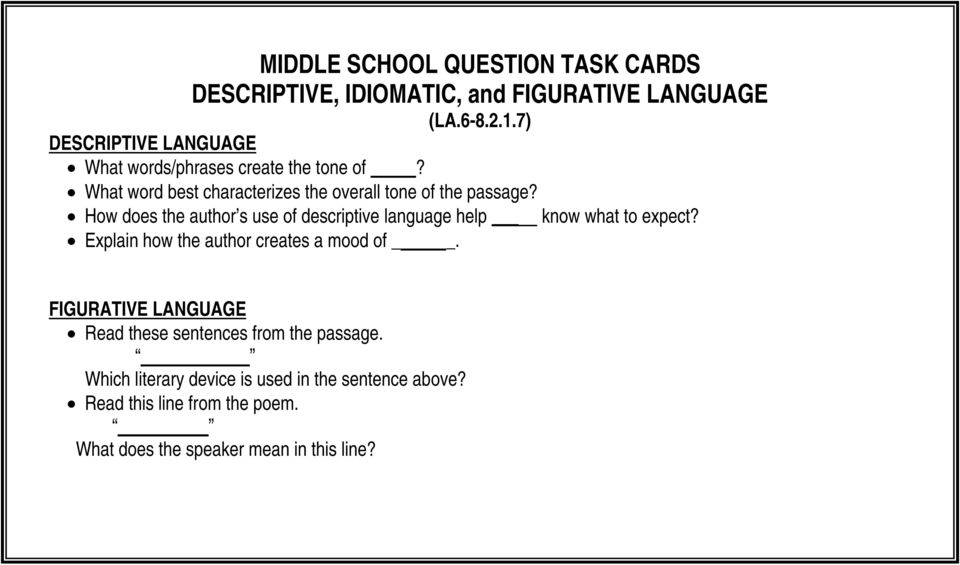
11 DESCRIPTIVE, IDIOMATIC, and FIGURATIVE LANGUAGE (LA ) DESCRIPTIVE LANGUAGE What words/phrases create the tone of? What word best characterizes the overall tone of the passage? How does the author s use of descriptive language help Explain how the author creates a mood of. know what to expect? FIGURATIVE LANGUAGE Read these sentences from the passage. Which literary device is used in the sentence above? Read this line from the poem. What does the speaker mean in this line?
12

Write the key elements of the plot in a story you have read.
 F OR USE WITH F OCUS L ESSON 1: PLOT, SETTING, AND T HEME 1a Plot is the series of events in a story. Exposition is the author s introduction to the characters and setting. The conflict, or problem, sets
Language Arts Literacy Areas of Focus: Grade 6
 Language Arts Literacy : Grade 6 Mission: Learning to read, write, speak, listen, and view critically, strategically and creatively enables students to discover personal and shared meaning throughout their
Third Grade Language Arts Learning Targets - Common Core
 Third Grade Language Arts Learning Targets - Common Core Strand Standard Statement Learning Target Reading: 1 I can ask and answer questions, using the text for support, to show my understanding. RL 1-1
Language Arts Literacy Areas of Focus: Grade 5
 Language Arts Literacy : Grade 5 Mission: Learning to read, write, speak, listen, and view critically, strategically and creatively enables students to discover personal and shared meaning throughout their
the treasure of lemon brown by walter dean myers
 the treasure of lemon brown by walter dean myers item analysis for all grade 7 standards: vocabulary, reading, writing, conventions item analysis for all grade 8 standards: vocabulary, reading, writing,
Grade Level: 2 nd Grade
 1. Read closely to determine what the text says explicitly and to make logical inferences from it; cite specific textual evidence when writing or speaking to support conclusions drawn from the text. RL.2.1.
Writing Emphasis by Grade Level Based on State Standards. K 5.1 Draw pictures and write words for specific reasons.
 Writing Emphasis by Grade Level Based on State Standards Grade K K 5.1 Draw pictures and write words for specific reasons. Grade 1 1.5.1 Write brief narratives describing an experience. Grade 2 2.5.2 Write
CRCT Content Descriptions based on the Georgia Performance Standards. Reading Grades 1-8
 CRCT Content Descriptions based on the Georgia Performance Standards Reading Grades 1-8 Kathy Cox State Superintendent of Schools June 2007 Criterion-Referenced Competency Tests (CRCT) Content Descriptions
LANGUAGE! 4 th Edition, Levels A C, correlated to the South Carolina College and Career Readiness Standards, Grades 3 5
 Page 1 of 57 Grade 3 Reading Literary Text Principles of Reading (P) Standard 1: Demonstrate understanding of the organization and basic features of print. Standard 2: Demonstrate understanding of spoken
Alignment of the National Standards for Learning Languages with the Common Core State Standards
 Alignment of the National with the Common Core State Standards Performance Expectations The Common Core State Standards for English Language Arts (ELA) and Literacy in History/Social Studies, Science,
Thai Language Self Assessment
 The following are can do statements in four skills: Listening, Speaking, Reading and Writing. Put a in front of each description that applies to your current Thai proficiency (.i.e. what you can do with
Purposes and Processes of Reading Comprehension
 2 PIRLS Reading Purposes and Processes of Reading Comprehension PIRLS examines the processes of comprehension and the purposes for reading, however, they do not function in isolation from each other or
Grade 6 English Language Arts Performance Level Descriptors
 Limited Grade 6 English Language Arts Performance Level Descriptors A student performing at the Limited Level demonstrates a minimal command of Ohio s Learning Standards for Grade 6 English Language Arts.
Minnesota K-12 Academic Standards in Language Arts Curriculum and Assessment Alignment Form Rewards Intermediate Grades 4-6
 Minnesota K-12 Academic Standards in Language Arts Curriculum and Assessment Alignment Form Rewards Intermediate Grades 4-6 4 I. READING AND LITERATURE A. Word Recognition, Analysis, and Fluency The student
CST and CAHSEE Academic Vocabulary
 CST and CAHSEE Academic Vocabulary Grades K 12 Math and ELA This document references Academic Language used in the Released Test Questions from the 2008 posted CAHSEE Released Test Questions (RTQs) and
Grade 4 Writing Curriculum Map
 Curriculum Map BOE Approval November 2013 CURRICULUM MAP WRITING GRADE 4 SEPTEMBER OCTOBER NOVEMBER DECEMBER JANUARY Creating a Buzz About : It s All About Me! Tell Me A Story Realistic Fiction Tell Me
New Jersey Core Curriculum Content Standards: For Language Arts Literacy
 For STANDARD 3.1 (READING) ALL STUDENTS WILL UNDERSTAND AND APPLY THE KNOWLEDGE OF SOUNDS, LETTERS, AND WORDS IN WRITTEN ENGLISH TO BECOME INDEPENDENT AND FLUENT READERS AND WILL READ A VARIETY OF MATERIALS
HIV, STD & Pregnancy Prevention
 HIV, STD & Pregnancy Prevention The HealthSmart HIV, STD & Pregnancy Prevention unit meets the following Common Core State Standards in English Language Arts for Grades 9-10. Reading Informational Text
Reading Strategies by Level. Early Emergent Readers
 The charts below were created as a common language for teachers and students in the Wallingford Public Schools in kindergarten through eighth grade. The level of the chart selected for use in the classroom
Mansfield City Schools ELA Pacing Guide Grade 6 Reading
 ACQUISITION OF VOCABULARY AV 6.1 - Define the meaning of unknown words by using context clues and the author's use of definition, restatement and example. AV6.6 - Apply the knowledge of prefixes, suffixes
Using Think-Alouds to Improve Reading Comprehension Lesson Plan
 Using Think-Alouds to Improve Reading Comprehension Lesson Plan Estimated Lesson Time: One class period Overview: Studies have shown that the think-aloud strategy improves comprehension on tests. Through
Higher-Order Thinking Skills (HOTS)
 Higher-Order Thinking Skills (HOTS) Thinking Skill Students will be able to: Sample Tasks/Questions Predicting predict the content or the outcome of the text, either before or during reading based on available
STAAR Sample Short Answer Questions
 STAAR Sample Short Answer Questions ENGLISH I, II, and III Single Selection: Literary In this excerpt from Anne of Green Gables, do you think the stage directions enhance your understanding of the scene?
READY NCEXTEND2 End-of-Grade English Language Arts (ELA)/Reading Grades 3-8 Assessments
 READY NCEXTEND2 End-of-Grade English Language Arts (ELA)/Reading Grades 3-8 Assessments NCEXTEND2 ELA/Reading Grades 3-8 Achievement Level Ranges (Cut Scores) Subject Grade Level 1 Level 2 Level 3 Level
Units of Study 9th Grade
 Units of Study 9th Grade First Semester Theme: The Journey Second Semester Theme: Choices The Big Ideas in English Language Arts that drive instruction: Independent thinkers construct meaning through language.
D24. Core Analysis Frame: Fiction. Examine Setting. Analyze Characters. Examine Plot. (continued on page D25)
 Core Analysis Frame: Fiction D24 These questions will help you understand any story you read. For more advanced, in-depth analysis of each element, use the following frames: Setting Plot Author s Craft
BUILDING A LITERATURE PYRAMID
 BUILDING A LITERATURE PYRAMID Performance Standard 2A.F Students are to build a pyramid of about one (or more) of the literary elements (e.g., plot, character, theme, setting) by using taken from one of
Response to Literature Essay Writing
 Response to Literature Essay Writing Intro. Paragraph with thesis statement* Body Par. #1 Body Par. #2 Body Par. #3 (optional) Concluding Paragraph Introductory Paragraph -- Like a funnel, start with a
3rd Grade Reading Standard Exceeds (4) Secure (3) Developing (2) Beginning (1)
 3rd Grade Reading Standard Exceeds (4) Secure (3) Developing (2) Beginning (1) based on the Refer to details and examples in a text when explaining what the text says explicitly and when drawing inferences
Virginia English Standards of Learning Grade 8
 A Correlation of Prentice Hall Writing Coach 2012 To the Virginia English Standards of Learning A Correlation of, 2012, Introduction This document demonstrates how, 2012, meets the objectives of the. Correlation
Academic Standards for Reading, Writing, Speaking, and Listening June 1, 2009 FINAL Elementary Standards Grades 3-8
 Academic Standards for Reading, Writing, Speaking, and Listening June 1, 2009 FINAL Elementary Standards Grades 3-8 Pennsylvania Department of Education These standards are offered as a voluntary resource
parent ROADMAP SUPPORTING YOUR CHILD IN GRADE FIVE ENGLISH LANGUAGE ARTS
 TM parent ROADMAP SUPPORTING YOUR CHILD IN GRADE FIVE ENGLISH LANGUAGE ARTS 5 America s schools are working to provide higher quality instruction than ever before. The way we taught students in the past
Interpreting areading Scaled Scores for Instruction
 Interpreting areading Scaled Scores for Instruction Individual scaled scores do not have natural meaning associated to them. The descriptions below provide information for how each scaled score range should
This document has been produced to support the development of effective questioning and dialogue between teacher and pupils.
 QUESTIONING Assessing and Developing Children s Understanding and Thinking in Literacy through Effective Introduction This document has been produced to support the development of effective questioning
Strand: Reading Literature Topics Standard I can statements Vocabulary Key Ideas and Details
 Strand: Reading Literature Topics Standard I can statements Vocabulary Key Ideas and Details Craft and Structure RL.5.1 Quote accurately from a text when explaining what the text says explicitly and when
ENGLISH LANGUAGE ARTS
 ENGLISH LANGUAGE ARTS INTRODUCTION Clear student learning outcomes and high learning standards in the program of studies are designed to prepare students for present and future language requirements. Changes
The plot is the sequence of events in a story. Each event causes or leads to the next. Events of the plot reveal a problem called the conflict.
 FOR USE WITH FOCUS LESSON 1: NARRATIVE STRATEGIES I 1a The plot is the sequence of events in a story. Each event causes or leads to the next. Events of the plot reveal a problem called the conflict. The
Montgomery County Public Schools English 9B Exam Review
 Montgomery County Public Schools English 9B Exam Review June 2013 FORMAT Five Readings an excerpt from a Shakespeare play (not Romeo and Juliet) two poems a narrative a nonfiction article related to the
D36. Core Analysis Frame: Poetry. Examine Content. Examine Form and Structure. (continued on page D37)
 Core Analysis Frame: Poetry D36 The questions on this analysis frame will help you achieve a basic understanding of any poem you read. For more advanced, in-depth analysis of each element, use the following
Students will know Vocabulary: claims evidence reasons relevant accurate phrases/clauses credible source (inc. oral) formal style clarify
 Sixth Grade Writing : Text Types and Purposes Essential Questions: 1. How do writers select the genre of writing for a specific purpose and audience? 2. How do essential components of the writing process
MCAS/DCCAS English Language Arts Correlation Chart Grade 7
 MCAS/DCCAS English Language Arts Correlation Chart Grade 7 MCAS Finish Line English Language Arts Grade 7 MCAS Standard DCCAS Standard DCCAS Standard Description Unit 1: Vocabulary Strategies Lesson 1:
SIXTH GRADE UNIT 1. Reading: Literature
 Reading: Literature Writing: Narrative RL.6.1 RL.6.2 RL.6.3 RL.6.4 RL.6.5 RL.6.6 RL.6.7 W.6.3 SIXTH GRADE UNIT 1 Key Ideas and Details Cite textual evidence to support analysis of what the text says explicitly
Expository Reading and Writing By Grade Level
 Expository and Writing By Grade Level Kindergarten TEKS identify the topic of an informational text heard identify the topic and details in expository text heard or read, referring to the words and/or
GRADE 9 READING LITERATURE...2
 Grade 9 Reading Additional Samples The BC performance standards for Grade 9 reading consist of rating scales that describe student achievement in March-April of a given year and samples illustrating typical
High School Communications Curriculum Indicators tested/taught indicator
 Freshman Sophomore Junior Senior adjusts reading rate to support comprehension when reading HS.1.2.1 narrative, and persuasive texts. determines meaning of words or phrases using context clues (e.g., definitions,
KINDGERGARTEN. Listen to a story for a particular reason
 KINDGERGARTEN READING FOUNDATIONAL SKILLS Print Concepts Follow words from left to right in a text Follow words from top to bottom in a text Know when to turn the page in a book Show spaces between words
A + dvancer College Readiness Online Alignment to Florida PERT
 A + dvancer College Readiness Online Alignment to Florida PERT Area Objective ID Topic Subject Activity Mathematics Math MPRC1 Equations: Solve linear in one variable College Readiness-Arithmetic Solving
Strand: Reading Literature Topics Standard I can statements Vocabulary Key Ideas and Details
 Strand: Reading Literature Key Ideas and Details Craft and Structure RL.3.1 Ask and answer questions to demonstrate understanding of a text, referring explicitly to the text as the basis for the answers.
Grade 3 Question Stem Bank: Common Core State Standards
 Reading Literature (RL) Reading for Information Key Ideas and Details Question Stems: Standard Basic: Remember Understand Standard: Apply Analyze Expanded: Evaluate Create RL 3.1 RI 3.1 Identify explicit
GRADE 11 English Language Arts Standards Pacing Guide. 1 st Nine Weeks
 1 st Nine Weeks A. Verify meanings of words by the author s use of definition, restatement, example, comparison, contrast and cause and effect. B. Distinguish the relationship of word meanings between
Common Core Writing Rubrics, Grade 3
 Common Core Writing Rubrics, Grade 3 The following writing rubrics for the Common Core were developed by the Elk Grove Unified School District in Elk Grove, California. There are rubrics for each major
Prentice Hall Literature Grade 8 2010 Correlated to: Kansas Reading Education Standards for Grade 8 (Grade 8)
 Standard 1: Reading EIGHTH GRADE Reading: The student reads and comprehends text across the curriculum. Benchmark 1: The student uses skills in alphabetics to construct meaning from text. No standards
French Language and Culture. Curriculum Framework 2011 2012
 AP French Language and Culture Curriculum Framework 2011 2012 Contents (click on a topic to jump to that page) Introduction... 3 Structure of the Curriculum Framework...4 Learning Objectives and Achievement
Conventions for Writing a Literary Analysis Paper
 Conventions for Writing a Literary Analysis Paper BCCC Tutoring Center This handout can be used in conjunction with the Tutoring Center s resource, How to Write a Literary Analysis Paper. Your Writing
Author Study: Edgar Allan Poe 8 th Grade Language Arts Summative Assessments
 Author Study: Edgar Allan Poe 8 th Grade Language Arts Summative Assessments The author study essay and project will be due December 10th and will include the following: 1 literary analysis essay Mandatory
AK + ASD Writing Grade Level Expectations For Grades 3-6
 Revised ASD June 2004 AK + ASD Writing For Grades 3-6 The first row of each table includes a heading that summarizes the performance standards, and the second row includes the complete performance standards.
2011 Grade 8 New York English Language Arts Test Specifications
 2011 Grade 8 New York English Language Arts Test Specifications The New York State Education Department redesigned the 2011 Grades 3-8 English Language Arts tests. The intent of the redesign is to assess
From Our Classroom Strategy Library During Reading
 Concept Map Use this map to organize your thoughts and make connections to your topic. Write the main idea in the center, and add supporting ideas or related topics in each surrounding oval. Continue to
Reading Timeline 2nd Nine Weeks
 Reading Timeline 2nd Nine Weeks Task Focus Standard Essential Questions 1 *Elements of Fables 2 *Story structure (beginning) *Characters, setting, plot 3 *Characters 4 *Story Structure (problem/solution)
Point-by Point Method, Comparison/Contrast Essay Step-by-Step Teacher Overview
 Point-by Point Method, Comparison/Contrast Essay Teacher Overview Skill Focus Levels of Thinking Remember Understand Apply Analyze Evaluate Create Close Reading Grammar Composition Reading Strategies Inference
Reading VIII Grade Level 8
 Reading VIII Reading VIII introduces students to a variety of topics to enrich their reading experience including: understanding common misspellings using prefixes, suffixes, root words, and forming compounds
Brought to you by the NVCC-Annandale Reading and Writing Center
 Brought to you by the NVCC-Annandale Reading and Writing Center WORKSHOP OBJECTIVES: To understand the steps involved in writing inclass essays To be able to decode the question so that you answer the
How To Write A Novel
 Appendix B: Grade Level Tables for All Claims and Assessment Targets and Item Types 1 Appendix B: Grade Level Tables for All Claims and Assessment Targets and Item Types Grades 3 5 Summative Assessment
Short Stories Grade 9
 Short Stories Grade 9 Content Area: English Language Arts Course(s): Language Arts Literacy I Time Period: 6 weeks Length: Weeks Status: Published Unit Overview Students will read and analyze literary
Focus: Reading Unit of Study: Fiction/Expository/Persuasive/Research/Media Literacy
 4 th Grade Reading and Writing TEKS 4th Nine Weeks Focus: Reading Unit of Study: Fiction/Expository/Persuasive/Research/Media Literacy Figure 19: Reading/Comprehension Skills. Students use a flexible range
Child-speak Reading Level 1 APP AF1 AF2 AF3 AF4 AF5 AF6 AF7 Use a range of strategies, including accurate decoding text, to read for meaning
 Child-speak Reading Level 1 APP In some usually I can break down and blend consonant vowel consonant words e.g. cat (1c) I can recognise some familiar words in the I read. (1c) When aloud, I know the sentences
Comprehension Questions for Leveled Text
 Fiction What words to you expect to come on the next page? What do you think is going to happen next by looking at the pictures? What do you think will happen at the end of the story? What do you think
Reading and Viewing Achievement Standards
 Reading and Viewing Achievement Standards The following outlines text study over the semester in English Language Arts (at least 30% should be Canadian content and include representation from New Brunswick).
PENNSYLVANIA COMMON CORE STANDARDS English Language Arts Grades 9-12
 1.2 Reading Informational Text Students read, understand, and respond to informational text with emphasis on comprehension, making connections among ideas and between texts with focus on textual evidence.
E/LA Common Core Standards for Writing Grade 5
 Text Type and Purposes Anchor Standards 1. Write arguments to support claims in an analysis of substantive topics or texts, using valid reasoning and relevant and sufficient evidence. 2. Write informative/explanatory
Reading: The student reads and comprehends text across the curriculum.
 Curricular Standards for Reading Education Kansas L iterature Reading with Purpose Course 1 2007 STANDARDS Standard 1: Reading Reading: The student reads and comprehends text across the curriculum. Benchmark
5. Develop two test questions based on the first chapter:
 Reading Notes: Chapter One (pgs. 1 16) Introduction While reading, we will pause to make some observations. These observations are intended to improve your ability to see and interpret key ideas and events
HIGH SCHOOL MASS MEDIA AND MEDIA LITERACY STANDARDS
 Guidelines for Syllabus Development of Mass Media Course (1084) DRAFT 1 of 7 HIGH SCHOOL MASS MEDIA AND MEDIA LITERACY STANDARDS Students study the importance of mass media as pervasive in modern life
English. Suggested long term planning Years 1 to 6. Herts for Learning Ltd 01438 845111 www.hertsforlearning.co.uk
 English long term planning Years 1 to 6 Herts for Learning Ltd 01438 845111 www.hertsforlearning.co.uk The Long Term Plans allow for two planning approaches: Planning which follows the teaching sequence
Grade 8 English Language Arts Performance Level Descriptors
 Limited Grade 8 English Language Arts Performance Level Descriptors A student performing at the Limited Level demonstrates a minimal command of Ohio s Learning Standards for Grade 8 English Language Arts.
Section 8 Foreign Languages. Article 1 OVERALL OBJECTIVE
 Section 8 Foreign Languages Article 1 OVERALL OBJECTIVE To develop students communication abilities such as accurately understanding and appropriately conveying information, ideas,, deepening their understanding
READING. Common Core Standards-Based. Graphic Organizers for GRADES 9-10. In-Depth Analysis. Created by Tracee Orman
 Graphic Organizers for Common Core Standards-Based READING In-Depth Analysis GRADES 9-10 Created by Tracee Orman www.traceeorman.com www.teacherspayteachers.com/store/tracee-orman CCS RL Graphic Organizers
INTRODUCTION to writing a graph description
 INTRODUCTION to writing a graph description For the IELTS writing test, you are required to complete two writing tasks. Task 1 is some kind of data report, while Task 2 is an essay. You are probably already
EXAMS Leaving Certificate English
 EXAMS Leaving Certificate English Theme Language focus Learning focus Learning Support Language Support Exams: English Key vocabulary for exam questions, type and structure of questions. Understanding
Bilingual Education Assessment Urdu (034) NY-SG-FLD034-01
 Bilingual Education Assessment Urdu (034) NY-SG-FLD034-01 The State Education Department does not discriminate on the basis of age, color, religion, creed, disability, marital status, veteran status, national
Reading Standards for Literature
 Reading for Literature ELACC3RL1 Key Ideas and Details: Ask and answer questions to demonstrate understanding of a text, referring explicitly to the text as the basis for the answers. 11/5/2012 1 Reading
How To Read With A Book
 Behaviors to Notice Teach Level A/B (Fountas and Pinnell) - DRA 1/2 - NYC ECLAS 2 Solving Words - Locates known word(s) in. Analyzes words from left to right, using knowledge of sound/letter relationships
NOTE-TAKING. Rutgers School of Nursing
 NOTE-TAKING Rutgers School of Nursing WHEN TO TAKE NOTES BEFORE DURING AFTER I. Before Class: Preparation (mental and physical) Read Textbook BEFORE Class Start Taking Notes BEFORE Class The SQ3R Method
Catering for students with special needs
 Catering for students with special needs In preparing students for the assessment tasks, teachers need to be aware of the specific learning needs of individual students in their classes. These could include
Students will know Vocabulary: purpose details reasons phrases conclusion point of view persuasive evaluate
 Fourth Grade Writing : Text Types and Purposes Essential Questions: 1. How do writers select the genre of writing for a specific purpose and audience? 2. How do essential components of the writing process
English 7 Essential Curriculum
 English 7 Essential Curriculum Genre Autobiography Realistic Fiction Speculative Fiction Theme Facing Injustice Perseverance Thrills and Chills OVERVIEW English 7 students learn how to make purposeful
Close Reading (CLR) Score Range KEY IDEAS AND DETAILS
 These Standards describe what students who score in specific score ranges on the Reading Test of ACT Explore, ACT Plan, and the ACT college readiness assessment are likely to know and be able to do. 13
Contextual Understanding, Conceptual Understanding, Structural Understanding, and Tools and Resources
 Prentice Hall Writing and Grammar: Communication In Action 2004, Gold Level Ohio Academic Content Standards, Grade-Level Indicators, English Language Arts (Grade 9) Grade Nine Phonemic Awareness, Word
ENGLISH LANGUAGE ARTS TESTING OUT EXAM
 ENGLISH 9 ENGLISH LANGUAGE ARTS TESTING OUT EXAM ANN ARBOR PUBLIC SCHOOLS Sytlabns HURON/PIONEER HIGH SCHOOL English 9 2nd semester Passing standard (C+) For the exam, students must provide their own pens,
Grade 6 FCAT 2.0 Reading Sample Answers
 Grade FCAT 2.0 Reading Sample Answers This booklet contains the answers to the FCAT 2.0 Reading sample questions, as well as explanations for the answers. It also gives the Next Generation Sunshine State
FIRST CERTIFICATE Reading and Use of English Writing Listening Speaking Reading:
 Page1 Cambridge FCE B2 FIRST CERTIFICATE Reading and Use of English (1h15min) Reading: 7 parts/52 questions Writing (1h20min) 2 parts. Listening (about 40 min) Speaking (14 min per pair of candidates)
READING THE NEWSPAPER
 READING THE NEWSPAPER Outcome (lesson objective) Students will comprehend and critically evaluate text as they read to find the main idea. They will construct meaning as they analyze news articles and
Module 1 Exercise 3 How to recognize a main idea in a short story
 Section 1A: Comprehension and Insight skills based on short stories Module 1 Exercise 3 How to recognize a main idea in a short story Before you begin What you need: Related text: Powder by Tobias Wolff
Rubrics for Assessing Student Writing, Listening, and Speaking High School
 Rubrics for Assessing Student Writing, Listening, and Speaking High School Copyright by the McGraw-Hill Companies, Inc. All rights reserved. Permission is granted to reproduce the material contained herein
Common Core State Standards for Literacy in History/Social Studies, Science, and Technical Subjects, Grades 9-10
 Common Core State Standards for Literacy in History/Social Studies, Science, and Technical English Language Arts Standards» Anchor Standards» College and Career Readiness Anchor Standards for Reading The
Lesson Title: Argumentative Writing (Writing a Critical Review)
 Lesson Title: Argumentative Writing (Writing a Critical Review) Author: Carl Myers, DeeAnne Simonson Subject Area(s): Type an X in the box to the left of the subject area(s) addressed in this lesson: Subject
Ms Juliani -Syllabus Special Education-Language/ Writing
 Ms Juliani -Syllabus Special Education-Language/ Writing * As a teacher, I have high expectations for my students and believe that they need to be encouraged, nurtured, and rewarded for their efforts.
Unit 4.3: Making Predictions, Inferences and Connections about Characters English as a Second Language 5 weeks of instruction
 STAGE 1 (Desired Results) Unit Summary: Transversal Themes: Integration Ideas: In this unit, the student will analyze characters from stories and pictures using effective strategies of good readers: making
Common Core Standards Pacing Guide Fourth Grade English/Language Arts Pacing Guide 1 st Nine Weeks
 Common Core Standards Pacing Guide Fourth Grade English/Language Arts Pacing Guide 1 st Nine Weeks Key: Objectives in bold to be assessed after the current nine weeks Objectives in italics to be assessed
MStM Reading/Language Arts Curriculum Lesson Plan Template
 Grade Level: 6 th grade Standard 1: Students will use multiple strategies to read a variety of texts. Grade Level Objective: 1. A.6.1: compare/contrast the differences in fiction and non-fiction text.