
Reading and Viewing Achievement Standards
|
|
|
- Kristian Turner
- 9 years ago
- Views:
Transcription
1 Reading and Viewing Achievement Standards The following outlines text study over the semester in English Language Arts (at least 30% should be Canadian content and include representation from New Brunswick). Additional reading and reading support are expected in all subject areas. These guidelines are for instructional texts. Shorter Text Minimum of five from each category Poetic texts (e.g., lyrics, odes, ballad, dramatic monologue) Visuals and multimedia (e.g., graphs, political cartoons, video games, webpages) Essays and popular non-fiction (e.g., obituaries, rants, reports, blogs) Multi-genre Study Minimum of one multi-genre study Explore a theme or a question through a variety of texts, including: One student-selected book study extended text (i.e., book-length narrative or modern or classic script or play) A variety of shorter texts (see list above) Optional: short story Students are required to explore a variety of genres in their independent reading. Independent reading choices should include those of interest or enjoyment and those that stretch understanding and build capacity to handle more challenging themes, information, genres and structures. Quantity and quality of texts should be balanced and suit the individual. Recommendations for time committed to deep reading are as follows: During ELA: 15-20% of class time (includes conferring, but not book club discussions) Outside Instructional Time: Appropriate: 2 hours per week (15-20 minutes per day) Strong: at least 3 ½ hours per week (30 minutes per day)

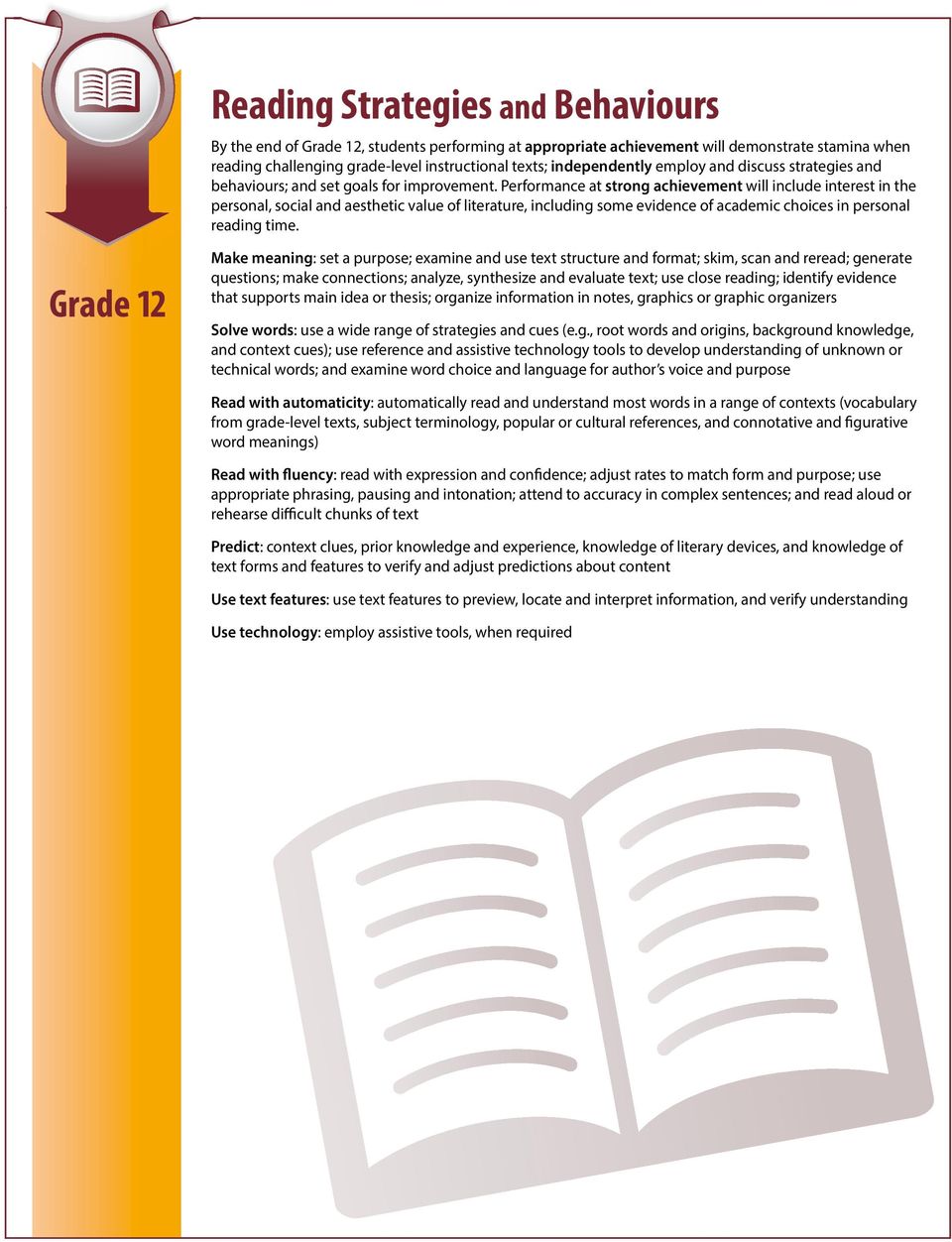
2 Reading Strategies and Behaviours By the end of, students performing at appropriate achievement will demonstrate stamina when reading challenging grade-level instructional texts; independently employ and discuss strategies and behaviours; and set goals for improvement. Performance at strong achievement will include interest in the personal, social and aesthetic value of literature, including some evidence of academic choices in personal reading time. Make meaning: set a purpose; examine and use text structure and format; skim, scan and reread; generate questions; make connections; analyze, synthesize and evaluate text; use close reading; identify evidence that supports main idea or thesis; organize information in notes, graphics or graphic organizers Solve words: use a wide range of strategies and cues (e.g., root words and origins, background knowledge, and context cues); use reference and assistive technology tools to develop understanding of unknown or technical words; and examine word choice and language for author s voice and purpose Read with automaticity: automatically read and understand most words in a range of contexts (vocabulary from grade-level texts, subject terminology, popular or cultural references, and connotative and figurative word meanings) Read with fluency: read with expression and confidence; adjust rates to match form and purpose; use appropriate phrasing, pausing and intonation; attend to accuracy in complex sentences; and read aloud or rehearse difficult chunks of text Predict: context clues, prior knowledge and experience, knowledge of literary devices, and knowledge of text forms and features to verify and adjust predictions about content Use text features: use text features to preview, locate and interpret information, and verify understanding Use technology: employ assistive tools, when required
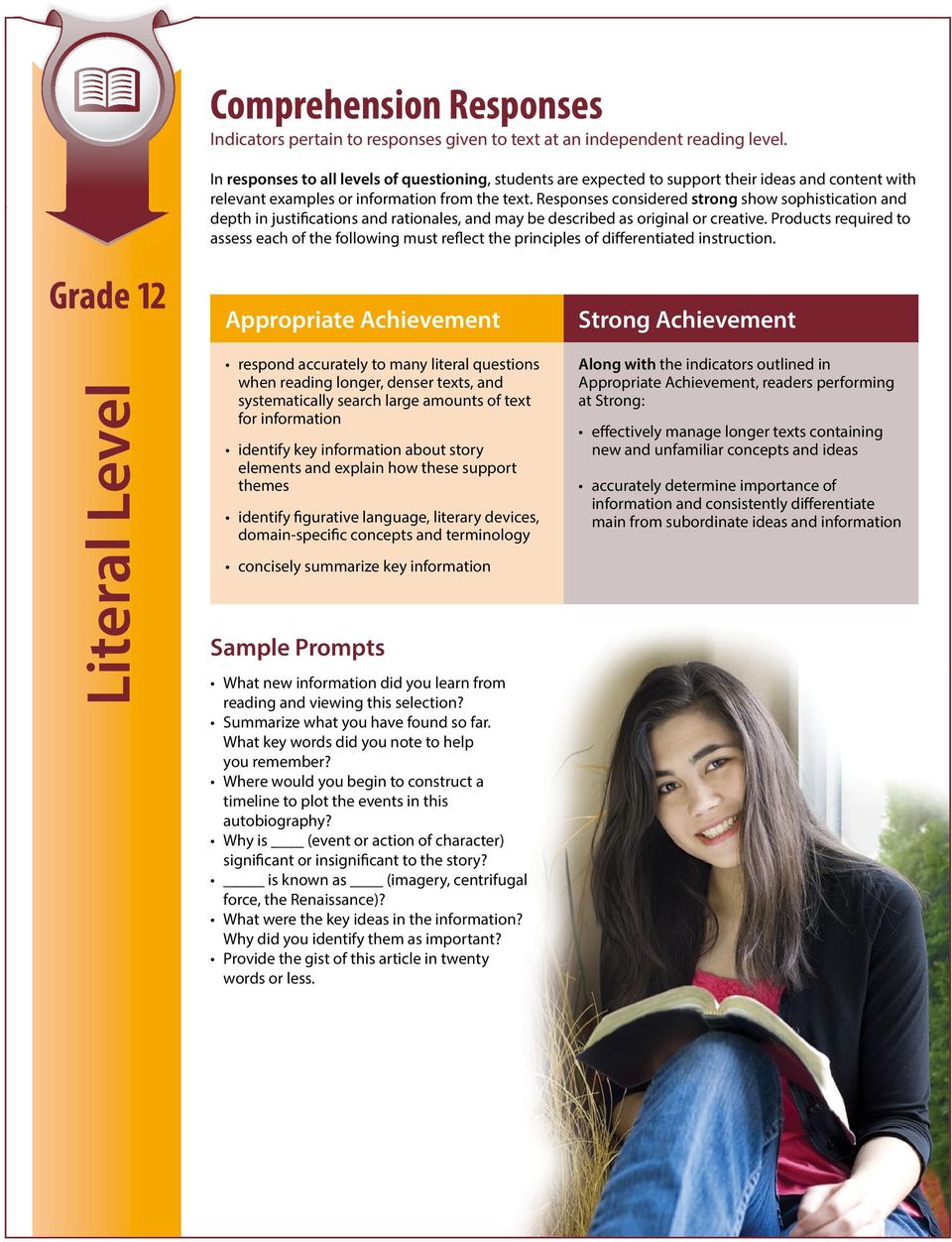
3 Comprehension Responses Indicators pertain to responses given to text at an independent reading level. In responses to all levels of questioning, students are expected to support their ideas and content with relevant examples or information from the text. Responses considered strong show sophistication and depth in justifications and rationales, and may be described as original or creative. Products required to assess each of the following must reflect the principles of differentiated instruction. Literal Level Appropriate Achievement respond accurately to many literal questions when reading longer, denser texts, and systematically search large amounts of text for information identify key information about story elements and explain how these support themes identify figurative language, literary devices, domain-specific concepts and terminology concisely summarize key information Sample Prompts What new information did you learn from reading and viewing this selection? Summarize what you have found so far. What key words did you note to help you remember? Where would you begin to construct a timeline to plot the events in this autobiography? Why is (event or action of character) significant or insignificant to the story? is known as (imagery, centrifugal force, the Renaissance)? What were the key ideas in the information? Why did you identify them as important? Provide the gist of this article in twenty words or less. Strong Achievement Along with the indicators outlined in Appropriate Achievement, readers performing at Strong: effectively manage longer texts containing new and unfamiliar concepts and ideas accurately determine importance of information and consistently differentiate main from subordinate ideas and information
4 Appropriate Achievement Strong Achievement Inferential Level make inferences about complex characters and story events; describe relationships between characters, and between context, language, purpose and audience; and describe effects on plot and subplots or overall theme interpret relationships between ideas within and beyond the text to draw conclusions or make comparisons use context clues, prior knowledge and other sources to explain the meaning of vocabulary, technical terms and dialect; interpret the meaning and purpose of a range of literary devices use text features (e.g., diagrams, graphics, quotes, table of contents, bibliography) and text organization and structure to interpret information and infer the author s or creator s purpose articulate points of view and messages in the text Sample Prompts Along with the indicators outlined in Appropriate Achievement, readers performing at Strong: demonstrate a solid understanding of how story events are interrelated choose precise evidence from the text to support opinions interpret why specific vocabulary, technical terms, dialect or literary devices were chosen identify and interpret how audience assumptions are shaped and shape the text Guidelines for Levels of Questions on Summative Assessments: Maximum 20% Literal Between 40-60% Inf/Int Between 20-60% Per/Ev/Cr Describe relationships between (characters) at the beginning and end of the story. What caused these changes? What does format, layout or structure tell you about the author s purpose? In what ways did the weaknesses or strengths of the characters affect the chain of events in the story? How would the story be different if the characters had acted differently, or if different events had occurred? What is the theme or thesis of this selection? What helps justify your assumptions or conclusions? What influences your assumptions or conclusions? What does this phrase mean? Why was it chosen? Give an example of how the author, poet, photographer, illustrator or creator used (a specific device, such as foreshadowing, irony, imagery, archetypes, camera angles, lighting, line, volume, timing, pace). Explain. How does this text feature (e.g., table of contents) help you understand the text? What information do you learn that adds to the text? What meaning or story can you infer? What message does the (an aspect of the text: e.g., title, design, font, diction) convey?

5 Appropriate Achievement Strong Achievement Personal/Critical/Evaluative Level compare and contrast characters, events, ideas and themes with personal experiences, prior knowledge and emergent understandings; make text-to-text, text-to-world comparisons; connect characters, themes and plots within and across texts and genres; consider texts in terms of worldview; make connections between texts, historical events, and social, moral and political issues express and support personal reactions, preferences for, and opinions about particular texts, authors, illustrators and genres; express changes in personal viewpoint and ideas analyze how different elements of craft (e.g., dialect, imagery, irony, flashbacks, foreshadowing, symbolism, tone) create meaning and engage audience; evaluate the author s effectiveness; cite evidence analyze how texts manipulate, persuade or control; comment about how discourses beliefs, values, identity and power shape and are shaped by the text; propose alternative perspectives; demonstrate understanding that texts reveal and produce ideologies, identities, positions and propaganda; assess the veracity of claims and reliability of information; analyze multiple interpretations evaluate how purpose, structure, and characteristics of a variety of text forms contribute to understanding; analyze relationships between language, topic, genre, purpose, context and audience Sample Prompts Along with the indicators outlined in Appropriate Achievement, readers performing at Strong: research independently to extend interest and understanding of worldviews and gather information to support opinions choose precise citations from other sources to support assertions about texts synthesize experiences with other texts and prior knowledge to make sophisticated connections and offer unique perspectives Does (character) remind you of other characters? Who and why? How does knowledge of these characters help you understand (character)? What would you have done in this situation? How does the structure or layout of the text achieve or detract from the author s purpose? How does the (e.g., publishing decision, such as inclusion of a table of contents, acknowledgements, epilogue) influence the reader? How are beliefs, values, identities or power relationships influenced by this passage? How does this contribute to or shape understanding of the text as a cultural artefact? The problem is described by. What do you think would say about it? Whose viewpoint is presented? What, if any, opposing viewpoints are presented? Whose viewpoint is missing? Describe the biases and assumptions presented in this selection. Whose interests are served? Who is the target audience for this selection? What are some examples of how the author used exaggeration or subtle misinformation? What are some similarities and differences between (form or genre) and another (form for genre)? What presumptions are made of the reader?

6 Text Complexity Text complexity is not isolated to the actual text. Experience, knowledge and interest influence how the reader navigates the text. The term text includes print, visual, oral and digital sources. Students select and read independently a range of literary and information texts. Students may employ assistive technology to support reading. Texts include: Knowledge demands: ever-growing array of genres, many themes beyond personal experiences; requires knowledge of specific subject matter and other texts (intertextuality); awareness of worldviews (including author s perspective); ability to take a critical stance and justify positions Themes: complex and sophisticated themes and ideas (e.g., relevant and robust themes, exploring social or moral issues, justice, war, discrimination) that cultivate social awareness, evoke emotional responses, challenge personal points of view and provide insights into the struggles of humanity; characters and information requiring the reader to interpret and connect information and ideas with other texts and subject areas; multiple levels of meaning Sentences: many complex sentence structures (including sentences greater than 30 words); multiple descriptive sentences containing information vital to understanding of the text; complicated use of dialogue Language: challenging language requires moderate level of content knowledge; some implicit or inferred meaning; wide range of literary devices (e.g., figurative, symbolic, ironic language); some lengthier descriptions, dialects (regional or historical), colloquialisms, other languages, domain-specific, archaic, or academic (not requiring extensive knowledge) Word complexity: many long multi-syllable words, some difficult nouns and technical vocabulary; requires additional reading and research Graphics: variety of challenging illustrations, photographs and sophisticated graphics; interpretation of these is essential to understanding Layout: many lines of print on a page; variation in layout, print styles and font within the same text (many examples of dense print); complex range of punctuation; may feature a wide range of reader s tools and text features (e.g., glossary, pronunciation guide index, italics, scales, legends) In addition, text complexity of literary fiction (e.g., realistic and historical fiction, mysteries, myths, science fiction, allegories, parodies, satire, graphic novels, drama) includes: Text structure: some complex, implicit and unconventional narrative structures; shifts in points of view; flashbacks and major time shifts Plot: complex plots; requires awareness of linguistic, structural and presentation devices Character development: main character displays complexity and unpredictability; factors that relate to character development require reader to gather information through inferences including knowledge of archetypes and conflict; multiple characters revealed through dialogue, actions, thoughts and/or perceptions of others Textual details: captions, graphics, and/or unassigned dialogue from which story action and character development must be inferred; description, imagery, symbolism, figurative language all vital to understanding settings, characters and themes In addition, text complexity of literary non-fiction and information texts (e.g., essays, speeches, journalistic text, historical accounts, textbooks, reports, directions, biography and autobiography, memoir, documentary, ads, charts, maps, tables, pamphlets, graphs, infographics) includes: Depth of content: large amounts of content, sometimes beyond subject-matter instruction, requiring readers to synthesize information from within and beyond the text (i.e., use primary and secondary sources, follow current events, research theories and historical events) Presentation: topics, ideas and information, often implicit, presented in multiple layers requiring readers employ understanding of structure Textual details: information presented in a variety of ways (e.g., paragraphs, columns, links, cutaways, graphics) and in combination, requiring readers preview text layout, skim and scan, and read with a purpose

How To Read With A Book
 Behaviors to Notice Teach Level A/B (Fountas and Pinnell) - DRA 1/2 - NYC ECLAS 2 Solving Words - Locates known word(s) in. Analyzes words from left to right, using knowledge of sound/letter relationships
Virginia English Standards of Learning Grade 8
 A Correlation of Prentice Hall Writing Coach 2012 To the Virginia English Standards of Learning A Correlation of, 2012, Introduction This document demonstrates how, 2012, meets the objectives of the. Correlation
Fountas & Pinnell Guided Reading Text Level Descriptions
 Fountas & Pinnell Guided Reading Text Level Descriptions A: Characteristics of Texts at Level A: Simple factual texts, animal fantasy and realistic fiction Picture books Text and concepts highly supported
Guided Reading Indicators
 Guided Reading Level A Descriptors Characteristics of Early Emergent Readers at Level A Simple factual texts, animal fantasy and realistic fiction Picture books Text and concepts highly supported by pictures
Academic Standards for Reading, Writing, Speaking, and Listening June 1, 2009 FINAL Elementary Standards Grades 3-8
 Academic Standards for Reading, Writing, Speaking, and Listening June 1, 2009 FINAL Elementary Standards Grades 3-8 Pennsylvania Department of Education These standards are offered as a voluntary resource
Minnesota K-12 Academic Standards in Language Arts Curriculum and Assessment Alignment Form Rewards Intermediate Grades 4-6
 Minnesota K-12 Academic Standards in Language Arts Curriculum and Assessment Alignment Form Rewards Intermediate Grades 4-6 4 I. READING AND LITERATURE A. Word Recognition, Analysis, and Fluency The student
Close Reading (CLR) Score Range KEY IDEAS AND DETAILS
 These Standards describe what students who score in specific score ranges on the Reading Test of ACT Explore, ACT Plan, and the ACT college readiness assessment are likely to know and be able to do. 13
Michigan High School Content Expectations for English Language Arts correlated to EDGE Fundamentals National Geographic School
 Michigan High School Content Expectations for English Language Arts correlated to EDGE Fundamentals National Geographic School Publishing/Hampton-Brown Michigan High School Content Expectations for English
Expository Reading and Writing By Grade Level
 Expository and Writing By Grade Level Kindergarten TEKS identify the topic of an informational text heard identify the topic and details in expository text heard or read, referring to the words and/or
Language Arts Literacy Areas of Focus: Grade 6
 Language Arts Literacy : Grade 6 Mission: Learning to read, write, speak, listen, and view critically, strategically and creatively enables students to discover personal and shared meaning throughout their
Mansfield City Schools ELA Pacing Guide Grade 6 Reading
 ACQUISITION OF VOCABULARY AV 6.1 - Define the meaning of unknown words by using context clues and the author's use of definition, restatement and example. AV6.6 - Apply the knowledge of prefixes, suffixes
McDougal Littell Bridges to Literature Level III. Alaska Reading and Writing Performance Standards Grade 8
 McDougal Littell Bridges to Literature Level III correlated to the Alaska Reading and Writing Performance Standards Grade 8 Reading Performance Standards (Grade Level Expectations) Grade 8 R3.1 Apply knowledge
National Essential Skills Survey / Common Core State Standards / NYS ELA Standards / CDOS / State Assessment Crosswalk
 National Essential Skills Survey / Common Core State Standards / NYS EA Standards / CDOS / State Assessment Crosswalk NESS NYS EA Connections CDOS Regents Reading for iterature E2 E37 E38 1. Cite strong
Child-speak Reading Level 1 APP AF1 AF2 AF3 AF4 AF5 AF6 AF7 Use a range of strategies, including accurate decoding text, to read for meaning
 Child-speak Reading Level 1 APP In some usually I can break down and blend consonant vowel consonant words e.g. cat (1c) I can recognise some familiar words in the I read. (1c) When aloud, I know the sentences
SIXTH GRADE UNIT 1. Reading: Literature
 Reading: Literature Writing: Narrative RL.6.1 RL.6.2 RL.6.3 RL.6.4 RL.6.5 RL.6.6 RL.6.7 W.6.3 SIXTH GRADE UNIT 1 Key Ideas and Details Cite textual evidence to support analysis of what the text says explicitly
Alignment of the National Standards for Learning Languages with the Common Core State Standards
 Alignment of the National with the Common Core State Standards Performance Expectations The Common Core State Standards for English Language Arts (ELA) and Literacy in History/Social Studies, Science,
Language Arts Literacy Areas of Focus: Grade 5
 Language Arts Literacy : Grade 5 Mission: Learning to read, write, speak, listen, and view critically, strategically and creatively enables students to discover personal and shared meaning throughout their
the treasure of lemon brown by walter dean myers
 the treasure of lemon brown by walter dean myers item analysis for all grade 7 standards: vocabulary, reading, writing, conventions item analysis for all grade 8 standards: vocabulary, reading, writing,
Reading ELA/Literacy Claim 1
 Literary Texts 1 Key Details: Given an inference or conclusion, use explicit details and implicit information from the text to support the inference or conclusion provided. DOK 2 Standard: Cite the textual
(by Level) Characteristics of Text. Students Names. Behaviours to Notice and Support
 Level E Level E books are generally longer than books at previous levels, either with more pages or more lines of text on a page. Some have sentences that carry over several pages and have a full range
Prentice Hall Literature Grade 8 2010 Correlated to: Kansas Reading Education Standards for Grade 8 (Grade 8)
 Standard 1: Reading EIGHTH GRADE Reading: The student reads and comprehends text across the curriculum. Benchmark 1: The student uses skills in alphabetics to construct meaning from text. No standards
LANGUAGE! 4 th Edition, Levels A C, correlated to the South Carolina College and Career Readiness Standards, Grades 3 5
 Page 1 of 57 Grade 3 Reading Literary Text Principles of Reading (P) Standard 1: Demonstrate understanding of the organization and basic features of print. Standard 2: Demonstrate understanding of spoken
Grade Genre Skills Lessons Mentor Texts and Resources 6 Grammar To Be Covered
 Grade Genre Skills Lessons Mentor Texts and Resources 6 Grammar To Be Covered 6 Personal Narrative Parts of speech (noun, adj, verb, adv) Complete sentence (subj. and verb) Capitalization Tense (identify)
Units of Study 9th Grade
 Units of Study 9th Grade First Semester Theme: The Journey Second Semester Theme: Choices The Big Ideas in English Language Arts that drive instruction: Independent thinkers construct meaning through language.
Grade 8 Reading Assessment. Eligible Texas Essential Knowledge and Skills
 Grade 8 Reading Assessment Eligible Texas Essential Knowledge and Skills STAAR Grade 8 Reading Assessment Genres Assessed: Literary Fiction (Readiness) Literary Nonfiction (Supporting) Poetry (Supporting)
CST and CAHSEE Academic Vocabulary
 CST and CAHSEE Academic Vocabulary Grades K 12 Math and ELA This document references Academic Language used in the Released Test Questions from the 2008 posted CAHSEE Released Test Questions (RTQs) and
Using Leveled Text to Teach and Support Reading Strategies
 Using Leveled Text to Teach and Support Reading Strategies The text structures of leveled text support the teaching of strategies along a developmental continuum. As the levels increase, the demands on
Grade: 9 (1) Students will build a framework for high school level academic writing by understanding the what of language, including:
 Introduction: The following document is a draft of standards-designed, comprehensive Pacing Guide for high school English Grade 9. This document will evolve as feedback is accumulated. The Pacing Guide
MStM Reading/Language Arts Curriculum Lesson Plan Template
 Grade Level: 6 th grade Standard 1: Students will use multiple strategies to read a variety of texts. Grade Level Objective: 1. A.6.1: compare/contrast the differences in fiction and non-fiction text.
3rd Grade Reading Standard Exceeds (4) Secure (3) Developing (2) Beginning (1)
 3rd Grade Reading Standard Exceeds (4) Secure (3) Developing (2) Beginning (1) based on the Refer to details and examples in a text when explaining what the text says explicitly and when drawing inferences
Grade 4 Writing Curriculum Map
 Curriculum Map BOE Approval November 2013 CURRICULUM MAP WRITING GRADE 4 SEPTEMBER OCTOBER NOVEMBER DECEMBER JANUARY Creating a Buzz About : It s All About Me! Tell Me A Story Realistic Fiction Tell Me
thank you, m'am by langston hughes
 thank you, m'am by langston hughes item analyses for all standards: vocabulary, reading, writing, conventions grade grade 8 grades 9 & 0 iv vi vii reading standard.0 --word analysis, fluency, and systematic
Montgomery County Public Schools English 9B Exam Review
 Montgomery County Public Schools English 9B Exam Review June 2013 FORMAT Five Readings an excerpt from a Shakespeare play (not Romeo and Juliet) two poems a narrative a nonfiction article related to the
CRCT Content Descriptions based on the Georgia Performance Standards. Reading Grades 1-8
 CRCT Content Descriptions based on the Georgia Performance Standards Reading Grades 1-8 Kathy Cox State Superintendent of Schools June 2007 Criterion-Referenced Competency Tests (CRCT) Content Descriptions
English 7 Essential Curriculum
 English 7 Essential Curriculum Genre Autobiography Realistic Fiction Speculative Fiction Theme Facing Injustice Perseverance Thrills and Chills OVERVIEW English 7 students learn how to make purposeful
PENNSYLVANIA COMMON CORE STANDARDS English Language Arts Grades 9-12
 1.2 Reading Informational Text Students read, understand, and respond to informational text with emphasis on comprehension, making connections among ideas and between texts with focus on textual evidence.
STAAR Sample Short Answer Questions
 STAAR Sample Short Answer Questions ENGLISH I, II, and III Single Selection: Literary In this excerpt from Anne of Green Gables, do you think the stage directions enhance your understanding of the scene?
Published on www.standards.dcsf.gov.uk/nationalstrategies
 Published on www.standards.dcsf.gov.uk/nationalstrategies 16-Dec-2010 Year 3 Narrative Unit 3 Adventure and mystery Adventure and mystery (4 weeks) This is the third in a block of four narrative units
Background to the new Staffordshire Grids
 Background to the new Staffordshire Grids The removal of levels for most pupils in 2014-15 and all pupils in 2015-16, has posed a problem for schools in how to assess children s progress in the New National
ENGLISH IV-Grade 12 CURRICULUM MAP
 ENGLISH IV-Grade 12 CURRICULUM MAP English 1: Literary Genres English 2: American Literature English 3: British Literature English 4: World Literature Reading: Night Romeo and Juliet Poetry unit Short
Grade 6 English Language Arts Performance Level Descriptors
 Limited Grade 6 English Language Arts Performance Level Descriptors A student performing at the Limited Level demonstrates a minimal command of Ohio s Learning Standards for Grade 6 English Language Arts.
Common Core State Standards Grades 9-10 ELA/History/Social Studies
 Common Core State Standards Grades 9-10 ELA/History/Social Studies ELA 9-10 1 Responsibility Requires Action. Responsibility is the active side of morality: doing what I should do, what I said I would
Academic Standards for Reading, Writing, Speaking, and Listening
 Academic Standards for Reading, Writing, Speaking, and Listening Pre-K - 3 REVISED May 18, 2010 Pennsylvania Department of Education These standards are offered as a voluntary resource for Pennsylvania
Appendix: W. Item: Curriculum Course Guide - New High School Course/Honors Creative Writing Department: Instructional Services
 Appendix: W Item: Curriculum Course Guide - New High School Course/Honors Creative Writing Department: Instructional Services Background/Historical Context: Creative Writing has been offered in our school
Reading VIII Grade Level 8
 Reading VIII Reading VIII introduces students to a variety of topics to enrich their reading experience including: understanding common misspellings using prefixes, suffixes, root words, and forming compounds
Grade Level: 2 nd Grade
 1. Read closely to determine what the text says explicitly and to make logical inferences from it; cite specific textual evidence when writing or speaking to support conclusions drawn from the text. RL.2.1.
ENGLISH LANGUAGE ARTS
 ENGLISH LANGUAGE ARTS INTRODUCTION Clear student learning outcomes and high learning standards in the program of studies are designed to prepare students for present and future language requirements. Changes
English 2 - Journalism Mitch Martin: [email protected]
 Mission English 2 - Journalism Mitch Martin: [email protected] To educate students to be self-directed learners, collaborative workers, complex thinkers, quality producers, and community contributors
Contextual Understanding, Conceptual Understanding, Structural Understanding, and Tools and Resources
 Prentice Hall Writing and Grammar: Communication In Action 2004, Gold Level Ohio Academic Content Standards, Grade-Level Indicators, English Language Arts (Grade 9) Grade Nine Phonemic Awareness, Word
Grade 8 English Language Arts Performance Level Descriptors
 Limited Grade 8 English Language Arts Performance Level Descriptors A student performing at the Limited Level demonstrates a minimal command of Ohio s Learning Standards for Grade 8 English Language Arts.
Teacher Name : J. Pigg Class/Grade Level: 6 th Reading 2 nd Six Weeks Unit Title: Unit 02: Exploring Fiction and Drama
 TeacherName:J.Pigg Class/GradeLevel:6 th Reading 2 nd SixWeeks UnitTitle:Unit02:ExploringFictionandDrama TEKS:06NELA02 Reading/Vocabulary Development. Students understand new vocabulary and use it when
British Literature, Quarter 2, Unit 1 of 3. Macbeth. Overview
 British Literature, Quarter 2, Unit 1 of 3 Macbeth Overview Overall days: 20 (1 day = 50-55 minutes) Purpose The purpose of this unit is to read, analyze, and perform scenes from Shakespeare s Macbeth.
High School Communications Curriculum Indicators tested/taught indicator
 Freshman Sophomore Junior Senior adjusts reading rate to support comprehension when reading HS.1.2.1 narrative, and persuasive texts. determines meaning of words or phrases using context clues (e.g., definitions,
Literary Elements and the Short Story Essential Question: Why do we tell stories? Common Core Standards Learning Objectives Suggested Works
 Unit: Literary Elements and the Short Story Essential Question: Why do we tell stories? Timeline: Semester 1: 9 weeks RL. 9.1 Cite strong and 1. Identify and explain plot The Most thorough textual evidence
How To Write A Novel
 Appendix B: Grade Level Tables for All Claims and Assessment Targets and Item Types 1 Appendix B: Grade Level Tables for All Claims and Assessment Targets and Item Types Grades 3 5 Summative Assessment
Strand: Reading Literature Topics Standard I can statements Vocabulary Key Ideas and Details
 Strand: Reading Literature Topics Standard I can statements Vocabulary Key Ideas and Details Craft and Structure RL.5.1 Quote accurately from a text when explaining what the text says explicitly and when
Writing Emphasis by Grade Level Based on State Standards. K 5.1 Draw pictures and write words for specific reasons.
 Writing Emphasis by Grade Level Based on State Standards Grade K K 5.1 Draw pictures and write words for specific reasons. Grade 1 1.5.1 Write brief narratives describing an experience. Grade 2 2.5.2 Write
Modern foreign languages
 Modern foreign languages Programme of study for key stage 3 and attainment targets (This is an extract from The National Curriculum 2007) Crown copyright 2007 Qualifications and Curriculum Authority 2007
Reading is the process in which the reader constructs meaning by interacting with the text.
 Part 1 Reading is the process in which the reader constructs meaning by interacting with the text. This interactive process involves the reader s prior knowledge, the text, and the reading situation. Literal
Write the key elements of the plot in a story you have read.
 F OR USE WITH F OCUS L ESSON 1: PLOT, SETTING, AND T HEME 1a Plot is the series of events in a story. Exposition is the author s introduction to the characters and setting. The conflict, or problem, sets
Date Re-Assessed. Indicator. CCSS.ELA-Literacy.RF.5.3 Know and apply grade-level phonics and word analysis skills in decoding words.
 CCSS English/Language Arts Standards Reading: Foundational Skills Fifth Grade Retaught Reviewed Assessed Phonics and Word Recognition CCSS.ELA-Literacy.RF.5.3 Know and apply grade-level phonics and word
MATRIX OF STANDARDS AND COMPETENCIES FOR ENGLISH IN GRADES 7 10
 PROCESSES CONVENTIONS MATRIX OF STANDARDS AND COMPETENCIES FOR ENGLISH IN GRADES 7 10 Determine how stress, Listen for important Determine intonation, phrasing, points signaled by appropriateness of pacing,
READING. Common Core Standards-Based. Graphic Organizers for GRADES 9-10. In-Depth Analysis. Created by Tracee Orman
 Graphic Organizers for Common Core Standards-Based READING In-Depth Analysis GRADES 9-10 Created by Tracee Orman www.traceeorman.com www.teacherspayteachers.com/store/tracee-orman CCS RL Graphic Organizers
Genre Definitions. Albemarle County Public Schools, August 1996 Appendix F
 Genre Definitions I. Fiction A. Realistic Fiction Imaginative writing that accurately reflects life as it could be lived today. Everything is a realistic fiction story could conceivably happen to real
by Learning Area Achievement Objectives The New Zealand Curriculum Set of 8 charts
 The New Zealand Curriculum Achievement Objectives by Learning Area Set of 8 charts Published for the Ministry of Education by Learning Media Limited, Box 3293, Wellington, New Zealand. www.learningmedia.co.nz
Fifth Grade English Language Arts Learning Goals for 3 rd 9- Weeks
 Skills students should demonstrate by the end of the 2 nd 9- weeks of school: Unit 4A- Making Connections Across Literary Genres Learning Goal: Student will understand that authors use point of view to
Common Core Progress English Language Arts
 [ SADLIER Common Core Progress English Language Arts Aligned to the [ Florida Next Generation GRADE 6 Sunshine State (Common Core) Standards for English Language Arts Contents 2 Strand: Reading Standards
Haberdashers Adams Federation Schools
 Haberdashers Adams Federation Schools Abraham Darby Academy Reading Policy Developing reading skills Reading is arguably the most crucial literacy skill for cross-curricular success in secondary schools.
LANGUAGE ARTS 2016 17 K 12 SUBJECT BOOKLET
 LANGUAGE ARTS 2016 17 K 12 SUBJECT BOOKLET Gwinnett s curriculum for grades K 12 is called the Academic Knowledge and Skills (AKS). The AKS for each grade level spell out the essential things students
AK + ASD Writing Grade Level Expectations For Grades 3-6
 Revised ASD June 2004 AK + ASD Writing For Grades 3-6 The first row of each table includes a heading that summarizes the performance standards, and the second row includes the complete performance standards.
A Model Curriculum for Pennsylvania School Library Programs: Worksheet for Grades 6-8. Competencies What students should be able to do; key skills
 Big Idea: Effective readers use appropriate strategies to construct meaning. A Model Curriculum for Pennsylvania School Library Programs: Worksheet for s 6-8 How do strategic readers create meaning from
PROGRAM CONCENTRATION:
 Implementation date PROGRAM CONCENTRATION: Business & Computer Science CAREER PATHWAY: Administrative Information/Support COURSE TITLE: Business Communication and Presentation Course Description: The goal
American Literature, Quarter 1, Unit 2 of 3 The Puritan Tradition and The Crucible. Overview. (1 day = 50-55 minutes)
 American Literature, Quarter 1, Unit 2 of 3 The Puritan Tradition and The Crucible Overall days: 16 (1 day = 50-55 minutes) Overview Purpose This unit will focus on the beliefs of early American Puritans
Focus: Reading Unit of Study: Fiction/Expository/Persuasive/Research/Media Literacy
 4 th Grade Reading and Writing TEKS 4th Nine Weeks Focus: Reading Unit of Study: Fiction/Expository/Persuasive/Research/Media Literacy Figure 19: Reading/Comprehension Skills. Students use a flexible range
Performance Indicators-Language Arts Reading and Writing 3 rd Grade
 Learning Standards 1 st Narrative Performance Indicators 2 nd Informational 3 rd Persuasive 4 th Response to Lit Possible Evidence Fluency, Vocabulary, and Comprehension Reads orally with Applies letter-sound
Assoc Degree Applic. - Transfer to UC/CSU/Private
 Solano Community College - Prof. Steven Federle English 2, Spring 2010, Section 10283 Tuesday, 6:15 9:05 P.M., Room 743 Computer Lab Critical Thinking & Writing about Literature Class Communications: Voice
Teacher's Guide to Meeting the Common Core State Standards* with Scott Foresman Reading Street 2008
 Implementing the Common Core State StandArds Teacher's Guide to Meeting the Common Core State Standards* with Scott Foresman Reading Street 2008 Table of Contents Grade 5 Introduction................................................
Reading Strategies by Level. Early Emergent Readers
 The charts below were created as a common language for teachers and students in the Wallingford Public Schools in kindergarten through eighth grade. The level of the chart selected for use in the classroom
Year 1 reading expectations (New Curriculum) Year 1 writing expectations (New Curriculum)
 Year 1 reading expectations Year 1 writing expectations Responds speedily with the correct sound to graphemes (letters or groups of letters) for all 40+ phonemes, including, where applicable, alternative
Indiana Department of Education
 GRADE 1 READING Guiding Principle: Students read a wide range of fiction, nonfiction, classic, and contemporary works, to build an understanding of texts, of themselves, and of the cultures of the United
English Language Arts Grade 8 PA Alternate Eligible Content
 English Language Arts Grade 8 PA Content Grade 8 ELA Content Approved November 19, 2015 1 PA Reporting Category: E08.A Literature Text CC.1.3.8.A Determine a theme or central idea of a text and analyze
Unit Essential Questions: What is the relationship between change and growth? How do writers use different types of writing to express their ideas?
 May 2012 ENGLISH LANGUAGE ARTS UNIT MAP GRADE 6 Page 1 of 12 Unit 1: Changes in Me Personal change is a normal, predictable, and often positive aspect of life. Reading, exploring, analyzing, and interpreting
Grade 5: Module 3A: Unit 2: Lesson 13 Developing an Opinion Based on the Textual Evidence:
 Grade 5: Module 3A: Unit 2: Lesson 13 Developing an Opinion Based on the Textual Evidence: Jackie Robinson s Role in the Civil Rights Movement This work is licensed under a Creative Commons Attribution-NonCommercial-ShareAlike
Short Stories Grade 9
 Short Stories Grade 9 Content Area: English Language Arts Course(s): Language Arts Literacy I Time Period: 6 weeks Length: Weeks Status: Published Unit Overview Students will read and analyze literary
240Tutoring Reading Comprehension Study Material
 240Tutoring Reading Comprehension Study Material This information is a sample of the instructional content and practice questions found on the 240Tutoring PRAXIS II Middle School English Language Arts
Teaching guide: AO2 - the ways in which meanings are shaped
 Teaching guide: AO2 - the ways in which meanings are shaped AS and A-level English Literature now require students to analyse a range of ways in which meanings are shaped in literary texts. Within this,
KINDGERGARTEN. Listen to a story for a particular reason
 KINDGERGARTEN READING FOUNDATIONAL SKILLS Print Concepts Follow words from left to right in a text Follow words from top to bottom in a text Know when to turn the page in a book Show spaces between words
New Jersey Core Curriculum Content Standards: For Language Arts Literacy
 For STANDARD 3.1 (READING) ALL STUDENTS WILL UNDERSTAND AND APPLY THE KNOWLEDGE OF SOUNDS, LETTERS, AND WORDS IN WRITTEN ENGLISH TO BECOME INDEPENDENT AND FLUENT READERS AND WILL READ A VARIETY OF MATERIALS
From Our Classroom Strategy Library During Reading
 Concept Map Use this map to organize your thoughts and make connections to your topic. Write the main idea in the center, and add supporting ideas or related topics in each surrounding oval. Continue to
Strand: Reading Literature Topics Standard I can statements Vocabulary Key Ideas and Details
 Strand: Reading Literature Key Ideas and Details Craft and Structure RL.3.1 Ask and answer questions to demonstrate understanding of a text, referring explicitly to the text as the basis for the answers.
Students will know Vocabulary: purpose details reasons phrases conclusion point of view persuasive evaluate
 Fourth Grade Writing : Text Types and Purposes Essential Questions: 1. How do writers select the genre of writing for a specific purpose and audience? 2. How do essential components of the writing process
Grade 5. Ontario Provincial Curriculum-based Expectations Guideline Walking with Miskwaadesi and Walking with A`nó:wara By Subject/Strand
 Ontario Provincial Curriculum-based Expectations Guideline Walking with Miskwaadesi and Walking with A`nó:wara By Subject/Strand Turtle Island Conservation Ontario Teachers Resource Bundle 1 The Arts 1.1
Montgomery County Public Schools Advanced English Semester A Exam Review
 Montgomery County Public Schools Advanced English Semester A Exam Review Four Readings including a narrative a poem a non-fiction piece a visual FORMAT Thirty Selected Response Items (SRs) Students will
English. Suggested long term planning Years 1 to 6. Herts for Learning Ltd 01438 845111 www.hertsforlearning.co.uk
 English long term planning Years 1 to 6 Herts for Learning Ltd 01438 845111 www.hertsforlearning.co.uk The Long Term Plans allow for two planning approaches: Planning which follows the teaching sequence
As Approved by State Board 4/2/09
 Improving students' ability to learn, communicate, and collaborate through literacy education As Approved by State Board 4/2/09 Nebraska Language Arts Standards As approved by State Board 4/2/09 Table
Critical Reading. English Language Arts Curriculum Framework. Revised 2010
 Critical Reading English Language Arts Curriculum Framework Revised 2010 Course Title: Critical Reading Course/Unit Credit: 1 Course Number: 419110 Teacher Licensure: Please refer to the Course Code Management
Inspiration Standards Match: Virginia
 Inspiration Standards Match: Virginia Standards of Learning: English Language Arts Middle School Meeting curriculum standards is a major focus in education today. This document highlights the correlation
Students will know Vocabulary: claims evidence reasons relevant accurate phrases/clauses credible source (inc. oral) formal style clarify
 Sixth Grade Writing : Text Types and Purposes Essential Questions: 1. How do writers select the genre of writing for a specific purpose and audience? 2. How do essential components of the writing process
ENGLISH III-Grade 11 CURRICULUM MAP
 ENGLISH III-Grade 11 CURRICULUM MAP English 1: Literary Genres English 2: American Literature English 3: British Literature English 4: World Literature Reading: Night Romeo and Juliet Poetry unit Short
This document has been produced to support the development of effective questioning and dialogue between teacher and pupils.
 QUESTIONING Assessing and Developing Children s Understanding and Thinking in Literacy through Effective Introduction This document has been produced to support the development of effective questioning