
Perceived Workplace Discrimination as a Mediator of the Relationship between Work Environment and Employee Outcomes: Does Minority Status Matter?
|
|
|
- Dominick Oliver
- 9 years ago
- Views:
Transcription

1 University of South Florida Scholar Commons Graduate Theses and Dissertations Graduate School Perceived Workplace Discrimination as a Mediator of the Relationship between Work Environment and Employee Outcomes: Does Minority Status Matter? Nicole Ellis Jagusztyn University of South Florida Follow this and additional works at: Part of the American Studies Commons Scholar Commons Citation Jagusztyn, Nicole Ellis, "Perceived Workplace Discrimination as a Mediator of the Relationship between Work Environment and Employee Outcomes: Does Minority Status Matter?" (2010). Graduate Theses and Dissertations. This Dissertation is brought to you for free and open access by the Graduate School at Scholar Commons. It has been accepted for inclusion in Graduate Theses and Dissertations by an authorized administrator of Scholar Commons. For more information, please contact [email protected].
2 Perceived Workplace Discrimination as a Mediator of the Relationship between Work Environment and Employee Outcomes: Does Minority Status Matter? by Nicole Ellis Jagusztyn A dissertation submitted in partial fulfillment of the requirements for the degree of Doctor of Psychology Department of Psychology College of Arts and Sciences University of South Florida Major Professor: Kristen Salomon, Ph.D. Jennifer Bosson, Ph.D. Edward Levine, Ph.D. Stephen Stark, Ph.D. Joseph Vandello, Ph.D. Date of Approval: July 12, 2010 Keywords: ethnic differences, minority, health, stress, job attitudes, environment Copyright 2010, Nicole Ellis Jagusztyn
3 Acknowledgements I would like to thank my major professor, Kristen Salomon, Ph.D., for the guidance and feedback I needed in completing this project. I would also like to thank my committee for providing the depth and rigor that this project needed to make a valuable contribution to the literature. To Dr. Thomas Bernard, thank you for agreeing to chair my defense on such short notice. Many thanks to my parents for supporting me through twenty-two long years of schooling. Pyramids took less time to build. To Jeremy Mackling, I bestow on you credit for motivating me.
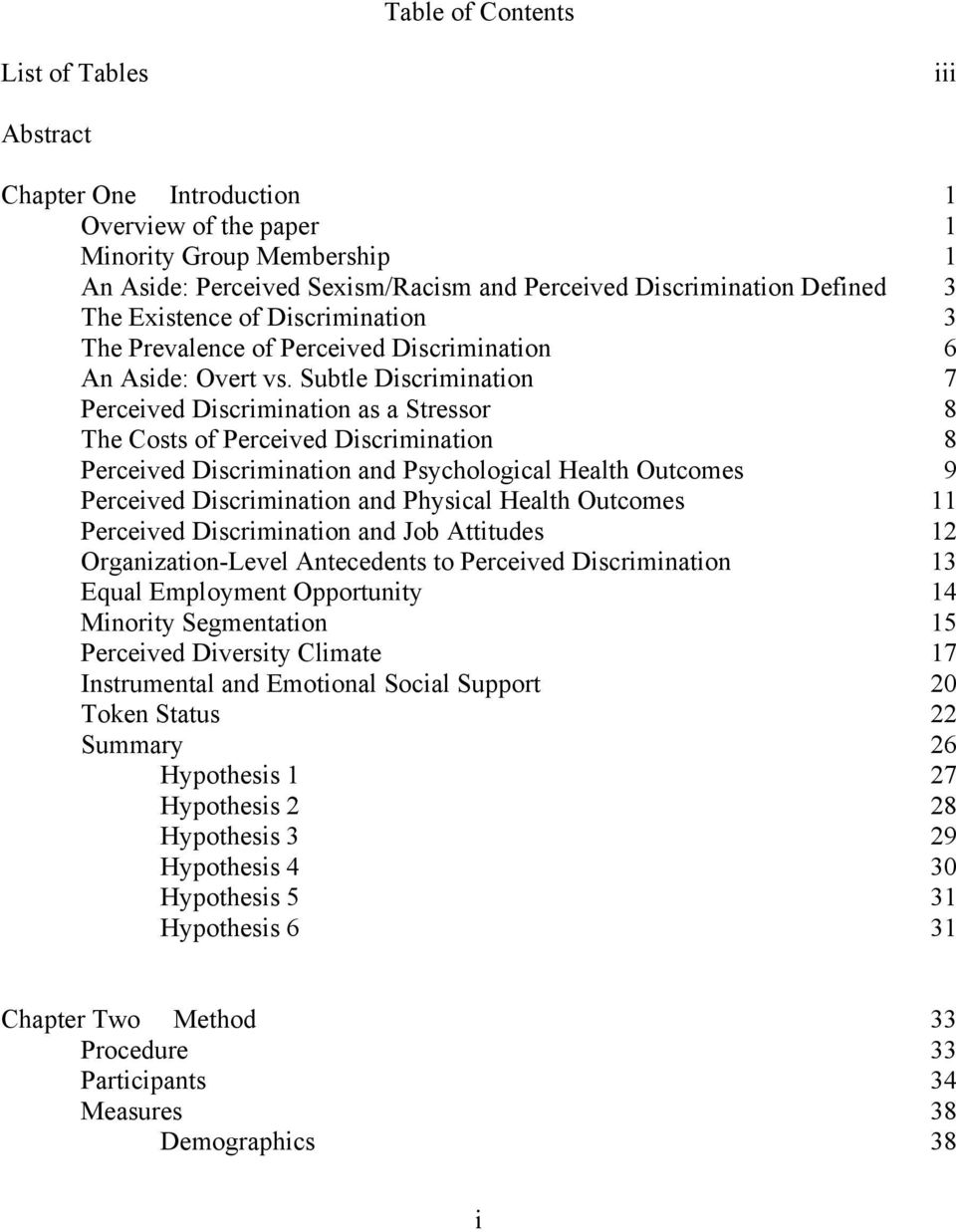
4 Table of Contents List of Tables iii Abstract Chapter One Introduction 1 Overview of the paper 1 Minority Group Membership 1 An Aside: Perceived Sexism/Racism and Perceived Discrimination Defined 3 The Existence of Discrimination 3 The Prevalence of Perceived Discrimination 6 An Aside: Overt vs. Subtle Discrimination 7 Perceived Discrimination as a Stressor 8 The Costs of Perceived Discrimination 8 Perceived Discrimination and Psychological Health Outcomes 9 Perceived Discrimination and Physical Health Outcomes 11 Perceived Discrimination and Job Attitudes 12 Organization-Level Antecedents to Perceived Discrimination 13 Equal Employment Opportunity 14 Minority Segmentation 15 Perceived Diversity Climate 17 Instrumental and Emotional Social Support 20 Token Status 22 Summary 26 Hypothesis 1 27 Hypothesis 2 28 Hypothesis 3 29 Hypothesis 4 30 Hypothesis 5 31 Hypothesis 6 31 Chapter Two Method 33 Procedure 33 Participants 34 Measures 38 Demographics 38 i
5 Equal Employment Opportunity 38 Perceived Minority Segmentation 39 Diversity Climate 39 Instrumental Social Support 40 Emotional Social Support 40 Token Status 41 Perceived Discrimination at work (overt) 41 Perceived Discrimination at work (subtle) 42 Every-day Perceived Discrimination 42 Physical Health 43 Psychological Health 44 Job Satisfaction 43 Organizational Commitment 43 Intention to Turnover 43 Data Analysis 44 Chapter Three Results 48 Analysis of Pilot Test Data 48 Analysis of Full Demonstration Data 68 Results for Perceived Equal Employment Opportunity/ Diversity Climate 73 Sex-Based Discrimination 73 Race-Based Discrimination 82 Results for Minority Segmentation 92 Sex-Based Discrimination 92 Race-Based Discrimination 102 Results for Social Support 112 Sex-Based Discrimination 112 Race-Based Discrimination 122 Analysis of Coworker Responses 133 Chapter Four Discussion 136 Summary of Results for Equal Employment Opportunity/ Diversity Climate 136 Summary of Results for Minority Segmentation 137 Summary of Results for Social Support 140 Sex-Based vs. Race-Based Perceived Discrimination 142 Conclusions 143 Limitations 144 Suggestions for Future Research 146 References 149 Appendix A: Measures 177 ii
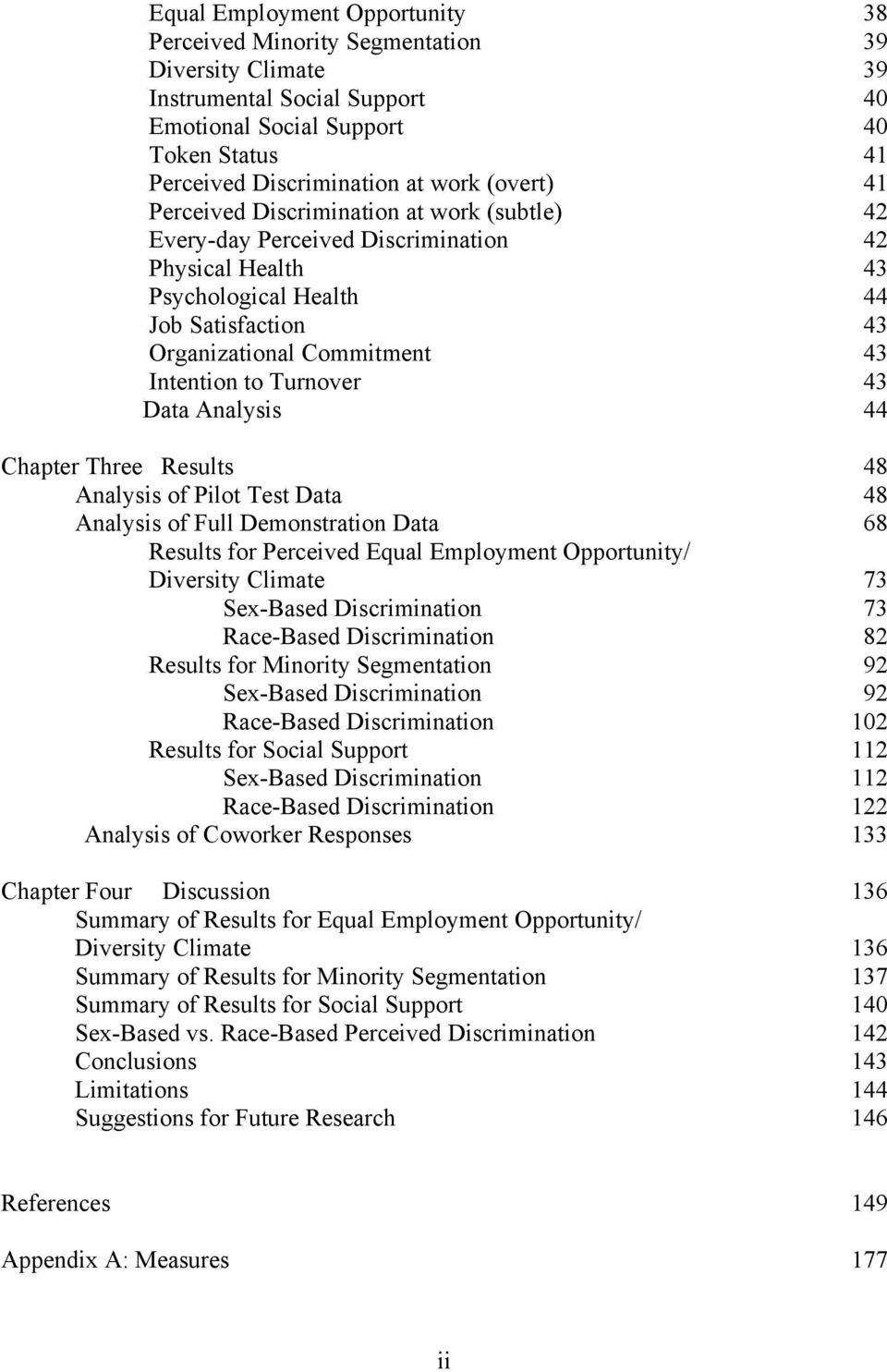
6 Appendix B: Original Version of Full Demonstration Analyses 189 About the Author End Page iii

7 List of Tables Table 1 Comparison of Minority and Majority group Members 35 Table 2 Group Comparison on Continuous Demographic Variables 36 Table 3 Group Comparison on Categorical Demographic Variables 37 Table 4 Item Analysis of Job Satisfaction Measure. 49 Table 5 Item Analysis of Organizational Commitment Measure. 50 Table 6 Item Analysis of SF-36 Physical Functioning Sub-scale 51 Table 7 Item Analysis of SF-36 Physical Role Limitations Scale 52 Table 8 Item Analysis of SF-36 Emotional Role Limitations Scale 52 Table 9 Item Analysis of the SF-36 Energy Sub-scale 53 Table 10 Item Analysis of the SF-36 Emotional Well-being Sub-scale 53 Table 11 Item Analysis of the SF-36 Social Functioning Sub-scale 54 Table 12 Item Analysis of the SF-36 Pain Sub-scale 54 Table 13 Item Analysis of the SF-36 General Health Sub-scale 54 Table 14 Item Analysis of the Instrumental Social Support Scale 55 Table 15 Item Analysis of the Emotional Social Support Scale 55 Table 16 Item Analysis of the Minority Segmentation Scale 56 Table 17 Item Analysis of the Diversity Climate Scale 57 Table 18 Item Analysis of the Subtle Gender Discrimination Scale 58 Table 19 Item Analysis of the Subtle Race Discrimination at Work Scale 59 iv

8 Table 20 Item Analysis of the Overt Race Discrimination at Work Scale 60 Table 21 Item Analysis of the Overt Gender Discrimination at Work Scale 61 Table 22 Item Analysis of the General Every-day Race Discrimination Scale 62 Table 23 Item Analysis of the General Every-day Gender Discrimination 63 Table 24 Item Analysis of the Equal Employment Opportunity Scale 64 Table 25 Percentage of Tokenism within the Workplace and Work Group 65 Table 26 Correlations Among the Discrimination Measures in Pilot Study 67 Table 27 Correlations Among all Measures used in Original Analyses 70 Table 28 Correlations Among all Measures used in Revised Analyses 72 Table 29 Table 30 Table 31 Table 32 Table 33 Table 34 Table 35 Results of Moderated Mediation (PREDICTOR= EEODIV, Med = Sex-based Discrimination, DV= Job Satisfaction, Mod = Gender) Results of Simple Mediation for Men and Women (PREDICTOR = EEODIV, Med = Sex-based Discrimination, DV = Job Satisfaction) Results of Moderated Mediation (PREDICTOR= EEODIV, Med = Sex-based Discrimination, DV= Organizational Commitment, Mod = Gender) Results of Simple Mediation for Men and Women (PREDICTOR = EEODIV, Med = Sex-based Discrimination, DV = Organizational Commitment) Results of Moderated Mediation (PREDICTOR= EEODIV, Med = Sex-based Discrimination, DV= Intent to Turnover, Mod = Gender) Results of Simple Mediation for Men and Women (PREDICTOR = EEODIV, Med = Sex-based Discrimination, DV = Intent to Turnover) Results of Moderated Mediation (PREDICTOR= EEODIV, Med = Sex-based Discrimination, DV= Physical Health, Mod = Gender) v

9 Table 36 Table 37 Table 38 Table 39 Table 40 Table 41 Table 42 Table 43 Table 44 Table 45 Table 46 Table 47 Results of Simple Mediation for Men and Women (PREDICTOR = EEODIV, Med = Sex-based Discrimination, DV = Physical Health) Results of Moderated Mediation (PREDICTOR= EEODIV, Med = Sex-based Discrimination, DV= Psychological Health, Mod = Gender) Results of Simple Mediation for Men and Women (PREDICTOR = EEODIV, Med = Sex-based Discrimination, DV = Psychological Health) Results of Moderated Mediation (PREDICTOR= EEODIV, Med = Race-based Discrimination, DV= Job Satisfaction, Mod = Race) Results of Simple Mediation for Whites and Non-Whites (PREDICTOR = EEODIV, Med = Race-based Discrimination, DV = Job Satisfaction) Results of Moderated Mediation (PREDICTOR= EEODIV, Med = Race-based Discrimination, DV= Organizational Commitment, Mod = Race) Results of Simple Mediation for Whites and Non-Whites (PREDICTOR = EEODIV, Med = Race-based Discrimination, DV = Organizational Commitment) Results of Moderated Mediation (PREDICTOR= EEODIV, Med = Race-based Discrimination, DV= Intent to Turnover, Mod = Race) Results of Simple Mediation for Whites and Non-Whites (PREDICTOR = EEODIV, Med = Race-based Discrimination, DV = Intent to Turnover) Results of Moderated Mediation (PREDICTOR= EEODIV, Med = Race-based Discrimination, DV= Physical Health, Mod = Race) Results of Simple Mediation for Whites and Non-Whites (PREDICTOR = EEODIV, Med = Race-based Discrimination, DV = Physical Health) Results of Moderated Mediation (PREDICTOR= EEODIV, Med = Race-based Discrimination, DV= Psychological Health, Mod = Race) vi

10 Table 48 Table 49 Table 50 Table 51 Table 52 Table 53 Table 54 Table 55 Table 56 Table 57 Table 58 Results of Simple Mediation for Whites and Non-Whites (PREDICTOR = EEODIV, Med = Race-based Discrimination, DV = Psychological Health) Results of Moderated Mediation (PREDICTOR= Minority Segmentation, Med = Sex-based Discrimination, DV= Job Satisfaction, Mod = Gender) Results of Simple Mediation for Men and Women (PREDICTOR = Minority Segmentation, Med = Sex-based Discrimination, DV = Job Satisfaction) Results of Moderated Mediation (PREDICTOR= Minority Segmentation, Med = Sex-based Discrimination, DV= Organizational Commitment, Mod = Gender) Results of Simple Mediation for Men and Women (PREDICTOR = Minority Segmentation, Med = Sex-based Discrimination, DV = Organizational Commitment) Results of Moderated Mediation (PREDICTOR= Minority Segmentation, Med = Sex-based Discrimination, DV= Intent to Turnover, Mod = Gender) Results of Simple Mediation for Men and Women (PREDICTOR = Minority Segmentation, Med = Sex-based Discrimination, DV = Intent to Turnover) Results of Moderated Mediation (PREDICTOR= Minority Segmentation, Med = Sex-based Discrimination, DV= Physical Health, Mod = Gender) Results of Simple Mediation for Men and Women (PREDICTOR = Minority Segmentation, Med = Sex-based Discrimination, DV = Physical Health) Results of Moderated Mediation (PREDICTOR= Minority Segmentation, Med = Sex-based Discrimination, DV= Psychological Health, Mod = Gender) Results of Simple Mediation for Men and Women (PREDICTOR = Minority Segmentation, Med = Sex-based Discrimination, DV = Psychological Health) vii

11 Table 59 Table 60 Table 61 Table 62 Table 63 Table 64 Table 65 Table 66 Table 67 Table 68 Table 69 Results of Moderated Mediation (PREDICTOR= Minority Segmentation, Med = Race-based Discrimination, DV= Job Satisfaction, Mod = Race) Results of Simple Mediation for Whites and Non-Whites (PREDICTOR = Minority Segmentation, Med = Race-based Discrimination, DV = Job Satisfaction) Results of Moderated Mediation (PREDICTOR= Minority Segmentation, Med = Race-based Discrimination, DV= Organizational Commitment, Mod = Race) Results of Simple Mediation for Whites and Non-Whites (PREDICTOR = Minority Segmentation, Med = Race-based Discrimination, DV = Organizational Commitment) Results of Moderated Mediation (PREDICTOR= Minority Segmentation, Med = Race-based Discrimination, DV= Intent to Turnover, Mod = Race) Results of Simple Mediation for Whites and Non-Whites (PREDICTOR = Minority Segmentation, Med = Race-based Discrimination, DV = Intent to Turnover) Results of Moderated Mediation (PREDICTOR= Minority Segmentation, Med = Race-based Discrimination, DV= Physical Health, Mod = Race) Results of Simple Mediation for Whites and Non-Whites (PREDICTOR = Minority Segmentation, Med = Race-based Discrimination, DV = Physical Health) Results of Moderated Mediation (PREDICTOR= Minority Segmentation, Med = Race-based Discrimination, DV= Psychological Health, Mod = Race) Results of Simple Mediation for Whites and Non-Whites (PREDICTOR = Minority Segmentation, Med = Race-based Discrimination, DV = Psychological Health) Results of Moderated Mediation (PREDICTOR= Social Support, Med = Sex-based Discrimination, DV= Job Satisfaction, Mod = Gender) viii

12 Table 70 Table 71 Table 72 Table 73 Table 74 Table 75 Table 76 Table 77 Table 78 Table 79 Table 80 Results of Simple Mediation for Men and Women (PREDICTOR = Social Support, Med = Sex-based Discrimination, DV = Job Satisfaction) Results of Moderated Mediation (PREDICTOR= Social Support, Med = Sex-based Discrimination, DV= Organizational Commitment, Mod = Gender) Results of Simple Mediation for Men and Women (PREDICTOR = Social Support, Med = Sex-based Discrimination, DV = Organizational Commitment) Results of Moderated Mediation (PREDICTOR= Social Support, Med = Sex-based Discrimination, DV= Intent to Turnover, Mod = Gender) Results of Simple Mediation for Men and Women (PREDICTOR = Social Support, Med = Sex-based Discrimination, DV = Intent to Turnover) Results of Moderated Mediation (PREDICTOR= Social Support, Med = Sex-based Discrimination, DV= Physical Health, Mod = Gender) Results of Simple Mediation for Men and Women (PREDICTOR = Social Support, Med = Sex-based Discrimination, DV = Physical Health) Results of Moderated Mediation (PREDICTOR= Social Support, Med = Sex-based Discrimination, DV= Psychological Health, Mod = Gender) Results of Simple Mediation for Men and Women (PREDICTOR = Social Support, Med = Sex-based Discrimination, DV = Psychological Health) Results of Moderated Mediation (PREDICTOR= Social Support, Med = Race-based Discrimination, DV= Job Satisfaction, Mod = Race) Results of Simple Mediation for Whites and Non-Whites (PREDICTOR = Social Support, Med = Race-based Discrimination, DV = Job Satisfaction) ix
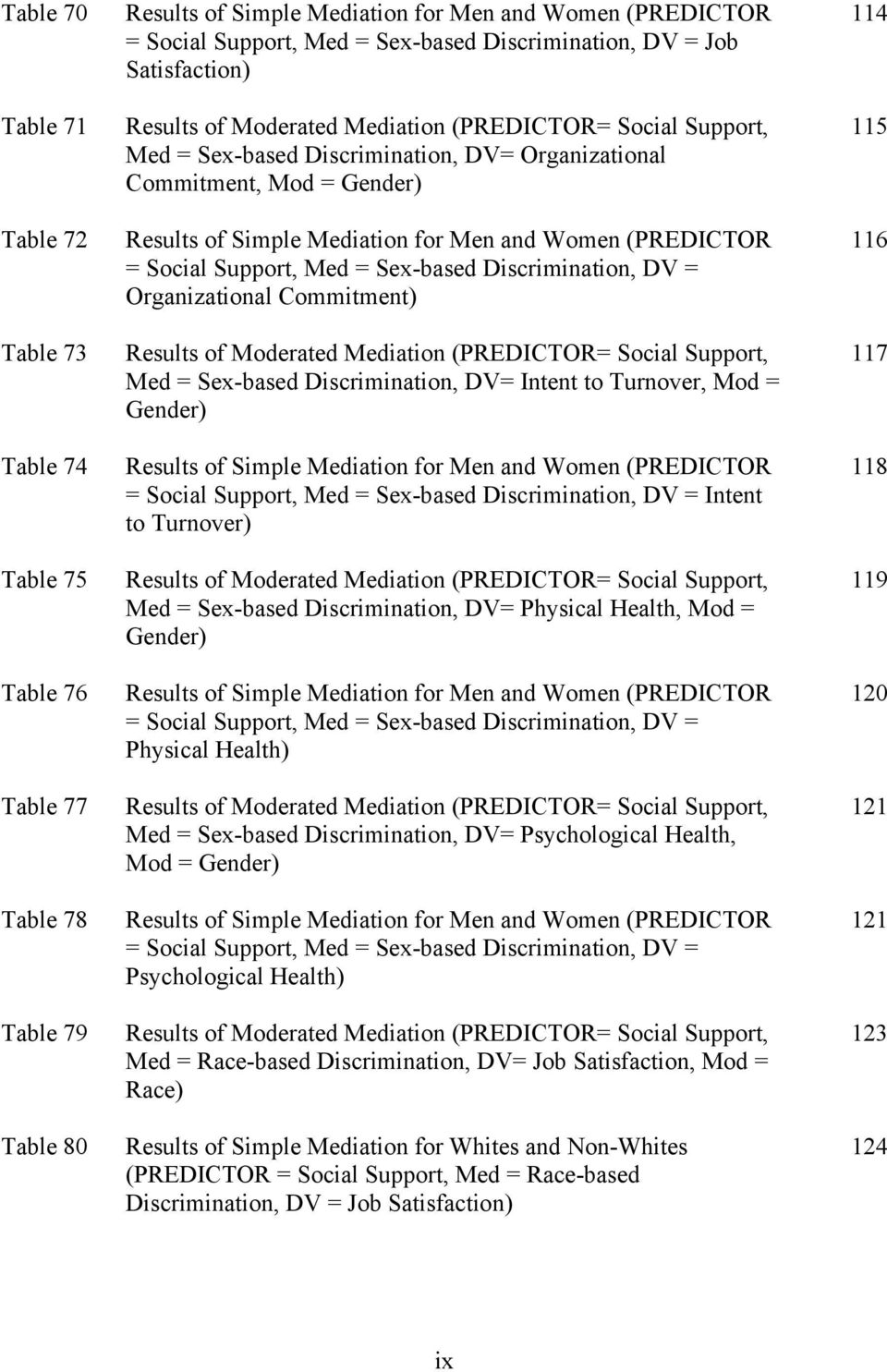
13 Table 81 Table 82 Table 83 Table 84 Table 85 Table 86 Table 87 Table 88 Table 89 Results of Moderated Mediation (PREDICTOR= Social Support, Med = Race-based Discrimination, DV= Organizational Commitment, Mod = Race) Results of Simple Mediation for Whites and Non-Whites (PREDICTOR = Social Support, Med = Race-based Discrimination, DV = Organizational Commitment) Results of Moderated Mediation (PREDICTOR= Social Support, Med = Race-based Discrimination, DV= Intent to Turnover, Mod = Race) Results of Simple Mediation for Whites and Non-Whites (PREDICTOR = Social Support, Med = Race-based Discrimination, DV = Intent to Turnover) Results of Moderated Mediation (PREDICTOR= Social Support, Med = Race-based Discrimination, DV= Physical Health, Mod = Race) Results of Simple Mediation for Whites and Non-Whites (PREDICTOR = Social Support, Med = Race-based Discrimination, DV = Physical Health) Results of Moderated Mediation (PREDICTOR= Social Support, Med = Race-based Discrimination, DV= Psychological Health, Mod = Race) Results of Simple Mediation for Whites and Non-Whites (PREDICTOR = Social Support, Med = Race-based Discrimination, DV = Psychological Health) Summary of Significant Results for Equal Employment Opportunity/Diversity Climate Table 90 Summary of Significant Results for Minority Segmentation 132 Table 91 Summary of Significant Results for Social Support 133 Table 92 Table 93 Descriptive Statistics for Organizational Antecedents Comparing Study Participants to Coworkers Results of Moderated Mediation (Predictor = EEO, Med = Subtle Discrimination, DV = Job Satisfaction, Mod = Gender) x

14 Table 94 Table 95 Table 96 Table 97 Table 98 Table 99 Table 100 Table 101 Table 102 Table 103 Table 104 Table 105 Results of Simple Mediation Follow-up Tests for Men and Women (Predictor = EEO, Med = Subtle Discrimination, DV = Job Satisfaction) Results of Moderated Mediation (Predictor = EEO, Med = Subtle Discrimination, DV = Organizational Commitment, Mod = Gender) Results of Simple Mediation Follow-up Tests for Men and Women (Predictor = EEO, Med = Subtle Discrimination, DV = Organizational Commitment) Results of Moderated Mediation (Predictor = EEO, Med = Subtle Discrimination, DV = Intent to Turnover, Mod = Gender) Results of Simple Mediation Follow-up Tests for Men and Women (Predictor = EEO, Med = Subtle Discrimination, DV = Intent to Turnover) Results of Moderated Mediation (Predictor = EEO, Med = Subtle Discrimination, DV = Physical Health, Mod = Gender) Results of Simple Mediation Follow-up Tests for Men and Women (Predictor = EEO, Med = Subtle Discrimination, DV = Physical Health) Results of Moderated Mediation (Predictor = EEO, Med = Subtle Discrimination, DV = Psychological Health, Mod = Gender) Results of Simple Mediation Follow-up Tests for Men and Women (Predictor = EEO, Med = Subtle Discrimination, DV = Psychological Health) Results of Moderated Mediation (Predictor = EEO, Med = Overt Discrimination, DV = Job Satisfaction, Mod = Gender) Results of Simple Mediation Follow-up Tests for Men and Women (Predictor = EEO, Med = Overt Discrimination, DV = Job Satisfaction) Results of Moderated Mediation (Predictor = EEO, Med = Overt Discrimination, DV = Organizational Commitment, Mod = Gender) xi
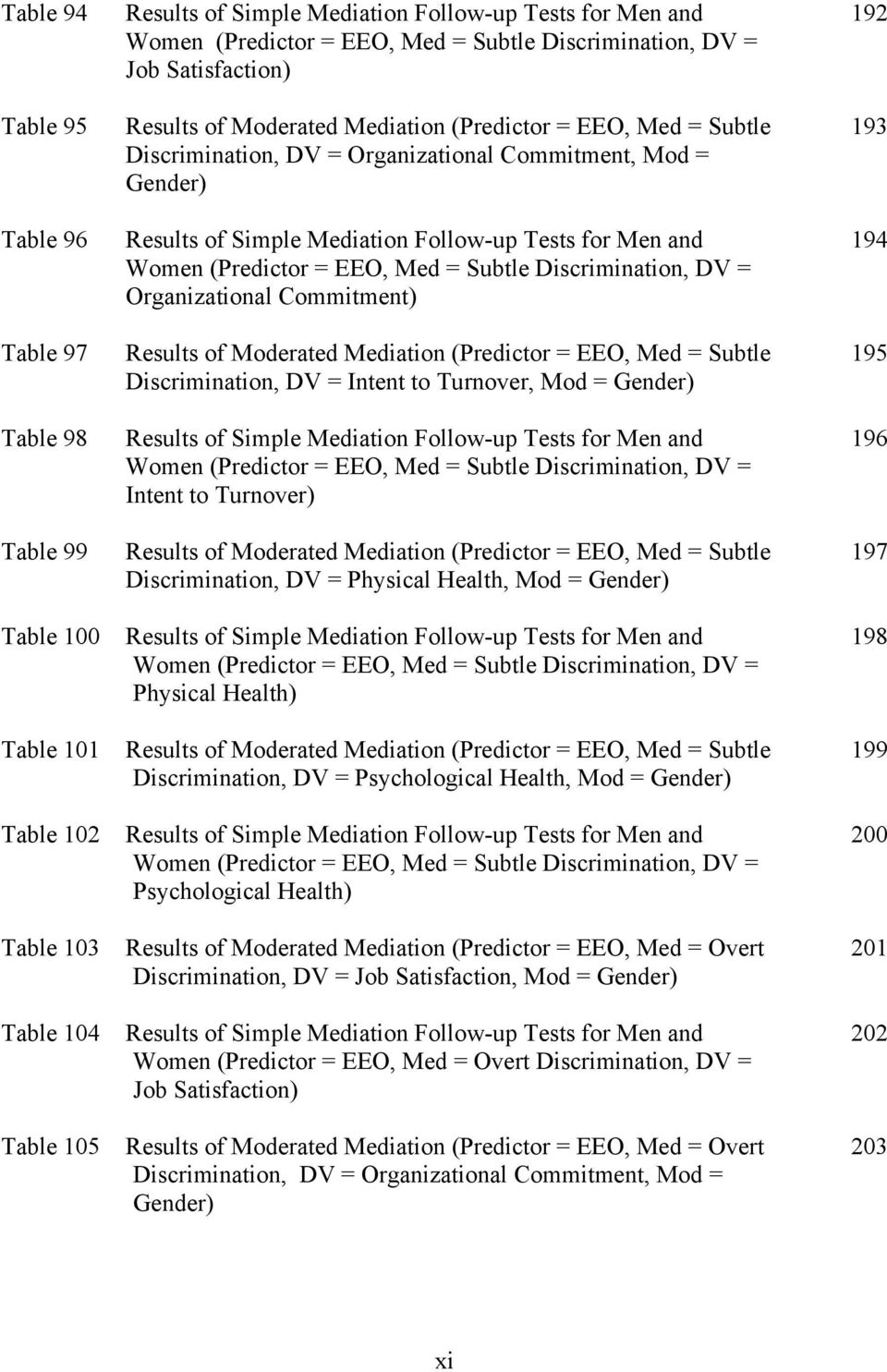
15 Table 106 Table 107 Table 108 Table 109 Table 110 Table 111 Results of Simple Mediation Follow-up Tests for Men and Women (Predictor = EEO, Med = Overt Discrimination, DV = Organizational Commitment) Results of Moderated Mediation (Predictor = EEO, Med = Overt Discrimination, DV = Intent to Turnover, Mod = Gender) Results of Simple Mediation Follow-up Tests for Men and Women (Predictor = EEO, Med = Overt Discrimination, DV = Intent to Turnover) Results of Moderated Mediation (Predictor = EEO, Med = Overt Discrimination, DV = Physical Health, Mod = Gender) Results of Simple Mediation Follow-up Tests for Men and Women (Predictor = EEO, Med = Overt Discrimination, DV = Physical Health) Results of Moderated Mediation (Predictor = EEO, Med = Overt Discrimination, DV = Psychological Health, Mod = Gender) Table 112 Results of Simple Mediation Follow-up Tests for Men and Women (Predictor = EEO, Med = Overt Discrimination, DV = Psychological Health) 210 Table 113 Table 114 Table 115 Table 116 Table 117 Table 118 Results of Moderated Mediation (Predictor = EEO, Med = Subtle Discrimination, DV = Job Satisfaction, Mod = Race) Results of Simple Mediation Follow-up Tests for Whites and Non-whites (Predictor = EEO, Med = Subtle Discrimination, DV = Job Satisfaction) Results of Moderated Mediation (Predictor = EEO, Med = Subtle Discrimination, DV = Organizational Commitment, Mod = Race) Results of Simple Mediation Follow-up Tests for Whites and Non-whites (Predictor = EEO, Med = Subtle Discrimination, DV = Organizational Commitment) Results of Moderated Mediation (Predictor = EEO, Med = Subtle Discrimination, DV = Intent to Turnover, Mod = Race) Results of Simple Mediation Follow-up Tests for Whites and Non-whites (Predictor = EEO, Med = Subtle Discrimination, DV = Intent to Turnover) xii

16 Table 119 Table 120 Table 121 Table 122 Table 123 Table 124 Table 125 Table 126 Table 127 Table 128 Table 129 Table 130 Table 131 Results of Moderated Mediation (Predictor = EEO, Med = Subtle Discrimination, DV = Physical Health, Mod = Race) Results of Simple Mediation Follow-up Tests for Whites and Non-whites (Predictor = EEO, Med = Subtle Discrimination, DV = Physical Health) Results of Moderated Mediation (Predictor = EEO, Med = Subtle Discrimination, DV = Psychological Health, Mod = Race) Results of Simple Mediation Follow-up Tests for Whites and Non-whites (Predictor = EEO, Med = Subtle Discrimination, DV = Psychological Health) Results of Moderated Mediation (Predictor = EEO, Med = Overt Discrimination, DV = Job Satisfaction, Mod = Race) Results of Simple Mediation Follow-up Tests for Whites and Non-whites (Predictor = EEO, Med = Overt Discrimination, DV = Job Satisfaction) Results of Moderated Mediation (Predictor = EEO, Med = Overt Discrimination, DV = Organizational Commitment, Mod = Race) Results of Simple Mediation Follow-up Tests for Whites and Non-whites (Predictor = EEO, Med = Overt Discrimination, DV = Organizational Commitment) Results of Moderated Mediation (Predictor = EEO, Med = Overt Discrimination, DV = Intent to Turnover, Mod = Race) Results of Simple Mediation Follow-up Tests for Whites and Non-whites (Predictor = EEO, Med = Overt Discrimination, DV = Intent to Turnover) Results of Model rated Mediation (Predictor = EEO, Med = Overt Discrimination, DV = Physical Health, Mod = Race) Results of Simple Mediation Follow-up Tests for Whites and Non-whites (Predictor = EEO, Med = Overt Discrimination, DV = Physical Health) Results of Moderated Mediation (Predictor = EEO, Med = Overt Discrimination, DV = Psychological Health, Mod = Race) xiii

17 Table 132 Table 133 Table 134 Table 135 Table 136 Table 137 Table 138 Table 139 Table 140 Table 141 Table 142 Results of Simple Mediation Follow-up Tests for Whites and Non-whites (Predictor = EEO, Med = Overt Discrimination, DV = Psychological Health) Results of Moderated Mediation (Predictor = MINORITY SEG, Med = Subtle Discrimination, DV = Job Satisfaction, Mod = Gender) Results of Simple Mediation Follow-up Tests for Men and Women (Predictor = MINORITY SEG, Med = Subtle Discrimination, DV = Job Satisfaction) Results of Moderated Mediation (Predictor = MINORITY SEG, Med = Subtle Discrimination, DV = Organizational Commitment, Mod = Gender) Results of Simple Mediation Follow-up Tests for Men and Women (Predictor = MINORITY SEG, Med = Subtle Discrimination, DV = Organizational Commitment) Results of Moderated Mediation (Predictor = MINORITY SEG, Med = Subtle Discrimination, DV = Intent to Turnover, Mod = Gender) Results of Simple Mediation Follow-up Tests for Men and Women (Predictor = MINORITY SEG, Med = Subtle Discrimination, DV = Intent to Turnover) Results of Moderated Mediation (Predictor = MINORITY SEG, Med = Subtle Discrimination, DV = Physical Health, Mod = Gender) Results of Simple Mediation Follow-up Tests for Men and Women (Predictor = MINORITY SEG, Med = Subtle Discrimination, DV = Physical Health) Results of Moderated Mediation (Predictor = MINORITY SEG, Med = Subtle Discrimination, DV = Psychological Health, Mod = Gender) Results of Simple Mediation Follow-up Tests for Men and Women (Predictor = MINORITY SEG, Med = Subtle Discrimination, DV = Psychological Health) xiv
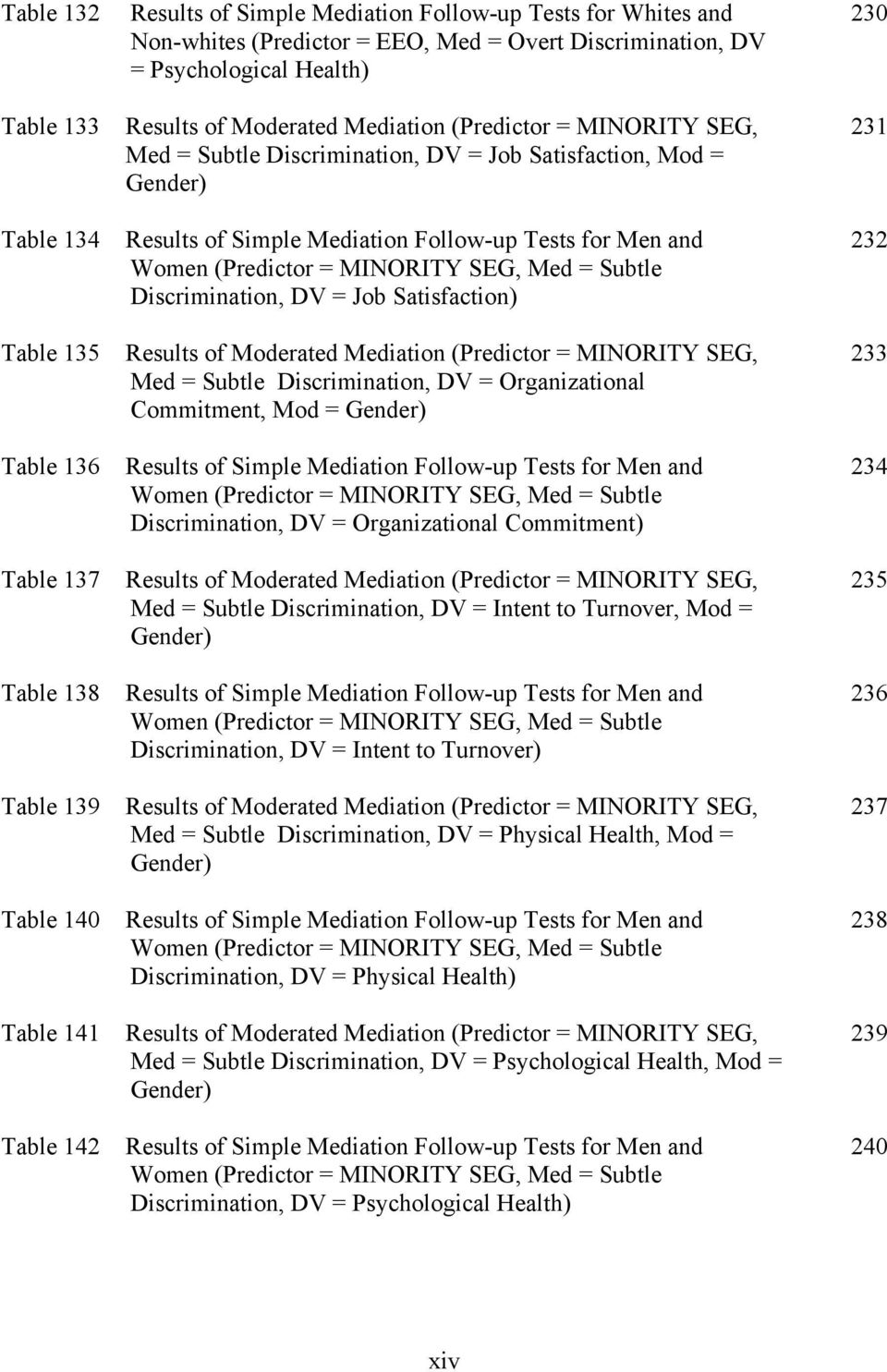
18 Table 143 Table 144 Table 145 Table 146 Table 147 Results of Moderated Mediation (Predictor = MINORITY SEG, Med = Overt Discrimination, DV = Job Satisfaction, Mod = Gender) Results of Simple Mediation Follow-up Tests for Men and Women (Predictor = MINORITY SEG, Med = Overt Discrimination, DV = Job Satisfaction) Results of Moderated Mediation (Predictor = MINORITY SEG, Med = Overt Discrimination, DV = Organizational Commitment, Mod = Gender) Results of Simple Mediation Follow-up Tests for Men and Women (Predictor = MINORITY SEG, Med = Overt Discrimination, DV = Organizational Commitment) Results of Moderated Mediation (Predictor = MINORITY SEG, Med = Overt Discrimination, DV = Intent to Turnover, Mod = Gender) Table 148 Results of Simple Mediation Follow-up Tests for Men and Women (Predictor = MINORITY SEG, Med = Overt Discrimination, DV = Intent to Turnover) Table 149 Results of Moderated Mediation (Predictor = MINORITY SEG, Med = Overt Discrimination, DV = Physical Health, Mod = Gender) Table 150 Results of Simple Mediation Follow-up Tests for Men and Women (Predictor = MINORITY SEG, Med = Overt Discrimination, DV = Physical Health) Table 151 Results of Moderated Mediation (Predictor = MINORITY SEG, Med = Overt Discrimination, DV = Psychological Health, Mod = Gender) Table 152 Results of Simple Mediation Follow-up Tests for Men and Women (Predictor = MINORITY SEG, Med = Overt Discrimination, DV = Psychological Health) Table 153 Results of Moderated Mediation (Predictor = MINORITY SEG, Med = Subtle Discrimination, DV = Job Satisfaction, Mod = Race) xv
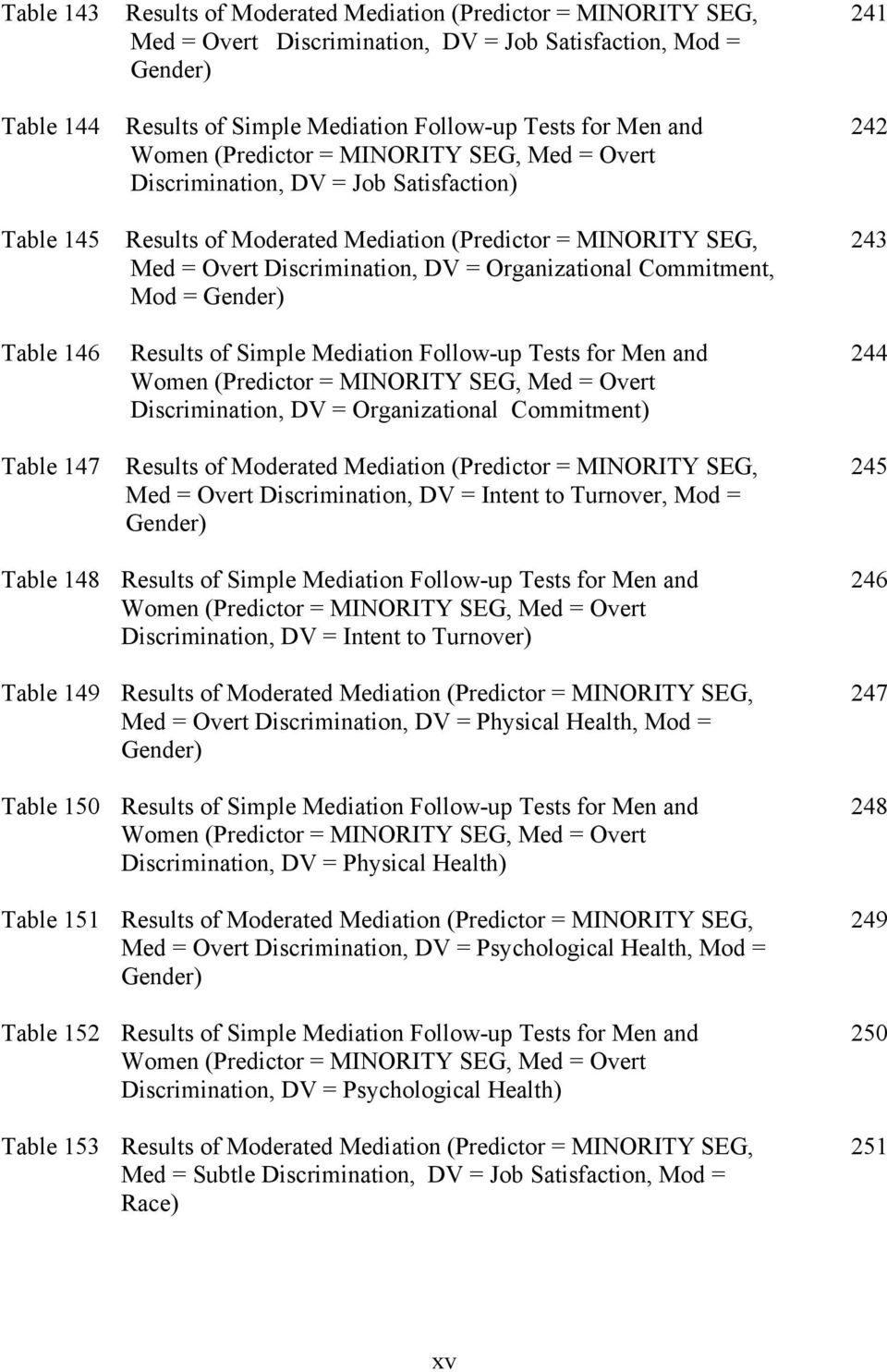
19 Table 154 Results of Simple Mediation Follow-up Tests for Whites and Nonwhites (Predictor = MINORITY SEG, Med = Subtle Discrimination, DV = Job Satisfaction) Table 155 Results of Moderated Mediation (Predictor = MINORITY SEG, Med = Subtle Discrimination, DV = Organizational Commitment, Mod = Race) Table 156 Results of Simple Mediation Follow-up Tests for Whites and Nonwhites (Predictor = MINORITY SEG, Med = Subtle Discrimination, DV = Organizational Commitment) Table 157 Results of Moderated Mediation (Predictor = MINORITY SEG, Med = Subtle Discrimination, DV = Intent to Turnover, Mod = Race) Table 158 Results of Simple Mediation Follow-up Tests for Whites and Nonwhites (Predictor = MINORITY SEG, Med = Subtle Discrimination, DV = Intent to Turnover) Table 159 Results of Moderated Mediation (Predictor = MINORITY SEG, Med = Subtle Discrimination, DV = Physical Health, Mod = Race) Table 160 Results of Simple Mediation Follow-up Tests for Whites and Nonwhites (Predictor = MINORITY SEG, Med = Subtle Discrimination, DV = Physical Health) Table 161 Table 162 Table 163 Table 164 Table 165 Results of Moderated Mediation (Predictor = MINORITY SEG, Med = Subtle Discrimination, DV = Psychological Health, Mod = Race) Results of Simple Mediation Follow-up Tests for Whites and Non-whites (Predictor = MINORITY SEG, Med = Subtle Discrimination, DV = Psychological Health) Results of Moderated Mediation (Predictor = MINORITY SEG, Med = Overt Discrimination, DV = Job Satisfaction, Mod = Race) Results of Simple Mediation Follow-up Tests for Whites and Non-whites (Predictor = MINORITY SEG, Med = Overt Discrimination, DV = Job Satisfaction) Results of Moderated Mediation (Predictor = MINORITY SEG, Med = Overt Discrimination, DV = Organizational Commitment, Mod = Race) xvi
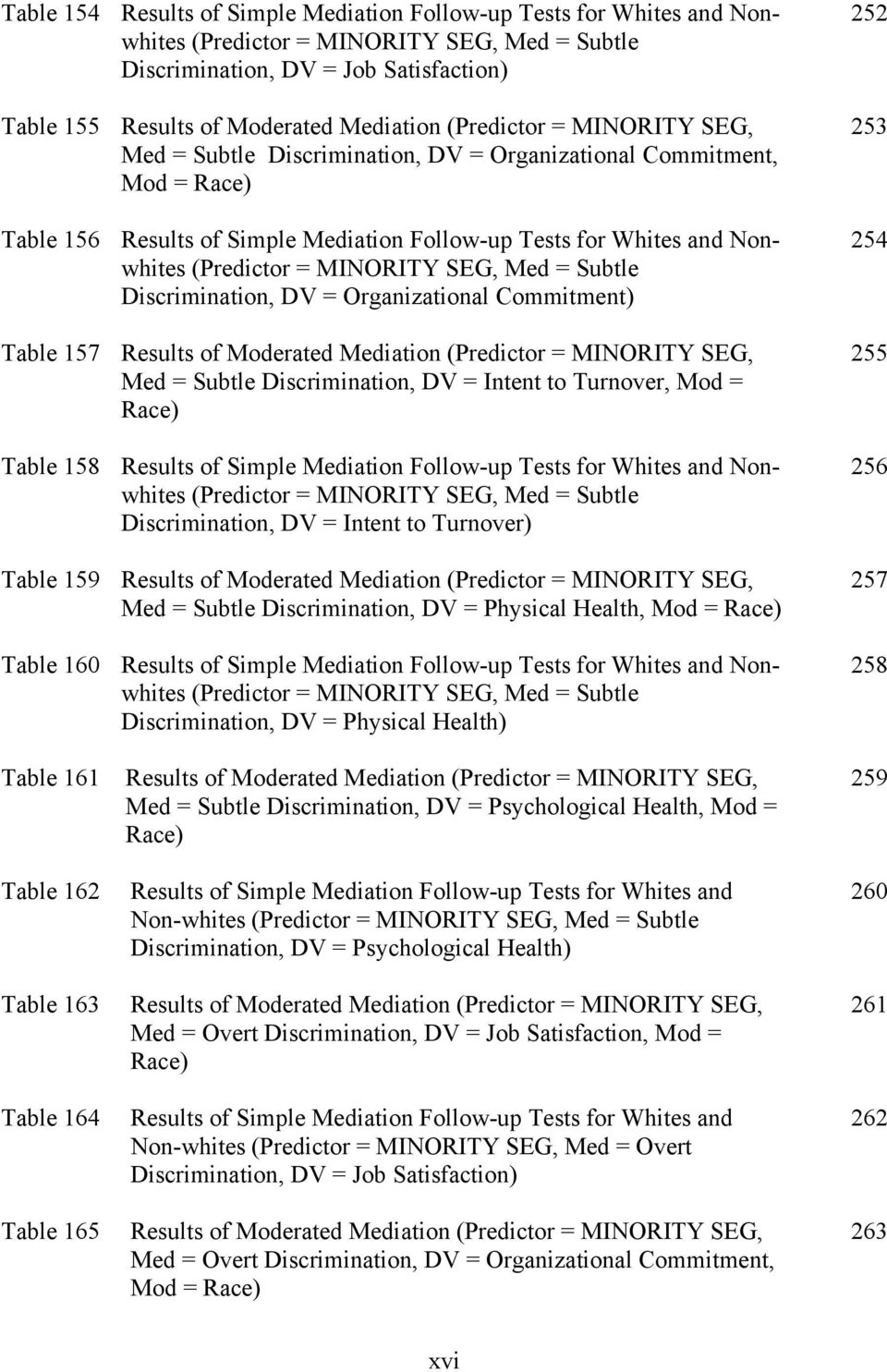
20 Table 166 Table 167 Table 168 Table 169 Table 170 Table 171 Table 172 Table 173 Table 174 Table 175 Table 176 Results of Simple Mediation Follow-up Tests for Whites and Non-whites (Predictor = MINORITY SEG, Med = Overt Discrimination, DV = Organizational Commitment) Results of Moderated Mediation (Predictor = MINORITY SEG, Med = Overt Discrimination, DV = Intent to Turnover, Mod = Race) Results of Simple Mediation Follow-up Tests for Whites and Non-whites (Predictor = MINORITY SEG, Med = Overt Discrimination, DV = Intent to Turnover) Results of Moderated Mediation (Predictor = MINORITY SEG, Med = Overt Discrimination, DV = Physical Health, Mod = Race) Results of Simple Mediation Follow-up Tests for Whites and Non-whites (Predictor = MINORITY SEG, Med = Overt Discrimination, DV = Physical Health) Results of Moderated Mediation (Predictor = MINORITY SEG, Med = Overt Discrimination, DV = Psychological Health, Mod = Race) Results of Simple Mediation Follow-up Tests for Whites and Non-whites (Predictor = MINORITY SEG, Med = Overt Discrimination, DV = Psychological Health) Results of Moderated Mediation (Predictor = DIVERSITY CLIMATE, Med = Subtle Discrimination, DV = Job Satisfaction, Mod = Gender) Results of Simple Mediation Follow-up Tests for Men and Women (Predictor = DIVERSITY CLIMATE, Med = Subtle Discrimination, DV = Job Satisfaction) Results of Moderated Mediation (Predictor = DIVERSITY CLIMATE, Med = Subtle Discrimination, DV = Organizational Commitment, Mod = Gender) Results of Simple Mediation Follow-up Tests for Men and Women (Predictor = DIVERSITY CLIMATE, Med = Subtle Discrimination, DV = Organizational Commitment) xvii
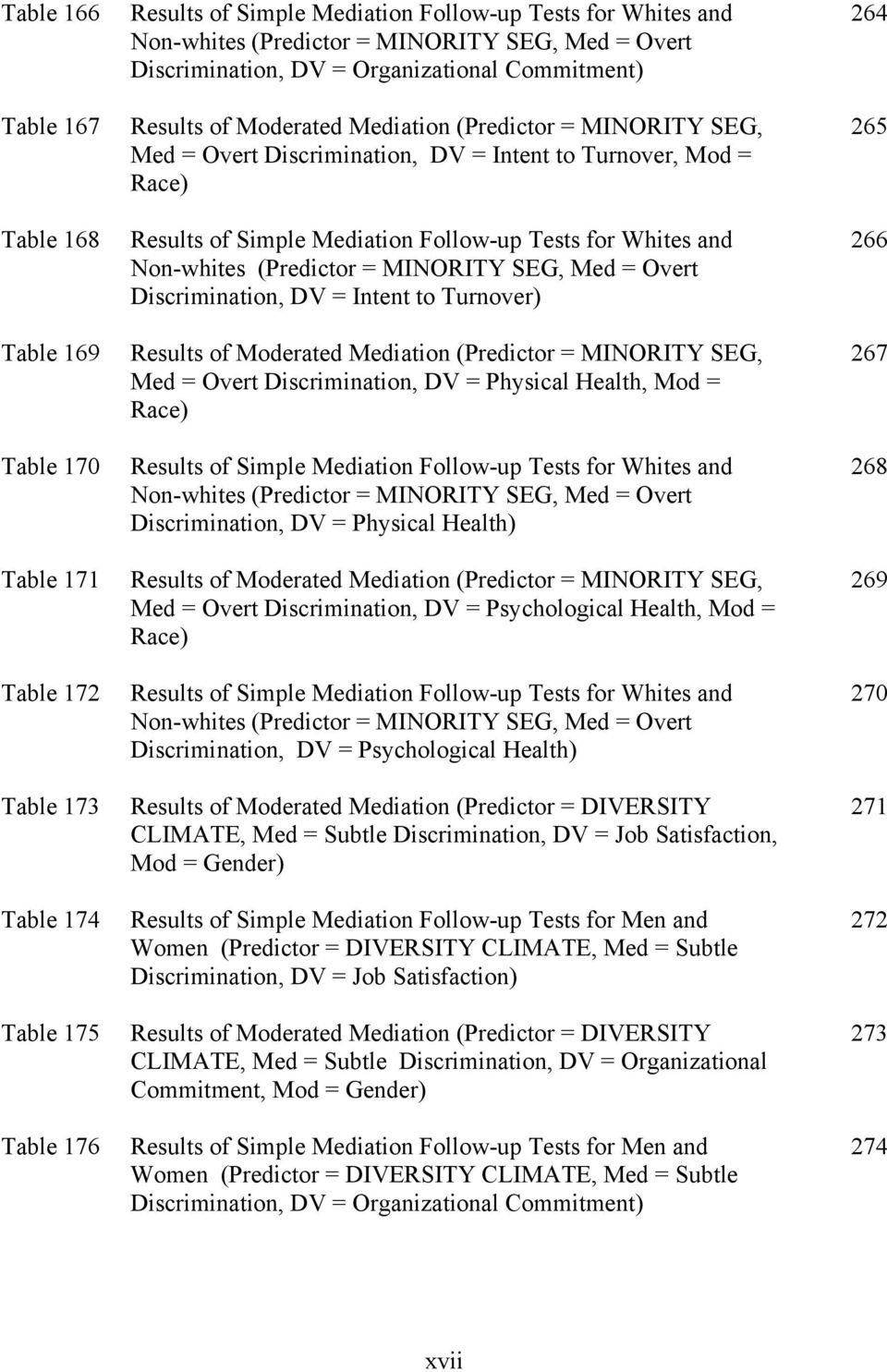
21 Table 177 Table 178 Table 179 Table 180 Table 181 Table 182 Table 183 Table 184 Table 185 Table 186 Table 187 Results of Moderated Mediation (Predictor = DIVERSITY CLIMATE, Med = Subtle Discrimination, DV = Intent to Turnover, Mod = Gender) Results of Simple Mediation Follow-up Tests for Men and Women (Predictor = DIVERSITY CLIMATE, Med = Subtle Discrimination, DV = Intent to Turnover) Results of Moderated Mediation (Predictor = DIVERSITY CLIMATE, Med = Subtle Discrimination, DV = Physical Health, Mod = Gender) Results of Simple Mediation Follow-up Tests for Men and Women (Predictor = DIVERSITY CLIMATE, Med = Subtle Discrimination, DV = Physical Health) Results of Moderated Mediation (Predictor = DIVERSITY CLIMATE, Med = Subtle Discrimination, DV = Psychological Health, Mod = Gender) Results of Simple Mediation Follow-up Tests for Men and Women (Predictor = DIVERSITY CLIMATE, Med = Subtle Discrimination, DV = Psychological Health) Results of Moderated Mediation (Predictor = DIVERSITY CLIMATE, Med = Overt Discrimination, DV = Job Satisfaction, Mod = Gender) Results of Simple Mediation Follow-up Tests for Men and Women (Predictor = DIVERSITY CLIMATE, Med = Overt Discrimination, DV = Job Satisfaction) Results of Moderated Mediation (Predictor = DIVERSITY CLIMATE, Med = Overt Discrimination, DV = Organizational Commitment, Mod = Gender) Results of Simple Mediation Follow-up Tests for Men and Women (Predictor = DIVERSITY CLIMATE, Med = Overt Discrimination, DV = Organizational Commitment) Results of Moderated Mediation (Predictor = DIVERSITY CLIMATE, Med = Overt Discrimination, DV = Intent to Turnover, Mod = Gender) xviii
22 Table 188 Table 189 Table 190 Table 191 Table 192 Table 193 Table 194 Table 195 Table 196 Table 197 Table 198 Results of Simple Mediation Follow-up Tests for Men and Women (Predictor = DIVERSITY CLIMATE, Med = Overt Discrimination, DV = Intent to Turnover) Results of Moderated Mediation (Predictor = DIVERSITY CLIMATE, Med = Overt Discrimination, DV = Physical Health, Mod = Gender) Results of Simple Mediation Follow-up Tests for Men and Women (Predictor = DIVERSITY CLIMATE, Med = Overt Discrimination, DV = Physical Health) Results of Moderated Mediation (Predictor = DIVERSITY CLIMATE, Med = Overt Discrimination, DV = Psychological Health, Mod = Gender) Results of Simple Mediation Follow-up Tests for Men and Women (Predictor = DIVERSITY CLIMATE, Med = Overt Discrimination, DV = Psychological Health) Results of Moderated Mediation (Predictor = DIVERSITY CLIMATE, Med = Subtle Discrimination, DV = Job Satisfaction, Mod = Race) Results of Simple Mediation Follow-up Tests for Whites and Non-whites (Predictor = DIVERSITY CLIMATE, Med = Subtle Discrimination, DV = Job Satisfaction) Results of Moderated Mediation (Predictor = DIVERSITY CLIMATE, Med = Subtle Discrimination, DV = Organizational Commitment, Mod = Race) Results of Simple Mediation Follow-up Tests for Whites and Non-whites (Predictor = DIVERSITY CLIMATE, Med = Subtle Discrimination, DV = Organizational Commitment) Results of Moderated Mediation (Predictor = DIVERSITY CLIMATE, Med = Subtle Discrimination, DV = Intent to Turnover, Mod = Race) Results of Simple Mediation Follow-up Tests for Whites and Non-whites (Predictor = DIVERSITY CLIMATE, Med = Subtle Discrimination, DV = Intent to Turnover) xix
23 Table 199 Table 200 Table 201 Table 202 Table 203 Table 204 Table 205 Table 206 Table 207 Table 208 Table 209 Results of Moderated Mediation (Predictor = DIVERSITY CLIMATE, Med = Subtle Discrimination, DV = Physical Health, Mod = Race) Results of Simple Mediation Follow-up Tests for Whites and Non-whites (Predictor = DIVERSITY CLIMATE, Med = Subtle Discrimination, DV = Physical Health) Results of Moderated Mediation (Predictor = DIVERSITY CLIMATE, Med = Subtle Discrimination, DV = Psychological Health, Mod = Race) Results of Simple Mediation Follow-up Tests for Whites and Non-whites (Predictor = DIVERSITY CLIMATE, Med = Subtle Discrimination, DV = Psychological Health) Results of Moderated Mediation (Predictor = DIVERSITY CLIMATE, Med = Overt Discrimination, DV = Job Satisfaction, Mod = Race) Results of Simple Mediation Follow-up Tests for Whites and Non-whites (Predictor = DIVERSITY CLIMATE, Med = Overt Discrimination, DV = Job Satisfaction) Results of Moderated Mediation (Predictor = DIVERSITY CLIMATE, Med = Overt Discrimination, DV = Organizational Commitment, Mod = Race) Results of Simple Mediation Follow-up Tests for Whites and Non-whites (Predictor = DIVERSITY CLIMATE, Med = Overt Discrimination, DV = Organizational Commitment) Results of Moderated Mediation (Predictor = DIVERSITY CLIMATE, Med = Overt Discrimination, DV = Intent to Turnover, Mod = Race) Results of Simple Mediation Follow-up Tests for Whites and Non-whites (Predictor = DIVERSITY CLIMATE, Med = Overt Discrimination, DV = Intent to Turnover) Results of Moderated Mediation (Predictor = DIVERSITY CLIMATE, Med = Overt Discrimination, DV = Physical Health, Mod = Race) xx
24 Table 210 Table 211 Table 212 Table 213 Table 214 Table 215 Table 216 Table 217 Table 218 Table 219 Table 220 Results of Simple Mediation Follow-up Tests for Whites and Non-whites (Predictor = DIVERSITY CLIMATE, Med = Overt Discrimination, DV = Physical Health) Results of Moderated Mediation (Predictor = DIVERSITY CLIMATE, Med = Overt Discrimination, DV = Psychological Health, Mod = Race) Results of Simple Mediation Follow-up Tests for Whites and Non-whites (Predictor = DIVERSITY CLIMATE, Med = Overt Discrimination, DV = Psychological Health) Results of Moderated Mediation (Predictor = INSTRUMENTAL SS, Med = Subtle Discrimination, DV = Job Satisfaction, Mod = Gender) Results of Simple Mediation Follow-up Tests for Men and Women (Predictor = INSTRUMENTAL SS, Med = Subtle Discrimination, DV = Job Satisfaction) Results of Moderated Mediation (Predictor = INSTRUMENTAL SS, Med = Subtle Discrimination, DV = Organizational Commitment, Mod = Gender) Results of Simple Mediation Follow-up Tests for Men and Women (Predictor = INSTRUMENTAL SS, Med = Subtle Discrimination, DV = Organizational Commitment) Results of Moderated Mediation (Predictor = INSTRUMENTAL SS, Med = Subtle Discrimination, DV = Intent to Turnover, Mod = Gender) Results of Simple Mediation Follow-up Tests for Men and Women (Predictor = INSTRUMENTAL SS, Med = Subtle Discrimination, DV = Intent to Turnover) Results of Moderated Mediation (Predictor = INSTRUMENTAL SS, Med = Subtle Discrimination, DV = Physical Health, Mod = Gender) Results of Simple Mediation Follow-up Tests for Men and Women (Predictor = INSTRUMENTAL SS, Med = Subtle Discrimination, DV = Physical Health) xxi
25 Table 221 Table 222 Table 223 Table 224 Table 225 Table 226 Table 227 Table 228 Table 229 Table 230 Table 231 Results of Moderated Mediation (Predictor = INSTRUMENTAL SS, Med = Subtle Discrimination, DV = Psychological Health, Mod = Gender) Results of Simple Mediation Follow-up Tests for Men and Women (Predictor = INSTRUMENTAL SS, Med = Subtle Discrimination, DV = Psychological Health) Results of Moderated Mediation (Predictor = INSTRUMENTAL SS, Med = Overt Discrimination, DV = Job Satisfaction, Mod = Gender) Results of Simple Mediation Follow-up Tests for Men and Women (Predictor = INSTRUMENTAL SS, Med = Overt Discrimination, DV = Job Satisfaction) Results of Moderated Mediation (Predictor = INSTRUMENTAL SS, Med = Overt Discrimination, DV = Organizational Commitment, Mod = Gender) Results of Simple Mediation Follow-up Tests for Men and Women (Predictor = INSTRUMENTAL SS, Med = Overt Discrimination, DV = Organizational Commitment) Results of Moderated Mediation (Predictor = INSTRUMENTAL SS, Med = Overt Discrimination, DV = Intent to Turnover, Mod = Gender) Results of Simple Mediation Follow-up Tests for Men and Women (Predictor = INSTRUMENTAL SS, Med = Overt Discrimination, DV = Intent to Turnover) Results of Moderated Mediation (Predictor = INSTRUMENTAL SS, Med = Overt Discrimination, DV = Physical Health, Mod = Gender) Results of Simple Mediation Follow-up Tests for Men and Women (Predictor = INSTRUMENTAL SS, Med = Overt Discrimination, DV = Physical Health) Results of Moderated Mediation (Predictor = INSTRUMENTAL SS, Med = Overt Discrimination, DV = Psychological Health, Mod = Gender) xxii
26 Table 232 Table 233 Table 234 Table 235 Table 236 Table 237 Table 238 Table 239 Table 240 Table 241 Table 242 Results of Simple Mediation Follow-up Tests for Men and Women (Predictor = INSTRUMENTAL SS, Med = Overt Discrimination, DV = Psychological Health) Results of Moderated Mediation (Predictor = INSTRUMENTAL SS, Med = Subtle Discrimination, DV = Job Satisfaction, Mod = Race) Results of Simple Mediation Follow-up Tests for Whites and Non-whites (Predictor = INSTRUMENTAL SS, Med = Subtle Discrimination, DV = Job Satisfaction) Results of Moderated Mediation (Predictor = INSTRUMENTAL SS, Med = Subtle Discrimination, DV = Organizational Commitment, Mod = Race) Results of Simple Mediation Follow-up Tests for Whites and Non-whites (Predictor = INSTRUMENTAL SS, Med = Subtle Discrimination, DV = Organizational Commitment) Results of Moderated Mediation (Predictor = INSTRUMENTAL SS, Med = Subtle Discrimination, DV = Intent to Turnover, Mod = Race) Results of Simple Mediation Follow-up Tests for Whites and Non-whites (Predictor = INSTRUMENTAL SS, Med = Subtle Discrimination, DV = Intent to Turnover) Results of Moderated Mediation (Predictor = INSTRUMENTAL SS, Med = Subtle Discrimination, DV = Physical Health, Mod = Race) Results of Simple Mediation Follow-up Tests for Whites and Non-whites (Predictor = INSTRUMENTAL SS, Med = Subtle Discrimination, DV = Physical Health) Results of Moderated Mediation (Predictor = INSTRUMENTAL SS, Med = Subtle Discrimination, DV = Psychological Health, Mod = Race) Results of Simple Mediation Follow-up Tests for Whites and Non-whites (Predictor = INSTRUMENTAL SS, Med = Subtle Discrimination, DV = Psychological Health) xxiii
27 Table 243 Table 244 Table 245 Table 246 Table 247 Table 248 Table 249 Table 250 Table 251 Table 252 Table 253 Results of Moderated Mediation (Predictor = INSTRUMENTAL SS, Med = Overt Discrimination, DV = Job Satisfaction, Mod = Race) Results of Simple Mediation Follow-up Tests for Whites and Non-whites (Predictor = INSTRUMENTAL SS, Med = Overt Discrimination, DV = Job Satisfaction) Results of Moderated Mediation (Predictor = INSTRUMENTAL SS, Med = Overt Discrimination, DV = Organizational Commitment, Mod = Race) Results of Simple Mediation Follow-up Tests for Whites and Non-whites (Predictor = INSTRUMENTAL SS, Med = Overt Discrimination, DV = Organizational Commitment) Results of Moderated Mediation (Predictor = INSTRUMENTAL SS, Med = Overt Discrimination, DV = Intent to Turnover, Mod = Race) Results of Simple Mediation Follow-up Tests for Whites and Non-whites (Predictor = INSTRUMENTAL SS, Med = Overt Discrimination, DV = Intent to Turnover) Results of Moderated Mediation (Predictor = INSTRUMENTAL SS, Med = Overt Discrimination, DV = Physical Health, Mod = Race) Results of Simple Mediation Follow-up Tests for Whites and Non-whites (Predictor = INSTRUMENTAL SS, Med = Overt Discrimination, DV = Physical Health) Results of Moderated Mediation (Predictor = INSTRUMENTAL SS, Med = Overt Discrimination, DV = Psychological Health, Mod = Race) Results of Simple Mediation Follow-up Tests for Whites and Non-whites (Predictor = INSTRUMENTAL SS, Med = Overt Discrimination, DV = Psychological Health) Results of Moderated Mediation (Predictor = EMOTIONAL SS, Med = Subtle Discrimination, DV = Job Satisfaction, Mod = Gender) xxiv
28 Table 254 Table 255 Table 256 Table 257 Table 258 Table 259 Table 260 Table 261 Table 262 Table 263 Table 264 Results of Simple Mediation Follow-up Tests for Men and Women (Predictor = EMOTIONAL SS, Med = Subtle Discrimination, DV = Job Satisfaction) Results of Moderated Mediation (Predictor = EMOTIONAL SS, Med = Subtle Discrimination, DV = Organizational Commitment, Mod = Gender) Results of Simple Mediation Follow-up Tests for Men and Women (Predictor = EMOTIONAL SS, Med = Subtle Discrimination, DV = Organizational Commitment) Results of Moderated Mediation (Predictor = EMOTIONAL SS, Med = Subtle Discrimination, DV = Intent to Turnover, Mod = Gender) Results of Simple Mediation Follow-up Tests for Men and Women (Predictor = EMOTIONAL SS, Med = Subtle Discrimination, DV = Intent to Turnover) Results of Moderated Mediation (Predictor = EMOTIONAL SS, Med = Subtle Discrimination, DV = Physical Health, Mod = Gender) Results of Simple Mediation Follow-up Tests for Men and Women (Predictor = EMOTIONAL SS, Med = Subtle Discrimination, DV = Physical Health) Results of Moderated Mediation (Predictor = EMOTIONAL SS, Med = Subtle Discrimination, DV = Psychological Health, Mod = Gender) Results of Simple Mediation Follow-up Tests for Men and Women (Predictor = EMOTIONAL SS, Med = Subtle Discrimination, DV = Psychological Health) Results of Moderated Mediation (Predictor = EMOTIONAL SS, Med = Overt Discrimination, DV = Job Satisfaction, Mod = Gender) Results of Simple Mediation Follow-up Tests for Men and Women (Predictor = EMOTIONAL SS, Med = Overt Discrimination, DV = Job Satisfaction) xxv
29 Table 265 Table 266 Table 267 Table 268 Table 269 Table 270 Table 271 Table 272 Table 273 Table 274 Table 275 Results of Moderated Mediation (Predictor = EMOTIONAL SS, Med = Overt Discrimination, DV = Organizational Commitment, Mod = Gender) Results of Simple Mediation Follow-up Tests for Men and Women (Predictor = EMOTIONAL SS, Med = Overt Discrimination, DV = Organizational Commitment) Results of Moderated Mediation (Predictor = EMOTIONAL SS, Med = Overt Discrimination, DV = Intent to Turnover, Mod = Gender) Results of Simple Mediation Follow-up Tests for Men and Women (Predictor = EMOTIONAL SS, Med = Overt Discrimination, DV = Intent to Turnover) Results of Moderated Mediation (Predictor = EMOTIONAL SS, Med = Overt Discrimination, DV = Physical Health, Mod = Gender) Results of Simple Mediation Follow-up Tests for Men and Women (Predictor = EMOTIONAL SS, Med = Overt Discrimination, DV = Physical Health) Results of Moderated Mediation (Predictor = EMOTIONAL SS, Med = Overt Discrimination, DV = Psychological Health, Mod = Gender) Results of Simple Mediation Follow-up Tests for Men and Women (Predictor = EMOTIONAL SS, Med = Overt Discrimination, DV = Psychological Health) Results of Moderated Mediation (Predictor = EMOTIONAL SS, Med = Subtle Discrimination, DV = Job Satisfaction, Mod = Race) Results of Simple Mediation Follow-up Tests for Whites and Non-whites (Predictor = EMOTIONAL SS, Med = Subtle Discrimination, DV = Job Satisfaction) Results of Moderated Mediation (Predictor = EMOTIONAL SS, Med = Subtle Discrimination, DV = Organizational Commitment, Mod = Race) xxvi
30 Table 276 Table 277 Table 278 Table 279 Table 280 Table 281 Table 282 Table 283 Table 284 Table 285 Table 286 Results of Simple Mediation Follow-up Tests for Whites and Non-whites (Predictor = EMOTIONAL SS, Med = Subtle Discrimination, DV = Organizational Commitment) Results of Moderated Mediation (Predictor = EMOTIONAL SS, Med = Subtle Discrimination, DV = Intent to Turnover, Mod = Race) Results of Simple Mediation Follow-up Tests for Whites and Non-whites (Predictor = EMOTIONAL SS, Med = Subtle Discrimination, DV = Intent to Turnover) Results of Moderated Mediation (Predictor = EMOTIONAL SS, Med = Subtle Discrimination, DV = Physical Health, Mod = Race) Results of Simple Mediation Follow-up Tests for Whites and Non-whites (Predictor = EMOTIONAL SS, Med = Subtle Discrimination, DV = Physical Health) Results of Moderated Mediation (Predictor = EMOTIONAL SS, Med = Subtle Discrimination, DV = Psychological Health, Mod = Race) Results of Simple Mediation Follow-up Tests for Whites and Non-whites (Predictor = EMOTIONAL SS, Med = Subtle Discrimination, DV = Psychological Health) Results of Moderated Mediation (Predictor = EMOTIONAL SS, Med = Overt Discrimination, DV = Job Satisfaction, Mod = Race) Results of Simple Mediation Follow-up Tests for Whites and Non-whites (Predictor = EMOTIONAL SS, Med = Overt Discrimination, DV = Job Satisfaction) Results of Moderated Mediation (Predictor = EMOTIONAL SS, Med = Overt Discrimination, DV = Organizational Commitment, Mod = Race) Results of Simple Mediation Follow-up Tests for Whites and Non-whites (Predictor = EMOTIONAL SS, Med = Overt Discrimination, DV = Organizational Commitment) xxvii
31 Table 287 Table 288 Table 289 Table 290 Table 291 Table 292 Table 293 Table 294 Table 295 Table 296 Table 297 Results of Moderated Mediation (Predictor = EMOTIONAL SS, Med = Overt Discrimination, DV = Intent to Turnover, Mod = Race) Results of Simple Mediation Follow-up Tests for Whites and Non-whites (Predictor = EMOTIONAL SS, Med = Overt Discrimination, DV = Intent to Turnover) Results of Moderated Mediation (Predictor = EMOTIONAL SS, Med = Overt Discrimination, DV = Physical Health, Mod = Race) Results of Simple Mediation Follow-up Tests for Whites and Non-whites (Predictor = EMOTIONAL SS, Med = Overt Discrimination, DV = Physical Health) Results of Moderated Mediation (Predictor = EMOTIONAL SS, Med = Overt Discrimination, DV = Psychological Health, Mod = Race) Results of Simple Mediation Follow-up Tests for Whites and Non-whites (Predictor = EMOTIONAL SS, Med = Overt Discrimination, DV = Psychological Health) Results of Moderated Mediation (Predictor = TOKEN STATUS, Med = Subtle Discrimination, DV = Job Satisfaction, Mod = Gender) Results of Simple Mediation Follow-up Tests for Men and Women (Predictor = TOKEN STATUS, Med = Subtle Discrimination, DV = Job Satisfaction) Results of Moderated Mediation (Predictor = TOKEN STATUS, Med = Subtle Discrimination, DV = Organizational Commitment, Mod = Gender) Results of Simple Mediation Follow-up Tests for Men and Women (Predictor = TOKEN STATUS, Med = Subtle Discrimination, DV = Organizational Commitment) Results of Moderated Mediation (Predictor = TOKEN STATUS, Med = Subtle Discrimination, DV = Intent to Turnover, Mod = Gender) xxviii
32 Table 298 Table 299 Table 300 Table 301 Table 302 Table 303 Table 304 Table 305 Table 306 Table 307 Table 308 Results of Simple Mediation Follow-up Tests for Men and Women (Predictor = TOKEN STATUS, Med = Subtle Discrimination, DV = Intent to Turnover) Results of Moderated Mediation (Predictor = TOKEN STATUS, Med = Subtle Discrimination, DV = Physical Health, Mod = Gender) Results of Simple Mediation Follow-up Tests for Men and Women (Predictor = TOKEN STATUS, Med = Subtle Discrimination, DV = Physical Health) Results of Moderated Mediation (Predictor = TOKEN STATUS, Med = Subtle Discrimination, DV = Psychological Health, Mod = Gender) Results of Simple Mediation Follow-up Tests for Men and Women (Predictor = TOKEN STATUS, Med = Subtle Discrimination, DV = Psychological Health) Results of Moderated Mediation (Predictor = TOKEN STATUS, Med = Overt Discrimination, DV = Job Satisfaction, Mod = Gender) Results of Simple Mediation Follow-up Tests for Men and Women (Predictor = TOKEN STATUS, Med = Overt Discrimination, DV = Job Satisfaction) Results of Moderated Mediation (Predictor = TOKEN STATUS, Med = Overt Discrimination, DV = Organizational Commitment, Mod = Gender) Results of Simple Mediation Follow-up Tests for Men and Women (Predictor = TOKEN STATUS, Med = Overt Discrimination, DV = Organizational Commitment) Results of Moderated Mediation (Predictor = TOKEN STATUS, Med = Overt Discrimination, DV = Intent to Turnover, Mod = Gender) Results of Simple Mediation Follow-up Tests for Men and Women (Predictor = TOKEN STATUS, Med = Overt Discrimination, DV = Intent to Turnover) xxix
33 Table 309 Table 310 Table 311 Table 312 Table 313 Table 314 Table 315 Table 316 Table 317 Table 318 Table 319 Results of Moderated Mediation (Predictor = TOKEN STATUS, Med = Overt Discrimination, DV = Physical Health, Mod = Gender) Results of Simple Mediation Follow-up Tests for Men and Women (Predictor = TOKEN STATUS, Med = Overt Discrimination, DV = Physical Health) Results of Moderated Mediation (Predictor = TOKEN STATUS, Med = Overt Discrimination, DV = Psychological Health, Mod = Gender) Results of Simple Mediation Follow-up Tests for Men and Women (Predictor = TOKEN STATUS, Med = Overt Discrimination, DV = Psychological Health) Results of Moderated Mediation (Predictor = TOKEN STATUS, Med = Subtle Discrimination, DV = Job Satisfaction, Mod = Race) Results of Simple Mediation Follow-up Tests for Whites and Non-whites (Predictor = TOKEN STATUS, Med = Subtle Discrimination, DV = Job Satisfaction) Results of Moderated Mediation (Predictor = TOKEN STATUS, Med = Subtle Discrimination, DV = Organizational Commitment, Mod = Race) Results of Simple Mediation Follow-up Tests for Whites and Non-whites (Predictor = TOKEN STATUS, Med = Subtle Discrimination, DV = Organizational Commitment) Results of Moderated Mediation (Predictor = TOKEN STATUS, Med = Subtle Discrimination, DV = Intent to Turnover, Mod = Race) Results of Simple Mediation Follow-up Tests for Whites and Non-whites (Predictor = TOKEN STATUS, Med = Subtle Discrimination, DV = Intent to Turnover) Results of Moderated Mediation (Predictor = TOKEN STATUS, Med = Subtle Discrimination, DV = Physical Health, Mod = Race) xxx
34 Table 320 Table 321 Table 322 Table 323 Table 324 Table 325 Table 326 Table 327 Table 328 Table 329 Table 330 Results of Simple Mediation Follow-up Tests for Whites and Non-whites (Predictor = TOKEN STATUS, Med = Subtle Discrimination, DV = Physical Health) Results of Moderated Mediation (Predictor = TOKEN STATUS, Med = Subtle Discrimination, DV = Psychological Health, Mod = Race) Results of Simple Mediation Follow-up Tests for Whites and Non-whites (Predictor = TOKEN STATUS, Med = Subtle Discrimination, DV = Psychological Health) Results of Moderated Mediation (Predictor = TOKEN STATUS, Med = Overt Discrimination, DV = Job Satisfaction, Mod = Race) Results of Simple Mediation Follow-up Tests for Whites and Non-whites (Predictor = TOKEN STATUS, Med = Overt Discrimination, DV = Job Satisfaction) Results of Moderated Mediation (Predictor = TOKEN STATUS, Med = Overt Discrimination, DV = Organizational Commitment, Mod = Race) Results of Simple Mediation Follow-up Tests for Whites and Non-whites (Predictor = TOKEN STATUS, Med = Overt Discrimination, DV = Organizational Commitment) Results of Moderated Mediation (Predictor = TOKEN STATUS, Med = Overt Discrimination, DV = Intent to Turnover, Mod = Race) Results of Simple Mediation Follow-up Tests for Whites and Non-whites (Predictor = TOKEN STATUS, Med = Overt Discrimination, DV = Intent to Turnover) Results of Moderated Mediation (Predictor = TOKEN STATUS, Med = Overt Discrimination, DV = Physical Health, Mod = Race) Results of Simple Mediation Follow-up Tests for Whites and Non-whites (Predictor = TOKEN STATUS, Med = Overt Discrimination, DV = Physical Health) xxxi
35 Table 331 Table 332 Table 333 Results of Moderated Mediation (Predictor = TOKEN STATUS, Med = Overt Discrimination, DV = Psychological Health, Mod = Race) Results of Simple Mediation Follow-up Tests for Whites and Non-whites (Predictor = TOKEN STATUS, Med = Overt Discrimination, DV = Psychological Health) Summary of Significant Results for Perceived Equal Employment Opportunity Table 334 Summary of Significant Results for Minority Segmentation 429 Table 335 Summary of Significant Results for Diversity Climate 430 Table 336 Summary of Significant Results for Instrumental Social Support 431 Table 337 Summary of Significant Results for Emotional Social Support 432 Table 338 Summary of Significant Results for Token Status 433 xxxii
36 Organizational Contributions to Perceived Workplace Discrimination Nicole Ellis Jagusztyn Abstract The purpose of the current study was to explore the role of six organizational factors (Equal Employment Opportunity, minority segmentation, diversity climate, instrumental social support, emotional social support, and token status) in the perception of discrimination in the workplace by minorities and majority-group members. Five outcomes (job satisfaction, organizational commitment, intention to turnover, physical health, and psychological health) were investigated in response to perceived discrimination. Moderated mediation was used to test hypothesis where perceived discrimination mediated the relationship between organizational antecedents and outcomes; minority status served as the moderators. Support for the mediating role of perceived discrimination was found in the relationship between each organizational antecedent and outcome. In each case, poorer environmental conditions related to increased perceived discrimination which in turn related to more negative workplace attitudes and health outcomes. Implications for workplace design are discussed. xxxiii
37 Chapter One Introduction Overview of the paper There is a general paucity of research on perceived discrimination at work, and the studies that do exist in this area have focused on outcomes or individual factors contributing to the perception of differential treatment. However, perceived discrimination does not originate in the mind of its victim. There are likely a host of environmental and organizational antecedents to these beliefs. Understanding these antecedents is an important first step towards alleviating actual discrimination in the workplace. The study to follow will investigate how organizational factors impact perceived discrimination from the perspectives of both minority and majority group members. Two types of perceived discrimination will be considered: subtle and overt. Perceived discrimination will be viewed as a stressor impacting five outcomes: job satisfaction, organizational commitment, intention to turnover, psychological health and physical health. Minority group membership Although minority group tends to conjure images of a group composed of fewer members compared to a majority group, this is not necessarily the case. For the purposes of this paper, a minority group is any group of individuals that hold a disparate amount of 1
38 power compared to a majority group, regardless of size. In the United States, the predominant majority group in most work contexts is white individuals, specifically, white American men. The largest minority groups are women and non-white individuals (both men and women). The literature has shown the members of these groups to be disadvantaged both economically and socially. For example, a 2007 Census survey revealed that the female-to-male earnings ratio was In other words, women have approximately 78% the income compared to men (DeNavas-Walt, Proctor & Smith, 2008). Further, the characteristics of a successful manager tend be more masculine traits compared to feminine traits. A study compared data collected during , , and 1999, and found that although the trend is decreasing over time, a good manager is still seen as being more masculine (Powell, Butterfield, & Parent, 2002). This predicament is not limited to women. For example, blacks earn less than comparable whites (Beggs, 1995; Bridges & Villemez, 1994), in addition to having more negative interpersonal outcomes when interacting with white majority group members (Crosby, Bromly & Saxe, 1980). Given that women and non-white individuals comprise the largest minority groups in the United States, it is no surprise that the bulk of research on the discrimination of minorities includes female and non-white samples, as discrimination likely has the largest impact for these groups in employment. Moreover, the overwhelming majority of studies involving non-whites focus on black individuals. This might be because blacks have traditionally been the largest non-white minority group in the U.S., and because of the lengthy history of overt institutional discrimination against this group. Thus, it is important to note that while the bulk of supporting research for 2
39 non-whites in this paper will center on black individuals, other non-white minorities will be included in this study. For the purposes of this paper, a minority is any individual who self-identifies as female (white or non-white) or non-white (male or female). Because two separate sets of comparative analyses will be done, a majority group member is defined as a male (white or non-white) when being compared to a female (white or non-white) or as a white individual (male or female) when being compared to a non-white individual (male or female). An Aside: Perceived Sexism/Racism and Perceived Discrimination Defined Throughout this paper, sexism/racism and discrimination are used interchangeably. There is a difference between sexism/racism and discrimination, however. Sexism or racism includes feelings, opinions, and ideas that a person s worth is based on gender or race. Discrimination includes differential actions towards people based on their gender or race as a result of the attitudes towards people belonging to that gender/race. Throughout this paper, the terms may be used interchangeably, because the perception and outcomes of these constructs are closely related. The existence of discrimination Before one can discuss perceived discrimination, it is important to demonstrate the existence of actual discrimination in the workplace. A multitude of studies have demonstrated empirical evidence of discrimination against minorities in every aspect of employment. First, recruitment efforts may be influenced by prejudice. One study found that companies tended to focus their recruitment efforts towards white neighborhoods and prestigious schools while avoiding job advertisements in newspapers and public agencies 3
40 (Neckerman & Kirschenman, 1991) where non-whites are likely to look. These strategies systematically excluded inner-city minorities from entering consideration; employers believed their methods attracted higher-quality workers. Second, subjectivity during the hiring process may lead to discrimination against certain groups. Fidell (1970) demonstrated that women are offered lower-level jobs and are rated as less desirable job candidates compared to men. King, Madera, Hebl, Knight & Mendoza (2006) found that resumes with stereotypically black names were rated lower than those with neutral names, regardless of the qualifications of the individual. Additionally, Stewart and Perlow (2001) found that evaluators have more confidence when assigning whites to higher status jobs and conversely assigning blacks to lower status jobs, demonstrating possible discrimination in job assignments. Next, performance appraisals may be subject to bias. One study found that black employees received lower supervisory ratings when rated by white managers compared to black mangers (Stauffer & Buckley, 2005). However, white ratees received equivalent ratings regardless of whether they were rated by white or black supervisors. Greenhaus and Parasuraman (1993) investigated the attributions of performance ratings and found that the supervisors associated the success of black managers to help from others more often than either ability or effort, compared to white managers. It has also been shown that black managers are rated lower on both task and contextual job performance compared to white managers (Greenhaus, Parasuraman, & Wormley 1990). Advancement is also subject to discrimination. Landau (1995) demonstrated that race and gender were significantly related to ratings of promotion potential, even after controlling for age, education, tenure, salary grade, and functional area. Here, women were rated lower than 4
41 men, and both Asians and blacks were rated lower than whites. Moreover, several studies have demonstrated wage disparities for minorities. Women have lower wage and salary income than men (DeNavas-Walt, Proctor, & Smith, 2008). Also, blacks earn less than comparable whites (i.e. in education, experience, hours worked, etc.; Beggs, 1995; Bridges & Villemez, 1994). Promotions are also impacted by discrimination. Maume (1999) found that blacks were less likely than whites to be promoted, and men were highly likely to be promoted to a supervisory position if coming from an occupation dominated by women. Similarly, Baldi and McBrier (1997) found that white employees were highly likely to be promoted when in scarce supply among minorities. Another study found that the determinants of promotion differ for minorities (Baldi & McBrier, 1997). Here, education was seen as a screening device for the hire of white employees but was not related to advancement. In contrast, education was considered a prerequisite for the advancement of black employees. Similarly, Mueller, Parcel & Tanaka (1989) demonstrated that black supervisors have to exhibit positive managerial qualities to a greater extent than white supervisors in order to be considered for promotion. Additionally, black men and white women waited longer than white men for promotions. Further, women are often on career tracks that do not allow for very high advancement within an organization (Gutek, Larwood & Stromberg, 1986). The disparities in promotion for minorities are likely linked to prejudice from majority-group decision makers. For example, white managers are more likely to associate the characteristics of successful middle managers with stereotypically white qualities rather than qualities stereotypically assigned to black individuals (Tomkiewicz, Brenner & Adeyemi-Bello, 1998). Also, Foschi, Lai and Sigerson (1994) found that gender is a cue to competence 5
42 for men, but not for women. When there is a lack of evidence for competence, men will use gender in making job-related decisions. A variety of studies seem to demonstrate the existence of discrimination in all aspects of employment. It seems plausible that there would be an equally widespread amount of perceived discrimination among minorities. The prevalence of perceived discrimination Whether or not discriminatory practices are actually in place, the notion of their presence may impact minorities. A national study on socially disadvantaged people reported on the prevalence of perceived discrimination (Kessler, Mickelson & Williams, 1999). Results indicated that 33.5% of the respondents experienced exposure to major lifetime discrimination and 60.9% experienced day-to-day discrimination. Black Americans and Latina/os are more likely than white Americans to say that they, and other members of their group, have personally experienced discrimination based on their ethnicity (Operario & Fiske, 2001). Women are also more likely than men to label a negative act as discrimination if it is perpetrated by a majority group member against a minority group member (Rodin, Price, Bryson & Sanchez, 1990). Perceived discrimination is also common in the work environment. Results from several studies indicate that non-whites do perceive their work environments to be somehow discriminatory, while white individuals tend to believe there are equal opportunities for all people (Hite, 2004; Jeanquart-Barone & Sekaran, 1996). Similarly, women tend to view other women as targets of discrimination more often than men (Gutek, Cohen, & Tsui, 1996) and tend to report experiencing discrimination personally (Frienze, Olson, & Good, 1990). While currently there is a dearth of research on 6
43 perceived discrimination specific to stages during the job lifecycle (e.g. during selection, job assignments, layoffs) there is some evidence of minorities beliefs about differential treatment during career development and advancement (Burlew & Johnson, 1992; Jackson, 1994). Thus, in keeping with the evidence of the existence of actual discrimination, there is evidence of perceived discrimination on the part of minorities. These perceptions of differential treatment are likely to impact attitudes and behaviors on the part of those affected. An Aside: Overt vs. Subtle Perceived Discrimination Actual discrimination may take a subtle or overt form. Overt discrimination tends to be more obvious. Individuals may be denied resources, experience exclusion, or be publically mistreated as a result of their group status. Subtle discrimination, on the other hand, tends to be more covert. Individuals receive interpersonal mistreatment as a result of their group status. For example, an employee may insult a minority coworker based on their ethnicity. Thus, perceived discrimination can take different forms as well. When individuals perceive overt discrimination, they are experiencing a more blatant form of discrimination whereas subtle perceived discrimination results from actions which can be more ambiguous but are still attributed to group status. There is evidence that forms of overt discrimination are have become less common in the past few decades (see Dovidio & Gaertner, 1991, for a review) as people of all races have tended to adopt more egalitarian views. However, as aforementioned studies have highlighted, all forms of discrimination are still in existence today. The 7
44 frequency, nature and severity of the perceived discrimination will differentially impact individual targets. Perceived discrimination as a stressor Perceived discrimination is a stressor for minority employees. Several studies have explicitly named race-based discrimination as a general stressor (Contrada et al., 2001; Clark, Anderson, Clark & Williams, 1999) and an occupational stressor for black individuals (Hughes & Dodge, 1997). Landrine and Klonoff (1996) found that 99.4% of the subjects in their study found racial discrimination to be stressful. Discrimination has been well-documented as a stressor for black Americans, and the stress associated with it has been linked to negative physical and psychological outcomes (Hunter & Lewis-Coles, 2004). One definition of stress is a particular relationship between the person and the environment that is appraised by the person as taxing or exceeding his or her resources and endangering his or her well-being (Lazarus & Folkman, 1984, p.19). The abundance of negative outcomes associated with perceived discrimination alone demonstrates how it can exceed an individual s resources or endanger their well-being, and thus implies it as a stressor. The costs of perceived discrimination From an organizational perspective, the financial consequences of perceived discrimination can be devastating, as perceived discrimination is the logical precursor to discrimination lawsuits. There have been several large class-action lawsuits brought against major employers in the last two decades. In 2001, Coca-Cola paid $192.5 million to plaintiffs who accused the company of race-biased promotion practices (King & Spruell, 2001). Similar cases have been brought against Texaco, Inc., Shoney s, Inc., 8
45 Winn Dixie Stores, Inc., and CSX transportation. The millions spent in settlements are only part of the equation; discrimination suits also cost companies in legal fees, lost productivity, and damage to the company s image. In other words, a company s bottom line can be seriously impacted by employee perceptions of fairness. However, the costs of perceived discrimination extend beyond the financial burden of lawsuits. Victims may experience chronic health outcomes, short-term physiological symptoms, job stress, psychological distress, changes in job attitudes or other negative consequences that may indirectly impact a company s bottom line. This paper will focus on how perceived discrimination affects psychological health, physical health, and job attitudes. Perceived discrimination and psychological health outcomes Psychological health differs between men and women. A meta analysis found that women tend to report higher stress levels compared to men, and women reported more depression, anxiety, and psychosomatic symptoms compared to men (Davis, Matthews, Twamley, 1999). However, empirical research has generally failed to demonstrate an overall disadvantage in mental health for ethnic minorities. For example, the self-esteem of African Americans and Hispanics may be higher than European Americans under certain circumstances, such as when academic self-esteem is not included in the selfesteem measure (Twenge & Crocker, 2002). Thus, because non-whites are more often victims of discrimination, on the surface it may appear that pervasive discrimination has no impact on psychological health for ethnic minorities. However, there are a handful of studies that show well-being among minorities does vary when ethnic discrimination is considered. For example, a 13-year longitudinal 9
46 study of the effects of every-day perceived racism and discrimination on mental health found that greater frequency of negative racial encounters and a general belief that whites wanted to keep blacks down were predictive of poorer subjective well-being (Jackson, Brown, Williams, Torres, Sellers & Brown, 1996). Additional studies have found that perceived ethnic discrimination is significantly related to high level of psychological distress (Brown, Sellers, Brown & Jackson, 1999; Williams & Williams- Morris, 2000). Researchers have similar findings when investigating negative mental health outcomes specific to perceived discrimination at work, and these studies have demonstrated how discrimination affects female targets. Women have been found to experience psychological distress in response to perceived workplace discrimination, even after controlling for prior emotional health (Pavalko, Mossakowski & Hamilton, 2003). Similarly, perceptions of discrimination tend to harm well-being in women more so than men (Schmitt, Bramscombe, Kobrynowicz & Own, 2002). Bergman and Drasgow (2003) found a negative relationship between sexual harassment and psychological well-being for white, black, Latina, and Asian women. Everyday workplace discrimination and perceived prejudice has also been negatively associated with well-being among African Americans (Deitch, Barsky, Butz, Chan, Brief, & Bradley, 2003; Branscombe, Schmitt & Harvey, 1999). Exclusion, which is a form of discrimination, has been linked to poor psychological well-being (Mor Barak & Levin, 2002). Klonoff, Landrine & Campbell (2000) found that women who reported frequent sexist treatment had more depressive and anxious symptoms than women who reported little sexism. Thus, perceived discrimination is one stressor which may be experienced 10
47 more frequently by minorities, and it may negatively impact psychological health outcomes for women and non-white minorities. Perceived discrimination and physical health outcomes Certain ethnic minority groups have a greater incidence of chronic illnesses (e.g. heart disease) and shorter life expectancies than white individuals (National Center for Health Statistics, 2007). Although lifestyle factors such as high-fat diets and lack of exercise are partly to blame, it has been suggested that perceived racism and discrimination might help explain the ethnic differences in certain health outcomes for ethnic minorities (Anderson, McNeilly, & Myers, 1993; Brondolo, Rieppi, Kelly, & Gerin, 2003; Clark, et al., 1999). Studies have demonstrated that the perception of discrimination in general can have negative effects on health and well-being for ethnic minorities (Pavalko, Mossakowski, & Hamilton, 2003; Landrine & Klonoff, 1996). For example, one longitudinal study of the effects of every-day perceived discrimination on physical health found that greater frequency of reports of poor treatment due to race was positively associated with number of doctor-reported physical health problems and presence of health disability (Jackson, Brown, Williams, Torres, Sellers & Brown, 1996). There are also important gender differences in physical health. Pre-menopausal women have longer life expectancies and a lower incidence of certain chronic illnesses compared to their male counterparts (National Center for Health Statistics, 2007). The pre-menopausal caveat is important because, as some researchers posit, there is a protective effect of female reproductive hormones (e.g. estrogen) against risk for coronary heart disease or other chronic illnesses. Gender differences lessen or disappear when post-menopausal women are considered. Because of the role biology plays in 11
48 explaining sex differences in health, it may appear that sexism has no effect. However, Bergman and Drasgow (2003) found a negative relationship between sexual harassment and perceptions of health for white, black, Latina, and Asian women. Also, Klonoff, Landrine & Campbell (2000) found that women who reported frequent sexist treatment had more somatic symptoms (i.e. headache, gastrointestinal symptoms, and pain) than women who reported little sexism. It appears that perceived discrimination negatively impacts physical health for both women and minorities. There are multiple explanations for group-level differences in physical health, and discrimination is likely one contributing factor. Perceived discrimination and job attitude outcomes The literature has demonstrated the ill effects of perceived discrimination on a number of job attitudes. Among them are less job involvement and career satisfaction, and fewer career prospects (Foley & Kidder, 2002; Perry, Hendricks, & Broadbent, 2000; Sanchez & Brock, 1996; Shaffer, Joplin, Bell, Lau & Oguz, 2000; Valentine, Silver & Twigg, 1999); greater work conflict, lower feelings of power, and decreased job prestige (Gutek, Cohen & Tsui, 1996); and fewer organizational citizenship behaviors (Ensher, Grant-Vallone, & Donaldson, 2001). Taken together, perceived discrimination is related to more negative job attitudes. Two of the more commonly studied job attitudes are job satisfaction and organizational commitment. Levitin, Quinn and Staines (1971) found an association between discrimination and job satisfaction for women. Perceived race-based discrimination negatively impacts job satisfaction as well (Valentine, Silver & Twigg, 1999). Hispanic employees were found to have lower job satisfaction and organizational 12
49 commitment when perceiving discrimination (Sanchez & Brock, 1996). Ensher et al. (2001) demonstrated that perceived discrimination from supervisors, coworkers, and the organization itself impacted job satisfaction and organizational commitment in a sample of ethnically diverse blue-collar employees. Also, gender discrimination has been negatively associated with job satisfaction and affective commitment (Shaffer et al., 2000). Other studies have investigated the relationship between discrimination and turnover, and have found a positive relationship between the two. Shaffer et al. (2000) found a positive association between gender-based discrimination and turnover intentions. Also, a study with a sample of physicians found the perceived discrimination promotes turnover (Nunez-Smith, Pilgrim, Wynia, Desai, Bright, Krumholtz, & Bradley, 2009). Physicians belonging to a minority group were significantly more likely than majority-group physicians to have left a job at least once due to perceived discrimination. Situational factors at work that signal possible discrimination may also promote turnover. While recruitment practices centering on diversity may be effective at recruiting diverse candidates, they may actually increase turnover when high expectations for a positive diversity climate are not fulfilled (McKay & Avery, 2005). Also, the paucity of diversity among upper management may increase turnover by indicating to minorities that there are no opportunities for advancement (Elvira & Cohen, 2001). Organization-level antecedents to perceived discrimination The research on perceived discrimination as whole is sparse and few studies have concentrated on the antecedents of perceived workplace discrimination. These antecedents are multi-faceted: influenced by a complex web of organizational, group, and 13
50 individual-level factors. However, the current paper will focus on only six organizational factors. These include Equal Employment Opportunity (EEO) practices, minority segmentation, diversity climate, instrumental social support, emotional social support, and token status. It is critical to note that only the perception of organization-level factors will be evaluated, not objective measures of these factors. Objectively measuring these variables would be difficult even given unlimited resources within a single organization, let alone multiple organizations. While a comparison between objective and subject organizational antecedents to perceived discrimination would valuably contribute to the literature, it is beyond the scope of this project. Equal Employment Opportunity Today, it is more and more common that an Equal Employment Opportunity (EEO) policy is part of an organization s strategy. Having EEO provisions means that an organization does not consider any protected class information (e.g. sex, race, color, religion) when making organizational decisions such as hiring or promotions (Gutman, 2000). Essentially, companies with a strong EEO policy take an identity-blind approach to organizational decisions. Under Title VII of the Civil Rights Act of 1964, no organization (with a few exceptions) should make organizational decisions based on this information. However, an organization s commitment to EEO, either formally or informally, will vary widely company to company. Research seems to indicate that the existence of EEO has a positive effect on discrimination; that is, a greater commitment to EEO is associated with less perceived discrimination. Including EEO as part of an organization s strategic business plan 14
51 provides a tangible indication that discrimination is not tolerated in an organization (Morrison & Von Glinow, 1990). Adding EEO statements to company publications (e.g. website or newsletters) that frame diversity as a source of competitive advantage promotes the belief within the organization that diversity presents an opportunity rather than a burden (e.g. Cox & Blake, 1991). Because EEO policies are more group-statusblind, it is unlikely there will be large group differences in how the presence of EEO impacts perceived discrimination. In other words, men, women, whites, and non-whites, will tend to perceive less discrimination when a company has a strong, visible EEO policy. Konrad and Linnehan (1995) explored this idea in a study of line managers attitudes towards human resource management practices. All line managers, regardless of gender or ethnicity, favored identity-blind policies over identity-conscious ones. To date no studies could be found on the relationship between EEO and psychological health, physical health, or job attitudes such as job satisfaction, organizational commitment, or intention to turnover. It is possible that EEO policies have a positive impact on these outcomes given the fact that most employees tend to view these policies favorably. However, the direct impact of EEO on psychological and physical health, and job attitudes is likely very small. Minority Segmentation Minority segmentation occurs when minorities are relegated to certain jobs or areas within an organization. The occupational disadvantage for ethnic minorities has been well-documented (Kaufman, 2001; Tomaskovic-Devey, 1993; Vaughn-Cooke, 1983). The marginalization and segregation of minorities to certain jobs is also well established (Collins, 1989; Kaufman, 2001; Steinberg, 1995). Usually these jobs are the 15
52 least desirable, the lowest in terms of prestige and power, and contain the least opportunities for advancement (Kaufman, 2001), but it is also possible that these jobs have a decent income and high job security. However, when segmented jobs appear advantageous, they are often disadvantageous in other ways (e.g., opportunities for advancement, location) and thus become earmarked for minorities (Steinberg, 1995). In one study among black managers, 67% reported that they were holding a racialized job (Collins, 1997). Other studies have revealed that even higher-status positions set aside for minorities offer fewer opportunities to supervise production or non-minority subordinates, or to influence organizational policies (Cose, 1993; Feagin & Sikes, 1994; Zweigenhaft & Domoff, 1991, 1998, 2003). How minority segmentation will impact perceived discrimination is unclear. No studies could be located investigating a relationship between these two concepts. The bulk of the aforementioned studies are self-report, illustrating that minorities are aware of the fact that they are relegated to certain jobs based on their group status. Thus, minorities will likely perceive more discrimination from the organization when their places of work funnel them into certain jobs or areas. However, there will likely be a negative relationship between minority segmentation and interpersonal discrimination from the viewpoint of minorities. In other words, women and non-whites will experience more interpersonal discrimination as their workplace becomes more integrated because they will be dealing more with majority group members. Majority group members, on the other hand, will likely display a negative relationship between minority segmentation and perceived organizational or interpersonal discrimination, as their group will be favored in most situations as they become a numerical majority. Minority segmentation is difficult 16
53 to observe directly, and some studies have relied on subjective measures. However, some researchers have found a relationship between objective and subjective reports of this phenomenon (Gomez & Trierweiler, 2001; Hammer & Green, 1998; Turner & Turner, 1981). The current study will use subjective measures of minority segmentation. It is possible there is a direct effect of minority segmentation on outcomes. A handful of studies suggest negative outcomes in terms of psychological health under conditions of minority segmentation. Several researchers have speculated that the abundance of white men in positions of authority may have a negative impact on women and non-white subordinates (Ely, 1994; Pfeffer, 1989; Ridgeway, 1988). Specifically, Forman (2003) found a negative relationship between perceived racial segmentation in the workplace and psychological well-being (i.e. self-efficacy). However, to date there have been no studies on minority segmentation in the workplace and physical health. The relationship between minority segmentation and job attitudes, like job satisfaction and organizational commitment, remains largely unexplored in the literature. One exception is intention to turnover. Turnover among minorities may actually increase as segmentation increases. Jobs with higher concentrations of Latina/os and African Americans have less status, lower pay, less influence, and fewer opportunities for advancement (Chatman & O Reilly, 2004; Tsui et al., 1992). Tomaskovik-Devey (1993) found that job quality improved as white male incumbents increased. Thus, minority segmentation may signal turnover for minority individuals. However, as minority segmentation increases, majority group members are funneled to the more advantageous positions. Majority group members will be probably be less likely to turnover as minority segmentation increases. 17
54 Perceived Diversity Climate An organization s diversity climate can be defined as employees shared perceptions of the polices, practices, and procedures that both implicitly and explicitly communicate the extent to which maintaining an inclusive environment for all employees is a priority (Dipboye & Colella, 2005). In a positive diversity climate, group identities have no weight in organizational functioning. Here, human resource functions are consistently enacted, minorities exist at all levels of the organization, and prejudice is not rewarded. Discrimination should be less common within a positive diversity climate, compared to a company who does not value inclusion. Although it is possible to examine diversity climate at the organizational level of analysis, most studies have focused on individual level perceptions. This approach is useful because if minorities believe that their organization fosters bias, then this is the reality that the organization should tend to, as employees behavior reflects their perceptions (Weick, 1995). Research has shown that women and ethnic minorities tend to perceive a poorer diversity climate then their majority counterparts; with lower levels of inclusion, bias in informal processes, lost opportunities because of bias, and insufficient attention paid to diversity (Kossek & Zonia, 1993; Mor Barak, Cherin, & Berkman, 1998). Organizations with positive diversity climates tend to exhibit lower levels of actual discrimination (Cox, 1994). This is likely due to a heightened commitment towards maintaining a diverse workforce. However, the relationship between diversity climate and perceived discrimination has yet to be established. There is likely a negative relationship between diversity climate and perceived discrimination, as a positive 18
55 diversity climate would entail organizational efforts to minimize discrimination. The current study will explore this possibility. Further, diversity climate perceptions are related to job satisfaction and organizational commitment (Hicks-Clarke & Iles, 2000). As minorities are more likely to experience discrimination and thus benefit more from diversity efforts, a positive diversity climate will likely have positive effects on job attitudes for minority employees. Negative racial conditions within an organization have been shown to undermine minorities job attitudes (Chrobot-Mason, 2003; Foley, Kidder, & Powell 2002), which tend to be precursors to attrition (Griffeth & Hom, 2001). How diversity climate will impact job attitudes for majority group members is unclear. Majority group members are generally less likely to experience discrimination, and thus the strength of an organization s diversity climate may be inconsequential. One study found that diversity climate was significantly and negatively related to turnover intentions for all groups, although the relationship was stronger for black employees (McKay, Avery, Tonidandel, Morris, Hernandez, & Hebl, 2007). Thus, diversity climate could have a positive impact on job attitudes for all groups. Conversely, aversive racism theory (Dovidio, Gaertner, Kawakami, & Hodson, 2002; McConahay, 1983) suggests that majority group members may have a subconscious aversion to minority group members and thus may respond negatively to diversity efforts. A positive diversity climate is counter to their selfinterests as it is benefiting other groups; job satisfaction, organizational commitment, and willingness to remain at an organization may suffer as a result. The direct effect of diversity climate on psychological and physical outcomes has been previously unexplored in the literature. It is possible that a positive diversity climate 19
56 will have a positive impact on health outcomes just as the effect is positive on job attitudes. Instrumental and Emotional Social Support One of the defining features of employment for women and non-white individuals seems to be the lack of similar individuals with whom to interact (Ibarra, 1993). A shortage of like others may mean that minorities are missing an important aspect of work life: social support. There are various forms of social support. First, instrumental support provides a minority worker with information or resources. Access to informal networks or the presence of a mentor may provide instrumental social support. Emotional social support, on the other hand, provides minority individuals a venue for venting on workplace issues, an opportunity to relate to co-workers on a personal level, and a chance to go beyond appearances and reveal personal qualities to others in the workplace. Access to informal networks and a mentor may similarly provide this emotional social support, but it may also originate from coworkers or a supervisor. Empirical evidence from several studies shows how minorities are shortchanged in both instrumental and emotional social support. Racial and ethnic minorities have lower participation rates in informal networks compared to white individuals (Lincoln & Miller, 1979). Some of this absence may be voluntary, but not all of it. A common complaint among women and ethnic minorities is limited access to or exclusion from informal interaction networks (Miller, 1986; Morrison & Von Glinow, 1990; O Leary & Ickovics, 1992). Similarly, a consistent finding in interviews with women and ethnic minorities was the importance of informal processes in promotion opportunities in addition to the barriers they faced in gaining access to these informal processes (Mor 20
57 Barak et al., 1998). Apparently, these individuals feel that organizations not only tolerate but create barriers to promotion through informal resources and power networks. Access to these networks provides instrumental resources such as information, which can be critical for capitalizing on promotion opportunities. Further, there are interpersonal resources such as friendship, social support, and face time with decision makers which can improve well-being and also improve promotion potential (e.g. Ibarra, 1993). Thus, an absence from these informal networks, be it volitional or not, can be detrimental to career advancement. There is also evidence that minorities tend to receive fewer opportunities for training and development that may prepare them for advancement (Alderfer, Alderfer, Tucker & Tucker, 1980; Nixon, 1985; Jeanquart-Barone, 1996). Without access to informal networks, minorities may be unaware of opportunities. Black employees also tend to believe that they do not receive as much critical career information as their white counterparts (Alderfer et al., 1980). Women also tend to have less access to organizational information compared to men (Alderfer, 1987). Mentors provide support themselves, but may also provide access to informal networks. A performance barrier in the workplace indicated by female securities employees was lack of a mentor (Roth, 2004). Sponsorship can be crucial for career success for any individual, and especially so for minority individuals (Kanter, 1997; Yoder et al., 1985). The gender and the race of the mentor may influence their efficacy. White male mentors offer substantial benefits over women and non-white employees (Dreher & Ash, 1990; Dreher & Chargois, 1998; Dreher & Cox, 1996). The absence of either instrumental or emotional social support may signal the presence of discrimination for minorities; especially when others in the work 21
58 environment are receiving it. For example, one study found a negative relationship between social support and perceived race-based discrimination, where perceptions of discrimination increased as social support decreased (Prelow, Mosher, Bowman, 2006). There is also evidence of a relationship between social support and work outcomes. For example, black employees tend to view factors relating to an individual in their work environment, such as their supervisor, as their main source of job stress more so than white individuals (Stroman & Seltzer, 1991). Another study demonstrated that lack of emotional support from supervisors was the strongest predictor of negative work outcomes (i.e. job stress) for black employees (Ford, 1985). There is a direct link between social support and psychological well-being. Support provided by one s social network is important for maintaining a person s well-being (Babin & Boles, 1996). Social support at work has also been associated with lower levels of emotional exhaustion and anxiety in addition to improved mental health (Snow & Kline, 1995). Workplace support may also decrease perceived stressors, improve general well-being, and reduce job dissatisfaction (Gant et al., 1993). Taken together, there is evidence that lack of social support is related to perceived discrimination. The absence of instrumental and emotional social support is potentially problematic not only because it may serve as a signal for possible discrimination, but also because it may negatively impact health and job attitudes. Token Status Kanter (1977) defines token status as an individual who shares group status with less than 15% of fellow employees. For example, a single woman in a workplace composed of seven men would be a token employee. Kanter originally formed her 22
59 tokenism theory around women, although it has been expanded to other minorities as the theory was designed with numerical imbalances in mind rather than physical differences. Kanter posited that there are three common token experiences in the workplace: heightened visibility in the work environment, which escalates performance pressures; isolation from social and professional networks, which serves to exaggerate the differences between tokens and the majority group (i.e. contrast); and role encapsulation, where tokens are forced into stereotypical scripts in order to make themselves understandable to the majority group. These common experiences may increase the perception of discrimination for women and non-white tokens. Relationships between tokenism and sex- and race-based discrimination have been found. One study on forty-four female firefighters (all tokens within their respective units) found that all but three reported experiencing sexist events within the last year (Yoder & McDonald, 1998). Experiencing sexist discrimination was positively associated with visibility of mistakes and negatively associated with colleagueship. Moreover, being the first woman in a firehouse was positively related to sexist discrimination and perceptions of differential treatment. Female lawyers in token positions have also reported higher levels of sexist behavior than non-tokens (Rosenberg, Perlstadt, & Phillips, 1993). The relationship between tokenism and discrimination has also been found among non-whites. For example, forty-four African-American journalists identified tokenism as one of the many discriminatory practices they face in the newsroom (Shafer, 1993). Although Kanter (1977) originally stated that tokenism depends more on numerical imbalances than group status, studies have shown that group status does have 23
60 an impact. The consequences of tokenism may depend on the relative status of the tokens compared to the majority group (Alexander & Thoits, 1985; Yoder, 1991). For example, male tokens in female-dominated occupations actually receive advantages, such as in promotions and pay (Fairhurst & Snavely, 1983; Floge & Merrill, 1985; Williams, 1992, 1995). Similarly, Fairhurst and Snavely (1983) found that men in nursing school (i.e. tokens) did not report feeling socially isolated or under greater pressure to perform. This may be due to homophily preferences, or the tendency for individuals to associate with others like themselves (Berscheid & Hatfield, 1978; McPherson, Smith-Lovin, & Cook, 2001; Smith-Lovin & McPherson, 1993). If individuals in power, such as upper managers, are male, they may provide preferential treatment to men in token positions. Thus, white male tokens may not experience the same discrimination as women or nonwhite individuals. On the other hand, these same homophily preferences explain why female and non-white tokens experience differential treatment both socially and structurally. Roth (2004) posited this idea in her qualitative work with male and female wall-street employees. Interviewees revealed that homophily preferences were often a barrier to performance, advancement, and bonus compensation, which was based on performance appraisals. Thus, token status is necessary but not sufficient to produce perceptions of discrimination; one must also be a gender or ethnic minority. Given this information, token status will likely be positively associated with discrimination for minorities, whereas there will be a negative or a nonexistent relationship between token status and discrimination for majority group members. Tokens should experience more work stress and psychological symptoms than non-tokens (Kanter, 1977). Jackson, Thoits, and Taylor (1995) demonstrated how 24
61 tokenism is related to psychological well-being. Racial tokens experienced high levels of depression while gender tokens experienced high levels of anxiety. Also, racial tokens experienced token stress, which is characterized by loss of black identity, multiple demands of being black, a sense of isolation, and having to show greater competence. Also, greater role overload, a work stressor, was associated with gender token status. Token female police officers experienced less job satisfaction and more jobrelated depression compared to non-token female officers (Krimmel & Gormley, 2003). However, male tokens may also experience negative job attitudes. One study found that token male flight attendants, a position dominated by females, experienced lower job satisfaction, less organizational commitment, and higher intentions to quit (Young & James, 2001). This is consistent with other research demonstrating traditional majority group members experiencing less affective organizational commitment when they find themselves with minority status (Chattopadhyay, 1999; Tsui et al., 1992). Neimann and Dovidio (1998) found black, Latina/o, and Asian professors were less satisfied with their jobs when they were the solo minority in an academic setting, although the relationship between solo status and job satisfaction was mediated by distinctiveness, or the stigmatizing feelings of minorities in a token status. There is also research on the link between minority tokenism and turnover. Hom, Roberson, and Ellis (2008) analyzed attrition information from 20 American firms contributing data on over 400,000 professional and managerial workers from a variety of demographic groups. They found that women quit more than men overall and racial minorities quit more than white Americans. Moreover, Asian American, black, and Latina women quit more than their male counterparts and white Americans as a whole, 25
62 although this effect was eliminated after tenure was controlled. Interestingly, being a female numerical minority in a male-dominated job did not result in greater turnover, although men do tend to turnover more as female incumbents increase. These results are mirrored in a study by Chatman and O Reilly (2004). Men are less likely to leave allmale or male-dominated groups, and are more likely to leave female-dominated or balanced groups (i.e. groups with equal amounts of men and women). Women, on the other hand, were most likely to leave all-women or balanced groups and least likely to leave female- or male-dominated groups. These findings have implications for minority segmentation or tokenism, and turnover. Turnover will likely increase for men and white individuals as they become tokens in a minority-dominated workforce. However, turnover will decrease for women and minorities as they become tokens because they will view themselves as holding a position of status along with majority group members (i.e. white men). Summary The purpose of the current study is to investigate the mediating role of perceived discrimination in the relationship between organizational antecedents and work outcomes. The organizational antecedents will include employee perceptions of EEO policy, minority segmentation, diversity climate, instrumental social support, emotional social support, and token status. The outcomes will include self-reported psychological health, physical health, and job attitudes (job satisfaction, organizational commitment, and intention to turnover). Analyses testing six different conceptual hypotheses will be conducted separately for comparing women to men, and white to non-white participants. Additionally, two types of perceived discrimination will be analyzed: subtle and overt. 26
63 Note that in each of the hypotheses below, predictions are made regarding the directions of paths in the models. For some hypotheses, the predicted directions are different for minority and majority group members. However, in every case, the relationship between perceived discrimination and job satisfaction, organization commitment, physical health, and psychological health is predicted to be negative while the relationship between perceived discrimination and turnover intention should be positive. Equal Employment Opportunity policy is an identity-blind approach to company practices such as hiring and promotions. Individuals from all groups should be treated equally when a company has a strong EEO policy. Thus, a stronger EEO policy will relate to less perceived discrimination for both minority and majority group members, which will in turn relate to more positive job attitudes, and psychological and physical health outcomes. Hypothesis 1 Perceived discrimination mediates the relationship between EEO policy and work outcomes. There will be a negative relationship between EEO policy and perceived discrimination for both minority and majority group members, although the relationship should be stronger for minorities. Similarly, both groups will demonstrate a positive relationship between EEO policy and psychological and physical health, and job satisfaction and organizational commitment, in addition to a negative relationship between EEO policy and intention to turnover. Thus, minority status should not moderate the relationship between EEO policy and perceived discrimination. Minority segmentation occurs when women and non-whites are relegated to certain areas or jobs within a company. Greater minority segmentation favors majority- 27
64 group members, but may serve as a signal to possible discrimination for minorities. Further, minority segmentation may negatively impact health, job satisfaction, and organizational commitment for minorities, but will have the opposite effect for whites and men. Minority segmentation will increase intention to turnover among minorities, but will decrease intention to turnover among majority-group members. When minority segmentation is prevalent within a company, minority individuals tend to relegated to lower-status jobs while majority group members are placed in positions of higher prestige. Thus, as minority segmentation increases, outcomes are better for white and men, but worse for women and non-white persons. Hypothesis 2 Perceived discrimination mediates the relationship between minority segmentation and work outcomes. Minorities will perceive more discrimination as minority segmentation increases, whereas majority group members will display a negative relationship between minority segmentation and perceived discrimination. Minority group members will report lower job satisfaction, organizational commitment, psychological health, physical health, and greater intention to turnover as reported minority segmentation increases. The opposite will be found for majority group members. Thus, minority status should moderate the relationship between minority segmentation and perceived discrimination. Diversity climate reflects shared perceptions as to the extent to which an organization values the inclusion of individuals from all groups through its policies and procedures. Minorities are the likely beneficiaries of such efforts. Thus, a strong diversity climate is likely to lead to less perceived discrimination and more positive outcomes in 28
65 terms of job attitudes, psychological health, and physical health for minorities, in addition to a decreased desire to turnover. However, it is unclear how majority-group members react to diversity efforts. They are less likely to benefit from such policies and it is possible they would react negatively to the inclusion of more out-group individuals due to possible losses in benefits. It is possible they will have worse health and job attitudes outcomes in addition to an increased likelihood to intend to turnover. Hypothesis 3 Perceived discrimination mediates the relationship between diversity climate and work outcomes. Diversity climate is negatively related to perceived discrimination for minority group members. These individuals will also experience greater job satisfaction, organizational commitment, psychological health, physical health, and less intention to turnover as diversity climate improves. Majority group members, on the other hand, will report a positive relationship between diversity climate and perceived discrimination. There will also be a negative relationship between diversity climate and job attitudes, psychological health, and physical health, in addition to a positive relationship with intention to turnover. Instrumental social support includes resources (e.g. information) provided to workers from supervisors or co-workers. When minority group members fail to receive these resources, they are more likely to report their group status as a reason. There will be a negative relationship between instrumental social support and perceived discrimination for minority group members. Further, the lack of instrumental social support will result in negative health and job attitude outcomes, in addition to an increased intention to turnover for minority individuals. However, because the lack of social support serves as 29
66 signal for discrimination for minority but not majority group members, there will be no relationship between instrumental social support and perceived discrimination for this group, although majority group members will still experience negative outcomes as instrumental support decreases. When majority group members fail to receive instrumental social support, they are more likely to attribute this failure to reasons other than group status. Hypothesis 4 Perceived discrimination will mediate the relationship between instrumental social support and work outcomes, but only for minority respondents. Minorities will perceive greater discrimination as instrumental social support decreases while men and whites will report no relationship between level of instrumental support and discrimination. All groups will report lower levels of job satisfaction, organizational commitment, psychological health, physical health, and greater intention to turnover as instrumental social support decreases. Emotional social support includes affective resources (e.g. opportunity for venting, advice) provided to workers from supervisors or co-workers. There will be a negative relationship between emotional social support and perceived discrimination for minority group members. Similar to instrumental social support, minority individuals tend to link a lack of emotional social support to their group status. Further, the lack of emotional social support will result in negative health and job attitude outcomes, in addition to an increased intention to turnover. However, because the lack of social support serves as signal for discrimination for minorities but not majority group members, there will be no relationship between emotional social support and perceived 30
67 discrimination for this group, although majority group members will still experience negative outcomes. Hypothesis 5 Perceived discrimination will mediate the relationship between emotional social support and work outcomes, but only for minority participants. Minorities will perceive greater discrimination as emotional social support decreases while men and whites will report no relationship between level of emotional support and discrimination. All groups will report lower levels of job satisfaction, organizational commitment, psychological health, physical health, and greater intention to turnover as emotional social support decreases. An employee is a token when they are part of a group that comprises less than 15% of the workforce within their organization. Tokenism is associated with perceived discrimination among minorities in addition to negative job satisfaction and organizational commitment, and psychological/physical health outcomes. Conversely, majority-group tokens are less likely to perceive discrimination as they still hold a position of power due to their status in society. However, majority tokens are also likely to have lower job satisfaction and organizational commitment, as research has shown these negative outcomes for majority group members who find themselves surrounded by minority coworkers. Additionally, predictions regarding intention to turnover will likely be opposite those of the other job attitudes. Minority tokens will be more likely to intend to stay in a job as they are surrounded by individuals with a high-status and will perceive themselves as holding a higher-status position. Conversely, majority-group tokens will be 31
68 more likely to intend to turnover because they will perceive themselves as being surrounded by lower-status co-workers and thus holding a lower-status position. Hypothesis 6 Perceived discrimination will mediate the relationship between token status and work outcomes. There will be a positive relationship between tokenism and perceived discrimination among minority individuals, but a negative relationship for majority individuals. The relationship between tokenism and job satisfaction, organizational commitment, psychological health, and physical health will be negative for minority participants, but the relationship will be positive with intent to turnover. Majority individuals will also report lower levels of job satisfaction, organizational commitment, psychological health, and physical health as tokenism increases, but these individuals will report greater intention to turnover. Thus, minority status will moderate the relationship between token status and perceived discrimination. 32
69 Chapter Two Method Procedure The study occurred in two phases: a pilot study and full demonstration. The purpose of the pilot study was to gather data for an item analysis. Several of the measures intended for use in the full demonstration had been created specifically for the current study, or had limited reliability and validity information. Participants were recruited for the pilot study, and only after items had been evaluated based on the item analysis were participants recruited for the full demonstration. For both the pilot study and the full demonstration, participants completed all measures online during a single session. Some of the participants were recruited through the USF Psychology Department Participant Pool, while others were participants from previous studies recruited via an . For individuals who participated via the subject pool, the study was posted on the SONA website, visible to individuals who had selfreported working more than 10 hours per week. A qualified individual could elect to participate in the study. The remaining individuals received an which contained a short message explaining the scope of the study. Regardless of how participants were recruited, all were directed to a link for the website containing the measures. Directions for the survey were provided when participants first opened the web page containing the survey. 33
70 When participants completed the full survey, the final screen gave participants the option of forwarding a message to a coworker. Participants were directed to send the survey to a coworker who was preferably in the same position as themselves. The message contained a link to another survey, when contained items assessing the work environment only. The purpose of this survey was to get second-source data on the environmental conditions of the participants workplace. Participants A minority, for the purposes of this study, is defined as any individual who selfidentifies as a women or non-white individual. White individuals and males are considered majority group members. A total of 726 individuals were recruited to participate in this study. This number includes individuals who participated in the pilot study (n = 240), demonstration (n = 457), and optional coworker survey (n = 29). Some overlap between the pilot study and demonstration participants was possible, but because participation was anonymous it is impossible to quantify. Additionally, analyses may not include every individual who participated in the study as some respondents did not complete the entire survey. Two-hundred and forty individuals participated in the pilot study. Sixty-five percent of the sample was female, and 64% of the sample included white individuals. The average age was years (SD = 14.02). Participants worked hours per week on average (SD = 13.82), were in their job about 5.35 years (SD = 7.67), were predominately in the service industry (32%), and had not yet completed college (41%). Four-hundred and fifty seven individuals participated in the full demonstration. However, all respondents were not included in analyses. Several people did not indicate 34
71 their gender (n = 24) or ethnicity (n = 22), or did not complete enough of the survey to be included in all of the analyses. The average age was years (SD = 8.56). Participants worked hours per week on average (SD = 12.38), were in their position about 3 years (SD = 4.49), were predominately in the service industry (34.71%), and had completed some college (51.16%). There were a total of 298 women and 135 men, as well as 236 whites and 197 non-whites. Since part of the analyses compared majority and minority group members, and these groups are defined two ways (i.e. women vs. men and whites vs. nonwhites), it is of interest to know how the balance of the sample. Table 1 displays how many individuals fall into each category. Table 1. Comparison of Minority and Majority group Members Men Women Total Whites Non-whites Total There were some significant differences on the demographic variables between the minority and majority group members. White participants (M = 25.42) were significantly older than non-white participants (M = 23.39; F = 5.10, p <.05). White participants (M = 29.45) also worked more hours per week than non-white respondents (M = 26.70; F = 5.30, p <.05). There were also differences between men and women. Men (M = 32.18) similarly tended to work longer hours than their female counterparts (M 35
72 = 26.40; F = 20.93, p <.01). Men (M = 3.70 years) also held their positions significantly longer than women (M = 2.65; F = 5.19, p <.05). A complete comparison of demographic information for the full demonstration participants can be found in Table 2 and Table 3. Table 2. Group Comparison on Continuous Demographic Variables Overall Men Women Whites Non-Whites M SD M SD M SD M SD M SD Age Work hours Tenure
73 Table 3. Group Comparison on Categorical Demographic Variables Overall Men Women Whites Non- Whites Education Some HS 0.69% 0.00% 1.01% 0.43% 1.02% HS diploma/ged 5.56% 2.99% 6.76% 3.40% 8.12% Some college 51.16% 49.25% 52.03% 48.94% 53.81% AA degree 21.76% 18.66% 22.97% 22.13% 21.32% Bachelor s degree 10.65% 14.18% 9.12% 13.62% 7.11% Master s degree 6.71% 9.70% 5.41% 7.66% 5.58% Doctorate 3.47% 5.22% 2.70% 3.83% 3.05% Industry Business/Financial 8.74% 11.85% 7.38% 11.81% 5.05% Education 8.97% 2.96% 11.74% 6.75% 11.62% Healthcare 10.34% 10.37% 10.07% 8.44% 12.63% Culture/Arts 2.99% 1.48% 3.69% 3.38% 2.53% Service 34.71% 25.19% 38.93% 38.82% 29.80% IT/Computer 3.91% 7.41% 2.35% 4.22% 3.54% Blue Collar 3.68% 5.93% 2.68% 3.80% 3.54% Other 26.67% 34.81% 23.15% 22.78% 31.31% Twenty-nine individuals participated in the coworker survey. Eight of these individuals had to be excluded because they could not be matched with a demonstration study participant. Eighty-six percent of the sample were women, and 81% of the sample included white individuals. The average age was years (SD = 10.51). Participants worked hours per week on average (SD = 10.49), were in their job about 4.83 years 37
74 (SD = 9.26), were predominately in the education industry (19%), and had earned a Bachelor s degree (76%). Participants were recruited online through several mechanisms. Employed individuals were identified through the Psychology Participant Pool at the University of South Florida. Also, the principal investigator has two contact lists from previous studies: one containing the addresses of over 2,000 minority employed individuals and another containing over 1,000 addresses of employed individuals in the Tampa Bay area. Participation was voluntary and anonymous. Remuneration was provided for individuals who participated through the Psychology department participant pool only, in the form of partial course credit. Measures Demographics Information on gender, ethnicity, age, highest level of education achieved, hours worked per week, job tenure, and industry type was collected. Unless otherwise noted, all other measures include a 5-point Likert-type response scale where 1 = Strongly disagree, 2 = Disagree, 3 = Neither agree nor disagree, 4 = Agree, and 5 = Strongly Agree. Measures are scored by adding the responses for each scale. Equal Employment Opportunity The extent to which the organization is perceived as emphasizing equal employment opportunity was measured with 4 items. An example item is Senior managers emphasize Equal Employment Opportunity These items were created specifically for this study, however inspiration was gleaned from Parker, Baltes & Christiansen (1997). 38
75 Perceived Minority Segmentation Employee perceptions of how the organization allocates positions based on minority status was measured with three items. No measure could be located to measure this concept, therefore these items were developed as modifications of items from two large surveys of black individuals. The National Survey of Black Americans (NSBA) asked two dichotomous items designed to measure perceived racial segmentation: In the place where you work, do Black people tend to get certain kinds of jobs? and Is your job one that Black people tend to get more than whites? The NSBA is a series of studies initiated in 1977, developed by the Program for Research on Black Americans at the Institute for Social Research, University of Michigan. Similarly, the 1995 Detroit Area Study (DAS) asked a single dichotomous item: Do you think your job is one that people of your ethnic or racial group tend to get more than people of other groups? The 1995 DAS is one of a series of studies from the Survey Research Center and the Department of Sociology at the University of Michigan. Each DAS poses a unique set of research questions and is headed by different principal investigators each year. The 1995 DAS was headed by James Jackson and David Williams. From these items, three items were developed to be measured on a Likert-type scale and to be applicable to women and nonwhite minorities. These items are: At my organization, minorities tend to get certain types of jobs, My job is one that tends to be given to minorities, and At my organization, minorities tend to be assigned to certain areas/departments. Diversity climate 39
76 Climate for diversity was measured with nine items (McKay et al., 2007). Note that the wording of the items was modified slightly to make more sense with the rating scale of current study. Reported alpha for this measure was Perceived instrumental social support Instrumental social support at work was measured with four items. These items have been developed by Caplan, Cobb, French, Van Harrison, and Pinneau (1980). Instrumental social support describes the extent to which resources are provided from other people at work. An example item it My immediate supervisor goes out of his/her way to make things easier for you at work. Participants are asked each question twice: once for their immediate supervisor and once for other people at work. In addition to the 5-point Likert-type scale for the item, there is a not applicable option in the event that a participant does not have a supervisor or coworkers. Alpha for the supervisor scale has ranged from.86 to.91 (Lee & Ashforth, 1993; Repeti & Cosmas, 1991). Alpha for the co-worker subscale has been reported at.79 (Repeti & Cosmos, 1991). Lim (1996) also reported an alpha of.80 for the combined supervisor/co-worker scale. Additionally, three items were asked regarding participant s access to informal networks and mentoring. These items were primarily exploratory and have been developed for use within this project. Because it was determined that they added little value to the measurement of instrumental social support, they were left out of the analyses in favor of keeping the well-validated original measure intact. Perceived emotional social support Emotional social support was measured with four items. These items have been developed by Caplan et al. (1980). Emotional social support describes the extent to which 40
77 individuals have an outlet at work to vent their personal problems. An example item is My immediate supervisor is easy to talk to. Participants are asked each question twice: once for their immediate supervisor and once for other people at work. In addition to the 5-point Likert-type scale for the item, there is a not applicable option in the event that a participant does not have a supervisor or coworkers. Alpha for the supervisor scale has ranged from.86 to.91 (Lee & Ashforth, 1993; Repeti & Cosmas, 1991). Alpha for the co-worker subscale has been reported at.79 (Repeti & Cosmos, 1991). Lim (1996) also reported an alpha of.80 for the combined supervisor/co-worker scale. Token Status Kanter (1977) defines a token as an individual whose group status (e.g. gender or ethnicity) comprises less than 15% of the total group composition. Since obtaining this information objectively within the context of this study is impossible given the anonymous participation, subjects will be asked to estimate the group composition of their workplace. Their token status both within the organization as a whole and within their work group/department was estimated. Four items have been created for this purpose. The items direct participants to report what percentage of their coworkers share their gender or ethnicity either within their workgroup or entire physical location of their workplace. The response scale is as follows: Less than 15%, At least 15%, At least 25%, At least 50%, At least 75%, I don t know/not applicable. Individuals who chose Less than 15% are classified as either an ethnic or gender token, while all others are non-tokens. Only token status within the group was used in analyses, however. Token status within the workplace was asked mainly for exploratory purposes. Fewer individuals identified themselves as gender or racial token within the workplace as a 41
78 whole, compared to the workgroup. Further, tokenism may become more salient and the effects of tokenism may become more intense as the group becomes smaller. For these reasons, only work group tokenism was included in the mediation models. Perceived discrimination at work (overt) No single measure could be found which satisfactorily measured perceived discrimination within the workplace from all sources (supervisors, coworkers, and the organization itself). Thus items were taken from three previously used measures and modified to meet the needs of the current study. Four items were created based on Landrine and Klonoff s (1996) The Schedule of Racist Events. Six items were created based on items used by Ensher, Grant-Vallone, and Donaldson (2001). Also, eight items were created based on the Perceived Discrimination Scale used by Sanchez and Brock (1996). A total of eighteen items measured the extent to which employees perceive racebased and sex-based discrimination in the workplace. Perceived discrimination at work (subtle) The measure of subtle perceived discrimination at work was a slight modification of an existing measure developed by Williams, Yu, Jackson, and Anderson (1997). The original measure asked participants to record how often they experienced various forms of poor interpersonal treatment (e.g. treated with less respect). After rating ten forms of interpersonal treatment, respondents indicated which of nine characteristics (e.g. race, gender, age, etc.) were reasons for the poor treatment. Participants could choose all or none of the characteristics. The modification for the current study involved adding the phrase because of your gender or because of your race/ethnicity to the end of the first ten items. For example, You are treated with less courtesy than other people was 42
79 changed to You are treated with less courtesy than other people because of your gender for the current study. Every-day Perceived Discrimination A measure of general perceived discrimination was used in the pilot study only to evaluate the discriminant validity of the perceived discrimination at work scales. It consisted of 15 items adapted from Landrine and Klonoff s (1996) The Schedule of Racist Events. Although this scale was developed for race-based discrimination, items were slightly modified to inquire about gender-based discrimination. Job satisfaction Global job satisfaction was measured with a 3-item measure developed by Cammann, Fichman, Jenkins, & Klesh (1983). An example item is All in all, I am satisfied with my job. Several studies have provided alpha estimates from.67 to.95 (McFarlin & Rice, 1992; McLain, 1995; Pearson, 1991; Sanchez & Brock, 1996; Siegall & McDonald, 1995). Organizational Commitment Overall organizational commitment was measured with nine items (Mowday, Steers, & Porter, 1979). The scale has a demonstrated coefficient alpha ranging from.74 to.92 (see Fields, 2002 for a review), and test-retest reliability has been shown to be 0.74 (Vandenberg & Lance, 1992). Intention to Turnover Intention to turnover was measured with a single item, How often have you seriously considered quitting your present job?. Participants respond on a 6-point 43
80 response scale where 1 = Never, 2 = Rarely, 3 = Sometimes, 4 = Somewhat often, 5 = Quite often, and 6 = Extremely often. Physical Health Part of the SF-36 Health Survey (Medical Outcomes Trust, 1992) assessed physical health. The full measure contains 36 items comprising eight subscales which measure both physical and psychological health. One can assess either physical or psychological health by breaking the scale into two composite scores. The Physical Composite Score is comprised of the following subscales: physical functioning (10 items), role limitations due to physical problems (4 items), pain (2 items), and general health perceptions (5 items). The measure has demonstrated internal consistency reliability coefficients between 0.60 to 0.94 and test-retest from.43 to.90 (see Bowling, 1997 for a review). Also, the response scale varies widely within the measure and is not consistent with the other measures in the current study. See Appendix A for more information. Psychological Health Part of the SF-36 Health Survey (Medical Outcomes Trust, 1992) was used to assess psychological health. The following subscales were used to measure psychological health: social functioning (2 items), role limitations due to emotional problems (3 items), mental health/well-being (5 items), and energy/vitality (4 items). The measure has demonstrated internal consistency reliability coefficients between 0.60 to 0.94 and testretest from.43 to.90 (see Bowling, 1997 for a review). Also, the response scale varies widely within the measure and is not consistent with the other measures in the current study. See Appendix A for more information. 44
81 Data Analysis All six hypotheses were initially tested with moderated mediation. In each case, majority status (majority vs. minority group member) was evaluated as a moderator in the relationship between organizational antecedent (e.g. EEO status) and perceived discrimination. Further, perceived discrimination was evaluated as a mediator in the relationship between environmental condition and outcomes (e.g. intention to turnover). The analysis was conducted via a method described in Preacher, Rucker, and Hayes (2007). The paper directed readers to a website which provides a SPSS macro for conducting the analyses. This macro was downloaded and used in the current study. The macro provides multiple regression information including a mediator model and a dependent variable model. In the mediator model, the effects of the predictor, the moderator, and their interaction on the mediator are displayed. This is where the presence of moderation is determined. In the dependent variable model, the effects of the mediator, the moderator, the independent variable, and the interaction between the independent variable and the moderator are displayed. In addition to results of the multiple regressions, the conditional indirect effects for the majority and minority group members are displayed. Following the moderated mediation, tests of simple mediation were conducted separately for minority and majority group members. A SAS macro developed by Preacher and Hayes (2004) was downloaded and used to run the analyses. The macro provides results of the multistep approach proposed by Barron and Kenny (1986), known as the causal steps test. However, fulfillment of the multistep approach was not a requisite condition for mediation in the current study. Methodologists have identified 45
82 several shortcomings in the causal steps test. Primarily, methodologists question whether it is necessary to demonstrate a direct effect from the independent variable to the dependent variable (MacKinnon, Krull & Lockwood, 2000; Shrout & Bolger, 2002). As the mediation relationship becomes more distal or complex, it will become more difficult to establish a relationship between a predictor and outcome. This relationship is more likely to be transmitted through additional mediators, or affected by competing causes or random factors. Other researchers have critiqued the full causal-steps test on the grounds that the sample size needed to detect effects is prohibitively large (Fritz & MacKinnon, 2007). To evaluate the presence of mediation, a variation of the causal steps test, known as the joint significance test, was used (see Mackinnon, Lockwood, Hoffman, West, & Sheets, 2002 for a review). This test was shown to have greater power with comparable Type I error rates to Baron and Kenny s (1986) causal steps test (MacKinnon et al., 2002). In the joint significance test, if the relationships between the independent variable and the mediator, and the mediator and the dependent variable are jointly significant, then mediation is present. Although this method does not test the overall independentdependent variable relationship, it does provide the most direct test of the simultaneous null hypothesis that both paths in the mediation model are equal to zero. Men were compared to women and whites were compared to non-whites by examining the direction and significance of the path coefficients in their respective models. Although the tests of simple mediation give a second indication of the presence of mediation (i.e. after the indirect effects of the moderated mediation), their main purpose was to examine the direction and significance of individual paths in the model. It should also be noted that 46
83 the joint significance approach was used to determine the presence of overall mediation in the moderated mediation models. Thus, the analyses provided four pieces of information considered in the results. First, the results of the multiple regression portion of the moderated mediation reveal if the overall mediation model is significant (regardless of minority status). This reveals whether or not there is a relationship of the various organizational antecedents on the outcomes through perceived discrimination. The joint significance test was used to make this determination. Second, the interaction between the organizational antecedent and minority status when predicting perceived discrimination reveals whether or not minority status is a moderator. Third, the indirect effects reveal if the mediation model is different for minority and majority group members. Note that it is possible to have a significant interaction term and non-significant indirect effects and vice versa, or have both significant (or non-significant) interaction term and indirect effects. Finally, the tests of simple mediation between groups allows for the examination of path strength and direction in the mediation model between groups. The results of the separate tests of mediation should also align somewhat with the indirect effects, since both tests are examining the same outcome using different methods. 47
84 Chapter Three Results Analysis of Pilot Test Data The purpose of the pilot test was to evaluate all items intended for inclusion in the full demonstration. Item characteristics, including item mean, item standard deviation, item-total correlations, alpha if item deleted, and total alpha were evaluated for all Likerttype items. The Token Status scale was open-ended, thus the response patterns were evaluated in this measure. Tables 4 through 26 display item mean, item standard deviation, item-total correlation, and alpha if item deleted for each item in every measure included in the pilot study. Results of the item analysis for most measures indicated that no changes were needed for the full demonstration. This includes scales measuring job satisfaction, organizational commitment, all SF-36 subscales, instrumental and emotional social support, minority segmentation, diversity climate, subtle workplace gender discrimination, subtle workplace racial discrimination, overt workplace gender discrimination, and overt workplace racial discrimination. The majority of these scales exhibited total coefficient alphas over The exceptions to this were the SF-36 Emotional well-being scale (α = 0.77), SF-36 Social Functioning Scale (α = 0.79), SF-36 Pain Scale (α = 0.78), and the SF-36 General Health Scale (α = 0.74). Although the alphas for these scales are lower than the others, given the well-validated nature of the 48
85 SF-36 as a whole, changes to this scale are not warranted. Moreover, the majority of the scales exhibited item means close to the natural means of the Likert-type scales. The exceptions to this were scales measuring subtle workplace gender discrimination, subtle workplace race discrimination, overt workplace gender discrimination, and overt workplace race discrimination. For these measures, item means trended towards the lower end of the scale. This is not surprising, given the sensitive nature of these questions. Also, it is unlikely that the majority of the sample would have experienced an abundance of discrimination. Since these kinds of response patterns are expected, no changes were needed to these scales. Finally, the item-total correlations within each scale as well as alpha-if-item-deleted did not reveal cause for any modifications to these items. Table 4. Item Analysis of Job Satisfaction Measure. M SD I-T r Deleted α All in all, I am satisfied with my job In general, I don t like my job In general, I like working here Note. Coefficient alpha for the scale as a whole was
86 Tables 5. Item Analysis of Organizational Commitment Measure. M SD I-T r Deleted α I am willing to put a great deal of effort beyond that normally expected in order to help this organization be successful. I talk up this organization to my friends as a great organization to work for. I would accept almost any type of job assignment in order to keep working for this organization. I find that my values and the organization s values are very similar. I am proud to tell others that I am part of this organization. This organization really inspires the very best in me in the way of job performance. I am extremely glad that I chose this organization to work for over others I was considering at the time I joined. I really care about the fate of this organization. For me, this is the best of all possible organizations for which to work. Note. Coefficient alpha for the scale as a whole was
87 Table 6. Item Analysis of SF-36 Physical Functioning Sub-scale M SD I-T r Deleted α My health now limits vigorous activities, such as My health now limits moderate activities, such as.. My health now limits lifting or carrying groceries. My health now limits climbing several flights of stairs. My health now limits climbing one flight of stairs. My health now limits bending, kneeling, or stooping. My health now limits walking more than one mile. My health now limits walking several blocks. My health now limits walking on block. My health now limits bathing or dressing myself. Note. Coefficient alpha for the scale as a whole was
88 Table 7. Item Analysis of SF-36 Physical Role Limitations Scale During the past four weeks, I have cut down on the amount of time I spend on work or other activities as a result of my physical health. During the past four weeks, I have accomplished less than I would like as a result of my physical health. During the past four weeks, I was limited in the kind of work or other activities I could do as a result of my physical health. During the past four weeks, I had difficulty performing work or other activities because of my physical health. Note. Coefficient alpha for the scale as a whole was 0.85 M SD I-T r Deleted α Table 8. Item Analysis of SF-36 Emotional Role Limitations Scale During the past four weeks, I have cut down the amount of time I spend on work or other activities as a result of emotional problems. During the past four weeks, I accomplished less than I would like as a result of emotional problems. M SD I-T r Deleted α During the past four weeks, I didn t do work or other activities as carefully as usual as a result of emotional problems. Note. Coefficient alpha for the scale as a whole was
89 Table 9. Item Analysis of the SF-36 Energy Sub-scale How much of the time during the past four weeks did you feel full of pep? How much of the time during the past four weeks did you have a lot of energy? How much of the time during the past four weeks did you feel worn out? How much of the time during the past four weeks did you feel tired? Note. Coefficient alpha for the scale as a whole was M SD I-T r Deleted α Table 10. Item Analysis of the SF-36 Emotional Well-being Sub-scale How much of the time during the past four weeks have you been a very nervous person? How much of the time during the past four weeks have you felt so down in the dumps that nothing could cheer you up? How much of time during the past four weeks have you felt calm and peaceful? How much of the time during the past four weeks have you felt downhearted and blue? How much of the time during the past four weeks have you been a happy person? Note. Coefficient alpha for the scale as a whole was 0.77 M SD I-T r Deleted α
90 Table 11. Item Analysis of the SF-36 Social Functioning Sub-scale M SD I-T r Deleted α During the past four weeks, to what n/a extent has your physical health or emotional problems interfered with your normal social activities with family, friends, neighbors, or groups? During the past four weeks, how n/a much of the time has your physical health or emotional problems interfered with your social activities? Note. Coefficient alpha for the scale as a whole was 0.79 Table 12. Item Analysis of the SF-36 Pain Sub-scale M SD I-T r Deleted α How much bodily pain have you had n/a during the past four weeks? During the past four weeks, how n/a much did pain interfere with your normal work (including both work outside the home and housework). Note. Coefficient alpha for the scale as a whole was Table 13. Item Analysis of the SF-36 General Health Sub-scale 54 M SD I-T r Deleted α In general, would you say your health is: I seem to get sick a little easier than other people. I am healthy as anybody I know I expect my health to get worse My health is excellent Note. Coefficient alpha for the scale as a whole was 0.74
91 Table 14. Item Analysis of the Instrumental Social Support Scale M SD I-T r Deleted α My immediate supervisor goes out of his/her way to do things to make my work life easier for me. Other people at work go out of their way to make my work life easier for me. My immediate supervisor can be relied on when things get tough at work. Other people at work can be relied on when things get tough at work. I have access to a mentor at my workplace. I have access to informal social networks at my workplace. I have access to informal information networks at my workplace. Note. Coefficient alpha for the scale as a whole was 0.86 Table 15. Item Analysis of the Emotional Social Support Scale M SD I-T r Deleted α It is easy to talk to my supervisor It is easy to talk to other people at work. My immediate supervisor is willing to listen to my personal problems. Note. Coefficient alpha for the scale as a whole was
92 Table 16. Item Analysis of the Minority Segmentation Scale M SD I-T r Deleted α In my organization, minorities tend to get certain types of jobs. In my organization, minority and majority group members tend to get different types of jobs. My job is one that tends to be given to minorities rather than majority group members. In my organization, minorities tend to be assigned to certain areas or departments whereas majority group members tend to be assigned elsewhere. In my organization, minority and majority group members tend to work at different physical locations (i.e. branch offices, buildings, neighborhoods). Note. Coefficient alpha for the scale as a whole was
93 Table 17. Item Analysis of the Diversity Climate Scale M SD I-T r Deleted α My organization recruits from diverse sources. My organization offers equal access to training. My organization promotes open communication on diversity. My organization publicizes diversity principles. My organization offers training to manage a diverse population. My organization respects the perspectives of people like me. My organization maintains a diversity-friendly work environment. My workgroup has a climate that values diverse perspectives. Top leaders visibly commit to diversity. Note. Coefficient alpha for the scale as a whole was
94 Table 18. Item Analysis of the Subtle Gender Discrimination Scale M SD I-T r Deleted α You are treated with less courtesy than other people because of your gender. You are treated with less respect that other people because of your gender. People act as if they think you are not smart because of your gender. People act as if they are afraid of you because of your gender. People act as if they think you are dishonest because of your gender. People act as if they are better than you are because of your gender. You or your family members are called names or insulted because of your gender. You are threatened or harassed because of your gender. People ignore you or act as if you are not there because of your gender. Note. Coefficient alpha for the scale as a whole was
95 Table 19. Item Analysis of the Subtle Race Discrimination at Work Scale M SD I-T r Deleted α You are treated with less courtesy than other people because of your You are treated with less respect that other people because of your People act as if they think you are not smart because of race/ethnicity. People act as if they are afraid of you because of your race/ethnicity. People act as if they think you are dishonest because of your People act as if they are better than you are because of your You or your family members are called names or insulted because of You are threatened or harassed because of your race/ethnicity. People ignore you or act as if you are not there because of your Note. Coefficient alpha for the scale as a whole was
96 Table 20. Overt Race Discrimination at Work Scale I have been treated unfairly by employers, bosses, or supervisors because of my race/ethnicity. I have been treated unfairly by coworkers or colleagues because of my race/ethnicity. My supervisor sometimes makes racist decisions against my racial/ethnic group. My coworkers sometimes make racist statements directed at my racial/ethnic group. I feel that some of the policies and practices of this organization are racist, and they are directed against my racial/ethnic group. At work, I sometimes feel that my race/ethnicity is a limitation. At work, I do not get enough recognition because of my race/ethnicity. At work, I sometimes feel that people actively try to stop me from advancing because of my race/ethnicity. At work, I feel that others exclude me from their activities because of my race/ethnicity. Note. Coefficient alpha for the scale as a whole was 0.97 M SD I-T r Deleted α
97 Table 21. Overt Gender Discrimination at Work Scale M SD I-T r Deleted α I have been treated unfairly by employers, bosses, or supervisors because of my gender. I have been treated unfairly by coworkers or colleagues because of my gender. My supervisor sometimes makes sexist decisions against my gender group. My coworkers sometimes make sexist statements directed at my gender group. I feel that some of the policies and practices of this organization are sexist against my gender group. At work, I sometimes feel that my gender is a limitation. At work, I do not get enough recognition because of my gender. At work, I sometimes feel that people actively try to stop me from advancing because of my gender. At work, I feel that others exclude me from their activities because of my gender. Note. Coefficient alpha for the scale as a whole was
98 Table 22. General Every-day Race Discrimination Scale I have been treated unfairly by teachers and professors because of my race/ethnicity. I have been treated unfairly by people in service jobs (store clerks, waiters, bartenders, and others) because of my race or ethnicity. I have been treated unfairly by strangers because of my race/ethnicity. M SD I-T r Deleted α I have been treated unfairly by people in helping jobs (doctors, nurses, school counselors, therapists, I have been treated unfairly by neighbors because of my race/ethnicity. I have been treated unfairly by institutions (schools, universities, the police, the courts, and others) I have been treated unfairly by people that I thought were my I have been accused or suspected of doing something wrong (such as stealing, cheating, not doing your People have misunderstood my intentions and motives because of There were times when I wanted to tell off someone for being racist There have been times when I have been really angry about racist There have been times when I was forced to take drastic steps (such as filing a grievance, filing a lawsuit, I have been called racist names I have gotten into an argument or a fight about something racist that was I have been made fun of, picked on, pushed, shoved, hit or threatened Note. Coefficient alpha for the scale as a whole was
99 Table 23. General Every-day Gender Discrimination M SD I-T r Deleted α I have been treated unfairly by teachers and professors because of my gender. I have been treated unfairly by people in service jobs (store clerks, waiters, bartenders, and others) because of my gender. I have been treated unfairly by strangers because of my gender. I have been treated unfairly by people in helping jobs (doctors, nurses, school counselors, therapists, I have d h been )btreated unfairly f by d neighbors because of my gender. I have been treated unfairly by institutions (schools, universities, the police, the courts, and others) I have been treated unfairly by people that I thought were my friends because of my gender. I have been accused or suspected of doing something wrong (such as stealing, cheating, not doing your People h fhave h misunderstood k b kimy intentions and motives because of There were d times when I wanted to tell someone off for being sexist There have been times when I have been really angry about something There have been times when I was forced to take drastic steps (such as filing a grievance, filing a lawsuit, quitting my job, moving away, and I have been called sexist names I have gotten into an argument or a fight about something sexist that was I have been made fun of, picked on, pushed, shoved, hit or threatened Note. Coefficient alpha for the scale as a whole was
100 The results of the pilot test did reveal modifications necessary for two scales: perceived organizational support for Equal Employment Opportunity, and Token Status. In the perceived organizational support for EEO scale, one item asked When organizational decisions are made (e.g. hiring, promotions), they are typically identityblind. This item had a low item-total correlation (r = 0.79) and alpha (α = 0.86) would have been improved if the item was deleted (α = 0.88). The wording of the item may have been confusing to respondents, as many were likely unsure what was meant by identityblind. This item was borrowed from a previously used measure, where the meaning of item in context may have been more apparent. This item was removed from the survey used in the full demonstration. Table 24. Item Analysis of the Equal Employment Opportunity Scale M SD I-T r Deleted α My organization has a strong Equal Employment Opportunity (EEO) Policy. My organization has a visible EEO Policy. Senior managers emphasize EEO When organizational decisions are made (e.g. hiring, promotions), they are typically identity-blind. My organization displays their commitment to EEO in statements on company publications (e.g. company website, posters, etc.) Token status was measured in the pilot study with six open-ended items. Two items asked respondents to estimate the total number of people employed within their workgroup and within the physical location of their job. Four more questions asked 64
101 individuals to estimate the number of people sharing their gender and ethnicity within their workgroup and entire work location. The original idea was to calculate a percentage based on the numbers provided. The open-ended nature of these items was the most problematic. Twenty-eight percent of the sample either did not respond to one or more of the open-ended items, or provided answers that were difficult to interpret. For example, one individual indicated that the number of people employed in the workgroup was larger than the number of people employed at the workplace. Many of those that did respond provided a range of people. At best these ranges could be averaged or interpreted, leading to a loss of measurement precision. The six open-ended items in the pilot were abandoned in favor of four Likert-type items for the full demonstration. Instead of asking participants to fill-in numbers, there were merely asked to choose a percentage of individuals who shared their gender or ethnicity from a six-point Likert scale. One of these options was I don t know/not applicable. Many participants in the pilot indicated not being able to estimate numbers of people, or indicated they were self-employed or worked remotely, making tokenism impossible. Table 25. Percentage of Tokenism within the Workplace and Work Group Token Status Percentage Gender token in workplace 9.7% Racial token in workplace 10.3% Gender token in work group 1.1% Racial token in work group 2.9% Of particular concern was the measurement of workplace discrimination. No scale could be located to meet the needs of the current study. Thus, two scales were developed 65
102 for use in this study. The first was perceived subtle workplace gender/race discrimination and the other was perceived overt workplace gender/race discrimination. The subtle scale was a small modification of an existing scale, while the overt scale was a compilation and modification of various items from three previous studies. Not only were item characteristics examined for these scales, but these scales were compared to a measure of general every-day gender/race discrimination. The comparison was made to establish discriminant validity. Since all six scales were measuring discrimination, a moderate correlation among measures is to be expected. However, ideally the correlations between the workplace measures should be higher than between the workplace and non-workplace measure, and the correlations among the race-based or gender-based discrimination measures should be higher than between the race-based and gender-based discrimination measures. None of the correlations exceed The subtle discrimination scales showed the best discriminant validity. Both subtle workplace discrimination scales correlated highest with their overt workplace discrimination scale counterpart and lowest with the other-type every-day discrimination scale. Overt workplace gender discrimination correlated highest with overt workplace race discrimination and lowest with subtle workplace race discrimination. Overt workplace race discrimination correlated highest with overt workplace gender discrimination and lowest with subtle workplace gender discrimination. Moreover, each overt scale was more correlated with its same-type everyday discriminations scale than with the other-type every-day discrimination. The correlations between overt workplace discrimination and every-day discrimination are likely higher than subtle discrimination because they are both measuring more serious 66
103 forms of mistreatment whereas the subtle discrimination scale measures more ambiguous, less serious mistreatment. Although the overt workplace discrimination scales are correlated with each other, they appear to be distinguishing themselves from other-type discrimination both in the subtle workplace form and in every-day life. The correlation matrix is shown in Table 26. Again, the correlations are higher than desired in a discriminant validity analysis, but this is because all six scales are measuring some form of discrimination. Individuals who perceive discrimination in one context may be more likely to perceive discrimination in another. The pattern of correlations is generally supportive of the construct validity of the subtle and overt workplace discrimination scales. Thus, they were unchanged for use in the full demonstration. Table 26. Correlations among the discrimination measures Subtle gender discrimination at work 2 Subtle race discrimination at work 0.68* 3 Overt gender discrimination at work 0.69* 0.56* 4 Overt race discrimination at work 0.56* 0.71* 0.80* 5 World every-day gender discrimination 0.64* 0.54* 0.79* 0.71* 6 World every-day race discrimination 0.45* 0.63* 0.62* 0.78* 0.73* *Correlation is significant at p <
104 Analysis of the full demonstration data Initially, analyses were conducted and hypotheses tested exactly as specified in the method of the current paper. The original design specified six predictors, and intended to conduct analyses separately for overt and subtle discrimination, mainly as an exploratory task. These results are presented in their entirety in Appendix B. Examination of the original findings led to a condensed version which is presented and discussed below. The condensed version reflects a number of changes. First, the predictors EEO and diversity climate were combined into a single index. Table 27 displays the correlations among all measures used in the study, as well as the means and standard deviations for each scale. The table contains the correlation between EEO and diversity climate, which was high (r =.70). Additionally, the pattern of results between EEO and diversity climate was very similar. These findings likely result from a conceptual overlap between perceptions of equal employment opportunity and diversity climate, in that EEO is a part of, or will contribute to, diversity climate. For that reason, these two predictors have been combined into a single index (henceforth referred to as EEO/diversity climate, or EEODIV). Second, instrumental social support and emotional social support have also been combined into an index. The correlation between the two was high (r =.74), and the pattern of results in the original analysis was nearly identical. As there is not a large contribution to the knowledge base by considering these two variables separately, they have been combined (henceforth referred to as social support). Next, overt and subtle discrimination (both race-based and gender-based) have been combined into a single index of perceived discrimination. These two types of perceived discrimination were originally treated separately as an exploratory analysis. However, as the original analyses 68
105 revealed, there was little difference between subtle and overt discrimination within either race-based or gender-based discrimination. Much more information could be gleaned by comparing race-based to gender-based discrimination. Thus, the analyses to follow contain a single index of either race-based or gender-based workplace discrimination (henceforth referred to as race discrimination or gender discrimination ). Finally, token status is not included in the analyses to follow. There are two reasons for this decision. Primarily, token status is highly correlated with minority status in that most of the tokens in the sample are minorities. Moreover, there are a dearth of tokens overall. The pattern of results presented in Appendix B is merely a reflection of this imbalance and likely not a reflection of reality. Second, there have been problems with the measurement of token status from the outset of the study. The items were dramatically changed from the pilot study to the full demonstration, and the items as they currently stand have no validity information. Further, the items ask participants to make a subjective assessment of a very objective construct. Although the questions posed in the current study would make a valuable contribution to the literature, any interpretations made from the quality of the data collected would not. 69
106 Table 27. Correlations Among all Measures used in Original Analyses Mean SD EEO Minority Seg Diversity Climate 4 Instrumental Support 5 Emotional Support 6 Subtle Race Discrim 7 Subtle Sex Discrim 8 Overt Race Discrim 9 Overt Sex Discrim 10 Job Sat Org Comm Physical Health 13 Psych Health Intent to Turnover 15 Gender Token 16 Racial Token
107 In summary, the results of the full demonstration below present moderated mediation and simple mediation findings related to three predictors (EEO/diversity climate, minority segmentation, and social support), two mediators (perceived race-based or gender-based discrimination), and five outcomes (job satisfaction, organizational commitment, intention to turnover, physical health, and psychological health). Table 28 presents descriptive statistics and correlations among measures used in the revised analyses. 71
108 Table 28. Correlations Among all Measures used in Revised Analyses Mean SD EEO/Diversity Climate 2 Minority Segmentation 3 Social Support Race Discrimination 5 Sex Discrimination 6 Job Satisfaction Org Commitment 8 Physical Health Psychological Health 10 Intent to Turnover
109 Results for Perceived Equal Employment Opportunity/Diversity Climate Sex-based Discrimination. Perceived Equal Employment Opportunity (EEO) and diversity climate in the workplace was investigated as a predictor in a model where sexbased discrimination mediates the relationship between EEODIV and five dependent variables (job satisfaction, organizational commitment, intention to turnover, physical health, and psychological health). Minority status was investigated as a moderator in the relationship between the predictor and the mediator. Additionally, separate mediation models were tested for each of the comparison groups (men, women, whites, and nonwhites). First, a model was tested where sex discrimination mediates the relationship between EEODIV and job satisfaction. The results of the moderated mediation demonstrated overall support for mediation as the path from EEODIV to subtle sex discrimination was significant (B = -.46, t = -4.39, p <.00) in addition to the path from the mediator to job satisfaction (B = -.05, t = -3.50, p <.00). Perceived EEODIV was related to less perceived discrimination, which in turn was related to greater job satisfaction. No significant interaction was found between the predictor (EEODIV) and the moderator (minority status). Thus, minority status does not moderate the relationship between EEODIV and perceived subtle sex discrimination. The indirect effects support the finding of overall mediation for both men and women, as the indirect effects for both groups were significant. Results for the moderated mediation can be found in Table
110 Table 29. Results of Moderated Mediation (PREDICTOR = EEODIV, Med =Sex-based Discrimination, DV = Job Satisfaction, Mod = Gender Predictor B SE t p Sex discrimination Constant EEODIV Minority Status EEODIV * Minority Status Job satisfaction Constant Sex discrimination EEODIV Minority Status EEODIV * Minority Status Minority Status Indirect Effect SE z p Men Women The separate tests of mediation for both men and women support the finding that perceived subtle sex discrimination mediated the relationship between EEO and job satisfaction, and that there does not appear to be a difference for minority or majority group members. Also, the paths were in the hypothesized directions. The results for the simple mediation tests for men and women are displayed in Table
111 Table 30. Results of Simple Mediation for Men and Women (PREDICTOR = EEODIV, Med = Sexbased Discrimination, DV = Job Satisfaction) Men Women B SE t p B SE t p b(yx) b(mx) b(ym.x) b(yx.m) Next, a model was tested where the dependent variable was organizational commitment. Again, support for overall mediation was found as the path from EEODIV to sex discrimination (B = -.44, t = -4.26, p =.00) and the path from the mediator to organization commitment (B = -.08, t = -2.42, p <.05) was significant. Perceived EEODIV was related to less perceived discrimination, which in turn was related to greater organizational commitment. However, no significant interaction was found between EEODIV and minority status. When examining the indirect effects, both men and women exhibited a significant indirect effect of EEO on organizational commitment through perceived discrimination. Results of the moderated mediation are displayed in Table
112 Table 31. Results of Moderated Mediation (PREDICTOR = EEODIV, Med = Sex-based Discrimination, DV = Organizational Commitment, Mod = Gender) Predictor B SE t p Sex discrimination Constant EEODIV Minority Status EEODIV * Minority Status Organizational Constant Sex discrimination EEODIV Minority Status EEODIV * Minority Status Minority Status Indirect Effect SE z p Men Women The results of the separate mediation tests demonstrate that the model is supported for women, but only one path was significant for men. However, all paths were in the hypothesized directions. Results for the simple mediation tests are shown in Table 32. Table 32. Results of Simple Mediation for Men and Women (PREDICTOR = EEODIV, Med = Sexbased Discrimination, DV = Organizational Commitment) Men Women B SE t p B SE t p b(yx) b(mx) b(ym.x) b(yx.m)
113 Next, a model predicting intention to turnover was examined. Support for overall mediation is again found as the paths from EEODIV to perceived discrimination (B = -.46, t = -4.41, p <.01) and from perceived discrimination to intention to turnover (B =.03, t = 4.41, p <.01) were significant. Perceived EEODIV was related to less perceived discrimination, which in turn was related to less intention to turnover. However, the interaction between minority status and the independent variables was not significant, indicating that relationships may not be different for men and women. The indirect effects were significant for both men and women participants. Results of the moderated mediation are shown in Table 33. Table 33. Results of Moderated Mediation (PREDICTOR = EEODIV, Med = Sex-based Discrimination, DV = Intention to Turnover, Mod = Gender) Predictor B SE t p Sex discrimination Constant EEODIV Minority Status EEODIV * Minority Status Turnover Constant Sex discrimination EEODIV Minority Status EEODIV * Minority Status Minority Status Indirect Effect SE z p Men Women
114 The separate mediation analyses demonstrated that sex discrimination mediates the relationship between EEODIV and intention to turnover for both men and women. All paths are in the hypothesized directions. Table 34 displays the results for the simple mediation tests. Table 34. Results of Simple Mediation for Men and Women (PREDICTOR = EEODIV, Med = Sexbased Discrimination, DV = Intention to Turnover) Men Women B SE t p B SE t p b(yx) b(mx) b(ym.x) b(yx.m) Next, the mediating role of perceived discrimination in the relationship between EEODIV and physical health was examined. The model was supported as the paths from EEODIV to the mediator (B = -.44, t = -4.12, p <.01) and from perceived discrimination physical health (B = -.13, t = -4.68, p <.01) were significant. Perceived EEODIV was related to less perceived discrimination, which in turn was related to better physical health. However, there was no significant interaction between minority status and EEO. Additionally, indirect effects for both men and women were significant and similar in size. The results of the moderated mediation are displayed in Table
115 Table 35. Results of Moderated Mediation (PREDICTOR = EEODIV, Med = Sex-based Discrimination, DV = Physical Health, Mod = Gender) Predictor B SE t p Sex discrimination Constant EEODIV Minority Status EEODIV * Minority Status Physical Health Constant Sex discrimination EEODIV Minority Status EEODIV * Minority Status Minority Status Indirect Effect SE z p Men Women The results for the separate tests of mediation are shown in Table 36. Here, perceived discrimination does appear to mediate the relationship between EEODIV and physical health for both men and women. Additionally, all paths are in the hypothesized directions. 79
116 Table 36. Results of Simple Mediation for Men and Women (PREDICTOR = EEODIV, Med = Sexbased Discrimination, DV = Physical Health) Men Women B SE t p B SE t p b(yx) b(mx) b(ym.x) b(yx.m) Finally, psychological health was investigated as a dependent variable in a model where perceived discrimination mediated the relationship between EEODIV and the psychological health. There was support for an overall mediating effect as the paths between EEODIV and perceived discrimination (B = -.42, t = -3.98, p <.01) and from the mediator to psychological health (B = -.11, t = -3.44, p <.01) were jointly significant. Perceived EEODIV was related to less perceived discrimination, which in turn was related to better psychological health. However, the interaction between EEO and minority status was not significant, indicating that minority status does not moderate the relationship between EEODIV and perceived discrimination. Further, the indirect effects for both men and women respondents were both significant, but similar in size and direction. Results are shown in Table
117 Table 37. Results of Moderated Mediation (PREDICTOR = EEODIV, Med = Sex-based Discrimination, DV = Psychological Health, Mod = Gender) Predictor B SE t p Sex discrimination Constant EEODIV Minority Status EEODIV * Minority Status Psychological Health Constant Sex discrimination EEODIV Minority Status EEODIV * Minority Status Minority Status Indirect Effect SE z p Men Women The simple tests of mediation reveal that the mediation model is not fully supported for men, as one of the paths is not significant. However, the model is fully supported for women. Further, all paths are in the hypothesized directions. Results are shown in Table
118 Table 38. Results of Simple Mediation for Men and Women (PREDICTOR = EEODIV, Med = Sexbased Discrimination, DV = Psychological Health) Men Women B SE t p B SE t p b(yx) b(mx) b(ym.x) b(yx.m) Race-based Discrimination. Perceived Equal Employment Opportunity (EEO) and diversity climate in the workplace was investigated as a predictor in a model where race-based discrimination mediates the relationship between EEODIV and five dependent variables (job satisfaction, organizational commitment, intention to turnover, physical health, and psychological health). Minority status was investigated as a moderator in the relationship between the predictor and the mediator. Additionally, separate mediation models were tested for each of the comparison groups (men, women, whites, and nonwhites). First, a model was tested where race discrimination mediates the relationship between EEODIV and job satisfaction. The results of the moderated mediation demonstrated overall support for mediation as the path from EEODIV to race discrimination was significant (B = -.29, t = -4.20, p <.01) in addition to the path from the mediator to job satisfaction (B = -.05, t = -3.40, p <.01). Perceived EEODIV was 82
119 related to less perceived discrimination, which in turn was related to greater job satisfaction. There was a significant interaction found between the predictor (EEODIV) and the moderator (minority status). Thus, minority status does moderate the relationship between EEODIV and perceived race discrimination. However, the indirect effects for both men and women were significant and similar in size and direction. Results for the moderated mediation can be found in Table 39. Table 39. Results of Moderated Mediation (PREDICTOR = EEODIV, Med =Race-based Discrimination, DV = Job Satisfaction, Mod = Race Predictor B SE t p Race discrimination Constant EEODIV Minority Status EEODIV * Minority Status Job satisfaction Constant Race discrimination EEODIV Minority Status EEODIV * Minority Status Minority Status Indirect Effect SE z p White Non-white The separate tests of mediation reveal support for the mediation model in both whites and non-whites. Also, the paths were in the hypothesized directions. The results for the simple mediation tests for whites and non-whites are displayed in Table 40. Table
120 Results of Simple Mediation for Whites and Non-whites (PREDICTOR = EEODIV, Med = Race-based Discrimination, DV = Job Satisfaction) White Non-white B SE t p B SE t p b(yx) b(mx) b(ym.x) b(yx.m) Next, a model was tested where the dependent variable was organizational commitment. Support for overall mediation was not found as the path from EEODIV to race discrimination (B = -.30, t = -4.32, p <.01) was significant but the path from the mediator to organization commitment was not. However, this path was approaching significance. However, there was a significant interaction found between EEODIV and minority status. When examining the indirect effects, neither whites nor non-whites exhibited significance. Results of the moderated mediation are displayed in Table
121 Table 41. Results of Moderated Mediation (PREDICTOR = EEODIV, Med = Race-based Discrimination, DV = Organizational Commitment, Mod = Race) Predictor B SE t p Race discrimination Constant EEODIV Minority Status EEODIV * Minority Status Organizational Constant Race discrimination EEODIV Minority Status EEODIV * Minority Status Minority Status Indirect Effect SE z p White Non-white The results of the separate mediation tests demonstrate that the model is not supported for either whites or non-whites. In both cases, the path between EEODIV and perceived race discrimination is significant, but the path between race discrimination and organizational commitment is not. However, all paths were in the hypothesized directions. Results for the simple mediation tests are shown in Table
122 Table 42. Results of Simple Mediation for Whites and Non-whites (PREDICTOR = EEODIV, Med = Race-based Discrimination, DV = Organizational Commitment) White Non-white B SE t p B SE t p b(yx) b(mx) b(ym.x) b(yx.m) Next, a model predicting intention to turnover was examined. Support for overall mediation is again found as the paths from EEODIV to perceived discrimination (B = -.31, t = -4.42, p <.01) and from perceived discrimination to intention to turnover (B =.03, t = 4.96, p <.01) were significant. Perceived EEODIV was related to less perceived discrimination, which in turn was related to less intention to turnover. The interaction between minority status and the independent variables was significant, indicating that relationships between EEODIV and race discrimination may be different for whites and non-whites. However, the indirect effects were significant for both white and non-white participants. Results of the moderated mediation are shown in Table
123 Table 43. Results of Moderated Mediation (PREDICTOR = EEODIV, Med = Race-based Discrimination, DV = Intention to Turnover, Mod = Race) Predictor B SE t p Race discrimination Constant EEODIV Minority Status EEODIV * Minority Status Turnover Constant Race discrimination EEODIV Minority Status EEODIV * Minority Status Minority Status Indirect Effect SE z p White Non-white The separate mediation analyses demonstrated that race discrimination mediates the relationship between EEODIV and intention to turnover for both whites and nonwhites. All paths are in the hypothesized directions. Table 44 displays the results for the simple mediation tests. 87
124 Table 44. Results of Simple Mediation for Whites and Non-whites (PREDICTOR = EEODIV, Med = Race-based Discrimination, DV = Intention to Turnover) White Non-white B SE t p B SE t p b(yx) b(mx) b(ym.x) b(yx.m) Next, the mediating role of perceived discrimination in the relationship between EEODIV and physical health was examined. The model was supported as the paths from EEODIV to the mediator (B = -.29, t = -4.18, p <.01) and from perceived discrimination physical health (B = -.18, t = -5.94, p <.01) were jointly significant. Perceived EEODIV was related to less perceived discrimination, which in turn was related to better physical health. There was a significant interaction between minority status and EEODIV. Thus, minority status moderated the relationship between EEODIV and race discrimination. Additionally, indirect effects for both whites and non-whites were significant and similar in size. The results of the moderated mediation are displayed in Table
125 Table 45. Results of Moderated Mediation (PREDICTOR = EEODIV, Med = Race-based Discrimination, DV = Physical Health, Mod = Race) Predictor B SE t p Race discrimination Constant EEODIV Minority Status EEODIV * Minority Status Physical Health Constant Race discrimination EEODIV Minority Status EEODIV * Minority Status Minority Status Indirect Effect SE z p White Non-white The results for the separate tests of mediation are shown in Table 46. Here, perceived discrimination appears to mediate the relationship between EEODIV and physical health for whites and non-whites. Additionally, all paths are in the hypothesized directions. 89
126 Table 46. Results of Simple Mediation for Whites and Non-whites (PREDICTOR = EEODIV, Med = Race-based Discrimination, DV = Physical Health) White Non-white B SE t p B SE t p b(yx) b(mx) b(ym.x) b(yx.m) Finally, psychological health was investigated as a dependent variable in a model where perceived discrimination mediated the relationship between EEODIV and the psychological health. There was not full support for the overall mediation model as the path from race discrimination to psychological health was marginally significant. However, all paths were in the hypothesized directions. Perceived EEODIV was related to less perceived discrimination, which in turn was related to better psychological health. However, the interaction between EEODIV and minority status was significant, indicating that minority status does moderate the relationship between EEODIV and perceived discrimination. Further, the indirect effects for both whites and non-whites respondents were both non-significant, but similar in size and direction. Results are shown in Table
127 Table 47. Results of Moderated Mediation (PREDICTOR = EEODIV, Med = Race-based Discrimination, DV = Psychological Health, Mod = Race) Predictor B SE t p Race discrimination Constant EEODIV Minority Status EEODIV * Minority Status Psychological Health Constant Race discrimination EEODIV Minority Status EEODIV * Minority Status Minority Status Indirect Effect SE z p White Non-white The tests of simple mediation show full support of the meditational model in nonwhite participants, but not in white participants. Only one path is significant in the white participants model. However, paths are in the hypothesized directions. Results are shown in Table
128 Table 48. Results of Simple Mediation for Whites and Non-whites (PREDICTOR = EEODIV, Med = Race-based Discrimination, DV = Psychological Health) White Non-whites B SE t p B SE t p b(yx) b(mx) b(ym.x) b(yx.m) Results for Minority Segmentation Sex-based Discrimination. Perceived minority segmentation in the workplace was investigated as a predictor in a model where sex-based discrimination mediates the relationship between minority segmentation and five dependent variables (job satisfaction, organizational commitment, intention to turnover, physical health, and psychological health). Minority status was investigated as a moderator in the relationship between the predictor and the mediator. First, perceived sex-based discrimination was investigated as a mediator in the relationship between minority segmentation and job satisfaction. Support for overall mediation was found as the paths between minority segmentation and perceived discrimination (B =.84, t = 3.88, p <.01) and between the mediator and job satisfaction (B = -.06, t = -4.30, p <.01) were jointly significant. Minority segmentation was related to greater perceived discrimination which in turn was related to less job satisfaction. No 92
129 significant interaction was found between the predictor (minority segmentation) and the moderator (minority status). Thus, minority status is not a moderator in the current model. The indirect effects are significant for both men and women, and were similar in size. The results of the moderated mediation are shown in Table 49. Table 49. Results of Moderated Mediation (PREDICTOR = Minority Segmentation, Med = Sexbased Discrimination, DV = Job Satisfaction, Mod = Gender) Predictor B SE t p Sex discrimination Constant MINORITY SEG Minority Status MINORITY SEG * Minority Status Job satisfaction Constant Sex discrimination MINORITY SEG Minority Status MINORITY SEG * Minority Status Minority Status Indirect Effect SE z p Men Women A significant mediating effect was found for both men and women. Thus, sexbased discrimination mediates the relationship between minority segmentation and job satisfaction. Paths are not all in the hypothesized directions. Path coefficients were predicted to be different in directions based on minority status. However, paths are in the same direction for both majority and minority group members. Specifically, it was hypothesized that minority group members would perceive a positive relationship between minority segmentation and perceived discrimination, whereas majority group 93
130 members would perceive a negative relationship. However, both groups demonstrated a positive relationship. Results for the simple tests of mediation are shown in Table 50. Table 50. Results of Simple Mediation for Men and Women (PREDICTOR = Minority Segmentation, Med = Sex-based Discrimination, DV = Job Satisfaction) Men Women B SE t p B SE t p b(yx) b(mx) b(ym.x) b(yx.m) Next, perceived sex-based discrimination was investigated as a mediator in the relationship between minority segmentation and organizational commitment. Support for overall mediation was found as the paths between minority segmentation and perceived discrimination (B =.78, t = 3.62, p <.01) and between the mediator and organizational commitment (B = -.14, t = -3.99, p <.01) were jointly significant. Minority segmentation was related to greater perceived discrimination which in turn was related to less organizational commitment. No significant interaction was found between the predictor (minority segmentation) and the moderator (minority status). Thus, minority status is not a moderator in the current model. Additionally, the indirect effects are significant for both men and women, and were similar in size. Results are shown in Table
131 Table 51. Results of Moderated Mediation (PREDICTOR = Minority Segmentation, Med = Sexbased Discrimination, DV = Organizational Commitment, Mod = Gender) Predictor B SE t p Sex discrimination Constant MINORITY SEG Minority Status MINORITY SEG * Minority Organizational Constant Sex discrimination MINORITY SEG Minority Status MINORITY SEG * Minority Minority Status Indirect Effect SE z p Men Women The results for the separate tests of mediation are shown in Table 52. A significant mediating effect was found for both men and women. Paths are not all in the hypothesized directions. Path coefficients were predicted to be different in direction based on minority status. However, paths are in the same direction for both majority and minority group members. Specifically, it was hypothesized that minority group members would perceive a positive relationship between minority segmentation and perceived discrimination, whereas majority group members would perceive a negative relationship. However, both groups demonstrated a positive relationship. 95
132 Table 52. Results of Simple Mediation for Men and Women (PREDICTOR = Minority Segmentation, Med = Sex-based Discrimination, DV = Organizational Commitment) Men Women B SE t p B SE t p b(yx) b(mx) b(ym.x) b(yx.m) Next, perceived sex-based discrimination was investigated as a mediator in the relationship between minority segmentation and intention to turnover. Support for overall mediation was found as the paths between minority segmentation and perceived discrimination (B =.84, t = 3.89, p <.01) and between the mediator and intention to turnover (B =.03, t = 5.06, p <.01) were jointly significant. Minority segmentation was associated with greater perceived discrimination which in turn was related to greater turnover intention. No significant interaction was found between the predictor (minority segmentation) and the moderator (minority status). Thus, minority status is not a moderator in the current model. Further, the indirect effects were significant for both men and women, and were similar in size. Results are displayed in Table
133 Table 53. Results of Moderated Mediation (PREDICTOR = Minority Segmentation, Med = Sexbased Discrimination, DV = Intention to Turnover, Mod = Gender) Predictor B SE t p Sex discrimination Constant MINORITY SEG Minority Status MINORITY SEG * Minority Status Turnover Constant Sex discrimination MINORITY SEG Minority Status MINORITY SEG * Minority Status Minority Status Indirect Effect SE z p Men Women The results for the separate tests of mediation are shown in Table 54. A significant mediating effect was found for both men and women. Paths are not all in the hypothesized directions. Path coefficients were predicted to be different in directions based on minority status. However, paths are in the same direction for both majority and minority group members. Specifically, it was hypothesized that minority group members would perceive a positive relationship between minority segmentation and perceived discrimination, whereas majority group members would perceive a negative relationship. However, both groups demonstrated a positive relationship. 97
134 Table 54. Results of Simple Mediation for Men and Women (PREDICTOR = Minority Segmentation, Med = Sex-based Discrimination, DV = Intention to Turnover) Men Women B SE t p B SE t p b(yx) b(mx) b(ym.x) b(yx.m) Next, perceived sex-based discrimination was investigated as a mediator in the relationship between minority segmentation and physical health. Support for overall mediation was found as the paths between minority segmentation and perceived discrimination (B =.78, t = 3.55, p <.01) and between the mediator and physical health (B = -.16, t = -5.89, p <.01) were jointly significant. Minority segmentation was related to greater perceived discrimination which in turn was related to poorer physical health. No significant interaction was found between the predictor (minority segmentation) and the moderator (minority status). Thus, minority status is not a moderator in the current model. Additionally, the indirect effects are significant for both men and women, and were similar in size. Results for the moderated mediation are shown in Table
135 Table 55. Results of Moderated Mediation (PREDICTOR = Minority Segmentation, Med = Sexbased Discrimination, DV = Physical Health, Mod = Gender) Predictor B SE t p Sex discrimination Constant MINORITY SEG Minority Status MINORITY SEG * Minority Physical Health Constant Sex discrimination MINORITY SEG Minority Status MINORITY SEG * Minority Minority Status Indirect Effect SE z p Men Women A significant mediating effect was found for women and men. Paths are not all in the hypothesized directions. Path coefficients were predicted to be different in directions based on minority status. However, paths are in the same direction for both majority and minority group members. Specifically, it was hypothesized that minority group members would perceive a positive relationship between minority segmentation and perceived discrimination, whereas majority group members would perceive a negative relationship. However, both groups demonstrated a positive relationship. Results for the simple tests of mediation are shown in Table
136 Table 56. Results of Simple Mediation for Men and Women (PREDICTOR = Minority Segmentation, Med = Sex-based Discrimination, DV = Physical Health) Men Women B SE T p B SE t p b(yx) b(mx) b(ym.x) b(yx.m) Finally, perceived sex-based discrimination was investigated as a mediator in the relationship between minority segmentation and psychological health. Support for overall mediation was found as the paths between minority segmentation and perceived discrimination (B =.77, t = 3.54, p <.01) and between the mediator and psychological health (B = -.14, t = -4.27, p <.01) were jointly significant. Minority segmentation was related to greater perceived discrimination which in turn was related to poorer psychological health. No significant interaction was found between the predictor (minority segmentation) and the moderator (minority status). Thus, minority status is not a moderator in the current model. The indirect effects are significant for both men and women, and were similar in size. Results are displayed in Table
137 Table 57. Results of Moderated Mediation (PREDICTOR = Minority Segmentation, Med = Sexbased Discrimination, DV = Psychological Health, Mod = Gender) Predictor B SE t p Sex discrimination Constant MINORITY SEG Minority Status MINORITY SEG * Minority Status Psychological Health Constant Sex discrimination MINORITY SEG Minority Status MINORITY SEG * Minority Status Minority Status Indirect Effect SE z p Men Women A significant mediating effect was found for women, but the model was not fully supported for men. Thus, sex-based discrimination mediates the relationship between minority segmentation and psychological health for women, but not for men. Paths are not all in the hypothesized directions. Path coefficients were predicted to be different in directions based on minority status. However, paths are in the same direction for both majority and minority group members. Specifically, it was hypothesized that minority group members would perceive a positive relationship between minority segmentation and perceived discrimination, whereas majority group members would perceive a negative relationship. However, both groups demonstrated a positive relationship. Results of the simple tests of mediation are shown in Table
138 Table 58. Results of Simple Mediation for Men and Women (PREDICTOR = Minority Segmentation, Med = Sex-based Discrimination, DV = Psychological Health) Men Women B SE t p B SE t p b(yx) b(mx) b(ym.x) b(yx.m) Race-based Discrimination. Perceived minority segmentation in the workplace was investigated as a predictor in a model where race-based discrimination mediates the relationship between minority segmentation and five dependent variables (job satisfaction, organizational commitment, intention to turnover, physical health, and psychological health). Minority status was investigated as a moderator in the relationship between the predictor and the mediator. First, perceived race-based discrimination was investigated as a mediator in the relationship between minority segmentation and job satisfaction. Support for overall mediation was not found, as only one of the paths in the model, the path between the mediator and job satisfaction (B = -.06, t = -4.70, p <.01), was significant. However, the other path was approaching significance. No significant interaction was found between the predictor (minority segmentation) and the moderator (minority status). Thus, minority status is not a moderator in the current model. However, the interaction effect approached significance in this case (B =.44, t = 1.74, p =.08). The indirect effects indicate a 102
139 difference between groups. While the indirect effect for non-whites is significant (Indirect effect = -.05, z = -3.12, p <.01), the indirect effect for white participants is approaching significance. Results for the moderated mediation are shown in Table 59. Table 59. Results of Moderated Mediation (PREDICTOR = Minority Segmentation, Med = Racebased Discrimination, DV = Job Satisfaction, Mod = Race) Predictor B SE t p Race discrimination Constant MINORITY SEG Minority Status MINORITY SEG * Minority Job Satisfaction Constant Race discrimination MINORITY SEG Minority Status MINORITY SEG * Minority Minority Status Indirect Effect SE z p Whites Non-whites The results for the separate tests of mediation indicated support for the mediation model for both white and non-white participants. Paths are not all in the hypothesized directions. Path coefficients were predicted to be different in directions based on minority status. However, paths are in the same direction for both majority and minority group members. Specifically, it was hypothesized that minority group members would perceive a positive relationship between minority segmentation and perceived discrimination, whereas majority group members would perceive a negative relationship. However, both 103
140 groups demonstrated a positive relationship. Table 60 displays the results for the simple tests of mediation. Table 60. Results of Simple Mediation for Whites and Non-whites (PREDICTOR = Minority Segmentation, Med = Race-based Discrimination, DV = Job Satisfaction) Whites Non-whites B SE t p B SE t p b(yx) b(mx) b(ym.x) b(yx.m) Next, perceived race-based discrimination was investigated as a mediator in the relationship between minority segmentation and organizational commitment. Support for overall mediation was found as the paths between minority segmentation and perceived discrimination (B =.35, t = 2.02, p <.05) and between the mediator and organizational commitment (B = -.15, t = -4.19, p <.01) were jointly significant. Minority segmentation was related to greater perceived discrimination which in turn was related to less organizational commitment. No significant interaction was found between the predictor (minority segmentation) and the moderator (minority status). Thus, minority status is not a moderator in the current model. However, similar to the findings for job satisfaction, the interaction effect approached significance (B =.43, t = 1.69, p =.09). The indirect effects indicate a difference between groups. The indirect effect is significant for non- 104
141 white participants (Indirect effect = -.12, z = -2.93, p <.01), but not so for white participants. Results are displayed in Table 61. Table 61. Results of Moderated Mediation (PREDICTOR = Minority Segmentation, Med = Racebased Discrimination, DV = Organizational Commitment, Mod = Race) Predictor B SE t p Race discrimination Constant MINORITY SEG Minority Status MINORITY SEG * Minority Organizational Constant Race discrimination MINORITY SEG Minority Status MINORITY SEG * Minority Minority Status Indirect Effect SE z p Whites Non-whites The results for the separate tests of mediation indicated full support for the models for both white and non-white participants. Paths are not all in the hypothesized directions. Path coefficients were predicted to be different in directions based on minority status. However, paths are in the same direction for both majority and minority group members. Specifically, it was hypothesized that minority group members would perceive a positive relationship between minority segmentation and perceived discrimination, whereas majority group members would perceive a negative relationship. However, both groups demonstrated a positive relationship. Results are shown in Table
142 Table 62. Results of Simple Mediation for Whites and Non-whites (PREDICTOR = Minority Segmentation, Med = Race-based Discrimination, DV = Organizational Commitment) Whites Non-whites B SE t p B SE t p b(yx) b(mx) b(ym.x) b(yx.m) Next, perceived race-based discrimination was investigated as a mediator in the relationship between minority segmentation and intention to turnover. Support for overall mediation was found as the paths between minority segmentation and perceived discrimination (B =.38, t = 2.18, p <.05) and between the mediator and intention to turnover (B =.04, t = 5.98, p <.01). Moreover, all paths were in the predicted direction. No significant interaction was found between the predictor (minority segmentation) and the moderator (minority status). Thus, minority status is not a moderator in the current model. However, the interaction effect was approaching significance (B =.43, t = 1.70, p =.09). The indirect effects were both significant and similar in size and direction. Results are shown in Table
143 Table 63. Results of Moderated Mediation (PREDICTOR = Minority Segmentation, Med = Racebased Discrimination, DV = Intention to Turnover, Mod = Race) Predictor B SE t p Race discrimination Constant MINORITY SEG Minority Status MINORITY SEG * Minority Turnover Constant Race discrimination MINORITY SEG Minority Status MINORITY SEG * Minority Minority Status Indirect Effect SE z p Whites Non-whites A significant mediating effect was found for both white and non-white participants. Paths are not all in the hypothesized directions. Path coefficients were predicted to be different in directions based on minority status. However, paths are in the same direction for both majority and minority group members. Specifically, it was hypothesized that minority group members would perceive a positive relationship between minority segmentation and perceived discrimination, whereas majority group members would perceive a negative relationship. However, both groups demonstrated a positive relationship. Results for the simple tests of mediation are shown in Table
144 Table 64. Results of Simple Mediation for Whites and Non-whites (PREDICTOR = Minority Segmentation, Med = Race-based Discrimination, DV = Intention to Turnover) Whites Non-whites B SE t p B SE t p b(yx) b(mx) b(ym.x) b(yx.m) Next, perceived race-based discrimination was investigated as a mediator in the relationship between minority segmentation and physical health. Support for overall mediation was not found as the paths between minority segmentation and perceived discrimination was approaching significance while the path between the mediator and physical health (B = -.20, t = -6.92, p <.01) was significant. Minority segmentation trended toward a relationship with greater perceived discrimination which in turn was related to poorer physical health. There was a significant interaction was found between the predictor (minority segmentation) and the moderator (B =.72, t = 2.75, p <.05). Thus, minority status is a moderator in the current model. The indirect effects are supportive of the interaction effect. The indirect effects are significant for non-white participants, but not so for white participants. Results are shown in Table
145 Table 65. Results of Moderated Mediation (PREDICTOR = Minority Segmentation, Med = Racebased Discrimination, DV = Physical Health, Mod = Race) Predictor B SE t p Race discrimination Constant MINORITY SEG Minority Status MINORITY SEG * Minority Physical Health Constant Race discrimination MINORITY SEG Minority Status MINORITY SEG * Minority Minority Status Indirect Effect SE z p Whites Non-whites The results for the separate tests of mediation indicated full support of the mediation model for non-white participants, but marginal support for white participants as one of paths was significant while the other was approaching significance. Paths are not all in the hypothesized directions. Path coefficients were predicted to be different in directions based on minority status. However, paths are in the same direction for both majority and minority group members. Specifically, it was hypothesized that minority group members would perceive a positive relationship between minority segmentation and perceived discrimination, whereas majority group members would perceive a negative relationship. However, both groups demonstrated a positive relationship. Results are shown in Table
146 Table 66. Results of Simple Mediation for Whites and Non-whites (PREDICTOR = Minority Segmentation, Med = Race-based Discrimination, DV = Physical Health) Whites Non-whites B SE t p B SE t p b(yx) b(mx) b(ym.x) b(yx.m) Finally, perceived race-based discrimination was investigated as a mediator in the relationship between minority segmentation and psychological health. Support for overall mediation was found as the paths between minority segmentation and perceived discrimination (B =.38, t = 2.11, p <.05) and between the mediator and psychological health (B = -.09, t = -2.89, p <.01) were jointly significant. Minority segmentation was related to greater perceived discrimination which in turn was related to poorer psychological health. No significant interaction was found between the predictor (minority segmentation) and the moderator (minority status). Thus, minority status is not a moderator in the current model. The indirect effects were different for white and nonwhite participants, however. Non-white participants exhibited a significant indirect effect (Indirect effect = -.07, z = -2.24, p <.05), whereas white participants did not. Results for the moderated mediation are shown in Table
147 Table 67. Results of Moderated Mediation (PREDICTOR = Minority Segmentation, Med = Racebased Discrimination, DV = Psychological Health, Mod = Race) Predictor B SE t p Race discrimination Constant MINORITY SEG Minority Status MINORITY SEG * Minority Psychological Health Constant Race discrimination MINORITY SEG Minority Status MINORITY SEG * Minority Minority Status Indirect Effect SE z p Whites Non-whites Non-white participants exhibited support for the mediation model in the simple test of mediation. However, only one of paths in the model of white participants was significant, while the other was approaching significance. Paths are not all in the hypothesized directions. Path coefficients were predicted to be different in directions based on minority status. However, paths are in the same direction for both majority and minority group members. Specifically, it was hypothesized that minority group members would perceive a positive relationship between minority segmentation and perceived discrimination, whereas majority group members would perceive a negative relationship. However, both groups demonstrated a positive relationship. Results are displayed in Table
148 Table 68. Results of Simple Mediation for Whites and Non-whites (PREDICTOR = Minority Segmentation, Med = Race-based Discrimination, DV = Psychological Health) Whites Non-whites B SE t p B SE t p b(yx) b(mx) b(ym.x) b(yx.m) Results for Social Support Sex-based Discrimination. Social support in the workplace was investigated as a predictor in a model where sex-based discrimination mediates the relationship between social support and five dependent variables (job satisfaction, organizational commitment, intention to turnover, physical health, and psychological health). Minority status was investigated as a moderator in the relationship between the predictor and the mediator. First, perceived sex-based discrimination was investigated as a mediator in the relationship between social support and job satisfaction. Support for overall mediation was not found as the paths between social support and perceived discrimination (B = -.59, t = -3.71, p <.01) was significant, but the path between the mediator and job satisfaction was not significant. No significant interaction was found between the predictor (social support) and the moderator (minority status). Thus, minority status is not a moderator in the current model. The indirect effects are similar for men and women, in that they are 112
149 both non-significant, and nearly identical in size. Results for the moderated mediation are shown in Table 69. Table 69. Results of Moderated Mediation (PREDICTOR = Social Support, Med = Sex-based Discrimination, DV = Job Satisfaction, Mod = Gender) Predictor B SE t p Sex discrimination Constant SOCIAL SUPPORT Minority Status SUPPORT* Minority Status Job Satisfaction Constant Sex discrimination SOCIAL SUPPORT Minority Status SUPPORT* Minority Status Minority Status Indirect Effect SE z p Men Women The results for the separate tests of mediation indicate that the model was not fully supported in either men or women. Here, the paths between social support and perceived discrimination are significant, but the other paths are not. However, all paths were in the hypothesized directions. Results are shown in Table
150 Table 70. Results of Simple Mediation for Men and Women (PREDICTOR = Social Support, Med = Sex-based Discrimination, DV = Job Satisfaction) Men Women B SE t p B SE t p b(yx) b(mx) b(ym.x) b(yx.m) Next, perceived sex-based discrimination was investigated as a mediator in the relationship between social support and organizational commitment. Support for overall mediation was not found as the path between social support and perceived discrimination (B = -.58, t = -3.66, p <.01) was significant, but the path between the mediator and organizational commitment was not significant. No significant interaction was found between the predictor (social support) and the moderator (minority status). Thus, minority status is not a moderator in the current model. The indirect effects are similar for men and women, as they are both non-significant and similar in size. Results are shown in Table
151 Table 71. Results of Moderated Mediation (PREDICTOR = Social Support, Med = Sex-based Discrimination, DV = Organizational Commitment, Mod = Gender) Predictor B SE t p Sex discrimination Constant SOCIAL SUPPORT Minority Status SUPPORT * Minority Status Organizational Constant Sex discrimination SOCIAL SUPPORT Minority Status SUPPORT * Minority Status Minority Status Indirect Effect SE z p Men Women The results for the separate tests of mediation are shown in Table 72. The mediating effect was not fully supported for either men or women, as one of the two paths was not significant in bath cases. However, the path between perceived discrimination and organizational commitment was approaching significance for the female sample. 115
152 Table 72. Results of Simple Mediation for Men and Women (PREDICTOR = Social Support, Med = Sex-based Discrimination, DV = Organizational Commitment) Men Women B SE t p B SE t p b(yx) b(mx) b(ym.x) b(yx.m) Next, perceived sex-based discrimination was investigated as a mediator in the relationship between social support and intention to turnover. Support for overall mediation was found as the paths between social support and perceived discrimination (B = -.59, t = -3.74, p <.01) and between the mediator and intention to turnover (B =.02, t = 3.20, p <.01) were jointly significant. Social support was related to less perceived discrimination which in turn was related to less turnover intention. No significant interaction was found between the predictor (social support) and the moderator (minority status). Thus, minority status is not a moderator in the current model. The indirect effects were significant for both men and women, and were similar in size and direction. Results of the moderated mediation are shown in Table
153 Table 73. Results of Moderated Mediation (PREDICTOR = Social Support, Med = Sex-based Discrimination, DV = Intention to Turnover, Mod = Gender) Predictor B SE t p Sex discrimination Constant SOCIAL SUPPORT Minority Status SUPPORT * Minority Status Turnover Constant Sex discrimination SOCIAL SUPPORT Minority Status SUPPORT * Minority Status Minority Status Indirect Effect SE z p Men Women The results for the separate tests of mediation are shown in Table 74. The model was fully supported for women, but one of the two paths was approaching significance in the male sample (B =.02, t = 1.90, p =.06). All paths were in the hypothesized directions. 117
154 Table 74. Results of Simple Mediation for Men and Women (PREDICTOR = Social Support, Med = Sex-based Discrimination, DV = Intention to Turnover) Men Women B SE t p B SE t p b(yx) b(mx) b(ym.x) b(yx.m) Next, perceived sex-based discrimination was investigated as a mediator in the relationship between social support and physical health. Support for overall mediation was found as the paths between social support and perceived discrimination (B = -.49, t = -2.95, p <.01) and between the mediator and physical health (B = -.14, t = -5.02, p <.01) were jointly significant. Social support was related to less perceived discrimination which in turn was related to better physical health. No significant interaction was found between the predictor (social support) and the moderator (minority status). Additionally, the indirect effects are significant for both men and women, and were similar in size. Results are displayed in Table
155 Table 75. Results of Moderated Mediation (PREDICTOR = Social Support, Med = Sex-based Discrimination, DV = Physical Health, Mod = Gender) Predictor B SE t p Sex discrimination Constant SOCIAL SUPPORT Minority Status SUPPORT * Minority Status Physical Health Constant Sex discrimination SOCIAL SUPPORT Minority Status SUPPORT * Minority Status Minority Status Indirect Effect SE z p Men Women The results for the separate tests of mediation are shown in Table 76. A significant mediating effect was found for both men and women. All paths were in the hypothesized directions. 119
156 Table 76. Results of Simple Mediation for Men and Women (PREDICTOR = Social Support, Med = Sex-based Discrimination, DV = Physical Health) Men Women B SE t p B SE t p b(yx) b(mx) b(ym.x) b(yx.m) Finally, perceived sex-based discrimination was investigated as a mediator in the relationship between social support and psychological health. Support for overall mediation was found as the paths between social support and perceived discrimination (B = -.55, t = -3.40, p <.01) and between the mediator and psychological health (B = -.09, t = -2.93, p <.01) were jointly significant. Social support was related to less perceived discrimination which in turn was related to better psychological health. No significant interaction was found between the predictor (social support) and the moderator (minority status). Thus, minority status is not a moderator in the current model. Additionally, the indirect effects were significant for both men and women, and were similar in size. Results are displayed in Table
157 Table 77. Results of Moderated Mediation (PREDICTOR = Social Support, Med = Sex-based Discrimination, DV = Psychological Health, Mod = Gender) Predictor B SE t p Sex discrimination Constant SOCIAL SUPPORT Minority Status SUPPORT * Minority Status Psychological Health Constant Sex discrimination SOCIAL SUPPORT Minority Status SUPPORT * Minority Status Minority Status Indirect Effect SE z p Men Women The results for the separate tests of mediation indicated a difference between men and women. The model was fully supported for women, but not supported for men. All paths were in the hypothesized directions. Results are displayed in Table 78. Table 78. Results of Simple Mediation for Men and Women (PREDICTOR = Social Support, Med = Sex-based Discrimination, DV = Psychological Health) Men Women B SE t p B SE t p b(yx) b(mx) b(ym.x) b(yx.m)
158 Race-based Discrimination. Social support in the workplace was investigated as a predictor in a model where race-based discrimination mediates the relationship between social support and five dependent variables (job satisfaction, organizational commitment, intention to turnover, physical health, and psychological health). Minority status was investigated as a moderator in the relationship between the predictor and the mediator. First, perceived race-based discrimination was investigated as a mediator in the relationship between social support and job satisfaction. Support for overall mediation was found as the paths between social support and perceived discrimination (B = -.33, t = -2.82, p <.05) and between the mediator and job satisfaction (B = -.03, t = -2.41, p <.05) were jointly significant. Social support was related to less perceived discrimination which in turn was related to greater job satisfaction. A significant interaction was found between the predictor (social support) and the moderator (B = -.36, t = -2.04, p <.05). Thus, minority status is a moderator in the current model. The indirect effects were also different for white and non-white participants. The indirect effect was significant for nonwhite participants (Indirect effect =.02, z = 2.14, p <.05), but non-significant for white participants. Results are shown in Table
159 Table 79. Results of Moderated Mediation (PREDICTOR = Social Support, Med = Race-based Discrimination, DV = Job Satisfaction, Mod = Race) Predictor B SE t p Race discrimination Constant SOCIAL SUPPORT Minority Status SUPPORT * Minority Status Job Satisfaction Constant Race discrimination SOCIAL SUPPORT Minority Status SUPPORT * Minority Status Minority Status Indirect Effect SE z p Whites Non-whites The results for the separate tests of mediation are shown in Table 80. A significant mediating effect was found for white participants, but the model was not fully supported for non-white participants. However, all paths were in the hypothesized directions. 123
160 Table 80. Results of Simple Mediation for Whites and Non-whites (PREDICTOR = Social Support, Med = Race-based Discrimination, DV = Job Satisfaction) Whites Non-whites B SE t p B SE t p b(yx) b(mx) b(ym.x) b(yx.m) Next, perceived race-based discrimination was investigated as a mediator in the relationship between social support and organizational commitment. Support for overall mediation was found as the paths between social support and perceived discrimination (B = -.35, t = -3.03, p <.01) and between the mediator and organizational commitment (B = -.07, t = -2.34, p <.05) were jointly significant. Social support was related to less perceived discrimination which in turn was related to greater organizational commitment. The interaction between the predictor (social support) and the moderator was marginally significant (B = -.32, t = -1.81, p =.07). Additionally, the indirect effects are different for white and non-white participants, as the indirect effect is significant for non-white participants, but not for white participants. Results are shown in Table
161 Table 81. Results of Moderated Mediation (PREDICTOR = Social Support, Med = Race-based Discrimination, DV = Organizational Commitment, Mod = Race) Predictor B SE t p Race discrimination Constant SOCIAL SUPPORT Minority Status SUPPORT * Minority Status Organizational Constant Race discrimination SOCIAL SUPPORT Minority Status SUPPORT * Minority Status Minority Status Indirect Effect SE z p Whites Non-whites The results for the separate tests of mediation indicate that the model was not fully supported for either white or non-white participants. However, all paths were in the hypothesized directions. Results of the simple tests of mediation are shown in Table
162 Table 82. Results of Simple Mediation for Whites and Non-whites (PREDICTOR = Social Support, Med = Race-based Discrimination, DV = Organizational Commitment) Whites Non-whites B SE t p B SE t p b(yx) b(mx) b(ym.x) b(yx.m) Next, perceived race-based discrimination was investigated as a mediator in the relationship between social support and intention to turnover. Support for overall mediation was found as the paths between social support and perceived discrimination (B = -.37, t = -3.26, p <.01) and between the mediator and intention to turnover (B =.02, t = 4.09, p <.01) were jointly significant. Social support was related to less perceived discrimination which in turn was related to less intention to turnover. A significant interaction was found between the predictor (social support) and the moderator (B = -.38, t = -2.15, p <.05). Thus, minority status is a moderator in the current model. The indirect effects are similar for white and non-white participants, as they are both significant and similar in size and direction. Results are shown in Table
163 Table 83. Results of Moderated Mediation (PREDICTOR = Social Support, Med = Race-based Discrimination, DV = Intention to Turnover, Mod = Race) Predictor B SE t p Race discrimination Constant SOCIAL SUPPORT Minority Status SUPPORT * Minority Status Turnover Constant Race discrimination SOCIAL SUPPORT Minority Status SUPPORT * Minority Status Minority Status Indirect Effect SE z p Whites Non-whites The results for the separate tests of mediation indicate full support for the mediation model for both white and non-white participants. All paths were in hypothesized directions. Table 84 displays the results for the simple tests of mediation. 127
164 Table 84. Results of Simple Mediation for Whites and Non-whites (PREDICTOR = Social Support, Med = Race-based Discrimination, DV = Intention to Turnover) Whites Non-whites B SE t p B SE t p b(yx) b(mx) b(ym.x) b(yx.m) Next, perceived race-based discrimination was investigated as a mediator in the relationship between social support and physical health. Support was found for overall mediation as the path between social support and perceived discrimination (B = -.32, t = , p <.05) and the path between the mediator and physical health (B = -.18, t = -6.07, p <.01) was jointly significant. No significant interaction was found between the predictor (social support) and the moderator (minority status). Thus, minority status is not a moderator in the current model. Additionally, the indirect effects were similar for white and non-white participants, as they were both significant and similar in size and direction. Results are displayed in Table
165 Table 85. Results of Moderated Mediation (PREDICTOR = Social Support, Med = Race-based Discrimination, DV = Physical Health, Mod = Race) Predictor B SE t p Race discrimination Constant SOCIAL SUPPORT Minority Status SUPPORT * Minority Status Physical Health Constant Race discrimination SOCIAL SUPPORT Minority Status SUPPORT * Minority Status Minority Status Indirect Effect SE z p Whites Non-whites The results for the separate tests of mediation indicate that a significant mediating effect was found for both white and non-white participants. All paths were in the hypothesized directions. Table 86 displays the results. Table 86. Results of Simple Mediation for Whites and Non-whites (PREDICTOR = Social Support, Med = Race-based Discrimination, DV = Physical Health) Whites Non-whites B SE t p B SE t p b(yx) b(mx) b(ym.x) b(yx.m)
166 Finally, perceived race-based discrimination was investigated as a mediator in the relationship between social support and psychological health. Support was not found for overall mediation as the path between social support and perceived discrimination was significant (B = -.41, t = -3.38, p <.01) but the path between the mediator and psychological health was not. No significant interaction was found between the predictor (social support) and the moderator (minority status). Thus, minority status is not a moderator in the current model. The indirect effects were not significant for either white or non-white participants. Results are displayed in Table 87. Table 87. Results of Moderated Mediation (PREDICTOR = Social Support, Med = Race-based Discrimination, DV = Psychological Health, Mod = Race) Predictor B SE t p Race discrimination Constant SOCIAL SUPPORT Minority Status SUPPORT * Minority Status Psychological Health Constant Race discrimination SOCIAL SUPPORT Minority Status SUPPORT * Minority Status Minority Status Indirect Effect SE z p Whites Non-whites The results for the separate tests of mediation are shown in Table 88. A significant mediating effect was not found for either white or non-white participants, as 130
167 the path between perceived discrimination and psychological health was non-significant in both cases. However, all paths were in the hypothesized directions. Table 88. Results of Simple Mediation for Whites and Non-whites (PREDICTOR = Social Support, Med = Race-based Discrimination, DV = Psychological Health) Whites Non-whites B SE t p B SE t p b(yx) b(mx) b(ym.x) b(yx.m) Summary of Results for the Full Demonstration Because of the large amount of findings, three tables have been created to summarize the significant results related to the three predictors. Tables 89, 90, and 91 highlight the significant findings from each of the mediation models tested. 131
168 Table 89. Summary of Significant Results for Equal Employment Opportunity/Diversity Climate Path Overall model Interaction Majority Indirect Effect Minority Indirect Effect Majority Simple Mediation Minority Simple Mediation Sex-based Job Satisfaction X X X X X Sex-based Org Commit X X X X Sex-based Turnover X X X X X Sex-based Physical health X X X X X Sex-based Psych health X X X X Race-based JobSatisfaction X X X X X X Race-based Org Commit X X Race-based Turnover X X X X X X Race-based Physical health X X X X X X Race-based Psych health X X X indicates a significant finding at p <.05 Table 90. Summary of Significant Results for Minority Segmentation Path Overall model Interaction Majority Indirect Effect Minority Indirect Effect Majority Simple Mediation Minority Simple Mediation Sex-based Job Satisfaction X X X X X Sex-based Org Commit X X X X X Sex-based Turnover X X X X X Sex-based Physical health X X X X X Sex-based Psych health X X X X Race-based JobSatisfaction X X X Race-based Org Commit X X X X Race-based Turnover X X X X X Race-based Physical health X X X X Race-based Psych health X X X X indicates a significant finding at p <
169 Table 91. Summary of Significant Results for Social Support Path Overall model Interaction Majority Indirect Effect Minority Indirect Effect Majority Simple Mediation Minority Simple Mediation Sex-based Job Satisfaction Sex-based Org Commit Sex-based Turnover X X X X Sex-based Physical health X X X X X Sex-based Psych health X X X X Race-based JobSatisfaction X X X X Race-based Org Commit X X Race-based Turnover X X X X X X Race-based Physical health X X X X X Race-based Psych health X indicates a significant finding at p <.05 Analysis of Coworker Data Data on the organizational antecedents only (i.e. EEO, minority segmentation, diversity climate, instrumental social support, emotional social support, and token status) was collected from coworkers of the participants in the sample. The purpose of the coworker survey was to analyze secondary source data about the work environment. In total, twenty-nine coworkers responded to the survey. Participants were asked to provide a three-word code that would be used to match them with their coworker. Twenty-one coworkers could be matched based on the matching criteria. Table 92 displays descriptive statistics for each of the organizational antecedents, comparing coworkers to study participants. 133
170 Table 92. Descriptive Statistics for Organizational Antecedents Comparing Study Participants to Coworkers Mean SD r^ EEO (sample) EEO (coworker) Minority Segmentation (sample) * Minority Segmentation (coworker) Diversity Climate (sample) * Diversity Climate (coworker) Instrumental Support (sample) * Instrumental Support (coworker) Emotional Support (sample) Emotional Support (coworker) Gender Tokenism (sample) Gender Tokenism (coworker) Racial Tokenism (sample) * Racial Tokenism (coworker) ^ r reflects the correlation between study participants and coworkers * Indicates that r is significant at p <.05 Study participants were instructed to provide the coworker survey to an individual in the workplace holding a similar position, and sharing similar demographic characteristics. Ninety-five percent of the coworker respondents indicated the survey was sent to them by a coworker, rather than a supervisor or subordinate. Seventy-one percent 134
171 of the coworker respondents reported sharing the same position with their matched study participant, 76% reported sharing the same supervisor, 86% reported working in the same department, and 86% reported working at the same physical location. Although the majority of the matched pairs were similar in job characteristics, there were fewer similarities in demographic characteristics. Seventy-six of the pairs shared the same gender and 57% shared the same race, but only 43% shared both gender and race. Dependent sample t-tests were used to compare differences on the organizational antecedents between respondents and their coworkers. There were no significant differences between the two groups on perceived equal employment opportunity, minority segmentation, diversity climate, instrumental social support, emotional social support, gender-based tokenism or race-based tokenism. However, the difference between study participants and coworkers on diversity climate was marginally significant (t = 1.98, p =.06). 135
172 Chapter Four Discussion Summary of Results for Equal Employment Opportunity/Diversity Climate Taken together, there is support for the overall mediating role of perceived discrimination in the relationship between perceived equal employment opportunity/diversity climate and workplace outcomes. Eight of the ten models examined exhibited joint significance in the paths between EEODIV and perceived discrimination, and between perceived discrimination and outcomes. The remaining three models lacked significance in the path between perceived discrimination and outcome only. The directions of paths revealed that a more positive EEO/diversity climate was related to less perceived discrimination, which was in turn related to improved outcomes. Minority status does appear to moderate the relationship between EEODIV and perceived race-based discrimination. However, none of the interactions in models examining sex-based discrimination were significant. Thus, there are differences between white and non-white employees on the strength of the relationship between EEODIV and perceived discrimination. However, the indirect effects and tests of simple mediation did not support a difference between minority and majority group members in the overall mediation model. In nearly every instance, both majority and minority group members exhibited significant 136
173 (or non-significant) findings. It is possible to find support for minority status as a moderator in the relationship between the predictor and mediator, and yet fail to find group differences in indirect effects or simple mediation models. The interaction effect is considering slope differences in one path, while indirect effects are considering the multiplicative effect of two paths. Finally, each of ten models examined exhibited the same pattern in the direction of paths. EEODIV was negatively related to perceived workplace discrimination. Thus, as the climate improved, less unfair treatment was reported. Also, perceived discrimination was negatively related to job satisfaction, organizational commitment, physical health and psychological health, and positively related to intent to turnover. Last, EEODIV was positively related to job satisfaction, organizational commitment, physical health and psychological health, and negatively related to intent to turnover. Summary of Results for Minority Segmentation Hypothesis 2 predicted that perceived discrimination would mediate the relationship between minority segmentation and outcomes. Minority status would moderate the relationship between minority segmentation and perceived discrimination. It was predicted that minority individuals would report a positive relationship between minority segmentation and perceived discrimination, a negative relationship between minority segmentation and job satisfaction, organizational commitment, physical health and psychological health, and a positive relationship with turnover intention. Majority individuals, on the other hand, would report a negative relationship between minority segmentation and perceived discrimination, a positive relationship between minority 137
174 segmentation and job satisfaction, organizational commitment, physical health and psychological health, and a negative relationship with turnover intention. Taken together, the results for minority segmentation indicate that there is an overall effect of minority segmentation on outcomes through perceived discrimination. All of the models for sex discrimination and three of the five models for race discrimination demonstrated support for mediation, suggesting that minority segmentation is related to increased perceived discrimination, which in turn leads to poorer outcomes. Two of the models for race discrimination (i.e. those testing job satisfaction and physical health as outcomes) did not fully support the model. However, in all cases all of the paths were significant except one that approached significance. Thus, minority segmentation does relate to perceived discrimination across groups of employees, and differentially grouping the workforce by gender or ethnicity can negatively impact outcomes. However, there were differences when comparing the gender groups to the ethnic groups. The results for men and women seemed to indicate support for the overall mediation model, but there was no support for minority status as a moderator, the indirect effects were significant for both groups in every case, and the path coefficients support mediation for both groups in nearly every case. Thus, the relationship of minority segmentation on outcomes through perceived discrimination does not appear to differ based on gender. The results for white and non-white participants were less straightforward. In one of the five models investigated, minority status was found to be a moderator in the relationship between minority segmentation and perceived discrimination. In three of the 138
175 remaining models, this interaction effect was marginally significant. Moreover, the indirect effects support a possible difference between white and non-white individuals. In four of the five models investigated, tests of non-white individuals exhibited a significant indirect effect, whereas tests of white individuals did not. However, the simple tests of mediation reveal a different scenario as both groups displayed support for the model in most cases. Based on these findings, it is difficult to conclude that the effect of minority segmentation on outcomes through perceived discrimination differs between white and non-white individuals. However, the pattern of results suggests there may be ethnic differences. It is possible that a larger sample of employees would better reveal the group differences. Finally, the directions of the path coefficients are different than expected. It was hypothesized that minority group members would exhibit a positive relationship between minority segmentation and perceived discrimination, as minorities are more likely to be treated unfairly as they are grouped together within an organization. Conversely, majority group members were expected to exhibit a negative relationship between minority segmentation and perceived discrimination, as they are likely to benefit from ethnic grouping. Next, it was predicted that minority group members would report a poorer job satisfaction, organizational commitment, physical health, and psychological health with increasing minority segmentation. Also, they would experience a positive relationship between minority segmentation and intention to turnover. The rationale was that minority individuals will realize they are being grouped into an area with less prestige and influence, and this will negatively impact work attitudes and health. The opposite directions were predicted for majority group members as they will realize that they are 139
176 surrounded by others with power and influence, and this will positively affect work attitudes and health. However, path directions were identical across models and between men/women and whites/non-whites. In each case, greater minority segmentation was associated with more perceived discrimination. Thus, as a workplace became more segmented by group status, individuals felt more unfair treatment, regardless of which group, minority or majority, to which they belonged. It seems that majority group members may not receive more benefits as the workplace becomes segmented; people from all groups are at a disadvantage. Also, across models there was a positive relationship between minority segmentation and intention to turnover, and a negative relationship with the other work attitude and health outcomes. Thus, as a workplace became more segmented, individuals reported less job satisfaction, organizational commitment, physical health, and psychological health, and a greater intention to turnover. This is somewhat puzzling as one would expect a worker to experience more positive outcomes as they are surrounded by more similar others. However, it is possible that an organization which funnels minority group members into certain areas has other negative environmental characteristics which make it an undesirable place to work. Employees may not experience unfair treatment based on race or sex (because they are surrounded by similar others) but they may experience unfair treatment for other reasons. For example, management may unfairly treat all employees below a certain level or in certain types of positions. Or perhaps a company which archaically sorts employees based on physical characteristics also has archaic technology, ancient buildings, and outdated policies. Summary of Results for Social Support 140
177 Hypothesis 4 and 5 predicted that perceived discrimination would mediate the relationship between social support and outcomes for minority individuals, but not for majority individuals. Minority individuals would report a negative relationship between social support and perceived discrimination, a positive relationship between social support and job satisfaction, organizational commitment, physical health and psychological health, and negative relationship with intent to turnover. Majority group members, on the other hand, would report no relationship between social support and perceived discrimination. However, they would report relationships between social support and outcomes in the same directions and minority group members. Taken together, there was some support for the overall model. In seven of the ten models examined, perceived discrimination mediated the relationship between social support and the outcomes. In the other models, one path was significant while the other path approached significance. As a whole, there seems to be support that social support plays a role in affecting perceived discrimination in the workplace, across gender or ethnic groups. However, there were differences between men and women and between white and non-white respondents. First, there was no support for the moderating role of minority status in the relationship between social support and perceived sex-based discrimination. Further, for both the indirect effects and simple mediation models, both men and women displayed either significant or non-significant findings in most cases. Thus, there does not appear to be a difference between men and women in how discrimination mediates the relationship between social support and outcomes. 141
178 For race-based discrimination, on the other hand, there was some evidence of the moderating role of minority status in the relationship between social support and perceived discrimination. The interaction effect was significant in models pertaining to job satisfaction and turnover intent, and marginal in one additional model. This lends some support for ethnic differences in the relationship between social support and perceived discrimination. However, the pattern of indirect effects and tests of simple mediation were the same between white and non-white individuals in most cases (i.e. all except three), implying that there may not be group differences in the overall model. Across the social support models, the paths conformed to hypothesized directions. It was predicted that there would be a negative relationship between social support and perceived discrimination, a negative relationship between perceived discrimination and outcomes, and a positive relationship between social support and outcomes. Path directions were supported for both majority and minority group members. Although a lack of mediation was expected for majority group members, one would still expect to see the individual paths in the hypothesized directions. Sex-based vs. Race-based Perceived Discrimination An examination of models pertaining to each of the three organizational antecedents does not reveal outstanding differences between race-based and sex-based discrimination. Patterns of differences seemed to lie within the models for an individual antecedent. Specifically, the models for EEODIV revealed differences by type of minority. The sex-based discrimination models all supported the overall model where discrimination mediated the relationship between EEODIV and outcomes. Minority status did not moderate the relationship between predictor and discrimination for these 142
179 models. The race-based discrimination models, on the hand, demonstrated that minority status moderated the relationship between EEODIV and discrimination in each of the models, and the overall model was not supported in each case. It seems that there are ethnic differences in how EEODIV related to discrimination, but not gender differences. Taken together, the type of discrimination (race-based or sex-based) does not seem to be as important as the antecedents and other elements entered into the mediation models. Conclusions A total of 30 moderated mediation models were investigated in the current paper. The majority of the models demonstrated that perceived workplace discrimination mediates the relationship between workplace conditions and outcomes. Taken together, poor workplace conditions related to greater perceived discrimination which related to negative consequences for individuals from all groups. While not consistent with a priori hypotheses, these findings are novel and suggest that a lack of commitment to workplace diversity adversely affects all employees, minority or not. However, patterns of moderation and indirect effects reveal that relationships may be stronger for minority group members in some cases, suggesting that these workplace factors adversely affect minority individuals to a greater degree. The bulk of previous research has focused on individual differences which relate to the perception of discrimination. The current study is novel in that it demonstrates the importance of the environment in precipitating feelings of unfair treatment. The perception of discrimination is the logical precursor to discrimination claims and as such organizations may want to place importance on creating a fair workplace for all individuals. Emphasizing a commitment to EEO policy, strengthening diversity climate, 143
180 reducing minority segmentation, and creating opportunities for social support may help enhance the fairness of an organization and improve workplace attitudes and health for all employees. Limitations The main limitation of the full demonstration is likely the untested nature of many of the measures. Measures of perceived discrimination, the perceived Equal Employment Opportunity (EEO) measure, the minority segmentation measure, and the token status measure are relatively new and do not have extensive reliability and validity information. Although a pilot test was conducted to evaluate the quality of all measures and many analyses resulted in many significant findings, it would be worthwhile to gather more data using the newer scales. The measure of minority segmentation has some specific limitations. Each item in this scale refers to minorities or majority group members. However, unlike other scales used in the study, it does not define what a minority or majority member is. Thus, we do not know specifically to whom respondents were referring when they answered questions about these groups. It could be problematic if some respondents defined a minority as a woman, while other intended a minority to be a non-white individual, and still others referred to any group who happened to comprise a small percentage of their workplace. A layer of complexity is added since the current study compared a priori-defined minority to majority group members based on their perceptions of undefined minority groups. Although it is currently difficult to tell, the wording of the minority segmentation scale may have had some influence on the difference in findings 144
181 between men and women, and whites and non-whites. This is an issue that should be addressed in future studies. Another consideration is the number of tests conducted. Thirty tests of moderated mediation and sixty tests of simple mediation were conducted. Descriptive statistics such as correlations among measures and significance testing between groups on demographic characteristics were also conducted. This may raise concerns about the Type I error rate. However, the number of significant findings far exceeds 5%. The consistency in findings between similar tests and within each type of organizational antecedent lessens fears about spurious results. It is also important to note the cross-sectional nature of the study. Although tests of mediation are designed to demonstrate possible causal relationships, causation can only be demonstrated through proper research design. All measures were collected at one time in a survey format. The actual work environment was not measured or manipulated. Thus, although one can draw conclusions about relationships between variables in the current study, one cannot draw conclusions about causal relationships among variables in the current study. A follow-up study would be needed where different work environments are manipulated to varying levels of the organizational antecedents, and differences in perceived discrimination and then outcomes are compared. Finally, the nature of the sample was a limitation. There were many instances of marginal significance. In several of these cases, there was evidence from related analyses that more power might result in significant findings. Although the analyses in the full demonstration included over 400 participants, given the small effect sizes of the some of the relationships, the study could have benefited from a larger sample. Moreover, the 145
182 bulk of the sample was drawn from the Psychology participant pool. Although every participant was employed, most participants were also students. It is possible that there are some specific ramifications of being a working student, or it may also be possible that a certain type of person gravitates towards being a working student in Psychology willing to fill out an internet survey. Perhaps people in this sample were more likely to report certain relationship due to their student status or shared personality characteristics, and findings are not representative of the working population as a whole. Questions such as these need to be answered in future studies, which will hopefully include a broader sample. Limitations of the coworker study should also be mentioned. Most importantly, the sample size was very small. Less than 10% of the participants in the full demonstration had a matched coworker. It becomes difficult to conduct analyses, let alone draw many conclusions from the results. Moreover, participants were not always similar to coworkers in terms of gender, ethnicity, or position within the organization. Participants were asked to send the coworker survey to a similar other in terms of demographic and employment characteristics. This was not the case in many instances. Coworkers were asked to report on the environment, and when these individuals held a different position or perhaps were physically located in a different area from the coworker, perceptions may differ. Further, perceptions are likely to differ even more when the coworker is not similar in gender or ethnicity. Taken together, the results of the coworker survey should be interpreted with caution. Future Directions 146
183 A natural follow-up to the current study would be either a laboratory or field study designed to test causal relationships between variables discussed in this paper. While the findings of the current study demonstrated possible directional relationships, only a controlled experiment designed to provide temporal precedence and exclusion of the influence of secondary variables can strengthen the arguments made in the current paper. Next, the study investigated group differences two ways: comparing men to women and whites to non-whites. Every person appears in both analyses but some individuals shift minority status between the two. A natural next step is to compare true majority group members (i.e. white men) to single-minority group members (i.e. white women and non-white men) and double-minority group members (i.e. non-white women). It would also be interesting to break the non-white minority group into specific ethnic groups, such as black and Hispanic individuals. The perceptions of black individuals may very well differ from other ethnic minorities, as some groups can hide their ethnicity and are less likely to receive differential treatment based on group membership. For example, many Hispanic individuals have light skin and an absence of an accent, and therefore may not be generally perceived as an ethnic minority. Finally, the nature of perceived discrimination at work needs more attention in the literature. Perceptions of differential treatment can cost companies millions when they lead to a lawsuit. Yet, we understand little about what leads to perceived discrimination, as well as the composition of perceived discrimination itself. More studies are needed to investigate the difference between subtle and overt discrimination. Additionally, the source of discrimination at work is important. The measures of perceived discrimination 147
184 in the current study addressed discrimination from interpersonal sources as well as institutional sources. Interpersonal sources of discrimination could include coworkers, supervisors, or other people at work. Institutional sources of discrimination come from policies and practices enacted by the organization as a whole. Depending on the source, feelings of differential treatment may vary by group. This study was unable to tease apart differences among source of discrimination, but future studies should pay attention to this issue. 148
185 References Alderfer, C.P. (1987). An intergroup perspective on group dynamics. In J.W. Lorsch (Ed.), Handbook of organizational behavior (pp ). Englewood Cliffs, NJ: Prentice Hall. Alderfer, C.P., Alderfer, C.J., Tucker, L., & Tucker, R.C. (1980). Diagnosing race relations in management. Journal of Applied Behavioral Science, 16, Alexander, V., & Thoits, P. (1985). Token achievement: An examination of proportional representation and performance outcomes. Social Forces, 64(2), Anderson, N., McNeilly, M., & Myers, H. (1993). A biopsychosocial model of race differences in vascular reactivity. Cardiovascular reactivity to psychological stress & disease (pp ). Washington, DC US: American Psychological Association. Babin, B., & Boles, J. (1996). The effects of perceived co-worker involvement and supervisor support on service provider role stress, performance and job satisfaction. Journal of Retailing, 72(1), Baldi, S., & McBrier, D. B. (1997). Do the determinants of promotion differ for blacks and whites? Work and Occupations, 24(4),
186 Baron, R.M. & Kenny, D.A. (1986). The moderator-mediator distinction in social psychological research: Conceptual, strategic, and statistical considerations. Journal of Personality and Social Psychology, 51, Beggs, J.L. (1995). The institutional environment: Implications for race and gender inequality in the U.S. Labor Market. American Sociological Review, 60, Berscheid, E. & Hatfield, E. (1978). Interpersonal Attraction. 2 nd Ed. New York: Random House. Bergman, M., & Drasgow, F. (2003). Race as a moderator in a model of sexual harassment: An empirical test. Journal of Occupational Health Psychology, 8(2), Bowling, A. (1997). Measuring health: A review of quality of life measurements scales. 2 nd Ed. Philadelphia: Open University Press. Branscombe, N. R., Schmitt, M. T., & Harvey, R. D. (1999). Perceiving pervasive discrimination among african americans: Implications for group identification and well-being. Journal of Personality and Social Psychology, 77(1), Bridges, W.P. & Villemez, W.J. (1994). The employment relationship: Causes and consequences of modern personnel administration. New York: Plenum. 150
187 Brondolo, E., Rieppi, R., Kelly, K., & Gerin, W. (2003). Perceived racism and blood pressure: A review of the literature and conceptual and methodological critique. Annals of Behavioral Medicine, 25(1), Brown, T., Sellers, S., Brown, K., & Jackson, J. (1999). Race, ethnicity, and culture in the sociology of mental health. Handbook of sociology of mental health (pp ). Dordrecht Netherlands: Kluwer Academic Publishers. Burlew, A. K., & Johnson, J. L. (1992). Role conflict and career advancement among african american women in nontraditional professions. The Career Development Quarterly, 40(4), Cammann, C., Fichman, M., Jenkins, D., & Klesh, J. (1983). Assessing the attitudes and perceptions of organizational members. In S. Seashore, E. Lawler, P. Mirvis, & C. Cammann (Eds.), Assessing organizational change: A guide to methods, measures and practices. (pp ). New York: John Wiley. Caplan, R.D., Cobb, S., French, J.R.P., Van Harrison, R., & Pinneau, S.R. (1980). Job demands and worker health. Ann Arbor: University of Michigan, Institute for Social Research. Chatman, J., & O'Reilly, C. (2004). Asymmetric Reactions to Work Group Sex Diversity among Men and Women. Academy of Management Journal, 47(2),
188 Chattopadhyay, P. (1999). Beyond direct and symmetrical effects: The influence of demographic dissimilarity on organizational citizenship behaviors. Academy of Management Journal, 42, Chrobot-Mason, D. (2003). Keeping the promise: Psychological contract violations for minority employees. Journal of Managerial Psychology, 18(1), Clark, R., Anderson, N. B., Clark, V. R., & Williams, D. R. (1999). Racism as a stressor for african americans: A biopsychosocial model. American Psychologist, 54(10), Collins, S.M. (1989). The marginalization of black executives. Social Problems, 36(4), Contrada, R. J. Ashmore, R. D., Gary, M. L., Coups, E., Egeth, J.D., Sewell, A., Ewell, K., Goyal T.M., chasse, V. (2001). Measures of ethnicity-related stress: Psychometric properties, ethnic group differences, and associations with wellbeing. Journal of Applied Psychology, 31, Cose, E. (1993). The rage of the privileged class. New York, NY: Harper Collins. Cox, T.H. & Blake, S. (1991). Managing cultural diversity: Implications for organizational competitiveness. Academy of Management Executive, 5, Crosby, F., Bromley, S., & Saxe, L. (1980). Recent unobtrusive studies of black and white discrimination and prejudice: A literature review. Psychological Bulletin, 87(3),
189 Davis, M., Matthews, K., & Twamley, E. (1999). Is life more difficult on Mars or Venus? A meta-analytic review of sex differences in major and minor life events. Annals of Behavioral Medicine, 21(1), DeNavas-Walt, C., Proctor, B.D., & Smith, J.C. (2008). U.S. Census Bureau, Current Population Reports, P Income, Poverty, and Health Insurance Coverage in the United States: U.S. Government Printing Office: Washington, D.C. Deitch, E. A., Barsky, A., Butz, R. M., Chan, S., Brief, A. P., & Bradley, J. C. (2003). Subtle yet significant: The existence and impact of everyday racial discrimination in the workplace. Human Relations, 56(11), Dipboye, R.L. & Colella, A. (2005). Discrimination at work: The psychological and organizational bases. Mahwah, NJ: Lawrence Erlbaum Associates. Dovidio, J.F., & Gaertner, S.L. (1991). Changes in the expression and assessment of racial predujice. In H.J. Knopke, R.J. Norrell, & R.W. Rogers (Eds.), Opening Doors: Perspectives on race relations in contemporary America (pp ). Tuscaloosa: The University of Alabama Press. Dovidio, J.F., Gaertner, S.L., Kawakami, K., Hodson, G. (2002). Why can t we just get along? Interpersonal biases and interracial distrust. Cultural diversity and Ethnic minority psychology, 8,
190 Dreher, G., & Ash, R. (1990). A comparative study of mentoring among men and women in managerial, professional, and technical positions. Journal of Applied Psychology, 75(5), Dreher, G., & Chargois, J. (1998). Gender, mentoring experiences, and salary attainment among graduates of an historically Black university. Journal of Vocational Behavior, 53(3), Dreher, G., & Cox, T. (1996). Race, gender, and opportunity: A study of compensation attainment and the establishment of mentoring relationships. Journal of Applied Psychology, 81(3), Elvira, M., & Cohen, L. (2001). Location matters: A cross-level analysis of the effects of organizational sex composition on turnover. Academy of Management Journal, 44(3), Ely, R. (1994). The effects of organizational demographics and social identity on relationships among professional women. Administrative Science Quarterly, 39, Ensher, E. A., Grant-Vallone, E. J., & Donaldson, S. I. (2001). Effects of perceived discrimination on job satisfaction, organizational commitment, organizational citizenship behavior, and grievances. Human Resource Development Quarterly, 12(1),
191 Fairhurst, G., & Snavely, B. (1983). Majority and token minority group relationships: Power acquisition and communication. Academy of Management Review, 8(2), Fairhurst, G., & Snavely, B. (1983). A test of the social isolation of male tokens. Academy of Management Journal, 26(2), Feagin, J. R., & Sikes, M. P. (1994). Living with racism: The black middle-class experience. Boston, MA, US: Beacon Press. Fidell, L. (1970). Empirical verification of sex discrimination in hiring practices in psychology. American Psychologist, 25(12), Fields, D.L. (2002). Taking the measure of work: A guide to validated scales for organizational research and diagnosis. Thousand Oaks, CA: Sage Publications. Floge, L., & Merrill, D. (1986). Tokenism reconsidered: Male nurses and female physicians in a hospital setting. Social Forces, 64(4), Foley, S., & Kidder, D. L. (2002). Hispanic law students' perceptions of discrimination, justice, and career prospects. Hispanic Journal of Behavioral Sciences, 24(1), Foley, S., Kidder, D.L., & Powell, G.N. (2002). The perceived glass ceiling and justice perceptions: An investigation of Hispanic law associates. Journal of Management, 28,
192 Ford, D. L. (1985). Facets of work support and employee work outcomes: An exploratory analysis. Journal of Management, 11(3), 5. Forman, T. A. (2003). The social psychological costs of racial segmentation in the workplace: A study of African Americans' well-being. Journal of Health and Social Behavior, 44(3), Foschi, M., Lai, L., & Sigerson, K. (1994). Gender and double standards in the assessment of job applicants. Social Psychology Quarterly, 57(4), Frieze, I. H., Olson, J. E., & Good, D. C. (1990). Perceived and actual discrimination in the salaries of male and female managers. Journal of Applied Social Psychology, 20(1), Fritz, M.S., & MacKinnon, D.P. (2007). Required sample size to detect the mediated effect. Psychological Science, 18(3), Gant, L. M., Nagda, B. A., Brabson, H. V., & Jayaratne, S. (1993). Effects of social support and undermining on african american workers' perceptions of coworker and supervisor relationships and psychological well-being. Social Work, 38(2), Gomez, J. P., & Trierweiler, S. J. (2001). Does discrimination terminology create response bias in questionnaire studies of discrimination? Personality and Social Psychology Bulletin, 27(5),
193 Greenhaus, J. H., & Parasuraman, S. (1993). Job performance attributions and career advancement prospects: An examination of gender and race effects. Organizational Behavior and Human Decision Processes, 55(2), Greenhaus, J. H., Parasuraman, S., & Wormley, W. M. (1990). Effects of race on organizational experiences, job performance evaluations, and career outcomes. Academy of Management Journal, 33(1), Griffeth, R.W. & Hom, P.W. (2001). Retaining valued employees. Thousand Oaks, CA: Sage. Gutek, B. A., Cohen, A. G., & Tsui, A. (1996). Reactions to perceived sex discrimination. Human Relations, 49(6), Gutek, B.A., Larwood, L, & Stromberg, A.H. (1986). Women at work. In C. Cooper & I. Robertson (Eds.), Review of Industrial-Organizational Psychology (pp ). London: Wiley. Gutman, A. (1993). EEO law and personnel practices. Thousand Oaks, CA, US: Sage Publications, Inc. Hammer, R. & Green, G. (1998). Perceptions of Racial Discrimination in Employment among African Americans: Assessing the Effect of Occupational Exclusion/Social Closure. Presented at the Annual Meeting of the American Sociological Association, August 21-25, San Francisco, CA. 157
194 Hicks-Clarke, D., & Iles, P. (2000). Climate for diversity and its effects on career and organisational attitudes and perceptions. Personnel Review, 29(3), Hite, L.M. (2004). Black and White women managers: Access to opportunity. Human Resource Development Quarterly, 15(2), Hom, P., Roberson, L., & Ellis, A. (2008). Challenging conventional wisdom about who quits: Revelations from corporate America. Journal of Applied Psychology, 93(1), Hughes, D., & Dodge, M. A. (1997). African american women in the workplace: Relationships between job conditions, racial bias at work, and perceived job quality. American Journal of Community Psychology, 25(5), Hunter, C. D., & Lewis-Coles, M. E. (2004). Coping with racism: A spirit-based psychological perspective. In J. L. Chin (Ed.), The psychology of prejudice and discrimination: Racism in america, vol. 1. (pp ). Westport, CT, US: Praeger Publishers/Greenwood Publishing Group. Ibarra, H. (1993). Personal networks of women and minorities in management: A conceptual framework. Academy of Management Review, 18(1), Jackson, J., Brown, T., Williams, D., Torres, M., Sellers, S., & Brown, K. (1996). Racism and the Physical and Mental Health Status of African Americans: A Thirteen-year National Panel Study. Ethnicity and Disease, 6(1-2),
195 Jackson, P., Thoits, P., & Taylor, H. (1995). Composition of the workplace and psychological well-being: The effects of tokenism on America's Black elite. Social Forces, 74(2), Jeanquart-Barone, S. (1996). Implications of racial diversity in the supervisor-subordinate relationship. Journal of Applied Social Psychology, 26(11), Jeanquart-Barone, S., & Sekaran, U. (1996). Institutional racism: An empirical study. Journal of Social Psychology, 136(4), Kanter, R.M. (1977). Men and Women of the corporation. New York: Basic Books. Kaufman, R. (2001). Race and Labor market segmentation in Sourcebook of Labor Markets New York, NY: Kluwer Academic. Kessler, R. C., Mickelson, K. D., & Williams, D. R. (1999). The prevalence, distribution, and mental health correlates of percieved discrimination in the united states. Journal of Health and Social Behavior, 40(3), King, E. B., Madera, J. M., Hebl, M. R., Knight, J. L., & Mendoza, S. A. (2006). What's in a name? A multiracial investigation of the role of occupational stereotypes in selection decisions. Journal of Applied Social Psychology, 36(5), King, A.G., & Spruell, S.P. (2001). Coca-Cola takes the high road. Black Enterprise, 31(7),
196 Konrad, A., & Linnehan, F. (1995). Race and sex differences in line managers' reactions to equal employment opportunity and affirmative action interventions. Group & Organization Management, 20(4), Kossek, E. E., & Zonia, S. C. (1993). Assessing diversity climate: A field study of reactions to employer efforts to promote diversity. Journal of Organizational Behavior, 14(1), Krimmel, J., & Gormley, P. (2003). Tokenism and Job Satisfaction for Policewomen. American Journal of Criminal Justice, 28(1), Landau, J. (1995). The relationship of race and gender to managers ratings of promotion potential. Journal of Organizational Behavior, 16(4), Landrine, H., & Klonoff, E. A. (1996). The schedule of racist events: A measure of racial discrimination and a study of its negative physical and mental health consequences. Journal of Black Psychology, 22(2), Lazarus, R.S. & Folkman, S. (1984). Stress, appraisal, and coping. New York: Springer. Lee. R.T., & Ashforth, B.E. (1993). A further examination of managerial burnout: Toward an integrated model. Journal of Organizational Behavior, 14, Levitin, T., Quinn, R. P., & Staines, G. L. (1971). Sex discrimination against the american working woman. American Behavioral Scientist, 15(2),
197 Lim, V.K.G. (1996). Job insecurity and its outcomes: Moderating effects of work-based and non-work-based social support. Human Relations, 49(2), 171. Lincoln, J.R. & Miller, J. (1979). Work and friendship ties in organizations: A comparative analysis of relational networks. Administrative Science Quarterly, 14, MacKinnon, D.P., Krull, J.L., & Lockwood, C.M. (2000). Equivalence of the mediation, confounding, and suppression effects. Prevention Science, 1, MacKinnon, D.P., Lockwood, C.M., Hoffman, J.M., West, S.G., & Sheets, V. (2002). A comparison of methods to test mediation and other intervening variable effects. Psychological Methods, 7, Maume, D. J. J. (1999). Glass ceilings and glass escalators: Occupational segregation and race and sex differences in managerial promotions. Work and Occupations, 26(4), McConahay, J.G. (1983). Modern racism and modern discrimination: The effects of race, racial attitudes, and context on simulated hiring decisions. Personality and Social Psychology Bulletin, 9, McFarlin, D.B. & Rice, R.W. (1992). The role of facet importance as a moderator in job satisfaction processes, Journal of Organizational Behavior, 13,
198 McKay, P.F. & Avery, D.R. (2005). Warning! Diversity recruitment could backfire. Journal of Management Inquiry, 14, McKay, P.F., Avery, D.R., Tonidandel, S., Morris, M.A., Hernandez, M., Hebl, M.R. (2007). Racial differences in employee retention: Are diversity climate perceptions the key? Personnel Psychology, 60, McLain, D.L. (1995). Responses to health and safety risk in the work environment. Academy of Management Journal, 38(6), McPherson, M., Smith-Lovin, L., & Cook, J. (2001). Birds of a feather: Homophily in social networks. Annual Review of Sociology, 27, Medical Outcomes Trust. (1993). How to score the SF-36 Health Survey. Boston, MA: Medical Outcomes Trust. Miller, J. (1986). Pathways in the workplace. Cambridge, UK: Cambridge University Press. Mor Barak, M.E., Cherin, D.A., & Berkman, S. (1998). Organizational and personal dimensions in diversity climate: Ethnic and gender differences in employee perceptions. Journal of Applied Behavioral Science, 34,
199 Mor Barak, M., & Levin, A. (2002). Outside of the corporate mainstream and excluded from the work community: A study of diversity, job satisfaction and well-being. Community, Work & Family, 5(2), Morrison, A. M., & von Glinow, M. A. (1990). Women and minorities in management. American Psychologist, 45(2), Mowday, R.T., Steers, R.M., & Porter, L.W. (1979). The measurement of organizational commitment. Journal of Vocational Behavior, 14, Mueller, C. W., Parcel, T. L., & Tanaka, K. (1989). Particularism in authority outcomes of black and white supervisors. Social Science Research, 18(1), National Center for Health Statistics (2007). Health, United States, 2007, With Chartbook on Trends in the Health of Americans. Hyattsville, MD. Neckerman, K. M., & Kirschenman, J. (1991). Hiring strategies, racial bias, and innercity workers. Social Problems, 38(4), Neimann, Y.F. & Dovidio, J.F. (1998). Relationship of solo status, academic rank, and perceived distinctiveness on job satisfaction of racial/ethnic minorities. Journal of Applied Psychology, 83(1), Nixon, R. (1985). Black managers in corporate America: Alienation or integration. Washington, DC: National Urban League. 163
200 Nunez-Smith, M., Pilgrim, N., Wynia, M., Desai, M.M., Bright, C., Krumholtz, H., & Bradley, E.H. (2009). Healthcare workplace discrimination and physician turnover. Journal of the National Medical Association, 101(12), O'Leary, V. E., & Ickovics, J. R. (1992). Cracking the glass ceiling: Overcoming isolation and alienation. In U. Sekaran, & F. T. L. Leong (Eds.), Womanpower: Managing in times of demographic turbulence. (pp. 7-30). Thousand Oaks, CA, US: Sage Publications, Inc. Operario, D., & Fiske, S. T. (2001). Ethnic identity moderates perceptions of prejudice: Judgments of personal versus group discrimination and subtle versus blatant bias. Personality and Social Psychology Bulletin, 27(5), Parker, C., Baltes, B., & Christiansen, N. (1997). Support for affirmative action, justice perceptions, and work attitudes: A study of gender and racial-ethnic group differences. Journal of Applied Psychology, 82(3), Pavalko, E. K., Mossakowski, K. N., & Hamilton, V. J. (2003). Does perceived discrimination affect health? longitudinal relationships between work discrimination and women's physical and emotional health. Journal of Health and Social Behavior, 44(1),
201 Pearson, C.A.L. (1991). An assessment of extrinsic feedback on participation, role perceptions, motivation, and job satisfaction in a self-managed system for monitoring group achievement. Human Relations, 44(5), Perry, E. L., Hendricks, W., & Broadbent, E. (2000). An exploration of access and treatment discrimination and job satisfaction among college graduates with and without physical disabilities. Human Relations, 53(7), Pfeffer, J. (1989). A political perspective on careers: Interests, networks, and environments. In M.B. Arthur, D.T. Hall, & B.S. Lawrence (Eds.), Handbook of career theory (pp ). Cambridge, UK: Cambridge University Press. Powell, G. N., Butterfield, D. A., & Parent, J. D. (2002). Gender and managerial stereotypes: Have the times changed? Journal of Management, 28(2), Preacher, K.J., & Hayes, A.F. (2004). SPSS and SAS procedures for estimating indirect effects in simple mediation models. Behavior Research Methods, Instruments, and Computers, 36, Preacher, K.J., Rucker, D.D., & Hayes, A.F. (2007). Addressing Moderated Mediation Hypotheses: Theory, Methods, and Prescriptions. Multivariate Behavioral Research, 42(1),
202 Prelow, H. M., Mosher, C. E., & Bowman, M. A. (2006). Perceived racial discrimination, social support, and psychological adjustment among african american college students. Journal of Black Psychology, 32(4), Repeti, R.L. & Cosmas, K.A. (1991). The quality of the social environment at work and job satisfaction. Journal of Applied Social Psychology, 21(10), Ridgeway, C.L. (1988). Gender differences in task groups: A status and legitimacy account. In M. Webster & M. Foschi (Eds.) Status generalization: New Theory and research (pp ). Stanford, CA: Stanford University Press. Rodin, M. J., Price, J. M., Bryson, J. B., & Sanchez, F. J. (1990). Asymmetry in prejudice attribution. Journal of Experimental Social Psychology, 26(6), Rosenberg, J., Perlstadt, H., & Phillips, W. (1993). Now that we are here: Discrimination, disparagement, and harassment at work and the experience of women lawyers. Gender & Society, 7(3), Roth, L.M. (2004). The social psychology of tokenism: Status and homophily processes on Wall Street. Sociological Perspectives, 47(2), Sanchez, J. I., & Brock, P. (1996). Outcomes of perceived discrimination among hispanic employees: Is diversity management a luxury or a necessity? Academy of Management Journal, 39(3),
203 Schmitt, M. T., Branscombe, N. R., Kobrynowicz, D., & Owen, S. (2002). Perceiving discrimination against one's gender group has different implications for well-being in women and men. Personality and Social Psychology Bulletin, 28(2), Seigall, M., & McDonald, T. (1995). Focus of attention and employee reactions to job change. Journal of Applied Social Psychology, 25(13), Shafer, R. (1993). What minority journalists identify as constraints to full newsroom equality. Howard Journal of Communications, 4(3), Shaffer, M. A., Joplin, J. R. W., Bell, M. P., Lau, T., & Oguz, C. (2000). Gender discrimination and job-related outcomes: A cross-cultural comparison of working women in the united states and china. Journal of Vocational Behavior, 57(3), Shrout, P.E., & Bolger, N. (2002). Mediation in experimental and non-experimental studies: New procedures and recommendations. Psychological Methods, 7, Smith-Lovin, L. & McPherson, J.M. (1993). You are who you know: A network approach to gender. Pp in Theory on Gender/Feminism on Theory, edited by P. England, Hawthorne, NY, Aldine de Gruyter. Snow, D., & Kline, M. (1995). Preventive interventions in the workplace to reduce negative psychiatric consequences of work and family stress. Does stress cause 167
204 psychiatric illness? (pp ). Washington, DC US: American Psychiatric Association. Stauffer, J. M., & Buckley, M. R. (2005). The existence and nature of racial bias in supervisory ratings. Journal of Applied Psychology, 90(3), Steinberg, S. (1995). Turning back: The retreat from racial justice in American thought and policy. Boston, MA: Beacon Press. Stewart, L. D., & Perlow, R. (2001). Applicant race, job status, and racial attitude as predictors of employment discrimination. Journal of Business and Psychology, 16(2), Stroman, C. A., & Seltzer, R. (1991). Racial differences in coping with job stress: A research note. Journal of Social Behavior & Personality, 6(7), Tomaskovic-Devey, D. (1993). Gender and racial inequality at work: The sources and consequences of job segregation. Ithaca: NY, ILR Press. Tomkiewicz, J., Brenner, O. C., & Adeyemi-Bello, T. (1998). The impact of perceptions and stereotypes on the managerial mobility of african americans. Journal of Social Psychology, 138(1), Tsui, A., Egan, T., & O'Reilly, C. (1992). Being different: Relational demography and organizational attachment. Administrative Science Quarterly, 37(4),
205 Turner, C.B. & Turner, B.F. (1981). Racial discrimination in occupations: Perceived and actual. Phylon, 42(4), Twenge, J.M. & Crocker, J. (2002). Race and self-esteem: Meta-analyses comparing whites, blacks, Hispanics, Asians, and American Indians, and comment on Gray- Little and Hafdahl (2000). Psychological Bulletin, 128(3), Valentine, S., Silver, L., & Twigg, N. (1999). Locus of control, job satisfaction and job complexity: The role of perceived race discrimination. Psychological Reports, 84(3), Vandenberg, R.J., & Lance, C.E. (1992). Examining the causal order of job satisfaction and organizational commitment. Journal of Management, 18(1), Vaugn-Cooke, D. (1983). Blacks in labor markets: A historical assessment. Urban League Review, 7(2), Weick, K.E. (1995). Sensemaking in organizations. Thousand Oaks, CA: Sage. Williams, C. (1992). The glass escalator: Hidden advantages for men in the female professions. Social Problems, 39(3), Williams, D., & Williams-Morris, R. (2000). Racism and mental health: The African American experience. Ethnicity & Health, 5(3),
206 Williams, D. R., Yu, Y., Jackson, J., & Anderson, N. (1997). Racial differences in physical and mental health: Socioeconomic status, stress, and discrimination. Journal of Health Psychology, 2, Yoder, J.D. (1991). Opening and Closing Doors to Women's Careers. PsycCRITIQUES, 36(6), Yoder, J.D., Adams, J., Grove, S., Priest, R.F. (1985). To teach is to learn: Overcoming tokenism with mentors. Psychology of women quarterly, 8(1), Yoder, J.D., & McDonald, T. (1998). Measuring sexist discrimination in the workplace: Support for the validity of the Schedule of Sexist Events. Psychology of Women Quarterly, 22(3), Young, J.L. & James, E.H. (2001). Token majority: The work attitudes of male flight attendants. Sex Roles, 45 (5/6), Zweigenhaft, R. L., & Domhoff, G. W. (1991). Blacks in the white establishment? A study of race and class in america. New Haven, CT, US: Yale University Press. Zweigenhaft, R. L., & Domhoff, G. W. (1998). Diversity in the power elite: Have women and minorities reached the top?. New Haven, CT, US: Yale University Press. Zweigenhaft, R. L., & Domhoff, G. W. (2003). Blacks in the white elite: Will the progress continue?. Lanham, MD, US: Rowman & Littlefield. 170
207 Bibliography Alderfer, C. P., & Smith, K. K. (1982). Studying intergroup relations embedded in organizations. Administrative Science Quarterly, 27(1), Barak, M. E. M., Cherin, D. A., & Berkman, S. (1998). Organizational and personal dimensions in diversity climate: Ethnic and gender differences in employee perceptions. Journal of Applied Behavioral Science, 34(1), Bigham, J.C. (1974). Views of black and white children concerning the distribution of personality characteristics. Journal of Personality, 42, Braddock, J.H. & McPartland, J.M. (1987). How minorities continue to be excluded from equal employment opportunities: Research on labor market and institutional barriers. Journal of Social Issues, 43(1), Broverman, I.K., Vogel, S.R., Broverman, D.M., Clarkson, F.E. & Rosenkrantz, P.S. (1972). Sex stereotypes: A current appraisal. Journal of Social Issues, 28, Catalyst. (1993). Successful initiatives for breaking the glass ceiling to upward mobility for minorities and women. New York: Author. Cleveland, J. N., Stockdale, M., & Murphy, K. R. (2000). Women and men in organizations: Sex and gender issues at work. Mahwah, NJ, US: Lawrence Erlbaum Associates Publishers. 171
208 Collins, S.M. (1997). Black corporate executives: The making and breaking of the black middle class. Philadelphia, PA: University of Pittsburgh Press. Cox, T., Jr. (1994). Cultural diversity in organizations: Theory, research, and practice. San Francisco: Berrett-Koehler. Folger, R., & Cropanzano, R. (1998). Organizational justice and human resource management. Thousand Oaks, CA, US: Sage Publications, Inc. Harris, M. M., Lievens, F., & Van Hoye, G. (2004). 'I think they discriminated against me': Using prototype theory and organizational justice theory for understanding perceived discrimination in selection and promotion situations. International Journal of Selection and Assessment, 12(1), Heilbrun, A.B., Jr. (1976). Measurement of masculine and feminine sex role identification as independent dimensions. Journal of Consulting and Clinical Psychology, 44, Heilman, M. E. (1980). The impact of situational factors on personnel decisions concerning women: Varying the sex composition of the applicant pool. Organizational Behavior & Human Performance, 26(3), Heilman, M. E., Battle, W. S., Keller, C. E., & Lee, R. A. (1998). Type of affirmative action policy: A determinant of reactions to sex-based preferential selection? Journal of Applied Psychology, 83(2),
209 Heilman, M. E., & Blader, S. L. (2001). Assuming preferential selection when the admissions policy is unknown: The effects of gender rarity. Journal of Applied Psychology, 86(2), Heilman, M. E., & Welle, B. (2006). Disadvantaged by diversity? the effects of diversity goals on competence perceptions. Journal of Applied Social Psychology, 36(5), Jackson, B. M. (1994). African-American women in the workplace: A personal perspective from African-American female EAPs. Employee Assistance Quarterly, 9(3), Kahn, R. L., & Byosiere, P. (1992). Stress in organizations. In M. D. Dunnette, & L. M. Hough (Eds.), Handbook of industrial and organizational psychology, vol. 3 (2nd ed.). (pp ). Palo Alto, CA, US: Consulting Psychologists Press. King, K. R. (2005). Why is discrimination stressful? the mediating role of cognitive appraisal. Cultural Diversity and Ethnic Minority Psychology, 11(3), Klonoff, E., Landrine, H., & Campbell, R. (2000). Sexist discrimination may account for well-known gender differences in psychiatric symptoms. Psychology of Women Quarterly, 24(1),
210 Kravitz, D. A., & Platania, J. (1993). Attitudes and beliefs about affirmative action: Effects of target and of respondent sex and ethnicity. Journal of Applied Psychology, 78(6), Major, B., Quinton, W.J. & McCoy, S.K. (2002). Antecedents and consequences of attributions to discrimination: Theoretical and empirical advances. In Zanna, Mark P. (Ed). Advances in experimental and social psychology, Vol 34. Academic Press; San Diego, CA. Mor Barak, M. E., Findler, L., & Wind, L. H. (2003). Cross-cultural aspects of diversity and well-being in the workplace: An international perspective. Journal of Social Work Research and Evaluation, 4(2), Northcraft, G.B. & Martin, J. (1982). Double jeopardy: Resistance to affirmative action from potential beneficiaries. In B. Gutek (Ed.), Sex role stereotyping and affirmative action policy. Los Angeles: Institute of Industrial Relations, University of California. Parker, C. P., Dipboye, R. L., & Jackson, S. L. (1995). Perceptions of organizational politics: An investigation of antecedents and consequences. Journal of Management, 21(5), Pines, A., & Aronson, E. (1988). Career burnout: Causes and cures. New York, NY, US: Free Press. 174
211 Sackett, P. R., DuBois, C. L., & Noe, A. W. (1991). Tokenism in performance evaluation: The effects of work group representation on male-female and whiteblack differences in performance ratings. Journal of Applied Psychology, 76(2), Samuels, F. (1973). Group Images. New Haven, CT: College and University Press. Sánchez, J. I., & Fernández, D. M. (1993). Acculturative stress among hispanics: A bidimensional model of ethnic identification. Journal of Applied Social Psychology, 23(8), Sweeney, P. D., & McFarlin, D. B. (1997). Process and outcome: Gender differences in the assessment of justice. Journal of Organizational Behavior, 18(1), Taylor, S. E., Fiske, S. T., Etcoff, N. L., & Ruderman, A. J. (1978). Categorical and contextual bases of person memory and stereotyping. Journal of Personality and Social Psychology, 36(7), Triandis, H. C., Kurowski, L. L., Tecktiel, A., & Chan, D. K. (1993). Extracting the emics of diversity. International Journal of Intercultural Relations, 17(2), U.S. Department of Labor, Office of the Federal Contract Compliance Programs (1995). OFCCP glass ceiling initiative: Are there cracks in the ceiling? Washington, DC: Office of the Federal Contract Compliance Programs, U.S. Department of Labor. 175
212 Williams, C. (1995). Still a man s world: Men who do women s work. Berkley: University of California Press. Wright, R., King, S. W., & Berg, W. E. (1985). Job satisfaction in the workplace: A study of black females in management positions. Journal of Social Service Research, 8(3),
213 Appendix A Measures 177
214 Demographics Please choose your gender: Male Female What is your age (in years)? Are you Hispanic/Latino? YES NO What race do you most identify with? White/Non-Hispanic African American Asian/Pacific Islander American Indian Multiracial Other What race do others see you as? White/Non-Hispanic African American Asian/Pacific Islander American Indian Multiracial Other What race is your mother? White/Non-Hispanic African American 178
215 Asian/Pacific Islander American Indian Multiracial Other What race/ethnicity is your father? White/Non-Hispanic African American Asian/Pacific Islander American Indian Multiracial Other What is your highest level of education? Some high school High school diploma or GED Some college Technical diploma/associate s degree Bachelor s degree Graduate degree How many hours per week do you work? At your primary job, how long have you been working there? Less than 1 year At least 1 year 179
216 At least 5 years At least 10 years 15 + years Please check the industry that your job falls into: Business/ Financial (including real estate or insurance) Education Healthcare Culture, Arts or Recreation Service (including sales and law enforcement) Agribusiness Manufacturing Production Transportation or Construction Computer Science or Information Technology Other Support for Equal Employment Opportunity 1. My organization has an Equal Employment Opportunity (EEO) policy. 2. My organization has a strong Equal Employment Opportunity (EEO) policy. 3. My organization has a visible Equal Employment Opportunity (EEO) policy. 4. Senior managers emphasize Equal Employment Opportunity. 5. When organizational decision are made (e.g. hiring, promotions), they are typically identity-blind. Perceived Minority Segmentation 1. At my organization, minorities tend to get certain types of jobs. 2. My job is one that tends to be given to minorities. 3. At my organization, minorities tend to be assigned to certain areas/departments. Token Status (pilot study version) 1. Approximately how many people are employed at the physical location where you are employed? 2. Approximately how many people work within your work group/department? 3. Approximately how many people sharing your gender are employed at the physical location of your job? (Percentages are ok) 180
217 4. Approximately how many people sharing your race/ethnicity are employed at the physical location of your job? (Percentages are ok) 5. Approximately how many people sharing your gender are employed within your work group/department? (Percentages are ok) Approximately how many people sharing your race/ethnicity are employed within your work group/department? (Percentages are ok) Token Status (full demonstration version) Think about all of the people who work at the same physical location (e.g. business, office building) that you do. You may or may not work directly with these people on a regular basis, but they work at that same location. Answer the next two questions in regards to these people. 1. Using your best guess, what percentage of people employed at the physical location of your job is the same gender as you? 2. Using your best guess, what percentage of people employed at the physical location of your job is the same race or ethnicity as you? Think about all of the people who work within your same work group. This includes people you work with directly on a regular basis (e.g. coworkers and supervisors). Answer the next two questions in regards to these people. 3. Using you best guess, what percentage of people employed within your immediate work group is the same gender as you? 4. Using your best guess, what percentage of people employed within your immediate work group is the same race/ethnicity as you? a. Less than 15% b. At least 15% c. At least 25% d. At least 50% e. At least 75% f. I don t know/not applicable 181
218 Diversity Climate Scale 1. My company recruits from diverse sources. 2. My company offers equal access to training. 3. My company promotes open communication on diversity. 4. My company publicizes diversity principles. 5. My company offers training to manage a diverse population. 6. My company respects the perspectives of people like me. 7. My company maintains a diversity-friendly work environment. 8. My workgroup has a climate that values diverse perspectives. 9. Top leaders visibly commit to diversity. Social Support Scale 1. My immediate supervisor goes out of his/her way to do things to make my work life easier for me. 2. Other people at work go out of their way to make my work life easier for me. 3. It is easy to talk to my immediate supervisor. 4. It is easy to talk to other people at work. 5. My immediate supervisor can be relied on when things get tough at work. 6. Other people at work can be relied on when things get tough at work. 7. My immediate supervisor is willing to listen to my personal problems. 8. Other people at work are willing to listen to my personal problems. 9. I have access to a mentor at my workplace. 10. I have access to informal social networks at my workplace. 11. I have access to informal information networks at my workplace. Perceived discrimination at work 1. I have been treated unfairly by employers, bosses, or supervisors because of my race/ethnicity. 2. I have been treated unfairly by employers, bosses, or supervisors because of my gender. 3. I have been treated unfairly by coworkers or colleagues because of my race/ethnicity. 4. I have been treated unfairly by coworkers or colleagues because of my gender. 5. My supervisor sometimes makes racist decisions. 6. My supervisor sometimes makes sexist decisions. 7. My coworkers sometimes make racist statements. 8. My coworkers sometimes make sexist statements. 9. I feel that some of the policies and practices of this organization are racist. 10. I feel that some of the policies and practices of this organization are sexist. 11. At work, I sometimes feel that my race/ethnicity is a limitation. 182
219 12. At work, I sometimes feel that my gender is a limitation. 13. At work, I do not get enough recognition because of my race/ethnicity. 14. At work, I do not get enough recognition because of my gender. 15. At work, I sometimes feel that people actively try to stop me from advancing because of my race/ethnicity. 16. At work, I sometimes feel that people actively try to stop me from advancing because of my gender. 17. At work, I feel that others exclude me from their activities because of my race/ethnicity. 18. At work, I feel that others exclude me from their activities because of my gender. Every-Day Perceived Discrimination 1. I have been treated unfairly by teachers and professors because of my race/ethnicity. 2. I have been treated unfairly by people in service jobs (store clerks, waiters, bartenders, and others) because of my race/ethnicity. 3. I have been treated unfairly by strangers because of my race/ethnicity. 4. I have been treated unfairly by people in helping jobs (doctors, nurses, school counselors, therapists, and others) because of my ethnicity. 5. I have been treated unfairly by neighbors because of my race/ethnicity. 6. I have been treated unfairly by institutions (schools, universities, the police, the courts, and others) because of my race/ethnicity. 7. I have been treated unfairly by people that I thought were my friends because of my race/ethnicity. 8. I have been accused or suspected of doing something wrong (such as stealing, cheating, not doing your share of the work, or breaking the law) because of my race/ethnicity. 9. People have misunderstood my intentions and motives because of my race/ethnicity. 10. There were times when I wanted to tell off someone for being racist against my racial/ethnic group but I didn t say anything. 11. There have been times when I have been really angry about something racist that was done to me. 12. There have been times when I was forced to take drastic steps (such as filing a grievance, filing a lawsuit, quitting my job, moving away, and other actions) to deal with some racist thing that was done to me. 13. II have been called racist names. 14. I have gotten into an argument or a fight about something racist that was done to me or somebody else. 15. I have been made fun of, picked on, pushed, shoved, hit, or threatened with harm because of my race or ethnicity. 16. I have been treated unfairly by teachers and professors because of my gender. 183
220 17. I have been treated unfairly by people in service jobs (store clerks, waiters, bartenders, and others) because of my gender. 18. I have been treated unfairly by strangers because of my gender. 19. I have been treated unfairly by people in helping jobs (doctors, nurses, school counselors, therapists, and others) because of my gender. 20. I have been treated unfairly by neighbors because of my gender. 21. I have been treated unfairly by institutions (schools, universities, the police, the courts, and others) because of my gender. 22. I have been treated unfairly by people that I thought were my friends because of my gender. 23. I have been accused or suspected of doing something wrong (such as stealing, cheating, not doing your share of the work, or breaking the law) because of my gender. 24. People have misunderstood my intentions and motives because of my gender. 25. There were times when I wanted to tell off someone for being sexist against my gender but I didn t say anything. 26. There have been times when I have been really angry about something sexist that was done to me. 27. There have been times when I was forced to take drastic steps (such as filing a grievance, filing a lawsuit, quitting my job, moving away, and other actions) to deal with some sexist thing that was done to me. 28. II have been called sexist names. 29. I have gotten into an argument or a fight about something sexist that was done to me or somebody else. 30. I have been made fun of, picked on, pushed, shoved, hit, or threatened with harm because of my gender. SF In general, would you say your health is: 1 Excellent 2 Very Good 3 Good 4 Fair 5 Poor 2. Compared to one year ago, how would you rate your health in general now? 1 Much better now than one year ago 2 Somewhat better not than one year ago 3 About the same 184
221 4 Somewhat worse now than one year ago 5 Much worse now than one year ago The following items are about activities you might do during a typical day. Does your health now limit you in these activities? If so, how much? 3. Vigorous activities, such as running lifting heavy objects, participating in strenuous sports. 4. Moderate activities, such as moving a table, pushing a vacuum cleaner, bowling, or playing golf. 5. Lifting or carrying groceries. 6. Climbing several flights of stairs 7. Claiming one flight of stairs. 8. Bending, kneeling, or stooping. 9. Walking more than one mile. 10. Walking several blocks 11. Walking one block. 12. Bathing or dressing yourself 1 Yes, limited a lot 2 Yes, limited a little 3 No, not at all limited During the past 4 weeks, have you had any of the following problems with your work or other regular daily activities as a result of your physical health? 13. Cut down the amount of time you spent on work or other activities. 14. Accomplished less than you would like 15. Were limited in the kind of work or other activities. 16. Had difficulty performing the work or other activities (for example, it took extra effort) 1 Yes 2 No During the past 4 weeks, have you had any of the following problems with your work or other regular daily activities as a result of any emotional problems (such as feeling depressed or anxious)? 17. Cut down the amount of time you spent on work or other activities. 18. Accomplished less than you would like 19. Didn t do work or other activities as carefully as usual 1 Yes 2 No 20. During the past 4 weeks, to what extent has your physical health or emotional problems interfered with your normal social activities with family, friends, neighbors, or groups? 185
222 1 Not at all 2 Slightly 3 Moderately 4 Quite a bit 5 Extremely 21. How much bodily pain have you had during the past 4 weeks? 1 None 2 Very mild 3 Mild 4 Moderate 5 Severe 6 Very severe 22. During the past 4 weeks, how much did pain interfere with your normal work (including both work outside the home and housework)? 1 Not at all 2 A little bit 3 Moderately 4 Quite a bit 5 Extremely These questions are about how you feel and how things have been with you during the past 4 weeks. For each question, please give the one answer that comes closest to the way you have been feeling. 1 All of the time 2 Most of the time 3 A good bit of the time 4 Some of the time 5 A little of the time 6 None of the time How much of the time during the past 4 weeks Did you feel full of pep? 24. Have you been a very nervous person? 25. Have you felt so down in the dumps that nothing could cheer you up? 26. Have you felt calm and peaceful? 27. Did you have a lot of energy? 28. Have you felt downhearted and blue? 29. Did you feel worn out? 30. Have you been a happy person? 31. Did you feel tired? 186
223 32. During the past 4 weeks, how much of the time has your physical health or emotional problems interfered with your social activities (like visiting with friends, relatives, etc.)? 1 All of the time 2 Most of the time 3 Some of the time 4 A little of the time 5 None of the time How TRUE or FALSE is each of the following statements for you. 1 Definitely True 2 Mostly True 3 Don t know 4 Mostly False 5 Definitely False 33. I seem to get sick a little easier than other people 34. I am as healthy as anybody I know 35. I expect my health to get worse 36. My health is excellent. Job satisfaction 1. All in all, I am satisfied with my job. 2. In general, I don t like my job. 3. In general, I like working here. Organizational Commitment Scale 1. I am willing to put a great deal of effort beyond that normally expected in order to help this organization be successful. 2. I talk up this organization to my friends as a great organization to work for. 3. I would accept almost any types of job assignment in order to keep working for this organization. 187
224 4. I find that my values and the organization s values are very similar 5. I am proud to tell others that I am part of this organization. 6. This organization really inspires the very best in me in the way of job performance. 7. I am extremely glad that I chose this organization to work for over others I was considering at the time I joined. 8. I really care about the fate of this organization. For me, this is the best of all possible organizations for which to work. 188
225 Appendix B Original Version of Full Demonstration Analyses 189
226 Results Results for Perceived Equal Employment Opportunity Subtle Sex-based Discrimination. Perceived Equal Employment Opportunity (EEO) in the workplace was investigated as a predictor in a model where subtle sexbased discrimination mediates the relationship between EEO and five dependent variables (job satisfaction, organizational commitment, intention to turnover, physical health, and psychological health). Minority status was investigated as a moderator in the relationship between the predictor and the mediator. Additionally, separate mediation models were tested for each of the comparison groups (men, women, whites, and nonwhites). First, a model was tested where subtle sex discrimination mediates the relationship between EEO and job satisfaction. The results of the moderated mediation demonstrated overall support for mediation as the path from EEO to subtle sex discrimination was significant (B = -.35, t = -2.99, p <.01) in addition to the path from the mediator to job satisfaction (B = -.11, t = -3.69, p <.01). Perceived EEO was related to less perceived discrimination, which in turn was related to greater job satisfaction. No significant interaction was found between the predictor (EEO) and the moderator (minority status). Thus, minority status does not moderate the relationship between EEO and perceived subtle sex discrimination. The indirect effects support the finding of overall mediation for both men and women, as the indirect effects for both groups were significant. Results for the moderated mediation can be found in Table
227 Table 93. Results of Moderated Mediation (PREDICTOR = EEO, Med = Subtle Discrimination, DV = Job Satisfaction, Mod = Gender Predictor B SE t p Subtle sex Constant EEO Minority Status EEO * Minority Status Job satisfaction Constant Subtle sex EEO Minority Status EEO * Minority Status Minority Status Indirect Effect SE z p Men Women The separate tests of mediation for both men and women support the finding that perceived subtle sex discrimination mediated the relationship between EEO and job satisfaction, and that there does not appear to be a difference for minority or majority group members. Also, the paths were in the hypothesized directions. The results for the simple mediation tests for men and women are displayed in Table
228 Table 94. Results of Simple Mediation for Men and Women (PREDICTOR = EEO, Med = Subtle Discrimination, DV = Job Satisfaction) Men Women B SE t p B SE t p b(yx) b(mx) b(ym.x) b(yx.m) Next, a model was tested where the dependent variable was organizational commitment. Again, support for overall mediation was found as the path from EEO to subtle sex discrimination (B = -.32, t = -2.80, p <.05) and the path from the mediator to organization commitment (B = -.24, t = -2.91, p <.01) was significant. Perceived EEO was related to less perceived discrimination, which in turn was related to greater organizational commitment. However, no significant interaction was found between EEO and minority status. When examining the indirect effects, women exhibited a significant indirect effect of EEO on organizational commitment through perceived discrimination (Indirect effect =.07, z = 2.37, p <.05), while men did not. However, the men s results are approaching significance. Results of the moderated mediation are displayed in Table
229 Table 95. Results of Moderated Mediation (PREDICTOR = EEO, Med = Subtle Discrimination, DV = Organizational Commitment, Mod = Gender) Predictor B SE t p Subtle sex discrimination Constant EEO Minority Status EEO * Minority Status Organizational Constant Subtle sex discrimination EEO Minority Status EEO * Minority Status Minority Status Indirect Effect SE z p Men Women The results of the separate mediation tests demonstrate that the model is supported for women, but all paths are not significant for men. However, all paths were in the hypothesized directions. Results for the simple mediation tests are shown in Table
230 Table 96. Results of Simple Mediation for Men and Women (PREDICTOR = EEO, Med = Subtle Discrimination, DV = Organizational Commitment) Men Women B SE t p B SE t p b(yx) b(mx) b(ym.x) b(yx.m) Next, a model predicting intention to turnover was examined. Support for overall mediation is again found as the paths from EEO to perceived discrimination (B = -.35, t = -2.99, p <.01) and from perceived discrimination to intention to turnover (B =.06, t = 4.36p <.01) were significant. Perceived EEO was related to less perceived discrimination, which in turn was related to less intention to turnover. However, the interaction between minority status and the independent variables was not significant, indicating that relationships may not be different for men and women. The indirect effects were significant for both men and women participants. Results of the moderated mediation are shown in Table
231 Table 97. Results of Moderated Mediation (PREDICTOR = EEO, Med = Subtle Discrimination, DV = Intention to Turnover, Mod = Gender) Predictor B SE t p Subtle sex discrimination Constant EEO Minority Status EEO * Minority Status Turnover Constant Subtle sex discrimination EEO Minority Status EEO * Minority Status Minority Status Indirect Effect SE z p Men Women The separate mediation analyses demonstrated that subtle sex discrimination mediates the relationship between EEO and intention to turnover for both men and women. All paths are in the hypothesized directions. Table 98 displays the results for the simple mediation tests. 195
232 Table 98. Results of Simple Mediation for Men and Women (PREDICTOR = EEO, Med = Subtle Discrimination, DV = Intention to Turnover) Men Women B SE t p B SE t p b(yx) b(mx) b(ym.x) b(yx.m) Next, the mediating role of perceived discrimination in the relationship between EEO and physical health was examined. The model was supported as the paths from EEO to the mediator (B = -.35, t = -2.95, p <.01) and from perceived discrimination physical health (B = -.29, t = -4.54, p <.01) were significant. Perceived EEO was related to less perceived discrimination, which in turn was related to better physical health. However, there was no significant interaction between minority status and EEO. Additionally, indirect effects for both men and women were significant and similar in size. The results of the moderated mediation are displayed in Table
233 Table 99. Results of Moderated Mediation (PREDICTOR = EEO, Med = Subtle Discrimination, DV = Physical Health, Mod = Gender) Predictor B SE t p Subtle sex discrimination Constant EEO Minority Status EEO * Minority Status Physical Health Constant Subtle sex discrimination EEO Minority Status EEO * Minority Status Minority Status Indirect Effect SE z p Men Women The results for the separate tests of mediation are shown in Table 100. Here, perceived discrimination does not appear to mediate the relationship between EEO and physical health for men, although one of the paths is marginally significant. However, for the minority group (i.e. women), there is a relationship. Additionally, all paths are in the hypothesized directions. 197
234 Table 100. Results of Simple Mediation for Men and Women (PREDICTOR = EEO, Med = Subtle Discrimination, DV = Physical Health) Men Women B SE t p B SE t p b(yx) b(mx) b(ym.x) b(yx.m) Finally, psychological health was investigated as a dependent variable in a model where perceived discrimination mediated the relationship between EEO and the psychological health. There was support for an overall mediating effect as the paths between EEO and perceived discrimination (B = -.31, t = -2.69, p <.05) and from the mediator to psychological health (B = -.25, t = -3.22, p <.01) were jointly significant. Perceived EEO was related to less perceived discrimination, which in turn was related to better psychological health. However, the interaction between EEO and minority status was not significant, indicating that minority status does not moderate the relationship between EEO and perceived discrimination. Further, the indirect effects for both men and women respondents were both significant, but similar in size and direction. Results are shown in Table
235 Table 101. Results of Moderated Mediation (PREDICTOR = EEO, Med = Subtle Discrimination, DV = Psychological Health, Mod = Gender) Predictor B SE t p Subtle sex discrimination Constant EEO Minority Status EEO * Minority Status Psychological Health Constant Subtle sex discrimination EEO Minority Status EEO * Minority Status Minority Status Indirect Effect SE z p Men Women Similar to the tests of mediation for physical health, there is no support for the mediation model for men, but the model is fully supported for women. Results are shown in Table
236 Table 102. Results of Simple Mediation for Men and Women (PREDICTOR = EEO, Med = Subtle Discrimination, DV = Psychological Health) Men Women B SE t p B SE t p b(yx) b(mx) b(ym.x) b(yx.m) Overt Sex-based Discrimination. Perceived Equal Employment Opportunity (EEO) in the workplace was investigated as a predictor in a model where overt sex-based discrimination mediates the relationship between EEO and five dependent variables (job satisfaction, organizational commitment, intention to turnover, physical health, and psychological health). Minority status was investigated as a moderator in the relationship between the predictor and the mediator. First, perceived overt sex-based discrimination was investigated as a mediator in the relationship between EEO and job satisfaction. Support for overall mediation was found as the paths between EEO and perceived discrimination (B = -.73, t = -4.41, p <.01) and between the mediator and job satisfaction (B = -.08, t = -4.25, p <.01) were significant. Perceived EEO was related to less perceived discrimination, which in turn was related to greater job satisfaction. No significant interaction was found between the predictor (EEO) and the moderator (minority status). Thus, minority status is not a 200
237 moderator in the current model. Additionally, the indirect effects for men and women were both significant but similar in size and direction. Results of the moderated mediation are shown in Table 103. Table 103. Results of Moderated Mediation (PREDICTOR = EEO, Med = Overt Discrimination, DV = Job Satisfaction, Mod = Gender) Predictor B SE t p Overt sex discrimination Constant EEO Minority Status EEO * Minority Status Job Satisfaction Constant Overt sex discrimination EEO Minority Status EEO * Minority Status Minority Status Indirect Effect SE z p Men Women The results for the separate tests of mediation are shown in Table 104. Perceived discrimination was found to mediate the relationship between EEO and job satisfaction for both men and women. All paths were in the hypothesized directions. 201
238 Table 104. Results of Simple Mediation for Men and Women (PREDICTOR = EEO, Med = Overt Discrimination, DV = Job Satisfaction) Men Women B SE t p B SE t p b(yx) b(mx) b(ym.x) b(yx.m) Next, perceived overt sex-based discrimination was investigated as a mediator in the relationship between EEO and organizational commitment. Support for overall mediation was found as the paths between EEO and perceived discrimination (B = -.71, t = -4.29, p <.01) and between the mediator and organizational commitment (B = -.20, t = -3.66, p <.01) were significant. Perceived EEO was related to less perceived discrimination which in turn was related to greater organizational commitment. No significant interaction was found between the predictor (EEO) and the moderator (minority status). Thus, minority status is not a moderator in the current model. Further, the indirect effects for men and women were both significant but similar in size and direction. Results for the moderated mediation are displayed in Table
239 Table 105. Results of Moderated Mediation (PREDICTOR = EEO, Med = Overt Discrimination, DV = Organizational Commitment, Mod = Gender) Predictor B SE t p Overt sex discrimination Constant EEO Minority Status EEO * Minority Status Organizational Constant Overt sex discrimination EEO Minority Status EEO * Minority Status Minority Status Indirect Effect SE z p Men Women The results for the separate tests of mediation are shown in Table 106. Perceived discrimination was found to mediate the relationship between EEO and organizational commitment for both men and women. Also, all paths were in the hypothesized directions. 203
240 Table 106. Results of Simple Mediation for Men and Women (PREDICTOR = EEO, Med = Overt Discrimination, DV = Organizational Commitment) Men Women B SE t p B SE t p b(yx) b(mx) b(ym.x) b(yx.m) Next, perceived overt sex-based discrimination was investigated as a mediator in the relationship between EEO and intention to turnover. Support for overall mediation was found as the paths between EEO and perceived discrimination (B = -.73, t = -4.43, p <.01) and between the mediator and intention to turnover (B =.05, t = 5.22, p <.01) were significant. Perceived EEO was related to less perceived discrimination which in turn was related to less intention to turnover. No significant interaction was found between the predictor (EEO) and the moderator (minority status). Thus, minority status is not a moderator in the current model. The indirect effects for men and women were both significant but similar in size and direction. Results for the moderated mediation are similar for both men and women. Table 107 displays results of the moderated mediation. 204
241 Table 107. Results of Moderated Mediation (PREDICTOR = EEO, Med = Overt Discrimination, DV = Intention to Turnover, Mod = Gender) Predictor B SE t p Overt sex discrimination Constant EEO Minority Status EEO * Minority Status Turnover Constant Overt sex discrimination EEO Minority Status EEO * Minority Status Minority Status Indirect Effect SE z p Men Women The results for the separate tests of mediation are shown in Table 108. Perceived discrimination was found to mediate the relationship between EEO and intention to turnover for both men and women. Moreover, all paths were in the hypothesized directions. 205
242 Table 108. Results of Simple Mediation for Men and Women (PREDICTOR = EEO, Med = Overt Discrimination, DV = Intention to Turnover) Men Women B SE t p B SE t p b(yx) b(mx) b(ym.x) b(yx.m) Next, perceived overt sex-based discrimination was investigated as a mediator in the relationship between EEO and physical health. Support for overall mediation was found as the paths between EEO and perceived discrimination (B = -.67, t = -3.74, p <.01) and between the mediator and physical health (B = -.22, t = -5.19, p <.01) were significant. Perceived EEO was related to less perceived discrimination which in turn was related to better physical health. No significant interaction was found between the predictor (EEO) and the moderator (minority status). Thus, minority status was not a moderator in the current model. The indirect effects for men and women were both significant but similar in size and direction. Results for the moderated mediation are displayed in Table
243 Table 109. Results of Moderated Mediation (PREDICTOR = EEO, Med = Overt Discrimination, DV = Physical Health, Mod = Gender) Predictor B SE t p Overt sex discrimination Constant EEO Minority Status EEO * Minority Status Physical Health Constant Overt sex discrimination EEO Minority Status EEO * Minority Status Minority Status Indirect Effect SE z p Men Women The results for the separate tests of mediation are displayed in Table 110. Perceived discrimination was found to mediate the relationship between EEO and physical health for both men and women. 207
244 Table 110. Results of Simple Mediation for Men and Women (PREDICTOR = EEO, Med = Overt Discrimination, DV = Physical Health) Men Women B SE t p B SE t p b(yx) b(mx) b(ym.x) b(yx.m) Finally, perceived overt sex-based discrimination was investigated as a mediator in the relationship between EEO and psychological health. Support for overall mediation was found as the paths between EEO and perceived discrimination (B = -.73, t = -4.33, p <.01) and between the mediator and psychological health (B = -.21, t = -4.24, p <.01) were significant. Perceived EEO was related to less perceived discrimination which in turn was related to better psychological health. No significant interaction was found between the predictor (EEO) and the moderator (minority status). Thus, minority status was not a moderator in the current model. Additionally, the indirect effects for men and women were both significant but similar in size and direction. Results for the moderated mediation are displayed in Table
245 Table 111. Results of Moderated Mediation (PREDICTOR = EEO, Med = Overt Discrimination, DV = Psychological Health, Mod = Gender) Predictor B SE t p Overt sex discrimination Constant EEO Minority Status EEO * Minority Status Psychological Health Constant Overt sex discrimination EEO Minority Status EEO * Minority Status Minority Status Indirect Effect SE z p Men Women Results for the simple tests of mediation are found in Table 112. Perceived discrimination was found to mediate the relationship between EEO and physical health for women, but not men. However, the path from EEO to the mediator was marginally significant. Also, all paths were in the predicted directions. Given the fewer number of men than women, the lack of mediation for men may be due to a lack of power. 209
246 Table 112. Results of Simple Mediation for Men and Women (PREDICTOR = EEO, Med = Overt Discrimination, DV = Psychological Health) Men Women B SE t p B SE t p b(yx) b(mx) b(ym.x) b(yx.m) Subtle Race-based Discrimination. Perceived Equal Employment Opportunity (EEO) in the workplace was investigated as a predictor in a model where subtle racebased discrimination mediates the relationship between EEO and five dependent variables (job satisfaction, organizational commitment, intention to turnover, physical health, and psychological health). Minority status was investigated as a moderator in the relationship between the predictor and the mediator. First, perceived subtle race-based discrimination was investigated as a mediator in the relationship between EEO and job satisfaction. Support for overall mediation was found as the paths between EEO and perceived discrimination (B = -.21, t = -2.53, p <.05) and between the mediator and job satisfaction (B = -.12, t = -4.08, p <.01) were significant. Perceived EEO was related to less perceived discrimination which in turn was related to greater job satisfaction. No significant interaction was found between the predictor (EEO) and the moderator (minority status). Thus, minority status is not a 210
247 moderator in the current model. Additionally, the indirect effects for men and women were both significant, and similar in size and direction. Results for the moderated mediation can be found in Table 113. Table 113. Results of Moderated Mediation (PREDICTOR = EEO, Med = Subtle Discrimination, DV = Job Satisfaction, Mod = Race) Predictor B SE t p Subtle race discrimination Constant EEO Minority Status EEO * Minority Status Job Satisfaction Constant Subtle race discrimination EEO Minority Status EEO * Minority Status Minority Status Indirect Effect SE z p Whites Non-whites The results for the separate tests of mediation are displayed in Table 114. Subtle race-based discrimination was found to mediate the relationship between EEO and job satisfaction for both white and non-white respondents. Also, all paths were in the predicted directions. 211
248 Table 114. Results of Simple Mediation for Whites and Non-whites (PREDICTOR = EEO, Med = Subtle Discrimination, DV = Job Satisfaction) Whites Non-whites B SE t p B SE t p b(yx) b(mx) b(ym.x) b(yx.m) Next, perceived subtle race-based discrimination was investigated as a mediator in the relationship between EEO and organizational commitment. Support for overall mediation was found as the paths between EEO and perceived discrimination (B = -.21, t = -2.56, p <.05) and between the mediator and job satisfaction (B = -.23, t = -2.93, p <.01) were significant. Perceived EEO was related to less perceived discrimination which in turn was related to greater organizational commitment. No significant interaction was found between the predictor (EEO) and the moderator (minority status). Thus, minority status is not a moderator in the current model. While the indirect effect is significant for non-white individuals, the indirect effect is approaching significance for white participants. Results for the moderated mediation can be found in Table
249 Table 115. Results of Moderated Mediation (PREDICTOR = EEO, Med = Subtle Discrimination, DV = Organizational Commitment, Mod = Race) Predictor B SE t p Subtle race discrimination Constant EEO Minority Status EEO * Minority Status Organizational Constant Subtle race discrimination EEO Minority Status EEO * Minority Status Minority Status Indirect Effect SE z p Whites Non-whites The results for the separate tests of mediation are shown in Table 116. Subtle race-based discrimination was found to mediate the relationship between EEO and organizational commitment for non-white participants, but the model was not fully supported for white participants. However, all paths were in the predicted directions. 213
250 Table 116. Results of Simple Mediation for Whites and Non-whites (PREDICTOR = EEO, Med = Subtle Discrimination, DV = Organizational Commitment) Whites Non-whites B SE t p B SE t p b(yx) b(mx) b(ym.x) b(yx.m) Next, perceived subtle race-based discrimination was investigated as a mediator in the relationship between EEO and intention to turnover. Support for overall mediation was found as the paths between EEO and perceived discrimination (B = -.21, t = -2.51, p <.05) and between the mediator and intention to turnover (B =.08, t = 5.88, p <.01) were significant. Perceived EEO was related to less perceived discrimination which in turn as related to less intention to turnover. No significant interaction was found between the predictor (EEO) and the moderator (minority status). Thus, minority status is not a moderator in the current model. Additionally, the indirect effects are significant for both white and non-white participants, and the indirect effects are similar in size. The results of the moderated mediation are shown in Table
251 Table 117. Results of Moderated Mediation (PREDICTOR = EEO, Med = Subtle Discrimination, DV = Intention to Turnover, Mod = Race) Predictor B SE t p Subtle race discrimination Constant EEO Minority Status EEO * Minority Status Turnover Constant Subtle race discrimination EEO Minority Status EEO * Minority Status Minority Status Indirect Effect SE z p Whites Non-whites The results for the separate tests of mediation are shown in Table 118. Subtle race-based discrimination was found to mediate the relationship between EEO and intention to turnover for both white and non-white participants. Moreover, all paths were in predicted directions. 215
252 Table 118. Results of Simple Mediation for Whites and Non-whites (PREDICTOR = EEO, Med = Subtle Discrimination, DV = Intention to Turnover) Whites Non-whites B SE t p B SE t p b(yx) b(mx) b(ym.x) b(yx.m) Next, perceived subtle race-based discrimination was investigated as a mediator in the relationship between EEO and physical health. Support for overall mediation was found as the paths between EEO and perceived discrimination (B = -.19, t = -2.33, p <.05) and between the mediator and physical health (B = -.31, t = -4.72, p <.01) were jointly significant. Perceived EEO was related to less perceived discrimination which was in turn related to better physical health. No significant interaction was found between the predictor (EEO) and the moderator (minority status). Thus, minority status is not a moderator in the current model. Further, the indirect effects are significant for both white and non-white participants, and the indirect effects are similar in size. Results of the moderated mediation are shown in Table
253 Table 119. Results of Moderated Mediation (PREDICTOR = EEO, Med = Subtle Discrimination, DV = Physical Health, Mod = Race) Predictor B SE t p Subtle race discrimination Constant EEO Minority Status EEO * Minority Status Physical Health Constant Subtle race discrimination EEO Minority Status EEO * Minority Status Minority Status Indirect Effect SE z p Whites Non-whites The results for the separate tests of mediation are displayed in Table 120. Subtle race-based discrimination was found to mediate the relationship between EEO and physical health for non-white and white participants. Paths are in the hypothesized directions. 217
254 Table 120. Results of Simple Mediation for Whites and Non-whites (PREDICTOR = EEO, Med = Subtle Discrimination, DV = Physical Health) Whites Non-whites B SE t p B SE t p b(yx) b(mx) b(ym.x) b(yx.m) Next, perceived subtle race-based discrimination was investigated as a mediator in the relationship between EEO and psychological health. There was not support found for overall mediation. Although the path from EEO to the mediator was significant (B = -.22, t = -2.49, p <.05), the path between the mediator and psychological health only approached significance (B = -.14, t = -1.96, p =.05). No significant interaction was found between the predictor (EEO) and the moderator (minority status). Thus, minority status is not a moderator in the current model. Neither the indirect effects for white nor non-white participants were significant. Results of the moderated mediation are displayed in Table
255 Table 121. Results of Moderated Mediation (PREDICTOR = EEO, Med = Subtle Discrimination, DV = Psychological Health, Mod = Race) Predictor B SE t p Subtle race discrimination Constant EEO Minority Status EEO * Minority Status Psychological Health Constant Subtle race discrimination EEO Minority Status EEO * Minority Status Minority Status Indirect Effect SE z p Whites Non-whites The results for the separate tests of mediation are shown in Table 122. There was not support for a mediating effect in either white or non-white individuals, although the non-white individuals exhibited one significant path and one path approaching significance. However, all paths were in the predicted directions. 219
256 Table 122. Results of Simple Mediation for Whites and Non-whites (PREDICTOR = EEO, Med = Subtle Discrimination, DV = Psychological Health) Whites Non-whites B SE t p B SE t p b(yx) b(mx) b(ym.x) b(yx.m) Overt Race-based Discrimination. Perceived Equal Employment Opportunity (EEO) in the workplace was investigated as a predictor in a model where overt racebased discrimination mediates the relationship between EEO and five dependent variables (job satisfaction, organizational commitment, intention to turnover, physical health, and psychological health). Minority status was investigated as a moderator in the relationship between the predictor and the mediator. First, perceived overt race-based discrimination was investigated as a mediator in the relationship between EEO and job satisfaction. Support for overall mediation was found as the paths between EEO and perceived discrimination (B = -.33, t = -2.98, p <.01) and between the mediator and job satisfaction (B = -.09, t = -4.34, p <.01) were jointly significant. Perceived EEO was related to less perceived discrimination which in turn was related to greater job satisfaction. No significant interaction was found between the predictor (EEO) and the moderator (minority status). Thus, minority status is not a 220
257 moderator in the current model. The indirect effects are significant for both white and non-white participants, and were similar in size. Results for the moderated mediation are shown in Table 123. Table 123. Results of Moderated Mediation (PREDICTOR = EEO, Med = Overt Discrimination, DV = Job Satisfaction, Mod = Race) Predictor B SE t p Overt race discrimination Constant EEO Minority Status EEO * Minority Status Job Satisfaction Constant Overt race discrimination EEO Minority Status EEO * Minority Status Minority Status Indirect Effect SE z p Whites Non-whites The results for the separate tests of mediation are shown in Table 124. A significant mediating effect was found for both white and non-white participants. All paths were in the predicted directions. 221
258 Table 124. Results of Simple Mediation for Whites and Non-whites (PREDICTOR = EEO, Med = Overt Discrimination, DV = Job Satisfaction) Whites Non-whites B SE t p B SE t p b(yx) b(mx) b(ym.x) b(yx.m) Next, perceived overt race-based discrimination was investigated as a mediator in the relationship between EEO and organizational commitment. Support for overall mediation was found as the paths between EEO and perceived discrimination (B = -.34, t = -3.03, p <.01) and between the mediator and organizational commitment (B = -.20, t = -3.50, p <.01) were jointly significant. Perceived EEO was related to less perceived discrimination which in turn was related to greater organizational commitment. No significant interaction was found between the predictor (EEO) and the moderator (minority status). Thus, minority status is not a moderator in the current model. The indirect effects were significant for both white and non-white participants, and were similar in size. Results are displayed in Table
259 Table 125. Results of Moderated Mediation (PREDICTOR = EEO, Med = Overt Discrimination, DV = Organizational Commitment, Mod = Race) Predictor B SE t p Overt race discrimination Constant EEO Minority Status EEO * Minority Status Organizational Constant Overt race discrimination EEO Minority Status EEO * Minority Status Minority Status Indirect Effect SE z p Whites Non-whites The results for the separate tests of mediation are displayed in Table 126. A significant mediating effect was found for both white and non-white participants. Also, all paths were in the expected directions. 223
260 Table 126. Results of Simple Mediation for Whites and Non-whites (PREDICTOR = EEO, Med = Overt Discrimination, DV = Organizational Commitment) Whites Non-whites B SE t p B SE t p b(yx) b(mx) b(ym.x) b(yx.m) Next, perceived overt race-based discrimination was investigated as a mediator in the relationship between EEO and intention to turnover. Support for overall mediation was found as the paths between EEO and perceived discrimination (B = -.34, t = -3.00, p <.01) and between the mediator and intention to turnover (B =.05, t = 5.61, p <.01) were jointly significant. Perceived EEO was related to less perceived discrimination which in turn was related to less intention to turnover. No significant interaction was found between the predictor (EEO) and the moderator (minority status). Thus, minority status is not a moderator in the current model. The indirect effects are significant for both white and non-white participants, and were similar in size. Results for the moderated mediation are displayed in Table
261 Table 127. Results of Moderated Mediation (PREDICTOR = EEO, Med = Overt Discrimination, DV = Intention to Turnover, Mod = Race) Predictor B SE t p Overt race discrimination Constant EEO Minority Status EEO * Minority Status Turnover Constant Overt race discrimination EEO Minority Status EEO * Minority Status Minority Status Indirect Effect SE z p Whites Non-whites The results for the separate tests of mediation are shown in Table 128. Perceived overt race-based discrimination was found to mediate the relationship between EEO and organizational commitment for both white and non-white individuals. Moreover, all paths were in hypothesized directions. 225
262 Table 128. Results of Simple Mediation for Whites and Non-whites (PREDICTOR = EEO, Med = Overt Discrimination, DV = Intention to Turnover) Whites Non-whites B SE t p B SE t p b(yx) b(mx) b(ym.x) b(yx.m) Next, perceived overt race-based discrimination was investigated as a mediator in the relationship between EEO and physical health. Support for overall mediation was found as the paths between EEO and perceived discrimination (B = -.33, t = -2.82, p <.05) and between the mediator and physical health (B = -.28, t = -6.35, p <.01) were jointly significant. Perceived EEO was related to less perceived discrimination which in turn was related to better physical health. No significant interaction was found between the predictor (EEO) and the moderator (minority status). Thus, minority status is not a moderator in the current model. The indirect effects are significant for both white and non-white participants, and were similar in size. Results are displayed in Table
263 Table 129. Results of Moderated Mediation (PREDICTOR = EEO, Med = Overt Discrimination, DV = Physical Health, Mod = Race) Predictor B SE t p Overt race discrimination Constant EEO Minority Status EEO * Minority Status Physical Health Constant Overt race discrimination EEO Minority Status EEO * Minority Status Minority Status Indirect Effect SE z p Whites Non-whites The results for the separate tests of mediation are displayed in Table 130. A significant mediating effect was found for both white and non-white participants. All paths were in the predicted directions. 227
264 Table 130. Results of Simple Mediation for Whites and Non-whites (PREDICTOR = EEO, Med = Overt Discrimination, DV = Physical Health) Whites Non-whites B SE t p B SE t p b(yx) b(mx) b(ym.x) b(yx.m) Finally, perceived overt race-based discrimination was investigated as a mediator in the relationship between EEO and psychological health. Support for overall mediation was found as the paths between EEO and perceived discrimination (B = -.36, t = -3.06, p <.01) and between the mediator and psychological health (B = -.17, t = -3.24, p <.01) were jointly significant. Perceived EEO was related to less perceived discrimination which in turn was related to better psychological health. No significant interaction was found between the predictor (EEO) and the moderator (minority status). Thus, minority status is not a moderator in the current model. Additionally, the indirect effects are significant for both white and non-white participants, and were similar in size. Results are shown in Table
265 Table 131. Results of Moderated Mediation (PREDICTOR = EEO, Med = Overt Discrimination, DV = Psychological Health, Mod = Race) Predictor B SE t p Overt race discrimination Constant EEO Minority Status EEO * Minority Status Psychological Health Constant Overt race discrimination EEO Minority Status EEO * Minority Status Minority Status Indirect Effect SE z p Whites Non-whites A significant mediating effect was found for non-white participants; however, there was not support for the mediating effect in white participants. All paths were in hypothesized directions. Results for the simple tests of mediation are shown in Table
266 Table 132. Results of Simple Mediation for Whites and Non-whites (PREDICTOR = EEO, Med = Overt Discrimination, DV = Psychological Health) Whites Non-whites B SE t p B SE t p b(yx) b(mx) b(ym.x) b(yx.m) Results for Minority Segmentation Subtle Sex-based Discrimination. Perceived minority segmentation in the workplace was investigated as a predictor in a model where subtle sex-based discrimination mediates the relationship between minority segmentation and five dependent variables (job satisfaction, organizational commitment, intention to turnover, physical health, and psychological health). Minority status was investigated as a moderator in the relationship between the predictor and the mediator. First, perceived subtle sex-based discrimination was investigated as a mediator in the relationship between minority segmentation and job satisfaction. Support for overall mediation was found as the paths between minority segmentation and perceived discrimination (B =.29, t = 3.10, p <.01) and between the mediator and job satisfaction (B = -.11, t = -3.63, p <.01) were jointly significant. Minority segmentation was related to greater perceived discrimination which in turn was related to less job satisfaction. No 230
267 significant interaction was found between the predictor (minority segmentation) and the moderator (minority status). Thus, minority status is not a moderator in the current model. The indirect effects are significant for both men and women, and were similar in size. The results of the moderated mediation are shown in Table 133. Table 133. Results of Moderated Mediation (PREDICTOR = Minority Segmentation, Med = Subtle Discrimination, DV = Job Satisfaction, Mod = Gender) Predictor B SE t p Subtle sex discrimination Constant MINORITY SEG Minority Status MINORITY SEG * Minority Status Job satisfaction Constant Subtle sex discrimination MINORITY SEG Minority Status MINORITY SEG * Minority Status Minority Status Indirect Effect SE z p Men Women A significant mediating effect was found for both men and women. Thus, subtle sex-based discrimination mediates the relationship between minority segmentation and job satisfaction. Paths are not all in the hypothesized directions. Path coefficients were predicted to be different in directions based on minority status. However, paths are in the same direction for both majority and minority group members. Specifically, it was hypothesized that minority group members would perceive a positive relationship between minority segmentation and perceived discrimination, whereas majority group 231
268 members would perceive a negative relationship. However, both groups demonstrated a positive relationship. Results for the simple tests of mediation are shown in Table 134. Table 134. Results of Simple Mediation for Men and Women (PREDICTOR = Minority Segmentation, Med = Subtle Discrimination, DV = Job Satisfaction) Men Women B SE t p B SE t p b(yx) b(mx) b(ym.x) b(yx.m) Next, perceived subtle sex-based discrimination was investigated as a mediator in the relationship between minority segmentation and organizational commitment. Support for overall mediation was found as the paths between minority segmentation and perceived discrimination (B =.26, t = 2.79, p <.05) and between the mediator and organizational commitment (B = -.29, t = -3.41, p <.01) were jointly significant. Minority segmentation was related to greater perceived discrimination which in turn was related to less organizational commitment. No significant interaction was found between the predictor (minority segmentation) and the moderator (minority status). Thus, minority status is not a moderator in the current model. Additionally, the indirect effects are significant for both men and women, and were similar in size. Results are shown in Table
269 Table 135. Results of Moderated Mediation (PREDICTOR = Minority Segmentation, Med = Subtle Discrimination, DV = Organizational Commitment, Mod = Gender) Predictor B SE t p Subtle sex discrimination Constant MINORITY SEG Minority Status MINORITY SEG * Minority Organizational Constant Subtle sex discrimination MINORITY SEG Minority Status MINORITY SEG * Minority Minority Status Indirect Effect SE z p Men Women The results for the separate tests of mediation are shown in Table 136. A significant mediating effect was found for both men and women. Paths are not all in the hypothesized directions. Path coefficients were predicted to be different in directions based on minority status. However, paths are in the same direction for both majority and minority group members. Specifically, it was hypothesized that minority group members would perceive a positive relationship between minority segmentation and perceived discrimination, whereas majority group members would perceive a negative relationship. However, both groups demonstrated a positive relationship. 233
270 Table 136. Results of Simple Mediation for Men and Women (PREDICTOR = Minority Segmentation, Med = Subtle Discrimination, DV = Organizational Commitment) Men Women B SE t p B SE t p b(yx) b(mx) b(ym.x) b(yx.m) Next, perceived subtle sex-based discrimination was investigated as a mediator in the relationship between minority segmentation and intention to turnover. Support for overall mediation was found as the paths between minority segmentation and perceived discrimination (B =.29, t = 3.08, p <.01) and between the mediator and intention to turnover (B =.06, t = 4.14, p <.01) were jointly significant. Minority segmentation was associated with greater perceived discrimination which in turn was related to greater turnover intention. No significant interaction was found between the predictor (minority segmentation) and the moderator (minority status). Thus, minority status is not a moderator in the current model. Further, the indirect effects were significant for both men and women, and were similar in size. Results are displayed in Table
271 Table 137. Results of Moderated Mediation (PREDICTOR = Minority Segmentation, Med = Subtle Discrimination, DV = Intention to Turnover, Mod = Gender) Predictor B SE t p Subtle sex discrimination Constant MINORITY SEG Minority Status MINORITY SEG * Minority Status Turnover Constant Subtle sex discrimination MINORITY SEG Minority Status MINORITY SEG * Minority Status Minority Status Indirect Effect SE z p Men Women The results for the separate tests of mediation are shown in Table 138. A significant mediating effect was found for both men and women. Paths are not all in the hypothesized directions. Path coefficients were predicted to be different in directions based on minority status. However, paths are in the same direction for both majority and minority group members. Specifically, it was hypothesized that minority group members would perceive a positive relationship between minority segmentation and perceived discrimination, whereas majority group members would perceive a negative relationship. However, both groups demonstrated a positive relationship. 235
272 Table 138. Results of Simple Mediation for Men and Women (PREDICTOR = Minority Segmentation, Med = Subtle Discrimination, DV = Intention to Turnover) Men Women B SE t p B SE t p b(yx) b(mx) b(ym.x) b(yx.m) Next, perceived subtle sex-based discrimination was investigated as a mediator in the relationship between minority segmentation and physical health. Support for overall mediation was found as the paths between minority segmentation and perceived discrimination (B =.26, t = 2.82, p <.05) and between the mediator and physical health (B = -.33, t = -5.06, p <.01) were jointly significant. Minority segmentation was related to greater perceived discrimination which in turn was related to poorer physical health. No significant interaction was found between the predictor (minority segmentation) and the moderator (minority status). Thus, minority status is not a moderator in the current model. Additionally, the indirect effects are significant for both men and women, and were similar in size. Results for the moderated mediation are shown in Table
273 Table 139. Results of Moderated Mediation (PREDICTOR = Minority Segmentation, Med = Subtle Discrimination, DV = Physical Health, Mod = Gender) Predictor B SE t p Subtle sex discrimination Constant MINORITY SEG Minority Status MINORITY SEG * Minority Physical Health Constant Subtle sex discrimination MINORITY SEG Minority Status MINORITY SEG * Minority Minority Status Indirect Effect SE z p Men Women A significant mediating effect was found for women, and the results for men approached significance. Paths are not all in the hypothesized directions. Path coefficients were predicted to be different in directions based on minority status. However, paths are in the same direction for both majority and minority group members. Specifically, it was hypothesized that minority group members would perceive a positive relationship between minority segmentation and perceived discrimination, whereas majority group members would perceive a negative relationship. However, both groups demonstrated a positive relationship. Results for the simple tests of mediation are shown in Table
274 Table 140. Results of Simple Mediation for Men and Women (PREDICTOR = Minority Segmentation, Med = Subtle Discrimination, DV = Physical Health) Men Women B SE t p B SE t p b(yx) b(mx) b(ym.x) b(yx.m) Finally, perceived subtle sex-based discrimination was investigated as a mediator in the relationship between minority segmentation and psychological health. Support for overall mediation was found as the paths between minority segmentation and perceived discrimination (B =.26, t = 2.77, p <.05) and between the mediator and psychological health (B = -.26, t = -3.43, p <.01) were jointly significant. Minority segmentation was related to greater perceived discrimination which in turn was related to poorer psychological health. No significant interaction was found between the predictor (minority segmentation) and the moderator (minority status). Thus, minority status is not a moderator in the current model. The indirect effects are significant for both men and women, and were similar in size. Results are displayed in Table
275 Table 141. Results of Moderated Mediation (PREDICTOR = Minority Segmentation, Med = Subtle Discrimination, DV = Psychological Health, Mod = Gender) Predictor B SE t p Subtle sex discrimination Constant MINORITY SEG Minority Status MINORITY SEG * Minority Status Psychological Health Constant Subtle sex discrimination MINORITY SEG Minority Status MINORITY SEG * Minority Status Minority Status Indirect Effect SE z p Men Women A significant mediating effect was found for women, but the model was not fully supported for men. Thus, subtle sex-based discrimination mediates the relationship between minority segmentation and psychological health for women, but not for men. Paths are not all in the hypothesized directions. Path coefficients were predicted to be different in directions based on minority status. However, paths are in the same direction for both majority and minority group members. Specifically, it was hypothesized that minority group members would perceive a positive relationship between minority segmentation and perceived discrimination, whereas majority group members would perceive a negative relationship. However, both groups demonstrated a positive relationship. Results of the simple tests of mediation are shown in Table
276 Table 142. Results of Simple Mediation for Men and Women (PREDICTOR = Minority Segmentation, Med = Subtle Discrimination, DV = Psychological Health) Men Women B SE t p B SE t p b(yx) b(mx) b(ym.x) b(yx.m) Overt Sex-based Discrimination. Perceived minority segmentation in the workplace was investigated as a predictor in a model where overt sex-based discrimination mediates the relationship between minority segmentation and five dependent variables (job satisfaction, organizational commitment, intention to turnover, physical health, and psychological health). Minority status was investigated as a moderator in the relationship between the predictor and the mediator. First, perceived overt sex-based discrimination was investigated as a mediator in the relationship between minority segmentation and job satisfaction. Support for overall mediation was found as the paths between minority segmentation and perceived discrimination (B =.54, t = 4.02, p <.01) and between the mediator and job satisfaction (B = -.09, t = -4.48, p <.01) were jointly significant. Minority segmentation was related to greater perceived discrimination which was related to less job satisfaction. No significant interaction was found between the predictor (minority segmentation) and the 240
277 moderator (minority status). Thus, minority status is not a moderator in the current model. The indirect effects were significant for both men and women, and were similar in size. Results are shown in Table 143. Table 143. Results of Moderated Mediation (PREDICTOR = Minority Segmentation, Med = Overt Discrimination, DV = Job Satisfaction, Mod = Gender) Predictor B SE t p Overt sex discrimination Constant MINORITY SEG Minority Status MINORITY SEG * Minority Job Satisfaction Constant Overt sex discrimination MINORITY SEG Minority Status MINORITY SEG * Minority Minority Status Indirect Effect SE z p Men Women The results for the separate tests of mediation are shown in Table 144. A significant mediating effect was found for both men and women. Thus, overt sex-based discrimination mediated the relationship between minority segmentation and job satisfaction. Additionally, paths are not all in the hypothesized directions. Path coefficients were predicted to be different in directions based on minority status. However, paths are in the same direction for both majority and minority group members. 241
278 Table 144. Results of Simple Mediation for Men and Women (PREDICTOR = Minority Segmentation, Med = Overt Discrimination, DV = Job Satisfaction) Men Women B SE t p B SE t p b(yx) b(mx) b(ym.x) b(yx.m) Next, perceived overt sex-based discrimination was investigated as a mediator in the relationship between minority segmentation and organizational commitment. Support for overall mediation was found as the paths between minority segmentation and perceived discrimination (B =.52, t = 3.80, p <.01) and between the mediator and organizational commitment (B = -.24, t = -4.40, p <.01) were jointly significant. Minority segmentation was related to greater perceived discrimination which was in turn related to less organizational commitment. No significant interaction was found between the predictor (minority segmentation) and the moderator (minority status). Thus, minority status is not a moderator in the current model. The indirect effects were significant for both men and women, and were similar in size. Results for the moderated mediation are shown in Table
279 Table 145. Results of Moderated Mediation (PREDICTOR = Minority Segmentation, Med = Overt Discrimination, DV = Organizational Commitment, Mod = Gender) Predictor B SE t p Overt sex discrimination Constant MINORITY SEG Minority Status MINORITY SEG * Minority Organizational Constant Overt sex discrimination MINORITY SEG Minority Status MINORITY SEG * Minority Minority Status Indirect Effect SE z p Men Women The results for the separate tests of mediation are shown in Table 146. A significant mediating effect was found for both men and women. Paths are not all in the hypothesized directions. Path coefficients were predicted to be different in directions based on minority status. However, paths are in the same direction for both majority and minority group members. Specifically, it was hypothesized that minority group members would perceive a positive relationship between minority segmentation and perceived discrimination, whereas majority group members would perceive a negative relationship. However, both groups demonstrated a positive relationship. 243
280 Table 146. Results of Simple Mediation for Men and Women (PREDICTOR = Minority Segmentation, Med = Overt Discrimination, DV = Organizational Commitment) Men Women B SE t p B SE t p b(yx) b(mx) b(ym.x) b(yx.m) Next, perceived overt sex-based discrimination was investigated as a mediator in the relationship between minority segmentation and intention to turnover. Support for overall mediation was found as the paths between minority segmentation and perceived discrimination (B =.54, t = 4.03, p <.01) and between the mediator and intention to turnover (B =.05, t = 5.35, p <.01) were jointly significant. Minority segmentation was related to greater perceived discrimination which in turn was related to greater turnover intention. No significant interaction was found between the predictor (minority segmentation) and the moderator (minority status). Thus, minority status is not a moderator in the current model. The indirect effects are significant for both men and women, and were similar in size. Results are displayed in Table
281 Table 147. Results of Moderated Mediation (PREDICTOR = Minority Segmentation, Med = Overt Discrimination, DV = Intention to Turnover, Mod = Gender) Predictor B SE t p Overt sex discrimination Constant MINORITY SEG Minority Status MINORITY SEG * Minority Turnover Constant Overt sex discrimination MINORITY SEG Minority Status MINORITY SEG * Minority Minority Status Indirect Effect SE z p Men Women A significant mediating effect was found for both men and women. Thus, overt sex-based discrimination mediates the relationship between minority segmentation and intention to turnover. Paths are not all in the hypothesized directions. Path coefficients were predicted to be different in directions based on minority status. However, paths are in the same direction for both majority and minority group members. Specifically, it was hypothesized that minority group members would perceive a positive relationship between minority segmentation and perceived discrimination, whereas majority group members would perceive a negative relationship. However, both groups demonstrated a positive relationship. Results for the tests of simple mediation are shown in Table
282 Table 148. Results of Simple Mediation for Men and Women (PREDICTOR = Minority Segmentation, Med = Overt Discrimination, DV = Intention to Turnover) Men Women B SE t p B SE t p b(yx) b(mx) b(ym.x) b(yx.m) Next, perceived overt sex-based discrimination was investigated as a mediator in the relationship between minority segmentation and physical health. Support for overall mediation was found as the paths between minority segmentation and perceived discrimination (B =.50, t = 3.62, p <.01) and between the mediator and physical health (B = -.24, t = -5.56, p <.01) were jointly significant. Minority segmentation was related to greater perceived discrimination which in turn was related to poorer physical health. No significant interaction was found between the predictor (minority segmentation) and the moderator (minority status). Thus, minority status is not a moderator in the current model. Additionally, the indirect effects were significant for both men and women, and were similar in size. Results are shown in Table
283 Table 149. Results of Moderated Mediation (PREDICTOR = Physical Health, Med = Overt Discrimination, DV = Physical Health, Mod = Gender) Predictor B SE t p Overt sex discrimination Constant MINORITY SEG Minority Status MINORITY SEG * Minority Physical Health Constant Overt sex discrimination MINORITY SEG Minority Status MINORITY SEG * Minority Minority Status Indirect Effect SE z p Men Women The results for the separate tests of mediation are shown in Table 150. A significant mediating effect was found for both men and women. Paths are not all in the hypothesized directions. Path coefficients were predicted to be different in directions based on minority status. However, paths are in the same direction for both majority and minority group members. Specifically, it was hypothesized that minority group members would perceive a positive relationship between minority segmentation and perceived discrimination, whereas majority group members would perceive a negative relationship. However, both groups demonstrated a positive relationship. 247
284 Table 150. Results of Simple Mediation for Men and Women (PREDICTOR = Minority Segmentation, Med = Overt Discrimination, DV = Physical Health) Men Women B SE t p B SE t p b(yx) b(mx) b(ym.x) b(yx.m) Finally, perceived overt sex-based discrimination was investigated as a mediator in the relationship between minority segmentation and psychological health. Support for overall mediation was found as the paths between minority segmentation and perceived discrimination (B =.52, t = 3.77, p <.01) and between the mediator and psychological health (B = -.21, t = -4.33, p <.01) were jointly significant. Minority segmentation was related to greater perceived discrimination which in turn was related to poorer psychological health. No significant interaction was found between the predictor (minority segmentation) and the moderator (minority status). Thus, minority status is not a moderator in the current model. Further, the indirect effects are significant for both men and women, and were similar in size. Results for the moderated mediation are shown in Table
285 Table 151. Results of Moderated Mediation (PREDICTOR = Minority Segmentation, Med = Overt Discrimination, DV = Psychological Health, Mod = Gender) Predictor B SE t p Overt sex discrimination Constant MINORITY SEG Minority Status MINORITY SEG * Minority Psychological Health Constant Overt sex discrimination MINORITY SEG Minority Status MINORITY SEG * Minority Minority Status Indirect Effect SE z p Men Women A significant mediating effect was found for women. However, the model was not fully supported for men as the path from minority segmentation to perceived discrimination is not significant. Paths are not all in the hypothesized directions. Path coefficients were predicted to be different in directions based on minority status. However, paths are in the same direction for both majority and minority group members. Specifically, it was hypothesized that minority group members would perceive a positive relationship between minority segmentation and perceived discrimination, whereas majority group members would perceive a negative relationship. However, both groups demonstrated a positive relationship. Table 152 displays the results for the simple tests of mediation. 249
286 Table 152. Results of Simple Mediation for Men and Women (PREDICTOR = Minority Segmentation, Med = Overt Discrimination, DV = Psychological Health) Men Women B SE t p B SE t p b(yx) b(mx) b(ym.x) b(yx.m) Subtle Race-based Discrimination. Perceived minority segmentation in the workplace was investigated as a predictor in a model where subtle race-based discrimination mediates the relationship between minority segmentation and five dependent variables (job satisfaction, organizational commitment, intention to turnover, physical health, and psychological health). Minority status was investigated as a moderator in the relationship between the predictor and the mediator. First, perceived subtle race-based discrimination was investigated as a mediator in the relationship between minority segmentation and job satisfaction. Support was not found for the overall model. The path between the mediator and job satisfaction (B = -.12, t = -4.31, p <.01) was significant, but the path between minority segmentation and the mediator was not (B =.13, t = 1.73, p >.05). No significant interaction was found between the predictor (minority segmentation) and the moderator (minority status). Thus, minority status is not a moderator in the current model. The indirect effects, however, 250
287 indicate that there may be a difference between white and non-white participants. The indirect effects for non-whites participants were significant (Indirect effect = -.04, z = , p <.01), but this was not the case for white participants. Results for the moderated mediation are displayed in Table 153. Table 153. Results of Moderated Mediation (PREDICTOR = Minority Segmentation, Med = Subtle Discrimination, DV = Job Satisfaction, Mod = Race) Predictor B SE t p Subtle race discrimination Constant MINORITY SEG Minority Status MINORITY SEG * Minority Job Satisfaction Constant Subtle race discrimination MINORITY SEG Minority Status MINORITY SEG * Minority Minority Status Indirect Effect SE z p Whites Non-whites The results for the separate tests of mediation indicate that the model is supported for both white and non-white participants. Paths are not all in the hypothesized directions. Path coefficients were predicted to be different in direction based on minority status. However, paths are in the same direction for both majority and minority group members. Specifically, it was hypothesized that minority group members would perceive a positive relationship between minority segmentation and perceived discrimination, whereas 251
288 majority group members would perceive a negative relationship. However, both groups demonstrated a positive relationship. Results are shown in Table 154. Table 154. Results of Simple Mediation for Whites and Non-whites (PREDICTOR = Minority Segmentation, Med = Subtle Discrimination, DV = Job Satisfaction) White Non-whites B SE t p B SE t p b(yx) b(mx) b(ym.x) b(yx.m) Next, perceived subtle race-based discrimination was investigated as a mediator in the relationship between minority segmentation and organizational commitment. Similar to the results for job satisfaction, there was not support for overall mediation. The path between minority segmentation and perceived discrimination was not significant, but the path between the mediator and organizational commitment (B = -.29, t = -3.65, p <.01) was significant. No significant interaction was found between the predictor (minority segmentation) and the moderator (minority status). Thus, minority status is not a moderator in the current model. The indirect effects, however, indicate that there is a difference between white and non-white participants. The indirect effect for non-white participants is significant (Indirect effect = -.09, z = -2.59, p <.05), but this is not the case for white participants. Results are displayed in Table
289 Table 155. Results of Moderated Mediation (PREDICTOR = Minority Segmentation, Med = Subtle Discrimination, DV = Organizational Commitment, Mod = Race) Predictor B SE t p Subtle race discrimination Constant MINORITY SEG Minority Status MINORITY SEG * Minority Organizational Constant Subtle race discrimination MINORITY SEG Minority Status MINORITY SEG * Minority Minority Status Indirect Effect SE z p Whites Non-whites The results for the separate tests of mediation indicate that there was a significant mediating effect was found for both white and non-white participants. Paths are not all in the hypothesized directions. Path coefficients were predicted to be different in direction based on minority status. However, paths are in the same direction for both majority and minority group members. Specifically, it was hypothesized that minority group members would perceive a positive relationship between minority segmentation and perceived discrimination, whereas majority group members would perceive a negative relationship. However, both groups demonstrated a positive relationship. Results are shown in Table
290 Table 156. Results of Simple Mediation for Whites and Non-whites (PREDICTOR = Minority Segmentation, Med = Subtle Discrimination, DV = Organizational Commitment) Whites Non-whites B SE t p B SE t p b(yx) b(mx) b(ym.x) b(yx.m) Next, perceived subtle race-based discrimination was investigated as a mediator in the relationship between minority segmentation and intention to turnover. Support was not found for overall mediation. The path between minority segmentation and perceived discrimination was not significant, but the path between the mediator and intention to turnover was significant (B =.08, t = 5.95, p <.01). No significant interaction was found between the predictor (minority segmentation) and the moderator (minority status). Thus, minority status is not a moderator in the current model. The indirect effects were different for white and non-white participants. The indirect effects were significant for non-white participants (Indirect effect =.03, z = 3.28, p <.01), but were not significant for white participants. Results of the moderated mediation are shown in Table
291 Table 157. Results of Moderated Mediation (PREDICTOR = Intention to Turnover, Med = Subtle Discrimination, DV = Intention to Turnover, Mod = Race) Predictor B SE t p Subtle race discrimination Constant MINORITY SEG Minority Status MINORITY SEG * Minority Turnover Constant Subtle race discrimination MINORITY SEG Minority Status MINORITY SEG * Minority Minority Status Indirect Effect SE z p Whites Non-whites The separate tests of mediation revealed full support for the mediating effect for both white and non-white participants. Paths are not all in the hypothesized directions. Path coefficients were predicted to be different in direction based on minority status. However, paths are in the same direction for both majority and minority group members. Specifically, it was hypothesized that minority group members would perceive a positive relationship between minority segmentation and perceived discrimination, whereas majority group members would perceive a negative relationship. However, both groups demonstrated a positive relationship. Results are shown in Table
292 Table 158. Results of Simple Mediation for Whites and Non-whites (PREDICTOR = Minority Segmentation, Med = Subtle Discrimination, DV = Intention to Turnover) Whites Non-whites B SE t p B SE t p b(yx) b(mx) b(ym.x) b(yx.m) Next, perceived subtle sex-based discrimination was investigated as a mediator in the relationship between minority segmentation and physical health. The overall model of mediation was not supported. The path between minority segmentation and perceived discrimination was not significant, but the path between the mediator and physical health was significant (B = -.36, t = -5.42, p <.01). Although the path from minority segmentation to perceived discrimination was not significant, the interaction between minority segmentation and minority status in predicting the mediator was significant (B =.30, t = 2.68, p <.05). Additionally, the indirect effect was significant for non-white participants only (Indirect effect = -.14, z = -3.59, p <.01). Results are displayed in Table
293 Table 159. Results of Moderated Mediation (PREDICTOR = Minority Segmentation, Med = Subtle Discrimination, DV = Physical Health, Mod = Race) Predictor B SE t p Subtle race discrimination Constant MINORITY SEG Minority Status MINORITY SEG * Minority Physical Health Constant Subtle race discrimination MINORITY SEG Minority Status MINORITY SEG * Minority Minority Status Indirect Effect SE z p Whites Non-whites Results for the separate tests of mediation indicated a mediating effect for nonwhite participants but not for white participants. Paths are not all in the hypothesized directions. Path coefficients were predicted to be different in directions based on minority status. However, paths are in the same direction for both majority and minority group members. Specifically, it was hypothesized that minority group members would perceive a positive relationship between minority segmentation and perceived discrimination, whereas majority group members would perceive a negative relationship. However, both groups demonstrated a positive relationship. Table 160 displays the results for the simple tests of mediation. 257
294 Table 160. Results of Simple Mediation for Whites and Non-whites (PREDICTOR = Minority Segmentation, Med = Subtle Discrimination, DV = Physical Health) Whites Non-whites B SE t p B SE t p b(yx) b(mx) b(ym.x) b(yx.m) Finally, perceived subtle race-based discrimination was investigated as a mediator in the relationship between minority segmentation and psychological health. Support was not found for overall mediation. The path between minority segmentation and psychological health was not significant, however the path between the mediator and psychological health was significant (B = -.16, t = -2.19, p <.05). No significant interaction was found between the predictor (minority segmentation) and the moderator (minority status). Thus, minority status is not a moderator in the current model. The indirect effects are supportive of the lack of moderation. The indirect effects were not significant for either white or non-white participants. Results are shown in Table
295 Table 161. Results of Moderated Mediation (PREDICTOR = Minority Segmentation, Med = Subtle Discrimination, DV = Psychological Health, Mod = Race) Predictor B SE t p Subtle race discrimination Constant MINORITY SEG Minority Status MINORITY SEG * Minority Psychological Health Constant Subtle race discrimination MINORITY SEG Minority Status MINORITY SEG * Minority Minority Status Indirect Effect SE z p Whites Non-whites There was not a significant mediating effect for either white or non-white participants. Paths are not all in the hypothesized directions. Path coefficients were predicted to be different in directions based on minority status. However, paths are in the same direction for both majority and minority group members. Specifically, it was hypothesized that minority group members would perceive a positive relationship between minority segmentation and perceived discrimination, whereas majority group members would perceive a negative relationship. However, both groups demonstrated a positive relationship. Results for the simple tests of mediation are shown in Table
296 Table 162. Results of Simple Mediation for Whites and Non-whites (PREDICTOR = Minority Segmentation, Med = Subtle Discrimination, DV = Psychological Health) Whites Non-whites B SE t p B SE t p b(yx) b(mx) b(ym.x) b(yx.m) Overt Race-based Discrimination. Perceived minority segmentation in the workplace was investigated as a predictor in a model where overt race-based discrimination mediates the relationship between minority segmentation and five dependent variables (job satisfaction, organizational commitment, intention to turnover, physical health, and psychological health). Minority status was investigated as a moderator in the relationship between the predictor and the mediator. First, perceived overt race-based discrimination was investigated as a mediator in the relationship between minority segmentation and job satisfaction. Support for overall mediation was found as the paths between minority segmentation and perceived discrimination (B =.24, t = 2.28, p <.05) and between the mediator and job satisfaction (B = -.10, t = -4.59, p <.01) were jointly significant. Minority segmentation was related to greater perceived discrimination which in turn was related to less job satisfaction. No significant interaction was found between the predictor (minority segmentation) and the moderator (minority status). Thus, minority status is not a moderator in the current 260
297 model. However, the interaction effect approached significance in this case (B =.26, t = 1.69, p =.09). The indirect effects indicate a difference between groups. While the indirect effect for non-whites is significant (Indirect effect = -.05, z = -3.17, p <.01), the indirect effect for white participants is approaching significance. Results for the moderated mediation are shown in Table 163. Table 163. Results of Moderated Mediation (PREDICTOR = Minority Segmentation, Med = Overt Discrimination, DV = Job Satisfaction, Mod = Race) Predictor B SE t p Overt race discrimination Constant MINORITY SEG Minority Status MINORITY SEG * Minority Job Satisfaction Constant Overt race discrimination MINORITY SEG Minority Status MINORITY SEG * Minority Minority Status Indirect Effect SE z p Whites Non-whites The results for the separate tests of mediation indicated support for the mediation model for both white and non-white participants. Paths are not all in the hypothesized directions. Path coefficients were predicted to be different in directions based on minority status. However, paths are in the same direction for both majority and minority group members. Specifically, it was hypothesized that minority group members would perceive a positive relationship between minority segmentation and perceived discrimination, 261
298 whereas majority group members would perceive a negative relationship. However, both groups demonstrated a positive relationship. Table 164 displays the results for the simple tests of mediation. Table 164. Results of Simple Mediation for Whites and Non-whites (PREDICTOR = Minority Segmentation, Med = Overt Discrimination, DV = Job Satisfaction) Whites Non-whites B SE t p B SE t p b(yx) b(mx) b(ym.x) b(yx.m) Next, perceived overt race-based discrimination was investigated as a mediator in the relationship between minority segmentation and organizational commitment. Support for overall mediation was found as the paths between minority segmentation and perceived discrimination (B =.24, t = 2.32, p <.05) and between the mediator and organizational commitment (B = -.24, t = -4.11, p <.01) were jointly significant. Minority segmentation was related to greater perceived discrimination which in turn was related to less organizational commitment. No significant interaction was found between the predictor (minority segmentation) and the moderator (minority status). Thus, minority status is not a moderator in the current model. However, similar to the findings for job satisfaction, the interaction effect approached significance (B =.25, t = 1.64, p =.10). 262
299 The indirect effects indicate a difference between groups. The indirect effect is significant for non-white participants (Indirect effect = -.11, z = -2.96, p <.01), but not so for white participants. Results are displayed in Table 165. Table 165. Results of Moderated Mediation (PREDICTOR = Minority Segmentation, Med = Overt Discrimination, DV = Organizational Commitment, Mod = Race) Predictor B SE t p Overt race discrimination Constant MINORITY SEG Minority Status MINORITY SEG * Minority Organizational Constant Overt race discrimination MINORITY SEG Minority Status MINORITY SEG * Minority Minority Status Indirect Effect SE z p Whites Non-whites The results for the separate tests of mediation indicated full support for the models for both white and non-white participants. Paths are not all in the hypothesized directions. Path coefficients were predicted to be different in directions based on minority status. However, paths are in the same direction for both majority and minority group members. Specifically, it was hypothesized that minority group members would perceive a positive relationship between minority segmentation and perceived discrimination, whereas majority group members would perceive a negative relationship. However, both groups demonstrated a positive relationship. Results are shown in Table
300 Table 166. Results of Simple Mediation for Whites and Non-whites (PREDICTOR = Minority Segmentation, Med = Overt Discrimination, DV = Organizational Commitment) Whites Non-whites B SE t p B SE t p b(yx) b(mx) b(ym.x) b(yx.m) Next, perceived overt race-based discrimination was investigated as a mediator in the relationship between minority segmentation and intention to turnover. Support for overall mediation was found as the paths between minority segmentation and perceived discrimination (B =.26, t = 2.50, p <.05) and between the mediator and intention to turnover (B =.05, t = 5.58, p <.01). Moreover, all paths were in the predicted direction. No significant interaction was found between the predictor (minority segmentation) and the moderator (minority status). Thus, minority status is not a moderator in the current model. The indirect effects were both significant and similar in size and direction. Results are shown in Table
301 Table 167. Results of Moderated Mediation (PREDICTOR = Minority Segmentation, Med = Overt Discrimination, DV = Intention to Turnover, Mod = Race) Predictor B SE t p Overt race discrimination Constant MINORITY SEG Minority Status MINORITY SEG * Minority Turnover Constant Overt race discrimination MINORITY SEG Minority Status MINORITY SEG * Minority Minority Status Indirect Effect SE z p Whites Non-whites A significant mediating effect was found for both white and non-white participants. Paths are not all in the hypothesized directions. Path coefficients were predicted to be different in directions based on minority status. However, paths are in the same direction for both majority and minority group members. Specifically, it was hypothesized that minority group members would perceive a positive relationship between minority segmentation and perceived discrimination, whereas majority group members would perceive a negative relationship. However, both groups demonstrated a positive relationship. Results for the simple tests of mediation are shown in Table
302 Table 168. Results of Simple Mediation for Whites and Non-whites (PREDICTOR = Minority Segmentation, Med = Overt Discrimination, DV = Intention to Turnover) Whites Non-whites B SE t p B SE t p b(yx) b(mx) b(ym.x) b(yx.m) Next, perceived overt race-based discrimination was investigated as a mediator in the relationship between minority segmentation and physical health. Support for overall mediation was found as the paths between minority segmentation and perceived discrimination (B =.22, t = 2.08, p <.05) and between the mediator and physical health (B = -.31, t = -6.82, p <.01) were jointly significant. Minority segmentation was related to greater perceived discrimination which in turn was related to poorer physical health. There was a significant interaction was found between the predictor (minority segmentation) and the moderator (B =.39, t = 2.46, p <.05). Thus, minority status is a moderator in the current model. The indirect effects are supportive of the interaction effect. The indirect effects are significant for non-white participants, but not so for white participants. Results are shown in Table
303 Table 169. Results of Moderated Mediation (PREDICTOR = Minority Segmentation, Med = Overt Discrimination, DV = Physical Health, Mod = Race) Predictor B SE t p Overt race discrimination Constant MINORITY SEG Minority Status MINORITY SEG * Minority Physical Health Constant Overt race discrimination MINORITY SEG Minority Status MINORITY SEG * Minority Minority Status Indirect Effect SE z p Whites Non-whites The results for the separate tests of mediation indicated full support of the mediation model for both white and non-white participants. Paths are not all in the hypothesized directions. Path coefficients were predicted to be different in directions based on minority status. However, paths are in the same direction for both majority and minority group members. Specifically, it was hypothesized that minority group members would perceive a positive relationship between minority segmentation and perceived discrimination, whereas majority group members would perceive a negative relationship. However, both groups demonstrated a positive relationship. Results are shown in Table
304 Table 170. Results of Simple Mediation for Whites and Non-whites (PREDICTOR = Minority Segmentation, Med = Overt Discrimination, DV = Physical Health) Whites Non-whites B SE t p B SE t p b(yx) b(mx) b(ym.x) b(yx.m) Finally, perceived overt race-based discrimination was investigated as a mediator in the relationship between minority segmentation and psychological health. Support for overall mediation was found as the paths between minority segmentation and perceived discrimination (B =.27, t = 2.48, p <.05) and between the mediator and psychological health (B = -.17, t = -3.40, p <.01) were jointly significant. Minority segmentation was related to greater perceived discrimination which in turn was related to poorer psychological health. No significant interaction was found between the predictor (minority segmentation) and the moderator (minority status). Thus, minority status is not a moderator in the current model. The indirect effects were different for white and nonwhite participants, however. Non-white participants exhibited a significant indirect effect (Indirect effect = -.07, z = -2.49, p <.05), whereas white participants did not. Results for the moderated mediation are shown in Table
305 Table 171. Results of Moderated Mediation (PREDICTOR = Minority Segmentation, Med = Overt Discrimination, DV = Psychological Health, Mod = Race) Predictor B SE t p Overt race discrimination Constant MINORITY SEG Minority Status MINORITY SEG * Minority Psychological Health Constant Overt race discrimination MINORITY SEG Minority Status MINORITY SEG * Minority Minority Status Indirect Effect SE z p Whites Non-whites Both white and non-white participants exhibited support for the mediation model in the simple test of mediation. Paths are not all in the hypothesized directions. Path coefficients were predicted to be different in directions based on minority status. However, paths are in the same direction for both majority and minority group members. Specifically, it was hypothesized that minority group members would perceive a positive relationship between minority segmentation and perceived discrimination, whereas majority group members would perceive a negative relationship. However, both groups demonstrated a positive relationship. Results are displayed in Table
306 Table 172. Results of Simple Mediation for Whites and Non-whites (PREDICTOR = Minority Segmentation, Med = Overt Discrimination, DV = Psychological Health) Whites Non-whites B SE t p B SE t p b(yx) b(mx) b(ym.x) b(yx.m) Results for Diversity Climate Subtle Sex-based Discrimination. Diversity climate in the workplace was investigated as a predictor in a model where subtle sex-based discrimination mediates the relationship between diversity climate and five dependent variables (job satisfaction, organizational commitment, intention to turnover, physical health, and psychological health). Minority status was investigated as a moderator in the relationship between the predictor and the mediator. First, perceived subtle sex-based discrimination was investigated as a mediator in the relationship between diversity climate and job satisfaction. Support for overall mediation was found as the paths between diversity climate and perceived discrimination (B = -.26, t = -4.12, p <.01) and between the mediator and job satisfaction (B = -.08, t = , p <.05) were jointly significant. Diversity climate was related to less perceived discrimination which in turn was related to greater job satisfaction. No significant 270
307 interaction was found between the predictor (diversity climate) and the moderator (minority status). Thus, minority status is not a moderator in the current model. The indirect effects are significant for both men and women, and were similar in size. Results are shown in Table 173. Table 173. Results of Moderated Mediation (PREDICTOR = Diversity Climate, Med = Subtle Discrimination, DV = Job Satisfaction, Mod = Gender) Predictor B SE t p Subtle sex discrimination Constant DIVERSITY CLIM Minority Status DIVERSITY CLIM * Minority Job satisfaction Constant Subtle sex discrimination DIVERSITY CLIM Minority Status DIVERSITY CLIM * Minority Minority Status Indirect Effect SE z p Men Women The mediation model was not fully supported for either men or women. Although the path from the perceived discrimination to job satisfaction was significant for both men and women, the path from diversity climate to the mediator was only approaching significance. Paths are not all in the hypothesized directions. Path coefficients were predicted to be different in directions based on minority status. However, paths are in the same direction for both majority and minority group members. Specifically, it was hypothesized that minority individuals would report a negative relationship between 271
308 diversity climate and perceived discrimination whereas majority individuals would report a positive relationship. However, the relationship was negative for both groups. Results for the simple tests of mediation are shown in Table 174. Table 174. Results of Simple Mediation for Men and Women (PREDICTOR = Diversity Climate, Med = Subtle Discrimination, DV = Job Satisfaction) Men Women B SE t p B SE t p b(yx) b(mx) b(ym.x) b(yx.m) Next, perceived subtle sex-based discrimination was investigated as a mediator in the relationship between diversity climate and organizational commitment. Support for overall mediation was not found. Although the path between diversity climate and perceived discrimination (B = -.25, t = -4.04, p <.01) was significant, the path between perceived discrimination and organizational commitment was not. No significant interaction was found between the predictor (diversity climate) and the moderator (minority status). Thus, minority status is not a moderator in the current model. Additionally, the indirect effects were not significant for either men or women. Results are displayed in Table
309 Table 175. Results of Moderated Mediation (PREDICTOR = Diversity Climate, Med = Subtle Discrimination, DV = Organizational Commitment, Mod = Gender) Predictor B SE t p Subtle sex discrimination Constant DIVERSITY CLIM Minority Status DIVERSITY CLIM * Minority Organizational Constant Subtle sex discrimination DIVERSITY CLIM Minority Status DIVERSITY CLIM * Minority Minority Status Indirect Effect SE z p Men Women The mediation model was not supported for men or women. Thus, subtle sexbased discrimination does not mediate the relationship between diversity climate and organizational commitment. Paths are not all in the hypothesized directions. Path coefficients were predicted to be different in directions based on minority status. However, paths are in the same direction for both majority and minority group members. Specifically, it was hypothesized that minority individuals would report a negative relationship between diversity climate and perceived discrimination whereas majority individuals would report a positive relationship. However, the relationship was negative for both groups. Results are shown in Table
310 Table 176. Results of Simple Mediation for Men and Women (PREDICTOR = Diversity Climate, Med = Subtle Discrimination, DV = Organizational Commitment) Men Women B SE t p B SE t p b(yx) b(mx) b(ym.x) b(yx.m) Next, perceived subtle sex-based discrimination was investigated as a mediator in the relationship between diversity climate and intention to turnover. Support for overall mediation was found as the paths between diversity climate and perceived discrimination (B = -.26, t = -4.09, p <.01) and between the mediator and intention to turnover (B =.05, t = 3.48, p <.01) were jointly significant. Diversity climate was related to less perceived discrimination which in turn was related to less turnover intention. No significant interaction was found between the predictor (diversity climate) and the moderator (minority status). Thus, minority status is not a moderator in the current model. The indirect effects are significant for both men and women, and were similar in size. Results for the moderated mediation are shown in Table
311 Table 177. Results of Moderated Mediation (PREDICTOR = Diversity Climate, Med = Subtle Discrimination, DV = Intention to Turnover, Mod = Gender) Predictor B SE t p Subtle sex discrimination Constant DIVERSITY CLIM Minority Status DIVERSITY CLIM * Minority Turnover Constant Subtle sex discrimination DIVERSITY CLIM Minority Status DIVERSITY CLIM * Minority Minority Status Indirect Effect SE z p Men Women The results for the separate tests of mediation are shown in Table 178. A significant mediating effect was found for both men and women. Paths are not all in the hypothesized directions. Path coefficients were predicted to be different in directions based on minority status. For example, minority individuals were hypothesized to report a positive relationship between minority segmentation and perceived discrimination, whereas majority participants should report a negative relationship. However, paths are in the same direction for both majority and minority group members. 275
312 Table 178. Results of Simple Mediation for Men and Women (PREDICTOR = Diversity Climate, Med = Subtle Discrimination, DV = Intention to Turnover) Men Women B SE t p B SE t p b(yx) b(mx) b(ym.x) b(yx.m) Next, perceived subtle sex-based discrimination was investigated as a mediator in the relationship between diversity climate and physical health. Support for overall mediation was found as the paths between diversity climate and perceived discrimination (B = -.25, t = -3.90, p <.01) and between the mediator and physical health (B = -.26, t = , p <.01) were jointly significant. Diversity climate was related to less perceived discrimination which in turn was related to better physical health. No significant interaction was found between the predictor (diversity climate) and the moderator (minority status). Thus, minority status is not a moderator in the current model. Additionally, the indirect effects are significant for both men and women, and were similar in size. Results are displayed in Table
313 Table 179. Results of Moderated Mediation (PREDICTOR = Diversity Climate, Med = Subtle Discrimination, DV = Physical Health, Mod = Gender) Predictor B SE t p Subtle sex discrimination Constant DIVERSITY CLIM Minority Status DIVERSITY CLIM * Minority Physical Health Constant Subtle sex discrimination DIVERSITY CLIM Minority Status DIVERSITY CLIM * Minority Minority Status Indirect Effect SE z p Men Women The results for the separate tests of mediation are shown in Table 180. Support for the mediation model was found for women, but not for men. Paths are not all in the hypothesized directions. Path coefficients were predicted to be different in directions based on minority status. However, paths are in the same direction for both majority and minority group members. Specifically, it was hypothesized that minority individuals would report a negative relationship between diversity climate and perceived discrimination whereas majority individuals would report a positive relationship. However, the relationship was negative for both groups. 277
314 Table 180. Results of Simple Mediation for Men and Women (PREDICTOR = Diversity Climate, Med = Subtle Discrimination, DV = Physical Health) Men Women B SE t p B SE t p b(yx) b(mx) b(ym.x) b(yx.m) Finally, perceived subtle sex-based discrimination was investigated as a mediator in the relationship between diversity climate and psychological health. Support for overall mediation was found as the paths between diversity climate and perceived discrimination (B = -.22, t = -3.58, p <.01) and between the mediator and psychological health (B = -.18, t = -2.42, p <.05) were jointly significant. Diversity climate was related to less perceived discrimination which in turn was related to better psychological health. No significant interaction was found between the predictor (diversity climate) and the moderator (minority status). Thus, minority status is not a moderator in the current model. The indirect effects are significant for women, but were only approaching significance for the men. Results are shown in Table
315 Table 181. Results of Moderated Mediation (PREDICTOR = Diversity Climate, Med = Subtle Discrimination, DV = Psychological Health, Mod = Gender) Predictor B SE t p Subtle sex discrimination Constant DIVERSITY CLIM Minority Status DIVERSITY CLIM * Minority Psychological Health Constant Subtle sex discrimination DIVERSITY CLIM Minority Status DIVERSITY CLIM * Minority Minority Status Indirect Effect SE z p Men Women A significant mediating effect was found for women, but the mediation model was not supported for men. Paths are not all in the hypothesized directions. Path coefficients were predicted to be different in directions based on minority status. However, paths are in the same direction for both majority and minority group members. Specifically, it was hypothesized that minority individuals would report a negative relationship between diversity climate and perceived discrimination whereas majority individuals would report a positive relationship. However, the relationship was negative for both groups. Results for the simple tests of mediation are shown in Table
316 Table 182. Results of Simple Mediation for Men and Women (PREDICTOR = Diversity Climate, Med = Subtle Discrimination, DV = Psychological Health) Men Women B SE t p B SE t p b(yx) b(mx) b(ym.x) b(yx.m) Overt Sex-based Discrimination. Diversity climate in the workplace was investigated as a predictor in a model where overt sex-based discrimination mediates the relationship between diversity climate and five dependent variables (job satisfaction, organizational commitment, intention to turnover, physical health, and psychological health). Minority status was investigated as a moderator in the relationship between the predictor and the mediator. First, perceived overt sex-based discrimination was investigated as a mediator in the relationship between diversity climate and job satisfaction. Support for overall mediation was found as the paths between diversity climate and perceived discrimination (B = -.43, t = -4.85, p <.01) and between the mediator and job satisfaction (B = -.06, t = , p <.01) were jointly significant. Diversity climate was related to less perceived discrimination which in turn was related to greater job satisfaction. No significant interaction was found between the predictor (diversity climate) and the moderator (minority status). Thus, minority status is not a moderator in the current model. The 280
317 indirect effects are significant for both men and women, and were similar in size. Results are shown in Table 183. Table 183. Results of Moderated Mediation (PREDICTOR = Diversity Climate, Med = Overt Discrimination, DV = Job Satisfaction, Mod = Gender) Predictor B SE t p Overt sex discrimination Constant DIVERSITY CLIM Minority Status DIVERSITY CLIM * Minority Job Satisfaction Constant Overt sex discrimination DIVERSITY CLIM Minority Status DIVERSITY CLIM * Minority Minority Status Indirect Effect SE z p Men Women The results for the separate tests of mediation are shown in Table 184. Support for the mediation model was found for men, but the model was not fully supported for women. Paths are not all in the hypothesized directions. Path coefficients were predicted to be different in directions based on minority status. However, paths are in the same direction for both majority and minority group members. Specifically, it was hypothesized that minority individuals would report a negative relationship between diversity climate and perceived discrimination whereas majority individuals would report a positive relationship. However, the relationship was negative for both groups. 281
318 Table 184. Results of Simple Mediation for Men and Women (PREDICTOR = Diversity Climate, Med = Overt Discrimination, DV = Job Satisfaction) Men Women B SE t p B SE t p b(yx) b(mx) b(ym.x) b(yx.m) Next, perceived overt sex-based discrimination was investigated as a mediator in the relationship between diversity climate and organizational commitment. Support for overall mediation was found as the paths between diversity climate and perceived discrimination (B = -.42, t = -4.81, p <.01) and between the mediator and organizational commitment (B = -.12, t = -2.30, p <.05) were jointly significant. Diversity climate was related to less perceived discrimination which in turn was related to greater organizational commitment. No significant interaction was found between the predictor (diversity climate) and the moderator (minority status). Thus, minority status is not a moderator in the current model. Further, the indirect effects are significant for both men and women, and were similar in size. Results are shown in Table
319 Table 185. Results of Moderated Mediation (PREDICTOR = Diversity Climate, Med = Overt Discrimination, DV = Organizational Commitment, Mod = Gender) Predictor B SE t p Overt sex discrimination Constant DIVERSITY CLIM Minority Status DIVERSITY CLIM * Minority Organizational Constant Overt sex discrimination DIVERSITY CLIM Minority Status DIVERSITY CLIM * Minority Minority Status Indirect Effect SE z p Men Women The results for the separate tests of mediation indicate that that the mediation model was not fully supported for either men or women. In both cases, the path from perceived discrimination to organizational commitment was significant, but the path from diversity climate to perceived discrimination was not. Paths are not all in the hypothesized directions. Path coefficients were predicted to be different in directions based on minority status. However, paths are in the same direction for both majority and minority group members. Specifically, it was hypothesized that minority individuals would report a negative relationship between diversity climate and perceived discrimination whereas majority individuals would report a positive relationship. However, the relationship was negative for both groups. Results are shown in Table
320 Table 186. Results of Simple Mediation for Men and Women (PREDICTOR = Diversity Climate, Med = Overt Discrimination, DV = Organizational Commitment) Men Women B SE t p B SE t p b(yx) b(mx) b(ym.x) b(yx.m) Next, perceived overt sex-based discrimination was investigated as a mediator in the relationship between diversity climate and intention to turnover. Support for overall mediation was found as the paths between diversity climate and perceived discrimination (B = -.43, t = -4.88, p <.01) and between the mediator and intention to turnover (B =.04, t = 4.04, p <.01) were jointly significant. Diversity climate was related to less perceived discrimination which in turn was related to less turnover intention. No significant interaction was found between the predictor (diversity climate) and the moderator (minority status). Thus, minority status is not a moderator in the current model. The indirect effects are significant for both men and women, and were similar in size. Results for the moderated mediation are shown in Table
321 Table 187. Results of Moderated Mediation (PREDICTOR = Diversity Climate, Med = Overt Discrimination, DV = Intention to Turnover, Mod = Gender) Predictor B SE t p Overt sex discrimination Constant DIVERSITY CLIM Minority Status DIVERSITY CLIM * Minority Turnover Constant Overt sex discrimination DIVERSITY CLIM Minority Status DIVERSITY CLIM * Minority Minority Status Indirect Effect SE z p Men Women The results for the separate tests of mediation are shown in Table 188. A significant mediating effect was found for both men and women. Paths are not all in the hypothesized directions. Path coefficients were predicted to be different in directions based on minority status. However, paths are in the same direction for both majority and minority group members. For example, the path between minority segmentation and perceived discrimination was predicted to be positive for minority respondents and negative for majority respondents. It was found to be negative for both. 285
322 Table 188. Results of Simple Mediation for Men and Women (PREDICTOR = Diversity Climate, Med = Overt Discrimination, DV = Intention to Turnover) Men Women B SE t p B SE t p b(yx) b(mx) b(ym.x) b(yx.m) Next, perceived overt sex-based discrimination was investigated as a mediator in the relationship between diversity climate and physical health. Support for overall mediation was found as the paths between diversity climate and perceived discrimination (B = -.36, t = -3.81, p <.01) and between the mediator and physical health (B = -.20, t = , p <.01) were jointly significant. Diversity climate was related to less perceived discrimination which in turn was related to better physical health. No significant interaction was found between the predictor (diversity climate) and the moderator (minority status). Thus, minority status is not a moderator in the current model. The indirect effects are significant for both men and women, and were similar in size. Results are shown in Table
323 Table 189. Results of Moderated Mediation (PREDICTOR = Diversity Climate, Med = Overt Discrimination, DV = Physical Health, Mod = Gender) Predictor B SE t p Overt sex discrimination Constant DIVERSITY CLIM Minority Status DIVERSITY CLIM * Minority Physical Health Constant Overt sex discrimination DIVERSITY CLIM Minority Status DIVERSITY CLIM * Minority Minority Status Indirect Effect SE z p Men Women A significant mediating effect was found for both men and women. Paths are not all in the hypothesized directions. Path coefficients were predicted to be different in directions based on minority status. However, paths are in the same direction for both majority and minority group members. Specifically, it was hypothesized that minority individuals would report a negative relationship between diversity climate and perceived discrimination whereas majority individuals would report a positive relationship. However, the relationship was negative for both groups. Results for the mediation model are shown in Table
324 Table 190. Results of Simple Mediation for Men and Women (PREDICTOR = Diversity Climate, Med = Overt Discrimination, DV = Physical Health) Men Women B SE t p B SE t p b(yx) b(mx) b(ym.x) b(yx.m) Finally, perceived overt sex-based discrimination was investigated as a mediator in the relationship between diversity climate and psychological health. Support for overall mediation was found as the paths between diversity climate and perceived discrimination (B = -.41, t = -4.55, p <.01) and between the mediator and psychological health (B = -.17, t = -3.35, p <.01) were jointly significant. Diversity climate was related to less perceived discrimination which in turn was related to better psychological health. No significant interaction was found between the predictor (diversity climate) and the moderator (minority status). Thus, minority status is not a moderator in the current model. Additionally, the indirect effects are significant for both men and women, and were similar in size. Results are displayed in Table
325 Table 191. Results of Moderated Mediation (PREDICTOR = Diversity Climate, Med = Overt Discrimination, DV = Psychological Health, Mod = Gender) Predictor B SE t p Overt sex discrimination Constant DIVERSITY CLIM Minority Status DIVERSITY CLIM * Minority Psychological Health Constant Overt sex discrimination DIVERSITY CLIM Minority Status DIVERSITY CLIM * Minority Minority Status Indirect Effect SE z p Men Women The results for the separate tests of mediation are shown in Table 192. A significant mediating effect was found for women, but the model was not fully supported for men. Paths are not all in the hypothesized directions. Path coefficients were predicted to be different in directions based on minority status. However, paths are in the same direction for both majority and minority group members. Specifically, it was hypothesized that minority individuals would report a negative relationship between diversity climate and perceived discrimination whereas majority individuals would report a positive relationship. However, the relationship was negative for both groups. 289
326 Table 192. Results of Simple Mediation for Men and Women (PREDICTOR = Diversity Climate, Med = Overt Discrimination, DV = Psychological Health) Men Women B SE t p B SE t p b(yx) b(mx) b(ym.x) b(yx.m) Subtle Race-based Discrimination. Diversity climate in the workplace was investigated as a predictor in a model where subtle race-based discrimination mediates the relationship between diversity climate and five dependent variables (job satisfaction, organizational commitment, intention to turnover, physical health, and psychological health). Minority status was investigated as a moderator in the relationship between the predictor and the mediator. First, perceived subtle race-based discrimination was investigated as a mediator in the relationship between diversity climate and job satisfaction. Support for overall mediation was found as the paths between diversity climate and perceived discrimination (B = -.15, t = -3.39, p <.01) and between the mediator and job satisfaction (B = -.08, t = , p <.05) were jointly significant. Diversity climate was related to less perceived discrimination which in turn was related to greater job satisfaction. A significant interaction was found between the predictor (minority segmentation) and the minority 290
327 status (B = -.21, t = -3.26, p <.00). Thus, minority status does serve as a moderator in the current model. The indirect effects were different between groups. The indirect effect is significant for non-white participants and non-significant for white participants, although the indirect effect in this case approached significance. Results for the moderated mediation are shown in Table 193. Table 193. Results of Moderated Mediation (PREDICTOR = Diversity Climate, Med = Subtle Discrimination, DV = Job Satisfaction, Mod = Race) Predictor B SE t p Subtle race discrimination Constant DIVERSITY CLIM Minority Status DIVERSITY CLIM * Minority Job Satisfaction Constant Subtle race discrimination DIVERSITY CLIM Minority Status DIVERSITY CLIM * Minority Minority Status Indirect Effect SE z p Whites Non-whites The results for the separate tests of mediation are shown in Table 194. A significant mediating effect was found for non-white participants, but the mediation model was not supported for white participants. Paths are not all in the hypothesized directions. Path coefficients were predicted to be different in directions based on minority status. However, paths are in the same direction for both majority and minority group members. Specifically, it was hypothesized that minority individuals would report a 291
328 negative relationship between diversity climate and perceived discrimination whereas majority individuals would report a positive relationship. However, the relationship was negative for both groups. Table 194. Results of Simple Mediation for Whites and Non-whites (PREDICTOR = Diversity Climate, Med = Subtle Discrimination, DV = Job Satisfaction) Whites Non-whites B SE t p B SE t p b(yx) b(mx) b(ym.x) b(yx.m) Next, perceived subtle race-based discrimination was investigated as a mediator in the relationship between diversity climate and organizational commitment. Support for overall mediation was not found as the path between diversity climate and perceived discrimination (B = -.15, t = -3.48, p <.01) was significant but the path between the mediator and organizational commitment was not. A significant interaction was found between the predictor (diversity climate) and minority status (B = -.20, t = -3.05, p <.01). Thus, minority status is a moderator in the current model. The indirect effects, however, were non-significant and similar in size. Results are shown in Table
329 Table 195. Results of Moderated Mediation (PREDICTOR = Diversity Climate, Med = Subtle Discrimination, DV = Organizational Commitment, Mod = Race) Predictor B SE t p Subtle race discrimination Constant DIVERSITY CLIM Minority Status DIVERSITY CLIM * Minority Organizational Constant Subtle race discrimination DIVERSITY CLIM Minority Status DIVERSITY CLIM * Minority Minority Status Indirect Effect SE z p Whites Non-whites The results for the separate tests of mediation are shown in Table 196. Findings from both white and non-white participants failed to support the mediation model. Paths are not all in the hypothesized directions. Path coefficients were predicted to be different in directions based on minority status. However, paths are in the same direction for both majority and minority group members. Specifically, it was hypothesized that minority individuals would report a negative relationship between diversity climate and perceived discrimination whereas majority individuals would report a positive relationship. However, the relationship was negative for both groups. 293
330 Table 196. Results of Simple Mediation for Whites and Non-whites (PREDICTOR = Diversity Climate, Med = Subtle Discrimination, DV = Organizational Commitment) Whites Non-whites B SE t p B SE t p b(yx) b(mx) b(ym.x) b(yx.m) Next, perceived subtle race-based discrimination was investigated as a mediator in the relationship between diversity climate and intention to turnover. Support for overall mediation was found as the paths between diversity climate and perceived discrimination (B = -.16, t = -3.55, p <.01) and between the mediator and intention to turnover (B =.07, t = 4.79, p <.01) were jointly significant. Diversity climate was related to less perceived discrimination which in turn was related to less turnover intention. A significant interaction was found between the predictor (diversity climate) and the moderator (B = -.20, t = -3.01, p <.01). Thus, minority status is a moderator in the current model. The indirect effects, however, were significant for both white and nonwhite participants, and were similar in size. Results are shown in Table
331 Table 197. Results of Moderated Mediation (PREDICTOR = Diversity Climate, Med = Subtle Discrimination, DV = Intention to Turnover, Mod = Race) Predictor B SE t p Subtle race discrimination Constant DIVERSITY CLIM Minority Status DIVERSITY CLIM * Minority Turnover Constant Subtle race discrimination DIVERSITY CLIM Minority Status DIVERSITY CLIM * Minority Minority Status Indirect Effect SE z p Whites Non-whites The results for the separate tests of mediation are shown in Table 198. A significant mediating effect was found for both white and non-white participants. Paths are not all in the hypothesized directions. Path coefficients were predicted to be different in directions based on minority status. However, paths are in the same direction for both majority and minority group members. For example, the path between minority segmentation and perceived discrimination was hypothesized to be positive for minority participants and negative for majority participants. Results indicated a negative relationship for both groups. 295
332 Table 198. Results of Simple Mediation for Whites and Non-whites (PREDICTOR = Diversity Climate, Med = Subtle Discrimination, DV = Intention to Turnover) Whites Non-whites B SE t p B SE t p b(yx) b(mx) b(ym.x) b(yx.m) Next, perceived subtle race-based discrimination was investigated as a mediator in the relationship between diversity climate and physical health. Support for overall mediation was found as the paths between diversity climate and perceived discrimination (B = -.14, t = -3.30, p <.01) and between the mediator and physical health (B = -.31, t = , p <.01) were jointly significant. Diversity climate was related to less perceived discrimination which in turn was related to better physical health. A significant interaction was found between the predictor (diversity climate) and the moderator (B = -.18, t = -2.77, p <.05). Thus, minority status is a moderator in the current model. The indirect effects are significant for both white and non-white participants, and were similar in size. Results are displayed in Table
333 Table 199. Results of Moderated Mediation (PREDICTOR = Diversity Climate, Med = Subtle Discrimination, DV = Physical Health, Mod = Race) Predictor B SE t p Subtle race discrimination Constant DIVERSITY CLIM Minority Status DIVERSITY CLIM * Minority Physical Health Constant Subtle race discrimination DIVERSITY CLIM Minority Status DIVERSITY CLIM * Minority Minority Status Indirect Effect SE z p Whites Non-whites The results for the separate tests of mediation are shown in Table 200. A significant mediating effect was found for both white and non-white participants. Paths are not all in the hypothesized directions. Path coefficients were predicted to be different in directions based on minority status. However, paths are in the same direction for both majority and minority group members. Specifically, it was hypothesized that minority individuals would report a negative relationship between diversity climate and perceived discrimination whereas majority individuals would report a positive relationship. However, the relationship was negative for both groups. 297
334 Table 200. Results of Simple Mediation for Whites and Non-whites (PREDICTOR = Diversity Climate, Med = Subtle Discrimination, DV = Physical Health) Whites Non-whites B SE t p B SE t p b(yx) b(mx) b(ym.x) b(yx.m) Finally, perceived subtle race-based discrimination was investigated as a mediator in the relationship between diversity climate and psychological health. Support for overall mediation was not found, as the path between diversity climate and perceived discrimination was significant (B = -.16, t = -3.52, p <.01), but the path between the mediator and psychological health was not significant. A significant interaction was found between the predictor (minority segmentation) and minority status (B = -.21, t = , p <.01). Thus, minority status is a moderator in the current model. The indirect effects were similar in size and non-significant for both white and non-white participants. Results are shown in Table
335 Table 201. Results of Moderated Mediation (PREDICTOR = Diversity Climate, Med = Subtle Discrimination, DV = Psychological Health, Mod = Race) Predictor B SE t p Subtle race discrimination Constant DIVERSITY CLIM Minority Status DIVERSITY CLIM * Minority Psychological Health Constant Subtle race discrimination DIVERSITY CLIM Minority Status DIVERSITY CLIM * Minority Minority Status Indirect Effect SE z p Whites Non-whites The results for the separate tests of mediation are shown in Table 202. Findings from both white and non-white participants indicated no support for the mediation model. Paths are not all in the hypothesized directions. Path coefficients were predicted to be different in directions based on minority status. However, paths are in the same direction for both majority and minority group members. Specifically, it was hypothesized that minority individuals would report a negative relationship between diversity climate and perceived discrimination whereas majority individuals would report a positive relationship. However, the relationship was negative for both groups. 299
336 Table 202. Results of Simple Mediation for Whites and Non-whites (PREDICTOR = Diversity Climate, Med = Subtle Discrimination, DV = Psychological Health) Whites Non-whites B SE t p B SE t p b(yx) b(mx) b(ym.x) b(yx.m) Overt Race-based Discrimination. Diversity climate in the workplace was investigated as a predictor in a model where overt race-based discrimination mediates the relationship between diversity climate and five dependent variables (job satisfaction, organizational commitment, intention to turnover, physical health, and psychological health). Minority status was investigated as a moderator in the relationship between the predictor and the mediator. First, perceived overt race-based discrimination was investigated as a mediator in the relationship between diversity climate and job satisfaction. Support for overall mediation was found as the paths between diversity climate and perceived discrimination (B = -.29, t = -4.86, p <.01) and between the mediator and job satisfaction (B = -.07, t = , p <.01) were jointly significant. Diversity climate was related to less perceived discrimination which in turn was related to greater job satisfaction. A significant interaction was found between the predictor (diversity climate) and the moderator (B = -.22, t = -2.47, p <.05). Thus, minority status is a moderator in the current model. The 300
337 indirect effects are significant for both white and non-white participants, and were similar in size. Results are shown in Table 203. Table 203. Results of Moderated Mediation (PREDICTOR = Diversity Climate, Med = Overt Discrimination, DV = Job Satisfaction, Mod = Race) Predictor B SE t p Overt race discrimination Constant DIVERSITY CLIM Minority Status DIVERSITY CLIM * Minority Job Satisfaction Constant Overt race discrimination DIVERSITY CLIM Minority Status DIVERSITY CLIM * Minority Minority Status Indirect Effect SE z p Whites Non-whites The results for the separate tests of mediation are shown in Table 204. A significant mediating effect was found for white participants, but not for non-white participants. Paths are not all in the hypothesized directions. Path coefficients were predicted to be different in directions based on minority status. However, paths are in the same direction for both majority and minority group members. Specifically, it was hypothesized that minority individuals would report a negative relationship between diversity climate and perceived discrimination whereas majority individuals would report a positive relationship. However, the relationship was negative for both groups. 301
338 Table 204. Results of Simple Mediation for Whites and Non-whites (PREDICTOR = Diversity Climate, Med = Overt Discrimination, DV = Job Satisfaction) Whites Non-whites B SE t p B SE t p b(yx) b(mx) b(ym.x) b(yx.m) Next, perceived over race-based discrimination was investigated as a mediator in the relationship between diversity climate and organizational commitment. Support for overall mediation was not found as the path between diversity climate and perceived discrimination was significant (B = -.29, t = -5.00, p <.01), but the path between the mediator and organizational commitment was not. A significant interaction was found between the predictor (diversity climate) and the moderator (B = -.21, t = -2.40, p <.05). Thus, minority status is a moderator in the current model. The indirect effects are not significant for white or non-white participants, and were similar in size. Results are shown in Table
339 Table 205. Results of Moderated Mediation (PREDICTOR = Diversity Climate, Med = Overt Discrimination, DV = Organizational Commitment, Mod = Race) Predictor B SE t p Overt race discrimination Constant DIVERSITY CLIM Minority Status DIVERSITY CLIM * Minority Organizational Constant Overt race discrimination DIVERSITY CLIM Minority Status DIVERSITY CLIM * Minority Minority Status Indirect Effect SE z p Whites Non-whites The results for the separate tests of mediation are shown in Table 206. The mediating effect was non-significant for both white and non-white participants. However, the model approached significance for white participants. Paths are not all in the hypothesized directions. Path coefficients were predicted to be different in directions based on minority status. However, paths are in the same direction for both majority and minority group members. Specifically, it was hypothesized that minority individuals would report a negative relationship between diversity climate and perceived discrimination whereas majority individuals would report a positive relationship. However, the relationship was negative for both groups. 303
340 Table 206. Results of Simple Mediation for Whites and Non-whites (PREDICTOR = Diversity Climate, Med = Overt Discrimination, DV = Organizational Commitment) Whites Non-whites B SE t p B SE t p b(yx) b(mx) b(ym.x) b(yx.m) Next, perceived overt race-based discrimination was investigated as a mediator in the relationship between diversity climate and intention to turnover. Support for overall mediation was found as the paths between diversity climate and perceived discrimination (B = -.31, t = -5.24, p <.01) and between the mediator and intention to turnover (B =.04, t = 4.26, p <.01) were jointly significant. Diversity climate was related to less perceived discrimination which in turn was related to less turnover intention. A significant interaction was found between the predictor and the moderator (B = -.19, t = -2.20, p <.05). Thus, minority status is a moderator in the current model. The indirect effects are significant for both white and non-white participants, and were similar in size. Results are shown in Table
341 Table 207. Results of Moderated Mediation (PREDICTOR = Diversity Climate, Med = Overt Discrimination, DV = Intention to Turnover, Mod = Race) Predictor B SE t p Overt race discrimination Constant DIVERSITY CLIM Minority Status DIVERSITY CLIM * Minority Turnover Constant Overt race discrimination DIVERSITY CLIM Minority Status DIVERSITY CLIM * Minority Minority Status Indirect Effect SE z p Whites Non-whites A significant mediating effect was found for white participants, but the model was not fully supported for non-white participants as the path from diversity climate to perceived discrimination was approaching significance. Paths are not all in the hypothesized directions. Path coefficients were predicted to be different in directions based on minority status. However, paths are in the same direction for both majority and minority group members. For example, the path between minority segmentation and perceived discrimination was predicted to be positive for minority individuals but negative for majority individuals. It was found to be negative for both groups. Results for the simple mediation tests are shown in Table
342 Table 208. Results of Simple Mediation for Whites and Non-whites (PREDICTOR = Diversity Climate, Med = Overt Discrimination, DV = Intention to Turnover) Whites Non-whites B SE t p B SE t p b(yx) b(mx) b(ym.x) b(yx.m) Next, perceived overt race-based discrimination was investigated as a mediator in the relationship between diversity climate and physical health. Support for overall mediation was found as the paths between diversity climate and perceived discrimination (B = -.29, t = -4.93, p <.01) and between the mediator and physical health (B = -.28, t = , p <.01) were jointly significant. Diversity climate was related to less perceived discrimination which in turn was related to better physical health. A significant interaction was found between the predictor (diversity climate) and the moderator (B = -.20, t = -2.17, p <.05). Thus, minority status is a moderator in the current model. The indirect effects are significant for both white and non-white participants, and were similar in size. Results are shown in Table
343 Table 209. Results of Moderated Mediation (PREDICTOR = Diversity Climate, Med = Overt Discrimination, DV = Physical Health, Mod = Race) Predictor B SE t p Overt race discrimination Constant DIVERSITY CLIM Minority Status DIVERSITY CLIM * Minority Physical Health Constant Overt race discrimination DIVERSITY CLIM Minority Status DIVERSITY CLIM * Minority Minority Status Indirect Effect SE z p Whites Non-whites The results for the separate tests of mediation are shown in Table 210. A significant mediating effect was found for both white and non-white participants. Paths are not all in the hypothesized directions. Path coefficients were predicted to be different in directions based on minority status. However, paths are in the same direction for both majority and minority group members. Specifically, it was hypothesized that minority individuals would report a negative relationship between diversity climate and perceived discrimination whereas majority individuals would report a positive relationship. However, the relationship was negative for both groups. 307
344 Table 210. Results of Simple Mediation for Whites and Non-whites (PREDICTOR = Diversity Climate, Med = Overt Discrimination, DV = Physical Health) Whites Non-whites B SE t p B SE t p b(yx) b(mx) b(ym.x) b(yx.m) Finally, perceived overt race-based discrimination was investigated as a mediator in the relationship between diversity climate and psychological health. Support for overall mediation was found as the paths between diversity climate and perceived discrimination (B = -.31, t = -5.17, p <.05) and between the mediator and psychological health (B = -.13, t = -2.39, p <.05) were jointly significant. Diversity climate was related to less perceived discrimination which in turn was related to better psychological health. A significant interaction was found between the predictor (diversity climate) and the moderator (B = -.21, t = -2.28, p <.05). Thus, minority status is a moderator in the current model. The indirect effects are significant for both white and non-white participants, and were similar in size. Results are shown in Table
345 Table 211. Results of Moderated Mediation (PREDICTOR = Diversity Climate, Med = Overt Discrimination, DV = Psychological Health, Mod = Race) Predictor B SE t p Overt race discrimination Constant DIVERSITY CLIM Minority Status DIVERSITY CLIM * Minority Psychological Health Constant Overt race discrimination DIVERSITY CLIM Minority Status DIVERSITY CLIM * Minority Minority Status Indirect Effect SE z p Whites Non-whites A significant mediating effect was found for non-white participants, but not for white participants. Paths are not all in the hypothesized directions. Path coefficients were predicted to be different in directions based on minority status. However, paths are in the same direction for both majority and minority group members. Specifically, it was hypothesized that minority individuals would report a negative relationship between diversity climate and perceived discrimination whereas majority individuals would report a positive relationship. However, the relationship was negative for both groups. Results for the simple tests of mediation are shown in Table
346 Table 212. Results of Simple Mediation for Whites and Non-whites (PREDICTOR = Diversity Climate, Med = Overt Discrimination, DV = Psychological Health) Whites Non-whites B SE t p B SE t p b(yx) b(mx) b(ym.x) b(yx.m) Results for Instrumental Social Support Subtle Sex-based Discrimination. Instrumental social support in the workplace was investigated as a predictor in a model where subtle sex-based discrimination mediates the relationship between instrumental social support and five dependent variables (job satisfaction, organizational commitment, intention to turnover, physical health, and psychological health). Minority status was investigated as a moderator in the relationship between the predictor and the mediator. First, perceived subtle sex-based discrimination was investigated as a mediator in the relationship between instrumental social support and job satisfaction. Support for overall mediation was found as the paths between instrumental social support and perceived discrimination (B = -.30, t = -2.53, p <.05) and between the mediator and job satisfaction (B = -.06, t = -2.32, p <.05) were jointly significant. Instrumental social support was related to less perceived discrimination which in turn was related to greater 310
347 job satisfaction. No significant interaction was found between the predictor (instrumental social support) and the moderator (minority status). Thus, minority status is not a moderator in the current model. The indirect effects indicate a difference for men and women. The indirect effect was significant for women (Indirect effect =.02, z = 2.01, p <.05), but was non-significant for men. Results for the moderated mediation are shown in Table 213. Table 213. Results of Moderated Mediation (PREDICTOR = Instrumental Social Support, Med = Subtle Discrimination, DV = Job Satisfaction, Mod = Gender) Predictor B SE t p Subtle sex discrimination Constant INSTRUMENTAL Minority Status INSTRUMENTAL * Minority Job satisfaction Constant Subtle sex discrimination INSTRUMENTAL Minority Status INSTRUMENTAL * Minority Minority Status Indirect Effect SE z p Men Women The results for the separate tests of mediation also indicated a difference for men and women. Here, the mediation model was supported for men but not supported for women. However, all paths were in the hypothesized directions. Results are shown in Table
348 Table 214. Results of Simple Mediation for Men and Women (PREDICTOR = Instrumental Social Support, Med = Subtle Discrimination, DV = Job Satisfaction) Men Women B SE t p B SE t p b(yx) b(mx) b(ym.x) b(yx.m) Next, perceived subtle sex-based discrimination was investigated as a mediator in the relationship between instrumental social support and organizational commitment. Support for overall mediation was found as the paths between instrumental social support and perceived discrimination (B = -.29, t = -2.45, p <.05) and between the mediator and organizational commitment (B = -.14, t = -2.01, p <.05) were jointly significant. Social support was related to less perceived discrimination which in turn was related to greater organizational commitment. No significant interaction was found between the predictor and (minority status). Thus, minority status is not a moderator in the current model. The indirect effects are non-significant for both men and women, and are similar in size and direction. Results are shown in Table
349 Table 215. Results of Moderated Mediation (PREDICTOR = Instrumental Social Support, Med = Subtle Discrimination, DV = Organizational Commitment, Mod = Gender) Predictor B SE t p Subtle sex discrimination Constant INSTRUMENTAL Minority Status INSTRUMENTAL * Minority Organizational Constant Subtle sex discrimination INSTRUMENTAL Minority Status INSTRUMENTAL * Minority Minority Status Indirect Effect SE z p Men Women Results for both men and women failed to support the mediation model. However, all paths were in the hypothesized directions. Table 216 displays the results for the simple tests of mediation. Table 216. Results of Simple Mediation for Men and Women (PREDICTOR = Instrumental Social Support, Med = Subtle Discrimination, DV = Organizational Commitment) Men Women B SE t p B SE t p b(yx) b(mx) b(ym.x) b(yx.m)
350 Next, perceived subtle sex-based discrimination was investigated as a mediator in the relationship between instrumental social support and intention to turnover. Support for overall mediation was found as the paths between instrumental social support and perceived discrimination (B = -.32, t = -2.65, p <.05) and between the mediator and intention to turnover (B =.04, t = 3.19, p <.01) were jointly significant. Social support was related to less perceived discrimination which in turn was related to less turnover intention. No significant interaction was found between the predictor (instrumental social support) and the moderator (minority status). Thus, minority status is not a moderator in the current model. The indirect effects indicate a difference between men and women, as the indirect effects are significant for women, but are not for men. Results are shown in Table 217. Table 217. Results of Moderated Mediation (PREDICTOR = Instrumental Social Support, Med = Subtle Discrimination, DV = Intention to Turnover, Mod = Gender) Predictor B SE t p Subtle sex discrimination Constant INSTRUMENTAL Minority Status INSTRUMENTAL * Minority Turnover Constant Subtle sex discrimination INSTRUMENTAL Minority Status INSTRUMENTAL * Minority Minority Status Indirect Effect SE z p Men Women
351 The separate tests of mediation indicated a significant mediating effect for both men and women. All paths were in the hypothesized directions. Results are shown in Table 218. Table 218. Results of Simple Mediation for Men and Women (PREDICTOR = Instrumental Social Support, Med = Subtle Discrimination, DV = Intention to Turnover) Men Women B SE t p B SE t p b(yx) b(mx) b(ym.x) b(yx.m) Next, perceived subtle sex-based discrimination was investigated as a mediator in the relationship between instrumental social support and physical health. Support for overall mediation was found as the paths between instrumental social support and perceived discrimination (B = -.26, t = -2.08, p <.05) and between the mediator and physical health (B = -.29, t = -4.36, p <.01) were jointly significant. Social support was related to less perceived discrimination which in turn was related to better physical health. No significant interaction was found between the predictor (instrumental social support) and the moderator (minority status). Thus, minority status is not a moderator in the current model. The indirect effects were different for men and women, as the indirect effect was significant for women, but non-significant for men. Results are shown in Table
352 Table 219. Results of Moderated Mediation (PREDICTOR = Instrumental Social Support, Med = Subtle Discrimination, DV = Physical Health, Mod = Gender) Predictor B SE t p Subtle sex discrimination Constant INSTRUMENTAL Minority Status INSTRUMENTAL * Minority Physical Health Constant Subtle sex discrimination INSTRUMENTAL Minority Status INSTRUMENTAL * Minority Minority Status Indirect Effect SE z p Men Women The separate tests of mediation revealed full support of the mediation model for women as both paths were significant. On the other hand, there was no support of the model for men. However, all paths were in the hypothesized directions. Results for the simple tests of mediation are shown in Table
353 Table 220. Results of Simple Mediation for Men and Women (PREDICTOR = Instrumental Social Support, Med = Subtle Discrimination, DV = Physical Health) Men Women B SE t p B SE t p b(yx) b(mx) b(ym.x) b(yx.m) Finally, perceived subtle sex-based discrimination was investigated as a mediator in the relationship between instrumental social support and psychological health. Support for overall mediation was found as the paths between instrumental social support and perceived discrimination (B = -.29, t = -2.39, p <.05) and between the mediator and psychological health (B = -.20, t = -2.62, p <.05) were jointly significant. Social support was related to less perceived discrimination which in turn was related to better psychological health. No significant interaction was found between the predictor (instrumental social support) and the moderator (minority status). Thus, minority status is not a moderator in the current model. The indirect effects were different for men and women, as the indirect effect was significant for women, but not for men. Results are displayed in Table
354 Table 221. Results of Moderated Mediation (PREDICTOR = Instrumental Social Support, Med = Subtle Discrimination, DV = Psychological Health, Mod = Gender) Predictor B SE t p Subtle sex discrimination Constant INSTRUMENTAL Minority Status INSTRUMENTAL * Minority Psychological Health Constant Subtle sex discrimination INSTRUMENTAL Minority Status INSTRUMENTAL * Minority Minority Status Indirect Effect SE z p Men Women The results for the separate tests of mediation are shown in Table 222. A significant mediating effect was found for women, but not for men. However, all paths were in the hypothesized directions. 318
355 Table 222. Results of Simple Mediation for Men and Women (PREDICTOR = Instrumental Social Support, Med = Subtle Discrimination, DV = Psychological Health) Men Women B SE t p B SE t p b(yx) b(mx) b(ym.x) b(yx.m) Overt Sex-based Discrimination. Instrumental social support in the workplace was investigated as a predictor in a model where overt sex-based discrimination mediates the relationship between instrumental social support and five dependent variables (job satisfaction, organizational commitment, intention to turnover, physical health, and psychological health). Minority status was investigated as a moderator in the relationship between the predictor and the mediator. First, perceived overt sex-based discrimination was investigated as a mediator in the relationship between instrumental social support and job satisfaction. Support for overall mediation was found as the paths between instrumental social support and perceived discrimination (B = -.65, t = -3.68, p <.01) and between the mediator and job satisfaction (B = -.04, t = -2.19, p <.05) were jointly significant. Social support was related to less perceived discrimination which in turn was related to greater job satisfaction. No significant interaction was found between the predictor (instrumental social support) and the moderator (minority status). Thus, minority status is not a 319
356 moderator in the current model. The indirect effects are similar for men and women, in that they are both significant, and nearly identical in size. Results for the moderated mediation are shown in Table 223. Table 223. Results of Moderated Mediation (PREDICTOR = Instrumental Social Support, Med = Overt Discrimination, DV = Job Satisfaction, Mod = Gender) Predictor B SE t p Overt sex discrimination Constant INSTRUMENTAL Minority Status INSTRUMENTAL * Minority Job Satisfaction Constant Overt sex discrimination INSTRUMENTAL Minority Status INSTRUMENTAL * Minority Minority Status Indirect Effect SE z p Men Women The results for the separate tests of mediation indicate a difference between men and women. Here, the mediation model is fully supported for men but not fully supported for women. However, all paths were in the hypothesized directions. Results are shown in Table
357 Table 224. Results of Simple Mediation for Men and Women (PREDICTOR = Instrumental Social Support, Med = Overt Discrimination, DV = Job Satisfaction) Men Women B SE t p B SE t p b(yx) b(mx) b(ym.x) b(yx.m) Next, perceived overt sex-based discrimination was investigated as a mediator in the relationship between instrumental social support and organizational commitment. Support for overall mediation was found as the paths between instrumental social support and perceived discrimination (B = -.63, t = -3.64, p <.01) and between the mediator and organizational commitment (B = -.10, t = -2.11, p <.05) were jointly significant. Social support was related to less perceived discrimination which in turn was related to greater organizational commitment. No significant interaction was found between the predictor (instrumental social support) and the moderator (minority status). Thus, minority status is not a moderator in the current model. The indirect effects are similar for men and women, as they are both non-significant and similar in size. Results are shown in Table
358 Table 225. Results of Moderated Mediation (PREDICTOR = Instrumental Social Support, Med = Overt Discrimination, DV = Organizational Commitment, Mod = Gender) Predictor B SE t p Overt sex discrimination Constant INSTRUMENTAL Minority Status INSTRUMENTAL * Minority Organizational Constant Overt sex discrimination INSTRUMENTAL Minority Status INSTRUMENTAL * Minority Minority Status Indirect Effect SE z p Men Women The results for the separate tests of mediation are shown in Table 226. The mediating effect was not fully supported for either men or women. Table 226. Results of Simple Mediation for Men and Women (PREDICTOR = Instrumental Social Support, Med = Overt Discrimination, DV = Organizational Commitment) Men Women B SE t p B SE t p b(yx) b(mx) b(ym.x) b(yx.m)
359 Next, perceived overt sex-based discrimination was investigated as a mediator in the relationship between instrumental social support and intention to turnover. Support for overall mediation was found as the paths between instrumental social support and perceived discrimination (B = -.65, t = -3.71, p <.01) and between the mediator and intention to turnover (B =.03, t = 3.60, p <.01) were jointly significant. Social support was related to less perceived discrimination which in turn was related to less turnover intention. No significant interaction was found between the predictor (instrumental social support) and the moderator (minority status). Thus, minority status is not a moderator in the current model. The indirect effects were significant for both men and women, and were similar in size and direction. Results of the moderated mediation are shown in Table 227. Table 227. Results of Moderated Mediation (PREDICTOR = Instrumental Social Support, Med = Overt Discrimination, DV = Intention to Turnover, Mod = Gender) Predictor B SE t p Overt sex discrimination Constant INSTRUMENTAL Minority Status INSTRUMENTAL * Minority Turnover Constant Overt sex discrimination INSTRUMENTAL Minority Status INSTRUMENTAL * Minority Minority Status Indirect Effect SE z p Men Women
360 The results for the separate tests of mediation are shown in Table 228. A significant mediating effect was found for both men and women. Moreover, all paths were the hypothesized directions. Table 228. Results of Simple Mediation for Men and Women (PREDICTOR = Instrumental Social Support, Med = Overt Discrimination, DV = Intention to Turnover) Men Women B SE t p B SE t p b(yx) b(mx) b(ym.x) b(yx.m) Next, perceived overt sex-based discrimination was investigated as a mediator in the relationship between instrumental social support and physical health. Support for overall mediation was found as the paths between instrumental social support and perceived discrimination (B = -.50, t = -2.72, p <.05) and between the mediator and physical health (B = -.22, t = -4.97, p <.01) were jointly significant. Social support was related to less perceived discrimination which in turn was related to better physical health. No significant interaction was found between the predictor (instrumental social support) and the moderator (minority status). Additionally, the indirect effects are significant for both men and women, and were similar in size. Results are displayed in Table
361 Table 229. Results of Moderated Mediation (PREDICTOR = Instrumental Social Support, Med = Overt Discrimination, DV = Physical Health, Mod = Gender) Predictor B SE t p Overt sex discrimination Constant INSTRUMENTAL Minority Status INSTRUMENTAL * Minority Physical Health Constant Overt sex discrimination INSTRUMENTAL Minority Status INSTRUMENTAL * Minority Minority Status Indirect Effect SE z p Men Women The results for the separate tests of mediation are shown in Table 230. A significant mediating effect was found for both men and women. All paths were in the hypothesized directions. 325
362 Table 230. Results of Simple Mediation for Men and Women (PREDICTOR = Instrumental Social Support, Med = Overt Discrimination, DV = Physical Health) Men Women B SE t p B SE t p b(yx) b(mx) b(ym.x) b(yx.m) Finally, perceived overt sex-based discrimination was investigated as a mediator in the relationship between instrumental social support and psychological health. Support for overall mediation was found as the paths between instrumental social support and perceived discrimination (B = -.61, t = -3.47, p <.01) and between the mediator and psychological health (B = -.17, t = -3.57, p <.01) were jointly significant. Social support was related to less perceived discrimination which in turn was related to better psychological health. No significant interaction was found between the predictor (instrumental social support) and the moderator (minority status). Thus, minority status is not a moderator in the current model. Additionally, the indirect effects were significant for both men and women, and were similar in size. Results are displayed in Table
363 Table 231. Results of Moderated Mediation (PREDICTOR = Instrumental Social Support, Med = Overt Discrimination, DV = Psychological Health, Mod = Gender) Predictor B SE t p Overt sex discrimination Constant INSTRUMENTAL Minority Status INSTRUMENTAL * Minority Psychological Health Constant Overt sex discrimination INSTRUMENTAL Minority Status INSTRUMENTAL * Minority Minority Status Indirect Effect SE z p Men Women The results for the separate tests of mediation indicated a difference between men and women. The model was fully supported for women, but not supported for men. All paths were in the hypothesized directions. Results are displayed in Table 232. Table 232. Results of Simple Mediation for Men and Women (PREDICTOR = Instrumental Social Support, Med = Overt Discrimination, DV = Psychological Health) Men Women B SE t p B SE t p b(yx) b(mx) b(ym.x) b(yx.m)
364 Subtle Race-based Discrimination. Instrumental social support in the workplace was investigated as a predictor in a model where subtle race-based discrimination mediates the relationship between instrumental social support and five dependent variables (job satisfaction, organizational commitment, intention to turnover, physical health, and psychological health). Minority status was investigated as a moderator in the relationship between the predictor and the mediator. First, perceived subtle race-based discrimination was investigated as a mediator in the relationship between instrumental social support and job satisfaction. Support for overall mediation was found as the paths between instrumental social support and perceived discrimination (B = -.18, t = -2.03, p <.05) and between the mediator and job satisfaction (B = -.07, t = -2.87, p <.01) were jointly significant. Social support was related to less perceived discrimination which in turn was related to greater job satisfaction. A significant interaction was found between the predictor (instrumental social support) and the moderator (B = -.32, t = -2.34, p <.05). Thus, minority status is a moderator in the current model. The indirect effects were also different for white and non-white participants. The indirect effect was significant for non-white participants (Indirect effect =.04, z = 2.43, p <.05), but non-significant for white participants. Results are shown in Table
365 Table 233. Results of Moderated Mediation (PREDICTOR = Instrumental Social Support, Med = Subtle Discrimination, DV = Job Satisfaction, Mod = Race) Predictor B SE t p Subtle race discrimination Constant INSTRUMENTAL Minority Status INSTRUMENTAL * Minority Job Satisfaction Constant Subtle race discrimination INSTRUMENTAL Minority Status INSTRUMENTAL * Minority Minority Status Indirect Effect SE z p Whites Non-whites The results for the separate tests of mediation are shown in Table 234. A significant mediating effect was found for non-white participants, but not for white participants. However, all paths were in the hypothesized directions. 329
366 Table 234. Results of Simple Mediation for Whites and Non-whites (PREDICTOR = Instrumental Social Support, Med = Subtle Discrimination, DV = Job Satisfaction) Whites Non-whites B SE t p B SE t p b(yx) b(mx) b(ym.x) b(yx.m) Next, perceived subtle race-based discrimination was investigated as a mediator in the relationship between instrumental social support and organizational commitment. Support for overall mediation was found as the paths between instrumental social support and perceived discrimination (B = -.19, t = -2.22, p <.05) and between the mediator and organizational commitment (B = -.15, t = -2.33, p <.05) were jointly significant. Social support was related to less perceived discrimination which in turn was related to greater organizational commitment. A significant interaction was found between the predictor (instrumental social support) and the moderator (B = -.27, t = -2.04, p <.05). Thus, minority status is a moderator in the current model. Additionally, the indirect effects are different for white and non-white participants, as the indirect effect is significant for nonwhite participants, but not for white participants. Results are shown in Table
367 Table 235. Results of Moderated Mediation (PREDICTOR = Instrumental Social Support, Med = Subtle Discrimination, DV = Organizational Commitment, Mod = Race) Predictor B SE t p Subtle race discrimination Constant INSTRUMENTAL Minority Status INSTRUMENTAL * Minority Organizational Constant Subtle race discrimination INSTRUMENTAL Minority Status INSTRUMENTAL * Minority Minority Status Indirect Effect SE z p Whites Non-whites The results for the separate tests of mediation indicate support of the mediation model for non-white participants, but not for white participants. However, all paths were in the hypothesized directions. Results of the simple tests of mediation are shown in Table
368 Table 236. Results of Simple Mediation for Whites and Non-whites (PREDICTOR = Instrumental Social Support, Med = Subtle Discrimination, DV = Organizational Commitment) Whites Non-whites B SE t p B SE t p b(yx) b(mx) b(ym.x) b(yx.m) Next, perceived subtle race-based discrimination was investigated as a mediator in the relationship between instrumental social support and intention to turnover. Support for overall mediation was found as the paths between instrumental social support and perceived discrimination (B = -.21, t = -2.37, p <.05) and between the mediator and intention to turnover (B =.06, t = 4.97, p <.01) were jointly significant. Social support was related to less perceived discrimination which in turn was related to less intention to turnover. A significant interaction was found between the predictor (instrumental social support) and the moderator (B = -.32, t = -2.40, p <.05). Thus, minority status is a moderator in the current model. The indirect effects are similar for white and non-white participants, as they are both significant and similar in size and direction. Results are shown in Table
369 Table 237. Results of Moderated Mediation (PREDICTOR = Instrumental Social Support, Med = Subtle Discrimination, DV = Intention to Turnover, Mod = Race) Predictor B SE t p Subtle race discrimination Constant INSTRUMENTAL Minority Status INSTRUMENTAL * Minority Turnover Constant Subtle race discrimination INSTRUMENTAL Minority Status INSTRUMENTAL * Minority Minority Status Indirect Effect SE z p Whites Non-whites The results for the separate tests of mediation indicate full support for the mediation model for both white and non-white participants. All paths were in hypothesized directions. Table 238 displays the results for the simple tests of mediation. 333
370 Table 238. Results of Simple Mediation for Whites and Non-whites (PREDICTOR = Instrumental Social Support, Med = Subtle Discrimination, DV = Intention to Turnover) Whites Non-whites B SE t p B SE t p b(yx) b(mx) b(ym.x) b(yx.m) Next, perceived subtle race-based discrimination was investigated as a mediator in the relationship between instrumental social support and physical health. Support was not found for overall mediation as the path between instrumental social support and perceived discrimination was non-significant, but the path between the mediator and physical health (B = -.32, t = -4.75, p <.01) was significant. No significant interaction was found between the predictor (instrumental social support) and the moderator (minority status). Thus, minority status is not a moderator in the current model. Additionally, the indirect effects were different for white and non-white participants, as the indirect was significant for non-white participants (Indirect effect =.11, z = 2.70, p <.05), but was non-significant for white participants. Results are displayed in Table
371 Table 239. Results of Moderated Mediation (PREDICTOR = Instrumental Social Support, Med = Subtle Discrimination, DV = Physical Health, Mod = Race) Predictor B SE t p Subtle race discrimination Constant INSTRUMENTAL Minority Status INSTRUMENTAL * Minority Physical Health Constant Subtle race discrimination INSTRUMENTAL Minority Status INSTRUMENTAL * Minority Minority Status Indirect Effect SE z p Whites Non-whites The results for the separate tests of mediation indicate significant mediating effect was found for both white and non-white participants. All paths were in the hypothesized directions. Table 240 displays the results. Table 240. Results of Simple Mediation for Whites and Non-whites (PREDICTOR = Instrumental Social Support, Med = Subtle Discrimination, DV = Physical Health) Whites Non-whites B SE t p B SE t p b(yx) b(mx) b(ym.x) b(yx.m)
372 Finally, perceived subtle race-based discrimination was investigated as a mediator in the relationship between instrumental social support and psychological health. Support was not found for overall mediation as the path between instrumental social support and perceived discrimination was significant (B = -.22, t = -2.42, p <.05) but the path between the mediator and psychological health was not. No significant interaction was found between the predictor (instrumental social support) and the moderator (minority status). Thus, minority status is not a moderator in the current model. The indirect effects were not significant for either white or non-white participants. Results are displayed in Table 241. Table 241. Results of Moderated Mediation (PREDICTOR = Instrumental Social Support, Med = Subtle Discrimination, DV = Psychological Health, Mod = Race) Predictor B SE t p Subtle race discrimination Constant INSTRUMENTAL Minority Status INSTRUMENTAL * Minority Psychological Health Constant Subtle race discrimination INSTRUMENTAL Minority Status INSTRUMENTAL * Minority Minority Status Indirect Effect SE z p Whites Non-whites
373 The results for the separate tests of mediation are shown in Table 242. A significant mediating effect was not found for either white or non-white participants. However, all paths were in the hypothesized directions. Table 242. Results of Simple Mediation for Whites and Non-whites (PREDICTOR = Instrumental Social Support, Med = Subtle Discrimination, DV = Psychological Health) Whites Non-whites B SE t p B SE t p b(yx) b(mx) b(ym.x) b(yx.m) Overt Race-based Discrimination. Instrumental social support in the workplace was investigated as a predictor in a model where overt race-based discrimination mediates the relationship between instrumental social support and five dependent variables (job satisfaction, organizational commitment, intention to turnover, physical health, and psychological health). Minority status was investigated as a moderator in the relationship between the predictor and the mediator. First, perceived overt race-based discrimination was investigated as a mediator in the relationship between instrumental social support and job satisfaction. Support for overall mediation was found as the paths between instrumental social support and perceived discrimination (B = -.37, t = -3.11, p <.01) and between the mediator and job satisfaction (B = -.04, t = -2.40, p <.05) were jointly significant. Social support was 337
374 related to less perceived discrimination which in turn was related to greater job satisfaction. No significant interaction was found between the predictor (instrumental social support) and the moderator (minority status). Thus, minority status is not a moderator in the current model. The indirect effects were different for white and nonwhite participants, as the indirect effect was significant for non-white participants (Indirect effect =.03, z = 2.12, p <.05), but non-significant for white participants. Results of the moderated mediation are shown in Table 243. Table 243. Results of Moderated Mediation (PREDICTOR = Instrumental Social Support, Med = Overt Discrimination, DV = Job Satisfaction, Mod = Race) Predictor B SE t p Overt race discrimination Constant INSTRUMENTAL Minority Status INSTRUMENTAL * Minority Job Satisfaction Constant Overt race discrimination INSTRUMENTAL Minority Status INSTRUMENTAL * Minority Minority Status Indirect Effect SE z p Whites Non-whites The results for the separate tests of mediation indicated full support for the mediation model for white participants, but not for non-white participants. However, all paths were in the hypothesized directions. Table 244 displays the results for the simple tests of mediation. 338
375 Table 244. Results of Simple Mediation for Whites and Non-whites (PREDICTOR = Instrumental Social Support, Med = Overt Discrimination, DV = Job Satisfaction) Whites Non-whites B SE t p B SE t p b(yx) b(mx) b(ym.x) b(yx.m) Next, perceived over race-based discrimination was investigated as a mediator in the relationship between instrumental social support and organizational commitment. Support for overall mediation was found as the paths between instrumental social support and perceived discrimination (B = -.39, t = -3.30, p <.01) and between the mediator and organizational commitment (B = -.10, t = -2.02, p <.05) were jointly significant. Social support was related to less perceived discrimination which in turn was related to greater organizational commitment. No significant interaction was found between the predictor (instrumental social support) and the moderator (minority status). Thus, minority status is not a moderator in the current model. The indirect effects are similar for white and nonwhite participants, in that they are both non-significant and similar in size and direction. Results are shown in Table
376 Table 245. Results of Moderated Mediation (PREDICTOR = Instrumental Social Support, Med = Overt Discrimination, DV = Organizational Commitment, Mod = Race) Predictor B SE t p Overt race discrimination Constant INSTRUMENTAL Minority Status INSTRUMENTAL * Minority Organizational Constant Overt race discrimination INSTRUMENTAL Minority Status INSTRUMENTAL * Minority Minority Status Indirect Effect SE z p Whites Non-whites The results for the separate tests of mediation are shown in Table 246. The mediating effect was non-significant for both white and non-white participants. However, all paths were in the hypothesized directions. 340
377 Table 246. Results of Simple Mediation for Whites and Non-whites (PREDICTOR = Instrumental Social Support, Med = Overt Discrimination, DV = Organizational Commitment) Whites Non-whites B SE t p B SE t p b(yx) b(mx) b(ym.x) b(yx.m) Next, perceived overt race-based discrimination was investigated as a mediator in the relationship between instrumental social support and intention to turnover. Support for overall mediation was found as the paths between instrumental social support and perceived discrimination (B = -.42, t = -3.51, p <.01) and between the mediator and intention to turnover (B =.03, t = 3.84, p <.01) were jointly significant. Social support was related to less perceived discrimination which in turn was related to less intention to turnover. No significant interaction was found between the predictor (instrumental social support) and the moderator (minority status). Thus, minority status is not a moderator in the current model. Additionally, the indirect effects are significant for both white and non-white participants, and were similar in size. Results are shown in Table
378 Table 247. Results of Moderated Mediation (PREDICTOR = Instrumental Social Support, Med = Overt Discrimination, DV = Intention to Turnover, Mod = Race) Predictor B SE t p Overt race discrimination Constant INSTRUMENTAL Minority Status INSTRUMENTAL * Minority Turnover Constant Overt race discrimination INSTRUMENTAL Minority Status INSTRUMENTAL * Minority Minority Status Indirect Effect SE z P Whites Non-whites The results for the separate tests of mediation indicate a fully supported mediation model for white participants, but not for non-white participants. However, all paths were in hypothesized directions. Table 248 displays the results. 342
379 Table 248. Results of Simple Mediation for Whites and Non-whites (PREDICTOR = Instrumental Social Support, Med = Overt Discrimination, DV = Intention to Turnover) Whites Non-whites B SE t p B SE t p b(yx) b(mx) b(ym.x) b(yx.m) Next, perceived overt race-based discrimination was investigated as a mediator in the relationship between instrumental social support and physical health. Support for overall mediation was found as the paths between instrumental social support and perceived discrimination (B = -.36, t = -3.04, p <.01) and between the mediator and physical health (B = -.28, t = -6.13, p <.01) were jointly significant. Social support was related to less perceived discrimination which in turn was related to better physical health. No significant interaction was found between the predictor (instrumental social support) and the moderator (minority status). Thus, minority status is not a moderator in the current model. The indirect effects are significant and similar in size for both white and non-white participants. Results for the moderated mediation are shown in Table
380 Table 249. Results of Moderated Mediation (PREDICTOR = Instrumental Social Support, Med = Overt Discrimination, DV = Physical Health, Mod = Race) Predictor B SE t p Overt race discrimination Constant INSTRUMENTAL Minority Status INSTRUMENTAL * Minority Physical Health Constant Overt race discrimination INSTRUMENTAL Minority Status INSTRUMENTAL * Minority Minority Status Indirect Effect SE z p Whites Non-whites The results for the separate tests of mediation are shown in Table 250. A significant mediating effect was found for both white and non-white participants. All paths were in hypothesized directions. 344
381 Table 250. Results of Simple Mediation for Whites and Non-whites (PREDICTOR = Instrumental Social Support, Med = Overt Discrimination, DV = Physical Health) Whites Non-whites B SE t p B SE t p b(yx) b(mx) b(ym.x) b(yx.m) Finally, perceived overt race-based discrimination was investigated as a mediator in the relationship between instrumental social support and psychological health. Support for overall mediation was found as the paths between instrumental social support and perceived discrimination (B = -.44, t = -3.55, p <.01) and between the mediator and psychological health (B = -.13, t = -2.51, p <.05) were jointly significant. Social support was related to less perceived discrimination which in turn was related to better psychological health. No significant interaction was found between the predictor (instrumental social support) and the moderator (minority status). Thus, minority status is not a moderator in the current model. Additionally, the indirect effect was significant for non-white participants (Indirect effect =.09, z = 2.14, p <.05), but was only approaching significance for white participants (Indirect effect =.06, z = 2.00, p =.05). Results are displayed in Table
382 Table 251. Results of Moderated Mediation (PREDICTOR = Instrumental Social Support, Med = Overt Discrimination, DV = Psychological Health, Mod = Race) Predictor B SE t p Overt race discrimination Constant INSTRUMENTAL Minority Status INSTRUMENTAL * Minority Psychological Health Constant Overt race discrimination INSTRUMENTAL Minority Status INSTRUMENTAL * Minority Minority Status Indirect Effect SE z p Whites Non-whites The results for the separate tests of mediation are shown in Table 252. A significant mediating effect was found for non-white participants, but the mediation model was not fully supported for white participants. However, all paths were in hypothesized directions. 346
383 Table 252. Results of Simple Mediation for Whites and Non-whites (PREDICTOR = Instrumental Social Support, Med = Overt Discrimination, DV = Psychological Health) Whites Non-whites B SE t p B SE t p b(yx) b(mx) b(ym.x) b(yx.m) Results for Emotional Social Support Subtle Sex-based Discrimination. Emotional social support in the workplace was investigated as a predictor in a model where subtle sex-based discrimination mediates the relationship between emotional social support and five dependent variables (job satisfaction, organizational commitment, intention to turnover, physical health, and psychological health). Minority status was investigated as a moderator in the relationship between the predictor and the mediator. First, perceived subtle sex-based discrimination was investigated as a mediator in the relationship between emotional social support and job satisfaction. Support for overall mediation was found as the paths between emotional social support and perceived discrimination (B = -.33, t = -2.65, p <.05) and between the mediator and job satisfaction (B = -.06, t = -2.02, p <.05) were jointly significant. Social support was related to less perceived discrimination which in turn was related to greater job satisfaction. No significant interaction was found between the predictor (emotional social support) and the 347
384 moderator (minority status). Thus, minority status is not a moderator in the current model. The indirect effects were similar for men and women, as they were both nonsignificant and similar in size. Results for the moderated mediation are shown in Table 253. Table 253. Results of Moderated Mediation (PREDICTOR = Emotional Social Support, Med = Subtle Discrimination, DV = Job Satisfaction, Mod = Gender) Predictor B SE t p Subtle sex discrimination Constant EMOTIONAL Minority Status EMOTIONAL * Minority Status Job satisfaction Constant Subtle sex discrimination EMOTIONAL Minority Status EMOTIONAL * Minority Status Minority Status Indirect Effect SE z p Men Women The results for the separate tests of mediation are shown in Table 254. There was a lack of support for the mediation model for both men and women. However, all paths were in the hypothesized directions. 348
385 Table 254. Results of Simple Mediation for Men and Women (PREDICTOR = Emotional Social Support, Med = Subtle Discrimination, DV = Job Satisfaction) Men Women B SE t p B SE t p b(yx) b(mx) b(ym.x) b(yx.m) Next, perceived subtle sex-based discrimination was investigated as a mediator in the relationship between emotional social support and organizational commitment. Support for overall mediation was not found as the path between emotional social support and perceived discrimination (B = -.32, t = -2.60, p <.05) was significant but the path between the mediator and organizational commitment was not significant. No significant interaction was found between the predictor (emotional social support) and the moderator (minority status). Thus, minority status is not a moderator in the current model. Moreover, the indirect effects were non-significant but similar in size for both men and women. Results are shown in Table
386 Table 255. Results of Moderated Mediation (PREDICTOR = Emotional Social Support, Med = Subtle Discrimination, DV = Organizational Commitment, Mod = Gender) Predictor B SE t p Subtle sex discrimination Constant EMOTIONAL Minority Status EMOTIONAL * Minority Status Organizational Constant Subtle sex discrimination EMOTIONAL Minority Status EMOTIONAL * Minority Status Minority Status Indirect Effect SE z p Men Women The results for the separate tests of mediation revealed lack of support for the mediation model in both men and women. However, all paths were in the hypothesized directions. Table 256 displays the results for the simple tests of mediation. 350
387 Table 256. Results of Simple Mediation for Men and Women (PREDICTOR = Emotional Social Support, Med = Subtle Discrimination, DV = Organizational Commitment) Men Women B SE t p B SE t p b(yx) b(mx) b(ym.x) b(yx.m) Next, perceived subtle sex-based discrimination was investigated as a mediator in the relationship between emotional social support and intention to turnover. Support for overall mediation was found as the paths between emotional social support and perceived discrimination (B = -.33, t = -2.64, p <.05) and between the mediator and intention to turnover (B =.04, t = 3.14, p <.01) were jointly significant. Social support was related to less perceived discrimination which in turn was related to less turnover intention. No significant interaction was found between the predictor (emotional social support) and the moderator (minority status). Thus, minority status is not a moderator in the current model. The indirect effect was significant for women (Indirect effect = -.02, z = -2.74, p <.05) but was marginally significant for men (Indirect effect = -.01, z = -1.97, p =.05). Results are displayed in Table
388 Table 257. Results of Moderated Mediation (PREDICTOR = Emotional Social Support, Med = Subtle Discrimination, DV = Intention to Turnover, Mod = Gender) Predictor B SE t p Subtle sex discrimination Constant EMOTIONAL Minority Status EMOTIONAL * Minority Status Turnover Constant Subtle sex discrimination EMOTIONAL Minority Status EMOTIONAL * Minority Status -, Minority Status Indirect Effect SE z p Men Women The results for the separate tests of mediation were similar for both men and women, as support was found for the mediation models in both groups. Moreover, all paths were in hypothesized directions. Table 258 displays the results for the simple tests of mediation. 352
389 Table 258. Results of Simple Mediation for Men and Women (PREDICTOR = Emotional Social Support, Med = Subtle Discrimination, DV = Intention to Turnover) Men Women B SE t p B SE t p b(yx) b(mx) b(ym.x) b(yx.m) Next, perceived subtle sex-based discrimination was investigated as a mediator in the relationship between emotional social support and physical health. Support for overall mediation was not found as the path between emotional social support and perceived discrimination was non-significant, but the path between the mediator and physical health (B = -.29, t = -4.31, p <.01) was significant. No significant interaction was found between the predictor (emotional social support) and the moderator (minority status). Thus, minority status is not a moderator in the current model. The indirect effects indicated a difference between groups, as women exhibited a significant indirect effect (Indirect effect =.13, z = 3.32, p <.01), but the indirect effect was non-significant for men. Results are shown in Table
390 Table 259. Results of Moderated Mediation (PREDICTOR = Emotional Social Support, Med = Subtle Discrimination, DV = Physical Health, Mod = Gender) Predictor B SE t p Subtle sex discrimination Constant EMOTIONAL Minority Status EMOTIONAL * Minority Status Physical Health Constant Subtle sex discrimination EMOTIONAL Minority Status EMOTIONAL * Minority Status Minority Status Indirect Effect SE z p Men Women The results for the separate tests of mediation are shown in Table 260. The mediation model was supported for women but not for men. However, all paths were in the hypothesized directions. 354
391 Table 260. Results of Simple Mediation for Men and Women (PREDICTOR = Emotional Social Support, Med = Subtle Discrimination, DV = Physical Health) Men Women B SE t p B SE t p b(yx) b(mx) b(ym.x) b(yx.m) Finally, perceived subtle sex-based discrimination was investigated as a mediator in the relationship between emotional social support and psychological health. Support for overall mediation was found as the paths between emotional social support and perceived discrimination (B = -.29, t = -2.28, p <.05) and between the mediator and psychological health (B = -.18, t = -2.29, p <.05) were jointly significant. Social support was related to less perceived discrimination which in turn was related to better psychological health. No significant interaction was found between the predictor (emotional social support) and the moderator (minority status). Thus, minority status is not a moderator in the current model. The indirect effects indicated a difference in minority status, as the indirect effect was significant for women (Indirect effect =.08, z = 2.08, p <.05) but not for men. Results are shown in Table
392 Table 261. Results of Moderated Mediation (PREDICTOR = Emotional Social Support, Med = Subtle Discrimination, DV = Psychological Health, Mod = Gender) Predictor B SE t p Subtle sex discrimination Constant EMOTIONAL Minority Status EMOTIONAL * Minority Status Psychological Health Constant Subtle sex discrimination EMOTIONAL Minority Status EMOTIONAL * Minority Status Minority Status Indirect Effect SE z p Men Women A significant mediating effect was found for women but not for men. However, all paths were in the hypothesized directions. Results are displayed in Table 262. Table 262. Results of Simple Mediation for Men and Women (PREDICTOR = Emotional Social Support, Med = Subtle Discrimination, DV = Psychological Health) Men Women B SE t p B SE t p b(yx) b(mx) b(ym.x) b(yx.m)
393 Overt Sex-based Discrimination. Emotional social support in the workplace was investigated as a predictor in a model where overt sex-based discrimination mediates the relationship between emotional social support and five dependent variables (job satisfaction, organizational commitment, intention to turnover, physical health, and psychological health). Minority status was investigated as a moderator in the relationship between the predictor and the mediator. First, perceived overt sex-based discrimination was investigated as a mediator in the relationship between emotional social support and job satisfaction. Support for overall mediation was found as the paths between emotional social support and perceived discrimination (B = -.85, t = -4.67, p <.01) and between the mediator and job satisfaction (B = -.04, t = -2.23, p <.05) were jointly significant. Social support was related to less perceived discrimination which in turn was related to greater job satisfaction. No significant interaction was found between the predictor (emotional social support) and the moderator (minority status). Thus, minority status is not a moderator in the current model. The indirect effects were similar for men and women, as both were similar in size and non-significant. Results are displayed in Table
394 Table 263. Results of Moderated Mediation (PREDICTOR = Emotional Social Support, Med = Overt Discrimination, DV = Job Satisfaction, Mod = Gender) Predictor B SE t p Overt sex discrimination Constant EMOTIONAL Minority Status EMOTIONAL * Minority Status Job Satisfaction Constant Overt sex discrimination EMOTIONAL Minority Status EMOTIONAL * Minority Status Minority Status Indirect Effect SE z p Men Women The results for the separate tests of mediation were similar for men and women as there was a failure to support the mediation model in both groups. However, all paths were in the hypothesized directions. Table 264 shows the results for the simple tests of mediation. 358
395 Table 264. Results of Simple Mediation for Men and Women (PREDICTOR = Emotional Social Support, Med = Overt Discrimination, DV = Job Satisfaction) Men Women B SE t p B SE t p b(yx) b(mx) b(ym.x) b(yx.m) Next, perceived overt sex-based discrimination was investigated as a mediator in the relationship between emotional social support and organizational commitment. Support for overall mediation was found as the paths between emotional social support and perceived discrimination (B = -.84, t = -4.64, p <.01) and between the mediator and organizational commitment (B = -.13, t = -2.46, p <.05) were jointly significant. Social support was related to less perceived discrimination which in turn was related to greater organizational commitment. No significant interaction was found between the predictor (emotional social support) and the moderator (minority status). Thus, minority status is not a moderator in the current model. Additionally, the indirect effects for both men and women were similar in size and significant. Results for the moderated mediation are displayed in Table
396 Table 265. Results of Moderated Mediation (PREDICTOR = Emotional Social Support, Med = Overt Discrimination, DV = Organizational Commitment, Mod = Gender) Predictor B SE t p Overt sex discrimination Constant EMOTIONAL Minority Status EMOTIONAL * Minority Status Organizational Constant Overt sex discrimination EMOTIONAL Minority Status EMOTIONAL * Minority Status Minority Status Indirect Effect SE z p Men Women The results for the separate tests of mediation were different for men and women. While the mediation model was fully supported for women, it was not supported for men. However, all paths were in the hypothesized directions. Table 266 displays the results for the simple tests of mediation. 360
397 Table 266. Results of Simple Mediation for Men and Women (PREDICTOR = Emotional Social Support, Med = Overt Discrimination, DV = Organizational Commitment) Men Women B SE t p B SE t p b(yx) b(mx) b(ym.x) b(yx.m) Next, perceived overt sex-based discrimination was investigated as a mediator in the relationship between emotional social support and intention to turnover. Support for overall mediation was found as the paths between emotional social support and perceived discrimination (B = -.85, t = -4.72, p <.01) and between the mediator and intention to turnover (B =.04, t = 3.84, p <.01) were jointly significant. Social support was related to less perceived discrimination which in turn was related to les turnover intention. No significant interaction was found between the predictor (emotional social support) and the moderator (minority status). Thus, minority status is not a moderator in the current model. Further, the indirect effects were significant for both men and women. Table 267 displays the results for the moderated mediation. 361
398 Table 267. Results of Moderated Mediation (PREDICTOR = Emotional Social Support, Med = Overt Discrimination, DV = Intention to Turnover, Mod = Gender) Predictor B SE t p Overt sex discrimination Constant EMOTIONAL Minority Status EMOTIONAL * Minority Status Turnover Constant Overt sex discrimination EMOTIONAL Minority Status EMOTIONAL * Minority Status Minority Status Indirect Effect SE z p Men Women The results for the separate tests of mediation are shown in Table 268. A significant mediating effect was found for both men and women. Moreover, all paths were hypothesized directions. 362
399 Table 268. Results of Simple Mediation for Men and Women (PREDICTOR = Emotional Social Support, Med = Overt Discrimination, DV = Intention to Turnover) Men Women B SE t p B SE t p b(yx) b(mx) b(ym.x) b(yx.m) Next, perceived overt sex-based discrimination was investigated as a mediator in the relationship between emotional social support and physical health. Support for overall mediation was found as the paths between emotional social support and perceived discrimination (B = -.72, t = -3.70, p <.01) and between the mediator and physical health (B = -.22, t = -4.85, p <.01) were jointly significant. Social support was related to less perceived discrimination which in turn was related to better physical health. No significant interaction was found between the predictor (emotional social support) and the moderator (minority status). Thus, minority status is not a moderator in the current model. Additionally, the indirect effects are significant for both men and women, and were similar in size. Results are shown in Table
400 Table 269. Results of Moderated Mediation (PREDICTOR = Emotional Social Support, Med = Overt Discrimination, DV = Physical Health, Mod = Gender) Predictor B SE t p Overt sex discrimination Constant EMOTIONAL Minority Status EMOTIONAL * Minority Status Physical Health Constant Overt sex discrimination EMOTIONAL Minority Status EMOTIONAL * Minority Status Minority Status Indirect Effect SE z p Men Women The results for the separate tests of mediation are shown in Table 270. A significant mediating effect was found for both men and women. All paths were in the hypothesized directions. 364
401 Table 270. Results of Simple Mediation for Men and Women (PREDICTOR = Emotional Social Support, Med = Overt Discrimination, DV = Physical Health) Men Women B SE t p B SE t p b(yx) b(mx) b(ym.x) b(yx.m) Finally, perceived overt sex-based discrimination was investigated as a mediator in the relationship between emotional social support and psychological health. Support for overall mediation was found as the paths between emotional social support and perceived discrimination (B = -.82, t = -4.48, p <.01) and between the mediator and psychological health (B = -.16, t = -3.14, p <.01) were jointly significant. Social support was related to less perceived discrimination which in turn was related to better psychological health. No significant interaction was found between the predictor (emotional social support) and the moderator (minority status). Thus, minority status is not a moderator in the current model. The indirect effects are significant for both men and women, and were similar in size. Results are shown in Table
402 Table 271. Results of Moderated Mediation (PREDICTOR = Emotional Social Support, Med = Overt Discrimination, DV = Psychological Health, Mod = Gender) Predictor B SE t p Overt sex discrimination Constant EMOTIONAL Minority Status EMOTIONAL * Minority Status Psychological Health Constant Overt sex discrimination EMOTIONAL Minority Status EMOTIONAL * Minority Status Minority Status Indirect Effect SE z p Men Women The results for the separate tests of mediation revealed a significant mediating effect for women, but not for men. However, all paths were in the hypothesized directions. Table 272 displays the results for the simple tests of mediation. Table 272. Results of Simple Mediation for Men and Women (PREDICTOR = Emotional Social Support, Med = Overt Discrimination, DV = Psychological Health) Men Women B SE t p B SE t p b(yx) b(mx) b(ym.x) b(yx.m)
403 Subtle Race-based Discrimination. Emotional social support in the workplace was investigated as a predictor in a model where subtle race-based discrimination mediates the relationship between emotional social support and five dependent variables (job satisfaction, organizational commitment, intention to turnover, physical health, and psychological health). Minority status was investigated as a moderator in the relationship between the predictor and the mediator. First, perceived subtle race-based discrimination was investigated as a mediator in the relationship between emotional social support and job satisfaction. Support for overall mediation was not found as the path between emotional social support and perceived discrimination was not significant, but the path between the mediator and job satisfaction (B = -.08, t = -3.07, p <.01) was significant. A significant interaction was found between the predictor (emotional social support) and the moderator (B = -.34, t = , p <.05). Thus, minority status is a moderator in the current model. Additionally, the indirect effect results indicate a difference between white and non-white participants, as there is non-significant effect for white participants, but a significant effect for nonwhite participants (Indirect effect =.04, z = 2.49, p <.05). Results are shown in Table
404 Table 273. Results of Moderated Mediation (PREDICTOR = Emotional Social Support, Med = Subtle Discrimination, DV = Job Satisfaction, Mod = Race) Predictor B SE t p Subtle race discrimination Constant EMOTIONAL Minority Status EMOTIONAL * Minority Status Job Satisfaction Constant Subtle race discrimination EMOTIONAL Minority Status EMOTIONAL * Minority Status Minority Status Indirect Effect SE z p Whites Non-whites The results for the separate tests of mediation are shown in Table 274. A significant mediating effect was found for women but not for men. However, all paths were in the hypothesized directions. 368
405 Table 274. Results of Simple Mediation for Whites and Non-whites (PREDICTOR = Emotional Social Support, Med = Subtle Discrimination, DV = Job Satisfaction) Whites Non-whites B SE t p B SE t p b(yx) b(mx) b(ym.x) b(yx.m) Next, perceived subtle race-based discrimination was investigated as a mediator in the relationship between emotional social support and organizational commitment. Support for overall mediation was not found as the path between emotional social support and perceived discrimination was not significant but the path between the mediator and organizational commitment (B = -.21, t = -2.86, p <.01) was significant. A significant interaction was found between the predictor (emotional social support) and the moderator (B = -.30, t = -2.01, p <.05). Thus, minority status is a moderator in the current model. The indirect effects are different between white and non-white respondents. Non-white respondents exhibited a significant indirect effect (Indirect effect =.10, z = 2.33, p <.05), whereas white respondents did not. Results are displayed in Table
406 Table 275. Results of Moderated Mediation (PREDICTOR = Emotional Social Support, Med = Subtle Discrimination, DV = Organizational Commitment, Mod = Race) Predictor B SE t p Subtle race discrimination Constant EMOTIONAL Minority Status EMOTIONAL * Minority Status Organizational Constant Subtle race discrimination EMOTIONAL Minority Status EMOTIONAL * Minority Status Minority Status Indirect Effect SE z p Whites Non-whites The results for the separate tests of mediation are shown in Table 276. A significant mediating effect was found for non-white participants but not for white participants. However, all paths were in the hypothesized directions. 370
407 Table 276. Results of Simple Mediation for Whites and Non-whites (PREDICTOR = Emotional Social Support, Med = Subtle Discrimination, DV = Organizational Commitment) Whites Non-whites B SE t p B SE t p b(yx) b(mx) b(ym.x) b(yx.m) Next, perceived subtle race-based discrimination was investigated as a mediator in the relationship between emotional social support and intention to turnover. Support for overall mediation was not found as the path between emotional social support and perceived discrimination was not significant, but the path between the mediator and intention to turnover (B =.07, t = 5.03, p <.01) was significant. A significant interaction was found between the predictor (emotional social support) and the moderator (B = -.36, t = -2.41, p <.05). Thus, minority status is a moderator in the current model. Additionally, the indirect effect was significant for non-white participants (Indirect effect = -.04, z = , p <.01), but not for white participants. Results are shown in Table
408 Table 277. Results of Moderated Mediation (PREDICTOR = Emotional Social Support, Med = Subtle Discrimination, DV = Intention to Turnover, Mod = Race) Predictor B SE t p Subtle race discrimination Constant EMOTIONAL Minority Status EMOTIONAL * Minority Status Turnover Constant Subtle race discrimination EMOTIONAL Minority Status EMOTIONAL * Minority Status Minority Status Indirect Effect SE z p Whites Non-whites The results for the separate tests of mediation indicated a significant mediating effect was found for both white and non-white participants. Moreover, all paths were in hypothesized directions. Results are shown in Table
409 Table 278. Results of Simple Mediation for Whites and Non-whites (PREDICTOR = Emotional Social Support, Med = Subtle Discrimination, DV = Intention to Turnover) Whites Non-whites B SE t p B SE t p b(yx) b(mx) b(ym.x) b(yx.m) Next, perceived subtle race-based discrimination was investigated as a mediator in the relationship between emotional social support and physical health. Support for overall mediation was not found as the path between emotional social support and perceived discrimination was not significant, but the path between the mediator and physical health (B = -.33, t = -4.89, p <.01) was significant. No significant interaction was found between the predictor (emotional social support) and the moderator (minority status). Thus, minority status is not a moderator in the current model. The indirect effects indicated a difference between white and non-white participants, as there were significant findings for non-white participants (Indirect effect =.13, z = 2.75, p <.05), but not for white participants. Results for the moderated mediation are shown in Table
410 Table 279. Results of Moderated Mediation (PREDICTOR = Emotional Social Support, Med = Subtle Discrimination, DV = Physical Health, Mod = Race) Predictor B SE t p Subtle race discrimination Constant EMOTIONAL Minority Status EMOTIONAL * Minority Status Physical Health Constant Subtle race discrimination EMOTIONAL Minority Status EMOTIONAL * Minority Status Minority Status Indirect Effect SE z p Whites Non-whites The results for the separate tests of mediation are shown in Table 280. A significant mediating effect was found for non-white participants, but the mediation model was not fully supported for white participants. However, all paths were in the hypothesized directions. 374
411 Table 280. Results of Simple Mediation for Whites and Non-whites (PREDICTOR = Emotional Social Support, Med = Subtle Discrimination, DV = Physical Health) Whites Non-whites B SE t p B SE t p b(yx) b(mx) b(ym.x) b(yx.m) Finally, perceived subtle race-based discrimination was investigated as a mediator in the relationship between emotional social support and psychological health. Support for overall mediation was not found as the path between emotional social support and perceived discrimination (B = -.22, t = -2.18, p <.05) was significant, but the path between the mediator and psychological health was not significant. No significant interaction was found between the predictor (emotional social support) and the moderator (minority status). Thus, minority status is not a moderator in the current model. Additionally, the indirect effects are similar for white and non-white respondents, as they are both non-significant and similar in size. Results are displayed in Table
412 Table 281. Results of Moderated Mediation (PREDICTOR = Emotional Social Support, Med = Subtle Discrimination, DV = Psychological Health, Mod = Race Predictor B SE t p Subtle race discrimination Constant EMOTIONAL Minority Status EMOTIONAL * Minority Status Psychological Health Constant Subtle race discrimination EMOTIONAL Minority Status EMOTIONAL * Minority Status Minority Status Indirect Effect SE z p Whites Non-whites The mediating effect was non-significant for both white and non-white participants. However, all paths were in the hypothesized directions. Results for the simple tests of mediation are shown in Table
413 Table 282. Results of Simple Mediation for Whites and Non-whites (PREDICTOR = Emotional Social Support, Med = Subtle Discrimination, DV = Psychological Health) Whites Non-whites B SE t p B SE t p b(yx) b(mx) b(ym.x) b(yx.m) Overt Race-based Discrimination. Emotional social support in the workplace was investigated as a predictor in a model where overt race-based discrimination mediates the relationship between emotional social support and five dependent variables (job satisfaction, organizational commitment, intention to turnover, physical health, and psychological health). Minority status was investigated as a moderator in the relationship between the predictor and the mediator. First, perceived overt race-based discrimination was investigated as a mediator in the relationship between emotional social support and job satisfaction. Support for overall mediation was found as the paths between emotional social support and perceived discrimination (B = -.34, t = -2.56, p <.05) and between the mediator and job satisfaction (B = -.07, t = -3.42, p <.01) were jointly significant. Social support was related to less perceived discrimination which in turn was related to greater job satisfaction. No significant interaction was found between the predictor (emotional social support) and the moderator (minority status). Thus, minority status is not a moderator in the current 377
414 model. The indirect effects were somewhat different between white and non-white participants. Although the indirect effects were similar in size, the findings were significant for non-white participants (Indirect effect =.05, z = 2.65, p <.05) only. Results are shown in Table 283. Table 283. Results of Moderated Mediation (PREDICTOR = Emotional Social Support, Med = Overt Discrimination, DV = Job Satisfaction, Mod = Race) Predictor B SE t p Overt race discrimination Constant EMOTIONAL Minority Status EMOTIONAL * Minority Status Job Satisfaction Constant Overt race discrimination EMOTIONAL Minority Status EMOTIONAL * Minority Status Minority Status Indirect Effect SE z p Whites Non-whites The results for the separate tests of mediation revealed full support for the mediation model in white participants, but not in non-white participants. However, all paths were in the hypothesized directions. Table 284 displays the results for the simple tests of mediation. 378
415 Table 284. Results of Simple Mediation for Whites and Non-whites (PREDICTOR = Emotional Social Support, Med = Overt Discrimination, DV = Job Satisfaction) Whites Non-whites B SE t p B SE t p b(yx) b(mx) b(ym.x) b(yx.m) Next, perceived overt race-based discrimination was investigated as a mediator in the relationship between emotional social support and organizational commitment. Support for overall mediation was found as the paths between emotional social support and perceived discrimination (B = -.35, t = -2.73, p <.05) and between the mediator and organizational commitment (B = -.17, t = -3.18, p <.01) were jointly significant. Social support was related to less perceived discrimination which in turn was related to greater organizational commitment. No significant interaction was found between the predictor (emotional social support) and the moderator (minority status). Thus, minority status is not a moderator in the current model. The indirect effects are significant for both white and non-white participants, and were similar in size. Table 285 displays the results for the moderated mediation. 379
416 Table 285. Results of Moderated Mediation (PREDICTOR = Emotional Social Support, Med = Overt Discrimination, DV = Organizational Commitment, Mod = Race) Predictor B SE t p Overt race discrimination Constant EMOTIONAL Minority Status EMOTIONAL * Minority Status Organizational Constant Overt race discrimination EMOTIONAL Minority Status EMOTIONAL * Minority Status Minority Status Indirect Effect SE z p Whites Non-whites The results for the separate tests of mediation were somewhat different for white and non-white participants. The mediation model is fully supported for white participants but is approaching significance in non-white participants. However, all paths were in the hypothesized directions. Results are displayed in Table
417 Table 286. Results of Simple Mediation for Whites and Non-whites (PREDICTOR = Emotional Social Support, Med = Overt Discrimination, DV = Organizational Commitment) Whites Non-whites B SE t p B SE t p b(yx) b(mx) b(ym.x) b(yx.m) ,96.00 Next, perceived overt race-based discrimination was investigated as a mediator in the relationship between emotional social support and intention to turnover. Support for overall mediation was found as the paths between emotional social support and perceived discrimination (B = -.40, t = -3.04, p <.01) and between the mediator and intention to turnover (B =.04, t = 4.47, p <.01) were jointly significant. Social support was related to less perceived discrimination which in turn was related to less turnover intention. No significant interaction was found between the predictor (emotional social support) and the moderator (minority status). Thus, minority status is not a moderator in the current model. Further, the indirect effects were significant for both white and non-white participants, and were similar in size. Results are displayed in Table
418 Table 287. Results of Moderated Mediation (PREDICTOR = Emotional Social Support, Med = Overt Discrimination, DV = Intention to Turnover, Mod = Race) Predictor B SE t p Overt race discrimination Constant EMOTIONAL Minority Status EMOTIONAL * Minority Status Turnover Constant Overt race discrimination EMOTIONAL Minority Status EMOTIONAL * Minority Status Minority Status Indirect Effect SE z p Whites Non-whites For the separate tests of mediation, a significant mediating effect was found for white participants, but the mediation model was only partially supported for non-white participants. All paths were in hypothesized directions. Results are displayed in Table
419 Table 288. Results of Simple Mediation for Whites and Non-whites (PREDICTOR = Emotional Social Support, Med = Overt Discrimination, DV = Intention to Turnover) Whites Non-whites B SE t p B SE t p b(yx) b(mx) b(ym.x) b(yx.m) Next, perceived overt race-based discrimination was investigated as a mediator in the relationship between emotional social support and physical health. Support for overall mediation was found as the paths between emotional social support and perceived discrimination (B = -.33, t = -2.44, p <.05) and between the mediator and physical health (B = -.29, t = -6.28, p <.01) were jointly significant. Social support was related to less perceived discrimination which in turn was related to better physical health. No significant interaction was found between the predictor (emotional social support) and the moderator (minority status). Thus, minority status is not a moderator in the current model. Further, the indirect effects were significant for both white and non-white participants, and were similar in size. Results are displayed in Table
420 Table 289. Results of Moderated Mediation (PREDICTOR = Emotional Social Support, Med = Overt Discrimination, DV = Physical Health, Mod = Race) Predictor B SE t p Overt race discrimination Constant EMOTIONAL Minority Status EMOTIONAL * Minority Status Physical Health Constant Overt race discrimination EMOTIONAL Minority Status EMOTIONAL * Minority Status Minority Status Indirect Effect SE z p Whites Non-whites The results for the separate tests of mediation revealed a significant mediating effect was found for white and non-white participants. All paths were hypothesized directions. Table 290 displays the results for the simple tests of mediation. 384
421 Table 290. Results of Simple Mediation for Whites and Non-whites (PREDICTOR = Emotional Social Support, Med = Overt Discrimination, DV = Physical Health) Whites Non-whites B SE t p B SE t p b(yx) b(mx) b(ym.x) b(yx.m) Finally, perceived overt race-based discrimination was investigated as a mediator in the relationship between emotional social support and psychological health. Support for overall mediation was found as the paths between emotional social support and perceived discrimination (B = -.44, t = -3.21, p <.01) and between the mediator and psychological health (B = -.13, t = -2.59, p <.05) were jointly significant. Social support was related to less perceived discrimination which in turn was related to better psychological health. No significant interaction was found between the predictor (emotional social support) and the moderator (minority status). Thus, minority status is not a moderator in the current model. The indirect effects were slightly different for white and non-white participants; the indirect effect was significant for non-white participants (Indirect effect =.09, z = 2.10, p <.05), but approaching significance for white participants. Results are shown in Table
422 Table 291. Results of Moderated Mediation (PREDICTOR = Emotional Social Support, Med = Overt Discrimination, DV = Psychological Health, Mod = Race) Predictor B SE t p Overt race discrimination Constant EMOTIONAL Minority Status EMOTIONAL * Minority Status Psychological Health Constant Overt race discrimination EMOTIONAL Minority Status EMOTIONAL * Minority Status Minority Status Indirect Effect SE z p Whites Non-whites The results for the separate tests of mediation displayed support for the mediation model in non-white participants, but not in white participants. However, all paths were in the hypothesized directions. Table 292 shows the results for the simple tests of mediation. 386
423 Table 292. Results of Simple Mediation for Whites and Non-whites (PREDICTOR = Emotional Social Support, Med = Overt Discrimination, DV = Psychological Health) Whites Non-whites B SE t p B SE t p b(yx) b(mx) b(ym.x) b(yx.m) Results for Token Status Subtle Sex-based Discrimination. Token status in the workplace was investigated as a predictor in a model where subtle sex-based discrimination mediates the relationship between token status and five dependent variables (job satisfaction, organizational commitment, intention to turnover, physical health, and psychological health). Minority status was investigated as a moderator in the relationship between the predictor and the mediator. First, perceived subtle sex-based discrimination was investigated as a mediator in the relationship between token status and job satisfaction. Support for overall mediation was not found as the path between token status and perceived discrimination was not significant and the path between the mediator and job satisfaction (B = -.14, t = -4.70, p <.01) was significant. A significant interaction was not found between the predictor (token status) and the moderator (minority status), however the interaction effect was marginally significant (B = 4.23, t = 1.97, p =.05). The indirect effects are different between men 387
424 and women, as there is a significant effect for women (Indirect effect = -.69, z = -2.48, p <.05) but not for men. Results are shown in Table 293. Table 293. Results of Moderated Mediation (PREDICTOR = Token Status, Med = Subtle Discrimination, DV = Job Satisfaction, Mod = Gender) Predictor B SE t p Subtle sex discrimination Constant TOKEN STATUS Minority Status TOKEN STATUS * Minority Status Job satisfaction Constant Subtle sex discrimination TOKEN STATUS Minority Status TOKEN STATUS * Minority Status Minority Status Indirect Effect SE z p Men Women The results for the separate tests of mediation indicated full support for the mediation model for women, but not for men. Paths are not in the hypothesized directions. The path coefficients were predicted to differ between minority and majority group members; however the directions are the same. Specifically, the path between token status and perceived discrimination was predicted to be positive for minority individuals and negative for majority individuals. However, it was found to positive for both groups. Results are shown in Table
425 Table 294. Results of Simple Mediation for Men and Women (PREDICTOR = Token Status, Med = Subtle Discrimination, DV = Job Satisfaction) Men Women B SE t p B SE t p b(yx) b(mx) b(ym.x) b(yx.m) Next, perceived subtle sex-based discrimination was investigated as a mediator in the relationship between token status and organizational commitment. Support for overall mediation was not found as the path between token status and perceived discrimination was non-significant and the path between the mediator and organizational commitment (B = -.36, t = -4.29, p <.01) was significant. No significant interaction was found between the predictor (token status) and the moderator (minority status). However, the interaction effect was marginally significant (B = 4.04, t = 1.92, p =.06). The indirect effects were different between men and women, as the indirect effect was significant for women (Indirect effect = -1.75, z = -2.45, p <.05), but not for men. Table 295 displays the results for the moderated mediation. 389
426 Table 295. Results of Moderated Mediation (PREDICTOR = Token Status, Med = Subtle Discrimination, DV = Organizational Commitment, Mod = Gender) Predictor B SE t p Subtle sex discrimination Constant TOKEN STATUS Minority Status TOKEN STATUS * Minority Organizational Constant Subtle sex discrimination TOKEN STATUS Minority Status TOKEN STATUS * Minority Minority Status Indirect Effect SE z p Men Women The results for the separate tests of mediation displayed full support for the model in women, but not in men. Paths are not in the hypothesized directions. The path coefficients were predicted to differ between minority and majority group members; however the directions are the same. Specifically, the path between token status and perceived discrimination was predicted to be positive for minority individuals and negative for majority individuals. However, it was found to positive for both groups. Table 296 displays the results for the simple tests of mediation. 390
427 Table 296. Results of Simple Mediation for Men and Women (PREDICTOR = Token Status, Med = Subtle Discrimination, DV = Organizational Commitment) Men Women B SE t p B SE t p b(yx) b(mx) b(ym.x) b(yx.m) Next, perceived subtle sex-based discrimination was investigated as a mediator in the relationship between token status and intention to turnover. Support for overall mediation was not found as the path between token status and perceived discrimination was not significant, but the path between the mediator and intention to turnover (B =.07, t = 5.14, p <.01) was significant. No significant interaction was found between the predictor (token status) and the moderator (minority status).however, the interaction effect was marginally significant (B = 4.26, t = 1.99, p =.05). The indirect effects indicate a difference between men and women, as there is a significant effect for women (Indirect effect =.35, z = 2.55, p <.05), but the effect is non-significant for men. Results are displayed in Table
428 Table 297. Results of Moderated Mediation (PREDICTOR = Token Status, Med = Subtle Discrimination, DV = Intention to Turnover, Mod = Gender) Predictor B SE t p Subtle sex discrimination Constant TOKEN STATUS Minority Status TOKEN STATUS * Minority Status Turnover Constant Subtle sex discrimination TOKEN STATUS Minority Status TOKEN STATUS * Minority Status Minority Status Indirect Effect SE z p Men Women The results for the separate tests of mediation indicate full support for the mediation model in women but no support for men. Paths are not in the hypothesized directions. The path coefficients were predicted to differ between minority and majority group members; however the directions are the same. Specifically, the path between token status and perceived discrimination was predicted to be positive for minority individuals and negative for majority individuals. However, it was found to positive for both groups. Table 298 displays the results for the simple tests of mediation. 392
429 Table 298. Results of Simple Mediation for Men and Women (PREDICTOR = Token Status, Med = Subtle Discrimination, DV = Intention to Turnover) Men Women B SE t p B SE t p b(yx) b(mx) b(ym.x) b(yx.m) Next, perceived subtle sex-based discrimination was investigated as a mediator in the relationship between token status and physical health. Support for overall mediation was not found as the path between token status and perceived discrimination was nonsignificant, but the path between the mediator and physical health (B = -.34, t = -5.29, p <.01) was significant. A significant interaction was found between the predictor (token status) and the moderator (B = 5.16, t = 2.37, p <.05). Thus, minority status is a moderator in the current model. The indirect effects are supportive of a difference between men and women. The indirect effect was significant for women (Indirect effect = -1.73, z = -2.62, p <.05), but not for men. Results are shown in Table
430 Table 299. Results of Moderated Mediation (PREDICTOR = Token Status, Med = Subtle Discrimination, DV = Physical Health, Mod = Gender) Predictor B SE t p Subtle sex discrimination Constant TOKEN STATUS Minority Status TOKEN STATUS * Minority Physical Health Constant Subtle sex discrimination TOKEN STATUS Minority Status TOKEN STATUS * Minority Minority Status Indirect Effect SE z p Men Women The results of the simple tests of mediation revealed full support of the mediation model in women, but no support for men. Also, the path between token status and perceived discrimination was predicted to be positive for minority individuals and negative for majority individuals. However, it was found to positive for both groups. Table 300 displays these results. 394
431 Table 300. Results of Simple Mediation for Men and Women (PREDICTOR = Token Status, Med = Subtle Discrimination, DV = Physical Health) Men Women B SE t p B SE t p b(yx) b(mx) b(ym.x) b(yx.m) Finally, perceived subtle sex-based discrimination was investigated as a mediator in the relationship between token status and psychological health. Support for overall mediation was not found as the path between token status and perceived discrimination was not significant, but the path between the mediator and psychological health (B = -.29, t = -3.82, p <.01) was significant. A significant interaction was found between the predictor (token status) and the moderator (B = 4.96, t = 2.21, p <.05). Thus, minority status is a moderator in the current model. Additionally, the indirect effect was significant for women (Indirect effect = -1.55, z = -2.39, p <.05) only. Results are shown in Table
432 Table 301. Results of Moderated Mediation (PREDICTOR = Token Status, Med = Subtle Discrimination, DV = Psychological Health, Mod = Gender) Predictor B SE t p Subtle sex discrimination Constant TOKEN STATUS Minority Status TOKEN STATUS * Minority Status Psychological Health Constant Subtle sex discrimination TOKEN STATUS Minority Status TOKEN STATUS * Minority Status Minority Status Indirect Effect SE z p Men Women The results for the separate tests of mediation indicated support for the mediation model in women, but not in men. Paths are not in the hypothesized directions. The path coefficients were predicted to differ between minority and majority group members; however the directions are the same. Specifically, the path between token status and perceived discrimination was predicted to be positive for minority individuals and negative for majority individuals. However, it was found to positive for both groups. Table 302 displays the results for the simple tests of mediation. 396
433 Table 302. Results of Simple Mediation for Men and Women (PREDICTOR = Token Status, Med = Subtle Discrimination, DV = Psychological Health) Men Women B SE t p B SE t p b(yx) b(mx) b(ym.x) b(yx.m) Overt Sex-based Discrimination. Token status in the workplace was investigated as a predictor in a model where overt sex-based discrimination mediates the relationship between token status and five dependent variables (job satisfaction, organizational commitment, intention to turnover, physical health, and psychological health). Minority status was investigated as a moderator in the relationship between the predictor and the mediator. First, perceived overt sex-based discrimination was investigated as a mediator in the relationship between token status and job satisfaction. Support for overall mediation was not found as the path between token status and perceived discrimination was not significant, but the path between the mediator and job satisfaction (B = -.10, t = -5.36, p <.01) was significant. A significant interaction was found between the predictor (token status) and the moderator (B = 10.64, t = 3.34, p <.01). Thus, minority status is a moderator in the current model. Further, the indirect effect is significant for women 397
434 (Indirect effect = -1.18, z = -3.46, p <.01) but not for men. Results are shown in Table 303. Table 303. Results of Moderated Mediation (PREDICTOR = Token Status, Med = Overt Discrimination, DV = Job Satisfaction, Mod = Gender) Predictor B SE t p Overt sex discrimination Constant TOKEN STATUS Minority Status TOKEN STATUS * Minority Job Satisfaction Constant Overt sex discrimination TOKEN STATUS Minority Status TOKEN STATUS * Minority Minority Status Indirect Effect SE z p Men Women The results for the separate tests of mediation revealed full support of the mediation model in women, but not for men. Paths are not in the hypothesized directions. The path coefficients were predicted to differ between minority and majority group members; however the directions are the same. Specifically, the path between token status and perceived discrimination was predicted to be positive for minority individuals and negative for majority individuals. However, it was found to positive for both groups. Results are displayed in Table
435 Table 304. Results of Simple Mediation for Men and Women (PREDICTOR = Token Status, Med = Overt Discrimination, DV = Job Satisfaction) Men Women B SE t p B SE t p b(yx) b(mx) b(ym.x) b(yx.m) Next, perceived overt sex-based discrimination was investigated as a mediator in the relationship between token status and organizational commitment. Support for overall mediation was not found as the path between token status and perceived discrimination was not significant, but the path between the mediator and organizational commitment (B = -.27, t = -4.98, p <.01) was significant. A significant interaction was found between the predictor (token status) and the moderator (B = 10.44, t = 3.30, p <.01). Thus, minority status is a moderator in the current model. Additionally, there was a significant indirect effect for women (Indirect effect = -3.05, z = -3.36, p <.01), but not for men. Results are displayed in Table
436 Table 305. Results of Moderated Mediation (PREDICTOR = Token Status, Med = Overt Discrimination, DV = Organizational Commitment, Mod = Gender) Predictor B SE t p Overt sex discrimination Constant TOKEN STATUS Minority Status TOKEN STATUS * Minority Organizational Constant Overt sex discrimination TOKEN STATUS Minority Status TOKEN STATUS * Minority Minority Status Indirect Effect SE z p Men Women The results for the separate tests of mediation indicate support for the mediation model in women, but not for men. Paths are not in the hypothesized directions. The path coefficients were predicted to differ between minority and majority group members; however the directions are the same. Specifically, the path between token status and perceived discrimination was predicted to be positive for minority individuals and negative for majority individuals. However, it was found to positive for both groups. Table 306 displays the results for the simple tests of mediation. 400
437 Table 306. Results of Simple Mediation for Men and Women (PREDICTOR = Token Status, Med = Overt Discrimination, DV = Organizational Commitment) Men Women B SE t p B SE t p b(yx) b(mx) b(ym.x) b(yx.m) Next, perceived overt sex-based discrimination was investigated as a mediator in the relationship between token status and intention to turnover. Support for overall mediation was not found as the path between token status and perceived discrimination was not significant, but the path between the mediator and intention to turnover (B =.05, t = 6.01, p <.01) was significant. A significant interaction was found between the predictor (token status) and the moderator (B = 10.62, t = 3.34, p <.01). Thus, minority status is a moderator in the current model. The indirect effect was significant for women (Indirect effect =.62, z = 3.62, p <.01), but was non-significant for men. Results are shown in Table
438 Table 307. Results of Moderated Mediation (PREDICTOR = Token Status, Med = Overt Discrimination, DV = Intention to Turnover, Mod = Gender) Predictor B SE t p Overt sex discrimination Constant TOKEN STATUS Minority Status TOKEN STATUS * Minority Turnover Constant Overt sex discrimination TOKEN STATUS Minority Status TOKEN STATUS * Minority Minority Status Indirect Effect SE z p Men Women There was support for the mediation model in women, but all paths were not significant for men. Paths are not in the hypothesized directions. The path coefficients were predicted to differ between minority and majority group members; however the directions are the same. Specifically, the path between token status and perceived discrimination was predicted to be positive for minority individuals and negative for majority individuals. However, it was found to positive for both groups. Table 308 displays the results of the simple tests of mediation for men and women. 402
439 Table 308. Results of Simple Mediation for Men and Women (PREDICTOR = Token Status, Med = Overt Discrimination, DV = Intention to Turnover Men Women B SE t p B SE t p b(yx) b(mx) b(ym.x) b(yx.m) Next, perceived overt sex-based discrimination was investigated as a mediator in the relationship between token status and physical health. Support for overall mediation was not found as the path between token status and perceived discrimination was not significant, but the path between the mediator and physical health (B = -.25, t = -5.88, p <.01) was significant. A significant interaction was found between the predictor (token status) and the moderator (B = 11.21, t = 3.43, p <.01). Thus, minority status is a moderator in the current model. Additionally, the indirect effect was significant for women (Indirect effect = -2.78, z = -3.48, p <.01) but not for men. Results are displayed in Table
440 Table 309. Results of Moderated Mediation (PREDICTOR = Token Status, Med = Overt Discrimination, DV = Physical Health, Mod = Gender) Predictor B SE t p Overt sex discrimination Constant TOKEN STATUS Minority Status TOKEN STATUS * Minority Physical Health Constant Overt sex discrimination TOKEN STATUS Minority Status TOKEN STATUS * Minority Minority Status Indirect Effect SE z p Men Women The results for the separate tests of mediation are displayed in Table 310. A significant mediating effect was found for women but not for men. All paths were in hypothesized directions. 404
441 Table 310. Results of Simple Mediation for Men and Women (PREDICTOR = Token Status, Med = Overt Discrimination, DV = Physical Health) Men Women B SE t p B SE t p b(yx) b(mx) b(ym.x) b(yx.m) Finally, perceived overt sex-based discrimination was investigated as a mediator in the relationship between token status and psychological health. Support for overall mediation was not found as the path between token status and perceived discrimination was not significant, but the path between the mediator and psychological health (B = -.23, t = -4.64, p <.01) was significant. A significant interaction was found between the predictor (token status) and the moderator (B = 12.43, t = 3.68, p <.01). Thus, minority status is a moderator in the current model. Additionally, the indirect effect was significant for women (Indirect effect = -2.85, z = -3.32, p <.01) but not for men. Results are displayed in Table
442 Table 311. Results of Moderated Mediation (PREDICTOR = Token Status, Med = Overt Discrimination, DV = Psychological Health, Mod = Gender) Predictor B SE t p Overt sex discrimination Constant TOKEN STATUS Minority Status TOKEN STATUS * Minority Psychological Health Constant Overt sex discrimination TOKEN STATUS Minority Status TOKEN STATUS * Minority Minority Status Indirect Effect SE z p Men Women The results for the separate tests of mediation displayed support for the model in women, not for men. Paths are not in the hypothesized directions. The path coefficients were predicted to differ between minority and majority group members; however the directions are the same. Specifically, the path between token status and perceived discrimination was predicted to be positive for minority individuals and negative for majority individuals. However, it was found to positive for both groups. Table 312 shows the results for the simple tests of mediation. 406
443 Table 312. Results of Simple Mediation for Men and Women (PREDICTOR = Token Status, Med = Overt Discrimination, DV = Psychological Health) Men Women B SE t p B SE t p b(yx) b(mx) b(ym.x) b(yx.m) Subtle Race-based Discrimination. Token status in the workplace was investigated as a predictor in a model where subtle sex-based discrimination mediates the relationship between token status and five dependent variables (job satisfaction, organizational commitment, intention to turnover, physical health, and psychological health). Minority status was investigated as a moderator in the relationship between the predictor and the mediator. First, perceived subtle race-based discrimination was investigated as a mediator in the relationship between token status and job satisfaction. Support for overall mediation was found as the paths between token status and perceived discrimination (B = 6.25, t = 3.24, p <.01) and between the mediator and job satisfaction (B = -.13, t = -4.67, p <.01) were jointly significant. A significant interaction was found between the predictor (token status) and the moderator (B = -6.79, t = -3.25, p <.01). Thus, minority status is a moderator in the current model. The indirect effect is significant for white participants 407
444 (Indirect effect = -.83, z = -2.61, p <.05), but not for non-white participants. Results are displayed in Table 313. Table 313. Results of Moderated Mediation (PREDICTOR = Token Status, Med = Subtle Discrimination, DV = Job Satisfaction, Mod = Race) Predictor B SE t p Subtle race discrimination Constant TOKEN STATUS Minority Status TOKEN STATUS * Minority Job Satisfaction Constant Subtle race discrimination TOKEN STATUS Minority Status TOKEN STATUS * Minority Minority Status Indirect Effect SE z p Whites Non-whites The results for the separate tests of mediation indicated support for the mediation model in white participants, but not in non-white participants. Moreover, the paths are not in hypothesized directions. The relationship between token status and perceived discrimination was predicted to be positive for minority individuals and negative for majority individuals, however the opposite was found. Results are displayed in Table
445 Table 314. Results of Simple Mediation for Whites and Non-whites (PREDICTOR = Token Status, Med = Subtle Discrimination, DV = Job Satisfaction) Whites Non-whites B SE t p B SE t p b(yx) b(mx) b(ym.x) b(yx.m) Next, perceived subtle race-based discrimination was investigated as a mediator in the relationship between token status and organizational commitment. Support for overall mediation was found as the paths between token status and perceived discrimination (B = 6.35, t = 3.35, p <.01) and between the mediator and organizational commitment (B = -.32, t = -4.02, p <.01) were jointly significant. No significant interaction was found between the predictor (token status) and the moderator (B = -6.43, t = -3.13, p <.01). Thus, minority status is a moderator in the current model. The indirect effect was significant for white participants (Indirect effect = -2.03, z = -2.53, p <.05), but not for non-white participants. Results of the moderated mediation are shown in Table
446 Table 315. Results of Moderated Mediation (PREDICTOR = Token Status, Med = Subtle Discrimination, DV = Organizational Commitment, Mod = Race) Predictor B SE t p Subtle race discrimination Constant TOKEN STATUS Minority Status TOKEN STATUS * Minority Organizational Constant Subtle race discrimination TOKEN STATUS Minority Status TOKEN STATUS * Minority Minority Status Indirect Effect SE z p Whites Non-whites The results for the separate tests of mediation indicate a lack of support of the mediation model for both white and non-white participants. However, the mediation model was marginally supported in white participants. Moreover, the paths are not in hypothesized directions. The relationship between token status and perceived discrimination was predicted to be positive for minority individuals and negative for majority individuals, however the opposite was found. Results are displayed in Table
447 Table 316. Results of Simple Mediation for Whites and Non-whites (PREDICTOR = Token Status, Med = Subtle Discrimination, DV = Organizational Commitment) Whites Non-whites B SE t p B SE t p b(yx) b(mx) b(ym.x) b(yx.m) Next, perceived subtle race-based discrimination was investigated as a mediator in the relationship between token status and intention to turnover. Support for overall mediation was found as the paths between token status and perceived discrimination (B = 6.19, t = 3.20, p <.01) and between the mediator and intention to turnover (B =.08, t = 6.37, p <.01) were jointly significant. A significant interaction was found between the predictor (token status) and the moderator (B = -6.44, t = -3.08, p <.01). Thus, minority status is a moderator in the current model. Additionally, the indirect effect was significant for white participants (Indirect effect =.52, z = 2.83, p <.01), but not for non-white participants. Results are displayed in Table
448 Table 317. Results of Moderated Mediation (PREDICTOR = Token Status, Med = Subtle Discrimination, DV = Intention to Turnover, Mod = Race) Predictor B SE t p Subtle race discrimination Constant TOKEN STATUS Minority Status TOKEN STATUS * Minority Turnover Constant Subtle race discrimination TOKEN STATUS Minority Status TOKEN STATUS * Minority Minority Status Indirect Effect SE z p Whites Non-whites The results for the separate tests of mediation were indicated full support of the mediation model in white participants, but not in non-white participants. Moreover, the paths are not in hypothesized directions. The relationship between token status and perceived discrimination was predicted to be positive for minority individuals and negative for majority individuals, however the opposite was found. Results are displayed in Table
449 Table 318. Results of Simple Mediation for Whites and Non-whites (PREDICTOR = Token Status, Med = Subtle Discrimination, DV = Intention to Turnover) Whites Non-whites B SE t p B SE t p b(yx) b(mx) b(ym.x) b(yx.m) Next, perceived subtle race-based discrimination was investigated as a mediator in the relationship between token status and physical health. Support for overall mediation was found as the paths between token status and perceived discrimination (B = 4.86, t = 2.48, p <.05) and between the mediator and physical health (B = -.33, t = -5.15, p <.01) were jointly significant. A significant interaction was found between the predictor (token status) and the moderator (B = -5.85, t = -2.76, p <.05). Thus, minority status is a moderator in the current model. Additionally, the indirect effect was significant for white respondents (Indirect effect = -1.59, z = -2.20, p <.05) only. Table 319 displays the results for the moderated mediation. 413
450 Table 319. Results of Moderated Mediation (PREDICTOR = Token Status, Med = Subtle Discrimination, DV = Physical Health, Mod = Race) Predictor B SE t p Subtle race discrimination Constant TOKEN STATUS Minority Status TOKEN STATUS * Minority Physical Health Constant Subtle race discrimination TOKEN STATUS Minority Status TOKEN STATUS * Minority Minority Status Indirect Effect SE z p Whites Non-whites The results for the separate tests of mediation indicated full support of the mediation model in white participants, but not in non-white participants. Moreover, the paths are not in hypothesized directions. The relationship between token status and perceived discrimination was predicted to be positive for minority individuals and negative for majority individuals, however the opposite was found. Table 320 displays the results for the simple tests of mediation. 414
451 Table 320. Results of Simple Mediation for Whites and Non-whites (PREDICTOR = Token Status, Med = Subtle Discrimination, DV = Physical Health) Whites Non-whites B SE t p B SE t p b(yx) b(mx) b(ym.x) b(yx.m) Finally, perceived subtle race-based discrimination was investigated as a mediator in the relationship between token status and psychological health. Support for overall mediation was found as the paths between token status and perceived discrimination (B = 6.18, t = 3.17, p <.01) and between the mediator and psychological health (B = -.17, t = , p <.05) were jointly significant. A significant interaction was found between the predictor (token status) and the moderator (B = -6.46, t = -3.05, p <.01). Thus, minority status is a moderator in the current model. The indirect effects were not significant for white or non-white participants, however the indirect effect for white participants was approaching significance (Indirect effect = -1.04, z = -1.84, p =.06). Results are shown in Table
452 Table 321. Results of Moderated Mediation (PREDICTOR = Token Status, Med = Subtle Discrimination, DV = Psychological Health, Mod = Race) Predictor B SE t p Subtle race discrimination Constant TOKEN STATUS Minority Status TOKEN STATUS * Minority Psychological Health Constant Subtle race discrimination TOKEN STATUS Minority Status TOKEN STATUS * Minority Minority Status Indirect Effect SE z p Whites Non-whites The mediation model was not fully supported for either white or non-white participants. Moreover, the paths are not in hypothesized directions. The relationship between token status and perceived discrimination was predicted to be positive for minority individuals and negative for majority individuals, however the opposite was found. Table 322 displays these results. 416
453 Table 322. Results of Simple Mediation for Whites and Non-whites (PREDICTOR = Token Status, Med = Subtle Discrimination, DV = Psychological Health) Whites Non-whites B SE t p B SE t p b(yx) b(mx) b(ym.x) b(yx.m) Overt Race-based Discrimination. Token status in the workplace was investigated as a predictor in a model where overt race-based discrimination mediates the relationship between token status and five dependent variables (job satisfaction, organizational commitment, intention to turnover, physical health, and psychological health). Minority status was investigated as a moderator in the relationship between the predictor and the mediator. First, perceived overt race-based discrimination was investigated as a mediator in the relationship between token status and job satisfaction. Support for overall mediation was found as the paths between token status and perceived discrimination (B = 13.52, t = 5.18, p <.01) and between the mediator and job satisfaction (B = -.10, t = -4.87, p <.01) were jointly significant. A significant interaction was found between the predictor (token status) and the moderator (B = , t = -5.22, p <.01). Thus, minority status is a moderator in the current model. Additionally, the indirect effect is significant for white 417
454 participants (Indirect effect = -1.39, z = -3.51, p <.01), but not for non-white participants. Results are shown in Table 323. Table 323. Results of Moderated Mediation (PREDICTOR = Token Status, Med = Overt Discrimination, DV = Job Satisfaction, Mod = Race) Predictor B SE t p Overt race discrimination Constant TOKEN STATUS Minority Status TOKEN STATUS * Minority Job Satisfaction Constant Overt race discrimination TOKEN STATUS Minority Status TOKEN STATUS * Minority Minority Status Indirect Effect SE z p Whites Non-whites The results for the separate tests of mediation indicated support for the mediation model in white participants, but not in non-white participants. Moreover, the paths are not in hypothesized directions. The relationship between token status and perceived discrimination was predicted to be positive for minority individuals and negative for majority individuals, however the opposite was found. Table 324 displays the results for the simple tests of mediation. 418
455 Table 324. Results of Simple Mediation for Whites and Non-whites (PREDICTOR = Token Status, Med = Overt Discrimination, DV = Job Satisfaction) Whites Non-whites B SE t p B SE t p b(yx) b(mx) b(ym.x) b(yx.m) Next, perceived overt race-based discrimination was investigated as a mediator in the relationship between token status and organizational commitment. Support for overall mediation was found as the paths between token status and perceived discrimination (B = 13.60, t = 5.25, p <.01) and between the mediator and organizational commitment (B = -.26, t = -4.50, p <.01) were jointly significant. A significant interaction was found between the predictor (token status) and the moderator (B = , t = -5.13, p <.01). Thus, minority status is a moderator in the current model. Additionally, the indirect effect was significant for white participants (Indirect effect = -3.52, z = -3.38, p <.01) but not for non-white participants. Results are shown in Table
456 Table 325. Results of Moderated Mediation (PREDICTOR = Token Status, Med = Overt Discrimination, DV = Organizational Commitment, Mod = Race) Predictor B SE t p Overt race discrimination Constant TOKEN STATUS Minority Status TOKEN STATUS * Minority Organizational Constant Overt race discrimination TOKEN STATUS Minority Status TOKEN STATUS * Minority Minority Status Indirect Effect SE z p Whites Non-whites The results for the separate tests of mediation indicated full support of the mediation model for white participants only. Moreover, the paths are not in hypothesized directions. The relationship between token status and perceived discrimination was predicted to be positive for minority individuals and negative for majority individuals, however the opposite was found. Results are displayed in Table
457 Table 326. Results of Simple Mediation for Whites/Non-whites (PREDICTOR = Token Status, Med = Overt Discrimination, DV = Organizational Commitment) Whites Non-whites B SE t p B SE t p b(yx) b(mx) b(ym.x) b(yx.m) Next, perceived overt race-based discrimination was investigated as a mediator in the relationship between token status and intention to turnover. Support for overall mediation was found as the paths between token status and perceived discrimination (B = 13.41, t = 5.09, p <.01) and between the mediator and intention to turnover (B =.06, t = , p <.01) were jointly significant. A significant interaction was found between the predictor (token status) and the moderator (B = , t = -5.04, p <.01). Thus, minority status is a moderator in the current model. Additionally, the indirect effects were significant for white participants (Indirect effect =.76, z = 3.83, p <.01) but not for nonwhite participants. Results are displayed in Table
458 Table 327. Results of Moderated Mediation (PREDICTOR = Token Status, Med = Overt Discrimination, DV = Intention to Turnover, Mod = Race) Predictor B SE t p Overt race discrimination Constant TOKEN STATUS Minority Status TOKEN STATUS * Minority Turnover Constant Overt race discrimination TOKEN STATUS Minority Status TOKEN STATUS * Minority Minority Status Indirect Effect SE z p Whites Non-whites The results for the separate tests of mediation indicated full support of the mediation model for white participants, but not for non-white participants. Moreover, the paths are not in hypothesized directions. The relationship between token status and perceived discrimination was predicted to be positive for minority individuals and negative for majority individuals, however the opposite was found. Table 328 displays the results for the simple tests of mediation. 422
459 Table 328. Results of Simple Mediation for Whites and Non-whites (PREDICTOR = Token Status, Med = Overt Discrimination, DV = Intention to Turnover) Whites Non-whites B SE t p B SE t p b(yx) b(mx) b(ym.x) b(yx.m) Next, perceived overt race-based discrimination was investigated as a mediator in the relationship between token status and physical health. Support for overall mediation was found as the paths between token status and perceived discrimination (B = 12.17, t = 4.38, p <.01) and between the mediator and physical health (B = -.29, t = -6.61, p <.01) were jointly significant. A significant interaction was found between the predictor (token status) and the moderator (B = , t = -4.64, p <.01). Thus, minority status is a moderator in the current model. Additionally, the indirect effect is significant for white participants (Indirect effect = -3.56, z = -3.62, p <.01) but not for non-white participants. Results are shown in Table
460 Table 329. Results of Moderated Mediation (PREDICTOR = Token Status, Med = Overt Discrimination, DV = Physical Health, Mod = Race) Predictor B SE t p Overt race discrimination Constant TOKEN STATUS Minority Status TOKEN STATUS * Minority Physical Health Constant Overt race discrimination TOKEN STATUS Minority Status TOKEN STATUS * Minority Minority Status Indirect Effect SE z p Whites Non-whites The mediation model was fully supported for white participants, but was not supported for non-white participants. Moreover, the paths are not in hypothesized directions. The relationship between token status and perceived discrimination was predicted to be positive for minority individuals and negative for majority individuals, however the opposite was found. Results are displayed in Table
461 Table 330. Results of Simple Mediation for Whites and Non-whites (PREDICTOR = Token Status, Med = Overt Discrimination, DV = Physical Health) Whites Non-whites B SE t p B SE t p b(yx) b(mx) b(ym.x) b(yx.m) Finally, perceived overt race-based discrimination was investigated as a mediator in the relationship between token status and psychological health. Support for overall mediation was found as the paths between token status and perceived discrimination (B = 13.35, t = 5.02, p <.01) and between the mediator and psychological health (B = -.19, t = -3.60, p <.01) were jointly significant. A significant interaction was found between the predictor (token status) and the moderator (B = , t = -4.99, p <.01). Thus, minority status is a moderator in the current model. The indirect effect is significant for white participants (Indirect effect = -2.47, z = -2.88, p <.01) but not for non-white participants. Table 331 displays the results for the moderated mediation. 425
462 Table 331. Results of Moderated Mediation (PREDICTOR = Token Status, Med = Overt Discrimination, DV = Psychological Health, Mod = Race) Predictor B SE t p Overt race discrimination Constant TOKEN STATUS Minority Status TOKEN STATUS * Minority Psychological Health Constant Overt race discrimination TOKEN STATUS Minority Status TOKEN STATUS * Minority Minority Status Indirect Effect SE z p Whites Non-whites The results for the separate tests of mediation exhibited a lack of support for the mediation model in either white or non-white participants. Moreover, the paths are not in hypothesized directions. The relationship between token status and perceived discrimination was predicted to be positive for minority individuals and negative for majority individuals, however the opposite was found. Results are shown in Table
463 Table 332. Results of Simple Mediation for Whites and Non-whites (PREDICTOR = Token Status, Med = Overt Discrimination, DV = Psychological Health) Whites Non-whites B SE t p B SE t p b(yx) b(mx) b(ym.x) b(yx.m)
464 Table 333. Summary of Significant Results for Perceived Equal Employment Opportunity Path Overall model Interaction Majority Indirect Effect Minority Indirect Effect Majority Simple Mediation Minority Simple Mediation Subtle sex Job Satisfaction X X X X X Subtle sex Org X X X Commitment Subtle sex Intent to X X X X X Turnover Subtle sex Physical health X X X X Subtle sex Psych health X X X X Overt sex Job Satisfaction X X X X X Overt sex Org X X X X X Commitment Overt sex Intent to X X X X X Turnover Overt sex Physical health X X X X X Overt sex Psych health X X X X Subtle race Job X X X X X Satisfaction Subtle race Org X X X Commitment Subtle race Intent to X X X X X Turnover Subtle race Physical X X X X X health Subtle race Psych health Overt race Job Satisfaction X X X X X Overt race Org X X X X X Commitment Overt race Intent to X X X X X Turnover Overt race Physical health X X X X X Overt race Psych health X X X X X indicates a significant finding at p <
465 Table 334. Summary of Significant Results for Minority Segmentation Path Overall model Interaction Majority Indirect Effect Minority Indirect Effect Majority Simple Mediation Minority Simple Mediation Subtle sex Job Satisfaction X X X X X Subtle sex Org X X X X X Commitment Subtle sex Intent to X X X X X Turnover Subtle sex Physical health X X X X Subtle sex Psych health X X X X Overt sex Job Satisfaction X X X X X Overt sex Org X X X X X Commitment Overt sex Intent to X X X X X Turnover Overt sex Physical health X X X X X Overt sex Psych health X X X X Subtle race Job X X X Satisfaction Subtle race Org X X X Commitment Subtle race Intent to X X X Turnover Subtle race Physical X X X health Subtle race Psych health Overt race Job Satisfaction X X X X Overt race Org X X X X Commitment Overt race Intent to X X X X X Turnover Overt race Physical health X X X X X Overt race Psych health X X X X X indicates a significant finding at p <
466 Table 335. Summary of Significant Results for Diversity Climate Path Overall model Interaction Majority Indirect Effect Minority Indirect Effect Subtle sex Job Satisfaction X X X Subtle sex Org Commitment Subtle sex Intent to Turnover Majority Simple Mediation Minority Simple Mediation X X X X X Subtle sex Physical health X X X X Subtle sex Psych health X X X Overt sex Job Satisfaction X X X X Overt sex Org X X X Commitment Overt sex Intent to X X X X X Turnover Overt sex Physical health X X X X X Overt sex Psych health X X X X Subtle race Job X X X X Satisfaction Subtle race Org X Commitment Subtle race Intent to X X X X X X Turnover Subtle race Physical X X X X X X health Subtle race Psych health X Overt race Job X X X X X Satisfaction Overt race Org X Commitment Overt race Intent to X X X X X Turnover Overt race Physical health X X X X X X Overt race Psych health X X X X X X indicates a significant finding at p <
467 Table 336. Summary of Significant Results for Instrumental Social Support Path Overall model Interaction Majority Indirect Effect Minority Indirect Effect Majority Simple Mediation Minority Simple Mediation Subtle sex Job Satisfaction X X X Subtle sex Org X Commitment Subtle sex Intent to X X X X Turnover Subtle sex Physical health X X X Subtle sex Psych health X X X Overt sex Job Satisfaction X X Overt sex Org X Commitment Overt sex Intent to X X X X X Turnover Overt sex Physical health X X X X X Overt sex Psych health X X X X Subtle race Job X X X X Satisfaction Subtle race Org X X X X Commitment Subtle race Intent to X X X X X X Turnover Subtle race Physical X X X health Subtle race Psych health Overt race Job Satisfaction X X X Overt race Org X Commitment Overt race Intent to X X X X Turnover Overt race Physical health X X X X X Overt race Psych health X X X X indicates a significant finding at p <
468 Table 337. Summary of Significant Results for Emotional Social Support Path Overall model Interaction Majority Indirect Effect Minority Indirect Effect Majority Simple Mediation Minority Simple Mediation Subtle sex Job Satisfaction X Subtle sex Org Commitment Subtle sex Intent to X X X X Turnover Subtle sex Physical health X X Subtle sex Psych health X X X Overt sex Job Satisfaction X Overt sex Org X X X X Commitment Overt sex Intent to X X X X X Turnover Overt sex Physical health X X X X X Overt sex Psych health X X X X Subtle race Job X X X Satisfaction Subtle race Org X X X Commitment Subtle race Intent to X X X X Turnover Subtle race Physical X X health Subtle race Psych health Overt race Job Satisfaction X X X Overt race Org X X X X Commitment Overt race Intent to X X X X Turnover Overt race Physical health X X X X X Overt race Psych health X X X X indicates a significant finding at p <
469 Table 338. Summary of Significant Results for Token Status Path Overall model Interaction Majority Indirect Effect Minority Indirect Effect Majority Simple Mediation Minority Simple Mediation Subtle sex Job Satisfaction X X Subtle sex Org X X Commitment Subtle sex Intent to X X Turnover Subtle sex Physical health X X X Subtle sex Psych health X X X Overt sex Job Satisfaction X X X Overt sex Org X X X Commitment Overt sex Intent to X X X Turnover Overt sex Physical health X X X Overt sex Psych health X X X Subtle race Job X X X X Satisfaction Subtle race Org X X X X Commitment Subtle race Intent to X X X X Turnover Subtle race Physical X X X X health Subtle race Psych health X X Overt race Job X X X X Satisfaction Overt race Org X X X X Commitment Overt race Intent to X X X X Turnover Overt race Physical health X X X X Overt race Psych health X X X X indicates a significant finding at p <.05 Discussion Summary of Results for Equal Employment Opportunity Hypothesis 1 predicted that perceived discrimination would mediate the relationship between equal employment opportunity and outcomes. However, minority status would not moderate the relationship between EEO and perceived discrimination. 433
470 Both minority and majority group members would report a negative relationship between EEO and perceived discrimination, a positive relationship between EEO and job satisfaction, organizational commitment, physical health and psychological health, and a negative relationship with turnover intention. Taken together, there is strong support for the mediating role of perceived discrimination in the relationship between perceived equal employment opportunity and workplace outcomes. The relationship is consistent regardless of whether one is considering subtle or overt discrimination and/or sex-based or race-based discrimination. All twenty models examined revealed support for this finding. This relationship does not appear to be different for Men and Women, or whites and nonwhites. In most of the twenty models examined, the indirect effects and/or path coefficients were significant for men and women or whites and non-whites. There were exceptions to this in seven of the twenty models. In six of these cases, all paths or indirects were significant except for one path or one indirect that approached significance. For example, in the model examining perceived subtle race-based discrimination as mediator in the relationship between EEO and organizational commitment, the path coefficient in the simple test of mediation for white participants approached significance whereas all other paths and the indirect were significant. This is likely a power issue that would be resolved with a larger sample. Minority status does not appear to moderate the relationship between EEO and perceived discrimination, as none of the twenty models found a significant interaction between EEO and minority status in predicting perceived discrimination. Thus, perceived 434
471 strength of a company s EEO policy is an important consideration in lessening feelings of unfair treatment across categories of employees. Summary of Results for Minority Segmentation Hypothesis 2 predicted that perceived discrimination would mediate the relationship between minority segmentation and outcomes. Minority status would moderate the relationship between minority segmentation and perceived discrimination. It was predicted that minority individuals would report a positive relationship between minority segmentation and perceived discrimination, a negative relationship between minority segmentation and job satisfaction, organizational commitment, physical health and psychological health, and a positive relationship with turnover intention. Majority individuals, on the other hand, would report a negative relationship between minority segmentation and perceived discrimination, a positive relationship between minority segmentation and job satisfaction, organizational commitment, physical health and psychological health, and a negative relationship with turnover intention. Taken together, the results for minority segmentation indicate that there is an overall effect of minority segmentation on outcomes through perceived discrimination. The models for subtle sex discrimination, overt sex discrimination and overt race discrimination all demonstrated support for mediation, suggesting that minority segmentation is related to increased perceived discrimination, which in turn leads to poorer outcomes. The five models that investigated subtle race discrimination did not indicate full support for the mediation model. However, in all cases all of the paths were significant except one that approached significance. Thus, minority segmentation does relate to perceived discrimination across groups of employees, and differentially 435
472 grouping the workforce by gender or ethnicity can negatively impact outcomes. However, there were differences between white/nonwhite participants and men-women. The results for men and women seemed to indicate support for the overall mediation model, but there was no support for minority status as a moderator, the indirect effects were significant for both groups in every case, and the path coefficients support mediation for both groups in nearly every case. Thus, the relationship of minority segmentation on outcomes through perceived discrimination does not appear to differ based on gender. The results for white and non-white participants were less straightforward. In two of the ten models investigated, minority status was found to be a moderator in the relationship between minority segmentation and perceived discrimination. In six of the remaining models, this interaction effect was marginally significant. Moreover, the indirect effects support a possible difference between white and non-white individuals. In eight of the ten models investigated, tests of non-white individuals exhibited a significant indirect effect, whereas tests of white individuals did not. However, the simple tests of mediation reveal a different scenario as both groups displayed support for the model in most cases. Based on these findings, it is difficult to conclude that the effect of minority segmentation on outcomes through perceived discrimination differs between white and non-white individuals. However, the pattern of results suggests there may be ethnic differences. It is possible that a larger sample of employees would better reveal the group differences. Finally, the directions of the path coefficients are different than expected. It was hypothesized that minority group members would exhibit a positive relationship between 436
473 minority segmentation and perceived discrimination, as minorities are more likely to be treated unfairly as they are grouped together within an organization. Conversely, majority group members were expected to exhibit a negative relationship between minority segmentation and perceived discrimination, as they are likely to benefit from ethnic grouping. Next, it was predicted that minority group members would report a poorer job satisfaction, organizational commitment, physical health, and psychological health with increasing minority segmentation. Also, they would experience a positive relationship between minority segmentation and intention to turnover. The rationale was that minority individuals will realize they are being grouped into an area with less prestige and influence, and this will negatively impact work attitudes and health. The opposite directions were predicted for majority group members as they will realize that they are surrounded by others with power and influence, and this will positively affect work attitudes and health. However, path directions were identical across models and between men/women and whites/non-whites. In each case, greater minority segmentation was associated with more perceived discrimination. Thus, as a workplace became more grouped by minority status, individuals felt more unfair treatment, regardless of minority status. It seems that majority group members may not receive more benefits as the workplace becomes segmented; people from all groups are at a disadvantage. Also, across models there was a positive relationship between minority segmentation and intention to turnover, and a negative relationship with the other work attitude and health outcomes. Thus, as a workplace became more segmented, individuals reported less job satisfaction, organizational commitment, physical health, and psychological health, and a greater intention to turnover. This is somewhat puzzling as one would expect a worker to 437
474 experience more positive outcomes as they are surrounded by more similar others. However, it is possible that an organization which funnels minority group members into certain areas has other negative environmental characteristics which make it an undesirable place to work. Employees may not experience unfair treatment based on race or sex (because they are surrounded by similar others) but they may experience unfair treatment for other reasons. For example, management may unfairly treat all employees below a certain level or in certain types of positions. Or perhaps a company which archaically sorts employees based on physical characteristics also has archaic technology, ancient buildings, and outdated policies. The wording of the minority segmentation scale may account for the difference in findings between men and women, and whites and non-whites. The scale refers to majority and minority group members without defining what is meant by minority. It is possible that respondents associated race or ethnicity with minority status more often than gender when responding to these questions. Thus, when ethnic minorities were answering questions about minority segmentation, they were thinking about themselves whereas ethnic majority individuals were thinking about others. Whom men or women were thinking of depended on their ethnicity. Regardless of the group comparisons, there seemed to be overall support for the model where perceived discrimination mediated the relationship between minority segmentation and outcomes. There were no differences between men and women, although both groups exhibited significant indirect effects. There were differences between whites and non-whites, where the indirect effects were significant for non-white participants only. The indirect effects appear significant for both men and women because both of these groups are composed of roughly equal ethnic 438
475 groups. The group differences in this model are ethnic differences. Non-white individuals report a relationship between minority segmentation and discrimination because they were likely referring to their ethnic group when responding to items. White individuals, on the other hand, were specifically envisioning their group as majority group members when responding to the items. Summary of Results for Diversity Climate Hypothesis 3 predicted that perceived discrimination would mediate the relationship between diversity climate and outcomes. Minority status would moderate the relationship between diversity climate and perceived discrimination. It was predicted that minority individuals would report a negative relationship between diversity climate and perceived discrimination, a positive relationship between diversity climate and job satisfaction, organizational commitment, physical health, and psychological health, and a negative relationship with intent to turnover. Majority individuals, on the other hand, would report a positive relationship between diversity climate and perceived discrimination, and negative relationship between diversity climate and job satisfaction, organizational commitment, physical health and psychological health, and a positive relationship with turnover intention. Taken together, there was overall support for the mediation model where perceived discrimination mediated the relationship between diversity climate and the outcomes. Of the twenty models examined, sixteen displayed full support for the model and one model with all paths significant except a single path approaching significance. The three remaining models all involved race-based discrimination. However, there does appear to be a general relationship of diversity climate on work outcomes and health 439
476 through perceived discrimination. Specifically, a more positive diversity climate is associated with less perceived discrimination, which in turn is related to better outcomes. There appears to be a difference between sex-based and raced-based discrimination in the model. In the ten models that included sex-based discrimination, there was no support for minority status as a moderator in the relationship between diversity climate and perceived discrimination. Moreover, none of the indirect effects differed between men and women. However, some of path coefficient results differed between men and women. For example, there was not full support of the model for men with regards to the physical and psychological health outcomes with subtle perceived discrimination as the moderator, and with psychological health as the outcome with overt perceived discrimination as the moderator. In these cases, just one of the paths did not reach significance, while all others were significant. These isolated cases may reveal gender differences with regards to a specific outcome, but as a whole, men and women do not appear to differ on the mediation model. On the other hand, all ten of the models comparing white to non-white participants demonstrated support for minority status as a moderator in the relationship between diversity climate and the perceived discrimination. This means the relationship between diversity climate and perceived race-based discrimination differs by ethnic group. However, this difference was not reflected in the indirect effects or path coefficients of the simple tests mediation, as they were jointly significant or nonsignificant in most cases. It is possible to have evidence of minority status as a moderator but no significant differences in the mediation models. The moderator is only indicating the presence of an interaction effect between the moderator variable and the predictor on 440
477 the mediator, whereas the indirect effects are also taking into account the dependent variables. The interaction effects in each model are negative, indicating that the slope of the relationship between diversity climate and perceived discrimination are steeper for minority group members compared to majority group members. Finally, the path coefficients did not match hypothesized directions. It was hypothesized that path directions would differ between minority and majority group members. First, it was predicted that minority group members would experience a negative relationship between diversity climate and perceived discrimination. Because minority group members are likely beneficiaries of a positive diversity climate, their perceptions of unfair treatment would decrease as the diversity climate becomes stronger. Additionally, as the diversity climate becomes stronger, outcomes would become more positive. Conversely, majority group members were predicted to experience a positive relationship between diversity climate and perceived discrimination. Since majority group members are likely to lose power and influence and these benefits are dispersed among minority group members, they would experience more perceptions of unfair treatment as the diversity climate strengthens. Moreover, their outcomes would become more negative with a stronger diversity climate. However, the results indicated no differences in path directions between majority and minority group members. Across all models, there was a negative relationship between diversity climate and perceived discrimination. Apparently all individuals perceived less unfair treatment as the diversity climate improved. It is possible that a strengthened diversity climate improves fairness for everyone, and the loss of benefits in either unnoticed or nonexistent in majority group members. Additionally, results indicated a positive relationship between diversity climate and job satisfaction, 441
478 organizational commitment, physical health, and psychological health, as well as a negative relationship with intention to turnover. All workers perceived more positive outcomes as diversity climate improved. Again, a strong diversity climate may foster benefits for all employees regardless of gender or ethnicity. Summary of Results for Instrumental Social Support Hypothesis 4 predicted that perceived discrimination would mediate the relationship between instrumental social support and outcomes for minority individuals, but not for majority individuals. Minority status would not moderate the relationship between instrumental social support and perceived discrimination. Minority individuals would report a negative relationship between instrumental social support and perceived discrimination, a positive relationship between instrumental social support and job satisfaction, organizational commitment, physical health and psychological health, and negative relationship with intent to turnover. Majority group members, on the other hand, would report no relationship between instrumental social support and perceived discrimination. However, they would report relationships between instrumental social support and outcomes in the same directions and minority group members. Taken together, there was support for the overall model. In eighteen of the twenty models examined, perceived discrimination mediated the relationship between instrumental social support and the outcomes. In one other model, all paths were significant save one that approached significance. As a whole, there seems to be support that instrumental social support plays a role in affecting perceived discrimination in the workplace, across gender or ethnic groups. However, there were differences between men and women and between white and non-white respondents. 442
479 First, there was no support for the moderating role of minority status in the relationship between instrumental social support and perceived sex-based discrimination. However, the results differ for subtle and overt discrimination. The indirect effects and simple mediation tests for subtle sex-based discrimination revealed differences between men and women. In many of these cases, the mediation model was supported for women, but not for men. But for overt sex-based discrimination, the indirect effects and simple mediation follow-up tests were more similar between men and women. This likely indicates a difference in type of perceived discrimination in the workplace. Since this pattern of findings was very similar for emotional social support, reasons for these results will be discussed in a later section. It was hypothesized that there would be no mediation for majority group members, as majority group members tend to attribute a lack of social support to other factors than discrimination. This was somewhat supported, but apparently the type of discrimination is important. For race-based discrimination, on the other hand, there was some evidence of the moderating role of minority status in the relationship between instrumental social support and perceived discrimination. The interaction effect was significant in three of the ten models examined, and marginal in an additional four models. This lends some support for ethnic differences in this particular relationship. The indirect effects and tests of simple mediation were also different between white and non-white individuals in many cases, lending further support for group differences. In most instances where there were group differences, the model was significant for non-white individuals and non-significant for white individuals. This supports the hypothesis for instrumental social support. Majority 443
480 group members (e.g. white individuals) will attribute an absence of social support at work to other factors than unfair treatment. Across the instrumental social support models, the paths conformed to hypothesized directions. It was predicted that there would be a negative relationship between instrumental social support and perceived discrimination, a negative relationship between perceived discrimination and outcomes, and a positive relationship between instrumental social support and outcomes. Paths were supported for both majority and minority group members. Although a lack of mediation was expected for majority group members, one would still expect to see the individual paths in the hypothesized directions. Summary of Results for Emotional Social Support Hypothesis 5 predicted that perceived discrimination would mediate the relationship between emotional social support and outcomes for minority individuals, but not for majority individuals. Minority status would not moderate the relationship between emotional social support and perceived discrimination. Minority individuals would report a negative relationship between emotional social support and perceived discrimination, a positive relationship between emotional social support and job satisfaction, organizational commitment, physical health and psychological health, and negative relationship with intent to turnover. Majority group members, on the other hand, would report no relationship between emotional social support and perceived discrimination. However, they would report relationships between emotional social support and outcomes in the same directions and minority group members. 444
481 Taken together, there appears to be overall support for the mediation model, where perceived discrimination mediates the relationship between emotional social support and outcomes. This model was fully supported in 13 of the 20 models examined, and marginally supported in an additional five models. Thus, strong emotional support can be an important organizational factor in reducing perceived discrimination and improving work attitudes and outcomes. Results differed for the emotional social support predictor depending on what type of discrimination one is considering. For sex-based discrimination, there did not appear to differences between men and women. Minority status was not found to be a moderator in any of the ten models examined. The majority of the indirect effects and tests of simple mediation did not differ between men and women. In cases where there were differences, one group was marginally significant while the other was significant. Taken together, there does not appear to be strong support for a gender differences. For race-based discrimination, there was some support for the moderating role of minority status in the relationship between emotional social support and perceived discrimination. There was support for the moderating role of minority status in the relationship between emotional social support and perceived discrimination for work attitude outcomes (i.e. job satisfaction, organizational commitment, intention to turnover) but not health outcomes. However, there were more marginally significant than significant interaction effects as a whole. Further, only half of the indirect effects and tests of simple mediation revealed group differences in mediating effects. Taken together, it appears there some effect of ethnicity, but it is difficult to draw strong conclusions based on the mixed results. 445
482 Across the emotional social support models, the paths conformed to hypothesized directions. It was predicted that there would be a negative relationship between emotional social support and perceived discrimination, a negative relationship between perceived discrimination and outcomes, and a positive relationship between emotional social support and outcomes. Paths were supported for both majority and minority group members. Although a lack of mediation was expected for majority group members, one would still expect to see the individual paths in the hypothesized directions. Summary of Results for Token Status In hypothesis six, it was predicted that perceived discrimination would mediate the relationship between token status and outcomes. Minority status would moderate the relationship between token status and perceived discrimination. Minority individuals would report a positive relationship between tokenism and perceived discrimination, a negative relationship between tokenism and job satisfaction, organizational commitment, physical health and psychological health, in addition to a negative relationship with intention to turnover. Majority group individuals, on the other hand, would report a negative relationship between tokenism and perceived discrimination, a positive relationship between tokenism and job satisfaction, organizational commitment, physical health and psychological health, in addition to a positive relationship with intent to turnover. The findings for token status differ considerably based on whether one is considering sex-based discrimination or race-based discrimination. For sex-based discrimination there was no evidence for the overall mediation model. However, there was evidence for the moderating role of minority status in the relationship between token 446
483 status and perceived discrimination. Moreover, in each of the comparisons of indirect effects and tests of simple mediation, there were significant differences between men and women. Specifically, the models were significant for women, but not for men. The findings were very different within race-based discrimination models. Here, the overall model was supported in every case. That is, perceived discrimination mediated the role between token status and outcomes. Additionally, the interaction effect between token status and minority status was significant in each model. There were also significant differences between white and non-white respondents in the majority of the indirect effects and tests of simple mediation. In each case, the model was significant for white individuals rather than non-white individuals. The differences between sex-based and race-based discrimination illustrate how token status differentially affects different groups. Regardless of the model examined, token status exhibited a positive relationship with perceived discrimination, meaning the predicted levels of perceived discrimination were higher for tokens than non-tokens. Also, minority status moderated the relationship between token status and both types of discrimination, indicating the type of token matters. First, the indirect effects were significant for women, but not men. Thus, token status plays an important role in reporting discrimination, and in turn, affecting outcomes for women. The literature review highlighted studies which found high levels of perceived discrimination and poor workplace outcomes among female tokens. On the other hand, male tokens tend to stand out in a positive way, often receiving benefits for their token status. Thus, token or not, factors other than token status are likely to impact perceived discrimination and outcomes for men. However, female token status is likely to play a large role in the specified 447
484 mediation model. Interestingly, the situation was reversed when race was considered: the mediation models were significant for majority group members (i.e. white individuals) but not minority group members. In this case, the situation for non-white individuals may be similar to men. Token or not, men are likely to be treated the same (i.e. well). Similarly, non-white individuals may be treated the same (i.e. poorly), token or not. Nonwhite individuals tend to perceive higher levels of unfair treatment in general compared to white individuals. Perhaps token status does little to change this. A minority token may perceive unfair treatment from their coworkers, in addition to other forces in the workplace. A minority non-token can still perceive unfair treatment from supervisors and the organization. However, tokenism does play an important role for white individuals. White non-tokens are surrounded by like others, and are unlikely to perceived unfair treatment. White tokens, on the other hand, are surrounded by non-white individuals. These individuals may view themselves in an inferior position and, in turn, perceive unfair treatment from supervisors or the organization. They may also perceive unfair treatment based on their race from their different-race coworkers. Subtle vs. Overt Perceived Discrimination Two types of discrimination were investigated in the current study: subtle and overt. Because few studies have focused on perceived discrimination at work, it was of interest to investigate possible differences between forms of unfair treatment. For the EEO, minority segmentation and diversity climate models, there appeared to be no pattern of differences between subtle and overt perceived discrimination. However, as highlighted in previous discussions of results, there were some differences for the two types of social support. 448
485 First, both subtle and overt sex-based discrimination were found to mediate the relationship between instrumental social support and all outcomes. Minority status did not moderate the relationship between predictor and perceived discrimination in each case. However, there were differences in indirect effects. For the subtle sex-based models, the indirect effect was significant for women but not men. For the overt sexbased models, the effects were either significant or not for both groups. There were similar findings for subtle and overt race-based discrimination. Here, the indirect effects were significant for non-white participants and non-significant for white participants for subtle race discrimination, but either jointly significant or non-significant for overt racebased discrimination. This pattern of findings was nearly identical for emotional social support. Because this pattern of results was not mirrored in models involving the other four organizational antecedents, these findings likely illuminate how social support operates in the workplace more so than differences between subtle and overt discrimination. Perhaps reported levels of social support were more strongly linked to overt discrimination for both groups, because lack of support is a form of overt discrimination. For example, one of the items on the overt race-based discrimination scale was At work, I feel that others exclude me from their activities because of my race/ethnicity. Being included in work activities is a form of instrumental social support. Indirect effects for overt discrimination were similar for minority and majority group members in social support models because of the strong conceptual overlap between the two constructs. 449
486 Subtle discrimination, on the hand, is more like interpersonal mistreatment, and is likely less strongly related to social support than overt discrimination. Perhaps the reported relationship between social support and subtle discrimination is stronger for minority group members because of attributions. When minority individuals lack social support, they are more likely to view minority status as a cause, whereas majority group members are more likely to perceive other reasons. Thus, majority group members are failing to report a relationship between social support and subtle discrimination because subtle discrimination (i.e. interpersonal mistreatment) likely has other causes in their minds. Sex-based vs. Race-based Perceived Discrimination An examination of models pertaining to each of the six organizational antecedents does not reveal outstanding differences between race-based and sex-based discrimination. Patterns of differences seemed to lie within the models for an individual antecedent. Specifically, the models for minority segmentation revealed differences by type of minority. The sex-based discrimination models all supported the overall model where discrimination mediated the relationship between minority segmentation and outcomes. However, minority status was not found to be a moderator in any of the outcomes and the indirect effects were significant for both men and women in every case. The race-based discrimination models, on the hand, demonstrated that minority status moderated the relationship between minority segmentation and discrimination either marginally or significantly in eight of ten models. Additionally, the indirect effects were significant for non-white individuals and non-significant for white individuals in most cases. Possible explanations for these patterns of findings were discussed in a previous section covering 450
487 the results for minority segmentation. Taken together, the type of discrimination (racebased or sex-based) does not seem to be as important as the antecedents and other elements entered into the mediation models. Conclusions A total of 120 moderated mediation models were investigated in the current paper. The majority of the models demonstrated that perceived workplace discrimination mediates the relationship between workplace conditions and outcomes. Taken together, poor workplace conditions related to greater perceived discrimination which related to negative consequences for individuals from all groups. While not consistent with a priori hypotheses, these findings are novel and suggest that a lack of commitment to workplace diversity adversely affects all employees, minority or not. However, patterns of moderation and indirect effects reveal that relationships may be stronger for minority group members, suggesting that these workplace factors adversely affect minority individuals to a greater degree. The bulk of previous research has focused on individual differences which relate to the perception of discrimination. The current study is novel in that it demonstrates the importance of the environment in precipitating feelings of unfair treatment. The perception of discrimination is the logical precursor to discrimination claims and as such organizations may want to place importance on creating a fair workplace for all individuals. Emphasizing a commitment to EEO policy, reducing minority segmentation, strengthening diversity climate, creating opportunities for instrumental and emotional social support, and being aware of employees with token status may help enhance the fairness of an organization and improve workplace attitudes and health for all employees. 451
488 Limitations The main limitation of the full demonstration is likely the untested nature of many of the measures. Both measures of perceived discrimination, the perceived Equal Employment Opportunity (EEO) measure, the minority segmentation measure, and the token status measure are relatively new and do not have extensive reliability and validity information. Although a pilot test was conducted to evaluate the quality of all measures and many analyses resulted in many significant findings, it would be worthwhile to gather more data using the newer scales. The measure of minority segmentation has some specific limitations. Each item in this scale refers to minorities or majority group members. However, unlike other scales used in the study, it does not define what a minority or majority member is. Thus, we do not know specifically to whom respondents were referring when they answered questions about these groups. It could be problematic if some respondents defined a minority as a woman, while other intended a minority to be a non-white individual, and still others referred to any group who happened to comprise a small percentage of their workplace. A layer of complexity is added since the current study compared a priori-defined minority to majority group members based on their perceptions of undefined minority groups. As previously addressed, this may account for differences in results between men/women and whites/non-whites. Another consideration is the number of tests conducted. One-hundred and twenty tests of moderated mediation and two hundred and forty tests of simple mediation were conducted. Descriptive statistics such as correlations among measures and significance testing between groups on demographic characteristics were also conducted. This may 452
489 raise concerns about the Type I error rate. However, the number of significant findings far exceeds 5%. The consistency in findings between similar tests and within each type of organizational antecedent lessens fears about spurious results. Finally, there were many instances of marginal significance. In several of these cases, there was evidence from related analyses that more power might result in significant findings. As such, the study could have benefited from a larger sample. Limitations of the coworker study should also be mentioned. Most importantly, the sample size was very small. Less than 10% of the participants in the full demonstration had a matched coworker. It becomes difficult to conduct analyses, let alone draw many conclusions from the results. Moreover, participants were not always similar to coworkers in terms of gender, ethnicity, or position within the organization. Participants were asked to send the coworker survey to a similar other in terms of demographic and employment characteristics. This was not the case in many instances. Coworkers were asked to report on the environment, and when these individuals held a different position or perhaps were physically located in a different area from the coworker, perceptions may differ. Further, perceptions are likely to differ even more when the coworker is not similar in gender or ethnicity. Taken together, the results of the coworker survey should be interpreted with caution. Future Directions The study investigated group differences two ways: comparing men to women and whites to non-whites. Every person appears in both analyses but some individuals shift minority status between the two. A natural next step is to compare true majority group members (i.e. white men) to single-minority group members (i.e. white women and 453
490 non-white men) and double-minority group members (i.e. non-white women). It would also be interesting to break the non-white minority group into specific ethnic groups, such as black and Hispanic individuals. The perceptions of black individuals may very well differ from other ethnic minorities, as some groups can hide their ethnicity and are less likely to receive differential treatment based on group membership. For example, many Hispanic individuals have light skin and an absence of an accent, and therefore may not be generally perceived as an ethnic minority. Finally, the nature of perceived discrimination at work needs more attention in the literature. Perceptions of differential treatment can cost companies millions when they lead to a lawsuit. Yet, we understand little about what leads to perceived discrimination, as well as the composition of perceived discrimination itself. More studies are needed to investigate the difference between subtle and overt discrimination. Additionally, the source of discrimination at work is important. The measures of perceived discrimination in the current study addressed discrimination from interpersonal sources as well as institutional sources. Interpersonal sources of discrimination could include coworkers, supervisors, or other people at work. Institutional sources of discrimination come from policies and practices enacted by the organization as a whole. Depending on the source, feelings of differential treatment may vary by group. This study was unable to tease apart differences among source of discrimination, but future studies should pay attention to this issue. 454
491 About the Author Nicole Ellis Jagusztyn was born and raised in Ft. Lauderdale, FL. After graduating from Nova High School, she attended the University of Florida in Gainesville, FL. In 2004, she graduated summa cum laude with a Bachelor s of Science in Psychology and a minor in Sociology. In Fall of 2004, she began her graduate program in Industrial Organizational Psychology at the University of South Florida. During her tenure at USF, she became involved in the emerging field of Occupational Health Psychology, and was one of the first students to concentrate in the area. Her extensive coursework in the area allowed her to earn a graduate certificate in Safety Management. At the end of her doctoral program, she began her career in applied research as a Research Analyst at Hillsborough Community College. In her spare time, Nicole enjoys cooking, the outdoors, spending time with her dog and cat, and traveling as much as possible.
Workflow Administration of Windchill 10.2
 Workflow Administration of Windchill 10.2 Overview Course Code Course Length TRN-4339-T 2 Days In this course, you will learn about Windchill workflow features and how to design, configure, and test workflow
Music Business Lecturers Oxford, UK Seeking Part-time and casual appointments
 Music Business Lecturers Oxford, UK Seeking Part-time and casual appointments SAE Institute is a leading global provider of education for creative media industries with a current network of over 50 Colleges
Regulation On Attainment of Doctor of Sciences Degree at SEEU (PhD)
 According to article 118 of the Law on Higher Education of Republic of Macedonia; articles 60, 68 and 69 of SEEU statute ; based on decision of Council of Teaching and Science of SEEU of date April 12th
Registered Nurses. Population
 The Registered Nurse Population Findings from the 2008 National Sample Survey of Registered Nurses September 2010 U.S. Department of Health and Human Services Health Resources and Services Administration
Business Administration of Windchill PDMLink 10.0
 Business Administration of Windchill PDMLink 10.0 Overview Course Code Course Length TRN-3160-T 3 Days After completing this course, you will be well prepared to set up and manage a basic Windchill PDMLink
R162-2f-206c. Certification of Continuing Education Course. (1) (a) The division may not award continuing education credit for a course that is
 R162-2f-206c. Certification of Continuing Education Course. (1) (a) The division may not award continuing education credit for a course that is advertised in Utah to real estate licensees unless the course
THE WHITE HOUSE. Office of the Press Secretary. For Immediate Release June 26, 2013 EXECUTIVE ORDER - - - - - - -
 THE WHITE HOUSE Office of the Press Secretary For Immediate Release June 26, 2013 EXECUTIVE ORDER - - - - - - - ESTABLISHING THE WHITE HOUSE COUNCIL ON NATIVE AMERICAN AFFAIRS By the authority vested in
Usage of Information Technology in the Programs of Music Teaching, Example of Uludag University Turkey
 International Conference on Educational Research and Sports Education (ERSE 013) Usage of Information Technology in the Programs of Music Teaching, Example of Uludag University Turkey Sirin Akbulut Demirci,
Climate and Disaster Resilience Index of Asian Cities
 Climate and Disaster Resilience Index of Asian Cities Coexistence of Contrast Rajib Shaw Professor, http://www.iedm.ges.kyoto-u.ac.jp/ Increasing Trend 4000 3500 Source: UNPD, 2010 3000 2500 2000 1500
Mid Willamette Valley: Community Systems Background Document Marion, Polk, Yamhill, Linn, and Benton counties
 Mid WillametteValley:CommunitySystemsBackgroundDocument Marion,Polk,Yamhill,Linn,andBentoncounties PreparedbytheClimateLeadershipInitiative April2010 OVERVIEW SurroundingtheWillametteRiverandborderedbytheCoastRangeandCascades,theMid
TOP 25 ABORTION STATISTICS IN AMERICA
 TOP 25 ABORTION STATISTICS IN AMERICA 2015 Care Net. All rights reserved. 2015 Care Net. Facts On Abortion. All rights reserved. No part of this publication may be reproduced, stored in a retrieval system,
BSM 9.0 ESSENTIALS. Instructor-Led Training
 BSM 9.0 ESSENTIALS Instructor-Led Training INTENDED AUDIENCE New users of Business Service Management (BSM) 9.0, including: Database Administrators System Administrators Network Administrators Operations
Introduction to Windchill PDMLink 10.0 for Heavy Users
 Introduction to Windchill PDMLink 10.0 for Heavy Users Overview Course Code Course Length TRN-3146-T 2 Days In this course, you will learn how to complete the day-to-day functions that enable you to create
List of approved Universities and Programmes by Yayasan Peneraju
 1 ASIA PACIFIC UNIVERSITY OF BACHELOR DEGREE i. Bachelor of Arts (Hons.) in Accounting and Finance: TECHNOLOGY AND INNOVATION Forensic Accounting A6227 Taxation Forex and Investments ii. Bachelor of Science
Forensic Accounting Taxation
 NO UNIVERSITY LEVEL PROGRAMME PROGRAMME CODE 1 ASIA PACIFIC UNIVERSITY OF i. Bachelor of Arts (Hons.) in Accounting and Finance: TECHNOLOGY AND INNOVATION Forensic Accounting Taxation A6227 Forex and Investments
Illinois Early Intervention System Overview Online Training Outline
 Illinois Early Intervention System Overview Online Training Outline I. System Overview Demonstration provides tips on how to navigate the online modules II. Early Intervention at a Glance (approximately
Thresholds & Pre-requisites
 Thresholds & Pre-requisites Please see below the scoring thresholds and pre-requisites for the QS Stars Evaluation: OVERALL 1000 1 Star... 100 Must have the authority to grant valid degree level programs
Deal or Appeal. Thursday, November 16, 2006 4:30 PM to 5:45 PM Room # B405
 Deal or Appeal Thursday, November 16, 2006 4:30 PM to 5:45 PM Room # B405 TM adventurelaw APPEAL OR DEAL: DEFENDING AN ACCIDENT AT YOUR FACILITY Prepared By R. Wayne Pierce, Esquire The Pierce Law Firm,
Case Study. The economic benefits of vocational education and training in South Africa
 Case Study The economic benefits of vocational education and training in South Africa Introduction As a developing economy, South Africa recognises the importance of a skilled workforce to enable economic
INTERNAL REGULATIONS OF THE AUDIT AND COMPLIANCE COMMITEE OF BBVA COLOMBIA
 ANNEX 3 INTERNAL REGULATIONS OF THE AUDIT AND COMPLIANCE COMMITEE OF BBVA COLOMBIA (Hereafter referred to as the Committee) 1 INDEX CHAPTER I RULES OF PROCEDURE OF THE BOARD OF DIRECTORS 1 NATURE 3 2.
Book of Needs of the Holy Orthodox Church
 by Christian Classics Ethereal Library About Book of Needs of the Holy Orthodox Church by Title: URL: Author(s): Publisher: Print Basis: Rights: Date Created: Status: CCEL Subjects: Book of Needs of the
FREQUENTLY!ASKED!LEGAL! QUESTIONS!!!! A!MANUAL!FOR!OREGON S!! DOMESTIC!AND!SEXUAL!VIOLENCE!! ADVOCATES!!!!
 FREQUENTLYASKEDLEGAL QUESTIONS AMANUALFOROREGON S DOMESTICANDSEXUALVIOLENCE ADVOCATES OREGONCOALITIONAGAINSTDOMESTICANDSEXUALVIOLENCE 1737NEALBERTASTREET,SUITE205 PORTLAND,OREGON97211 503"230"1951 WWW.OCADSV.COM
Audit Committee Charter
 Audit Committee Charter 1. Members. The Audit Committee (the "Committee") shall be composed entirely of independent directors, including an independent chair and at least two other independent directors.
Erie County Property Taxes Greg Michalek University at Buffalo Law Student
 FACT SHEET May 2, 2009 Erie County Property Taxes Greg Michalek University at Buffalo Law Student What is a property tax? It is a tax on the assessed value of real property. Typically set by school boards,
Contents. iii. ix xi xi xi xiii xiii xiii xiv xv xvi xvii xix
 What s New in Microsoft Office Project 2003 Getting Help Getting Help with This Book and Its CD-ROM Getting Help with Microsoft Office Project 2003 Using the Book s CD-ROM What s on the CD-ROM System Requirements
NATO STANDARD AMedP-8.1 DOCUMENTATION RELATIVE TO INITIAL MEDICAL TREATMENT AND EVACUATION
 NATO STANDARD AMedP-8.1 DOCUMENTATION RELATIVE TO INITIAL MEDICAL TREATMENT AND EVACUATION Edition A Version 1 JUNE 2013 NORTH ATLANTIC TREATY ORGANIZATION ALLIED MEDICAL PUBLICATION Published by the NATO
Closing the Gender Pay Gap Would Improve Women s Social Security Protections and Strengthen Social Security s Financing
 Closing the Gender Pay Gap Would Improve Women s Social Security Protections and Strengthen Social Security s Financing More than 51 years after the enactment of the Equal Pay Act, i women still do not
Agenda item number: 5 FINANCE AND PERFORMANCE MANAGEMENT OVERVIEW AND SCRUTINY COMMITTEE FUTURE WORK PROGRAMME
 Agenda item number: 5 COMMITTEE FINANCE AND PERFORMANCE MANAGEMENT OVERVIEW AND SCRUTINY COMMITTEE DATE TUESDAY 17 JUNE 2003 TITLE OF REPORT RESPONSIBLE OFFICER FUTURE WORK PROGRAMME Ann Joyce, Head of
Key facts and statistics about volunteering in Australia
 Table of contents Key facts and statistics about volunteering in Australia Introduction.. page 2 How many people volunteer.page 2 Formal Informal Who volunteers..page 3 Gender Disability Cultural and linguistic
John Allan November 5, 1884 Dunphaile Castle IV December 12, 1884 Laurel II January 17, 1885 Umvoti XV January 29, 1885 Dunphaile Castle V March 16,
 SHIPS FROM MADRAS NAME OF SHIP DATE OF ARRIVAL Truro November 16, 1860 Lord George Bentinck December 24, 1860 Tyburnia March 20, 1861 Earl of Hardwick September 21, 1863 Scindian October 29, 1863 Rajasthana
Automation in Banking, Volume 1-2014
 Brochure More information from http://www.researchandmarkets.com/reports/3045720/ Automation in Banking, Volume 1-2014 Description: This year's edition of the Automation in Banking report marks the 29th
PMI-DVC Board of Directors Roles and Responsibilities
 PMI-DVC Board of Directors Roles and Responsibilities I. President Along with the responsibilities outlined in the chapter bylaws, the President: a. Serves as the chief executive officer for the chapter
Contemporary Craft Sector Profile and Analysis
 Contemporary Craft Sector Profile and Analysis This briefing note distils information from several sources, to summarise the craft sector s current economic impact and business profile. Key documents are:
How To Understand Human Resource Management
 MBA 616: HUMAN RESOURCE MANAGEMENT Semester II, 2007-2008 Mon, Wed. 8.30-10.00 am, FB 320 Rahul Varman, FB 327, Ph: 7970, email: [email protected] Purpose Managing humans is at the heart of almost all
SUMMARY OF CONTENTS. C o m m o n R e p re s e n t a t i o n C o n f l i c t s
 SUMMARY OF CONTENTS Contents Preface vii xix Part I Introductory Materials 1 Chapter 1 Introduction 3 Chapter 2 Disqualification Motion Procedure 17 Chapter 3 Grounds for Disqualification 41 P a r t I
ANALYSIS. Vendor Performance: A Shared Responsibility OTTAWA JANUARY 2014 PROMOTING FAIRNESS, OPENNESS AND TRANSPARENCY IN PUBLIC PROCUREMENT
 ANALYSIS Vendor Performance: A Shared Responsibility OTTAWA JANUARY 2014 PROMOTING FAIRNESS, OPENNESS AND TRANSPARENCY IN PUBLIC PROCUREMENT Table of contents INTRODUCTION... 1 BACKGROUND... 1 METHODOLOGY...
Introduction to Windchill Projectlink 10.2
 Introduction to Windchill Projectlink 10.2 Overview Course Code Course Length TRN-4270 1 Day In this course, you will learn how to participate in and manage projects using Windchill ProjectLink 10.2. Emphasis
Bankruptcy Remote Structuring
 Bankruptcy Remote Structuring by David W. Forti April 1-3, 2001 Copyright 2001 Dechert. All rights reserved. Materials have been abridged from laws, court decisions and administrative rulings and should
TUITION & MISCELLANEOUS FEES ACADEMIC YEAR 2014/15. Students on placement year of sandwich courses/intercalary year abroad 1,835
 1 FULL-TIME COURSES (b) Home and EU excluding GB Students Undergraduate and Integrated Master's awards and equivalent courses (except as detailed below) 3,685 Students on placement year of sandwich courses/intercalary
A Few Facts and Ideas Related to Informal Long-term Care
 A Few Facts and Ideas Related to Informal Long-term Care Economic value of unpaid care: The economic value of care provided by family caregivers in the U.S. has been estimated at $375 billion. i In Minnesota,
Customer Acceptance Policy
 Customer Acceptance Policy 1. Introduction and Scope of Policy This Customer Acceptance Policy (the Policy ) is pursuant to Regulation 7(9) of the Prevention of Money Laundering and Funding of Terrorism
UNIVERSITY OF MIAMI CONSULTING/ SERVICE AGREEMENT
 UNIVERSITY OF MIAMI CONSULTING/ SERVICE AGREEMENT THIS AGREEMENT made this day of 20, by and between the University of Miami located in Coral Gables, Florida, 33124, hereinafter referred to as the University
GUIDELINES FOR ONLINE SUBMISSION OF APPLICATIONS
 GUIDELINES FOR ONLINE SUBMISSION OF APPLICATIONS Important Note/Information for the applicants: It is in the interest of the applicants to study in detail and thoroughly observe the guidelines given in
THE PROPERTY TAX PROTEST PROCESS
 THE PROPERTY TAX PROTEST PROCESS A summary of the appeal procedures under the Texas Property Tax Code Presented by: Jason C. Marshall THE MARSHALL FIRM PC 302 N. Market Suite 510 Dallas TX 75202 214.742.4800
KATHARINE HOUSE HOSPICE JOB DESCRIPTION. Advanced Nurse Practitioner (Independent Prescriber)
 KATHARINE HOUSE HOSPICE JOB DESCRIPTION Advanced Nurse Practitioner (Independent Prescriber) Post Holder: Area of Work: Responsible to: Vacant Day Therapies Director of Nursing Services Mission To offer
Schedule of Bank Charges Schedule of Charges (Excluding FED)
 Schedule of Bank Charges Schedule of Charges (Excluding FED) CONSUMER BANKING A VISA / Master Card 1 Credit Card Operations (i) Service Fee 3.33% Per month (40% APR) on Cash Advance 3.33% per month (40%
1. The degree of Doctor of Philosophy may be granted in any Faculty of the University.
 Ordinance Vl-B. Doctor of Philosophy (Ph.D) 1. The degree of Doctor of Philosophy may be granted in any Faculty of the University. 2. All academic matters related to this degree shall be supervised by
WOMEN OWNED SMALL BUSINESS (WOSB) PROGRAM CERTIFICATION ECONOMICALLY DISADVANATGED or EDWOSB
 WOMEN OWNED SMALL BUSINESS (WOSB) PROGRAM CERTIFICATION ECONOMICALLY DISADVANATGED or EDWOSB All EDWOSBs that are interested in submitting an offer on a solicitation that has been set aside for WOSBs under
Critical Incident Response Student Service Competencies MANUAL FOR STUDENT SERVICES PERSONNEL
 Critical Incident Response Student Service Competencies MANUAL FOR STUDENT SERVICES PERSONNEL WorkingDraft January, 2000 (EDWA & Tunnecliffe & Associates) . Contents Page 1.0 Introduction 3 2.0 Role of
www.inacol.org Fast Facts About Online Learning Research, Trends and Statistics K-12 Online Learning and Virtual Schools: Expanding Options
 Research, Trends and Statistics K-12 Online Learning and Virtual Schools: Expanding Options K-12 online learning is a new field consisting of an estimated $300 million market, which is growing at an estimated
Ageing strategies. Introduction. April 2011 On...
 April 2011... Ageing strategies Introduction Following the general election in the Republic of Ireland (ROI) in February 2011, Kathleen Lynch was given ministerial responsibility for older people's issues.
How To Make Index Option Contracts In Karnival Stock Exchange
 REGULATIONS GOVERNING INDEX OPTION CONTRACTS [Gazette Notification of MAY 02, 2012] REGULATIONS GOVERNING INDEX OPTION CONTRACTS OF THE KARACHI STOCK EXCHANGE (GUARANTEE) LIMITED 1. PREAMBLE WHEREAS in
ALEXANDER ALEC R. ROTHROCK Born Evanston, Illinois 1959
 CURRICULUM VITAE ALEXANDER ALEC R. ROTHROCK Born Evanston, Illinois 1959 Burns, Figa & Will, P.C. Plaza Tower One, Suite 1000 6400 South Fiddler s Green Circle Greenwood Village, CO 80111 Telephone: (303)
Reg. IV.18.(i). Special Rules: Telecommunications and ancillary service providers. [Adopted July 31, 2008]
![Reg. IV.18.(i). Special Rules: Telecommunications and ancillary service providers. [Adopted July 31, 2008]](/thumbs/27/12158221.jpg "Reg. IV.18.(i). Special Rules: Telecommunications and ancillary service providers. [Adopted July 31, 2008]") Reg. IV.18.(i). Special Rules: Telecommunications and ancillary service providers. [Adopted July 31, 2008] The following special rules are established with respect to the apportionment of income from the
Reg. IV.18.(i). Special Rules: Telecommunications and ancillary service providers. [Adopted July 31, 2008] The following special rules are established with respect to the apportionment of income from the
งานท าทายท ล มแม น ำโขง
 งานท าทายท ล มแม น ำโขง การจ างแรงงานข ามชาต ในประเทศไทย: งานหน ก จ ายน อย และไม ได ร บการค มครอง เล ม หน ง โดย อ เลน เพ ยร ส น โครงการอน ภ ม ภาคล มน ำโขงเพ อต อต านการค าเด กและหญ ง ส ร ย พร พ นพ ง อาร
CUSTOMER ONLINE PURCHASE INTENTION TOWARDS AIRLINE E-TICKETING IN KLANG VALLEY CHEW YUH YIING CHONG CHOOI SUN MICHELLE SIM KAI FERN YONG SOOK HUOI
 CUSTOMER ONLINE PURCHASE INTENTION TOWARDS AIRLINE E-TICKETING IN KLANG VALLEY BY CHEW YUH YIING CHONG CHOOI SUN MICHELLE SIM KAI FERN YONG SOOK HUOI A research project submitted in partial fulfillment
Social Media and Political Engagement
 OCTOBER 19, 2012 Social Media and Political Engagement 66% of social media users have employed the platforms to post their thoughts about civic and political issues, react to others postings, press friends
The Processes and Effectiveness of Online Counselling and Therapy for Young People. Mitchell J. Dowling. University of Canberra.
 The Processes and Effectiveness of Online Counselling and Therapy for Young People Mitchell J. Dowling University of Canberra Faculty of Health Primary Supervisor: Professor Debra Rickwood A thesis by
ATTORNEYS MAKING OUT LIKE BANDITS: IT IS LEGAL, BUT IS IT ETHICAL? By Elizabeth Ann Escobar
 ATTORNEYS MAKING OUT LIKE BANDITS: IT IS LEGAL, BUT IS IT ETHICAL? By Elizabeth Ann Escobar I. IN WHOSE BEST INTEREST?...2 II. COMPENSATION: WORDS MATTER...3 III. EDUCATION AND STATUTORY REFORM...5 IV.
No. 29 February 12, 2016. The President
 Vol. 81 Friday, No. 29 February 12, 2016 Part IV The President Executive Order 13719 Establishment of the Federal Privacy Council VerDate Sep2014 20:00 Feb 11, 2016 Jkt 238001 PO 00000 Frm 00001 Fmt
Program Learning Objectives
 Geographic Information Science, M.S. Majors in Computational Geosciences. 2012-201. Awase Khirni Syed 1 *, Bisheng Yang 2, Eliseo Climentini * 1 [email protected], Assitant Professor, Taif University,
Accreditation in Higher Education - an introduction -
 Confédération des Conférences des Recteurs de l'union Européenne Confederation of European Union Rectors' Conferences Aarlenstraat 39-41 rue d Arlon B-1000 Brussels Tel.: (32) 2 2305544 Fax:(32)2 2305751
72% of Online Adults are Social Networking Site Users
 www.pewresearch.org AUGUST 5, 2013 72% of Online Adults are Social Networking Site Users Social networking sites remain most popular among young adults, but other age groups continue to increase their
www.inacol.org Fast Facts About Online Learning Research, Trends and Statistics K-12 Online Learning and Virtual Schools: Expanding Options
 Research, Trends and Statistics K-12 Online Learning and Virtual Schools: Expanding Options K-12 online learning is a new field consisting of an estimated $50 million market, which is growing at an estimated
STATE UNIVERSITY OF NEW YORK COLLEGE OF TECHNOLOGY CANTON, NEW YORK COURSE OUTLINE EADM 435 DISASTER SIMULATION
 STATE UNIVERSITY OF NEW YORK COLLEGE OF TECHNOLOGY CANTON, NEW YORK COURSE OUTLINE EADM 435 DISASTER SIMULATION Prepared By: Dr. Michael J. O Connor Jr. SCHOOL OF BUSINSS AND LIBERAL ARTS DEPARTMENT OF
Enrolled Copy S.B. 40
 1 FINANCIAL AND ECONOMIC LITERACY AMENDMENTS 2 2014 GENERAL SESSION 3 STATE OF UTAH 4 Chief Sponsor: Patricia W. Jones 5 House Sponsor: Rich Cunningham 6 7 LONG TITLE 8 General Description: 9 This bill
How To Pass Social Work
 + MSW-001 MSW-002 MSW-003 MSW-00 MSW-00 MSW-006 MASTER DEGREE IN SOCIAL WORK (MSW First Year) Assignment: 12-13 Course Titles MSW-001 : igin and Development of Social Work MSW-002 : Professional Social
TUITION & MISCELLANEOUS FEES ACADEMIC YEAR 2013/14. Students on placement year of sandwich courses/intercalary year abroad 1,780
 1 FULL-TIME COURSES (b) Home and EU excluding GB Students Undergraduate and Integrated Master's awards and equivalent courses (except as detailed below) 3,575 Students on placement year of sandwich courses/intercalary
No. 30 February 16, 2016. The President
 Vol. 81 Tuesday, No. 30 February 16, 2016 Part IV The President Executive Order 13719 Establishment of the Federal Privacy Council: Republication VerDate Sep2014 16:34 Feb 12, 2016 Jkt 238001 PO 00000
EGG HARBOR TOWNSHIP SCHOOLS CURRICULUM GUIDE HIGH SCHOOL BUSINESS BUSINESS MANAGEMENT/BUSINESS ETHICS
 EGG HARBOR TOWNSHIP SCHOOLS CURRICULUM GUIDE HIGH SCHOOL BUSINESS BUSINESS MANAGEMENT/BUSINESS ETHICS SUBJECT AREA PHILOSOPHY The purpose of business education is to provide students with the knowledge
Risk Management Policy
 Risk Management Policy PURPOSE: NEW/REVISED POLICY: The California State Student Association maintains a Risk Management Policy to ensure the ongoing identification of potential risks and threats to the
PSD2 Regulating a New Payments World Patterns of Expertise The quest for a
 PSD2 Regulating a New Payments World Patterns of Expertise The quest for a A Guide from Icon Solutions By Tom Hay, Head of Payments December 2014 Overview The European Union has been drafting new legislation
Targeted Advertising and Consumer Privacy Concerns Experimental Studies in an Internet Context
 TECHNISCHE UNIVERSITAT MUNCHEN Lehrstuhl fur Betriebswirtschaftslehre - Dienstleistungsund Technologiemarketing Targeted Advertising and Consumer Privacy Concerns Experimental Studies in an Internet Context
The usage of human resource information systems in HR processes in select software companies in Bangalore City India.
 The usage of human resource information systems in HR processes in select software companies in Bangalore City India. Dr M Nishad Nawaz MBA., MHRM., M.Phil.,Ph.D.(Corresponding Author) College of Business
Windchill PDMLink 10.2. Curriculum Guide
 Windchill PDMLink 10.2 Curriculum Guide Live Classroom Curriculum Guide Update to Windchill PDMLink 10.2 from Windchill PDMLink 9.0/9.1 for the End User Introduction to Windchill PDMLink 10.2 for Light
How To Lower Premium Tax In Georgia
 OPPORTUNITIES TO REDUCE EFFECTIVE TAX RATE OF GEORGIA PREMIUM TAX (FORC Journal: Vol. 25 Edition 1 - Spring 2014) Tony Roehl, Esq. (404) 495-8477 The insurance industry views premium taxes as an inevitable
Ministry of Social Justice and Empowerment (Department of Social Justice & Empowerment) Government of India
 Dr. Ambedkar Central Sector Scheme of Interest Subsidy on Educational Loan for Overseas Studies for Other Backward Classes (OBCs) (Effective from 2014-15) Ministry of Social Justice and Empowerment (Department
SAS. 9.4 Guide to Software Updates. SAS Documentation
 SAS 9.4 Guide to Software Updates SAS Documentation The correct bibliographic citation for this manual is as follows: SAS Institute Inc. 2013. SAS 9.4 Guide to Software Updates. Cary, NC: SAS Institute
DR. BABASAHEB AMBEDKAR MARATHWADA UNIVERSITY, AURANGABAD. PROGRAMME
 BCA 1 DR BABASAHEB AMBEDKAR MARATHWADA UNIVERSITY, AURANGABAD Diploma in Business Management Semester I st & II nd Semester (New Syllabus 60/40) Examination May-2011 The Examination held on the Days and
Internet, broadband, and cell phone statistics
 Internet, broadband, and cell phone statistics By: Lee Rainie, Director January 5, 2010 Overview In a national survey between November 30 and December 27, 2009, we find: 74% of American adults (ages 18
Children and the Long-Term Effects of Poverty
 1 Children and the Long-Term Effects of Poverty June 2004 Children and the Long-term Effects of Poverty 2 Over the last several years, the United States has experienced a rising trend in child poverty
Online Product Research
 Online Product Research 58% of Americans have researched a product or service online September 29, 2010 Jim Jansen, Senior Fellow, Pew Internet Project http://pewinternet.org/reports/2010/online-product-research.aspx
C&A MM Inventory Relieve & Post to Job Cost Installation and Setup Instructions with Process Flow
 4820 8 TH STREET SALEM, OREGON 97301 C&A MM Inventory Relieve & Post to Job Cost Installation and Setup Instructions with Process Flow The general purpose of this program is to relieve parts from inventory
Schneps, Leila; Colmez, Coralie. Math on Trial : How Numbers Get Used and Abused in the Courtroom. New York, NY, USA: Basic Books, 2013. p i.
 New York, NY, USA: Basic Books, 2013. p i. http://site.ebrary.com/lib/mcgill/doc?id=10665296&ppg=2 New York, NY, USA: Basic Books, 2013. p ii. http://site.ebrary.com/lib/mcgill/doc?id=10665296&ppg=3 New
AMBER ROAD, INC. CORPORATE GOVERNANCE GUIDELINES
 AMBER ROAD, INC. CORPORATE GOVERNANCE GUIDELINES The following have been adopted by the Board of Directors (the Board ), of Amber Road, Inc. ( Amber Road or the Company ) to promote the effective functioning
Why participation works
 Why participation works Full title Why participation works: the role of employee involvement in the implementation of the customer relationship management type of organizational change. Key words Participation,
PART A: OVERVIEW...1 1. INTRODUCTION...1 2. APPLICABILITY...1 3. OBJECTIVE...1 PART B: LEGAL PROVISIONS...2 4. LEGAL PROVISIONS...
 PART A: OVERVIEW...1 1. INTRODUCTION...1 2. APPLICABILITY...1 3. OBJECTIVE...1 PART B: LEGAL PROVISIONS...2 4. LEGAL PROVISIONS...2 PART C: POLICY...2 5. SCOPE OF ACTIVITIES THAT CAN BE OUTSOURCED...2
USING EXCHANGE HOSTED ENCRYPTION
 MICROSOFT CUSTOMERS USING EXCHANGE HOSTED ENCRYPTION Microsoft Customers using Exchange Hosted - Sales Intelligence Sales Intellect Company is providing Customer Sales Intelligence about that consists
Windchill Service Information Manager 10.2. Curriculum Guide
 Windchill Service Information Manager 10.2 Curriculum Guide Live Classroom Curriculum Guide Introduction to Windchill Service Information Manager 10.2 Building Information Structures with Windchill Service
Erasmus+ Programme. The University of Ioannina COURSES OFFERED AT THE DEPARTMENT OF PHILOSOPHY, EDUCATION & PSYCHOLOGY. Academic Year 2014-2015
 The University of Ioannina Erasmus+ Programme UNIVERSITY OF IOANNINA FACULTY OF ARTS DEPARTMENT OF PHILOSOPHY UNIVERSITY CAMPUS GR-451 10 IOANNINA COURSES OFFERED AT THE DEPARTMENT OF PHILOSOPHY, EDUCATION
Doing Better Business in Germany
 Doing Better Business in Germany Direct Investments Commerce and Trade Initial Orientation and Guidance for Clients and Legal Counsel Abroad Doing Better Business in Germany Doing Better Business in Germany
360 0 Performance Appraisal
 360 0 Performance Appraisal B Ruth Sunitha Dept. of Business Management St. Martin s PG College of Technology Hyderabad, India [email protected] Abstract 360-degree performance appraisal process
1 of 7 31/10/2012 18:34
 Regulatory Story Go to market news section Company TIDM Headline Released Number Ironveld PLC IRON Holding(s) in Company 18:01 31-Oct-2012 0348Q18 RNS Number : 0348Q Ironveld PLC 31 October 2012 TR-1: