
SIMATIC. SIMATIC WinCC (TIA Portal) V13 Guidelines for Implementing Automation Projects in a GMP Environment. GMP Engineering Manual
|
|
|
- Hilary Burns
- 9 years ago
- Views:
Transcription
1 SIMATIC SIMATIC WinCC (TIA Portal) V13 Guidelines for Implementing Automation Projects in a GMP Environment GMP Engineering Manual Edition 09/2014 Answers for industry.

2 Introduction Configuring in a GMP Environment 1 Requirements for Computer Systems in the GMP Environment 2 SIMATIC WinCC (TIA Portal) V13 GMP Engineering Manual Guidelines for Implementing Automation Projects in a GMP Environment System Specification 3 System Installation and Basic Configuration 4 Project Settings and Definitions 5 Configuration for WinCC RT Professional 6 Configuration for WinCC Comfort / WinCC RT Advanced 7 Configuration for SIMATIC S Automation Systems 8 Support for Verification 9 Data Backup 10 Operation, Maintenance and Service 11 System Updates and Migration 12 Abbreviations Index 09/2014 A5E AA

3 Legal information Warning notice system This manual contains notices you have to observe in order to ensure your personal safety, as well as to prevent damage to property. The notices referring to your personal safety are highlighted in the manual by a safety alert symbol, notices referring only to property damage have no safety alert symbol. These notices shown below are graded according to the degree of danger. DANGER indicates that death or severe personal injury will result if proper precautions are not taken. WARNING indicates that death or severe personal injury may result if proper precautions are not taken. CAUTION indicates that minor personal injury can result if proper precautions are not taken. NOTICE indicates that property damage can result if proper precautions are not taken. If more than one degree of danger is present, the warning notice representing the highest degree of danger will be used. A notice warning of injury to persons with a safety alert symbol may also include a warning relating to property damage. Qualified Personnel The product/system described in this documentation may be operated only by personnel qualified for the specific task in accordance with the relevant documentation, in particular its warning notices and safety instructions. Qualified personnel are those who, based on their training and experience, are capable of identifying risks and avoiding potential hazards when working with these products/systems. Proper use of Siemens products Note the following: WARNING Trademarks Disclaimer of Liability Siemens products may only be used for the applications described in the catalog and in the relevant technical documentation. If products and components from other manufacturers are used, these must be recommended or approved by Siemens. Proper transport, storage, installation, assembly, commissioning, operation and maintenance are required to ensure that the products operate safely and without any problems. The permissible ambient conditions must be complied with. The information in the relevant documentation must be observed. All names identified by are registered trademarks of Siemens AG. The remaining trademarks in this publication may be trademarks whose use by third parties for their own purposes could violate the rights of the owner. We have reviewed the contents of this publication to ensure consistency with the hardware and software described. Since variance cannot be precluded entirely, we cannot guarantee full consistency. However, the information in this publication is reviewed regularly and any necessary corrections are included in subsequent editions. Siemens AG Division Digital Factory Postfach Nürnberg GERMANY A5E AA P09/2014 Subject to change Copyright Siemens AG All rights reserved

4 Introduction Introduction Purpose of the manual This manual describes the requirements, from a pharmaceutical regulatory perspective (short: GMP view), for a computer system and its software as well as the procedure for configuring such a system. The relationship between requirements and their implementation is explained based on practical examples. Target groups The manual is intended for all plant operators, persons in charge of industryspecific system concepts, project managers and programmers, and servicing and maintenance personnel who use the automation and process control systems in the GMP environment. Basic knowledge required Basic knowledge of SIMATIC WinCC and STEP 7 is required to understand this manual. Knowledge about GMP in the pharmaceutical industry is also beneficial. Disclaimer This manual provides support for system owners and programmers for the integration of SIMATIC systems into the GMP environment. This support relates to the validation and takes into account the special requirements of international agencies and organizations, such as 21 CFR Part 11 and EU GMP Guide Annex 11. We have reviewed the contents of this publication to ensure consistency with the hardware and software. However, since deviations cannot be precluded entirely, we cannot guarantee full consistency. The information in this document is checked regularly for system changes or changes to the regulations of the various organizations and necessary corrections will be included in subsequent issues. We are grateful for suggestions for improvement, which should be directed to the VSS Pharma in Karlsruhe (Germany). Validity of the manual The information described in this manual is evaluated for SIMATIC WinCC / STEP 7 (TIA Portal) V13 and is exemplary for Server/client system configured with the engineering software SIMATIC WinCC Professional Panel TP1500, configured with the engineering software SIMATIC WinCC Comfort SIMATIC S7-1500, configured with the engineering software SIMATIC STEP 7 Professional with the options WinCC Recipes, Win CC WebNavigator and WinCC Audit as well as the WinCC Premium Add-ons PM-CONTROL, PM-QUALITY and PM-OPEN A5E AA 3

5 Introduction IMPORT. Information regarding the exact compatibility between the various components is contained in the product catalog CA 01. The catalog can be found on the Internet at A list of the compatibility of different versions of the product is available at Any requests about the compatibility of the Premium Add-ons for SIMATIC WinCC should be addressed directly to the suppliers see, Position in the information landscape The system documentation of the SIMATIC WinCC (TIA Portal) control and monitoring system is an integral part of the system software. The TIA Portal information system is available to the user as online help (HTML Help) or as electronic documentation in PDF format. This manual supplements the existing SIMATIC WinCC manuals. The guidelines herein are not only useful during configuration,, they also provide an overview of the requirements for configuration and what is expected of computer systems in a GMP environment. Structure of the manual The regulations and guidelines, recommendations and mandatory specifications are explained, that provide the basis for the configuration of computer systems. All the necessary functions and requirements for hardware and software components are also described, which should make the selection of components easier. Based on examples, the use of hardware and software is explained and how they are configured or programmed to meet the requirements. Further explanations can be found in the standard documentation. Additional support Contact your local Siemens representative and offices if you have any questions about the products mentioned in this manual and do not find the right answers. Find your contact person at: You can access technical documentation for various SIMATIC products and systems at: The online catalog and the online ordering system are available at: For questions about the manual, please contact VSS Pharma at [email protected] You can find additional information about products, system and services offered by Siemens for the pharmaceutical industry at 4 A5E AA

6 Introduction Training centers We offer various courses to help you get started with SIMATIC WinCC (TIA Portal). Please contact your regional training center, or the central training center in Nuremberg, Germany. Internet: Technical support You can contact the technical support using the web form for support request: as well as the Center of Competence for WinCC in Mannheim for the mentioned WinCC Premium Add-ons at More information about our technical support is available on the Internet at There you will find for example FAQs, technical manuals, etc. under Product Support Examples of applications, performance, etc. under Applications and Tools Online service & support In addition to our documentation, we offer you a comprehensive online knowledge base at: There you will find under Services The newsletter that provides you with latest information relating to your product The right documents for you, using our Service & Support search engine A bulletin board in which users and specialists worldwide exchange their knowhow Your local Siemens representative Information about on-site services, repairs, spare parts and more A5E AA 5

7 Table of Contents Table of Contents Introduction... 3 Table of Contents Configuring in a GMP Environment Regulations and guidelines Life cycle model Responsibilities Approval and change procedure Risk-based approach Requirements for Computer Systems in the GMP Environment Categorization of hardware and software Test effort depending on the categorization Change and configuration management Software creation Access control and user administration Requirements for user ID and password Application of access control to an automation system Requirements for electronic records Electronic signatures Audit trail Reporting of batch data Archiving data Data backup Retrieving archived data Time synchronization Use of third-party components System Specification Selection and specification of the hardware Selection of the hardware components for automation systems Selection of the hardware components for HMI devices Hardware specification Security of the plant network Specification of the basic software Basic software for user administration Basic software engineering Basic software for automation level Basic software for operating level Data archiving Report generation / reporting Increase of availability with WinCC RT Professional A5E AA

8 Table of Contents 3.4 Specification of the application software Additional SIMATIC software for the operating level WinCC Premium Add-ons Interfaces to process data Connection to host systems Utilities and drivers Printer drivers Virus scanner Image & partition tools System Installation and Basic Configuration Installation of the operating system Installation of SIMATIC components Installation of the engineering software Installation of the SIMATIC WinCC RT runtime software Options for SIMATIC WinCC (TIA Portal) Setting up long-termarchiving Access protection for the automation system Setting up the user administration for HMI devices User administration with SIMATIC Logon Security settings in Windows Configuration of SIMATIC Logon User administration without SIMATIC Logon Local SIMATIC user groups Administration of user rights Access control at the operating system level Startup characteristics Blocking the operating system level during operation Data and information security Project Settings and Definitions Project setup Creating a new project Inter Project Engineering (IPE) Migration of existing projects Integrated configuring with WinCC (TIA Portal) and SIMATIC Manager STEP Working with multi-language projects HMI device wizard GMP project setting in the Audit option Libraries Object-oriented configuration for HMI devices Master copies and types Faceplates Screen window User data type Project functions in the form of scripts Block-oriented configuration of the automation software Program blocks Technology objects PLC data types Time synchronization Concepts for WinCC RT Professional Concepts for panels and HMI devices with WinCC RT Advanced A5E AA 7

9 Table of Contents Concepts for the automation system Time stamping Configuration management Versioning of the application software Versioning examples for the visualization level Versioning examples in the area of the PLC Configuration for WinCC RT Professional Creating the graphic user interface Creating operator input alarms User-specific functions and scripts Audit trail Configuration for electronic signature Recipe control WinCC Recipes option WinCC Premium Add-on PM-CONTROL Electronic data recording and archiving Specifying the data to be archived Recording and archiving Archiving batch data with PM-QUALITY Increased availability for data archiving Reporting Reporting of process and production data Batch-based reporting with PM-QUALITY Monitoring of the system Diagnostics of communication connections Memory space view Data exchange with the plant control level Connection to a web client Setting up the user rights on the WinCC server Remote access via the network Web access for data display Interfaces to SIMATIC WinCC WinCC option Control Development Connection of SIMATIC S Connection to other components and third-party suppliers Configuration for WinCC Comfort / WinCC RT Advanced Creating the graphic user interface Creating operator input alarms User-specific functions and scripts Audit trail Configuration for electronic signature Recipe control WinCC Recipes option WinCC Premium Add-on PM-CONTROL Electronic data recording and archiving Specifying the data to be archived Recording and archiving A5E AA

10 Table of Contents Archiving batch data with PM-QUALITY Connection to a network drive with access control Reporting Output of process and production data Batch-based reporting with PM-QUALITY Remote control of HMI devices with the Sm@rtServer option Secure HTTPS connection between HMI devices Monitoring of the system Diagnostics of the communication connection Interfaces Connection of SIMATIC S Connection to other components and third-party suppliers Connection to SIMATIC WinCC RT Professional Configuration for SIMATIC S Automation Systems Creation of the user program Hardware planning Software program Protection functions in the automation system Protection level Know-how protection for blocks Local display protection Recipes and data logs Recipes Data logs Web server of the CPU Access via a secure connection with HTTPS The web interface Diagnostic functions Online & diagnostics in the TIA Portal engineering system Status & diagnostics on the local display Test of the user program Simulation of the PLC using the PLCSIM software Testing with online connection Support for Verification Test planning Verification of hardware Verification of software Software categorization according to GAMP Guide Verification of software products Verification of the application software Documentation of the project data Configuration control Project versioning Change control of the configuration data Data Backup Backing up the operating system and SIMATIC WinCC Backup for the Comfort Panel Backup of the automation software A5E AA 9

11 Table of Contents 11 Operation, Maintenance and Service Operation and monitoring Operational change control System restoration Uninterruptible power supply System Updates and Migration Update of the system software Upgrading of TIA projects Migration of the application software Migration of the project data for HMI devices Migration of S7-300/400 programs to S programs Validation effort for migration Abbreviations Index A5E AA

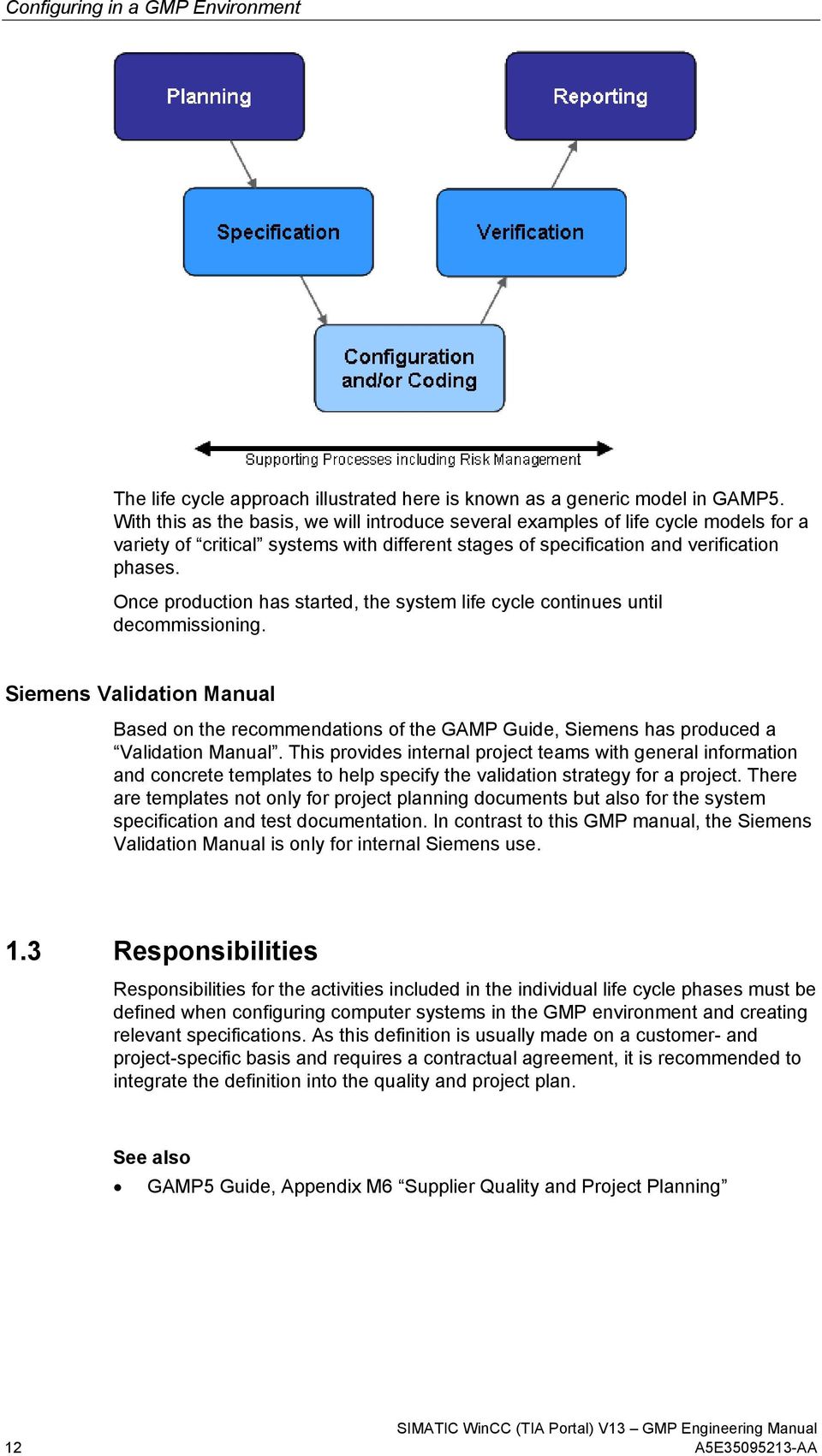
12 Configuring in a GMP Environment 1 Configuring in a GMP Environment As a prerequisite for configuring computer systems in the GMP environment, approved specifications must be available. Requirements contained in standards, recommendations, and guidelines must be followed during the preparation of these specifications and well as during the implementation and operation of computer systems. This chapter deals with the most important sets of regulations and explains some of the basic ideas. 1.1 Regulations and guidelines The regulations, guidelines and recommendations of various national and international authorities and organizations must be observed when configuring computer systems requiring validation in a GMP environment. Regarding computer systems, the following are of particular significance: Name (author) 21 CFR Part 11 (US Food and Drug Administration, FDA) Annex 11 of the EU GMP Guidelines (European Commission) GAMP5 (ISPE) Title Electronic Records, Electronic Signatures Computerized systems A Risk-Based Approach to Compliant GxP Computerized Systems Scope Law/regulation for manufacturers and importers of drugs for the U.S. market Binding directive within the European Union for implementation into national law Guideline with worldwide validity as recommendation 1.2 Life cycle model A central component of Good Engineering Practice (GEP) is the application of a recognized project methodology based on a defined life cycle. The aim is to provide a solution known as the risk-based approach that meets the relevant requirements. GAMP5 approach The following figure shows the general approach of GAMP5 for the development of computerized systems. It begins with the planning phase of a project and ends with the start of pharmaceutical production after completion of testing and reporting. A5E AA 11

13 Configuring in a GMP Environment The life cycle approach illustrated here is known as a generic model in GAMP5. With this as the basis, we will introduce several examples of life cycle models for a variety of critical systems with different stages of specification and verification phases. Once production has started, the system life cycle continues until decommissioning. Siemens Validation Manual Based on the recommendations of the GAMP Guide, Siemens has produced a Validation Manual. This provides internal project teams with general information and concrete templates to help specify the validation strategy for a project. There are templates not only for project planning documents but also for the system specification and test documentation. In contrast to this GMP manual, the Siemens Validation Manual is only for internal Siemens use. 1.3 Responsibilities Responsibilities for the activities included in the individual life cycle phases must be defined when configuring computer systems in the GMP environment and creating relevant specifications. As this definition is usually made on a customer- and project-specific basis and requires a contractual agreement, it is recommended to integrate the definition into the quality and project plan. GAMP5 Guide, Appendix M6 Supplier Quality and Project Planning 12 A5E AA
14 Configuring in a GMP Environment 1.4 Approval and change procedure When new systems requiring validation are set up or when existing systems requiring validation are modified, a top priority is to achieve and maintain the validated status, which means ensuring the traceability of the implemented steps. Before setting up or modifying a system, it is therefore necessary to plan, document, and obtain the customer s approval of pending steps in terms of functionality and time. 1.5 Risk-based approach Both the U.S. agency FDA ( Pharmaceutical cgmps for the 21st Century Initiative, 2004) and the industry association ISPE/GAMP ( GAMP5 Guide, 2008) recommend a risk-based approach to the validation of systems. This means that whether and to what extent a system will be validated depends on its complexity and its influence on the product quality. A5E AA 13

15 Requirements for Computer Systems in the GMP Environment 2 Requirements for Computer Systems in the GMP Environment This chapter describes the essential requirements an automated system in the GMP environment must meet regarding the use of computerized systems. These requirements must be defined in the specification and implemented during configuration. In case of subsequent changes or interventions in the system, reliable evidence must be provided at any time regarding what was changed or implemented, by whom and at which time. The requirements for this task are implemented in various functions and are described in the following chapters. Note This chapter describes the general requirements for computer and automation systems. The concrete system-specific fulfillment follows starting from chapter Categorization of hardware and software Hardware categorization According to the GAMP Guide, hardware components of a system fall into two categories: standard hardware components (category 1) and custom built hardware components (category 2). Software categorization According to the GAMP Guide, the software components of a system are divided into various software categories. These range from commercially available and preconfigured standard software products that are simply installed to configured software products and customized applications ( programmed software ). 2.2 Test effort depending on the categorization The effort for validation (specifying and testing) is much greater when using configured and, in particular, customized products compared with the effort for standard products (hardware and/or software). The overall effort for validation can therefore be significantly reduced by extensive use of standard products. 14 A5E AA

16 Requirements for Computer Systems in the GMP Environment 2.3 Change and configuration management All controlled elements of a system should be identified by name and version, and changes to them should be checked. The transition from the project phase to the corresponding operational procedure should be defined at an early stage. The procedure includes, for example: Identification of the elements affected Identification of the elements by name and version number Change control Control of the configuration (storage, release, etc.) Periodic checks of the configuration GAMP5 Guide, Appendix M8 Project Change and Configuration Management 2.4 Software creation Certain guidelines must be followed during software creation, and documented in the quality and project plan (in the sense of Good Engineering Practice, short GEP). Guidelines for software creation can be found in the GAMP Guide and in relevant standards and recommendations. Using type/instance concepts and copy templates Whereas the validation effort for standard software products is limited to the verification of the software name and version, the effort for validation of customized software amounts to a check of the entire range of functions as well as a supplier audit. In order to keep the validation effort as low as possible, standardized modules should therefore be used preferentially (products, in-house standards, project standards) when configuring the software. From these, customized types and templates are created and tested according to the design specifications. Identification of software modules / types / copy templates During software creation, the individual software modules must be assigned a unique name, a version, and a brief description of the module. Changing software modules / types / copy templates Changes to software modules should be appropriately documented. Apart from incrementing the version identifier, the date and the name of the person performing the change should be recorded, when applicable with a reference to the corresponding change request/order. A5E AA 15
17 Requirements for Computer Systems in the GMP Environment 2.5 Access control and user administration To ensure the security of computer systems in the GMP environment, these systems should be equipped with an access control system. In addition to physical access control, access control systems protect computer systems against unauthorized access Users are assembled into groups, which are then used to manage user permissions.. Individual users can be granted access authorization in various ways: Combination of a unique user ID and password Chip cards together with a password Evaluation of biometric features In general, actions that can be executed on a computer system must be protected against unauthorized access. Various rights can be assigned to users depending on their duties. Access to the user administration should only be given to the system owner or to a very limited number of employees defined by the system owner. Furthermore, it is absolutely essential that unauthorized access to electronically recorded data is prevented. The use of an automatic logout function is advisable and provides additional access protection. This does not, however, absolve the user from the general responsibility of logging off when exiting the system. The automatic logout time should be defined in the specification in agreement with the system owner. Note Only authorized persons should be allowed access to PCs or the computer system. This can be supported with appropriate mechanisms such as mechanical locking and through the use of hardware and software for remote access Requirements for user ID and password User ID The user ID for a system should have a minimum length defined by the customer and be unique within the system. Password When passwords are created, a minimum number of characters and of the expiry period of the password should be defined. A password should generally comprise a combination of characters with a minimum length and should also meet at least three of the criteria listed below. Use of uppercase letters Use of lowercase letters Use of numerals (0-9) Use of special characters The configuration is decribed in chapter 4.4 Setting up the user administration for HMI devices. 16 A5E AA

18 Requirements for Computer Systems in the GMP Environment Application of access control to an automation system In addition to physical access control, automation systems of the SIMATIC S provide access protection through the display protection on the device and through assignment of software passwords in different protection levels for access to program data via the network. Chapter 8.2 Protection functions in the automation system 2.6 Requirements for electronic records The following requirements additionally apply to the use of electronic records for relevant data: The system must be validated. Only authorized persons must be able to enter or change data (access control). Changes to data or deletions must be recorded (audit trail). Electronic records for long-term archiving must be stored securely and kept available using appropriate measures. The initials and signatures required by the regulations must be implemented as electronic signatures. Relevant production steps / processes, significant interim stages and major equipment must be defined in advance by those responsible for pharmaceutical matters. This definition is often process-specific. If an electronic batch production record is used, its structure and contents must match the structure and contents of the master production record. As an alternative, the master production record and batch production record can also be combined in one document. EU GMP Guide chapter 4.9 and Annex CFR Part 11 Electronic Records, Electronic Signatures, US FDA 2.7 Electronic signatures Electronic signatures are computer-generated information that acts as a legally binding equivalent to a handwritten signature. Regulations concerning the use of electronic signatures are defined, for example, in 21 CFR Part 11 of the US FDA and in EU GMP Guide Annex 11. Electronic signatures are of practical relevance, for example, for manual data inputs and operator interventions during runtime, approval of process steps and data reports, and changes to recipes. Each electronic signature must be assigned uniquely to one person and must not be used by any other person. A5E AA 17

19 Requirements for Computer Systems in the GMP Environment Note For the manufacture of all drugs and medical devices that enter the U.S. market, the FDA regulations must be met; i.e., 21 CFR Part 11 contains the FDA regulations regarding electronic signatures. Conventional electronic signatures If electronic signatures that are not based on biometrics are used, they must be created in such a way that the signing persons must identify themselves using at least two identification components. This also applies in all cases where a smart card replaces one of the two identification components. These identification components can be, for example, a user ID and a password. The identification components must be assigned uniquely and may only be used by the actual owner of the signature. Electronic signatures based on biometrics An electronic signature based on biometrics must be created in such a way that it can only be used by one person. If the signing person uses the electronic signature based on biometrics, one identification component is adequate. Possible identifying features in biometric systems are fingerprints, iris structure, etc. 2.8 Audit trail The audit trail is a control mechanism of the system that ensures the traceability of data entries and data changes. A secure audit trail is particularly necessary in the context of creation, modification, or deletion of GMP-relevant data records (electronic records). Such an audit trail must document all changes made or actions taken with the date and time. The typical content of an audit trail describes who changed what and when (old value / new value), and optionally also why. 2.9 Reporting of batch data The batch documentation is of particular importance in the production of pharmaceuticals and medical devices. For pharmaceutical manufacturers, the properly created batch documentation often represents the only documented basis for evidence within the framework of product liability. The components of the batch documentation are as follows: Master production record and batch production record Packaging instructions and packaging record (the packaging of the finished drug is part of the manufacturing process from the pharmaceutical perspective) Test instructions and test report (for all quality checks, for example, in the chemical analysis) 18 A5E AA

20 Requirements for Computer Systems in the GMP Environment Central importance is assigned to the concept of the batch production record or packaging record, which is defined as follows: The batch production record is always related to a product and batch, always based on the corresponding parts of the applicable master production record, and contains all process-relevant measuring and control processes as actual values and deviations from the specified set points Archiving data (Electronic) archiving is defined as the permanent storage of electronic data and records on a long-term storage medium. The customer is responsible for defining the procedures and controls for the storage of electronic data. Based on predicate rules (EU GMP Guide, US 21 CFR Part 210/211, etc.), it must be decided how electronic data is stored and, in particular, which data is affected by this. This decision should be based on a reasonable and documented risk assessment, which also considers the significance of the electronic data over the retention period. If the archived data are migrated or converted, the integrity of the data over the entire conversion process must be ensured Data backup In contrast to archiving of electronic data, data backups are used to create backup copies, which ensure the recovery of the system in case original data is lost or in the event of system failure. The backup procedure must include the periodic backup of non-retentive information in order to avoid total loss of the data if system components fail or if data is accidentally deleted. Backup procedures must be tested to ensure that data is saved correctly. Backup records should be labeled clearly and intelligibly and dated. 2 Data backups are created on external data carriers. The data media used should comply with the recommendations of the device manufacturer. For the backup of electronic data, the following distinctions are made Backup of the installation, for example, partition image Backup of the application Backup of log data, for example, process data Here, particular attention is paid to the storage of data backup media (storage of the copy and original in different locations, protection from magnetic fields and natural hazards). 1 Good Practice and Compliance for Electronic Records and Signatures. Part 3, Models for Systems Implementation and Evolution. PDA Electronic Records and Electronic Signatures Assessment. Chris Reid & Barbara Mullendore, PDA A5E AA 19

21 Requirements for Computer Systems in the GMP Environment 2.12 Retrieving archived data It must be ensured that the archived/backed-up data can be read back at any time. If a system update/migration is performed, compatibility of the data archived/backed-up before the update must be ensured. If necessary, the archived/backed-up data must also be migrated Time synchronization A uniform time reference (including a time zone reference) must be guaranteed within a system in order to provide the archiving of messages, alarms, etc., with explicit time stamps. Time synchronization is especially important for the archiving data and the analysis of faults of a system. UTC (Universal Time Coordinated, see also ISO 8601) is recommended as the time base for saving data. The time stamp of messages and values can be displayed in the local time with a reference to daylight saving / standard time Use of third-party components When third-party components (hardware and software) are used, their compatibility with other components in use must be verified. If components that are tailored (customized) for the specific project are used, a supplier audit should be considered in order to check the supplier and its quality management system. GAMP5 Guide, Appendix M2 Supplier Assessment 20 A5E AA
22 System Specification 3 System Specification During the specification phase of a computer and automation system, the system to be set up and its functionality are defined at the level of detail required for implementation. Specifications not only represent the basis for a structured and traceable configuration but are particularly in the GMP environment an essential reference for final verification of the system. The specification covers both the selection of the products, product variants, options, and system configurations and the application software. The overall specification can be divided, for example, into: Functional specification (FS) as a response to user requirement specifications (URS) Hardware (and network) design specification (HDS) Software design specification (SDS) HMI design specification 3.1 Selection and specification of the hardware Different types of systems are used both for automation and operator control and monitoring of simple and more complex production processes and manufacturing operations. The choice of hardware components should be appropriate for the requirements. These requirements can be functional in nature, but also include aspects such as local conditions, software compatibility or data security. A5E AA 21
23 System Specification Selection of the hardware components for automation systems The automation system is selected based on the requirements for the control of the production process. The devices of the SIMATIC S series with their display for on-site diagnostics and expanded protection functions are especially well-suited for operation in validated systems. Selection criteria are the processing speed of the program, the program size and available interfaces (Profibus interfaces, Ethernet interfaces, or multiple interfaces). Step sequences can be easily realized with the optional S7 Graph programming language. Special requirements for safety are met through fail-safe devices that automatically bring the system to a safe state in case of failure Selection of the hardware components for HMI devices For monitoring and control of the production process, a selection is made from local HMI devices all the way to multi-user systems with server/client. Single-user station with complete operator control and monitoring of a production process through local HMI devices (Comfort Panel or Multi Panel), Panel PC or standard PC Multi-user station consisting of operator terminals (WinCC clients) and a WinCC server that supplies the WinCC clients with data The system availability and data reliability can be increased, especially for PC components with critical functions, by using RAID systems of a suitable class (1, 5) or a redundant system design. With respect to the selection of panels, an Ethernet connection is recommended for backing up the data on a network drive. The effort for specification and testing is significantly reduced through the use of system-tested hardware components and system configurations. For specific requirements at the machine level of production plants (for example, in the food and beverage industry or the pharmaceutical industry), Siemens offers extremely rugged panels and Panel PCs with touch screens and stainless steel fronts (INOX). 22 A5E AA
24 System Specification If an HMI device is also intended for operator actions, the (regulatory!) requirements for recording of these actions in an audit trail must be considered when the hardware components are selected. Recommendation We recommend the use of released hardware from the current SIMATIC HMI Product Catalog CA 01 because these hardware devices have been verified for compatibility in the system test by Siemens. Functional differences between the SIMATIC panels in Online Support under Entry ID Stainless steel housing for SIMATIC HMI Panel PC Ex / Thin Client Ex in Online Support under Entry ID Hardware specification The hardware (and network) design specification (abbreviated HDS) describes the hardware architecture and configuration. The HDS should, for example, define the points listed below. This is used later as a test basis for the verification. Hardware layout plan and network structure PC components for server and client including installation procedures Automation system with CPUs, I/O cards, field devices, control cabinets, etc. The hardware can be specified as part of the functional specification or in a separate document (HDS). Note The requirements in the hardware layout plan and the designation of hardware components must be unambiguous. GAMP5 Guide, Appendix D3 Configuration and Design 3.2 Security of the plant network In order to meet current customer requirements for networked systems and to ensure the highest possible data security at all times, data and information security is of great importance when establishing networked systems. Measures for increasing data and system security SIMATIC offers several ways to increase data and information security and therefore the security of a production plant. These include: Central user administration, staggered user groups and user rights Security concepts for network security and restricted access to network drives in an open system A5E AA 23
25 System Specification SIMATIC NET SCALANCE-S firewall and VPN modules SIMATIC Security Control (SSC), in combination with WinCC RT Professional Chapter 4.7 Data and information security All-round protection with Industrial Security - Plant Security in Online Support under Entry ID Manual Security Concept PCS 7 and WinCC in Online Support under Entry ID Specification of the basic software The software specification describes not only the application software but also the standard software components used in the system, for example, by specifying the name, version number, etc. The components of commercially available standard software include software of third-party providers such as operating systems, Adobe Reader, MS Office, etc. Note This software specification serves as an acceptance criterion during subsequent tests (FAT, SAT, IQ, OQ), see also chapter 9.3 Verification of software. The SIMATIC WinCC (TIA Portal) software consists of engineering and runtime components for different-sized HMI devices. The corresponding runtime components run on their associated hardware. This is configured and programmed in the engineering interface. Because the functionalities and applications on on-site HMI devices (panels) differ significantly in some cases from those in a SCADA environment (Supervisory Control and Data Acquisition), the technical functions for WinCC Professional are described in chapter 6 of this manual and the technical functions for WinCC Comfort/Advanced are described in chapter 7. GMP-relevant technical functions for the SIMATIC S automation system are presented in chapter 8 of this manual. Hardware and software requirements and operating system selection Information on releases of the various WinCC variants and options with the operating systems (32-bit and 64-bit) can be found in Product Catalog CA 01 Compatibility tool Online help, Readme file The security updates and Critical Updates provided by Microsoft for the Windows operating system are tested by Siemens for compatibility with SIMATIC software and released; see reference in chapter 12.1 Update of the system software. 24 A5E AA
26 System Specification Basic components of SIMATIC WinCC Comfort / Advanced / Professional Designation Brief description Availability Comf Adv Prof Graphics Editor for creating graphics X X X HMI tags Tag management X X X User administration User administration X X X HMI alarms Alarm logging X X X Logs Process value logging X X* X Recipes Preparation of recipes X X* X* Reports Report creation X X X Additional SIMATIC components Designation Brief description Availability Comf Adv Prof SIMATIC Logon Connection to Windows User - - X* Management SIMATIC Logon Connection of panels to a central user X* X* - Remote Access administration with SIMATIC Logon WinCC Audit for Recording of operator actions X* X* -** SIMATIC Panel / Runtime Advanced WinCC Server Servers in a server/client structure - - X* WinCC Client Client in a server/client structure - - X* WinCC Redundancy Redundant servers X* WinCC WebNavigator View of data and operation of process - - X* screens via the web WinCC DataMonitor View of data using a browser - - X* * = This component requires an additional license ** = Audit trail can be implemented by configuration, see chapter 6.4 Audit trail. Basic components for automation systems Designation Program blocks Technology objects PLC tags PLC data types Watch and force tables Traces Device proxy data PLC messages Brief description Program structure subdivided into Main, FCs (functions), FBs (function blocks) and data blocks Configuration of standard controls for PID, counting and measuring, Motion Control Compilation of digital and analog inputs/outputs Data structures that are used repeatedly Compilation of data for online monitoring during commissioning Monitoring and evaluation of process values Generation of device proxy files for IPE (Inter Project Engineering) Messages for chronological messaging A5E AA 25
27 System Specification Additional components for automation system The S7-PLCSIM software provides the platform for a functional test of the created user blocks, independent of the available target hardware. The software version must be compatible with the version of the engineering system Basic software for user administration An essential requirement particularly in the GMP environment is the access control to the system. This is the only way to ensure secure operation in compliance with regulations (US 21 CFR Part 11 and EU GMP Guide Annex 11). Unauthorized access to the operator control and monitoring system and to the file system and directory structures in the operating system must be prevented. This requires appropriate planning: Definition of user groups with different authorization levels for operation and maintenance Definition of users and assignment to the user groups Establishing an adapted system structure, including authorizations at storage folders In a single-user system or a distributed system with multiple HMI devices (also in combination with panels), users can be centrally administered on a computer in a workgroup or domain. SIMATIC Logon supports a user administration based on Windows mechanisms that can be used both in a workgroup and in a Windows domain. Information on installation and configuration of SIMATIC Logon is contained in chapter 4.4 Setting up the user administration for HMI devices and in the SIMATIC Logon Configuration Manual. For local HMI devices without a network connection, the user administration must be set up locally on each panel (see chapter User administration without SIMATIC Logon ) Basic software engineering The TIA Portal is the common engineering interface for the HMI devices and the automation level. The WinCC Comfort, WinCC Advanced and WinCC Professional options are available for the configuration of HMI devices suitable for the GMP environment. The required variant depends on the type of HMI devices in use, ranging from panels and industrial PCs to standard PCs. For the configuration of the automation level, the TIA Portal is expanded to include the SIMATIC STEP 7 Professional (TIA Portal) component. 26 A5E AA
28 System Specification Source: WinCC Professional V13.0 System Manual The respective engineering system contains all the basic functions for engineering the HMI devices. At the center is the project navigator in which all devices belonging to the project are managed. The editors for configuring the different functions are opened for each HMI device from the project navigator. Copy functions simplify the transfer of configured data to other HMI devices. Tag management In the TIA Portal, automation systems and HMI devices can be created in a project. Inputs and outputs are maintained in a separate tag table for each controller (PLC). The HMI devices are connected to the process by connecting the external HMI tags to the PLC tags in the PLC tag tables. The TIA Portal creates the integrated connections automatically. For this reason, the tags are maintained only by the PLC. After compilation, corrections are transferred automatically to the project data of the HMI devices. This ensures that tags are maintained consistently throughout the project. If automation systems and HMI devices are configured in separate TIA projects within the framework of Team Engineering, the project-wide consistency of process tags is brought about by the device proxy files. The tags are also maintained here only in the project data for the automation system. Chapter Inter Project Engineering (IPE) Libraries The project library is used for storing the configured data. Both configured WinCC objects, such as complete graphics, graphics elements, control objects, tags, and scripts, as well as PLC program blocks and PLC data types can be saved in the project library and used multiple times in the project. The global library, in which completely configured devices can also be stored, supports cross-project data storage. A5E AA 27
29 System Specification Export / import of project data The WinCC engineering system has an export / import interface. Alarms, recipe data records, text lists, tags and project texts can be exported and re-used in another project. An export generates either XLSX or CSV files, which can be edited using the standard Microsoft Excel software and imported back into the project. However, manual documentation of the changes in accordance with the change control procedure must be ensured when importing into an existing project Basic software for automation level Hardware configuration, network connections and user program are stored on the local SIMATIC Memory Card of the S automation system. After the automation device is started, the compiled user program is processed cyclically and data is exchanged with the I/O devices Basic software for operating level The runtime software (RT) is used for operator control and monitoring of the production process. Functionalities for recording and displaying of runtime data are described in the following. Alarms Many alarms of varying importance occur in a plant. To guide the user, even in critical situations, the alarms of the project are grouped in alarm classes. These alarm classes and a concept for alarm acknowledgment should be defined with the system owner at the beginning of the project. Note The display suppression functionality of the WinCC RT Professional runtime software can be used to suppress the display of selected alarms, for example, during startup phases. The alarms are nevertheless recorded in the WinCC alarm log. For additional information, refer to the TIA Portal Information System > Visualize processes > Working with alarms > Working with alarms > Configuring the output of alarms > Configuring the alarm view (RT Professional) > Configuring alarm display suppression ( ) Use of this functionality is the responsibility of the system owner and should therefore be coordinated with him. Archives In a regulated environment, relevant production and quality data must be kept in some cases for 5, 10 or more years. This data must be defined, stored safely and moved to external logs according to data volume or time period. The process, the corresponding data and archive components should be defined for this. chapter "Data archiving" and chapters 6.7 and 7.7 "Electronic data recording and archiving". The WinCC RT Professional runtime software can also be used to archive process values in compressed form in compressed archives. 28 A5E AA
30 System Specification Recipes A system for structuring recipes should be developed if recipe data or equipment data records are required for ongoing operation. The individual recipe elements can be freely defined for each recipe. A variety of data records can be stored for a recipe. The number of data records and recipes depends on the selected HMI device. Audit trail Operational entries and changes to GMP-relevant data must be documented with time stamp, user ID, old value and new value in the form of an audit trail. This can be configured as appropriate for the values involved and is stored in the alarm history (WinCC RT Professional). Specifically for panels and for the WinCC RT Advanced runtime software, the Audit option fulfills the required functionality of an audit trail, see also chapter GMP project setting in the Audit option. Note To make it easier to view and check GMP-relevant entries, values and changes during plant operation, it makes sense to categorize these already during the specification phase. The system owner should be able to name the GMP-critical values and define them in advance Data archiving Tag values, system messages and audit trail can be archived. The performance scope of archiving and the method depends on the hardware of the used HMI device and the runtime software. Archiving for panels and WinCC RT Advanced The archives are stored on the local system. A memory card is used for local data archiving in the case of panels. By means of a network connection, the archives can be automatically moved or copied to a network drive. Alternatively, panels have USB ports for manual backup. The archive size is dependent on the available memory space. Archiving with WinCC RT Professional The basic package of the WinCC RT Professional runtime software contains possible archive configurations for single-user systems and server/client structures. A configuration for the export to a different computer is set in addition to archive size and segment change. Options for long-term archiving are mentioned in chapter "Setting up long-term". The WinCC DataMonitor option, for example, can be used to view the data. A5E AA 29
31 System Specification Batch-based archiving The WinCC Premium Add-on PM-QUALITY is available for batch-based acquisition and archiving of production data such as process values and alarms, see chapter Archiving batch data with PM-QUALITY and chapter Note The Data Log function of the automation systems provides another easy way of archiving process values. Because this data cannot be protected from manipulation, this function is not suitable in the GMP environment Report generation / reporting Reports of alarms and process values Alarms, recipe data and current process values can be printed out in the form of reports once they have been defined in the report editor. WinCC RT Professional provides further options for reporting, such as the output of log data in trends or tables. Depending on the system, output to the printer is managed either in the task scheduler or by print job. A cyclical or event-dependent starting point is specified for this. Batch-based reporting The WinCC Premium Add-on PM-QUALITY is available for a batch-based reporting of the recorded data, see chapter and chapter Batch-based reporting with PM-QUALITY Increase of availability with WinCC RT Professional The parallel archiving of the relevant process values, alarms and recipes increases the availability of the data. With the SIMATIC WinCC Redundancy for RT Professional option, one WinCC system can be operated as a master and another WinCC system as a standby server. The archive data are continuously synchronized. When one system fails, the other system continues the archiving function. As soon as both systems are back online, an automatic data synchronization is performed. For correct operation of the redundant WinCC system and consistent data display, the WinCC clients should always be connected to the master. Chapter Recording and archiving 30 A5E AA
32 System Specification 3.4 Specification of the application software Besides the definition of the hardware (chapter 3.1 Selection and specification of the hardware ) and the standard software components (chapter 3.3 Specification of the basic software ), the specification of the application software is an essential part of the design specification. This is used later as an acceptance criterion for the system verification (FAT, SAT, IQ, OQ) in addition to the functional specification. The design specification may consist of one or more documents. Other separate documents are also frequently maintained, for example, process tag list, I/O list, parameter list, P&ID, etc. The status of these documents (version, release) must be defined just as clearly as the other specification documents (URS, FS, DS). GAMP5 Guide, Appendix D3 Configuration and Design For example, the design specification can be divided as follows: System specification (general) System structure, PC profiles User administration Definition of user groups, users, authorizations, local users, configuration of SIMATIC Logon, WinCC user administration, etc. Archive configuration (archives, archiving cycles) Recipe structure Interfaces (S7 connections, OPC, discrete I/O processing) Printer configuration HMI design specification The following aspects, among others, are specified for the user interface: Screen layout and navigation Plant screens, unit screens, detailed screens of interfaces Operating level, possibly access authorizations Screen hierarchy Screen resolution, screen cycles Block icons, used graphic elements Alarm classes, priorities, alarm numbering ranges, display Software design specification General information such as project name, libraries, plant hierarchy Template and module specification in a separate document if necessary Reaction to power failure and restart Time synchronization, specification of master and slaves Description of exceptional conditions for safe plant operation Emergency stop characteristics A5E AA 31
33 System Specification 3.5 Additional SIMATIC software for the operating level WinCC Premium Add-ons This manual presents the following WinCC Premium Add-ons: Designation Brief description Availability PM CONTROL PM-QUALITY Recipe data management and job scheduling Batch-based data acquisition and reporting Comf Adv Prof X* X X X* X X PM-OPEN IMPORT Importing of process data X* X X PM-ANALYZE Evaluating and analyzing of alarm X X X logs * For data exchange, an Ethernet connection can be used to connect panels to the Premium Add-ons installed on a separate PC. The WinCC Premium Add-ons are enabled with separate licenses. Batch-based control with PM-CONTROL The WinCC Premium Add-on PM-CONTROL is a batch-based parameter control for recipe/product data management. The integrated order control allows flexible handling of production orders in which the recipe, production location, scalable production quantity and time of production can be specified. The software package is divided into three applications: Topology manager for mapping the plant topology, creating the required parameters and configuring the connection to the automation level Recipe system for creating and managing recipes / products with automatic versioning Order planning and order control, scheduling and management of production orders To achieve a cost-effective solution for both simple and more complex tasks, PM- CONTROL is available in the Compact, Standard and Professional variants. 32 A5E AA
34 System Specification * = Only in the Professional chained operating mode The use of SIMATIC Logon as a central user administration can be enabled in PM- CONTROL. Batch-based reporting with PM-QUALITY The data recorded in WinCC Premium Add-on PM-QUALITY can be displayed in curve diagrams, printed out on a printer in report form or exported via an HTML or XML file or in database format. The software package includes the following applications: Topology Manager for mapping the plant topology and specifying the production data to be acquired, such as process values (continuous, snapshot), alarms and operator interventions Report editor for creating the report layout for representation of the acquired batch data in reports and for display on the screen Data Logging, runtime component for acquiring data Data View and various ActiveX controls for displaying the batch data Data Center for merging the batch data acquired in parallel in redundant systems Besides the automatic acquisition of the configured batch data, manually entered values, for example laboratory values can be added to a batch report later. It is also possible to use a script in WinCC to configure an electronic signature of the batch reports by the logged-on user and with it the manual assignment of the batch status (released / locked). If the released batch report has been exported automatically due to the export option setting, no more changes can be made to the report if the complete automatically property is selected. A5E AA 33
35 System Specification Batch-based archiving with PM-QUALITY The WinCC Premium Add-on PM-QUALITY is used for batch-based acquisition of production-relevant data such as process values and alarms. The acquired batch data can be automatically exported in database format, in HTML format and/or in XML format either on the local system or to a computer in the network. To view the exported batch data in the database format, the PM- QUALITY application Data View (PM-QUALITY client) is used. The plug-ins for Microsoft Excel provided by PM-QUALITY support tracking and evaluation of batch data. Importing archives with PM-OPEN IMPORT With PM-OPEN IMPORT, process data (tag and alarm logs) and operator actions (audit trail), which are logged by panels and HMI devices with RT Advanced in CSV/TXT format, are transferred to the databases of WinCC RT Professional. This enables the data to be centrally compiled and archived in a distributed system with multiple HMI devices. The controls for the trend/table view and alarm view in WinCC Runtime are used for viewing the data. Evaluating and analyzing alarms with PM-ANALYZE PM-ANALYZE evaluates the alarms of the connected HMI devices. Convenient filter settings and statistical analyses based on occurrence and frequency provide support for optimizations and for locating errors and weak points. Besides the system status messages and operator messages of the active plant process, system messages from the Windows Event Viewer can also be logged for analyses Interfaces to process data WinCC WebNavigator Remote access to the WinCC project data is set up with the WinCC Web Navigator option in combination with the WinCC RT Professional runtime software. To view the process screens, users with the necessary rights must authenticate themselves using their password. The details are checked by SIMATIC Logon. Operation of the process screens is subject to access control, which is defined in the WinCC project in the user administration. Documenting operator actions using WinCC WebNavigator, in Online Support under Entry ID A5E AA
36 System Specification WinCC DataMonitor WinCC Data Monitor is a dedicated display and analysis system for process data from WinCC and data from the WinCC long-term archive server. WinCC DataMonitor provides a number of analysis tools for interactive data display and analysis of current process values and historical data: Excel workbooks Published reports Trends and alarms Process screens Web center Connection to host systems The options for connection to host systems depend on the HMI device used. Interfaces of panels and single-user systems with WinCC RT Advanced Process values for visualization and logging can be provided to an OPC client in a data communication based on OPC (OLE for process control). For this purpose, panels can be configured as OPC UA servers and single-user systems with WinCC Advanced as OPC DA (DCOM) or OPC UA servers. A5E AA 35
37 System Specification Interfaces of the SCADA system to host systems Standardized access with OPC and OLE DB from computer systems of the plant management level to computer systems of the process level is integrated in WinCC Professional. WinCC Professional provides access to the following process data: Interrupts and events (alarms), OPC A&E, read and write (acknowledgments only) access Process value logs (trends), OPC HDA, read and write access Process tags (states), OPC DA, read and write access data communication via DCOM Process tags, OPC XML DA, read and write access via web service Process values and process value logs, OPC UA (Unified Architecture), read and write access The data communication is based on the TCP/IP protocol with exchange of digital certificates. All log data, WinCC OLE DB, read-only access 3.6 Utilities and drivers Printer drivers For panel PCs and standard PCs, we recommend using the printer drivers integrated in the operating system and released for WinCC. No guarantee for proper operation of the system is made if external drivers are used. Printout from local printers or network printers is possible for panels. Hard copies or reports can be printed on a network printer. Line printing of alarms is only possible on a local printer. A list of the released printers and the required settings for the panels are compiled in the product support at: Printers for SIMATIC HMI Panels, Online Support under Entry ID Virus scanner The use of virus scanners on panel PCs and standard PCs is enabled during process mode. The released virus scanners can be accessed via the compatibility tool in the product support. The following settings must be observed when using virus scanners: The real-time search is one of the most important functions. However, it is sufficient to examine the incoming data traffic. Scheduled scans must be disabled because they restrict the performance of the system considerably during process operation. Manual search must not be performed during the process operation. It can be performed at regular intervals, for example, during maintenance intervals. These arrangements should be defined in the specification and/or optionally in a work instruction from the IT department in charge. 36 A5E AA
38 System Specification Image & partition tools Supplemental Imaging and Partitioning software allows you to create a backup of the entire contents of a hard drive, the so-called image, as well as to partition the hard drives. A quick restoration of the system is possible with the system and user software backed up in the image. Backed up hard drive contents can also be imported to devices of the same type. This facilitates the process of replacing computers. The SIMATIC Image and Partition Creator (IPC) provided by Siemens is a software package that can be used to accomplish these tasks. This is also possible without a separate installation through direct use from CD or USB FlashDrive. Administration skills are needed for this process. Note The created images are used for restoring the installed system, but are not used for backing up online data. A5E AA 37
39 System Installation and Basic Configuration 4 System Installation and Basic Configuration SIMATIC TIA Portal is a common engineering interface for the automation level, HMI devices and drives. SIMATIC WinCC (TIA Portal) consists of the engineering software and runtime software for the respective HMI devices. SIMATIC STEP 7 Professional (TIA Portal) contains the engineering system for programming automation systems in all performance classes. Together, the two software packages cover the engineering for the complete portfolio of the automation level and HMI devices. Different software packages are offered depending on the performance range: Engineering software for automation level STEP 7 Basic (for S only) STEP 7 Professional Engineering software for HMI devices WinCC Basic for Basic Panels (Audit option is not available) WinCC Comfort for all panels WinCC Advanced for panels and also for single-user PC systems WinCC Professional also for multi-user systems with server-client structure Runtime software for HMI devices The respective runtime software is required for the visualization on each HMI device: Integrated runtime module for the panels WinCC RT Advanced for Panel PC and standard PC WinCC RT Professional for complex plants and client-server systems The runtime software is activated with a license key except for the panels. 38 A5E AA
40 System Installation and Basic Configuration 4.1 Installation of the operating system Control panels come preinstalled with the Microsoft Windows CE operating system and the corresponding runtime software. Note If the installed Microsoft Windows CE version of the panel does not match the version of the project data, the engineering system has updates for the operating system in store. For additional information, refer to the TIA Portal Information System > Visualize processes > Compiling and loading > Servicing the HMI device > Updating the operating system. Panel PCs are available in different expansion stages with installed operating system. The hardware and operating system requirements of the SIMATIC HMI software must be considered when using standard PCs. Details can be found in the current product catalog CA 01. Current information on the operating system installation can be found in the Installation chapter of the TIA Portal Information System. Note The computer name must conform to the naming convention of the SIMATIC software application. You should read the information in the respective installation instructions and readme files of the SIMATIC software to be installed on the computer, e.g. SIMATIC Net. The computer name may no longer be changed after the WinCC RT Professional software is installed. This would require a complete re-installation of the runtime software. 4.2 Installation of SIMATIC components Installation of the engineering software The SIMATIC WinCC (TIA Portal) and SIMATIC STEP 7 (TIA Portal) engineering software are installed on a SIMATIC PG / PC or a standard PC and set up the TIA Portal. The software is activated in each case with licenses. The license for the HMI devices determines the corresponding variant. The TIA Portal acts as a central engineering interface. Project data is created for the automation systems and for one or more HMI devices of different types. After compilation, the project data is transferred to the respective automation system or the corresponding HMI device. The project can be started on the device for the current production. A5E AA 39
41 System Installation and Basic Configuration Installation of the SIMATIC WinCC RT runtime software Panels and panel PCs are available as complete systems with pre-installed and licensed WinCC RT. WinCC RT must be installed and licensed separately on each operator control and monitoring component for server/client systems or standard PCs. Additional licenses are required for any other options that are used. During installation of the runtime software, default settings in the Windows operating system are automatically adapted to the requirements of the software. The required settings are displayed on the screen during the installation and can be saved in RTF format and printed. The software installation continues only after the settings are confirmed. Note WinCC RT Professional is generally released for use in a domain or workgroup. Domain-group policies and domain restrictions can prevent its installation, however. In this case, remove the computer from the domain prior to installation. After the installation, the computer can be joined to the domain again if the group policies and restrictions do not prevent operation of the WinCC software. SIMATIC Security Control During installation of the WinCC RT Advanced and WinCC RT Professional runtime software, default settings in the Windows operating system are automatically adapted to the requirements of the software. The required settings in the operating system are managed in the SIMATIC Security Control application for WinCC RT Professional. The application can be opened after installation using Start > Programs > Siemens Automation > Security Control, and the settings made can be viewed there. An option for saving and printing is provided. The following settings are configured automatically for specific functions: Security-related registry entries Configuration of the Windows firewall exceptions list DCOM settings (Distributed Component Object Model), for WinCC RT Professional only SIMATIC Security Control is restarted automatically, if additional settings in the Windows operating system are required after installation of WinCC options, such as the WinCC Web Navigator option. Note If the WinCC computer is joined to a different work environment (domain or workgroup), the settings must be re-configured by SIMATIC Security Control. TIA Portal Information System > Installation > Notes on the installation 40 A5E AA
42 System Installation and Basic Configuration Options for SIMATIC WinCC (TIA Portal) The options for the HMI devices can be configured in the engineering software without the need for an additional license. The license is required on the respective HMI device so that the configured option is operational. Licenses are supplied on USB sticks and transferred to the HMI device using the Automation License Manager tool. For panels, the license is transferred via the engineering system, the Automation License Manager or ProSave. The procedure is described in the TIA Portal Information System. The WinCC Premium Add-ons described here are installed after the WinCC runtime software and licensed with using a USB dongle or software license Setting up long-termarchiving For long-term archiving of process value, alarm and audit trail logs, the log data can be moved or outsourced to a network drive or exported to another computer. The required (and only the required!) access authorizations must be set up for this. The task scheduler or an event for copying or moving the logs can be configured for panels and HMI devices with WinCC RT Advanced, see chapter 7.7 Electronic data recording and archiving. In addition to the archives, a backup is configured, in which the file size and time period of the export to a network drive or other computer can be defined, see chapter 6.7 Electronic data recording and archiving for HMI devices with WinCC RT Professional. 4.3 Access protection for the automation system An essential requirement for secure operation of an automated production plant that is compliant with regulations is the control of access to the system. Program data, parameter settings and starting/stopping of the application must be protected from unauthorized access. The SIMATIC S7-300 / 400 / 1500 automation systems offer graded levels of protection for controlled access to the user program via the network. In addition, SIMATIC S provides an additional protection level for the connecting to HMI devices and a display protection for operator interventions on-site. Chapter 8.2 Protection functions in the automation system A5E AA 41
43 System Installation and Basic Configuration 4.4 Setting up the user administration for HMI devices For secure operation that is compliant with regulations, controlled access to both the operating level and configuration level and to archives and backup copies is required. A user-based logon and logout for operator actions is one of the basic functionalities for meeting this requirement. To organize the operator authorization, users are assigned to different user groups according to their tasks. Authorizations for the individual operator actions are assigned to each user group in the project data for each HMI device. Note The structure and the authorizations of the user groups should already be defined in the specification at the start of the project and be set up at the start of the engineering phase. Access authorizations and settings, such as password length, complexity and period of validity can and should be appropriately configured to increase password security. All permissions for operator control elements on the visualization interface (faceplates, input boxes, buttons etc.) must be set up according to the specifications. Note For distributed systems (also in combination with panels) or single-user systems with WinCC RT Professional, we recommend implementation of user administration based on SIMATIC Logon and Microsoft Windows Administration. The user administration is set up locally for local HMI devices without a network connection. Users and their user group assignment are then only known locally User administration with SIMATIC Logon User administration with SIMATIC Logon is based on the mechanisms of the Windows operating system. The users and groups are configured according to the specification in the user administration of Windows. The following steps must be performed when setting up the user administration based on SIMATIC Logon. Setup of the user groups and users in Windows Installation and setup of SIMATIC Logon Setup of the security settings in Windows (see chapter 4.4.2) Administration of the user rights for the respective HMI device The access control for the operator interface is then configured: Assignment of permissions in the visualization interface (input boxes, buttons, screen windows) Setup of access rights in PM-CONTROL or PM-QUALITY if the WinCC Premium Add-ons are used 42 A5E AA
44 System Installation and Basic Configuration Both Windows user administration options are always available in a domain or in a workgroup with a central logon server. Operating system help of Microsoft Windows or the appropriate Windows manual (for setting up Windows workgroups or a domain) TIA Portal Information System > Visualize processes> Configuring user administration WinCC Process Visualization System, WinCC Security Concept, chapter 4 User and access management in WinCC and integration into WinCC and integration into Windows Management, Online Support under Entry ID Chapter in Security Concept PCS 7 and WinCC manual, Online Support under Entry ID Windows domain The one-time administration of groups and users on a domain server reduces the maintenance effort and provides greater security. All computers in the domain are admitted to the group membership. Note When multiple domain servers are used or when there are redundant servers, the domain structure ensures that users will still be able to perform operations or log on even if one domain server fails. Windows workgroup All user data is created and managed on the server of a workgroup. SIMATIC Logon checks the logon data against the user administration on this server and provides the logon information to the other computers in the workgroup Security settings in Windows When SIMATIC Logon is used, the administrator configures the following security settings in Windows under Control Panel > Administrative Tools > Local Security Policy > Security Settings > Account Policies / Local Policies: Password policies such as complexity, password length, password age Account lockout policies Audit policies Note After installation of Windows, default parameters are set for the password policies, account lockout policies and audit policies. These settings must be checked and modified according to the applicable project requirements. A5E AA 43
45 System Installation and Basic Configuration Chapter Blocking the operating system level during operation Chapter 5.4 Password policies in PCS 7 Compendium Part F Industrial Security (V8.0), Online Support under Entry ID Configuration of SIMATIC Logon SIMATIC Logon checks the correctness of the logon data of a user on the computer against the central user administration and returns the logon information to the respective HMI device. User logon for the operation of WinCC options and Premium Add-ons can be included in the check by SIMATIC Logon. Note If the logon server is unavailable due to a network interruption, the local user administration becomes active instead of the central user administration. In order to bring the plant to a safe state in the event of an emergency, a local user and a local user group with limited operating rights should be created for this. Note Events such as successful and failed logon/logoffs or password changes are stored in the EventLog database of SIMATIC Logon and in the WinCC alarm system. Chapter 4.5 Administration of user rights Chapter in Security Concept PCS 7 and WinCC manual, Online Support under Entry ID The use of SIMATIC Logon is activated in Runtime Settings > User Administration. 44 A5E AA
46 System Installation and Basic Configuration Activation for HMI devices of type WinCC RT Professional Activation for HMI devices of type WinCC RT Advanced or Comfort Panels In addition to the user logon via SIMATIC Logon, the number of invalid logon attempts can be limited for these HMI devices. A5E AA 45
47 System Installation and Basic Configuration The initial settings of SIMATIC Logon are made in the Configure SIMATIC Logon dialog box. The settings are described in the SIMATIC Logon Configuration Manual and include, for example: The logon of a default user after user logoff Logon server ( working environment ) Automatic logoff with SIMATIC Logon Note No auto-logoff may be activated at the operating system level, otherwise the user interface will be completely closed. Furthermore, the activation of a screen saver in combination with SIMATIC Logon is not allowed. 46 A5E AA
48 System Installation and Basic Configuration User administration without SIMATIC Logon For panels or single-user systems (WinCC RT Advanced), the users and user groups are administered locally. The requirements for access control are met through appropriate configuration. The password settings, such as password, account lockout and policies, are then defined in the local user administration of the HMI device. A5E AA 47
49 System Installation and Basic Configuration Local SIMATIC user groups WinCC Professional supports the Windows authorization model. In order to create and start the WinCC user interface, at least Power User rights on the operating system level are required. By differentiating between Administrators and Power Users (plant operators) at the Windows level logon, a logical separation is achieved for the computer access authorization. The Windows user must be a member of some SIMATIC groups. Therefore, the following local groups are automatically set up during the installation of the runtime software. These must not be changed or deleted! Siemens TIA Engineer SIMATIC HMI SIMATIC HMI CS SIMATIC HMI VIEWER Note The defined users must be made members of the corresponding authorized SIMATIC user groups. WinCC Professional automatically manages the security settings and share permissions for the project data. The access rights for the operator interface conform to the configuration in the WinCC user administration and are checked by the runtime software, see chapter 4.5 Administration of user rights. WinCC Runtime Professional Readme > Runtime Chapter Security settings in Windows applies here as well 4.5 Administration of user rights Regardless of whether user administration with SIMATIC Logon or local user administration for a single-user system (panel or RT Advanced) without SIMATIC Logon is used, the user rights for operation in runtime are defined in the project data of the HMI device. The user rights are generally assigned to the user groups. For this purpose, the required user groups are created in the project data, if necessary with the same names as the user groups in Windows (SIMATIC Logon). The following procedure must be followed for this: Open the project data for the HMI device in the TIA Portal (engineering system) Open the user administration with the Users groups tab Create group(s) Assign rights for each group 48 A5E AA
50 System Installation and Basic Configuration The user rights are assigned for the group members using the WinCC user groups in the project data. Members of the Engineers group, for example, are then assigned the corresponding rights for operator input in the WinCC operator interface. 4.6 Access control at the operating system level The operating system user who is logged on in the background at WinCC runtime should have power user rights and not administrator rights. These rights are required to create and start the WinCC user interface. This ensures that only WinCC has access to the database. Operating system access to the SQL database is therefore not possible. Access to the operating system level is not necessary and usually not desired for the plant operator logged on to WinCC. Therefore, additional configuration settings (startup characteristics, blocking the operating system level) must be made. These settings prevent unauthorized access from process operation of SIMATIC WinCC to sensitive data of the operating system. Note Access to the operating system level should be reserved exclusively for administrators or technical service personnel. Locking of key combinations, Online Support under Entry ID A5E AA 49
51 System Installation and Basic Configuration Startup characteristics For the safe start of the HMI device, an automatic startup through to the activation of the user interface is configured. In this way, access to the operating system level is prevented during the startup. Automatic logon in the Windows operating system is described in the Online Support under Entry ID is an example for SIMATIC IPCs. The configuration of the automatic start of the user interface is different for each of the various HMI devices. Automatic startup for HMI devices with WinCC RT Professional Automatic startup is organized in the WinCC RT Start application. This is opened with Start > Programs > Siemens Automation > Runtime Systems. When the Autostart property is selected, the specified project is activated automatically when the computer boots up. The Allow "Cancel" during activation check box should not be selected, so that the project start cannot be interrupted. Those editors that will be required during the ongoing operation are selected in Runtime settings > Services. Other applications that should be started automatically, such as the Premium Add-ons PM-CONTROL or PM-QUALITY, are added under Additional tasks/applications. 50 A5E AA
52 System Installation and Basic Configuration Automatic startup for HMI devices with WinCC RT Advanced Automatic startup is organized in the WinCC RT Loader application (HMILoad.exe). This is opened with Start > Programs > Siemens Automation > Runtime Systems. The project with project path that is to be started automatically is specified under Settings. The automatic start of the project data after startup of the operating system is delayed for the number of seconds indicated in the Wait box. A link to the HMILoad.exe application (C:\Program Files (X86)\Siemens\Automation\WinCC RT Advanced) must then be placed in the autostart of the operating system. A5E AA 51
53 System Installation and Basic Configuration Automatic startup for panels The runtime loader automatically starts at panel startup. The project data is activated after the set time delay. The delay time can be configured in the Control Panel under Transfer > Directories. We recommend setting the value equal to 0, so that the project data is activated immediately. Note After commissioning, the Remote Control property in the Control Panel under Transfer should be disabled so that accidental automatic transfer from the engineering system is prevented Blocking the operating system level during operation Configuration settings in WinCC RT Professional To prevent access to the operating system during process operation, the Windows keys are disabled under Keyboard in the runtime settings. TIA Portal Information System > Visualize processes > Operating in Runtime > Commissioning projects > Commissioning projects for Runtime Professional > Settings for Runtime Professional > Defining hotkeys in the project Locking of key combinations, Online Support under Entry ID A5E AA
54 System Installation and Basic Configuration Configuration settings in WinCC RT Advanced Access to the operating system during process operation is prevented if task switching is locked in the runtime settings under General. Note Generally, for deactivating ongoing operation, a button can be provided on the user interface, which can only be actuated with the corresponding authorization and enables access to the operating system. Preventing system access in object programming It must be ensured that no objects are used in the user interface that permit access to the Windows file system or to executable programs. This risk exists, for example, with OLE objects, Internet links, online help system, etc. A5E AA 53
55 System Installation and Basic Configuration Configuration settings in Windows The Keep the taskbar on top of other windows setting must be disabled in Windows. Some graphics cards provide keyboard shortcuts for operation, which must be deactivated. 4.7 Data and information security In the regulated environment, production processes and recorded data are controlled and securely stored in order to guarantee product quality verifiably. Secure handling of data is a basic requirement for compliant operation. Relevant production data and operator inputs must be stored in accordance with national and international regulations for many years. Therefore, data and information security has many facets, some of which are explained here. Definition of a suitable system structure User administration, see chapter 4.4 Setting up the user administration for HMI devices Planning of data storage as well as the input and output devices Secure storage of sensitive data with redundancy and access control Use of virus scanners, see chapter Virus scanner Defined startup characteristics startup and operation of the user interface, see chapter 4.6 Access control at the operating system level Organizational measures Planning and assigning the necessary access rights Supplemented with codes of behavior, such as handling of USB sticks Operating procedures for archiving, retrieval and possibly data migration 54 A5E AA
56 System Installation and Basic Configuration Adaptation of the operating system settings During installation of the WinCC RT Advanced and WinCC RT Professional runtime software, default settings in the Windows operating system are automatically adapted to the requirements of the software with SIMATIC Security Control. Chapter Installation of the SIMATIC WinCC RT runtime software SIMATIC NET SCALANCE S The SCALANCE S security modules form the core of the innovative safety concept of Siemens that protects networks and data. The protective function of SCALANCE S works in such a way that all traffic to and from the cell is controlled. With a combination of different security measures such as firewalls, NAT/NAPT routers and VPN (Virtual Private Network) over IPsec tunnels, the security modules of SCALANCE S protect individual devices or even entire automation cells from: Data espionage Data manipulation Unauthorized access Security configuration in the TIA Portal Security modules of type SCALANCE S or communication processors (CP) that are used to increase network security can be configured in the TIA Portal engineering system. These modules are integrated into the network in the Devices & networks editor. After definition of a user that is authorized to configure security settings, the editors for the global security settings are displayed in the project tree. In the NTP editor, NTP(secure) servers can be configured that safeguard the time synchronization in the network through additional encryption (see also chapter 5.5 Time synchronization ). A5E AA 55
57 System Installation and Basic Configuration TIA Portal Information System > Editing devices and networks > Configuring devices and networks > Configure networks > Industrial Ethernet Security > Configuring security > General Manuals of the SCALANCE family All-round protection with Industrial Security - Plant Security in the Online Support under Entry ID Online Support under Entry ID Protection of an automation cell using the SCALANCE S602 V3 and SCALANCE S623 security modules via a firewall and the document attached there Online Support under Entry ID Industrial Security with SCALANCE S Modules over IPsec VPN tunnels and the document attached there 56 A5E AA
58 Project Settings and Definitions 5 Project Settings and Definitions Projects are used to organize the storage of data and programs resulting from the creation of an automation solution. The data that makes up a project includes the following: Configuration data on the hardware structure and parameter assignment data for modules Configuration data for communication over networks Configuration data for the automation and HMI devices The central data management ensures uniform consistency between automation and visualization. Once created, data is available in all editors, and changes or corrections are automatically updated throughout the project. Both the process automation and the operator process control and monitoring can be implemented in a very flexibly and customized manner. The automation program is prepared according to customer requirements. Standards developed for a specific customer can be used repeatedly in a carefully structured program. A large part of the application software is configured for the HMI devices; additional functionality can be added with the aid of scripts. 5.1 Project setup Creating a new project The TIA Portal is started for creating a new project. The TIA Portal offers two views, the portal view and the project view, which can be toggled. Select the Create new project entry in the portal view. Enter project name and path, or accept the suggested data. Click the Create button. The remaining steps are listed in the TIA Portal. Configure a device. Selection of the controller and HMI devices that are required for the automation solution. Network and connections can be configured. Write PLC program The programs are created for the individual controllers (PLCs). Configure an HMI screen The visualization is configured for the individual HMI devices. A5E AA 57
59 Project Settings and Definitions A wizard provides support for performing each step and opens the project view at the suitable point Inter Project Engineering (IPE) Extensive automation tasks are typically solved through teamwork. A division between the PLC programming and the visualization is useful for this. So that the advantage of integration for tag connections and program messages is maintained, the IPE is used. The PLC programming is performed in a TIA project. Definitions for tags and, if necessary, messages (for chronological messaging) that are required in the visualization are transferred to a device proxy file. In another TIA project for the visualization task, a PLC proxy device is added and initialized with the data from the generated device proxy file. In this way, the PLC tags are available in the customary manner. After changes to the PLC project, a device proxy file is generated again and the associated PLC proxy device is updated in the TIA project for visualization. TIA Portal Information System > Programming a PLC > Using Team Engineering TIA Portal Information System > Visualize processes > Using global functions > Using controller data from other projects 58 A5E AA
60 Project Settings and Definitions Migration of existing projects Projects from previous automation solutions can be migrated to the TIA Portal. General procedure for migration in chapter 12 System Updates and Migration TIA Portal Information System > Migrating projects and programs Migrating Production Plants with of SIMATIC (TIA Portal) Visualization, Online Support under Entry ID Integrated configuring with WinCC (TIA Portal) and SIMATIC Manager STEP 7 For technical or plant-specific reasons, it is sometimes necessary to continue creating the PLC program with SIMATIC Manager (> V5.4 SP3) and the visualization with WinCC (TIA Portal). Tag and alarm definitions in SIMATIC Manager are transferred using a file to a device proxy PLC directly into the TIA project for configuration of the visualization. Current HMI devices (e.g. Comfort Panels) can be integrated in SIMATIC Manager using a GSD/GSDML file in order, for example, to configure required connection parameters. Combined configuration with WinCC (TIA Portal) and STEP 7 V5.x, Online Support under Entry ID Working with multi-language projects The TIA Portal supports the Unicode (UTF-16) format, which includes Asian languages. Multiple languages can be managed in parallel in a project and transfer to the HMI devices. The operator switches between the available languages for the operator interface using buttons. It is possible to switch between languages for the following project texts: Alarm texts Labeling of screen objects, e.g. buttons Display texts, texts relevant for operation Display names of recipes Text lists etc. Chapter in WinCC Professional V13.0 System Manual, Online Support under Entry ID TIA Portal Information System > Visualize processes > Using global functions > Managing languages A5E AA 59
61 Project Settings and Definitions HMI device wizard A base structure for the visualization interface of an HMI device is created with the support of the HMI device wizard. When SIMATIC panels are added to a project, the wizard starts automatically; for HMI devices based on a PC system, the wizard can be started manually via the shortcut menu in the project tree. The HMI device wizard guides you through a series of dialogs for creating the basic structure. The basic structure consists of a base screen with a toolbar, title bar, alarm line and various system screens for diagnostic purposes. Projectspecific, empty plant screens can be added, so that these are already taken into account when selecting the screen. In addition, the screen background color, the screen resolution and the company-specific logo are defined. TIA Portal Information System > Visualize processes > Using global functions > Working with the HMI Device Wizard > HMI device wizard basics (...) GMP project setting in the Audit option The WinCC (TIA Portal) Audit option for panels or RT Advanced is provided specifically for GMP-relevant production plants. The option includes the following functions: Creating operator input alarms Creating an audit trail The NotifyUserAction system function Entering of electronic signatures Data archiving with checksum Identification of recipes as GMP-relevant Documenting the audit trail The GMP setting is activated at the start of the configuration in the runtime settings editor. The above-listed functions are then offered and can be configured, see chapter 7.2 Creating operator input alarms, 7.4 Audit trail, and 7.5 Configuration for electronic signature. 60 A5E AA
62 Project Settings and Definitions 5.2 Libraries The engineering in the TIA Portal is supported by two libraries: Project library Global library The project library is used to store programmed or configured software elements. In the PLC area, these are blocks and PLC data types developed specifically for the user or complete PLC devices. For HMI devices, user-defined WinCC objects, such as complete screens, tag tables, scripts, etc., all the way to complete configuration of HMI devices are stored. These user-defined blocks or objects are developed in detail, tested and qualified and are thus available as a project standard for multiple use in the project. The global library is a cross-project library whose contents can also be used in other projects. By default, the global library contains master copies for buttons, monitoring modules, and document templates for the project documentation. Userspecific global libraries can be set up for centralized storage of user-defined objects and blocks, for example, from the project library. TIA Portal Information System > Editing projects > Using libraries > Library basics 5.3 Object-oriented configuration for HMI devices For the graphic design of the user interface, the toolbar offers a comprehensive set of objects and graphic elements. Customized display and operating objects consisting of a configured group of objects are created as faceplates. The screen window technology is used for the display of a screen in screen. By storing configured objects, object groups and faceplates in libraries, they can be used repeatedly. The objects stored there are available to all similar type HMI devices in the project ( Project Library ) or in other projects ( Global Library ). For dynamization of faceplates and screen windows, it is preferable to use a user data type that bundles various tag types in a user-defined data structure for a process unit such as a motor. User data types are stored in the project library and are available throughout the project. The object-oriented configuration is useful for: Configured objects and object groups Faceplates (see chapter 5.3.2) Screen windows (see chapter 5.3.3) User data types (see chapter 5.3.4) Project functions (see chapter 5.3.5) Note Configured objects or object groups, faceplates and user data types are created for the respective use case and tested with the customer before they are copied or instantiated in the configuration. A5E AA 61
63 Project Settings and Definitions Master copies and types Each of the libraries mentioned above (see chapter 5.2) contains two folders named Types and Master copies. Library objects can be created or used either as a master copy or as a type. As a master copy, a configured object group is moved to the master copy area of the project library and can be used repeatedly in the project. Changes to the master copy are not transferred to the copies previously created. Master copies can also be stored in a global library for use in other projects. Faceplates and user data types are created and maintained in the Types folder. These are based on the type-instance model. For example, when a faceplate is integrated in a process screen, a local instance of the type is created. Changes in the type are automatically transferred to all of its instances. If necessary, an instance of the type can be deleted. A distinction is made between the Panel / RT Advanced and RT Professional device families when the faceplates are stored under Types. The faceplates can only be reused in the same type of device family. TIA Portal Information System > Visualize processes > Using global functions > Working with libraries > Copy templates and types Faceplates A faceplate consists of a grouping of objects which are tailored to the special requirements of the plant with respect graphic representation and dynamization. The object properties and events used to dynamize the faceplate are individually defined in the faceplate editor. User data types are recommended for connecting the interface to the process screens. A faceplate is always created as a type in the project library. A copy can be saved in the cross-project global library under types. Thereafter, it is available in other projects as well. There are significantly more options for designing and dynamization with WinCC RT Professional. TIA Portal Information System > Visualize processes > Creating screens > Working with faceplates Screen window The Screen window control allows you to call a screen within a screen. This functionality is used, for example, to call a window for controlling a process unit (valve, drive). Such an operator control screen is configured once for a particular function and then opened as an instance in a screen window. The dynamization of a screen window is carried out based on user data types. When the screen is called, a tag prefix is transferred. The screen window technology is only available in WinCC RT Professional. 62 A5E AA
64 Project Settings and Definitions TIA Portal Information System > Visualize processes > Creating screens > Display and Control Objects > Objects > Screen window (RT Professional) User data type User data types are used for dynamization of faceplates and screen windows. For a process unit, such as a motor, a user data type is defined, which contains all tag types of the motor as elements. Each user data type is created for a particular type of communication (SIMATIC S7-300/400, SIMATIC S7-1200, SIMATIC S7-1500, internal communication, etc.) and for a Panel / RT Advanced or RT Professional device family and can only be used in this environment. The example shows a simplified form. TIA Portal Information System > Visualize processes > Working with tags > Working with user data types (Panels, RT Advanced, RT Professional) Project functions in the form of scripts Customer-specific requirements that are not covered by the basic functionality can be realized in the form of functions or local scripts. A function consists of standardized system functions and/or user-defined functions. If such user-defined functions are required repeatedly, they should be configured as project functions in the Scripts editor. The function code is created one-time in the script, then tested and qualified. The function is then available for this HMI device and after moving it to the project library under master copy it is also available project-wide for several HMI devices (see chapter 6.3 User-specific functions and scripts ). 5.4 Block-oriented configuration of the automation software The automation software is created using a modular approach. For information on the procedure for creating the user program, see chapter 8 Configuration for SIMATIC S Automation Systems. A5E AA 63
65 Project Settings and Definitions Program blocks The SIMATIC STEP 7 (TIA Portal) basic software provides different block types for structuring the software. The LAD, FBD, and STL programming languages and for certain blocks also the SCL programming language are offered for creating the software. Some CPUs also have the S7-GRAPH programming language for programming of step sequences. Organization blocks are called directly by the CPU either cyclically or acyclically. The call structure of the user program is started in these organization blocks. Function blocks communicate with an instance data block that stores the data of the interface. Functions are blocks whose interface data are not stored. Global data blocks are used for storage of program data. Program code that is used multiple times in the user program is created once as a function or function block, then tested and qualified. For the call of a function block, only parameters have to be assigned. After the block is moved to the project library or a global library as a master copy or type, the block is available throughout the project and for other projects. Chapter Versioning examples in the area of the PLC Chapter Software program 64 A5E AA
66 Project Settings and Definitions Technology objects Standards for motion control, PID control and fast counting and measurement acquisition are offered under technology objects. The standard blocks are integrated in the automation software and parameters are easily assigned. Motion Control contains blocks for controlling stepper and servo motors with impulse interface. PID Control provides various closed-loop control blocks. Counting and measurement together with the high-speed counter provides for easy parameter assignment of counter modules PLC data types A PLC data type is a user-defined data structure that consists of multiple elements with different data types. For example, the interface data for a unit such as a motor or a recipe is mapped in a PLC data type. The PLC data type is used as a template for creating global data blocks and structured PLC tags. It is also used in the tag declaration of code blocks such as function blocks (FB) and functions (FC). Chapter Versioning examples in the area of the PLC 5.5 Time synchronization In SIMATIC WinCC (TIA Portal), the time transmitted on the bus is by default the UTC (Universal Time Coordinated). To ensure time consistency, all stations and controllers belonging to the WinCC system must be synchronized so that chronological processing (logging of trends, A5E AA 65
67 Project Settings and Definitions alarms) can be enabled system-wide. This applies to all computers in the Windows workgroup or within a domain. The structure of the time synchronization must be carefully planned. Each time synchronization in the project is dependent on requirements. The requirements of time synchronization must be described in the functional specification. HMI devices with WinCC RT Professional can be integrated into automatic time synchronization via the plant bus or system bus. In conjunction with panels or single-user systems with WinCC RT Advanced, either time synchronization in the connection to the PLC or a Set time of day can be configured. The activation of time synchronization must also take place on the engineering station, otherwise problems could occur during the downloading of changes. Note The activation of time synchronization is essential in plants in which GMP is mandatory Concepts for WinCC RT Professional Concepts for time synchronization are presented in the following. Time synchronization in a Windows workgroup The time synchronization in a workgroup should be realized via the WinCC server. In the Windows operating system, the computer can be configured as an NTP server that distributes the system time for the time synchronization in the network. A radio receiver, such as SICLOCK, can be used to feed the time in the network. Time synchronization in a Windows domain If the automation system is operated in a Windows domain, the domain must serve as the time master. The time synchronization of the domain server can also be realized using a time master such as SICLOCK. Note The time synchronization of the clients in the domain is realized using Microsoft system services. Time synchronization Time synchronization in the automation environment, Online Support under Entry ID Time-of-day synchronization between WinCC Runtime Professional and an S7 controller, Online Support under Entry ID Clock synchronization between an HMI operator panel and a SIMATIC PLC, Online Support under Entry ID Display format of the date in Runtime, Online Support under Entry ID TIA Portal Information System > Editing devices and networks > Configuring devices and networks > Configuring networks > Industrial Ethernet Security > Configuring security > General > Configuring time-of-day synchronization 66 A5E AA
68 Project Settings and Definitions TIA Portal Information System > Visualize processes > Communicating with PLCs > Communicating with SIMATIC S > Configuring time synchronization (Basic Panels, Panels, RT Advanced) Chapter 4.7 Data and information security Concepts for panels and HMI devices with WinCC RT Advanced Direct time synchronization can be configured between a CPU and panels that support time synchronization. Here, the time can be specified by the HMI device (master) or by the controller (slave). TIA Portal Information System > Visualize processes > Communicating with PLCs > Communicating with SIMATIC S > Configuring time synchronization (Basic Panels, Panels, RT Advanced) TIA Portal Information System > Editing devices and networks > Configuring devices and networks > Configuring networks > Industrial Ethernet Security > Configuring security > General > Configuring time-of-day synchronization Setting the time-of-day As an alternative to time synchronization via the connection to the PLC, the time of day can be set in the CPU or in the HMI device. The Set time-of-day method does not have the same accuracy as the time synchronization, since frame and script runtimes are introduced. The device that serves as the time master must be defined within the system. Note If a network with an NTP server is available, the time synchronization should be realized preferentially using NTP mode. Time synchronization Time synchronization in the automation environment, Online Support under Entry ID Settings in Windows 7 in order to change the system time of the PC by means of WinCC RT Advanced, Online Support under Entry ID Chapter 4.7 Data and information security A5E AA 67
69 Project Settings and Definitions Daylight saving / standard time changeover Daylight saving / standard time changeover is realized for panels using the SetDaylightSavingTime system function. This can be automated by a trigger of the PLC that evaluates the daylight saving / standard time changeover event. TIA Portal Information System > Visualize processes > Working with system functions and Runtime scripting > Reference > Function list > System functions (Basic Panels, Panels, RT Advanced) Concepts for the automation system NTP mode (Network Time Protocol) is activated for the time synchronization of the automation system. In this mode, the device sends time-of-day requests to the configured NTP servers at regular intervals. This is either the domain controller or one or more computers in the workgroup that are configured as an NTP server (for example, computer with WinCC RT Professional installation). The most exact time for the time synchronization is determined based on the answers. Additional hardware such as CPs (communication processors) and SCALANCE switches control the network protocols, including for time synchronization, thus increasing the reliability in the network. TIA Portal Information System > Editing devices and networks > Configuring devices and networks > Additional information on configurations > Functional description of S CPUs (S7-1500) > Setting the operating behavior ( ) > Time-of-day functions ( ) > Time-of-day synchronization NTP mode ( ) Chapter 4.7 Data and information security Time-of-day synchronization between WinCC Runtime Professional and an S7 controller, Online Support under Entry ID Time synchronization - Time synchronization in the automation environment, Online Support under Entry ID A5E AA
70 Project Settings and Definitions Time stamping HMI alarms Alarms from the CPU (AS) are displayed in the HMI device and logged. The alarm receives the time stamp either from the HMI device upon arrival of the alarm (discrete alarms) or from the CPU directly when it is created (controller alarms). A discrete alarm is detected based on a bit change in the alarm tag. The HMI alarm system assigns the time stamp of the HMI device. The time stamp has a certain inaccuracy due to the acquisition cycle, bus delay time and time required for processing the alarm. Alarms present for a time shorter than the acquisition cycle are lost. For monitoring the limits of tags in WinCC, an analog alarm is generated in the HMI alarm system if the defined limits are violated. The assignment of the time stamp is similar to that for discrete alarms. The discrete alarm procedure and limit monitoring are easy-to-configure alarm procedures for panels, HMI devices with WinCC RT Advanced and single-user systems with WinCC RT Professional. In redundant systems or system configurations with multiple operator stations (WinCC RT Professional), program alarms are generated in the CPU for coordinated acknowledging and sending. These receive a precise time stamp directly when they occur in the CPU. Standard blocks for generation of program alarms are offered that are tailored to the utilized CPU. For example, for the CPU S7-1500, the Program Alarm block; for the CPU S7-400, the Notify, Notify_8P, Alarm, Alarm_S/SQ, Alarm_D/DQ, and Alarm_8/8P blocks; for the CPU S7-300, the Alarm S/SQ, Alarm D/DQ, and Alarm SC blocks in simple design. Program alarms are transferred to the various HMI devices of the TIA project as controller messages. The assignment is made by an alarm class assignment. Note The time stamping of the program alarms in the CPU is more accurate than that of the discrete alarms and analog alarms that are only generated in the individual HMI devices. However, the configuration is much more complicated. In addition, the different CPU possibilities must be considered in the selection. Refer to the relevant CPU manuals and the block descriptions in the TIA Portal information system for restrictions relating to the system resources for simultaneously pending alarms. TIA Portal Information System > Programming a PLC > References > References (S7-1200, S7-1500) > Extended instructions (...) > Alarms (S7-1500) TIA Portal Information System > Programming a PLC > References (S7-300, S7-400) > Extended instructions (...) > Alarms (...) TIA Portal Information System > Visualize processes > Working with alarms > Principles > Alarm procedures > Overview of the alarm types (...) A5E AA 69
71 Project Settings and Definitions Archiving By default, process values acquired and evaluated in the HMI device receive their time stamp at the time of their acquisition in the visualization system. Logging cycles are defined for cyclic logging of the process values. The time stamp that is assigned when the process values are acquired contains the inaccuracy of the configured logging cycle. Other logging methods are On change, On demand and Cyclic selective triggered by an enable tag. Process-driven archiving of process values in WinCC Tag Logging archives, Online Support under Entry ID The specification (URS, FS) of a GMP-compliant plant must describe the way in which time stamping will be performed. The accuracy necessary for alarm and process value acquisition must be checked in detail. The methods of time stamping mentioned above can be used alongside each other. The hardware for the automation and visualization must be selected accordingly. 5.6 Configuration management The configuration of a computer system consists of various hardware and software components, which can vary in complexity and range from commercially available standard components to specially customized user components. The current system configuration should be fully available at all times and easy to understand. For this purpose, the system is divided into configuration elements, which are identifiable with a unique name and a version number and can be distinguished from the previous versions. Definition of the configuration elements In most cases, standard hardware components are used, for example PCs, controllers (PLCs), monitors, panels, etc. These are defined and documented by means of type, version number, etc. More work is required when customer-specific hardware is used, for more on this see chapter 3.1 Selection and specification of the hardware. The standard components for software include, for example, the SIMATIC WinCC (TIA Portal) system software, the libraries contained therein, other options and Premium Add-ons. The application software is configured and programmed on the basis of standard software. The individual configuration elements into which the application software should be split cannot be defined for all cases as it differs depending on various customer requirements and system characteristics. 70 A5E AA
72 Project Settings and Definitions Versioning of the configuration elements Whereas the version ID of standard software cannot be influenced by the user / project engineer, the assignment of version numbers and a procedure for change control must be defined in work instructions for the configuration of the application software. Starting from the beginning of the application creation, all configuration elements should be maintained following a defined procedure for configuration management even if they are subject to formal change control only at a later stage. Note Chapter 5.7 Versioning of the application software includes examples of how individual software elements can be versioned. The change control procedure for a plant already in operation should always be agreed with the system owner, see chapter 11.2 Operational change control. GAMP5 Guide, Appendix M8 Project Change and Configuration Management 5.7 Versioning of the application software The project guidelines must define which elements are to be versioned, when versioning is to take place, and whether a major version or minor version is to be incremented; for example: The major version is set to 1.0 after the FAT and to 2.0 after commissioning. All other changes are incremented in the minor version. Whether the major version or the minor version is to be changed can also depend on the scope or effect of the change in question. The following data is specified for the versioning of the application software: Name Date Version number Comment on the change The following chapters show various examples of software element versioning. A5E AA 71
73 Project Settings and Definitions Versioning examples for the visualization level Versioning of screens The engineering system automatically records the creation date, the time stamp of the last change, and the Windows user logged on at the time. The data is retrieved if the Screens object in the project navigator is selected and the button is pressed in the toolbar on the project navigator. The Author and Creation date columns can be displayed using the column header. TIA Portal Information System > Introduction to the TIA Portal > User interface and operation > Layout of the user interface > Overview window Automatic versioning of the screens is not carried out; the version can be maintained manually in the file. Under Remark, for example, the last change can be manually maintained with the manually assigned version and a reference to the change number in the change request documentation. Information for versioning, such as version ID, change date and name, can be stored in a static text field. It is practical to place the text boxes for versioning in a separate screen level that can be shown or hidden as required. The display of the static text field during the process operation is controlled by the object property display or via the Visibility animation. Note Change details can be described, for example, in the relevant change request documentation. 72 A5E AA
74 Project Settings and Definitions Versioning of faceplates When the editing of a new faceplate is finished and it is released for use in the project data, the engineering system automatically sets the version The first and second position of the version number can be specified on a user-specific basis. After the faceplate is edited and enabled again, the version number is incremented automatically in the third position. It is useful to enter a comment with information on the different versions. The current processing of a faceplate can be discarded by restoring the latest approved version. Changes in the faceplate are passed to all integrated instances only when the Update instances in the project property is activated at the time the faceplate is released. A5E AA 73
75 Project Settings and Definitions The properties in the information area of the project tree show additional information. All versions are stored in the project library and can be deleted individually. Any version can be used in the project data. The use in the screens is listed in the cross-reference for the version. 74 A5E AA
76 Project Settings and Definitions Versioning of VB / C scripts VB scripts or C scripts (only for WinCC RT Professional) are created in order to access tags and graphical screen objects during ongoing operation and to initiate screen-independent actions. In addition, scripts are used to link functions that are triggered during process operation to individual properties of screen objects (e.g. by using the mouse). Two different methods of script creation are distinguished in WinCC: Local scripts that are created directly for the property of an object in the Screens editor. These scripts are part of the screen and are stored with the screen. Versioning is performed in the screen. Screen-independent scripts that are created in the Scripts editor and are available in function lists for repeated selection either with object properties or in the task scheduler. For VB / C scripts that are created with the Scripts editor, the engineering system records the last change date and the Windows user who is logged on at this time. For retrieving the data, see chapter Versioning examples for the visualization level - Versioning of screens. A5E AA 75
77 Project Settings and Definitions Note It is advisable to maintain a history in the scripts indicating any changes made. The history is entered as comment before the start of the code. Example for specification of the history in a C script: Example for specification of the history in a VB script: 76 A5E AA
78 Project Settings and Definitions Versioning of reports The automatic issuing of a version ID in the report layouts is not supported. For manual versioning of different versions, a static field for entry of a version ID can be inserted in the report layout. The version ID must be kept up-to-date as specified in the SOP for configuration management. The following figure shows an example of a footer of a report layout with the additional entry field for the version Versioning examples in the area of the PLC Versioning of functions and function blocks Functions (FC) and function blocks (FB) can be moved to the library as a copy template or a type. Storage as a type is only suitable if there are no absolute links to the PLC tag management or to data blocks. A warning message is output, if applicable. Upon first-time storage as a type, the name, author and content are entered and a version number is assigned. This is incremented automatically at the lowest position after change and release. Depending on the extent of the change, the other two positions of the version number in the library can be manually adjusted. The type/instance concept is activated when a block is moved to the library as a type. Instances of the block are used in the user program. The block can now only be edited in the library using the Edit type function. Editing in the block editor is blocked by write protection. The master copy or type is moved from the library to the project tree for use in the user program. Block instances that are maintained as a type in the library are displayed with the version number used and a specially marked icon. A5E AA 77
79 Project Settings and Definitions Versioning of PLC data types In the same way as functions and function blocks, PLC data types can also be stored as a master copy or type in the project library or in a global library. When a PLC data type is stored as a type, the type/instance concept is activated here as well. Name, author, comment and version number are specified. The PLC data type is then further maintained in the library. PLC data types that are used as an instance in the program can be recognized in the project tree based on the assigned version number and the marked icon. 78 A5E AA
80 Project Settings and Definitions Time stamping within the PLC The TIA Portal engineering system performs an exact time stamping for all blocks. This serves as the basis for the consistency check for the compilation and for downloading of changes to the CPU. TIA Portal Information System > Programming a PLC > Creating a user program > Creating and managing blocks > Specifying block properties > Block time stamps A5E AA 79
81 Configuration for WinCC RT Professional 6 Configuration for WinCC RT Professional In a complete automation solution, SIMATIC WinCC (TIA Portal) takes over the operator control, monitoring and data logging functions. The connection to the automation level is by means of high-performance process interfacing. This chapter 6 explains instructions and recommendations for the configuration of WinCC RT Professional in GMP-mandatory environment. The configuration of HMI panels and WinCC RT Advanced is covered in chapter 7 Configuration for WinCC Comfort / WinCC RT Advanced. WinCC Professional V13.0 System Manual, Online Support under Entry ID Creating the graphic user interface To visualize the plant or process, process screens for operator control and monitoring are created according the specified requirements. Available elements are described in chapter 5.3 Object-oriented configuration for HMI devices. The HMI device wizard can be used to configure a basic structure for the visual interface and the screen resolution. For complex processes involving several process screens, we recommend defining a system for screen selection and screen navigation. SIMATIC WinCC provides the editor menu bars and toolbars for implementation. Both the overview graphics and the operating philosophy must be described in the specification (for example URS, FS and P&I) and created accordingly. When completed, these should be shown in the form of screenshots to the customer for approval. A variety of ready-made graphic objects, thematically organized according to machine and plant components, instrumentation, operator controls and buildings are available (independent of a library) for the creation of screens directly in the engineering system under Tools > Graphics. The objects can be easily inserted into a screen using drag-and-drop and adjusted as needed. 6.2 Creating operator input alarms For plants that are operated in the GMP environment, the international regulations, such as US 21 CFR Part 11 and EU GMP Guide Annex 11, requires traceability of operator inputs that influence GMP-relevant data. GMP-relevant operator inputs made using input / output fields or buttons must therefore be configured such that an operator input alarm is generated. This operator input alarm is recorded in the alarm logging with time stamp, user ID, old value and new value. 80 A5E AA
82 Configuration for WinCC RT Professional Input / output field The generating of an operator input alarm when a value changes in an I/O field object is set in the Security object property. A system-side operator input alarm is generated when the Operator input log property is selected in the Logging area. If the Request motive property is selected, the system opens a window for entering a comment after the value is applied. The corresponding operator input right is configured in the Authorization property under Runtime security. Button For the changing of tag values via a button, a system function is attached to an event of the button. A set of system functions that also create an operator input alarm is available for this. However, the entry of a comment/motive cannot be activated. Operator input alarms in combination with faceplate types Operator input alarms can also be generated if the I/O field is integrated in a faceplate. For this purpose, the Operator input log property is activated in the Security object property for the I/O field in the faceplate. The process value of the I/O field is placed on the interface of the faceplate. When a faceplate instance is inserted in a process screen, this interface is connected to the corresponding tags. If the value in the faceplate is changed, an operator input alarm is generated by the system, in which the tag name with the old value and new value for this faceplate instance is documented. The authorization for operation of the faceplate is specified for each integrated instance. A5E AA 81
83 Configuration for WinCC RT Professional Script functions for value changes Alarms for documenting operator actions can also be configured in addition to the system-generated operator input alarms. The TriggerOperatorEvent system function is provided for integration in a C script. Alternatively, a VB script can be created by calling a pre-configured user alarm and supplying it with the appropriate process data. The scripts are attached to an object event in a process screen. 82 A5E AA
84 Configuration for WinCC RT Professional TIA Portal Information System > Visualize processes > Working with alarms > Working with Alarms > Configuring alarms > Configuring alarms (RT Professional) > Configuring user alarms (...) TIA Portal Information System > Visualize processes > Working with system functions and Runtime scripting > Reference > C scripting (RT Professional) > System functions (...) > TriggerOperatorEvent (...) Chapter 6.5 Configuration for electronic signature Acknowledgement of alarms as operator input alarm Various operator actions (locking, releasing, hiding, showing, acknowledging) in the alarm view can be documented with an operator input alarm. For example, for the acknowledgment of an alarm, a system alarm is generated containing the time stamp of the acknowledgment, the logged-on user and a reference to the acknowledged alarm. 6.3 User-specific functions and scripts Customer-specific requirements are implemented using system functions and/or user-defined functions. System functions are system-tested standard functions that are already integrated in the TIA Portal. User-defined functions or local scripts based on VB script or C script are userwritten programs that are categorized as software category 5. This type of software is developed in order to meet customer-specific requirements not covered by the standard functions. In this case, a greater validation effort must be calculated in the A5E AA 83
85 Configuration for WinCC RT Professional form of detailed functional and interface descriptions and documented tests, see chapter Software categorization according to GAMP Guide. System functions are processed parallel to user-defined functions in a function list or integrated in user-defined functions or local scripts. A function list is defined for an object event, and local scripts are attached directly to an object property. The task scheduler provides additional options for executing scripts. Note For creation of user-specific functions and scripts, the programming guidelines should be defined in project- and department-specific instructions (SOP coding standards, naming conventions, style guide, etc.). Know-how-protection of user-defined functions User-defined functions such as VB script or C script can be password protected. A password is required to open and edit the function. The protection is maintained, even if the protected function is moved to the library. Password protection can be canceled if the password is known. Protected functions are identified in the project tree by a lock in the icon. TIA Portal Information System > Visualize processes > Working with system functions and Runtime scripting > Working with customized functions > Protecting user-defined functions Chapter Protecting user-defined functions in WinCC Professional V13.0 System Manual, Online Support under Entry ID A5E AA
86 Configuration for WinCC RT Professional 6.4 Audit trail The recording of an audit trail for user actions with GMP-relevant data is implemented in the alarm system in WinCC Professional. Operator inputs using input/output fields or buttons can be configured in the Screens editor such that an operator input alarm is generated by the system (for configuration, refer to chapter 6.2 Creating operator input alarms ). Note The generated operator input alarm is a system alarm for which WinCC automatically enters the old value in parameter block 2 and the new value of parameter block 3. Therefore, we recommend renaming parameter blocks 2 and 3 accordingly. The system alarms must be created in the System events tab in the HMI alarms editor before logon and logout actions can be entered in the alarm system. The import dialog opens when the tab is selected for the first time (see figure below). A5E AA 85
87 Configuration for WinCC RT Professional For the display of the operator input alarms, the Alarm view is moved from the Tools > Controls area to a process screen using drag-and-drop. So that only operator input alarms and logon/logout actions are displayed in the Alarm view, the corresponding filters must be set. User-defined user alarms can be filtered according to the alarm number as well. So that logons via a web connection are also displayed, a filtering according to the alarm numbers and must also be provided. The audit trail is displayed in the process screen as follows: The icon in the Comment column indicates that a comment is present. This can be displayed using the button marked in the screenshot. 86 A5E AA
88 6.5 Configuration for electronic signature Configuration for WinCC RT Professional In order to use electronic signatures in a computer system instead of handwritten signatures, legal regulations such as 21 CFR Part 11 of the U.S. FDA and Annex 11 of the EU GMP Guide must be complied with. Other laws and regulations define which actions require signatures. The owner of the process always decides which of these signatures may be carried out electronically. Operator actions in WinCC, such as inputs using I/O fields or buttons, can be configured such that a single electronic signature is requested from the logged-on user. Example: A setpoint is to be changed. When the I/O field is clicked, a screen window appears in which the logged-on user signs electronically by confirming his password. Only then is the setpoint change carried out. During this operator action, a script with the VB function VerifyUser or AuthenticateUserNoGUI is called in the background and activates the SIMATIC Logon Service. The function authenticates the logged-on user using the password entered. The electronic signature is established by an audit trail entry via the call of a user alarm, see chapter 6.4 Audit trail ). The screen window for the electronic signature can be flexibly designed. During operation, the electronic signature information could look like this. 6.6 Recipe control WinCC Recipes option The creating of database tables with multiple data records in the Recipes editor can be configured such that the GMP requirements for the audit trail of parameter data (recipe data / machine data) are complied with. For this purpose, I/O fields are created in a recipe screen and linked to the respective data fields. If the Operator input log property is activated for the I/O field, the entry of a value triggers an operator input alarm. A5E AA 87
89 Configuration for WinCC RT Professional TIA Portal Information System > Visualize processes > Working with recipes TIA Portal Information System > Visualize processes > Working with system functions and Runtime scripting > Reference > Events > Overview (RT Professional) > Elements (...) WinCC Premium Add-on PM-CONTROL WinCC Premium Add-on PM-CONTROL provides easy, straightforward maintenance of recipes, see also chapter WinCC Premium Add-ons - Batch-based control with PM-CONTROL. PM-CONTROL manages recipes or machine data records in a separate database. The following functions are supported: Change tracking in a separate recipe-related audit trail Automatic versioning of the recipes Electronic signature for input as well as for changes in the recipe data records, only fully signed recipes are available for production. Restoration of an older recipe version using an integrated mechanism Configurable retention period for recipes in the recipe database Various states for recipes PM-QUALITY system description at Chapter WinCC Premium Add-ons 88 A5E AA
90 Configuration for WinCC RT Professional 6.7 Electronic data recording and archiving It is very important to provide complete quality verification with regard to qualityrelevant production data, especially for production plants operating in a GMP environment. Multiple steps must be performed for electronic recording and archiving: Definition of the data to be archived, the archive sizes and the appropriate archiving strategy Setup of the data logs for online storage of the selected process values Setting parameters for exporting of archives to the archive server (time period or amount of storage space occupied) Specifying the data to be archived Various factors must be taken into account when defining the archiving strategy and determining the required memory capacity, for example: Definition of the data from different origins that needs to be archived, such as process values, alarms, batch data, reports, audit trails, log files etc. Definition of the respective recording cycles Specification of the respective storage duration, online and offline Definition of the archiving cycle for external export These data are stored in various logs: Data logs Alarm log PM-QUALITY database PM CONTROL databases Actions are also monitored and recorded in log files or databases in other parts of the system: WinCC reports SIMATIC Logon EventLog Event Viewer under Windows Computer Management (logon/logoff activities, account management, rights settings for the file system, etc., according to the corresponding configuration) All the files mentioned (and others, if required) must be considered in the archiving concept. A5E AA 89
91 Configuration for WinCC RT Professional Recording and archiving Archiving in WinCC takes place in two steps. Alarms and process values are first recorded in the alarm log and in the data log. These short-term archives can be backed up, using a variety of solutions, in a longterm archive and stored there for the period defined by the customer. Data recording in SIMATIC WinCC For the logging alarms and process values in the GMP environment, the Signing enabled property is selected under Logging in the runtime settings editor. An internal algorithm then generates a checksum when exporting. Through this, the system recognizes subsequent manipulations and these are indicated when a connection is established to a manipulated database. A second backup path can also be specified as a precautionary measure against long-term archive server failure. 90 A5E AA
92 Configuration for WinCC RT Professional Archiving batch data with PM-QUALITY In PM-QUALITY, the acquired batch data can be exported manually or automatically in database, HTML or XML format. The acquisition of the data is described in chapter Batch-based reporting with PM-QUALITY. Only completed batches can be archived. Selecting the Automatic batch finalize check box in the Project Settings > Defaults dialog has the effect that changes/additions to the batch data are no longer possible after the automatic export in database format. For export in HTML or XML format, the subsequent manipulation of the data can be prevented through corresponding rights on the drive (read only) or through automatic conversion to PDF format using auxiliary tools. PM-QUALITY system description at Increased availability for data archiving PM-QUALITY Professional with Data Center can be used for the continuous recording of batch data in a redundant system with two WinCC RT Professional servers. A precondition for this is that the computers are time-synchronized. Upon completion and release of a batch, the Application Data Center merges the recorded batch data from two PM-QUALITY runtime databases into one export database. If one WinCC server is not available, the Data Center only becomes active when both WinCC servers are operating again. A5E AA 91
93 Configuration for WinCC RT Professional 6.8 Reporting Reporting of process and production data The documentation of process and production data is configured in the Report editor. The following data, among others, can be recorded: Alarm sequence report Alarm report Log report Tag table Tag trend / screen Recipes Hardcopy Tag values Chronological listing of all alarms occurring since the start of WinCC Runtime Alarms of the current alarm list Alarms from the alarm log, e.g. audit trail based on operator input alarms Tag contents from process value logs or compressed logs in the form of a table Tag contents from process value logs or compressed logs in the form of a trend Data records of recipes in tabular form Hardcopy of screen contents Current process values at defined times Note WinCC reports support reporting based on continuous archives. The layouts for reporting are designed according to the requirements of the specification. In addition to detailed pages of content, a report may also include a front page, rear page and a header and footer. There are numerous tools available for displaying the content. These can be easily moved into the detail area using drag-and-drop and then configured. TIA Portal Information System > Visualize processes > Working with reports 92 A5E AA
94 Configuration for WinCC RT Professional Print jobs For the output of a report on a printer, a print job is defined in which the report name, time range, page range and the printer are specified. The print job can be started as a time-controlled or event-driven job. The output of the audit trail entries is shown in the report as follows: Batch-based reporting with PM-QUALITY The WinCC Premium Add-on PM-QUALITY is used for batch-based acquisition and reporting of batch data. The recording of the production-relevant data begins with the Batch start signal and ends with the Batch end signal. The data is assigned to a specific batch with a unique name, which can be configured, and can be called again using the batch name. Over the time range of the batch run time, the process values are recorded in the separate PM-QUALITY database, staggered according to different archiving cycles, or are transferred from the WinCC data logs. Event-driven or triggerdependent process values (e.g. setpoints, actual values) are recorded as a snapshot. Alarm events and audit trail entries are transferred from the alarm logs (Panel and WinCC RT Advanced) or the HMI alarms (WinCC RT Professional) to the PM-QUALITY database. PM-QUALITY system description at Design of the batch report The report editor provides numerous options for a user-defined report layout for the batch report. An example of how to display audit trail entries (operator input alarms) in a batch report is explained below. The alarm blocks to be displayed in the batch report are selected in the properties of the WinCC Audit Trail alarm group in the Topology Manager. Next, the alarm number for the operator input alarm defined in the WinCC system is entered in the alarm filter dialog. A5E AA 93
95 Configuration for WinCC RT Professional The WinCC Audit Trail alarm group is displayed in the report editor under available report blocks. The audit trail alarm group is moved to the right using dragand-drop for display in a report layout. The display is defined in the properties for the report block. The display of an audit trail in a batch report can have the following appearance: Change comments can be displayed directly in the audit trail. 94 A5E AA
96 Configuration for WinCC RT Professional 6.9 Monitoring of the system Diagnostics of communication connections WinCC provides the Channel diagnostics application for monitoring communication connections to the secondary controllers. The application can be opened using Start > All programs > Siemens Automation > Runtime Systems or integrated in a WinCC screen (e.g. diagnostic screen) as an ActiveX Control. The status of the channels that support diagnostics is displayed in a window. Information on the start / end of the connection, version ID and error alarms with time stamp are recorded automatically in a log file. In this way, evidence regarding the quality of the communication connections is provided by the system Memory space view The DiskSpaceView object displays, in the form of bar, the percentage of the total memory capacity of a drive that is used. For monitoring purposes, a memory space display can be integrated in a screen (e.g. diagnostic screen) for each drive. Percentages and bar colors can be configured for tolerance, warning and alarm Data exchange with the plant control level Data exchange with the plant control level or other systems must be covered by system functionalities. Various methods are available for this purpose. For access to archive data and process tags, OPC interfaces are available that can be installed with the system software. Other methods for direct access to the archive databases are available with ADO / OLEDB or via Runtime API. The following interfaces are included: OPC DA / OPC XML DA OPC Historical Data Access (HDA) OPC Alarms and Events (A&E) OPC UA ADO/OLE DB A5E AA 95
97 Configuration for WinCC RT Professional TIA Portal Information System > Visualize processes > Interfaces > OPC TIA Portal Information System > Visualize processes > Working with alarms > Alarm logging (Panels, RT Advanced, RT Professional) > Configuring alarm logging (...) Data exchange via Runtime API In Runtime API, the programming interface of WinCC is accessible. As a result, internal WinCC functions can be used and tags or archive data accessed in custom applications. TIA Portal Information System > Visualize processes > Interfaces > Runtime API (RT Professional) 6.11 Connection to a web client For the web access from a network computer to the WinCC user interface, a distinction is made between read-only access and read/write access. While readonly and read/write access can be set up with the WinCC Web Navigator, the WinCC DataMonitor option is also available as an alternative for read-only access. Operation via the web client is checked by SIMATIC Logon (user authentication) and by the user administration in WinCC (user authorization). TIA Portal Information System > Visualize processes > Options > WinCC WebNavigator (RT Professional) Chapter WinCC WebNavigator in WinCC Professional V13.0 System Manual, Online Support under Entry ID Note If operator input alarms are to be generated as audit trail entries when using the web client, the standard functions can be used (see chapter 6.2 Creating operator input alarms ). The script functions described there are only supported by using the web client if SIMATIC Logon is installed on the computer. Note For viewing process images in which ActiveX controls of the WinCC Premium Add-ons PM-CONTROL and PM-QUALITY are integrated, the respective client must be installed and licensed on the computer for the remote access. 96 A5E AA
98 Configuration for WinCC RT Professional Setting up the user rights on the WinCC server The user authorization in the web client is set up in the WinCC user administration for the user groups. Remote access is enabled by selecting the Web access check box for the user group. The Web access - view only function governs the operator authorization between WebNavigator and DataMonitor. If this function is not selected and the WebNavigator license is detected, the process screens can be operated. If this function is activated, the process screens can only be monitored. Note This configuration is carried out separately for each user group. This means that release for remote access, start page, language, and operator authorization can be defined differently for each user group Remote access via the network The installation of the web client is required for remote access. The WinCCViewerRT application is installed automatically when the web client is installed. Since the WinCCViewerRT can be individually configured, it is recommended that it be used instead of Internet Explorer for remote access. For the initial configuration and further use, the WinCCViewerRT application is called using Start > Programs > Siemens Automation > Options and Tools > HMI Tools. Parameters are assigned the first time the application is started: A5E AA 97
99 Configuration for WinCC RT Professional The disable keys in the second screen shot should be disabled, however. TIA Portal Information System > Visualize processes > Options > WinCC WebNavigator (RT Professional) > Operating a WinCC project (...) The time configured here for the automatic logoff is relevant for the logoff behavior of remote access. When the WinCCViewerRT is used, it is sufficient to specify the logout time in the configuration (see above). According to the information configured here, the user is prompted to confirm logoff from the web one minute before the specified time. 98 A5E AA
100 Configuration for WinCC RT Professional The settings are stored in the WinCCViewerRT.xml configuration file by default. The next time the WinCCViewerRT application is started, the parameter assignment dialog is not opened. If subsequent parameter changes are required, the configuration dialog can be re-opened with the key combination Ctrl + Alt + P. If reopening of the configuration dialog in this way is not desired for security reasons, the indicated XML file can be deleted when having appropriate rights. The configuration dialog will reopen once at the next start of the application. Logging on and off via the Web are reported in the WinCC alarm system, if the system alarms have been imported (see also chapter 6.4 Audit trail ). Operator actions via web access can be identified based on the entry for the computer name Web access for data display Besides the WinCC Web Navigator option, the Trends & Alarms application of the WinCC Data Monitor option can be used to display and evaluate logged data. Trends & Alarms and the other tools available grant read-only access to the logged data. As an alternative, the process screens with the WinCC controls for the display of alarms and data logs can be used for viewing the data. With Internet Explorer, the log data can be displayed on any computer in the network. This requires the installation of an MS SQL server on the computer where the archive databases are stored. For access to previously exported data logs, the Archive connector tool enables the archived databases to be connected to and disconnected from the MS SQL server Interfaces to SIMATIC WinCC WinCC option Control Development WinCC Professional and WinCC Advanced provide an interface for creating userspecific complex controls. This interface is documented in detail in the WinCC ControlDevelopment option. TIA Portal Information System > Visualize processes > Interfaces > Customer Controls (RT Advanced, RT Professional) > Overview (...) A5E AA 99
101 Configuration for WinCC RT Professional Connection of SIMATIC S7 Connection via defined channels For data exchange between WinCC and the automation systems, a physical communication connection and a logical communication connection are configured in the Devices & networks editor. The tag management provides the data interface between the automation system and the PC system with the WinCC RT Professional installation. All the editors integrated in WinCC read / write data in the tag management. In doing so, a direct access exists to the PLC tags (external tags), PLC data types or HMI tags (internal tags). Only PLC tags / PLC data types with the Accessible from HMI property allow access from the HMI device. For the synchronization of PLC tags with PLC data types (UDT), a naming convention can be configured in WinCC. The WinCC tag names are created accordingly. An interruption of the communication connection is indicated in the WinCC alarms when system alarms are activated. 100 A5E AA
102 Configuration for WinCC RT Professional Evaluation of tag status and quality status For monitoring purposes, a status value and a quality code are generated for each tag. Among other things, the tag status indicates configured limit value violations and the link status between WinCC and the automation level. The quality code is a statement about the quality of the value transfer and value processing. In the properties of a graphic object, it is possible, for example, to configure the evaluation of the tag status or the quality code in the inspector window under Animation > Animate property. When object properties are dynamized using the property list, properties for evaluation of the quality code and the tag status are offered additionally. The evaluation is specified in the form of a VB script. TIA Portal Information System > Visualize processes > Creating screens > Dynamic Screen Control > Dynamization with animations > Dynamization with property animation (RT Professional) > Dynamization with property animations (...) Connection to other components and third-party suppliers Connection via defined channels The OPC channel serves as a general communication connection between WinCC and other systems. The communication driver for OPC (OLE for Process Control) is certified by the OPC Foundation. The driver is included with the WinCC system software. SIMATIC WinCC RT Professional can be used as a SCADA system (Supervisory Control and Data Acquisition) on which one or more secondary panels or HMI devices are connected to WinCC RT Advanced via OPC communication. It is possible to connect the OPC client to third-party control systems using an OPC server. A communication connection is configured for the OPC channel in the connections editor. The relevant tags can be created with name and type once the OPC server is activated on the communication partner. WinCC also operates as an OPC server and forwards process values to other OPC clients. Chapter 6.10 Data exchange with the plant control level Data communication between S7 station and PC station using SIMATIC Net OPC Server, Online Support under Entry ID A5E AA 101
103 Configuration for WinCC Comfort / WinCC RT Advanced 7 Configuration for WinCC Comfort / WinCC RT Advanced Operator control, monitoring and data archiving functions are covered for panels or single-user systems with WinCC or WinCC RT Advanced. This chapter describes specifically the configuration of Comfort Panels and Multi Panels with the WinCC Comfort engineering software. The presented configuration methods can be applied to the WinCC RT Advanced engineering system. WinCC Comfort / Advanced V13.0 System Manual, Online Support under Entry ID Creating the graphic user interface Once the basic structure for the visualization has been created using with the HMI device wizard, the individual process screens are created according to the requirements. Basic objects, elements and controls for the design of the screens are available in the Tools area. Essential elements for a GMP-compliant configuration are described in chapter 5.3 Object-oriented configuration for HMI devices. A framework design with company name, logo and buttons for screen selection can be defined in the form of templates. A template provides the basis for the process screens. Both the process screens and the operating philosophy must be described in the specification (for example URS, FS and P&I) and created accordingly. These should be submitted to the customer for approval in the form of screenshots. 7.2 Creating operator input alarms For plants in the GMP environment, the international regulations, such as US 21 CFR Part 11 and EU GMP Guide Annex 11, require that operator inputs that influence GMP-relevant data be traceable. Therefore, these operator inputs must be configured such that an operator input alarm is generated. The WinCC (TIA Portal) Audit option for panels or RT Advanced supports this requirement after activation of the GMP-compliant configuration (see chapter GMP project setting in the Audit option ). Operator input alarms are recorded in the audit trail with time stamp, user ID, old value and new value. In WinCC Comfort / RT Advanced, the generation of the operator input alarm is activated for each GMP-relevant tag (not for the I/O field graphic object as in WinCC RT Professional). 102 A5E AA
104 Configuration for WinCC Comfort / WinCC RT Advanced The table can be expanded to include the GMP-relevant, Type of confirmation and Comment required columns using the shortcut menu for the column heading. Once the GMP relevant property is activated for a tag, an operator input alarm is generated in the audit trail if the value of the tag is changed (see chapter 7.4 Audit trail ). With Confirmation type, the prompt for an electronic signature is set. Alternatively, confirmation can be in the form of an acknowledgement or generally omitted ( No confirmation ). The Comment required check box is selected for the entry of a comment. For the entry of the electronic signature or a comment, a dialog is displayed automatically as soon as a GMP-relevant tag value, for example, a tag value connected to an I/O field, is changed in the operator interface. (See chapter 7.5 Configuration for electronic signature ) Operator input alarms in combination with faceplate types The interface of the faceplate instances is connected to tags or to tags that are an element of a user data type. For generating operator input alarms, the GMPrelevant property is activated for the individual tags in the tag table. All related elements are automatically activated as GMP-relevant for a user data type (the data type Motor_int V0.3.0 in the figure below). A5E AA 103
105 Configuration for WinCC Comfort / WinCC RT Advanced The operator input alarms are displayed as follows in the audit trail: Operator input alarms with the NotifyUserAction system function The NotifyUserAction system function can be used to generate operator input alarms for operator actions that do not directly affect a tag value, such as the pressing of a button. This is recorded either in the function list at an object event A5E AA
106 Configuration for WinCC Comfort / WinCC RT Advanced or integrated in a VB script as follows: 7.3 User-specific functions and scripts Customer-specific requirements can be implemented in WinCC Comfort / RT Advanced in the form of functions or local VB scripts and then also provided with know-how protection. Chapter 6.3 User-specific functions and scripts. Such custom scripts are categorized as GAMP software category 5. The validation effort in the form of detailed functional and interface descriptions and documented tests is described in chapter Software categorization according to GAMP Guide. 7.4 Audit trail When the GMP project property is activated in the Audit option (see chapter GMP project setting in the Audit option ), the Historical data editor is expanded to include the Audit trail log. The audit trail records the operator actions in chronological order thereby providing traceability of the plant operation. The audit trail contains the following entries: Configuration-dependent records: Value change of a GMP-relevant tag GMP-relevant recipes, see chapter 7.6 Recipe control Operator input alarms based on the NotifyUserAction system function Operator input alarms for operation of the alarm view (acknowledging, locking, releasing, hiding, showing) A5E AA 105
107 Configuration for WinCC Comfort / WinCC RT Advanced Automatic entries without any additional configuration User administration Logging on and off of users, including logon failures Import of user administration Alarm system All alarms that are acknowledged by the user (the alarm text can also be logged) All attempts to acknowledge Archive operations (called logs) Starting/stopping a log Opening/closing all logs Deleting a log Starting a sequence log Copying a log Recipe operation, see chapter 7.6 Recipe control Audit trail settings such as storage location, format and minimum storage space are made in the Historical data editor on the Audit Trail tab in the general properties. The characteristics of this archive are configured under the settings. Note The Force function must be deactivated in the GMP environment so that all operator input alarms are completely recorded in the audit trail. We recommend evaluating the events Low free storage space and Free space critically low and configuring a reaction in the function list. (e.g. generating a warning alarm, moving the files to a network drive) If no storage space is available, GMP-relevant operator actions are no longer feasible. 106 A5E AA
108 Configuration for WinCC Comfort / WinCC RT Advanced TIA Portal Information System > Visualize processes > Working with system functions and Runtime scripting > Reference > Function list > System functions (Basic Panels, Panels, RT Advanced) > ArchiveLogFile (Panels, RT Advanced) Displaying the audit trail The audit trail is stored RDB, CSV or TXT format in a circular log. A checksum, which is formed by an internal algorithm for each entry, ensures that manipulations are detected. To view the audit trail in the Audit Viewer, the log files are closed on the HMI device, the audit trail file is moved to another directory such as a network drive and then opened again. This is realized using a function list, or a VB script is executed via a button or the task scheduler. An alternative approach for copying or moving archive logs like in the script shown is presented in the Online Support under Entry ID TIA Portal Information System > Visualize processes > Working with system functions and Runtime scripting > Reference > Function list > System functions (Basic Panels, Panels, RT Advanced) > ArchiveLogFile (Panels, RT Advanced) To prevent manipulation of the audit trail files, the network drive can be protected against unauthorized access with Windows tools (see chapter Blocking the operating system level during operation ). The Audit Viewer application is used for displaying the audit trail on a PC and is included in the scope of delivery of the engineering system. The Audit Viewer evaluates the checksums of the entries and signals any manipulation with a red indicator and an unchanged file with a green indicator. A5E AA 107
109 Configuration for WinCC Comfort / WinCC RT Advanced The HmiCheckLogIntegrity.exe application, which can be called in a command line or integrated in a script, provides another option for verifying the checksums in the audit trail files. TIA Portal Information System > Visualize processes > Options > WinCC Audit (Panels, RT Advanced) > Using the Audit trail (Panels, RT Advanced) > Evaluating an audit trail (...) > Evaluating Audit Trails with DOS program (...) 7.5 Configuration for electronic signature A regulatory or customer-specific requirement may call for a signature for sensitive operator actions. When the GMP project property available in the Audit option is activated (see chapter GMP project setting in the Audit option ), it is possible to configure a single electronic signature in which the logged-on user is prompted to enter the password. A dialog for entering the password is opened automatically. The electronic signature requirement is configured either with the tags in the tag table in the GMP property or with the NotifyUserAction system function (see chapter 7.2 Creating operator input alarms ). Electronic signature is selected as the confirmation type. If an additional comment entry is required, the corresponding check box is selected or the system function for comment required is configured with yes. 108 A5E AA
110 Configuration for WinCC Comfort / WinCC RT Advanced 7.6 Recipe control WinCC Recipes option Related parameters such as production data and machine parameters are summarized in a recipe. A recipe consists of several data records in which various values are stored for the individual recipe elements. Each recipe element is connected to a tag. The recipes are stored in a separate data store. When the Recipes option is used in combination with the Audit option, GMP settings can be activated in the properties for the recipes. The following actions are recorded in the audit trail for GMP-relevant recipes: Creating and storing new recipe records Changing and saving recipe data records Transferring recipe data records to the PLC or reading from the PLC Changing the setting online/offline for the synchronization of tag values when using recipe tags All recipes and data records can be displayed in the process screen with the recipe view control. A change to a data record is stored in the audit trail, but details regarding the changed values are not saved. A5E AA 109
111 Configuration for WinCC Comfort / WinCC RT Advanced The recipe tags with activated GMP-relevant property are integrated in a recipe screen for FDA-compliant tracking of changes to the recipe data records. The recipe view control can be used for the display by deactivating the display of the toolbar buttons. TIA Portal Information System > Visualize processes > Options > WinCC Audit (Panels, RT Advanced) > Configuring audit functions (...) > Logging recipe data record changes (...) TIA Portal Information System > Visualize processes > Working with recipes > Working with recipes (Basic Panels, Panels, RT Advanced) > Displaying and Editing Recipes in Runtime ( ) > Basics on the recipe screen ( ) TIA Portal Information System > Visualize processes > Performance features > General technical specifications > Memory requirement of recipes WinCC Premium Add-on PM-CONTROL WinCC Premium Add-on PM-CONTROL provides easy, straightforward maintenance of recipes, see also chapter WinCC Premium Add-ons Batch-based control with PM-CONTROL. PM-CONTROL is installed on a separate computer or on the computer with WinCC RT Advanced. The structure of PM-CONTROL enables the central recipe data management with automatic versioning for several production units and controllers. PM-CONTROL can be used as a standalone system for the maintenance of recipes and the management of orders. A tag connection to panels or WinCC RT Advanced or directly an S7 controller is established via OPC UA. For the display of recipe data and the order management, PM-CONTROL provides ActiveX controls, which can be integrated into process screens with the use of WinCC RT Advanced. 110 A5E AA
112 Configuration for WinCC Comfort / WinCC RT Advanced The international requirements for electronic signatures according to US 21 CFR Part 11 and EU GMP Guide Annex 11 are met by PM-CONTROL, see chapter WinCC Premium Add-on PM-CONTROL Electronic data recording and archiving Data recording and archiving is of great importance for production plants in the GMP environment so that complete quality verification with regard to qualityrelevant production data can be furnished. Several steps must be performed for this: Definition of the data to be archived, the archive sizes and the appropriate archiving strategy Setup of the data logs for online storage of the selected process values Concept for exporting the archives, for example, to a network drive Specifying the data to be archived Various factors must be taken into account when defining the archiving strategy and determining the required memory capacity, for example: Definition of the data from different origins, such as process values, alarms, audit trails, recipe data batch data (PM-QUALITY), etc.), that must be archived. Definition of the respective archiving cycles Definition of the respective retention period, both online and offline Definition of the cycle for the external data storage These data are stored in various logs: Data log Alarm log Audit trail PM-QUALITY databases PM CONTROL databases Recipes are stored in the HMI device and exported to files for the data backup. The data export/import is organized using actions, such as buttons. Actions are also monitored and recorded in log files or databases in other parts of the system WinCC reports SIMATIC Logon EventLog, on the computer with the SIMATIC Logon installation Event Viewer in the Windows Computer Management only for WinCC RT Advanced (logon/logoff actions, account management, rights settings for the file system, etc., according to the corresponding configuration) All the files mentioned (and others, if required) must be considered in the archiving concept. A5E AA 111
113 Configuration for WinCC Comfort / WinCC RT Advanced Recording and archiving Tag and alarm logs defined in the Historical data editor for continuous archiving of process-relevant data. The configured logging method determines the reaction if the log is full. Circular log The oldest entries are deleted. Segmented circular log The entries are stored in defined segments. When all segments are filled, the oldest segment is deleted. Display system event at a definable fill level A system alarm is triggered when the fill level is reached. Trigger event at full log A checksum can be generated for each log entry for logging methods Display system event at... and Trigger event in combination with CSV and TXT formats. This enables any manipulation of the archives to be detected. The checksum is checked when the archive is opened in the Audit Viewer application, see chapter 7.4 Audit trail (Viewing the audit trail). The size of the archive depends on the length of a single entry and the number of entries. It is defined in number of entries. The size of the memory card must be taken into account here for HMI devices. TIA Portal Information System > Visualize processes > Working with tags > Archive tags > Data logging (Panels, RT Advanced) > Working with data logs (...) TIA Portal Information System > Visualize processes > Working with alarms > Alarm logging (Panels, RT Advanced, RT Professional) > Configuring alarm logging (Panels, RT Advanced) The CSV, TXT and RDB formats are available as file formats. Logging in RDB format, a proprietary database, provides fast access to data for displaying the data in the controls during runtime. For further evaluation of the data, the RDB format must be converted into the CSV format using the copy function. Files in CSV / TXT format can be evaluated with other tools. The TXT format is Unicode-compliant and therefore suitable for Asian fonts. 112 A5E AA
114 Configuration for WinCC Comfort / WinCC RT Advanced Logging language The logging language is specified in the general runtime settings of the HMI device. If a change of language is intended in the operator interface, it is recommended that one of the set up languages be specified as the log language so that logging always occurs in the same language. Note For panels, we recommend logging of tags, alarms and audit trails locally on a memory card and cyclically transferring the archives to a network drive. Chapter Connection to a network drive with access control TIA Portal Information System > Visualize processes > Working with system functions and Runtime scripting > Reference > Function list > System functions (Basic Panels, Panels, RT Advanced) > ArchiveLogFile (Panels, RT Advanced) Safely copying and moving logs, Online Support under Entry ID Archiving batch data with PM-QUALITY The WinCC Premium Add-on PM-QUALITY offers batch-based archiving of process data and alarms (see also chapter Archiving batch data with PM- QUALITY ). PM-QUALITY is installed on a separate computer or on the computer with WinCC RT Advanced. PM-QUALITY records the batch data from multiple, parallel operating production units in a separate database. A tag connection to panels or WinCC RT Advanced or directly an S7 controller is established via OPC UA. Various ActiveX controls, for example, for viewing the batch data or trends, are available in WinCC RT Advanced for integration in a process screen. PM-QUALITY can be operated as a standalone system on a PC as an alternative. Applications for displaying and managing the batch data are included in the scope of delivery. A5E AA 113
115 Configuration for WinCC Comfort / WinCC RT Advanced Connection to a network drive with access control To enable back up of the locally stored data, the panel is connected to a network via the Ethernet interface. Integrating an HMI operator panel in a local network, Online Support under Entry ID Note The folder where the data is stored by the panel must be secured with Windows tools to protect CSV- and TXT-files against unauthorized user manipulation. The following procedure is recommended for this purpose: A new user is created with the name of the panel in the Windows user management of the PC to which the log data is moved to the shared folder. The name of the panel was specified when the network connection was configured in the control panel under network. This is the name by which the panel logs on to the network. The access rights for the shared folder are defined in the folder properties in the Security tab. The panel name is added under Group or user names and is assigned Full control under permissions. 114 A5E AA
116 Configuration for WinCC Comfort / WinCC RT Advanced The Write permission check box is selected under Deny for the Users and Administrators user groups. The panel is authorized to store the log files in the directory based on this configuration. All other users can only read the log files. However, consideration should be given to creating an HMI administrator that has write access to the directory in case of emergency. Note If the log data is placed in a subfolder of the shared directory, then it is sufficient to make the security settings for this folder. The screenshots were taken in the Windows Server 2008 R2 operating system. A5E AA 115
117 Configuration for WinCC Comfort / WinCC RT Advanced 7.8 Reporting Output of process and production data Process data can be output in report form on a network printer or stored in PDF / HMTL format. The following data can be reported: Tag contents Alarm report Audit trail Recipes Hardcopy Current process values Alarms from the alarm buffer or from the alarm log Operator action entries Data records of recipes in tabular form Hardcopy of screen content The report layout can be designed with a title page, header and footer, multiple detail pages and a back page. For the display of process data, a series of objects and controls are available in the Tools area that can be moved to the report pages using drag-and-drop and then configured. The scope of the data output can be specified as follows: Alarms: Output of the alarm buffer or the alarm log A time range from... to... can be specified. Recipes: Output of a particular recipe for each integrated control For this recipe, either all data records, a specific record or a range of data record numbers are printed. Audit trail: Output of the complete audit trail entries that were stored on the HMI device Hardcopy: Printout of the current screen content using the PrintScreen system function TIA Portal Information System > Visualize processes > Working with reports > Basics Activation of the printout The output to the default printer is organized with the PrintReport system function. The system function can be launched either with a button or cyclically in the task scheduler. Reporting on a network printer or another printing option The following alternatives are available printing reports: Network printer Postscript printing (printing with PostScript compatible printers) Brother QL-650TD (thermal printer) PDF printing (output in a PDF file) HTML printing (output in an HTML file) 116 A5E AA
118 Configuration for WinCC Comfort / WinCC RT Advanced Printer drivers for Comfort Panels are available in an options package for printing to PDF/HTML files and for the PostScript printing and Brother QL-650TD options. These drivers can be installed on the HMI device using the ProSave application. Reports in the PDF/HTML file format can also be stored on a USB stick or a network drive as an alternative to local storage on a memory card. List of recommended printers, and printer driver optional package with installation instructions, Online Support under Entry ID TIA Portal Information System> Visualize processes > Performance features > General technical specifications > Recommended printers TIA Portal Information System> Visualize processes > Performance features > General technical specifications > Printing via print server Setting up a network printer, Online Support under Entry ID Batch-based reporting with PM-QUALITY The WinCC Premium Add-on PM-QUALITY offers convenient reporting of batch data. In contrast to the continuous data acquisition on the HMI devices, recording of the relevant batch data begins with the start of the batch and stops at the end of the batch. The recorded data is assigned directly to a batch name / number. In a system configuration with panels and WinCC RT Advanced, batch data is recorded as follows in PM-QUALITY: Process values from panels or WinCC RT Advanced or directly from the S7 controller via OPC connection Transfer of alarm logs from the panel or WinCC RT Advanced Transfer of the audit trail from the panel or WinCC RT Advanced Transfer of data logs from the panel or WinCC RT Advanced A5E AA 117
119 Configuration for WinCC Comfort / WinCC RT Advanced The process values are acquired cyclically or event-driven. At the end of the batch, alarm logs and the audit trail are moved to a network drive or another drive on the PC and read in there by PM-QUALITY into its own database. PM-QUALITY Report editor provides a wide range of design and evaluation options for the display of batch data in a report. Chapter Batch-based reporting with PM-QUALITY Chapter Archiving batch data with PM-QUALITY Remote control of HMI devices with the Sm@rtServer option The use of the WinCC Sm@rtServer option in combination with the WinCC Audit option is released for use in GMP environments only under certain preconditions. In order for operator actions to be reliably assigned to the current log-on user, the remote control / remote maintenance must additionally be interlocked. For this purpose, the connection to the web server is established only with an operator request and is terminated again after the operator input ends. The establishment and termination of the connection to the web server is controlled by means of a synchronization signal in the HTTP protocol. An authentication is set up for the connection of the web client with the web server. In this way, the following requirements can be met: Only one HMI device can be used for operator input, either the server or client. The current user is automatically logged off before a changeover. A seamless changeover is not possible. The current user is logged off automatically, when the web client connects to the web server, or the remote control screen is exited due to a change of screens. The web server is additionally stopped. After a connection broke, the current user is logged off automatically and the web server is stopped. After the connection is restored, a new operator request must be issued. The web server is only in operation when remote control is active. Only the operator control for one web client will be enabled. Remote control of operator panel in applications requiring validation in the pharmaceutical environment, Online Support under Entry ID A5E AA
120 Configuration for WinCC Comfort / WinCC RT Advanced Secure HTTPS connection between HMI devices A secure connection with certificate for exchanging tags between the web server and web client increases the security of the data exchange in the network. The certificate is generated on the web server at the first web client access. The certificate is transferred to the web clients and installed/imported there for each file transfer. Each time a connection is established, the web client checks whether the certificate is consistent with the web server. As a further security measure, web users are created with password on the HMI device with the activated web server. This user data is entered in the web client when there is a HTTPS connection. During the certificate check, the time stamp and device name, among other things, are compared. For this reason, time synchronization of the HMI devices must be ensured. Because panels do not recognize the device name in the network, either the Allow invalid computer names for certificates property is activated or a domain or name server is configured in the network settings for the panel. TIA Portal Information System > Visualize processes > Options > WinCC Sm@rtServer (Panels, RT Advanced) > Access via SIMATIC HMI HTTP Protocol ( ) > Commissioning an HTTP connection ( ) A5E AA 119
121 Configuration for WinCC Comfort / WinCC RT Advanced 7.10 Monitoring of the system Diagnostics of the communication connection The status of the connection to subsidiary controllers can be visualized with the System diagnostics view control. The device view shows the available devices of a level in a table (see figure). Information on the status as well as error entries are displayed in the detail view, which can be opened by double-clicking the device in the table. The control can be integrated, for example, in a diagnostic screen. TIA Portal Information System > Visualize processes > Creating screens > Display and Control Objects > Objects 7.11 Interfaces Connection of SIMATIC S7 Comfort Panels and PC systems with WinCC RT Advanced are equipped with communication drivers, for example, for SIMATIC S7-1200, SIMATIC S7-1500, and SIMATIC S7-300/400. A connection is established via MPI / PROFIBUS DP or Ethernet. The physical connection and logical connection are configured in the Devices & networks editor. The tag management is the data interface between the S7 and the HMI device. All editors integrated in WinCC read and write data in tag management. Through the integration in the TIA Portal Engineering interface, there is direct access to the PLC tags (external process tags) and the HMI tags (internal tags of the HMI device) in the editors for configuring the HMI device. Changes to S7 data that are used in the HMI device (for example PLC tags, data block assignment) are automatically updated in the projects of the connected HMI devices when the project data are compiled. An interruption of the communication connection is automatically indicated with a system alarm in the HMI alarms. The connection status can be visualized in a process screen with the System diagnostics view control. 120 A5E AA
122 Configuration for WinCC Comfort / WinCC RT Advanced TIA Portal Information System > Visualize processes > Communicating with PLCs > Device dependency > Comfort Panel / PC systems with WinCC Runtime Chapter Diagnostics of the communication connection Chapter Inter Project Engineering (IPE) Connection to other components and third-party suppliers The HMI devices have an OPC interface for connecting to other components as well as third-party suppliers. An HMI device can be used as an OPC server and/or OPC client. The type of the OPC connection depends on the device. TIA Portal Information System > Visualize processes > Interfaces > OPC > OPC for Runtime Advanced > Basics > Using OPC in WinCC Connection to SIMATIC WinCC RT Professional In a distributed system, HMI devices with WinCC RT Professional, devices with RT Advanced as well as panels might be implemented. Tag contents are exchanged via the OPC interface. Chapter Connection to other components and third-party suppliers Central audit trail Audit trail logs that are generated by the individual HMI devices as a circular log in CSV format can be imported into the database of the alarm system of WinCC RT Professional with the PM-OPEN IMPORT add-on. A distinction is made between operator input alarms, alarms and system alarms. In the case of operator input alarms, it must be noted that they are assigned the number of the standard operator input alarm in WinCC RT Professional ( ). Old value and new value are also transferred to the process value blocks 2 and 3. The original time stamp of the alarms is preserved when importing data. The import of data is organized as follows: Installation of the PM-OPEN IMPORT add-on on the PC with WinCC RT Professional Creating a directory for each HMI device into which the CSV files are moved event-driven or cyclically The directories are monitored by PM-OPEN IMPORT with Windows tools. As soon as a CSV file is detected in the directory, PM-OPEN IMPORT starts reading in the data. The imported audit trail entries can be displayed in a process screen by WinCC RT Professional with the ActiveX Control Alarm view. A5E AA 121
123 Configuration for WinCC Comfort / WinCC RT Advanced Central process value logging and central alarm management Data and alarm logs that are generated by the individual HMI devices as a circular log in CSV format can also be transferred to the databases of WinCC RT Professional with the PM-OPEN IMPORT add-on. Data from the data log are read into the data log of WinCC RT Professional and alarms into the alarm log. The original time stamp remains unchanged. The corresponding tags and alarms must be created beforehand in WinCC RT Professional. In order to differentiate the alarms, an offset is configured for the alarm number for each HMI device. The imported data can be displayed in WinCC RT Professional using the trend / table view or the alarm view. 122 A5E AA
124 Configuration for SIMATIC S Automation Systems 8 Configuration for SIMATIC S Automation Systems The automation task is described in the User Requirement Specification (URS), Functional Specification (FS) and Design Specification (DS). Besides the functional description of the system, the specifications describe the operating philosophy in manual/automatic/local modes and an alarm and security concept. Based on this documentation, the hardware is planned and the user-specific software is prepared. 8.1 Creation of the user program The user program includes both the hardware configuration of the automation system and the software program for the functional operation Hardware planning The complete configuration of the automation system including all hardware modules, connections, connection parameters and device properties is configured in the Devices & networks editor and downloaded to the PLC. Convenient diagnostic functions display faults in the TIA Portal engineering system or directly on the local display. Chapter Online & diagnostics in the TIA Portal engineering system Software program Before the start of programming, the automation task should be subdivided into smaller functional areas based on technological implications. Individual units such as valves, motors, pumps etc., are functionally identified and described. Functions that are repeated in the entire program, such as the control of valves or motors, are programmed, tested and validated in separate blocks. The program structure maps the required functional sequence, whereby the previously validated blocks are called up as required and only parameters still have to be assigned. Chapter Software categorization according to GAMP Guide TIA Portal Information System > Programming a PLC > Creating the user program > Programming basics > Blocks in the user program > Linear and structured programming STEP 7 Professional V13.0 System Manual, Online Support under Entry ID A5E AA 123
125 Configuration for SIMATIC S Automation Systems Software interlock / safety The system must guarantee safe operation of the plant in all situations. In addition to taking this into consideration in the functional specification, appropriate measures taken during programming also contribute to the prevention of dangerous situations and to safety. Examples of this include: Incorrect inputs on HMI devices must not trigger incorrect reactions. Realization of Emergency Stop functions with fail-safe automation hardware or with suitable hardware devices. Controlling of output values of the analog output signals when the automation system switches to STOP state Outputs to the process should only be controlled at one point in the program. Besides the cyclic processing, routines for starting and restarting the program after power failure as well as error handling and alarms should be provided. Diagnostic alarms for runtime, end position and limit value monitoring must be integrated in the blocks. These should be displayed on the connected HMI devices. Programming languages The CPU SIMATIC S provides an innovative architecture for storing program data and thus also provides an increase in the program performance. The Programming Guideline for S7-1200/S presents the new programming options and a comparison with the previous PLC systems (see Online Support under Entry ID ). The TIA Portal supports the creation of error-free program code with convenient functions. The following programming languages are available: LAD Ladder Diagram (graphical, based on circuit diagrams) FBD Function Block Diagram (graphical, based on electronic circuits) STL Statement List SCL Structured Control Language, a high-level Pascal-based programming language based on IEC GRAPH Graphical programming language for creating sequential control functions (CPU-dependent) The programming language can be specified for each block. Graphical programming languages easily provide an overview of the programmed function. System-tested instructions matched to the selected programming language are provided, which also map system blocks depending on the complexity. The autocomplete function offers only compatible instructions and tags. Incorrect code entry is minimized by the syntax check. At the conclusion of code creation, the blocks are compiled and checked for the following aspects: General syntax check of the entire program Check of block calls for errors at the interfaces Unique block numbers Consistency of the program based on the time stamps that are assigned internally in the system when the individual blocks are changed. 3 IEC (also EN 61131) addresses the basics of programmable logic controllers. Part 3 of the standard defines the programming languages. 124 A5E AA
126 Configuration for SIMATIC S Automation Systems TIA Portal Information System > Programming a PLC > Creating the user program > Compiling and downloading blocks Instructions The instructions for the program code are categorized into Basic instructions Extended instructions Technology Communication and are managed in the system library. Note When the individual blocks are created, a check should be made to determine to what extent functionality can be covered by the instructions offered on the product side. An instruction is already system-tested by default and reduces the amount of the validation effort associated with category 5 user-specific software (chapter 9.3 Verification of software ). Only parameters still have to be assigned for the callup. An instruction for a complex function represents a system block. The system library is also updated when the engineering system is upgraded. Changes to individual instructions are marked by a version number. If the main version is incremented, this signifies a more significant change, possibly even to the interface. The secondary version (position after the decimal) is incremented in the course of an error correction or minor changes. Within one software program, the same version of an instruction must be used. This is controlled automatically when the program is compiled. A5E AA 125
127 Configuration for SIMATIC S Automation Systems TIA Portal Information System > Programming a PLC > Creating a user program > Programming blocks > Program editor > Using instruction versions Comparison list for programming languages, Online Support under Entry ID Example blocks for STEP 7 (TIA Portal) and WinCC (TIA Portal), Online Support under Entry ID Program flow control Runtime errors during program execution cause the program to abort. To prevent this, some functions in the LAD/FBD programming languages have the EN/ENO mechanism. Instructions are executed if the EN enable input has the signal state 1. After error-free execution of the instruction, the ENO enable output also has the signal state 1. The error case with signal state 0 can be evaluated by the calling block. In the STL, SCL and S7-GRAPH programming languages, a status word can be evaluated correspondingly. TIA Portal Information System > Programming a PLC > Creating a user program > Programming basics > Program flow control Implicit data type conversion An implicit data type conversion is always performed where data of different types is jointly processed, for example, in comparison operations or arithmetic operations. To prevent inaccurate values resulting from the data conversion, the stringent check according to IEC can be activated for blocks. Incompatible operands must then be converted explicitly by appropriate software instructions. The IEC check property can be activated as the default setting for all new blocks or set separately for each block. 126 A5E AA
128 Configuration for SIMATIC S Automation Systems Detailed information regarding implicit and explicit conversion of the individual formats is documented in the TIA Portal Information System > Programming a PLC > Creating a user program > Programming basics > Data types > Data type conversion. TIA Portal Information System > Programming a PLC > Creating a user program > Programming blocks > Program editor > General settings for the PLC programming Programming Guide for S7-1200/S7-1500, Online Support under Entry ID Optimized block access New blocks are created with the Optimized block access property by default in the SIMATIC S In contrast to the SIMATIC S7-300/400 automation systems, the tag decorations are implemented universally with symbolic names of the data elements. As a result of this, the absolute addresses can be managed and optimized automatically by the system. This increases the program performance and minimizes errors. The Optimized block access property can be deactivated/activated for each block. After a migration of STEP 7 projects for the S7-300/400 automation systems to S7-1500, the Optimized block access is deactivated by default. If the requirements indicated in the documentation are met, this property can be activated subsequently for each individual block. TIA Portal Information System > Programming a PLC > Creating a user program > Programming basics > Blocks in the user program > Blocks with optimized access Retentive tag declaration To prevent data loss in the event of power failure, the Retentive property is activated for data blocks. As a result, this data is stored in retentive memory. Instance data blocks always have the same block access (standard for optimized) as the associated function block. In the case of optimized block access, the Retentive property can be activated not only for the complete data block as with S7-300/400 but also for individual data elements in the data block or for individual tags at the interface of the function block. The Retention property is available for individual tags for global data blocks with optimized block access as well. Extending the block interface A memory reserve of 100 bytes is set for each function block in the SIMATIC S by default. Additional retentive memory area can be defined. This memory reserve is used if the block is to be extended subsequently at its interface during operation of user program. The Download without reinitialization property prevents overwriting of the tags marked as retentive. A5E AA 127
129 Configuration for SIMATIC S Automation Systems The assigned retentive memory area can be canceled again at a later time, for example, when the plant is shut down. It must then be taken into consideration when starting the plant that the initial values and not the retentive values are activated. The release to memory area can be used again for extensions. Note Each change during operation must be agreed on with the system owner and documented and implemented according to the change control procedure. In the case of a complete reinitialization, the corresponding effects must be noted. TIA Portal Information System > Programming a PLC > Creating a user program > Compiling and downloading blocks > Downloading blocks (S7-1200, S7-1500) > Loading block extensions without reinitialization ( ) > Resetting the reserved memory ( ) Programming Guide for S7-1200/S , Online Support under Entry ID Supporting functions during programming In order to create consistent and error free software, the TIA Portal offers many types of program information in the PLC programming area. Cross references provide an overview of all used operands, blocks, tags, and screens, each with point of use (including jump) and type of use. Assignment list provides an overview of the assigned operands within the program. Call structure represents the call hierarchy of the blocks and provides an overview of the use of the blocks. Dependency structure shows a list of utilized blocks with instance data blocks and their dependency on other blocks. TIA Portal Information System > Programming a PLC > Displaying program information TIA Portal Information System > Programming a PLC > Displaying crossreferences 128 A5E AA
130 Configuration for SIMATIC S Automation Systems 8.2 Protection functions in the automation system The automation systems (S7-300/400 and S7-1500) are equipped with protection functions for preventing unwanted access to program data over the network. The SIMATIC S provides an additional protection level for a controlled network connection to HMI devices. Unauthorized interventions on site are prevented by the display protection on the device. All the indicated automation systems have know-how protection for safeguarding the block contents. The protection functions for the SIMATIC S are explained in the following Protection level For access to the program data of the PLC with a TIA Portal engineering system or an HMI device, protection levels, graded by operation level, can be set up. Each protection level can be provided with a password. The configured settings take effect after being downloaded to the automation system. The entry of the password for read-only or read/write access is requested the first time an online connection with the automation system is established. As long as the network connection exists, the password entry does not have to be repeated. The Options > Delete access rights menu item deletes the password entries for full (read/write) access and, if applicable, read-only access, and the password entry is requested again, if required. Password-protected functions can only be executed from an engineering system. It is not possible to log onto the PLC in parallel. An additional protection against full access with password during RUN mode can be configured locally on the CPU display. Full access is only enabled when the hardware switch on the CPU is in STOP position. No access (complete protection) protection level: When complete protection is activated, a password must be entered for full access. In addition, a separate password can be specified for the Read access and HMI access protection levels, respectively. If the password has not been specified there, the password for full access applies. A5E AA 129
131 Configuration for SIMATIC S Automation Systems In order to start the download operation to the PLC, the password for full access must be entered in the Load preview dialog. The password is also required for forcing/modifying tags, changing the operating mode online, etc. Note It is strongly recommended that the No access protection level be configured at the latest for the commissioning. If the PLC access is not protected, data can be downloaded from any TIA Portal engineering system using the Accessible devices function and an online connection. (see chapter 10.3 Backup of the automation software ). So that the connection between the HMI device and the SIMATIC S can be established successfully, the password for HMI access must be specified in the HMI project data under Connections. This is either a separate password or the password for full access. The project data are downloaded to the HMI device. When the tag connection between the HMI device and PLC is established, the HMI password for the connection is checked. The connection is only established when there is a match. HMI access protection level: When this protection level is configured, a tag connection from the HMI device to the SIMATIC S is allowed without entry of a password. The reading of diagnostic data is also allowed. All other actions require a password for write access (full access), optional for read access 130 A5E AA
132 Configuration for SIMATIC S Automation Systems Read access protection level: The setting of this protection level provides users read access to the data. For example, online information and diagnostic data can be called. A password must be configured for full access. Full access (no protection) protection level: When this level is activated, the CPU program is not protected. The user is given full access to all functions. The setting is not recommended. Full access including fail-safe (no protection) protection level: Fail-safe CPUs have an additional protection level that must be provided with a password in order for full access to the program data, including the fail-safe functions. TIA Portal Information System > Editing devices and networks > Additional information on configurations > Functional description of S CPUs (S7-1500) > Setting the operating behavior ( ) > Protection ( ) Know-how protection for blocks For protection of the block content, know-how protection can be set up for the following block types: organization blocks (OB), function blocks (FB), functions (FC) and global data blocks. This is configured separately for each block in the form of a password. Without the password, it is possible to read the block title, block parameters, call structure of the program, and global tags. In addition, the blocks can be copied, deleted and integrated in the program. The block content is displayed only after the corresponding password is entered. Changing the block is only possible if the password is known. A protected block is marked with a lock in the project tree. + A5E AA 131
133 Configuration for SIMATIC S Automation Systems Copy protection In addition to know-how protection, copy protection can be activated. The copy protection acts in combination with a serial number either from the memory card or the CPU. This is specified when copy protection is activated in the engineering system. When the software is downloaded to the PLC, a check is made to determine whether the configured serial number matches that of the connected device. As soon as an error is identified for a block, the complete download operation is canceled even if the block is not being called in the software. Protected blocks in the library A protected block can be stored in the project library or in a global library as a master copy. In so doing, the password is also transferred with the block data. Protected blocks are not specially marked in the icon in the library, however. When the block is inserted from the library into the program, a conflict may occur if the block name already exists in the program. In this case, a dialog for selecting the corresponding action is displayed. If Rename and paste objects is selected, the name is changed automatically and the block is inserted in the project tree. In order to change the block number, it is necessary to enter the password for know-how protection. Note The password is also retained if the block is stored in the project library or a global library. 132 A5E AA
134 Configuration for SIMATIC S Automation Systems TIA Portal Information System > Programming a PLC > Creating a user program > Protecting blocks Local display protection Operator inputs on the display of the SIMATIC S can be passwordprotected. This password is specified in the properties of the SIMATIC S and downloaded with the hardware configuration to the CPU. The display protection can then be activated and deactivated on the display using Settings > Lock / Unlock. As soon as protection is activated, entry of the display password is required for any configuration change. However, alarms and diagnostic information can be called at any time without entering the password. Extended protection Protection in addition to the configured protection levels for the program data (local lock) can be set for the display of the SIMATIC S under Settings > Protection. This protection is active while the mode switch (hardware switch) is in RUN position. The protection is divided into three levels: Password for full access Password for read access Password for HMI access For each level, Allow or Deactivate in RUN can be selected. In the Deactivate in RUN setting, the protected functions cannot be executed in RUN mode even if the required password is known. For example, downloading of program changes with password is only possible when the mode switch (hardware switch) is in the STOP position. TIA Portal Information System > Editing devices and networks > Additional information on configurations > Functional description of S CPUs (S7-1500) > Setting the operating behavior ( ) > Protection ( ) > Disabling online access to CPU via the display (...) Hardware protection The display can also be mechanically removed during RUN mode. When this happens, the underlying memory card and the RUN/STOP mode switch are freely accessible. When the memory card is removed, the CPU switches to STOP state. For this reason, unauthorized removal of the display must be prevented. For example, the display can be securely connected to the enclosure with a seal or lock by means of an existing eye. Otherwise, local access to the automation hardware should be appropriately safeguarded. A5E AA 133
135 Configuration for SIMATIC S Automation Systems 8.3 Recipes and data logs Recipes The SIMATIC S offers the ability to manage simple recipe or parameter data records. Change control for these recipe data records is not available, however. Note Due to the lack of change control, this function must not be used in GMP-relevant plants Data logs Current values from the CPU can be written in data logs. These are files in CSV format that are created on the SIMATIC memory card in the data logs directory or in the internal load memory. There is no concept to archive these data logs. The CSV format is not protected from data manipulation. Note Due to the lack of change control, this function must not be used in GMP-relevant plants. 8.4 Web server of the CPU The SIMATIC S has a web server that can be activated in the CPU properties, if required. Diagnostic information, operating mode, device status and information as well as tag tables can be called with a browser over the network. TIA Portal Information System > Editing devices and networks > Configuring devices and networks > Additional information on configurations > Functional description of S CPUs (S7-1500) > Setting the operating behavior ( ) > CPU properties ( ) > Overview of the CPU properties ( ) Chapter 4.7 Data and information security 134 A5E AA
136 Configuration for SIMATIC S Automation Systems User administration for web server Users that log onto the web server interface are configured with a password in a separate user administration. The operator input in the web server is dependent on the access levels that are enabled for the logged-on user. For establishing the connection, the IP address of the CPU is entered in the URL of the browser. If the IP address of the CPU is known, a connection to the web server can be established from each computer in the same subnet. Each connection to a browser is recorded in the diagnostic buffer of the CPU with IP address and session ID. Chapter Online & diagnostics in the TIA Portal engineering system In parallel to the connections between a browser and the web server of the CPU, an online connection for the TIA Portal engineering system to the STEP 7 program via a PG/PC can be active. Note It is recommended that access via external firewalls be limited appropriately or that a secure connection via HTTPS be established (see below). A5E AA 135
137 Configuration for SIMATIC S Automation Systems Access via a secure connection with HTTPS A secure connection with HTTPS increases the security for the access to the web server of the CPU. A separate certificate is required for this, which the web server provides for download. The certificate is initially downloaded to the PC concerned via a connection with HTTP and added to the existing trusted certificates using the import function in the browser. The Permit access only with HTTPS property is then activated in the CPU properties. Now, only computers that have the required certificate are permitted to establish a connection. TIA Portal Information System > Editing devices and networks > Configuring devices and networks > Creating configurations > Configuring automation systems (S7-300, S7-400, S7-1500) > Configurations for Web server ( ) > Standard websites ( ) > Access for HTTPS ( ) 136 A5E AA
138 Configuration for SIMATIC S Automation Systems The web interface The user is logged on to the web page. Depending on the enabled access rights, the user can make operator inputs, such as changing the operating mode. Menu items and buttons for which the user has not been granted access rights are not displayed. Examples of functions provided via the web server interface include: Operating mode changeover CPU data, order number, serial number, versions Content of the diagnostic buffer Information regarding the module status Pending alarms Data for communication, such as IP address, MAC address, router The web server interface primarily provides information concerning the automation system. The STEP 7 program cannot be modified from the web server. 8.5 Diagnostic functions Online & diagnostics in the TIA Portal engineering system If the engineering system has an online connection to the PLC, detailed online and diagnostic information can be called up. Besides the general data about the CPU (order number, version, manufacturer information), the diagnostic buffer in which all system events are recorded is output. Information is also shown regarding the operating status (RUN/STOP), memory utilization and cycle time. A5E AA 137
139 Configuration for SIMATIC S Automation Systems Diagnostic buffer The diagnostic buffer serves as a log file for all events that occur on the CPU and the assigned modules. Entries are made with time stamp and information text in the order of their occurrence. If required, the display can be frozen so that detailed analyses can be performed. Entries continue to be made in the background. The diagnostic buffer can be read out in the following ways: In the TIA Portal engineering system using the Online & diagnostics entry, if an online connection exists. Using the display directly on the CPU Using the web server of the CPU, if it is activated. TIA Portal Information System > Editing devices and networks > Device and network diagnostics > Hardware diagnostics > Checking a module for defects > Reading out the diagnostic buffer of a CPU Cycle time Under Online & diagnostics or on the Online Tools task card, a cycle time diagram can be opened if the TIA Portal engineering system has an online connection to the PLC. 138 A5E AA
140 Configuration for SIMATIC S Automation Systems The diagram shows the following, starting from the last transition of STOP to RUN: The shortest cycle time The current cycle time The longest cycle time The absolute values are displayed below the diagram. Memory usage Under Online & diagnostics or on the Online Tools task card, the memory usage can be called up if the TIA Portal engineering system has an online connection to the PLC Status & diagnostics on the local display The CPU S has a display on which the device, status and diagnostic buffers can be called directly on the device and various settings can be made. The display provides the following functions: Overview of the PLC and memory card with order number, serial number, version, etc. Diagnostics with listing of alarms, diagnostic buffers and watch tables Settings for IP address (only after release), date and time, change of operating mode (RUN/STOP switchover), memory reset and reset to factory settings; additional protection functions for the user program during RUN (see chapter Local display protection ) Module information for the plug-in hardware Display settings such as brightness, energy-saving and standby modes, language changeover separately for the operator interface and alarms A5E AA 139
141 Configuration for SIMATIC S Automation Systems 8.6 Test of the user program The TIA Portal engineering system provides convenient functions for testing the user-specific program. If the hardware of the PLC is not available, it can be simulated with the PLCSIM software package. PLCSIM is included in the scope of delivery of SIMATIC STEP 7 (TIA Portal) Professional and is installed separately Simulation of the PLC using the PLCSIM software The hardware of the PLC is simulated with PLCSIM. The application is opened as soon as the simulation for the selected PLC is started in the TIA Portal engineering system. The user program is downloaded to the software. Once RUN mode has been activated, the software simulates the program execution as in the PLC. The TIA Portal engineering system receives an online connection for the simulation so that the convenient test functions can be utilized Testing with online connection The online connection is established for the selected device in the project tree in the TIA Portal engineering system using the button or the shortcut menu, if the PLC hardware is available and accessible. Alternatively, the online connection is established by means of the simulation with PLCSIM. As soon as an online connection is available, extensive testing possibilities are offered: Online/offline comparison of complete programs, individual blocks, tag tables, hardware, and much more Online monitoring of the execution of individual blocks Testing with program status (definition of call environment and breakpoints) Watch and force tables for tracking value changes and modifying values Trace function for recording value changes over a definable time period Watch and force tables in the engineering system Relevant values can be assembled in tables in order to monitor value changes and specify values selectively. TIA Portal Information System > Programming a PLC > Testing the user program TIA Portal Information System > Programming a PLC > Creating a user program > Comparing PLC programs > Comparing blocks 140 A5E AA
142 Configuration for SIMATIC S Automation Systems Trace function The trace function is used for evaluating tag values for highly dynamic actions. The recordings can be saved and read out again if required. Active recordings of an axis control panel or PID controller can be added to the respective curve diagram. TIA Portal Information System > Using online and diagnostic functions > Using the trace and logic analyzer function Machine-oriented operating and monitoring in Online Support, Online Support under Entry ID A5E AA 141
143 Support for Verification 9 Support for Verification The following graphic shows the general life cycle approach. After creation of the system, the system must be tested to establish whether all specified requirements are met. GAMP5 calls this phase Verification. The terms validation and qualification are not replaced by this but rather supplemented. Test activities performed by the supplier and suitably documented can be used for the validation activities of the pharmaceutical company. Various standard functions of the TIA Portal engineering system can be used in support of verification / qualification. 9.1 Test planning In defining a project life cycle, various test phases are specified. Therefore, basic qualification activities are defined at a very early stage of the project and fleshed out in detail during the subsequent specification phases. The following details are defined at the outset of the project: Responsibilities for planning and performing tests and approving their results Scope of tests in relation to the individual test phases Test environment (hardware, software, simulation, etc.) Note The testing effort should reflect both the results of the risk analysis and the complexity of the component under test. A suitable test environment and time, as well as appropriate test documentation, can help to ensure that only very few tests need to be repeated in subsequent test phases, or even none at all. 142 A5E AA
144 Support for Verification The individual tests are planned in detail at the same time as the system specifications (FS, DS) are compiled. The following are defined: Procedures for the individual tests Test methods, e.g. structural (code review) or functional (black box test) 9.2 Verification of hardware During the qualification phase, tests are performed to verify whether the installed components and the overall system design meet the requirements of the design specification. This includes details such as component name, firmware/product version, installation location, server and clients used, interfaces to the automation systems, etc. Utilities for the verification of the system hardware Printouts and screenshots as proof during qualification (chapter 9.4 Documentation of the project data ) Additional visual checks of the hardware when necessary Printouts of the hardware configuration and verification of compliance with the switch cabinet documentation PC pass with information on all installed hardware and software components. This can be created manually or using commercially available tools. Where necessary, there should also be an additional visual check. Verification of the panel hardware Panels are delivered preconfigured with the Windows CE operating system. For the hardware verification, the panel type and version and the supplemental memory card and network configuration must be checked. Panel type and version can be read out on the panel using Control Panel > OP. A5E AA 143
145 Support for Verification The network configuration is called using Control Panel > Network and Dial-up Connections. Verification of the hardware for automation systems An offline/online comparison is started in the topology overview of the Devices & networks editor. For devices with online connection, the hardware data are output in a table. The display of the columns can be expanded, if required. 144 A5E AA
146 Support for Verification 9.3 Verification of software Utilities for the verification of the system software Files, printouts and screenshots of various functions and programs can be used as proof during verification, for example: Installed software, chapter Verification of software products Documentation of the project data, chapter 9.4 Documentation of the project data SIMATIC Security Control, chapter Installation of the SIMATIC WinCC RT runtime software Diagnostics of communication connections, chapter Diagnostics of communication connections Memory space view, chapter Memory space view Chapter Diagnostics of the communication connection Diagnostics of PLC status, chapter 8.5 Diagnostic functions Memory use of PLC, chapter Online & diagnostics in the TIA Portal engineering system Chapter 8.6 Test of the user program Software categorization according to GAMP Guide According to the GAMP5 Guide, the software components of a system are assigned to one of four software categories for the purpose of validating automated systems. In terms of a WinCC system, this means that the individual software components require various degrees of effort for specification and testing depending on their software category. While a computer system as a whole would usually have to be assigned to category 4 or sometimes even 5, the individual software components to be installed (without configuration) involve effort analogous to category 3 or 1. Configuration based on the installed products, libraries, blocks, etc. then corresponds to category 4. If Free code is also programmed, this corresponds to a category 5. Procedure for category 5 functions Here, specification and testing requires a much greater effort: 1. Creation of a description of functions for the software 2. Definition of the functions used 3. Definition of the inputs and outputs used 4. Definition of the operator control and monitoring ability 5. Software design according to specification and programming guidelines 6. Structural testing for compliance with programming guidelines 7. Functional testing for conformity with description of functions 8. Approval prior to use or duplication A5E AA 145
147 Support for Verification Verification of software products For the verification of standard software products used, a check is made to verify whether the installed software meets the requirements of the specification. These are usually products that are not designed specifically for a customer but rather are freely available on the market, e.g.: Operating system and other software packages SIMATIC WinCC Runtime system software SIMATIC standard options (DataMonitor, WebNavigator, Recipes, etc.) SIMATIC WinCC Premium Add-ons (PM-CONTROL, PM-QUALITY, PM-OPEN IMPORT, PM-ANALYZE) Standard libraries The software installed on the operating system can be checked with Control Panel > Add/Remove Programs. The settings in the Windows operating system required for the WinCC system software can be queried in the SIMATIC Security Control application: All programs > Siemens Automation > Security Control > Accepted settings. (see also chapter Installation of the SIMATIC WinCC RT runtime software ) The installed SIMATIC software is documented in detail in the WinCC RT Start application under Help > About WinCC RT Start... > Components. 146 A5E AA
148 Support for Verification The Automation License Manager program provides information about the licenses installed on each WinCC computer. Verification of the software for panels The installed operating system version is read out for panel under Control Panel > System. The available memory is also shown here: The Automation License Manager program can also be used to verify the SIMATIC licenses installed on panels. For this purpose, a connection between the panel and Automation License Manager is established: With TIA Portal engineering system via the context menu HMI Device maintenance > Authorize/License Without TIA Portal engineering system in Automation License Manager via the menu Edit > Connect target system > Connect HMI device A5E AA 147
149 Support for Verification Example of installed licenses on a panel: Verification of the application software For verification of the application software, test descriptions are generated according to the requirements of the software specification and then used as a basis for testing the software. The following checks are typical when testing a computer system: Name of the application software Technological hierarchy (plant, unit, technical equipment, individual control element, etc.) Software module test (typical test) Communication with other devices (controllers, MES systems, etc.) Inputs and outputs Control modules (control module level) Equipment phases and equipment operations (technical functions) 148 A5E AA
150 Support for Verification Relationships between modes (MANUAL/AUTOMATIC switchovers, interlocks, start, running, stopped, aborting, completed, etc.) Process tag designations Visualization structure (P&ID) Operating philosophy (access control, group rights, user rights) Archiving concepts (short-term archives, long-term archives) Alarm concept Trends Time synchronization Configuration data such as the tags, functions or graphics used can be output based on reports. For this purpose, ready-made standard layouts and print jobs exist in the global library of the TIA Portal engineering system (see chapter Reporting of process and production data ). A5E AA 149
151 Support for Verification 9.4 Documentation of the project data Documentation of the project data can be created in the engineering system in support of the hardware and software verification. For this purpose, the TIA Portal provides a number of templates in the global library, also in accordance with the ISO standard for technical project documentation. Documentation of the following data can be displayed as a print preview on the screen or output on a printer via the corresponding context menu: Entire project data when the top node is selected in the project tree Project data for a device in the project tree Contents of an opened editor (e.g. Devices & networks) Tables Libraries Example: first page of a document for the PLC_1 device in the Devices & networks editor. TIA Portal Information System > Editing projects > Editing project data > Printing project contents 150 A5E AA
152 Support for Verification In the print dialog box, the printer, document layout and the extent of the documentation, either All or Compact, is selected. The printing of previously selected objects is also offered. 9.5 Configuration control Project versioning In a storage concept, it might be specified, for example, that the project is backed up following a change. The TIA Portal provides the following options: Minimizing and copying the project data to another directory Project archives in compressed form as a file with extension.zap[vx]. Both when minimizing and when archived, the project data is reduced to the essential components, thereby reducing the file size. When minimized, a project copy is created in a selected directory. It is suitable for sending by or for archiving with a standard tool such as Winzip. Project archives created with the TIA Portal can be extracted again in the TIA Portal. Version compatibilities must be taken into consideration. A version ID can, for example, be included in the file name. TIA Portal Information System > Editing projects > Creating and managing projects > Archiving and retrieving projects A5E AA 151
153 Support for Verification Versioning of data in WinCC options / Add-ons Make sure that the appropriate databases are backed up, if the Premium Add-ons are used such as PM-CONTROL / PM-QUALITY. Before the data backup, the project in PM-SERVER as well as the utility application for PM-CONTROL and PM- QUALITY must be closed, in order to disconnect the databases from the MS SQL Server. The directory that contains the project data of the add-ons (by default: C:\Users\Public\Documents\Siemens\ProcessManagement\...) is copied or packaged, at which time a version number can be integrated in the name. The original names of the directories must be reset before the data can be restored. If the Premium Add-on PM-OPEN IMPORT is used, the configuration file Project.csv is saved to the configured storage location Change control of the configuration data The configuration can be controlled using the versioning of the individual configuration elements and the associated change documentation, see chapter 5.7 Versioning of the application software. 152 A5E AA
154 Data Backup 10 Data Backup 10.1 Backing up the operating system and SIMATIC WinCC The backup of the operating system and the WinCC installation should be carried out with hard drive images. These images allow you to restore the original state of PCs without significant effort. Note An image can only be imported on a PC with identical hardware. For this reason, the hardware configuration of the PC must be adequately documented. Images of individual partitions can only be exchanged between image-compatible PCs because various settings, for example in the registry, generally differ from PC to PC Backup for the Comfort Panel For a Comfort Panel, a data backup can be saved for backup to a USB stick or SD card. The backup contains the following data: Operating system Compiled runtime software Recipes User administration Configuration data (licenses, add-ons, third-party files) The backup and restoration of the data is performed using the Service & Commissioning object in the Control Panel. The OS Update via USB stick or SD card is also supported. The created backups can be listed with time stamp and backup version number in the TIA Portal. For this, the memory card is connected to the configuration PC using a card reader, or the USB stick to the USB port, and the data is displayed in the TIA Portal using the Card Reader / USB memory editor. Besides the manual backup, the Service & Commissioning object also provides an automatic backup function. The comfort panel has a second memory card slot for this. The slot is intended for a SIMATIC Memory Card (SMC) with at least 2 GB memory. If the automatic backup is activated, the backup is also updated automatically on the SMC at every project transfer. This SIMATIC Memory Card (SMC) can be inserted in a different device of the same type. During booting, the SMC is read and the image is transferred to the device. A5E AA 153
155 Data Backup 10.3 Backup of the automation software A hardware and software upload to the TIA Portal engineering system from an automation system can be performed if RUN mode is activated and the device is accessible over the network (accessible devices button). The upload is started using the menu Online > Upload device as new station (hardware and software). The project data received can be backed up and logged as described in chapter "Project versioning". Note The PLC must be protected with protection level No access so that the project data cannot be downloaded from anywhere in the network. Chapter Protection level 154 A5E AA
156 Operation, Maintenance and Service 11 Operation, Maintenance and Service 11.1 Operation and monitoring SIMATIC WinCC (TIA Portal) provides extensive process visualization. Individually configured user interfaces can be configured for each application for reliable process control and optimization of the entire production sequence. The production can be monitored, operated and optimized using numerous interfaces. Screen signals in graphic and operating screens as well as trends, alarms, horns, etc., serve as central components for monitoring during operation. WinCC Professional also provides the display of a sequence status (GRAPH7) with the S7GraphOverview control and the mapping of a network from the PLC in an operating screen without STEP 7 installation with the PLC Code Display control. TIA Portal Information System > Visualize processes > Interfaces > Runtime API (RT Professional) > Functions for displaying of PLC Code ( ) > Display in the PLC code Display ( ) Runtime data can be output by the system based on reports. Corresponding reports and print jobs are configured in the engineering system for this purpose (see chapters Reporting of process and production data and Output of process and production data ). The available data includes alarms in chronological order, alarms from a specific alarm log, alarms from the current alarm list, values from a process value log and compressed log, and data from applications not belonging to WinCC Operational change control Changes to validated and operational plants must always be planned in consultation with the system owner, documented and only be implemented and tested after approval. The example below illustrates the procedure for changes: 1. Initiation and approval of change specification by system owner 2. Description of the software change 3. Backup of the current WinCC project data 4. Implementation of software changes including manual documentation based on the current version 5. Test of changes including documentation 6. Backup the changed WinCC project data with the versioning The effects of the change on other parts of a WinCC application and the resulting tests must be specified based on risk and documented. A5E AA 155
157 Operation, Maintenance and Service 11.3 System restoration The procedure described in this chapter should enable the end user to restore the operating system and the automation system after a disaster. Disasters are taken to mean the following cases: Damage to the operating system or installed programs Damage to the system configuration data or project configuration data Loss or damage to runtime data Damage or failure of the hardware The system is restored using the backed up data. The backed up data (medium) and all the materials needed for the restoration (basic system, installation software, documentation) must be stored at a defined location. There must be a Disaster Recovery Plan which must be checked on a regular basis. Restoring the operating system and installed software The restoration of the operating system and installed software is carried out by importing the corresponding images (see chapter 10 Data Backup ). The instructions provided by the relevant software supplier for the data backup application should be followed. Restoring the application software The process for restoring the application software depends on the kind of backup. Reading back the data from a manually created backup Restoring the runtime data Runtime data, for example, from Alarm Logging and Tag Logging that has not been backed up using a backup configuration is lost in the event of a hard disk disaster. To view historical data in WinCC Runtime, corresponding backup versions with extensions mdf and ldf are copied back to the local computer and connected to the MS SQL Server via the Connect archive button in the controls for displaying the data. 156 A5E AA
158 Operation, Maintenance and Service 11.4 Uninterruptible power supply An uninterruptible power supply (UPS) is a system for battery backup of the supply voltage. If the power supply fails, the battery of the UPS takes over as the power supply. When power is re-established, the UPS battery stops serving as the power supply and the battery is recharged. A few UPS systems offer not only battery backup of the power supply but also the possibility of supply voltage monitoring. They ensure an output voltage without interference voltages at all times. Systems with high priority are, for example: Automation system (AS) Network components Archive server WinCC server WinCC clients Panels In each case it is important to include the systems for reporting in the battery backup. The reporting should also record the time of the power failure. The following must also be considered: Configuration of alarming for power failure events Specification of the time frame until shutting down the PC Specification of the time frame for the UPS battery backup A5E AA 157
159 System Updates and Migration 12 System Updates and Migration 12.1 Update of the system software It is essential that system software updates for a validated, operational plant are agreed with the user. An update such as this represents a system change, which must be planned and executed in accordance with the applicable change procedure. Similar to the description in chapter 11.2 Operational change control, this roughly means the following steps: Describe the planned change Effects on functions / plant units / documentation taking into consideration the system description of the new and modified functions in the readme file/release notes Assessment of the risks Define the tests that need to be performed to achieve validated status, based on the risk assessment Approve/reject the change (in accordance with defined responsibilities) Update the technical documentation Execute the change in accordance with manufacturer documentation (once the plant has been released for it) Document the activities performed Qualification: Carry out and document the necessary tests In considering possible influences, the following may be relevant: Process screens, objects, especially the script-based dynamization Alarm system and process value logging in terms of function and display Access authorizations Interfaces Effects during download System performance Documentation (specifications) Qualification tests to be repeated or performed for the first time Note Support for software update and project migration is provided by SIMATIC Product Support at A list of the released Microcoft Patches, e.g., for security gaps, is published in the Online Support under Entry ID Support for the operating system update on operator panels, Online Support under Entry ID A5E AA
160 System Updates and Migration 12.2 Upgrading of TIA projects Projects that were created with a previous version of the TIA Portal can be opened in the current version. The behavior when opening depends on the respective previous version. A project copy is always created so that the former project data is retained. A compatibility mode exists for the previous TIA Portal version V12 SP1. This means that the project data can be edited, compiled and transferred in the previous version. This is true as long as the project data is being upgraded in order to use the expanded scope of functions of V13. PC systems with WinCC RT Professional are an exception. These can only be edited in the previous version. Projects from older TIA Portal versions are upgraded directly when opened. Procedure for the upgrade: The upgrade is started in the Project menu with the Upgrade entry. Information and error messages regarding the upgrade are output in the information area and can be processed as appropriate. Hardware and software must be compiled for each individual device at the end of an upgrade. PC systems of the WinCC Professional and WinCC Client type are upgraded automatically to version V13. For all other HMI devices, the old device version is retained. Thus, a decision of whether to change the version to V13 can be made separately for each device. TIA Portal Information System > Editing projects > Creating and managing projects > Upgrading projects 12.3 Migration of the application software Migration of the project data for HMI devices With a migration, the WinCC project data from WinCC classic or WinCC flexible is converted to the data format for WinCC TIA Portal and can then be further processed. Before the migration, the WinCC versions that are released for migration must be checked. The project being migrated may have to be upgraded to the required version. A5E AA 159
161 System Updates and Migration Procedure for migration: The project is converted to a migration format using the Migration Tool application. If the required WinCC flexible version is installed in parallel with the TIA Portal, the migration can be performed directly in the TIA Portal. This also applies to the parallel installation of the corresponding SIMATIC STEP 7 version. The migration is started using the Migration button in the portal view of the TIA Portal. During the migration, the devices that are no longer supported are automatically replaced by comparable successor devices. Configuration settings are offered for conversion of the screen format. Hardware and software must be compiled for each individual device at the end of a migration. The migration report shows the migration sequence. Compilation information for the individual devices is output in the information area and may require further postprocessing. If adjustments are made in the project, these are subject to validation. The validation effort is decided in consultation with the system user. Possible check points are the new features available in WinCC as well as the correct installation of the software components required for migration in compliance with regulations. TIA Portal Information System > Migrating projects and programs Migrating production plants with SIMATIC (TIA Portal) Visualization, Online Support under Entry ID Migration of plants with SIMATIC (TIA Portal) Complete systems, Online Support under Entry ID Migration of S7-300/400 programs to S programs The programs of a S7-300/400 CPU can be migrated for use on a S CPU. The migration is started in the Devices & networks editor in the shortcut menu for the CPU with the Migrate to S entry. Before the migration, the information in the online help under Migrating projects and programs > Special considerations for migration of PLC programs (S7-1500) must be taken into consideration. Changes to organization blocks Protected blocks cannot be migrated Absolute accesses to local data are no longer supported All function blocks are generally multi-instance-capable etc. 160 A5E AA
162 System Updates and Migration Alarms, information and errors are recorded in a migration report. This report can be viewed at any time in the project tree at the highest project node under Properties > Project history. After the migration, a compilation is required. Additional information and any errors in the software are output during compilation. If the software has been compiled error-free, the data can be downloaded to the CPU. Note For increasing the performance, the S provides optimized block access which can be activated subsequently in the block properties (see chapter Software program ). Entries for migration to STEP 7 (TIA Portal) and WinCC (TIA Portal), Online Support under Entry ID Requirements for migrating a STEP 7 V5.x project to a STEP 7 Professional (TIA Portal) project, Online Support under Entry ID Validation effort for migration The migration functionality itself, which made available by the system, is a product property that does not require more testing in detail in the project application. However, random tests should be performed, especially for critical functions. The steps in chapter 12.1 Update of the system software should be taken into consideration for this. Manual adjustments that are made in addition to the automatic migration must be planned, documented and tested according to the change control procedure (see chapter 11.2 Operational change control ). A5E AA 161
163 Abbreviations Abbreviations Abbreviation Description CFR Code of Federal Regulations CP Communication Processor DS Design Specification FAT Factory Acceptance Test FB Function block FBD Programming language; Function Block Diagram FC Functions FDA Food and Drug Administration FS Functional Specification GAMP Good Automated Manufacturing Practice GMP Good Manufacturing Practice HDS Hardware Design Specification HMI Human Machine Interface HW Hardware IQ Installation Qualification LAD Programming language; Ladder Diagram OLE Object Linking and Embedding OPC OLE for Process Control OQ Operational Qualification PLC Programmable Logic Controller RT Runtime SAT Site Acceptance Test SCADA Supervisory Control and Data Acquisition SDS Software Design Specification SMC SIMATIC Memory Card STL Programming language: Statement List SW Software URS User Requirement Specification UPS Uninterruptible power supply UTC Universal Time Coordinated 162 A5E AA
164 Index Index A Access control... 16, 26, 49 Automation system Alarm management Alarms... 28, 69 API Application software... 24, 31, 156 Migration Verification Versioning Archives Archiving... 19, 29, 34, 41, 70, 89, 111, 112 Audit trail... 18, 29, 85, 94, 105, 121 Automation License Manager B Backup... 19, 37, 153 Panel Batch report... 18, 33, 93, 117 Block-oriented configuration Blocks , 131 C Category Hardware Software... 14, 145 Change control... 13, 15, 71, 89, 151, 155 Change procedure... 13, 158 Configuration management... 15, 70, 151 Copy protection D Data backup... See Backup Data exchange Data logs Data security Diagnostics... 95, 120, 137 Display protection Documentation of the project data E Electronic record Electronic signature... 17, 87, 108 EU GMP Guide Annex , 17, 80, 87, 102 Export F Faceplate type Faceplates Versioning FDA 21 CFR Part , 17, 80, 87, 102 Function Versioning Function block Versioning G GAMP , 145 GMP requirements GMP settings... 60, 103, 108, 109 H Hardware... 21, 143 Hardware category HTTPS connection , 136 I IEC check Image Import Information security Installation Operating system SIMATIC components SIMATIC WinCC options Inter Project Engineering (IPE) Interfaces... 99, 120 OPC Process data S , 120 K Know-how protection... 84, 131 L Library... 27, 61, 132 Life cycle model M Maintenance Master copies Memory space Migration... 59, 159 Validation Monitoring... 95, 120 N Network drive A5E AA 163
165 Index O Object-oriented configuration Operating system... 24, 39, 43, 49, 52, 54 Operator input alarms...80, 81, 83, 102, 104 Overview diagrams P Panel , 147, 153 Partition Password... 16, 43 PLC Time stamp Versioning PLC data type Versioning Printer drivers Printout... 93, 116 Process screens Process value logging Program blocks Programming language Project setup Protection function Protection level R Recipe...29, 32, 87, 109, 134 Regulations / Guidelines Report Versioning Reporting... 30, 92, 116 Restoration Retrieving Risk assessment , 158 S Screen window Screens Versioning Scripts... 63, 82, 83, 105 Versioning: Security Network SIMATIC Security Control WinCC Add-on SIMATIC Logon... 26, 42, 44 SIMATIC NET SCALANCE S SIMATIC S Simulation Software Automation level Engineering Installed Operating level Software category... 14, 145 Software interlock Specification Application software Basic Software Hardware HMI Software design System User administration Startup characteristics T Tag Technology objects Test planning Third-party components Connection , 121 Time stamp PLC Time synchronization... 20, 65 Automation system HMI devices Panels WinCC RT Professional Type conversion Type-instance concept Types U Uninterruptible power supply (UPS) Updates User administration HMI devices SIMATIC Logon Web server User data type User groups... 47, 48 User ID User interface... 80, 102 User rights V Validation Validation Manual Verification Application software Hardware Software Software product Versioning Application software Configuration elements Faceplates Function Function block PLC PLC data type Report Screens Scripts Virus scanner W Web access Data display Remote A5E AA
166 Index User rights Web server WinCC Add-on... 32, 152 PM-ANALYZE PM-CONTROL... 32, 88, 110 PM-OPEN IMPORT PM-QUALITY... 33, 34, 91, 93, 113, 117 WinCC Option Audit... 60, 108 ControlDevelopment DataMonitor... 35, 96 Recipes... 87, WebNavigator... 34, 96 A5E AA 165
167 Further information Internet: Siemens AG Industry Sector Pharmaceutical and Life Science Industry KARLSRUHE DEUTSCHLAND Subject to change without prior notice A5E AA Siemens AG 2014 Siemens Pharma Industry
Compliance Response Edition 07/2009. SIMATIC WinCC V7.0 Compliance Response Electronic Records / Electronic Signatures. simatic wincc DOKUMENTATION
 Compliance Response Edition 07/2009 SIMATIC WinCC V7.0 Compliance Response Electronic Records / Electronic Signatures simatic wincc DOKUMENTATION Compliance Response Electronic Records / Electronic Signatures
WinCC Runtime Professional Readme SIMATIC HMI. WinCC V11 SP1. Readme WinCC Runtime Professional. Special considerations for Windows 7.
 WinCC Runtime Professional Readme SIMATIC HMI WinCC V11 SP1 Special considerations for Windows 7 1 Installation 2 Runtime 3 Options 4 HMI devices 5 Readme WinCC Runtime Professional System Manual Online
Declaration of Conformity 21 CFR Part 11 SIMATIC WinCC flexible 2007
 Declaration of Conformity 21 CFR Part 11 SIMATIC WinCC flexible 2007 SIEMENS AG Industry Sector Industry Automation D-76181 Karlsruhe, Federal Republic of Germany E-mail: [email protected] Fax: +49
SIMATIC STEP 7 V5.4. GMP-Engineering Manual. Guidelines for Implementing. Automation Projects in a GMP. Environment
 s SIMATIC STEP 7 V5.4 GMP-Engineering Manual Guidelines for Implementing Automation Projects in a GMP Environment Introduction Contents Prerequisites for Configuring Automated Systems in a GMP Environment
SIMATIC PCS 7 V6.1. GMP - Engineering Manual. Guidelines for implementing automation projects in a GMP environment
 s SIMATIC PCS 7 V6.1 Guidelines for implementing automation projects in a GMP environment Introduction Contents Prerequisites for Configuring Automated Systems in a GMP Environment Requirements for Automated
Validity 1. Improvements in STEP 7 2. Improvements in WinCC 3 SIMATIC. Readme. Programming and Operating Manual
 Validity 1 Improvements in STEP 7 2 SIMATIC Improvements in WinCC 3 Readme Programming and Operating Manual 07/2013 Legal information Warning notice system This manual contains notices you have to observe
DANGER indicates that death or severe personal injury will result if proper precautions are not taken.
 Multi-User Systems 1 ArchiveServer 2 SIMATIC HMI WinCC V7.0 SP1 File Server 3 WinCC ServiceMode 4 Redundant Systems 5 System Manual Print of the Online Help 11/2008 Legal information Warning notice system
Visualization SIMATIC. Visualization. Present sample project. HMI configuration. Insert HMI device from libraries 3. Configuring HMI connection 4
 Present sample project 1 HMI configuration 2 SIMATIC Getting Started Insert HMI device from libraries 3 Configuring HMI connection 4 Configuring system diagnostics 5 Simulating an HMI device 6 05/2014
Validity 1. Improvements in STEP 7 2. Improvements in WinCC 3. Simatic. Readme. Readme
 Validity 1 Improvements in STEP 7 2 Simatic Improvements in WinCC 3 2012 Legal information Warning notice system This manual contains notices you have to observe in order to ensure your personal safety,
SIMATIC. SIMATIC Logon. User management and electronic signatures. Hardware and Software Requirements. Scope of delivery 3.
 SIMATIC SIMATIC SIMATIC User management and electronic signatures 1 Hardware and Software Requirements 2 Scope of delivery 3 Installation 4 5 Configuration Manual 08/2008 A5E00496669-05 Legal information
Compliance Response SIMATIC SIMATIC PCS 7 V8.1. Electronic Records / Electronic Signatures (ERES) Edition 03/2015. Answers for industry.
 SIMATIC SIMATIC PCS 7 V8.1 Electronic Records / Electronic Signatures (ERES) Compliance Response Edition 03/2015 Answers for industry. Compliance Response Electronic Records / Electronic Signatures (ERES)
GMP Engineering Manual Edition 12/2009. SIMATIC WinCC V7.0 Guidelines for Implementing Automation Projects in a GMP Environment.
 GMP Engineering Manual Edition 12/2009 SIMATIC WinCC V7.0 Guidelines for Implementing Automation Projects in a GMP Environment simatic wincc s SIMATIC WinCC V7.0 GMP Engineering Manual Guidelines for Implementing
Validity 1. Installation 2 SIMATIC. WinCC flexible Tag simulator Update 1. Readme
 Validity 1 Installation 2 SIMATIC WinCC flexible Readme 05/2011 Legal information Warning notice system This manual contains notices you have to observe in order to ensure your personal safety, as well
SIMATIC SIMATIC PCS 7 V8.0. Electronic Records / Electronic Signatures. Compliance Response. Answers for industry.
 SIMATIC SIMATIC PCS 7 V8.0 Electronic Records / Electronic Signatures Compliance Response Edition 09/2012 Answers for industry. Compliance Response Electronic Records / Electronic Signatures for SIMATIC
Creating the program. TIA Portal. SIMATIC Creating the program. Loading the block library. Deleting program block Main [OB1] Copying program blocks
![Creating the program. TIA Portal. SIMATIC Creating the program. Loading the block library. Deleting program block Main [OB1] Copying program blocks](/thumbs/37/17675850.jpg "Creating the program. TIA Portal. SIMATIC Creating the program. Loading the block library. Deleting program block Main [OB1] Copying program blocks") Loading the block library 1 Deleting program block Main [OB1] 2 TIA Portal SIMATIC Getting Started Copying program blocks 3 Cyclic interrupt OB 4 Copying tag tables 5 Compiling a project 6 Load project
Loading the block library 1 Deleting program block Main [OB1] 2 TIA Portal SIMATIC Getting Started Copying program blocks 3 Cyclic interrupt OB 4 Copying tag tables 5 Compiling a project 6 Load project
CPU 317-2 PN/DP: Configuring an ET. 200S as PROFINET IO device SIMATIC. PROFINET CPU 317-2 PN/DP: Configuring an ET 200S as PROFINET IO device
 CPU 317-2 PN/DP: Configuring an ET 200S as PROFINET IO device SIMATIC PROFINET CPU 317-2 PN/DP: Configuring an ET 200S as PROFINET IO device Introduction 1 Preparation 2 Learning units 3 Further Information
Information Server Documentation SIMATIC. Information Server V8.0 Update 1 Information Server Documentation. Introduction 1. Web application basics 2
 Introduction 1 Web application basics 2 SIMATIC Information Server V8.0 Update 1 System Manual Office add-ins basics 3 Time specifications 4 Report templates 5 Working with the Web application 6 Working
SIMATIC SIMATIC PCS 7 V8.1. GMP Engineering Manual. Answers for industry. Guidelines for Implementing Automation Projects in a GMP Environment
 SIMATIC SIMATIC PCS 7 V8.1 Guidelines for Implementing Automation Projects in a GMP Environment GMP Engineering Manual Edition 09/2015 Answers for industry. Introduction Configuring in a GMP Environment
(262) 251-3000 pccweb.com Germantown Appleton Eau Claire. vision. technology. results. Course Length & Time: Two days.
 Siemens HMI with TIA Portal Outline This two day course will provide students the skills necessary to develop and maintain applications with the Siemens TIA Portal WinCC Comfort/Advanced software. Course
21 CFR Part 11 White Paper
 21 CFR Part 11 White Paper Version V8.00 SR1 ProLeiT AG Einsteinstrasse 8, D-91074 Herzogenaurach, Germany Phone: +49 (0) 9132 777-0 Fax: +49 (0) 9132 777-150 E-Mail: [email protected] Internet: http://www.proleit.com
SIMATIC HMI. WinCC flexible 2008 Getting Started - First-Time Users Getting Started. Printout of the Online Help 06/2008 A5E00279548-04
 SIMATIC HMI WinCC flexible 2008 Getting Started - First-Time Users Getting Started Printout of the Online Help 06/2008 A5E00279548-04 Safety Guidelines This manual contains notices you have to observe
SIMATIC. WinCC V7.0. Getting started. Getting started. Welcome 2. Icons 3. Creating a project 4. Configure communication 5
 SIMATIC WinCC V7.0 SIMATIC WinCC V7.0 Printout of the Online Help 1 Welcome 2 Icons 3 Creating a project 4 Configure communication 5 Configuring the Process Screens 6 Archiving and displaying values 7
SIMATIC HMI. WinCC V7.3. WinCC/DataMonitor. WinCC/DataMonitor. Installation Notes 1. WinCC/DataMonitor Release Notes 2
 Installation Notes 1 Release Notes 2 SIMATIC HMI WinCC V7.3 Getting Started 3 Documentation 4 System Manual Print of the Online Help 06/2014 A5E34330046-AA Legal information Warning notice system This
LOGO! LOGO! App V.10. LOGO! app 1. Making basic settings and establishing a connection to LOGO! Using the device overview 3. Creating controls 4
 LOGO! app 1 Making basic settings and establishing a connection to LOGO! 2 LOGO! Using the device overview 3 Creating controls 4 Settings and project information 5 Operating Manual 04/2016 A5E38071463-AA
This interpretation of the revised Annex
 Reprinted from PHARMACEUTICAL ENGINEERING The Official Magazine of ISPE July/August 2011, Vol. 31 No. 4 www.ispe.org Copyright ISPE 2011 The ISPE GAMP Community of Practice (COP) provides its interpretation
WinCC. Configuration Manual. Manual Volume 3
 WinCC Configuration Manual Manual Volume 3 This manual is part of the documentation package with the order number: 6AV6392-1CA05-0AB0 Release: September 1999 WinCC, SIMATIC, SINEC, STEP are trademarks
Testing Automated Manufacturing Processes
 Testing Automated Manufacturing Processes (PLC based architecture) 1 ❶ Introduction. ❷ Regulations. ❸ CSV Automated Manufacturing Systems. ❹ PLCs Validation Methodology / Approach. ❺ Testing. ❻ Controls
SIMATIC. Process Control System PCS 7 Configuration Symantec Endpoint Protection (V12.1) Preface 1. Virus scanner administration 2.
 Preface 1 Virus scanner administration 2 SIMATIC Configuration 3 Process Control System PCS 7 Configuration Symantec Endpoint Protection (V12.1) Commissioning Manual 04/2013 A5E03874574-02 Legal information
Patch management and security. updates SIMATIC. Process Control System PCS 7 Patch management and security updates. Preface 1
 Patch management and security updates SIMATIC Preface 1 Patch management and security updates 2 Practical information 3 Process Control System PCS 7 Patch management and security updates Commissioning
Applications & Tools. Configuration of Messages and Alarms in WinCC (TIA Portal) WinCC (TIA Portal) Application description December 2012
 Cover Configuration of Messages and Alarms in WinCC (TIA Portal) WinCC (TIA Portal) Application description December 2012 Applications & Tools Answers for industry. Siemens Industry Online Support This
Realize your full potential with the new version of SIMATIC PCS 7
 Version 8.1 Realize your full potential with the new version of SIMATIC PCS 7 Performance you trust siemens.com/simatic-pcs7 Answers for industry. More than 70 new features, new possibilities: SIMATIC
Full Compliance Contents
 Full Compliance for and EU Annex 11 With the regulation support of Contents 1. Introduction 2 2. The regulations 2 3. FDA 3 Subpart B Electronic records 3 Subpart C Electronic Signatures 9 4. EU GMP Annex
SIMATIC HMI. WinCC flexible 2008 Compact / Standard / Advanced. Preface Introduction to WinCC flexible. WinCC flexible Engineering System
 SIMATIC HMI WinCC flexible 2008 SIMATIC HMI WinCC flexible 2008 Compact / Standard / Advanced User's Manual This manual is part of the documentation package with the order number 6AV6691-1AB01-3AB0. 07/2008
Compact Monitoring Technology your environmental monitoring solution
 Compact Monitoring Technology your environmental monitoring solution Monitor your GxP environmental parameters and cut your validation costs. Solutions for Life Science and Hospitals www.siemens.com/cmt
Creating the project and hardware. TIA Portal. SIMATIC Creating the project and hardware. Introduction to the TIA Portal 1. Creating a project
 Introduction to the TIA Portal 1 Creating a project 2 TIA Portal SIMATIC Getting Started Creating an S7-1500 CPU 3 Running the hardware detection 4 Creating ET 200 interface modules 5 Networking ET 200
DB Administration COMOS. Platform DB Administration. Trademarks 1. Prerequisites. MS SQL Server 2005/2008 3. Oracle. Operating Manual 09/2011
 Trademarks 1 Prerequisites 2 COMOS Platform MS SQL Server 2005/2008 3 Oracle 4 Operating Manual 09/2011 A5E03638301-01 Legal information Legal information Warning notice system This manual contains notices
Performing an automated installation
 Principles of an automated installation 1 Automated installation using the record / play mode 2 Automated installation via the command line 3 Parameter list 4 Return values from the installation process
DANGER indicates that death or severe personal injury will result if proper precautions are not taken.
 SIMATIC Process Control System PCS 7 V7.0 SP1 SIMATIC Process Control System PCS 7 V7.0 SP1 Preface 1 PC components of a PCS 7 system 2 Hardware for PC stations 3 Installing PC stations 4 Appendix 5 Operating
COMOS. Lifecycle COMOS Snapshots. "COMOS Snapshots" at a glance 1. System requirements for installing "COMOS Snapshots" Database management 3
 "" at a glance 1 System requirements for installing "COMOS Snapshots" 2 COMOS Lifecycle Operating Manual Database management 3 Configuring "COMOS Snapshots" 4 Default settings for "COMOS Snapshots" 5 Starting
ABSTRACT INTRODUCTION WINDOWS SERVER VS WINDOWS WORKSTATION. Paper FC02
 ABSTRACT Paper FC02 Implementing SAS using Microsoft Windows Server and Remote Desktop Paul Gilbert, DataCeutics, Inc., Pottstown, PA Steve Light, DataCeutics, Inc., Pottstown, PA DataCeutics provides
Security all around. Industrial security for your plant at all levels. siemens.com/industrialsecurity. Answers for industry.
 Security all around Industrial security for your plant at all levels siemens.com/industrialsecurity Answers for industry. A systematic approach to minimize threats With the increased use of Ethernet connections
Applications & Tools. Migration to TIA Portal. WinCC Basic / Comfort / Advanced STEP 7 V5.x / WinCC flexible 2008 SP3. Migration Guide September 2013
 Migration to TIA Portal WinCC Basic / Comfort / Advanced STEP 7 V5.x / WinCC flexible 2008 SP3 Migration Guide September 2013 Applications & Tools Answers for industry. Siemens Industry Online Support
Cover sheet. How do you create a backup of the OS systems during operation? SIMATIC PCS 7. FAQ November 2013. Service & Support. Answers for industry.
 Cover sheet How do you create a backup of the OS systems during operation? SIMATIC PCS 7 FAQ November 2013 Service & Support Answers for industry. Question This entry originates from the Service & Support
Support and Remote Dialup SIMATIC. Process Control System PCS 7. Support and Remote Dialup. Preface 1. Support and Remote Dialup.
 Preface 1 2 SIMATIC Process Control System PCS 7 Dialup 3 Practical information 4 Commissioning Manual 12/2011 A5E02657554-02 Legal information Legal information Warning notice system This manual contains
SIMATIC HMI. WinCC flexible Getting Started First Time User. Order number 6ZB5370-1CL02-0BA2. Edition 04/2006 A5E00279548-03
 SIMATIC HMI WinCC flexible Getting Started First Time User Order number 6ZB5370-1CL02-0BA2 Edition 04/2006 A5E00279548-03 Safety Guidelines This manual contains notices which you should observe to ensure
Electronic records and electronic signatures in the regulated environment of the pharmaceutical and medical device industries
 White Paper No 01 I December 2010 Implementation of 21 CFR Part 11 in the epmotion Software Electronic records and electronic signatures in the regulated environment of the pharmaceutical and medical device
StruxureWare Power Monitoring 7.0.1
 StruxureWare Power Monitoring 7.0.1 Installation Guide 7EN02-0308-01 07/2012 Contents Safety information 5 Introduction 7 Summary of topics in this guide 7 Supported operating systems and SQL Server editions
U.S. FDA Title 21 CFR Part 11 Compliance Assessment of SAP Records Management
 U.S. FDA Title 21 CFR Part 11 Compliance Assessment of SAP Records Management Disclaimer These materials are subject to change without notice. SAP AG s compliance analysis with respect to SAP software
DeltaV Capabilities for Electronic Records Management
 January 2013 Page 1 DeltaV Capabilities for Electronic Records Management This paper describes DeltaV s integrated solution for meeting FDA 21CFR Part 11 requirements in process automation applications
Automation License Manager
 s Contents Product Overview 1 Installation 2 Working with the Automation License Manager 3 Glossary Manual Index 12/2008 A5E02389428-01 Legal information Warning notice system This manual contains notices
VERITAS Backup Exec TM 10.0 for Windows Servers
 VERITAS Backup Exec TM 10.0 for Windows Servers Quick Installation Guide N134418 July 2004 Disclaimer The information contained in this publication is subject to change without notice. VERITAS Software
21 CFR Part 11 Deployment Guide for Wonderware System Platform 3.1, InTouch 10.1 and Historian 9.0
 Deployment Guide 21 CFR Part 11 Deployment Guide for Authors: Invensys Operations Management and TSD (Total System Design, an Optimation Company) Table of Contents by Section 1 Before you Begin...............................................................................................
DeltaV Capabilities for Electronic Records Management
 September 2004 Page 1 An integrated solution for meeting FDA 21CFR Part 11 requirements in process automation applications using a configurable off-the-shelf (COTS) solution Emerson Process Management.
Monitoring manufacturing, production and storage environments in the pharmaceutical industry
 Application Description AD/RandC/005-EN Monitoring manufacturing, production and storage environments in the pharmaceutical industry - Provides independent verification and validation of the manufacture,
SOLAARsecurity. Administrator Software Manual. 010508 Issue 2
 SOLAARsecurity Administrator Software Manual 9499 400 40011 010508 Issue 2 2008. All rights reserved. SOLAAR House, 19 Mercers Row, Cambridge CB5 8BZ.United Kingdom. Telephone +44 (0) 1223 347400, Fax
How can I manage all automation software tasks in one engineering environment?
 How can I manage all automation software tasks in one engineering environment? With Totally Integrated Automation Portal: One integrated engineering framework for all your automation tasks. Answers for
Cut down your costs, increase your productions efficiently with the knowledge of PLC s Siemens technology. SITRAIN TM THAILAND Page 1 of 14
 Training Center Digital Factory and Process Industries & Drives 1. Introduction 2. Course content 3. Course Schedule 4. Terms and Condition 5. Registration Channel Page 1 of 14 1. Introduction SITRAIN
Assessment of Vaisala Veriteq vlog Validation System Compliance to 21 CFR Part 11 Requirements
 / WHITE PAPER Assessment of Vaisala Veriteq vlog Validation System Compliance to 21 CFR Part 11 Requirements The 21 CFR Part 11 rule states that the FDA view is that the risks of falsification, misinterpretation,
C o v e r. Thin Client Application Options. SIMATIC Thin Client s FAQ h April 2009 e et. Service & Support. Answers for industry.
 C o v e r SIMATIC Thin Client s FAQ h April 2009 e et Service & Support Answers for industry. Question This entry originates from the Service & Support Portal of Siemens AG, Sector Industry, Industry Automation
Monitoring the autoclaving process in the pharmaceutical industry
 Application Description AD/RandC/006-EN Monitoring the autoclaving process in the pharmaceutical industry - Provides independent verification and validation monitoring of the autoclaving process - Enables
Configuration limits for products of the SIMATIC NET PC Software V12 SIMATIC NET. Configuration limits for products of the SIMATIC NET PC Software V12
 Configuration limits for products of the SIMATIC NET PC Software V12 Communications partners and configuration limits for HARDNET-PB DP-Base 1 software Configuration limits, SOFTNET-PB DP 2 SIMATIC NET
SIMATIC S7-300. Getting Started for First Time Users. Order No.: 6ZB5310-0NC02-0BA0 04/2007 A5E01094750-01
 SIMATIC S7-300 Getting Started for First Time Users Order No.: 6ZB5310-0NC02-0BA0 04/2007 A5E01094750-01 Safety Guidelines This manual contains notices you have to observe in order to ensure your personal
SIMATIC HMI. WinCC V7.0 SP1 MDM - WinCC/DataMonitor. WinCC/DataMonitor Installation Notes 1. WinCC/DataMonitor Release Notes 2
 WinCC/DataMonitor Installation Notes 1 WinCC/DataMonitor Release Notes 2 SIMATIC HMI WinCC V7.0 SP1 WinCC/DataMonitor Getting Started 3 WinCC/DataMonitor Documentation 4 System Manual Print of the Online
SCADA Compliance Tools For NERC-CIP. The Right Tools for Bringing Your Organization in Line with the Latest Standards
 SCADA Compliance Tools For NERC-CIP The Right Tools for Bringing Your Organization in Line with the Latest Standards OVERVIEW Electrical utilities are responsible for defining critical cyber assets which
epblue GxP oftware manual Software version 20.4.1 075 900.874
 ee ab. pblue n. ig. p. manual GxP oftware manual epblue GxP Software manual Software version 20.4.1 075 900.874 Copyright 2012 Eppendorf AG, Hamburg. No part of this publication may be reproduced without
Siemens AG 2011. SIMATIC WinCC in the Totally Integrated Automation Portal
 SIMATIC WinCC in the Totally Integrated Automation Portal Flexibility in all HMI applications from the Basic Panel to process visualization Brochure November 2011 SIMATIC HMI Answers for industry. SIMATIC
WinCC Options. Redundancy. Manual C79000-G8263-C142-01
 WinCC Options Redundancy Manual Edition November 1998 WinCC, SIMATIC, SINEC, STEP are Siemens registered trademarks. All other product and system names in this manual are (registered) trademarks of their
SCADA/HMI MOVICON TRAINING COURSE PROGRAM
 SCADA/HMI MOVICON TRAINING COURSE PROGRAM The Movicon training program includes the following courses: Basic Training Course: 1 day course at Progea head offices or authorized center. On location at client
SIMATIC. ET 200S distributed I/O Digital electronic module 8DI DC24V (6ES7131-4BF00-0AA0) Preface. Properties 1. Diagnostics 2.
 SIMATIC ET 200S distributed I/O SIMATIC Preface Properties 1 Diagnostics 2 ET 200S distributed I/O Digital electronic module 8DI DC24V (6ES7131-4BF00-0AA0) Manual 04/2007 A5E01077339-01 Safety Guidelines
Implementing Title 21 CFR Part 11 (Electronic Records ; Electronic Signatures) in Manufacturing Presented by: Steve Malyszko, P.E.
 Implementing Title 21 CFR Part 11 (Electronic Records ; Electronic Signatures) in Manufacturing Presented by: Steve Malyszko, P.E. President & CEO Agenda Introduction Who is Malisko Engineering? Title
Agilent MicroLab Software with Spectroscopy Configuration Manager and Spectroscopy Database Administrator (SCM/SDA)
 Agilent MicroLab Software with Spectroscopy Configuration Manager and Spectroscopy Database Administrator (SCM/SDA) Compliance with 21 CFR Part 11 Introduction Part 11 in Title 21 of the Code of Federal
Information Flow in the Digital Factory Siemens AG 2014. All Rights Reserved. siemens.com/wincc
 WinCC V7.3 Information Flow in the Digital Factory siemens.com/wincc Challenges: Manufacturing is changing faster than ever before Increasing competitiveness 1 Increase efficiency 2 Shorten time-to-market
PROCESS DATA VISUALIZATION AND MONITORING USING INTERNET
 International Carpathian Control Conference ICCC 2002 MALENOVICE, CZECH REPUBLIC May 27-30, 2002 PROCESS DATA VISUALIZATION AND MONITORING USING INTERNET Lenka LANDRYOVÁ 1 and Jiří KOZIOREK 2 1 Department
SIMATIC WinCC V12 Engineering for all HMI-Systems
 1 Engineering for all HMI-Systems Engineering Edition WinCC Professional 512, 4k, max. PowerTags WinCC Advanced WinCC Comfort WinCC Basic Basic Panels Comfort Panels, Mobile Panels Panel PC, Standard PC
TIA Portal vs Studio 5000
 Comparison TIA Portal vs Studio 5000 Restricted to Siemens Employees and Distributor Personnel Siemens Industry, Inc. 2013 All rights reserved. Answers for industry. Efficient engineering is crucial for
How To Control A Medical Device With A Pc System
 Clean room monitoring and disinfection FMS 5.0, the Leading Facility Monitoring Software TSI FMS system is an advanced, reliable, and user-friendly monitoring software suite that features a truly open
Installation & Upgrade Guide. Hand-Held Configuration Devices Mobility DHH820-DMS. Mobility DHH820-DMS Device Management System Software
 Installation & Upgrade Guide Hand-Held Configuration Devices Mobility DHH820-DMS Mobility DHH820-DMS Device Management System Software WARNING notices as used in this manual apply to hazards or unsafe
Protecting productivity with Plant Security Services
 Protecting productivity with Plant Security Services Identify vulnerabilities and threats at an early stage. Take proactive measures. Achieve optimal long-term plant protection. siemens.com/plant-security-services
FDA 21 CFR Part 11 Electronic records and signatures solutions for the Life Sciences Industry
 FDA 21 CFR Part 11 Electronic records and signatures solutions for the Life Sciences Industry The Rule 21 CFR Part 11 Handwritten signature means the scripted name or legal mark of an individual handwritten
Progress zenon projects to FDA 21 CFR Part 11 compliance
 Progress zenon projects to FDA 21 CFR Part 11 compliance History Date Comment 18.08.2010 Robert Harrison, original author 2 Contents History... 2 Contents... 3 1. Introduction... 4 2. Objective... 4 3.
System 800xA Tools. System Version 5.1. Power and productivity for a better world TM
 System 800xA Tools System Version 5.1 Power and productivity for a better world TM System 800xA Tools System Version 5.1 NOTICE This document contains information about one or more ABB products and may
SIMATIC. Process Control System PCS 7 SIMATIC BATCH. Preface, Contents
 s Preface, Contents SIMATIC Process Control System PCS 7 Manual What's New in SIMATIC BATCH? Product introduction and installation 2 Technological basics in accordance with ISA S88.01 3 1 Introduction
T101 - Migrating your HMI System
 T101 - Migrating your HMI System PUBLIC PUBLIC - 5058-CO900G 2 Agenda Why Migrate to Integrated Architecture How to Migrate What s New in HMI Software RSView32 to FactoryTalk View SE migrations FactoryTalk
IndustrialIT System 800xA Engineering
 IndustrialIT System 800xA Engineering Overview Features and Benefits Integrated Engineering Environment: Supports the engineering of the entire extended automation system from field devices to plant management
EUROPEAN COMMISSION HEALTH AND CONSUMERS DIRECTORATE-GENERAL. EudraLex The Rules Governing Medicinal Products in the European Union
 EUROPEAN COMMISSION HEALTH AND CONSUMERS DIRECTORATE-GENERAL Public Health and Risk Assessment Pharmaceuticals Brussels, SANCO/C8/AM/sl/ares(2010)1064599 EudraLex The Rules Governing Medicinal Products
DANGER indicates that death or severe personal injury will result if proper precautions are not taken.
 Basic Settings 1 Configuring the firewall 2 SIMATIC HMI Configuring DCOM 3 Configuring DCOM Machine Default 4 Using OPC via DCOM with Windows XP SP3 Readme 01/2010 Safety Guidelines This manual contains
ScreenMaster RVG200 Paperless recorder FDA-approved record keeping. Measurement made easy
 Information INF13/147 EN ScreenMaster RVG200 Paperless recorder FDA-approved record keeping Measurement made easy Guidance on the use of the RVG200 paperless recorder for electronic record keeping in FDA-approved
VERITAS Backup Exec 9.1 for Windows Servers Quick Installation Guide
 VERITAS Backup Exec 9.1 for Windows Servers Quick Installation Guide N109548 Disclaimer The information contained in this publication is subject to change without notice. VERITAS Software Corporation makes
System approach to archiving and reporting
 System approach to archiving and reporting SIMATIC Process Historian 2014 SIMATIC Information Server 2014 siemens.com/simatic Answers for industry. Efficient production management and analysis The modern
Historian SQL Server 2012 Installation Guide
 Historian SQL Server 2012 EIO0000001701 04-10-2013 Historian SQL Server 2012 Installation Guide 04-10-2013 EIO0000001701.00 www.schneider-electric.com The information provided in this documentation contains
Industrial IT System 800xA Satt Products and Systems
 Industrial IT System 800xA Satt Products and Systems Overview Features and Benefits Reducing Time to Decision and Action: System 800xA Process Portal delivers the exact information, filters out noise to
Network-based Control System STARDOM. Network-based Control System. http://stardom.biz. Bulletin 34P02A00-11E. Versatile Data Server Software
 Network-based Control System STARDOM Network-based Control System Versatile Data Server Software Bulletin 34P02A00-11E http://stardom.biz Network Based Control System Simple, Secure Operation Site status
SIMATIC WinCC Process Visualization using Plant Intelligence. March 2007. Brochure. simatic hmi
 SIMATIC WinCC Process Visualization using Plant Intelligence Brochure March 2007 simatic hmi WinCC 1 SIMATIC WinCC More transparency for production The range of SIMATIC HMI operating and monitoring products
Vijeo Citect Architecture and Redundancy Study Guide
 Vijeo Citect Architecture and Redundancy Study Guide Version 7.30 Schneider-Electric Pty (Australia) Ltd 78 Waterloo Road Macquarie Park NSW 2113 Australia DISCLAIMER Schneider Electric makes no representations
UNICORN 7.0. Administration and Technical Manual
 UNICORN 7.0 Administration and Technical Manual Page intentionally left blank Table of Contents Table of Contents 1 Introduction... 1.1 Administrator functions overview... 1.2 Network terms and concepts...
testo Saveris 21CFR Part 11 Software Instruction manual
 testo Saveris 21CFR Part 11 Software Instruction manual 2 1 Contents 1 Contents 1 Contents... 3 2 Specifications... 4 2.1. Intended purpose... 4 2.2. 21 CFR Part 11 and terminology used... 5 3 First steps...
IndustrialIT System 800xA AC 870P/Melody Engineering
 IndustrialIT System 800xA AC 870P/Melody Engineering Overview Features and Benefits Scalable System Architecture: The system architecture can range from a single station to complex client/server architecture.
Wonderware InBatch. Flexible batch management
 Flexible batch management Wonderware InBatch is control system independent software that can be used for the most complex batching processes that require a high level of flexibility. Sophisticated equipment
WinCC. Configuration Manual. Manual Volume 2
 WinCC Configuration Manual Manual Volume 2 This manual is part of the documentation package with the order number: 6AV6392-1CA05-0AB0 Release: September 1999 WinCC, SIMATIC, SINEC, STEP are trademarks
Introducing: BioXpert. Supervisory Control and Data Acquisition Software
 Introducing: BioXpert Supervisory Control and Data Acquisition Software Applikon Biotechnology SUPERVISORY CONTROL AND DATA ACQUISITION SOFTWARE BioXpert Introducing: BioXpert BioXpert is a software tool