
Techniques for Multi-Channel Testing and Data Acquisition
|
|
|
- Dorthy Anderson
- 9 years ago
- Views:
Transcription
1 D I S C O V E R S E R I E S I T H L E Y K E applications guide Techniques for Multi-Channel Testing and Data Acquisition a greater measure of confidence

2 Contents Ensuring the Accuracy and Cost-Effectiveness of Temperature Measurement Systems... 3 Burn-in Testing Techniques for Switching Power Supplies... 9 Solutions for Production Testing of Connectors LLCR Pin Socket Testing with the Model 3732 High Density Matrix Card High Reliability Power Supply Testing

3 Ensuring the Accuracy and Cost-Effectiveness of Temperature Measurement Systems Introduction Temperature is one of the most frequently measured quantities in science and industry, and temperature measurements are made for a variety of reasons. Sensors are the heart of temperature measurements, and, with many varieties from which to choose, it s important to select the proper sensor for the application. In addition, the temperature measurement system used must be matched to the application, as well, for optimal cost-effectiveness. This applications brief will examine how to evaluate the advantages and disadvantages of various sensor types and the instrumentation options available so that sensor outputs result in accurate and reliable measurements. Temperature Sensor Technologies A variety of sensor technologies are available, including thermocouples, resistive temperature detectors (RTDs), and thermistors, all of which offer widely different measurement ranges, accuracy levels, prices, and ease of use. However, the best sensor choice often depends largely on the application environment and temperature range required. Table 1 provides an overview of these sensor types. Thermocouples Thermocouples are the most commonly used type of temperature measurement sensor. But, despite their widespread use, thermocouples may be the least understood type of temperature sensors. When compared to some temperature sensors, thermocouples are easy to work with and are based on a simple operating principle. However, there are many different types of thermocouples, and special attention to metallurgy, operating principles, limitations, and treatment of measurement data is required to ensure consistently accurate results. Thermocouples offer several advantages over other temperature sensor types: The basic thermocouple is relatively inexpensive, although protective sheaths, cabling, and connectors can contribute to overall expense. Thermocouples are mechanically simple, durable, and reliable. Properties of typical metals used in thermocouples provide predictable output voltages. This allows users to adapt thermocouples to a variety of applications, including those in reactive or caustic environments. The physical construction of a basic thermocouple is simple all that s necessary is twisting together wires of the appropriate alloys. Commercial thermocouples are assembled through welding, crimping, or soldering. All methods produce similar results. Thermocouples lend themselves to a variety of packaging techniques that can be adapted to many types of applications. Thermocouples offer a wide overall temperature measurement range, spanning about 100 C to higher than 2500 C. Thermocouple accuracy is typically on the order of ±1 2 C, which is more than adequate for the majority of applications. Although thermocouples have relatively few disadvantages, these disadvantages affect their usage and the hardware needed to read them significantly. Thermocouple output is on the order of microvolts per degree, and thermocouples are sometimes located at a significant distance from the system used to acquire them. To compensate for these factors, a variety of signal conditioning techniques, including differential measurement mode, high gain, filtering, etc., is used to maximize the signal Table 1. Common Temperature Sensor Types Characteristic Thermocouples Resistive Temperature Detectors Thermistors Overall Very broad range; moderate accuracy High accuracy and repeatability High resolution Temperature Range 100 to C 200 to +800 C 80 to +150 C Accuracy ±1 to 2 C ±0.1 to 0.2 C ±0.1 to 0.2 C Type of Output Signal Very low V Slight R change Wide R change Typical Applications Notes Industrial Food processing Burn-in Automotive Aerospace Several types, each with specific useful temperature range Non-linear output Requires cold junction compensation Burn in Aerospace Laboratory monitoring Pharmaceuticals Automotive Paper/pulp Food processing Relatively fragile Non linear R vs. t Requires a resistive bridge circuit or 4-wire low ohms Biological applications Control systems Measurement of environmental temps Consumer devices Relatively fragile Non-linear R vs. t Requires high resolution ohms measurement 3

4 and minimize noise. These practices result in relatively slow measurement rates for thermocouples, typically no more than a few hundred readings per second. Furthermore, thermocouple output is non-linear, so linearization routines must be built into the hardware and/or software used to convert thermocouple voltages to a temperature reading. Measuring temperature with thermocouples also requires the use of a reference junction. A thermocouple is a practical application of the Seebeck Effect. Almost two centuries ago, physicist Thomas Seebeck discovered that the junction between two dissimilar metals generates a voltage that is a function of temperature. Historically, temperature measurement with thermocouples relied on a second thermocouple element to sense a known temperature as a reference. At one time, the most common way of producing a reference temperature was to immerse the reference junction in an ice bath, which gave it the name cold junction. Today, however, a growing number of instruments, including Keithley s Model 3706A System Switch/Multimeter and Series 2700 Multimeter/Data Acquisition/Switch systems, is suitable for temperature measurement and offer one or more reference junction functions. Within the usable temperature range of any thermocouple, there is a proportional relationship between thermocouple voltage and temperature. However, this relationship is by no means a linear one. In fact, most thermocouples are extremely non-linear over their operating ranges. In order to obtain temperature data from a thermocouple, it is necessary to convert the non-linear thermocouple voltage to temperature units through a process known as linearization. When thermocouples are connected to the terminals of the datalogger or other measurement instrument, the connections form additional junctions that can generate unwanted thermoelectric voltages. A copper terminal pin plugged into a copper socket will not generate a thermoelectric EMF. However, a constantan pin or socket crimped to a copper wire results in a J-type thermocouple junction that will generate a thermoelectric EMF. Extension wire and connector pins made from thermocouple metals are available to permit connection of like metals. Attention must be paid to every conductor and termination throughout a thermocouple circuit to ensure that unwanted junctions are not introduced into the circuit. Packaging can affect a thermocouple s suitability for a given application. Although a working thermocouple can be made by twisting the stripped ends of a pair of thermocouple wires together, the most reliable and consistent operation is provided by thermocouples that have been welded. Real-world applications often require that thermocouples be enclosed and protected from the environment or fitted with mounts, probe tips, or other features that best suit a specific application. The sheath (Figure 1) is extremely important because it protects the thermocouple element from contamination and physical damage due to caustic materials, liquids, and other environment elements. Common sheath materials include iron, steel, stainless steel, iconel, ceramics, and porcelain. Extension Connector Thermocouple Wire Figure 1. Typical industrial thermocouple. Sheath A thermocouple s overall response time depends not only on the tip design but also on the sheath material and diameter, and the surrounding medium. Response times can vary from a tenth of a second to several seconds. Several different metal alloys are used to construct thermocouples. Each alloy offers characteristics that are advantageous for specific applications. As shown in Table 2, Table 2. Thermocouple Types Type Gauge F Range C Range 8 70 to to 760 J (Iron vs. Constantan) to to to to to to to to 1260 K (Chromel vs. Alumel) to to to to to to to to 1260 N (Nicrosil vs. Nisil) to to to to to to to to 371 T (Copper vs. Constantan) to to to to to to 871 E (Chromel vs. Constantan) to to to to 538 R, S Platinum vs. Platinum/13% Rhodium to to 1454 B (Platinum/ 6% Rhodium vs. Platinum/ 30% Rhodium) to to 1454 Table 3. Thermocouple Color Codes, United States Type ( + ) Conductor ( ) Conductor Thermocouple Jacket Extension Jacket J White Red Brown Black K Yellow Red Brown Yellow N Orange Red Brown Orange T Blue Red Brown Blue E Purple Red Brown Purple R Black Red Green S Black Red Green B Gray Red Gray

5 these alloys have been assigned a series of standardized letter codes. Each type of thermocouple wire can be identified by a color code for the individual conductors. Several color-coding systems are used around the world, but most indicate the negative thermocouple lead with red. However, the colors of the positive conductor, thermocouple wire jacket, and extension wire jacket can vary. Table 3 provides an overview of the color code system used in the United States. Base metal thermocouple types J, K, N, E, and T are economical, reliable, and reasonably accurate. They represent more than 90 percent of all thermocouples and are well suited for temperatures ranging from 200 to 1700 C. Type E: Suitable for 200 to 871 C. Applicable to atmospheres ranging from vacuum to mildly oxidizing and for very low temperatures. Type E provides the highest output of any of the base metal thermocouples. Type J: Suitable for lower temperatures (0 to 600 C). Should not be used at temperatures higher than 760 C. Economical and reliable. Popular in the plastics industry but useful as a general-purpose thermocouple within the prescribed temperature range. Type K: Industry standard for temperatures up to 1250 C. Can corrode in chemically reducing environments. Type N: Similar to Type K but more resistant to oxidation. Type T: Suitable for 200 to 350 C. Commonly used in food processing industry. Thermocouple types R, S, and B are constructed of platinum and rhodium, so they are referred to as noble metal thermocouples. As a class, these thermocouples are more accurate and stable than base metal types, but they are also more expensive. They are used for applications up to 1700 C, and as references for testing other types. To prevent contamination at high temperatures from metal vapors, they should be used inside a non-metallic sheath. Type R: Industrial standard for high temperature (to 1450 C). Prone to contamination when contacting other metals. Stable in oxidizing atmospheres but degrade rapidly in vacuum or reducing atmospheres. Type S: Similar to Type R. Not used extensively as an industrial sensor. Type B: Similar to Types R and S, but useful to 1700 C. Best used at temperatures higher than 250 C. A weak, non-linear output at low temperatures and a dip in output voltage from 0 C to 50 C make the B type thermocouple unusable at temperatures lower than 50 C. Resistive Temperature Detectors Resistive temperature detectors (RTDs) are among the most stable and accurate type of temperature sensors available. They offer a narrower measurement range than thermocouples, covering approximately 200 C to +800 C. The actual range for a particular RTD depends on its composition and construction, but it won t vary appreciably from this range. RTDs are used where high accuracy and repeatability are required, such as in food, laboratory, and pharmaceutical applications. Accuracy is often expressed as a percentage of resistance at a specified temperature. Several techniques are used to manufacture RTDs. The classic RTD configuration is a length of platinum wire wound on a glass or ceramic bobbin, which is then encapsulated in glass or other protective material (Figure 2). Another variety is constructed by depositing a conductive film on a non-conductive substrate, which is then encapsulated or coated to protect the film. RTD assemblies often include connectors, metallic sheaths, and handles that make them resemble thermocouple probes. Figure 2. A simple RTD. RTDs are based on the principle that the resistance of most metals increases with an increase in temperature. Most generalpurpose RTDs are made of platinum wire. The resistance of platinum RTDs ranges from tens of ohms to several thousand ohms, but most platinum RTDs have been standardized to a value of 100W at 0 C. Depending on the purity of the platinum used, the temperature coefficient (α) of a platinum RTD is W/W/ C (the European curve) to W/W/ C (American curve). Unlike a thermocouple, an RTD requires no reference junction. It might seem a simple matter to connect a standard DMM to the RTD, measure the resistance of the RTD, then convert to a corresponding temperature. In practice, the resistive properties of the RTD and associated wiring usually require sensitive instrumentation optimized for low resistance measurements. For example, a 100W RTD having α = W/W/ C produces a resistance change of only 100W W/ W/ C or 0.385W/ C. The wire leads connecting the RTD to the ohmmeter might have a value of several ohms. With a 100W RTD, 1W amounts to an equivalent temperature error of about 2.5 C. Two options for converting resistance to temperature are available. One is simply to consult a look-up table and find the temperature corresponding to a specific resistance. This method is workable in software programs where an event will be triggered at a certain temperature (the corresponding resistance or voltage can be used as a trigger level), but it is not suitable for real-time readout of temperature based on RTD resistance values. A second method of converting resistance to temperature is by 5

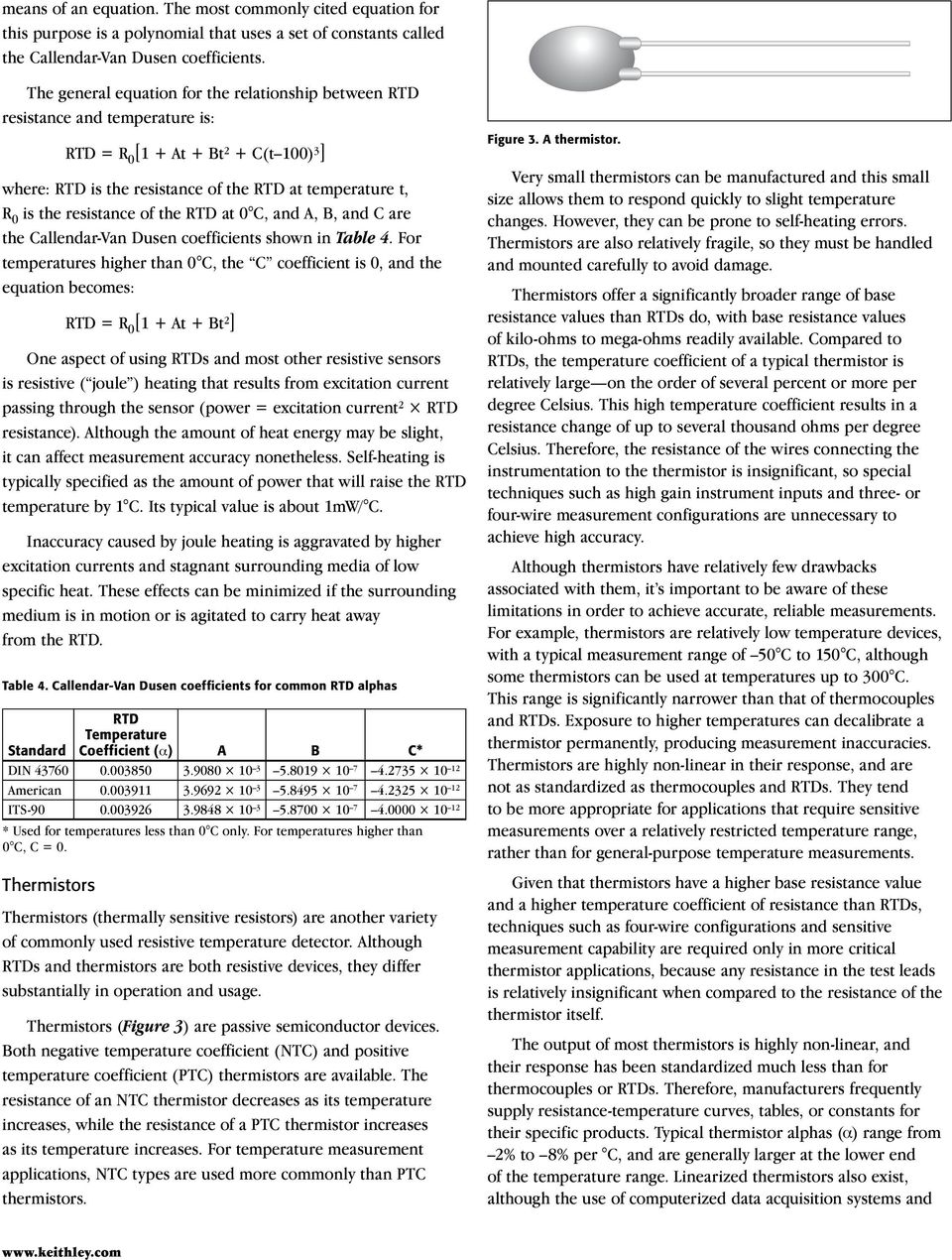
6 means of an equation. The most commonly cited equation for this purpose is a polynomial that uses a set of constants called the Callendar-Van Dusen coefficients. The general equation for the relationship between RTD resistance and temperature is: RTD = R 0 [1 + At + Bt 2 + C(t 100) 3 ] where: RTD is the resistance of the RTD at temperature t, R 0 is the resistance of the RTD at 0 C, and A, B, and C are the Callendar-Van Dusen coefficients shown in Table 4. For temperatures higher than 0 C, the C coefficient is 0, and the equation becomes: RTD = R 0 [1 + At + Bt 2 ] One aspect of using RTDs and most other resistive sensors is resistive ( joule ) heating that results from excitation current passing through the sensor (power = excitation current 2 RTD resistance). Although the amount of heat energy may be slight, it can affect measurement accuracy nonetheless. Self-heating is typically specified as the amount of power that will raise the RTD temperature by 1 C. Its typical value is about 1mW/ C. Inaccuracy caused by joule heating is aggravated by higher excitation currents and stagnant surrounding media of low specific heat. These effects can be minimized if the surrounding medium is in motion or is agitated to carry heat away from the RTD. Table 4. Callendar-Van Dusen coefficients for common RTD alphas Standard RTD Temperature Coefficient (α) A B C* DIN American ITS * Used for temperatures less than 0 C only. For temperatures higher than 0 C, C = 0. Thermistors Thermistors (thermally sensitive resistors) are another variety of commonly used resistive temperature detector. Although RTDs and thermistors are both resistive devices, they differ substantially in operation and usage. Thermistors (Figure 3) are passive semiconductor devices. Both negative temperature coefficient (NTC) and positive temperature coefficient (PTC) thermistors are available. The resistance of an NTC thermistor decreases as its temperature increases, while the resistance of a PTC thermistor increases as its temperature increases. For temperature measurement applications, NTC types are used more commonly than PTC thermistors. Figure 3. A thermistor. Very small thermistors can be manufactured and this small size allows them to respond quickly to slight temperature changes. However, they can be prone to self-heating errors. Thermistors are also relatively fragile, so they must be handled and mounted carefully to avoid damage. Thermistors offer a significantly broader range of base resistance values than RTDs do, with base resistance values of kilo-ohms to mega-ohms readily available. Compared to RTDs, the temperature coefficient of a typical thermistor is relatively large on the order of several percent or more per degree Celsius. This high temperature coefficient results in a resistance change of up to several thousand ohms per degree Celsius. Therefore, the resistance of the wires connecting the instrumentation to the thermistor is insignificant, so special techniques such as high gain instrument inputs and three- or four-wire measurement configurations are unnecessary to achieve high accuracy. Although thermistors have relatively few drawbacks associated with them, it s important to be aware of these limitations in order to achieve accurate, reliable measurements. For example, thermistors are relatively low temperature devices, with a typical measurement range of 50 C to 150 C, although some thermistors can be used at temperatures up to 300 C. This range is significantly narrower than that of thermocouples and RTDs. Exposure to higher temperatures can decalibrate a thermistor permanently, producing measurement inaccuracies. Thermistors are highly non-linear in their response, and are not as standardized as thermocouples and RTDs. They tend to be more appropriate for applications that require sensitive measurements over a relatively restricted temperature range, rather than for general-purpose temperature measurements. Given that thermistors have a higher base resistance value and a higher temperature coefficient of resistance than RTDs, techniques such as four-wire configurations and sensitive measurement capability are required only in more critical thermistor applications, because any resistance in the test leads is relatively insignificant when compared to the resistance of the thermistor itself. The output of most thermistors is highly non-linear, and their response has been standardized much less than for thermocouples or RTDs. Therefore, manufacturers frequently supply resistance-temperature curves, tables, or constants for their specific products. Typical thermistor alphas (α) range from 2% to 8% per C, and are generally larger at the lower end of the temperature range. Linearized thermistors also exist, although the use of computerized data acquisition systems and
7 software make them unnecessary unless the readout hardware must be used with a linearized type. For computerized applications, relatively accurate thermistor curves can be approximated with the Steinhart-Hart equation: 1 T = A + B ln(r T ) + C[ln(R T )] 3 T is the temperature in degrees Kelvin, which is equal to the Celsius temperature plus R T is the resistance of the thermistor. The thermistor manufacturer should provide the constants A, B, and C for a given thermistor. Measurement Instrumentation Options The performance of a temperature measurement system depends just as much on the measurement hardware used as on the sensors. If multiple sensors must be monitored, selecting appropriate switching hardware is also critical. To ensure the completed system meets the application s requirements fully, it s helpful to consider a few critical questions before beginning the selection process. What kinds of temperature transducers must the system be able to handle? How many temperature channels must the system be able to accommodate? Does the application require measuring/monitoring temperatures in remote locations? Does the application require incorporating electrical measurements other than temperature into the system? What type of traceability is required for my measurements? Although thermocouples, RTDs, and thermistors are compatible with many types of measurement instruments, digital multimeters (DMMs) are among the most common choices. A growing number of DMMs are capable of measuring the very low voltages or resistances that temperature sensors produce. Their inherently low noise design and traceable accuracy specifications make them well suited for temperature measurement applications. For applications that require monitoring temperature at multiple points, DMMs with integrated switching hardware are often the most economical solution in terms of flexibility, measurement accuracy, and test throughput. For example, Keithley s Model 3706A System Switch/Multimeter (Figure 4) combines scalable, instrument-grade switching and multi-channel measurement into a single instrument. Figure 4. The Model 3706A System Switch/Multimeter supports up to 360 thermocouple channels in a single 2U chassis. For the temperature monitoring system builder, this all-inone-box combination of high-speed switching and high integrity measurements greatly simplifies the system integration process and helps control system hardware costs. The Model 3706A incorporates multiple features that make it suitable for a variety of temperature monitoring and control applications: Up to 360 thermocouple channels with standard terminal block connections in a single 2U chassis. Automatic cold junction compensation (CJC) on the compatible Model 3720, 3721, and 3724 Multiplexer Cards with a screw terminal accessory for thermocouple-type temperature measurements. Built-in support for measuring temperature with three thermistor types: 2.2kW, 5kW, and 10kW. LXI/Ethernet connection for simplified temperature monitoring in remote locations. Option to expand to additional temperature monitoring channels in additional Series 3700A chassis via the built-in TSP-Link interface. 14 programmable digital I/O lines allow controlling external devices, such as component handlers or other instruments, or sending alarm indications if a critical temperature parameter exceeds tolerance. An embedded graphing toolkit that supports real-time data trending and analysis, which can be invaluable for temperature monitoring tasks. This toolkit gives users a quick, easy, flexible way to observe data as it s acquired they can check the progress of long-duration tests in just seconds, then make adjustments if the results are not as anticipated. There s no need to install special software on the PC or the instrument itself or to write code to extract data from the instrument s reading buffer and import the data into a third-party package or a spreadsheet for analysis. In applications like burn-in, which typically involve monitoring multiple temperature, voltage, and resistance measurements, the Model 3706A s plotting capabilities simplify spotting trends over the course of the test. Users can view up to 40 channels of acquired data in a line or scatter plot in either real-time mode or in user-defined increments. The Model 3706A makes it simple to compare and contrast readings on a per-channel basis so users can spot potential problems early. Similarly, Keithley s Series 2700 Multimeter/Data Acquisition/ Switch systems (Figure 5) are well suited for monitoring and logging temperature. All three mainframes support thermocouples, RTDs, and thermistors with built-in signal conditioning and 300V isolation. To begin using a temperature sensor, the system builder simply plugs in one of the nine Series 7700 switch/control modules that support temperature measurements, connects the sensor, and the instrument does the rest. If a thermocouple is broken or disconnected, the instrument will alert the operator. 7

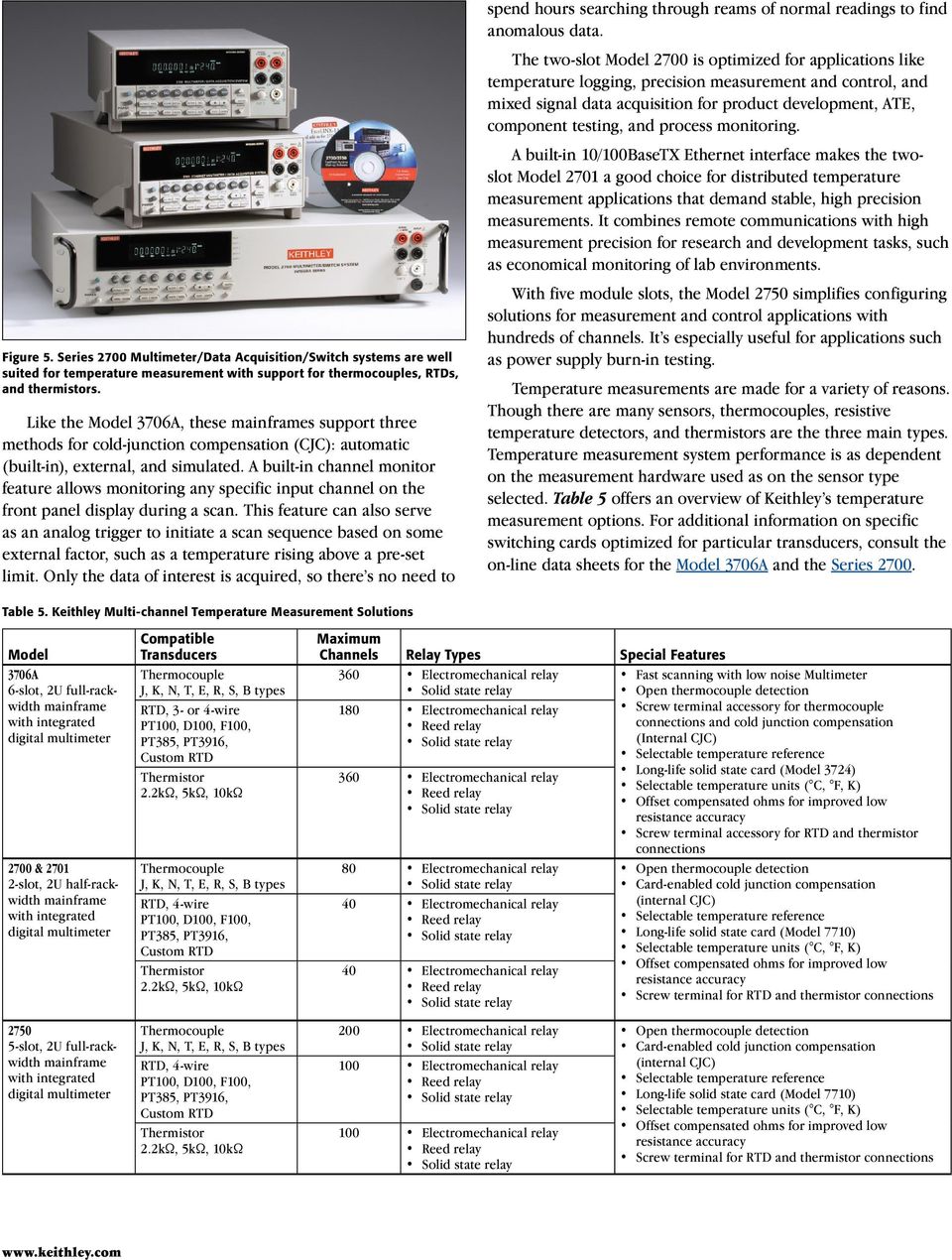
8 Figure 5. Series 2700 Multimeter/Data Acquisition/Switch systems are well suited for temperature measurement with support for thermocouples, RTDs, and thermistors. Like the Model 3706A, these mainframes support three methods for cold-junction compensation (CJC): automatic (built-in), external, and simulated. A built-in channel monitor feature allows monitoring any specific input channel on the front panel display during a scan. This feature can also serve as an analog trigger to initiate a scan sequence based on some external factor, such as a temperature rising above a pre-set limit. Only the data of interest is acquired, so there s no need to spend hours searching through reams of normal readings to find anomalous data. The two-slot Model 2700 is optimized for applications like temperature logging, precision measurement and control, and mixed signal data acquisition for product development, ATE, component testing, and process monitoring. A built-in 10/100BaseTX Ethernet interface makes the twoslot Model 2701 a good choice for distributed temperature measurement applications that demand stable, high precision measurements. It combines remote communications with high measurement precision for research and development tasks, such as economical monitoring of lab environments. With five module slots, the Model 2750 simplifies configuring solutions for measurement and control applications with hundreds of channels. It s especially useful for applications such as power supply burn-in testing. Temperature measurements are made for a variety of reasons. Though there are many sensors, thermocouples, resistive temperature detectors, and thermistors are the three main types. Temperature measurement system performance is as dependent on the measurement hardware used as on the sensor type selected. Table 5 offers an overview of Keithley s temperature measurement options. For additional information on specific switching cards optimized for particular transducers, consult the on-line data sheets for the Model 3706A and the Series Table 5. Keithley Multi-channel Temperature Measurement Solutions Model 3706A 6-slot, 2U full-rackwidth mainframe with integrated digital multimeter 2700 & slot, 2U half-rackwidth mainframe with integrated digital multimeter Compatible Transducers Thermocouple J, K, N, T, E, R, S, B types RTD, 3- or 4-wire PT100, D100, F100, PT385, PT3916, Custom RTD Thermistor 2.2kΩ, 5kΩ, 10kΩ Thermocouple J, K, N, T, E, R, S, B types RTD, 4-wire PT100, D100, F100, PT385, PT3916, Custom RTD Thermistor 2.2kΩ, 5kΩ, 10kΩ Maximum Channels Relay Types Special Features 360 Electromechanical relay Solid state relay 180 Electromechanical relay Reed relay Solid state relay 360 Electromechanical relay Reed relay Solid state relay 80 Electromechanical relay Solid state relay 40 Electromechanical relay Reed relay Solid state relay 40 Electromechanical relay Reed relay Solid state relay Fast scanning with low noise Multimeter Open thermocouple detection Screw terminal accessory for thermocouple connections and cold junction compensation (Internal CJC) Selectable temperature reference Long-life solid state card (Model 3724) Selectable temperature units ( C, F, K) Offset compensated ohms for improved low resistance accuracy Screw terminal accessory for RTD and thermistor connections Open thermocouple detection Card-enabled cold junction compensation (internal CJC) Selectable temperature reference Long-life solid state card (Model 7710) Selectable temperature units ( C, F, K) Offset compensated ohms for improved low resistance accuracy Screw terminal for RTD and thermistor connections slot, 2U full-rackwidth mainframe with integrated digital multimeter Thermocouple J, K, N, T, E, R, S, B types RTD, 4-wire PT100, D100, F100, PT385, PT3916, Custom RTD Thermistor 2.2kΩ, 5kΩ, 10kΩ 200 Electromechanical relay Solid state relay 100 Electromechanical relay Reed relay Solid state relay 100 Electromechanical relay Reed relay Solid state relay Open thermocouple detection Card-enabled cold junction compensation (internal CJC) Selectable temperature reference Long-life solid state card (Model 7710) Selectable temperature units ( C, F, K) Offset compensated ohms for improved low resistance accuracy Screw terminal for RTD and thermistor connections
9 Burn-in Testing Techniques for Switching Power Supplies Introduction One of the consequences of the rapid growth of the telecommunications, desktop computing, and network server markets is a burgeoning demand for switching power supplies and DC-to-DC converters. While these power supplies are typically inexpensive, a high level of quality must be maintained through careful production testing. Highly accelerated stress screening (HASS) or burn-in is a common production step for switching power supplies designed for computers and servers. Extended environmental testing is performed to ensure the product will continue to function properly over its entire service life. It is not uncommon to age and monitor thousands of power supplies at once. When designing this type of test system, the biggest challenge is dealing with the high number of channels the system must monitor and the test system surroundings. Large numbers of switching power supplies can produce tremendous amounts of electrical noise, which can reduce the test system s measurement perform ance significantly. the number of channels needed for the test system. Reducing the number of channels monitored allows a test system to accommodate more power supplies during the testing cycle, reducing overall cost. Less expensive and less complicated power supplies found in PCs may have up to six outputs, while power adapters for laptop computers will have one output. As in the previous case, only one channel is monitored. The 5V output is monitored as the temperature in the environmental burn-in chamber reaches the upper and lower limits, and the power supply output is repeatedly cycled on/off. Monitoring Voltage Figure 1 is a simple schematic of a test for monitoring the voltage output of a power supply. A digital multimeter (DMM) would be connected in parallel with the load resistance to measure the power supply voltage. The load resistance is chosen to emulate the load resistances found in the final application, but may be chosen to reach full output capacity to perform stress testing. Test Description High-end power supplies and DC-to-DC converters with outputs from 400W to 2000W are commonly found in many telecom and server applications. These devices typically have four to six voltage outputs that must be verified. Output voltages may vary from 3.3V to 48V, with one output terminal dedicated to 5V. To verify that the entire power supply is functioning properly, the manufacturer often monitors only the 5V output. This implies that all channels are measured during manufacture, but for the purposes of burn-in, only one output is monitored to reduce 110V or 220V AC Input Power Supply Under Test Load R Figure 1. Monitoring the output of a switching power supply. Monitor Voltage (3.3V 48V) Measurements Over Entire Test Cycle Measure Measure Measure Measure Measure Measure Measure ON Voltage OFF Voltage 15 sec 15 sec ON OFF Repeat 10 Times 40 Minute Constant Output Time Figure 2. Typical burn-in test cycle. 9

10 Output Cycling To stress the power supplies being tested further, the output is repeatedly turned on and off. If a device is destined to fail, the failure will generally occur when the output is cycled. To capture failure data, the output voltage of each power supply is measured during each time the output is turned on, as shown in Figure 2. After the output is cycled 15 to 20 times, the output is left on and the power supply is left to continue aging. While the output is left on, the voltage is measured only occasionally. Test System Description The basic requirement for burn-in testing is to measure the voltage drop across the load resistor placed across the output of each switching power supply (Figure 1) during the entire test cycle. Test cycle duration can range from less than an hour to many days, depending on the quality requirements determined by the manufacturer. Figure 3 illustrates an example of a 300-channel burn-in system in an environmental chamber, using the Model 3706A 7½-digit DMM to make the required voltage measurement on each power supply. Six Model 3720 Dual 1 30 Multiplexer Cards are used to connect the inputs of the Model 3706A to each power supply. The Model 3720 Multiplexer Card is used in this case because each card can monitor up to 60 channels at 300VDC. Each channel has two connections (HI and LO) for each power supply. A typical specification for a power supply is to output 5V with 10% accuracy, which presents no measurement problem for a the integrated 7½-digit DMM in the Model 3706A. As shown in Figure 2, when the output is cycled every 15 seconds, the DMM must make measurements on 300 channels during the 15 second on time. Setting the integration rate or measurement time to be as fast as possible (NPLC = 0.001) and disabling all filters makes performing these measurements fast and easy. The Model 3706A/3720 Multimeter/Data Acquisition System can be used to verify the temperature profile of the environmental temperature chamber independently. By plugging Model 3706A Model 3720 Card Model 3720 Card System Cabling Environmental Burn-in Chamber + Thermocouples + + PS PS PS PS PS PS PS PS PS PS PS PS PS PS PS PS PS PS PS PS PS PS PS PS PS PS PS PS PS PS PS PS PS PS PS PS PS PS PS PS PS PS PS PS PS PS PS PS PS PS PS PS PS PS PS PS PS PS PS PS PS PS PS PS Power Supplies Under Test Figure channel switching power supply burn-in test system schematic. one Model channel differential multiplexer module into the Model 3706A, the system can accommodate up to 60 thermocouples. Typical s of Error Environmental Noise Placing hundreds of switching power supplies into an environmental temperature chamber makes it extremely difficult to make accurate voltage measurements because switching power supplies radiate high frequency noise. If the ground connection is noisy, traditional data acquisition systems will be unable to make satisfactory measurements. The system described here requires scanning across multiple channels rapidly with the high impedance input of the DMM. In this situation, it can be difficult to distinguish between 5V and 0V on adjacent channels. Even with the Model 3706A s superior CMRR, NMRR and 26-bit ADC, making the distinction can be difficult. However, Keithley has developed an algorithm (described elsewhere in this application note) that simplifies this problem. To determine whether a power supply is good or bad, the test system must not only look at the absolute voltage value, but also at how subsequent readings compare. Figures 4a and 4b show two different results when sampling a noisy signal. Assuming the Voltage SAMPLE 1 SAMPLE 2 Voltage SAMPLE 1 SAMPLE 2 5V 5V Noise Noise SAMPLE1 = 4.92V SAMPLE2 = 5.00V SAMPLE1 = 5.00V SAMPLE2 = 4.23V SAMPLE1 - SAMPLE2 = 0.08V Time SAMPLE1 - SAMPLE2 = 0.77V Time Figure 4a. Good result from multiple samples. Figure 4b. Bad result from multiple samples.

11 power supply being tested is known to be acceptable, the figures show how noise can affect the final outcome of the test. Sample 2 in Figure 4b was taken when a noise spike was introduced into the system. This illustrates the importance of taking many samples into account from each power supply or increasing the measurement integration rate. When measuring 5V on one channel and 0V on the next with very fast scan speed, a DMM may not measure 0V for the second channel. Actually, the first reading may be 4.7V and subsequent readings will decrease to 4.3V, 3.7V and gradually down to 0V. This gradual decrease id due to the RC time constant created by the large DMM input impedance and the capacitance in the test system cabling and fixtures. In contrast, if the measured 5V (i.e. power supply is good) twice, the two results will be similar (generally less than 10mV difference). Therefore, Sample 1 Sample 2 = Delta, and if Delta is less than 10mV and both samples are within in limits the power supply is accepted. Without using this algorithm, setting a higher measurement integration rate will significantly improve the instrument s measurement performance in noisy environments, but the resulting scan rate would not be sufficient for the number of channels and time constraints of this application. Relay Life Generally, as the power supplies are being tested, their outputs are turned on. Therefore, as the switch mainframe is scanning across each device, the relays are being opened and closed with voltage across their contacts. Actuating a relay in this manner raises the possibility of arcing, which can severely degrade relay life. The relays on the Model 3720 are rated for 10 8 closures when voltage is not being switched or for 10 5 closures if a 1A, 300V signal is being continually switched. As the signal levels decrease, the expected life of the relay will increase, so it is important to note the voltage and current levels of each power supply that is to be monitored. Equipment List The following equipment is required to assemble the 300- channel switching power supply burn-in test system shown in Figure 3. Model 3706A System Switch/Multimeter. Six Model 3720 Multiplexer Cards. Ten Model 3720-MTC-3 Cables. one Model 3720-ST Screw Terminal. Alternative Solutions The Model 2700 Multimeter/Data Acquisition System supports up to 80 channels is a nice fit for smaller and more modular systems. The Model 2700 is optimized for smaller HASS systems, or for smaller production lots of power supplies. The 2700 series of switch cards many solutions for temperature monitoring and analog signal routing up to 300V. Output cycling of the power supplies is accomplished using Keithley s line of PIO digital I/O boards and solid-state relay (SSR) modules. Test System Safety Many electrical test systems or instruments are capable of measuring or sourcing hazardous voltage and power levels. It is also possible, under single fault conditions (e.g., a programming error or an instrument failure), to output hazardous levels even when the system indicates no hazard is present. These high voltage and power levels make it essential to protect operators from any of these hazards at all times. Protection methods include: Design test fixtures to prevent operator contact with any hazardous circuit. Make sure the device under test is fully enclosed to protect the operator from any flying debris. For example, capacitors and semiconductor devices can explode if too much voltage or power is applied. Double insulate all electrical connections that an operator could touch. Double insulation ensures the operator is still protected, even if one insulation layer fails. Use high-reliability, fail-safe interlock switches to disconnect power sources when a test fixture cover is opened. Where possible, use automated handlers so operators do not require access to the inside of the test fixture or have a need to open guards. Provide proper training to all users of the system so they understand all potential hazards and know how to protect themselves from injury. It is the responsibility of the test system designers, integrators, and installers to make sure operator and maintenance personnel protection is in place and effective. 11

12

13 Solutions for Production Testing of Connectors Introduction As electronics have become increasingly pervasive, the importance of electrical connectors has increased dramatically. 1 Quality connectors are vital to ensuring overall product reliability in applications ranging from motor vehicles to transatlantic telecom systems. The degree and type of electrical testing that connectors undergo typically depends on how crucial they are to the overall performance of the systems in which they are installed. Stringent electrical tests are often specified when high reliability is required. Isolation and continuity are the two most commonly measured parameters in connector testing. Isolation measurements are usually performed between each of the connector pins or between the pins and the outer shell of the connector. Isolation measurements are used to verify that signals are not misdirected and insulation is sufficient under the operating conditions of the connector. Continuity is measured between pins to ensure that once the connector is installed, the electrical signals will be transmitted properly. There are a number of instruments that may be used in connector testing; thus, selecting the optimal solution for a particular application may not be an easy task. This note addresses many of the issues involved in implementing a connector characterization system. Test Description Isolation (Insulation) Resistance Given today s ever-shrinking circuit geometry and the higher frequencies of electronic signals, isolation is an important consideration for reliability and crosstalk. Environmental conditions such as high heat and vibration may also cause degradation of insulation and shorts within the connector. Isolation is typically tested by applying a voltage across two pins in a connector and measuring the resulting current that flows between them. The corresponding resistance from the test is compared to a predetermined threshold value. If the resistance level is too low, the connector is rejected. Common threshold levels range from 1MW to 1TW. Figure 1 shows the electrical equivalent of a connector; the isolation resistance is identified as R iso. When testing very high ohmic devices, the measured resistance may change significantly in response to a change in the applied voltage, an effect known as the voltage coefficient of resistance. This effect makes it preferable to test high value resistors with the source voltage, measure current method. 1 Although this application note targets connector production testing, engineers in cable assembly manufacturing operations perform tests similar to those presented here. These engineers may find the information in this note helpful when selecting test equipment. The actual test voltage chosen depends on the capabilities of the instrumentation and the degree of current measurement sensitivity available, as well as the ratings of the connector material. For a given resistance value, a higher voltage will result in a higher current signal, which can be measured with higher resolution. Figure 2 illustrates the constant voltage method for measuring high resistances. When the measured current is fairly low, the likelihood of measurement errors increases. Contributors to error include noise generated by electrically charged objects in the environment, leakage current in the test fixture, and the amount of cable capacitance present. Strategies for overcoming these measurement obstacles are discussed in the Typical s of Error section in this note. Connector Shell R pin1 R iso R iso R pin2 R iso R iso R pin3 R iso R iso R pinx Figure 1. Electrical Equivalent of a Connector, Showing Pin Continuity and Isolation Resistance. Voltage R Isolation HI Ammeter Figure 2. Constant Voltage Method for Measuring High Resistance. Pin Continuity As long-term performance of connectors becomes increasingly important, the continuity performance from the input to the output of the connector will also become more important. Connector pins are often made from metal alloys, so the measurement result is a very low resistance value. Typically, continuity is tested by sourcing a constant current through the pin and measuring the corresponding voltage drop. Pin continuity is identified as R pin in Figure 1. Using high currents to LO R iso 13

14 test continuity has two advantages. First, using a sufficiently high test current ensures the resulting voltage signal will be above the noise floor of the test system. The noise floor includes the error related to the voltage drop in lead resistances and the voltages due to the variation of temperature at junctions of dissimilar metals. Second, a higher test current can also serve as a stress test for the connector. Often, the connector will be tested at a current level higher than the rated current level in order to verify performance margin. Figure 3 illustrates how a current source and voltmeter are used to measure resistance. Most instruments designed to measure low resistances have a built-in current source and voltmeter and can be configured to measure resistance with one instrument bus command or button on the front panel. Current R Continuity HI Voltmeter Figure 3. Constant Current Method for Measuring Low Resistance LO Solutions Overview Table 1 shows a representative selection of Keithley test equipment solutions for connector testing. Use this table to identify the solution that best fits the specific measurement parameters. When selecting test equipment, the user/design engineer needs to determine appropriate accuracy and speed requirements, the range of resistances to be measured, the method of measuring resistance, and whether or not it s necessary to control the value of test current or voltage. Additional features such as handler interfacing and limit testing may also be of importance to the user. Selection of a switch solution requires a plan of the test environment and the sequence of tests to be performed. Answering the following questions will assist the engineer in designing a switch system: How many devices are to be tested? Is parallel testing needed? Will the system be performing multi-pin/pin-to-pin testing? What are the maximum voltage and current levels to be sourced and/or measured? Table 1. Instrument Selection Guide for Connector Test. Test Equipment Model 2750 Multimeter/ Switch System Model 2790 Meter/ Switch System Model 2400 Meter SMU Instruments Model 2400 Meter and Model 2182A Nanovoltmeter Model 3706A System Switch/ Multimeter Model 6487 Picoammeter with Voltage Model 6517B Electrometer Model 2001/2002 High Performance Multimeter Model 6221 Current and Model 2182A Nanovoltmeter Pin Continuity Isolation Test Measurement Ranges Notable Features Pin Continuity: 1mW+ Optional internal switching. Isolation: Up to 100MW Offset compensation. Common-side ohms configuration. Enhanced low ohms measurement capability. Pin Continuity: 10mW+ Isolation: Up to 1GW Pin Continuity: 1mW+ Isolation: ~ 1GW Pin Continuity: 1μW+ Pin Continuity: 1mW+ Isolation: Up to 100MW Isolation: 1kW 1TW Isolation: 200kW 1e17W Pin Continuity: 10mW Isolation: Up to 1GW Pin Continuity: 100nW Isolation: Up to 100GW Optional internal switching. Offset compensation. 500V programmable voltage source (low power). 50mA programmable current source. Programmable test current (pin continuity). Programmable voltage source (isolation test). Ability to save 100 test setups in memory. Auto output-off reduce device heating. Contact check option. Programmable test current. Delta mode current reversal technique for 2400 and 2182A. Optional internal switching. Offset compensation. Common-side ohms configuration. Enhanced low ohms measurement capability. Up to 576 two-wire multiplexer channels. Independent programmable voltage source (±500V). V/I Ohms. Independent programmable voltage source (±1000V). Optional internal switching. Optional temperature and humidity measurements. Offset compensation. Optional internal switching. Optional Model 1801 Nanovolt Preamp to increase sensitivity (with this preamp, pin continuity range can extend down to 5mW at a test current of 9.2mA). Delta Mode for low thermal, low resistance measurements.

15 What are the speed and accuracy requirements? After having determined the specific application needs, the designer may wish to review the switching and measurement solution with a Keithley Applications Engineer. Test System Option Descriptions Series 3700A or Series 2700/Integra Systems Choosing the appropriate test equipment can be difficult. Series 3700A or Series 2700 Systems simplify the test setup by combining the switch and measurement hardware into a single unit. These products incorporate a precision digital multimeter with a wide assortment of switching cards and switching topologies (multiplexer, matrix, etc ). Table 2 provides an overview of the Series 3700A and For more details on the available switching modules, see the keithley.com website. Both of these systems measure all ranges of resistance using the constant current method. The instruments range (up to 100MW) may be adequate for measuring isolation resistance in many applications. These models also offer fourwire connections, dry circuit testing (3706A and 2750), offset compensation and low current source to prevent device heating in low resistance measurements. The section of this note titled Typical s of Error discusses how these features can be useful in reducing or eliminating measurement errors. The Model 3706A and Model 2750 mainframes have an enhanced ability to measure low ohms accurately. This makes it an ideal choice for pin continuity tests. Pairing the Model 3721 Switch Card with the 3706A or the Model 7701 Switch Card with the Model 2750 permits four-wire connections without comprising channel count. These cards offer the same channel count (3721: 40 channels, 7701: 32 channels) for four-wire resistance measurements as it does for two-wire measurements by using a common-side ohms configuration. As shown in Figure 4, a four-wire measurement is made by connecting the HI and Input HI to a bus that is common with one side of all the devices. With such a configuration, up to 240 low resistance devices may be tested using the Model 3706A and six Model 3721 Switch Cards. Testing multi-pin connectors may require a switch configuration in which measurements are made from any one pin to any other. A matrix switch card permits convenient Contact Pin and Mating Sleeve HI HI Ch. 1 Ch. 2 Ohmmeter Ch. 40 LO LO 3706A/3721 Multimeter/Switch System Figure 4. Common-Side Ohms Configuration pin-to-pin testing and are available in both the Model 3700A and Series 2700 instruments. Model 2790 Meter/Switch System If source programmability is required, consider the Model 2790 Meter Switch System as a possible solution. A member of the Integra Series family of products, the Model 2790 has the multimeter functions of the Model 2700 with optional switching modules that include voltage and/or current sources. Three optional modules for the Model 2790 are available: Model 7751 High Voltage /Switch Module, Model 7752 Low Voltage Current--Only /Switch Module, and Model Channel General Purpose Multiplexer Module. The Model 7751 module contains a low power programmable 500V voltage source with a maximum current output of 50μA. It also has a 50mA programmable current source. Additionally, an I-V converter is included on the 7751 module in order to make more accurate measurements than are possible with the ammeter internal to the Model 2790 mainframe. These enhanced source and measure capabilities allow making isolation measurements up to 1GW and continuity measurements down to 10mW with the Model The Model 7752 switch card is also as an option for the Model Containing just the 50mA programmable current source, the 7752 is ideal for applications where only continuity measurements will be made. Table 2. Integra Series Comparison Chart Integra Series Product Number of Slots Communication Interface Model GPIB, RS-232 Model Ethernet, RS-232 Model GPIB, RS-232 Model 3706A 6 Maximum Channel Count or Crosspoints 80 channels or 96 crosspoints 80 channels or 96 crosspoints 200 channels or 240 crosspoints 576 channels or 576 crosspoints Internal Data Buffer Capacity Maximum Reading Rate, Single Channel (readings/second) 55, Additional Features 450, Portable, ½ rack, 2U design 110, ,000 14,000 Low ohms capability (1μW max. sensitivity) Low ohms capability (0.1μW max. sensitivity) 15

16 Each Model 7751 or 7752 module allows two-wire connections to 12 DUTs. If more connections are required, consider using the Model Channel multiplexer card in the second slot of the Model In addition to higher channel count, this card permits routing to the DMM for general measurements, including voltage, current, and resistance. The sources on the Model 7751/2 cards are accessible via screw terminals and may be routed to the Model 7702 card for measurement. For some applications, the measurement range of the Series 2700 instruments may not be broad enough to accommodate the test requirements for both isolation and continuity measurements. The engineer may also want more flexibility in the level of source current or voltage used in the test. In these cases, one of the Series 2400 Meter SMU instruments may be a more suitable solution. Series 2400 Meter SMU Instruments Meter SMU instruments consist of a voltage source, current source, voltmeter, ammeter, and ohmmeter in a single half-racksized package. With these components, Meter SMU instruments offer greater measurement sensitivity for pin continuity tests and extended range for isolation resistance tests. Some devices, however, may not be able to withstand such a high level of current without experiencing device heating, which can introduce significant error to the measurement. The Meter products have an auto output-off feature that keeps the source turned on only long enough to complete the measurement (only a few milliseconds), which reduces device heating. As an added benefit, auto output-off provides cold switching, for extended relay life in switch systems. Series 2400 instruments also include offset compensation, as well as programmable compliance settings that allow users to apply dry circuit conditions. For extremely low resistance devices that require a high degree of test accuracy, a more sensitive voltmeter, such as the Model 2182A Nanovoltmeter, will likely need to be paired with the Meter SMU instrument. Using the Model 2182A and a Meter SMU instrument, the uncertainty of a 1mW measurement with a 10mA source is 0.45%. Comparing these specifications with the example in the previous paragraph (where the Meter SMU instrument alone was used), the 2182A/2400 configuration with a 100 reduction in source current leads to only a 0.15% increase in uncertainty. The combination of these two instruments offers wider flexibility in source current and measurement time. The Delta Mode feature of the Model 2182A also allows coordination with the Meter SMU instrument to add offset compensation to the measurement. Another potential source is to use the Model 6221 Current with the Model 2182A Nanovoltmeter. They were designed to work together for low resistance measurements. At 100mA test current from the Model 6221 and the sensitivity of the Model 2182A at 10nV, the low resistance measurement is sensitive to 1e-7W (100nW). Like the Model 2400, you have control over the test current. And the Model 6221 has the trigger link connection to trigger the Model 2182A for delta measurements. The main advantage to using Models 6221/2182A over Models 2400/2182A is that the Model 6221 controls the two units. The data is shown on the Model 6221 in volts, ohms, watts, or siemens. Since the two units were developed with delta mode in mind, the system is very simple to configure. Once the serial cable and trigger link cable are connected between the two instruments, it takes only a few button pushes to configure and start the delta mode. The Model 6221 s maximum current is 100mA. The 2400 Series maximum current is 5A. If using 100mA and below, then Models 6221/2182A are recommended. If using above 100mA, then the 2400 Series with the Model 2182A is recommended. As discussed previously, it s generally preferable to test high value resistors with the source voltage method. Given that Series 2400 instruments all have a voltage source, these instruments may be used to measure isolation resistances of up to 1GW or more with reasonable accuracy. With a 1100V source, the Model 2410 offers the possibility of testing very large resistances. Testing a 10GW resistor at 500V, the Model 2410 offers just 0.67% uncertainty. Additional Isolation Test Equipment Other solutions for high insulation resistance measurement include the Model 2001, Model 2002, and Model 3706A Digital Multimeters. These instruments offer the ability to measure up to 1GW using the constant current method, in addition to standard multimeter functions such as AC voltage, AC current, and temperature. The Model 6487 Picoammeter has an independent 500V programmable source voltage and a V/I resistance mode, which make it suitable and convenient for measuring insulation resistance. The Model 6517B electrometer, with an independent 1000V programmable source and 3fA offset on its ammeter, offers the best high resistance measurement accuracy of all standard Keithley instruments. This instrument may be necessary for extremely high insulation resistances (hundreds of gigaohms or teraohms). Obviously, there are many instrumentation options available. Therefore, when choosing test equipment, the project engineer should carefully consider the entire range of resistance to be tested and other measurements or applications for which the instrument may be used. Switching Solutions Once it s clear what instrumentation option is most appropriate, the project engineer can focus on the switching requirements of the application. While the Series 2700 Integra Systems and Model 3706A can be used for switching alone, Keithley also offers the Series 7000 line of switching products, which are designed for use with measurement hardware. The Model 7001 and 7002 mainframes house and control the plug-in switch cards,

17 which contain the relays that will connect the test equipment to the test points of the connector. Plug-in switch cards are available in a variety of relay configurations. The multiplexer and the matrix are the two most common switch topologies. Multiplexer cards are used to connect one instrument to many test points or vice versa. Figure 5 shows a simple multiplexer configuration in which resistors are connected across each relay. When only one channel is closed, a device is connected to the inputs of the Meter SMU instrument and can be tested. A matrix configuration, on the other hand, provides the flexibility required to test many different channel patterns. In a matrix, any one point in the system may be connected to any other point in the system. For example, this configuration is useful when more than one instrument is needed to test each device. Figure 6 shows a simple matrix configuration with connections to two instruments and five pins of a six-pin device. Although two channels must be closed in order to perform a measurement, the matrix configuration allows testing any possible combination of connector pins. Up to 40 differential channels per 7011 Switch Card Model 24XX Figure 5. Multiplexer Configuration Model 6517B Electrometer Model 2010 DMM Ammeter HI Guard V- LO LO HI Figure 6. Matrix Configuration Model 7011 Quad 1 10 Multiplexer Connector Under Test Model 7153 High Voltage/Low Current Matrix Card The Series 7000 switch mainframes are smart in that they can save switch patterns and sequences. These mainframes also have built-in trigger hardware (see the Trigger Link description in the section titled Optimizing the Measurement ) that affords hardware handshaking between the switch mainframe and the measurement equipment. With this external triggering, the instruments can execute the programmed test sequence without operator intervention. In addition to the relay configuration, it s very important to consider the specifications of the switch card when choosing switch hardware. The goal of switching is to make connections without compromising the measurement. When measuring pin continuity (low resistances), it s important to choose a switch card with low contact potential and a current rating high enough to withstand test current. When measuring insulation resistances, choose a switch card with low offset current, high isolation resistance, and a voltage rating high enough to withstand source voltage. For more detailed information on selecting appropriate switch hardware, refer to Keithley s Switching Handbook. Optimizing the Measurement Trigger Link The Trigger Link is a hardware handshake bus used by the instruments to ensure proper test sequencing. It s a standard feature on all newer Keithley instruments, including those mentioned in this note. When the meter and switch mainframe are connected via a Trigger Link cable, they can trigger each other to allow faster test completion. This built-in bus eliminates the need for direct PC control of most system synchronization functions. When the Trigger Link function is used properly, the only functions the PC performs are initiating the test and retrieving data from the system. Solutions to Typical s of Error Noise Noise can come from many sources in the production environment. When electrically charged objects, such as machinery, electrical motors, or fluorescent lights are brought near an uncharged object (i.e., the device under test), small, unwanted voltages may be generated. To minimize the effects of this electrostatic interference, ensure all system cabling is properly shielded. All shields should be connected to a single common point such as the signal LO. Whether the system cabling is single- or multi-conductor, it s best to use one shield around the wire bundle. Leakage Current Stray or leakage current in cables and fixtures can be a source of error in measurements of extremely low currents, such as for high impedance devices or parameters. To minimize leakage current problems, the test fixture insulation must be made of materials with resistances much higher than the impedances being tested. If proper care is not taken, some portion of the test current will flow through any low impedance path to ground, 17

18 affecting measurement results. An alternate method of reducing leakage currents is to guard the test. When testing multi-pin connectors, it s also important to guard the other pins that are not being tested because the resistance between the other pins and ground may affect the final measurement. By connecting the guard output from the meter to the other pins, the undesirable resistance and subsequent leakage to ground is eliminated. Refer to Keithley s Low Level Measurements handbook for detailed information on guarding. Figure 7 illustrates how to connect the Model 6517B Electrometer to make a high resistance measurement properly to minimize leakage current, cable capacitance, and noise. 6517B HI Ammeter Meter Connect Relay V- LO Triax Input LO HI Shield DUT Figure 7. Model 6517B Connections for Making Guarded Ohms Measurement Cable Capacitance The amount of capacitance in the test system cabling will determine the settling time required to obtain an accurate reading. Settling time is determined by the system s RC time constant; a large resistance value can result in significant settling times, even with a relatively small capacitance value. For best accuracy, let four to five time constants elapse before taking the measurement. System capacitance, and thereby settling time, can be reduced by keeping cable lengths as short as possible, guarding the system properly, and using the source voltage, measure current method of making high resistance measurements. Lead Resistance A common source of error for low impedance occurs when only two test leads are connected to the DUT. In this configuration, both the current source and voltmeter use the same pair of leads. The lead resistance, being in series with the DUT, is added to the final measurement. Such a setup is especially detrimental for testing connector pins because the test lead resistance may actually be greater than the resistance of the connector itself. Figure 8a illustrates this effect. To eliminate lead resistance effects, the current source and voltmeter must be separated so that four wires (force and sense leads) are used to connect to the device. The amount of current in the sense leads is negligible and so the lead resistance is insignificant. Figure 8b shows how the voltmeter senses the voltage drop across the DUT without the effect of the lead resistance. Output HI Model 24XX Meter Output LO HI LO Figure 8a. Two-Wire Measurement R S Output HI HI Model 24XX Meter Output LO LO Figure 8b. Four-Wire Measurement Thermoelectric EMFs Thermoelectric EMFs may cause measurement problems for low impedance measurements. The voltage drop across low impedance devices is typically very small. Thermoelectric EMFs may be on the same order of magnitude as the test signal, thereby introducing significant error. Most of the instruments discussed in this note can be programmed to cancel the effects of thermoelectric offsets automatically through the offset compensation or current reversal technique. This technique involves taking two measurements. The first measurement is taken at the desired positive source level, then the second is taken at the opposite source polarity (or at 0A, depending on the instrument). These two measurements are then subtracted from each other and the resulting resistance is calculated as follows: (V 2 V 1 ) Delta Mode Ohms = (I 2 I 1 ) where: I 1 is the source current set to a specified positive value. I 2 is the same current value as I 1 with opposite polarity. V 1 is the voltage measured at I 1. V 2 is the voltage measured at I 2. Equipment List The equipment needed to build the connector test system illustrated in Figure 6 includes: Keithley Model 6517B Electrometer/High Resistance System Keithley Model 2010 Low Noise Multimeter Keithley Model 7001 (or 7002) Switching Mainframe Model High Voltage Low Current Matrix Switching cards. Each card can accommodate up to five connector pins. Model 7153-TRX cables for connecting to the 7153 card. Two cables are required for each switch card in the system. Model 237-TRX-T 3-slot Triax T adapters. Four adapters are required for each switch card in the system. PC with Model KUSB-488 Interface Card Three Model 7007 IEEE-488 Interface Cables

19 Test System Safety Many electrical test systems or instruments are capable of measuring or sourcing hazardous voltage and power levels. It s also possible, under single fault conditions (e.g., a programming error or an instrument failure), to output hazardous levels even when the system indicates no hazard is present. These high voltage and power levels make it essential to protect operators from any of these hazards at all times. Protection methods include: Design test fixtures to prevent operator contact with any hazardous circuit. Make sure the device under test is fully enclosed to protect the operator from any flying debris. For example, capacitors and semiconductor devices can explode if too much voltage or power is applied. Double insulate all electrical connections that an operator could touch. Double insulation ensures the operator is still protected, even if one insulation layer fails. Use high reliability, fail-safe interlock switches to disconnect power sources when a test fixture cover is opened. Where possible, use automated handlers so operators do not require access to the inside of the test fixture or have a need to open guards. Provide proper training to all users of the system so they understand all potential hazards and know how to protect themselves from injury. It s the responsibility of the test system designers, integrators, and installers to make sure operator and maintenance personnel protection is in place and effective. Alternative Solutions Some types of connectors must be tested over wider voltage and current ranges than those described here. Keithley Application Note #2154, Testing Devices with High Voltage and High Current, describes how to configure a test system based on Meter SMU instruments that supports testing isolation resistance up to 1100V and continuity up to 3A. 19

20

21 LLCR Pin Socket Testing with the Model 3732 High Density Matrix Card Introduction Computer processors (CPUs) today have come a long way from the computer processors of the past. They draw more power, run at lower voltages, and have more pins than ever before. Meanwhile, they can still be dropped into a CPU socket without the need to be soldered. With such large current draws, any significant resistance in the contacts between the CPU and the socket can cause large voltage drops and excess heat, rendering the CPU inoperable. Because of this, it is critical that the contact resistance be minimized. To ensure this requirement, thorough testing of sockets must be performed. This testing usually comes in the form of Low Level Contact Resistance (LLCR) testing. In an LLCR test, the resistance of a set of contacts is measured using low level signals. The test is performed by sourcing current in the 1nA to 100mA range across the contacts being evaluated and measuring the resultant voltage drop. Due to the small resistance values found on the contacts, this voltage drop is System can test from any H terminal to any L terminal, but it cannot test from any H terminal to any other H terminal or from any L terminal to any other L terminal. Ch. 1 Ch. 2 HI Analog Backplane 1 Analog Backplane 2 DMM Input DMM Example: System can test from H1 to L5, but it cannot test from H1 to H5. Ch. 3 Ch. 4 Ch. 5 Analog Backplane 3 Analog Backplane 4 Ch. 6 Analog Backplane 5 Ch. 7 Analog Backplane 6 Ch. 8 LO Ch. 9 Ch Bank 1 H1 H2 H3 H4 H5 H6 H7 H8 H9 H10 L1 L2 L3 L4 L5 L6 L7 L8 L9 L10 HI Ch. 31 Ch. 32 Ch. 33 Ch. 34 Ch. 35 Ch. 36 Ch. 37 Analog Backplane 1 Analog Backplane 2 Analog Backplane 3 Analog Backplane 4 Analog Backplane 5 Analog Backplane 6 DMM Input DMM Ch. 38 LO Ch. 39 Ch Bank 1 Figure 1. Four-wire cable test connections using a multiplexer 21
22 typically very small (in the microvolt range) and thus requires a high quality voltmeter to obtain accurate readings. LLCR tests are performed on CPU sockets by placing an interposer over the socket and then measuring the resistance between various sets of pins in the socket. The interposer creates a path across a number of contacts, and thus the measured resistance is the sum of the contact resistances of the individual pins. The total contact resistance is then divided by the number of contacts in the path to get the average contact resistance. Typical desired contact resistance is under 17-20mW per contact. Connect AB3 HI to AB1 HI (Pin 5 to Pin 1) (DMM HI) Connect AB3 LO to AB2 HI (Pin 6 to Pin 3) ( HI) Connect AB4 HI to AB1 LO (Pin 7 to Pin 2) (DMM LO) Connect AB4 LO to AB2 LO (Pin 8 to Pin 4) ( LO) Test System Design Due to the variety of socket sizes and layouts and the different interposers that can exist for a single socket, it is desirable to have a test system that can adapt to new probe patterns without requiring manual rewiring of the test system. The test system should be flexible enough to adapt to a new layout simply with programming and should provide the ability to test from any pin in the socket to any other pin in the socket. Also, due to the low resistances involved, the system must use Kelvin connections. SMU Solution One way to implement this kind of system is to use several source measure units (SMUs), with one SMU per pin, and perform your tests from one SMU to another. However, at hundreds or thousands of pins per socket, this is neither cost nor space effective. A much cheaper and more efficient solution would be to combine switching hardware with a single set of measurement instrumentation and allow the switch to connect the instruments between the socket pins. Multiplexer Solution Most test systems requiring switching can be built using multiplexer cards. With multiplexers such as Keithley s Model 3722 Dual 1 48 High Density, Multiplexer Card and some simple wiring of the Model 3706A switch mainframe s analog backplanes, very dense cable test systems can be created. These systems allow full 4-wire Kelvin testing from any pin at one end of the cable to any pin at the other end of the cable. It does this by connecting the two banks of the multiplexer to the two ends of the cable then re-wiring the backplane to route Bank 1 signals to the Digital Multimeter s (DMM s) HI and HI inputs and Bank 2 signals to the DMM s LO and LO inputs. An example of this system can be seen in Figures 1 and 2. In essence, this sounds very similar to the procedure for the socket pin test. However, this system has a limitation that makes it unsuitable for this particular application; it cannot test between pins that are on the same side of the cable. For example, for a test between pins H1 and H5, Figure 1 shows that it is not possible to route both the DMM HI signals and DMM LO signals to the pins at the same time. In a socket test system where a test needs to be done between any two pins in the system, this setup is insufficient. Figure 2. Backplane connections for 4-wire cable test using a multiplexer In order to get any pin to any pin switch capability from multiplexers, one multiplexer is needed for each pin in the system, and each multiplexer must have as many channels as there are pins in the test system (minus the one for itself). For example, to test a 40-pin socket, differential multiplexers are necessary in order to perform 4-wire Kelvin measurements from any pin to any pin. This would correspond to 40 Model 3721 Dual 1 20 Multiplexer cards and would require seven Model 3706A mainframes to house them. This is by no means practical. Matrix Solution LLCR pin socket testing requires a switch card with maximum flexibility. No card provides this as simply and easily as a switch matrix card. Because of this, choose the Keithley Model 3732 Quad 4 28 Single Pole, Ultra-High Density, Matrix Card. Its four rows provide the exact number of lines required for 4-wire Kelvin connections and the single-pole crosspoints offer the ability to route each signal to exactly where the user desires. The Model 3732 matrix card has density. In the previous example using multiplexers, it would require 40 Model 3721 cards and 7 mainframes to house a 40-pin test system that has the required flexibility needed for our test system. With the Model 3732 configured as a matrix, only one Model 3706A mainframe and a single Model 3732 card are required to create the same system. Using the Model 3732 there can be a total of 56 test pins per card (two columns per pin: one source, one sense) for a total of 336 four-wire Kelvin pins per mainframe. (A mainframe can contain up to six Model 3732 cards.) In addition, thanks to the analog backplanes of the Model 3706A, the number of columns across multiple cards (as well as connected to the internal DMM) can be further expanded without any external wiring. If a single mainframe is not large enough, the columns across mainframes can also be expanded with only four wires by connecting the Model 3706A analog backplanes together. This results in high density systems; for example, 1000-pin tests can be performed with less than four full mainframes. Current and DMM Selection To achieve the desired density in the system, select the Keithley Model 3732 Ultra-High Density Reed Relay Matrix Card and the
23 Keithley Model 3706A System Switch/Multimeter; however, test signals are still needed. Within the Model 3706A is a precision 7½-digit DMM capable of making 4-wire Kelvin resistance measurements. With 1µW resolution, the DMM in the Model 3706A is completely capable of making the low milli-ohm measurements required for LLCR testing. However, the problem with any DMM is that the current they source to perform measurements is a fixed value. In a low level contact resistance test, the current required varies depending on the device under test (DUT). To have a truly flexible system it is much better to use a precision current source to source the exact amount of current needed. Then, use the voltmeter on the internal DMM to measure the voltage and calculate the resistance. While any precision current source would work for this application, a Keithley Model 2612B Meter instrument will maximize speed and simplicity. The Model 2612B precisely sources and measures the current levels of this application and integrates with the Model 3706A using Keithley s TSP- Link technology. This combination of hardware provides the framework for an incredibly fast and accurate test system. Using TSP-Link and the embedded Test Script Processor (TSP ), both the Model 2612B and the Model 3706A Switch/DMM can be controlled from a single script. Switch, source, and measure operations between the instruments can be synchronized without the use of external digital I/O. Also, thanks to TSP- Link and the advanced trigger models of both instruments, the required tests can be performed at maximum speed through the use of scans and sweeps. If the Model 2612B can perform 4-wire Kelvin resistance measurements, why is the DMM in the Model 3706A necessary? If the DUT resistances in this application were higher, then the DMM would probably not be necessary because the voltage levels would be higher. The DMM is necessary, however, because it has a higher resolution voltmeter than the Model 2612B (7½ digits vs. 5½). At these low levels, the voltmeter of the Model 2612B does not have enough resolution to achieve the desired accuracy, the 3706A s DMM is used to measure the voltage across the DUT. Application Details This test system is both flexible and scalable because of the architecture of the Model 3732 ultra-high density matrix card. Being a single-pole matrix, this card has the ability to route any signal to any pin. This same architecture also allows the system to expand, often without external wiring, simply by closing relays on the analog backplane. In a typical socket test, for any particular part being tested, the pins to be tested between are usually predetermined. The Model 3706A tailors to this through the use of switch patterns. A pattern allows you to take multiple channels and group them together such that an open or close of that pattern will open and close those channels all at the same time. For a particular test, the user would simply hard code in a predetermined set of switch patterns then add these patterns to a scan to perform the test. In a typical test, these patterns do not include every pin in the socket. In order to demonstrate the power and flexibility of this test system, the following explains how to test every pin to every other pin in the system. Required Equipment In this example, assume that the DUT has 56 pins to test. To complete tests on this DUT the following equipment is needed: One Model 3706A System Switch/Multimeter One Model 3732 Ultra-High Density, Matrix Card One Model 3732-ST-C Column Expansion Screw Terminal One Model 2612B System Meter Instrument One Model 3706-BKPL Backplane Connector One Model TSP-Link Crossover Cable One PC with Interface for Instrument Control System Connections & Configuration Communications Before any testing can be done, everything must first be connected. Communications simply require a TSP-Link cable between the Model 2612B and the Model 3706A, and a GPIB or Ethernet cable between the Model 2612B and the computer (see Figure 3). No additional wires are needed for triggering as these lines are built into TSP-Link. This system takes advantage of TSP-Link technology so the instruments must be setup properly to use it. For this setup the Model 2612B is configured as the master node, while the Model 3706A acts as a slave. Configure the 2612B as TSP-Link node 1 and the 3706A as TSP-Link node 2. This can be done from the front panel of each instrument by pressing the MENU button Model 2612B GPIB or Ethernet TSP-Link Model 3706A Figure 3. System communications hookup 23
24 then selecting TSPLINK from the Main menu. From the TSPLINK menu select NODE and then configure the node number. Press ENTER to accept the changes. Matrix Configuration Next, the Model 3732 Ultra-High Density Reed Relay Matrix Card must be configured. This is done by setting a pair of jumpers on the Model 3732-ST-C screw terminal block. Set the jumpers for the configuration (see Figure 4). Table 1. Backplane to row mappings for configuration Row Analog Backplane 1 A1 HI, A3 HI, A5 HI 2 A1 LO, A3 LO, A5 LO 3 A2 HI, A4 HI, A6 HI 4 A2 LO, A4 LO, A6 LO DMM will not cause interference or load the circuit in any way. In this example we are using analog backplane 4. See Figure 5 for details. 1 9 Figure 4. Model 3732-ST-C jumper settings for configuration SMUA HI LO 15 8 Test Signals Finally, the test signal connections must be hooked up. Thanks to the flexibility of the Model 3732, this is easy. The only wiring required is from the Model 3732 to the probe pins and from the Model 2612B to the Model 3706A. The probe pins connect to columns of the Model 3732 card. Adjacent columns on the card will be used to test a single socket pin, with one column being used for the source lead and the other column used for the sense lead. The Model 2612B connects to the Model 3706A through the analog backplane connector, which allows the Model 2612B to connect to the Model 3732 regardless of in which slot it is located. This also supports easy expansion of the system to multiple cards. The Model 3732 Ultra-High Density Reed Relay Matrix Card is designed so that the rows of the card can be connected to the analog backplane of the Model 3706A mainframe. This allows column expansion without the use of external wiring as well as the ability to connect to the Model 3706A s internal DMM. In the Model 3732, each row of the matrix maps to an analog backplane line. The mappings for the configuration used in this application can be seen in Table 1. Because the HI and LO signals of the Model 3706A s internal DMM are tied to analog backplane 1, Rows 1 and 2 of the matrix will be used to connect to the DMM by default. This leaves Rows 3 and 4 to be used for the HI and LO signals of the Model 2612B. To facilitate system scalability, rather than connect the Model 2612B directly to Rows 3 and 4 of the Model 3732 card, the Model 2612B will be connected to an analog backplane of the Model 3706A instead. The table shows that the Model 2612B can be connected to analog backplane 2, 4, or 6 as these are tied to Rows 3 and 4. Knowing that the 4-wire sense lines of the Model 3706A s internal DMM are tied to analog backplane 2, connect the Model 2612B to analog backplane 4 or 6 to ensure that the Model 3706A s Figure 5. Connect the Model 2612B Meter instrument to analog backplane 4 through the analog backplane D-Sub connector With the test instruments connected to the rows, the test pins will be connected to the columns. Each test pin has a Kelvin connection, therefore, each test pin requires that two columns be connected to it, one for the source signal and one for the sense. To facilitate simplicity in wiring and channel mappings, adjacent columns should be used to create source-sense pairs for the test pins. For example, columns 1 and 2 should be connected to test pin 1 s source and sense leads. Columns 3 and 4 should be connected to test pin 2. This continues for as many test pins as needed in the system. Figure 6 shows these connections in detail. Note that when scaling this system up, this pattern should be maintained throughout the system, across cards and mainframes. Test Sequence Each test on a socket is performed between two test pins. One of these test pins acts as the HI terminal of the DUT while the other acts as the LO. This means we must route the HI source and sense lines of the test instruments to one test pin and the LO source and sense lines to the other. To do this, close four crosspoints as shown in Figure 7. With this configuration, one pin to all others can be easily tested by simply fixing the HI signal on one pin and scanning the LO signal across all the other pins. Then, move the HI signal to the next pin and repeat the scan of the LO signal across all other pins. This process can be repeated over and over until each pin has been tested against all other pins. See Figures 8, 9, and 10 for an illustration of this procedure. The figures show the measurement paths and thus the relays that must close for each step in the test. By examining Figures 8,
25 9, and 10, you can see that the required relays to be closed move in a fixed pattern with each step of the test; two columns right per step. This provides a simple pattern in the channel mappings to write code against. Trigger Model Setup The Model 3706A System Switch/Multimeter and the Model 2612B System Meter instrument both include an advanced trigger model for tight timing and synchronization of switch and SMU operations. Using these features, the test can be configured to run as quickly as possible without the worry of operations becoming unsynchronized. The script in Appendix R1 R2 R3 R4 A1HI A1LO A4HI A4LO DMM HI DMM LO SMU HI SMU LO C1 C2 C3 C4 C5 C6 C7 C8 C111 C112 Pin 1 Pin 2 Pin 3 Pin 4 Pin 56 Figure 6. Column to pin mappings R1 R2 R3 R4 A1HI A1LO A4HI A4LO DMM HI DMM LO SMU HI SMU LO C1 C2 C3 C4 C5 C6 C7 C8 C111 C112 Pin 1 Pin 2 Pin 3 Pin 4 Pin 56 Figure 7. Close these four crosspoints to test from pin 1 to pin 2 R1 R2 R3 R4 A1HI A1LO A4HI A4LO DMM HI DMM LO SMU HI SMU LO C1 C2 C3 C4 C5 C6 C7 C8 C111 C112 Pin 1 Pin 2 Pin 3 Pin 4 Pin 56 Figure 8. Test from pin 1 to every pin R1 R2 R3 R4 A1HI A1LO A4HI A4LO DMM HI DMM LO SMU HI SMU LO C1 C2 C3 C4 C5 C6 C7 C8 C111 C112 Pin 1 Pin 2 Pin 3 Pin 4 Pin 56 Figure 9. Test from pin 2 to every pin 25
26 R1 R2 R3 R4 A1HI A1LO A4HI A4LO DMM HI DMM LO SMU HI SMU LO C1 C2 C3 C4 C5 C6 C7 C8 C111 C112 Pin 1 Pin 2 Pin 3 Pin 4 Pin 56 Figure 10. Test from pin 56 to every pin A takes advantage of the trigger model to synchronize the operations between a scan running on the Model 3706A and a sweep running on the Model 2612B. The configuration of the trigger model for this test can be seen in Figure 11. Because the trigger model can be intimidating for newcomers, the script also includes a version of the test written entirely through script operation and makes no use of the trigger model. By using the trigger model, the overhead associated with processing script commands is eliminated, which can dramatically decrease the time required to test. In this test, 56 pins are tested for a total of 3,136 test points. With all automatic functions turned off and an NPLC setting of 0.1, the test execution time in the script for this test was seconds, equating to a scan rate channels per second. The test execution time for this same test performed using the trigger model was seconds, or channels per second; a 91.9% speed increase. At higher NPLC settings, there is less of an improvement as the measurement itself becomes a much greater source of delay than the command processing overhead. The greatest improvement can be achieved at lower NPLC settings. Running the Test Testing with this system is performed through the use of test scripts and the Keithley Test Script Builder (TSB) software. However, if an Ethernet interface is being used, then TSB Embedded can be used instead. code for this script can be found in Appendix A. The script in Appendix A is designed for use with a single Model 3732 card placed in slot 1 of the Model 3706A mainframe. It takes advantage of new ICL commands that were introduced with Model 3706A firmware release 1.40 (so firmware version 1.40e or later is required). For simplicity of test setup, the DUT will be a two-foot length of standard computer ribbon cable rather than an actual pin socket. This provides a low resistance DUT without requiring a pin prober as the cable can easily be wired directly into the Model 3732-ST-C Screw Terminal Block. Based on the column to pin mappings shown in Figure 6, the configuration can provide 56 test pins. Each wire in the cable requires two pins to test, one at either end of the wire, thus with a single Model 3732 we can test up to 28 wires in the cable. For this test, one end of the cable will be connected to pins 1 through 28 and the other end to pins 29 through 56. With the DUT wired this way, a clear pattern will appear in the collected data, demonstrating the flexibility the test system provides. The test script for this system has been designed to be easy to use and requires the user to call only one function in order to run the test. A test can be initiated with a call to:, measrngv, pins). PinTestScan() has three parameters for customizing the test. srclevel measrngv pins The current level, in Amps, to source during the test The measure range, in Volts, to be used during the test The number of pins to test. Can be any value between 1 and 56 To run this test, connect to the Model 2612B in TSB and download the script. In this example, srclevel is set to 5mA, measrngv to 100mV, and pins to 56. In the Instrument Console window, type PinTestScript(5e-3, 0.1, 56) then press Enter. The test will run until every pin has been tested. With these settings, all 56 pins will be tested against all 56 pins for a total of 3,136 test points. Analyzing the Results The collected data is formatted so it can be copied directly from the Instrument Console window and pasted into a Microsoft Excel spreadsheet. Once pasted, the data will appear in a grid, 56 rows by 56 columns. Each row indicates the position of the HI pin while each column indicates the position of the LO pin. This allows you to easily find the measured resistance value between any two pins. For example, if you wanted to know the resistance of wire 2 in the cable, you know that one end of the wire is at pin 2 while the other end is at pin 30. Simply look at row 2 column 30 to find the measured resistance value. With the data pasted into Excel, highlight all of it. From the Format menu select Conditional Formatting The Conditional Formatting window will appear. Add a rule to highlight, in the color of your choice, numbers between 1 and 1. This will cause the data to be highlighted only if the measured resistance value is small. Click OK to accept the formatting. The formatted data collected can be seen in Appendix B.
27 3706A tsplink.trigger [1] mode EVENT_ID tsplink.trig_synchronousa stimulus tsplink.trigger [2] mode EVENT_ID tsplink.trig_synchronousa stimulus scan.trigger arm.stimulus channel.stimulus sequence.stimulus measure.stimulus bypass off EVENT_SCAN_READY EVENT_SCAN_START EVENT_CHANNEL_READY EVENT_MEASURE_COMP EVENT_SEQUENCE_COMP EVENT_SCAN_COMP EVENT_IDLE smua.trigger arm.stimulus source.stimulus measure.stimulus endpulse.stimulus IDLE_EVENT_ID SWEEPING_EVENT_ID SWEEP_COMPLETE_EVENT_ID ARMED_EVENT_ID SOURCE_COMPLETE_EVENT_ID MEASURE_COMPLETE_EVENT_ID PULSE_COMPLETE_EVENT_ID 2612B tsplink.trigger [1] EVENT_ID mode tsplink.trig_synchronousm stimulus tsplink.trigger [2] EVENT_ID mode tsplink.trig_synchronousm stimulus Figure 11. Trigger model for synchronous Model 3706A and Model 2612B operations Notice the pattern that appears in the highlighted data and which rows and columns are highlighted. As can be seen in Appendix B, data is only highlighted under two conditions; when the HI and LO pins are on either end of the same wire in the cable or when they are the same pin. The highlighted measurements toward the upper right of the spreadsheet are the measurements from one end of the cable to the other. The highlighted measurements at the lower left of the spreadsheet are also from one end of the cable to the other, however, the HI and LO pins are now on opposite ends of the cable. The highlighted measurements down the center are caused by the HI and LO pin being the same pin. With the measurements in the upper right and the lower left being of the same DUT, just in opposite directions, one would expect the resistance values measured to be closer than they are. This difference in measured value is caused by thermal offsets. Because the voltages being measured are so small, the thermal offsets have significant effect on the measurements. However, since the thermal offsets only act in one direction, we can eliminate these effects and get a true resistance value by taking a measurement in both directions and averaging the two readings. This is commonly referred to as a delta-mode measurement. The rest of the data is not highlighted and shows very high resistance instead. This makes sense because for most any two pins, there is no conductive path between them and thus the resistance would be very high. What this test has done is not only measure the resistance of the wires in the cable, but it has also shown the isolation between the pins. Conclusion With today s high pin count ICs, contact resistance testing of pin sockets provides some unique challenges for test systems. It can be difficult to build a system that provides enough density to test the whole socket without filling an entire test rack while at the same time maintaining flexibility in how and where these tests are performed. Often times it is possible to create a system 27
28 that provides the necessary capabilities, but requires the use of overly complicated channel patterns to make connections. This often makes the system both difficult to use as well as difficult to scale to larger applications. Today, this is no longer a problem thanks to new high density matrix cards like the Keithley Model These cards allow for maximum flexibility and the highest possible density without sacrificing ease of use or scalability. They are truly ready for the next generation of test and measurement applications. References 1. Edward M. Bock, Jr., Low Level Contact Resistance Characterization, AMP Journal of Technology Vol. 3 November, Intel Corporation, Intel Pentium 4 Processor 478-Pin Socket (mpga478), Design Guidelines, October 2001 Appendix A Model 3732 Application Note Script.tsp --[[ Title: 3732 App Note Test Script Author: Keithley Applications Description: This script is designed to perform a pin test using a 3706A with 3732 card and a 2600B Series SMU. This script will scan the pins measuring the resistance between one pin and every other pin on an idividual basis. It will then repeat the process for the next pin until every pin has been measured agains every other pin. This script requires that the 3732 card be configured as a Single 4x112 matrix and that the card be placed in slot 1 of the 3706A mainframe. This script requires that the Hi and Lo leads of the 2600B SMU be connected to analog backplane 4 through the backplane connector on the back of the 3706A mainframe. Hardware Requirements: 1x 2600B Series Meter Instrument 1x 3706A System Switch/Multimeter 1x 3723 Quad 4x28 Matrix card, configured as a Single 4x112 1x 3732-ST-C Column Expanding Screw Terminal Firmware Revisions Used: 3706A: XXB: Revision History: ]]-- REV 1.0.0, 3/18/2010 Modified by: Keithley Applications Original Revision -- This function performs the pin test entirely in script and does not -- use the advanced trigger models of the 3706A and 2600B Series SMU. function PinTestScript(srcLevelI, measrngv, pins) if (srcleveli == nil) then srcleveli = 1e-3 end if (measrngv == nil) then measrngv = 0.1 end if (pins == nil) then pins = 56 end InitializeTSP() reset() ke3706.reset() -- Initialize the TSP-Link network -- reset 2600B -- reset 3706A -- Configure the DMM ke3706.dmm.func = ke3706.dmm.dc_volts ke3706.dmm.autorange = 0 ke3706.dmm.range = measrngv ke3706.dmm.nplc = 1 print( DMM Settings Configured ) -- Configure the SMU smua.reset() smua.source.func smua.source.autorangei = 0 smua.measure.autorangei = 0 = smua.output_dcamps
29 smua.measure.autorangev = 0 smua.source.rangei = srcleveli smua.measure.rangei = srcleveli smua.measure.nplc = 1 print( SMU Settings Configured ) -- Create a reading buffer for the dmm rbuf = ke3706.dmm.makebuffer(pins*pins) rbuf.clear() rbuf.appendmode = 1 -- Configure the SMU reading buffer smua.nvbuffer1.clear() smua.nvbuffer1.appendmode = 1 print( Reading Buffers Ready ) -- Begin Test print( Test Running... ) display.clear() ke3706.display.clear() display.settext( Test in Progress! ) ke3706.display.settext( Do NOT Disturb! ) smua.source.output = 1 for i=1,pins do -- HI Pin for j=1,pins do -- LO Pin -- print(string.format( From:\t%d\tTo:\t%d, i, j)) chlist = ke3706.channel.createspecifier(1,1,1,2*(i-1)+2)..,.. ke3706.channel. createspecifier(1,1,3,2*(i-1)+1)..,.. ke3706.channel.createspecifier(1,1,2,2*(j-1)+2)..,.. ke3706.channel. createspecifier(1,1,4,2*(j-1)+1)..,10911,10914 ke3706.channel.exclusiveclose(chlist) smua.source.leveli = srcleveli delay(500e-6) -- Let the source settle for 500 microseconds smua.measure.overlappedi(smua.nvbuffer1) ke3706.dmm.measure(rbuf) waitcomplete() smua.source.leveli = 0 end -- LO Pin end -- HI Pin smua.source.output = 0 print( Test Complete ) display.screen = 0 ke3706.display.screen = 1 -- Open Backplane Relays ke3706.channel.open( allslots ) end -- Print back data x = 1 for i=1,pins do line = for j=1,pins do line = line.. rbuf[x]/smua.nvbuffer1[x].. \t x = x + 1 end print(line) end -- This funtion performs the pin test by combining a scan on the 3706A -- with a sweep on the 2600B Series SMU and synchronizes them with the -- instruments trigger model. function PinTestScan(srcLevelI, measrngv, pins) if (srcleveli == nil) then srcleveli = 1e-3 end if (measrngv == nil) then measrngv = 0.1 end if (pins == nil) then pins = 56 end InitializeTSP() reset() ke3706.reset() -- Initialize the TSP-Link network -- reset 2600B -- reset 3706A 29
30 ke3706.scan.reset() -- Clear the scan list -- Create a DMM config for the scan ke3706.dmm.func = ke3706.dmm.dc_volts ke3706.dmm.autorange = 0 ke3706.dmm.range = measrngv ke3706.dmm.nplc = 1 ke3706.dmm.configure.set( PinTestConfig ) print( DMM Settings Configured ) -- Configure the SMU settings smua.reset() smua.source.func = smua.output_dcamps smua.source.autorangei = 0 smua.measure.autorangei = 0 smua.measure.autorangev = 0 smua.source.rangei = srcleveli smua.measure.rangei = srcleveli smua.source.delay = 500e-6 -- Set a source delay to allow signal to settle print( SMU Settings Configured ) -- Configure trigger models --============================== -- Configure 3706A Trigger Model ke3706.tsplink.trigger[1].mode ke3706.tsplink.trigger[1].stimulus ke3706.tsplink.trigger[1].clear() ke3706.tsplink.trigger[2].mode ke3706.tsplink.trigger[2].stimulus ke3706.tsplink.trigger[2].clear() = ke3706.tsplink.trig_synchronousa = ke3706.scan.trigger.event_channel_ready = ke3706.tsplink.trig_synchronousa = ke3706.scan.trigger.event_sequence_comp ke3706.scan.trigger.channel.stimulus ke3706.scan.trigger.channel.clear() = ke3706.tsplink.trigger[1].event_id ke3706.scan.trigger.sequence.stimulus = ke3706.tsplink.trigger[2].event_id ke3706.scan.trigger.sequence.clear() ke3706.scan.bypass = print( 3706A Trigger Model Configured ) -- Configure 2600B Trigger Mode tsplink.trigger[1].mode tsplink.trigger[1].stimulus tsplink.trigger[1].clear() tsplink.trigger[2].mode tsplink.trigger[2].stimulus tsplink.trigger[2].clear() = tsplink.trig_synchronousm = smua.trigger.pulse_complete_event_id = tsplink.trig_synchronousm = smua.trigger.source_complete_event_id smua.trigger.source.lineari(srcleveli, srcleveli, 2) -- Config Linear Sweep V smua.trigger.source.limitv = 1 smua.trigger.measure.action = smua.enable smua.trigger.measure.i(smua.nvbuffer1) smua.trigger.endpulse.action = smua.source_idle smua.trigger.endsweep.action = smua.source_idle smua.trigger.count = pins*pins smua.trigger.arm.stimulus = 0 smua.trigger.source.stimulus = tsplink.trigger[1].event_id smua.trigger.measure.stimulus = 0 smua.trigger.endpulse.stimulus = tsplink.trigger[2].event_id smua.trigger.source.action = smua.enable -- Turn on sweeps ============================ print( 26XXB Trigger Model Configured ) -- Build A Scan List --****************
31 -- Each step in the scan will need to close multiple crosspoints to complete -- the connections between the instruments and the test pins. We could do -- this by creating patterns and then adding the patterns to the scan using -- the command scan.add() however, since pattern memory is limited and we -- don t need to save these patterns since they are easy to generate, we will -- use scan.adimagestep() instead. print( Building Scan List... ) for i=1,pins do -- HI Pin Loop for j=1,pins do -- LO Pin Loop chlist = ke3706.channel.createspecifier(1,1,1,2*(i-1)+2)..,.. ke3706.channel. createspecifier(1,1,3,2*(i-1)+1)..,.. ke3706.channel.createspecifier(1,1,2,2*(j-1)+2)..,.. ke3706.channel. createspecifier(1,1,4,2*(j-1)+1)..,10911,10914 ke3706.scan.addimagestep(chlist, PinTestConfig ) if (errorqueue.count > 0) then print( Error while configuring scan. Exiting test. ) exit() end end end --***************** -- End Build Scan List print(string.format( Scan List built. Scan has %d steps., ke3706.scan.stepcount)) collectgarbage() -- Create a reading buffer for the scan rbuf = ke3706.dmm.makebuffer(ke3706.scan.stepcount) rbuf.clear() rbuf.appendmode = 1 -- Configure the SMU reading buffer smua.nvbuffer1.clear() smua.nvbuffer1.collectsourcevalues = 1 smua.nvbuffer2.clear() smua.nvbuffer2.collectsourcevalues = 1 print( Reading Buffers Ready ) -- Initiate scan print( Running Scan ) display.clear() ke3706.display.clear() display.settext( Test in Progress! ) ke3706.display.settext( Do NOT Disturb! ) smua.source.output = 1 ke3706.scan.background(rbuf) smua.trigger.initiate() delay(0.1) synchronize tsplink.trigger[1].assert() waitcomplete() -- Inititate the 3706A trigger model -- Initiate the 2600B trigger model -- Give the trigger models a little time to -- This trigger puts the scan in motion smua.source.output = 0 print( Scan Done ) display.screen = 0 ke3706.display.screen = 1 -- Open Backplane Relays ke3706.channel.open( allslots ) -- Print Back Data x = 1 for i=1,pins do line = for j=1,pins do line = line.. rbuf[x]/smua.nvbuffer1[x].. \t x = x + 1 end print(line) 31
32 end end -- This function initializes the TSP network for this script and creates an alias for the 3706A function InitializeTSP() errorqueue.clear() if (tsplink.state ~= online ) then tsplink.reset(2) end if (errorqueue.count > 0) then print(errorqueue.next()) exit() end end ke3706 = node[2] -- Create Alias
33 33 Appendix B: Data Collected During Example Test E E E E E E E E E E E E E E E E E E E E E E E E E E E E E E E E E E E E E E E E E E E E E E E E E E E E E E E E E E E E E E E E E E E E E E E E E E E E E E E E E E E E E E E E E E E E E E E E E E E E E E E E E E E E E E E E E E E E E E E E E E E E E E E E E E E E E E E E E E E E E E E E E E E E E E E E E E E E E E E E E E E E E E E E E E E E E E E E E E E E E E E E E E E E E E E E E E E E E E E E E E E E E E E E E E E E E E E E E E E E E E E E E E E E E E E E E E E E E E E E E E E E E E E E E E E E E E E E E E E E E E E E E E E E E E E E E E E E E E E E E E E E E E E E E E E E E E E E E E E E E E E E E E E E E E E E E E E E E E E E E E E E E E E E E E E E E E E E E E E E E E E E E E E E E E E E E E E E E E E E E E E E E E E E E E E E E E E E E E E E E E E E E E E E E E E E E E E E E E E E E E E E E E E E E E E E E E E E E E E E E E E E E E E E E E E E E E E E E E E E E E E E E E E E E E E E E E E E E E E E E E E E E E E E E E E E E E E E E E E E E E E E E E E E E E E E E E E E E E E E E E E E E E E E E E E E E E E E E E E E E E E E E E E E E E E E E E E E E E E E E E E E E E E E E E E E E E E E E E E E E E E E E E E E E E E E E E E E E E E E E E E E E E E E E E E E E E E E E E E E E E E E E E E E E E E E E E E E E E E E E E E E E E E E E E E E E E E E E E E E E E E E E E E E E E E E E E E E E E E E E E E E E E E E E E E E E E E E E E E E E E E E E E E E E E E E E E E E E E E E E E E E E E E E E E E E E E E E E E E E E E E E E E E E E E E E E E E E E E E E E E E E E E E E E E E E E E E E E E E E E E E E E E E E E E E E E E E E E E E E E E E E E E E E E E E E E E E E E E E E E E E E E E E E E E E E E E E E E E E E E E E E E E E E E E E E E E E E E E E E E E E E E E E E E E E E E E E E E E E E E E E E E E E E E E E E E E E E E E E E E E E E E E E E E E E E E E E E E E E E E E E E E E E E E E E E E E E E E E E E E E E E E E E E E E E E E E E E E E E E E E E E E E E E E E E E E E E E E E E E E E E E E E E E E E E E E E E E E E E E E E E E E E E E E E E E E E E E E E E E E E E E E E E E E E E E E E E E E E E E E E E E E E E E E E E E E E E E E E E E E E E E E E E E E E E E E E E E E E E E E E E E E E E E E E E E E E E E E E E E E E E E E E E E E E E E E E E E E E E E E E E E E E E E E E E E E E E E E E E E E E E E E E E E E E E E E E E E E E E E E E E E E E E E E E E E E E E E E E E E E E E E E E E E E E E E E E E E E E E E E E E E E E E E E E E E E E E E E E E E E E E E E E E E E E E E E E E E E E E E E E E E E E E E E E E E E E E E E E E E E E E E E E E E E E E E E E E E E E E E E E E E E E E E E E E E E E E E E E E E E E E E E E E E E E E E E E E E E E E E E E E E E E E E E E E E E E E E E E E E E E E E E E E E E E E E E E E E E E E E E E E E E E E E E E E E E E E E E E E E E E E E E E E E E E E E E E E E E E E E E E E E E E E E E E E E E E E E E E E E E E E E E E E E E E E E E E E E E E E E E E E E E E E E E E E E E E E E E E E E E E E E E E E E E E E E E E E E E E E E E E E E E E E E E E E E E E E E E E E E E E E E E E E E E E E E E E E E E E E E E E E E E E E E E E E E E E E E E E E E E E E E E E E E E E E E E E E E E E E E E E E E E E E E E E E E E E E E E E E E E E E E E E E E E E E E E E E E E E E E E E E E E E E E E E E E E E E E E E E E E E E E E E E E E E E E E E E E E E E E E E E E E E E E E E E E E E E E E E E E E E E E E E E E E E E E E E E E E E E E E E E E E E E E E E E E E E E E E E E E E E E E E E E E E E E E E E E E E E E E E E E E E E E E E E E E E E E E E E E E E E E E E E E E E E E E E E E E E E E E E E E E E E E E E E E E E E E E E E E E E E E E E E E E E E E E E E E E E E E E E E E E E E E E E E E E E E E E E E E E E E E E E E E E E E E E E E E E E E E E E E E E E E E E E E E E E E E E E E E E E E E E E E E E E E E E E E E E E E E E E E E E E E E E E E E E E E E E E E E E E E E E E E E E E E E E E E E E E E E E E E E E E E E E E E E E E E E E E E E E E E E E E E E E E E E E E E E E E E E E E E E E E E E E E E E E E E E E E E E E E E E E E E E E E E E E E E E E E E E E E E E E E E E E E E E E E E E E E E E E E E E E E E E E E E E E E E E E E E E E E E E E E E E E E E E E E E E E E E E E E E E E E E E E E E E E E E E E E E E E E E E E E E E E E E E E E E E E E E E E E E E E E E E E E E E E E E E E E E E E E E E E E E E E E E E E E E E E E E E E E E E E E E E E E E E E E E E E E E E E E E E E E E E E E E E E E E E E E E E E E E E E E E E E E E E E E E E E E E E E E E E E E E E E E E E E E E E E E E E E E E E E E E E E E E E E E E E E E E E E E E E E E E E E E E E E E E E E E E E E E E E E E E E E E E E E E E E E E E E E E E E E E E E E E E E E E E E E E E E E E E E E E E E E E E E E E E E E E E E E E E E E E E E E E E E E E E E E E E E E E E E E E E E E E E E E E E E E E E E E E E E E E E E E E E E E E E E E E E E E E E E E E E E E E E E E E E E E E E E E E E E E E E E E E E E E E E E E E E E E E E E E E E E E E E E E E E E E E E E E E E E E E E E E E E E E E E E E E E E E E E E E E E E E E E E E E E E E E E E E E E E E E E E E E E E E E E E E E E E E E E E E E E E E E E E E E E E E E E E E E E E E E E E E E E E E E E E E E E E E E E E E E E E E E E E E E E E E E E E E E E E E E E E E E E E E E E E E E E E E E E E E E E E E E E E E E E E E E E E E E E E E E E E E E E E E E E E E E E E E E E E E E E E E E E E E E E E E E E E E E E E E E E E E E E E E E E E E E E E E E E E E E E E E E E E E E E E E E E E E E E E E E E E E E E E E E E E E E E E E E E E E E E E E E E E E E E E E E E E E E E E E E E E E E E E E E E E E E E E E E E E E E E E E E E E E E E E E E E E E E E E E E E E E E E E E E E E E E E E E E E E E E E E E E E E E E E E E E E E E E E E E E E E E E E E E E E E E E E E E E E E E E E E E E E E E E E E E E E E E E E E E E E E E E E E E E E E E E E E E E E E E E E E E E E E E E E E E E E E E E E E E E E E E E E E E E E E E E E E E E E E E E E E E E E E E E E E E E E E E E E E E E E E E E E E E E E E E E E E E E E E E E E E E E E E E E E E E E E E E E E E E E E E E E E E E E E E E E E E E E E E E E E E E E E E E E E E E E E E E E E E E E E E E E E E E E E E E E E E E E E E E E E E E E E E E E E E E E E E E E E E E E E E E E E E E E E E E E E E E E E E E E E E E E E E E E E E E E E E E E E E E E E E E E E E E E E E E E E E E E E E E E E E E E E E E E E E E E E E E E E E E E E E E E E E E E E E E E E E E E E E E E E E E E E E E E E E E E E E E E E E E E E E E E E E E E E E E E E E E E E E E E E E E E E E E E E E E E E E E E E E E E E E E E E E E E E E E E E E E E E E E E E E E E E E E E E E E E E E E E E E E E E E E E E E E E E E E E E E E E E E E E E E E E E E E E E E E E E E E E E E E E E E E E E E E E E E E E E E E E E E E E E E E E E E E E E E E E E E E E E E E E E E E E E E E E E E E E E E E E E E E E E E E E E E E E E E E E E E E E E E E E E E E E E E E E E E E E E E E E E E E E E E E E E E E E E E E E E E E E E E E E E E E E E E E E E E E E E E E E E E E E E E E E E E E E E E E E E E E E E E E E E E E E E E E E E E E E E E E E E E E E E E E E E E E E E E E E E E E E E E E E E E E E E E E E E E E E E E E E E E E E E E E E E E E E E E E E E E E E E E E E E E E E E E E E E E E E E E E E E E E E E E E E E E E E E E E E E E E E E E E E E E E E E E E E E E E E E E E E E E E E E E E E E E E E E E E E E E E E E E E E E E E E E E E E E E E E E E E E E E E E E E E E E E E E E E E E E E E E E E E E E E E E E E E E E E E E E E E E E E E E E E E E E E E E E E E E E E E E E E E E E E E E E E E E E E E E E E E E E E E E E E E E E E E E E E E E E E E E E E E E E E E E E E E E E E E E E E E E E E E E E E E E E E E E E E E E E E E E E E E E E E E E E E E E E E E E E E E E E E E E E E E E E E E E E E E E E E E E E E E E E E E E E E E E E E E E E E E E E E E E E E E E E E E E E E E E E E E E E E E E E E E E E E E E E E E E E E E E E E E E E E E E E E E E E E E E E E E E E E E E E E E E E E E E E E E E E E E E E E E E E E E E E E E E E E E E E E E E E E E E E E E E E E E E E E E E E E E E E E E E E E E E E E E E E E E E E E E E E E E E E E E E E E E E E E E E E E E E E E E E E E E E E E E E E E E E E E E E E E E E E E E E E E E E E E E E E E E E E E E E E E E E E E E E E E E E E E E E E E E E E E E E E E E E E E E E E E E E E E E E E E E E E E E E E E E E E E E E E E E E E E E E E E E E E E E E E E E E E E E E E E E E E E E E E E E E E E E E E E E E E E E E E E E E E E E E E E E E E E E E E E E E E E E E E E E E E E E E E E E E E E E E E E E E E E E E E E E E E E E E E E E E E E E E E E E E E E E E E E E E E E E E E E E E E E E E E E E E E E E E E E E E E E E E E E E E E E E E E E E E E E E E E E E E E E E E E E E E E E E E E E E E E E E E E E E E E E E E E E E E E E E E E E E E E E E E E E E E E E E E E E E E E E E E E E E E E E E E E E E E E E E E E E E E E E E E E E E E E E E E E E E E E E E E E E E E E E E E E E E E E E E E E E E E E E E E E E E E E E E E E E E E E E E E E E E E E E E E E E E E E E E E E E E E E E E E E E E E E E E E E E E E E E E E E E E E E E E E E E E E E E E E E E E E E E E E E E E E E E E E E E E E E E E E E E E E E E E E E E E E E E E E E E E E E E E E E E E E E E E E E E E E E E E E E E E E E E E E E E E E E E E E E E E E E E E E E E E E E E E E E E E E E E E E E E E E E E E E E E E E E E E E E E E E E E E E E E E E E E E E E E E E E E E E E E E E E E E E E E E E E E E E E E E E E E E E E E E E E E E E E E E E E E E E E E E E E E E E E E E E E E E E E E E E E E E E E E E E E E E E E E E E E E E E E E E E E E E E E E E E E E E E E E E E E E E E E E E E E E E E E E E E E E E E E E E E E E E E E E E E E E E E E E E E E E E E E E E E E E E E E E E E E E E E E E E E E E E E E E E E E E E E E E E E E E E E E E E E E E E E E E E E E E E E E E E E E E E E E E E E E E E E E E E E E E E E E E E E E E E E E E E E E E E E E E E E E E E E E E E E E E E E E E E E E E E E E E E E E E E E E E E E E E E E E E E E E E E E E E E E E E E E E E E E E E E E E E E E E E E E E E E E E E E E E E E E E E E E E E E E E E E E E E E E E E E E E E E E E E E E E E E E E E E E E E E E E E E E E E E E E E E E E E E E E E E E E E E E E E E E E E E E E E E E E E E E E E E E E E E E E E E E E E E E E E E E E E E E E E E E E E E E E E E E E E E E E E E E E E E E E E E E E E E E E E E E E E E E E E E E E E E E E E E E E E E E E E E E E E E E E E E E E E E E E E E E E E E E E E E E E E E E E E E E E E E E E E E E E E E E E E E E E E E E E E E E E E E E E E E E E E E E E E E E E E E E E E E E E E E E E E E E E E E E E E E E E E E E E E E E E E E E E E E E E E E E E E E E E E E E E E E E E E E E E E E E E E E E E E E E E E E E E E E E E E E E E E E E E E E E E E E E E E E E E E E E E E E E E E E E E E E E E E E E E E E E E E E E E E E E E E E E E E E E E E E E E E E E E E E E E E E E E E E E E E E E E E E E E E E E E E E E E E E E E E E E E E E E E E E E E E E E E E E E E E E E E E E E E E E E E E E E E E E E E E E E E E E E E E E E E E E E E E E E E E E E E E E E E E E E E E E E E E E E E E E E E E E E E E E E E E E E E E E E E E E E E E E E E E E E E E E E E E E E E E E E E E E E E E E E E E E E E E E E E E E E E E E E E E E E E E E E E E E E E E E E E E E E E E E E E E E E E E E E E E E E E E E E E E E E E E E E E E E E E E E E E E E E E E E E E E E E E E E E E E E E E E E E E E E E E E E E E E E E E E E E E E E E E E E E E E E E E E E E E E E E E E E E E E E E E E E E E E E E E E E E E E E E E E E E E E E E E E E E E E E E E E E E E E E E E E E E E E E E E E E E E E E E E E E E E E E E E E E E E E E E E E E E E E E E E E E E E E E E E E E E E E E E E E E E E E E E E E E E E E E E E E E E E E E E E E E E E E E E E E E E E E E E E E E E E E E E E E E E E E E E E E E E E E E E E E E E E E E E E E E E E E E E E E E E E E E E E E E E E E E E E E E E E E E E E E E E E E E E E E E E E E E E E E E E E E E E E E E E E E E E E E E E E E E E E E E E E E E E E E E E E E E E E E E E E E E E E E E E E E E E E E E E E E E E E E E E E E E E E E E E E E E E E E E E E E E E E E E E E E E E E E E E E E E E E E E E E E E E E E E E E E E E E E E E E E E E E E E E E E E E E E E E E E E E E E E E E E E E E E E E E E E E E E E E E E E E E E E E E E E E E E E E E E E E E E E E E E E E E E E E E E E E E E E E E E E E E E E E E E E E E E E E E E E E E E E E E E E E E E E E E E E E E E E E E E E E E E E E E E E E E E E E E E E E E E E E E E E E E E E E E E E E E E E E E E E E E E E E E E E E E E E E E E E E E E E E E E E E E E E E E E E E E E E E E E E E E E E E E E E E E E E E E E E E E E E E E E E E E E E E E E E E E E E E E E E E E E E E E E E E E E E E E E E E E E E E E E E E E E E E E E E E E E E E E E E E E E E E E E E E E E E E E E E E E E E E E E E E E E E E E E E E E E E E E E E E E E E E E E E E E E E E E E E E E E E E E E E E E E E E E E E E E E E E E E E E E E E E E E E E E E E E E E E E E E E E E E E E E E E E E E E E E E E E E E E E E E E E E E E E E E E E E E E E E E E E E E E E E E E E E E E E E E E E E E E E E E E E E E E E E E E E E E E E E E E E E E E E E E E E E E E E E E E E E E E E E E E E E E E E E E E E E E E E E E E E E E E E E E E E E E E E E E E E E E E E E E E E E E E E E E E E E E E E E E E E E E E E E E E E E E E E E E E E E E E E E E E E E E E E E E E E E E E E E E E E E E E E E E E E E E E E E E E E E E E E E E E E E E E E E E E E E E E E E E E E E E E E E E E E E E E E E E E E E E E E E E E E E E E E E E E E E E E E E E E E E E E E E E E E E E E E E E E E E E E E E E E E E E E E E E E E E E E E E E E E E E E E E E E E E E E E E E E E E E E E E E E E E E E E E E E E E E E E E E E E E E E E E E E E E E E E E E E E E E E E E E E E E E E E E E E E E E E E E E E E E E E E E E E E E E E E E E E E E E E E E E E E E E E E E E E E E E E E E E E E E E E E E E E E E E E E E E E E E E E E E E E E E E E E E E E E E E E E E E E E E E E E E E E E E E E E E E E E E E E E E E E E E E E E E E E E E E E E E E E E E E E E E E E E E E E E E E E E E E E E E E E E E E E E E E E E E E E E E E E E E E E E E E E E E E E E E E E E E E E E E E E E E E E E E E E E E E E E E E E E E E E E E E E E E E E E E E E E E E E E E E E E E E E E E E E E E E E E E E E E E E E E E E E E E E E E E E E E E E E E E E E E E E E E E E E E E E E E E E E E E E E E E E E E E E E E E E E E E E E E E E E E E E E E E E E E E E E E E E E E E E E E E E E E E E E E E E E E E E E E E E E E E E E E E E E E E E E E E E E E E E E E E E E E E E E E E E E E E E E E E E E E E E E E E E E E E E E E E E E E E E E E E E E E E E E E E E E E E E E E E E E E E E E E E E E E E E E E E E E E E E E E E E E E E E E E E E E E E E E E E E E E E E E E E E E E E E E E E E E E E E E E E E E E E E E E E E E E E E E E E E E E E E E E E E E E E E E E E E E E E E E E E E E E E E E E E E E E E E E E E E E E E E E E E E E E E E E E E E E E E E E E E E E E E E E E E E E E E E E E E E E E E E E E E E E E E E E E E E E E E E E E E E E E E E E E E E E E E E E E E E E E E E E E E E E E E E E E E E E E E E E E E E E E E E E E E E E E E E E E E E E E E E E E E E E E E E E E E E E E E E E E E E E E E E E E E E E E E E E E E E E E E E E E E E E E E E E E E E E E E E E E E E E E E E E E E E E E E E E E E E E E E E E E E E E E E E E E E E E E E E E E E E E E E E E E E E E E E E E E E E E E E E E E E E E E E E E E E E E E E E E E E E E E E E E E E E E E E E E E E E E E E E E E E E E E E E E E E E E E E E E E E E E E E E E E E E E E E E E E E E E E E E E E E E E E E E E E E E E E E E E E E E E E E E E E E E E E E E E E E E E E E E E E E E E E E E E E E E E E E E E E E E E E E E E E E E E E E E E E E E E E E E E E E E E E E E E E E E E E E E E E E E E E E E E E E E E E E E E E E E E E E E E E E E E E E E E E E E E E E E E E E E E E E E E E E E E E E E E E E E E E E E E E E E E E E E E E E E E E E E E E E E E E E E E E E E E E E E E E E E E E E E E E E E E E E E E E E E E E E E E E E E E E E E E E E E E E E E E E E E E E E E E E E E E E E E E E E E E E E E E E E E E E E E E E E E E E E E E E E E E E E E E E E E E E E E E E E E E E E E E E E E E E E E E E E E E E E E E E E E E E E E E E E E E E E E E E E E E E E E E E E E E E E E E E E E E E E E E E E E E E E E E E E E E E E E E E E E E E E E E E E E E E E E E E E E E E E E E E E E E E E E E E E E E E E E E E E E E E E E E E E E E E E E E E E E E E E E E E E E E E E E E E E E E E E E E E E E E E E E E E E E E E E E E E E E E E E E E E E E E E E E E E E E E E E E E E E E E E E E E E E E E E E E E E E E E E E E E E E E E E E E E E E E E E E E E E E E E E E E E E E E E E E E E E E E E E E E E E E E E E E E E E E E E E E E E E E E E E E E E E E E E E E E E E E E E E E E E E E E E E E E E E E E E E E E E E E E E E E E E E E E E E E E E E E E E E E E E E E E E E E E E E E E E E E E E E E E E E E E E E E E E E E E E E E E E E E E E E E E E E E E E E E E E E E E E E E E E E E E E E E E E E E E E E E E E E E E E E E E E E E E E E E E E E E E E E E E E E E E E E E E E E E E E E E E E E E E E E E E E E E E E E E E E E E E E E E E E E E E E E E E E E E E E E E E E E E E E E E E E E E E E E E E E E E E E E E E E E E E E E E E E E E E E E E E E E E E E E E E E E E E E E E E E E E E E E E E E E E E E E E E E E E E E E E E E E E E E E E E E E E E E E E E E E E E E E E E E E E E E E E E E E E E E E E E E E E E E E E E E E E E E E E E E E E E E E E E E E E E E E E E E E E E E E E E E E E E E E E E E E E E E E E E E E E E E E E E E E E E E E E E E E E E E E E E E E E E E E E E E E E E E E E E E E E E E E E E E E E E E E E E E E E E E E E E E E E E E E E E E E E E E E E E E E E E E E E E E E E E E E E E E E E E E E E E E E E E E E E E E E E E E E E E E E E E E E E E E E E E E E E E E E E E E E E E E E E E E E E E E E E E E E E E E E E E E E E E E E E E E E E E E E E E E E E E E E E E E E E E E E E E E E E E E E E E E E E E E E E E E E E E E E E E E E E E E E E E E E E E E E E E E E E E E E E E E E E E E E E E E E E E E E E E E E E E E E E E E E E E E E E E E E E E E E E E E E E E E E E E E E E E E E E E E E E E E E E E E E E E E E E E E E E E E E E E E E E E E E E E E E E E E E E E E E E E E E E E E E E E E E E E E E E E E E E E E E E E E E E E E E E E E E E E E E E E E E E E E E E E E E E E E E E E E E E E E E E E E E E E E E E E E E E E E E E E E E E E E E E E E E E E E E E E E E E E E E E E E E E E E E E E E E E E E E E E E E E E E E E E E E E E E E E E E E E E E E E E E E E E E E E E E E E E E E E E E E E E E E E E E E E E E E E E E E E E E E E E E E E E E E E E E E E E E E E E E E E E E E E E E E E E E E E E E E E E E E E E E E E E E E E E E E E E E E E E E E E E E E E E E E E E E E E E E E E E E E E E E E E E E E E E E E E E E E E E E E E E E E E E E E E E E E E E E E E E E E E E E E E E E E E E E E E E E E E E E E E E E E E E E E E E E E E E E E E E E E E E E E E E E E E E E E E E E E E E E E E E E E E E E E E E E E E E E E E E E E E E E E E E E E E E E E E E E E E E E E E E E E E E E E E E E E E E E E E E E E E E E E E E E E E E E E E E E E E E E E E E E E E E E E E E E E E E E E E E E E E E E E E E E E E E E E E E E E E E E E E E E E E E E E E E E E E E E E E E E E E E E E E E E E E E E E E E E E E E E E E E E E E E E E E E E E E E E E E E E E E E E E E E E E E E E E E E E E E E E E E E E E E E E E E E E E E E E E E E E E E E E E E E E E E E E E E E E E E E E E E E E E E E E E E E E E E E E E E E E E E E E E E E E E E E E E E E E E E E E E E E E E E E E E E E E E E E E E E E E E E E E E E E E E E E E E E E E E E E E E E E E E E E E E E E E E E E E E E E E E E E E E E E E E E E E E E E E E E E E E E E E E E E E E E E E E E E E E E E E E E E E E E E E E E E E E E E E E E E E E E E E E E E E E E E E E E E E E E E E E E E E E E E E E E E E E E E E E E E E E E E E E E E E E E E E E E E E E E E E E E E E E E E E E E E E E E E E E E E E E E E E E E E E E E E E E E E E E E E E E E E E E E E E E E E E E E E E E E E E E E E E E E E E E E E E E E E E E E E E E E E E E E E E E E E E E E E E E E E E E E E E E E E E E E E E E E E E E E E E E E E E E E E E E E E E E E E E E E E E E E E E E E E E E E E E E E E E E E E E E E E E E E E E E E E E E E E E E E E E E E E E E E E E E E E E E E E E E E E E E E E E E E E E E E E E E E E E E E E E E E E E E E E E E E E E E E E E E E E E E E E E E E E E E E E E E E E E E E E E E E E E E E E E E E E E E E E E E E E E E E E E E E E E E E E E E E E E E E E E E E E E E E E E E E E E E E E E E E E E E E E E E E E E E E E E E E E E E E E E E E E E E E E E E E E E E E E E E E E E E E E E E E E E E E E E E E E E E E E E E E E E E E E E E E E E E E E E E E E E E E E E E E E E E E E E E E E E E E E E E E E E E E E E E E E E E E E E E E E E E E E E E E E E E E E E E E E E E E E E E E E E E E E E E E E E E E E E E E E E E E E E E E E E E E E E E E E E E E E E E E E E E E E E E E E E E E E E E E E E E E E E E E E E E E E E E E E E E E E E E E E E E E E E E E E E E E E E E E E E E E E E E E E E E E E E E E E E E E E E E E E E E E E E E E E E E E E E E E E E E E E E E E E E E E E E E E E E E E E E E E E E E E E E E E E E E E E E E E E E E E E E E E E E E E E E E E E E E E E E E E E E E E E E E E E E E E E E E E E E E E E E E E E E E E E E E E E E E E E E E E E E E E E E E E E E E E E E E E E E E E E E E E E E E E E E E E E E E E E E E E E E E E E E E E E E E E E E E E E E E E E E E E E E E E E E E E E E E E E E E E E E E E E E E E E E E E E E E E E E E E E E E E E E E E E E E E E E E E E E E E E E E E E E E E E E E E E E E E E E E E E E E E E E E E E E E E E E E E E E E E E E E E E E E E E E E E E E E E E E E E E E E E E E E E E E E E E E E E E E E E E E E E E E E E E E E E E E E E E E E E E E E E E E E E E E E E E E E E E E E E E E E E E E E E E E E E E E E E E E E E E E E E E E E E E E E E E E E E E E E E E E E E E E E E E E E E E E E E E E E E E E E E E E E E E E E E E E E E E E E E E E E E E E E E E E E E E E E E E E E E E E E E E E E E E E E E E E E E E E E E E E E E E E E E E E E E E E E E E E E E E E E E E E E E E E E E E E E E E E E E E E E E E E E E E E E E E E E E E E E E E E E E E E E E E E E E E E E E E E E E E E E E E E E E E E E E E E E E E E E E E E E E E E E E E E E E E E E E E E E E E E E E E E E E E E E E E E E E E E E E E E E E E E E E E E E E E E E E E E E E E E E E E E E E E E E E E E E E E E E E E E E E E E E E E E E E E E E E E E E E E E E E E E E E E E E E E E E E E E E E E E E E E E E E E E E E E E E E E E E E E E E E E E E E E E E E E E E E E E E E E E E E E E E E E E E E E E E E E E E E E E E E E E E E E E E E E E E E E E E E E E E E E E E E E E E E E E E E E E E E E E E E E E E E E E E E E E E E E E E E E E E E E E E E E E E E E E E E E E E E E E E E E E E E E E E E E E E E E E E E E E E E E E E E E E E E E E E E E E E E E E E E E E E E E E E E E E E E E E E E E E E E E E E E E E E E E E E E E E E E E E E E E E E E E E E E E E E E E E E E E E E E E E E E E E E E E E E E E E E E E E E E E E E E E E E E E E E E E E E E E E E E E E E E E E E E E E E E E E E E E E E E E E E E E E E E E E E E E E E E E E E E E E E E E E E E E E E E E E E E E E E E E E E E E E E E E E E E E E E E E E E E E E E E E E E E E E E E E E E E E E E E E E E E E E E E E E E E E E E E E E E E E E E E E E E E E E E E E E E E E E E E E E E E E E E E E E E E E E E E E E E E E E E E E E E E E E E E E E E E E E E E E E E E E E E E E E E E E E E E E E E E E E E E E E E E E E E E E E E E E E E E E E E E E E E E E E E E E E E E E E E E E E E E E E E E E E E E E E E E E E E E E E E E E E E E E E E E E E E E E E E E E E E E E E E E E E E E E E E E E E E E E E E E E E E E E E E E E E E E E E E E E E E E E E E E E E E E E E E E E E E E E E E E E E E E E E E E E E E E E E E E E E E E E E E E E E E E E E E E E E E E E E E E E E E E E E E E E E E E E E E E E E E E E E E E E E E E E E E E E E E E E E E E E E E E E E E E E E E E E E E E E E E E E E E E E E E E E E E E E E E E E E E E E E E E E E E E E E E E E E E E E E E E E E E E E E E E E E E E E E E E E E E E E E E E E E E E E E E E E E E E E E E E E E E E E E E E E E E E E E E E E E E E E E E E E E E E E E E E E E E E E E E E E E E E E E E E E E E E E E E E E E E E E E E E E E E E E E E E E E E E E E E E E E E E E E E E E E E E E E E E E E E E E E E E E E E E E E E E E E E E E E E E E E E E E E E E E E E E E E E E E E E E E E E E E E E E E E E E E E E E E E E E E E E E E E E E E E E E E E E E E E E E E E E E E E E E E E E E E E E E E E E E E E E E E E E E E E E E E E E E E E E E E E E E E E E E E E E E E E E E E E E E E E E E E E E E E E E E E E E E E E E E E E E E E E E E E E E E E E E E E E E E E E E E E E E E E E E E E E E E E E E E E E E E E E E E E E E E E E E E E E E E E E E E E E E E E E E E E E E E E E E E E E E E E E E E E E E E E E E E E E E E E E E E E E E E E E E E E E E E E E E E E E E E E E E E E E E E E E E E E E E E E E E E E E E E E E E E E E E E E E E E E E E E E E E E E E E E E E E E E E E E E E E E E E E E E E E E E E E E E E E E E E E E E E E E E E E E E E E E E E E E E E E E E E E E E E E E E E E E E E E E E E E E E E E E E E E E E E E E E E E E E E E E E E E E E E E E E E E E E E E E E E E E E E E E E E E E E E E E E E E E E E E E E E E E E E E E E E E E E E E E E E E E E E E E E E E E E E E E E E E E E E E E E E E E E E E E E E E E E E E E E E E E E E E E E E E E E E E E E E E E E E E E E E E E E E E E E E E E E E E E E E E E E E E E E E E E E E E E E E E E E E E E E E E E E E E E E E E E E E E E E E E E E E E E E E E E E E E E E E E E E E E E E E E E E E E E E E E E E E E E E E E E E E E E E E E E E E E E E E E E E E E E E E E E E E E E E E E E E E E E E E E E E E E E E E E E E E E E E E E E E E E E E E E E E E E E E E E E E E E E E E E E E E E E E E E E E E E E E E E E E E E E E E E E E E E E E E E E E E E E E E E E E E E E E E E E E E E E E E E E E E E E E E E E E E E E E E E E E E E E E E E E E E E E E E E E E E E E E E E E E E E E E E E E E E E E E E E E E E E E E E E E E E E E E E E E E E E E E E E E E E E E E E E E E E E E E E E E E E E E E E E E E E E E E E E E E E E E E E E E E E E E E E E E E E E E E E E E E E E E E E E E E E E E E E E E E E E E E E E E E E E E E E E E E E E E E E E E E E E E E E E E E E E E E E E E E E E E E E E E E E E E E E E E E E E E E E E E E E E E E E E E E E E E E E E E E E E E E E E E E E E E E E E E E E E E E E E E E E E E E E E E E E E E E E E E E E E E E E E E E E E E E E E E E E E E E E E E E E E E E E E E E E E E E E E E E E E E E E E E E E E E E E E E E E E E E E E E E E E E E E E E E E E E E E E E E E E E E E E E E E E E E E E E E E E E E E E E E E E E E E E E E E E E E E E E E E E E E E E E E E E E E E E E E E E E E E E E E E E E E E E E E E E E E E E E E E E E E E E E E E E E E E E E E E E E E E E E E E E E E E E E E E E E E E E E E E E E E E E E E E E E E E E E E E E E E E E E E E E E E E E E E E E E E E E E E E E E E E E E E E E E E E E E E E E E E E E E E E E E E E E E E E E E E E E E E E E E E E E E E E E E E E E E E E E E E E E E E E E E E E E E E E E E E E E E E E E E E E E E E E E E E E E E E E E E E E E E E E E E E E E E E E E E E E E E E E E E E E E E E E E E E E E E E E E E E E E E E E E E E E E E E E E E E E E E E E E E E E E E E E E E E E E E E E E E E E E E E E E E E E E E E E E E E E E E E E E E E E E E E E E E E E E E E E E E E E E E E E E E E E E E E E E E E E E E E E E E E E E E E E E E E E E E E E E E E E E E E E E E E E E E E E E E E E E E E E E E E E E E E E E E E E E E E E E E E E E E E E E E E E E E E E E E E E E E E E E E E E E E E E E E E E E E E E E E E E E E E E E E E E E E E E E E E E E E E E E E E E E E E E E E E E E E E E E E E E E E E E E E E E E E E E E E E E E E E E E E E E E E E E E E E E E E E E E E E E E E E E E E E E E E E E E E E E E E E E E E E E E E E E E E E E E E E E E E E E E E E E E E E E E E E E E E E E E E E E E E E E E E E E E E E E E E E E E E E E E E E E E E E E E E E E E E E E E E E E E E E E E E E E E E E E E E E E E E E E E E E E E E E E E E E E E E E E E E E E E E E E E E E E E E E E E E E E E E E E E E E E E E E E E E E E E E E E E E E E E E E E E E E E E E E E E E E E E E E E E E E E E E E E E E E E E E E E E E E E E E E E E E E E E E E E E E E E E E E E E E E E E E E E E E E E E E E E E E E E E E E E E E E E E E E E E E E E E E E E E E E E E E E E E E E E E E E E E E E E E E E E E E E E E E E E E E E E E E E E E E E E E E E E E E E E E E E E E E E E E E E E E E E E E E E E E E E E E E E E E E E E E E E E E E E E E E E E E E E E E E E E E E E E E E E E E E E E E E E E E E E E E E E E E E E E E E E E E E E E E E E E E E E E E E E E E E E E E E E E E E E E E E E E E E E E E E E E E E E E E E E E E E E E E E E E E E E E E E E E E E E E E E E E E E E E E E E E E E E E E E E E E E E E E E E E E E E E E E E E E E E E E E E E E E E E E E E E E E E E E E E E E E E E E E E E E E E E E E E E E E E E E E E E E E E E E E E E E E E E E E E E E E E E E E E E E E E E E E E E E E E E E E E E E E E E E E E E E E E E E E E E E E E E E E E E E E E E E E E E E E E E E E E E E E E E E E E E E E E E E E E E E E E E E E E E E E E E E E E E E E E E E E E E E E E E E E E E E E E E E E E E E E E E E E E E E E E E E E E E E E E E E E E E E E E E E E E E E E E E E E E E E E E E E E E E E E E E E E E E E E E E E E E E E E E E E E E E E E E E E E E E E E E E E E E E E E E E E E E E E E E E E E E E E E E E E E E E E E E E E E E E E E E E E E E E E E E E E E E E E E E E E E E E E E E E E E E E E E E E E E E E E E E E E E E E E E E E E E E E E E E E E E E E E E E E E E E E E E E E E E E E E E E E E E E E E E E E E E E E E E E E E E E E E E E E E E E E E E E E E E E E E E E E E E E E E E E E E E E E E E E E E E E E E E E E E E E E E E E E E E E E E E E E E E E E E E E E E E E E E E E E E E E E E E E E E E E E E E E E E E E E E E E E E E E E E E E E E E E E E E E E E E E E E E E E E E E E E E E E E E E E E E E E E E E E E E E E E E E E E E E E E E E E E E E E E E E E E E E E E E E E E E E E E E E E E E E E E E E E E E E E E E E E E E E E E E E E E E E E E E E E E E E E E E E E E E E E E E E E E E E E E E E E E E E E E E E E E E E E E E E E E E E E E E E E E E E E E E E E E E E E E E E E E E E E E E E E E E E E E E E E E E E E E E E E E E E E E E E E E E E E E E E E E E E E E E E E E E E E E E E E E E E E E E E E E E E E E E E E E E E E E E E E E E E E E E E E E E E E E E E E E E E E E E E E E E E E This figure shows the collected resistance values between each of the 56 pins used in a 28-conductor cable test. Pins 1 through 28 were connected to one end of the cable conductors while pins 29 through 56 were connected to the other end. The columns represent the position of the HI test pin while the rows represent the position of the LO test pin. The data is highlighted where the measured resistance value between the pins is low. (Continues)
34 n A. The highlighted values show the resistance of each conductor from one end of the cable to the other. n B. For the highlighted values, the resistance is low because the HI and LO test pin are the same pin. The value shown is actually a measurement of the resistance of an internal trace in the switch card. n C. The highlighted values also show the resistance of each conductor from one end of the cable to the other. However, the direction of current flow through the conductor was in the opposite direction as the HI and LO pin positions are swapped. Notice how the value in section C is different from the corresponding value in section A. This is due to thermal offsets in the measurement. To get the true resistance value of the conductor, you must average the measurement in section C with the corresponding measurement in section A.
35 High Reliability Power Supply Testing Introduction The reliability of a power supply must match or exceed the rest of the system in which it is installed. Generally, this requires fast production testing that accurately characterizes key parameters. Assuring Power Supply Reliability To ensure reliability, power supply manufacturers perform extensive tests on production units. Sometimes this involves burn-in or accelerated stress testing to weed out infant mortality [1]. In any case, typical tests include AC ripple, DC voltage levels, temperature, AC voltage and continuity. These test parameters could be measured using a separate instrument for each measurement. A faster, more cost effective method would be the use of a single instrument to measure all the parameters, if one were available that could be easily and quickly switched to different measurement points and functions. A practical, cost effective solution that lies between these two extremes is described below. Test Equipment Issues Practical considerations preclude the use of a single instrument to measure all the required power supply parameters during production. This situation calls for a switching matrix and multiple measuring instruments. Still, the number of instruments should be minimized for reasons of cost, including capital expenditures, integration, operation, and maintenance expense. With the wide range of signals to be measured and switched, test system components must be carefully chosen to minimize these costs while assuring a high level of accuracy and test system throughput. Another important consideration is the bandwidth of the signal path through the switch matrix, since it connects multiple measuring instruments to multiple Devices Under Test (DUTs). One of the tests performed on power supplies is AC ripple on the DC output. With harmonics, ripple frequencies can be as high as several MHz. In supplies designed for fast transient response, the phase margin of the feedback loop and output stability with short risetime load changes may be spot checked during production. This also requires a high bandwidth signal path. Tektronix MSO5000 Series Oscilloscope Model 7711 OUT A Ch SMA-1 Cable 7711-SMA-BNC Cable Thermocouple Power Supply Input Output HI LO High Line 132V 7705 Ch.1 Low Line 108V 7705 Ch.11 Model 7700 HI HI ACV Ch.2 Ch.2 LO LO HI HI TEMP Ch.4 Ch.4 LO LO DCV CONT 10% Load 7705 Ch.21 90% Load 7705 Ch.31 Figure 1. DC power supply test diagram. Only one power supply is shown; additional switching channels would be used to connect multiple supplies to the measuring instruments. 35
36 Of course, high test throughput is important in any production environment. To help minimize test time, manufacturers are often interested in only a pass/fail indication at the end of a test sequence. Specific parameter values may be recorded, but not analyzed during production testing Test Configuration The remainder of this article describes an example system and techniques for performing basic power supply tests under different load conditions and AC line voltages, i.e.: Measure the AC input voltage to the power supply Measure the DC output and its AC RMS noise voltage. Measure AC p-p noise (ripple). Measure the temperature of the test chamber, and the temperature rise of the heat sink that holds the power semiconductor output regulator. To verify integrity of the signal paths, an ancillary test measures cable continuity before taking the power supply measurements. A simplified circuit diagram of the example test system is shown in Figure 1. Besides the DUT (power supply), there are only three elements in this configuration. A PC runs the test program, and controls the other two pieces of test equipment. These are a high resolution DMM/data logging system with expansion slots for switching modules, which is the primary data acquisition device. An oscilloscope controlled by the PC measures AC ripple on the power supply output. This test configuration minimizes the number of instruments, helps assure accuracy, saves rack space, and is convenient for cabling purposes. The switch modules installed in the DMM expansion slots have bandwidths as high as 2GHz for minimal insertion loss and low signal reflection in the AC ripple signal path. Low loss cables are used to connect the power supply through the switching module to the oscilloscope. (See Figure 1.) Accurate measurements of ripple are important to power supply manufacturers, as they strive to minimize this parameter. Either the Keithley Model 2700 or 2750 DMM/Data Acquisition/Switch System could be used for this test configuration, depending on the number DUTs to be loaded into the test chamber and the required number of channels. (The Model 2700 has two slots for switch modules, and the Model 2750 has five slots, providing up to 200 differential measurement channels.) Both instruments provide fast pass/fail measurements using their limit functions to detect acceptable levels of the measured parameters. They allow different limit values for each channel, which is very useful since several parameters are being measured. For purposes of this example, the following switch modules are used in three slots of a Model 2750: 1. Model 7700, 20-Channel Differential Multiplexer With Automatic Cold Junction Compensation (CJC) This module switches channels associated with the DCV, ACV, 2-wire ohms (cable continuity), and thermocouple temperature measurements. 2. Model 7711, 2GHz/50Ω RF Module Dual 1 4 switching channels in this module handle the high frequency ripple signals (on the supply s DCV output). 3. Model 7705, 40-Channel Control Module This module switches loads and controls the AC line input voltage to each supply. In this example the maximum number of supplies that could be tested is four. Using more cards and/or Model 2750s would accommodate additional DUTs. Figure 1 shows the switching channels that are opened and closed for various tests on one of the DUTs. Test Procedures Each measurement function must be preconfigured on the Model 2750 with respect to measurement type, range, integration rate, filter and other parameters for a the particular test. The temperature function must be configured for the appropriate thermocouple type, reference junction, etc. The first step is to measure the resistance of the test system cabling to verify proper connections. Then for different load and line conditions, the power supply output voltage must be measured to verify that it remains within specified limits. The input AC line voltage is varied and measured to make sure it falls within the limits specified for the input transformer. The temperature of the supply is monitored to obtain heat rise data over the range of operating conditions, and during burn in. Again, this must remain within specifications. All this is combined with the AC noise measurements taken with the oscilloscope. The details of the test sequence also are important. Typically, the sequence below is followed to place progressively higher stresses on the supply. 1. The continuity of each cable is checked to be sure it is properly connected. 2. With a 10% load, measure input ACV at the low power line limit. 3. Measure DCV output of supply and ACV RMS noise. 4. Measure ACV p-p noise on the oscilloscope. 5. Measure temperature increase of the test chamber and the supply s output semiconductor heat sink. 6. Repeat steps 2 through 5 for: a. 10% load and high line voltage limit b. 90% load and low line voltage c. 90% load and high line voltage The test sequence is controlled by configuring the Model 2750 switch module channel closures. Each measurement function has a unique combination of channel closures. For example, the output of the power supply at high AC line voltage
37 and 10% load could be measured with the following channel closures. (Refer to Figure 1 and Table 1 for channel numbers). HI line AC power (Model 7705 channel 1) DCV Output (Model 7700 channel 1) 10% Load (Model 7705 channel 21) Then to test with the same load, but low AC voltage, the following channels are closed: LO line AC power (Model 7705 channel 11) DCV Output (Model 7700 channel 1) 10% Load (Model 7705 channel 21) A complete list of channel closures for each test on a single power supply is provided in Table 1. In general there are nine channels to be switched for each power supply: Four channels on the Two for ACV (HI and LO line). Two for the load (10% and 90%). Four channels on the 7700 One channel for the DCV output signal. One channel for ACV input to the One channel for the temperature measurement. One channel for the 2-wire Ohms measurement. One channel on the 7711 for the AC ripple test. Table 1. Switch Module Channel Closure Assignments. Function HI Line 10% Load HI Line 90% Load LO Line 10% Load 7705 CH CH CH11 DCV 7700 CH CH CH CH CH CH21 ACV Temperature 2 W Ohms AC Ripple 7705 CH CH CH CH CH CH CH CH CH CH CH CH CH CH CH CH CH CH CH CH CH CH CH CH CH CH CH CH CH CH CH CH CH CH CH CH21 LO Line 90% Load 7705 CH CH CH CH CH CH CH CH CH CH CH CH CH CH CH31 Cabling Connections to the Model 7700 switch module shown in Figure 1 can be made with standard insulated wire. Maximum recommended wire size for the screw terminals is #20AWG. The use of shielded cable is recommended to minimize external noise. The insulation rating for the ACV connection must be high enough for the supply s AC line input voltage (say, 220V). The DCV, 2-wire Ohms, and load signals can use lighter insulation based on the power supply output voltage and current ratings. Naturally, the temperature measurement connections to the Model 7700 are through thermocouple wires. The Model 2750 mainframe in which the Model 7700 is installed can measure temperature with J, K, N, T, E, R, S and B type thermocouples. For this example application, a T-type thermocouple can be used, as it easily covers the range of interest ( 200 C to +400 C). The high frequency ripple signal connection at the power supply requires a spring clip/alligator clip adaptor (depending on the power supply) to an RF cable. A Keithley Model BNC-SMA cable can be used (Figure 1). One end is an SMA male connector, which is connected to the Model 7711 switch module. The other end is a BNC female that requires a BNC male to clip-on adaptor for the DUT. The common ground on the Model 7711 module is connected to chassis. Typical s of Measurement Error s of errors can be characterized as determinable systematic errors, and random errors that are difficult to quantify. Systematic errors are those caused by the measuring instrument, switching devices and cabling. Random errors are the result of noise from the external environment, sensors, and related measurement devices. To minimize random errors, use shielded cables for all test leads. Cables with one shield and multiple conductors are recommended. The shield of all cables should be connected in a star arrangement to a solid earth ground at a single point. To minimize determinable systematic errors, follow the recommendations below: To decrease AC noise susceptibility, increase the measurement integration time. The measurement time of the Model 2750 is adjustable over a range of 0.01 to 50 power line cycles (PLCs). For 60Hz power, one PLC is 16.67ms. For maximum rejection of noise originating on the power line, i.e., line cycle pickup, an integral number of PLCs must be used (e.g., 1,2,5, etc.) A certain level of DC contact potential is associated with any pair of switch or relay contacts. This EMF creates some degree of error in voltage measurements. The Model 7700 switch module contacts create a maximum potential of 1μV when they are closed. For the Model 7705 module, the contact potential is less than 4 μv. This source of error may or may not be significant, depending on the measurement it affects. However, it should be recorded and a mental adjustment made for its magnitude. The Model 7711 has some inherent errors associated with unterminated channels. If some of channels on this module will not to be used, they should be terminated in a 50-Ohm load. In some applications, the power handling capabilities of the Model 7711 should be considered. The maximum amount of power that can be routed while maintaining proper DMM accuracy is shown in Figure 2. Power levels of up to 10 watts can be used, but this may cause measurement errors. For instance, routing 10 watts of power at 1GHz may cause 37
38 Power (watts) the DMM to have an additional 10VDC offset uncertainty with measuring DC voltages. Since the Model 7711 is being used only for AC ripple measurement in the example test configuration, power handling should not be an issue MHz 10 8 Additional 6 DMM Uncertainty 4 500MHz MHz Figure 2. Carry power per channel vs. frequency for the Model 7711 switch module. Example Program Keithley Instruments has developed an example program for the PC controlling the test equipment. Although the program will require modification for a specific DUT and its test requirements, it provides a test development shortcut. Embedded comments in the program give the developer insights into program coding and how commands are used. The program is available in the Model 7711 User s Guide [2]. This guide is available for download on the Keithley web site by going to and following the links to Document Center/Manuals/7711/Models 7711 and User s Guide PA-818 Rev B. References 1. Keithley Application Note #2260, Burn-in Testing Techniques for Switching Power Supplies. 2. Keithley Models 7711/7712 Single-Pole, Dual 1 4 RF Multiplexer Modules User s Guide, Publication PA-818.
39 Specifications are subject to change without notice. All Keithley trademarks and trade names are the property of Keithley Instruments, Inc. All other trademarks and trade names are the property of their respective companies. A Greater Measure of Confidence KEITHLEY INSTRUMENTS, INC AURORA RD. CLEVELAND, OH Fax: KEITHLEY BENELUX FRANCE ITALY MALAYSIA SINGAPORE sg BRAZIL GERMANY JAPAN MEXICO TAIWAN tw CHINA cn INDIA KOREA RUSSIA UNITED KINGDOM For further information on how to purchase or to locate a sales partner please visit /company/buy Copyright 2014 Keithley Instruments, Inc. Printed in the U.S.A No
Basic RTD Measurements. Basics of Resistance Temperature Detectors
 Basic RTD Measurements Basics of Resistance Temperature Detectors Platinum RTD resistances range from about 10 O for a birdcage configuration to 10k O for a film type, but the most common is 100 O at 0
Measuring Temperature withthermistors a Tutorial David Potter
 NATIONAL INSTRUMENTS The Software is the Instrument Application Note 065 Measuring Temperature withthermistors a Tutorial David Potter Introduction Thermistors are thermally sensitive resistors used in
HIGH RELIABILITY POWER SUPPLY TESTING
 HIGH RELIABILITY POWER SUPPLY TESTING Dale Cigoy Keithley Instruments, Inc. The reliability of a power supply must match or exceed the rest of the system in which it is installed. Generally, this requires
Microcontroller to Sensor Interfacing Techniques
 to Sensor Interfacing Techniques Document Revision: 1.01 Date: 3rd February, 2006 16301 Blue Ridge Road, Missouri City, Texas 77489 Telephone: 1-713-283-9970 Fax: 1-281-416-2806 E-mail: [email protected]
Simplify Data Acquisition with a Built-in LXI Web Server
 M E A S U R E M E N T T I P S Volume 9, Number 3 Simplify Data Acquisition with a Built-in LXI Web Server Snapshot: Make temperature measurements quickly and easily There are many applications in which
Using Thermocouple Sensors Connecting Grounded and Floating Thermocouples
 Connecting Grounded and Floating Thermocouples For best performance, Thermocouple sensors should be floating. This will ensure that no noise currents can flow in the sensor leads and that no common-mode
PART 1 - INTRODUCTION...
 Table of Contents PART 1 - INTRODUCTION... 3 1.1 General... 3 1.2 Sensor Features... 3 1.3 Sensor Specifications (CDE-45P)... 4 Figure 1-1 CDE-45P Sensor Dimensions (standard, convertible style)... 4 PART
Temperature Sensors. Resistance Temperature Detectors (RTDs) Thermistors IC Temperature Sensors
 Temperature Sensors Resistance Temperature Detectors (RTDs) Thermistors IC Temperature Sensors Drew Gilliam GE/MfgE 330: Introduction to Mechatronics 03.19.2003 Introduction There are a wide variety of
# 2. Selecting and Using Thermistors for Temperature Control
 # 2 Selecting and Using Thermistors for Temperature Control Selecting and Using Thermistors for Temperature Control Thermally sensitive resistors (thermistors) are used widely in laser diode and detector
Using NTC Temperature Sensors Integrated into Power Modules
 Using NTC Temperature Sensors Integrated into Power Modules Pierre-Laurent Doumergue R&D Engineer Advanced Power Technology Europe Chemin de Magret 33700 Mérignac, France Introduction Most APTE (Advanced
APPLICATION NOTES DEFINITIONS NTC Thermistor 101
 APPLICATION NOTES DEFINITIONS NTC Thermistor 101 Thermistors Thermally sensitive resistors whose primary function is to exhibit a change in electrical resistance with a change in its body temperature.
Temperature Accuracy of Thermistors and RTDs Application Notes
 Thermistors and RTDs are devices used to measure temperature in modern Heating, Ventilating, Air Conditioning and Refrigeration (HVAC/R) systems. The electrical resistance of both devices is determined
USB TC-08. Temperature Logger. User's Guide. usbtc08.en r7 Copyright 2005-2013 Pico Technology Limited. All rights reserved.
 USB TC-08 Temperature Logger User's Guide USB TC-08 User's Guide I Contents 1 Introduction...1...1 1 Overview...1 2 Leg al information...2 3 Safety warning...3 4 Company details 2 Getting Started...4...4
Lab E1: Introduction to Circuits
 E1.1 Lab E1: Introduction to Circuits The purpose of the this lab is to introduce you to some basic instrumentation used in electrical circuits. You will learn to use a DC power supply, a digital multimeter
Thermistor Basics. Application Note AN-TC11 Rev. A. May, 2013 Page 1 WHAT IS A THERMISTOR?
 Thermistor Basics May, 2013 Page 1 WHAT IS A THERMISTOR? A thermistor is a resistance thermometer, or a resistor whose resistance is dependent on erature. The term is a combination of thermal and resistor.
Resistance, Ohm s Law, and the Temperature of a Light Bulb Filament
 Resistance, Ohm s Law, and the Temperature of a Light Bulb Filament Name Partner Date Introduction Carbon resistors are the kind typically used in wiring circuits. They are made from a small cylinder of
CALIBRATION OF A THERMISTOR THERMOMETER (version = fall 2001)
 CALIBRATION OF A THERMISTOR THERMOMETER (version = fall 2001) I. Introduction Calibration experiments or procedures are fairly common in laboratory work which involves any type of instrumentation. Calibration
ELECTRIC HEATER COMPANY Operating and Maintenance Manual For Immersion Heating Elements
 ELECTRIC HEATER COMPANY Operating and Maintenance Manual For Immersion Heating Elements HUBBELL ELECTRIC HEATER COMPANY P.O. BOX 288 STRATFORD, CT 06615 PHONE: (203) 378-2659 FAX: (203) 378-3593 INTERNET:
Cold-Junction-Compensated K-Thermocoupleto-Digital Converter (0 C to +1024 C)
 19-2235; Rev 1; 3/02 Cold-Junction-Compensated K-Thermocoupleto-Digital General Description The performs cold-junction compensation and digitizes the signal from a type-k thermocouple. The data is output
Multi-Range Programmable DC Power Supplies 9115 Series
 Data Sheet Multi-Range Programmable DC Power Supplies 1200 W / 3000 W Multi-Range DC Power Supplies Features & Benefits Any model can replace several supplies on your bench or in your rack. Unlike conventional
SuperIOr Controller. Digital Dynamics, Inc., 2014 All Rights Reserved. Patent Pending. Rev: 5-16-14 1
 SuperIOr Controller The SuperIOr Controller is a game changer in the world of high speed embedded control. The system combines incredible speed of both control and communication with revolutionary configurable
Considerations When Specifying a DC Power Supply
 Programming Circuit White Paper Considerations When Specifying a DC Power Supply By Bill Martin, Sales/Applications Engineer Every automated test system that tests electronic circuit boards, modules or
ADC-20/ADC-24 Terminal Board. User Guide DO117-5
 ADC-20/ADC-24 Terminal Board User Guide DO117-5 Issues: 1) 8.11.05 Created by JB. 2) 13.12.05 p10: added 0V connection to thermocouple schematic. 3) 22.3.06 p11: removed C1. 4) 20.8.07 New logo. 5) 29.9.08
Measuring temperature with Resistance Temperature Detectors (RTD) (e.g., Pt100) and thermocouples
 Measuring temperature with Resistance Temperature Detectors (RTD) (e.g., Pt100) and thermocouples White Paper By Prof. Dr.-Ing. Klaus Metzger In the area of physical measurement technology, temperature
SCXI -1303 32-CHANNEL ISOTHERMAL TERMINAL BLOCK
 INSTALLATION GUIDE SCXI -1303 32-CHANNEL ISOTHERMAL TERMINAL BLOCK Introduction This guide describes how to install and use the SCXI-1303 terminal block with SCXI-1102, SCXI-1102B, SCXI-1102C, and SCXI-1100
How to calibrate an RTD or Platinum Resistance Thermometer (PRT)
 How to calibrate an RTD or Platinum Resistance Thermometer (PRT) Application Note Introduction There are two types of calibrations applicable to PRTs characterization and tolerance testing. The type of
The Do s and Don ts of Pressure Transducers
 The Do s and Don ts of Pressure Transducers ABSTRACT When specifying a pressure transducer for a process measurement, a number of items have to be considered. Some of the more important ones are discussed
Lab 3 - DC Circuits and Ohm s Law
 Lab 3 DC Circuits and Ohm s Law L3-1 Name Date Partners Lab 3 - DC Circuits and Ohm s Law OBJECTIES To learn to apply the concept of potential difference (voltage) to explain the action of a battery in
Digital Energy ITI. Instrument Transformer Basic Technical Information and Application
 g Digital Energy ITI Instrument Transformer Basic Technical Information and Application Table of Contents DEFINITIONS AND FUNCTIONS CONSTRUCTION FEATURES MAGNETIC CIRCUITS RATING AND RATIO CURRENT TRANSFORMER
Cables. 1.888.KEITHLEY (U.S. only) www.keithley.com ACCESSORIES
 Model Description Type TERMINATIONS LENGTH From To m ft USE WITH: 236-ILC-3 Safety Interlock Shielded twisted pair 3-pin round 3-pin round 3 10 237, 4200-SCS, 8007, 8008 237-ALG-2 Low Noise Input Triax
JNIOR. Overview. Get Connected. Get Results. JNIOR Model 310. JNIOR Model 312. JNIOR Model 314. JNIOR Model 410
 The INTEG is an Ethernet I/O (digital, analog) device that monitors and controls a small set of process signals. functions as both basic I/O for integration with another application or system AND as a
PC BASED PID TEMPERATURE CONTROLLER
 PC BASED PID TEMPERATURE CONTROLLER R. Nisha * and K.N. Madhusoodanan Dept. of Instrumentation, Cochin University of Science and Technology, Cochin 22, India ABSTRACT: A simple and versatile PC based Programmable
Evaluation copy. Build a Temperature Sensor. Project PROJECT DESIGN REQUIREMENTS
 Build a emperature Sensor Project A sensor is a device that measures a physical quantity and converts it into an electrical signal. Some sensors measure physical properties directly, while other sensors
K Standard Grade Ni-Cr vs Ni-Al (Chromel vs Alumel)
 SureGrip TM 80PK-24 Air Temperature Probe Instruction Sheet XWWarning To avoid electrical shock, do not use this probe when voltages exceeding 24 V ac rms or 60 V dc are present. The probe tip is electronically
R&D Engineer. equipment. the power
 Application Note APT0406 Using NTC Temperature sensor integrated into power module Pierre-Laurent Doumergue R&D Engineer Microsemi Power Module Products 26 rue de Campilleau 33 520 Bruges, France Introduction:
Keysight Technologies Quickly Identify and Characterize Thermal Measurement Points
 Keysight Technologies Quickly Identify and Characterize Thermal Measurement Points Application Brief Test Challenges: Temperature characterization of a prototype Long-term building inspection 02 Keysight
2000 6½-Digit Multimeter
 13 built-in measurement functions 2000 readings/second at 4½ digits Optional scanner cards for multipoint measurements IEEE-488 and RS-232 interfaces Fluke 8840/42 command set Ordering Information 2000
Experiment #3, Ohm s Law
 Experiment #3, Ohm s Law 1 Purpose Physics 182 - Summer 2013 - Experiment #3 1 To investigate the -oltage, -, characteristics of a carbon resistor at room temperature and at liquid nitrogen temperature,
WxGoos-1 Climate Monitor Installation Instructions Page 1. Connections. Setting an IP Address
 Instructions Page 1 Connections The WxGoos-1 is a self-contained web server and requires 6vdc of power at 300ma. A center-positive 2.1 mm plug is used. There are five ports: 1. 10/100 Ethernet RJ-45 receptacle
THERMAL ANEMOMETRY ELECTRONICS, SOFTWARE AND ACCESSORIES
 TSI and TSI logo are registered trademarks of TSI Incorporated. SmartTune is a trademark of TSI Incorporated. THERMAL ANEMOMETRY ELECTRONICS, SOFTWARE AND ACCESSORIES IFA 300 Constant Temperature Anemometry
Physics 3330 Experiment #2 Fall 1999. DC techniques, dividers, and bridges R 2 =(1-S)R P R 1 =SR P. R P =10kΩ 10-turn pot.
 Physics 3330 Experiment #2 Fall 1999 DC techniques, dividers, and bridges Purpose You will gain a familiarity with the circuit board and work with a variety of DC techniques, including voltage dividers,
High Power Programmable DC Power Supplies PVS Series
 Data Sheet High Power Programmable DC Power Supplies The PVS10005, PVS60085, and PVS60085MR programmable DC power supplies offer clean output power up to 5.1 kw, excellent regulation, and fast transient
Loop Calibration and Maintenance
 Loop Calibration and Maintenance Application Note Introduction Process instrumentation requires periodic calibration and maintenance to ensure that it is operating correctly. This application note contains
Troubleshooting accelerometer installations
 Troubleshooting accelerometer installations Accelerometer based monitoring systems can be tested to verify proper installation and operation. Testing ensures data integrity and can identify most problems.
www.keithley.com LLM 6 th Edition Low Level Measurements Handbook Precision DC Current, Voltage, and Resistance Measurements
 www.keithley.com LLM 6 th Edition Low Level Measurements Handbook Precision DC Current, Voltage, and Resistance Measurements Low Level Measurements Handbook Precision DC Current, Voltage, and Resistance
MGO Insulated Thermocouples Index
 MGO Insulated Thermocouples Index PAGE General Information... 2-3 Part Numbering Examples..... 4 Thermocouple Elements (MA)... 5 Leadwire Style Thermocouples (MB)... 6-7 Leadwire Style Thermocouples (MD,
New High Current MOSFET Module Offers 177 µω R DS(on)
 ew High Current Offers 177 µω R D(on) By William C. Kephart, Eric R. Motto Application Engineering owerex Incorporated Abstract This paper describes a new family of high current modules optimized for industrial
Module 1, Lesson 3 Temperature vs. resistance characteristics of a thermistor. Teacher. 45 minutes
 Module 1, Lesson 3 Temperature vs. resistance characteristics of a thermistor 45 minutes Teacher Purpose of this lesson How thermistors are used to measure temperature. Using a multimeter to measure the
Testing for the Unexpected: An Automated Method of Injecting Faults for Engine Management Development
 Testing for the Unexpected: An Automated Method of Injecting Faults for Engine Management Development By Shaun Fuller What will happen if a fault occurs in an automotive vehicle s electrical system? Similarly,
HTM2500LF Temperature and Relative Humidity Module
 Hermetic Housing Humidity calibrated within +/-2% @55%RH Temperature measurement through NTC 10kOhms +/-1% direct output Small size product Typical 1 to 4 Volt DC output for 0 to 100%RH at 5Vdc DESCRIPTION
Voltech DC1000. Precision DC Bias Current Source
 DC1000 Precision DC Bias Current Source DC1000 Precision DC Bias Current Source TM Integral Rack Mount Lugs High Contrast Green LED Display Easy Control Rotary Knob Output LED Indicator DC 1000 OUTPUT
The Control of ph and Oxidation Reduction Potential (ORP) in Cooling Tower Applications By Charles T. Johnson, Walchem Corporation
 The Control of ph and Oxidation Reduction Potential (ORP) in Cooling Tower Applications By Charles T. Johnson, Walchem Corporation Introduction The importance of keeping cooling tower water in proper chemical
Wahl C50 Calibrator FEATURES
 NEW! On Site Multifunction Portable Far Superior Accuracy as Compared to Fluke! Simultaneous Measurement and Generation Quick Connect Terminals Anti-Shock Boot Quick Connect Terminals Navigator Power Supply,
Modular I/O System Analog and Digital Interface Modules
 OPERATING INSTRUCTIONS Modular I/O System Analog and Digital Interface Modules Installation Operation Maintenance Document Information Document ID Title: Operating Instructions Modular I/O System Part
22.302 Experiment 5. Strain Gage Measurements
 22.302 Experiment 5 Strain Gage Measurements Introduction The design of components for many engineering systems is based on the application of theoretical models. The accuracy of these models can be verified
DCS Series 1 kw, 1.2 kw, & 3 kw
 DCS Series 1 kw, 1.2 kw, & 3 kw AVAILABLE WITH LXI STANDARD COMPLIANT ETHERNET Applications Automotive Electronics Rackmount ATE System Battery Charging DCS Series DCS Series: 1 kw, 1.2 kw, & 3 kw DCS
Kit 106. 50 Watt Audio Amplifier
 Kit 106 50 Watt Audio Amplifier T his kit is based on an amazing IC amplifier module from ST Electronics, the TDA7294 It is intended for use as a high quality audio class AB amplifier in hi-fi applications
IC Temperature Sensor Provides Thermocouple Cold-Junction Compensation
 IC Temperature Sensor Provides Thermocouple Cold-Junction Compensation INTRODUCTION Due to their low cost and ease of use thermocouples are still a popular means for making temperature measurements up
Introduction to Data Acquisition
 Introduction to Data Acquisition Overview This tutorial is part of the National Instruments Measurement Fundamentals series. Each tutorial in this series, will teach you a specific topic of common measurement
Use and Application of Output Limiting Amplifiers (HFA1115, HFA1130, HFA1135)
 Use and Application of Output Limiting Amplifiers (HFA111, HFA110, HFA11) Application Note November 1996 AN96 Introduction Amplifiers with internal voltage clamps, also known as limiting amplifiers, have
Multi-Range Programmable DC Power Supplies 9115 Series
 Data Sheet 1200 W Multi-Range DC Power Supplies Features & Benefits Any 9115 series model can replace several supplies on your bench or in your rack. Unlike conventional supplies with fixed output ratings,
Whale 3. User Manual and Installation Guide. DC Servo drive. Contents. 1. Safety, policy and warranty. 1.1. Safety notes. 1.2. Policy. 1.3. Warranty.
 Whale 3 DC Servo drive User Manual and Installation Guide Contents 1. Safety, policy and warranty. 1.1. Safety notes. 1.2. Policy. 1.3. Warranty. 2. Electric specifications. 2.1.Operation ranges. 3. Connections
Temperature & Humidity SMS Alert Controller
 Temperature & Humidity Alert Controller METERS 3 simple steps starting the unit: Insert the SIM card Plug in the sensors connectors Connect the AC power cord. Specifications: AC 90~260V Auto Select Internal
1.44 kw Programmable DC Power Supplies XLN Series
 Data sheet 1.44 kw Programmable DC Power Supplies XLN Series New Family of High Density System Power Supplies The B&K Precision XLN series are compact, programmable, single-output DC power supplies, suitable
Practical Application of Industrial Fiber Optic Sensing Systems
 Practical Application of Industrial Fiber Optic Sensing Systems John W. Berthold and David B. Needham Davidson Instruments, Inc. P.O. Box 130100, The Woodlands, TX 77393 ABSTRACT In this presentation,
RTD and thermocouple circuits, with millivolt calculations
 RTD and thermocouple circuits, with millivolt calculations This worksheet and all related files are licensed under the Creative Commons ttribution License, version 1.0. To view a copy of this license,
DC Electronic Loads 8500 series
 Data Sheet DC Electronic Loads 8500 series 2400W 600 W - 1200 W 300 W Versatile & Economical DC Electronic Loads The 8500 series Programmable DC Electronic Loads can be used for testing and evaluating
ABB Drives. User s Manual HTL Encoder Interface FEN-31
 ABB Drives User s Manual HTL Encoder Interface FEN-31 HTL Encoder Interface FEN-31 User s Manual 3AUA0000031044 Rev B EN EFFECTIVE: 2010-04-06 2010 ABB Oy. All Rights Reserved. 5 Safety instructions
Table of Contents. The Basics of Electricity 2. Using a Digital Multimeter 4. Testing Voltage 8. Testing Current 10. Testing Resistance 12
 Table of Contents The Basics of Electricity 2 Using a Digital Multimeter 4 IDEAL Digital Multimeters An Introduction The Basics of Digital Multimeters is designed to give you a fundamental knowledge of
QUICK START GUIDE FOR DEMONSTRATION CIRCUIT 956 24-BIT DIFFERENTIAL ADC WITH I2C LTC2485 DESCRIPTION
 LTC2485 DESCRIPTION Demonstration circuit 956 features the LTC2485, a 24-Bit high performance Σ analog-to-digital converter (ADC). The LTC2485 features 2ppm linearity, 0.5µV offset, and 600nV RMS noise.
HOW ACCURATE ARE THOSE THERMOCOUPLES?
 HOW ACCURATE ARE THOSE THERMOCOUPLES? Deggary N. Priest Priest & Associates Consulting, LLC INTRODUCTION Inevitably, during any QC Audit of the Laboratory s calibration procedures, the question of thermocouple
MODEL 2202IQ (1991-MSRP $549.00)
 F O R T H E L O V E O F M U S I C F O R T H E L O V E O F M U S I C MODEL 2202IQ (1991-MSRP $549.00) OWNER'S MANUAL AND INSTALLATION GUIDE INTRODUCTION Congratulations on your decision to purchase a LINEAR
Pressure Transducer to ADC Application
 Application Report SLOA05 October 2000 Pressure Transducer to ADC Application John Bishop ABSTRACT Advanced Analog Products/OpAmp Applications A range of bridgetype transducers can measure numerous process
PS323. Precision, Single-Supply SPST Analog Switch. Features. Description. Block Diagram, Pin Configuration, and Truth Table. Applications PS323 PS323
 Features ÎÎLow On-Resistance (33-ohm typ.) Minimizes Distortion and Error Voltages ÎÎLow Glitching Reduces Step Errors in Sample-and-Holds. Charge Injection, 2pC typ. ÎÎSingle-Supply Operation (+2.5V to
Agilent 4339B/4349B High Resistance Meters
 Agilent 4339B/4349B High Resistance Meters Technical Overview Within Budget Without Compromise Introducing the Agilent Technologies 4339B and 4349B High Resistance Meters Used for Making Ultra- High Resistance
Low Cost, Precision IC Temperature Transducer AD592*
 a FEATURES High Precalibrated Accuracy:.5 C max @ +25 C Excellent Linearity:.15 C max ( C to +7 C) Wide Operating Temperature Range: 25 C to +15 C Single Supply Operation: +4 V to +3 V Excellent Repeatability
AC-DC Converter Application Guidelines
 AC-DC Converter Application Guidelines 1. Foreword The following guidelines should be carefully read prior to converter use. Improper use may result in the risk of electric shock, damaging the converter,
www.keithley.com LLM 6 th Edition Low Level Measurements Handbook Precision DC Current, Voltage, and Resistance Measurements
 www.keithley.com LLM 6 th Edition Low Level Measurements Handbook Precision DC Current, Voltage, and Resistance Measurements Low Level Measurements Handbook Precision DC Current, Voltage, and Resistance
Connectors, Adapters, and Tools
 MODEL NAME USE WITH: 213-CON Analog Output Connector 213 237-BAN-3 Triax to Banana Plug 7072, 7072-HV, 7172, 2001, DMMs 237-BNC-TRX 3-Lug Female Triax to Male BNC Connector with 237, 6517A, 7078-TRX cables
Essential Electrical Concepts
 Essential Electrical Concepts Introduction Modern vehicles incorporate many electrical and electronic components and systems: Audio Lights Navigation Engine control Transmission control Braking and traction
More Op-Amp Circuits; Temperature Sensing
 ECE 2A Lab #5 Lab 5 More OpAmp Circuits; Temperature Sensing Overview In this lab we will continue our exploration of opamps but this time in the context of a specific application: temperature sensing.
Technical Note Series
 Technical Note Series SKIN CONDUCTANCE SENSOR (SA9309M) S TN0 0 0 8-0 0 S k i n C o n d u c t a n c e S e n s o r Page 2 IMPORTANT OPERATION INFORMATION WARNING Type BF Equipment Internally powered equipment
Physical Specifications (Custom design available.)
 Helmholtz Coils A useful laboratory technique for getting a fairly uniform magnetic field, is to use a pair of circular coils on a common axis with equal currents flowing in the same sense. For a given
Permissible ambient temperature Operation Storage, transport
 The Sitras PRO combined DC protective unit and controller is used in the power supply for DC railways in mass transit and main-line systems up 3,000 V DC. It protects DC switch gear and contact line systems
NEW. EVEN MORE data acquisition and test stand automation
 NEW EVEN MORE data acquisition and test stand automation the new class of data The plug&play complete package User benefits Expert Series is the latest generation of data acquisition Complete hardware
ECEN 1400, Introduction to Analog and Digital Electronics
 ECEN 1400, Introduction to Analog and Digital Electronics Lab 4: Power supply 1 INTRODUCTION This lab will span two lab periods. In this lab, you will create the power supply that transforms the AC wall
SYSTEM 4C. C R H Electronics Design
 SYSTEM 4C C R H Electronics Design SYSTEM 4C All in one modular 4 axis CNC drive board By C R Harding Specifications Main PCB & Input PCB Available with up to 4 Axis X, Y, Z, A outputs. Independent 25
Low Voltage, Resistor Programmable Thermostatic Switch AD22105
 a Low Voltage, Resistor Programmable Thermostatic Switch AD22105 FEATURES User-Programmable Temperature Setpoint 2.0 C Setpoint Accuracy 4.0 C Preset Hysteresis Wide Supply Range (+2.7 V dc to +7.0 V dc)
Transmitter Interface Program
 Transmitter Interface Program Operational Manual Version 3.0.4 1 Overview The transmitter interface software allows you to adjust configuration settings of your Max solid state transmitters. The following
Process Alarm Solutions
 Process Alarm Solutions Reliable Supervision and Control www.selco.com SELCO flexible alarm panels for supervision and control SELCO provides efficient and reliable solutions for alarm monitoring of electrical
Electrical Safety Tester Verification
 Ensuring Validity of Regulatory Tests Verification of electrical safety testing equipment is a procedure that is often overlooked by manufacturers. Running test verification is crucial to ensuring that
4-Channel Thermometer / Datalogger
 USER GUIDE 4-Channel Thermometer / Datalogger RTD and Thermocouple Inputs Model SDL200 Introduction Congratulations on your purchase of the Extech SDL200 Thermometer, an SD Logger Series meter. This meter
Mobile Device Power Monitor Battery Connection Quick Start Guide
 Mobile Device Power Monitor Battery Connection Quick Start Guide Distributed By: Monsoon Solutions, Inc. www.msoon.com Introduction The Power Tool software and the Mobile Device Power Monitor hardware
Instruction Manual. 2in1 LAN Tester & Multimeter. Model: LA-1011
 Instruction Manual 2in1 LAN Tester & Multimeter Model: LA-1011 1 Contents Introduction... Features... Safety Precautions.. Meter Description... Electrical Specification... Operation.. AutoRanging Multimeter.
SOLARCARE SERIES PRODUCT AND APPLICATION GUIDE
 SOLARCARE SERIES PRODUCT AND APPLICATION GUIDE for solar energy management LEATEC Delivering Solutions for Energy Management SOLAR ENERGY DATA CENTER BUILDING 4 to8 String Monitoring with 0.% Accuracy
SERVICE MANUAL FOR 12 VDC WALL THERMOSTAT AIR CONDITIONING SYSTEMS ROOF TOP UNITS ONLY
 RV Products Division SERVICE MANUAL FOR 12 VDC WALL THERMOSTAT AIR CONDITIONING SYSTEMS ROOF TOP UNITS ONLY Airxcel, Inc. RV Products Division P.O. Box 4020 Wichita, KS 67204 1976A376 (1-11) TABLE OF CONTENTS
USER MANUAL V5.0 ST100
 GPS Vehicle Tracker USER MANUAL V5.0 ST100 Updated on 15 September 2009-1 - Contents 1 Product Overview 3 2 For Your Safety 3 3 ST100 Parameters 3 4 Getting Started 4 4.1 Hardware and Accessories 4 4.2
Application Note. So You Need to Measure Some Inductors?
 So You Need to Measure Some nductors? Take a look at the 1910 nductance Analyzer. Although specifically designed for production testing of inductors and coils, in addition to measuring inductance (L),
The Fundamentals of Thermoelectrics
 The Fundamentals of Thermoelectrics A bachelor s laboratory practical Contents 1 An introduction to thermoelectrics 1 2 The thermocouple 4 3 The Peltier device 5 3.1 n- and p-type Peltier elements..................
Fundamentals of Mass Flow Control
 Fundamentals of Mass Flow Control Critical Terminology and Operation Principles for Gas and Liquid MFCs A mass flow controller (MFC) is a closed-loop device that sets, measures, and controls the flow of