
Fabrication and Welding Basic Principles of Fabricated Component Design: Manufacture and Test Methods (Higher)
|
|
|
- Kelly James
- 9 years ago
- Views:
Transcription
1 Fabrication and Welding Basic Principles of Fabricated Component Design: Manufacture and Test Methods (Higher) 5794

2

3 September 1999 HIGHER STILL Fabrication and Welding Basic Principles of Fabricated Component Design: Manufacture and Test Methods (Higher) Support Materials

4 CONTENTS LECTURERS / TEACHERS INFORMATION AND SUPPORT MATERIAL Section Section 1 Section 2 Section 3 Section 4 Section 5 Section 6 Content The learning outcomes to be covered in the unit Teaching and learning advice Assessment procedures detailing what is to be assessed, when it is to be assessed and method of recording results Resource Requirements including course notes book lists and audio-visual list. Health and Safety Acknowledgements STUDENTS INFORMATION AND SUPPORT MATERIAL Section Section 1 Section 2 Section 3 Section 4 Contents The outcomes to be covered in the unit The assessment instruments for the outcome Students guide to working on this unit Course notes, technical information sheets and tutorials. Manufacture and Test Methods (Higher) - Teacher/Lecturer Information 1

5 Manufacture and Test Methods (Higher) - Teacher/Lecturer Information 2

6 SECTION 1 : OUTCOMES The outcomes to be covered in the unit Outcome 1 Interpret fabrication drawings, identify and interpret welding symbols. Performance criteria a. Interpretation of welding symbols is correct in terms of manufacturers instructions and relevant standards. b. Interpretation of fabrication drawings is correct in terms of manufacturers instructions. Range statement Welding symbols: butt welds, filler welds, resistance welds, welding process, weld location, weld details (contour, dimension, pitch, site instructions). Fabrication drawings: assembly instructions, forming instructions, dimensions, conventions, general information. Evidence requirements Graphic and written/oral evidence to demonstrate that the student can identify and interpret common welding symbols. Graphic and written exercises to demonstrate that the student can interpret simple fabrication drawings according to manufacturers instructions, including details identified in the range statement. Outcome 2 Illustrate the factors affecting the design of fabricated components. Performance criteria a. Explanation of the factors affecting the structural integrity of design is accurate in terms of the component. b. Explanation of the factors affecting the functional aspect of design is correct in terms of the component. c. Illustration of the interrelationship among structural, functional and manufacturing aspects of the fabricated component design are clear and accurate. Manufacture and Test Methods (Higher) - Teacher/Lecturer Information 3

7 Range statement Components: tanks, drums, pressure vessels Structural integrity: structural stiffening, shape, change of shape, added stiffness. Functional: external service environment, internal service environment. Evidence requirements Written and/or pictorial evidence that the student clearly understands the difference between the structural and the functional aspects of design and of the methods used to add rigidity and/or stiffness to the container. Written and/or pictorial evidence that the student can select a container that incorporates the structural, functional and manufacturing aspects of design and annotates the pictorial evidence accordingly. Supplementary oral evidence to ensure that the student can cover the range. Outcome 3 Describe the manufacturing methods used for a fabricated component. Performance criteria a. Description of the advantages and limitations of the methods used for component manufacture is comprehensive, clear and accurate. b. Identification of the equipment and the sequence of manufacturing methods used for a component are correct. c. Completion of a flowchart is correct in terms of the given specification. d. Explanation of the reasons why continuous testing is carried out on fabricated components as they are being manufactured is clear, comprehensive and accurate. Range statement Components: tanks, drums, pressure vessels, structures. Manufacturing methods: cutting, forming, jointing, handling, finishing. Continuous testing: stage inspection, material checking. Evidence requirements Written and/or pictorial evidence that the student clearly understands the manufacturing methods in use for container construction together with their relative advantages and disadvantages. Performance evidence that the student can produce a flow-chart and specify the appropriate methods in the correct sequence. Written and/or pictorial evidence that the student can explain testing and the reasons for choice of methods. Manufacture and Test Methods (Higher) - Teacher/Lecturer Information 4

8 Outcome 4 Describe inspection and test procedures used during and after manufacture of fabricated components. Performance criteria a. Description of pressure tests and associated safety regulations is comprehensive, clear and accurate. b. Specification of functional dimensions used in a dimensional test is correct. Range statement Tests: pneumatic, hydraulic, Functional dimensions: tolerances, component size. Evidence requirements Describe inspection and test procedures used during and after manufacture of fabricated components. Performance evidence that the student can mark from given drawings the functional dimensions of the component. Manufacture and Test Methods (Higher) - Teacher/Lecturer Information 5

9 SECTION 2 : TEACHING AND LEARNING ADVICE Teaching Methods Outcome 1 Main Topic Interpretation of fabrication drawings and welding symbols. Industrial drawings should be used as source for identification of symbols and drawing interpretation, with constant reference to BSEN Welded, brazed and soldered joints-symbolic representation on drawings: 1995 (BS 499 part 2 ) The coverage of welding symbols should concentrate on the identification and interpretation of the weld symbol and not focus on the actual drawing of the symbol Outcome 2 Main Topic Design principles Elements of fabricated component design and their interrelationship. Use should be made of good examples of functional design such as a pressed steel car wheel, fuel containers, car radiator, liquid food containers with radiused corners. The design of bridges and gantries should be discussed. Sheets of paper, or cardboard can be utilised to show the effects of poor design. Holes, both round and square in card, can be used to demonstrate material failure by simple tearing and observing where the tearing starts. The context in which the design is taught should be limited to functional aspects such as size shape strength etc and interrelationships between the design of the component and the manufacturing methods. Outcome 3 Main Topic Manufacturing methods Support sheets giving cutting, forming, jointing and finishing processes together with worksheets on handling costs comparisons between the various processes should be used. Flowcharts based on the use of scale models to show the operation layouts. A selection of exemplar layouts can be used to help with teaching operation sequences and process choice. Works visits should be arranged to enhance student experience. Hands on student activities and support materials can and should be used where possible. It should be the lecturer / teachers aim to constantly apply the outcomes to practical situations to enable students to constantly apply underpinning knowledge themselves. Manufacture and Test Methods (Higher) - Teacher/Lecturer Information 6

10 Outcome 4 Main Topic Quality assurance Awareness of the variety of tests that a component may be subjected to during and after manufacture. Workshop activities to demonstrate simple leak tests and low pressure testing of containers. Teaching Plan The teaching plan below gives guidance on suggested teaching order and guidance on the timing of assessment. LEARNING ACTIVITY Lecturer input UNIT CONTENT Interpret fabrication drawings, identify and interpret welding symbols (O 1) Drawing interpretation: drawing principles projection methods, identification of welding symbols, use of BSEN 22553: 1995 Practical exercise/tutorial Formative assessment (O 1) Assessment Assessment (O 1) Lecturer input Practical activities Lecturer input Practical activity Lecturer input Workshop activity Interpret industrial drawings and manufacturer instructions, identify weld symbols on industrial type drawings Illustrate the factors affecting the design of fabricated components (O2) Design principles: structural integrity, functional aspects, and environmental requirements. Show the effects of poor design by the use of card or paper. Demonstrate material failure by simple tearing and observing where the tearing starts around square and round holes. Assessment (O 2) Describe the manufacturing methods used for a fabricated component (O3) Manufacturing operations: operational sequences, manufacturing methods, flowcharts, equipment, continuous testing, inspection methods and material checking Formative assessment (O3) Produce operational sequence sheets, design flowcharts for manufacture. Assessment (O3) Describe inspection and test procedures used during and after manufacture of fabricated components (Lo4) Quality assurance: inspection and testing methods, dimensional checks, leak testing. Conduct simple leak test, carry out dimensional checks. Assessment (O4) Manufacture and Test Methods (Higher) - Teacher/Lecturer Information 7

11 SECTION 3: ASSESSMENT PROCEDURES Assessment procedures detailing what is to be assessed, when it is to be assessed and method of recording results Outcome 1 The assessment should ensure that students can identify weld symbols and interpret drawings and manufacturers instructions. This section can be integrated with the section on planning and manufacturing sequences and an integrated assessment is possible. A combined identification and interpretation exercise should be used to cover the range and performance criteria (a). For example, the assessment could be in the form of a table that contains welding symbols. Students should complete the table alternating between identifying a symbol from a sketch to sketching a symbol from a description. All items in the range should be covered. Alternatively, students can also sketch the weld joint as identified by the symbol. Drawing interpretation should be based on a series of questions relating to features found on fabrication drawings. Outcome 2 The assessment should be mainly a combination of written and graphical exercises. The student should be able to understand functional and manufacturing aspects of design. This could be assessed by the use of a written exercise based on the factors affecting the design of a fabricated component, combined with structured questions, formulated around a sketch/drawing of a fabricated structure. Outcome 3 The assessment of this outcome could be organised so that an assignment or project forms the backbone where the design parameters of a container are assessed. Manufacturing processes, process flowcharts and manufacturing instructions are required for the manufacture of a fabricated component and finally the integration of testing methods are considered to ensure that the design criteria have been complied with during manufacture. Hands-on student activities and support material should be used wherever possible. It should be the teacher or lecturer s aim to constantly relate the outcomes to practical situations. Outcome 4 Written exercises in the form of inspection reports could be used to evidence that the student can explain testing methods produce sequence of testing operations and justifying their use. The identification of functional dimensions of a component can be achieved by the annotation of sketches or integrated with outcomes 2 and 3. Manufacture and Test Methods (Higher) - Teacher/Lecturer Information 8

12 Assessment Timing Assessments should be carried out under closed book conditions. It is difficult to allocate a time scale to each outcome assessment, as it is possible to carry out the assessment as teaching and learning progresses. A notional timescale for the average student to complete the assessment is given in the table below. Assessment Procedures OUTCOME NUMBER APPROXIMATE TIME ALLOCATION 1 60 minutes 2 60 minutes 3 70 minutes 4 40 minutes Retention of evidence All written work should be retained for verification purposes. Reassessment Time is allowed within units for the assessment and reassessment of outcomes. Where a student has not attained the standard necessary to pass a particular outcome or outcomes, there should be an opportunity to be reassessed. It is not necessary to reassess the students on all questions provided the lecturer / teacher is satisfied that the students overall performance is satisfactory. Reassessment instruments should be designed to ensure the same degree of rigor. Alternative fabricated components, weld symbols and sketches can be used for the purposes of reassessment. Recording Procedures Student achievement can be recorded using the sample sheets that follow. As an outcome is achieved it can be ticked and any relevant comments entered if required on the Record of Assessment Checklist. The Record of Performance sheet can be used to record information on assessment schedules and deadlines including reassessment dates if applicable. Manufacture and Test Methods (Higher) - Teacher/Lecturer Information 9

13 RECORD OF ASSESSMENT AND OBSERVATION CHECKLIST BASIC PRINCIPLES OF FABRICATED COMPONENT DESIGN, MANUFACTURE AND TEST METHODS Class: Date: Manufacture and Test Methods (Higher) - Teacher/Lecturer Information 10

14 RECORD OF ASSESSMENT / CHECKLIST NAME LO 1 LO 2 LO 3 LO 4 COMMENTS Manufacture and Test Methods (Higher) - Teacher/Lecturer Information 11

15 STUDENTS RECORD OF PERFORMANCE Manufacture and Test Methods (Higher) - Teacher/Lecturer Information 12

16 RECORD OF PERFORMANCE STUDENT NAME CLASS: Topic Date Due/ Week Number Achieved/ Not Achieved Comments Date Completed Lecturer / Teacher Name: Lecturer / Teacher Signature: Date: Manufacture and Test Methods (Higher) - Teacher/Lecturer Information 13

17 SECTION 4 : RESOURCES Resource Requirements including course notes, book list and audio-visual list. Course notes Course notes are included as examples of the type of information that should be given to students. Recommended Book List TITLE PUBLISHER AUTHOR Which Process? Abington ISBN Houldcroft, P. Welding Processes and Technology Pitman ISBN Romans, D. and Simons, E.N. Welding Processes Cambridge ISBN Houldcroft, P. Technician Fabrication & Welding 1 Cassell Ltd ISBN Cooper, K. J. and Greenwood, T. P. Welding and Fabrication Technology Pitman ISBN Kenyon, W. Basic Welding and Fabrication Pitman ISBN Kenyon, W. Blueprint Reading for Welders Delmar ISBN Bennett, A. E. and Siy, L. J. Basic Engineering Drawing Welding and Metal Fabrication Journals Engineering Design for Technicians Longman Scientific & Technical ISBN The Welding Institute Pitman Rhodes, R. S. and Cook, L. B. The Welding Institute Hawkes, B and Abinett, R The Engineering Design Process Pitman ISBN Hawkes, B and Abinett, R Manufacture and Test Methods (Higher) - Teacher/Lecturer Information 14

18 Recommended Video list TITLE SOURCE Aluminium Gas Metal Arc Welding Aluminium Gas Tungsten Arc Welding Basic Skills Gas Metal Arc Welding Basic Skills - Gas Metal Arc Welding Conducting Welder Approval Tests Cores for Satisfaction Facts of NDT Process and Practice Gas Tungsten Arc Welding Process and Practice Gas Metal Arc Welding Safe Electric Arc Cutting and Welding Safe Oxy Acetylene Cutting and Welding Stainless Steel - Gas Metal Arc Welding Stainless Steel - Gas Tungsten Arc Welding Thermal Joining Murex Murex Murex Murex The Welding Institute Murex The Welding Institute Murex Murex Murex Murex Murex Murex BBC Education College Teaching/Learning pack UNIT NUMBER TITLE SOURCE Manufacture of Containers Anniesland College Manufacture of Containers Motherwell College Key Resources and workshop facilities industrial drawings assignment sheets, planning sheets a selection of components highlighting design features low pressure leak testing equipment (small pump) industrial visits. access to fabrication and welding workshops current British/European standards (details in the table below) Manufacture and Test Methods (Higher) - Teacher/Lecturer Information 15

19 British/European standards NUMBER BSEN : 1995 (BS 499 part 2 ) TITLE Welded, brazed and soldered joints-symbolic representation on drawings Current Standards The use of current British and European standards is required throughout the course. It is recommended that users contact the British Standards office for information on current standards in use. the contact address is listed below. British Standards Office Quality House 2000 Academy Park Gower Street Glasgow G51 1PP TEL: (Customer service ) Technical information sources The journal Connect from the Welding Institute includes a series entitled Job Knowledge for Welders which will provide information on materials used in the fabrication and welding industry. The journal is published by TWI Abington Hall, Cambridge CB1 6AL, Telephone , FAX The articles contained in the journal can be freely reproduced as long as acknowledgement is made to The Welding Institute. Manufacture and Test Methods (Higher) - Teacher/Lecturer Information 16

20 SECTION 5: HEALTH AND SAFETY The safety of teaching / lecturing staff and students working in the fabrication and welding workshops must be the primary concern of everyone involved. This has to take precedence over all other activities and be sustained against all other pressures. There are many aspects to safety as follows: Statutory requirements Centre procedures Centre structure Staff training and behaviour Workshop/laboratory features Student training and behaviour It is beyond the scope of this document to provide details of all of these items, which should be embraced as part of centre safety policy. Lecturers / Teachers must, however, be satisfied that all appropriate safety measures are in place before embarking on work within the fabrication and welding workshops. Student training is a recurrent activity which is likely to be the direct responsibility of the Lecturer / Teacher. While this has to take place on a continuous basis as work in the workshop/laboratory proceeds, it is helpful to perform specific safety training at course commencement. Such training might form part of the course induction as its relevance extends across all course units. This is particularly important for fabrication and welding students, as they should be encouraged to develop their own safety culture, which should become a lifelong asset. There is a rich diversity of material available on the subject but as a minimum students should have access to the booklet Be Safe available from the local LEC as part of the skillseekers programme. The large welding companies such as Murex and The Welding Institute provide excellent Health and Safety materials. Manufacture and Test Methods (Higher) - Teacher/Lecturer Information 17

21 SECTION 6: ACKNOWLEDGEMENTS We gratefully acknowledge the support and assistance provided by colleagues at Motherwell College, Kilmarnock College, Falkirk College, Perth College and Anniesland College who have contributed material and helpful advice for this pack. Manufacture and Test Methods (Higher) - Teacher/Lecturer Information 18
22 STUDENT INFORMATION AND SUPPORT MATERIAL 1
23 2
24 SECTION 1: OUTCOMES The outcomes to be covered in the unit Outcome 1 Interpret fabrication drawings, identify and interpret welding symbols. Performance criteria a. Interpretation of welding symbols is correct in terms of manufacturers instructions and relevant standards. b. Interpretation of fabrication drawings is correct in terms of manufacturers instructions. Range statement Welding symbols: butt welds, filler welds, resistance welds, welding process, weld location, weld details (contour, dimension, pitch, site instructions). Fabrication drawings: assembly instructions, forming instructions, dimensions, conventions, general information. Evidence requirements Graphic and written/oral evidence to demonstrate that the student can identify and interpret common welding symbols. Graphic and written exercises to demonstrate that the student can interpret simple fabrication drawings according to manufacturers instructions, including details identified in the range statement. Outcome 2 Illustrate the factors affecting the design of fabricated components. Performance criteria a. Explanation of the factors affecting the structural integrity of design is accurate in terms of the component. b. Explanation of the factors affecting the functional aspect of design is correct in terms of the component. c. Illustration of the interrelationship among structural, functional and manufacturing aspects of the fabricated component design are clear and accurate. 3
25 Range statement Components: tanks, drums, pressure vessels Structural integrity: structural stiffening, shape, change of shape, added stiffness. Functional: external service environment, internal service environment. Evidence requirements Written and/or pictorial evidence that the student clearly understands the difference between the structural and the functional aspects of design and of the methods used to add rigidity and/or stiffness to the container. Written and/or pictorial evidence that the student can select a container, which incorporates the structural, functional, and manufacturing aspects of design and annotates the pictorial evidence accordingly. Supplementary oral evidence to ensure that the student can cover the range. Outcome 3 Describe the manufacturing methods used for a fabricated component. Performance criteria a. Description of the advantages and limitations of the methods used for component manufacture is comprehensive, clear and accurate. b. Identification of the equipment and the sequence of manufacturing methods used for a component are correct. c. Completion of a flowchart is correct in terms of the given specification. d. Explanation of the reasons why continuous testing is carried out on fabricated components as they are being manufactured is clear, comprehensive and accurate. Range statement Components: tanks, drums, pressure vessels, structures. Manufacturing methods: cutting, forming, jointing, handling, and finishing. Continuous testing: stage inspection, material checking. Evidence requirements Written and/or pictorial evidence that the student clearly understands the manufacturing methods in use for container construction together with their relative advantages and disadvantages. Performance evidence that the student can produce a flow-chart and specify the appropriate methods in the correct sequence. 4
26 Outcome 4 Describe inspection and test procedures used during and after manufacture of fabricated components. Performance criteria a. Description of pressure tests and associated safety regulations is comprehensive, clear and accurate. b. Specification of functional dimensions used in a dimensional test is correct. Range statement Tests: pneumatic, hydraulic. Functional dimensions: tolerances, component size. Evidence requirements Performance evidence that the student can mark from given drawings the functional dimensions of the component. Written and/or pictorial evidence that the student can explain testing and the reasons for choice of methods. 5
27 SECTION 2: ASSESSMENT The assessment instruments for the outcome This unit covers: interpretation of fabrication drawings and the identification of weld symbols factors affecting the design of fabricated components manufacturing methods used for the fabrication of components quality assurance methods Outcome 1 Outcome 1 will be assessed by the use of written questions. You will be required to identify a welding symbol from a given sketch or sketch a weld joint from a given symbol. You will be required to identify the weld symbols as given on a drawing of a fabricated component. Drawing interpretation question where you are required to identify various aspects from a fabricated component drawing. Outcome 2 Outcome 2 will be assessed by the use of written questions. You will be required to state examples for each of the following aspects of fabricated design: 1. Structural 2. Functional 3. Manufacturing You will be required to answer questions relating to the design aspects of for a given fabricated component. Outcome 3 Outcome 3 will be assessed by the use of written questions. You will be required to complete a planning operations sheet for the manufacture of a fabricated component or, to include details of the processes and equipment required. You will be required to give written details related to the inspection and testing of a component detailed in a previous question. Outcome 4 Outcome 4 will be assessed by the use of written questions. You will be required to explain the processes and procedures required in the testing of the fabricated component detailed in the assessment for Outcome 2. 6
28 SECTION 3: STUDENT GUIDE In this unit you will be introduced to Basic Principles of Fabricated Component Design, Manufacture and Test Methods. This will include the principles associated with the manufacture of pressure vessels and simple structures together with the associated quality assurance processes and techniques. An essential part of the unit will be the topic on interpretation of drawings and identification of weld symbols in accordance with the new British and European standards (BSEN). As far as possible practical exercises based on design and manufacture will be used as the teaching method. The quality assurance topic will include you being involved in the testing of a fabricated component and reporting on subsequent defects. You will also have the opportunity to plan a sequence of operations for the manufacture of a fabricated component. Prior knowledge You will not require any prior knowledge of fabricated component design in order to undertake this unit. 7
29 SECTION 4: COURSE NOTES AND TUTORIALS Welding Symbols Details of symbols Details of symbols used in fabrication and welding drawings can be found in BSEN 22553: 1995 Welded, brazed and soldered joints Symbolic representation on drawings. Position of symbol on drawing The welding symbol consists of the following components (see Figure 1): Arrow line (a) Reference line (b) Identification line (c) Welding symbol (b) (d) (a) (c) Joint Figure 1 Position of the reference line The reference line shall preferably be drawn parallel to the bottom edge of the drawing. If this is not possible it should be drawn perpendicular (see figure 2). 8
30 Position of the arrow line The position of the arrow line with respect to the weld is of no special significance (see figure 2). The arrow line shall: Join one end of the continuous reference line such that it forms an angle with it Be completed by an arrow head. Figure 2 Position of symbol with regard to the reference line The symbol is placed either above or beneath the reference line, in accordance with the following regulation: The symbol is placed on the continuous side of the reference line if the weld (weld face) is on the arrow side (see figure 3a) The symbol is placed on the dashed line side if the weld (weld face) is on the other side of the joint (see figure 3c) 9
31 Figures 3a, b and c The distinction between arrow side and other side is detailed in Figure 3b. Other Arrow Arrow Other Side side side side For symmetrical welds only Weld on arrow side Weld on other side Figure 3b To be welded on the arrow side To be welded on the other side Figure 3a Figure 3b Note: More detailed information is available from the standard including elementary symbols, combined symbols, supplementary symbols, dimensioning of welds and indication of welding process (in accordance with ISO 4063). 10
32 Fabrication Processes The main processes used in the manufacture of fabricated components are as follows: Design Marking out Cutting Forming Joining Assembly and Inspection Marking out Where small quantities only are required or one-off jobs, it is usual to usual to use the method of direct marking from the drawing. This entails working from set datum points which may be squared lines on plates or square edges. Templates If set shapes, rolling diameters or angles have to be formed then use is made of set templates. The use of a set template is shown in figure 1a. If a large number of items have to be produced then a template is used (see figure 1b). Templates are made from wood, special card like paper or metal depending on the number and type of object. The cost of making the template is justified if large batches have to be produced. It is important that, after marking out, critical dimensions are checked by a competent person before drilling, etc., to avoid any delay and expense which would occur due to mistakes. Care should be taken in planning the marking out of a number of components from a single sheet, to achieve economy of material. The position of holes can be pre marked through the template but these should then be marked using a centre punch or nipple punch. To help with identification, dab marks can be circled with white paint. 11
33 TEMPLATE 51mm TEMPLATE SET TEMPLATE USE OF TEMPLATE Figure 1a Figure 1b Marking-off large plates Large plates have to be marked off in the flat position or on the floor. A datum line is used and this is scribed adjacent to one edge with the aid of a straight edge and scriber. An alternative method of marking out a straight line on a large plate is by the use of a chalkline (see figure 2). The procedure for using a chalkline is as follows: 1. The line is located on the plate 2. The chalked line is stretched and flicked on to the plate 3. The line is then marked (chalked) on the plate Note: An engineers square can be used to ensure the line is pulled up in a straight line from the plate. 12
34 The use of a chalkline MAGNET TRY-SQUARE CHALK LINE STEEL PLATE Figure 2 Metal cutting The two main methods used to cut plate material are as follows: Thermal cutting Shearing Thermal cutting Thermal cutting can be by the oxy-fuel method or plasma. In oxy-fuel cutting the fuel gas can be propane or acetylene. Propane is cheaper than acetylene and requires a special cutting nozzle. The process works by the principle of rapid oxidation. When carbon steel is heated to a temperature of approximately 850 C the iron in the steel burns in the presence of the oxygen and oxides are formed. At this stage a chemical reaction takes place. This is called an exothermic reaction, which in turn produces more heat, which melts the oxides that have been formed and the molten oxide is blown away. The equipment consists of gas supply and accessories, cutting torch and suitable cutting nozzle. Cutting nozzle A cutting nozzle consisting of an outer nozzle, which supplies a mixture of gasses in the form of a pre-heating flame and an inner nozzle that supplies the blast of cutting oxygen. A selection of nozzle types is shown in figure 3a. 13
35 Hand cutting torch The most common type is a high pressure torch which is made up of a mixing chamber containing the combined gasses and a tube section carrying the cutting oxygen to the nozzle (figure 3b). The cutting oxygen is released on to the workpiece by a lever on the top of the torch. Accurate cutting of standard shapes can made by the use of a selection of cutting aids (figure 4 ). Factors influencing the quality of cut A good quality cut depends on the following: Correct nozzle size for plate thickness Correct gas pressures Correct cutting speed Correct nozzle distance from plate Good operator technique If all these factors are present then a smooth cut edge is produced. This cut edge is called the Kerf. The effects of variation in flame cutting procedures can be seen in figure 5. 14
36 Figure 3 Cutting Nozzles A B C D E NOZZLE DESIGN FEATURES A ONE-PIECE ACETYLENE CUTTING NOZZLE - PARALLEL BORE, 3-9 PRE-HEAT HOLES, NO SKIRT. B TWO-PIECE ACETYLENE CUTTING NOZZLE - VENTURI BORE, PRE-HEAT ANNULUS, NO SKIRT. C TWO-PIECE NATURAL GAS NOZZLE - VENTURI BORE, PRE-HEAT FLUTES, LONG SKIRT. D TWO-PIECE PROPANE NOZZLE - PARALLEL BORE, PRE-HEAT SLOTS, LONG SKIRT. E TWO-PIECE PROPANE NOZZLE - P-ARALLEL BORE, PRE-HEAT FLUTES, OXYGEN CURTAIN. Figure 3a Cutting Torch CUTTING OXYGEN HEATING OXYGEN CUTTING OXYGEN CONTROL LEVER HEATING OXYGEN VALVE MIXER IN HEAD ADJUST PRESSURES CORRECTLY AT REGULARS MAINTAIN CORRECT DISTANCE 90 O FUEL GAS REMOVE RUST & SCALE BEFORE COMMENCING FUEL GAS VALVE ENSURE EDGE OF PLATE Figure 3b Figure 4 15
37 Cutting aids and attachments RADIUS BAR SMALL CIRCLE GUIDE RADIUS BAR FITS ON BLOWPIPE HEAD ADJUSTABLE RADIUS BAR ROLLER CARRIES BLOWPIPE POINT FITS PUNCH MARK AT CIRCLE CENTRE BEVAL ATTACHMENT LARGE CIRCLE CUTTING BLOWPIPE STEADIED AND CUTTING ANGLE MAINTAINED USING TWO SUITABLE STRAIGHT BARS O 30 O 60 SELECT NOZZLE & PRESSURES FOR INCREASED THICKNESS OF BEVEL CUTTING BEVELLED EDGE ON INCLINE CUTTING BEVEL 16
38 Figure 5 Types of Edge Produced Flame cutting faults Description Edge condition Good cut, all settings correct Rounded top edge due to melting, scale forming, gouging and drag lines at pronounced bottom edge, brittle bottom edge, scale difficult to remove. Cause: Travel speed too slow Undercut edge, drag lines excessive, top and bottom edge rounded. Cause: Travel speed too fast Melted and rounded top edge, undercut on edge caused by oxygen strumming out of nozzle, bottom edge square. Cause: Nozzle distance from workpiece too great. Rounded top edge, heavy beading evident, appearance of cut edge otherwise good. Cause: Nozzle height incorrect Edge has a regular bead, wide kerf at the top of edge with undercut beneath. Cause: Cutting oxygen pressure too great. 17
39 Rounded and melted top edge, slag adhering to edge, taper face. Cause: Pre-heat flame too large. Shearing The most common form of shearing is by the use of a guillotine. There are four main types of guillotine: Hand operated lever - bench type shear Foot operated - treadle type Electric power driven Hydraulic power Hand operated lever type guillotines and treadle guillotines are used to cut sheet metal up to 1.6mm thick. Power operated guillotines are used in thick plate work usually up to 12mm thick. Treadle and power guillotines are fitted with front guides and back gauge/stops, on some machines these are set electrically (figure 6). Safety Safety guards are fitted to guillotines to protect the operator from the cutting blade, these can be adjusted mechanically. 18
40 Figure 6 Cutting set up adjustable back stop STARTING LEVER EMERGENCY STOP FIXED SIDE STOP CLAMP CLAMPING RAM TOP BLADE CUTTING LINE PLATE ADJUSTABLE BACK STOP LOWER BLADE TOP BLADE LOWER BLADE Rolling and bending Bending rolls are used to produce cylindrical forms. Bending rolls can be hand operated for sheet metal use or power operated for thick plate work. In the main rolls are horizontal but in some cases they can be vertical when forming of large plate is required. As a rule of thumb the minimum diameter that can be rolled is twice the roll diameter. Roll types The most common roll types are pinch and pyramid (figure 7). Pinch type rolls are used for forming sheet metal Pyramid type rolls are used for heavy plate forming and as the name suggests the rolls are arranged in the form of a pyramid. The top roll is adjusted up and down and can be partly detached to allow the work to be removed. 19
41 Pre-forming The design of rolling machines does not allow the leading and trailing edges to be formed therefore it is necessary to pre-form the plate prior to rolling to ensure the leading and trailing plate edges are curved. This can be achieved by bending on a press, using the rolls themselves or in the case of sheet metal hand formed with a mallet. The curve can be checked using a set template. Figure 7 Roll types Pyramid type Pinch type Bending Sheet metal is bent using folding machines. The three main steps in folding are as follows: 1. Clamping in clamping, the material is pressed between a lever-operated top clamping blade and the folding beam. 2. Folding in folding, the bottom folding beam is pulled up causing the work to bend 3. Removal of the work care must be taken when folding to ensure that the work can be removed from the machine. Planning should be carried out prior to folding and a folding sequence should be established. These steps are detailed in figure 8. 20
42 Figure 8 Folding stages 25.4mm MAX RADIUS FOLDING - STANDARD BED BAR BENDING - SMALL RADIUS USE OF RADIUS FINGERS REVERSE BENDS Bending Thick Plate Thick plate is bent by using a press brake. Press brakes come in two forms, mechanical and electro-hydraulic. A press brake is really a wide ram press, and can be used for various types of work. It consists of a top tool and a bottom dye. Press brakes can be up-stroking and down-stroking. In up-stroking a ram pushes the bottom tool up to meet the top fixed tool. Hydraulic press brakes are usually up-stroking types. In down-stroking the ram brings the top tool down to meet the bottom fixed tool. Examples of tooling can be seen in figure 9. 21
43 Figure 9 Press brake tooling MAX DEPTH OF BOX
44 Joining The most common joining method used in fabrication is welding. Details of common welding processes can be found in the tables below. PROCESS DESCRIPTION APPLICATION Manual Metal Arc Metal Arc Gas Shielded Tungsten Arc Gas Shield An arc is formed between a flux-coated electrode and the joint to welded, causing the joint edges and the electrode end to melt. Molten filler is transferred across the arc into the molten weld pool where both fuse together to form a welded joint protected during cooling by a layer of slag. Very high quality welds may be produced. The power source is normally a d.c. Rectifier with the torch connected to the positive pole. A filler wire is continuously fed through the torch from a wire reel. The welding arc is self-adjusted by the machine. A shielding gas is also passed through the torch to the workpiece. The current is adjusted by varying the wire feed speed. The most common forms of MAGS welding are Dip transfer, used on thin sheet and Spray transfer used on heavy plate. The arc is struck between a nonconsumable tungsten electrode by means of an H.F. spark and the workpiece. A suitable gas shield is introduced into the weld pool protecting the weld pool from atmospheric contamination. The current can be AC or DC depending on the material to be welded or the welding operation. AC is preferred for the welding of aluminium and magnesium alloys. Welding of structural steelwork. New and repair work Hard-facing applications Boilers, ships, pressure vessels, bridges, container tanks. Widely used in the fabrication industry. Structural steel work, shipbuilding, car body repair, stainless steel fabrications, aluminium work, pipe work High quality welding of ferrous and nonferrous metals Thin sheet materials. Root runs in pipes used in oil production work. Food processing equipment. Car industry. High precision production work. Repair work on non-ferrous materials. Aircraft industry. 23
45 Fabrication Design Stiffening of fabricated components: A thin sheet metal plate will not support a heavy load, however a thick metal plate of the same cross sectional area will. It may be part of the design process that the component has to be light in weight but strong enough to support a load. In this case the thin sheet must be stiffened to make it rigid and strong. An example of stiffening can be demonstrated by using simple card (figure 10a). Figure 10a Principle of stiffening TUMBLER OF WATER NOTE PAPER EMPTY TUMBLERS OR IGIN A L PA PE R CORRUGATED BY FOLDING PAPER THICKNESS NEUTRAL AXIS PAPER THICKNESS AREA OF HIGH STRESS NEUTRAL AXIS AREA OF HIGH STRESS Building in rigidity A simple method of imparting rigidity to a structure is by forming a flange on the ends of the plate or by forming a safe edge (figure 10 b). In cylindrical work the introduction of dome shapes or curves help with stiffening. The swaging of a cylindrical shape container can add rigidity and it also adds to the aesthetic appearance of the object. (Figure 10 c). 24
46 Bolted, welded or riveted stiffeners Large panel sections can be made more rigid by the use of applied stiffeners such as top hat sections, angle sections, heavy plate flat bar and D shaped bar. These stiffeners can be spot welded, tack welded, bolted or riveted to the panels (figure 10d). Angle frames can also be used to support fabricated structures. It is also possible to impart rigidity to a sheet metal structure such as ducting, by introducing a diamond break fold to the component. This also helps minimise drumming in sections of sheet metal ducting, due to vibration from extractor fan motors. (figure 10 e) Figure 10 b Edge Flanging and Safe Edges Figure 10c Curved surfaces and swaging 25
47 Figure 10 (continued) Figure 10d Applied stiffeners ANGLE IRON STIFFENER RIVET EDGES FOLDED TOP HAT SECTION FLAT BAR STIFFENER D-SHAPED BAR STIFFENER Figure 10e Angle Frames and Diamond Folding ANGLE IRON STIFFENER RIVET 26
48 Assembly and Inspection Figure 11 gives details of the inspection methods used to check a pressure vessel for, alignment (plumb line), squareness (set square), dimensional accuracy (straight edge and tape measure) and straightness (tensioned wire). Figure 11 Inspection methods TIMBER SUPPORT FOR PLUMB LINE TOP VESSEL = TOP SUPPORT = BOTTOM VESSEL PIPE FLANGES BOTTOM SUPPORT PULLEY PLATFORM BRACKETS ALIGNED USING TENSIONED WIRE PLATFORM SUPPORT BRACKETS BULK LIQUID VESSEL WEIGHT 27
49 28
Chapter 5 - Aircraft Welding
 Chapter 5 - Aircraft Welding Chapter 5 Section A Study Aid Questions Fill in the Blanks 1. There are 3 types of welding:, and, welding. 2. The oxy acetylene flame, with a temperature of Fahrenheit is produced
WORD DEFINITION WORD (NATIONAL LANGUAGE)
 WELDING GLOSSARY The Glossary has been created as part of the Migration for Development in the Western Balkans (MIDWEB) project, which received financial assistance from the European Commission IPA 2009
TIG WELDING TIPS by Tom Bell
 (This is a two-part document, with general tig welding first followed by one aluminum-specific.) TIG WELDING TIPS by Tom Bell 1. The bigger the rod, the easier it is to feed. Use larger diameter rods (3/32
General Allowances for Insulation & Cladding
 TRADE OF Industrial Insulation PHASE 2 Module 1 Sheet Metal and Insulation Fundamentals UNIT: 4 General Allowances for Insulation & Cladding Produced by In cooperation with subject matter expert: Michael
WELDING & CUTTING MAIN EQUIPMENT
 GASES DIVISION GAS WELDING & CUTTING EQUIPMENT WELDING & CUTTING MAIN EQUIPMENT GAS WELDING & CUTTING KIT The MARIGASES GAS WELDING AND CUTTING KIT is a high quality set containing all the tools and components
INDIAN STANDARDS (BIS) ON WELDING
 ** IS 82:957 Glossary of terms relating to welding and cutting of Sep 2008 metals 2 IS 83:986 Scheme of symbols for welding (revised) Sep 2008 3 IS 84:2004 Covered electrodes for manual metal arc welding
EML 2322L MAE Design and Manufacturing Laboratory. Welding
 EML 2322L MAE Design and Manufacturing Laboratory Welding Intro to Welding A weld is made when separate pieces of material to be joined combine and form one piece when heated to a temperature high enough
Sheet Metal Shearing & Bending
 Training Objective After watching the program and reviewing this printed material, the viewer will gain a knowledge and understanding of the principles and machine methods of shearing and bending sheetmetal
GK Packing System Welding Instructions
 GK Packing System Welding Instructions Roxtec GmbH Neuer Höltigbaum 1-3, 22143 Hamburg GERMANY Tel +49 (040) 657398-0, Fax +49 (040) 657398-50 EMAIL [email protected], www.roxtec.de Welding instructions
TARIFF CODE and updates standard
 TARIFF CODE and updates standard No HS CODE AHTN CODE PRODUCT DESCRIPTION PRODUCT TYPE STANDARDS IDENTIFIED 7207 Semi finished products of iron or non alloy steel Containing by weight less than 0.25% of
Welding. Module 19.2.1
 Welding Module 19.2.1 Hard Soldering Hard soldering is a general term for silver soldering and brazing. These are very similar thermal joining processes to soft soldering in as much that the parent metal
North Carolina FFA Association Agricultural Mechanics Career Development Event
 North Carolina FFA Association Three (3) of the following Agricultural Mechanics Performance Skills will be selected for the state competition. North Carolina FFA Association Agricultural Mechanics Performance
FLAME CuTTIng te la P is utting B c
 FLAME CUTTING Both Oxy-LPG and Oxy-acetylene processes are acceptable for sectioning all thicknesses of BISPLATE. With these processes, the following techniques are recommended: Gas pressure to be the
SEMFWE232 SQA Unit Code H2BN 04 Cutting plate and sections using shearing machines
 Overview This standard identifies the competencies you need for cutting and shaping metal plate and sections (3 mm thickness and above) for fabrications using guillotines and section cropping machines,
3.3 Welding and welded connections
 3.3 Welding and welded connections Welding is the process of joining two pieces of metal by creating a strong metallurgical bond between them by heating or pressure or both. It is distinguished from other
Modular Locomotive System Instruction Manual for HBK8 George Body Kit
 Modular Locomotive System Instruction Manual for HBK8 George Body Kit Roundhouse Engineering Co. Ltd. Units 6-10 Churchill Business Park. Churchill Road, Wheatley. Doncaster. DN1 2TF. England. Tel. 01302
Welding of Plastics. Amit Mukund Joshi. (B.E Mechanical, A.M.I.Prod.E)
 Welding of Plastics Amit Mukund Joshi (B.E Mechanical, A.M.I.Prod.E) Introduction Mechanical fasteners, adhesives, and welding processes can all be employed to form joints between engineering plastics.
Pressure vessel basics for all engineers
 Pressure vessel basics for all engineers by Sharjeel Aslam Faiz 1. Contents 2. Preliminary Design... 3 3. Loads... 3 4. Detailed design... 3 5. Information in-flow to a fabrication drawing... 4 6. Information
VCE VET ENGINEERING STUDIES
 Victorian Certificate of Education 2013 SUPERVISOR TO ATTACH PROCESSING LABEL HERE STUDENT NUMBER Letter Figures Words VCE VET ENGINEERING STUDIES Written examination Section Wednesday 20 November 2013
MGB Chrome Bumper Conversion
 MGB Chrome Bumper Conversion Installation Instructions For 1974 1/2-1980 MGB This kit requires cutting, welding, and painting. Professional installation recommended. Note: Every MGB body is slightly different
APPLICATION COMPETENCY FIELD
 UNIT CODE UNIT TITLE APPLICATION COMPETENCY FIELD ELEMENTS Elements describe the essential outcomes. 1 Follow safe work practices MARC018 Employ tools, equipment and materials in a shipboard context This
Forename: Surname: School / College/ Institution. Course date: / / RDTHSC:
 Specialist Extension Level S5HS Forename: Surname: School / College/ Institution Course date: / / RDTHSC: These Training and Accreditation Guidelines are based on the following essential publications:
WELDING TECHNOLOGY DEGREES AND CERTIFICATES. Welding Technology Degree. Shielded Metal Arc Plate and Pipe (270 hours) Certificate
 Area: Technical Education Dean: Dr. Trish Caldwell Phone: (916) 484-8354 Counseling: (916) 484-8572 www.arc.losrios.edu/~welding/ The American Welding Society (AWS) nationally accredits American River
MARC5001A Employ tools, equipment and materials in a shipboard context
 MARC5001A Employ tools, equipment and materials in a shipboard context Release 1 MARC5001A Employ tools, equipment and materials in a shipboard context Modification History Release 1 This is the first
Field Welding Inspection Guide
 Field Welding Inspection Guide Assistance in interpretation of any specification or questions concerning field welding issues can be obtained from the Office of Materials Management, Structural Welding
SMARTY 160 POWER page 4-5 SMARTY 180 / 220 XL page 4-6 SMARTY TX 250 page 4-7. SMARTY TX 160 Alu page 4-8 SMARTY TX 220 Alu page 4-9
 CHAPTER TIG welding Introduction pages - & - WELDING POWER SOURCES DC power sources SMARTY 60 POWER page -5 SMARTY 80 / 0 XL page -6 SMARTY TX 50 page -7 AC/DC power sources SMARTY TX 60 Alu page -8 SMARTY
Job Ready Assessment Blueprint. Welding. Test Code: 4172 / Version: 01. Copyright 2013. All Rights Reserved.
 Job Ready Assessment Blueprint Welding Test Code: 4172 / Version: 01 Copyright 2013. All Rights Reserved. General Assessment Information Blueprint Contents General Assessment Information Written Assessment
It's large enough to handle most welding job shop projects, yet small enough to make it a worth while home-workshop tool
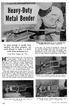 It's large enough to handle most welding job shop projects, yet small enough to make it a worth while home-workshop tool H Craft Print Project No. 272 ERE'S a metal bender that will enable you to bend
2. This is a close up of a typical area where the rocker is rusted out leaving holes under where the rocker moulding would be..
 ROCKER PANELS 55,56,57 CHEVY REPLACEMENT Do not throw away any pieces when you first remove them. There are many supports that are not reproduced and will need to be used again. When disassembling try
HOW TO MAKE A MOTOR BRACKET
 HOW TO MAKE A MOUNTING BRACKET FOR AN ELECTRIC MOTOR Often, brackets supplied with purchased items (e.g. electric motors or servos) are not ideally suited for fitting into our models or they are not supplied
HEAVY-DUTY HAND CUTTING TORCHES AND ACCESSORIES. Page 1 Version no.: V0-090902
 Page 1 HEAVY-DUTY HAND CUTTING TORCHES AND ACCESSORIES Page 2 Heavy-Duty Hand Cutting Torch HCT 663: With lever-operated valve for cutting oxygen, for cutting duties involving high thermal loads on slabs,
SHOP NOTES METAL SHAPER FOR YOUR SHOP
 SHOP NOTES METAL SHAPER FOR YOUR SHOP A METAL SHAPER is indispensable for certain machining operations where flat surfaces must be produced within very close limits, such as machining flats on castings,
Sheet Metal Bending. By- Prem Mahendranathan
 Sheet Metal Bending By- BENDING n Bending is a manufacturing process by which a metal can be deformed by plastically deforming the material and changing its shape n Deformation about one axis PROFILES
PIPING DRAWINGS BASICS N.P.TODKAR
 PIPING DRAWINGS BASICS N.P.TODKAR There are two types of views used in the piping drawings: a) Orthographic- Plans and Elevations b) Pictorial - Isometric Views Piping layout is developed in both plan
FRAME DOOR OPENING, DOOR AND SIDE PANEL OUTER
 NUBIRA/LACETTI FRAME DOOR OPENING, DOOR AND SIDE PANEL OUTER 6 1 SECTION 6 FRAME DOOR OPENING, DOOR AND SIDE PANEL OUTER CONTENTS 1. FRAME DOOR OPENING........................................... 6 2 1.1.GENERAL
Technical Services & Capabilities
 Technical Services & Capabilities Machining Welding MIG TIG Robotic TIG Friction Stir Welding Solution Heat Treat & Artificial Aging Assemblies & Fabrication Bike Frame Specialists Technical Services Product
Gas tungsten arc welding, commonly called TIG (tungsten inert gas), produces an arc between a
 DESIGN CONSIDERATIONS FOR WELDING Apart from resistance spot welding (RSW), three processes are most commonly used for welding metal stampings and fabrications: gas metal arc welding (GMAW) or MIG; gas
FIELD ACCEPTANCE OF FIELD WELDING GUIDE
 Page 1 of 17 Oklahoma DOT Materials & Testing January 14, 2004 Publication: GFA-FW (Updated to reference current Structural Materials Branch of the ODOT Materials Division URL 07/06/2016) FIELD ACCEPTANCE
TECHNICAL SPECIFICATION SERIES 8000 PRECAST CONCRETE
 TECHNICAL SPECIFICATION SERIES 8000 PRECAST CONCRETE TECHNICAL SPECIFICATION PART 8000 - PRECAST CONCRETE TABLE OF CONTENTS Item Number Page 8100 PRECAST CONCRETE CONSTRUCTION - GENERAL 8-3 8101 General
Typical TIG-plasma solutions
 Typical -plasma solutions 2228-005 2003-670 Boilers maker solutions 2004-257 1210-064 1210-067 64 3638-008 2008-400 1415-014 2000-169 2003-204 1467-003 2000-343 2000-160 Pipework solutions or plasma welded
James M. Pleasants Company
 James M. Pleasants Company SUBMITTAL DATA GAINESVILLE MECHANICAL DECEMBER 20, 2013 PROJECT: GSU: J-183 HUMANITIES LAW BLDG. QUOTE NO:12116 ENGINEER: STEVENS & WILKINSON GASKETED PLATE HEAT EXCHANGER Tag:
HORIZONTAL INSTALLATION
 THERMO/SOLAR Žiar s.r.o. MANUAL FOR INSTALLATION PV SUPPORTING FRAMES HORIZONTAL INSTALLATION Technical alternation reserved A1410 1 12/2014 CONTENT ORD.NO. PAGE Mounting information 3 Mounting, flat roof
Pump Skid Fabrication for Magnetic Coupling. Rick Soltis Chief Mechanic City of Bedford
 Pump Skid Fabrication for Magnetic Coupling Rick Soltis Chief Mechanic City of Bedford Contents Magnetic Couplings What They Are, How They Work, Where They re Used Fabrication and Manufacturing of Pump
TECHNICAL SPECIFICATION FOR PROJECTION WELDING MACHINE (Qty. 2 Nos.)
 TECHNICAL SPECIFICATION FOR PROJECTION WELDING MACHINE (Qty. 2 Nos.) 1. Requirement: Two (02) Nos. DC Type, 3 phase, 3 wire Projection Welding Machine is required for welding of ventilation M.S. / Stainless
Think precision, Think HSS REAMING
 Think precision, Think HSS REAMING SUMMARY REAMING TOOLS 2 Zoom on a reamer 3 Which HSS for maximum efficiency? 4 Coatings for the best performance 5 Vocabulary 6 Choose the right design 7 Types of bevel
ME 111: Engineering Drawing
 ME 111: Engineering Drawing Lecture # 14 (10/10/2011) Development of Surfaces http://www.iitg.ernet.in/arindam.dey/me111.htm http://www.iitg.ernet.in/rkbc/me111.htm http://shilloi.iitg.ernet.in/~psr/ Indian
MECHANICS OF SOLIDS - BEAMS TUTORIAL 1 STRESSES IN BEAMS DUE TO BENDING. On completion of this tutorial you should be able to do the following.
 MECHANICS OF SOLIDS - BEAMS TUTOIAL 1 STESSES IN BEAMS DUE TO BENDING This is the first tutorial on bending of beams designed for anyone wishing to study it at a fairly advanced level. You should judge
TruLaser Tube: Optimal tube. and. profile cutting. Machine Tools / Power Tools Laser Technology / Electronics Medical Technology
 TruLaser Tube: Optimal tube and profile cutting Machine Tools / Power Tools Laser Technology / Electronics Medical Technology Giving you the edge in laser tube processing. The TRUMPF Group ranks among
Working Drawing and Assemblies. Chapter 10
 Working Drawing and Assemblies Chapter 10 Objectives 1.Define working drawings. 2. Describe how working drawings are used in industry. 3. List the major components of a complete set of working drawings.
Table of contents BRAZED TURNING TOOLS. Toolholders H 2. Tips H 6. Rods H 8. Technical information H 9 H 1
 Table of contents BRAZED TURNING TOOLS Toolholders 2 Tips 6 Rods 8 9 1 ISO External holders General turning External Ordering Tip According to ISO243-1975 (DIN 4982-198) h b l 1 f 1 f 2 a p r ε γ 1) λ
Equipment Information
 3002A Equipment Information INDEX: DESCRIPTION AND KEY FEATURES LAYOUT NOMINAL TECHNICAL DATA CONFIGURATION Sealed Air GmbH Customer Systems Center D4 Park 4 CH-6039 Root-Längenbold Telephone: +41 (0)
Pipe Cutting and Beveling Clamshells
 Pipe Cutting and Beveling Clamshells Who We Are One Company, Total Support, Complete Solutions For more than a century, Hydratight has provided world-class bolted joint solutions and continues to set international
Solid shape molding is not desired in injection molding due to following reasons.
 PLASTICS PART DESIGN and MOULDABILITY Injection molding is popular manufacturing method because of its high-speed production capability. Performance of plastics part is limited by its properties which
Technical Drawing Specifications Resource A guide to support VCE Visual Communication Design study design 2013-17
 A guide to support VCE Visual Communication Design study design 2013-17 1 Contents INTRODUCTION The Australian Standards (AS) Key knowledge and skills THREE-DIMENSIONAL DRAWING PARALINE DRAWING Isometric
STEWART GILL CONVEYORS Ltd
 STEWART GILL CONVEYORS Ltd 550M STS SYSTEM overhead - inverted - side mounted - floor mounted - SPECIALISTS IN OVERHEAD CONVEYOR SYSTEMS 2 Index About 550M STS... 3 Track... 4 Track Supports... 5 Bends...
Modular Locomotive System Instruction Manual for HBK5 Billy Body Kit
 Modular Locomotive System Instruction Manual for HBK5 Billy Body Kit Roundhouse Engineering Co. Ltd. Units 6-10 Churchill Business Park. Churchill Road, Wheatley. Doncaster. DN1 2TF. England. Tel. 01302
6720616592.00-1.SD. Flat roof. Rack Mounting. Installation instructions 6 720 647 036 (2010/11) AU
 6720616592.00-1.SD Flat roof Rack Mounting AU Installation instructions 2 Contents AU Contents 1 Key to symbols and safety instructions....... 3 1.1 Explanation of symbols................ 3 1.2 Safety
Welded Fabric. The CARES Guide to Reinforcing Steels Part 5. Installation of welded fabric on a major contract. 1.0 Introduction
 Welded Fabric 1.0 Introduction Welded fabric, often referred to as mesh, is a machine welded grid arrangement of reinforcing bars or wires. It is covered by British Standard BS4483. This was revised in
T A B L E T 1 T E S T S A N D I N S P E C T I O N C A B L E P C U T A N D P C U T - A
 T A B L E T 1 1 of 7 Tests & Inspection Cable PCUT & PCUT-A (Table T1) T E S T S A N D I N S P E C T I O N C A B L E P C U T A N D P C U T - A No. Test Scale MOC Requirements G 20:10:001:01 Defined Test
IHSS-N1 WELDED HONEYCOMB CORE SPECIFICATION. Generated: Sergiy Papyshev Engineering. Approved: Don Prysi Manufacturing. Approved: Merzuk Ramic Quality
 IHSS-N1 WELDED HONEYCOMB CORE SPECIFICATION Generated: Sergiy Papyshev Engineering Approved: Don Prysi Manufacturing Approved: Merzuk Ramic Quality Approved: Steven Barnett Administrative DATE DATE DATE
Application of Welding Standards in Hong Kong. S. K. Babu Laboratory Manager - Foundation Techniques Ltd
 Application of Welding Standards in Hong Kong S. K. Babu Laboratory Manager - Foundation Techniques Ltd Introduction: This paper summarizes the current welding standards practiced in Hong Kong & also outlines
Manual piston sampler...m 11
 SAMPLING Manual piston sampler...m 11 Screw sampler...prec 22...PREC 100 Slide sampler...pr 55 Rotative screw sampler...prv Piston sampler...p 11 Sampler on belt conveyor...pba Rotating cup sampler...pgr
ROUNDO 3-Roll Plate Bending Machines Type PS
 ROUNDO 3-Roll Plate Bending Machines Type PS Universal Machine used for all Plate Bending Double Pinch Design 1. Align the plate using the alignment grooves in the lower rolls or against the rear roll.
Power Cube Open Source Ecology Page 1. Power Cube. Version 4
 Power Cube Open Source Ecology Page 1 Power Cube Version 4 Power Cube Open Source Ecology Page 2 Contents Table of Contents Power Cube... 1 Contents...2 Introduction... 3 Bill Of Materials...4 Discrete
DUGARD. Machine Tools Since 1939. Dugard 700L Series Heavy Duty CNC Lathes. www.dugard.com
 DUGARD Machine Tools Since 1939 Dugard 700L Series Heavy Duty CNC Lathes www.dugard.com Dugard 700L Heavy Duty CNC Lathe 2000, 3000 or 4000mm bed length Designed for easy and convenient operation The concave
Lecture slides on rolling By: Dr H N Dhakal Lecturer in Mechanical and Marine Engineering, School of Engineering, University of Plymouth
 Lecture slides on rolling By: Dr H N Dhakal Lecturer in Mechanical and Marine Engineering, School of Engineering, University of Plymouth Bulk deformation forming (rolling) Rolling is the process of reducing
Modeling Curved Surfaces
 Modeling Cylindrical and Curved Theory Views of Cylinders Contour Lines Extruded Surfaces Revolved Surfaces & Cutouts Profile Shape Axis of Revolution Swept Surfaces & Cutouts Profile Shape Path Curves
Sheet metal operations - Bending and related processes
 Sheet metal operations - Bending and related processes R. Chandramouli Associate Dean-Research SASTRA University, Thanjavur-613 401 Table of Contents 1.Quiz-Key... Error! Bookmark not defined. 1.Bending
Field Application Note
 Field Application Note Reverse Dial Indicator Alignment RDIA Mis-alignment can be the most usual cause for unacceptable operation and high vibration levels. New facilities or new equipment installations
European Welding Standards
 European Welding Standards John Dyson 15 th March 2004 European Standards Harmonised Standards Not all EN Standards are Harmonised, only those that are considered to satisfy relevant ESRs in product directives.
Conceptual Design of Buildings (Course unit code 1C2)
 (Course unit code 1C2) Module C Design of Steel Members J.P. Jaspart (University of Liège) 520121-1-2011-1-CZ-ERA MUNDUS-EMMC Bolts are the main type of fasteners used in steel joints. The main geometrical
JIS G3472 Electric Resistance Welded Carbon Steel Tubes for Automobile Structural Purposes
 JIS G3472 Electric Resistance Welded Carbon Steel Tubes for Automobile Structural Purposes 1. Scope This Japanese Industrial Standard specifies the electric resistance welded carbon steel tubes, hereinafter
1300 MAXTRAK SPECIFICATION
 CONE CRUSHER Crusher type: Liners: Standard concave: Lubrication: Adjustment: Control: Concave options: 1300 Automax Crusher. Manganese steel alloy mantle and concave. Medium Coarse. Pumped system having
SERIES NG 1800 STRUCTURAL STEELWORK
 MANUAL OF CONTRACT DOCUMENTS FOR HIGHWAY WORKS VOLUME 2 NOTES FOR GUIDANCE ON THE SPECIFICATION FOR HIGHWAY WORKS SERIES NG 1800 STRUCTURAL STEELWORK Contents Clause Title Page NG 1800 (08/14) General
جامعة البلقاء التطبيقية
 AlBalqa Applied University تا سست عام 997 The curriculum of associate degree in Air Conditioning, Refrigeration and Heating Systems consists of (7 credit hours) as follows: Serial No. Requirements First
Diameter. Swift Lift Round Recess Plug. Note: The diameter of the narrow recess plug is the same as the diameter of the round recess plug.
 P-5 The P-5 is hot forged from carbon steel. The formed head provis spherical seating that the Lifting Eye engages, while a disc-shaped foot is embedd in the concrete. Due to its being a forged part, the
Unit 24: Applications of Pneumatics and Hydraulics
 Unit 24: Applications of Pneumatics and Hydraulics Unit code: J/601/1496 QCF level: 4 Credit value: 15 OUTCOME 2 TUTORIAL 2 HYDRAULIC AND PNEUMATIC CYLINDERS The material needed for outcome 2 is very extensive
Sheet Metal Stamping Dies & Processes
 Training Objectives After watching the program and reviewing this printed material, the viewer will gain knowledge and understanding of the stamping process and the die systems used to form sheet metal.
Ultrasonic Reference Blocks
 Ultrasonic Reference Blocks Custom and Standard Test Blocks for Nondestructive Testing Introduction 3 IIW Type 1 Calibration Block 4 Miniature Angle Beam (ROMPAS) Calibration Block 4 Distance Calibration
Structural welding is a process by which the parts that are to be connected are heated and
 CHAPTER 6. WELDED CONNECTIONS 6.1 INTRODUCTORY CONCEPTS Structural welding is a process by which the parts that are to be connected are heated and fused, with supplementary molten metal at the joint. A
Naue GmbH&Co.KG. Quality Control and. Quality Assurance. Manual. For Geomembranes
 Naue GmbH&Co.KG Quality Control and Quality Assurance Manual For Geomembranes July 2004 V.O TABLE OF CONTENTS 1. Introduction 2. Quality Assurance and Control 2.1 General 2.2 Quality management acc. to
Unit 24: Applications of Pneumatics and Hydraulics
 Unit 24: Applications of Pneumatics and Hydraulics Unit code: J/601/1496 QCF level: 4 Credit value: 15 OUTCOME 2 TUTORIAL 4 DIRECTIONAL CONTROL VALVES The material needed for outcome 2 is very extensive
DSM http://www.dsmmfg.com 1 (800) 886-6376
 DESIGN GUIDE FOR BENT SHEET METAL This guide discusses how the bends are made, what thicknesses of sheet metal are commonly used, recommended bend radius to use when modeling the part, some practical limits
The TransCut 300 plasma cutting system - Plasmacutting with liquid working medium
 The TransCut 300 plasma cutting system - Plasmacutting with liquid working medium Speaker Sector Company Street Town Excellent portability with the TransCut 300 plasma cutting system Compact, portable
ASTM A860/A860M-09 Standard Specification for Wrought High Strength. Ferritic Steel Butt Welding Fittings. 1. Scope :- 2. Reference Documents :-
 Standard Specification for Wrought High Strength Ferritic Steel Butt Welding Fittings 1. Scope :- 1.1 This specification covers wrought high strength ferritic steel butt-welding fitting of seamless and
International Training Institute for the Sheet Metal and Air Conditioning Industry
 American Council on Education - National Guide to College Credit for Workforce Training Page 1 of 13 International Training Institute for the Sheet Metal and Air Conditioning Industry The (ITI), formerly
TITANIUM FABRICATION CORP.
 TITANIUM FABRICATION CORP. Titanium, Zirconium, and Tantalum Clad Construction General Considerations In many applications, particularly for large pressure vessels designed for high temperature and pressure,
BAGGAGE HANDLING SYSTEMS. Trastecnica S.p.A. Handling Baggage Systems Edition 2002 - Rev. 00-1 -
 BAGGAGE HANDLING SYSTEMS Trastecnica S.p.A. Handling Baggage Systems Edition 2002 - Rev. 00-1 - TECHNICAL SPECIFICS INDEX Check-in with one conveyor 4 Scales 6 Belt Conveyors 8 Take away 9 Feeder and Belt
Flash Butt Welding Machines
 Flash Butt Welding Machines Types AS 15 - AS 320 Flash butt welding current brake current (ka) current time flattening reversal preheating welding time flash butting forging A reliable and economic process
SEMAE3221 Machining aircraft components using CNC milling machines
 Machining aircraft components using CNC milling machines Overview This standard identifies the competences you need to operate Computer Numerical Control (CNC) three axis or five axis machines or CNC machining
1. Lay out 2 pieces of 7/8" tubing and mark for bending as shown. Remember that the bend is in the shaded area as shown below in Figure 1.
 MINI BIKE PLANS Page 1 INTRODUCTION Before starting to build your Mini-Bike, be sure that you have all the parts shown on the material list. You will note that tubing has been used in the construction.
SEMMME2-20 - SQA Unit Code H2AB 04 Operating CNC Milling Machines
 Overview This unit identifies the competences you need to operate Computer Numerical Control (CNC) three-axis or multi-axis machines, or CNC machining centres, in accordance with approved procedures. You
LarsLap model C for cutting, milling grinding and lapping seats and flanges on globe, safety and control valves
 LarsLap model C for cutting, milling grinding and lapping seats and flanges on globe, safety and control valves As a rule, control and reduction valves of the globe type have an integrated plug that narrowly
AN INTRODUCTION TO TIG WELDING. wws group [email protected]
 AN INTRODUCTION TO TIG WELDING wws group [email protected] WARNING: This document contains general infmation about the topic discussed herein. This document is not an application manual and does not
EDEXCEL NATIONAL CERTIFICATE/DIPLOMA MECHANICAL PRINCIPLES AND APPLICATIONS NQF LEVEL 3 OUTCOME 1 - LOADING SYSTEMS TUTORIAL 3 LOADED COMPONENTS
 EDEXCEL NATIONAL CERTIICATE/DIPLOMA MECHANICAL PRINCIPLES AND APPLICATIONS NQ LEVEL 3 OUTCOME 1 - LOADING SYSTEMS TUTORIAL 3 LOADED COMPONENTS 1. Be able to determine the effects of loading in static engineering
PARTNERS and RESPONSABILITIES
 Location Key Facts Core Business Design and manufacture management of heavy machined steel structures and components for steel mill industry. Sales up to 40 MLN Staff 190 person Area of shops 35.000 m²