
MCP4017/18/19. 7-Bit Single I 2 C Digital POT with Volatile Memory in SC70. Package Types. Features. Device Features. Rheostat
|
|
|
- Liliana Watson
- 9 years ago
- Views:
Transcription
1 7-Bit Single I 2 C Digital POT with Volatile Memory in SC7 Features Potentiometer or Rheostat configuration options 7-bit: Resistor Network Resolution Resistors (128 Steps) Zero Scale to Full Scale Wiper operation R AB Resistances: 5 kω, 1 kω, 5 kω, or 1 kω Low Wiper Resistance: 1Ω (typical) Low Tempco: - Absolute (Rheostat): 5 ppm typical ( C to 7 C) - Ratiometric (Potentiometer): 1 ppm typical Simple I 2 C Protocol with read & write commands Brown-out reset protection (1.5V typical) Power-on Default Wiper Setting (Mid-scale) Low-Power Operation: µa Static Current (typical) Wide Operating Voltage Range: - 2.7V to 5.5V - Device Characteristics Specified - 1.8V to 5.5V - Device Operation Package Types Potentiometer MCP418 SC7-6 V DD V SS SCL B A W 6 A 5 W 4 SDA V DD V SS SCL V DD V SS SCL Rheostat MCP419 SC7-5 Wide Bandwidth (-3 db) Operation: - 2 MHz (typical) for 5. kω device Extended temperature range (-4 C to +125 C) Very small package (SC7) Lead free (Pb-free) package MCP417 SC7-6 B A W 6 W W 5 B B 4 SDA 5 W A 4 SDA Device Features Device Control Interface # of Steps Wiper Configuration Memory Type Resistance (typical) Options (kω) Wiper (Ω) VDD Operating Range (1) Package MCP417 I 2 C 128 Rheostat RAM 5., 1., 5., V to 5.5V SC7-6 MCP418 I 2 C 128 Potentiometer RAM 5., 1., 5., V to 5.5V SC7-6 MCP419 I 2 C 128 Rheostat RAM 5., 1., 5., V to 5.5V SC7-5 Note 1: Analog characteristics only tested from 2.7V to 5.5V 29 Microchip Technology Inc. DS22147A-page 1

2 Device Block Diagram V DD V SS SCL SDA Power-up/ Brown-out Control I 2 C Serial Interface Module, Control Logic, & Memory Resistor Network (Pot ) Note 1 A (2) W (1, 2) B Note 1: Some configurations will have this signal internally connected to ground. 2: In some configurations, this signal may not be connected externally (internally floating or grounded). Comparison of Similar Microchip Devices (1) Control Interface # of Steps Memory Type Resistance (typical) V DD Operating Range (2) HV Interface WiperLock Technology Wiper Device Configuration Options (kω) Package MCP417 I 2 C 128 Rheostat RAM 5., 1., 5., V to 5.5V No No SC7-6 MCP412 U/D 64 Rheostat RAM 2.1, 5., 1., V to 5.5V Yes No SOT-23-6 MCP422 U/D 64 Rheostat EE 2.1, 5., 1., V to 5.5V Yes Yes SOT-23-6 MCP4132 SPI 129 Rheostat RAM 5., 1., 5., V to 5.5V Yes No PDIP-8, MCP4142 SPI 129 Rheostat EE 5., 1., 5., V to 5.5V Yes Yes SOIC-8, MSOP-8, MCP4152 SPI 257 Rheostat RAM 5., 1., 5., V to 5.5V Yes No DFN-8 MCP4162 SPI 257 Rheostat EE 5., 1., 5., V to 5.5V Yes Yes MCP4532 I 2 C 129 Rheostat RAM 5., 1., 5., V to 5.5V Yes No MSOP-8, MCP4542 I 2 C 129 Rheostat EE 5., 1., 5., V to 5.5V Yes Yes DFN-8 MCP4552 I 2 C 257 Rheostat RAM 5., 1., 5., V to 5.5V Yes No MCP4562 I 2 C 257 Rheostat EE 5., 1., 5., V to 5.5V Yes Yes MCP418 I 2 C 128 Potentiometer RAM 5., 1., 5., V to 5.5V No No SC7-6 MCP413 U/D 64 Potentiometer RAM 2.1, 5., 1., V to 5.5V Yes No SOT-23-6 MCP423 U/D 64 Potentiometer EE 2.1, 5., 1., V to 5.5V Yes Yes SOT-23-6 MCP419 I 2 C 128 Rheostat RAM 5., 1., 5., V to 5.5V No No SC7-5 MCP414 U/D 64 Rheostat RAM 2.1, 5., 1., V to 5.5V Yes No SOT-23-5 MCP424 U/D 64 Rheostat EE 2.1, 5., 1., V to 5.5V Yes Yes SOT-23-5 Note 1: This table is broken into three groups by a thick line (and color coding). The unshaded devices in this table are the devices described in this data sheet, while the shaded devices offer a comparable resistor network configuration. 2: Analog characteristics only tested from 2.7V to 5.5V DS22147A-page 2 29 Microchip Technology Inc.

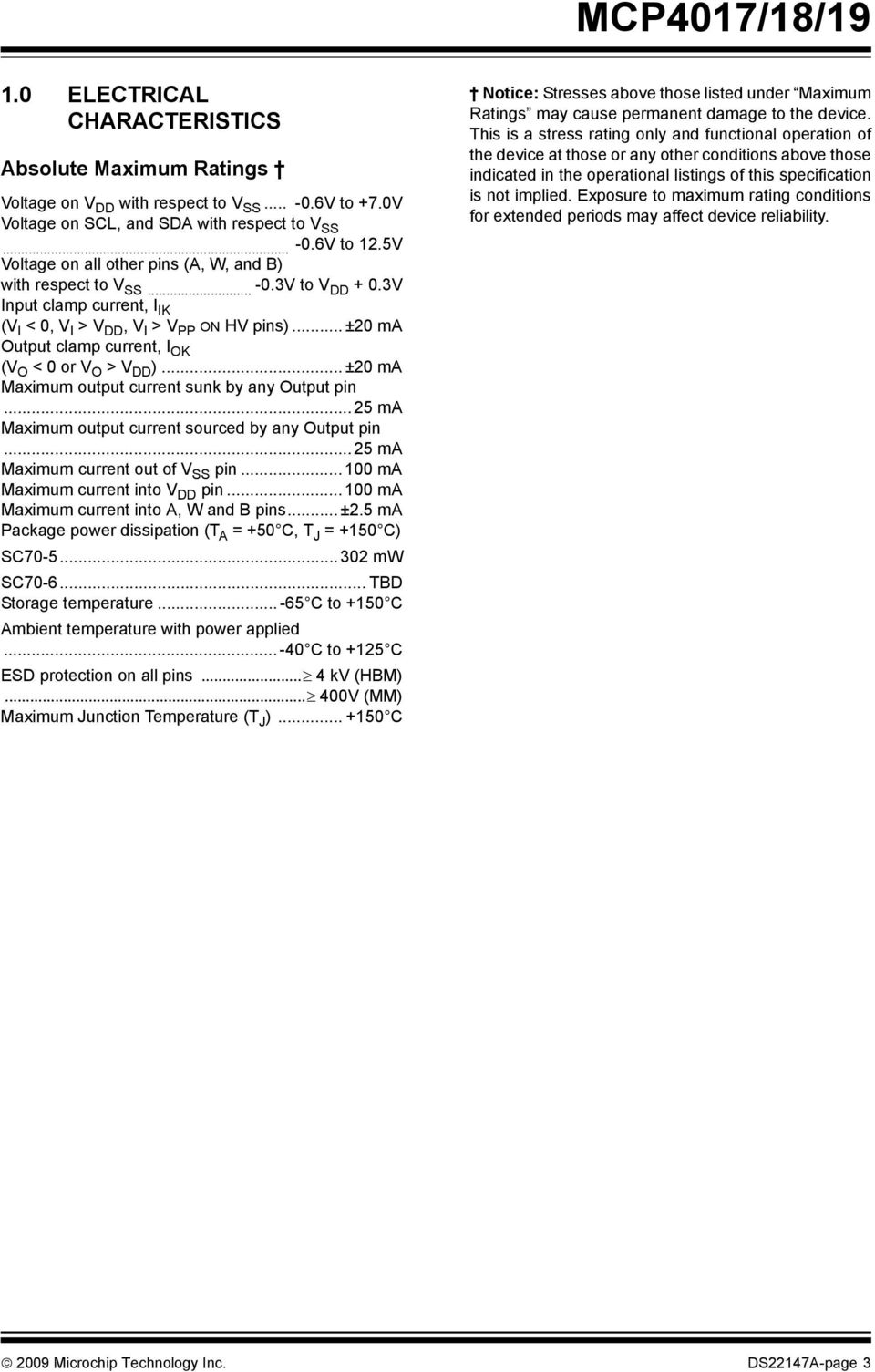
3 1. ELECTRICAL CHARACTERISTICS Absolute Maximum Ratings Voltage on V DD with respect to V SS V to +7.V Voltage on SCL, and SDA with respect to V SS V to 12.5V Voltage on all other pins (A, W, and B) with respect to V SS V to V DD +.3V Input clamp current, I IK (V I <, V I > V DD, V I > V PP ON HV pins)... ±2 ma Output clamp current, I OK (V O < or V O > V DD )... ±2 ma Maximum output current sunk by any Output pin ma Maximum output current sourced by any Output pin ma Maximum current out of V SS pin... 1 ma Maximum current into V DD pin... 1 ma Maximum current into A, W and B pins... ±2.5 ma Package power dissipation (T A = +5 C, T J = +15 C) SC mw SC TBD Storage temperature C to +15 C Ambient temperature with power applied C to +125 C ESD protection on all pins... 4 kv (HBM)... 4V (MM) Maximum Junction Temperature (T J ) C Notice: Stresses above those listed under Maximum Ratings may cause permanent damage to the device. This is a stress rating only and functional operation of the device at those or any other conditions above those indicated in the operational listings of this specification is not implied. Exposure to maximum rating conditions for extended periods may affect device reliability. 29 Microchip Technology Inc. DS22147A-page 3
4 AC/DC CHARACTERISTICS DC Characteristics Standard Operating Conditions (unless otherwise specified) Operating Temperature 4 C T A +125 C (extended) All parameters apply across the specified operating ranges unless noted. V DD = +2.7V to 5.5V, 5 kω, 1 kω, 5 kω, 1 kω devices. Typical specifications represent values for V DD = 5.5V, T A = +25 C. Parameters Sym Min Typ Max Units Conditions Supply Voltage V DD V Analog Characteristics specified V Digital Characteristics specified V DD Start Voltage to ensure Wiper Reset V BOR 1.65 V RAM retention voltage (V RAM ) < V BOR V DD Rise Rate to ensure Power-on Reset Delay after device exits the reset state (V DD > V BOR ) Supply Current (Note 8) V DDRR (Note 7) V/ms T BORD 1 2 µs I DD 45 8 µa Serial Interface Active, Write all s to Volatile Wiper V DD = 5.5V, F SCL = 4 khz µa Serial Interface Inactive, (Stop condition, SCL = SDA = V IH ), Wiper =, V DD = 5.5V Note 1: Resistance is defined as the resistance between terminal A to terminal B. 2: INL and DNL are measured at V W with V A = V DD and V B = V SS. 3: MCP418 device only, includes V WZSE and V WFSE. 4: Resistor terminals A, W and B s polarity with respect to each other is not restricted. 5: This specification by design. 6: Non-linearity is affected by wiper resistance (R W ), which changes significantly over voltage and temperature. 7: POR/BOR is not rate dependent. 8: Supply current is independent of current through the resistor network DS22147A-page 4 29 Microchip Technology Inc.

5 AC/DC CHARACTERISTICS (CONTINUED) DC Characteristics Resistance R AB kω -52 devices (Note 1) (± 2%) kω -13 devices (Note 1) kω -53 devices (Note 1) kω -14 devices (Note 1) Resolution N 128 Taps No Missing Codes Step Resistance R S R AB / Ω Note 5 (127) Wiper Resistance R W 1 17 Ω V DD = 5.5 V, I W = 2. ma, code = h Ω V DD = 2.7 V, I W = 2. ma, code = h Nominal ΔR AB /ΔT 5 ppm/ C T A = -2 C to +7 C Resistance 1 ppm/ C T A = -4 C to +85 C Tempco 15 ppm/ C T A = -4 C to +125 C Ratiometeric ΔV WB /ΔT 15 ppm/ C Code = Midscale (3Fh) Tempco Resistor Terminal Input Voltage Range (Terminals A, B and W) V A, V W, V B Vss V DD V Note 4, Note 5 Maximum current through Terminal (A, W or B) Note 5 Standard Operating Conditions (unless otherwise specified) Operating Temperature 4 C T A +125 C (extended) All parameters apply across the specified operating ranges unless noted. V DD = +2.7V to 5.5V, 5 kω, 1 kω, 5 kω, 1 kω devices. Typical specifications represent values for V DD = 5.5V, T A = +25 C. Parameters Sym Min Typ Max Units Conditions I T 2.5 ma Terminal A I AW, W = Full Scale (FS) 2.5 ma Terminal B I BW, W = Zero Scale (ZS) 2.5 ma Terminal W I AW or I BW, W = FS or ZS 1.38 ma I AB, V B = V, V A = 5.5V, R AB(MIN) = ma I Terminal A AB, V B = V, V A = 5.5V, R AB(MIN) = 8 and.138 ma I Terminal B AB, V B = V, V A = 5.5V, R AB(MIN) = 4.69 ma I AB, V B = V, V A = 5.5V, R AB(MIN) = 8 Note 1: Resistance is defined as the resistance between terminal A to terminal B. 2: INL and DNL are measured at V W with V A = V DD and V B = V SS. 3: MCP418 device only, includes V WZSE and V WFSE. 4: Resistor terminals A, W and B s polarity with respect to each other is not restricted. 5: This specification by design. 6: Non-linearity is affected by wiper resistance (R W ), which changes significantly over voltage and temperature. 7: POR/BOR is not rate dependent. 8: Supply current is independent of current through the resistor network 29 Microchip Technology Inc. DS22147A-page 5

6 AC/DC CHARACTERISTICS (CONTINUED) DC Characteristics Standard Operating Conditions (unless otherwise specified) Operating Temperature 4 C T A +125 C (extended) All parameters apply across the specified operating ranges unless noted. V DD = +2.7V to 5.5V, 5 kω, 1 kω, 5 kω, 1 kω devices. Typical specifications represent values for V DD = 5.5V, T A = +25 C. Parameters Sym Min Typ Max Units Conditions Full Scale Error (MCP418 only) (code = 7Fh) Zero Scale Error (MCP418 only) (code = h) Potentiometer Integral Non-linearity Potentiometer Differential Nonlinearity Bandwidth -3 db (See Figure 2-83, load = 3 pf) V WFSE LSb 5 kω 2.7V V DD 5.5V LSb 1 kω 2.7V V DD 5.5V LSb 5 kω 2.7V V DD 5.5V LSb 1 kω 2.7V V DD 5.5V V WZSE LSb 5 kω 2.7V V DD 5.5V LSb 1 kω 2.7V V DD 5.5V LSb 5 kω 2.7V V DD 5.5V LSb 1 kω 2.7V V DD 5.5V INL -.5 ± LSb 2.7V V DD 5.5V MCP418 device only (Note 2) DNL -.25 ± LSb 2.7V V DD 5.5V MCP418 device only (Note 2) BW 2 MHz 5 kω Code = 3Fh 1 MHz 1 kω Code = 3Fh 26 khz 5 kω Code = 3Fh 1 khz 1 kω Code = 3Fh Note 1: Resistance is defined as the resistance between terminal A to terminal B. 2: INL and DNL are measured at V W with V A = V DD and V B = V SS. 3: MCP418 device only, includes V WZSE and V WFSE. 4: Resistor terminals A, W and B s polarity with respect to each other is not restricted. 5: This specification by design. 6: Non-linearity is affected by wiper resistance (R W ), which changes significantly over voltage and temperature. 7: POR/BOR is not rate dependent. 8: Supply current is independent of current through the resistor network DS22147A-page 6 29 Microchip Technology Inc.

7 AC/DC CHARACTERISTICS (CONTINUED) DC Characteristics Standard Operating Conditions (unless otherwise specified) Operating Temperature 4 C T A +125 C (extended) All parameters apply across the specified operating ranges unless noted. V DD = +2.7V to 5.5V, 5 kω, 1 kω, 5 kω, 1 kω devices. Typical specifications represent values for V DD = 5.5V, T A = +25 C. Parameters Sym Min Typ Max Units Conditions Rheostat Integral Non-linearity MCP418 (Note 3) MCP417 and MCP419 devices only (Note 3) Rheostat Differential Nonlinearity MCP418 (Note 3) MCP417 and MCP419 devices only (Note 3) R-INL -2. ± LSb 5 kω 5.5V, I W = 9 µa LSb 2.7V, I W = 43 µa (Note 6) See Section 2. LSb 1.8V (Note 6) -2. ± LSb 1 kω 5.5V, I W = 45 µa LSb 2.7V, I W = 215 µa (Note 6) See Section 2. LSb 1.8V (Note 6) ± LSb 5 kω 5.5V, I W = 9 µa LSb 2.7V, I W = 43 µa (Note 6) See Section 2. LSb 1.8V (Note 6) -.8 ± LSb 1 kω 5.5V, I W = 45 µa LSb 2.7V, I W = 21.5 µa (Note 6) See Section 2. LSb 1.8V (Note 6) R-DNL -.5 ± LSb 5 kω 5.5V, I W = 9 ma LSb 2.7V, I W = 43 µa (Note 6) See Section 2. LSb 1.8V (Note 6) -.5 ± LSb 1 kω 5.5V, I W = 45 µa LSb 2.7V, I W = 215 µa (Note 6) See Section 2. LSb 1.8V (Note 6) ± LSb 5 kω 5.5V, I W = 9 µa ± LSb 2.7V, I W = 43 µa (Note 6) See Section 2. LSb 1.8V (Note 6) ± LSb 1 kω 5.5V, I W = 45 µa ± LSb 2.7V, I W = 21.5 µa (Note 6) See Section 2. LSb 1.8V (Note 6) Capacitance (P A ) C AW 75 pf f =1 MHz, Code = Full Scale Capacitance (P w ) C W 12 pf f =1 MHz, Code = Full Scale Capacitance (P B ) C BW 75 pf f =1 MHz, Code = Full Scale Note 1: Resistance is defined as the resistance between terminal A to terminal B. 2: INL and DNL are measured at V W with V A = V DD and V B = V SS. 3: MCP418 device only, includes V WZSE and V WFSE. 4: Resistor terminals A, W and B s polarity with respect to each other is not restricted. 5: This specification by design. 6: Non-linearity is affected by wiper resistance (R W ), which changes significantly over voltage and temperature. 7: POR/BOR is not rate dependent. 8: Supply current is independent of current through the resistor network 29 Microchip Technology Inc. DS22147A-page 7

8 AC/DC CHARACTERISTICS (CONTINUED) DC Characteristics Digital Inputs/Outputs (SDA, SCK) Schmitt Trigger High Input Threshold V IH.7 V DD V 1.8V V DD 5.5V Schmitt Trigger Low Input Threshold Hysteresis of Schmitt Trigger Inputs (Note 5) Output Low Voltage (SDA) V IL -.5.3V DD V V HYS.1V DD V All inputs except SDA and SCL N.A. V SDA 1 khz V DD < 2.V N.A. V V DD 2.V and.1 V DD V SCL 4 khz V DD < 2.V.5 V DD V V DD 2.V V OL V SS.2V DD V V DD < 2.V, I OL = 1 ma V SS.4 V V DD 2.V, I OL = 3 ma Input Leakage I IL -1 1 µa V IN = V DD and V IN = V SS Current Pin Capacitance C IN, C OUT 1 pf f C = 4 khz RAM (Wiper) Value Value Range N h 7Fh hex Wiper POR/BOR N POR/BOR 3Fh hex Value Power Requirements Power Supply Sensitivity (MCP418 only) Standard Operating Conditions (unless otherwise specified) Operating Temperature 4 C T A +125 C (extended) All parameters apply across the specified operating ranges unless noted. V DD = +2.7V to 5.5V, 5 kω, 1 kω, 5 kω, 1 kω devices. Typical specifications represent values for V DD = 5.5V, T A = +25 C. Parameters Sym Min Typ Max Units Conditions PSS.5.35 %/% V DD = 2.7V to 5.5V, V A = 2.7V, Code = 3Fh Note 1: Resistance is defined as the resistance between terminal A to terminal B. 2: INL and DNL are measured at V W with V A = V DD and V B = V SS. 3: MCP418 device only, includes V WZSE and V WFSE. 4: Resistor terminals A, W and B s polarity with respect to each other is not restricted. 5: This specification by design. 6: Non-linearity is affected by wiper resistance (R W ), which changes significantly over voltage and temperature. 7: POR/BOR is not rate dependent. 8: Supply current is independent of current through the resistor network DS22147A-page 8 29 Microchip Technology Inc.

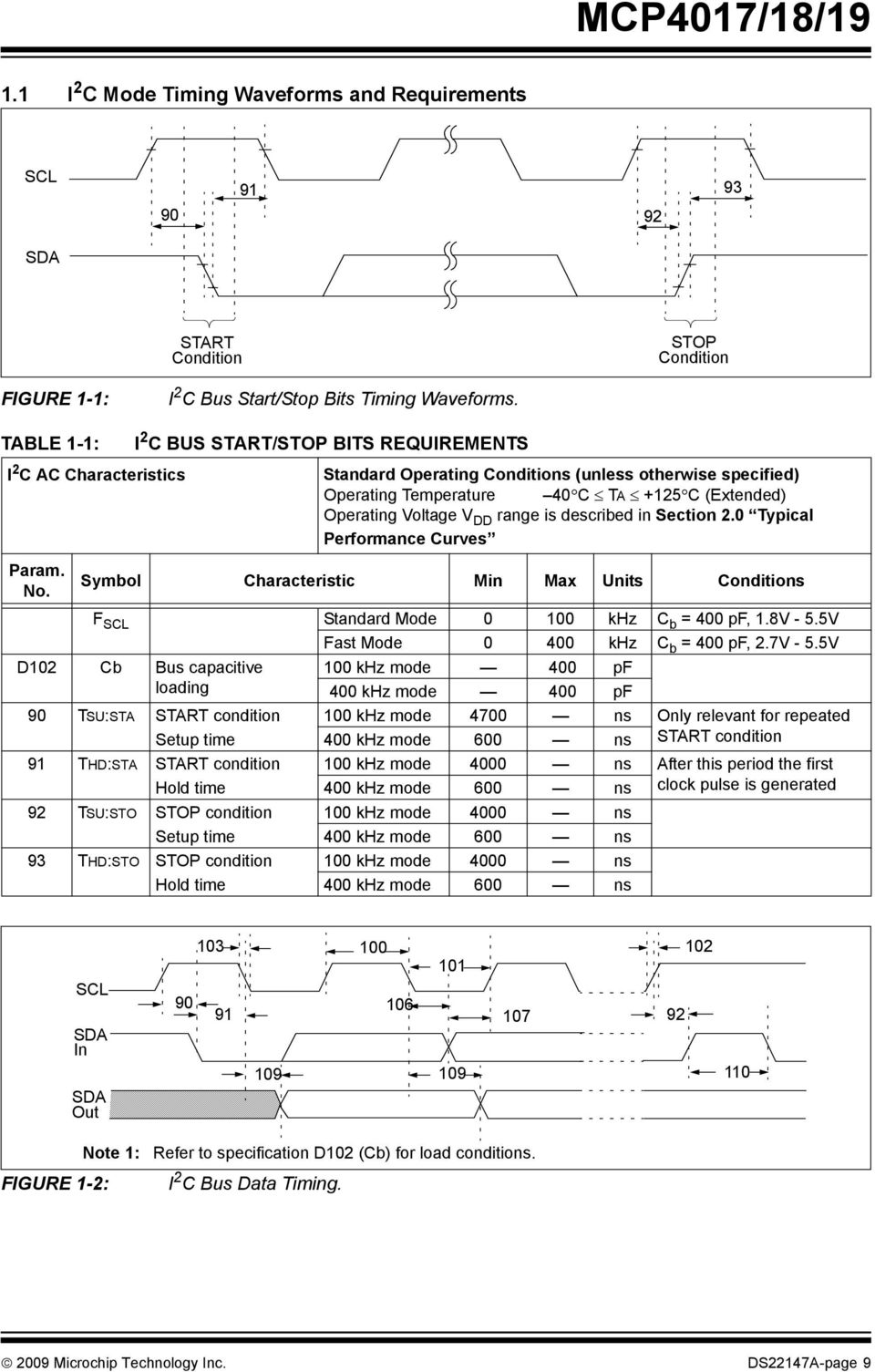
9 1.1 I 2 C Mode Timing Waveforms and Requirements SCL SDA START Condition STOP Condition FIGURE 1-1: I 2 C Bus Start/Stop Bits Timing Waveforms. TABLE 1-1: I 2 C AC Characteristics Param. No. I 2 C BUS START/STOP BITS REQUIREMENTS Standard Operating Conditions (unless otherwise specified) Operating Temperature 4 C TA +125 C (Extended) Operating Voltage V DD range is described in Section 2. Typical Performance Curves Symbol Characteristic Min Max Units Conditions F SCL Standard Mode 1 khz C b = 4 pf, 1.8V - 5.5V Fast Mode 4 khz C b = 4 pf, 2.7V - 5.5V D12 Cb Bus capacitive loading 1 khz mode 4 pf 4 khz mode 4 pf 9 TSU:STA START condition 1 khz mode 47 ns Only relevant for repeated Setup time 4 khz mode 6 ns START condition 91 THD:STA START condition 1 khz mode 4 ns After this period the first Hold time 4 khz mode 6 ns clock pulse is generated 92 TSU:STO STOP condition 1 khz mode 4 ns Setup time 4 khz mode 6 ns 93 THD:STO STOP condition 1 khz mode 4 ns Hold time 4 khz mode 6 ns SCL SDA In SDA Out Note 1: FIGURE 1-2: Refer to specification D12 (Cb) for load conditions. I 2 C Bus Data Timing. 29 Microchip Technology Inc. DS22147A-page 9
10 TABLE 1-2: I 2 C BUS DATA REQUIREMENTS (SLAVE MODE) I 2 C AC Characteristics Standard Operating Conditions (unless otherwise specified) Operating Temperature 4 C TA +125 C (Extended) Operating Voltage VDD range is described in AC/DC characteristics Parameter Sym Characteristic Min Max Units Conditions No. 1 T HIGH Clock high time 1 khz mode 4 ns 1.8V-5.5V 4 khz mode 6 ns 2.7V-5.5V 11 T LOW Clock low time 1 khz mode 47 ns 1.8V-5.5V 4 khz mode 13 ns 2.7V-5.5V 12A (5) T RSCL SCL rise time 1 khz mode 1 ns Cb is specified to be from 4 khz mode 2 +.1Cb 3 ns 1 to 4 pf 12B (5) T RSDA SDA rise time 1 khz mode 1 ns Cb is specified to be from 4 khz mode 2 +.1Cb 3 ns 1 to 4 pf 13A (5) T FSCL SCL fall time 1 khz mode 3 ns Cb is specified to be from 4 khz mode 2 +.1Cb 4 ns 1 to 4 pf 13B (5) T FSDA SDA fall time 1 khz mode 3 ns Cb is specified to be from 4 khz mode 2 +.1Cb (4) 3 ns 1 to 4 pf 16 THD:DAT Data input hold time 17 TSU:DAT Data input setup time 19 T AA Output valid from clock 1 khz mode ns 1.8V-5.5V, Note 6 4 khz mode ns 2.7V-5.5V, Note 6 1 khz mode 25 ns (2) 4 khz mode 1 ns 1 khz mode 345 ns (1) 4 khz mode 9 ns 11 T BUF Bus free time 1 khz mode 47 ns Time the bus must be free 4 khz mode 13 ns before a new transmission can start T SP Input filter spike 1 khz mode 5 ns Philips Spec states N.A. suppression 4 khz mode 5 ns (SDA and SCL) Note 1: As a transmitter, the device must provide this internal minimum delay time to bridge the undefined region (min. 3 ns) of the falling edge of SCL to avoid unintended generation of START or STOP conditions. 2: A fast-mode (4 khz) I 2 C-bus device can be used in a standard-mode (1 khz) I 2 C-bus system, but the requirement tsu; DAT 25 ns must then be met. This will automatically be the case if the device does not stretch the LOW period of the SCL signal. If such a device does stretch the LOW period of the SCL signal, it must output the next data bit to the SDA line TR max.+tsu;dat = = 125 ns (according to the standard-mode I 2 C bus specification) before the SCL line is released. 3: The MCP418/MCP419 device must provide a data hold time to bridge the undefined part between VIH and VIL of the falling edge of the SCL signal. This specification is not a part of the I 2 C specification, but must be tested in order to guarantee that the output data will meet the setup and hold specifications for the receiving device. 4: Use Cb in pf for the calculations. 5: Not Tested. 6: A Master Transmitter must provide a delay to ensure that difference between SDA and SCL fall times do not unintentionally create a Start or Stop condition. DS22147A-page 1 29 Microchip Technology Inc.

11 TEMPERATURE CHARACTERISTICS Electrical Specifications: Unless otherwise indicated, V DD = +1.8V to +5.5V, V SS =GND. Parameters Sym Min Typ Max Units Conditions Temperature Ranges Specified Temperature Range T A C Operating Temperature Range T A C Storage Temperature Range T A C Thermal Package Resistances Thermal Resistance, 5L-SC7 θ JA 331 C/W (Note 1) Thermal Resistance, 6L-SC7 θ JA TBD C/W Note 1: Package Power Dissipation (PDIS) is calculated as follows: P DIS = (T J - T A ) / θ JA, where: T J = Junction Temperature, T A = Ambient Temperature. 29 Microchip Technology Inc. DS22147A-page 11

12 NOTES: DS22147A-page Microchip Technology Inc.

13 2. TYPICAL PERFORMANCE CURVES Note: The graphs and tables provided following this note are a statistical summary based on a limited number of samples and are provided for informational purposes only. The performance characteristics listed herein are not tested or guaranteed. In some graphs or tables, the data presented may be outside the specified operating range (e.g., outside specified power supply range) and therefore outside the warranted range. Note: Unless otherwise indicated, T A = +25 C, V DD = 5V, V SS = V. I DD (µa) khz, 5.5V 4 khz, 2.7V 1 khz, 5.5V 1 khz, 2.7V Temperature ( C) I DD Interface Inactive (µa) V V Temperature ( C) FIGURE 2-1: Interface Active Current (I DD ) vs. SCL Frequency (f SCL ) and Temperature (V DD = 1.8V, 2.7V and 5.5V). FIGURE 2-2: Interface Inactive Current (I SHDN ) vs. Temperature and V DD. (V DD = 1.8V, 2.7V and 5.5V). 29 Microchip Technology Inc. DS22147A-page 13

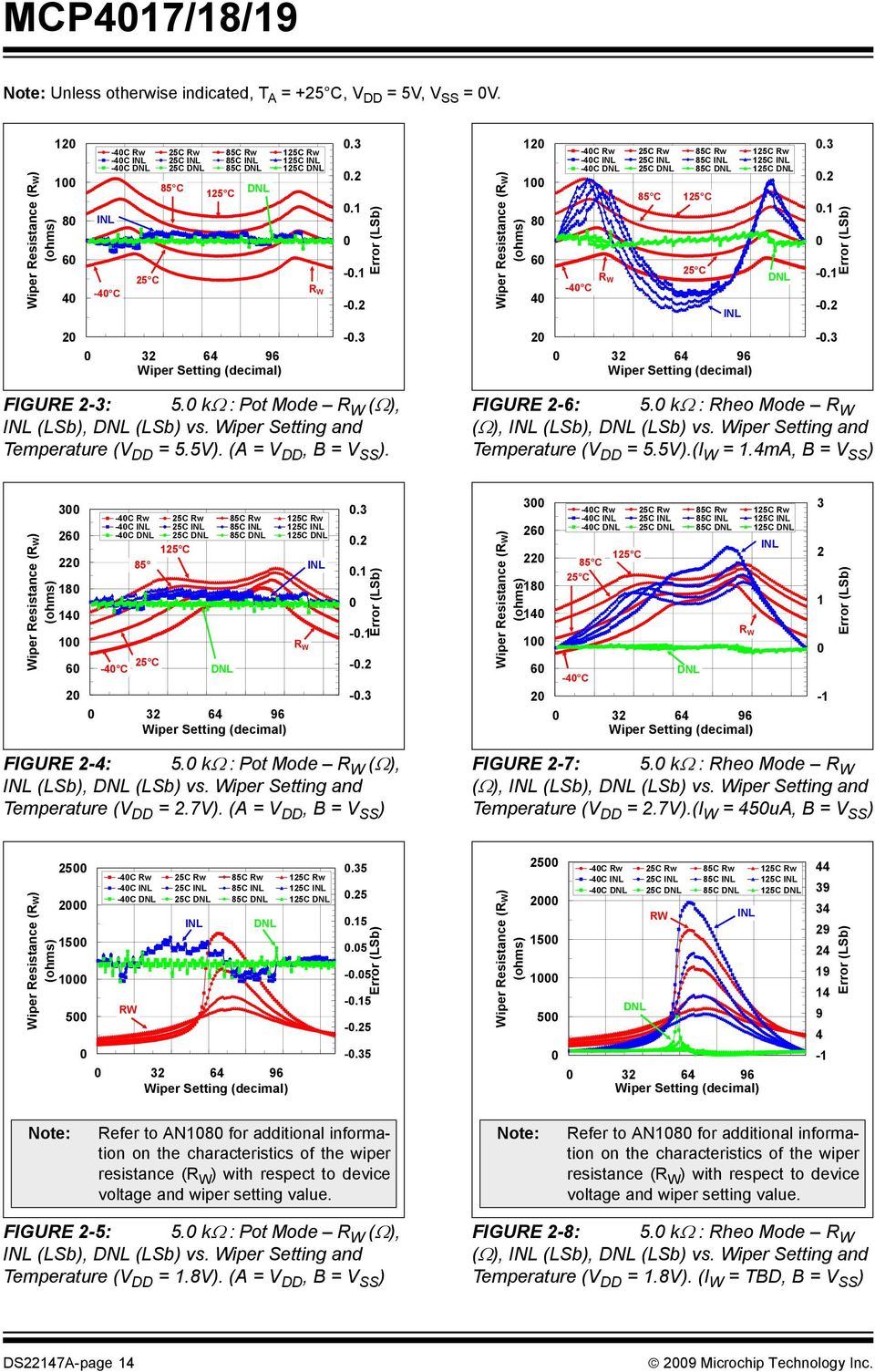
14 Note: Unless otherwise indicated, T A = +25 C, V DD = 5V, V SS = V. Wiper Resistance (R W ) (ohms) INL -4C Rw 25C Rw 85C Rw 125C Rw -4C INL 25C INL 85C INL 125C INL -4C DNL 25C DNL 85C DNL 125C DNL -4 C 25 C 85 C 125 C DNL R W Error (LSb) Wiper Resistance (R W ) (ohms) C Rw 25C Rw 85C Rw 125C Rw -4C INL 25C INL 85C INL 125C INL -4C DNL 25C DNL 85C DNL 125C DNL R W -4 C 85 C 125 C 25 C INL DNL Error (LSb) Wiper Setting (decimal) Wiper Setting (decimal) -.3 FIGURE 2-3: 5. kω : Pot Mode R W (Ω), INL (LSb), DNL (LSb) vs. Wiper Setting and Temperature (V DD = 5.5V). (A = V DD, B = V SS ). FIGURE 2-6: 5. kω : Rheo Mode R W (Ω), INL (LSb), DNL (LSb) vs. Wiper Setting and Temperature (V DD = 5.5V).(I W = 1.4mA, B = V SS ) Wiper Resistance (R W ) (ohms) C Rw 25C Rw 85C Rw 125C Rw -4C INL 25C INL 85C INL 125C INL -4C DNL 25C DNL 125 C 85C DNL 125C DNL 85 INL -4 C 25 C DNL Wiper Setting (decimal) R W Error (LSb) Wiper Resistance (R W ) (ohms) C Rw 25C Rw 85C Rw 125C Rw -4C INL 25C INL 85C INL 125C INL -4C DNL 25C DNL 85C DNL 125C DNL 85 C 125 C 25 C -4 C DNL R W Wiper Setting (decimal) INL Error (LSb) FIGURE 2-4: 5. kω : Pot Mode R W (Ω), INL (LSb), DNL (LSb) vs. Wiper Setting and Temperature (V DD = 2.7V). (A = V DD, B = V SS ) FIGURE 2-7: 5. kω : Rheo Mode R W (Ω), INL (LSb), DNL (LSb) vs. Wiper Setting and Temperature (V DD = 2.7V).(I W = 45uA, B = V SS ) Wiper Resistance (R W ) (ohms) C Rw 25C Rw 85C Rw 125C Rw -4C INL 25C INL 85C INL 125C INL -4C DNL 25C DNL 85C DNL 125C DNL RW INL DNL Wiper Setting (decimal) Error (LSb) Wiper Resistance (R W ) (ohms) C Rw 25C Rw 85C Rw 125C Rw -4C INL 25C INL 85C INL 125C INL -4C DNL 25C DNL 85C DNL 125C DNL DNL RW INL Wiper Setting (decimal) Error (LSb) Note: Refer to AN18 for additional information on the characteristics of the wiper resistance (R W ) with respect to device voltage and wiper setting value. Note: Refer to AN18 for additional information on the characteristics of the wiper resistance (R W ) with respect to device voltage and wiper setting value. FIGURE 2-5: 5. kω : Pot Mode R W (Ω), INL (LSb), DNL (LSb) vs. Wiper Setting and Temperature (V DD = 1.8V). (A = V DD, B = V SS ) FIGURE 2-8: 5. kω : Rheo Mode R W (Ω), INL (LSb), DNL (LSb) vs. Wiper Setting and Temperature (V DD = 1.8V). (I W = TBD, B = V SS ) DS22147A-page Microchip Technology Inc.
15 Note: Unless otherwise indicated, T A = +25 C, V DD = 5V, V SS = V. Full-Scale Error (FSE) (LSb) V V Ambient Temperature ( C) R BW Tempco (PPM) V 5.5V Wiper Setting (decimal) FIGURE 2-9: 5. kω : Full Scale Error (FSE) vs. Temperature (V DD = 5.5V, 2.7V, 1.8V). FIGURE 2-12: 5. kω : R BW Tempco ΔR WB / ΔT vs. Code. Zero-Scale Error (ZSE) (LSb) V V Ambient Temperature ( C) FIGURE 2-1: 5. kω : Zero Scale Error (ZSE) vs. Temperature (V DD = 5.5V, 2.7V, 1.8V). FIGURE 2-13: Response Time. 5. kω : Power-Up Wiper Nominal Resistance (R AB ) (Ohms) V V V Ambient Temperature ( C) Wiper V DD FIGURE 2-11: 5. kω : Nominal Resistance (Ω) vs. Temperature and V DD. FIGURE 2-14: 5. kω : Digital Feedthrough (SCL signal coupling to Wiper pin). 29 Microchip Technology Inc. DS22147A-page 15

16 Note: Unless otherwise indicated, T A = +25 C, V DD = 5V, V SS = V. FIGURE 2-15: 5. kω : Write Wiper (4h 3Fh) Settling Time (V DD =5.5V). FIGURE 2-18: 5. kω : Write Wiper (FFh h) Settling Time (V DD =5.5V). FIGURE 2-16: 5. kω : Write Wiper (4h 3Fh) Settling Time (V DD =2.7V). FIGURE 2-19: 5. kω : Write Wiper (FFh h) Settling Time (V DD =2.7V). FIGURE 2-17: 5. kω : Write Wiper (4h 3Fh) Settling Time (V DD =1.8V). FIGURE 2-2: 5. kω : Write Wiper (FFh h) Settling Time (V DD =1.8V). DS22147A-page Microchip Technology Inc.

17 Note: Unless otherwise indicated, T A = +25 C, V DD = 5V, V SS = V. Wiper Resistance (R W ) (ohms) C Rw 25C Rw 85C Rw 125C Rw -4C INL 25C INL 85C INL 125C INL -4C DNL 25C DNL 85C DNL 125C DNL -4 C DNL 85 C 125 C 25 C INL R W Error (LSb) Wiper Resistance (R W ) (ohms) C -4C Rw 25C Rw 85C Rw 125C Rw -4C INL 25C INL 85C INL 125C INL -4C DNL 25C DNL 85C DNL 125C DNL 85 C 125 C 25 C INL DNL R W Error (LSb) Wiper Setting (decimal) Wiper Setting (decimal) -.3 FIGURE 2-21: 1 kω Pot Mode : R W (Ω), INL (LSb), DNL (LSb) vs. Wiper Setting and Temperature (V DD = 5.5V). (A = V DD, B = V SS ) FIGURE 2-24: 1 kω Rheo Mode : R W (Ω), INL (LSb), DNL (LSb) vs. Wiper Setting and Temperature (V DD = 5.5V).(I W = 45uA, B = V SS ) Wiper Resistance (R W ) (ohms) C Rw 25C Rw 85C Rw 125C Rw -4C INL 25C INL 85C INL 125C INL -4C DNL 25C DNL 85C DNL 125C DNL -4 C INL 25 C 85 DNL Wiper Setting (decimal) 125 C R W Error (LSb) Wiper Resistance (R W ) (ohms) C Rw 25C Rw 85C Rw 125C Rw -4C INL 25C INL 85C INL 125C INL -4C DNL 25C DNL 85C DNL 125C DNL 25 C -4 C 85 C 125 C DNL INL Wiper Setting (decimal) R W Error (LSb) FIGURE 2-22: 1 kω Pot Mode : R W (Ω), INL (LSb), DNL (LSb) vs. Wiper Setting and Temperature (V DD = 2.7V). (A = V DD, B = V SS ) FIGURE 2-25: 1 kω Rheo Mode : R W (Ω), INL (LSb), DNL (LSb) vs. Wiper Setting and Temperature (V DD = 2.7V).(I W = 21uA, B = V SS ) Wiper Resistance (R W ) (ohms) C Rw 25C Rw 85C Rw 125C Rw -4C INL 25C INL 85C INL 125C INL -4C DNL 25C DNL 85C DNL 125C DNL RW DNL INL Error (LSb) Wiper Resistance (R W ) (ohms) C Rw 25C Rw 85C Rw 125C Rw -4C INL 25C INL 85C INL 125C INL -4C DNL 25C DNL 85C DNL 125C DNL RW DNL INL Error (LSb) Wiper Setting (decimal) Wiper Setting (decimal) -1 Note: Refer to AN18 for additional information on the characteristics of the wiper resistance (R W ) with respect to device voltage and wiper setting value. Note: Refer to AN18 for additional information on the characteristics of the wiper resistance (R W ) with respect to device voltage and wiper setting value. FIGURE 2-23: 1 kω Pot Mode : R W (Ω), INL (LSb), DNL (LSb) vs. Wiper Setting and Temperature (V DD = 1.8V). (A = V DD, B = V SS ) FIGURE 2-26: 1 kω Rheo Mode : R W (Ω), INL (LSb), DNL (LSb) vs. Wiper Setting and Temperature (V DD = 1.8V). (I W = TBD, B = V SS ) 29 Microchip Technology Inc. DS22147A-page 17

18 Note: Unless otherwise indicated, T A = +25 C, V DD = 5V, V SS = V. Full-Scale Error (FSE) (LSb) V V Ambient Temperature ( C) FIGURE 2-27: 1 kω : Full Scale Error (FSE) vs. Temperature (V DD = 5.5V, 2.7V, 1.8V). R BW Tempco (PPM) V 5.5V Wiper Setting (decimal) FIGURE 2-3: 1 kω : R BW Tempco ΔR WB / ΔT vs. Code. Zero-Scale Error (ZSE) (LSb) V V Ambient Temperature ( C) FIGURE 2-28: 1 kω : Zero Scale Error (ZSE) vs. Temperature (V DD = 5.5V, 2.7V, 1.8V). FIGURE 2-31: Response Time. 1 kω : Power-Up Wiper 12 Nominal Resistance (R AB ) (Ohms) V 5.5V Ambient Temperature ( C) FIGURE 2-29: 1 kω : Nominal Resistance (Ω) vs. Temperature and V DD. 2.7 Wiper V DD FIGURE 2-32: 1 kω : Digital Feedthrough (SCL signal coupling to Wiper pin). DS22147A-page Microchip Technology Inc.

19 Note: Unless otherwise indicated, T A = +25 C, V DD = 5V, V SS = V. FIGURE 2-33: 1 kω : Write Wiper (4h 3Fh) Settling Time (V DD =5.5V). FIGURE 2-36: 1 kω : Write Wiper (FFh h) Settling Time (V DD =5.5V). FIGURE 2-34: 1 kω : Write Wiper (4h 3Fh) Settling Time (V DD =2.7V). FIGURE 2-37: 1 kω : Write Wiper (FFh h) Settling Time (V DD =2.7V). FIGURE 2-35: 1 kω : Write Wiper (4h 3Fh) Settling Time (V DD =1.8V). FIGURE 2-38: 1 kω : Write Wiper (FFh h) Settling Time (V DD =1.8V). 29 Microchip Technology Inc. DS22147A-page 19

20 Note: Unless otherwise indicated, T A = +25 C, V DD = 5V, V SS = V. Wiper Resistance (R W ) (ohms) C Rw 25C Rw 85C Rw 125C Rw -4C INL 25C INL 85C INL 125C INL -4C DNL 25C DNL 85C DNL 125C DNL -4 C INL 85 C 125 C DNL 25 C R W Error (LSb) Wiper Resistance (R W ) (ohms) C Rw 25C Rw 85C Rw 125C Rw -4C INL 25C INL 85C INL 125C INL -4C DNL 25C DNL 85C DNL 125C DNL 85 C 125 C -4 C 25 C DNL INL R W Error (LSb) Wiper Setting (decimal) Wiper Setting (decimal) -.3 FIGURE 2-39: 5 kω Pot Mode : R W (Ω), INL (LSb), DNL (LSb) vs. Wiper Setting and Temperature (V DD = 5.5V). FIGURE 2-42: 5 kω Rheo Mode : R W (Ω), INL (LSb), DNL (LSb) vs. Wiper Setting and Temperature (V DD = 5.5V).(I W = 9uA, B = V SS ) Wiper Resistance (R W ) (ohms) C Rw 25C Rw 85C Rw 125C Rw -4C INL 25C INL 85C INL 125C INL -4C DNL 25C DNL 85C DNL 125C DNL C -4 C 25 C DNL INL Wiper Setting (decimal) R W Error (LSb) Wiper Resistance (R W ) (ohms) C Rw 25C Rw 85C Rw 125C Rw -4C INL 25C INL 85C INL 125C INL -4C DNL 25C DNL 85C DNL 125C DNL 25 C 85 C -4 C 125 C DNL Wiper Setting (decimal) R W INL Error (LSb) FIGURE 2-4: 5 kω Pot Mode : R W (Ω), INL (LSb), DNL (LSb) vs. Wiper Setting and Temperature (V DD = 2.7V). FIGURE 2-43: 5 kω Rheo Mode : R W (Ω), INL (LSb), DNL (LSb) vs. Wiper Setting and Temperature (V DD = 2.7V).(I W = 45uA, B = V SS ) Wiper Resistance (R W ) (ohms) C Rw 25C Rw 85C Rw 125C Rw -4C INL 25C INL 85C INL 125C INL -4C DNL 25C DNL 85C DNL 125C DNL DNL INL RW Wiper Setting (decimal) Error (LSb) Wiper Resistance (R W ) (ohms) C Rw 25C Rw 85C Rw 125C Rw -4C INL 25C INL 85C INL 125C INL -4C DNL 25C DNL 85C DNL 125C DNL DNL RW INL Wiper Setting (decimal) Error (LSb) Note: Refer to AN18 for additional information on the characteristics of the wiper resistance (R W ) with respect to device voltage and wiper setting value. Note: Refer to AN18 for additional information on the characteristics of the wiper resistance (R W ) with respect to device voltage and wiper setting value. FIGURE 2-41: 5 kω Pot Mode : R W (Ω), INL (LSb), DNL (LSb) vs. Wiper Setting and Temperature (V DD = 1.8V). FIGURE 2-44: 5 kω Rheo Mode : R W (Ω), INL (LSb), DNL (LSb) vs. Wiper Setting and Temperature (V DD = 1.8V). (I W = TBD, B = V SS ) DS22147A-page 2 29 Microchip Technology Inc.

21 Note: Unless otherwise indicated, T A = +25 C, V DD = 5V, V SS = V. Full-Scale Error (FSE) (LSb) V 1.8V Ambient Temperature ( C) R BW Tempco (PPM) V 5.5V Wiper Setting (decimal) FIGURE 2-45: 5 kω : Full Scale Error (FSE) vs. Temperature (V DD = 5.5V, 2.7V, 1.8V). FIGURE 2-48: 5 kω : R BW Tempco ΔR WB / ΔT vs. Code. Zero-Scale Error (ZSE) (LSb) V 1.8V Ambient Temperature ( C) FIGURE 2-46: 5 kω : Zero Scale Error (ZSE) vs. Temperature (V DD = 5.5V, 2.7V, 1.8V). FIGURE 2-49: Response Time. 5 kω : Power-Up Wiper 498 Nominal Resistance (R AB ) (Ohms) V 2.7V 5.5V Ambient Temperature ( C) Wiper V DD FIGURE 2-47: 5 kω : Nominal Resistance (Ω) vs. Temperature and V DD. FIGURE 2-5: 5 kω : Digital Feedthrough (SCL signal coupling to Wiper pin). 29 Microchip Technology Inc. DS22147A-page 21
22 Note: Unless otherwise indicated, T A = +25 C, V DD = 5V, V SS = V. FIGURE 2-51: 5 kω : Write Wiper (4h 3Fh) Settling Time (V DD =5.5V). FIGURE 2-54: 5 kω : Write Wiper (FFh h) Settling Time (V DD =5.5V). FIGURE 2-52: 5 kω : Write Wiper (4h 3Fh) Settling Time (V DD =2.7V). FIGURE 2-55: 5 kω : Write Wiper (FFh h) Settling Time (V DD =2.7V). FIGURE 2-53: 5 kω : Write Wiper (4h 3Fh) Settling Time (V DD =1.8V). FIGURE 2-56: 5 kω : Write Wiper (FFh h) Settling Time (V DD =1.8V). DS22147A-page Microchip Technology Inc.
23 Note: Unless otherwise indicated, T A = +25 C, V DD = 5V, V SS = V. Wiper Resistance (R W ) (ohms) C -4C Rw 25C Rw 85C Rw 125C Rw -4C INL 25C INL 85C INL 125C INL -4C DNL 25C DNL 85C DNL 125C DNL 85 C 125 C 25 C INL DNL R W Error (LSb) Wiper Resistance (R W ) (ohms) C Rw 25C Rw 85C Rw 125C Rw -4C INL 25C INL 85C INL 125C INL -4C DNL 25C DNL 85C DNL 125C DNL 85 C 125 C DNL -4 C 25 C INL R W Error (LSb) Wiper Setting (decimal) Wiper Setting (decimal) -.3 FIGURE 2-57: 1 kω Pot Mode : R W (Ω), INL (LSb), DNL (LSb) vs. Wiper Setting and Temperature (V DD = 5.5V). FIGURE 2-6: 1 kω Rheo Mode : R W (Ω), INL (LSb), DNL (LSb) vs. Wiper Setting and Temperature (V DD = 5.5V). (I W = 45uA, B = V SS ) Wiper Resistance (R W ) (ohms) C Rw 25C Rw 85C Rw 125C Rw -4C INL 25C INL 85C INL 125C INL -4C DNL 25C DNL 85C DNL 125C DNL DNL -4 C 25 C C INL Wiper Setting (decimal) R W Error (LSb) Wiper Resistance (R W ) (ohms) C Rw 25C Rw 85C Rw 125C Rw -4C INL 25C INL 85C INL 125C INL -4C DNL 25C DNL 85C DNL 125C DNL 125 C INL 85 C -4 C 25 C DNL Wiper Setting (decimal) R W Error (LSb) FIGURE 2-58: 1 kω Pot Mode : R W (Ω), INL (LSb), DNL (LSb) vs. Wiper Setting and Temperature (V DD = 2.7V). FIGURE 2-61: 1 kω Rheo Mode : R W (Ω), INL (LSb), DNL (LSb) vs. Wiper Setting and Temperature (V DD = 2.7V). (I W = 21uA, B = V SS ) Wiper Resistance (R W ) (ohms) C Rw 25C Rw 85C Rw 125C Rw -4C INL 25C INL 85C INL 125C INL -4C DNL 25C DNL 85C DNL 125C DNL DNL RW INL Wiper Setting (decimal) Error (LSb) Wiper Resistance (R W ) (ohms) C Rw 25C Rw 85C Rw 125C Rw -4C INL 25C INL 85C INL 125C INL -4C DNL 25C DNL 85C DNL 125C DNL DNL RW Wiper Setting (decimal) INL Error (LSb) Note: Refer to AN18 for additional information on the characteristics of the wiper resistance (R W ) with respect to device voltage and wiper setting value. FIGURE 2-59: 1 kω Pot Mode : R W (Ω), INL (LSb), DNL (LSb) vs. Wiper Setting and Temperature (V DD = 1.8V). Note: Refer to AN18 for additional information on the characteristics of the wiper resistance (R W ) with respect to device voltage and wiper setting value. FIGURE 2-62: 1 kω Rheo Mode : R W (Ω), INL (LSb), DNL (LSb) vs. Wiper Setting and Temperature (V DD = 1.8V). (I W = TBD, B = V SS ) 29 Microchip Technology Inc. DS22147A-page 23
24 Note: Unless otherwise indicated, T A = +25 C, V DD = 5V, V SS = V. Full-Scale Error (FSE) (LSb) V V Ambient Temperature ( C) R BW Tempco (PPM) V 5.5V Wiper Setting (decimal) FIGURE 2-63: 1 kω : Full Scale Error (FSE) vs. Temperature (V DD = 5.5V, 2.7V, 1.8V). FIGURE 2-66: 1 kω : R BW Tempco ΔR WB / ΔT vs. Code. Zero-Scale Error (ZSE) (LSb) V 1.8V Ambient Temperature ( C) FIGURE 2-64: 1 kω : Zero Scale Error (ZSE) vs. Temperature (V DD = 5.5V, 2.7V, 1.8V). FIGURE 2-67: Response Time. 1 kω : Power-Up Wiper Nominal Resistance (R AB ) (Ohms) V V V Ambient Temperature ( C) Wiper V DD FIGURE 2-65: 1 kω : Nominal Resistance (Ω) vs. Temperature and V DD. FIGURE 2-68: 1 kω : Digital Feedthrough (SCL signal coupling to Wiper pin). DS22147A-page Microchip Technology Inc.
25 Note: Unless otherwise indicated, T A = +25 C, V DD = 5V, V SS = V. FIGURE 2-69: 1 kω : Write Wiper (4h 3Fh) Settling Time (V DD = 5.5V). FIGURE 2-72: 1 kω : Write Wiper (FFh h) Settling Time (V DD = 5.5V). FIGURE 2-7: 1 kω : Write Wiper (4h 3Fh) Settling Time (V DD = 2.7V). FIGURE 2-73: 1 kω : Write Wiper (FFh h) Settling Time (V DD = 2.7V). FIGURE 2-71: 1 kω : Write Wiper (4h 3Fh) Settling Time (V DD = 1.8V). FIGURE 2-74: 1 kω : Write Wiper (FFh h) Settling Time (V DD = 1.8V). 29 Microchip Technology Inc. DS22147A-page 25
26 Note: Unless otherwise indicated, T A = +25 C, V DD = 5V, V SS = V. V IH (V) V V V Temperature ( C) V OL (mv) V (@ 3mA) V (@ 3mA).1 1.8V (@ 1mA) Temperature ( C) FIGURE 2-75: Temperature. V IH (SCL, SDA) vs. V DD and FIGURE 2-77: Temperature. V OL (SDA) vs. V DD and V 2.7V V V IL (V) V V DD (V) V Temperature ( C) Temperature ( C) FIGURE 2-76: Temperature. V IL (SCL, SDA) vs. V DD and FIGURE 2-78: and Temperature. POR/BOR Trip point vs. V DD DS22147A-page Microchip Technology Inc.
27 Note: Unless otherwise indicated, T A = +25 C, V DD = 5V, V SS = V. db 1 Code = 7Fh Code = 3Fh -1-2 Code = Fh Code = 1Fh -3 Code = 1h , 1, Frequency (khz) db 1 Code = 7Fh -1 Code = 3Fh Code = 1Fh -2 Code = Fh -3 Code = 1h , 1, Frequency (khz) FIGURE 2-79: (-3dB). 5kΩ Gain vs. Frequency FIGURE 2-82: Frequency (-3dB). 1 kω Gain vs. db Code = Fh Code = 1h Code = 1Fh Code = 7Fh Code = 3Fh 2.1 Test Circuits +5V V IN A W B V V OUT , 1, Frequency (khz) FIGURE 2-8: (-3dB). 1 kω Gain vs. Frequency FIGURE 2-83: (-3dB). Gain vs. Frequency Test db 1 Code = 7Fh -1 Code = 3Fh -2 Code = 1Fh Code = Fh -3 Code = 1h , 1, Frequency (khz) FIGURE 2-81: (-3dB). 5 kω Gain vs. Frequency 29 Microchip Technology Inc. DS22147A-page 27
28 NOTES: DS22147A-page Microchip Technology Inc.
29 3. PIN DESCRIPTIONS The descriptions of the pins are listed in Table 3-1. Additional descriptions of the device pins follow. TABLE 3-1: Pin Name MCP417 (SC7-6) PINOUT DESCRIPTION FOR THE MCP417/18/19 Pin Number MCP418 (SC7-6) MCP419 (SC7-5) Pin Type Buffer Type Function V DD P Positive Power Supply Input V SS P Ground SCL I/O ST (OD) I 2 C Serial Clock pin SDA I/O ST (OD) I 2 C Serial Data pin B 5 I/O A Potentiometer Terminal B W I/O A Potentiometer Wiper Terminal A 6 I/O A Potentiometer Terminal A Legend: A = Analog input ST (OD) = Schmitt Trigger with Open Drain I = Input O = Output I/O = Input/Output P = Power 29 Microchip Technology Inc. DS22147A-page 29
30 3.1 Positive Power Supply Input (V DD ) The V DD pin is the device s positive power supply input. The input power supply is relative to V SS and can range from 1.8V to 5.5V. A de-coupling capacitor on V DD (to V SS ) is recommended to achieve maximum performance. While the device s voltage is in the range of 1.8V V DD < 2.7V, the Resistor Network s electrical performance of the device may not meet the data sheet specifications. 3.2 Ground (V SS ) The V SS pin is the device ground reference. 3.3 I 2 C Serial Clock (SCL) The SCL pin is the serial clock pin of the I 2 C interface. The MCP41X acts only as a slave and the SCL pin accepts only external serial clocks. The SCL pin is an open-drain output. Refer to Section 5. Serial Interface - I 2 C Module for more details of I 2 C Serial Interface communication. W pin can support both positive and negative current. The voltage on terminal W must be between V SS and V DD. 3.7 Potentiometer Terminal A The terminal A pin (available on some devices) is connected to the internal potentiometer s terminal A. The potentiometer s terminal A is the fixed connection to the Full Scale (x7f tap) wiper value of the digital potentiometer. The terminal A pin is available on the MCP418 devices. The terminal A pin does not have a polarity relative to the terminal W pin. The terminal A pin can support both positive and negative current. The voltage on Terminal A must be between V SS and V DD. The terminal A pin is not available on the MCP417 and MCP419 devices. For these devices, the potentiometer s terminal A is internally floating. 3.4 I 2 C Serial Data (SDA) The SDA pin is the serial data pin of the I 2 C interface. The SDA pin has a Schmitt trigger input and an open-drain output. Refer to Section 5. Serial Interface - I 2 C Module for more details of I 2 C Serial Interface communication. 3.5 Potentiometer Terminal B The terminal B pin (available on some devices) is connected to the internal potentiometer s terminal B. The potentiometer s terminal B is the fixed connection to the Zero Scale (x tap) wiper value of the digital potentiometer. The terminal B pin is available on the MCP417 device. The terminal B pin does not have a polarity relative to the terminal W pin. The terminal B pin can support both positive and negative current. The voltage on terminal B must be between V SS and V DD. The terminal B pin is not available on the MCP418 and MCP419 devices. For these devices, the potentiometer s terminal B is internally connected to V SS. 3.6 Potentiometer Wiper (W) Terminal The terminal W pin is connected to the internal potentiometer s terminal W (the wiper). The wiper terminal is the adjustable terminal of the digital potentiometer. The terminal W pin does not have a polarity relative to terminals A or B pins. The terminal DS22147A-page 3 29 Microchip Technology Inc.
31 4. GENERAL OVERVIEW The MCP417/18/19 devices are general purpose digital potentiometers intended to be used in applications where a programmable resistance with moderate bandwidth is desired. This Data Sheet covers a family of three Digital Potentiometer and Rheostat devices. The MCP418 device is the Potentiometer configuration, while the MCP417 and MCP419 devices are the Rheostat configuration. Applications generally suited for the MCP41X devices include: Set point or offset trimming Sensor calibration Selectable gain and offset amplifier designs Cost-sensitive mechanical trim pot replacement As the Device Block Diagram shows, there are four main functional blocks. These are: POR/BOR Operation Serial Interface - I 2 C Module Resistor Network The POR/BOR operation and the Memory Map are discussed in this section and the I 2 C and Resistor Network operation are described in their own sections. The Serial Commands commands are discussed in Section POR/BOR Operation The Power-on Reset is the case where the device is having power applied to it from V SS. The Brown-out Reset occurs when a device had power applied to it, and that power (voltage) drops below the specified range. The devices RAM retention voltage (V RAM ) is lower than the POR/BOR voltage trip point (V POR /V BOR ). The maximum V POR /V BOR voltage is less then 1.8V. When V POR /V BOR < V DD < 2.7V, the Resistor Network s electrical performance may not meet the data sheet specifications. In this region, the device is capable of reading and writing to its volatile memory if the proper serial command is executed. Table 4-1 shows the digital pot s level of functionality across the entire V DD range, while Figure 4-1 illustrates the Power-up and Brown-out functionality BROWN-OUT RESET When the device powers down, the device V DD will cross the V POR /V BOR voltage. Once the V DD voltage decreases below the V POR /V BOR voltage the following happens: Serial Interface is disabled If the V DD voltage decreases below the V RAM voltage the following happens: Volatile wiper registers may become corrupted As the voltage recovers above the V POR /V BOR voltage see Section Power-on Reset. Serial commands not completed due to a Brown-out condition may cause the memory location to become corrupted WIPER REGISTER (RAM) The Wiper Register is volatile memory that starts functioning at the RAM retention voltage (V RAM ). The Wiper Register will be loaded with the default wiper value when V DD will rise above the V POR /V BOR voltage DEVICE CURRENTS The current of the device can be classified into two modes of the device operation. These are: Serial Interface Inactive (Static Operation) Serial Interface Active Static Operation occurs when a Stop condition is received. Static Operation is exited when a Start condition is received POWER-ON RESET When the device powers up, the device V DD will cross the V POR /V BOR voltage. Once the V DD voltage crosses the V POR /V BOR voltage, the following happens: Volatile wiper register is loaded with the default wiper value (3Fh) The device is capable of digital operation 29 Microchip Technology Inc. DS22147A-page 31
32 TABLE 4-1: DEVICE FUNCTIONALITY AT EACH V DD REGION (NOTE 1) V DD Level Serial Interface Potentiometer Terminals V DD < V BOR < 1.8V Ignored unknown Unknown V BOR V DD < 1.8V Unknown Operational with reduced electrical specs 1.8V V DD < 2.7V Accepted Operational with reduced electrical specs Wiper Setting Wiper Register loaded with POR/BOR value Wiper Register determines Wiper Setting Comment Electrical performance may not meet the data sheet specifications. 2.7V V DD 5.5V Accepted Operational Wiper Register Meets the data sheet specifications determines Wiper Setting Note 1: For system voltages below the minimum operating voltage, the customer will be recommended to use a voltage supervisor to hold the system in reset. This will ensure that MCP417/18/19 commands are not attempted out of the operating range of the device. Normal Operation Range V DD Outside Specified AC/DC Range Normal Operation Range 2.7V 1.8V V POR/BOR V RAM V SS Analog Characteristics not specified Device s Serial Interface is Not Operational Analog Characteristics not specified V BOR Delay Wiper Forced to Default POR/BOR setting FIGURE 4-1: Power-up and Brown-out. DS22147A-page Microchip Technology Inc.
33 5. SERIAL INTERFACE - I 2 C MODULE A 2-wire I 2 C serial protocol is used to write or read the digital potentiometer s wiper register. The I 2 C protocol utilizes the SCL input pin and SDA input/output pin. The I 2 C serial interface supports the following features. Slave mode of operation 7-bit addressing The following clock rate modes are supported: - Standard mode, bit rates up to 1 kb/s - Fast mode, bit rates up to 4 kb/s Support Multi-Master Applications The serial clock is generated by the Master. The I 2 C Module is compatible with the Phillips I 2 C specification. Phillips only defines the field types, field lengths, timings, etc. of a frame. The frame content defines the behavior of the device. The frame content for the MCP417, MCP418, and MCP419 devices are defined in this section of the Data Sheet. Figure 5-1 shows a typical I 2 C bus configurations. Single I 2 C Bus Configuration Host Controller Device 1 Device 3 Device n Device 2 Device I 2 C I/O Considerations I 2 C specifications require active low, passive high functionality on devices interfacing to the bus. Since devices may be operating on separate power supply sources, ESD clamping diodes are not permitted. The specification recommends using open drain transistors tied to V SS (common) with a pull-up resistor. The specification makes some general recommendations on the size of this pull-up, but does not specify the exact value since bus speeds and bus capacitance impacts the pull-up value for optimum system performance. Common pull-up values range from 1 kω to a max of ~1 kω. Power sensitive applications tend to choose higher values to minimize current losses during communication but these applications also typically utilize lower V DD. The SDA and SCL float (are not driving) when the device is powered down. A "glitch" filter is on the SCL and SDA pins when the pin is an input. When these pins are an output, there is a slew rate control of the pin that is independent of device frequency SLOPE CONTROL The device implements slope control on the SDA output. The slope control is defined by the fast mode specifications. For Fast (FS) mode, the device has spike suppression and Schmidt trigger inputs on the SDA and SCL pins. FIGURE 5-1: Configurations. Typical Application I 2 C Bus Refer to Section 2. Typical Performance Curves, AC/DC Electrical Characteristics table for detailed input threshold and timing specifications. 29 Microchip Technology Inc. DS22147A-page 33
34 5.2 I 2 C Bit Definitions I 2 C bit definitions include: Start Bit Data Bit Acknowledge (A) Bit Repeated Start Bit Stop Bit Clock Stretching Figure 5-8 shows the waveform for these states START BIT The Start bit (see Figure 5-2) indicates the beginning of a data transfer sequence. The Start bit is defined as the SDA signal falling when the SCL signal is High. SDA SCL S FIGURE 5-2: Start Bit DATA BIT The SDA signal may change state while the SCL signal is Low. While the SCL signal is High, the SDA signal MUST be stable (see Figure 5-3). SDA SCL S FIGURE 5-3: 1st Bit 1st Bit Data Bit. 2nd Bit 2nd Bit ACKNOWLEDGE (A) BIT The A bit (see Figure 5-4) is a response from the Slave device to the Master device. Depending on the context of the transfer sequence, the A bit may indicate different things. Typically the Slave device will supply an A response after the Start bit and 8 data bits have been received. The A bit will have the SDA signal low. If the Slave Address is not valid, the Slave Device will issue a Not A (A). The A bit will have the SDA signal high. If an error condition occurs (such as an A instead of A) then an START bit must be issued to reset the command state machine. TABLE 5-1: Event General Call Slave Address valid Slave Address not valid MCP417/18/19 A / A RESPONSES Acknowledge Bit Response A A A REPEATED START BIT Comment Bus Collision N.A. I 2 C Module Resets, or a Don t Care if the collision occurs on the Masters Start bit. The Repeated Start bit (see Figure 5-5) indicates the current Master Device wishes to continue communicating with the current Slave Device without releasing the I 2 C bus. The Repeated Start condition is the same as the Start condition, except that the Repeated Start bit follows a Start bit (with the Data bits + A bit) and not a Stop bit. The Start bit is the beginning of a data transfer sequence and is defined as the SDA signal falling when the SCL signal is High. Note 1: A bus collision during the Repeated Start condition occurs if: SDA is sampled low when SCL goes from low to high. SCL goes low before SDA is asserted low. This may indicate that another master is attempting to transmit a data "1". SDA SCL 8 D A 9 SDA 1st Bit FIGURE 5-4: Acknowledge Waveform. SCL Sr = Repeated Start FIGURE 5-5: Waveform. Repeat Start Condition DS22147A-page Microchip Technology Inc.
35 5.2.5 STOP BIT The Stop bit (see Figure 5-6) Indicates the end of the I 2 C Data Transfer Sequence. The Stop bit is defined as the SDA signal rising when the SCL signal is High. A Stop bit resets the I 2 C interface of the other devices. SDA SCL A / A P FIGURE 5-6: Stop Condition Receive or Transmit Mode CLOCK STRETCHING Clock Stretching is something that the Secondary Device can do, to allow additional time to respond to the data that has been received. The MCP417/18/19 will not strech the clock signal (SCL) since memory read accesses occur fast enough ABORTING A TRANSMISSION If any part of the I 2 C transmission does not meet the command format, it is aborted. This can be intentionally accomplished with a START or STOP condition. This is done so that noisy transmissions (usually an extra START or STOP condition) are aborted before they corrupt the device IGNORING AN I 2 C TRANSMISSION AND FALLING OFF THE BUS The MCP417/18/19 expects to receive entire, valid I 2 C commands and will assume any command not defined as a valid command is due to a bus corruption and will enter a passive high condition on the SDA signal. All signals will be ignored until the next valid START condition and CONTROL BYTE are received. SDA SCL S 1st 2nd 3rd 4th 5th 6th 7th 8th A/A 1st 2nd 3rd 4th 5th 6th 7th 8th A/A P Bit Bit Bit Bit Bit Bit Bit Bit Bit Bit Bit Bit Bit Bit Bit Bit FIGURE 5-7: Typical 16-bit I 2 C Waveform Format. SDA SCL FIGURE 5-8: START Condition Data allowed to change Data or A valid I 2 C Data States and Bit Sequence. STOP Condition 29 Microchip Technology Inc. DS22147A-page 35
36 5.2.9 I 2 C COMMAND PROTOCOL The MCP417/18/19 is a slave I 2 C device which supports 7-bit slave addressing. The slave address contains seven fixed bits. Figure 5-9 shows the control byte format Control Byte (Slave Address) The Control Byte is always preceded by a START condition. The Control Byte contains the slave address consisting of seven fixed bits and the R/W bit. Figure 5-9 shows the control byte format and Table 5-2 shows the I 2 C address for the devices. Slave Address S A6 A5 A4 A3 A2 A1 A R/W A/A Start R/W bit bit R/W = = write R/W = 1 = read A bit (controlled by slave device) A = = Slave Device Acknowledges byte A = 1 = Slave Device does not Acknowledge byte FIGURE 5-9: Slave Address Bits in the I 2 C Control Byte. TABLE 5-2: DEVICE I 2 C ADDRESS Device I 2 C Address Comment MCP MCP MCP Hardware Address Pins The MCP417/MCP418/MCP419 does not support hardware address bits GENERAL CALL The General Call is a method that the Master device can communicate with all other Slave devices. The MCP417/18/19 devices do not respond to General Call address and commands, and therefore the communications are Not Acknowledged. Second Byte S A x x x x X x x A P General Call Address 7-bit Command Reserved 7-bit Commands (By I 2 C Specification - Philips # , Ver. 2.1 January 2) 11 b - Reset and write programmable part of slave address by hardware. 1 b - Write programmable part of slave address by hardware. b - NOT Allowed The Following is a Hardware General Call Format Second Byte S A x x x x X x x 1 A n occurrences of (Data + A / A) x x x x X x x X A P General Call Address 7-bit Command This indicates a Hardware General Call MCP416/7/8/9 will ignore this byte and all following bytes (and A), until a Stop bit (P) is encountered. FIGURE 5-1: General Call Formats. DS22147A-page Microchip Technology Inc.
37 5.3 Software Reset Sequence Note: This technique should be supported by any I 2 C compliant device. The 24xxxx I 2 C Serial EEPROM devices support this technique, which is documented in AN128. At times it may become necessary to perform a Software Reset Sequence to ensure the MCP417/18/ 19 device is in a correct and known I 2 C Interface state. This only resets the I 2 C state machine. This is useful if the MCP417/18/19 device powers up in an incorrect state (due to excessive bus noise, etc), or if the Master Device is reset during communication. Figure 5-11 shows the communication sequence to software reset the device. The Stop bit terminates the current I 2 C bus activity. The MCP417/18/19 wait to detect the next Start condition. This sequence does not effect any other I 2 C devices which may be on the bus, as they should disregard this as an invalid command. 5.4 Serial Commands The MCP417/18/19 devices support 2 serial commands. These commands are: Write Operation Read Operations S S P Start bit FIGURE 5-11: Format. Software Reset Sequence The 1st Start bit will cause the device to reset from a state in which it is expecting to receive data from the Master Device.In this mode, the device is monitoring the data bus in Receive mode and can detect the Start bit forces an internal Reset. The nine bits of 1 are used to force a Reset of those devices that could not be reset by the previous Start bit. This occurs only if the MCP417/18/19 is driving an A on the I 2 C bus, or is in output mode (from a Read command) and is driving a data bit of onto the I 2 C bus. In both of these cases, the previous Start bit could not be generated due to the MCP417/18/19 holding the bus low. By sending out nine 1 bits, it is ensured that the device will see a A (the Master Device does not drive the I 2 C bus low to acknowledge the data sent by the MCP417/18/19), which also forces the MCP417/ 18/19 to reset. The 2nd Start bit is sent to address the rare possibility of an erroneous write. This could occur if the Master Device was reset while sending a Write command to the MCP417/18/19, AND then as the Master Device returns to normal operation and issues a Start condition while the MCP417/18/19 is issuing an A. In this case if the 2nd Start bit is not sent (and the Stop bit was sent) the MCP417/18/19 could initiate a write cycle. Note: Nine bits of 1 Start bit Stop bit The potential for this erroneous write ONLY occurs if the Master Device is reset while sending a Write command to the MCP417/18/ Microchip Technology Inc. DS22147A-page 37
38 5.4.1 WRITE OPERATION The write operation requires the START condition, Control Byte, Acknowledge, Data Byte, Acknowledge and STOP (or RESTART) condition. The Control (Slave Address) Byte requires the R/W bit equal to a logic zero (R/W = ) to generate a write sequence. The MCP417/18/19 is responsible for generating the Acknowledge (A) bits. Data is written to the MCP417/18/19 after every byte transfer (during the A bit). If a STOP or RESTART condition is generated during a data transfer (before the A bit), the data will not be written to MCP417/18/ 19. Data bytes may be written after each Acknowledge. The command is terminated once a Stop (P) condition occurs. Refer to Figure 5-12 for the write sequence. For a single byte write, the master sends a STOP or RESTART condition after the 1st data byte is sent. The MSb of each Data Byte is a don t care, since the wiper register is only 7-bits wide. Figure 5-14 shows the I 2 C communication behavior of the Master Device and the MCP417/18/19 device and the resultant I 2 C bus values READ OPERATIONS The read operation requires the START condition, Control Byte, Acknowledge, Data Byte, the master generating the A and STOP condition. The Control Byte requires the R/W bit equal to a logic one (R/W = 1) to generate a read sequence. The MCP417/18/19 will A the Slave Address Byte and A all the Data Bytes. The I 2 C Master will A the Slave Address Byte and the last Data Byte. If there are multiple Data Bytes, the I 2 C Master will A all Data Bytes except the last Data Byte (which it will A). The MCP417/18/19 maintains control of the SDA signal until all data bits have been clocked out. The command is terminated once a Stop (P) condition occurs. Refer to Figure 5-13 for the read command sequence. For a single read, the master sends a STOP or RESTART condition after the 1st data byte (and A bit) is sent from the slave. Figure 5-14 shows the I 2 C communication behavior of the Master Device and the MCP417/18/19 device and the resultant I 2 C bus values. Fixed Address Read/Write bit ( = Write) S A x D6 D5D4 D3 D2 D1D A x D6 D5 D4 D3 D2 D1 D A Slave Address Byte Data Byte Data Byte STOP bit x D6 D5D4 D3 D2 D1 D Data Byte Legend S = Start Condition P = Stop Condition A = Acknowledge X = Don t Care R/W = Read/Write bit D6, D5, D4, D3, D2, D1, D = Data bits A x D6D5D4D3 D2D1D A P Data Byte FIGURE 5-12: I 2 C Write Command Format. DS22147A-page Microchip Technology Inc.
39 Fixed Address Read/Write bit ( 1 = Read) S A D6 D5D4 D3 D2 D1D A(1) D6 D5 D4 D3 D2 D1 D A(1) Slave Address Byte Data Byte Data Byte STOP bit D6 D5D4 D3 D2 D1 D Data Byte A(1) D6D5D4D3 D2D1DA (2) P Data Byte Legend S = Start Condition P = Stop Condition A = Acknowledge X = Don t Care R/W = Read/Write bit Note 1 = Data bits Note 1: Master Device is responsible for A / A signal. If a A signal occurs, the MCP417/18/19 will abort this transfer and release the bus. 2: The Master Device will A, and the MCP417/18/19 will release the bus so the Master Device can generate a Stop or Repeated Start condition. FIGURE 5-13: I 2 C Read Command Format. 29 Microchip Technology Inc. DS22147A-page 39
40 Write 1 Byte Master S Slave Address R / W A Data Byte (1) A P S x d d d d d d d 1 P MCP417/18/19 I 2 C Bus Write 2 Bytes Master S x d d d d d d d P S Slave Address R / W A Data Byte (1) A Data Byte (1) A P S x d d d d d d d 1 x d d d d d d d 1 P MCP417/18/19 I 2 C Bus Read 1 Byte Read 2 Bytes S x d d d d d d d x d d d d d d d 1 P S Slave Address R / WA Data Byte A P Master S P MCP417/18/19 d d d d d d d 1 I 2 C Bus S d d d d d d d 1 P S Slave Address R / W A Data Byte A Data Byte A P Master S P MCP417/18/19 d d d d d d d 1 d d d d d d d 1 I 2 C Bus Note 1: S d d d d d d d d d d d d d d 1 P For Write Commands, the MSb of the Data Byte is a don t care since the wiper register is only 7-bits wide. FIGURE 5-14: I 2 C Communication Behavior. DS22147A-page 4 29 Microchip Technology Inc.
41 6. RESISTOR NETWORK The Resistor Network is made up of two parts. These are: Resistor Ladder Wiper Figure 6-1 shows a block diagram for the resistive network. Digital potentiometer applications can be divided into two resistor network categories: Rheostat configuration Potentiometer (or voltage divider) configuration The MCP417 is a true rheostat, with terminal B and the wiper (W) of the variable resistor available on pins. The MCP418 device offers a voltage divider (potentiometer) with terminal B internally connected to ground. The MCP419 device is a Rheostat device with terminal A of the resistor floating, terminal B internally connected to ground, and the wiper (W) available on pin. 6.1 Resistor Ladder Module The resistor ladder is a series of equal value resistors (R S ) with a connection point (tap) between the two resistors. The total number of resistors in the series (ladder) determines the R AB resistance (see Figure 6-1). The end points of the resistor ladder are connected to the device Terminal A and Terminal B pins. The R AB (and R S ) resistance has small variations over voltage and temperature. The Resistor Network has 127 resistors in a string between terminal A and terminal B. This gives 7-bits of resolution. The wiper can be set to tap onto any of these 127 resistors thus providing 128 possible settings (including terminal A and terminal B). This allows zero scale to full scale connections. A wiper setting of h connects the Terminal W (wiper) to Terminal B (Zero Scale). A wiper setting of 3Fh is the Mid scale setting. A wiper setting of 7Fh connects the Terminal W (wiper) to Terminal A (Full Scale). Table 6-1 illustrates the full wiper setting map. Terminal A and B as well as the wiper W do not have a polarity. These terminals can support both positive and negative current. R S R S R S R S Note 1: A FIGURE 6-1: Diagram. N = 127 N = 126 N = 125 N = 1 N = B RW (1) 7Fh RW (1) 7Eh RW (1) 7Dh RW (1) RW (1) 1h h Analog Mux Resistor Network Block TABLE 6-1: WIPER SETTING MAP Wiper Setting Properties 7Fh Full Scale (W = A) 7Eh - 4h W = N 3Fh W = N (Mid Scale) 3Eh - 1h W = N h Zero Scale (W = B) W The wiper resistance is tap dependent. That is, each tap selection resistance has a small variation. This variation has more effect on devices with smaller R AB resistance (5. kω). 29 Microchip Technology Inc. DS22147A-page 41
42 Step resistance (R S ) is the resistance from one tap setting to the next. This value will be dependent on the R AB value that has been selected. Equation 6-1 shows the calculation for the step resistance while Table 6-2 shows the typical step resistances for each device. EQUATION 6-1: R S R S CALCULATION = R AB 127 Equation 6-2 illustrates the calculation used to determine the resistance between the wiper and terminal B. EQUATION 6-2: R WB CALCULATION R R AB N WB = R 127 W N = to 127 (decimal) A POR/BOR event will load the Volatile Wiper register value with the default value. Table 6-3 shows the default values offered. TABLE 6-3: DEFAULT FACTORY SETTINGS SELECTION Resistance Typical Default POR Wiper Code R AB Value Setting Code (1) kω Mid-scale 3Fh kω Mid-scale 3Fh kω Mid-scale 3Fh kω Mid-scale 3Fh Note 1: Custom POR/BOR Wiper Setting options are available, contact the local Microchip Sales Office for additional information. Custom options have minimum volume requirements. The digital potentiometer is available in four nominal resistances (R AB ) where the nominal resistance is defined as the resistance between terminal A and terminal B. The four nominal resistances are 5 kω, 1 kω, 5 kω, and 1 kω. The total resistance of the device has minimal variation due to operating voltage (see Figure 2-11, Figure 2-29, Figure 2-47, or Figure 2-65). TABLE 6-2: Part Number MCP417/18/19-52E MCP417/18/19-13E MCP417/18/19-53E MCP417/18/19-14E STEP RESISTANCES Case Resistance (Ω) Total (R AB ) Step (R S ) Min Typical Max Min Typical Max Min Typical Max Min Typical Max DS22147A-page Microchip Technology Inc.
43 6.2 Resistor Configurations RHEOSTAT CONFIGURATION When used as a rheostat, two of the three digital potentiometer s terminals are used as a resistive element in the circuit. With terminal W (wiper) and either terminal A or terminal B, a variable resistor is created. The resistance will depend on the tap setting of the wiper (and the wiper s resistance). The resistance is controlled by changing the wiper setting The unused terminal (B or A) should be left floating. Figure 6-2 shows the two possible resistors that can be used. Reversing the polarity of the A and B terminals will not affect operation POTENTIOMETER CONFIGURATION When used as a potentiometer, all three terminals of the device are tied to different nodes in the circuit. This allows the potentiometer to output a voltage proportional to the input voltage. This configuration is sometimes called voltage divider mode. The potentiometer is used to provide a variable voltage by adjusting the wiper position between the two endpoints as shown in Figure 6-3. Reversing the polarity of the A and B terminals will not affect operation. V 1 A A W R AW or R BW B V 2 W V 3 B FIGURE 6-2: Rheostat Configuration. This allows the control of the total resistance between the two nodes. The total resistance depends on the starting terminal to the Wiper terminal. So at the code h, the R BW resistance is minimal (R W ), but the R AW resistance in maximized (R AB + R W ). Conversely, at the code 3Fh, the R AW resistance is minimal (R W ), but the R BW resistance in maximized (R AB + R W ). The resistance Step size (R S ) equates to one LSb of the resistor. Note: Resistor To avoid damage to the internal wiper circuitry in this configuration, care should be taken to insure the current flow never exceeds 2.5 ma. The pinout for the rheostat devices is such that as the wiper register is incremented, the resistance of the resistor will increase (as measured from Terminal B to the W Terminal). FIGURE 6-3: Configuration. Potentiometer The temperature coefficient of the R AB resistors is minimal by design. In this configuration, the resistors all change uniformly, so minimal variation should be seen. The Wiper resistor temperature coefficient is different to the R AB temperature coefficient. The voltage at node V3 (Figure 6-3) is not dependent on this Wiper resistance, just the ratio of the R AB resistors, so this temperature coefficient in most cases can be ignored. Note: To avoid damage to the internal wiper circuitry in this configuration, care should be taken to insure the current flow never exceeds 2.5 ma. 29 Microchip Technology Inc. DS22147A-page 43
44 6.3 Wiper Resistance Wiper resistance is the series resistance of the analog switch that connects the selected resistor ladder node to the Wiper Terminal common signal (see Figure 6-1). A value in the volatile wiper register selects which analog switch to close, connecting the W terminal to the selected node of the resistor ladder. The resistance is dependent on the voltages on the analog switch source, gate, and drain nodes, as well as the device s wiper code, temperature, and the current through the switch. As the device voltage decreases, the wiper resistance increases (see Figure 6-4 and Table 6-4). The wiper can connect directly to Terminal B or to Terminal A. A zero scale connections, connects the Terminal W (wiper) to Terminal B (wiper setting of h). A full scale connections, connects the Terminal W (wiper) to Terminal A (wiper setting of 7Fh). In these configurations the only resistance between the Terminal W and the other Terminal (A or B) is that of the analog switches. The wiper resistance is typically measured when the wiper is positioned at either zero scale (h) or full scale (3Fh). The wiper resistance in potentiometer-generated voltage divider applications is not a significant source of error. The wiper resistance in rheostat applications can create significant nonlinearity as the wiper is moved toward zero scale (h). The lower the nominal resistance, the greater the possible error. In a rheostat configuration, this change in voltage needs to be taken into account. Particularly for the lower resistance devices. For the 5. kω device the maximum wiper resistance at 5.5V is approximately 3.2% of the total resistance, while at 2.7V it is approximately 6.5% of the total resistance. In a potentiometer configuration, the wiper resistance variation does not effect the output voltage seen on the W pin. The slope of the resistance has a linear area (at the higher voltages) and a non-linear area (at the lower voltages). In where resistance increases faster then the voltage drop (at low voltages). R W V DD Note: The slope of the resistance has a linear area (at the higher voltages) and a non-linear area (at the lower voltages). FIGURE 6-4: Relationship of Wiper Resistance (R W ) to Voltage. Since there is minimal variation of the total device resistance over voltage, at a constant temperature (see Figure 2-11, Figure 2-29, Figure 2-47, or Figure 2-65), the change in wiper resistance over voltage can have a significant impact on the INL and DNL error. TABLE 6-4: TYPICAL STEP RESISTANCES AND RELATIONSHIP TO WIPER RESISTANCE Resistance (Ω) R W / R S (%) (1) R W / R AB (%) (2) Total (R AB ) Typical Wiper (R W ) Step (R S ) Typical 5.5V 2.7V R W = Typical R W = 5.5V R W = 2.7V R W = Typical R W = 5.5V R W = 2.7V % 431.8% 825.5% 2.% 3.4% 6.5% % 215.9% % 1.% 1.7% 3.25% % 43.18% 82.55%.2%.34%.65% % 21.59% 41.28%.1%.17%.325% Note 1: R S is the typical value. The variation of this resistance is minimal over voltage. 2: R AB is the typical value. The variation of this resistance is minimal over voltage. DS22147A-page Microchip Technology Inc.
45 6.4 Operational Characteristics Understanding the operational characteristics of the device s resistor components is important to the system design Differential Non-linearity (DNL) DNL error is the measure of variations in code widths from the ideal code width. A DNL error of zero would imply that every code is exactly 1 LSb wide ACCURACY Integral Non-linearity (INL) INL error for these devices is the maximum deviation between an actual code transition point and its corresponding ideal transition point after offset and gain errors have been removed. These endpoints are from x to x7f. Refer to Figure 6-5. Positive INL means higher resistance than ideal. Negative INL means lower resistance than ideal. Digital Input Code FIGURE 6-5: Actual transfer function INL < INL < Digital Pot Output INL Accuracy. Ideal transfer function Digital Input Code FIGURE 6-6: Actual transfer function DNL Accuracy. Ideal transfer function Narrow code < 1 LSb Digital Pot Output Wide code, > 1 LSb Ratiometric temperature coefficient The ratiometric temperature coefficient quantifies the error in the ratio R AW /R WB due to temperature drift. This is typically the critical error when using a potentiometer device (MCP418) in a voltage divider configuration Absolute temperature coefficient The absolute temperature coefficient quantifies the error in the end-to-end resistance (Nominal resistance R AB ) due to temperature drift. This is typically the critical error when using a rheostat device (MCP417 and MCP419) in an adjustable resistor configuration. 29 Microchip Technology Inc. DS22147A-page 45
46 6.4.2 MONOTONIC OPERATION Monotonic operation means that the device s resistance increases with every step change (from terminal A to terminal B or terminal B to terminal A). The wiper resistances difference at each tap location. When changing from one tap position to the next (either increasing or decreasing), the ΔR W is less then the ΔR S. When this change occurs, the device voltage and temperature are the same for the two tap positions. x3f x3e R S62 R S63 Digital Input Code x3d x3 x2 R S1 R S3 x1 R S x R W (@ tap) FIGURE 6-7: R BW. n =? R BW = R Sn + R W(@ Tap n) n = Resistance (R BW ) DS22147A-page Microchip Technology Inc.
47 7. DESIGN CONSIDERATIONS In the design of a system with the MCP417/18/19 devices, the following considerations should be taken into account. These are: The Power Supply The Layout In the design of a system with the MCP417/18/19 devices, the following considerations should be taken into account: Power Supply Considerations Layout Considerations 7.1 Power Supply Considerations The typical application will require a bypass capacitor in order to filter high-frequency noise, which can be induced onto the power supply's traces. The bypass capacitor helps to minimize the effect of these noise sources on signal integrity. Figure 7-1 illustrates an appropriate bypass strategy. In this example, the recommended bypass capacitor value is.1 µf. This capacitor should be placed as close to the device power pin (V DD ) as possible (within 4mm). The power source supplying these devices should be as clean as possible. If the application circuit has separate digital and analog power supplies, V DD and V SS should reside on the analog plane. 7.2 Layout Considerations Inductively-coupled AC transients and digital switching noise can degrade the input and output signal integrity, potentially masking the MCP417/18/19 s performance. Careful board layout will minimize these effects and increase the Signal-to-Noise Ratio (SNR). Bench testing has shown that a multi-layer board utilizing a low-inductance ground plane, isolated inputs, isolated outputs and proper decoupling are critical to achieving the performance that the silicon is capable of providing. Particularly harsh environments may require shielding of critical signals. If low noise is desired, breadboards and wire-wrapped boards are not recommended RESISTOR TEMPCO Characterization curves of the resistor temperature coefficient (Tempco) are shown in Figure 2-11, Figure 2-29, Figure 2-47, and Figure These curves show that the resistor network is designed to correct for the change in resistance as temperature increases. This technique reduces the end to end change is R AB resistance. V DD.1 µf V DD.1 µf A W B MCP417/18/19 SCL SDA PICmicro Microcontroller V SS V SS FIGURE 7-1: Connections. Typical Microcontroller 29 Microchip Technology Inc. DS22147A-page 47
48 NOTES: DS22147A-page Microchip Technology Inc.
49 8. APPLICATIONS EXAMPLES Digital potentiometers have a multitude of practical uses in modern electronic circuits. The most popular uses include precision calibration of set point thresholds, sensor trimming, LCD bias trimming, audio attenuation, adjustable power supplies, motor control overcurrent trip setting, adjustable gain amplifiers and offset trimming. The MCP417/18/19 devices can be used to replace the common mechanical trim pot in applications where the operating and terminal voltages are within CMOS process limitations (V DD = 2.7V to 5.5V). 8.1 Set Point Threshold Trimming Applications that need accurate detection of an input threshold event often need several sources of error eliminated. Use of comparators and operational amplifiers (op amps) with low offset and gain error can help achieve the desired accuracy, but in many applications, the input source variation is beyond the designer s control. If the entire system can be calibrated after assembly in a controlled environment (like factory test), these sources of error are minimized if not entirely eliminated. Figure 8-1 illustrates a common digital potentiometer configuration. This configuration is often referred to as a windowed voltage divider. Note that R 1 is not necessary to create the voltage divider, but its presence is useful when the desired threshold has limited range. It is windowed because R 1 can narrow the adjustable range of V TRIP to a value much less than V DD V SS. If the output range is reduced, the magnitude of each output step is reduced. This effectively increases the trimming resolution for a fixed digital potentiometer resolution. This technique may allow a lower-cost digital potentiometer to be utilized (64 steps instead of 256 steps). The MCP418 s low DNL performance is critical to meeting calibration accuracy in production without having to use a higher precision digital potentiometer. MCP418 SDA SCL FIGURE 8-1: Using the Digital Potentiometer to Set a Precise Output Voltage TRIMMING A THRESHOLD FOR AN OPTICAL SENSOR If the application has to calibrate the threshold of a diode, transistor or resistor, a variation range of.1v is common. Often, the desired a resolution of 2 mv or better is adequate to accurately detect the presence of a precise signal. A windowed voltage divider, utilizing the MCP418, would be a potential solution. Figure 8-2 illustrates this example application. R 1 MCP418 SDA SCL V DD A B V DD W.1 µf V DD A B R 1 R sense V TRIP W V OUT V CC+ Comparator V CC MCP621 EQUATION 8-1: CALCULATING THE WIPER SETTING FROM THE DESIRED V TRIP FIGURE 8-2: Calibration. Set Point or Threshold R WB V TRIP = V DD R 1 + R 2 R AB = R Nominal R WB = R AB D 127 V D = TRIP (R 1 + R AB ) 127 V DD D = Digital Potentiometer Wiper Setting (-127) 29 Microchip Technology Inc. DS22147A-page 49
50 8.2 Operational Amplifier Applications Figure 8-3 and Figure 8-4 illustrate typical amplifier circuits that could replace fixed resistors with the MCP417/18/19 to achieve digitally-adjustable analog solutions. V IN + MCP6291 R 1 V DD Op Amp V OUT A B W MCP418 MCP417 R 3 FIGURE 8-3: Trimming Offset and Gain in a Non-Inverting Amplifier. MCP418 B A W R 4 V DD R 1 A B W V IN MCP418 Op Amp + MCP621 f 1 c = π R Eq C V OUT Thevenin Equivalent R Eq = ( R 1 + R AB R WB ) ( R 2 + R WB ) + R w FIGURE 8-4: Programmable Filter. DS22147A-page 5 29 Microchip Technology Inc.
51 8.3 Temperature Sensor Applications Thermistors are resistors with very predictable variation with temperature. Thermistors are a popular sensor choice when a low-cost temperature-sensing solution is desired. Unfortunately, thermistors have non-linear characteristics that are undesirable, typically requiring trimming in an application to achieve greater accuracy. There are several common solutions to trim & linearize thermistors. Figure 8-5 and Figure 8-6 are simple methods for linearizing a 3-terminal NTC thermistor. Both are simple voltage dividers using a Positive Temperature Coefficient (PTC) resistor (R 1 ) with a transfer function capable of compensating for the linearity error in the Negative Temperature Coefficient (NTC) thermistor. The circuit, illustrated by Figure 8-5, utilizes a digital rheostat for trimming the offset error caused by the thermistor s part-to-part variation. This solution puts the digital potentiometer s R W into the voltage divider calculation. The MCP417/18/19 s R AB temperature coefficient is a low 5 ppm (-2 C to +7 C). R W s error is substantially greater than R AB s error because R W varies with V DD, wiper setting and temperature. For the 5 kω devices, the error introduced by R W is, in most cases, insignificant as long as the wiper setting is > 6. For the 2 kω devices, the error introduced by R W is significant because it is a higher percentage of R WB. For these reasons, the circuit illustrated in Figure 8-5 is not the most optimum method for exciting and linearizing a thermistor. The circuit illustrated by Figure 8-6 utilizes a digital potentiometer for trimming the offset error. This solution removes R W from the trimming equation along with the error associated with R W. R 2 is not required, but can be utilized to reduce the trimming window and reduce variation due to the digital pot s R AB part-to-part variability. R 1 V DD NTC Thermistor V OUT MCP418 FIGURE 8-6: Thermistor Calibration using a Digital Potentiometer in a Potentiometer Configuration. V DD R 1 NTC Thermistor V OUT R 2 MCP417 FIGURE 8-5: Thermistor Calibration using a Digital Potentiometer in a Rheostat Configuration. 29 Microchip Technology Inc. DS22147A-page 51
52 8.4 Wheatstone Bridge Trimming Another common configuration to excite a sensor (such as a strain gauge, pressure sensor or thermistor) is the wheatstone bridge configuration. The wheatstone bridge provides a differential output instead of a single-ended output. Figure 8-7 illustrates a wheatstone bridge utilizing one to three digital potentiometers. The digital potentiometers in this example are used to trim the offset and gain of the wheatstone bridge. V DD 5kΩ MCP417 V OUT MCP417 MCP417 5 kω 5 kω FIGURE 8-7: Trimming. Wheatstone Bridge DS22147A-page Microchip Technology Inc.
53 9. DEVELOPMENT SUPPORT 9.1 Development Tools To assist in your design and evaluation of the MCP417/18/19 devices, a Demo board using the MCP417 device is in development. Please check the Microchip web site for the release of this board. The board part number is tentatively MCP4XXXDM-PGA, and is expected to be available in the summer of Technical Documentation Several additional technical documents are available to assist you in your design and development. These technical documents include Application Notes, Technical Briefs, and Design Guides. Table 9-1 shows some of these documents. TABLE 9-1: TECHNICAL DOCUMENTATION Application Title Literature # Note Number AN18 Understanding Digital Potentiometers Resistor Variations DS18 AN737 Using Digital Potentiometers to Design Low Pass Adjustable Filters DS737 AN692 Using a Digital Potentiometer to Optimize a Precision Single Supply Photo Detect DS692 AN691 Optimizing the Digital Potentiometer in Precision Circuits DS691 AN219 Comparing Digital Potentiometers to Mechanical Potentiometers DS219 Digital Potentiometer Design Guide DS2217 Signal Chain Design Guide DS Microchip Technology Inc. DS22147A-page 53
54 NOTES: DS22147A-page Microchip Technology Inc.
55 1. PACKAGING INFORMATION 1.1 Package Marking Information 5-Lead SC7 Example: Part Number Code XXNN MCP419T-52E/LT MCP419T-13E/LT MCP419T-53E/LT MCP419T-14E/LT BENN BFNN BGNN BHNN BENN 6-Lead SC7 Example: XXNN Part Number Code Part Number Code MCP417T-52E/LT AENN MCP418T-52E/LT AANN MCP417T-13E/LT AFNN MCP418T-13E/LT ABNN MCP417T-53E/LT AGNN MCP418T-53E/LT ACNN MCP417T-14E/LT AHNN MCP418T-14E/LT ADNN AANN Legend: XX...X Customer-specific information Y Year code (last digit of calendar year) YY Year code (last 2 digits of calendar year) WW Week code (week of January 1 is week 1 ) NNN e3 Alphanumeric traceability code Pb-free JEDEC designator for Matte Tin (Sn) * This package is Pb-free. The Pb-free JEDEC designator ( e3 ) can be found on the outer packaging for this package. Note: In the event the full Microchip part number cannot be marked on one line, it will be carried over to the next line, thus limiting the number of available characters for customer-specific information. 29 Microchip Technology Inc. DS22147A-page 55
56 D b E1 E 4 5 e e A A2 c A1 L DS22147A-page Microchip Technology Inc.
57 Note: For the most current package drawings, please see the Microchip Packaging Specification located at 29 Microchip Technology Inc. DS22147A-page 57
58 Note: For the most current package drawings, please see the Microchip Packaging Specification located at DS22147A-page Microchip Technology Inc.
59 Note: For the most current package drawings, please see the Microchip Packaging Specification located at 29 Microchip Technology Inc. DS22147A-page 59
60 NOTES: DS22147A-page 6 29 Microchip Technology Inc.
61 APPENDIX A: REVISION HISTORY Revision A (March 29) Original Release of this Document. 29 Microchip Technology Inc. DS22147A-page 61
62 NOTES: DS22147A-page Microchip Technology Inc.
63 PRODUCT IDENTIFICATION SYSTEM To order or obtain information, e.g., on pricing or delivery, refer to the factory or the listed sales office. PART NO. XXX X /XX Device Resistance Version Temperature Range Device: MCP417: Single Rheostat with I 2 C interface MCP417T: Single Rheostat with I 2 C interface (Tape and Reel) MCP418: Single Potentiometer to GND with I 2 C Interface MCP418T: Single Potentiometer to GND with I 2 C Interface (Tape and Reel) MCP419: Package Single Rheostat to GND with I 2 C Interface MCP419T: Single Rheostat to GND with I 2 C Interface (Tape and Reel) Examples: a) MCP417T-52E/LT: 5 kω, 6-LD SC-7. b) MCP417T-13E/LT: 1 kω, 6-LD SC-7. c) MCP417T-53E/LT: 5 kω, 6-LD SC-7. d) MCP417T-14E/LT: 1 kω, 6-LD SC-7. a) MCP418T-52E/LT: 5 kω, 6-LD SC-7. b) MCP418T-13E/LT: 1 kω, 6-LD SC-7. c) MCP418T-53E/LT: 5 kω, 6-LD SC-7. d) MCP418T-14E/LT: 1 kω, 6-LD SC-7. Resistance Version: Temperature Range: Package: 52 = 5 kω 13 = 1 kω 53 = 5 kω 14 = 1 kω E = -4 C to +125 C LT = Plastic Small Outline Transistor (SC7), 5-lead, 6-lead a) MCP419T-52E/LT: 5 kω, 5-LD SC-7. b) MCP419T-13E/LT: 1 kω, 5-LD SC-7. c) MCP419T-53E/LT: 5 kω, 5-LD SC-7. d) MCP419T-14E/LT: 1 kω, 5-LD SC Microchip Technology Inc. DS22147A-page 63
64 NOTES: DS22147A-page Microchip Technology Inc.
65 Note the following details of the code protection feature on Microchip devices: Microchip products meet the specification contained in their particular Microchip Data Sheet. Microchip believes that its family of products is one of the most secure families of its kind on the market today, when used in the intended manner and under normal conditions. There are dishonest and possibly illegal methods used to breach the code protection feature. All of these methods, to our knowledge, require using the Microchip products in a manner outside the operating specifications contained in Microchip s Data Sheets. Most likely, the person doing so is engaged in theft of intellectual property. Microchip is willing to work with the customer who is concerned about the integrity of their code. Neither Microchip nor any other semiconductor manufacturer can guarantee the security of their code. Code protection does not mean that we are guaranteeing the product as unbreakable. Code protection is constantly evolving. We at Microchip are committed to continuously improving the code protection features of our products. Attempts to break Microchip s code protection feature may be a violation of the Digital Millennium Copyright Act. If such acts allow unauthorized access to your software or other copyrighted work, you may have a right to sue for relief under that Act. Information contained in this publication regarding device applications and the like is provided only for your convenience and may be superseded by updates. It is your responsibility to ensure that your application meets with your specifications. MICROCHIP MAKES NO REPRESENTATIONS OR WARRANTIES OF ANY KIND WHETHER EXPRESS OR IMPLIED, WRITTEN OR ORAL, STATUTORY OR OTHERWISE, RELATED TO THE INFORMATION, INCLUDING BUT NOT LIMITED TO ITS CONDITION, QUALITY, PERFORMANCE, MERCHANTABILITY OR FITNESS FOR PURPOSE. Microchip disclaims all liability arising from this information and its use. Use of Microchip devices in life support and/or safety applications is entirely at the buyer s risk, and the buyer agrees to defend, indemnify and hold harmless Microchip from any and all damages, claims, suits, or expenses resulting from such use. No licenses are conveyed, implicitly or otherwise, under any Microchip intellectual property rights. Trademarks The Microchip name and logo, the Microchip logo, Accuron, dspic, KEELOQ, KEELOQ logo, MPLAB, PIC, PICmicro, PICSTART, rfpic, SmartShunt and UNI/O are registered trademarks of Microchip Technology Incorporated in the U.S.A. and other countries. FilterLab, Linear Active Thermistor, MXDEV, MXLAB, SEEVAL, SmartSensor and The Embedded Control Solutions Company are registered trademarks of Microchip Technology Incorporated in the U.S.A. Analog-for-the-Digital Age, Application Maestro, CodeGuard, dspicdem, dspicdem.net, dspicworks, dsspeak, ECAN, ECONOMONITOR, FanSense, In-Circuit Serial Programming, ICSP, ICEPIC, Mindi, MiWi, MPASM, MPLAB Certified logo, MPLIB, MPLINK, mtouch, nanowatt XLP, PICkit, PICDEM, PICDEM.net, PICtail, PIC 32 logo, PowerCal, PowerInfo, PowerMate, PowerTool, REAL ICE, rflab, Select Mode, Total Endurance, TSHARC, WiperLock and ZENA are trademarks of Microchip Technology Incorporated in the U.S.A. and other countries. SQTP is a service mark of Microchip Technology Incorporated in the U.S.A. All other trademarks mentioned herein are property of their respective companies. 29, Microchip Technology Incorporated, Printed in the U.S.A., All Rights Reserved. Printed on recycled paper. Microchip received ISO/TS-16949:22 certification for its worldwide headquarters, design and wafer fabrication facilities in Chandler and Tempe, Arizona; Gresham, Oregon and design centers in California and India. The Company s quality system processes and procedures are for its PIC MCUs and dspic DSCs, KEELOQ code hopping devices, Serial EEPROMs, microperipherals, nonvolatile memory and analog products. In addition, Microchip s quality system for the design and manufacture of development systems is ISO 91:2 certified. 29 Microchip Technology Inc. DS22147A-page 65
66 WORLDWIDE SALES AND SERVICE AMERICAS Corporate Office 2355 West Chandler Blvd. Chandler, AZ Tel: Fax: Technical Support: Web Address: Atlanta Duluth, GA Tel: Fax: Boston Westborough, MA Tel: Fax: Chicago Itasca, IL Tel: Fax: Cleveland Independence, OH Tel: Fax: Dallas Addison, TX Tel: Fax: Detroit Farmington Hills, MI Tel: Fax: Kokomo Kokomo, IN Tel: Fax: Los Angeles Mission Viejo, CA Tel: Fax: Santa Clara Santa Clara, CA Tel: Fax: Toronto Mississauga, Ontario, Canada Tel: Fax: ASIA/PACIFIC Asia Pacific Office Suites , 37th Floor Tower 6, The Gateway Harbour City, Kowloon Hong Kong Tel: Fax: Australia - Sydney Tel: Fax: China - Beijing Tel: Fax: China - Chengdu Tel: Fax: China - Hong Kong SAR Tel: Fax: China - Nanjing Tel: Fax: China - Qingdao Tel: Fax: China - Shanghai Tel: Fax: China - Shenyang Tel: Fax: China - Shenzhen Tel: Fax: China - Wuhan Tel: Fax: China - Xiamen Tel: Fax: China - Xian Tel: Fax: China - Zhuhai Tel: Fax: ASIA/PACIFIC India - Bangalore Tel: Fax: India - New Delhi Tel: Fax: India - Pune Tel: Fax: Japan - Yokohama Tel: Fax: Korea - Daegu Tel: Fax: Korea - Seoul Tel: Fax: or Malaysia - Kuala Lumpur Tel: Fax: Malaysia - Penang Tel: Fax: Philippines - Manila Tel: Fax: Singapore Tel: Fax: Taiwan - Hsin Chu Tel: Fax: Taiwan - Kaohsiung Tel: Fax: Taiwan - Taipei Tel: Fax: Thailand - Bangkok Tel: Fax: EUROPE Austria - Wels Tel: Fax: Denmark - Copenhagen Tel: Fax: France - Paris Tel: Fax: Germany - Munich Tel: Fax: Italy - Milan Tel: Fax: Netherlands - Drunen Tel: Fax: Spain - Madrid Tel: Fax: UK - Wokingham Tel: Fax: /26/9 DS22147A-page Microchip Technology Inc.
DS1721 2-Wire Digital Thermometer and Thermostat
 www.dalsemi.com FEATURES Temperature measurements require no external components with ±1 C accuracy Measures temperatures from -55 C to +125 C; Fahrenheit equivalent is -67 F to +257 F Temperature resolution
DS1621 Digital Thermometer and Thermostat
 Digital Thermometer and Thermostat www.dalsemi.com FEATURES Temperature measurements require no external components Measures temperatures from 55 C to +125 C in 0.5 C increments. Fahrenheit equivalent
DS1621 Digital Thermometer and Thermostat
 www.maxim-ic.com FEATURES Temperature measurements require no external components Measures temperatures from -55 C to +125 C in 0.5 C increments. Fahrenheit equivalent is -67 F to 257 F in 0.9 F increments
NTE2053 Integrated Circuit 8 Bit MPU Compatible A/D Converter
 NTE2053 Integrated Circuit 8 Bit MPU Compatible A/D Converter Description: The NTE2053 is a CMOS 8 bit successive approximation Analog to Digital converter in a 20 Lead DIP type package which uses a differential
DS1307ZN. 64 x 8 Serial Real-Time Clock
 DS137 64 x 8 Serial Real-Time Clock www.maxim-ic.com FEATURES Real-time clock (RTC) counts seconds, minutes, hours, date of the month, month, day of the week, and year with leap-year compensation valid
MCP3426/7/8. 16-Bit, Multi-Channel ΔΣ Analog-to-Digital Converter with I 2 C Interface and On-Board Reference. Features.
 16-Bit, Multi-Channel ΔΣ Analog-to-Digital Converter with I 2 C Interface and On-Board Reference Features 16-bit ΔΣ ADC with Differential Inputs: - 2 channels: MCP3426 and MCP3427-4 channels: MCP3428 Differential
7 OUT1 8 OUT2 9 OUT3 10 OUT4 11 OUT5 12 OUT6 13 OUT7 14 OUT8 15 OUT9 16 OUT10 17 OUT11 18 OUT12 19 OUT13 20 OUT14 21 OUT15 22 OUT16 OUT17 23 OUT18
 18 CHANNELS LED DRIVER GENERAL DESCRIPTION IS31FL3218 is comprised of 18 constant current channels each with independent PWM control, designed for driving LEDs. The output current of each channel can be
HDMM01 V1.0. Dual-axis Magnetic Sensor Module With I 2 C Interface FEATURES. Signal Path X
 Dual-axis Magnetic Sensor Module With I 2 C Interface FEATURES Low power consumption: typically 0.4mA@3V with 50 measurements per second Power up/down function available through I 2 C interface SET/RESET
TRIPLE PLL FIELD PROG. SPREAD SPECTRUM CLOCK SYNTHESIZER. Features
 DATASHEET ICS280 Description The ICS280 field programmable spread spectrum clock synthesizer generates up to four high-quality, high-frequency clock outputs including multiple reference clocks from a low-frequency
ICS650-44 SPREAD SPECTRUM CLOCK SYNTHESIZER. Description. Features. Block Diagram DATASHEET
 DATASHEET ICS650-44 Description The ICS650-44 is a spread spectrum clock synthesizer intended for video projector and digital TV applications. It generates three copies of an EMI optimized 50 MHz clock
FM75 Low-Voltage Two-Wire Digital Temperature Sensor with Thermal Alarm
 Low-Voltage Two-Wire Digital Temperature Sensor with Thermal Alarm Features User Configurable to 9, 10, 11 or 12-bit Resolution Precision Calibrated to ±1 C, 0 C to 100 C Typical Temperature Range: -40
ICS514 LOCO PLL CLOCK GENERATOR. Description. Features. Block Diagram DATASHEET
 DATASHEET ICS514 Description The ICS514 LOCO TM is the most cost effective way to generate a high-quality, high-frequency clock output from a 14.31818 MHz crystal or clock input. The name LOCO stands for
FEATURES DESCRIPTIO APPLICATIO S. LTC1451 LTC1452/LTC1453 12-Bit Rail-to-Rail Micropower DACs in SO-8 TYPICAL APPLICATIO
 12-Bit Rail-to-Rail Micropower DACs in SO-8 FEATRES 12-Bit Resolution Buffered True Rail-to-Rail Voltage Output 3V Operation (LTC1453), I CC : 250µA Typ 5V Operation (), I CC : 400µA Typ 3V to 5V Operation
Features. Modulation Frequency (khz) VDD. PLL Clock Synthesizer with Spread Spectrum Circuitry GND
 DATASHEET IDT5P50901/2/3/4 Description The IDT5P50901/2/3/4 is a family of 1.8V low power, spread spectrum clock generators capable of reducing EMI radiation from an input clock. Spread spectrum technique
Cold-Junction-Compensated K-Thermocoupleto-Digital Converter (0 C to +1024 C)
 19-2235; Rev 1; 3/02 Cold-Junction-Compensated K-Thermocoupleto-Digital General Description The performs cold-junction compensation and digitizes the signal from a type-k thermocouple. The data is output
AAT3520/2/4 MicroPower Microprocessor Reset Circuit
 General Description Features PowerManager The AAT3520 series of PowerManager products is part of AnalogicTech's Total Power Management IC (TPMIC ) product family. These microprocessor reset circuits are
Real Time Clock Module with I2C Bus
 Moisture Seitivity Level: MSL=1 FEATURES: With state-of-the-art RTC Technology by Micro Crystal AG RTC module with built-in crystal oscillating at 32.768 khz 3 timekeeping current at 3 Timekeeping down
DESCRIPTIO FEATURES FU CTIO AL BLOCK DIAGRA. LTC1655/LTC1655L 16-Bit Rail-to-Rail Micropower DACs in. SO-8 Package APPLICATIO S
 FEATRES 16-Bit Monotonicity Over Temperature Deglitched Rail-to-Rail Voltage Output SO-8 Package I CC(TYP) : 6µA Internal Reference:.48V (LTC1655) 1.5V (LTC1655L) Maximum DNL Error: ±1LSB Settling Time:
12-Bit Serial Daisy-Chain CMOS D/A Converter DAC8143
 a FEATURES Fast, Flexible, Microprocessor Interfacing in Serially Controlled Systems Buffered Digital Output Pin for Daisy-Chaining Multiple DACs Minimizes Address-Decoding in Multiple DAC Systems Three-Wire
1-Mbit (128K x 8) Static RAM
 1-Mbit (128K x 8) Static RAM Features Pin- and function-compatible with CY7C109B/CY7C1009B High speed t AA = 10 ns Low active power I CC = 80 ma @ 10 ns Low CMOS standby power I SB2 = 3 ma 2.0V Data Retention
LC898300XA. Functions Automatic adjustment to the individual resonance frequency Automatic brake function Initial drive frequency adjustment function
 Ordering number : A2053 CMOS LSI Linear Vibrator Driver IC http://onsemi.com Overview is a Linear Vibrator Driver IC for a haptics and a vibrator installed in mobile equipments. The best feature is it
TS555. Low-power single CMOS timer. Description. Features. The TS555 is a single CMOS timer with very low consumption:
 Low-power single CMOS timer Description Datasheet - production data The TS555 is a single CMOS timer with very low consumption: Features SO8 (plastic micropackage) Pin connections (top view) (I cc(typ)
LM75 Digital Temperature Sensor and Thermal Watchdog with Two-Wire Interface
 Digital Temperature Sensor and Thermal Watchdog with Two-Wire Interface General Description The LM75 is a temperature sensor, Delta-Sigma analog-todigital converter, and digital over-temperature detector
ACT4077 Driver for MACAIR A3818, A5690, A5232, A4905 & MIL-STD-1553
 ACT4077 Driver for MACAIR A3818, A5690, A5232, A4905 & MIL-STD-1553 Features CIRCUIT TECHNOLOGY www.aeroflex.com ACT4077 Driver meets MIL-STD-1553A & B, Macair A3818, A4905, A5232 and A5690 specs Bipolar
DS1821 Programmable Digital Thermostat and Thermometer
 ma www.maxim-ic.com FEATURES Requires no external components Unique 1-Wire interface requires only one port pin for communication Operates over a -55 C to +125 C (67 F to +257 F) temperature range Functions
SPREAD SPECTRUM CLOCK GENERATOR. Features
 DATASHEET ICS7152 Description The ICS7152-01, -02, -11, and -12 are clock generators for EMI (Electro Magnetic Interference) reduction (see below for frequency ranges and multiplier ratios). Spectral peaks
AP331A XX G - 7. Lead Free G : Green. Packaging (Note 2)
 Features General Description Wide supply Voltage range: 2.0V to 36V Single or dual supplies: ±1.0V to ±18V Very low supply current drain (0.4mA) independent of supply voltage Low input biasing current:
Low-Jitter I 2 C/SPI Programmable Dual CMOS Oscillator
 eet General Description The DSC2111 and series of programmable, highperformance dual CMOS oscillators utilizes a proven silicon MEMS technology to provide excellent jitter and stability while incorporating
High-Speed, 5 V, 0.1 F CMOS RS-232 Driver/Receivers ADM202/ADM203
 a FEATURES kb Transmission Rate ADM: Small (. F) Charge Pump Capacitors ADM3: No External Capacitors Required Single V Power Supply Meets EIA-3-E and V. Specifications Two Drivers and Two Receivers On-Board
css Custom Silicon Solutions, Inc.
 css Custom Silicon Solutions, Inc. GENERAL PART DESCRIPTION The is a micropower version of the popular timer IC. It features an operating current under µa and a minimum supply voltage of., making it ideal
ICS379. Quad PLL with VCXO Quick Turn Clock. Description. Features. Block Diagram
 Quad PLL with VCXO Quick Turn Clock Description The ICS379 QTClock TM generates up to 9 high quality, high frequency clock outputs including a reference from a low frequency pullable crystal. It is designed
EMERGING DISPLAY CUSTOMER ACCEPTANCE SPECIFICATIONS 20400 (LED TYPES) EXAMINED BY : FILE NO. CAS-10184 ISSUE : DEC.01,1999 TOTAL PAGE : 7 APPROVED BY:
 EXAMINED BY : FILE NO. CAS-10184 APPROVED BY: EMERGING DISPLAY TECHNOLOGIES CORPORATION ISSUE : DEC.01,1999 TOTAL PAGE : 7 VERSION : 2 CUSTOMER ACCEPTANCE SPECIFICATIONS MODEL NO. : 20400 (LED TYPES) FOR
256K (32K x 8) Static RAM
 256K (32K x 8) Static RAM Features High speed: 55 ns and 70 ns Voltage range: 4.5V 5.5V operation Low active power (70 ns, LL version) 275 mw (max.) Low standby power (70 ns, LL version) 28 µw (max.) Easy
DATA SHEET. TDA1543 Dual 16-bit DAC (economy version) (I 2 S input format) INTEGRATED CIRCUITS
 INTEGRATED CIRCUITS DATA SHEET File under Integrated Circuits, IC01 February 1991 FEATURES Low distortion 16-bit dynamic range 4 oversampling possible Single 5 V power supply No external components required
MADR-009190-0001TR. Quad Driver for GaAs FET or PIN Diode Switches and Attenuators Rev. 4. Functional Schematic. Features.
 Features High Voltage CMOS Technology Four Channel Positive Voltage Control CMOS device using TTL input levels Low Power Dissipation Low Cost Lead-Free SOIC-16 Plastic Package Halogen-Free Green Mold Compound
VITESSE SEMICONDUCTOR CORPORATION. 16:1 Multiplexer. Timing Generator. CMU x16
 Features 16:1 2.488 Gb/s Multiplexer Integrated PLL for Clock Generation - No External Components 16-bit Wide, Single-ended, ECL 100K Compatible Parallel Data Interface 155.52 MHz Reference Clock Frequency
MADR-009269-0001TR. Single Driver for GaAs FET or PIN Diode Switches and Attenuators Rev. V1. Functional Schematic. Features.
 Features High Voltage CMOS Technology Complementary Outputs Positive Voltage Control CMOS device using TTL input levels Low Power Dissipation Low Cost Plastic SOIC-8 Package 100% Matte Tin Plating over
EMERGING DISPLAY CUSTOMER ACCEPTANCE SPECIFICATIONS 16290(LED TYPES) EXAMINED BY : FILE NO. CAS-10251 ISSUE : JUL.03,2001 TOTAL PAGE : 7
 EXAMINED BY : FILE NO. CAS-10251 EMERGING DISPLAY ISSUE : JUL.03,2001 APPROVED BY: TECHNOLOGIES CORPORATION TOTAL PAGE : 7 VERSION : 1 CUSTOMER ACCEPTANCE SPECIFICATIONS MODEL NO. : 16290(LED TYPES) FOR
The I2C Bus. NXP Semiconductors: UM10204 I2C-bus specification and user manual. 14.10.2010 HAW - Arduino 1
 The I2C Bus Introduction The I2C-bus is a de facto world standard that is now implemented in over 1000 different ICs manufactured by more than 50 companies. Additionally, the versatile I2C-bus is used
2 TO 4 DIFFERENTIAL PCIE GEN1 CLOCK MUX ICS557-06. Features
 DATASHEET 2 TO 4 DIFFERENTIAL PCIE GEN1 CLOCK MUX ICS557-06 Description The ICS557-06 is a two to four differential clock mux designed for use in PCI-Express applications. The device selects one of the
TSL213 64 1 INTEGRATED OPTO SENSOR
 TSL 64 INTEGRATED OPTO SENSOR SOES009A D4059, NOVEMBER 99 REVISED AUGUST 99 Contains 64-Bit Static Shift Register Contains Analog Buffer With Sample and Hold for Analog Output Over Full Clock Period Single-Supply
MADR-009443-0001TR. Quad Driver for GaAs FET or PIN Diode Switches and Attenuators. Functional Schematic. Features. Description. Pin Configuration 2
 Features Functional Schematic High Voltage CMOS Technology Four Channel Positive Voltage Control CMOS device using TTL input levels Low Power Dissipation Low Cost 4x4 mm, 20-lead PQFN Package 100% Matte
INTEGRATED CIRCUITS DATA SHEET. PCF8591 8-bit A/D and D/A converter. Product specification Supersedes data of 2001 Dec 13.
 INTEGRATED CIRCUITS DATA SHEET Supersedes data of 2001 Dec 13 2003 Jan 27 CONTENTS 1 FEATURES 2 APPLICATIONS 3 GENERAL DESCRIPTION 4 ORDERING INFORMATION 5 BLOCK DIAGRAM 6 PINNING 7 FUNCTIONAL DESCRIPTION
MM74HC4538 Dual Retriggerable Monostable Multivibrator
 MM74HC4538 Dual Retriggerable Monostable Multivibrator General Description The MM74HC4538 high speed monostable multivibrator (one shots) is implemented in advanced silicon-gate CMOS technology. They feature
LTC1658 14-Bit Rail-to-Rail Micropower DAC in MSOP DESCRIPTION FEATURES APPLICATIONS TYPICAL APPLICATION
 -Bit Rail-to-Rail Micropower DAC in MSOP FEATRES -Bit Resolution 8-Lead MSOP Package Buffered True Rail-to-Rail Voltage Output V or V Single Supply Operation Very Low Power: I CC(TYP) = 7µA Power-On Reset
MicroMag3 3-Axis Magnetic Sensor Module
 1008121 R01 April 2005 MicroMag3 3-Axis Magnetic Sensor Module General Description The MicroMag3 is an integrated 3-axis magnetic field sensing module designed to aid in evaluation and prototyping of PNI
INTEGRATED CIRCUITS. 74LVC08A Quad 2-input AND gate. Product specification IC24 Data Handbook. 1997 Jun 30
 INTEGRATED CIRCUITS IC24 Data Handbook 1997 Jun 30 FEATURES Wide supply voltage range of 1.2 V to 3.6 V In accordance with JEDEC standard no. 8-1A Inputs accept voltages up to 5.5 V CMOS low power consumption
STLQ015. 150 ma, ultra low quiescent current linear voltage regulator. Description. Features. Application
 150 ma, ultra low quiescent current linear voltage regulator Description Datasheet - production data Features SOT23-5L Input voltage from 1.5 to 5.5 V Very low quiescent current: 1.0 µa (typ.) at no load
+5 V Powered RS-232/RS-422 Transceiver AD7306
 a FEATURES RS- and RS- on One Chip Single + V Supply. F Capacitors Short Circuit Protection Excellent Noise Immunity Low Power BiCMOS Technology High Speed, Low Skew RS- Operation C to + C Operations APPLICATIONS
Features. Ordering Information. * Underbar marking may not be to scale. Part Identification
 MIC86 Teeny Ultra Low Power Op Amp General Description The MIC86 is a rail-to-rail output, input common-mode to ground, operational amplifier in Teeny SC7 packaging. The MIC86 provides 4kHz gain-bandwidth
X9C102/103/104/503. Terminal Voltages ±5V, 100 Taps. Digitally-Controlled (XDCP) Potentiometer
 APPLICATION NOTE A V A I L A B L E AN20 AN42 53 AN71 AN73 AN88 AN91 92 AN115 Terminal Voltages ±5V, 100 Taps X9C102/103/104/503 Digitally-Controlled (XDCP) Potentiometer FEATURES Solid-State Potentiometer
DG2302. High-Speed, Low r ON, SPST Analog Switch. Vishay Siliconix. (1-Bit Bus Switch with Level-Shifter) RoHS* COMPLIANT DESCRIPTION FEATURES
 High-Speed, Low r ON, SPST Analog Switch (1-Bit Bus Switch with Level-Shifter) DG2302 DESCRIPTION The DG2302 is a high-speed, 1-bit, low power, TTLcompatible bus switch. Using sub-micron CMOS technology,
SG6520 FEATURES DESCRIPTION TYPICAL APPLICATION. Product Specification. PC Power Supply Supervisors
 FEATURES Two 12V sense input pins: VS12 and VS12B Over voltage protection (OVP) for 3.3V, 5V and two 12V Over current protection (OCP) for 3.3V, 5V and two 12V Under voltage protection (UVP) for 3.3V,
JTAG-HS2 Programming Cable for Xilinx FPGAs. Overview. Revised January 22, 2015 This manual applies to the HTAG-HS2 rev. A
 1300 Henley Court Pullman, WA 99163 509.334.6306 www.digilentinc.com Programming Cable for Xilinx FPGAs Revised January 22, 2015 This manual applies to the HTAG-HS2 rev. A Overview The Joint Test Action
SN54HC191, SN74HC191 4-BIT SYNCHRONOUS UP/DOWN BINARY COUNTERS
 Single Down/Up Count-Control Line Look-Ahead Circuitry Enhances Speed of Cascaded Counters Fully Synchronous in Count Modes Asynchronously Presettable With Load Control Package Options Include Plastic
LC7218, 7218M, 7218JM
 Ordering number : EN4758B CMOS LSI LC7218, 7218M, 7218JM PLL Frequency Synthesizer for Electronic Tuning in AV Systems Overview The LC7218, LC7218M and LC7218JM are PLL frequency synthesizers for electronic
PS323. Precision, Single-Supply SPST Analog Switch. Features. Description. Block Diagram, Pin Configuration, and Truth Table. Applications PS323 PS323
 Features ÎÎLow On-Resistance (33-ohm typ.) Minimizes Distortion and Error Voltages ÎÎLow Glitching Reduces Step Errors in Sample-and-Holds. Charge Injection, 2pC typ. ÎÎSingle-Supply Operation (+2.5V to
Bi-directional level shifter for I²C-bus and other systems.
 APPLICATION NOTE Bi-directional level shifter for I²C-bus and other Abstract With a single MOS-FET a bi-directional level shifter circuit can be realised to connect devices with different supply voltages
PIN CONFIGURATION FEATURES ORDERING INFORMATION ABSOLUTE MAXIMUM RATINGS. D, F, N Packages
 DESCRIPTION The µa71 is a high performance operational amplifier with high open-loop gain, internal compensation, high common mode range and exceptional temperature stability. The µa71 is short-circuit-protected
INTEGRATED CIRCUITS. NE558 Quad timer. Product data Supersedes data of 2001 Aug 03. 2003 Feb 14
 INTEGRATED CIRCUITS Supersedes data of 2001 Aug 03 2003 Feb 14 DESCRIPTION The Quad Timers are monolithic timing devices which can be used to produce four independent timing functions. The output sinks
PACKAGE OUTLINE DALLAS DS2434 DS2434 GND. PR 35 PACKAGE See Mech. Drawings Section
 PRELIMINARY DS2434 Battery Identification Chip FEATURES Provides unique ID number to battery packs PACKAGE OUTLINE Eliminates thermistors by sensing battery temperature on chip DALLAS DS2434 1 2 3 256
PI5C3244 12345678901234567890123456789012123456789012345678901234567890121234567890123456789012345678901212345678901234567890123456789012123456789012
 Features: Near-Zero propagation delay 5-ohm switches connect inputs to outputs when enabled Direct bus connection when switches are ON Ultra Low Quiescent Power (0.2µA Typical) Ideally suited for notebook
Allows the user to protect against inadvertent write operations. Device select and address bytes are Acknowledged Data Bytes are not Acknowledged
 Write Protect CAT24WCxxx I 2 C Serial EEPROMs. Allows the user to protect against inadvertent write operations. WP = V CC : Write Protected Device select and address bytes are Acknowledged Data Bytes are
TLI4946. Datasheet TLI4946K, TLI4946-2K, TLI4946-2L. Sense and Control. May 2009
 May 2009 TLI4946 High Precision Hall Effect Latches for Industrial and Consumer Applications TLI4946K, TLI4946-2K, TLI4946-2L Datasheet Rev. 1.0 Sense and Control Edition 2009-05-04 Published by Infineon
High-Speed, Low r ON, SPST Analog Switch (1-Bit Bus Switch)
 High-Speed, Low r ON, SPST Analog Switch (1-Bit Bus Switch) DG2301 ishay Siliconix DESCRIPTION The DG2301 is a high-speed, 1-bit, low power, TTLcompatible bus switch. Using sub-micron CMOS technology,
ADC12041 ADC12041 12-Bit Plus Sign 216 khz Sampling Analog-to-Digital Converter
 ADC12041 ADC12041 12-Bit Plus Sign 216 khz Sampling Analog-to-Digital Converter Literature Number: SNAS106 ADC12041 12-Bit Plus Sign 216 khz Sampling Analog-to-Digital Converter General Description Operating
Features INVERTING. 0.6mA NONINVERTING INVERTING. 0.6mA NONINVERTING
 MIC442/442/4428 Dual 1.A-Peak Low-Side MOSFET Driver General Description The MIC442/442/4428 family are highly-reliable dual lowside MOSFET drivers fabricated on a BiCMOS/DMOS process for low power consumption
EMERGING DISPLAY CUSTOMER ACCEPTANCE SPECIFICATIONS 16400(LED TYPES) EXAMINED BY : FILE NO. CAS-10068 ISSUE : JAN.19,2000 TOTAL PAGE : 7 APPROVED BY:
 EXAMINED BY : FILE NO. CAS-10068 APPROVED BY: EMERGING DISPLAY TECHNOLOGIES CORPORATION ISSUE : JAN.19,2000 TOTAL PAGE : 7 VERSION : 3 CUSTOMER ACCEPTANCE SPECIFICATIONS MODEL NO. : 16400(LED TYPES) FOR
USB2.0 <=> I2C V4.4. Konverter Kabel und Box mit Galvanischetrennung
 USB2.0 I2C V4.4 Konverter Kabel und Box mit Galvanischetrennung USB 2.0 I2C Konverter Kabel V4.4 (Prod. Nr. #210) USB Modul: Nach USB Spezifikation 2.0 & 1.1 Unterstützt automatisch "handshake
LTC1390 8-Channel Analog Multiplexer with Serial Interface U DESCRIPTIO
 FEATRES -Wire Serial Digital Interface Data Retransmission Allows Series Connection with Serial A/D Converters Single V to ±V Supply Operation Analog Inputs May Extend to Supply Rails Low Charge Injection
DS1225Y 64k Nonvolatile SRAM
 DS1225Y 64k Nonvolatile SRAM www.maxim-ic.com FEATURES years minimum data retention in the absence of external power Data is automatically protected during power loss Directly replaces 2k x 8 volatile
Description. For Fairchild s definition of Eco Status, please visit: http://www.fairchildsemi.com/company/green/rohs_green.html.
 FSA2357 Low R ON 3:1 Analog Switch Features 10µA Maximum I CCT Current Over an Expanded Control Voltage Range: V IN=2.6V, V CC=4.5V On Capacitance (C ON): 70pF Typical 0.55Ω Typical On Resistance (R ON)
R EXT THERMISTOR. Maxim Integrated Products 1
 19-2219; Rev 0; 2/02 Thermistor-to-Digital Converter General Description The converts an external thermistor s temperature-dependent resistance directly into digital form. The thermistor and an external
ZL40221 Precision 2:6 LVDS Fanout Buffer with Glitchfree Input Reference Switching and On-Chip Input Termination Data Sheet
 Features Inputs/Outputs Accepts two differential or single-ended inputs LVPECL, LVDS, CML, HCSL, LVCMOS Glitch-free switching of references On-chip input termination and biasing for AC coupled inputs Six
HT1632C 32 8 &24 16 LED Driver
 328 &216 LED Driver Features Operating voltage: 2.V~5.5V Multiple LED display 32 ROW /8 COM and 2 ROW & 16 COM Integrated display RAM select 32 ROW & 8 COM for 6 display RAM, or select 2 ROW & 16 COM for
NB3H5150 I2C Programming Guide. I2C/SMBus Custom Configuration Application Note
 NB3H550 I2C Programming Guide I2C/SMBus Custom Configuration Application Note 3/4/206 Table of Contents Introduction... 3 Overview Process of Configuring NB3H550 via I2C/SMBus... 3 Standard I2C Communication
DS18B20 Programmable Resolution 1-Wire Digital Thermometer
 www.dalsemi.com FEATURES Unique 1-Wire interface requires only one port pin for communication Multidrop capability simplifies distributed temperature sensing applications Requires no external components
HCC/HCF4032B HCC/HCF4038B
 HCC/HCF4032B HCC/HCF4038B TRIPLE SERIAL ADDERS INERT INPUTS ON ALL ADDERS FOR SUM COMPLEMENTING APPLICATIONS FULLY STATIC OPERATION...DC TO 10MHz (typ.) @ DD = 10 BUFFERED INPUTS AND OUTPUTS SINGLE-PHASE
LM139/LM239/LM339/LM2901/LM3302 Low Power Low Offset Voltage Quad Comparators
 Low Power Low Offset Voltage Quad Comparators General Description The LM139 series consists of four independent precision voltage comparators with an offset voltage specification as low as 2 mv max for
Quad 2-input NAND Schmitt trigger
 Rev. 9 15 December 2015 Product data sheet 1. General description 2. Features and benefits 3. Applications The is a quad two-input NAND gate. Each input has a Schmitt trigger circuit. The gate switches
Description. 5k (10k) - + 5k (10k)
 THAT Corporation Low Noise, High Performance Microphone Preamplifier IC FEATURES Excellent noise performance through the entire gain range Exceptionally low THD+N over the full audio bandwidth Low power
4 OUTPUT PCIE GEN1/2 SYNTHESIZER IDT5V41186
 DATASHEET IDT5V41186 Recommended Applications 4 Output synthesizer for PCIe Gen1/2 General Description The IDT5V41186 is a PCIe Gen2 compliant spread-spectrum-capable clock generator. The device has 4
HCC4541B HCF4541B PROGRAMMABLE TIMER
 HCC4541B HCF4541B PROGRAMMABLE TIMER 16 STAGE BINARI COUNTER LOW SYMMETRICAL OUTPUT RESISTANCE, TYPICALLY 100 OHM AT DD = 15 OSCILLATOR FREQUENCY RANGE : DC TO 100kHz AUTO OR MASTER RESET DISABLES OSCIL-
MM74HC14 Hex Inverting Schmitt Trigger
 MM74HC14 Hex Inverting Schmitt Trigger General Description The MM74HC14 utilizes advanced silicon-gate CMOS technology to achieve the low power dissipation and high noise immunity of standard CMOS, as
Features. V PP IN V CC3 IN V CC5 IN (opt) EN0 EN1 MIC2562
 MIC2562A /CardBus Socket Power Controller General Description The MIC2562A (Personal Computer Memory Card International Association) and CardBus power controller handles all PC Card slot power supply pins,
MM74HCT373 MM74HCT374 3-STATE Octal D-Type Latch 3-STATE Octal D-Type Flip-Flop
 3-STATE Octal D-Type Latch 3-STATE Octal D-Type Flip-Flop General Description The MM74HCT373 octal D-type latches and MM74HCT374 Octal D-type flip flops advanced silicongate CMOS technology, which provides
64 x 8, Serial, I 2 C Real-Time Clock
 DS1307 64 x 8, Serial, I 2 C Real-Time Clock GENERAL DESCRIPTION The DS1307 serial real-time clock (RTC) is a lowpower, full binary-coded decimal (BCD) clock/calendar plus 56 bytes of NV SRAM. Address
1 TO 4 CLOCK BUFFER ICS551. Description. Features. Block Diagram DATASHEET
 DATASHEET 1 TO 4 CLOCK BUFFER ICS551 Description The ICS551 is a low cost, high-speed single input to four output clock buffer. Part of IDT s ClockBlocks TM family, this is our lowest cost, small clock
PI5A100. Precision, Wide-Bandwidth Quad SPDT Analog Switch. Description. Features. Block Diagram, Pin Configuration. Applications.
 Precision, Wide-Bandwidth Quad SPDT Analog Switch Features Single Supply Operation (+2V to +6V) Rail-to-Rail Analog Signal Dynamic Range Low On-Resistance (6Ω typ with 5V supply) Minimizes Distortion and
TSM2N7002K 60V N-Channel MOSFET
 SOT-23 SOT-323 Pin Definition: 1. Gate 2. Source 3. Drain PRODUCT SUMMARY V DS (V) R DS(on) (Ω) I D (ma) 5 @ V GS = 10V 100 60 5.5 @ V GS = 5V 100 Features Low On-Resistance ESD Protection High Speed Switching
74HCU04. 1. General description. 2. Features and benefits. 3. Ordering information. Hex unbuffered inverter
 Rev. 7 8 December 2015 Product data sheet 1. General description The is a hex unbuffered inverter. Inputs include clamp diodes. This enables the use of current limiting resistors to interface inputs to
CD4027BMS. CMOS Dual J-K Master-Slave Flip-Flop. Pinout. Features. Functional Diagram. Applications. Description. December 1992
 CD7BMS December 199 CMOS Dual J-K Master-Slave Flip-Flop Features Pinout High Voltage Type (V Rating) Set - Reset Capability CD7BMS TOP VIEW Static Flip-Flop Operation - Retains State Indefinitely with
LC 2 MOS Signal Conditioning ADC with RTD Excitation Currents AD7711
 FEATURES Charge-Balancing ADC 24 Bits, No Missing Codes 0.0015% Nonlinearity 2-Channel Programmable Gain Front End Gains from 1 to 128 1 Differential Input 1 Single-Ended Input Low-Pass Filter with Programmable
Supertex inc. HV256. 32-Channel High Voltage Amplifier Array HV256. Features. General Description. Applications. Typical Application Circuit
 32-Channel High Voltage Amplifier Array Features 32 independent high voltage amplifiers 3V operating voltage 295V output voltage 2.2V/µs typical output slew rate Adjustable output current source limit
Features. Applications
 Low-Cost IttyBitty Thermal Sensor General Description The is a digital thermal sensor capable of measuring the temperature of a remote PN junction. It is optimized for applications favoring low cost and
SELF-OSCILLATING HALF-BRIDGE DRIVER
 Data Sheet No. PD60029 revj I2155&(PbF) (NOTE: For new designs, we recommend I s new products I2153 and I21531) SELF-OSCILLATING HALF-BIDGE DIE Features Floating channel designed for bootstrap operation
UV A Light Sensor with I 2 C Interface
 UV A Light Sensor with I 2 C Interface DESCRIPTION is an advanced ultraviolet (UV) light sensor with I 2 C protocol interface and designed by the CMOS process. It is easily operated via a simple I 2 C
TS321 Low Power Single Operational Amplifier
 SOT-25 Pin Definition: 1. Input + 2. Ground 3. Input - 4. Output 5. Vcc General Description The TS321 brings performance and economy to low power systems. With high unity gain frequency and a guaranteed
28V, 2A Buck Constant Current Switching Regulator for White LED
 28V, 2A Buck Constant Current Switching Regulator for White LED FP7102 General Description The FP7102 is a PWM control buck converter designed to provide a simple, high efficiency solution for driving
IEC 1000-4-2 ESD Immunity and Transient Current Capability for the SP72X Series Protection Arrays
 IEC 00-4-2 ESD Immunity and Transient Current Capability for the SP72X Series Protection Arrays Application Note July 1999 AN9612.2 Author: Wayne Austin The SP720, SP721, SP723, and SP724 are protection