
Service Reference Guide HP Compaq dc5800 Business PC
|
|
|
- Regina Dalton
- 9 years ago
- Views:
Transcription
1 Service Reference Guide HP Compaq dc5800 Business PC

2 Copyright 2008 Hewlett-Packard Development Company, L.P. The information contained herein is subject to change without notice. Microsoft and Windows are trademarks of Microsoft Corporation in the U.S. and other countries. The only warranties for HP products and services are set forth in the express warranty statements accompanying such products and services. Nothing herein should be construed as constituting an additional warranty. HP shall not be liable for technical or editorial errors or omissions contained herein. This document contains proprietary information that is protected by copyright. No part of this document may be photocopied, reproduced, or translated to another language without the prior written consent of Hewlett-Packard Company. Service Reference Guide Business PCs First Edition (February 2008) Document Part Number:
3 Table of contents 1 Installing and Customizing the Software Installing the Operating System... 1 Installing or Upgrading Device Drivers... 1 HP Backup and Recovery Manager Computer Setup (F10) Utility Computer Setup (F10) Utilities... 3 Using Computer Setup (F10) Utilities... 4 Computer Setup File... 5 Computer Setup Storage... 6 Computer Setup Security... 8 Computer Setup Power Computer Setup Advanced Recovering the Configuration Settings Computer Diagnostic Features HP Insight Diagnostics Accessing HP Insight Diagnostics Survey Tab Test Tab Status Tab Log Tab Help Tab Saving and Printing Information in HP Insight Diagnostics Downloading the Latest Version of HP Insight Diagnostics Protecting the Software HP Backup and Recovery Manager Desktop Management Initial Configuration and Deployment HP Software Agent Altiris Deployment Solution Agent Remote System Installation Software Updating and Management HP Client Management Interface HP SoftPaq Download Manager HP System Software Manager HP ProtectTools Security Manager iii

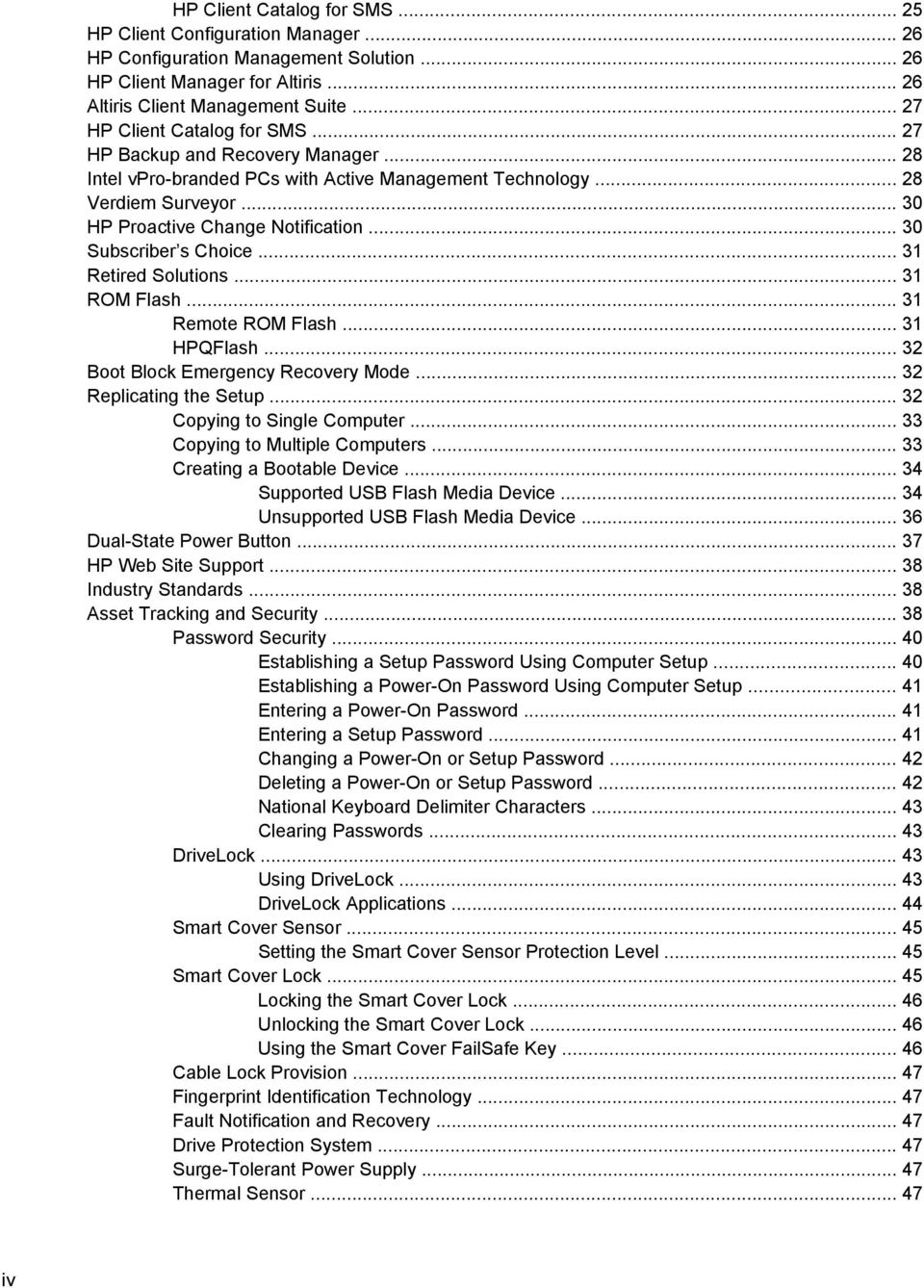
4 iv HP Client Catalog for SMS HP Client Configuration Manager HP Configuration Management Solution HP Client Manager for Altiris Altiris Client Management Suite HP Client Catalog for SMS HP Backup and Recovery Manager Intel vpro-branded PCs with Active Management Technology Verdiem Surveyor HP Proactive Change Notification Subscriber s Choice Retired Solutions ROM Flash Remote ROM Flash HPQFlash Boot Block Emergency Recovery Mode Replicating the Setup Copying to Single Computer Copying to Multiple Computers Creating a Bootable Device Supported USB Flash Media Device Unsupported USB Flash Media Device Dual-State Power Button HP Web Site Support Industry Standards Asset Tracking and Security Password Security Establishing a Setup Password Using Computer Setup Establishing a Power-On Password Using Computer Setup Entering a Power-On Password Entering a Setup Password Changing a Power-On or Setup Password Deleting a Power-On or Setup Password National Keyboard Delimiter Characters Clearing Passwords DriveLock Using DriveLock DriveLock Applications Smart Cover Sensor Setting the Smart Cover Sensor Protection Level Smart Cover Lock Locking the Smart Cover Lock Unlocking the Smart Cover Lock Using the Smart Cover FailSafe Key Cable Lock Provision Fingerprint Identification Technology Fault Notification and Recovery Drive Protection System Surge-Tolerant Power Supply Thermal Sensor... 47
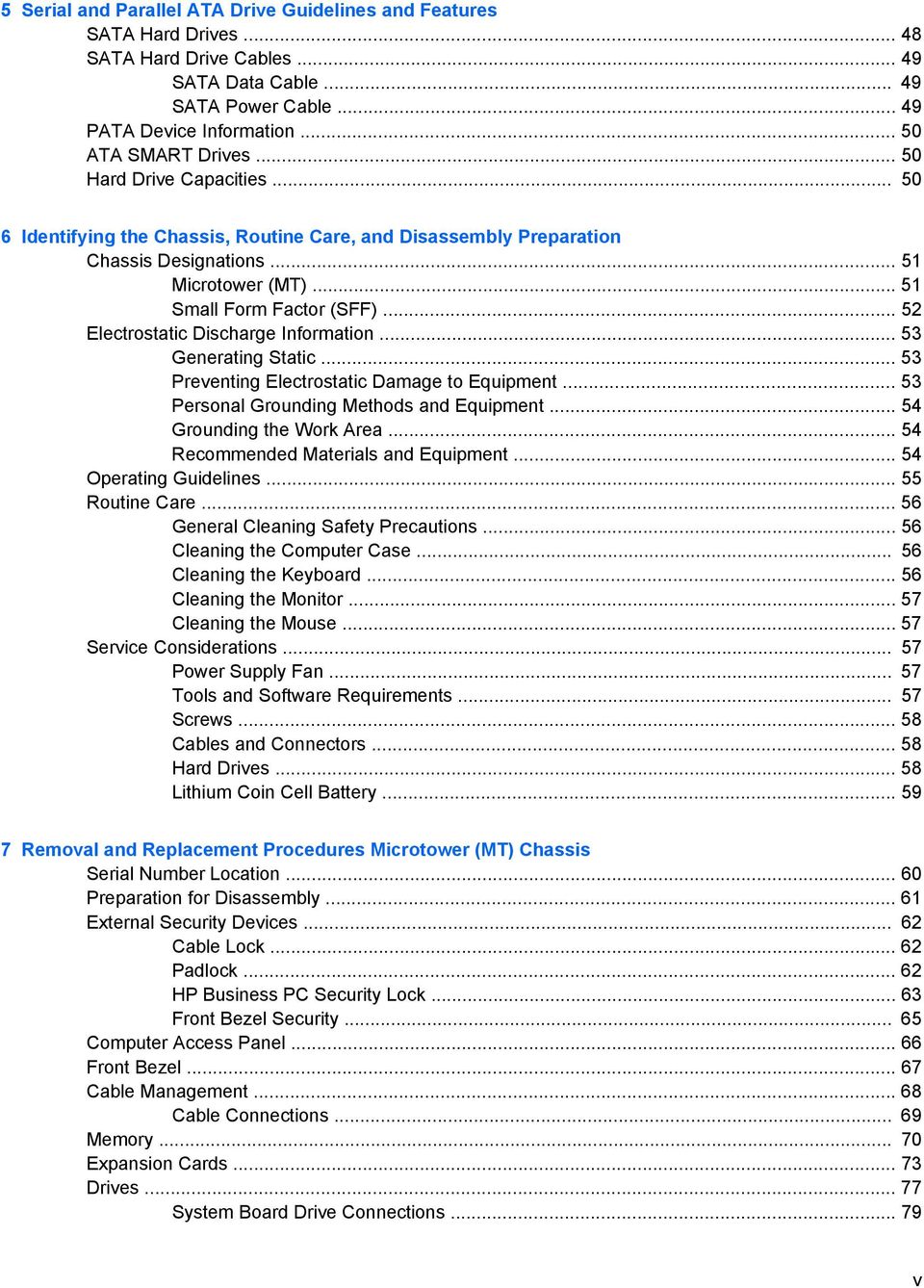
5 5 Serial and Parallel ATA Drive Guidelines and Features SATA Hard Drives SATA Hard Drive Cables SATA Data Cable SATA Power Cable PATA Device Information ATA SMART Drives Hard Drive Capacities Identifying the Chassis, Routine Care, and Disassembly Preparation Chassis Designations Microtower (MT) Small Form Factor (SFF) Electrostatic Discharge Information Generating Static Preventing Electrostatic Damage to Equipment Personal Grounding Methods and Equipment Grounding the Work Area Recommended Materials and Equipment Operating Guidelines Routine Care General Cleaning Safety Precautions Cleaning the Computer Case Cleaning the Keyboard Cleaning the Monitor Cleaning the Mouse Service Considerations Power Supply Fan Tools and Software Requirements Screws Cables and Connectors Hard Drives Lithium Coin Cell Battery Removal and Replacement Procedures Microtower (MT) Chassis Serial Number Location Preparation for Disassembly External Security Devices Cable Lock Padlock HP Business PC Security Lock Front Bezel Security Computer Access Panel Front Bezel Cable Management Cable Connections Memory Expansion Cards Drives System Board Drive Connections v
6 Drive Positions Removing an External 5.25-inch or 3.5-inch Drive Installing an External 5.25-inch or 3.5-inch Drive Removing an Internal 3.5-inch Hard Drive Installing an Internal 3.5-inch Hard Drive Removing and Replacing a Removable 3.5-inch SATA Hard Drive ReadyBoost Card Processor Baffle Fan/Air Baffle Front USB Panel Power Switch/LED Assembly Heatsink Processor Speaker Rear Chassis Fan Optional Serial Port Power Supply System Board Battery Type 1 Battery Holder Type 2 Battery Holder Type 3 Battery Holder Removal and Replacement Procedures Small Form Factor (SFF) Chassis Preparation for Disassembly External Security Devices Installing a Security Lock Cable Lock Padlock HP Business PC Security Lock Front Bezel Security Computer Access Panel Front Bezel Bezel Blanks Using the Small Form Factor Computer in a Tower Orientation Installing Additional Memory DIMMs DDR2-SDRAM DIMMs Populating DIMM Sockets Installing DIMMs Expansion Cards Cable Management Cable Connections Drives Drive Positions Installing and Removing Drives System Board Drive Connections Removing an Optical Drive Installing an Optical Drive into the 5.25-inch Drive Bay Removing an External 3.5-inch Drive vi

7 Installing a Drive into the 3.5-inch External Drive Bay Removing and Replacing the Primary 3.5-inch Internal SATA Hard Drive Removing and Replacing a Removable 3.5-inch SATA Hard Drive Cable Routing ReadyBoost Card Inner Baffle Fan/Outer Baffle Power Switch Assembly Front I/O Device Heatsink Processor Speaker Power Supply System Board Battery Type 1 Battery Holder Type 2 Battery Holder Type 3 Battery Holder Appendix A Connector Pin Assignments Keyboard Mouse Ethernet BNC Ethernet RJ Ethernet AUI Parallel Interface Serial Interface, Powered and Non-Powered USB Microphone Headphone Line-in Audio Line-out Audio External Infrared Transceiver Monitor ATA/ATAPI (IDE) Standard Drive Cable CD-ROM 50-Pin Connector Pin Power Pin MicroFit Power (CMT, SFF) Pin Power (for CPU) Pin Power (for CPU) (CMT, SFF) SATA Data and Power PCI Express PCI Express PCI Express Mini Card DVI Connector Appendix B Power Cord Set Requirements General Requirements Japanese Power Cord Requirements Country-Specific Requirements vii

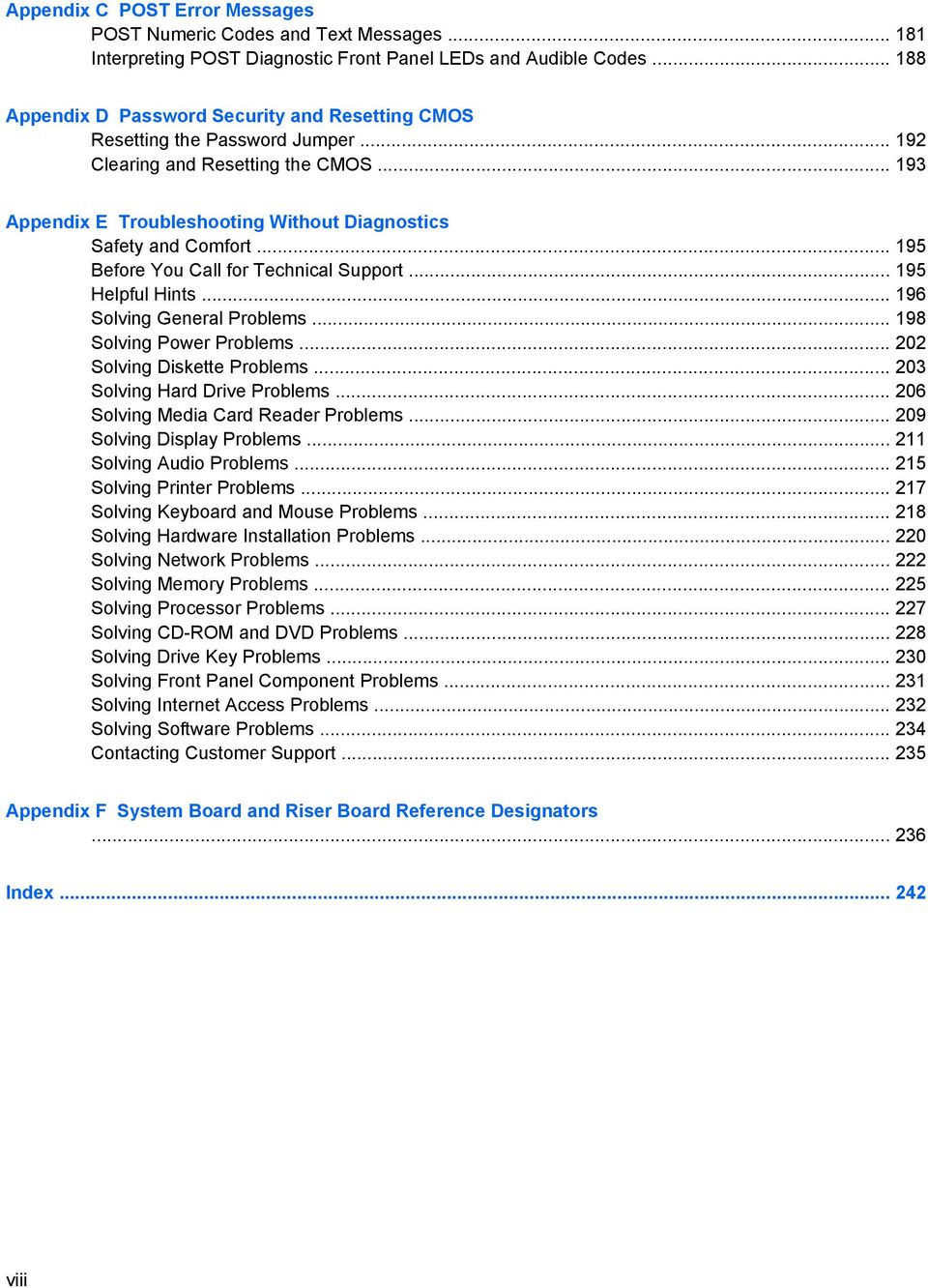
8 Appendix C POST Error Messages POST Numeric Codes and Text Messages Interpreting POST Diagnostic Front Panel LEDs and Audible Codes Appendix D Password Security and Resetting CMOS Resetting the Password Jumper Clearing and Resetting the CMOS Appendix E Troubleshooting Without Diagnostics Safety and Comfort Before You Call for Technical Support Helpful Hints Solving General Problems Solving Power Problems Solving Diskette Problems Solving Hard Drive Problems Solving Media Card Reader Problems Solving Display Problems Solving Audio Problems Solving Printer Problems Solving Keyboard and Mouse Problems Solving Hardware Installation Problems Solving Network Problems Solving Memory Problems Solving Processor Problems Solving CD-ROM and DVD Problems Solving Drive Key Problems Solving Front Panel Component Problems Solving Internet Access Problems Solving Software Problems Contacting Customer Support Appendix F System Board and Riser Board Reference Designators Index viii
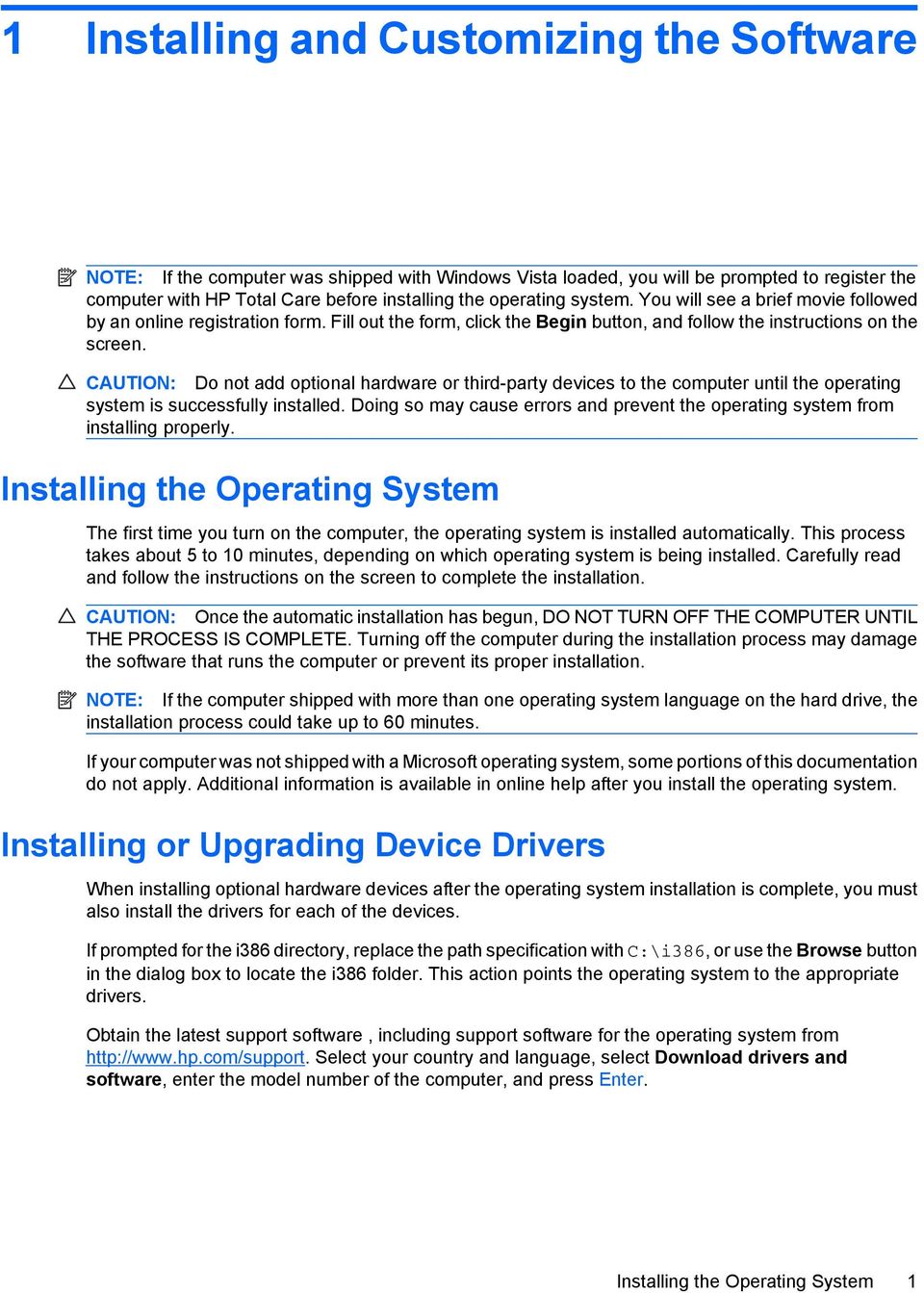
9 1 Installing and Customizing the Software NOTE: If the computer was shipped with Windows Vista loaded, you will be prompted to register the computer with HP Total Care before installing the operating system. You will see a brief movie followed by an online registration form. Fill out the form, click the Begin button, and follow the instructions on the screen. CAUTION: Do not add optional hardware or third-party devices to the computer until the operating system is successfully installed. Doing so may cause errors and prevent the operating system from installing properly. Installing the Operating System The first time you turn on the computer, the operating system is installed automatically. This process takes about 5 to 10 minutes, depending on which operating system is being installed. Carefully read and follow the instructions on the screen to complete the installation. CAUTION: Once the automatic installation has begun, DO NOT TURN OFF THE COMPUTER UNTIL THE PROCESS IS COMPLETE. Turning off the computer during the installation process may damage the software that runs the computer or prevent its proper installation. NOTE: If the computer shipped with more than one operating system language on the hard drive, the installation process could take up to 60 minutes. If your computer was not shipped with a Microsoft operating system, some portions of this documentation do not apply. Additional information is available in online help after you install the operating system. Installing or Upgrading Device Drivers When installing optional hardware devices after the operating system installation is complete, you must also install the drivers for each of the devices. If prompted for the i386 directory, replace the path specification with C:\i386, or use the Browse button in the dialog box to locate the i386 folder. This action points the operating system to the appropriate drivers. Obtain the latest support software, including support software for the operating system from Select your country and language, select Download drivers and software, enter the model number of the computer, and press Enter. Installing the Operating System 1
10 HP Backup and Recovery Manager The HP Backup and Recovery Manager is an easy-to-use, versatile application that allows you to back up and recover the primary hard drive on the PC. The application works within Windows to create backups of Windows, all applications, and all data files. Backups can be scheduled to occur automatically at designated intervals, or they can be initiated manually. Important files can be archived separately from regular backups. HP Backup and Recovery Manager is preinstalled on the hard drive's Recovery Partition. Recovery Points and file backups can be copied to CD or DVD discs, while all backups can be copied to network or secondary hard disks. HP highly recommends that you create a Recovery Disc Set immediately before using the computer and schedule regular automatic Recovery Point backups. To create the Recovery Disc Set: 1. Click Start > HP Backup and Recovery > HP Backup and Recovery Manager to open the Backup and Recovery Wizard, then click Next. 2. Select Create a set of recovery discs (Recommended) and click Next. 3. Follow the instructions in the wizard. For more information on using HP Backup and Recovery Manager, refer to the HP Backup and Recovery Manager User Guide by selecting Start > HP Backup and Recovery > HP Backup and Recovery Manager Manual. NOTE: You can order a Recovery Disc Set from HP by calling the HP support center. Go to the following Web site, select your region, and click the Technical support after you buy link under the Call HP heading to obtain the support center telephone number for your region. 2 Chapter 1 Installing and Customizing the Software

11 2 Computer Setup (F10) Utility Computer Setup (F10) Utilities Use Computer Setup (F10) Utility to do the following: Change factory default settings. Set the system date and time. Set, view, change, or verify the system configuration, including settings for processor, graphics, memory, audio, storage, communications, and input devices. Modify the boot order of bootable devices such as hard drives, diskette drives, optical drives, or USB flash media devices. Enable Quick Boot, which is faster than Full Boot but does not run all of the diagnostic tests run during a Full Boot. You can set the system to: always Quick Boot (default); periodically Full Boot (from every 1 to 30 days); or always Full Boot. Select Post Messages Enabled or Disabled to change the display status of Power-On Self-Test (POST) messages. Post Messages Disabled suppresses most POST messages, such as memory count, product name, and other non-error text messages. If a POST error occurs, the error is displayed regardless of the mode selected. To manually switch to Post Messages Enabled during POST, press any key (except F1 through F12). Establish an Ownership Tag, the text of which is displayed each time the system is turned on or restarted. Enter the Asset Tag or property identification number assigned by the company to this computer. Enable the power-on password prompt during system restarts (warm boots) as well as during power-on. Establish a setup password that controls access to Computer Setup (F10) Utility and the settings described in this section. Secure integrated I/O functionality, including the serial, USB, or parallel ports, audio, or embedded NIC, so that they cannot be used until they are unsecured. Enable or disable removable media boot ability. Enable or disable legacy diskette write ability (when supported by hardware). Computer Setup (F10) Utilities 3

12 Solve system configuration errors detected but not automatically fixed during the Power-On Self- Test (POST). Replicate the system setup by saving system configuration information on diskette and restoring it on one or more computers. Execute self-tests on a specified ATA hard drive (when supported by drive). Enable or disable DriveLock security (when supported by drive). Using Computer Setup (F10) Utilities Computer Setup can be accessed only by turning the computer on or restarting the system. To access the Computer Setup Utilities menu, complete the following steps: 1. Turn on or restart the computer. If you are in Microsoft Windows, click Start > Shut Down > Restart. 2. As soon as the computer is turned on, press F10 when the monitor light turns green to enter Computer Setup. Press Enter to bypass the title screen, if necessary. NOTE: If you do not press F10 at the appropriate time, you must restart the computer and again press F10 when the monitor light turns green to access the utility. 3. Select your language from the list and press Enter. 4. A choice of five headings appears in the Computer Setup Utilities menu: File, Storage, Security, Power and Advanced. 5. Use the arrow (left and right) keys to select the appropriate heading. Use the arrow (up and down) keys to select the option you want, then press Enter. To return to the Computer Setup Utilities menu, press Esc. 6. To apply and save changes, select File > Save Changes and Exit. If you have made changes that you do not want applied, select Ignore Changes and Exit. To reset to factory settings or previously saved default settings (some models), select Apply Defaults and Exit. This option will restore the original factory system defaults. CAUTION: Do NOT turn the computer power OFF while the BIOS is saving the Computer Setup (F10) changes because the CMOS could become corrupted. It is safe to turn off the computer only after exiting the F10 Setup screen. Table 2-1 Computer Setup (F10) Utility Heading Table File Table 2-2 Computer Setup File on page 5 Storage Table 2-3 Computer Setup Storage on page 6 Security Table 2-4 Computer Setup Security on page 8 Power Table 2-5 Computer Setup Power on page 11 Advanced Table 2-6 Computer Setup Advanced (for advanced users) on page 12 4 Chapter 2 Computer Setup (F10) Utility

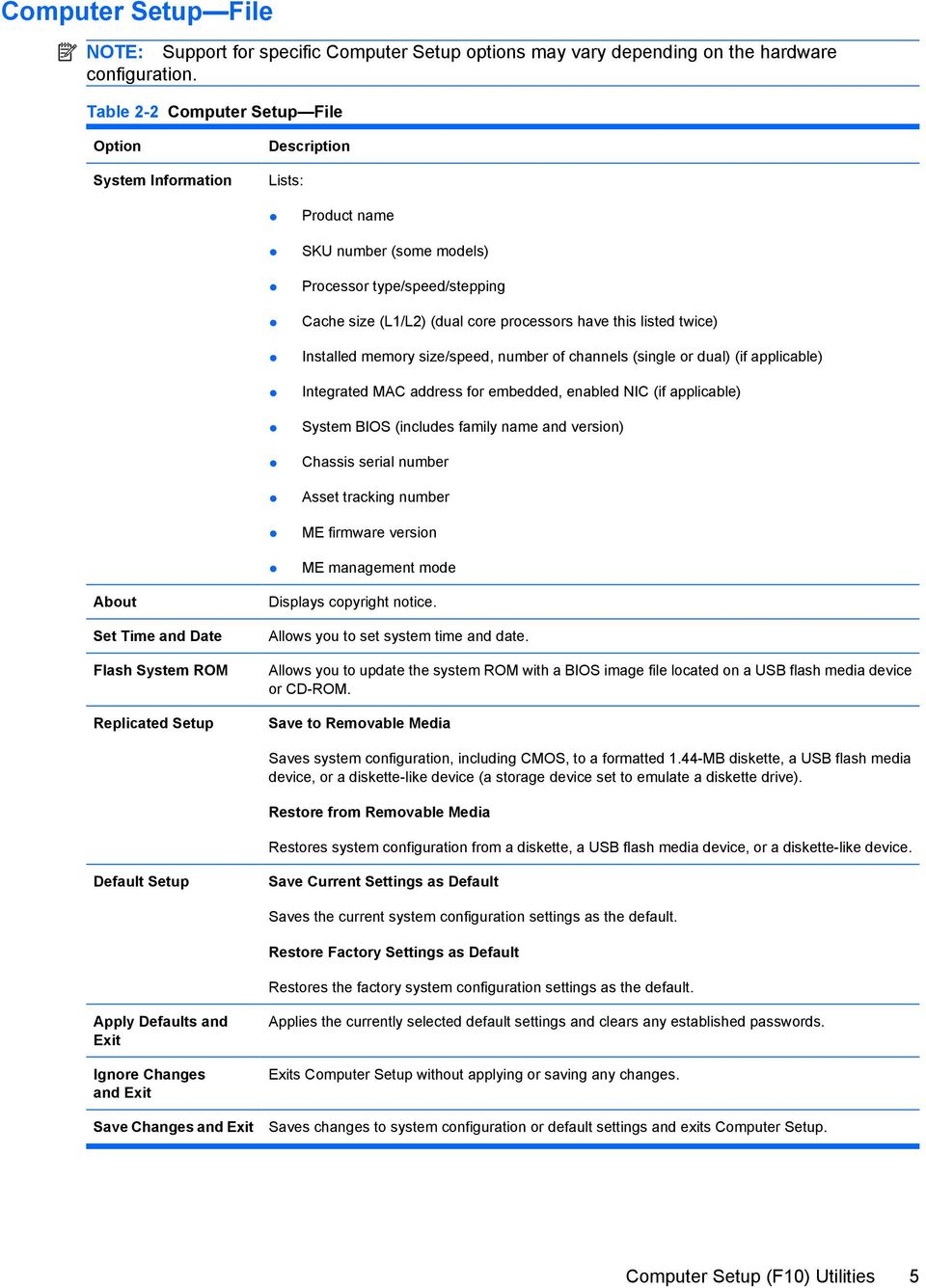
13 Computer Setup File NOTE: Support for specific Computer Setup options may vary depending on the hardware configuration. Table 2-2 Computer Setup File Option System Information Description Lists: Product name SKU number (some models) Processor type/speed/stepping Cache size (L1/L2) (dual core processors have this listed twice) Installed memory size/speed, number of channels (single or dual) (if applicable) Integrated MAC address for embedded, enabled NIC (if applicable) System BIOS (includes family name and version) Chassis serial number Asset tracking number ME firmware version ME management mode About Set Time and Date Flash System ROM Replicated Setup Displays copyright notice. Allows you to set system time and date. Allows you to update the system ROM with a BIOS image file located on a USB flash media device or CD-ROM. Save to Removable Media Saves system configuration, including CMOS, to a formatted 1.44-MB diskette, a USB flash media device, or a diskette-like device (a storage device set to emulate a diskette drive). Restore from Removable Media Restores system configuration from a diskette, a USB flash media device, or a diskette-like device. Default Setup Save Current Settings as Default Saves the current system configuration settings as the default. Restore Factory Settings as Default Restores the factory system configuration settings as the default. Apply Defaults and Exit Ignore Changes and Exit Save Changes and Exit Applies the currently selected default settings and clears any established passwords. Exits Computer Setup without applying or saving any changes. Saves changes to system configuration or default settings and exits Computer Setup. Computer Setup (F10) Utilities 5
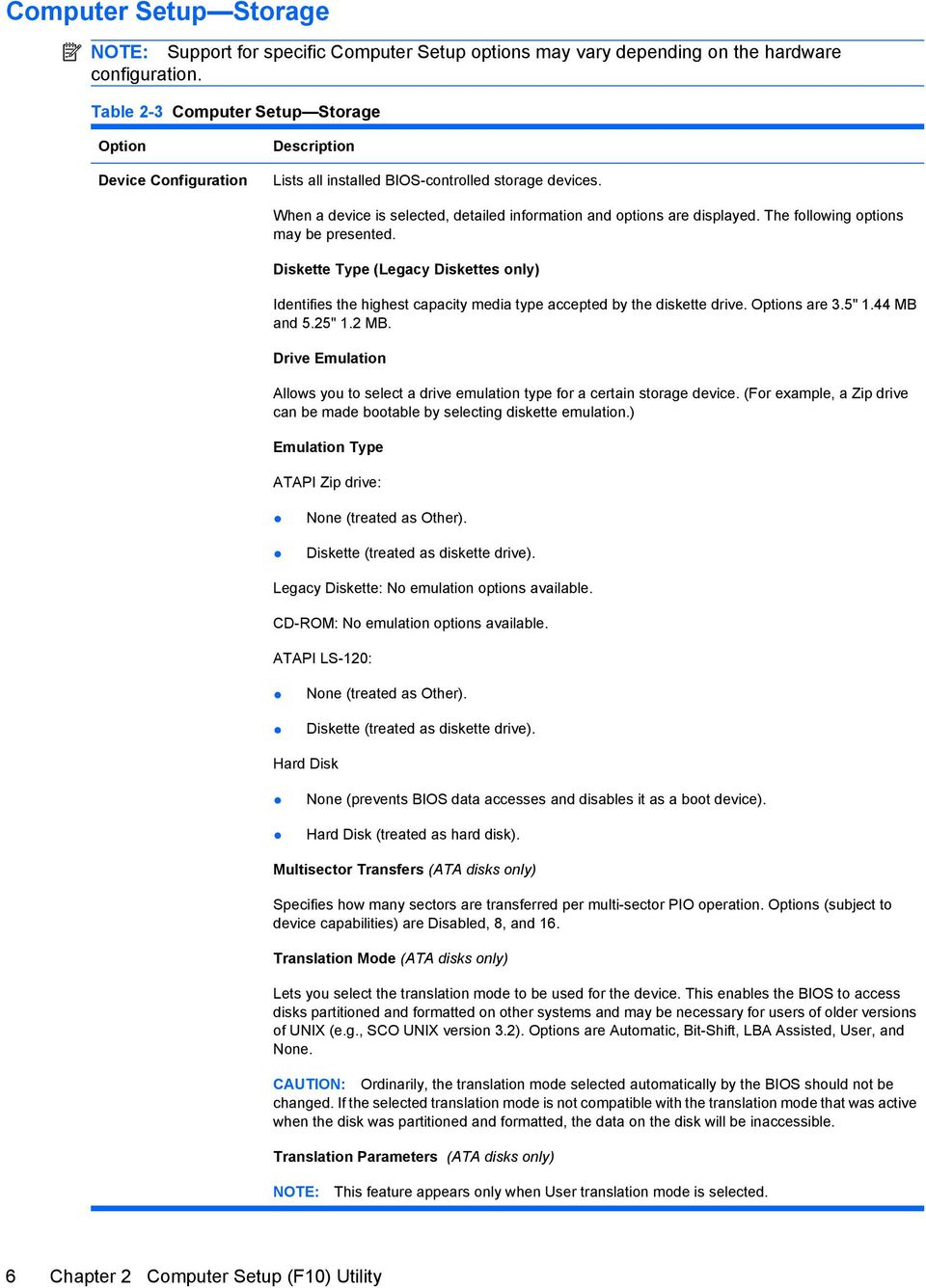
14 Computer Setup Storage NOTE: Support for specific Computer Setup options may vary depending on the hardware configuration. Table 2-3 Computer Setup Storage Option Device Configuration Description Lists all installed BIOS-controlled storage devices. When a device is selected, detailed information and options are displayed. The following options may be presented. Diskette Type (Legacy Diskettes only) Identifies the highest capacity media type accepted by the diskette drive. Options are 3.5" 1.44 MB and 5.25" 1.2 MB. Drive Emulation Allows you to select a drive emulation type for a certain storage device. (For example, a Zip drive can be made bootable by selecting diskette emulation.) Emulation Type ATAPI Zip drive: None (treated as Other). Diskette (treated as diskette drive). Legacy Diskette: No emulation options available. CD-ROM: No emulation options available. ATAPI LS-120: None (treated as Other). Diskette (treated as diskette drive). Hard Disk None (prevents BIOS data accesses and disables it as a boot device). Hard Disk (treated as hard disk). Multisector Transfers (ATA disks only) Specifies how many sectors are transferred per multi-sector PIO operation. Options (subject to device capabilities) are Disabled, 8, and 16. Translation Mode (ATA disks only) Lets you select the translation mode to be used for the device. This enables the BIOS to access disks partitioned and formatted on other systems and may be necessary for users of older versions of UNIX (e.g., SCO UNIX version 3.2). Options are Automatic, Bit-Shift, LBA Assisted, User, and None. CAUTION: Ordinarily, the translation mode selected automatically by the BIOS should not be changed. If the selected translation mode is not compatible with the translation mode that was active when the disk was partitioned and formatted, the data on the disk will be inaccessible. Translation Parameters (ATA disks only) NOTE: This feature appears only when User translation mode is selected. 6 Chapter 2 Computer Setup (F10) Utility
15 Table 2-3 Computer Setup Storage (continued) Allows you to specify the parameters (logical cylinders, heads, and sectors per track) used by the BIOS to translate disk I/O requests (from the operating system or an application) into terms the hard drive can accept. Logical cylinders may not exceed The number of heads may not exceed 256. The number of sectors per track may not exceed 63. These fields are only visible and changeable when the drive translation mode is set to User. SATA Default Values Allows you to specify the default values for the Multisector Transfers, Transfer Mode, and Translation Mode for ATA devices. Storage Options Removable Media Boot Enables/disables ability to boot the system from removable media. Legacy Diskette Write Enables/disables ability to write data to legacy diskettes. NOTE: After saving changes to Removable Media Write, the computer will restart. Turn the computer off, then on, manually. DPS Self-Test Allows you to execute self-tests on ATA hard drives capable of performing the Drive Protection System (DPS) self-tests. NOTE: This selection will only appear when at least one drive capable of performing the DPS selftests is attached to the system. Boot Order Allows you to: Specify the order in which attached devices (such as a USB flash media device, diskette drive, hard drive, optical drive, or network interface card) are checked for a bootable operating system image. Each device on the list may be individually excluded from or included for consideration as a bootable operating system source. Specify the order of attached hard drives. The first hard drive in the order will have priority in the boot sequence and will be recognized as drive C (if any devices are attached). NOTE: MS-DOS drive lettering assignments may not apply after a non-ms-dos operating system has started. Shortcut to Temporarily Override Boot Order To boot one time from a device other than the default device specified in Boot Order, restart the computer and press F9 when the monitor light turns green. After POST is completed, a list of bootable devices is displayed. Use the arrow keys to select the preferred bootable device and press Enter. The computer then boots from the selected non-default device for this one time. Computer Setup (F10) Utilities 7

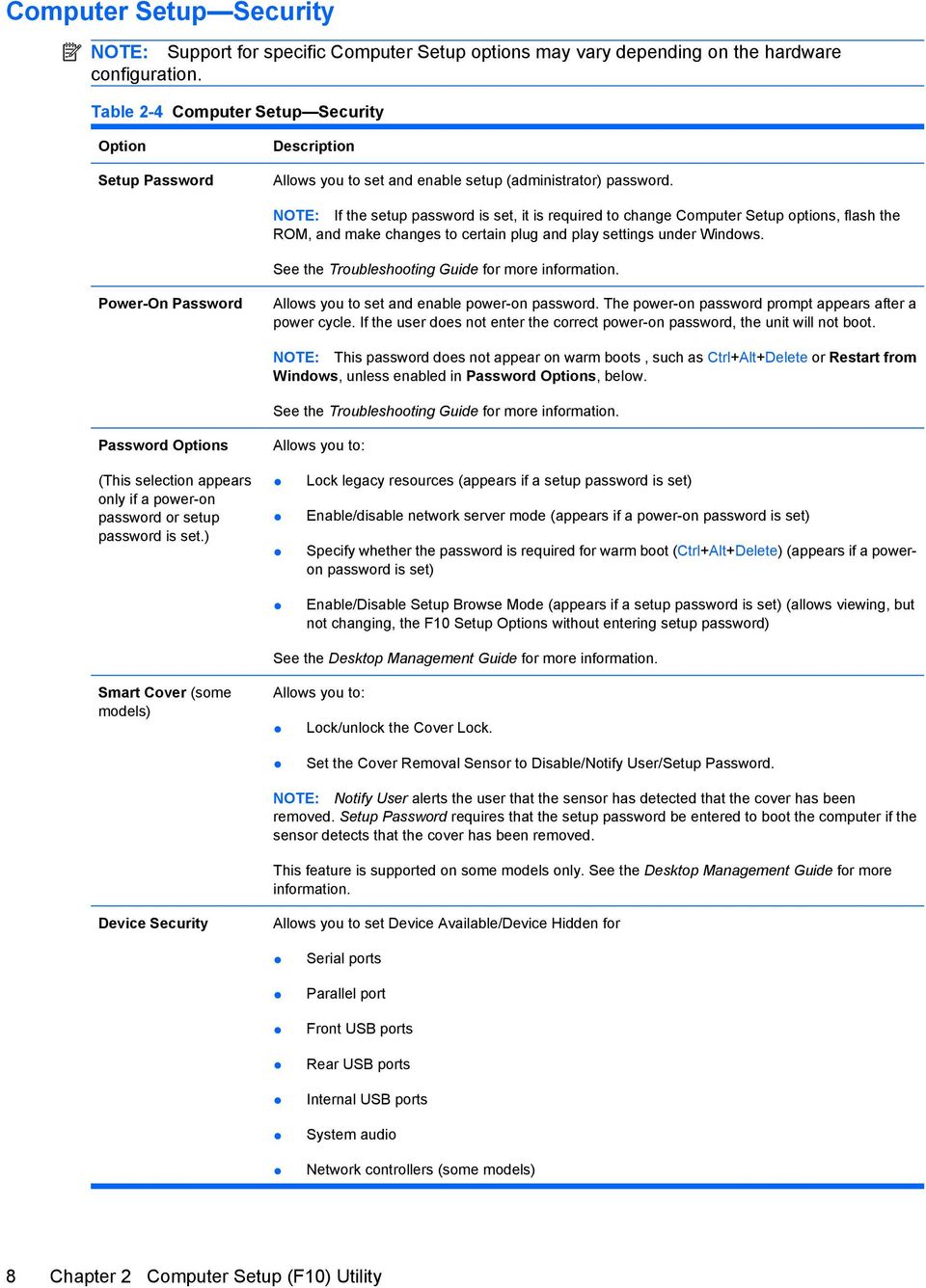
16 Computer Setup Security NOTE: Support for specific Computer Setup options may vary depending on the hardware configuration. Table 2-4 Computer Setup Security Option Setup Password Description Allows you to set and enable setup (administrator) password. NOTE: If the setup password is set, it is required to change Computer Setup options, flash the ROM, and make changes to certain plug and play settings under Windows. See the Troubleshooting Guide for more information. Power-On Password Allows you to set and enable power-on password. The power-on password prompt appears after a power cycle. If the user does not enter the correct power-on password, the unit will not boot. NOTE: This password does not appear on warm boots, such as Ctrl+Alt+Delete or Restart from Windows, unless enabled in Password Options, below. See the Troubleshooting Guide for more information. Password Options Allows you to: (This selection appears only if a power-on password or setup password is set.) Lock legacy resources (appears if a setup password is set) Enable/disable network server mode (appears if a power-on password is set) Specify whether the password is required for warm boot (Ctrl+Alt+Delete) (appears if a poweron password is set) Enable/Disable Setup Browse Mode (appears if a setup password is set) (allows viewing, but not changing, the F10 Setup Options without entering setup password) See the Desktop Management Guide for more information. Smart Cover (some models) Allows you to: Lock/unlock the Cover Lock. Set the Cover Removal Sensor to Disable/Notify User/Setup Password. NOTE: Notify User alerts the user that the sensor has detected that the cover has been removed. Setup Password requires that the setup password be entered to boot the computer if the sensor detects that the cover has been removed. This feature is supported on some models only. See the Desktop Management Guide for more information. Device Security Allows you to set Device Available/Device Hidden for Serial ports Parallel port Front USB ports Rear USB ports Internal USB ports System audio Network controllers (some models) 8 Chapter 2 Computer Setup (F10) Utility
17 Table 2-4 Computer Setup Security (continued) Legacy diskette Embedded security device (some models) SATA0 SATA1 (some models) SATA4 (some models) SATA5 (some models) Network Service Boot System IDs Enables/disables the computer s ability to boot from an operating system installed on a network server. (Feature available on NIC models only; the network controller must be either a PCI expansion card or embedded on the system board.) Allows you to set: Asset tag (18-byte identifier) and ownership tag (80-byte identifier displayed during POST). See the Desktop Management Guide for more information. Chassis serial number or Universal Unique Identifier (UUID) number. The UUID can only be updated if the current chassis serial number is invalid. (These ID numbers are normally set in the factory and are used to uniquely identify the system.) Keyboard locale setting (for example, English or German) for System ID entry. DriveLock Security Allows you to assign or modify a master or user password for hard drives. When this feature is enabled, the user is prompted to provide one of the DriveLock passwords during POST. If neither is successfully entered, the hard drive will remain inaccessible until one of the passwords is successfully provided during a subsequent cold-boot sequence. NOTE: This selection will only appear when at least one drive that supports the DriveLock feature is attached to the system. See the Desktop Management Guide for more information. System Security (some models: these options are hardware dependent) Data Execution Prevention (some models) (enable/disable) Helps prevent operating system security breaches. Virtualization Technology (some models) (enable/disable) Controls the virtualization features of the processor. Changing this setting requires turning the computer off and then back on. Embedded Security Device Support (some models) (enable/disable) Permits activation and deactivation of the Embedded Security Device. Changing this setting requires turning the computer off and then back on. NOTE: To configure the Embedded Security Device, a Setup password must be set. If Embedded Security Device Support is enabled, the following options are available: Reset to Factory Settings (some models) (Do not reset/reset) Resetting to factory defaults will erase all security keys. Changing this setting requires turning the computer off and then back on. CAUTION: The embedded security device is a critical component of many security schemes. Erasing the security keys will prevent access to data protected by the Embedded Security Device. Choosing Reset to Factory Settings may result in significant data loss. Power-on authentication support (some models) (enable/disable) Controls the power-on password authentication scheme that utilizes the Embedded Security Device. Changing this setting requires turning the computer off and then back on. Reset authentication credentials (some models) (Do not reset/reset) Selecting Reset disables the power-on authentication support and clears the authentication information from the Embedded Security Device. Changing this setting requires turning the computer off and then back on Computer Setup (F10) Utilities 9

18 Table 2-4 Computer Setup Security (continued) OS management of Embedded Security Device (some models) (enable/disable) This option allows the user to limit operating system control of the Embedded Security Device. Changing this setting requires turning the computer off and then back on. This option allows the user to limit OS control of the Embedded Security Device. Reset of Embedded Security Device through OS (some models) (enable/disable) This option allows the user to limit the operating system ability to request a Reset to Factory Settings of the Embedded Security Device. Changing this setting requires turning the computer off and then back on. NOTE: To enable this option, a Setup password must be set. Smart Card BIOS Password Support (some models) (enable/disable) Allows the user to enable/ disable the Smart Card to be used in place of the Setup and Power-On Passwords. This setting requires additional initialization within ProtectTools before this option will take effect. Setup Security Level Provides a method to allow end-users limited access to change specified setup options, without having to know the Setup Password. This feature allows the administrator the flexibility to protect changes to essential setup options, while allowing the user to view system settings and configure nonessential options. The administrator specifies access rights to individual setup options on a case-by-case basis via the Setup Security Level menu. By default, all setup options are assigned Setup Password, indicating the user must enter the correct Setup Password during POST to make changes to any of the options. The administrator may set individual items to None, indicating the user can make changes to the specified options when setup has been accessed with invalid passwords. The choice, None, is replaced by Power-On Password if a Power-On Password is enabled. NOTE: Setup Browse Mode must be set to Enable in order for the user to enter Setup without knowing the setup password. 10 Chapter 2 Computer Setup (F10) Utility

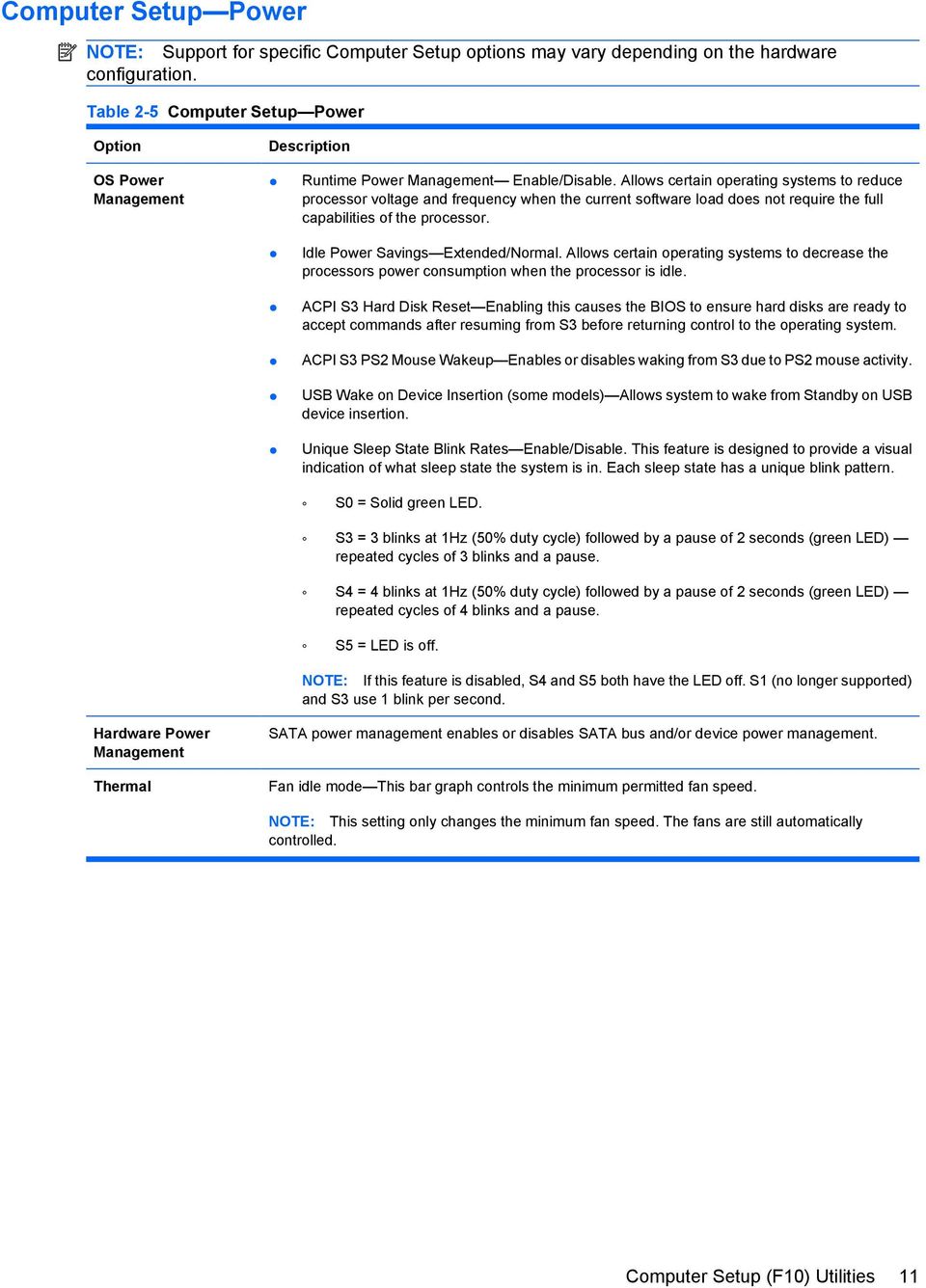
19 Computer Setup Power NOTE: Support for specific Computer Setup options may vary depending on the hardware configuration. Table 2-5 Computer Setup Power Option Description OS Power Management Runtime Power Management Enable/Disable. Allows certain operating systems to reduce processor voltage and frequency when the current software load does not require the full capabilities of the processor. Idle Power Savings Extended/Normal. Allows certain operating systems to decrease the processors power consumption when the processor is idle. ACPI S3 Hard Disk Reset Enabling this causes the BIOS to ensure hard disks are ready to accept commands after resuming from S3 before returning control to the operating system. ACPI S3 PS2 Mouse Wakeup Enables or disables waking from S3 due to PS2 mouse activity. USB Wake on Device Insertion (some models) Allows system to wake from Standby on USB device insertion. Unique Sleep State Blink Rates Enable/Disable. This feature is designed to provide a visual indication of what sleep state the system is in. Each sleep state has a unique blink pattern. S0 = Solid green LED. S3 = 3 blinks at 1Hz (50% duty cycle) followed by a pause of 2 seconds (green LED) repeated cycles of 3 blinks and a pause. S4 = 4 blinks at 1Hz (50% duty cycle) followed by a pause of 2 seconds (green LED) repeated cycles of 4 blinks and a pause. S5 = LED is off. NOTE: If this feature is disabled, S4 and S5 both have the LED off. S1 (no longer supported) and S3 use 1 blink per second. Hardware Power Management Thermal SATA power management enables or disables SATA bus and/or device power management. Fan idle mode This bar graph controls the minimum permitted fan speed. NOTE: This setting only changes the minimum fan speed. The fans are still automatically controlled. Computer Setup (F10) Utilities 11
20 Computer Setup Advanced NOTE: Support for specific Computer Setup options may vary depending on the hardware configuration. Table 2-6 Computer Setup Advanced (for advanced users) Option Power-On Options Heading Allows you to set: POST mode (QuickBoot, FullBoot, or FullBoot every 1 30 days). POST messages (enable/disable). MEBx Setup Prompt (hidden/displayed). Enabling this feature displays the text CTRL+P = MEBx during POST. Disabling this feature prevents the text from being displayed. However, pressing Ctrl+P still accesses the ME BIOS Extension Setup Utility, which is used to configure manageability settings. F9 prompt (hidden/displayed). Enabling this feature will display the text F9 = Boot Menu during POST. Disabling this feature prevents the text from being displayed. However, pressing F9 will still access the Shortcut Boot [Order] Menu screen. See Storage > Boot Order for more information. F10 prompt (hidden/displayed). Enabling this feature will display the text F10 = Setup during POST. Disabling this feature prevents the text from being displayed. However, pressing F10 will still access the Setup screen. F11 prompt (hidden/displayed). Setting this feature to displayed will display the text F11 = Recovery during POST. Hiding the feature prevents the text from being displayed. However, pressing F11 will still attempt to boot to the HP Backup and Recovery partition. See Factory Recovery Boot Support for more information. F12 prompt (hidden/displayed). Enabling this feature will display the text F12 = Network during POST. Disabling this feature prevents the text from being displayed. However, pressing F12 will still force the system to attempt booting from the network. Factory Recovery Boot Support (enable/disable). Enabling this feature will cause an additional prompt, F11 = Recovery, to be displayed during POST on systems with HP Backup and Recovery software installed and configured with a recovery partition on the boot hard drive. Pressing F11 causes the system to boot to the recovery partition and launch HP Backup and Recovery. The F11 = Recovery prompt can be hidden with the F11 prompt (hidden/displayed) option (see above). Option ROM prompt (enable/disable). Enabling this feature will cause the system to display a message before loading option ROMs. (This feature is supported on some models only.) Remote wakeup boot source (remote server/local hard drive). After Power Loss (off/on/previous state): Setting this option to: Off causes the computer to remain powered off when power is restored. On causes the computer to power on automatically as soon as power is restored. On allows you to power on the computer using a power strip switch, if the computer is connected to an electric power strip. Previous state causes the computer to power on automatically as soon as power is restored, if it was on when power was lost. 12 Chapter 2 Computer Setup (F10) Utility

21 Table 2-6 Computer Setup Advanced (for advanced users) (continued) NOTE: If you turn off power to the computer using the switch on a power strip, you will not be able to use the suspend/sleep feature or the Remote Management features. POST Delay (None, 5, 10 15, or 20 seconds). Enabling this feature will add a user-specified delay to the POST process. This delay is sometimes needed for hard disks on some PCI cards that spin up very slowly, so slowly that they are not ready to boot by the time POST is finished. The POST delay also gives you more time to select F10 to enter Computer (F10) Setup. Limit CPUID Maximum Value to 3. Restricts the number of CPUID functions reported by the microprocessor. Enable this feature if booting to Windows NT. Execute Memory Test (some models) BIOS Power-On Onboard Devices Restarts the computer and executes the POST memory test. Allows you to set the computer to turn on automatically at a time you specify. Allows you to set resources for or disable onboard system devices (diskette controller, serial port, or parallel port). PCI Devices Lists currently installed PCI devices and their IRQ settings. Allows you to reconfigure IRQ settings for these devices or to disable them entirely. These settings have no effect under an ACPI-based operating system. PCI VGA Configuration Displayed only if there are multiple PCI video adapters in the system. Allows you to specify which VGA controller will be the boot or primary VGA controller. NOTE: In order to see this entry, you must enable Integrated Video (Advanced > Device Options) and Save Changes and Exit. Bus Options On some models, allows you to enable or disable: PCI SERR# Generation. PCI VGA palette snooping, which sets the VGA palette snooping bit in PCI configuration space; only needed when more than one graphics controller is installed. Device Options Allows you to set: Printer mode (Bi-Directional, EPP + ECP, Output Only). Num Lock state at power-on (off/on). S5 Wake on LAN (enable/disable). To disable Wake on LAN during the off state (S5), use the arrow (left and right) keys to select the Advanced > Device Options menu and set the S5 Wake on LAN feature to Disable. This obtains the lowest power consumption available on the computer during S5. It does not affect the ability of the computer to Wake on LAN from suspend or hibernation, but will prevent it from waking from S5 via the network. It does not affect operation of the network connection while the computer is on. If a network connection is not required, completely disable the network controller (NIC) by using the arrow (left and right) keys to select the Security > Device Security menu. Set the Network Controller option to Device Hidden. This prevents the network controller from being used by the operating system and reduces the power used by the computer in S5. Integrated Video (enable/disable). Allows you to use integrated video and PCI Up Solution video at the same time (available on some models only). This option is only available if a PCI Up video card is installed. NOTE: After Integrated Video is enabled and changes saved, a new menu item appears under Advanced to allow you to select the primary VGA controller video device. Inserting a PCI Express video card automatically disables Integrated Video. When PCI Express video is on, Integrated Video must remain disabled. Computer Setup (F10) Utilities 13
22 Table 2-6 Computer Setup Advanced (for advanced users) (continued) Multi-Processor (enable/disable). This option may be used to disable multi-processor support under the OS. Internal speaker (some models) (does not affect external speakers) Monitor Tracking (enable/disable). Allows BIOS to save monitor asset information. NIC PXE Option ROM Download (enable/disable). The BIOS contains an embedded NIC option ROM to allow the unit to boot through the network to a PXE server. This is typically used to download a corporate image to a hard drive. The NIC option ROM takes up memory space below 1MB commonly referred to as DOS Compatibility Hole (DCH) space. This space is limited. This F10 option will allow users to disable the downloading of this embedded NIC option ROM thus giving more DCH space for additional PCI cards which may need option ROM space. The default will be to have the NIC option-rom-enabled. Recovering the Configuration Settings This method of recovery requires that you first perform the Save to Removable Media command with the Computer Setup (F10) Utility before Restore is needed. (See Save to Removable Media on page 5 in the Computer Setup File table.) NOTE: It is recommended that you save any modified computer configuration settings to a diskette, a USB flash media device, or a diskette-like device (a storage device set to emulate a diskette drive) and save the diskette or device for possible future use. To restore the configuration, insert the diskette, USB flash media device, or other storage media emulating a diskette with the saved configuration and perform the Restore from Removable Media command with the Computer Setup (F10) Utility. (See Restore from Removable Media on page 5 in the Computer Setup File table.) 14 Chapter 2 Computer Setup (F10) Utility
23 3 Computer Diagnostic Features HP Insight Diagnostics NOTE: HP Insight Diagnostics is included on CD with some computer models only. The HP Insight Diagnostics utility allows you to view information about the hardware configuration of the computer and perform hardware diagnostic tests on the subsystems of the computer. The utility simplifies the process of effectively identifying, diagnosing, and isolating hardware issues. The Survey tab is displayed when you invoke HP Insight Diagnostics. This tab shows the current configuration of the computer. From the Survey tab, there is access to several categories of information about the computer. Other tabs provide additional information, including diagnostic test options and test results. The information in each screen of the utility can be saved as an html file and stored on a diskette or USB HP Drive Key. Use HP Insight Diagnostics to determine if all the devices installed on the computer are recognized by the system and functioning properly. Running tests is optional but recommended after installing or connecting a new device. You should run tests, save the test results, and print them so that you have printed reports available before placing a call to the Customer Support Center. NOTE: Third party devices may not be detected by HP Insight Diagnostics. Accessing HP Insight Diagnostics To access HP Insight Diagnostics, you must create a Recovery Disc Set then boot to the CD containing the utility. It can also be downloaded from See Downloading the Latest Version of HP Insight Diagnostics on page 19 for more information. NOTE: HP Insight Diagnostics is included as part of the Recovery Disk Set with some computer models only. If you have already created a Recovery Disc Set, begin the following procedure at step Click Start > HP Backup and Recovery > HP Backup and Recovery Manager to open the Backup and Recovery Wizard, then click Next. 2. Select Create a set of recovery discs (Recommended) and click Next. 3. Follow the instructions in the wizard to create a Recovery Disc Set. 4. Use Windows Explorer to search the Recovery Disc Set for the CD with the compaq\hpdiags directory. 5. While the computer is on, insert the CD into an optical drive on the computer. HP Insight Diagnostics 15
24 Survey Tab 6. Shut down the operating system and turn off the computer. 7. Turn on the computer. The system will boot to the CD. NOTE: If the system does not boot to the CD in the optical drive, you may need to change the boot order in the Computer Setup (F10) utility so that the system attempts to boot to the optical drive before booting to the hard drive. Refer to the Computer Setup (F10) Utility Guide for more information. 8. Select the appropriate language and click Continue. NOTE: It is recommended that you accept the assigned default keyboard for your language unless you want to test your specific keyboard. 9. In the End User License Agreement page, click Agree if you agree with the terms. The HP Insight Diagnostics utility launches with the Survey tab displayed. The Survey tab displays important system configuration information. In the View level field, you can select the Summary view to see limited configuration data or select the Advanced view to see all the data in the selected category. In the Category field, you can select the following categories of information to display: All Gives a listing of all categories of information about the computer. Overview Gives you a listing of general information about the computer. Architecture Provides system BIOS and PCI device information. Asset Control Shows product name, asset tag, system serial number, and processor information. Communication Shows information about the computer parallel (LPT) and serial (COM) port settings, plus USB and network controller information. Graphics Shows information about the graphics controller of the computer. Input Devices Shows information about the keyboard, mouse, and other input devices connected to the computer. Memory Shows information about all memory in the computer. This includes memory slots on the system board and any memory modules installed. Miscellaneous Shows HP Insight Diagnostics version information, computer configuration memory (CMOS) information, system board data, and system management BIOS data. Storage Shows information about storage media connected to the computer. This list includes all fixed disks, diskette drives, and optical drives. System Shows information about the computer model, processor, chassis, and BIOS, plus internal speaker and PCI bus information. 16 Chapter 3 Computer Diagnostic Features
25 Test Tab The Test tab allows you to choose various parts of the system to test. You can also choose the type of test and testing mode. There are three types of tests to choose from: Quick Test Provides a predetermined script where a sample of each hardware component is exercised and requires no user intervention in either Unattended or Interactive mode. Complete Test Provides a predetermined script where each hardware component is fully tested. There are more tests available in the Interactive mode, but these require user intervention. Custom Test Provides the most flexibility in controlling the testing of a system. The Custom Test mode allows you to specifically select which devices, tests, and test parameters are run. For each test type, there are two test modes to choose from: Interactive Mode Provides maximum control over the testing process. The diagnostic software will prompt you for input during tests that require your interaction. You may also determine whether the test passed or failed. Unattended Mode Does not display prompts and requires no interaction. If errors are found, they are displayed when testing is complete. Status Tab To begin testing: 1. Select the Test tab. 2. Select the tab for the type of test you want to run: Quick, Complete, or Custom. 3. Select the Test Mode: Interactive or Unattended. 4. Choose how you want the test to be executed, either Number of Loops or Total Test Time. When choosing to run the test over a specified number of loops, enter the number of loops to perform. If you desire to have the diagnostic test for a specified time period, enter the amount of time in minutes. 5. If performing a Quick Test or Complete Test, select the device to be tested from the drop-down list. If performing a Custom Test, Click the Expand button and select the devices to be tested or click the Check All button to select all devices. 6. Click the Begin Testing button at the bottom right corner of the screen to start the test. The Status tab, which allows you to monitor the progress of the test, is automatically displayed during the testing process. When the test is complete, the Status tab shows whether the device passed or failed. 7. If errors are found, go to the Log tab and click the Error Log to display more detailed information and recommended actions. The Status tab displays the status of the selected tests. The type of test executed (Quick, Complete, or Custom) is also displayed. The main progress bar displays the percent complete of the current set of tests. While testing is in progress, a Cancel Testing button is displayed for use if you want to cancel the test. HP Insight Diagnostics 17
26 After testing has completed, the Cancel Testing button is replaced with a Retest button. The Retest button will retest the last set of tests executed. This enables you to re-run the set of tests without having to re-enter the data in the Test tab. The Status tab also shows: The devices being tested The test status (running, passed, or failed) of each device being tested The overall test progress of all devices being tested The test progress for each device being tested The elapsed test times for each device being tested Log Tab The Log tab contains a Test Log tab and an Error Log tab. The Test Log displays all tests that have been executed, the number of times of execution, the number of times failed, and the time it took to complete each test. The Clear Test Log button will clear the contents of the Test Log. The Error Log displays the tests for devices that have failed during the diagnostic testing and includes the following columns of information. The Device section displays the device tested. The Test section displays the type of test run. The Description section describes the error that the diagnostic test found. The Recommended Repair will give a recommended action that should be performed to resolve the failed hardware. The Failed Count is the number of times the device has failed a test. The Error Code provides a numerical code for the failure. The error codes are defined in the Help tab. Help Tab The Clear Error Log button will clear the contents of the Error Log. On the Help tab contains an HP Insight Diagnostics tab, an Error Codes tab, and a Test Components tab. The HP Insight Diagnostics tab contains help topics and includes search and index features. The Error Codes tab provides a description of each numerical error code that may appear in the Error Log tab located on the Log tab. Each code has a corresponding error Message and a Recommended Repair action that should help solve the problem. To find an error code description quickly, enter the code in the box at the top of the tab and click the Find Error Codes button. The Test Components tab displays low-level information on tests that are run. 18 Chapter 3 Computer Diagnostic Features
27 Saving and Printing Information in HP Insight Diagnostics You can save the information displayed in the HP Insight Diagnostics Survey and Log tabs to a diskette or a USB 2.0 HP Drive Key (64MB or higher). You can not save to the hard drive. The system will automatically create an html file that has the same appearance as the information displayed on the screen. 1. Insert a diskette or USB 2.0 HP Drive Key (capacity must be 64MB or higher). USB 1.0 Drive Keys are not supported. 2. Click Save in the bottom right corner of the screen. 3. Select Save to the floppy or Save to USB key. 4. Enter a file name in the File Name box and click the Save button. An html file will be saved to the inserted diskette or USB HP Drive Key. NOTE: Do not remove the diskette or USB key until you see a message indicating that the html file has been written to the media. 5. Print the information from the storage device used to save it. NOTE: To exit HP Insight Diagnostics, click Exit Diagnostics button in the bottom left corner of the screen then remove the CD from the optical drive. Downloading the Latest Version of HP Insight Diagnostics 1. Go to 2. Click the Software & Driver Downloads link. 3. Enter your product number (for example, dc5800) in the text box and press the Enter key. 4. Select your specific computer model. 5. Select your OS. 6. Click the Diagnostic link. 7. Click HP Insight Diagnostics Offline Edition. 8. Select a language and click Download. NOTE: The download includes instructions on how to create the bootable CD. Protecting the Software To protect software from loss or damage, you should keep a backup copy of all system software, applications, and related files stored on the hard drive. See the operating system or backup utility documentation for instructions on making backup copies of data files. Protecting the Software 19
28 HP Backup and Recovery Manager The HP Backup and Recovery Manager is an easy-to-use, versatile application that allows you to back up and recover the primary hard drive on the PC. The application works within Windows to create backups of Windows, all applications, and all data files. Backups can be scheduled to occur automatically at designated intervals, or they can be initiated manually. Important files can be archived separately from regular backups. HP Backup and Recovery Manager is preinstalled on the hard drive's Recovery Partition and allows you to create Recovery Points to back up the entire system incrementally. Recovery Points and file backups can be copied to CD or DVD discs, while all backups can be copied to network or secondary hard disks. HP highly recommends that you create a Recovery Disc Set immediately before using the computer and schedule regular automatic Recovery Point backups. Backups can also be copied to a network or secondary hard disks. To create the Recovery Disc Set: 1. Click Start > HP Backup and Recovery > HP Backup and Recovery Manager to open the Backup and Recovery Wizard, then click Next. 2. Select Create a set of recovery discs (Recommended) and click Next. 3. Follow the instructions in the wizard. PC Recovery requires a reboot to the Recovery Partition or from the Recovery Disc Set. To reboot to the Recovery Partition, press F11 at startup when you see the message Press F11 for Emergency Recovery. For more information on using HP Backup and Recovery Manager, refer to the HP Backup and Recovery Manager User Guide by selecting Start > HP Backup and Recovery > HP Backup and Recovery Manager Manual. NOTE: You can order a Recovery Disc Set from HP by calling the HP support center. Go to the following Web site, select your region, and click the Technical support after you buy link under the Call HP heading to obtain the support center telephone number for your region Chapter 3 Computer Diagnostic Features
29 4 Desktop Management HP Client Management Solutions provides standards-based solutions for managing and controlling desktops, workstations, and notebook PCs in a networked environment. HP pioneered desktop manageability in 1995 with the introduction of the industry s first fully manageable desktop personal computers. HP is a patent holder of manageability technology. Since then, HP has led an industry-wide effort to develop the standards and infrastructure required to effectively deploy, configure, and manage desktops, workstations, and notebook PCs. HP develops its own management software and works closely with leading management software solution providers in the industry to ensure compatibility between HP Client Management Solutions and these products. HP Client Management Solutions are an important aspect of our broad commitment to providing you with solutions that assist you in lowering the total cost of owning and maintaining the PCs throughout their lifecycle. The key capabilities and features of desktop management are: Initial configuration and deployment Remote system installation Software updating and management ROM flash Hardware option configuration Asset tracking and security Fault notification and recovery NOTE: Support for specific features described in this guide may vary by model or software version. Initial Configuration and Deployment The computer comes with a preinstalled system software image. After a brief software unbundling process, the computer is ready to use. You may prefer to replace the preinstalled software image with a customized set of system and application software. There are several methods for deploying a customized software image. They include: Installing additional software applications after unbundling the preinstalled software image. Using software deployment tools, such as HP Client Configuration Manager, HP Configuration Management Solution (based on Radia technology), or Altiris Deployment Solution, to replace the preinstalled software with a customized software image. Using a disk cloning process to copy the contents from one hard drive to another. Initial Configuration and Deployment 21
30 The best deployment method depends on your information technology environment and processes. The PC Deployment section of the HP Lifecycle Service Web site ( cache/ html) provides information to help you select the best deployment method. The Restore Plus! CD, ROM-based setup, and ACPI hardware provide further assistance with recovery of system software, configuration management and troubleshooting, and power management. NOTE: See HP Backup and Recovery Manager on page 2 for information on creating the Restore Plus! CD. HP Software Agent The management agent used by both HP Client Configuration Manager and HP Configuration Management Solution is pre-loaded on the computer. When installed, it enables communication with the HP management console. To install the HP Software Agent: 1. Click Start. 2. Click All Programs. 3. Click HP Manageability. 4. Click Radia Management Agent Readme. 5. Review and follow the instructions contained in the Readme file to install the HP Software Agent. The HP Software Agent is a key infrastructure component for enabling all of the HP configuration management solutions. To learn about the other infrastructure components necessary for implementing the HP configuration management solutions, please visit index.html. Altiris Deployment Solution Agent This program is pre-loaded on the computer. When installed, it enables communication with the administrator Deployment Solution console. To install Altiris Deployment Solution Agent: 1. Click Start. 2. Click All Programs. 3. For Windows Vista, click Install Altiris DAgent. For Windows XP, click Install Altiris AClient. 4. Follow the on-screen instructions to set up and configure the Altiris client. This agent is a key infrastructure component for enabling Altiris Deployment Solution which is part of the Altiris Client Management Suite. To learn about the other infrastructure components necessary for implementing Altiris Client Management Suite, please visit 22 Chapter 4 Desktop Management
31 Remote System Installation Remote System Installation allows you to start and set up the system using the software and configuration information located on a network server by initiating the Preboot Execution Environment (PXE). The Remote System Installation feature is usually used as a system setup and configuration tool, and can be used for the following tasks: Formatting a hard drive Deploying a software image on one or more new PCs Remotely updating the system BIOS in flash ROM (Remote ROM Flash on page 31) Configuring the system BIOS settings To initiate Remote System Installation, press F12 when the F12 = Network Service Boot message appears in the lower-right corner of the HP logo screen when the computer is booting up. Follow the instructions on the screen to continue the process. The default boot order is a BIOS configuration setting that can be changed to always attempt to PXE boot. Software Updating and Management HP provides several tools for managing and updating software on desktops, workstations, and notebooks: HP Client Management Interface HP SoftPaq Download Manager HP System Software Manager HP ProtectTools Security Manager HP Client Configuration Manager HP Configuration Management Solution HP Client Manager for Altiris Altiris Client Management Suite HP Client Catalog for SMS HP Backup and Recovery Manager Intel vpro-branded PCs with Active Management Technology Verdiem Surveyor HP Proactive Change Notification HP Subscriber's Choice HP Client Management Interface Regardless of the system management tools your IT department uses, managing both your hardware and software assets is important to keeping your IT costs low and your business agile. The IT Remote System Installation 23
32 administrator can access the HP Client Management Interface by writing simple scripts and integrating those scripts to the management solution of their choice. With the HP Client Management Interface (HP CMI), new HP business computers seamlessly integrate into your managed IT environment. HP CMI provides an interface that simplifies the integration of HP business computers with popular industry system management tools (including Microsoft Systems Management Server, IBM Tivoli Software, and HP Operations) and custom inhouse developed management applications. Using HP CMI, systems management tools and applications can request indepth client inventory, receive health status information, and manage system BIOS settings by communicating directly with the client computer, reducing the need for agent or connector software to achieve integration. HP Client Management Interface is based on industry standards that include Microsoft Windows Management Interface (MS WMI), Web-Based Enterprise Management (WBEM), System Management BIOS (SMBIOS), and Advanced Configuration and Power Interface (ACPI). HP CMI is a foundation technology utilized in HP Client Management Solutions. With HP CMI, HP gives you flexibility in choosing how you manage your HP client computers. HP Client Management Interface used in conjunction with system management software can: Request in-depth client inventory information Capture detailed information about the processors, hard drives, memory, BIOS, drivers, including sensor information (such as fan speed, voltage, and temperature). Receive health status information Subscribe for a wide range of client hardware alerts (such as over-temperature, fan stall, and hardware configuration changes) to be sent to the system management console, application, or to the local client computer. Alerts are sent real-time when triggered by hardware events. Manage system BIOS settings Perform F10 functions including setting and changing the BIOS passwords and computer boot order remotely from your system management console on any or all of your client systems without having to visit each machine. For more information on HP Client Management Interface, refer to HP SoftPaq Download Manager HP SoftPaq Download Manager is a free, easy-to-use interface for locating and downloading software updates for the HP client PC models in your environment. By specifying your models, operating system, and language, you can quickly locate, sort, and select the softpaqs you need. To download HP SoftPaq Download Manager, visit HP System Software Manager HP System Software Manager (SSM) is a free utility that automates remote deployment of device drivers and BIOS updates for your networked HP business PCs. When SSM runs, it silently (without user interaction) determines the revision levels of drivers and BIOS installed on each networked client system and compares this inventory against system software SoftPaqs that have been tested and stored in a central file store. SSM then automatically updates any down-revision system software on the networked PCs to the later levels available in the file store. Since SSM only allows distribution of SoftPaq updates to the correct client system models, administrators can confidently and efficiently use SSM to keep system software updated. System Software Manager integrates with enterprise software distribution tools such as HP Configuration Management Solution, HP Client Manager for Altiris, and Microsoft Systems Management 24 Chapter 4 Desktop Management
33 Server (SMS). Using SSM, you can distribute customer-created or third-party updates that have been packaged in the SSM-format. SSM may be downloaded at no charge by visiting NOTE: SSM does not currently support remote ROM flash on systems that have Windows Vista BitLocker enabled and are using TPM measurements to protect the BitLocker keys because flashing the BIOS would invalidate the trust signature that BitLocker created for the platform. Disable BitLocker via Group Policy in order to flash the system BIOS. You can enable BitLocker support without TPM measurements of BIOS to avoid invalidating the BitLocker keys. HP recommends you keep a secure backup of the BitLocker credentials in case of recovery emergencies. HP ProtectTools Security Manager HP ProtectTools Security Manager software provides security features that help protect against unauthorized access to the computer, networks, and critical data. Enhanced security functionality is provided by the following software modules: Credential Manager for HP ProtectTools Embedded Security for HP ProtectTools Java Card Security for HP ProtectTools BIOS Configuration for HP ProtectTools Drive Encryption for HP ProtectTools Device Access Manager for HP ProtectTools The software modules available for your computer may vary depending on your model. For example, Embedded Security for HP ProtectTools is available only for computers on which the Trusted Platform Module (TPM) embedded security chip is installed. HP ProtectTools software modules may be preinstalled, preloaded, or available for download from the HP Web site. For select HP Compaq Desktops, HP ProtectTools is available as an after market option. Visit for more information. NOTE: The instructions in this guide are written with the assumption that you have already installed the applicable HP ProtectTools software modules. HP Client Catalog for SMS Update management is an important function of maintaining any set of computers, from a single PC to an enterprise datacenter. The ability to identify which updates exist and selectively deploy those updates in a timely and automated manner can help maintain security and productivity for the managed organization. HP now offers a mechanism to streamline updates for HP systems within a Microsoft System Management Server management infrastructure. The HP Client Catalog for SMS contains software driver and patch information for desktop, mobile and workstation platforms. With SMS 2003 R2 and Inventory Tool for Custom Updates, organizations can integrate and deploy HP software updates quickly and easily, based on detailed platform characteristics that the HP Client Catalog for SMS provides to target appropriate client systems within the managed enterprise. For more information on HP Client Catalog for SMS, visit Software Updating and Management 25
34 HP Client Configuration Manager HP Client Configuration Manager is a hardware and software management solution for Windows Vista, Windows XP and HP Thin Client environments that is easy to use and quick to deploy, while providing a strong foundation for future requirements. It is offered in two editions: The Basic Edition is a free product for managing HP desktops, notebooks and workstations, providing hardware and software inventory, remote control, HP alert monitoring, HP BIOS and driver updates, integration with HP Protect Tools and add-on support for Intel AMT. The Basic Edition also supports deployment and management of HP Thin Clients. The Premium Edition, available for purchase, includes all functionality provided in Basic Edition and adds Windows deployment and migration, patch management capabilities, software distribution and software usage metering. HP Client Configuration Manager provides a migration path to HP Configuration Management Solution (based on Radia technology) for automated management of large, heterogeneous and continuously changing IT environments. For more information about the HP Client Configuration Manager, visit HP Configuration Management Solution HP Configuration Management Solution is a policy-based solution that enables administrators to inventory, deploy, patch, and continuously manage software and content across heterogeneous client platforms. With the HP Configuration Management Solution, the IT professional can: Automate the entire lifecycle management process from discovery, deployment, and ongoing management through migration and retirement Automatically deploy and continuously manage an entire software stack (operating systems, applications, patches, settings, and content) to a desired state Manage software on virtually any device, including desktops, workstations, and notebooks, in a heterogeneous or standalone infrastructure Manage software on most operating systems With continuous configuration management, HP customers report dramatic savings in IT costs, accelerated time-to-market for software and content, and increased user productivity and satisfaction. For more information on HP Configuration Management Solution, visit solutions/ascm/index.html. HP Client Manager for Altiris HP Client Manager, developed with Altiris, is available free for all supported HP business desktop, notebook, and workstation models. SSM is integrated into HP Client Manager, and enables central tracking, monitoring, and management of the hardware aspects of HP client systems. Use HP Client Manager to: Get valuable hardware information such as CPU, memory, video, and security settings Monitor system health to fix problems before they occur 26 Chapter 4 Desktop Management
35 Automatically acquire and install drivers and BIOS updates without visiting each PC Remotely configure BIOS and security settings Automate processes to quickly resolve hardware problems Tight integration with HP Instant Support tools reduces hardware troubleshooting time. Diagnostics remotely run & view reports on HP desktop, notebook, and workstation models System Health Scan check for known hardware issues in your installed base of HP client systems Active Chat connect to HP customer support to resolve issues HP Knowledgebase link to expert information Automated SoftPaq collection and delivery process for fast resolution of hardware problems Identify, inventory, and initialize systems with HP ProtectTools embedded security chip Option for health alerts to display locally on the client system Report basic inventory information for non-hp clients Setup and configure TPM security chip Centrally schedule client backup and recovery Add on support for managing Intel AMT For more information on HP Client Manager, visit Altiris Client Management Suite Altiris Client Management Suite is an easy-to-use solution for full life-cycle software management of desktops, notebooks, and workstations. Client Management Suite Level 1 includes the following Altiris products: Inventory Solution Deployment Solution Software Delivery Solution Patch Management Solution Application Metering Solution Application Management Solution Carbon Copy Solution For more information on Altiris Client Management Suite, visit ClientManagementSuite.aspx. HP Client Catalog for SMS Update management is an important function of maintaining any set of computers, from a single PC to an enterprise datacenter. The ability to identify which updates exist and selectively deploy those Altiris Client Management Suite 27
36 updates in a timely and automated manner can help maintain security and productivity for the managed organization. HP now offers a mechanism to streamline updates for HP systems within a Microsoft System Management Server management infrastructure. The HP Client Catalog for SMS contains software driver and patch information for desktop, mobile and workstation platforms. With SMS 2003 R2 and Inventory Tool for Custom Updates, organizations can integrate and deploy HP software updates quickly and easily, based on detailed platform characteristics that the HP Client Catalog for SMS provides to target appropriate client systems within the managed enterprise. For more information on HP Client Catalog for SMS, visit HP Backup and Recovery Manager The HP Backup and Recovery Manager is an easy-to-use, versatile application that allows you to back up and recover the primary hard drive on the PC. The application works within Windows to create backups of Windows, all applications, and all data files. Backups can be scheduled to occur automatically at designated intervals, or they can be initiated manually. Important files can be archived separately from regular backups. HP Backup and Recovery Manager is preinstalled on the hard drive's Recovery Partition. Recovery Points and file backups can be copied to CD or DVD discs, while all backups can be copied to network or secondary hard disks. HP highly recommends that you create a Recovery Disc Set immediately before using the computer and schedule regular automatic Recovery Point backups. To create the Recovery Disc Set: 1. Click Start > HP Backup and Recovery > HP Backup and Recovery Manager to open the Backup and Recovery Wizard, then click Next. 2. Select Create a set of recovery discs (Recommended) and click Next. 3. Follow the instructions in the wizard. For more information on using HP Backup and Recovery Manager, refer to the HP Backup and Recovery Manager User Guide by selecting Start > HP Backup and Recovery > HP Backup and Recovery Manager Manual. NOTE: You can order a Recovery Disc Set from HP by calling the HP support center. Go to the following Web site, select your region, and click the Technical support after you buy link under the Call HP heading to obtain the support center telephone number for your region. Intel vpro-branded PCs with Active Management Technology Intel Active Management Technology (AMT) allows better discovery, healing, and protection of networked computing assets. With AMT, PCs can be managed whether the system is on, off, or the operating system is hung. 28 Chapter 4 Desktop Management
37 Intel vpro features include: Hardware inventory information Alerting Power management power on/off, cycle power Remote diagnosis and repair Serial-over-LAN allows console control of remote PC during its boot phase IDE-Redirect allows system booting from a remote boot drive, disk, or ISO image Hardware-based isolation and recovery limit or cut off PC network access, if virus-like activity is detected NOTE: For an overview of Intel vpro technology, visit For HP-specific information on Intel vpro technology, see the white papers at support. Select your country and language, select See support and troubleshooting information, enter the model number of the computer, and press Enter. In the Resources category, click Manuals (guides, supplements, addendums, etc.). Under Quick jump to manuals by category, click White papers. On Intel vpro-branded PCs, available management technologies include the following: AMT ASF Virtualization Technology (VT) ASF and AMT may not be configured at the same time, but both are supported. To configure Intel vpro systems for AMT or ASF: 1. Turn on or restart the computer. If you are in Microsoft Windows, click Start > Shut Down > Restart. 2. As soon as the computer is turned on, press the hot key, Ctrl+P, when the monitor light turns green. NOTE: If you do not press Ctrl+P at the appropriate time, you must restart the computer and again press Ctrl+P when the monitor light turns green to access the utility. This hot-key enters the Intel Management Engine BIOS Execution (MEBx) setup utility. This utility allows the user to configure various aspects of the management technology. Configuration options include: ME Platform Configuration ME Platform State Control enable/disable management engine ME Firmware Local Update local enable/disable management of firmware updates LAN Controller enable/disable integrated network controller Intel vpro-branded PCs with Active Management Technology 29
38 ME Features Control enable AMT, ASF, or none ME Power Control configure management engine power policies Intel AMT Configuration Change AMT Password required in order to configure AMT (the default password is admin) Host Name allows administrator to assign a name to the client TCP/IP allows administrator to assign an IP address or enable DHCP Provisioning Server allows administrator to assign IP address of provisioning server Provision Model allows administrator to configure either enterprise or SMB mode Set PID and PPS allows administrator to provide pre-provisioning key (see HP s white paper, Intel vpro Provisioning) Un-Provision allows administrator to reset AMT configuration to factory defaults VLAN allows administrator to enable LAN virtualization support SOL/IDE-R allows administrator to enable remote boot and control sessions Change MEBx Password (HP highly recommends that this password be changed. The default password is admin.) In order to remotely manage AMT systems, the administrator must use a remote console that supports AMT. Enterprise management consoles are available from suppliers such as HP, Altiris and Microsoft SMS. In SMB mode, the client provides a Web browser interface. To access this feature, open a browser from any other system on the network and enter where host_name is the name assigned to the system. Alternatively, the IP address may be used in place of the host name. Verdiem Surveyor Verdiem Surveyor is a software solution that helps manage PC energy costs. Surveyor measures and reports how much energy each PC consumes. It also provides control over PC power settings enabling administrators to easily implement energy saving strategies across their networks. An HP SoftPaq containing the Surveyor agent may be downloaded from the HP Support site and installed on supported commercial desktop models. Surveyor licenses for managing PCs may be purchased through your HP representative. HP Proactive Change Notification The Proactive Change Notification program uses the Subscriber's Choice Web site in order to proactively and automatically: Send you Proactive Change Notification (PCN) informing you of hardware and software changes to most commercial computers and servers, up to 60 days in advance Send you containing Customer Bulletins, Customer Advisories, Customer Notes, Security Bulletins, and Driver alerts for most commercial computers and servers 30 Chapter 4 Desktop Management
39 You create your own profile to ensure that you only receive the information relevant to a specific IT environment. To learn more about the Proactive Change Notification program and create a custom profile, visit Subscriber s Choice Subscriber s Choice is a client-based service from HP. Based on your profile, HP will supply you with personalized product tips, feature articles, and/or driver and support alerts/notifications. Subscriber s Choice Driver and Support Alerts/Notifications will deliver s notifying you that the information you subscribed to in your profile is available for review and retrieval. To learn more about Subscriber s Choice and create a custom profile, visit Retired Solutions Two software packages, Altiris Local Recovery, and Dantz Retrospect, will no longer be shipping on HP business desktops, notebooks, or workstations. Starting with new business desktops, notebooks, and workstations released in 2006, all will ship with HP Backup and Recovery Manager. ROM Flash The computer's BIOS is stored in a programmable flash ROM (read only memory). By establishing a setup password in the Computer Setup (F10) Utility, you can protect the ROM from being unintentionally updated or overwritten. This is important to ensure the operating integrity of the computer. Should you need or want to upgrade the BIOS, you may download the latest BIOS images from the HP driver and support page, CAUTION: For maximum ROM protection, be sure to establish a setup password. The setup password prevents unauthorized ROM upgrades. System Software Manager allows the system administrator to set the setup password on one or more PCs simultaneously. For more information, visit Remote ROM Flash Remote ROM Flash allows the system administrator to safely upgrade the BIOS on remote HP computers directly from the centralized network management console. Enabling the system administrator to perform this task remotely on multiple computers results in a consistent deployment of, and greater control over, HP PC BIOS images over the network. It also results in greater productivity and lower total cost of ownership. NOTE: SSM does not currently support remote ROM flash on systems that have Windows Vista BitLocker enabled and are using TPM measurements to protect the BitLocker keys because flashing the BIOS would invalidate the trust signature that BitLocker created for the platform. Disable BitLocker via Group Policy in order to flash the system BIOS. The computer must be powered on, or turned on through Remote Wakeup, to take advantage of Remote ROM Flash. For more information on Remote ROM Flash, refer to the HP Client Manager Software or System Software Manager at Subscriber s Choice 31
40 HPQFlash The HPQFlash utility is used to locally update or restore the system BIOS of individual PCs from a Windows operating system. For more information on HPQFlash, visit and enter the model number of the computer when prompted. Boot Block Emergency Recovery Mode Boot Block Emergency Recovery Mode permits system recovery in the unlikely event of a ROM flash failure. For example, if a power failure were to occur during a BIOS upgrade, the ROM flash would be incomplete. This would render the system BIOS unusable. The Boot Block is a flash-protected section of the ROM that contains code that checks for a valid system BIOS image when the system is turned on. If the system BIOS image is valid, the system starts normally. If the system BIOS image is not valid, a failsafe Boot Block BIOS provides enough support to search removable media for BIOS image files. If an appropriate BIOS image file is found, it is automatically flashed into the ROM. When an invalid system BIOS image is detected, the system power LED will blink red 8 times, one blink every second. Simultaneously, the speaker will beep 8 times. If the portion of the system ROM containing the video option ROM image is not corrupt, Boot Block Emergency Recovery Mode will be displayed on the screen. To recover the system after it enters Boot Block Emergency Recovery Mode, complete the following steps: 1. Turn off the power. 2. Insert a CD or USB flash device containing the desired BIOS image file in the root directory. NOTE: The media must be formatted using the FAT12, FAT16, or FAT32 file system. 3. Turn on the computer. If no appropriate BIOS image is found, you will be prompted to insert media containing a BIOS image file. If the system successfully reprograms the ROM, the system will automatically power off. 4. Remove the removable media used to upgrade the BIOS. 5. Turn the power on to restart the computer. NOTE: BitLocker prevents Windows Vista from booting when a CD containing the BIOS image file is in an optical drive. If BitLocker is enabled, remove this CD before attempting to boot to Windows Vista. Replicating the Setup The following procedures give an administrator the ability to easily copy one setup configuration to other computers of the same model. This allows for faster, more consistent configuration of multiple computers. 32 Chapter 4 Desktop Management
41 NOTE: Both procedures require a diskette drive or a supported USB flash media device, such as an HP Drive Key. Copying to Single Computer CAUTION: A setup configuration is model-specific. File system corruption may result if source and target computers are not the same model. For example, do not copy the setup configuration from a dc5xxx PC to a dx5xxx PC. 1. Select a setup configuration to copy. Turn off the computer. If you are in Windows, click Start > Shut Down > Shut Down. 2. If you are using a USB flash media device, insert it now. 3. Turn on the computer. 4. As soon as the computer is turned on, press F10 when the monitor light turns green to enter Computer Setup. Press Enter to bypass the title screen, if necessary. NOTE: If you do not press F10 at the appropriate time, you must restart the computer and again press F10 when the monitor light turns green to access the utility. 5. If you are using a diskette, insert it now. 6. Click File > Replicated Setup > Save to Removable Media. Follow the instructions on the screen to create the configuration diskette or USB flash media device. 7. Turn off the computer to be configured and insert the configuration diskette or USB flash media device. 8. Turn on the computer to be configured. 9. As soon as the computer is turned on, press F10 when the monitor light turns green to enter Computer Setup. Press Enter to bypass the title screen, if necessary. 10. Click File > Replicated Setup > Restore from Removable Media, and follow the instructions on the screen. 11. Restart the computer when the configuration is complete. Copying to Multiple Computers CAUTION: A setup configuration is model-specific. File system corruption may result if source and target computers are not the same model. For example, do not copy the setup configuration from a dc7xxx PC to a dx7xxx PC. This method takes a little longer to prepare the configuration diskette or USB flash media device, but copying the configuration to target computers is significantly faster. Replicating the Setup 33
42 NOTE: A bootable diskette is required for this procedure or to create a bootable USB flash media device. If Windows XP is not available to use to create a bootable diskette, use the method for copying to a single computer instead (see Copying to Single Computer on page 33). 1. Create a bootable diskette or USB flash media device. See Supported USB Flash Media Device on page 34 or Unsupported USB Flash Media Device on page 36. CAUTION: Not all computers can be booted from a USB flash media device. If the default boot order in the Computer Setup (F10) Utility lists the USB device before the hard drive, the computer can be booted from a USB flash media device. Otherwise, a bootable diskette must be used. 2. Select a setup configuration to copy. Turn off the computer. If you are in Windows, click Start > Shut Down > Shut Down. 3. If you are using a USB flash media device, insert it now. 4. Turn on the computer. 5. As soon as the computer is turned on, press F10 when the monitor light turns green to enter Computer Setup. Press Enter to bypass the title screen, if necessary. NOTE: If you do not press F10 at the appropriate time, you must restart the computer and again press F10 when the monitor light turns green to access the utility. 6. If you are using a diskette, insert it now. 7. Click File > Replicated Setup > Save to Removable Media. Follow the instructions on the screen to create the configuration diskette or USB flash media device. 8. Download a BIOS utility for replicating setup (repset.exe) and copy it onto the configuration diskette or USB flash media device. To obtain this utility, go to support.html and enter the model number of the computer. 9. On the configuration diskette or USB flash media device, create an autoexec.bat file containing the following command: repset.exe 10. Turn off the computer to be configured. Insert the configuration diskette or USB flash media device and turn the computer on. The configuration utility will run automatically. 11. Restart the computer when the configuration is complete. Creating a Bootable Device Supported USB Flash Media Device Supported devices have a preinstalled image to simplify the process of making them bootable. All HP or Compaq and most other USB flash media devices have this preinstalled image. If the USB flash media device being used does not have this image, use the procedure later in this section (see Unsupported USB Flash Media Device on page 36). 34 Chapter 4 Desktop Management
43 To create a bootable USB flash media device, you must have: a supported USB flash media device a bootable DOS diskette with the FDISK and SYS programs (If SYS is not available, FORMAT may be used, but all existing files on the USB flash media device will be lost.) a PC that is bootable from a USB flash media device CAUTION: Some older PCs may not be bootable from a USB flash media device. If the default boot order in the Computer Setup (F10) Utility lists the USB device before the hard drive, the computer can be booted from a USB flash media device. Otherwise, a bootable diskette must be used. 1. Turn off the computer. 2. Insert the USB flash media device into one of the computer's USB ports and remove all other USB storage devices except USB diskette drives. 3. Insert a bootable DOS diskette with FDISK.COM and either SYS.COM or FORMAT.COM into a diskette drive and turn on the computer to boot to the DOS diskette. 4. Run FDISK from the A:\ prompt by typing FDISK and pressing Enter. If prompted, click Yes (Y) to enable large disk support. 5. Enter Choice [5] to display the drives in the system. The USB flash media device will be the drive that closely matches the size of one of the drives listed. It will usually be the last drive in the list. Note the letter of the drive. USB flash media device drive: CAUTION: If a drive does not match the USB flash media device, do not proceed. Data loss can occur. Check all USB ports for additional storage devices. If any are found, remove them, reboot the computer, and proceed from step 4. If none are found, either the system does not support the USB flash media device or the USB flash media device is defective. DO NOT proceed in attempting to make the USB flash media device bootable. 6. Exit FDISK by pressing the Esc key to return to the A:\ prompt. 7. If your bootable DOS diskette contains SYS.COM, go to step 8. Otherwise, go to step At the A:\ prompt, enter SYS x: where x represents the drive letter noted above. CAUTION: Be sure that you have entered the correct drive letter for the USB flash media device. After the system files have been transferred, SYS will return to the A:\ prompt. Go to step Copy any files you want to keep from your USB flash media device to a temporary directory on another drive (for example, the system's internal hard drive). 10. At the A:\ prompt, enter FORMAT /S X: where X represents the drive letter noted before. CAUTION: Be sure that you have entered the correct drive letter for the USB flash media device. FORMAT will display one or more warnings and ask you each time whether you want to proceed. Enter Y each time. FORMAT will format the USB flash media device, add the system files, and ask for a Volume Label. 11. Press Enter for no label or enter one if desired. Replicating the Setup 35
44 12. Copy any files you saved in step 9 back to your USB flash media device. 13. Remove the diskette and reboot the computer. The computer will boot to the USB flash media device as drive C. NOTE: The default boot order varies from computer to computer, and it can be changed in the Computer Setup (F10) Utility. If you have used a DOS version from Windows 9x, you may see a brief Windows logo screen. If you do not want this screen, add a zero-length file named LOGO.SYS to the root directory of the USB flash media device. Return to Copying to Multiple Computers on page 33. Unsupported USB Flash Media Device To create a bootable USB flash media device, you must have: a USB flash media device a bootable DOS diskette with the FDISK and SYS programs (If SYS is not available, FORMAT may be used, but all existing files on the USB flash media device will be lost.) a PC that is bootable from a USB flash media device CAUTION: Some older PCs may not be bootable from a USB flash media device. If the default boot order in the Computer Setup (F10) Utility lists the USB device before the hard drive, the computer can be booted from a USB flash media device. Otherwise, a bootable diskette must be used. 1. If there are any PCI cards in the system that have SCSI, ATA RAID or SATA drives attached, turn off the computer and unplug the power cord. CAUTION: The power cord MUST be unplugged. 2. Open the computer and remove the PCI cards. 3. Insert the USB flash media device into one of the computer's USB ports and remove all other USB storage devices except USB diskette drives. Close the computer cover. 4. Plug in the power cord and turn on the computer. 5. As soon as the computer is turned on, press F10 when the monitor light turns green to enter Computer Setup. Press Enter to bypass the title screen, if necessary. NOTE: If you do not press F10 at the appropriate time, you must restart the computer and again press F10 when the monitor light turns green to access the utility. 6. Go to Advanced > PCI Devices to disable both the PATA and SATA controllers. When disabling the SATA controller, note the IRQ to which the controller is assigned. You will need to reassign the IRQ later. Exit setup, confirming the changes. SATA IRQ: 7. Insert a bootable DOS diskette with FDISK.COM and either SYS.COM or FORMAT.COM into a diskette drive and turn on the computer to boot to the DOS diskette. 8. Run FDISK and delete any existing partitions on the USB flash media device. Create a new partition and mark it active. Exit FDISK by pressing the Esc key. 36 Chapter 4 Desktop Management
45 9. If the system did not automatically restart when exiting FDISK, press Ctrl+Alt+Del to reboot to the DOS diskette. 10. At the A:\ prompt, type FORMAT C: /S and press Enter. Format will format the USB flash media device, add the system files, and ask for a Volume Label. 11. Press Enter for no label or enter one if desired. 12. Turn off the computer and unplug the power cord. Open the computer and re-install any PCI cards that were previously removed. Close the computer cover. 13. Plug in the power cord, remove the diskette, and turn on the computer. 14. As soon as the computer is turned on, press F10 when the monitor light turns green to enter Computer Setup. Press Enter to bypass the title screen, if necessary. 15. Go to Advanced > PCI Devices and re-enable the PATA and SATA controllers that were disabled in step 6. Put the SATA controller on its original IRQ. 16. Save the changes and exit. The computer will boot to the USB flash media device as drive C. NOTE: The default boot order varies from computer to computer, and it can be changed in the Computer Setup (F10) Utility. Refer to the Computer Setup (F10) Utility for instructions. If you have used a DOS version from Windows 9x, you may see a brief Windows logo screen. If you do not want this screen, add a zero-length file named LOGO.SYS to the root directory of the USB flash media device. Return to Copying to Multiple Computers on page 33. Dual-State Power Button With Advanced Configuration and Power Interface (ACPI) enabled, the power button can function either as an on/off switch or as a standby button. The standby feature does not completely turn off power, but instead causes the computer to enter a low-power standby state. This allows you to power down quickly without closing applications and to return quickly to the same operational state without any data loss. To change the power button s configuration, complete the following steps: 1. Left click on the Start Button, then select Control Panel > Power Options. 2. In the Power Options Properties, select the Advanced tab. 3. In the Power Button section, select Stand by. After configuring the power button to function as a standby button, press the power button to put the system in a very low power state (standby). Press the button again to quickly bring the system out of standby to full power status. To completely turn off all power to the system, press and hold the power button for four seconds. CAUTION: Do not use the power button to turn off the computer unless the system is not responding; turning off the power without operating system interaction could cause damage to or loss of data on the hard drive. Dual-State Power Button 37
46 HP Web Site Support HP engineers rigorously test and debug software developed by HP and third-party suppliers, and develop operating system specific support software, to ensure performance, compatibility, and reliability for HP computers. When making the transition to new or revised operating systems, it is important to implement the support software designed for that operating system. If you plan to run a version of Microsoft Windows that is different from the version included with the computer, you must install corresponding device drivers and utilities to ensure that all features are supported and functioning properly. HP has made the task of locating, accessing, evaluating, and installing the latest support software easier. You can download the software from The Web site contains the latest device drivers, utilities, and flashable ROM images needed to run the latest Microsoft Windows operating system on the HP computer. Industry Standards HP management solutions integrate with other systems management applications, and are based on industry standards, such as: Web-Based Enterprise Management (WBEM) Windows Management Interface (WMI) Wake on LAN Technology ACPI SMBIOS Pre-boot Execution (PXE) support Asset Tracking and Security Asset tracking features incorporated into the computer provide key asset tracking data that can be managed using HP Systems Insight Manager, HP Client Manager, HP Configuration Management Solution, HP Client Configuration Manager, or other system management applications. Seamless, automatic integration between asset tracking features and these products enables you to choose the management tool that is best suited to the environment and to leverage the investment in existing tools. HP also offers several solutions for controlling access to valuable components and information. HP Embedded Security for ProtectTools, if installed, prevents unauthorized access to data and checks system integrity and authenticates third-party users attempting system access. (For more information, refer to the HP ProtectTools Security Manager Guide at Security features such as HP Embedded Security for ProtectTools, the Smart Cover Sensor and the Smart Cover Lock, available on some models, help to prevent unauthorized access to the internal components of the personal computer. By disabling parallel, serial, or USB ports, or by disabling removable media boot capability, you can protect valuable data assets. Memory Change and Smart Cover Sensor alerts can be automatically forwarded to system management applications to deliver proactive notification of tampering with a computer s internal components. NOTE: HP Embedded Security for ProtectTools, the Smart Cover Sensor, and the Smart Cover Lock are available as options on some systems. 38 Chapter 4 Desktop Management
47 Use the following utilities to manage security settings on the HP computer: Locally, using the Computer Setup Utilities. See the Computer Setup (F10) Utility Guide included with the computer for additional information and instructions on using the Computer Setup Utilities. Some computers also have HP BIOS Configuration for ProtectTools, which is a Windows-based component of ProtectTools that allows administrators to configure BIOS security settings from within the running OS. Remotely, using HP Client Manager, HP Client Configuration Manager, or System Software Manager. This software enables the secure, consistent deployment and control of security settings. The following table and sections refer to managing security features of the computer locally through the Computer Setup (F10) Utilities. Table 4-1 Security Features Overview Option Setup Password Description Allows you to set and enable setup (administrator) password. NOTE: If the setup password is set, it is required to change Computer Setup options, flash the ROM, and make changes to certain plug and play settings under Windows. See the Troubleshooting Guide for more information. Power-On Password Allows you to set and enable power-on password. The power-on password prompt appears after a power cycle. If the user does not enter the correct power-on password, the unit will not boot. NOTE: This password does not appear on warm boots, such as Ctrl+Alt +Delete or Restart from Windows, unless enabled in Password Options, below. See the Troubleshooting Guide for more information. Password Options (This selection will appear only if a power-on password is set.) Pre-Boot Authorization Smart Cover (some models) Allows you to specify whether the password is required for warm boot (Ctrl +Alt+Del). See the Troubleshooting Guide for more information. Allows you to enable/disable the Smart Card to be used in place of the Power- On Password. Allows you to: Enable/disable the Cover Lock. Enable/disable the Cover Removal Sensor. NOTE: Notify User alerts the user that the sensor has detected that the cover has been removed. Setup Password requires that the setup password be entered to boot the computer if the sensor detects that the cover has been removed. Embedded Security Allows you to: Enable/disable the Embedded Security device. Reset the device to Factory Settings. This feature is supported on some models only. See the HP ProtectTools Security Manager Guide at Device Security Enables/disables serial ports, parallel port, front USB ports, system audio, network controllers (some models), and SCSI controllers (some models). Asset Tracking and Security 39
48 Table 4-1 Security Features Overview (continued) Option Network Service Boot System IDs Description Enables/disables the computer s ability to boot from an operating system installed on a network server. (Feature available on NIC models only; the network controller must be either a PCI expansion card or embedded on the system board.) Allows you to set: Asset tag (18-byte identifier) and ownership Tag (80-byte identifier displayed during POST). See the Computer Setup (F10) Utility Guide for more information. Chassis serial number or Universal Unique Identifier (UUID) number. The UUID can only be updated if the current chassis serial number is invalid. (These ID numbers are normally set in the factory and are used to uniquely identify the system.) DriveLockSecurity (some models) Allows you to assign or modify a master or user password for hard drives. When this feature is enabled, the user is prompted to provide one of the DriveLock passwords during POST. If neither is successfully entered, the hard drive will remain inaccessible until one of the passwords is successfully provided during a subsequent cold-boot sequence. NOTE: This selection will only appear when at least one drive that supports the DriveLock feature is attached to the system. For more information about Computer Setup, see the Computer Setup (F10) Utility Guide. Support for security features may vary depending on the specific computer configuration. Password Security The power-on password prevents unauthorized use of the computer by requiring entry of a password to access applications or data each time the computer is turned on or restarted. The setup password specifically prevents unauthorized access to Computer Setup, and can also be used as an override to the power-on password. That is, when prompted for the power-on password, entering the setup password instead will allow access to the computer. A network-wide setup password can be established to enable the system administrator to log in to all network systems to perform maintenance without having to know the power-on password, even if one has been established. Establishing a Setup Password Using Computer Setup If the system is equipped with an embedded security device, refer to the HP ProtectTools Security Manager Guide at Establishing a setup password through Computer Setup prevents reconfiguration of the computer (use of the Computer Setup (F10) utility) until the password is entered. 1. Turn on or restart the computer. If you are in Windows, click Start > Shut Down > Restart. 2. As soon as the computer is turned on, press F10 when the monitor light turns green to enter Computer Setup. Press Enter to bypass the title screen, if necessary. NOTE: If you do not press F10 at the appropriate time, you must restart the computer and again press F10 when the monitor light turns green to access the utility. 3. Select Security, then select Setup Password and follow the instructions on the screen. 4. Before exiting, click File > Save Changes and Exit. 40 Chapter 4 Desktop Management
49 Establishing a Power-On Password Using Computer Setup Establishing a power-on password through Computer Setup prevents access to the computer when power is turned on, unless the password is entered. When a power-on password is set, Computer Setup presents Password Options under the Security menu. Password options include Password Prompt on Warm Boot. When Password Prompt on Warm Boot is enabled, the password must also be entered each time the computer is rebooted. 1. Turn on or restart the computer. If you are in Windows, click Start > Shut Down > Restart. 2. As soon as the computer is turned on, press F10 when the monitor light turns green to enter Computer Setup. Press Enter to bypass the title screen, if necessary. NOTE: If you do not press F10 at the appropriate time, you must restart the computer and again press F10 when the monitor light turns green to access the utility. 3. Select Security, then Power-On Password and follow the instructions on the screen. 4. Before exiting, click File > Save Changes and Exit. Entering a Power-On Password To enter a power-on password, complete the following steps: 1. Turn on or restart the computer. If you are in Windows, click Start > Shut Down > Restart the Computer. 2. When the key icon appears on the monitor, type the current password, then press Enter. NOTE: Type carefully; for security reasons, the characters you type do not appear on the screen. If you enter the password incorrectly, a broken key icon appears. Try again. After three unsuccessful tries, you must turn off the computer, then turn it on again before you can continue. Entering a Setup Password If the system is equipped with an embedded security device, refer to the HP ProtectTools Security Manager Guide at If a setup password has been established on the computer, you will be prompted to enter it each time you run Computer Setup. 1. Turn on or restart the computer. If you are in Windows, click Start > Shut Down > Restart. 2. As soon as the computer is turned on, press F10 when the monitor light turns green to enter Computer Setup. Press Enter to bypass the title screen, if necessary. NOTE: If you do not press F10 at the appropriate time, you must restart the computer and again press F10 when the monitor light turns green to access the utility. 3. When the key icon appears on the monitor, type the setup password, then press Enter. NOTE: Type carefully; for security reasons, the characters you type do not appear on the screen. If you enter the password incorrectly, a broken key icon appears. Try again. After three unsuccessful tries, you must turn off the computer, then turn it on again before you can continue. Asset Tracking and Security 41
50 Changing a Power-On or Setup Password If the system is equipped with an embedded security device, refer to the HP ProtectTools Security Manager Guide at 1. Turn on or restart the computer. If you are in Windows, click Start > Shut Down > Restart the Computer. 2. To change the Power-On password, go to step 3. To change the Setup password, as soon as the computer is turned on, press F10 when the monitor light turns green to enter Computer Setup. Press Enter to bypass the title screen, if necessary. NOTE: If you do not press F10 at the appropriate time, you must restart the computer and again press F10 when the monitor light turns green to access the utility. 3. When the key icon appears, type the current password, a slash (/) or alternate delimiter character, the new password, another slash (/) or alternate delimiter character, and the new password again as shown: current password/new password/new password NOTE: Type carefully; for security reasons, the characters you type do not appear on the screen. 4. Press Enter. The new password takes effect the next time you turn on the computer. NOTE: Refer to the National Keyboard Delimiter Characters on page 43 for information about the alternate delimiter characters. The power-on password and setup password may also be changed using the Security options in Computer Setup. Deleting a Power-On or Setup Password If the system is equipped with an embedded security device, refer to the HP ProtectTools Security Manager Guide at 1. Turn on or restart the computer. If you are in Windows, click Start > Shut Down > Restart the Computer. 2. To delete the Power-On password, go to step 3. To delete the Setup password, as soon as the computer is turned on, press F10 when the monitor light turns green to enter Computer Setup. Press Enter to bypass the title screen, if necessary. NOTE: If you do not press F10 at the appropriate time, you must restart the computer and again press F10 when the monitor light turns green to access the utility. 3. When the key icon appears, type the current password followed by a slash (/) or alternate delimiter character as shown: current password/ 4. Press Enter. NOTE: Refer to National Keyboard Delimiter Characters on page 43 for information about the alternate delimiter characters. The power-on password and setup password may also be changed using the Security options in Computer Setup. 42 Chapter 4 Desktop Management
51 National Keyboard Delimiter Characters Each keyboard is designed to meet country-specific requirements. The syntax and keys that you use to change or delete the password depend on the keyboard that came with the computer. National Keyboard Delimiter Characters / Arabic - Greek / Russian = Belgian. Hebrew - Slovakian - BHCSY* - Hungarian - Spanish / Brazilian - Italian / Swedish/Finnish / Chinese / Japanese - Swiss - Czech / Korean / Taiwanese - Danish - Latin American / Thai! French - Norwegian. Turkish é French Canadian - Polish / U.S. English - German - Portuguese * For Bosnia-Herzegovina, Croatia, Slovenia, and Yugoslavia Clearing Passwords DriveLock If you forget the password, you cannot access the computer. Refer to the Troubleshooting Guide for instructions on clearing passwords. If the system is equipped with an embedded security device, refer to the HP ProtectTools Security Manager Guide at DriveLock is an industry-standard security feature that prevents unauthorized access to the data on ATA hard. DriveLock has been implemented as an extension to Computer Setup. It is only available when hard drives that support the ATA Security command set are detected. DriveLock is intended for HP customers for whom data security is the paramount concern. For such customers, the cost of the hard drive and the loss of the data stored on it is inconsequential when compared with the damage that could result from unauthorized access to its contents. In order to balance this level of security with the practical need to accommodate a forgotten password, the HP implementation of DriveLock employs a twopassword security scheme. One password is intended to be set and used by a system administrator while the other is typically set and used by the end-user. There is no "back-door" that can be used to unlock the drive if both passwords are lost. Therefore, DriveLock is most safely used when the data contained on the hard drive is replicated on a corporate information system or is regularly backed up. In the event that both DriveLock passwords are lost, the hard drive is rendered unusable. For users who do not fit the previously defined customer profile, this may be an unacceptable risk. For users who do fit the customer profile, it may be a tolerable risk given the nature of the data stored on the hard drive. Using DriveLock When one or more hard drives that support the ATA Security command set are detected, the DriveLock option appears under the Security menu in Computer Setup. The user is presented with options to set Asset Tracking and Security 43
52 the master password or to enable DriveLock. A user password must be provided in order to enable DriveLock. Since the initial configuration of DriveLock is typically performed by a system administrator, a master password should be set first. HP encourages system administrators to set a master password whether they plan to enable DriveLock or keep it disabled. This will give the administrator the ability to modify DriveLock settings if the drive is locked in the future. Once the master password is set, the system administrator may enable DriveLock or choose to keep it disabled. If a locked hard drive is present, POST will require a password to unlock the device. If a power-on password is set and it matches the device s user password, POST will not prompt the user to re-enter the password. Otherwise, the user will be prompted to enter a DriveLock password. On a cold boot, either the master or the user password may be used. On a warm boot, enter the same password used to unlock the drive during the preceding cold-boot. Users will have two attempts to enter a correct password. On a cold boot, if neither attempt succeeds, POST will continue but the drive will remain inaccessible. On a warm boot or restart from Windows, if neither attempt succeeds, POST will halt and the user will be instructed to cycle power. DriveLock Applications The most practical use of the DriveLock security feature is in a corporate environment. The system administrator would be responsible for configuring the hard drive which would involve, among other things, setting the DriveLock master password and a temporary user password. In the event that the user forgets the user password or the equipment is passed on to another employee, the master password can always be used to reset the user password and regain access to the hard drive. HP recommends that corporate system administrators who choose to enable DriveLock also establish a corporate policy for setting and maintaining master passwords. This should be done to prevent a situation where an employee intentionally or unintentionally sets both DriveLock passwords before leaving the company. In such a scenario, the hard drive would be rendered unusable and require replacement. Likewise, by not setting a master password, system administrators may find themselves locked out of a hard drive and unable to perform routine checks for unauthorized software, other asset control functions, and support. For users with less stringent security requirements, HP does not recommend enabling DriveLock. Users in this category include personal users or users who do not maintain sensitive data on their hard drives as a common practice. For these users, the potential loss of a hard drive resulting from forgetting both passwords is much greater than the value of the data DriveLock has been designed to protect. Access to Computer Setup and DriveLock can be restricted through the Setup password. By specifying a Setup password and not giving it to end users, system administrators are able to restrict users from enabling DriveLock. 44 Chapter 4 Desktop Management
53 Smart Cover Sensor CoverRemoval Sensor, available on some models, is a combination of hardware and software technology that can alert you when the computer cover or side panel has been removed. There are three levels of protection, as described in the following table. Table 4-2 Smart Cover Sensor Protection Levels Level Setting Description Level 0 Disabled Smart Cover Sensor is disabled (default). Level 1 Notify User When the computer is restarted, the screen displays a message indicating that the computer cover or side panel has been removed. Level 2 Setup Password When the computer is restarted, the screen displays a message indicating that the computer cover or side panel has been removed. You must enter the setup password to continue. NOTE: These settings can be changed using Computer Setup. For more information about Computer Setup, see the Computer Setup (F10) Utility Guide. Setting the Smart Cover Sensor Protection Level To set the Smart Cover Sensor protection level, complete the following steps: 1. Turn on or restart the computer. If you are in Windows, click Start > Shut Down > Restart. 2. As soon as the computer is turned on, press F10 when the monitor light turns green to enter Computer Setup. Press Enter to bypass the title screen, if necessary. NOTE: If you do not press F10 at the appropriate time, you must restart the computer and again press F10 when the monitor light turns green to access the utility. 3. Select Security > Smart Cover > Cover Removal Sensor, and select the desired security level. 4. Before exiting, click File > Save Changes and Exit. Smart Cover Lock The Smart Cover Lock is a software-controllable cover lock featured on some HP computers. This lock prevents unauthorized access to the internal components. Computers ship with the Smart Cover Lock in the unlocked position. CAUTION: For maximum cover lock security, be sure to establish a setup password. The setup password prevents unauthorized access to the Computer Setup utility. NOTE: The Smart Cover Lock is available as an option on some systems. Asset Tracking and Security 45
54 Locking the Smart Cover Lock To activate and lock the Smart Cover Lock, complete the following steps: 1. Turn on or restart the computer. If you are in Windows, click Start > Shut Down > Restart. 2. As soon as the computer is turned on, press F10 when the monitor light turns green to enter Computer Setup. Press Enter to bypass the title screen, if necessary. NOTE: If you do not press F10 at the appropriate time, you must restart the computer and again press F10 when the monitor light turns green to access the utility. 3. Select Security > Smart Cover > Cover Lock > Lock option. 4. Before exiting, click File > Save Changes and Exit. Unlocking the Smart Cover Lock 1. Turn on or restart the computer. If you are in Windows, click Start > Shut Down > Restart. 2. As soon as the computer is turned on, press F10 when the monitor light turns green to enter Computer Setup. Press Enter to bypass the title screen, if necessary. NOTE: If you do not press F10 at the appropriate time, you must restart the computer and again press F10 when the monitor light turns green to access the utility. 3. Select Security > Smart Cover > Cover Lock > Unlock. 4. Before exiting, click File > Save Changes and Exit. Using the Smart Cover FailSafe Key If you enable the Smart Cover Lock and cannot enter the password to disable the lock, you will need a Smart Cover FailSafe Key to open the computer cover. You will need the key in any of the following circumstances: Power outage Startup failure PC component failure (such as processor or power supply) Forgotten password CAUTION: The Smart Cover FailSafe Key is a specialized tool available from HP. Be prepared; order this key before you need oneat an authorized reseller or service provider. To obtain the FailSafe Key, do any one of the following: Contact an authorized HP reseller or service provider. Call the appropriate number listed in the warranty. For more information about using the Smart Cover FailSafe Key, consult the Hardware Reference Guide. 46 Chapter 4 Desktop Management
55 Cable Lock Provision The rear panel of the computer (some models) accommodates a cable lock so that the computer can be physically secured to a work area. For illustrated instructions, please see the Hardware Reference Guide. Fingerprint Identification Technology Eliminating the need to enter user passwords, HP Fingerprint Identification Technology tightens network security, simplifies the login process, and reduces the costs associated with managing corporate networks. Affordably priced, it is not just for high-tech, high-security organizations anymore. NOTE: Support for Fingerprint Identification Technology varies by model. For more information, visit: Fault Notification and Recovery Fault Notification and Recovery features combine innovative hardware and software technology to prevent the loss of critical data and minimize unplanned downtime. If the computer is connected to a network managed by HP Client Manager, the computer sends a fault notice to the network management application. With HP Client Manager Software, you can also remotely schedule diagnostics to automatically run on all managed PCs and create a summary report of failed tests. Drive Protection System The Drive Protection System (DPS) is a diagnostic tool built into the hard drives installed in some HP computers. DPS is designed to help diagnose problems that might result in unwarranted hard drive replacement. When HP computers are built, each installed hard drive is tested using DPS, and a permanent record of key information is written onto the drive. Each time DPS is run, test results are written to the hard drive. The service provider can use this information to help diagnose conditions that caused you to run the DPS software. Refer to the Troubleshooting Guide for instructions on using DPS. Surge-Tolerant Power Supply An integrated surge-tolerant power supply provides greater reliability when the computer is hit with an unpredictable power surge. This power supply is rated to withstand a power surge of up to 2000 volts without incurring any system downtime or data loss. Thermal Sensor The thermal sensor is a hardware and software feature that tracks the internal temperature of the computer. This feature displays a warning message when the normal range is exceeded, which gives you time to take action before internal components are damaged or data is lost. Asset Tracking and Security 47
56 5 Serial and Parallel ATA Drive Guidelines and Features NOTE: Serial ATA = SATA Parallel ATA = PATA SATA Hard Drives Serial ATA Hard Drive Characteristics Number of pins/conductors in data cable 7/7 Number of pins in power cable 15 Maximum data cable length Data interface voltage differential Drive voltages Jumpers for configuring drive Data transfer rate in (100 cm) mv 3.3 V, 5 V, 12 V N/A 3.0 Gb/s SATA connectors on the system board are color coded to make identification easier. SATA Identification Color Port Attachment Sequence Primary channel, device 0 Dark blue SATA 0 1 Primary channel, device 1 Light Blue SATA 4 4 Secondary channel, device 0 White SATA 1 2 Secondary channel, device 1 Orange SATA 5 3 NOTE: If there is an error on the application of the attach rules, a POST error message may be displayed. 48 Chapter 5 Serial and Parallel ATA Drive Guidelines and Features
57 SATA Hard Drive Cables SATA Data Cable Always use an HP approved SATA 3.0 Gb/s cable as it is fully backwards compatible with the SATA 1.5 Gb/s drives. Current HP desktop products ship with SATA 3.0 Gb/s hard drives. SATA data cables are susceptible to damage if overflexed. Never crease a SATA data cable and never bend it tighter than a 30 mm (1.18 in) radius. The SATA data cable is a thin, 7-pin cable designed to transmit data for only a single drive. As shown in the table, each cable has 3 grounds, and 4 transmit/receive pins. Pin Number Usage Device Plug Host Plug P1 Ground Ground Ground P2 A+ Transmit data Receive data P3 A- Transmit data Receive data P4 Ground Ground Ground P5 B- Receive data Transmit data P6 B+ Receive data Transmit data P7 Ground Ground Ground P2 and P3 differential signal pair P5 and P6 differential signal pair SATA Power Cable Pin Usage Notes Pin Usage Notes P1 V V power P9 V5 5 V power P2 V V power P10 Ground P3 V V power P11 Ground P4 Ground P12 Ground P5 Ground P13 V12 12 V power P6 Ground P14 V12 12 V power P7 V5 5 V power P15 V12 12 V power P8 V5 5 V power SATA Hard Drive Cables 49
58 PATA Device Information The USDT model is the only product that supports a PATA optical drive. No PATA drives are supported on any other model. ATA SMART Drives The Self Monitoring Analysis and Recording Technology (SMART) ATA drives for the HP Personal Computers have built-in drive failure prediction that warns the user or network administrator of an impending failure or crash of the hard drive. The SMART drive tracks fault prediction and failure indication parameters such as reallocated sector count, spin retry count, and calibration retry count. If the drive determines that a failure is imminent, it generates a fault alert. Hard Drive Capacities The combination of the file system and the operating system used in the computer determines the maximum usable size of a drive partition. A drive partition is the largest segment of a drive that may be properly accessed by the operating system. A single hard drive may therefore be subdivided into a number of unique drive partitions in order to make use of all of its space. Because of the differences in the way that drive sizes are calculated, the size reported by the operating system may differ from that marked on the hard drive or listed in the computer specification. Drive size calculations by drive manufacturers are bytes to the base 10 while calculations by Microsoft are bytes to the base 2. Drive/Partition Capacity Limits Maximum Size File System Controller Type Operating System Partition Drive FAT 32 ATA Windows 2000/XP/Vista 32 GB 2 TB NTFS ATA Windows 2000/XP/Vista 2 TB 2 TB 50 Chapter 5 Serial and Parallel ATA Drive Guidelines and Features
59 6 Identifying the Chassis, Routine Care, and Disassembly Preparation This chapter provides general service information for the computer. Adherence to the procedures and precautions described in this chapter is essential for proper service. CAUTION: When the computer is plugged into an AC power source, voltage is always applied to the system board. You must disconnect the power cord from the power source before opening the computer to prevent system board or component damage. Chassis Designations Microtower (MT) Chassis Designations 51
60 Small Form Factor (SFF) 52 Chapter 6 Identifying the Chassis, Routine Care, and Disassembly Preparation
61 Electrostatic Discharge Information A sudden discharge of static electricity from your finger or other conductor can destroy static-sensitive devices or microcircuitry. Often the spark is neither felt nor heard, but damage occurs. An electronic device exposed to electrostatic discharge (ESD) may not appear to be affected at all and can work perfectly throughout a normal cycle. The device may function normally for a while, but it has been degraded in the internal layers, reducing its life expectancy. Networks built into many integrated circuits provide some protection, but in many cases, the discharge contains enough power to alter device parameters or melt silicon junctions. Generating Static The following table shows that: Different activities generate different amounts of static electricity. Static electricity increases as humidity decreases. Relative Humidity Event 55% 40% 10% Walking across carpet 7,500 V 15,000 V 35,000 V Walking across vinyl floor 3,000 V 5,000 V 12,000 V Motions of bench worker 400 V 800 V 6,000 V Removing DIPs from plastic tube 400 V 700 V 2,000 V Removing DIPs from vinyl tray 2,000 V 4,000 V 11,500 V Removing DIPs from Styrofoam 3,500 V 5,000 V 14,500 V Removing bubble pack from PCB 7,000 V 20,000 V 26,500 V Packing PCBs in foam-lined box 5,000 V 11,000 V 21,000 V These are then multi-packaged inside plastic tubes, trays, or Styrofoam. NOTE: 700 volts can degrade a product. Preventing Electrostatic Damage to Equipment Many electronic components are sensitive to ESD. Circuitry design and structure determine the degree of sensitivity. The following packaging and grounding precautions are necessary to prevent damage to electric components and accessories. To avoid hand contact, transport products in static-safe containers such as tubes, bags, or boxes. Protect all electrostatic parts and assemblies with conductive or approved containers or packaging. Keep electrostatic sensitive parts in their containers until they arrive at static-free stations. Place items on a grounded surface before removing them from their container. Always be properly grounded when touching a sensitive component or assembly. Electrostatic Discharge Information 53
62 Avoid contact with pins, leads, or circuitry. Place reusable electrostatic-sensitive parts from assemblies in protective packaging or conductive foam. Personal Grounding Methods and Equipment Use the following equipment to prevent static electricity damage to equipment: Wrist straps are flexible straps with a maximum of one-megohm ± 10% resistance in the ground cords. To provide proper ground, a strap must be worn snug against bare skin. The ground cord must be connected and fit snugly into the banana plug connector on the grounding mat or workstation. Heel straps/toe straps/boot straps can be used at standing workstations and are compatible with most types of shoes or boots. On conductive floors or dissipative floor mats, use them on both feet with a maximum of one-megohm ± 10% resistance between the operator and ground. Static Shielding Protection Levels Method Antistatic plastic Carbon-loaded plastic Metallized laminate Voltage 1,500 7,500 15,000 Grounding the Work Area To prevent static damage at the work area, use the following precautions: Cover the work surface with approved static-dissipative material. Provide a wrist strap connected to the work surface and properly grounded tools and equipment. Use static-dissipative mats, foot straps, or air ionizers to give added protection. Handle electrostatic sensitive components, parts, and assemblies by the case or PCB laminate. Handle them only at static-free work areas. Turn off power and input signals before inserting and removing connectors or test equipment. Use fixtures made of static-safe materials when fixtures must directly contact dissipative surfaces. Keep work area free of nonconductive materials such as ordinary plastic assembly aids and Styrofoam. Use field service tools, such as cutters, screwdrivers, and vacuums, that are conductive. Recommended Materials and Equipment Materials and equipment that are recommended for use in preventing static electricity include: Antistatic tape Antistatic smocks, aprons, or sleeve protectors Conductive bins and other assembly or soldering aids 54 Chapter 6 Identifying the Chassis, Routine Care, and Disassembly Preparation
63 Conductive foam Conductive tabletop workstations with ground cord of one-megohm +/- 10% resistance Static-dissipative table or floor mats with hard tie to ground Field service kits Static awareness labels Wrist straps and footwear straps providing one-megohm +/- 10% resistance Material handling packages Conductive plastic bags Conductive plastic tubes Conductive tote boxes Opaque shielding bags Transparent metallized shielding bags Transparent shielding tubes Operating Guidelines To prevent overheating and to help prolong the life of the computer: Keep the computer away from excessive moisture, direct sunlight, and extremes of heat and cold. Operate the computer on a sturdy, level surface. Leave a 10.2-cm (4-inch) clearance on all vented sides of the computer and above the monitor to permit the required airflow. Never restrict the airflow into the computer by blocking any vents or air intakes. Do not place the keyboard, with the keyboard feet down, directly against the front of the desktop unit as this also restricts airflow. Occasionally clean the air vents on all vented sides of the computer. Lint, dust, and other foreign matter can block the vents and limit the airflow. Be sure to unplug the computer before cleaning the air vents. Never operate the computer with the cover or side panel removed. Do not stack computers on top of each other or place computers so near each other that they are subject to each other s re-circulated or preheated air. If the computer is to be operated within a separate enclosure, intake and exhaust ventilation must be provided on the enclosure, and the same operating guidelines listed above will still apply. Keep liquids away from the computer and keyboard. Never cover the ventilation slots on the monitor with any type of material. Install or enable power management functions of the operating system or other software, including sleep states. Operating Guidelines 55
64 Routine Care General Cleaning Safety Precautions 1. Never use solvents or flammable solutions to clean the computer. 2. Never immerse any parts in water or cleaning solutions; apply any liquids to a clean cloth and then use the cloth on the component. 3. Always unplug the computer when cleaning with liquids or damp cloths. 4. Always unplug the computer before cleaning the keyboard, mouse, or air vents. 5. Disconnect the keyboard before cleaning it. 6. Wear safety glasses equipped with side shields when cleaning the keyboard. Cleaning the Computer Case Follow all safety precautions in General Cleaning Safety Precautions on page 56 before cleaning the computer. To clean the computer case, follow the procedures described below: To remove light stains or dirt, use plain water with a clean, lint-free cloth or swab. For stronger stains, use a mild dishwashing liquid diluted with water. Rinse well by wiping it with a cloth or swab dampened with clear water. For stubborn stains, use isopropyl (rubbing) alcohol. No rinsing is needed as the alcohol will evaporate quickly and not leave a residue. After cleaning, always wipe the unit with a clean, lint-free cloth. Occasionally clean the air vents on the computer. Lint and other foreign matter can block the vents and limit the airflow. Cleaning the Keyboard Follow all safety precautions in General Cleaning Safety Precautions on page 56 before cleaning the keyboard. To clean the tops of the keys or the keyboard body, follow the procedures described in Cleaning the Computer Case on page 56. When cleaning debris from under the keys, review all rules in General Cleaning Safety Precautions on page 56 before following these procedures: CAUTION: the keys. Use safety glasses equipped with side shields before attempting to clean debris from under Visible debris underneath or between the keys may be removed by vacuuming or shaking. Canned, pressurized air may be used to clean debris from under the keys. Caution should be used as too much air pressure can dislodge lubricants applied under the wide keys. 56 Chapter 6 Identifying the Chassis, Routine Care, and Disassembly Preparation
65 If you remove a key, use a specially designed key puller to prevent damage to the keys. This tool is available through many electronic supply outlets. CAUTION: Never remove a wide leveled key (like the space bar) from the keyboard. If these keys are improperly removed or installed, the keyboard may not function properly. Cleaning under a key may be done with a swab moistened with isopropyl alcohol and squeezed out. Be careful not to wipe away lubricants necessary for proper key functions. Use tweezers to remove any fibers or dirt in confined areas. Allow the parts to air dry before reassembly. Cleaning the Monitor Wipe the monitor screen with a clean cloth moistened with water or with a towelette designed for cleaning monitors. Do not use sprays or aerosols directly on the screen; the liquid may seep into the housing and damage a component. Never use solvents or flammable liquids on the monitor. To clean the monitor body follow the procedures in Cleaning the Computer Case on page 56. Cleaning the Mouse Before cleaning the mouse, ensure that the power to the computer is turned off. Clean the mouse ball by first removing the retaining plate and the ball from the housing. Pull out any debris from the ball socket and wipe the ball with a clean, dry cloth before reassembly. To clean the mouse body, follow the procedures in Cleaning the Computer Case on page 56. Service Considerations Listed below are some of the considerations that you should keep in mind during the disassembly and assembly of the computer. Power Supply Fan The power supply fan is a variable-speed fan based on the temperature in the power supply. CAUTION: The cooling fan is always on when the computer is in the On mode. The cooling fan is off when the computer is in Standby, Suspend, or Off modes. You must disconnect the power cord from the power source before opening the computer to prevent system board or component damage. Tools and Software Requirements To service the computer, you need the following: Torx T-15 screwdriver (HP screwdriver with bits, PN ) Torx T-15 screwdriver with small diameter shank (for certain front bezel removal) Flat-bladed screwdriver (may sometimes be used in place of the Torx screwdriver) Phillips #2 screwdriver Service Considerations 57
66 Diagnostics software HP tamper-resistant T-15 wrench (Smart Cover FailSafe Key, PN ) or HP tamperresistant bits (Smart Cover FailSafe Key, PN ) Screws The screws used in the computer are not interchangeable. They may have standard or metric threads and may be of different lengths. If an incorrect screw is used during the reassembly process, it can damage the unit. HP strongly recommends that all screws removed during disassembly be kept with the part that was removed, then returned to their proper locations. CAUTION: drives only. Metric screws have a black finish. U.S. screws have a silver finish and are used on hard CAUTION: As each subassembly is removed from the computer, it should be placed away from the work area to prevent damage. Cables and Connectors Hard Drives Most cables used throughout the unit are flat, flexible cables. These cables must be handled with care to avoid damage. Apply only the tension required to seat or unseat the cables during insertion or removal from the connector. Handle cables by the connector whenever possible. In all cases, avoid bending or twisting the cables, and ensure that the cables are routed in such a way that they cannot be caught or snagged by parts being removed or replaced. CAUTION: When servicing this computer, ensure that cables are placed in their proper location during the reassembly process. Improper cable placement can damage the computer. Handle hard drives as delicate, precision components, avoiding all physical shock and vibration. This applies to failed drives as well as replacement spares. If a drive must be mailed, place the drive in a bubble-pack mailer or other suitable protective packaging and label the package Fragile: Handle With Care. Do not remove hard drives from the shipping package for storage. Keep hard drives in their protective packaging until they are actually mounted in the CPU. Avoid dropping drives from any height onto any surface. If you are inserting or removing a hard drive, turn off the computer. Do not remove a hard drive while the computer is on or in standby mode. Before handling a drive, ensure that you are discharged of static electricity. While handling a drive, avoid touching the connector. For more information about preventing electrostatic damage, refer to Electrostatic Discharge Information on page 53 Do not use excessive force when inserting a drive. Avoid exposing a hard drive to liquids, temperature extremes, or products that have magnetic fields such as monitors or speakers. 58 Chapter 6 Identifying the Chassis, Routine Care, and Disassembly Preparation
67 Lithium Coin Cell Battery The battery that comes with the computer provides power to the real-time clock and has a minimum lifetime of about three years. See the appropriate removal and replacement chapter for the chassis you are working on in this guide for instructions on the replacement procedures. WARNING! This computer contains a lithium battery. There is a risk of fire and chemical burn if the battery is handled improperly. Do not disassemble, crush, puncture, short external contacts, dispose in water or fire, or expose it to temperatures higher than 140ºF (60ºC). Do not attempt to recharge the battery. NOTE: Batteries, battery packs, and accumulators should not be disposed of together with the general household waste. In order to forward them to recycling or proper disposal, please use the public collection system or return them to HP, their authorized partners, or their agents. Service Considerations 59
68 7 Removal and Replacement Procedures Microtower (MT) Chassis Adherence to the procedures and precautions described in this chapter is essential for proper service. After completing all necessary removal and replacement procedures, run the Diagnostics utility to verify that all components operate properly. NOTE: Not all features listed in this guide are available on all computers. Serial Number Location Each computer has a unique serial number and product ID number that are located on the top cover of the computer. Keep these numbers available for use when contacting customer service for assistance. 60 Chapter 7 Removal and Replacement Procedures Microtower (MT) Chassis
69 Preparation for Disassembly See Identifying the Chassis, Routine Care, and Disassembly Preparation on page 51 for initial safety procedures. 1. Remove/disengage any security devices that prohibit opening the computer (External Security Devices on page 62). 2. Close any open software applications. 3. Exit the operating system. 4. Remove any diskette, compact disc, or media card from the computer. 5. Turn off the computer and any peripheral devices that are connected to it. CAUTION: Turn off the computer before disconnecting any cables. Regardless of the power-on state, voltage is always present on the system board as long as the system is plugged into an active AC outlet. In some systems the cooling fan is on even when the computer is in the Standby, or Suspend modes. The power cord should always be disconnected before servicing a unit. 6. Disconnect the power cord from the electrical outlet and then from the computer. 7. Disconnect all peripheral device cables from the computer. 8. Lay the computer down on its side to achieve a safe working position. NOTE: During disassembly, label each cable as you remove it, noting its position and routing. Keep all screws with the units removed. CAUTION: The screws used in the computer are of different thread sizes and lengths; using the wrong screw in an application may damage the unit. Preparation for Disassembly 61
70 External Security Devices Cable Lock The following security devices are used to prevent unauthorized access to the internal components of the computer and/or secure the computer to a fixed object. Padlock 62 Chapter 7 Removal and Replacement Procedures Microtower (MT) Chassis
71 HP Business PC Security Lock 1. Fasten the security cable by looping it around a stationary object. 2. Thread the keyboard and mouse cables through the lock. External Security Devices 63
72 3. Screw the lock to the chassis using the screw provided. 4. Insert the plug end of the security cable into the lock (1) and push the button in (2) to engage the lock. Use the key provided to disengage the lock. 64 Chapter 7 Removal and Replacement Procedures Microtower (MT) Chassis
73 Front Bezel Security The front bezel can be locked in place by installing a security screw provided by HP. The security screw is located on the fan duct inside the chassis. To lock the front bezel, remove the security screw from the fan duct (1) and install it through the chassis frame into the front bezel (2). External Security Devices 65
74 Computer Access Panel 1. Prepare the computer for disassembly (Preparation for Disassembly on page 61). CAUTION: Before removing the computer access panel, ensure that the computer is turned off and that the power cord is disconnected from the electrical outlet. 2. Loosen the captive thumbscrew (1) that secures the access panel to the computer chassis. 3. Slide the access panel back (2) about 1.3 cm (1/2 inch), then lift it off the unit. To install the access panel, reverse the removal procedure. 66 Chapter 7 Removal and Replacement Procedures Microtower (MT) Chassis
75 Front Bezel 1. Prepare the computer for disassembly (Preparation for Disassembly on page 61). 2. Remove the computer access panel (Computer Access Panel on page 66). 3. Press outward on the two latches on the right side of the bezel and the single latch on the left side of the bezel (1) to release the bottom of the bezel, then swing the bottom of the bezel away from the chassis (2) to release the top of the bezel. To reinstall the front bezel, reverse the removal procedure. Front Bezel 67
76 Cable Management Always follow good cable management practices when working inside the computer. Keep cables away from major heat sources like the heatsink. Do not jam cables on top of expansion cards or memory modules. Printed circuit cards like these are not designed to take excessive pressure on them. Keep cables clear of sliding or moveable parts to prevent them from being cut or crimped when the parts are moved. When folding a flat ribbon cable, never fold to a sharp crease. Sharp creases may damage the wires. Some flat ribbon cables come prefolded. Never change the folds on these cables. Do not bend any cable sharply. A sharp bend can break the internal wires. Never bend a SATA data cable tighter than a 30 mm (1.18 in) radius. Never crease a SATA data cable. Do not rely on components like the drive cage, power supply, or computer cover to push cables down into the chassis. Always position the cables to lay properly by themselves. When removing the power supply power cables from the P1 or P3 connectors on the system board, always follow these steps: 1. Squeeze on the top of the retaining latch attached to the cable end of the connector (1). 2. Grasp the cable end of the connector and pull it straight up (2). CAUTION: Always pull the connector - NEVER pull on the cable. Pulling on the cable could damage the cable and result in a failed power supply. 68 Chapter 7 Removal and Replacement Procedures Microtower (MT) Chassis
77 Cable Connections System board connectors are color-coded to make it easier to find the proper connection. System Board Connections System Board Connector, Name, and Connector Color Description P1, PWR, black Power supply, 24-pin P3, PWRCPU, black Power supply, 4-pin P10, FLOPPY, black Diskette drive P8, CPU FAN, white Heatsink fan P9, CHASSIS FAN, brown or red Chassis fan P5, PB/LED, black Front power button/led P24, FRNT USB, Yellow Front I/O USB cable P23, FRNT I/O, black Front I/O audio P6, SPKR Internal speaker P150, MEDIA CARD Media card reader P11, REAR FAN, red/maroon Rear fan P12, FRONT_AUD, white Front audio Power Supply Cable Connections Power Supply Connector ID P1 P3 P4 P5 P6 P8 P9 P10 P11 Description Main power CPU power 1st Hard drive, SATA0 2nd HDD PATA/Zip/Media card reader Diskette drive 1st ODD or 2nd HDD if no ODD present, SATA1 2nd ODD 3rd ODD Cable Management 69
78 Memory The computer comes with double data rate 2 synchronous dynamic random access memory (DDR2- SDRAM) dual inline memory modules (DIMMs). The memory sockets on the system board can be populated with up to four industry-standard DIMMs. These memory sockets are populated with at least one preinstalled DIMM. To achieve the maximum memory support, you can populate the system board with up to 8 GB of memory configured in a highperforming dual channel mode. For proper system operation, the DDR2-SDRAM DIMMs must be: industry-standard 240-pin unbuffered, PC MHz-compliant or PC MHz-compliant 1.8 volt DDR2-SDRAM DIMMs The DDR2-SDRAM DIMMs must also: support CAS latency 5 DDR2 667 Mhz (5-5-5 timing), CAS latency 5 DDR2 800 Mhz (5-5-5 timing), and CAS latency 6 DDR2 800 Mhz (6-6-6 timing) contain the mandatory JEDEC SPD information In addition, the computer supports: 512Mbit and 1Gbit non-ecc memory technologies single-sided and double-sided DIMMs DIMMs constructed with x8 and x16 DDR devices; DIMMs constructed with x4 SDRAM are not supported NOTE: The system will not operate properly if you install unsupported DIMMs. There are four DIMM sockets on the system board, with two sockets per channel. The sockets are labeled XMM1, XMM2, XMM3, and XMM4. Sockets XMM1 and XMM2 operate in memory channel A. Sockets XMM3 and XMM4 operate in memory channel B. 70 Chapter 7 Removal and Replacement Procedures Microtower (MT) Chassis
79 Item Description Socket Color 1 DIMM socket XMM1, Channel A (populate first) Black 2 DIMM socket XMM2, Channel A White 3 DIMM socket XMM3, Channel B (populate second) Black 4 DIMM socket XMM4, Channel B White NOTE: A DIMM must occupy the XMM1 socket. The system will automatically operate in single channel mode, dual channel mode, or flex mode, depending on how the DIMMs are installed. The system will operate in single channel mode if the DIMM sockets are populated in one channel only. The system will operate in a higher-performing dual channel mode if the total memory capacity of the DIMMs in Channel A is equal to the total memory capacity of the DIMMs in Channel B. The technology and device width can vary between the channels. For example, if Channel A is populated with two 512MB DIMMs and Channel B is populated with one 1GB DIMM, the system will operate in dual channel mode. The system will operate in flex mode if the total memory capacity of the DIMMs in Channel A is not equal to the total memory capacity of the DIMMs in Channel B. In flex mode, the channel populated with the least amount of memory describes the total amount of memory assigned to dual channel and the remainder is assigned to single channel. For optimal speed, the channels should be balanced so that the largest amount of memory is spread between the two channels. If one channel will have more memory than the other, the larger amount should be assigned to Channel A. For example, if you are populating the sockets with one 1GB DIMM, and three 512MB DIMMs, Channel A should be populated with the 1GB DIMM and one 512MB DIMM, and Channel B should be populated with the two 512MB DIMMs. With this configuration, 2GB will run as dual channel and 512MB will run as single channel. In any mode, the maximum operational speed is determined by the slowest DIMM in the system. CAUTION: The memory module sockets have gold metal contacts. When upgrading the memory, it is important to use memory modules with gold metal contacts to prevent corrosion and/or oxidation resulting from having incompatible metals in contact with each other. Static electricity can damage the electronic components of the computer or optional cards. Before beginning these procedures, ensure that you are discharged of static electricity by briefly touching a grounded metal object. Refer to Electrostatic Discharge Information on page 53 for more information. When handling a memory module, be careful not to touch any of the contacts. Doing so may damage the module. 1. Prepare the computer for disassembly (Preparation for Disassembly on page 61). 2. Remove the computer access panel (Computer Access Panel on page 66). WARNING! To reduce risk of personal injury from hot surfaces, allow the internal system components to cool before touching. Memory 71
80 3. Open both latches of the memory module socket (1), and insert the memory module into the socket (2). NOTE: A memory module can be installed in only one way. Match the notch on the module with the tab on the memory socket. A DIMM must occupy the black XMM1 socket. NOTE: For maximum performance, populate the sockets so that the memory capacity is spread as equally as possible between Channel A and Channel B. 4. Push the DIMM module down firmly into the socket, ensuring that the module is fully inserted and properly seated. The DIMM must be pushed all the way down into the socket and sit evenly in the socket to avoid memory corruption. Make sure the latches are in the closed position (3). 5. Repeat steps 3 and 4 for any additional modules that you want to install. NOTE: The computer automatically recognizes the additional memory when turned on. To reassemble the computer, reverse the removal procedure. 72 Chapter 7 Removal and Replacement Procedures Microtower (MT) Chassis
81 Expansion Cards The computer has one standard PCI expansion slot that can accommodate an expansion card up to cm (6.875 inches) in length. The computer also has two PCI Express x1 expansion slots and one PCI Express x16 expansion slot. Item Description 1 PCI Express x1 expansion slot 2 PCI Express x1 expansion slot 3 PCI expansion slot 4 PCI Express x16 expansion slot NOTE: You can install a PCI Express x1, x4, x8, or x16 expansion card in the PCI Express x16 expansion slot. To remove, replace, or add an expansion card: 1. Prepare the computer for disassembly (Preparation for Disassembly on page 61). 2. Remove the computer access panel (Computer Access Panel on page 66). 3. Locate the correct vacant expansion socket on the system board and the corresponding expansion slot on the back of the computer chassis. Expansion Cards 73
82 4. On the rear of the computer, a slot cover lock secures the expansion card brackets and expansion slot covers in place. Lift up on the tab at the top of the lock and rotate the lock open. 5. Before installing an expansion card, remove the expansion slot cover or the existing expansion card. NOTE: Before removing an installed expansion card, disconnect any cables that may be attached to the expansion card. a. If you are installing an expansion card in a vacant socket, remove the appropriate expansion slot cover on the back of the chassis. Pull the slot cover straight up then away from the inside of the chassis. 74 Chapter 7 Removal and Replacement Procedures Microtower (MT) Chassis
83 b. If you are removing a standard PCI card, hold the card at each end, and carefully rock it back and forth until the connectors pull free from the socket. Pull the expansion card straight up from the socket (1) then away from the inside of the chassis (2) to release it from the chassis frame. Be sure not to scrape the card against the other components. c. If you are removing a PCI Express x16 card, pull the retention arm on the back of the expansion socket away from the card and carefully rock the card back and forth until the connectors pull free from the socket. Pull the expansion card straight up from the socket then away from the inside of the chassis to release it from the chassis frame. Be sure not to scrape the card against the other components. 6. Store the removed card in anti-static packaging. 7. If you are not installing a new expansion card, install an expansion slot cover to close the open slot. Expansion Cards 75
84 CAUTION: After removing an expansion card, you must replace it with a new card or expansion slot cover for proper cooling of internal components during operation. 8. To install a new expansion card, hold the card just above the expansion socket on the system board then move the card toward the rear of the chassis (1) so that the bracket on the card is aligned with the open slot on the rear of the chassis. Press the card straight down into the expansion socket on the system board (2). NOTE: When installing an expansion card, press firmly on the card so that the whole connector seats properly in the expansion card slot. 9. Rotate the slot cover lock to the closed position, ensuring that it snaps securely in place. 10. Connect external cables to the installed card, if needed. Connect internal cables to the system board, if needed. 11. Reconfigure the computer, if necessary. Refer to the Computer Setup (F10) Utility Guide for instructions on using Computer Setup. 76 Chapter 7 Removal and Replacement Procedures Microtower (MT) Chassis
85 Drives When installing additional drives, follow these guidelines: The primary Serial ATA (SATA) hard drive must be connected to the dark blue primary SATA connector on the system board labeled SATA0. Connect the first SATA optical drive to the white SATA connector on the system board labeled SATA1. Always populate the dark blue SATA0 and white SATA1 connectors before the light blue SATA4 and orange SATA5 connectors. Connect a second SATA optical drive to the orange SATA5 connector. Connect additional SATA hard drives to the next available (unpopulated) SATA connector on the system board in the following order: SATA0, SATA1, SATA5, SATA4. Connect a diskette drive to the connector labeled FLOPPY. Connect a media card reader to the USB connector labeled MEDIA. The system does not support Parallel ATA (PATA) optical drives or PATA hard drives. You may install either a third-height or a half-height drive into a half-height bay. You must install guide screws to ensure the drive will line up correctly in the drive cage and lock in place. HP has provided extra guide screws installed on the interior of the chassis frame next to the power supply. The hard drive uses 6-32 isolation mounting guide screws. All other drives use M3 metric screws. The HP-supplied metric guide screws (1) are black. The HP-supplied 6-32 isolation mounting guide screws (2) are silver and blue. Drives 77
86 CAUTION: To prevent loss of work and damage to the computer or drive: If you are inserting or removing a drive, shut down the operating system properly, turn off the computer, and unplug the power cord. Do not remove a drive while the computer is on or in standby mode. Before handling a drive, ensure that you are discharged of static electricity. While handling a drive, avoid touching the connector. For more information about preventing electrostatic damage, refer to Electrostatic Discharge Information on page 53. Handle a drive carefully; do not drop it. Do not use excessive force when inserting a drive. Avoid exposing a hard drive to liquids, temperature extremes, or products that have magnetic fields such as monitors or speakers. If a drive must be mailed, place the drive in a bubble-pack mailer or other protective packaging and label the package Fragile: Handle With Care. 78 Chapter 7 Removal and Replacement Procedures Microtower (MT) Chassis
87 System Board Drive Connections Refer to the following illustration and table to identify the system board drive connectors. No. System Board Connector System Board Label Color 1 SATA0 SATA0 dark blue 2 SATA1 SATA1 white 3 SATA4 SATA4 light blue 4 SATA5 SATA5 orange 5 Diskette Drive FLOPPY black 6 Media Card Reader MEDIA black Drives 79
88 Drive Positions 1 Two 5.25-inch external drive bays for optional drives (optical drives shown) 2 One 3.5-inch external drive bay for optional drive (media card reader shown) 3 Primary 3.5-inch internal hard drive bay 4 Secondary 3.5-inch internal hard drive bay for optional hard drive To verify the type and size of the storage devices installed in the computer, run Computer Setup. Refer to the Computer Setup (F10) Utility Guide for more information. 80 Chapter 7 Removal and Replacement Procedures Microtower (MT) Chassis
89 Removing an External 5.25-inch or 3.5-inch Drive CAUTION: computer. All removable media should be taken out of a drive before removing the drive from the 1. Prepare the computer for disassembly (Preparation for Disassembly on page 61). 2. Remove the computer access panel (Computer Access Panel on page 66). 3. Remove the front bezel (Front Bezel on page 67). 4. Disconnect the drive cables, as indicated in the following illustrations. a. If you are removing a 5.25-inch optical drive, disconnect the power cable (1) and data cable (2) from the back of the drive. b. If you are removing a diskette drive, disconnect the data cable (1) and power cable (2) from the back of the drive. Drives 81
90 c. If you are removing a media card reader, disconnect the USB cable from the system board. 5. A latch drive bracket with release tabs secures the drives in the drive bay. Lift the release tab on the latch drive bracket (1) for the drive you want to remove, then slide the drive from its drive bay (2). 6. Remove the four guide screws (two on each side) from the old drive. You will need these screws to install a new drive. 82 Chapter 7 Removal and Replacement Procedures Microtower (MT) Chassis
91 Installing an External 5.25-inch or 3.5-inch Drive NOTE: The system does not support Parallel ATA (PATA) optical drives. 1. Install the four guide screws (two on each side) that were removed from the old drive into the new drive. The screws help guide the drive into its proper position in the bay. Extra guide screws are provided on the interior of the chassis frame next to the power supply if needed. NOTE: Optical drives, diskette drives, and media card readers use M3 metric guide screws. Four extra metric guide screws are provided on the interior of the chassis frame next to the power supply. The HP-supplied metric screws are black. Refer to Drives on page 77 for an illustration of the extra M3 metric guide screws location. If you are replacing a drive, transfer the guides screws from the old drive to the new one. 2. If necessary, remove the appropriate drive bezel blank from the front bezel by pressing the two retaining tabs towards the outer left edge of the bezel (1) and pull the bezel blank inwards to remove it (2). Drives 83
92 3. Slide the drive into the drive bay, making sure to align the guide screws with the guide slots, until the drive snaps into place. 4. Connect the power and data cables to the drive as indicated in the following illustrations. a. If you are installing an optical drive, connect the power cable (1) and data cable (2) to the back of the drive. CAUTION: Never crease or bend a SATA data cable tighter than a 30 mm (1.18 in) radius. A sharp bend can break the internal wires. 84 Chapter 7 Removal and Replacement Procedures Microtower (MT) Chassis
93 b. If you are installing a diskette drive, connect the data cable (1) and power cable (2) to the back of the drive. 5. If installing a new drive, connect the opposite end of the data cable to the appropriate system board connector. NOTE: If you are installing a SATA optical drive, connect the first optical drive to the white SATA connector on the system board labeled SATA1. Connect a second optical drive to the orange SATA connector labeled SATA5. If you are installing a diskette drive, connect it to the connector on the system board labeled FLOPPY. If installing a media card reader, connect the USB cable from the media card reader to the USB connector on the system board labeled MEDIA. Refer to System Board Drive Connections on page 79 for an illustration of the system board drive connectors. Drives 85
94 Removing an Internal 3.5-inch Hard Drive NOTE: Before you remove the old hard drive, be sure to back up the data from the old hard drive so that you can transfer the data to the new hard drive. Also, if you are replacing the primary hard drive, make sure you have created a Recovery Disc Set to restore the operating system, software drivers, and any software applications that were preinstalled on the computer. If you do not have this CD set, select Start > HP Backup and Recovery and create it now. 1. Prepare the computer for disassembly (Preparation for Disassembly on page 61). 2. Remove the computer access panel (Computer Access Panel on page 66). 3. Remove the front bezel (Front Bezel on page 67). 4. Disconnect the power cable (1) and data cable (2) from the back of the hard drive. 5. Release the drive by pulling the release tab away from the drive (1) and sliding the drive out of the bay (2). 6. Remove the four guide screws (two on each side) from the old drive. You will need these screws to install a new drive. 86 Chapter 7 Removal and Replacement Procedures Microtower (MT) Chassis
95 Installing an Internal 3.5-inch Hard Drive NOTE: The system does not support Parallel ATA (PATA) hard drives 1. Install the four guide screws (two on each side) that were removed from the old drive into the new drive. The screws help guide the drive into its proper position in the bay. Extra guide screws are provided on the interior of the chassis frame next to the power supply. NOTE: The hard drive uses 6-32 isolation mounting guide screws. Four extra guide screws are installed on the interior of the chassis frame next to the power supply. The HP-supplied isolation mounting guide screws are silver and blue. Refer to Installing and Removing Drives on page 133 for an illustration of the extra 6-32 isolation mounting guide screws location. If you are replacing a drive, transfer the guides screws from the old drive to the new one. 2. Slide the drive into the drive bay, making sure to align the guide screws with the guide slots, until the drive snaps into place. The upper bay is for the primary hard drive. The bottom bay is for an optional secondary hard drive. Drives 87
96 3. Connect the power cable (1) and data cable (2) to the back of the hard drive. NOTE: If you are installing a primary hard drive, use the power connector labeled P4. If you are installing a secondary hard drive, use the power connector labeled P3. CAUTION: Never crease or bend a SATA data cable tighter than a 30 mm (1.18 in) radius. A sharp bend can break the internal wires. 4. If installing a new drive, connect the opposite end of the data cable to the appropriate system board connector. NOTE: If your system has only one SATA hard drive, you must connect the hard drive data cable to the dark blue connector labeled SATA0 to avoid any hard drive performance problems. If you are adding a second hard drive, connect the data cable to the next available (unpopulated) SATA connector on the system board in the following order: SATA0, SATA1, SATA5, SATA4. 5. Route the power and data cables in their cable retainers. 6. Replace the front bezel and computer access panel. 7. Reconnect the power cord and any external devices, then turn on the computer. 8. Lock any security devices that were disengaged when the access panel was removed. NOTE: If you are replacing the primary hard drive, use the Recovery Disc Set to restore the operating system, software drivers, and any software applications that were preinstalled on the computer. 88 Chapter 7 Removal and Replacement Procedures Microtower (MT) Chassis
97 Removing and Replacing a Removable 3.5-inch SATA Hard Drive Some models are equipped with a Removable SATA Hard Drive Enclosure in the 5.25-inch external drive bay. The hard drive is housed in a carrier that can be quickly and easily removed from the drive bay. To remove and replace a drive in the carrier: NOTE: Before you remove the old hard drive, be sure to back up the data from the old hard drive so that you can transfer the data to the new hard drive. Also, if you are replacing the primary hard drive, make sure you have created a Recovery Disc Set to restore the operating system, software drivers, and any software applications that were preinstalled on the computer. If you do not have this CD set, select Start > HP Backup and Recovery and create it now. 1. Unlock the hard drive carrier with the key provided and slide the carrier out of the enclosure. 2. Remove the screw from the rear of the carrier (1) and slide the top cover off the carrier (2). Drives 89
98 3. Remove the adhesive strip that secures the thermal sensor to the top of the hard drive (1) and move the thermal sensor away from the carrier (2). 4. Remove the four screws from the bottom of the hard drive carrier. 90 Chapter 7 Removal and Replacement Procedures Microtower (MT) Chassis
99 5. Slide the hard drive back to disconnect it from the carrier then lift it up and out of the carrier. 6. Place the new hard drive in the carrier then slide the hard drive back so that it seats in the SATA connector on the carrier's circuit board. Be sure the connector on the hard drive is pressed all the way into the connector on the carrier's circuit board. Drives 91
100 7. Replace the four screws in the bottom of the carrier to hold the drive securely in place. 8. Place the thermal sensor on top of the hard drive in a position that does not cover the label (1) and attach the thermal sensor to the top of the hard drive with the adhesive strip (2). 92 Chapter 7 Removal and Replacement Procedures Microtower (MT) Chassis
101 9. Slide the cover on the carrier (1) and replace the screw on the rear of the carrier to secure the cover in place (2). 10. Slide the hard drive carrier into the enclosure on the computer and lock it with the key provided. NOTE: The carrier must be locked for power to be supplied to the hard drive. Drives 93
102 ReadyBoost Card A ReadyBoost card is installed on the system board. A 10-pin connector, as well as a separate post, secures the ReadyBoost card to the system board. You can use two different methods to remove the ReadyBoost card. If replacing only the card, you can remove the card from the system board but leave the post in place. If replacing the card and post, you must remove the system board and then loosen the post from the bottom side of the system board before removing the card. 1. Prepare the computer for disassembly (Preparation for Disassembly on page 61). 2. Remove the computer access panel (Computer Access Panel on page 66). 3. Disconnect the main power cable from the system board and push it aside. 4. Use tweezers or a small needle-nose pliers to compress the locking tip on the plastic standoff that secures the ReadyBoost module and then carefully lift the back edge of the module until it releases. To install the ReadyBoost card: NOTE: If you are installing a ReadyBoost module for the first time, insert the plastic standoff into the mounting hole provided on the system board. 1. Align the ReadyBoost module with the connector on the system board and the locking tip on the standoff. 2. Push down until the module is securely in place. 3. Connect the main power cable to the system board. 94 Chapter 7 Removal and Replacement Procedures Microtower (MT) Chassis
103 Processor Baffle 1. Prepare the computer for disassembly (Preparation for Disassembly on page 61). 2. Remove the computer access panel (Computer Access Panel on page 66). 3. Remove the hard drive cable from the clip on top of the baffle. 4. Slide the baffle toward the rear of the chassis until the tab on the top of the baffle clears the slot on the fan baffle and the tabs on the bottom of the baffle slide to the larger opening in the slots in the base of the chassis. 5. Lift the baffle up and out of the chassis. To reinstall the processor baffle, reverse the removal procedure. When reinstalling the processor baffle, first insert the two tabs on the bottom of the baffle into the slots in the base of the chassis, and the slide the baffle toward the front of the chassis until the tab on the top of the baffle slides into the fan baffle and the bottom tabs lock into place. Processor Baffle 95
104 Fan/Air Baffle 1. Prepare the computer for disassembly (Preparation for Disassembly on page 61). 2. Remove the computer access panel (Computer Access Panel on page 66). 3. Unplug the fan cable from the system board (CHFAN, P9). 4. Remove the processor baffle. 5. Remove the silver T15 screw that secures the baffle to the base of the chassis. 6. Unplug the speaker cable. 7. Push down on the two top tabs that secure the baffle to the front of the chassis (1), and then push the two bottom tabs toward each other (2). 8. Slide the baffle about 1 inch (2.5 cm) toward the rear of the unit, and then lift the baffle up and out of the chassis while threading the speaker cable through the hole on the side of the baffle. To reinstall the fan/air baffle, reverse the removal procedure. When reinstalling the baffle, be sure to thread the speaker cable back through the hole in the side of the baffle, and then plug the cable back into the system board. 96 Chapter 7 Removal and Replacement Procedures Microtower (MT) Chassis
105 Front USB Panel 1. Prepare the computer for disassembly (Preparation for Disassembly on page 61). 2. Remove the computer access panel (Computer Access Panel on page 66). 3. Remove the front bezel (Front Bezel on page 67). 4. Disconnect the front I/O cable from the blue system board connector (P6) and the USB cable from the yellow system board connector (FRONT_USB, P24). 5. Stand the unit upright. 6. Remove the silver T15 screw that secures the panel to the chassis. 7. Pull the panel away from the unit while threading the wires between the drive cage and the baffle and through the hole in the front of the chassis. To reinstall the panel, reverse the removal procedure. Front USB Panel 97
106 Power Switch/LED Assembly 1. Prepare the computer for disassembly (Preparation for Disassembly on page 61). 2. Remove the computer access panel (Computer Access Panel on page 66). 3. Remove the front bezel (Front Bezel on page 67). 4. Remove the processor baffle (Processor Baffle on page 95). 5. Remove the fan/baffle (Fan/Air Baffle on page 96). 6. Disconnect the cable from the system board (P5, PB/LED). 7. Press on the left side of the assembly and rotate away from the chassis while threading the cable between the drive cage and the front of the chassis, then through the hole in front of the chassis. 8. Remove the assembly from the chassis. To reinstall the assembly, insert the tabs on the right side of the assembly into the slots in the chassis, and then rotate the left side of the assembly down until it snaps into place. 98 Chapter 7 Removal and Replacement Procedures Microtower (MT) Chassis
107 Heatsink 1. Prepare the computer for disassembly (Preparation for Disassembly on page 61). 2. Remove the computer access panel (Computer Access Panel on page 66). 3. Unplug the fan cable from the system board (CPUFAN, P8). 4. Loosen the four silver T15 captive screws that secure the heatsink to the system board. CAUTION: Heatsink retaining screws should be removed in diagonally opposite pairs (as in an X) to even the downward forces on the processor. This is especially important as the pins on the socket are very fragile and any damage to them may require replacing the system board. 5. Remove the heatsink from the processor. When reinstalling the heatsink, make sure that its bottom has been cleaned with an alcohol wipe and fresh thermal grease has been applied to the top of the processor. CAUTION: Heatsink retaining screws should be tightened in diagonally opposite pairs (as in an X) to evenly seat the heatsink on the processor. This is especially important as the pins on the socket are very fragile and any damage to them may require replacing the system board. Heatsink 99
108 Processor 1. Prepare the computer for disassembly (Preparation for Disassembly on page 61). 2. Remove the computer access panel (Computer Access Panel on page 66). 3. Remove the heatsink (Heatsink on page 99). 4. Rotate the locking lever to its full open position (1). 5. Raise and rotate the microprocessor retainer to its fully open position (2). 6. Carefully lift the processor from the socket (3). CAUTION: Do NOT handle the pins in the processor socket. These pins are very fragile and handling them could cause irreparable damage. Once pins are damaged it may be necessary to replace the system board. The heatsink must be installed within 24 hours of installing the processor to prevent damage to the processor s solder connections. To install a new processor: 1. Place the processor in its socket and close the retainer. 2. Secure the locking lever. If reusing the existing heatsink, go to step 3. If using a new heatsink, go to step If reusing the existing heatsink, apply the thermal grease provided in the spares kit to the top of the processor. 4. Clean the bottom of the heatsink with the provided alcohol pad and place it atop the processor. 100 Chapter 7 Removal and Replacement Procedures Microtower (MT) Chassis
109 Speaker 5. If using a new heatsink, remove the protective covering from the bottom of the heatsink and place it in position atop the processor. 6. Secure the heatsink to the system board and system board tray with the four captive screws and attach the heatsink control cable to the system board. CAUTION: Heatsink retaining screws should be tightened in diagonally opposite pairs (as in an X) to evenly seat the heatsink on the processor. This is especially important as the pins on the socket are very fragile and any damage to them may require replacing the system board. NOTE: After installing a new processor onto the system board, always update the system ROM to ensure that the latest version of the BIOS is being used on the computer. The latest system BIOS can be found on the Web at: 1. Prepare the computer for disassembly (Preparation for Disassembly on page 61). 2. Remove the computer access panel (Computer Access Panel on page 66). 3. Remove the processor baffle (Processor Baffle on page 95). 4. Remove the fan baffle (Fan/Air Baffle on page 96). 5. Make sure the speaker wire is disconnected from the system board (SPKR, P6). 6. From the inside of the chassis, remove the two silver T15 screws that secure the speaker to the chassis. 7. Slide the speaker up and lift it out of the chassis. To replace the speaker, reverse the removal procedures. When replacing the speaker, be sure to route the cable through the hole in the left side of the processor baffle. Speaker 101
110 Rear Chassis Fan 1. Prepare the computer for disassembly (Preparation for Disassembly on page 61). 2. Remove the computer access panel (Computer Access Panel on page 66). 3. Disconnect the fan control cable from the system board (P11, POWER FAN). 4. Remove the four silver Phillips screws that secure the fan to the chassis. 5. Lift the fan out of the chassis. To install the fan assembly, reverse the removal procedure. Be sure to orient the air flow out of the unit. 102 Chapter 7 Removal and Replacement Procedures Microtower (MT) Chassis
111 Optional Serial Port The computer may include an optional second serial port. This port is installed in an expansion card slot, and you can use expansion card removal and replacement procedures to remove and install it. 1. Prepare the computer for disassembly (Preparation for Disassembly on page 61). 2. Remove the computer access panel (Computer Access Panel on page 66). 3. Disconnect the serial port cable from the system board. 4. Remove the port assembly using the same procedure used to remove an expansion card. See Expansion Cards on page 73 for more information. To install the serial port, reverse the removal procedure. Optional Serial Port 103
112 Power Supply 1. Prepare the computer for disassembly (Preparation for Disassembly on page 61). 2. Remove the computer access panel (Computer Access Panel on page 66). 3. Disconnect all power cables from the drives and from the system board. 4. Remove the four silver T15 screws that connect the power supply to the chassis. 104 Chapter 7 Removal and Replacement Procedures Microtower (MT) Chassis
113 5. Press the tab in front of the power supply that holds it in place. 6. Slide the power supply toward the front of the computer, rotate toward the fan so the power supply clears the lip on the top of the chassis, and then lift the power supply out of the chassis. To install the power supply, reverse the removal procedure. Power Supply 105
114 System Board 1. Prepare the computer for disassembly (Preparation for Disassembly on page 61). 2. Remove the computer access panel (Computer Access Panel on page 66). 3. Remove all expansion boards (Expansion Cards on page 73). 4. Disconnect all cables connected to the system board, noting their location for reinstallation. 5. Remove the heatsink (Heatsink on page 99). 6. Remove the seven screws that secure the system board to the chassis. 7. Slide the system board toward the front of the computer to disengage the I/O panel from the rear of the chassis. 8. Lift the system board out of the computer. When reinstalling the system board, first insert the I/O panel back into the slots in the rear of the chassis, and then align the board with the chassis screw holes. NOTE: When replacing the system board, you must change the chassis serial number in the BIOS. 106 Chapter 7 Removal and Replacement Procedures Microtower (MT) Chassis
115 Battery The battery that comes with the computer provides power to the real-time clock. When replacing the battery, use a battery equivalent to the battery originally installed in the computer. The computer comes with a 3-volt lithium coin cell battery. WARNING! The computer contains an internal lithium manganese dioxide battery. There is a risk of fire and burns if the battery is not handled properly. To reduce the risk of personal injury: Do not attempt to recharge the battery. Do not expose to temperatures higher than 60 C (140ºF). Do not disassemble, crush, puncture, short external contacts, or dispose of in fire or water. Replace the battery only with the HP spare designated for this product. CAUTION: Before replacing the battery, it is important to back up the computer CMOS settings. When the battery is removed or replaced, the CMOS settings will be cleared. Refer to the Computer Setup (F10) Utility Guide for information on backing up the CMOS settings. Static electricity can damage the electronic components of the computer or optional equipment. Before beginning these procedures, ensure that you are discharged of static electricity by briefly touching a grounded metal object. NOTE: The lifetime of the lithium battery can be extended by plugging the computer into a live AC wall socket. The lithium battery is only used when the computer is NOT connected to AC power. HP encourages customers to recycle used electronic hardware, HP original print cartridges, and rechargeable batteries. For more information about recycling programs, go to recycle. 1. Prepare the computer for disassembly (Preparation for Disassembly on page 61). 2. Remove the computer access panel (Computer Access Panel on page 66). NOTE: It may be necessary to remove an expansion card to gain access to the battery. 3. Locate the battery and battery holder on the system board. 4. Depending on the type of battery holder on your system board, complete the following instructions to replace the battery: Battery 107
116 Type 1 Battery Holder 1. Lift the battery out of its holder. 2. Slide the replacement battery into position, positive side up. 3. The battery holder automatically secures the battery in the proper position. 4. Replace the computer access panel. 5. Plug in the computer and turn on power to the computer. 6. Reset the date and time and any special system setups using Computer Setup. Refer to the Computer Setup (F10) Utility Guide. Type 2 Battery Holder 1. To release the battery from its holder, squeeze the metal clamp (1) that extends above one edge of the battery. When the battery pops up, lift it out. 2. To insert the new battery, slide one edge of the replacement battery under the holder s lip with the positive side up (2). Push the other edge down until the clamp snaps over the other edge of the battery. 3. Replace the computer access panel. 108 Chapter 7 Removal and Replacement Procedures Microtower (MT) Chassis
117 4. Plug in the computer and turn on power to the computer. 5. Reset the date and time and any special system setups using Computer Setup. Refer to the Computer Setup (F10) Utility Guide. Type 3 Battery Holder 1. Pull back on the clip (1) that holds the battery in place, then remove the battery (2). 2. Insert the new battery and position the clip back in place. 3. Replace the computer access panel. 4. Plug in the computer and turn on power to the computer. 5. Reset the date and time and any special system setups using Computer Setup. Refer to the Computer Setup (F10) Utility Guide. Battery 109
118 8 Removal and Replacement Procedures Small Form Factor (SFF) Chassis Adherence to the procedures and precautions described in this chapter is essential for proper service. After completing all necessary removal and replacement procedures, run the Diagnostics utility to verify that all components operate properly. NOTE: Not all features listed in this guide are available on all computers. Preparation for Disassembly See Identifying the Chassis, Routine Care, and Disassembly Preparation on page 51 for initial safety procedures. 1. Remove/disengage any security devices that prohibit opening the computer (External Security Devices on page 111). 2. Close any open software applications. 3. Exit the operating system. 4. Remove any diskette, compact disc. or media card from the computer. 5. Turn off the computer and any peripheral devices that are connected to it. CAUTION: Turn off the computer before disconnecting any cables. Regardless of the power-on state, voltage is always present on the system board as long as the system is plugged into an active AC outlet. In some systems the cooling fan is on even when the computer is in the Standby, or Suspend modes. The power cord should always be disconnected before servicing a unit. 6. Disconnect the power cord from the electrical outlet and then from the computer. 7. Disconnect all peripheral device cables from the computer. NOTE: During disassembly, label each cable as you remove it, noting its position and routing. Keep all screws with the units removed. CAUTION: The screws used in the computer are of different thread sizes and lengths; using the wrong screw in an application may damage the unit. 110 Chapter 8 Removal and Replacement Procedures Small Form Factor (SFF) Chassis
119 External Security Devices The following security devices are used to prevent unauthorized access to the internal components of the computer and/or secure the computer to a fixed object. Installing a Security Lock Cable Lock The security locks displayed below and on the following pages can be used to secure the computer. External Security Devices 111
120 Padlock 112 Chapter 8 Removal and Replacement Procedures Small Form Factor (SFF) Chassis
121 HP Business PC Security Lock 1. Fasten the security cable by looping it around a stationary object. 2. Thread the keyboard and mouse cables through the lock. External Security Devices 113
122 3. Screw the lock to the chassis using the screw provided. 4. Insert the plug end of the security cable into the lock (1) and push the button in (2) to engage the lock. Use the key provided to disengage the lock. 114 Chapter 8 Removal and Replacement Procedures Small Form Factor (SFF) Chassis
123 Front Bezel Security The front bezel can be locked in place by installing a security screw provided by HP. The security screw is located on the fan duct inside the chassis. To lock the front bezel, remove the security screw from the fan duct (1) and install it through the chassis frame into the front bezel (2). External Security Devices 115
124 Computer Access Panel 1. Prepare the computer for disassembly (Preparation for Disassembly on page 110). 2. Press the buttons on the left and right sides of the computer (1) then slide the access panel back until it stops and lift it up and off the chassis (2). To install the access panel, reverse the removal procedure. 116 Chapter 8 Removal and Replacement Procedures Small Form Factor (SFF) Chassis
125 Front Bezel 1. Prepare the computer for disassembly (Preparation for Disassembly on page 110). 2. Remove the access panel (Computer Access Panel on page 116). 3. Lift up the green latch behind the upper right side of the bezel and push down on the latch behind the lower right side of the bezel (1), then pull the right side of the bezel off the chassis (2), followed by the left side. To replace the front bezel, reverse the removal procedures. Front Bezel 117
126 Bezel Blanks On some models, there are bezel blanks covering the 3.5-inch and 5.25-inch external drive bays that need to be removed before installing a drive. To remove a bezel blank: 1. Prepare the computer for disassembly (Preparation for Disassembly on page 110). 2. Remove the access panel (Computer Access Panel on page 116). 3. Remove the front bezel (Front Bezel on page 67). 4. To remove the 3.5-inch bezel blank, push the two retaining tabs that hold the bezel blank in place towards the outer right edge of the bezel (1) and slide the bezel blank to the right to remove it (2). 5. To remove the 5.25-inch bezel blank, push the two retaining tabs that hold the bezel blank in place towards the outer left edge of the bezel (1) and pull the bezel blank inwards to remove it (2). 6. Replace the front bezel. 118 Chapter 8 Removal and Replacement Procedures Small Form Factor (SFF) Chassis
127 Using the Small Form Factor Computer in a Tower Orientation The Small Form Factor computer can be used in a tower orientation. The HP logo plate on the front bezel is adjustable for either desktop or tower orientation. 1. Prepare the computer for disassembly (Preparation for Disassembly on page 61). 2. Remove the computer access panel (Computer Access Panel on page 66). 3. Remove the front bezel (Front Bezel on page 67). 4. Remove the front bezel. 5. Squeeze together the two sides of the peg on the back side of the logo plate (1) and push the peg inwards towards the front side of the bezel (2). 6. Rotate the plate 90 degrees (3) then pull back on the peg to lock the logo plate in place. 7. Replace the front bezel. 8. Replace the access panel. Using the Small Form Factor Computer in a Tower Orientation 119
128 9. Orient the computer so that its right side is facing down. NOTE: To stabilize the computer in a tower orientation, HP recommends the use of the optional tower stand. NOTE: Ensure at least 10.2 centimeters (4 inches) of space on all sides of the computer remains clear and free of obstructions. 120 Chapter 8 Removal and Replacement Procedures Small Form Factor (SFF) Chassis
129 Installing Additional Memory DIMMs The computer comes with double data rate 2 synchronous dynamic random access memory (DDR2- SDRAM) dual inline memory modules (DIMMs). The memory sockets on the system board can be populated with up to four industry-standard DIMMs. These memory sockets are populated with at least one preinstalled DIMM. To achieve the maximum memory support, you can populate the system board with up to 8 GB of memory configured in a highperforming dual channel mode. DDR2-SDRAM DIMMs For proper system operation, the DDR2-SDRAM DIMMs must be: industry-standard 240-pin unbuffered PC MHz-compliant or PC MHz-compliant 1.8 volt DDR2-SDRAM DIMMs The DDR2-SDRAM DIMMs must also: support CAS latency 5 DDR2 667 Mhz (5-5-5 timing), CAS latency 5 DDR2 800 Mhz (5-5-5 timing), and CAS latency 6 DDR2 800 Mhz (6-6-6 timing) contain the mandatory JEDEC SPD information In addition, the computer supports: 512Mbit and 1Gbit non-ecc memory technologies single-sided and double-sided DIMMs DIMMs constructed with x8 and x16 DDR devices; DIMMs constructed with x4 SDRAM are not supported NOTE: The system will not operate properly if you install unsupported DIMMs. Installing Additional Memory 121
130 Populating DIMM Sockets There are four DIMM sockets on the system board, with two sockets per channel. The sockets are labeled XMM1, XMM2, XMM3, and XMM4. Sockets XMM1 and XMM2 operate in memory channel A. Sockets XMM3 and XMM4 operate in memory channel B. Item Description Socket Color 1 DIMM socket XMM1, Channel A (populate first) Black 2 DIMM socket XMM2, Channel A White 3 DIMM socket XMM3, Channel B (populate second) Black 4 DIMM socket XMM4, Channel B White NOTE: A DIMM must occupy the XMM1 socket. The system will automatically operate in single channel mode, dual channel mode, or flex mode, depending on how the DIMMs are installed. The system will operate in single channel mode if the DIMM sockets are populated in one channel only. The system will operate in a higher-performing dual channel mode if the total memory capacity of the DIMMs in Channel A is equal to the total memory capacity of the DIMMs in Channel B. The technology and device width can vary between the channels. For example, if Channel A is populated with two 512MB DIMMs and Channel B is populated with one 1GB DIMM, the system will operate in dual channel mode. The system will operate in flex mode if the total memory capacity of the DIMMs in Channel A is not equal to the total memory capacity of the DIMMs in Channel B. In flex mode, the channel populated with the least amount of memory describes the total amount of memory assigned to dual channel and the remainder is assigned to single channel. For optimal speed, the channels should be balanced so that the largest amount of memory is spread between the two channels. If one channel 122 Chapter 8 Removal and Replacement Procedures Small Form Factor (SFF) Chassis
131 will have more memory than the other, the larger amount should be assigned to Channel A. For example, if you are populating the sockets with one 1GB DIMM, and three 512MB DIMMs, Channel A should be populated with the 1GB DIMM and one 512MB DIMM, and Channel B should be populated with the two 512MB DIMMs. With this configuration, 2GB will run as dual channel and 512MB will run as single channel. In any mode, the maximum operational speed is determined by the slowest DIMM in the system. Installing DIMMs CAUTION: You must disconnect the power cord and wait approximately 30 seconds for the power to drain before adding or removing memory modules. Regardless of the power-on state, voltage is always supplied to the memory modules as long as the computer is plugged into an active AC outlet. Adding or removing memory modules while voltage is present may cause irreparable damage to the memory modules or system board. If you see an LED light on the system board, voltage is still present. The memory module sockets have gold-plated metal contacts. When upgrading the memory, it is important to use memory modules with gold-plated metal contacts to prevent corrosion and/or oxidation resulting from having incompatible metals in contact with each other. Static electricity can damage the electronic components of the computer or optional cards. Before beginning these procedures, ensure that you are discharged of static electricity by briefly touching a grounded metal object. For more information, refer to Electrostatic Discharge Information on page 53. When handling a memory module, be careful not to touch any of the contacts. Doing so may damage the module. 1. Prepare the computer for disassembly (Preparation for Disassembly on page 110). 2. Remove the access panel (Computer Access Panel on page 116). 3. Rotate up the external drive bay housing and the power supply to access the memory module sockets on the system board. WARNING! To reduce risk of personal injury from hot surfaces, allow the internal system components to cool before touching. Installing Additional Memory 123
132 4. Open both latches of the memory module socket (1), and insert the memory module into the socket (2). NOTE: A memory module can be installed in only one way. Match the notch on the module with the tab on the memory socket. A DIMM must occupy the black XMM1 socket. For maximum performance, populate the sockets so that the memory capacity is spread as equally as possible between Channel A and Channel B. Refer to Populating DIMM Sockets on page 122 for more information. 5. Push the module down into the socket, ensuring that the module is fully inserted and properly seated. Make sure the latches are in the closed position (3). 6. Repeat steps 4 and 5 to install any additional modules. The computer should automatically recognize the additional memory the next time you turn on the computer. 124 Chapter 8 Removal and Replacement Procedures Small Form Factor (SFF) Chassis
133 Expansion Cards The computer has one standard low-profile PCI expansion slot that can accommodate an expansion card up to cm (6.875 inches) in length. The computer also has two PCI Express x1 expansion slots and one PCI Express x16 expansion slot. NOTE: The PCI and PCI Express slots support only low profile cards. Item Description 1 PCI Express x16 expansion slot 2 PCI expansion slot 3 PCI Express x1 expansion slot 4 PCI Express x1 expansion slot NOTE: You can install a PCI Express x1, x4, x8, or x16 expansion card in the PCI Express x16 expansion slot. To install an expansion card: 1. Prepare the computer for disassembly (Preparation for Disassembly on page 110). 2. Remove the access panel (Computer Access Panel on page 116). 3. Locate the correct vacant expansion socket on the system board and the corresponding expansion slot on the back of the computer chassis. Expansion Cards 125
134 4. Release the slot cover retention latch that secures the PCI slot covers by lifting the green tab on the latch and rotating the latch to the open position. 5. Before installing an expansion card, remove the expansion slot cover or the existing expansion card. NOTE: Before removing an installed expansion card, disconnect any cables that may be attached to the expansion card. a. If you are installing an expansion card in a vacant socket, remove the appropriate expansion slot cover on the back of the chassis. Pull the slot cover straight up then away from the inside of the chassis. 126 Chapter 8 Removal and Replacement Procedures Small Form Factor (SFF) Chassis
135 b. If you are removing a standard PCI card, hold the card at each end, and carefully rock it back and forth until the connectors pull free from the socket. Pull the expansion card straight up from the socket (1) then away from the inside of the chassis (2) to release it from the chassis frame. Be sure not to scrape the card against the other components. c. If you are removing a PCI Express x16 card, pull the retention arm on the back of the expansion socket away from the card and carefully rock the card back and forth until the connectors pull free from the socket. Pull the expansion card straight up from the socket then away from the inside of the chassis to release it from the chassis frame. Be sure not to scrape the card against the other components. 6. Store the removed card in anti-static packaging. 7. If you are not installing a new expansion card, install an expansion slot cover to close the open slot. Expansion Cards 127
136 CAUTION: After removing an expansion card, you must replace it with a new card or expansion slot cover for proper cooling of internal components during operation. 8. To install a new expansion card, hold the card just above the expansion socket on the system board then move the card toward the rear of the chassis (1) so that the bracket on the card is aligned with the open slot on the rear of the chassis. Press the card straight down into the expansion socket on the system board (2). NOTE: When installing an expansion card, press firmly on the card so that the whole connector seats properly in the expansion card slot. 9. Rotate the slot cover retention latch back in place to secure the expansion card. 128 Chapter 8 Removal and Replacement Procedures Small Form Factor (SFF) Chassis
137 10. Connect external cables to the installed card, if needed. Connect internal cables to the system board, if needed. 11. Reconfigure the computer, if necessary. Refer to the Computer Setup (F10) Utility Guide for instructions on using Computer Setup. Cable Management The Small Form Factor chassis is very compact and proper routing of the internal cables is critical to the computer operation. Follow good cable management practices when working inside the computer. Keep cables away from major heat sources like the heatsink. Do not jam cables on top of expansion cards or memory modules. Printed circuit cards like these are not designed to take excessive pressure on them. Keep cables clear of movable or rotating parts like the power supply and drive cage to prevent them from being cut or crimped when the component is lowered into its normal position. When folding a flat ribbon cable, never fold to a sharp crease. Some flat ribbon cables come prefolded. Never change the folds on these cables. Do not bend any cable sharply. A sharp bend can break the internal wires. Never bend a SATA data cable tighter than a 30 mm (1.18 in) radius. Never crease a SATA data cable. Do not rely on components like the drive cage, power supply, or computer cover to push cables down into the chassis. Always position the cables to lay properly by themselves. When removing the power supply power cables from the P1 connector on the system board, always follow these steps: 1. Squeeze on the top of the retaining latch attached to the cable end of the connector (1). 2. Grasp the cable end of the connector and pull it straight up (2). CAUTION: Always pull the connector - NEVER pull on the cable. Pulling on the cable could damage the cable and result in a failed power supply. Cable Management 129
138 130 Chapter 8 Removal and Replacement Procedures Small Form Factor (SFF) Chassis
139 Cable Connections System board connectors are color-coded to make it easier to find the proper connection. Cable To Cable Designator Power Supply System board, 24-pin P1 Power Supply CPU power, 4-pin P2 Power Supply 1st Hard drive P3 Power Supply 1st Optical drive P4 Power Supply 2nd hard drive P5 Power Supply 2nd Optical drive P7 Cable To PCA Designator Diskette drive System board P10, FLOPPY (Black) 1st hard drive System board P60, SATA 0 (Dark Blue) 1st ODD or 2nd HDD if no ODD present System board P61, SATA 1 (White) 2nd HDD if ODD present System board P62, SATA 4 (Light blue) 2nd ODD System board P63, SATA5 (Orange) Serial port A System board P54, COMA Serial port B System board P52, COMB Heatsink fan System board P8, CPUFAN (white) Front power button/led System board P5, PB/LED (black) Front I/O USB System board P24, FRONT_USB (Yellow) Speaker System board P6, SPKR (white) Front audio System board P23, FRONT AUD, (Black) Chassis fan System board P9, CHFAN (red) Media card reader System board P150, MEDIA (black) Cable Connections 131
140 Drives A Torx T-15 screwdriver is needed to remove and install the guide screws on a drive. CAUTION: Make sure personal files on the hard drive are backed up to an external storage device before removing the hard drive. Failure to do so will result in data loss. After replacing the primary hard drive, you will need to run the Restore Plus! CD to load the HP factory-installed files. Drive Positions inch internal hard drive bay inch external drive bay for optional drives (media card reader shown) inch external drive bay for optional drives (optical drive shown) NOTE: The 3.5-inch external drive bay can also be configured with a secondary internal hard drive covered by a bezel blank. To verify the type, size, and capacity of the storage devices installed in the computer, run Computer Setup. Refer to the Computer Setup (F10) Utility Guide for more information. 132 Chapter 8 Removal and Replacement Procedures Small Form Factor (SFF) Chassis
141 Installing and Removing Drives When installing additional drives, follow these guidelines: The primary Serial ATA (SATA) hard drive must be connected to the dark blue primary SATA connector on the system board labeled SATA0. Connect a SATA optical drive to the white SATA connector on the system board labeled SATA1. Connect additional SATA hard drives to the next available (unpopulated) SATA connector on the system board in the following order: SATA0, SATA1, SATA5, SATA4. Always populate the dark blue SATA0 and white SATA1 connectors before the light blue SATA4 and orange SATA5 connectors. Connect a diskette drive to the connector labeled FLOPPY. Connect a media card reader to the USB connector labeled MEDIA. The system does not support Parallel ATA (PATA) optical drives or PATA hard drives. You must install guide screws to ensure the drive will line up correctly in the drive cage and lock in place. HP has provided extra guide screws for the external drive bays (four 6-32 standard screws and four M3 metric screws), installed in the front of the chassis, under the front bezel. The 6-32 standard screws are required for a secondary hard drive. All other drives (except the primary hard drive) use M3 metric screws. The HP-supplied metric screws are black and the HP-supplied standard screws are silver. If you are replacing the primary hard drive, you must remove the four silver and blue 6-32 isolation mounting guide screws from the old hard drive and install them in the new hard drive. Drives 133
142 CAUTION: To prevent loss of work and damage to the computer or drive: If you are inserting or removing a drive, shut down the operating system properly, turn off the computer, and unplug the power cord. Do not remove a drive while the computer is on or in standby mode. Before handling a drive, ensure that you are discharged of static electricity. While handling a drive, avoid touching the connector. For more information about preventing electrostatic damage, refer to Electrostatic Discharge Information on page 53. Handle a drive carefully; do not drop it. Do not use excessive force when inserting a drive. Avoid exposing a hard drive to liquids, temperature extremes, or products that have magnetic fields such as monitors or speakers. If a drive must be mailed, place the drive in a bubble-pack mailer or other protective packaging and label the package Fragile: Handle With Care. 134 Chapter 8 Removal and Replacement Procedures Small Form Factor (SFF) Chassis
143 System Board Drive Connections Refer to the following illustration and table to identify the system board drive connectors. No. System Board Connector System Board Label Color 1 SATA0 SATA0 dark blue 2 SATA1 SATA1 white 3 SATA4 SATA4 light blue 4 SATA5 SATA5 orange 5 Diskette Drive FLOPPY black 6 Media Card Reader MEDIA black Drives 135
144 Removing an Optical Drive CAUTION: computer. All removable media should be taken out of a drive before removing the drive from the To remove an optical drive: 1. Prepare the computer for disassembly (Preparation for Disassembly on page 110). 2. Remove the access panel (Computer Access Panel on page 116). 3. Rotate the drive cage to its upright position. 4. Disconnect the power cable (1) and data cable (2) from the rear of the optical drive. 136 Chapter 8 Removal and Replacement Procedures Small Form Factor (SFF) Chassis
145 5. Rotate the drive cage back down to its normal position. CAUTION: Be careful not to pinch any cables or wires when rotating the drive cage down. 6. Press down on the green drive retainer button located on the left side of the drive to disengage the drive from the drive cage (1). While pressing the drive retainer button, slide the drive back until it stops, then lift it up and out of the drive cage (2). NOTE: To replace the optical drive, reverse the removal procedure. When replacing a drive, transfer the four guide screws from the old drive to the new one. Installing an Optical Drive into the 5.25-inch Drive Bay To install an optional 5.25-inch optical drive: 1. Prepare the computer for disassembly (Preparation for Disassembly on page 110). 2. Remove the access panel (Computer Access Panel on page 116). 3. If you are installing a drive in a bay covered by a bezel blank, remove the front bezel then remove the bezel blank. See Front Bezel on page 117 and Bezel Blanks on page 118 for more information. Drives 137
146 4. Install two M3 metric guide screws in the lower holes on each side of the drive. HP has provided four extra M3 metric guide screws on the front of the chassis, under the front bezel. The M3 metric guide screws are black. Refer to Installing and Removing Drives on page 133 for an illustration of the extra M3 metric guide screws location. CAUTION: Use only 5-mm long screws as guide screws. Longer screws can damage the internal components of the drive. NOTE: When replacing the drive, transfer the four M3 metric guide screws from the old drive to the new one. 5. Position the guide screws on the drive into the J-slots in the drive bay. Then slide the drive toward the front of the computer until it locks into place. 138 Chapter 8 Removal and Replacement Procedures Small Form Factor (SFF) Chassis
147 6. Rotate the drive cage to its upright position. 7. Connect the SATA data cable to the white system board connector labeled SATA1. 8. Route the data cable through the cable guides. CAUTION: There are two cable guides that keep the data cable from being pinched by the drive cage when raising or lowering it. One is located on the bottom side of the drive cage. The other is located on the chassis frame under the drive cage. Ensure that the data cable is routed through these guides before connecting it to the optical drive. 9. Connect the power cable (1) and data cable (2) to the rear of the optical drive. Drives 139
148 10. Rotate the drive cage back down to its normal position. CAUTION: Be careful not to pinch any cables or wires when rotating the drive cage down. The system automatically recognizes the drive and reconfigures the computer. Removing an External 3.5-inch Drive CAUTION: computer. All removable media should be taken out of a drive before removing the drive from the NOTE: The 3.5-inch drive bay may contain a diskette drive or a media card reader. The 3.5-inch drive is located underneath the optical drive. You must remove the optical drive before removing the external 3.5-inch drive. 1. Follow the procedure in Removing an Optical Drive on page 136 to remove the optical drive and access the 3.5-inch drive. CAUTION: Ensure that the computer is turned off and that the power cord is disconnected from the electrical outlet before proceeding. 140 Chapter 8 Removal and Replacement Procedures Small Form Factor (SFF) Chassis
149 2. Disconnect the drive cables, as indicated in the following illustrations: a. If you are removing a diskette drive, disconnect the data cable (1) and power cable (2) from the back of the drive. b. If you are removing a media card reader, disconnect the USB cable from the system board. Drives 141
150 3. Press the green drive retainer latch (1) located on the right side of the drive to disengage the drive from the drive cage. While pressing the drive retainer latch, slide the drive back until it stops, then lift it up and out of the drive cage (2). NOTE: To replace the 3.5-inch drive, reverse the removal procedure. When replacing a 3.5-inch drive, transfer the four guide screws from the old drive to the new one. Installing a Drive into the 3.5-inch External Drive Bay Depending on the computer configuration, the 3.5-inch external drive bay on the front of the computer may be configured with a media card reader or a diskette drive, or it may be an empty drive bay. If the computer was not configured with a 3.5-inch drive, you can install a media card reader, diskette drive, or hard drive into the drive bay. The 3.5-inch bay is located underneath the optical drive. To install a drive into the 3.5-inch bay: NOTE: Install guide screws to ensure the drive will line up correctly in the drive cage and lock in place. HP has provided extra guide screws for the external drive bays (four 6-32 standard screws and four M3 metric screws), installed in the front of the chassis, under the front bezel. A secondary hard drive uses 6-32 standard screws. All other drives (except the primary hard drive) use M3 metric screws. The HPsupplied M3 metric screws are black and the HP-supplied 6-32 standard screws are silver. Refer to Installing and Removing Drives on page 133 for illustrations of the guide screw locations. 1. Follow the procedure in Removing an Optical Drive on page 136to remove the optical drive and access the 3.5-inch drive bay. CAUTION: Ensure that the computer is turned off and that the power cord is disconnected from the electrical outlet before proceeding. 2. If you are installing a diskette drive or media card reader in a bay covered by a bezel blank, remove the front bezel then remove the bezel blank. See Bezel Blanks on page 118 for more information. 142 Chapter 8 Removal and Replacement Procedures Small Form Factor (SFF) Chassis
151 3. Position the guide screws on the drive into the J-slots in the drive bay. Then slide the drive toward the front of the computer until it locks into place. 4. Connect the appropriate drive cables: a. If installing a diskette drive, connect the power and data cables to the rear of the drive and connect the other end of the data cable to the connector on the system board labeled FLOPPY. b. If installing a second hard drive, connect the power and data cables to the rear of the drive and connect the other end of the data cable to the next available (unpopulated) SATA connector on the system board in the following order: SATA0, SATA1, SATA5, SATA4. c. If installing a media card reader, connect the USB cable from the media card reader to the USB connector on the system board labeled MEDIA. NOTE: Refer to System Board Drive Connections on page 135 for an illustration of the system board drive connectors. 5. Replace the optical drive. Drives 143
152 Removing and Replacing the Primary 3.5-inch Internal SATA Hard Drive NOTE: The system does not support Parallel ATA (PATA) hard drives. Before you remove the old hard drive, be sure to back up the data from the old hard drive so that you can transfer the data to the new hard drive. Also, if you are replacing the primary hard drive, make sure you have created a Recovery Disc Set to restore the operating system, software drivers, and any software applications that were preinstalled on the computer. If you do not have this CD set, select Start > HP Backup and Recovery and create it now. The preinstalled 3.5-inch hard drive is located under the power supply. To remove and replace the hard drive: 1. Prepare the computer for disassembly (Preparation for Disassembly on page 110). 2. Remove the access panel (Computer Access Panel on page 116). 3. Rotate the drive cage for external drives to its upright position. 144 Chapter 8 Removal and Replacement Procedures Small Form Factor (SFF) Chassis
153 4. Rotate the power supply to its upright position. The hard drive is located beneath the power supply. 5. Disconnect the power cable (1) and data cable (2) from the back of the hard drive. Drives 145
154 6. Press down on the green release latch next to the hard drive (1). While holding the latch down, slide the drive forward until it stops, then lift the drive up and out of the bay (2). 7. To install a hard drive, you must transfer the silver and blue isolation mounting guide screws from the old hard drive to the new hard drive. 146 Chapter 8 Removal and Replacement Procedures Small Form Factor (SFF) Chassis
155 8. Align the guide screws with the slots on the chassis drive cage, press the hard drive down into the bay, then slide it back until it stops and locks in place. 9. Connect the power and data cables to the back of the hard drive. NOTE: When replacing the primary hard drive, be sure to route the SATA and power cables through the cable guide on the bottom of the chassis frame behind the hard drive. If the system has only one SATA hard drive, the data cable must be connected to the dark blue connector labeled SATA0 on the system board to avoid any hard drive performance problems. If you are adding a second hard drive, connect the other end of the data cable to the next available (unpopulated) SATA connector on the system board in the following order: SATA0, SATA1, SATA5, SATA Rotate the drive cage for external drives and the power supply down to their normal positions. NOTE: If you are replacing the primary hard drive, use the Recovery Disc Set to restore the operating system, software drivers, and any software applications that were preinstalled on the computer. Drives 147
156 Removing and Replacing a Removable 3.5-inch SATA Hard Drive Some models are equipped with a Removable SATA Hard Drive Enclosure in the 5.25-inch external drive bay. The hard drive is housed in a carrier that can be quickly and easily removed from the drive bay. To remove and replace a drive in the carrier: NOTE: Before you remove the old hard drive, be sure to back up the data from the old hard drive so that you can transfer the data to the new hard drive. Also, if you are replacing the primary hard drive, make sure you have created a Recovery Disc Set to restore the operating system, software drivers, and any software applications that were preinstalled on the computer. If you do not have this CD set, select Start > HP Backup and Recovery and create it now. 1. Unlock the hard drive carrier with the key provided and slide the carrier out of the enclosure. 2. Remove the screw from the rear of the carrier (1) and slide the top cover off the carrier (2). 3. Remove the adhesive strip that secures the thermal sensor to the top of the hard drive (1) and move the thermal sensor away from the carrier (2). 148 Chapter 8 Removal and Replacement Procedures Small Form Factor (SFF) Chassis
157 4. Remove the four screws from the bottom of the hard drive carrier. 5. Slide the hard drive back to disconnect it from the carrier then lift it up and out of the carrier. Drives 149
158 6. Place the new hard drive in the carrier then slide the hard drive back so that it seats in the SATA connector on the carrier's circuit board. Be sure the connector on the hard drive is pressed all the way into the connector on the carrier's circuit board. 7. Replace the four screws in the bottom of the carrier to hold the drive securely in place. 150 Chapter 8 Removal and Replacement Procedures Small Form Factor (SFF) Chassis
159 8. Place the thermal sensor on top of the hard drive in a position that does not cover the label (1) and attach the thermal sensor to the top of the hard drive with the adhesive strip (2). 9. Slide the cover on the carrier (1) and replace the screw on the rear of the carrier to secure the cover in place (2). 10. Slide the hard drive carrier into the enclosure on the computer and lock it with the key provided. NOTE: The carrier must be locked for power to be supplied to the hard drive. Drives 151
160 Cable Routing When servicing the computer, please note the original locations of the cables and how they are routed in the chassis. There are two white plastic cable clamps in the chassis located under the drive cage one attached directly to the drive cage, the other attached to the chassis base. Make sure to replace all cables to their proper locations when reassembling the computer. The image below illustrates proper cable routing. 152 Chapter 8 Removal and Replacement Procedures Small Form Factor (SFF) Chassis
161 ReadyBoost Card A ReadyBoost card is installed in the computer. The card is secured to the chassis, and a cable connects the card to the system board. 1. Prepare the computer for disassembly (Preparation for Disassembly on page 110). 2. Remove the access panel (Computer Access Panel on page 116). 3. Unplug the ReadyBoost cable from the system board, and then lift the card assembly from the chassis. To install the ReadyBoost card, reverse the removal procedure. ReadyBoost Card 153
162 Inner Baffle 1. Prepare the computer for disassembly (Preparation for Disassembly on page 110). 2. Remove the access panel (Computer Access Panel on page 116). 3. Lift the inner baffle straight up out of the chassis. To install the inner baffle, reverse the removal procedure. When reinstalling the inner baffle, be careful of the location of the power switch wire. 154 Chapter 8 Removal and Replacement Procedures Small Form Factor (SFF) Chassis
163 Fan/Outer Baffle 1. Prepare the computer for disassembly (Preparation for Disassembly on page 110). 2. Remove the access panel (Computer Access Panel on page 116). 3. Remove the front bezel (Front Bezel on page 117). 4. Remove the inner baffle (Inner Baffle on page 154). 5. Unplug the fan cable from the system board (P9, CHFAN). 6. Remove the black Phillips screw (1) that secures the baffle to the front of the chassis. 7. When viewed from the front, slide the baffle toward the right to loosen the tabs (2) from the front of the chassis, and then lift the assembly from the chassis. To install the fan/outer baffle, reverse the removal procedure. Be careful of the power switch wires when reinstalling. Fan/Outer Baffle 155
164 Power Switch Assembly 1. Prepare the computer for disassembly (Preparation for Disassembly on page 110). 2. Remove the access panel (Computer Access Panel on page 116). 3. Remove the front bezel (Front Bezel on page 117). 4. Remove the fan/outer baffle (Fan/Outer Baffle on page 155). 5. Rotate the drive cage to the upright position. 6. Unplug the power switch cable from the system board (P5, PB/LED). 7. Squeeze the switch holder retaining clips together at the front of the chassis (1) and push the switch assembly into the chassis (2). NOTE: Note the location of each LED so you can reassemble in the correct order 8. Push the two LEDs into the chassis (3). 9. Remove the assembly from the chassis. To install the power switch assembly, reverse the removal procedure. When installing the power switch, replace the LEDs first. You may need to first insert one clip and the power button, then use a small flat-blade screwdriver to help guide the other clip into its slot. 156 Chapter 8 Removal and Replacement Procedures Small Form Factor (SFF) Chassis
165 Front I/O Device You do not have to remove the fan/outer baffle to remove the front I/O device. 1. Prepare the computer for disassembly (Preparation for Disassembly on page 110). 2. Remove the access panel (Computer Access Panel on page 116). 3. Remove the front bezel (Front Bezel on page 117). 4. Disconnect the front I/O cable (FRONT_AUD, P23) from the blue connector on the system board and the USB cable (FRONT_USB, P24) from the yellow connector on the system board. 5. Rotate the drive cage to its upright position. 6. Remove the silver T15 screw that secures the front I/O device to the chassis. 7. Pull the device from the chassis and guide the cables through the hole to remove them from the chassis. To reinstall the front I/O device, reverse the removal procedure. When reinstalling the front I/O device, be sure to guide the cables through the opening in the drive cage directly behind the front I/O device slot in the front of the chassis. Front I/O Device 157
166 Heatsink 1. Prepare the computer for disassembly (Preparation for Disassembly on page 110). 2. Remove the access panel (Computer Access Panel on page 116). 3. Disconnect the heatsink fan control cable from the system board (P8, CPUFAN). 4. Loosen the four captive silver T15 screws that secure the heatsink to the system board tray. CAUTION: Heatsink retaining screws should be removed in diagonally opposite pairs (as in an X) to even the downward forces on the processor. This is especially important as the pins on the socket are very fragile and any damage to them may require replacing the system board. 5. Lift the heatsink from atop the processor and set it on its side to keep from contaminating the work area with thermal grease. When reinstalling the heatsink, make sure that its bottom has been cleaned with an alcohol wipe and fresh thermal grease has been applied to the top of the processor. CAUTION: Heatsink retaining screws should be tightened in diagonally opposite pairs (as in an X) to evenly seat the heatsink on the processor. This is especially important as the pins on the socket are very fragile and any damage to them may require replacing the system board. Failure to install the fan shroud may cause the computer to overheat. 158 Chapter 8 Removal and Replacement Procedures Small Form Factor (SFF) Chassis
167 Processor 1. Prepare the computer for disassembly (Preparation for Disassembly on page 110). 2. Remove the access panel (Computer Access Panel on page 116). 3. Remove the heatsink (Heatsink on page 158). 4. Rotate the locking lever to its full open position (1). 5. Raise and rotate the microprocessor retainer to its fully open position (2). 6. Carefully lift the processor from the socket (3). CAUTION: Do NOT handle the pins in the processor socket. These pins are very fragile and handling them could cause irreparable damage. Once pins are damaged it may be necessary to replace the system board. The heatsink must be installed within 24 hours of installing the processor to prevent damage to the processor s solder connections. To install a new processor: 1. Place the processor in its socket and close the retainer. 2. Secure the locking lever. If reusing the existing heatsink, go to step 3. If using a new heatsink, go to step If reusing the existing heatsink, clean the bottom of the heatsink with the alcohol pad provided in the spares kit. CAUTION: Before reinstalling the heatsink you must clean the top of the processor and the bottom of the heatsink with an alcohol pad supplied in the spares kit. After the alcohol has evaporated, apply thermal grease to the top of the processor from the syringe supplied in the spares kit. 4. Apply the thermal grease provided in the spares kit to the top of the processor and install the heatsink atop the processor. Processor 159
168 Speaker 5. Go to step If using a new heatsink, remove the protective covering from the bottom of the heatsink and place it in position atop the processor. 7. Secure the heatsink to the system board and system board tray with the four captive screws and attach the heatsink control cable to the system board. CAUTION: Heatsink retaining screws should be tightened in diagonally opposite pairs (as in an X) to evenly seat the heatsink on the processor. This is especially important as the pins on the socket are very fragile and any damage to them may require replacing the system board. NOTE: After installing a new processor onto the system board, always update the system ROM to ensure that the latest version of the BIOS is being used on the computer. The latest system BIOS can be found on the Web at: 1. Prepare the computer for disassembly (Preparation for Disassembly on page 110). 2. Remove the access panel (Computer Access Panel on page 116). 3. Remove the front bezel (Front Bezel on page 117). 4. Rotate the drive cage to its upright position. 5. Disconnect the speaker wire from the system board (SPKR, P6). 6. Remove the two black T15 screws that secure the speaker to the chassis. 7. Lift the speaker up and out of the chassis while guiding the wire through the hole in the drive cage. To install the speaker, reverse the removal procedures. When reinstalling the speaker, be sure to run the speaker wire through the hole in the drive cage directly behind the speaker. 160 Chapter 8 Removal and Replacement Procedures Small Form Factor (SFF) Chassis
169 Power Supply WARNING! Voltage is always present on the system board when the computer is plugged into an active AC outlet. To avoid possible personal injury and damage to the equipment the power cord should be disconnected from the computer and/or the AC outlet before opening the computer. 1. Prepare the computer for disassembly (Preparation for Disassembly on page 110). 2. Remove the access panel (Computer Access Panel on page 116). 3. Rotate the drive cage up and disconnect the power cables from all of the drives. 4. Disconnect the power cables from the system board. Ensure you have disconnected all power supply cables. 5. Release the power supply cables from the cable retaining clips on the bottom of the chassis and under the drive cage. 6. Rotate the power supply to its full upright position (1), pull the power supply forward about 1/2 inch, and then lift the power supply straight up and out of the chassis (2). To install the power supply: CAUTION: When installing the power supply cables, make sure they are properly positioned so they are not cut by the drive cage and are not pinched by the rotating power supply. 1. Place the power supply in the upright position. 2. Insert all four knobs (two on each side of the power supply) into their associated slots in the power supply brackets. 3. Push the power supply all the way down, and then press toward the rear of the unit until it snaps into place. The top of a properly installed power supply will set flush with the top of the chassis. Power Supply 161
170 System Board 1. Prepare the computer for disassembly (Preparation for Disassembly on page 110). 2. Remove the access panel (Computer Access Panel on page 116). 3. Remove all PCI and PCI Express expansion boards (Expansion Cards on page 125). 4. Remove the fan shroud from the chassis (Inner Baffle on page 154). 5. Rotate the drive cage to its upright position. 6. Rotate the power supply to its full upright position. 7. Disconnect all data and power cables from the system board. 8. Disconnect the serial port from the system board. 9. Disconnect the balance of the cables from the system board. 10. Remove the heatsink (Heatsink on page 158). 11. Remove the six remaining silver T15 screws that secure the system board to the chassis (1). 12. Lift up the front of the system board (2), and then pull the system board forward, up, and out of the chassis (3). To install the system board, reverse the removal procedure. NOTE: When replacing the system board, you must change the chassis serial number in the BIOS. NOTE: The heatsink should be installed on the system board before the system board is reinstalled in the chassis. CAUTION: Before reinstalling the heatsink you must clean the top of the processor and the bottom of the heatsink with an alcohol pad supplied in the spares kit. After the alcohol has evaporated, apply thermal grease to the top of the processor from the syringe supplied in the spares kit. 162 Chapter 8 Removal and Replacement Procedures Small Form Factor (SFF) Chassis
171 Battery CAUTION: When reconnecting the cables it is important that they be positioned so they do not interfere with the rotation of the drive cage or power supply. The battery that comes with your computer provides power to the real-time clock and has a lifetime of about three years. When replacing the battery, use a battery equivalent to the battery originally installed on the computer. The computer comes with a 3-volt lithium coin cell battery. NOTE: The lifetime of the lithium battery can be extended by plugging the computer into a live AC wall socket. The lithium battery is only used when the computer is NOT connected to AC power. WARNING! This computer contains an internal lithium manganese dioxide battery. There is a risk of fire and burns if the battery is not handled properly. To reduce the risk of personal injury: Do not attempt to recharge the battery. Do not expose to temperatures higher than 140 F (60 C). Do not disassemble, crush, puncture, short external contacts, or dispose of in fire or water. Replace the battery only with the HP spare designated for this product. CAUTION: Before replacing the battery, it is important to back up the computer CMOS settings. When the battery is removed or replaced, the CMOS settings will be cleared. Refer to the Computer Setup (F10) Utility Guide for information on backing up the CMOS settings. NOTE: HP encourages customers to recycle used electronic hardware, HP original print cartridges, and rechargeable batteries. For more information about recycling programs, go to recycle. CAUTION: Static electricity can damage the electronic components of the computer or optional equipment. Before beginning these procedures, ensure that you are discharged of static electricity by briefly touching a grounded metal object. 1. Prepare the computer for disassembly (Preparation for Disassembly on page 110). 2. Remove the access panel (Computer Access Panel on page 116). NOTE: It may be necessary to remove an expansion card to gain access to the battery. 3. Locate the battery and battery holder on the system board. 4. Depending on the type of battery holder on your system board, complete the following instructions to replace the battery: Battery 163
172 Type 1 Battery Holder 1. Lift the battery out of its holder. 2. Slide the replacement battery into position, positive side up. 3. The battery holder automatically secures the battery in the proper position. 4. Replace the computer access panel. 5. Plug in the computer and turn on power to the computer. 6. Reset the date and time, your passwords, and any special system setups, using Computer Setup. Refer to the Computer Setup (F10) Utility Guide. Type 2 Battery Holder 1. To release the battery from its holder, squeeze the metal clamp that extends above one edge of the battery. When the battery pops up, lift it out (1). 2. To insert the new battery, slide one edge of the replacement battery under the holder s lip with the positive side up (2). Push the other edge down until the clamp snaps over the other edge of the battery. 3. Replace the computer access panel. 164 Chapter 8 Removal and Replacement Procedures Small Form Factor (SFF) Chassis
173 4. Plug in the computer and turn on power to the computer. 5. Reset the date and time, your passwords, and any special system setups, using Computer Setup. Refer to the Computer Setup (F10) Utility Guide. Type 3 Battery Holder 1. Pull back on the clip (1) that holds the battery in place, then remove the battery (2). 2. Insert the new battery and position the clip back in place. 3. Replace the computer access panel. 4. Plug in the computer and turn on power to the computer. 5. Reset the date and time, your passwords, and any special system setups, using Computer Setup. Refer to the Computer Setup (F10) Utility Guide. Battery 165
174 A Connector Pin Assignments Keyboard This appendix contains the pin assignments for many computer and workstation connectors. Some of these connectors may not be used on the product being serviced. Connector and Icon Pin Signal Data Unused Ground +5 VDC Clock Unused Mouse Connector and Icon Pin Signal Data Unused Ground +5 VDC Clock Unused Ethernet BNC Connector and Icon Pin Signal 1 2 Data Ground 166 Appendix A Connector Pin Assignments
175 Ethernet RJ-45 Connector and Icon Pin Signal (+) Transmit Data (-) Transmit Data (+) Receive Data Unused Unused (-) Receive Data Unused Unused Ethernet AUI Connector and Icon Pin Signal Pin Signal 1 Ground 9 Positive AUI Differential Receive 2 Negative AUI Differential Collision V 3 Positive AUI Differential Collision 11 Ground 4 Negative AUI Differential Transmit 12 Ground 5 Positive AUI Differential Transmit 13 Unused 6 Ground 14 Unused 7 Ground 15 Unused 8 Negative AUI Differential Receive 16 Unused Ethernet RJ
176 Parallel Interface Connector and Icon Pin Signal Pin Signal 1 Strobe 10 Acknowledge 2 Data Bit 0 11 Busy 3 Data Bit 1 12 Paper End 4 Data Bit 2 13 Select 5 Data Bit 3 14 Auto Linefeed 6 Data Bit 4 15 Error 7 Data Bit 5 16 Initialize Printer 8 Data Bit 6 17 Select IN 9 Data Bit Signal Ground Serial Interface, Powered and Non-Powered Connector and Icon Pin Signal Carrier Detect (12V if powered) Receive Data Transmit Data Data Terminal Ready Signal Ground Data Set Ready Request to Send Clear to Send Ring Indicator (5V if powered) 168 Appendix A Connector Pin Assignments
177 USB Connector and Icon Pin Signal VDC - Data + Data Ground Microphone Connector and Icon (1/8 miniphone) Pin Signal (Tip) 2 (Ring) 3 (Shield) Audio_left Power_Right Audio_right Headphone Connector and Icon (1/8 miniphone) Pin Signal (Tip) 2 (Ring) 3 (Shield) Audio_left Power_Right Ground Line-in Audio Connector and Icon (1/8 miniphone) Pin Signal (Tip) 2 (Ring) 3 (Shield) Audio_In_Left Audio_In_Right Ground Line-out Audio Connector and Icon (1/8 miniphone) Pin Signal (Tip) 2 (Ring) 3 (Shield) Audio_Out_Left Audio_Out_Right Ground USB 169
178 External Infrared Transceiver Connector and Icon Pin Signal Transmit Receive Ground 5V Mode Not Used Not Used Not Used Monitor Connector and Icon Pin Signal Pin Signal 1 Red Analog 9 +5V (fused) 2 Green Analog 10 Ground 3 Blue Analog 11 Not used 4 Not used 12 DDC Serial Data 5 Ground 13 Horizontal Sync 6 Ground 14 Vertical Sync 7 Ground 15 DDC Serial Clock 8 Ground 170 Appendix A Connector Pin Assignments
179 ATA/ATAPI (IDE) Standard Drive Cable Connector Pin Signal Pin Signal Pin Signal 1 Reset 15 DD1 29 DMAK 2 Ground 16 DD14 30 Ground 3 DD7 17 DD0 31 INTRQ 4 DD8 18 DD15 32 IOCS16 5 DD6 19 Ground 33 DA1 6 DD9 20 (Key) 34 PDIAG (cable detect) 7 DD5 21 DMARQ 35 DA0 8 DD10 22 Ground 36 DA2 9 DD4 23 DIOW 37 CS1FX 10 DD11 24 Ground 38 CS3FX 11 DD3 25 DIOR 39 DASP 12 DD12 26 Ground 40 Ground 13 DD2 27 IORDY 14 DD13 28 CSEL ATA/ATAPI (IDE) Standard Drive Cable 171
180 CD-ROM 50-Pin Connector Connector Pin Signal Pin Signal Pin Signal Pin Signal 1 Audio L-ch 14 DD12 27 IORDY 40 +5V 2 Audio R-ch 15 DD3 28 DMACK 41 +5V 3 Audio GND 16 DD13 29 INTRQ 42 +5V 4 GND 17 DD2 30 IOCS16 43 GND 5 RESET 18 DD14 31 DA1 44 GND 6 DD8 19 DD1 32 PDIAG 45 GND 7 DD7 20 DD15 33 DA0 46 GND 8 DD9 21 DD0 34 DA2 47 CSEL 9 DD6 22 DMARQ 35 CS1FX 48 GND 10 DD10 23 GND 36 CS3FX 49 Vendor-specific 11 DD5 24 DIOR 37 DASP 50 Vendor-specific 12 DD11 25 DIOW 38 +5V 13 DD4 26 GND 39 +5V 24-Pin Power Connector Front 12 1 Pin Signal Pin Signal Pin Signal Pin Signal V 7 GND V 19 GND V 8 POK 14 12V 20 open 3 GND 9 +5 Vaux 15 GND 21 +5V 4 +5V V 16 PSON 22 +5V 5 GND V 17 GND 23 +5V 6 +5V V 18 GND 24 GND 172 Appendix A Connector Pin Assignments
181 24-Pin MicroFit Power (CMT, SFF) Connector Front 12 1 Pin Signal Pin Signal Pin Signal Pin Signal 1 +5 Vaux 7 PWRGD V 19 GND 2 GND V 14 +5V Sense V 3 +5V V 15 GND 21 Sense 4 +5V 10 Tach 16 +5V V 5 PS_ON 11 GND 17 +5V V 6 GND 12 Fan-CMD V 24 GND 4-Pin Power (for CPU) Connector and Icon Pin Signal GND GND +12V CPU -12V CPU 6-Pin Power (for CPU) (CMT, SFF) Connector and Icon Pin Signal 1 GND 2 GND 3 GND V CPU 12V CPU 6 +12V 24-Pin MicroFit Power (CMT, SFF) 173
182 SATA Data and Power Drive Connector Pin Signal Pin Signal Pin Signal Pin Signal S1 Ground S2 A+ S3 A- S4 Ground S5 B- S6 B+ S7 Ground P1 Ground P2 V 3.3 P3 V 3.3 P4 Ground P5 B- P6 Ground P7 V 5 P8 V 5 P9 V 5 P10 Ground P11 Reserved P12 Ground P13 V 12 P14 V12 P15 V 12 S = Data, P = Power PCI Express x1, x4, x8, and x16 PCI Express Connector Pin A Pin Signal Pin Signal Pin Signal Pin Signal Pin Signal 1 PRSNT1 6 JTAG3 11 PERST# 16 PERp0 21 PERp V 7 JTAG4 12 GND 17 PERn0 22 PERn V 8 JTAG5 13 REFCLK+ 18 GND 23 GND 4 GND V 14 REFCLK- 19 RSVD 24 GND 5 JTAG V 15 GND 20 GND 25 PERp2 26 PERn(2) 31 GND 36 PERn4 41 GND 46 GND 27 GND 32 RSVD 37 GND 42 GND 47 PERp7 28 GND 33 RSVD 38 GND 43 PERp6 48 PERn7 29 PERp3 34 GND 39 PERp5 44 PERn6 49 GND 30 PERn3 35 PERp4 40 PERn5 45 GND 50 RSVD 51 GND 56 PERp9 61 PERn10 66 GND 71 GND 174 Appendix A Connector Pin Assignments
183 52 PERp8 57 PERn9 62 GND 67 GND 72 PERp13 53 PERN8 58 GND 63 GND 68 PERp12 73 PERn13 54 GND 59 GND 64 PERp11 69 PERn12 74 GND 55 GND 60 PERp10 65 PERn11 70 GND 75 GND 76 PERp14 81 PERn15 77 PERn14 82 GND 78 GND 79 GND 80 PERp15 NOTE: x1 PCI Express uses pins 1-18 x4 PCI Express uses pins 1-32 x8 PCI Express uses pins 1-49 x16 PCI Express uses pins 1-8 PCI Express x1, x4, x8, and x16 PCI Express Connector Pin B Pin Signal Pin Signal Pin Signal Pin Signal Pin Signal 1 +12V 6 SMDAT 11 WAKE# 16 GND 21 GND 2 +12V 7 GND 12 RSVD 17 GND 22 GND 3 RSVD V 13 GND 18 GND 23 PETp2 4 GND 9 JTAG1 14 PETp0 19 PETp1 24 PETn2 5 SMCLK vAux 15 PETn0 20 PETn1 25 GND 26 GND 31 PRSNT2# 36 GND 41 PETp6 46 PETn7 27 PETp3 32 GND 37 PETp5 42 PRTn6 47 GND 28 PETn3 33 PETp4 38 PETn5 43 GND 48 PRSNT2# 29 GND 34 PETn4 39 GND 44 GND 49 GND 30 RSVD 35 GND 40 GND 45 PETp7 50 PETp8 51 PETn8 56 GND 61 GND 66 PETp12 71 PETn13 PCI Express 175
184 52 GND 57 GND 62 PETp11 67 PETn12 72 GND 53 GND 58 PETp10 63 PETn11 68 GND 73 GND 54 PETp9 59 PETn10 64 GND 69 GND 74 PETp14 55 PETn9 60 GND 65 GND 70 PETp13 75 PETn14 76 GND 81 PRSNT2# 77 GND 82 RSVD 78 PETp15 79 PETn15 80 GND NOTE: x1 PCI Express uses pins 1-18 x4 PCI Express uses pins 1-32 x8 PCI Express uses pins 1-49 x16 PCI Express uses pins 1-8 PCI Express Mini Card PCI Express Mini Card Connector Pin Signal Pin Signal Pin Signal Pin Signal Pin Signal WAKE# 3.3V Reserved** GND Reserved** 1.5V CLKREQ# UIM_PWR GND UIM_DATA REFCLK- UIM_CLK REFCLK+ UIM_RESET GND UIM_VPP Reserved *** (UIM_C8) GND Reserved*** (UIM_C4) W_DISABLE# GND PERST# PERn0 +3.3Vaux PERp0 GND GND +1.5V GND SMB_CLK 176 Appendix A Connector Pin Assignments
185 31 PETn0 37 Reserved* 43 Reserved* 49 Reserved* 32 SMB_DATA 38 USB_D+ 44 LED_WLAN# 50 GND 33 PETp0 39 Reserved* 45 Reserved* 51 Reserved* 34 GND 40 GND 46 LED_WPAN# V 36 GND 41 Reserved* 47 Reserved* 36 USB_D- 42 LED_WWAN# V NOTE: *Reserved for future second PCI Express LAN (if needed) **Reserved for future wireless coexistence control interface (if needed) ***Reserved for future UIM interface (if needed) DVI Connector Connector and Icon Pin Signal Pin Signal 1 T.M.D.S. Data2 13 T.M.D.S. Data3+ 2 T.M.D.S. Data V Power 3 T.M.D.S. Data2/4 Shield 15 Ground (for +5V) 4 T.M.D.S. Data4 16 Hot Pug Detect 5 T.M.D.S. Data4+ 17 T.M.D.S. Data0 6 DDC Clock 18 T.M.D.S. Data0+ 7 DDC Data 19 T.M.D.S. Data0/5 Shield 8 No Connect 20 T.M.D.S. Data5 9 T.M.D.S. Data1 21 T.M.D.S. Data5+ 10 T.M.D.S. Data1+ 22 T.M.D.S. Data Shield 11 T.M.D.S. Data1/3 Shield 23 T.M.D.S. Clock+ 12 T.M.D.S. Data3 24 T.M.D.S. Clock- DVI Connector 177
186 B Power Cord Set Requirements The power supplies on some computers have external power switches. The voltage select switch feature on the computer permits it to operate from any line voltage between or volts AC. Power supplies on those computers that do not have external power switches are equipped with internal switches that sense the incoming voltage and automatically switch to the proper voltage. The power cord set received with the computer meets the requirements for use in the country where you purchased the equipment. Power cord sets for use in other countries must meet the requirements of the country where you use the computer. General Requirements The requirements listed below are applicable to all countries: 1. The power cord must be approved by an acceptable accredited agency responsible for evaluation in the country where the power cord set will be installed. 2. The power cord set must have a minimum current capacity of 10A (7A Japan only) and a nominal voltage rating of 125 or 250 volts AC, as required by each country s power system. 3. The diameter of the wire must be a minimum of 0.75 mm 2 or 18AWG, and the length of the cord must be between 1.8 m (6 feet) and 3.6 m (12 feet). The power cord should be routed so that it is not likely to be walked on or pinched by items placed upon it or against it. Particular attention should be paid to the plug, electrical outlet, and the point where the cord exits from the product. WARNING! Do not operate this product with a damaged power cord set. If the power cord set is damaged in any manner, replace it immediately. Japanese Power Cord Requirements For use in Japan, use only the power cord received with this product. CAUTION: Do not use the power cord received with this product on any other products. 178 Appendix B Power Cord Set Requirements
187 Country-Specific Requirements Additional requirements specific to a country are shown in parentheses and explained below. Country Accrediting Agency Country Accrediting Agency Australia (1) EANSW Italy (1) IMQ Austria (1) OVE Japan (3) METI Belgium (1) CEBC Norway (1) NEMKO Canada (2) CSA Sweden (1) SEMKO Denmark (1) DEMKO Switzerland (1) SEV Finland (1) SETI United Kingdom (1) BSI France (1) UTE United States (2) UL Germany (1) VDE 1. The flexible cord must be Type HO5VV-F, 3-conductor, 0.75mm 2 conductor size. Power cord set fittings (appliance coupler and wall plug) must bear the certification mark of the agency responsible for evaluation in the country where it will be used. 2. The flexible cord must be Type SVT or equivalent, No. 18 AWG, 3-conductor. The wall plug must be a two-pole grounding type with a NEMA 5-15P (15A, 125V) or NEMA 6-15P (15A, 250V) configuration. 3. Appliance coupler, flexible cord, and wall plug must bear a T mark and registration number in accordance with the Japanese Dentori Law. Flexible cord must be Type VCT or VCTF, 3-conductor, 0.75 mm 2 conductor size. Wall plug must be a two-pole grounding type with a Japanese Industrial Standard C8303 (7A, 125V) configuration. Country-Specific Requirements 179
188 C POST Error Messages This appendix lists the error codes, error messages, and the various indicator light and audible sequences that you may encounter during Power-On Self-Test (POST) or computer restart, the probable source of the problem, and steps you can take to resolve the error condition. POST Message Disabled suppresses most system messages during POST, such as memory count and non-error text messages. If a POST error occurs, the screen will display the error message. To manually switch to the POST Messages Enabled mode during POST, press any key (except F10 or F12). The default mode is POST Message Disabled. The speed at which the computer loads the operating system and the extent to which it is tested are determined by the POST mode selection. Quick Boot is a fast startup process that does not run all of the system level tests, such as the memory test. Full Boot runs all of the ROM-based system tests and takes longer to complete. Full Boot may also be enabled to run every 1 to 30 days on a regularly scheduled basis. To establish the schedule, reconfigure the computer to the Full Boot Every x Days mode, using Computer Setup. NOTE: For more information on Computer Setup, see the Computer Setup (F10) Utility Guide. 180 Appendix C POST Error Messages
189 POST Numeric Codes and Text Messages This section covers those POST errors that have numeric codes associated with them. The section also includes some text messages that may be encountered during POST. NOTE: The computer will beep once after a POST text message is displayed on the screen. Table C-1 Numeric Codes and Text Messages Control panel message Description Recommended action 101-Option ROM Checksum Error System ROM or expansion board option ROM checksum. 1. Verify the correct ROM. 2. Flash the ROM if needed. 3. If an expansion board was recently added, remove it to see if the problem remains. 4. Clear CMOS. (See Appendix B, Password Security and Resetting CMOS on page 191.) 5. If the message disappears, there may be a problem with the expansion card. 6. Replace the system board. 103-System Board Failure DMA or timers. 1. Clear CMOS. (See Appendix B, Password Security and Resetting CMOS on page 191.) 2. Remove expansion boards. 3. Replace the system board. 110-Out of Memory Space for Option ROMs 162-System Options Not Set Recently added PCI expansion card contains an option ROM too large to download during POST. Configuration incorrect. RTC (real-time clock) battery may need to be replaced. 1. If a PCI expansion card was recently added, remove it to see if the problem remains. 2. In Computer Setup, set Advanced > Device Options > NIC PXE Option ROM Download to DISABLE to prevent PXE option ROM for the internal NIC from being downloaded during POST to free more memory for an expansion card's option ROM. Internal PXE option ROM is used for booting from the NIC to a PXE server. 3. Ensure the ACPI/USB Top of Memory setting in Computer Setup is enabled. Run Computer Setup and check the configuration in Advanced > Onboard Devices. Reset the date and time under Control Panel. If the problem persists, replace the RTC battery. See the Hardware Reference Guide for instructions on installing a new battery, or contact an authorized dealer or reseller for RTC battery replacement. POST Numeric Codes and Text Messages 181
190 Table C-1 Numeric Codes and Text Messages (continued) Control panel message Description Recommended action 163-Time & Date Not Set Invalid time or date in configuration memory. RTC (real-time clock) battery may need to be replaced. Reset the date and time under Control Panel (Computer Setup can also be used). If the problem persists, replace the RTC battery. See the Hardware Reference Guide for instructions on installing a new battery, or contact an authorized dealer or reseller for RTC battery replacement. 163-Time & Date Not Set CMOS jumper may not be properly installed. Check for proper placement of the CMOS jumper if applicable. 164-MemorySize Error Memory amount has changed since the last boot (memory added or removed). Press the F1 key to save the memory changes. 164-MemorySize Error Memory configuration incorrect. 1. Run Computer Setup or Windows utilities. 2. Make sure the memory module(s) are installed properly. 3. If third-party memory has been added, test using HP-only memory. 4. Verify proper memory module type. 201-Memory Error RAM failure. 1. Run Computer Setup or Windows utilities. 2. Ensure memory modules are correctly installed. 3. Verify proper memory module type. 4. Remove and replace the identified faulty memory module(s). 5. If the error persists after replacing memory modules, replace the system board. 213-Incompatible Memory Module in Memory Socket(s) X, X, DIMM Configuration Warning 219-ECC Memory Module Detected ECC Modules not supported on this Platform A memory module in memory socket identified in the error message is missing critical SPD information, or is incompatible with the chipset. Populated DIMM Configuration is not optimized. Recently added memory module(s) support ECC memory error correction. 1. Verify proper memory module type. 2. Try another memory socket. 3. Replace DIMM with a module conforming to the SPD standard. Rearrange the DIMMs so that each channel has the same amount of memory. 1. If additional memory was recently added, remove it to see if the problem remains. 2. Check product documentation for memory support information. 301-Keyboard Error Keyboard failure. 1. Reconnect keyboard with computer turned off. 2. Check connector for bent or missing pins. 182 Appendix C POST Error Messages
191 Table C-1 Numeric Codes and Text Messages (continued) Control panel message Description Recommended action 3. Ensure that none of the keys are depressed. 4. Replace keyboard. 303-Keyboard Controller Error I/O board keyboard controller. 1. Reconnect keyboard with computer turned off. 2. Replace the system board. 304-Keyboard or System Unit Error Keyboard failure. 1. Reconnect the keyboard with computer turned off. 2. Ensure that none of the keys are depressed. 3. Replace the keyboard. 4. Replace the system board. 501-Display Adapter Failure Graphics display controller. 1. Reseat the graphics card (if applicable). 2. Clear CMOS. (See Appendix B, Password Security and Resetting CMOS on page 191.) 3. Verify monitor is attached and turned on. 4. Replace the graphics card (if possible). 510-Flash Screen Image Corrupted Flash Screen image has errors. Reflash the system ROM with the latest BIOS image. 511-CPU, CPUA, or CPUB Fan not Detected 512-Chassis, Rear Chassis, or Front Chassis Fan not Detected 514-CPU or Chassis Fan not Detected 601-Diskette Controller Error CPU fan is not connected or may have malfunctioned. Chassis, rear chassis, or front chassis fan is not connected or may have malfunctioned. CPU or chassis fan is not connected or may have malfunctioned. Diskette controller circuitry or floppy drive circuitry incorrect. 1. Reseat CPU fan. 2. Reseat fan cable. 3. Replace CPU fan. 1. Reseat chassis, rear chassis, or front chassis fan. 2. Reseat fan cable. 3. Replace chassis, rear chassis, or front chassis fan. 1. Reseat CPU or chassis fan. 2. Reseat fan cable. 3. Replace CPU or chassis fan. 1. Run Computer Setup. 2. Check and/or replace cables. 3. Clear CMOS. (See Appendix B, Password Security and Resetting CMOS on page 191.) 4. Replace diskette drive. 5. Replace the system board. POST Numeric Codes and Text Messages 183
192 Table C-1 Numeric Codes and Text Messages (continued) Control panel message Description Recommended action 605-Diskette Drive Type Error Mismatch in drive type. 1. Run Computer Setup. 2. Disconnect any other diskette controller devices (tape drives). 3. Clear CMOS. (See Appendix B, Password Security and Resetting CMOS on page 191.) 660-Display cache is detected unreliable 912-Computer Cover Has Been Removed Since Last System Startup 917-Front Audio Not Connected 918-Front USB Not Connected 921-Device in PCI Express slot failed to initialize 1151-Serial Port A Address Conflict Detected 1152-Serial Port B Address Conflict Detected 1155-Serial Port Address Conflict Detected Integrated graphics controller display cache is not working properly and will be disabled. Computer cover was removed since last system startup. Front audio harness has been detached or unseated from motherboard. Front USB harness has been detached or unseated from motherboard. There is an incompatibility/problem with this device and the system or PCI Express Link could not be retrained to an x1. Both external and internal serial ports are assigned to COM1. Both external and internal serial ports are assigned to COM2. Both external and internal serial ports are assigned to same IRQ. Replace system board if minimal graphics degrading is an issue. No action required. Reconnect or replace front audio harness. Reconnect or replace front USB harness. Try rebooting the system. If the error reoccurs, the device may not work with this system 1. Remove any serial port expansion cards. 2. Clear CMOS. (See Appendix B, Password Security and Resetting CMOS on page 191.) 3. Reconfigure card resources and/or run Computer Setup or Windows utilities. 1. Remove any serial port expansion cards. 2. Clear CMOS. (See Appendix B, Password Security and Resetting CMOS on page 191.) 3. Reconfigure card resources and/or run Computer Setup or Windows utilities. 1. Remove any serial port expansion cards. 2. Clear CMOS. (See Appendix B, Password Security and Resetting CMOS on page 191.) 3. Reconfigure card resources and/or run Computer Setup or Windows utilities. 184 Appendix C POST Error Messages
193 Table C-1 Numeric Codes and Text Messages (continued) Control panel message Description Recommended action 1720-SMART Hard Drive Detects Imminent Failure 1796-SATA Cabling Error 1797-SATA Drivelock is not supported in RAID mode. Hard drive is about to fail. (Some hard drives have a hard drive firmware patch that will fix an erroneous error message.) One or more SATA devices are improperly attached. For optimal performance, the SATA 0 and SATA 1 connectors must be used before SATA 4 and SATA 5. Drivelock is enabled on one or more SATA hard drives, and they cannot be accessed while the system is configured for RAID mode. 1. Determine if hard drive is giving correct error message. Enter Computer Setup and run the Drive Protection System test under Storage > DPS Self-test. 2. Apply hard drive firmware patch if applicable. (Available at 3. Back up contents and replace hard drive. Ensure SATA connectors are used in ascending order. For one device, use SATA 0. For two devices, use SATA 0 and SATA 1. For three devices, use SATA 0, SATA1, and SATA 4. Either remove the Drivelocked SATA device or disable the Drivelock feature. To disable the Drivelock feature, enter Computer Setup, change Storage > Storage Options > SATA Emulation to IDE, and select File > Save Changes and Exit. Reenter Computer Setup and select Security > Drivelock. For each listed Drivelock-capable SATA device, ensure Drivelock is Disabled. Lastly, change Storage > Storage Options > SATA Emulation back to RAID and select File > Save Changes and Exit Microcode Patch Error Processor is not supported by ROM BIOS. 1. Upgrade BIOS to proper version. 2. Change the processor PMM Allocation Error during MEBx Download 2201-MEBx Module did not checksum correctly Memory error during POST execution of the Management Engine (ME) BIOS Extensions option ROM Memory error during POST execution of the Management Engine (ME) BIOS Extensions option ROM 1. Reboot the computer. 2. Unplug the power cord, re-seat the memory modules, and reboot the computer. 3. If the memory configuration was recently changed, unplug the computer, restore the original memory configuration, and reboot the computer. 4. If the error persists, replace the system board. 1. Reboot the computer. 2. Unplug the power cord, re-seat the memory modules, and reboot the computer. 3. If the memory configuration was recently changed, unplug the power cord, restore the original memory configuration, and reboot the computer. 4. If the error persists, replace the system board. POST Numeric Codes and Text Messages 185
194 Table C-1 Numeric Codes and Text Messages (continued) Control panel message Description Recommended action 2202-PMM Deallocation Error during MEBx cleanup 2203-Setup error during MEBx execution 2204-Inventory error during MEBx execution 2205-Interface error during MEBx execution 2211-Memory not configured correctly for proper MEBx execution. Memory error during POST execution of the Management Engine (ME) BIOS Extensions option ROM MEBx selection or exit resulted in a setup failure. BIOS information passed to the MEBx resulted in a failure. MEBx operation experienced a hardware error during communication with ME. DIMM1 is not installed. 1. Reboot the computer. 2. Unplug the power cord, re-seat the memory modules, and reboot the computer. 3. If the memory configuration was recently changed, unplug the power cord, restore the original memory configuration, and reboot the computer. 4. If the error persists, replace the system board. 1. Reboot the computer. 2. Unplug the power cord, re-seat the memory modules, and reboot the computer. 3. If the memory configuration was recently changed, unplug the power cord, restore the original memory configuration, and reboot the computer. 4. If the error persists, replace the system board. 1. Reboot the computer. 2. If the error persists, update to the latest BIOS version. 3. If the error still persists, replace the system board. 1. Reboot the computer. 2. If the error persists, update to the latest BIOS version. 3. If the error still persists, replace the system board. Make sure there is a memory module in the black DIMM1 socket and that it is properly seated. Invalid Electronic Serial Number Electronic serial number is missing. Enter the correct serial number in Computer Setup. Network Server Mode Active and No Keyboard Attached Keyboard failure while Network Server Mode enabled. 1. Reconnect keyboard with computer turned off. 2. Check connector for bent or missing pins. 3. Ensure that none of the keys are depressed. 4. Replace keyboard. Parity Check 2 Parity RAM failure. Run Computer Setup and Diagnostic utilities. 186 Appendix C POST Error Messages
195 Table C-1 Numeric Codes and Text Messages (continued) Control panel message Description Recommended action System will not boot without fan Third-party graphics card may be causing a problem. CPU fan not installed or disconnected in VSFF chassis. Remove third-party graphics card to see if the problem goes away. 1. Remove the computer cover, press the power button, and see if the processor fan spins. If the processor fan is not spinning, make sure the fan's cable is plugged onto the system board header. Ensure the heatsink is properly seated and installed. 2. If the fan is plugged in and the heatsink is properly seated but the fan does not spin, then replace the heatsink-fan assembly. POST Numeric Codes and Text Messages 187
196 Interpreting POST Diagnostic Front Panel LEDs and Audible Codes This section covers the front panel LED codes as well as the audible codes that may occur before or during POST that do not necessarily have an error code or text message associated with them. WARNING! When the computer is plugged into an AC power source, voltage is always applied to the system board. To reduce the risk of personal injury from electrical shock and/or hot surfaces, be sure to disconnect the power cord from the wall outlet and allow the internal system components to cool before touching. Look for the LED on the system board. If the LED is illuminated, the system still has power. Power off the computer and remove the power cord before proceeding. NOTE: If you see flashing LEDs on a PS/2 keyboard, look for flashing LEDs on the front panel of the computer and refer to the following table to determine the front panel LED codes. Recommended actions in the following table are listed in the order in which they should be performed. Not all diagnostic lights and audible codes are available on all models. Table C-2 Diagnostic Front Panel LEDs and Audible Codes Activity Beeps Possible Cause Recommended Action Green Power LED On. None Computer on. None Green Power LED flashes every two seconds. None Computer in Suspend to RAM mode (some models only) or normal Suspend mode. None required. Press any key or move the mouse to wake the computer. Red Power LED flashes two times, once every second, followed by a two second pause. Beeps stop after fifth iteration but LEDs continue until problem is solved. Red Power LED flashes three times, once every second, followed by a two second pause. Beeps stop after fifth iteration but LEDs continue until problem is solved. 2 Processor thermal protection activated: A fan may be blocked or not turning. OR The heatsink/fan assembly is not properly attached to the processor. 3 Processor not installed (not an indicator of bad processor). 1. Ensure that the computer air vents are not blocked and the processor cooling fan is running. 2. Open hood, press power button, and see if the processor fan spins. If the processor fan is not spinning, make sure the fan's cable is plugged onto the system board header. 3. If fan is plugged in, but is not spinning, then replace heatsink/fan assembly. 4. Contact an authorized reseller or service provider. 1. Check to see that the processor is present. 2. Reseat the processor. 188 Appendix C POST Error Messages
197 Table C-2 Diagnostic Front Panel LEDs and Audible Codes (continued) Activity Beeps Possible Cause Recommended Action Red Power LED flashes four times, once every second, followed by a two second pause. Beeps stop after fifth iteration but LEDs continue until problem is solved. 4 Power failure (power supply is overloaded). 1. Open the hood and ensure the 4 or 6-wire power supply cable is seated into the connector on the system board. 2. Check if a device is causing the problem by removing ALL attached devices (such as hard, diskette, or optical drives, and expansion cards). Power on the system. If the system enters the POST, then power off and replace one device at a time and repeat this procedure until failure occurs. Replace the device that is causing the failure. Continue adding devices one at a time to ensure all devices are functioning properly. 3. Replace the power supply. 4. Replace the system board. Red Power LED flashes five times, once every second, followed by a two second pause. Beeps stop after fifth iteration but LEDs continue until problem is solved. 5 Pre-video memory error. CAUTION: To avoid damage to the DIMMs or the system board, you must unplug the computer power cord before attempting to reseat, install, or remove a DIMM module. 1. Reseat DIMMs. 2. Replace DIMMs one at a time to isolate the faulty module. 3. Replace third-party memory with HP memory. 4. Replace the system board. Red Power LED flashes six times, once every second, followed by a two second pause. Beeps stop after fifth iteration but LEDs continue until problem is solved. 6 Pre-video graphics error. For systems with a graphics card: 1. Reseat the graphics card. 2. Replace the graphics card. 3. Replace the system board. Red Power LED flashes seven times, once every second, followed by a two second pause. Beeps stop after fifth iteration but LEDs continue until problem is solved. Red Power LED flashes eight times, once every second, followed by a two second pause. Beeps stop after fifth iteration but LEDs continue until problem is solved. 7 System board failure (ROM detected failure prior to video). 8 Invalid ROM based on bad checksum. For systems with integrated graphics, replace the system board. Replace the system board. 1. Reflash the system ROM with the latest BIOS image. See the Boot Block Emergency Recovery Mode section of the Desktop Management Guide for more information. 2. Replace the system board. Interpreting POST Diagnostic Front Panel LEDs and Audible Codes 189
198 Table C-2 Diagnostic Front Panel LEDs and Audible Codes (continued) Activity Beeps Possible Cause Recommended Action Red Power LED flashes nine times, once every second, followed by a two second pause. Beeps stop after fifth iteration but LEDs continue until problem is solved. 9 System powers on but is unable to boot. 1. Check that the voltage selector, located on the rear of the power supply (some models), is set to the appropriate voltage. Proper voltage setting depends on your region. 2. Unplug the AC power cord from the computer, wait 30 seconds, then plug the power cord back in to the computer. 3. Replace the system board. 4. Replace the processor. Red Power LED flashes ten times, once every second, followed by a two second pause. Beeps stop after fifth iteration but LEDs continue until problem is solved. 10 Bad option card. 1. Check each option card by removing the card (one at a time if multiple cards), then power on the system to see if fault goes away. 2. Once a bad card is identified, remove and replace the bad option card. 3. Replace the system board. System does not power on and LEDs are not flashing. None System unable to power on. Press and hold the power button for less than 4 seconds. If the hard drive LED turns green, the power button is working correctly. Try the following: 1. Check that the voltage selector (some models), located on the rear of the power supply, is set to the appropriate voltage. Proper voltage setting depends on your region. 2. Replace the system board. OR Press and hold the power button for less than 4 seconds. If the hard drive LED does not turn on green then: 1. Check that the unit is plugged into a working AC outlet. 2. Open hood and check that the power button harness is properly connected to the system board. 3. Check that both power supply cables are properly connected to the system board. 4. Check to see if the 5V_aux light on the system board is turned on. If it is turned on, then replace the power button harness. If the problem persists, replace the system board. 5. If the 5V_aux light on the system board is not turned on, remove the expansion cards one at a time until the 5V_aux light on the system board turns on. It the problem persists, replace the power supply. 190 Appendix C POST Error Messages
199 D Password Security and Resetting CMOS This computer supports security password features, which can be established through the Computer Setup Utilities menu. This computer supports two security password features that are established through the Computer Setup Utilities menu: setup password and power-on password. When you establish only a setup password, any user can access all the information on the computer except Computer Setup. When you establish only a power-on password, the power-on password is required to access Computer Setup and any other information on the computer. When you establish both passwords, only the setup password will give you access to Computer Setup. When both passwords are set, the setup password can also be used in place of the power-on password as an override to log in to the computer. This is a useful feature for a network administrator. If you forget the password for the computer, you can clear that password so you can gain access to the information on the computer by resetting the password jumper. CAUTION: Pushing the CMOS button will reset CMOS values to factory defaults. It is important to back up the computer CMOS settings before resetting them in case they are needed later. Back up is easily done through Computer Setup. See the Computer Setup (F10) Utility Guide for information on backing up the CMOS settings. 191
200 Resetting the Password Jumper To disable the power-on or setup password features, or to clear the power-on or setup passwords, complete the following steps: 1. Shut down the operating system properly, then turn off the computer and any external devices, and disconnect the power cord from the power outlet. 2. With the power cord disconnected, press the power button again to drain the system of any residual power. WARNING! To reduce the risk of personal injury from electrical shock and/or hot surfaces, be sure to disconnect the power cord from the wall outlet, and allow the internal system components to cool before touching. CAUTION: When the computer is plugged in, the power supply always has voltage applied to the system board even when the unit is turned off. Failure to disconnect the power cord can result in damage to the system. Static electricity can damage the electronic components of the computer or optional equipment. Before beginning these procedures, ensure that you are discharged of static electricity by briefly touching a grounded metal object. See the Hardware Reference Guide for more information. 3. Remove the computer cover or access panel. 4. Locate the header and jumper. NOTE: The password jumper is green so that it can be easily identified. For assistance locating the password jumper and other system board components, see the Illustrated Parts Map (IPM) for that particular system. The IPM can be downloaded from 5. Remove the jumper from pins 1 and 2. Place the jumper on either pin 1 or 2, but not both, so that it does not get lost. 6. Replace the computer cover or access panel. 7. Reconnect the external equipment. 8. Plug in the computer and turn on power. Allow the operating system to start. This clears the current passwords and disables the password features. 9. To establish new passwords, repeat steps 1 through 4, replace the password jumper on pins 1 and 2, then repeat steps 6 through 8. Establish the new passwords in Computer Setup. Refer to the Computer Setup (F10) Utility Guide for Computer Setup instructions. 192 Appendix D Password Security and Resetting CMOS
201 Clearing and Resetting the CMOS The computer s configuration memory (CMOS) stores information about the computer s configuration. The CMOS button resets CMOS but does not clear the power-on and setup passwords. Clearing CMOS will clear the Active Management Technology (AMT) settings in the Management Engine BIOS Extension (MEBx), including the password. The password will default to admin and will need to be reset. The AMT settings will also need to be reset. To access the MEBx, press CTRL+P during POST. 1. Turn off the computer and any external devices, and disconnect the power cord from the power outlet. 2. Disconnect the keyboard, monitor, and any other external equipment connected to the computer. WARNING! To reduce the risk of personal injury from electrical shock and/or hot surfaces, be sure to disconnect the power cord from the wall outlet, and allow the internal system components to cool before touching. CAUTION: When the computer is plugged in, the power supply always has voltage applied to the system board even when the unit is turned off. Failure to disconnect the power cord can result in damage to the system. Static electricity can damage the electronic components of the computer or optional equipment. Before beginning these procedures, ensure that you are discharged of static electricity by briefly touching a grounded metal object. See the Hardware Reference Guide for more information. 3. Remove the computer cover or access panel. CAUTION: Pushing the CMOS button will reset CMOS values to factory defaults. It is important to back up the computer CMOS settings before resetting them in case they are needed later. Back up is easily done through Computer Setup. See the Computer Setup (F10) Utility Guide for information on backing up the CMOS settings. Clearing and Resetting the CMOS 193
202 4. Locate, press, and hold the CMOS button in for five seconds. NOTE: Make sure you have disconnected the AC power cord from the wall outlet. The CMOS button will not clear CMOS if the power cord is connected. Figure D-1 CMOS button NOTE: For assistance locating the CMOS button and other system board components, see the Illustrated Parts Map (IPM) for that particular system. 5. Replace the computer cover or access panel. 6. Reconnect the external devices. 7. Plug in the computer and turn on power. NOTE: You will receive POST error messages after clearing CMOS and rebooting advising you that configuration changes have occurred. Use Computer Setup to reset any special system setups along with the date and time. For instructions on Computer Setup, see the Computer Setup (F10) Utility Guide. 194 Appendix D Password Security and Resetting CMOS
203 E Troubleshooting Without Diagnostics This chapter provides information on how to identify and correct minor problems, such as diskette drive, hard drive, optical drive, graphics, audio, memory, and software problems. If you encounter problems with the computer, refer to the tables in this chapter for probable causes and recommended solutions. NOTE: For information on specific error messages that may appear on the screen during Power-On Self-Test (POST) at startup, refer to Appendix A, POST Error Messages on page 180. Safety and Comfort WARNING! Misuse of the computer or failure to establish a safe and comfortable work environment may result in discomfort or serious injury. Refer to the Safety & Comfort Guide at ergo for more information on choosing a workspace and creating a safe and comfortable work environment. This equipment has been tested and found to comply with the limits for a Class B digital device, pursuant to Part 15 of the FCC Rules. For more information, refer to the Safety & Regulatory Information guide. Before You Call for Technical Support If you are having problems with the computer, try the appropriate solutions below to try to isolate the exact problem before calling for technical support. Run the diagnostics utility. Refer to Chapter 1, Computer Diagnostic Features on page 15 for more information. Run the Drive Protection System (DPS) Self-Test in Computer Setup. Refer to the Computer Setup (F10) Utility Guide for more information. Check the Power LED on the front of the computer to see if it is flashing red. The flashing lights are error codes that will help you diagnose the problem. Refer to Appendix A, POST Error Messages on page 180 for more information. If the screen is blank, plug the monitor into a different video port on the computer if one is available. Or, change out the monitor with a monitor that you know is functioning properly. If you are working on a network, plug another computer with a different cable into the network connection. There may be a problem with the network plug or cable. If you recently added new hardware, remove the hardware and see if the computer functions properly. If you recently installed new software, uninstall the software and see if the computer functions properly. Safety and Comfort 195
204 Boot the computer to the Safe Mode to see if it will boot without all of the drivers loaded. When booting the operating system, use Last Known Configuration. Refer to the comprehensive online technical support at Refer to the following Helpful Hints on page 196 section in this guide. To assist you in resolving problems online, HP Instant Support Professional Edition provides you with self-solve diagnostics. If you need to contact HP support, use HP Instant Support Professional Edition's online chat feature. Access HP Instant Support Professional Edition at: Access the Business Support Center (BSC) at for the latest online support information, software and drivers, proactive notification, and worldwide community of peers and HP experts. If it becomes necessary to call for technical assistance, be prepared to do the following to ensure that your service call is handled properly: Be in front of your computer when you call. Write down the computer serial number and product ID number, and the monitor serial number before calling. Spend time troubleshooting the problem with the service technician. Remove any hardware that was recently added to your system. Remove any software that was recently installed. Restore the system from the Recovery Disc Set that you created or restore the system to its original factory condition in HP Backup and Recovery Manager. CAUTION: Restoring the system will erase all data on the hard drive. Be sure to back up all data files before running the restore process. NOTE: For sales information and warranty upgrades (Care Packs), call your local authorized service provider or dealer. Helpful Hints If you encounter problems with the computer, monitor, or software, see the following list of general suggestions before taking further action: Check that the computer and monitor are plugged into a working electrical outlet. Check to see that the voltage select switch (some models) is set to the appropriate voltage for your region (115V or 230V). Check to see that the computer is turned on and the green power light is on. Check to see that the monitor is turned on and the green monitor light is on. Check the Power LED on the front of the computer to see if it is flashing red. The flashing lights are error codes that will help you diagnose the problem. Refer to Appendix A, POST Error Messages on page 180 for more information. Turn up the brightness and contrast controls of the monitor if the monitor is dim. Press and hold any key. If the system beeps, then the keyboard should be operating correctly. 196 Appendix E Troubleshooting Without Diagnostics
205 Check all cable connections for loose connections or incorrect connections. Wake the computer by pressing any key on the keyboard or pressing the power button. If the system remains in suspend mode, shut down the computer by pressing and holding the power button for at least four seconds then press the power button again to restart the computer. If the system will not shut down, unplug the power cord, wait a few seconds, then plug it in again. The computer will restart if automatic start on power loss is set in Computer Setup. If it does not restart, press the power button to start the computer. Reconfigure the computer after installing a non plug and play expansion board or other option. See Solving Hardware Installation Problems on page 220 for instructions. Be sure that all the needed device drivers have been installed. For example, if you are using a printer, you need a driver for that model printer. Remove all bootable media (diskette, CD, or USB device) from the system before turning it on. If you have installed an operating system other than the factory-installed operating system, check to be sure that it is supported on the system. If the system has multiple video sources (embedded, PCI, or PCI-Express adapters) installed (embedded video on some models only) and a single monitor, the monitor must be plugged into the monitor connector on the source selected as the primary VGA adapter. During boot, the other monitor connectors are disabled and if the monitor is connected into these ports, the monitor will not function. You can select which source will be the default VGA source in Computer Setup. CAUTION: When the computer is plugged into an AC power source, there is always voltage applied to the system board. You must disconnect the power cord from the power source before opening the computer to prevent system board or component damage. Helpful Hints 197
206 Solving General Problems You may be able to easily resolve the general problems described in this section. If a problem persists and you are unable to resolve it yourself or if you feel uncomfortable about performing the operation, contact an authorized dealer or reseller. WARNING! When the computer is plugged into an AC power source, voltage is always applied to the system board. To reduce the risk of personal injury from electrical shock and/or hot surfaces, be sure to disconnect the power cord from the wall outlet and allow the internal system components to cool before touching. Look for the LED on the system board. If the LED is illuminated, the system still has power. Power off the computer and remove the power cord before proceeding. Table E-1 Solving General Problems Computer appears locked up and will not turn off when the power button is pressed. Cause Solution Software control of the power switch is not functional. 1. Press and hold the power button for at least four seconds until the computer turns off. 2. Disconnect the power cord from the electrical outlet. Computer will not respond to USB keyboard or mouse. Cause Computer is in standby mode. Solution To resume from standby mode, press the power button or press any key. CAUTION: When attempting to resume from standby mode, do not hold down the power button for more than four seconds. Otherwise, the computer will shut down and you will lose any unsaved data. System has locked up. Restart computer. Computer date and time display is incorrect. Cause RTC (real-time clock) battery may need to be replaced. NOTE: Connecting the computer to a live AC outlet prolongs the life of the RTC battery. Solution First, reset the date and time under Control Panel (Computer Setup can also be used to update the RTC date and time). If the problem persists, replace the RTC battery. See the Hardware Reference Guide for instructions on installing a new battery, or contact an authorized dealer or reseller for RTC battery replacement. 198 Appendix E Troubleshooting Without Diagnostics
207 Table E-1 Solving General Problems (continued) Cursor will not move using the arrow keys on the keypad. Cause The Num Lock key may be on. Solution Press the Num Lock key. The Num Lock light should not be on if you want to use the arrow keys. The Num Lock key can be disabled (or enabled) in Computer Setup. There is no sound or sound volume is too low. Cause Solution System volume may be set low or muted. 1. Check the F10 BIOS settings to make sure the internal system speaker is not muted (this setting does not affect the external speakers). 2. Make sure the external speakers are properly connected and powered on and that the speakers' volume control is set correctly. 3. Use the system volume control available in the operating system to make sure the speakers are not muted or to increase the volume. The audio device may be connected to the wrong jack on the rear of the computer. Ensure that the device is connected to the correct jack on the rear of the computer. Poor performance is experienced. Cause Solution Processor is hot. 1. Make sure airflow to the computer is not blocked. Leave a 10.2-cm (4-inch) clearance on all vented sides of the computer and above the monitor to permit the required airflow 2. Make sure fans are connected and working properly (some fans only operate when needed). 3. Make sure the processor heatsink is installed properly. Hard drive is full. Low on memory. Hard drive fragmented. Program previously accessed did not release reserved memory back to the system. Virus resident on the hard drive. Transfer data from the hard drive to create more space on the hard drive. Add more memory. Defragment hard drive. Restart the computer. Run virus protection program. Solving General Problems 199
208 Table E-1 Solving General Problems (continued) Poor performance is experienced. Cause Solution Too many applications running. 1. Close unnecessary applications to free up memory. Some applications run in the background and can be closed by right-clicking on their corresponding icons in the task tray. To prevent these applications from launching at startup, go to Start > Run (Windows XP) or Start > Accessories > Run (Windows Vista) and type msconfig. On the Startup tab of the System Configuration Utility, uncheck applications that you do not want to launch automatically. CAUTION: Do not prevent applications from launching at startup that are required for proper system operation. 2. Add more memory. Some software applications, especially games, are stressful on the graphics subsystem 1. Lower the display resolution for the current application or consult the documentation that came with the application for suggestions on how to improve performance by adjusting parameters in the application. 2. Add more memory. 3. Upgrade the graphics solution. Cause unknown. Restart the computer. Computer powered off automatically and the Power LED flashes Red two times, once every second, followed by a two second pause, and the computer beeps two times. (Beeps stop after fifth iteration but LEDs continue flashing). Cause Processor thermal protection activated: A fan may be blocked or not turning. OR The heatsink is not properly attached to the processor. Solution 1. Ensure that the computer air vents are not blocked and the processor cooling fan is running. 2. Open hood, press power button, and see if the processor fan spins. If the processor fan is not spinning, make sure the fan's cable is plugged onto the system board header. 3. If fan is plugged in, but is not spinning, then replace the heatsink/fan assembly. 4. Contact an authorized reseller or service provider. 200 Appendix E Troubleshooting Without Diagnostics
209 Table E-1 Solving General Problems (continued) System does not power on and the LEDs on the front of the computer are not flashing. Cause System unable to power on. Solution Press and hold the power button for less than 4 seconds. If the hard drive LED turns green, then: 1. Check that the voltage selector, located on the rear of the power supply on some models, is set to the appropriate voltage. Proper voltage setting depends on your region. 2. Remove the expansion cards one at a time until the 5V_aux light on the system board turns on. 3. Replace the system board. OR Press and hold the power button for less than 4 seconds. If the hard drive LED does not turn on green then: 1. Check that the unit is plugged into a working AC outlet. 2. Open hood and check that the power button harness is properly connected to the system board. 3. Check that both power supply cables are properly connected to the system board. 4. Check to see if the 5V_aux light on the system board is turned on. If it is turned on, then replace the power button harness. 5. If the 5V_aux light on the system board is off, then replace the power supply. 6. Replace the system board. Solving General Problems 201
210 Solving Power Problems Common causes and solutions for power problems are listed in the following table. Table E-2 Solving Power Problems Power supply shuts down intermittently. Cause Voltage selector switch on rear of computer chassis (some models) not switched to correct line voltage (115V or 230V). Power supply will not turn on because of internal power supply fault. Solution Select the proper AC voltage using the selector switch. Contact an authorized service provider to replace the power supply. Computer powered off automatically and the Power LED flashes Red two times, once every second, followed by a two second pause, and the computer beeps two times. (Beeps stop after fifth iteration but LEDs continue flashing.) Cause Processor thermal protection activated: A fan may be blocked or not turning. OR The heatsink is not properly attached to the processor. Solution 1. Ensure that the computer air vents are not blocked and the processor cooling fan is running. 2. Open hood, press power button, and see if the processor fan spins. If the processor fan is not spinning, make sure the fan's cable is plugged onto the system board header. 3. If fan is plugged in, but is not spinning, then replace the heatsink/fan assembly. 4. Contact an authorized reseller or service provider. Power LED flashes Red four times, once every second, followed by a two second pause, and the computer beeps four times. (Beeps stop after fifth iteration but LEDs continue flashing.) Cause Solution Power failure (power supply is overloaded). 1. Open the hood and ensure the 4- or 6-wire power supply cable is seated into the connector on the system board. 2. Check if a device is causing the problem by removing ALL attached devices (such as hard, diskette, or optical drives, and expansion cards). Power on the system. If the system enters the POST, then power off and replace one device at a time and repeat this procedure until failure occurs. Replace the device that is causing the failure. Continue adding devices one at a time to ensure all devices are functioning properly. 3. Replace the power supply. 4. Replace the system board. 202 Appendix E Troubleshooting Without Diagnostics
211 Solving Diskette Problems Common causes and solutions for diskette problems are listed in the following table. NOTE: You may need to reconfigure the computer when you add or remove hardware, such as an additional diskette drive. See Solving Hardware Installation Problems on page 220 for instructions. Table E-3 Solving Diskette Problems Diskette drive light stays on. Cause Diskette is damaged. Solution In Microsoft Windows XP, right-click Start, click Explore, and select a drive. Select File > Properties > Tools. Under Errorchecking click Check Now. In Microsoft Windows Vista, right-click Start, click Explore, and right-click on a drive. Select Properties then select the Tools tab. Under Error-checking click Check Now. Diskette is incorrectly inserted. Drive cable is not properly connected. Remove diskette and reinsert. Reconnect drive cable. Ensure that all four pins on the diskette power cable are connected to the drive. Drive not found. Cause Cable is loose. Removable drive is not seated properly. The device has been hidden in Computer Setup. Solution Reseat diskette drive data and power cable. Reseat the drive. Run the Computer Setup utility and ensure Device Available is selected for the Legacy Diskette in Security > Device Security. Diskette drive cannot write to a diskette. Cause Diskette is not formatted. Solution Format the diskette. 1. From Windows Explorer select the disk (A) drive. 2. Right-click the drive letter and select Format. 3. Select the desired options, and click Start to begin formatting the diskette. Diskette is write-protected. Writing to the wrong drive. Use another diskette or remove the write protection. Check the drive letter in the path statement. Not enough space is left on the diskette. 1. Use another diskette. 2. Delete unneeded files from diskette. Solving Diskette Problems 203
212 Table E-3 Solving Diskette Problems (continued) Diskette drive cannot write to a diskette. Cause Legacy diskette writes are disabled in Computer Setup. Diskette is damaged. Solution Enter Computer Setup and enable Legacy Diskette Write in Storage > Storage Options. Replace the damaged disk. Cannot format diskette. Cause Invalid media reported. Solution When formatting a disk in MS-DOS, you may need to specify diskette capacity. For example, to format a 1.44-MB diskette, type the following command at the MS-DOS prompt: FORMAT A: /F:1440 Disk may be write-protected. Legacy diskette writes are disabled in Computer Setup. Open the locking device on the diskette. Enter Computer Setup and enable Legacy Diskette Write in Storage > Storage Options. A problem has occurred with a disk transaction. Cause The directory structure is bad, or there is a problem with a file. Solution In Microsoft Windows XP, right-click Start, click Explore, and select a drive. Select File > Properties > Tools. Under Errorchecking, click Check Now. In Microsoft Windows Vista, right-click Start, click Explore, and right-click on a drive. Select Properties then select the Tools tab. Under Error-checking click Check Now. Diskette drive cannot read a diskette. Cause You are using the wrong diskette type for the drive type. You are reading the wrong drive. Diskette is damaged. Solution Check the type of drive that you are using and use the correct diskette type. Check the drive letter in the path statement. Replace the diskette with a new one. Invalid system disk message is displayed. Cause A diskette that does not contain the system files needed to start the computer has been inserted in the drive. Diskette error has occurred. Solution When drive activity stops, remove the diskette and press the Spacebar. The computer should start up. Restart the computer by pressing the power button. 204 Appendix E Troubleshooting Without Diagnostics
213 Table E-3 Solving Diskette Problems (continued) Cannot Boot to Diskette. Cause Diskette is not bootable. Solution Replace with a bootable diskette. Diskette boot has been disabled in Computer Setup. 1. Run Computer Setup and enable diskette boot in Storage > Boot Order. 2. Run Computer Setup and enable diskette boot in Storage > Storage Options > Removable Media Boot. NOTE: Both steps should be used as the Removable Media Boot function in Computer Setup overrides the Boot Order enable command. Network server mode is enabled in Computer Setup. Removable media boot has been disabled in Computer Setup. Run Computer Setup and disable Network Server Mode in Security > Password Options. Run Computer Setup and enable Removable Media Boot in Storage > Storage Options > Removable Media Boot. Solving Diskette Problems 205
214 Solving Hard Drive Problems Table E-4 Solving Hard Drive Problems Hard drive error occurs. Cause Solution Hard disk has bad sectors or has failed. 1. In Microsoft Windows XP, right-click Start, click Explore, and select a drive. Select File > Properties > Tools. Under Error-checking, click Check Now. In Microsoft Windows Vista, right-click Start, click Explore, and right-click on a drive. Select Properties then select the Tools tab. Under Errorchecking click Check Now. 2. Use a utility to locate and block usage of bad sectors. If necessary, reformat the hard disk. Disk transaction problem. Cause Either the directory structure is bad or there is a problem with a file. Solution In Microsoft Windows XP, right-click Start, click Explore, and select a drive. Select File > Properties > Tools. Under Errorchecking, click Check Now. In Microsoft Windows Vista, right-click Start, click Explore, and right-click on a drive. Select Properties then select the Tools tab. Under Error-checking click Check Now. Drive not found (identified). Cause Cable could be loose. The system may not have automatically recognized a newly installed device. Solution Check cable connections. See reconfiguration directions in Solving Hardware Installation Problems on page 220. If the system still does not recognize the new device, check to see if the device is listed within Computer Setup. If it is listed, the probable cause is a driver problem. If it is not listed, the probable cause is a hardware problem. If this is a newly installed drive, run the Computer Setup utility and try adding a POST delay under Advanced > Power-On. The device is attached to a SATA port that has been hidden in Computer Setup. Drive responds slowly immediately after power-up. Run the Computer Setup utility and ensure Device Available is selected for the device's SATA port in Security > Device Security. Run Computer Setup and increase the POST Delay in Advanced > Power-On Options. 206 Appendix E Troubleshooting Without Diagnostics
215 Table E-4 Solving Hard Drive Problems (continued) Nonsystem disk/ntldr missing message. Cause The system is trying to start from a diskette that is not bootable. The system is trying to start from the hard drive but the hard drive may have been damaged. Solution Remove the diskette from the diskette drive. 1. Insert a bootable diskette into the diskette drive and restart the computer. 2. Check the hard drive format using fdisk: If NTFS formatting, use a third party reader to evaluate the drive. If FAT32 formatting, the hard drive cannot be accessed. System files missing or not properly installed. 1. Insert a bootable diskette into the diskette drive and restart the computer. 2. Check the hard drive format using Fdisk: If NFTFS formatting, use a third party reader to evaluate the drive. If FAT32 formatting, the hard drive cannot be accessed. 3. Install system files for the appropriate operating system. 4. Restore the system to a recovery point in HP Backup and Recovery Manager. Refer to the HP Backup and Recovery Manager User Guide in the Windows Start menu for more information. Hard drive boot has been disabled in Computer Setup. Bootable hard drive is not attached as first in a multi-hard drive configuration. Bootable hard drive's controller is not listed first in the Boot Order. Run the Computer Setup utility and enable the hard drive entry in the Storage > Boot Order list. If attempting to boot from a hard drive, ensure it is attached to the dark blue system board connector labeled SATA 0. Run the Computer Setup utility and select Storage > Boot Order and ensure the bootable hard drive's controller is listed immediately under the Hard Drive entry. Computer will not boot from hard drive. Cause The device is attached to a SATA port that has been hidden in Computer Setup. Boot order is not correct. Hard Drive's "Emulation Type" is set to "None." Hard drive is damaged. Solution Run the Computer Setup utility and ensure Device Available is selected for the device's SATA port in Security > Device Security. Run the Computer Setup utility and change boot sequence in Storage > Boot Order. Run the Computer Setup utility and change the "Emulation Type" to "Hard Disk" in the device's details under Storage > Device Configuration. Observe if the front panel Power LED is blinking RED and if any beeps are heard. See Appendix A, POST Error Messages on page 180 to determine possible causes for the blinking red and beep codes. See the Worldwide Limited Warranty for terms and conditions. Solving Hard Drive Problems 207
216 Table E-4 Solving Hard Drive Problems (continued) Computer seems to be locked up. Cause Program in use has stopped responding to commands. Solution Attempt the normal Windows Shut Down procedure. If this fails, press the power button for four or more seconds to turn off the power. To restart the computer, press the power button again. The removable hard drive has no power to the hard drive enclosure. Cause The lock on the enclosure is not turned to the ON position. Power cable from the computer power supply to the enclosure frame is not properly connected. Solution Insert the key and turn the lock clockwise 90 degrees. The green LED on the front of the enclosure should be on. Check the power supply to make sure it is properly connected to the rear of the enclosure frame. The removable hard drive is not recognized by the computer. Cause The removable hard drive carrier is not fully seated in the enclosure frame or the hard drive is not fully seated in the carrier. Solution Push the carrier into the enclosure frame so that the connector on the rear of the frame is properly seated. If this does not solve the problem, turn off the computer, remove the carrier, and check to see if the connector on the hard drive is properly seated in the carrier. The removable hard drive enclosure is beeping and the green LED is flashing. Cause Fan failure alarm on the removable hard drive enclosure has been activated. Solution Shut down the computer and contact HP for a replacement enclosure. 208 Appendix E Troubleshooting Without Diagnostics
217 Solving Media Card Reader Problems Table E-5 Solving Media Card Reader Problems Media card will not work in a digital camera after formatting it in Microsoft Windows XP or Microsoft Windows Vista. Cause By default, Windows XP and Windows Vista will format any media card with a capacity greater than 32MB with the FAT32 format. Most digital cameras use the FAT (FAT16 & FAT12) format and can not operate with a FAT32 formatted card. Solution Either format the media card in the digital camera or select FAT file system to format the media card in a computer with Windows XP or Windows Vista. A write-protected or locked error occurs when attempting to write to the media card. Cause Media card is locked. Locking the media card is a safety feature that prevents writing to and deleting from an SD/Memory Stick/ PRO card. Solution If using an SD card, make sure that the lock tab located on the right of the SD card is not in the locked position. If using a Memory Stick/PRO card, make sure that the lock tab located on the bottom of the Memory Stick/PRO card is not in the locked position. Can not write to the media card. Cause The media card is a read-only memory (ROM) card. Media card is locked. Locking the media card is a safety feature that prevents writing to and deleting from an SD/Memory Stick/ PRO card. Solution Check the manufacturer s documentation included with your card to see if it is writable. If using an SD card, make sure that the lock tab located on the right of the SD card is not in the locked position. If using a Memory Stick/PRO card, make sure that the lock tab located on the bottom of the Memory Stick/PRO card is not in the locked position. Unable to access data on the media card after inserting it into a slot. Cause The media card is not inserted properly, is inserted in the wrong slot, or is not supported. Solution Ensure that the card is inserted properly with the gold contact on the correct side. The green LED will light if inserted properly. Do not know how to remove a media card correctly. Cause The computer s software is used to safely eject the card. Solution Open My Computer (Windows XP) or Computer (Windows Vista), right-click on the corresponding drive icon, and select Eject. Then pull the card out of the slot. NOTE: flashing Never remove the card when the green LED is Solving Media Card Reader Problems 209
218 Table E-5 Solving Media Card Reader Problems (continued) After installing the media card reader and booting to Windows, the reader and the inserted cards are not recognized by the computer. Cause The operating system needs time to recognize the device if the reader was just installed into the computer and you are turning the PC on for the first time. Solution Wait a few seconds so that the operating system can recognize the reader and the available ports, and then recognize whatever media is inserted in the reader. After inserting a media card in the reader, the computer attempts to boot from the media card. Cause The inserted media card has boot capability. Solution If you do not want to boot from the media card, remove it during boot or do not select the option to boot from the inserted media card during the boot process. 210 Appendix E Troubleshooting Without Diagnostics
219 Solving Display Problems If you encounter display problems, see the documentation that came with the monitor and to the common causes and solutions listed in the following table. Table E-6 Solving Display Problems Blank screen (no video). Cause Monitor is not turned on and the monitor light is not on. Bad monitor. The cable connections are not correct. You may have a screen blanking utility installed or energy saver features are enabled. System ROM is corrupted; system is running in Boot Block Emergency Recovery Mode (indicated by eight beeps). You are using a fixed-sync monitor and it will not sync at the resolution chosen. Computer is in standby mode. Solution Turn on the monitor and check that the monitor light is on. Try a different monitor. Check the cable connection from the monitor to the computer and to the electrical outlet. Press any key or click the mouse button and, if set, type your password. Reflash the system ROM with the latest BIOS image. See the Boot Block Emergency Recovery Mode section of the Desktop Management Guide for more information Be sure that the monitor can accept the same horizontal scan rate as the resolution chosen. Press the power button to resume from standby mode. CAUTION: When attempting to resume from standby mode, do not hold down the power button for more than four seconds. Otherwise, the computer will shut down and you will lose any unsaved data. Monitor cable is plugged into the wrong connector. Monitor settings in the computer are not compatible with the monitor. If the computer system has both an integrated graphics connector and an add-in graphics card connector, plug the monitor cable into the graphics card connector on the back of the computer. 1. In Windows XP Control Panel, double-click the Display icon and select the Settings tab. In Windows Vista Control Panel, under Appearance and Personalization, select Adjust screen resolution. 2. Use the sliding control to reset the resolution. Cannot enable integrated graphics after installing a PCI Express graphics card. Cause On systems with Intel integrated graphics, the integrated graphics cannot be enabled after installing a PCI Express x16. Solution The integrated graphics can be enabled in Computer Setup if a PCI or PCI Express x1 graphics card is installed, but it cannot be enabled if there is a graphics card in the PCI Express x16 slot. Solving Display Problems 211
220 Table E-6 Solving Display Problems (continued) Blank screen and the power LED flashes Red five times, once every second, followed by a two second pause, and the computer beeps five times. (Beeps stop after fifth iteration but LEDs continue flashing.) Cause Solution Pre-video memory error. 1. Reseat DIMMs. Power on the system. 2. Replace DIMMs one at a time to isolate the faulty module. 3. Replace third-party memory with HP memory. 4. Replace the system board. Blank screen and the power LED flashes Red six times, once every second, followed by a two second pause, and the computer beeps six times. (Beeps stop after fifth iteration but LEDs continue flashing.) Cause Pre-video graphics error. Solution For systems with a graphics card: 1. Reseat the graphics card. Power on the system. 2. Replace the graphics card. 3. Replace the system board. For systems with integrated graphics, replace the system board. Blank screen and the power LED flashes Red seven times, once every second, followed by a two second pause, and the computer beeps seven times. (Beeps stop after fifth iteration but LEDs continue flashing.) Cause System board failure (ROM detected failure prior to video). Solution Replace the system board. Monitor does not function properly when used with energy saver features. Cause Monitor without energy saver capabilities is being used with energy saver features enabled. Solution Disable monitor energy saver feature. Dim characters. Cause The brightness and contrast controls are not set properly. Cables are not properly connected. Solution Adjust the monitor brightness and contrast controls. Check that the graphics cable is securely connected to the graphics card and the monitor. 212 Appendix E Troubleshooting Without Diagnostics
221 Table E-6 Solving Display Problems (continued) Blurry video or requested resolution cannot be set. Cause If the graphics controller was upgraded, the correct graphics drivers may not be loaded. Monitor is not capable of displaying requested resolution. Graphics card is bad. Solution Install the video drivers included in the upgrade kit. Change requested resolution. Replace the graphics card. The picture is broken up, rolls, jitters, or flashes. Cause The monitor connections may be incomplete or the monitor may be incorrectly adjusted. Solution 1. Be sure the monitor cable is securely connected to the computer. 2. In a two-monitor system or if another monitor is in close proximity, be sure the monitors are not interfering with each other s electromagnetic field by moving them apart. 3. Fluorescent lights or fans may be too close to the monitor. Monitor needs to be degaussed. Degauss the monitor. Refer to the documentation that came with the monitor for instructions. Image is not centered. Cause Position may need adjustment. Solution Press the monitor's Menu button to access the OSD menu. Select ImageControl/ Horizontal Position or Vertical Position to adjust the horizontal or vertical position of the image. No Connection, Check Signal Cable displays on screen. Cause Monitor video cable is disconnected. Solution Connect the video cable between the monitor and computer. CAUTION: Ensure that the computer power is off while connecting the video cable. Out of Range displays on screen. Cause Video resolution and refresh rate are set higher than what the monitor supports. Solution Restart the computer and enter Safe Mode. Change the settings to a supported setting then restart the computer so that the new settings take effect. Solving Display Problems 213
222 Table E-6 Solving Display Problems (continued) Vibrating or rattling noise coming from inside a CRT monitor when powered on. Cause Monitor degaussing coil has been activated. Solution None. It is normal for the degaussing coil to be activated when the monitor is powered on. Clicking noise coming from inside a CRT monitor. Cause Electronic relays have been activated inside the monitor. Solution None. It is normal for some monitors to make a clicking noise when turned on and off, when going in and out of standby mode, and when changing resolutions. High pitched noise coming from inside a flat panel monitor. Cause Brightness and/or contrast settings are too high. Solution Lower brightness and/or contrast settings. Fuzzy focus; streaking, ghosting, or shadowing effects; horizontal scrolling lines; faint vertical bars; or unable to center the picture on the screen (flat panel monitors using an analog VGA input connection only). Cause Flat panel monitor s internal digital conversion circuits may be unable to correctly interpret the output synchronization of the graphics card. Solution 1. Select the monitor s Auto-Adjustment option in the monitor s on-screen display menu. 2. Manually synchronize the Clock and Clock Phase onscreen display functions. To download a SoftPaq that will assist you with the synchronization, go to the following Web site, select the appropriate monitor, and download either SP32347 or SP32202: Graphics card is not seated properly or is bad. 1. Reseat the graphics card. 2. Replace the graphics card. Certain typed symbols do not appear correct. Cause The font you are using does not support that particular symbol. Solution Use the Character Map to locate and select the appropriate symbol. Click Start > All Programs > Accessories > System Tools > Character Map. You can copy the symbol from the Character Map into a document. 214 Appendix E Troubleshooting Without Diagnostics
223 Solving Audio Problems If the computer has audio features and you encounter audio problems, see the common causes and solutions listed in the following table. Table E-7 Solving Audio Problems Sound cuts in and out. Cause Processor resources are being used by other open applications. Direct sound latency, common in many media player applications. Solution Shut down all open processor-intensive applications. In Windows XP only: 1. From the Control Panel, select Sounds and Audio Devices. 2. On the Audio tab, select a device from the Sound Playback list. 3. Click the Advanced button and select the Performance tab. 4. Set the Hardware acceleration slider to None and the Sample rate conversion quality slider to Good and retest the audio. 5. Set the Hardware acceleration slider to Full and the Sample rate conversion quality slider to Best and retest the audio. Sound does not come out of the speaker or headphones. Cause Software volume control is turned down or muted. Solution Double-click the Speaker icon on the taskbar, then make sure that Mute is not selected and use the volume slider to adjust the volume. Audio is hidden in Computer Setup. Enable the audio in Computer Setup: Security > Device Security > Audio. The external speakers are not turned on. The audio device may be connected to the wrong jack on the rear of the computer. External speakers plugged into the wrong audio jack on a recently installed sound card. Digital CD audio is not enabled. Headphones or devices connected to the line-out connector mute the internal speaker. Computer is in standby mode. Turn on the external speakers. Ensure that the device is connected to the correct jack on the rear of the computer. See the sound card documentation for proper speaker connection. Enable digital CD audio. In the Device Manager, right-click on the CD/DVD device and select Properties. Make sure Enable digital CD audio for this CD-ROM device is checked. Turn on and use headphones or external speakers, if connected, or disconnect headphones or external speakers. Press the power button to resume from standby mode. Solving Audio Problems 215
224 Table E-7 Solving Audio Problems (continued) Sound does not come out of the speaker or headphones. Cause Solution CAUTION: When attempting to resume from standby mode, do not hold down the power button for more than four seconds. Otherwise, the computer will shut down and you will lose any unsaved data. Internal speaker is disabled in Computer Setup. Enable the internal speaker in Computer Setup. Select Advanced > Device Options > Internal Speaker. Sound from headphones is not clear or muffled. Cause Headphones are plugged into the rear audio output connector. The rear audio output connector is for powered audio devices and is not designed for headphone use. Solution Plug the headphones into the headphone connector on the front of the computer. Computer appears to be locked up while recording audio. Cause The hard disk may be full. Solution Before recording, make sure there is enough free space on the hard disk. You can also try recording the audio file in a compressed format. Line-in jack is not functioning properly. Cause Jack has been reconfigured in the audio driver or application software. Solution In the audio driver or application software, reconfigure the jack or set the jack to its default value. 216 Appendix E Troubleshooting Without Diagnostics
225 Solving Printer Problems If you encounter printer problems, see the documentation that came with the printer and to the common causes and solutions listed in the following table. Table E-8 Solving Printer Problems Printer will not print. Cause Printer is not turned on and online. Solution Turn the printer on and make sure it is online. The correct printer drivers for the application are not installed. 1. Install the correct printer driver for the application. 2. Try printing using the MS-DOS command: DIR C:\ > [printer port] where [printer port] is the address of the printer being used. If the printer works, reload the printer driver. If you are on a network, you may not have made the connection to the printer. Printer may have failed. Make the proper network connections to the printer. Run printer self-test. Printer will not turn on. Cause The cables may not be connected properly. Solution Reconnect all cables and check the power cord and electrical outlet. Printer prints garbled information. Cause The correct printer driver for the application is not installed. The cables may not be connected properly. Printer memory may be overloaded. Solution Install the correct printer driver for the application. Reconnect all cables. Reset the printer by turning it off for one minute, then turn it back on. Printer is offline. Cause The printer may be out of paper. Solution Check the paper tray and refill it if it is empty. Select online. Solving Printer Problems 217
226 Solving Keyboard and Mouse Problems If you encounter keyboard or mouse problems, see the documentation that came with the equipment and to the common causes and solutions listed in the following table. Table E-9 Solving Keyboard Problems Keyboard commands and typing are not recognized by the computer. Cause Solution Keyboard connector is not properly connected. 1. On the Windows XP Desktop, click Start > Shut Down. On the Windows Vista Desktop, click Start, click the arrow on the lower right corner of the Start menu, then select Shut Down. 2. After the shutdown is complete, reconnect the keyboard to the back of the computer and restart the computer. Program in use has stopped responding to commands. Keyboard needs repairs. Computer is in standby mode. Shut down your computer using the mouse and then restart the computer. See the Worldwide Limited Warranty for terms and conditions. Press the power button to resume from standby mode. CAUTION: When attempting to resume from standby mode, do not hold down the power button for more than four seconds. Otherwise, the computer will shut down and you will lose any unsaved data. Cursor will not move using the arrow keys on the keypad. Cause The Num Lock key may be on. Solution Press the Num Lock key. The Num Lock light should not be on if you want to use the arrow keys. The Num Lock key can be disabled (or enabled) in Computer Setup. Table E-10 Solving Mouse Problems Mouse does not respond to movement or is too slow. Cause Mouse connector is not properly plugged into the back of the computer. Solution Shut down the computer using the keyboard. 1. Press the Ctrl and Esc keys at the same time (or press the Windows logo key) to display the Start menu. 2. Use the arrow keys to select Shut Down and then press the Enter key. 3. After the shutdown is complete, plug the mouse connector into the back of the computer (or the keyboard) and restart. Program in use has stopped responding to commands. Shut down the computer using the keyboard then restart the computer. 218 Appendix E Troubleshooting Without Diagnostics
227 Table E-10 Solving Mouse Problems (continued) Mouse does not respond to movement or is too slow. Cause Mouse may need cleaning. Mouse may need repair. Computer is in standby mode. Solution Remove the roller ball cover on the mouse and clean the internal components. See the Worldwide Limited Warranty for terms and conditions. Press the power button to resume from standby mode. CAUTION: When attempting to resume from standby mode, do not hold down the power button for more than four seconds. Otherwise, the computer will shut down and you will lose any unsaved data. Mouse will only move vertically, horizontally, or movement is jerky. Cause Mouse roller ball or the rotating encoder shafts that make contact with the ball are dirty. Solution Remove roller ball cover from the bottom of the mouse and clean the internal components with a mouse cleaning kit available from most computer stores. Solving Keyboard and Mouse Problems 219
228 Solving Hardware Installation Problems You may need to reconfigure the computer when you add or remove hardware, such as an additional drive or expansion card. If you install a plug and play device, Windows automatically recognizes the device and configures the computer. If you install a non plug and play device, you must reconfigure the computer after completing installation of the new hardware. In Windows, use the Add Hardware Wizard and follow the instructions that appear on the screen. WARNING! When the computer is plugged into an AC power source, voltage is always applied to the system board. To reduce the risk of personal injury from electrical shock and/or hot surfaces, be sure to disconnect the power cord from the wall outlet and allow the internal system components to cool before touching. Look for the LED on the system board. If the LED is illuminated, the system still has power. Power off the computer and remove the power cord before proceeding. Table E-11 Solving Hardware Installation Problems A new device is not recognized as part of the system. Cause Device is not seated or connected properly. Cable(s) of new external device are loose or power cables are unplugged. Power switch of new external device is not turned on. When the system advised you of changes to the configuration, you did not accept them. A plug and play board may not automatically configure when added if the default configuration conflicts with other devices. USB ports on the computer are disabled in Computer Setup. Solution Ensure that the device is properly and securely connected and that pins in the connector are not bent down. Ensure that all cables are properly and securely connected and that pins in the cable or connector are not bent down. Turn off the computer, turn on the external device, then turn on the computer to integrate the device with the computer system. Reboot the computer and follow the instructions for accepting the changes. Use Windows Device Manager to deselect the automatic settings for the board and choose a basic configuration that does not cause a resource conflict. You can also use Computer Setup to reconfigure or disable devices to resolve the resource conflict. Enter Computer Setup (F10) and enable the USB ports. Computer will not start. Cause Wrong memory modules were used in the upgrade or memory modules were installed in the wrong location. Solution 1. Review the documentation that came with the system to determine if you are using the correct memory modules and to verify the proper installation. NOTE: DIMM 1 must always be installed. 2. Observe the beeps and LED lights on the front of the computer. Beeps and flashing LEDs are codes for specific problems. 3. If you still cannot resolve the issue, contact Customer Support. 220 Appendix E Troubleshooting Without Diagnostics
229 Table E-11 Solving Hardware Installation Problems (continued) Power LED flashes Red five times, once every second, followed by a two second pause, and the computer beeps five times. (Beeps stop after fifth iteration but LEDs continue flashing.) Cause Solution Memory is installed incorrectly or is bad. CAUTION: To avoid damage to the DIMMs or the system board, you must unplug the computer power cord before attempting to reseat, install, or remove a DIMM module. 1. Reseat DIMMs. Power on the system. 2. Replace DIMMs one at a time to isolate the faulty module. NOTE: DIMM 1 must always be installed. 3. Replace third-party memory with HP memory. 4. Replace the system board. Power LED flashes Red six times, once every second, followed by a two second pause, and the computer beeps six times. (Beeps stop after fifth iteration but LEDs continue flashing.) Cause Graphics card is not seated properly or is bad, or system board is bad. Solution For systems with a graphics card: 1. Reseat the graphics card. Power on the system. 2. Replace the graphics card. 3. Replace the system board. For systems with integrated graphics, replace the system board. Power LED flashes Red ten times, once every second, followed by a two second pause, and the computer beeps ten times. (Beeps stop after fifth iteration but LEDs continue flashing.) Cause Solution Bad option card. 1. Check each option card by removing the cards one at time (if multiple cards), then power on the system to see if fault goes away. 2. Once bad card is identified, remove and replace bad option card. 3. Replace the system board. Solving Hardware Installation Problems 221
230 Solving Network Problems Some common causes and solutions for network problems are listed in the following table. These guidelines do not discuss the process of debugging the network cabling. Table E-12 Solving Network Problems Wake-on-LAN feature is not functioning. Cause Wake-on-LAN is not enabled. NOTE: Some NICs come with their own configuration applets that allow for more detailed control and configuration of wake features. Refer to the documentation included with the NIC for more information. Solution To enable Wake-on-LAN in Windows XP: 1. Select Start > Control Panel. 2. Double-click Network Connections. 3. Double-click Local Area Connection. 4. Click Properties. 5. Click Configure. 6. Click the Power Management tab, then select the check box to Allow this device to bring the computer out of standby. To enable Wake-on-LAN in Windows Vista: 1. Select Start > Control Panel. 2. Under Network and Internet, select View network status and tasks. 3. In the Tasks list, select Manage network connections. 4. Double-click Local Area Connection. 5. Click the Properties button. 6. Click the Configure button. 7. Click the Power Management tab, then select the check box to Allow this device to wake the computer. Network driver does not detect network controller. Cause Solution Network controller is disabled. 1. Run Computer Setup and enable network controller. 2. Enable the network controller in the operating system via Device Manager. Incorrect network driver. Check the network controller documentation for the correct driver or obtain the latest driver from the manufacturer s Web site. 222 Appendix E Troubleshooting Without Diagnostics
231 Table E-12 Solving Network Problems (continued) Network status link light never flashes. NOTE: Cause The network status light is supposed to flash when there is network activity. Solution No active network is detected. Network controller is not set up properly. Check cabling and network equipment for proper connection. Check for the device status within Windows, such as Device Manager for driver load and the Network Connections applet within Windows for link status. Network controller is disabled. 1. Run Computer Setup and enable network controller. 2. Enable the network controller in the operating system via Device Manager. Network driver is not properly loaded. System cannot autosense the network. Reinstall network drivers. Disable auto-sensing capabilities and force the system into the correct operating mode. Diagnostics reports a failure. Cause The cable is not securely connected. The cable is attached to the incorrect connector. There is a problem with the cable or a device at the other end of the cable. Network controller interrupt is shared with an expansion board. The network controller is defective. Solution Ensure that the cable is securely attached to the network connector and that the other end of the cable is securely attached to the correct device. Ensure that the cable is attached to the correct connector. Ensure that the cable and device at the other end are operating correctly. Under the Computer Setup Advanced menu, change the resource settings for the board. Contact an authorized service provider. Diagnostics passes, but the computer does not communicate with the network. Cause Network drivers are not loaded, or driver parameters do not match current configuration. Solution Make sure the network drivers are loaded and that the driver parameters match the configuration of the network controller. Make sure the correct network client and protocol is installed. The network controller is not configured for this computer. Select the Network icon in the Control Panel and configure the network controller. Network controller stopped working when an expansion board was added to the computer. Cause Network controller interrupt is shared with an expansion board. Solution Under the Computer Setup Advanced menu, change the resource settings for the board. Solving Network Problems 223
232 Table E-12 Solving Network Problems (continued) Network controller stopped working when an expansion board was added to the computer. Cause The network controller requires drivers. The expansion board installed is a network card (NIC) and conflicts with the embedded NIC. Solution Verify that the drivers were not accidentally deleted when the drivers for a new expansion board were installed. Under the Computer Setup Advanced menu, change the resource settings for the board. Network controller stops working without apparent cause. Cause The files containing the network drivers are corrupted. The cable is not securely connected. The network controller is defective. Solution Reinstall the network drivers, using the Recovery Disc Set created from the hard drive's Recovery Partition. Ensure that the cable is securely attached to the network connector and that the other end of the cable is securely attached to the correct device. Contact an authorized service provider. New network card will not boot. Cause New network card may be defective or may not meet industrystandard specifications. Solution Install a working, industry-standard NIC, or change the boot sequence to boot from another source. Cannot connect to network server when attempting Remote System Installation. Cause The network controller is not configured properly. Solution Verify Network Connectivity, that a DHCP Server is present, and that the Remote System Installation Server contains the NIC drivers for your NIC. System setup utility reports unprogrammed EEPROM. Cause Unprogrammed EEPROM. Solution Contact an authorized service provider. 224 Appendix E Troubleshooting Without Diagnostics
233 Solving Memory Problems If you encounter memory problems, some common causes and solutions are listed in the following table. CAUTION: Power may still be supplied to the DIMMs when the computer is turned off (depending on the Management Engine (ME) settings). To avoid damage to the DIMMs or the system board, you must unplug the computer power cord before attempting to reseat, install, or remove a DIMM module. For those systems that support ECC memory, HP does not support mixing ECC and non-ecc memory. Otherwise, the computer will not boot the operating system. NOTE: The memory count will be affected by configurations with the Management Engine (ME) enabled. The ME uses 8MB of system memory in single channel mode or 16MB of memory in dualchannel mode to download, decompress, and execute the ME firmware for Out-of-Band (OOB), thirdparty data storage, and other management functions. Table E-13 Solving Memory Problems System will not boot or does not function properly after installing additional memory modules. Cause A memory module is not installed in the XMM1 (or DIMM1) socket. Memory module is not the correct type or speed grade for the system or the new memory module is not seated properly. Solution Ensure that a memory module is installed in the black XMM1 (or DIMM1) socket on the system board. This socket must be populated with a memory module. Replace module with the correct industry-standard device for the computer. On some models, ECC and non-ecc memory modules cannot be mixed. Out of memory error. Cause Memory configuration may not be set up correctly. You have run out of memory to run the application. Solution Use the Device Manager to check memory configuration. Check the application documentation to determine the memory requirements. Memory count during POST is wrong. Cause The memory modules may not be installed correctly. Integrated graphics may use system memory. Solution Check that the memory modules have been installed correctly and that proper modules are used. No action required. Solving Memory Problems 225
234 Table E-13 Solving Memory Problems (continued) Insufficient memory error during operation. Cause Too many Terminate and Stay Resident programs (TSRs) are installed. You have run out of memory for the application. Solution Delete any TSRs that you do not need. Check the memory requirements for the application or add more memory to the computer. Power LED flashes Red five times, once every second, followed by a two second pause, and the computer beeps five times. (Beeps stop after fifth iteration but LEDs continue flashing.) Cause Solution Memory is installed incorrectly or is bad. 1. Reseat DIMMs. Power on the system. 2. Replace DIMMs one at a time to isolate the faulty module. 3. Replace third-party memory with HP memory. 4. Replace the system board. 226 Appendix E Troubleshooting Without Diagnostics
235 Solving Processor Problems If you encounter processor problems, common causes and solutions are listed in the following table. Table E-14 Solving Processor Problems Poor performance is experienced. Cause Solution Processor is hot. 1. Make sure the airflow to the computer is not blocked. 2. Make sure the fans are connected and working properly (some fans only operate when needed). 3. Make sure the processor heatsink is installed properly. Power LED flashes Red three times, once every second, followed by a two second pause. Cause Solution Processor is not seated properly or not installed. 1. Check to see that the processor is present. 2. Reseat the processor. Solving Processor Problems 227
236 Solving CD-ROM and DVD Problems If you encounter CD-ROM or DVD problems, see the common causes and solutions listed in the following table or to the documentation that came with the optional device. Table E-15 Solving CD-ROM and DVD Problems System will not boot from CD-ROM or DVD drive. Cause The device is attached to a SATA port that has been hidden in the Computer Setup utility. Removable Media Boot is disabled in the Computer Setup utility. Network Server Mode is enabled in Computer Setup. Non-bootable CD in drive. Boot order not correct. Solution Run the Computer Setup utility and ensure Device Available is selected for the device's SATA port in Security > Device Security. Run the Computer Setup utility and enable booting to removable media in Storage > Storage Options. Ensure CD- ROM is enabled in Storage > Boot Order. Run the Computer Setup utility and disable Network Server Mode in Security > Password Options. Try a bootable CD in the drive. Run the Computer Setup utility and change boot sequence in Storage > Boot Order. Drive not found (identified). Cause Cable could be loose. The system may not have automatically recognized a newly installed device. Solution Check cable connections. See reconfiguration directions in Solving Hardware Installation Problems on page 220. If the system still does not recognize the new device, check to see if the device is listed within Computer Setup. If it is listed, the probable cause is a driver problem. If it is not listed, the probable cause is a hardware problem. If this is a newly installed drive, run the Computer Setup utility and try adding a POST delay under Advanced > Power-On Options. The device is attached to a SATA port that has been hidden in Computer Setup. Drive responds slowly immediately after power-up. Run the Computer Setup utility and ensure Device Available is selected for the device's SATA port in Security > Device Security. Run Computer Setup and increase the POST Delay in Advanced > Power-On Options. CD-ROM or DVD devices are not detected or driver is not loaded. Cause Drive is not connected properly or not properly configured. Solution See the documentation that came with the optional device. 228 Appendix E Troubleshooting Without Diagnostics
237 Table E-15 Solving CD-ROM and DVD Problems (continued) Movie will not play in the DVD drive. Cause Movie may be regionalized for a different country. Decoder software is not installed. Damaged media. Movie rating locked out by parental lock. Media installed upside down. Solution See the documentation that came with the DVD drive. Install decoder software. Replace media. Use DVD software to remove parental lock. Reinstall media. Cannot eject compact disc (tray-load unit). Cause Disc not properly seated in the drive. Solution Turn off the computer and insert a thin metal rod into the emergency eject hole and push firmly. Slowly pull the tray out from the drive until the tray is fully extended, then remove the disc. CD-ROM, CD-RW, DVD-ROM, or DVD-R/RW drive cannot read a disc or takes too long to start. Cause Media has been inserted upside down. The DVD-ROM drive takes longer to start because it has to determine the type of media played, such as audio or video. CD or DVD disc is dirty. Solution Re-insert the Media with the label facing up. Wait at least 30 seconds to let the DVD-ROM drive determine the type of media being played. If the disc still does not start, read the other solutions listed for this topic. Clean CD or DVD with a CD cleaning kit, available from most computer stores. Windows does not detect the CD-ROM or DVD-ROM drive. 1. Use Device Manager to remove or uninstall the device. 2. Restart the computer and let Windows detect the CD or DVD driver. Recording or copying CDs is difficult or impossible. Cause Solution Wrong or poor quality media type. 1. Try using a slower speed when recording. 2. Verify that you are using the correct media for the drive. 3. Try a different brand of media. Quality varies widely between manufacturers. Solving CD-ROM and DVD Problems 229
238 USDT computer boots too slow after removing a CD-ROM or DVD drive. Cause The system is searching for the drive during boot because the drive cable is still attached to the system board. Solution Disconnect the drive cable from the system board. Solving Drive Key Problems If you encounter Drive Key problems, common causes and solutions are listed in the following table. Table E-16 Solving Drive Key Problems USB Drive Key is not seen as a drive letter in Windows. Cause The drive letter after the last physical drive is not available. Solution Change the default drive letter for the Drive Key in Windows. USB Drive Key not found (identified). Cause The device is attached to a USB port that has been hidden in Computer Setup. The device was not properly seated before power-up. Solution Run the Computer Setup utility and ensure that "Device available" is selected for "All USB Ports" and "Front USB Ports" under Security > Device Security. Ensure the device is fully inserted into the USB port before applying power to the system System will not boot from USB Drive Key. Cause Boot order is not correct. Removable Media Boot is disabled in the Computer Setup utility. The image on the device is not bootable. Solution Run the Computer Setup utility and change boot sequence in Storage > Boot Order. Run the Computer Setup utility and enable booting to removable media in Storage > Storage Options. Ensure USB is enabled in Storage > Boot Order. Follow the procedures described in the "ROM Flash: Replicating the Setup: Creating a Bootable Device: Supported USB Flash Media Device" section of the Service Reference Guide. The computer boots to DOS after making a bootable Drive Key. Cause Drive Key is bootable. Solution Install the Drive Key only after the operating system boots. 230 Appendix E Troubleshooting Without Diagnostics
239 Solving Front Panel Component Problems If you encounter problems with devices connected to the front panel, refer to the common causes and solutions listed in the following table. Table E-17 Solving Front Panel Component Problems A USB device, headphone, or microphone is not recognized by the computer. Cause Solution Device is not properly connected. 1. Turn off the computer. 2. Reconnect the device to the front of the computer and restart the computer. The device does not have power. If the USB device requires AC power, be sure one end is connected to the device and one end is connected to a live outlet. The correct device driver is not installed. 1. Install the correct driver for the device. 2. You might need to reboot the computer. The cable from the device to the computer does not work. 1. If possible, replace the cable. 2. Restart the computer. The device is not working. 1. Replace the device. 2. Restart the computer. USB ports on the computer are disabled in Computer Setup. Enter Computer Setup (F10) and enable the USB ports. Solving Front Panel Component Problems 231
240 Solving Internet Access Problems If you encounter Internet access problems, consult your Internet Service Provider (ISP) or refer to the common causes and solutions listed in the following table. Table E-18 Solving Internet Access Problems Unable to connect to the Internet. Cause Internet Service Provider (ISP) account is not set up properly. Modem is not set up properly. Web browser is not set up properly. Cable/DSL modem is not plugged in. Cable/DSL service is not available or has been interrupted due to bad weather. The CAT5 UTP cable is disconnected. IP address is not configured properly. Cookies are corrupted. (A cookie is a small piece of information that a Web server can store temporarily with the Web browser. This is useful for having the browser remember some specific information that the Web server can later retrieve.) Solution Verify Internet settings or contact your ISP for assistance. Reconnect the modem. Verify the connections are correct using the quick setup documentation. Verify that the Web browser is installed and set up to work with your ISP. Plug in cable/dsl modem. You should see a power LED light on the front of the cable/dsl modem. Try connecting to the Internet at a later time or contact your ISP. (If the cable/dsl service is connected, the cable LED light on the front of the cable/dsl modem will be on.) Connect the CAT5 UTP cable between the cable modem and the computers s RJ-45 connector. (If the connection is good, the PC LED light on the front of the cable/dsl modem will be on.) Contact your ISP for the correct IP address. Windows Vista 1. Select Start > Control Panel. 2. Click Network and Internet. 3. Click Internet Options. 4. In the Browsing history section on the General tab, click the Delete button. 5. Click the Delete cookies button. Windows XP 1. Select Start > Control Panel. 2. Double-click Internet Options. 3. On the General tab, click the Delete Cookies button. Cannot automatically launch Internet programs. Cause You must log on to your ISP before some programs will start. Solution Log on to your ISP and launch the desired program. 232 Appendix E Troubleshooting Without Diagnostics
241 Table E-18 Solving Internet Access Problems (continued) Internet takes too long to download Web sites. Cause Modem is not set up properly. Solution Verify that the modem is connected and communicating properly. Windows XP 1. Select Start > Control Panel. 2. Double-click System. 3. Click the Hardware tab. 4. In the Device Manager area, click the Device Manager button. 5. Double-click Modems. 6. Double-click Agere Systems PCI-SV92PP Soft Modem. 7. On the General tab, click Diagnostics. 8. Click Query Modem. A Success response indicates the modem is connected and working properly. Windows Vista 1. Select Start > Control Panel. 2. Click on System and Maintenance. 3. Click on System. 4. In the Tasks list, select Device Manager. 5. Double-click Modems. 6. Double-click Agere Systems PCI-SV92PP Soft Modem. 7. On the General tab, click Diagnostics. 8. Click Query Modem. A Success response indicates the modem is connected and working properly. Solving Internet Access Problems 233
242 Solving Software Problems Most software problems occur as a result of the following: The application was not installed or configured correctly. There is insufficient memory available to run the application. There is a conflict between applications. Be sure that all the needed device drivers have been installed. If you have installed an operating system other than the factory-installed operating system, check to be sure it is supported on the system. NOTE: HP Backup and Recovery Manager can be used to restore the software to a recovery point or to restore the system to its factory configuration. Refer to HP Backup and Recovery Manager on page 2 for more information. If you encounter software problems, see the applicable solutions listed in the following table. Table E-19 Solving Software Problems Computer will not continue and no HP logo screen has appeared. Cause POST error has occurred. Solution Observe the beeps and LED lights on the front of the computer. See Appendix A, POST Error Messages on page 180 to determine possible causes. See the Restore Kit or the Worldwide Limited Warranty for terms and conditions. Computer will not continue after HP logo screen has appeared. Cause System files may be damaged. Solution Restore the files from the Recovery Disc Set or backups you created in HP Backup and Recovery Manager. Illegal Operation has Occurred error message is displayed. Cause Software being used is not Microsoft-certified for your version of Windows. Configuration files are corrupt. Solution Verify that the software is certified by Microsoft for your version of Windows (see program packaging for this information). If possible, save all data, close all programs, and restart the computer. 234 Appendix E Troubleshooting Without Diagnostics
243 Contacting Customer Support For help and service, contact an authorized reseller or dealer. To locate a reseller or dealer near you, visit NOTE: If you take the computer to an authorized reseller, dealer, or service provider for service, remember to provide the setup and power-on passwords if they are set. Refer to the number listed in the warranty or in the Support Telephone Numbers guide for technical assistance. Contacting Customer Support 235
244 F System Board and Riser Board Reference Designators These reference designators are used on most but not all HP system and riser boards. Designator BAT CR1 CR2 CR3 CR4 CR35 E14 E15 E16 E25 E49/JP49 E50 J7 J9 J10 J11 J12 J13 J14 J20-29 J30 J31 - J35 J37 Component Battery socket/battery LED - 5V_Aux (on) Health-LED UID LED Power LED Hard drive activity LED Boot block header/jumper Boot block recovery header ROM recovery header CPLD programming header Clear Password header/jumper Clear CMOS header RJ45 jack Stacked RJ45/Dual USB Quad stacked USB First IEEE 1394 connector Second IEEE 1394 connector SPDIF input SPDIF output PCI slots PCI extender slot (male) PCI Express slots Primary SCSI connector 236 Appendix F System Board and Riser Board Reference Designators
245 J38 J39 J40 J41 J50 J51 J52 J53 J54 J55 J65 J66 J67 J68 J69 J70 J71 J72 J73 J74 J75 J76 J77 J78 J80 J81 J82 J83 J101 J9020-J9029 J9030-J9034 JP49/E49 L1 L2 Secondary SCSI connector Stacked parallel/scsi connector AGP slot x16 PCI Express slot for graphics First parallel port Second parallel port Double-stacked parallel port, Top = Port B, Bottom = Port A Parallel port over single Serial Port Parallel port over Serial Port and Video Port Parallel port over dual VGA ports DVI connector Keyboard connector, PS/2 (Closest to power supply) Mouse connector, PS/2 Stacked mouse (Top)/keyboard (Bottom) connector Video connector, VGA Primary single USB connector Secondary single USB port Microphone jack Line-in jack Line-out jack Headphone jack Volume control Double-stacked headphone (Bottom)/microphone (Top) connector Double-stacked line-in (Top)/line-out (Bottom) connector Stacked serial/audio connector Primary double-stack USB, Top = Port 2, Bottom = Port 1 Secondary double-stack USB, Top = Port 4, Bottom = Port 3 Triple-stacked audio jack (line in, line out/headphone, microphone) Security board connector - for security card PCI slots on riser card PCI express slots on riser card Clear password header/jumper USB front port choke (1st) USB rear port choke (1st) 237
246 L3 L4 L5 P1 P2 P3 P4 P5 P6 P7 P8 P9 P10 P11 P12 P13 P15 P16 P17 P18 P19 P20 P21 P22 P23 P24 P25 P26 P27 P29 P30 P40 P41 P52 USB rear port choke (2nd) USB rear port choke (3rd) USB front port choke (2nd) P/S connector (20 or 24 pin) Second P/S connector (as required) Processor 12V header Secondary Processor 12V header Main Power/HDD LED connector Speaker connector Analog audio connector (from CD-ROM) Primary chassis fan header or primary CPU heatsink fan Secondary chassis fan header Diskette drive connector Auxiliary Audio connector Alert on LAN connector VRM module footprint AUI connector Fan command/fan sink header (may be 2 or 4 pin) Digital audio expansion header SPDIF internal input header SPDIF internal output header Primary IDE connector Secondary IDE/MultiBay connector Header for NEWCARD Header for front panel audio Header for front panel USB Internal USB connector 1 Internal USB connector 2 MultiBay header SCSI LED connector PCI extender slot (female) Blade PC graphics connector (outboard) Blade PC graphics connector (inboard) Second serial port 238 Appendix F System Board and Riser Board Reference Designators
247 P54 P55 P58 P60 P61 P62 P63 P64 P65 P66 P67 P68 P69 P70 P71 P80 P81 P82 P83 P84 P85 P86 P87 P101 P106 P124 P125 P126 P150 P216 SW2 SW50 U2 U3 Primary serial port Double stack serial port, Top = Serial B, Bottom = Serial A Riser edge connector (male-mates with J30) PrimarySerial ATA (SATA) connector Second Serial ATA (SATA) connector Third Serial ATA (SATA) connector Fourth Serial ATA (SATA) connector VSFF expansion connector Graphics option connector Fifth Serial ATA (SATA) connector Sixth Serial ATA (SATA) connector Seventh Serial ATA (SATA) connector Eighth Serial ATA (SATA) connector Primary (CPU) fan header for fansink Secondary CPU fan header for fansink Primary Serial Attached SCSI (SAS) connector Second Serial Attached SCSI (SAS) connector Third Serial Attached SCSI (SAS) connector Fourth Serial Attached SCSI (SAS) connector Fifth Serial Attached (SAS) connector Sixth Serial Attached (SAS) connector Seventh Serial Attached (SAS) connector Eighth Serial Attached (SAS) connector Security board connector, system board Secondary speaker connector Hood lock header Hood sensor header Flying parallel port header Media reader header White box chassis fan header Security hood switch on riser card Clear CMOS switch/push button Single chip solution (combined northbridge/southbridge) North bridge 239
248 U4 U5 U6 U7 U10 U11 U12 U13 U14 U16 U17 U18 U19 U20 U21 U29 U30 U31 U32 U46 U50 U51 U52 U53 XBT XMM1 XMM2 - XMM5 XU1 XU2 XU15/U15 XU19/U19 Y1 Y2 Y3 South bridge Super I/O Clock chip 64 bit Bridge LOM1 LOM1 EEPROM LOM1 PHY Audio Codec Audio amplifier LOM2 LOM2 EEPROM LOM2 PHY SPI ROM - SOIC-8 footprint Fan controller SPI ROM - SO16 footprint TMDS controller Parallel port diode array First serial port transceiver Second serial port transceiver VRM controller USB front port power switch First USB rear port power switch Second USB rear port power switch Third USB rear port power switch Battery retainer Memory slot. DIMM1 or RIMM1 populated and tested Following memory slots Primary processor socket Secondary processor socket System ROM and Socket (Socket = XU15, ROM = U15) SPI ROM and socket (XU19 = socket, U19 = SPI ROM) Primary (TH) system clock crystal Secondary (SMT) system clock crystal Primary NIC clock crystal 240 Appendix F System Board and Riser Board Reference Designators
249 Y4 Y5/H5 Secondary NIC clock crystal RTC clock crystal/tie-down 241
250 Index Symbols/Numerics 24-pin MicroFit power pin assignments pin power pin assignments pin power pin assignments pin power pin assignments 173 A access to computer, controlling 38 Active Management Technology, Intel vpro-branded PCs with 28 Altiris AClient 22 Deployment Solution Agent 22 asset tracking 38 ATA/ATAPI (IDE) drive cable pin assignments 171 audible codes 188 audio problems 215 B battery disposal 59 SFF removal and replacement 163 beep codes 188 bezel blanks SFF removal and replacement 118 BIOS Boot Block Emergency Recovery Mode 32 HPQFlash 32 Remote ROM Flash 31 Boot Block Emergency Recovery Mode 32 boot problems 230 bootable device creating 34 DiskOnKey 34, 36 HP Drive Key 34, 36 USB flash media device 34 booting options Full Boot 180 Quick Boot 180 C cable connections MT 69 SFF 131 cable lock provision 47 cable management MT 68 SFF 129 cable pinouts SATA data 49 SATA power 49 cable routing SFF removal and replacement 152 cautions AC power 51 cables 58 cooling fan 57 cover lock security 45 electrostatic discharge 53 FailSafe Key 46 keyboard cleaning 56 keyboard keys 57 protecting ROM 31 CD-ROM connector pin assignments 172 CD-ROM or DVD problems 228 change notification 30 changing operating systems, important information 38 changing password 42 chasis types, illustrated 51 chassis MT illustrated 51 SFF illustrated 52 cleaning computer 56 mouse 57 safety precautions 56 clearing password 43 Client Management Interface 23 Client Manager 26 cloning tools, software 21 CMOS backing up 191 clearing and resetting 193 computer access panel MT removal and replacement 66 SFF removal and replacement 116 computer cleaning 56 Computer Setup Utilities 32 Configuration Management Solution 26 configuring power button 37 connections MT system board 69 SFF system board 131 connector pin assignments 166 controlling access to computer 38 country power cord set requirements 179 cover lock 45 cover lock security, caution 45 Customer Support 195, 235 customizing software 21 D deleting password Index
251 delimiter characters, table 43 deployment tools, software 21 diagnostic tool for hard drives 47 diagnostics utility 15 DIMMs. See memory disassembly preparation MT 61 SFF 110 disk, cloning 21 diskette drive installing 83, 142 removing 81, 140 diskette problems 203 DiskOnKey bootable 34, 36 HP Drive Key 34 drive connectors MT 79 Drive Key problems 230 drive, protecting 47 DriveLock applications 44 using 43 drives MT locations 80 SFF locations 132 SFF removal and replacement 132 dual-state power button 37 DVI pin assignments 177 E electrostatic discharge (ESD) preventing damage 53 Emergency Recovery Mode, Boot Block 32 entering power-on password 41 setup password 41 error codes 180, 188 messages 181 ethernet AUI pin assignments 167 BNC pin assignments 166 RJ-45 pin assignments 167 expansion cards MT removal and replacement 73 expansion slot cover removing 126 removing MT 74 replacing 76, 128 F FailSafe Key caution 46 ordering 46 fan shroud MT removal and replacement 95 SFF removal and replacement 155 fan, power supply 57 fan/air baffle MT removal and replacement 96 Fault Notification and Recovery HP Client Manager 47 fingerprint identification technology 47 flashing LEDs 188 front bezel MT removal and replacement 67 security 65, 115 SFF removal and replacement 117, 123, 125, 136, 137, 144 front I/O device SFF removal and replacement 157 front panel problems 231 front USB panel MT removal and replacement 97 G general problems 198 grounding methods 54 H hard drive installing 87, 144 installing secondary 142 proper handling 58 removing 86, 144 SATA characteristics 48 hard drive problems 206 hard drives, diagnostic tool 47 hardware installation problems 220 headphone pin assignments 169 heatsink MT removal and replacement 99 SFF removal and replacement 158 helpful hints 196 HP Client Catalog for SMS 25 Client Management Interface 23 Client Manager for Altiris 26 Configuration Management Solution 26 ProtectTools Security Manager 25 System Software Manager 24 HP Client Catalog for SMS 27 HP Drive Key bootable 34, 36 DiskOnKey 34 HP Lifecycle solutions 21 HPQFlash 32 I industry standards 38 infrared (IR) transceiver, external, pin assignments 170 initial configuration 21 inner baffle SFF removal and replacement 154 Insight Diagnostics 15 installing diskette drive 83, 142 hard drive 87, 144 media card reader 83, 142 memory 121 optical drive 83, 137 removable hard drive 89, 148 Intel vpro-branded PCs with Active Management Technology 28 internal temperature of computer 47 Internet access problems 232 Internet addresses. See Web sites Index 243
252 K keyboard cleaning 56 pin assignments 166 keyboard delimiter characters, national 43 keyboard problems 218 L LEDs blinking power 188 blinking PS/2 keyboard 188 line-in audio pin assignments 169 line-out audio pin assignments 169 locking Smart Cover Lock 46 locks cable lock 62, 111 front bezel 65, 115 HP Business PC Security Lock 63, 113 padlock 62, 112 M media card reader installing 83, 142 removing 81, 140 Media Card Reader problems 209 memory installing 121 MT removal and replacement 70 populating sockets 122 specifications 121 memory problems 225 microphone pin assignments 169 monitor pin assignments 170 monitor problems 211 mouse cleaning 57 pin assignments 166 mouse problems 218 MT access panel removal and replacement 66 cable connections 69 cable management 68 chassis, illustrated 51 disassembly preparation 61 expansion cards removal and replacement 73 external security 62 fan shroud removal and replacement 95 fan/air baffle removal and replacement 96 front bezel removal and replacement 67 front USB panel removal and replacement 97 heatsink removal and replacement 99 memory removal and replacement 70 power supply removal and replacement 104 power switch/led assembly removal and replacement 98 preparation for disassembly 61 processor removal and replacement 100 ReadyBoost card removal and replacement 94 rear chassis fan removal and replacement 102 serial port removal and replacement 103 speaker removal and replacement 101 system board connections 69 system board removal and replacement 106 N national keyboard delimiter characters 43 network problems 222 notification of changes 30 numeric error codes 181 O operating guidelines 55 operating systems, important information about 38 optical drive installing 83, 137 removing 81, 136 optical drive problems 228 ordering FailSafe Key 46 overheating, prevention 55 P parallel interface pin assignments 168 password changing 42 clearing 43, 191 deleting 42 power-on 41, 191 security 40 setup 40, 41, 191 PC deployment 21 PCI card 73, 75, 125, 127 PCI Express card 73, 75, 125, 127 PCI Express Mini Card pin assignments 176 PCI Express pin assignments 174 PCN (Proactive Change Notification) 30 POST error messages 180 power button configuring 37 dual-state 37 power cord set requirements country specific 179 power problems 202 power supply fan 57 MT removal and replacement 104 SFF removal and replacement 161 power supply, surge-tolerant 47 power switch assembly SFF removal and replacement 156 power switch/led assembly MT removal and replacement 98 power-on password changing 42 deleting Index
253 entering 41 setting 41 Preboot Execution Environment (PXE) 23 preinstalled software image 21 printer problems 217 Proactive Change Notification (PCN) 30 problems audio 215 CD-ROM or DVD 228 diskette 203 Drive Key 230 front panel 231 general 198 hard drive 206 hardware installation 220 Internet access 232 keyboard 218 Media Card Reader 209 memory 225 monitor 211 mouse 218 network 222 power 202 printer 217 processor 227 software 234 processor MT removal and replacement 100 SFF removal and replacement 159 processor problems 227 product ID location 60 protecting hard drive 47 protecting ROM, caution 31 ProtectTools Security Manager 25 PXE (Preboot Execution Environment) 23 R ReadyBoost card MT removal and replacement 94 SFF removal and replacement 153 rear chassis fan MT removal and replacement 102 Recovery Mode, Boot Block Emergency 32 recovery, software 21 reference designators 236 Remote ROM Flash 31 remote setup 23 Remote System Installation 23 removable hard drive replacing 89, 148 removal and replacement MT access panel 66 MT expansion cards 73 MT fan shroud 95 MT fan/air baffle 96 MT front bezel 67 MT front USB panel 97 MT heatsink 99 MT memory 70 MT power supply 104 MT power switch/led assembly 98 MT processor 100 MT ReadyBoost card 94 MT rear chassis fan 102 MT serial port 103 MT speaker 101 MT system board 106 SFF battery 163 SFF bezel blanks 118 SFF cable routing 152 SFF computer access panel 116 SFF drives 132 SFF fan shroud 155 SFF front bezel 117, 123, 125, 136, 137, 144 SFF front I/O device 157 SFF heatsink 158 SFF inner baffle 154 SFF power supply 161 SFF power switch assembly 156 SFF processor 159 SFF ReadyBoost card 153 SFF speaker 160 SFF system board 162 removing diskette drive 81, 140 expansion slot cover 74, 126 hard drive 86, 144 media card reader 81, 140 optical drive 81, 136 PCI card 75, 127 PCI Express card 75, 127 resetting CMOS 191 password jumper 191 retired solutions 31 riser board reference designators 236 ROM flash 31 Remote Flash 31 S safety and comfort 195 safety precautions cleaning 56 SATA connectors on system board 48 data cable pinouts 49 hard drive characteristics 48 pin assignments 174 power cable pinouts 49 screws, correct size 58 security cable lock 47, 62, 111 DriveLock 43 features, table 39 fingerprint identification technology 47 front bezel 65, 115 HP Business PC Security Lock 63, 113 MT 62 padlock 62, 112 password 40 ProtectTools Security Manager 25 settings 38 SFF 111 Smart Cover Lock 45 Smart Cover Sensor 45 serial interface pin assignments 168 Index 245
254 serial number location 60 serial port MT removal and replacement 103 service considerations 57 setup copying to multiple computers 33 copying to single computer 33 initial 21 replicating 32 setup password changing 42 deleting 42 entering 41 setting 40 SFF battery removal and replacement 163 cable connections 131 cable management 129 cable routing 152 chassis, illustrated 52 computer access panel removal and replacement 116 disassembly preparation 110 drives removal and replacement 132 external security 111 fan shroud removal and replacement 155 front bezel removal and replacement 117, 123, 125, 136, 137, 144 front I/O device removal and replacement 157 heatsink removal and replacement 158 inner baffle removal and replacement 154 power supply removal and replacement 161 power switch assembly removal and replacement 156 preparation for disassembly 110 processor removal and replacement 159 ReadyBoost card removal and replacement 153 SFF bezel blanks removal and replacement 118 speaker removal and replacement 160 system board connections 131 system board removal and replacement 162 Smart Cover FailSafe Key, ordering 46 Smart Cover Lock FailSafe Key 46 locking 46 unlocking 46 Smart Cover Sensor protection levels 45 setting 45 software Active Management Technology 28 Altiris AClient 22 Altiris Deployment Solution Agent 22 asset tracking 38 backing up 19 Configuration Management Solution 26 Drive Protection System 47 HP Client Catalog for SMS 25, 27 HP Client Management Interface 23 HP Client Manager for Altiris 26 HP ProtectTools Security Manager 25 HP System Software Manager 24 integration 21 problems 234 recovery 21 Remote System Installation 23 servicing computer 57 updating and management tools 23 spare part number tamper-resistent wrench 58 Torx T-15 screwdriver 57 speaker MT removal and replacement 101 SFF removal and replacement 160 specifications memory 121 MT memory 70 static electricity 53 Subscriber's Choice 31 surge-tolerant power supply 47 system board MT removal and replacement 106 reference designators 236 SATA connectors 48 SFF removal and replacement 162 system board drive connections MT 79 System Software Manager 24 T tamper-proof screws tool 58 temperature control 55 temperature, internal computer 47 thermal sensor 47 tools, servicing 57 Torx T15 screwdriver 57 tower orientation 119 U unlocking Smart Cover Lock 46 USB flash media device, bootable 34, 36 USB pin assignments 169 V ventilation, proper 55 W Wake-on-LAN feature 222 Web sites BIOS download 31 Fingerprint Identification Technology 47 HP Client Configuration Manager 26 HP Client Manager Index
255 HP Configuration Management Solution 22, 26 HP white papers 29 HPQFlash 32 Intel vpro technology 29 PC deployment 22 Proactive Change Notification 31 Remote ROM Flash 31 replicating setup 34 ROM Flash 31 software support 38 Subscriber's Choice 31 Subscriber s Choice 31 System Software Manager download 25 white papers 29 Index 247
Computer Setup (F10) Utility Guide Business PCs
 Computer Setup (F10) Utility Guide Business PCs Copyright 2007 Hewlett-Packard Development Company, L.P. The information contained herein is subject to change without notice. Microsoft, Windows, and Windows
Computer Setup (F10) Utility Guide HP Compaq 6000 Pro Business PCs
 Computer Setup (F10) Utility Guide HP Compaq 6000 Pro Business PCs Copyright 2009 Hewlett-Packard Development Company, L.P. The information contained herein is subject to change without notice. Microsoft,
Computer Setup (F10) Utility Guide HP Compaq 6005 Pro Business PCs
 Computer Setup (F10) Utility Guide HP Compaq 6005 Pro Business PCs Copyright 2009 Hewlett-Packard Development Company, L.P. The information contained herein is subject to change without notice. Microsoft,
Computer Setup (F10) Utility Guide Business Desktops
 Guide Business Desktops Document Part Number: 361206-002 September 2004 This guide provides instructions on how to use Computer Setup. This tool is used to reconfigure and modify computer default settings
Service Reference Guide HP Compaq dc7800 Business PC
 Service Reference Guide HP Compaq dc7800 Business PC Copyright 2007 Hewlett-Packard Development Company, L.P. The information contained herein is subject to change without notice. Microsoft and Windows
Computer Setup (F10) Utility Guide Evo Desktop Family Evo Workstation Family
 b Computer Setup (F10) Utility Guide Evo Desktop Family Evo Workstation Family Document Part Number: 215867-004 May 2002 This guide provides instructions on how to use Computer Setup. This tool is used
Computer Setup User Guide
 Computer Setup User Guide Copyright 2008 Hewlett-Packard Development Company, L.P. Bluetooth is a trademark owned by its proprietor and used by Hewlett-Packard Company under license. Intel is a trademark
Getting Started. rp5800, rp5700 and rp3000 Models
 Getting Started rp5800, rp5700 and rp3000 Models Copyright 2011 Hewlett-Packard Development Company, L.P. The information contained herein is subject to change without notice. Microsoft, Windows, and Windows
Computer Setup (F10) Utility Guide HP Compaq dx2200 Microtower Business PC
 Guide HP Compaq dx2200 Microtower Business PC Document Part Number: 413759-001 January 2006 This guide provides instructions on how to use Computer Setup. This tool is used to reconfigure and modify computer
Maintenance and Service Guide. HP Compaq Pro 4300 Small Form Factor Business PC
 Maintenance and Service Guide HP Compaq Pro 4300 Small Form Factor Business PC Copyright 2012 Hewlett-Packard Development Company, L.P. The information contained herein is subject to change without notice.
HP BUSINESS NOTEBOOK PC F10 SETUP OVERVIEW
 HP BUSINESS NOTEBOOK PC F10 SETUP OVERVIEW 2011 Business Notebook Models Technical white paper Table of contents Executive summary... 2 System requirements... 2 Supported models... 2 Enhancements... 2
Getting Started. HP Retail Systems
 Getting Started HP Retail Systems Copyright 2012, 2013 Hewlett-Packard Development Company, L.P. The information contained herein is subject to change without notice. Microsoft and Windows are U.S. registered
Maintenance and Service Guide
 Maintenance and Service Guide 8200 Elite Series Convertible Minitower 8200 Elite Series Microtower 8200 Elite Series Small Form Factor 8200 Elite Series Ultra-Slim Desktop 6200 Pro Series Microtower 6200
Using GIGABYTE Notebook for the First Time
 P34 V6.0 Congratulations on your purchase of the GIGABYTE Notebook. This manual will help you to get started with setting up your notebook. The final product configuration depends on the model at the point
WHITE PAPER. HP Guide to System Recovery and Restore
 WHITE PAPER January 2003 Prepared By PSG Product Software Engineering Hewlett-Packard Company CONTENTS Purpose3 Using Safe Mode To Diagnose And Correct Problems 4 Using the Recovery Console To Repair Damaged
Using GIGABYTE Notebook for the First Time
 Congratulations on your purchase of the GIGABYTE Notebook. This manual will help you to get started with setting up your notebook. The final product configuration depends on the model at the point of your
HP Advanced Wireless Docking Station. User Guide
 HP Advanced Wireless Docking Station User Guide Copyright 2014, 2015 Hewlett-Packard Development Company, L.P. Intel is a trademark of Intel Corporation in the U.S. and other countries. Windows and Windows
TouchPad and Keyboard
 TouchPad and Keyboard Document Part Number: 393522-001 October 2005 This guide explains the TouchPad and keyboard. Contents 1 TouchPad Identifying the Touchpad........................... 1 Using the TouchPad...............................
Using AORUS Notebook for the First Time
 V2.0 Congratulations on your purchase of the AORUS Notebook! This Manual will help you to get started with setting up your notebook. For more detailed information, please visit our website at http://www.aorus.com.
HP dx5150 RAID Installation and Setup Guide Version 1.10. Document Part Number: 403571-001
 HP dx5150 RAID Installation and Setup Guide Version 1.10 Document Part Number: 403571-001 July 2005 Copyright 2005 Hewlett-Packard Development Company, L.P. The information contained herein is subject
HP ProtectTools User Guide
 HP ProtectTools User Guide Copyright 2007 Hewlett-Packard Development Company, L.P. Microsoft and Windows are U.S. registered trademarks of Microsoft Corporation. Intel is a trademark or registered trademark
Advanced Host Controller Interface (AHCI) and Redundant Array of Independent Disks (RAID) on HP Compaq dc5850 Business PCs
 Advanced Host Controller Interface (AHCI) and Redundant Array of Independent Disks (RAID) on HP Compaq dc5850 Business PCs Using AMD Array Management Software (RAIDXpert) Introduction............................................................2
Using GIGABYTE Notebook for the First Time
 P55 V3.0 Congratulations on your purchase of the GIGABYTE Notebook. This manual will help you to get started with setting up your notebook. The final product configuration depends on the model at the point
Using Integrated and Discrete Graphics Simultaneously
 Using Integrated and Discrete Graphics Simultaneously For HP Compaq 8200 Elite and 6200 Pro Series desktop models Table of contents Introduction... 2 System requirements... 2 Configuring the system...
Software Update, Backup, and Recovery
 Software Update, Backup, and Recovery User Guide Copyright 2007 Hewlett-Packard Development Company, L.P. Windows is a U.S. registered trademark of Microsoft Corporation. The information contained herein
Using GIGABYTE Notebook for the First Time
 Congratulations on your purchase of the GIGABYTE Notebook! This Manual will help you to get started with setting up your notebook. For more detailed information, please visit our website at http://www.gigabyte.com.
A+ Guide to Managing and Maintaining Your PC, 7e. Chapter 16 Fixing Windows Problems
 A+ Guide to Managing and Maintaining Your PC, 7e Chapter 16 Fixing Windows Problems Objectives Learn what to do when a hardware device, application, or Windows component gives a problem Learn what to do
HP Compaq Business Notebook nc6400 software overview
 Business Notebook nc6400 software overview Abstract... 2 Highlights... 2 Operating systems... 2 Microsoft Windows 2000... 2 Software delivery... 5 HP worldwide website and Download Facility... 5 Software
Instructions for installing Microsoft Windows Small Business Server 2003 R2 on HP ProLiant servers
 Instructions for installing Microsoft Windows Small Business Server 2003 R2 on HP ProLiant servers integration note Abstract... 2 Installation requirements checklists... 3 HP ProLiant server checklist...
Apple Server Diagnostics User Guide. For Version 3X10⁶
 Apple Server Diagnostics User Guide For Version 3X10⁶ KKApple Inc. 2009 Apple Inc. All rights reserved. Under the copyright laws, this manual may not be copied, in whole or in part, without the written
HP Personal Workstations Step-By- Step Instructions for Upgrading Windows Vista or Windows XP Systems to Windows 7
 HP Personal Workstations Step-By- Step Instructions for Upgrading Windows Vista or Windows XP Systems to Windows 7 September 15, 2009 Introduction HP is committed to supporting our customer s operating
HP Client Manager 6.2
 HP Client Manager 6.2 Introduction... 2 New Features in HPCM 6.2... 4 Understanding how HPCM works... 5 Extensive reporting capability... 5 HPCM in operation... 6 Client inventory... 6 Health monitoring...
Phoenix SecureCore TM Setup Utility
 Phoenix SecureCore TM Setup Utility Important information: We continually strive to bring you the latest and proven features and technologies. As part of our drive to continually improve our products modifications
HP Client Manager 6.1
 HP Client Manager 6.1 Introduction... 2 New Features in HPCM 6.1... 4 Understanding how HPCM works... 6 Extensive reporting capability... 7 HPCM in operation... 7 Client inventory... 7 Health monitoring...
WHITE PAPER. Installing Microsoft Windows 98 on Compaq Armada E, M, and V Portable Products CONTENTS
 WHITE PAPER March 2001 Prepared By CPCG Software Product Management Compaq Computer Corporation CONTENTS INTRODUCTION3 CLEAN INSTALLING WINDOWS 983 PREPARING FOR INSTALLATION3 MODIFYING A MICROSOFT DOS
Using GIGABYTE Notebook for the First Time
 Congratulations on your purchase of the GIGABYTE Notebook P7! This Manual will help you to get started with setting up your notebook. For more detailed information, please visit our website at http://www.gigabyte.com.
Using ATI Array Management Software (WebPAM)
 Redundant Array of Independent Disks (RAID) on HP Compaq dc5750 Business PCs Using ATI Array Management Software (WebPAM) Introduction............................................................ 2 Mirroring
HP Compaq notebook common image white paper
 HP Compaq notebook common image white paper Introduction... 2 System requirements and prerequisites... 2 Common image preparation using factory preinstalled Windows Vista images... 4 Configuring the Windows
ZENworks 11 Support Pack 4 Full Disk Encryption Agent Reference. May 2016
 ZENworks 11 Support Pack 4 Full Disk Encryption Agent Reference May 2016 Legal Notice For information about legal notices, trademarks, disclaimers, warranties, export and other use restrictions, U.S. Government
HP ProtectTools Embedded Security Guide
 HP ProtectTools Embedded Security Guide Document Part Number: 364876-001 May 2004 This guide provides instructions for using the software that allows you to configure settings for the HP ProtectTools Embedded
Desktop Management Guide HP Business PCs
 Desktop Management Guide HP Business PCs Copyright 2009 Hewlett-Packard Development Company, L.P. The information contained herein is subject to change without notice. Microsoft, Windows, Windows Vista,
HP Z230 Workstation. Maintenance and Service Guide
 HP Z230 Workstation Maintenance and Service Guide Copyright Information Copyright 2013 2015 Hewlett-Packard Development Company, L.P. Third Edition: April 2015 Second Edition: March 2014 First Edition:
Parallels Desktop for Mac
 Parallels Software International, Inc. Parallels Desktop for Mac Quick Start Guide 3.0 (c) 2005-2007 Copyright 2006-2007 by Parallels Software International, Inc. All rights reserved. Parallels and Parallels
Upgrading and Servicing Guide
 Upgrading and Servicing Guide The only warranties for Hewlett-Packard products and services are set forth in the express statements accompanying such products and services. Nothing herein should be construed
User Guide Software Version 2.1.0
 Intel Solid State Drive Firmware Update Tool User Guide Software Version 2.1.0 Order Number: 322570-007US Intel disclaims all express and implied warranties, including without limitation, the implied warranties
User Guide for Windows 10
 User Guide for Windows 10 System requirements E10684 First Edition July 2015 To facilitate a smoother transition from your previous operating system, read the system requirements below before upgrading
A+ Guide to Managing and Maintaining Your PC, 7e. Chapter 1 Introducing Hardware
 A+ Guide to Managing and Maintaining Your PC, 7e Chapter 1 Introducing Hardware Objectives Learn that a computer requires both hardware and software to work Learn about the many different hardware components
Microsoft BackOffice Small Business Server 4.5 Installation Instructions for Compaq Prosignia and ProLiant Servers
 Integration Note October 2000 Prepared by OS Integration Engineering Compaq Computer Corporation Contents Introduction...3 Requirements...3 Minimum Requirements...4 Required Information...5 Additional
Intel Rapid Start Technology (FFS) Guide
 Intel Rapid Start Technology (FFS) Guide Technical white paper Table of contents Intel Rapid Start Technology (FFS) Guide... 2 Product Definition... 2 Requirements... 2 Enabling Intel Rapid Start Technology...
HP USB Smartcard CCID Keyboard. User Guide
 HP USB Smartcard CCID Keyboard User Guide Copyright 2013 Hewlett-Packard Development Company, L.P. The information contained herein is subject to change without notice. Microsoft, Windows, and Windows
QuickSpecs. Overview. Compaq Remote Insight Lights-Out Edition
 Overview M ODELS Remote Insight Lights-Out Edition 157866-001 New Remote Insight Lights-Out Edition provides virtual graphical control using any standard browser to your remote or data centre server, giving
Using GIGABYTE Notebook for the First Time
 Congratulations on your purchase of the GIGABYTE Notebook. This manual will help you to get started with setting up your notebook. The final product configuration depends on the model at the point of your
Operating Instructions - Recovery, Backup and Troubleshooting Guide
 Personal Computer Operating Instructions - Recovery, Backup and Troubleshooting Guide Please create your recovery discs immediately after setup. Please read this manual carefully before using your product.
Quick start to evaluating HP Windows Embedded Standard 2009 Thin Clients. HP t5630w, HP t5730w, HP t5740, HP gt7720
 Get your thin client running Right out of the box Quick start to evaluating HP Windows Embedded Standard 2009 Thin Clients HP t5630w, HP t5730w, HP t5740, HP gt7720 Get your new thin client system up and
QuickSpecs. HP 200 G1 Microtower Business PC. HP 200 G1 Microtower Business PC. Overview
 Overview Front 1. Power Button 2. Power Indicator Light 3. Hard Disk Drive Indicator Light 4. Optical Disk Drive Ejection Button 5. Media Card Reader Indicator Light 6. 7-in-1 Media Card Reader (optional)
Ultra Thin Client TC-401 TC-402. Users s Guide
 Ultra Thin Client TC-401 TC-402 Users s Guide CONTENT 1. OVERVIEW... 3 1.1 HARDWARE SPECIFICATION... 3 1.2 SOFTWARE OVERVIEW... 4 1.3 HARDWARE OVERVIEW...5 1.4 NETWORK CONNECTION... 7 2. INSTALLING THE
HP VMware ESXi 5.0 and Updates Getting Started Guide
 HP VMware ESXi 5.0 and Updates Getting Started Guide Abstract This guide is intended to provide setup information for HP VMware ESXi. HP Part Number: 616896-002 Published: August 2011 Edition: 1 Copyright
Installation Guide MAXTOR SATAII/300 INTERNAL HARD DRIVE
 Installation Guide MAXTOR SATAII/300 INTERNAL HARD DRIVE Contents Warranty Registration Information.............................. 1 Introduction.................................................. 2 Precautions................................................
A+ Guide to Software: Managing, Maintaining, and Troubleshooting, 5e. Chapter 3 Installing Windows
 : Managing, Maintaining, and Troubleshooting, 5e Chapter 3 Installing Windows Objectives How to plan a Windows installation How to install Windows Vista How to install Windows XP How to install Windows
Configuration Guide HP Point of Sale (POS) Accessories. Document Version 1.00
 Configuration Guide HP Point of Sale (POS) Accessories Document Version 1.00 May 2006 1 Copyright 2006 Hewlett-Packard Development Company, L.P. The information contained herein is subject to change without
Windows 7 XP Mode for HP Business PCs
 Windows 7 XP Mode for HP Business PCs Table of Contents: Introduction...1 Disclaimer...1 Main features and benefits... 2 Hardware Requirements...2 Minimum Hardware Requirements... 3 Recommended Hardware
Desktop Management Guide Business Desktops
 Business Desktops Document Part Number: 312947-001 March 2003 This guide provides definitions and instructions for using security and Intelligent Manageability features that are preinstalled on select
HP ProLiant DL380 G5 High Availability Storage Server
 HP ProLiant DL380 G5 High Availability Storage Server installation instructions *5697-7748* Part number: 5697 7748 First edition: November 2008 Legal and notice information Copyright 1999, 2008 Hewlett-Packard
HP Z220, Z420, Z620, and Z820 Workstations Microsoft Windows XP Installation Reference Guide
 HP Z220, Z420, Z620, and Z820 Workstations Microsoft Windows XP Installation Reference Guide Important information on installing the Windows XP Operating System on HP Z220, Z420, Z620 and Z820 Workstations.
Using GIGABYTE Notebook for the First Time
 Congratulations on your purchase of the GIGABYTE Notebook. This manual will help you to get started with setting up your notebook. The final product configuration depends on the model at the point of your
2-Bay Raid Sub-System Smart Removable 3.5" SATA Multiple Bay Data Storage Device User's Manual
 2-Bay Raid Sub-System Smart Removable 3.5" SATA Multiple Bay Data Storage Device User's Manual www.vipower.com Table of Contents 1. How the SteelVine (VPMP-75211R/VPMA-75211R) Operates... 1 1-1 SteelVine
BIOS Update Release Notes
 BIOS Update Release Notes PRODUCTS: DH55TC, DH55HC, DH55PJ (Standard BIOS) BIOS Version 0040 - TCIBX10H.86A.0040.2010.1018.1100 October 18, 2010 Integrated Graphics Option ROM Revision on HC/TC: 2017 PC
Maintenance and Service Guide. HP ap5000 All-In-One Point of Sale System
 Maintenance and Service Guide HP ap5000 All-In-One Point of Sale System Copyright 2010 Hewlett-Packard Development Company, L.P. The information contained herein is subject to change without notice. Microsoft
Using Integrated Lights-Out in a VMware ESX environment
 Using Integrated Lights-Out in a VMware ESX environment 2 nd Edition Technology Brief Abstract... 2 ilo architecture in a virtualized environment... 2 The benefits of ilo in a virtualized environment...
Corsair Flash Voyager USB 2.0 Flash Drive UFD Utility User s Manual
 Corsair Flash Voyager USB 2.0 Flash Drive UFD Utility User s Manual Contents For AP v2.10.0.0 Release For Windows 98/ME/2000/XP Version 1.1B (08/27/2004) Contents...1 Introduction...1 Features & Specifications...2
Lenovo Miix 2 8. User Guide. Read the safety notices and important tips in the included manuals before using your computer.
 Lenovo Miix 2 8 User Guide Read the safety notices and important tips in the included manuals before using your computer. Notes Before using the product, be sure to read Lenovo Safety and General Information
Configuring HP Elite, EliteBook, and Z220 systems for Intel Smart Response Technology
 Technical white paper Configuring HP Elite, EliteBook, and Z220 systems for Intel Smart Response Technology Table of contents Overview 2 System requirements 3 How to enable Intel Smart Response Technology
Centran Version 4 Getting Started Guide KABA MAS. Table Of Contents
 Page 1 Centran Version 4 Getting Started Guide KABA MAS Kaba Mas Welcome Kaba Mas, part of the world-wide Kaba group, is the world's leading manufacturer and supplier of high security, electronic safe
Installing Microsoft Windows on HP Compaq and EliteBook Notebook PCs
 Installing Microsoft Windows on HP Compaq and EliteBook Notebook PCs Executive summary... 2 Purpose... 2 Audience... 2 System requirements and prerequisites... 2 Installing the operating system and system
Troubleshooting Guide HP Business PCs
 Troubleshooting Guide HP Business PCs Copyright 2009 Hewlett-Packard Development Company, L.P. The information contained herein is subject to change without notice. Microsoft, Windows, and Windows Vista
HP Online ROM Flash. User Guide
 HP Online ROM Flash User Guide Part number: 216315-010 Tenth edition: March 2006 Legal notices Copyright 2000, 2006 Hewlett-Packard Development Company, L.P. The information contained herein is subject
Notebook Tour User Guide
 Notebook Tour User Guide Copyright 2007 Hewlett-Packard Development Company, L.P. Microsoft and Windows are U.S. registered trademarks of Microsoft Corporation. Bluetooth is a trademark owned by its proprietor
HP EliteBook and ProBook Notebook PCs - Upgrading from Windows 7 to Windows 8
 HP EliteBook and ProBook Notebook PCs - Upgrading from Windows 7 to Windows 8 This document pertains to HP business notebook computers to be upgraded from Windows 7 using a digital copy of Windows 8. You
HP ProtectTools for Small Business Security Software, Version 5.10. User Guide
 HP ProtectTools for Small Business Security Software, Version 5.10 User Guide Copyright 2010 Hewlett-Packard Development Company, L.P. The information contained herein is subject to change without notice.
Lenovo IdeaPad U510. User Guide V1.0. Read the safety notices and important tips in the included manuals before using your computer.
 Lenovo IdeaPad U510 User Guide V1.0 Read the safety notices and important tips in the included manuals before using your computer. Note Before using the product, be sure to read Lenovo Safety and General
Type Message Description Probable Cause Suggested Action. Fan in the system is not functioning or room temperature
 Table of Content Error Messages List... 2 Troubleshooting the Storage System... 3 I can t access the Manager... 3 I forgot the password for logging in to the Manager... 3 The users can t access the shared
This guide describes features that are common to most models. Some features may not be available on your tablet.
 User Guide Copyright 2013 Hewlett-Packard Development Company, L.P. Bluetooth is a trademark owned by its proprietor and used by Hewlett-Packard Company under license. Google is a trademark of Google Inc.
THE. solution. STORe it. SHARE it.
 THE small business solution THE HP Storageworks X510 Data Vault STORe it. SECURE it. SHARE it. T H E H P S t o r a g e w o r k s X 51 0 D a t a V a u l t data protection just got less puzzling If, like
Copyright 2006 Hewlett-Packard Development Company, L.P.
 Power User Guide Copyright 2006 Hewlett-Packard Development Company, L.P. Microsoft and Windows are U.S. registered trademarks of Microsoft Corporation. Bluetooth is a trademark owned by its proprietor
Firmware security features in HP Compaq business notebooks
 HP ProtectTools Firmware security features in HP Compaq business notebooks Embedded security overview... 2 Basics of protection... 2 Protecting against unauthorized access user authentication... 3 Pre-boot
VMware Horizon FLEX User Guide
 Horizon FLEX 1.5 This document supports the version of each product listed and supports all subsequent versions until the document is replaced by a new edition. To check for more recent editions of this
1. System Requirements
 BounceBack Data Transfer 14.2 User Guide This guide presents you with information on how to use BounceBack Data Transfer 14.2. Contents 1. System Requirements 2. Attaching Your New Hard Drive To The Data
HP Mini Remote Control (Select Models Only) User Guide
 HP Mini Remote Control (Select Models Only) User Guide Copyright 2008 Hewlett-Packard Development Company, L.P. Windows and Windows Vista are U.S. registered trademarks of Microsoft Corporation. The information
Lenovo IdeaPad. User Guide. Read the safety notices and important tips in the included manuals before using your computer.
 Lenovo IdeaPad User Guide Read the safety notices and important tips in the included manuals before using your computer. Notes Before using the product, be sure to read Lenovo Safety and General Information
Multimedia. User Guide
 Multimedia User Guide Copyright 2006 Hewlett-Packard Development Company, L.P. Microsoft and Windows are U.S. registered trademarks of Microsoft Corporation. The information contained herein is subject
Intel Rapid Storage Technology
 Intel Rapid Storage Technology User Guide August 2011 Revision 1.0 1 Document Number: XXXXXX INFORMATION IN THIS DOCUMENT IS PROVIDED IN CONNECTION WITH INTEL PRODUCTS. NO LICENSE, EXPRESS OR IMPLIED,
Configuring and Using AMT on TS140 and TS440
 Configuring and Using AMT on TS140 and TS440 Lenovo ThinkServer TS Series Servers Lenovo Enterprise Product Group Version 1.0 September 17, 2013 2013 Lenovo. All rights reserved. LENOVO PROVIDES THIS PUBLICATION
H ARDWARE C ONSIDERATIONS
 H ARDWARE C ONSIDERATIONS for Sidewinder 5 firewall software Dell Precision 530 This document provides information on specific system hardware required for running Sidewinder firewall software on a Dell
HP Mobile Remote Control (Select Models Only) User Guide
 HP Mobile Remote Control (Select Models Only) User Guide Copyright 2008 Hewlett-Packard Development Company, L.P. Windows and Windows Vista are either trademarks or registered trademarks of Microsoft Corporation
BIOS Update Release Notes
 BIOS Update Release Notes PRODUCTS: DH61BE, DH61CR, DH61DL, DH61WW, DH61SA, DH61ZE (Standard BIOS) BIOS Version 0120 - BEH6110H.86A.0120.2013.1112.1412 Date: November 12, 2013 ME Firmware: Ignition SKU
AwardBIOS Setup Utility
 AwardBIOS Setup Utility Modifications to the BIOS Setup settings should be performed by advanced users only. Setting items to incorrect values may cause your system to malfunction. Introducing BIOS Setup...2
HP External Hard Disk Drive Backup Solution by Seagate User Guide. November 2004 (First Edition) Part Number 373652-001
 HP External Hard Disk Drive Backup Solution by Seagate User Guide November 2004 (First Edition) Part Number 373652-001 Copyright 2004 Hewlett-Packard Development Company, L.P. The information contained
Compaq Presario Desktop Products. Upgrading and Servicing Guide
 Compaq Presario Desktop Products Upgrading and Servicing Guide The information in this document is subject to change without notice. Hewlett-Packard Company makes no warranty of any kind with regard to