
3.4 The Shapes of Cycloalkanes: Planar or Nonplanar?
|
|
|
- Rodney Ross
- 9 years ago
- Views:
Transcription
1 3.4 The Shapes of Cycloalkanes: Planar or Nonplanar?

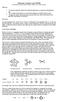
2 Adolf von Baeyer (19th century) assumed cycloalkanes are planar polygons distortion of bond angles from gives angle strain to cycloalkanes with rings either smaller or larger than cyclopentane Baeyer deserves credit for advancing the idea of angle strain as a destabilizing factor. But Baeyer was incorrect in his belief that cycloalkanes were planar.

3 Types of Strain Torsional strain strain that results from eclipsed bonds van der Waals strain (steric strain) strain that results from atoms being too close together angle strain strain that results from distortion of bond angles from normal values

4 Measuring Strain in Cycloalkanes Heats of combustion can be used to compare stabilities of isomers. But cyclopropane, cyclobutane, etc. are not isomers. All heats of combustion increase as the number of carbon atoms increase.

5 Measuring Strain in Cycloalkanes Therefore, divide heats of combustion by number of carbons and compare heats of combustion on a "per CH 2 group" basis.

6 Heats of Combustion in Cycloalkanes Cycloalkane kj/mol Cyclopropane 2, Cyclobutane 2, Cyclopentane 3, Per CH 2 Cyclohexane 3, Cycloheptane 4, Cyclooctane 5, Cyclononane 5, Cyclodecane 6,

7 Heats of Combustion in Cycloalkanes Cycloalkane kj/mol Per CH 2 According to Baeyer, cyclopentane should have less angle strain than cyclohexane. Cyclopentane 3, Cyclohexane 3, The heat of combustion per CH 2 group is less for cyclohexane than for cyclopentane. Therefore, cyclohexane has less strain than cyclopentane.

8 Adolf von Baeyer (19th century) assumed cycloalkanes are planar polygons distortion of bond angles from gives angle strain to cycloalkanes with rings either smaller or larger than cyclopentane Baeyer deserves credit for advancing the idea of angle strain as a destabilizing factor. But Baeyer was incorrect in his belief that cycloalkanes were planar.

9 3.5 Conformations of Cyclohexane heat of combustion suggests that angle strain is unimportant in cyclohexane tetrahedral bond angles require nonplanar geometries

10 Chair is the most stable conformation of cyclohexane All of the bonds are staggered and the bond angles at carbon are close to tetrahedral.

11 Boat conformation is less stable than the chair 180 pm All of the bond angles are close to tetrahedral but close contact between flagpole hydrogens causes van der Waals strain in boat.

12 Boat conformation is less stable than the chair Eclipsed bonds bonds gives torsional strain to boat.

13 Skew boat is slightly more stable than boat Boat Skew boat Less van der Waals strain and less torsional strain in skew boat.

14 Generalization the chair conformation of cyclohexane is the most stable conformation and derivatives of cyclohexane almost always exist in the chair conformation

15 3.6 Axial and Equatorial Bonds in Cyclohexane

16 The 12 bonds to the ring can be divided into two sets of 6.

17 6 Bonds are axial Axial bonds point "north and south"

18 The 12 bonds to the ring can be divided into two sets of 6.

19 6 Bonds are equatorial Equatorial bonds lie along the equator

20 3.7 Conformational Inversion (Ring-Flipping) in Cyclohexane

21 Conformational Inversion chair-chair interconversion (ring-flipping) rapid process (activation energy = 45 kj/mol) all axial bonds become equatorial and vice versa
22
23 Half- chair
24 Half- chair Skew boat
25 Half- chair Skew boat
26 Half- chair Skew boat
27 45 kj/mol 45 kj/mol 23 kj/mol
28 3.8 Conformational Analysis of Monosubstituted Cyclohexanes most stable conformation is chair substituent is more stable when equatorial
29 Methylcyclohexane CH 3 5% 95% Chair chair interconversion occurs, but at any instant 95% of the molecules have their methyl group equatorial. Axial methyl group is more crowded than an equatorial one. CH 3
30 Methylcyclohexane 5% 95% Source of crowding is close approach to axial hydrogens on same side of ring. Crowding is called a "1,3-diaxial repulsion" and is a type of van der Waals strain.
31 Fluorocyclohexane F F 40% 60% Crowding is less pronounced with a "small" substituent such as fluorine. Size of substituent is related to its branching.
32 tert-butylcyclohexane C(CH 3 ) 3 Less than 0.01% Greater than 99.99% Crowding is more pronounced with a "bulky" substituent such as tert-butyl. tert-butyl is highly branched. C(CH 3 ) 3
33 tert-butylcyclohexane van der Waals strain due to 1,3-diaxial repulsions
2/10/2011. Stability of Cycloalkanes: Ring Strain. Stability of Cycloalkanes: Ring Strain. 4.3 Stability of Cycloalkanes: Ring Strain
 4.3 Stability of Cycloalkanes: Ring Strain Angle strain The strain induced in a molecule when bond angles are forced to deviate from the ideal 109º tetrahedral value (Adolf von Baeyer 1885) Stability of
CONFORMATIONAL ANALYSIS PRACTICE EXERCISES. 1) Draw a Newman projection of the most stable conformation of 2-methylpropane.
 CONFORMATIONAL ANALYSIS PRACTICE EXERCISES 1) Draw a Newman projection of the most stable conformation of 2-methylpropane. 2) The structures below are: C 3 C 3 C 3 C 3 A) not isomers. B) conformational
cyclohexane cyclopentane Nomenclature Follows same rules as for stright-chain alkanes. Examples: name the following
 Structure and Stereochemistry of Alkanes Reading: Wade chapter 3, sections 3-10- 3-16 Study Problems: 3-43, 3-44, 3-45, 3-46 Key oncepts and Skills: ompare the energies of cycloalkanes, and explain ring
Stereochemistry of Alkanes and Cycloalkanes
 Stereochemistry of Alkanes and ycloalkanes onformation of ethane: Rotation is possible around - Different arrangements of atoms that can be converted into one another by rotation about single bonds are
ACE PRACTICE TEST Chapter 8, Quiz 3
 ACE PRACTICE TEST Chapter 8, Quiz 3 1. Using bond energies, calculate the heat in kj for the following reaction: CH 4 + 4 F 2 CF 4 + 4 HF. Use the following bond energies: CH = 414 kj/mol, F 2 = 155 kj/mol,
MULTIPLE CHOICE QUESTIONS Part 4 Nomenklatur -konformation
 MULTIPLE COICE QUESTIONS Part 4 Nomenklatur -konformation (Answers on pages 21-22) Topic: Nomenclature 1. The IUPAC name for A) 6-Ethyl-3,4-dimethylheptane B) 2-Ethyl-4,5-dimethylheptane C) 3,4,6-Trimethyloctane
5.5 Vicinal Proton-Proton Coupling 3 J HH
 5.5 Vicinal Proton-Proton Coupling 3 J Copyright ans J. Reich 21 All Rights Reserved University of Wisconsin The single most useful - coupling relationship is that between vicinal protons. The size of
H 3 C CH 2 CH 2 CH 2 CH 2 CH 3. Copyright 2012 Nelson Education Ltd. Chapter 1: Organic Compounds 1.1-1
 Section 1.1: Alkanes Mini Investigation: Arranging Carbon Atoms, page 10 A. Three different molecules of C 5 H 12 are possible. B. Five arrangements are possible for C 6 H 14, as predicted: H 3 C CH 2
C has 4 valence electrons, O has six electrons. The total number of electrons is 4 + 2(6) = 16.
 129 Lewis Structures G. N. Lewis hypothesized that electron pair bonds between unlike elements in the second (and sometimes the third) row occurred in a way that electrons were shared such that each element
Colby College Molecular Mechanics Exercises MOE (Molecular Operating Environment) Exercises September 2014
 Colby College Molecular Mechanics Exercises MOE (Molecular Operating Environment) Exercises September 2014 Thomas W. Shattuck Department of Chemistry,Colby College Waterville, Maine 04901 A Teaching License
1.15 Bonding in Methane and Orbital Hybridization
 1.15 Bonding in Methane and Orbital Hybridization Structure of Methane tetrahedral bond angles = 109.5 bond distances = 110 pm but structure seems inconsistent with electron configuration of carbon Electron
2. Atoms with very similar electronegativity values are expected to form
 AP hemistry Practice Test #6 hapter 8 and 9 1. Which of the following statements is incorrect? a. Ionic bonding results from the transfer of electrons from one atom to another. b. Dipole moments result
Chapter 9 - Covalent Bonding: Orbitals
 Chapter 9 - Covalent Bonding: Orbitals 9.1 Hybridization and the Localized Electron Model A. Hybridization 1. The mixing of two or more atomic orbitals of similar energies on the same atom to produce new
7.14 Linear triatomic: A-----B-----C. Bond angles = 180 degrees. Trigonal planar: Bond angles = 120 degrees. B < B A B = 120
 APTER SEVEN Molecular Geometry 7.13 Molecular geometry may be defined as the three-dimensional arrangement of atoms in a molecule. The study of molecular geometry is important in that a molecule s geometry
EXPERIMENT 1: Survival Organic Chemistry: Molecular Models
 EXPERIMENT 1: Survival Organic Chemistry: Molecular Models Introduction: The goal in this laboratory experience is for you to easily and quickly move between empirical formulas, molecular formulas, condensed
Vocabulary: VSEPR. 3 domains on central atom. 2 domains on central atom. 3 domains on central atom NOTE: Valence Shell Electron Pair Repulsion Theory
 Vocabulary: VSEPR Valence Shell Electron Pair Repulsion Theory domain = any electron pair, or any double or triple bond is considered one domain. lone pair = non-bonding pair = unshared pair = any electron
Molecular Geometry and Hybrid Orbitals. Molecular Geometry
 Molecular Geometry and ybrid Orbitals + -- bond angle 90 o Molecular Geometry Why Should I are bout Molecular Geometry? Molecular geometry (shape) influences... 3 Physical properties: 3 3 3 3 3 Pentane
CHAPTER 10 THE SHAPES OF MOLECULES
 ATER 10 TE AE MLEULE 10.1 To be the central atom in a compound, the atom must be able to simultaneously bond to at least two other atoms. e,, and cannot serve as central atoms in a Lewis structure. elium
Molecular Models Experiment #1
 Molecular Models Experiment #1 Objective: To become familiar with the 3-dimensional structure of organic molecules, especially the tetrahedral structure of alkyl carbon atoms and the planar structure of
Type of Chemical Bonds
 Type of Chemical Bonds Covalent bond Polar Covalent bond Ionic bond Hydrogen bond Metallic bond Van der Waals bonds. Covalent Bonds Covalent bond: bond in which one or more pairs of electrons are shared
The strength of the interaction
 The strength of the interaction Host Guest Supramolecule (host-guest complex) When is the host capable to recognize the guest? How do we define selectivity Which element will we use to design the host
Application Note AN4
 TAKING INVENTIVE STEPS IN INFRARED. MINIATURE INFRARED GAS SENSORS GOLD SERIES UK Patent App. No. 2372099A USA Patent App. No. 09/783,711 World Patents Pending INFRARED SPECTROSCOPY Application Note AN4
Chapter 4 Lecture Notes
 Chapter 4 Lecture Notes Chapter 4 Educational Goals 1. Given the formula of a molecule, the student will be able to draw the line-bond (Lewis) structure. 2. Understand and construct condensed structural
Geometries and Valence Bond Theory Worksheet
 Geometries and Valence Bond Theory Worksheet Also do Chapter 10 textbook problems: 33, 35, 47, 49, 51, 55, 57, 61, 63, 67, 83, 87. 1. Fill in the tables below for each of the species shown. a) CCl 2 2
methyl RX example primary RX example secondary RX example secondary RX example tertiary RX example
 ucleophilic Substitution & Elimination hemistry 1 eginning patterns to knowfor S and E eactions - horizontal and vertical templates for practice Example 1 - two possible perspectives (deuterium and tritium
Theme 3: Bonding and Molecular Structure. (Chapter 8)
 Theme 3: Bonding and Molecular Structure. (Chapter 8) End of Chapter questions: 5, 7, 9, 12, 15, 18, 23, 27, 28, 32, 33, 39, 43, 46, 67, 77 Chemical reaction valence electrons of atoms rearranged (lost,
Health Science Chemistry I CHEM-1180 Experiment No. 15 Molecular Models (Revised 05/22/2015)
 (Revised 05/22/2015) Introduction In the early 1900s, the chemist G. N. Lewis proposed that bonds between atoms consist of two electrons apiece and that most atoms are able to accommodate eight electrons
Communicated March 31, 1951 CHR CHR CHR. *H* zz '" *H _ 0.-...H / k C,.. CHR CNR CHR CHR CHR *HN/' N 'H_N/' H_./ - H-(H.
 VOL. 37, 1951 CHEMISTR Y: PA ULING AND COREY 251 THE PLEATED SHEET, A NEW LAYER CONFIGURATION OF POL YPEPTIDE CHAINS BY LINUS PAULING AND ROBERT B. COREY GATES AND CRELLIN LABORATORIES OF CHEMISTRY,* CALIFORNIA
A REVIEW OF GENERAL CHEMISTRY: ELECTRONS, BONDS AND MOLECULAR PROPERTIES
 A REVIEW OF GENERAL CEMISTRY: ELECTRONS, BONDS AND MOLECULAR PROPERTIES A STUDENT SOULD BE ABLE TO: 1. Draw Lewis (electron dot and line) structural formulas for simple compounds and ions from molecular
Chapter 10 Molecular Geometry and Chemical Bonding Theory
 Chem 1: Chapter 10 Page 1 Chapter 10 Molecular Geometry and Chemical Bonding Theory I) VSEPR Model Valence-Shell Electron-Pair Repulsion Model A) Model predicts Predicts electron arrangement and molecular
CHAPTER 10 THE SHAPES OF MOLECULES
 ATER 10 TE AE MLEULE 10.1 To be the central atom in a compound, the atom must be able to simultaneously bond to at least two other atoms. e,, and cannot serve as central atoms in a Lewis structure. elium
Alkanes. Chapter 1.1
 Alkanes Chapter 1.1 Organic Chemistry The study of carbon-containing compounds and their properties What s so special about carbon? Carbon has 4 bonding electrons. Thus, it can form 4 strong covalent bonds
AROMATIC COMPOUNDS A STUDENT SHOULD BE ABLE TO:
 A STUDENT SHULD BE ABLE T: ARMATIC CMPUNDS 1. Name benzene derivatives given the structures, and draw the structures given the names. This includes: Monosubstituted benzenes named as derivatives of benzene:
Chapter 6. Alkenes: Structure and Stability
 hapter 6. Alkenes: Structure and Stability Steric Acid (saturated fatty acid) Linoleic Acid (unsaturated fatty acid) Degrees of unsaturation saturated hydrocarbon n 2n2 cycloalkane (1 ring) n 2n alkene
Organic Chemistry A Brief Course
 Study Guide and Solutions Manual rganic hemistry A ief ourse TIRTEET EDITI David art hio State University hris adad hio State University David raine hio State University arold art Michigan StateUniversity
Peptide bonds: resonance structure. Properties of proteins: Peptide bonds and side chains. Dihedral angles. Peptide bond. Protein physics, Lecture 5
 Protein physics, Lecture 5 Peptide bonds: resonance structure Properties of proteins: Peptide bonds and side chains Proteins are linear polymers However, the peptide binds and side chains restrict conformational
EXPERIMENT 9 Dot Structures and Geometries of Molecules
 EXPERIMENT 9 Dot Structures and Geometries of Molecules INTRODUCTION Lewis dot structures are our first tier in drawing molecules and representing bonds between the atoms. The method was first published
Bonding & Molecular Shape Ron Robertson
 Bonding & Molecular Shape Ron Robertson r2 n:\files\courses\1110-20\2010 possible slides for web\00bondingtrans.doc The Nature of Bonding Types 1. Ionic 2. Covalent 3. Metallic 4. Coordinate covalent Driving
Chapter 10 Conjugation in Alkadienes and Allylic Systems
 . 0 onjugated Systems hapter 0 onjugation in Alkadienes and Allylic Systems onjugated systems are those in which a π-bond is connected or conjugated (from the Latin conjugare which means to link r yoke
SHAPES OF MOLECULES (VSEPR MODEL)
 1 SAPES MLEULES (VSEPR MDEL) Valence Shell Electron-Pair Repulsion model - Electron pairs surrounding atom spread out as to minimize repulsion. - Electron pairs can be bonding pairs (including multiple
Chapter 10. Conjugation in Alkadienes and Allylic Systems. Class Notes. B. The allyl group is both a common name and an accepted IUPAC name
 Chapter 10 Conjugation in Alkadienes and Allylic Systems Chapter 10 suggested problems: I. The allyl group Class Notes A. B. The allyl group is both a common name and an accepted IUPAC name 1. Allyl alcohol
The peptide bond Peptides and proteins are linear polymers of amino acids. The amino acids are
 Introduction to Protein Structure Proteins are large heteropolymers usually comprised of 50 2500 monomer units, although larger proteins are observed 7. The monomer units of proteins are amino acids. The
Self Assessment_Ochem I
 UTID: 2013 Objective Test Section Identify the choice that best completes the statement or answers the question. There is only one correct answer; please carefully bubble your choice on the scantron sheet.
AP Chemistry A. Allan Chapter 8 Notes - Bonding: General Concepts
 AP Chemistry A. Allan Chapter 8 Notes - Bonding: General Concepts 8.1 Types of Chemical Bonds A. Ionic Bonding 1. Electrons are transferred 2. Metals react with nonmetals 3. Ions paired have lower energy
Benzene Benzene is best represented as a resonance hybrid:
 Electrophilic Aromatic Substitution (EAS) is a substitution reaction usually involving the benzene ring; more specifically it is a reaction in which the hydrogen atom of an aromatic ring is replaced as
CHAPTER 10 THE SHAPES OF MOLECULES
 ATER 10 TE AE MLEULE EMIAL ETI BED READIG RBLEM B10.1 lan: Examine the Lewis structure, noting the number of regions of electron density around the carbon and nitrogen atoms in the two resonance structures.
Name: Class: Date: 3) The bond angles marked a, b, and c in the molecule below are about,, and, respectively.
 Name: Class: Date: Unit 9 Practice Multiple Choice Identify the choice that best completes the statement or answers the question. 1) The basis of the VSEPR model of molecular bonding is. A) regions of
Role of Hydrogen Bonding on Protein Secondary Structure Introduction
 Role of Hydrogen Bonding on Protein Secondary Structure Introduction The function and chemical properties of proteins are determined by its three-dimensional structure. The final architecture of the protein
pre -TEST Big Idea 2 Chapters 8, 9, 10
 Name: AP Chemistry Period: Date: R.F. Mandes, PhD, NBCT Complete each table with the appropriate information. Compound IMF Compound IMF 1 NiCl 3 7 ClCH 2 (CH 2 ) 3 CH 3 2 Fe 8 H 2 CF 2 3 Ar 9 H 2 NCH 2
NMR Spectroscopy of Aromatic Compounds (#1e)
 NMR Spectroscopy of Aromatic Compounds (#1e) 1 H NMR Spectroscopy of Aromatic Compounds Erich Hückel s study of aromaticity in the 1930s produced a set of rules for determining whether a compound is aromatic.
CHEM 203 Exam 1. KEY Name Multiple Choice Identify the letter of the choice that best completes the statement or answers the question.
 CHEM 203 Exam 1 KEY Name Multiple Choice Identify the letter of the choice that best completes the statement or answers the question. _D C 1. Which of the following elements is a large percentage of both
ORGANIC COMPOUNDS IN THREE DIMENSIONS
 (adapted from Blackburn et al., Laboratory Manual to Accompany World of hemistry, 2 nd ed., (1996) Saunders ollege Publishing: Fort Worth) Purpose: To become familiar with organic molecules in three dimensions
Question 4.2: Write Lewis dot symbols for atoms of the following elements: Mg, Na, B, O, N, Br.
 Question 4.1: Explain the formation of a chemical bond. A chemical bond is defined as an attractive force that holds the constituents (atoms, ions etc.) together in a chemical species. Various theories
Molecular Structures. Chapter 9 Molecular Structures. Using Molecular Models. Using Molecular Models. C 2 H 6 O structural isomers: .. H C C O..
 John W. Moore onrad L. Stanitski Peter. Jurs http://academic.cengage.com/chemistry/moore hapter 9 Molecular Structures Stephen. oster Mississippi State University Molecular Structures 2 6 structural isomers:
5. Structure, Geometry, and Polarity of Molecules
 5. Structure, Geometry, and Polarity of Molecules What you will accomplish in this experiment This experiment will give you an opportunity to draw Lewis structures of covalent compounds, then use those
Combinatorial Biochemistry and Phage Display
 Combinatorial Biochemistry and Phage Display Prof. Valery A. Petrenko Director - Valery Petrenko Instructors Galina Kouzmitcheva and I-Hsuan Chen Auburn 2006, Spring semester COMBINATORIAL BIOCHEMISTRY
Structures and Properties of Substances. Introducing Valence-Shell Electron- Pair Repulsion (VSEPR) Theory
 Structures and Properties of Substances Introducing Valence-Shell Electron- Pair Repulsion (VSEPR) Theory The VSEPR theory In 1957, the chemist Ronald Gillespie and Ronald Nyholm, developed a model for
Final Examination, Organic Chemistry 1 (CHEM 2210) December 2000 Version *A* A. B. C. D.
 Final Examination, rganic hemistry 1 (EM 2210) December 2000 Version *A* 1. What are the hybridization of, and the geometrical shape around, the nitrogen atom in the following molecule? N 3 3 A. sp, linear
Section Activity #1: Fill out the following table for biology s most common elements assuming that each atom is neutrally charged.
 LS1a Fall 2014 Section Week #1 I. Valence Electrons and Bonding The number of valence (outer shell) electrons in an atom determines how many bonds it can form. Knowing the number of valence electrons present
CHEMISTRY 1710 - Practice Exam #5 - SPRING 2014 (KATZ)
 CHEMISTRY 1710 - Practice Exam #5 - SPRING 2014 (KATZ) Name: Score: This is a multiple choice exam. Choose the BEST answer from the choices which are given and write the letter for your choice in the space
ORGANIC CHEM I Practice Questions for Ch. 4
 ORGANIC CHEM I Practice Questions for Ch. 4 1) Write an equation to describe the initiation step in the chlorination of methane. 2) Reaction intermediates that have unpaired electrons are called. 3) When
Hybrid Molecular Orbitals
 Hybrid Molecular Orbitals Last time you learned how to construct molecule orbital diagrams for simple molecules based on the symmetry of the atomic orbitals. Molecular orbitals extend over the entire molecule
PRACTICE PROBLEMS, CHAPTERS 1-3
 PRATIE PRBLEMS, APTERS 1-3 (overed from h. 3: Alkane and Alkyl alide nomenclature only) 1. The atomic number of boron is 5. The correct electronic configuration of boron is: A. 1s 2 2s 3 B. 1s 2 2p 3.
Hydrogen Bonds The electrostatic nature of hydrogen bonds
 Hydrogen Bonds Hydrogen bonds have played an incredibly important role in the history of structural biology. Both the structure of DNA and of protein a-helices and b-sheets were predicted based largely
Benzene and Aromatic Compounds
 Benzene and Aromatic Compounds Benzene (C 6 H 6 ) is the simplest aromatic hydrocarbon (or arene). Benzene has four degrees of unsaturation, making it a highly unsaturated hydrocarbon. Whereas unsaturated
Chapter 2 The Chemical Context of Life
 Chapter 2 The Chemical Context of Life Multiple-Choice Questions 1) About 25 of the 92 natural elements are known to be essential to life. Which four of these 25 elements make up approximately 96% of living
A pure covalent bond is an equal sharing of shared electron pair(s) in a bond. A polar covalent bond is an unequal sharing.
 CHAPTER EIGHT BNDING: GENERAL CNCEPT or Review 1. Electronegativity is the ability of an atom in a molecule to attract electrons to itself. Electronegativity is a bonding term. Electron affinity is the
CHEMISTRY 101 EXAM 3 (FORM B) DR. SIMON NORTH
 1. Is H 3 O + polar or non-polar? (1 point) a) Polar b) Non-polar CHEMISTRY 101 EXAM 3 (FORM B) DR. SIMON NORTH 2. The bond strength is considerably greater in HF than in the other three hydrogen halides
Molecular Geometry and VSEPR We gratefully acknowledge Portland Community College for the use of this experiment.
 Molecular and VSEPR We gratefully acknowledge Portland ommunity ollege for the use of this experiment. Objectives To construct molecular models for covalently bonded atoms in molecules and polyatomic ions
Nuclear Magnetic Resonance Spectroscopy
 Nuclear Magnetic Resonance Spectroscopy Nuclear magnetic resonance spectroscopy is a powerful analytical technique used to characterize organic molecules by identifying carbonhydrogen frameworks within
Chapter 7. Comparing Ionic and Covalent Bonds. Ionic Bonds. Types of Bonds. Quick Review of Bond Types. Covalent Bonds
 Comparing Ionic and Covalent Bonds Chapter 7 Covalent Bonds and Molecular Structure Intermolecular forces (much weaker than bonds) must be broken Ionic bonds must be broken 1 Ionic Bonds Covalent Bonds
AP* Bonding & Molecular Structure Free Response Questions page 1
 AP* Bonding & Molecular Structure ree Response Questions page 1 (1) AP is a registered trademark of the ollege Board. The ollege Board was not involved in the production of and does not endorse this product.
the double or triple bond. If the multiple bond is CH 3 C CCHCCH 3
 Alkenes, Alkynes, and Aromatic ompounds Alkenes and Alkynes Unsaturated contain carbon-carbon double and triple bond to which more hydrogen atoms can be added. Alkenes: carbon-carbon double bonds Alkynes:
VSEPR Model. The Valence-Shell Electron Pair Repulsion Model. Predicting Molecular Geometry
 VSEPR Model The structure around a given atom is determined principally by minimizing electron pair repulsions. The Valence-Shell Electron Pair Repulsion Model The valence-shell electron pair repulsion
Chapter 9. Chemical reactivity of molecules depends on the nature of the bonds between the atoms as well on its 3D structure
 Chapter 9 Molecular Geometry & Bonding Theories I) Molecular Geometry (Shapes) Chemical reactivity of molecules depends on the nature of the bonds between the atoms as well on its 3D structure Molecular
Molecular Geometry and Chemical Bonding Theory
 Chapter 10 Molecular Geometry and Chemical Bonding Theory Concept Check 10.1 An atom in a molecule is surrounded by four pairs of electrons, one lone pair and three bonding pairs. Describe how the four
Homolytic vs. Heterolytic Fragmentation
 omolytic vs. eterolytic Fragmentation Most organic transformations involve the movement of electron pairs (heterolytic reactions). There are a few important addition reactions, however, in which the electron
Chapter 8: Covalent Bonding and Molecular Structure
 hapter 8 ovalent Bonding and Molecular Structure 8-1 hapter 8: ovalent Bonding and Molecular Structure hapter 8 8.1 Interactions Between Particles: oulomb s Law 8.2 ovalent Bonding Basics 8.3 Lewis Structures
Introduction to Chemistry. Course Description
 CHM 1025 & CHM 1025L Introduction to Chemistry Course Description CHM 1025 Introduction to Chemistry (3) P CHM 1025L Introduction to Chemistry Laboratory (1) P This introductory course is intended to introduce
Chapter 1 Structure and Bonding. Modified by Dr. Daniela Radu
 John E. McMurry www.cengage.com/chemistry/mcmurry Chapter 1 Structure and Bonding Modified by Dr. Daniela Radu What is Organic Chemistry? Living things are made of organic chemicals Proteins that make
H 2O gas: molecules are very far apart
 Non-Covalent Molecular Forces 2/27/06 3/1/06 How does this reaction occur: H 2 O (liquid) H 2 O (gas)? Add energy H 2O gas: molecules are very far apart H 2O liquid: bonding between molecules Use heat
Laboratory 11: Molecular Compounds and Lewis Structures
 Introduction Laboratory 11: Molecular Compounds and Lewis Structures Molecular compounds are formed by sharing electrons between non-metal atoms. A useful theory for understanding the formation of molecular
Chem 11 Oa-Section 2. Exam #2. 1 October 2004
 " Chem 11 Oa-Section 2 Exam #2 1 October 2004 Name: K~ Instructions Please read each question carefully and answer it completely and clearly. Do the problems in the order that is easiest for you. Point
Calculating the Degrees of Unsaturation From a Compound s Molecular Formula
 Calculating the Degrees of Unsaturation From a Compound s Molecular Formula Alkanes have the molecular formula C n. Alkanes are saturated hydrocarbons because each member of the family has the maximum
Modern Construction Materials Prof. Ravindra Gettu Department of Civil Engineering Indian Institute of Technology, Madras
 Modern Construction Materials Prof. Ravindra Gettu Department of Civil Engineering Indian Institute of Technology, Madras Module - 2 Lecture - 2 Part 2 of 2 Review of Atomic Bonding II We will continue
SHORT ANSWER. Write the word or phrase that best completes each statement or answers the question.
 Exam Name SHORT ANSWER. Write the word or phrase that best completes each statement or answers the question. 1) Calculate the magnetic field that corresponds to the proton resonance frequency of 300.00
1. What is the hybridization of the indicated atom in the following molecule?
 Practice Final Exam, Chemistry 2210, rganic Chem I 1. What is the hybridization of the indicated atom in the following molecule? A. sp 3 B. sp 2 C. sp D. not hybridized 2. Name the functional groups in
Polarity. Andy Schweitzer
 Polarity Andy Schweitzer What does it mean to be polar? A molecule is polar if it contains + and somewhere in the molecule. Remember: Protons can not move. So for a molecule to get a +/- it must somehow
Read the sections on Allotropy and Allotropes in your text (pages 464, 475, 871-2, 882-3) and answer the following:
 Descriptive Chemistry Assignment 5 Thermodynamics and Allotropes Read the sections on Allotropy and Allotropes in your text (pages 464, 475, 871-2, 882-3) and answer the following: 1. Define the word allotrope
Chapter10 Tro. 4. Based on the Lewis structure, the number of electron domains in the valence shell of the CO molecule is A) 1 B) 2 C) 3 D) 4 E) 5
 Chapter10 Tro 1. All of the geometries listed below are examples of the five basic geometries for molecules with more than 3 atoms except A) planar triangular B) octahedral C) tetrahedral D) trihedral
Nucleophilic Substitution and Elimination
 Nucleophilic Substitution and Elimination What does the term "nucleophilic substitution" imply? A nucleophile is an the electron rich species that will react with an electron poor species A substitution
Chem 112 Intermolecular Forces Chang From the book (10, 12, 14, 16, 18, 20,84,92,94,102,104, 108, 112, 114, 118 and 134)
 Chem 112 Intermolecular Forces Chang From the book (10, 12, 14, 16, 18, 20,84,92,94,102,104, 108, 112, 114, 118 and 134) 1. Helium atoms do not combine to form He 2 molecules, What is the strongest attractive
CH101/105, GENERAL CHEMISTRY LABORATORY
 CH101/105, GENERAL CHEMITRY LABORATORY LABORATORY LECTURE 5 EXPERIMENT 5: LEWI TRUCTURE AND MOLECULAR HAPE Lecture topics I. LEWI TRUCTURE a) calculation of the valence electron numbers; b) choosing the
SOME TOUGH COLLEGE PROBLEMS! .. : 4. How many electrons should be shown in the Lewis dot structure for carbon monoxide? N O O
 SME TUGH CLLEGE PRBLEMS! LEWIS DT STRUCTURES 1. An acceptable Lewis dot structure for 2 is (A) (B) (C) 2. Which molecule contains one unshared pair of valence electrons? (A) H 2 (B) H 3 (C) CH 4 acl 3.
Why? Intermolecular Forces. Intermolecular Forces. Chapter 12 IM Forces and Liquids. Covalent Bonding Forces for Comparison of Magnitude
 1 Why? Chapter 1 Intermolecular Forces and Liquids Why is water usually a liquid and not a gas? Why does liquid water boil at such a high temperature for such a small molecule? Why does ice float on water?
Amino Acids. Amino acids are the building blocks of proteins. All AA s have the same basic structure: Side Chain. Alpha Carbon. Carboxyl. Group.
 Protein Structure Amino Acids Amino acids are the building blocks of proteins. All AA s have the same basic structure: Side Chain Alpha Carbon Amino Group Carboxyl Group Amino Acid Properties There are
Q.1 Draw out some suitable structures which fit the molecular formula C 6 H 6
 Aromatic compounds GE 1 BENZENE Structure Primary analysis revealed benzene had an... empirical formula of and a molecular formula of 6 6 Q.1 Draw out some suitable structures which fit the molecular formula
CHEMISTRY BONDING REVIEW
 Answer the following questions. CHEMISTRY BONDING REVIEW 1. What are the three kinds of bonds which can form between atoms? The three types of Bonds are Covalent, Ionic and Metallic. Name Date Block 2.