
Molecular Models Experiment #1
|
|
|
- Paula Norton
- 9 years ago
- Views:
Transcription
1 Molecular Models Experiment #1 Objective: To become familiar with the 3-dimensional structure of organic molecules, especially the tetrahedral structure of alkyl carbon atoms and the planar structure of alkenes. Introduction It is not possible to view molecules, even through the most powerful microscopes, except for a few extremely large polymeric molecules, whose images can be visualized with the electron microscope. The tunneling electron microscope can image atoms on the surface of materials, but it is not useful for visualizing small molecules. A nuclear magnetic resonance spectrometer (NMR) can provide important information about the relative position of atoms with respect to one another in a molecule, especially organic molecules. Consequently, chemists must resort to inferring a chemical structure from a variety of chemical and physical properties of a compound. Molecular models are useful in testing hypotheses about the structure of a molecule. In fact, Watson and Crick derived the double helix structure of DNA using a molecular model. In this experiment you will use ball and stick models to represent atoms and bonds in molecules and build molecular structures using these models. In order to better understand chemical properties of molecules, it will help to be able to visualize the three dimensional structure. The model kits consist of different colored balls with holes for the pegs that connect them. The balls are color coded and the holes correspond to the number of bonds each atom normally has. We will not be using all of the different balls (atoms) provided in the kit. Notice that the number of holes in each ball corresponds to what chemists often refer to as the valence of an atom (in this case the usual valence for organic molecules). Hydrogen and the halogens, chlorine, bromine and iodine, have only one bond to carbon. Oxygen forms two covalent bonds, nitrogen usually forms three covalent bonds, and carbon always forms 4 covalent bonds. This gives rise to what is sometimes called the HONC rule; i.e., H has one bond, O has 2, N has 3 and C has 4 bonds in most neutral organic molecules. Table of Atom Characteristics for Molecular Models Color of Ball Number of Holes Atom Represented Black 4 Carbon White 1 Hydrogen Red 2 Oxygen Blue 4 Nitrogen Green 1 Chlorine Orange 1 Iodine or Bromine 1

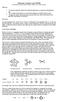
2 The additional lone pair of electrons on the N atom allows it to form the ammonium ion + if H attaches, or quaternary amines if four carbons are attached. Oxygen may lose a proton in organic acids to form the negatively charged carboxylate ion (or phenolate ion from phenols). In summary, when O has only one bond to another atom it will carry a negative charge and when N has 4 bonds to other atoms it will carry a positive charge. You should also notice that there are different size pegs to connect the balls. In this exercise you will use only the gray pegs (some medium length, light gray and rigid, some longer, darker gray and flexible). The flexible pegs are used to make multiple bonds, i.e., double bonds. In this exercise you will construct different isomers of organic molecules. Isomers are molecules with the same chemical formula but different structures. Structural isomers are compounds with different connections among their atoms. You should be able to distinguish between different structural isomers and different conformations of the same isomer. You can form different conformations of a molecule by merely rotating groups around a bond without breaking any bonds. It is necessary to break bonds in order to form different structural isomers (see Fig 1 below). 2-methylpropane before isopropyl radical before attach methyl radical to C3 of removing methyl group moving H to C2 propyl to form n-butane Figure 1. In this diagram it is necessary to break the C-C bond between C2 and the methyl C of 2-methylpropane (shown on the left) and transfer one H atom from C3 to C2 of that molecule (shown in the middle of the diagram) before connecting the methyl C to C3 (shown on the right) in transforming 2-methylpropane to n-butane; hence these are structural isomers. Is this perfectly clear? Remember: It is necessary to break bonds in order to form a different isomer. It is also necessary to have the same number of atoms of each element for molecules to be isomers of one another. In this exercise you will be frequently asked to describe the three dimensional structure of a molecule, sometimes drawing the molecule on paper (i.e., in two dimensions). Consequently, it is often necessary to describe the position of one atom relative to other atoms with respect to their distance from you in space. For example, if the methane model is placed on the bench, it will (due to gravity) have one hydrogen atom directly above the carbon atom. It will be necessary to draw structures to represent the relative positions of atoms in space. Some people find this difficult to do, but you must try to appreciate the spatial relationships of atoms in molecules. 2

3 Materials: Molecular model kits. Figure 2. Different conformations of butane. Note: These different structures can be formed without breaking bonds. The shapes may be different and they may look different from different angles, but they are all identical molecules. Figure 3. Different structural isomers of 2-butene. Note: bonds must be broken to convert cis-2-butene to trans-2-butene. The horizontal bond in the middle is a double bond. 3

4 This page has been intentionally left blank. 4

5 Name Chemistry 4X, Sec Molecular Models Experiment #1 Pre-Lab Exercise 1. How many bonds are normally formed to atoms of each of the following elements when they are in most organic molecules. No. of Bonds No. of Bonds No. of Bonds H C N O Cl S F Br I 2. Molecules can be represented by molecular formulas or by structural formulas. Write the molecular formula for butane below and show all the possible structural formulas for butane. Molecular Formula for Butane All Possible Structural Formulas for Butane 3. What is the difference between conformational structures of a molecule and different structural isomers? Give an example to illustrate. 5

6 4. How would you describe the difference between a saturated hydrocarbon and an unsaturated hydrocarbon? Give examples of each to illustrate. 5. Give two examples of cycloalkanes and one example of a cycloalkene, showing the structural formula for each. Name the structures you have drawn. 6. What is meant by cis- and trans- isomers of alkenes. Give an example of each, making a structural formula and correctly naming it for each example. 6

7 Name Molecular Models Experiment #1 Chemistry 4X, Sec Data & Report Sheet Part A. Simple Hydrocarbons. 1. Make a model of methane (CH 4) connecting four H atoms (white balls) to one C atom (black ball), using the light gray, rigid pegs. Place the model on the bench and notice the 3-dimensional structure. Write the structural formula for methane (using chemical symbols, i.e., C and H) on the left below and draw a 3-dimensional diagram of the methane model on the right. 2. Remove an H atom and replace it with a C atom forming a C-C bond. Complete the model by adding bonds (light gray, rigid pegs) to H atoms to fill all the holes in the two C atoms. What is the name of the molecule you have just formed? Write the chemical formula for this molecule. Notice it is possible to rotate the molecule about the C-C bond. Place it on the bench with four H atoms in contact with the bench and two H atoms pointing straight up. Draw a diagram of this model below on the left. Then rotate the molecule about the C-C bond so there are two H atoms from one C in contact with the bench and only one H atom from the other C pointing straight down in contact with the bench. Draw a diagram of this form of the model below on the right. Are these different isomers? (yes or no) Did you break any bonds when you rotated the molecule about the C-C bond? 3. Remove one H atom from the molecule above. What is the name of the C2H 5 radical (group) you have just formed? Attach a C atom where the H atom was, and fill in the remaining holes with bonds to H atoms. What is the name of this three carbon molecule? Is it still possible to rotate the molecule about both of the C-C bonds? (yes or no) 7

8 Remove an H from the central C and remove one -CH 3 group from this C and place it where the H was. Place the H where the -CH group was. Have you formed a different isomer? (yes or no) 3 Does the molecule look any different? (yes or no) Write the structural formula (using chemical symbols) for this molecule below on the left and draw a diagram of this model (ball and stick) below on the right. 4. Remove an H atom from an end C of the three carbon molecule above and replace it with a -CH 3 group. What is the name of the molecule you have formed? We will now use numbering to represent the order of the C atoms (i.e., C1, C2, C3, and C4 in this case). Place the molecule on the bench so two H atoms from C2 and two H atoms from C3 are in contact with the bench. Write the structural formula (using chemical symbols) for this molecule (as you see it) in the space below on the left. After drawing that structure, rotate the molecule about the bond connecting C2 and C3 to get two H atoms from C1 in contact with the bench and two H atoms from C3 in contact with the bench. Write the structural formula (using chemical symbols) for this molecule (as you see it) in the space below on the right. Have you broken any bonds to change the shape? (yes or no) Is this the same molecule or a different molecule after rotating it? (same or different) 5. Remove an H atom from C2 and remove C4 (as a -CH 3 group) from C3. Place the -CH 3 group on C2 and place the H atom on C3. Is this the same molecule or a different molecule than the one you had in step 4? What is the common name for the molecule you have just formed? What is the IUPAC name for this molecule? (See the text book if you need help naming this compound) Write the structural formula for this molecule in the space to the right. 8

9 Name Chemistry 4X, Sec Part B. Unsaturated Hydrocarbons. 6. Make a model of 2-butene using two of the longer, flexible (dark gray) pegs to connect C2 and C3, forming a double bond. The remainder of the molecule should have single bonds (rigid, light gray pegs). What is the molecular formula for 2-butene? Be sure you have made the correct model for 2-butene. Can you rotate the molecule about the double bond connecting C2 and C3? (yes or no) Notice the general shape of the molecule and notice that all atoms connected to C2 and C3, as well as C2 and C3 are in a plane (i.e., this part of the molecule is planar). Place the model on the bench and write the structural formula (using chemical symbols) for the molecule you have just made in the space below. Is this the cis- or trans- isomer of 2-butene? 7. Now make the other structural isomer (cis- or trans-) of 2-butene. Does it look different from the model you made in step 6? (Yes or no) Place the model on the bench and write the structural formula (using chemical symbols) for the molecule in the space below. 9

10 Part C. Alkanes vs Cycloalkanes 8. Make a continuous chain (no branching, no double bonds) of six C atoms and make the model of the saturated hydrocarbon by filling all the remaining holes with bonds (rigid pegs) to H atoms. What is the name of this molecule? Notice you can now rotate the molecule about all of the C-C bonds to form many different shapes. Do the different shapes result in different molecules or different isomers? (yes or no) Have you broken any bonds when you rotate about C-C bonds to give different shapes? Draw structural diagrams for at least four of the possible structural isomers of hexane below. 9. Remove one H atom (white ball only) from C1 and remove one H atom (with its bond) from C6 of n-hexane and connect C1 to C6 with a single bond (light gray, rigid peg). Write the chemical formula for this molecule. Is this an isomer of n-hexane? What is the name of this compound? Is it possible to rotate the molecule about the C-C bonds? Using the diagrams below to represent this cycloalkane, add the appropriate number of H atoms to each of the six points (or angles) in the geometric figures, which represent C atoms. Note: You should be able to place the model on the bench with three H atoms pointing straight down and three H atoms (on alternating Cs) pointing straight up to get the middle structure. After drawing the H atoms on that diagram, you should be able to get four H atoms (e.g., on C2, C3, C5 and C6) pointing nearly straight down on the bench, and two H atoms (on C1 and C4, the left and right sides) pointing nearly straight up to get the structure on the right above. 10

Survival Organic Chemistry Part I: Molecular Models
 Survival Organic Chemistry Part I: Molecular Models The goal in this laboratory experience is to get you so you can easily and quickly move between empirical formulas, molecular formulas, condensed formulas,
ORGANIC COMPOUNDS IN THREE DIMENSIONS
 (adapted from Blackburn et al., Laboratory Manual to Accompany World of hemistry, 2 nd ed., (1996) Saunders ollege Publishing: Fort Worth) Purpose: To become familiar with organic molecules in three dimensions
EXPERIMENT 1: Survival Organic Chemistry: Molecular Models
 EXPERIMENT 1: Survival Organic Chemistry: Molecular Models Introduction: The goal in this laboratory experience is for you to easily and quickly move between empirical formulas, molecular formulas, condensed
5. Structure, Geometry, and Polarity of Molecules
 5. Structure, Geometry, and Polarity of Molecules What you will accomplish in this experiment This experiment will give you an opportunity to draw Lewis structures of covalent compounds, then use those
Molecular Models in Biology
 Molecular Models in Biology Objectives: After this lab a student will be able to: 1) Understand the properties of atoms that give rise to bonds. 2) Understand how and why atoms form ions. 3) Model covalent,
Chapter 4 Lecture Notes
 Chapter 4 Lecture Notes Chapter 4 Educational Goals 1. Given the formula of a molecule, the student will be able to draw the line-bond (Lewis) structure. 2. Understand and construct condensed structural
Alkanes. Chapter 1.1
 Alkanes Chapter 1.1 Organic Chemistry The study of carbon-containing compounds and their properties What s so special about carbon? Carbon has 4 bonding electrons. Thus, it can form 4 strong covalent bonds
Laboratory 11: Molecular Compounds and Lewis Structures
 Introduction Laboratory 11: Molecular Compounds and Lewis Structures Molecular compounds are formed by sharing electrons between non-metal atoms. A useful theory for understanding the formation of molecular
CHEM 203 Exam 1. KEY Name Multiple Choice Identify the letter of the choice that best completes the statement or answers the question.
 CHEM 203 Exam 1 KEY Name Multiple Choice Identify the letter of the choice that best completes the statement or answers the question. _D C 1. Which of the following elements is a large percentage of both
Question Bank Organic Chemistry-I
 Question Bank Organic Chemistry-I 1. (a) What do you understand by the following terms : (i) Organic chemistry (ii) Organic compounds (iii) Catenation? [3] (b) Why are there very large number of organic
Modelling Compounds. 242 MHR Unit 2 Atoms, Elements, and Compounds
 6.3 Figure 6.26 To build the Michael Lee-Chin Crystal at the Royal Ontario Museum, models were used at different stages to convey different types of information. Modelling Compounds The Michael Lee-Chin
Unit Vocabulary: o Organic Acid o Alcohol. o Ester o Ether. o Amine o Aldehyde
 Unit Vocabulary: Addition rxn Esterification Polymer Alcohol Ether Polymerization Aldehyde Fermentation Primary Alkane Functional group Saponification Alkene Halide (halocarbon) Saturated hydrocarbon Alkyne
Lecture Overview. Hydrogen Bonds. Special Properties of Water Molecules. Universal Solvent. ph Scale Illustrated. special properties of water
 Lecture Overview special properties of water > water as a solvent > ph molecules of the cell > properties of carbon > carbohydrates > lipids > proteins > nucleic acids Hydrogen Bonds polarity of water
Page 1. 6. Which hydrocarbon is a member of the alkane series? (1) 1. Which is the structural formula of methane? (1) (2) (2) (3) (3) (4) (4)
 1. Which is the structural formula of methane? 6. Which hydrocarbon is a member of the alkane series? 7. How many carbon atoms are contained in an ethyl group? 1 3 2 4 2. In the alkane series, each molecule
Acids and Bases: Molecular Structure and Acidity
 Acids and Bases: Molecular Structure and Acidity Review the Acids and Bases Vocabulary List as needed. Tutorial Contents A. Introduction B. Resonance C. Atomic Radius D. Electronegativity E. Inductive
Austin Peay State University Department of Chemistry CHEM 1021 TESTING FOR ORGANIC FUNCTIONAL GROUPS
 TESTING FOR ORGANIC FUNCTIONAL GROUPS Caution: Chromic acid is hazardous as are many of the organic substances in today s experiment. Treat all unknowns with extreme care. Many organic substances are flammable.
Health Science Chemistry I CHEM-1180 Experiment No. 15 Molecular Models (Revised 05/22/2015)
 (Revised 05/22/2015) Introduction In the early 1900s, the chemist G. N. Lewis proposed that bonds between atoms consist of two electrons apiece and that most atoms are able to accommodate eight electrons
How to Quickly Solve Spectrometry Problems
 How to Quickly Solve Spectrometry Problems You should be looking for: Mass Spectrometry (MS) Chemical Formula DBE Infrared Spectroscopy (IR) Important Functional Groups o Alcohol O-H o Carboxylic Acid
Calculating the Degrees of Unsaturation From a Compound s Molecular Formula
 Calculating the Degrees of Unsaturation From a Compound s Molecular Formula Alkanes have the molecular formula C n. Alkanes are saturated hydrocarbons because each member of the family has the maximum
Chapter 2: The Chemical Context of Life
 Chapter 2: The Chemical Context of Life Name Period This chapter covers the basics that you may have learned in your chemistry class. Whether your teacher goes over this chapter, or assigns it for you
IUPAC System of Nomenclature
 IUPAC System of Nomenclature The IUPAC (International Union of Pure and Applied Chemistry) is composed of chemists representing the national chemical societies of several countries. ne committee of the
Sample Exercise 8.1 Magnitudes of Lattice Energies
 Sample Exercise 8.1 Magnitudes of Lattice Energies Without consulting Table 8.2, arrange the ionic compounds NaF, CsI, and CaO in order of increasing lattice energy. Analyze From the formulas for three
Chemistry 1110 Organic Chemistry IUPAC Nomenclature
 hemistry 1110 rganic hemistry IUPA Nomenclature 1 f the approximately 32 million unique chemical compounds presently known, over 95% of them can be classified as organic; i.e., containing carbon. The IUPA
Assessment Schedule 2013 Chemistry: Demonstrate understanding of the properties of organic compounds (91391)
 NCEA Level 3 Chemistry (91391) 2013 page 1 of 8 Assessment Schedule 2013 Chemistry: Demonstrate understanding of the properties of organic compounds (91391) Evidence Statement Q Evidence Achievement Achievement
Self Assessment_Ochem I
 UTID: 2013 Objective Test Section Identify the choice that best completes the statement or answers the question. There is only one correct answer; please carefully bubble your choice on the scantron sheet.
EXPERIMENT 17 : Lewis Dot Structure / VSEPR Theory
 EXPERIMENT 17 : Lewis Dot Structure / VSEPR Theory Materials: Molecular Model Kit INTRODUCTION Although it has recently become possible to image molecules and even atoms using a high-resolution microscope,
Chapter 13 Organic Chemistry
 Chapter 13 Organic Chemistry 13-1. Carbon Bonds 13-2. Alkanes 13-3. Petroleum Products 13-4. Structural Formulas 13-5. Isomers 13-6. Unsaturated Hydrocarbons 13-7. Benzene 13-8. Hydrocarbon Groups 13-9.
Mass Spec - Fragmentation
 Mass Spec - Fragmentation An extremely useful result of EI ionization in particular is a phenomenon known as fragmentation. The radical cation that is produced when an electron is knocked out of a neutral
13C NMR Spectroscopy
 13 C NMR Spectroscopy Introduction Nuclear magnetic resonance spectroscopy (NMR) is the most powerful tool available for structural determination. A nucleus with an odd number of protons, an odd number
A REVIEW OF GENERAL CHEMISTRY: ELECTRONS, BONDS AND MOLECULAR PROPERTIES
 A REVIEW OF GENERAL CEMISTRY: ELECTRONS, BONDS AND MOLECULAR PROPERTIES A STUDENT SOULD BE ABLE TO: 1. Draw Lewis (electron dot and line) structural formulas for simple compounds and ions from molecular
Name Class Date. What is ionic bonding? What happens to atoms that gain or lose electrons? What kinds of solids are formed from ionic bonds?
 CHAPTER 1 2 Ionic Bonds SECTION Chemical Bonding BEFORE YOU READ After you read this section, you should be able to answer these questions: What is ionic bonding? What happens to atoms that gain or lose
Chapter 2 The Chemical Context of Life
 Chapter 2 The Chemical Context of Life Multiple-Choice Questions 1) About 25 of the 92 natural elements are known to be essential to life. Which four of these 25 elements make up approximately 96% of living
CHM220 Addition lab. Experiment: Reactions of alkanes, alkenes, and cycloalkenes*
 CM220 Addition lab Experiment: Reactions of alkanes, alkenes, and cycloalkenes* Purpose: To investigate the physical properties, solubility, and density of some hydrocarbon. To compare the chemical reactivity
Test Bank - Chapter 4 Multiple Choice
 Test Bank - Chapter 4 The questions in the test bank cover the concepts from the lessons in Chapter 4. Select questions from any of the categories that match the content you covered with students. The
Ionic and Covalent Bonds
 Ionic and Covalent Bonds Ionic Bonds Transfer of Electrons When metals bond with nonmetals, electrons are from the metal to the nonmetal The becomes a cation and the becomes an anion. The between the cation
List the 3 main types of subatomic particles and indicate the mass and electrical charge of each.
 Basic Chemistry Why do we study chemistry in a biology course? All living organisms are composed of chemicals. To understand life, we must understand the structure, function, and properties of the chemicals
Everything You Need to Know About Mechanisms. First rule: Arrows are used to indicate movement of electrons
 Everything You eed to Know About Mechanisms A) The orrect Use of Arrows to Indicate Electron Movement The ability to write an organic reaction mechanism properly is key to success in organic chemistry
Chapter 13 Organic Chemistry
 Chapter 13 Organic Chemistry Introduction Organic chemistry is the study of carbon based compounds. The structural and genetic materials of living organisms are organic compounds. Many of the substances
PRACTICE PROBLEMS, CHAPTERS 1-3
 PRATIE PRBLEMS, APTERS 1-3 (overed from h. 3: Alkane and Alkyl alide nomenclature only) 1. The atomic number of boron is 5. The correct electronic configuration of boron is: A. 1s 2 2s 3 B. 1s 2 2p 3.
PROTEINS THE PEPTIDE BOND. The peptide bond, shown above enclosed in the blue curves, generates the basic structural unit for proteins.
 Ca 2+ The contents of this module were developed under grant award # P116B-001338 from the Fund for the Improvement of Postsecondary Education (FIPSE), United States Department of Education. However, those
Proton Nuclear Magnetic Resonance ( 1 H-NMR) Spectroscopy
 Proton Nuclear Magnetic Resonance ( 1 H-NMR) Spectroscopy Theory behind NMR: In the late 1940 s, physical chemists originally developed NMR spectroscopy to study different properties of atomic nuclei,
Chapter 3 Molecules of Cells
 Bio 100 Molecules of cells 1 Chapter 3 Molecules of Cells Compounds containing carbon are called organic compounds Molecules such as methane that are only composed of carbon and hydrogen are called hydrocarbons
Sample Exercise 8.1 Magnitudes of Lattice Energies
 Sample Exercise 8.1 Magnitudes of Lattice Energies Without consulting Table 8.2, arrange the following ionic compounds in order of increasing lattice energy: NaF, CsI, and CaO. Analyze: From the formulas
The Four Questions to Ask While Interpreting Spectra. 1. How many different environments are there?
 1 H NMR Spectroscopy (#1c) The technique of 1 H NMR spectroscopy is central to organic chemistry and other fields involving analysis of organic chemicals, such as forensics and environmental science. It
AP Chemistry A. Allan Chapter 8 Notes - Bonding: General Concepts
 AP Chemistry A. Allan Chapter 8 Notes - Bonding: General Concepts 8.1 Types of Chemical Bonds A. Ionic Bonding 1. Electrons are transferred 2. Metals react with nonmetals 3. Ions paired have lower energy
MOLECULAR REPRESENTATIONS AND INFRARED SPECTROSCOPY
 MLEULAR REPRESENTATINS AND INFRARED SPETRSPY A STUDENT SULD BE ABLE T: 1. Given a Lewis (dash or dot), condensed, bond-line, or wedge formula of a compound draw the other representations. 2. Give examples
Identification of Unknown Organic Compounds
 Identification of Unknown Organic Compounds Introduction The identification and characterization of the structures of unknown substances are an important part of organic chemistry. Although it is often
For example: (Example is from page 50 of the Thinkbook)
 SOLVING COMBINED SPECTROSCOPY PROBLEMS: Lecture Supplement: page 50-53 in Thinkbook CFQ s and PP s: page 216 241 in Thinkbook Introduction: The structure of an unknown molecule can be determined using
Name Lab #3: Solubility of Organic Compounds Objectives: Introduction: soluble insoluble partially soluble miscible immiscible
 Lab #3: Solubility of rganic Compounds bjectives: - Understanding the relative solubility of organic compounds in various solvents. - Exploration of the effect of polar groups on a nonpolar hydrocarbon
Solving Spectroscopy Problems
 Solving Spectroscopy Problems The following is a detailed summary on how to solve spectroscopy problems, key terms are highlighted in bold and the definitions are from the illustrated glossary on Dr. Hardinger
Elements in the periodic table are indicated by SYMBOLS. To the left of the symbol we find the atomic mass (A) at the upper corner, and the atomic num
 . ATOMIC STRUCTURE FUNDAMENTALS LEARNING OBJECTIVES To review the basics concepts of atomic structure that have direct relevance to the fundamental concepts of organic chemistry. This material is essential
Chapter 13 Spectroscopy NMR, IR, MS, UV-Vis
 Chapter 13 Spectroscopy NMR, IR, MS, UV-Vis Main points of the chapter 1. Hydrogen Nuclear Magnetic Resonance a. Splitting or coupling (what s next to what) b. Chemical shifts (what type is it) c. Integration
Chapter 5 Chemical Compounds
 Chapter 5 59 Chapter 5 Chemical Compounds Review Skills 5.1 Classification of Matter 5.2 Compounds and Chemical Bonds Equal and Unequal Sharing of Electrons Transfer of Electrons Summary of Covalent and
 2814 hains, Rings and Spectroscopy June 2003 Mark Scheme 2814 Mark Scheme June 2003 The following annotations may be used when marking: X = incorrect response (errors may also be underlined) ^ = omission
Chemical Bonding: Covalent Systems Written by Rebecca Sunderman, Ph.D Week 1, Winter 2012, Matter & Motion
 Chemical Bonding: Covalent Systems Written by Rebecca Sunderman, Ph.D Week 1, Winter 2012, Matter & Motion A covalent bond is a bond formed due to a sharing of electrons. Lewis structures provide a description
PROTONS AND ELECTRONS
 reflect Imagine that you have a bowl of oranges, bananas, pineapples, berries, pears, and watermelon. How do you identify each piece of fruit? Most likely, you are familiar with the characteristics of
Formal Charges. Step 2. Assign the formal charge to each atom. Formal charge is calculated using this formula: H O H H
 Formal harges Discussion: Ions bear a positive or negative charge. If the ion is polyatomic (is constructed of more than on atom), we might ask which atom(s) of the ion carry the charge? Knowledge of charge
LEWIS DIAGRAMS. by DR. STEPHEN THOMPSON MR. JOE STALEY
 by DR. STEPHEN THOMPSON MR. JOE STALEY The contents of this module were developed under grant award # P116B-001338 from the Fund for the Improvement of Postsecondary Education (FIPSE), United States Department
Suggested solutions for Chapter 3
 s for Chapter PRBLEM Assuming that the molecular ion is the base peak (00% abundance) what peaks would appear in the mass spectrum of each of these molecules: (a) C5Br (b) C60 (c) C64Br In cases (a) and
Hybrid Molecular Orbitals
 Hybrid Molecular Orbitals Last time you learned how to construct molecule orbital diagrams for simple molecules based on the symmetry of the atomic orbitals. Molecular orbitals extend over the entire molecule
CHEMISTRY BONDING REVIEW
 Answer the following questions. CHEMISTRY BONDING REVIEW 1. What are the three kinds of bonds which can form between atoms? The three types of Bonds are Covalent, Ionic and Metallic. Name Date Block 2.
Organic Chemistry Tenth Edition
 Organic Chemistry Tenth Edition T. W. Graham Solomons Craig B. Fryhle Welcome to CHM 22 Organic Chemisty II Chapters 2 (IR), 9, 3-20. Chapter 2 and Chapter 9 Spectroscopy (interaction of molecule with
Which substance contains positive ions immersed in a sea of mobile electrons? A) O2(s) B) Cu(s) C) CuO(s) D) SiO2(s)
 BONDING MIDTERM REVIEW 7546-1 - Page 1 1) Which substance contains positive ions immersed in a sea of mobile electrons? A) O2(s) B) Cu(s) C) CuO(s) D) SiO2(s) 2) The bond between hydrogen and oxygen in
POLARITY AND MOLECULAR SHAPE WITH HYPERCHEM LITE
 POLARITY AND MOLECULAR SHAPE WITH HYPERCHEM LITE LAB MOD4.COMP From Gannon University SIM INTRODUCTION Many physical properties of matter, such as boiling point and melting point, are the result of the
EXPERIMENT 9 Dot Structures and Geometries of Molecules
 EXPERIMENT 9 Dot Structures and Geometries of Molecules INTRODUCTION Lewis dot structures are our first tier in drawing molecules and representing bonds between the atoms. The method was first published
Molecular Formula Determination
 Molecular Formula Determination Classical Approach Qualitative elemental analysis Quantitative elemental analysis Determination of empirical formula Molecular weight determination Molecular formula determination
EXPERIMENT # 17 CHEMICAL BONDING AND MOLECULAR POLARITY
 EXPERIMENT # 17 CHEMICAL BONDING AND MOLECULAR POLARITY Purpose: 1. To distinguish between different types of chemical bonds. 2. To predict the polarity of some common molecules from a knowledge of bond
20.2 Chemical Equations
 All of the chemical changes you observed in the last Investigation were the result of chemical reactions. A chemical reaction involves a rearrangement of atoms in one or more reactants to form one or more
Studying an Organic Reaction. How do we know if a reaction can occur? And if a reaction can occur what do we know about the reaction?
 Studying an Organic Reaction How do we know if a reaction can occur? And if a reaction can occur what do we know about the reaction? Information we want to know: How much heat is generated? How fast is
VSEPR Model. The Valence-Shell Electron Pair Repulsion Model. Predicting Molecular Geometry
 VSEPR Model The structure around a given atom is determined principally by minimizing electron pair repulsions. The Valence-Shell Electron Pair Repulsion Model The valence-shell electron pair repulsion
Bonding & Molecular Shape Ron Robertson
 Bonding & Molecular Shape Ron Robertson r2 n:\files\courses\1110-20\2010 possible slides for web\00bondingtrans.doc The Nature of Bonding Types 1. Ionic 2. Covalent 3. Metallic 4. Coordinate covalent Driving
Molecular Geometry and VSEPR We gratefully acknowledge Portland Community College for the use of this experiment.
 Molecular and VSEPR We gratefully acknowledge Portland ommunity ollege for the use of this experiment. Objectives To construct molecular models for covalently bonded atoms in molecules and polyatomic ions
Lewis Dot Notation Ionic Bonds Covalent Bonds Polar Covalent Bonds Lewis Dot Notation Revisited Resonance
 Lewis Dot Notation Ionic Bonds Covalent Bonds Polar Covalent Bonds Lewis Dot Notation Revisited Resonance Lewis Dot notation is a way of describing the outer shell (also called the valence shell) of an
ORGANIC CHEM I Practice Questions for Ch. 4
 ORGANIC CHEM I Practice Questions for Ch. 4 1) Write an equation to describe the initiation step in the chlorination of methane. 2) Reaction intermediates that have unpaired electrons are called. 3) When
Section Activity #1: Fill out the following table for biology s most common elements assuming that each atom is neutrally charged.
 LS1a Fall 2014 Section Week #1 I. Valence Electrons and Bonding The number of valence (outer shell) electrons in an atom determines how many bonds it can form. Knowing the number of valence electrons present
Chemistry Workbook 2: Problems For Exam 2
 Chem 1A Dr. White Updated /5/1 1 Chemistry Workbook 2: Problems For Exam 2 Section 2-1: Covalent Bonding 1. On a potential energy diagram, the most stable state has the highest/lowest potential energy.
Theme 3: Bonding and Molecular Structure. (Chapter 8)
 Theme 3: Bonding and Molecular Structure. (Chapter 8) End of Chapter questions: 5, 7, 9, 12, 15, 18, 23, 27, 28, 32, 33, 39, 43, 46, 67, 77 Chemical reaction valence electrons of atoms rearranged (lost,
Symmetric Stretch: allows molecule to move through space
 BACKGROUND INFORMATION Infrared Spectroscopy Before introducing the subject of IR spectroscopy, we must first review some aspects of the electromagnetic spectrum. The electromagnetic spectrum is composed
PTAC: Applied Chemistry COURSE OUTLINE & OBJECTIVES ESC Approved November 19, 2004
 INTRODUCTION PTAC: Applied Chemistry COURSE OUTLINE & OBJECTIVES ESC Approved November 19, 2004 A. Introduction to Chemistry Terms 1. Define basic terms associated with chemistry: Organic/inorganic/biochemistry/physical
the double or triple bond. If the multiple bond is CH 3 C CCHCCH 3
 Alkenes, Alkynes, and Aromatic ompounds Alkenes and Alkynes Unsaturated contain carbon-carbon double and triple bond to which more hydrogen atoms can be added. Alkenes: carbon-carbon double bonds Alkynes:
Nuclear Magnetic Resonance Spectroscopy
 Nuclear Magnetic Resonance Spectroscopy Nuclear magnetic resonance spectroscopy is a powerful analytical technique used to characterize organic molecules by identifying carbonhydrogen frameworks within
Worksheet 14 - Lewis structures. 1. Complete the Lewis dot symbols for the oxygen atoms below
 Worksheet 14 - Lewis structures Determine the Lewis structure of 2 oxygen gas. 1. omplete the Lewis dot symbols for the oxygen atoms below 2. Determine the number of valence electrons available in the
H 3 C CH 2 CH 2 CH 2 CH 2 CH 3. Copyright 2012 Nelson Education Ltd. Chapter 1: Organic Compounds 1.1-1
 Section 1.1: Alkanes Mini Investigation: Arranging Carbon Atoms, page 10 A. Three different molecules of C 5 H 12 are possible. B. Five arrangements are possible for C 6 H 14, as predicted: H 3 C CH 2
An Introduction to Organic Chemistry
 An Introduction to Organic Chemistry 81 Organic Chemistry Organic chemistry is the study of compounds containing carbon with the exception of simple compounds e.g. carbonates (CO 3 2- ), carbon dioxide
Amount of Substance. http://www.avogadro.co.uk/definitions/elemcompmix.htm
 Page 1 of 14 Amount of Substance Key terms in this chapter are: Element Compound Mixture Atom Molecule Ion Relative Atomic Mass Avogadro constant Mole Isotope Relative Isotopic Mass Relative Molecular
AP* Bonding & Molecular Structure Free Response Questions page 1
 AP* Bonding & Molecular Structure ree Response Questions page 1 (1) AP is a registered trademark of the ollege Board. The ollege Board was not involved in the production of and does not endorse this product.
2. Which one of the ions below possesses a noble gas configuration? A) Fe 3+ B) Sn 2+ C) Ni 2+ D) Ti 4+ E) Cr 3+
 Chapter 9 Tro 1. Bromine tends to form simple ions which have the electronic configuration of a noble gas. What is the electronic configuration of the noble gas which the bromide ion mimics? A) 1s 2 2s
Getting the most from this book...4 About this book...5
 Contents Getting the most from this book...4 About this book....5 Content Guidance Topic 1 Atomic structure and the periodic table...8 Topic 2 Bonding and structure...14 Topic 2A Bonding....14 Topic 2B
C has 4 valence electrons, O has six electrons. The total number of electrons is 4 + 2(6) = 16.
 129 Lewis Structures G. N. Lewis hypothesized that electron pair bonds between unlike elements in the second (and sometimes the third) row occurred in a way that electrons were shared such that each element
FOR TEACHERS ONLY. The University of the State of New York REGENTS HIGH SCHOOL EXAMINATION PHYSICAL SETTING/CHEMISTRY
 FOR TEACHERS ONLY PS CH The University of the State of New York REGENTS HIGH SCHOOL EXAMINATION PHYSICAL SETTING/CHEMISTRY Wednesday, January 29, 2003 9:15 a.m. to 12:15 p.m., only SCORING KEY AND RATING
A mutual electrical attraction between the nuclei and valence electrons of different atoms that binds the atoms together is called a(n)
 Chemistry I ATOMIC BONDING PRACTICE QUIZ Mr. Scott Select the best answer. 1) A mutual electrical attraction between the nuclei and valence electrons of different atoms that binds the atoms together is
1. What is the hybridization of the indicated atom in the following molecule?
 Practice Final Exam, Chemistry 2210, rganic Chem I 1. What is the hybridization of the indicated atom in the following molecule? A. sp 3 B. sp 2 C. sp D. not hybridized 2. Name the functional groups in
CHAPTER 6 Chemical Bonding
 CHAPTER 6 Chemical Bonding SECTION 1 Introduction to Chemical Bonding OBJECTIVES 1. Define Chemical bond. 2. Explain why most atoms form chemical bonds. 3. Describe ionic and covalent bonding.. 4. Explain
SOME TOUGH COLLEGE PROBLEMS! .. : 4. How many electrons should be shown in the Lewis dot structure for carbon monoxide? N O O
 SME TUGH CLLEGE PRBLEMS! LEWIS DT STRUCTURES 1. An acceptable Lewis dot structure for 2 is (A) (B) (C) 2. Which molecule contains one unshared pair of valence electrons? (A) H 2 (B) H 3 (C) CH 4 acl 3.
Determination of Molecular Structure by MOLECULAR SPECTROSCOPY
 Determination of Molecular Structure by MOLEULAR SPETROSOPY hemistry 3 B.Z. Shakhashiri Fall 29 Much of what we know about molecular structure has been learned by observing and analyzing how electromagnetic
Nuclear Structure. particle relative charge relative mass proton +1 1 atomic mass unit neutron 0 1 atomic mass unit electron -1 negligible mass
 Protons, neutrons and electrons Nuclear Structure particle relative charge relative mass proton 1 1 atomic mass unit neutron 0 1 atomic mass unit electron -1 negligible mass Protons and neutrons make up
The Periodic Table: Periodic trends
 Unit 1 The Periodic Table: Periodic trends There are over one hundred different chemical elements. Some of these elements are familiar to you such as hydrogen, oxygen, nitrogen and carbon. Each one has
Unit 2 Review: Answers: Review for Organic Chemistry Unit Test
 Unit 2 Review: Answers: Review for Organic Chemistry Unit Test 2. Write the IUPAC names for the following organic molecules: a) acetone: propanone d) acetylene: ethyne b) acetic acid: ethanoic acid e)
Chapter 5 Classification of Organic Compounds by Solubility
 Chapter 5 Classification of Organic Compounds by Solubility Deductions based upon interpretation of simple solubility tests can be extremely useful in organic structure determination. Both solubility and
CH101/105, GENERAL CHEMISTRY LABORATORY
 CH101/105, GENERAL CHEMITRY LABORATORY LABORATORY LECTURE 5 EXPERIMENT 5: LEWI TRUCTURE AND MOLECULAR HAPE Lecture topics I. LEWI TRUCTURE a) calculation of the valence electron numbers; b) choosing the