
Letters and Sounds, Phase 1, Aspect 2 General Sound Discrimination Instrumental Sounds Tuning into Sounds
|
|
|
- Octavia Berry
- 9 years ago
- Views:
Transcription
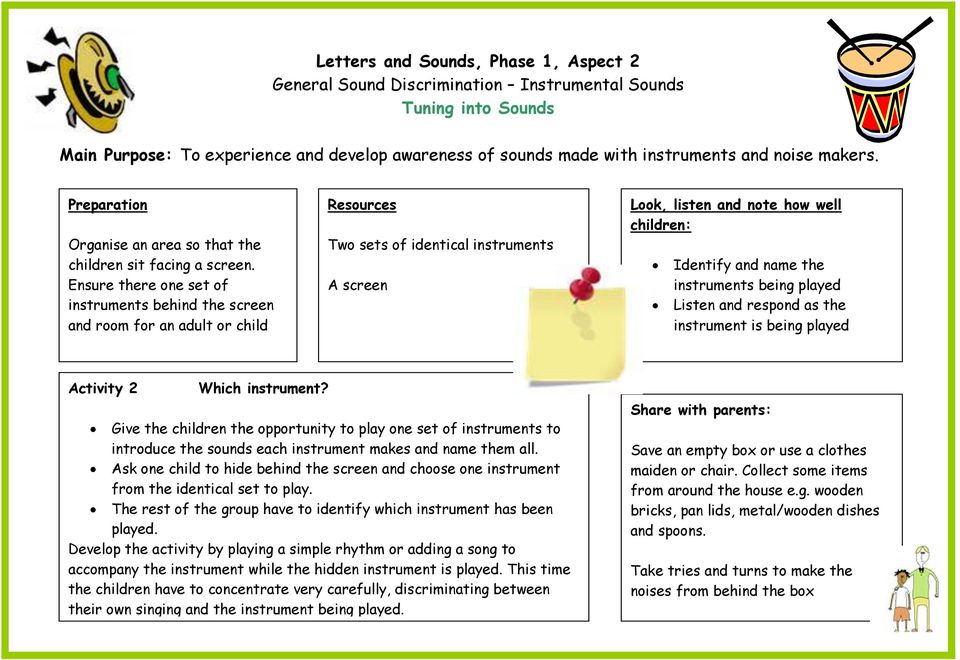
1 Tuning into Sounds Main Purpose: To experience and develop awareness of sounds made with instruments and noise makers. Organise an area so that the children sit facing a screen. Ensure there one set of instruments behind the screen and room for an adult or child Two sets of identical instruments A screen Identify and name the instruments being played Listen and respond as the instrument is being played Activity 2 Which instrument? Give the children the opportunity to play one set of instruments to introduce the sounds each instrument makes and name them all. Ask one child to hide behind the screen and choose one instrument from the identical set to play. The rest of the group have to identify which instrument has been played. Develop the activity by playing a simple rhythm or adding a song to accompany the instrument while the hidden instrument is played. This time the children have to concentrate very carefully, discriminating between their own singing and the instrument being played. Save an empty box or use a clothes maiden or chair. Collect some items from around the house e.g. wooden bricks, pan lids, metal/wooden dishes and spoons. Take tries and turns to make the noises from behind the box
2 Tuning into Sounds Main Purpose: To experience and develop awareness of sounds made with instruments and noise makers. Symbols to represent loud and quiet will require preparation in advance. Ensure instruments are in good order Symbols or resources to represent loud and quiet Selection of instruments Identify and name the instruments being played Listen and respond as the instrument is being played Activity 3 Adjust the volume Two children sit opposite each other with identical instruments. Ask them to copy each other making loud sounds and quiet sounds. It may be necessary to demonstrate with two adults copying each other first. Then try with an adult and one child. Use cards or puppets as cues to represent loud or quiet (e.g picture of a megaphone or a finger on the lips or a puppet of a lion and a mouse). This is an easy game to play at home using items from around the home.

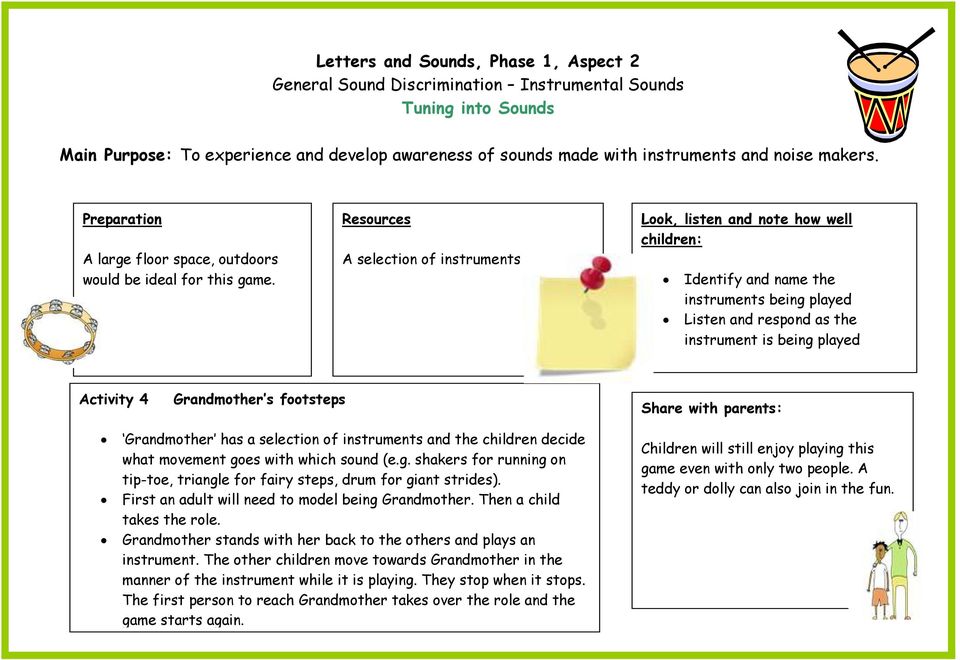
3 Tuning into Sounds Main Purpose: To experience and develop awareness of sounds made with instruments and noise makers. A large floor space, outdoors would be ideal for this game. A selection of instruments Identify and name the instruments being played Listen and respond as the instrument is being played Activity 4 Grandmother s footsteps Grandmother has a selection of instruments and the children decide what movement goes with which sound (e.g. shakers for running on tip-toe, triangle for fairy steps, drum for giant strides). First an adult will need to model being Grandmother. Then a child takes the role. Grandmother stands with her back to the others and plays an instrument. The other children move towards Letters Grandmother and Sounds, in the manner of the instrument while it is playing. They stop when it stops. The first person to reach Grandmother takes over the role and the game starts again. Children will still enjoy playing this game even with only two people. A teddy or dolly can also join in the fun.
4 Listening and Remembering Sounds Main Purpose: To listen and appreciate the difference between sounds made with instruments Space for children to sit in a small circle. Area to place screen if required Activity 5 Matching sound makers Pairs of matching sound makers Feely bag Screen ( to adapt game) Are able to remember and repeat a rhythm Discriminate and reproduce loud and quiet sounds Are able to start and stop playing at the signal Show pairs of sound makers (e.g. maracas, triangles) to a small group of children. Place one set of sound makers in a feely bag The children take turns to select a sound maker from the feely bag. Once all the children have selected a sound maker, remind them to listen carefully. Play a matching sound maker. The child with that sound maker stands up and plays it. Adapt the activity by playing the sound maker behind a screen so the children have to identify it by the sound alone. Use a shopping bag or basket to hide sound makers in. Take tries and turns. Can you find something that makes a sound like this Child can have 3 or 4 items to choose from.

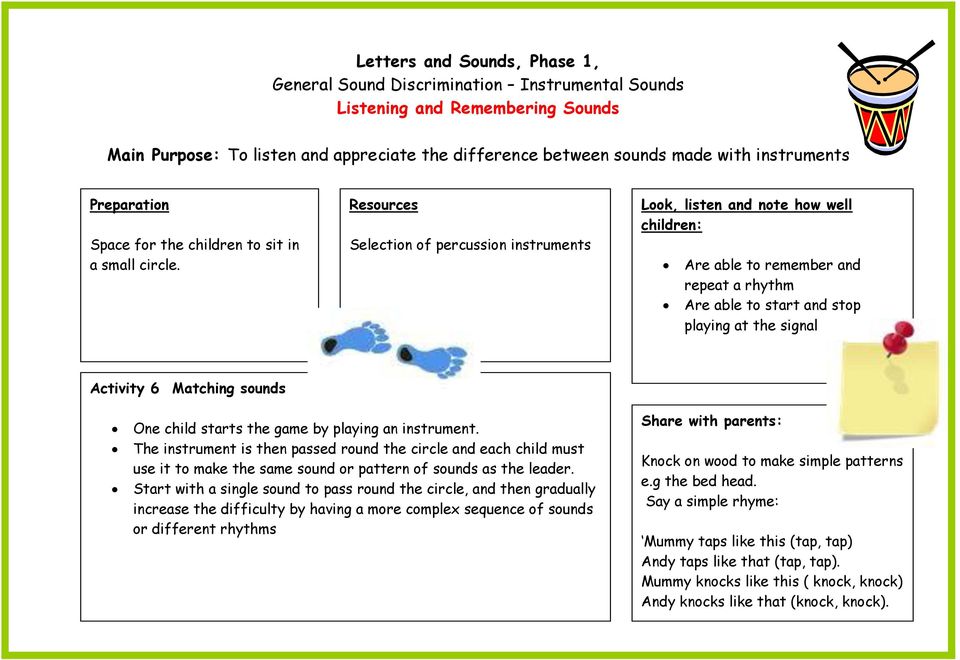
5 Letters and Sounds, Phase 1, Listening and Remembering Sounds Main Purpose: To listen and appreciate the difference between sounds made with instruments Space for the children to sit in a small circle. Selection of percussion instruments Are able to remember and repeat a rhythm Are able to start and stop playing at the signal Activity 6 Matching sounds One child starts the game by playing an instrument. The instrument is then passed round the circle and each child must use it to make the same sound or pattern of sounds as the leader. Start with a single sound to pass round the circle, and then gradually increase the difficulty by having a more complex sequence of sounds or different rhythms Letters and Sounds, Phase 1, Knock on wood to make simple patterns e.g the bed head. Say a simple rhyme: Mummy taps like this (tap, tap) Andy taps like that (tap, tap). Mummy knocks like this ( knock, knock) Andy knocks like that (knock, knock).
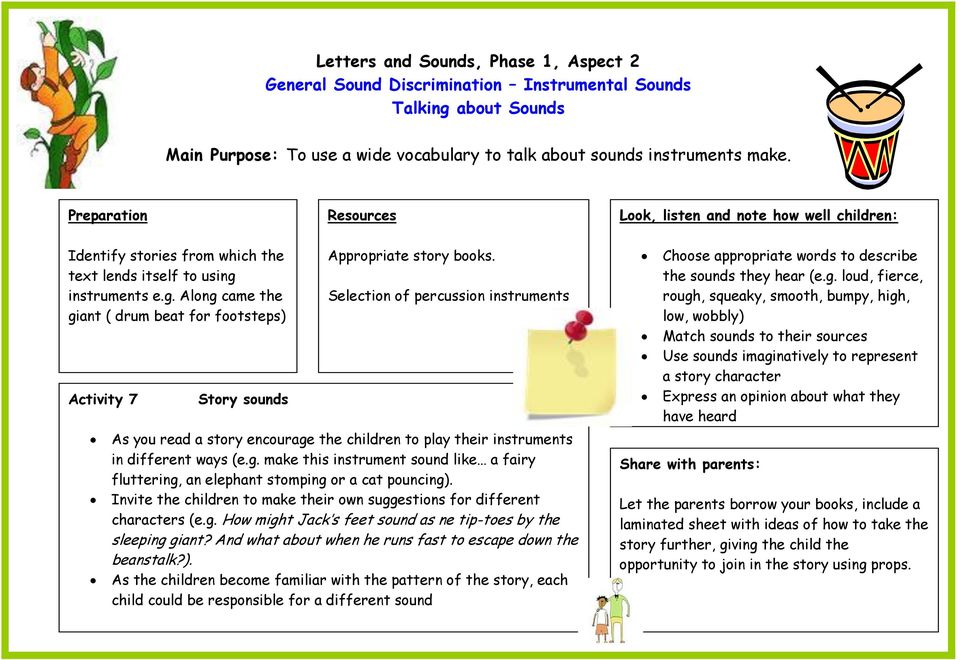
6 Talking about Sounds Main Purpose: To use a wide vocabulary to talk about sounds instruments make. Identify stories from which the text lends itself to using instruments e.g. Along came the giant ( drum beat for footsteps) Activity 7 Story sounds Appropriate story books. Selection of percussion instruments As you read a story encourage the children to play their instruments in different ways (e.g. make this instrument sound like a fairy fluttering, an elephant stomping or a cat pouncing). Invite the children to make their own suggestions for different characters (e.g. How might Jack s feet sound as ne tip-toes by the sleeping giant? And what about when he runs fast to escape down the beanstalk?). As the children become familiar with the pattern of the story, each child could be responsible for a different sound Choose appropriate words to describe the sounds they hear (e.g. loud, fierce, rough, squeaky, smooth, bumpy, high, low, wobbly) Match sounds to their sources Use sounds imaginatively to represent a story character Express an opinion about what they have heard Let the parents borrow your books, include a laminated sheet with ideas of how to take the story further, giving the child the opportunity to join in the story using props.
7 Talking about sounds Main Purpose: To use a wide vocabulary to talk about the sounds instruments make. Hide the instruments around the setting, indoors or outdoors A selection of instruments Teddy or similar Choose appropriate words to describe the sounds they hear and where they found it Activity 8 Hidden instruments Explain to the children that last night when they were all tucked up in bed, teddy has been hiding the instruments all around the nursery. Ask the children to look for the instruments As each instrument is discovered the finder stands by teddy and plays the instrument, the others run to join the finder. Continue in this way until all the instruments have been found to make an orchestra When tidying up the bedroom, play the game so that when ever the child finds a noise maker they talk about the kind of noise it makes and collect it in a special basket or box. This box will then support many of the other activities.

8 Talking about sounds Main Purpose: To use a wide vocabulary to talk about the sounds instruments make. Allocate a space for children to rehearse. Ensure a variety of instruments are available Instruments Posters of stories or rhymes to stimulate the children Choose appropriate words to describe sounds they hear Use sounds imaginatively to represent a story character Express an opinion about what they have heard Activity 9 Musical show and tell Invite the children to perform short instrumental music for others. The others are asked to say what they liked about the music. The performers may say why they chose to perform the way they did. (It was very noisy because it was like an angry giant). Turn the TV off and take turns to perform using sound makers.

9 Talking about sounds Main Purpose: To use a wide vocabulary to talk about the sounds instruments make. Collect a selection of animal posters Consider an appropriate area to make an interest table, with easy access for parents Activity 10 Animal sounds A selection of animal puppets or toys A range of instruments Choose appropriate words to describe the sounds they hear. Use sounds imaginatively Express an opinion about what they have heard Encourage the children to play with the instruments and the animals. Discuss matching sounds to the animals. Give a choice of two instruments to represent a child s chosen animal and ask the children to choose which sound is the better fit. After practising this activity so the children understand what to do. Make an interest table, with a selection of instruments and posters of animals for the children to explore and match. The posters and instruments can be changed regularly. Encourage the children to show their carers the interest table and share the activity with them

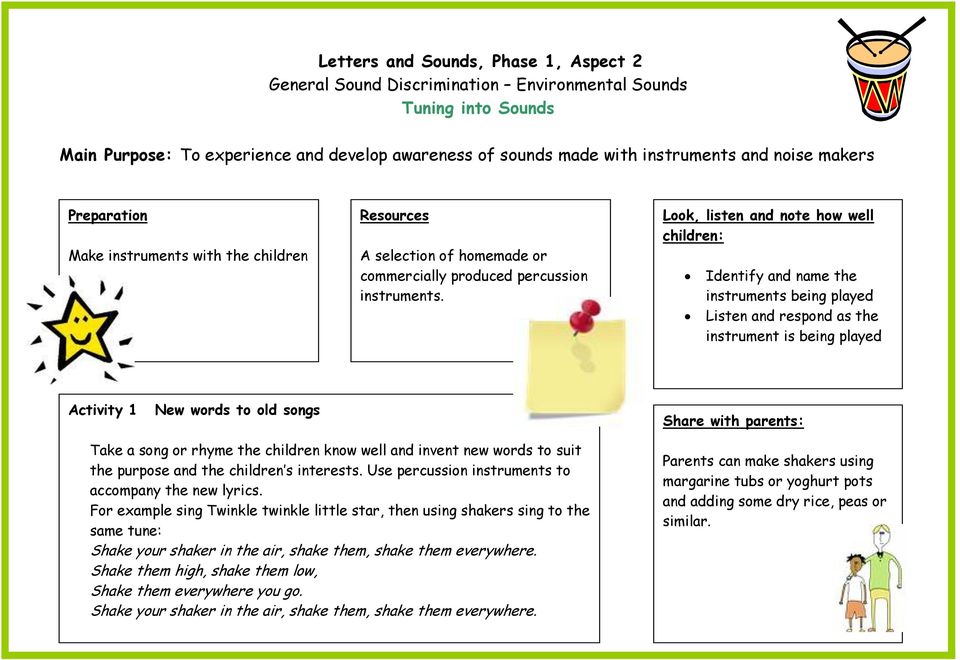
10 General Sound Discrimination Environmental Sounds Tuning into Sounds Main Purpose: To experience and develop awareness of sounds made with instruments and noise makers Make instruments with the children A selection of homemade or commercially produced percussion instruments. Identify and name the instruments being played Listen and respond as the instrument is being played Activity 1 New words to old songs Take a song or rhyme the children know well and invent new words to suit the purpose and the children s interests. Use percussion instruments to accompany the new lyrics. For example sing Twinkle twinkle little star, then using shakers sing to the same tune: Shake your shaker in the air, shake them, shake them everywhere. Shake them high, shake them low, Shake them everywhere you go. Shake your shaker in the air, shake them, shake them everywhere. Parents can make shakers using margarine tubs or yoghurt pots and adding some dry rice, peas or similar.
11

Look, listen and note how well children: Preparation. Resources. Plan this into your singing time activities.
 Tuning into Sounds Plan this into your singing time activities. Music tape / DVD with a clear beat to respond to Articulate their tongues and mouths Activity 1: Mouth movements Explore different mouth
Teaching Rhyme The Second Step in Teaching Phonological Awareness
 Teaching Rhyme The Second Step in Teaching Phonological Awareness 1) Poetry, Songs and Jingles Rhyming poems, songs and jingles that children learn by heart offer special opportunities for rhyme play.
Letters and Sounds: Principles and Practice of High Quality Phonics Phase One Teaching Programme
 Letters and Sounds: Principles and Practice of High Quality Phonics Phase One Teaching Programme Ref: Letters and Sounds: Principles and Practice of High Quality Phonics Phase One Teaching Programme First
Communicate through music
 Communicate through music When adults talk to a baby, they make music they make their voices lilt up and down in a sing-song way, and find short phrases to say in a rhythmic way. Hello baby! Aren t you
KIDS Sensory Play Resource Sheets Playing with Sound
 KIDS Sensory Play Resource Sheets Playing with Sound INTRODUCTION Take a moment to close your eyes and listen carefully to what is around you. You may be hearing a passing car, bird song, a radio, voices
ACTIVITY. pbsparents.com/catinthehat/
 Overview The Cat in the Hat Knows a Lot About That! Have you ever noticed how your child explores the world by using all of his senses? You can help him think more about how he sees, hears, smells, feels,
AR State PIRC/ Center for Effective Parenting
 Helping Young Children Learn to Read What Parents Can Do Reading is one of the basic building blocks for your child s learning and school success. It is a skill on which most other learning is built. Children
Lesson Plans: Stage 3 - Module One
 Lesson Plans: Stage 3 - Module One TM Music Completes the Child 1 Stage Three Module One Contents Week One Music Time Song 2 Concept Development Focus: Tempo 4 Song Clap Your Hands 5 George the Giant Pitch
everyday s a learning day
 everyday s a learning day Birth to 3 years Health and Wellbeing, Literacy and Numeracy Give your Child a Great Start Every Day s a Learning Day Page 2 c SThis book for parents and carers of children aged
My Family FREE SAMPLE. This unit focuses on sequencing. These extension
 Unit 5 This unit focuses on sequencing. These extension Unit Objectives activities give the children practice with sequencing beginning, middle, and end. As the learn to name family members and rooms children
Share books and talk together
 Share books and talk together Babies love to communicate. They are born sociable and come into the world with a willingness to communicate and learn. Their experiences in their early years shape their
Letters and Sounds - Phase 1 Aspect 5 Alliteration Tuning into Sounds Main purpose: To develop understanding of alliteration
 Tuning into Sounds Main purpose: To develop understanding of alliteration Area to enable small group of children to sit comfortably in a circle None required Identify initial sounds of words Reproduce
Five to Thrive TALK PLAY CUDDLE RELAX. Easy workouts for babies and toddlers RESPOND
 Five to Thrive Easy workouts for babies and toddlers Morning Sing along Sing along to your favourite song or your child s favourite nursery rhyme. If your baby isn t speaking yet, copy their sounds, facial
Play helps children feel good about themselves
 Play helps children feel good about themselves Contents Children develop their social and emotional skills through play How do young children play? Play helps children develop a positive sense of self
How To Play With A Toddler
 Where Is The Green Sheep? 0-12 12 M Play is the most powerful way babies learn. Every time you pick up babies, cuddle them, sing to them or read to them they are learning about language. By sharing this
Year 2 Summer Term Oral and Mental Starter Activity Bank
 Year 2 Summer Term Oral and Mental Starter Activity Bank Objectives for term Recall x2 table facts and derive division facts. Recognise multiples of 5. Recall facts in x5 table. Recall x10 table and derive
behind the scenes curriculum mapping: primary The following curriculum mapping is relevant for all 10 episodes of THE LION KING - Behind The Scenes
 curriculum mapping: primary The following curriculum mapping is relevant for all 10 episodes of THE LION KING - Behind The Scenes Episode 1 from screen to stage Episode 2 BEHIND THE STORY Episode 3 meet
Handale Primary School Music Curriculum Year EYFS ( 4-5 year olds)
 Handale Primary School Music Curriculum Year EYFS ( 4-5 year olds) Music at EYFS stage reflects the different ways in which children learn and engage with other people. Many examples of stories, songs
Activity Pack The Jolly Postman
 World-class theatre for children Activity Pack The Jolly Postman Warm up game This exercise needs a clear space! The centre of the room is called home. When the group hear the word home all pupils must
Preschool March Lessons. Dr. Seuss Day. One Day Free Sample
 Preschool March Lessons Dr. Seuss Day One Day Free Sample Kids R Learning Preschool Lesson Plans Letter R - Number 9 Dr. Seuss Day Circle Time: Left & Right Feet Read the story the Foot Book Explain to
Talking and Listening. Language and Literacy in the Foundation Stage
 Acknowledgements The Early Years Literacy Interboard Group wishes to record its thanks to the following schools for their willing co-operation in the production of this resource. Ballysillan Primary, Belfast;
David s Heart: David Praises God
 Teacher s Guide: Ages 4-5 Kings & Kingdoms Part 2: Judges through Esther Unit 8, Lesson 41 David s Heart: David Praises God Lesson Aim: To explore ways to praise the Lord. THE WORSHIP Who God is: The King
Using sentence fragments
 Lesson 8 Descriptive Essays Description is not a distinct mode of writing, like expository, narrative, and persuasive, but the ability to write descriptively is essential to a host of writing genres. Many
School. Lesson plan. Topic. Aims. Age group. Level. Time. Materials. School, school objects, rules, subjects, rooms and uniforms
 School Lesson plan Topic School, school objects, rules, subjects, rooms and uniforms Aims To practise (depending on stages chosen): vocabulary: words connected to school, school objects, rules, subjects,
Jesus and Nicodemus Lesson Aim: To know God loves the world.
 Teacher s Guide: Ages 4-5 Kings & Kingdoms Part 1: The Life of Jesus Unit 2, Lesson 8 Jesus and Nicodemus Lesson Aim: To know God loves the world. THE WORSHIP Who God is: The King Who Serves THE WORD Bible
Hints and tips on how to get the most out of the performance. Book 4. Acting tips
 Hints and tips on how to get the most out of the performance. Book 4 Acting tips Tips on how to introduce the show to the group, run workshops, explore the text, cast and organise the show. Before the
EARLY CHILDHOOD LITERACY AND NUMERACY BUILDING GOOD PRACTICE MARILYN FLEER AND BRIDIE RABAN
 EARLY CHILDHOOD LITERACY AND NUMERACY BUILDING GOOD PRACTICE MARILYN FLEER AND BRIDIE RABAN EARLY CHILDHOOD LITERACY AND NUMERACY CARDS This set of cards has been developed to help you support young children
Objective: God is all Powerful! Bible Memory Verse: Matthew 19:26b With man this is impossible, but with God all things are THEME OVERVIEW
 Jesus the Magnificent Scripture: Luke 8:40-56 and Luke 18:35-43 Objective: God is all Powerful! Bible Memory Verse: Matthew 19:26b With man this is impossible, but with God all things are possible. THEME
Knowledge and Understanding of the World. Early Learning Goals. National Curriculum. (learning objectives) (level 1 descriptors)
 Knowledge and Understanding of the World Knowledge and Understanding of the world Science K&U4 Ask questions about why things happened and how things work To talk about what they see To make recordings
Exploring Sound Body percussion
 Exploring Sound Body percussion Ideas and activities for exploring body percussion sounds for all classes Strand : Listening and responding Strand unit: Exploring sounds Exploring sounds involves listening
Domain and goal Activities Dancing game Singing/Vocalizing game Date What did your child do?
 AUDITION Sways, dances or vocalizes to music and singing CD, MP3, radio Voice Bombardment of /p/ Speech Sounds p.5 6 An important aspect of learning to listen is learning that music and singing is different
What Is Sound? 20 minutes. Materials For the teacher. 1 pr. *cymbals, large 1 pr. cymbals, small 1 xylophone *Not provided in kit
 Share with Your Students Vocabulary pitch STUDENT RESOURCE 1.1 INFORMATION SHEET how high or low a sound is What Is Sound? 1. Make copies of Student Resource 1.1, Vocabulary, and cut it up to make flashcards.
Talk To Your Baby Quiz
 Talk To Your Baby Quiz 1. When should you start talking to babies? a) From the moment they are born b) After six weeks c) When they smile at you 2. When does the majority of brain development occur in
Female Child s date of birth: Last name: State/ Province: Home telephone number:
 60 Ages & Stages Questionnaires 57 months 0 days through 66 months 0 days Month Questionnaire Please provide the following information. Use black or blue ink only and print legibly when completing this
All About Me. Babies (0-1) Meal times. Has your baby been weaned? Yes No
 All About Me To make the transition from home to Early Learners Nursery School as smooth as possible, could you give us the information about the following areas: Babies (0-1) Meal times Has your baby
Early Years Foundation Stage Framework 2012 An overview with recommendations for music-making
 Early Years Foundation Stage Framework 2012 An overview with recommendations for music-making Commissioned by Sound Connections in June 2012 from Linda Bance (MA Music Ed) for the London Early Years Music
AUDITION WEEK. Domain and goal. Activities. Shows awareness of sound when directed by parent Environmental sounds Voice
 AUDITION WEEK 1 Shows awareness of sound when directed by parent Environmental sounds Voice The first step in bringing your child to spoken language through audition is to teach him that there is sound.
Retelling. In the beginning.. Then,... After that,... And then,... Finally,... Do I understand what I read? Does it make sense?
 Retelling Gr 1-3 In the beginning.. Then,... After that,... And then,... Finally,... Do I understand what I read? Does it make sense? Retelling Gr 1-3 Page 1 Grade: Prior Knowledge: What prior knowledge
On Your Marks: Under-5s Day 2 Jesus heals Bartimaeus Mark 10: 46-52
 On Your Marks: Under-5s Day 2 Jesus heals Bartimaeus Mark 10: 46-52 Simple Story An enlarged copy of the 'Bart' picture on A4 card; three extra faces (available as a web download: Day 2 resource sheets
Catch the Calypso Beat and Put it in Your Feet! A Smithsonian Folkways Lesson Designed by: Katie Wood Seattle Public Schools, Seattle WA
 Catch the Calypso Beat and Put it in Your Feet! A Smithsonian Folkways Lesson Designed by: Katie Wood Seattle Public Schools, Seattle WA Summary: In this lesson students will travel to the island of Trinidad
Reading Aloud with Children of All Ages
 with Children of All Ages Derry Koralek THE SINGLE MOST IMPORTANT ACTIVITY for building knowledge for their eventual success in reading is reading aloud to children, stressed Becoming a Nation of Readers,
God is Eternal Lesson 1
 Preschool Curriculum (4K / 5K) August 15 th & 16 th, 2009 God is Eternal Lesson 1 Divine Attribute: Heart Response: God is Eternal Be Amazed Memory Verse: Jesus Christ is the same yesterday, today and
Language and Literacy for Young Learners Online
 Language and Literacy for Young Learners Online 4433 Bissonnet Bellaire, Texas 77401 713.664.7676 f: 713.664.4744 www.neuhaus.org Introduction Important Foundational Skills 1. Oral Language 2. Phonological
Alphabetic Knowledge / Exploring with Letters
 Alphabetic Knowledge / Exploring with Letters Reading Goal 67: demonstrate awareness of the alphabetic principle Reads books with repetitive sounds and/or pronounces words deliberately and slowly when
VAK Learning Styles. Whether you realise it or not, we all have preferences for how we absorb information, analyse it and make decisions:
 What is Your Learning Preference? VAK Learning Styles Whether you realise it or not, we all have preferences for how we absorb information, analyse it and make decisions: Some people like to see what you
All Saints (or All Hallows) Celebration
 All Saints (or All Hallows) Celebration Bible base: Mark 10:46 52 Aim: To present an alternative focus to the Hallowe en events that dominate this time of year. Note to leaders Our focus this week will
The Dance Lesson. A good dance lesson should contain some or all of the following:-
 The Dance Lesson The Primary School Curriculum says:- Dance in education involves the child in creating, performing and appreciating movement as a means of expression and communication. Dance differs from
Last name: State/ Province: Home telephone number:
 60 Ages & Stages Questionnaires 57 months 0 days through 66 months 0 days Month Questionnaire Please provide the following information. Use black or blue ink only and print legibly when completing this
Senior Phase Grade 7 Today Planning Pack ARTS AND CULTURE
 M780636110205 Senior Phase Grade 7 Today Planning Pack ARTS AND CULTURE Contents: Work Schedule: Page Grade 7 2 Lesson Plans: Grade 7 4 Rubrics: Rubric 1 11 Rubric 2 12 Rubric 3 13 1 Work schedule for
DIGITAL MUSIC DAY 1 WHAT IS SOUND? ANALOG AND DIGITAL EARLY RECORDING WAX FOR YOUR EARS ROUND BUT FLAT WIRE AND TAPE PURE SOUND
 DIGITAL MUSIC DAY 1 WHAT IS SOUND? 1. Making a sound playing a musical instrument, moves the surrounding the instrument. 2. Making a sound sends out air which hit your ears. 3. Waves of changing air pressure
CHILD S NAME INSERT CHILD S PHOTO HERE
 RECORD OF F DEVELOPMENT T A AND N PROGRESS AT KINDERGARTEN RT LEVEL CHILD S NAME INSERT CHILD S PHOTO HERE GUIDELINES for Kindergarten Assistants: Every Kindergarten Assistant (KGA) must know if each child
Week 2 Foundation. Week
 2 Week 2 Foundation Areas of Development and Learning: Social development / Physical development Focus: Greeting and saying hello Greetings (e.g. Bonjour/Hola) 1 Introduce children to Bonjour or Hello
Circle or tick the answer that most represents how you generally behave.
 VAK Learning Styles Self-Assessment Questionnaire Circle or tick the answer that most represents how you generally behave. (It s best to complete the questionnaire before reading the accompanying explanation.)
Goals for Preschool aged Children: (Compiled from several State Guidelines) Compilation by Narcissa Summerfield Language Community Goals
 Goals for Preschool aged Children: (Compiled from several State Guidelines) Compilation by Narcissa Summerfield Language Community Goals Interact appropriately in groups (taking turns talking or playing
A to Z of Potty Training Tips
 A to Z of Potty Training Tips Age There is no right age to potty train, as natural readiness varies from child to child. Children gain bowel and bladder control at their own pace, but most are potty trained
Nami s Gifts. Lesson Plan. About the Book Text Type: Fiction/Realistic Page Count: 16 Word Count: 220. About the Lesson Targeted Reading Strategy
 Lesson Plan About the Book Text Type: Fiction/Realistic Page Count: 16 Word Count: 220 Book Summary Nami has a problem: She must make the perfect gift for each person in her family. It is her family tradition.
Fry Phrases Set 1. TeacherHelpForParents.com help for all areas of your child s education
 Set 1 The people Write it down By the water Who will make it? You and I What will they do? He called me. We had their dog. What did they say? When would you go? No way A number of people One or two How
King Solomon Asks to Be Wise
 Teacher s Guide: Ages 2-3 Kings & Kingdoms Part 2: Judges through Esther Unit 9, Lesson 43 King Solomon Asks to Be Wise Lesson Aim: To know God helps us make good choices. THE WORSHIP Who God is: The King
Infant Development: The First Year of Life
 Infant Development: The First Year of Life Your child's first few years are critical in the development of his or her temperament, learning style and pattern of growth. You are your child's first and most
Helping your child with Reading
 Helping your child with Reading Some ways that you can support. Getting Started Sharing books - We teach phonics to help our children learn to read and write and in order to do this successfully they need
Writing With Writers: Karla Kuskin Poetry Step 1: My Poem
 Writing With Writers: Karla Kuskin Poetry Step 1: My Poem ME By Karla Kuskin My nose is blue, my teeth are green, my face is like a soup tureen. I look just like a lima bean. I'm very, very lovely. My
Activities to Help Your Baby Grow and Learn
 Communication Your baby now has many different sounds and a lot to say. She likes to play with sounds such as ba ba ba and is learning that some sounds mean special people, such as dada. She understands
INTRODUCTION TEACHING TIPS. THE NURSERY CLASS Purpose
 INTRODUCTION THE NURSERY CLASS Purpose Letter to Parents The purpose of the nursery class is to help children learn the restored gospel of Jesus Christ and live it. The nursery class should help the children
Produced in partnership by: Universally Speaking. The ages and stages of children s communication development from birth to 5
 Produced in partnership by: Universally Speaking The ages and stages of children s communication development from birth to 5 Children can all be great communicators Communication is the way we connect
Twinkle Stars Day Nursery
 Twinkle Stars Day Nursery Inspection report for early years provision Unique reference number EY379607 Inspection date 19/01/009 Inspector Jasvinder Kaur Setting address Telephone number 0190 737 378 Email
Using Books to Support Social Emotional Development. Hands Are Not for Hitting By Martine Agassi Free Spirit Publishing, Inc.
 Using Books to Support Social Emotional Development Hands Are Not for Hitting By Martine Agassi Free Spirit Publishing, Inc. Hands Are Not for Hitting is a story about alternative actions and activities
Language Arts Core, First Grade, Standard 8 Writing-Students write daily to communicate effectively for a variety of purposes and audiences.
 Genre Unit Reading and Writing Fables by Amy Kinney Language Arts Core, First Grade, Standard 7 Comprehension-Students understand, interpret, and analyze narrative and informational grade level text. Objective
Phonemic Awareness. Section III
 Section III Phonemic Awareness Rationale Without knowledge of the separate sounds that make up words, it is difficult for children to hear separate sounds, recognize the sound s position in a word, and
End of Reception Report: July 2013
 End of Reception Report: July 2013 Name: Date: Communication and Language Listening and attention Understanding Speaking Child A is able to listen to instructions and follow them accurately, including
The Ten Commandments
 The Ten Commandments Teacher Pep Talk: God had miraculously led His people (the Israelites) out of Egypt and safely through the Red Sea. Now at long last the Israelites had arrived at the mountain of God.
Music For Every Classroom: Make Your Own Holiday Music by Elizabeth M. Peterson Copyright 2005 by Elizabeth M. Peterson
 Music For Every Classroom: Make Your Own Holiday Music by Elizabeth M. Peterson Copyright 2005 by Elizabeth M. Peterson What would we do without music during the holiday season? Holiday music is everywhere
Has difficulty with counting reliably in tens from a multiple of ten
 Has difficulty with counting reliably in tens from a multiple of ten Opportunity for: looking for patterns 5 YR / 100-square Tens cards (Resource sheet 24) Multiples of ten (10 100) written on A5 pieces
PUSD High Frequency Word List
 PUSD High Frequency Word List For Reading and Spelling Grades K-5 High Frequency or instant words are important because: 1. You can t read a sentence or a paragraph without knowing at least the most common.
English (Literacy) Reading Target Ideas. P Scale 4
 P Scale 4 Pupils listen and respond to familiar rhymes and stories Begin to remember one or two repeated words e.g. names of people or objects, or key words in a repetitive phrase, in a familiar text when
CAMBRIDGE FIRST CERTIFICATE Listening and Speaking NEW EDITION. Sue O Connell with Louise Hashemi
 CAMBRIDGE FIRST CERTIFICATE SKILLS Series Editor: Sue O Connell CAMBRIDGE FIRST CERTIFICATE Listening and Speaking NEW EDITION Sue O Connell with Louise Hashemi PUBLISHED BY THE PRESS SYNDICATE OF THE
Term 2 Exploring Patterns. Suggested Percentage of Time: 15%
 Term 2 Exploring Patterns Suggested Percentage of Time: 15% MA75 MA76 Unit Overview Focus and Context In Kindergarten, students are formally introduced to repeating patterns of two to three elements. Students
Phonics. High Frequency Words P.008. Objective The student will read high frequency words.
 P.008 Jumping Words Objective The student will read high frequency words. Materials High frequency words (P.HFW.005 - P.HFW.064) Choose target words. Checkerboard and checkers (Activity Master P.008.AM1a
Animals that move slowly, animals that move quickly
 Unit Three Time 74 Animals that move slowly, animals that move quickly Unit 3: Time Image courtesy of: Microsoft clipart Focus: Animals that move slowly and quickly linked with time Whole class activity
STREETSENSE. Gym Cards
 Teachers Notes The Scottish Road Safety Campaign have developed a series of Gym Cards to support activities at Level A in Streetsense. The Gym Cards can either be used in conjunction with specific Level
What makes a good friend?
 What makes a good friend? Cross Curriculum links: En1 3a-e; 4a, b, c En3 1b, 12 PSHCE 4a, c Learning Outcomes: What you need: Understand that there are different kinds of friendship Consider how we might
Draft. How play is structured in early years settings to promote development. Curriculum requirements. Introduction. Key terms.
 Learning aim C TOPIC C1 Key terms Adult-led play play opportunities and activities which are organised and led by an adult. Adult-initiated play play opportunities set up by adults for children to discover.
МИНИСТЕРСТВО НА ОБРАЗОВАНИЕТО И НАУКАТА ЦЕНТЪР ЗА КОНТРОЛ И ОЦЕНКА НА КАЧЕСТВОТО НА УЧИЛИЩНОТО ОБРАЗОВАНИЕ ТЕСТ ПО АНГЛИЙСКИ ЕЗИК ЗА VII КЛАС
 МИНИСТЕРСТВО НА ОБРАЗОВАНИЕТО И НАУКАТА ЦЕНТЪР ЗА КОНТРОЛ И ОЦЕНКА НА КАЧЕСТВОТО НА УЧИЛИЩНОТО ОБРАЗОВАНИЕ ТЕСТ ПО АНГЛИЙСКИ ЕЗИК ЗА VII КЛАС PART ONE: LISTENING COMPREHENSION Listening A Directions: You
Purpose: To acquire language and the ability to communicate successfully with others
 Purpose: To acquire language and the ability to communicate successfully with others The language development and communication domain involves the development of the ability to use language to communicate
What is the EYFS Framework why do we have one?
 *Publication currently subject to redesign Parents Guide to the Early Years Foundation Stage Framework Exciting times ahead for you and your child What is the Early Years Foundation Stage? Welcome to the
My Brother s Birthday
 Teacher Edition My Brother s Birthday alphakids Written by Jack Hastings Photography by Ross Tonkin Published edition Eleanor Curtain Publishing 2004 First published 2004 Apart from any fair dealing for
1. Identify a natural opportunity within current planning. Prepare resources as required, and a simple recording sheet for each group.
 Activity 4 Planning a practical activity Illustrated by The Snowman s Coat Young children are often asked to carry out practical tasks, but can find planning them difficult. Asking them to plan in a Thinking
South Camberley Primary and Nursery School
 South Camberley Primary and Nursery School Curriculum Planning Half Term 6 Week Planning Please highlight the term Autumn 1 Autumn 2 Spring 1 Spring 2 Summer 1 Summer 2 Year Group: Nursery Topic Title:
K-1 Common Core Writing Santa Fe Public Schools Presented by: Sheryl White
 K-1 Common Core Writing Santa Fe Public Schools Presented by: Sheryl White Session Objectives Review expectations in Common Core Writing Gain ideas for teaching opinion writing Collaborate and articulate
Developing Fundamental Movement Skills
 Developing Fundamental Movement Skills GENERAL OVERVIEW OF CATCH Being able to catch a ball is vital in order to play many team games (such as netball, Gaelic football, rugby, baseball, cricket and basketball)
Do Not Worry Lesson Aim: To know God takes care of everything.
 Teacher s Guide: Ages 4-5 Kings & Kingdoms Part 1: The Life of Jesus Unit 6, Lesson 30 Do Not Worry Lesson Aim: To know God takes care of everything. THE WORSHIP Who God is: The King Who Teaches THE WORD
Gaddesden Row JMI School Year 1 January-February 2014. Look at what we are doing!
 Dear Parents, It seems that it may be quite wet outside for the foreseeable future! The children will need to wear a coat with a hood so we can still go outside if the rain is not too heavy. In the colder
CHILD, HEALTH, WELFARE & DEVELOPMENT ASSESSMENT GUIDE
 CHILD, HEALTH, WELFARE & DEVELOPMENT ASSESSMENT GUIDE REGULATION 5 Reference: R5, Version: 1 [8 th March 2011] 1 This assessment guide is divided into four sections as follows: Section 1 Section 2: Section
Exploring Sounds Environmental Sounds
 Exploring Sounds Environmental Sounds Ideas and activities for exploring environmental sounds for all classes Strand : Listening and responding Strand unit: Exploring sounds Exploring sounds involves listening
Contents. A Word About This Guide... 3. Why Is It Important for My Child to Read?... 4. How Will My Child Learn to Read?... 4
 Contents A Word About This Guide............................... 3 Why Is It Important for My Child to Read?................ 4 How Will My Child Learn to Read?....................... 4 How Can I Help My
Sing, Spell, Read & Write
 Sing, Spell, Read & Write Correlated to Head Start DOMAIN: LANGUAGE DEVELOPMENT Element: Listening & Understanding Demonstrates increasing ability to attend to and understand conversations, stories, songs,
Life Skills: Beginning knowledge Topic: South Africa Context: South African Symbols People Money Languages Symbols Provinces
 Theme: South Africa our heritage Day 1 First ring Concept: South African symbols Participates in discussions and asks Listens and responds to simple Talks about pictures in posters, theme charts, books
Parable of The Prodigal Son
 Parable of The Prodigal Son Teacher Pep Talk: Children need to know that they are loved unconditionally. In fact, we all need to know it! In the Parable of the Prodigal Son, Jesus assures us that God will
VAK Learning Styles Self-Assessment Questionnaire
 Student Services Study Skills Student Development and Counselling VAK Learning Styles Self-Assessment Questionnaire Circle or tick the answer that most represents how you generally behave. (It s best to
How To Teach Children To Read Recipe Cards
 English as a Second Language Activities for very young learners in early childhood education and early primary education Integrate Ireland Language and Training 2005 1 Some important points On entry to