
Indian Textile and Garment Industry- An Overview*
|
|
|
- Julie Bell
- 9 years ago
- Views:
Transcription
1 Indian Textile and Garment Industry- An Overview* Dr.T.S Devaraja Associate Professor Department of Commerce Post Graduate Centre University of Mysore Hassan, India Tel: Mobile: : Fax: Web: [email protected] * The work described in this working paper was substantially supported by a grant from the Indian Council of Social Science Research, Ministry of Human Resource Development, Government of India, New Delhi.

2 Indian Textile and Garment Industry- An Overview This version: May 2011 Abstract India is the world s second largest producer of textiles and garments after China. It is the world s third largest producer of cotton after China and the USA and the second largest cotton consumer after China. The Indian textile industry is as diverse and complex as country itself and it combines with equal equanimity this immense diversity into a cohesive whole. The fundamental strength of this industry flows from its strong production base of wide range of fibres / yarns from natural fibers like cotton, jute, silk and wool to synthetic /man-made fibres like polyester, viscose, nylon and acrylic. The growth pattern of the Indian textile industry in the last decade has been considerably more than the previous decades, primarily on account of liberalization of trade and economic policies initiated by the Government in the 1990s. In producer-driven value chains, large, usually transnational, manufacturers play the central roles in coordinating production networks. This is typical of capital- and technology-intensive industries such as automobiles, aircraft, computers, semiconductors and heavy machinery. Buyer-driven value chains are those in which large retailers, marketers and branded manufacturers play the pivotal roles in setting up decentralized production networks in a variety of exporting countries, typically located in developing countries. This pattern of trade-led industrialization has become common in labour-intensive, consumer-goods industries such as garments, footwear, toys, handicrafts and consumer electronics. Large manufacturers control the producer-driven value chains at the point of production, while marketers and merchandisers exercise the main leverage in buyer-driven value chains at the design and retail stages. Apparel is an ideal industry for examining the dynamics of buyer-driven value chains. The relative ease of setting up clothing companies, coupled with the prevalence of developed-country protectionism in this sector, has led to an unparalleled diversity of garment exporters in the third world. Apparel is an ideal industry for examining the dynamics of buyer-driven value chains. Key words: liberalization, Textile and Garment industry, labour-intensive, Buyer-driven value chains, producer-driven value chains, protectionism, and capital and technologyintensive industries

3 Introduction: In global capitalism, economic activity is international in scope and global in organization. Internationalization refers to the geographic spread of economic activities across national boundaries. As such, it is not a new phenomenon. It has been a prominent feature of the world economy since at least the seventeenth century when colonial powers began to carve up the world in search of raw materials and new markets. Globalization is more recent, implying functional integration between internationally dispersed activities. Industrial and commercial firms have both promoted globalization, establishing two types of international economic networks. One is producer driven and the other buyer-driven. In producer-driven value chains, large, usually transnational, manufacturers play the central roles in coordinating production networks (including their backward and forward linkages). This is typical of capital- and technology-intensive industries such as automobiles, aircraft, computers, semiconductors and heavy machinery. Buyer-driven value chains are those in which large retailers, marketers and branded manufacturers play the pivotal roles in setting up decentralized production networks in a variety of exporting countries, typically located in developing countries. This pattern of trade-led industrialization has become common in labour-intensive, consumer-goods industries such as garments, footwear, toys, handicrafts and consumer electronics. Tiered networks of third-world contractors that make finished goods for foreign buyers carry out production. Large retailers or marketers that order the goods supply the specifications. Firms that fit the buyer-driven model, including retailers like Wal-Mart, Sears and JC Penney, athletic footwear companies like Nike and Reebok, and fashion-oriented apparel companies like Liz Claiborne, Gap and The Limited Inc., generally design and/or market but do not make the branded products they order. They are manufacturers without factories, with the physical production of goods separated from the design and marketing. Unlike producer-driven chains, where profits come from scale, volume and technological advances, in buyer-driven chains profits come from combinations of highvalue research, design, sales, marketing and financial services that allow the retailers, designers and marketers to act as strategic brokers in linking overseas factories and traders with product niches in their main consumer markets.2 Profitability is greatest in the concentrated parts of global value chains that have high entry barriers for new firms. In producer-driven chains, manufacturers of advanced products like aircraft, automobiles and computers are the key economic agents both in terms of their earnings and their ability to exert control over backward linkages with raw material and component suppliers, and forward linkages into distribution and retailing. The lead firms in producerdriven chains usually belong to international oligopolies. Buyer-driven value chains, by contrast, are characterized by highly competitive and globally decentralized factory systems with low entry barriers. The companies that develop and sell brand named products have considerable control over how, when and where manufacturing will take place, and how much profit accrues at each stage. Thus, large manufacturers control the producer-driven value chains at the point of production, while marketers and merchandisers exercise the main leverage in buyerdriven value chains at the design and retail stages. Apparel is an ideal industry for

4 examining the dynamics of buyer-driven value chains. The relative ease of setting up clothing companies, coupled with the prevalence of developed-country protectionism in this sector, has led to an unparalleled diversity of garment exporters in the third world. Furthermore, the backward and forward linkages are extensive, and help to account for the large number of jobs associated with the industry. The apparel value chain is organized around five main parts: raw material supply including: natural and synthetic fibres; provision of components, such as the yarns and fabrics manufactured by textile companies; production networks made up of garment factories, including their domestic and overseas subcontractors; export channels established by trade intermediaries; and marketing networks at the retail level Apparel is an ideal industry for examining the dynamics of buyer-driven value chains. The relative ease of setting up clothing companies, coupled with the prevalence of developed-country protectionism in this sector, has led to an unparalleled diversity of garment exporters in the third world. Furthermore, the backward and forward linkages are extensive, and help to account for the large number of jobs associated with the industry. The apparel value chain is organized around five main parts: raw material supply, including: natural and synthetic fibres; provision of components, such as the yarns and fabrics manufactured by textile companies; production networks made up of garment factories, including their domestic and overseas subcontractors; export channels established by trade intermediaries; and marketing networks at the retail level (see Figure 1).

5 Textile Companies Appeal Manufacturing Retail Outlets North America All Retail Outlets US garment factories (designing, cutting, sewing, buttonholing, and ironing) Department stores Natural fibers Cotton, Wool, Silk etc Yarn (spinning) Fabric (weaving, knitting, finishing Domestic and Mexican / Caribbean Basin Subcontractors Asia Brand named appeal companies Specialty stores Mass merchandise chains Synthetic fibers Oil, Natural gas Petrochemicals Synthetic fibers Asian garment contractors Overseas buying offices Discount chains Domestic and overseas subcontractors Trading companies All Retail Outlets Off price, factory outlet, mail order, others Raw Material Networks Component Networks Production Networks Export Networks Marketing Networks Figure 1 Supply Chain Management Frameworks Source: Appelbaum and Gereffi (1994), p. 46.

6 There are differences between these parts, such as geographical location, labour skills and conditions, technology, and the scale and type of enterprises, which also affect market power and distribution of profits among the main firms in the chain. Entry barriers are low for most garment factories, although they become progressively higher when moving upstream to textiles and fibres; brand names and stores are alternative competitive assets that firms can use to generate significant economic rents. The lavish advertising budgets and promotional campaigns needed to create and sustain global brands, and the sophisticated and costly information technology employed by mega retailers to develop quick response programmes that increase revenues and lower risks by getting suppliers to manage inventories, have allowed retailers and marketers to displace traditional manufacturers as the leaders in many consumer-goods industries. In apparel, the split between manufacturing and marketing that prompted the emergence of lean retailing (i.e. the model of frequent ship ments by suppliers to fill ongoing replenishment orders by retailers, based on real-time sales information collected at the retailer s stores on a daily basis) was caused by the development of several key information technologies. These included: bar coding and point-of-sale scanning used to provide immediate and accurate information on product sales; electronic data interchange (EDI) used by the retailer to restock; and automated distribution centres to handle small restocking orders, rather than the traditional warehouse system used for large bulk shipments. India is the world s second largest producer of textiles and garments after China. It is the world s third largest producer of cotton after China and the USA and the second largest cotton consumer after China. The textile and garment industry in India is one of the oldest manufacturing sectors in the country and is currently its largest. The textile and garment industry fulfils a pivotal role in the Indian economy. It is a major foreign exchange earner and, after agriculture, it is the largest employer with a total workforce of 35 mn. In 2009 textiles and garments accounted for about 16per cent of industrial production and 18 per cent of export earnings. The industry covers a wide range of activities. These include the production of natural raw materials such as cotton, jute, silk and wool, as well as synthetic filament and spun yarn. In addition an extensive range of finished products are made. The Indian textile industry accounts for about 24per cent of the world s spindle capacity, making it the second highest after China, and around eight per cent of global rotor capacity. Also, it has the highest loom capacity including hand looms with a 63per cent share. India accounts for about 14per cent of the world s production of textile fibres and yarns. This includes jute, of which it is the largest producer. The country is the second largest producer of silk and cellulose fibre and yarn, and the fifth largest producer of synthetic fibre and yarn. The Indian textile industry is as diverse and complex as country itself and it combines with equal equanimity this immense diversity into a cohesive whole. Endowed with largest loom age in the world, the second highest spindle age, next only to China, a strong multi-fibre raw material base, a vast pool of skilled workers, flexible production systems, a dynamic entrepreneurship together with vibrant design creativity, have all contributed to creating a vibrant textile industry that has long been the mainstay of the Indian economy. The Indian textile garment industry is an enormous complex entity.

7 There is organized sector, decentralized sector and down the line weavers, the artisans as well as the farmers. The spectrum of technology is wide spread right from handmade to semi mechanical, mechanical and highly sophisticated information based technology and microprocessor based technology. The fundamental strength of this industry flows from its strong production base of wide range of fibres / yarns from natural fibers like cotton, jute, silk and wool to synthetic /man-made fibres like polyester, viscose, nylon and acrylic. In fact, apart from China, no other country can boast of such strong and diverse base in textile fibres / yarns. The complex and varied structure of coupled with its close linkage with culture and multifibre raw material base enables it to produce variety of products for varying consumer needs and preferences. India is: The largest producer of jute in the world The second largest producer of silk The third largest in cotton and second largest in cellulosic fibres The fifth largest in synthetic fibres / yarn The growth pattern of the Indian textile industry in the last decade has been considerably more than the previous decades, primarily on account of liberalization of trade and economic policies initiated by the Government in the 1990s. Fiscal duty structure of the textile industry has also influenced to a great extent the growth and the structure of the industry. Historically the fiscal policies concerning textile industry have always considered small is beautiful and consequence is reflected in structural anomalies and concentration of downstream segments of the industry in the decentralized sector and decimation of the organized sector. 1. Textile Value Chain The textile value chain extends from raw material, i.e., fibres to finished products, i.e., clothing and made-ups, with spinning, weaving, knitting and processing coming in between as intermediate processes. The structural pyramid of Indian textile industry is inverse in terms of strength. Fibre manufacturing and spinning processes is strong while weaving and processing are relatively weak segments. However, in the recent past, there has been intensive activity in terms of technological up gradation of entire value chain of the textile activity. About US$ 7.50 billion of investment has taken place in this industry for capacity expansion and modernization during the last about five years. A sort of silent revolution has been taking place, which thus manifested itself in increase in production during the current year. Though the Indian textile industry uses all kind of fibres / yarn, it continues to be predominantly cotton based. The consumption of cotton fibre vis-à-vis other fibres / yarn in India is 54: 46, while the global consumption of fibres / yarn is 40: 60 in favour of non-cotton fibres / yarn. However, in India also the consumption of manmade fibre / yarn is increasing very fast and expected to reach the world level in near future. As already stated Indian textile industry is predominantly cotton based. India is

8 the third largest producer of cotton following China and USA. During the production cotton was to be 309 lakh bales. The quality of cotton has also improved considerably over a period of time. The improvement in quantity and quality of cotton has been contributed to a great extent by the Cotton Technology Mission (TMC), which was launched by Govt. during As on March 31, 2007 activation of market yard, improvements of market yard and new market yards with project cost of Rs. 35, lakhs have been sanctioned. Other major fibres/yarns used by the textile industry are man-made fibres /yarns. The man-made fibres/ yarns industry, particularly the polyester segment, has achieved significant growth during the last two decades. The installed capacity increased from 223 million kgs in to 4218 million Kgs. in The production of this industry increased from 188 million kgs during the year to 3987 million kg during the year , out of which 1901 million kgs is contributed by polyester segment alone. The sharp increase in production of polyester fibre and yarn has made India emerge as the fifth largest producer of man-made fibre/filament yarn in the world. Other fibres used by the textile industry are wool, silk and jute. Wool is the only fibre the production of which is deficient in the country. India produces about 52 million kgs of raw wool out of which only 5 million kg. is of average apparel grade and remaining 40 million kg is of carpet grade wool and other coarse wool. The worsted woolen sector, therefore, entirely depends on import of raw wool for meeting its raw material requirements. Even the export oriented carpet industry depends on New Zealand wool for blending to obtain the desired lustre in the carpets. India is second largest producer of silk with annual production in the range of 16 million kg. However, India has the unique distinction of being endowed by nature with the all four varieties of silk, viz., mulberry, tusar, eri and muga. Another fibre is jute; India is the largest producer of the jute in the World. The environmental considerations assuming importance have created new opportunities for jute, which is biodegradable, renewable and eco-friendly. What has happened over the years is that it has been traditionally associated with low value addition and utilization in terms of sacking and packing material. However, recently efforts are being made to diversify this sector into newer areas particularly geo-textiles. Textile industry has also started using jute in blends with other fibre for apparel usage. The growth in the production of textile fibres has facilitated the growth of the spinning sector. Industrial delicensing and liberalization policies coupled with freedom from unfair competition from unorganized sector accelerated the process of setting up of spinning units in the organized sector after 1990s. By the end of March 2009, 2180 spinning units are functioning in the organized sector. In the late 90s, SSI spinning units have also sprung up mostly in and around Tirupur. Taking spindle age in organized and small-scale sector, about million Spindles and 6.80 lakh rotors are functioning in the country by the end of march The significant feature of the spinning industry is that about 92 percent of the yarn is produced in the organized sector, while only eight percent is produced in the small-scale sector. Technology-wise also spinning industry is reasonably modernized particularly by taking advantage of Textile Modernization Fund

9 Scheme (TMFS) which was in vague during seventh plan. The spinning industry is also the largest beneficiary under Technology Upgradation Fund Scheme (TUFS) The projects worth Rs.15,032 crore have been sanctioned under the scheme. Many compact yarnspinning units are also coming up under TUFS. The growth in spinning capacity, the production of cotton, blended and 100 per cent non cotton yarn has also gradually increased and during the year it was provisionally estimated at 2498, 575, 348 million kgs respectively. India, today is one of the largest producer / exporter of cotton yarn. Weaving activity, in which India was lagging behind for a very long period has also taken a quantum jump as far as quality, is concerned during the recent period. In the last three years, more than 31,000 shutters less looms have been installed. Further by taking advantage of 20 per cent capital subsidy scheme under TUFS, weaving and weaving preparatory activities are being upgraded by the power loom sector. At the time of independence, mill sector was producing 75 per cent of the total cloth production. However, subsequently restrictions were imposed in the installation of weaving capacity of the mill sector. Therefore, the weaving capacity of the organized mill sector stagnated for a number of years. Even after the removal of the restrictions in 1985, the capacity of the organized mill sector, which had by then lost its competitive edge, has been consistently declining. Thus, between 1985 and 2009, the weaving capacity has declined from 3.59 lakh to 0.92 lakh looms a decline of more than 50 per cent. However, there is discernible, though hazy, trend of revival of composite mills. Composite segment is the second largest beneficiary under TUFS. Projects worth Rs crore by the end of March 2008 have been sanctioned under the scheme. It is expected that as TMFS launched during the seventh plan has modernized the spinning industry enabling the country to become the largest exporter of cotton yarn, the TUFS will strengthen the technology of the weaving sector. The power loom sector has been expanding steadily. The number of power looms has increased from lakh in to more than 22 lakh by the end of year Further, the technology level of power loom sector, which used to be very low, has started improving. The Government s efforts are in progress to formulate the schemes to accelerate the modernization process of power loom sector. Cluster Development programmes in the identified clusters of power loom have also been initiated by the Government organizations. The power loom associations are also activating themselves to create the awareness about the need for all-round development of the power loom sector enabling it to face successfully the challenges of globalised economy. Indian hand woven fabric occupies a place of eminence in preserving the country's heritage and culture. It has a long tradition of excellence in its craftsmanship. The handloom industry has an advantage of flexibility of small production quantities, openness to innovations, low investment, labour intensive and adaptability to market requirements etc., is trying to innovate and produce high level products. There is tremendous potential for knit products, global demand for which is growing at a faster

10 pace than for woven textiles. Increased use of knitted fabrics for fashion wear and household articles has opened up new vistas for this sector. The knitted segment has been de-reserved from March Production by this sector touched million sq. meters during With the removal of restriction on investment due to dereservation of this sector, investment is likely to go up. The total production of cloth by all sectors, i.e., mill, power loom, handloom, knitting and khadi, wool and silk has shown an upward trend. Total production of cloth has increased from 43,034 million Sq.meters during to 65,432 million Sq.meters during , registering an annual rate of growth of 3.34 percent during the last five years. The relative share of production of cloth from mill, handloom, power loom (including khadi, wool, and silk) and knitting sector is about three per cent, 14 per cent, 65 per cent and 24 per cent respectively during Knitting /Hosiery 19% Mill 5% Handloom 11% Power loom (incl. KWS) 65% The processing stage is undoubtedly the most significant process in the value chain of various textile products contributing the essential user requirements of easy maintenance, colour fastness and also aesthetic value addition in terms of colours, motifs and designs. The value addition at this stage of production is maximum, often manifold, what with bio-finishes, various surface finishes such as peach finish, sand finish, raised finish, or brush fabrics, coated, impregnated fabrics, water repellent, fire retardant and anti bacterial finish etc. In India also many high-tech processing units have been set up in the recent past and many units are at implementation stage under TUFS. The Government has approved additional 10 per cent capital subsidy for specified processing machinery under TUFS with effect from April 20, Clothing industry is a phenomenon of this century more specifically the 1970s onwards owing its growth to the potential in apparel exports. Since a modest beginning in the 70s it has grown into a gigantic industry spread over the country. The growth rate of clothing industry has almost doubled over the last eight years and the knitted segment has grown faster than woven garments. The estimated production of this industry is about 8000 million pieces with market value of US$ 28 billion. We still pin our hopes on this sector to drive the textile industry and trade and tuned it as engine of growth. In spite of several problems faced by clothing segment, this sector has shown dynamism and achieved rapid growth during the last two decades. This sector has the potential to achieve tremendous growth particularly in the global trade by broad basing its market and product mix to meet the challenges of trading blocks created in its major markets, i.e., US and EU. To provide the industry with world class infrastructure facilities for setting up textile units. Scheme for Integrated Textile Parks (SITP) was launched. The National Institute of Fashion Technology (NIFT) has been set up to provide a leadership role in sensitizing the industry to the concept of value addition by inducting trained professionals

11 to manage the industry. ATDCs run by AEPC, and power loom service centres are also contributing by catering the need of human resource development. 2. Value Chain Analysis of Micro Small and Medium Enterprises in Tirupur Study Region Tirupur has been the centre of textile business since 1870, dominated by yarn trading and cotton pressing, catering mainly to the mills set up by colonial rulers, to counter the high cost of labour in the European mills, especially that of Manchester. Today, it is one of the important garment clusters in India, providing employment to more than 3,00,000 people directly and indirectly and is earning a considerable amount of foreign exchange by contributing more than 50 per cent cotton knitwear exports from India. From a small business town in the 80 s, Tirupur has now grown as a Municipal Corporation and is the headquarter for the newly formed Tirupur District. It has attracted the attention of both the policy makers and businessmen at the national and international levels, mainly because of its continuous business growth and its outstanding performance. This has been the result of self initiatives taken by the entrepreneurs in the cluster to address the issues which were affecting the growth of their business on their own, without waiting for the Government or any external agencies to support. 2.1 Geographical Spread Position of the Cluster Tirupur is spread over sq. kms. It is the seventh largest town in Tamil Nadu and it is well connected by road and rail. The nearest airport is in Coimbatore. The town witnessed all round development due to rapid expansion of the business that took place in and around Tirupur in the last one decade, encompassing peripheral villages Avinashi, Nallur, Mangalam, kangeayma, Palladam, Koduwai, which are situated around 15 km radius from Tirupur. Continuous growth of business in Tirupur is creating employment opportunities for the people from all walks of life who are skilled, unskilled, educated and uneducated, all through the year. As a result of this people from the southern districts of Tamil Nadu, where rain is scanty and water is scarce are coming to Tirupur in search of employment. People from neighboring State of Kerala are also migrating to the town, in search of employment. Tirupur provides equal opportunities for employment as well as for investment, from all over the country. 2.2 History and Evolution Tirupur s local economy was predominantly agrarian. The cultivation of cotton in large areas in the region created the emergence of a market for raw (ungin ned) cotton earlier, thus setting a base for mushrooming of cotton ginning factories. In fact, Tirupur was basically a cotton ginning cluster before it transformed into a hosiery cluster and finally a knitwear cluster. In due course, Tirupur cotton market and ginning factories lost their edge to similar centres that emerged elsewhere in the country, and many of these entrepreneurs switched to knitwear production for survival. Mr Gulam Kadar in 1937 established Baby Knitting Industries in Kaderpet area at Tirupur. He started with

12 making men s vests, known as banians. This was followed by the establishment of second knitting unit by Mrs. Chellammal, named Chellammal Knitting. As Series of strikes in the late 1930 s in knitting factories in the neighbouring towns of Salem and Madurai resulted in the opening of new firms in Tirupur. It emerged as a prominent centre for knitwear, in South India by 1940 s. By 1961, the number of units rose to 230 and till 1970 the industry was catering only to the domestic market. The first export of knitted garments was made to the US and Ghana by Mohan Knits through a Bombay merchant exporter in However, it could not be sustained. Till 1978, manufacturers at Tirupur were doing job work only for merchant- exporters at Mumbai. The SWOT analysis of this Tirupur cluster is presented in Annexure I 3. Readymade Garments Industry in Perspective And It s Present Scenario In Bangalore Study Region The garment industries in Karnataka are concentrated in Bangalore where some of the largest export houses of the country are existing. Today overseas buyers view Bangalore as an important location for sourcing of garments after Bombay and Delhi. Brand images are being felt in this region and there is a great potential for production of value added goods. Garment industries in Bangalore started from the period of British. M/s. Bangalore dressmaking Co. was the first unit, started to manufacture garment in Bangalore during 1940, which was started by Mr. Vittal Rao. During the rule of British, there was a need of clothing dress materials. This led to the development of RMG industries in Bangalore. Apart from RMG industries, there were silk weaving industries in Bangalore, which led to the development of silk exporters also. After India s independence in 1947, the industries started picking up slowly to cater the needs of dresses of the common man and local market. The industry started flourishing. Most of RMG industries are concentrated in Bommanahalli and Peenya industrial estate. After the dereservation of garments, big players like Mafthlal, Aravind Mills, etc. started entering the field and occupied places in the sector which indirectly affected the small scale sector. There are about 3000 RMG units in and around Bangalore. Most of the buying agencies in the world have established their branch office in the city. Apart from this, Apparel Park, at Doddaballapur has started functioning in a big way. In India, RMG units are concentrated in the cities like Delhi, Mumbai, Kolkotta, Bangalore, Chennai, Jaipur, Tirupur, Ludhiana. There is a different in the end products manufactured at Bangalore and other places. RMG are mainly made for export house. There are many SSI units mainly doing job work providing supports to the SME like GE, Aravind fashion, Sonal Holding, Texport Syndicate units in the cluster. The technology and manufacturing process are same as used in other regions. In Bangalore, garment units are mainly concentrated in the following area 1. Bommanahalli, 2. Bommasandra, 3. Peenya, 4. Yeswanthpur, 5. Rajajinagar Industrial Estate and Industrial town. The important products manufactured here are; - Ladies: i. Jacket, ii. Blouses, iii. Chooridar,, iv. Petticoats, Gents: i. Trousers, ii. Shirts, iii. Coats, iv. T Shirts

13 There has been increase in the number of RMG units in Bangalore since At present there are about 900 active readymade garment manufacturers and exporters, still number is likely to increase as per the reports of apparel park at Doddaballapur, near to Bangalore. Karnataka Industrial Area Development Board is in the process of acquiring the lands for the further expansion of the park. There are about 1600 fabricators who are doing job work for these exporters, apart from domestic market needs. There are 50 embroidery units who are supporting these units for value addition. As per the reports received from AEPC, total export up to December 2009 was around Rs.3050 Crores. Total output from this cluster is about 3500 crores of which about 3000 crores are exported and rest are consumed in the domestic market. Broad sub grouping of the products is as follows: 1. Readymade garments for Gents, : 60% 2. RMG for ladies : 30% 3. RMG for kids : 10% 3.1 Geographical Indication: Development of RMG units in Bangalore was started in the year 1970 onwards by leading exporters like Gokaldas export, Ashoka export, Gokadas Images, continental exports, Leela Fashions, Texport Overseas etc. Later, small industries (fabricators) were started by taking the orders from large scale. Most important reasons for developments of RMG is the availability and sourcing of export fabrics from places like Salem, Erode, Coimbatore which are nearest to Bangalore. The other reasons, which contributed for the development of industries, are Availability of space, Availability of raw material, Skilled labour, Existence of airport/cargo container depot/infrastructure, Flexible specialization, Entrepreneurship. 3.2 Readymade Garments Main stream of Bangalore: The economy of Bangalore is inextricably mixed up with that of readymade garment industry. 30 per cent of the Readymade Garments of the country are made in this region. This is third biggest readymade garment manufacturing cluster in the country. Till 1990 the business performance of this cluster (mainly expo rts) and the emergence of new units kept on increasing steadily. However, after 1990 till 2000 the effect of liberalization was slowly felt and the level of competition kept on intensifying. During , around 30 per cent of units were closed due to lack of orders and competitions. Other units are running well but still some of the units are planning to close down due to financial, marketing and labour problems, which was revealed during the visits. 3.4 The existence of inter-firm and Intra-firm linkages: One of the most important attributes of Readymade Garments Cluster Bangalore is the existence of inter-firm and Intra-firm linkage. The firms are mostly integrated horizontally and not vertically. Because of high scale of operations and sub-contracting relationship, the cluster is capable of executing all sorts of orders. Even there are firms, which have no manufacturing base but still book large orders, and get the products manufactured through fabricators and execute the orders. There are few firms, which are vertically

14 integrated and do most of the operations in house. The large scales of operation and subcontracting arrangements have resulted in flexible specialization. 4. Value Chain Analysis: As there are a number of items and different types of raw material i.e. cotton, polyester blends, viscose, etc. used by the RMG industry, it is not possible to give value chain analysis for all the products. After discussing with the units, the value chain analysis has been done on percentage basis as given here under 1. Basic raw materials i.e. Grey Fabric - 50 to 60% (of sale price of products) 2. Processing charges: (i.e. Bleach or dyeing or printing) - 10 to 15% 3. Cutting and fabrication - 10 to 15% 4. Fittings and Accessories - 10% 5. Finishing and Packaging - 5 to 6% 6. Embroidery and Handwork (if needed) - 25% (extra on nominal sale price) The SWOT analysis of this Bangalore cluster is presented in Annexure II. 5. Subcontracting and Home-Based Garment Workers Development of small scale industries (SSI) has been an important objective of the planning process in India. Reservation of items exclusively for this sector was one of the main planks of the policy. Different kinds of fiscal concession, in the form of lower excise duties, differential taxation, subsidies and sales rebates are other important set of protective measures for the SSIs. Various financial and other institutions have also been set up to facilitate the growth of this sector. In the 1991 policy reforms a special policy for the small scale sector was a drastic shift to facilitate finance for the SSIs. For an easy access to the capital market, a provision was made for 24 percent equity participation in SSI units by other industrial undertakings. 5.1 Limited Growth of Sub-contracting in India: Two factors highlighted above make the conditions for the growth of subcontracting in India conducive. These are segmentation in the labour market with a large component of informal workers and the large variation in the size structure of the manufacturing industry. The small firms acts as a window to access the unorganised labour market. However, evidence available shows that subcontracting has not developed as much as it should have in comparison to Japan or Taiwan. One of the principal reasons is the much slower growth of the manufacturing industry in India. Thus, in areas with a relatively high growth, e.g., around major cities as Delhi, Pune and Bangalore, subcontracting has begun in a major way. In regions of slow growth such as in and around Calcutta, instead of subcontracting it was merchant capital that mediated relations between small (tiny) and large firms. The increased growth of manufacturing sector in the eighties was conducive to the growth of subcontracting in the West and South and to a limited extent in the North of India. Vendor development emerged as a strategic option in some of the more dynamic industries such as engineering firms in these areas (Morris, et.al., 1999). Besides growth, other factors include imperfections in the credit market which create severe bias against lending to small firms. This erodes their bargaining position vis-a-vis large firms. Another important factor that has limited the growth of subcontracting is the lack of exchanges for booking subcontracting capacities (Morris, et.al., 1999). However, with liberalisation it can be hoped that some of these constraints to the growth of the small scale sector and

15 subcontracting will be removed. Similarly, there is a move to set up a 'subcontracting exchange' which will facilitate the growth of subcontracting. A third reason could be that the forms of subcontracting relationships which are developing are perhaps even less visible than firm to firm subcontracting and are not captured by any data collection effort. Data collection on subcontracting between firms are also not sought to be captured systematically, as we observed from the earlier section on empirical evidences. Evidence provided refers mainly to the large factory segment and to an extent the small scale industry. One of the new forms of subcontracting, not captured in these data, are a large component of 'home workers' engaged in manufacturing activity in their homes. In a survey in Bangalore city we observed that 24 percent of the women workers were engaged as 'home workers' in various manufacturing activities. 5.2 Meaning of subcontracting/home based: The term homebased worker is used for two types of workers who carry out remunerative work within their homes. They are independent own account workers and dependent sub-contract workers. The term homeworker is used to designate the second category of dependent workers only. The ILO Home Work Convention clearly defined a home worker as a person who carried out work for remuneration in premises of his/her choice, other than the work place of the employer, resulting in a product or service as specified by the employer, irrespective of who provided the equipment, material or inputs used. The home-based garment workers form the bottom most layer of this industry. This segment of the garment industry operates mainly through contractors. These contractors take the material from the large merchants or shops and supply it to home based workers. They then collect the finished product and return it to the supplier for final sale in the market. The home-based workers are almost 100 per cent women. The women workers are spread across the country in this sector. This segment manufactures mainly frocks for children, petticoats and gowns. These are of much lower quality products and are meant for the local market. They are sold in the small retail outlets. This segment also becomes active during the festival season. These women garment home-based workers are also likely to work through a chain of contractors and subcontractors. 6. Export of Textiles and Apparels A steady inflow of foreign exchange is one of the dominant features of the economic contribution of the textile trade. Successive government policies have consistently encouraged measures to exploit our comparative advantages to increase exports. The exclusivity of our handlooms, the uniqueness of silk, the flare of our fashion designers, the delicacy of our carpets and the cost competitiveness of our power loom cotton fabrics have kept up a steady interest in Indian textiles and made the task comparatively easy for an exporter. The textile trade over the last decade has increased considerably from US$ five billion to US$ 14 billion. The textile exports also contribute to about 16 per cent of the India s total exports. In the global textile trade also our share has increased from 1.85 percent in 1985 to 3.13 per cent last year. However, it is still lower than our share of 11 per cent in Further, our exports have grown at an average of seven per cent per

16 annum in dollar terms over the last five years, while world textile trade has grown only about four per cent annum in the same period. Others 14% Man-made textiles 13% Cotton textiles 27% Readymade garments 46% The National Textile Policy 2000 has envisaged textile exports at US $ 50 billion with the share of garments at US $ 25 billion by The Government has initiated appropriate schemes to provide the necessary thrust for achieving the export targets of US $ 50 billion by The world trade is expected to increase at the rate of eight per cent. By 2010 it will be about US$ 660 billion. Accordingly, the US$ 50 billion. Target would mean global share of seven percent as against 3.13 per cent currently. The World Bank has estimated that Indian clothing industry would benefit from abolition of quota as its quota levels are always fully utilized. The recent measures taken by the Government in the form of TMC, TUFS, Cluster development plan, SITP are also bound to reflect in strengthening the fundamentals of the textile industry enabling it to market its products aggressively in the global market. 7. Shifting of Textile Activity to Asia It has been rightly said that twenty-first century will belong to Asia. This is getting more and clearer and holds good even in case of textile sector. It is well known that with very high labour costs in U.S.A and Europe, entire activity from spinning to garmenting will shift to Asian countries like China, India, Bangladesh, Pakistan, Sri Lanka etc. With the abolition of quota regime, each country would try to grab maximum share of world trade in textile and garment sector. Indian Textile Industry will have to face fierce competition particularly from China, Pakistan, Bangladesh and Sri Lanka. It is now very clear that China will secure much larger share vis-à-vis other competing countries and India will have to settle down to a second position. 8. Investments in Textile and Garment Sector As mentioned earlier, the textile exports are projected to reach a level of US $ 50 billion (Rs crores annually) from the present level of about 12 billion US$. This, would however, call for massive investments in the textile sector. As per the vision statement for the textile sector prepared by CRISIL investments of Rs crores will be needed not only to modernize the existing capacities but also to create fresh capacity. The largest investment need will be in the processing sector, which is a critical segment in the value chain that determines the quality of the fabrics/ apparels. An investment of Rs.64,900 crores is required to set up world-class process houses in the country. A broad break up of investments of Rs.1,75,259 crores is as under in the table: 1

17 Table 1 : Investment in Textile and Garment Industry estimated by CRISIL Sector Investments (Rs. In Cr.) Spinning 42,655 Weaving 31,034 Knitting 5,670 Processing 64,900 Garmenting 31,000 Total: 1,75,259 Source: CRISIL-Assuming a Debt Equity Ratio of 1.5:1, the Equity requirement is about Rs Crores and Debt Requirement of Rs Crores. The inherent strengths of the textile industry have seen the textile industry through rough days and hard times. There have been many periods of adversity, when growth charts have dipped and it has appeared that misfortune will overtake. But like phoenix the textile industry has risen each time from the ashes. Tremendous resilience and creative genius in India will achieve the due to this country. Today, rapid changes in the world trading system have endangered the stability of the textile-garment industry and created an atmosphere of uncertainty and turbulence in the industry. But it is also a fact that turbulence is necessary for any change in the system. In a world that is fast losing its traditional boundaries and borders are becoming invisible, there is need to bring about technological improvement, structural changes, and liberalization from controls and regulations, increased productivities of labour and machine and reliable quality assurance systems. If there is insecurity inherent in the globalised economy, there is also opportunity opening up of vast markets to Indian textiles and Indian clothing that were earlier closed or regulated and Indian textile industry is ready to take up this opportunity of free trade and secure its well deserved position in the international textile arena. 9. Global Apparel Sourcing The high development in the global transport and communication systems also assisted the shifting of production locations. Fast movement of commodities over continents and instant communications and fast transfer of any kind of data and information facilitated much cost reduction in sourcing commodities like garments from cheap locations. The add-on profit advantages facilitated through these new technology systems, through cost reductions without passing on such reductions to the consumers and producers, motivated leading market players to look for cheaper products even at locations far away from the markets. Despite globalization and economies of low-wage pulls and high technology in communication and transportation, production dispersion of various commodities are still constrained by various factors, and this is applicable to the garment industry too. M. Vijayabaskar (in Gopal Joshi, ed., 2002) obser ves the retailer types and major global sourcing areas and made the classification of countries ring wise

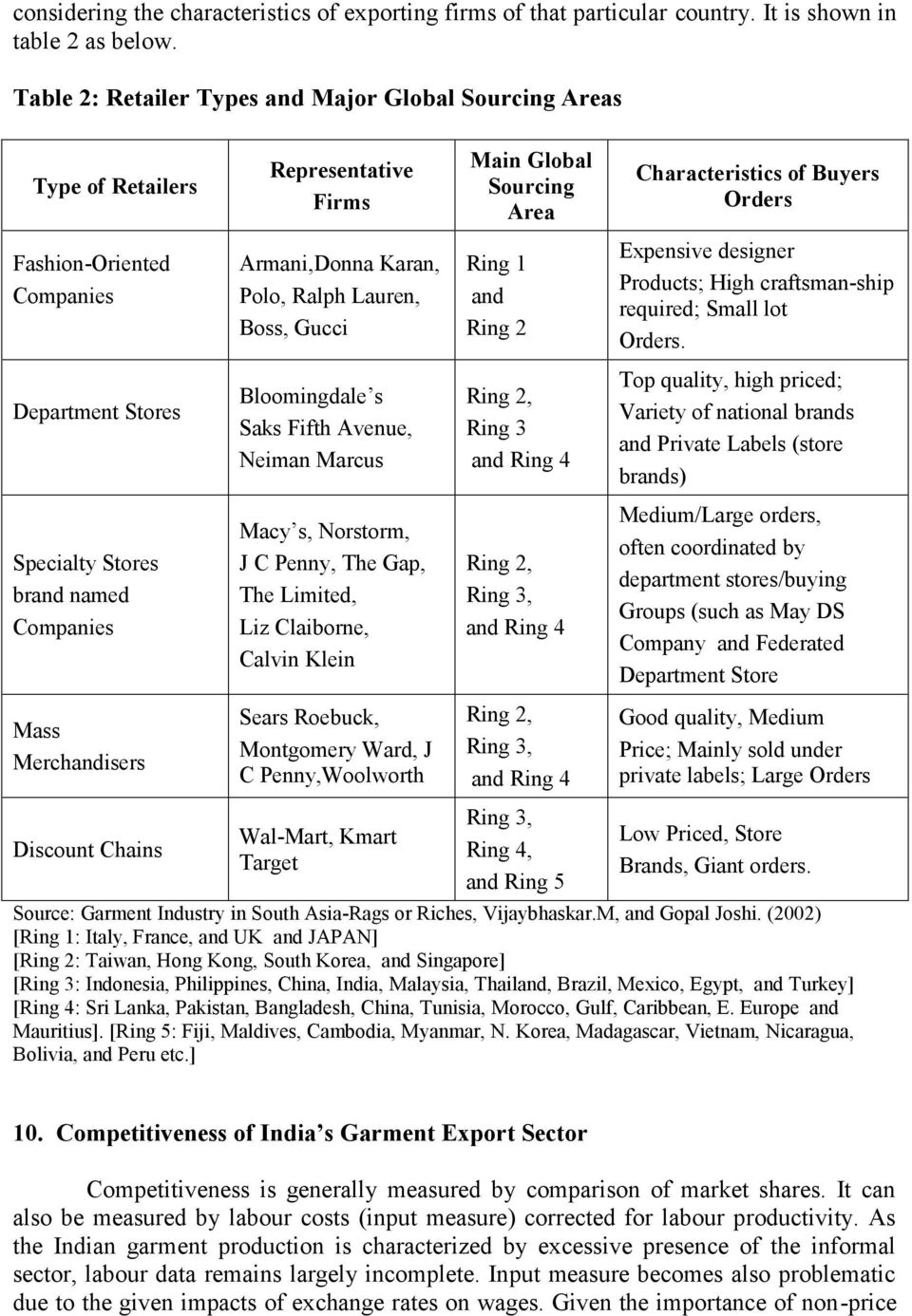
18 considering the characteristics of exporting firms of that particular country. It is shown in table 2 as below. Table 2: Retailer Types and Major Global Sourcing Areas Type of Retailers Fashion-Oriented Companies Department Stores Specialty Stores brand named Companies Mass Merchandisers Discount Chains Representative Firms Armani,Donna Karan, Polo, Ralph Lauren, Boss, Gucci Bloomingdale s Saks Fifth Avenue, Neiman Marcus Macy s, Norstorm, J C Penny, The Gap, The Limited, Liz Claiborne, Calvin Klein Sears Roebuck, Montgomery Ward, J C Penny,Woolworth Wal-Mart, Kmart Target Main Global Sourcing Area Ring 1 and Ring 2 Ring 2, Ring 3 and Ring 4 Ring 2, Ring 3, and Ring 4 Ring 2, Ring 3, and Ring 4 Ring 3, Ring 4, and Ring 5 Characteristics of Buyers Orders Expensive designer Products; High craftsman-ship required; Small lot Orders. Top quality, high priced; Variety of national brands and Private Labels (store brands) Medium/Large orders, often coordinated by department stores/buying Groups (such as May DS Company and Federated Department Store Good quality, Medium Price; Mainly sold under private labels; Large Orders Low Priced, Store Brands, Giant orders. Source: Garment Industry in South Asia-Rags or Riches, Vijaybhaskar.M, and Gopal Joshi. (2002) [Ring 1: Italy, France, and UK and JAPAN] [Ring 2: Taiwan, Hong Kong, South Korea, and Singapore] [Ring 3: Indonesia, Philippines, China, India, Malaysia, Thailand, Brazil, Mexico, Egypt, and Turkey] [Ring 4: Sri Lanka, Pakistan, Bangladesh, China, Tunisia, Morocco, Gulf, Caribbean, E. Europe and Mauritius]. [Ring 5: Fiji, Maldives, Cambodia, Myanmar, N. Korea, Madagascar, Vietnam, Nicaragua, Bolivia, and Peru etc.] 10. Competitiveness of India s Garment Export Sector Competitiveness is generally measured by comparison of market shares. It can also be measured by labour costs (input measure) corrected for labour productivity. As the Indian garment production is characterized by excessive presence of the informal sector, labour data remains largely incomplete. Input measure becomes also problematic due to the given impacts of exchange rates on wages. Given the importance of non-price
19 factors in the garment sector, unit value realization may be a better parameter for measuring competitiveness. This also poses many problems due to the highly fragmented character of the apparel market. Higher unit value realizations may indicate a heavy hold in a different market segment rather than competitiveness in similar markets. However, higher unit value is a critical factor in sustaining and improving competitiveness over time. Due to the presence of many non-price factors such as quick response, fabric quality and processing quality etc., no single indicator can reflect competitiveness of Indian garment sector properly. A number of indicators are normally used to measure competitiveness of Indian apparel exports. Within the changing global garment scenario, in which growth of garment exports to leading markets are expected to increase considerably using the nonbarrier channels, India would definitely try its hand to corner a good share through whatever means at its command. But, the ground on which India stands to stretch its hand to corner such a share also needs to be analyzed in order to understand the probable ability of India to succeed in this venture. Garment categories such as non-knit women s outerwear, non-knit undergarments and knitted undergarments constitute the biggest shares and together account for more than 70 per cent of exports from India. When compared to the market shares of these and other product categories of Indian exports against a few of its competitors, India s competitive edge is quite mixed. The comparison is restricted to apparel exports to the USA, the single largest market for Indian exports. China and Hong Kong pose the strongest competition to India in terms of market shares. China has penetrated in almost all product categories. This indicates that a regionbased specialization in specific niches may be the best option to countries to expand their shares without undermining the shares of the other countries. As the market shares might have been influenced by the quota restrictions at that time, which prevented countries from expanding exports beyond a point, a unit value comparison of product values across countries would be relevant. Data indicates that the unit values of garments exported from Hong Kong are higher than that of most other countries, which means that they compete in different, relatively up market segment as compared to other countries. Therefore, unit values may not indicate the level of competitiveness accurately. But, comparing India s unit values with the average for all countries will help to understand India s relative position. It is clear from the table that India has above average unit value in two of the six product categories though Indonesia has a higher unit value in both the categories and China in all of them. Another indicator of competitiveness is that of labour productivity, which is especially relevant to Bangalore, Mumbai, New Delhi and Tirupur characterized by highly labour intensive operations and results in many issues concerning labour standards compliance. Stuart-Smith, K. (2001), in S. Gupta (ed.) observes the road map to global supremacy. He has provided a number of competitiveness indicators of countries in terms of labour. One such indicator is the wage adjusted for productivity differences. It is found that wage adjusted for productivity is one of the highest in India. While the rank of India

20 is extremely low at 51 out of 59 countries, that of China and Indonesia are five and 45 respectively. In fact, wages are found to be very low for the country s productivity in China. Further, China too ranks pretty favorably as compared to India in terms of flexible hiring and firing practices despite better educational levels. Though these indicators are only representative of the entire workforce and may not hold true for the textile garment sector, it is quite likely that some of the differences would favor China even within the garment sector. In fact, though the data on wage rates would indicate that Indian wage rates are not too different from other peripheral economies, it is found that the cost per standard minute in India is higher than that of Indonesia. All these lead to the dismal performance of Indian garment exports in comparison to other peripheral economies, despite the high boom witnessed in areas such as Bangalore, Mumbai, New Delhi and Tirupur woven wear and knitwear cluster which remains as a drop in the ocean of global garment exports despite the fact that it provides local economic growth in relatively large measure. Various reasons have been cited for the relatively poor performance of the Indian garment sector in the world market 1.Garment exports from India is largely confined to cotton garments and hence confined to only one segment of the apparel market. 2. Government policies have created distortions in the industrial sectors, which lead to failure in reaping the liberalized and globalized trade atmosphere. 11. Latest Trends in Indian Garment Exports The latest data available from the AEPC and other secondary sources though deficient in many macro and sectoral aspects, is also not much encouraging with regard to India s position in the world garment market though it records remarkable growth compared to the last decade. The increased volume of trade is facilitated by phasing out of the barriers through the ATC integration. In the last few years, the Indian exporters have been able to create a niche for themselves in global markets. This comes from delivering products of exceptional quality as well as on time at competitive rates. According to experts, these exporters can turn in this acceptance to an opportunity. For instance, for the last many years, Indian textiles have been well accepted in international markets for their exceptional quality, so even if these products were to be expensive by a small margin, the buyers would still flock to Indian shores, since the domestic exporters have created a very good reputation for themselves. But the current price difference, when compared with those of other countries is very much on the higher side to entice an international buyer. This price difference comes from the high cost of basic raw materials, which normally account for per cent of a finished product cost. Other than raw material costs, high logistics and capital costs are hampering the growth of the industry. Indian cotton is priced at least per cent higher than those prevailing in global markets. In the new cotton season that began a few months ago, the government decided to increase the Minimum Support Price (MSP) of cotton by a whopping per cent, which resulted in increased pressure on the textile exporters.

21 The other most important raw material, Polyester fibre also attracts a five percent customs duty in addition to four percent special additional duty (SAD). But here again, the exporter is not able to avail the benefit of using the advance license system and benefit from buying raw material from global markets as, he looses the drawback given in lieu of other duties and taxes paid by him. The other most important cost centre is the cost of transportation. It is cheaper to ship material to nearby foreign countries from the nearest port, than transporting the same volume within the borders of India by road. The other issue confronting the textile exporters is refund of state taxes and duties. While the central government refunds the duties and taxes it receives from the exporters, it would help the exporters if the states were also to do so. High working capital costs also add to the already lofty overheads the textile industry is incurring. The exporters are in position to deliver exceptional results if they could access dollar loans at affordable rates. All these factors, if looked in to by the government of the day, could help the exporters ride out the crisis and at the same time grab competitor shares, since the other two major countries like China and Pakistan are facing problems of their own which is nullifying their competitive spirit and thereby could prove to be an prospect for Indian textile exporters, to turn crisis in to an opportunity. 12. Analysis of Garment Industry in the Study Region The study is intended to update the available information of the garment industry in the study region with regard to SCM practices, with focus on location advantage, competitiveness in manufacturing, risk management and power of collaboration. It also aimed at building the necessary ground for SCM actions for increasing value in the Supply chain. The aim and objective of the study is to support the activities of Garment supply chain. This could have a positive impact on the global garment sector for achieving economic, social production systems. The location selected for the study is Bangalore, Mumbai, New Delhi and Tirupur Garment cluster, a typical garment production region in India. Any attempt for launching the study for suppliers and stakeholders of supply chain needs to be prefaced by an in-depth study and analysis of the ground realities of locales that houses the suppliers and stakeholders, which should bring out the relevant supply chain standards and situations existing at the locality of intervention. It is essential to understand the current levels of supply chain practices at the selected region. The first phase of the study was restricted to cutting, making, and trimming (CMT) segment of the garment sector. Other stakeholders such as cotton farmers, ginning and spinning firms, dye houses, bleachers, accessory producers, service providers and allied firms were not included in the purview of the study but taken note of in a general manner for holistic analysis of the realities in Bangalore garment cluster. Target beneficiaries of the project are various stakeholders in the textile-garment industry of India who are producing different brands and those who wish to enter the value chain. This research study is to encourage and enable textile-garment enterprises in India to have a positive and growing impact on quality of life of the people involved by adoption of improved SCM. It has been designed to map opinions of various stakeholders. The study also contains analysis of key issues and quantification of
22 problems in Bangalore, Mumbai, New Delhi and Tirupur with the intention to develop a business model in supply chain/value chain management. 13. Sustainability of Industry in Study Region There are interesting, strange, contradictory and confusing responses among the stakeholders about the sustainable development of Bangalore, Mumbai, New Delhi and Tirupur Garment cluster and its future growth as a garment sourcing location. While trade unions, environmentalists and workers voice hopelessness, the entrepreneurs and government agencies are showing high hopes for Bangalore, Mumbai, New Delhi and Tirupur further growth into a world leader in woven wear and knitwear production.the model which is required to Bangalore, Mumbai, New Delhi and Tirupur garment cluster is to help how a resource optimization system can be put in place, given the multicolor, multi stakeholder, multiple agency situation of Bangalore, Mumbai, New Delhi and Tirupur garment cluster with a monoactivity oriented development, which is both vertically and horizontally integrated and functions almost like a complex web in terms of space, operations and hierarchies and linkages, and also characterized by high level of segmentation, disorganization and in formalization. A major constraint in any direction of sustainability of the study region would be the high sense of alienation of its large majority of people, the workers, who are not regarded as equal partners in the high flying dreams of development, but bear the pressures emanating from the dreams and the high gear attempts to realize them. Technological solutions without giving sufficient space and emphasis to human element involved would lead to imperfect results and further problems. Since then, many millions of tons of coloured clothes traveled from Bangalore, Mumbai, New Delhi and Tirupur to many corners of the Earth, bearing many brand names (and some of them leading woven and woven wear and knitwear brands of the world, adorning the shopping malls of the fashion capitals of the world). It provided high revenue (woven wear export from Bangalore, Mumbai, New Delhi and Tirupur regions itself in 2007 crossed Rs. 35,000 crores to the country and many millions in profit to people of the study region and assured survival of thousands of workers and their families. The growth in business and incentives offered by government in the form of duty drawback, income tax exemption and other schemes for export promotion enabled the exporters of Bangalore, Mumbai, New Delhi and Tirupur to plough back their entire profits into expansion and modernization of production and processing capacities. A number of new and modern production facilities with latest machines for woven and knitting, other dry processes and garment making were set up all over the town and adjacent areas. Processing facilities were also modernized with soft flow dyeing machines. Huge investments have also been made on introducing effluent treatment systems. There are more than 300 individual effluent treatment plants are working throughout the day and night to treat the effluents. Quite a few of the dyeing factories have already achieved the distinction of zero discharge. Thus there has been an all round up gradation of technology and tremendous expansion of production capacities in all areas of woven wear and knitwear manufacture. Garment manufacturers and exporters association
23 has initiated a number of huge projects to improve infrastructure facilities with the participation of central and state governments, national and international financial and funding institutions. Soft skill development has also been taking place in tandem. A number of firms have implemented ISO standards for quality, environment management, occupational safety and health of workers besides social accountability standards (SA 8000). Bangalore, Mumbai, New Delhi and Tirupur thus carved out a prominent place in the international market place for woven wear and knitwear and reputation as a reliable source of quality woven wear and knitwear at competitive prices, manufactured by adopting best manufacturing practices and delivered in time. Today, there is no big international brand that is not sourcing its requirements of woven wear and knitwear from Bangalore, Mumbai, New Delhi and Tirupur. The sustainable development achieved by Bangalore, Mumbai, New Delhi and Tirupur woven wear industry has resulted in an incremental growth of export. The redeeming feature of this all encompassing transformation is that it is continuous. The time lag in introducing new technologies from any part of the world is zero. Over the years, Bangalore, Mumbai, New Delhi and Tirupur has emerged as the leading woven wear production centre in the country. Due to hard work, dedication and tireless perseverance of the exporters to meet demands of buyers for quality, competitive pricing and adherence to delivery schedules, Bangalore, Mumbai, New Delhi and Tirupur is now in the league of top ranking producers of fashionable woven wear and knitwear in the world. This reputation is reflected in the substantial interest shown by world leaders in apparel marketing, to name a few, Wal-Mart, J C Penny, GAP, Marks and Spencer s, Sara Lee, Tommy Hilfiger, Karstadt Quell, H and, Switcher and so on. The dream of an apparel park of international standards in India is taking shape in a remote place near Bangalore i.e. Doddaballapur, is now named New Bangalore heralding a new era of growth in the quota free regime that is unfolded in The whole world appeared to have discovered Bangalore, Mumbai, New Delhi and Tirupur in the early 1990s. The success story of Bangalore, Mumbai, New Delhi and Tirupur the new boomtowns, had spread all over. Suddenly many international agencies began to take notice of these cosmopolitan cities in India as it is today, Bangalore, Mumbai, New Delhi and Tirpur industrial system is obviously not sustainable. It is characterized by heavy pollution, misuse and depletion of critical resources like land/soil, and water. Even after a decade since the above Industrial Ecology study, the situation of Bangalore, Mumbai, New Delhi and Tirupur seems to have been moving only at a snail s pace towards sustainable industrial practices. There were many efforts launched during the last decade through government, entrepreneurial and civil society initiatives. Development in the Bangalore, Mumbai, New Delhi and Tirupur woven wear and knitwear industry has attracted much academic attention in the 1990s, the industry is visualized as that of a classic sweating of labour with long hours of work and high work intensity, through the piece rate system and the use of children and female workers. The growth of garment industry in the Bangalore, Mumbai, New Delhi and Tirupur industrial clusters in relation to the accepted models of industrial districts also formed the subject of discussion in the late 1990s. There is no difference of responses among various stakeholders regarding the future of Bangalore, Mumbai, New Delhi and Tirupur needs a
24 lot more fine-tuning before going further on the dreams, though there have been many initiatives for changes in the past and some are underway. Yet there is much to be desired, especially due to the considerable share of Bangalore, Mumbai, New Delhi and Tirupur to India s export earnings. Given the kind of enthusiasm shown by almost all stakeholders, though there are skeptics too, it may not be an unachievable dream but require highly coordinated and committed efforts by all stakeholders concerned. It is clear that the global garment industry, like many other sectors, is on a course of change under the newly placed international trade regimes. It is especially interesting to note the changes due to the lifting of protectionist regimes at the consumers-end through the WTO mechanisms. While these changes would lead to increase in production and product diversity available to the consumers at competitive prices, the impacts of such non-barrier trade regimes on the actual locations of production in terms of achieving higher quality of life for the stakeholders would require some level of probing as such impacts remain either ambivalent or unclear due to deficiency of information. It is observed that heightened competition, in the wake of quota-free regimes, between the various production locations (mostly less developed or developing nations) to gain the wide and high markets of the developed nations may lead to assuring cheaper, high quality products to the already well-off segments of humanity. Simultaneously, the mad race for markets at highly competitive prices (as competition too get intensified through non-quota trade regimes) would lead to neglect of the survival needs of the majority of humanity in the Less Developed or Developing (Non-Industrialized) producer countries. While this is also partly due to the current international monetary system, based on artificial exchange values for various currencies, which is largely beneficial to the developed markets of the developed nations, seeking non-barrier integration in the currency exchange system will be the last wild dream that can be achieved in the globalized economy. The global economic system is permanently geared towards the higher benefits of those who have the purchasing power to shake and shape the market. It has no time to hear the wails and weeps of the ones who produce for these markets as a means for daily survival. Therefore, it is essential to note here some of the essential characteristics of the global garment industry, within the wide frame of the global economy, as a pre-note to understand the dynamics of garment production and exports. This is especially important because improving quality of life of stakeholders at the production-end of garment industry with the help of certain levels of buyer-pressures that has been emerging due to various factors at the buyers-end, in relation to consumption/product standards of the clothes. The new consciousness concerning 3Fs (Fair Price, Fair Say, Fair Share) and 4Cs (Produce clean, Eat clean, Wear clean, Live clean) that engendered in the developed world, While the emerging characteristics of globalization-based growth in the garment industry needs to be mentioned here as a window to understand the global dynamics of the woven wear and knitwear production and India s position within this dynamics and how Bangalore, Mumbai, New Delhi and Tirupur woven wear and knitwear cluster fits
25 into this complex dynamics. Clothes travelled long distances from production centers to the consumers even before the advent of colonialism, through various trade routes. Clothes from India travelled, along with spices, to various parts of the world through Arab and Chinese trade networks, many centuries before the beginning of the colonial history. 14. The Complex Story of Study Region The confusion concerning number of units in Bangalore, Mumbai, New Delhi and Tirupur is writ large in the peculiar culture. A large section of units do not have name boards at the entrance. The only indications to make sure that a building is used for woven wear and knitwear operation is the board announcing that no child labor employed or an announcement of some job vacancies. There is no doubt that the contribution of Bangalore, Mumbai, New Delhi and Tirupur to woven wear and knitwear exports forms a major share of the total woven wear and knitwear exports of India. But, as mentioned earlier, when compared to the total apparel exports of India, the share of Bangalore, Mumbai, New Delhi and Tirupur stands at per cent in quantity terms, but in terms of value contribution is per cent. The latest data indicates to a large extent a steady growth in exports from Bangalore, Mumbai, New Delhi and Tirupur in terms of value and quantity. It is quite intriguing that agencies which maintain updated data concerning trade activity and show willingness to share it do not find it necessary to maintain updated data on operational aspects, and if at all maintained, show unwillingness to share it for one or other reason. This point to the often veiled underbelly of Bangalore, Mumbai, New Delhi and Tirupur. Apart from the boom the study region, nearby areas are getting into the woven wear and knitwear production network. Woven wear and knitwear industry is spreading to nearby Erode and Salem districts in a fast pace. It is good for India in the last decade, though there was tough competition from other poor countries, which were also bending all rules to get the maximum out of the quota-free global garment markets. As seen above, it is still boom time in Bangalore, Mumbai, New Delhi and Tirupur. In particular, a ready-made garment, which is the most important component, has exhibited strong exports growth of 11.6 per cent in value terms, in This is a highly positive sign because ready-mades are one of the high value-added end products among garment articles. The high composition of readymade garments and cotton textiles also indicate the predominant role of Bangalore Bangalore, Mumbai, New Delhi and Tirupur in filling the garment export basket of India. The domestic market of garments in India especially that of ready-mades has tremendous potential to grow, according to many industry observers. After the emergence of intensified export based garment production, retailers all over India started marketing garments with small faults, garments rejected by the foreign buyers, and excess quantity of garments. Interestingly, export surplus (small faults, rejects and excess quantity) made in countries like Bangladesh now find their way to Bangalore, Mumbai, New Delhi and Tirupur wholesalers of surplus quantity. Recently a number of leading international brands started marketing garments in major metropolitan cities in India and most of these garments are produced in locations of the study region.
26 15. Process of Garment Production in the Study Region The process of garment production, starting from the basic raw material and ending by passing the finished product to the consumers, involves many stages, be it starting from cotton cultivation or from producing synthetic or man-made fabrics. The following table 3 shows the different operations and respective units operating Bangalore, Mumbai, New Delhi and Tirupur. Table 3 Number of production units in different operation in Bangalore, Mumbai, New Delhi and Tirupur Operations Knitting/Stitching Units 13,345 Dyeing and Bleaching 5,423 Fabric Printing 4,987 Embroidery 4,768 Other Ancillary Units 4,231 Compacting and Calendaring 3,421 Total 36,175 Number of Units Source: South Indian Hosiery Manufacturers Association (SIHMA), Bulletin, 2008 In the case of woven wear and knitwear production at Bangalore, Mumbai, New Delhi and Tirupur the main raw material is cotton yarn of different thickness. This is supplied by hundreds of spinning mills located in Coimbatore, Salem, Erode and also in other parts of India, through wholesale and retail outlets. Almost all the major raw material producers have their outlets in Bangalore. Shops and agencies selling accessories, such as buttons, zips, laces and sewing threads are enough in the study region. Similarly, the dyes and chemicals that are manufactured mainly in North India and West India are available through sales depots and dealers in the study region. The circular knitting machines, dyeing, bleaching and other machines are mainly manufactured in Punjab, especially in Ludhiana and Amritsar, which reach Bangalore, Mumbai, New Delhi and Tirupur through sales networks. Imported, new technology machinery has been used widely in the study region. Many agents and dealers for both indigenous and imported machinery are based in the study region providing access to the latest models available worldwide. In addition, there are company showrooms of imported machineries in Coimbatore, Chennai, Bangalore etc. Private enterprises have set up service providing firms to cater to various requirements of garment exports. A recent phenomenon in the study region is the upcoming consultancy firms and buying agents, which provide services for quality and standards compliances, and also assist the firms in the process of procuring export orders. While there is sufficient supply of good quality
27 yarn, including organic cotton yarn from mills specializing in organic yarn located in Hyderabad, there is still deficiency of capacity in Bangalore, Mumbai, New Delhi and Tirupur with regard to quality dyeing and finishing processes. This is a major constraint that limits the competitiveness of Indian knit garments. Though India has a very advanced spinning sector, the benefits of it are not carried up the production ladder with equal standards in dyeing and finishing. Production run are long in India, leading to high gestation and higher working process inventory. The average manufacturing and delivery lead time, from procurement of yarn to shipment (receipt by customer) of garments for Indian apparel exports is days, which is often longer than an entire fashion season. But, India is still in the Ring-3 exporters which is not a main source point of the high-value, high fashion market with such limited season span. Bangalore, Mumbai, New Delhi and Tirupur are a source point for large order brands and private labels, this lead-time problem may not be a major constraint. But, change into high value, high fashion segment would require reduction in gestation period. In such a case, India and Bangalore, Mumbai, New Delhi and Tirupur should also get ready to meet strong competition from Ring-1 countries including Italy, UK, France and Japan, which control lion s share of this market. The garment industry cluster of the study region also requires better quality and more competitive pricing for yarn and other material inputs. In the knitting process, yarn has to be converted into loops. While a defect in woven fabric is rectifiable, it is not possible in knitted fabric and yarn cost contributes 60 per cent of product cost. Liberalization of markets led to a shortage of yarn for producers of Bangalore, Mumbai, New Delhi and Tirupur. Spinning mills now prefer to export yarn, taking advantage from the high prices in the world market. During the last decade, more than 6000 units in the study region (mainly composite, vertically integrated units of the to units existing now) have gone for modernization. Soft flow dyeing machines, compacting machines for minimizing residual shrinkage, computerized colour matching systems and stenter machines for removing deformity in woven wear and knitwear are some of the many new technology introduced in the study region. There is short supply of skilled technicians and engineers to man the new technology equipments. Bangalore, Mumbai, New Delhi and Tirupur is not stagnant in relation to innovations and finding solutions to problems, and it is trying to grow up and would go for any amount of efforts to maintain and improve its position as the main location in the Indian export map. The enthusiasm that can be seen among the manufacturers, exporters, traders and even among a segment of laborers-though some segment of workers, trade unions and NGOs are skeptical about future of the study region and the concerned government agencies is unusual, according to normal Indian attitudes concerning change. The level of coordination and cooperation for changes and improvements among the stakeholders in Bangalore, Mumbai, New Delhi and Tirupur is comparatively high though at times become strained due to conflicts of interests between employers and trade unions. Apparel Export Promotion Council (APEC) observes the arrival of international brands in Bangalore, Mumbai, New Delhi and Tirupur for sourcing woven wear and knitwear has triggered a new dimension in the growth plans of the study region. They are looking for production facilities comparable to those in developed countries, not in terms
28 of size but in terms of compliance with social accountability standards, quality and environmental management systems, working conditions and work environment. Even though individual exporters have already responded to the needs of international brands, the facilities have been spread out all over the place and hence not visible. APEC has, therefore, been dreaming of a huge industrial complex for manufacture of woven wear and knitwear exclusively for exports with state of the art machinery. It is important to note that APEC has achieved its dream and the Apparel Park has come up at 35 km away from Bangalore named as Doddaballapur apparel park, the side of the national highway. But, there is all round criticism regarding the Apparel Park, as it is merely focusing on CMT and without sufficient facilities for clean production in the back-end processes of bleaching and dyeing. There is a high degree of inter-dependence among the small firms in the vertically integrated clusters. The pattern of organization in Indian garment industry show many satellites around large firms that have grown horizontally, by splitting of production into many units under a single firm. Each unit can be registered as a small-scale unit and get benefits of the SSI scheme of the government. Small firms with machines are the most flexible. Larger firms have more trouble adjusting to global market shifts, (at least in garments), according to Apparel Export Promotion Council. Designation of the unit as small scale in many cases means that firms, which are expanding, do notional separation of new units and register them as separate units (despite common ownership). This gives the distorted impression of an industry composed solely of small and medium sized individual firms. But, in fact including many units owned by the same person or family or partnership firm, and some of them though small/medium in appearance have turnover above the million mark. The complex cluster structure, with many complex webs of ownership, family and caste relationships across various units, of Bangalore, Mumbai, New Delhi and Tirupur pose many problems and complications with regard to compliance audits. Single units often belong to larger groups under family or individual or partnerships. Plants to be audited may have other units of the same group next door that are not part of the audit. They would be involved in processes that do not belong to the specific definition of the garment industry in the guidelines or codes of conduct. Other CMT units may be part of the group, but they might not be doing the work for the buyer who ordered the audit. But, in majority of audits, firms often fail to provide a fully separate administration for the different units. Therefore, there is a need to lift many veils (not corporate veils, but organization function veils) to understand the real nature and character of a unit in the study region. In addition, during peak seasons, other units completely separate from the one audited and holding the compliance certificate, would take over part of the work to meet delivery schedules.
29 16. Textile Sector High Level Value Chain Fiber Production Spinning Weaving Knitting Dyeing & Finishing Garment Confection Raw Fiber Yam Fabric Garments Dyeing Finishing Product Figure 2 Stages in Textile and Garment Value Chain Source: Author Conclusion Bangalore, Mumbai, New Delhi and Tirupur have the ability to take up small orders or large orders at short notice. It is also able to produce the entire range of woven wear and knitwear at low cost with reasonably good quality within specified schedules. However, Bangalore, Mumbai, New Delhi and Tirupur are constrained by occasional delays in delivery. It also suffers from failures to meet standards demanded by higher price niche markets and inability to compete with China, Bangladesh and Sri Lanka in the low price product segment. Non-tariff barriers emerged along with quota phase out (on account of environmental and social issues like child labour and personal safety norms) also affected the growth of the study region. Its inability to reap benefits of economies of scale due to fragmented holdings is yet another threat. At the same time, it also failed to reap the full benefits of a cluster model due to absence of professionalism and snail pace government systems. The study region is specializes in fashion sensitive products with
30 large and medium volume orders. This is in line with India s overall garment export profile, concentrated on cotton, semi-fashion, middle price segment. The minimum scale for efficient production in India is much lower than for example in China or Bangladesh, and the degree of subcontracting is much higher. The increasing dependence on agents and buying companies is a matter of serious concern. A part of value realization would be drained into the pockets of these agents. This part is lost from accumulating in the hands of the producers and thus leads to reduced trickle down to the lower ends of productionto the workers. Middlemen are classically inclined to create artificial and non-price factors that would influence production processes and costs But, in the existing conditions of high professionalism and educated entrepreneurs in the study region, are getting emerged but buying agents and family connected business units have become indispensable to some extent. But, there is a small section of secondgeneration, new, educated entrepreneurs, emerging slowly in the study region. The government-national, state and local municipal administration-have been very slow to cope with the sudden leap of Bangalore, Mumbai, New Delhi and Tirupur into the global garment market. The demand-supply duality even affected almost all the social inputs for life and resulted in high cost escalation. The present export-driven prosperity made Bangalore, Mumbai, New Delhi and Tirupur entrepreneurs to meet these costs, but deficient supply of infrastructure and other social inputs would prevent further growth. Water scarcity is the biggest problem in the study region. High population of vehicles and political rallies, protesters, unions, metro construction are causing blocks in Bangalore, Mumbai, New Delhi and Tirupur further attempt to leap up into higher rungs in the global garment marketthe general economic boom caused by woven wear and knitwear export from Bangalore, Mumbai, New Delhi and Tirupur has resulted in overall increase in cost of living. Some observers opined that it would be higher than the cost of living in Chennai, making it similar to the cost upshot in some tourist places like Kovalam (Kerala) and Goa, which made life of the majority a mad struggle for survival inside an ocean of wealth and plenty. One aspect to be considered here is that half of the total labour force of around 5,00,000 are migrants and do not have any permanent residence in Bangalore. Despite Bangalore, Mumbai, New Delhi and Tirupur achievement in woven wear and knitwear exports over the last decades, there is still shortage of permanent skilled workers, which indicate on one side the lack of vision with regard to strengthening human resources, and on the other the high bargaining ability of skilled workers in the study region. A measure of growth in the study region can be the fact that nearly 30 per cent of India s textile machinery orders last year came from Bangalore, Mumbai, New Delhi and Tirupur. There are dozens firms with a turnover of over Rs million. The biggest exporter in the cluster, Gokuldas Exports Ltd, Mathura Garments, Texport overseas, Bombay Reyan. Among the 9,500 firms registered with AEPC, nearly 6500 are in the Rs. five million turnover categories, indicating the concentration of small units. Garment making Bangalore, Mumbai, New Delhi and Tirupur is highly professional, educated and experienced enterprises, are reaping the benefits from the city being called as Silicon Valley of India. Big players are reengineering the firms by investing on information technology to reduce cost and to achieve competitive advantage.
31 A number of mills in yarn and fabric production sector, are moving into own value addition processes by becoming more involved in downstream manufacturing operations such as CMT. Although most of these mills do not directly involve in finishing operations, they are adding value to their own products by coordinating operations with those in lower end of the production chain. This move is evident in the case of export and domestic market production chains. The Government of India and state governments have been actively involved in policy making for promotion of textile and garment sector of India, spear headed by the Textiles Committee, Ministry of Textiles, and Government of India. Given the fact of high labour intensive character of the garment sector and the availability of cheap labour, India has been attempting to use the quota-free international trade regime for achieving its aim to jump into higher rings of the development ladder. This also facilitated increase in employment opportunities, mainly for the low skilled and unskilled rural migrants. But, as usual, policy prescriptions were rather slow till recently. The recent change in attitude and roles of agencies such as the Textiles Committee are remarkable as it successfully transformed from its policing role of many decades into the new promotional role, following the opportunities provided by quota-free trade regimes. REFERENCES 1. Aditya Marwaha (2008). Impact of China on Indian Garment Industry. A dissertation presented in part consideration for the degree of MA Marketing, The University of Nottingham. 2. Afuah, A. and Tucci, C (2003). Internet business models and strategies: text and cases. New York: McGraw-Hill, pp: Apparel Export Promotion Council ( 2009). Export Statistics for Garments and Knitwear. (New Delhi: Apparel Exports Promotion Council). 4. Apparel Fortnightly Report (2002). Review of Export Performance. Apparel fortnightly, April, pp: Apparel Online Report (2002). India Needs To Be Cautious But Not Worried. Apparel online, pp: Apparel Online Team Report (2002). Innovation for Garments Productivity, Apparel online, November, pp: Apparel View Report (2003). Are We Using the Right Technology For Apparel Production. Apparel View, February, pp: Balls, John D ( 2000). e-business and ERP: Transforming the Enterprise. John Wiley and Sons, Inc., New York, pp: Beaman, B.M (1998). Supply chain design and Analysis: Models and Methods. International Journal of Production Economics, 55(30), pp: Breitman and Lucas (1987). Supplier perceptions of quick response systems. Journal of Enterprise Information Management, 19(3), Calvin and Joseph (2007). Occupation Related Accidents in Selected Garment Industries in Bangalore City. Indian Journal of Community Medicine,Vol. 31, No. 3, pp
32 12. Chan, F (2001). For SMEs, Cost is all that Matters. Asia Computer Weekly, October, pp: Cohen and Lee (1989). Development of supplier selection model a case study in the advanced technology industry. Proceedings of the Institution of Mechanical Engineers, 218, Chatterjee, S. and R. Mohan (1993). India s Garment Exports, in Economic and Political Weekly, 28/35, pp: M Chopra S. and Meindl P ( 2001). SCM, Prentice Hall, New Jersey. 16. Chopra, Sunil and Peter Meindl (2003). What will drive the Enterprise software shakeout. Supply Chain Management Review, January, pp: Christopher, S. Tang (2006). Perspectives in supply chain risk management. International Journal of Production Economics, October, Volume 103, Issue 2, pp: Christopher, M. and Lee, H (2004). Mitigating supply chain risk through improved confidence. International Journal of Physical Distribution and Logistics Management, Vol. 34 No. 5, pp Christopher. M (1998). Logistics and Supply Chain Management. 2 nd edition, London: Financial Times Pitman Publishing. 20. Clarke, M. P (1998). Virtual logistics: an introduction and overview of the concepts. International Journal of Physical Distribution and Logistics Management, 28(7), pp: Claire Shaeffer (2009). Sewing for the Apparel Industry. Prentice Hall, New Delhi. 22. Cooper, M.C. and Pagh, J. D (1999). SCM: Implementation Issues and Research Opportunities. The International Journal of Logistics Management 9(2), pp: Copacino W (2000). The e-synchronized supply chain. Logistic management distribution, report, Vol.39, pp: Croom, S.P., Romano and M. Giannakis (2000). Supply Chain Management: An Analytical Framework for Critical Literature Review. European Journal of Purchasing and Supply Management, 6(1), pp David Anderson and hau Lee (2001). New Supply Chain Business Models The Opportunities and Challenges. ASCET Key Note. 26. David Taylor and Alyse Terhune (2000). Collaborative Communities: The Next Advantage. Supply Chain Management Review, March pp: Deshpande P.P (2009). Garment - Export Industry of India. APH Publishing Corporation, New Delhi. 28. Donald Bowersox, David Closs, Theodore Stank, and Scott Keiler (2000). How Supply Chain Competency Leads to Business Success. Supply Chain Management Review, September, pp: Donald R.Coper (2006). Business research methods. Florida atlantic University,Tata Mc.Graw-Hill publishing company limited,newdelhi,pp: Ean Korea (1998). Guidebook for POS system adoption in apparel industry. 31. Ethel C. Brooks (2007). Unraveling the Garment Industry: Transnational Organizing and Women's Work. University of Minnesota Press, Minnesota, USA
33 32. Exim Bank of India (1995). Indian Garment Exports: Implications of the MFA. Phase-Out Occasional, pp: 34. (Delhi: India Book House). 33. Fred Kuglin and Barabra Rosenbaum (2001). The Supply Chain Network at Internet Speed. New York, NY: Amazon.com 34. Gary Gereffi (2003). The Global Apparel Value Chain: What Prospects for Upgrading by Developing Countries. Duke University Durham, USA and Olga Memedovic, UNIDO, Strategic Research and Economics Branch, pp Gilbert and Alorie (2001). Collaborative Business. Information Week, May, pp: Harland, C., Brenchley, R. and Walker, H (2003). Risk in supply networks. Journal of Purchasing and Supply Management, Vol. 9 No. 1, pp Hau Lee and Seungjin Whang (1999). Supply Chain Integration in the Age of e- Business. Supply Chain Management Global Supplement, pp: Hau Lee, V. Padmanabhan, and Seungjin Whang (1997). The Bullwhip Effect in Supply Chains. Sloan Management Review, Spring, pp: Hoque and Faisal (2000). e-enterprise: business models, Architecture, and components. Cambridge University Press, Cambridge, UK, pp: Hugos, M (2002). Essentials of supply chain management. New York, John Wiley. Implementation framework Logistic information management, Vol. 13. No.1, pp: John Mentzer, James Foggin and Susan Golicic (2000). Collaboration: The Enablers, Impediments, and Benefits. Supply Chain Management Review, September, pp: Lambert, D. M., Cooper, M. C., and Pagh, J. D (1998). SCM: Implementation Issues and Research Opportunities. The International Journal of Logistics Management 9(2), PP: Lancaster, S., Yen, D., and Yuan K. C (2006). Information Management, Computer Security, Vol. 14, No. 2, pp: Liang, T (2004). Effects of electronic commerce models and industrial characteristics on firm performance. Industrial Management & Data Systems, 104(7), pp: Marlon Lezama, Brian Webber and Charles Dagher (2005). Sourcing Practices In The Apparel Industry: Implications For Garment Exporters In Commonwealth Developing Countries. Commonwealth Secretariat, Marlborough House, Pall Mall, London SW1Y 5HX, UK 46. Matthias Holweg Stephen Disney, Jan Holmström and Johanna Smaros (2005). Supply Chain Collaboration: Making Sense of the Strategy Continuum. European Management Journal, April, Volume 23, Issue 2, pp: Mecker, S.S (1999). Internet supply chain management. Electronic News, Vol. 45, No. 33, pp: Mentzer, J., Dewitt, W., Keebler, J., Min, S., Nix, N., Smith, C. and Zacharia, Z (2001). Defining supply chain management. Journal of Business Logistics, Vol. 22 No. 2, pp Morgen, D (2004). Deploying extranet. Network security, Vol. 12, pp: Norris, Grant, Hurley, James R., Hartley, Kenneth M., Dunlcavy. John R., and Balls John D (2000). E-Business and ERP: Transforming the Enterprise. John Wiley & Sons, Inc., New York, pp: 13.
34 51. Pawar, S.K. and Driva Helen (2000). Electronic trading in supply chain a holistic Approach. 57 th All India Textile Conference, The textile Association (India) PHC. 52. Ramaswamy, K.V. and G. Gereffi (1998). India s Apparel Sector in the Global Economy Catching Up or Falling Behind?. Economic and Political Weekly, 33-3, pp: Radhika Balakrishnan (2001). The Hidden Assembly Line: Gender Dynamics of Subcontracted Work In A Global Economy. Kumarian Press, New Delhi. 54. Ron Ireland and Robert Bruce (2000). CPFR: Only the Beginning of Collaboration. Supply Chain Management Review, September, pp: Samar Verma (2002). Export Competitiveness of Indian Textile and Garment Industry. Working paper No. 94, Indian Council for Research on International Economic Relations, New Delhi. 56. Satyaki Roy (2009). Garments Industry In India-Lessons from Two Clusters. Institute for Studies in Industrial Development, New Delhi. 57. Serve, M., Yen, D. C., and Wang, J. C (2002). B2B enhanced supply chain process: toward building virtual enterprises. Business Process Management Journal, 8(3), pp: Stuart Smith, and Gupta K N S (2001). Roadmap to Global Supremacy. 59. Subbulakshmi V (2004), Indian Garment Industry - Prospects Beyond ICFAI University, Hyderabad. 60. Swallow D.A (2008). Production and control in the Indian garment export industry. Cambridge Press, pp Vijayabaskar, M ( 2002). Garment Industry in South Asia-Rags or Riches - Competitiveness, productivity and job quality in the post-mfa environment, Williams, L. R., Esper, T. L., and Ozment, J (2002). The electronic supply chain: the impact of the current and future structure of strategic alliances, partnerships and logistics leadership. International Journal of Physical Distribution and Logistics Management, 32(8), pp: Xiaobo Zhao, Deju Xu, Hanqin Zhang and Qi-Ming He (2006). Modeling and analysis of a supply assembly store chain, European Journal of Operational Research, Vol. 176, Is 1, 2006, pp:
Annexure 1. 1. India s FTA/PTA and RMG Trade with FTA/PTA Partners
 Annexure 1 1. India s FTA/PTA and RMG Trade with FTA/PTA Partners The size of India s clothing industry is estimated to be US$ 62 bn. in 2012 as per FICCI and Textile committee estimates including exports
not to be republished NCERT A Shirt in the Market
 CHAPTER 9 A Shirt in the Market This chapter tells us the story of a shirt! It begins with the production of cotton and ends with the sale of the shirt. We shall see that a chain of markets links the producer
Polyester Fibres in Europe: Developments and Trends
 Polyester Fibres in Europe: Developments and Trends 9th China International Polyester and Intermediates Forum Frédéric VAN HOUTE Director General, CIRFS Shanghai, P.R. China, November 8 9, 2012 1. Background
THE DEVELOPMENT OF SUPPLY CHAIN MANAGEMENT IN THAILAND TEXTILE INDUSTRY
 THE DEVELOPMENT OF SUPPLY CHAIN MANAGEMENT IN THAILAND TEXTILE INDUSTRY Veeris Ammarapala Management Technology Program Sirindhorn International Institute of Technology, Thammasat University Pathumthani
The Textile and Apparel Industry in India
 The Textile and Apparel Industry in India Pankaj Chandra Indian Institute of Management Vastrapur, Ahmedabad 380015 [email protected] October 2005 Revised April 2006 This essay has been prepared
TURKISH TEXTILE, APPAREL, LEATHER and CARPET INDUSTRIES
 TURKISH TEXTILE, APPAREL, LEATHER and CARPET INDUSTRIES HISTORICAL BACKGROUND TEXTILE AND APPAREL Turkey had a closed economy until 1980s; production and export were at poor levels. With the shift towards
JCT Limited. Stock Performance Details Shareholding Details September 2015
 JCT Limited Date: 17 th February, 216 Stock Performance Details Shareholding Details September 215 Current Price : ` 5.49^ Face Value : ` 2.5 per share 52 wk High / Low : ` 1.99 / 2.55 Total Traded Volume
Weiqiao Textile Announces its 2015 Interim Results
 Weiqiao Textile Announces its 2015 Interim Results Seize new opportunities in new normal development phase Continued leadership against the backdrop of industry changes Financial Summary Revenue was approximately
Training Construction Workers for Sustainable Environment
 International Journal of Environmental Research and Development. ISSN 2249-3131 Volume 4, Number 1 (2014), pp. 21-26 Research India Publications http://www.ripublication.com/ijerd.htm Training Construction
INDIAN LUBRICANT INDUSTRY - SHRINKING MARGINS
 INDIAN LUBRICANT INDUSTRY - SHRINKING MARGINS Declining demand growth of automotive lubricants, increasing competition on account of the presence of a large number of players, and increasing raw material
GROWTH AND PROSPECTS FOR SERVICE SECTOR IN GLOBALIZED ECONOMY: A STUDY OF INDIAN TOURISM INDUSTRY
 GROWTH AND PROSPECTS FOR SERVICE SECTOR IN GLOBALIZED ECONOMY: Harini K.V * Indira M** A STUDY OF INDIAN TOURISM INDUSTRY Abstract: The services industry is one of the largest and fastest-growing sectors
Fifty years of Australia s trade
 Fifty years of Australia s trade Introduction This edition of Australia s Composition of Trade marks the publication s 50th anniversary. In recognition of this milestone, this article analyses changes
Key Success Factors for the Apparel Manufacturing Industry: A Case Study at Company X
 , July 2-4, 2014, London, U.K. Key Success Factors for the Apparel Manufacturing Industry: A Case Study at Company X Devkumar S Callychurn, K Soobhug and Dinesh K Hurreeram Abstract - The Mauritian apparel
GLOBAL SOURCING IN THE U.S. APPAREL INDUSTRY. GARY GEREFFI Duke University ABSTRACT
 GLOBAL SOURCING IN THE U.S. APPAREL INDUSTRY GARY GEREFFI Duke University ABSTRACT This article analyzes the sourcing patterns of the U.S. apparel industry using a global supply chain perspective. Retailers,
A Comparative Study between Organised and Unorganised Manufacturing Sectors in India
 The Journal of Industrial Statistics (2012), 1 (2), 222-240 222 A Comparative Study between Organised and Unorganised Sectors in India Ruchika Gupta 1, Department of Higher Education, New Delhi, India
Asia Insight: Online to Offline The Great Technology Migration
 Asia Insight: Online to Offline The Great Technology Migration July 25, 2015 by Michael Oh of Matthews Asia A few years back, when we last wrote extensively about the significant developments undergone
STATS WINDOW. Retail industry
 Volume 8, Issue 4, October 2015 STATS WINDOW The Pacific Business Review International has taken an initiative to start a section which will provide a snapshot of major Global & Indian economic indicators
FABRIC INDUSTRY PRODUCTION
 FABRIC INDUSTRY Having the largest share in Turkish industrial production, the textile industry is one of the first established industries in Turkey. The sector comprises 19 thousand manufacturing companies
International Trade Financing and Risk Management Manual
 International Trade Financing and Risk Management Manual Website: www.aepcindia.in For query please contact: Ms. Vanni Mehta, [email protected] Incorporated in1978, (AEPC) is the official body of apparel
Executive Forum on National Export Strategies
 2002 Executive Forum on National Export Strategies Maannaaggi inngg Coomppeetti itti ivvee Addvvaannttaaggee: : Thhee Vaal luueess ooff Naatti ioonnaal l Sttrraatteeggyy ADDING VALUE: BUILDING VALUE-ADDITION
World Manufacturing Production
 Quarterly Report World Manufacturing Production Statistics for Quarter IV, 2013 Statistics Unit www.unido.org/statistics Report on world manufacturing production, Quarter IV, 2013 UNIDO Statistics presents
Ralph Lauren. Shelby Gray Group #2 BUS 440.02 11:30
 Ralph Lauren Shelby Gray Group #2 BUS 440.02 11:30 0 COMPANY OVERVIEW Polo Ralph Lauren is a company specializing in the production of lifestyle products. Ralph Lauren began forty years ago with simply
PERIPHERAL ACTIVITIES Fashion photography Hair care and cosmetics Accessories Perfumes Modelling
 designer fashion PERIPHERAL ACTIVITIES Fashion photography Hair care and cosmetics Accessories Perfumes Modelling RELATED ACTIVITIES Magazine publishing Design education Graphic design Product design CORE
Press October 2010. Texprocess Leading International Trade Fair for Processing Textile and Flexible Materials Frankfurt am Main, 24 to 27 May 2011
 Press October 2010 Texprocess Leading International Trade Fair for Processing Textile and Flexible Materials Frankfurt am Main, Dr. Michael Sturm Tel. +49 69 7575-6463 Fax +49 69 7575-6758 [email protected]
Trends in Australia s Exports 1
 April 2 Trends in Australia s Exports 1 The reduction of trade barriers, and cheaper transportation and communication costs have contributed to Australia becoming more open and more closely integrated
The three most important things in retailing are location, location and location.
 Location Introduction Most business studies textbooks can t resist starting a section on business location with the following phrase: The three most important things in retailing are location, location
Global Marine Trends 2030
 Global Marine Trends 2030 Global Marine Trends 2030 A Positive Marine World in 2030 Optimism is a strategy for making a better future. Because unless you believe that the future can be better, you are
India s Services Exports
 Markus Hyvonen and Hao Wang* Exports of services are an important source of demand for the Indian economy and account for a larger share of output than in most major economies. The importance of India
The Evolution of Textile and Apparel Industry in Asia. Dr. Gordon YEN Executive Director & Chief Financial Officer
 The Evolution of Textile and Apparel Industry in Asia Dr. Gordon YEN Executive Director & Chief Financial Officer 1 Global Supply Chain Major cotton suppliers Major yarn spinners & fabric mills Major garment
Application of SaaS BPM in Apparel Manufacturing
 Application of SaaS BPM in Apparel Manufacturing by Krishna Kumar Simbus Technologies 1 www.simbustech.com TABLE OF CONTENTS Introduction..3 External Reasons 5 Internal Reasons.7 2 www.simbustech.com .
II. Merchandise trade
 II. Merchandise trade World merchandise trade grew by 2 per cent in volume terms in 2012 against a backdrop of weak global demand and declining prices. This is significantly less than the 5 per cent increase
GROWTH & DEVELOPMENT OF THE MALAYSIAN ECONOMY - An overview -
 GROWTH & DEVELOPMENT OF THE MALAYSIAN ECONOMY - An overview - MOHAMED ARIFF 1 MALAYSIA: GDP GROWTH % 15 10 5 0-5 -10 1957 1960 1970 1980 1990 2000 2010 GDP Growth (%) Source: DOS 2 Factors Contributing
World Manufacturing Production
 Quarterly Report World Manufacturing Production Statistics for Quarter III, 2013 Statistics Unit www.unido.org/statistics Report on world manufacturing production, Quarter III, 2013 UNIDO Statistics presents
Export Growth and Prospect of Floriculture in India
 Export Growth and Prospect of Floriculture in India *Amitava Saha I Introduction Floriculture is an age old farming activity in India having immense potential for generating gainful self-employment among
AFRICA EN VOGUE THE OPPORTUNITIES AND CHALLENGES OF TEXTILE & APPAREL SOURCING MARKETS IN EAST AFRICA
 AFRICA EN VOGUE THE OPPORTUNITIES AND CHALLENGES OF TEXTILE & APPAREL SOURCING MARKETS IN EAST AFRICA The focus on Textile & Apparel (T&A) sourcing markets has so far been on Asia. Yet, also African countries
The wool fibre is capable of producing vastly superior product by segregating fleeces from sheep to garment, but to do so is expensive.
 CASE STUDY 2 : WOOL SUPPLY CHAIN 1 Synopsis This is a story about a joint venture arrangement in a wool supply chain, from Australian woolgrower to European weaver. The arrangement operated from 1994 until
education. In contrast, workers engaged in fishing worked an average of 61.7 hours per
 THAILAND 40,000 Fig. 1: Employment by Major Economic Activity ('000s), 2002-2008 Agriculture, Forestry, Agriculture, Forestry & 35,000 30,000 25,000 20,000 15,000 10,000 5,000 0 2002 2004 2006 2008 Mining
Recent trends of dynamically growing and developing life insurance markets in Asia
 Recent trends of dynamically growing and developing life insurance markets in Asia Tomikazu HIRAGA, Ph.D. and LL.M. General Manager for Asia, NLI Research Institute Asia is a growth market where foreign
Chinese students and the higher education market in Australia and New Zealand.
 Chinese students and the higher education market in Australia and New Zealand. by Ma Xiaoying English Department North China Electric University, Beijing, China and Malcolm Abbott Centre for Research in
Clothing Consumption By. On Fibre Manufacturer Supply Chains. Arvind Singhal Chairman, Technopak Advisors. 6 th Nov, 2012
 Global ChangesIn Clothing Consumption By 2020, And Their Impact On Fibre Manufacturer Supply Chains Arvind Singhal Chairman, Technopak Advisors 6 th Nov, 2012 Presentation Flow 2 Key trends impacting global
FY2015 Survey on the International Operations of Japanese Firms JETRO Overseas Business Survey
 Japan External Trade Organization FY2015 Survey on the International Operations of Japanese Firms JETRO Overseas Business Survey March 3, 2016 Japan External Trade Organization (JETRO) Table of contents
CARDATO REGENERATED CO2 NEUTRAL
 EXECUTIVE SUMMARY CARDATO REGENERATED CO2 NEUTRAL The recycling of wool, feature upon which the Prato textile industry of Italy was founded, is being again adopted for its sustainability, to eliminate
Micro, Small and Medium Enterprises Financing in India - Issues and Concerns
 Micro, Small and Medium Enterprises Financing in India - Issues and Concerns Dr. C.S. Prasad* Micro, Small and Medium enterprises (MSME) constitute the dominant form of business organisation worldwide.
Economic Change in India
 Adam Cagliarini and Mark Baker* India has become an increasingly important part of the global economic landscape over the past decade. Its economy has become more open to international trade, its workforce
Strategic Planning for the Textile and Clothing Supply Chain
 , July 4-6, 2012, London, U.K. Strategic Planning for the Textile and Clothing Supply Chain Deedar Hussain, Manuel Figueiredo, Anabela Tereso, and Fernando Ferreira Abstract The expansion of textile and
II. Merchandise trade
 II. Merchandise trade Merchandise trade increased by 5 per cent in volume in 211. The strongest momentum was achieved by trade in manufactured goods, which grew by.5 per cent. Key developments in 211:
The Partnership for Sustainable Textiles
 The Partnership for Sustainable Textiles We all agree that we do not wish to have clothes touching our bodies that have been produced in places where human rights are being trampled underfoot and people
TPP#NEGOTIATION## OPPORTUNITIES#AND#CHALLENGES#FOR# VIETNAM#TEXTILE#&#APPAREL#INDUSTRY#
 TPP#NEGOTIATION## OPPORTUNITIES#AND#CHALLENGES#FOR# VIETNAM#TEXTILE#&#APPAREL#INDUSTRY# Vietnam Textile & Apparel Association Hanoi, March 2013 INDUSTRY INTRODUCTION ROLE OF T&A INDUSTRY IN VIETNAM INTEGRATING
Economic Policy and State Intervention (Richards and Waterbury CHs #2,3,7,8,9) 1. Recovery Since 1800 2. Growth Policies 3. Why the Middle East Chose
 Economic Policy and State Intervention (Richards and Waterbury CHs #2,3,7,8,9) 1. Recovery Since 1800 2. Growth Policies 3. Why the Middle East Chose Import Substitution 4. MENA vs. Asia 5. Reform Disparity
Schemes for Financing Micro, Small and Medium Enterprises
 Schemes for Financing Micro, Small and Medium Enterprises Background The Small Scale Industries Sector, redefined since 2006 as the Micro Small and Medium Enterprises Sector has played a seminal role in
66th Plenary Meeting of the INTERNATIONAL COTTON ADVISORY COMMITTEE
 66th Plenary Meeting of the INTERNATIONAL COTTON ADVISORY COMMITTEE MINUTES FIRST OPEN SESSION 11:00 hr. Monday October 22, 2007 Mr. Yakup Güngör, President of Textile Group of Haci Ömer Sabanci Holding
General Certificate of Education Advanced Level Examination January 2010
 General Certificate of Education Advanced Level Examination January 2010 Economics ECON4 Unit 4 The National and International Economy Tuesday 2 February 2010 1.30 pm to 3.30 pm For this paper you must
BUY RSWM LTD SYNOPSIS. CMP 292.20 Target Price 336.00. SEPTEMBER 1 st 2015. Result Update(PARENT BASIS): Q1 FY16
 BUY CMP 292.20 Target Price 336.00 RSWM LTD Result Update(PARENT BASIS): Q1 FY16 SEPTEMBER 1 st 2015 ISIN: INE611A01016 Index Details Stock Data Sector Textiles BSE Code 500350 Face Value 10.00 52wk. High
Global Cashew Nut Industry Report
 Brochure More information from http://www.researchandmarkets.com/reports/310379/ Global Cashew Nut Industry Report Description: Cashew a native of Eastern Brazil was introduced to India by the Portuguese
The Fiber-Textile-Apparel Value Chain: Mexico and China Compared
 The Fiber-Textile-Apparel Value Chain: Mexico and China Compared Gary Gereffi, Duke University Durham, North Carolina / USA [email protected] First Forum on Opportunities in the Economic and Trade Relationship
Brief about Texpo 2016 07~10 April 2016 at Karachi Expo Centre. Textile Sector of Pakistan
 Subject: TEXPO 206 Pakistan (24-27 March 206) at Karachi EXPO Centre Trade Development Authority of Pakistan (TDAP) in consultation with Ministry of Commerce of Pakistan will be organizing a maiden sector
Address by CEO Karl-Johan Persson at H&M s AGM 2015
 Address by CEO Karl-Johan Persson at H&M s AGM 2015 Good afternoon everybody, and a warm welcome to H&M s annual general meeting 2015. I am very pleased to see so many of you here today. As always, lots
Unemployment: Causes and its Economics Outcomes during Recent Years in Afghanistan
 Unemployment: Causes and its Economics Outcomes during Recent Years in Afghanistan Summary, Conclusion and Recommendations The objective of the paper is to study the current situation of labor market in
International Education in the Comox Valley: Current and Potential Economic Impacts
 International Education in the Comox Valley: Current and Potential Economic Impacts FINAL REPORT March 2012 Prepared by: Vann Struth Consulting Group Inc. Vancouver, BC www.vannstruth.com Prepared for:
World Fashion Exchange
 World Fashion Exchange Company Profile Solutions for the Apparel, Accessories, Retailers and Brand Manufacturers Traders / Agents / Whole Sellers Apparel. Accessories. Retail. Brand Manufacturing Company
Global Exhibition on Services
 Ministry of Commerce & Industry Global Exhibition on Services Concept Note 1 GES Concept Note Global Exhibition on Services (GES) - Concept Note The Government of India, Ministry of Commerce and Industry
Executive summary. Global Wage Report 2014 / 15 Wages and income inequality
 Executive summary Global Wage Report 2014 / 15 Wages and income inequality Global Wage Report 2014/15 Wages and income inequality Executive summary INTERNATIONAL LABOUR OFFICE GENEVA Copyright International
The Research of Vancl Network Marketing
 The Research of Vancl Network Marketing WU Zhonghua School of Business Administration, Jiangxi University of Finance and Economics, China, 330013 [email protected] Abstract: In recent years, the garment
Comparing Chinese Investment into North America and Europe
 Comparing Chinese Investment into North America and Europe 1 EXECUTIVE SUMMARY Chinese outbound foreign direct investment (OFDI) has grown rapidly in recent years and is increasingly flowing to high-income
IJPSS Volume 2, Issue 3 ISSN: 2249-5894
 A STUDY ON PROBLEM AND PROSPECTS OF WOMEN ENTREPRENEURS WITH SPECIAL REFERENCE TO G. PALANIAPPAN* C. S. RAMANIGOPAL** A. MANI*** ERODE DISTRICT ABSTRACT: Women have been successful in breaking their confinement
India's Foreign Trade Statistics
 India's Foreign Trade Statistics Each country tries to increase the availability of goods and services to its people through purchase from other countries. Similarly it tries to sell its surplus production
SWOT Analysis of E-Commerce
 Advance in Electronic and Electric Engineering. ISSN 2231-1297, Volume 4, Number 6 (2014), pp. 663-668 Research India Publications http://www.ripublication.com/aeee.htm SWOT Analysis of E-Commerce Ms Kiran
Impact of Foreign Direct Investment, Imports and Exports
 Impact of Foreign Direct Investment, Imports and Exports Dr. A. Jayakumar, Professor of Commerce, Periyar University, Salem, India. Kannan.L, Research Scholar, Department of Commerce, Periyar University,
TURKISH CLOTHING INDUSTRY
 TURKISH CLOTHING INDUSTRY The root of textile production in Turkey goes centuries back to the Ottoman period. The textile production was quite widespread and advanced in the 16th century in Turkey, while
Global Demographic Trends and their Implications for Employment
 Global Demographic Trends and their Implications for Employment BACKGROUND RESEARCH PAPER David Lam and Murray Leibbrandt Submitted to the High Level Panel on the Post-2015 Development Agenda This paper
Trinidad and Tobago. Table 1: GDP Value Added by Industry (Million Dollars, Constant Prices) & % Share in Total Value Added
 TRINIDAD AND TOBAGO 600 Fig. 1: Employment by Major Economic Activity ('000s), 2000-2008 Agriculture, Hunting, Forestry and Fishing Community, Social & Personal 500 400 300 200 100 100,000 90,000 80,000
Towards 2017 Better Work Phase III Strategy
 Towards 2017 Better Work Phase III Strategy Towards 2017 Better Work Phase III Strategy Promoting Good Working Conditions Across the International Garment Industry Problem Analysis Sixty million workers
The Global E-Commerce Gold Rush How Retailers Can Find Riches Overseas
 The Global E-Commerce Gold Rush How Retailers Can Find Riches Overseas By Joanne Bethlahmy, Bharat Popat, and Paul Schottmiller E-commerce is going global as retailers from around the world take advantage
MICRO, SMALL AND MEDIUM ENTERPRISES ( MSME ) INDIAN SCENARIO
 MICRO, SMALL AND MEDIUM ENTERPRISES ( MSME ) INDIAN SCENARIO Jawhar Sircar Additional Secretary & Development Commissioner Ministry of Micro, Small & Medium Enterprises Government of India 1 India: a large
OVERCOMING BARRIERS TO GOING GLOBAL
 EXPORTING IS GOOD FOR BRITAIN OVERCOMING BARRIERS TO GOING GLOBAL Despite the barriers to business growth present here in the UK, domestic business is deemed far simpler than international business. Competition
Science Technology and Innovation in Sri Lanka
 THE PANEL OF THE UNITED NATIONS COMMISSION ON SCIENCE AND TECHNOLOGY FOR DEVELOPMENT 28-30 November 2007 Kuala Lumpur Science Technology and Innovation in Sri Lanka The views presented here are the participants
GLOBAL MARKETING PROGRAM
 GLOBAL MARKETING PROGRAM Building the Brand May 8, 2014 OUTLINE WHO WE ARE Introduction Strategic Planning Program Implementation Conclusion COTTON COUNCIL INTERNATIONAL WHY PROMOTE COTTON EXPORTS? Growing
Contract 4212 Study Report Vision 2020 For the Sustained Growth of Textile Machinery Industry for
 Contract 4212 Study Report Vision 2020 For the Sustained Growth of Textile Machinery Industry for Supported by Development Council for Textile Machinery Industry Department of Heavy Industry(DHI) Ministry
A True Roller Coaster Ride: Sourcing Markets Force Fashion Players to Paradigm Change. Kurt Salmon Global Sourcing Reference 2015 [12th Edition]
![A True Roller Coaster Ride: Sourcing Markets Force Fashion Players to Paradigm Change. Kurt Salmon Global Sourcing Reference 2015 [12th Edition]](/thumbs/27/10389845.jpg "A True Roller Coaster Ride: Sourcing Markets Force Fashion Players to Paradigm Change. Kurt Salmon Global Sourcing Reference 2015 [12th Edition]") A True Roller Coaster Ride: Sourcing Markets Force Fashion Players to Paradigm Change Kurt Salmon Global Sourcing Reference 2015 [12th Edition] Increases of sourcing costs in China and other important
A True Roller Coaster Ride: Sourcing Markets Force Fashion Players to Paradigm Change Kurt Salmon Global Sourcing Reference 2015 [12th Edition] Increases of sourcing costs in China and other important
Research & Corporate Development DERIVATIVES MARKET TRANSACTION SURVEY 2009/10
 Research & Corporate Development DERIVATIVES MARKET TRANSACTION SURVEY 2009/10 November 2010 CONTENTS Page 1. Introduction...1 2. Key findings... 3 3. Figures and tables... 7 3.1 Distribution of trading
CHANGING HRM PRACTICES WITH SPECIAL REFERENCE TO RETENTION POLICIES AT TCS
 CHANGING HRM PRACTICES WITH SPECIAL REFERENCE TO RETENTION POLICIES AT TCS Ms. Ruchita Petkar Asst. Professor ATSS CBSCA, Chinchwad, Pune Dr. Suhas Sahasrabudhe Principal CSIT, Shahu Nagar, Pune Abstract:
Trends in Private and Public Investments in Agricultural Marketing Infrastructure in India
 Agricultural Economics Research Review Vol. 21 (Conference Number) 2008 pp 371-376 Trends in Private and Public Investments in Agricultural Marketing Infrastructure in India M.S. Jairath* National Institute
HUMAN RESOURCE MANAGEMENT IN MAKE IN INDIA. Dr. NIRU SHARAN Assistant Professor Amity Law School, Noida
 HUMAN RESOURCE MANAGEMENT IN MAKE IN INDIA Dr. NIRU SHARAN Assistant Professor Amity Law School, Noida A country is what its people are, and therefore definitely the success of a project will depend on
Global Sourcing Highlights and Trends for 2015 Onwards
 Global Sourcing Highlights and Trends for 2015 Onwards World Sports Forum 2015 04.02.2015 Dr. Sven Kromer Munich Kurt Salmon Over 75 Years of Consulting for the Apparel and Footwear Industry North America
What s next in apparel sourcing?
 58 Toko Ohmori What s next in apparel sourcing? Chief procurement officers at the world s largest apparel companies are facing higher costs, tackling knotty compliance issues, and exploring new sourcing
SAP Business One The Right Solution for Small & Medium Enterprises
 SAP Business One The Right Solution for Small & Medium Enterprises www.praxisinfosolutions.com About the Author: Dattatreya R Kulkarni (http://tinyurl.com/o3j7fga), is one of the Founding Directors of
Legislative Council Panel on Economic Services
 For discussion on 25 January 1999 Legislative Council Panel on Economic Services PROMOTION OF HONG KONG AS AN INTERNATIONAL SHIPPING CENTRE Purpose This paper aims to inform members of a series of new
Foreign Direct Investment in Automobile Industry
 ISSN: 2347-3215 Volume 1 Number 3 (2013) pp. 33-37 www.ijcrar.com Foreign Direct Investment in Automobile Industry T. Rajesh 1 and A.S. Dileep 2* 1 Department of Commerce, Govt College, Ambalapuzha, India
Reference: Gregory Mankiw s Principles of Macroeconomics, 2 nd edition, Chapters 10 and 11. Gross Domestic Product
 Macroeconomics Topic 1: Define and calculate GDP. Understand the difference between real and nominal variables (e.g., GDP, wages, interest rates) and know how to construct a price index. Reference: Gregory
TOP 10 THINGS TO KNOW ABOUT DOING BUSINESS IN INDIA
 TOP 10 THINGS TO KNOW ABOUT DOING BUSINESS IN INDIA By Dezan Shira & Associates, Delhi Office [email protected] 1. What are my options for investment? Foreign investment into India can come in a variety
Small-Medium Enterprises in Hong Kong: Recent Developments and Policy Issues. Y. C Richard Wong The University of Hong Kong
 8/7/13 Small-Medium Enterprises in Hong Kong: Recent Developments and Policy Issues Y. C Richard Wong The University of Hong Kong We review the recent developments of small and medium enterprises (SMEs)
ABHINAV NATIONAL MONTHLY REFEREED JOURNAL OF RESEARCH IN ARTS & EDUCATION www.abhinavjournal.com
 PERFORMANCE OF INDIA S ELECTRONICS & COMPUTER SOFTWARE SERVICES INDUSTRY G. V. Vijayasri Research Scholar, Department of Economics, Andhra University, Visakhapatnam, Andhra Pradesh, India Email: [email protected]
Intertextile Shanghai Apparel Fabrics Exhibition 21-24 October 2013
 Intertextile Shanghai Apparel Fabrics Exhibition 21-24 October 2013 1.The Show: This year witnessed the largest ever Intertextile Shanghai Apparel Fabric Fair, a dynamic and ultra-busy business platform,
ASIAN JOURNAL OF MANAGEMENT RESEARCH Online Open Access publishing platform for Management Research
 Online Open Access publishing platform for Management Research Copyright by the authors Licensee IPA Under Creative Commons license 3.0 Research Article ISSN 2229 3795 Indian life insurance industry changing
Growth of E-commerce in Fashion Businesses
 Growth of E-commerce in Fashion Businesses By Amit Gugnani, Sr. VP - Fashion & Sakshi Chhillar, Associate Consultant, Textile and Apparel, Technopak THE INDIAN RETAIL INDUSTRY WITNESSED A BOLSTERED GROWTH
Mothercare Group Modern Slavery Act Transparency Statement FY15/16
 Introduction Mothercare Group Modern Slavery Act Transparency Statement FY15/16 This statement is made in line with our obligations under the UK s Modern Slavery Act 2015. These obligations comprise releasing
China s experiences in domestic agricultural support. Tian Weiming China Agricultural University
 China s experiences in domestic agricultural support Tian Weiming China Agricultural University Contents Background The policy system Major measures and their implementation Empirical assessment of the
Chapter 1 INTRODUCTION Synopsis A. Backdrop: B. Integrated Inventory Management: a. Horizontal Integration. b. Vertical Integration. C.
 Chapter 1 INTRODUCTION Synopsis A. Backdrop: B. Integrated Inventory Management: a. Horizontal Integration. b. Vertical Integration. C. Research Objectives : D. Parameters : E. Limitations of the Study