
We studied 45 patients with 46 fractures of the
|
|
|
- Willis Taylor
- 9 years ago
- Views:
Transcription
1 Patterns of healing of scaphoid fractures THE IMPORTANCE OF VASCULARITY R. W. Kulkarni, R. Wollstein, R. Tayar, N. Citron From the St Helier Hospital, Carshalton, England We studied 45 patients with 46 fractures of the scaphoid who presented sequentially over a period of 21 months. MRI enabled us to relate the pattern of the fracture to the blood supply of the scaphoid. Serial MRI studies of the four main patterns showed that each followed a constant sequence during healing and failure to progress normally predicted nonunion. J Bone Joint Surg [Br] 1999;81-B: Received 9 April 1998; Accepted after revision 20 July 1998 Fractures of the scaphoid frequently result in nonunion. When the proximal pole of a nonunion is avascular, the chance of union after surgery is small. 1,2 To our knowledge the vascular status of the scaphoid in acute fractures has not been studied. We have used MRI to study the vascularity and healing of a consecutive series of acute fractures of the scaphoid treated in a standardised way. Patients and Methods All acute fractures of the scaphoid which presented at the fracture clinic of the senior author (NC) over 21 months were included in the study. There were 47 patients, but two were excluded, one because he refused the treatment offered and the other because of associated carpal instability due to the initial trauma. Both had internal fixation with uneventful healing of the fracture. Of the remaining 45 patients, 35 were men (mean age 27.7 years) and ten were women (mean age 47.1 years). One had bilateral fractures, making a total of 46 for review. An acute fracture was defined as one which had occurred during the three weeks before presentation at the hospital. A below-elbow fibreglass cast was applied, which included R. W. Kulkarni, MS Orth, FRCS, Orthopaedic Registrar R. Wollstein, MD, Research Registrar R. Tayar, FRCR, Consultant Radiologist N. Citron, MChir, FRCS, Consultant Orthopaedic Surgeon St Helier Hospital, Wrythe Lane, Carshalton, Surrey SM5 1AA, UK. Correspondence should be sent to Mr N. Citron British Editorial Society of Bone and Joint Surgery X/99/19028 $2.00 the thumb, with slight radial deviation of the wrist. MRI was then carried out using a 1.0 Tesla scanner (General Electric, Milwaukee, Wisconsin) with a dedicated wrist coil. T1 (TR350 and TE20)- and T2 (TR3000 and TE 85)-weighted images were obtained in the coronal plane. The patients were seen six weeks after the initial consultation for further radiographs and a change of cast. At 12 weeks the cast was removed, the MRI repeated and another set of radiographs obtained. The wrists were then left free, with patients being recalled at six-weekly intervals until either clinical or radiological signs of nonunion were present 3 or the wrist was clinically normal, with radiographs showing the presence of trabeculae crossing the fracture site in all four views. We were able to divide the outcome of treatment into nonunion or union, with an MR scan in cases of doubt. An observer, who was unaware of the clinical or radiological condition, reviewed the MR images. An arbitrary scale graded the brightness of the image, ranging from +3 to -3, with 0 being isodense with the head of the capitate. A diagnosis of avascular necrosis was made if MRI of the scaphoid showed low signal intensity on both the T1- and T2-weighted images, and a low signal on the T1- weighted image 4,5 combined with a high signal on T2 indicated hypervascularity. The bone was considered normal if it showed isodensity with the head of the capitate on both T1- and T2-weighted views, indicating the return of normal fat to the medullary cavity of the scaphoid. Results The patients were followed for a mean of 30 weeks (12 to 78). The fractures were seen only on MRI in five, were undisplaced in 28 and were displaced more than 2 mm in 13. There were two cases of nonunion, both in waist fractures and both displaced more than 2 mm. One was of the vertical oblique pattern and the other was a transverse waist fracture. We found four types of MRI pattern in the early images (Table I). We interpreted these on the basis of the known vascular supply of the scaphoid 6,7 which is from two sets of vessels. One enters the dorsal side through the scaphoid ridge, and the other, more distal, the laterovolar aspect near the tuberosity. VOL. 81-B, NO. 1, JANUARY
2 86 R. W. KULKARNI, R. WOLLSTEIN, R. TAYAR, N. CITRON Table I. Classification of the four types of MRI pattern obtained in the early images MRI pattern Number of cases classification Number of cases of nonunion Type 1. Both fragments retain their vascularity (Fig. 1). The fracture line appears to run between the vascular territories of the vessels of the dorsal ridge and those of the volar tuberosity. A hypervascular healing response was seen involving both fragments. We defined this response as a signal intensity of -2 or -3 on T1- and of +2 or +3 on T2- weighted images. 8 There were eight patients with this type of fracture. Type 2. The proximal fragment shows signs of avascularity and the distal fragment a hypervascular healing response (Fig. 2). A signal intensity of -1 or less on both the T1- and T2-weighted images indicates avascularity. The fracture line interrupts the blood supply to the proximal fragment by the vessels of the dorsal ridge and healing has therefore to occur from the vascularised distal fragment. We noted the presence of a revascularisation front (Fig. 3) progressing from the fracture line into the avascular fragment. This was characterised by extension of the hypervascular tissue into the avascular segment with a clear dividing line at the interface. This process continued until the entire avascular segment had been crossed except in those cases which went on to nonunion. In these the front stopped. With time, as the hypervascularity subsided and normal marrow-containing fat was formed, the signal behind the front slowly returned to normal. We measured the distance between the midpoint of the fracture line and the midpoint of the front as shown on the T2-weighted image (Fig. 4). There were 35 fractures of this type, of which two went on to nonunion. Type 3. The distal fragment shows signs of avascularity and the proximal fragment a hypervascular healing response (Fig. 5). The fracture line interrupts the blood supply to the distal fragment from the vessels of the volar tuberosity. Healing occurs only by invasion of the distal fragment from the proximal fragment. There was only one such case in our series. Type 4. Both fragments are avascular. Radiologically, these show extensive comminution on the radial side (Fig. 6). Both sets of vessels are interrupted by the fracture. Healing occurs only by invasion of fronts from the point of entry of the vessels into the avascular proximal and distal fragments. There were two such patients. Fig. 1a Fig. 1b Type-1 fracture. MRI shows a) the T1- and b) the T2-weighted scans. Diagrams (c) show the fracture and its mode of healing. White represents normal bone marrow, black hypervascularity, and grey avascular areas. The fracture can heal from both sides as shown by the sequence of diagrams which proceeds from left to right. Fig. 1c THE JOURNAL OF BONE AND JOINT SURGERY

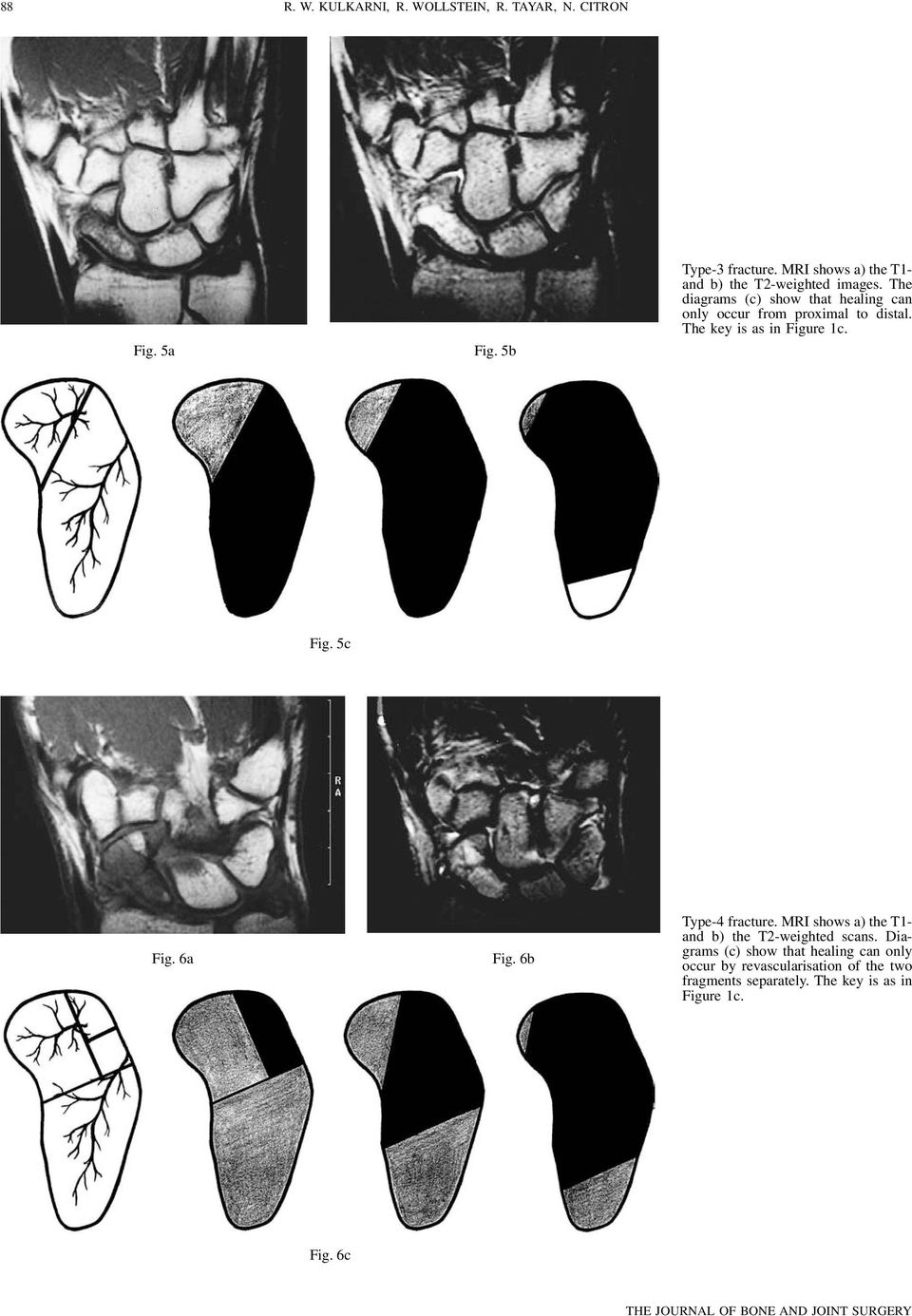
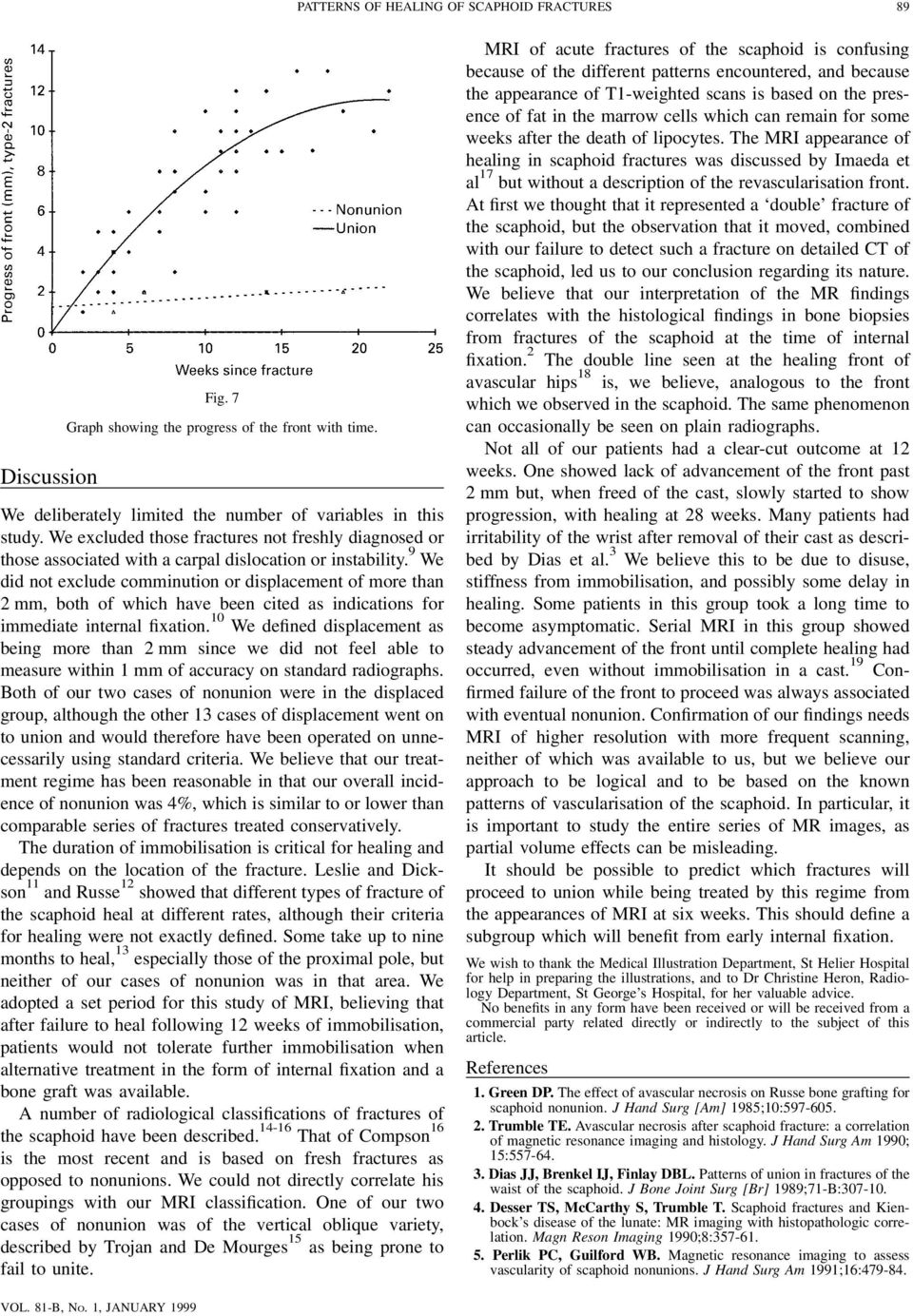
3 PATTERNS OF HEALING OF SCAPHOID FRACTURES 87 Fig. 2a Fig. 2b Type-2 fracture. MRI shows a) the T1- and b) the T2-weighted images. Diagrams (c) show that healing can only occur from distal to proximal. The key is as in Figure 1c. Fig. 2c Fig. 3 MRI showing a revascularisation front as a white line on the T2-weighted image. Avascular necrosis in either part of the scaphoid is indicated on plain radiographs by a relative increase in density in two or more views. There were only ten cases in our series, with radiological evidence of a revascularisation front being seen in six. We measured the rate of progress of the front by serial MRI and found it to be a fairly constant 0.7 mm per week (Fig. 7). We believe that we can predict nonunion of fractures of the scaphoid by the lack of progression of the Fig. 4 Diagram showing the measurement of the progress of a revascularisation front. front. No fracture in which the front was within 2 mm of the fracture line at eight weeks went on to nonunion except for one which had delayed union. VOL. 81-B, NO. 1, JANUARY 1999

4 88 R. W. KULKARNI, R. WOLLSTEIN, R. TAYAR, N. CITRON Fig. 5a Fig. 5b Type-3 fracture. MRI shows a) the T1- and b) the T2-weighted images. The diagrams (c) show that healing can only occur from proximal to distal. The key is as in Figure 1c. Fig. 5c Fig. 6a Fig. 6b Type-4 fracture. MRI shows a) the T1- and b) the T2-weighted scans. Diagrams (c) show that healing can only occur by revascularisation of the two fragments separately. The key is as in Figure 1c. Fig. 6c THE JOURNAL OF BONE AND JOINT SURGERY
5 PATTERNS OF HEALING OF SCAPHOID FRACTURES 89 Discussion Fig. 7 Graph showing the progress of the front with time. We deliberately limited the number of variables in this study. We excluded those fractures not freshly diagnosed or those associated with a carpal dislocation or instability. 9 We did not exclude comminution or displacement of more than 2 mm, both of which have been cited as indications for immediate internal fixation. 10 We defined displacement as being more than 2 mm since we did not feel able to measure within 1 mm of accuracy on standard radiographs. Both of our two cases of nonunion were in the displaced group, although the other 13 cases of displacement went on to union and would therefore have been operated on unnecessarily using standard criteria. We believe that our treatment regime has been reasonable in that our overall incidence of nonunion was 4%, which is similar to or lower than comparable series of fractures treated conservatively. The duration of immobilisation is critical for healing and depends on the location of the fracture. Leslie and Dickson 11 and Russe 12 showed that different types of fracture of the scaphoid heal at different rates, although their criteria for healing were not exactly defined. Some take up to nine months to heal, 13 especially those of the proximal pole, but neither of our cases of nonunion was in that area. We adopted a set period for this study of MRI, believing that after failure to heal following 12 weeks of immobilisation, patients would not tolerate further immobilisation when alternative treatment in the form of internal fixation and a bone graft was available. A number of radiological classifications of fractures of the scaphoid have been described That of Compson 16 is the most recent and is based on fresh fractures as opposed to nonunions. We could not directly correlate his groupings with our MRI classification. One of our two cases of nonunion was of the vertical oblique variety, described by Trojan and De Mourges 15 as being prone to fail to unite. MRI of acute fractures of the scaphoid is confusing because of the different patterns encountered, and because the appearance of T1-weighted scans is based on the presence of fat in the marrow cells which can remain for some weeks after the death of lipocytes. The MRI appearance of healing in scaphoid fractures was discussed by Imaeda et al 17 but without a description of the revascularisation front. At first we thought that it represented a double fracture of the scaphoid, but the observation that it moved, combined with our failure to detect such a fracture on detailed CT of the scaphoid, led us to our conclusion regarding its nature. We believe that our interpretation of the MR findings correlates with the histological findings in bone biopsies from fractures of the scaphoid at the time of internal fixation. 2 The double line seen at the healing front of avascular hips 18 is, we believe, analogous to the front which we observed in the scaphoid. The same phenomenon can occasionally be seen on plain radiographs. Not all of our patients had a clear-cut outcome at 12 weeks. One showed lack of advancement of the front past 2 mm but, when freed of the cast, slowly started to show progression, with healing at 28 weeks. Many patients had irritability of the wrist after removal of their cast as described by Dias et al. 3 We believe this to be due to disuse, stiffness from immobilisation, and possibly some delay in healing. Some patients in this group took a long time to become asymptomatic. Serial MRI in this group showed steady advancement of the front until complete healing had occurred, even without immobilisation in a cast. 19 Confirmed failure of the front to proceed was always associated with eventual nonunion. Confirmation of our findings needs MRI of higher resolution with more frequent scanning, neither of which was available to us, but we believe our approach to be logical and to be based on the known patterns of vascularisation of the scaphoid. In particular, it is important to study the entire series of MR images, as partial volume effects can be misleading. It should be possible to predict which fractures will proceed to union while being treated by this regime from the appearances of MRI at six weeks. This should define a subgroup which will benefit from early internal fixation. We wish to thank the Medical Illustration Department, St Helier Hospital for help in preparing the illustrations, and to Dr Christine Heron, Radiology Department, St George s Hospital, for her valuable advice. No benefits in any form have been received or will be received from a commercial party related directly or indirectly to the subject of this article. References 1. Green DP. The effect of avascular necrosis on Russe bone grafting for scaphoid nonunion. J Hand Surg [Am] 1985;10: Trumble TE. Avascular necrosis after scaphoid fracture: a correlation of magnetic resonance imaging and histology. J Hand Surg Am 1990; 15: Dias JJ, Brenkel IJ, Finlay DBL. Patterns of union in fractures of the waist of the scaphoid. J Bone Joint Surg [Br] 1989;71-B: Desser TS, McCarthy S, Trumble T. Scaphoid fractures and Kienbock s disease of the lunate: MR imaging with histopathologic correlation. Magn Reson Imaging 1990;8: Perlik PC, Guilford WB. Magnetic resonance imaging to assess vascularity of scaphoid nonunions. J Hand Surg Am 1991;16: VOL. 81-B, NO. 1, JANUARY 1999
6 90 R. W. KULKARNI, R. WOLLSTEIN, R. TAYAR, N. CITRON 6. Taleisnik J, Kelly PJ. The extraosseous and intraosseous blood supply of the scaphoid bone. J Bone Joint Surg [Am] 1966;48-A: Gelberman RH, Menon J. The vascularity of the scaphoid bone. J Hand Surg 1980;5-A: Vogler JB III, Murphy WA. Bone marrow imaging. Radiology 1988; 168: Weber ER. Biomechanical implications of scaphoid waist fractures. Clin Orthop 1980;149: Cooney WP, Dobyns JH, Linscheid RL. Fractures of the scaphoid: a rational approach to management. Clin Orthop 1980;149: Leslie IJ, Dickson RA. The fractured carpal scaphoid: natural history and factors influencing outcome. J Bone Joint Surg [Br] 1981;63-B: Russe O. Fracture of the carpal navicular: diagnosis, non-operative treatment, and operative treatment. J Bone Joint Surg [Am] 1960; 42-A: Dickison JC, Shannon JG. Fractures of the carpal scaphoid in the Canadian Army: a review and commentary. Surgery Gynaecology and Obstetrics 1944;79: Herbert TJ, Fisher WE. Management of the fractured scaphoid using a new bone screw. J Bone Joint Surg [Br] 1984;66-B: Trojan E, De Mourges G. Fractures et pseudarthroses du scaphoide carpien, étude thérapeutique. Rev Chir Orthop 1959;45: Compson JP. The anatomy of acute scaphoid fractures: a threedimensional analysis of patterns. J Bone Joint Surg [Br] 1998;80-B: Imaeda T, Nakamura R, Miura T, Makino N. Magnetic resonance imaging in scaphoid fractures. J Hand Surg [Br] 1992;17-B: Totty WG, Murphy WA, Ganz WI, et al. Magnetic resonance imaging of the normal and ischemic femoral head. AJR 1984;143: London PS. The broken scaphoid bone: the case against pessimism. J Bone Joint Surg [Br] 1961;43-B: THE JOURNAL OF BONE AND JOINT SURGERY

Scaphoid Fractures- Anatomy And Diagnosis: A Systemic Review Of Literature
 Article ID: WMC001268 ISSN 2046-1690 Scaphoid Fractures- Anatomy And Diagnosis: A Systemic Review Of Literature Corresponding Author: Dr. Dharm Meena, junior resident, orthopaedics, PGIMER, E 402, MDH,PGIMER,CHANDIGARH,
DIAGNOSING SCAPHOID FRACTURES. Anthony Hewitt
 DIAGNOSING SCAPHOID FRACTURES Anthony Hewitt Introduction Anatomy of the scaphoid Resembles a deformed peanut Articular cartilage covers 80% of the surface It rests in a plane 45 degrees to the longitudinal
Various classifications of scaphoid fractures have
 The anatomy of acute scaphoid fractures A THREE-DIMENSIONAL ANALYSIS OF PATTERNS J. P. Compson From the United Medical and Dental Schools of Guy s and St Thomas Hospitals, London, England Various classifications
We compared the long-term outcome in 61
 Fracture of the carpal scaphoid A PROSPECTIVE, RANDOMISED 12-YEAR FOLLOW-UP COMPARING OPERATIVE AND CONSERVATIVE TREATMENT B. Saedén, H. Törnkvist, S. Ponzer, M. Höglund From Stockholm Söder Hospital,
Chpter 2 Nonoperative Management of Non-displaced Acute Scaphoid Fracture
 Chpter 2 Nonoperative Management of Non-displaced Acute Scaphoid Fracture Megan Tomaino and Thomas B. Hughes Case Presentation The patient is a 15-year-old male with a history of left wrist pain following
Fractures around wrist
 Fractures around wrist Colles Fracture Smiths fracture Barton s fracture Chauffer s fracture Scaphoid fracture Lunate dislocation Vivek Pandey Colles fracture Definition: Fracture of the distal end radius
RADIOGRAPHIC EVALUATION
 Jeff Husband MD Objectives Evaluate, diagnose and manage common wrist injuries due to high energy trauma in athletes Appropriately use radiographs, CT scans and MRI Know when to refer patients for additional
Musculoskeletal Trauma of the Wrist
 September 2000 Musculoskeletal Trauma of the Wrist Murat Akalin, Harvard Medical School, Year- IV Gillian Lieberman, MD The Wrist Most common site of injury in entire skeleton Distal radius and ulna fractures
Scaphoid Non-union. Dr. Mandel Dr. Gyomorey. May 3 rd 2006
 Scaphoid Non-union Dr. Mandel Dr. Gyomorey May 3 rd 2006 Introduction Scaphoid fracture incidence: 8-38/100,000 Non-union 5% (0-22%) Adams and Leonard (1928) first described operative treatment of the
August 1st, 2006. Scaphoid Fractures. Dr. Christine Walton, PGY 2 Orthopedics
 August 1st, 2006 Scaphoid Fractures Dr. Christine Walton, PGY 2 Orthopedics Injury Patterns to the Carpal Bones 1) Perilunate pattern injuries 2) Axial pattern injuries 3) Local impaction/avulsion injuries
Scaphoid Fracture of the Wrist
 Page 1 of 6 Scaphoid Fracture of the Wrist Doctors commonly diagnose a sprained wrist after a patient falls on an outstretched hand. However, if pain and swelling don't go away, doctors become suspicious
IFSSH Scientific Committee on. Wrist Biomechanics and Instability
 IFSSH Scientific Committee on Wrist Biomechanics and Instability Chair: Hisao Moritomo (Japan) Committee: Emmanuel Apergis (Greece) Guillaume Herzberg (France) Scott Wolfe (USA) Jose Maria Rotella (Argentina)
Minimal Invasive Treatment for Scaphoid Fractures Using the Cannulated Herbert Screw System
 Techniques in Hand and Upper Extremity Surgery 7(4):141 146, 2003 T E C H N I Q U E 2003 Lippincott Williams & Wilkins, Inc., Philadelphia Minimal Invasive Treatment for Scaphoid Fractures Using the Cannulated
Scaphoid Fractures 1
 1 Scaphoid Fractures Scaphoid Fractures Introduction Anatomy Biomechanics History Clinical examination Radiographic evaluation DDx Classification Treatment Complications 2 Scaphoid fractures Introduction
ASSOCIATE PROFESSOR BO POVLSEN Emeritus Consultant Orthopaedic Surgeon Guy s & St Thomas Hospitals NHS Trust GMC no. 3579329
 ASSOCIATE PROFESSOR BO POVLSEN Emeritus Consultant Orthopaedic Surgeon Guy s & St Thomas Hospitals NHS Trust GMC no. 3579329 Consultant Orthopaedic Surgeon London Bridge Hospital Medico-Legal Secretary:
Ulnar sided Wrist Pain
 Ulnar sided Wrist Pain 1 Susan Cross, 1 Anshul Rastogi, 2 Brian Cohen, 1 Rosy Jalan 1 Dept of Radiology, Barts Health NHS Trust, London, UK 2 London Orthopaedic Centre Contact: [email protected]
Wrist Fractures. Wrist Defined: Carpal Bones Distal Radius Distal Ulna
 Wrist Fractures Wrist Fractures Wrist Defined: Carpal Bones Distal Radius Distal Ulna Wrist Fractures Wrist Joints: CMC Intercarpal Radiocarpal DRUJ drudge Wrist Fractures Wrist Fractures: (that we are
Legg-Calve'-Perthes Disease The National Osteonecrosis Foundation
 Home Osteonecrosis Osteonecrosis of the Jaw Mission Statement More About Us Related Sites Questions & Answers NONF Brochure Legg-Calve'-Perthes Disease Brochure Membership Form NONF Newsletter Volunteers
The late consequences of scaphoid fractures
 REVIEW ARTICLE The late consequences of scaphoid fractures N. J. Barton From Nottingham University Hospital, Nottingham, England N. J. Barton, Emeritus Orthopaedic and Hand Surgeon Nottingham University
Imaging of Lisfranc Injury
 November 2011 Imaging of Lisfranc Injury Greg Cvetanovich, Harvard Medical School Year IV Agenda Case Presentation Introduction Anatomy Lisfranc Injury Classification Imaging Treatment 2 Case Presentation
Distal Radius Fractures. Lee W Hash, MD Affinity Orthopedics and Sports Medicine
 Distal Radius Fractures Lee W Hash, MD Affinity Orthopedics and Sports Medicine The Problem of Distal Radius Fractures Common injury: >450,000/yr. in USA High potential for functional impairment and frequent
INJURIES OF THE HAND AND WRIST By Derya Dincer, M.D.
 05/05/2007 INJURIES OF THE HAND AND WRIST By Derya Dincer, M.D. Hand injuries, especially the fractures of metacarpals and phalanges, are the most common fractures in the skeletal system. Hand injuries
Examination and treatment of scaphoid fractures and pseudarthrosis 1138 42
 Review article Examination and treatment of scaphoid fractures and pseudarthrosis 1138 42 BACKGROUND About 2 000 patients annually incur a fractured scaphoid in Norway. Assessment and diagnosis can be
PERILUNATE AND LUNATE DISLOCATIONS
 PERILUNATE AND LUNATE DISLOCATIONS Rebecca Morris Advanced Practitioner Plain Film Reporting March 2011 Perilunate and Lunate dislocations Introduction Definition Anatomy Clinical presentation Mechanism
Spine University s Guide to Vertebral Osteonecrosis (Kummel's Disease)
 Spine University s Guide to Vertebral Osteonecrosis (Kummel's Disease) 2 Introduction Kummel's disease is a collapse of the vertebrae (the bones that make up the spine). It is also called vertebral osteonecrosis.
Wrist and Hand. Patient Information Guide to Bone Fracture, Bone Reconstruction and Bone Fusion: Fractures of the Wrist and Hand: Carpal bones
 Patient Information Guide to Bone Fracture, Bone Reconstruction and Bone Fusion: Wrist and Hand Fractures of the Wrist and Hand: Fractures of the wrist The wrist joint is made up of the two bones in your
Most active and intricate part of the upper extremity Especially vulnerable to injury Do not respond well to serious trauma. Magee, 2008. pg.
 PTA 216 Most active and intricate part of the upper extremity Especially vulnerable to injury Do not respond well to serious trauma Magee, 2008. pg. 396 28 bones Numerous articulations 19 intrinsic muscles
THE WRIST. At a glance. 1. Introduction
 THE WRIST At a glance The wrist is possibly the most important of all joints in everyday and professional life. It is under strain not only in many blue collar trades, but also in sports and is therefore
WRIST EXAMINATION. Look. Feel. Move. Special Tests
 WRIST EXAMINATION Look o Dorsum, side, palmar- palmar flex wrist to exacerbate dorsal swellings o Deformity e.g. radial deviation after colles, prominent ulna o Swellings e.g. ganglion o Scars, muscle
NERVE COMPRESSION DISORDERS
 Common Disorders of the Hand and Wrist Ryan Klinefelter, MD Associate Professor of Orthopaedics Department of Orthopaedics The Ohio State University Medical Center NERVE COMPRESSION DISORDERS 1 Carpal
Commonly Missed Fractures in the Emergency Department
 Commonly Missed Fractures in the Emergency Department Taylor Sittler MS IV - UMASS Images courtesy of Jim Wu, MD, Sanjay Shetty, MD and Mary Hochman, MD Diagnostic Errors in the ED Taylor Sittler, MS IV
.org. Ankle Fractures (Broken Ankle) Anatomy
 Ankle Fractures (Broken Ankle) Page ( 1 ) A broken ankle is also known as an ankle fracture. This means that one or more of the bones that make up the ankle joint are broken. A fractured ankle can range
Wrist and Hand Injuries Keep Your Edge: Hockey Sports Medicine 2015 Toronto, Canada August 28-30
 Wrist and Hand Injuries Keep Your Edge: Hockey Sports Medicine 2015 Toronto, Canada August 28-30 Steven E. Rokito, MD Division Chief, Sports Medicine, NSLIJ Associate team orthopedist NY Islanders Wrist
Adult Forearm Fractures
 Adult Forearm Fractures Your forearm is made up of two bones, the radius and ulna. In most cases of adult forearm fractures, both bones are broken. Fractures of the forearm can occur near the wrist at
Radius and Scaphoid Fractures
 Page 1 of 7 Return to the Table of Contents Site Map Your Account Support About Us Marketplace Offerings: Medscape.com Charts Mobile Logician CBSHealthwatch American Academy of Orthopaedic Surgeons Annual
Scaphoid and Other Wrist Injuries in the Emergency Department
 CLINICAL PRACTICE GUIDELINE Scaphoid and Other Wrist Injuries in the Emergency Department SCOPE (Area): SCOPE (Staff): Emergency Department and Fracture Clinic Medical, Nursing, Patient Service Assistants
FEMORAL NECK FRACTURE FOLLOWING TOTAL KNEE REPLACEMENT
 1 FEMORAL NECK FRACTURE FOLLOWING TOTAL KNEE REPLACEMENT László Sólyom ( ), András Vajda & József Lakatos Orthopaedic Department, Semmelweis University, Medical Faculty, Budapest, Hungary Correspondence:
MRI of Bone Marrow Radiologic-Pathologic Correlation
 MRI of Bone Marrow Radiologic-Pathologic Correlation Marilyn J. Siegel, M.D. Mallinckrodt Institute of Radiology Washington University School of Medicine St. Louis, MO and Visiting Scientist, AFIP, Washington,
Scaphoid Fracture in the Elite Athlete
 Scaphoid Fracture in the Elite Athlete Mark R. Belsky, MD*, Matthew I. Leibman, MD, David E. Ruchelsman, MD KEYWORDS Scaphoid Fracture Wrist Athlete KEY POINTS Operative fixation is preferred to casting
Ankle Fractures - OrthoInfo - AAOS. Copyright 2007 American Academy of Orthopaedic Surgeons. Ankle Fractures
 Copyright 2007 American Academy of Orthopaedic Surgeons Ankle Fractures "I broke my ankle." A broken ankle is also known as an ankle "fracture." This means that one or more of the bones that make up the
The Dilemmas of a Scaphoid Fracture: A Difficult Diagnosis for Primary Care Physicians
 Clinical Review Article The Dilemmas of a Scaphoid Fracture: A Difficult Diagnosis for Primary Care Physicians Ryan Nishihara, MD Scaphoid fractures account for 2% to 7% of all orthopedic fractures, 1
Citation International Orthopaedics, 2011, v. 35 n. 3, p. 389-394. Creative Commons: Attribution 3.0 Hong Kong License
 Title Operative treatment of distal radial fractures with locking plate system - A prospective study Author(s) Kwan, KYH; Lau, TW; Leung, F Citation International Orthopaedics, 2011, v. 35 n. 3, p. 389-394
Non Operative Management of Common Fractures
 Non Operative Management of Common Fractures Mr Duy Thai Orthopaedic Surgeon MBBS, FRACS (Ortho), Dip Surg Anat NOT ALL FRACTURES NEED TO BE FIXED FRACTURE CLINIC EMERGENCY DEPARTMENTS GENERAL PRACTITIONERS
Common Hand and Wrist Conditions: When to Refer? Dr Tim Heath
 Common Hand and Wrist Conditions: When to Refer? Dr Tim Heath Difficult Balance Many hand conditions can be managed non-operatively / simply Missed injury or delayed diagnosis not uncommon Common Problems
Tibial Intramedullary Nailing
 Tibial Intramedullary Nailing Turnberg Building Orthopaedics 0161 206 4898 All Rights Reserved 2015. Document for issue as handout. Procedure The tibia is the long shin bone in the lower leg. It is a weight
ASSOCIATED LESIONS COMPLICATIONS OSTEOARTICULAR COMPLICATIONS
 Corrective Osteotomy of Distal Radius Malunion---New Horizons I certify that, to the best of my knowledge, no aspect of my current personal or profession situation might reasonably be expected to affect
.org. Lisfranc (Midfoot) Injury. Anatomy. Description
 Lisfranc (Midfoot) Injury Page ( 1 ) Lisfranc (midfoot) injuries result if bones in the midfoot are broken or ligaments that support the midfoot are torn. The severity of the injury can vary from simple
Shoulder Pain and Weakness
 Shoulder Pain and Weakness John D. Kelly IV, MD THE PHYSICIAN AND SPORTSMEDICINE - VOL 32 - NO. 11 - NOVEMBER 2004 For CME accreditation information, instructions and learning objectives, click here. A
STRUCTURES AT RISK DURING VOLAR PERCUTANEOUS FIXATION OF SCAPHOID FRACTURES: A CADAVER STUDY
 STRUCTURES AT RISK DURING VOLAR PERCUTANEOUS FIXATION OF SCAPHOID FRACTURES: A CADAVER STUDY Scott Evans, MD 1, Justin Brantley, MS 1,2, Christina Brady, BS 3, Christina Salas, PhD 1,2, Deana Mercer, MD
Radiological diagnosis of injuries following Fall on outstretched hand (FOOSH)
 snap to grid Radiological diagnosis of injuries following Fall on outstretched hand (FOOSH) Core Radiology Clerkship Beth Israel Deaconess Medical Center Ziad Obermeyer, MS4 Gillian Lieberman, MD 18 September
SPECT/CT Wrist. Wrist pain 3/27/2012
 Wrist pain Wrist joint - complicated anatomy complex biomechanics Imaging and management of wrist pain presents a significant challenge Significant economic burden SPECT/CT Wrist HK Mohan GSTT London Intra-capsular
Common wrist injuries in sport. Chris Milne Sports Physician Hamilton,NZ
 Common wrist injuries in sport Chris Milne Sports Physician Hamilton,NZ Overview / Classification Acute injuries Simple - wrist sprain Not so simple 1 - Fracture of distal radius/ulna 2 - Scaphoid fracture
Calcaneus (Heel Bone) Fractures
 Copyright 2010 American Academy of Orthopaedic Surgeons Calcaneus (Heel Bone) Fractures Fractures of the heel bone, or calcaneus, can be disabling injuries. They most often occur during high-energy collisions
Radial Head Fracture Repair and Rehabilitation
 1 Radial Head Fracture Repair and Rehabilitation Surgical Indications and Considerations Anatomical Considerations: The elbow is a complex joint due to its intricate functional anatomy. The ulna, radius
Hand and Upper Extremity Injuries in Outdoor Activities. John A. Schneider, M.D.
 Hand and Upper Extremity Injuries in Outdoor Activities John A. Schneider, M.D. Biographical Sketch Dr. Schneider is an orthopedic surgeon that specializes in the treatment of hand and upper extremity
Conclusions: Displaced Colles fractures should be reduced and stabilized with percutaneous K-wires to achieve an excellent functional outcome.
 Original Article with percutaneous K-wires ABSTRACT Manandhar RR, Lakhey S, Pandey BK, Pradhan RL, Sharma S, Rijal KP Department of Orthopaedic Surgery, Kathmandu Medical College Teaching Hospital, Sinamangal,
.org. Arthritis of the Hand. Description
 Arthritis of the Hand Page ( 1 ) The hand and wrist have multiple small joints that work together to produce motion, including the fine motion needed to thread a needle or tie a shoelace. When the joints
Recommendations for cross-sectional imaging in cancer management, Second edition
 www.rcr.ac.uk Recommendations for cross-sectional imaging in cancer management, Second edition Breast cancer Faculty of Clinical Radiology www.rcr.ac.uk Contents Breast cancer 2 Clinical background 2 Who
ASOP Exams PO Box 7440 Seminole, FL 33775. The Manual of Fracture Casting & Bracing Exam 80% Passing ID # Name Title. Address. City State Zip.
 The Manual of Fracture Casting & Bracing Exam 80% Passing ID # Name Title Address City State Zip Tel# Email Certification Organization Cert# Mail a copy of your completed exam to: ASOP Exams PO Box 7440
Simplified surgery. Personalized performance.
 Simplified surgery. Personalized performance. VISIONAIRE Patient Matched Technology Accuracy Advanced surgical precision, resulting in reproducible outcomes Efficiency Simplifying surgery, reducing costs,
Scaphoid Fractures Epidemiology, diagnosis and treatment
 PETER JØRGSHOLM Print by Media-Tryck Lund University 2015 Scaphoid Fractures Epidemiology, diagnosis and treatment Scaphoid Fractures The scaphoid is the most commonly fractured carpal bone. The diagnosis
C H A P T E R 3 5. Thomas J. Merrill, DPM Riquel Gonzalez, DPM INTRODUCTION CASE REPORT
 C H A P T E R 3 5 CORTICOSTEROID INDUCED AVASCULAR NECROSIS OF THE RIGHT MEDIAL CUNEIFORM TREATED WITH TRINITY EVOLUTION BONE GRAFT AND ARTHRODESIS: Case Report and Review of the Literature Thomas J. Merrill,
BODY BODY PEDICLE PEDICLE TRANSVERSE TRANSVERSE PROCESS PROCESS
 Learning Objective Radiology Anatomy of the Spine and Upper Extremity Identify anatomic structures of the spine and upper extremities on standard radiographic and cross-sectional images Timothy J. Mosher,
The 10 Most Common Hand Pathologies In Adults. 1. Carpal Tunnel and Cubital Tunnel
 The 10 Most Common Hand Pathologies In Adults Bobbi Jacobsen PA C 1. Carpal Tunnel and Cubital Tunnel CARPAL TUNNEL (median nerve) ( ) Pain and numbness Distal, proximal radiating Sensory disturbance Distribution
Osteoarthritis progresses slowly and the pain and stiffness it causes worsens over time.
 Arthritis of the Foot and Ankle Arthritis is the leading cause of disability in the United States. It can occur at any age, and literally means "pain within a joint." As a result, arthritis is a term used
Patient Prep Information
 Stereotactic Breast Biopsy Patient Prep Information Imaging Services Cannon Memorial Hospital Watauga Medical Center Table Weight Limits for each facility Cannon Memorial Hospital Watauga Medical Center
.org. Clavicle Fracture (Broken Collarbone) Anatomy. Description. Cause. Symptoms
 Clavicle Fracture (Broken Collarbone) Page ( 1 ) A broken collarbone is also known as a clavicle fracture. This is a very common fracture that occurs in people of all ages. Anatomy The collarbone (clavicle)
.org. Posterior Tibial Tendon Dysfunction. Anatomy. Cause. Symptoms
 Posterior Tibial Tendon Dysfunction Page ( 1 ) Posterior tibial tendon dysfunction is one of the most common problems of the foot and ankle. It occurs when the posterior tibial tendon becomes inflamed
The Hand Exam: Tips and Tricks
 The Hand Exam: Tips and Tricks Nikki Strauss Schroeder, MD Assistant Clinical Professor, UCSF Department of Orthopaedic Surgery November 4, 2013 Outline Surface Anatomy Hand Anatomy Exam Management of
Magnetic Resonance Imaging
 Magnetic Resonance Imaging North American Spine Society Public Education Series What Is Magnetic Resonance Imaging (MRI)? Magnetic resonance imaging (MRI) is a valuable diagnostic study that has been used
CURRICULUM VITAE THOMAS F. BREEN, M. D.
 CURRICULUM VITAE THOMAS F. BREEN, M. D. PROFESSIONAL: Associate Professor of Orthopedics 1995 - present UMASS Memorial Medical Center Worcester. MA, Assistant Professor of Orthopedics 1988-1995 University
Wrist Fractures: What the Clinician Wants to Know 1
 What the Clinician Wants to Know Charles A. Goldfarb, MD Yuming Yin, MD Louis A. Gilula, MD Andrew J. Fisher, MD Martin I. Boyer, MD Index terms: Bones, CT, 43.1211 Wrist, fractures, 43.41 Wrist, MR, 43.12141,
Distal interphalangeal (DIP) joint and
 Distal Interphalangeal and Thumb Interphalangeal Joint Arthrodesis with New Generation Small Headless, Variable Pitch Fixation Devices Christopher V. Cox, M.D., Brandon E. Earp, M.D., Philip E. Blazar,
Characterization of small renal lesions: Problem solving with MRI Gary Israel, MD
 Characterization of small renal lesions: Problem solving with MRI Gary Israel, MD With the widespread use of cross-sectional imaging, many renal masses are incidentally found. These need to be accurately
Clinical performance of endoprosthetic and total hip replacement systems
 Veterans Administration Journal of Rehabilitation Research and Development Vol. 24 No. 3 Pages 49 56 Clinical performance of endoprosthetic and total hip replacement systems P. M. SANDBORN, B.S. ; S. D.
Current methods of diagnosis and treatment of scaphoid fractures
 REVIEW Open Access Current methods of diagnosis and treatment of scaphoid fractures Steven J Rhemrev 1*, Daan Ootes 1, Frank JP Beeres 2, Sven AG Meylaerts 1, Inger B Schipper 2 Abstract Fractures of the
SCAPULAR FRACTURES. Jai Relwani, Shoulder Fellow, Reading Shoulder Unit, Reading.
 SCAPULAR FRACTURES Jai Relwani, Shoulder Fellow, Reading Shoulder Unit, Reading. Aims Anatomy Incidence/Importance Mechanism Classification Principles of treatment Specific variations Conclusion Anatomy
TELEDIAGNOSTICS OF FRACTURE HEALING PROGRESS
 W.Glinkowski 1,2,6, J.Żyłkowski 4,6, A.Wojciechowski 3,6, P. Picewicz 5, A.Górecki 1 TELEDIAGNOSTICS OF FRACTURE HEALING PROGRESS 1 Chair and Department of Orthopedics and Traumatology of Locomotor System,
.org. Shoulder Pain and Common Shoulder Problems. Anatomy. Cause
 Shoulder Pain and Common Shoulder Problems Page ( 1 ) What most people call the shoulder is really several joints that combine with tendons and muscles to allow a wide range of motion in the arm from scratching
Musculoskeletal MRI Technical Considerations
 Musculoskeletal MRI Technical Considerations Garry E. Gold, M.D. Professor of Radiology, Bioengineering and Orthopaedic Surgery Stanford University Outline Joint Structure Image Contrast Protocols: 3.0T
Treat to Target Approach in Rheumatoid Arthritis: UK perspective. Dr Deirdre Shawe, North Hampshire Hospital, Basingstoke, UK
 Treat to Target Approach in Rheumatoid Arthritis: UK perspective Dr Deirdre Shawe, North Hampshire Hospital, Basingstoke, UK What is the target? To achieve remission or low disease activity in Rheumatoid
Abdominal Pedicle Flaps To The Hand And Forearm John C. Kelleher M.D., F.A.C.S.
 Abdominal Pedicle Flaps To The Hand And Forearm John C. Kelleher M.D., F.A.C.S. Global-HELP Publications Chapter Eight: TECHNICAL REQUIREMENTS FOR FORMATION OF A TUBED PEDICLE FLAP Creating a tube pedicle
Crescent-shaped rotator cuff tears are relatively
 Use of Preoperative Magnetic Resonance Imaging to Predict Rotator Cuff Tear Pattern and Method of Repair J. F. James Davidson, M.D., Stephen S. Burkhart, M.D., David P. Richards, M.D., and Scot E. Campbell,
3. Be able to perform a detailed clinical examination of the forearm and wrist.
 Patient Care: 1. Demonstrate appropriate evaluation and treatment of patients with hand/wrist surgery problems in the emergency room and as part of the inpatient consultation service, including application
Osteoarthritis and osteoporosis
 Osteoarthritis and osteoporosis What is osteoporosis? Osteoporosis occurs when the struts which make up the mesh-like structure within bones become thin causing them to become fragile and break easily,
Malleolar fractures Anna Ekman, Lena Brauer
 Malleolar fractures Anna Ekman, Lena Brauer How to use this handout? The left column is the information as given during the lecture. The column at the right gives you space to make personal notes. Learning
Sports Related Fractures of the Foot and Ankle
 Sports Related Fractures of the Foot and Ankle Patrick Ebeling, MD Orthopedic Foot and Ankle Surgeon Twin Cities Orthopedics Burnsville, MN No disclosures Sports Related Fractures of 5 th Metatarsal Fractures
Chapter 30. Rotational deformity Buddy taping Reduction of metacarpal fracture
 Chapter 30 FINGER FRACTURES AND DISLOCATIONS KEY FIGURES: Rotational deformity Buddy taping Reduction of metacarpal fracture Because we use our hands for so many things, finger fractures and dislocations