
Minimal Invasive Treatment for Scaphoid Fractures Using the Cannulated Herbert Screw System
|
|
|
- David Alfred McKinney
- 9 years ago
- Views:
Transcription
1 Techniques in Hand and Upper Extremity Surgery 7(4): , 2003 T E C H N I Q U E 2003 Lippincott Williams & Wilkins, Inc., Philadelphia Minimal Invasive Treatment for Scaphoid Fractures Using the Cannulated Herbert Screw System Veith L. Moser, MD Hermann Krimmer, MD, PhD Department of Hand Surgery Rhön-Klinikum AG Bad Neustadt, Germany Timothy J. Herbert, MD, FACS Sydney, Australia ABSTRACT Internal fixation of scaphoid fractures avoids the problems associated with prolonged plaster immobilization and, at the same time, allows an early return to activity for these mostly young patients. Internal fixation of the scaphoid is greatly facilitated by the use of specially designed headless bone screws, such as the Herbert bone screw, originally developed specifically for internal fixation of the scaphoid; furthermore, the advent of cannulated scaphoid screws has made closed (percutaneous fixation) stabilization of the scaphoid a reality. Indeed, this method has now become the treatment of choice for the majority of acute scaphoid fracture, bringing with it all the advantages of internal fixation without the disadvantages of open surgery. However, the success of closed treatment is also dependent on an accurate assessment of the fracture, and for this reason, we now advocate the routine use of computed tomography preoperatively. Because of the complex, 3-dimensional shape of the scaphoid, simple x-rays alone are inadequate, whereas computed tomography, parallel to the long axis of the scaphoid, allows excellent visualization of the fracture and any associated deformity, which must be corrected at the time of surgery. We describe here our method of treating acute scaphoid fractures, and we report the outcome of minimally invasive fixation. Keywords: scaphoid, fracture, minimally invasive fixation, Herbert screw, HBS Corresponding author: Dr. Hermann Krimmer, Klinik für Handchirurgie, Rhön-Klinikum, Salzburger Leite 1, Bad Neustadt, Germany. [email protected]. HISTORICAL PERSPECTIVE Until recently, nonoperative treatment, in a thumb spica cast, has been considered the treatment of choice for scaphoid fractures. 1 The main argument in favor of this approach was that nearly all fractures (over 90%) would heal if diagnosed and treated promptly. Because of the anatomic shape and position of the scaphoid, internal fixation has always been considered too technically demanding and in the past, has been reserved for the occasional case in which cast treatment appears inappropriate (eg, severe displacement, delayed treatment, etc.) (Fig. 1). The problem with this approach is that treatment is often prolonged for many months, particularly if primary healing is not achieved; for the majority of young, active patients, this represents a major functional and economic disability. Furthermore, the fact is that with conservative treatment, nonunion of the scaphoid remains a common and disabling problem. 1,2 In 1984, Herbert presented his results using a new, headless bone screw to treat scaphoid fractures by internal fixation. 3 Other reports followed, all claiming improved results for internal fixation, but the technical difficulties associated with open scaphoid surgery remained a major obstacle to general acceptance. 3 5 However, as reports started to appear 4,6 12 claiming similar success using percutaneous fixation, interest in this method has grown to the stage at which many now consider it to be the treatment of choice for the majority of acute scaphoid fractures. Indeed, given the apparent advantages, both in morbidity and in outcome, we have now reached the stage at which the decision to treat a scaphoid fracture in plaster must be carefully considered and justified on the likely outcome. Our preferred method is to use the HBS cannulated Volume 7, Issue 4 141

2 Moser et al wrists in full radial and ulnar deviation, together with true lateral views with the wrist in neutral. 13,14 Once a fracture is suspected or diagnosed, a computerized tomography (CT) bone scan should be performed. In addition to the standard sagittal and transversal views, we have found that cuts made in the sagittal plane parallel to the long axis of the scaphoid provide the best view of the fracture and any associated deformity 15 (Fig. 2). We have found CT to be the most accurate means of assessing the fracture, and we reserve magnetic resonance imaging only for those cases in which there is a need to assess the vascularity of the proximal pole. 16 To determine the most appropriate method of treatment, it is essential to use some form of classification of scaphoid fractures. We favor the Herbert classification, which relates the radiologic appearance of the fracture to its stability and prognosis (Table 1). SURGICAL TECHNIQUE FIGURE 1. High and low compression type of HBS system cannulated for 1-mm wires are not adjustable. scaphoid screw (Martin Medizin) because this implant has exactly the same external dimensions as the original and highly successful Herbert screw. The screw is available in both normal and high-compression configurations, the latter being used chiefly in conjunction with a bone graft in which the increased compression (approx 30%) is considered beneficial. A mini HBS (noncannulated), with a shaft diameter of only 1.5 mm is also available and is our implant of choice for fixation of small, proximal pole fractures (Type B3). For the majority of cases, we use the standard HBS screw, which has a 1-mm guide wire, making it ideal for our method of minimally invasive treatment; fixation is sufficiently secure for us to dispense with the use of plaster, and our postoperative treatment involves the use of a simple elastic bandage for a period of 2 weeks. INDICATIONS AND CONTRAINDICATIONS Accurate radiologic assessment is essential to define the shape and size of the scaphoid, as well as to demonstrate the exact location and extent of the fracture and any associated displacement. Initial x-rays should be of high quality and should include, at a minimum, posteroanterior views of both The surgeon should be seated with the dominant hand at the outer end of the table. A radiolucent, hinged hand holding device is extremely useful, but failing this, a large, rolled-up towel is used to aid extension of the wrist. The availability of x-ray screening is an important prerequisite: we position the image intensifier on the opposite side from the surgeon, with the assistant seated at the head of the table (Fig. 3). This setup allows vertical x-ray images to be used, with minimal disturbance, throughout the procedure. Initially, the scaphoid is screened with the image intensifier to confirm that fracture is suitable for closed treatment; when indicated, careful closed reduction is performed, facilitated by the use of percutaneous pins (joystick technique) where necessary. However, in most cases, simple hyperextension of the wrist will ensure an accurate reduction of the fracture, which is the reason that we prefer to operate with the arm extended. Once satisfactory reduction of the fracture has been achieved, the tubercle of the scaphoid, which becomes more prominent in full radial deviation of the wrist, is palpated and marked on the skin. A short incision (3 5mm) is made over the scaphotrapezial joint, and the distal pole of the scaphoid is exposed. The drill guide is then firmly positioned on the surface of the distal pole, toward its radial side (the correct entry point should be confirmed by the image intensifier), and a 1-mm guide wire is inserted through the sleeve (Fig. 4A). Then, aiming the guide toward the proximal pole of the scaphoid (approximately 45 degrees dorsally and 45 degrees ulnarly, with the wrist in neutral), the guide wire 142 Techniques in Hand and Upper Extremity Surgery

3 Percutaneous Screw Fixation of the Scaphoid FIGURE 2. A, Suspected fracture of the scaphoid. B, Fracture detected with computed tomography. is inserted slowly, and under x-ray control (Fig. 4B). By continuously moving the wrist from pronation into supination, the position of the guide wire can be carefully monitored while it is being inserted. Ideally, it should be aligned along the mid-axis of the scaphoid in both planes, while remaining as closely perpendicular to the fracture as possible. The guide wire should enter, but not penetrate, the firm subchondral bone at the apex of the proximal pole. Once the correct positioning of the guide wire has been achieved, its depth is used to indicate the length of screw required; this is measured by passing the depth gauge over the protruding end of the wire, taking care to ensure that the tip of the guide is pressed firmly onto the tubercle. The stop on the cannulated drill is then set to the measured length, and under x-ray control, the drill is passed over the wire and slowly inserted, using a small power drill at low rpm. It is important that the drill follows exactly the same line as the guide wire, and for this reason, it is important to use minimum force and to screen it during insertion. This is the reason that we prefer to use a suitable, small power instrument, rather than drill by hand, as this requires more force. To avoid the risk of the guide wire being removed with the drill, we normally advance it across the joint and into the radius (Fig. 4C). However, when doing this, it is TABLE 1. Classification of scaphoid fractures (Herbert) Type A acute fractures stable: A1 fracture of the tubercle A2 undisplaced fracture in the medial or distal third Type B acute fractures unstable: B1-oblique fracture B2-displaced or angulated fracture B3-fracture of the proximal pole B4-trans-scaphoid, perilunate fracture dislocation FIGURE 3. Setup for minimal invasive approach. Volume 7, Issue 4 143
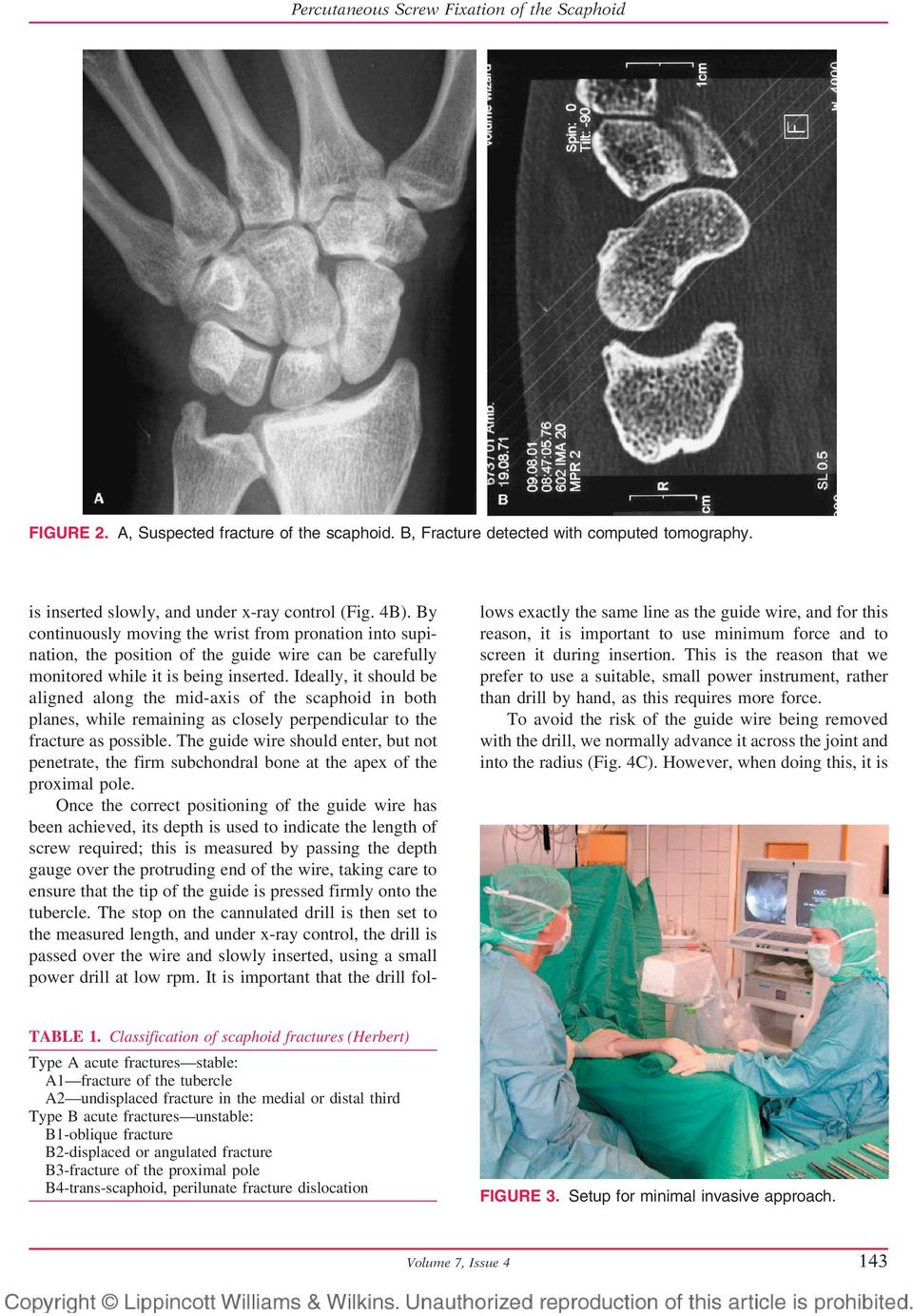
4 Moser et al FIGURE 4. A, Insertion of the guide wire by power drill. B, Correct position on lateral projection. C, Drill passes the whole length of the scaphoid, K wire fixed inside of the radius. D, Correct positioning of the screw. essential that the wrist joint is held immobile until the wire is removed (Fig. 5). Once the drill has been fully inserted and its position checked by the image intensifier (Fig. 4D), a screw of appropriate length is selected, placed over the guide wire, and inserted. As soon as the trailing threads of the screw start to engage in the bone, the guide wire is removed. The screw is then fully tightened, ensuring that its threads are well buried beneath the surface of the tubercle. The final position, together with the stability of fixation, is once again checked by screening the wrist on the image intensifier. POSTOPERATIVE AND REHABILITATION Postoperatively, an elastic bandage is used for the first 2 weeks; this normally provides adequate support during the period of wound healing while allowing sufficient movement to prevent any risk of adhesions and joint stiffness. Heavy manual work and contact sports are avoided for at least 6 weeks. Full function and range of movement are regained rapidly after minimally invasive surgery, and physiotherapy is rarely required. COMPLICATIONS Because the use of a cannulated screw carries a risk of the guide wire becoming bent or broken, this part of the procedure demands extra caution. In particular, if the guide wire crosses a joint, this must not be moved until the wire has been removed to avoid any risk of bending or breakage (Fig. 6). Similarly, when drilling, it is im- 144 Techniques in Hand and Upper Extremity Surgery

5 Percutaneous Screw Fixation of the Scaphoid FIGURE 5. Clinical example: A, Slight deformity at the radial cortex. B, Computed tomography scan shows dislocation of the fracture. C and D, Correct positioning of the screw in both planes. portant to be sure that the tip of the drill has reached maximum depth. Otherwise, the screw may impinge against hard bone, causing the fracture to displace. RESULTS We have recently published a series of 17 patients treated by this method without immobilization in a cast. 3 The majority had unstable fractures (12 type B2, 1 type B1), while there were 4 stable fractures (type A2). All fractures united, and there were no complications. In a larger series of 68 patients, we have observed 2 nonunions; one of these was the result of a technical error (inadequate fixation of the proximal pole), while in the second case, a second injury to the wrist, sustained within 3 weeks of surgery, seemed to be the cause of failure. CONCLUSION Percutaneous fixation of selected acute scaphoid fractures, using the technique detailed here, accelerates functional recovery and allows an early return to work. When used appropriately, union rates approaching 100% may be anticipated, and provided that care is exercised with the technique, morbidity and complications are minimal. We believe that minimally invasive stabilization is the treatment of choice for the majority of type A2, B1, and B2 scaphoid fractures. Volume 7, Issue 4 145

6 Moser et al FIGURE 6. Risk of breakage of the K wire if the wrist is not fixed. REFERENCES 1. Lennert KH, Contzen H. Conservative treatment of fractures of the scaphoid bone indications. Unfallchirurgie. 1988;14: Mack GR, Wilckens JH, McPherson SA. Subacute scaphoid fractures. A closer look at closed treatment. Am J Sports Med. 1998;26: Herbert TJ, Fisher WE. Management of the scaphoid fracture using a new bone screw. J Bone J Surg Br. 1984;66: Inouge G, Shionoya K. Herbert screw fixation by limited access for acute fractures of the scaphoid. J Bone J Surg Br. 1997;79: Kozin SH. Internal fixation of scaphoid fractures. Hand Clin. 1997;13: Herbert T, Krimmer H. Scaphoid fractures: internal fixation. In: Gelbermannn RH, ed. The Wrist: Master Techniques in Orthopaedic Surgery. Philadelphia: Lippincott Williams & Wilkins; 2002: Krimmer H. Scaphoid fracture repair using the Herbert Screw System (HBS). Atlas Hand Clin. 2003;8: Haddad FS, Goddard NJ. Acute percutaneus scaphoid fixation using a cannulated screw. J Bone J Surg Br. 1998;80: Wozasek GE, Moser KD. Percutaneous screw fixation for fractures of the scaphoid. J Bone J Surg Br. 1991;73: Schwarz N. Results of percutaneous screw fixation of fresh scaphoid fractures. Unfallheilkunde. 1981;84: Slade JF III, Jaskwhich D. Percutaneous fixation of scaphoid fractures. Hand Clin. 2001;17: Ring D, Jupiter JB, Herndon JH. Acute fractures of the scaphoid. J Am Acad Orthop Surg. 2000;8: Desai VV, Davis TR, Barton NJ. The prognostic value and reproducibility of the radiological features of the fractured scaphoid. J Hand Surg [Br]. 1999;24: Dias JJ, Thompson J, Barton NJ et al. Suspected scaphoid fractures: the value of radiographs. J Bone J Surg Br. 1990; 72: Frahm R, Lowka K, Vinee P. Computerized tomography diagnosis of scaphoid fracture and pseudoarthrosis in comparison with roentgen image. Handchir Mikrochir Plast Chir. 1992;24: Krimmer H, Schmitt R, Herbert T. Scaphoid fractures diagnosis, classification and therapy. Unfallchirurg. 2000; 103: Rettig ME, Kollias SC. Internal fixation of acute stable scaphoid fractures in the athlete. Am J Sports Med. 1996; 24: Techniques in Hand and Upper Extremity Surgery

DIAGNOSING SCAPHOID FRACTURES. Anthony Hewitt
 DIAGNOSING SCAPHOID FRACTURES Anthony Hewitt Introduction Anatomy of the scaphoid Resembles a deformed peanut Articular cartilage covers 80% of the surface It rests in a plane 45 degrees to the longitudinal
We compared the long-term outcome in 61
 Fracture of the carpal scaphoid A PROSPECTIVE, RANDOMISED 12-YEAR FOLLOW-UP COMPARING OPERATIVE AND CONSERVATIVE TREATMENT B. Saedén, H. Törnkvist, S. Ponzer, M. Höglund From Stockholm Söder Hospital,
INJURIES OF THE HAND AND WRIST By Derya Dincer, M.D.
 05/05/2007 INJURIES OF THE HAND AND WRIST By Derya Dincer, M.D. Hand injuries, especially the fractures of metacarpals and phalanges, are the most common fractures in the skeletal system. Hand injuries
How To Fix A Radial Head Plate
 Mayo Clinic CoNGRUENT RADIAL HEAD PLATE Since 1988 Acumed has been designing solutions to the demanding situations facing orthopedic surgeons, hospitals and their patients. Our strategy has been to know
Zimmer Small Fragment Universal Locking System. Surgical Technique
 Zimmer Small Fragment Universal Locking System Surgical Technique Zimmer Small Fragment Universal Locking System 1 Zimmer Small Fragment Universal Locking System Surgical Technique Table of Contents Introduction
Fractures around wrist
 Fractures around wrist Colles Fracture Smiths fracture Barton s fracture Chauffer s fracture Scaphoid fracture Lunate dislocation Vivek Pandey Colles fracture Definition: Fracture of the distal end radius
Wrist Fractures. Wrist Defined: Carpal Bones Distal Radius Distal Ulna
 Wrist Fractures Wrist Fractures Wrist Defined: Carpal Bones Distal Radius Distal Ulna Wrist Fractures Wrist Joints: CMC Intercarpal Radiocarpal DRUJ drudge Wrist Fractures Wrist Fractures: (that we are
Wrist and Hand. Patient Information Guide to Bone Fracture, Bone Reconstruction and Bone Fusion: Fractures of the Wrist and Hand: Carpal bones
 Patient Information Guide to Bone Fracture, Bone Reconstruction and Bone Fusion: Wrist and Hand Fractures of the Wrist and Hand: Fractures of the wrist The wrist joint is made up of the two bones in your
TwinFix Cannulated Compression Screw
 TwinFix Cannulated Compression Screw Leibinger Solutions for Hand Surgery Procedural Guide TwinFix Sterilization, Organization, Storage 29-12020 Profyle MODULAR Sterilizing Container 29-40162 TwinFix Implant
SALVATION. Fusion Bolts and Beams SURGICAL TECHNIQUE
 SALVATION Fusion Bolts and Beams SURGICAL TECHNIQUE Contents Chapter 1 4 Introduction Chapter 2 4 Intended Use Chapter 3 4 Device Description 4 Fusion Beams 5 Fusion Bolts Chapter 4 5 Preoperative Planning
Adult Forearm Fractures
 Adult Forearm Fractures Your forearm is made up of two bones, the radius and ulna. In most cases of adult forearm fractures, both bones are broken. Fractures of the forearm can occur near the wrist at
Scaphoid Non-union. Dr. Mandel Dr. Gyomorey. May 3 rd 2006
 Scaphoid Non-union Dr. Mandel Dr. Gyomorey May 3 rd 2006 Introduction Scaphoid fracture incidence: 8-38/100,000 Non-union 5% (0-22%) Adams and Leonard (1928) first described operative treatment of the
Chpter 2 Nonoperative Management of Non-displaced Acute Scaphoid Fracture
 Chpter 2 Nonoperative Management of Non-displaced Acute Scaphoid Fracture Megan Tomaino and Thomas B. Hughes Case Presentation The patient is a 15-year-old male with a history of left wrist pain following
Zimmer Periarticular Proximal Tibial Locking Plate
 Zimmer Periarticular Proximal Tibial Locking Plate Surgical Technique The Science of the Landscape Zimmer Periarticular Proximal Tibial Locking Plate 1 Table of Contents Introduction 2 Locking Screw Technology
V-TEK IVP System 2.7 System 4.0
 V-TEK IVP System Ankle 2.7 Fix System 4.0 Surgical Technique Surgical Technique Titanium osteosynthesis system for tibio-talar and tibio-talo-calcaneal fusion SECTION 1 Ankle Fix System 4.0 Titanium osteosynthesis
.org. Clavicle Fracture (Broken Collarbone) Anatomy. Description. Cause. Symptoms
 Clavicle Fracture (Broken Collarbone) Page ( 1 ) A broken collarbone is also known as a clavicle fracture. This is a very common fracture that occurs in people of all ages. Anatomy The collarbone (clavicle)
Radial Head Fracture Repair and Rehabilitation
 1 Radial Head Fracture Repair and Rehabilitation Surgical Indications and Considerations Anatomical Considerations: The elbow is a complex joint due to its intricate functional anatomy. The ulna, radius
Scaphoid Fracture of the Wrist
 Page 1 of 6 Scaphoid Fracture of the Wrist Doctors commonly diagnose a sprained wrist after a patient falls on an outstretched hand. However, if pain and swelling don't go away, doctors become suspicious
Anatomic Percutaneous Ankle Reconstruction of Lateral Ligaments (A Percutaneous Anti ROLL)
 Anatomic Percutaneous Ankle Reconstruction of Lateral Ligaments (A Percutaneous Anti ROLL) Mark Glazebrook James Stone Masato Takao Stephane Guillo Introduction Ankle stabilization is required when a patient
RADIOGRAPHIC EVALUATION
 Jeff Husband MD Objectives Evaluate, diagnose and manage common wrist injuries due to high energy trauma in athletes Appropriately use radiographs, CT scans and MRI Know when to refer patients for additional
ASSOCIATED LESIONS COMPLICATIONS OSTEOARTICULAR COMPLICATIONS
 Corrective Osteotomy of Distal Radius Malunion---New Horizons I certify that, to the best of my knowledge, no aspect of my current personal or profession situation might reasonably be expected to affect
Malleolar fractures Anna Ekman, Lena Brauer
 Malleolar fractures Anna Ekman, Lena Brauer How to use this handout? The left column is the information as given during the lecture. The column at the right gives you space to make personal notes. Learning
Scaphoid Fractures 1
 1 Scaphoid Fractures Scaphoid Fractures Introduction Anatomy Biomechanics History Clinical examination Radiographic evaluation DDx Classification Treatment Complications 2 Scaphoid fractures Introduction
We studied 45 patients with 46 fractures of the
 Patterns of healing of scaphoid fractures THE IMPORTANCE OF VASCULARITY R. W. Kulkarni, R. Wollstein, R. Tayar, N. Citron From the St Helier Hospital, Carshalton, England We studied 45 patients with 46
ASSOCIATE PROFESSOR BO POVLSEN Emeritus Consultant Orthopaedic Surgeon Guy s & St Thomas Hospitals NHS Trust GMC no. 3579329
 ASSOCIATE PROFESSOR BO POVLSEN Emeritus Consultant Orthopaedic Surgeon Guy s & St Thomas Hospitals NHS Trust GMC no. 3579329 Consultant Orthopaedic Surgeon London Bridge Hospital Medico-Legal Secretary:
.org. Ankle Fractures (Broken Ankle) Anatomy
 Ankle Fractures (Broken Ankle) Page ( 1 ) A broken ankle is also known as an ankle fracture. This means that one or more of the bones that make up the ankle joint are broken. A fractured ankle can range
Foot and Ankle Technique Guide Proximal Inter-Phalangeal (PIP) Fusion
 Surgical Technique Foot and Ankle Technique Guide Proximal Inter-Phalangeal (PIP) Fusion Prepared in consultation with: Phinit Phisitkul, MD Department of Orthopedics and Rehabilitation University of Iowa
Scaphoid Fractures- Anatomy And Diagnosis: A Systemic Review Of Literature
 Article ID: WMC001268 ISSN 2046-1690 Scaphoid Fractures- Anatomy And Diagnosis: A Systemic Review Of Literature Corresponding Author: Dr. Dharm Meena, junior resident, orthopaedics, PGIMER, E 402, MDH,PGIMER,CHANDIGARH,
Distal Radius Fractures. Lee W Hash, MD Affinity Orthopedics and Sports Medicine
 Distal Radius Fractures Lee W Hash, MD Affinity Orthopedics and Sports Medicine The Problem of Distal Radius Fractures Common injury: >450,000/yr. in USA High potential for functional impairment and frequent
Musculoskeletal Trauma of the Wrist
 September 2000 Musculoskeletal Trauma of the Wrist Murat Akalin, Harvard Medical School, Year- IV Gillian Lieberman, MD The Wrist Most common site of injury in entire skeleton Distal radius and ulna fractures
Hand and Upper Extremity Injuries in Outdoor Activities. John A. Schneider, M.D.
 Hand and Upper Extremity Injuries in Outdoor Activities John A. Schneider, M.D. Biographical Sketch Dr. Schneider is an orthopedic surgeon that specializes in the treatment of hand and upper extremity
THE WRIST. At a glance. 1. Introduction
 THE WRIST At a glance The wrist is possibly the most important of all joints in everyday and professional life. It is under strain not only in many blue collar trades, but also in sports and is therefore
Imaging of Lisfranc Injury
 November 2011 Imaging of Lisfranc Injury Greg Cvetanovich, Harvard Medical School Year IV Agenda Case Presentation Introduction Anatomy Lisfranc Injury Classification Imaging Treatment 2 Case Presentation
August 1st, 2006. Scaphoid Fractures. Dr. Christine Walton, PGY 2 Orthopedics
 August 1st, 2006 Scaphoid Fractures Dr. Christine Walton, PGY 2 Orthopedics Injury Patterns to the Carpal Bones 1) Perilunate pattern injuries 2) Axial pattern injuries 3) Local impaction/avulsion injuries
.org. Distal Radius Fracture (Broken Wrist) Description. Cause
 Distal Radius Fracture (Broken Wrist) Page ( 1 ) The radius is the larger of the two bones of the forearm. The end toward the wrist is called the distal end. A fracture of the distal radius occurs when
Zimmer Periarticular Elbow Locking Plate System
 Zimmer Periarticular Elbow Locking Plate System Surgical Technique The Right Solutions for Fractures Around the Elbow Disclaimer This document is intended exclusively for physicians and is not intended
Ankle Fractures - OrthoInfo - AAOS. Copyright 2007 American Academy of Orthopaedic Surgeons. Ankle Fractures
 Copyright 2007 American Academy of Orthopaedic Surgeons Ankle Fractures "I broke my ankle." A broken ankle is also known as an ankle "fracture." This means that one or more of the bones that make up the
Calcaneus (Heel Bone) Fractures
 Copyright 2010 American Academy of Orthopaedic Surgeons Calcaneus (Heel Bone) Fractures Fractures of the heel bone, or calcaneus, can be disabling injuries. They most often occur during high-energy collisions
IFSSH Scientific Committee on. Wrist Biomechanics and Instability
 IFSSH Scientific Committee on Wrist Biomechanics and Instability Chair: Hisao Moritomo (Japan) Committee: Emmanuel Apergis (Greece) Guillaume Herzberg (France) Scott Wolfe (USA) Jose Maria Rotella (Argentina)
Zimmer Natural Nail System. Cephalomedullary Nail Surgical Technique STANDARD
 Zimmer Natural Nail System Cephalomedullary Nail Surgical Technique STANDARD Zimmer Natural Nail System Cephalomedullary Nail Surgical Technique - Standard 1 Zimmer Natural Nail System Cephalomedullary
.org. Fractures of the Thoracic and Lumbar Spine. Cause. Description
 Fractures of the Thoracic and Lumbar Spine Page ( 1 ) Spinal fractures can vary widely in severity. While some fractures are very serious injuries that require emergency treatment, other fractures can
Surgical technique. End Cap for TEN. For axial stabilization and simultaneous protection of soft tissue.
 Surgical technique End Cap for TEN. For axial stabilization and simultaneous protection of soft tissue. Table of contents Indications and contraindications 3 Implants 4 Instruments 4 Preoperative planning
KnifeLight. Carpal Tunnel Ligament Release. Operative Technique
 KnifeLight Carpal Tunnel Ligament Release Operative Technique Contents Page 1. Features & Benefits 3 Intended Use and Indications 3 Contraindications 3 Features & Benefits 3 2. Operative Technique 4 Antegrade
Chapter 30. Rotational deformity Buddy taping Reduction of metacarpal fracture
 Chapter 30 FINGER FRACTURES AND DISLOCATIONS KEY FIGURES: Rotational deformity Buddy taping Reduction of metacarpal fracture Because we use our hands for so many things, finger fractures and dislocations
Chapter 33. Nerve Physiology
 Chapter 33 NERVE AND VASCULAR INJURIES OF THE HAND KEY FIGURES: Digital nerve location on finger Epineurial repair Nerves and blood vessels of the hand and fingers usually are quite delicate, and some
NCB Distal Femur System. Surgical Technique
 NCB Distal Femur System Surgical Technique NCB Distal Femur System Surgical Technique 3 Surgical Technique NCB Distal Femur System Table of Contents Introduction 4 Indications 8 Preoperative Planning
Orthopedic Foot Instruments. Dedicated instruments for reconstructive foot surgery.
 Orthopedic Foot Instruments. Dedicated instruments for reconstructive foot surgery. Surgical Technique This publication is not intended for distribution in the USA. Instruments and implants approved by
Radius and Scaphoid Fractures
 Page 1 of 7 Return to the Table of Contents Site Map Your Account Support About Us Marketplace Offerings: Medscape.com Charts Mobile Logician CBSHealthwatch American Academy of Orthopaedic Surgeons Annual
Fracture Care Coding September 28, 2011
 Fracture Care Coding September 28, 2011 Julie Edens Leu, CPC, CPCO, CPMA, CPC-I 1 Disclaimer Every reasonable effort has been made to ensure that the educational material provided today is accurate and
Syndesmosis Injuries
 Syndesmosis Injuries Dr. Alex Rabinovich Outline Anatomy Injury types and classification Treatment options Nonoperative vs. Operative Indications for operative Operative technique Postoperative management
3. Be able to perform a detailed clinical examination of the forearm and wrist.
 Patient Care: 1. Demonstrate appropriate evaluation and treatment of patients with hand/wrist surgery problems in the emergency room and as part of the inpatient consultation service, including application
Rigid Internal Fixation of Displaced Distal Radius Fractures
 n Feature rticle Rigid Internal Fixation of Displaced Distal Radius Fractures Stephen. Gunther, MD; Tennyson L. Lynch, S abstract Full article available online at Healio.com/Orthopedics. Search: 20131219-14
Rodding Surgery. 804 W. Diamond Ave., Ste. 210 Gaithersburg, MD 20878 (800) 981-2663 (301) 947-0083
 Rodding Surgery 804 W. Diamond Ave., Ste. 210 Gaithersburg, MD 20878 (800) 981-2663 (301) 947-0083 Fax: (301) 947-0456 Internet: www.oif.org Email: [email protected] The Osteogenesis Imperfecta Foundation,
.org. Lisfranc (Midfoot) Injury. Anatomy. Description
 Lisfranc (Midfoot) Injury Page ( 1 ) Lisfranc (midfoot) injuries result if bones in the midfoot are broken or ligaments that support the midfoot are torn. The severity of the injury can vary from simple
Distal interphalangeal (DIP) joint and
 Distal Interphalangeal and Thumb Interphalangeal Joint Arthrodesis with New Generation Small Headless, Variable Pitch Fixation Devices Christopher V. Cox, M.D., Brandon E. Earp, M.D., Philip E. Blazar,
ASOP Exams PO Box 7440 Seminole, FL 33775. The Manual of Fracture Casting & Bracing Exam 80% Passing ID # Name Title. Address. City State Zip.
 The Manual of Fracture Casting & Bracing Exam 80% Passing ID # Name Title Address City State Zip Tel# Email Certification Organization Cert# Mail a copy of your completed exam to: ASOP Exams PO Box 7440
Mini TightRope CMC Surgical Technique
 Mini TightRope CMC Surgical Technique Mini TightRope CMC Mini TightRope CMC Fixation The Mini TightRope provides a unique means to suspend the thumb metacarpal after partial or complete trapezial resection
Most active and intricate part of the upper extremity Especially vulnerable to injury Do not respond well to serious trauma. Magee, 2008. pg.
 PTA 216 Most active and intricate part of the upper extremity Especially vulnerable to injury Do not respond well to serious trauma Magee, 2008. pg. 396 28 bones Numerous articulations 19 intrinsic muscles
Minimally Invasive Hip Replacement through the Direct Lateral Approach
 Surgical Technique INNOVATIONS IN MINIMALLY INVASIVE JOINT SURGERY Minimally Invasive Hip Replacement through the Direct Lateral Approach *smith&nephew Introduction Prosthetic replacement of the hip joint
Sports Related Fractures of the Foot and Ankle
 Sports Related Fractures of the Foot and Ankle Patrick Ebeling, MD Orthopedic Foot and Ankle Surgeon Twin Cities Orthopedics Burnsville, MN No disclosures Sports Related Fractures of 5 th Metatarsal Fractures
How To Use A Phoenix Retrograde Femoral Nail
 Phoenix Retrograde Femoral Nail System Featuring CoreLock Technology Surgical Technique Contents Introduction... Page 1 Indications... Page 2 Design Features... Page 3 Surgical Technique... Page 6 Product
OptiLock Periarticular Plating System For Proximal Tibial Fractures. Pre-Launch Surgical Technique
 OptiLock Periarticular Plating System For Proximal Tibial Fractures Pre-Launch Surgical Technique Contents Introduction... Page 1 Indications & Fracture Classifications... Page 4 Design Features... Page
Patient Labeling Information System Description
 Patient Labeling Information System Description The Trident Ceramic Acetabular System is an artificial hip replacement device that features a new, state-of-the-art ceramic-on-ceramic bearing couple. The
The late consequences of scaphoid fractures
 REVIEW ARTICLE The late consequences of scaphoid fractures N. J. Barton From Nottingham University Hospital, Nottingham, England N. J. Barton, Emeritus Orthopaedic and Hand Surgeon Nottingham University
LCP Olecranon Plate. The anatomical fixation system with angular stability for olecranon and proximal ulnar fractures.
 LCP Olecranon Plate. The anatomical fixation system with angular stability for olecranon and proximal ulnar fractures. Surgical Technique This publication is not intended for distribution in the USA. Instruments
Ruby O Brochta-Woodward BSN, CPC, CCS-P, COSC, ACS-OR April 17, 2013 AAPC National Conference Orlando, FL
 Ruby O Brochta-Woodward BSN, CPC, CCS-P, COSC, ACS-OR April 17, 2013 AAPC National Conference Orlando, FL Fracture coding, what do you need to know? Types of fractures Types of treatment Fracture care
Aesculap Veterinary Orthopaedics. Targon VET Interlocking Nail
 Aesculap Veterinary Orthopaedics Targon VET Interlocking Nail Flexibility Stability Dynamics The Targon VET is based on new, technology which reverses the known principles of interlocking nails. The rotation-stabilising
Wrist and Hand Injuries Keep Your Edge: Hockey Sports Medicine 2015 Toronto, Canada August 28-30
 Wrist and Hand Injuries Keep Your Edge: Hockey Sports Medicine 2015 Toronto, Canada August 28-30 Steven E. Rokito, MD Division Chief, Sports Medicine, NSLIJ Associate team orthopedist NY Islanders Wrist
LCP Superior Clavicle Plate. The anatomically precontoured fixation system with angular stability for clavicle shaft and lateral clavicle.
 LCP Superior Clavicle Plate. The anatomically precontoured fixation system with angular stability for clavicle shaft and lateral clavicle. Surgical Technique This publication is not intended for distribution
MINI FRAGMENT SYSTEM. Instruments and implants for 1.5 mm, 2.0 mm, and 2.4 mm plate fixation PRODUCT OVERVIEW
 MINI FRAGMENT SYSTEM Instruments and implants for 1.5 mm, 2.0 mm, and 2.4 mm plate fixation PRODUCT OVERVIEW TABLE OF CONTENTS INTRODUCTION Mini Fragment System 2 PRODUCT INFORMATION Plates 4 Screws 6
Technique Guide. Orthopaedic Cable System. Cerclage solutions for general surgery.
 Technique Guide Orthopaedic Cable System. Cerclage solutions for general surgery. Table of Contents Introduction The Orthopaedic Cable System 2 Indications 4 Contraindications 4 Surgical Technique Cerclage
4052 Slimplicity Tech final_layout 1 6/29/15 3:29 PM Page 2 Surgical Technique
 Surgical Technique TABLE OF CONTENTS Slimplicity Anterior Cervical Plate System Overview 2 Indications 2 Implants 3 Instruments 4 Surgical Technique 6 1. Patient Positioning and Approach 6 2. Plate Selection
TABLE OF CONTENTS. Indications and Contraindications 3. Features and Benefits 4. Ease of connection 4 Stable fixation concept 5
 Surgical Technique TABLE OF CONTENTS Indications and Contraindications 3 Features and Benefits 4 Ease of connection 4 Stable fixation concept 5 Surgical Technique Steps 6 Identification and preparation
Common wrist injuries in sport. Chris Milne Sports Physician Hamilton,NZ
 Common wrist injuries in sport Chris Milne Sports Physician Hamilton,NZ Overview / Classification Acute injuries Simple - wrist sprain Not so simple 1 - Fracture of distal radius/ulna 2 - Scaphoid fracture
.org. Posterior Tibial Tendon Dysfunction. Anatomy. Cause. Symptoms
 Posterior Tibial Tendon Dysfunction Page ( 1 ) Posterior tibial tendon dysfunction is one of the most common problems of the foot and ankle. It occurs when the posterior tibial tendon becomes inflamed
Integumentary System Individual Exercises
 Integumentary System Individual Exercises 1. A physician performs an incision and drainage of a subcutaneous abscess in his office for a particularly uncooperative established patient. How should this
WRIST EXAMINATION. Look. Feel. Move. Special Tests
 WRIST EXAMINATION Look o Dorsum, side, palmar- palmar flex wrist to exacerbate dorsal swellings o Deformity e.g. radial deviation after colles, prominent ulna o Swellings e.g. ganglion o Scars, muscle
.org. Arthritis of the Hand. Description
 Arthritis of the Hand Page ( 1 ) The hand and wrist have multiple small joints that work together to produce motion, including the fine motion needed to thread a needle or tie a shoelace. When the joints
Posttraumatic medial ankle instability
 Posttraumatic medial ankle instability Alexej Barg, Markus Knupp, Beat Hintermann Orthopaedic Department University Hospital of Basel, Switzerland Clinic of Orthopaedic Surgery, Kantonsspital Baselland
Various classifications of scaphoid fractures have
 The anatomy of acute scaphoid fractures A THREE-DIMENSIONAL ANALYSIS OF PATTERNS J. P. Compson From the United Medical and Dental Schools of Guy s and St Thomas Hospitals, London, England Various classifications
Systemic condition affecting synovial tissue Hypertrohied synovium destroys. Synovectomy. Tenosynovectomy Tendon Surgery Arthroplasty Arthrodesis
 Surgical Options for Rheumatoid Arthritis of the Wrist Raj Bhatia Consultant Hand & Orthopaedic Surgeon Bristol Royal Infirmary & Avon Orthopaedic Centre Rheumatoid Arthritis Systemic condition affecting
FEMORAL NECK FRACTURE FOLLOWING TOTAL KNEE REPLACEMENT
 1 FEMORAL NECK FRACTURE FOLLOWING TOTAL KNEE REPLACEMENT László Sólyom ( ), András Vajda & József Lakatos Orthopaedic Department, Semmelweis University, Medical Faculty, Budapest, Hungary Correspondence:
Minimally Invasive Lumbar Fusion
 Minimally Invasive Lumbar Fusion Biomechanical Evaluation (1) coflex-f screw Biomechanical Evaluation (1) coflex-f intact Primary Stability intact Primary Stability Extension Neutral Position Flexion Coflex
Lentur Cable System. Surgical Technique
 Lentur Cable System Surgical Technique Contents Introduction... Page 1 System Design Features And Benefits... Page 2 Implants... Page 3 Instrumentation... Page 4 Surgical Technique... Page 5 Single Cable...
Westmount UCC 751 Victoria Street South, Kitchener, ON N2M 5N4 519-745-2273 Fairway UCC 385 Fairway Road South, Kitchener, ON N2C 2N9 519-748-2327
 K-W URGENT CARE CLINICS INC. Westmount UCC 751 Victoria Street South, Kitchener, ON N2M 5N4 519-745-2273 Fairway UCC 385 Fairway Road South, Kitchener, ON N2C 2N9 519-748-2327 OPEN Mon-Fri 8am-5pm, Sa
Integra. Subtalar MBA and bioblock Implant SURGICAL TECHNIQUE
 Integra Subtalar MBA and bioblock Implant SURGICAL TECHNIQUE Table of contents Introduction Description... 2 Indications... 2 Contraindications... 2 Surgical Technique Step 1: Incision and Dissection...3
Achilles Tendon Repair, Operative Technique
 *smith&nephew ANKLE TECHNIQUE GUIDE Achilles Tendon Repair, Operative Technique Prepared in Consultation with: C. Niek van Dijk, MD, PhD KNEE HIP SHOULDER EXTREMITIES Achilles Tendon Repair, Operative
Tibial Intramedullary Nailing
 Tibial Intramedullary Nailing Turnberg Building Orthopaedics 0161 206 4898 All Rights Reserved 2015. Document for issue as handout. Procedure The tibia is the long shin bone in the lower leg. It is a weight
1 of 6 1/22/2015 10:06 AM
 1 of 6 1/22/2015 10:06 AM 2 of 6 1/22/2015 10:06 AM This cross-section view of the shoulder socket shows a typical SLAP tear. Injuries to the superior labrum can be caused by acute trauma or by repetitive
Technique Guide. DHS/DCS Dynamic Hip and Condylar Screw System. Designed to provide stable internal fixation.
 Technique Guide DHS/DCS Dynamic Hip and Condylar Screw System. Designed to provide stable internal fixation. Table of Contents Introduction Dynamic Hip Screw (DHS) 2 Dynamic Condylar Screw (DCS) 3 Indications
Technique Guide. Large Fragment LCP Instrument and Implant Set. Part of the Synthes locking compression plate (LCP) system.
 Technique Guide Large Fragment LCP Instrument and Implant Set. Part of the Synthes locking compression plate (LCP) system. Table of Contents Introduction Large Fragment LCP Instrument and Implant Set
Information for the Patient About Surgical
 Information for the Patient About Surgical Decompression and Stabilization of the Spine Aging and the Spine Daily wear and tear, along with disc degeneration due to aging and injury, are common causes
Technique Guide. Screw Removal Set. Instruments for removing Synthes screws.
 Technique Guide Screw Removal Set. Instruments for removing Synthes screws. Table of Contents Introduction Screw Removal Set 2 Surgical Technique Preoperative Planning and Preparation 6 Removal of Intact
TENDON INJURIES OF THE HAND KEY FIGURES:
 Chapter 32 TENDON INJURIES OF THE HAND KEY FIGURES: Extensor surface of hand Mallet finger Mallet splints Injured finger in stack splint Repair of open mallet Most hand specialists believe that the earlier
Wrist Fracture. Please stick addressograph here
 ORTHOPAEDIC UNIT: 01-293 8687 /01-293 6602 UPMC BEACON CENTRE FOR ORTHOPAEDICS: 01-2937575 PHYSIOTHERAPY DEPARTMENT: 01-2936692 GUIDELINES FOR PATIENTS FOLLOWING WRIST FRACTURE Please stick addressograph