
Chain Saws with Chain Brake
|
|
|
- Gervais Casey
- 9 years ago
- Views:
Transcription
1 OPERATION MANUAL Chain Saws with Chain Brake Read and understand all of the instructions and safety information in this manual before operating or servicing this tool. Register this product at REV Greenlee Textron Inc. 9/10

2 Table of Contents Description... 2 Safety... 2 Purpose... 2 Other Publications... 2 Important Safety Information Identification... 6 Chain Saw Basics Hazard Prevention Compression and Tension... 9 Cutting Techniques Training Setting the Super Spool Hoses and Fittings Hose Connections Typical Setup Operation Maintenance Schedule Storage Checking and Setting the Automatic Chain Oiler Saw Chain and Bar Maintenance Sharpening the Saw Chain Troubleshooting Description Greenlee Utility Chain Saws are hydraulically powered cutting tools intended for pruning, limbing, and felling operations. Powered by a rugged, direct-drive gear motor, this type of saw provides extraordinary cutting power for trimming and cutting from an aerial device or from the ground. The blade and bar can be replaced with a blade and bar of a different length or pitch to adapt to various cutting situations. For blade-and-bar combinations that are compatible with this saw, see Accessories in the Specifications and Parts manual. Kickback reduction features on this chain saw include a low-kickback chain and a chain brake. The Greenlee Utility Super Spool allows these saws to be used on either Open-Center or Closed-Center hydraulic systems. Super Spool is protected by U. S. Patent No Safety Safety is essential in the use and maintenance of Greenlee Utility tools and equipment. This instruction manual and any decals on the tool provide information for avoiding hazards and unsafe practices related to the use of this tool. Observe all of the safety information provided. This manual introduces some general tree-trimming and felling guidelines. For more information on these procedures, contact: National Arborist Association P.O. Box 1094 Amherst, NH Phone: (603) Fax: (603) Website: Purpose This instruction manual is intended to familiarize all personnel with the safe operation and maintenance procedures for the following chain saws with chain brake: HPS513CB (45826) HCS8160CB (45653) Keep this manual available to all personnel. Replacement manuals are available upon request at no charge at Other Publications Tool Owners/Users Specifications and Parts: Publication Greenlee Utility Authorized Service Centers Service Manual: Publication All specifications are nominal and may change as design improvements occur. Greenlee Textron Inc. shall not be liable for damages resulting from misapplication or misuse of its products. Greenlee Utility is a registered trademark of Greenlee Textron. Loctite and 242 are registered trademarks of Loctite Corporation. Super Spool is a trademark of Greenlee Textron Inc. KEEP THIS MANUAL Greenlee / A Textron Company Boeing Dr. Rockford, IL USA

3 IMPORTANT SAFETY INFORMATION SAFETY ALERT SYMBOL This symbol is used to call your attention to hazards or unsafe practices which could result in an injury or property damage. The signal word, defined below, indicates the severity of the hazard. The message after the signal word provides information for preventing or avoiding the hazard. Skin injection hazard: Oil under pressure easily punctures skin causing serious injury, gangrene or death. If you are injured by escaping oil, seek medical attention immediately. Do not use fingers or hands to check for leaks. Do not hold hose or couplers while the hydraulic system is pressurized. Depressurize the hydraulic system before servicing. Immediate hazards which, if not avoided, WILL result in severe injury or death. Hazards which, if not avoided, COULD result in severe injury or death. Hazards or unsafe practices which, if not avoided, MAY result in injury or property damage. Read and understand all of the instructions and safety information in this manual before operating or servicing this tool. Failure to observe this warning could result in severe injury or death. Electric shock hazard: This tool is not insulated. Contact with live circuits could result in severe injury or death. Before operating the saw, read and understand the following explanations in this manual: Pull-In Pull-in can occur when the blade at the bottom of the bar contacts a foreign object or when the blade is pinched in the cut. The saw will be suddenly and forcefully pulled away from the operator. Push-back Push-back can occur when the blade at the top of the bar contacts a foreign object or when the blade is pinched in the cut. The saw will be suddenly and forcefully pushed back toward the operator. Kickback Kickback can occur when the chain at the guide bar tip contacts anything. The bar of the saw will travel upward and back, toward the operator. Failure to observe this warning could result in severe injury or death. Greenlee / A Textron Company Boeing Dr. Rockford, IL USA

4 IMPORTANT SAFETY INFORMATION Wear a hard hat when using this tool. Failure to observe this warning could result in severe injury or death. Wear eye protection when operating or servicing this tool. Failure to wear eye protection could result in serious eye injury from flying debris or hydraulic oil. Wear hearing protection when using this tool. Long-term exposure to high noise levels could result in hearing loss. Do not change accessories, inspect, adjust or clean tool when it is connected to a power source. Accidental startup can result in serious injury. Keep the handles clean, dry and free of hydraulic fluid. Maintain a firm grip on tool, using both hands with thumbs and fingers encircling the handles at all times. Serious injury can result if an operator does not control the tool. Do not use above shoulder height. Do not lock the trigger in the Power-ON position. Operator cannot stop tool when trigger is locked. Do not remove or modify the trigger actuator. Accidental startup can result in serious injury. Wear protective gloves when handling or adjusting the chain. The chain can cut even when stationary. Failure to observe these warnings could result in severe injury or death. Wear foot protection when using this tool. Failure to observe this warning could result in serious injury. Saw body, bar, blade and other components will be hot during and after use. Use care when handling the saw. Hot surfaces can cause serious burns. Failure to observe this warning could result in severe injury or death. Some types of timber can produce hazardous dust when cut. Wear a dust mask to prevent breathing hazardous dust. Failure to observe this warning could result in temporary breathing difficulty or serious injury. To transport the chain saw: Allow the chain to stop rotating. Wait for the chain to cool. Use an appropriate guide bar sheath or scabbard. Carry the saw with the guide bar toward the rear. Failure to observe these warnings could result in severe injury or death. Greenlee / A Textron Company Boeing Dr. Rockford, IL USA

5 IMPORTANT SAFETY INFORMATION Do not disconnect tool, hoses or fittings while the power source is running or if the hydraulic fluid is hot. Hot hydraulic fluid could cause serious burns. Vibration hazard: Apply just enough pressure to do the work. Applying excess pressure to the tool can cause operator discomfort or temporary numbness. Failure to observe this precaution may result in injury. Do not reverse hydraulic flow. Operation with hydraulic flow reversed could cause tool malfunction. Connect the pressure hose and tank hose to the proper ports. Use this tool for cutting wood only. Any other use can result in injury or property damage. Inspect tool before use. Replace any worn, damaged or missing parts. A damaged or improperly assembled tool can malfunction, injuring nearby personnel. Inspect hydraulic hoses and couplings every operating day. Repair or replace if leakage, cracking, wear or damage is evident. Damaged hoses or couplings can fail resulting in injury or property damage. Ensure that all bystanders and unnecessary personnel are clear of the work area when operating the tool. Nearby personnel can be injured by falling debris. Failure to observe these precautions may result in injury or property damage. Check the operation of the automatic oiler frequently. See Checking and Setting the Automatic Chain Oiler in this manual. Check the chain frequently for proper tension and sharpness. Tension and sharpen as necessary. See the instructions under Saw Chain and Bar Maintenance. Check the fluid level of the power source reservoir frequently. The automatic oiler uses hydraulic fluid to lubricate the bar and chain, and will cause the fluid level to drop. Procedure for disconnecting hydraulic hoses, fittings or components: 1. Move the flow lever on the hydraulic power source to the OFF position. 2. Stop the power source. 3. Follow the sequence under Disconnecting Hoses to prevent pressure buildup. In case some pressure has built up, loosen hoses, fittings or components slowly. Hydraulic oil could cause skin irritation. Handle the tool and hoses with care to prevent skin contact with hydraulic oil. In case of accidental skin contact with hydraulic oil, wash the affected area immediately to remove the oil. Failure to observe these precautions may result in injury. Emergency stop procedure: 1. Release the trigger. 2. Shut off the hydraulic power source. Note: Keep decals clean and legible. Replace decals when necessary see the decals listed in the Specifications and Parts manual. Greenlee / A Textron Company Boeing Dr. Rockford, IL USA

6 Identification Parts of the Chain Saws 1. Bar 10. Tank Port 2. Chain 11. Pressure Port 3. Shroud 12. Hydraulic Motor with Serial Number 4. Front Handle 13. Automatic Oiler Adjustment Screw 5. Control Handle 14. Spike Rack 6. Trigger Actuator 15. Chain Brake Spool 7. Trigger 16. Chain Brake Linkage 8. Trigger Spool 17. Chain Brake Cable / Conduit 9. Lower Handle 18. Toggle Greenlee / A Textron Company Boeing Dr. Rockford, IL USA

7 Chain Saw Basics This section introduces some basic principles of chain saw use (Hazard Prevention, Compression and Tension, and Cutting Techniques). For more information on proper tree-trimming and felling procedures, contact the National Arborist Association at the address shown under Safety at the front of this manual. Note: Maintain proper footing and balance while using this tool. Do not over-reach. Unsuitable footing and balance may not allow counteracting normal or unexpected movement of the tool. HAZARD PREVENTION The cutting action of this chain saw is performed by a chain-type blade driven at high speed by a powerful hydraulic motor. When used carefully and properly, the chain saw is a highly effective cutting tool. When used improperly, or when anything interferes with the normal rotation of the blade, the operator could very suddenly and very quickly lose control of the saw. Such loss of control can result in harm to the operator. The three terms that describe loss of control are pull-in, push-back, and kickback. Kickback Kickback is much more hazardous than pull-in or push-back. When kickback happens, the entire saw may rotate suddenly and forcefully. The bar of the saw may quickly travel upward and back, toward the operator. Kickback can occur when the blade at the guide bar tip contacts anything while the chain is rotating. Some causes for kickback are: using the guide bar tip for cutting. contacting a metal object when cutting. accidental contact when cutting more than one branch at a time. Figure 3 Using Guide Bar Tip for Cutting Pull-In Pull-in can occur when the blade at the bottom of the bar is doing the cutting. If the blade is suddenly pinched in the cut, or if it contacts a foreign object such as a nail, the saw may be suddenly and forcefully pulled away from the operator. Figure 1 Pull-In Figure 4 Contact with Metal Objects PULL Push-Back Push-back can occur when the blade at the top of the bar is doing the cutting. If the blade is suddenly pinched in the cut, or if it contacts a foreign object such as a nail, the saw will be suddenly and forcefully pushed back toward the operator. Figure 2 Push-Back Metal Objects Figure 5 Cutting More Than One Branch at a Time PUSH Greenlee / A Textron Company Boeing Dr. Rockford, IL USA

8 Chain Saw Basics (cont d) Preventing Pull-In, Push-Back and Kickback The chain/bar combination and shroud are intended to prevent or reduce the likelihood and severity of kickback. Verify that these items are in good working order (chain is sharp and properly tensioned, shroud is not damaged, etc.) to get the maximum benefit from these features. If worn or damaged, replace these items with Greenlee Utility replacement parts. General Tips: Maintain the saw properly. Verify that the blade is sharp and has been properly tensioned. The chain on new models will stretch and need to be adjusted frequently. Check the chain every 10 minutes of operation on new saws or replacement chains. Refer to Adjusting Chain Tension in the Maintenance section of this manual. Do not allow the guide bar tip to contact anything. Do not over-reach. Do not use the saw above shoulder height. Cut only one limb, branch, or log at a time. Be aware that small-diameter limbs or branches are more likely to catch the blade, causing pull-in or kickback. Do not allow the guide bar tip to contact anything. Figure 6 Verify that the chain is sharp and properly tensioned. Cutting Procedure: Hold the chain saw securely with both hands and maintain a firm, secure grip. Bring the chain saw to full rpm before starting the cut. Maintain full rpm until the cut is completely finished. Press spike rack against the limb or trunk. Apply a moderate amount of downward force to the saw. Cut straight through. Do not twist the saw during the cut. Be alert for the limb to shift, which may pinch the saw in the cut. Be alert for a limb or branch under tension to spring back when the cut is complete and the tension is released. Figure 7 Cutting Procedure Bring chain to full rpm. Maintain full rpm until the cut is finished. Apply a moderate amount of downward force. Hold saw securely with both hands. Press the spike rack against the limb or trunk. Greenlee / A Textron Company Boeing Dr. Rockford, IL USA

9 Chain Saw Basics (cont d) Chain Brake Feature This chain saw has a chain brake feature, which, when actuated, stops chain rotation quickly. This is accomplished by the rotation of a spool in the hydraulic flow path, preventing flow to and from the chain saw. This spool is connected to the front shroud so that when the shroud is moved forward, the spool rotates, preventing hydraulic flow and stopping the chain immediately. To restart the chain saw operation, the front shroud must be pulled rearward to rotate the spool and allow hydraulic flow. Site Preparation Tips Prepare the cutting area by clearing away brush, branches, vines, etc. Remove any unnecessary tools and coil up excess hydraulic hose. Survey the limb, branch or tree to predict the direction or path of fall. Be sure that no personnel are in that area. Some factors that will influence the direction or path of fall of the tree include, but are not limited to: weight distribution of the limbs and branches. The weight distribution can be changed by pruning. the lean of the tree. A tree that leans will tend to fall in the direction it leans. wind direction. Do not fell a tree in strong winds. If working in a municipal area, plan the direction of fall so that a limb or tree doesn t fall into a roadway, strike a nearby building, contact nearby power lines, etc. If the tree is on an incline, work uphill from the fall path. A tree or branch might tend to bounce or roll downhill. Plan and clear two emergency exit routes, in case the tree falls in an unexpected direction. COMPRESSION AND TENSION Any branch or log will have two forces acting on it compression and tension. As the branch or log is cut, compression tends to push the two halves toward each other. Tension tends to pull the two halves apart. See the illustrations. A log or limb supported at both ends has the compression on the top. A log or limb supported at one end has the compression on the bottom. Make the first cut on the compression side. Cut through approximately 1/3 of the log s diameter. Make the second cut on the tension side. This will decrease the likelihood that the saw will become pinched in the cut. Compression Figure 8 Compression on Top Tension Figure 9 Compression on Bottom Tension Side View 1 2 Side View 2 1 Compression Greenlee / A Textron Company Boeing Dr. Rockford, IL USA

10 Chain Saw Basics (cont d) CUTTING TECHNIQUES Pruning Pruning is the process of cutting limbs or small branches off of a tree. Whenever possible, prune lower branches first so that higher branches have a clear fall path. When pruning, the compression is along the bottom of the limb or branch. Make the first cut at the bottom, and final cut at the top of the branch. Felling Felling refers to cutting a tree down. Felling a tree consists of two cuts a notch cut and a felling cut. Begin by planning the direction of fall. Make the first cut the notch cut from the direction in which you want the tree to fall. After making the notch cut, remove the wedge-shaped piece of wood from the notch. On the other side of the trunk, begin the felling cut approximately two inches above the bottom of the notch. Keeping two escape routes in mind, proceed with the felling cut. Do not cut completely through leave approximately 1/10 of the diameter of the trunk to act as a hinge. This hinge will help to control the direction of fall. Figure 10 Felling Sectioning Sectioning is a method of bucking a fallen tree that is too large for a single pass of the saw. See the illustrations below. As always, make the first cuts on the compression side. Make the final cut on the tension side. Figure 11 Sectioning 1 2 1/10 Felling Cut 45 Notch Cut 3 1/4 Limbing Limbing is cutting limbs and branches from a fallen tree. Keep in mind that the trunk might shift as limbs are removed from it. Remove limbs from the upper side of the trunk only. Then proceed to Bucking. Bucking Bucking refers to cutting the fallen tree into short sections. Make the first bucking cut on the compression side, and make the second cut on the tension side. Be aware that the section may fall in an unexpected direction when the cut is complete. 4 Make last cut from tension side. TRAINING For information on proper tree-trimming and felling procedures, or any other forestry training, contact the National Arborist Association at the address shown under Safety at the front of this manual. Greenlee / A Textron Company Boeing Dr. Rockford, IL USA

11 Setting the Super Spool The Super Spool allows the tool to be used with either open-center or closed-center hydraulic systems. Open-center Hydraulic System Use a wrench to turn the Super Spool until the letter O on the spool is aligned with the letter C on the tool handle. Closed-center Hydraulic System Use a wrench to turn the Super Spool until the letter C on the spool is aligned with the letter C on the tool handle. Figure 12 Setting the Super Spool Position Closed-Center Open-Center Connecting Hoses 1. Move the flow lever on the hydraulic power source to the OFF position. 2. Stop the hydraulic power source. 3. Connect the tank hose to the tank (or return) port on the power source, and then to the tank port on the tool. 4. Connect the pressure hose to the pressure port or hose coupler on the tool, and then to the pressure port on the power source. Disconnecting Hoses 1. Move the flow lever on the hydraulic power source to the OFF position. 2. Stop the hydraulic power source. 3. Disconnect the pressure hose from the power source, and then from the tool. 4. Disconnect the tank hose from the tool, and then from the power source. 5. Install dust caps over the ports to prevent contamination. Hoses and Fittings Installation and Maintenance See publication , SAE J1273 (Hose and Hose Assemblies). Typical Setup Replacement See a Greenlee Utility catalog or Greenlee Utility publication , Low Pressure Quick Couplers, Adapters and Hoses. Hose Connections Tool Port Identification One of three methods is used to identify the pressure and tank ports of Greenlee Utility tools. Match your tool to this table. Pressure Port P or In or 9/16 18 SAE O-ring Boss (smaller port) Tank Port T Out 3/4 16 SAE O-ring Boss (larger port) Greenlee / A Textron Company Boeing Dr. Rockford, IL USA

12 Operation Electric shock hazard: This tool is not insulated. Contact with live circuits could result in severe injury or death. Skin injection hazard: Oil under pressure easily punctures skin causing serious injury, gangrene or death. If you are injured by escaping oil, seek medical attention immediately. Do not use fingers or hands to check for leaks. Do not hold hose or couplers while the hydraulic system is pressurized. Depressurize the hydraulic system before servicing. Saw body, bar, blade and other components will be hot during and after use. Use care when handling the saw. Hot surfaces can cause serious burns. Failure to observe this warning could result in severe injury or death. Before operating the saw, read and understand the following explanations in this manual: Pull-In Pull-in can occur when the blade at the bottom of the bar contacts a foreign object or when the blade is pinched in the cut. The saw will be suddenly and forcefully pulled away from the operator. Push-back Push-back can occur when the blade at the top of the bar contacts a foreign object or when the blade is pinched in the cut. The saw will be suddenly and forcefully pushed back toward the operator. Kickback Kickback can occur when the chain at the guide bar tip contacts anything. The bar of the saw will travel upward and back, toward the operator. Failure to observe this warning could result in severe injury or death. Wear a hard hat when using this tool. Failure to observe this warning could result in severe injury or death. Greenlee / A Textron Company Boeing Dr. Rockford, IL USA

13 Operation (cont d) Wear eye protection when operating or servicing this tool. Failure to wear eye protection could result in serious eye injury from flying debris or hydraulic oil. Wear hearing protection when using this tool. Long-term exposure to high noise levels could result in hearing loss. Check the operation of the automatic oiler frequently. See Checking and Setting the Automatic Chain Oiler in this manual. Check the chain frequently for proper tension and sharpness. Tension and sharpen as necessary. See the instructions under Saw Chain and Bar Maintenance. Check the fluid level of the power source reservoir frequently. The automatic oiler uses hydraulic fluid to lubricate the bar and chain, and will cause the fluid level to drop. Wear foot protection when using this tool. Failure to observe this warning could result in serious injury. Do not disconnect tool, hoses or fittings while the power source is running or if the hydraulic fluid is hot. Hot hydraulic fluid could cause serious burns. Vibration hazard: Apply just enough pressure to do the work. Applying excess pressure to the tool can cause operator discomfort or temporary numbness. Failure to observe this precaution may result in injury. Emergency stop procedure: 1. Release the trigger. 2. Shut off the hydraulic power source. 1. Grasp the front handle with your left hand and the trigger handle with your right hand. Note: These hand placement instructions are for both right-handed and left-handed users. 2. Press down on the trigger actuator and pull the trigger until the saw reaches full rpm. 3. Feed the rotating saw chain using a steady, constant pressure. Note: Cut straight through the wood do not twist the saw in the cut. 4. To stop the saw, release the trigger. 5. When the tool is not in use, stop the power source to reduce heat and wear. Greenlee / A Textron Company Boeing Dr. Rockford, IL USA

14 Maintenance Wear eye protection when operating or servicing this tool. Failure to wear eye protection could result in serious eye injury from flying debris or hydraulic oil. Do not change accessories, inspect, adjust or clean tool when it is connected to a power source. Accidental startup can result in serious injury. Failure to observe this warning could result in severe injury or death. SCHEDULE Use this schedule to maximize the tool s service life. Notes: Keep all decals clean and legible. Replace decals when necessary. See the Specifications and Parts manual for decal part numbers. When disposing of any components (hydraulic hoses, hydraulic fluid, worn parts, etc.), do so in accordance with federal, state and local laws or ordinances. Daily 1. Wipe all tool surfaces clean. 2. Inspect the entire chain before use. Tension and sharpen the chain as instructed under Saw Chain and Bar Maintenance. An improperly sharpened, dull, worn or damaged chain increases the risk of kickback. 3. Check the operation of the automatic oiler before use as instructed under Checking and Setting the Automatic Chain Oiler. An improperly set oiler can accelerate the wear of the chain and bar. 4. Inspect the hydraulic hoses and fittings for signs of leaks, cracks, wear or damage. Replace if necessary. 5. Install dust caps over the hydraulic ports when the tool is disconnected. Monthly 1. Perform a thorough inspection of the hydraulic hoses and fittings as described in publication , SAE J1273 (Hose and Hose Assemblies). 2. Perform the Bar Service procedure as described under Saw Chain and Bar Maintenance. STORAGE Wipe all tool surfaces clean of oil and wood particles. Check for worn chain and bar as well as for loose, broken, or damaged chain saw components. Adjust or replace as necessary. Install an appropriate guide bar sheath or scabbard, and store in a location to preclude accidental contact or damage. CHECKING AND SETTING THE AUTOMATIC CHAIN OILER The automatic chain oiler provides a constant supply of oil to lubricate the bar and chain whenever the saw is operating. An adjustment screw controls the amount of oil supplied. 1. Run the saw at full rpm. 2. If the tip of the saw gives off a fine spray of oil, the automatic oiler is working properly. If the saw does not give off a spray of oil, adjust the oiler. Note: For better results, hold saw so that the tip of the saw blade is pointing toward a clean sheet of paper or cardboard and run the saw at full rpm. If the automatic oiler is working properly, the paper or cardboard should soon show small droplets of oil. 3. Stop the hydraulic power source. 4. Twist the adjustment screw 1/2 turn as follows: clockwise to decrease the oiler output. counterclockwise to increase the oiler output. Figure 13 Automatic Oiler Adjustment Screw Automatic Oiler Adjustment Screw 5. Start the hydraulic power source. 6. Repeat until the oiler output is adjusted correctly. Annually If required by your organization, have the tool inspected by an Greenlee Utility Authorized Service Center. Greenlee / A Textron Company Boeing Dr. Rockford, IL USA

15 STRAIGHTEDGE Chain Saws with Chain Brake Maintenance (cont d) SAW CHAIN AND BAR MAINTENANCE Use only saw chains that conform to the requirements for low-kickback saw chains per ANSI B , Para New Chain Break-In 1. Run the saw at low chain speed without cutting wood for 2 to 3 minutes. Check the output from the automatic oiler. 2. Stop the hydraulic power source. Disconnect the hoses. Allow the bar and chain to cool. Check the tension and adjust if necessary. 3. Connect the hoses. Start the power source. Make a few easy cuts at moderate chain speed. 4. Stop the hydraulic power source. Disconnect the hoses. Allow the bar and chain to cool. Check the tension and adjust if necessary. 5. Connect the hoses. Start the power source. Use the saw for moderate cuts during the next 30 minutes of use. Checking Chain Tension 1. Stop the hydraulic power source. Disconnect the hoses. Allow the bar and chain to cool. 2. Pull the saw chain around the bar. The chain should rotate around the bar easily. If it does not, see Chain is Difficult to Rotate Manually in the Troubleshooting table. 3. Check the tension as follows: Pull the saw chain away from the bar (see the illustration) using approximately 4.4 Newtons (2 lb) of force. The clearance between the chain and bar should be approximately 3.2 mm (1/8"). If there is too much or too little clearance, proceed to Adjusting Chain Tension. Adjusting Chain Tension 1. Loosen the two bar flange nuts. 2. Turn the saw chain tension adjusting screw until the proper tension is achieved, as follows: Pull the saw chain away from the bar (see the illustration) using approximately 4.4 Newtons (2 lb) of force. The clearance between the chain and bar should be approximately 3.2 mm (1/8"). 3. Hold the bar nose up and tighten the two bar flange nuts. Torque to 16.9 Newton-meters (150 in-lb). 4. Check the chain tension again. 5. Rotate the chain around the bar manually. If you hear a clicking noise, the chain drive links are hitting the bar. Repeat the Adjusting Chain Tension procedure. Bar Service 1. Mark the top side of the bar with a grease pencil or marker. 2. Remove the chain and bar. Use a small cleaning brush to remove all residue from the bar groove. 3. Clean the oil passage at the base of the guide bar. Use any instrument small enough to thoroughly clean the passage. 4. Check the bar rails for wear by placing a straight edge against the side of the bar and one cutter. See Figure 15. Clearance between the bar and straight edge indicates that the bar rails are not worn. If the chain leans and there is little or no clearance between the bar and straightedge, the bar rails are worn and the bar should be replaced. Figure 15 Checking Rails for Wear Figure 14 Proper Chain Tension CHAIN IS STRAIGHT CHAIN LEANS STRAIGHTEDGE Approx. 4.4 Newtons (2 lb.) Clearance Rails are not worn. No Clearance Rails are worn. Replace bar. Approx. 3.2 mm (1/8") Greenlee / A Textron Company Boeing Dr. Rockford, IL USA

16 Maintenance (cont d) 5. Inspect the rim sprocket and sprocket adapter. Replace if worn or damaged. Figure 16 Rim Sprocket and Sprocket Adapter Sprocket Adapter Rim Sprocket 6. Use the mark made in Step 1 to install the bar upside down, so that the bar will wear evenly. 7. Install the chain as shown. Adjust the tension of the chain as described under Adjusting Chain Tension. Top View Figure 17 Direction of Chain Travel Cutting Edge Side View Greenlee / A Textron Company Boeing Dr. Rockford, IL USA

17 Maintenance (cont d) SHARPENING THE SAW CHAIN The saw chain must be sharpened to the manufacturer s specifications. If the saw chain is not properly sharpened, the risk of kickback increases. If using a filing guide or hand-held grinder, refer to the manufacturer s instructions provided with the unit. See Illustration Figure A Figure B Figure C Figure D Figure E Figure F Model Number Chain Part Number Pitch Gauge Side Plate Angle Top Plate Cutting Angle Top Plate Filing Angle File Guide Angle Depth Gauge Setting Round File Size HPS513CB ".058" " 5/32" HCS8160CB /8".050" " 3/16" Saw Chain Pitch See Figure A. Pitch refers to the saw chain measurement. A chain s pitch is the distance between any three consecutive rivets divided by two. Example:.65 divided by two equals.325 pitch. Saw Chain Gauge See Figure B. Gauge refers to the thickness of that portion of the drive link which fits into the guide bar groove. The guide bar and saw chain gauge must match. Industry standards are.050,.058 and.063. Figure A Pitch Figure B Gauge This distance divided by two equals Pitch A. Thickness of bottom section of drive link equals Gauge B. Figure C Side Plate Angle Figure D Top Plate Cutting Angle Figure E Top Plate Filing Angle Figure F Depth Gauge Setting C D E F Greenlee / A Textron Company Boeing Dr. Rockford, IL USA

18 Maintenance (cont d) Filing Depth Gauges 1. If the cutters are sharpened with a file holder, check and lower the depth gauges before sharpening the cutters. 2. Check the depth gauges every third sharpening. 3. See Figure 18. Place the depth gauge tool on the cutter. If the depth gauge projects, file it level with the top of the tool. Always file from the inside of the saw chain toward an outside cutter. 2. File the cutters on one side of the saw chain from the inside out. File on the forward stroke only. Figure 21 Filing Cutters Figure 18 Lowering Depth Gauges 3. Keep the line on the file holder parallel to the center of the saw chain. Reverse the procedure for the other side. Figure 22 Filing Cutters 4. See Figure 19. Round off the front corner to maintain the original shape of the depth gauge after using the depth gauge tool. Always follow the recommended depth gauge setting of the chain manufacturer. This is important for maximum performance throughout the saw chain s life as well as for protection against kickback. Figure 19 Rounding Off Depth Gauges File Holder Line 4. Keep all cutters the same length. Figure 23 Filing Cutters Filing Cutters General 1. Support the file holder on the cutter top plate and depth gauge as shown. 5. File enough to remove any damage to the cutting edges (side plate and top plate) of the cutter. Figure 24 Filing Cutters Figure 20 Filing Cutters File Holder File Side Plate Top Plate Greenlee / A Textron Company Boeing Dr. Rockford, IL USA

19 Troubleshooting Before troubleshooting, determine whether the problem is in the tool, the hoses, or the power source. Substitute a tool, hoses, or power source known to be in good working order to eliminate the item that is not operating. If the problem is in the tool, see the troubleshooting table in this manual. If the problem is in the power source, see the troubleshooting section of the power source instruction manual. Problem Probable Cause Probable Remedy Tool does not operate. Improper power source. Verify that the power source meets the specifications. See the Specifications and Parts manual. Hydraulic fluid level low. Incorrect hydraulic fluid viscosity. Chain brake may be engaged. Check the fluid level. Check system for leaks. Use hydraulic fluid with the correct viscosity. See the Specifications and Parts manual. Pull front shroud rearward to reset. Tool operates slowly or erratically. Hydraulic fluid cold. Allow fluid to warm to the operating temperature. Actuate the tool intermittently to reduce the warming time. Trigger difficult to operate; trigger sticks when released. Chain runs in wrong direction. Power source not adjusted correctly. Hydraulic fluid level low. Air in the hydraulic system. Incorrect hydraulic fluid viscosity. Dirt or gummy deposits on trigger or spool. Hose connections at tool are reversed. Refer to the power source operator s manual. Set the flow and pressure to correspond with the tool. Check the fluid level. Check system for leaks. See power source manufacturer s instructions for removing air from the system. Use hydraulic fluid with the correct viscosity. See the Specifications and Parts manual. Clean and lubricate trigger and trigger spool. Depressurize hydraulic system. Switch the hose connections. Greenlee / A Textron Company Boeing Dr. Rockford, IL USA

20 Troubleshooting (cont d) Problem Probable Cause Probable Remedy Chain does not cut. Chain dull. Remove chain and sharpen to chain manufacturer s specifications or replace with a sharp chain. Too much tension on the chain. Automatic oiler not lubricating chain and bar. Chain installed backward. Guide bar worn. Adjust chain tension. See Saw Chain and Bar Maintenance. See Checking and Setting the Automatic Chain Oiler. Remove chain and install correctly. Inspect guide bar rails for wear. See Saw Chain and Bar Maintenance. If excessively worn, replace guide bar. Tool feels hot. Hydraulic fluid level low. Check the fluid level. Check system for leaks. Chain is difficult to rotate manually. Incorrect hydraulic fluid viscosity. Hydraulic fluid dirty. Hydraulic pressure trapped in saw motor. Chain and bar improperly adjusted. Chain drive links damaged. Bar groove damaged. Use hydraulic fluid with the correct viscosity. See the Specifications and Parts manual. See the power source owner s manual for procedure to replace hydraulic oil and filter. Release hydraulic pressure by using proper hose disconnection procedure. See Hose Connections in this manual. See Adjusting Chain Tension under Saw Chain and Bar Maintenance in this manual. Remove chain and inspect drive links. Remove chain and inspect bar groove. USA Fax: Fax: Canada Fax: International Fax: Boeing Drive Rockford, IL USA An ISO 9001 Company Greenlee Textron Inc. is a subsidiary of Textron Inc.

Chain Saws HPS513 (49565) HCS816 (49566) HCS820 (49603)
 INSTRUCTION MANUAL Chain Saws HPS513 (49565) HCS816 (49566) HCS820 (49603) Serial Codes FZH, FZJ, and GAM Read and understand all of the instructions and safety information in this manual before operating
758 Heavy-duty Ratchet Guy Wire Cutter
 INSTRUCTION MANUAL 758 Heavy-duty Ratchet Guy Wire Cutter Read and understand all of the instructions and safety information in this manual before operating or servicing this tool. Register this product
HRD-1 and HRD-58 Hydraulic Ground Rod Drivers
 INSTRUCTION MANUAL HRD-1 and HRD-58 Hydraulic Ground Rod Drivers Read and understand all of the instructions and safety information in this manual before operating or servicing this tool. 99950235 REV
HRD-1 and HRD-58 Hydraulic Ground Rod Drivers
 INSTRUCTION MANUAL HRD-1 and HRD-58 Hydraulic Ground Rod Drivers Serial Codes GMJ and GMK Read and understand all of the instructions and safety information in this manual before operating or servicing
Reel Stands and Spindles
 INSTRUCTION MANUAL 687 683 656 647 684 657 Reel Stands and Spindles Read and understand all of the instructions and safety information in this manual before operating or servicing this tool. Register this
HAND PUMP OPERATION, SERVICE AND PARTS INSTRUCTION MANUAL
 OPERATION, SERVICE AND PARTS INSTRUCTION MANUAL 767 HAND PUMP Read and understand this material before operating or servicing this equipment. Failure to understand how to safely operate this tool could
Rexroth Hydraulic Pump A10VO Series User Manual
 Rexroth Hydraulic Pump A10VO Series User Manual Rexroth Hydraulic pump A10VO Series User Manual Revised 5/1/2009 Page 1 of 12 Functional Purpose This pump is preferred over a fixed displacement (gear)
Chainsaw Safety. This training will prepare you to safely operate chainsaws, as well as perform basic servicing and maintenance.
 Chainsaw Safety Photo taken by Ann Steele, SSAI This training will prepare you to safely operate chainsaws, as well as perform basic servicing and maintenance. Personal Protective Equipment ANSI approved
WARNING Read Rules for Safe Operation and Installation Carefully. Prevents Rotational Chain Saw Kickbacks when Properly Installed.
 INSTALLATION AND USE KICK GUARD WARNING Read Rules for Safe Operation and Installation Carefully Prevents Rotational Chain Saw Kickbacks when Properly Installed. X7503201804 89857139134 10/03 2 Contents
FJ2. 2 Ton Trolley Floor Jack Assembly & Operating Instructions
 FJ2 2 Ton Trolley Floor Jack Assembly & Operating Instructions READ ALL INSTRUCTIONS AND WARNINGS BEFORE USING THIS PRODUCT. This manual provides important information on proper operation & maintenance.
SECTION G2: CABLE PROCESSOR MODULE MAINTENANCE
 SECTION G2: CABLE PROCESSOR MODULE MAINTENANCE Cable Processor Module overview WARNING! When tipping the Cable Processor Module back, (after removing the toggle arm pin), use extreme caution not to drop
Table of Contents WARNING SYMBOLS AND DEFINITIONS
 Table of Contents SAFETY INSTALLATION OPERATION MAINTENANCE Safety... 2 Specifications... 4 Installation... 5 Operation... 8 WARNING SYMBOLS AND DEFINITIONS Maintenance... 9 Parts List and Assembly Diagram...
MODEL T-4 TRENCHER. Operators Manual
 DO NOT THROW AWAY IMPORTANT MANUAL MODEL TRENCHER Operators Manual P.O.BOX 290 San Bernardino, CA. 92402 Phone (909) 478-5700 (800) 922-4680 Fax (909) 478-5710 E-mail: [email protected] www.groundhoginc.com
National- Spencer Inc.
 9-27-2010 National- Spencer Inc. 19.2V HEAVY DUTY GREASE GUN PRODUCT SPECIFICATION Charger Input Power 110 VAC Battery Output Power 19.2V Battery Capacity 1500 MAH Battery Pack Charge Time 1 Hour Maximum
Failure to comply with the following cautions and warnings could cause equipment damage and personal injury.
 1.0 IMPORTANT RECEIVING INSTRUCTIONS Visually inspect all components for shipping damage. Shipping Damage is not covered by warranty. If shipping damage is found, notify carrier at once. The carrier is
880 HYDRAULIC BENDER
 OPERATION, SERVICE AND PARTS INSTRUCTION MANUAL 880 HYDRAULIC BENDER Read and understand this material before operating or servicing this tool. Failure to understand how to safely operate this tool could
MODEL T200-F18 MODEL T125-F18 Finish Nailers
 P MODEL T200-F18 MODEL T125-F18 Finish Nailers IMPORTANT! DO NOT DESTROY It is the customer s responsibility to have all operators and service personnel read and understand this manual. OPERATING MANUAL
Cable Drum Machine. Operation Manual BC260 SERIES. Cleans 1 1/4" to 3" lines up to 50'
 Cable Drum Machine Operation Manual BC260 SERIES Cleans 1 1/4" to 3" lines up to 50' Used For: Sink, Shower & Floor Drains 42FM " WARNING - Read All Instructions, When Using Electric Tools, Basic Safety
Notes. Material 1. Tools the employee is expected to operate
 OSHA Standard29 CFR 1910.211-.247, Subpart O, Machinery and Machine Guarding, and Subpart P, Hand and Portable-Powered Tools and other Hand- Held Equipment. Hand Tool Safety Preparation 1. Read Applicable
15GAL STEEL OIL DRAIN WITH 110V PUMP
 15GAL STEEL OIL DRAIN WITH 110V PUMP OWNER S MANUAL WARNING: Read carefully and understand all ASSEMBLY AND OPERATION INSTRUCTIONS before operating. Failure to follow the safety rules and other basic safety
Failure to comply with the following cautions and warnings could cause equipment damage and personal injury.
 1.0 IMPORTANT RECEIVING INSTRUCTIONS Visually inspect all components for shipping damage. Shipping Damage is not covered by warranty. If shipping damage is found, notify carrier at once. The carrier is
CIRCULAR SAW SAFETY Reviewed 9/24/2007
 1. General Safety Rules CIRCULAR SAW SAFETY Reviewed 9/24/2007 DANGER -- Keep hands away from cutting area behind the saw blade since kickback could cause the saw to jump backwards over your hand. Keep
Tech. Services: (800) 477-8326 Fax: (800) 765-8326 Order Entry: (800) 541-1418 Fax: (800) 288-7031 Internet Address: http://www.powerteam.
 ORIGINAL INSTRUCTIONS Form No.102842 5 SPX Hydraulic Technologies 5885 11th Street Rockford, IL 61109-3699 USA Tech. Services: (800) 477-8326 Fax: (800) 765-8326 Order Entry: (800) 541-1418 Fax: (800)
1000-LB. TRAILER JACK OWNER S MANUAL
 1000-LB. TRAILER JACK OWNER S MANUAL WARNING: Read carefully and understand all INSTRUCTIONS before operating. Failure to follow the safety rules and other basic safety precautions may result in serious
CR25 Cable Roller Guide
 INSTRUCTION MANUAL CR25 Cable Roller Guide Read and understand all of the instructions and safety information in this manual before operating or servicing this tool. 52022071 2005 Greenlee Textron Inc.
MODEL G300 BRAKE BLEEDER
 MODEL G300 BRAKE BLEEDER Installation, Operation & Repair Parts Information Branick Industries, Inc. 4245 Main Avenue P.O. Box 1937 Fargo, North Dakota 58103 REV060616 P/N: 81-0035G 1 THIS PAGE INTENTIONALLY
Plus ESG50GL Battery-powered, High-speed Cable Cutter
 INSTRUCTION MANUAL Serialnummer GATOR Plus ESG50GL Battery-powered, High-speed Cable Cutter Read and understand all of the instructions and safety information in this manual before operating of servicing
* 20 8 RN. 74 Guide Bars HERE S HOW THE OREGON SAW BAR. 12" 14" 18" 20" 36" (Etc.) 0=.050" 8=.058" 3=.063" 4=.043"
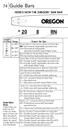 74 Guide Bars HERE S HOW THE OREGON SAW BAR * 20 8 RN Length in Inches 12" 14" 18" 20" 36" (Etc.) Gauge 0=.050" 8=.058" 3=.063" 4=.043" GUARD MATE HOLES These holes are built into the noses of certain
Chapter 7 Hydraulic System Troubleshooting
 Chapter 7 Hydraulic System Troubleshooting General The following troubleshooting information is provided as a general guide to identify, locate and correct problems that may be experienced with the hydraulic
DO NOT OPERATE LANCELOT OR SQUIRE WITHOUT FIRST ADJUSTING THE SAFETY GUARD. ( See Below)
 Assembly Instructions - Lancelot and Squire King Arthur s Tools (KAT) is pleased to present the first tandem mounted saw chain accessories whereby differing combinations of Lancelot and Squire may be paired
Guide to Safe Working with Timber and Chainsaws
 Guide to Safe Working with Timber and Chainsaws Our vision: A national culture where all commit to safe and healthy workplaces and the safe and sustainable management of chemicals. Introduction This guidance
AWWA Butterfly Valve Operation and Maintenance Manual Series 511A & 510A 20 and Smaller
 January 2013 AWWA Butterfly Valve Operation and Maintenance Manual Series 511A & 510A 20 and Smaller Milliken Valve Company 190 Brodhead Avenue, Suite 100 Bethlehem, PA 18017 Phone: (610) 861-8803 Fax:
GUTTER MACHINE CONTROLS STANDARD
 GUTTER MACHINE CONTROLS STANDARD Note: determine what type of control package is installed on the machine. --more-- All operators should familiarize themselves with the appropriate controls prior to any
TECHNICAL BULLETIN. Meritor WABCO Cab Leveling Valves and Chassis Leveling Valves. How the Cab Leveling and Chassis Leveling Valves Work
 Revised 02-00 TECHNICAL BULLETIN Meritor WABCO Cab Leveling Valves and Chassis Leveling Valves This technical bulletin covers both cab and chassis leveling valves manufactured by Meritor WABCO. While the
Hydraulic Air Riveter. Operation Manual RC197 RC198. Recommend for mass production line industrial area. Page 1
 Hydraulic Air Riveter Recommend for mass production line industrial area Operation Manual RC197 RC198 Page 1 CONTENTS 1 Important Safety Rules 2 Tool Specification 2.1 Nomenclature 2.2 Technical Data 3
Auto Feed Screwdriver
 ENGLISH (Original instructions) INSTRUCTION MANUAL Auto Feed Screwdriver 684 00607 DOUBLE INSULATION IMPORTANT: Read Before Using. ENGLISH (Original instructions) SPECIFICATIONS Model 684 Screw strip 4
HT-0095 Mini PV Receptacles 22-32 AWG Crimping Hand Tool. Tool P/N HT-0095
 HT-0095 Mini PV Receptacles 22-32 AWG Crimping Hand Tool Tool P/N HT-0095 FCI MANUAL P/N 415988-001 Issued: Date (03/12/99) Page 1 of 18 HT-0095 Issued: Date (03/12/99) Page 2 of 18 Introduction Table
8" BENCH GRINDER OWNER'S MANUAL
 8" BENCH GRINDER OWNER'S MANUAL WARNING: Read carefully and understand all INSTRUCTIONS before operating. Failure to follow the safety rules and other basic safety precautions may result in serious personal
OPERATOR S MANUAL 18 VOLT, 1 HOUR CHARGER
 OPERATOR S MANUAL 18 VOLT, 1 HOUR CHARGER P110 Your battery charger has been engineered and manufactured to Ryobi s high standard for dependability, ease of operation, and operator safety. When properly
Float and Thermostatic Traps Series H, C and X
 Hoffman Specialty Installation & Maintenance Instructions HS-(E) and Thermostatic Traps Series H, C and X Series C & NPT Series C NPT Series X NPT Series C NPT Series H Ratings Maximum Max. Operating NPT
CUTTING TREES, PRE-COMMERCIAL THINNING AND SLASHING
 CUTTING TREES, PRE-COMMERCIAL THINNING AND SLASHING TABLE OF CONTENTS I 437-007-0800 General Requirements... I-1 437-007-0805 Mechanical Falling... I-3 437-007-0810 Manual Falling... I-4 437-007-0815 Wedges...
Operating Manual Please Read Before Operating Unit
 Operating Manual Please Read Before Operating Unit Model RT2S Wire Stripper & Component Lead Cleaner Service and All Spare Parts Available The Eraser Company, Inc. PO Box 4961/ Oliva Drive Syracuse, NY
PRODUCT MANUAL - M090
 PRODUCT MANUAL - M090 MODEL 203/266 ELECTRIC CAN OPENER 1 SAFETY CAUTION: SEVERED CAN LIDS HAVE CUTTING EDGES. USE OF A PROTECTIVE GLOVE OR TONGS IS ADVISED WHEN HANDLING LIDS. WARNING To avoid risk of
#12 Professional Meat Grinders
 #12 Professional Meat Grinders MG-203100 (52021040) Manual Instruction Thank you, and congratulations on purchasing the Non-corrosive electric meat grinder. Your grinder comes complete with everything
HYDRAULIC LIFT TABLE CART 2200-LB.
 HYDRAULIC LIFT TABLE CART 2200-LB. OWNER S MANUAL WARNING: Read carefully and understand all MACHINE ADJUSTMENT AND OPERATION INSTRUCTIONS before operating. Failure to follow the safety rules and other
Class 5 to 7 Truck and Bus Hydraulic Brake System
 Class 5 to 7 Truck and Bus Hydraulic Brake System Diagnostic Guide 1st Edition * 5+0 Important Service tes The information in this publication was current at the time of printing. The information presented
Front brakes (FN- 3), servicing
 j a t Front brakes (FN- 3), servicing 46-1 Front brakes, servicing Note: Install complete repair kit. After replacing brake pads and before moving vehicle, depress brake pedal several times firmly to properly
SET-UP AND INSTALLATION FOR LEAD SCREW CARTRIDGE ASSEMBLY
 SET-UP AND INSTALLATION FOR LEAD SCREW CARTRIDGE ASSEMBLY 82-13-1 O-Ring (Rear) The Lead Screw Assembly is shipped separately. Note: Install Electrical and Pneumatic Circuitry. Be Sure electrical and pneumatic
CHROME FRONT BRAKE MASTER CYLINDER KIT
 -J075 REV. 009-0-0 CHROME FRONT BRAKE MASTER CYLINDER KIT GENERAL Kit Number 5-99D, 5-99D Models These Chrome Master Cylinder Kits are designed to replace the original equipment front brake master cylinder
PTO OWNER S MANUAL ALLISON FAMILY CODE. pag.1
 PTO OWNER S MANUAL FAMILY CODE ALLISON pag.1 CONTENTS GENERAL INFORMATION Safety information...3 OMFB P.T.O. Safety Label Instructions...6 Foreword...7 INSTALLATION INSTRUCTIONS Mounting the PTO on the
tire inflator with pressure gauge
 tire inflator with pressure gauge Model 95583 Assembly And Operation Instructions Due to continuing improvements, actual product may differ slightly from the product described herein. 3491 Mission Oaks
Auto-belay Cable Replacement Process
 Auto-belay Cable Replacement Process Version 2.00 WARNING: The air pressure in the auto-belay system is what causes the cable to be retracted when releasing the cable or climbing the wall with the cable
Router. A. Identify the major parts of the router. B. Complete a written test on safety and operating procedures of the router with 100% accuracy.
 Router I. Competencies Given a properly adjusted router, instruction and demonstration of use, each student will be able to: A. Identify the major parts of the router. B. Complete a written test on safety
13. REAR WHEEL/BRAKE/SUSPENSION
 13. REAR WHEEL/BRAKE/SUSPENSION 13 3.5~4.5kg-m 8.0~10.0kg-m 0.8~1.2kg-m 3.0~4.0kg-m 2.4~3.0kg-m 3.5~4.5kg-m 6.0~8.0kg-m 13-0 13. REAR WHEEL/BRAKE/SUSPENSION 13 REAR WHEEL/BRAKE/SUSPENSION SERVICE INFORMATION...
INSTRUCTION. Industrial Sewing Machines. No. 010012. First published : June 1997 Second edition : March 2001
 INSTRUCTION Industrial Sewing Machines First published : June 1997 Second edition : March 2001 No. 010012 INTRODUCTION Thank you for your purchasing Kansai Special's DLR Series. Read and study this instruction
ROTOR LOADER OWNER S MANUAL
 ROTOR LOADER OWNER S MANUAL ROTOR LOADER OWNER S MANUAL WARNING IMPORTANT SAFETY INSTRUCTIONS AND GUIDELINES. Misuse of paintball equipment may cause serious injury or death. QUICK SET-UP GUIDE BATTERY
SBC90. Abrasive Blast Cabinet Assembly & Operating Instructions
 SBC90 Abrasive Blast Cabinet Assembly & Operating Instructions READ ALL INSTRUCTIONS AND WARNINGS BEFORE USING THIS PRODUCT. SAVE THESE INSTRUCTIONS FOR FUTURE REFERENCE. This manual provides important
Unit: mm(in) Item Standard value Service limit Axle shaft run out - 0.2(0.008)
 Rear Wheel/Brake/Suspension 13. Rear Wheel/Brake/Suspension Service Information 13-1 Troubleshooting 13-2 Rear Wheel 13-3 Rear Cushion 13-4 Rear Swing Arm 13-7 Service Information General Safety If the
Owner s Manual Read and keep this manual. Patents World Wide
 Owner s Manual Read and keep this manual. Patents World Wide S & S Industries, Inc., Sarasota, FL, USA www.trail-gator.com Copyright 2008 All Rights Reserved The following manual is provided to assist
PAINT SPRAY GUN WASHER
 PAINT SPRAY GUN WASHER 94996 ASSEMBLY AND OPERATING INSTRUCTIONS Visit our website at: http://www.harborfreight.com Read this material before using this product. Failure to do so can result in serious
Flat Bottom Long Ram Hydraulic Jack
 Flat Bottom Long Ram Hydraulic Jack 3 Ton 8 Ton 36468 36469 ASSEMBLY & OPERATING INSTRUCTIONS 349 Mission Oaks Blvd., Camarillo, CA 930 Visit our Web site at http://www.harborfreight.com TO PREVENT SERIOUS
XL PREMIUM OIL COOLER KIT
 -J05 REV. 0-0-0 XL PREMIUM OIL COOLER KIT GENERAL Kit Number 0008 Models For model fitment information, see the P&A Retail Catalog or the Parts and Accessories section of www.harley-davidson.com (English
Section 6 Brake Drum Failure Analysis. Brake Drum Wear Conditions. What is Normal Wear? What is Deep or Excessive Wear? WARNING. Deep, Uniform Wear
 Section Brake Drum 6 Failure Analysis WARNING To prevent serious eye injury, always wear safe eye protection when you perform vehicle maintenance or service. Figure 6.1 ASBESTOS AND NON-ASBESTOS FIBERS
Reasons for reissue of this instruction sheet are provided in Section 5, REVISION SUMMARY.
 Reasons for reissue of this instruction sheet are provided in Section 5, REVISION SUMMARY. Air Pressure 586.1 min 689.5 kpa max [85 min 100 psi max] Air Displacement 721,000 mm 3 [44 in. 3 ] Figure 1 Weight
Failure to comply with the following cautions and warnings could cause equipment damage and personal injury.
 1.0 IMPPORTANT RECEIVING INSTRUCTIONS Visually inspect all components for shipping damage. Shipping Damage is not covered by warranty. If shipping damage is found, notify carrier at once. The carrier is
IMPORTANT INFORMATION - PLEASE READ. Table of Contents. Introduction. General Information
 IMPORTANT INFORMATION - PLEASE READ Introduction Congratulations! Welcome to the world of the ELLIPTICAL CROSS TRAINER. The ELLIPTICAL CROSS TRAINER is one of the finest and most comprehensive pieces of
DiscPlus DX195 and DX225 Air Disc Brakes
 Revised 11-04 Technical Bulletin Revised 1 Technical 11-04 Bulletin DiscPlus DX195 and DX225 Air Disc Brakes Inspection, Installation and Diagnostics Air Disc Brake Inspection Intervals and Procedures
SAFETY & OPERATING INSTRUCTIONS
 SAFETY & OPERATING INSTRUCTIONS EDLUND TOMATO LASER, Models ETL -316, -140 & -380 READ AND UNDERSTAND THIS MANUAL AND ALL INSTRUCTIONS BEFORE OPERATING THIS SLICER. 159 Industrial Parkway, Burlington,
DANGER DANGER. General Information. Safety Is Your Responsibility. Ordering Parts. Contact Information
 Safety Safety Is Your Responsibility DANGER To avoid personal injury or death, carefully read and understand all instructions pertaining to the Anthony Liftgates product. Do not attempt to install, operate,
MBSAW. Meat Cutting Band Saw With Meat Grinder Assembly & Operating Instructions
 06/2011 MBSAW Meat Cutting Band Saw With Meat Grinder Assembly & Operating Instructions READ ALL INSTRUCTIONS AND WARNINGS BEFORE USING THIS PRODUCT. This manual provides important information on proper
FASCINATION 700 HVLP TANNING PRO SYSTEM USER MANUAL
 FASCINATION 700 HVLP TANNING PRO SYSTEM USER MANUAL Congratulations on choosing the Fascination 700 HVLP Tanning Pro System! Your system includes the following items: 1 Fascination 700 HVLP Tanning Pro
Sport Ice Elektro 124
 Sport Ice Elektro 124 Operation Manual 2007/4 V2.1 Introduction The Sport Ice Elektro 124 is an ice resurfacing machine designed to be used on small ice surfaces. The machine has been designed to produce
Cooling system components, removing and installing
 Engine BHW Cooling system components, removing and installing Page 1 / 24 19-1 Cooling system components, removing and installing Warning! When doing any repair work, especially in the engine compartment,
CONGRATULATIONS! TABLE OF CONTENTS. 1 Safety Warnings 2 About Your Wheels 3 Setting Up Your Wheels 7 Care and Cleaning 8 Warranty
 WHEEL MANUAL CONGRATULATIONS! Congratulations on your purchase of Oval Concepts Wheels. Developed to perform at a high level, it is important that you follow the operation and maintenance instructions
Fire Hydrant Troubleshooting
 Fire Hydrant Troubleshooting Pulsation or chatter during opening and flow of water from hydrant. Loose condition in stem at lower valve plate nut. Tighten lower valve plate nut and secure with SS lock
SP AF 300mm F/2.8 LD [IF] for Canon (Model 360EE)
![SP AF 300mm F/2.8 LD [IF] for Canon (Model 360EE)](/thumbs/40/21493790.jpg "SP AF 300mm F/2.8 LD [IF] for Canon (Model 360EE)") SP AF 300mm F/2.8 LD [IF] for Canon (Model 360EE) We greatly appreciate your purchase of this Tamron lens. The Tamron SP AF 300mm F/2.8 LD [IF] is a fast telephoto lens developed for Canon AF single-reflex
SP AF 300mm F/2.8 LD [IF] for Canon (Model 360EE) We greatly appreciate your purchase of this Tamron lens. The Tamron SP AF 300mm F/2.8 LD [IF] is a fast telephoto lens developed for Canon AF single-reflex
Rebuild Instructions for 70001 and 70010 Transmission
 Rebuild Instructions for 70001 and 70010 Transmission Brinn, Incorporated 1615 Tech Drive Bay City, MI 48706 Telephone 989.686.8920 Fax 989.686.6520 www.brinninc.com Notice Read all instructions before
Hydraulic Transmission Jacks Operating Instructions & Parts Manual
 Blackhawk Automotive is a Licensed Trade Mark Made by SFA Companies, Kansas City, MO Hydraulic Transmission Jacks Operating Instructions & Parts Manual Model BH7011 BH7210 Capacity 1/2 Ton 1 Ton SFA Companies
DR K10 RAPIDFIRE LOG SPLITTER SAFETY & OPERATING INSTRUCTIONS. Original Language. Serial No. Order No.
 DR K10 RAPIDFIRE LOG SPLITTER SAFETY & OPERATING INSTRUCTIONS Serial No. Order No. Original Language DR Power Equipment Toll-free phone: 1-800-DR-OWNER (376-9637) Fax: 1-802-877-1213 Website: www.drpower.com
System Saver 318 Air Compressor for Mack E-Tech and ASET Engines
 Maintenance Manual 31 System Saver 318 Air Compressor for Mack E-Tech and ASET Engines Revised 08-05 NON-THROUGH DRIVE THROUGH DRIVE Service Notes About This Manual This manual provides service and repair
Volkswagen Jetta, Golf, GTI 1999, 2000 Brake System 47 Brakes - Hydraulic Components (Page GR-47)
 47 Brakes - Hydraulic Components (Page GR-47) FS III front brake calipers, servicing Front brake caliper piston, removing and installing FN 3 front brake calipers, servicing Front caliper piston, removing
Pet hair clipper. Model 96822. Diagrams within this manual may not be drawn proportionally.
 Pet hair clipper Model 96822 Cleaning And Operation Instructions Diagrams within this manual may not be drawn proportionally. Due to continuing improvements, actual product may differ slightly from the
jbs nfb INSTALLATION INSTRUCTIONS AND OWNERS MANUAL Mechanical Steering for Inboard, Outboard, and Sterndrive Powered Vessels
 MEMBER INSTALLATION INSTRUCTIONS AND OWNERS MANUAL Part # IS-SH5094, Rev 3, 04/204 www.seastarsolutions.com SH5294 DUAL SH5094 SINGLE jbs nfb Mechanical Steering for Inboard, Outboard, and Sterndrive Powered
SE-100-1, SE-200-1, SE-500-1, and SE-1000-1 AIR CHAMP PRODUCTS. User Manual SE BRAKE MODELS: (i) MTY (81) 83 54 10 18 ventas@industrialmagza.
 AIR CHAMP PRODUCTS User Manual SE BRAKE MODELS: SE-00-, SE-200-, SE-500-, and SE-000- (i) FORM NO. L-20084-E-040 In accordance with Nexen s established policy of constant product improvement, the specifications
Trouble Shooting Tech Tips Operation
 Steering Components TroubleShooting Tech Tips Table of Contents Basic Steering System Operation 2 Sector Shaft Adjustments 4 Drag Link Adjustment 5 Relief Valve/Unloading Valve Adjustment 6 Ross TAS Automatic
Trillium 40 Axis Spring Tensioner Wire Replacement Instructions
 Trillium 40 Axis Spring Tensioner Wire Replacement Instructions 1 Overview The objective is to replace the broken axis spring tensioner wire. This requires the following tasks: 1. Remove the seismometer
Rail Vehicle Systems IP-241. Rev 07 3/9/2016 - en. Installation and Maintenance Guide. Slack Adjuster Model KRD-482-E and KRD-482-R P/N 783901, 790196
 Rail Vehicle Systems IP-241 Rev 07 3/9/2016 - en Installation and Maintenance Guide Slack Adjuster Model KRD-482-E and KRD-482-R P/N 783901, 790196 Contact Address New York Air Brake 748 Starbuck Avenue
SUSPENSION DIAGNOSIS
 SECTION 2A SUSPENSION DIAGNOSIS TABLE OF CONTENTS Diagnosis... 2A-2 General Diagnosis... 2A-2 Hub and Bearing... 2A-7 2A-2 SUSPENSION DIAGNOSIS DIAGNOSIS GENERAL DIAGNOSIS Problems in the steering, the
OPERATING INSTRUCTIONS FOR
 OPERATING INSTRUCTIONS FOR MEDECO KEY MACHINES FOR MEDECO ORIGINAL, BIAXIAL, MEDECO 3, KEYMARK CLASSIC & KEYMARK X4 PRODUCTS MEDECO HIGH SECURITY LOCKS ASSUMES NO RESPONSIBILITY FOR INJURY OR PROPERTY
Industrial Process Pump Safety Manual IMPORTANT SAFETY NOTICE
 Industrial Process Pump Safety Manual IMPORTANT SAFETY NOTICE To: Our Valued Customers User safety is a major focus in the design of our products. Following the precautions outlined in this manual will
Electric Meat Grinder
 Electric Meat Grinder OWNER S MANUAL WARNING: Read carefully and understand all INSTRUCTIONS before operating. Failure to follow the safety rules and other basic safety precautions may result in serious
GPS AutoSteer System Installation Manual
 GPS AutoSteer System Installation Manual Supported Vehicles John Deere Sprayers 4720 4630 4730 4830 AutoTrac Ready PN: 602-0227-01-A LEGAL DISCLAIMER Note: Read and follow ALL instructions in this manual
Strut Spring Compressor
 Strut Spring Compressor Item 43753 Read this material before using this product. Failure to do so can result in serious injury. SAVE THIS MANUAL. When unpacking, make sure that the product is intact and
OPERATING INSTRUCTION MANUAL FOR S-240 HYDRAULIC CUTTERS WITH PARTS LIST
 HUSKIE TOOLS, INC. OPERATING INSTRUCTION MANUAL FOR S-240 HYDRAULIC CUTTERS WITH PARTS LIST GENERAL INFORMATION GUIDE FOR S-240 CUTTER The following steps are guidelines for safe operation of the Huskie
Multi-Pitch Pitching Machine USER MANUAL
 Multi-Pitch Pitching Machine USER MANUAL TABLE OF CONTENTS Thank you for purchasing the Cimarron Multi-Pitch Pitching Machine. The Cimarron Multi-Pitch Pitching Machine is a high performance pitching machine
Speed-Mat Rectangle Cutter
 Speed-Mat Rectangle Cutter 1 Honeycomb baseboard. 2 Left hold down. 14 3 Bottom hold down. 4 4 Left / right rule. 8 5 8 5 Left / right rule pointer. 1 6 Top / bottom rule. 7 Top / bottom rule pointer.
BACKPACK SPRAYERS. MODEL NOS: KSP16 & KSP20 Part Nos: 3402270 & 3402275 OPERATING & MAINTENANCE INSTRUCTIONS GC04/12
 BACKPACK SPRAYERS MODEL NOS: KSP16 & KSP20 Part Nos: 3402270 & 3402275 OPERATING & MAINTENANCE INSTRUCTIONS GC04/12 INTRODUCTION Thank you for purchasing this CLARKE Sprayer, designed for use only with
MEASURING WHEEL ALIGNMENT
 MEASURING WHEEL ALIGNMENT 2003-04 WHEEL ALIGNMENT Specifications & Procedures - Hummer - H2 Steering and vibration complaints are not always the result of improper alignment. One possible cause is wheel
HYDRAULIC TABLE CART
 Owner s Manual & Safety Instructions Save This Manual Keep this manual for the safety warnings and precautions, assembly, operating, inspection, maintenance and cleaning procedures. Write the product s
IMPORTANT SAFETY NOTICE
 IMPORTANT SAFETY NOTICE To: Our Valued Customers User safety is a major focus in the design of our products. Following the precautions outlined in this manual will minimize your risk of injury. ITT Goulds