
Implicit versus explicit comparatives
|
|
|
- Dominick Beasley
- 9 years ago
- Views:
Transcription
1 Implicit versus explicit comparatives Robert van Rooij ILLC, University of Amsterdam Abstract It is natural to assume that the explicit comparative John is taller than Mary can be true in cases the implicit comparative John is tall compared to Mary is not. This is sometimes seen as a threat to comparison-class based analyses of the comparative. In this paper it is claimed that the distinction between explicit and implicit comparatives corresponds to the difference between (strict) weak orders and semi-orders, and that both can be characterized naturally in terms of constraints on the behavior of predicates among different comparison classes. 1 Introduction Consider the following figure, picturing the lengths of John and Mary. John Mary Chris Kennedy (this volume) observed that according to most people s intuition, this picture allows us to say (1-a). At the same time, most people would say that (1-b) is false. (1) a. John is taller than Mary. b. Compared to Mary, John is tall, but compared to John, Mary is not tall. I would like to thank an anonymous reviewer and the editors (Paul Egre and Nathan Klinedinst) for their useful comments on an earlier version of this paper. I would like Chris Kennedy for stating the challenge and for pointing out the reference to Sapir. 1

2 This observation is stated as a challenge to followers of Klein (1980). According to Klein (1980), (1-a) is true if and only if there is a comparison class according to which John is tall and Mary is not, i.e. (Klein). It is standardly assumed (e.g. Von Stechow, 1984) that Klein s actual analysis of (1-a) is equivalent with the simpler analysis of van Benthem, (Benthem), which will be discussed in section 2: (Klein) (1-a) is true iff there is a comparison class such that John is tall here and Mary is not. (Benthem) (1-a) is true iff John is tall in comparison class {John, Mary}, but Mary is not. But according to (Benthem), (1-a) and (1-b) have the same truth conditions, and it is impossible to account for the contrast between them in truth conditional terms. We will meet Kennedy s challenge by making a distinction between analyses (Klein) and (Benthem). 2 Comparatives and comparison classes Although expressions of many lexical categories are vague, most research on vagueness concentrates on adjectives like tall and bald. In linguistics these adjectives are known as gradable adjectives and should be distinguished from non-gradable adjectives like pregnant and even. The latter adjectives do not give rise to (much) vagueness. There exist two major types of approaches to the analysis of gradable adjectives: degree-based approaches and delineation approaches. Degree-based approaches (e.g. Seuren, 1973; von Stechow, 1984; Kennedy, 1999), analyze gradable adjectives as relations between individuals and degrees, where these degrees are thought of as scales associated with the dimension referred to by the adjective. Individuals can possess a property to a certain measurable degree. The truth conditions of sentences involving these adjectives are stated in terms of degrees. According to the most straightforward degree-based approach, a sentence like John is tall is true iff the degree to which John is tall is (significantly) greater than a (contextually given) standard of height. The comparative John is taller than Mary is true iff the (maximal) degree to which John is tall is greater than the (maximal) degree to which Mary is tall. 1 Delineation approaches (Lewis, 1970; Kamp, 1975; Klein 1980, 1991) analyze gradable adjectives like tall as simple predicates, but assume that the 1 More complex sentences suggest that this simple picture is naive, and there has been a lot of discussion of how to improve on it. I will ignore this discussion in this paper. 2

3 extension of these terms are crucially context-dependent. If one accounts for comparatives in terms of supervaluation structures as Lewis and Kamp do, the most obvious way to account for this context-dependence is very similar to the one used in degree-based approaches: context just determines the cutoff-point. But, of course, context-dependence is more fine-grained than that. For Jumbo to be a small elephant, for instance, means that Jumbo is being small for an elephant, but that does not mean that Jumbo is small. For instance, Jumbo will be much bigger than any object that counts as a big mouse. One way to make this explicit is to assume with Klein (1980) that every adjective should be interpreted with respect to a comparison class, i.e. a set of individuals. The truth of a sentence like John is tall depends on the contextually given comparison class: it is true in context (or comparison class) c iff John is counted as tall in this class. Klein (1980) further proposes that the meaning of the comparative John is taller than Mary is context-independent and the sentence is true iff there is a context (henceforth we will use context instead of the more cumbersome comparison class ) according to which John counts as tall, while Mary does not. If there is any context in which this is the case, it will also be the case in the context containing only John and Mary. Klein (1980) favors the delineation approach towards comparatives for a number of reasons. First, a degree-based approach only makes sense in case the comparative gives rise to a total ordering. But for at least some cases (e.g. more clever than) this does not seem to be true, because clever is a multi-dimensional adjective. Second, the delineation account assumes that the meaning of the comparative taller than is a function of the meaning of tall. This is much in line with Frege s principle of compositionality, 2 and also accounts for the fact that in a wide variety of languages the positive is formally unmarked in relation to the comparative. An analysis of comparatives in terms of comparison classes is sometimes stated as if it presupposes that the domain of all individuals of any gradable adjective has an inherent ordering imposed upon it, and that the ordering on a comparison class must preserve the initial ordering on the domain of the adjective in order to avoid undesirable entailments. Kennedy (1997) states this in terms of the following consistency postulate. For any context in which a is ϕ is true and b a with respect to the original ordering on the domain of ϕ, then b is ϕ is also true, and for any context in which a is ϕ is false, and a b, then b is ϕ is also false. 2 But see Von Stechow (1984) for an argument saying that also the degree-based approach is in line with Frege s principle. 3

4 But if this were so, the delineation analysis of comparatives would be reduced to an initial comparison ordering, and thus the delineation approach would not take the positive use of the adjective as basic. Fortunately, Van Benthem (1982) has shown that what Kennedy calls the initial ordering can be derived from how we positively use the adjective in certain contexts, plus some additional constraints on how the meaning of the adjective can change from context to context. This is done in terms of the notion of a context structure, M, being a triple X, C, V, where X is a non-empty set of individuals, the set of contexts, C, consists of all finite subsets of X, and the valuation V assigns to each context c C and each property T those individuals in c which are to count as being T in c. This definition leaves room for the most diverse behavior of individuals across contexts. Based on intuition (for instance by visualizing sticks of various lengths), however, the following plausible cross-contextual principles make sense, which constrain the possible variation. Take two individuals x and y in context c such that M, c = T (x) T (y). We now constrain the set of contexts C by the following three principles: No Reversal (NR), which forbids x and y to change roles in other contexts: (NR) c C : M, c = T (y) T (x). This constraint does not prevent x and y both to be tall in larger contexts than c. However, once we look at such larger contexts, the Upward Difference (UD) constraint demands that there should be at least one difference pair: (UD) c C[c c z 1, z 2 : M, c = T (z 1 ) T (z 2 )] The final Downward Difference (DD) principle constrains in a very similar way what is allowed if we look at subsets of c: if x and y are elements of this subset, there still should be a difference pair: (DD) c C[(c c & x, y c ) z 1, z 2 : M, c = T (z 1 ) T (z 2 )] If we say that John is taller than Mary is true if and only if there is a context c such that M, c = T (j) T (m), Van Benthem shows that the comparative (given the above constraints on context strucures) as defined above has exactly those properties which we intuitively want for most comparatives (see below). Thus we have seen that on the basis of the initial idea of the delineation approach we can derive the ordering relation that Kennedy (1997) claims delineation approaches must already take for granted to begin with. In the definition of a context structure we used above, context structures 4

5 give rise to orderings for any context-dependent adjective. For convenience, we will just limit ourselves to one adjective: P. If we do so, we can think of a context structure as a triple X, C, P, where P can be though of as a choice function, rather than a general valuation function. Definition 1. A context structure M is a triple X, C, P, where X is a non-empty set of individuals, the set of contexts, C, consists of all finite subsets of X, and the choice function P assigns to each context c C one of its subsets. Notice that P (c) (with respect to context structure M) corresponds to the set {x X : M, c = P (x)} in our earlier formulation. To state the crosscontextual constraints somewhat more compactly than we did above, we define the notion of a difference pair: x, y D P (c) iff def x P (c) and y (c P (c)). Now we can define the constraints as follows (where c 2 abbreviates c c, and D 1 P (c) = def { y, x : x, y D P (c)}): (NR) c, c C : D P (c) D 1 P (c ) =. (UD) c c and D P (c), then D P (c ). (DD) c c and D P (c ) c 2, then D P (c). If we say that x > P y, iff def x P ({x, y}) and y P ({x, y}), van Benthem (1982) shows that the ordering as defined above gives rise to a strict weak order. A structure X, R, with R a binary relation on X, is a strict weak order just in case R is irrreflexive (IR), transitive (TR), and almost connected (AC): Definition 2. A (strict) weak order is a structure X, R, with R a binary relation on X that satisfies the following conditions: (IR) x : R(x, x). (TR) x, y, z : (R(x, y) R(y, z)) R(x, z). (AC) x, y, z : R(x, y) (R(x, z) R(z, y)). The constraint that R should be almost connected is in some circles better known under its contrapositive guise as co-transitivity: x, y, z : ( R(x, z) R(z, y)) R(x, y). If we now define the indifference relation, I, or in our case P, as follows: x P y iff def neither x > P y nor y > P x, it is clear that P is an equivalence relation. It is well-known from measurement theory (e.g. Krantz et al, 1971) that in case > P gives rise to a (strict) weak order, it can be represented numerically by a real valued function f P such that for all x, y X: x > P y iff f P (x) > f P (y), and x P y iff f P (x) = f P (y). 5

6 3 Explicit versus implicit comparison Consider again the following figure, picturing the lengths of John and Mary. John Mary How can we account for the fact that the explicit comparative (1-a) is intuitively true, while the implicit comparative (1-b) is false? 3 (1-a) (1-b) John is taller than Mary. Compared to Mary, John is tall, but compared to John, Mary is not tall. It is clear that according to (Benthem) (1-a) and (1-b) have the same truth conditions, and it is impossible to account for the contrast between them in truth conditional terms. (Benthem) (1-a) is true iff John is tall in comparison class {John, Mary}, but Mary is not. Of course, Klein s (1980) original analysis (Klein) was a bit different, so it seems possible to account for the difference between (1-a) and (1-b) in terms of the difference between (Klein) and (Benthem). (Klein) (1-a) is true iff there is a comparison class s.t. John is tall here and Mary is not. It can be easily shown, however, that in case Klein would have adopted Van Benthem s (1982) cross-contextual constraints, (Klein) is equivalent to (Benthem). It is immediately clear that by Van Benthem s definition of a context structure and by adopting his constraints, analysis (Klein) follows from analysis (Benthem). But it is important to see why also the reverse holds. So suppose that (1-a) is true according to (Klein). That means that there exists a comparison class c C containing John and Mary such that j P (c) m P (c). But this means that j, m is a difference pair in c, and by (DD) it follows that j, m will be a difference pair in all c C that are subsets of c containing both John and Mary. By the assumption that C 3 According to Chris Kennedy (p.c.) the names explicit versus implicit comparatives goes back to Sapir (1944). 6

7 contains all finite subsets of X, it follows that j, m is also a difference pair for comparison class {John, Mary}, which means that (1-a) is also predicted to be true by (Benthem). I would like to point out that the derivation of the truth of the comparative according to (Benthem) from its truth according to (Klein) is based on (at least) two assumptions. The first assumption is that we do not really make a distinction between it not being the case that Mary is tall, and Mary s being not-tall, or, perhaps equivalently, Mary s being short. A second crucial presupposition on which the above derivation is based is the assumption that C contains all finite subsets of X, in particular that {John, Mary} is an element of C. The first assumption, however, was explicitly rejected by Klein (1980). Klein (1980) explicitly proposed that an adjective gives rise to a three-way partition of the comparison class c: some individuals in c are (definitely) tall, some are (definitely) not-tall, and some are neither. Klein used a three-valued logic, but the same intuition can be captured by inducing the three-way partition by a set of contrary predicates: e.g., the adjective tall and its antonym short. Although no individual in c is tall and short, it is possible that some individuals are neither. Klein (1980) assumed that an adjective gives rise to a three-way partition to account for vagueness. I will argue in the next section that doing so is indeed natural to account for the Sorites paradox. In the next section I will also argue that for the very same reason it is also natural to give up van Benthem s (1981) assumption that all finite subsets of X are appropriate comparison classes. In section 5 I will then show that if one gives up either of these assumptions one can generate an ordering relation that properly represents vagueness, and, or so I will argue, in terms of which one can give a natural account of the distinction between (1-a) and (1-b). 4 The Sorites and semi-orders 4.1 Vagueness and Semi-orders Consider a long series of people ordered in terms of their height. Of each of them you are asked whether they are tall or not. We assume that the variance between two subsequent persons is always indistinguishable. Now, if you decide that the first individual presented to you, the tallest, is tall, it seems only reasonable to judge the second individual to be tall as well, since you cannot distinguish their heights. But, then, by the same token, the third person must be tall as well, and so on indefinitely. In particular, this makes also the last person tall, which is a counterintuitive conclusion, given that it is in contradiction with our intuition that this last, and shortest individual, is short, and thus not tall. 7

8 This so-called Sorites reasoning is elementary, based only on our intuition that the first individual is tall, the last short, and the following inductive premise, which seems unobjectable: [P] If you call one individual tall, and this individual is not visibly taller than another individual, you have to call the other one tall too. Our above Sorites reasoning involved the predicate tall, but that was obviously not essential. Take any predicate P that gives rise to a complete ordering as P than. Let us assume that P is the indistinguishability, or indifference, relation between individuals with respect to predicate P. Now we can state the inductive premise somewhat more formally as follows: [P] For any x, y X : (P (x) x P y) P (y). If we assume that it is possible that x 1,..., x n : x 1 P x 2 x n 1 P x n, but P (x 1 ) and P (x n ), the paradox will arise. Recall that if P (x 1 ) and P (x n ), it is required that x 1 must be visibly or significantly P -er than x n, denoted by x 1 P x n. In section 2 of this paper we have defined a relation > P in terms of the behavior of predicate P. The constraints discussed there, however, did not allow for the possibility that x 1,..., x n : x 1 P x 2 x n 1 P x n, but P (x 1 ) and P (x n ), and the defined comparison relation could not really be interpreted as meaning being visibly/significantly P -er than. Fortunately, there is a well-known ordering that should be interpreted this way: what Luce (1956) calls a semi-order. Following Scott & Suppes (1958) (equivalent, but still) simpler definition, a structure X, R, with R a binary relation on X, is a semi-order just in case R is irreflexive (IR), satisfies the interval-order (IO) condition, and is semi-transitive (STr). 4 Definition 3. A semi-order is a structure X, R, with R a binary relation on X that satisfies the following conditions: (IR) x : R(x, x). (IO) x, y, v, w : (R(x, y) R(v, w)) (R(x, w) R(v, y)). (STr) x, y, z, v : (R(x, y) R(y, z)) (R(x, v) R(v, z)). It is important to see that if we interpret the relation P as a semi-order, it is irreflexive and transitive, but need not be almost connected. Perhaps the 4 Any relation that is irreflexive and satisfies the interval-order condition is called an interval order. All interval orders are also transitive, meaning that they are stronger than strict partial orders. 8

9 easiest way to grasp what it means to be a semi-order is to look at its (intended) measure-theoretical interpretation. On the intended interpretation, x P y is true iff the height of x is higher than the height of y plus some fixed (small) real number ɛ, which can be thought of as a margin of error. 5 Indeed, as already suggested by Luce (1956) and rigorously proved by Scott & Suppes (1958), if X is a finite set and ɛ a positive number, X, P is a semi-order if and only if there is a real-valued function f P such that for all x, y X : x P y iff f P (x) > f P (y) + ɛ. This fact helps to explain the constraints. That the order should be irreflexive is trivial, because there can be no x such that f P (x) > f P (x) + ɛ. As for (IO), consider two cases: f P (x) f P (v) or f P (v) f(x). In the first case we have f P (x) f P (v) > f P (w) + ɛ, and thus x w. In the second case we have f P (v) f P (x) > f P (y) + ɛ, and thus v y. To see that (STr) holds, suppose that x P y and y P z. Then f P (x) > ɛ f P (y) > ɛ f P (z) (with a > ɛ b iff a > b + ɛ). But then f P (v) f P (y) implies v z, and f P (v) f P (y) implies x P v. In terms of P we can define a similarity relation P as follows: x P y iff neither x P y nor y P x. The relation P is reflexive and symmetric, but need not be transitive. Thus, P does not give rise to an equivalence relation. One should think of this similarity relation as one of indifference or indistinguishability. Measure theoretically x P y is true iff the difference in height between x and y is less than ɛ. 6 In case ɛ = 0, the semi-order is a weak order. 4.2 Some proposed solutions to the Sorites The standard reaction to the Sorites paradox taken by proponents of fuzzy logic and/or supervaluation theory is to say that the argument is valid, but that the inductive premise [P] (or one of its instantiations) is false. But why, then, does it at least seem to us that the inductive premise is true? According to the standard accounts of vagueness making use of fuzzy logic and supervaluation theory, this is so because the instantiations of the inductive premise are almost true (in fuzzy logic), or almost all instantiations are true in the complete valuations (in supervaluation theory). Linguists (e.g. Kamp, 1975; Klein, 1980; Pinkal, 1995) typically do not like the fuzzy logic approach to vagueness, because that cannot account for 5 One can think of Williamson s (1990) epistemic analysis of vagueness based on semiorders as well. 6 The fact that P is intransitive has the consequence that semi-orders cannot be given a full measure-theoretic interpretation f in the sense that there is no set of transformations such that f is unique up to this set of transformations. This fate it shares with, among others, partial orders. 9

10 what Fine (1975) called penumbral connections. The treatment of vagueness and the Sorites paradox in supervaluation theory is not unproblematic either, however. The use of complete refinements in supervaluation theory assumes that we can always make sharp cutoff-points: vagueness exists only because in daily life we are too lazy to make them. But this assumption seems to be wrong: vagueness exists, according to Dummett (1975), because we cannot make such sharp cutoff-points even if we wanted to. In terms of what we discussed above, this suggests that the relation P of indifference or indistinguishability should be intransitive, just as it is for a semi-order. But because this relation is still symmetric, it is very natural to claim that something like [P] is true. For a while, the so-called contextualist solution to the Sorites paradox was quite popular (e.g. Kamp, 1981; Pinkal, 1984; Raffman, 1994, 1996). Most proponents of the contextuallist solution follow Kamp (1981) in trying to preserve (most of) [P] by giving up some standard logical assumptions, and/or by making use of a mechanism of context change. But with Keefe (2007) we do not believe that context change is essential to save natural language from the Sorites paradox. We rather believe that any solution involves some notion of partiality. We will briefly discuss two such proposed solutions in this section (without pretending to be complete or assuming that they are undoubtfully successful), and use the motivations behind those solutions in the following sections to propose some new cross contextual constraints on the behavior of predicates which generate semi-orders. A first solution is closely related with recent work of Raffman (2005) and Shapiro (2006) and makes use of partiality in a rather direct way: 7 in terms of three valued logic (Shapiro), or in terms of pairs of contrary antonymns (Raffman). The idea just as what Klein (1980) proposed earlier is that with respect to a comparison class c, predicate P and its antonym P do not necessarily partition c, and there might be elements in c that neither (clearly) have property P nor property P, but are somewhere in the middle. Once one makes such a move it is very natural to assume that the inductive principle [P] is not valid, but a weakened version of it, [P w ], is: [P w ] If you call one individual tall in a particular context, and this individual is not visibly/relevantly taller than another individual, you will/should not call the other one short/not tall. Thus, for any x, y I, c C : (P (x, c) x P y) P (y, c). Of course, principle [P w ] can only be different from the original [P] if 7 Shapiro (2006) argues that his solution is closely related to Waisman s notion of Open Texture. For what it is worth, I believe that Waisman s notion is more related to what I call the second solution of the Sorites. 10

11 P (y, c) does not come down to the same as P (y, c). 8 Thus, a gap between the sets of P - and P -individuals (with respect to c) is required. Notice that the Sorites paradox can now be solved in a familiar way: P (x 1, c) and P (x n, c) are true in context c, and modus ponens is valid, but the inductive hypothesis, or (all) its instantiations, are not. However, because we adopt [P w ] as a valid principle of language use, we can explain why inductive hypothesis [P] seems so natural. To illustrate, if c = {x, y, z}, it might be that with respect to a particular context structure P (c) = {x}, P (c) = {z}, and x P y P z. Notice that such a context structure satisfies [P w ] but not [P]. A second solution is more radically pragmatic in nature and seems very much in line with Wittgenstein s Philosofische Untersuchungen. 9 In normal discourse, we talk about relatively few objects, all of which are easily discernible from the others. In those circumstances, [P] will not give rise to inconsistency, but serves its purpose quite well. Only in exceptional situations i.e., when we are confronted with long sequences of pairwise indistinguishable objects do things go wrong. But in such situations, we should not be using vague predicates like tall but precisely measurable predicates instead. A weak version of this reaction can be formalized naturally in terms of comparison classes. The idea is that it only makes sense to use a predicate P in a context i.e. with respect to a comparison class, if it helps to clearly demarcate the set of individuals that have property P from those that do not. Following Gaifman (1997), 10 we will implement this idea by assuming that any subset of X can only be an element of the set of pragmatically appropriate comparison classes C just in case the gap between the last individual(s) that have property P and the first that do(es) not must be between individuals x and y such that x is clearly, or significantly, P -er than y. This is not the case if the graph of the relation P is closed in c c. 11 Indeed, it is exactly in those cases that the Sorites paradox arises. Notice that also this analysis makes use of partiality, but this now consists in the idea that certain comparison classes are not appropriate for the use of a particular predicate P. 8 In this paper I don t really distinguish thinking of the comparison class as part of the context (as I did until now, or of thinking of it as an argument of an adjective. For present purposes, this distinction is irrelevant. 9 See in particular section 85-87: A rule stands like a signpost... The signpost in order in in normal circumstances it fulfils its purpose. The observation that our pragmatic solution is very much in line with Wittgenstein s later philosophy, I owe to Frank Veltman. 10 One might argue that Gaifman s solution was already anticipated though in a rather different way by Kamp (1981). A theory much more similar to Gaifman s was proposed by Pagin (this volume). The editors of this volume pointed out to me that Gomez-Torrente (2008) argues for much the same idea. 11 Notice that also in discrete cases the relation P can be closed in c c. It just depends on how P is defined. 11
![instantiations, are not. However, because we adopt [P w ] as a valid principle of language use, we can explain why inductive hypothesis [P] seems so natural.](/docs-images/46/21318631/images/page_11.jpg "To illustrate, if c = {x, y, z}, it might be that with respect to a particular context structure P (c) = {x}, P (c) = {z}, and x P y P z.")
12 How does such a proposal deal with the Sorites paradox? Well, it claims that in all contexts in which P can be used appropriately, [P] is true. If we assume in addition that the first element x 1 of a Sorites series is the absolute most P -individual, and the last element x n the absolute least P -individual, it also claims that in all contexts c in which it is appropriate to use predicate P in combination with x 1 and x n, P (x 1, c) is true and P (x n, c) is false. Thus, in all appropriate contexts, the premises of the Sorites argument are considered to be true. Still, no contradiction can be derived, because using predicate P when explicitly confronted with a set of objects that form a Sorites series is inappropriate. Thus, in contrast to the original contextualist approaches of Kamp (1981), Pinkal (1984), and others, the Sorites paradox is not avoided by assuming that the meaning (or extension) of the predicate changes as the discourse proceeds. Rather, the Sorites paradox is avoided by claiming that the use of predicate P is inappropriate when confronted with a Sorites series of objects. 12 The above sketch of some proposed solutions was rather unsophisticated and I do not want to claim in this paper that they, or their more sophisticated variants, are completely successful. I also don t want to go into their relative pros and cons, or argue that they are (clearly) preferred to other proposals (though I sympathize with them). I only sketched them because the motivations behind those proposals clearly suggest some new cross contextual constraints on the behavior of predicates which can be shown to generate (or even characterize) semi-orders. 4.3 Semi-orders and semantic gaps The first of the above solutions to the Sorites paradox is in essence threevalued. Either because a three-valued logic was used, or because we made use of pairs of antonyms. Recall again that Klein (1980) already used a threevalued logic: not all individuals in a particular comparison class need to be either tall or not-tall (in fact, Klein used supervaluations to make up for this deficiency ). In this section we will indicate that once we follow this line of thought, it becomes easy to generate semi-orders, instead of weak orders. Our derivation makes use of two choice functions. Let us say that P (c) selects the elements of c that (clearly) have property P, while P (c) (e.g. tall ) selects the 12 Williamson (p.c.) and a reviewer of this paper ask what are the semantic consequences of using a pragmatically inappropriate comparison class. The main answer is that if pushed one can still choose between, for instance, an epistemic approach or a three valued approach. Adopting this approach, the answer to this question should, I think, be of little theoretical importance: I do not think we have very strong semantic intuitions about things that go against what we ought to do and normally do. 12

13 elements that (clearly) have property P ) (e.g. short ). Now we can give the following four constraints: 13 (P ) c C : P (c) P (c) =. (NR ) c, c : D P (c) D 1 P (c ) = and D P (c) D 1 P (c ) =. (UD ) If c c and D P P (c), then D P P (c ). (DD ) If c c and D P P (c ) c 2, then D P P (c). Constraint (P ) assures that P and P behave as contraries, while (NR ) is the obvious generalization of van Benthem s (1982) No Reversal constraint. Constraints (UD ) and (DD ) are very similar to the earlier Upward and Downward Difference constraints of van Benthem (1982), but still crucially different. The difference is that in this case we look at contrary pairs, and not merely at contradictory pairs. We define the ordering relation as follows: x P y iff def x P ({x, y}) and y P ({x, y}). Then we can prove that this relation is irreflexive and transitive, but it need not satisfy almost connectedness: If x P y, it is possible that neither x P z nor z P y, because (DD ) does not require either of them to hold if P ({x, y, z}) = {x} and P ({x, y, z}) = {y}. Now we can prove the following theorem (see van Rooij, 2009): Theorem 1. Any context structure X, C, P, P with X and C as defined above such that P and P obey axioms (P ), (NR ), (UD ), and (DD ), gives rise to a semi-order X, P, if we define x P y as x P ({x, y}) and y P ({x, y}). 4.4 Semi-orders and pragmatic gaps Recall that according to the pragmatic solution of the Sorites paradox not all subsets of X are assumed to be appropriate comparison classes. Whether c is an appropriate comparison class/context set was defined in terms of the relations p and P : the relation P should not connect all elements in c. In this section we want to turn that idea around: find some principles to generate all and only all appropriate context sets and then derive the relations P and P from that. The idea is that we just start with subsets of C that consist of two distinguishable elements and close this set of subsets of C under some closure conditions such that they will generate all and only all appropriate contexts. That is, the idea is to find some closure conditions such that we will generate just those subsets of X for which also vague predicates can clearly partition the context without giving rise to the Sorites paradox. 13 The formulation of the constraints is much simpler, though equivalent, to the formulation I used in van Rooij (2009). I thank Frank Veltman for pointing out that my earlier formulation was needlessly complex. 13

14 In conjunction with this, we will assume the same cross-contextual constraints on the behavior of P as van Benthem (1982) did, and define also x P y as he did: x P y iff def x P ({x, y}) and y P ({x, y}). The closure conditions that jointly do this job are the following: (P1) c C : x C : c {x} GAP c {x} C. (OR) c C, {x, y} C : c {x} C or c {y} C. (P2) c C, x X : c GAP 2 c {x} C. In terms of these constraints we want to generate all appropriate comparison classes starting with a set of appropriate comparison classes of just 2 elements. These constraints mention GAP and GAP 2, which intuitively stand for gaps. Still, it is important to realize that the formalization does not make use of any predefined notion of a gap. The two notions GAP and GAP 2 will be defined in terms of such sets of appropriate comparison classes. Before we discuss these constraints, it is important to see that the closure conditions do not guarantee that C necessarily contains all finite subsets of X (or better, not all subsets of X with cardinality 2 or 3). This is essential, because otherwise we could conclude with van Benthem (1982) that the resulting ordering relation would be a weak order and satisfies (AC) x, y, z : x P y (x P z z P y). It suffices to observe that because neither GAP nor GAP 2 (both notions are defined below) is always satisfied, no constraint formulated above forces us to assume that {x, y, z} C if x P y, which is all that we need. Now we will discuss these constraints. Constraint (P1) says that to any element c of C one can add any element x X (thus, also c {x} C) that is in an ordering relation with respect to at least one other element, on the condition that c {x} satisfies constraint GAP. To state this constraint, suppose that c contains n elements (written by c n ). Then the constraint says that there must be at least n 1 subsets c of c with cardinality n 1 such that all these c are also elements of C. c n GAP iff def n 1 c c : card(c ) = n 1 c C. The intuition behind this condition is that only those subsets of X satisfy GAP if there is at least one gap in this subset with respect to the relevant property. It is easy to show that this closure condition guarantees that the resulting ordering relation will satisfy transitivity and will thus be a strict partial order. 14 Constraint (OR) guarantees that if {x, y} and {v, w} are in C, then 14 For a proof of this result, and the others mentioned below, see van Rooij (to appear). 14

15 either {x, y, v} or {x, y, w} belongs to C as well. We will see below that by adopting this constraint the resulting ordering relation will satisfy the interval ordering condition. Constraint (P2) implements the intuition that if c gives rise to two gaps (again, only intuitively speaking), one can always add at least one arbitrary element of the domain to it, without closing all gaps. Constraint (P2) is defined in terms of predicate GAP 2 which is defined as follows: c n GAP 2 iff def n c c : card(c ) = n 1 c C. Notice the subtle difference between GAP 2 and GAP : whereas the former requires that there are at least n subsets of c n in C with cardinality n 1, the latter requires this only for n 1 subsets. The intuition between this formal difference is that whereas c satisfies GAP already if it contains at least one gap, c can only satisfy GAP 2 if it has at least two gaps. Consider subsets of the natural numbers and assume that such a subset has a gap if at least one number in the order is missing. Thus, {1, 2, 3, 4} has no gap, {1, 2, 3, 5} has 1, but {1, 3, 4, 6} and {1, 3, 5, 7} have two or more gaps. The set {1, 2, 3, 5} has the following subsets of 3 numbers with a gap: {1, 2, 5}, {1, 3, 5}, and {2, 3, 5}. Thus it has 3 such subsets, which means that {1, 2, 3, 5} satisfies GAP, but not GAP 2. The set {1, 3, 4, 6}, on the other hand, has 4 four subsets of 3 elements with a gap: {1, 3, 4}, {1, 3, 6}, {1, 4, 6}, and {3, 4, 6} which means that it satisfies both GAP and GAP 2. The same holds for the set {1, 3, 5, 7}. The idea behind constraint (P2) is that to the set {1, 3, 4, 6} we can always add an arbitrary natural number and still have a gap (and thus be an appropriate context), but that this doesn t hold for {1, 2, 3, 5}: adding 4 would result in an inappropriate context. Now we can state the desired theorem (see van Rooij, 2009): Theorem 2. Any context structure X, C, P with X a set of individuals, where P obeys axioms (NR), (DD), (UD) of section 2, and where C is closed under (P1), (OR), and (P2) gives rise to a semi-order X, P, if we define x P y as x P ({x, y}) and y P ({x, y}). 5 Comparisons revisited Consider once more the following figure, picturing the lengths of John and Mary. 15

16 John Mary How can we account for the intuition that this picture allows us to say that the explicit comparative (1-a) is true while the implicit comparative (1-b) is false? (1-a) (1-b) John is taller than Mary. Compared to Mary, John is tall, but compared to John, Mary is not tall. I would like to suggest that the difference between explicit and implicit comparatives is closely related with the difference between weak orders and semiorders. As already suggested in section 1, weak orders are very natural representations of standard explicit comparatives like (1-a). I propose that the semi-order relation significantly taller than, i.e. T, is what is relevant to evaluate the truth of implicit comparatives like (1-b). Thus, (1-b) is true just in case John is significantly taller than Mary. This immediately explains why (1-a) can be inferred from (1-b), but not the other way around. A weak order > P can be thought of as at least as informative, or refined, as a corresponding semi-order P in the sense that for all x, y X X, if x P y, then x > P y as well. There is, however, another sense in which it is natural to think of the semi-order as the basic one, and derive a corresponding weak order. Note, though, that for an arbitrary semi-order there might always be several weak orders that are compatible with it. The following two weak orders can, for instance, be derived from the semi-order P : > 1 P defined as x > 1 P y iff def z : (x P z z P y) and > 2 P defined as x >2 P y iff def z : (x P z z P y). Fortunatetely, for each semi-order there is also a unique most refined weak order that can be derived from it. As already shown by Luce (1956), this unique strict weak order > P can be defined as follows: x > P y iff def z : (x P z z P y) (x P z z P y). The corresponding relation P defined as x y iff def x P y and y P x is an equivalence relation, which could also be defined directly as x y iff def z I : x P z iff y P z. What I would like to suggest is that if we start with the semi-order P in terms of which we interpret implicit comparatives, it is the strongest derived weak order > P that is relevant to interpret explicit comparatives. Recall from section 3.1 that if P is tall, measure theoretically x P y is true iff the difference in length between x and y is less than a fixed margin of error ɛ. Suppose that John s length is δ < ɛ higher than Mary s length, which 16

17 is δ < ɛ higher than Sue s length, but that the difference between John s and Sue s length is higher than ɛ. This situation can be pictured as follows: John Mary Sue In this situation, j P m, m P s, but j P s. Given our claim that implicit comparatives should be interpreted as significantly taller than using semi-orders, we correctly predict that (1-b) is false: j P m. But given that we interpret implicit comparatives in terms of the weak order > P defined in terms of the semi-order, we also correctly predict that (1-a) comes out as being true. The reason is that j > P m, because there is an s, i.e. Sue, such that j P s and s P m. This is an encouraging result, and enough to explain the difference between (1-a) and (1-b). But we wanted more: we wanted to explain the difference between explicit and implicit comparatives in terms of the behavior of adjectives in comparison classes. In the remainder of this section I want to discuss (i) how we can do that, and (ii) whether the way we suggested to interpret explicit comparatives is really strong enough. An obvious way to account for the distinction between explicit and implicit comparisons in terms of comparison classes is just to look at the differences between the constraints on context structures in section 1 versus those in sections 3.3 and 3.4. If we adopt the semantic model of section 3.3 we might say that the distinction between explicit versus implicit comparatives corresponds to whether we assume the equivalence of It is not the case that Mary is tall in c and Mary is small in c or not. If we adopt the pragmatic model of section 3.4, on the other hand, the distinction between explicit versus implicit comparatives can be said to correspond with what we take to be appropriate comparison classes: all subsets of X, or only those in which there is a significant gap. But what if this freedom is not allowed? What if we cannot play with what is an appropriate comparison class and assume the equivalence of It is not the case that Mary is tall in c and Mary is small in c? Even in that case, I claim, we can make a distinction between explicit and implicit comparatives, because adopting the analysis of section 3.3, we can make a difference between (Klein) and (Benthem), as introduced in the beginning of this paper. Thus, I propose the following interpretation rules: (Klein) (1-a) is true iff there is a comparison class such that John is 17

18 tall here and Mary is not: c : M, c = T (j) T (m). (Benthem) (1-b) is true iff John is tall in comparison class {John, Mary}, and Mary is not: M, {j, m} = T (j) T (m). Let us first note that in the semantic model of section 3.3, it is now at least possible that (1-a) is true, but (1-b) is false. It is very natural to assume that in the comparison class {John, Mary, Sue}, we count John as tall, Sue as short, and Mary as neither tall nor short. But this is enough for the explicit comparative (1-a) to be true in the above situation. Moreover, it is natural to assume that in the comparison class {John, Mary}, we count John as tall if and only if Mary is counted as tall, which means that the implicit comparative (1-b) is correctly predicted to be false. Unfortunately, the constraints given in section 3.3 do not rule out the possibility that given the above situation, John is counted as tall in comparison class {John, Mary} but Mary is not. But in that situation (1-b) is falsely predicted to be true, just as (1-a). A situation like this is ruled out if we adopt the natural constraint that for all comparison classes c, P (c) = iff P (c) =. Adopting this constraint, it can only be the case that John is counted as tall in comparison class {John, Mary} but Mary not if Mary is counted as short in this comparison class, and thus that John is significantly taller than Mary. But this is in contradiction with what we assumed. How does this proposal relate with our earlier suggestion to interpret explicit comparatives in terms of the unique strongest weak order derived from a semi-order? We can prove that it comes down to the same thing. Suppose an explicit comparative x is P -er than y is true according to (Klein) because there is a comparison class c such that x P (c) and y c P (c). If c = {x, y} then x P y holds. Because P > P it follows that x > P y, so that is ok. But now suppose that it is not the case that x P ({x, y}) and y P ({x, y}). Then there must be a superset c of {x, y} for which x P (c) and y P (c) holds. Adopting constraint (DD ) we have already ruled out the possibility that y P (c). So it must be that y c but y P (c) and y P (c). Let c for instance be {x, y, z}. By our constraint that for all comparison classes c, P (c) = iff P (c) = it follows that z P (c). By (DD ) it follows that x P ({x, z}) and z P ({x, z}), and thus that x P z. What we have to show is that z P y. Because z P (c), y P (c) and y P (c), it follows by (NR ) that it is not the case that z P ({y, z}) and y P ({y, z}), which means that z P y. But that means that y P z. If y P z we are done, so suppose y P z. In that case it is natural to assume that there is another (i.e. taller) z such that x P ({x, y, z }), z P ({x, y, z }), y P ({x, y, z }) and y P ({x, y, z }) and for which y P z. But this means that y P z which is what we wanted. 18

19 The one but last sentence indicated something important that, in fact, appeared already much earlier: if we want to guarantee that John is counted as taller than Mary if their relative lengths are pictured as below, John Mary we have to assume that we have enough other individuals John and Mary can be compared with. There either has to be somebody like Sue who is significantly shorter than John but similar to Mary, or another individual who is significantly taller than Mary but similar to John. A very natural way to guarantee these kind of witnesses to exist is to adopt the following constraints on models: for all individuals y with at most two exceptions (the tallest and shortest individuals, if they exist), x, z : x P z x P y P z. For the other two individuals v, if they exist, it just hold that w : w v v P w. Thus, we demand that with at most two exceptions, any object is indistinguishable from at least two others. If we take semi-orders to be primitive, this constraint has a direct effect. Otherwise, the constraint should be reformulated in terms of context structures. In whatever way we do this, it is clear that it has the desired effect: any small difference in length between John and Mary is enough to make the explicit comparative true. Adopting the above type of witness constraint is costly, but how costly is it really? Degree-based theories of comparatives make use of witness constraints as well. If we look at the algebraic structures that are faithfully represented by means of the measure functions (see Krantz et al., 1971) we see that in case the numbers are really crucial (as is the case in so-called interval scales and ratio scales ) it has to be assumed that there exists a witness for every possible degree required for the homomorphic function. It is clear that our witness constraint is much less involved, i.e., we did not secretly presuppose degrees after all. 6 Conclusion I claimed in this paper that the distinction between explicit and implicit comparatives corresponds to the difference between (strict) weak orders and semiorders. Moreover, I showed that both can be characterized naturally in terms of constraints on the behavior of predicates among different comparison classes, and thereby meeting the challenge Kennedy and others have posed upon comparison class-based approaches of comparative statements. How can degree- 19

20 based approaches account for the difference between explicit and implicit comparatives? The most natural way for them to make a distinction between (1-a) and (1-b) would be to claim that for the latter there must be a specific number ɛ > 0 such that the length of John minus ɛ is more than the length of Mary. But if we think of ɛ as the threshold, degree-based approaches must make a distinction between explicit and implicit comparatives very much like we did involving weak and semi-orders. An interesting question that arises is whether we really want the threshold to be the same for any pair of individuals. This was assumed in this paper (by making use of semi-orders), but should perhaps be rejected in general. In De Jaegher and van Rooij (to appear) it is shown that Prospect Theory can be used to account for the intuition that the threshold depends on the individuals involved. It would take us too far to investigate this issue here. References [1] Benthem, J. van (1982), Later than late: on the logical origin of the temporal order, Pacific Philosophical Quarterly 63: [31] Dummett, M. (1975), Wang s paradox, Synthese, 30: [31] Fine, K. (1975), Vagueness, truth and logic, Synthese, 30: [31] Gaifman, H. (1997), Vagueness, tolerance and contextual logic, manuscript, Columbia University. [31] Gomez-Torrente, M. (2008), The sorites, linguistic preconceptions and the dual picture of vagueness, in: R. Dietz and S. Moruzzi (eds.), Cuts and Clouds. Essays in the Nature and Logic of Vagueness, Oxford University Press, Oxford. [31] Graff, D. (2000), Shifting sands: An interest relative theory of vagueness, Philosophical Topics, 28: [31] Jaegher, K. de and R. van Rooij (to appear), Strategic vagueness and appropriate contexts, in Benz et al. (eds.), Games and Pragmatics, Texts in Logic and Games, LNCS, Springer. [31] Kamp, H. (1975), Two theories of adjectives, in E. Keenan (ed.), Formal Semantics of Natural Language, Cambridge University Press, Cambridge, pp [31] Kamp, H. (1981), The paradox of the heap, in U. Mönnich (ed.), Aspects of Philosophical Logic, D. Reidel, Dordrecht, pp

21 [31] Keefe, R. (2007), Vagueness without context change, Mind, 116: 462. [31] Kennedy, C. (1999), Projecting the Adjective: The Syntax and Semantics of Gradability and Comparison. Garland Press, New York. [31] Kennedy, C. (this volume), Vagueness and comparison. [31] Klein, E. (1980), The semantics of positive and comparative adjectives, Linguistics and Philosophy, 4: [31] Klein, E. (1991), Comparatives, in von Stechow, A. and D. Wunderlich (eds.), Semantik: Ein internationales Handbuch der zeitgenössischen Forschung, Walter de Gruyter. [31] Krantz, D., R. Duncan Luce, P. Suppes, and T. Tversky (1971), Foundations of Measurement, Vol. 1, Academic Press, New York and London. [31] Lewis, D. (1970), General semantics, Synthese, 22: [31] Luce, R. D. (1956), Semiorders and a theory of utility discrimination, Econometrica, 24: [31] Pagin, P. (this volume), Vagueness and domain restriction, this volume. [31] Pinkal, M. (1984), Consistency and context change: The Sorites paradox, in F. Landman & F. Veltman (eds.), Varieties of Formal Semantics, Proceedings of the fourth Amsterdam Colloquium, Groningen-Amsterdam Studies in Semantics, Foris Publications, Dordrecht. [31] Raffman, D. (1994), Vagueness without paradox, The Philosophical Review, 103, [31] Raffman, D. (1996), Vagueness and Context-Relativity, Philosophical Studies, 81: [31] Raffman, D. (2005), Borderline cases and bivalence, Philosophical Review, 114: [31] Rooij, R. van (2009), Revealed preference and satisficing behavior, in G. Bonano et. al. (eds.), Proceedings of LOFT 2008, Amsterdam University Press. [31] Rooij, R. van (to appear), Vagueness and language, to appear in Ronzitti (ed.), The Vagueness Handbook, Springer. 21
22 [31] Sapir, E. (1944), Grading: A study in semantics, Philosophy of Science, 11: [31] Scott, D. and P. Suppes (1958), Foundational aspects of theories of measurement, Journal of Symbolic Logic, 23: [31] Seuren, P. (1973), The comparative, in Kiefer, F. and N. Ruwet (eds.), Generative Grammar in Europe, pp , Reidel. [31] Shapiro, S. (2006), Vagueness in Context, Clarendon Press, Oxford. [31] Stechow, A. von (1984), Comparing semantic theories of comparison, Journal of Semantics, 3: [31] Waismann, F. (1968), Verifiability, in A. Flew (ed.), Logic and Language, Basic Blackwell, Oxfordf. [31] Wittgenstein, L. (1953), Philosophical Investigations/Philosopische Untersuchungen, Oxford, Blackwell. 22
COMPARATIVES WITHOUT DEGREES: A NEW APPROACH. FRIEDERIKE MOLTMANN IHPST, Paris [email protected]
 COMPARATIVES WITHOUT DEGREES: A NEW APPROACH FRIEDERIKE MOLTMANN IHPST, Paris [email protected] It has become common to analyse comparatives by using degrees, so that John is happier than Mary would
3. Mathematical Induction
 3. MATHEMATICAL INDUCTION 83 3. Mathematical Induction 3.1. First Principle of Mathematical Induction. Let P (n) be a predicate with domain of discourse (over) the natural numbers N = {0, 1,,...}. If (1)
Chapter 3. Cartesian Products and Relations. 3.1 Cartesian Products
 Chapter 3 Cartesian Products and Relations The material in this chapter is the first real encounter with abstraction. Relations are very general thing they are a special type of subset. After introducing
Slippery Slopes and Vagueness
 Slippery Slopes and Vagueness Slippery slope reasoning, typically taken as a fallacy. But what goes wrong? Is it always bad reasoning? How should we respond to a slippery slope argument and/or guard against
Mathematical Induction
 Mathematical Induction In logic, we often want to prove that every member of an infinite set has some feature. E.g., we would like to show: N 1 : is a number 1 : has the feature Φ ( x)(n 1 x! 1 x) How
CHAPTER 3. Methods of Proofs. 1. Logical Arguments and Formal Proofs
 CHAPTER 3 Methods of Proofs 1. Logical Arguments and Formal Proofs 1.1. Basic Terminology. An axiom is a statement that is given to be true. A rule of inference is a logical rule that is used to deduce
INCIDENCE-BETWEENNESS GEOMETRY
 INCIDENCE-BETWEENNESS GEOMETRY MATH 410, CSUSM. SPRING 2008. PROFESSOR AITKEN This document covers the geometry that can be developed with just the axioms related to incidence and betweenness. The full
Mathematical Induction
 Mathematical Induction (Handout March 8, 01) The Principle of Mathematical Induction provides a means to prove infinitely many statements all at once The principle is logical rather than strictly mathematical,
3. Logical Reasoning in Mathematics
 3. Logical Reasoning in Mathematics Many state standards emphasize the importance of reasoning. We agree disciplined mathematical reasoning is crucial to understanding and to properly using mathematics.
Lecture 17 : Equivalence and Order Relations DRAFT
 CS/Math 240: Introduction to Discrete Mathematics 3/31/2011 Lecture 17 : Equivalence and Order Relations Instructor: Dieter van Melkebeek Scribe: Dalibor Zelený DRAFT Last lecture we introduced the notion
TO HELL WITH SPEECH ACT THEORY
 In: Marcelo Dascal (Ed.), Dialogue: An Interdisciplinary Approach, Amsterdam / Philadelphia (Benjamins), 1985, S. 205-211. Georg Meggle TO HELL WITH SPEECH ACT THEORY 0. During the last few years semantics,
So let us begin our quest to find the holy grail of real analysis.
 1 Section 5.2 The Complete Ordered Field: Purpose of Section We present an axiomatic description of the real numbers as a complete ordered field. The axioms which describe the arithmetic of the real numbers
This asserts two sets are equal iff they have the same elements, that is, a set is determined by its elements.
 3. Axioms of Set theory Before presenting the axioms of set theory, we first make a few basic comments about the relevant first order logic. We will give a somewhat more detailed discussion later, but
Degrees of Truth: the formal logic of classical and quantum probabilities as well as fuzzy sets.
 Degrees of Truth: the formal logic of classical and quantum probabilities as well as fuzzy sets. Logic is the study of reasoning. A language of propositions is fundamental to this study as well as true
Basic Set Theory. 1. Motivation. Fido Sue. Fred Aristotle Bob. LX 502 - Semantics I September 11, 2008
 Basic Set Theory LX 502 - Semantics I September 11, 2008 1. Motivation When you start reading these notes, the first thing you should be asking yourselves is What is Set Theory and why is it relevant?
CHAPTER 7 GENERAL PROOF SYSTEMS
 CHAPTER 7 GENERAL PROOF SYSTEMS 1 Introduction Proof systems are built to prove statements. They can be thought as an inference machine with special statements, called provable statements, or sometimes
Lecture 2. What is the Normative Role of Logic?
 Lecture 2. What is the Normative Role of Logic? What is the connection between (deductive) logic and rationality? One extreme: Frege. A law of logic is a law of rational thought. Seems problematic, if
Lecture 8 The Subjective Theory of Betting on Theories
 Lecture 8 The Subjective Theory of Betting on Theories Patrick Maher Philosophy 517 Spring 2007 Introduction The subjective theory of probability holds that the laws of probability are laws that rational
Lecture 1. Basic Concepts of Set Theory, Functions and Relations
 September 7, 2005 p. 1 Lecture 1. Basic Concepts of Set Theory, Functions and Relations 0. Preliminaries...1 1. Basic Concepts of Set Theory...1 1.1. Sets and elements...1 1.2. Specification of sets...2
TOPOLOGY: THE JOURNEY INTO SEPARATION AXIOMS
 TOPOLOGY: THE JOURNEY INTO SEPARATION AXIOMS VIPUL NAIK Abstract. In this journey, we are going to explore the so called separation axioms in greater detail. We shall try to understand how these axioms
WHAT ARE MATHEMATICAL PROOFS AND WHY THEY ARE IMPORTANT?
 WHAT ARE MATHEMATICAL PROOFS AND WHY THEY ARE IMPORTANT? introduction Many students seem to have trouble with the notion of a mathematical proof. People that come to a course like Math 216, who certainly
Discrete Mathematics and Probability Theory Fall 2009 Satish Rao, David Tse Note 2
 CS 70 Discrete Mathematics and Probability Theory Fall 2009 Satish Rao, David Tse Note 2 Proofs Intuitively, the concept of proof should already be familiar We all like to assert things, and few of us
1/9. Locke 1: Critique of Innate Ideas
 1/9 Locke 1: Critique of Innate Ideas This week we are going to begin looking at a new area by turning our attention to the work of John Locke, who is probably the most famous English philosopher of all
Formal Languages and Automata Theory - Regular Expressions and Finite Automata -
 Formal Languages and Automata Theory - Regular Expressions and Finite Automata - Samarjit Chakraborty Computer Engineering and Networks Laboratory Swiss Federal Institute of Technology (ETH) Zürich March
Handout #1: Mathematical Reasoning
 Math 101 Rumbos Spring 2010 1 Handout #1: Mathematical Reasoning 1 Propositional Logic A proposition is a mathematical statement that it is either true or false; that is, a statement whose certainty or
8 Divisibility and prime numbers
 8 Divisibility and prime numbers 8.1 Divisibility In this short section we extend the concept of a multiple from the natural numbers to the integers. We also summarize several other terms that express
Math 4310 Handout - Quotient Vector Spaces
 Math 4310 Handout - Quotient Vector Spaces Dan Collins The textbook defines a subspace of a vector space in Chapter 4, but it avoids ever discussing the notion of a quotient space. This is understandable
Determination of the normalization level of database schemas through equivalence classes of attributes
 Computer Science Journal of Moldova, vol.17, no.2(50), 2009 Determination of the normalization level of database schemas through equivalence classes of attributes Cotelea Vitalie Abstract In this paper,
Notes on Complexity Theory Last updated: August, 2011. Lecture 1
 Notes on Complexity Theory Last updated: August, 2011 Jonathan Katz Lecture 1 1 Turing Machines I assume that most students have encountered Turing machines before. (Students who have not may want to look
Basic Concepts of Set Theory, Functions and Relations
 March 1, 2006 p. 1 Basic Concepts of Set Theory, Functions and Relations 1. Basic Concepts of Set Theory...1 1.1. Sets and elements...1 1.2. Specification of sets...2 1.3. Identity and cardinality...3
WRITING A CRITICAL ARTICLE REVIEW
 WRITING A CRITICAL ARTICLE REVIEW A critical article review briefly describes the content of an article and, more importantly, provides an in-depth analysis and evaluation of its ideas and purpose. The
Follow links for Class Use and other Permissions. For more information send email to: [email protected]
 COPYRIGHT NOTICE: Ariel Rubinstein: Lecture Notes in Microeconomic Theory is published by Princeton University Press and copyrighted, c 2006, by Princeton University Press. All rights reserved. No part
WRITING PROOFS. Christopher Heil Georgia Institute of Technology
 WRITING PROOFS Christopher Heil Georgia Institute of Technology A theorem is just a statement of fact A proof of the theorem is a logical explanation of why the theorem is true Many theorems have this
One natural response would be to cite evidence of past mornings, and give something like the following argument:
 Hume on induction Suppose you were asked to give your reasons for believing that the sun will come up tomorrow, in the form of an argument for the claim that the sun will come up tomorrow. One natural
Which Semantics for Neighbourhood Semantics?
 Which Semantics for Neighbourhood Semantics? Carlos Areces INRIA Nancy, Grand Est, France Diego Figueira INRIA, LSV, ENS Cachan, France Abstract In this article we discuss two alternative proposals for
Unraveling versus Unraveling: A Memo on Competitive Equilibriums and Trade in Insurance Markets
 Unraveling versus Unraveling: A Memo on Competitive Equilibriums and Trade in Insurance Markets Nathaniel Hendren January, 2014 Abstract Both Akerlof (1970) and Rothschild and Stiglitz (1976) show that
University of Ostrava. Reasoning in Description Logic with Semantic Tableau Binary Trees
 University of Ostrava Institute for Research and Applications of Fuzzy Modeling Reasoning in Description Logic with Semantic Tableau Binary Trees Alena Lukasová Research report No. 63 2005 Submitted/to
ALMOST COMMON PRIORS 1. INTRODUCTION
 ALMOST COMMON PRIORS ZIV HELLMAN ABSTRACT. What happens when priors are not common? We introduce a measure for how far a type space is from having a common prior, which we term prior distance. If a type
Philosophical argument
 Michael Lacewing Philosophical argument At the heart of philosophy is philosophical argument. Arguments are different from assertions. Assertions are simply stated; arguments always involve giving reasons.
Regular Languages and Finite Automata
 Regular Languages and Finite Automata 1 Introduction Hing Leung Department of Computer Science New Mexico State University Sep 16, 2010 In 1943, McCulloch and Pitts [4] published a pioneering work on a
Appendix B Data Quality Dimensions
 Appendix B Data Quality Dimensions Purpose Dimensions of data quality are fundamental to understanding how to improve data. This appendix summarizes, in chronological order of publication, three foundational
Cartesian Products and Relations
 Cartesian Products and Relations Definition (Cartesian product) If A and B are sets, the Cartesian product of A and B is the set A B = {(a, b) :(a A) and (b B)}. The following points are worth special
Actuality and fake tense in conditionals *
 Semantics & Pragmatics Volume 8, Article 12: 1 12, 2015 http://dx.doi.org/10.3765/sp.8.12 Actuality and fake tense in conditionals * John Mackay University of Wisconsin-Madison Submitted 2014-08-02 / First
Likewise, we have contradictions: formulas that can only be false, e.g. (p p).
 CHAPTER 4. STATEMENT LOGIC 59 The rightmost column of this truth table contains instances of T and instances of F. Notice that there are no degrees of contingency. If both values are possible, the formula
A Non-Linear Schema Theorem for Genetic Algorithms
 A Non-Linear Schema Theorem for Genetic Algorithms William A Greene Computer Science Department University of New Orleans New Orleans, LA 70148 bill@csunoedu 504-280-6755 Abstract We generalize Holland
Duality in Linear Programming
 Duality in Linear Programming 4 In the preceding chapter on sensitivity analysis, we saw that the shadow-price interpretation of the optimal simplex multipliers is a very useful concept. First, these shadow
Decision Making under Uncertainty
 6.825 Techniques in Artificial Intelligence Decision Making under Uncertainty How to make one decision in the face of uncertainty Lecture 19 1 In the next two lectures, we ll look at the question of how
Harvard College Program in General Education Faculty of Arts and Sciences Harvard University. A Guide to Writing in Ethical Reasoning 15
 Harvard College Program in General Education Faculty of Arts and Sciences Harvard University A Guide to Writing in Ethical Reasoning 15 A Guide to Writing in Ethical Reasoning 15 Professor Jay M. Harris
A Few Basics of Probability
 A Few Basics of Probability Philosophy 57 Spring, 2004 1 Introduction This handout distinguishes between inductive and deductive logic, and then introduces probability, a concept essential to the study
This chapter is all about cardinality of sets. At first this looks like a
 CHAPTER Cardinality of Sets This chapter is all about cardinality of sets At first this looks like a very simple concept To find the cardinality of a set, just count its elements If A = { a, b, c, d },
Fundamentele Informatica II
 Fundamentele Informatica II Answer to selected exercises 1 John C Martin: Introduction to Languages and the Theory of Computation M.M. Bonsangue (and J. Kleijn) Fall 2011 Let L be a language. It is clear
CS 103X: Discrete Structures Homework Assignment 3 Solutions
 CS 103X: Discrete Structures Homework Assignment 3 s Exercise 1 (20 points). On well-ordering and induction: (a) Prove the induction principle from the well-ordering principle. (b) Prove the well-ordering
Lecture 16 : Relations and Functions DRAFT
 CS/Math 240: Introduction to Discrete Mathematics 3/29/2011 Lecture 16 : Relations and Functions Instructor: Dieter van Melkebeek Scribe: Dalibor Zelený DRAFT In Lecture 3, we described a correspondence
Separation Properties for Locally Convex Cones
 Journal of Convex Analysis Volume 9 (2002), No. 1, 301 307 Separation Properties for Locally Convex Cones Walter Roth Department of Mathematics, Universiti Brunei Darussalam, Gadong BE1410, Brunei Darussalam
Last time we had arrived at the following provisional interpretation of Aquinas second way:
 Aquinas Third Way Last time we had arrived at the following provisional interpretation of Aquinas second way: 1. 2. 3. 4. At least one thing has an efficient cause. Every causal chain must either be circular,
CS 3719 (Theory of Computation and Algorithms) Lecture 4
 CS 3719 (Theory of Computation and Algorithms) Lecture 4 Antonina Kolokolova January 18, 2012 1 Undecidable languages 1.1 Church-Turing thesis Let s recap how it all started. In 1990, Hilbert stated a
Duality of linear conic problems
 Duality of linear conic problems Alexander Shapiro and Arkadi Nemirovski Abstract It is well known that the optimal values of a linear programming problem and its dual are equal to each other if at least
THE DIMENSION OF A VECTOR SPACE
 THE DIMENSION OF A VECTOR SPACE KEITH CONRAD This handout is a supplementary discussion leading up to the definition of dimension and some of its basic properties. Let V be a vector space over a field
COMBINATORIAL PROPERTIES OF THE HIGMAN-SIMS GRAPH. 1. Introduction
 COMBINATORIAL PROPERTIES OF THE HIGMAN-SIMS GRAPH ZACHARY ABEL 1. Introduction In this survey we discuss properties of the Higman-Sims graph, which has 100 vertices, 1100 edges, and is 22 regular. In fact
The Prime Numbers. Definition. A prime number is a positive integer with exactly two positive divisors.
 The Prime Numbers Before starting our study of primes, we record the following important lemma. Recall that integers a, b are said to be relatively prime if gcd(a, b) = 1. Lemma (Euclid s Lemma). If gcd(a,
Things That Might Not Have Been Michael Nelson University of California at Riverside [email protected]
 Things That Might Not Have Been Michael Nelson University of California at Riverside [email protected] Quantified Modal Logic (QML), to echo Arthur Prior, is haunted by the myth of necessary existence. Features
Samples of Opening Paragraphs for a Short Philosophy Paper
 Samples of Opening Paragraphs for a Short Philosophy Paper For Illustrative purposes only In what follows, you'll read 3 samples of opening paragraphs. The last example is a whole paper (on a topic totally
I. GROUPS: BASIC DEFINITIONS AND EXAMPLES
 I GROUPS: BASIC DEFINITIONS AND EXAMPLES Definition 1: An operation on a set G is a function : G G G Definition 2: A group is a set G which is equipped with an operation and a special element e G, called
E3: PROBABILITY AND STATISTICS lecture notes
 E3: PROBABILITY AND STATISTICS lecture notes 2 Contents 1 PROBABILITY THEORY 7 1.1 Experiments and random events............................ 7 1.2 Certain event. Impossible event............................
Basic Proof Techniques
 Basic Proof Techniques David Ferry [email protected] September 13, 010 1 Four Fundamental Proof Techniques When one wishes to prove the statement P Q there are four fundamental approaches. This document
CONTENTS 1. Peter Kahn. Spring 2007
 CONTENTS 1 MATH 304: CONSTRUCTING THE REAL NUMBERS Peter Kahn Spring 2007 Contents 2 The Integers 1 2.1 The basic construction.......................... 1 2.2 Adding integers..............................
Lemma 5.2. Let S be a set. (1) Let f and g be two permutations of S. Then the composition of f and g is a permutation of S.
 Definition 51 Let S be a set bijection f : S S 5 Permutation groups A permutation of S is simply a Lemma 52 Let S be a set (1) Let f and g be two permutations of S Then the composition of f and g is a
AN ANALYSIS OF A WAR-LIKE CARD GAME. Introduction
 AN ANALYSIS OF A WAR-LIKE CARD GAME BORIS ALEXEEV AND JACOB TSIMERMAN Abstract. In his book Mathematical Mind-Benders, Peter Winkler poses the following open problem, originally due to the first author:
Arguments and Dialogues
 ONE Arguments and Dialogues The three goals of critical argumentation are to identify, analyze, and evaluate arguments. The term argument is used in a special sense, referring to the giving of reasons
The last three chapters introduced three major proof techniques: direct,
 CHAPTER 7 Proving Non-Conditional Statements The last three chapters introduced three major proof techniques: direct, contrapositive and contradiction. These three techniques are used to prove statements
A first step towards modeling semistructured data in hybrid multimodal logic
 A first step towards modeling semistructured data in hybrid multimodal logic Nicole Bidoit * Serenella Cerrito ** Virginie Thion * * LRI UMR CNRS 8623, Université Paris 11, Centre d Orsay. ** LaMI UMR
k, then n = p2α 1 1 pα k
 Powers of Integers An integer n is a perfect square if n = m for some integer m. Taking into account the prime factorization, if m = p α 1 1 pα k k, then n = pα 1 1 p α k k. That is, n is a perfect square
Mathematics for Computer Science/Software Engineering. Notes for the course MSM1F3 Dr. R. A. Wilson
 Mathematics for Computer Science/Software Engineering Notes for the course MSM1F3 Dr. R. A. Wilson October 1996 Chapter 1 Logic Lecture no. 1. We introduce the concept of a proposition, which is a statement
LEARNING OBJECTIVES FOR THIS CHAPTER
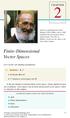 CHAPTER 2 American mathematician Paul Halmos (1916 2006), who in 1942 published the first modern linear algebra book. The title of Halmos s book was the same as the title of this chapter. Finite-Dimensional
or conventional implicature [1]. If the implication is only pragmatic, explicating logical truth, and, thus, also consequence and inconsistency.
![or conventional implicature [1]. If the implication is only pragmatic, explicating logical truth, and, thus, also consequence and inconsistency.](/thumbs/19/318384.jpg "or conventional implicature [1]. If the implication is only pragmatic, explicating logical truth, and, thus, also consequence and inconsistency.") 44 ANALYSIS explicating logical truth, and, thus, also consequence and inconsistency. Let C1 and C2 be distinct moral codes formulated in English. Let C1 contain a norm N and C2 its negation. The moral
44 ANALYSIS explicating logical truth, and, thus, also consequence and inconsistency. Let C1 and C2 be distinct moral codes formulated in English. Let C1 contain a norm N and C2 its negation. The moral
Local periods and binary partial words: An algorithm
 Local periods and binary partial words: An algorithm F. Blanchet-Sadri and Ajay Chriscoe Department of Mathematical Sciences University of North Carolina P.O. Box 26170 Greensboro, NC 27402 6170, USA E-mail:
Brewer s Conjecture and the Feasibility of Consistent, Available, Partition-Tolerant Web Services
 Brewer s Conjecture and the Feasibility of Consistent, Available, Partition-Tolerant Web Services Seth Gilbert Nancy Lynch Abstract When designing distributed web services, there are three properties that
Exact Nonparametric Tests for Comparing Means - A Personal Summary
 Exact Nonparametric Tests for Comparing Means - A Personal Summary Karl H. Schlag European University Institute 1 December 14, 2006 1 Economics Department, European University Institute. Via della Piazzuola
Sensitivity Analysis 3.1 AN EXAMPLE FOR ANALYSIS
 Sensitivity Analysis 3 We have already been introduced to sensitivity analysis in Chapter via the geometry of a simple example. We saw that the values of the decision variables and those of the slack and
Cosmological Arguments for the Existence of God S. Clarke
 Cosmological Arguments for the Existence of God S. Clarke [Modified Fall 2009] 1. Large class of arguments. Sometimes they get very complex, as in Clarke s argument, but the basic idea is simple. Lets
6.3 Conditional Probability and Independence
 222 CHAPTER 6. PROBABILITY 6.3 Conditional Probability and Independence Conditional Probability Two cubical dice each have a triangle painted on one side, a circle painted on two sides and a square painted
How does the problem of relativity relate to Thomas Kuhn s concept of paradigm?
 How does the problem of relativity relate to Thomas Kuhn s concept of paradigm? Eli Bjørhusdal After having published The Structure of Scientific Revolutions in 1962, Kuhn was much criticised for the use
INTRODUCTORY SET THEORY
 M.Sc. program in mathematics INTRODUCTORY SET THEORY Katalin Károlyi Department of Applied Analysis, Eötvös Loránd University H-1088 Budapest, Múzeum krt. 6-8. CONTENTS 1. SETS Set, equal sets, subset,
Introduction to Topology
 Introduction to Topology Tomoo Matsumura November 30, 2010 Contents 1 Topological spaces 3 1.1 Basis of a Topology......................................... 3 1.2 Comparing Topologies.......................................
Chapter II. Controlling Cars on a Bridge
 Chapter II. Controlling Cars on a Bridge 1 Introduction The intent of this chapter is to introduce a complete example of a small system development. During this development, you will be made aware of the
The compositional semantics of same
 The compositional semantics of same Mike Solomon Amherst College Abstract Barker (2007) proposes the first strictly compositional semantic analysis of internal same. I show that Barker s analysis fails
Solutions to In-Class Problems Week 4, Mon.
 Massachusetts Institute of Technology 6.042J/18.062J, Fall 05: Mathematics for Computer Science September 26 Prof. Albert R. Meyer and Prof. Ronitt Rubinfeld revised September 26, 2005, 1050 minutes Solutions
Chapter 6 Competitive Markets
 Chapter 6 Competitive Markets After reading Chapter 6, COMPETITIVE MARKETS, you should be able to: List and explain the characteristics of Perfect Competition and Monopolistic Competition Explain why a
How should we think about the testimony of others? Is it reducible to other kinds of evidence?
 Subject: Title: Word count: Epistemology How should we think about the testimony of others? Is it reducible to other kinds of evidence? 2,707 1 How should we think about the testimony of others? Is it
ECON 312: Oligopolisitic Competition 1. Industrial Organization Oligopolistic Competition
 ECON 312: Oligopolisitic Competition 1 Industrial Organization Oligopolistic Competition Both the monopoly and the perfectly competitive market structure has in common is that neither has to concern itself
Testing LTL Formula Translation into Büchi Automata
 Testing LTL Formula Translation into Büchi Automata Heikki Tauriainen and Keijo Heljanko Helsinki University of Technology, Laboratory for Theoretical Computer Science, P. O. Box 5400, FIN-02015 HUT, Finland
Discrete Mathematics and Probability Theory Fall 2009 Satish Rao, David Tse Note 10
 CS 70 Discrete Mathematics and Probability Theory Fall 2009 Satish Rao, David Tse Note 10 Introduction to Discrete Probability Probability theory has its origins in gambling analyzing card games, dice,
Page 331, 38.4 Suppose a is a positive integer and p is a prime. Prove that p a if and only if the prime factorization of a contains p.
 Page 331, 38.2 Assignment #11 Solutions Factor the following positive integers into primes. a. 25 = 5 2. b. 4200 = 2 3 3 5 2 7. c. 10 10 = 2 10 5 10. d. 19 = 19. e. 1 = 1. Page 331, 38.4 Suppose a is a
You know from calculus that functions play a fundamental role in mathematics.
 CHPTER 12 Functions You know from calculus that functions play a fundamental role in mathematics. You likely view a function as a kind of formula that describes a relationship between two (or more) quantities.
1 if 1 x 0 1 if 0 x 1
 Chapter 3 Continuity In this chapter we begin by defining the fundamental notion of continuity for real valued functions of a single real variable. When trying to decide whether a given function is or