
COVALENT COMPOUNDS. Chemistry 332
|
|
|
- Jonas Hampton
- 9 years ago
- Views:
Transcription
1 OVALENT OMPOUNDS hemistry 332

2 Unit 4 (ovalent ompounds) 1. Write the electron dot structure (Lewis Dot Structure) for covalent compounds or ions. 2. Use electronegativity to determine the polarity of a bond or molecule. 3. Given the formula of a covalent compound, write its correct name; given the name of a covalent compound, write its formula. 4. Describe the attractive forces between ions, polar molecules, and nonpolar molecules. Unit 4 (ovalent ompounds) ovalent Bond, Octet Rule, Lewis Dot Structure/Intramolecular Bond, Intermolecular Force, Polar, Non-polar, Solubility 2
3 OVALENT OMPOUNDS ovalent compounds are made from two non-metals and so don t follow the normal ionic rules. You can tell if a compound is covalent because it has prefixes modifying the species names. These species tell you exactly how many atoms are in the covalent compound. The prefixes are 1 = mono 2 = di 3 = tri 4 = tetra 5 = penta 6 = hexa 7 = hepta 8 = octa 9 = nona 10 = deca All you have to do is write the species in the compound together, and add a subscript based on the numbers above: nitrogen dioxide: NO 2 dinitrogen monoxide: N 2 O phosphorus pentachloride: P1 5 sulfur hexafluoride: SF 6 diphosphorus pentoxide: P 2 O 5 Most organic compounds that contain alcohol (R-O) or carboxylic acid (R- OO) functional groups will most likely be soluble due to the hydrogen bonding capabilities of those substances. Other covalent compounds tend to be insoluble in water. Most organic and covalent compounds will not conduct electricity in water. The exception to this rule are organic acids (carboxylic acids). 3

4 hemistry 332 Name I. Name the following compounds. ovalent Naming 1. N 2 O 5 2. SeBr PF 6 6. BF 3 7. P 2 l 4 8. S 2 l 3 9. NO P 2 O OF O 13. BrO BN 15. Br 4 4

5 II. Please write the formulas the formulas for the following compounds. 1. Dihydrogen monoxide 2. Phosphorus trihydride 3. Dinitrogen trioxide 4. arbon tetrachloride 5. arbon dioxide 6. Trinitrogen tetroxide 7. Dinitrogen monoxide 8. tetraphosphorus decaoxide 9. Selenium trioxide 10. Iodine heptafluoride 11. Sulfur hexafluoride 12. Sulfur dichloride 13. Disilicon hexabromide 14. Dichlorine heptaoxide 15. Pentaphosphorus decoxide 5

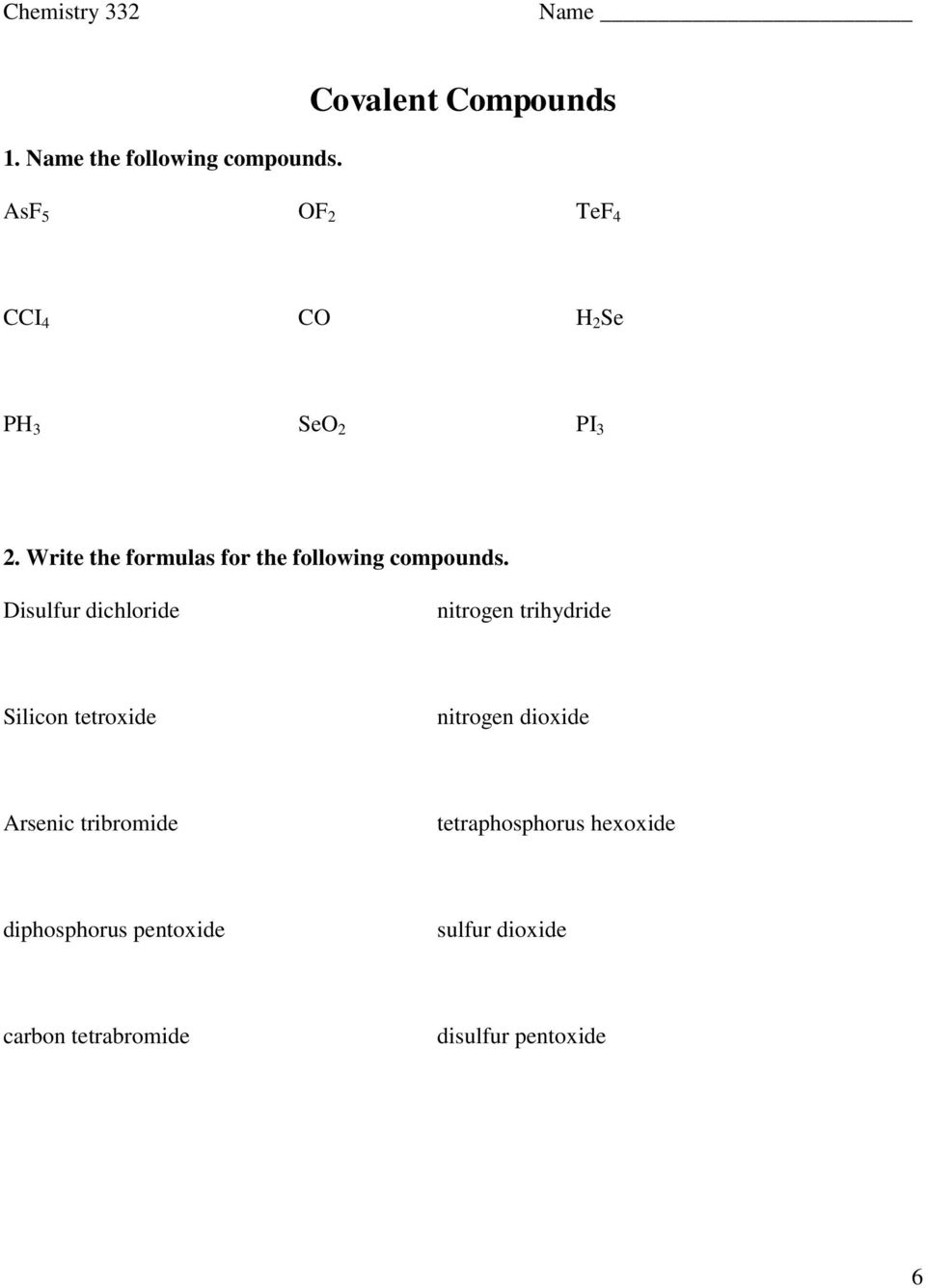
6 hemistry 332 Name 1. Name the following compounds. ovalent ompounds AsF 5 OF 2 TeF 4 I 4 O 2 Se P 3 SeO 2 PI 3 2. Write the formulas for the following compounds. Disulfur dichloride nitrogen trihydride Silicon tetroxide nitrogen dioxide Arsenic tribromide tetraphosphorus hexoxide diphosphorus pentoxide sulfur dioxide carbon tetrabromide disulfur pentoxide 6
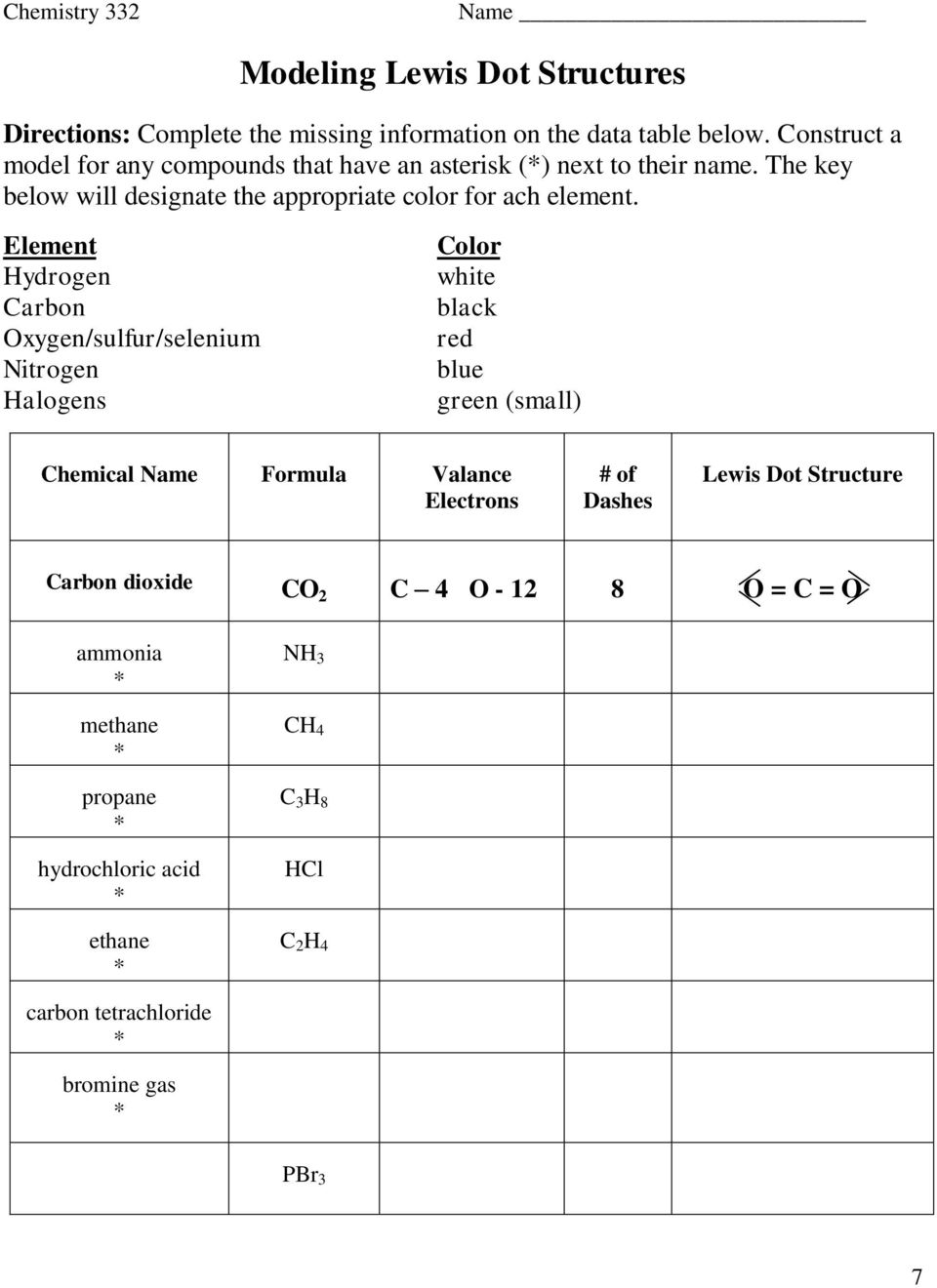
7 hemistry 332 Name Modeling Lewis Dot Structures Directions: omplete the missing information on the data table below. onstruct a model for any compounds that have an asterisk (*) next to their name. The key below will designate the appropriate color for ach element. Element ydrogen arbon Oxygen/sulfur/selenium Nitrogen alogens olor white black red blue green (small) hemical Name Formula Valance Electrons # of Dashes Lewis Dot Structure arbon dioxide O 2 4 O O = = O ammonia * methane * propane * hydrochloric acid * ethane * N l 2 4 carbon tetrachloride * bromine gas * PBr 3 7
8 Lewis Dot Structures (Side 2) Directions: ompleter the data table below. It is not necessary to construct any models. Formula Valance Electrons # of Dashes Lewis Dot Structure Nl 3 SiS 2 SiN F 2 l 2 Ge 4 SF 2 Sel 2 AsF 3 2 Br 2 l 2 2 O 2 O F 4 8

9 Name Lewis Dot Structures Worksheet #1 omework Problems 1. O O 3. 2 O 4. I 5. N F 2 9. SeF N 9

10 Name Lewis Dot Structures Worksheet #2 omework Problems N 3. S S 5. N 2 6. Br 2 Br 2 7. NI 3 8.O 2 9. F O 10

11 Lewis (Electron) Dot Formulas 5 Easy Rules 1. Determine Arrangement Place the least electronegative atom in the center. The halogens and hydrogen can never be in the center. 2. Determine total number of valence electrons. Two electrons are represented by one dash. (add for negative ions, subtract for positive ions) 3. Attach central atom to surrounding atoms. Molecule should be symmetrical. 4. Distribute remaining electrons. 5. Use double or triple bonds if necessary. ydrogen and the halogens can never have a double or triple bond. 11

12 Table of Electronegativity Values 1 A 2 A 3 A 4 A 5 A 6 A 7 A 8 A e 2.1 Li Be B N O F Ne Na Mg Al Si P S l Ar K a Ga Ge As Se Br Kr Rb Sr In Sn Sb Te I Xe s Ba Tl Pb Bi Po At Rn Fr 0.7 Ra 0.9 Differences in Electronegativity ovalent Non-polar = ovalent Polar = 0.5 and above Ionic = ontains a metal 12

13 B6polar Name Polarity w/s Given the molecules below, identify those which are polar and which are nonpolar. Then identify which ones form hydrogen bonds with like molecules. 13

14 Name Investigating Some Properties of Water A water molecule is formed when two hydrogen atoms are bonded to a single oxygen atom. Because of the structures of the atoms involved, a bent molecule is formed. O The bond between each hydrogen and the oxygen atom is formed by the sharing of a pair of electrons. The electrons are not shared equally between the two atoms. The oxygen atom has greater attraction for the shared pair of electrons so it keeps them closer to itself. The unequal sharing causes the oxygen atom to have a partial negative charge (δ-) while the hydrogen atoms will have a partial positive charge (δ+). Because the partially negative oxygen and partially positive hydrogen s are arranged in a bent shape, the water molecule has a positive side and a negative side; it is called a polar molecule or dipole. This polarity causes the water molecules to be attracted to each other. The positive side of one molecule is attracted to the negative side of another molecule. This intermolecular attraction (shown by the lighter lines) is weaker than the covalent bonds which hold the hydrogen and oxygen atoms together in each molecule, but is strong enough to affect the properties of water. In this lab you will investigate some properties of water by comparing water s behavior to that of hexane in several situations. exane is a non polar molecule because of the very uniform arrangement of the atoms in the molecule. exane 14

15 Name Investigating Some Properties of Water PLW 1. Draw the molecular structure of water and label the partial charges of each element. 2. Why is the water molecule s shape bent and not linear? 3. ow does the shape of the water molecule determine its polarity? 4. Define hydrogen bonding. 5. Using class notes, describe intermolecular bonds. 6. Draw the structure of hexane and describe its polarity. 15

16 Name Water & yclohexane Lab Questions Table 1: Rate of evaporation Explain in detail why the drop of cyclohexane evaporated faster than the drop of water. Table 2: apillary action Explain in detail why the water went further up the glass capillary tube than did cyclohexane. Table 3: Surface Tension Explain in detail why you were able to put more drops of water than cyclohexane on a penny. Table 4: Wax Paper Explain in detail why the water and cyclohexane behaved as they did on wax paper. 16

17 Table 5: Static harge Explain in detail why the water was bent by static charge but the cyclohexane wasn t. Table 6: Vortex Explain in detail why the cyclohexane was easier to make a vortex in than water. Table 7: Surface tension Explain in detail why a paperclip can float on top of water but not on top of cyclohexane. 17

18 Lab- ovalent Solubility Purpose- The purpose of this lab is to develop a series of solubility guidelines for covalent compounds. Safety: Goggles and Aprons must be worn Procedure- 1. Fill 7 test tubes ¾ full with tap water. 2. Using the small bottles provided, add 10 drops of each chemical to a test tube. 3. Put a stopper on each test tube and shake for 30 seconds. 4. Let the contents of the tube settle and examine each tube. 5. Make a determination if the substance dissolved in the water or not. 6. Record your results in the data table. 7. Dispose of the chemicals as instructed by your teacher. Data- Substance Methanol yclohexane Ethyl acetate Acetic acid Ethanol Toluene Ethylene glycol Dissolves in water? Explanation- ome up with a guideline for the solubility of these compounds in water. You should complete the statements: A substance will dissolve in water if 18

19 19 O O O O O O O O Methanol yclohexane Ethyl acetate Acetic Acid Ethanol Toluene Ethylene glycol

20 Intramolecular Bonds (Bonds within a compound) Type Definition Electronegativity Difference Ionic Examples Diagram ovalent Polar Electronegatvity Difference is.5 or greater ovalent Non-Polar Electronegativity Difference is less than.5 20

21 Intermolecular Bonds (Bonds between two compounds) Type Definition Examples Drawing ydrogen Dipole- Dipole Dispersion aka London Forces 21
22 Evaporation and Intermolecular Attractions In this experiment, Temperature Probes are placed in various liquids. Evaporation occurs when the probe is removed from the liquid s container. This evaporation is an endothermic process that results in a temperature decrease. The magnitude of a temperature decrease is related to the strength of intermolecular forces of attraction. In this experiment, you will study temperature changes caused by the evaporation of several liquids and relate the temperature changes to the strength of intermolecular forces of attraction. You will examine the molecular structures for the presence and relative strength of two intermolecular forces hydrogen bonding and dispersion forces. PRE-LAB SET UP Obtain six test tubes, each with a different chemical. Set #1 should contain: Ethylene Glycol, Ethanol, and yclohexane. Set #2 should contain: Methanol, water, and Acetone. You should also have a Vernier logger-pro green box with three different temperature probes attached to it. Be sure you know which temperature probe is plugged into which slot. EMIAL STRUTURES The chemical structures of the six chemicals to be used in this experiment are shown below. 22
23 PROEDURE 1. Obtain and wear goggles! AUTION: The compounds used in this experiment are flammable and poisonous. Avoid inhaling their vapors. Avoid contacting them with your skin or clothing. Be sure there are no open flames in the lab during this experiment. Notify your teacher immediately if an accident occurs. 2. Prepare the computer for data collection Prepare the computer for data collection by opening the experiment file. Go to: Start My computer Extras on P files (O drive) Science hemistry 332 Lab- Evaporation On the Graph window, the vertical axis has temperature scaled from 5 to 30 º. The horizontal axis has time scaled from 0 to 250 seconds. 3. Wrap the three probes with pieces of paper towels of similar size secured by small rubber bands as shown in Figure 1. Roll the filter paper around the probe tip in the shape of a cylinder. int: First slip the rubber band up on the probe; wrap the paper around the probe, and then finally slip the rubber band over the wrapped paper. The paper should be even with the probe end. 4. Stand probe 1 in the Ethylene Glycol tube, probe 2 in the Ethanol tube, and probe 3 in the yclohexane tube. 5. Prepare 3 pieces of masking tape to be used to tape the probes in position during Step6. 6. After the probes have been in the liquids for at least 45 seconds, begin data collection by clicking ( OLLET) Monitor the temperature for 15 seconds to establish the initial temperature of each liquid. Then simultaneously remover the probes from the liquids and tape them so the probe tips extend 5 cm over the edge of the table top as shown in Figure When both temperatures have reached minimums and have begun to increase, click ( STOP ) to end data collection. 8. Roll the rubber band up the probe shaft and dispose of the paper towels and rubber bands in the trash can. 9. Print out the results of your experiment and label each line by putting the correct name of the substance by its corresponding line on the graph. 10. Examine the structures of the three substances and decide what kind of intermolecular forces are present in each, dispersion forces or hydrogen bonding. 11. Using this information, make a prediction of the shape of the graph for chemical set #2. Decide which line will be which chemical base upon the structures. 12. Repeat the experiment but this time use chemical set #2: methanol, water, and acetone. 13. Print out the results of you experiment and label the three lines with the correct names of the substances. 23
24 Name PLW Evaporation and Intermolecular Attractions Substance Formula Structural Formulas Molecular Weight ydrogen Bond (Yes or No) yclohexane 6 12 Acetone 3 6 O Substance Formula Structural Formulas Molecular Weight ydrogen Bond (Yes or No) Water Ethylene Glycol 2 O 2 4 (O) 2 Substance Formula Structural Formulas Molecular Weight Methanol 3 (O) ydrogen Bond (Yes or No) Ethanol 2 5 (O) 1. Is evaporation an endothermic or exothermic process? 2. Define evaporation by describing the molecules movement. 24
25 Analysis of Evaporation Lab Set #1 Substance Electron Dot Structure Polar Or Nonpolar Type of Intermolecular Bond # of Bonds Ethylene Glycol Ethanol yclohexane 25
26 Analysis of Evaporation Lab Set #2 Substance Electron Dot Structure Polar Or Nonpolar Type of Intermolecular Bond # of Bonds Methanol Water Acetone 26
27 TIE DYE PATTERNS There are endless ways of getting patterns on your shirts. The first time you do this, you will want to give students some ideas. owever, you will find that student become very creative and do things that we never thought about. I highly recommend that they do use patterns though rather than trying to write on shirts. The writing spreads and the shirts are usually not liked by the students the next day. (1) SPIRALS Spread shirt out front side up. Grasp wherever you would like the center of spiral and carefully twist keeping the shirt flat. Your shirt will look like a pie shape. Now use bamboo skewers sticks and rubber bands to bind together. Be careful that the center of the spiral is not in a place you do not desire (like the center of your tummy, etc.) Squirt on dye like you are cutting a pie. You may do one color perhaps 8 ways and then take another color in the white areas in between. I recommend that you color all visible white for a striking shirt. You will always have some white where the folds are. Turn over and REPEAT. (2) MULTI-SPIRALS You may make as many spirals as you desire. Again be careful where you choose. Two in breast area usually are not acceptable to young ladies. You may make each spiral different colors, etc. Get creative. Do both sides. (3) SPIDERS Many of the students enjoy spiders with black (heavy metal types). Fold shirt in half lengthwise so that the back of shirt is to inside. Now grasp the shirt about 1/3 of the way from the neck and make a spiral. Place color on in pie shapes and then place BLAK dye on the other white areas (pie shape). Turn over and repeat on back side. (4) STRIPES Fold shirt in half and fold accordion folds. If you want a V effect, place at 45 º angle from neck. Squirt on dye perpendicular to folds. Bind together with rubber bands and sticks. Do not leave white unless you want a lot of white in your shirt. (5) FIRE Grab pieces of shirt and twist bands around the areas. (6) RINKLE Lay shirt flat on table. Fluff up areas or grasp. Sprinkle dye on areas in pattern you like. This pattern is difficult to bind together with rubber ands and sticks but can be done. (7) STAR This is more complicated, but very nice when finished. Lay the damp shirt on surface. Smooth out wrinkles. Fold in half so sleeves match. Fold back one side on the quarter line. Fold sleeve up. Turn shirt over and fold on quarter line on other side and fold sleeve up. Straighten out so you now have a long rectangle. You will now do a flag fold. (ave you ever folded a flag?) You will end up with a compact triangle. Your triangle has two sides equal and a longer side. Place your sticks on the two corners and bind with rubber bands. Now take your 1 st dye color and squirt on all three corners. Make sure that you get enough so the dye permeates all folds. Then take a 2 nd color and place on three sides. Let sit for 24 hours. 27
28 28
A PREVIEW & SUMMMARY of the 3 main types of bond:
 Chemical Bonding Part 1 Covalent Bonding Types of Chemical Bonds Covalent Bonds Single Polar Double NonPolar Triple Ionic Bonds Metallic Bonds Other Bonds InterMolecular orces first A PREVIEW & SUMMMARY
Chapter 4: Structure and Properties of Ionic and Covalent Compounds
 Chapter 4: Structure and Properties of Ionic and Covalent Compounds 4.1 Chemical Bonding o Chemical Bond - the force of attraction between any two atoms in a compound. o Interactions involving valence
Worksheet 14 - Lewis structures. 1. Complete the Lewis dot symbols for the oxygen atoms below
 Worksheet 14 - Lewis structures Determine the Lewis structure of 2 oxygen gas. 1. omplete the Lewis dot symbols for the oxygen atoms below 2. Determine the number of valence electrons available in the
5. Structure, Geometry, and Polarity of Molecules
 5. Structure, Geometry, and Polarity of Molecules What you will accomplish in this experiment This experiment will give you an opportunity to draw Lewis structures of covalent compounds, then use those
PERIODIC TABLE OF THE ELEMENTS
 PERIODIC TABLE OF THE ELEMENTS Periodic Table: an arrangement of elements in horizontal rows (Periods) and vertical columns (Groups) exhibits periodic repetition of properties First Periodic Table: discovered
Bonding Practice Problems
 NAME 1. When compared to H 2 S, H 2 O has a higher 8. Given the Lewis electron-dot diagram: boiling point because H 2 O contains stronger metallic bonds covalent bonds ionic bonds hydrogen bonds 2. Which
Lab: Properties of Polar and Nonpolar Substances
 Lab: Properties of Polar and Nonpolar Substances Purpose: To explain the interactions of matter in relation to polarity. Stations 1 and 2 - il and water do not mix As a metaphor, oil and water are often
CHAPTER 6 REVIEW. Chemical Bonding. Answer the following questions in the space provided.
 Name Date lass APTER 6 REVIEW hemical Bonding SETIN 1 SRT ANSWER Answer the following questions in the space provided. 1. a A chemical bond between atoms results from the attraction between the valence
Which substance contains positive ions immersed in a sea of mobile electrons? A) O2(s) B) Cu(s) C) CuO(s) D) SiO2(s)
 BONDING MIDTERM REVIEW 7546-1 - Page 1 1) Which substance contains positive ions immersed in a sea of mobile electrons? A) O2(s) B) Cu(s) C) CuO(s) D) SiO2(s) 2) The bond between hydrogen and oxygen in
Exercises Topic 2: Molecules
 hemistry for Biomedical Engineering. Exercises Topic 2 Authors: ors: Juan Baselga & María González Exercises Topic 2: Molecules 1. Using hybridization concepts and VSEPR model describe the molecular geometry
Laboratory 11: Molecular Compounds and Lewis Structures
 Introduction Laboratory 11: Molecular Compounds and Lewis Structures Molecular compounds are formed by sharing electrons between non-metal atoms. A useful theory for understanding the formation of molecular
Name Lab #3: Solubility of Organic Compounds Objectives: Introduction: soluble insoluble partially soluble miscible immiscible
 Lab #3: Solubility of rganic Compounds bjectives: - Understanding the relative solubility of organic compounds in various solvents. - Exploration of the effect of polar groups on a nonpolar hydrocarbon
TRENDS IN THE PERIODIC TABLE
 Noble gases Period alogens Alkaline earth metals Alkali metals TRENDS IN TE PERIDI TABLE Usual charge +1 + +3-3 - -1 Number of Valence e - s 1 3 4 5 6 7 Electron dot diagram X X X X X X X X X 8 Group 1
The elements of the second row fulfill the octet rule by sharing eight electrons, thus acquiring the electronic configuration of neon, the noble gas o
 2. VALENT BNDING, TET RULE, PLARITY, AND BASI TYPES F FRMULAS LEARNING BJETIVES To introduce the basic principles of covalent bonding, different types of molecular representations, bond polarity and its
Name: Block: Date: Test Review: Chapter 8 Ionic Bonding
 Name: Block: Date: Test Review: Chapter 8 Ionic Bonding Part 1: Fill-in-the-blank. Choose the word from the word bank below. Each word may be used only 1 time. electron dot structure metallic electronegativity
Chapter 4: Nonionic Compounds and Their Nomenclature
 50 Chapter 4: Nonionic Compounds and Their Nomenclature A nonionic compound is a substance composed of atoms held together by chemical bonding forces, called covalent bonds. Covalent bonds are formed by
Molecular Models in Biology
 Molecular Models in Biology Objectives: After this lab a student will be able to: 1) Understand the properties of atoms that give rise to bonds. 2) Understand how and why atoms form ions. 3) Model covalent,
Naming Compounds. There are three steps involved in naming ionic compounds- naming the cation, naming the anion, and naming the entire compound.
 Naming Compounds Naming compounds is an important part of chemistry. Most compounds fall in to one of three categories ionic compounds, molecular compounds, or acids. Part One: Naming Ionic Compounds Identifying
CHEM 1301 SECOND TEST REVIEW. Covalent bonds are sharing of electrons (ALWAYS valence electrons). Use Lewis structures to show this sharing.
 CEM 1301 SECOND TEST REVIEW Lewis Structures Covalent bonds are sharing of electrons (ALWAYS valence electrons). Use Lewis structures to show this sharing. Rules OCTET RULE an atom would like to have 8
In the box below, draw the Lewis electron-dot structure for the compound formed from magnesium and oxygen. [Include any charges or partial charges.
 Name: 1) Which molecule is nonpolar and has a symmetrical shape? A) NH3 B) H2O C) HCl D) CH4 7222-1 - Page 1 2) When ammonium chloride crystals are dissolved in water, the temperature of the water decreases.
2. Atoms with very similar electronegativity values are expected to form
 AP hemistry Practice Test #6 hapter 8 and 9 1. Which of the following statements is incorrect? a. Ionic bonding results from the transfer of electrons from one atom to another. b. Dipole moments result
B) atomic number C) both the solid and the liquid phase D) Au C) Sn, Si, C A) metal C) O, S, Se C) In D) tin D) methane D) bismuth B) Group 2 metal
 1. The elements on the Periodic Table are arranged in order of increasing A) atomic mass B) atomic number C) molar mass D) oxidation number 2. Which list of elements consists of a metal, a metalloid, and
CHAPTER 6 Chemical Bonding
 CHAPTER 6 Chemical Bonding SECTION 1 Introduction to Chemical Bonding OBJECTIVES 1. Define Chemical bond. 2. Explain why most atoms form chemical bonds. 3. Describe ionic and covalent bonding.. 4. Explain
PERIODIC TABLE OF GROUPS OF ELEMENTS Elements can be classified using two different schemes.
 1 PERIODIC TABLE OF GROUPS OF ELEMENTS Elements can be classified using two different schemes. Metal Nonmetal Scheme (based on physical properties) Metals - most elements are metals - elements on left
Section Activity #1: Fill out the following table for biology s most common elements assuming that each atom is neutrally charged.
 LS1a Fall 2014 Section Week #1 I. Valence Electrons and Bonding The number of valence (outer shell) electrons in an atom determines how many bonds it can form. Knowing the number of valence electrons present
OCTET RULE Generally atoms prefer electron configurations with 8 valence electrons. - Filled s and p subshells
 TYPES EMIAL BDIG 1 Ionic Bonding - Bond between ions whose charges attract each other - ne atom gives electrons and one atom takes electrons. Example a + l - ionic bond ovalent Bonding - two atoms each
Nomenclature of Ionic Compounds
 Nomenclature of Ionic Compounds Ionic compounds are composed of ions. An ion is an atom or molecule with an electrical charge. Monatomic ions are formed from single atoms that have gained or lost electrons.
Topic 4 National Chemistry Summary Notes. Formulae, Equations, Balancing Equations and The Mole
 Topic 4 National Chemistry Summary Notes Formulae, Equations, Balancing Equations and The Mole LI 1 The chemical formula of a covalent molecular compound tells us the number of atoms of each element present
Sample Exercise 8.1 Magnitudes of Lattice Energies
 Sample Exercise 8.1 Magnitudes of Lattice Energies Without consulting Table 8.2, arrange the ionic compounds NaF, CsI, and CaO in order of increasing lattice energy. Analyze From the formulas for three
Name: Date: Period: Presentation #4. Covalent compounds continued practice with drawing them. Modeling covalent compounds in 3D
 Homework Activities Name: Date: Period: This week we will practice creating covalent compounds through drawings and 3D models. We will also look at polar and non-polar molecules to see how their structures
SHAPES OF MOLECULES (VSEPR MODEL)
 1 SAPES MLEULES (VSEPR MDEL) Valence Shell Electron-Pair Repulsion model - Electron pairs surrounding atom spread out as to minimize repulsion. - Electron pairs can be bonding pairs (including multiple
Questions on Chapter 8 Basic Concepts of Chemical Bonding
 Questions on Chapter 8 Basic Concepts of Chemical Bonding Circle the Correct Answer: 1) Which ion below has a noble gas electron configuration? A) Li 2+ B) Be 2+ C) B2+ D) C2+ E) N 2-2) Of the ions below,
Sample Exercise 8.1 Magnitudes of Lattice Energies
 Sample Exercise 8.1 Magnitudes of Lattice Energies Without consulting Table 8.2, arrange the following ionic compounds in order of increasing lattice energy: NaF, CsI, and CaO. Analyze: From the formulas
Electronegativity and Polarity MAIN Idea A chemical bond s character is related to each atom s
 Section 8.5 Objectives Describe how electronegativity is used to determine bond type. Compare and contrast polar and nonpolar covalent bonds and polar and nonpolar molecules. Generalize about the characteristics
Polarity and Properties Lab PURPOSE: To investigate polar and non-polar molecules and the affect of polarity on molecular properties.
 Name!!!! date Polarity and Properties Lab PURPOSE: To investigate polar and non-polar molecules and the affect of polarity on molecular properties. STATION 1: Oil and water do not mix. We all know that.
CHM220 Addition lab. Experiment: Reactions of alkanes, alkenes, and cycloalkenes*
 CM220 Addition lab Experiment: Reactions of alkanes, alkenes, and cycloalkenes* Purpose: To investigate the physical properties, solubility, and density of some hydrocarbon. To compare the chemical reactivity
Chapter 4 Compounds and Their Bonds
 Chapter 4 Compounds and Their Bonds 4.1 Octet Rule and Ions Octet Rule An octet is 8 valence electrons. is associated with the stability of the noble gases. He is stable with 2 valence electrons (duet).
H 2O gas: molecules are very far apart
 Non-Covalent Molecular Forces 2/27/06 3/1/06 How does this reaction occur: H 2 O (liquid) H 2 O (gas)? Add energy H 2O gas: molecules are very far apart H 2O liquid: bonding between molecules Use heat
Theme 3: Bonding and Molecular Structure. (Chapter 8)
 Theme 3: Bonding and Molecular Structure. (Chapter 8) End of Chapter questions: 5, 7, 9, 12, 15, 18, 23, 27, 28, 32, 33, 39, 43, 46, 67, 77 Chemical reaction valence electrons of atoms rearranged (lost,
Exercise 3.5 - Naming Binary Covalent Compounds:
 Chapter Exercise Key 1 Chapter Exercise Key Exercise.1 Classifying Compounds: Classify each of the following substances as either a molecular compound or an ionic compound. a. formaldehyde, CH 2 O (used
Chemistry Assessment Unit AS 1
 Centre Number 71 Candidate Number ADVANCED SUBSIDIARY (AS) General Certificate of Education January 2011 Chemistry Assessment Unit AS 1 assessing Basic Concepts in Physical and Inorganic Chemistry [AC111]
Health Science Chemistry I CHEM-1180 Experiment No. 15 Molecular Models (Revised 05/22/2015)
 (Revised 05/22/2015) Introduction In the early 1900s, the chemist G. N. Lewis proposed that bonds between atoms consist of two electrons apiece and that most atoms are able to accommodate eight electrons
Chapter 6 Assessment. Name: Class: Date: ID: A. Multiple Choice Identify the choice that best completes the statement or answers the question.
 Name: Class: Date: ID: A Chapter 6 Assessment Multiple Choice Identify the choice that best completes the statement or answers the question. 1. When an atom loses an electron, it forms a(n) a. anion. c.
Reading Preview. Key Terms covalent bond molecule double bond triple bond molecular compound polar bond nonpolar bond
 Section 4 4 bjectives After this lesson, students will be able to L.1.4.1 State what holds covalently bonded s together. L.1.4.2 Identify the properties of molecular compounds. L.1.4.3 Explain how unequal
CHEMISTRY BONDING REVIEW
 Answer the following questions. CHEMISTRY BONDING REVIEW 1. What are the three kinds of bonds which can form between atoms? The three types of Bonds are Covalent, Ionic and Metallic. Name Date Block 2.
Chemistry 105, Chapter 7 Exercises
 hemistry 15, hapter 7 Exercises Types of Bonds 1. Using the periodic table classify the bonds in the following compounds as ionic or covalent. If covalent, classify the bond as polar or not. Mg2 4 i2 a(3)2
Chapter 8 Basic Concepts of the Chemical Bonding
 Chapter 8 Basic Concepts of the Chemical Bonding 1. There are paired and unpaired electrons in the Lewis symbol for a phosphorus atom. (a). 4, 2 (b). 2, 4 (c). 4, 3 (d). 2, 3 Explanation: Read the question
Ionization energy _decreases from the top to the bottom in a group. Electron affinity increases from the left to the right within a period.
 hem 150 Answer Key roblem et 2 1. omplete the following phrases: Ionization energy _decreases from the top to the bottom in a group. Electron affinity increases from the left to the right within a period.
Bonding & Molecular Shape Ron Robertson
 Bonding & Molecular Shape Ron Robertson r2 n:\files\courses\1110-20\2010 possible slides for web\00bondingtrans.doc The Nature of Bonding Types 1. Ionic 2. Covalent 3. Metallic 4. Coordinate covalent Driving
2. Which one of the ions below possesses a noble gas configuration? A) Fe 3+ B) Sn 2+ C) Ni 2+ D) Ti 4+ E) Cr 3+
 Chapter 9 Tro 1. Bromine tends to form simple ions which have the electronic configuration of a noble gas. What is the electronic configuration of the noble gas which the bromide ion mimics? A) 1s 2 2s
Chapter 4 Lecture Notes
 Chapter 4 Lecture Notes Chapter 4 Educational Goals 1. Given the formula of a molecule, the student will be able to draw the line-bond (Lewis) structure. 2. Understand and construct condensed structural
The Lewis structure is a model that gives a description of where the atoms, charges, bonds, and lone pairs of electrons, may be found.
 CEM110 Week 12 Notes (Chemical Bonding) Page 1 of 8 To help understand molecules (or radicals or ions), VSEPR shapes, and properties (such as polarity and bond length), we will draw the Lewis (or electron
6.5 Periodic Variations in Element Properties
 324 Chapter 6 Electronic Structure and Periodic Properties of Elements 6.5 Periodic Variations in Element Properties By the end of this section, you will be able to: Describe and explain the observed trends
5.4 Trends in the Periodic Table
 5.4 Trends in the Periodic Table Think about all the things that change over time or in a predictable way. For example, the size of the computer has continually decreased over time. You may become more
We will not be doing these type of calculations however, if interested then can read on your own
 Chemical Bond Lattice Energies and Types of Ions Na (s) + 1/2Cl 2 (g) NaCl (s) ΔH= -411 kj/mol Energetically favored: lower energy Like a car rolling down a hill We will not be doing these type of calculations
CHEMICAL NAMES AND FORMULAS
 9 CHEMICAL NAMES AND FORMULAS SECTION 9.1 NAMING IONS (pages 253 258) This section explains the use of the periodic table to determine the charge of an ion. It also defines polyatomic ion and gives the
7) How many electrons are in the second energy level for an atom of N? A) 5 B) 6 C) 4 D) 8
 HOMEWORK CHEM 107 Chapter 3 Compounds Putting Particles Together 3.1 Multiple-Choice 1) How many electrons are in the highest energy level of sulfur? A) 2 B) 4 C) 6 D) 8 2) An atom of phosphorous has how
Ionic and Covalent Bonds
 Ionic and Covalent Bonds Ionic Bonds Transfer of Electrons When metals bond with nonmetals, electrons are from the metal to the nonmetal The becomes a cation and the becomes an anion. The between the cation
Molecular Structures. Chapter 9 Molecular Structures. Using Molecular Models. Using Molecular Models. C 2 H 6 O structural isomers: .. H C C O..
 John W. Moore onrad L. Stanitski Peter. Jurs http://academic.cengage.com/chemistry/moore hapter 9 Molecular Structures Stephen. oster Mississippi State University Molecular Structures 2 6 structural isomers:
Electronegativity and Polarity
 and Polarity N Goalby Chemrevise.org Definition: is the relative tendency of an atom in a molecule to attract electrons in a covalent bond to itself. is measured on the Pauling scale (ranges from 0 to
Contaminant Behavior in the Environment: Basic Principles 41. To predict if a molecule is polar, we need to answer two questions:
 ontaminant Behavior in the Environment: Basic Principles 41 opyright 2008. R Press All rights reserved. May not be reproduced in any form without permission from the publisher, except Depending on its
SOME TOUGH COLLEGE PROBLEMS! .. : 4. How many electrons should be shown in the Lewis dot structure for carbon monoxide? N O O
 SME TUGH CLLEGE PRBLEMS! LEWIS DT STRUCTURES 1. An acceptable Lewis dot structure for 2 is (A) (B) (C) 2. Which molecule contains one unshared pair of valence electrons? (A) H 2 (B) H 3 (C) CH 4 acl 3.
Structure, Polarity & Physical Properties
 tructure, Polarity & Physical Properties upplemental packet handouts 92-96 I. Lewis structure, stability, and bond energies A. ydrogen, oxygen, and nitrogen are present in the atmosphere as diatomic molecular
3/5/2014. iclicker Participation Question: A. MgS < AlP < NaCl B. MgS < NaCl < AlP C. NaCl < AlP < MgS D. NaCl < MgS < AlP
 Today: Ionic Bonding vs. Covalent Bonding Strengths of Covalent Bonds: Bond Energy Diagrams Bond Polarities: Nonpolar Covalent vs. Polar Covalent vs. Ionic Electronegativity Differences Dipole Moments
19.2 Chemical Formulas
 In the previous section, you learned how and why atoms form chemical bonds with one another. You also know that atoms combine in certain ratios with other atoms. These ratios determine the chemical formula
Periodic Table Questions
 Periodic Table Questions 1. The elements characterized as nonmetals are located in the periodic table at the (1) far left; (2) bottom; (3) center; (4) top right. 2. An element that is a liquid at STP is
CHEMICAL NAMES AND FORMULAS
 6 CEMICAL NAMES AND FORMULAS SECTION 6.1 INTRODUCTION TO CEMICAL BONDING (pages 133 137) This section explains how to distinguish between ionic and molecular compounds. It also defines cation and anion
The Periodic Table: Periodic trends
 Unit 1 The Periodic Table: Periodic trends There are over one hundred different chemical elements. Some of these elements are familiar to you such as hydrogen, oxygen, nitrogen and carbon. Each one has
AP Chemistry A. Allan Chapter 8 Notes - Bonding: General Concepts
 AP Chemistry A. Allan Chapter 8 Notes - Bonding: General Concepts 8.1 Types of Chemical Bonds A. Ionic Bonding 1. Electrons are transferred 2. Metals react with nonmetals 3. Ions paired have lower energy
Chapter 13 - LIQUIDS AND SOLIDS
 Chapter 13 - LIQUIDS AND SOLIDS Problems to try at end of chapter: Answers in Appendix I: 1,3,5,7b,9b,15,17,23,25,29,31,33,45,49,51,53,61 13.1 Properties of Liquids 1. Liquids take the shape of their container,
EXPERIMENT 17 : Lewis Dot Structure / VSEPR Theory
 EXPERIMENT 17 : Lewis Dot Structure / VSEPR Theory Materials: Molecular Model Kit INTRODUCTION Although it has recently become possible to image molecules and even atoms using a high-resolution microscope,
Unit 3: Quantum Theory, Periodicity and Chemical Bonding. Chapter 10: Chemical Bonding II Molecular Geometry & Intermolecular Forces
 onour Chemistry Unit 3: Quantum Theory, Periodicity and Chemical Bonding Chapter 10: Chemical Bonding II Molecular Geometry & Intermolecular orces 10.1: Molecular Geometry Molecular Structure: - the three-dimensional
LEWIS DIAGRAMS. by DR. STEPHEN THOMPSON MR. JOE STALEY
 by DR. STEPHEN THOMPSON MR. JOE STALEY The contents of this module were developed under grant award # P116B-001338 from the Fund for the Improvement of Postsecondary Education (FIPSE), United States Department
Chem 112 Intermolecular Forces Chang From the book (10, 12, 14, 16, 18, 20,84,92,94,102,104, 108, 112, 114, 118 and 134)
 Chem 112 Intermolecular Forces Chang From the book (10, 12, 14, 16, 18, 20,84,92,94,102,104, 108, 112, 114, 118 and 134) 1. Helium atoms do not combine to form He 2 molecules, What is the strongest attractive
KINETIC THEORY OF MATTER - molecules in matter are always in motion - speed of molecules is proportional to the temperature
 1 KINETIC TERY F MATTER - molecules in matter are always in motion - speed of molecules is proportional to the temperature TE STATES F MATTER 1. Gas a) ideal gas - molecules move freely - molecules have
Chapter 8: Covalent Bonding and Molecular Structure
 hapter 8 ovalent Bonding and Molecular Structure 8-1 hapter 8: ovalent Bonding and Molecular Structure hapter 8 8.1 Interactions Between Particles: oulomb s Law 8.2 ovalent Bonding Basics 8.3 Lewis Structures
H H H O. Pre-Lab Exercises Lab 6: Organic Chemistry. Lab 6: Organic Chemistry Chemistry 100. 1. Define the following: a.
 Lab 6: Organic hemistry hemistry 100 1. Define the following: a. ydrocarbon Pre-Lab Exercises Lab 6: Organic hemistry Name Date Section b. Saturated hydrocarbon c. Unsaturated hydrocarbon 2. The formula
Alkanes. Chapter 1.1
 Alkanes Chapter 1.1 Organic Chemistry The study of carbon-containing compounds and their properties What s so special about carbon? Carbon has 4 bonding electrons. Thus, it can form 4 strong covalent bonds
Chemistry Workbook 2: Problems For Exam 2
 Chem 1A Dr. White Updated /5/1 1 Chemistry Workbook 2: Problems For Exam 2 Section 2-1: Covalent Bonding 1. On a potential energy diagram, the most stable state has the highest/lowest potential energy.
Chapter 7. Comparing Ionic and Covalent Bonds. Ionic Bonds. Types of Bonds. Quick Review of Bond Types. Covalent Bonds
 Comparing Ionic and Covalent Bonds Chapter 7 Covalent Bonds and Molecular Structure Intermolecular forces (much weaker than bonds) must be broken Ionic bonds must be broken 1 Ionic Bonds Covalent Bonds
A REVIEW OF GENERAL CHEMISTRY: ELECTRONS, BONDS AND MOLECULAR PROPERTIES
 A REVIEW OF GENERAL CEMISTRY: ELECTRONS, BONDS AND MOLECULAR PROPERTIES A STUDENT SOULD BE ABLE TO: 1. Draw Lewis (electron dot and line) structural formulas for simple compounds and ions from molecular
(b) Formation of calcium chloride:
 Chapter 2: Chemical Compounds and Bonding Section 2.1: Ionic Compounds, pages 22 23 1. An ionic compound combines a metal and a non-metal joined together by an ionic bond. 2. An electrostatic force holds
AP CHEMISTRY 2009 SCORING GUIDELINES
 AP CHEMISTRY 2009 SCORING GUIDELINES Question 6 (8 points) Answer the following questions related to sulfur and one of its compounds. (a) Consider the two chemical species S and S 2. (i) Write the electron
Chapter 2 Polar Covalent Bonds; Acids and Bases
 John E. McMurry http://www.cengage.com/chemistry/mcmurry Chapter 2 Polar Covalent Bonds; Acids and Bases Javier E. Horta, M.D., Ph.D. University of Massachusetts Lowell Polar Covalent Bonds: Electronegativity
4.5 Physical Properties: Solubility
 4.5 Physical Properties: Solubility When a solid, liquid or gaseous solute is placed in a solvent and it seems to disappear, mix or become part of the solvent, we say that it dissolved. The solute is said
EXPERIMENT # 17 CHEMICAL BONDING AND MOLECULAR POLARITY
 EXPERIMENT # 17 CHEMICAL BONDING AND MOLECULAR POLARITY Purpose: 1. To distinguish between different types of chemical bonds. 2. To predict the polarity of some common molecules from a knowledge of bond
Separation of Amino Acids by Paper Chromatography
 Separation of Amino Acids by Paper Chromatography Chromatography is a common technique for separating chemical substances. The prefix chroma, which suggests color, comes from the fact that some of the
Start: 26e Used: 6e Step 4. Place the remaining valence electrons as lone pairs on the surrounding and central atoms.
 Section 4.1: Types of Chemical Bonds Tutorial 1 Practice, page 200 1. (a) Lewis structure for NBr 3 : Step 1. The central atom for nitrogen tribromide is bromine. 1 N atom: 1(5e ) = 5e 3 Br atoms: 3(7e
VSEPR Model. The Valence-Shell Electron Pair Repulsion Model. Predicting Molecular Geometry
 VSEPR Model The structure around a given atom is determined principally by minimizing electron pair repulsions. The Valence-Shell Electron Pair Repulsion Model The valence-shell electron pair repulsion
Chemistry 1050 Chapter 13 LIQUIDS AND SOLIDS 1. Exercises: 25, 27, 33, 39, 41, 43, 51, 53, 57, 61, 63, 67, 69, 71(a), 73, 75, 79
 Chemistry 1050 Chapter 13 LIQUIDS AND SOLIDS 1 Text: Petrucci, Harwood, Herring 8 th Edition Suggest text problems Review questions: 1, 5!11, 13!17, 19!23 Exercises: 25, 27, 33, 39, 41, 43, 51, 53, 57,
POLAR COVALENT BONDS Ionic compounds form repeating. Covalent compounds form distinct. Consider adding to NaCl(s) vs. H 2 O(s):
 POLAR COVALENT BONDS Ionic compounds form repeating. Covalent compounds form distinct. Consider adding to NaCl(s) vs. H 2 O(s): Sometimes when atoms of two different elements form a bond by sharing an
INTERMOLECULAR FORCES
 INTERMOLECULAR FORCES Intermolecular forces- forces of attraction and repulsion between molecules that hold molecules, ions, and atoms together. Intramolecular - forces of chemical bonds within a molecule
EXPERIMENT 9 Dot Structures and Geometries of Molecules
 EXPERIMENT 9 Dot Structures and Geometries of Molecules INTRODUCTION Lewis dot structures are our first tier in drawing molecules and representing bonds between the atoms. The method was first published
100% ionic compounds do not exist but predominantly ionic compounds are formed when metals combine with non-metals.
 2.21 Ionic Bonding 100% ionic compounds do not exist but predominantly ionic compounds are formed when metals combine with non-metals. Forming ions Metal atoms lose electrons to form +ve ions. Non-metal
Unit 3: Quantum Theory, Periodicity and Chemical Bonding
 Selected Honour Chemistry Assignment Answers pg. 9 Unit 3: Quantum Theory, Periodicity and Chemical Bonding Chapter 7: The Electronic Structure of Atoms (pg. 240 to 241) 48. The shape of an s-orbital is
TYPES OF CHEMICAL BONDING Ionic Bonding - two atoms of opposite charge electrically attracted to one another
 1 TYPES EMIAL BDIG Ionic Bonding - two atoms of opposite charge electrically attracted to one another ovalent Bonding - two atoms each sharing electrons within a molecular orbital Metallic Bonding - positive
MODERN ATOMIC THEORY AND THE PERIODIC TABLE
 CHAPTER 10 MODERN ATOMIC THEORY AND THE PERIODIC TABLE SOLUTIONS TO REVIEW QUESTIONS 1. Wavelength is defined as the distance between consecutive peaks in a wave. It is generally symbolized by the Greek
47374_04_p25-32.qxd 2/9/07 7:50 AM Page 25. 4 Atoms and Elements
 47374_04_p25-32.qxd 2/9/07 7:50 AM Page 25 4 Atoms and Elements 4.1 a. Cu b. Si c. K d. N e. Fe f. Ba g. Pb h. Sr 4.2 a. O b. Li c. S d. Al e. H f. Ne g. Sn h. Au 4.3 a. carbon b. chlorine c. iodine d.
SCPS Chemistry Worksheet Periodicity A. Periodic table 1. Which are metals? Circle your answers: C, Na, F, Cs, Ba, Ni
 SCPS Chemistry Worksheet Periodicity A. Periodic table 1. Which are metals? Circle your answers: C, Na, F, Cs, Ba, Ni Which metal in the list above has the most metallic character? Explain. Cesium as the