
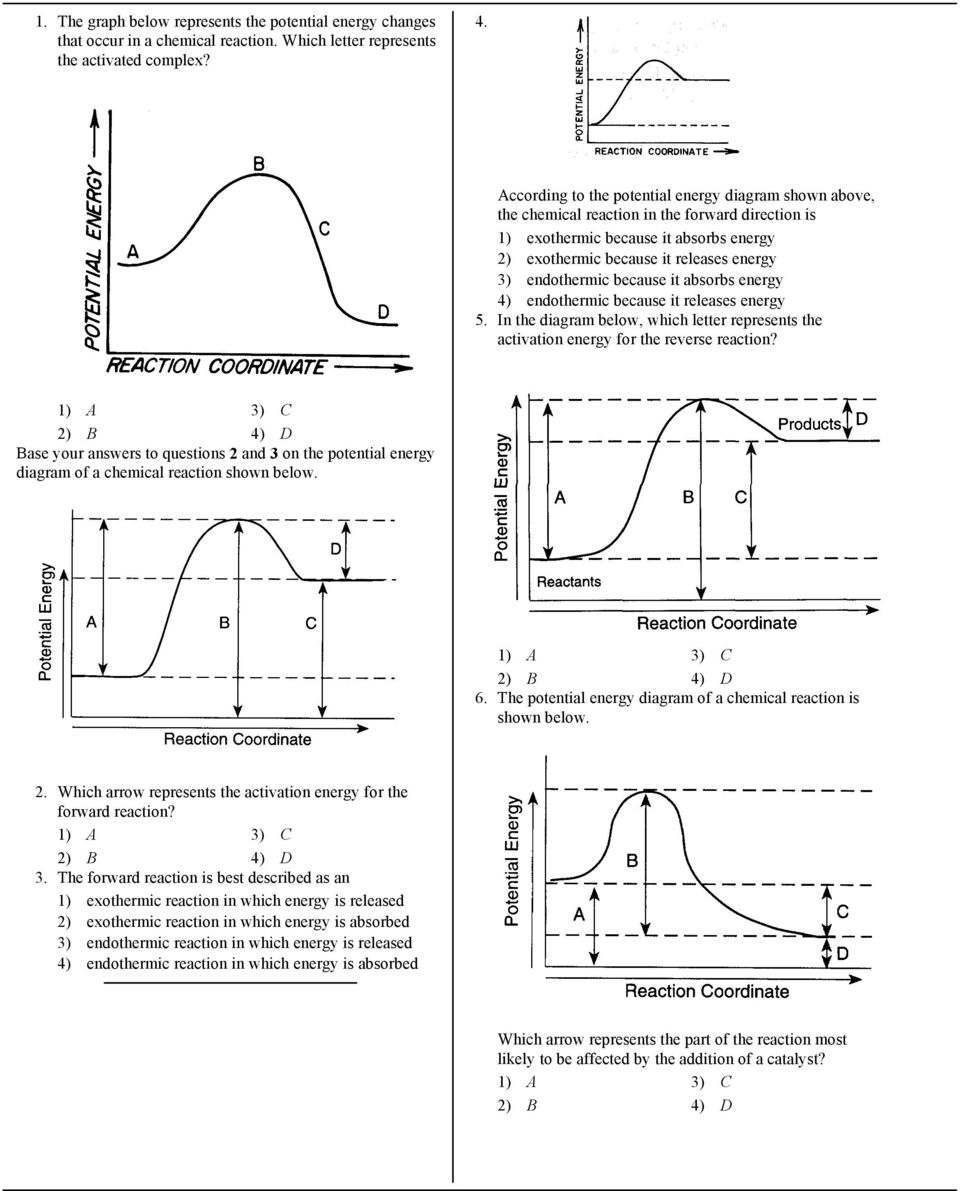
1. The graph below represents the potential energy changes that occur in a chemical reaction. Which letter represents the activated complex?
|
|
|
- Nickolas Watson
- 9 years ago
- Views:
Transcription
1 1. The graph below represents the potential energy changes that occur in a chemical reaction. Which letter represents the activated complex? 4. According to the potential energy diagram shown above, the chemical reaction in the forward direction is 1) exothermic because it absorbs energy 2) exothermic because it releases energy 3) endothermic because it absorbs energy 4) endothermic because it releases energy 5. In the diagram below, which letter represents the activation energy for the reverse reaction? Base your answers to questions 2 and 3 on the potential energy diagram of a chemical reaction shown below. 6. The potential energy diagram of a chemical reaction is shown below. 2. Which arrow represents the activation energy for the forward reaction? 3. The forward reaction is best described as an 1) exothermic reaction in which energy is released 2) exothermic reaction in which energy is absorbed 3) endothermic reaction in which energy is released 4) endothermic reaction in which energy is absorbed Which arrow represents the part of the reaction most likely to be affected by the addition of a catalyst?
2 7. The diagram below represents the energy changes that occur during the formation of a certain compound under standard conditions. 9. Which graph represents an endothermic reaction? 1) 3) 2) 4) According to Reference Table I, the compound could be 1) C 2 H 6 (g) 2) CO 2 (g) 3) HI(g) 4) NH 3 (g) 8. The potential energy diagram below represents a reaction. 10. Which diagram represents the potential energy of an exothermic reaction? 1) 3) 2) 4) 11. The potential energy diagram below shows the reaction X + Y Z. Which arrow represents the activation energy of the forward reaction? When a catalyst is added to the reaction, it will change the value of 1) 1 and 2 3) 2 and 3 2) 1 and 3 4) 3 and 4

3 12. Given the reaction: S(s) + O 2 (g) - SO 2 (g) + energy 13. The potential energy diagram below represents the reaction 2KClO 3 2KCl + 3O 2. Which diagram best represents the potential energy changes for this reaction? 1) 2) 3) 4) Which numbered interval on the diagram would change when a catalyst is added? 1) 1 3) 3 2) 2 4) Which information about a chemical reaction is provided by a potential energy diagram? 1) the oxidation states of the reactants and products 2) the average kinetic energy of the reactants and products 3) the change in solubility of the reacting substances 4) the energy released or absorbed during the reaction 15. In the potential energy diagram below, which letter represents the potential energy of the activated complex? 16. In a potential energy diagram, the difference between the potential energy of the products and the potential energy of the reaction is equal to the 1) heat of reaction 2) entropy of the reaction 3) activation energy of the foward reaction 4) activation energy of the reverse reaction

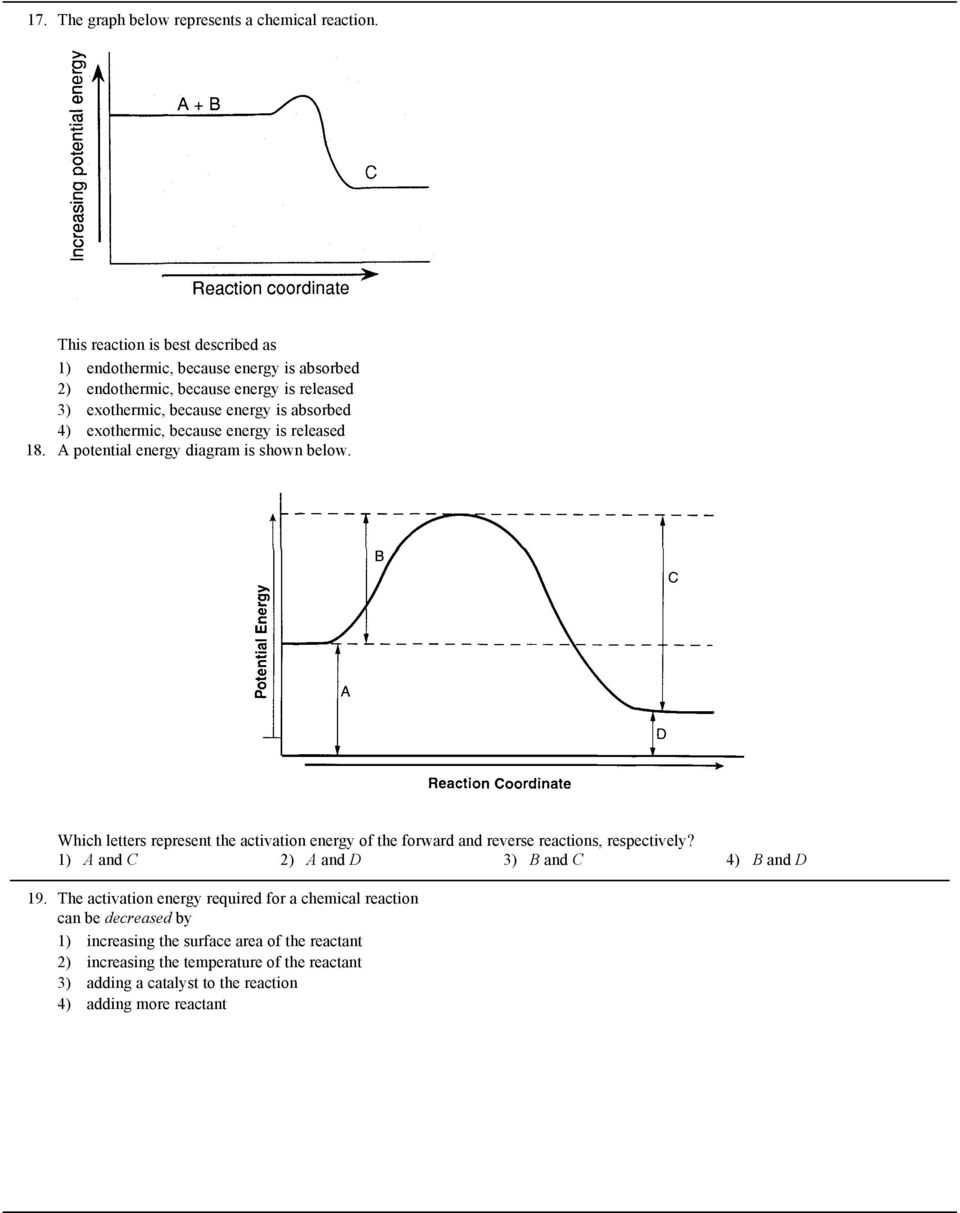
4 17. The graph below represents a chemical reaction. This reaction is best described as 1) endothermic, because energy is absorbed 2) endothermic, because energy is released 3) exothermic, because energy is absorbed 4) exothermic, because energy is released 18. A potential energy diagram is shown below. Which letters represent the activation energy of the forward and reverse reactions, respectively? 1) A and C 2) A and D 3) B and C 4) B and D 19. The activation energy required for a chemical reaction can be decreased by 1) increasing the surface area of the reactant 2) increasing the temperature of the reactant 3) adding a catalyst to the reaction 4) adding more reactant
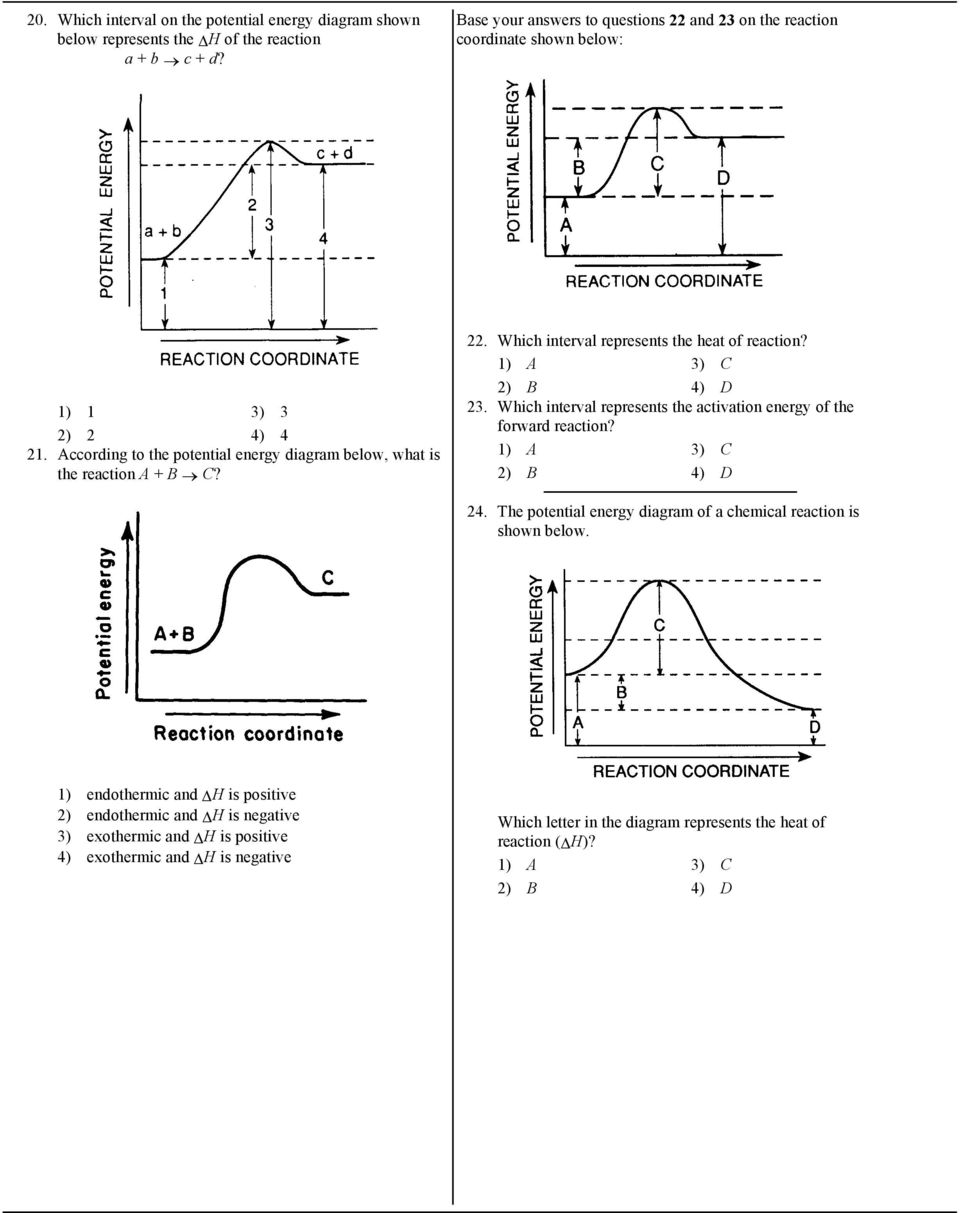
5 20. Which interval on the potential energy diagram shown below represents the H of the reaction a + b c + d? Base your answers to questions 22 and 23 on the reaction coordinate shown below: 1) 1 3) 3 2) 2 4) According to the potential energy diagram below, what is the reaction A + B C? 22. Which interval represents the heat of reaction? 23. Which interval represents the activation energy of the forward reaction? 24. The potential energy diagram of a chemical reaction is shown below. 1) endothermic and H is positive 2) endothermic and H is negative 3) exothermic and H is positive 4) exothermic and H is negative Which letter in the diagram represents the heat of reaction ( H)?
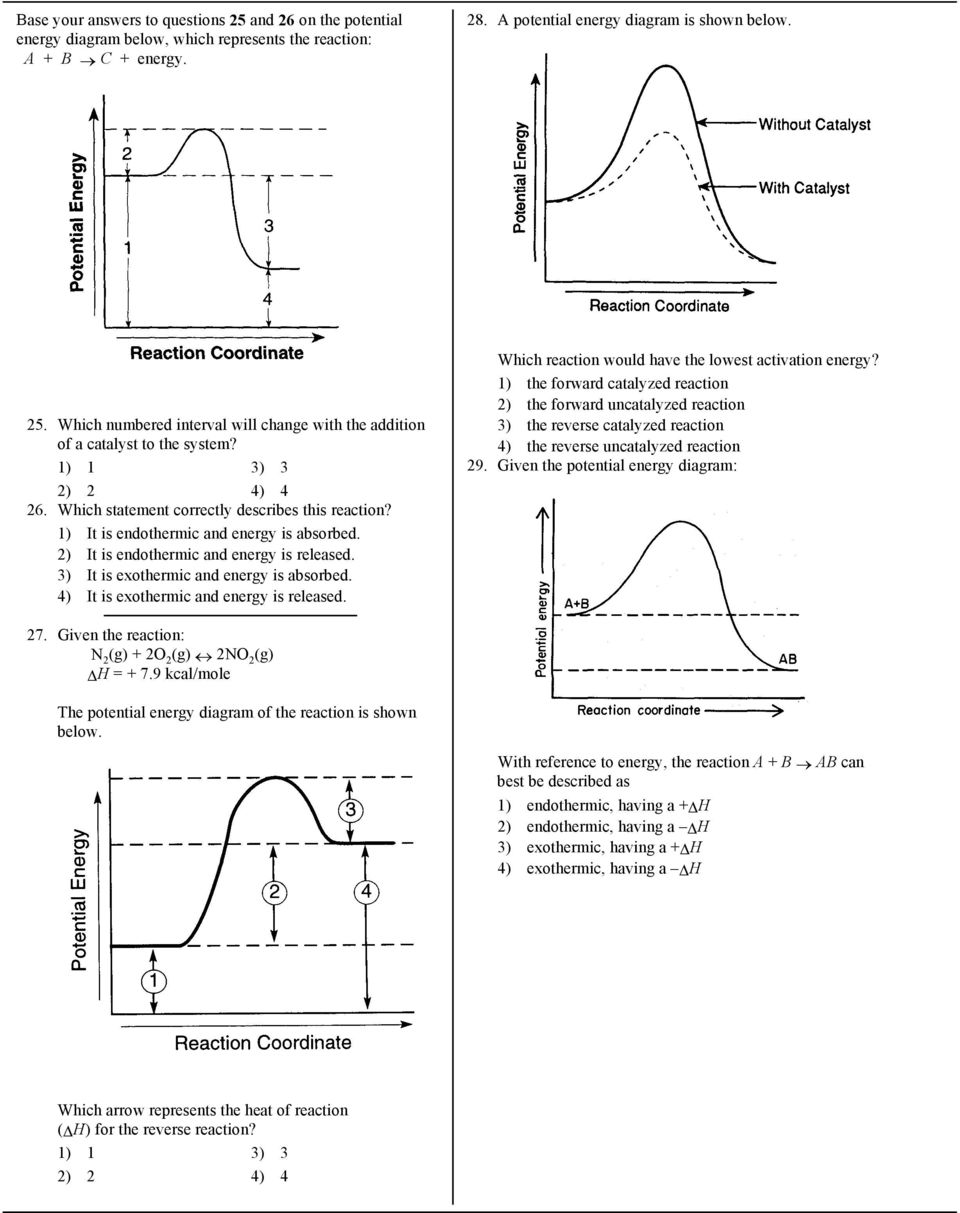
6 Base your answers to questions 25 and 26 on the potential energy diagram below, which represents the reaction: A + B C + energy. 28. A potential energy diagram is shown below. 25. Which numbered interval will change with the addition of a catalyst to the system? 1) 1 3) 3 2) 2 4) Which statement correctly describes this reaction? 1) It is endothermic and energy is absorbed. 2) It is endothermic and energy is released. 3) It is exothermic and energy is absorbed. 4) It is exothermic and energy is released. Which reaction would have the lowest activation energy? 1) the forward catalyzed reaction 2) the forward uncatalyzed reaction 3) the reverse catalyzed reaction 4) the reverse uncatalyzed reaction 29. Given the potential energy diagram: 27. Given the reaction: N 2 (g) + 2O 2 (g) 2NO 2 (g) H = kcal/mole The potential energy diagram of the reaction is shown below. With reference to energy, the reaction A + B AB can best be described as 1) endothermic, having a + H 2) endothermic, having a H 3) exothermic, having a + H 4) exothermic, having a H Which arrow represents the heat of reaction ( H) for the reverse reaction? 1) 1 3) 3 2) 2 4) 4
7 30. Given the potential energy diagram of a chemical reaction: 32. A potential energy diagram of a chemical reaction is shown below. Which arrow represents the potencial energy of the reactants? 31. The graph below is a potential energy diagram of a compound which is formed from its elements. What is the difference between the potential energy of the reactants and the potential energy of the products? 1) 20. kcal 3) 60. kcal 2) 40. kcal 4) 80. kcal 33. According to Table I, which potential energy diagram best represents the reaction that forms H 2 O( ) from its elements? 1) 3) 2) 4) Which interval represents the heat of reaction?

8 34. When a spark is applied to a mixture of hydrogen and oxygen, the gases react explosively. Which potential energy diagram best represents the reaction? 1) 35. Base your answers on the potential energy diagram below. 2) 3) The potential energy of the activated complex is equal to the sum of 1) X + Y 3) X + Y + W 2) X + W 4) X + W + Z 36. In the potential energy diagram below, which interval represents the heat of reaction ( H)? 4)

9 Reference Tables

10 Answer Key

Chemical reactions allow living things to grow, develop, reproduce, and adapt.
 Section 2: Chemical reactions allow living things to grow, develop, reproduce, and adapt. K What I Know W What I Want to Find Out L What I Learned Essential Questions What are the parts of a chemical reaction?
pencil. Vocabulary: 1. Reactant 2. Product 3. Activation energy 4. Catalyst 5. substrate 6. Chemical reaction Keep your textbooks when you are done
 Objectives Students will explore the importance of chemical reactions in biology Students will discuss the role of enzymes as catalysts in biological reactions. Students will analyze graphs showing how
Mr. Bracken. Multiple Choice Review: Thermochemistry
 Mr. Bracken AP Chemistry Name Period Multiple Choice Review: Thermochemistry 1. If this has a negative value for a process, then the process occurs spontaneously. 2. This is a measure of how the disorder
Test Review # 9. Chemistry R: Form TR9.13A
 Chemistry R: Form TR9.13A TEST 9 REVIEW Name Date Period Test Review # 9 Collision theory. In order for a reaction to occur, particles of the reactant must collide. Not all collisions cause reactions.
Chemistry B11 Chapter 4 Chemical reactions
 Chemistry B11 Chapter 4 Chemical reactions Chemical reactions are classified into five groups: A + B AB Synthesis reactions (Combination) H + O H O AB A + B Decomposition reactions (Analysis) NaCl Na +Cl
Thermochemical equations allow stoichiometric calculations.
 CHEM 1105 THERMOCHEMISTRY 1. Change in Enthalpy ( H) Heat is evolved or absorbed in all chemical reactions. Exothermic reaction: heat evolved - heat flows from reaction mixture to surroundings; products
Chemical Reactions Practice Test
 Chemical Reactions Practice Test Chapter 2 Name Date Hour _ Multiple Choice Identify the choice that best completes the statement or answers the question. 1. The only sure evidence for a chemical reaction
Thermochemistry. r2 d:\files\courses\1110-20\99heat&thermorans.doc. Ron Robertson
 Thermochemistry r2 d:\files\courses\1110-20\99heat&thermorans.doc Ron Robertson I. What is Energy? A. Energy is a property of matter that allows work to be done B. Potential and Kinetic Potential energy
Enthalpy of Reaction and Calorimetry worksheet
 Enthalpy of Reaction and Calorimetry worksheet 1. Calcium carbonate decomposes at high temperature to form carbon dioxide and calcium oxide, calculate the enthalpy of reaction. CaCO 3 CO 2 + CaO 2. Carbon
Standard Free Energies of Formation at 298 K. Average Bond Dissociation Energies at 298 K
 1 Thermodynamics There always seems to be at least one free response question that involves thermodynamics. These types of question also show up in the multiple choice questions. G, S, and H. Know what
CHEMISTRY STANDARDS BASED RUBRIC ATOMIC STRUCTURE AND BONDING
 CHEMISTRY STANDARDS BASED RUBRIC ATOMIC STRUCTURE AND BONDING Essential Standard: STUDENTS WILL UNDERSTAND THAT THE PROPERTIES OF MATTER AND THEIR INTERACTIONS ARE A CONSEQUENCE OF THE STRUCTURE OF MATTER,
Chemical Bonds. Chemical Bonds. The Nature of Molecules. Energy and Metabolism < < Covalent bonds form when atoms share 2 or more valence electrons.
 The Nature of Molecules Chapter 2 Energy and Metabolism Chapter 6 Chemical Bonds Molecules are groups of atoms held together in a stable association. Compounds are molecules containing more than one type
Chapter 8: Chemical Equations and Reactions
 Chapter 8: Chemical Equations and Reactions I. Describing Chemical Reactions A. A chemical reaction is the process by which one or more substances are changed into one or more different substances. A chemical
DETERMINING THE ENTHALPY OF FORMATION OF CaCO 3
 DETERMINING THE ENTHALPY OF FORMATION OF CaCO 3 Standard Enthalpy Change Standard Enthalpy Change for a reaction, symbolized as H 0 298, is defined as The enthalpy change when the molar quantities of reactants
In the box below, draw the Lewis electron-dot structure for the compound formed from magnesium and oxygen. [Include any charges or partial charges.
 Name: 1) Which molecule is nonpolar and has a symmetrical shape? A) NH3 B) H2O C) HCl D) CH4 7222-1 - Page 1 2) When ammonium chloride crystals are dissolved in water, the temperature of the water decreases.
AP CHEMISTRY 2007 SCORING GUIDELINES. Question 6
 AP CHEMISTRY 2007 SCORING GUIDELINES Question 6 Answer the following questions, which pertain to binary compounds. (a) In the box provided below, draw a complete Lewis electron-dot diagram for the IF 3
Chapter 8 - Chemical Equations and Reactions
 Chapter 8 - Chemical Equations and Reactions 8-1 Describing Chemical Reactions I. Introduction A. Reactants 1. Original substances entering into a chemical rxn B. Products 1. The resulting substances from
The energy level diagram for this reaction is shown below.
 Q. Methanol can be made when methane reacts with oxygen. (a) The energy level diagram for this reaction is shown below. (i) What is the energy change represented by A? () (ii) Use the energy level diagram
SUPPLEMENTARY TOPIC 3 ENERGY AND CHEMICAL REACTIONS
 SUPPLEMENTARY TOPIC 3 ENERGY AND CHEMICAL REACTIONS Rearranging atoms. In a chemical reaction, bonds between atoms in one or more molecules (reactants) break and new bonds are formed with other atoms to
2. The percent yield is the maximum amount of product that can be produced from the given amount of limiting reactant.
 UNIT 6 stoichiometry practice test True/False Indicate whether the statement is true or false. moles F 1. The mole ratio is a comparison of how many grams of one substance are required to participate in
Name Class Date. In the space provided, write the letter of the term or phrase that best completes each statement or best answers each question.
 Assessment Chapter Test A Chapter: States of Matter In the space provided, write the letter of the term or phrase that best completes each statement or best answers each question. 1. The kinetic-molecular
Chapter 13 Chemical Kinetics
 Chapter 13 Chemical Kinetics Student: 1. The units of "reaction rate" are A. L mol -1 s -1. B. L 2 mol -2 s -1. C. s -1. D. s -2. E. mol L -1 s -1. 2. For the reaction BrO 3 - + 5Br - + 6H + 3Br 2 + 3H
Chemical Formulas, Equations, and Reactions Test Pre-AP Write all answers on your answer document.
 Name: Period: Chemical Formulas, Equations, and Reactions Test Pre-AP Write all answers on your answer document. 1. Which of the following is a NOT a physical property of hydrogen? A. It is gas C. It is
Name Date Class STOICHIOMETRY. SECTION 12.1 THE ARITHMETIC OF EQUATIONS (pages 353 358)
 Name Date Class 1 STOICHIOMETRY SECTION 1.1 THE ARITHMETIC OF EQUATIONS (pages 353 358) This section explains how to calculate the amount of reactants required or product formed in a nonchemical process.
Chapter 5 Student Reading
 Chapter 5 Student Reading THE POLARITY OF THE WATER MOLECULE Wonderful water Water is an amazing substance. We drink it, cook and wash with it, swim and play in it, and use it for lots of other purposes.
CST Practice Test. Multiple Choice Questions
 CST Practice Test Young NAME CST Practice Test Multiple Choice Questions 1) At 1 atm and 298 K, which of the K a values listed below represents the strongest acid? 5) Which electron-dot symbol represents
Energy and Chemical Reactions. Characterizing Energy:
 Energy and Chemical Reactions Energy: Critical for virtually all aspects of chemistry Defined as: We focus on energy transfer. We observe energy changes in: Heat Transfer: How much energy can a material
Thermodynamics. Thermodynamics 1
 Thermodynamics 1 Thermodynamics Some Important Topics First Law of Thermodynamics Internal Energy U ( or E) Enthalpy H Second Law of Thermodynamics Entropy S Third law of Thermodynamics Absolute Entropy
Ch 8.5 Solution Concentration Units % (m/m or w/w) = mass of solute x 100 total mass of solution mass of solution = mass solute + mass solvent
 1 Ch 8.5 Solution Concentration Units % (m/m or w/w) = mass of solute x 100 total mass of solution mass of solution = mass solute + mass solvent % (v/v) = volume of solute x 100 volume of solution filled
Copyright The McGraw-Hill Companies, Inc. Permission required for reproduction or display. Two Forms of Energy
 Module 2D - Energy and Metabolism Objective # 19 All living organisms require energy for survival. In this module we will examine some general principles about chemical reactions and energy usage within
Chemical Reactions 2 The Chemical Equation
 Chemical Reactions 2 The Chemical Equation INFORMATION Chemical equations are symbolic devices used to represent actual chemical reactions. The left side of the equation, called the reactants, is separated
Bomb Calorimetry. Example 4. Energy and Enthalpy
 Bomb Calorimetry constant volume often used for combustion reactions heat released by reaction is absorbed by calorimeter contents need heat capacity of calorimeter q cal = q rxn = q bomb + q water Example
Chapter 5 Chemical Quantities and Reactions. Collection Terms. 5.1 The Mole. A Mole of a Compound. A Mole of Atoms.
 Chapter 5 Chemical Quantities and Reactions 5.1 The Mole Collection Terms A collection term states a specific number of items. 1 dozen donuts = 12 donuts 1 ream of paper = 500 sheets 1 case = 24 cans 1
Balancing Chemical Equations
 Why? Balancing Chemical Equations Atoms are neither created nor destroyed in a chemical reaction, they are just rearranged. In other words, in a chemical reaction, what goes into the reaction must come
CHEMICAL EQUILIBRIUM (ICE METHOD)
 CHEMICAL EQUILIBRIUM (ICE METHOD) Introduction Chemical equilibrium occurs when opposing reactions are proceeding at equal rates. The rate at which the products are formed from the reactants equals the
k 2f, k 2r C 2 H 5 + H C 2 H 6
 hemical Engineering HE 33 F pplied Reaction Kinetics Fall 04 Problem Set 4 Solution Problem. The following elementary steps are proposed for a gas phase reaction: Elementary Steps Rate constants H H f,
Chapter 3: Stoichiometry
 Chapter 3: Stoichiometry Key Skills: Balance chemical equations Predict the products of simple combination, decomposition, and combustion reactions. Calculate formula weights Convert grams to moles and
Physical and Chemical Properties of Matter
 Physical and Chemical Properties of Matter What is matter? Anything that has mass and takes up space Chemical or Physical Property? Physical properties of matter: characteristics that can be observed or
AP CHEMISTRY 2006 SCORING GUIDELINES
 AP CHEMISTRY 2006 SCORING GUIDELINES Question 6 6. Answer each of the following in terms of principles of molecular behavior and chemical concepts. (a) The structures for glucose, C 6 H 12 O 6, and cyclohexane,
Paper 1 (7405/1): Inorganic and Physical Chemistry Mark scheme
 AQA Qualifications A-level Chemistry Paper (7405/): Inorganic and Physical Chemistry Mark scheme 7405 Specimen paper Version 0.5 MARK SCHEME A-level Chemistry Specimen paper 0. This question is marked
Chemistry 11 Some Study Materials for the Final Exam
 Chemistry 11 Some Study Materials for the Final Exam Prefix Abbreviation Exponent giga G 10 9 mega M 10 6 kilo k 10 3 hecto h 10 2 deca da 10 1 deci d 10-1 centi c 10-2 milli m 10-3 micro µ 10-6 nano n
MULTIPLE CHOICE QUESTIONS
 MULTIPLE CHOICE QUESTIONS 1. Most components of energy conversion systems evolved very early; thus, the most fundamental aspects of energy metabolism tend to be: A. quite different among a diverse group
Part B 2. Allow a total of 15 credits for this part. The student must answer all questions in this part.
 Part B 2 Allow a total of 15 credits for this part. The student must answer all questions in this part. 51 [1] Allow 1 credit for 3 Mg(s) N 2 (g) Mg 3 N 2 (s). Allow credit even if the coefficient 1 is
Balance the following equation: KClO 3 + C 12 H 22 O 11 KCl + CO 2 + H 2 O
 Balance the following equation: KClO 3 + C 12 H 22 O 11 KCl + CO 2 + H 2 O Ans: 8 KClO 3 + C 12 H 22 O 11 8 KCl + 12 CO 2 + 11 H 2 O 3.2 Chemical Symbols at Different levels Chemical symbols represent
Balancing chemical reaction equations (stoichiometry)
 Balancing chemical reaction equations (stoichiometry) This worksheet and all related files are licensed under the Creative Commons Attribution License, version 1.0. To view a copy of this license, visit
green B 1 ) into a single unit to model the substrate in this reaction. enzyme
 Teacher Key Objectives You will use the model pieces in the kit to: Simulate enzymatic actions. Explain enzymatic specificity. Investigate two types of enzyme inhibitors used in regulating enzymatic activity.
CHEM 120 Online: Chapter 6 Sample problems Date: 2. Which of the following compounds has the largest formula mass? A) H2O B) NH3 C) CO D) BeH2
 CHEM 120 Online: Chapter 6 Sample problems Date: 1. To determine the formula mass of a compound you should A) add up the atomic masses of all the atoms present. B) add up the atomic masses of all the atoms
What You Need To Know for the Chemistry Regents Exam
 Name: What You Need To Know for the Chemistry Regents Exam The Test The Chemisty Regents Exam is broken down into three sections: Part A: 35 mulitple choice questions from all units covered over the course
Unit 5 Practice Test. Name: Class: Date: Multiple Choice Identify the choice that best completes the statement or answers the question.
 Name: Class: Date: Unit 5 Practice Test Multiple Choice Identify the choice that best completes the statement or answers the question. 1) The internal energy of a system is always increased by. A) adding
Current Staff Course Unit/ Length. Basic Outline/ Structure. Unit Objectives/ Big Ideas. Properties of Waves A simple wave has a PH: Sound and Light
 Current Staff Course Unit/ Length August August September September October Unit Objectives/ Big Ideas Basic Outline/ Structure PS4- Types of Waves Because light can travel through space, it cannot be
Key Questions. What happens to chemical bonds during chemical reactions?
 LESSON 2.4 Getting Started Objectives 2.4.1 Explain how chemical reactions affect chemical bonds. 2.4.2 Describe how energy changes affect how easily a chemical reaction will occur. 2.4.3 Explain why enzymes
Temperature. Number of moles. Constant Terms. Pressure. Answers Additional Questions 12.1
 Answers Additional Questions 12.1 1. A gas collected over water has a total pressure equal to the pressure of the dry gas plus the pressure of the water vapor. If the partial pressure of water at 25.0
5. Which temperature is equal to +20 K? 1) 253ºC 2) 293ºC 3) 253 C 4) 293 C
 1. The average kinetic energy of water molecules increases when 1) H 2 O(s) changes to H 2 O( ) at 0ºC 3) H 2 O( ) at 10ºC changes to H 2 O( ) at 20ºC 2) H 2 O( ) changes to H 2 O(s) at 0ºC 4) H 2 O( )
How To Calculate Mass In Chemical Reactions
 We have used the mole concept to calculate mass relationships in chemical formulas Molar mass of ethanol (C 2 H 5 OH)? Molar mass = 2 x 12.011 + 6 x 1.008 + 1 x15.999 = 46.069 g/mol Mass percentage of
Lecture 35: Atmosphere in Furnaces
 Lecture 35: Atmosphere in Furnaces Contents: Selection of atmosphere: Gases and their behavior: Prepared atmospheres Protective atmospheres applications Atmosphere volume requirements Atmosphere sensors
Chapter 14. Review Skills
 Chapter 14 The Process of Chemical Reactions ave you ever considered becoming a chemical engineer? The men and women in this profession develop industrial processes for the large-scale production of the
Chapter 13 - Chemical Equilibrium
 Chapter 1 - Chemical Equilibrium Intro A. Chemical Equilibrium 1. The state where the concentrations of all reactants and products remain constant with time. All reactions carried out in a closed vessel
UNIT (4) CALCULATIONS AND CHEMICAL REACTIONS
 UNIT (4) CALCULATIONS AND CHEMICAL REACTIONS 4.1 Formula Masses Recall that the decimal number written under the symbol of the element in the periodic table is the atomic mass of the element. 1 7 8 12
Review - After School Matter Name: Review - After School Matter Tuesday, April 29, 2008
 Name: Review - After School Matter Tuesday, April 29, 2008 1. Figure 1 The graph represents the relationship between temperature and time as heat was added uniformly to a substance starting at a solid
Q1. A student studied the reaction between dilute hydrochloric acid and an excess of calcium carbonate.
 Q. A student studied the reaction between dilute hydrochloric acid and an excess of calcium carbonate. calcium carbonate + hydrochloric acid calcium chloride + water + carbon dioxide The student measured
Chapter 6 Chemical Calculations
 Chapter 6 Chemical Calculations 1 Submicroscopic Macroscopic 2 Chapter Outline 1. Formula Masses (Ch 6.1) 2. Percent Composition (supplemental material) 3. The Mole & Avogadro s Number (Ch 6.2) 4. Molar
Transfer of heat energy often occurs during chemical reactions. A reaction
 Chemistry 111 Lab: Thermochemistry Page I-3 THERMOCHEMISTRY Heats of Reaction The Enthalpy of Formation of Magnesium Oxide Transfer of heat energy often occurs during chemical reactions. A reaction may
Equilibrium. Ron Robertson
 Equilibrium Ron Robertson Basic Ideas A. Extent of Reaction Many reactions do not go to completion. Those that do not are reversible with a forward reaction and reverse reaction. To be really correct we
Test 5 Review questions. 1. As ice cools from 273 K to 263 K, the average kinetic energy of its molecules will
 Name: Thursday, December 13, 2007 Test 5 Review questions 1. As ice cools from 273 K to 263 K, the average kinetic energy of its molecules will 1. decrease 2. increase 3. remain the same 2. The graph below
Unit 19 Practice. Name: Class: Date: Multiple Choice Identify the choice that best completes the statement or answers the question.
 Name: Class: Date: Unit 19 Practice Multiple Choice Identify the choice that best completes the statement or answers the question. 1) The first law of thermodynamics can be given as. A) E = q + w B) =
Thermodynamics Worksheet I also highly recommend Worksheets 13 and 14 in the Lab Manual
 Thermodynamics Worksheet I also highly recommend Worksheets 13 and 14 in the Lab Manual 1. Predict the sign of entropy change in the following processes a) The process of carbonating water to make a soda
7-5.5. Translate chemical symbols and the chemical formulas of common substances to show the component parts of the substances including:
 7-5.5 Translate chemical symbols and the chemical formulas of common substances to show the component parts of the substances including: NaCl [salt], H 2 O [water], C 6 H 12 O 6 [simple sugar], O 2 [oxygen
Reaction of Potassium Permanganate and Glycerin.
 Reaction of Potassium Permanganate and Glycerin. Potassium Permanganate (KMnO 4 ) is a dark purple solid that is used as a very powerful oxidizing agent. An oxidizing agent is a substance which, in its
11 Thermodynamics and Thermochemistry
 Copyright ç 1996 Richard Hochstim. All rights reserved. Terms of use.» 37 11 Thermodynamics and Thermochemistry Thermodynamics is the study of heat, and how heat can be interconverted into other energy
Calculations and Chemical Equations. Example: Hydrogen atomic weight = 1.008 amu Carbon atomic weight = 12.001 amu
 Calculations and Chemical Equations Atomic mass: Mass of an atom of an element, expressed in atomic mass units Atomic mass unit (amu): 1.661 x 10⁻²⁴ g Atomic weight: Average mass of all isotopes of a given
1. What is the molecular formula of a compound with the empirical formula PO and a gram-molecular mass of 284 grams?
 Name: Tuesday, May 20, 2008 1. What is the molecular formula of a compound with the empirical formula PO and a gram-molecular mass of 284 grams? 2 5 1. P2O 5 3. P10O4 2. P5O 2 4. P4O10 2. Which substance
Read the sections on Allotropy and Allotropes in your text (pages 464, 475, 871-2, 882-3) and answer the following:
 Descriptive Chemistry Assignment 5 Thermodynamics and Allotropes Read the sections on Allotropy and Allotropes in your text (pages 464, 475, 871-2, 882-3) and answer the following: 1. Define the word allotrope
Stoichiometry Exploring a Student-Friendly Method of Problem Solving
 Stoichiometry Exploring a Student-Friendly Method of Problem Solving Stoichiometry comes in two forms: composition and reaction. If the relationship in question is between the quantities of each element
Equilibria Involving Acids & Bases
 Week 9 Equilibria Involving Acids & Bases Acidic and basic solutions Self-ionisation of water Through reaction with itself: The concentration of water in aqueous solutions is virtually constant at about
Introductory Chemistry, 3 rd Edition Nivaldo Tro. Roy Kennedy Massachusetts Bay Community College Wellesley Hills, Maqqwertd ygoijpk[l
 Introductory Chemistry, 3 rd Edition Nivaldo Tro Quantities in Car an octane and oxygen molecules and carbon dioxide and water Chemical Reactions Roy Kennedy Massachusetts Bay Community College Wellesley
7. 1.00 atm = 760 torr = 760 mm Hg = 101.325 kpa = 14.70 psi. = 0.446 atm. = 0.993 atm. = 107 kpa 760 torr 1 atm 760 mm Hg = 790.
 CHATER 3. The atmosphere is a homogeneous mixture (a solution) of gases.. Solids and liquids have essentially fixed volumes and are not able to be compressed easily. have volumes that depend on their conditions,
FORM A is EXAM II, VERSION 1 (v1) Name
 FORM A is EXAM II, VERSION 1 (v1) Name 1. DO NOT TURN THIS PAGE UNTIL DIRECTED TO DO SO. 2. These tests are machine graded; therefore, be sure to use a No. 1 or 2 pencil for marking the answer sheets.
MEMORANDUM GRADE 11. PHYSICAL SCIENCES: CHEMISTRY Paper 2
 MEMORANDUM GRADE 11 PHYSICAL SCIENCES: CHEMISTRY Paper 2 MARKS: 150 TIME: 3 hours Learning Outcomes and Assessment Standards LO1 LO2 LO3 AS 11.1.1: Plan and conduct a scientific investigation to collect
2. DECOMPOSITION REACTION ( A couple have a heated argument and break up )
 TYPES OF CHEMICAL REACTIONS Most reactions can be classified into one of five categories by examining the types of reactants and products involved in the reaction. Knowing the types of reactions can help
Chapter 2. The Chemistry of Life Worksheets
 Chapter 2 The Chemistry of Life Worksheets (Opening image courtesy of David Iberri, http://en.wikipedia.org/wiki/file:camkii.png, and under the Creative Commons license CC-BY-SA 3.0.) Lesson 2.1: Matter
Chemical Equations. Chemical Equations. Chemical reactions describe processes involving chemical change
 Chemical Reactions Chemical Equations Chemical reactions describe processes involving chemical change The chemical change involves rearranging matter Converting one or more pure substances into new pure
KS3 Science: Chemistry Contents
 summary KS3 Science MyWorks Guide Chemistry KS3 Science: Chemistry Mini zes: 40 Super zes: 5 Extension zes: 4 Skills zes: 6 TOTAL 54 What are MyWorks zes? MyWorks zes are short individual learning tasks
Spring 2009. kj mol 125 0-229 -92. H f. H rxn = Σ H f (products) - Σ H f (reactants)
 Spring 2009 2. The reaction of an elemental halogen with an alkane is a very common reaction. The reaction between chlorine and butane is provided below. (NOTE: Questions a d and f pertain to this reaction.)
Composition of the Atmosphere. Outline Atmospheric Composition Nitrogen and Oxygen Lightning Homework
 Molecules of the Atmosphere The present atmosphere consists mainly of molecular nitrogen (N2) and molecular oxygen (O2) but it has dramatically changed in composition from the beginning of the solar system.
Chapter 6: Writing and Balancing Chemical Equations. AB A + B. CaCO3 CaO + CO2 A + B C. AB + C AC + B (or AB + C CB + A)
 78 Chapter 6: Writing and Balancing Chemical Equations. It is convenient to classify chemical reactions into one of several general types. Some of the more common, important, reactions are shown below.
LESSON PLAN 1. Fire Science. Key Terms and Concepts. ash chemical reaction combustion Consumer Product Safety Commission endothermic exothermic
 LESSON PLAN 1 Fire Prevention Fire and Fire Prevention Combustion occurs when the three elements of the fire triangle heat, fuel and oxygen are present. Understanding this basic chemical reaction can help
Chapter 3! Stoichiometry: Calculations with Chemical Formulas and Equations. Stoichiometry
 Chapter 3! : Calculations with Chemical Formulas and Equations Anatomy of a Chemical Equation CH 4 (g) + 2O 2 (g) CO 2 (g) + 2 H 2 O (g) Anatomy of a Chemical Equation CH 4 (g) + 2 O 2 (g) CO 2 (g) + 2
Chapter 7: Chemical Energy
 Chapter 7: Chemical Energy Goals of Period 7 Section 7.1: To describe atoms, chemical elements and compounds Section 7.2: To discuss the electromagnetic force and physical changes Section 7.3: To illustrate
Chem 1A Exam 2 Review Problems
 Chem 1A Exam 2 Review Problems 1. At 0.967 atm, the height of mercury in a barometer is 0.735 m. If the mercury were replaced with water, what height of water (in meters) would be supported at this pressure?
Honors Chemistry: Unit 6 Test Stoichiometry PRACTICE TEST ANSWER KEY Page 1. A chemical equation. (C-4.4)
 Honors Chemistry: Unit 6 Test Stoichiometry PRACTICE TEST ANSWER KEY Page 1 1. 2. 3. 4. 5. 6. Question What is a symbolic representation of a chemical reaction? What 3 things (values) is a mole of a chemical
Stoichiometry. 1. The total number of moles represented by 20 grams of calcium carbonate is (1) 1; (2) 2; (3) 0.1; (4) 0.2.
 Stoichiometry 1 The total number of moles represented by 20 grams of calcium carbonate is (1) 1; (2) 2; (3) 01; (4) 02 2 A 44 gram sample of a hydrate was heated until the water of hydration was driven
20.2 Chemical Equations
 All of the chemical changes you observed in the last Investigation were the result of chemical reactions. A chemical reaction involves a rearrangement of atoms in one or more reactants to form one or more
1. A covalent bond between two atoms represents what kind of energy? a. Kinetic energy b. Potential energy c. Mechanical energy d.
 1. A covalent bond between two atoms represents what kind of energy? a. Kinetic energy b. Potential energy c. Mechanical energy d. Solar energy A. Answer a is incorrect. Kinetic energy is the energy of
UNIT 1 THERMOCHEMISTRY
 UNIT 1 THERMOCHEMISTRY THERMOCHEMISTRY LEARNING OUTCOMES Students will be expected to: THERMOCHEMISTRY STSE analyse why scientific and technological activities take place in a variety individual and group
Answer Key Chemistry If8766 Moles And Mass
 If8766 Moles And Mass Free PDF ebook Download: If8766 Moles And Mass Download or Read Online ebook answer key chemistry if8766 moles and mass in PDF Format From The Best User Guide Database Moles and Mass.
87 16 70 20 58 24 44 32 35 40 29 48 (a) graph Y versus X (b) graph Y versus 1/X
 HOMEWORK 5A Barometer; Boyle s Law 1. The pressure of the first two gases below is determined with a manometer that is filled with mercury (density = 13.6 g/ml). The pressure of the last two gases below
STATE UNIVERSITY OF NEW YORK COLLEGE OF TECHNOLOGY CANTON, NEW YORK COURSE OUTLINE CHEM 150 - COLLEGE CHEMISTRY I
 STATE UNIVERSITY OF NEW YORK COLLEGE OF TECHNOLOGY CANTON, NEW YORK COURSE OUTLINE CHEM 150 - COLLEGE CHEMISTRY I PREPARED BY: NICOLE HELDT SCHOOL OF SCIENCE, HEALTH, AND PROFESSIONAL STUDIES SCIENCE DEPARTMENT
Reaction Rates and Chemical Kinetics. Factors Affecting Reaction Rate [O 2. CHAPTER 13 Page 1
 CHAPTER 13 Page 1 Reaction Rates and Chemical Kinetics Several factors affect the rate at which a reaction occurs. Some reactions are instantaneous while others are extremely slow. Whether a commercial
A n = 2 to n = 1. B n = 3 to n = 1. C n = 4 to n = 2. D n = 5 to n = 2
 North arolina Testing Program EO hemistry Sample Items Goal 4 1. onsider the spectrum for the hydrogen atom. In which situation will light be produced? 3. Which color of light would a hydrogen atom emit
Chapter 8: An Introduction to Metabolism
 Chapter 8: An Introduction to Metabolism Name Period Concept 8.1 An organism s metabolism transforms matter and energy, subject to the laws of thermodynamics 1. Define metabolism. The totality of an organism