
The Mystery of Rapa Nui
|
|
|
- Ira Houston
- 9 years ago
- Views:
Transcription
1 Lesson at a Glance Teams of students investigate evidence from field studies, ships logs, and oral traditions to solve the mystery of what happened to the natural resources of Rapa Nui. Students present their findings to the class and discuss the ecological and cultural kinship Hawai i has with Rapa Nui. Aunty Momi s journal helps students to reflect on ways that they can bring a sense of lökahi (balance) into their lives and the responsibility that we have to use resources sustainably for future generations. Focus Question What caused the decline of natural resources and human population in Rapa Nui and what can we learn from our shared ecological and cultural kinship? Key Concepts It is each generation s responsibility to use resources sustainably so that future generations will have the fresh water, soil, fisheries and other natural resources that they need. Hawai i shares ecological and cultural kinship with other Pacific islands. We can cooperate with one another and share problems and successes for living sustainably. Values lökahi (harmony, balance) kuleana (responsibility) hö`ihi (respect) lokomaika`i (good hearted) Time three - four class periods Performance Standards Identify human activities that may create changes resulting in unbalanced ecosystems. Depict information and relationships by constructing diagrams, charts, and graphs. Produce a narrative account that creates an organizing structure and establishes the significance of events. Demonstrate comprehension of text by writing about theme/author's message. Apply themes to own life experiences. 57

2 Subject Areas science, social studies, language arts Materials Values illustrations (provided) Momi s journal (provided) Student activity sheet (provided) Research materials: Ships' Logs (provided) Oral Traditions (provided) Field Work (provided) Map of Rapa Nui (provided) Additional references (listed at end of activity) Preparation Make two or three copies of the research materials for student teams to use (Ships' Logs, Oral Traditions, Field Work). Make a copy of the student activity sheet and Aunty Momi s journal for each student. If possible, obtain some of the additional references suggested for Rapa Nui. Note: Teachers who field tested this activity reported that the Let's Go Voyaging distance learning program, "Our, Island, Our Canoe" was extremely helpful to students as they solved the mystery Teacher Background Rapa Nui, also known as Easter Island, has always held a fascination for scientists and cultural enthusiasts. The island is known for its moai the giant religious stone statues that were carved by the people in Rapa Nui during the 14 th and 15 th centuries. (Some may have been carved as early as the 10 th century.) The largest of the moai is about 66 feet high and is estimated to weigh 300 tons! It was never completed and is still in the quarry. The largest moai on an ahu (raised stone platform) is just over 40 feet high. Today, many of these majestic statues are toppled over and the island s resources are just beginning to recover from environmental collapse. What is the story of Rapa Nui and how can we learn from it? Rapa Nui, like Hawaiÿi, is very isolated; it is considered to be the most isolated high island ecosystem in the world. It is a tiny island approximately 2,400 miles off the Chilean coast. The nearest inhabited island is Pitcairn, to the northwest, 1,400 miles away. The nearest uninhabited islands are the low islets of Sala y Gomez to the east of Rapa Nui. Mangareva, 1,450 miles northwest of Pitcairn, was the nearest inhabited island in antiquity. The Marquesas Islands, to the north of Mangareva, were probably the origin of the Polynesian migrations that settled both Rapa Nui and Hawai`i. (Refer to the Pacific Map in Appendix C.) The island of Rapa Nui is about the size of Länaÿi. Politically it is part of Chile (Chilean Polynesia), however, despite Western influence, Rapa Nui has retained much of its Polynesian heritage, particularly its language. Rapa Nui and Spanish are both spoken on the island; English is used, but not as often. Because of Rapa Nui s isolation and the southeasterly tradewinds and ocean currents it faces, there have been many theories as to how the native people discovered it. Some experts believed that the people migrated from South America. Their argument was that it would be impossible for these unskilled voyagers to travel against the winds and the ocean currents to reach the island. But after lengthy studies, most agree that these highly skilled people originated from Polynesia. They were so skilled in seamanship that they accomplished what their European counterparts could not. 58

3 According to oral traditions, the original Polynesian settlers, guided by their leader Hotu Matu`a, arrived at Rapa Nui (Te Pito o te Henua-- the center of the world, or last point of contact with the world) in approximately A.D Some archaeologists believe that the island may have been settled much earlier due to carbon-dating of an ahu as early as the second century. Since these structures would not have been created until well after settlement, the actual settement date could be much earlier than A.D As the Polynesian settlers disembarked from their canoes, they found an island with adequate natural resources for their survival. From pollen samples taken from the island's wetlands, there is evidence that there was a lowland forest dominated by an extinct endemic palm species (Jubaea chilensis). The palm provided wood for building canoes that had to be large enough to withstand the rigors of deep-sea fishing. Native hau hau (Triumfetta semitriloba) trees were used to make cordage and the wood of the native toromiro (Sophora toromiro) tree may have been used for fueling fires and crafting huts. There were natural lakes and springs as well intermittant streams that provided the islanders with fresh water. There were no reefs, but the ocean was filled with shoreline and deep-sea fish. Loss of Forests and Fisheries As the human population increased, the forest and fisheries gradually declined. The forests, which once provided for the people, were not regenerating, and their ocean resources were on the verge of collapse. How did this island lose its natural resources? By most accounts, the environmental collapse on Rapa Nui is due to a number of factors that occurred gradually over a period of time. By A.D.1400, pollen samples from Rano Kau indicate that the forest in that part of the island was nearly gone. Pollen samples from another site, Rano Raraku, show an abundance of charcoal near the deposit's surface as well as evidence of soil erosion and changes in soil chemistry. Charcoal in the soil may have been due to burning of trees. Climatic change in the past may have affected soil chemistry. An alteration in rainfall, leading to less dense vegetation cover could have caused more leaching of soil minerals during the wet season. The introduction of the Polynesian rat may have contributed to deforestation. One study found rat teeth marks on Jubaea tree nuts, evidence that the nuts had been gnawed by rodents to extract the fruit. By eating the fruit of the nut, the rodent prevented germination of the seed. No seeds meant no seedlings and no new trees. Rats may have preyed on the island's birds as well. From the archaeological digs, there is evidence that all of the native land birds were gone from the island two centuries after the first arrival. If any of these birds were pollinators, their decline could have hand an impact on the loss of plants as well. Human overharvesting of timber for canoes, shelter, fuel, and fiber also contributed to the forest s degeneration. With the loss of the forest tree canopy, the soil was exposed to sun and rain. Rainfall caused extensive soil erosion and run-off, flooding streams and disabling onshore marine fisheries. Without the forest, people were unable to build canoes sturdy enough for deep-sea fishing. They were then relegated to onshore fishing, depleting their ocean resources even further. One account describes the Dutch visit in 1722 to Rapa Nui. They were greeted by a Rapa Nui native in a canoe constructed of light timber and sewn and glued together with organic material. The canoe was so frail that the oarsman spent half of his time bailing. The loss of forest and ocean resources had devastating consequences for the people. Food resources were scarce. Chickens were highly coveted and placed in specially designed stone dwellings to prevent thievery. By the 15th century, there is evidence of dramatic conflict with wars between tribes, competition for scarce resources, and finally, starving people resorting to cannibalism. The loss of forest in Rapa Nui appears to have been gradual and due to many factors. By the time of Western contact in 1722, there were few trees remaining. And with the introduction of sheep after 1722, the island became even more barren. 59

4 The Moai During the height of moai construction in the 14th and 15th centuries, island tribes directed their attention to the carving and erection of their moai. These towering stone statues which represented a tribe's ancestors, were believed to carry each tribes mana (spiritual power or energy). Tribes moved their moai from the stone quarry to ahu (raised stone platforms) near the coast. There are 300 ahu around the island. Each ahu has house sites associated with it (up to 2,000 sites for each). The largest of these stone platforms is 1,800 feet long, 24 feet high and feet wide. It took hundreds of people to build this huge ahu. An intriguing question is, how were the giant moai moved from the inland stone quarry to the ahu on the coast? According to oral traditions, the moai walked. Some archaeologists believe people moved the moai by edging them forward a corner at a time; others believe the statues were rolled on logs. There are over 800 moai on the island today. Declining Human Population The human population is estimated to have reached its peak of 8,000-20,000 people by1680. But with the scarcity of resources, Rapa Nui s population began a downward spiral. According to many Rapa Nui legends, the production of statues ceased when quarrels erupted over food and there was a breakdown in the distribution and exchange of food. Craftsmen who relied on the farmers and fishers for food resources were unable to depend on them. The group cooperation that was a vital part of this society came to a halt. Another significant event contributing to the near eradication of the native population was the Peruvian slave trade. In 1862, the human population on Rapa Nui may have totaled approximately 2,000 to 3,000. Approximately 1,000 people were captured and hauled off to Peru to slave in the guano mines. Over 900 Rapa Nui islanders perished from disease and ill treatment in these mines. Significantly, those captured included ariki (chiefs) and priests who were the keepers of oral traditions. Members of the ariki class knew how to read the inscriptions on the ko hau rongorongo tablets. These tablets represent Polynesia's only indigenous, pre-european contact, written texts. This knowledge was destroyed by the Peruvian slave raids and their aftermath. Several months later, the Bishop of Tahiti, Mgr. Tepano Jaussen, urged the Peruvian government to release the prisoners. Some of the islanders relocated to Mangareva and to Pamata`i in Tahiti; others returned to Rapa Nui. On their return voyage, 85 of the 100 islanders died from smallpox and tuberculosis. Fifteen people returned to Rapa Nui infecting the disease-free population. By the end of the epidemic, the island of Rapa Nui had been transformed into a mass grave. By the year 1877, only 111 people remained on the island. After the slave raids, some of the descendants of the islanders who relocated to Mangareva and Pamata`i returned safely to their island. Restoration and Renewal Based on Rapa Nui s devastating past, what efforts are currently underway by the people to restore their moai, regenerate their forests and reconnect to their Polynesian cousins? Both the government and the communities of Rapa Nui are working together to bring about cultural and environmental renewal. The interest shown in Rapa Nui monumental restoration has revived a sense of cultural pride among the native population. Most families have labored to restore the physical monuments of the island's past, beginning a process of reclaiming cultural identity that was badly damaged by Western disease and imperialism. Rapa Nui leaders are reaching out to their Polynesian counterparts, particularly in Tahiti and Hawaiÿi, to help them with their efforts. In March of 1998, teachers, researchers and videographers from Hawai`i visited the island to prepare for the voyage to Rapa Nui in In May, an environmental group of high school students from 60

5 Rapa Nui Tahiti 2,500 miles Chilean coast 2,350 miles quarry 3 miles 61

6 the Kamehameha Schools in Hawaiÿi were invited to take part in a scientific and cultural student exchange program. To prepare for the trip, the group s advisors worked closely with groups from Rapa Nui professional archaeologists, government and community leaders, cultural resource specialists and the Rapa Nui Outrigger Canoe Club to determine their needs. From that meeting, a list of objectives were compiled. The trip was a success. The group gained an appreciation for and a better understanding of Rapa Nui and its people. They participated in several archaeological field studies learning about moai and petroglyph conservation. They compared the similarities of Rapa Nui s cultural practices in the use of native plants and animal materials to ancient Hawaiians. They shared their knowledge of stewardship and sustainablility practices of ancient Hawaiians. They provided seeds of native Hawaiian plants and trees and planted them in the Rapa Nui National Park. The students also worked closely with the Polynesian Voyaging Society in helping to promote voyaging traditions and practices. This experience helped to build and solidify the cultural and environmental relationship Hawaiÿi has with Rapa Nui. It also brought an awareness to the Hawaiÿi community of what could happen if we do not care for our own island resources. Ultimately, we can learn from Rapa Nui and work together in developing a brighter more sustainable future for our children. Taking Action! Kualapu u School grades 5 and 6 students won Moanalua Gardens Foundation s1998 Hawai i Needs Care Award. Their project, Promote Resolutions with Integrity for a Sustainable Moloka i (PRISM), demonstrates their commitment to caring for their island environment. Students conducted research on water and land use, habitat protection, resource management, energy, waste management and other issues concerning their island s future. Students visited sites, interviewed community members, and organized their data to present in a public symposium. Students have developed and implemented action plans based on the data they collected. One community elder who attended the symposium commented that she could die happy knowing the future of her beloved island was in the hands of caring and committed kids! Supplemental Resources Bahn, Paul and Flenley, John. Easter Island, Earth Island. London: Thames and Hudson, 1992 Finney, Ben. Voyage of Rediscovery. University of California Press, (Recounts the voyage of rediscovery describing navigation, construction of voyaging canoes, the welcome in Aotearoa, and more.) Flenley, J.R. and Sarah M. King. Late Quaternary Pollen Records from Easter Island. Nature. Vol. 307, January, 5, 1984 Moanalua Gardens Foundation. Forest Treasures. CD-ROM to be released in summer (This CD-ROM provides a database of Hawaiian forest plants and animals with animal sounds, videos, and a wealth of information about forests in Hawai`i and other parts of the world.) Skottsberg, Carl, Ed. The Natural History of Juan Fernandez and Easter Island, Vol. 1 Geography, Geology, Origin of Island Life, UPPSALA, (See Part I Skottsberg's notes on a visit to Easter Island.) Web Sites Easter Island Foundation: ~trance/eif.html (Provides a list of references available for purchase from their foundation.) Polynesian Voyaging Society: leahi.kcc.hawaii.edu/org/pvs (Provides articles and information about Rapa Nui and will have updates of the voyage to Rapa Nui in 1999.) easterisland/ww.html (This site has a number of photographs of moai from different sites around the island. 62

7 z2y3ez2y3ez2 Teaching Suggestions 1. Distribute copies of Aunty Momi s journal and ask students to take turns reading it aloud. Move the canoe cut-out along the voyaging line constructed in activity one, The Remarkable Journey, to Rapa Nui. Ask groups of students to write their answers to discussion questions and share their ideas with the class. 2. Distribute the student activity sheets and challenge students to solve the mystery of Rapa Nui. What caused the disappearance of forests, soils, and fish, and the drastic drop in human population on the isolated island of Rapa Nui? 3. Divide the class into six investigative teams. Students on each team should divide up tasks to research different sources of information and record relevant information to add to the team s report. Encourage students to use the Internet and library references for additional information. 4. Once they ve solved the mystery, ask students on each team to present their findings. Their presentations should include diagrams that depict relationships between significant events and any photographs or drawings that students download from the Internet. 5. After each team presents its findings, encourage other students to ask questions and compare the results of different investigations. Discuss ways that human activities lead to unbalanced ecosystems. 6. Ask students to reflect in their journals on ways they bring the values of lökahi (balance), kuleana (responsibility), hö`ihi (respect) and lokomaika`i (goodhearted) into their lives. 63

8 The Mystery of Rapa Nui Meeting Standards Focus Question: What caused the decline of natural resources and human population in Rapa Nui and what can we learn from our shared ecological and cultural kinship? Standard Student Tasks Assessment: Meet Criteria Assessment: Exceed Criteria 1 Demonstrate comprehension of text by writing about theme/ author s message. In small groups, students discuss the following questions about Aunty Momi s journal: What were Aunty Momi s biggest concerns toward the end of the journey to Rapa Nui? Why? Could the kind of environmental destruction that occurred on Rapa Nui ever happen to Hawai i? Why or why not? How is living on an island similar to surviving on a canoe? What can we do to live healthy and sustainable lives without jeopardizing our future? What could our class do to really make a difference and work toward a healthy, balanced environment? During class discussion: each group will list at least one answer to each question discussed; each group will share the answers of two questions with the whole class. Students take action for the environment by conducting a project that helps to conserve resources. 64

9 3 Identify human activities that may create changes resulting in unbalanced ecosystems. Depict information and relationships by constructing diagrams, charts, and graphs. 5 Produce a narrative account that creates an organizing structure and establishes the significance of events. 6 Apply themes to own life experiences. Teams of students research information about the loss of resources and decline in human population in Rapa Nui. Teams of students present their findings to the whole class. Students reflect on the values learned in this unit. Each student on a team: summarizes the clues from at least one source of information provided; gathers information from two other sources using the library and Internet; draws a diagram or other graphic to depict relationships between events and outcomes related to the mystery; identifies how the changes led to unbalanced forest and nearshore ecosystems. Each student on a team: presents part of the team s findings; describes how the clues led to conclusions; helps to answer questions from other teams. Journal will have: daily entry for one week one entry for each value (lökahi) and (kuleana) reflecting how the value is applied in student s life. Student gathers information from two additional sources and includes this information in the team s report. Student s report includes comparisons to his/her island where resources have declined due to human activities. Journal will have daily entry for two weeks. 65

10 Teacher's Answer Sheet (1 of 2) Field Work Clues Archaeological Digs Why weren t the same kind of bones found in each of the layers? The bones are clues to the food people ate at different periods, so there must have been different foods available at different times. What do the different layers of bones indicate? The chicken bones are clues to the most recent diet of people on the island. The middle layer of rat bones and sea snails indicate people were probably relying on these animals for food. The lowest layer indicates that dolphin, seal and sea birds were used for food. (However, dolphins are an aumetua (family god) for some islanders and were probably not consumed by them.) The fact that these bones are not in the upper layers, indicates that these animals were no longer a source of food. Dolphins are plentiful around the island and may have been a source of food for the islanders. What could have caused the people to stop harvesting dolphins? (You may need to find more information about the forest. See the pollen analysis and Ship s Logs.) The loss of trees meant that the islanders would not have been able to build the sturdy canoes they would need to fish for dolphin. Why did the people change from using obsidian materials for tools, to using it for weapons? What does this tell us? The shift from tools to weapons around A.D.1400 indicates that wars broke out and were probably at a peak around 1800s. Pollen Samples What were the results of the pollen analysis? What does this suggest happened to the forest in this part of the island? Why? By A.D.1400 there are no pollen grains for hau hau (Triumffetta semitriloba) trees, and the native palm (Jubaea chilensis) and toromiro (Sophora toromiro) trees are declining at Rano Kau, although pollen grains for these trees were abundant in A.D.750. This suggests the forest was nearly gone in this part of the island by A.D Why were forests growing prior to A.D.750, but nearly gone after A.D.1400 at Rano Kau? What happened? Hau hau was used as cordage and it could have been harvested to make cordage to haul and erect the moai. The disappearance of hau hau from Rano Kau at the same time that there is a move to making weapons, suggests that people were fighting over scarce resources. Palms were used for canoes. The decline in the palm pollen and the lack of dolphin bones in later layers of the archaeological dig indicates that the people lacked the trees they needed to make sea-worthy canoes. 66

11 Teacher's Answer Sheet (2 of 2) Oral Traditions Clues How would you describe the physical appearance of the moai kavakava? Do you think this provides any clue to what was happening to the people of Rapa Nui? Why? The hollow cheeks and protruding ribs indicate starvation. What do you think happened to the toppled over moai and to the white coral eyes of the moai? Why did it happen? What do you think was so significant about the eyes? People must have toppled the moai and removed the white coral eyes. The fact that moai are toppled over and many are broken at the neck indicates warfare and that people may have been fighting over scarce resources. Taking the eyes from another s moai, could be viewed as trying to take away some of the statue s mana (power). What does the legend about the old woman tell you about the people during this period? It indicates that people didn t have enough to eat so they were unable to exchange food for labor and continue carving the giant moai. How did the people move the huge stone statues from the stone quarry to the coast? Could the transportation of the moai have anything to do with the depletion of their forest? It is unclear how the statues were moved. The cordage from forest trees (hauhau) could have been used to haul and erect the moai and this would have had a direct effect on the loss of the forest. Ships Logs Clues Why were the islanders who greeted Dutch Admiral Jacob Roggeveen in 1722 having to bail out their canoes? The canoes were made of planks sewn and glued together and they leaked. The trees were gone so the islanders had no sturdy canoes. Could the leaky canoes be related to the fact that there were no dolphin bones in the middle and upper layers of the archaeological dig? To catch dolphins, the islanders would have needed sturdy canoes. When the trees were gone, the islanders would not have been able to build sturdy enough canoes to catch dolphins. What do most of the ships logs and Stefan s letter tell us about finding foods or other resources on Rapa Nui? Food, water, lumber, marine animals, and all resources were too scarce to provide anything to visiting ships in the 1700s and 1800s. What does Cook s description of the islanders tell you was happening to the population? The people were starving and there were either few females or the females were hidden. 67

12 Student Activity Sheet The Island: Locate Rapa Nui (Easter Island) on a map or globe. Rapa Nui, like Hawaiÿi, is very isolated; it is considered to be the most isolated high island ecosystem in the world. It is a tiny island, about the size of Länaÿi, located approximately 2,400 miles off the Chilean coast. What is the nearest island to the northwest of Rapa Nui,1,400 miles away? Polynesian Settlers Guided by their leader Hotu Matu`a, the original Polynesian settlers arrived at Te Pito o te Henua (Rapa Nui) in approximately A.D They discovered an island with the natural resources they needed to survive. The island had forest resources for them to build their canoes, fuel their fires, and craft their huts. There were natural lakes that provided them with fresh water. There were no reefs, but the ocean provided shoreline and deep-sea fish. The human population grew to approximately 8,000-20,000 people by However, by 1877, only 111 people remained on the island! Today, the island is known for the moai that the people carved, mostly during the 14 th and 15 th centuries. These stone statues play an important role in the island s history. What Happened on Rapa Nui? You learn that these majestic moai were at one time all toppled over. Some have been restored to an upright position. Most of the forest and much of the topsoil on the island is gone. All of the native land birds and sea birds are gone, and the nearshore fisheries are nearly depleted, too. People are working to restore the island to its former health. You are helping in this effort by documenting why the resources were lost and why the human population crashed. Your report will be shared with other students to prevent such losses from occurring again. Mystery What caused the disappearance of forests, soils and fish, and the drastic drop in human population on the isolated island of Rapa Nui? Your Task You have just been assigned to an investigative research team on the island of Rapa Nui. You are to investigate the mystery of Rapa Nui and write a report with your conclusions. Your team s report should summarize each of the clues you find through: FIELD WORK - find the clues in the archaeological dig sites and in the pollen analysis. ORAL TRADITIONS - discover the connection between the huge moai and the island s resources. SHIPS' LOGS - find the secrets in the archives of old ships logs. A good investigator leaves no stone unturned, so dig up as much evidence as possible! Explore other sources of information from books, articles and the Internet. 68

13 Field Work (1 of 2) The Mystery of Rapa Nui Archaeological Digs: Bones On the first day, you arrive at an ancient house site where excavations are already in progress. You and your team carefully set to work uncovering the earth and creating a test pit. As you dig through three layers of sediment representing different time periods, you discover that embedded in each of the three layers of clay are bones. In the first layer, nearest to the surface, you discover several kinds of chicken bones. The second layer reveals remnants of rat bones and shells from sea snails. The last layer, and the deepest, reveals the remains of dolphin, seal and sea bird skeletons. You jot down your findings. Clue: Why weren t the same kind of bones found in each of the layers? What do the different layers of bones indicate? Clue: Dolphins are plentiful around the island and they may have been a source of food for the islanders.* What could have caused the people to stop harvesting dolphins? You may need to find more information about the forest. See the Pollen Samples and Ships' Logs Weapons The next day you spend at the town of Vinapu. Another field survey is being done, except this time archaeologists are searching for prehistoric weapons called mataÿa. You meet with the head of the excavation team and he shares his findings. The weapons that were discovered were made from a shiny, hard black rock called obsidian. The people of Rapa Nui used to use this rock to make tools around A.D.1400, but by the 1800s the islanders were using obsidian for weapons instead. The production of mataÿa was at its peak in the 1800s. Renowned archaeologist, William Mulloy, discovered 402 obsidian stones hidden in a cave in Vinapu. It s an interesting find. You make several notes and return home. Clue: Why did the people change from using obsidian material for tools, to using it for weapons? What does this tell us? *According to some sources, the dolphin was the aumetua (family god) for some islanders and would not have been a food source for those who had this relationship with the dolphin. 69

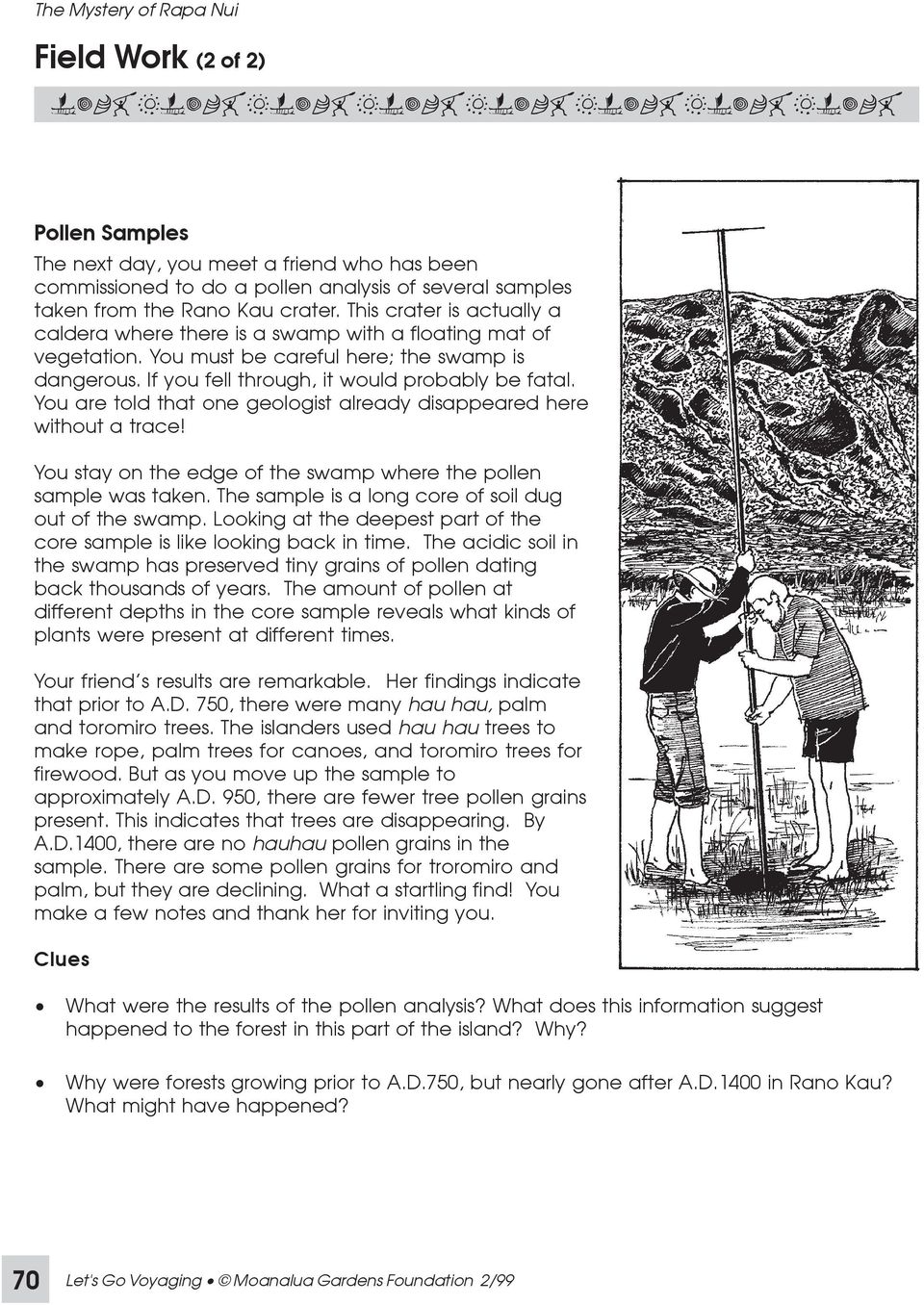
14 Field Work (2 of 2) Pollen Samples The next day, you meet a friend who has been commissioned to do a pollen analysis of several samples taken from the Rano Kau crater. This crater is actually a caldera where there is a swamp with a floating mat of vegetation. You must be careful here; the swamp is dangerous. If you fell through, it would probably be fatal. You are told that one geologist already disappeared here without a trace! You stay on the edge of the swamp where the pollen sample was taken. The sample is a long core of soil dug out of the swamp. Looking at the deepest part of the core sample is like looking back in time. The acidic soil in the swamp has preserved tiny grains of pollen dating back thousands of years. The amount of pollen at different depths in the core sample reveals what kinds of plants were present at different times. Your friend s results are remarkable. Her findings indicate that prior to A.D. 750, there were many hau hau, palm and toromiro trees. The islanders used hau hau trees to make rope, palm trees for canoes, and toromiro trees for firewood. But as you move up the sample to approximately A.D. 950, there are fewer tree pollen grains present. This indicates that trees are disappearing. By A.D.1400, there are no hauhau pollen grains in the sample. There are some pollen grains for troromiro and palm, but they are declining. What a startling find! You make a few notes and thank her for inviting you. Clues What were the results of the pollen analysis? What does this information suggest happened to the forest in this part of the island? Why? Why were forests growing prior to A.D.750, but nearly gone after A.D.1400 in Rano Kau? What might have happened? 70
15 Oral Traditions The Mystery of Rapa Nui Many, many years ago, the people of Rapa Nui transported huge stone statues or moai from one part of the island to another. You believe that there is some connection to the transportation of the moai and the island s resources. It is up to you to determine how the moai were moved and how this related to the depletion of the island's natural resources. On first inspection of your island, you observe a sea of moai. There are about 800 of these huge stone statues. The largest moai is 300 tons and 66 feet high and lies unfinished in the quarry. The largest on an ahu (raised stone platform) is 40 feet high. Most are near the coast staring inland, while others lay abandoned on dirt roads. Some moai are partially carved in the stone quarry that provided the volcanic rock from which they were carved. What heightens your curiosity is the fact that at one time the moai were toppled over and many were broken at the neck. You make a few notes. The next day, you ask permission to meet with island elders. They explain to you that many of them do not recall why or how the moai moved from the quarry to the ahus around the coast. Some say the moai walked. You are skeptical of that explanation since a good number of the moai were found nearly 12 miles away from the quarry! The elders explain that the moai were a very significant part of Rapa Nui culture. The moai represent the ancestors and are believed to possess mana (spiritual power). The larger the moai, the greater the mana the clan would possess. Because of this, tribes engaged in battle, fighting over who possessed the larger and more powerful moai. The elders also mention that white pieces of coral were used to represent the eyes of the moai. But on your initial inspection of the toppled stone statues, there was no evidence of this. The elders also show you some wood carvings called moai kavakava. These carvings show men with beards, hooked noses hollow cheeks and protruding ribs. You make a few notes and graciously thank your hosts for their information. The following day, you speak to an island elder about your research. She tells you that as a child, she learned a legend about a woman (believed to be a witch) who was denied her rightful share of lobster. In anger, the old woman caused those laboring in the quarry to stop all production of moai. The legend intrigues you. You know that the island people exchanged food for labor. The fisher gave to the farmer, and the farmer provided for the craftspeople. Everyone shared resources. You write a few remarks on your notepad. Clues How would you describe the physical appearance of the moai kavakava? Do you think this provides any clue to what was happening to the people of Rapa Nui? Why? What do you think happened to the toppled over moai and to the white coral eyes of the moai? Why did it happen? What do you think was so significant about the eyes? What does the legend about the old woman tell you about the people during this period? How could the people have moved the huge stone statues from the stone quarry to the coast? Could the transportation of the moai have anything to do with the depletion of their forest? How? 71

16 Ships' Logs (1 of 3) After combing through the archives on Rapa Nui, you find the following notes from ships logs and an old letter from a crew person aboard the first foreign ship to visit the island in Some of them are useful clues; some are not. The ship was soon invaded by a group of natives who were so bold that they took the hats and caps of the sailors from their heads and jumped with their plunder overboard. Their craft were put together with manifold small planks and light inner timbers, which they cleverly stitched together with very fine twisted threads...but as they lack the knowledge and particularly the materials for caulking and making tight the great number of seams of the canoes, these are accordingly very leaky, for which reason they are compelled to spend half the time in bailing. The stone images at first caused us to be struck with astonishment because we could not comprehend how it was possible that these people, who are devoid of heavy thick timber for making any machines, as well as strong ropes, nevertheless had been able to erect such images. Dutch Admiral Jacob Roggeveen, 1722 (see crew's letter also, pages 68-73) Natives were small, lean, timid and miserable. No nation need contend for the honour of the discovery of this island; as there can be few places which afford less convenience for shipping than it does. Here is no safe anchorage; no wood for fuel; nor any fresh water worth taking on board. Nature has been exceedingly sparing of her favours to this spot. As everything must be raised by dint of labour, it cannot be supposed the inhabitants plant much more than is sufficient for themselves; and as they are but few in number, they cannot have much to spare to supply the wants of visitant strangers. The workmanship of the ahu (religious platform) is not inferior to the best plain piece of masonry we have in England. They use no sort of cement; yet the joints are exceedingly close, and the stones morticed and tenanted one into another, in a very artful manner. The inhabitants of this island do not seem to exceed six or seven hundred souls, and about two-thirds of those we saw were males. They either have but few females among them, or else many were restrained from making their appearance, during our stay. Capt. James Cook,

17 Ships' Logs (2 of 3) I don t know how I am to make a fire on that island, there is no wood! Bailey, Katherine Routledge s ship s cook (no date) We saw a platform on which were set four red statues, equidistant from one another, their summits covered with white stones. French Admiral Abel Dupetit-Thouars, 1838 Much has been said in ancient times of the convicts in the quarries. They were tortured less than the laborers in the guano quarries. The dust and the smell could suffocate a novice. It is impossible for anyone not used to them to spend an hour at the workings. M.L. Simonin, Le Tour du Monde, 1868 NOTE: During the Peruvian slave trade, islanders were taken against their will to serve as slaves in mines for guano (bird droppings). Guano is a source of fertilizer, rich in nitrogen. Conduct some research to find out how this slave trade devastated the people of Rapa Nui. The natives stop me before one of these thatched dwellings that are to be found everywhere, flattened amidst the rocks and sand, resembling the back of a beast lying down. And they invite me to enter, which I am forced to do on all fours, threading my way in like a cat through a cat flap, because the door, at ground level, and guarded by two sinister-faced divinities of granite, is a round hole, barely two feet high. The bottom of the funnel (at Rano Kao) is occupied by a lake lined by rushes that serves as a watering place for livestock. Green slopes close off the horizon, making this pocket a world apart, enshrined in the island. Pierre Loti, L lle de Paques, 1872 We can catch no glimpse of relations between individuals save the exterior forms and tokens of politeness...when a chief paid a visit to the chief of another tribe he was met along the road by groups of warriors, who formed an escort. On these occasions no doubt the chanters recited long genealogies, as is still done on the Tuamotus. The two chiefs advanced to meet and pressed the wings of their noses together. Alfred Metraux, Easter Island,

18 Ships Logs (3 of 3) The men who could execute such perfect work must have possessed ultra-modern tools...a small group of intelligent beings was stranded on Easter island owing to a technical hitch. The stranded group had a great store of knowledge, very advanced weapons and a method of working stone unknown to us...perhaps to leave the natives a lasting memory of their stay, but perhaps also as a sign to the friends who were looking for them, the strangers extracted a colossal statue from the volcanic stone. Then they made more stone giants which they set up on stone pedestals along the coast so that they were visible from afar...in the remote past there were intelligences with an advanced technology for whom the covering of vast distances in aircraft of the most varied kinds was no problem. Erich Von Daniken, Return to the Stars 1972 Clues Why were the islanders who greeted Dutch Admiral Jacob Roggeveen in 1722 having to bail out their canoes? What do most of the ships' logs tell us about finding foods or other resources on Rapa Nui? What does Cook s description of the islanders tell you was happening to the population? 74

19 05 April 1722 Dearest Mummy, I am writing to assure you of my safety and good health. I know that it was poor of me to up and leave our lovely home in Amsterdam without a moments notice, but I must hasten to profess that I longed for freedom, excitement and adventure. Admiral Jacob Roggeveen has been most gracious and has allowed me to serve as a pantry boy aboard his vessel. We have visited several Pacific Islands on our journey, but none other stands foremost in my mind but Easter Island appropriately named by the admiral himself. It was on that Easter Sunday that we set anchor in Hanga o Honu Bay. A group of natives greeted us in canoes made from many planks of wood. These canoes were put together with small planks and light inner timbers, which they cleverly stitched together with very fine twisted threads. Their canoes were leaky so they were compelled to spend half their time bailing. The admiral ordered a small shore party with peaceful 75

20 intentions to light ashore and seek food supplies. The natives were most cordial and accommodated us most willingly. Yet, as we roamed the island in search of foodstuffs we were alarmed by what we perceived as a people near starvation. All that remained in the timberland were stumps of dry, rotting wood. A fair amount of natives were transporting a felled tree by means of fine woven thread. It was most awkward for them as the thread would part as they would tug on the line. The small bushes scattered about carried the pungent scent of rodent, which we saw scampering from twig to twig devouring plant seeds. It was evident that what little rain the heavens produced ran off the hard ground into the sea. There was no shelter from the treetops to shield the sun and wind, hence the rain ran off the parched land. As we ventured from the timberland, we came upon a series logs that stretched to the horizon. We maneuvered through the maze of timber and came upon a volcanic mountain, which the natives referred to as Rano Raraku. Rano is their name for 76

21 mountain. To our amazement, we discovered a tribe of natives chiseling enormous monuments from the volcanic tuft with primitive adzes. Some of these men lay chiseling in crevices no larger than a coffin. Another large group of men attempted to hoist one of the stone structures skyward. We watched in awe at this most incredible feat. As we descended from the mountain, we noticed with surprise a sea of giant sculptures. Hundreds of statues lay scattered at the foot of the volcano. Some lay abandoned and others remained imprisoned in the volcano s quarries. As we neared a monumental structure, we noticed the incredible workmanship of the statues. It was the best plain piece of masonry we had ever seen. No sort of cement was used. Most of the eye sockets were empty, but a few carried white coral representing each eye. We learned that it was believed the eyes and the head of the statue carried some form of mana (power). A community of natives, it appeared, had gathered for some sort of ceremony. On our search for food, we came upon a stone construction in what appeared to be a chicken dwelling. It was circular in 77
22 shape and made of small stones piled high and carefully fitted. Inside the structure were a series of chambers which served as resting houses for the chickens. It was common to see the chicken dwellings scattered about the island. The dwellings prevented thievery and those owning the feathered birds were perceived as wealthy. Since the master of the chicken dwelling was no where in sight, we warmed our hands on a nearby cooking fire and quickly departed circling back around the island still in search of food. As we made our return to our ship, we noticed few thatched huts. It appeared that most of the natives resided in cave dwellings. In fact, they had built an elaborate garden system in which they grew sweet potatoes, yams, arrowroot, taro and palm lilies. Alas, the garden we came upon had been depleted and lay dry and fallow. The men and I moved on in further search of food. When we reached the cove of Hanga o Honu, we noticed an abandoned log partially hollowed. It seemed as if the natives had attempted to create a seaworthy canoe, but never finished the task. Upon reflection, it appeared to be the only 78
23 log on the island from which a seaworthy canoe could be crafted. I remember the natives whom greeted our ship in leaky canoes. Wading out into the sea, we witnessed several women near shore attempting to harpoon something between the rocks. But upon closer investigation, it appeared that all they had captured were a crab and two sea urchins. We made our own search of shellfish and found none. It was as desolate a place that I had seen in a year's journey with the admiral. We returned to our ship to report to the admiral about the meager provisions on the island. But the starkness of the land and the haunting beauty of the stone statues remained forever etched in my mind. Although we were unable to find nourishment for ourselves, it was with great regret that I departed this mysterious island. How were the people to survive with so little foodstuffs? Of what value were the great stone statues? How were they transported and erected? What had befallen the timberland? Why had the sea been depleted of its shellfish? These questions continued to haunt me even after we had been at sea for several weeks. I yearn, dearest mummy, to one day return to this most 79
24 intriguing place. But for now I will continue on Admiral Roggeveen s course in search of other uncharted lands. Please pray for my safe return. I will forever hold you in my nightly prayers. Godspeed. Your loving son, Stefan Note: This letter is fictional, but the information it contains is based on fact. 80
B1 certification. March 2016. Reading and Writing
 B1 certification March 2016 B1 certification March 2016 Reading and Writing You have 1 hour and 30 minutes to complete both parts. Please keep your eyes on your exam only. Copying or cheating will result
PUSD High Frequency Word List
 PUSD High Frequency Word List For Reading and Spelling Grades K-5 High Frequency or instant words are important because: 1. You can t read a sentence or a paragraph without knowing at least the most common.
Easter Island Population Model
 Easter Island Population Model Consider a problem that happened on Easter Island. Easter Island is a small island (about 150 square miles) in the Pacific Ocean about 2,000 miles from South America. It
Easter Island named Rapa Nui by Tahitian sailors. A remote island of only 64 square miles. Best known for its large, stone statues called moai.
 EASTER ISLAND Part 1: The rise of a great civilization Easter Island named Rapa Nui by Tahitian sailors. A remote island of only 64 square miles. Best known for its large, stone statues called moai. How
Fry Phrases Set 1. TeacherHelpForParents.com help for all areas of your child s education
 Set 1 The people Write it down By the water Who will make it? You and I What will they do? He called me. We had their dog. What did they say? When would you go? No way A number of people One or two How
Adapted from Stone Girl Bone Girl by Laurence Anholt, Francis Lincoln Children s Book
 1. Mary Anning Adapted from Stone Girl Bone Girl by Laurence Anholt, Francis Lincoln Children s Book This is the true story of Mary Anning, who lived 200 years ago. Mary was born in 1799 and was one of
The Ten Best Ways. The basket for The Ten Best Ways is on one of the Old Testament shelves.
 The Ten Best Ways Background Focus: the Ten Commandments (Exodus 20:1-17, Deuteronomy 5:1-21) God was present to Moses at Sinai three times. First, God was present in the burning bush when God revealed
THE LOST PEOPLE OF MESA VERDE by Elsa Marston. The Anasazi lived peacefully on the mesa for 800 years. Then they disappeared.
 THE LOST PEOPLE OF MESA VERDE by Elsa Marston The Anasazi lived peacefully on the mesa for 800 years. Then they disappeared. In the dry land of southwestern Colorado a beautiful plateau rises. It has so
Chapter 1 Key Themes in Environmental Science
 Key Themes in Environmental Science Case Study: Shrimp, Mangroves, and Pickup Trucks This case study highlights the plight of a small farmer in Thailand in the shrimp farming business. He makes his living
God, the Great Creator
 Pre-Session Warm Up God, the Great Creator (Genesis 1: 2:3) Today we re going to start a new series of lessons all about God s attributes. An attribute is a character trait or quality about someone. For
The Fox and the Crow
 A narrative is a framework that tells a story. It has a plot, with a complication and resolution. Examples of this type of writing include fairytales, novels, myths, legends, fables, fantasy and poems.
Jesus Parables in Chronological Order. Three Kingdom of Heaven Parables (#13-#15) Parable #13 Mark 4:26-29 The Growing Seed
 Jesus Parables in Chronological Order Three Kingdom of Heaven Parables (#13-#15) Parable #13 Mark 4:26-29 The Growing Seed 26 He also said, This is what the kingdom of God is like. A man scatters seed
Rainforest Concern Module 2 Why do we need rainforests?
 Rainforest Concern Module 2 Why do we need rainforests? Rainforest Concern Module 2: Why do we need Rainforest? Before we go any further, there are some words you may not understand, and these words and
LESSON TITLE: Jesus is the Way, the Truth, and the Life
 Devotion NT271 CHILDREN S DEVOTIONS FOR THE WEEK OF: LESSON TITLE: Jesus is the Way, the Truth, and the Life THEME: We can always trust Jesus. SCRIPTURE: John 14:1-6 Dear Parents Welcome to Bible Time
GOD S BIG STORY Week 1: Creation God Saw That It Was Good 1. LEADER PREPARATION
 This includes: 1. Leader Preparation 2. Lesson Guide GOD S BIG STORY Week 1: Creation God Saw That It Was Good 1. LEADER PREPARATION LESSON OVERVIEW Exploring the first two chapters of Genesis provides
Rocks and Minerals What is right under your feet?
 Rocks and Minerals What is right under your feet? Name: 1 Before you start What do you already know? What is the difference between a rock and a mineral? What are the three categories of rocks? 1. 2. 3.
Answer Keys to Unit Tests
 Reading Geography Series Answer Keys to Unit Tests Unit 1 The Five Themes of Geography Unit 2 Patterns in Physical Geography Unit 3 Natural Resources 7 Portage & Main Press Unit Test for The Five Themes
Rapid Changes in Earth s Surface
 TEKS investigate rapid changes in Earth s surface such as volcanic eruptions, earthquakes, and landslides Rapid Changes in Earth s Surface Constant Changes Earth s surface is constantly changing. Wind,
LESSON TITLE: The House Built on the Rock
 Devotion NT227 CHILDREN S DEVOTIONS FOR THE WEEK OF: LESSON TITLE: The House Built on the Rock THEME: We must hear and do the Word of God. SCRIPTURE: Matthew 7:24-29 Dear Parents Welcome to Bible Time
Ghana: A West African Trading Empire
 Ghana: A West African Trading Empire The kingdom of Ghana lasted from 500 C.E. to the 11 th century C.E. The kingdom arose from the Sahel of Africa and spread to the valley between the Senegal and Niger
Devotion NT267 CHILDREN S DEVOTIONS FOR THE WEEK OF: LESSON TITLE: The Second Coming. THEME: Jesus is coming again. SCRIPTURE: Matthew 24:27-31
 Devotion NT267 CHILDREN S DEVOTIONS FOR THE WEEK OF: LESSON TITLE: The Second Coming THEME: Jesus is coming again. SCRIPTURE: Matthew 24:27-31 Dear Parents Welcome to Bible Time for Kids. Bible Time for
Today, we re going to tackle your GUM U7, L2 & L3 Cause and Effect Essay! Chat me your best sentence using the word conscientious.
 Good Morning Conscientious 7 th Graders! Today, we re going to tackle your GUM U7, L2 & L3 Cause and Effect Essay! Chat me your best sentence using the word conscientious. Rainforest Destruction: Causes
Greetings, Blessings, Scott DeWitt Director of Spiritual Outreach Casas por Cristo
 Team Devotional Greetings, Welcome to Casas por Cristo! If you are reading this, then more than likely you are embarking on a week-long adventure serving our Lord and Savior along the U.S. / México border
Level E Placement Worksheet & Student Passage. Level 1 Placement Worksheet & Student Passage. Level 2 Placement Worksheet & Student Passage
 Placement Guide This guide will help you choose the right One Minute Reader level for your child. The ideal level is neither too easy nor too difficult. It should challenge the student without being frustrating.
Ranger Report About Deforestation of the Rainforest
 Ranger Report About Deforestation of the Rainforest About deforestation Forests are cut down for many reasons, but most of them are related to money or to people s need to provide for their families. The
LESSON TITLE: Our Chief Cornerstone. THEME: Jesus is our cornerstone! SCRIPTURE: Ephesians 2:19-22 CHILDREN S DEVOTIONS FOR THE WEEK OF: Dear Parents
 Devotion NT328 CHILDREN S DEVOTIONS FOR THE WEEK OF: LESSON TITLE: Our Chief Cornerstone THEME: Jesus is our cornerstone! SCRIPTURE: Ephesians 2:19-22 Dear Parents Welcome to Bible Time for Kids! This
Lesson Overview. Biodiversity. Lesson Overview. 6.3 Biodiversity
 Lesson Overview 6.3 6.3 Objectives Define biodiversity and explain its value. Identify current threats to biodiversity. Describe how biodiversity can be preserved. THINK ABOUT IT From multicolored coral
Tha h nk n sg s iving g Praye y r
 Thanksgiving Prayer The People Today we have gathered and we see that the cycles of life continue. We have been given the duty to live in balance and harmony with each other and all living things. So now,
NATURAL REGIONS OF KENTUCKY
 NATURAL WONDERS As you travel around Kentucky taking pictures, you are excited by what you see. Kentucky offers diverse and amazing sights. The Six Regions In the West, you see the Mississippi River, the
These pages build on Units 2B & C and introduce predator-prey relationships and food chains.
 Unit 4B Habitats Teaching Notes These pages build on Units 2B & C and introduce predator-prey relationships and food chains. Curriculum, resource and other links Sc1 & Sc2 Resources Associated with this
You re One in Seven Billion!
 You re One in Seven Billion! We ve all heard the expression, You re one in a million!. With the ever-growing number of people on the planet, it might be more accurate to say, You re one in seven billion!
Year 2 History: Ancient Egypt Resource Pack
 Year 2 History: Ancient Egypt Resource Pack This pack includes the following lessons: Locating Egypt The River Nile Archeology Hieroglyphics Pharaohs Every effort has been made to seek permission for the
Colonization and Revolutionary War Roanoke--The Lost Colony
 Non-fiction: Colonization and Revolutionary War Roanoke: The Lost Colony Colonization and Revolutionary War Roanoke--The Lost Colony During the 1580 s, the English made several attempts to establish a
THEME: Jesus sent the Holy Spirit to indwell and empower us.
 Devotion NT285 CHILDREN S DEVOTIONS FOR THE WEEK OF: LESSON TITLE: The Day of Pentecost THEME: Jesus sent the Holy Spirit to indwell and empower us. Dear Parents SCRIPTURE: Acts 2:1-41 Dear Parents, Welcome
RENEWABLE OR NOT? ADVANCE PREPARATION MATERIALS
 AT A GLANCE RENEWABLE OR NOT? Students learn the difference between renewable and non-renewable resources and discover why sustainable use of natural resources is important. OBJECTIVES Students will: Identify
LESSON TITLE: Jesus Visits Mary and Martha THEME: Jesus wants us to spend time with \ Him. SCRIPTURE: Luke 10:38-42
 Devotion NT249 CHILDREN S DEVOTIONS FOR THE WEEK OF: LESSON TITLE: Jesus Visits Mary and Martha THEME: Jesus wants us to spend time with \ Him. SCRIPTURE: Luke 10:38-42 Dear Parents Welcome to Bible Time
Sustainable Landscape Practices
 Reviewed by Jamie Csizmadia Summary Students will explore the benefits of utilizing sustainable landscape practices focusing on the use of native plants. After defining sustainable landscape practices
MAPPING THE PREHISTORIC STATUE ROADS ON RAPA NUI USING REMOTE SENSING SATELLITE IMAGERY
 MAPPING THE PREHISTORIC STATUE ROADS ON RAPA NUI USING REMOTE SENSING SATELLITE IMAGERY Gabe Wofford Global Environmental Science University of Hawai i at Manoa ABSTRACT In an extension of the work of
Creation. Then God spoke and Creation came into being. God formed everything: Creation Week God called all that He had created good.
 Creation Teacher Pep Talk: Imagine darkness and emptiness and nothing else except God. God in His own time decides that He is going to create something wonderful: something which will eventually cost Him
The concepts developed in this standard include the following: Oceans cover about 70% of the surface of the Earth.
 Name Date Grade 5 SOL 5.6 Review Oceans Made by SOLpass - www.solpass.org [email protected] Reproduction is permitted for SOLpass subscribers only. The concepts developed in this standard include
Unit 4 - Shelter. Plants
 Unit 4 - Shelter Shelter is one of the elements of survival, along with food and water. Shelter offers people safety and security. Often a person s shelter is a reflection of their personal habitat. Outside
California Treasures High-Frequency Words Scope and Sequence K-3
 California Treasures High-Frequency Words Scope and Sequence K-3 Words were selected using the following established frequency lists: (1) Dolch 220 (2) Fry 100 (3) American Heritage Top 150 Words in English
Lesson 1. Objectives: ocus: Subjects:
 Lesson 1 The Web of Life Objectives: 1. Understand the concept of an ecosystem. 2. Understand the interdependence of members of an ecosystem. Subjects: 1. Ecology 2. Language 3. Art MATERIALS: Copies of
THEME: God desires for us to demonstrate His love!
 Devotion NT320 CHILDREN S DEVOTIONS FOR THE WEEK OF: LESSON TITLE: The Gift of Love THEME: God desires for us to demonstrate His love! SCRIPTURE: 1 Corinthians 13:1-13 Dear Parents Welcome to Bible Time
C-14: God Created the World and People Spoiled It
 Title: GOD CREATED THE WORLD AND PEOPLE SPOILED IT Theme / Bible Basis: Review of Genesis 1-11 Bible Reading: Psalm 148, NLT Introduction: In our recent messages, we have read together from several stories
Love thy neighbour. every
 Love thy neighbour every Presentation notes These notes will help you share the stories of Morsheda and Feroza with your congregations, groups or classes this Christian Aid Week. Please adapt the script
Task 3 Reading into Writing: Endangered Animals
 At a glance Level: ISE II Task 3 Reading into Writing: Endangered Animals Focus: Task 3 Reading into writing Aims: To read information about endangered animals, to answer questions about the information
The Empty Tomb. (Easter Sunday)
 The Empty Tomb! (Easter Sunday) Teacher Pep Talk: Congratulations! You get to teach children the greatest Bible story of all: The Resurrection of Jesus Christ! EASTER!! There is no greater story of God
Volcanoes and More: A Visit to Two National Parks in Hawaii
 VOA Special English is a daily news and information service for English learners. Read the story and then do the activities at the end. MP3s of stories can be found at voaspecialenglish.com Volcanoes and
Devotion NT347 CHILDREN S DEVOTIONS FOR THE WEEK OF: LESSON TITLE: The Hall of Faith. THEME: God wants us to trust Him. SCRIPTURE: Hebrews 11:1-40
 Devotion NT347 CHILDREN S DEVOTIONS FOR THE WEEK OF: LESSON TITLE: The Hall of Faith THEME: God wants us to trust Him. SCRIPTURE: Hebrews 11:1-40 Dear Parents Welcome to Bible Time for Kids! This is a
The retreat of glaciers and the original people of the Great Lakes
 Subject/target grade: Grade 9-12 Local History, Ecology, or Earth/Environmental Science classes Duration: Four 50-minute class periods; one optional half-day field activity Setting: Classroom Materials
Soul-Winning Commitment Day. Sunday School/ Small Group Lessons. Soul-Winning. Commitment Day
 Sunday School/ Small Group Lessons Soul-Winning Commitment Day Purpose of Lesson: This guide is for the purpose of preparing older children through adult Sunday school members to understand the importance
Mini Dinosaurs. Grades K 1 2. Compiled by
 Mini Dinosaurs Grades K 1 2 Compiled by Leanne M. Burrow, Extension educator, 4 H/ Youth development, Purdue University Cooperative Extension Service Henry County Resources and References Exploring 4 H,
Easter Island: Guide For Inquisitive Minds
 Easter Island: Guide For Inquisitive Minds Copyright Brien Foerster 2013 Cover by Hans Messershmidt Disclaimer: All of the content of this book was gleaned from information by other authors, internet sources
LILLIAN PITAWANAKWAT LESSON PLAN 2006 All Rights Reserved 4D Interactive Inc. 416-530-2752 1
 Elder Lillian Pitawanakwat Nation Ojibwe/Potawotami Lesson Plan Grade Level Junior (Grades 1-6) Time Required 3 4 hours Subject Strand Links Geography Natural Science Astronomy Traditional Teachings The
THEME: Jesus knows all about us and He loves us.
 Devotion NT224 CHILDREN S DEVOTIONS FOR THE WEEK OF: LESSON TITLE: The Woman at the Well THEME: Jesus knows all about us and He loves us. SCRIPTURE: John 4:1-42 Dear Parents Welcome to Bible Time for Kids!
Teacher s Guide For. Ancient History: Ancient Pueblo People: The Anasazi
 Teacher s Guide For Ancient History: Ancient Pueblo People: The Anasazi For grade 7 - College Programs produced by Centre Communications, Inc. for Ambrose Video Publishing, Inc. Executive Producer William
ENDANGERED AND THREATENED
 ENDANGERED AND THREATENED Understand how species in the Sonoran Desert Region may become endangered or threatened and what is being done to protect them. ARIZONA SCIENCE STANDARDS SC03-S4C3-03&04, SC08-S1C3-07,
1 rethinking the Ten Commandments: Why Ten Commandments? The Backstory September 4, 2011 Rev. George S Reynolds
 1 We all have rules. Some we keep, some we don t. Some we expect others to keep, even if we don t. After all isn t a person s ability to keep the rules we create what we base our relationships on? You
NATIONAL CURRICULUM LINKS
 Special Places Key Stage 1 < < Special Places SUMMARY OF ACTIVITY Based around a Native American theme whereby pupils spend time in the outdoors on their own, but with each pupil supported by their own
Main Point: God gives each of us gifts and abilities. We should use them to glorify Him.
 The Ten Talents Matthew 18:21-35 PPT Title The Ten Talents Main Point: God gives each of us gifts and abilities. We should use them to glorify Him. Key Verse: God s gifts of grace come in many forms. Each
Section #7: NOAH: A MAN OF FAITH
 21 Discussion Guide Section #7: NOAH: A MAN OF FAITH 1. How did Noah show his faith in God? 2. How specific were the instructions God gave? 3. Describe the size of the ark. Read to the Group: Since the
Prepare ahead of time for kindergarten 1st grade Small Groups this session:
 1 Small Group, K-1 Bible Story: Paul s Conversion Acts 1-3; 9:1-9 Bottom Line: If you want to know who God is, find out more about Jesus. Memory Verse: When you walk, nothing will slow you down. When you
Our Lady Invites Us To Wake Up From Our Spiritual Coma - Medjugorje.com
 Medjugorje visionary, Ivan, speaking to several thousand pilgrims today, August 18, 2010. Ivan was given special instructions from Our Lady concerning the youth and family. Being married to an American
THEME: We need to completely trust in Jesus.
 Devotion NT238 CHILDREN S DEVOTIONS FOR THE WEEK OF: LESSON TITLE: Jesus Walks on Water THEME: We need to completely trust in Jesus. SCRIPTURE: Mark 6:45-52 Dear Parents Welcome to Bible Time for Kids!
Exploring Our World with GIS Lesson Plans Engage
 Exploring Our World with GIS Lesson Plans Engage Title: Exploring Our Nation 20 minutes *Have students complete group work prior to going to the computer lab. 2.List of themes 3. Computer lab 4. Student
Sunflowers. Name. Level and grade. PrimaryTools.co.uk
 Sunflowers Name Score Level and grade 2012 Contents Billy s Sunflower... 3 A story by Nicola Moon So Many Sunflowers!... 14 Vincent Van Gogh... 15 Information about the artist Making a Paper Sunflower...
God is Eternal Lesson 1
 Preschool Curriculum (4K / 5K) August 15 th & 16 th, 2009 God is Eternal Lesson 1 Divine Attribute: Heart Response: God is Eternal Be Amazed Memory Verse: Jesus Christ is the same yesterday, today and
How to make a Solitary Bee Box
 How to make a Solitary Bee Box **Note: The following instructions include the use of tools that may be dangerous. Ensure there is adult supervision with children. Time: 1 hour People: 1-2+ Materials: Wood
The Start of my Arctic Adventure
 The Start of my Arctic Adventure I have been asked if I would like to go to the Arctic. I am very excited. All I know about the Arctic is that it has lots of ice and is very cold. Here are some of the
Human Impacts on the World Ocean
 This website would like to remind you: Your browser (Safari 7) is out of date. Update your browser for more security, comfort and the best experience on this site. lesson Human Impacts on the World Ocean
Wild About... Frogs and Frogspawn
 a Wild About... Rutland County Council Nature notes Frogs belong to a group of animals called amphibians, which also includes newts and toads. Amphibians live both on land and in water. Water is needed
The Fruit of the Spirit is Love
 The Fruit of the Spirit is Love Pre-Session Warm Up (Galatians 5:22-23) Today we are going to learn more about the fruit of the Spirit called, Love. What do you think of when you hear the word love? A
What are you. worried about? Looking Deeper
 What are you worried about? Looking Deeper Looking Deeper What are you worried about? Some of us lie awake at night worrying about family members, health, finances or a thousand other things. Worry can
Old Testament. Part One. Created for use with young, unchurched learners Adaptable for all ages including adults
 Old Testament Part One Created for use with young, unchurched learners Adaptable for all ages including adults Mission Arlington Mission Metroplex Curriculum Lesson 9 Page 1 M ISSION ARLINGTON MISSION
Jamestown Settlement Family Gallery Guide From Africa to Virginia
 Jamestown Settlement Family Gallery Guide From Africa to Virginia Not long after the English settled Jamestown in 1607, the first Africans were brought to Virginia. They arrived in 1619 from the Kongo/Angola
Sermon Promise in Unexpected Places Genesis 39:1-23, September 21, 2014
 1 How many of you have your Be a Blessing stones with you from last week? For those of you who weren t here, these stones are to remind us of the promise that God made to Abraham when he was called to
Phonics. High Frequency Words P.008. Objective The student will read high frequency words.
 P.008 Jumping Words Objective The student will read high frequency words. Materials High frequency words (P.HFW.005 - P.HFW.064) Choose target words. Checkerboard and checkers (Activity Master P.008.AM1a
That spring, the sun shone every day. I was lonely at first in
 1 Tom and Daisy That spring, the sun shone every day. I was lonely at first in the East. But I felt that this was the real beginning of my life. I walked in the fresh air. I bought books. I worked hard.
Field Report: Caere Project 2015
 Bryn Critz Schockmel Boston University History of Art and Architecture Field Report: Caere Project 2015 This summer I had the pleasure of participating in the Caere Project, led by Professor Fabio Colivicchi
The Earth, Sun, and Moon
 reflect The Sun and Moon are Earth s constant companions. We bask in the Sun s heat and light. It provides Earth s energy, and life could not exist without it. We rely on the Moon to light dark nights.
Guided Reading Level Ī - -
 A Friend to the Pilgrims Guided Reading Level Ī - - No part of this publication may be reproduced in whole or in part, or stored in a retrieval system, or transmitted in any form or by any means, electronic,
Ancient India Lesson 2
 Name: Date: Ancient India Lesson 2 Early Indian Civilization Over 1,000 miles separate the Indus River valley from Iraq, the region once known as Mesopotamia. This distance did not keep people from traveling
Meet the Nonfiction Main Idea Challenge
 Meet the Nonfiction Main Idea Challenge What s the challenge? Students often give the topic or a fact as the main idea when they have read nonfiction. What students need to do to meet the MAIN IDEA requirement
Fry s Sight Word Phrases
 The people Write it down By the water Who will make it? You and I What will they do? He called me. We had their dog. What did they say? When would you go? No way A number of people One or two How long
Unit: Plants & Animals (Grade 2)
 Unit: Plants & Animals (Grade 2) Content Area: Science Course(s): Science Time Period: 8 weeks Length: Weeks Status: Published Unit Overview Students will determine the life cycles of plants and animals
Prepositions. off. down. beneath. around. above. during
 Prepositions In the above sentences, the words in bold print are prepositions; arrows indicate the words each preposition connects. The noun or pronoun that comes after each preposition is called the object
Unit 2 Lesson 4 Early Human Migration and Stone Age Tools
 Unit 2 Lesson 4 Early Human Migration and Stone Age Tools Daily Warm-up True/False Read the False statements below. Replace each underlined word with one from the word bank that makes each sentence True.
1 Branches of Earth Science
 CHAPTER 1 1 Branches of Earth Science SECTION The World of Earth Science BEFORE YOU READ After you read this section, you should be able to answer these questions: What are the four major branches of Earth
Effects of Water Classroom Activity
 Effects of Water Classroom Activity The Classroom Activity introduces students to the context of a performance task, so they are not disadvantaged in demonstrating the skills the task intends to assess.
THEME: We should take every opportunity to tell others about Jesus.
 Devotion NT307 CHILDREN S DEVOTIONS FOR THE WEEK OF: LESSON TITLE: Paul Goes Before Agrippa THEME: We should take every opportunity to tell others about Jesus. SCRIPTURE: Acts 25:13 26:32 Dear Parents
The Early Church Peter Preaches After Denying
 The Early Church Peter Preaches After Denying Lesson 1 LESSON OVERVIEW Key Point: Jesus makes a difference in people s lives. Repeat this phrase throughout the lesson. Bible Story: Mark 14:66-72 Challenge
Devotion NT273 CHILDREN S DEVOTIONS FOR THE WEEK OF: LESSON TITLE: The Garden of Gethsemane. THEME: We always need to pray! SCRIPTURE: Luke 22:39-53
 Devotion NT273 CHILDREN S DEVOTIONS FOR THE WEEK OF: LESSON TITLE: The Garden of Gethsemane THEME: We always need to pray! SCRIPTURE: Luke 22:39-53 Dear Parents Welcome to Bible Time for Kids. Bible Time
Florida Pioneer Homes By Lance Corlew & Ron Miller
 Florida Pioneer Homes By Lance Corlew & Ron Miller Summary Florida pioneer homes were simple, with few luxuries. Life was very difficult in the 1800s compared to today. In this lesson, students will have
The rock cycle. Introduction. What are rocks?
 The rock cycle This Revision looks at the three types of rock: sedimentary, igneous and metamorphic. It looks at how they are formed, the weathering of rocks and the way one form of rock turns into another,
Unit 4 Lesson 8 The Qin and Han Dynasties
 Unit 4 Lesson 8 The Qin and Han Dynasties Directions Read the False statements below. Replace each underlined word with one from the word bank that makes each sentence True. Word Bank Ying Zheng army copper
Isaac and Rebekah. (Genesis 24; 25:19-34; 27:1-40) Spark Resources: Spark Story Bibles. Supplies: None. Spark Resources: Spark Bibles
 BIBLE SKILLS & GAMES LEADER GUIDE Isaac and Rebekah (Genesis 24; 25:19-34; 27:1-40) Age-Level Overview Age-Level Overview Open the Bible Activate Faith Lower Elementary Workshop Focus: God s promises come
PRODUCTION. 1The Surplus
 1The Surplus 2 The US economy produces an amazing number of different products: thousands of different foods, countless movies, dozens of different type cars, hundreds of entertainment products, dozens