
GCSE. Specification. Geography B For exams and certification June 2014 onwards
|
|
|
- Blaise Neal
- 9 years ago
- Views:
Transcription
1 GCSE Specification Geography B For exams and certification June 2014 onwards

2 GCSE Specification Geography B (Linear) 9035

3 This specification will be published annually on our website ( We will notify centres in writing of any changes to this specification. We will also publish changes on our website. The version of the specification on our website will always be the most up to date version, although it may be different from printed versions. Vertical black lines indicate a significant change or addition to the previous version of this specification. You can get further copies of this specification from: AQA Logistics Centre (Manchester) Unit 2, Wheel Forge Way Ashburton Park Trafford Park Manchester M17 1EH or you can download it from our website ( Copyright 2012 AQA and its licensors. All rights reserved. COPYRIGHT AQA retains the copyright on all its publications, including the specifications. However, registered centres for AQA are permitted to copy material from this specification booklet for their own internal use. The Assessment and Qualifications Alliance (AQA) is a company limited by guarantee registered in England and Wales (company number ) and a registered charity (number ). Registered address AQA, Devas Street, Manchester M15 6EX.
4 Contents GCSE Geography B (Linear) for Teaching from September 2012 (version 1.0) 1 Introduction Why choose AQA? Why choose Geography B? How do I start using this specification? How can I find out more? 4 2 Specification at a Glance Summary of assessment 6 3 Subject Content Unit 1: Managing places in the 21st century Unit 2: Hostile world and Investigating the shrinking world Unit 3: Local investigation including fieldwork and Geographical issue investigation Geographical Skills Checklist 29 4 Scheme of Assessment Aims and learning outcomes Assessment Objectives National criteria Prior learning Access to assessment: diversity and inclusion 32 5 Administration Availability of assessment units and certification Entries Private candidates Access arrangements and special consideration Language of examinations Qualification title Awarding grades and reporting results Examination Series 36 1
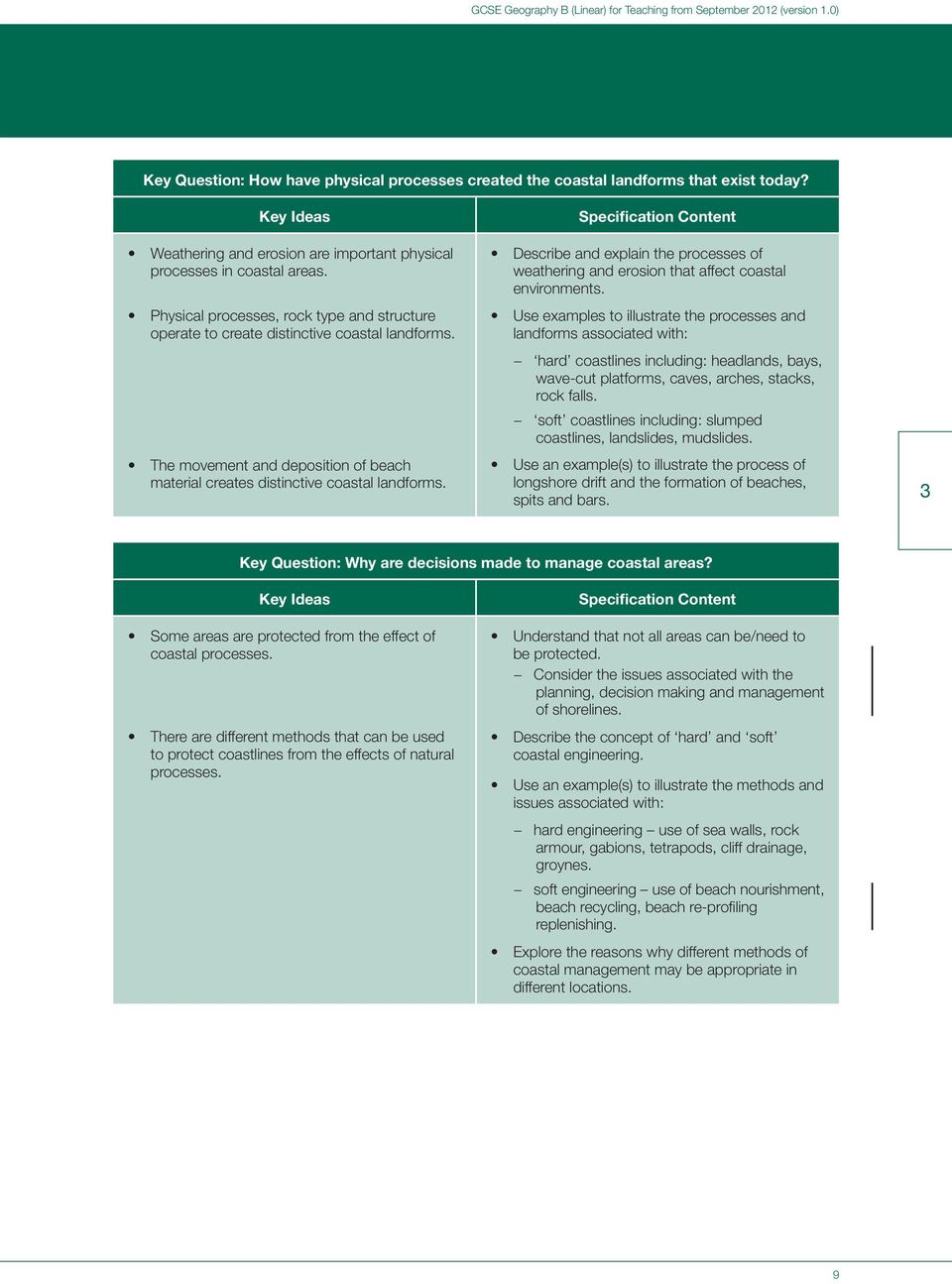
5 6 Controlled Assessment Administration Authentication of controlled assessment work Malpractice Teacher standardisation Internal standardisation of marking Annotation of controlled assessment work Submitting marks and sample work for moderation Factors affecting individual candidates Retaining evidence 39 7 Moderation Moderation procedures Consortium arrangements Post-moderation procedures 40 Appendices 41 A Grade Descriptions 41 B Spiritual, Moral, Ethical, Social, Legislative, Sustainable 42 Development, Economic and Cultural Issues, and Health and Safety Considerations C Overlaps with other Qualifications 43 D Wider Key Skills 44 2

6 1 Introduction GCSE Geography B (Linear) for Teaching from September 2012 (version 1.0) 1.1 Why choose AQA? AQA is the UK s favourite exam board and more students receive their academic qualifications from AQA than from any other board. But why is AQA so popular? AQA understands the different requirements of each subject by working in partnership with teachers. Our GCSEs: enable students to realise their full potential contain engaging content are manageable for schools and colleges are accessible to students of all levels of ability lead to accurate results, delivered on time are affordable and value for money. AQA provides a comprehensive range of support services for teachers: access to subject departments training for teachers including practical teaching strategies and approaches that really work presented by senior examiners personalised support for Controlled Assessment 24-hour support through our website and online Ask AQA past question papers and mark schemes comprehensive printed and electronic resources for teachers and students AQA is an educational charity focused on the needs of the learner. All our income goes towards operating and improving the quality of our specifications, examinations and support services. We don t aim to profit from education we want you to. If you are an existing customer then we thank you for your support. If you are thinking of moving to AQA then we look forward to welcoming you Why choose Geography B? AQA specifications in Geography: allow the opportunity to develop: communication skills graphical and cartographical skills technological skills, including ICT and GIS interpersonal skills through debate and discussion literacy and numeracy problem solving skills entrepreneurial skills and awareness of career possibilities. allow the opportunity for personalised and independent learning provide candidates, for whom GCSE will be the end of their formal study of geography, a clear overall view of the world in the first part of the 21st century provide a sound foundation for those candidates who intend to continue to study the subject to a higher level allow the development of awe and wonder which will allow candidates to fully appreciate and learn from the world around them. Progression This qualification is a recognised part of the National Qualifications framework. As such GCSE provides progression from Key Stage 3 to post-16 studies. It lays an appropriate foundation for further study of geography or related subjects. In addition, it provides a worthwhile course for candidates of various ages and from diverse backgrounds in terms of general education and lifelong learning. 3

7 1.3 How do I start using this specification? 1 Already using an existing AQA Geography specification? Register to receive further information, such as mark schemes, past question papers, details of teacher support meetings, etc, at Information will be available electronically or in print, for your convenience. Tell us that you intend to enter candidates. Then we can make sure that you receive all the material you need for the examinations. This is particularly important where examination material is issued before the final entry deadline. You can let us know by completing the appropriate Intention to Enter and Estimated Entry forms. We will send copies to your Exams Officer and they are also available on our website ( Not using the AQA specification currently? Almost all centres in England and Wales use AQA or have used AQA in the past and are approved AQA centres. A small minority are not. If your centre is new to AQA, please contact our centre approval team at [email protected] 1.4 How can I find out more? Ask AQA You have 24-hour access to useful information and answers to the most commonly-asked questions at If the answer to your question is not available, you can submit a query for our team. Our target response time is one day. Teacher Support Details of the full range of current Teacher Support and CPD courses are available on our web site at There is also a link to our fast and convenient online booking system for all of our courses at 4
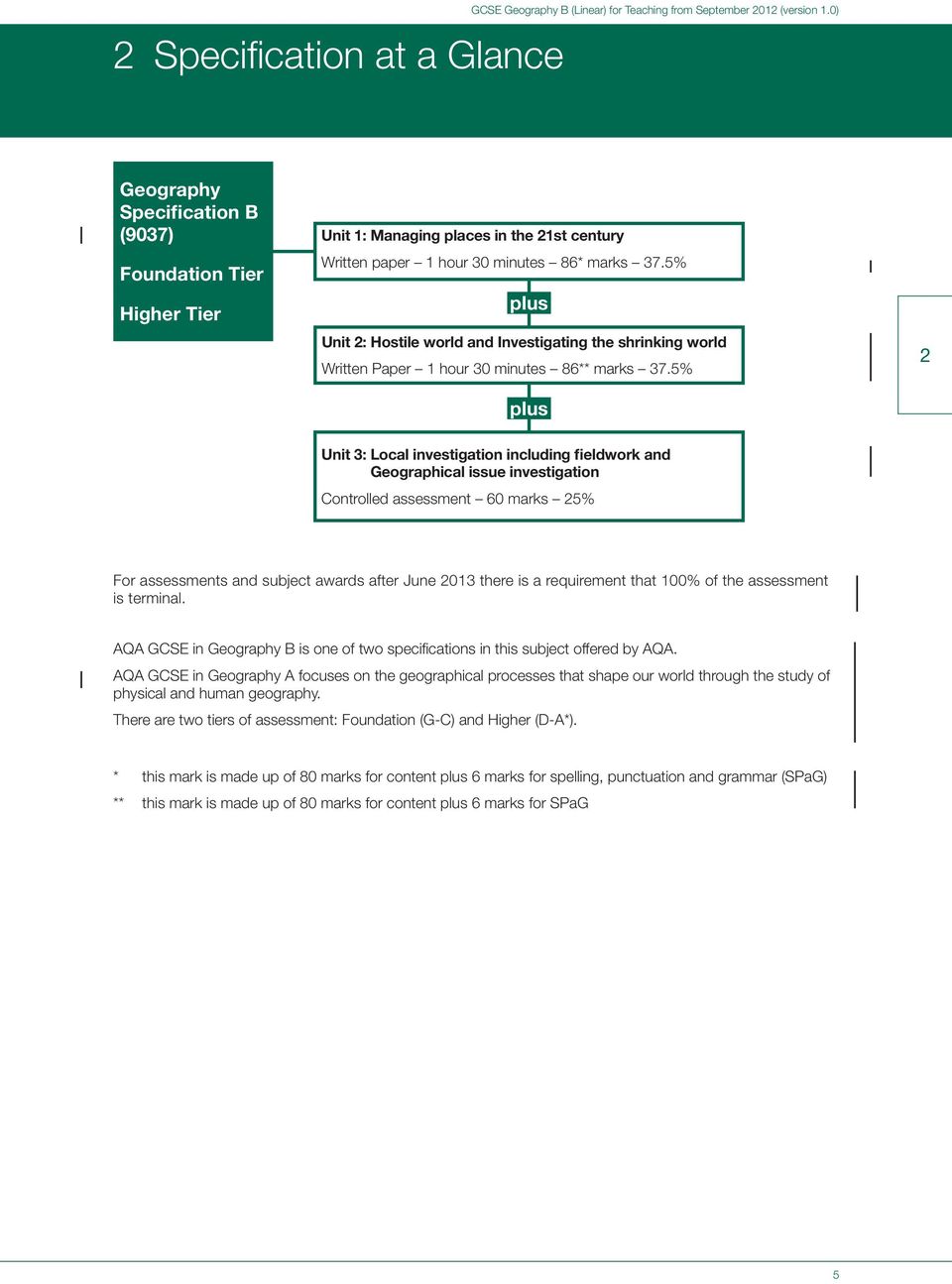
8 2 Specification at a Glance GCSE Geography B (Linear) for Teaching from September 2012 (version 1.0) Geography Specification B (9037) Foundation Tier Higher Tier Unit 1: Managing places in the 21st century Written paper 1 hour 30 minutes 86* marks 37.5% plus Unit 2: Hostile world and Investigating the shrinking world Written Paper 1 hour 30 minutes 86** marks 37.5% plus 2 Unit 3: Local investigation including fieldwork and Geographical issue investigation Controlled assessment 60 marks 25% For assessments and subject awards after June 2013 there is a requirement that 100% of the assessment is terminal. AQA GCSE in Geography B is one of two specifications in this subject offered by AQA. AQA GCSE in Geography A focuses on the geographical processes that shape our world through the study of physical and human geography. There are two tiers of assessment: Foundation (G-C) and Higher (D-A*). * this mark is made up of 80 marks for content plus 6 marks for spelling, punctuation and grammar (SPaG) ** this mark is made up of 80 marks for content plus 6 marks for SPaG 5
9 2.1 Summary of assessment The minimum teaching requirements for the course are: The coastal environment and The urban environment and either Living with natural hazards or The challenge of extreme environments and either Investigating the globalisation of industry or Investigating global tourism and either Energy in the 21 st century or Water a precious resource. Unit 1: Managing places in the 21st century 37.5% of the full GCSE 2 External examination June availability starting from June 2014 Summary of Content The coastal environment The urban environment Style of Assessment 1 hour 30 minute examination Answer all questions. Unit 2: Hostile world and Investigating the shrinking world 37.5% of the full GCSE External examination June availability starting from June 2014 Summary of Content Section A: Living with natural hazards and The challenge of extreme environments Section B: Investigating the globalisation of industry and Investigating global tourism Style of Assessment 1 hour 30 minute examination Answer one question from Section A and one question from Section B. 6

10 Unit 3: Local investigation including fieldwork and Geographical issue investigation 25% of the full GCSE Controlled Assessment June availability starting from June 2014 Task One: Local investigation including fieldwork (15% of the full GCSE) Marked out of 36. Word guidance of hour write-up under direct supervision. Summary of Content The coastal environment The urban environment Investigating the globalisation of industry Investigating global tourism Style of Assessment Task Setting: Centres will select a task from a choice of four provided by AQA 2 years prior to submission. Task Taking: Candidates will work under the direct supervision of a teacher at all times, with the exception of research involving primary and/or secondary data collection. Task Marking: Centres will mark the candidates work which will then be moderated by AQA. Task Two: Geographical issue investigation (10% of the full GCSE) Marked out of 24. Word guidance of hour write-up under direct supervision. Summary of Content Energy in the 21st century Water a precious resource Style of Assessment Task Setting: Centres will select a Geographical issue investigation task from a choice of two provided by AQA 2 years prior to submission. Task Taking: Candidates will work under the direct supervision of a teacher at all times, with the exception of research involving secondary data. Task Marking: Centres will mark the candidates work which will be moderated by AQA. 2 7

11 3 Subject Content Introduction Specification B seeks to respond to the call for a curriculum which is stimulating, imaginative and flexible. The nature of the Specification is such that it gives an opportunity for the development of a wide range of research and presentation skills. It is of great advantage that the course can also be delivered using a range of teaching and learning techniques; for example being teacher led to supported self study, maximising the skills and aptitudes of both teacher and candidate. Specification B seeks to energise and interest candidates by giving them an insight into future challenges through the study of current issues of local, national and global importance, and their future management. By giving them an appreciation of the significance of values and attitudes to the development and resolution of these issues candidates are given useful preparation for understanding the world in which they are going to live and work. The nature of the Specification means that it has strong links to global citizenship and the understanding of human systems in different parts of the world. The aspiration is that this will raise candidates awareness of their responsibilities to other people, to the environment and to the sustainability of the planet Unit 1: Managing places in the 21st century The coastal environment With over four billion people living in coastal areas and numbers growing rapidly the need to understand and appreciate the issues involved in managing these areas is critical. Coastal areas are one of the most dynamic global environments and are being constantly re-shaped by both natural processes and the demands of economic development. They have both economic and environmental value and are consequently areas where conflicting demands create the need for complex management and planning strategies. With the increasing threat of rising sea levels, the demand for the sustainable management of coastal areas will become even more critical. Key Question: Why are coastal areas a valuable economic and environmental resource? Coastal areas are multi-use areas which provide opportunities for a number of human activities. Use an example(s) to describe and explain the reasons for the growth of human and economic activities in coastal areas. Use an example to illustrate the range of human activities found in a coastal area and the reasons for their development. There are frequently conflicting demands on coastal areas and this creates a need for management strategies. Use examples to: explore the issues arising out of the conflict between economic development and the need for conservation in coastal areas. explore the measures used to conserve coastal environments. 8

12 Key Question: How have physical processes created the coastal landforms that exist today? Weathering and erosion are important physical processes in coastal areas. Physical processes, rock type and structure operate to create distinctive coastal landforms. The movement and deposition of beach material creates distinctive coastal landforms. Describe and explain the processes of weathering and erosion that affect coastal environments. Use examples to illustrate the processes and landforms associated with: hard coastlines including: headlands, bays, wave-cut platforms, caves, arches, stacks, rock falls. soft coastlines including: slumped coastlines, landslides, mudslides. Use an example(s) to illustrate the process of longshore drift and the formation of beaches, spits and bars. 3 Key Question: Why are decisions made to manage coastal areas? Some areas are protected from the effect of coastal processes. There are different methods that can be used to protect coastlines from the effects of natural processes. Understand that not all areas can be/need to be protected. Consider the issues associated with the planning, decision making and management of shorelines. Describe the concept of hard and soft coastal engineering. Use an example(s) to illustrate the methods and issues associated with: hard engineering use of sea walls, rock armour, gabions, tetrapods, cliff drainage, groynes. soft engineering use of beach nourishment, beach recycling, beach re-profiling replenishing. Explore the reasons why different methods of coastal management may be appropriate in different locations. 9
13 Key Question: How can the management of coastal areas be increasingly sustainable? 3 Protecting coastal areas from the increasing threat of rising sea levels will require the development of different approaches. The sustainability of coastal areas requires the whole of the coastal zone to be managed effectively. Investigate one example of the use of managed realignment (retreat). Describe the methods used. Explain how they operate to protect the coastal area from flooding. Evaluate the significance of the methods in relation to the increasing risk of coastal flooding. Explore the idea of Integrated Coastal Zone Management (ICZM) by looking at one example of a coastal area in relation to its economic and environmental sustainability (e.g. Florida/ Mediterranean). Consider: the pressures on the area the strategies being used to reduce the pressures and ensure the long-term sustainability of the area. The urban environment The world is becoming increasingly urban it is estimated that by 2020 over 70% of the world s population will live in urban areas. In developing countries large numbers of people are moving to core urban-industrial areas in the hope of improving their quality of life. This rapid urbanisation creates challenges for urban planners in relation to housing and the supply of basic services. In developed countries many urban areas have gone through a period of economic decline; the challenge in these areas is often about improving socio-economic conditions and addressing environmental issues. The global future will be an increasingly urban future and this will create a need to put in place sustainable methods of managing urban living in existing areas and designing new urban centres that operate in sympathy with both people and the environment. Key Question: How can urban growth create challenges? The world is increasingly urban. Urban areas face increasing threats from environmental hazards. The increasing need to manage the movement of people and traffic in urban areas. Investigate global patterns of urban population/ rates of urbanisation. Investigate one urban area to consider the environmental hazards (pollution) linked to urban/industrial concentrations and the challenges these present. Use an example(s) to describe and explain the different methods being used to manage people movement and traffic in urban areas. 10

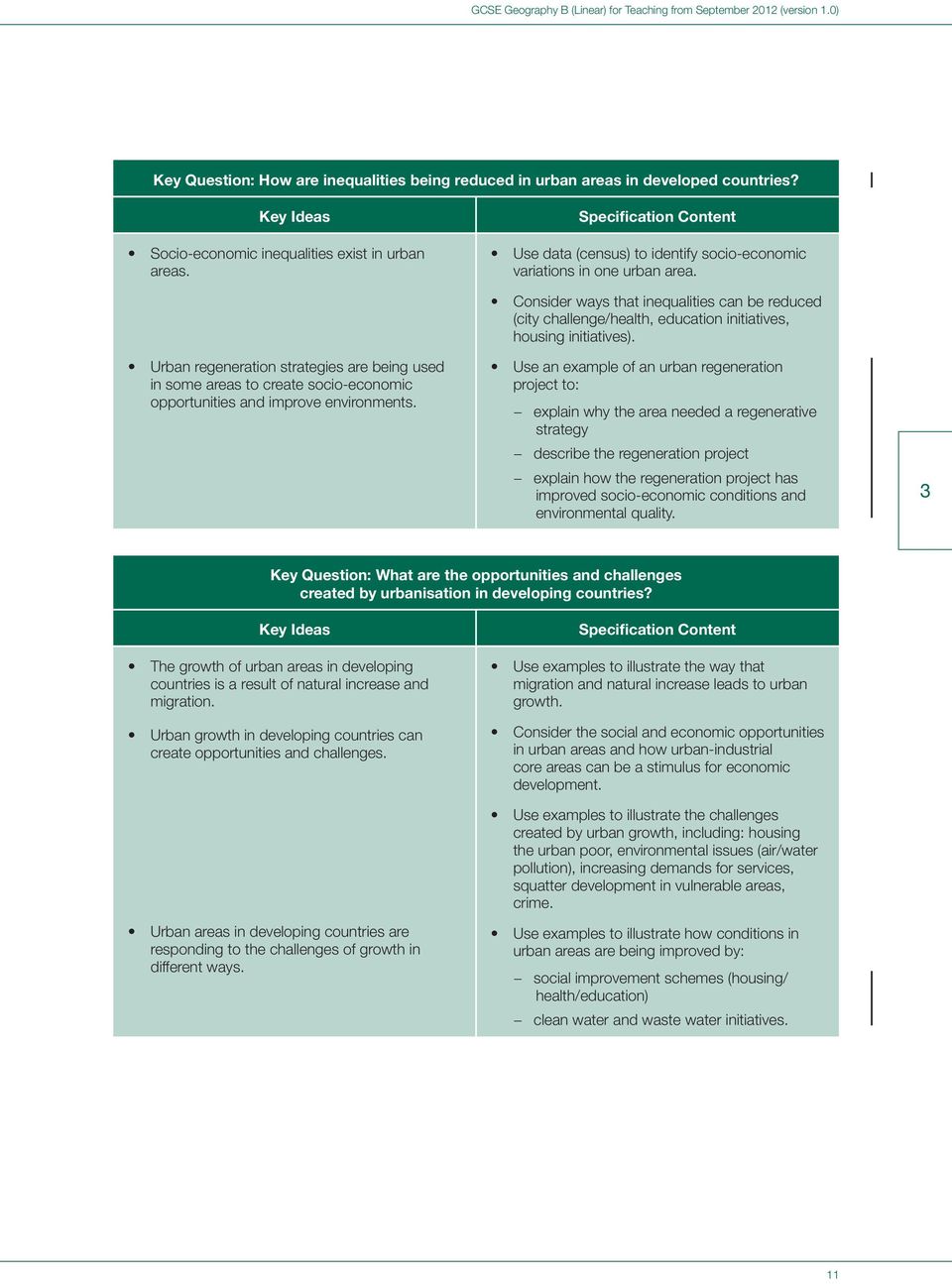
14 Key Question: How are inequalities being reduced in urban areas in developed countries? Socio-economic inequalities exist in urban areas. Use data (census) to identify socio-economic variations in one urban area. Urban regeneration strategies are being used in some areas to create socio-economic opportunities and improve environments. Consider ways that inequalities can be reduced (city challenge/health, education initiatives, housing initiatives). Use an example of an urban regeneration project to: explain why the area needed a regenerative strategy describe the regeneration project explain how the regeneration project has improved socio-economic conditions and environmental quality. 3 Key Question: What are the opportunities and challenges created by urbanisation in developing countries? The growth of urban areas in developing countries is a result of natural increase and migration. Urban growth in developing countries can create opportunities and challenges. Use examples to illustrate the way that migration and natural increase leads to urban growth. Consider the social and economic opportunities in urban areas and how urban-industrial core areas can be a stimulus for economic development. Use examples to illustrate the challenges created by urban growth, including: housing the urban poor, environmental issues (air/water pollution), increasing demands for services, squatter development in vulnerable areas, crime. Urban areas in developing countries are responding to the challenges of growth in different ways. Use examples to illustrate how conditions in urban areas are being improved by: social improvement schemes (housing/ health/education) clean water and waste water initiatives. 11
15 Key Question: How can urban living be increasingly sustainable? What is meant by urban sustainability? Sustainable planning and management ideas are being increasingly used in urban areas. Describe the elements of urban management that need to be considered if an area is to be increasingly sustainable. Use an example(s) to illustrate sustainable urban initiatives, including: carbon neutral housing/renewable energy greening urban areas recycling/sustainable resource use sustainable urban planning initiatives Unit 2: Hostile world and Investigating the shrinking world Section A Hostile world Living with natural hazards Many people now live in hostile areas of the world. Areas close to plate boundaries and areas that suffer from tropical storms or wildfires can pose dangers for the people who live there. They have to be able to understand the causes and effects of these hazards in order to prepare for and respond to them. Key Question: What are the causes and effects of earthquakes and volcanic eruptions and how do people prepare for and respond to them? The damaging effects of earthquakes and volcanic eruptions. The causes of earthquakes and volcanic eruptions. Why people live in areas at risk from earthquakes and volcanic eruptions. Reducing the damaging effects of earthquakes and volcanic eruptions. Use examples to describe the primary and secondary damage caused by earthquakes and volcanic eruptions. Explain how the effects might vary among countries with different levels of economic development. Describe the global distribution of earthquakes and volcanoes and their relationship to plate boundaries. The physical processes taking place at different types of plate boundaries and the consequences. Include constructive, destructive and conservative boundaries. Describe the advantages of living in areas at risk from earthquakes and volcanic eruptions. Include geothermal energy, tourism, and fertile soils. Explain why people choose to stay in, or are unable to move away from an area at risk from earthquakes and volcanic eruptions. Describe a range of strategies and methods used to reduce the damaging effects of earthquakes and volcanic eruptions used in countries with different levels of economic development. Include short-term responses and long-term responses (prediction, planning, and preparation). 12

16 Key Question: What are the causes and effects of tropical storms and how do people prepare for and respond to them? The damaging effects of tropical storms. The causes of tropical storms. Reducing the damaging effects of tropical storms. Tropical storms could become more frequent and their distribution may change. Describe the primary and secondary effects of tropical storms. Explain how the effects might vary among countries with different levels of economic development. Describe the global distribution of tropical storms. The physical processes leading to the formation of a tropical storm in one region of the world. Describe strategies and methods used to reduce the damaging effects of tropical storms. Include monitoring, use of GIS, education and other preparation in countries with different levels of economic development. Explain why the distribution and frequency of tropical storms may change. Include the impact of climate change. 3 Key Question: What are the causes and effects of wildfires and how do people prepare for and respond to them? The effects of wildfires. The causes of wildfires. Reducing the damaging effects of wildfires. Wildfires could become more frequent and their distribution may change. Describe the effects of wildfires on people and the environment. Describe the climatic features found in areas where wildfires are common and how these lead to the formation of wildfires. Using an example, explore the extent to which wildfires are natural hazards. Describe strategies and methods used to reduce the damaging effects of wildfires. Include evacuation, education and the role of the emergency services. Explain why the distribution and frequency of wildfires may change. Include the effects of increasing numbers of people living in and using semi-arid areas, increased frequency of drought due to climate change. Explain why areas in which wildfires occur should be protected. 13

17 The challenge of extreme environments Due to increasing population pressure and demand for resources, more people are living in extreme environments. They have to face the challenge of adapting to and managing these inhospitable yet fragile areas. Key Question: What is the hot desert environment and how do people interact with it? 3 Where are the hot desert environments? The nature of the hot desert environment and the reasons for its formation. Why are some areas at risk of becoming a hot desert environment? Managing the fringe of the hot desert. Describe the global distribution of areas of hot desert. Explain the factors affecting temperature and rainfall in hot desert areas and how this affects vegetation. Explain the idea of the spreading desert. Study an example of an area on the fringe of a hot desert, which is at risk from desertification. Include the effects of climate change and population pressure: overgrazing, overcultivation and soil erosion. Describe strategies and methods used to reduce the risk of desertification in countries with a low level of economic development. Include water and soil management, conservation, and use of appropriate, sustainable technology. Key Question: What is the tropical rainforest environment and how do people interact with it? Where are the tropical rainforest environments? The nature of the tropical rainforest environment and the reasons for its formation. The opportunities and challenges of development in the tropical rainforest environment. Managing the tropical rainforest environment. Describe the global distribution of areas of tropical rainforest. Explain the factors affecting temperature and rainfall in areas of tropical rainforest and how this affects vegetation. Explain the idea of the shrinking tropical rainforest. Study an example of an area affected by deforestation. Include the damaging effects on the ecosystem of agriculture, mineral exploitation, and logging. Explain how the demands on the tropical rainforest environment may change in the future. Describe strategies and methods used to reduce problems in the tropical rainforest environment. Include conservation, reforestation and sustainable management schemes. Explain why the tropical rainforest environment should be protected. 14

18 Key Question: What is the cold environment and how do people interact with it? Where are the cold environments? The nature of cold environments and the reasons for their formation. The opportunities and challenges of development in cold environments. Managing cold environments. Describe the global distribution of polar and tundra environments. Explain the factors affecting temperature and precipitation in polar and tundra environments and how these affect vegetation. Explain the effect of global warming on cold environments. Study an example of an area where glaciers are retreating or ice shelves are shrinking. Describe the ways in which people have exploited cold environments. Include Antarctica and oil in Alaska. What does the future hold for these fragile, cold environments? Describe strategies and methods used to reduce problems in cold environments. Include the use of technology, the role of governments, international agreements and conservation groups. Explain why cold environments should be protected. 3 Section B Investigating the shrinking world Investigating the globalisation of industry Companies organise and locate all over the world as industry becomes increasingly globalised. This change has impacts on people and places and requires careful management in order to ensure that it is sustainable. The global nature of modern industry has led to changes in the development gap. This unit focuses on geographical investigation. Candidates should be given the opportunity to investigate a range of places and to consider how globalisation impacts specific localities and groups of people. Key Question: Why has industry become increasingly global? The growth of the globalised economy. There are a number of reasons for the globalisation of industry. To what extent do we produce and consume globally? Investigate one Transnational Corporation (TNC) to show its global operations. Use contemporary examples to investigate changing industrial location factors. Explore changing patterns of trade, including the ideas of fair and unfair trade. Explore a range of factors, including increased mobility, changing markets, relative labour costs, political influences and developments in technology. 15

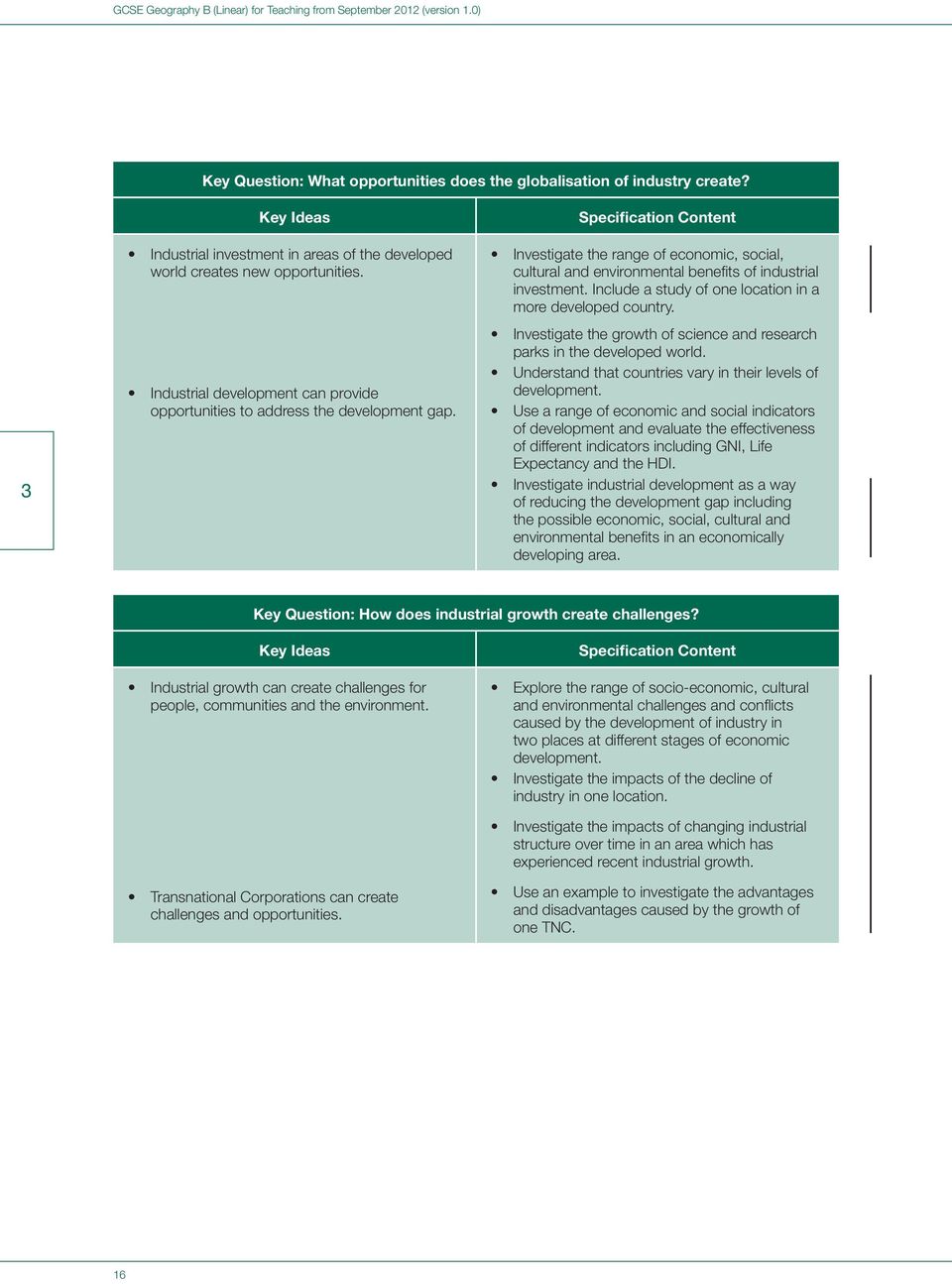
19 Key Question: What opportunities does the globalisation of industry create? 3 Industrial investment in areas of the developed world creates new opportunities. Industrial development can provide opportunities to address the development gap. Investigate the range of economic, social, cultural and environmental benefits of industrial investment. Include a study of one location in a more developed country. Investigate the growth of science and research parks in the developed world. Understand that countries vary in their levels of development. Use a range of economic and social indicators of development and evaluate the effectiveness of different indicators including GNI, Life Expectancy and the HDI. Investigate industrial development as a way of reducing the development gap including the possible economic, social, cultural and environmental benefits in an economically developing area. Key Question: How does industrial growth create challenges? Industrial growth can create challenges for people, communities and the environment. Explore the range of socio-economic, cultural and environmental challenges and conflicts caused by the development of industry in two places at different stages of economic development. Investigate the impacts of the decline of industry in one location. Investigate the impacts of changing industrial structure over time in an area which has experienced recent industrial growth. Transnational Corporations can create challenges and opportunities. Use an example to investigate the advantages and disadvantages caused by the growth of one TNC. 16
20 Key Question: Can industrial development be appropriate and sustainable? The impacts of industrial development can be managed sustainably. Use an example to show how appropriate technology helps to manage the impact of industrial change in a sustainable way. Explore how management and planning help to make large-scale industrial development increasingly sustainable. Investigate the effect of a management strategy. Investigating global tourism Tourism is a rapidly growing industry. Increased opportunities to travel mean that many people have become global consumers of tourism. This growth has impacts on people and places and requires careful management in order to ensure that it is sustainable. The global nature of the modern tourist industry has led to changes in the development gap. This unit focuses on geographical investigation. Candidates should be given the opportunity to investigate a range of places and to consider how global trends and developments in tourism impact specific localities and groups of people. 3 Key Question: How has the global tourist industry grown? Tourism has become an increasingly varied and global industry. There are a number of reasons for the expansion of the tourist industry. The changing pattern of tourist destinations around the world. Explore how different places and environments provide opportunities for tourist activities. The development of mass commercial tourism and specialist tourism. Explore the development of package holiday and short break destinations and the growth of long-haul locations. Explore a range of social and economic factors, including greater wealth, mobility and leisure time and changes in lifestyles. The role of technology. Use an example to investigate the growth of a global tourism company. 17

21 Key Question: What opportunities does the growth of the tourism industry create? 3 The tourism industry is important in many parts of the developed world. Tourism can be an important way to address the development gap. Investigate the range of economic, social, cultural and environmental benefits tourism brings to established tourist locations. Include a study of one established tourist location in a more developed country. Understand that countries vary in their levels of development. Use a range of economic and social indicators of development and evaluate the effectiveness of different indicators including GNI, Life Expectancy and the HDI. Investigate tourism as a way of reducing the development gap including the possible economic, social, cultural and environmental benefits in a developing long-haul location. Key Question: How does tourism create challenges and conflicts? Tourism can create challenges for people, communities and the environment. Tourism can create environmental challenges on a global scale. Explore the range of social, cultural and environmental challenges caused by the development of tourism, including the study of two places at different stages of economic development. The impacts of the decline of tourism in one named location. Disadvantages of tourism as a way of closing the development gap, including the economic challenges in a developing long-haul location. Explore how different tourist activities can conflict with each other and local communities. An investigation of the conflicts in one tourist honeypot. Impacts on the global environment through increased international travel. 18
22 Key Question: How can the tourist industry promote sustainable development? Planning and management can help ensure that tourism is more sustainable. Use an example to show how ecotourism helps to manage the impacts of tourism in a sustainable way. Use an example of a tourist honeypot to: describe how management and planning methods are being used to reduce conflict. Investigate the effectiveness of one management strategy. 3.3 Unit 3: Local investigation including fieldwork and Geographical issue investigation 3 Controlled assessments can be completed at any point during the GCSE course. Centres must ensure that their candidates complete both the 15% fieldwork task and the 10% investigation task. The titles for the tasks are available through Secure Key Materials (SKM). Candidates must complete the controlled assessment tasks relevant to the year in which they are certificating. Local investigation including fieldwork This will be assessed by means of controlled assessment. Candidates will submit a piece of work prepared under controlled conditions based on a task provided by AQA. Centres will be able to choose one task from four options that will change each year. The tasks will be based on units within the Specification and the task titles will be released two years before the date of submission, eg options published in 2012 can only be submitted for the 2014 examination. This main component (15%) requires candidates to use fieldwork as part of an investigation examining one question or hypothesis at a local scale. Primary data collection must take place within the investigation and contribute to the work submitted as part of the examination. The report on the investigation has seven components: 1. Introduction 2. Methodology 3. Sorting of data and other evidence 4. Presentation of findings 5. Description, interpretation and analysis of findings 6. Conclusions 7. Evaluation Controlled assessment advisers will be available to give advice on all aspects of the controlled assessment including the marking. Task setting (High Level of Control) Each year four tasks will be set by AQA based on the following topics within the Specification: The coastal environment The urban environment Investigating the globalisation of industry Investigating global tourism Candidates must attempt one task only. Each task will consist of the unit heading from which it is derived followed by a statement. Centres will be able to contextualise the investigation by using this statement to produce a question or hypothesis appropriate to their candidates. Candidates should demonstrate the following skills within the controlled assessment: establish an appropriate sequence of investigation incorporating enquiry skills obtain information from a range of different sources, including primary data collected through fieldwork describe, analyse and interpret evidence, reach valid conclusions and communicate findings appropriately evaluate methods of collecting evidence, suggest improvements, evaluate the validity and limitations of that evidence and the conclusions reached. 19
23 3 Task taking (Limited and High Levels of Control) Preparation (Limited Level of Control) Teachers may advise candidates on: the focus of the investigation sources of information relevance of materials/concepts document structure (chapter titles and content) techniques of data collection techniques of data presentation skills of analysis and evaluation health and safety matters. During this phase centres should ensure that candidates are familiar with the marking criteria for this controlled assessment. It is expected that the task will take up to 12 hours of teaching time with additional time to collect the fieldwork data. There is a word guidance of 1,200 words for this component. Research, planning, processing and presentation (Limited Level of Control) Candidates will need to collect a limited amount of primary data for the purpose of the task and this must take place within the investigation. Secondary data can form the bulk of this investigation. The time used to collect fieldwork data does not form part of the 12 hours teaching time. Candidates should normally spend up to 2 hours carrying out research and preparing notes and materials for this phase of the investigation. Up to 6 hours should be used for candidates to consider and complete the first 4 elements of their investigation. These are: 1. Introduction including reference to any relevant theory and location evidence. 2. Methodology description and justification of how information was collected. 3. Sorting of data and other evidence collating, sorting and organising evidence. 4. Presentation of findings completing any maps, graphs or illustrations relating to the investigation. There is guidance of 400 words for this part of the investigation. The work of individual candidates may be informed by working with others but candidates must provide an individual response. Candidates should have access to the relevant primary and secondary sources and may make use of any further resources available in the centre, including the Internet, to inform their research. Candidates must keep a record of all the primary and secondary sources (including websites) they use. Each candidate should have a folder in which draft material is stored alongside work completed for submission. This folder must be collected at the end of each lesson and only issued to candidates under the supervision of a teacher. Teachers must monitor progress to ensure that work prepared elsewhere is not introduced into the folders or that plagiarism does not occur. Once the task has been completed and the final investigation submitted for assessment, the centre must retain the draft work contained in the folders as it will provide evidence that the controlled assessment is the candidate s own work. Draft material will not be assessed. Teachers may give advice to candidates during the research and planning phase and this should be recorded in the fieldwork folder. The degree of advice will vary but teachers must not give written feedback on drafts or provide writing frames, and candidates are required to reach their own conclusions based upon their interpretation of the evidence collected and presented. Description, interpretation, analysis, conclusions and evaluation (High Level of Control) The description, interpretation, analysis, conclusions and evaluation of the fieldwork evidence has guidance of 800 words. Candidates will be required to write up the final 3 elements of their investigation under a high level of control. The three elements are: 5. Description, interpretation and analysis of findings 6. Conclusions 7. Evaluation This work will be completed within a maximum of 4 hours under a high level of control. When writing up the final three elements of their investigation, candidates must work independently and complete all work under the formal supervision of a teacher or invigilator. Candidates may not communicate with each other during this time. Any assistance given to candidates during this phase must be recorded on the Candidate Record Form. The teacher or invigilator must collect all materials in at the end of each session and return them to candidates at the beginning of the next session. Candidates may not bring any new materials in to the classroom once this phase has started. During this phase of the controlled assessment, candidates may have access to their research 20
24 folder containing resources. Candidates must not have access to secondary sources or the Internet while they are completing this part of the controlled assessment. Any resources (including the Internet) used during the research and planning phase must be listed in a bibliography forming part of the controlled assessment. Candidates work may be hand-written, prepared using ICT or presented in another appropriate method. Work that is hand-written must include at least one element of ICT data presentation in order to meet the marking criteria of the presentation strand. Where there is no element of ICT data presentation (maps, graphs, diagrams etc.) candidates cannot gain any marks in the presentation strand of the marking criteria. Candidates using laptops/pcs to write this part of the controlled assessment cannot have access to the Internet or removable media such as floppy disks or memory sticks as this could breach the controlled conditions. If the interpretation, analysis, conclusions and evaluation stage is divided into a number of shorter sessions, centres should ensure that work is saved securely so that candidates cannot amend or add to the saved material between sessions. Candidates may use the spellcheck and grammar facility on a computer. At the end of the controlled assessment the teacher or invigilator must collect in all the work including the final piece of work for assessment. The work will be submitted as part of a portfolio along with the Geographical Issue Investigation task. Task marking (Medium Level of Control) The report on the investigation will be marked out of 36. Teachers in centres must use the marking criteria provided by AQA to mark the completed report. The controlled assessment will be moderated by AQA in accordance with the procedures outlined in Section 7 of the specification. Quality of written communication (QWC) will be assessed as an integral part of the marking on the interpretation and QWC Strand of Controlled Assessment. 3 Marking Criteria for Local fieldwork investigation Strand Level 1 Level 2 Level 3 Geographical Understanding The candidate identifies and defines the key geographical concepts or processes that will underpin the investigation. The candidate correctly incorporates the key concepts or processes defined in Level 1 into relevant data collection techniques and within the interpretation of results. As well as meeting the requirements of the Level 2 criteria, the candidate correctly applies the key concepts or processes to the conclusions and then to the evaluations. (1 2 marks) (3 4 marks) (5 6 marks) Methodology The candidate provides a context for the investigation and outlines how relevant information will be collected. Evidence is provided to confirm that the candidate has collected some material. There is little evidence of organisation and/or planning. The candidate fulfils the requirements for Level 1. The sequence of the investigation is described. The candidate describes and carries out the investigation using the methods stated ensuring that some of the information has been collected through fieldwork. The work shows evidence of organisation and planning. The candidate fulfils the requirements for Level 2. The methods selected to collect the information are clearly justified. The work is well organised and planned. (1 2 marks) (3 4 marks) (5 6 marks) 21
25 Presentation The candidate presents their findings using basic techniques. There is an element of ICT data presentation within the work. The study area is located in a basic manner. The candidate presents their findings using a limited range of appropriate presentation techniques, completed accurately, with clear evidence of ICT data presentation within the work. The study area is clearly located. The candidate fulfils the requirements for Level 2. In addition a wider range of appropriate presentation techniques is used, completed accurately, with clear evidence of ICT data presentation within the work. Examples of more complex skills are used to present their results. The study area is located in detail. (1 3 marks) (4 6 marks) (7 9 marks) 3 Interpretation and QWC The candidate gives a brief description of their findings. Some basic reasons may be offered for these findings. A limited range of specialised terms is used. Reasonable accuracy in the use of spelling, punctuation and grammar is evident. The candidate describes and attempts to analyse results by means of basic numerical data manipulation. Conclusions are drawn relating to the original purpose of the investigation. A good range of specialist terms is used appropriately. Considerable accuracy in spelling, punctuation and grammar is evident. The candidate describes and analyses the findings in detail. Valid conclusions are reached in relation to the original purpose of the enquiry. A wide range of specialist terms is used appropriately. Ideas are expressed clearly, logically and fluently with accurate use of spelling, punctuation and grammar. (1 3 marks) (4 6 marks) (7 9 marks) Evaluation The candidate reflects on the effectiveness of the investigation and the methods used to collect information. Suggestions are made indicating how such an enquiry might be improved. The candidate fulfils the requirements for Level 1. Specific problems relating to the methods used to collect the information are identified. Reference is made explaining how these problems may have affected the results. The candidate fulfils the requirements for Level 2. The effect of problems with the methods and results on the validity of the conclusions is discussed. (1 2 marks) (3 4 marks) (5 6 marks) Where an answer fails to meet level 1, zero marks should be awarded. Geographical issue investigation This will be assessed by means of a controlled assessment. Candidates will submit a piece of work prepared under controlled conditions responding to an issue set by AQA. There will be a choice of two issues, one taken from each of the sections Energy in the 21st century and Water a precious resource. The issues will be available through Secure Key Materials (SKM). Candidates must complete the issue relevant to the year in which they are certificating. The issues will be released two years before the date of submission, eg issues published in 2012 can only be submitted for the 2014 examination series. Candidates are required to study all Key Questions and ideas for one section. The issue must be considered within the context of the whole section in order that candidates can investigate the issue from an informed perspective. Candidates then proceed to take the controlled assessment under the specified controlled conditions. Candidates must attempt one issue and not all candidates at a centre have to complete the same issue, which will be set at either a regional, national, international or global scale or at a range of these scales. AQA controlled assessment advisers will be available to give advice on all aspects of the controlled assessment including the marking. 22
26 Section A Energy in the 21st century The demand for energy will continue to increase in the 21st century, fuelled by the rapid industrial development in many parts of the world. Satisfying increasing energy demand will become a growing challenge as fossil fuels become scarcer, resulting in an increasing reliance on renewable methods of energy production. In the short term, burning fossil fuels and the links to the problems of climate change will remain an important issue. The development of renewable energy sources may also pose questions in terms of their socio-economic and environmental impacts. As fossil fuel energy resources become increasingly scarce there will be a need to develop new approaches to the supply of energy which are suitable for different global situations. At the same time, more efficient use of energy will play a growing part in managing the demand for energy. Key Question: How are energy use and development linked? The demand for energy is linked to levels of development. Increasing demand raises questions about global energy security. Describe and explain the link between levels of energy use and economic development Investigate the idea of: the energy mix direct energy resource use, including fuelwood/animal manure indirect energy resource use (resource powerstation transmission). Investigate the growing demand for energy and examine the issues that this raises, including: the depletion of finite resources the price of energy the global energy gap the need to produce increasing amounts of energy by using renewable methods the need to use energy more efficiently. 3 Key Question: What environmental issues are associated with using natural resources as sources of energy? The exploitation and use of fossil fuels can create environmental problems. Nuclear power may play an increasing role in energy supply. Renewable energy sources have costs and benefits. The use of fuelwood in developing countries is a threat to people and the environment. Use example(s) to illustrate the environmental threats linked to the exploitation of fossil fuels, Examine the causes and impacts of: acid rain global warming. Investigate the use of nuclear power and the issues involved in its use. Use examples to investigate the issues associated with the use of renewable energy, including wind power, hydroelectricity and tidal power. Consider the part that renewable energy might play in UK energy supply in the future. Investigate fuelwood issues in developing countries in relation to: the effect on health the impact on the environment (degradation of landscapes). 23
27 Key Question: How can future energy demand be met increasingly sustainably? 3 Using energy more efficiently can play a part in reducing demand. Developments in renewable energy technology will increase the opportunity to move towards a more sustainable energy future. Use of technology and new building techniques can reduce residential energy use. More energy-efficient transport systems will become an increasing priority. Investigate individual energy use and carbon footprints to consider how energy use could be reduced. Investigate the increasing use of existing renewables and the developments of new sustainable energy. Investigate how modern building materials, construction and technology can reduce energy use. Use example(s) to describe and explain the development of energy efficient, carbon neutral residential developments. Look at how encouraging the use of alternative transport systems could reduce energy use, including public transport, cycle ways. Investigate the increasing use of technology to reduce the use of fossil fuels in vehicles. Section B Water a precious resource Water is precious to life and access to clean water is considered a fundamental human right. However, in many parts of the world access to both clean water and sanitation systems is limited, resulting in high rates of water related disease and death. The natural water cycle is frequently adapted to provide water for drinking, farming, energy production, industry and a number of other functions. These differing demands can put pressure on water supply systems and create social and environmental conflict. In order that water security is guaranteed for future generations sustainable methods of water management and conservation will need to be increasingly used. Key Question: How is the water cycle changed by human activity? The water cycle is affected by physical factors. The water cycle is adapted to meet human needs. Climate change may affect patterns of rainfall and water supply. The use and misuse of water resources can cause conflict. Describe and explain the natural water cycle. Investigate the natural factors that affect the water cycle, including climate and geology. Explore the different ways that the water cycle is adapted to respond to human needs. Use an example(s) to investigate the range of demands placed on the water cycle by human need, including: water supply to urban/industrial areas agricultural schemes power generation leisure and tourism. Investigate the possible effects of climate change on patterns of rainfall and water supply. Use an example(s) to illustrate the environmental problems that can be caused by poor water management. Use an example to illustrate how managing limited water supply can create conflicts. 24
28 Key Question: What are the issues of poor water supply? Natural factors are a major influence on water supply. Look at the global distribution of rainfall and the relationship with water shortages and surpluses. Use example(s) to examine how droughts and floods may be the result of natural and human processes. Lack of clean water and effective sanitation systems affect the quality of life in many parts of the world. Look at the global pattern of access to clean water and sanitation. Identify areas which are most at risk because of poor water/sanitation services. Investigate the causes and effects of poor water quality and limited sanitation systems. Consider the extent to which the lack of access to clean water is a significant indicator of economic development. 3 Water shortages can have significant impacts in both developed and developing countries. Use example to consider the problems of water shortages in both developed and developing parts of the world. Key Question: How can water supply and quality be improved? Water transfer schemes are increasingly important in an urban world. In developing countries water management schemes can increase levels of access to clean water and sanitation systems. In developed countries technology can be used to increase the efficiency of water use. Improving water quality requires pollution management. Investigate water management schemes, including a large scale scheme and smaller scale work of Non-Governmental Organisations (NGO) (Water Aid). Investigate methods of collecting, distributing and using water more effectively. Use an example of a water management scheme that has increased access to clean water/provided improvements to levels of sanitation (an NGO funded scheme/ government scheme). Use examples to illustrate how building and conservation techniques can be used to increase the efficiency of water management. Use an example to describe a water source (river/lake) that has been improved by the use of sustainable management methods. 25
29 3 Task setting (High Level of Control) Each year two issues will be set by AQA. The issues will be replaced every year. Candidates must complete the controlled assessment tasks relevant to the year in which they are certificating. Whilst completing the investigation candidates should demonstrate some of the following skills and abilities: Ask appropriate geographical questions Demonstrate competence in extracting relevant material from sources such as maps, diagrams, GIS, textbooks, articles, websites, statistics etc. Communicate findings Present and interpret findings Reach conclusions based on evidence Make effective use of ICT Show awareness of different points of view. Task taking (Limited and High Levels of Control) It is expected that the task will take 8 hours. There is word guidance of 800 words for this component. Whilst word and time limits are set for separate parts of this component these are flexible as long as the final document does not exceed the maximum stated above and it is completed within the specified time. Preparation (Limited Level of Control) Teachers may advise candidates on: key concepts or theories relating to the issue research skills and sources relevance of research materials presentation options and techniques skills of interpretation and analysis how different interest groups may not share common values and attitudes. During this phase centres should ensure that candidates are familiar with the marking criteria for this controlled assessment. Research and planning (Limited Level of Control) This phase of the Controlled Assessment should take no more than 6 hours for the candidates to consider and complete the first 5 elements of their investigation. These are: 1. Introduction providing background to the issue 2. Developing key questions relating to the issue which need to be addressed 3. Researching the issue 4. Collating research evidence 5. Presenting research material in map, graphical and written forms. There is a guidance of 400 words for this part of the controlled assessment. All work must be carried out under the direct supervision of the teacher with the exception of any independent research involving primary or secondary data collection. The work of individual candidates may be informed by working with others but candidates must provide an individual response. Candidates should have access to the relevant primary and secondary sources and may make use of any further resources available in the centre, including the Internet, to inform their research. Candidates must keep a record of all the primary and secondary sources (including websites) they use. Each candidate should have a folder in which they store any draft material alongside work completed for submission. This folder must be collected at the end of each lesson and only issued to candidates under the supervision of a teacher. Teachers must monitor progress to ensure that pre-prepared work is not introduced into the folders or that plagiarism does not occur. Once the task has been completed and the final investigation submitted for assessment, the centre must retain the draft work contained in the folders as it will provide evidence that the controlled assessment is the candidate s own work. Draft material will not be assessed. Teachers may give advice to candidates during the research and planning phase and this should be recorded in the research folder. The degree of advice will vary but teachers must not give written feedback on drafts, or provide writing frames, and candidates are required to reach their own conclusions based upon their interpretation of the evidence collected and presented. The research folder must not contain any pre-prepared answers for the 2 hour high level of control task. Values and attitudes and conclusions (High Level of Control) The final part of the investigation requires the candidate to consider the values and attitudes of groups and individuals that may be involved in the issue. Candidates must also offer conclusions in relation to the issue. This part of the investigation has guidance of 400 words and must be completed by the candidate under a high level of control in no more than 2 hours. When completing their response, candidates must work independently and carry out all work under the formal supervision of a teacher or invigilator. Candidates may not communicate with each other 26
30 during this time. Any assistance given to candidates during this phase must be recorded in the Candidate Record Form. The teacher or invigilator must collect in all materials at the end of each session and return them to candidates at the beginning of the next session. Candidates may not bring any new materials into the classroom once this phase has started. During this phase of the controlled assessment, candidates may have access to their research folder containing resources. Candidates must not have access to secondary sources or the Internet while they are completing this part of their controlled assessment. Any resources (including the Internet) used during the research and planning phase must be listed in a bibliography forming part of the controlled assessment. Candidates work may be hand-written, prepared using ICT or presented in another appropriate method. Where there is no element of ICT data presentation (maps, graphs, diagrams etc.) within hand-written work, candidates can only gain marks in Level 1 of the presentation strand of the marking criteria. Candidates using laptops/pcs to write their controlled assessment cannot have access to the Internet, removable storage such as floppy disks or memory sticks as this could breach the controlled conditions. If candidates are producing a written report using ICT completed over a number of sessions, centres should ensure that work is saved securely to ensure that candidates cannot amend or add to the saved material between sessions. Candidates may use the spellcheck and grammar facility on a computer. At the end of the controlled assessment the teacher or invigilator must collect in all the work including the final piece of work for assessment. The work will be submitted as part of a portfolio alongside the Local Investigation with Fieldwork task. Task marking (Medium Level of Control) The work will be marked out of 24. Teachers in centres must use the marking criteria provided by AQA to mark the completed work. The controlled assessment will be moderated by AQA according to the procedures outlined in Section 7 of the specification. Quality of Written Communication will be assessed as an integral part of the marking on the Interpretation and QWC Strand of Controlled Assessment. 3 Marking Criteria for Geographical issue investigation Strand Level 1 Level 2 Level 3 Research Evidence The candidate produces limited research evidence relating to the issue. The candidate clearly produces appropriate research material relating to the issue. The candidate contributes a wide range of appropriate research material relating to the issue. 1 2 marks 3 4 marks 5 6 marks Geographical Understanding and QWC A limited range of specialised terms is used. Reasonable accuracy in the use of spelling, punctuation and grammar is evident. A good range of specialist terms is used appropriately. Considerable accuracy in spelling, punctuation and grammar is evident. A wide range of specialist terms is used appropriately. Ideas are expressed clearly, logically and fluently with accurate use of spelling, punctuation and grammar. 1 mark 2 marks 3 marks Presentation Skills The candidate uses basic skills of presentation. The work lacks organisation. ICT data presentation techniques may not be present. The candidate uses appropriate skills of presentation. The work is organised and there is an element of ICT data presentation. The candidate uses skills of presentation completed to a very high standard. The work is highly organised. There are ICT data presentation techniques evident within the work. 1 2 marks 3 4 marks 5 6 marks 27
31 Values and Attitudes The candidate provides evidence of one point of view in relation to the issue. The candidate provides some evidence of two alternative views in relation to the issue. The candidate provides detailed evidence of more than two alternative points of view in relation to the issue. 1 2 marks 3 4 marks 5 6 marks Conclusions The candidate reaches basic and/ or unsubstantiated conclusions. The candidate reaches clear conclusions, some of which are substantiated. The candidate reaches valid and substantiated conclusions. 1 mark 2 marks 3 marks Where an answer fails to meet level 1, zero marks should be awarded. 3 28
32 3.4 Geographical skills checklist Candidates are required to develop a range of geographical skills including cartographic, graphical, enquiry and ICT skills. Maps at a variety of scales: use and interpret OS maps at a range of scales, including 1: and 1: scales and other maps appropriate to the topic. Atlas maps: recognising and describing distributions and patterns of both human and physical features. Use maps in association with photographs and be able to compare maps. Sketch maps: draw, label, understand and interpret sketch maps. Photographs: candidates should be able to use and interpret ground, aerial and satellite photographs. Drawing sketches from photographs and in the field. Labelling and annotation of diagrams, maps, graphs, sketches, photographs etc. Construct line, bar, divided bar, scattergraphs and pie diagrams. Complete a variety of graphs and maps including choropleth, isoline, desire lines, proportional symbols and flow lines. Interpret a variety of graphs, including those located on maps and topological diagrams. Candidates should be able to extract information from a range of sources, including GIS, websites, newspaper reports, tables, quotes and other sources appropriate to the topic. In any of the units candidates could be expected to describe, analyse and interpret evidence, make decisions, reach and justify conclusions and carry out a process of evaluation. Literacy: most communication is through the written word raising the importance of good literacy skills. Candidates should be able to communicate information in ways suitable for a range of target audiences. ICT Skills In undertaking activities to develop their knowledge and understanding of geography, candidates should be given opportunities to develop and use ICT skills in a variety of contexts to: collect data from primary and secondary sources, using ICT sources and tools; present information, develop arguments and draw conclusions using ICT tools. Opportunities to use ICT sources and tools occur throughout the content of this specification. These can include: Using ICT research tools (including web pages, video clips, podcasts, software simulations and GIS) to find information. For example to: use maps and aerial photographs to explore the nature of ecotourist resorts; use the internet to compare opinions about new developments such as the exploitation of oil in Alaska; investigate the costs and benefits of different coastal defence methodologies; use overlays of tectonic plates and recent earthquakes on a GIS to draw conclusions about the causes of earthquakes; access real-time information forecasting the path of tropical storms; use animations to develop understanding of coastal erosion processes; find out about the impacts of the Three Gorges Dam. Evaluating the reliability of sources and the possibility of bias and take this into account when drawing conclusions. Communicating and exchanging information to work collaboratively. Using ICT tools safely and responsibly and employ safe working practices. Using spreadsheets or databases for data analysis, for modelling or to explore patterns and solve problems. For example to: model the possible costs of coastal protection schemes; produce a range of effective graphs to illustrate the results of a survey into holiday preferences; analyse the relationship between the magnitude of tropical storms and resulting damage. Using ICT to develop and refine work to present it in a range of contexts. For example to: produce a leaflet or poster to communicate safety advice for people living in earthquake zones; develop a sequence of digital posters to present researched information to their peers about a Transnational corporation; annotate photographs to show the impacts of urban problems on people; produce letters or memos to communicate information effectively about the development of biofuels; develop podcasts or news video reports to summarise the issues associated with the conservation of Antarctica; produce a report on the impacts of wildfires. Candidates should use appropriate technologies including GIS, to research geographical topics and present their findings. 3 29
33 4 Scheme of Assessment 4.1 Aims and learning outcomes GCSE courses based on this specification should encourage candidates to be inspired, moved and challenged by following a broad, coherent, satisfying, worthwhile course of study and gain an insight into related sectors. They should prepare learners to make informed decisions about further learning opportunities and career choices. GCSE specifications in Geography must enable learners to: Actively engage in the process of geography to develop as effective and independent learners and as critical and reflective thinkers with enquiring minds Develop their knowledge and understanding of geographical concepts and appreciate the relevance of these concepts to our changing world Develop a framework of spatial awareness in which to appreciate the importance of the location of places and environments from local to global Understand the significance of values and attitudes to the development and resolution of issues Develop their responsibility as global citizens and recognise how they can contribute to a future that is sustainable and inclusive Develop and apply their learning to the real world through fieldwork and other out of classroom learning Use of geographical skills, appropriate technologies, enquiry and analysis. 4.2 Assessment Objectives (AOs) 4 The assessment units will assess the following assessment objectives in the context of the content and skills set out in Section 3 (Subject Content). AO1 Assessment Objectives Recall, select and communicate their knowledge and understanding of places, environments and concepts. % Weighting 30-40% AO2 Apply their knowledge and understanding in familiar and unfamiliar contexts % AO3 Select and use a variety of skills, techniques and technologies to investigate, analyse and evaluate questions and issues % Quality of Written Communication (QWC) GCSE specifications which require candidates to produce written material in English must: ensure that text is legible and that spelling, punctuation and grammar are accurate so that meaning is clear; select and use a form and style of writing appropriate to purpose and to complex subject matter organise information clearly and coherently, using specialist vocabulary when appropriate. In this specification QWC will be assessed across the whole course. Spelling, punctuation and grammar As a result of the Government policy aims set out in the White Paper, The Importance of Teaching (2010), Ofqual have amended the Scheme of assessment section in the GCSE subject criteria for Geography so that marks are allocated for accuracy in spelling, punctuation and the use of grammar, to emphasise their importance, in line with the following performance descriptions: Where the subject criteria require Threshold performance Candidates spell, punctuate and use the rules of grammar with reasonable accuracy in the context of the demands of the question. Any errors do not hinder meaning in the response. Where required, they use a limited range of specialist terms appropriately. Intermediate performance Candidates spell, punctuate and use the rules of grammar with considerable accuracy and general control of meaning in the context of the demands of the question. Where required, they use a good range of specialist terms with facility. 30
34 High performance Candidates spell, punctuate and use the rules of grammar with consistent accuracy and effective control of meaning in the context of the demands of the question. Where required, they use a wide range of specialist terms adeptly and with precision. The marks for spelling, punctuation and the accurate use of grammar will only be allocated to written and externally assessed units where there is a requirement for sufficient extended writing to enable the accurate application of the Performance descriptions. The marks allocated will achieve a total weighting of 5% of the total marks for the qualification. The marks for spelling, punctuation and the accurate use of grammar will be allocated to individual questions. These marks will be identified to candidates on the question papers. A minimum of three marks for spelling, punctuation and grammar will be allocated to any single question. Spelling, punctuation and grammar will be assessed in the Full course in Unit 1 and Unit 2. Specific marks for spelling, punctuation and grammar will be allocated in question papers from January 2013 onwards. Weighting of Assessment Objectives for GCSE The table below shows the approximate weighting of each of the Assessment Objectives in the GCSE units. Assessment Objectives Unit Weightings (%) Unit 1 Unit 2 Unit 3 Overall Weighting of AOs (%) 4 AO AO AO Overall Weighting of Units (%)
35 4.3 National criteria This specification complies with the following. The Subject Criteria for Geography B including the rules for Controlled Assessment Code of Practice The GCSE Qualification Criteria The Arrangements for the Statutory Regulation of External Qualifications in England, Wales and Northern Ireland: Common Criteria The requirements for qualifications to provide access to Levels 1 and 2 of the National Qualification Framework 4.4 Prior learning There are no prior learning requirements. However, any requirements set for entry to a course following this specification are at the discretion of centres. 4.5 Access to assessment : diversity and inclusion 4 GCSEs often require assessment of a broader range of competences. This is because they are general qualifications and, as such, prepare candidates for a wide range of occupations and higher level courses. The revised GCSE qualification and subject criteria were reviewed to identify whether any of the competences required by the subject presented a potential barrier to any candidates regardless of their ethnic origin, religion, gender, age disability or sexual orientation. If this was the case, the situation was reviewed again to ensure such competences were included only where essential to the subject. The findings of this process were discussed with groups who represented the interests of a diverse range of candidates. Reasonable adjustments are made for disabled candidates in order to enable them to access the assessments. For this reason, very few candidates will have a complete barrier to any part of the assessment. Further details are given in Section
36 5 Administration GCSE Geography B (Linear) for Teaching from September 2012 (version 1.0) 5.1 Availability of assessment units and certification Examinations and certification for this specification are available as follows: Availability of Units Unit 1 Unit 2 Unit 3 Availability of Certification June 2014 June 2015 Ofqual s revisions to the Code of Practice mean that from June 2014: assessments (both external assessments and moderation of controlled assessment) will only be available once a year in June with 100% of the assessment being taken in the examination series in which the qualification is awarded. 5.2 Entries Please refer to the current version of Entry Procedures and Codes for up to date entry procedures. You should use the following entry codes for the units and for certification. Foundation Tier Unit F Unit F Unit Higher Tier Unit H Unit H Unit GCSE certification 9037 Candidates have to enter all the assessment units at the end of the course, at the same time as they enter for the subject award. 5 33
37 5.3 Private candidates This specification is available to private candidates. Private candidates should write to AQA for a copy of Supplementary Guidance for Private Candidates. Arrangements must be agreed with AQA for the assessment and authentication of controlled assessment. 5.4 Access arrangements and special consideration We have taken note of equality and discrimination legislation and the interests of minority groups in developing and administering this specification. We follow the guidelines in the Joint Council for Qualifications (JCQ) document: Access Arrangements, Reasonable Adjustments and Special Consideration: General and Vocational Qualifications. This is published on the JCQ website ( or you can follow the link from our website ( Access Arrangements We can make arrangements so that candidates with special needs can access the assessment. These arrangements must be made before the examination. For example, we can produce a Braille paper for a candidate with a visual impairment. Special Consideration We can give special consideration to candidates who have had a temporary illness, injury or indisposition at the time of the examination. Where we do this, it is given after the examination. Applications for access arrangements and special consideration should be submitted to AQA by the Examinations Officer at the centre Language of examinations We will provide units for this specification in English only. 5.6 Qualification title The qualification based on this specification is: AQA GCSE in Geography 5.7 Awarding grades and reporting results The GCSE qualifications will be graded on an eightgrade scale: A*, A, B, C, D, E, F and G. Candidates who fail to reach the minimum standard for grade G will be recorded as U (unclassified) and will not receive a qualification certificate. We will publish the minimum raw mark for each grade, for each unit, when we issue candidates results. We will report a candidate s unit results to centres in terms of uniform marks and qualification results in terms of uniform marks and grades. 34
38 For each unit, the uniform mark corresponds to a grade as follows. Unit 1 (maximum uniform mark = 150) Unit 3 (maximum uniform mark = 100) Grade Uniform Mark Range Grade Uniform Mark Range A* A B C D E F G U 0 29 A* A B C D E F G U 0 19 Unit 2 (maximum uniform mark = 150) Grade Uniform Mark Range A* A B C D E F G U
39 We calculate a candidate s total uniform mark by adding together the uniform marks for the relevant units. We convert this total uniform mark to a grade as follows. (maximum uniform mark = 400) Grade Uniform Mark Range A* A B C D E F G U Examination series Candidates have to enter all the assessment units at the end of the course, at the same time as they enter for the subject award. As a consequence of the move to linear assessment, candidates will be allowed to carry forward their controlled assessment unit result(s) following the initial moderation and aggregation during the lifetime of the specification. Candidates will not be allowed to carry forward unit results from a short course in order to aggregate to a full course. 36
40 6 Controlled Assessment Administration The Head of Centre is responsible to AQA for ensuring that controlled assessment work is conducted in accordance with AQA s instructions and JCQ instructions. 6.1 Authentication of controlled assessment work In order to meet the requirements of Code of Practice AQA requires: candidates to sign the Candidate Record Form to confirm that the work submitted is their own teachers/assessors to confirm on the Candidate Record Form that the work assessed is solely that of the candidate concerned and was conducted under the conditions laid down by the specification centres to record marks of zero if candidates cannot confirm the authenticity of work submitted for assessment. The completed Candidate Record Form for each candidate should be attached to his/her work. All teachers who have assessed the work of any candidate entered for each component must sign the declaration of authentication. If teachers/assessors have reservations about signing the authentication statements, the following points of guidance should be followed. If it is believed that a candidate has received additional assistance and this is acceptable within the guidelines for the relevant specification, the teacher/assessor should award a mark which represents the candidate s unaided achievement. The authentication statement should be signed and information given on the relevant form. If the teacher/assessor is unable to sign the authentication statement for a particular candidate, then the candidate s work cannot be accepted for assessment. If, during the external moderation process, there is no evidence that the work has been properly authenticated, AQA will set the associated mark(s) to zero. 6.2 Malpractice Teachers should inform candidates of the AQA Regulations concerning malpractice. Candidates must not: submit work which is not their own lend work to other candidates allow other candidates access to, or the use of, their own independently-sourced source material (this does not mean that candidates may not lend their books to another candidate, but candidates should be prevented from plagiarising other candidates research) include work copied directly from books, the internet or other sources without acknowledgement and attribution. submit work typed or word-processed by a third person without acknowledgement. These actions constitute malpractice, for which a penalty (for example disqualification from the examination) will be applied. If malpractice is suspected, the Examinations Officer should be consulted about the procedure to be followed. Where suspected malpractice in controlled assessments is identified by a centre after the candidate has signed the declaration of authentication, the Head of Centre must submit full details of the case to AQA at the earliest opportunity. The form JCQ/M1 should be used. Copies of the form can be found on the JCQ website ( Malpractice in controlled assessments discovered prior to the candidate signing the declaration of authentication need not be reported to AQA, but should be dealt with in accordance with the centre s internal procedures. AQA would expect centres to treat such cases very seriously. Details of any work which is not the candidate s own must be recorded on the Candidate Record Form or other appropriate place. 6 37
41 6.3 Teacher standardisation AQA will hold annual standardising meetings for teachers, usually in the autumn term, for controlled assessment. At these meeting we will provide support in contextualising the tasks and using the marking criteria. If your centre is new to this specification, you must send a representative to one of the meetings. If you have told us you are a new centre, either by submitting an intention to enter and/or an estimate of entry or by contacting the subject team, we will contact you to invite you to a meeting. AQA will contact centres if the moderation of controlled assessment work from the previous year has identified a serious misinterpretation of the controlled assessment requirements, or a significant adjustment has been made to a centre s marks. In these cases, centres will be expected to send a representative to one of the meetings. For all other centres, attendance is optional. If a centre is unable to attend and would like a copy of the written materials used at the meeting, they should contact the subject administration team at [email protected]. It is likely that during the lifetime of this specification AQA will move to online teacher standardisation. 6.4 Internal standardisation of marking Centres must standardise marking to make sure that all candidates at the centre have been marked to the same standard. One person must be responsible for internal standardisation. This person should sign the Centre Declaration Sheet to confirm that internal standardisation has taken place. Internal standardisation may involve: all teachers marking some trial pieces of work and identifying differences in marking standards discussing any differences in marking at a training meeting for all teachers involved in the assessment referring to reference and archive material such as previous work or examples from AQA s teacher standardising meetings. 6.5 Annotation of controlled assessment work 6 The Code of Practice states that the awarding body must require internal assessors to show clearly how the marks have been awarded in relation to the marking criteria defined in the specification and that the awarding body must provide guidance on how this is to be done. The annotation will help the moderator to see as precisely as possible where the teacher considers that the candidates have met the criteria in the specification. Work could be annotated by either of the following methods: key pieces of evidence flagged throughout the work by annotation either in the margin or in the text summative comments on the work, referencing precise sections in the work. 6.6 Submitting marks and sample work for moderation The total mark for each candidate must be submitted to AQA and the moderator on the mark forms provided, by Electronic Data Interchange (EDI) or through the e-portfolio system (only available for certain units/components) by the specified date (see Centres will normally be notified which candidates work is required in the sample to be submitted to the moderator (please refer to section 7.1 for further guidance on submitting samples). 38
42 6.7 Factors affecting individual candidates Teachers should be able to accommodate the occasional absence of candidates by ensuring that the opportunity is given for them to make up missed controlled assessments. An alternative supervised, time session may be organised for candidates who are absent at the time which the centre originally arranged. If work is lost, AQA should be notified immediately of the date of the loss, how it occurred, and who was responsible for the loss. Centres should use the JCQ form JCQ/LCW to inform AQA Centre and Candidate Support Services of the circumstances. Where special help which goes beyond normal learning support is given, AQA must be informed through comments on the Candidate Record Form so that such help can be taken into account when moderation takes place. Candidates who move from one centre to another during the course sometimes present a problem for a scheme of controlled assessment work. Possible courses of action depend on the stage at which the move takes place. If the move occurs early in the course the new centre should take responsibility for controlled assessment work. If it occurs late in the course it may be possible to arrange for the moderator to assess the work through the Educated Elsewhere procedure. Centres should contact AQA at the earliest possible stage for advice about appropriate arrangements in individual cases. 6.8 Retaining evidence The centre must retain the work of all candidates, with Candidate Record Forms attached, under secure conditions, from the time it is assessed, to allow for the possibility of an enquiry about results. The work may be returned to candidates after the deadline for enquiries about results. If an enquiry about a result has been made, the work must remain under secure conditions in case it is required by AQA. 6 39
43 7 Moderation 7.1 Moderation procedures Moderation of the controlled assessment work is by inspection of a sample of candidates work, sent by post or electronically through the e-portfolio system from the centre to a moderator appointed by AQA. The centre marks must be submitted to AQA and to the moderator by the specified deadline (see Centres entering fewer candidates than the minimum sample size and centres submitting through the e-portfolio system should submit the work of all of their candidates. Centres entering larger numbers of candidates will be notified of the candidates whose work will be required in the sample to be submitted for moderation. Following the re-marking of the sample work, the moderator s marks are compared with the centre marks to determine whether any adjustment is needed in order to bring the centre s assessments into line with standards generally. In some cases it may be necessary for the moderator to call for the work of additional candidates in the centre. In order to meet this possible request, centres must retain under secure conditions and have available the controlled assessment work and Candidate Record Forms of every candidate entered for the examination and be prepared to submit it on demand. Mark adjustments will normally preserve the centre s order of merit, but where major discrepancies are found, AQA reserves the right to alter the order of merit. 7.2 Consortium arrangements If there are a consortium of centres with joint teaching arrangements (ie where candidates from different centres have been taught together but where they are entered through the centre at which they are on roll), the centres must inform AQA by completing the JCQ/ CCA form. The centres concerned must nominate a consortium co-ordinator who undertakes to liaise with AQA on behalf of all centres in the consortium. If there are different co-ordinators for different specifications, a copy of the JCQ/CCA form must be submitted for each specification. AQA will allocate the same moderator to each centre in the consortium and the candidates will be treated as a single group for the purpose of moderation. 7.3 Post-moderation procedures On publication of the results, we will provide centres with details of the final marks for the controlled assessment work. The candidates work will be returned to the centre after the examination. The centre will receive a report, at the time results are issued, giving feedback on the accuracy of the assessments made, and the reasons for any adjustments to the marks. We may retain some candidates work for archive or standardising purposes. 7 40
44 Appendices GCSE Geography B (Linear) for Teaching from September 2012 (version 1.0) A Grade Descriptions Grade descriptions are provided to give a general indication of the standards of achievement likely to have been shown by candidates awarded particular grades. The descriptions should be interpreted in relation to the content outlined in the specification; they are not designed to define that content. The grade awarded will depend in practice upon the extent to which the candidate has met the assessment objectives (see Section 4) overall. Shortcomings in some aspects of the candidates performance may be balanced by better performances in others. Grade A Candidates recall, select and communicate detailed knowledge and thorough understanding of places, environments, concepts and locations at a range of scales. They use geographical terminology accurately and appropriately. They apply appropriate knowledge and understanding of a wide range of geographical concepts, processes and patterns in a variety of both familiar and unfamiliar physical and human contexts. They recognise and understand complex relationships between people and the environment, identifying and evaluating current problems and issues, and making perceptive and informed geographical decisions. They understand how these can contribute to a future that is sustainable. They select, evaluate and use effectively a wide range of relevant skills and appropriate techniques and technologies. They identify relevant questions and issues and establish appropriate sequences to undertake investigations independently. They collect and record accurately a range of appropriate evidence from a wide range of sources, including fieldwork. They analyse and interpret information and critically evaluate its validity. They reflect on the limitations of evidence, detecting and responding to bias to make informed and reasoned judgements to present substantiated and appropriate conclusions. Grade C Candidates recall, select and communicate knowledge and understanding of places, environments, concepts and locations across different scales. They use geographical terminology appropriately. They apply their knowledge and understanding of geographical concepts, processes and patterns in a variety of both familiar and unfamiliar physical and human contexts. They understand relationships between people and the environment, identifying and explaining different problems and issues and making geographical decisions that are supported by reasons, including sustainable approaches. They select and use a variety of skills, and appropriate techniques and technologies to identify questions and issues to undertake investigations. They collect and record appropriate evidence from different sources, including fieldwork. They analyse and interpret evidence and recognise some of the limitations of evidence to reach plausible conclusions. Grade F Candidates recall, select and communicate knowledge and some limited aspects of understanding about places, environments and concepts at more than one scale. They communicate their ideas using everyday language. They apply their understanding of some simple physical and human processes and patterns in different contexts. They recognise simple relationships between people and the environment. They identify problems and issues and make decisions informed by simple reasons and evidence. They use skills and a limited number of techniques and technologies to undertake an investigation. They collect and record a limited selection of evidence from some sources, including fieldwork. They interpret evidence to reach some basic conclusions. A 41
45 B Spiritual, Moral, Ethical, Social, Legislative, Sustainable Development, Economic and Cultural Issues, and Health and Safety Considerations B This specification offers opportunities for broader curriculum learning which can contribute to a wider understanding of the following issues: Moral: Candidates studying geography consider a variety of moral issues, including the consequences of globalisation, the impact on workers regarding possible exploitation and the role of TNCs (Investigating the Shrinking World). Candidates also consider the efforts to manage natural disasters or the desert fringes (Hostile World). Ethical: Candidates consider a range of ethical issues such as the impact of Fair Trade in reducing global inequalities (Investigating the Shrinking World). Candidates also consider different levels of development and efforts to tackle such disparities from an ethical viewpoint (The Urban Environment and Hostile World). Social: Candidates study many social issues such as the impact of events, actions and policies on people and communities. Opportunities to consider social aspects occur through the specification (The Coastal Environment, The Urban Environment, Living with Natural Hazards, The Challenge of Extreme Environments, The Globalisation of lndustry and Global Tourism). Cultural: Candidates studying tourism in different places (Global Tourism) and at various levels of development would be able to link cultural benefits and cultural challenges to less developed tropical regions. Candidates can also consider cultural benefits relating to more developed countries (Investigating the Globalisation of lndustry). Environmental: Environmental issues are at the core of much of the study of geography. Candidates consider sustainable management of fragile environments ( The Challenge of Extreme Environments) such as tropical rainforests and the sustainable use of a coastal habitat ( The Coastal Environment). Sustainability is a theme that runs throughout the specification. Citizenship: The study of geography contributes to candidates understanding of citizenship. The specification as a whole aims to provide a clear overall view of the world in the first part of the 21st Century and give candidates an insight into future challenges and current issues at local, national and global scale.themes such as decision making, conflicts and priorities are specified within the subject content (Managing Places in the 21st Century and Investigating the Shrinking World). Spiritual: Candidates will appreciate the value of urban buildings and architecture and the worth of all people (The Urban Environment). There will be an opportunity to study the tremendous power of the earth s forces (Living with Natural Hazards). The study of Geography will also highlight the nature of humanity and the threats to our planet. In addition the conflicting values of tourism and spirituality can be explored (Global Tourism). Health and Safety: Candidates will undertake risk assessments when planning and carrying out fieldwork (Controlled Assessment). Global warming, acid rain and nuclear energy (Energy in the 21st Century) and poor water supplies (Water A Precious Resource) have clear health links. AQA has taken great care to ensure that any wider issues, including those particularly relevant to the education of students at Key Stage 4, have been identified and taken into account in the preparation of this specification. They will only form part of the assessment requirements where they relate directly to the specific content of the specification and have been identified in Section 3: Content. European Dimension AQA has taken account of the 1988 Resolution of the Council of the European Community in preparing this specification and associated specimen units. Environmental Education AQA has taken account of the 1988 Resolution of the Council of the European Community and the Report Environmental Responsibility: An Agenda for Further and Higher Education 1993 in preparing this specification and associated specimen units. Avoidance of Bias AQA has taken great care in the preparation of this specification and specimen units to avoid bias of any kind. 42
46 C Overlaps with other Qualifications There is some overlap of content in this specification with aspects of the AQA GCSE in Environmental Science and the AQA GCSE in Leisure and Tourism. C 43
47 D Wider Key Skills The replacement of Key Skills with Functional Skills The Key Skills qualifications have been replaced by the Functional Skills. However, centres may claim proxies for Key Skills components and/or certification in the following series: January, March and June The Administration Handbook for the Key Skills Standards 2012 has further details. All Examination Officers in centres offering AQA Key Skills and Wider Key Skills have been sent a letter outlining the details of the end dates of these subjects. Copies of the letters have also been sent to the Head of Centre and Key Skills coordinator. This is a brief outline of that information. It is correct as at August 2011 and replaces the information on the same subject found in other documents on the AQA website: Key Skills Levels 1, 2 and 3 Test and Portfolio The final opportunity for candidates to enter for a level 1, 2 or 3 Key Skills test or portfolio was June 2011 with the last certification in Key Skills Level 4 The last series available to candidates entering for the Key Skills Level 4 test and portfolio was June 2010 with the last certification in the June series Basic Skills Adult Literacy Levels 1 and 2, Adult Numeracy Levels 1 and 2 AQA Basic Skills qualifications will now be available until, at least, the June 2012 series. Funding We have received the following advice on the funding of learners undertaking these qualifications: Currently the Skills Funding Agency funds Basic Skills in literacy and numeracy for adult, 19 plus, learners only. There are various support funds for learners aged administered by the Young People s Learning Agency (YPLA). These include EMA (until the end of the 2010/11 academic year), Care to Learn and discretionary learner support hardship funding for learners living away from home. This information is correct at the time of publication. If you would like to check the funding provision post-june 2011, please call the Skills Funding Agency helpdesk on Wider Key Skills The AQA Wider Key Skills qualifications are no longer available. The last portfolio moderation took place in June Further updates to this information will be posted on the website as it becomes available. wider_noticeboard.php. D 44
48 GCSE Geography B Teaching from 2012 onwards Qualification Accreditation Number: 600/ 6491/ 2 Every specification is assigned a national classification code indicating the subject area to which it belongs. The classification code for this specification is Centres should be aware that candidates who enter for more than one GCSE qualification with the same classification code will have only one grade (the highest) counted for the purpose of the School and College Performance Tables. Centres may wish to advise candidates that, if they take two specifications with the same classification code, schools and colleges are very likely to take the view that they have achieved only one of the two GCSEs. The same view may be taken if candidates take two GCSE specifications that have different classification codes but have significant overlap of content. Candidates who have any doubts about their subject combinations should check with the institution to which they wish to progress before embarking on their programmes. To obtain free specification updates and support material or to ask us a question register with Ask AQA: Support meetings are available throughout the life of the specification. Further information is available at: Copyright 2012 AQA and its licensors. All rights reserved. The Assessment and Qualifications Alliance (AQA) is a company limited by guarantee registered in England and Wales (company number ) and a registered charity (registered charity number ). Registered address: AQA, Devas Street, Manchester M15 6EX. MIG
Teacher Resource Bank Scheme of work
 GCSE Geography B (9035) Unit 1: Managing Places in the 21 st Century Section A The Coastal Environment Total A + B: 50 hours Total Section A: 25 hours Key question Key ideas Subject content Possible case
Geography. Geography B. Curriculum Planner GCSE 2012. Version 1 October 2012
 Geography GCSE 2012 Geography B Curriculum Planner Version 1 October 2012 www.ocr.org.uk/gcse2012 INTRODUCTION This plan is not deemed to be prescriptive, it is one suggested route through the specification.
Advice For the multiple-choice questions, completely fill in the circle alongside the appropriate answer(s).
 SPECIMEN ASSESSMENT MATERIAL GCSE GEOGRAPHY Paper 1 Living with the physical environment Specimen Materials For this paper you must have: a pencil a ruler. Time allowed: 1 hour 30 minutes Instructions
GCSE. Specification. General Studies For exams June 2014 onwards For certification June 2014
 GCSE Specification General Studies For exams June 2014 onwards For certification June 2014 onwards GCSE Specification General Studies 4760 This specification will be published annually on our website (http://www.aqa.org.uk).
GCSE. Sociology Short Course for exams June 2014 onwards. Specification. and certification June 2014. Full Course for exams June 2014 onwards
 GCSE Specification Sociology Short Course for exams June 2014 onwards and certification June 2014 onwards Full Course for exams June 2014 onwards and certification June 2014 onwards Contents GCSE Sociology
specification AS/A Level GCE GCE Geography version 4 September 2013 OCR Advanced Subsidiary GCE in Geography H083 OCR Advanced GCE in Geography H483
 AS/A Level GCE GCE Geography OCR Advanced Subsidiary GCE in Geography H083 OCR Advanced GCE in Geography H483 version 4 September 2013 specification OCR 2013 QAN 500/2613/6 QAN 500/2585/5 Contents 1 About
GCSE. English L anguage. Specification. For exams J une 2014 onwards For certification June 2014 onwards
 GCSE G Specification English L anguage For exams J une 2014 onwards For certification June 2014 onwards GCSE Specification English Language 4705 Our specification is published on our website (http://www.aqa.org.uk).
Climate Change: A Local Focus on a Global Issue Newfoundland and Labrador Curriculum Links 2010-2011
 Climate Change: A Local Focus on a Global Issue Newfoundland and Labrador Curriculum Links 2010-2011 HEALTH Kindergarten: Grade 1: Grade 2: Know that litter can spoil the environment. Grade 3: Grade 4:
Geography Controlled Assessment Fieldwork. [email protected]
 Geography Controlled Assessment Fieldwork [email protected] Getting Started: Thinking about Controlled Assessments Find someone who can tell you : one thing about controlled assessments
Geography 2030 - AQA GCE Mark Scheme 2011 January series. Version 1.0. klm. General Certificate of Education January 2011. Unit 2.
 Version 1.0 klm General Certificate of Education January 2011 Geography A Unit 2 GEOG2 Post-Stand Mark Scheme 3 Mark schemes are prepared by the Principal Examiner and considered, together with the relevant
GCSE. Business Subjects and Economics. Specification. Business Studies Applied Business (Double Award) Business and Communication Systems Economics
 GCSE Specification Business Subjects and Economics Business Studies Applied Business (Double Award) Business and Communication Systems Economics For exams i n June 2014 onwards and certification June 2014
GCSE. Art and Design Full Course for exams June 2014 onwards. Specification. and certification June 2014. Short Course for exams June 2014 onwards
 GCSE Specification Art and Design Full Course for exams June 2014 onwards and certification June 2014 onwards Short Course for exams June 2014 onwards and certification June 2014 onwards GCSE Specification
GCSE. English. Specification. For exams June 2014 onwards For certification June 2014 onwards
 G Specification GCSE English For exams June 2014 onwards For certification June 2014 onwards GCSE Specification English 4700 Our specification is published on our website (http://www.aqa.org.uk). We will
LEVEL 3 EXTENDED PROJECT QUALIFICATION 2015/2020
 LEVEL 3 EXTENDED PROJECT QUALIFICATION 015/00 LEVEL 3 EXTENDED PROJECT QUALIFICATION (7993) Specification Freestanding EPQ September 015 to May 00 First entry November 015 Contents Level 3 Extended Project
GCE. General Studies A. AS and A Level Specification. For exams from June 2014 onwards For certification from June 2014 onwards
 GCE AS and A Level Specification General Studies A For exams from June 2014 onwards For certification from June 2014 onwards Contents GCE General Studies A For exams from June 2014 onwards (version 1.4)
Controlled Assessment guidance
 Controlled Assessment guidance GCSE Modern Foreign Languages AQA supporting achievement Controlled Assessment is the new GCSE Modern Foreign Languages form of internal assessment. At AQA, we are providing
Final. Mark Scheme. Physical Education. (Specification 4891) Unit 1: Knowledge and Understanding for the Active Participant (Short Course)
 Version 2 General Certificate of Secondary Education (Short Course) June 203 Physical Education 4890 (Specification 489) Unit : Knowledge and Understanding for the Active Participant (Short Course) Final
GCSE. Engineering and Engineering (Double Award) Specification. For exams June 2014 onwards For certification June 2014
 GCSE Specification Engineering and Engineering (Double Award) For exams June 2014 onwards For certification June 2014 onwards GCSE Specification Engineering 4850 This specification will be published annually
General Certificate of Secondary Education (Short Course) June 2011. Unit 1: Knowledge and Understanding for the Active Participant (Short Course)
 Version 1 General Certificate of Secondary Education (Short Course) June 2011 Physical Education 48901 (Specification 4891) Unit 1: Knowledge and Understanding for the Active Participant (Short Course)
hij GCSE Science A 2 Foundation Tier Unit 6F SPECIMEN MARK SCHEME Version 1.0
 hij GCSE Science A 2 Foundation Tier Unit 6F SPECIMEN MARK SCHEME Version.0 Copyright 20 AQA and its licensors. All rights reserved. The Assessment and Qualifications Alliance (AQA) is a company limited
GCSE Further Additional Science. Higher Tier. Unit 3 Physics 3H SPECIMEN MARK SCHEME V1
 GCSE Further Additional Science Higher Tier Unit 3 Physics 3H SPECIMEN MARK SCHEME V Copyright 0 AQA and its licensors. All rights reserved. The Assessment and Qualifications Alliance (AQA) is a company
Geosciences - Programme subject in programme for Specialization in General Studies
 Geosciences - Programme subject in programme for Specialization in General Studies Dette er en oversettelse av den fastsatte læreplanteksten. Læreplanen er fastsatt på Bokmål Laid down as a regulation
foundation (7991) Specification Freestanding FPQ September 2013 to May 2017 First entry January 2014
 LEVEL 1 FOUNDATION PROJECT QUALIFICATION 2013/2017 level 1 foundation project qualification (7991) Specification Freestanding FPQ September 2013 to May 2017 First entry January 2014 Contents Level 1 Foundation
Desertification: Cause and Effect Students learn about the causes and effects of desertification threatening the African Sahel.
 Students learn about the causes and effects of desertification threatening the African Sahel. Author Grade Level Duration Barbara Stout 6-8 and 4-5 class periods National Geography Standards ELEMENT TWO:
Assessment Policy. 1 Introduction. 2 Background
 Assessment Policy 1 Introduction This document has been written by the National Foundation for Educational Research (NFER) to provide policy makers, researchers, teacher educators and practitioners with
GCSE Geography B (9035)
 GCSE Geography B (9035) Unit 2: Hostile world and investigating the shrinking world Section A - Hostile world Textbooks Author Title Publisher ISBN Phil Lamb, David Payne, AQA Geography B Nelson Thornes
Key Stage 4 Programme of Study mapping against GCSE ICT Short Course
 mapping against GCSE ICT Short Course Our GCSE ICT Short Course specification covers the majority of the Programme of Study (with the intentional exception of section 4 Curriculum opportunities which is
Final. Mark Scheme. Spanish 46951F. (Specification 4695) Unit 1: Listening (Foundation) General Certificate of Secondary Education June 2013
 Version.0: 063 General Certificate of Secondary Education June 203 Spanish 4695F (Specification 4695) Unit : Listening (Foundation) Final Mark Scheme Mark schemes are prepared by the Principal Examiner
Mark Scheme. Spanish 46951F. (Specification 4695) Unit 1: Listening (Foundation) General Certificate of Secondary Education January 2013
 Version.0: 03 General Certificate of Secondary Education January 203 Spanish 4695F (Specification 4695) Unit : Listening (Foundation) Mark Scheme Mark schemes are prepared by the Principal Examiner and
hij GCSE Additional Science Biology 2 Higher Tier Biology 2H SPECIMEN MARK SCHEME Version 1.0
 hij GCSE Additional Science Biology 2 Higher Tier Biology 2H SPECIMEN MARK SCHEME Version.0 Copyright 20 AQA and its licensors. All rights reserved. The Assessment and Qualifications Alliance (AQA) is
ENVIRONMENTAL SCIENCE CURRICULUM for CLASS IX to X
 ENVIRONMENTAL SCIENCE CURRICULUM for CLASS IX to X The Royal Society for Protection of Nature (RSPN) in collaboration with Department of Curriculum Research & Development (DCRD) of Ministry of Education
Version 1.0 02/10. General Certificate of Education. Economics. ECON1: Markets and Market Failure. Mark Scheme. 2010 examination - January series
 Version 1.0 02/10 General Certificate of Education Economics ECON1: Markets and Market Failure Mark Scheme 2010 examination - January series Mark schemes are prepared by the Principal Examiner and considered,
FACTS ABOUT CLIMATE CHANGE
 FACTS ABOUT CLIMATE CHANGE 1. What is climate change? Climate change is a long-term shift in the climate of a specific location, region or planet. The shift is measured by changes in features associated
hij GCSE Science A 1 Foundation Tier Unit 5F SPECIMEN MARK SCHEME Version 1.0
 hij GCSE Science A Foundation Tier Unit 5F SPECIMEN MARK SCHEME Version.0 Copyright 20 AQA and its licensors. All rights reserved. The Assessment and Qualifications Alliance (AQA) is a company limited
Key skills for developing employability
 Key skills for developing employability First published 2001 6.00 Qualifications and Curriculum Authority 2001 ISBN 1 85838 481 8 Reproduction, storage, adaption or translation, in any form or by any means,
This syllabus is approved for use in England, Wales and Northern Ireland as a Cambridge International Level 1/Level 2 Certificate.
 SYLLABUS Cambridge IGCSE Geography 0460 For examination in June and November 2016 This syllabus is approved for use in England, Wales and Northern Ireland as a Cambridge International Level 1/Level 2 Certificate.
Citizenship education in Northern Ireland, Wales, Scotland and England
 Citizenship education in Northern Ireland, Wales, Scotland and England Northern Ireland The Northern Ireland curriculum is described as six Areas of Learning at key stages 1 and 2: Language and Literacy
Problem Solving answer guidance WJEC B GCSE Geography Higher Tier. Question Mark scheme Comments Part A ai
 Question Mark scheme Comments Part A ai One mark for each of three correct statements that enables Fort McMurray to be accurately located. The use of north eastern (1) Alberta (1) will be worth two marks.
abc Information and Communication Technology 2520 Mark Scheme General Certificate of Education Living in the Digital World
 Version 1.0: 0609 abc General Certificate of Education Information and Communication Technology 2520 INFO2 Living in the Digital World Mark Scheme 2009 examination June series Mark schemes are prepared
Final. Mark Scheme. Additional Science / Physics (Specification 4408 / 4403) PH2FP. Unit: Physics 2
 Version.0 General Certificate of Secondary Education January 203 Additional Science / Physics (Specification 4408 / 4403) Unit: Physics 2 Final Mark Scheme Mark schemes are prepared by the Principal Examiner
The Co-operative s Green Schools Revolution. LESSON PLAN KS1: Duelling fuels! Fossil fuels versus renewable energy.
 Energy The Co-operative s Green Schools Revolution LESSON PLAN KS1: Duelling fuels! Fossil fuels versus renewable energy. SUGGESTED TIME: 60 MINS Age group No. of pupils in cohort Classroom support (to
hij GCSE Additional Science Physics 2 Foundation Tier Physics 2F SPECIMEN MARK SCHEME Version 1.0
 hij GCSE Additional Science Physics Foundation Tier Physics F SPECIMEN MARK SCHEME Version.0 Copyright 0 AQA and its licensors. All rights reserved. The Assessment and Qualifications Alliance (AQA) is
Llansanffraid Church in Wales Primary School. Information and Communication Technology (ICT) Policy
 Llansanffraid Church in Wales Primary School Information and Communication Technology (ICT) Policy ICT is changing the lives of everyone. Through teaching children the skills to use ICT we equip them to
Final. Mark Scheme ICT INFO2. (Specification 2520) Unit 2: Living in the digital world. General Certificate of Education (A-level) June 2013
 Version 1.0 General Certificate of Education (A-level) June 2013 ICT INFO2 (Specification 2520) Unit 2: Living in the digital world Final Mark Scheme Mark schemes are prepared by the Principal Examiner
hij GCSE Additional Science Physics 2 Higher Tier Physics 2H SPECIMEN MARK SCHEME Version 1.0
 hij GCSE Additional Science Physics 2 Higher Tier Physics 2H SPECIMEN MARK SCHEME Version.0 Copyright 20 AQA and its licensors. All rights reserved. The Assessment and Qualifications Alliance (AQA) is
General Certificate of Secondary Education November 2012. Mathematics (Linear) B 4365 Paper 2 Higher Tier. Final. Mark Scheme
 General Certificate of Secondary Education November 2012 Mathematics (Linear) B 4365 Paper 2 Higher Tier Final Mark Scheme Mark schemes are prepared by the Principal Examiner and considered, together with
Final. Mark Scheme. Additional Science / Physics (Specification 4408 / 4403) PH2HP. Unit: Physics 2
 Version.0 General Certificate of Secondary Education January 03 Additional Science / Physics (Specification 4408 / 4403) Unit: Physics Final Mark Scheme Mark schemes are prepared by the Principal Examiner
SYLLABUS. Cambridge IGCSE Economics. For examination in June and November 2016. Also for examination in March 2016 for India only.
 SYLLABUS Cambridge IGCSE Economics 0455 For examination in June and November 2016. Also for examination in March 2016 for India only. Cambridge Secondary 2 Changes to syllabus for 2016 This syllabus has
Final. Mark Scheme. French 46551F. (Specification 4655) Unit 1: Listening (Foundation) General Certificate of Secondary Education June 2013
 Version 1.0: 0613 General Certificate of Secondary Education June 2013 French 46551F (Specification 4655) Unit 1: Listening (Foundation) Final Mark Scheme Mark schemes are prepared by the Principal Examiner
IAM Level 2. NVQ Certificate in Business and Administration. Qualification handbook. 2012 edition
 IAM Level 2 NVQ Certificate in Business and Administration Qualification handbook 2012 edition Published by the IAM IAM 2012 Registered charity number 254807 Published 2012 All rights reserved. This publication
Natural Disasters & Assessing Hazards and Risk. Natural Hazards and Natural Disasters
 Page 1 of 9 EENS 3050 Tulane University Natural Disasters Prof. Stephen A. Nelson Natural Disasters & Assessing Hazards and Risk This page last updated on 19-Aug-2014 Natural Hazards and Natural Disasters
Answer Keys to Unit Tests
 Reading Geography Series Answer Keys to Unit Tests Unit 1 The Five Themes of Geography Unit 2 Patterns in Physical Geography Unit 3 Natural Resources 7 Portage & Main Press Unit Test for The Five Themes
Mark Scheme. Business Studies BUSS4. (Specification 2130) Unit 4: The Business Environment and Change
 General Certificate of Education (A-level) January 2013 Business Studies BUSS4 (Specification 2130) Unit 4: The Business Environment and Change Mark Scheme Mark schemes are prepared by the Principal Examiner
2. Roles and responsibilities
 2. Roles and responsibilities 2.1 Organising for e-assessment 8 2.2 Key areas of responsibility 8 2.3 Generic skills and knowledge in e-assessment 9 2.4 Roles and responsibilities related to e-testing
klm Mark Scheme Applied Business 8611/8613 General Certificate of Education Financial Planning and Monitoring 2009 examination - January series
 Version 1.0: 0208 klm General Certificate of Education Applied Business 8611/861 BS0 Financial Planning and Monitoring Mark Scheme 2009 examination - January series Mark schemes are prepared by the Principal
A LEVEL ECONOMICS. ECON1/Unit 1 Markets and Market Failure Mark scheme. 2140 June 2014. Version 0.1 Final
 A LEVEL ECONOMICS ECON1/Unit 1 Markets and Market Failure Mark scheme 2140 June 2014 Version 0.1 Final Mark schemes are prepared by the Lead Assessment Writer and considered, together with the relevant
GCSE Specifications for teaching from 2009. Business Studies
 GCSE Specifications for teaching from 2009 Business Studies GCSE BUSINESS STUDIES 1 Contents WJEC GCSE in BUSINESS STUDIES For Teaching from 2009 For Award from 2011 Page Summary of Assessment 2 Introduction
GCSE. Specification. Citizenship Studies 4105
 GCSE Specification Citizenship Studies Full Course for exams June 2014 onwards and certification June 2014 onwards Short Course for exams June 2014 onwards and certification June 2014 onwards GCSE Specification
Unit 4 Strand E Exemplar Work A Travel Package to Dahab, Egypt and Related Commentary
 GCSE Leisure and Tourism Controlled Assessment: Unit 4 Strand E Exemplar Work A Travel Package to Dahab, Egypt and Related Commentary Information on exemplars Leisure and Tourism GCSE Controlled Assessments
Report on the Examination
 Version 1.0 General Certificate of Education (A-level) June 2012 Art and Design (Photography) ARTF1 (Specification 2200) Unit 1: Coursework Portfolio Report on the Examination Further copies of this Report
*&6( 0DWKHPDWLFV,QWURGXFWLRQ
 2;)25 23(1 *&6( 0DWKHPDWLFV,QWURGXFWLRQ Maths GCSE Welcome to your Mathematics GCSE course! This introduction contains all the information you need to be able to start your course, and you can also use
Chapter 3: Climate and Climate Change Answers
 Chapter 3: Climate and Climate Change Answers Section A: Climate 1. (a) Explain what each of the following means: (4 x 1 mark) (i) climate the average weather of an area over a 25 30 year period (ii) maritime
Assessment for Curriculum for Excellence. Strategic Vision Key Principles
 Assessment for Curriculum for Excellence Strategic Vision Key Principles Assessment for Curriculum for Excellence Strategic Vision and Key Principles Cabinet Secretary s Foreword Curriculum for Excellence
The Next Generation Science Standards (NGSS) Correlation to. EarthComm, Second Edition. Project-Based Space and Earth System Science
 The Next Generation Science Standards (NGSS) Achieve, Inc. on behalf of the twenty-six states and partners that collaborated on the NGSS Copyright 2013 Achieve, Inc. All rights reserved. Correlation to,
Year 11 Case Study Revision Pack
 Year 11 Case Study Revision Pack Topic Case Study Focus Case Study Location What could you be asked? Economic development and industry Population and settlement Natural Hazards (Climatic and Tectonic Hazars)
GCE. Geography. Mark Scheme for January 2011. Advanced Subsidiary GCE Unit F762: Managing Change in Human Environments
 GCE Geography Advanced Subsidiary GCE Unit F762: Managing Change in Human Environments Mark Scheme for January 2011 Oxford Cambridge and RSA Examinations OCR (Oxford Cambridge and RSA) is a leading UK
Higher Business Management Course Specification (C710 76)
 Higher Business Management Course Specification (C710 76) Valid from August 2014 First edition: April 2014, version 1.1 Revised edition: September 2014, version 1.2 This specification may be reproduced
GCSE SOCIOLOGY. Unit 1 Mark scheme. 41901 June 2014. Version: 1.0 Final
 GCSE SOCIOLOGY Unit 1 Mark scheme 41901 June 2014 Version: 1.0 Final Mark schemes are prepared by the Lead Assessment Writer and considered, together with the relevant questions, by a panel of subject
Certificate in Preparation for Working Life (Short Course)
 Level 1/2 Specification Certificate in Preparation for Working Life (Short Course) For certification from June 2013 V 1.1 1112 Our specification is published on our website (http://www.aqa.org.uk). We
General Certificate of Secondary Education November 2012. Mathematics (Linear) B 4365 Paper 1 Foundation Tier. Final. Mark Scheme
 General Certificate of Secondary Education November 2012 Mathematics (Linear) B 4365 Paper 1 Foundation Tier Final Mark Scheme Mark schemes are prepared by the Principal Examiner and considered, together
Problem Solving answer guidance WJEC B GCSE Geography Foundation Tier Question Mark scheme Comments
 Question Mark scheme Comments Part A One mark for each correctly identified response. Don t be tempted to circle more than one response from each set of three. ai Alberta / Fort McMurray / 400. aii One
BTEC STUDENT HANDBOOK
 BTEC STUDENT HANDBOOK SILVERDALE SCHOOL KLeighton Contents What BTEC qualifications can I study at Silverdale... 2 What is a BTEC... 2 Key features of the BTEC Firsts in Health and Social care... 3 Course
Friday 20 January 2012 Morning
 THIS IS A NEW SPECIFICATION H Friday 20 January 2012 Morning GCSE TWENTY FIRST CENTURY SCIENCE PHYSICS A A181/02 Modules P1 P2 P3 (Higher Tier) *A131500112* Candidates answer on the Question Paper. A calculator
Earth Science & Environmental Science SOL
 Earth Science & Environmental Science SOL THE SOL FOR GRADE 6 The Virginia Science SOL for Grades K 6 are organized according to a set of strands, with the SOL in each strand developed progressively through
Chapter 1 Key Themes in Environmental Science
 Key Themes in Environmental Science Case Study: Shrimp, Mangroves, and Pickup Trucks This case study highlights the plight of a small farmer in Thailand in the shrimp farming business. He makes his living
Generic grade descriptors and supplementary subjectspecific guidance for inspectors on making judgements during visits to schools
 Religious education Generic grade descriptors and supplementary subjectspecific guidance for inspectors on making judgements during visits to schools Inspectors visit 150 schools each year to inform Ofsted
Foundation Year in Social Sciences and
 UNIVERSITY OF BRADFORD Faculty of Social Sciences Division of Sociology and Criminology Programme title: Foundation Year in Social Sciences and Management Awarding and teaching institution: University
Climate Change and Infrastructure Planning Ahead
 Climate Change and Infrastructure Planning Ahead Climate Change and Infrastructure Planning Ahead Infrastructure the physical facilities that support our society, such as buildings, roads, railways, ports
Scheme of Work Units 1 and 2: Setting up a Business and Growing as a Business an Integrated Approach
 GCSE Business Studies Scheme of Work Units 1 and 2: Setting up a Business and Growing as a Business an Integrated Approach Copyright 2012 AQA and its licensors. All rights reserved. The Assessment and
Geography. Curriculum Glance Cards
 Geography Curriculum Glance Cards A fundamental principle of the curriculum is that children s current understanding and knowledge should form the basis for new learning. The curriculum is designed to
General Certificate of Secondary Education January 2013. Economics 413011. (Specification: 4135/4132) Unit 11: Personal Economics.
 General Certificate of Secondary Education Economics 430 (Specification: 435/432) Unit : Personal Economics Mark Scheme Mark schemes are prepared by the Principal Examiner and considered, together with
hij GCSE Additional Science 1 Foundation Tier Unit 5F SPECIMEN MARK SCHEME Version 1.0
 hij GCSE Additional Science Foundation Tier Unit 5F SPECIMEN MARK SCHEME Version.0 Copyright 0 AQA and its licensors. All rights reserved. The Assessment and Qualifications Alliance (AQA) is a company
hij GCSE Additional Science Chemistry 2 Higher Tier Chemistry 2H SPECIMEN MARK SCHEME Version 1.0
 hij GCSE Additional Science Chemistry 2 Higher Tier Chemistry 2H SPECIMEN MARK SCHEME Version.0 Copyright 20 AQA and its licensors. All rights reserved. The Assessment and Qualifications Alliance (AQA)
abc Information and Communication Technology 2520 Mark Scheme General Certificate of Education Living in the Digital World
 Version 1.0: 0210 abc General Certificate of Education Information and Communication Technology 2520 INFO2 Living in the Digital World Mark Scheme 2010 examination January series Mark schemes are prepared
A Personal Project: Caring for Animals
 A Personal Project: Caring for Animals Level 2 Specification for Junior Cycle Short Course Enter Title Here 1 June 2016 Enter Date Here Contents Short courses and Level 2 Learning Programmes 3 Rationale
WHOLE SCHOOL THEMES. Understanding of the consequences of their behaviour and actions.
 WHOLE SCHOOL THEMES Giving Nation is a fantastic vehicle for supporting your delivery of SMSC across an entire year group. Through running student-led social action young people research, design & deliver
Amherst County Public Schools. AP Environmental Science Curriculum Pacing Guide. College Board AP Environmental Science Site
 Amherst County Public Schools AP Environmental Science Curriculum Pacing Guide College Board AP Environmental Science Site REV: 8/12 1 st 9 weeks AP Objectives Energy Resources and Consumption A. Energy
CCEA GCSE Specification in Business Studies
 CCEA GCSE Specification in Business Studies For first teaching from September 2009 For first assessment from Summer 2010 For first award in Summer 2011 Subject Code: 3210 Foreword This booklet contains
GCSE. Media Studies and Media Studies (Double Award) Specification. For exams June 2014 onwards For certification June 2014 onwards
 GCSE Specification Media Studies and Media Studies (Double Award) For exams June 2014 onwards For certification June 2014 onwards GCSE Specification Media Studies 4810 This specification will be published
Programme Specification. BA (Hons) Education Studies. Valid from: March 2014 Faculty of Humanities and Social Sciences
 Programme Specification BA (Hons) Studies Valid from: March 2014 Faculty of Humanities and Social Sciences SECTION 1: GENERAL INFORMATION Awarding body: Teaching institution and location: Final award:
PRESERVICE. PROFESSIONAL STANDARDS FOR QUEENSLAND TEACHERS (graduate level): A guide for use with preservice teachers QUEENSLAND COLLEGE OF TEACHERS
 PRESERVICE PROFESSIONAL STANDARDS FOR TEACHERS (graduate level): March 2009 INTRODUCTION The Professional Standards for Queensland Teachers underpin all stages of teachers professional learning throughout
Science Grade 06 Unit 05 Exemplar Lesson 01: Advantages and Disadvantages of Energy Resources
 Grade 06 Unit 05 Exemplar Lesson 01: Advantages and Disadvantages of Energy Resources This lesson is one approach to teaching the State Standards associated with this unit. Districts are encouraged to
Earth Science Landforms, Weathering, and Erosion Reading Comprehension. Landforms, Weathering, and Erosion
 Reading Comprehension Name 1 How many people have been to the Rocky Mountains or the Grand Canyon? When people go to visit these natural wonders, they may not realize that it took millions of years for
General Certificate of Education June 2010. Information and Communication Technology. The Use of ICT in the Digital World. Unit 3. Final.
 General Certificate of Education June 2010 Information and Communication Technology INFO3 The Use of ICT in the Digital World Unit 3 Final Mark Scheme Mark schemes are prepared by the Principal Examiner
Stage 4. Geography. Blackline Masters. By Karen Devine
 1 Devine Educational Consultancy Services Stage 4 Geography Blackline Masters By Karen Devine Updated January 2010 2 This book is intended for the exclusive use in NSW Secondary Schools. It is meant to