
FIRE DEPARTMENT HYDRAULICS
|
|
|
- Camilla Bradford
- 9 years ago
- Views:
Transcription
1 FIRE DEPARTMENT HYDRAULICS BASIC CONCEPTS & FORMULAS WATER MEASUREMENTS 1 Cubic foot of water weighs 62.5 pounds 1 Cubic foot of water contains 1,728 cubic inches 1 Cubic foot of water contains 7.5 gallons 1 Gallon of water contains 8.35 pounds 1 Gallon of water contains 231 cubic inches HEAD AND ATMOSPHERIC PRESSURE 1 foot of water exerts a back pressure of 0.434psi EXAMPLE: When working from a standpipe at a point 100 feet above the street, the engineer must provide 43.4psi to overcome the back pressure from the elevation. In addition, the engineer must provide pressure necessary to overcome friction loss and provide nozzle pressure. 1psi will elevate water 2,304 feet Atmospheric pressure at sea level is 14.7psi Theoretically, the maximum lift for drafting would be 34 feet This is determined by taking the atmospheric pressure (14.7psi) multiplied by the number of feet each psi lifts water (2,304 feet) to give (34 feet). Practically speaking, lifts over 20 feet should not be attempted. 1 mercury (inches of vacuum) = 1.13 feet of lift 1

2 ESTIMATING AVAILABLE WATER FROM A HYDRANT A recommended minimum of 10psi* should be maintained on the compound gauge when taking water from a hydrant. *This varies from recommendations in IFSTA Pumping Apparatus, Driver/Operator Handbook, 1 st Edition The terms static pressure and residual pressure are familiar to every firefighter. However, the difference between them is all too often not properly understood. Static pressure, we say, is the pressure that exists on a given hydrant when no water is flowing. This pressure is the same pressure that is available at the water source. Whether the source be a gravity tank or a pumping station is not important. Once the hydrant is open and a flow of water is present, a drop in pressure will occur. This drop in pressure is due to the friction loss that is now occurring in the water main system between the water source and the pump. The larger the water main between the source of supply and the hydrant equals less friction loss. The remaining pressure on the main is that which we term residual pressure. Since we have friction loss on the suction side also, we again must consider the same factors as we considered on the discharge side. The farther the pumper in use is from the hydrant, the less usable pressure due to increased friction loss. The faster the water is moving (velocity), the greater the loss. If the flow from the hydrant is doubled, the friction loss will be 4 times as great. It is this factor that will enable the pump operator to tell how many lines the available water pressure will enable him/her to handle. EXAMPLE: The intake compound gauge showed 70psi before any lines are charged (static pressure) and a 2½ line with a 250 GPM fog nozzle is then charged and the intake pressure drops to 67psi. This indicates the friction loss between the source of supply and the pump intake is 3psi with 250 GPM flowing. By applying the factor friction loss varies as the (flow)² it is simple to calculate the number of lines of the same size the hydrant can supply. LINE² GPM CALCULATION FOR PSI LOSS Flow is twice the original (2)² = 4 x 3psi drop = Flow is triple the original (3)² = 9 x 3psi drop = Flow is 4 times the original (4)² = 16 x 3psi drop = Flow is 5 times the original (5)² = 25 x 3psi drop = 75 The pressure required for 5 lines is greater than the available pressure and cannot be supplied. 2

3 Thus by noting the static pressure reading and applying the numbers 4, 9, 16 or 25 to the pressure drop of the first line, a Fire Apparatus Engineer can determine how many more lines of the same flow he/she can apply. As can be seen from the example, the Fire Apparatus Engineer could supply 3 additional or more 250 GPM lines for a total of GPM lines with a residual pressure of approximately 22psi. In estimating available water, two things must be considered: 1. Quality/quantity of the water supply system 2. Fire department connections to the system Although the following method can give inference to both, the primary concern is the water available for firefighting, as the fire engineer has connected to the system. The method employed uses the Second Friction Loss Rule, which states: In the same size hose, friction loss varies approximately as the square* of the velocity of flow. Therefore, if the velocity is doubled, friction loss is quadrupled. EXAMPLE 1 VELOCITY VELOCITY SQUARED #1 DROP TOTAL DROP Doubled = 2 4 3psi 12psi Quadrupled = psi 3psi Quintupled = psi 75psi EXAMPLE 2 VELOCITY VELOCITY SQUARED #1 DROP TOTAL DROP Doubled = 2 4 6psi 24psi Tripled = 3 9 6psi 54psi Quadrupled = psi 96psi Quintupled = psi 150psi *To square a number, multiply the number times itself To Estimate Available Water: 1. Note the static reading 2. Note the drop after discharging the first line 3. Multiply the drop from the first line by the square of the velocity to see if the original flow may be doubled, tripled, etc. a. Multiply by 4 if doubling the flow b. Multiply by 9 if tripling the flow c. Multiply by 16 if quadrupling the flow d. Multiply by 25 if quintupling the flow 3

4 4. Subtract the total drop from the original static pressure, but do not take the Compound Gauge lower than 10psi 5. Product from #3 and your original flow rate will determine the total flow COMPONENTS OF A MOBILE WATER SUPPLY OPERATION A. Apparatus a. Tanker/tender i. NFPA minimum gallon capacity GPM ii. Construction features 1. Tank capacity and size 2. Chassis and axle loading 3. Engine and drive train type and size 4. Dump and vent size 5. Pump location and size 6. Tank type or style iii. Use 1. Combination a. Attack b. Supply 2. Shuttle a. Dump considerations b. Loading considerations c. Additional considerations depending on local conditions 3. Nurse (connected to pumper) b. Pumpers i. Pump capacity ii. Hose carried iii. Fittings and adapters iv. Use 1. Pump at water source 2. Unload tankers (power unload or nurse) 3. Relay (open or closed) 4. Fire attack 4

5 B. Portable tanks a. Function i. Reservoir ii. Dumping site for tanks b. Size i ,000 gallons ii. Circular or square c. Construction i. Folding synthetic ii. Floating collar d. Use i. Position and spotting for dumping and drafting ii. Level surface iii. Access and turn around C. Auxiliary equipment a. Portable pumps i. Light-weight 1. Easily carried to water source 2. Minimum manpower required ii. High volume at low pressure b. Loading and unloading dumps i. Special hoses or chutes ii. Jet drafts iii. Siphons or transfer devices iv. Low level strainers v. Fill devices vi. Cam-lock or quick connect couplings PUMP TESTS 1. Pre-service tests a. Certification test i. 2 hour 150psi ii. ½ hour 200psi iii. ½ hour 250psi iv. 10 minutes 165psi (overload or spurt test) b. Service test i. 20 minutes 150psi ii. 10 minutes 200psi iii. 10 minutes 250psi 5

6 iv. 10 minutes 165psi (optional) (overload or spurt test) A minimum of 10psi should be maintained on the compound gauge when taking water from a hydrant. 100% 150psi net pump pressure 70% 200psi net pump pressure 50% 250psi net pump pressure COMPUTING NET ENGINE PRESSURE 1. Net Engine Pressure (NEP) is the measurement of the total work performed by the pump a. To lift water into the pump b. To discharge water from the pump 2. Allowances are made for a. Friction loss in intake hose b. Height of lift 3. Friction loss factors in hard suction hose and strainer (measured in psi): RATED CAPACITY OF PUMPER FOR EACH ADDITIONAL 10 FEET OF SUCTION HOSE DIAMETER OF SUCTION HOSE FOR 10 FEET OF SUCTION HOSE 500 GPM 4 6 Plus Plus GPM Plus Plus GPM Plus Plus Plus GPM Plus Plus GPM 6 9 Plus Plus Plus GPM Plus Plus Plus GPM Plus Plus 0.5 6

7 COMPUTING NET ENGINE PRESSURE WHEN DRAFTING NEP = Suction Side Work + Discharge Side Work Work performed on the discharge side of the pump is indicated on the pump s discharge gauge Work performed on the suction side of the pump is determined by computing the following formula: Work (psi) = Lift (in feet) + Intake Hose Friction Loss (psi) 2.3 feet Steps: 1. Determine the lift (in feet) 2. Determine the friction loss in the intake hose used 3. Add lift and friction loss together 4. Divide by 2.3 (2.3 is the amount of lift (in feet) that 1psi of water pressure will support) EXAMPLE: A pumper is discharging 1000 GPM at a pressure of 142psi. The pumper is drafting water with a lift of 10 feet through 20 feet of 5 hard suction hose and strainer. What is the NEP? NEP = Suction Side Work + Discharge Side Work SS Work = 10 feet + 9.5psi = 19.5 ft. psi = 8.47psi 2.3 ft. 2.3 ft. Discharge Side Work = 142psi NEP = 8.47psi + 142psi NEP = 150psi 7

8 DETERMINING THE PUMP DISCHARGE PRESSURES FOR THE SERVICE TEST NEP = Suction Side Work + Discharge Side Work To determine the pump discharge pressures for a service test, the Suction Side Work must be subtracted from the NEP. Pump Discharge Pressure (PDP) = NEP Suction Side Work EXAMPLE: A 1000 GPM pumper is to perform an Annual Service Test. What are the desired readings on the pump discharge gauge for the following tests? % capacity 150psi NEP 2. 70% capacity 200psi NEP 3. 50% capacity 250psi NEP The pumper is using 2 10 foot sections of 5 hard suction hose. The pump has been primed. The compound gauge reading is approximately 10 Hg. Steps: 1. Find the lift (10 Hg x 1.13 feet = 11.3 feet) 2. Find the friction loss in the hard suction hose (5 = 9.5psi) 3. Compute Suction Side Work SS Work = Lift + Fiction Loss = 11.3 feet + 9.5psi = 20.8 ft. psi = 9psi 2.3 ft. 2.3 ft. 2.3psi 4. Solve for Pump Discharge Pressure (PDP) NEP SS WORK PDP 1 150psi 9psi 141psi 2 200psi 9psi 191psi 3 250psi 9psi 241psi 8

9 COMPUTING NET ENGINE PRESSURE WHEN THE PUMP IS BEING SUPPLIED BY A POSITIVE PRESSURE WATER SOURCE (HYDRANT) 1. No work is being performed on the suction side of the pump 2. The incoming pressure added to the discharge pressure, produced by the pump, produces the total discharge pressure 3. NEP the total work performed by the pump. Therefore, the incoming pressure must be subtracted for the discharge pressure (found on the discharge pressure gauge) to find the NEP of the pump NEP = Pump Discharge Pressure (PDP) Intake Pressure (IP) EXAMPLE: A pumper is being supplied by a hydrant. The compound gauge shows a residual pressure of 25psi and the discharge pressure is 175psi. What is the NEP? NEP = PDP IP = 175psi 25psi = 150psi NOTES FOR VARIOUS NOZZLE PRESSURES ON FOG NOZZLES GPM from fog nozzles at various pressure = Rated GPM x Desired Nozzle Pressure x 0.1 EXAMPLES: psi psi 50psi x 9 x 9 x x 0.1 x 0.1 x GPM 108 GPM 84 GPM GPM s FROM CIRCULAR OPENINGS Computing GPM s from circular openings shall use the following formula: GPM s = 29.7d² P Pressure d= diameter of orifice P= flow pressure (psi) of discharge stream 9

10 HAND LINES & MASTER STREAMS FAE will consider all flows up to 350 GPM to be considered HAND LINES. All flows over 350 GPM will be considered MASTER STREAMS. Nozzle Pressures Smooth Bore o Hand-held = 50psi o Master = 80psi Fogs (including fogs on master stream devices) o Most fogs = 100psi NOZZLE REACTION Newton s Third Law of Motion, For every action there is an equal and opposite reaction. As water leaves a nozzle under pressure, it causes a reactionary force in the opposite direction. The formula used for calculation of nozzle reaction is NR = 1.57D²P. Relating to fog nozzles and master stream smooth bore tips, fireground nozzle reaction calculations can be computed at approximately ½ the flow (measured in pounds). ANGLE OF DEFLECTION AND EFFECTIVE REACH The reach of fire streams is affected by two variables: 1. Air resistance 2. Gravity The air resistance increases at an accelerated rate as the pressure is raised with the same tip. The greatest horizontal reach occurs at elevations of degrees Maximum effective vertical reach of a fire stream occurs at degrees The third floor may be said to be the highest floor to which streams may be thrown effectively from street level. (Casey, pg. 329) Moderate head and tail winds decrease reach 10-15%. 10

11 HAND LINES 50PSI NOZZLE PRESSURE (GPM) SOLID STREAM NOZZLES MASTER STREAMS 80PSI NOZZLE PRESSURE (GPM) ¼ ⅛ ⅜ ¼ ½ ⅝ ¾ ⅞ ONE-EIGHTH (⅛ ) RULE ⅛ change in nozzle diameter at 50psi nozzle pressure changes the flow by approximately 50 GPM. ⅛ change in nozzle diameter at 80psi nozzle pressure changes the flow by approximately 100 GPM, up to and including 2 tips. FRICTION LOSS FORMULAS FOR 100 FEET OF HOSE HOSE DIAMETER FRICTION LOSS FORMULA 1 ½ The FL in 2 ½ hose at 4 times the stated GPM 1 ¾ (10 Q²) (2 Q² + Q) x 3 2 ½ (2 Q² + Q) 3 (2 Q² + Q) x 4 3 ½ (2 Q² + Q) x (2 Q² + Q) x ½ (2 Q² + Q) x (2 Q² + Q) x 0.03 *Q = GPM divided by 100 EXAMPLE: 1 ½ hose flowing 100 GPM x 4 2 ½ hose = 36psi =400 GPM 11

12 FRICTION LOSS 1 ½ HOSE To help simplify the computing of the friction loss in 1 ½ hose, the FAE Committee has accepted a standard GPM and friction loss commonly used in the fire service (200 GPM and 30psi per 100 feet of hose). This standard will be used when teaching this course and for any testing requiring the computing of FL in 1 ½ hose. The instructor may teach additional methods for computing FL in 1 ½ hose, but all FAE testing will only reflect the use of the above standard. FRICTION LOSS 1 ¾ HOSE To help simplify the computing of the friction loss in 1 ¾ hose, the FAE Committee has accepted a standard GPM and friction loss commonly used in the fire service (150 GPM and 32psi per 100 feet of hose). This standard will be used when teaching this course and for any testing requiring the computing of FL in 1 ¾ hose. The instructor may teach additional methods for computing FL in 1 ¾ hose, but all FAE testing will only reflect the use of the above standard. FIELD HYDRAULICS 250 GPM fog nozzle on a 2 ½ line = 15 pounds per 100-feet of friction loss 100 GPM fog nozzle on a 1 ½ line = 30 pounds per 100-feet of friction loss 150 GPM fog nozzle on a 1 ¾ line = 32 pounds per 100-feet of friction loss ELEVATION Add 5psi for each floor of elevation (exclude one floor) Subtract 5psi for each floor below grade APPLIANCES Add 25psi for standpipe system and siamese Add 10psi for gated wyes and siamese Add 20psi for all master stream devices Add 20psi for in-line operations SPRINKLER SYSTEMS Sprinkler systems shall be maintained at 150psi pump discharge pressure Calculate the flow from sprinkler heads by using the following formula: o Flow (GPM) = ½ pressure (at the sprinkler)

13 HYDRANT RESIDUAL PRESSURE A recommended minimum of 10psi should be maintained on the compound gauge when taking water from a hydrant FIELD HYDRAULICS Pump in CAPACITY when you are going to discharge over 50% of your pumper s capacity Pump in PRESSURE when you are going to have to develop a net pump pressure over 200psi FRICTION LOSS 2 ½ RUBBER-LINED HOSE POUNDS OF FRICTION LOSS PER 100 FEET 200 GPM 200/100 = 2 2 x (2 x 2) + 2 = 10 pounds 300 GPM 300/100 = 3 2 x (3 x 3) + 2 = 21 pounds 400 GPM 400/100 = 4 2 x (4 x 4) + 2 = 36 pounds RED LINE 500 GPM 500/100 = 5 2 x (5 x 5) + 2 = 55 pounds 600 GPM 600/100 = 6 2 x (6 x 6) + 2 = 78 pounds 700 GPM 700/100 = 7 2 x (7 x 7) + 2 = 105 pounds 800 GPM 800/100 = 8 2 x (8 x 8) + 2 = 136 pounds 900 GPM 900/100 = 9 2 x (9 x 9) + 2 = 171 pounds 1000 GPM 1000/100 = 10 2 x (10 x 10) + 2 = 210 pounds 3 HOSE POUNDS OF FRICTION LOSS PER 100 FEET 200 GPM 200/100 = 2 2 x 2 x 2 + (2 x 0.4) = 4.0 pounds 300 GPM 300/100 = 3 3 x 3 x 2 + (3 x 0.4) = 8.4 pounds 400 GPM 400/100 = 4 4 x 4 x 2 + (4 x 0.4) = 14.4 pounds 500 GPM 500/100 = 5 5 x 5 x 2 + (5 x 0.4) = 22.0 pounds 600 GPM 600/100 = 6 6 x 6 x 2 + (6 x 0.4) = 31.2 pounds RED LINE 700 GPM 700/100 = 7 7 x 7 x 2 + (7 x 0.4) = 42.0 pounds 800 GPM 800/100 = 8 8 x 8 x 2 + (8 x 0.4) = 54.4 pounds 900 GPM 900/100 = 9 9 x 9 x 2 + (9 x 0.4) = 68.4 pounds 1000 GPM 1000/100 = x 10 x 2 + (10 x 0.4) = 84.0 pounds 13

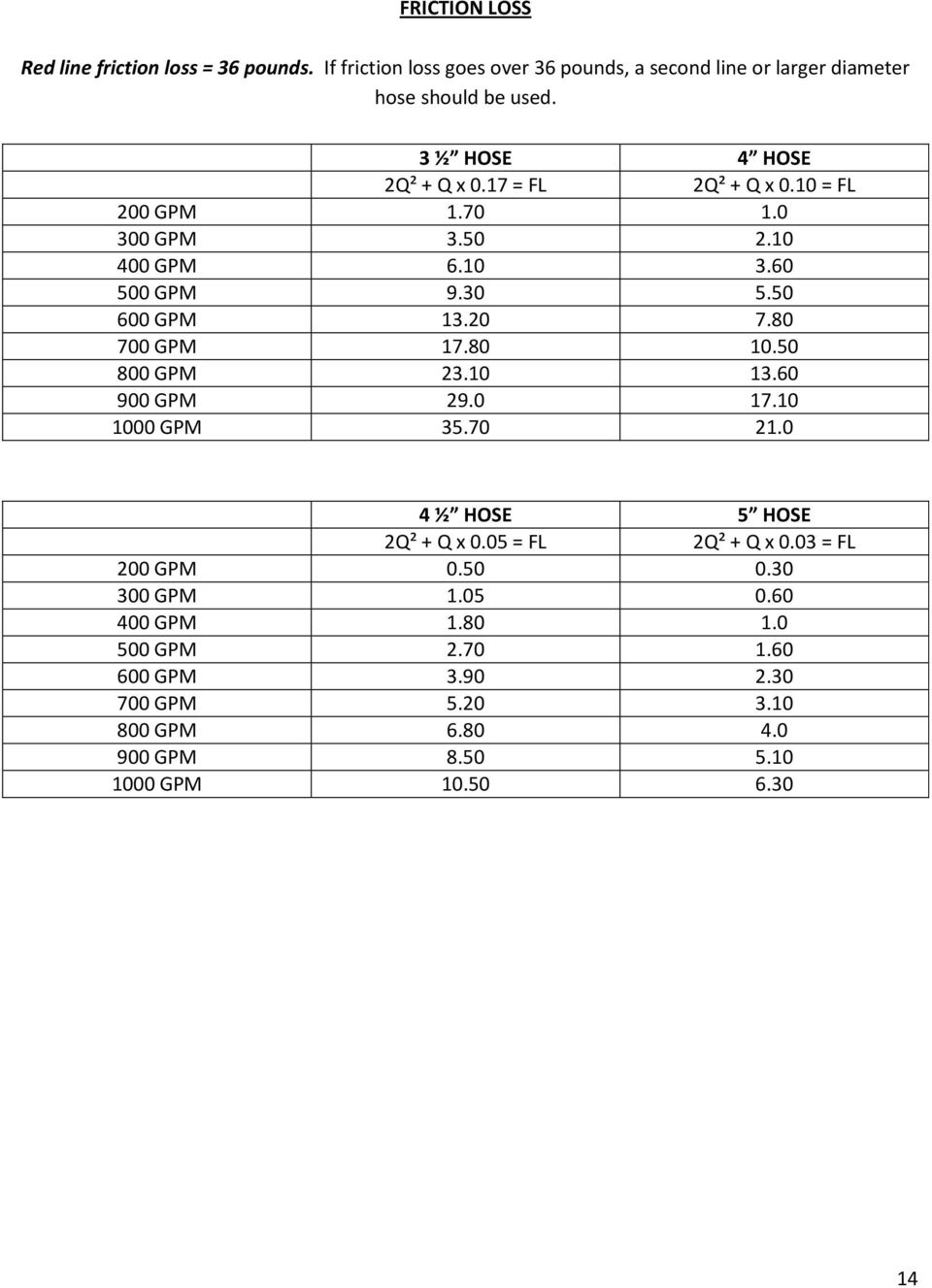
14 FRICTION LOSS Red line friction loss = 36 pounds. If friction loss goes over 36 pounds, a second line or larger diameter hose should be used. 3 ½ HOSE 4 HOSE 2Q² + Q x 0.17 = FL 2Q² + Q x 0.10 = FL 200 GPM GPM GPM GPM GPM GPM GPM GPM GPM ½ HOSE 5 HOSE 2Q² + Q x 0.05 = FL 2Q² + Q x 0.03 = FL 200 GPM GPM GPM GPM GPM GPM GPM GPM GPM
15 COURSE STANDARDS FOR CALCULATING ENGINE DISCHARGE PRESSURES NOZZLE OR TIP FLOW PRESSURE NOZZLE FRICTION LOSS PER 100 FEET OF HOSE 1 ½ 1 ¾ 2 ½ 3 1 ½ 100 GPM 100psi 30 1 ¾ 150 GPM 100psi 32 2 ½ 250GPM 100psi GPM 50psi ⅛ 250 GPM 50psi ¼ 300 GPM 50psi ¼ 400 GPM 80psi *36* ⅜ 500 GPM 80psi ½ 600 GPM 80psi 78 *31.2* 1 ⅝ 700 GPM 80psi ¾ 800 GPM 80psi ⅞ 900 GPM 80psi GPM 80psi *RED LINE FORMULA FOR ENGINE PRESSURE CALCULATIONS DP = NP + FL + AFL + E Pump Discharge Pressure (DP) = Nozzle Pressure (NP) + Friction Loss (FL) + Appliance Friction Loss (APL) + Elevation (E) Relays maintain 20psi for receiving pumper Hydrant Residual maintain 10psi from hydrant Wyes/Siamese 10psi loss Standpipe Systems 25psi loss Master Stream Devices 20psi loss Elevation 5psi per floor (exclude one floor) or ½ psi per foot 15

16 SUPPLY & SUPPORT OF SPRINKLERS & STANDPIPE SYSTEMS The following are suggested methods to indicate if you re not getting into a sprinkler or standpipe system with a supply line. A. In warm, humid weather, the lack of condensation on the hose coupling attached to the discharge port supplying this line B. The discharge port and hose butt supplying this line is or becomes warm C. Lack of a drop in the residual pressure as read on the compound gauge as this line is charged a. Once the supply line is full, there is no further movement of water D. The inability to gate and feather various pressures on the discharge port to which this line is attached a. The third principle of fluid pressure, Pressure applied to a confined fluid from without is transmitted in all directions without diminution. NOTE: Methods A and B may not be readily apparent or the best indication, especially if the pumper is supplying additional lines which are already flowing. SUPPLYING A STANDPIPE SYSTEM WHEN THE FIRE DEPARTMENT CONNECTION IS NOT USABLE When the fire department connection (siamese) supporting a standpipe system is not usable; and the check valve below the fire department connection (siamese) is inoperative, the following procedure should be followed: 1. Stretch a line from the pumper to a gated outlet on the first floor 2. Remove any house lines, reducer connections and/or pressure reducers 3. Connect the pumper supply line to the discharge outlet using a double female adapter 4. When the water is started in the supply line, the outlet valve is opened fully to allow water to flow into the riser 5. Where the hose outlet extends at a right angle from the riser, the weight of the hose and fittings should be supported by a short length of rope 6. If necessary, additional lines can be similarly stretched to hose outlets on other floors When the fire department connection (siamese) has a frozen swivel, placing a double male and double female adapter on the connection can overcome this difficulty. 16

17 SIAMESE OPERATIONS When it becomes necessary for a pumper to deliver large quantities of water, a siamese operation will be needed. Siamesing lines is one way of reducing the excessive friction loss created by large volume flows. Though it may look difficult to compute, it is actually no harder than a single line. When it becomes necessary to siamese, divide the GPM by the number of lines that pump is supplying. Next, compute the friction loss for one line at the reduced GPM flow and disregard the other lines. All that remains is to add either the Nozzle Pressure if supplying a deluge gun or 20psi for residual pressure if supplying another engine. EXAMPLE: It is necessary to supply a deluge set with a 1¾ tip from 400 feet away. This lay would require 800 GPM which would create 55 pounds FL per 100 feet in 3 hose; therefore, siamesing is necessary. EQUAL SIZE LINES 1. Divide the total GPM by two lines. This will five 400 GPM through each line. 2. Compute the friction loss for one line of 3 hose delivering 400 GPM a. 4 x 4 x = 36 x 0.4 = 14.4 or 15 pounds of FL per 100 feet of hose 3. Multiply the FL for 100 feet by the length of the lay in hundreds of feet a. 15 x 4 = 60psi FL for the total lay 4. Add 80 pounds NP to the 60 pounds FL = 20 pounds approximate loss for the deluge set and this will be the engine discharge pressure a = 160 pounds engine pressure EXAMPLE: If, in the above lay, it was necessary to use a 2½ and a 3 line, FL would be computed just a bit differently. UNEQUAL SIZE LINES 1. Divide the total GPM by two lines; this will give 400 GPM through each line 2. Compute the friction loss for one line of 2½ hose delivering 400 GPM a. 4 x 4 x = 36 pounds FL per 100 feet 3. Compute the friction loss for one line of 3 hose delivering 400 GPM a. 4 x 4 x = 36 x 0.4 = 14.4 or 15 pounds FL per 100 feet of hose 4. Add the two FL answers together and divide by two a = 51/2 = 14.4 or 15 pounds FL per 100 feet of hose 5. Multiply the FL for 100 feet by the length of the lay in hundreds of feet a. 25 x 4 = 100 pounds FL for the total lay 6. Add 80 pounds NP to the 100 pounds FL + 20 pounds approximate FL in the deluge set a = 200 pounds engine pressure 17

18 RULE OF THUMB for siamese of unequal size, but of equal length (2½ -3 ) 1-2 ½ & 1-3 SIAMESE LINES TOTAL GPM FL PER 100 FEET WYE OPERATIONS Wye operations are very common and are used in one way or another on just about any fire of consequence. Sometimes they are used to get 1½ hand lines to the fire where the reach is too long for a pre-connect. On most large fires, they are used for overhaul from 2½ lines rather than laying longer and/or additional lines of 1½. Another use would be to get two 2½ lines on a fire from one 3 supply line. Wye operations, like siamese operations are used to reduce friction loss. By the use of a wye, one may have one large supply line feeding two or more smaller hand lines. EXAMPLE: 400 feet of 2½ hose wyed to two 200 foot lines of 1½ hose. 1. Total the GPM from both 1½ lines. This is the amount of water for which the supply line must be computed a. 100 GPM GPM = 200 GPM for both 1½ lines b. Therefore, the 2½ supply line is flowing 200 GPM 2. Compute the friction loss for the supply line a. 2 x 2 x = 10 pounds FL for 100 feet of hose 3. Compute the friction loss for the supply line a. 30 pounds FL per 100 feet = 60 pounds total (disregard the second line) pounds FL for the 2½ supply line 60 pounds FL for the 1½ hand line 100 pounds NP + 10 pounds for the wye 210 pounds Engine Discharge Pressure 18

19 The lay would give 200 GPM through two 1½ lines 600 feet from the engine. The engine would be running at a discharge pressure of 210 pounds. If there were two 1½ lines each 600 feet in length, the discharge pressure would be 280psi and the engine would be running at excessive RPM for the job. FRICTION LOSS CALCULATIONS FOR ELEVATED STREAMS FROM PRE-PIPED WATERWAYS When it is necessary to supply a pre-piped waterway, there are some basic facts the FAE will have to know: 1. It is necessary to supply the water to the pump inlets or aerial intake when by-passing the pump and supplying the total operation 2. It is necessary to know the size tip that is intended for use in order to calculate pressure, determine the number of lines required and their diameter Since the waterways on pre-piped aerials are made of pipe, the following constants are used to determine the friction loss in the piping, master stream at different gallon flows. The friction loss factor for pre-piped waterways will include the friction loss in the: 1. Piping 2. Turret gun 3. Intake at the GMP flow provided For course and testing purposes, the Fire Apparatus Engineer Committee has accepted a standard flow for pre-piped waterway of 1000 GPM. When supplying a pre-piped waterway flowing 1000 GPM, a friction loss of 60psi will be used; which includes the intake, piping and master stream device. When pumping directly to the waterway, an additional 20psi will be added for the friction loss in the direct piping. Departments are encouraged to flow test their own apparatus to determine the actual friction loss. There are four ways to supply a pre-piped waterway: 1. Ladder truck pumps through internal piping to the ladder 2. Ladder truck pumps through hose into the ladder intake 3. Engine company pumps into the ladder intake 4. Relay to ladder truck pump operator (refer to relay operations) 19

20 EXAMPLE 1: It is necessary to supply a pre-piped aerial ladder. The aerial is elevated 50 feet above grade on a 100 foot aerial with a 2 tip (1000 GPM). The FAE decides to use two 100 foot lengths of 3 hose as feeder lines to supply the aerial s siamese in the rear of the aerial. Each of the lines will carry 500 GPM and the friction loss in the feeder lines will be about 22 pounds for the 100 foot lay. The constant is 60psi friction loss on a 100 foot pre-piped aerial ladder intake connection and master stream device. Obtain the engine pressure and add as follows: 22psi loss for two 100 foot lengths of 3 feeder line 60psi loss for 100 foot pre-piped aerial, intake and master stream 25psi loss for elevation + 80psi loss for nozzle pressure 187psi will be the Engine Discharge Pressure EXAMPLE 2: Using the same pre-piped aerial ladder as Example 1, except this time the FAE will use the piping form the pump to the aerial: 60psi loss for 100 foot pre-piped aerial, intake and master stream 20psi loss for piping from the pump to the base of the aerial ladder 25psi loss for elevation + 80psi loss for nozzle pressure 185psi will be the Engine Discharge Pressure The examples given above have been figured with 60psi friction loss in the piping of a 100 foot aerial ladder flowing 1000 GPM as a standard. All students having aerial devices shall utilize the manufacturer s specified friction loss in their department s pre-piped aerials. 20

21 ELEVATED STREAM MISCELANEOUS NOTES The following are some recommended procedures for obtaining good elevated streams: 1. Try to keep supply lines under 300 feet 2. Nozzle pressure should be 80psi for solid streams and 100psi for fog streams For each foot of elevation, the weight of water produces a pressure of pounds per square inch. This may be rounded off to 0.5 pounds per foot of elevation for fire ground calculations. Consider the simple basics, good elevated streams are possible if: 1. The proper size tip or fog nozzle is used for the available water supply and pumping capacity 2. Sufficient lines of sufficient diameter are run from the pumper to the base of the elevated apparatus 3. Sufficient pressure is maintained The modern aerial ladder is a valuable piece of equipment of the department that uses it well. Yet, if used incorrectly, firefighters can be seriously endangered; maintenance costs needlessly high; and fire losses increased. Careful study, supervised training and constant practice are needed to bring the engineer s skill to the highest point of efficiency. 21
22 GENERAL OPERATING SUGGESTIONS FOR CENTRIFUGAL FIRE PUMPS A centrifugal pump is designed for a specific duty and ordinarily will perform this duty satisfactorily over a long period of time. On occasion however, trouble will show up in one form or another and even an experienced operator may have difficulty in locating and correcting it. The suggestions listed below should be helpful. IF THE PUMP WILL NOT PRIME OR LOSES PRIME 1. Air leaks a. Faulty connection i. Suction hose or gasket ii. Discharge valves or gaskets iii. Booster tank iv. Drain valves v. Gauge b. Faulty pump packing c. Leaky pump gaskets All suction hose gaskets should be wiped clean of sand, pebbles and any other foreign matter before hose is attached to the pump. Hose couplings should be tightened snugly enough to make air-tight connections. Main pump packing should always be kept adjusted tightly enough to prevent excessive leakage (see manufacturer s operating instructions for proper packing adjustment procedure). 2. Detecting air leaks a. Connect suction hose to the pump with a cap on the opposite end of the hose b. Close all pump openings c. Open the priming valve and operate the primer until vacuum of inches of mercury is shown on the vacuum gauge i. If it is impossible to draw this much vacuum, the primer may be defective d. Close the priming valve and shut off the primer e. Shut off the engine i. If leaks are present: 1. The vacuum will promptly decrease as shown by the vacuum gauge 2. If the vacuum drops more than 10 inches of mercury in five minutes 3. Locating air leaks Air leaks may frequently be detected by ear if the engine is stopped. Applying water or oil to the suspected points may aid in detecting leaks. Leaks may be found by applying water pressure to the pump and suction hose by means of an auxiliary pump or hydrant. Pressures should be approximately 50psi and should not exceed that recommended for the suction hose or pump. 22
23 a. Dirt in the suction screens i. Dirt-clogged suction screens may make it difficult to prime the pump, as well as cause the pump to lose its prime after it is started ii. When operating from a draft, be sure suction screens are kept clean 1. Be sure to keep the end of the suction hose off the lake or river bottom 2. For this purpose, a special box or basket, which fits around the suction strainer or is threaded to the end of the hose, is frequently fabricated b. Engine speed too low i. Follow the manufacturer s recommendation for priming ii. Speeds higher than those recommended do not accelerate priming c. Primer not operated long enough i. Follow the manufacturer s recommendation ii. The maximum time for priming for lifts of 10 to 15 feet should not exceed 30 seconds for 1250 GPM pumps or below; or 45 seconds for 1500 GPM pumps or above d. Lack of oil in the primer reservoir i. Where a mechanically driven or electrically driven rotary primer is in use, an adequate supply of oil should always be kept in the reservoir to lubricate and seal the priming pump e. Improper clearance in rotary primer i. Due to wear, the clearance between the priming pump rotors and head may become so large as to cause poor priming characteristics 1. In this case, the proper clearance should be restored by the method outlined by the manufacturer in the priming pump operating instructions f. Excess carbon on exhaust primer valve seats i. See exhaust primer manufacturer s operating instructions to remove carbon g. Defective priming valve i. A broken or deteriorated priming valve spring may cause the valve to leak and the pump to lose its prime. ii. Worn parts in the priming valve may also allow air leakage h. High point in suction line i. High points in the suction line (caused, for example, by running suction hose over a bridge railing) create air pockets which may case loss of prime ii. In some cases, it may be impossible to rearrange the suction hose to eliminate the high point 1. In this case, prime may be obtained by closing the discharge valve immediately when the pressure drops and then re-priming 2. This procedure usually eliminates the air pocket which was drawn into the impellers when the pump was started after first priming; however, it may have to be repeated in some situations 23
24 i. Suction lift too high i. Lifts of more than 20 feet should not be attempted, even at low altitudes, unless there are practically no air leaks and the equipment is in new condition 1. In this case, higher lifts may be obtained j. End of suction hose not under water i. The end of the hose may be submerged enough for priming, but when a large volume of water is pumped, a whirlpool is sometimes formed which uncovers the end of the hose IF PUMP WILL NOT DELIVER CAPACITY The following may prevent the pump from delivering its rated capacity: 1. Relief valve improperly set a. If a relief valve is set at a pressure below the desired operating pressure it will bypass water and lower the capacity (see manufacturer s relief valve operating instructions) 2. Badly worn wear rings a. Failure of the pump to deliver its rated capacity at a given pressure may be an indication that the impeller war rings are badly worn, allowing excessive quantities of water to leak around them 3. Suction screen and impeller vanes fouled with debris a. Backwash of water from the pump through the impellers when the pump is stopped usually cleans the impeller vanes i. Debris on the pump suction screen however, usually remains in the suction hose and is immediately caught by the screen when pumping is resumed ii. Therefore, the suction hose should be removed and cleaned 4. Chassis transmission in wrong gear a. See operating instructions 5. Suction hose has collapsed a. On defective or old suction hoses, the inner liner often collapses when drafting water, thus restricting the flow of water to the pump b. Collapse of the inner liner is often hard to detect even when the inside of the hose is examined with a light i. This is due to the fact that the inner liner often goes back in place when the suction vacuum is removed ii. If the pump will deliver capacity with a different suction hose, it is reasonable to assume the liner on the former hose has become loosened 6. Suction hose not submerged deeply enough a. The lower end of the suction hose should be submerged at least two feet below the surface of the water to avoid taking in air 24
25 7. Suction hose too small a. When higher than normal lifts are involved or at high altitudes, larger hose is needed 8. Insufficient engine power a. Although the engine had sufficient power originally, there are several reasons why the power can decrease to the point at which it will not handle the pump at the rated capacity and pressure b. Things to suspect are: i. Incorrect timing ii. Fouled spark plugs iii. Burned distributor points iv. Weak condenser or coil v. Sticking valves vi. Worn piston rings vii. Worn fuel pump poor carbonation c. Also, if the engine is operated at higher than normal altitudes, the power may be too low i. The power of an engine decreases about 3-4% for every 1000 feet of increase in altitude d. Excessive engine temperatures, which frequently occur in hot weather and during long periods of operation reduce the power i. This can be caused by: 1. Clogged radiator or heat exchanger 2. Insufficient coolant 3. Worn water pump 4. Loose fan belt 5. Deteriorated crank case oil e. Transfer valve improperly set i. Does not apply to single stage pumps ii. The valve should be in a parallel (volume) position when pumping more than one half of the rated capacity iii. When changing the position of the valve, make sure it is moved completely into the new position; if not, the pump performance may be seriously affected 25
26 IF PUMP WILL NOT DEVELOP SUFFICIENT PRESSURE In general, conditions which prevent the pump from delivering the rated capacity will also affect the pressure adversely. The following may prevent the pump from developing sufficient pressure: 1. Relief valve improperly set a. A relief valve properly set will prevent the pump pressure from rising much above that at which it is set i. Consequently, too low a setting causes too low a pressure ii. See manufacturer s relief valve operating instructions 2. Insufficient pump speed a. May be due to one or more of the following: i. Impeller wear rings or other pump parts binding ii. Clutch slippage iii. Chassis transmission in wrong gear iv. Governor limiting engine speed v. Insufficient engine power 3. Transfer valve improperly set a. Does not apply to singe stage pumps b. The transfer valve should be in series (pressure) when pumping at high pressures 4. Capacity limiting pressure a. Care should be taken not to attempt to take more water from the pump than it can handle at the desired pressure (see instructions on operation of pump) b. If the pump is operating at draft under normal suction conditions and the maximum rated capacity is exceeded the pressure will be low due to the characteristic of a centrifugal pump even if the engine has plenty of power and speed c. Excess capacity may raise the suction vacuum to a point above that which the pump was designed and lowered pressures will result d. On pumping units having engines with low surplus power, the pressure will be limited by engine power if surplus capacity is being pumped 26
27 AUTOMATIC PUMP PRESSURE CONTROLLER The automatic pump pressure controller is a device which regulates the engine speed of a pumper to preclude surges or drops in the pressure of operating discharge lines as other lines are closed or opened. The basic method by which the device works is to compare the pump discharge pressure to a reference pressure stored, when the pump is set into operation, in a device called an accumulator. As pump discharge pressure varies in response to changing discharge volumes, the reference pressure in the accumulator acts on a hydraulic cylinder which in turn actuates a rod connected to the throttle linkage thereby adjusting the engine speed. The operating range of most automatic pump pressure controllers is between pounds. If the pump pressure drops below 30 pounds per square inch, the unit automatically disengages, thus protecting the engine as in the case of loss of prime. This device is equally effective with gasoline or diesel engines. 27
Firefighter Review. Instructor Guide
 Firefighter Review Instructor Guide Session Reference: 3 Topic: Attack Line Handling Level of Instruction: Time Required: Three Hours Materials: Two Fully Equipped Pumpers Structure for Use in Advancing
Toms River Fire Academy
 Pump School Manual Toms River Fire Academy Table of contents Chapter 1 Characteristics of Water Page 3 Pressures, Atmospheric, Static, Residual, Head.Page 7 Chapter 2 Pump Construction and Gauges Page
INTERNATIONAL FIRE TRAINING CENTRE FIREFIGHTER INITIAL PUMPS AND PRIMERS. Throughout this note he means he/she and his means his/hers.
 INTERNATIONAL FIRE TRAINING CENTRE FIREFIGHTER INITIAL PUMPS AND PRIMERS Throughout this note he means he/she and his means his/hers. Areas of bold type are considered to be of prime importance. INTRODUCTION
AKRON EDUCTORS TROUBLESHOOTING GUIDE OPERATION & THEORY OF EDUCTORS GENERAL OPERATING AND MAINTENANCE INSTRUCTIONS
 AKRON EDUCTORS TROUBLESHOOTING GUIDE OPERATION & THEORY OF EDUCTORS GENERAL OPERATING AND MAINTENANCE INSTRUCTIONS Products Include: 60 gpm eductors Style 3060, 3061, 3062 & 3070 95 gpm eductors Style
CENTRIFUGAL PUMP OVERVIEW Presented by Matt Prosoli Of Pumps Plus Inc.
 CENTRIFUGAL PUMP OVERVIEW Presented by Matt Prosoli Of Pumps Plus Inc. 1 Centrifugal Pump- Definition Centrifugal Pump can be defined as a mechanical device used to transfer liquid of various types. As
I. Introduction. 10 minutes
 I. Introduction 10 minutes Introduction (1 of 2) An uninterrupted water supply is: The primary weapon for extinguishment Essential for fire fighter safety Ensuring a dependable water supply is a critical
Pump ED 101. Positive Displacement Pumps. Part I Reciprocating Pumps
 Pump ED 101 Positive Displacement Pumps Part I Reciprocating Pumps Joe Evans, Ph.D http://www.pumped101.com There are many pump designs that fall into the positive displacement category but, for the most
Chapter 7 Hydraulic System Troubleshooting
 Chapter 7 Hydraulic System Troubleshooting General The following troubleshooting information is provided as a general guide to identify, locate and correct problems that may be experienced with the hydraulic
TROUBLESHOOTING GUIDE
 RJS SELF-PRIMING SHALLOW WELL JET PUMPS a. Motor will not start: 1. No power to pressure switch due to blown fuses, open switches or loose connections. 2. Pump pressure switch not closed. b. Pump fails
Hydraulic Trouble Shooting
 Hydraulic Trouble Shooting Hydraulic systems can be very simple, such as a hand pump pumping up a small hydraulic jack, or very complex, with several pumps, complex valving, accumulators, and many cylinders
HS-901(A) BASIC STEAM HEATING SYSTEMS
 HS-901(A) BASIC HEATING SYSTEMS One-Pipe Two-Pipe Basic Steam Heating Systems One-pipe steam heating system EQUALIZER SAFETY FACTOR STATIC HEAD PRESSURE DROP 2" HEATING UNIT 15" DRIP CONNECTION In a one-pipe,
MOBILE FIRE - RESCUE DEPARTMENT FIRE CODE ADMINISTRATION
 MOBILE FIRE - RESCUE DEPARTMENT FIRE CODE ADMINISTRATION Fire Pump Plan Review 2009 International Fire Code and NFPA 20 Date of Review / / BLD201 - Project Address: Project Name: Contractor s Business
Springdale Fire Department Backup Driver Certification Program. Behavioral Objectives
 Springdale Fire Department Backup Driver Certification Program Backup Driver Task Book I. Obtain required prerequisites 1. Performance a. Complete Probationary Program b. Complete CEVO Fire Course c. Complete
TRAINING AND EQUIPMENT MANUAL HOSE PRACTICES EFFECTIVE: OCTOBER 2007
 TRAINING AND EQUIPMENT MANUAL HOSE PRACTICES 301.010 ANNUAL SERVICE TEST FOR FIRE HOSE EFFECTIVE: OCTOBER 2007 The Department will test all fire hose annually. The testing of fire hose determines its serviceability.
A.Y. McDonald Mfg. Co. Troubleshooting Submersible and Jet Pumps
 A.Y. McDonald Mfg. Co. Troubleshooting Submersible and Jet Pumps Troubleshooting Submersible Pumps Fuse overload or circuit breaker trips when motor is started 1. Incorrect line voltage. Check the line
TRAINING BULLETIN Fire Apparatus Pump Test
 TOPIC: TRAINING BULLETIN Fire Apparatus Pump Test EFFECTIVE DATE: 05/06 DOC NO: TB081 CROSS REF: INTRODUCTION District Fire Apparatus Pump Testing is completed on an annual basis. Currently, pump testing
Fire Pump Plan Review March 2010
 Fire Pump Plan Review March 2010 Date of Review: / / Permit Number: Business/Building Name: Address of Project: Designer Name: Designer s Phone: Contractor: Contractor s Phone: Occupancy Classification:
Table V. Troubleshooting Checklist for Refrigeration Systems. Air or non-condensable gas in system. Inlet water warm.
 Table V Troubleshooting Checklist for Refrigeration Systems TROUBLE POSSIBLE CAUSE CORRECTIVE MEASURE High condensing pressure. Low condensing pressure. Air or non-condensable gas in system. Inlet water
Centrifugal Fans and Pumps are sized to meet the maximum
 Fans and Pumps are sized to meet the maximum flow rate required by the system. System conditions frequently require reducing the flow rate. Throttling and bypass devices dampers and valves are installed
CDS TROUBLESHOOTING SECTION I. VACUUM. 1.0. Weak vacuum at wand. Gauge reads normal (10hg to 14hg)
 CDS TROUBLESHOOTING SECTION I. VACUUM 1.0. Weak vacuum at wand. Gauge reads normal (10hg to 14hg) 1.1. Clogged hoses or wand tube. Disconnect hoses and carefully check for an obstruction. 1.2. Excessive
Unit 24: Applications of Pneumatics and Hydraulics
 Unit 24: Applications of Pneumatics and Hydraulics Unit code: J/601/1496 QCF level: 4 Credit value: 15 OUTCOME 2 TUTORIAL 3 HYDRAULIC AND PNEUMATIC MOTORS The material needed for outcome 2 is very extensive
Fire Hydrant Troubleshooting
 Fire Hydrant Troubleshooting Pulsation or chatter during opening and flow of water from hydrant. Loose condition in stem at lower valve plate nut. Tighten lower valve plate nut and secure with SS lock
Hydraulic Troubleshooting PRESENTED BY
 Hydraulic Troubleshooting PRESENTED BY NORMAN KRONOWITZ Introduction Welcome to the CMA/Flodyne/Hydradyne s Hydraulic Troubleshooting presentation. We will introduce many aspects of troubleshooting hydraulic
Example. Fluid Power. Circuits
 Example Fluid Power Circuits To Enhance Symbol Reading Skills To Work On Circuit Reading Skills With Answers HI LO Pump Circuit 18 A1 B1 17 16 15 13 Set 14 2,000 PSI PG2 Set 500 PSI 12 11 7 8 10 PG1 9
ELECTRIC/DIESEL FIRE PUMP CHECK LIST
 BUILDING NAME: DESIGNER: SCO REPRESENTATIVE: PUMP MANUF.: LOCATION: INSTALLER: DATE: OWNER NAME: INSTALLATION Certificate for flushing and hydrostatic test furnished Piping been hydrostatically tested
Trouble Shooting Tech Tips Operation
 Steering Components TroubleShooting Tech Tips Table of Contents Basic Steering System Operation 2 Sector Shaft Adjustments 4 Drag Link Adjustment 5 Relief Valve/Unloading Valve Adjustment 6 Ross TAS Automatic
Trouble Shooting. Pump
 Trouble Shooting Pump Trouble Possible Cause Remedy Oil leaking in the area of water pump crankshaft Worn crankshaft seal, bad bearing, grooved shaft, or failure of retainer o-ring. Excessive play on crankshaft
Failure to comply with the following cautions and warnings could cause equipment damage and personal injury.
 1.0 IMPORTANT RECEIVING INSTRUCTIONS Visually inspect all components for shipping damage. Shipping Damage is not covered by warranty. If shipping damage is found, notify carrier at once. The carrier is
TOPIC: 191004 KNOWLEDGE: K1.01 [3.3/3.5] Which one of the following contains indications of cavitation in an operating centrifugal pump?
![TOPIC: 191004 KNOWLEDGE: K1.01 [3.3/3.5] Which one of the following contains indications of cavitation in an operating centrifugal pump?](/thumbs/17/105210.jpg "TOPIC: 191004 KNOWLEDGE: K1.01 [3.3/3.5] Which one of the following contains indications of cavitation in an operating centrifugal pump?") KNOWLEDGE: K1.01 [3.3/3.5] P21 Which one of the following contains indications of cavitation in an operating centrifugal pump? A. Low flow rate with low discharge pressure. B. Low flow rate with high discharge
KNOWLEDGE: K1.01 [3.3/3.5] P21 Which one of the following contains indications of cavitation in an operating centrifugal pump? A. Low flow rate with low discharge pressure. B. Low flow rate with high discharge
ENGINE COOLING SYSTEM
 ENGINE COOLING SYSTEM 1988 Toyota Celica 1987-88 TOYOTA Engine Cooling Systems Celica DESCRIPTION The basic liquid cooling system consists of a radiator, water pump, thermostat, cooling fan, pressure cap,
WHAT YOU DON T KNOW ABOUT ACCUMULATORS CAN KILL YOU!
 WHAT YOU DON T KNOW ABOUT ACCUMULATORS CAN KILL YOU! Atlanta (Monroe) GA 770-267-3787 [email protected] www.gpmhydraulic.com What You Don t Know About Hydraulic Accumulators Can Kill You TABLE OF CONTENTS
Hydraulics Trouble Shooting Guide. TS-Guide_R.doc
 Hydraulics Trouble Shooting Guide TS-Guide_R.doc Table of Contents Condensed Table... 1 Valves... 3 Cylinders... 3 Boosters... 4 Fluid Motors... 5 Vane Pumps... 6 Radial Piston Pumps... 9 Hydraulic Systems...
MAINTENANCE OF WHEELMOVE IRRIGATION SYSTEMS
 MAINTENANCE OF WHEELMOVE IRRIGATION SYSTEMS F. Richard Beard, Agricultural Equipment, Structures and Electricity Robert W. Hill, Biological & Irrigation Engineering Boyd Kitchen, Uintah County Extension
Electric Brake Trouble Shooting Guide
 Electric Brake Trouble Shooting Guide PROBLEM CAUSES REMEDIES S OPEN CIRCUITS SEVERE SHORT CIRCUITS FIND AND S FIND AND WEAK S GREASE/OIL ON MAGNETS/LININGS CORRODED CONNECTIONS WORN LININGS OR MAGNETS
Theory, Application, and Sizing of Air Valves
 Theory, Application, and Sizing of Air Valves VAL-MATIC VALVE AND MANUFACTURING CORP. 905 RIVERSIDE DRIVE, ELMHURST, IL 60126 TEL. (630) 941-7600 FAX. (630) 941-8042 www.valmatic.com 1 THEORY, APPLICATION,
Define Fire Stream. A stream of water, or other extinguishing agent, after it leaves the fire hose and nozzle until it reaches the desired point
 Nozzles and Streams Define Fire Stream A stream of water, or other extinguishing agent, after it leaves the fire hose and nozzle until it reaches the desired point Identify the Purposes of a Fire Stream
Class 5 to 7 Truck and Bus Hydraulic Brake System
 Class 5 to 7 Truck and Bus Hydraulic Brake System Diagnostic Guide 1st Edition * 5+0 Important Service tes The information in this publication was current at the time of printing. The information presented
Oxy-Fuel Gas Welding. Given a functional oxy-fuel gas unit, instruction and demonstration of use, each student will be able to:
 I. Competencies Oxy-Fuel Gas Welding Given a functional oxy-fuel gas unit, instruction and demonstration of use, each student will be able to: A. Identify the major parts of the oxy-fuel gas unit. B. Pass
Pumps SELECTION OF A PUMP
 Pumps SELECTION OF A PUMP A water system needs to move the water produced from the source to its customers. In almost all cases in Minnesota, the source is at a lower elevation than the user so the water
Air Eliminators and Combination Air Eliminators Strainers
 Description Air Eliminators and Combination Air Eliminator Strainers are designed to provide separation, elimination and prevention of air in piping systems for a variety of installations and conditions.
FAIRBANKS NIJHUIS FIRE PUMPS. www.fairbanksnijhuis.com
 FAIRBANKS NIJHUIS FIRE PUMPS www.fairbanksnijhuis.com FAIRBANKS NIJHUIS Long established as a leading fire pump manufacturer, Fairbanks Nijhuis offers a broad range of horizontal and vertical split case,
BOWIE PUMPS OPERATION - MAINTENANCE
 BOWIE PUMPS OPERATION - MAINTENANCE PUMPING PRINCIPLE: The meshing owieeof the gears cause a slight depression, with the resulting enmeshing of the gears causing a vacuum drawing the fluid being pumped
Carburetion Troubleshooting Quick Reference Guide
 Carburetion Troubleshooting Quick Reference Guide SERVICE DIAGNOSTIC OVERVIEW A logical, planned approach can move service work through a repair center in a smooth and efficient manner. Fueled by information
The In-Line Gauge in Standpipe Operations
 The In-Line Gauge in Standpipe Operations BY RUSS CHAPMAN Your engine company receives a report of fire in a mid-rise elderly housing complex during morning coffee at the beginning of a shift. You know
Operating, Installation, and Maintenance Instructions
 ELKHART BRASS MFG. CO., INC. 1302 WEST BEARDSLEY AVENUE P.O. BOX 1127 ELKHART IN 46515 (574) 295-8330 FAX (574) 293-9914 Operating, Installation, and Maintenance Instructions RAM Personal Portable Monitor
Float and Thermostatic Traps Series H, C and X
 Hoffman Specialty Installation & Maintenance Instructions HS-(E) and Thermostatic Traps Series H, C and X Series C & NPT Series C NPT Series X NPT Series C NPT Series H Ratings Maximum Max. Operating NPT
OPERATIONS & MAINTENANCE (O&M) FOR PROPANE STORAGE FACILITIES
 OPERATIONS & MAINTENANCE (O&M) FOR PROPANE STORAGE FACILITIES Reference: National Fire Protection Association (NFPA) Pamphlet No. 58 Liquefied Petroleum Gas Code, 2001, Chapter 11 Type of Facility: Petroleum
Quik Lining Systems Heater Owners Guide
 Quik Lining Systems Heater Owners Guide Quik Lining Systems, Inc is pleased to present the Quik Heater, an innovative heater used to cure cured in place pipe for sewer laterals. The unit is the most cost
Quiz On Information Learned From Chapter 1
 Quiz On Information Learned From Chapter 1 1. Most hydraulic circuits are designed by: A. mechanical engineers. B. fluid power engineers. C. fluid power distributor salesmen. 2. Atmospheric pressure at
Rexroth Hydraulic Pump A10VO Series User Manual
 Rexroth Hydraulic Pump A10VO Series User Manual Rexroth Hydraulic pump A10VO Series User Manual Revised 5/1/2009 Page 1 of 12 Functional Purpose This pump is preferred over a fixed displacement (gear)
Constantemp Double Wall Low pressure steam-water Heater F-340LDW,F-640LDW, F-940LDW and F-1240LDW
 Installation, Operating and Maintenance Instructions 90/4.5.5 Rev. 0 Constantemp Double Wall Low pressure steam-water Heater F-340LDW,F-640LDW, F-940LDW and F-1240LDW Table of Contents SECTION I... 2 INSTALLATION...
BUT PRECAUTIONS MUST BE TAKEN OR SERIOUS BURNS CAN RESULT.
 Cooling System Operation Below is an explanation of this system's operation Radiator The radiator is a device designed to dissipate the heat which the coolant has absorbed from the engine. It is constructed
Lebanon Fire Department Lebanon Engine 512 Check Sheet
 Page 1 of 8 Initials Engine Oil Transmission Fluid Windshield washer fluid Radiator level Power Steering Fluid Mileage (All digits) Brakes/Air Tanks Fuel Level Windshield Wipers Brake Lights Interior Lights
PUMPS TYPE OF PUMP PRESSURE/FLOW RATING CHARACTERISTICS. Centrifugal Low Pressure/High Flow Flow changes when
 PUMPS Pumps provide the means for moving water through the system at usable working pressures. The operation and maintenance of these pumps are some of the most important duties for many water utility
MAINTENANCE AND SERVICE OF AUTOMATIC FIRE EXTINGUISHING SYSTEMS
 FIRE DEPARTMENT Bureau of Fire Protection and Life Safety www.cityofsanmateo.org 1900 O Farrell, Suite 140 San Mateo, CA 94403-1332 (650) 522-7940 FAX: (650) 522-7941 TDD: (650) 522-7047 MAINTENANCE AND
The Secret of Hydraulic Schematics. BTPHydraulics www.iranfluidpower.com
 The Secret of Hydraulic Schematics BTPHydraulics www.iranfluidpower.com www.iranfluidpower.com Table of Contents The Secret to Reading and Interpreting Hydraulic Schematics... 1 Hydraulic System Schematics...
Fluid Power Formula. These Formula Cover All Fluid Power Applications In This Manual
 These Formula Cover All Fluid Power Applications In This Manual For Computer Programs To Work Problems By Simply Filling In The Blanks See Your Local Fluid Power Distributor Many Companies Web Site Or
CTV-1500 Cooling Tower Vacuum Operating & Maintenance Manual
 CTV-1500 Cooling Tower Vacuum Operating & Maintenance Manual Goodway Technologies Corporation 420 West Avenue Stamford, CT 06902-6384 (203)359-4708 Sales: 1-800-333-7467 Customer Service: 1-800-370-2855
Class A Foam Mixing and Application Equipment
 Class A Foam Mixing and Application Equipment Adding Phos-Chek Class A foam concentrate to water: There are many methods of adding Phos-Chek Class A foam concentrate to water. The different methods have
Installation Manual. Solar Pool Heating System. Read the complete manual before beginning the installation
 Solar Pool Heating System Installation Manual Read the complete manual before beginning the installation 1. Sizing the System Visit www.techno-solis.com to size the system using the sizing calculator.
System Saver 318 Air Compressor for Mack E-Tech and ASET Engines
 Maintenance Manual 31 System Saver 318 Air Compressor for Mack E-Tech and ASET Engines Revised 08-05 NON-THROUGH DRIVE THROUGH DRIVE Service Notes About This Manual This manual provides service and repair
Spare Parts Program. Parts, Consumables & Accessories. 800.837.9711 superproductsllc.com
 Spare Parts Program Parts, Consumables & Accessories TABLE OF CONTENTS Program Introduction 3 Body 4 5 Boom 5 6 Hydraulic 6 Lights & Accessories 7 Tubes, Nozzles & Hose Fittings 8 11 Vacuum 11 Water 12
Cooling system components, removing and installing
 Engine BHW Cooling system components, removing and installing Page 1 / 24 19-1 Cooling system components, removing and installing Warning! When doing any repair work, especially in the engine compartment,
Fig 1 Power Transmission system of Tractor
 POWER TRANSMISSION SYSTEM Transmission is a speed reducing mechanism, equipped with several gears (Fig. 1). It may be called a sequence of gears and shafts, through which the engine power is transmitted
PART 2 FORKLIFT HYDRAULIC SYSTEM
 PART 2 FORKLIFT HYDRAULIC SYSTEM Chapter 1 Description and Operation Component Locations & Circuit Layouts 1 Hydraulic Pump 11 Control Valve 14 Valve Section Oil Flows 15 Anti-Cavitation Valve 22 Velocity
SECTION 812 SEWER LINE, MANHOLE AND WET WELL CLEANING
 812-1 SCOPE OF WORK: SECTION 812 SEWER LINE, MANHOLE AND WET WELL CLEANING a. The Contractor shall provide all labor, materials, equipment, and incidentals necessary to perform the cleaning of sewer lines,
Air/Vacuum Valves. Removal of Air from Pipelines. Allow the Entry of Air into Pipelines. Application:
 /Vacuum Valves Micro-Irrigation and vacuum control is essential to the safety, longevity, efficiency, and performance of an irrigation system. must be allowed to exit pipelines 1) upon startup to prevent
Trash Pumps Models: 56200, 562000, 56201, 562001, 56300, 563000, 56301, 563001
 Trash Pumps Models: 56200, 562000, 56201, 562001, 56300, 563000, 56301, 563001 Specifically designed pumps for heavy duty applications Handles solids with eas and simple to open and clean Standard roll
SunMaxx Solar Filling Station Operating Instructions
 SunMaxx Solar Filling Operating Instructions Content 1. Declaration of conformity... 2 2. Introduction... 2 3. Transportation and unpacking... 4 4. Mounting and commissioning... 5 5. End of operation...
Signature and ISX CM870 Fuel System
 Signature and ISX CM870 Fuel System Cummins Ontario Training Center HPI-TP Fuel System Heavy Duty High Pressure Injection - Time Pressure Fuel System The fuel system developed for the Signature and ISX
Vacuum. How It Relates to Refrigeration And Air Conditioning Service
 Vacuum How It Relates to Refrigeration And Air Conditioning Service Moisture In A Refrigeration System Visible Moisture Water Droplets Uncommon, but it can occur Invisible Moisture Water Vapor Found in
LOS ANGELES COUNTY FIRE DEPARTMENT CONTEXT TRAINING PROGRAM ENGINE COMPANY SKILLS 1 ¾ RESIDENTIAL ATTACK LINES
 3 ENGINE COMPANY SKILLS 1 ¾ RESIDENTIAL ATTACK LINES 1. General Information The attack line of choice for a residential fire is the pre-connected 1 ¾ attack line with an Automatic Nozzle 1 ¾ attack lines
CYLINDER LEAKAGE CHECK (Compression)
 TELEDYNE CONTINENTAL AIRCRAFT ENGINE service bulletin M84-15 SUPERSEDES M76-18 Rev.1 Technical Portions are FAA Approved 21 December 1984 TO: SUBJECT: MODELS AFFECTED: Aircraft Manufacturers, Distributors,
NFPA31FuelOilPiping 1 Revised 3-1-11
 NFPA 31 Fuel Oil Piping, Installation and Testing Chapter 8 Fuel Piping Systems and Components 8.1 Scope. This chapter shall apply to piping systems and their components used to transfer fuel oil from
Failure to comply with the following cautions and warnings could cause equipment damage and personal injury.
 1.0 IMPPORTANT RECEIVING INSTRUCTIONS Visually inspect all components for shipping damage. Shipping Damage is not covered by warranty. If shipping damage is found, notify carrier at once. The carrier is
C. starting positive displacement pumps with the discharge valve closed.
 KNOWLEDGE: K1.04 [3.4/3.6] P78 The possibility of water hammer in a liquid system is minimized by... A. maintaining temperature above the saturation temperature. B. starting centrifugal pumps with the
FIRE,FIREFIGHTING & FIREFIGHTING EQUIPMENT
 FIRE,FIREFIGHTING & FIREFIGHTING EQUIPMENT 1 1. Elements of Fire: The process combustion of fire may be regarded as a chemical triangle in its three side consisting of fuel, heat and oxygen. The control
Pressure Locking & Thermal Binding In Wedge Gate & Parallel Slide Gate Valves
 Pressure Locking & Thermal Binding In Wedge Gate & Parallel Slide Gate Valves CRANE Energy Flow Solutions TM Donald H. Johnson Crane Energy Flow Solutions 1 Crane Co. Resolution Made By Richard Teller
Automatic Fire Sprinkler Submittal Requirements
 Automatic Fire Sprinkler Submittal Requirements All commercial and industrial buildings with a total floor area of 5000 sq. ft. shall have an approved automatic sprinkler system installed. The Windsor-Severance
Overview. Introduction Cooling Tower Basics Principles of Operation Types of Cooling Towers Common Applications Design Considerations
 Stephen Lowe ASHRAE Hampton Roads Chapter Past President AECOM Design Mechanical Engineering Discipline Manager, Virginia Beach Division Professional Engineer Commonwealth of Virginia, NCEES BSME University
VERTICAL TURBINE AND PROPELLER PUMPS
 VERTICAL TURBINE AND PROPELLER PUMPS INTRODUCTION Vertical Turbine and Propeller Pumps Model 7000 Series Turbine Pump Model 800 Series Axial Flow Propeller Pump Model 800 Series Mixed Flow Propeller Pump
800-292-3279 916 638-0828
 800-292-3279 916 638-0828 http://easycleansystems.com/heaters/heater-parts.html VAL6 KBE5S and KBE5L Service manual KBE5S 1 2 Specifications Type VAL6 KBE5S Heat Output 111,000BTU/h Fuel Kerosene, Diesel
CHAPTER. Standpipes and Hose Systems OVERVIEW. Standpipe and Hose Systems Defined
 Standpipes and Hose Systems CHAPTER 3 This chapter, which opens with an overview of standpipe and hose systems, is intended to assist the registered design professional (RDP), commissioning agent, authority
COUNTERBALANCE VALVES
 COUNTERBALANCE VALVES Introduction They are modulating valves which allow free flow into the actuator and then block the reverse flow until they feel a pilot pressure inversely proportional to the load
Diagnosing Hydraulic Problems
 Diagnosing Hydraulic Problems 1 Problems A pressure test is a key check when you need to determine if a problem is caused by something that is inside or outside of the transmission. Low automatic transmission
BSM MOTOR DRIVEN CENTRIFUGAL PUMPS
 PRINCIPLE OF OPERATION A hydraulically and dynamically balanced impeller with raised vane sections discharges liquid as a result of the centrifugal force developed in rotation. The head developed is entirely
812-3 LIMITATIONS: b. No fire hydrant shall be obstructed or used when there is a fire in the area.
 812-1 SCOPE OF WORK: SECTION 812 SEWER LINE, MANHOLE AND WET WELL CLEANING a. The Contractor shall provide all labor, materials, equipment, and incidentals necessary to perform the cleaning of sewer lines,
ATTACHMENT 3: SPECIFICATION FOR SEWER CLEANING
 ATTACHMENT 3: SPECIFICATION FOR SEWER CLEANING 1.0 General 1.1 The work covered by this section consists of providing all labor, equipment, material and supplies, insurance, accessories, tools, transportation,
TECHNICAL ADVISORY BULLETIN
 RISK CONTROL AND CLAIM ADVOCACY PRACTICE TECHNICAL ADVISORY BULLETIN November 2014 www.willis.com FIRE PUMP TESTING Fire pumps are a critical part of a fire protection system, especially when they are
Pump Selection and Sizing (ENGINEERING DESIGN GUIDELINE)
 Guidelines for Processing Plant Page : 1 of 51 Rev 01 Feb 2007 Rev 02 Feb 2009 Rev 03 KLM Technology #03-12 Block Aronia, Jalan Sri Perkasa 2 Taman Tampoi Utama 81200 Johor Bahru. (ENGINEERING DESIGN GUIDELINE)
E-Line and Braided Line. E-Line Open Hole wireline
 E-Line and Braided Line E-Line Open Hole wireline Braided Line More strength Less feel Harder to seal Much harder to fish Braided line stronger (2800 to 3500 lb working strength, but less feel when fishing
Laundry Hot Water Systems
 TECHNICAL BULLETIN HE-2020 Laundry Hot Water Systems Commercial/Institutional Applications using Helitherm Heat Exchangers AERCO INTERNATIONAL, INC. 159 PARIS AVE., NORTHVALE, NJ 07647 (201) 768-2400 FAX
Sta-Rite Industries Basic Training Manual
 LOW SPEED BOOSTER PUMP HIGH SPEED FILTER PUMP AUX 1 AUX 2 1915 0895 Sta-Rite Industries Basic Training Manual THIRD EDITION Hydraulics Pumps Motors Filtration Heaters 2668 0397NF 2003 Sta-Rite Industries,
HYDROSTATIC TEST PUMPS
 HYDROSTATIC TEST PUMPS MANUAL HYDROSTATIC TEST PUMPS Ideal for testing residential water lines. Also for pressure testing small pressure tanks, sprinkler, boiler and solar systems. Lightweight and easy
ENGINE FUEL FUEL FILTER... FUEL HEATER... INJECTOR... SUPPLY PUMP... COMMON RAIL... FUEL PRESSURE LIMITTER...
 FUEL FILTER............................ FUEL HEATER.......................... INJECTOR.............................. SUPPLY PUMP.......................... COMMON RAIL.......................... FUEL PRESSURE
Owner s Manual. Models: 2S5P & 3S5P OPERATION AND MAINTENANCE OF SELF-PRIMING CENTRIFUGAL TRASH PUMPS PEDESTAL DRIVE
 Owner s Manual Models: 2S5P & 3S5P OPERATION AND MAINTENANCE OF SELF-PRIMING CENTRIFUGAL TRASH PUMPS PEDESTAL DRIVE WARNING!! Installation & Operating Instructions Self-Priming Centrifugal Pump DO NOT
MASTER CYLINDER. Section 2. Master Cylinder. Tandem Master Cylinder. Master Cylinder
 MASTER CYLINDER Master Cylinder The master cylinder converts the motion of the brake pedal into hydraulic pressure. It consists of the reservoir tank, which contains the brake fluid; and the piston and
Why and How we Use Capacity Control
 Why and How we Use Capacity Control On refrigeration and air conditioning applications where the load may vary over a wide range, due to lighting, occupancy, product loading, ambient weather variations,
TECHNICAL INFORMATION Bulletin
 Peerless Pump Company 2005 Dr. M.L. King Jr. Street, P.O. Box 7026, Indianapolis, IN 46207-7026, USA Telephone: (317) 925-9661 Fax: (317) 924-7338 www.peerlesspump.com www.epumpdoctor.com TECHNICAL INFORMATION