
HIV/AIDS in Ghana. Background, Projections, Impacts, Interventions, and Policy
|
|
|
- Theodora Lane
- 9 years ago
- Views:
Transcription
1 HIV/AIDS in Ghana Background, Projections, Impacts, Interventions, and Policy National AIDS/STI Control Programme Disease Control Unit Ministry of Health 3 rd Edition December 2001
2

3 HIV/AIDS in Ghana: Background, Projections, Impacts, Interventions, and Policy National AIDS/STI Control Programme Disease Control Unit Ministry of Health 3 rd Edition December 2001

4 TABLE OF CONTENTS LIST OF ABBREVIATIONS...iii FOREWORD... iv INTRODUCTION... 1 I. BACKGROUND... 3 What is HIV/AIDS?...4 HIV Transmission Mechanisms...5 Incubation Period...7 The HIV/AIDS Pyramid...9 Sentinel Surveillance System Current Estimates of HIV Prevalence Age-Sex Distribution of Reported AIDS Cases...16 II. PROJECTIONS Projected HIV Prevalence...20 Number of Projected HIV Infections and AIDS Cases Annual Deaths to Persons Aged 15 to Cumulative AIDS Deaths...25 III. THE SOCIAL AND ECONOMIC IMPACTS OF HIV/AIDS Orphans as a Result of AIDS Mortality Population Size and Growth Health Care HIV and Tuberculosis Women Sectoral Impacts IV. INTERVENTIONS TO CONTROL THE SPREAD OF HIV/AIDS Interventions HIV/AIDS Management...48 Treatments and Vaccines...49 V. POLICY ISSUES, STRATEGIC FRAMEWORK, INSTITUTIONAL STRUCTURES, AND LEADERSHIP SUPPORT Policy Issues National Strategic Framework Institutional Structures Leadership Support for HIV/AIDS Programmes Summary Frequently Asked Questions V. TECHNICAL NOTE VI. SELECTED SOURCES ii

5 LIST OF ABBREVIATIONS AIDS AIM ANC CBO CIDA DCU GSMF GDHS GSS HAART HIV IEC JSS MDA MOE MOH MTCT MTP-I NACP NGO PHRL PLWHA PPAG RCC SSS STD STI STP TB UNAIDS WHO Acquired Immune Deficiency Syndrome AIDS Impact Model Antenatal Care Community Based Organisation Canadian International Development Agency Disease Control Unit Ghana Social Marketing Foundation Ghana Demographic and Health Survey Ghana Statistical Service Highly Active Anti-Retroviral Therapy Human Immunodeficiency Virus Information, Education and Communication Junior Secondary School Ministries, Department and Agencies Ministry of Education Ministry of Health Mother-to-Child Transmission First Medium Term Plan National AIDS/STI Control Programme Non-Governmental Organization Public Health Reference Laboratory People Living with HIV/AIDS Planned Parenthood Association of Ghana Regional Co-ordinating Councils Senior Secondary School Sexually Transmitted Diseases Sexually Transmitted Infections Short Term Pla n Tuberculosis Joint United Nations Programme on AIDS World Health Organization iii

6 FOREWORD I am pleased to introduce to you HIV/AIDS in Ghana: Background, Projections, Impacts, Interventions, and Policy. This document is a product of the Ministry of Health, National AIDS/STI Control Programme. It uses readable language and colourful graphics to present a complex issue, and I encourage as many people as possible to read it. The book provides very useful information on the status of the epidemic, its consequences, interventions to slow the spread of the virus, and the policies and organisational structures that have been put in place to address all aspects of the epidemic. At the same time, the book is not a final statement on the epidemic and the National AIDS/STI Control Programme encourages and welcomes comments from people who read it so that future editions can be improved. The HIV/AIDS epidemic is a very serious problem in Ghana. Already in 2000, about 350,000 Ghanaians were infected with HIV, the virus that causes AIDS. This included 330,000 adults and 20,000 children. In addition, more than 150,000 Ghanaians have died from AIDS since the beginning of the epidemic in the early 1980s. The red ribbon which appears on the cover of this Third Edition has been adopted by the world as the universal symbol of solidarity with those who are infected or affected by AIDS. We include it on the cover to represent a shift in the HIV/AIDS programme in Ghana from an almost exclusive focus on prevention to a programme which still puts a priority on prevention but which has now been broadened to include a comprehensive programme of prevention, care and support. On the one hand, the picture is grim. Hundreds of thousands of our fellow citizens are already infected with a deadly virus that is almost certain to result in their deaths in the near future. And more and more persons are becoming infected every day. What is especially worrisome is that the evidence suggests that the epidemic is still expanding throughout the country. The HIV/AIDS epidemic can only undermine our efforts to achieve the developmental goals of Ghana. But on the other hand, there is much that we can do to change the course of the HIV/AIDS epidemic in Ghana. The virus is not spread in the air or water or by insects; rather, it is transmitted by certain kinds of human behaviour. More than 95 percent of our adults aged 15 to 49 years old 19 out of every 20 are not infected, and all of these uninfected men and women can take positive and active steps to protect themselves from HIV. Reports from Uganda show that it is possible for an African country to make important strides in changing the behaviour of individuals and the path of the epidemic. People living with HIV/AIDS also have an important role to play in limiting the spread of HIV. They can help prevent further infections and can improve the quality of their own lives through positive behavioural change. People who have HIV but who are not yet ill can live full and productive lives. People living with HIV/AIDS should not be stigmatised or discriminated against; rather they deserve our compassion, care, and support. iv

7 Ultimately, then, the epidemic can be best understood by asking ourselves, as individuals, certain questions. Am I or am I not infected? If I am, what can I do to change my life practices and reduce the chances of infecting others? If I am not, what life should I lead to avoid getting infected? How can I help those who are infected lead humane lives and prevent the spread of infection? I also wish to call upon all leaders in all sectors to do their part to limit the spread of HIV. If our leaders political, religious, business, non-governmental, community, district and all others individually a nd collectively do their part, I am convinced that we can change the course of this epidemic and limit its impact on the development effort in Ghana. I wish to thank representatives from the following organisations and others for contributing to the development of this document: Ghana AIDS Commission; Disease Control Unit, Ministry of Health (MOH); Ghana Social Marketing Foundation; Ghana Statistical Services; Health Education Unit, MOH; Korle-Bu Teaching Hospital; Reproduction and Child Health Unit, MOH; MOH Accra Region; MOH Ashanti Region; National Population Council Secretarial, National Headquarters and Eastern Regional Office; Population Impact Project, University of Ghana, Legon; Public Health Division, MOH; Public Health Reference Laboratory, MOH; School of Public Health, University of Ghana, Legon; TB Control Programme, MOH; CIDA Regional HIV/AIDS/STD Project; and UNAIDS. I also wish to thank USAID for financial and technical support, and the POLICY Project for technical assistance. Dr. Kwaku Afriyie Honourable Minister of Health v

8 INTRODUCTION The HIV/AIDS epidemic has become a serious health and development problem in many countries around the world. The Joint United Nations Programme on AIDS (UNAIDS) estimates the number of HIV infections worldwide at about 36.1 million by the end of 2000, of which 25.3 million were found in sub-saharan Africa. Another 21.8 million persons have already died from the disease since the beginning of the epidemic, mostly in Africa. And about 600,000 infants now become infected each year, about 90 percent of whom are African children. The virus that causes AIDS has already infected and is infecting many Ghanaians. About three percent of the entire adult population of the country is HIV infected. Most of these people do not even know they carry the virus. In 2000, about 330,000 adults and 20,000 children were already infected. Between the beginning of the epidemic in the mid-1980s and the end of 2000, more than 185,000 persons may have already developed AIDS, although not all of these have been officially recorded. No cure is available for AIDS, and the disease is becoming one of the most serious development issues in the country. Despite this situation, much can be done to alter the course of the HIV/AIDS epidemic in Ghana. HIV is not spread by casual contact or by mosquitoes or in the air or water. HIV is spread by certain types of human behaviour; therefore, it can be controlled by changes in those behaviours. What is needed is continued involvement from all sectors of Ghanaian society to promote interventions to reduce high-risk sexual behaviours, treat and control other sexually transmitted diseases, maintain a safe blood supply, ensure safe use of needles, and mitigate the problems of those already infected with HIV or otherwise affected by the epidemic. More than 95 percent of the adult population aged 15 to 49 remains free of the infection and all of these people have the opportunity to protect themselves from the disease. This briefing book is intended to provide information about the HIV/AIDS epidemic in Ghana. This material is also available as a slide show or interactive computer presentation. The information is provided in four sections: Background: Projections: Impacts: Interventions: Policy: What we know about HIV/AIDS in Ghana today The number of people who might develop AIDS in the future The social and economic impacts of AIDS What needs to be done to prevent the spread of HIV/AIDS Policy issues and the National Strategic Framework, and institutional structure that have been put into place to combat the epidemic Requests for presentations of this material or copies of this briefing book should be directed to the National AIDS/STI Control Programme. The address is located on the last page.
9 2

10 I. BACKGROUND What is HIV/AIDS? HIV Transmission Mechanisms Incubation Period The HIV/AIDS Pyramid Sentinel Surveillance System Current Estimates of HIV Prevalence Age-Sex Distribution of Reported AIDS Cases 3
11 BACKGROUND What is HIV/AIDS? Human Immunodeficiency Virus (HIV) is the virus that causes Acquired Immune Deficiency Syndrome (AIDS). HIV destroys the biological ability of the human body to fight off opportunistic infections such as pneumonia and tuberculosis (TB). A person can be infected with HIV for a long time without showing any symptoms of the disease. Nonetheless, during that period before a person develops symptoms, he or she can transmit the infection through sexual contact to other people. An infected woman can also transmit the disease to her infant during pregnancy or delivery or while breastfeeding. HIV can also be spread by transfusions of contaminated blood and by sharing needles used for injections and drug use. AIDS itself is defined in terms of how much deterioration of the immune system has taken place as seen by the presence of opportunistic infections. Virtually all infected persons die from the disease. In Ghana, an individual is said to have developed AIDS when he or she presents with a combination of signs and symptoms and has a positive HIV antibody test. These are grouped into major and minor signs and symptoms. The major signs and symptoms include: Prolonged fever (more than one month) Prolonged and chronic diarrhoea (usually over a month) Significant weight loss (over a period of time and more than 10 percent of body weight) The minor signs and symptoms include: Persistent cough for more than one month Persistent skin infection Aggressive skin cancer (Kaposi Sarcoma) Oral thrush (Candidiasis) Recurrent Shingles ( Ananse ) Enlargement of the lymph glands An individual with two of these major signs and symptoms and two of the minor signs and symptoms plus a positive HIV antibody test is said to have the disease AIDS. AIDS stands for Acquired Immune Deficiency Syndrome. It is a disease caused by Human Immunodeficiency Virus or HIV. It acts by weakening the immune system, making the body susceptible to and unable to recover from other diseases. 4

12 5

13 HIV Transmission Mechanisms In Ghana, as in the rest of Africa, two transmission mechanisms account for most new HIV infections in the country: heterosexual contact and mother-to-child (MTC) transmission. Besides sexual contact and MTC transfer, HIV can also be transmitted through contaminated blood, for example, through transfusions or the sharing of needles or blades that have been in contact with the blood of an HIV -infected person. Heterosexual Contact. The majority of infections (80 percent) are transmitted through heterosexual contact. Although the probability of transmitting HIV during intercourse can be quite low, a number of factors increase the risk of infection dramatically. One is the presence in either partner during unprotected sex of a sexually transmitted disease (STD), such as syphilis or gonorrhoea. These diseases form ulcers and sores that facilitate the transfer of the virus. A significant number of Ghanaian adults do suffer from STDs, and many have multiple sexual partners but do not use condoms to protect themselves. As a result, most new HIV infections are due to heterosexual contact. While homosexual contact can be an efficient mode of HIV transmission, it is important to stress the overwhelmingly dominant role of heterosexual cont act in spreading the virus in Ghana. Programmes designed to slow the spread of HIV will need to focus on reducing transmission through unprotected sexual contact. In the longer term, strategies will also have to address the underlying social and economic factors contributing to the spread of the disease. Mother-to-Child Transmission. Many children are infected through mother-tochild transmission. They receive the infection from their mothers during pregnancy, at the time of birth or through breastfeeding. About 30 to 40 percent of infants born to infected mothers will themselves be infected. The other 60 to 70 percent will not become infected, but are at risk of becoming orphans when their parents die from AIDS. Mother-to-child transmission of HIV accounts for approximately 15 percent of all HIV transmission. From the pie chart, it is clear that other modes of transmission contribute much less to the spread of the disease in Ghana. Nonetheless, it is still important to guard against contaminated blood and blood products, reused needles, and other unsterilised medical tools such as knives or razor blades that might transfer the virus. It is also especially important to stop some traditional practices, such as female circumcision, that involve cuttin g and the potential exposure of the blood to HIV. Equally important is how HIV is not transmitted. The virus is not transmitted by mosquitoes or by casual contact such as shaking hands or kissing or by sharing bowls or utensils. HIV-infected persons need not be shunned or avoided. 6
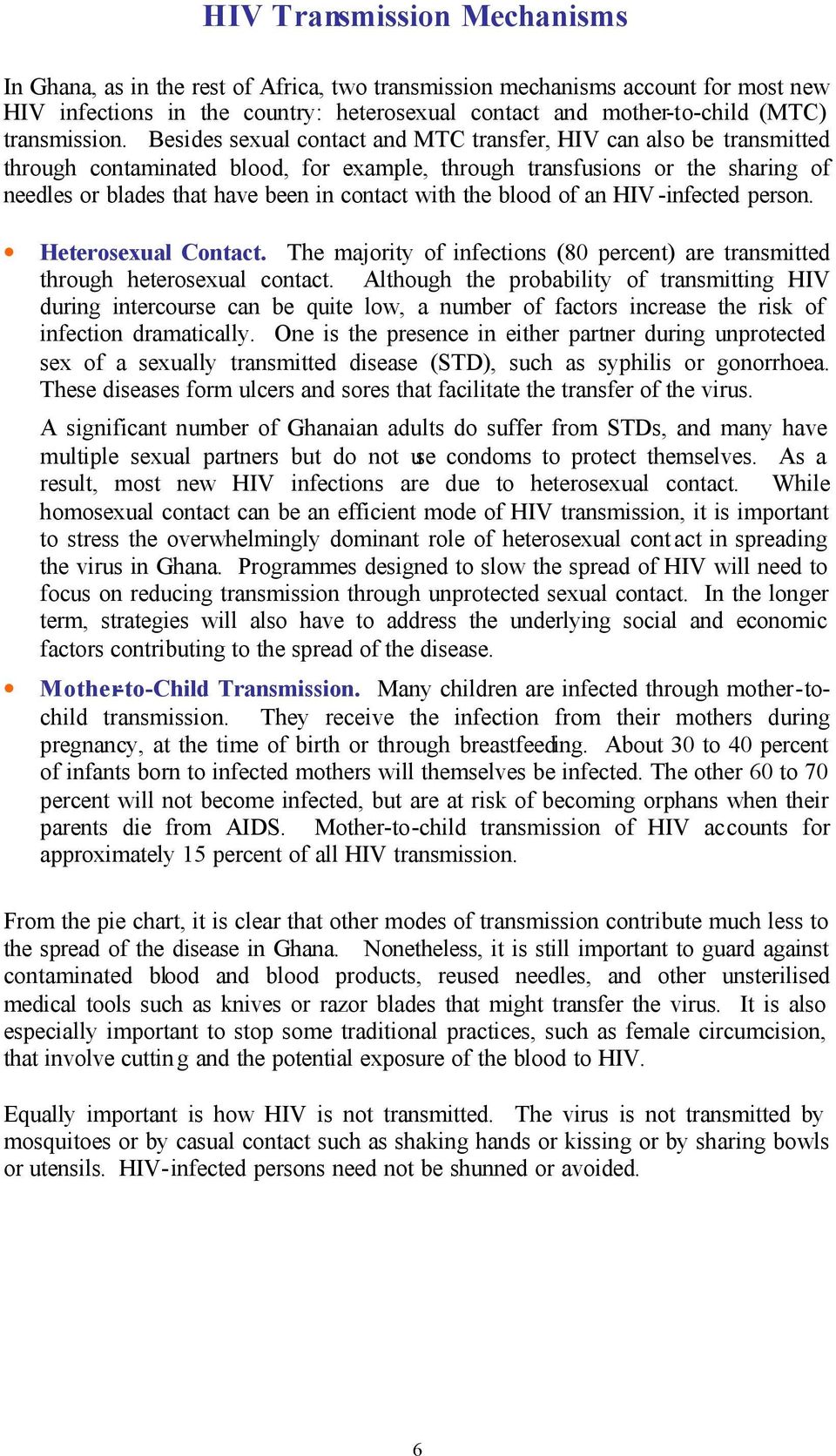
14 HIV Transmission Mechanisms Mother-tochild 15% Others 5% Heterosexual 80% 7

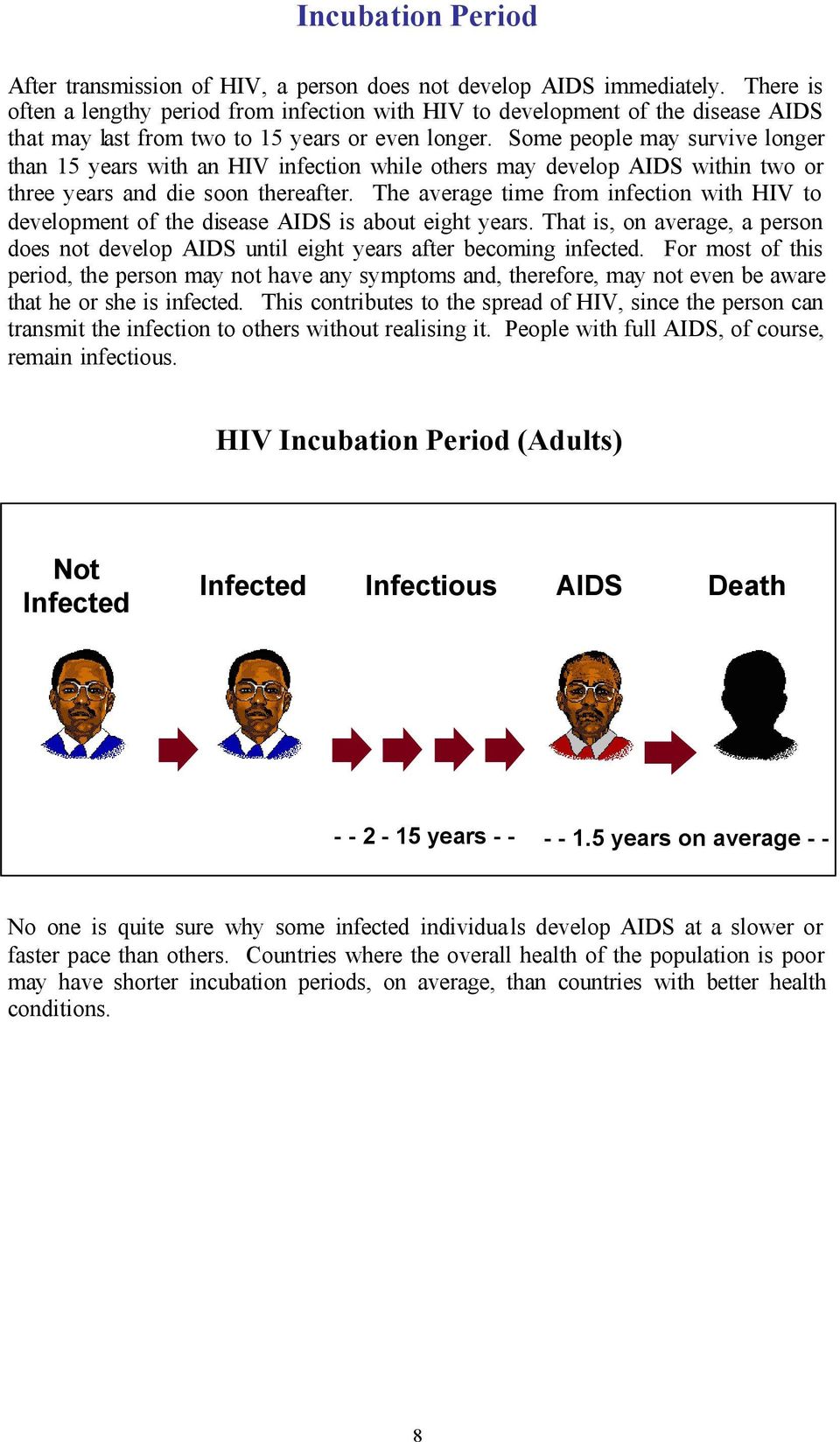
15 Incubation Period After transmission of HIV, a person does not develop AIDS immediately. There is often a lengthy period from infection with HIV to development of the disease AIDS that may last from two to 15 years or even longer. Some people may survive longer than 15 years with an HIV infection while others may develop AIDS within two or three years and die soon thereafter. The average time from infection with HIV to development of the disease AIDS is about eight years. That is, on average, a person does not develop AIDS until eight years after becoming infected. For most of this period, the person may not have any symptoms and, therefore, may not even be aware that he or she is infected. This contributes to the spread of HIV, since the person can transmit the infection to others without realising it. People with full AIDS, of course, remain infectious. HIV Incubation Period (Adults) Not Infected Infected Infectious AIDS Death years years on average - - No one is quite sure why some infected individua ls develop AIDS at a slower or faster pace than others. Countries where the overall health of the population is poor may have shorter incubation periods, on average, than countries with better health conditions. 8
16 For children, the incubation period is much shorter because their immune systems are not yet fully developed. Most infants who are infected at birth develop AIDS within two years and die soon thereafter. A few may survive as long as ten years, but all infected infants will eventually develop AIDS and die. HIV Incubation Period (Children) 30-40% of babies of HIV positive mothers are infected Infected AIDS DEATH < 1-5 years <1 year (on average) 9

17 The HIV/AIDS Pyramid Since the beginning of the epidemic in 1986 up to December 2000, 43,587 cases of AIDS have been reported to the Ministry of Health (MOH). Most of these have already died. However, reported AIDS represent only the visible part of the epidemic. There is much more to the epidemic, often called the hidden epidemic, than the number of reported cases. We know that not all AIDS cases are reported. This can happen for several reasons: Some people never seek hospital care for AIDS or have poor access to health service units. Some physicians or nurses may not want to record a diagnosis of AIDS because of the stigma attached to the disease. Recording and reporting of AIDS cases is inadequate at all levels. People with AIDS do not die from the virus but from the opportunistic infections (such as tuberculosis) that invade the body with the breakdown of the immune system; consequently, many persons die from these invasive infections before they are ever diagnosed as having AIDS. Private laboratories do not report all their figures and are not required to do so. The following pyramid shows that the number of those who have developed AIDS (43,587) is only the tip of the pyramid. The true number of cumulative AIDS cases in Ghana is not known, but, according to the projection model used in this study, the total was more than 185,000 by the end of Many more people have been infected with HIV, the virus that causes AIDS. They have not yet developed AIDS but will in the coming years. The largest part of the pyramid is the estimated 350,000 who are currently infected. Most of these do not know their HIV status, and may spread the epidemic. 10
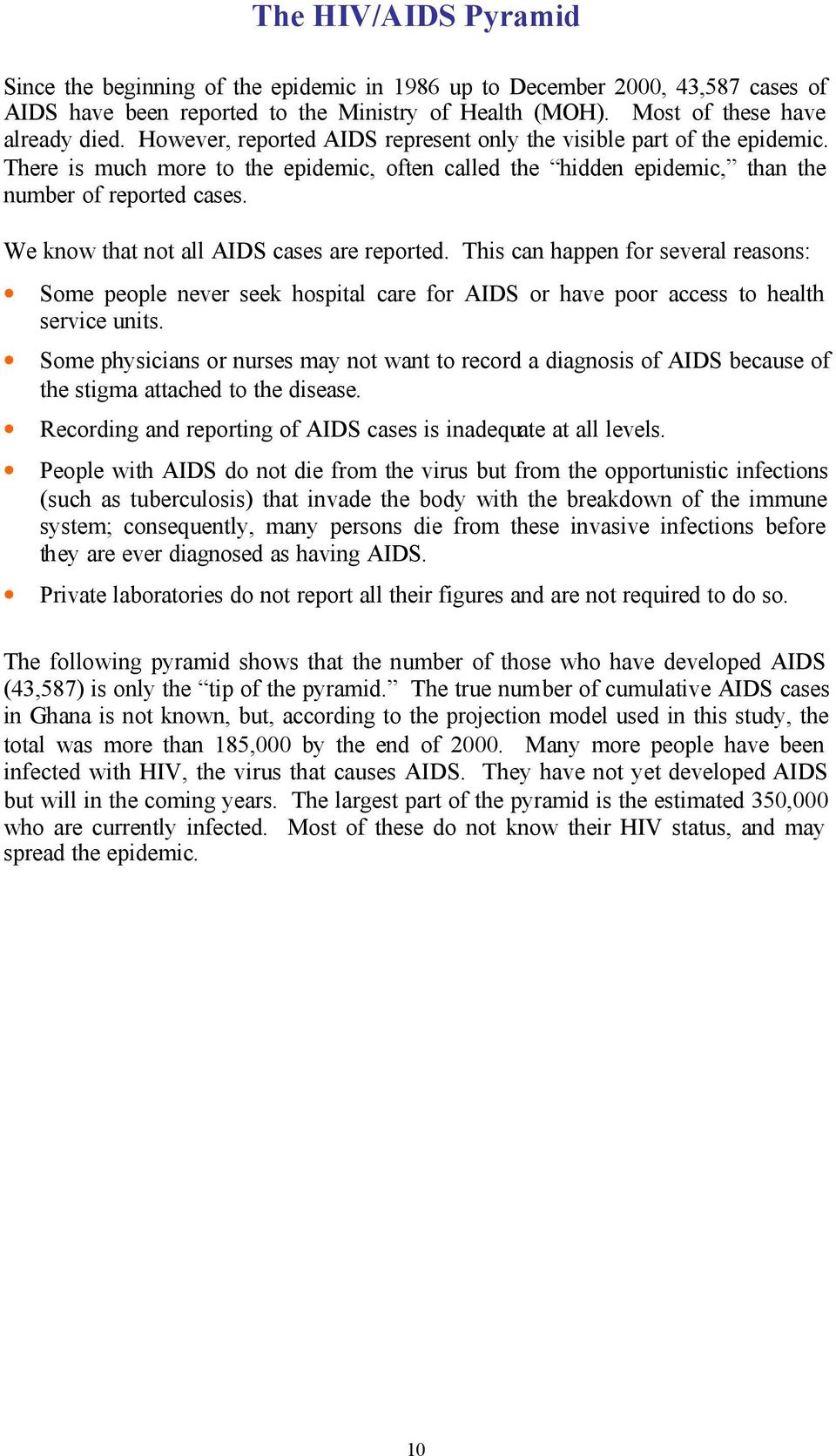
18 Actual AIDS cases are only the tip of the pyramid. Many more people are infected with HIV but have not yet developed AIDS. 43,587 reported cumulative AIDS cases (up to Dec. 2000) 185,000 estimated actual cumulative AIDS cases (up to Dec. 2000) 350,000 current HIV infections 11

19 Sentinel Surveillance System If most people do not know they are infected, how do public health officials monitor trends? In Ghana, the Ministry of Health operates a sentinel surveillance system that provides data for estimating the extent of HIV infection. Each of the ten regions has designated two hospitals or health centres to be sentinel surveillance sites. In addition, to two additional sites are included from the Greater Accra Region. At these selected sites, health workers take blood samples from pregnant women as part of their standard antenatal care. These blood samples are then tested anonymously for HIV infection. That is, the blood is tested for HIV after the routine laboratory tests, for which the blood was originally drawn, have been done and personal identifiers removed. This is the procedure that is recommended by the World Health Organization and that is used in almost all countries. UNAIDS suggests that the best way to understand the extent of the HIV/AIDS epidemic is to look at HIV prevalence among 15 to 49 year olds, or the percentage of persons aged 15 to 49 who are infected with the virus. Research has shown that the HIV prevalence from antenatal sites is a very good estimate for HIV prevalence among the total adult population aged

20 Current Estimates of HIV Prevalence Medical staff diagnosed the first AIDS cases in the country in Once started, the HIV/AIDS epidemic seems to have spread slowly but steadily. About 3.0 percent of the population in the 15 to 49 age group is now thought to be infected with HIV based on the sentinel surveillance data, and prevalence may still be rising. Three points are especially important in considering the HIV/AIDS epidemic in Ghana. HIV/AIDS is extremely serious in Ghana. The analysis suggests that about 350,000 Ghanaians were living with HIV in 2000 and this does not take into account those who have already died as a result of infection, and more and more Ghanaians are becoming infected every day. Virtually all of these people will die from AIDS. The data do not suggest that the epidemic has stablilised. For example, the Ministry of Health sponsored sentinel surveillance at all sites each year between 1994 and Analysis of this data indicates that HIV prevalence in the 15 to 49 year old age group in Ghana rose from 2.7 percent in 1994 to 3.0 percent in Although we do not know the future trend, there is certainly a danger that prevalence in Ghana could increase in the future as it has in neighbouring countries because of several factors including the worldwide epidemic in other sexually transmitted infections. HIV has spread more slowly in Ghana than in many other African countries. For example, in several southern African countries, HIV prevalence among 15 to 49 year olds is now estimated at more than 20 percent. No one is quite sure why the epidemic has spread more slowly in Ghana and some other West African countries. At the same time, many eastern and southern African countries had prevalence rates in the late 1980s similar to those currently found in Ghana, but the situation worsened rapidly. This suggests that an unchecked epidemic could result in much higher prevalence levels in Ghana. In sum, while HIV/AIDS has taken its own course in Ghana, the epidemic is so serious that it will have a profound impact on the social and economic development of the country well into the future. 13
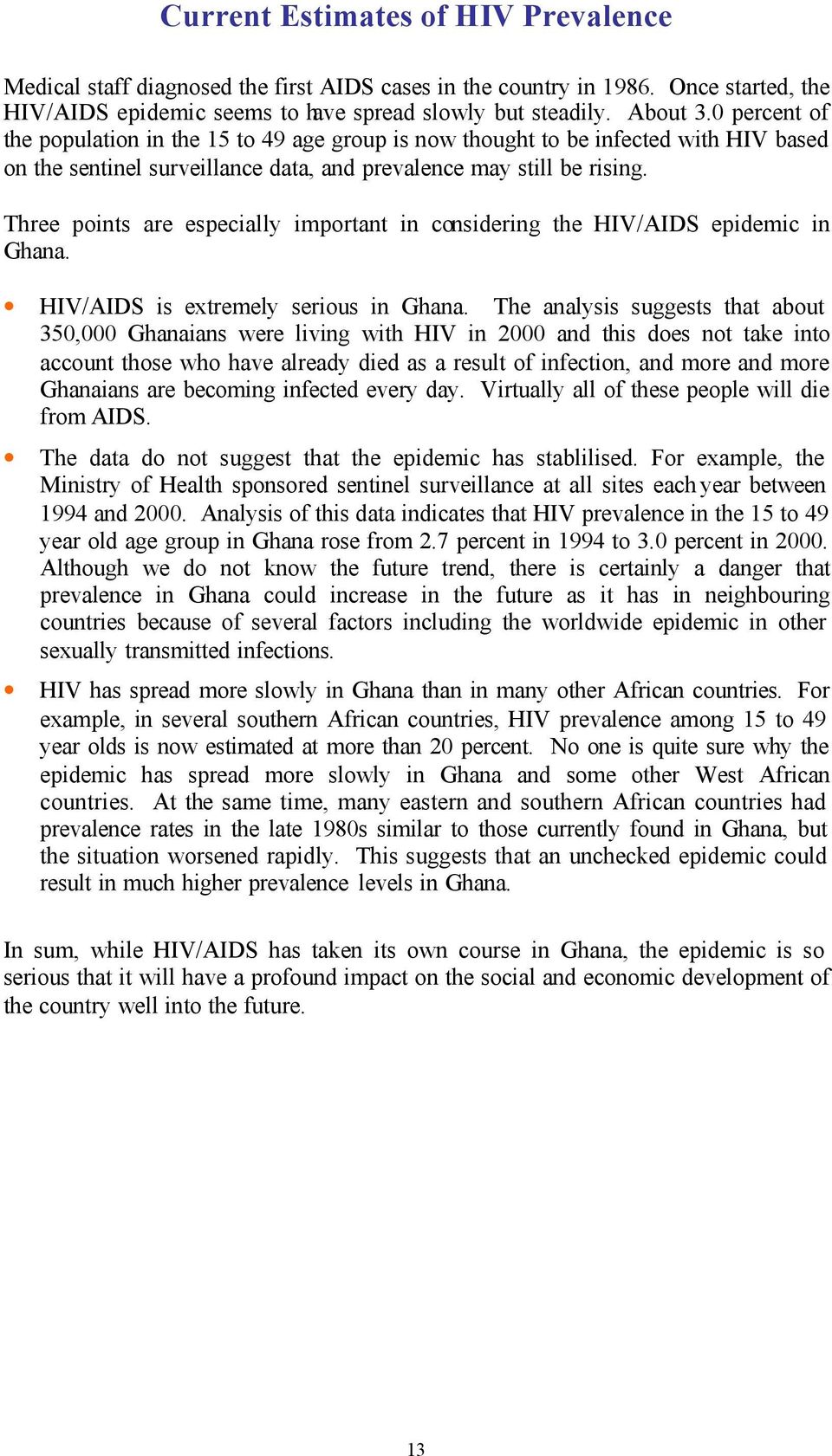
21 HIV Prevalence, Ages 15 to 49, % Source: Sentinel surveillance data by region may be found in Disease Control Unit, Ministry of Health. HIV/STD Sentinel Surveillance, These data are included in the Technical Note in Chapter VI of this report. 14
22 While the sentinel data indicate that HIV infection exists in all parts of the country, there are important regional differences. The bar chart indicates adult HIV prevalence by region. Eastern Region has consistently reported the highest levels of HIV infection, followed by Volta, Greater Accra, Western, Ashanti and Central Regions. Prevalence in Greater Accra is surprisingly low; in most African countries, some of the highest prevalence rates are usually found in the capital city and major urban centres. In Ghana, Greater Accra initially had one of the lower rates in the country, but the rate has been gradually increasing. In 1999 two additional sites were added in Greater Accra to help reflect the diversity of population in that region. Somewhat lower rates are found in the northern regions of the country, but there has been a narrowing of the differences with other regions as the epidemic progresses. HIV Prevalence, Ages 15-49, by Region 2000 Upper East Upper West Northern Brong Ahafo Ashanti Volta Eastern Greater Accra Central Western Source: MOH/DCU: HIV/AIDS Sentinel Surveillance,
23 A good way to summarise regional differences is to look at prevalence in the three geographic regions of the country. Prevalence in the 15 to 49 year old age group is estimated to be 3.6 percent in the southern geographical region and 2.6 in the middle geographical region. However, HIV prevalence was a significantly lower 1.2 percent in the northern region in The overall national figure, then, can disguise important regional differences. HIV Prevalence, Ages 15 to 49, by Geographical Region, 2000 NORTHERN 1.4 MIDDLE 2.6 SOUTHERN
24 Age-Sex Distribution of Reported AIDS Cases The following chart shows the cumulative number of reported AIDS cases through 2000 by age and sex. Reported cases represent only a small proportion of all AIDS cases; nonetheless, they can provide useful information about the nature of the HIV/AIDS epidemic in Ghana. Age-Sex Distribution of Reported AIDS Cases through 2000 Number of Cases, Female Window of Hope Male Age Group Source: Disease Control Unit, Ministry of Health The bar chart illustrates several interesting facts. More than 90 percent of AIDS cases are found among adults between the ages of 15 and 49. Since this is the most economically productive segment of the population, illnesses and deaths in this age group constitute an important economic burden. Many productive years and much investment in education and training will be lost. These illnesses and deaths also have important family consequences since most people in this age group are raising young children. To date, about two-thirds of the reported AIDS cases have been females. One reason for this pattern in Ghana appears to be that commercial sex workers returning from other countries accounted for a significant proportion of infections during the early stages of the epidemic. In either case, because the virus is usually transmitted by heterosexual contact, the differences in rates of infection between men and women tend to be reduced over time. The peak ages for AIDS cases are 25 to 34 for females and 30 to 39 for males. 17
25 The number of reported AIDS cases for females in the 15 to 24 age group is much higher than for males in the same age group. This is due to earlier sexual activity by young females and the fact that they often have older partners. Children between the ages of 5 and 14 may be a special Window of Hope. If these children can be taught to protect themselves from HIV infection before they become sexually active, they can remain free of HIV for their entire lives. But action must be taken now! 18
26 19
27 II. PROJECTIONS Projected HIV Prevalence Number of HIV Infections and AIDS Cases Annual Deaths among Persons Aged 15 to 49 Cumulative AIDS Deaths 20
28 PROJECTIONS Projected HIV Prevalence To project the number of new infections in the future, it is necessary to make an assumption about future levels of adult prevalence in the country. Does the evidence show that the epidemic has stabilised, that prevalence is no longer rising? Or does the evidence suggest that the epidemic is still spreading in the country? And, if prevalence is still on the rise, how high might it go? The evidence indicates that HIV prevalence is still on the rise in Ghana. Analysis based on the sentinel surveillance data shows HIV prevalence in the 15 to 49 year old age group in Ghana rising slowly from 2.7 percent in 1994 to 3.0 percent in Experience in other parts of Africa suggests that HIV prevalence in Ghana could rise even higher than at present. For example, as shown on the following map, HIV prevalence in many other African countries is much higher than in Ghana. Higher prevalence in other countries may be due to an earlier start of the epidemic in those countries, to different behaviour patterns, to the presence of a different strain of HIV in the early stages of the epidemic, or to a combination of all these factors. How high HIV prevalence in Ghana might rise is, of course, an unknown. If it follows the pattern of some neighbouring countries we could see a rise in prevalence over the coming years. But if an expanded and effective programme of interventions is put in place it could remain relativ ely stable or even decline. For purposes of this analysis we will look at two scenarios. In the high prevalence scenario HIV prevalence for 15 to 49 year olds is extrapolated from the historic trend and is assumed to increase from 3.0 percent in 2000 to 4.7 percent in 2004, 6.9 percent in 2009, and 9.0 percent in In the lower prevalence scenario HIV prevalence for 15 to 49 year olds remains relatively stable, with a prevalence rate of 4 percent in The rate is assumed to increase from 3.0 percent in 2000 to 3.3 percent in 2004, 3.6 percent in 2009, and 4.0 percent in This report looks at the important differences in impact that these two scenarios would have. 21
29 HIV Prevalence Among Adults, 15 to 49 Year Olds in Sub-Saharan Africa, 2000 Percent of adults (ages 15-49) infected 20% or higher 10% to 19% 5% to 9% less than 5% Source: Report on the Global HIV/AIDS Epidemic, UNAIDS: June 2000 Projected HIV Infections for 15 to 49 year olds under Two Scenarios Year High Projection 2.7% 3.0% 4.7% 6.9% 9.0% Lower Projection 2.7% 3.0% 3.3% 3.6% 4.0% 22
30 Number of Projected HIV Infections and AIDS Cases Using the assumptions, the projected number of Ghanaians infected with HIV by 2000 is probably about 350,000. Under the high prevalence scenario, that number would rise steadily over the next 14 years, reaching 860,000 in 2009 and about 1.2 million Under the low prevalence scenario, the number of total infections would rise to 470,000 in 2009 and 568,000 by The numbers infected in the year 2009 or in 2014 do not include the large numbers of Ghanaians who will have died from AIDS over this period of time. Number of Projected HIV Infections High Low 1.2 million Thousands thousand
31 The number of new AIDS cases developing eac h year among those persons living with HIV infection is shown in the chart below. Under the high prevalence scenario, the number of annual new AIDS cases would rise from 28,000 in 1999 to 36,000 in 2004 and 80,000 in Under the low prevalence scenario, the number of annual new AIDS cases would rise from 28,000 in 1999 to 34,000 in 2004 and 37,000 in Number of New AIDS Cases Each Year High Low 80,000 Thousands ,
32 Annual Deaths Among Persons Aged 15 to 49 The impact of the epidemic will be especially severe among adults in the prime working ages, 15 to 49. In the chart below, the blue line shows the projected annual number of deaths in this age group in the absence of AIDS. The line does not increase very much over time. The increase in this line is due to an increase in the total population size. However, with the high prevalence scenario with HIV prevalence reaching nine percent by the year 2014, the annual number of deaths in this age group will increase dramatically over time, reaching 344,000 annually by 2014, an increase of 75,000 annually over what it would have been without AIDS. With the low prevalence scenario, if HIV prevalence is four percent in 2014, the annual number of deaths in this age group will reach 305,000 by 2014, an increase of 36,000 over what it would have been without AIDS. This rapid increase in deaths in the productive age group could have serious consequences for the economic and social development of the country. Annual Number of Deaths among Adults Aged 15 to High Low Without AIDS 344,000 Thousands , ,
33 Cumulative AIDS Deaths Based on projections of AIDS cases, the cumulative death toll would be high. The chart below looks at the cumulative number of deaths from AIDS since the beginning of the epidemic in the mid -1980s. It is a good indicator of the seriousness of the epidemic in Ghana. From the beginning of the epidemic through 2000, the cumulative number of AIDS deaths has probably been about 160,000. The worst is yet to come. Over the next 14 years an additional 660,000 persons in Ghana could die from the disease. Under the high prevalence scenario, if HIV prevalence reaches 9 percent by the year 2014, the cumulative number of AIDS deaths in that year will have reached 817,000. Under the low prevalence scenario, where HIV prevalence is still 4 percent in 2014, the cumulative number of AIDS deaths by that year would reach 614,000. This illustrates the fact that in either case, Ghana will need to mount an expanded programme of care and support and will need to develop a comprehensive programme to mitigate the social and economic impacts of this epidemic. Cumulative AIDS Deaths High Low 817,000 Thousands ,
34 27
35 III. THE SOCIAL AND ECONOMIC IMPACTS OF AIDS Orphans as a Result of AIDS Mortality Population Size and Growth Health Care HIV and Tuberculosis Women Sectoral Impacts 28
36 THE SOCIAL AND ECONOMIC IMPACTS OF AIDS Orphans as a Result of AIDS One serious consequence of AIDS deaths among adults is an increase in the number of orphans. An AIDS orphan is a child under 15 who has lost either their mother or both parents to AIDS. In reality, given the predominance of heterosexual transmission in spreading the virus, many children will lose both parents. As shown in the following chart with the high prevalence scenario of HIV prevalence increasing to 9 percent by the year 2014, the number of AIDS orphans would rise quickly from 36,000 in 1994 to 390,000 in With the low prevalence scenario, the number of AIDS orphans would rise to 236,000 in 2014, about 150,000 fewer orphans than in the high scenario. It is important to remember that most AIDS orphans are not themselves infected with the virus. Everything possible should be done to eliminate the stigma and discrimination that these children may experience. Therefore it is usually best not to distinguish between AIDS orphans and other orphans, because both will have similar needs. Number of AIDS Orphans High Low 390,000 Thousands ,
37 There will be a tremendous strain on social systems to cope with such a large number of orphans and provide them with needed care and supervision. At the family level, there will be increased burden and stress for the extended family. This surge in the number of orphans is especially difficult in a major urban centre where traditional family structures are not as strong as in the countryside. Many grandparents will be left to care for young children. Other families are already headed by adolescents and the number of these households is increasing. There will be an increased burden to provide services for these children, including orphanages, health care, and school fees. Many orphans will never receive adequate health care and schooling, increasing the burden on society in future years. The number of street children will rise, and child labour will become more common as orphans look for ways to survive. 30
38 Mortality Ghana faces many serious health problems, all of which have to be addressed from the limited resources available for health. Why, then, should HIV/AIDS command more attention from health policymakers and planners than other competing health problems? Yet, in the end, HIV/AIDS is not just one more health challenge among many; rather, it is a killer disease of increasing seriousness that will have a significant impact on the country. Part of the problem in recognising the special character of HIV/AIDS is that the epidemic is often hidden. Recall that there is a lengthy incubation period, on average about eight years, between the time a person becomes HIV -infected to development of the disease AIDS. Most persons in Ghana who are infected with HIV don t even know it. Second, no one dies from AIDS directly; rather, infected persons succumb to the opportunistic infections, such as tuberculosis, that invade the body with the breakdown of the immune system. Consequently, many AIDS deaths are never identified as such. The worst mortality from AIDS lies in the near future, not the past. In 1994, for example, AIDS accounted for only about 4.6 percent of all deaths in Ghana. By 2014, however, AIDS will be responsible for 28 percent of deaths. No other single cause will come close to being responsible for so much mortality among Ghanaians. Deaths from AIDS and Other Causes Non-AIDS AIDS Thousands
39 Population Size and Growth What will be the impact of rising mortality from AIDS on the future growth of the Ghanaia n population? The following projections assume a continued decline in fertility rates in Ghana. Without the AIDS epidemic the population is predicted to grow to about 25 million persons in With AIDS causing increased deaths the population grows somewhat more slowly to 23.8 million persons in 2014 under the high HIV prevalence scenario. This is a difference of 1.2 million persons. In both cases, the population continues to grow rapidly. High birth rates are a more fundamental determinant of the fut ure population size of Ghana than AIDS deaths. An important point to remember is that the 1.2 million fewer people represent adults in the productive age groups who are no longer alive to care for their children and elderly parents, and to contribute to the economic well-being of their family and community. Projected Population Growth with AIDS without AIDS Millions
40 Health Care The treatment of the opportunistic infections resulting from AIDS is expensive and will place considerable strains on the delivery of health services in Ghana. The demand on health services as a result of AIDS can be seen by looking at health care expenditures. A recent study (Nabila, Antwi, et.al., June 2001) provides some evidence on what it costs to treat the opportunistic infections experienced by an AIDS patient in Ghana for one year. This recent estimate in Ghana indicated that the annual cost to treat the opportunistic infections experienced by an AIDS patient was about 4.2 million Cedis. The following chart illustrates the total health expenditures required in Ghana to treat these opportunistic infections assuming that 50 percent of all AIDS patients come for such health care in a given year. The expenditures to treat these opportunistic infections disease would rise from about 59 billion Cedis in 1999 to 167 billion Cedis in It was also estimated in the study that the cost of full anti-retroviral treatment for one AIDS patient would be much more. Based on actual experiences at Korle -Bu Teaching Hospital, the cost would be about 45 million Cedis for each patient per year. Obviously this would result in huge increases in the required expenditures. The increasing need for funds to spend on AIDS care threatens to divert spending from other important health care needs, or to leave many AIDS patients with inadequate care. The increasing need for funds to expend on AIDS care threatens to divert spending from other important health care needs, or to leave many AIDS patients with inadequate care. If funding is diverted from other health needs, then mortality and sickness not related to HIV is likely to increase as well, adding to the overall impact of the epidemic. 33
41 Annual AIDS Care Expenditures 180 Billions (cedis)
42 HIV and Tuberculosis Of particular note, HIV is largely responsible for the rapid rise in tuberculosis (TB) cases in recent years. The arrival of HIV/AIDS has caused a secondary TB epidemic in many African countries. As many as two-thirds of TB patients may be HIV positive. HIV infection weakens the immune system of otherwise healthy adults. Many, perhaps half, of all adults in Ghana carry a latent TB infection, which is suppressed by a healthy immune system. When the immune system is weakened by HIV, it can no longer control the TB infection and overt TB disease can develop. During the yea r 2000, 11,300 new cases of TB were reported in Ghana. The TB Control Programme estimates the true figure to be more than 30,000. In the chart below, the total bar represents the projected number of TB cases. One portion of the total bar represents the number of cases that would have occurred even without AIDS and the other portion represents the number that can be directly attributable to the AIDS epidemic. In 1989, about 14 percent of the TB cases could be attributed to AIDS. A 1997 study done in the Komfo Anokye Hospital in Kumasi found the HIV prevalence among TB patients was 23 percent. If the high scenario prevails, in 2009, about 57 percent of projected TB cases would be attributed to the HIV/AIDS epidemic. HIV and Tuberculosis Thousands of TB Cases Not Due to AIDS Due to AIDS See, for example, A.D. Harries. Tuberculosis and Human Immunodeficiency Virus Infection in Developing Countries. Lancet (1990), pp
43 These are almost certainly underestimates, because these new TB cases will transmit the disease to others. Also, the emergence of drug-resistant strains of TB in Africa is contributing to an ever -worsening epidemic. The impact of HIV infection on tuberculosis is an especially serious problem because TB is contagious through casual contact. HIV increases the risk of tuberculosis for the entire population. Treatment of TB is very expensive and puts considerable strain on the health budget. AIDS patients who have TB tend to stay in the hospital longer than other AIDS patients. Because of inadequate treatment of some cases of TB among both HIV-infected and uninfected people, drug-resistant strains of TB are appearing, making it yet more difficult to prevent transmission and more expensive to treat the disease. 36
44 Women HIV infects everyone. Men may be influenced into high-risk behaviour by cultural norms concerning labour migration, alcohol use, plural marriages and other aspects of social behaviour. However, women are especially vulnerable to the impact of AIDS for a number of reasons. Research indicates women are two to four times more vulnerable to HIV infection than men during unprotected intercourse because of the larger surface areas exposed to contact. Similarly, women are more vulnerable to other sexually transmitted diseases, the presence of which greatly enhances the risk of HIV infection. STDs (Sexually Transmitted Diseases) that bring on recognisable symptoms in men are often asymptomatic in women and, therefore, remain untreated. Women are also especially vulnerable to AIDS because they may have limited ability to protect themselves from HIV infection. A woman may be at risk of getting HIV even though she is faithful to her husband, because her husband has outside sexual partners. She may have little or no control over her husband s actions and no ability to protect herself by having her husband use condoms. AIDS can have a very serious impact on the lives of women when it strikes a family member. In many cases, women do not have a secure occupation that can provide a steady and adequate income. Thus, if the husband dies, the surviving wife and children can be particularly vulnerable. A woman may also have reduced ability to be a provider for the family if she needs to spend a significant portion of her time caring for family members who are sick with AIDS. It may reduce the time she has for productive work as well as affect the amount of time she can spend caring for children. Since other tasks, such as food preparation, must still be done, many women have to work even harder than normal to cope with AIDS in the family. Other socio-cultural and religious influences also play a part in this vulnerability. Deteriorating economic conditions that make it difficult for women to access health and social services due to poverty worsens this situation. Gender differences in access to economic opportunities reinforced by cultural practices promote the transmission of HIV/AIDS by creating a situation of high dependence of women on men, thus endangering their lives through involvement in unprotected sex especially with multiple partners. To combat some of these disadvantages, Ghana s National HIV/AIDS/STI Policy supports efforts that will empower women to recognise their vulnerability to HIV infection. 37
45 Sectoral Impacts What makes AIDS so important to national development is that it affects the development effort in virtually all sectors. HIV/AIDS is much more than just a health problem. The epidemic is so pervasive and so devastating that it requires a multisectoral response from all segments of Ghanaian society. A recent review of the response to HIV/AIDS in Ghana strongly recommended strengthening of a multisectoral approach. HIV/AIDS Epidemic Affects All Sectors... Health. It is clear that the cost of AIDS care will have a major impact on the allocation of health resources. Analysis of the costs of HIV/AIDS care will vary depending on whether one is considering only the essential drugs for opportunistic infections or the full cost of anti-retroviral treatment. An HIV/AIDS Economic Impact Study in Ghana done in June 2001 found the cost of out-patient care including drugs and laboratory services for opportunistic infections for an AIDS patient ranges between 36,308 Cedis (US$5.19) and 380,350 (US$54.34) per episode of illness. With the total cost for treating an AIDS patient for opportunistic infections for one year is approximately 4.2 million Cedis (US$594.98). This same study examined several businesses in Ghana and found that the total cost for full anti-retroviral treatment, for the few patients for whom this was available, amounted to 45 million Cedis per patient per year. Even with greatly reduced costs for anti-retroviral drugs that are currently being negotiated, the cost will not be affordable for many companies or individuals in the country. It is also doubtful if these companies can afford to sponsor staff members treatment for HIV/AIDS assuming three or more staff were to be infected and put on anti-retroviral treatment. The availability of anti-retroviral drugs in the country today should not in any way be 38
46 a substitute for other preventive programmes since its affordability in Ghana is very questionable, at least for now. Education. Skilled teachers are a precious commodity in all countries. But in some parts of Africa, they are becoming too sick to work or are dying due to HIV-related illnesses. AIDS among teachers may result in increasing absenteeism and disruption in the schools. Training costs for teachers could rise to replace those lost to the epidemic. For instance, AIDS accounted for seven out of ten deaths among teacher is Côte d Ivoire in 1998; Zambia lost 1,300 teachers in 1998 alone; and in Central African Republic schools have been closed owing to staff shortages. Economy/Finance Agriculture Because an AIDS death to an adult results in the loss of household labour and/or income, children are often required to leave school and remain at home or go to work to compensate for losses and to avoid school fees. Girls, in particular, may have to give up their educational opportunities. Orphans often lose the necessary financial, material, and emotional support that they need for successful schooling. Currently Ghana has not collected data on the impact of HIV/AIDS on the education sector. Efforts have to be intensified to study the impact of HIV/AIDS on the educational sector. Labour. The loss of people in the most productive years of their lives will certainly affect overall economic output. Some sectors, particularly those that require trained and skilled workers, will be harder struck than others. The productivity of an enterprise will be affected even before an employee dies, due to lost workdays because of sickness. The number of workdays lost to illness for a person with HIV/AIDS can range from as few as 30 to as many as 240 days in a year. Even healthy workers may need more time off from work to attend funerals of relatives and co-workers. AIDS can also have a significant impact on health care costs for firms that provide health care for their employees. Studies from countries hard hit by the epidemic show that AIDS has an adverse effect on the productive labour force. In Ghana as well, AIDS may have a significant impact on some firms as the study of a Ghanaian firm. Results of this study are illustrated in the following chart. AIDS related illness and deaths to employees affect a firm by both increasing expenditures and reducing revenues. Expenditures are increased for health care costs, burial fees and training and recruitment of replacement employees. Revenue decreases are a result of absenteeism due to illness or attendance at funerals. Labour turnover can lead to a less experienced labour force that is less productive. With high levels of HIV infection, businesses in Ghana would find it difficult to provide treatment, including antiretroviral drugs, due to long-term sustainability issues. HIV/AIDS thus presents a dual challenge in that it is both an extremely serious health problem and a major economic concern. 39
47 Impact on Labour: Increased Cost of Doing Business Death Benefits 61% Training Costs & Productivity Losses 22% Absenteeism 7% Health Care 3% Labour Turnover 7% Source: Steven Forsythe, May 2001 Economy. The economic effects will be felt first by individuals and their families then ripple outwards to firms and businesses and the macro-economy. The household impacts begin as soon as a member of the household starts to suffer from HIV-related illnesses. Illness prevents the primary breadwinner from working, increases the amount of money the household spends on health care, and requires other household members to miss school or work in order to care fro the patient. Death of the patient results in a permanent loss of income, either through lost wages and remittances, or through a decrease in agricultural labour supply. Households must also bear the costs of funerals and mourning. When children are withdrawn from school, the household suffers a severe loss of future earning potential. On a macroeconomic level, the impact of AIDS is difficult to assess. There are several mechanisms by which AIDS affects macroeconomic performance. AIDS deaths lead directly to a reduction in the number of workers available, and less experienced workers replace those who died, leading to lower productivity. A shortage of workers leads to higher wages, which leads to higher domestic production costs, and a loss of international competitiveness. Reduced savings because of greater health care expenditures and a loss of worker income can cause a significant drop in savings and capital accumulation. This leads to slower employment creation in the formal sector, which is particularly capital intensive. Transport. The transport sector is especially vulnerable to AIDS and important to AIDS prevention. Building and maintaining transport infrastructure often involves 40
48 sending teams of men away from their families for extended periods of time, increasing the likelihood of multiple sexual partners. The people who operate transport services (truck drivers, train crews, sailors) spend many days and nights away from their families. Most transport managers are highly trained professionals who are hard to replace if they die. The Government of Ghana and the private sector in Ghana face the dilemma of improving transport as an essential element of national development while protecting the health of transport workers and their families. Agriculture. Most of the agricultural sector in Ghana is subsistence farming; evidence from other countries suggests that the decline in labour supply due to morbidity and mortality from HIV/AIDS will have a negative impact on production, and thus on the food supply for households, increasing the incidence of malnutrition. There will be loss of labour supply at crucial planting and harvesting times. In addition, there could also be switching from labour-intensive expor t crops to food crops. Production may also suffer as the timing of general agricultural tasks is disrupted as workers fall ill and as others need to take time off to care for them. 41
49 IV. INTERVENTIONS TO CONFRONT THE AIDS EPIDEMIC Interventions HIV/AIDS Management Treatments and Vaccines 42
50 INTERVENTIONS TO CONFRONT THE AIDS EPIDEMIC The HIV/AIDS epidemic is already serious enough that it is going to result in the deaths of hundreds of thousands of Ghanaians in the near future. Nonetheless, much can be done to lessen the impact of the disease and eventually bring the epidemic under control, so that HIV prevalence never reaches the levels found in many other African countries. Interventions There is an international consensus that care and support for those infected with HIV or whose families are affected by AIDS must be an integral part of an AIDS control programme, and that people living with HIV/AIDS should play a key role in all interventions. Different interventions can be adopted to address the transmission mechanisms of HIV. Collectively, they can slow the spread of AIDS. Interventions to Limit Transmission through Heterosexual Contact. The major mode of transmission is through heterosexual contact; it is especially in this area that interventions have to be intensified in the Ghana. Interventions include promoting abstinence and faithfulness; promoting reductions in the number of sexual partners; encouraging delays in the onset of sexual activity among adolescents; promoting the correct use and consistent availability of condoms; strengthening programmes for STD control; and encouraging voluntary counselling and testing. Interventions to limit sexual transmission Promoting abstinence and faithfulness Reducing the overall number of sexual partners Delaying the onset of sexual activity among adolescents Promoting the use and consistent availability of condoms, including female condoms Strengthening programmes for STD control Encouraging voluntary counselling and testing Promoting abstinence before marriage and faithfulness to one partner. One set of interventions focuses on encouraging people to abstain from sex before marriage and remain faithful to a single partner. Abstinence and faithfulness could be promoted through a combination of mass media, counselling, and education programmes. Delays in the onset of sexual activity among adolescents can have a significant impact on the spread of HIV. Information, education, and 43
51 communication (IEC) and other programmes that address adolescents and the needs of young people are particularly needed. A reduction in HIV incidence (the annual rate of new infections) among today s young people would not only avoid much suffering but it would also be a critical step in controlling the spread of the virus. Reducing the number of sexual partners, especially the number of concurrent partners, can also have an effect. Given the extremely high rates of HIV infection among commercial sex workers, a reduction in the number of men who have unprotected sexual contact with prostitutes and bar girls can be important in bringing the epidemic under control. Overall, these strategies could make an important contribution to reducing the spread of HIV, although they would not be, by themselves, a complete solution. Promoting the use and availability of condoms. A third intervention is to promote condom use through mass media, counselling and education and to increase the availability of condoms through expanded public distribution, social marketing programmes, and programmes in the workplace. Special initiatives to promote condom use among high-risk populations (such as commercial sex workers and long-distance truck drivers) have proven effective in some countries. From the Ghana Demographic and Health Survey 1998 we know that awareness of HIV/AIDS is high in Ghana (97 percent of women and 99 percent of men have heard about AIDS). However, the majority of Ghanaians also believe that they are not personally at risk of contracting the HIV virus. People who believe that they have no risk or only a small risk of contracting HIV/AIDS are less likely to change their behaviour. In Ghana, a major HIV/AIDS awareness campaign was launched in February 2000 involving a consortium of partners including the Ghana Social Marketing Foundation, Johns Hopkins University, the National AIDS/STI Control Programme and the Ministry of Communication. Dubbed "STOP AIDS - LOVE LIFE, the campaign has the following objectives: increase risk perception among Ghanaians, increase social support for positive behaviour such as condom use, and increase compassion for those living with AIDS. The primary target of this campaign is young adults aged years. Components of the campaign have been mass media, interpersonal programmes and grassroots activities. Sub-campaigns have included: promotion of abstinence, condom promotion, compassion for people living with AIDS, traditional rulers initiative, use of music stars, a rural interpersonal programme using audio visual equipment, the Journey of Hope programme, and a commercial drivers programme. The Campaign is also working with religious organisations to increase compassion for those living with AIDS. Recent efforts to increase risk perception especially among young people are, however, yielding some results as can be seen from the increased sales of condoms since the launch of the STOP AIDS LOVE LIFE campaign. One year through the campaign, there has been a noticeable increase in condom distribution and use to meet the demand generated by the campaign. Condom sales have 44
52 increased by 80% over those of Distribution is now reaching outlets in the community such as tabletops, kiosks, container shops and bars apart from the usual pharmacies and chemical shops. Condom Sales in Ghana, Units(Pieces) in Millions Total GSMF PPAG MOH Source: UNAIDS: Country Profile Ghana, July 2001 Controlling other sexually transmitted diseases. Another intervention focuses on controlling the spread of STDs such as syphilis, gonorrhoea and chanchroid. The link between HIV and sexually transmitted infections (STIs) has been known for many years. A person with an untreated STI is more likely to pass on HIV during unprotected sex. STIs are known to increase the risk of HIV infection nine fold. Although there is a high burden of STIs, awareness of specific STIs is low. In 1998, 61.2 percent of women and 72.6 percent of men had heard of Gonorrhea. The awareness of other STIs such as Syphilis, Hepatitis and Genital Herpes was below 22 percent (GDHS 1998). Results from sentinel sites in Ghana have shown that HIV prevalence among STI Clinic attendants is higher than in the general population ranging between 6-40 percent. Among commercial sex workers HIV prevalence is as high as 82 percent. Most individuals with STIs do not seek appropriate care. A recent study in Mwanza, Tanzania, found that an improved STD prevention and treatment programme was associated with a reduction of 42 percent in the number of new HIV infections. Services to detect and control STDs can be critically important for managing the HIV/AIDS epidemic. 45
53 The basic strategies that can be adopted to bring the epidemic in STIs under control are limited in number: Expand services to vulnerable groups, for example to long-distance lorry drivers, youth, or commercial sex workers. Disseminate case definitions and encourage people with STIs to report promptly for treatment. Ensure that appropriate drugs are available at all health service delivery points. Mother-to-Child Transmission. A mother who is infected with HIV has a 30 to 40 percent chance of transmitting the virus to her newborn child. One of the critical areas for the reduction of HIV infection is through programmes targeted at the prevention of mother-to-child (MTCT). Various approaches can be used to reduce the number of children who are infected. In Ghana, a pilot project has been launched to test various interventions in Agomanya and Atua in the Eastern Region. Interventions under this programme include counselling, medical management, counselling on feeding options and the provision of Nevirapine (an anti-retroviral drug). Home-based care also is being encouraged under the programme. This programme also has elements of medical management for HIV positive pregnant women. Blood Transfusion. Health officials need to continue efforts to avoid infection through blood transfusion by keeping the blood supply as safe as possible. This means screening blood through laboratory tests and screening potential blood donors through interviews to reject as donors those who have a high probability of infection. Combined Interventions. Each of the intervention packages described above can make an important contribution to controlling the spread of HIV. Alone, none is likely to solve the problem completely; some people will respond to or be affected by one type of intervention while others will respond to or be affected by another. Computer simulations suggest that a much larger effect can be achieved by implementing all the interventions together in a broad attack on the epidemic. The following infor mation is not specific to Ghana, but is based on simulation modelling (see the chart that follows). It shows the expected impact of interventions in an illustrative African city. In the absence of interventions the base projection or the top line on the chart the HIV adult prevalence rate continues to rise over time. An effective blood-screening programme represented by the second line from the top reduces prevalence only modestly. However, an effective STD control programme brings expected preva lence down by about 12 percent, and condom promotion and partner reduction interventions reduce HIV prevalence even more. Most importantly, when all four interventions are implemented simultaneously, the projected prevalence is nearly 55 percent less in 2005 than it would have been in the absence of interventions. 46
54 Effects of Interventions HIV Prevalence Base Blood Screening STD Treatment Condom Promotion Partner Reduction Combined The fundamental message is a hopeful one. The simulation modelling suggests that with a concerted effort on a number of fronts, a country can turn the rising pr evalence curve downward and start to bring the HIV/AIDS epidemic under control. In 2000, the Ministry of Education (MOE) began implementation of HIV/AIDS intervention programmes under guidelines contained in the strategic plan covering the next five years. Prior to this initiative, MOE had integrated Population / Family Life Education topics into existing curricula in four career subjects at each level of the school programme: Primary, Junior Secondary (JSS), Senior Secondary (SSS), Teacher Training and University level. Key elements of the MOE plan involve: strengthening linkages among learners, educators, individuals and communities to combat the spread of the disease, training of teachers as motivators and students as peer educators for early diagnosis and treatment of STIs, and condom distribution and advocacy. Research activities will be sustained throughout the plan period to measure the impact of the interventions. 47
55 Overall, there are several important lessons to be learned concerning intervent ions. Pilot tests have shown that interventions can be successful in significantly reducing the spread of HIV. It is important to intervene as early as possible with a comprehensive mix of proven and effective interventions to reach the largest possible number of people and have the maximum impact. The most effective interventions are those that focus on population groups that have the most sexual partners. This is true at all stages of the epidemic. Prevention through behaviour change, condom promotion, and STD treatment is many times more cost-effective than either providing hospital treatment for AIDS patients or trying to prevent the spread of the virus with anti-retroviral therapy. Applying interventions on a large scale is costly and success is difficult to measure. Nonetheless, there is now evidence from Uganda and Thailand that significant reductions in HIV incidence and prevalence can occur at a national level. Both countries recognised the seriousness of the epidemic early and implemented strong national programmes to reduce the spread of HIV and to provide support for people with AIDS and their families. 48
56 HIV/AIDS Management Voluntary counselling and testing services have been shown in many African countries to attract many clients who want to know their HIV status. The public is encouraged to make use of such a facility. However, the incentive to be tested is stronger when medical services are available for those who test positive. Care for People Living with HIV/AIDS (PLWHA) including home-based care will be strengthened to improve service delivery and mitigate the impact of HIV/AIDS on individuals, the family and communities. Access to prophylaxis and treatment of opportunistic infections is being improved. HAART (Highly active anti-retroviral therapy) which is being promoted worldwide is not widely available in Ghana. MOH is taking steps to ensure its availability in the near future. Efforts to make these drugs more available and affordable to the clients will be strengthened. MTCT is estimated to account for about 15% of all HIV transmissions in Ghana. An initiative to reduce MTCT in high prevalence areas has started and will be scaled up to include all districts in Ghana in the future. Interventions are in place to reduce HIV transmission in the clinical setting through safe blood transfusion, infection prevention measures and provision of post-exposure prophylaxis. Outside clinical settings, strategies are in place to reduce transmission by individuals whose work puts their clients at risk of HIV transmission such as Traditional Birth Attendants, Wanzams, and beauticians, among others. 49
57 Treatments and Vaccines Treatments. Highly active anti-retroviral therapy (HAART) has received much international publicity in recent years. HAART uses combinations of drugs and can inhibit the spread of HIV within a person s body. For some HIV -infected persons, HAART has been an effective way to prevent the onset of AIDS and prolong life. However, several considerations need to be taken into account when considering HAART in the context of developing countries such as Ghana. Most importantly: Many HIV-infected persons cannot tolerate the side effects of the drugs and for them the combination therapy treatments are useless. Only about half of pr ospective users can tolerate the therapy. The drugs have to be taken under the strictest conditions, including time of day and with meals or on an empty stomach. Even small variations from the prescribed pattern can render the treatment ineffective. Patients also need constant access to sophisticated medical laboratories to track viral counts in the body. Perhaps most importantly, the costs of these treatments are prohibitively high. The new combination drugs are important in that for the first time a medical treatment has proven effective against HIV. This creates hope for the future. But for the moment, even in the most developed countries, this is a highly expensive experiment with an unknown outcome affecting a minority of HIV-infected individuals. In developing countries, the first experimental programmes are just beginning. It is possible to treat, for a long time, many of the opportunistic infections that develop because of the weakened immune system. These treatments can improve the quality of life and delay the death of a person with AIDS. Vaccines. For many HIV/AIDS researchers and policymakers, the real hope is for a widely available vaccine that can prevent HIV infection in the first place. Research on vaccines continues in many laboratories around the world, with more than two dozen experimental HIV vaccines currently being tested. Some African countries have joined the ongoing efforts for the development of vaccines against HIV. In Ghana the HIV sub-types are being identified to aid further research into vaccine development. Most scientists believe that vaccines are not likely to be ready for mass use for at least the next five to 10 years, if then. Even if vaccines do eventually become available, there will be problems in producing large quantities and delivering the vaccine to large numbers of people. In brief, it does not appear that either drugs or vaccines will contribute much to reducing the spread of HIV by sexual contact in Ghana in the next several years. Vaccines against HIV/AIDS are unlikely to be available to help reduce the spread of HIV in Ghana in the next several years 50
58 51
59 V. POLICY ISSUES, STRATEGIC FRAMEWORK, INSTITUTIONAL STRUCTURES, AND LEADERSHIP SUPPORT Policy Issues National Strategic Framework Institutional Structures Leadership Support for HIV/AIDS Programmes 52
60 POLICY ISSUES, STRATEGIC FRAMEWORK, INSTITUTIONAL STRUCTURES, AND LEADERSHIP SUPPORT Intensified efforts are now being directed at combating the adverse impact of the HIV/AIDS epidemic in Ghana. All of these efforts are informed and guided by two broad policy documents, namely the Draft National HIV/AIDS/STI Policy and the National Strategic Framework on HIV/AIDS. The Policy was developed through a participatory process and spells out roles and responsibility for the various Ministries, Departments and Agencies (MDAs). The Policy outlines a clear need for a National Strategic Framework which provides the basis for the mobilisation of all sectors in the implementation of the Multi-sectoral approach advocated in the Policy. All of these activities have now culminated in the establishment of the Ghana AIDS Commission, a body proposed in the National HIV/AIDS/STI Policy document. The Ghana AIDS Commission was launched at a Cabinet Retreat in Akosombo in September Policy Issues The objectives of the draft National Policy are to create the necessary conducive environment, through advocacy, to ensure sustained political commitment and support for effective action against HIV/AIDS/STIs; to create conditions for behavioural change in all areas of sexual and reproductive health; to decrease vulnerability to HIV/STIs and to reduce stigmatisation and discrimination; and to reduce the impact of HIV/AIDS related morbidity and mortality. The National Programme and Draft Policy. The Government of Ghana responded quickly to the emerging HIV/AIDS epidemic in the 1980s. The government established the National AIDS/STD Control Programme (NACP) in 1987 to coordinate the national response to the epidemic. NACP led in the development of a Short Term Plan (STP) for the prevention and control of HIV/AIDS that ran during 1987 and Subsequently, NACP developed the first Medium Term Plan (MTP 1) that guided HIV/AIDS prevention and control efforts over the period. The Ministry of Health was primarily responsible for implementing the early programmes, as was typical in African countries. However, over time, other public sector ministries, the private sector, non-governmental organizations (NGOs) and people living with HIV/AIDS (PLWHA) became move involved in programme implementation. A recent review of the national response to the HIV/AIDS epidemic stressed the importance of expanding a multi-sectoral approach to the epidemic. In 1997, NACP led the drafting of a Policy Document on HIV/AIDS. The purpose of the policy is to create a favourable environment for all HIV/AIDS control and prevention programmes, and to mitigate the social and personal consequences of HIV infection on those persons living with the virus and on those persons who have already developed AIDS. The national policy is still in draft form and has not ye t been formally adopted. 53
61 The objectives of the draft policy are to reduce the impact of morbidity and mortality as a result of HIV/AIDS in the general population; ensure that the basic human rights of persons infected with HIV and persons with AIDS are protected and upheld; ensure that HIV infected persons and persons with AIDS are provided with adequate medical and social care, including counselling; ensure that access to social and economic opportunities remain open to HIV infected persons and persons wit h AIDS; ensure that adequate attention is paid to groups such as women who have been found to be vulnerable to HIV; ensure that there is a consistent programme of information and education about HIV/AIDS among the general population, especially among youth, and that this increased knowledge is translated into an increase in attitudinal and behavioural change; decrease vulnerability to infection, reduce stigmatisation and discrimination, and minimize the socio -economic impact of the epidemic. The draft policy emphasises information and education leading to behavioural change, especially among youth, and the widespread availability and promotion of condoms as keys to limiting the spread of the virus. 54
62 National Strategic Framework The strategic framework is aimed at preventing and mitigating the socio-economic impact of HIV/AIDS on individuals, communities and the nation. Its objectives are to reduce new infections among the year age group, improve service delivery and reduce individual and societal vulnerability and establish a multi-sectoral and multidisciplinary institutional framework to co-ordinate programme implementation. The areas of interventions under the framework are prevention of new transmission of HIV, care and support for PLWHA, and creating an enabling environment for the national response. To meet the challenge of the HIV/AIDS epidemic, the Government of Ghana recognised the need to establish clear policy guidelines and effective organisational structures that emphasise the above components. As part of the expanded multisectoral approach, all sectors and ministries are being requested to design, implement, monitor and evaluate their sector-specific HIV/AIDS response. Strategic Planning and Priorities in Ghana. In April 1998, a team of national and international representatives reviewed the national response to the HIV/AIDS epidemic to date in Ghana. Rising prevalence levels suggest the need for an expanded response and this team suggested some key elements for an effective strategic programme. An expanded multi-sectoral approach is a necessity. To be effective, the national response must involve many different government ministries and departments at all levels, NGOs, the private sector, and people living with HIV/AIDS. Government has a key role to play, in part through its own activities and in part through its ability to mobilise other sectors of Ghanaian society. Central to the government role is the formulation of appropriate policies and laws, which establish a framework and a set of key principles for public and private action. These laws and policies should also ensure that all those affected by the epidemic are protected from discrimination and stigmatisation. Communities need to be fundamentally involved in the design and implementation of programmes. Community participation at all levels is essential for effective HIV/AIDS prevention, control, and care. An efficient surveillance and evaluation programme is an absolute necessity to guide and target programmes and to ma ke the most efficient use of scarce resources. Biomedical and behavioural research is also needed to help determine which programmes work and which do not. Improvement in STD treatment and prevention is now recognised to be one of the most effective ways to reduce HIV transmission. However, curable STDs often go undetected, untreated, or inadequately treated. Improved STD diagnosis and service provision will have to be an essential part of an expanded HIV/AIDS programme. This issue receives minimal attention in the draft policy. Providing support services for HIV-infected individuals and for those otherwise affected by the epidemic orphans, for example is an integral component of a comprehensive approach. Strengthening care and support services will become 55
63 ever more challenging as the number of HIV-infected persons, the number of AIDS cases and the number of AIDS deaths continue to rise. The HIV/AIDS epidemic is undermining social and economic development in Ghana, although improved information is needed for a better understanding of the current and future impacts. Conversely, a vigorous development effort is also needed to combat HIV/AIDS, especially insofar as it helps reduce gender inequalities and minimises the economic motivations for high-risk sexual behaviour. Some Key Components of a Strategic Programme Expanded multi-sectoral approach Supportive policies and laws Access to information and comprehensive services Decentralisation, community participation and individual responsibility in all HIV/AIDS programmes Adequate resource mobilisation Effective surveillance, evaluation and research 56
64 Institutional Structure The Government of Ghana, recognising that HIV/AIDS is a serious health and developmental issue, set up the Ghana AIDS Commission. This commission is the highest policy-making body on HIV/AIDS. It is a supra-ministerial and multi-sectoral body located in Office of the President. The Commission is mandated to direct and coordinate all activities to fight the disease. It will provide effective leadership in co-ordination of all programmes and activities of all stakeholders. The programmes are to be pursued through advocacy, joint planning, monitoring and evaluation to curb further spread of the epidemic. Specifically the Ghana AIDS Commission is mandated to carry out the following functions in the prevention and control of HIV/AIDS. These include: formulating national policies and strategies providing high level Advocacy for HIV/AIDS prevention and control providing effective leadership in the national planning of programmes expanding and co-ordinating the national response mobilising and managing resources and monitoring their allocation and utilisation fostering linkages and networking among stakeholders The Ghana AIDS Commission is composed of the following membership: representatives of ministries, departments and agencies (MDAs), organised labour, National Union of Ghanaian Students, Ghana Employers Association, National Population Council, National Council on Women and Development, PLWHA, National House of Chiefs, and selected individuals and co-opted members. 57
65 Leadership Support for HIV/AIDS Programmes Political, health, and other leaders will be directly involved in HIV/AIDS programme implementation. But political, governmental, non-governmental, religious, business, education, and other regional leaders who are not directly involved in the implementation of HIV/AIDS prevention programmes must contribute as well. If the leadership of Ghana all do their share, this epidemic can be turned around. Experience with health programmes in many developing countries shows that strong leadership support can be critical to success. This section will look at and illustrate what individual leaderships groups should do now to help control the HIV/AIDS epidemic in Ghana. Leadership support for HIV/AIDS programmes is critically important to the success of interventions. What can leaders do to help stem the spread of HIV in Ghana? Some illustrations follow but the list could be many times longer depending on the role of the leader or the organisation. Evidence from Uganda and elsewhere suggests that the spread, or diffusion, throughout the population of information about the epidemic its extent, the nature of the disease, how HIV is spread, the fatal consequences and how individuals can protect themselves and their loved ones is key to achieving widespread changes in high-risk behaviour. District and national leaders have numerous opportunities to share information, such as found in this document, with their constituencies. This is a practical and critically important process to which all well-informed leaders can immediately and realistically contribute. Political leaders can also contribute to a policy dialogue on the HIV/AIDS epidemic that keeps the issue high on the national agenda. One of the factors that seems to be helping turn the tide in Uganda is that President Museveni and other leaders have spoken out early and often about the HIV/AIDS epidemic and given open and strong support to intervention programmes. This gives both visibility and credibility to HIV/AIDS intervention programmes and helps develop a consensus about the most effective and acceptable prevention and mitigation strategies. HIV/AIDS statements should be included in speeches at all realistic opportunities. Leaders can contribute to the formulation of HIV/AIDS national and district strategic plans and can support implementation and funding efforts. One of the most common problems in addressing the HIV/AIDS epidemic is that persons have often avoided learning about or admitting to being infected with HIV because of the stigma attached to the disease and because of fear of discrimination. However, avoidance limits diffusion of knowledge about HIV in the general population and it increases the risk of transmission to loved ones and others. Political and other leaders can help by publicly acknowledging the need to care for and support persons living with AIDS and HIV infection and working against discrimination. 58
66 One of the key roles of leadership is to deal with the many legal and ethical challenges that the HIV/AIDS epidemic presents. Discrimination against individuals with HIV or AIDS violates their human rights and hampers prevention efforts by discouraging people from learning about their HIV status. A key element of the National HIV/AIDS/STI Policy is the guarantee that the human rights of all Ghanaians will be respected. Among the many important human rights issues are: Stigma. Social ostracism and alienation that lead to deterioration of civil, economic or political rights can be a consequence of the stigma associated with HIV/AIDS. A common problem experienced in many countries in addressing this epidemic is that people often avoid learning about or admitting to being infected with HIV because of the stigma attached to the disease and the fear of discrimination. Such avoidance limits diffusion of knowledge about HIV in the General population and increases the risk of transmission to loved ones and others. Testing for HIV. HIV testing for individuals should be voluntary. Confidentiality. Ethical codes regarding confidentiality of AIDS status should be enforced. Gende r. The National Policy supports efforts aimed at empowering women and recognising their vulnerability to HIV infection. Employment. Persons infected with HIV can work productively for many years before they succumb to AIDS. All workers must be protected from discrimination based on their HIV status. 1. Stigma 2. Information 3. Testing 4. Gender 5. Employment 59
67 Government can go beyond supporting general discussion and advocacy efforts abut respecting human rights and ensure that these rights are guaranteed in the legal system. Some of the legal and regulatory issues that government leadership can address are: Employer-employee rights. The employer does not have the right to know the HIV status of an employee without the consent of the employee. Research. A legal body with a clearly defined mandate will be established to coordinate HIV/AIDS/STD research. Children. Children infected and affected by HIV/AIDS will be protected from exploitation and discrimination using existing laws. Insurance. The government will work closely with insurance companies to establish guidelines pertaining to policies and benefits for people affected or infected with HIV. Counselling. Guidelines for counselling will be developed that will take into account the need for voluntary testing and confidentiality. Drugs. Clear legal provisions will regulate drug trials and provide sanctions against those peddling, cutting up for sale and advertising substances that have no proven curative value against HIV. Criminal sanctions. Criminal sanctions will be upheld against all those who deliberately infect others. Establish sanctions for those who knowingly infect others Employer-employee rights Guidelines for insurance companies Regulations for drugs & drug trials Codes for voluntary counselling & testing AIDS is much more than just a health problem; rather, it affects all aspects of society and all components of the development effort. It is therefore important that all government sectors, NGOs, private sector organisations, religious institutions, unions, professional societies, and others make their contributions. 60
68 What should a Parliamentarian do now? Provide overall legislative and political support and also initiate legal review of laws in population and reproductive health, including HIV/AIDS and ensure that resources are made available Share or diffuse knowledge about HIV/AIDS among constituents, especially information about transmission, fatal consequences and ways to prevent infection Engage in policy dialogue to ensure that the epidemic remains high on the national agenda Participate in strategic planning at national and district levels Support the HIV/AIDS programmes of NGOS and sectoral ministries Use influence of position to oppose discrimination against HIV-infected persons What should a Religious/NGO/Community Leader do now? Integrate messages and information about prevention, care and support into ongoing activities, such as youth and adult education Identify and serve as an advocate for vulnerable groups, for example young women and orphaned children, subject to sexual exploitation or abuse Develop IEC messages and programmes that stress the importance of family and moral values in stopping the spread of HIV, for example remaining faithful to one partner or encouraging delays in the onset of adolescent sexual activity Participate in care and support programmes for HIV -infected people Participate in strategic planning activities at district level What should the Regional Co-ordinating Councils do now? The Regiona l Co-ordinating Councils (RCCs) as the representative of Government at the regional level should ensure that all MDAs implement regional HIV/AIDS/STIs sector plans. RCCs should establish a Desk Office to coordinate and monitor HIV/AIDS/STIs programmes of all MDAs. The RCC should facilitate training for all Heads of MDAs and other regional officers in HIV/AIDS/STI prevention and control. This is to build the capacities of officers in-charge of HIV/AIDS/STIs programmes in the various MDAs. Some institutional structures addressing HIV/AIDS/STIs are currently in existence (e.g. NGOs, CBOs). Thus, the RCC should give them the needed support to function effectively. 61
69 What should the District Assemblies do now? Maintain oversight responsibility over the district local level response to the HIV/AIDS/STI epidemic Budget for HIV/AIDS/STIs activities Ensure that Heads of MDAs in their districts integrate HIV/AIDS/STIs prevention programmes into their main-line activities Facilitate the establishment of District HIV/AIDS/STIs Advocacy Networks and support both new and existing institutional structures involved in HIV/AIDS/STIs activities Encourage Assembly Members to address HIV/AIDS/STIs in their electoral areas What should a District Planner do now? Develop as much district-specific information about the epidemic as possible, make it available, and interpret the implications of HIV/AIDS projections for district-level development and integrate the elements of the District Response Initiatives on HIV/AIDS into their planning and programming activities Place HIV/AIDS strategic planning high on the district planning agenda Encourage local responses to the epidemic and support involvement of a broad range of government and non-governmental organisations What should a Business Leader do now? Collaborate with the Ministry of Manpower Development and Employment to finalise for approval a comprehensive workplace HIV/AIDS policy; Initiate Workplace HIV/AIDS prevention programmes that include STI management; and Extend their workplace HIVAIDS education and prevention programmes to cover communities close to their facilities. The Policy when completed will re-inforce recommendations contained in the national policy document that regard the rights of HIV-infected individuals to employment, social welfare and compensation. It should also ensure confidentiality as well as provide a workplace environment free of stigmatisation. The costs of the disease to companies must be monitored and programmes put in place to reduce anticipated HIV/AIDS impacts. Companies that have already started workplace programmes on HIV/AIDS should share their experience with other business organisations. In their administrative, legislative, and leadership roles, leaders in different areas can take measures to support appropriate intervention measures. 62
70 63
71 SUMMARY The sentinel surveillance data in Ghana seem to show that HIV prevalence in Ghana during the past few years has been fairly stable in the range of 3 to 4 percent of the adult population age Although there is no evidence of a rapid increase in HIV prevalence in Ghana during the past few years, most of the neighbouring countries have experienced such an increase. It will require several more years of careful monitoring before any definitive statements could be made about stabilisation or decline in HIV prevalence in Ghana. And there is certainly a danger that prevalence in Ghana could increase in the future as it has in neighbouring countries because of several factors including the worldwide epidemic in other sexually transmitted infections such as genital herpes. It is also clear that the number of AIDS cases and deaths will inevitably be increasing over the coming years as the 350,000 Ghanaians who are currently infected begin to develop the symptoms of AIDS. It is more important than ever that Ghana mount an expanded response to the epidemic, especially to prevent the spread of HIV among vulnerable groups including adolescents and young adults. An expanded programme of care and support will be required to provide the medical care needed by those with AIDS and to mitigate the social and economic impacts of AIDS on families and communities. 64
72 65
73 Frequently Asked Questions Since the first edition of HIV/AIDS in Ghana was published in 1996 many presentations based on this booklet have been given to audiences in Ghana. Several thousand people have participate d in these presentations and have asked many questions. The most frequently asked questions and brief responses are given here. How and where did HIV originate? HIV is closely related genetically to simian (primate) immunodeficiency viruses. How, when, and where it came into the human population is not known, but it may have been around for some time, infecting only a few people. In the last two decades, HIV has become an extremely serious epidemic and has spread throughout the world. How to prevent its spread, rather than how and where the virus originated, is the most important question facing us today. Why is Africa, of all the regions in the world, the hardest hit? The World Health Organization estimates that 70 percent of all AIDS cases have occurred in Africa and the highest HIV rates in the world are now in southern Africa. Poverty, the high prevalence of other sexually transmitted diseases, and cultural and sexual practices and beliefs all contribute to the rapid spread of HIV in Africa. Why is there more AIDS in some parts of the country than in others? Infection levels are generally higher in major urban areas than in rural areas, but in Ghana there have never been very large differences observed between urban and rural areas. Some parts of eastern Ghana have the highest recorded rates in the country. In the early stages of the epidemic, an important factor contributing to the spread of HIV was a history of travel outside Ghana. As the epidemic has progressed, HIV has spread throughout the country, and an individual s history of travel outside Ghana is no longer a major contributing factor. Although the northern belt has always had lower HIV prevalence than the southern belt, these differences have been reduced over time. HIV is found in every part of the country, and the same measures are required to combat this epidemic in all parts of the country. Is there a cure for AIDS? Will combination therapy cure AIDS? There is no cure for AIDS. Recently, new therapies combining three different antiretroviral drugs have proven successful in preventing or slowing the progress from HIV infection to AIDS when a person with HIV shows signs of a weakening immune system. However, these drugs are expensive and have side effects that may make them difficult t o take. They are not a cure, so lifelong treatment may be necessary. 66
74 Is there a vaccine to prevent AIDS? Many trial HIV vaccines are under development, and some are being tested in Africa, but the process of developing and testing drugs and vaccines is a long one. An effective vaccine is not likely to be available within the next 10 years. Therefore, efforts to prevent the spread of HIV through education are the main weapon. Is there more than one type of HIV? Does the virus mutate? There are different strains of HIV. The greatest difference is between HIV-1, which is the most common type in the world, and HIV-2, which is found primarily in western Africa. In the earliest stages of the epidemic in Ghana HIV-2 was common; however, HIV-1 now accounts for more than 90 percent of HIV infections in Ghana. HIV-2 does not transmit as readily as HIV-1 but still leads to eventual death. There are various strains of HIV-1 as well. Originally subtype B predominated in America and Europe, type E was in Thailand and Australia, and types A, C and D were in Africa and India. Now, however, most strains can be found almost everywhere. HIV mutates frequently, which poses a challenge to maintaining immunity or developing an effective vaccine. Are condoms really safe and effective if used properly? Can HIV pass through the pores of a condom? The only 100 percent effective method of avoiding sexually transmitted HIV infection is abstinence. Condoms are safe and offer reliable protection against HIV infection if used consistently and properly. The main risk for condom users is from using condoms inconsistently or improperly. Latex condoms do not have pores and have a thickness of 0.03 to 0.09 mm. They are tested extensively to make sure they meet the standards set by the World Health Organization so they are safe and effective. Can mosquitoes transmit HIV infection? There is no evidence of HIV being transmitted through mosquitoes. If it were, many more children and elderly people would be infected. The HIV virus in the blood is inactivated in the mosquito digestive system, just as it is in the human digestive system. When a mosquito bites it injects saliva, which may contain malaria parasites but does not contain HIV. Are the tests for HIV infection accurate? Tests for HIV infection are very accurate when done properly by qualified laboratory personnel. However, a positive test should always be confirmed with a second, different HIV test, since a small percentage of tests may be falsely positive. Also a person who has become infected very recently (for a few weeks to months after exposure) may test negative before enough antibodies develop within their body to show up in a test. 67
75 Why do some HIV-positive mothers transmit the virus to their babies while others do not? Mothers with HIV infection in Ghana transmit the virus to their babies between 30 and 40 percent of the time. Many factors influence the possibility of transmission. The amount of virus that the mother has in her body and the function of her immune system are the most important factors. But malaria during pregnancy, lack of vitamin A and other nutrients, a long or difficult labour or delivery, and duration of breastfeeding may also contribute to babies becoming infected. There are now ways to prevent mother-to-child HIV transmission by using antiretroviral drugs in pregnancy, labour and after delivery, by giving good antenatal and delivery care, and by advising on appropriate feeding. Can a married couple have different HIV results even though they have unprotected sex with each other? HIV infection is not transmitted each time a person has sexual intercourse. Especially if the infected person has a good immune function, few symptoms, and does not have genital ulcers, it may be several years before HIV is transmitted to the spouse. In fact, generally more couples in a community have different (discordant) results, where one is positive and the other is negative, than where both are HIV-infected. The best way for couples to know if they are safe is to go for voluntary counselling and testing as a couple, where they learn their HIV results together and can protect themselves if they are discordant. Why can t the government test everybody for HIV infection? There are several reasons why it is not sensible to test everyone for HIV infection. Firstly, the cost would be very large, several times as much as what the government currently spends for all health services. Secondly, it would be unethical to test people for HIV infection without asking permission of to be tested or providing them with counselling to help them cope with a positive test or understand how to remain infection free if they are currently not infected. There are not enough trained counsellors or funds to mount such a massive effort. However, the government encourages people to know their HIV status, especially for couples before marriage, when planning to have children, or when certain illnesses occur. This testing should be voluntary, counselling by a trained counsellor should accompany it, and there should always be a second, different test to confirm HIVpositive results. More facilities will be offering voluntary counselling and testing throughout the country. Improved rapid HIV tests have shortened the time to get the results to less than an hour. Despite education campaigns and increased condom use, HIV is still increasing. Why aren t these programmes effective? The AIDS prevention programmes that have been implemented have had an effect in reducing the severity of the epidemic. Many people have cha nged their behaviour to stick with one faithful partner. Many others have adopted condom use, and others are 68
76 seeking treatment for other sexually transmitted diseases so these programmes have had an effect. Unfortunately, they have not been widespread or effective enough to prevent all new infections. In fact, the number of infected people is still increasing. Only a much expanded prevention programme, with participation from all sectors government, NGOs, the private sector, religious groups, churches, professional organizations, community groups will be successful in reducing the number of infected people in the future. Won t learning that I am HIV infected cause me to die sooner? There is no scientific evidence to show that people who know their status de velop AIDS or die quicker. The advantages of knowing one s status include being able to protect sexual partners and to avoid re-infection, changing one s lifestyle to prevent illness and seek early treatment, and making more informed choices in their reproductive lives. 69
77 VI. TECHNICAL NOTE Sentinel surveillance systems for HIV are designed to provide information on trends to policy makers and programme planners. The data are useful for understanding the magnitude of the HIV/AIDS problem in certain geographic areas and among special populations and for monitoring the impact of interventions. These data also can be used to prepare an estimate of national HIV prevalence suitable for advocacy purposes. The approach used in Ghana to develop an estimate of adult HIV prevalence is described here (also see National AIDS/STI Control Programme, 2001). The HIV sentinel surveillance system in Ghana is implemented by the National AIDS/STI Control Programme, Disease Control Unit, Ministry of Health, in collaboration with Regional and District Directors of Health Services, site supervisors and on-site laboratory staff of participating districts, and the Public Health Reference Laboratory (PHRL). Data are collected on HIV infection among pregnant women attending antenatal clinics using the unlinked anonymous method recommended by the World Health Organization (WHO). During a period of 8 to 10 weeks each year, all women attending the selected antenatal clinics for their first visit for their current pregnancy are selected for the sample. The standard sample size at each clinic is 500. All women attending the clinic have blood drawn for testing for anaemia. After the names are removed from the blood samples, the samples are tested for HIV. This unlinked anonymous method provides an accurate unbiased estimate of HIV prevalence in the sample. The Public Health Reference Laboratory provides a very thorough quality control system to ensure that the testing is accurate. High quality test kits are utilized. In every site, all samples that test positive for HIV are sent to PHRL in Accra for a confirmatory test. In addition, ten percent of the samples that test negative are also sent to PHRL in Accra for quality control to make sure that there are no false negative results. Finally a pre-tested set of both positive and negative blood samples are sent to each of the sites for testing to ensure that the laboratories at the sites are capable of high quality testing. The HIV sentinel surveillance system in Ghana, with a sample size of 500 at each site (many countries use a sample size of 300), and consistent reporting each year, ranks among the best sentinel surveillance systems in any African country. This system of HIV sentinel sero-surveillance was instituted by the Ministry of Health in 1990 to complement the AIDS case reporting system. This was in response to the recognition of the limitations of AIDS case reporting. These limitations include the fact that AIDS cases do not reflect current transmission of HIV infection since the median interval between HIV infection and the onset of AIDS is between seven and ten years. Moreover, reported AIDS cases represent only a proportion of the AIDS cases that have actually occurred (the proportion of actual AIDS cases that are reported through the health system is currently estimated to be between percent). We know that not all AIDS cases are reported. This can happen for several reasons: some people may never seek hospital care for AIDS; some doctors may not record a diagnosis of AIDS because of the stigma attached to AIDS; some people with HIV infection may die of other diseases before they are ever diagnosed as having AIDS; and some rural health care facilities may not have the capability to test for HIV 70
78 infection. Therefore, the sentinel surveillance system provides the best means of measuring the current prevalence level. Initially, only a few sentinel sites were used. In 1994, the number of sentinel sites was increased to 20 and covered all ten regions of the country. In 1999 the number was further increased to 22 to accommodate two extra sites in Greater Accra in order to reflect the diversity of population in Accra / Tema. These HIV sentinel surveillance data in antenatal clinics represent the best source of infor mation available for preparing an estimate of national HIV prevalence and for preparing projections of the impact of the AIDS epidemic in Ghana. Presented here is the methodology used for preparing a national estimate. ANC Sentinel Surveillance Data HIV prevalence from each of the ANC sentinel surveillance sites for the years 1992 to 2000 are reported in Table 1. The National AIDS/STI Control Programme, Disease Control Unit, Ministry of Health publishes an HIV Sentinel Surveillance Report each year (Ministry of Health, ). These reports provide details of the test kits and reagents that are used for the testing, and the results, giving the number tested, the number testing positive for HIV, and the prevalence for each five-year age group, for each site. The reports also include information on HIV prevalence at two STD clinics, and data on prevalence of syphilis for 1999 and 2000 at each of the ANC sentinel sites. Each region in Ghana is represented by two sentinel sites, and two additional sites are included for Greater Accra Region. The sites are chosen to ensure that there will be a sufficiently large sample during the 8 to 10 week surveillance period. For purposes of this analysis, the average prevalence from the sites within each region is calculated to represent an estimated HIV prevalence for the region. These regional averages for each year are presented in Table 2. 71
79 Table 1. Ghana Sentinel Surveillance Data, Percentage of pregnant women testing HIV positive by sentinel site Region and Site Greater Accra Region Korle-Bu Adabraka Amasaman (Rural) Tema Ashanti Region Kumasi Mampong Brong Ahafo Region Sunyani Wenchi Central Region Cape Coast Assin Fosu Eastern Region Koforidua Agomanya
80 Table 1. Ghana Sentinel Surveillance Data, , continued. Percentage of pregnant women testing HIV positive by sentinel site Region and Site Northern Region Tamale Nalerigu Bole Upper East Region Bolgatanga Bawku Upper West Region Wa Jirapa Nandom Hamile Volta Region Ho Hohoe Western Region Takoradi Eikwe
81 Table 2. Ghana Sentinel Surveillance Data, ANC Data, HIV Prevalence: Regional Averages Region Greater Accra Region Ashanti Region Brong Ahafo Region Central Region Eastern Region Northern Region Upper East Region Upper West Region Volta Region Western Region
82 UNAIDS and its international working group on monitoring the HIV/AIDS epidemic has now standardised on the definition of adult HIV prevalence as the percentage of the adult population betwee n the ages of 15 and 49 that is infected with HIV. Note that in previous reports on Ghana prevalence was defined as the percentage of the adult population aged 15 years and older infected with HIV. The reason for adopting this new definition is that almost all data used for estimating prevalence comes from antenatal care data, representing women aged However, estimates of the total number of HIV infections will still include all age groups. There is also a consensus that the antennal clinic (ANC) data are generally representative of the adult population There are a number of reasons to suggest that the ANC data would overestimate the prevalence in the general population. However, there are also a number of reasons to suggest that the ANC data would underestimate the prevalence in the general population. The consensus is that these factors cancel each other out, and that ANC prevalence can be broadly used to represent the general adult population. This conclusion is supported by researc h in a number of different settings that compared the ANC data with population-based surveys. Reasons that would suggest that ANC data would overestimate prevalence in the general population include differences in the age distribution of pregnant women compared to all women 15-49, the proportion of the population that is sexually active and differences between female and male prevalence. ANC data represent sexually active women, with fertility higher at younger ages. In addition, as the AIDS epidemic matures there is clear evidence that women are at a greater physiological risk, and are socially more vulnerable, and thus tend to have higher HIV prevalence than men. This has been true in Ghana since the beginning of the epidemic. UNAIDS is now using a female to male ratio of 1.3:1 for current HIV infections. On the other hand, studies from several African sites have shown that women with HIV have lower fertility than those without infection, by approximately 20 percent. HIV positive women are thus less likely to be pregnant, and as a result, ANC data tend to under-estimate prevalence among all women aged For the age group, these differences tend to cancel each other. As a result, prevalence among pregnant women is widely felt to be a good indicator of prevalence among all adults 15-49, without any adjustments. (This conclusion is only valid for the population For some sub-populations, such as 15-19, there are significant differences in prevalence between pregnant women and al adults.) Therefore, in this analysis HIV prevalence among all ANC clients is assumed to be the same as prevalence among all adults Preparation of the national estimate of HIV prevalence There are several computer models, including the Epimodel that is used by UNAIDS, that have been used to analyse sentinel surveillance data and prepare national HIV estimates. These models calculate the curve that best fits the existing data, usually for the capital city, other urban areas, and rural areas. The models then use the data 75
83 points on the curve to combine the various regions to calculate a national estimate. These models are particularly useful when there are only a limited number of sentinel sites in a country. Since Ghana has established a comprehe nsive ANC sentinel surveillance programme, with at least two sites in each region, it is possible to calculate a national estimate using a very straight -forward approach, with very few assumptions. The only adjustment that is required is to weight the ANC data by the regional population distribution so that no site is given greater weight in the national estimate. It seems that from the beginning of the epidemic in Ghana there has been very little differential in HIV prevalence between the metropolitan areas and much smaller towns representing semi-urban /semi-rural populations. It is also evident, however, that by the early 1990s HIV had already spread to every part of the country. In many countries there is a clear differential, with urban HIV prevalence initially much higher than rural prevalence, but with the rural prevalence gradually catching up as the epidemic progresses. Since there are no truly rural sites represented in the sentinel surveillance system in Ghana, it is important to keep in mind that no adjustment has been made for any urban/rural differential that might exist. The method used to calculate national HIV prevalence is to use the regional HIV prevalence estimates together with data on regional population size to prepare a weighted national average. The resulting national HIV prevalence is used with DemProj, a population projections model, and AIM, an AIDS impact model, to calculate the number of current HIV infections and to make projections into the future. There are three steps in the preparation of the national estimate of HIV prevalence. 1. Calculating Regional HIV Prevalence Rates. Regional HIV prevalence rates were calculated by averaging the results from the sentinel sites in each region. For recent years, 1997 to 2000, there were only three sites where data were not reported for a particular year, all in For these three sites, Tamale and Nalerigu in Northern Region, and Jirapa in Upper West Region, the prevalence in 1997 and 1999 for the site was averaged to give the estimate for Since there were only minimal differences at any of these three sites between 1997 and 1999, it seems reasonable to use the average of these two years as an estimate for Calculating the Regional Population Age For each region, the year 2000 population was taken from the 2000 Population Census reported by the Ghana Statistical Service (GSS, 2001). The regional total populations in 2000 are indicated in Table 3. The total population of each region is then multiplied by the proportion aged from the 1984 Census (Ghana Statistical Service, 1987). The resulting population aged for 2000 is indicated in the second column in Table 3. It should be noted that all previous estimates of HIV prevalence and numbers infected were based on the projected population from 1984 (Ghana Statistical Service, 1995). The analysis presented in this paper uses the actual population count from The population for the year 2000 projected from 1984 was about 1.7 million higher than 76
84 the actual count in We now know, based on the Ghana Demographic and Health Survey, 1998 (Ghana Statistical Service and Macro International Inc., 1999), that fertility has declined more rapidly than had been projected. It is also very difficult to project mortality trends so far into the future. Clearly it is better to use the actual population count in When the final Census report for the 2000 Census is published, there are likely to be only very minor adjustments for age misreporting or undercounting. The use of the 2000 Census totals, which are lower than the previously projected numbers, will result in somewhat lower estimates of the number of people infected, but these new estimates will be more accurate since they are based on the actual 2000 census data. The age and sex distribution of the 2000 Census data are not yet available. The Ghana Statistical Service has advised that the proportion in the year age group from the 1984 Census be used in calculating the proportion in 2000, since the proportions change only very slowly over time, and there will have been only a minimal impact of the HIV epidemic on the age structure in Ghana up to now, although it will become more significant in the future as the number of AIDS deaths continue to increase. These proportions are multiplied by the population in the first column in Table 3 to give the population age in 2000, reported in the second column of Table Calculating the National HIV Prevalence Estimat es. The national HIV prevalence estimate weighted for the regional population distribution is calculated as follows. For each region, the population is multiplied by the regional HIV prevalence (15-49) to give the number of adult (15-49) infections. The regional prevalence is given in the third column of Table 3, and the number of adult infections (15-49) is given in the fourth column of Table 3. The regional infection numbers (age 15-49) are added to give a national total. The total infections (15-49) are then divided by the total population (15-49) to give the national prevalence. Results. The results of applying this methodology to the sentinel surveillance data are shown in Table 3, which shows HIV prevalence among adults aged 15 and 49. National adult HIV prevalence in 2000 is estimated to be 3 percent. The estimated number of infections in Table 3 refers only to the adult population age In order to estimate the total number of infections in the population, the AIDS Impact Mode l (AIM), described below, is used to calculate infections among children (0-14) and older adults (age 50 +). The AIM model then adds the infections among the three groups (0-14, 15-49, and 50+) to give an estimate of the total number of people infected with HIV. For the year 2000, the model estimates that about 350,000 Ghanaians are infected with HIV. 77
85 Table 6. HIV Prevalence Estimates 2000 Region Population Pop, Regional Number Average Infected Prevalence Western 1,842, , ,057 Central 1,580, , ,340 Gt. Accra 2,909,643 1,463, ,995 Eastern 2,108, , ,480 Volta 1,612, , ,661 Ashanti 3,187,601 1,430, ,635 Brong Ahafo 1,824, , ,527 Northern 1,854, , ,455 Upper West 573, , ,459 Upper East 917, , ,167 Total 18,412,247 8,254, ,777 3% Estimated National Prevalence,
86 What conclusions can be drawn from this analysis? The sentinel surveillance data in Ghana seem to show that HIV prevalence in Ghana during the past few years has been fairly stable in the range of 3 to 4 percent of the adult population age Although there is no evidence of a rapid increase in HIV prevalence in Ghana during the past few years, most of the neighbouring countries have experienced such an increase. It will require several more years of careful monitoring before any definitive statements could be made about stabilization or decline in HIV prevalence in Ghana. And there is certainly a danger that prevalence in Ghana could increase in the future as it has in neighbouring countries beca use of several factors including the worldwide epidemic in other sexually transmitted infections such as genital herpes. It is more important than ever that Ghana mount an expanded response to the epidemic, especially to prevent the spread of HIV among vulnerable groups including adolescents and young adults. It is also clear that the number of AIDS cases and deaths will inevitably be increasing over the coming years as the 350,000 Ghanaians who are currently infected begin to develop the symptoms of AIDS. An expanded programme of care and support will be required to provide the medical care required for those with AIDS and to mitigate the social and economic impacts of AIDS on families and communities. Where did the previous estimate of 4.6 percent come from? The estimate of 4.6 percent adult HIV prevalence that has been quoted in several reports was based on 1997 sentinel surveillance data adjusted for several factors. In 1997, the standard practice was to define adult HIV prevalence as prevalence among the population age 15 and over. It was also standard scientific practice at that time to adjust the ANC data to account for the lower fertility of HIV -positive women. The ANC data were reduced to account for the lower prevalence among older adults, and increased to account for lower fertility of HIV -positive women. The 1997 adjustments were calculated as follows: In 1997, the sentinel surveillance data weighted for regional population distribution provided an adult HIV prevalence for adults of 4.0. The adjustment factors were.918 (for older adults) and 1.25 (for the fertility factor). The calculations were: 4.0 X.918 X 1.25 = This was rounded to 4.6 percent. This was the standard scientific approach for making national estimates at that time. As indicated in the first section of this paper, new evidence has shown that ANC data can be used directly to represent prevalence in the adult population, with no adjustments required. Calculating the number of infections The HIV prevalence estimates have been used with the Spectrum model to project the consequences of these figures (Stover, 1999 and Stover and Kirmeyer, 1999). Two modules of Spectrum have been used, DemProj and AIM. DemProj projects the population by age and sex and displays a full range of demographic indicators while AIM calculates the number of people infected with HIV, AIDS cases, AIDS deaths, 79
87 AIDS orphans and other consequences of AIDS. The AIM model includes a calculation of infected children. The model calculates the number of infected children from the age -specific infection rates among women, the age -specific fertility rates, the perinatal transmission rate, the non-aids age-specific death rates and the distribution of the time from birth to AIDS death for infected newborns. In preparing the population projections, the size of the adult population by age and sex in 1984 is taken from the 1984 population census (Statistical Service, 1987). The population is projected forward from 1984 using the Spectrum model. The fertility and mortality assumptions have been adjusted so that the population projected for the year 2000 matches the 2000 figure from the 2000 Population Census of Ghana (Ghana Statistical Service, 2001). First the total fertility rate was adjusted to reflect the total fertility rates from the 1988, 1993 and 1998 Ghana Demographic and Health Surveys. The future trends in fertility were based on the assumption of reaching the National Population Policy goal of a total fertility rate of 4.0 in 2010 and 3.0 by Then the mortality assumptions (based on Life Expectancy) were adjusted until the year 2000 population exactly matched that of the 2000 Population Census. The model calculates that in the year 2000 a total of about 350,000 Ghanaians are infected with HIV. Future projections In this third edition of the booklet HIV/AIDS in Ghana the assumptions about future trends in HIV prevalence will take the form of two scenarios. In the first scenario HIV prevalence will increase from the current 3.0 percent to 9.0 percent in the year This reflects trends in neighbouring countries, several of which have already reached that level. The second scenario assumes that the trend in HIV will remain fairly stable, with a prevalence of 4.0 percent in the year Analysis of these two scenarios shows the dramatic difference in impact of these two scenarios and the importance of mounting an expanded and effective response. Ghana has prepared a National AIDS Policy, has formed the Ghana AIDS Commission, and is actively pursuing a multi-sectoral programme of HIV/AIDS prevention and care. The results reported here demonstrate the urgent need both to ensure the sustainability of the surveillance system and to continue building a revitalized and greatly e xpanded HIV/AIDS programme of prevention and care. Further inquiries on the technical content of this document can be submitted to the National AIDS/STD Control Programme. The address is on the last page. 80
88 81
89 VII. SELECTED SOURCES Bernstein, Robert S.; David C. Sokal; Steven T. Seitz; Bertran Auvert; John Stover and Warren Namaara. Simulating the Control of a Heterosexual HIV Epidemic in a Severely Affected East African City: Computational Modeling of Single vs. Combined Intervention Strategies with the iwgaids and SimulAIDS Models. Interfaces 28 (May June 1998), pp Bryson, Y.J. Perinatal HIV-1 Transmission: Recent Advances and Therapeutic Interventions. AIDS 10 (Supplement 3, 1998), pp. S33 S42. Canadian International Development Agency (CIDA). STD Prevalence Among Commercial Sex Workers in Accra and Tema: A Study Undertaken within the West Africa Project to Combat AIDS. Accra, Disease Control Unit, Ministry of Health. HIV/STD Sentinel Surveillance, Accra, Frimpong, E.H., S.Lawn, P. Antwi, B. Dwemoh, B. Afful, and J.W. Acheampong. HIV Infection in Tuberculosis Patients in Kumasi, Ghana Medical Journal, Vol. 31b, Ghana Statistical Service. Analysis of Demographic Data, I, Preliminary Analysis Reports. Accra: Ghana Statistical Service, Ghana Statistical Service. Analysis of Demographic Data, II, Detailed Analysis Reports. Accra: Ghana Statistical Service, Ghana Statistical Service Population Census of Ghana, Demographic and Economic Characteristics: Total Country. Accra: Ghana Statistical Service, Ghana Statistical Service Population Census of Ghana, Demographic and Economic Characteristics: Regional Reports. Accra: Ghana Statistical Service, Ghana Statistical Service Population Census of Ghana: Preliminary Report. Accra: Ghana Statistical Service, Ghana Statistical Service and Macro International Inc. Ghana Demographic and Health Survey Calverton, Maryland: Ghana Statistical Servic e and Macro International Inc., Ghana Statistical Service and Macro International Inc. Ghana Demographic and Health Survey Calverton, Maryland: Ghana Statistical Service and Macro International Inc., Ghana Statistical Service, Ministry of Health and Macro International Inc. Ghana Demographic and Health Survey, Calverton, Maryland: Ghana Statistical Service and Macro International Inc.,
90 Gyasi, R.K., R. Kumoji and A.B. Akosa Tuberculosis Associated Deaths: A Comparative Autopsy Study in Accra, Ghana, Ghana Medical Journal, Vol.34, No.3, September Health Research Unit, Ministry of Health. Pharmacy Outlet Survey and STD Management. Accra: Ministry of Health, Nabila, Prof. John S., Dr. Phyllis Antwi, Dr. Kwaku Yeboah and Stephen O. Kwankye, A Study of the Economic Impact of HIV/AIDS on Selected Business Organizations in Ghana, POLICY Project, Accra, Ghana, June National AIDS/STD Control Programme, Ministry of Health. AIDS in Ghana: Background, Projections, Impacts, Interventions. Accra, Ministry of Health, National AIDS/STD Control Programme, Ministry of Health. AIDS in Ghana: Background, Projections, Impacts, Interventions. Second Edition, Accra, Ministry of Health, National AIDS/STD Control Programme, Ministry of Health. HIV Sentinel Surveillance Reports, Accra, Ministry of Health, National AIDS/STI Control Programme, Ministry of Health. Estimating National HIV Prevalence in Ghana Using Sentinel Surveillance Data, Accra, Ministry of Health, August 1, Over, Mead. The Macro-Economic Impact of AIDS in Sub-Saharan Africa. Population and Human Resources Department. Washington, DC: The World Bank, April 20, Review of the National Respons e to the HIV Epidemic in Ghana. Report of a joint mission of UNDP, national consultants and USAID consultants. Unpublished report, Stanton, D.L. et al. Assessment of Private Sector STD Diagnosis and Treatment. Accra: Marketing and Social Research Institute, Stoneburner, Rand L. and Manuel Carballo. An Assessment of Emerging Patterns of HIV Incidence in Uganda and Other East African Countries. Final Report of Consultation for Family Health International, AIDS Control and Prevention Project (AIDSCAP). Geneva: International Centre for Migration and Health, Stover, John. AIM, Version 4: A Computer Program for Making HIV/AIDS Projections and Examining the Social and Economic Impacts of AIDS. The POLICY Project, The Futures Group International: Washington, D.C.,
91 Stover, John and Peter O. Way. Impact of interventions on reducing the spread of HIV in Africa: Computer simulation applications. African Journal of Medical Practice (1995) 2(4), pp Stover, John and Sharon Kirmeyer. DemProj, Version 4: A Computer Program for Making Population Projections. The POLICY Project, The Futures Group International: Washington, D.C., UNAIDS. Report on the Global HIV/AIDS Epidemic, June U.S. Bureau of the Census. Center for International Research. Recent HIV Seroprevalence Levels by Country: November Washington, DC, World Bank. Confronting AIDS: Public Priorities in a Global Epidemic. New York: Oxford University Press,
92 National AIDS/STI Control Programme Disease Control Unit, Ministry of Health P.O. Box KB 493 Korle-Bu, Accra Tel or Fax:
HIV/AIDS in Southern Africa:
 HIV/AIDS in Southern Africa: Background, Projections, Impacts, and Interventions Prepared by: The POLICY Project for Bureau for Africa Office of Sustainable Development US Agency for International Development
Chapter 21. What Are HIV and AIDS?
 Section 1 HIV and AIDS Today What Are HIV and AIDS? Human immunodeficiency virus (HIV) is the virus that primarily affects cells of the immune system and that causes AIDS. Acquired immune deficiency syndrome
Borderless Diseases By Sunny Thai
 Borderless Diseases By Sunny Thai Millennium Development Goal #6 6. Combat HIV/AIDS, malaria and other borderless diseases. A. Halt and begin reversing spread of HIV by 2015. B. Achieve universal access
Promoting Family Planning
 Promoting Family Planning INTRODUCTION Voluntary family planning has been widely adopted throughout the world. More than half of all couples in the developing world now use a modern method of contraception
Q&A on methodology on HIV estimates
 Q&A on methodology on HIV estimates 09 Understanding the latest estimates of the 2008 Report on the global AIDS epidemic Part one: The data 1. What data do UNAIDS and WHO base their HIV prevalence estimates
HIV/AIDS AND OTHER SEXUALLY TRANSMITTED INFECTIONS 11
 HIV/AIDS AND OTHER SEXUALLY TRANSMITTED INFECTIONS 11 11.1 INTRODUCTION D. Zanera and I. Miteka The 2004 Malawi Demographic and Health Survey (MDHS) collected information on HIV/AIDS as well as other sexually
HIV/AIDS PAPER OUTLINE. 0.Introduction. -Definitions. 1. AIDS as a stigma. -Factors to the AIDS stigma. 2. Transmission to HIV
 HIV/AIDS PAPER OUTLINE 0.Introduction -Definitions 1. AIDS as a stigma -Factors to the AIDS stigma 2. Transmission to HIV - The most common ways that people get HIV 3. Where you can not get AIDS 4. Conclusion
HIV and AIDS in Bangladesh
 HIV and AIDS in Bangladesh BACKGROUND The first case of HIV/AIDS in Bangladesh was detected in 1989. Since then 1495 cases of HIV/AIDS have been reported (as of December 2008). However UNAIDS estimates
Long Term Socio-Economic Impact of HIV/AIDS on Children and Policy Response in Thailand
 Long Term Socio-Economic Impact of HIV/AIDS on Children and Policy Response in Thailand Wattana S. Janjaroen Faculty of Economics and College of Public Health Chulalongkorn University Suwanee Khamman and
Dublin Declaration. on Partnership to fight HIV/AIDS in Europe and Central Asia
 Dublin Declaration on Partnership to fight HIV/AIDS in Europe and Central Asia Against the background of the global emergency of the HIV/AIDS epidemic with 40 million people worldwide living with HIV/AIDS,
UNAIDS 2014 LESOTHO HIV EPIDEMIC PROFILE
 UNAIDS 214 LESOTHO HIV EPIDEMIC PROFILE 214 LESOTHO Overview The Kingdom of Lesotho is landlocked and surrounded by South Africa. It has a surface area of 3 355 square kilometres and its population is
VI. IMPACT ON EDUCATION
 VI. IMPACT ON EDUCATION Like every other sector of the social and economic life of an AIDS-afflicted country, the education sector has felt the impact of the HIV/AIDS epidemic. An increasing number of
What is HIV? What is AIDS? The HIV pandemic HIV transmission Window period Stages of HIV infection
 Module 1 Overview of HIV Infection Purpose Pre-requisite Modules Learning Objectives To provide you with the basic terms and concepts related to HIV infection. None At the end of this module, you will
Frequently Asked Questions (FAQs)
 Frequently Asked Questions (FAQs) Research Rationale 1. What does PrEP stand for? There is scientific evidence that antiretroviral (anti-hiv) medications may be able to play an important role in reducing
SIXTY-SEVENTH WORLD HEALTH ASSEMBLY. Agenda item 12.3 24 May 2014. Hepatitis
 SIXTY-SEVENTH WORLD HEALTH ASSEMBLY WHA67.6 Agenda item 12.3 24 May 2014 Hepatitis The Sixty-seventh World Health Assembly, Having considered the report on hepatitis; 1 Reaffirming resolution WHA63.18,
World Health Day Diabetes and RMNCAH in Africa: R for Reproductive Health
 World Health Day Diabetes and RMNCAH in Africa: R for Reproductive Health Managing diabetes and reproductive health in developing contexts. The 2016 World Health Day theme to scale up prevention, strengthen
Tuberculosis and HIV/AIDS Co-Infection: Epidemiology and Public Health Challenges
 Tuberculosis and HIV/AIDS Co-Infection: Epidemiology and Public Health Challenges John B. Kaneene, DVM, MPH, PhD University Distinguished Professor of Epidemiology Director, Center for Comparative Epidemiology
The State Hospital HIV / AIDS
 The State Hospital HIV / AIDS The red ribbon is the international symbol of HIV & AIDS awareness. What is HIV? HIV stands for Human Immunodeficiency Virus: H is for Human - This virus infects human beings.
Mid-year population estimates. Embargoed until: 20 July 2010 14:30
 Statistical release Mid-year population estimates 2010 Embargoed until: 20 July 2010 14:30 Enquiries: Forthcoming issue: Expected release date User Information Services Tel: (012) 310 8600/4892/8390 Mid-year
MALAWI YOUTH DATA SHEET 2014
 MALAWI YOUTH DATA SHEET 2014 2 of Every 3 People in Malawi Are Under Age 25 Age 80+ 75-79 70-74 65-69 60-64 55-59 50-54 45-49 40-44 35-39 30-34 25-29 Male Female 20-24 POPULATION 700,000 700,000 0 POPULATION
CODE OF PRACTICE ON PREVENTION AND MANAGEMENT OF HIV/AIDS AT THE WORKPLACE
 CODE OF PRACTICE ON PREVENTION AND MANAGEMENT OF HIV/AIDS AT THE WORKPLACE DEPARTMENT OF OCCUPATIONAL SAFETY AND HEALTH MINISTRY OF HUMAN RESOURCES MALAYSIA 2001 1 TABLE OF CONTENTS CONTENT S PAGE GLOSSARY
Accent on Health Obgyn, PC HERPES Frequently Asked Questions
 1. What is herpes? 2. How common is herpes? 3. Is there a cure for herpes? 4. What is oral herpes (cold sores)? 5. How is oral herpes spread? 6. What is genital herpes? 7. How is genital herpes spread?
A Survey of the Knowledge of the Modes of Transmission of HIV/AIDS among Some Youths
 Original Article International Journal of Educational Research and Technology Volume 2, Issue 1, June 2011: 62-67 ISSN 0976-4089 Journal s URL: www.soeagra.com/ijert.htm A Survey of the Knowledge of the
MODULE 9: IMPLICATIONS OF HIV AND AIDS
 IMPORTANT: Provide your feedback after reading this module. The feedback link is provided on the last page of this module. Please note that you have been provided with a different link for each module
Global Update on HIV Treatment 2013: Results, Impact and Opportunities
 June 2013 Global Update on HIV Treatment 2013: Results, Impact and Opportunities WHO/UNAIDS/UNICEF v2 Outline Results: Progress towards Global Targets - Antiretroviral treatment - Prevention of mother-to-child
EPIDEMIOLOGY OF HEPATITIS B IN IRELAND
 EPIDEMIOLOGY OF HEPATITIS B IN IRELAND Table of Contents Acknowledgements 3 Summary 4 Introduction 5 Case Definitions 6 Materials and Methods 7 Results 8 Discussion 11 References 12 Epidemiology of Hepatitis
FAQs HIV & AIDS. What is HIV? A virus that reduces the effectiveness of your immune system, meaning you are less protected against disease.
 HIV & AIDS What is HIV? A virus that reduces the effectiveness of your immune system, meaning you are less protected against disease. What does HIV stand for? Human Immunodeficiency Virus Where did HIV
The Effects of HIV/AIDS on Children s Schooling in Uganda
 The Effects of HIV/AIDS on Children s Schooling in Uganda By John Bosco Asiimwe + August 07 Paper for presentation at the 5 th African Population Conference Arusha - Tanzania + Institute of Statistics
Care for children infected and those affected by HIV/AIDS. A training manual for CommunityHealth workers
 Care for children infected and those affected by HIV/AIDS A training manual for CommunityHealth workers Published by Save the Children UK P.O. Box 1124 Kampala Uganda Tel: +256 41 258815/344796 Fax: +256
Yes, I know I have genital herpes:
 Counseling Messages for Herpes Simplex Type II (HSV-II) Genital herpes Always take the time to attend to the participant s feelings and emotional state; for some people, this is the most devastating news
Estimates of New HIV Infections in the United States
 Estimates of New HIV Infections in the United States Accurately tracking the HIV epidemic is essential to the nation s HIV prevention efforts. Yet monitoring trends in new HIV infections has historically
USING OPEN AND DISTANCE LEARNING FOR TEACHER PROFESSIONAL DEVELOPMENT IN THE CONTEXT OF EFA AND THE MDG GOALS: CASE OF THE PEDAGOGIC DRUM IN CAMEROON
 USING OPEN AND DISTANCE LEARNING FOR TEACHER PROFESSIONAL DEVELOPMENT IN THE CONTEXT OF EFA AND THE MDG GOALS: CASE OF THE PEDAGOGIC DRUM IN CAMEROON Michael Nkwenti Ndongfack, Ministry of Basic Education,
HIV/AIDS 101 Teens and Young Adults. Chara McGill
 HIV/AIDS 101 Teens and Young Adults Chara McGill 1 Disclosure AS MANDATED BY ACCME SPEAKERS ARE ASKED TO DISCLOSE ANY REAL OR APPARENT CONFLICT RELATED TO THE CONTENT OF THEIR PRESENTATION TODAYS SPEAKER
Basic Presentation HIV/AIDS. For Use by Students, Teachers and the Public Seeking Basic Information About HIV/AIDS
 Basic Presentation HIV/AIDS For Use by Students, Teachers and the Public Seeking Basic Information About HIV/AIDS Objectives- Define and understand the difference between HIV Infection and AIDS Describe
BASIC INFORMATION ABOUT HIV, HEPATITIS B and C, and TUBERCULOSIS Adapted from the CDC
 BASIC INFORMATION ABOUT HIV, HEPATITIS B and C, and TUBERCULOSIS Adapted from the CDC HIV What are HIV and AIDS? HIV stands for Human Immunodeficiency Virus. This is the virus that causes AIDS. HIV is
The Basics of Drug Resistance:
 CONTACT: Lisa Rossi +1-412-641-8940 +1-412- 916-3315 (mobile) [email protected] The Basics of Drug Resistance: QUESTIONS AND ANSWERS HIV Drug Resistance and ARV-Based Prevention 1. What is drug resistance?
SITUATIONAL ANALYSIS ON HIV/AIDS IN KENYA ( Department of Adult Education ) By Janet Kawewa
 SITUATIONAL ANALYSIS ON HIV/AIDS IN KENYA ( Department of Adult Education ) By Janet Kawewa INTRODUCTION 1.0 In Kenya HIV/AIDS pandemic is 21 years old. The first Case of HIV/AIDS infection was occured
HIV/AIDS: General Information & Testing in the Emergency Department
 What Is HIV? HIV/AIDS: General Information & Testing in the Emergency Department HIV is the common name for the Human Immunodeficiency Virus. HIV is a retrovirus. This means it can enter the body s own
Summary. Accessibility and utilisation of health services in Ghana 245
 Summary The thesis examines the factors that impact on access and utilisation of health services in Ghana. The utilisation behaviour of residents of a typical urban and a typical rural district are used
Malawi Population Data Sheet
 Malawi Population Data Sheet 2012 Malawi s Population Is Growing Rapidly Malawi Population (Millions) 26.1 19.1 13.1 9.9 8.0 4.0 5.5 1966 1977 1987 1998 2008 2020 2030 Malawi s population is growing rapidly,
Progress and prospects
 Ending CHILD MARRIAGE Progress and prospects UNICEF/BANA213-182/Kiron The current situation Worldwide, more than 7 million women alive today were married before their 18th birthday. More than one in three
UNAIDS 2013 AIDS by the numbers
 UNAIDS 2013 AIDS by the numbers 33 % decrease in new HIV infections since 2001 29 % decrease in AIDS-related deaths (adults and children) since 2005 52 % decrease in new HIV infections in children since
UNICEF in South Africa
 UNICEF in South Africa A message from the Representative 47,900,000 people live in South Africa 20,200,000 are children 294,000 children are HIV-positive 1 in 17 children die before their fifth birthday
Ageing OECD Societies
 ISBN 978-92-64-04661-0 Trends Shaping Education OECD 2008 Chapter 1 Ageing OECD Societies FEWER CHILDREN LIVING LONGER CHANGING AGE STRUCTURES The notion of ageing societies covers a major set of trends
Estimating National HIV Prevalence in Ghana Using Sentinel Surveillance Data
 Estimating National HIV Prevalence in Ghana Using Sentinel Surveillance Data Methodology National AIDS/STI Control Programme Disease Control Unit Ministry of Health Accra August 1, 2001 Sentinel surveillance
E c o n o m i c. S o c i a l A f f a i r s THE IMPACT OF AIDS. United Nations
 E c o n o m i c & THE IMPACT OF AIDS S o c i a l A f f a i r s United Nations ST/ESA/SER.A/229 Department of Economic and Social Affairs Population Division THE IMPACT OF AIDS United Nations New York,
Tuberculosis: FAQs. What is the difference between latent TB infection and TB disease?
 Tuberculosis: FAQs What is TB disease? Tuberculosis (TB) is a disease caused by bacteria (germs) that are spread from person to person through the air. TB usually affects the lungs, but it can also affect
HEALTH TRANSITION AND ECONOMIC GROWTH IN SRI LANKA LESSONS OF THE PAST AND EMERGING ISSUES
 HEALTH TRANSITION AND ECONOMIC GROWTH IN SRI LANKA LESSONS OF THE PAST AND EMERGING ISSUES Dr. Godfrey Gunatilleke, Sri Lanka How the Presentation is Organized An Overview of the Health Transition in Sri
Feline Immunodeficiency Virus (FIV) and Feline Leukaemia Virus (FeLV)
 Feline Immunodeficiency Virus (FIV) and Feline Leukaemia Virus (FeLV) VETERINARY GUIDE 9 FIV and FeLV are both viruses within the same family of retroviruses, but are in different groups within that family.
VII. IMPACT ON THE HEALTH SECTOR
 VII. IMPACT ON THE HEALTH SECTOR The HIV/AIDS epidemic has posed and will continue to pose tremendous challenges to the health systems of the developing countries, especially in the most severely affected
GENDER AND DEVELOPMENT. Uganda Case Study: Increasing Access to Maternal and Child Health Services. Transforming relationships to empower communities
 GENDER AND DEVELOPMENT Uganda Case Study: Increasing Access to Maternal and Child Health Services The Context World Vision has been active in working with local communities to increase access to health
The Hepatitis B virus (HBV)
 The Hepatitis B virus (HBV) There are 400 million people in the world who live with chronic hepatitis B, including France. Most people don t even know they are infected. But there are several important
SPECIFICATION FOR HIV/AIDS AWARENESS
 SPECIFICATION FOR HIV/AIDS AWARENESS Generic specification issued for public comment June 2003 INTRODUCTION Research indicates that the South African construction industry has the third highest incidence
50 years THE GAP REPORT 2014
 THE GAP REPORT 2014 People aged 50 years and older The ageing of the world s population is one of the most significant demographic trends of this era, and there are a growing number of people aged 50 and
HIV/AIDS: AWARENESS AND BEHAVIOUR
 ST/ESA/SER.A/209/ES DEPARTMENT OF ECONOMIC AND SOCIAL AFFAIRS POPULATION DIVISION HIV/AIDS: AWARENESS AND BEHAVIOUR EXECUTIVE SUMMARY UNITED NATIONS NEW YORK 200 1 2 HIV/AIDS: AWARENESS AND BEHAVIOUR Executive
HIV/AIDS Tool Kit. B. HIV/AIDS Questionnaire for Health Care Providers and Staff
 8 HIV/AIDS Tool Kit B. HIV/AIDS Questionnaire for Health Care Providers and Staff FOR STAFF USE ONLY: SURVEY ID # HIV/AIDS KAP Questionnaire for Health Care Providers and Staff Introduction The goal of
The Impact of HIV/AIDS on the South African Mining Industry
 The Impact of HIV/ on the South African Mining Industry CEO and Senior Consultant, The Health Monitor Company I will give you some insight into HIV/ as a disease and its pathogenesis; some figures on the
Youth Visioning for Island Living 2012-2013 Project proposal on HIV and AIDS in Mauritius. [Adolescent Non-Formal Education Network] PROJECT DOCUMENT
![Youth Visioning for Island Living 2012-2013 Project proposal on HIV and AIDS in Mauritius. [Adolescent Non-Formal Education Network] PROJECT DOCUMENT](/thumbs/39/19257072.jpg "Youth Visioning for Island Living 2012-2013 Project proposal on HIV and AIDS in Mauritius. [Adolescent Non-Formal Education Network] PROJECT DOCUMENT") Youth Visioning for Island Living 2012-2013 Project proposal on HIV and AIDS in Mauritius [Adolescent Non-Formal Education Network] PROJECT DOCUMENT [Capacity building on HIV/AIDS and allied behavioural
Youth Visioning for Island Living 2012-2013 Project proposal on HIV and AIDS in Mauritius [Adolescent Non-Formal Education Network] PROJECT DOCUMENT [Capacity building on HIV/AIDS and allied behavioural
cambodia Maternal, Newborn AND Child Health and Nutrition
 cambodia Maternal, Newborn AND Child Health and Nutrition situation Between 2000 and 2010, Cambodia has made significant progress in improving the health of its children. The infant mortality rate has
HIV/AIDS. Information booklet
 HIV/AIDS Information booklet Content Introduction 1 What is HIV/AIDS 2 How is HIV spread? 4 Symptoms of HIV infection 7 Testing for HIV 8 Preventing the spread of HIV 10 Sexually Transmitted Infections
GENERAL INFORMATION. Hepatitis B Foundation - Korean Chapter Pg. 3 www.hepb.org
 GENERAL INFORMATION What is hepatitis B? Hepatitis B is the world's most common liver infection that can lead to cirrhosis and liver cancer. It is caused by the hepatitis B virus (HBV), which attacks and
Peer Educators Take Family Planning Messages to HIV-Positive Support Groups
 Family Planning for Healthy Living Project in Ghana : Stories of Peer Educators and Community Champions July 2008 Peer Educators Take Family Planning Messages to HIV-Positive Support Groups In Sub-Saharan
A REPORT CARD OF ADOLESCENTS IN ZAMBIA REPORT CARD 1
 A REPORT CARD OF ADOLESCENTS IN ZAMBIA REPORT CARD 1 2 A REPORT CARD OF ADOLESCENTS IN ZAMBIA CONTENTS TABLE OF CONTENTS Table of contents 4 List of figures 6 List of abbreviations 7 Summary 9 Chapter
Goal 6. Combat HIV/AIDS, malaria and other diseases
 Goal 6. Combat HIV/AIDS, malaria and other diseases 6.1. Introduction Goal 6 refers to prevention and treatment of communicable diseases which can be halted or reduced through actions for effective detection
Statistical release P0302
 Statistical release Mid-year population estimates 2011 Embargoed until: 27 July 2011 10:00 Enquiries: Forthcoming issue: Expected release date User Information Services Mid-year population estimates, 2012
HIV prevention and the wider UK population. What HIV prevention work should be directed towards the general population in the UK?
 Shaping attitudes Challenging injustice Changing lives Policy briefing HIV prevention and the wider UK population September 2011 What HIV prevention work should be directed towards the general population
FOREWORD. Member States in 2014 places patients and communities at the heart of the response. Here is an introduction to the End TB Strategy.
 FOREWORD We stand at a crossroads as the United Nations move from the 2015 Millennium Development Goals (MDGs) to the Sustainable Development Goals (SDGs) for 2030. Integral to this transition, the world
Annex 3 Tanzania Commission for AIDS TACAIDS. M&E Database User Manual
 Annex 3 Tanzania Commission for AIDS TACAIDS M&E Database User Manual Version 1.02 29 November 2005 M&E Database Table of Contents INTRODUCTION...2 1. THE DATABASE SYSTEM...2 1.1 APPROACH TO THE DEVELOPMENT...2
Health and Longevity. Global Trends. Which factors account for most of the health improvements in the 20th century?
 8 Health and Longevity The health of a country s population is often monitored using two statistical indicators: life expectancy at birth and the under-5 mortality rate. These indicators are also often
KENYA, COUNTY HIV SERVICE DELIVERY PROFILES
 MINISTRY OF HEALTH KENYA, COUNTY HIV SERVICE DELIVERY PROFILES NATIONAL AIDS AND STI CONTROL PROGRAM NASCOP Table of Contents Page Content 4 Abbreviations 5 Introductions 6 Reporting rates 8 Kiambu County
MINISTRY OF LABOUR AND HUMAN RESOURCE DEVELOPMENT WORKPLACE POLICY HIV/AIDS JUNE 2007
 MINISTRY OF LABOUR AND HUMAN RESOURCE DEVELOPMENT WORKPLACE POLICY ON HIV/AIDS JUNE 2007 Table of contents Table of contents... I Preface...II Foreword... III Definition Of Terms... IV 1.0. INTRODUCTION...1
Potential economic impacts of an HIV/AIDS epidemic in Papua New Guinea
 Potential economic impacts of an HIV/AIDS epidemic in Papua New Guinea Prepared for AusAID By the Centre for International Economics February 2002 Contents Glossary Summary HIV/AIDS imposes economic as
HIV/AIDS Care: The Diagnosis Code Series 2. Prepared By: Stacey L. Murphy, MPA, RHIA, CPC AHIMA Approved ICD-10-CM/ICD-10-CM Trainer
 HIV/AIDS Care: The Diagnosis Code Series 2 Prepared By: Stacey L. Murphy, MPA, RHIA, CPC AHIMA Approved ICD-10-CM/ICD-10-CM Trainer Learning Outcomes Identify and explain the difference between ICD-9-CM
How To Help The Ghanian Hiv Recipe Cards
 UN AID S PROGRAM M E COORDIN AT ING BO ARD UNAIDS/PCB (32)/13.CRP 3 Issue date: 07 June 2013 THIRTY-SECOND MEETING Date: 25-27 June 2013 Venue: Executive Board Room, WHO, Geneva Agenda item 4 Joint United
Pakistan Demographic and Health Survey 2006-07
 Education Most Pakistani Women Lack Any Education Only one in three ever-married women ages 15-49 in Pakistan has any education. Most women never learn how to read. The new Demographic and Health Survey
UNAIDS ISSUES BRIEF 2011 A NEW INVESTMENT FRAMEWORK FOR THE GLOBAL HIV RESPONSE
 UNAIDS ISSUES BRIEF 2011 A NEW INVESTMENT FRAMEWORK FOR THE GLOBAL HIV RESPONSE Copyright 2011 Joint United Nations Programme on HIV/AIDS (UNAIDS) All rights reserved The designations employed and the
MILLENNIUM DEVELOPMENT GOALS
 MILLENNIUM DEVELOPMENT GOALS Time Level Skills Knowledge goal 60 90 minutes intermediate speaking, reading to raise awareness of today s global issues and the UN Millennium Development Goals Materials
Population, Health, and Human Well-Being-- Benin
 Population, Health, and Human Well-Being-- Benin Demographic and Health Indicators Benin Sub- Saharan Africa World Total Population (in thousands of people) 1950 2,046 176,775 2,519,495 2002 6,629 683,782
Rapid Assessment of Sexual and Reproductive Health
 BURKINA FASO Rapid Assessment of Sexual and Reproductive Health and HIV Linkages This summary highlights the experiences, results and actions from the implementation of the Rapid Assessment Tool for Sexual
MINISTRY OF HEALTH PANDEMIC INFLUENZA A / H1N1 2009 VACCINE FREQUENTLY ASKED QUESTIONS
 Government of the Republic of Trinidad and Tobago MINISTRY OF HEALTH PANDEMIC INFLUENZA A / H1N1 2009 VACCINE FREQUENTLY ASKED QUESTIONS Influenza vaccines are one of the most effective ways to protect
COMMUNICABLE DISEASE
 Public Health Activities & Services Inventory Technical Notes COMMUNICABLE DISEASE CLINICAL SERVICES, SURVEILLANCE AND CONTROL In 2014, decision was made to adopt number of national public health activities
Subject: Teenage Pregnancy in Zambia Based on the Desk Research that was conducted by Restless Development
 SUBMISSION TO THE PARLIAMENTARY SESSIONAL COMMITTEE FOR YOUTH AND SPORT FOR THE THIRD SESSION OF THE 11 th NATIONAL ASSEMBLY OF ZAMBIA 27 TH JANUARY-16 TH FEBRUARY 2014 Subject: Teenage Pregnancy in Zambia
Methodology Understanding the HIV estimates
 UNAIDS July 2014 Methodology Understanding the HIV estimates Produced by the Strategic Information and Monitoring Division Notes on UNAIDS methodology Unless otherwise stated, findings in this report are
XVIIth International Aids Conference, Mexico City
 XVIIth International Aids Conference, Mexico City 5 August 2008 Parliamentary Briefing on HIV/AIDS: parliamentarians as partners in the fight against HIV. Prof. Dr. Marleen Temmerman, Senator, Belgian
HIV/AIDS-RELATED KNOWLEDGE AND ATTITUDES OF PREGNANT WOMEN IN DELTA STATE, NIGERIA.
 HIV/AIDS-RELATED KNOWLEDGE AND ATTITUDES OF PREGNANT WOMEN IN DELTA STATE, NIGERIA. *V. O. Awusi, *E.B. Anyanwu *Department of Family Medicine, Faculty of Medical Sciences, Delta state University, Abraka,
The Global Economic Cost of Cancer
 The Global Economic Cost of Cancer About the Global Economic Cost of Cancer Report Cancer is taking an enormous human toll around the world and is a growing threat in low- to middle-income countries.
HIV/AIDS policy. Introduction
 HIV/AIDS policy Introduction The International Federation of Red Cross and Red Crescent Societies (International Federation) has a long tradition of working in the area of health and care. National Red
Goal 1: Eradicate extreme poverty and hunger. 1. Proportion of population below $1 (PPP) per day a
 Annex II Revised Millennium Development Goal monitoring framework, including new targets and indicators, as recommended by the Inter-Agency and Expert Group on Millennium Development Goal Indicators At
What actually is the immune system? What is it made up of?
 This is a radio interview with Ken Sell, M.D., scientific director of the National Institute of Allergy and Infectious Diseases, National Institutes of Health (NIH), and Co-Chairman of the NIH Working
The Minnesota Chlamydia Strategy: Action Plan to Reduce and Prevent Chlamydia in Minnesota Minnesota Chlamydia Partnership, April 2011
 The Minnesota Chlamydia Strategy: Action Plan to Reduce and Prevent Chlamydia in Minnesota Minnesota Chlamydia Partnership, April 2011 Section 5: Screening, Treating and Reporting Chlamydia While the information
HIV/AIDS IN SUB-SAHARAN AFRICA: THE GROWING EPIDEMIC?
 HIV/AIDS IN SUB-SAHARAN AFRICA: THE GROWING EPIDEMIC? Paul Bennell 1 It is widely believed that the AIDS epidemic continues to spread rapidly throughout the African continent with rising levels of HIV
Part 4 Burden of disease: DALYs
 Part Burden of disease:. Broad cause composition 0 5. The age distribution of burden of disease 6. Leading causes of burden of disease 7. The disease and injury burden for women 6 8. The growing burden
GARPR Online Reporting Tool
 GARPR Online Reporting Tool 0 Narrative Report and Cover Sheet 1) Which institutions/entities were responsible for filling out the indicator forms? a) NAC or equivalent Yes b) NAP Yes c) Others Yes If