
GARPR Online Reporting Tool
|
|
|
- Corey Branden Lang
- 10 years ago
- Views:
Transcription
1 GARPR Online Reporting Tool 0 Narrative Report and Cover Sheet 1) Which institutions/entities were responsible for filling out the indicator forms? a) NAC or equivalent Yes b) NAP Yes c) Others Yes If Others, please specify UN agencies, Implementing partners 2) With inputs from Ministry of Education Yes Ministry of Health Yes Ministry of Labour Yes Ministry of Foreign Affairs No Other Ministry Yes If Other Ministry, please specify Federal Ministry of Women Affairs and Social Development Civil society organizations Yes People living with HIV Yes Private sector Yes United Nations organizations Yes 1 of 121

2 Bilateral organizations Yes International NGOs Yes Others Yes If Others, please specify National NGOs such as Association for Reproductive and Family Health (ARFH) and Society for Family Health (SFH) 3) Was the report discussed in a large forum? Yes 4) Are the survey results stored centrally? Yes 5) Are data available for public consultation? Yes 6) Who is the person responsible for submission of the report? Name(s) / title(s) Dr Kayode Ogungbemi, Director Strategic Knowledge Management Department, NACA Address(es) Plot 823 Ralph Shodeinde Street, Central Business District, Abuja, Nigeria (s) [email protected], [email protected] Telephone(s) , Young People Knowledge about HIV prevention is indicator/topic relevant? Yes is data available? Yes Data measurement tool / source Other General Population Based Survey Other measurement tool / source National HIV/AIDS Reproductive Health Survey (NARHS) 2012 From date 10/02/2012 To date 11/16/2012 Additional information related to entered data. e.g. reference to primary data source, methodological concerns Data related to this topic which does not fit into the indicator cells. Please specify methodology and reference to primary data source Data measurement tool / source GARPR Sample size - Number of Survey Respondents of 121

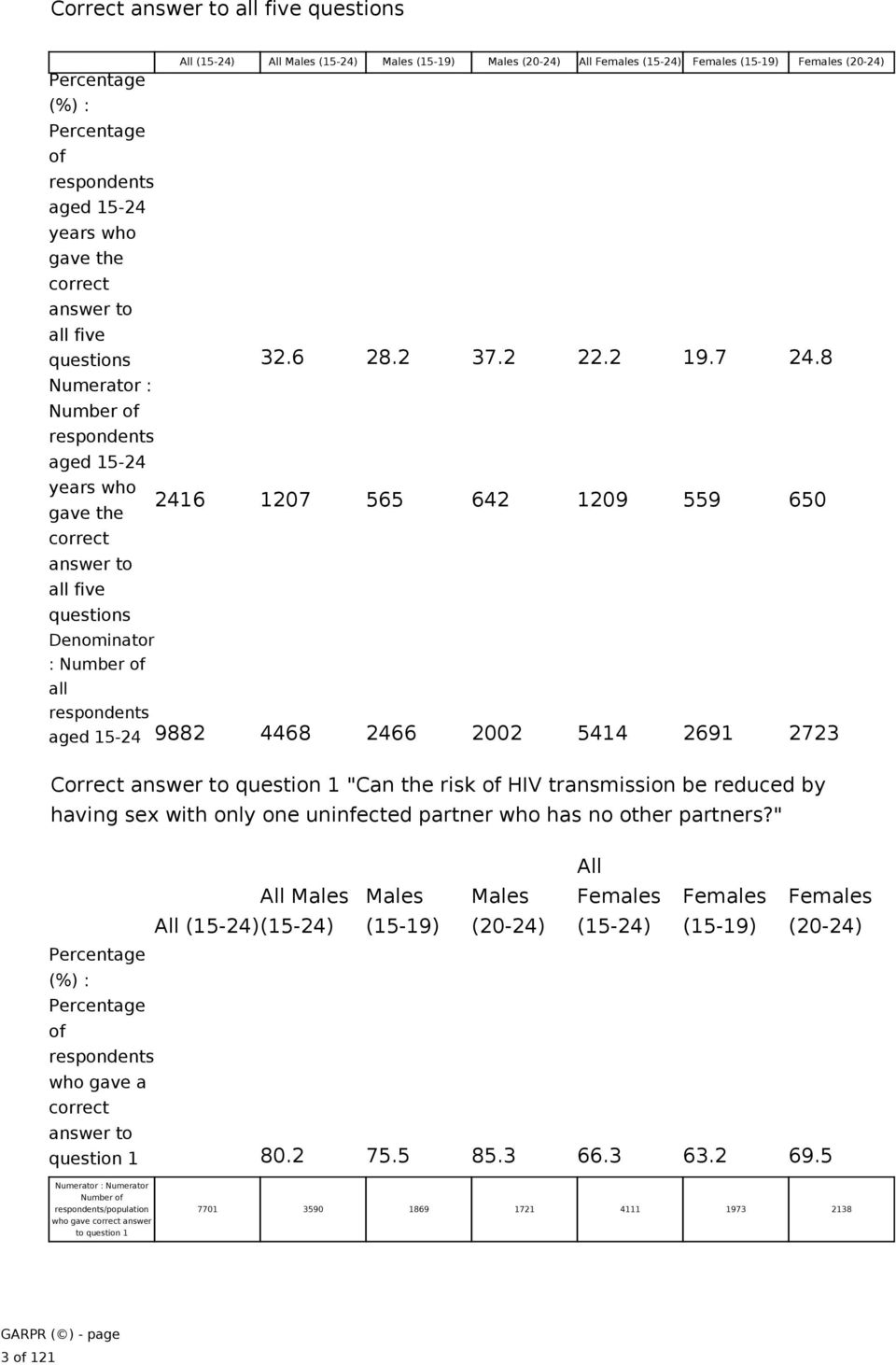
3 Correct answer to all five questions Percentage (%) Percentage of respondents aged years who gave the correct answer to all five All (15-24) All Males (15-24) Males (15-19) Males (20-24) All Females (15-24) Females (15-19) Females (20-24) questions Numerator Number of respondents aged years who gave the correct answer to all five questions Denominator Number of all respondents aged Correct answer to question 1 "Can the risk of HIV transmission be reduced by having sex with only one uninfected partner who has no other partners?" All All Males All (15-24) (15-24) Males (15-19) Males (20-24) Females (15-24) Females (15-19) Females (20-24) Percentage (%) Percentage of respondents who gave a correct answer to question Numerator Numerator Number of respondents/population who gave correct answer to question of 121
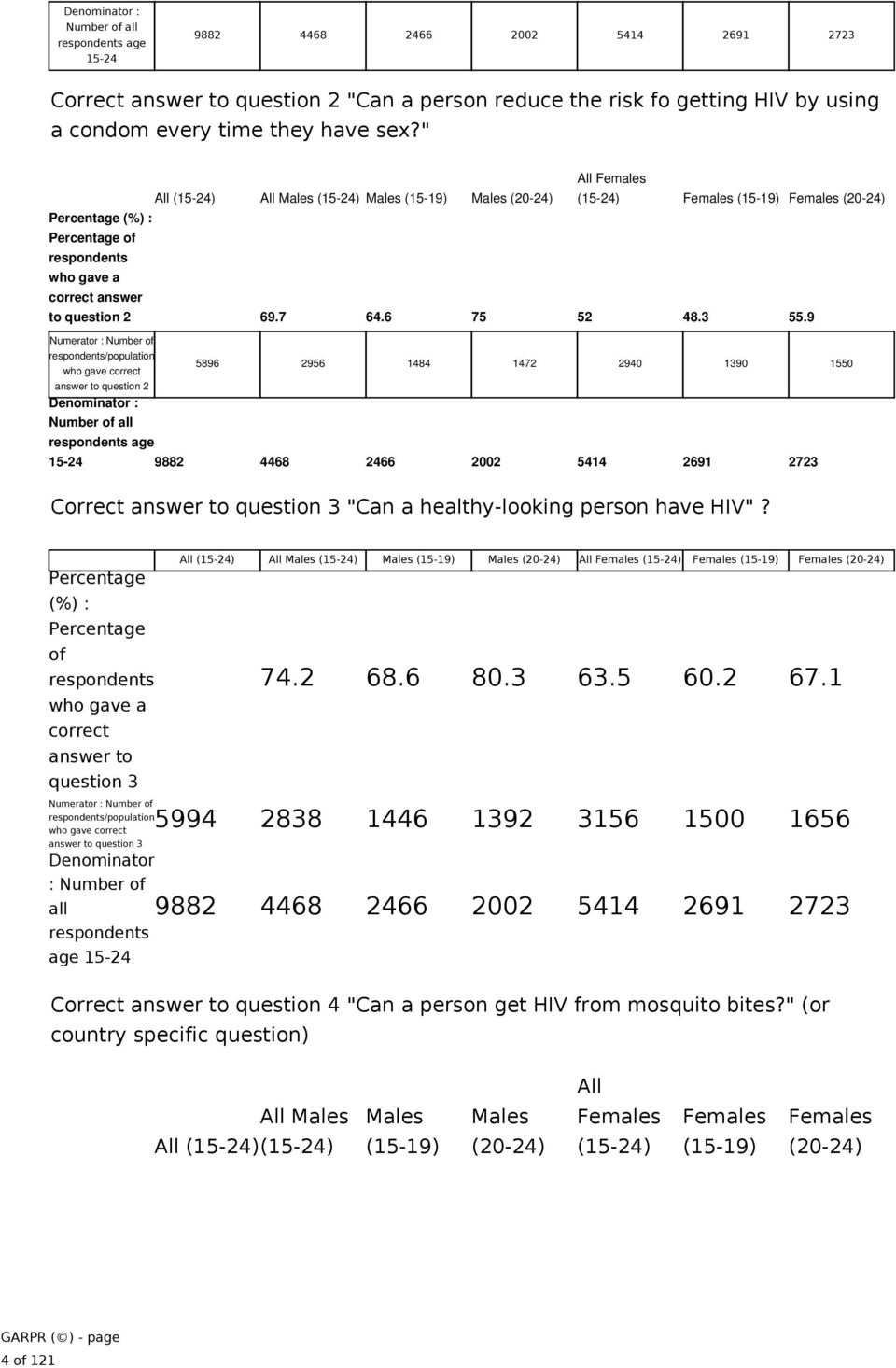
4 Denominator Number of all respondents age Correct answer to question 2 "Can a person reduce the risk fo getting HIV by using a condom every time they have sex?" All (15-24) All Males (15-24) Males (15-19) Males (20-24) All Females (15-24) Females (15-19) Females (20-24) Percentage (%) Percentage of respondents who gave a correct answer to question Numerator Number of respondents/population who gave correct answer to question 2 Denominator Number of all respondents age Correct answer to question 3 "Can a healthy-looking person have HIV"? Percentage (%) Percentage of respondents who gave a correct answer to question 3 Numerator Number of respondents/population who gave correct answer to question 3 Denominator Number of all respondents age All (15-24) All Males (15-24) Males (15-19) Males (20-24) All Females (15-24) Females (15-19) Females (20-24) Correct answer to question 4 "Can a person get HIV from mosquito bites?" (or country specific question) All All Males All (15-24) (15-24) Males (15-19) Males (20-24) Females (15-24) Females (15-19) Females (20-24) 4 of 121
5 Percentage (%) Percentage of respondents who gave a correct answer to question Numerator Number of respondents/population who gave correct answer to question 4 Denominator Number of all respondents age Correct answer to question 5 "Can a person get HIV from sharing food with someone who is infected?" (or country specific question) All All Males All (15-24) (15-24) Males (15-19) Males (20-24) Females (15-24) Females (15-19) Females (20-24) Percentage (%) Percentage of respondents who gave a correct answer to question 5 Numerator Number of respondents/population who gave correct answer to question 5 Denominator Number of all respondents age Sex before the age of 15 is indicator/topic relevant? Yes is data available? Yes Data measurement tool / source Other General Population Based Survey Other measurement tool / source National HIV/AIDS and Reproductive Health Survey (NARHS) 2012 From date 10/02/2012 To date 11/16/2012 Additional information related to entered data. e.g. reference to primary data source, methodological concerns Data related to this topic which does not fit into the indicator cells. Please specify methodology and reference to primary data source Data measurement tool / source GARPR Sample size - Number of Survey Respondents of 121

6 All (15-24) All Males (15-24) Males (15-19) Males (20-24) All Females (15-24) Females (15-19) Females (20-24) Percentage (%) Percentage of young women and men aged who have had sexual intercourse before the age of 15 Numerator Number of respondents (aged years) who report the age at which they first had sexual intercourse as under 15 years Denominator Number of all respondents aged years Multiple sexual partners is indicator/topic relevant? Yes is data available? Yes Data measurement tool / source Other General Population Based Survey Other measurement tool / source National HIV/AIDS and Reproductive Health Survey (NARHS) 2012 From date 10/02/2012 To date 11/16/2012 Additional information related to entered data. e.g. reference to primary data source, methodological concerns Data related to this topic which does not fit into the indicator cells. Please specify methodology and reference to primary data source Data measurement tool / source GARPR Sample size - Number of Survey Respondents All Males (all ages) Males (15-19) Males (20-24) Males (25-49) Females (all ages) Females (15-19) Females (20-24) Females (25-49) Percentage (%) Percentage of women and men aged who have had sexual intercourse with more than one partner in the past 12 months of 121

7 Numerator Number of respondents aged who have had sexual intercourse with more than one partner in the last 12 months Denominator Number of all respondents aged Condom use at last sex among people with multiple sexual partnerships is indicator/topic relevant? Yes is data available? Yes Data measurement tool / source Other General Population Based Survey Other measurement tool / source National HIV/AIDS and Reproductive Health Survey (NARHS) 2012 From date 10/02/2012 To date 11/16/2012 Additional information related to entered data. e.g. reference to primary data source, methodological concerns Data related to this topic which does not fit into the indicator cells. Please specify methodology and reference to primary data source Data measurement tool / source GARPR Sample size - Number of Survey Respondents All Males (all ages) Males (15-19) Males (20-24) Males (25-49) Females (all ages) Females (15-19) Females (20-24) Females (25-49) Percentage (%) Percentage of women and men aged who had more than one partner in the past 12 months who used a condom during their last sexual intercourse of 121
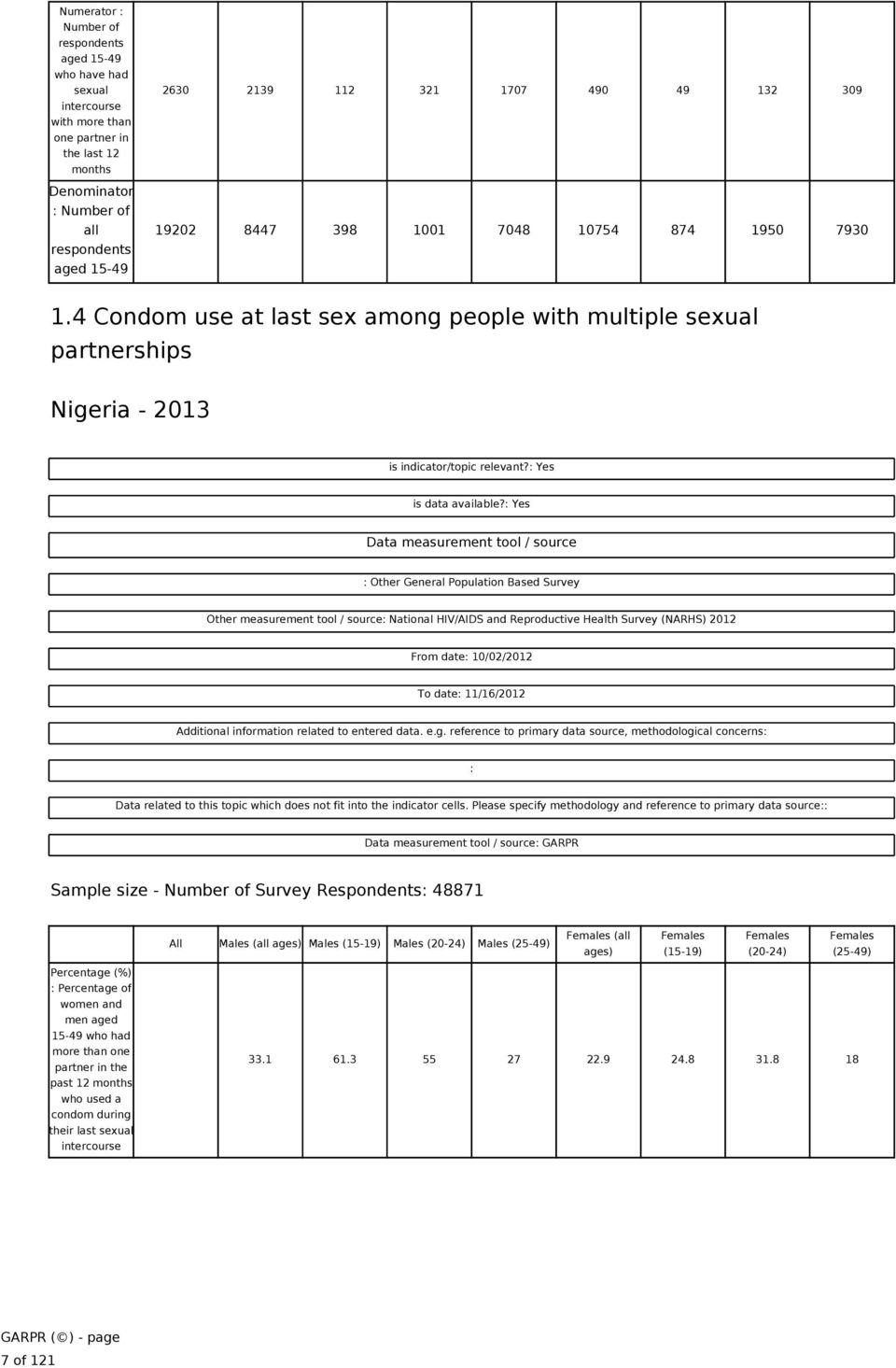
8 Numerator Number of respondents (aged 15-49) who reported having had more than one sexual partner in the last 12 months who also reported that a condom was used the last time they had sex Denominator Number of respondents (15-49) who reported having had more than one sexual partner in the last 12 months HIV testing in the general population is indicator/topic relevant? Yes is data available? Yes Data measurement tool / source Other General Population Based Survey Other measurement tool / source National HIV/AIDS and Reproductive Health Survey (NARHS) 2012 From date 10/02/2012 To date 11/16/2012 Additional information related to entered data. e.g. reference to primary data source, methodological concerns Data related to this topic which does not fit into the indicator cells. Please specify methodology and reference to primary data source Data measurement tool / source GARPR Sample size - Number of Survey Respondents All Males (all ages) Males (15-19) Males (20-24) Males (25-49) Females (all ages) Females (15-19) Females (20-24) Females (25-49) 8 of 121

9 Percentage (%) Percentage of women and men aged who received an HIV test in the past 12 months and know their results Numerator Number of respondents aged who have been tested for HIV during the last 12 months and who know their results Denominator Number of all respondents aged 15-49, including those who have never heard of HIV or AIDS HIV prevalence in young people is indicator/topic relevant? Yes is data available? Yes Data measurement tool / source Antenatal clinic data Other measurement tool / source From date 06/28/2010 To date 09/17/2010 Additional information related to entered data. e.g. reference to primary data source, methodological concerns This data can also be obtained from the NARHS but since the numerator and denominator specify data from Antenatal clinic attendees, the ANC 2010 survey data was used. Data related to this topic which does not fit into the indicator cells. Please specify methodology and reference to primary data source Data measurement tool / source GARPR Sample size - Number of Survey Respondents Total (15-24) Percentage (%) Percentage of young people aged who are living with HIV Numerator Number of antenatal clinic attendees (aged 15 24) tested whose HIV test results are positive Denominator Number of antenatal clinic attendees (aged 15 24) tested for their HIV infection status of 121

10 B Size estimations for key populations Sex workers Have you performed population size estimations for sex workers? Yes If yes, when was the latest estimation performed? (year) 2013 If yes, what was the size estimation? Comments (please include the definition used of the population, the method used to derive the size estimate, any site specific estimates available, if multi-site estimates were made.) A sexually active female is a female who undertakes sexual activity with a man in return for financial or material benefit. Men who have sex with men Have you performed population size estimations for men who have sex with men? Yes If yes, when was the latest estimation performed? (year) 2013 If yes, what was the size estimation? Comments (please include the definition used of the population, the method used to derive the size estimate, any site specific estimates available, if multi-site estimates were made.) Men who have sex with men (MSM) are men who have anal sex with other men as a matter of preference or practices, regardless of their sexual identity or sexual orientation, and irrespective of whether they also have sex with women or not. Men who sell sex to other men for money or material benefits are also recognized in this context. People who inject drugs Have you performed population size estimations for people who inject drugs? Yes If yes, when was the latest estimation performed? (year) 2013 If yes, what was the size estimation? Comments (please include the definition used of the population, the method used to derive the size estimate, any site specific estimates available, if multi-site estimates were made.) Injecting Drug Users (IDU) are people who injects drugs for non-therapeutic purposes, irrespective of the type of drug injected. Other key populations (please specify) 10 of 121

11 Have you performed population size estimations for other key populations? No If yes, when was the latest estimation performed? (year) If yes, what was the size estimation? Comments (please include the definition used of the population, the method used to derive the size estimate, any site specific estimates available, if multi-site estimates were made.) B.1 Sex workers is indicator/topic relevant? Yes is data available? Yes Data measurement tool / source Behavioural Surveillance Survey (please specify sampling strategy and location) Other measurement tool / source From date 10/10/2010 To date 12/12/2010 Additional information related to entered data. e.g. reference to primary data source, methodological concerns Data related to this topic which does not fit into the indicator cells. Please specify methodology and reference to primary data source Data measurement tool / source GARPR Case definition Female Sex Workers (FSW) a sexually active female who undertakes sexual activity with a man in return for financial or material benefit Number of sites 9 Sampling method Time location sampling (TLS) Download the site-specific survey data template, Site-specific-sw.xlsx Then, upload the filled-in form using the "Add file" button. 1.7 Sex Workers prevention programmes Additional information related to entered data. Sample size - Number of Survey Respondents of 121

12 Correct answer to both questions All Males Females Transgender(MTF)< Percentage (%) Percentage of sex workers who replied yes to both questions Numerator Number sex workers who replied yes to both questions Denominator Total number 5018 of sex workers surveyed Correct answer to question 1 "Do you know where you can go if you wish to receive an HIV test?" All Males Females Transgender(MTF)< Percentage (%) Percentage of sex workers who replied yes to question Numerator Number sex workers who replied yes to question Denominator Total number of sex workers surveyed Correct answer to question 2 "In the last twelve months, have you been given condoms?" All Males Females Transgender(MTF)< Percentage (%) Percentage of sex workers who replied yes to question of 121

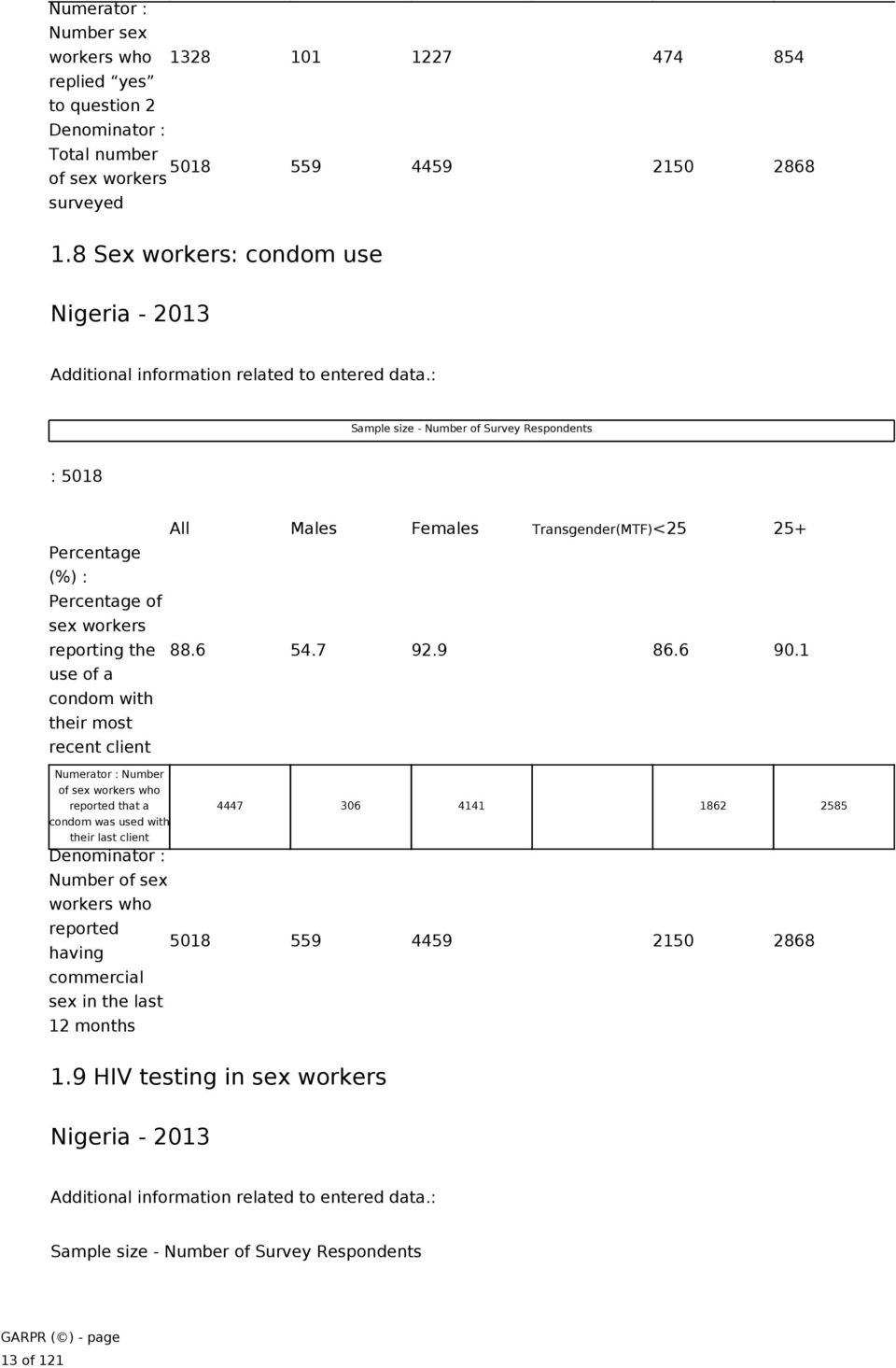
13 Numerator Number sex workers who replied yes to question 2 Denominator Total number 5018 of sex workers surveyed 1.8 Sex workers condom use Additional information related to entered data. Sample size - Number of Survey Respondents 5018 Percentage (%) Percentage of sex workers reporting the use of a condom with their most recent client All Males Females Transgender(MTF)< Numerator Number of sex workers who reported that a condom was used with their last client Denominator Number of sex workers who reported having commercial sex in the last 12 months HIV testing in sex workers Additional information related to entered data. Sample size - Number of Survey Respondents 13 of 121
14 5081 All Males Females Transgender(MTF) < Percentage (%) Percentage of sex workers who received an HIV test in the past 12 months and know their results Numerator Number of sex workers who have been tested for HIV during the last 12 months and who know their results Denominator Number of sex workers included in the sample HIV prevalence in sex workers Additional information related to entered data. Sample size - Number of Survey Respondents 5081 All Males Females Transgender(MTF)< Percentage (%) Percentage of sex workers who are living with HIV Numerator Number of sex workers who test positive for HIV Denominator Number of sex workers tested for HIV B.2 Men who have sex with men is indicator/topic relevant? Yes is data available? Yes Data measurement tool / source Behavioural Surveillance Survey (please specify sampling strategy and location) Other measurement tool / source From date 10/10/2010 To date 12/12/ of 121

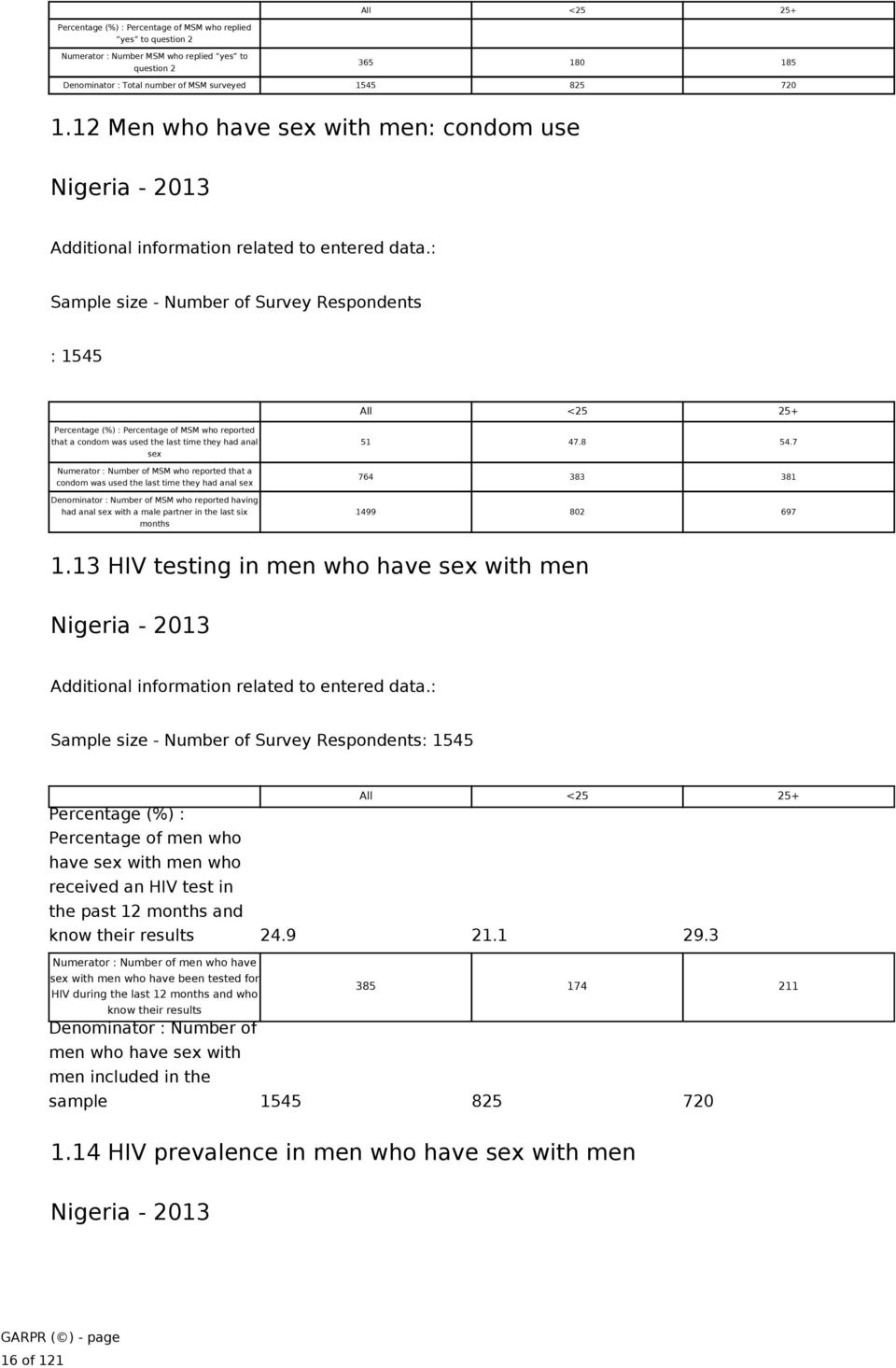
15 Additional information related to entered data. e.g. reference to primary data source, methodological concerns Data related to this topic which does not fit into the indicator cells. Please specify methodology and reference to primary data source Data measurement tool / source GARPR Case definition Men who have sex with men (MSM) are men who have anal sex with other men as a matter of preference or practices, regardless of their sexual identity or sexual orientation, and irrespective of whether they also have sex with women or not. Men who sell sex to other men for money or material benefits are also recognized in this context Number of sites 6 Sampling method Respondent driven sampling (RDS) Download the site-specific survey data template Site-specific-msm.xlsx Then, upload the filled-in form using the "Add file" button Men who have sex with men prevention programmes Additional information related to entered data. Sample size - Number of Survey Respondents 1545 Correct answer to both questions All < Percentage (%) Percentage of MSM who replied yes to both questions Numerator Number MSM who replied yes to both questions Denominator Total number of MSM surveyed Correct answer to question 1 "Do you know where you can go if you wish to receive an HIV test?" All < Percentage (%) Percentage of MSM who replied yes to question 1 Numerator Number MSM who replied yes to question Denominator Total number of MSM surveyed Correct answer to question 2 "In the last twelve months, have you been given condoms?" 15 of 121

16 All < Percentage (%) Percentage of MSM who replied yes to question 2 Numerator Number MSM who replied yes to question Denominator Total number of MSM surveyed Men who have sex with men condom use Additional information related to entered data. Sample size - Number of Survey Respondents 1545 All < Percentage (%) Percentage of MSM who reported that a condom was used the last time they had anal sex Numerator Number of MSM who reported that a condom was used the last time they had anal sex Denominator Number of MSM who reported having had anal sex with a male partner in the last six months HIV testing in men who have sex with men Additional information related to entered data. Sample size - Number of Survey Respondents 1545 All < Percentage (%) Percentage of men who have sex with men who received an HIV test in the past 12 months and know their results Numerator Number of men who have sex with men who have been tested for HIV during the last 12 months and who know their results Denominator Number of men who have sex with men included in the sample HIV prevalence in men who have sex with men 16 of 121
17 Additional information related to entered data. Sample size - Number of Survey Respondents 1545 All < Percentage (%) Percentage of men who have sex with men risk who are living with HIV Numerator Number of MSM who test positive for HIV Denominator Number of MSM tested for HIV HIV Testing and counselling in women and men aged 15 and older is indicator/topic relevant? Yes is data available? Yes Data measurement tool / source Please specify the data measurement tool below Other measurement tool / source Program data-fmoh From date 01/01/2013 To date 12/31/2013 Additional information related to entered data. e.g. reference to primary data source, methodological concerns Data related to this topic which does not fit into the indicator cells. Please specify methodology and reference to primary data source Data measurement tool / source GARPR Women and men aged 15 and older All Males (15+) (15+) Both Both Femalessexes Males Femalessexes Males Females (15+) (15-19) (15-19) (15-19) (20-24) (20-24) (20-24) Both sexes Males (25+) (25+) Females (25+) Number Number of people who received HIV testing and counselling in the past 12 months and know their results of 121

18 Number HIV+ out of the number tested Pregnant women (out of total number above) Females (15+) Females (15-19) Females (20-24) Females (25+) Number Number of pregnant women aged 15 and older (out of the total number above) who received testing and counselling in the past 12 months and received their results Percentage of health facilities dispensing HIV rapid test kits that experienced a stock-out in the last 12 months 18 of 121

19 is indicator/topic relevant? Yes is data available? No Data measurement tool / source Other measurement tool / source From date To date Additional information related to entered data. e.g. reference to primary data source, methodological concerns Data related to this topic which does not fit into the indicator cells. Please specify methodology and reference to primary data source Data measurement tool / source GARPR Numerator Denominator Percentage of women accessing antenatal care (ANC) services who were tested for syphilis 19 of 121

20 is indicator/topic relevant? Yes is data available? No Data measurement tool / source Other measurement tool / source From date To date Additional information related to entered data. e.g. reference to primary data source, methodological concerns Data related to this topic which does not fit into the indicator cells. Please specify methodology and reference to primary data source Data measurement tool / source GARPR Are the data representative of the entire country? No If no, please describe At first ANC visit Percentage (%) Percentage of women accessing antenatal care (ANC) services who were tested for syphilis at first ANC visit Numerator Number of women attending ANC services who were tested for syphilis at first ANC visit Denominator Number of women attending ANC services Total At any ANC visit Percentage (%) Percentage of women accessing antenatal care (ANC) services who were tested for syphilis at any ANC visit Numerator Number of women attending ANC services who were tested for syphilis at any ANC visit Denominator Number of women attending ANC services Total Percentage of antenatal care attendees who were positive for syphilis 20 of 121

21 is indicator/topic relevant? Yes is data available? No Data measurement tool / source Other measurement tool / source From date To date Additional information related to entered data. e.g. reference to primary data source, methodological concerns Data related to this topic which does not fit into the indicator cells. Please specify methodology and reference to primary data source Data measurement tool / source GARPR Test type(s) generally used in your country All < Percentage (%) Percentage of antenatal care attendees who were positive for syphilis Numerator Number of antenatal care attendees who tested positive for syphilis Denominator Number of antenatal care attendees who were tested for syphilis Percentage of antenatal care attendees positive for syphilis who received treatment 21 of 121
22 is indicator/topic relevant? Yes is data available? No Data measurement tool / source Other measurement tool / source From date To date Additional information related to entered data. e.g. reference to primary data source, methodological concerns Data related to this topic which does not fit into the indicator cells. Please specify methodology and reference to primary data source Data measurement tool / source GARPR Are the data representative of the entire country? No If no, please describe Total Percentage (%) Percentage of antenatal care attendees positive for syphilis who received treatment Numerator Number of antenatal care attendees with a positive syphilis serology who received at least one dose of benzathine penicillin 2.4 mu IM Denominator Number of antenatal care attendees with a positive syphilis serology Percentage of sex workers with active syphilis is indicator/topic relevant? Yes is data available? No Data measurement tool / source Other measurement tool / source From date To date Additional information related to entered data. e.g. reference to primary data source, methodological concerns 22 of 121
23 Data related to this topic which does not fit into the indicator cells. Please specify methodology and reference to primary data source Data measurement tool / source GARPR Are the data representative of the entire country? No If no, please describe Are data consistent with the definition of active syphilis for GARPR (both treponemal and non-treponemal test positive)? No If no, please describe Percentage (%) Percentage of sex workers (SWs) with active syphilis Numerator Number of sex workers who tested positive for syphilis Denominator Number of sex workers who were tested for syphilis Total Percentage of men who have sex with men with active syphilis is indicator/topic relevant? Yes is data available? No Data measurement tool / source Other measurement tool / source From date To date Additional information related to entered data. e.g. reference to primary data source, methodological concerns Data related to this topic which does not fit into the indicator cells. Please specify methodology and reference to primary data source Data measurement tool / source GARPR Are the data representative of the entire country? No 23 of 121
24 If no, please describe Are data consistent with the definition of active syphilis for GARPR (both treponemal and non-treponemal test positive)? No If no, please describe Total Percentage (%) Percentage men who have sex with men (MSM) with active syphilis Numerator Number of men who have sex with men who tested positive for syphilis Denominator Number of men who have sex with men who were tested for syphilis Number of adults reported with syphilis (primary/secondary and latent/unknown) in the past 12 months is indicator/topic relevant? Yes is data available? No Data measurement tool / source Other measurement tool / source From date To date Additional information related to entered data. e.g. reference to primary data source, methodological concerns Data related to this topic which does not fit into the indicator cells. Please specify methodology and reference to primary data source Data measurement tool / source GARPR Are the data representative of the entire country? No If no, please describe Numerator Number of adults reported with syphilis during the reporting period Denominator Number of individuals aged 15 and older Total Females Males Female (primary/secondary) Male (primary/secondary) Number of reported congenital syphilis cases (live births and stillbirths) in the past 12 months is indicator/topic relevant? Yes is data available? 24 of 121
25 No Data measurement tool / source Other measurement tool / source From date To date Additional information related to entered data. e.g. reference to primary data source, methodological concerns Data related to this topic which does not fit into the indicator cells. Please specify methodology and reference to primary data source Data measurement tool / source GARPR Are the data representative of the entire country? No If no, please describe Numerator Number of reported congenital syphilis cases (live births and stillbirths) in the past 12 months Denominator Number of live births Total Number of men reported with gonorrhoea in the past 12 months is indicator/topic relevant? Yes is data available? No Data measurement tool / source Other measurement tool / source From date To date Additional information related to entered data. e.g. reference to primary data source, methodological concerns Data related to this topic which does not fit into the indicator cells. Please specify methodology and reference to primary data source Data measurement tool / source GARPR Are the data representative of the entire country? No 25 of 121
26 If no, please describe Numerator Number of men reported with gonorrhoea in the past 12 months Total Denominator Number of males aged 15 and older Number of men reported with urethral discharge in the past 12 months is indicator/topic relevant? Yes is data available? No Data measurement tool / source Other measurement tool / source From date To date Additional information related to entered data. e.g. reference to primary data source, methodological concerns Data related to this topic which does not fit into the indicator cells. Please specify methodology and reference to primary data source Data measurement tool / source GARPR Are the data representative of the entire country? No If no, please describe Numerator Number of men reported with urethral discharge in the past 12 months Denominator Number of males aged 15 and older Total Number of adults reported with genital ulcer disease in the past 12 months 26 of 121
27 is indicator/topic relevant? Yes is data available? No Data measurement tool / source Other measurement tool / source From date To date Additional information related to entered data. e.g. reference to primary data source, methodological concerns Data related to this topic which does not fit into the indicator cells. Please specify methodology and reference to primary data source Data measurement tool / source GARPR Are the data representative of the entire country? No If no, please describe Numerator Number of adults reported with genital ulcer disease during the reporting period Denominator Number of individuals aged 15 and older Total Males Females A People who inject drugs is indicator/topic relevant? Yes is data available? Yes Data measurement tool / source Behavioural Surveillance Survey (please specify sampling strategy and location) Other measurement tool / source 27 of 121
28 From date 10/10/2010 To date 12/12/2010 Additional information related to entered data. e.g. reference to primary data source, methodological concerns Data related to this topic which does not fit into the indicator cells. Please specify methodology and reference to primary data source Data measurement tool / source GARPR Case definition Injecting Drug Users (IDU)s are persons who injects drugs for non-therapeutic purposes, irrespective of the type of drug injected. Number of sites 6 Sampling method Respondent driven sampling (RDS) Download the site-specific survey data template, Site-specific-pwid.xlsx Then, upload the filled-in form using the "Add file" button. 2.1 People who inject drugs prevention programmes Additional information related to entered data. Number of needles and syringes distributed per person who injects drugs per year by needle and syringe programmes For Dublin Declaration countries, you may refer to the latest data on the EMCDDA website <a target="_blank" href="http// distributed through specialised programmes per estimated IDU in 2011 or latest available year</a> Numerator Number of needles and syringes distributed in past 12 months by NSPs. Denominator Number of people who inject drugs in the country Total 2.2 People who inject drugs condom use Additional information related to entered data. Sample size - Number of Survey Respondents All Males Females < of 121
29 Percentage (%) Percentage of people who inject drugs reporting the use of a condom the last time they had sexual intercourse Numerator Number of people who inject drugs who reported that a condom was used the last time they had sex Denominator Number of people who inject drugs who report having injected drugs and having had sexual intercourse in the last month People who inject drugs safe injecting practices Additional information related to entered data. Sample size - Number of Survey Respondents 1545 All Males Females < Percentage (%) Percentage of people who inject drugs reporting the use of sterile injecting equipment the last time they injected Numerator Number of people who inject drugs who report using sterile injecting equipment the last time they injected drugs Denominator Number of people who inject drugs who report injecting drugs in the last month HIV testing in people who inject drugs 29 of 121
30 Additional information related to entered data. Sample size - Number of Survey Respondents 1545 Percentage (%) Percentage of people who inject drugs who received an HIV test in the past 12 months and know their All Males Females < results Numerator Number of people who inject drugs respondents who have been tested for HIV during the last 12 months and who know their results Denominator Number of people who inject drugs included in the sample HIV prevalence in people who inject drugs Additional information related to entered data. Sample size - Number of Survey Respondents 1545 Percentage (%) Percentage of people who inject drugs who are living with HIV<br> For Dublin Declaration countries, you may refer to the latest data on the EMCDDA website Prevalence of HIV infection among injecting drug users in the EU, Croatia, Turkey and Norway (<a target="_blank" href="http// table by country</a> <a target="_blank" href="http// >Detailed data from </a>) All Males Females < Numerator Number of people who inject drugs who test positive for HIV Denominator Number of people who inject drugs tested for HIV a Estimated number of opiate users (injectors and non-injectors) 30 of 121
31 is indicator/topic relevant? No is data available? No Data measurement tool / source Other measurement tool / source From date To date Additional information related to entered data. e.g. reference to primary data source, methodological concerns Data related to this topic which does not fit into the indicator cells. Please specify methodology and reference to primary data source Data measurement tool / source GARPR Estimated number of opiate users (injectors and non-injectors), if available 2.6b Number of people on opioid substitution therapy (OST) is indicator/topic relevant? No is data available? No Data measurement tool / source Other measurement tool / source From date To date Additional information related to entered data. e.g. reference to primary data source, methodological concerns Data related to this topic which does not fit into the indicator cells. Please specify methodology and reference to primary data source Data measurement tool / source GARPR Number of people on OST in all OST sites 2.7a Number of needle and syringe programme sites is indicator/topic relevant? No is data available? No Data measurement tool / source Other measurement tool / source From date To date Additional information related to entered data. e.g. reference to primary data source, methodological concerns Data related to this topic which does not fit into the indicator cells. Please specify methodology and reference to primary data source 31 of 121
32 Data measurement tool / source GARPR Number of NSP sites (including pharmacy sites providing no cost needles and syringes) 2.7b Number of opioid substitution therapy (OST) sites is indicator/topic relevant? No is data available? No Data measurement tool / source Other measurement tool / source From date To date Additional information related to entered data. e.g. reference to primary data source, methodological concerns Data related to this topic which does not fit into the indicator cells. Please specify methodology and reference to primary data source Data measurement tool / source GARPR Number of OST sites 3.1 Prevention of mother-to-child transmission is indicator/topic relevant? Yes is data available? Yes Data measurement tool / source Other (please specify) Other measurement tool / source Numerator is from ANC/ PMTCT register and L&D register From date 01/01/2013 To date 12/31/2013 Additional information related to entered data. e.g. reference to primary data source, methodological 32 of 121
33 concerns Nigeria did not adopt the option B + Data related to this topic which does not fit into the indicator cells. Please specify methodology and reference to primary data source Data measurement tool / source GARPR Percentage (%) Percentage of HIV-positive pregnant women who received antiretroviral medicine to reduce the risk of mother-to-child Data value transmission Numerator Number of HIV-positive pregnant women who received antiretroviral drugs during the past 12 months to reduce the risk of mother-to-child transmission during pregnancy and delivery newly initiated on ART during the current pregnancy already on ART before the current pregnancy Maternal triple ARV prophylaxis (prophylaxis component of WHO Option B) Maternal AZT (prophylaxis component during pregnancy and delivery of WHO Option A or WHO 2006 guidelines) 5. Single dose nevirapine (with or without tail) ONLY Please note that the final published value for PMTCT coverage will not include single dose nevirapine. However, this data is collected in the reporting tool during the phase out period. 6. Other (please comment e.g. specify regimen, uncategorized, etc.) In the Comment Box, for the women reported as receiving an "Other" regimen, please describe the ARV regimen(s) and the number of women receiving each regimen category. If disaggregations 1 and 2 are not available, please provide the total number of pregnant women on Lifelong ART Denominator Estimated number of HIV-positive pregnant women who delivered within the past 12 months a Prevention of mother-to-child transmission during breastfeeding is indicator/topic relevant? Yes is data available? Yes Data measurement tool / source Please specify Other measurement tool / source Program Data-FMoH From date 33 of 121
34 01/01/2013 To date 12/31/2013 Additional information related to entered data. e.g. reference to primary data source, methodological concerns The data used for the numerator includes women receiving ART for their own health and those receiving triple ARV prophylaxis but does not include those receiving SD Nevirapine or double ARV prophylaxis. The number of children breastfeeding and receiving prophylaxis is 14,843. This figure is not added to the numerator. Data related to this topic which does not fit into the indicator cells. Please specify methodology and reference to primary data source Data measurement tool / source GARPR Data value Percentage (%) Percentage of women living with HIV who are provided with antiretroviral medicines for themselves or their infants during the breastfeeding period Numerator Number of women living with HIV who were breastfeeding who received antiretroviral medicine for herself or her child to reduce the risk of mother-to-child transmission during breastfeeding during the past 12 months. Denominator Estimated number of women living with HIV who were breastfeeding in the past 12 months Early infant diagnosis is indicator/topic relevant? Yes is data available? Yes Data measurement tool / source EID Testing laboratories and Spectrum estimates Other measurement tool / source From date 01/01/2013 To date 12/31/2013 Additional information related to entered data. e.g. reference to primary data source, methodological concerns There is high number of loss to follow up of mother to child pair. There are also challenges with logistics for EID. Data related to this topic which does not fit into the indicator cells. Please specify methodology and reference to primary data source 34 of 121
35 Data measurement tool / source GARPR Data value Percentage (%) Percentage of infants born to HIV-positive women receiving a virological test for HIV within 2 months of birth 3.87 Numerator Number of infants who received an HIV test within two months of birth, during the reporting period. Infants tested should only be counted once 7459 Test result - Positive 1155 Test result - Negative 6304 Test result - Indeterminate 0 Test result - Rejected by laboratory Test result - Other Denominator Number of HIV-positive pregnant women giving birth in the last 12 months Mother-to-child transmission of HIV (modelled) is indicator/topic relevant? Yes is data available? Yes Data measurement tool / source Spectrum Other measurement tool / source From date 01/01/2013 To date 12/31/2013 Additional information related to entered data. e.g. reference to primary data source, methodological concerns Data related to this topic which does not fit into the indicator cells. Please specify methodology and reference to primary data source Data measurement tool / source GARPR Data value Percentage (%) Estimated percentage of child HIV infections from HIV-positive women delivering in the past 12 months Numerator Estimated number of children who will be newly infected with HIV due to mother-to-child transmission among children born in the previous 12 months to HIV-positive women Denominator Estimated number of HIV positive women who delivered in the previous 12 months Percentage of pregnant women who know their HIV status is indicator/topic relevant? Yes is data available? Yes Data measurement tool / source Please specify Other measurement tool / source Program data- FMoH From date 01/01/2013 To date 12/31/2013 Additional information related to entered data. e.g. reference to primary data source, methodological concerns Data related to this topic which does not fit into the indicator cells. Please specify methodology and reference to primary data source Data measurement tool / source GARPR 35 of 121
36 Percentage (%) - Percentage of pregnant women who were tested for HIV and received their results - during pregnancy, during labour and delivery, and during the post-partum period (<72 hours), including those with previously known HIV status Numerator - Number of pregnant women who were tested for HIV in the last 12 months and received their results - during pregnancy, during labour and delivery, and during the post-partum period (<72 hours), including those with previously known HIV status Data value Total number tested (including previously known positives) Total number tested and received results (including previously known positives) Total number testing positive (including previously known positives) (a) Total number of pregnant women attending ANC who were tested during ANC and received results or knew their positive status. Data value Number tested (including previously known positives) Number tested and received results (including previously known positives) HIV+ out of number tested (including previously known positives) (a.i) Number of pregnant women with unknown HIV status attending ANC who were tested during ANC and received results Data value Number tested Number tested and received results HIV+ out of number tested (a.ii) Number of pregnant women with known HIV+ infection attending ANC for a new pregnancy Number of HIV+ pregnant women Data value (b) Number of pregnant women with unknown HIV status attending L&D (labour and delivery) who were tested in L&D and received results Data value Number tested Number tested and received results HIV+ out of number tested (c) Number of women with unknown HIV status attending postpartum services within 72 hours of delivery who were tested and received results Data value Number tested 8639 Number tested and received results 8313 HIV+ out of number tested of 121
37 Denominator - Estimated number of pregnant women Percentage of pregnant women attending antenatal care whose male partner was tested for HIV in the last 12 months is indicator/topic relevant? Yes is data available? Yes Data measurement tool / source Please specify Other measurement tool / source Program Data-FMoH From date 01/01/2013 To date 12/31/2013 Additional information related to entered data. e.g. reference to primary data source, methodological concerns The denominator includes only data on new ANC ANC attendees and only from ANC sites providing HIV/AIDS services Data related to this topic which does not fit into the indicator cells. Please specify methodology and reference to primary data source Data measurement tool / source GARPR Data value Percentage (%) Percentage of pregnant women attending antenatal care whose male partner was tested for HIV in the last 12 months Numerator Number of pregnant women attending antenatal care whose male partner was tested in the last 12 months Denominator Number of pregnant women attending antenatal care Percentage of HIV-infected pregnant women assessed for ART eligibilty through either clinical staging or CD4 testing is indicator/topic relevant? Yes is data available? Yes Data measurement tool / source Please specify Other measurement tool / source Program Data- FMoH From date 01/01/2013 To date 12/31/2013 Additional information related to entered data. e.g. reference to primary data source, methodological concerns Data related to this topic which does not fit into the indicator cells. Please specify methodology and reference to primary data source 37 of 121
38 Data measurement tool / source GARPR Data value Percentage (%) Percentage of HIV-infected pregnant women assessed for ART eligibility through either clinical staging or CD4 testing Numerator Number of HIV-infected pregnant women assessed for ART eligibility Disaggregation by method of assessment Clinical staging only 9655 Disaggregation by method of assessment CD4 testing Women who were assessed both by CD4 testing and by clinical staging should be counted only once, as having been assessed by CD4 testing Denominator Estimated number of HIV-infected pregnant women Percentage of infants born to HIV-infected women provided with antiretroviral prophylaxis to reduce the risk of early mother-to-child transmission in the first 6 weeks is indicator/topic relevant? No is data available? No Data measurement tool / source Other measurement tool / source From date To date Additional information related to entered data. e.g. reference to primary data source, methodological concerns Data related to this topic which does not fit into the indicator cells. Please specify methodology and reference to primary data source Data measurement tool / source GARPR Percentage (%) Percentage of infants born to HIV-infected women (HIV-exposed infants) who received antiretroviral prophylaxis to reduce the risk of early mother-to-child- transmission in the first 6 weeks (i.e. early postpartum transmission around 6 weeks of age) Note. Ideally countries should capture the percentage of infants who received ARV prophylaxis. If this is not possible then countries should record the percentage of infants who were started on or provided with ARV prophylaxis. Data value 38 of 121
39 Numerator Number of infants born to HIV-infected women who received antiretroviral prophylaxis to reduce early mother-to-child transmission (early postpartum, in the first 6 weeks) Denominator Estimated number of HIV-infected pregnant women giving birth 3.9 Percentage of infants born to HIV-infected women started on cotrimoxazole (CTX) prophylaxis within two months of birth is indicator/topic relevant? Yes is data available? Yes Data measurement tool / source Please specify Other measurement tool / source Program Data-FMoH From date 01/01/2013 To date 12/31/2013 Additional information related to entered data. e.g. reference to primary data source, methodological concerns Data related to this topic which does not fit into the indicator cells. Please specify methodology and reference to primary data source Data measurement tool / source GARPR Data value Percentage (%) Percentage of infants born to HIV-infected women started on cotrimoxazole (CTX) prophylaxis within two months of birth Note. Ideally countries should capture the percentage of infants who received ARV prophylaxis. If this is not possible then countries should record the percentage of infants who were started on or provided with ARV prophylaxis. Numerator Number of infants born to HIV-infected women started on CTX prophylaxis within two months of birth Denominator Estimated number of HIV-infected pregnant women giving birth Distribution of feeding practices for infants born to HIV-infected women at DTP3 visit is indicator/topic relevant? Yes is data available? Yes Data measurement tool / source Please specify Other measurement tool / source Program data-fmoh From date 01/01/2013 To date 39 of 121
40 12/31/2013 Additional information related to entered data. e.g. reference to primary data source, methodological concerns The 'other' category refers to commercial infant formula. Data related to this topic which does not fit into the indicator cells. Please specify methodology and reference to primary data source Data measurement tool / source GARPR Distribution by feeding practice Exclusive breastfeeding 9622 Data value Estimated number of HIV-infected pregnant women giving birth Mixed feeding/other 1462 Uncategorized/other 2079 Number of infants born to HIV-infected women assessed for and whose infant feeding practices were recorded at DTP3 visit 3.11 Number of pregnant women attending ANC at least once during the reporting period is indicator/topic relevant? No is data available? No Data measurement tool / source Other measurement tool / source From date To date Additional information related to entered data. e.g. reference to primary data source, methodological concerns Data related to this topic which does not fit into the indicator cells. Please specify methodology and reference to primary data source Data measurement tool / source GARPR Number of pregnant women attending ANC at least once during the reporting period 40 of 121
41 4.1 HIV treatment antiretroviral therapy is indicator/topic relevant? Yes is data available? Yes Data measurement tool / source Antiretroviral Therapy Patient Registers and ANC estimates Other measurement tool / source From date 01/01/2013 To date 12/31/2013 Additional information related to entered data. e.g. reference to primary data source, methodological concerns The number provided above (639,397) is generated from all facilities (public and private) providing ART. The data is not dis aggregated by Private/public. The age dis -aggregation provided by the national program data includes <1, 1-14 and 15+. We therefore subtracted the figure for <1 from the figure reported for <15. Data related to this topic which does not fit into the indicator cells. Please specify methodology and reference to primary data source The dis aggregation for <1 for the ARV eligible population from spectrum could not be obtained. The age dis aggregation provided by the national program data includes <1, 1-14 and 15+. Data measurement tool / source GARPR Total and disaggregated by sex Percentage (%) Percentage of adults and children currently receiving antiretroviral therapy among all adults and children living Total Males Females Sex unknown with HIV Numerator Number of adults and children currently receiving antiretroviral therapy in accordance with the nationally approved treatment protocol (or WHO standards) at the end of the reporting period of 121
42 Denominator Estimated number of adults and children living with HIV National criteria for ART eligibility varies by country. To make this indicator comparable across countries global reports will present the ART coverage for adults and children as a percent of all people living with HIV Denominator Estimated number of eligible adults and children (using national eligibility criteria) Number Persons newly initiating antiretroviral therapy during the last reporting year Disaggregated by age group <15 (if disaggregated disaggregated values not available) 15+ (if values not available) < Age unknown 42 of 121
43 Percentage (%) Percentage of adults and children currently receiving antiretroviral therapy among all adults and children living with HIV Percentage is based on Denominator Numerator Number of adults and children currently receiving antiretroviral therapy in accordance with the nationally approved treatment protocol (or WHO standards) at the end of the reporting period Denominator 1 Estimated number of adults and children living with HIV of 121
44 Denominator 2 Estimated number of eligible adults and children (using national eligibility criteria) National criteria for ART eligibility varies by country. To make this indicator comparable across countries, global reports will present the ART coverage for adults and children as a percent of all people living with HIV Number Persons newly initiating antiretroviral therapy during the last reporting year Disaggregated by sector Public sector Numerator Number of adults and children currently receiving antiretroviral therapy in accordance with the nationally approved treatment protocol (or WHO standards) at the end of the reporting period. Private sector 4.2a HIV Treatment 12 months retention is indicator/topic relevant? Yes is data available? Yes Data measurement tool / source Antiretroviral Therapy Patient Registers Other measurement tool / source 44 of 121
45 From date 10/01/2012 To date 09/30/2013 Additional information related to entered data. e.g. reference to primary data source, methodological concerns Data related to this topic which does not fit into the indicator cells. Please specify methodology and reference to primary data source Data measurement tool / source GARPR Sample size - Number of Survey Respondents Total Males Females < Percentage (%) Percentage of adults and children with HIV known to be on treatment 12 months after initiating treatment among patients initiating antiretroviral therapy Numerator Number of adults and children who are still alive and on antiretroviral therapy at 12 months after initiating treatment Pregnancy status at start of therapy Breastfeeding status at start of therapy 45 of 121
46 Denominator Total number of adults and children who initiated antiretroviral therapy who were expected to achieve 12-month outcomes within the reporting period including those who have died since starting antiretroviral therapy, those who have stopped antiretroviral therapy, and those recorded as lost to follow-up at month Additional info In addition to 'alive and on ART', please report other outcomes at 12 months after initiating treatment Lost to follow-up Stopped Therapy Died 4.2b HIV Treatment 24 months retention is indicator/topic relevant? Yes is data available? No Data measurement tool / source Other measurement tool / source From date To date Additional information related to entered data. e.g. reference to primary data source, methodological concerns Data related to this topic which does not fit into the indicator cells. Please specify methodology and reference to primary data source Data measurement tool / source GARPR Sample size - Number of Survey Respondents 46 of 121
47 Total Males Females < Percentage (%) Percentage of adults and children with HIV still alive and known to be on antiretroviral therapy 24 months after initiating treatment among patients initiating antiretroviral therapy during 2011 If data on 24-months retention are not available for patients that initiated antiretroviral therapy in 2011 specifically, but available for patients that initiated antiretroviral therapy during an earlier time period (e.g or 2009), please specify the period in the comment field above Started antiretroviral therapy between [month]/[year] and [month]/[year] Pregnancy status at start of therapy Breastfeeding status at start of therapy 47 of 121
48 Numerator Number of adults and children who are still alive and on antiretroviral therapy at 24 months after initiating treatment (among those who initiated ART in 2011) Denominator Total number of adults and children who initiated antiretroviral therapy in 2011 who were expected to achieve 24-month outcomes within the 2013 reporting period (or 24 months after the specified initiating period) including those who have died since starting antiretroviral therapy, those who have stopped antiretroviral therapy, and those recorded as lost to follow-up at month 24 Additional info In addition to 'alive and on ART', please report other outcomes at 24 months after initiating treatment Lost to follow-up Stopped Therapy Died 4.2c HIV Treatment 60 months retention is indicator/topic relevant? Yes is data available? 48 of 121
49 No Data measurement tool / source Other measurement tool / source From date To date Additional information related to entered data. e.g. reference to primary data source, methodological concerns Data related to this topic which does not fit into the indicator cells. Please specify methodology and reference to primary data source Data measurement tool / source GARPR Sample size - Number of Survey Respondents Percentage (%) Percentage of adults and children with HIV still alive and known to be on antiretroviral therapy 60 months after initiating treatment among patients initiating antiretroviral therapy during 2008 If data on 60-months retention are not available for patients that initiated antiretroviral therapy in 2008 specifically, but available for patients that initiated antiretroviral therapy during an earlier time period (e.g or 2006), please specify the period in the comment field above Started antiretroviral therapy between [month]/[year] and [month]/[year] Numerator Number of adults and children who are still alive and on antiretroviral therapy at 60 months after initiating treatment (among those who initiated ART in 2008) Total Males Females < Pregnancy status at start of therapy Breastfeeding status at start of therapy 49 of 121
50 Denominator Total number of adults and children who initiated ART in 2008 (or another specified period), who were expected to achieve 60-month outcomes within the 2013 reporting period (or 60 months after the specified initiating period) including those who have died since starting antiretroviral therapy, those who have stopped antiretroviral therapy, and those recorded as lost to follow-up at month 60 Additional info In addition to 'alive and on ART', please report other outcomes at 60 months after initiating treatment Lost to follow-up Stopped Therapy Died 4.3a Health facilities that offer antiretroviral therapy is indicator/topic relevant? Yes is data available? Yes Data measurement tool / source Please specify Other measurement tool / source Programme Data- FMoH From date 01/01/2013 To date 12/31/2013 Additional information related to entered data. e.g. reference to primary data source, methodological concerns Data related to this topic which does not fit into the indicator cells. Please specify methodology and reference to primary data source Data measurement tool / source GARPR Total Total number of health facilities that offer antiretroviral therapy (ART) (i.e. prescribe and/or provide clinical follow-up) 820 Disaggregation by public/private Data value Public 820 Private Unknown/unspecified Disaggregation by health centre type 50 of 121
51 Hospital Health centre ANC TB service STI Unknown/unspecified Data value 4.3b Health facilities that offer paediatric antiretroviral therapy is indicator/topic relevant? Yes is data available? Yes Data measurement tool / source Please specify Other measurement tool / source Program Data- FMoH From date 01/01/2013 To date 12/31/2013 Additional information related to entered data. e.g. reference to primary data source, methodological concerns Data related to this topic which does not fit into the indicator cells. Please specify methodology and reference to primary data source Data measurement tool / source GARPR Total Total number of health facilities that offer paediatric antiretroviral therapy (ART) (i.e. prescribe and/or provide clinical follow-up) 820 Disaggregation by public/private Data value Public 820 Private Unknown/unspecified 51 of 121
52 4.4 ART stockouts is indicator/topic relevant? Yes is data available? No Data measurement tool / source Other measurement tool / source From date To date Additional information related to entered data. e.g. reference to primary data source, methodological concerns Data related to this topic which does not fit into the indicator cells. Please specify methodology and reference to primary data source Data measurement tool / source GARPR Percentage (%) Percentage of health facilities dispensing ARVs that experienced a stock-out of at least one required ARV drug in the last 12 months Numerator Number of health facilities dispensing ARVs that experienced a stock-out of one or more required ARV drug in the last 12 months Denominator Total number of health facilities dispensing ARVs Data value 4.6 HIV Care is indicator/topic relevant? Yes is data available? Yes Data measurement tool / source Please specify Other measurement tool / source Program Data-FMoH From date 01/01/2013 To date 12/31/2013 Additional information related to entered data. e.g. reference to primary data source, methodological concerns Data related to this topic which does not fit into the indicator cells. Please specify methodology and reference to primary data source Data measurement tool / source GARPR 52 of 121
53 4.6.a Total number of adults and children enrolled in HIV care at the end of the reporting period 4.6.b Number of adults and children newly enrolled in HIV care during the reporting period Total Males Females Sex unknown < Age unknown 4.7a Percentage of people on ART tested for viral load who have a suppressed viral load in the reporting period is indicator/topic relevant? No is data available? No Data measurement tool / source Other measurement tool / source From date To date Additional information related to entered data. e.g. reference to primary data source, methodological concerns Data related to this topic which does not fit into the indicator cells. Please specify methodology and reference to primary data source Data measurement tool / source GARPR 53 of 121
54 Total Males Females Sex unknown < Age unknown Percentage (%) Percentage of people on ART tested for viral load who have a suppressed viral load in the reporting period Numerator Number of people on ART tested for viral load in the reporting period with suppressed viral load (i.e copies/ml) Denominator Number of people on ART tested for viral load in the reporting period 4.7b Percentage of people on ART tested for viral load (VL) with VL level 1000 copies/ml after 12 months of therapy is indicator/topic relevant? No is data available? No Data measurement tool / source Other measurement tool / source From date To date Additional information related to entered data. e.g. reference to primary data source, methodological concerns Data related to this topic which does not fit into the indicator cells. Please specify methodology and reference to primary data source Data measurement tool / source GARPR Percentage (%) Percentage of people on ART tested for viral load (VL) with VL level 1000 copies/ml after 12 months of therapy Numerator Number of people tested after 12 months therapy for VL and have suppression ( VL 1000 copies/ml ) during the reporting period Denominator Number of people tested after 12 months therapy for VL during the reporting period Total Males Females Sex unknown < Age unknown 5.1 Co-management of tuberculosis and HIV treatment 54 of 121
55 is indicator/topic relevant? Yes is data available? Yes Data measurement tool / source Tuberculos Patient Registers and Estimates from WHO Stop TB database Other measurement tool / source From date 01/01/2013 To date 12/31/2013 Additional information related to entered data. e.g. reference to primary data source, methodological concerns The figures reported for the Numerator are from the ART registers The denominator of this indicator was obtained from WHO estimates for 2012 as 2013 estimates are not available. Data related to this topic which does not fit into the indicator cells. Please specify methodology and reference to primary data source Data measurement tool / source GARPR Total Percentage (%) Percentage of estimated HIV-positive incident TB cases that received treatment for both TB and HIV Numerator Number of people with HIV infection who received antiretroviral combination therapy in accordance with the nationally approved treatment protocol (or WHO/UNAIDS standards) and who were started on TB treatment (in accordance with national TB programme guidelines), within the reporting year Denominator Estimated number of incident TB cases in people living with HIV Annual estimates of the number of incident TB cases in people living with HIV in high TB burden countries are calculated by WHO and are available at http// Percentage of adults and children living with HIV newly enrolled in care who are detected having active TB disease is indicator/topic relevant? 55 of 121
56 Yes is data available? No Data measurement tool / source Other measurement tool / source From date To date Additional information related to entered data. e.g. reference to primary data source, methodological concerns Data related to this topic which does not fit into the indicator cells. Please specify methodology and reference to primary data source Data measurement tool / source GARPR Total Males Females Sex unknown < Age unknown Percentage (%) Percentage of adults and children living with HIV newly enrolled in care who are detected having active TB disease Numerator Total number of adults and children newly enrolled in HIV care who are diagnosed as having active TB disease during the reporting period 56 of 121
57 Denominator Total number of adults and children newly enrolled in pre-art care or on ART during the reporting period 5.3 Percentage of adults and children newly enrolled in HIV care starting isoniazid preventive therapy (IPT) is indicator/topic relevant? Yes is data available? No Data measurement tool / source Other measurement tool / source From date To date Additional information related to entered data. e.g. reference to primary data source, methodological concerns Data related to this topic which does not fit into the indicator cells. Please specify methodology and reference to primary data source Data measurement tool / source GARPR Percentage (%) Percentage of adults and children newly enrolled in HIV care starting isoniazid preventive therapy (IPT) Numerator Number of adults and children newly enrolled (i.e. started) in HIV care (pre-art and ART) who also start (i.e. given at least one dose) isoniazid preventive therapy treatment during the reporting period HIV care includes pre-art and ART. Denominator Number of adults and children newly enrolled (i.e. started) in HIV care during the reporting period. Data value 5.4 Percentage of adults and children enrolled in HIV care who had TB status assessed and recorded during their last visit is indicator/topic relevant? Yes is data available? No Data measurement tool / source Other measurement tool / source 57 of 121
58 From date To date Additional information related to entered data. e.g. reference to primary data source, methodological concerns Data related to this topic which does not fit into the indicator cells. Please specify methodology and reference to primary data source Data measurement tool / source GARPR Percentage (%) Percentage of adults and children enrolled in HIV care who had TB status assessed and recorded during their last visit Data value Numerator Number of adults and children in HIV care, who had their TB status assessed and recorded during their last visit HIV care includes pre-art and ART. Denominator Total number of adults and children in HIV care in the reporting period 6.1 AIDS spending is indicator/topic relevant? Yes is data available? Yes Data measurement tool / source National AIDS Spending Assessment (NASA) Other measurement tool / source From date 01/01/2013 To date 12/31/2013 Additional information related to entered data. e.g. reference to primary data source, methodological concerns Data related to this topic which does not fit into the indicator cells. Please specify methodology and reference to primary data source Data measurement tool / source GARPR Download an empty National Funding Matrix, 2013-GARPR-6-1_en.xls Then, upload the filled-in form using the "Add file" button. 58 of 121
59 7.1 Prevalence of recent intimate partner violence is indicator/topic relevant? Yes is data available? Yes Data measurement tool / source Other General Population Based Survey Other measurement tool / source National HIV/AIDS and Reproductive Health Survey From date 10/02/2012 To date 11/16/2012 Additional information related to entered data. e.g. reference to primary data source, methodological concerns The denominators include people who were not tested, hence the figures for the HIV positive and HIV negative groups do not add up to the whole. Data related to this topic which does not fit into the indicator cells. Please specify methodology and reference to primary data source Data measurement tool / source GARPR Sample size - Number of Survey Respondents Percentage (%) Proportion of ever-married or partnered women aged who experienced physical or sexual violence from a male intimate partner in Females (all ages) HIV+ HIV+ HIV+ Females Females Females Females Females Females Females Females Females Females Females(15-19) (15-19) (15-19) (20-24) (20-24) (20-24) (25-49) (25-49) (25-49) the past 12 months Numerator Women aged who currently have or ever had an intimate partner, who report experiencing physical or sexual violence by at least one of these partners in the past 12 months HIV+ HIV- HIV- HIV- HIV- Denominator Total women surveyed aged who currently have or had an intimate partner Discriminatory attitudes towards people living with HIV 59 of 121
60 is indicator/topic relevant? Yes is data available? Yes Data measurement tool / source Other General Population Based Survey Other measurement tool / source National HIV/ AIDS and Reproductive Health Survey (NARHS) 2012 From date 10/02/2012 To date 11/16/2012 Additional information related to entered data. e.g. reference to primary data source, methodological concerns Data related to this topic which does not fit into the indicator cells. Please specify methodology and reference to primary data source Data measurement tool / source GARPR As this indicator is new, it is likely that many countries will not be able to report on the indicator during the 2014 reporting round. Instead, countries are requested to report data from the previous version of question 1, Would you buy fresh vegetables from a shopkeeper or vendor if you knew that this person had the AIDS virus?. This question has been routinely collected in DHS in many countries. In future reporting rounds, countries should report on the full indicator. Sample size - Number of Survey Respondents Answered "No" or "It depends" to question 1 "Would you buy fresh vegetables from a shopkeeper or vendor if you knew that this person had HIV?" Percentage (%) Percentage of respondents (aged years) who respond No or It All Males (all Males ages) (15-19) Males (20-24) Males (25-49) Females (all ages) Females (15-19) Females (20-24) depends to question Numerator Number of respondents (aged years) who respond No or It Females (25-49) depends to question of 121
61 Denominator Number of all respondents aged years who have heard of HIV Answered "No" or "It depends" to question 2 "Do you think children living with HIV should be able to attend school with children who are HIV negative?" All Males (all ages) Males (15-19) Males (20-24) Males (25-49) Females (all ages) Females (15-19) Females (20-24) Females (25-49) Percentage (%) Percentage of respondents (aged years) who respond No or It depends to question 2 Numerator Number of respondents (aged years) who respond No or It depends to question 2 Denominator Number of all respondents aged years who have heard of HIV Answered "No" or "It depends" to both questions Males (all Males Males Males Females Females Females Females All ages) (15-19) (20-24) (25-49) (all ages) (15-19) (20-24) (25-49) Percentage (%) Percentage of respondents (aged years) who respond No or It depends to both of the two questions of 121
62 Numerator Number of respondents (aged years) who respond No or It depends to both of the two questions Denominator Number of all respondents aged years who have heard of HIV Orphans school attendance is indicator/topic relevant? Yes is data available? Yes Data measurement tool / source Population Based Survey - Demographic and Health Survey (DHS) Other measurement tool / source From date 06/11/2008 To date 10/10/2008 Additional information related to entered data. e.g. reference to primary data source, methodological concerns Only the preliminary report of the current NDHS is available. Therefore, this data is the same data that was reported previously which was extracted from Nigeria DHS The Denominator and numerator include only children aged Data related to this topic which does not fit into the indicator cells. Please specify methodology and reference to primary data source Data measurement tool / source GARPR PART A All Males Females Percentage (%) Current school attendance rate of orphans aged primary school age, secondary school age Numerator Number of children who have lost both parents and who attend school aged 10-14, primary school age, secondary school age of 121
63 Denominator Number of children who have lost both parents 134 PART B Percentage (%) Current school attendance rate of children aged primary school age, secondary school age both of whose parents are alive and who live with at least one parent 71.7 All Males Females Numerator Number of children both of whose parents are alive, who are living with at least one parent and who attend school aged 10-14, primary school age, secondary school age Denominator Number of children both of whose parents are alive who are living with at least one parent External economic support to the poorest households is indicator/topic relevant? No is data available? No Data measurement tool / source Other measurement tool / source From date To date Additional information related to entered data. e.g. reference to primary data source, methodological concerns Data related to this topic which does not fit into the indicator cells. Please specify methodology and reference to primary data source Data measurement tool / source GARPR Data value 63 of 121
64 Percentage (%) Proportion of the poorest households who received external economic support in the last 3 months Numerator Number of the poorest households that received any form of external economic support in the last 3 months External economic support is defined as free economic help (cash grants, assistance for school fees, material support for education, income generation support in cash or kind, food assistance provided at the household level, or material or financial support for shelter) that comes from a source other than friends, family or neighbours unless they are working for a community-based group or organization. This source is most likely to be the national government or a civil society organization. Denominator Total number of poorest households Poorest households are defined as a household in the bottom wealth quintile. Countries should use the exact indicator definition and method of measurement for standardized progress monitoring and reporting at national and global levels. This will allow monitoring of changes over time and comparisons across different countries. However, countries can add or exclude other categories locally (for example, other wealth quintiles) depending on the country needs with respect to national programme planning and implementation 0 Header is indicator/topic relevant? Yes is data available? Yes Data measurement tool / source NCPI Other measurement tool / source From date 02/13/2014 To date 03/07/2014 Additional information related to entered data. e.g. reference to primary data source, methodological concerns Data related to this topic which does not fit into the indicator cells. Please specify methodology and reference to primary data source 64 of 121
65 Data measurement tool / source GARPR Name of the National AIDS Committee Officer in charge of NCPI submission and who can be contacted for questions, if any Dr Kayode Ogungbemi Postal address Postal address National Agency for the Control of AIDS (NACA). Plot 823 Ralph Shodeinde Street Central Business District. Abuja. FCT Telephone , Fax [email protected] ; [email protected] Describe the process used for NCPI data gathering and validation NCPI questionnaire was sent to all relevant stakeholders including government, donor, implementing partners and civil society networks. A one day meeting was then held to consolidate and validate the various responses. At the workshop meeting participants were assigned to two different groups. One group was led by government stakeholders (FMOH and NACA) and supported by representatives from the implementing partners working in the country. The second group was led by a representative of the network of people living with HIV in Nigeria (NEPWHAN). The civil society network on HIV/AIDS in Nigeria (CISHAN) and youth network on HIV/AIDS (NYNETHA) were also represented. The Government group consolidated and validated responses in part A of the questionnaire. The civil society group did the same consolidation and validation fir Part B of the NCPI questionnaire. Describe the process used for resolving disagreements, if any, with respect to the responses to specific questions Brainstorming and discussions at the one day workshop Highlight concerns, if any, related to the final NCPI data submitted (such as data quality, potential misinterpretation of questions and the like) NCPI - PART A [to be administered to government officials] Organization Names/Positions Respondents to Part A FMoH Dr. Deborah Odoh- Assistant Director A1,A2,A3,A4,A5,A6 FMoH Chamberlain Ozogbu A1,A2,A3,A4,A5,A6 FMoH Imah John Dada- Clinical Psychologist A1,A2,A3,A4,A5,A6 NACA Francis Agbo- Assistant Director A1,A2,A3,A4,A5,A6 65 of 121
66 NACA NACA Lawrence Kwagha- Assistant Director Wakdok Sebastian-Assistant Director A1,A2,A3,A4,A5,A6 A1,A2,A3,A4,A5,A6 NACA Doris Ogbang- Senior Program Officer A1,A2,A3,A4,A5,A6 NCPI - PART B [to be administered to civil society organizations, bilateral agencies, and UN organizations] Organization Names/Positions Respondents to Part B NEPWHAN Danesi Ismaeel- Program Officer B1,B2,B3,B4,B5 UNAIDS Gabriel Undelikwo- CMNA B1,B2,B3,B4,B5 UNAIDS Eugene Igbudu- Program Officer B1,B2,B3,B4,B5 CISHAN Dorcas Shaibu- Program Assistant B1,B2,B3,B4,B5 WHO Adeniyi Ogundiran - NPO B1,B2,B3,B4,B5 MEASURE Evaluation Adedayo Adeyemi- Resident Advisor M&E B1,B2,B3,B4,B5 A.I Strategic plan 1. Has the country developed a national multisectoral strategy to respond to HIV? Yes IF YES, what is the period covered The National Strategic Plan (NSP) , Presidential Comprehensive Response Plan IF YES, briefly describe key developments/modifications between the current national strategy and the prior one. IF NO or NOT APPLICABLE, briefly explain why. The NSP was revised to include the following MDGs Vision 20/2020 (GoN) targets BCC and prevention policies Inputs from Civil Societies/PLWHIV IF YES, complete questions 1.1 through 1.10; IF NO, go to question Which government ministries or agencies have overall responsibility for the development and implementation of the national multi-sectoral strategy to respond to HIV? The National Agency for the Control of AIDS (NACA) HIV/AIDS Division of Federal Ministry of Health 1.2. Which sectors are included in the multisectoral strategy with a specific HIV budget for their activities? Education Included in Strategy Yes Earmarked Budget Yes Health Included in Strategy Yes 66 of 121
67 Earmarked Budget Yes Labour Included in Strategy Yes Earmarked Budget No Military/Police Included in Strategy Yes Earmarked Budget No Social Welfare Included in Strategy Yes Earmarked Budget No Transportation Included in Strategy Yes Earmarked Budget Yes Women Included in Strategy Yes Earmarked Budget No Young People Included in Strategy Yes Earmarked Budget No Other 67 of 121
68 Included in Strategy No Earmarked Budget No IF NO earmarked budget for some or all of the above sectors, explain what funding is used to ensure implementation of their HIV-specific activities? They are donor funded 1.3. Does the multisectoral strategy address the following key populations/other vulnerable populations, settings and cross-cutting issues? KEY POPULATIONS AND OTHER VULNERABLE POPULATIONS Discordant couples Yes Elderly persons Yes Men who have sex with men Yes Migrants/mobile populations Yes Orphans and other vulnerable children Yes People with disabilities Yes People who inject drugs Yes Sex workers Yes Transgender people No Women and girls Yes Young women/young men Yes Other specific vulnerable subpopulations Yes SETTINGS Prisons Yes Schools Yes Workplace Yes 68 of 121
69 CROSS-CUTTING ISSUES Addressing stigma and discrimination Yes Gender empowerment and/or gender equality Yes HIV and poverty Yes Human rights protection Yes Involvement of people living with HIV Yes IF NO, explain how key populations were identified? 1.4. What are the identified key populations and vulnerable groups for HIV programmes in the country? People living with HIV Yes Men who have sex with men Yes Migrants/mobile populations Yes Orphans and other vulnerable children Yes People with disabilities Yes People who inject drugs Yes Prison inmates Yes Sex workers Yes Transgender people No Women and girls Yes Young women/young men Yes 69 of 121
70 Other specific key populations/vulnerable subpopulations [write in] No 1.5 Does the country have a strategy for addressing HIV issues among its national uniformed services (such as military, police, peacekeepers, prison staff, etc)? Yes 1.6. Does the multisectoral strategy include an operational plan? Yes 1.7. Does the multisectoral strategy or operational plan include a) Formal programme goals? Yes b) Clear targets or milestones? Yes c) Detailed costs for each programmatic area? Yes d) An indication of funding sources to support programme implementation? Yes e) A monitoring and evaluation framework? Yes 1.8. Has the country ensured full involvement and participation of civil society in the development of the multisectoral strategy? Active involvement IF ACTIVE INVOLVEMENT, briefly explain how this was organised. Development of the NSP involved series of workshop and meetings with national and sub-national statekeholders actors including the public and private sectors, Civil Society Organizations (CSOs), People Living with HIV (PLWHIV) and Development Partners. Civil society networks and network of people living with HIV were also involved with the development process of the PCRP. IF NO or MODERATE INVOLVEMENT, briefly explain why this was the case Has the multisectoral strategy been endorsed by most external development partners (bi-laterals, multi-laterals)? Yes Have external development partners aligned and harmonized their HIV-related programmes to the national multisectoral strategy? Yes, all partners IF SOME PARTNERS or NO, briefly explain for which areas there is no alignment/harmonization and why 2.1. Has the country integrated HIV in the following specific development plans? 70 of 121
71 SPECIFIC DEVELOPMENT PLANS Common Country Assessment/UN Development Assistance Framework Yes National Development Plan Yes Poverty Reduction Strategy Yes National Social Protection Strategic Plan Yes Sector-wide approach Yes Other [write in] 2.2. IF YES, are the following specific HIV-related areas included in one or more of the develop-ment plans? HIV-RELATED AREA INCLUDED IN PLAN(S) Elimination of punitive laws No HIV impact alleviation (including palliative care for adults and children) Yes Reduction of gender inequalities as they relate to HIV prevention/treatment, care and/or support Yes Reduction of income inequalities as they relate to HIV prevention/ treatment, care and /or support Yes Reduction of stigma and discrimination Yes Treatment, care, and support (including social protection or other schemes) Yes Women s economic empowerment (e.g. access to credit, access to land, training) Yes Other [write in] 71 of 121
72 3. Has the country evaluated the impact of HIV on its socioeconomic development for planning purposes? Yes 3.1. IF YES, on a scale of 0 to 5 (where 0 is Low and 5 is High ), to what extent has the evalua tion informed resource allocation decisions? 3 4. Does the country have a plan to strengthen health systems? Yes Please include information as to how this has impacted HIV-related infrastructure, human resources and capacities, and logistical systems to deliver medications and children Upgrading of facilities providing HIV services, such as PHC, HCT centres, PMTCT sites etc Continuous training of personnel for delivering of HIV services. 5. Are health facilities providing HIV services integrated with other health services? a) HIV Counselling & Testing with Sexual & Reproductive Health Many b) HIV Counselling & Testing and Tuberculosis Many c) HIV Counselling & Testing and general outpatient care Few d) HIV Counselling & Testing and chronic Non-Communicable Diseases Few e) ART and Tuberculosis Many f) ART and general outpatient care Few g) ART and chronic Non-Communicable Diseases Few h) PMTCT with Antenatal Care/Maternal & Child Health Many i) Other comments on HIV integration 6. Overall, on a scale of 0 to 10 (where 0 is Very Poor and 10 is Excellent ), how would you rate strategy planning efforts in your country s HIV programmes in 2013? 8 Since 2011, what have been key achievements in this area Development of PCRP Revision of the national HIV M&E plan or NOP Mid-term Review of the NSP Mid-term Review of the UN ten targets Hosting of Abuja +12 conference What challenges remain in this area Funding gaps Need for greater government ownership at all levels particularly sub national level Inadequate data collation and reporting mechanism 72 of 121
73 A.II Political support and leadership 1. Do the following high officials speak publicly and favourably about HIV efforts in major domestic forums at least twice a year? A. Government ministers Yes B. Other high officials at sub-national level Yes 1.1. In the last 12 months, have the head of government or other high officials taken action that demonstrated leadership in the response to HIV? Yes Briefly describe actions/examples of instances where the head of government or other high officials have demonstrated leadership Launching of PCRP Hosting of Abuja + 12 Commemoration of World AIDS Day 2013 Presentation at African first ladies summit against HIV/AIDS by the Nigerian first lady 2. Does the country have an officially recognized national multisectoral HIV coordination body (i.e., a National HIV Council or equivalent)? Yes IF NO, briefly explain why not and how HIV programmes are being managed 2.1. IF YES, does the national multisectoral HIV coordination body Have terms of reference? Yes Have active government leadership and participation? Yes Have an official chair person? Yes IF YES, what is his/her name and position title? Prof John Idoko. Director General National Agency for the control of AIDS Have a defined membership? Yes IF YES, how many members? of 121
74 Include civil society representatives? Yes IF YES, how many? 4 Include people living with HIV? Yes IF YES, how many? 1 Include the private sector? Yes Strengthen donor coordination to avoid parallel funding and duplication of effort in programming and reporting? Yes 3. Does the country have a mechanism to promote coordinationbetween government, civil societyorganizations, and the private sector for implementing HIV strategies/programmes? Yes IF YES, briefly describe the main achievements Development of NSP in a collaborative and participatory- Jointly developed National M&E Plan known as NNRIMS Operational Plan also developed in a collaborative and participatory manner National Surveys Jointly conducted 2013 Mid-term review of NSP was conducted in a participatory manner involving all relevant stakeholders. National joint data quality assurance exercises What challenges remain in this area 4. What percentage of the national HIV budget was spent on activities implemented by civil society in the past year? What kind of support does the National HIV Commission (or equivalent) provide to civil society organizations for the implementation of HIV-related activities? Capacity-building Yes Coordination with other implementing partners Yes Information on priority needs Yes Procurement and distribution of medications or other supplies Yes Technical guidance Yes 74 of 121
75 Other [write in] No 6. Has the country reviewed national policies and laws to determine which, if any, are incon-sistent with the National HIV Control policies? Yes 6.1. IF YES, were policies and laws amended to be consistent with the National HIV Control policies? Yes IF YES, name and describe how the policies / laws were amended The passage of the National HIV Anti-Stigmatization law Processes Public discussion forum held, Stakeholders consultations carried out Name and describe any inconsistencies that remain between any policies/laws and the National AIDS Control policies 7. Overall, on a scale of 0 to 10 (where 0 is Very Poor and 10 is Excellent ), how would you rate the political support for the HIV programme in 2013? 8 Since 2011, what have been key achievements in this area The passage of the National HIV Anti-Stigmatization bill Formulation of the PCRP Hosting of the Abuja + 12 Increased State funding Increased human resources What challenges remain in this area Low disbursement of funds at the subnational level A.III Human rights 1.1. Does the country have non-discrimination laws or regulations which specify protections for specific key populations and other vulnerable groups? Select yes if the policy specifies any of the following key populations and vulnerable groups People living with HIV Yes Men who have sex with men No Migrants/mobile populations Yes Orphans and other vulnerable children Yes 75 of 121
76 People with disabilities Yes People who inject drugs No Prison inmates Yes Sex workers No Transgender people No Women and girls Yes Young women/young men Yes Other specific vulnerable subpopulations [write in] No 1.2. Does the country have a general (i.e., not specific to HIV-related discrimination) law on non-discrimination? Yes IF YES to Question 1.1. or 1.2., briefly describe the content of the/laws The constitution of the Federal Republic of Nigeria provides for right to life, right to health, right to freedom of association, right to religion, right to education etc. Briefly explain what mechanisms are in place to ensure these laws are implemented There is a government agency (The Human Rights Commission) with the responsibility of mediating and addressing any issues of rights violation. Briefly comment on the degree to which they are currently implemented Fairly well implemented 2. Does the country have laws, regulations or policies that present obstacles to effective HIV prevention, treatment, care and support for key populations and vulnerable groups? 76 of 121
77 No IF YES, for which key populations and vulnerable groups? People living with HIV No Elderly persons No Men who have sex with men No Migrants/mobile populations No Orphans and other vulnerable children No People with disabilities No People who inject drugs No Prison inmates No Sex workers No Transgender people No Women and girls No Young women/young men No Other specific vulnerable populations [write in] No Briefly describe the content of these laws, regulations or policies Briefly comment on how they pose barriers A.IV Prevention 1. Does the country have a policy or strategy that promotes information, education and communication (IEC) on HIV to the general population? Yes 77 of 121
78 IF YES, what key messages are explicitly promoted? Delay sexual debut Yes Engage in safe(r) sex Yes Fight against violence against women Yes Greater acceptance and involvement of people living with HIV Yes Greater involvement of men in reproductive health programmes Yes Know your HIV status Yes Males to get circumcised under medical supervision No Prevent mother-to-child transmission of HIV Yes Promote greater equality between men and women Yes Reduce the number of sexual partners Yes Use clean needles and syringes Yes Use condoms consistently Yes Other [write in] No 1.2. In the last year, did the country implement an activity or programme to promote accurate reporting on HIV by the media? Yes 2. Does the country have a policy or strategy to promote life-skills based HIV education for young people? Yes 2.1. Is HIV education part of the curriculum in Primary schools? No Secondary schools? Yes 78 of 121
79 Teacher training? Yes 2.2. Does the strategy include a) age-appropriate sexual and reproductive health elements? Yes b) gender-sensitive sexual and reproductive health elements? Yes 2.3. Does the country have an HIV education strategy for out-of-school young people? Yes 3. Does the country have a policy or strategy to promote information, education and communi-cation and other preventive health interventions for key or other vulnerable sub-populations? Yes Briefly describe the content of this policy or strategy Increased prevention campaigns using Cohort Access to the key population using Peer Education Minimum Prevention Package of intervention Formation of youth friendly centres 3.1. IF YES, which populations and what elements of HIV prevention does the policy/strategy address? People who inject drugs Condom promotion,hiv testing and counseling,reproductive health, including sexually transmitted infections prevention and treatment,stigma and discrimination reduction,targeted information on risk reduction and HIV education,vulnerability reduction (e.g. income generation) Men who have sex with men Condom promotion,hiv testing and counseling,reproductive health, including sexually transmitted infections prevention and treatment,stigma and discrimination reduction,targeted information on risk reduction and HIV education,vulnerability reduction (e.g. income generation) Sex workers Condom promotion,hiv testing and counseling,reproductive health, including sexually transmitted infections prevention and treatment,stigma and discrimination reduction,targeted information on risk reduction and HIV education,vulnerability reduction (e.g. income generation) Customers of sex workers Condom promotion,hiv testing and counseling,reproductive health, including sexually transmitted infections prevention and treatment,stigma and discrimination reduction,targeted information on risk reduction and HIV education Prison inmates Condom promotion,hiv testing and counseling,reproductive health, including sexually transmitted infections prevention and treatment,stigma and discrimination reduction,targeted information on risk reduction and HIV education,vulnerability reduction (e.g. income generation) Other populations [write in] 79 of 121
80 3.2. Overall, on a scale of 0 to 10 (where 0 is Very Poor and 10 is Excellent ), how would you rate policy efforts in support of HIV prevention in 2013? 8 Since 2011, what have been key achievements in this area Conduct of local epidemic appraisals in 22 states Development of the National HIV Vaccine Plan Development of combination prevention strategy called MPPI Development of standard national HIV prevention programme for FSWs What challenges remain in this area Low risk perception for HIV/AIDs among young people Low implementation of existing policies 4. Has the country identified specific needs for HIV prevention programmes? Yes IF YES, how were these specific needs determined? Through the conduct of the Local epidemic appraisals including mapping of hotspots and size estimations for MARPs IF YES, what are these specific needs? Increased need for commodities, e.g condoms, lubricants, test kits. Need for regular STI testing. Expand access to HIV testing for MARPs and general population To what extent has HIV prevention been implemented? The majority of people in need have access to Blood safety Agree Condom promotion Strongly agree Economic support e.g. cash transfers Disagree Harm reduction for people who inject drugs Agree HIV prevention for out-of-school young people Agree HIV prevention in the workplace Agree HIV testing and counseling Agree IEC on risk reduction Strongly agree IEC on stigma and discrimination reduction Strongly agree 80 of 121
81 Prevention of mother-to-child transmission of HIV Agree Prevention for people living with HIV Agree Reproductive health services including sexually transmitted infections prevention and treatment Disagree Risk reduction for intimate partners of key populations Agree Risk reduction for men who have sex with men Disagree Risk reduction for sex workers Strongly agree Reduction of gender based violence Agree School-based HIV education for young people Strongly agree Treatment as prevention Disagree Universal precautions in health care settings Strongly agree Other [write in] 5. Overall, on a scale of 0 to 10 (where 0 is Very Poor and 10 is Excellent ), how would you rate the efforts in implementation of HIV prevention programmes in 2013? 7 A.V Treatment, care and support 1. Has the country identified the essential elements of a comprehensive package of HIV treatment, care and support services? Yes If YES, Briefly identify the elements and what has been prioritized Regular testing/referral for STIs Regular testing/referral for TB HIV/TB integration HIV/SRH integration Priorities Pregnant women Young People Key target group Briefly identify how HIV treatment, care and support services are being scaled-up? Activation of new sites to increase coverage Provision of services at community level Capacity building of staff Greater involvement with people living with AIDS 81 of 121
82 1.1. To what extent have the following HIV treatment, care and support services been implemented? The majority of people in need have access to Antiretroviral therapy Strongly agree ART for TB patients Agree Cotrimoxazole prophylaxis in people living with HIV Strongly agree Early infant diagnosis Agree Economic support Strongly disagree Family based care and support Agree HIV care and support in the workplace (including alternative working arrangements) Strongly disagree HIV testing and counselling for people with TB Agree HIV treatment services in the workplace or treatment referral systems through the workplace Disagree Nutritional care Agree Paediatric AIDS treatment Agree Palliative care for children and adults Palliative care for children and adults Agree Post-delivery ART provision to women Agree Post-exposure prophylaxis for non-occupational exposure (e.g., sexual assault) Agree Post-exposure prophylaxis for occupational exposures to HIV Strongly agree 82 of 121
83 Psychosocial support for people living with HIV and their families Agree Sexually transmitted infection management Disagree TB infection control in HIV treatment and care facilities Agree TB preventive therapy for people living with HIV Agree TB screening for people living with HIV Agree Treatment of common HIV-related infections Agree Other [write in] 2. Does the government have a policy or strategy in place to provide social and economic support to people infected/affected by HIV? No Please clarify which social and economic support is provided 3. Does the country have a policy or strategy for developing/using generic medications or parallel importing of medications for HIV? No 4. Does the country have access to regional procurement and supply management mechanisms for critical commodities, such as antiretroviral therapy medications, condoms, and substitu-tion medications? Yes IF YES, for which commodities? Test kits, laboratory consumables, ARVs, Lubricants, condoms 5. Overall, on a scale of 0 to 10 (where 0 is Very Poor and 10 is Excellent ), how would you rate the efforts in the implementation of HIV treatment, care, and support programmes in 2013? 8 Since 2011, what have been key achievements in this area Increased number of people on treatment Increased treatment of STI Increased Condom distribution 83 of 121
84 What challenges remain in this area ART stockout Logistics management 6. Does the country have a policy or strategy to address the needs of orphans and other vulnerable children? Yes 6.1. IF YES, is there an operational definition for orphans and vulnerable children in the country? Yes 6.2. IF YES, does the country have a national action plan specifically for orphans and vulnerable children? Yes 7. Overall, on a scale of 0 to 10 (where 0 is Very Poor and 10 is Excellent ), how would you rate the efforts to meet the HIV-related needs of orphans and other vulnerable children in 2013? 8 Since 2011, what have been key achievements in this area The development of the National orphans and vulnerable children management information system With the development of the action plan the OVC program in the country is more organized More OVC reached since 2011 What challenges remain in this area Social cultural inhibitions Poor funding Coordination of OVC programme is weak A.VI Monitoring and evaluation 1. Does the country have one national Monitoring and Evaluation (M&E) plan for HIV? Yes Briefly describe any challenges in development or implementation Different reporting requirements by various partners Poor funding of M&E activities 1.1. IF YES, years covered NOP IF YES, have key partners aligned and harmonized their M&E requirements (including indi-cators) with the national M&E plan? Yes, all partners Briefly describe what the issues are 2. Does the national Monitoring and Evaluation plan include? A data collection strategy Yes IF YES, does it address Behavioural surveys Yes Evaluation / research studies 84 of 121
85 Yes HIV Drug resistance surveillance Yes HIV surveillance Yes Routine programme monitoring Yes A data analysis strategy Yes A data dissemination and use strategy Yes A well-defined standardised set of indicators that includes sex and age disaggregation (where appropriate) Yes Guidelines on tools for data collection Yes 3. Is there a budget for implementation of the M&E plan? Yes 3.1. IF YES, what percentage of the total HIV programme funding is budgeted for M&E activities? Is there a functional national M&E Unit? Yes Briefly describe any obstacles 4.1. Where is the national M&E Unit based? In the Ministry of Health? Yes In the National HIV Commission (or equivalent)? Yes Elsewhere? No If elsewhere, please specify 4.2. How many and what type of professional staff are working in the national M&E Unit? POSITION [write in position titles] Fulltime or Part-time? Since when? Epidemiologists, statisticians, health promotion experts, monitoring and evaluation experts Full-time of 121
86 POSITION [write in position titles] Fulltime or Part-time? Since when? 4.3. Are there mechanisms in place to ensure that all key partners submit their M&E data/reports to the M&E Unit for inclusion in the national M&E system? Yes Briefly describe the data-sharing mechanisms Data flows from service delivery points to the local government to the states and then to the national level. Other forums for data sharing include TWG meetings, NACA donour-partner meetings, SACA partner-forum meetings at the state level, SACA-LACA forums. What are the major challenges in this area Existence of different instances of the National M&E database 5. Is there a national M&E Committee or Working Group that meets regularly to coordinate M&E activities? Yes 6. Is there a central national database with HIV- related data? Yes IF YES, briefly describe the national database and who manages it. NHMIS managed by DPRS FMOH ENNRIMS DHIS database managed by NACA 6.1. IF YES, does it include information about the content, key populations and geographical coverage of HIV services, as well as their implementing organizations? Yes, but only some of the above IF YES, but only some of the above, which aspects does it include? It includes Geographical coverage of HIV services and the different program areas of the national response 6.2. Is there a functional Health Information System? At national level Yes At subnational level Yes IF YES, at what level(s)? National and state 7.1. Are there reliable estimates of current needs and of future needs of the number of adults and children requiring antiretroviral therapy? Estimates of Current and Future Needs 7.2. Is HIV programme coverage being monitored? Yes (a) IF YES, is coverage monitored by sex (male, female)? 86 of 121
87 Yes (b) IF YES, is coverage monitored by population groups? Yes IF YES, for which population groups? children, women, youths, adults, MARPs Briefly explain how this information is used Used for planning, decision making, budgeting, strategic planning, annual work plan development (c) Is coverage monitored by geographical area? Yes IF YES, at which geographical levels (provincial, district, other)? national, state, LGA, ward and facility Briefly explain how this information is used Planning, decision making, funding priorities, evaluating performance of National programmes, reprioritization 8. Does the country publish an M&E report on HIV, including HIV surveillance data at least once a year? Yes 9. How are M&E data used? For programme improvement? Yes In developing / revising the national HIV response? Yes For resource allocation? Yes Other [write in] No Briefly provide specific examples of how M&E data are used, and the main challenges, if any To formulate PCRP To affect distribution of resources and commodities e g condom Budgetting and allocation of resources Challenges Poor funding Timeliness of data (Late Collation and submission of data) Incompleteness of data 10. In the last year, was training in M&E conducted At national level? Yes IF YES, what was the number trained of 121
88 At subnational level? Yes IF YES, what was the number trained 70 At service delivery level including civil society? Yes IF YES, how many? Were other M&E capacity-building activities conducted other than training? Yes IF YES, describe what types of activities Monthly data harvest and M&E meetings State supportive supervision visits DHIS Review and training meetings Quaterly Technical working group meeting 11. Overall, on a scale of 0 to 10 (where 0 is Very Poor and 10 is Excellent ), how would you rate the HIV-related monitoring and evaluation (M&E) in 2013? 7 Since 2011, what have been key achievements in this area Review of NOP2 Adoption of a central DHIS by most of the partners Monthly M& E meetings Quarterly M&E TWG meetings What challenges remain in this area Poor funding for monitoring and evaluation Inadequate human resources B.I Civil Society involvement 1. To what extent (on a scale of 0 to 5 where 0 is Low and 5 is High ) has civil society contrib uted to strengthening the political commitment of top leaders and national strategy/policy formulations? 4 Comments and examples Civil society has contributed significantly to strengthening commitment for policy formulation Examples A. The anti- stigma bill of which civil society contributed to the passage bill in some states of the country. B. The withdrawal of the Tyonex brand of ARV which was found to be sub-standard by network of people living with HIV. 2. To what extent (on a scale of 0 to 5 where 0 is Low and 5 is High ) have civil society repre sentatives been involved in the planning and budgeting process for the National Strategic Plan on HIV or for the most current activity plan (e.g. attending planning meetings and reviewing drafts)? 3 Comments and examples 88 of 121
89 Civil society was involved in the development of the NSP both at national and state levels. However, for the Presidential Comprehensive Response Plan (PCRP) for Nigeria, civil society was not adequately involved. 3. To what extent (on a scale of 0 to 5 where 0 is Low and 5 is High ) are the services provided by civil society in areas of HIV prevention, treatment, care and support included in a. The national HIV strategy? 4 b. The national HIV budget? 4 c. The national HIV reports? 3 Comments and examples The current national reporting tool mostly captures facility based activities. It currently does not capture community based activities. 4. To what extent (on a scale of 0 to 5 where 0 is Low and 5 is High ) is civil society included in the monitoring and evaluation (M&E) of the HIV response? a. Developing the national M&E plan? 4 b. Participating in the national M&E committee / working group responsible for coordination of M&E activities? 4 c. Participate in using data for decision-making? 2 Comments and examples Use of data for decision making is low in the country generally as well as by civil society. 5. To what extent (on a scale of 0 to 5 where 0 is Low and 5 is High ) is civil society representation in HIV efforts inclusive of diverse organizations (e.g. organisations and networks of people living with HIV, of sex workers, community based organisations, and faith-based organizations)? 3 Comments and examples There is involvement of some groups but there is room to involve more of the groups like the sex workers and other key target group 6. To what extent (on a scale of 0 to 5 where 0 is Low and 5 is High ) is civil society able to access a. Adequate financial support to implement its HIV activities? 3 89 of 121
90 b. Adequate technical support to implement its HIV activities? 2 Comments and examples 7. What percentage of the following HIV programmes/services is estimated to be provided by civil society? Prevention for key-populations People living with HIV 51 75% Men who have sex with men >75% People who inject drugs >75% Sex workers 51 75% Transgender people Palliative care 51 75% Testing and Counselling 51 75% Know your Rights/ Legal services 25-50% Reduction of Stigma and Discrimination >75% Clinical services (ART/OI) 51 75% Home-based care 51 75% Programmes for OVC 51 75% 8. Overall, on a scale of 0 to 10 (where 0 is Very Poor and 10 is Excellent ), how would you rate the efforts to increase civil society participation in 2013? 7 90 of 121
91 Since 2011, what have been key achievements in this area Civil society is very active in the Country Coordinating Mechanism (CCM) Civil society was instrumental in increasing the number of care and treatment sites in the country What challenges remain in this area Funding, Stigmatization, lack of human capacity in both general and specialized areas B.II Political support and leadership 1. Has the Government, through political and financial support, involved people living with HIV, key populations and/or other vulnerable sub-populations in governmental HIV-policy design and programme implementation? Yes IF YES, describe some examples of when and how this has happened They were involved in the development of NSP , NOPII , development of GF funding proposals B.III Human rights 1.1. Does the country have non-discrimination laws or regulations which specify protections for specific key populations and other vulnerable subpopulations? Circle yes if the policy specifies any of the following key populations KEY POPULATIONS and VULNERABLE SUBPOPULATIONS People living with HIV Yes Men who have sex with men No Migrants/mobile populations Yes Orphans and other vulnerable children Yes People with disabilities Yes People who inject drugs No Prison inmates Yes 91 of 121
92 Sex workers No Transgender people No Women and girls Yes Young women/young men Yes Other specific vulnerable subpopulations [write in] No 1.2. Does the country have a general (i.e., not specific to HIV-related discrimination) law on non-discrimination? Yes IF YES to Question 1.1 or 1.2, briefly describe the contents of these laws Our constitution recognizes fundamental human rights (right to life, right to education, right to religion, freedom of association etc Briefly explain what mechanisms are in place to ensure that these laws are implemented There are various mechanisms of governments such as the courts, the police and The Human Rights Commission is in place to ensure that these laws are well implemented. The traditional systems also have mechanisms for protection of such rights Briefly comment on the degree to which they are currently implemented well implemented 2. Does the country have laws, regulations or policies that present obstacles to effective HIV prevention, treatment, care and support for key populations and other vulnerable subpopulations? No 2.1. IF YES, for which sub-populations? KEY POPULATIONS and VULNERABLE SUBPOPULATIONS People living with HIV No Men who have sex with men No Migrants/mobile populations No Orphans and other vulnerable children No 92 of 121
93 People with disabilities No People who inject drugs No Prison inmates No Sex workers No Transgender people No Women and girls No Young women/young men No Other specific vulnerable populations [write in] No Briefly describe the content of these laws, regulations or policies Briefly comment on how they pose barriers 3. Does the country have a policy, law or regulation to reduce violence against women, including for example, victims of sexual assault or women living with HIV? Yes Briefly describe the content of the policy, law or regulation and the populations included. The Nigerian constitution stipulates that every Nigerian has the right to life, freedom of association and when people s rights are infringed upon, they can seek redress through the national human rights commission 4. Is the promotion and protection of human rights explicitly mentioned in any HIV policy or strategy? Yes IF YES, briefly describe how human rights are mentioned in this HIV policy or strategy The 2009 Nigeria Labour Congress HIV/AIDS workplace policy makes specific provision for protection of rights 5. Is there a mechanism to record, document and address cases of discrimination experienced by people living with HIV, key populations and other vulnerable populations? Yes 93 of 121
94 IF YES, briefly describe this mechanism The anti -stigma diary which is maintained at state levels. 6. Does the country have a policy or strategy of free services for the following? Indicate if these services are provided free-of-charge to all people, to some people or not at all (circle yes or no as applicable). Antiretroviral treatment Provided free-of-charge to all people in the country Yes Provided free-of-charge to some people in the country No Provided, but only at a cost No HIV prevention services Provided free-of-charge to all people in the country Yes Provided free-of-charge to some people in the country No Provided, but only at a cost No HIV-related care and support interventions Provided free-of-charge to all people in the country Yes Provided free-of-charge to some people in the country No Provided, but only at a cost No If applicable, which populations have been identified as priority, and for which services? HIV positive pregnant women and children for PMTCT services 7. Does the country have a policy or strategy to ensure equal access for women and men to HIV prevention, treatment, care and support? Yes 7.1. In particular, does the country have a policy or strategy to ensure access to HIV prevention, treatment, care and support for women outside the context of pregnancy and childbirth? Yes 94 of 121
95 8. Does the country have a policy or strategy to ensure equal access for key populations and/or other vulnerable sub-populations to HIV prevention, treatment, care and support? Yes IF YES, Briefly describe the content of this policy/strategy and the populations included Nothing in the same sex Marriage (Prohibition) Act 2013 refers to or prohibits programs targeted at Prevention, Treatment, Care and Support for people living with HIV or affected by AIDS in Nigeria. No provision of this law will deny anybody in Nigeria access to HIV treatment and other medical services. The Government of Nigeria remains fully committed to improving the health of Nigerians and preventing all AIDS related deaths, and therefore will continue to ensure that Nigerians have access to the requisite services that they may require as guaranteed by the constitution 8.1. IF YES, does this policy/strategy include different types of approaches to ensure equal access for different key populations and/or other vulnerable sub-populations? Yes IF YES, briefly explain the different types of approaches to ensure equal access for different populations There are no screening questions at the point of service delivery to ascertain one s religion, sexual orientation, or other such discriminatory questions. 9. Does the country have a policy or law prohibiting HIV screening for general employment purposes (recruitment, assignment/relocation, appointment, promotion, termination)? Yes IF YES, briefly describe the content of the policy or law The Nigerian Labour Congress HIV workplace policy stipulates that Testing for HIV shall not be done as a condition for employment or routinely on staff. Screening shall be carried out with individual informed consent 10. Does the country have the following human rights monitoring and enforcement mechanisms? a. Existence of independent national institutions for the promotion and protection of human rights, including human rights commissions, law reform commissions, watchdogs, and ombudspersons which consider HIV-related issues within their work Yes b. Performance indicators or benchmarks for compliance with human rights standards in the context of HIV efforts Yes IF YES on any of the above questions, describe some examples The National Human Rights Commission probes cases of human rights abuses 11. In the last 2 years, have there been the following training and/or capacity-building activities a. Programmes to educate, raise awareness among people living with HIV and key populations concerning their rights (in the context of HIV)? Yes b. Programmes for members of the judiciary and law enforcement46 on HIV and human rights issues that may come up in the context of their work? Yes 12. Are the following legal support services available in the country? a. Legal aid systems for HIV casework Yes 95 of 121
96 b. Private sector law firms or university-based centres to provide free or reduced-cost legal services to people living with HIV Yes 13. Are there programmes in place to reduce HIV-related stigma and discrimination? Yes IF YES, what types of programmes? Programmes for health care workers Yes Programmes for the media Yes Programmes in the work place Yes Other [write in] No 14. Overall, on a scale of 0 to 10 (where 0 is Very Poor and 10 is Excellent ), how would you rate the policies, laws and regulations in place to promote and protect human rights in relation to HIV in 2013? 9 Since 2011, what have been key achievements in this area Adaptation of the national workplace policy in some states, the anti stigma law has been passed in 7 states. What challenges remain in this area The anti stigma law is in the process of being passed at the national level 15. Overall, on a scale of 0 to 10 (where 0 is Very Poor and 10 is Excellent ), how would you rate the effort to implement human rights related policies, laws and regulations in 2013? 6 Since 2011, what have been key achievements in this area Advocacy and campaigns, campaigns are still on-going by different groups What challenges remain in this area People find it difficult to seek re-dress, people are unaware of where to lay complaints, stigma and discrimination B.IV Prevention 1. Has the country identified the specific needs for HIV prevention programmes? Yes 96 of 121
97 IF YES, how were these specific needs determined? Through estimation, needs assessment and local epidemic appraisal. IF YES, what are these specific needs? Need for HCT in general population, Need for increased PMTCT coverage, Need for prevention programs among FSWs, MSM, IDU and prevention among general population. 1.1 To what extent has HIV prevention been implemented? The majority of people in need have access to Blood safety Disagree Condom promotion Agree Harm reduction for people who inject drugs Strongly disagree HIV prevention for out-of-school young people Agree HIV prevention in the workplace Strongly agree HIV testing and counseling Agree IEC on risk reduction Strongly agree IEC on stigma and discrimination reduction Strongly agree Prevention of mother-to-child transmission of HIV Agree Prevention for people living with HIV Agree Reproductive health services including sexually transmitted infections prevention and treatment Agree Risk reduction for intimate partners of key populations N/A Risk reduction for men who have sex with men N/A 97 of 121
98 Risk reduction for sex workers Agree School-based HIV education for young people Agree Universal precautions in health care settings Agree Other [write in] 2. Overall, on a scale of 0 to 10 (where 0 is Very Poor and 10 is Excellent ), how would you rate the efforts in the implementation of HIV prevention programmes in 2013? 8 Since 2011, what have been key achievements in this area Awareness has increased, condom use has increased in multiple sexual partnerships What challenges remain in this area low self risk perception, comprehensive knowledge of HIV low, inadequate HCT uptake, low PMTCT uptake B.V Treatment, care and support 1. Has the country identified the essential elements of a comprehensive package of HIV treatment, care and support services? Yes IF YES, Briefly identify the elements and what has been prioritized Treatment Care and support for PLHIV Provision of basic care kits OVC services Treatment and OVC are prioritized Briefly identify how HIV treatment, care and support services are being scaled-up? More centers have been opened so more people have access to these services 1.1. To what extent have the following HIV treatment, care and support services been implemented? The majority of people in need have access to Antiretroviral therapy Disagree ART for TB patients Disagree Cotrimoxazole prophylaxis in people living with HIV Agree Early infant diagnosis Strongly disagree 98 of 121
99 HIV care and support in the workplace (including alternative working arrangements) Disagree HIV testing and counselling for people with TB Agree HIV treatment services in the workplace or treatment referral systems through the workplace Disagree Nutritional care Disagree Paediatric AIDS treatment Disagree Post-delivery ART provision to women Disagree Post-exposure prophylaxis for non-occupational exposure (e.g., sexual assault) Disagree Post-exposure prophylaxis for occupational exposures to HIV Agree Psychosocial support for people living with HIV and their families Disagree Sexually transmitted infection management Agree TB infection control in HIV treatment and care facilities Agree TB preventive therapy for people living with HIV Disagree TB screening for people living with HIV Agree Treatment of common HIV-related infections Disagree Other [write in] 99 of 121
100 1.2. Overall, on a scale of 0 to 10 (where 0 is Very Poor and 10 is Excellent ), how would you rate the efforts in the implementation of HIV treatment, care and support programmes in 2013? 5 Since 2011, what have been key achievements in this area Services have been scaled up but there is still a lot to be done What challenges remain in this area Male involvement is low, cultural norms, influence of prayer houses, self denial, low funding 2. Does the country have a policy or strategy to address the needs of orphans and other vulnerable children? Yes 2.1. IF YES, is there an operational definition for orphans and vulnerable children in the country? Yes 2.2. IF YES, does the country have a national action plan specifically for orphans and vulnerable children? Yes 3. Overall, on a scale of 0 to 10 (where 0 is Very Poor and 10 is Excellent ), how would you rate the efforts in the implementation of HIV treatment, care and support programmes in 2013? 5 Since 2011, what have been key achievements in this area Services have been scaled up but there is still a lot to be done What challenges remain in this area Male involvement is low, cultural norms, influence of prayer houses, self denial, low funding P.1b WHO policy questions 100 of 121
101 is indicator/topic relevant? No is data available? No Data measurement tool / source Other measurement tool / source From date To date Additional information related to entered data. e.g. reference to primary data source, methodological concerns Data related to this topic which does not fit into the indicator cells. Please specify methodology and reference to primary data source Data measurement tool / source GARPR A HIV testing and counselling (1) Does the current national HIV testing and counselling policy/guidelines address testing of adolescents? If Other, please provide a comment address testing of children? If Other, please provide a comment address testing of mature minors? If Other, please provide a comment address HIV testing for key and vulnerable populations? 101 of 121
102 If Other, please provide a comment recommend provider initiated testing and counseling (PITC) in all patient encounters? If Other, please provide a comment recommend PITC for all pregnant women? If Other, please provide a comment recommend PITC for most-at-risk and vulnerable populations? If Other, please provide a comment support rapid testing with same day result provision? If Other, please provide a comment support HIV testing and counselling (HTC) provided by community services? If Other, please provide a comment support HIV rapid testing (point of care) done by lay or community workers? If Other, please provide a comment 102 of 121
103 B Antiretroviral Therapy (2) Status of ARV guidelines revision and ART initiation criteria Adult ART guidelines PMTCT guidelines Paediatric ART guidelines (3) Have recommendations of the WHO 2013 Guidelines on the use of ARVs for the Prevention and Treatment of HIV been adapted in a national process? Adult ART guidelines If Other, please provide a comment PMTCT guidelines If Other, please provide a comment Paediatric ART guidelines If Other, please provide a comment (4) What are the national ART targets? Target number of people on ART 1 ['', ''] 2 ['', ''] PMTCT ARV coverage target (e.g. 5% by 2015) 1 ['', ''] 2 ['', ''] 103 of 121
104 (5) If national guidelines recommend a CD4 threshold of 500, is there prioritization given to persons with a CD4 350 or to those with advanced clinical disease? If yes, please specify (6) What are ART initiation criteria in infants and children? (a) Age cut-off to treat all children irrespective of symptoms If Other, please specify (b) CD4 thresholds in children aged 5 years and older who are asymptomatic If Other, please specify (7) Do national guidelines recommend ART for all HIV infected patients with active TB? If Other, please specify (8) Do national guidelines recommend ART for the HIV positive partner in sero-discordant couples? If Other, please specify (9) Does the country use fixed-dose ART combinations in preference? If Other, please specify Regimen (10) Is TDF/3TC(FTC)/EFV the preferred 1st line ARV combination for adults and adolescents in the national guidelines? No (11) Is there a policy to phase out D4T? If Other, please specify (12) Is AZT/3TC(FTC)/ATV/r(LPV/r) the preferred 2nd line ARV combination for adults and adolescents in the national guidelines? 104 of 121
105 If Other, please specify (13) What is the preferred NRTI for children less than 3 years of age? If Other, please specify (14) Are LPV/r based-regimens preferred for all infants and children less than 36 months (irrespective of NNRTI exposure) in the national guidelines? (15) Is Efavirenz (EFV) recommended as the preferred NNRTI for children aged 3 years and older? If Other, please specify (16) What is the recommended NRTI backbone for children aged 3 10 years? If Other, please specify (17) What is the recommended NTRI backbone for adolescents greater than 35kg and at least 10 years of age? If Other, please specify Monitoring (18) Does the country use point-of-care CD4 technology? No (a) If yes, what proportion of district hospitals has CD4 Point of Care? Provide an estimate (%) (b) What proportion of primary health care facilities has access to CD4 Point of Care for testing their patients, whether on-site or nearby referral)? Provide an estimate (%) Service Delivery (19) Which of the following service provision modalities are included in the ART national policy? If Other, please specify (20) Which of the following co-infection policies are in place? 105 of 121
106 Adults Children C Prevention of Mother-to-Child Transmission (21) Do you have national plan for the elimination of MTCT of HIV? No If Yes, specify targets the MTCT transmission rate target(s) and year If Yes, specify the elimination target(s) and year (22) Do you have a national plan for elimination of MTCT of syphilis? (23) What is the current nationally recommended PMTCT option? If Option B or Option B+, please specify since which year (24) If currently implementing Option A, is transition to option B/B+ planned? No If Yes, please specify in what year (25) What is the current nationally recommended first line ART regimen for pregnant and breastfeeding women with HIV? If Other, please specify (26) What is the current nationally recommended PMTCT regimen and duration for HIV exposed infants? Current nationally recommended PMTCT regimen Duration (27) Is there a national recommendation on infant feeding for HIV-exposed infants? If breastfeeding is recommended for HIV positive women and exposed infants, is the duration specified? No 106 of 121
107 If Yes, please specify the duration in months D Sexually Transmitted Infections (28) Are there national STI treatment guidelines or recommendations? If so, what year were they last updated? No If yes, please specify the year it was updated E Key populations (29) Which of the following key population or vulnerable groups are explicitly addressed in the national HIV policy or national plans? (30) Which of the following components of the comprehensive package of HIV prevention, treatment and care interventions for sex workers are implemented in the country? (1) Comprehensive condom programming No (2) HIV testing and counselling No (3) Antiretroviral therapy and care No (4a) Symptomatic STI treatment No (4b) Asymptomatic STI treatment No (4c) Periodic presumptive STI treatment No (5) Comprehensive package of interventions for sex workers who inject drugs No (6) Empowerment of sex workers (participation in planning and implementation of HIV/AIDS/STI prevention and care activities) No (31) Which of the following components of the comprehensive package of HIV prevention, treatment and care interventions for men who have sex with men are implemented in the country? (1) Comprehensive condom programming No 107 of 121
108 (2) HIV testing and counselling No (3) Antiretroviral therapy and care No (4) Sexually transmitted infection (STI) prevention and treatment No (5) Comprehensive package of interventions for men who have sex with men who inject drugs No F Male circumcision (32) What is the current timeframe and target number of voluntary medical male circumcisions to achieve? Target number of voluntary medical male circumcisions Target year (33) What is the status of operational planning and monitoring? If Annual MC programme performance review has been conducted, please specify in what year (34) What are the recommended medical male circumcision methods? If a prequalified device method has been approved for use, please specify G Surveillance (35) Does the country carry out sentinel surveillance in special populations ANC attendees No if yes, please indicate Frequency in years Number of sites Year of last survey 108 of 121
109 Sex workers No if yes, please indicate Frequency in years Number of sites Year of last survey People who inject drugs No if yes, please indicate Frequency in years Number of sites Year of last survey Men who have sex with men No if yes, please indicate Frequency in years Number of sites Year of last survey Transgender populations No if yes, please indicate Frequency in years Number of sites Year of last survey 109 of 121
110 Other specific populations No If Other, please specify Frequency in years Number of sites Year of last survey H Monitoring and evaluation (36) What is the current status of planning for M&E of the HIV/AIDS health sector response? A national M&E plan exists No If Yes, please specify the year it was last updated A review of the M&E system was conducted No If Yes, please specify the year it was last reviewed A review of the M&E system is planned No If Yes, please specify the year it is planned for I HIV Drug Resistance (37) Is a national HIV drug resistance strategy in place? No If Yes, is it embedded in the national HIV strategy? No 110 of 121
111 (38) Has the country carried out HIV Drug Resistance (HIVDR) surveillance according to the following WHO protocols? Transmitted drug resistance surveys No if yes, please specify the year of last survey the year of next survey Pretreatment drug resistance surveys No if yes, please specify the year of last survey the year of next survey Acquired drug resistance surveys No if yes, please specify the year of last survey the year of next survey Paediatric drug resistance surveys No if yes, please specify the year of last survey the year of next survey Monitoring of Early warning indicators for HIV drug resistance No if yes, please specify the number of ART clinics participating 111 of 121
112 the year of last survey the year of next survey J Toxicity Monitoring Surveillance (39) What is the status of national ARV toxicity surveillance? K Strategic planning and review (40) What is the status of national HIV/AIDS Programme development (that includes HIV in the health sector)? A HIV (health sector) strategy is in place No If yes, please specify validity from (year) to (year) A HIV (health sector) programme review was carried out No If Yes, please specify the date. The next HIV (health sector) programme review is scheduled No If Yes, please specify the date. (41) Does the current national HIV [health sector] strategy address the following elements L Reproductive Health and Research In your country, do you have service delivery points providing appropriate medical and psychological care and support for women and men who have been raped and experienced incest? No 0 Header 112 of 121
113 is indicator/topic relevant? No is data available? No Data measurement tool / source Other measurement tool / source From date To date Additional information related to entered data. e.g. reference to primary data source, methodological concerns Data related to this topic which does not fit into the indicator cells. Please specify methodology and reference to primary data source Data measurement tool / source GARPR WHO/AMDS survey on the use of antiretroviral (ARV) medicines and laboratory technologies and Implementation of WHO Related Guidelines Survey to document the data situation in 2013 Name of person who filled in the questionnaire Position Institution address Phone 1 Treatment in HIV-infected Adults and Adolescents ( 10 years old) including pregnant women Question 1. Report the number of HIV-infected adults and adolescents 10 years old on first, second and third line regimens at the end of December 2013 First Line ['', ''] Second Line ['', ''] Third Line ['', ''] Total ['', ''] Question 2. First Line ART regimens used in HIV-infected adults and adolescents 10 years old at end of List of 1st line ART regimens used in HIV-infected adults and adolescents 10 years old regimen at the end of 2013 Number of HIV-infected adults and adolescents 10 years old receiving this ART regimen at the end of of 121
114 Total Question 3. Second Line ART regimens used in HIV-infected adults and adolescents 10 years old at the end of 2013 List of 2nd line ART regimens used in HIV-infected adults and adolescents 10 years old regimen at the end of 2013 Number of HIV-infected adults and adolescents 10 years old receiving this ART regimen at the end of 2013 Total Question 4 Third line ART regimens used in HIV-infected adults and adolescents 10 years old at end of 2013 List of 3rd line ART regimens used in HIV-infected adults and adolescents 10 years old at the end of 2013 Number of HIV-infected adults and adolescents 10 years old receiving this ART regimen at the end of 2013 Total Question 5. Number of HIV-infected adults and adolescents 10 years old who switched regimens between 1 January and 31 December 2013 Number of HIV-infected adults and adolescents 10 years old who switched from 1st line to 2nd line ART regimens from 1 Jan to 31 Dec 2013 Number of HIV-infected adults and adolescents 10 years old who switched from 2nd line ART to 3rd line ART regimens from 1 Jan to 31 Dec Treatment in HIV-infected Children (<10 years old) Question 6. Number of HIV-infected children <10 years old on first, second and third line ART regimens at the end of First Line ['', ''] Second Line ['', ''] Third Line ['', ''] 114 of 121
115 Total ['', ''] Question 7. First line ART regimens used in HIV-infected infants and children <10 years old at the end of 2013 List of 1st line regimens used in HIV-infected children at the end of 2013 # children < 3 years old receiving this regimen (A) # children 3 to <10 years old receiving this regimen (B) Total # children <10 years old receiving this regimen (A) + (B) Total ['', '', ''] Question 8 Second line ART regimen used in HIV-infected children <10 years old at the end of 2013 List of 2nd line ART regimen used in HIV-infected children <10 years old at the end of 2013 Number of HIV-infected children <10 years old receiving this regimen at the end of 2013 Total Question 9 Third line ART regimen used in HIV-infected children <10 years old at the end of 2013 List of 3rd line ART regimen used in HIV-infected children <10 years old at the end of 2013 Number of HIV-infected children <10 years old receiving this regimen at the end of 2013 Total Question 10. Number of HIV-infected children<10 years old who switched regimens between 1 January and 31 December 2013 Number of HIV-infected children <10 years old who switched from 1st line to 2nd line ART regimens from 1 Jan to 31 Dec 2013 Number of HIV-infected children<10 years old who switched from 2nd line ART to 3rd line ART regimens from 1 Jan to 31 Dec Prevention of Mother-to-Child Transmission Question 11. Please list ARV regimens used for PMTCT Option B in 2013 Option B ART regimens used for HIV-infected pregnant women in 2013 Number of HIV-infected pregnant women who received this regimen in 2013 Total 115 of 121
116 Question 12. Please list ARV regimens used for Option B+ in HIV-infected pregnant women by end of 2013 Option B+ ART regimens used for HIV-infected pregnant women in 2013 Number of HIV-infected pregnant women who received this regimen in 2013 Total Question 13 ARV regimens used for life-time treatment of HIV-infected pregnant women eligible for treatment if not listed under Option B+. ART regimens used for the life-time treatment in HIV-infected pregnant women eligible for ARV treatment in 2013 Number of HIV-infected pregnant women who received this regimen in 2013 Total Question 14. ARV used for HIV prophylaxis of neonates born from HIV-infected mothers in 2013 AZT NVP Total 4 Laboratory Services Question 15. Total number of laboratory / health facilities and type of test performed by 31 December 2013 Type of laboratory tests HIV serology antibody testing including rapid test ['', '', '', ''] Early Infant Diagnosis (EID) ['', '', '', ''] 116 of 121
117 CD4 ['', '', '', ''] Viral load ['', '', '', ''] HIVDR genotype testing ['', '', '', ''] GeneXpert (TB test) ['', '', '', ''] Question 16. Availability of laboratory HIV technologies. Please list as many technologies as your country has/ remove those that your country does not have by 31 December 2013 Type of machine CD4 Technologies ['', '', '', '', '', ''] BD FACSCalibur ['', '', '', '', '', ''] Coulter Epics ['', '', '', '', '', ''] Partec CyFlow ['', '', '', '', '', ''] BD FACSCount ['', '', '', '', '', ''] Millipore-Guava ['', '', '', '', '', ''] Apogee Auto40 Flow Cytometer ['', '', '', '', '', ''] PointCare NOW ['', '', '', '', '', ''] Alere Pima Analyzer ['', '', '', '', '', ''] Partec minipoc ['', '', '', '', '', ''] Number of lab / health Number of facilities (ART equipment or PMTCT) Main reason with a Number of Number of where the lab Number of lab for lab maintenance equipment Type of laboratory machine is machines not machines not contractual serviced in machine machines installed in use in use service of 121
118 Type of machine Viral Load Technologies ['', '', '', '', '', ''] Amplicor (Roche) ['', '', '', '', '', ''] COBAS TaqMan(Roche) ['', '', '', '', '', ''] Abbott RealTime HIV-1 ['', '', '', '', '', ''] VERSANT HIV-1 RNA (Siemens) ['', '', '', '', '', ''] NucliSens EasyQ HIV-1 (biomerieux) ['', '', '', '', '', ''] Type of machine Number of lab / health Number of laboratory facilities (ART or machines PMTCT) where the lab machine is installed Number of lab machines not in use Main reason for lab machines not in use Number of equipment Number of equipment with a maintenance serviced in 2013 contractual service Type of machine EID Technologies ['', '', '', '', '', ''] DBS Amplicor (Roche) ['', '', '', '', '', ''] Type of machine Number of laboratory machines Number of lab / health Main reason facilities (ART Number of lab for lab or PMTCT) machines not machines not where the lab in use in use machine is installed Number of equipment with a maintenance contractual service Number of equipment serviced in Laboratory Performance CD4 Tests Question 17. Number of HIV+ people who had at least one CD4 test between Jan- Dec of 121
119 Question 18. Number of patients on ART who had at least one CD4 test between Jan- Dec 2013 Question 19.Number of HIV-infected pregnant women who had at least one CD4 test between Jan- Dec 2013 Question 20. Total number of CD4 tests performed between Jan- Dec 2013 Viral Load Question 21. Number of HIV+ people who had at least one VL test between Jan- Dec 2013 Question 22. Number of patients on ART who had at least one VL test between Jan- Dec 2013 Question 23. Number of HIV-infected pregnant women who had at least one VL test between Jan- Dec 2013 Question 24. Total number of VL tests performed between Jan- Dec 2013 Early Infant Diagnosis (EID) Question 25. Number of infants (<12 months old) born to HIV-infected mother who had at least one EID test between Jan- Dec 2013 Question 26. Total number of EID tests performed between Jan- Dec Country Targets for Forecasting Purpose Question 27. In the table below, report the national targets for ART, PMTCT and lab tests in the next 4 years Country target Number of adults and children to be on ART ['', '', '', ''] Number of adults and adolescents ( 10 years) to be on ART ['', '', '', ''] Number of children <10 years to be on ART ['', '', '', ''] 119 of 121
120 Number of children <5 years to be on ART ['', '', '', ''] Number of children 5 to <10 years to be on ART ['', '', '', ''] Number of pregnant women receiving ART for PMTCT (Option B or B+) ['', '', '', ''] Number of HIV serology tests ['', '', '', ''] Number of CD4 tests ['', '', '', ''] Number of EID tests ['', '', '', ''] Number of VL tests ['', '', '', ''] Question 28 Stavudine (d4t) phase out plan. When phasing out d4t, what are the recommended first line regimens by order of preference Regimen Regimen Regimen Regimen Question 29. Proportion of d4t based regimens in adults and adolescents ( 10 years) and preferred NRTI replacement in the phase out plan of d4t. d4t phase out plan (% patients on d4t based regimens) ['', '', '', ''] Preferred NRTI replacement AZT (% patients on AZT based regimens) ['', '', '', ''] TDF (% patients on TDF based regimens) ['', '', '', ''] Question 30 Proportion of d4t based regimens in children (<10 years) and preferred NRTI replacement d4t phase out plan (% patients on d4t based regimens) ['', '', '', ''] 120 of 121
121 Preferred NRTI replacement AZT (% patients on AZT based regimens) ['', '', '', ''] ABC (% patients on ABC based regimens) ['', '', '', ''] 121 of 121
GLOBAL AIDS RESPONSE PROGRESS REPORTING 2016
 GLOBAL AIDS RESPONSE PROGRESS REPORTING 2016 Construction of core indicators for monitoring the 2011 United Nations Political Declaration on HIV and AIDS Includes additional WHO/UNICEF Health Sector Indicators
HIV Continuum of Care Monitoring Framework 2014
 HIV Continuum of Care Monitoring Framework 2014 Addendum to meeting report: Regional consultation on HIV epidemiologic information in Latin America and the Caribbean HIV Continuum of Care Monitoring Framework
hiv/aids Programme Use of Antiretroviral Drugs for Treating Pregnant Women and Preventing HIV Infection in Infants
 hiv/aids Programme Programmatic update Use of Antiretroviral Drugs for Treating Pregnant Women and Preventing HIV Infection in Infants EXECUTIVE SUMMARY April 2012 EXECUTIVE SUMMARY Recent developments
HIV/AIDS Tool Kit. B. HIV/AIDS Questionnaire for Health Care Providers and Staff
 8 HIV/AIDS Tool Kit B. HIV/AIDS Questionnaire for Health Care Providers and Staff FOR STAFF USE ONLY: SURVEY ID # HIV/AIDS KAP Questionnaire for Health Care Providers and Staff Introduction The goal of
Global Update on HIV Treatment 2013: Results, Impact and Opportunities
 June 2013 Global Update on HIV Treatment 2013: Results, Impact and Opportunities WHO/UNAIDS/UNICEF v2 Outline Results: Progress towards Global Targets - Antiretroviral treatment - Prevention of mother-to-child
UNAIDS 2014 LESOTHO HIV EPIDEMIC PROFILE
 UNAIDS 214 LESOTHO HIV EPIDEMIC PROFILE 214 LESOTHO Overview The Kingdom of Lesotho is landlocked and surrounded by South Africa. It has a surface area of 3 355 square kilometres and its population is
HIV/AIDS: General Information & Testing in the Emergency Department
 What Is HIV? HIV/AIDS: General Information & Testing in the Emergency Department HIV is the common name for the Human Immunodeficiency Virus. HIV is a retrovirus. This means it can enter the body s own
Richard H. Needle, PhD, MPH Lin Zhao, PhD candidate (UCSF School of Nursing) CSIS Africa Program Roundtable June 10, 2010
 Richard H. Needle, PhD, MPH Lin Zhao, PhD candidate (UCSF School of Nursing) CSIS Africa Program Roundtable June 10, 2010 Reference Group to the United Nations on HIV and Injecting Drug Use 2010 Mathers:
UNITED NATIONS GENERAL ASSEMBLY SPECIAL SESSION ON HIV/AIDS. Country Progress Report 2008. Sweden
 UNITED NATIONS GENERAL ASSEMBLY SPECIAL SESSION ON HIV/AIDS Country Progress Report 2008 Sweden ABBREVIATIONS...3 ACKNOWLEDGEMENTS...4 STATUS AT A GLANCE...1 NATIONAL INDICATOR DATA... 2 OVERVIEW OF THE
IV. Counseling Cue Cards. ICAP International Center for AIDS Care and Treatment Mailman School of Public Health Columbia University
 IV. Counseling Cue Cards ICAP International Center for AIDS Care and Treatment Mailman School of Public Health Columbia University How to Use These Counseling Cue Cards ABOUT THE CUE CARDS This set of
Dual elimination of mother-to-child transmission (MTCT) of HIV and syphilis
 Training Course in Sexual and Reproductive Health Research 2014 Module: Principles and Practice of Sexually Transmitted Infections Prevention and Care Dual elimination of mother-to-child transmission (MTCT)
Program Performance Indicators Revised Baseline & Target Setting Form January 1 June 30, 2004 Interim Progress Report
 ATTACHMENT B Program Performance Indicators Revised Baseline & Target Setting Form January 1 June 30, Interim Progress Report Overall HIV Indicator A.1: The number of newly diagnosed HIV infections Original
How To Help The Ghanian Hiv Recipe Cards
 UN AID S PROGRAM M E COORDIN AT ING BO ARD UNAIDS/PCB (32)/13.CRP 3 Issue date: 07 June 2013 THIRTY-SECOND MEETING Date: 25-27 June 2013 Venue: Executive Board Room, WHO, Geneva Agenda item 4 Joint United
HIV/AIDS PAPER OUTLINE. 0.Introduction. -Definitions. 1. AIDS as a stigma. -Factors to the AIDS stigma. 2. Transmission to HIV
 HIV/AIDS PAPER OUTLINE 0.Introduction -Definitions 1. AIDS as a stigma -Factors to the AIDS stigma 2. Transmission to HIV - The most common ways that people get HIV 3. Where you can not get AIDS 4. Conclusion
Frequently Asked Questions (FAQs)
 Frequently Asked Questions (FAQs) Research Rationale 1. What does PrEP stand for? There is scientific evidence that antiretroviral (anti-hiv) medications may be able to play an important role in reducing
HIV and AIDS in Bangladesh
 HIV and AIDS in Bangladesh BACKGROUND The first case of HIV/AIDS in Bangladesh was detected in 1989. Since then 1495 cases of HIV/AIDS have been reported (as of December 2008). However UNAIDS estimates
Q&A on methodology on HIV estimates
 Q&A on methodology on HIV estimates 09 Understanding the latest estimates of the 2008 Report on the global AIDS epidemic Part one: The data 1. What data do UNAIDS and WHO base their HIV prevalence estimates
Antiretroviral therapy for HIV infection in infants and children: Towards universal access
 Antiretroviral therapy for HIV infection in infants and children: Towards universal access Executive summary of recommendations Preliminary version for program planning 2010 Executive summary Tremendous
MONITORING SERVICES, PATIENTS AND PROGRAMMES
 CHAPTER 6 MONITORING SERVICES, PATIENTS AND PROGRAMMES INTRODUCTION This chapter describes how to collect, manage, analyse and use routine clinical information for HIV patient management, HIV programme
The Basics of Drug Resistance:
 CONTACT: Lisa Rossi +1-412-641-8940 +1-412- 916-3315 (mobile) [email protected] The Basics of Drug Resistance: QUESTIONS AND ANSWERS HIV Drug Resistance and ARV-Based Prevention 1. What is drug resistance?
AN OVERVIEW OF PROGRAMS FOR PEOPLE WHO INJECT DRUGS
 AN OVERVIEW OF PROGRAMS FOR PEOPLE WHO INJECT DRUGS Helgar Musyoki MARPs and Vulnerable Groups Program National AIDs/STI Control Programme November 2012 Background Injection of heroin in Kenya reportedly
How To Teach People To Live With Hiv
 MONITORING AND EVALUATION TOOLKIT HIV/AIDS, TUBERCULOSIS AND MALARIA Annexes: Selected Indicators for HIV/AIDS, Tuberculosis and Malaria Second Edition January 2006 Annexes: selected Indicators for HIV/AIDS,
KENYA, COUNTY HIV SERVICE DELIVERY PROFILES
 MINISTRY OF HEALTH KENYA, COUNTY HIV SERVICE DELIVERY PROFILES NATIONAL AIDS AND STI CONTROL PROGRAM NASCOP Table of Contents Page Content 4 Abbreviations 5 Introductions 6 Reporting rates 8 Kiambu County
HARM REDUCTION FOR PEOPLE WHO INJECT DRUGS INFORMATION NOTE
 HARM REDUCTION FOR PEOPLE WHO INJECT DRUGS INFORMATION NOTE Introduction The Global Fund supports evidence-based interventions that aim to ensure access to HIV prevention, treatment, care and support for
Update January 2014. Quick Start Guide for Spectrum
 Update January 2014 Quick Start Guide for Spectrum Contents Part I. Overview of estimates and projections tools... 3 Introduction... 3 A. Purpose of estimation and projection tools... 3 B. Reference Group
International Service Program 2010-2012
 International Service Program 2010-2012 Prevention of Mother-to-Child Transmission of HIV and Gender-Based Violence in Rwanda UNICEF USA$500,000 Project Description THE GOAL To prevent mother-to-child
GUIDANCE ON GLOBAL SCALE-UP OF THE PREVENTION OF MOTHER-TO-CHILD TRANSMISSION OF HIV
 GUIDANCE ON GLOBAL SCALE-UP OF THE PREVENTION OF MOTHER-TO-CHILD TRANSMISSION OF HIV Towards universal access for women, infants and young children and eliminating HIV and AIDS among children with The
Dublin Declaration. on Partnership to fight HIV/AIDS in Europe and Central Asia
 Dublin Declaration on Partnership to fight HIV/AIDS in Europe and Central Asia Against the background of the global emergency of the HIV/AIDS epidemic with 40 million people worldwide living with HIV/AIDS,
FAQs HIV & AIDS. What is HIV? A virus that reduces the effectiveness of your immune system, meaning you are less protected against disease.
 HIV & AIDS What is HIV? A virus that reduces the effectiveness of your immune system, meaning you are less protected against disease. What does HIV stand for? Human Immunodeficiency Virus Where did HIV
HPTN 073: Black MSM Open-Label PrEP Demonstration Project
 HPTN 073: Black MSM Open-Label PrEP Demonstration Project Overview HIV Epidemiology in the U.S. Overview of PrEP Overview of HPTN HPTN 061 HPTN 073 ARV Drug Resistance Conclusions Questions and Answers
Global AIDS Progress Report 2012
 Global AIDS Progress Report 2012 Fiji Islands Reporting period: January 2010 December 2011 Submission Date: 31 st March 2012 Table of Contents ABBREVIATIONS 2 I. STATUS AT A GLANCE 4 INCLUSIVENESS OF STAKEHOLDERS
HIV/AIDS AND OTHER SEXUALLY TRANSMITTED INFECTIONS 11
 HIV/AIDS AND OTHER SEXUALLY TRANSMITTED INFECTIONS 11 11.1 INTRODUCTION D. Zanera and I. Miteka The 2004 Malawi Demographic and Health Survey (MDHS) collected information on HIV/AIDS as well as other sexually
Methodology Understanding the HIV estimates
 UNAIDS July 2014 Methodology Understanding the HIV estimates Produced by the Strategic Information and Monitoring Division Notes on UNAIDS methodology Unless otherwise stated, findings in this report are
Operations Manual. for Delivery of HIV Prevention, Care and Treatment at Primary Health Centres in High-Prevalence, Resource-Constrained Settings
 Operations Manual for Delivery of HIV Prevention, Care and Treatment at Primary Health Centres in High-Prevalence, Resource-Constrained Settings Edition 1 for Field-testing WHO Library Cataloguing-in-Publication
MALAWI YOUTH DATA SHEET 2014
 MALAWI YOUTH DATA SHEET 2014 2 of Every 3 People in Malawi Are Under Age 25 Age 80+ 75-79 70-74 65-69 60-64 55-59 50-54 45-49 40-44 35-39 30-34 25-29 Male Female 20-24 POPULATION 700,000 700,000 0 POPULATION
Prevention of mother-to-child transmission of HIV/AIDS programmes
 CHAPTER 7 III Prevention of mother-to-child transmission of HIV/AIDS programmes Lily Kak, Inam Chitsike, Chewe Luo, Nigel Rollins Each year, over half a million newborns are infected with HIV in sub-saharan
Module 4: Formulating M&E Questions and Indicators
 Module 4: Formulating M&E Questions and Indicators Four Steps to Developing an Establish the M&E planning team and: M&E Plan 1. Align projects and activities with program goals. 2. Identify information
Mid-year population estimates. Embargoed until: 20 July 2010 14:30
 Statistical release Mid-year population estimates 2010 Embargoed until: 20 July 2010 14:30 Enquiries: Forthcoming issue: Expected release date User Information Services Tel: (012) 310 8600/4892/8390 Mid-year
NATIONAL MONITORING AND EVALUATION PLAN OF THE NATIONAL STRATEGIC PLAN 2006 2011
 2008 NATIONAL MONITORING AND EVALUATION PLAN OF THE NATIONAL STRATEGIC PLAN 2006 2011 Acknowledgements The National AIDS Commission would like to acknowledge the sponsorship of USAID/ PASCA in the development
SIXTY-SEVENTH WORLD HEALTH ASSEMBLY. Agenda item 12.3 24 May 2014. Hepatitis
 SIXTY-SEVENTH WORLD HEALTH ASSEMBLY WHA67.6 Agenda item 12.3 24 May 2014 Hepatitis The Sixty-seventh World Health Assembly, Having considered the report on hepatitis; 1 Reaffirming resolution WHA63.18,
Sexual Health and Sexually Transmitted Infections Prevention and Control Protocol, 2013 (Revised)
 Sexual Health and Sexually Transmitted Infections Prevention and Control Protocol, 2013 (Revised) Preamble The Ontario Public Health Standards (OPHS) are published by the Minister of Health and Long- Term
In Tanzania, ARVs were introduced free-of-charge by the government in 2004 and, by July 2008, almost 170,000 people were receiving the drugs.
 ANTIRETROVIRAL TREATMENT What is ART and ARV? ART is a short form for Antiretroviral Therapy (or Treatment). Antiretroviral therapy is a treatment consisting of a combination of drugs which work against
Diseases that can be spread during sex
 Diseases that can be spread during sex Did you know... over 65 million people in the United States have a chronic, incurable sexually transmitted disease (STD)? and that every year another 19 million persons
Injecting Drug Use and Youth: PSI s Programs. Shimon Prohow HIV Department Population Services International
 Injecting Drug Use and Youth: PSI s Programs Shimon Prohow HIV Department Population Services International PSI and HIV Male and Female Condoms HIV Counseling and Testing Male Circumcision Tuberculosis
Chapter 11 QUALITY IMPROVEMENT (QI)
 Chapter 11 QUALITY IMPROVEMENT (QI) 11.1 INTRODUCTION TO QUALITY IMPROVEMENT The quality of care delivered in your health centre is determined by many factors, including how its services are organized,
Participant Manual Trainer Manual Presentation Booklet
 The Fiji, Vanuatu, Kiribati and Solomon Islands Prevention of Mother-to-Child Transmission of HIV (PMTCT) Training Package is a comprehensive approach to the training of healthcare workers. The components
Service Availability and Readiness Assessment (SARA)
 Service Availability and Readiness Assessment () A methodology for measuring health systems strengthening 1 Why Measuring health services availability and readiness: More demand for accountability and
Summary of Key Points WHO Position Paper on Vaccines against Human Papillomavirus (HPV) October 2014
 Summary of Key Points WHO Position Paper on Vaccines against Human Papillomavirus (HPV) October 2014 1 Background l Selected types of HPV cause cervical cancer, anogenital warts, and other anogenital and
Peer Educators Take Family Planning Messages to HIV-Positive Support Groups
 Family Planning for Healthy Living Project in Ghana : Stories of Peer Educators and Community Champions July 2008 Peer Educators Take Family Planning Messages to HIV-Positive Support Groups In Sub-Saharan
Statement by Dr. Sugiri Syarief, MPA
 Check against delivery_ Commission on Population and Development 45th Session Economic and Social Council Statement by Dr. Sugiri Syarief, MPA Chairperson of the National Population and Family Planning
Frequently Asked Questions
 Guidelines for Testing and Treatment of Gonorrhea in Ontario, 2013 Frequently Asked Questions Table of Contents Background... 1 Treatment Recommendations... 2 Treatment of Contacts... 4 Administration
Long Term Socio-Economic Impact of HIV/AIDS on Children and Policy Response in Thailand
 Long Term Socio-Economic Impact of HIV/AIDS on Children and Policy Response in Thailand Wattana S. Janjaroen Faculty of Economics and College of Public Health Chulalongkorn University Suwanee Khamman and
on Prevention of Mother-To-Child Transmission (PMTCT) of HIV
 MEDIA BRIEF on Prevention of Mother-To-Child Transmission (PMTCT) of HIV in Swaziland MEDIA BRIEF on Prevention of Mother-To-Child Transmission (PMTCT) of HIV in Swaziland TABLE OF CONTENTS Acronyms Glossary
Rapid Assessment of Sexual and Reproductive Health
 BURKINA FASO Rapid Assessment of Sexual and Reproductive Health and HIV Linkages This summary highlights the experiences, results and actions from the implementation of the Rapid Assessment Tool for Sexual
XVIIth International Aids Conference, Mexico City
 XVIIth International Aids Conference, Mexico City 5 August 2008 Parliamentary Briefing on HIV/AIDS: parliamentarians as partners in the fight against HIV. Prof. Dr. Marleen Temmerman, Senator, Belgian
Estimates of New HIV Infections in the United States
 Estimates of New HIV Infections in the United States Accurately tracking the HIV epidemic is essential to the nation s HIV prevention efforts. Yet monitoring trends in new HIV infections has historically
Facts and Figures on Sexual Behaviour and Teenage Pregnancy (2)
 Facts and Figures on Sexual Behaviour and Teenage Pregnancy (2) For anyone reporting on or working in the area of sexual health, crisis pregnancy, or contraception. What is this research summary about?
GLOBAL AIDS RESPONSE PROGRESS REPORTING
 2015 GUIDANCE GLOBAL AIDS RESPONSE PROGRESS REPORTING 2015 WHO Library Cataloguing-in-Publication Data Global AIDS response progress reporting 2015. 1.HIV Infections. 2.Acquired immunodeficiency syndrome
THIS IS AN OFFICIAL NH DHHS HEALTH ALERT
 THIS IS AN OFFICIAL NH DHHS HEALTH ALERT Distributed by the NH Health Alert Network [email protected] August 13, 2015 1400 EDT (2:00 PM EDT) NH-HAN 20150813 Updated Centers for Disease Control (CDC)
EVALUATION OF THE BAHAMAS HIV/AIDS PROGRAMME FINAL REPORT
 EVALUATION OF THE BAHAMAS HIV/AIDS PROGRAMME FINAL REPORT Submitted by: Health Economics Unit The University of the West Indies St. Augustine Republic of Trinidad and Tobago Submitted to: CARICOM Secretariat
Meena Abraham, DrPH, MPH Director of Epidemiology Services Baltimore City Health Department
 Meena Abraham, DrPH, MPH Director of Epidemiology Services Baltimore City Health Department 271 Neighborhood Statistical Areas 55 Community Statistical Areas 26 Zip Codes Characteristic Baltimore City
HIV Surveillance Update
 HIV Surveillance Update Presentation to: CAPUS Metro Atlanta Testing and Linking Consortium (MATLC) Presented by: Deepali Rane, MPH and Jane Kelly, MD Georgia Department of Public Health Epidemiology Date:
children and THE GAP REPORT 2014
 THE GAP REPORT 2014 children and Pregnant women LIVING WITH HIV HIV is the leading cause of death among women of reproductive age. In 2013, 54% of pregnant women in low- and middle-income countries did
24 th Meeting of the UNAIDS Programme Coordinating Board Geneva, Switzerland 22-24 June 2009
 15 May 2009 24 th Meeting of the UNAIDS Programme Coordinating Board Geneva, Switzerland 22-24 June 2009 2010-2011 Performance Monitoring Framework Page 2/20 Additional documents for this item: 2010-2011
Statistical release P0302
 Statistical release Mid-year population estimates 2011 Embargoed until: 27 July 2011 10:00 Enquiries: Forthcoming issue: Expected release date User Information Services Mid-year population estimates, 2012
RAPID ASSESSMENT OF PEDIATRIC HIV TREATMENT IN NIGERIA
 RAPID ASSESSMENT OF PEDIATRIC HIV TREATMENT IN NIGERIA JANUARY 2013 This publication was made possible through the support of the U.S. President s Emergency Plan for AIDS Relief (PEPFAR) through the U.S.
HIV Pre-Exposure Prophylaxis (PrEP): A brief guide for providers updated January 2016
 HIV Pre-Exposure Prophylaxis (PrEP): A brief guide for providers updated January 2016 Daily emtricitabine/tenofovir (Truvada ) is safe and effective for reducing the risk of HIV acquisition in sexually
EPIDEMIOLOGY OF HEPATITIS B IN IRELAND
 EPIDEMIOLOGY OF HEPATITIS B IN IRELAND Table of Contents Acknowledgements 3 Summary 4 Introduction 5 Case Definitions 6 Materials and Methods 7 Results 8 Discussion 11 References 12 Epidemiology of Hepatitis
countdown to zero Believe it. Do it.
 countdown to zero Believe it. Do it. GLOBAL PLAN TOWARDS THE ELIMINATION OF NEW HIV INFECTIONS AMONG CHILDREN BY 2015 AND KEEPING THEIR MOTHERS ALIVE 2011-2015 UNAIDS/ JC2137E Copyright 2011 Joint United
SYNDROMIC CASE MANAGEMENT OF RTIs Advantages, Limitations, Optimization
 WHO COLLABORATING CENTRE FOR RESEARCH IN HUMAN REPRODUCTION Hôpitaux Universitaires de Genève SYNDROMIC CASE MANAGEMENT OF RTIs Advantages, Limitations, Optimization Dr SALONEY NAZEER Department of Gynaecology
UN AID S PROGRAM M E COORDIN AT ING BO ARD
 UN AID S PROGRAM M E COORDIN AT ING BO ARD UNAIDS/PCB (32)/CRP2 Issue date: 07 June 2013 THIRTY-SECOND MEETING Date: 25-27 June 2013 Venue: Executive Board Room, WHO, Geneva Agenda item 4 Joint United
Referral Guidelines for TB/HIV co-management. (First Edition)
 Referral Guidelines for TB/HIV co-management (First Edition) Government of Lesotho April 2011 1 REFERRAL GUIDELINES FOR TB/HIV CO-MANAGEMENT INTRODUCTION Many TB patients are infected with HIV. Many people
California Guidelines for STD Screening and Treatment in Pregnancy
 California Guidelines for STD Screening and Treatment in Pregnancy These guidelines were developed by the California Department of Public Health (CDPH) Sexually Transmitted Diseases (STD) Control Branch
CME Article Hiv Disease Surveillance
 CME Article Hiv Disease Surveillance hiv disease surveillance cme Collaboration between Medicine and Public Health Sindy M. Paul, md, mph; Helene Cross, phd; Linda Dimasi, mpa; Abdel R. Ibrahim, phd; and
HIV (Human Immunodeficiency Virus) Screening and Pre-Exposure Prophylaxis Guideline
 HIV (Human Immunodeficiency Virus) Screening and Pre-Exposure Prophylaxis Guideline Background... 2 Screening... 2 Recommendations... 2 Ordering and consent... 2 Indications for Periodic HIV Screening...
HIV/AIDS: AWARENESS AND BEHAVIOUR
 ST/ESA/SER.A/209/ES DEPARTMENT OF ECONOMIC AND SOCIAL AFFAIRS POPULATION DIVISION HIV/AIDS: AWARENESS AND BEHAVIOUR EXECUTIVE SUMMARY UNITED NATIONS NEW YORK 200 1 2 HIV/AIDS: AWARENESS AND BEHAVIOUR Executive