
FACT SHEET N 394 UPDATED MAY Healthy diet
|
|
|
- Kristina Thompson
- 9 years ago
- Views:
Transcription
1 FACT SHEET N 394 UPDATED MAY 2015 Healthy diet KEY FACTS n A healthy diet helps protect against malnutrition in all its forms, as well as noncommunicable diseases (NCDs), including diabetes, heart disease, stroke and cancer. n Unhealthy diet and lack of physical activity are leading global risks to health. n Healthy dietary practices start early in life breastfeeding fosters healthy growth and improves cognitive development, and may have longer-term health benefits, like reducing the risk of becoming overweight or obese and developing NCDs later in life. n Energy intake (calories) should be in balance with energy expenditure. Evidence indicates that total fat should not exceed 30% of total energy intake to avoid unhealthy weight gain (1, 2, 3), with a shift in fat consumption away from saturated fats to unsaturated fats (3), and towards the elimination of industrial trans fats (4). n Limiting intake of free sugars to less than 10% of total energy intake (2, 5) is part of a healthy diet. A further reduction to less than 5% of total energy intake is suggested for additional health benefits (5). n Keeping salt intake to less than 5 g per day helps prevent hypertension and reduces the risk of heart disease and stroke in the adult population (6). n WHO Member States have agreed to reduce the global population s intake of salt by 30% and halt the rise in diabetes and obesity in adults and adolescents as well as in childhood overweight by 2025 (7, 8, 9). OVERVIEW Consuming a healthy diet throughout the lifecourse helps prevent malnutrition in all its forms as well as a range of noncommunicable diseases and conditions. But the increased production of processed food, rapid urbanization and changing lifestyles have led to a shift in dietary patterns. People are now consuming more foods high in energy, fats, free sugars or salt/sodium, and many do not eat enough fruit, vegetables and dietary fibre such as whole grains. 1

2 The exact make-up of a diversified, balanced and healthy diet will vary depending on individual needs (e.g. age, gender, lifestyle, degree of physical activity), cultural context, locally available foods and dietary customs. But basic principles of what constitute a healthy diet remain the same. FOR ADULTS A healthy diet contains: n Fruits, vegetables, legumes (e.g. lentils, beans), nuts and whole grains (e.g. unprocessed maize, millet, oats, wheat, brown rice). n At least 400 g (5 portions) of fruits and vegetables a day (2). Potatoes, sweet potatoes, cassava and other starchy roots are not classified as fruits or vegetables. n Less than 10% of total energy intake from free sugars (2, 5) which is equivalent to 50 g (or around 12 level teaspoons) for a person of healthy body weight consuming approximately 2000 calories per day, but ideally less than 5% of total energy intake for additional health benefits (5). Most free sugars are added to foods or drinks by the manufacturer, cook or consumer, and can also be found in sugars naturally present in honey, syrups, fruit juices and fruit juice concentrates. n Less than 30% of total energy intake from fats (1, 2, 3). Unsaturated fats (e.g. found in fish, avocado, nuts, sunflower, canola and olive oils) are preferable to saturated fats (e.g. found in fatty meat, butter, palm and coconut oil, cream, cheese, ghee and lard) (3). Industrial trans fats (found in processed food, fast food, snack food, fried food, frozen pizza, pies, cookies, margarines and spreads) are not part of a healthy diet. n Less than 5 g of salt (equivalent to approximately1 teaspoon) per day (6) and use iodized salt. FOR INFANTS AND YOUNG CHILDREN In the first 2 years of a child s life, optimal nutrition fosters healthy growth and improves cognitive development. It also reduces the risk of becoming overweight or obese and developing NCDs later in life. Advice on a healthy diet for infants and children is similar to that for adults, but the following elements are also important. Infants should be breastfed exclusively during the first 6 months of life. Infants should be breastfed continuously until 2 years of age and beyond. From 6 months of age, breast milk should be complemented with a variety of adequate, safe and nutrient dense complementary foods. Salt and sugars should not be added to complementary foods. PRACTICAL ADVICE ON MAINTAINING A HEALTHY DIET Fruits and vegetables Eating at least 400 g, or 5 portions, of fruits and vegetables per day reduces the risk of NCDs (2), and helps ensure an adequate daily intake of dietary fibre. 2

3 In order to improve fruit and vegetable consumption you can: n always include vegetables in your meals n eat fresh fruits and raw vegetables as snacks n eat fresh fruits and vegetables in season n eat a variety of choices of fruits and vegetables. Fats Reducing the amount of total fat intake to less than 30% of total energy intake helps prevent unhealthy weight gain in the adult population (1, 2, 3). Also, the risk of developing NCDs is lowered by reducing saturated fats to less than 10% of total energy intake, and trans fats to less than 1% of total energy intake, and replacing both with unsaturated fats (2, 3). Fats intake can be reduced by: n changing how you cook remove the fatty part of meat; use vegetable oil (not animal oil); and boil, steam or bake rather than fry; n avoiding processed foods containing trans fats; and n limiting the consumption of foods containing high amounts of saturated fats (e.g. cheese, ice cream, fatty meat). Salt, sodium and potassium Most people consume too much sodium through salt (corresponding to an average of 9 12 g of salt per day) and not enough potassium. High salt consumption and insufficient potassium intake (less than 3.5 g) contribute to high blood pressure, which in turn increases the risk of heart disease and stroke (6, 10). 1.7 million deaths could be prevented each year if people s salt consumption were reduced to the recommended level of less than 5 g per day (11). People are often unaware of the amount of salt they consume. In many countries, most salt comes from processed foods (e.g. ready meals; processed meats like bacon, ham and salami; cheese and salty snacks) or from food consumed frequently in large amounts (e.g. bread). Salt is also added to food during cooking (e.g. bouillon, stock cubes, soy sauce and fish sauce) or at the table (e.g. table salt). You can reduce salt consumption by: n not adding salt, soy sauce or fish sauce during the preparation of food n not having salt on the table n limiting the consumption of salty snacks n choosing products with lower sodium content. Some food manufacturers are reformulating recipes to reduce the salt content of their products, and it is helpful to check food labels to see how much sodium is in a product before purchasing or consuming it. Potassium, which can mitigate the negative effects of elevated sodium consumption on blood pressure, can be increased with consumption of fresh fruits and vegetables. 3

4 Sugars The intake of free sugars should be reduced throughout the lifecourse (5). Evidence indicates that in both adults and children, the intake of free sugars should be reduced to less than 10% of total energy intake (2, 5), and that a reduction to less than 5% of total energy intake provides additional health benefits (5). Free sugars are all sugars added to foods or drinks by the manufacturer, cook or consumer, as well as sugars naturally present in honey, syrups, fruit juices and fruit juice concentrates. Consuming free sugars increases the risk of dental caries (tooth decay). Excess calories from foods and drinks high in free sugars also contribute to unhealthy weight gain, which can lead to overweight and obesity. Sugars intake can be reduced by: n limiting the consumption of foods and drinks containing high amounts of sugars (e.g. sugar-sweetened beverages, sugary snacks and candies); and n eating fresh fruits and raw vegetables as snacks instead of sugary snacks. HOW TO PROMOTE HEALTHY DIETS Diet evolves over time, being influenced by many factors and complex interactions. Income, food prices (which will affect the availability and affordability of healthy foods), individual preferences and beliefs, cultural traditions, as well as geographical, environmental, social and economic factors all interact in a complex manner to shape individual dietary patterns. Therefore, promoting a healthy food environment, including food systems which promote a diversified, balanced and healthy diet, requires involvement across multiple sectors and stakeholders, including government, and the public and private sector. Governments have a central role in creating a healthy food environment that enables people to adopt and maintain healthy dietary practices. Effective actions by policy-makers to create a healthy food environment include: n Creating coherence in national policies and investment plans including trade, food and agricultural policies to promote a healthy diet and protect public health: increase incentives for producers and retailers to grow, use and sell fresh fruits and vegetables; reduce incentives for the food industry to continue or increase production of processed foods with saturated fats and free sugars; encourage reformulation of food products to reduce the contents of salt, fats (i.e. saturated fats and trans fats) and free sugars; implement the WHO recommendations on the marketing of foods and nonalcoholic beverages to children; establish standards to foster healthy dietary practices through ensuring the availability of healthy, safe and affordable food in pre-schools, schools, other public institutions, and in the workplace; 4

5 explore regulatory and voluntary instruments, such as marketing and food labelling policies, economic incentives or disincentives (i.e. taxation, subsidies), to promote a healthy diet; and encourage transnational, national and local food services and catering outlets to improve the nutritional quality of their food, ensure the availability and affordability of healthy choices, and review portion size and price. n Encouraging consumer demand for healthy foods and meals: promote consumer awareness of a healthy diet; develop school policies and programmes that encourage children to adopt and maintain a healthy diet; educate children, adolescents and adults about nutrition and healthy dietary practices; encourage culinary skills, including in schools; support point-of-sale information, including through food labelling that ensures accurate, standardized and comprehensible information on nutrient contents in food in line with the Codex Alimentarius Commission guidelines; and provide nutrition and dietary counselling at primary health care facilities. n Promoting appropriate infant and young child feeding practices: implement the International Code of Marketing of Breast-milk Substitutes and subsequent relevant World Health Assembly resolutions; implement policies and practices to promote protection of working mothers; and promote, protect and support breastfeeding in health services and the community, including through the Baby-friendly Hospital Initiative. WHO RESPONSE The WHO Global Strategy on Diet, Physical Activity and Health (12) was adopted in 2004 by the World Health Assembly (WHA). It called on governments, WHO, international partners, the private sector and civil society to take action at global, regional and local levels to support healthy diets and physical activity. In 2010, the WHA endorsed a set of recommendations on the marketing of foods and non-alcoholic beverages to children (13). These recommendations guide countries in designing new policies and improving existing ones to reduce the impact on children of the marketing of unhealthy food. WHO is also helping to develop a nutrient profile model that countries can use as a tool to implement the marketing recommendations. In 2012, the WHA adopted a Comprehensive Implementation Plan on Maternal, Infant and Young Child Nutrition and 6 global nutrition targets to be achieved by 2025, including the reduction of stunting, wasting and overweight in children, the improvement of breastfeeding and the reduction of anaemia and low birth weight (7). 5

6 In 2013, the WHA agreed to 9 global voluntary targets for the prevention and control of NCDs, which include a halt to the rise in diabetes and obesity and a 30% relative reduction in the intake of salt by The Global Action Plan for the Prevention and Control of Noncommunicable Diseases (8) provides guidance and policy options for Member States, WHO and other UN agencies to achieve the targets. With many countries now seeing a rapid rise in obesity among infants and children, in May 2014 WHO set up the Commission on Ending Childhood Obesity. The Commission is developing a report specifying which approaches and actions are likely to be most effective in different contexts around the world. In November 2014, WHO organized, jointly with the Food and Agriculture Organization of the United Nations (FAO), the Second International Conference on Nutrition (ICN2). ICN2 adopted the Rome Declaration on Nutrition (14) and the Framework for Action (15), which recommends a set of policy options and strategies to promote diversified, safe and healthy diets at all stages of life. WHO is helping countries to implement the commitments made at ICN2. REFERENCES 1. Hooper L, Abdelhamid A, Moore HJ, Douthwaite W, Skeaff CM, Summerbell CD. Effect of reducing total fat intake on body weight: systematic review and meta-analysis of randomised controlled trials and cohort studies. BMJ. 2012; 345: e Diet, nutrition and the prevention of chronic diseases: report of a Joint WHO/FAO Expert Consultation. WHO Technical Report Series, No Geneva: World Health Organization; Fats and fatty acids in human nutrition: report of an expert consultation. FAO Food and Nutrition Paper 91. Rome: Food and Agriculture Organization of the United Nations; Nishida C, Uauy R. WHO scientific update on health consequences of trans fatty acids: introduction. Eur J Clin Nutr. 2009; 63 Suppl 2:S Guideline: Sugars intake for adults and children. Geneva: World Health Organization; Guideline: Sodium intake for adults and children. Geneva: World Health Organization; Comprehensive implementation plan on maternal, infant and young child nutrition. Geneva: World Health Organization; Global action plan for the prevention and control of NCDs Geneva: World Health Organization; Global status report on noncommunicable diseases Geneva: World Health Organization; Guideline: Potassium intake for adults and children. Geneva: World Health Organization; Mozaffarian D, Fahimi S, Singh GM, Micha R, Khatibzadeh S, Engell RE et al. Global sodium consumption and death from cardiovascular causes. N Engl J Med. 2014; 371(7): Global strategy on diet, physical activity and health. Geneva: World Health Organization; Set of recommendations on the marketing of foods and non-alcoholic beverages to children. Geneva: World Health Organization; Rome Declaration on Nutrition. Second International Conference on Nutrition. Rome: FAO/WHO; Framework for Action. Second International Conference on Nutrition. Rome: FAO/WHO;

DIABETES & HEALTHY EATING
 DIABETES & HEALTHY EATING Food gives you the energy you need for healthy living. Your body changes most of the food you eat into a sugar called glucose. (glucose) Insulin helps your cells get the sugar
It is important to know that some types of fats, like saturated and trans fat, can raise blood cholesterol levels.
 Healthy Eating You are what you eat! So before you even shop for food, it is important to become a well informed, smart food consumer and have a basic understanding of what a heart healthy diet looks like.
Heart healthy diet: 8 steps to prevent heart disease
 Heart healthy diet: 8 steps to prevent heart disease Changing your eating habits can be tough. Start with these eight strategies to kick start your way toward a heart healthy diet. By Mayo Clinic Staff
Will the cholesterol in my diet raise my blood cholesterol?
 Healthy eating for your heart What does heart healthy eating mean to me? Heart healthy eating is an important part of a healthy lifestyle. Heart healthy eating, along with regular physical activity and
Do children with diabetes need a special diet?
 Do children with diabetes need a special diet? No! The basic nutritional needs of a child or adolescent with diabetes is the same as their peers Healthy eating is important for all children Children with
Nutrition and Chronic Kidney Disease
 Nutrition and Chronic Kidney Disease I have been told I have early kidney failure. What does this mean? What can I expect? This means that your kidneys are not doing as good a job as they should to help
My Diabetic Meal Plan during Pregnancy
 My Diabetic Meal Plan during Pregnancy When you have diabetes and are pregnant, you need to eat small meals and snacks throughout the day to help control your blood sugar. This also helps you get in enough
Nutritional Guidelines for Roux-en-Y, Sleeve Gastrectomy and Duodenal Switch. Gastric Restrictive Procedures. Phase III Regular Consistency
 Nutritional Guidelines for Roux-en-Y, Sleeve Gastrectomy and Duodenal Switch Gastric Restrictive Procedures Phase III Regular Consistency The University of Chicago Hospitals Center for the Surgical Treatment
CORPORATE HEALTH LOWERING YOUR CHOLESTEROL & BLOOD PRESSURE
 CORPORATE HEALTH LOWERING YOUR CHOLESTEROL & BLOOD PRESSURE What is Cholesterol? What s wrong with having high cholesterol? Major risk factor for cardiovascular disease Higher the cholesterol higher the
Section C. Diet, Food Production, and Public Health
 This work is licensed under a Creative Commons Attribution-NonCommercial-ShareAlike License. Your use of this material constitutes acceptance of that license and the conditions of use of materials on this
Nutrition Recommendations and Interventions for Diabetes
 Nutrition Recommendations and Interventions for Diabetes S U P P L E M E N T Medical nutrition therapy (MNT) is important in preventing diabetes, managing existing diabetes, and preventing, or at least
Second International Conference on Nutrition. Rome, 19-21 November 2014. Conference Outcome Document: Framework for Action
 October 2014 ICN2 2014/3 Corr.1 Second International Conference on Nutrition Rome, 19-21 November 2014 Conference Outcome Document: Framework for Action FROM COMMITMENTS TO ACTION Background 1. There has
Health Maintenance: Controlling Cholesterol
 Sacramento Heart & Vascular Medical Associates February 18, 2012 500 University Ave. Sacramento, CA 95825 Page 1 What is cholesterol? Cholesterol is a fatty substance. It has both good and bad effects
Making Healthy Food Choices. Section 2: Module 5
 Making Healthy Food Choices Section 2: Module 5 1 Nutrition For Health What is healthy Tips on planning meals Making a shopping list/ Bulk orders Using WIC foods Cook and freeze What foods to choose How
Healthy Eating for Diabetes
 Healthy Eating for Diabetes What is diabetes? Diabetes is when your blood sugar (glucose) levels are higher than normal. For some people, this is because the insulin in their body doesn t work as well
Off to the right start WORLD DIABETES DAY 2014
 Off to the right start WORLD DIABETES DAY 2014 Guidebook 2014 1 World Diabetes Day (WDD) is celebrated annually on November 14. Led by the International Diabetes Federation (IDF), World Diabetes Day was
Healthy Foods for my School
 yum, yum, yum, yum, yum, yum, yum, yum, yum, yum, yum, yum, yum, yum, yum, yum, yum, yum, yum, yum, yum, Healthy Foods for my School Nutrition Standards for Saskatchewan Schools Schools are an ideal place
A Guide to Reducing Dietary Sodium Intake
 Salt and High Blood Pressure A Guide to Reducing Dietary Sodium Intake A Look at the DASH eating plan My Plate Basics Sodium is a mineral element most commonly found in salt (sodium chloride) Sodium occurs
Healthy Eating for Diabetes
 Healthy Eating for Diabetes What is diabetes and why is it important to manage it? Diabetes occurs when there is too much glucose in the blood. Learning how to manage your diabetes will help you feel better
Let s Talk Oils and Fats!
 Lesson Overview Lesson Participants: School Nutrition Assistants/Technicians, School Nutrition Managers, Child and Adult Care Food Program Staff, Teachers Type of Lesson: Short, face-to-face training session
Eat More, Weigh Less?
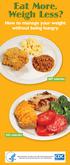 Eat More, Weigh Less? How to manage your weight without being hungry 607 calories 293 calories Department of Health and Human Services Centers for Disease Control and Prevention Can you weigh less without
Mediterranean diet: A heart-healthy eating plan Source: mayoclinic.org/mediterranean-diet
 Mediterranean diet: A heart-healthy eating plan Source: mayoclinic.org/mediterranean-diet The heart-healthy Mediterranean is a healthy eating plan based on typical foods and recipes of Mediterranean-style
Reading Food Labels. Nutritional values The ingredients of the item The percentage of the Recommended Daily Intake (RDI) of particular nutrients
 Eating well involves choosing a variety of foods that are low in saturated and trans fats, low in salt and high in dietary fibre. Food labels carry useful information to help you make choices about the
Lesson 3 Assessing My Eating Habits
 Lesson 3 Assessing My Eating Habits Overview This lesson introduces the federal guidelines for healthy eating. Students assess their eating habits against these guidelines and make suggestions for improvement.
Nutrients: Carbohydrates, Proteins, and Fats. Chapter 5 Lesson 2
 Nutrients: Carbohydrates, Proteins, and Fats Chapter 5 Lesson 2 Carbohydrates Definition- the starches and sugars found in foods. Carbohydrates are the body s preferred source of energy providing four
Healthy Eating For Your Kidneys
 Winter 14 Healthy Eating For Your Kidneys (For People Not on Dialysis) BC Provincial Renal Agency If you have kidney disease, you may need to change the food you eat. Changes will depend on your appetite,
Save Time and Money at the Grocery Store
 Save Time and Money at the Grocery Store Plan a Grocery List Making a list helps you recall items you need and also saves you time. Organize your list according to the layout of the grocery store. For
Fertile Food Can you eat your way to pregnancy? Tracy Cherry, RD, CDN University of Rochester Women s Lifestyle Center
 Fertile Food Can you eat your way to pregnancy? Tracy Cherry, RD, CDN University of Rochester Women s Lifestyle Center Fertility Food Folklore Almonds a fertility symbol throughout the ages. The aroma
Using the Nutrition Facts Label
 Using the Nutrition Facts Label A How-To Guide for Older Adults Inside Why Nutrition Matters For You...1 At-A-Glance: The Nutrition Facts Label...2 3 Key Areas of Importance...4 Your Guide To a Healthy
Eating Well with. Canada s Food Guide
 Eating Well with Canada s Food Guide Recommended Number of Food Guide Servings per Day Children Teens Adults Age in Years Sex 2-3 4-8 9-13 14-18 19-50 51+ Girls and Boys Females Males Females Males Females
Nutrition and Chronic Kidney Disease
 Nutrition and Chronic Kidney Disease National Kidney Foundation s Kidney Disease Outcomes Quality Initiative (NKF-K/DOQI TM ) The National Kidney Foundation is developing guidelines for clinical care to
Healthy Menu Planning
 Healthy Menu Planning Please save paper and print the pages of this resource back-to-back! Table of Contents Considerations for Planning Menus... 4 Menu Planning Principles... 4 Menu Cycling...5 Guidelines
Low Fat Diet after Cardiac Surgery With or Without Chyle Leak
 Low Fat Diet after Cardiac Surgery With or Without Chyle Leak What is chyle? Chyle (sounds like kyle) is a milky white fluid that contains protein, fat, cholesterol, lymphocytes, and electrolytes. It is
Eating Well with Diabetes. Cassie Vanderwall UW Health Nutrition Registered Dietitian Certified Personal Trainer Certified Diabetes Educator
 Eating Well with Diabetes Cassie Vanderwall UW Health Nutrition Registered Dietitian Certified Personal Trainer Certified Diabetes Educator Outline What is Diabetes? Diabetes Self-Management Eating Well
Draft comprehensive global monitoring framework and targets for the prevention and control of noncommunicable diseases
 SIXTY-SIXTH WORLD HEALTH ASSEMBLY A66/8 Provisional agenda item 13.1 15 March 2013 Draft comprehensive global monitoring framework and targets for the prevention and control of noncommunicable diseases
Dietetics. Advice on. Healthy Eating for Lowering Cholesterol
 Dietetics Advice on Healthy Eating for Lowering Cholesterol 41 What is blood cholesterol? A waxy, fat-like substance in the blood Made by the liver and also comes from food Important for building and maintenance
Maintaining Nutrition as We Age
 SS-207-06 For more information, visit the Ohio Department of Aging web site at: http://www.goldenbuckeye.com and Ohio State University Extension s Aging in Ohio web site at: http://www.hec.ohio-state.edu/famlife/aging
Healthy Eating and your Diabetes
 Healthy Eating and your Diabetes Patient Information Leaflet Why is Healthy Eating Important? Healthy eating is important to everyone but is even more important if you have diabetes. This is because some
Heart Healthy Diet: Tips for Lowering Cholesterol and Fat in Your Diet
 Heart Healthy Diet: Tips for Lowering Cholesterol and Fat in Your Diet Cholesterol Saturated Fats Polyunsaturated and Mono-unsaturated Fats This fat-like substance is needed for good health. However, high
Pediatrics. Specialty Courses for Medical Assistants
 Pediatrics Specialty Courses for Medical Assistants 7007 College Boulevard, Suite 385 Overland Park, Kansas 66211 www.ncctinc.com t: 800.875.4404 f: 913.498.1243 Pediatrics Specialty Certificate Course
Cholesterol made simple!
 Cholesterol made simple! Cholesterol is the biggest risk factor for heart disease and also increases your risk of stroke and circulatory disease - Heart UK The Cholesterol Charity What is Cholesterol and
Diabetes Nutrition. Roseville & Sacramento Medical Centers. Health Promotion Department Nutritional Services
 Diabetes Nutrition Roseville & Sacramento Medical Centers Health Promotion Department Nutritional Services Agenda Blood sugar goals Factors that affect blood sugar Diet Options: Menus, Exchange Lists,
MINTO PREVENTION & REHABILITATION CENTRE CENTRE DE PREVENTION ET DE READAPTATION MINTO. Counting Fat Grams. About This Kit
 MINTO PREVENTION & REHABILITATION CENTRE CENTRE DE PREVENTION ET DE READAPTATION MINTO Counting Fat Grams About This Kit In previous kits you have learned Foods to Choose and Foods to Decrease/Avoid for
Triglycerides: Frequently Asked Questions
 Triglycerides: Frequently Asked Questions Why are triglycerides important? The amount of triglycerides (or blood fats) in blood are one important barometer of metabolic health; high levels are associated
Carbohydrate Counting (Quiz Number: Manatee3032009)
 Page 1 The goal of Carbohydrate Counting is to make clear to you which foods affect your blood glucose and then to spread these foods evenly throughout the day (or to match insulin peaks and durations).
2) Herewith the 2nd question in our Q&A series with Ria Catsicas about 'Nutrition and Diabetes':
 DIABETES Q&A WITH RIA CATSICAS 1) Today is World Diabetes Day! We ve been chatting to clinical dietitian and nutrition consultant Ria Catsicas about nutrition and diabetes. Ria is a specialist in the practice
Sinclair Community College, Division of Allied Health Technologies
 Sinclair Community College, Division of Allied Health Technologies Health Promotion for Community Health Workers Cardiovascular disease, stroke, and cancer Class #5 High Blood Cholesterol (date) Course
Canada s Food Guide Jeopardy
 Canada s Food Guide Jeopardy Drafted: July 2008 Revised: December 2012 Eating Well with Canada s Food Guide Veg & Fruit Grain Products Milk & Alternatives Meat & Alternatives Physical Activity Miscellaneous
BEST & WORST FOODS FOR BELLY FAT
 Belly fat is worse for you than fat elsewhere on your body. Excess accumulation of belly fat is more dangerous than excess fat around your hips and thighs. Belly fat is associated with serious health problems,
Eat Well, Live Well Lesson 9: The Lowdown on Cholesterol
 Getting Started 1. Review lesson plan before each session 2. Copy handouts. 3. Gather supplies Eat Well, Live Well Lesson 9: The Lowdown on Cholesterol Supplies Needed 1. Handouts 2. Supplies for activity:
Presentation Prepared By: Jessica Rivers, BASc., PTS
 Presentation Prepared By: Jessica Rivers, BASc., PTS Presentation Outline Why should we care about our eating habits? Why is nutrition so important as we age? How do we know if we are eating healthy? What
Second International Conference on Nutrition. Rome, 19-21 November 2014. Conference Outcome Document: Rome Declaration on Nutrition
 October 2014 ICN2 2014/2 Second International Conference on Nutrition Rome, 19-21 November 2014 Conference Outcome Document: Rome Declaration on Nutrition Welcoming the participation of Heads of State
Fat Facts That Can Help Your Heart. Most Common Risk Factors for Heart Disease
 Fat Facts That Can Help Your Heart Sally Barclay, MS RD LD Nutrition Clinic for Employee Wellness Most Common Risk Factors for Heart Disease High LDL (bad) cholesterol Smoking Low HDL (good) cholesterol
Eating Healthy for Your Heart. Kelly Cardamone, MS, RD, CDE, CDN
 Eating Healthy for Your Heart Kelly Cardamone, MS, RD, CDE, CDN Do You Know? According to the Centers for Disease Control and Prevention, 70% of all deaths in the United States are due to chronic diseases.
Nutrition & Transplantation
 Nutrition & Transplantation www.kidney.org National Kidney Foundation s Kidney Disease Outcomes Quality Initiative Did you know that the National Kidney Foundation s Kidney Disease Outcomes Quality Initiative
For those with Diabetes and Chronic Kidney Disease. This pamphlet is intended for people diagnosed with early stage chronic kidney disease.
 Nutrition Tips For those with Diabetes and Chronic Kidney Disease. This pamphlet is intended for people diagnosed with early stage chronic kidney disease. November 2014 1 Happy Living Well With Diabetes
Policy/Program Memorandum No. 150
 Ministry of Education Policy/Program Date of Issue: October 4, 2010 Effective: Until revoked or modified Subject: Application: SCHOOL FOOD AND BEVERAGE POLICY Directors of Education Supervisory Officers
Healthy Eating for people at risk of diabetes or with prediabetes
 Healthy Eating for people at risk of diabetes or with prediabetes WHAT IS PREDIABETES / AT RISK OF DIABETES Some patients have a blood sugar level which is higher than normal but not high enough to be
Nuts, Oils, Dressings, and Spreads
 Nuts, Oils, Session 1 Background Information Tips Goals Background Information Nuts, Oils, Eating Fats There are three types of fat we ll focus on in this program: Healthy fats (polyunsaturated fats),
Nutrition Requirements
 Who is responsible for setting nutrition requirements in the UK? In the UK we have a set of Dietary Reference Values (DRVs). DRVs are a series of estimates of the energy and nutritional requirements of
NUTRITION AND HEMODIALYSIS
 NUTRITION AND HEMODIALYSIS www.kidney.org National Kidney Foundation's Kidney Disease Outcomes Quality Initiative Did you know that the National Kidney Foundation's Kidney Disease Outcomes Quality Initiative
County of Santa Clara Public Health Department
 County of Santa Clara Public Health Department PH05 042710. DATE: April 27, 2010 Prepared by:. Colleen Martin Health Care Program Manager TO: Board of Supervisors FROM: Dan Peddycord, RN, MPA/HA Public
Final Rule Nutrition Standards in the National School Lunch and School Breakfast Programs. Questions & Answers for Program Operators Revised 2/23/12
 Final Rule Nutrition Standards in the National School Lunch and School Breakfast Programs General: Questions & Answers for Program Operators Revised 2/23/12 (New or Revised Q/As are italicized) 1. Why
Information note about intake of sugars recommended in the WHO guideline for adults and children
 Information note about intake of sugars recommended in the WHO guideline for adults and children 1 The World Health Organization s new Guideline: Sugars intake for adults and children recommends reduced
High Cholesterol and Heart Failure
 High Cholesterol and Heart Failure What Is Cholesterol? Cholesterol is a waxy substance that comes from your liver and from the food you eat. Your body needs it to function properly. There are two main
FLORA PRO-ACTIV SPREAD ACTIVELY LOWERS CHOLESTEROL ABSORPTION
 FLORA PRO-ACTIV SPREAD ACTIVELY LOWERS CHOLESTEROL ABSORPTION A STEP TOWARDS A HEALTHIER HEART Flora pro-activ contains plant sterols, which are designed to be consumed as part of a healthy diet and lifestyle,
Nonalcoholic Fatty Liver Disease. Dietary and Lifestyle Guidelines
 Nonalcoholic Fatty Liver Disease Dietary and Lifestyle Guidelines Risk factors for NAFLD Typically, but not always seen in patients who are overweight. May have Diabetes and or insulin resistance high
Managing your cholesterol
 Managing your cholesterol Understanding and managing your cholesterol is one of the keys to leading a healthy lifestyle. If your cholesterol is high, you re at a greater risk for heart disease and stroke.
Healthy eating for young people with type 1 diabetes
 Introduction Eating healthy foods is an important part of managing your child s diabetes. It will help to control your child s blood sugar (glucose) levels and reduce their risk of developing other illnesses
Discussion Paper: Clarification and Guidance on Inappropriate Promotion of Foods for Infants and Young Children
 BACKGROUND Discussion Paper: Clarification and Guidance on Inappropriate Promotion of Foods for Infants and Young Children 1. Appropriate feeding of infants and young children is central to health and
SWEDEN. School food policy (mandatory) Year of publication 2013
 SWEDEN School food policy (mandatory) Developed by Year of publication 2013 Web link(s) Cost-free and nutritious school meals for all students aged 7-16 are required by Education Act, 2010:800. Voluntary
Screening Tests for Gestational Diabetes
 Screening Tests for Gestational Diabetes 50 Gram glucose challenge test If you choose to be screened for gestational diabetes, you may have one of several different tests. The most commonly used screening
Eating Right for Kidney Health: Tips for People with Chronic Kidney Disease
 Eating Right for Kidney Health: Tips for People with Chronic Kidney Disease What you eat and drink can help slow down the progression of chronic kidney disease (also known as CKD ) and help prevent complications.
Nutrition, Physical Activity and Obesity Denmark
 Nutrition, Physical Activity and Obesity Denmark This is one of the 53 country profiles covering developments in nutrition, physical activity and obesity in the WHO European Region. The full set of individual
Take Control of Your Health and Reduce Your Cancer Risk
 Take Control of Your Health and Reduce Your Cancer Risk Creation of this material was made possible in part by a pioneering grant from CBCC-USA. Distributed by India Cancer Initiative Take Control of
A GUIDE TO HELP PLAN, PURCHASE & PREPARE YOUR OWN HEALTHY FOOD. FOOD SENSE HEALTHY MEALS ON A BUDGET
 A GUIDE TO HELP PLAN, PURCHASE & PREPARE YOUR OWN HEALTHY FOOD. FOOD SENSE HEALTHY MEALS ON A BUDGET You ll be surprised at how affordable, delicious & convenient your own meals can be! the Great Plate:
Diet, activity and your risk of prostate cancer
 Diet, activity and your risk of prostate cancer Prostate cancer is the most common cancer in men in the UK. About one in eight men (12.5 per cent) will get prostate cancer at some point in their lives.
PART1: Sodium and Hypertension
 PART1: Sodium and Hypertension Jeff Whittle, MD, MPH Staff Physician, Clement J. Zablocki VA Medical Center Professor of Medicine, Medical College of Wisconsin Lifestyle and Blood Pressure LIFESTYLE CHANGE
Carbohydrate Counting for Patients with Diabetes. Lauren Dorman, MS RD CDE Registered Dietitian & Certified Diabetes Educator
 Carbohydrate Counting for Patients with Diabetes Lauren Dorman, MS RD CDE Registered Dietitian & Certified Diabetes Educator Program Purpose To increase knowledge of carbohydrate counting skills for nurses
MEAL PLANNING FOR MECHANICAL SOFT DIET
 MEAL PLANNING FOR MECHANICAL SOFT DIET Definition of Terms Calories Protein Blenderized Pureed Units of energy. A nutrient used by your body for growth and repair. The best sources are milk, meats, fish,
Town of Needham Trans Fat Ban
 Town of Needham Trans Fat Ban Presented by: Jen Tuttelman, MS, RD, LDN Tara Gurge, R.S., C.E.H.T., M.S. The Needham Health Department June 5, 2009 9:00-10:00 am Agenda Welcome and Introductions Trans Fat
February 2006. 23 Best Foods for Athletes
 23 Best Foods for Athletes February 2006 1. Beans Legumes a. Excellent source of fiber (important for keeping blood sugar and cholesterol levels under control). b. High in protein and a good source of
NEW YORK CITY DEPARTMENT OF HEALTH AND MENTAL HYGIENE. Control Your Cholesterol: Keep Your Heart Healthy
 V O L U M E 5, N U M B E R 8 V O L U M E 5, N U M B E R 8 Health Bulletin NEW YORK CITY DEPARTMENT OF HEALTH AND MENTAL HYGIENE #42 in a series of Health Bulletins on issues of pressing interest to all
healthy eating for gestational diabetes
 Talking diabetes No.19 healthy eating for gestational diabetes Gestational diabetes occurs in 5 8% of Australian women during pregnancy. It happens because the changing hormone levels in the body have
Η δίαιτα στην πρόληψη του αγγειακού εγκεφαλικού επεισοδίου
 ΠΡΟΓΡΑΜΜΑ ΜΕΤΑΠΤΥΧΙΑΚΩΝ ΣΠΟΥΔΩΝ «Η ΔΙΑΤΡΟΦΗ ΣΤΗΝ ΥΓΕΙΑ ΚΑΙ ΣΤΗ ΝΟΣΟ» Η δίαιτα στην πρόληψη του αγγειακού εγκεφαλικού επεισοδίου Γεώργιος Ντάιος Παθολογική Κλινική Πανεπιστημίου Θεσσαλίας Stroke Statistics
Mediterranean diet: Choose this hearthealthy
 MayoClinic.com reprints This single copy is for your personal, noncommercial use only. For permission to reprint multiple copies or to order presentation-ready copies for distribution, use the reprints
Ready, Set, Start Counting!
 Ready, Set, Start Counting! Carbohydrate Counting a Tool to Help Manage Your Blood Glucose When you have diabetes, keeping your blood glucose in a healthy range will help you feel your best today and in
SOLID FATS AND ADDED SUGARS (SoFAS) Know the Limits
 COOPERATIVE EXTENSION SERVICE UNIVERSITY OF KENTUCKY COLLEGE OF AGRICULTURE, LEXINGTON, KY, 40546 NEP-207B SOLID FATS AND ADDED SUGARS (SoFAS) Know the Limits The U.S. Department of Agriculture s Dietary
CONNECTICUT STATE BOARD OF EDUCATION Hartford
 III.A. CONNECTICUT STATE BOARD OF EDUCATION Hartford TO BE PROPOSED: April 6, 2015 RESOLVED, That the State Board of Education, pursuant to Section 10-215f of the Connecticut General Statutes, approves
Nutrition Information from My Plate Guidelines
 Nutrition Information from My Plate Guidelines Note: This information was compiled from the website: http://www.choosemyplate.gov/ for participants in the 4-H Food Prep Contest 1/12/16. The information
# Starch # Fat # Fruit # Free Foods. # Other Carbohydrates # Fast Foods # Vegetable. # Meat and Meat Substitutes
 FCS8750 Healthy Meal lans 1 Linda B. Bobroff 2 What Is a Meal lan? A meal plan is a guide to help you plan daily meals and snacks. It allows you to eat foods that you enjoy and that provide a good balance
American Cancer Society. Nutritional Guidelines for Reducing Your Risk of Cancer
 American Cancer Society Nutritional Guidelines for Reducing Your Risk of Cancer Cancer Impact More than one million Americans will be diagnosed with cancer this year. Scientific evidence suggests that
Selection and Preparation of Foods Management of the Food Budget*
 Selection and Preparation of Foods Management of the Food Budget* Healthy meals on a limited budget! How can you serve healthy meals on a limited budget? It takes some time and planning, but you and your
PAVING YOUR PATH TO DIABETES MANAGEMENT:
 African and Caribbean PAVING YOUR PATH TO DIABETES MANAGEMENT: Basic Carbohydrate Counting and The Glycemic Index What is carbohydrate? Carbohydrate is one of the three main nutrients found in foods. Starches,
Weaning learning to like new tastes and textures
 Complementary feeding or weaning is introducing solid foods in addition to your baby s milk feeds. Babies develop at different rates so begin when your baby is ready by six months, but not before four
Your Cholesterol Lowering Guide
 1 Your Cholesterol Lowering Guide Cholesterol plays a vital role in the day-to-day functioning of your body. However, too much cholesterol in the blood can affect your heart health. The good news is that
Background (cont) World Health Organisation (WHO) and IDF predict that this number will increase to more than 1,3 million in the next 25 years.
 Diabetes Overview Background What is diabetes Non-modifiable risk factors Modifiable risk factors Common symptoms of diabetes Early diagnosis and management of diabetes Non-medical management of diabetes