
Employment, Population and Housing Projections Halifax Regional Municipality: An Update
|
|
|
- Dina Freeman
- 9 years ago
- Views:
Transcription
1 Employment, Population and Housing Projections Halifax Regional Municipality: An Update July 28, 2009

2 Employment, Population and Housing Projections Halifax Regional Municipality: An Update Prepared for: Planning and Development Services Halifax Regional Municipality Prepared by: 1580 Kingston Road Toronto Ontario M1N 1S2 Phone: (416) Fax: (416) altusgroup.com July 28, 2009

3 EXECUTIVE SUMMARY Halifax Regional Municipality (HRM) retained Altus Group Economic Consulting to provide an update to the long term growth projections of the previous report in This update is prepared in light of the recent macroeconomic development and new data available from the 2006 census data. Economic Background The projections of employment for HRM take into consideration the macroeconomic environment in Canada, Atlantic Canada, Nova Scotia and specific local economic conditions. Over the past 25 years, employment growth in Canada has averaged 1.8 percent per year. Impending labour shortages, due in part to the aging of the population, will be partially responsible for a gradual slowing in the net pace of job creation over the next 25 years. Nova Scotia is a significant engine of growth within Atlantic Canada. Nova Scotia has a well diversified economy and an ideal location in relationship to the important U.S. Eastern Seaboard regions. Its economy has traditionally been resource based, relying heavily on the forestry, mining, fishing and agriculture sectors. In recent years, the provincial economy has shifted into manufacturing, technology and customer service sectors to diversify its economic base. These factors have served the province well in terms of relative economic growth over the last two decades. On three important economic measures, however GDP growth, employment and productivity Nova Scotia has performed slightly below Canada as a whole during the period Within Nova Scotia, and the broader regional economy, HRM has traditionally turned in a strong economic performance, and conditions are set to continue to outperform the regional economy in terms of job creation through the forecast period. All told, employment in HRM (on a place of work basis) is expected to expand to about 245,800 persons over the period This represents growth of about 37,000 persons, or a rate of growth of 0.8 percent per year. Halifax Regional Municipality: An Update Page i
4 Two alternative employment scenarios are also prepared: a low growth scenario based on employment growth of 11,600 persons, and a high growth scenario based on employment growth of 58,600 persons. Population The widely used cohort survival methodology is employed in order to estimate population for HRM through to This method uses historical data from the Census of Canada and projects future population based on assumptions for the three components of population growth births, deaths and net migration. The population of HRM is likely to rise by a total of 65,300 persons over the period. The driving factor behind this growth is anticipated rise in the employed population by 37,000 persons, based on the employment forecast and assumptions about net commuting. The gap between the total rise in population and the rise in employed population is due to declining total participation rates in the labour force, which is due, in turn, to the aging of the population into retirement years. Sources of population growth in HRM include a modest increase of about 8,200 persons through natural increase (the net of births and deaths) and a net inflow of some 57,100 migrants. Over two third of the net migration is expected to come from international sources, the remainder from other parts of Canada. Net migration is ultimately influenced by local employment opportunities. Migration and thus population growth is affected by the assumptions in the two alternate employment growth scenarios under consideration. In the case of the high growth scenario, population growth is as high as 95,000 persons over the forecast period. In the case of the low growth, the growth is just about 37,000 persons. Housing The potential housing demand model is employed to generate household growth projection of HRM based on the projected population. Potential household growth is a function of the projected population by age along with headship propensities (the number of people in each age group who are projected to head up a household). Halifax Regional Municipality: An Update Page ii

5 Over the period 2006 to 2026, a total of 45,500 new households are expected to emerge in HRM. Low density housing (including single and semidetached and mobile) is expected to account for the majority about 57 percent of housing completions over the projection period. Medium and high density should account for about 5 and 38 percent each. Housing demand is influenced by the alternative employment growth scenarios. In the case of the low growth scenario, potential household demand will advance only by about 33,600 households, and in the case of the high employment growth scenario, demand will likely be in the order of 66,800 units. Halifax Regional Municipality: An Update Page iii

6 TABLE OF CONTENTS Page EXECUTIVE SUMMARY... i 1 INTRODUCTION Workplan Report Structure Caveat MACROECONOMIC ENVIRONMENT An Age of Economic Uncertainty Canada Nova Scotia Regions within Nova Scotia Nova Scotia s Key Industries and Their Long Term Outlook Halifax POPULATION Projection Framework Births Deaths Total Natural Increase Migration Population Projections HOUSING NEEDS Methodology Headship Rates Household Growth By Structural Type Housing Growth Alternative Scenarios...44 APPENDIX CHANGES BETWEEN THE 2004 AND 2009 REPORTS Halifax Regional Municipality: An Update Page iv
7 1 INTRODUCTION Halifax Regional Municipality (HRM) retained Altus Group Economic Consulting to provide an update to the long term growth projections in light of the recent macroeconomic development and new data available from the 2006 census data. This report updates a previous study in 2004 conducted by (formerly Clayton Research) and Cantwell & Company. There have been a number of important developments in macroeconomic conditions since the 2004 study. In particular, current international economic events, including the financial and credit crisis, mounting government debt in the U.S., a potentially long U.S. recession and uncertainties regarding energy and oil prices may all influence the pace of macroeconomic growth in Canada and Halifax in the short and medium terms. The changing short and medium term macroeconomic view potentially can have an influence on demographic growth in Halifax. This update primarily focuses on employment, population and households growth projections. It does not replicate all the detailed planning allocations by component CSD, neither does it provides housing construction estimates. Overall, this report provides an update of population and household growth projections for the planning policies. 1.1 WORKPLAN To incorporate those new developments, this update of the 2004 report: Reviews the economic development scenario facing HRM over he period through to 2026 in light of new data and information that has become available; Provides a rebasing of the demographic and household projections based on new data available from the 2006 census and also more updated housing completions data from CMHC; and Provides revised projections for growth in employment, population and households by type over the period REPORT STRUCTURE This report contains three chapters in addition to this introduction, including: Halifax Regional Municipality: An Update Page 1
8 Chapter 2 presents projections of employment growth for HRM based on revised economic analysis; Chapter 3 provides projections of population growth for HRM during the period; and Chapter 4 offers projections of households growth during the study period. 1.3 CAVEAT This report relies on information from variety of secondary sources. While every effort is made to ensure the accuracy of the data, we cannot guarantee the complete accuracy of the information used in this report from these secondary sources. This report has been prepared solely for the purpose outlined herein and is not to be relied upon or used for any other purpose or by any other party without the prior written authorization of. Halifax Regional Municipality: An Update Page 2

9 2 MACROECONOMIC ENVIRONMENT This chapter provides a macroeconomic outlook for Canada, Nova Scotia and Halifax, and presents employment projections under three scenarios for the period. 2.1 AN AGE OF ECONOMIC UNCERTAINTY The credit shock that hit the world financial system in October 2008 has altered short term expectations from investors and economists on the world economic outlook. After extraordinary actions taken from governments and central banks around the world, various recent market indicators point out that the world financial system has stabilized and the recession seems to be moderating. It might take several quarters for the economy to grow again and economic activities to normalize. For the Canadian economy, the recent shift of economic growth from developed countries to emerging economies poses both benefits and challenges: There may be weaker growth in the sectors that are directly connected to American consumer spending, such as automotive equipment, newsprint and lumber; but There may be faster growth in the sectors linked to consumption from emerging countries, such as technology, oil and gas, and raw materials. This will potentially benefit the energy sector in Nova Scotia, for example, but add more pressures to the province s manufacturing and forestry industries to speed up their restructuring efforts. In addition, wide swings of energy prices and Canadian currency value also create uncertainties in the macroeconomic outlook. With respect to the economic growth scenarios in this report, growing economic uncertainty over the short and medium terms potentially widens the gap between high and low growth scenarios. 2.2 CANADA The short term economic prospects for Canada are in large part linked to the outlook for the U.S. economy and commodities markets. Since last October, Halifax Regional Municipality: An Update Page 3
10 commodities prices have deteriorated dramatically due to the sharp slowdown of the world economy and the expectation that this slowdown will be much deeper and more severe than previously thought. Slower economic growth in the U.S., Europe and Asia, and increased export competition from Asia will continue to present some headwinds to the eroding commodity boom in the short term. Economic growth in Canada this year will likely be marked by large contraction in GDP and employment losses (Figure 1). The slowdown is expected to see little recovery until 2010 when Canadian economic growth should be supported by improving conditions in the U.S. and a return to more normal credit conditions. Figure 1 Economic Conditions and Forecast, Canada Canada, Year-to-Year % Change Real GDP Employment Forecasts Source: based on data from Statistics Canada Although there are short term challenges to Canadian economy, in the long run, the economy will recover and ultimately return to its long term growth path. In the past 25 years (between 1983 and 2008), employment growth in Canada averaged 1.8% per year, while the overall economy has expanded by 2.9%. 1 The difference between economic growth and employment growth is due to 1 Average annual growth in real (chain weighted) Gross Domestic Product (GDP). Halifax Regional Municipality: An Update Page 4

11 the contribution of productivity, which in Canada, contributed about 1.1% per annum to economic growth. Moving forward, the role played by productivity in contributing to economic growth will increase its significance, as the Canadian economy struggles with an emerging labour shortage over the next 20 to 30 years. As the Canadian population ages, there will be fewer people entering the labour force to replace those retiring from it. Progressively lower birth rates in Canada over the past 40 years, along side impending retirements of most members of the baby boom generation in the next 30 years, is contributing to this trend. From a macroeconomic perspective, labour shortages (or reduced growth in the labour supply) result in a slowing of economic growth. The degree to which the pace of economic growth will slow, depends on the prospects for further productivity growth in Canada. Productivity in Canada over the next 30 years is expected to progressively improve, due to continued advancements in automation and information technology, innovations in goods and services producing techniques and developments in other labour saving technologies. However, while increasing productivity will aid in coping with some of the challenges of labour shortages, there may also be a slower economic growth environment, including lower growth rates of exports and domestic consumption, and a correspondingly lower production of goods and services. As a result, Canada will still experience a slower employment growth over the next 25 years than previously. 2.3 NOVA SCOTIA Nova Scotia is a significant engine of growth within Atlantic Canada. Its economy has traditionally been resource based, relying heavily on the forestry, mining, fishing and agriculture sectors. In recent years, the provincial economy has shifted into manufacturing, technology and customer service (i.e. call centres) sectors to diversify its economic base. These factors have served the province well in terms of relative economic growth over the last two decades. On three important economic measures, Nova Scotia has somewhat underperformed Canada as a whole during the period of : Halifax Regional Municipality: An Update Page 5

12 In terms of overall economic growth, as measured by real GDP growth, Nova Scotia has expanded on average 2.2 percent annually about 0.7 percentage point slower than Canadian average; In terms of employment growth, Nova Scotia s employment increased approximately 1.3 percent each year over the period 0.5 percentage point less than Canada as a whole; and Nova Scotia s productivity advanced at an average annual rate of 0.9 percent some 0.2 percentage points less than the national average; Over the years, Nova Scotia s employment growth has consistently been below the national average (Figure 2); During the latest census period, Nova Scotia created net new jobs at an annual rate of 1.5 percent, marginally lower than Canada as a whole; However, the employment gap between the province and the national average has widened again in the period of , growing at an average annual rate of 0.6 percent and 1.8 percent, respectively; and This gap should close again over the medium term, partially due to the increasing investment in energy and mining projects in the province. Halifax Regional Municipality: An Update Page 6

13 Figure 2 Employed Labour Force 1 Growth, Canada, Atlantic Canada, Nova Scotia and Halifax 2, Annual Average Percent Change Canada Atlantic Canada Nova Scotia Nova Scotia less Halifax Halifax Place of residence (POR) basis 2 Data adjusted for boundary changes in 2001 Source: based on data from Census Canada 2004 Report: Figure 2 Nova Scotia s economy will likely continue to grow at a slightly slower pace than the National average over the forecast period, and the gap between Nova Scotia s GDP growth and that for Canada as a whole, should roughly remain the same over the period. 2.4 REGIONS WITHIN NOVA SCOTIA A majority of the province s economic activities are concentrated in the Halifax urban area, although, the recent commodity boom is reviving smaller communities. This section examines the pattern of economic development across Nova Scotia. Between 1988 and 2008, employment growth across Atlantic Canada averaged 0.9 percent per year. Nova Scotia added net new jobs at an annual pace of about 1.0 percent over the period. Halifax s employment growth over the period was about 1.4 percent annually, much stronger than the rest of Nova Scotia. Halifax had a larger share of the total employment growth in the province (Figure 3) Halifax Regional Municipality: An Update Page 7

14 Figure 3 Employment Growth by Region, Atlantic Provinces, Annual Average Percent Change Halifax Rest of Nova Scotia NFLD+PEI+NB Atlantic Total Source: based on data from Statistics Canada, Labour Force Survey 2004 Report: Figure 1 Using census data, a long term pattern of Halifax s employment growth relative to the larger regional economic development is as follows (Figure 2): Employment growth in Halifax is consistently higher than the rest of Nova Scotia; Generally speaking, employment growth in Nova Scotia has been inline with the Atlantic region s average; During the period, strong local economic activities in energy, construction and service sectors resulted in Halifax s employment growth rate somewhat higher than the national average; After experiencing sluggish growth during the period, the Atlantic region s employment growth caught up with the rest of Canada during the early years of this decade; and In the last several years, employment growth of HRM has outgrown the province as a whole average annual growth rate is about 0.9 percent in HRM during the period, 0.3 percentage points higher than the provincial average. Halifax Regional Municipality: An Update Page 8

15 2.5 NOVA SCOTIA S KEY INDUSTRIES AND THEIR LONG TERM OUTLOOK The industrial composition of Nova Scotia s economy is important to its macroeconomic. The performance of Nova Scotia s economic prospects depends on both the strength of existing major industries and on prospects for emerging industries. Findings from the analysis illustrate that (Figure 4): Some major industries in Nova Scotia s economy are broad public sector 2, retail trade and manufacturing industries; Although primary industries such as agriculture, fishing, mining, and oil and gas extraction carry less weight in the province s employment, they play a significant role in the province s economic development; Investment in primary industries provide economic spinoff effects to other industries including, but not limited to construction, manufacturing, finance and insurance, and professional services; In Nova Scotia, the manufacturing and primary sectors all had declining shares of overall employment during the period; The fishing industry has been under intensive pressure over the last several years, mainly due to increased export competition from emerging economies and the appreciation of the Canadian dollar; Nova Scotia s fish processing sector consists of just over 220 licensed enterprises, with 182 in operation in 2006, which is about half of the size in the 1980s; 3 Other segments in the manufacturing sector also suffer from tougher overseas competition and higher value in the Canadian currency; 2 It includes educational services, health care services and public administration. 3 Nova Scotia Department of Fisheries and Agriculture, Nova Scotia Seafood Processing Sector: State of the Industry and Competitiveness Assessment, August Halifax Regional Municipality: An Update Page 9
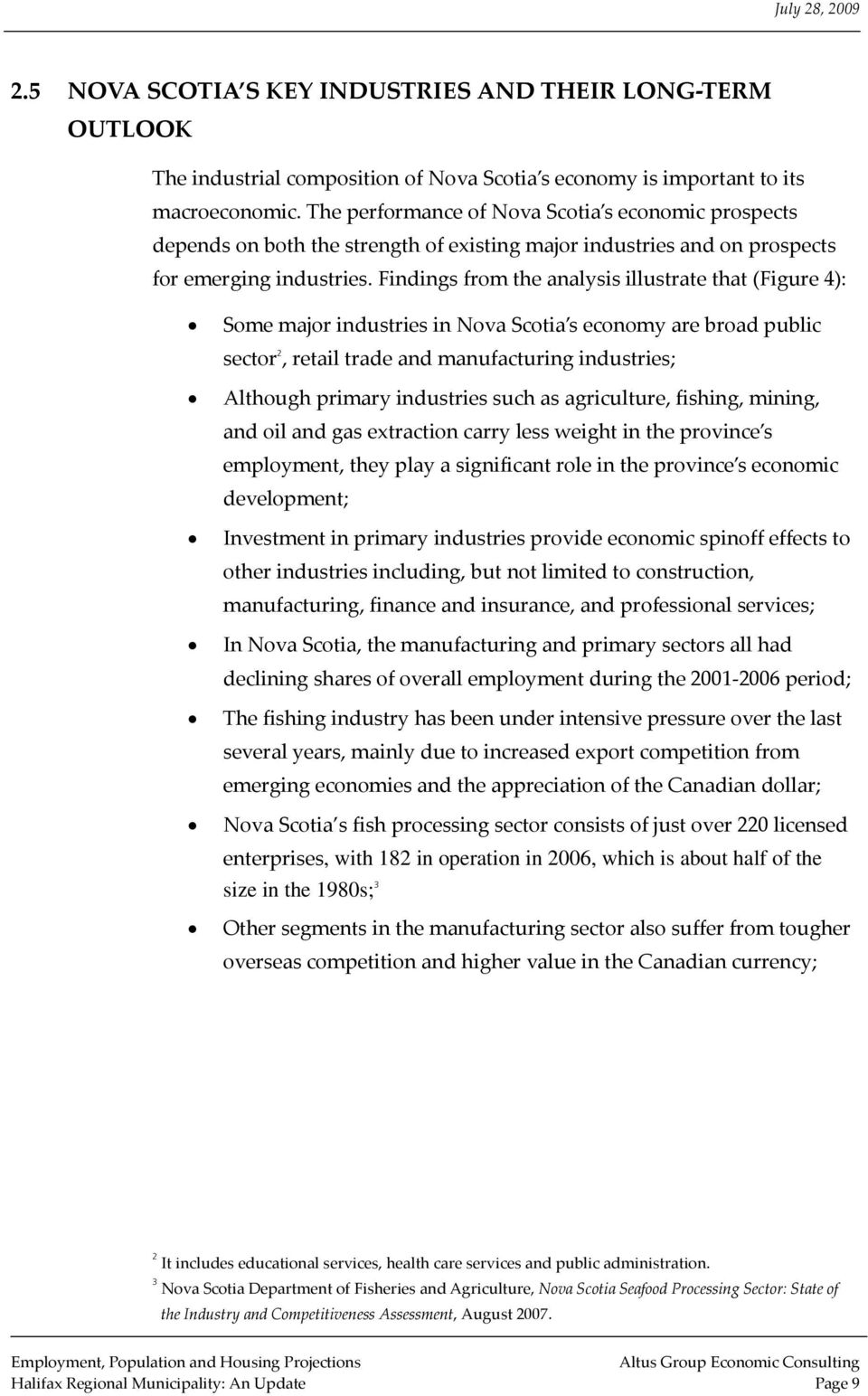
16 Figure 4 Labour Force Distribution by Industry, Canada and Nova Scotia, 2001 and 2006 Industry Group Percent Agriculture, forestry, fishing and hunting Mining and oil and gas extraction Utilities Construction Manufacturing Wholesale trade Retail trade Transportation and w arehousing Information and cultural industries Finance and insurance Real estate and rental and leasing Professional, scientific and technical services Management of companies and enterprises Administrative and support, w aste management and remediation services Educational services Health care and social assistance Arts, entertainment and recreation Accommodation and food services Other services (except public administration) Public administration Source: based on data from Statistics Canada 2004 Report: Figure 3 Other parts of the province s economy have demonstrated stronger growth the broad public sector, professional services and, administrative and support services sector increased shares of the province s total employment over the period; This trend is consistent with the broader Canadian economy moving away from low value added sectors such as low technology manufacturing to more knowledge based industries such as hightech manufacturing and services industries; Even though there have been short term setbacks, the energy sector continues to be a significant driver of economic development in Nova Scotia. Large energy projects underway include EnCana s $700 million Deep Panuke offshore natural gas project, and the Maple LNG terminal; and Economic spinoff effects related to these energy projects are felt throughout the province, especially in Halifax where most professional services providers and corporate support are located. Halifax Regional Municipality: An Update Page 10
17 2.6 HALIFAX Halifax s Economic Prospect Halifax Regional Municipality (HRM) is the capital of the Province of Nova Scotia and is the largest municipality in Atlantic Canada with population of 372,858 persons in With an international seaport (Port of Halifax), federal and provincial government offices, military bases, seven postsecondary institutions, regional communication firms, financial service providers and players in offshore oil and gas extraction industry, the municipality has a well diversified economy and labour force. Data from several census periods illustrates that (Figure 5): After a decade of weak growth in the 1990s, employment advanced impressively during the first 5 years of this decade, adding more than 3,400 net new jobs each year; This is consistent with levels of employment growth in the 1970s and 1980s; and The unexpectedly strong growth during the period is closely linked to the exceptional growth in the energy and mining sectors and their economic spinoff effects on industries such as professional services, finance and construction industries. Halifax Regional Municipality: An Update Page 11

18 Figure 5 Employment 1 Growth, Halifax CMA 2, Annual growth (Persons) , ,000 3, , Place of residence (POR) basis 2 Data are adjusted to reflect boundary changes between 1996 and 2001 Source: based on data from Census of Canada 2004 Report: Figure 4 In the coming years, the energy sector is likely to be a major influence on the city s economic development. Even though commodity prices have declined substantially in the recent months, the long term outlooks for most oil and gas projects in the province have not changed over the medium term, energy prices will rebound to the level that make current capital investments profitable. Energy companies are still committing to offshore oil and gas projects in the province such as EnCana s $700 million Deep Panuke project, which is well underway. The Government of Canada currently is actively seeking a Free Trade deal with the European Union, which, if succeed, can potential be worth $12 billion in boosted exports for Canada. This will significantly benefit the Port of Halifax, bringing important economic development and creating new jobs. However, the local economy is going to face headwind in the medium term, due to continued restructuring in forestry and fishing activities, and the continuing erosion of the manufacturing industry. It will take time for those displaced workers to obtain new jobs because the current economic crisis and they might be required trainings for new skills. This could drag down overall economic activities in Halifax. Halifax Regional Municipality: An Update Page 12

19 In general, Halifax may see relatively weaker economic growth in the next several years compared to recent trends, but relative economic functions will pick up thereafter Employment Prospects in Halifax In light of the strong employment growth during the period, and considered with other recent events, the short and medium term forecast for Halifax has evolved since over 2003 report (Figure 6): For Canada as a whole, employment growth during the period of , will be generally slower than the previous decade. Slower growth is primarily limited to the current economic crisis, which could last well into 2010 and a slowdown in labour force growth; Employment growth would be even slower during the period, due to the aging population and the pending retirement of baby boomers ; Across Atlantic Canada, employment growth will end out the period somewhat slower than during the previous period and remain slower than the national average. The region s Long term trends in employment growth will be roughly consistent with the country as a whole; Nova Scotia performed marginally better than the region during the period and over the next two decades, its employment growth will essentially parallel the region s average; and Halifax had a relatively strong employment growth during the period, and outperformed Canada as a whole. This pattern is unlikely to be sustained in the long term. Over the next two decades, Halifax s employment growth is going to be at or below the national average; and All told, Halifax s economy could create some 37,000 new positions between 2006 and 2026 according to this scenario an average annual growth of 1,850 net new jobs (2,330 per year through to 2016 and 1,370 per year thereafter). Halifax Regional Municipality: An Update Page 13

20 Figure 6 Employment Forecast, Various Areas, Actual Projection Annual Average Growth Annual Percent Growth Number of Persons Employed (000s) Canada * 13, , ,021 17, , Atlantic Canada * ,047 1, , Nova Scotia * Halifax CMA * n/a n/a 3.2 n/a n/a 1.8 n/a n/a Halifax Regional Municipality ** Halifax, Alternate Scenarios Low Growth High Growth Adjusted to 2001 boundary 2. Halifax County, estimate * Place of residence basis; ** Place of work basis; Source: based on data from Census Statistics 2004 Report: Figure 6 Number of Persons (000s) Percent Alternative Employment Growth Scenarios Even though the updated macroeconomic analysis suggests that HRM is likely to add about 1,850 new jobs per year during the period of , any projection is subject to underlying economic growth assumptions. As explained in the Chapter 0, the uncertainty of short and medium term macroeconomic outlooks has increased relative to the 2004 report. Taking this into consideration, this report increases the deviation of low and high growth scenarios from the baseline scenario in the employment growth forecast. Outcomes from various economic events and government policies may play out differently than anticipated, leading ultimately to economic development and job creation patterns in HRM, which might be higher or lower than the estimated 1,850 persons per year. For example: Underlying economic growth in HRM could turn in a stronger than anticipated performance. Under this scenario, a much stronger rebound in energy prices is anticipated, especially for natural gas, as the industry is currently is marketing natural gas as a green alternative to coal in electricity generation. Consequently, stronger activity in the energy extraction sector, and more robust capital investment, could be expected, with related economic spinoffs. In addition, development policies from local economic agencies such as Greater Halifax Partnership have the potential to generate greater interest, from outside investors, in sectors such as the life sciences and information technology, which could also result in higher new Halifax Regional Municipality: An Update Page 14
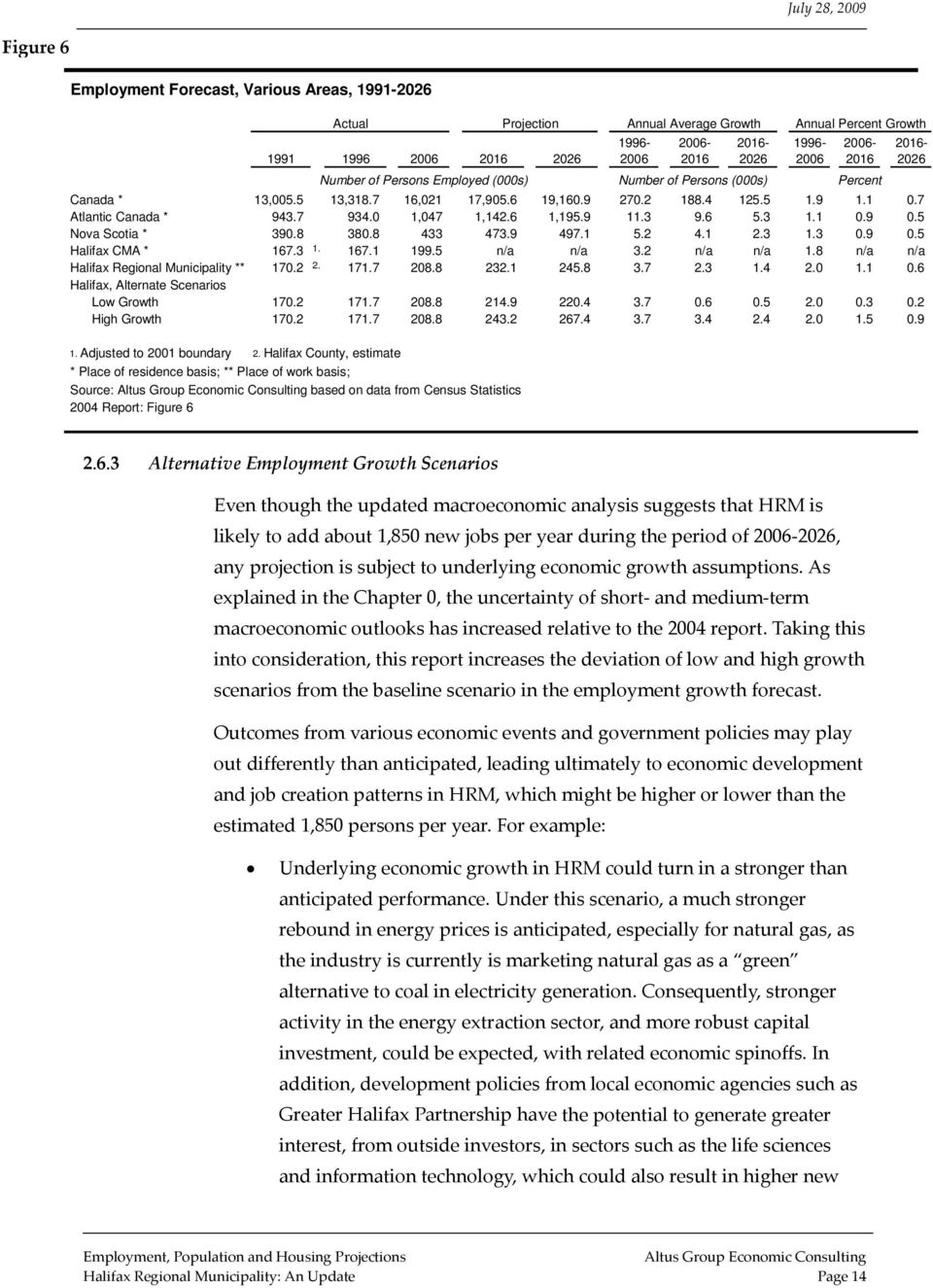
21 business investment in the municipality, accelerating the potential pace of job creation. Stronger economic and employment growth is part of the high growth scenario relative to the baseline forecast. The high growth considers job growth in HRM of approximately 2,930 persons per year over the period of (about 3,450 per year through to 2016 and 2,410 per year thereafter); Alternatively, it is possible that economic growth through the planning period in HRM could significantly understate the estimates used in this report. The current economic recession may well turn out to be much more protracted than expected, possibly lasting a prolonged period of time such as the US experience in the 1930s or Japanese experience in the 1990s. Under this scenario, the manufacturing sector will continue its sharp decline over the next decade and energy prices will not ever return to its peak levels in early These events can significantly derail many industries in HRM, leading to years of subpar growth. Under such circumstances, net job creation over the forecast period will be much lower than baseline forecast. An alternative growth forecast takes into consideration the likelihood of this negative economic scenario relative to the baseline forecast. The low growth scenario considers job growth in HRM of approximately 580 persons per year through the period (about 610 per year through to 2016 and 540 per year thereafter) Each of these alternative scenarios is illustrated in Figure 6. During the remainder of this report, analysis of migration and population implications of the baseline forecast scenario will be presented, along with the accompanying housing needs projections. In all case, the implications of the two alternative economic and job growth scenarios are also presented. Halifax Regional Municipality: An Update Page 15
22 3 POPULATION By using the cohort survival model, this chapter estimates population growth for HRM, based on three economic growth scenarios and various demographic assumptions. 3.1 PROJECTION FRAMEWORK The Cohort Survival Model The widely used cohort survival methodology is employed in order to estimate population for HRM through to This method uses historical data from the Census of Canada and projects future population based on assumptions for the three components of population growth: Births. Historical fertility rate trends within Halifax and anticipated future trends across Nova Scotia and Canada are used to derive expected fertility patterns in Halifax over the projection period; Deaths. Historical mortality rates by age and sex within Halifax and anticipated future trends across Nova Scotia and Canada are used to derive expected mortality patterns in Halifax over the projection periods; and Net migration. Historical migration patterns by age and sex (including international, inter provincial and intra provincial) are considered in the model, and anticipated future migration flows are projected to 1) satisfy labour force requirements in conjunction with the employment forecasts (under the three scenarios) presented in Chapter and 2) account for potential migration flows of non labourforce related migrants such as retirees. The cohort survival model is based on population growth in five year increments consistent with the five year cycle of the Census of Canada Alternative Growth Scenarios As in the 2004 study, three sets of population projections are presented in this chapter. The underlying drivers for the three scenarios in the population forecast are the three alternative economic and employment growth scenarios presented in Chapter 2. Halifax Regional Municipality: An Update Page 16
23 In comparison to the baseline scenario, the principal influence on the alternative scenarios is migration. Under the lower employment growth scenario, the local needs for in migration are somewhat lower over the forecast period and results in lower population growth through the forecast period. Conversely, under the higher employment growth scenario, requirements for in migration are elevated, and the model predicts higher inmigration and ensuing higher population growth through the forecast period. Otherwise, specific assumptions used in the cohort survival model, such as the birth rate, death rates, etc. are held constant through the three scenarios. Labour participation rates are assumed to respond to underlying condition in the labour market. 3.2 BIRTHS Methodology The number of births in each period of the projection is derived using the standard births methodology of the cohort survival approach. Future birth rates are assumed by age of mother and applied to the female population in each period (including an allowance for recent migrants). Typically, women in the age cohort account for the bulk of children born Recent Trends Recent demographic data from the Province of Nova Scotia suggest that birth rate for mothers aged have steadily declined over the past decade, however, birth rates for women aged have somewhat increased in the past few years (Figure 7). This is consistent with the general social trends in Canada as women more focus on professional developments (e.g. obtaining post secondary degrees) and delay their decision to have a child. Overall, the total fertility rate (TFR) (sum across each age cohort) has moderated over the past decade in the province, declined from 1.5 births per woman in 1996 to 1.4 births per woman. Halifax Regional Municipality: An Update Page 17
24 Figure 7 Birth Rates by Age of Mother, Nova Scotia, Births Per 1000 Women Source: based on data from Statistics Canada 2004 Report: Figure 7 To gain a sense of long term trends in fertility rates, this report examines the Statistics Canada s 2005 report for long term population projections. In the 2005 report, Statistics Canada estimates that the TFR is most likely to stabilize at the current level at least through to 2026 (Figure 8). Nonetheless, the TFR can potentially fluctuate around the current level. This report adopts the general consensus and assumes the TFR will remain at the current level during the period of Figure 8 Total Fertility Rate 1 Assumptions, Statistics Canada Projections, Nova Scotia, Growth Scenarios Low Baseline High Births Per Woman Sum of fertility rates across all age groups 2 Latest actual data Source: based on data from Statistics Canada 2004 Report: Figure 8 Halifax Regional Municipality: An Update Page 18
25 3.2.3 Projections Figure 9 illustrates the estimates of age specific fertility rate for HRM over the period. This study expects fertility rates to remain stable over the forecast period. There are several forces behind the historical decline in fertility rates, particularly among the age cohorts: Some of the historical decline in theses age cohorts has been connected to women having their first child later in life, and more from women forgoing childbirth altogether. This is partially caused by higher participation by women in education and the labour force, which has prompted many women to delay the birth of their first child and to conceive fewer children over their lifetime. The increased participation of young women in higher education and the labour force has been converging with that of males in recent years, and thereby further large advancement of this trend is less likely. There is less possibility of further shifts in the child bearing choices of women in these younger cohorts. This suggest that the long term fertility rates should be, at least, stabilize; Figure 9 Fertility Rate, Halifax Regional Municipality, Age Groups Rates Per One Thousand Women (Per Census Period) TOTAL Total Fertility Rate Canada n.a n.a. n.a. n.a Nova Scotia n.a n.a. n.a. n.a Halifax At end year of period, Statistics Canada Projections Source: Forecasts by based on data from Statistics Canada 2004 Report: Figure 9 Population projection guidelines from the United Nations suggest that for developed countries, a long term steady TFR between 1.5 and 2.0 births per woman is most likely. Halifax s TFR has already Halifax Regional Municipality: An Update Page 19
26 declined to 1.38 births per woman, dipping below these guidelines. It is reasonable to expect the TFR will not decline further in the coming decades, rather stabilize; and The assumption adopted in this report is consistent with the medium population growth scenario prepared by Statistics Canada. The total number of births is influenced by the number of females in each age group in the period. There was a decline in the number of births during the 1990s and the first half of this decade. Further moderation in the number of newborns is expected in the baseline and low growth scenarios during the period, reflecting changes in the base female population during this period. In the high growth scenario, an increasing number of births are predicted throughout the forecast period (Figure 10). Birth rates are held constant for each of the three growth scenarios, but the actual number of births varies by scenario based on the difference in the number of females in each age cohort among the three scenarios. Halifax Regional Municipality: An Update Page 20
27 Figure 10 Total Births, Halifax Regional Municipality, Baseline Scenario Census Periods Male Female Total Persons a 12,390 12,171 24, a 11,804 11,477 23, a 10,551 10,020 20, a 10,015 9,510 19, f 9,905 9,405 19, f 10,340 9,820 20, f 10,745 10,200 20, f 10,685 10,145 20,830 Low Growth Scenario Census Periods Male Female Persons Total f 9,830 9,330 19, f 9,965 9,460 19, f 9,995 9,490 19, f 9,765 9,270 19,035 High Growth Scenario Census Periods Male Female Persons Total f 10,030 9,525 19, f 10,765 10,220 20, f 11,445 10,865 22, f 11,530 10,945 22, DEATHS Methodology a : Final data f : Forecasts by Source: based on data from Statistics Canada 2004 Report: Figure 10 The projections of deaths in Halifax between 2006 and 2026 rely on the standard deaths methodology used in cohort survival models. Death rates are assumed by age and sex cohort and applied to the population by age and sex in each period. The major assumptions applied to this model are modest declines in death rates for all age groups. Halifax Regional Municipality: An Update Page 21
28 3.3.2 Death Rates Figure 11 shows HRM death rates estimated from the period (using data from Statistics Canada Annual Demographic Statistics) and projections of mortality rates through to Figure 11 Death Rates, Halifax Regional Municipality, Age Groups Male Deaths Per 1,000 Population Infant Female Deaths Per 1,000 Population Infant Source: based on Statistics Canada and U.S. Census Bureau data 2004 Report: Figure 11 Gradually declining death rates per age cohort is a general standard assumption, primarily due to advancements in medical research and technology: Over the last decades, death rates in HRM declined somewhat for most age groups among males and females; and Continued improvements in health care, medical research, disease treatment, nutrition and real personal wealth should further reduce mortality rates by age and sex. Halifax Regional Municipality: An Update Page 22
29 3.3.3 Projections Figure 12 presents the estimates for the number of death for HRM by sex, for each of the three growth scenarios. Even though mortality rates will continue to decline, the number of deaths will keep rising in HRM as the population continues to age into their higher mortality years (i.e. aging of the population). Figure 12 Total Deaths, Halifax Regional Municipality, Baseline Scenario Census Periods Male Female Total Persons a 5,508 4,836 10, a 5,724 5,395 11, a 5,990 6,045 12, a 6,295 6,580 12, f 8,080 8,235 16, f 8,685 8,700 17, f 9,460 9,350 18, f 10,350 10,225 20,575 Low Growth Scenario Census Periods Male Female Persons Total f 8,065 8,225 16, f 8,615 8,660 17, f 9,330 9,255 18, f 10,155 10,080 20,235 High Growth Scenario Census Periods Male Female Persons Total f 8,210 8,265 16, f 9,065 8,830 17, f 10,135 9,600 19, f 11,325 10,605 21,930 a : Final data f : Forecasts by Source: based on data from Statistics Canada 2004 Report: Figure TOTAL NATURAL INCREASE Compared to the early 1990s, there was a sharp decline in the net natural increase (births less deaths) within HRM during the first half of this decade net natural increase is about 6,650 persons during the period, almost half of the number in the period (Figure 13). As a result of Halifax Regional Municipality: An Update Page 23
30 the factors discussed for births and deaths in Section 3.2 and 3.3, the net natural increase in population is expected to continue its downward trends over the coming decades. All three growth scenarios are going to experience some sharp downturn in net natural increase in population with the low growth scenario suffers the most. Even the high growth scenario will see its net natural increase in population plummeting to some 545 persons in the period. Figure 13 Total Natural Increase, Halifax Regional Municipality, Baseline Scenario Census Periods Births Deaths Net Natural Increase 3.5 MIGRATION a 23,281 11,119 12, a 20,571 12,035 8, a 19,525 12,875 6, f 19,310 16,315 2, f 20,160 17,385 2, f 20,945 18,810 2, f 20,830 20, Low Growth Scenario Census Periods Births Deaths Net Natural Increase Persons f 19,160 16,290 2, f 19,425 17,275 2, f 19,485 18, f 19,035 20,235 (1,200) High Growth Scenario Census Periods Births Deaths Net Natural Increase Persons f 19,555 16,475 3, f 20,985 17,895 3, f 22,310 19,735 2, f 22,475 21, a : Final data f : Forecasts by Source: based on data from Statistics Canada 2004 Report: Figure 13 Net migration refers to the difference between the number of people moving to a local area from other areas and the number of people moving out of the area. Net migration can be either positive (more people moving in than out) or negative (more people moving out than in) for an area. The former is referred to as net in migration and the latter as net out migration. Halifax Regional Municipality: An Update Page 24
31 Net migration can be categorized by the origin of migrants: Migration to and from other countries is called international migration (immigration less emigration); Migration to and from other provinces is called interprovincial migration; and Migration within a single province is called intraprovincial migration Methodology The methodology for projecting net international and net interprovincial migration for Halifax, considers only the projections of these components at the baseline scenario level. Projections are also made for net intraprovincial migration based on projections of in migrants and out migrants by age and sex within this category. Two criteria are considered in assessing projections in the case of net interprovincial and net international migration and in projecting the intraprovincial migration by age and sex: Migration principally responds to underlying demographic conditions within the area. In the previous chapter three scenarios of potential employment growth for the Halifax Regional Municipality are presented. Based on certain labour force activity rates (the participation rate and the unemployment rate) the potential employment growth implies potential demographic needs, under each scenario. If employment growth is slower than the demographic labour force base, unemployment will rise, and residents will begin to leave the region seeking jobs elsewhere implying a net out migration scenario. On the other hand if employment growth is faster than the demographic labour force base, unemployment will fall, wages will rise and migrants from elsewhere in Nova Scotia, Canada and abroad will be attracted into the region implying a net in migration scenario. Some components of migration are responding to factors other than labour force conditions. For example, many migrants in the 55+ age cohorts are moving within Nova Scotia for lifestyle reasons, particularly in retirement. In addition, there is evidence that many native Haligonians who migrated to elsewhere in Canada during Halifax Regional Municipality: An Update Page 25
32 their working years, return to Halifax for retirement. The Halifax population projections take these migrants into account over and above the job motivated migrants Labour Force Needs Model Figure 14 illustrates a summary of the projected net migration demand based on the estimated labour force needs model with the baseline economic and employment scenario. Total employment in HRM under the baseline scenario is expected to increase to about 245,790 persons in 2026 from 208,785 in 2006 a total anticipated gains of some 37,000 jobs over the period. This study assumes that daily commuting inflows, which currently are about 9,300 persons, will stay constant over the forecast period. 4 The growth in labour force (total at about 36,630 persons) will be lower than employment growth. Given the anticipated deceleration in labour supply growth, primarily due to the aging of the population, the unemployment rate is assumed to gradually trend down over time. 4 The employment inflow/outflow refers to the average daily number of net commuters travelling into HRM for employment. Halifax Regional Municipality: An Update Page 26
33 Figure 14 Labour Force Needs Model, Halifax Regional Municipality, Baseline Growth Scenario Total Employment (Persons) 190, , , , , ,790 Inflow/(outflow) Commuters 8,000 9,300 9,300 9,300 9,300 9,300 Employed Labour Force (Persons) 182, , , , , ,521 Unemployment Rate (%) Labour Force (Persons) 196, , , , , ,494 Participation Rate (%) Population Persons , , , , , , and ,385 65,885 63,494 66,025 70,191 72,277 Total 359, , , , , ,127 Natural Increase (Births - Deaths) 1 8,536 6,650 2,995 2,775 2, Population due to Natural Alone 2 351, , , , , ,316 Implied Net 7,684 7,000 9,414 18,276 16,621 12,811 Migration 3 Demand 1 From Figure 13 2 Previous Census year's population plus the natural increase over the period 3 From all sources Source: 2004 Report: Figure 14 The increase in the population, however, which is required to achieve the labour force growth, is much higher a total of 58,860 new residents are needed to support an additional 36,630 persons in the labour force. Steady declines in the overall participation rates accounts for the difference. The expected decline in the overall participation rate is due to the aging of the population generally, older generations (60 years and older) have lower participation rates than younger generations. As the population ages, more people move into lower participation years, resulting in a lower overall participation rate. In this study, participation rates are estimated by age cohort. Most age groups will either see their participation rates increasing or remaining steady through to 2026 (Figure 15). Halifax Regional Municipality: An Update Page 27
34 Figure 15 Labour Force Characteristics, Halifax Regional Municipality, Baseline Scenario Males Participation Rate Percent Total Labour Force ,635 5,990 Persons 5,871 5,501 5,253 5, ,530 11,465 12,442 12,917 12,073 11, ,435 22,290 24,522 29,026 30,755 29, ,615 26,745 23,718 23,458 26,225 30, ,285 25,115 27,531 26,987 24,534 23, ,335 13,605 16,217 19,069 21,290 20, ,635 2,740 2,339 3,693 5,037 6,318 Total 101, , , , , ,443 Females Participation Rate Percent Total Labour Force ,050 6,495 Persons 6,281 5,794 5,511 5, ,640 11,890 12,413 12,716 11,760 11, ,650 23,065 24,458 27,530 28,809 27, ,745 25,965 23,733 25,077 27,207 29, ,790 25,105 26,908 26,572 24,738 25, ,525 10,965 13,651 16,107 17,965 17, ,425 1,605 2,594 3,869 5,392 Total 95, , , , , ,051 Total Both Sexes 196, , , , , ,494 Source: 2004 Report: Figure 15 Recently, there is evidence that older workers are staying in the labour force longer. Participation rates of older population have been steadily rising over the last decade and this trend is expected to continue, partially due to wealth Halifax Regional Municipality: An Update Page 28
35 effects 5 (i.e. mainly older workers have to stay in the labour force longer to compensate the lack of savings) and health effects (i.e. most older workers are in good physical conditions, allowing for continue active participating in the work force). Female participation rates will continue rising to further catch up with those of males. Based on those assumptions, the population in HRM will likely rise by a total of about 65,250 persons (including the rise in working age population and related dependent aged persons) over the forecast period. Calculations in Figure 14 demonstrates that if net migration were zero, then population growth from natural sources alone (i.e. births and deaths) would be insufficient to satisfy the population required to accommodate labour force demand. To support the estimated employment growth, Halifax needs to attract net migration of about 57,090 persons over the period Labour Force Model Under Alternative Growth Scenarios Figure 16 and Figure 17 illustrate the analysis regarding the low and high alternative growth scenarios respectively: In the case of the low scenario, lower employment growth in Halifax would lead to lower labour force demands and a corresponding lower draw on in migration as a source of population growth. It is of note that even under the low employment growth scenario, there remains a net positive need for migration in Halifax to satisfy labour force demand; and In the case of the high scenario, higher employment growth in Halifax would lead to higher labour force demands and a correspondingly higher draw on in migration as a source of population growth. In addition, participation rates and labour inflow outflow rates also modified according to the scenarios. During period of weak labour market activity, discouraged workers may leave the labour market, causing participation rates to fall. Commuting flows are also affected by economic conditions. 5 Since retirees have limited sources of income, they generally require investment incomes from personal savings to complement the loss of salary incomes in their retirement. Prospective retirees need to save enough in their working years, so that, incomes from their personal savings can sustain their current life style. If they do not have the required savings, they have no choice but to remain in the workforce. Halifax Regional Municipality: An Update Page 29
36 Conversely, commuting flows and participation rates can increase in high growth scenario. Figure 16 Labour Force Needs Model, Halifax Regional Municipality, Low Growth Scenario Total Employment (Persons) 190, , , , , ,352 Inflow/(outflow) Commuters 8,000 9,300 8,000 7,800 9,000 9,000 Employed Labour Force (Persons) 182, , , , , ,354 Unemployment Rate (%) Labour Force (Persons) 196, , , , , ,947 Participation Rate (%) Population Persons , , , , , , and ,385 65,885 62,636 62,737 64,924 66,009 Total 359, , , , , ,849 Natural Increase (Births - Deaths) 1 8,536 6,650 2,870 2, ,200 Population due to Natural Alone 2 351, , , , , ,464 Implied Net 7,684 7,000 5,691 7,761 9,447 9,385 Migration 3 Demand 1 From Figure 13 2 Previous Census year's population plus the natural increase over the period 3 From all sources Source: 2004 Report: Figure 17 Halifax Regional Municipality: An Update Page 30
37 Figure 17 Labour Force Needs Model, Halifax Regional Municipality, High Growth Scenario Total Employment (Persons) 190, , , , , ,358 Inflow/(outflow) Commuters 8,000 9,300 9,500 9,700 9,900 9,900 Employed Labour Force (Persons) 182, , , , , ,483 Unemployment Rate (%) Labour Force (Persons) 196, , , , , ,606 Participation Rate (%) Population Persons , , , , , , and ,385 65,885 64,584 68,819 74,844 78,458 Total 359, , , , , ,878 Natural Increase (Births - Deaths) 1 8,536 6,650 3,080 3,090 2, Population due to Natural Alone 2 351, , , , , ,279 Implied Net 7,684 7,000 16,329 27,385 23,430 18,599 Migration 3 Demand 1 From Figure 13 2 Previous Census year's population plus the natural increase over the period 3 From all sources Source: 2004 Report: Figure Net Immigration Projections Figure 18 presents the projections for immigration to Halifax in the context of the projection for Nova Scotia and Canada. During the period, Canada admitted, on average, some 238,722 new immigrants per year, up more than 28,000 persons from the previous five year average. Recent years, the Government of Canada has introduced various policies to make Canada more attractive to foreigners and ease the immigration process. For example, in 2008, the Ministry of Citizenship and Immigration introduced a new category of immigration, Canadian Experience Class, targeting certain temporary foreign workers and foreign student graduates with professional, managerial and skilled work experience gained in Canada. In 2008, Canada welcomed 247,202 new permanent residents, significantly higher than the average. Moving forward, the number of newcomers to Canada is assumed to rise gradually over the forecast period, Halifax Regional Municipality: An Update Page 31
38 primarily due to proactive immigration policies and strong demand from domestic labour market. Immigration levels across Atlantic Canada have fluctuated in recent years between about 1.4% and 1.9% of total Canadian immigration. This trend is expected to continue over the period. Recent years, Citizenship and Immigration Canada have introduced a range of policies to promote immigrant settlements outside of the traditional centres of Vancouver, Toronto and Montreal. Those efforts could help Atlantic Canada to attract and retain newcomers in the years ahead. Immigrant settlements in Halifax will moderately rise in the medium term and then stabilize as a share of overall Atlantic Canada based on relative strength in job creation in HRM relative to the rest of the region. Figure 18 Immigration, Canada, Atlantic Canada and HRM Baseline Scenario Atlantic Halifax Halifax RM Census Periods Canada Canada RM as % Atlantic Average Annual Number of Persons Percent a 177,092 2, a 236,949 4,475 2, a 210,151 3,459 1, a 238,722 3,265 1, f 239,932 3,500 1, f 244,976 5,190 2, f 260,101 5,000 2, f 265,093 3,700 1, a : Final data f : Forecasts by Source: based on data from Statistics Canada 2004 Report: Figure 19 The projection of emigrants from HRM follows a similar methodology (Figure 19). Overall, emigration from HRM is expected to account for a smaller share of overall emigration from Atlantic Canada, and will remain stable at around 500 persons per year thorough the forecast period. In terms of net migration, the total number of net international migrants to HRM rise through 2016, then moderate thereafter, primarily in response to slower growth in employment and labour force demand. Halifax Regional Municipality: An Update Page 32
39 Figure 19 Emigration, Canada, Atlantic Canada and HRM Baseline Scenario Atlantic Census Periods Canada Canada Halifax RM Halifax RM as % of Atlantic Average Annual Number of Persons Percent a 42,506 1, a 49,000 1, a 57,121 1, a 40,601 1, f 45,500 1, f 47,500 1, f 52,000 1, f 53,000 1, a : Final data f : Forecasts by Source: based on data from Statistics Canada 2004 Report: Figure Net Interprovincial Migration Projections Flows of interprovincial migration are mainly driven by varying economic performances across the country. In Nova Scotia, net out migration has occurred over the past two decades, primarily due to local residents pursuing job opportunities outside of the province. These trends have generally carried over into Halifax, however, to a lesser extent. After some improvement during the period of , net interprovincial migration deteriorated during the period the municipality lost, on average, some 318 residents to other provinces during the period (Figure 20). The situation should improve again in the coming years as the province s economy normalizes. Net interprovincial migration will likely turn positive in the period of for HRM, contributing between about 205 to 400 persons per year to the local population. Halifax Regional Municipality: An Update Page 33
40 Figure 20 Net Interprovincial Migration, Nova Scotia and HRM Baseline Scenario Atlantic Nova Halifax Census Periods Canada Scotia RM Average Annual Number of Persons a (3,517) (267) a (6,212) (1,094) (435) a (9,334) (1,273) (15) a (6,226) (1,445) (318) f (6,884) (1,563) (89) f (2,568) (71) f 5,981 3, f 6,618 3, a : Final data f : Forecasts by Source: based on data from Statistics Canada 2004 Report: Figure Net Intraprovincial Migration Projections Trends in intraprovincial migration are driven, in part, by three factors: Relative economic performances across Nova Scotia; Lifestyle considerations; and Housing affordability. In the period, Halifax saw an average of 112 persons per year moving out of the city to other areas of Nova Scotia. However, in the subsequent two five year periods, HRM saw significant net in migration a gain of about 465 persons and 483 persons per year in the period of and , respectively (Figure 21). This is partially due to the faster than provincial wide job creation in Halifax throughout the period. Intraprovincial migration is most affected by shifts in migration related to labour force demand. There will likely be a growing need for migrants to fulfill the workforce demands in HRM in the years ahead. As a consequence, a shift to a modest increase in net in migration is projected for HRM over the forecast period (Figure 21). Halifax Regional Municipality: An Update Page 34
41 Figure 21 Net Intraprovincial Migration, Halifax Regional Municipality, Average Annual Number of Persons (a) (a) (a) (a) (f) (f) (f) (f) (a) Final data; (f) Forecasts by Source: Altus Economic Consulting based on data from Statistics Canada 2004 Report: Figure POPULATION PROJECTIONS Population Projections, Halifax Regional Municipality, Projections of total population by age for the three different growth scenarios are presented in Figure 22, Figure 23 and Figure 24. The historical population is reported from the Census Canada, and projected population is presented on a census population basis. No adjustments are made to account for potential census undercount. Halifax Regional Municipality: An Update Page 35
42 Figure 22 Population by Age Group, Halifax Regional Municipality, Baseline Scenario Census Age Groups Number of Persons ,455 19,935 18,205 19,280 20,750 21,425 21, ,700 22,370 19,655 18,300 19,870 21,250 21, ,115 23,695 22,340 19,750 18,870 20,355 21, ,135 22,910 24,360 23,485 21,620 20,605 21, ,605 26,565 28,125 29,635 30,260 28,135 26, ,990 26,445 26,025 29,460 32,225 32,610 29, ,175 27,600 25,850 25,970 30,365 32,940 32, ,015 32,860 27,405 25,855 26,800 31,020 33, ,110 31,650 32,760 27,810 26,960 27,775 31, ,735 28,070 31,575 32,385 27,860 26,960 27, ,120 25,530 28,235 31,025 32,165 27,665 26, ,220 18,345 25,080 27,550 30,545 31,655 27, ,390 13,680 18,255 23,850 26,440 29,340 30, ,670 11,845 13,225 17,140 22,500 24,990 27, ,405 9,715 11,025 11,805 15,415 20,295 22, ,075 8,060 8,570 9,240 10,000 13,090 17, ,545 5,535 6,470 6,555 7,125 7,790 10, ,515 4,385 5,685 6,160 6,535 7,165 8,025 Total 342, , , , , , ,125 Source: ; Historical: Statistics Canada 2004 Report: Figure 23 Projections Figure 23 Population by Age Group, Halifax Regional Municipality, Low Growth Scenario Census Projections Age Groups Number of Persons ,455 19,935 18,205 18,875 19,290 19,475 19, ,700 22,370 19,655 18,075 18,865 19,380 19, ,115 23,695 22,340 19,530 18,070 18,950 19, ,135 22,910 24,360 23,195 20,560 19,235 20, ,605 26,565 28,125 28,930 28,130 25,795 24, ,990 26,445 26,025 28,985 30,080 29,515 27, ,175 27,600 25,850 25,605 28,780 30,050 29, ,015 32,860 27,405 25,545 25,490 28,810 30, ,110 31,650 32,760 27,530 25,850 25,925 29, ,735 28,070 31,575 32,235 27,155 25,570 25, ,120 25,530 28,235 30,890 31,640 26,710 25, ,220 18,345 25,080 27,440 30,125 30,945 26, ,390 13,680 18,255 23,770 26,130 28,795 29, ,670 11,845 13,225 17,095 22,325 24,620 27, ,405 9,715 11,025 11,775 15,295 20,080 22, ,075 8,060 8,570 9,225 9,935 12,965 17, ,545 5,535 6,470 6,540 7,085 7,720 10, ,515 4,385 5,685 6,155 6,515 7,120 7,955 Total 342, , , , , , ,850 Source: ; Historical: Statistics Canada 2004 Report: Figure 24 Halifax Regional Municipality: An Update Page 36
43 Figure 24 Population by Age Group, Halifax Regional Municipality, High Growth Scenario Census Projections Age Groups Number of Persons ,455 19,935 18,205 19,855 22,025 23,220 23, ,700 22,370 19,655 18,465 20,730 22,700 23, ,115 23,695 22,340 20,095 19,525 21,590 23, ,135 22,910 24,360 23,940 22,565 21,645 23, ,605 26,565 28,125 30,680 32,015 29,990 28, ,990 26,445 26,025 30,215 34,185 34,950 32, ,175 27,600 25,850 26,615 31,950 35,535 35, ,015 32,860 27,405 26,320 28,095 33,055 36, ,110 31,650 32,760 28,220 27,845 29,310 33, ,735 28,070 31,575 32,575 28,545 27,965 29, ,120 25,530 28,235 31,270 32,690 28,580 27, ,220 18,345 25,080 27,730 31,040 32,350 28, ,390 13,680 18,255 23,975 26,785 29,945 31, ,670 11,845 13,225 17,700 23,350 25,980 28, ,405 9,715 11,025 12,225 16,530 21,620 24, ,075 8,060 8,570 9,680 10,920 14,560 18, ,545 5,535 6,470 6,520 7,400 8,405 11, ,515 4,385 5,685 6,170 6,540 7,340 8,475 Total 342, , , , , , ,880 Source: ; Historical: Statistics Canada 2004 Report: Figure 25 Figure 25 demonstrates the projected 2026 population for HRM by age cohort: Under all three growth scenarios, persons aged 75+ will have the largest share of the city s population; Variations between the three growth scenarios with respect to the projected size of the cohorts aged 60+ are relatively small, as these groups are less affected by net migration than among younger age cohorts; and The largest variation between the baseline growth scenario and the alternatives scenarios is found among the age cohorts, which are more prominently affected by the migration scenarios. Halifax Regional Municipality: An Update Page 37
44 Figure 25 Population, Halifax Regional Municipality Three Scenarios, Population (000s) Population 2026 Baseline Population 2026 Low Growth Population 2026 High Growth Source: 2004 Report: Figure Population Growth by Age Cohort Figure 26 illustrates the historical and estimated population growth by broadly defined age cohorts, per five year period through to In all three scenarios, the effects of the aging of the population can clearly be seen through the pattern of increased relative and absolute growth among the older cohorts over the forecast period. In the baseline scenario, for example, persons aged 65+ who represent about 40% of growth in the period, will have an even larger share of growth by In the low growth scenario, the effects of the aging population are even more acute as there is less net in migration of younger workers to offset the aging of existing local population. By contrast, in the high growth scenario, the inflows of an increased number of younger in migrants provide an offset to the effects of the aging domestic population. Halifax Regional Municipality: An Update Page 38
45 Figure 26 Population Growth by Age Group, Halifax Regional Municipality, Total Change in Population Census Projections Baseline Scenario Number of Persons 0-14 (2,270) (5,800) (2,872) 2,162 3,538 1, ,190 2,590 4,069 1,524 (2,756) (3,081) ,145 (2,590) (5,571) (34) 6,711 6, ,825 14,015 10,856 6,720 (484) (4,397) 65+ 4,330 5,435 5,926 10,678 11,747 12,604 Total 16,220 13,650 12,409 21,051 18,756 13,066 Low Growth Scenario 0-14 (2,270) (5,800) (3,719) (255) 1, ,190 2,590 2,605 (2,348) (4,221) (2,787) ,145 (2,590) (6,674) (3,642) 3,081 4, ,825 14,015 10,530 5,793 (1,442) (5,469) 65+ 4,330 5,435 5,818 10,363 11,350 12,112 Total 16,220 13,650 8,561 9,911 10,347 8,185 High Growth Scenario 0-14 (2,270) (5,800) (1,784) 3,861 5,230 2, ,190 2,590 6,324 3,930 (2,179) (2,758) ,145 (2,590) (3,858) 2,698 9,434 9, ,825 14,015 11,399 7, (3,589) 65+ 4,330 5,435 7,327 12,441 13,162 13,781 Total 16,220 13,650 19,409 30,475 26,005 19,144 Source: ; Historical: Statistics Canada 2004 Report: Figure 27 Halifax Regional Municipality: An Update Page 39
46 4 HOUSING NEEDS This chapter presents estimates for household growth, based on the Altus Group Economic Consulting housing demand model, for Halifax Regional Municipality. 4.1 METHODOLOGY Our in house housing model is employed to generate household growth projection of HRM in this study. This model is based in the first instance, on the population projections prepared in the previous section. Age specific propensities are used to project the number of family and non family households and are applied to obtain projections of family, non family and total family households by age group (age of the household head). The family projections are then disaggregated further into couples with children at home, couples without children at home, lone parent and multi family households. These detailed family type projections are then used to help project housing demand by dwelling type in six categories based on a relationship between family type and dwelling type single detached, semi detached, row, highrise apartment, low rise apartment and all other. From a planning perspective, an estimate of potential development needs via three density categories is preferred. reorganizes the results of the housing demand model into three board categories low density (single detached and semi detached), medium density (row housing) and high density (apartments and other). Finally, incremental housing needs are assessed based on the resulting underlying household demand, and an assessment of supply factors, which might also influence the mix, quantity and location of new housing likely to be provided over the projection period. 4.2 HEADSHIP RATES Headship rates have the largest impact on the projection of household growth. Headship rates measure the proportion of people in a specific age cohort who are considered heads of their households. 6 Generally speaking, headship rates are relatively low among the aged cohort and rise 6 Referred to as Household Maintainers in the Census Canada. Halifax Regional Municipality: An Update Page 40
47 rapidly through the 20s and 30s. Based on 2006 census, headship rates continue to modestly rise with the aging of population and stabilize. Figure 27 shows the headship rates for HRM by age cohort in the 2006 census. In general, headship rates rose marginally across most age groups between 2001 and 2006 a change most likely motivated by the positive economic conditions in Halifax and relatively low mortgage rates compared to historical average over the period. This report employs the following assumption regarding headship rates through the forecast period: In the period, average household growth is expected to be some 1,932 units per year under the baseline scenario based on an analysis of housing starts and completions to date and trends in new developments. The baseline scenario assumes that rental vacancy rates and inventories of completed but unoccupied dwellings will remain steady between 2008 and This magnitude of household growth, given the estimated population growth during this period in Chapter 3, is based on very moderate declining headship rates through to 2011, partly in response to weaker economic conditions and greater uncertainty; and After 2011, it is assumed that any cyclical shifts in headship rates will have worked though the system, and that headships rates should remain constant through to In addition, the baseline population projection anticipates that there will be an increase for all cohorts 55 years and older, and a mixture of gains or losses of population for cohorts up to 55 years old. As a consequence, household growth in HRM over the forecast period is a function of both overall population growth and the leveraged growth from the aging of the local population the pace of household formation will get a boost as the population ages into its higher household formation years. Halifax Regional Municipality: An Update Page 41
48 Figure 27 Headship Rates and Population, Halifax Regional Municipality, Headship Rate (Household Heads as Percent of Population) Population 2006 Population 2026 Baseline Population (000s) Headship Source: based on data from Statistics Canada 2004 Report: Figure HOUSEHOLD GROWTH BY STRUCTURAL TYPE Based on the historical data on household formation by structural type and assumptions regarding future trends, the report also presents projections of potential household growth by dwelling type. The study divides housing structure type into three main categories: singleand semi detached (low density), row (medium density), and apartments and other (high density). The result of the baseline forecast is presented in Figure 28. Some findings from the analysis include: The demographic shifts anticipated in the population profile, along with factors such as continuing urban intensification, all suggest that medium and high density housing demand will continue to be a strong component in HRM over the forecast period; Halifax Regional Municipality: An Update Page 42
49 Figure 28 Annual Household Growth, Halifax Regional Municipality, Baseline Scenario Single and Apartments Total Census Periods Semis Row and Other Mobile Total Ex. Mobile Average Annual Occupied Dwelling Units , (174) 2,577 2, , ,125 2, , ,935 1, , ,360 2, , , ,590 2, , ,215 2, Average Annual 1, ,275 2,206 Total 24,180 2,500 17,460 1,380 45,500 44,120 Census Periods Percent Distribution (7) 100 n.a n.a n.a n.a n.a n.a n.a. Source: 2004 Report: Figure 29 Low density housing will continue to account for the majority of new housing in HRM and its proportion should stabilize around 53% of total new housing in the forecast period, rising from a low of some 41% in the period; Medium density housing has traditionally accounted for a relatively small share of overall household growth in HRM. There is some evidence to suggest that among ground oriented housing, medium density row development will capture modestly greater shares through the forecast period as intensification takes place in core zones, and as demand for lifestyle communities increases with the aging of the population. Medium density household demand will likely rise from about 1% in the period to some 5% of total household demand through to 2026; and More than half (55%) of household growth in was among apartments and other. This is a significant jump from the previous five year average of 34%. A change in household composition of this magnitude within a short period is unlikely to represent a long term Halifax Regional Municipality: An Update Page 43
50 trend. Rather, it is likely caused by short term housing supply issues. Based on the number of apartments recently started, under construction or recently completed, the report estimates apartment dwellings would account for about 40 percent of growth in the period of , roughly consistent with its long term trends. Over the remainder of the forecast period, the proportion of household growth destined for apartments will somewhat maintain at this level. 4.4 HOUSING GROWTH ALTERNATIVE SCENARIOS Two alternative scenarios of economic and population growth are presented in this study a high and a low growth scenario. Potential household demand and ultimate household growth will be effected by the various population scenarios. The housing demand model is also employed to estimate total potential housing demand under the two alternative scenarios, and to provide guidance on the distribution of this demand by housing structure type (Figure 29 and Figure 30). Several demographic and urban growth factors were also taken into consideration in assessing the likely influence of the alternate population scenarios on potential housing demand by structure type, including: Demand for low density structures, particularly single detached homes, is most heavily influenced by homeowners between the ages of 35 and 59. These cohorts are also the most dramatically influenced by the three scenarios. In the low growth scenario, population in some of these groups is actually set to decline over the forecast period, and in the high growth scenario, it is expected to expand among all these groups. This differential will have an influence on the potential demand for single detached homes in particular. Demand for single detached relative to other types will be stronger in the high growth scenario and weaker in the low growth scenario; and Conversely, propensities toward high density housing, particularly apartments, will be generally lower in the high growth scenario and generally higher in the low growth scenario. Historically, both rental and ownership apartment demand rises relative to other housing types among householders aged 60+. Halifax Regional Municipality: An Update Page 44
51 More of the population growth is concentrated among these age groups in the low growth scenario than the other scenarios, and so apartment demand is expected to get a boost in the low growth scenario relative to other structure types. Figure 29 Annual Household Growth, Halifax Regional Municipality, High Growth Scenario Single and Apartments Total Census Periods Semis Row and Other Mobile Total Ex. Mobile Average Annual Occupied Dwelling Units , (174) 2,577 2, , ,125 2, , ,370 2, , , ,515 3, , , ,880 3, , , ,600 3, Average Annual 1, , ,341 3,241 Total 37,120 3,180 24,520 2,000 66,820 64,820 Census Periods Percent Distribution n.a n.a n.a n.a n.a n.a n.a. Source: 2004 Report: Figure 31 Halifax Regional Municipality: An Update Page 45
52 Figure 30 Annual Household Growth, Halifax Regional Municipality, Low Growth Scenario Single and Apartments Total Census Periods Semis Row and Other Mobile Total Ex. Mobile Average Annual Occupied Dwelling Units , (174) 2,577 2, , ,125 2, ,685 1, ,735 1, ,780 1, ,525 1, Average Annual ,681 1,631 Total 17,420 1,800 13,400 1,000 33,620 32,620 Census Periods Percent Distribution (7) 100 n.a n.a n.a n.a n.a n.a n.a. Source: 2004 Report: Figure 31 Figure 31 presents the effect of the alternative growth scenarios on total potential household growth during the period of Halifax Regional Municipality: An Update Page 46
53 Figure 31 Potential Household Demand, HRM, Annual Household Growth, 000s Baseline Scenario High Growth Scenario Low Growth Scenario Source: based on data from Statistics Canada 2004 Report: Figure 32 Halifax Regional Municipality: An Update Page 47
54 Appendix Changes Between the 2004 and 2006 Reports
55 (formerly Clayton Research) produced a report on long term growth projections for Halifax Regional Municipality in Since the completion of the 2004 report, Statistics Canada has released results from the 2006 Census of Canada. Figure A 1 sets out the estimates for various quantities from the 2004 report and compares them to actual for the period as reported in the 2006 Census, and through other data such as the CMHC s starts and completions survey. Key highlights of this comparison are: The economic development scenario in the 2004 report underestimated the quantity of employment growth in the period as set out in the Census data. The Census reveals growth of some 18,300 net new jobs over the period, modestly above our high scenario; Both the population and household growth projections set out in the 2004 report generally captured the actual pace of growth in the period. Population and household growth ended the period between the low and baseline scenarios; Within the household growth components, the report appears to have under predicted the quantum of apartment household growth and over predicted the quantum of single family household growth; and It is of note that, although there appears to have been a divergence by household type from the predictions, the 2004 report s completions forecast generally captures the actual completions over the period and by type as revealed in CMHC s Starts and Completions Survey. There are also a number of differences in base assumptions regarding to local short and medium term economic prospects: In October 2008, the world economy suffered a massive financial crisis and ensuing international synchronised recession, which dramatically altered short term expectations from investors and economists on the world economic outlook; Since the 2004 report, the Canadian economy experienced a commodity boom, followed by a spectacular burst in Even though commodity prices have declined substantially from their historical highs in 2008, the long term outlooks for most oil and gas projects in the province have not changed. The energy sector has Halifax Regional Municipality: An Update Page A 1
56 become a major driver of economic developments in the province and Halifax, and is going to help the region to survive the current economic recession; The Canadian dollar saw significant appreciation during the years following the 2004 report, which created a major challenge to Canada s manufacturing industry. The current economic slump in the United States further accelerates the industry s deterioration; Figure A 1 HRM Urban Growth Framework, period As per Published 2004 Report Data Source Employment (persons) Low Growth 5,618 Baseline Scenario 10,518 18,303 Census High Growth 15,518 Population (persons) Low Growth 9,585 Baseline Scenario 18,125 13,663 Census High Growth 26,805 Households (units) Low Growth 10,525 Baseline Scenario 13,975 10,630 Census High Growth 16,850 SF Households (units) Low Growth 6,425 Baseline Scenario 8,475 4,865 Census High Growth 10,550 Apt. Households (units) Low Growth 4,100 Baseline Scenario 5,500 5,765 Census High Growth 6,300 Housing Completions (units) Low Growth 12,500 Baseline Scenario 13,400 13,172 CMHC High Growth 14,350 SF Housing Completions (units) Low Growth 8,150 Baseline Scenario 8,800 8,584 CMHC High Growth 9,500 Apt. Housing Completions (units) Low Growth 4,350 Baseline Scenario 4,600 4,588 CMHC High Growth 4,850 Source: based on data from Statistics Canada and CMHC Halifax Regional Municipality: An Update Page A 2
57 The recently announced stimulus plan from the federal government is going to mitigate some short term distresses in the local economy; Other macro and policy factors that have emerged since 2004 have also had an influence in the preparation of this report, such as the work by the federal government to pursue a free trade deal with the EU. Based on above factors, the employment projection for Halifax Regional Municipality is revised upward slightly. This is, in part, to due higher employment growth during the period of and the assumption of a recovery in the energy market and the manufacturing industry; and Although the short to medium term expectations are altered, the long term expectation on Halifax s economy is generally consistent between the two studies this study has a more optimistic outlook on the region s economy. The updated outlook on local employment growth will ultimately affect population growth in Halifax, primarily through economic migration (i.e. workers move in and out of the city due to employment). In addition, estimates on local fertility and death rates, and migration patterns have also updated, based on 2006 Census data and new annual population data from Statistics Canada. Even though the absolute values of population growth are different between the two studies, underlying trends in population, for the most part, are consistent. In this report, the share of each housing component (single and semis, row, apartments and other, and mobile) as a percent of total household growth in HRM is consistent with the estimates in the 2004 report. Looking ahead, the household growth pattern should converge with its long term trends. Halifax Regional Municipality: An Update Page A 3
ENGINEERING LABOUR MARKET
 ENGINEERING LABOUR MARKET in Canada Projections to 2025 JUNE 2015 ENGINEERING LABOUR MARKET in Canada Projections to 2025 Prepared by: MESSAGE FROM THE CHIEF EXECUTIVE OFFICER Dear colleagues: Engineers
PROVINCIAL OUTLOOK UPDATE February 6, 2015
 PROVINCIAL OUTLOOK UPDATE February 6, 2015 Real GDP growth 2015 Annual % change CANADA B.C. 2.4 2.7 2.9 3.1 Several developments have occurred since the publication of our most recent Provincial Outlook
The U.S. and Midwest Economy in 2016: Implications for Supply Chain Firms
 The U.S. and Midwest Economy in 2016: Implications for Supply Chain Firms Rick Mattoon Senior Economist and Economic Advisor Federal Reserve Bank of Chicago Right Place Supply Chain Management Conference
Hispanic Immigration and US Economic Growth. James Gillula Managing Director
 IHS economics Hispanic Immigration and US Economic Growth February 2015 ihs.com James Gillula Managing Director About IHS Economics IHS Economics is a global leader in economic analysis and forecasting.
6. Economic Outlook. The International Economy. Graph 6.2 Terms of Trade Log scale, 2012/13 average = 100
 6. Economic Outlook The International Economy Growth of Australia s major trading partners is expected to be around its long-run average in 015 and 016 (Graph 6.1). Forecasts for 015 have been revised
Toronto Employment Survey 2014
 This bulletin summarizes the highlights of the 2014 City of Toronto annual Survey, marking its 32 nd consecutive year. This information resource presents a picture of change in Toronto s economy throughout
Quarterly Economics Briefing
 Quarterly Economics Briefing March June 2015 2016 Review of Current Conditions: The Economic Outlook and Its Impact on Workers Compensation The exhibits below are updated to reflect the current economic
West Bank and Gaza: Labor Market Trends, Growth and Unemployment 1
 West Bank and Gaza: Labor Market Trends, Growth and Unemployment 1 Labor market developments in the West Bank and Gaza (WBG) since the 1994 Oslo accords have reflected relatively sluggish growth performance.
A Context for Change Management in the Capital Regional District
 A Context for Change Management in the Capital al District Future Population, Labour Force, Employment and Housing in the Capital al District URBAN FUTURES FINAL REPORT AUGUST 2009 A Context for Change
A Labour Economic Profile of New Brunswick
 A Labour Economic Profile of New Brunswick January 2016 Table of Contents New Brunswick Highlights........................... 2 Current Business Environment....................... 3 GDP Snapshot....................................
Business Outlook Survey Results of the Spring 2016 Survey Vol. 13.1 1 April 2016
 Business Outlook Survey Results of the Spring 2016 Survey Vol. 13.1 1 April 2016 Business sentiment in the spring Business Outlook Survey improved but remains subdued overall. The positive impetus coming
APPENDIX 7 POPULATION AND EMPLOYMENT PROJECTIONS
 APPENDIX 7 POPULATION AND EMPLOYMENT PROJECTIONS 1. INTRODUCTION AND OVERVIEW Population and employment projections are a key input to the City's and University of Toronto's Regional Travel Demand Model
The U.S. labor force the number of
 Employment outlook: 14 Labor force projections to 2014: retiring boomers The baby boomers exit from the prime-aged workforce and their movement into older age groups will lower the overall labor force
CANADA AND U.S. AUTO SALES: ROOM FOR FUR- THER GROWTH? October 2014. Factors supporting the U.S. sales outlook: Employment Growth
 93619 CANADA AND U.S. AUTO SALES: ROOM FOR FUR- THER GROWTH? October 2014 Canadian and U.S. auto sales have strengthened significantly from recession lows. Canadian new motor vehicle sales have surprised
EUROSYSTEM STAFF MACROECONOMIC PROJECTIONS FOR THE EURO AREA
 EUROSYSTEM STAFF MACROECONOMIC PROJECTIONS FOR THE EURO AREA On the basis of the information available up to 22 May 2009, Eurosystem staff have prepared projections for macroeconomic developments in the
INFLATION REPORT PRESS CONFERENCE. Thursday 4 th February 2016. Opening remarks by the Governor
 INFLATION REPORT PRESS CONFERENCE Thursday 4 th February 2016 Opening remarks by the Governor Good afternoon. At its meeting yesterday, the Monetary Policy Committee (MPC) voted 9-0 to maintain Bank Rate
New South Wales State and Regional Population Projections 2001-2051. 2004 Release TRANSPORT AND POPULATION DATA CENTRE
 New South Wales State and Regional Population Projections 21-251 251 24 Release TRANSPORT AND POPULATION DATA CENTRE THE TRANSPORT AND POPULATION DATA CENTRE (TPDC) The TPDC is located in the NSW Department
Business in Ireland. Published by the Stationery Office, Dublin, Ireland. Available from:
 An Phríomh-Oifig Staidrimh Central Statistics Office Business in Ireland 2012 Published by the Stationery Office, Dublin, Ireland. Available from: Central Statistics Office, Information Section, Skehard
Employment outlook. Cyprus: Forecast highlights. Between now and 2025:
 Cyprus: Forecast highlights Between now and 2025: Employment is forecast to rise steadily, but remain below its 2008 pre-crisis level. Most employment growth will be in distribution and transport. Most
2013 2014e 2015f. www.economics.gov.nl.ca. Real GDP Growth (%)
 The global economy recorded modest growth in 2014. Real GDP rose by 3.4%, however, economic performance varied by country and region (see table). Several regions turned in a lackluster performance. The
Planning for the Schools of Tomorrow
 Planning for the Schools of Tomorrow School Enrollment Projections Series January 2014 Page Intentionally Left Blank School Enrollment Projection Series: School District ii Table of Contents Introduction...
Background. Key points
 Background Employment forecasts over the three years to March 2018 1 are presented in this report. These employment forecasts will inform the Ministry s advice relating to immigration priorities, and priority
2. Germany. (a) Past trends
 2. Germany (a) Past trends While the total fertility rate increased steadily from 2.1 to 2.4 children per woman between 15-155 and 1-15, Germany experienced a continuous decline afterwards, to 1. children
South African Reserve Bank. Statement of the Monetary Policy Committee. Issued by Lesetja Kganyago, Governor of the South African Reserve Bank
 South African Reserve Bank Press Statement Embargo Delivery 21 July 2016 Statement of the Monetary Policy Committee Issued by Lesetja Kganyago, Governor of the South African Reserve Bank The UK vote to
HR TRENDS AND INSIGHTS: FALLING OIL PRICES AND DECREASED INDUSTRY SPENDING - EMPLOYMENT IMPACTS
 HR TRENDS AND INSIGHTS: FALLING OIL PRICES AND DECREASED INDUSTRY SPENDING - EMPLOYMENT IMPACTS This project is funded by Government Canada s Sectoral Initiatives Program FOREWORD Over Over last two last
THE STATE OF THE ECONOMY
 THE STATE OF THE ECONOMY CARLY HARRISON Portland State University Following data revisions, the economy continues to grow steadily, but slowly, in line with expectations. Gross domestic product has increased,
III. World Population Growth
 III. World Population Growth Population dynamics are one of the key factors to consider when thinking about development. In the past 50 years the world has experienced an unprecedented increase in population
United Nations INTRODUCTION. The World at Six Billion 1
 INTRODUCTION According to the latest United Nations population estimates, world population reaches the six billion mark on 12 October 1999, an historic milestone in the growth of world population. The
The recession of 2007 2009, a
 Employment outlook: Labor force projections to : a more slowly growing workforce The projected labor force growth over the next 10 years will be affected by the aging of the baby-boom generation; as a
Statement by. Janet L. Yellen. Chair. Board of Governors of the Federal Reserve System. before the. Committee on Financial Services
 For release at 8:30 a.m. EST February 10, 2016 Statement by Janet L. Yellen Chair Board of Governors of the Federal Reserve System before the Committee on Financial Services U.S. House of Representatives
Adjusting to a Changing Economic World. Good afternoon, ladies and gentlemen. It s a pleasure to be with you here in Montréal today.
 Remarks by David Dodge Governor of the Bank of Canada to the Board of Trade of Metropolitan Montreal Montréal, Quebec 11 February 2004 Adjusting to a Changing Economic World Good afternoon, ladies and
Svein Gjedrem: Prospects for the Norwegian economy
 Svein Gjedrem: Prospects for the Norwegian economy Speech by Mr Svein Gjedrem, Governor of Norges Bank (Central Bank of Norway), at Sparebank 1 SR-Bank Stavanger, Stavanger, 26 March 2010. The text below
Ireland and the EU 1973-2003 Economic and Social Change
 Ireland and the EU 1973-2003 Economic and Social Change Table 1 Population, 1971-2002 viii Table 2 Population of the provinces ix Table 3 Births, deaths and life expectancy ix Table 4 Numbers in education
World Population Growth
 3 World Population Growth Why is world population growing faster than ever before? Population dynamics are one of the key factors to consider when thinking about development. In the past years the world
Population, Housing and Economic Forecasts for the Winnipeg CMA and the City of Winnipeg
 Population, Housing and Economic Forecasts for the Winnipeg CMA and the City of Winnipeg The City of Winnipeg commissioned the Conference Board of Canada to develop a Long-Term Demographic and Economic
New York State Employment Trends
 New York State Employment Trends August 2015 Thomas P. DiNapoli New York State Comptroller Prepared by the Office of Budget and Policy Analysis Additional copies of this report may be obtained from: Office
The Economic Impacts of Reducing. Natural Gas and Electricity Use in Ontario
 The Economic Impacts of Reducing Natural Gas and Electricity Use in Ontario Prepared for Blue Green Canada July 2013 Table of Contents Executive Summary... i Key Findings... i Introduction...1 Secondary
Jarle Bergo: Monetary policy and the outlook for the Norwegian economy
 Jarle Bergo: Monetary policy and the outlook for the Norwegian economy Speech by Mr Jarle Bergo, Deputy Governor of Norges Bank, at the Capital markets seminar, hosted by Terra-Gruppen AS, Gardermoen,
Personal debt ON LABOUR AND INCOME
 ON LABOUR AND INCOME Personal debt Although the economy and population are almost times the size of s, the two countries show several similarities. Both have relatively high per-capita income and living
TRADE UNION MEMBERSHIP 2014. Statistical Bulletin JUNE 2015
 TRADE UNION MEMBERSHIP 2014 Statistical Bulletin JUNE 2015 Contents Contents... 2 Introduction... 3 Key findings... 5 1. Long Term Trends... 6 2.Private and Public Sectors. 12 3. Personal and job characteristics...
Saskatchewan Small Business Profile 2015
 Saskatchewan Small Business Profile 2015 October 2015 Ministry of the Economy Performance and Strategic Initiatives Division economy.gov.sk.ca Table of Contents INTRODUCTION... 1 KEY FACTS... 3 1. SMALL
10. European Union. (a) Past trends
 . European Union (a) Past trends The total fertility rate in the 15 countries that presently constitute the European Union was on a rising curve until 196-65, when it attained 2.69 births per woman. Since
2015 Annual Alberta Labour Market Review. Employment. Unemployment. Economic Regions. Migration. Indigenous People. Industries
 2015 Annual Alberta Labour Market Review Employment. Unemployment. Economic Regions Migration. Indigenous People. Industries Occupations. Education. Demographics Employment Despite the economic downturn,
Domestic Activity. Graph 6.2 Terms of Trade Log scale, 2013/14 average = 100
 6. Economic Outlook 6 The International Economy The outlook for GDP growth of Australia s major trading partners (MTPs) is unchanged from the November Statement. Over the next few years, growth is expected
Aboriginal People and the Labour Market: Estimates from the Labour Force Survey, 2008-2010
 Catalogue no. 71-588-X, no. 3 ISSN 1919-1200 ISBN 978-1-100-19433-2..Research paper... The Aboriginal Labour Force Analysis Series Aboriginal People and the Labour Market: Estimates from the Labour Force
Recently, the Bureau of Labor Statistics projected
 and Economic Growth GDP and Economic Growth GDP components contributions to U.S. economic growth Rebasing GDP and its components on chained 2001 dollars enhances the role of services as a contributor to
FCC Ag Economics: Farm Sector Health Drives Farm Equipment Sales
 FCC Ag Economics: Farm Sector Health Drives Farm Equipment Sales Fall 2015 FCC Ag Economics: Farm Sector Health Drives Farm Equipment Sales 1 Introduction Agriculture is always evolving. Average farm sizes
OUTLOOK FOR SMALL BUSINESS IN ONTARIO
 OUTLOOK FOR SMALL BUSINESS IN ONTARIO SMALL BUSINESS FACTS A definition: Small businesses have fewer than 100 employees Some numbers: Ontario has almost 350,000 small businesses Ontario has fewer small
Fort McPherson. Atlanta, GA MSA. Drivers of Economic Growth February 2014. Prepared By: chmuraecon.com
 Fort McPherson Atlanta, GA MSA Drivers of Economic Growth February 2014 Diversified and fast-growing economies are more stable and are less sensitive to external economic shocks. This report examines recent
Calgary Small Businesses: Fact Sheet
 Calgary Small Businesses: Fact Sheet Calgary small businesses account for nearly 95 per cent of all businesses they are a driving force within the city s business community. Small business owners have
Meeting with Analysts
 CNB s New Forecast (Inflation Report II/2015) Meeting with Analysts Petr Král Prague, 11 May, 2015 1 Outline Assumptions of the forecast The new macroeconomic forecast Comparison with the previous forecast
ONTARIO RETIREMENT PENSION PLAN
 THE ONTARIO RETIREMENT PENSION PLAN DISCUSSING A MADE-IN-ONTARIO SOLUTION ASSOCIATE MINISTER S MESSAGE Ask a child what they want to be when they grow up and they ll tell you. A doctor. An astronaut.
UNIVERSITY WORKS. 2014 employment report
 UNIVERSITY WORKS 2014 employment report Empirical data shows Ontario university graduates have the best labour market outcomes. A university education leads to success. UNIVERSITY grads get jobs University
Section 2 Evaluation of current account balance fluctuations
 Section 2 Evaluation of current account balance fluctuations Key points 1. The Japanese economy and IS balance trends From a macroeconomic perspective, the current account balance weighs the Japanese economy
5 Comparison with the Previous Convergence Programme and Sensitivity Analysis
 5 Comparison with the Previous Convergence Programme and Sensitivity Analysis 5.1 Comparison with the Previous Macroeconomic Scenario The differences between the macroeconomic scenarios of the current
U.S. Population Projections: 2005 2050
 Report Monday, February 11, 2008 U.S. Population Projections: 2005 2050 Jeffrey S. Passel and D Vera Cohn Pew Research Center 1615 L Street, NW, Suite 700 Washington, DC 20036 5610 Phone: 202 419 3600
BANK OF UGANDA. Good afternoon ladies and gentlemen, 1. Introduction
 BANK OF UGANDA Speech by Prof. E. Tumusiime-Mutebile, Governor, Bank of Uganda, at the Dialogue on the Impact of Oil Price Volatility and its Implications for the Economy and for Macroeconomic Stability,
The Wealth of Households: An Analysis of the 2013 Survey of Consumer Finances
 November 214 The Wealth of Households: An Analysis of the 213 Survey of Consumer Finances By David Rosnick and Dean Baker* Center for Economic and Policy Research 1611 Connecticut Ave. NW Suite 4 Washington,
A Portrait of Seattle s Low-Income Working Population
 A Portrait of Seattle s Low-Income Working Population December 2011 Support provided by the City of Seattle Office of Economic Development 1 INTRODUCTION The Great Recession, now over two years gone, has
Children in Egypt 2014 A STATISTICAL DIGEST
 Children in Egypt 2014 A STATISTICAL DIGEST CHAPTER 1 DEMOGRAPHY Children in Egypt 2014 is a statistical digest produced by UNICEF Egypt to present updated and quality data on major dimensions of child
Engineering Labour Market Conditions 2009-2018. Final report, September 1, 2010
 Engineering Labour Market Conditions 2009-2018 Final report, September 1, 2010 Report Outline Report Outline... 2 Executive Summary... 4 Background and Introduction... 14 Labour Market Assessments... 17
CHAPTER ONE: DEMOGRAPHIC ELEMENT
 CHAPTER ONE: DEMOGRAPHIC ELEMENT INTRODUCTION One of the basic elements of this comprehensive plan is an analysis of the City of Beaufort s (the City) current and projected demographic makeup. The purpose
About 870 million people are estimated to have
 Undernourishment around the world in 212 Undernourishment around the world Key messages The State of Food Insecurity in the World 212 presents new estimates of the number and proportion of undernourished
Renminbi Depreciation and the Hong Kong Economy
 Thomas Shik Acting Chief Economist [email protected] Renminbi Depreciation and the Hong Kong Economy If the recent weakness of the renminbi persists, it is likely to have a positive direct impact
State of Working Britain
 State of Working Britain Aim is to Gives an up to date assessment of the performance of UK labour market, to highlight recent important developments seeks to describe and understand the major long-term
Summary. Abbas P. Grammy 1 Professor of Economics California State University, Bakersfield
 The State of the Economy: Kern County, California Summary Abbas P. Grammy 1 Professor of Economics California State University, Bakersfield Kern County households follow national trends. They turned less
Global Demographic Trends and their Implications for Employment
 Global Demographic Trends and their Implications for Employment BACKGROUND RESEARCH PAPER David Lam and Murray Leibbrandt Submitted to the High Level Panel on the Post-2015 Development Agenda This paper
Monetary policy assessment of 13 September 2007 SNB aiming to calm the money market
 Communications P.O. Box, CH-8022 Zurich Telephone +41 44 631 31 11 Fax +41 44 631 39 10 Zurich, 13 September 2007 Monetary policy assessment of 13 September 2007 SNB aiming to calm the money market The
Project LINK Meeting New York, 20-22 October 2010. Country Report: Australia
 Project LINK Meeting New York, - October 1 Country Report: Australia Prepared by Peter Brain: National Institute of Economic and Industry Research, and Duncan Ironmonger: Department of Economics, University
Explanation beyond exchange rates: trends in UK trade since 2007
 Explanation beyond exchange rates: trends in UK trade since 2007 Author Name(s): Michael Hardie, Andrew Jowett, Tim Marshall & Philip Wales, Office for National Statistics Abstract The UK s trade performance
Projections of the Size and Composition of the U.S. Population: 2014 to 2060 Population Estimates and Projections
 Projections of the Size and Composition of the U.S. Population: to Population Estimates and Projections Current Population Reports By Sandra L. Colby and Jennifer M. Ortman Issued March 15 P25-1143 INTRODUCTION
Investment Company Institute and the Securities Industry Association. Equity Ownership
 Investment Company Institute and the Securities Industry Association Equity Ownership in America, 2005 Investment Company Institute and the Securities Industry Association Equity Ownership in America,
The 2024 prospects for EU agricultural markets: drivers and uncertainties. Tassos Haniotis
 1. Introduction The 2024 prospects for EU agricultural markets: drivers and uncertainties Tassos Haniotis Director of Economic Analysis, Perspectives and Evaluations; Communication DG Agriculture and Rural
I. DEMOGRAPHIC DETERMINANTS OF POPULATION AGEING
 World Population Ageing 9- I. DEMOGRAPHIC DETERMINANTS OF POPULATION AGEING Underlying global population ageing is a process known as the demographic transition in which mortality and then fertility decline
THE DEMOGRAPHY OF POPULATION AGEING
 THE DEMOGRAPHY OF POPULATION AGEING Barry Mirkin and Mary Beth Weinberger* An inevitable consequence of the demographic transition and the shift to lower fertility and mortality has been the evolution
Sweden 2013 Article IV Consultation: Concluding Statement of the Mission Stockholm May 31, 2013
 Sweden 2013 Article IV Consultation: Concluding Statement of the Mission Stockholm May 31, 2013 Sweden s economy performed well through the crisis, but growth has moderated recently 1. Growth has slowed
An analysis of the drivers behind the fall in direct investment earnings and their impact on the UK's current account deficit
 Article An analysis of the drivers behind the fall in direct investment earnings and their impact on the UK's current account deficit The UK current account deficit continued to widen in 2015, marking
CONTENTS. Executive Summary... 3 BC Labour Market. Credentials. Employment Outcomes
 CONTENTS Executive Summary... 3 BC Labour Market Skills Deficit 2016 to 2020. 5 Labour Market Outlook 2010 to 2020. 6 Employment by Sector..... 7 Job Openings 2010 to 2020..... 8 Regional Job Openings
Statement to Parliamentary Committee
 Statement to Parliamentary Committee Opening Remarks by Mr Glenn Stevens, Governor, in testimony to the House of Representatives Standing Committee on Economics, Sydney, 14 August 2009. The Bank s Statement
OECD Interim Economic Projections Real GDP 1 Percentage change 2015 2016. September 2015 Interim Projections. Outlook
 ass Interim Economic Outlook 16 September 2015 Puzzles and uncertainties Global growth prospects have weakened slightly and become less clear in recent months. World trade growth has stagnated and financial