
Hydraulic Accumulators Introduction. Page Accumulator Selection Guide. Design Features and Construction. Charging Valve.
|
|
|
- Philomena Warren
- 9 years ago
- Views:
Transcription
1 Design Features and Construction Piston Accumulators Parker piston accumulators consist of a cylindrical body, sealed by a gas cap and charging valve at the gas end, and by a hydraulic cap at the hydraulic end. A lightweight piston separates the gas side of the accumulator from the hydraulic side. As with the bladder/diaphragm accumulator, the gas side is charged with nitrogen to a predetermined pressure. Changes in system pressure cause the piston to rise and fall, allowing fluid to enter or forcing it to be discharged from the accumulator body. Bladder Accumulators Greer bladder accumulators feature a non-pleated, flexible rubber bladder housed within a steel shell. The open end of the bladder is attached to the precharging valve at the gas end of the shell. A poppet valve, normally held open by spring pressure, regulates fluid flow through the hydraulic port. Greer s bladder accumulators are available as either top or bottom repairable units, for optimum flexibility. Diaphragm Accumulators Parker diaphragm accumulators feature a one piece molded diaphragm which is mechanically sealed to the high strength metal shell. The flexible diaphragm provides excellent gas and fluid separation. A button molded to the bottom of the diaphragm prevents the diaphragm from being extruded out the hydraulic port. The non-repairable electronbeam welded construction reduces size, weight, and ultimately cost. The bladder/diaphragm is charged with a dry inert gas, such as: nitrogen, to a set precharge pressure determined by the system requirements. As system pressure fluctuates, the bladder/ diaphragm expands and contracts to discharge fluid from, or allow fluid into, the accumulator shell. Fig. 1 Typical bladder, diaphragm and piston accumulators Charging Valve Shell Shell Charging Valve Charging Valve Gas Cap Bladder Body Poppet Spring Hydraulic Port Diaphragm Button Fluid Port BLADDER DIAPHRAGM PISTON Piston Hydraulic Cap Gas 5 Parker Hannifin Corporation

2 ntents Accumulator Selection Guide Operation Stage (a) The accumulator is empty, and neither gas nor hydraulic sides are pressurized. Stage (b) The accumulator is precharged. Stage (c) The hydraulic system is pressurized. System pressure exceeds precharge pressure, and fluid flows into the accumulator. Stage (d) System pressure peaks. The accumulator is filled with fluid to its design capacity. Any further increase in hydraulic pressure would be prevented by a relief valve in the system. Stage (e) System pressure falls. Precharge pressure forces fluid from the accumulator into the system. Stage (f) Minimum system pressure is reached. The accumulator has discharged its design maximum volume of fluid back into the system. Fig 2 Operating conditions of bladder, piston and diaphragm accumulators (A) (B) (C) (D) (E) (F) Gas 6 Parker Hannifin Corporation

3 Accumulator Selection When selecting an accumulator for a particular application, both system and performance criteria should be considered. To ensure long and satisfactory service life, the following factors should be taken into account. Failure mode Output volume Flow rate Fluid type Response time Shock suppression High frequency cycling Mounting position External forces Sizing information Certification Safety Temperature effect Failure Modes In certain applications, a sudden failure may be preferable to a gradual failure. A high-speed machine, for example, where product quality is a function of hydraulic system pressure. Because sudden failure is detected immediately, scrap is minimized, whereas a gradual failure might mean that production of a large quantity of sub-standard product could occur before the failure became apparent. A bladder/diaphragm accumulator would be most suitable for this application. Conversely, where continuous operation is paramount and sudden failure could be detrimental as, for example, in a braking or steering circuit on mobile equipment, a progressive failure mode is desirable. In this application, a piston accumulator would be appropriate. Output Volume The maximum sizes available of each type of accumulator determine the limits of their suitability where large output volumes are required. There are, however, several methods of achieving higher output volumes than standard accumulator capacities suggest - see Large/ Multiple Accumulators, page 11. Table 1 compares typical fluid outputs for Parker s 10 gallon piston and bladder accumulators operating isothermally as auxiliary power sources over a range of minimum system pressures. The higher precharge pressures recommended for piston accumulators result in higher outputs than from comparable bladder accumulators. Also, bladder accumulators are not generally suitable for compression ratios greater than 4:1, as these could result in excessive bladder deformation. Piston accumulators have an inherently higher output relative to their overall dimensions, which may be critical in locations where space is limited. Piston accumulators are available in a choice of diameters and lengths for a given capacity, whereas bladder and diaphragm accumulators are frequently offered in only one size per capacity, and fewer sizes are available. Piston accumulators can also be built to custom lengths for applications in which available space is critical. Table 1: Relative Outputs of a 40 litre Accumulator Compression System Recommended Fluid Output Ratio Pressure, Precharge, GPM PSI PSI max min Bladder Piston Bladder Piston Below required minimum operating ratio of 4:1. Flow Rate Table 2 shows typical maximum flow rates for Parker s accumulator styles in a range of sizes. The larger standard bladder designs are limited to 220 GPM, although this may be increased to 600 GPM using a highflow port. The poppet valve controls flow rate, with excessive flow causing the poppet to close prematurely. Flow rates greater than 600 GPM may be achieved by mounting several accumulators on a common manifold Accumulators For a given system pressure, flow rates for piston accumulators generally exceed those for bladder designs. Flow is limited by piston velocity, which should not exceed 10 ft/sec. to avoid piston seal damage. In high-speed applications, high seal contact temperatures and rapid decompression of nitrogen that has permeated the seal itself, can cause blisters, cracks and pits in the seal surface. In this type of application a bladder style accumulator would be better suited. Table 2: Maximum Recommended Accumulator Flow Rates GPM at 3000 PSI Bladder Piston Bladder Diaphragm Piston Bladder High Diaphragm Bore Capacity Capacity Std. Flow 2 1 qt cu. in gal cu. in gal cu. in and Larger Parker Hannifin Corporation

4 ntents Accumulator Selection Guide Fluid Type Bladder/Diaphragm accumulators are more resistant to damage caused by contamination of the hydraulic fluid than piston types. While some risk exists from contaminants trapped between the bladder and the shell, a higher risk of failure exists from the same contaminants acting on the piston seal. Bladder accumulators are usually preferred to piston type accumulators for water service applications. Water systems tend to carry more solid contaminants and lubrication is poor. Both the piston and bladder type units require some type of preparation to resist corrosion on the wetted surfaces. Piston accumulators are preferred for systems using exotic fluids or where extremes of temperature are experienced as, compared to bladders. Piston seals are more easily molded in the required special compounds, and may be less expensive. Response Time In theory, bladder and diaphragm accumulators should respond more quickly to system pressure variations than piston types. There is no static friction to be overcome as with a piston seal, and there is no piston mass to be accelerated and decelerated. In practice, however, the difference in response is not great, and is probably insignificant in most applications. This applies equally in servo applications, as only a small percentage of servos require response times of 25ms or less. This is the point where the difference in response between piston and bladder accumulators becomes significant. Generally, a bladder accumulator should be used for applications requiring less than 25ms response time, and either accumulator type for a response of 25ms or greater. Shock Suppression Shock control does not necessarily demand a bladder/diaphragm accumulator. Example 1 A test circuit (Fig.3) includes a control valve situated 118 ft. from a pump supplying fluid at 29.6 GPM. The circuit uses 1.25 in. tubing and the relief valve is set to open at 2750 PSI. Shutting the control valve (Fig.4) produces a pressure spike of 385 PSI over relief valve setting (light trace). Tubing length makes pump-toservovalve distance 36m. Fig.3 Test circuit to generate and measure shock waves in a hydraulic system Pressure PSI No accumulator in circuit Piston accumulator Bladder accumulator Time ms Fig.4 Shock wave test results Example 1 Installing a Greer 1 gallon piston accumulator at the valve reduces the transient to 100 PSI over relief valve setting (medium trace). Substituting a 1 gal. bladder accumulator further reduces the transient to 80 PSI over relief valve setting (dark trace), an improvement of only 20 PSI and of little practical significance. Example 2 A second, similar test using in. tubing and a relief valve setting of 2650 PSI (Fig. 5) results in a pressure spike of 2011 PSI over relief valve setting without an accumulator (light trace). A Parker piston accumulator reduces the transient to 107 PSI over relief valve setting (medium trace), while a bladder accumulator achieves a transient of 87 PSI over relief valve setting (dark trace). The difference between accumulator types in shock suppression is again negligible. Pressure PSI No accumulator in circuit Piston accumulator Bladder accumulator Time ms Fig.5 Shock wave test results Example 2 8 Parker Hannifin Corporation

5 High Frequency Cycling High-frequency system pressure cycling can cause a piston accumulator to dither, with the piston cycling rapidly back and forth in a distance less than its seal width. Over an extended period, this condition may cause heat build-up under the seal due to lack of lubrication, resulting in seal and bore wear. For high frequency dampening applications, therefore, a bladder/diaphragm accumulator is generally more suitable. Forces perpendicular to an accumulator s axis should not affect a piston model, but fluid in a bladder accumulator may be thrown to one side of the shell (Fig.7), displacing the bladder and flattening and lengthening it. In this condition, fluid discharge could cause the poppet valve to pinch and cut the bladder. Higher precharge pressures increase the resistance of the bladder to the effects of perpendicular forces. Mounting Position The optimum mounting position for any accumulator is vertical, with the hydraulic port downwards. Piston models can be mounted horizontally if the fluid is kept clean but, if solid contaminants are present or expected in significant amounts, horizontal mounting can result in uneven or accelerated seal wear. A bladder accumulator may also be mounted horizontally, but uneven wear on the top of the bladder as it rubs against the shell while floating on the fluid can reduce its service life and even cause permanent distortion. The extent of the damage will depend upon fluid cleanliness, cycle rate, and compression ratio (i.e. maximum system pressure divided by minimum system pressure). In extreme cases, fluid can be trapped away from the hydraulic port (Fig.6), reducing output, or the bladder may become elongated, forcing the poppet valve to close prematurely. Fig.7 Perpendicular force causes the mass of the fluid to displace the bladder Acceleration Sizing Information Accurate sizing of an accumulator is critical if it is to deliver a long and reliable service life. Information and worked examples are shown in the sizing section of this catalog, or accumulator size can be calculated automatically by entering application details into Parker s inphorm software selection program. Please contact your local distributor for details, or contact us at Fig.6 A horizontally-mounted bladder accumulator can trap fluid away from the hydraulic valve External Forces Any application subjecting an accumulator to acceleration, deceleration or centrifugal force may have a detrimental effect on its operation, and could cause damage to a bladder accumulator. Forces along the axis of the tube or shell normally have little effect on a bladder accumulator but may cause a variation in gas pressure in a piston type because of the mass of the piston. Certification Accumulators are frequently required to conform to domestic or international certification. These requirements range from simple design factors to elaborate materials testing and inspection procedures carried out by an external agency. Most of the accumulators in Parker s piston, bladder, or diaphragm ranges are available with certification to meet all major U.S. and most major European standards. Safety Hydro-pneumatic accumulators should always be used in conjunction with a safety block, to enable the accumulator to be isolated from the circuit in an emergency or for maintenance purposes. 9 Parker Hannifin Corporation

6 ntents Accumulator Selection Guide Gas Bottle Installations Fig.8 An accumulator can be used with a remote gas bottle where space is critical A piston accumulator should be carefully sized to prevent the piston bottoming at the end of the cycle. Bladder designs should be sized to prevent filling to more than 75% full. Bladder installations require a special device called a transfer barrier at the gas end, to prevent extrusion of the bladder into the gas bottle piping. The flow rate between the bladder transfer barrier and its gas bottle will be restricted by the neck of the transfer barrier tube. Because of the above limitations, piston accumulators are generally preferred to bladder types for use in gas bottle installations. Diaphragm style accumulators are normally not used in conjunction with gas bottles. Remote gas storage offers installation flexibility where the available space or position cannot accommodate an accumulator of the required size. A smaller accumulator may be used in conjunction with a Parker auxiliary gas bottle, which can be located elsewhere (Fig.8). The gas bottle is sized by the formula: For Piston Accumulators: gas bottle size = accumulator size - (required output from accumulator x 1.1) For Bladder Type Accumulators: gas bottle size = accumulator size - (required output from accumulator x 1.25) For example, an application that calls for a 30 gallon accumulator may only actually require 8 gallons of fluid output. This application could therefore be satisfied with a 10 gallon accumulator and a 20 gallon gas bottle. Gas bottle installations may use either bladder or piston accumulators, subject to the following considerations. Any accumulator used with remote gas storage should generally have the same size port at the gas end as at the hydraulic end, to allow an unimpeded flow of gas to and from the gas bottle. The gas bottle will have an equivalent port in one end and a gas charging valve at the other. Accumulator manifold showing three gas bottles attached to a transfer barrier type piston accumulator. 10 Parker Hannifin Corporation

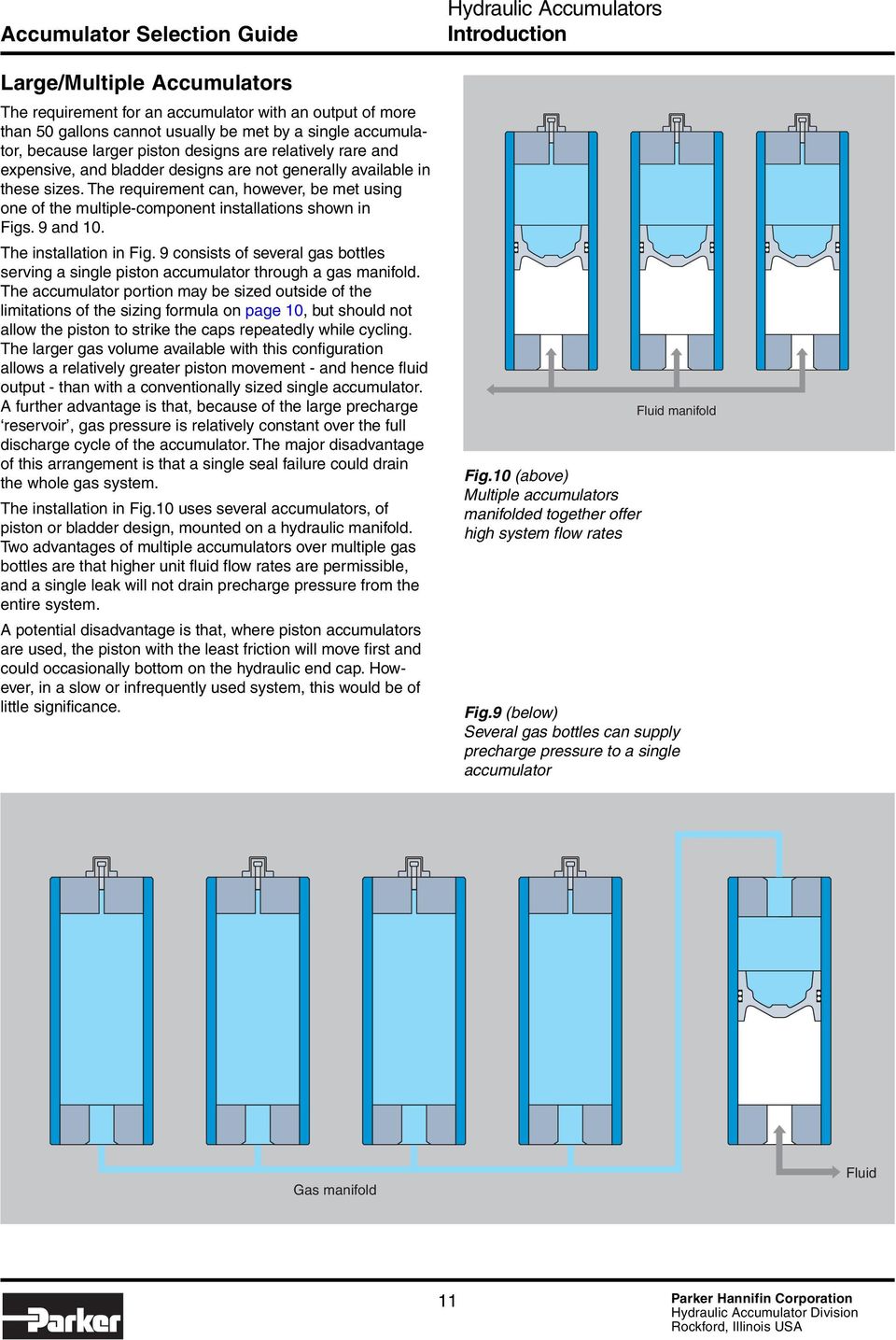
7 Large/Multiple Accumulators The requirement for an accumulator with an output of more than 50 gallons cannot usually be met by a single accumulator, because larger piston designs are relatively rare and expensive, and bladder designs are not generally available in these sizes. The requirement can, however, be met using one of the multiple-component installations shown in Figs. 9 and 10. The installation in Fig. 9 consists of several gas bottles serving a single piston accumulator through a gas manifold. The accumulator portion may be sized outside of the limitations of the sizing formula on page 10, but should not allow the piston to strike the caps repeatedly while cycling. The larger gas volume available with this configuration allows a relatively greater piston movement - and hence fluid output - than with a conventionally sized single accumulator. A further advantage is that, because of the large precharge reservoir, gas pressure is relatively constant over the full discharge cycle of the accumulator. The major disadvantage of this arrangement is that a single seal failure could drain the whole gas system. The installation in Fig.10 uses several accumulators, of piston or bladder design, mounted on a hydraulic manifold. Two advantages of multiple accumulators over multiple gas bottles are that higher unit fluid flow rates are permissible, and a single leak will not drain precharge pressure from the entire system. A potential disadvantage is that, where piston accumulators are used, the piston with the least friction will move first and could occasionally bottom on the hydraulic end cap. However, in a slow or infrequently used system, this would be of little significance. Fig.10 (above) Multiple accumulators manifolded together offer high system flow rates Fluid manifold Fig.9 (below) Several gas bottles can supply precharge pressure to a single accumulator Gas manifold Fluid 11 Parker Hannifin Corporation
8 ntents Accumulator Selection Guide Precharging Process Correct precharging involves accurately filling the gas side of an accumulator with a dry, inert gas such as nitrogen, before admitting fluid to the hydraulic side. It is important to precharge an accumulator to the correct specified pressure. Precharge pressure determines the volume of fluid retained in the accumulator at minimum system pressure. In an energy storage application, a bladder/diaphragm accumulator is typically precharged to 90% of minimum system pressure, and a piston accumulator to 95% of minimum system pressure at the system operating temperature. The ability to correctly carry out and maintain precharging is an important factor when choosing the type of accumulator for an application. Bladder accumulators are far more susceptible to damage during precharging than piston types. Before precharging and entering in service, the inside of the shell should be lubricated with system fluid. This fluid acts as a cushion, and lubricates and protects the bladder as it expands. When precharging, the first 50 PSI of nitrogen should be introduced slowly. Failure to follow this precaution could result in immediate bladder failure: high pressure nitrogen, expanding rapidly and thus cold, could form a channel in the folded bladder, concentrating at the bottom. The chilled, brittle rubber, expanding rapidly would then inevitably rupture (Fig. 11). The bladder could also be forced under the poppet, resulting in a cut. (Fig.12). Close attention should be paid to operating temperature during precharging, as a rise in temperature will cause a corresponding increase in pressure which could then exceed the precharge limit. Little damage can occur when precharging or checking the precharge on a piston accumulator, but care should be taken to make sure the accumulator is void of all fluid to prevent getting an incorrect reading on the precharge. Fig.11 Starburst rupture caused by loss of bladder elasticity Excessively High Precharge Excessive precharge pressure or a reduction in the minimum system pressure without a corresponding reduction in precharge pressure may cause operating problems or damage to accumulators. With excessive precharge pressure, a piston accumulator will cycle between stages (e) and (b) of Fig.2 see page 4, and the piston will travel too close to the hydraulic end cap. The piston could bottom at minimum system pressure, reducing output and eventually damaging the piston and piston seal. The piston can often be heard bottoming, warning of impending problems. An excessive precharge in a bladder accumulator can drive the bladder into the poppet assembly when cycling between stages (e) and (b). This could cause fatigue failure of the poppet spring assembly, or even a pinched and cut bladder, should it become trapped beneath the poppet as it is forced closed (Fig.12). Excessive precharge pressure is the most common cause of bladder failure. Excessively Low Precharge Excessively low precharge pressure or an increase in system pressure without a corresponding increase in precharge pressure can also cause operating problems and subsequent accumulator damage. With no precharge in a piston accumulator, the piston will be driven into the gas end cap and will often remain there. Usually, a single contact will not cause any damage, but repeated impacts will eventually damage the piston and seal. Conversely, for a bladder accumulator, too low or no precharge can have rapid and severe consequences. The bladder will be crushed into the top of the shell and can extrude into the gas stem and be punctured (Fig13). This condition is known as pick out. One such cycle is sufficient to destroy a bladder. Overall, piston accumulators are generally more tolerant of careless precharging. Fig.13 Fluid entering an un-precharged bladder accumulator has forced the bladder into the gas stem Fig.12 C-shaped cut shows that bladder has been trapped under poppet 12 Parker Hannifin Corporation

9 Monitoring Piston Accumulator Precharge Several methods can be used to monitor the precharge pressure of Parker s piston accumulators. Note that, in Figs.14b and 14c, flat pistons must be used to enable the sensors to register their positions. Pressure transducer With the hydraulic system shut down. A pressure transducer or gauge located in the gas end cap (Fig.14a) indicates the true precharge pressure after the hydraulic system has cooled and the accumulator has emptied of fluid. Fluid Fig.14a Pressure transducer measures actual precharge pressure of shut down system With the hydraulic system operating. A piston position sensor is installed in the hydraulic end cap (Fig.14b) and connected to an electronic measuring system. With an accurate initial precharge and after sufficient system operation to ensure thermal stability, the electronics can be calibrated to provide a continuous and accurate read-out of precharge pressure. Fluid Pressure transducer Sonar absolute position sensor Fig.14b Position sensor can provide continuous indication of precharge pressure In applications where an accumulator is coupled to a gas bottle, a Hall Effect proximity sensor can be installed in the accumulator gas end cap (Fig.14c) to detect when the piston comes within.050 inch of the cap. This system would provide a warning when precharge pressure has dropped and remedial action should be taken. Hall Effect proximity sensor Fluid Pressure transducer Fig.14c Hall Effect sensor registers proximity of piston to end cap 13 Parker Hannifin Corporation

10 ntents Accumulator Selection Guide A proximity or reed switch can be used in applications where it is desirable to know when the piston is approaching the gas cap of the accumulator or to detect a low precharge. When the rod is detected by the reed or proximity switch, the switch could be set up to send out a warning signal. When used with a pressure switch, it could detect a low precharge. In some instances two reed or proximity switches could be installed on the housing. It could be required that the first switch is always made, assuring us that the precharge is not too high; if the second switch is made, it would tell us that the precharge is to low. The position of the piston can be detected a fraction of an inch to several inches before it reaches the end cap. Proximity switch or Reed switch Magnet (only if Reed switch is used Rod Hyd. Port. Gas valve S.S.Housing Pressure switch Fig.14d Proximity switches can sense the position of an approaching piston.) Gas Bottle In some instances, it is extremely important to know the exact location of the piston inside the accumulator. By using a linear displacement transducer (LDT), this can be accomplished. Positions as well as velocities can be determined by the use of this unit. An LDT works by sending a signal down the probe. This signal is then reflected by a magnet attached to a rod and piston assembly. The LDT records the amount of time between sending and receiving the reflected signal and then calculates the position of the piston. Multiple signals will allow the unit to calculate velocity. The result of using this unit will allow the user to know the exact cubic inches of fluid in the accumulator as well as the flow rate of the fluid. Hyd. Port. Magnet LDT Probe Fig.14e Linear Displacement Transducers (LDT) can accurately detect both piston location and velocity 14 Parker Hannifin Corporation

11 Failure Prevention Accumulator failure is generally defined as inability to accept and exhaust a specified amount of fluid when operating over a specific system pressure range. Failure often results from an unwanted loss or gain of precharge pressure. It cannot be too highly stressed that correct precharge pressure is the most important factor in prolonging accumulator life. If maintenance of precharge pressure and relief valve settings is neglected, and if system pressures are adjusted without making corresponding adjustments to precharge pressures, shortened service life will result. Bladder Accumulators Bladder/Diaphragm accumulator failure occurs rapidly from bladder/diaphragm rupture (Fig.15). Rupture cannot be predicted because the intact bladder or diaphragm is essentially impervious to gas or fluid seepage; no measurable gas or fluid leakage through the bladder or diaphragm precedes failure. Precharge pressure PSI Precharge pressure PSI Precharge pressure PSI Number of cycles Number of cycles (a) Fig.15 When an accumulator bladder ruptures, precharge pressure immediately falls to zero As fluid leaks past an accumulator piston, precharge pressure rises (a). Gas leaking past the piston or valve causes precharge pressure to fall (b) Piston Accumulators Piston Accumulator failure generally occurs in one ofthe following gradual modes. Number of cycles (b) Fluid Leaks to the Gas Side This failure, sometimes called dynamic transfer, normally takes place during rapid cycling operations after considerable time in service. The worn piston seal carries a small amount of fluid into the gas side with each stroke. As the gas side slowly fills with fluid, precharge pressure rises and the accumulator stores and exhausts decreasing amounts of fluid. The accumulator will totally fail when precharge pressure equals maximum hydraulic system pressure. At that point, the accumulator will accept no further fluid. Because the rise in precharge pressure can be measured (Fig.15a), failure can be predicted and repairs effected before total failure occurs. Gas Leakage Precharge may be lost as gas slowly bypasses damaged piston seals. Seal deterioration occurs from excessively long service, from fluid contamination, or from a combination of the two. Gas can also vent directly through a defective gas core or end cap O-ring. The reducing precharge pressure then forces progressively less fluid into the system. Because this gradual decrease in precharge pressure can be measured (Fig.15b), repairs can again be effected before total failure occurs. Conclusions A correctly specified Parker accumulator, installed and maintained in accordance with the guidelines contained in this catalog, will give many years of trouble-free use. The combination of clean system fluid and accurate precharging will prevent most of the common fault conditions described here, and will contribute to the long life and high operating efficiency of the whole hydraulic system. 15 Parker Hannifin Corporation

WHAT YOU DON T KNOW ABOUT ACCUMULATORS CAN KILL YOU!
 WHAT YOU DON T KNOW ABOUT ACCUMULATORS CAN KILL YOU! Atlanta (Monroe) GA 770-267-3787 [email protected] www.gpmhydraulic.com What You Don t Know About Hydraulic Accumulators Can Kill You TABLE OF CONTENTS
LECTURE 28 to 29 ACCUMULATORS FREQUENTLY ASKED QUESTIONS
 LECTURE 28 to 29 ACCUMULATORS FREQUENTLY ASKED QUESTIONS 1. Define an accumulator and explain its function A hydraulic accumulator is a device that stores the potential energy of an incompressible fluid
Example. Fluid Power. Circuits
 Example Fluid Power Circuits To Enhance Symbol Reading Skills To Work On Circuit Reading Skills With Answers HI LO Pump Circuit 18 A1 B1 17 16 15 13 Set 14 2,000 PSI PG2 Set 500 PSI 12 11 7 8 10 PG1 9
Material taken from Fluid Power Circuits and Controls, John S. Cundiff, 2001
 Pressure Control Chapter 3 Material taken from Fluid Power Circuits and Controls, John S. Cundiff, 2001 Introduction Pressure control is a key element in the design of any circuit. Used correctly, it can
GENERAL APPLICATIONS 1 E 01-12
 GENERAL APPLICATIONS 1 E 01-12 HYDRAULIC ACCUMULATORS 1.1 APPLICATION FIELDS 1.2 APPLICATIONS 1.3 CERTIFICATIONS 1.4 ELASTOMERS 1.5 HYDRAULIC ACCUMULATORS 1.1 E 01-12 1.1.1 GENERAL The main task of the
Piston Accumulators. SK Series. Accumulator Catalog. Piston Types. Description. Sealing Systems. End Cap. O-ring. Sealing System. Piston.
 SK Series Piston Types TYPE 2 pplication: Low-friction design for higher piston speeds, slow movements without stick-slip effect and high number of actuations (millions). ctual cycles achieved will vary
Unit 24: Applications of Pneumatics and Hydraulics
 Unit 24: Applications of Pneumatics and Hydraulics Unit code: J/601/1496 QCF level: 4 Credit value: 15 OUTCOME 2 TUTORIAL 2 HYDRAULIC AND PNEUMATIC CYLINDERS The material needed for outcome 2 is very extensive
Why and How we Use Capacity Control
 Why and How we Use Capacity Control On refrigeration and air conditioning applications where the load may vary over a wide range, due to lighting, occupancy, product loading, ambient weather variations,
V47 Series Temperature Actuated Modulating Water Valves
 V47 Series Temperature Actuated Modulating Water Valves Master Catalog 125 Valves, Miscellaneous (Other Than Gas) Section V Product Bulletin V47 Issue Date 0286 Application The V47 modulating valves regulate
Index 11.1. Page. Pumping Systems...11.2-11.4 Intensifiers...11.5 Gas Boosters...11.6-11.7 High Pressure Generators...11.8-11.9
 Pumping Systems, Intensifiers, Gas Boosters and High Pressure Generators High Pressure Equipment Company produces a number of components and systems for general industrial, elevated pressure applications.
Unit 24: Applications of Pneumatics and Hydraulics
 Unit 24: Applications of Pneumatics and Hydraulics Unit code: J/601/1496 QCF level: 4 Credit value: 15 OUTCOME 2 TUTORIAL 4 DIRECTIONAL CONTROL VALVES The material needed for outcome 2 is very extensive
The Secret of Hydraulic Schematics. BTPHydraulics www.iranfluidpower.com
 The Secret of Hydraulic Schematics BTPHydraulics www.iranfluidpower.com www.iranfluidpower.com Table of Contents The Secret to Reading and Interpreting Hydraulic Schematics... 1 Hydraulic System Schematics...
Tech. Services: (800) 477-8326 Fax: (800) 765-8326 Order Entry: (800) 541-1418 Fax: (800) 288-7031 Internet Address: http://www.powerteam.
 ORIGINAL INSTRUCTIONS Form No.102842 5 SPX Hydraulic Technologies 5885 11th Street Rockford, IL 61109-3699 USA Tech. Services: (800) 477-8326 Fax: (800) 765-8326 Order Entry: (800) 541-1418 Fax: (800)
Force measurement. Forces VECTORIAL ISSUES ACTION ET RÉACTION ISOSTATISM
 Force measurement Forces VECTORIAL ISSUES In classical mechanics, a force is defined as "an action capable of modifying the quantity of movement of a material point". Therefore, a force has the attributes
ACCUMULATOR INSTALLATION
 7001-7 ACCUMULATOR INSTALLATION BRAKE ACCUMULATORS I 308L93 Rae 7-59710 Issued 6-93 Printed in U.S.A 7001-8 Removal ACCUMULATOR VALVE 1. Park the machine on a level surface and lower the. loader bucket
BLADDER SURGE CONTROL SYSTEM
 PART I GENERAL 1.01 Description BLADDER SURGE CONTROL SYSTEM This specification describes the requirements for a Bladder Surge Control System. The purpose of the system is to minimize transient pressures
Fluid Power Formula. These Formula Cover All Fluid Power Applications In This Manual
 These Formula Cover All Fluid Power Applications In This Manual For Computer Programs To Work Problems By Simply Filling In The Blanks See Your Local Fluid Power Distributor Many Companies Web Site Or
COUNTERBALANCE VALVES
 COUNTERBALANCE VALVES Introduction They are modulating valves which allow free flow into the actuator and then block the reverse flow until they feel a pilot pressure inversely proportional to the load
Standard Hydraulic Piping Flushing Procedure
 Page 1 of 6 1.0 Scope This procedure covers the minimum technical requirements for cleaning and flushing of Hydraulic and Piping, and related accessories. 2.0 Introduction In hydraulic fluid power systems,
Oildyne. 165 Series Hydraulic Power Units. Pressures to 241 bar (3500 psi) Flows to 5.4 lpm (1.4 gpm)
 Oildyne Hydraulic Power Units Pressures to 241 bar (3500 psi) Flows to 5.4 lpm (1.4 gpm) 11 Power Unit Features We are pleased to introduce our new power units. The power units let you put more power where
Hydraulic Trouble Shooting
 Hydraulic Trouble Shooting Hydraulic systems can be very simple, such as a hand pump pumping up a small hydraulic jack, or very complex, with several pumps, complex valving, accumulators, and many cylinders
Heating Water by Direct Steam Injection
 Heating Water by Direct Steam Injection Producing hot water by direct steam injection provides a solution where large volumes of hot water at precise temperatures are required, and where energy and space
Basic Hydraulics and Pneumatics
 Basic Hydraulics and Pneumatics Module 1: Introduction to Pneumatics PREPARED BY IAT Curriculum Unit March 2011 Institute of Applied Technology, 2011 ATM 1122 Basic Hydraulics and Pneumatics Module 1:
TECHNICAL INFORMATION Bulletin
 Peerless Pump Company 2005 Dr. M.L. King Jr. Street, P.O. Box 7026, Indianapolis, IN 46207-7026, USA Telephone: (317) 925-9661 Fax: (317) 924-7338 www.peerlesspump.com www.epumpdoctor.com TECHNICAL INFORMATION
Pressure drop in pipes...
 Pressure drop in pipes... PRESSURE DROP CALCULATIONS Pressure drop or head loss, occurs in all piping systems because of elevation changes, turbulence caused by abrupt changes in direction, and friction
CYLINDER LEAKAGE CHECK (Compression)
 TELEDYNE CONTINENTAL AIRCRAFT ENGINE service bulletin M84-15 SUPERSEDES M76-18 Rev.1 Technical Portions are FAA Approved 21 December 1984 TO: SUBJECT: MODELS AFFECTED: Aircraft Manufacturers, Distributors,
APPLIED PNEUMATICS AND HYDRAULICS H TUTORIAL HYDRAULIC AND PNEUMATIC CYLINDERS. This work covers part of outcome 2 of the standard Edexcel module.
 APPLIED PNEUMATICS AND HYDRAULICS H TUTORIAL HYDRAULIC AND PNEUMATIC CYLINDERS This work covers part of outcome 2 of the standard Edexcel module. The material needed for outcome 2 is very extensive so
C. starting positive displacement pumps with the discharge valve closed.
 KNOWLEDGE: K1.04 [3.4/3.6] P78 The possibility of water hammer in a liquid system is minimized by... A. maintaining temperature above the saturation temperature. B. starting centrifugal pumps with the
Mechanical Seal Piping Plans
 Mechanical Seal Piping Plans Single Seals plans 01, 02, 03, 11, 13, 14, 21, 23, 31, 32, 41 Dual Seals plans 52, 53A, 53B, 53C, 54, 55 Quench Seals plans 62, 65A, 65B, 66A, 66B Gas Seals plans 72, 74, 75,
Pressure Relief and Regulating Valves
 Pressure Relief and Regulating Valves With blocked center directional valves and variable displacement pumps, or open center directional valves and fixed displacement pumps where fast response, low leakage
SELECTION, APPLICATION AND MAINTENANCE
 DIESEL PROTECTION SYSTEMS D-Series Engine Automatic Overspeed Shut Down Valves (Spindle Types with Air Pressure and Manual Shut Down Options) SELECTION, APPLICATION AND MAINTENANCE Valve Numbers D92-AP
Unit 6: EXTRUSION. Difficult to form metals like stainless steels, nickel based alloys and high temperature metals can also be extruded.
 1 Unit 6: EXTRUSION Introduction: Extrusion is a metal working process in which cross section of metal is reduced by forcing the metal through a die orifice under high pressure. It is used to produce cylindrical
TRAINING AND EQUIPMENT MANUAL HOSE PRACTICES EFFECTIVE: OCTOBER 2007
 TRAINING AND EQUIPMENT MANUAL HOSE PRACTICES 301.010 ANNUAL SERVICE TEST FOR FIRE HOSE EFFECTIVE: OCTOBER 2007 The Department will test all fire hose annually. The testing of fire hose determines its serviceability.
Hydraulic control unit series 0086-372-01
 Technical Product Information No. 1290 EN Hydraulic control unit series 0086-372-01 Contents Page About this Technical Product Information (TPI) 2 The ORTLINGHAUS numbering system 2 About the product 3
Pump ED 101. Positive Displacement Pumps. Part I Reciprocating Pumps
 Pump ED 101 Positive Displacement Pumps Part I Reciprocating Pumps Joe Evans, Ph.D http://www.pumped101.com There are many pump designs that fall into the positive displacement category but, for the most
Specific Volume of Liquid (Column 7). The volume per unit of mass in cubic feet per pound.
 Steam Tables What They Are How to Use Them The heat quantities and temperature/ pressure relationships referred to in this Handbook are taken from the Properties of Saturated Steam table. Definitions of
Hydraulic Troubleshooting PRESENTED BY
 Hydraulic Troubleshooting PRESENTED BY NORMAN KRONOWITZ Introduction Welcome to the CMA/Flodyne/Hydradyne s Hydraulic Troubleshooting presentation. We will introduce many aspects of troubleshooting hydraulic
NFPA31FuelOilPiping 1 Revised 3-1-11
 NFPA 31 Fuel Oil Piping, Installation and Testing Chapter 8 Fuel Piping Systems and Components 8.1 Scope. This chapter shall apply to piping systems and their components used to transfer fuel oil from
KNC Model 3666 Automatic Pressure Calibration System
 KNC Model 3666 Automatic Pressure Calibration System Product Description The Model 3666 Automatic Pressure Calibration (APC) System by King Nutronics Corporation is a portable secondary standards laboratory
AIR LINE VALVES AND GAUGES
 AIR LINE VALVES AND GAUGES INGERSOLL-RAND AIR LINE VALVES AND GAUGES Maintaining consistent air pressure throughout the entire system is crucial for maximum performance and productivity. Ingersoll-Rand
Steam System Best Practices Condensate System Piping
 Steam System Best Practices Condensate System Piping Summary The best method for improving steam system energy efficiency, reducing chemical costs, and reducing make-up water costs is to return the maximum
ENGINE COOLING SYSTEM
 ENGINE COOLING SYSTEM 1988 Toyota Celica 1987-88 TOYOTA Engine Cooling Systems Celica DESCRIPTION The basic liquid cooling system consists of a radiator, water pump, thermostat, cooling fan, pressure cap,
MASTER CYLINDER. Section 2. Master Cylinder. Tandem Master Cylinder. Master Cylinder
 MASTER CYLINDER Master Cylinder The master cylinder converts the motion of the brake pedal into hydraulic pressure. It consists of the reservoir tank, which contains the brake fluid; and the piston and
Rexroth Hydraulic Pump A10VO Series User Manual
 Rexroth Hydraulic Pump A10VO Series User Manual Rexroth Hydraulic pump A10VO Series User Manual Revised 5/1/2009 Page 1 of 12 Functional Purpose This pump is preferred over a fixed displacement (gear)
Air Eliminators and Combination Air Eliminators Strainers
 Description Air Eliminators and Combination Air Eliminator Strainers are designed to provide separation, elimination and prevention of air in piping systems for a variety of installations and conditions.
System Saver 318 Air Compressor for Mack E-Tech and ASET Engines
 Maintenance Manual 31 System Saver 318 Air Compressor for Mack E-Tech and ASET Engines Revised 08-05 NON-THROUGH DRIVE THROUGH DRIVE Service Notes About This Manual This manual provides service and repair
Accumulators and Receivers
 aerospace climate control electromechanical filtration fluid & gas handling hydraulics pneumatics process control sealing & shielding Accumulators and Receivers Catalog C-1, October 2007 Page 2 / Catalog
SELECTION, APPLICATION & MAINTENANCE
 DIESEL PROTECTION SYSTEMS TPZ Engine Air Intake Shut Down Valves (Combined Automatic Overspeed and Air Pressure Operated Shut Down Bendix Types) SELECTION, APPLICATION & MAINTENANCE Valve Numbers TPZ-101
PRESSURE REDUCING CONTROL VALVE
 Schematics Throttles to reduce high upstream pressure to constant lower downstream pressure Low Flow By-Pass controls at low flows 4 PRESSURE REDUCING CONTROL VALVE with LOW FLOW BY-PASS FEATURE Main Line
Oil and Coolant Circulating Heating System. Model - OCSM
 Oil and Coolant Circulating Heating System Model - OCSM Installation & Operation Manual 216280-000 REV 2 Identifying Your System The HOTSTART heating system is designed to heat fluids for use in marine
Unit 24: Applications of Pneumatics and Hydraulics
 Unit 24: Applications of Pneumatics and Hydraulics Unit code: J/601/1496 QCF level: 4 Credit value: 15 OUTCOME 2 TUTORIAL 1 HYDRAULIC PUMPS The material needed for outcome 2 is very extensive so there
RV TIRE MAINTENANCE AND INFLATION TIPS
 RV TIRE MAINTENANCE AND INFLATION TIPS PROTECTING YOUR INVESTMENT ON THE ROAD Maintaining proper air pressure in RV tires is the best way to enhance tread life and overall performance. Improper tire inflation
Pump Ratio and Performance Charts
 Pump Ratio and Performance Charts Concept and Theory Training Table of Contents Introduction... 1 Overview... 1 How to use this Module... 2 Learning Objectives...2 Text...2 Charts, Illustrations...2 Progress
CDS TROUBLESHOOTING SECTION I. VACUUM. 1.0. Weak vacuum at wand. Gauge reads normal (10hg to 14hg)
 CDS TROUBLESHOOTING SECTION I. VACUUM 1.0. Weak vacuum at wand. Gauge reads normal (10hg to 14hg) 1.1. Clogged hoses or wand tube. Disconnect hoses and carefully check for an obstruction. 1.2. Excessive
*Rated to 207 Bar/3000 PSI with Aluminum Body. Catalog HY15-3501/US SERIES CAVITY DESCRIPTION FLOW PRESSURE PAGE NO.
 Bodies & Contents SERIES CAVITY DESCRIPTION FLOW PRESSURE PAGE NO. /GPM BAR/PSI STANDARD CHECKS D1A6... 2U... Valve Insert, Ball Type...145/38... 42/6... 5 D1B125... 2C... Valve Insert, Ball Type... 5/132...
Installation Manual DIAPHRAGM WELL TANK
 Installation Manual DIAPHRAGM WELL TANK Safety Instructions Installation Warranty IN-LINE SERIES: 2-5 & 7 GALLON HORIZONTAL SERIES: 7-14 & 20 GALLON VERTICAL SERIES: 14-20-32-36-52-86-96-119 GALLON KEEP
CONTAMINANT REMOVAL FROM CENTRIFUGAL SYSTEMS
 CONTAMINANT REMOVAL FROM CENTRIFUGAL SYSTEMS BULLETIN 240-10-3 June 2004 Supersedes June 1983 Many centrifugal systems get little maintenance. As a result they operate with the refrigerant highly contaminated
100DHP TM CCI DRAG Control Valve For High Pressure Turbine Bypass
 100DHP TM CCI DRAG Control Valve For High Pressure Turbine Bypass 2 What is a HP Turbine Bypass Valve? It routes high pressure, high temperature steam around the HP Turbine, from the main steam line typically
Installation Manual DIAPHRAGM WELL TANK
 Installation Manual DIAPHRAGM WELL TANK IN-LINE SERIES: 2-5 & 7 GALLON VERTICAL SERIES: 14-20-25-32-36-52-65-86-96-119 GALLON HORIZONTAL SERIES: 7-14 & 20 GALLON NO LEAD NO LEAD: The weighted average of
Chapter 7 Hydraulic System Troubleshooting
 Chapter 7 Hydraulic System Troubleshooting General The following troubleshooting information is provided as a general guide to identify, locate and correct problems that may be experienced with the hydraulic
NITROUS TRANSFER PUMP INSTRUCTIONS
 NITROUS TRANSFER PUMP INSTRUCTIONS SAFETY TIPS Never directly inhale nitrous oxide. When inhaled in large quantities, nitrous oxide can cause respiratory ailments or in extreme cases, death by suffocation.
Hydraulic multidisc Brake H420
 S320gb - rev 02/09 S E R V I C E Hydraulic multidisc Brake H420 A N U A L WARNER ELECTRIC EUROPE Rue Champfleur, B.P. 20095, F- 49182 St Barthélemy d Anjou Cedex Tél. +33 (0)2 41 21 24 24, Fax + 33 (0)2
Class 5 to 7 Truck and Bus Hydraulic Brake System
 Class 5 to 7 Truck and Bus Hydraulic Brake System Diagnostic Guide 1st Edition * 5+0 Important Service tes The information in this publication was current at the time of printing. The information presented
Quiz On Information Learned From Chapter 1
 Quiz On Information Learned From Chapter 1 1. Most hydraulic circuits are designed by: A. mechanical engineers. B. fluid power engineers. C. fluid power distributor salesmen. 2. Atmospheric pressure at
SITEMA PowerStroke. Technical Information TI-P12. 1 Function. 2 Applications. Mould Closing Devices series FSKP. Contents
 SITEMA PowerStroke FSP ocking, actuating and releasing by pneumatic pressure English translation of German original Technical Information TI-P1 SITEMA PowerStroke Mould Closing Devices series FSP drive
Daniel. Liquid Control Valves Technical Guide. Technical Guide DAN-LIQ-TG-44-rev0813. DAN-LIQ-TG-44-rev0208. February 2008.
 DAN-LIQ-TG-44-rev0208 February 2008 Daniel Liquid Control Valves Technical Guide www.daniel.com Daniel Measurement and Control Theory, Principle of Operation and Applications This brochure has been prepared
SIMPLIFIED VALVE CIRCUIT GUIDE
 SIMPLIFIED CIRCUIT GUIDE A GUIDE TO UNDERSTANDG PNEUMATIC DIRECTIONAL CONTROL S SOLENOID NO. 0 OUT 0 FLOW CONTROL METERED- FREE FLOW 0 0 OUT CYLDER TENDED Z-00 Compressed Air Valves Directional control
Liquid level measurement using hydrostatic pressure and buoyancy
 iquid level measurement using hydrostatic pressure and buoyancy This worksheet and all related files are licensed under the Creative Commons Attribution icense, version 1.0. To view a copy of this license,
ENERGY RETROFIT PROGRAM
 ENERGY RETROFIT PROGRAM An innovative but simple retrofit for existing hot water and chilled water piping systems that will help you save money. REDUCE FLOW BY 50% REDUCE PUMP HEAD BY 75% REDUCE PUMP POWER
Laddomat 21-60 Charging unit
 Laddomat 21-60 Charging unit User and installation instructions NOTE! Diagrams in this brochure only describe connection principles. Each installation must be measured and carried out according to the
Schematic Symbols Chart (Design Hydraulic and Pneumatic circits)
 Page 1 of 6 (Home) Symbols / Visit us on: Fluid Power, Automation and Motion Control for all Industries About Us Products Services Catalogs Place an Order Training & Information Contact Us Employee Access
Recommended Product Specifications Fuel Day Tank System Tramont UTRS Fuel Day Tank
 Recommended Product Specifications Fuel Day Tank System Tramont UTRS Fuel Day Tank This specification describes requirements for a Diesel Fuel Day Tank System consisting of one or more fuel tanks, an Electronic
THE STRAIN GAGE PRESSURE TRANSDUCER
 THE STRAIN GAGE PRESSURE TRANSDUCER Pressure transducers use a variety of sensing devices to provide an electrical output proportional to applied pressure. The sensing device employed in the transducers
Rental Services Temporary Cooling - Flexible Water Hose
 Engineering Bulletin Rental Services Temporary Cooling - Flexible Water Hose September 2006 CHS-PRB007-EN Warnings and Cautions Warnings and Cautions. Notice that warnings and cautions appear at appropriate
Chapter 5 Shock Absorber Design
 Chapter 5 Shock Absorber Design 5.1. Introduction The basic function of the shock absorber is to absorb and dissipate the impact kinetic energy to the extent that accelerations imposed upon the airframe
PERFORMANCE TEST REPORT. Rendered to: FORMTECH ENTERPRISES, INC. SERIES/MODEL: Truline PRODUCT TYPE: PVC Seawall
 PERFORMANCE TEST REPORT Rendered to: FORMTECH ENTERPRISES, INC. SERIES/MODEL: Truline PRODUCT TYPE: PVC Seawall Report No.: Test Dates: 04/17/12 Through: 04/18/12 Report Date: 06/13/12 130 Derry Court
SUSPENSION AND STEERING OVERVIEW
 SUSPENSION SUSPENSION AND STEERING OVERVIEW The S40/V50 has a wide track and a long wheelbase for its relative size and weight. This gives the car stable and predictable driving characteristics. It also
Section 6 Brake Drum Failure Analysis. Brake Drum Wear Conditions. What is Normal Wear? What is Deep or Excessive Wear? WARNING. Deep, Uniform Wear
 Section Brake Drum 6 Failure Analysis WARNING To prevent serious eye injury, always wear safe eye protection when you perform vehicle maintenance or service. Figure 6.1 ASBESTOS AND NON-ASBESTOS FIBERS
4 SENSORS. Example. A force of 1 N is exerted on a PZT5A disc of diameter 10 mm and thickness 1 mm. The resulting mechanical stress is:
 4 SENSORS The modern technical world demands the availability of sensors to measure and convert a variety of physical quantities into electrical signals. These signals can then be fed into data processing
Flowserve - Edward Valves Development of the Flowserve Edward Equiwedge Gate Valve
 Flowserve - Edward Valves Development of the Flowserve Edward Equiwedge Gate Valve Problem Gate valves in severe service applications that experience premature trim wear from seat guided discs or leakage
AKRON EDUCTORS TROUBLESHOOTING GUIDE OPERATION & THEORY OF EDUCTORS GENERAL OPERATING AND MAINTENANCE INSTRUCTIONS
 AKRON EDUCTORS TROUBLESHOOTING GUIDE OPERATION & THEORY OF EDUCTORS GENERAL OPERATING AND MAINTENANCE INSTRUCTIONS Products Include: 60 gpm eductors Style 3060, 3061, 3062 & 3070 95 gpm eductors Style
Extract of the White paper Reduce energy costs in compressed air systems by up to 60%
 Extract of the White paper Reduce energy costs in compressed air systems by up to 60% How can potential energy savings be identified? There are various measures for realising potential savings in compressed
Chapter 19 Purging Air from Piping and Vessels in Hydrocarbon Service
 BP Lower 48 Onshore Operations Safety Manual Page 4.19 1 Chapter 19 Purging Air from Piping and Vessels in Hydrocarbon Service I. General Requirements A. After motor vehicle accidents and underground excavation
Fire Pump Plan Review March 2010
 Fire Pump Plan Review March 2010 Date of Review: / / Permit Number: Business/Building Name: Address of Project: Designer Name: Designer s Phone: Contractor: Contractor s Phone: Occupancy Classification:
HYDRAULIC ACCUMULATOR. Energy buffering applications APPLICATIONS OSP 035. Applications with short term high quantity oil requirements
 HYDRAULIC ACCUMULATOR APPLICATIONS OSP 035 Energy buffering applications Energy saving - the capacity of buffering energy is one of the main features of OLAER hydraulic accumulators. Hydraulic installations
Mustang Series PRESSURE REDUCING CONTROL VALVE WITH PRESSURE SUSTAINING FEATURE. M115-2 (Globe) M1115-2 (Angle) Schematic. Standard Components
 Schematic Throttles to reduce high upstream pressure to constant lower downstream pressure Throttles to maintain minimum upstream pressure PRESSURE REDUCING CONTROL VALVE WITH PRESSURE SUSTAINING FEATURE
Volkswagen Jetta, Golf, GTI 1999, 2000 2.8 Liter VR6 2V Engine Mechanical, Engine Code(s): AFP 17 Engine-Lubrication (Page GR-17)
 17 Engine-Lubrication (Page GR-17) Lubrication system components, removing and installing Oil filter housing, disassembling and assembling Oil pan, removing and installing Oil pressure and oil pressure
10 TON HYDRAULIC PRESS
 10 TON HYDRAULIC PRESS Model Nos. CSA10F and CSA10B OPERATING & MAINTENANCE INSTRUCTIONS 0200 SPARE PARTS and SERVICING Please contact your nearest dealer, or CLARKE International, on one of the following
HIGH PRESSURE TECHNOLOGY HYDRAULICS PNEUMATICS TESTING EQUIPMENT
 HIGH PRESSURE TECHNOLOGY HYDRAULICS PNEUMATICS TESTING EQUIPMENT MAXIMATOR GmbH 2 MAXIMATOR has an extensive know-how concerning concept, development, construction and manufacturing of test benches and
HYDRAULIC LIFT TABLE CART 2200-LB.
 HYDRAULIC LIFT TABLE CART 2200-LB. OWNER S MANUAL WARNING: Read carefully and understand all MACHINE ADJUSTMENT AND OPERATION INSTRUCTIONS before operating. Failure to follow the safety rules and other
SITEMA PowerStroke. Technical Information TI-P11. 1 Function. 2 Applications. Mould Closing Devices series FSK. Contents
 English translation of German original Technical Information TI-P11 SITEMA PowerStroke Mould Closing Devices series FS drive system for powerful forces on a short stroke hydraulic actuation closing force
Model: 400E-2M. Bermad Electrically Controlled Deluge Valve with Easy Lock Manual Reset. Installation Operation Maintenance. Application Engineering
 Model: 400E-2M Bermad Electrically Controlled Deluge Valve with Easy Lock Manual Reset Installation Operation Maintenance Application Engineering BERMAD 1. Safety First BERMAD believes that the safety
15CI and 25CI Reversing Motor Pumpset Owner's Manual
 ComNav Marine Autopilots #15-13511 Crestwood Place Richmond, BC Canada V6V 2G1 Telephone: 604-207-1600 Fax: 604-207-8008 In Canda or the U.S.A: Toll Free Phone: 1-800-428-0212 Toll Free Fax 1-800-470-9611
Indirect-Fired Storage Water Heater Models WH-30 through WH-80 INSTALLATION AND OPERATING INSTRUCTIONS
 Indirect-Fired Storage Water Heater Models WH-30 through WH-80 INSTALLATION AND OPERATING INSTRUCTIONS Contents Page Ratings and Specifications..................... 2 Installation Requirements......................
Stainless Steel Pipe Fabrication
 Stainless Steel Pipe Fabrication Dr M J Fletcher, Delta Consultants, Rutland UK We are now all too familiar with demands to reduce manufacturing costs. Fabrication of stainless steel poses particular problems.
Lenntech. 1000 psi End port pressure vessels 2.5. User s Guide to: Phoenix Vessel Technology Limited. Model number: 1503
 1 User s Guide to: Phoenix Vessel Technology Limited 1000 psi End port pressure vessels 2.5. Model number: 1503 Lenntech [email protected] Tel. +31-152-610-900 www.lenntech.com Fax. +31-152-616-289 Phoenix
Series 510 Submersible Level Transmitters
 Series 510 Submersible Level Transmitters The Series 510 Submersible Level Transmitters are solid state instruments designed for direct submergence into many types of liquid for quick, accurate and reliable
COMPRESSED GASES. 1.2 The contents of each cylinder and container must be clearly identified (by tag or stamp) on the cylinder.
 Page 1 of 5 COMPRESSED GASES A compressed gas is defined as any mixture of gases in a container with a pressure exceeding 40 psi. at 70 o F, or 104 psi. at 130 o F; or any flammable liquid with an absolute
SERIES ASM NEOPRENE/EPMD FLANGED SINGLE SPHERE CONNECTOR CONNECTORS. Pressures to 225 PSIG (15.51 barg) Temperatures to 230ºF (110ºC)
 APPLICATIONS Process Industry Weak Acids Alkalies Compressed Air Pulp & Paper MODELS ASM - Flanged Connection OPTIONS Control Rods Oil & Gas Water & Waste Pump suction & discharge Sea water Chemical lines
OPERATING and MAINTENANCE MANUAL SERIES 2700A CONTROL VALVE CONTENTS. INTRODUCTION...1 Scope...1 Description...1 Valve Identification...
 OPERATING and MAINTENANCE MANUAL SERIES 2700A CONTROL VALVE CONTENTS INTRODUCTION...1 Scope...1 Description...1 Valve Identification...2 1.0 VALVE INSTALLATION...2 2.0 VALVE MAINTENANCE...3 Actuator Disassembly...3